WO2023120088A1 - 自動分析装置およびその制御方法 - Google Patents
自動分析装置およびその制御方法 Download PDFInfo
- Publication number
- WO2023120088A1 WO2023120088A1 PCT/JP2022/044310 JP2022044310W WO2023120088A1 WO 2023120088 A1 WO2023120088 A1 WO 2023120088A1 JP 2022044310 W JP2022044310 W JP 2022044310W WO 2023120088 A1 WO2023120088 A1 WO 2023120088A1
- Authority
- WO
- WIPO (PCT)
- Prior art keywords
- probe
- peak value
- capacitance
- automatic analyzer
- unit
- Prior art date
- Legal status (The legal status is an assumption and is not a legal conclusion. Google has not performed a legal analysis and makes no representation as to the accuracy of the status listed.)
- Ceased
Links
Images



Classifications
-
- G—PHYSICS
- G01—MEASURING; TESTING
- G01N—INVESTIGATING OR ANALYSING MATERIALS BY DETERMINING THEIR CHEMICAL OR PHYSICAL PROPERTIES
- G01N35/00—Automatic analysis not limited to methods or materials provided for in any single one of groups G01N1/00 - G01N33/00; Handling materials therefor
- G01N35/10—Devices for transferring samples or any liquids to, in, or from, the analysis apparatus, e.g. suction devices, injection devices
- G01N35/1009—Characterised by arrangements for controlling the aspiration or dispense of liquids
- G01N35/1011—Control of the position or alignment of the transfer device
-
- G—PHYSICS
- G01—MEASURING; TESTING
- G01D—MEASURING NOT SPECIALLY ADAPTED FOR A SPECIFIC VARIABLE; ARRANGEMENTS FOR MEASURING TWO OR MORE VARIABLES NOT COVERED IN A SINGLE OTHER SUBCLASS; TARIFF METERING APPARATUS; MEASURING OR TESTING NOT OTHERWISE PROVIDED FOR
- G01D5/00—Mechanical means for transferring the output of a sensing member; Means for converting the output of a sensing member to another variable where the form or nature of the sensing member does not constrain the means for converting; Transducers not specially adapted for a specific variable
- G01D5/12—Mechanical means for transferring the output of a sensing member; Means for converting the output of a sensing member to another variable where the form or nature of the sensing member does not constrain the means for converting; Transducers not specially adapted for a specific variable using electric or magnetic means
- G01D5/14—Mechanical means for transferring the output of a sensing member; Means for converting the output of a sensing member to another variable where the form or nature of the sensing member does not constrain the means for converting; Transducers not specially adapted for a specific variable using electric or magnetic means influencing the magnitude of a current or voltage
- G01D5/24—Mechanical means for transferring the output of a sensing member; Means for converting the output of a sensing member to another variable where the form or nature of the sensing member does not constrain the means for converting; Transducers not specially adapted for a specific variable using electric or magnetic means influencing the magnitude of a current or voltage by varying capacitance
- G01D5/241—Mechanical means for transferring the output of a sensing member; Means for converting the output of a sensing member to another variable where the form or nature of the sensing member does not constrain the means for converting; Transducers not specially adapted for a specific variable using electric or magnetic means influencing the magnitude of a current or voltage by varying capacitance by relative movement of capacitor electrodes
- G01D5/2417—Mechanical means for transferring the output of a sensing member; Means for converting the output of a sensing member to another variable where the form or nature of the sensing member does not constrain the means for converting; Transducers not specially adapted for a specific variable using electric or magnetic means influencing the magnitude of a current or voltage by varying capacitance by relative movement of capacitor electrodes by varying separation
-
- G—PHYSICS
- G01—MEASURING; TESTING
- G01F—MEASURING VOLUME, VOLUME FLOW, MASS FLOW OR LIQUID LEVEL; METERING BY VOLUME
- G01F23/00—Indicating or measuring liquid level or level of fluent solid material, e.g. indicating in terms of volume or indicating by means of an alarm
- G01F23/22—Indicating or measuring liquid level or level of fluent solid material, e.g. indicating in terms of volume or indicating by means of an alarm by measuring physical variables, other than linear dimensions, pressure or weight, dependent on the level to be measured, e.g. by difference of heat transfer of steam or water
- G01F23/26—Indicating or measuring liquid level or level of fluent solid material, e.g. indicating in terms of volume or indicating by means of an alarm by measuring physical variables, other than linear dimensions, pressure or weight, dependent on the level to be measured, e.g. by difference of heat transfer of steam or water by measuring variations of capacity or inductance of capacitors or inductors arising from the presence of liquid or fluent solid material in the electric or electromagnetic fields
- G01F23/263—Indicating or measuring liquid level or level of fluent solid material, e.g. indicating in terms of volume or indicating by means of an alarm by measuring physical variables, other than linear dimensions, pressure or weight, dependent on the level to be measured, e.g. by difference of heat transfer of steam or water by measuring variations of capacity or inductance of capacitors or inductors arising from the presence of liquid or fluent solid material in the electric or electromagnetic fields by measuring variations in capacitance of capacitors
-
- G—PHYSICS
- G01—MEASURING; TESTING
- G01F—MEASURING VOLUME, VOLUME FLOW, MASS FLOW OR LIQUID LEVEL; METERING BY VOLUME
- G01F23/00—Indicating or measuring liquid level or level of fluent solid material, e.g. indicating in terms of volume or indicating by means of an alarm
- G01F23/22—Indicating or measuring liquid level or level of fluent solid material, e.g. indicating in terms of volume or indicating by means of an alarm by measuring physical variables, other than linear dimensions, pressure or weight, dependent on the level to be measured, e.g. by difference of heat transfer of steam or water
- G01F23/26—Indicating or measuring liquid level or level of fluent solid material, e.g. indicating in terms of volume or indicating by means of an alarm by measuring physical variables, other than linear dimensions, pressure or weight, dependent on the level to be measured, e.g. by difference of heat transfer of steam or water by measuring variations of capacity or inductance of capacitors or inductors arising from the presence of liquid or fluent solid material in the electric or electromagnetic fields
- G01F23/263—Indicating or measuring liquid level or level of fluent solid material, e.g. indicating in terms of volume or indicating by means of an alarm by measuring physical variables, other than linear dimensions, pressure or weight, dependent on the level to be measured, e.g. by difference of heat transfer of steam or water by measuring variations of capacity or inductance of capacitors or inductors arising from the presence of liquid or fluent solid material in the electric or electromagnetic fields by measuring variations in capacitance of capacitors
- G01F23/265—Indicating or measuring liquid level or level of fluent solid material, e.g. indicating in terms of volume or indicating by means of an alarm by measuring physical variables, other than linear dimensions, pressure or weight, dependent on the level to be measured, e.g. by difference of heat transfer of steam or water by measuring variations of capacity or inductance of capacitors or inductors arising from the presence of liquid or fluent solid material in the electric or electromagnetic fields by measuring variations in capacitance of capacitors for discrete levels
-
- G—PHYSICS
- G01—MEASURING; TESTING
- G01F—MEASURING VOLUME, VOLUME FLOW, MASS FLOW OR LIQUID LEVEL; METERING BY VOLUME
- G01F23/00—Indicating or measuring liquid level or level of fluent solid material, e.g. indicating in terms of volume or indicating by means of an alarm
- G01F23/22—Indicating or measuring liquid level or level of fluent solid material, e.g. indicating in terms of volume or indicating by means of an alarm by measuring physical variables, other than linear dimensions, pressure or weight, dependent on the level to be measured, e.g. by difference of heat transfer of steam or water
- G01F23/26—Indicating or measuring liquid level or level of fluent solid material, e.g. indicating in terms of volume or indicating by means of an alarm by measuring physical variables, other than linear dimensions, pressure or weight, dependent on the level to be measured, e.g. by difference of heat transfer of steam or water by measuring variations of capacity or inductance of capacitors or inductors arising from the presence of liquid or fluent solid material in the electric or electromagnetic fields
- G01F23/263—Indicating or measuring liquid level or level of fluent solid material, e.g. indicating in terms of volume or indicating by means of an alarm by measuring physical variables, other than linear dimensions, pressure or weight, dependent on the level to be measured, e.g. by difference of heat transfer of steam or water by measuring variations of capacity or inductance of capacitors or inductors arising from the presence of liquid or fluent solid material in the electric or electromagnetic fields by measuring variations in capacitance of capacitors
- G01F23/266—Indicating or measuring liquid level or level of fluent solid material, e.g. indicating in terms of volume or indicating by means of an alarm by measuring physical variables, other than linear dimensions, pressure or weight, dependent on the level to be measured, e.g. by difference of heat transfer of steam or water by measuring variations of capacity or inductance of capacitors or inductors arising from the presence of liquid or fluent solid material in the electric or electromagnetic fields by measuring variations in capacitance of capacitors measuring circuits therefor
-
- G—PHYSICS
- G01—MEASURING; TESTING
- G01F—MEASURING VOLUME, VOLUME FLOW, MASS FLOW OR LIQUID LEVEL; METERING BY VOLUME
- G01F23/00—Indicating or measuring liquid level or level of fluent solid material, e.g. indicating in terms of volume or indicating by means of an alarm
- G01F23/22—Indicating or measuring liquid level or level of fluent solid material, e.g. indicating in terms of volume or indicating by means of an alarm by measuring physical variables, other than linear dimensions, pressure or weight, dependent on the level to be measured, e.g. by difference of heat transfer of steam or water
- G01F23/26—Indicating or measuring liquid level or level of fluent solid material, e.g. indicating in terms of volume or indicating by means of an alarm by measuring physical variables, other than linear dimensions, pressure or weight, dependent on the level to be measured, e.g. by difference of heat transfer of steam or water by measuring variations of capacity or inductance of capacitors or inductors arising from the presence of liquid or fluent solid material in the electric or electromagnetic fields
- G01F23/263—Indicating or measuring liquid level or level of fluent solid material, e.g. indicating in terms of volume or indicating by means of an alarm by measuring physical variables, other than linear dimensions, pressure or weight, dependent on the level to be measured, e.g. by difference of heat transfer of steam or water by measuring variations of capacity or inductance of capacitors or inductors arising from the presence of liquid or fluent solid material in the electric or electromagnetic fields by measuring variations in capacitance of capacitors
- G01F23/268—Indicating or measuring liquid level or level of fluent solid material, e.g. indicating in terms of volume or indicating by means of an alarm by measuring physical variables, other than linear dimensions, pressure or weight, dependent on the level to be measured, e.g. by difference of heat transfer of steam or water by measuring variations of capacity or inductance of capacitors or inductors arising from the presence of liquid or fluent solid material in the electric or electromagnetic fields by measuring variations in capacitance of capacitors mounting arrangements of probes
-
- G—PHYSICS
- G01—MEASURING; TESTING
- G01F—MEASURING VOLUME, VOLUME FLOW, MASS FLOW OR LIQUID LEVEL; METERING BY VOLUME
- G01F23/00—Indicating or measuring liquid level or level of fluent solid material, e.g. indicating in terms of volume or indicating by means of an alarm
- G01F23/80—Arrangements for signal processing
- G01F23/802—Particular electronic circuits for digital processing equipment
- G01F23/804—Particular electronic circuits for digital processing equipment containing circuits handling parameters other than liquid level
-
- G—PHYSICS
- G01—MEASURING; TESTING
- G01N—INVESTIGATING OR ANALYSING MATERIALS BY DETERMINING THEIR CHEMICAL OR PHYSICAL PROPERTIES
- G01N35/00—Automatic analysis not limited to methods or materials provided for in any single one of groups G01N1/00 - G01N33/00; Handling materials therefor
- G01N35/10—Devices for transferring samples or any liquids to, in, or from, the analysis apparatus, e.g. suction devices, injection devices
- G01N35/1004—Cleaning sample transfer devices
-
- G—PHYSICS
- G01—MEASURING; TESTING
- G01N—INVESTIGATING OR ANALYSING MATERIALS BY DETERMINING THEIR CHEMICAL OR PHYSICAL PROPERTIES
- G01N35/00—Automatic analysis not limited to methods or materials provided for in any single one of groups G01N1/00 - G01N33/00; Handling materials therefor
- G01N35/10—Devices for transferring samples or any liquids to, in, or from, the analysis apparatus, e.g. suction devices, injection devices
- G01N35/1009—Characterised by arrangements for controlling the aspiration or dispense of liquids
- G01N2035/1025—Fluid level sensing
Definitions
- the present invention relates to an automatic analyzer and its control method.
- Patent Literature 1 discloses a technique for detecting displacement of the lowered position of a probe by diverting a capacitance detection mechanism used for a liquid level detection function provided in an automatic analyzer.
- Patent Literature 1 Although the technique described in Patent Literature 1 can detect the displacement of the probe in the height direction, it is difficult to detect the displacement of the probe in the horizontal direction.
- SUMMARY OF THE INVENTION It is an object of the present invention to provide an automatic analyzer and a method of controlling the same that can determine the horizontal positional deviation of a probe by utilizing a capacitance-type liquid level detection function in the automatic analyzer.
- an automatic analyzer includes a pipetting mechanism capable of driving a probe for sucking or discharging a liquid in horizontal and vertical directions, and a control unit for controlling the dispensing mechanism and the capacitance measurement unit, wherein the control unit comprises the electrostatic A liquid level detection unit for detecting the liquid level of the liquid based on the capacitance measured by the capacitance measurement unit; a peak value calculation unit that calculates peak values of capacitance caused by a first member and a second member that are installed on the other side and the other side and are separated by a predetermined distance in the moving direction; and a position determining unit that determines the horizontal position of the probe by comparing a first peak value resulting from the second member with a second peak value resulting from the second member.
- a method for controlling an automatic analyzer includes the step of detecting the liquid level of a liquid based on the capacitance measured by the capacitance measuring unit; When the mechanism is driven in the horizontal direction, the capacitance caused by the first member and the second member placed on one side and the other side of the movement trajectory of the probe with a predetermined distance in the movement direction. and the control unit compares a first peak value caused by the first member and a second peak value caused by the second member to determine whether the probe is horizontal. and determining a directional position.
- an automatic analyzer capable of determining horizontal displacement of the probe and a control method thereof.
- FIG. 4 is a schematic diagram showing a dispensing mechanism and a determination jig; The perspective view which shows the structure of the jig
- FIG. 4 is a top view showing the rotation trajectory of the probe and the judgment jig; A graph showing the capacitance measured for each distance traveled by the probe.
- Functional block diagram of the automatic analyzer. 4 is a flow chart for probe position determination and correction.
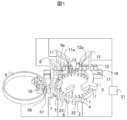
- FIG. 1 is a perspective view showing the overall configuration of the automatic analyzer.
- the automatic analyzer is a device that dispenses a sample (specimen) and a reagent into a plurality of reaction containers 2, causes them to react, and measures the reacted liquid.
- the automatic analyzer includes a reaction disk (incubator) 1, a reagent disk 9, a sample transport mechanism 17, reagent dispensing mechanisms 7 and 8, sample dispensing mechanisms 11 and 12, a washing mechanism 3, a spectrophotometer 4, stirring mechanisms 5 and 6, a cleaning pump (not shown), cleaning tanks 13, 14, 22, 23, 56 and 57, and a controller 21.
- the automatic analyzer further includes a display unit 51 and an input unit 52 .
- Reaction containers 2 are arranged on the circumference of the reaction disk 1.
- a sample transport mechanism 17 for moving a sample rack 16 carrying sample containers 15 (test tubes) is installed near the reaction disk 1 .
- a test sample such as blood is stored in the sample container 15 , placed on the sample rack 16 and transported by the sample transport mechanism 17 .
- Specimen dispensing mechanisms 11 and 12 that are rotatable and vertically movable are installed between the reaction disk 1 and the specimen transport mechanism 17 .
- the specimen pipetting mechanisms 11 and 12 are provided with specimen probes 11a and 12a. The specimen probes 11a and 12a move while drawing arcs around the rotating shafts of the specimen pipetting mechanisms 11 and 12, and the specimen containers 15 to the reaction containers 2 are moved. Dispense the sample to
- a plurality of reagent bottles 10 can be placed on the circumference of the reagent disk 9 .
- the reagent disk 9 is kept cool.
- reagent dispensing mechanisms 7 and 8 that can rotate and move up and down are installed.
- Reagent dispensing mechanisms 7 and 8 are provided with reagent probes 7a and 8a, respectively.
- a reagent is dispensed into the container 2 .
- a washing mechanism 3 for washing the reaction container 2 after measurement, stirring mechanisms 5 and 6 for stirring a mixed solution (reaction solution) of the reagent and the sample in the reaction container 2,
- a light source (not shown) and a spectrophotometer 4 are arranged for irradiating the mixed solution (reaction solution) of the above with light and measuring, for example, the absorbance thereof.
- Washing tanks 13, 14, 57, 56, 23, and 22 are installed above the moving ranges of the specimen dispensing mechanisms 11 and 12, the reagent dispensing mechanisms 7 and 8, and the stirring mechanisms 5 and 6, respectively.
- Each mechanism of the automatic analyzer is connected to the controller 21 via an interface 50 (not shown in FIG. 1) and controlled by the controller 21 .
- Analysis processing of test specimens by automatic analyzers is generally performed in the following order.
- the sample in the sample container 15 placed on the sample rack 16 transported to the vicinity of the reaction disk 1 by the sample transport mechanism 17 is aspirated by the sample probe 11a of the sample pipetting mechanism 11 and placed on the reaction disk 1. is discharged into the reaction vessel 2.
- a reagent to be used for analysis is aspirated from the reagent bottle 10 on the reagent disk 9 by the reagent probe 7a of the reagent dispensing mechanism 7 or the reagent probe 8a of the reagent dispensing mechanism 8, and the sample is previously dispensed. Discharge to container 2 .
- the mixture of the sample and the reagent in the reaction container 2 is stirred by the stirring mechanism 5 .
- the light generated from the light source is transmitted through the reaction container 2 containing the mixed liquid, and the luminosity of the transmitted light is measured by the spectrophotometer 4 .
- the light intensity measured by the spectrophotometer 4 is transmitted to the controller 21 via the A/D converter and interface 50 .
- the control unit 21 performs an operation for calculating the concentration of a predetermined component of the analysis item according to the reagent from the absorbance of the mixed liquid (reaction liquid).
- the obtained measurement results are displayed on the display unit 51 (not shown in FIG. 1).
- An automatic analyzer that determines the concentration of a predetermined component using the spectrophotometer 4 will be described as an example. It may be used in an analyzer or an automatic coagulation analyzer.
- the automatic analyzer has a liquid surface detection function that detects whether the probe has come into contact with the liquid surface based on changes in the capacitance of the tip of the probe.
- the electrostatic capacitance measuring section provided in the probe for detecting the liquid level is diverted to determine whether the probe is displaced in the horizontal direction. Then, based on the capacitance measured between the determination jig fixed or detachably provided in the automatic analyzer, the displacement of the movement trajectory of the probe is determined, and the position of the probe is corrected as necessary. The method will be explained in detail.
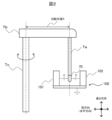
- FIG. 2 is a schematic diagram showing a uniaxial pipetting mechanism with a radius of gyration R and a judgment jig arranged in an automatic analyzer.
- reagent dispensing mechanism 7 described above will be described below as an example, other dispensing mechanisms such as the specimen dispensing mechanisms 11 and 12 and the reagent dispensing mechanism 8 described above can be similarly applied. is.
- the reagent dispensing mechanism 7 includes a reagent probe 7a for aspirating or discharging liquid, an arm 7b for supporting the reagent probe 7a, and a rotating shaft capable of rotating in the horizontal direction and displacing in the height direction. 7c.
- the reagent probe 7a is capable of rotational movement in the horizontal plane and vertical movement in the height direction in correspondence with the operation of the rotary shaft 7c by the control unit 21 . Further, the reagent probe 7a is capable of sucking and discharging liquid in correspondence with the operation of a syringe (not shown) by the control unit 21 .
- the reagent probe 7a of the reagent pipetting mechanism 7 rotates and moves onto the vertical projection of the reagent bottle 10, it descends and dips into the reagent in the reagent bottle 10 to aspirate the reagent.
- the reagent probe 7 a of the reagent pipetting mechanism 7 rises, rotates, moves onto the vertical projection of the reaction container 2 , and descends to discharge the reagent into the reaction container 2 .
- the reagent probe 7a is provided with a capacitance measuring section 70 that measures the capacitance between it and its surroundings.
- the capacitance measurement unit 70 transmits the measured capacitance to the control unit 21 via the interface 50 (see FIG. 6).
- a determination jig 100 for determining the positional deviation of the reagent probe 7a is arranged at a location corresponding to the horizontal movement locus of the reagent probe 7a, for example, in the cleaning tank 57 for cleaning the reagent probe 7a.
- the determination jig 100 has a first member 101 and a second member 102 located on one side and the other side of the movement locus of the reagent probe 7a.
- the first member 101 and the second member 102 are made of a conductive material and connected to GND potential.
- the placement location of the determination jig 100 is not limited to the cleaning tank as long as it is within the movement range of the probe and is a non-rotating structure.
- the determination jig 100 can be placed in a constant temperature bath that maintains the temperature of the reaction container 2, a disposal hole of the reaction container 2, or the like.
- the determination jig 100 may be fixed in advance to a structure on the automatic analyzer, or may be detachable. If it is detachable, for example, the determination jig 100 is attached before determining the positional deviation of the reagent probe 7a, and removed after determining the positional deviation of the reagent probe 7a.
- FIG. 3 is a perspective view showing the structure of the determination jig 100.
- the determination jig 100 of the present embodiment is composed of a base 103 on the bottom surface, and a first member 101 and a second member 102 which are two members protruding upward from the base 103. Configured. Further, the determination jig 100 is desirably made of a conductive material as described above. It may be made of any material. Note that the base 103, the first member 101, and the second member 102 may constitute the determination jig 100 integrally, or may constitute the determination jig 100 by assembling separate members. good.
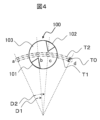
- FIG. 4 is a top view showing the rotation trajectory of the probe and the jig for determination
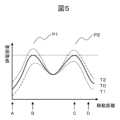
- FIG. 5 is a graph showing the capacitance measured for each moving distance of the probe. Circumferential positions a to d in FIG. 4 correspond to movement distances A to D in FIG.
- the capacitance measured by the capacitance measuring unit 70 has two peaks as the reagent probe 7a moves. Specifically, when the reagent probe 7a starts rotating from the circumferential position a, the capacitance gradually increases, and when the reagent probe 7a reaches the circumferential position b, which is the point of closest approach to the first member 101, , the capacitance becomes the first peak value (P1). As the reagent probe 7a rotates further, the capacitance gradually decreases, and then increases again at the intermediate point between the circumferential position b and the circumferential position c.
- the capacitance reaches the second peak value (P2), and thereafter the capacitance gradually decreases.
- the two peaks overlap and become difficult to distinguish. preferably.
- the first member 101 is installed on the inner diameter side of the circular movement locus of the reagent probe 7a
- the second member 102 is installed on the outer diameter side of the circular movement locus of the reagent probe 7a.
- the reagent probe 7a is set in advance so that it passes through the middle of the outer diameter side end of the first member 101 and the inner diameter side end of the second member 102 in the radial direction. Therefore, when the reagent probe 7a is in a normal position and the movement locus is the locus T0 in FIG. 4, the capacitance measured by the capacitance measuring unit 70 is waveform. That is, the first peak value (P1) caused by the first member 101 and the second peak value (P2) caused by the second member 102 are substantially the same.
- the first peak value (P1) becomes the second peak value (P2 ) becomes larger.
- the second peak value (P2) becomes the first peak value ( P1) becomes larger. Therefore, by calculating the first peak value (P1) that appears first and the second peak value (P2) that appears next, and comparing which value is larger, the radial direction of the reagent probe 7a can be determined. Positional deviation can be determined. In this way, since a plurality of peak values are relatively compared and determined, the determination accuracy is higher than that of comparing any one peak value (absolute value) with a reference value.
- the movement amount (rotational angle D1) or the movement time from the rotation start position (circumferential position a in FIG. 4) to the position (circumferential position b in FIG. 4) corresponding to the first peak value (P1) is predetermined. It is also possible to determine the positional deviation of the reagent probe 7a in the circumferential direction depending on whether it is within the range. In determining the positional deviation of the reagent probe 7a in the circumferential direction, the position from the rotation start position (circumferential position a in FIG. 4) to the position corresponding to the second peak value (P2) (circumferential position c in FIG. 4) A movement amount (rotational angle D2) or a movement time may be used.
- the reference circumferential position is not limited to the rotation start position, and may be another position (for example, the circumferential position d in FIG. 4).
- the tip of the protruding portion and the reagent probe 7a are at the shortest distance. Then the capacitance increases abruptly, and when the shortest distance is passed, the capacitance abruptly decreases. As a result, the peak of the capacitance measured by the capacitance measuring unit 70 becomes conspicuous, and the positional deviation determination accuracy is improved.
- FIG. 6 is a functional block diagram of the automatic analyzer. In addition, in FIG. 6, functions other than the calculation related to the capacitance are omitted.
- the control unit 21 is a computer having a processor and a memory, and as shown in FIG. there is Note that the liquid level detection unit 21a, the peak value calculation unit 21b, the position determination unit 21c, and the position correction unit 21d are functions realized by a processor executing a program stored in the memory.
- the liquid surface detection unit 21a detects whether the probe has reached the liquid surface from the change in capacitance measured by the capacitance measurement unit 70 when the dispensing mechanism is lowered.
- the peak value calculator 21b calculates the peak values of capacitance caused by the first member 101 and the second member 102, respectively.
- the position determination unit 21c determines the radial position of the probe by comparing the first peak value (P1) and the second peak value (P2). In addition, the position determination unit 21c determines whether the movement amount or the movement time from the reference position of the probe to the position corresponding to the first peak value (P1) or the second peak value (P2) is within a predetermined range. , the probe can also determine the circumferential position.
- the display unit 51 and the input unit 52 are also connected to the control unit 21 via the interface 50.
- the display unit 51 displays a warning or the like when the position determination result is abnormal, and is, for example, a display.
- the input unit 52 is used when the user inputs operation information and the like, and is, for example, a keyboard.
- FIG. 7 is a flow chart for determining and correcting the probe position.
- the automatic adjustment function that corrects the position of the probe when it is determined that there is a positional deviation will be described below.
- the position correction of the probe may be performed by a maintenance person. Note that the timing at which the automatic adjustment function is executed includes the time of exchanging the probe or the constant temperature bath, the time of initializing the automatic analyzer, the time of maintenance, and the like.
- step S1 when the maintenance person operates the automatic adjustment function execution button using the input unit 52, the automatic adjustment function starts. Then, the control unit 21 outputs a message to the display unit 51 prompting to attach the determination jig 100 to a predetermined position of the automatic analyzer (step S1). It should be noted that step S1 is not necessary if the determination jig 100 is fixed in advance to the washing tank 57 or the like of the automatic analyzer.
- the control unit 21 drives the reagent dispensing mechanism 7 in the height direction to raise the reagent probe 7a to a predetermined height for position determination. moves (step S2). Furthermore, the control unit 21 drives the reagent dispensing mechanism 7 in the horizontal direction, and the reagent probe 7a moves to the determination start point (step S3).
- the reagent probe 7a starts rotating from the determination start point, first passes near the first member 101, then passes near the second member 102, and reaches the determination end point (step S4).
- the peak value calculation unit 21b of the control unit 21 calculates the first peak value (P1) and the second peak value (P2), and the position corresponding to the first peak value (P1) from the determination start point.
- a movement amount or movement time up to the point is calculated (step S5).
- step S5 if the peak value, movement amount, or movement time cannot be calculated, a warning or the like prompting confirmation of whether the jig for determination 100 is correctly installed is output via the display unit 51 (step S6).
- step S5 when the peak value or the like can be calculated, the position determination unit 21c determines whether or not the first peak value (P1) and the second peak value (P2) are substantially the same (step S7).
- the reagent probe 7a is out of position in the radial direction. That is, the position determination unit 21c determines that the reagent probe 7a is displaced toward the inner diameter side when P1 is greater than P2, and determines that the reagent probe 7a is displaced toward the outer diameter side when P2 is greater than P1. .
- the position correction unit 21d corrects the radial position of the reagent probe 7a according to the determination result of the position determination unit 21c (step S8). If the reagent dispensing mechanism 7 does not have an actuator capable of radially moving the reagent probe 7a, a message may be output via the display unit 51 to prompt the maintenance person to correct the position. .
- step S9 determines whether or not the movement amount or the movement time calculated in step S6 is within a predetermined range.
- step S9 If it is determined in step S9 that the reagent probe 7a is out of the predetermined range, the position correction unit 21d calculates the difference from the design value as an adjustment value in the circumferential direction (step S10). Next, the position correction unit 21d determines whether or not the adjustment value is within a specified range (step S11).
- step S11 If it is determined in step S11 that the adjustment value is outside the specified range, a warning is output via the display unit 51 (step S12). On the other hand, if it is determined in step S11 that the adjustment value is within the specified range, the adjustment value is reflected in the automatic analyzer (step S13), and the automatic adjustment function ends.
- positional deviation of the probe in the radial direction and the circumferential direction is determined, and the position is corrected as necessary. This improves the reliability of automated analyzers.
- the present invention is not limited to the above-described embodiments, and various modifications are possible.
- the pipetting mechanism rotates on one axis so that the probe draws a circular trajectory. It may be one that moves linearly or one that moves linearly.
- the first member 101 and the second member 102 are not limited to the horizontal cross-sectional shape shown in FIG. 4, and may have a circular or polygonal horizontal cross section.
- the contour (tilt) in the height direction of the portion of the first member 101 and the second member 102 that faces the movement locus follows the contour (tilt) in the height direction of the capacitance measuring unit 70 at the tip of the probe. By doing so, the range of increase in capacitance when each member and the probe approach each other may be increased, and the S/N ratio may be increased.
- first member 101 and the second member 102 may be concave with respect to the base 103 instead of being convex with respect to the base 103 as shown in FIG. In this case, since the capacitance decreases as the first member and the second member approach, the position of the probe is determined by calculating the minimum value of the capacitance caused by each member.
- the number of members provided in the determination jig 100 is not limited to two, the first member and the second member, and may be three or more. Further, when determining only the circumferential positional deviation of the probe without determining the positional deviation of the probe in the radial direction, the determination jig 100 does not need to have a plurality of convex or concave members. It need only have a single member that is convex or concave along the trajectory of probe movement.
Landscapes
- Physics & Mathematics (AREA)
- Engineering & Computer Science (AREA)
- General Physics & Mathematics (AREA)
- Power Engineering (AREA)
- Fluid Mechanics (AREA)
- Thermal Sciences (AREA)
- Electromagnetism (AREA)
- Health & Medical Sciences (AREA)
- Life Sciences & Earth Sciences (AREA)
- Chemical & Material Sciences (AREA)
- Analytical Chemistry (AREA)
- Biochemistry (AREA)
- General Health & Medical Sciences (AREA)
- Immunology (AREA)
- Pathology (AREA)
- Signal Processing (AREA)
- Automatic Analysis And Handling Materials Therefor (AREA)
Priority Applications (4)
| Application Number | Priority Date | Filing Date | Title |
|---|---|---|---|
| JP2023569235A JP7809140B2 (ja) | 2021-12-24 | 2022-12-01 | 自動分析装置およびその制御方法 |
| CN202280073047.3A CN118176424A (zh) | 2021-12-24 | 2022-12-01 | 自动分析装置及其控制方法 |
| US18/713,240 US20250020682A1 (en) | 2021-12-24 | 2022-12-01 | Automatic Analyzer and Control Method Thereof |
| EP22910805.5A EP4455680A4 (en) | 2021-12-24 | 2022-12-01 | AUTOMATIC ANALYSIS DEVICE AND CONTROL METHOD FOR IT |
Applications Claiming Priority (2)
| Application Number | Priority Date | Filing Date | Title |
|---|---|---|---|
| JP2021210778 | 2021-12-24 | ||
| JP2021-210778 | 2021-12-24 |
Publications (1)
| Publication Number | Publication Date |
|---|---|
| WO2023120088A1 true WO2023120088A1 (ja) | 2023-06-29 |
Family
ID=86902088
Family Applications (1)
| Application Number | Title | Priority Date | Filing Date |
|---|---|---|---|
| PCT/JP2022/044310 Ceased WO2023120088A1 (ja) | 2021-12-24 | 2022-12-01 | 自動分析装置およびその制御方法 |
Country Status (5)
| Country | Link |
|---|---|
| US (1) | US20250020682A1 (https=) |
| EP (1) | EP4455680A4 (https=) |
| JP (1) | JP7809140B2 (https=) |
| CN (1) | CN118176424A (https=) |
| WO (1) | WO2023120088A1 (https=) |
Citations (11)
| Publication number | Priority date | Publication date | Assignee | Title |
|---|---|---|---|---|
| JP2005300330A (ja) * | 2004-04-12 | 2005-10-27 | Nikon Corp | 位置測定方法 |
| JP2008281365A (ja) * | 2007-05-08 | 2008-11-20 | Shimadzu Corp | マイクロチップ電気泳動装置 |
| JP2009300152A (ja) * | 2008-06-11 | 2009-12-24 | Hitachi High-Technologies Corp | 自動分析装置 |
| JP2010249601A (ja) * | 2009-04-14 | 2010-11-04 | Toshiba Corp | 自動分析装置 |
| JP2011033551A (ja) | 2009-08-05 | 2011-02-17 | Hitachi High-Technologies Corp | 自動分析装置及び分注装置の制御方法 |
| JP2012173059A (ja) * | 2011-02-18 | 2012-09-10 | Hitachi High-Technologies Corp | 分析装置 |
| JP2012181136A (ja) * | 2011-03-02 | 2012-09-20 | Sysmex Corp | 分析装置及び位置確認方法 |
| WO2012157642A1 (ja) * | 2011-05-16 | 2012-11-22 | 株式会社日立ハイテクノロジーズ | 自動分析装置及び方法 |
| JP2015087329A (ja) * | 2013-10-31 | 2015-05-07 | シスメックス株式会社 | 吸引部の位置調整方法及び検体処理装置 |
| WO2015079873A1 (ja) * | 2013-11-27 | 2015-06-04 | 株式会社島津製作所 | 自動試料注入装置 |
| JP2021139825A (ja) * | 2020-03-09 | 2021-09-16 | 株式会社日立ハイテク | 自動分析装置 |
Family Cites Families (2)
| Publication number | Priority date | Publication date | Assignee | Title |
|---|---|---|---|---|
| US5529754A (en) * | 1994-05-02 | 1996-06-25 | Hoffmann-La Roche Inc. | Apparatus for capacitatively determining the position of a pipetting needle within an automated analyzer |
| CN109115258B (zh) * | 2018-06-21 | 2020-10-23 | 迈克医疗电子有限公司 | 一种检测装置的校准方法、装置和终端设备 |
-
2022
- 2022-12-01 WO PCT/JP2022/044310 patent/WO2023120088A1/ja not_active Ceased
- 2022-12-01 EP EP22910805.5A patent/EP4455680A4/en active Pending
- 2022-12-01 JP JP2023569235A patent/JP7809140B2/ja active Active
- 2022-12-01 US US18/713,240 patent/US20250020682A1/en active Pending
- 2022-12-01 CN CN202280073047.3A patent/CN118176424A/zh active Pending
Patent Citations (11)
| Publication number | Priority date | Publication date | Assignee | Title |
|---|---|---|---|---|
| JP2005300330A (ja) * | 2004-04-12 | 2005-10-27 | Nikon Corp | 位置測定方法 |
| JP2008281365A (ja) * | 2007-05-08 | 2008-11-20 | Shimadzu Corp | マイクロチップ電気泳動装置 |
| JP2009300152A (ja) * | 2008-06-11 | 2009-12-24 | Hitachi High-Technologies Corp | 自動分析装置 |
| JP2010249601A (ja) * | 2009-04-14 | 2010-11-04 | Toshiba Corp | 自動分析装置 |
| JP2011033551A (ja) | 2009-08-05 | 2011-02-17 | Hitachi High-Technologies Corp | 自動分析装置及び分注装置の制御方法 |
| JP2012173059A (ja) * | 2011-02-18 | 2012-09-10 | Hitachi High-Technologies Corp | 分析装置 |
| JP2012181136A (ja) * | 2011-03-02 | 2012-09-20 | Sysmex Corp | 分析装置及び位置確認方法 |
| WO2012157642A1 (ja) * | 2011-05-16 | 2012-11-22 | 株式会社日立ハイテクノロジーズ | 自動分析装置及び方法 |
| JP2015087329A (ja) * | 2013-10-31 | 2015-05-07 | シスメックス株式会社 | 吸引部の位置調整方法及び検体処理装置 |
| WO2015079873A1 (ja) * | 2013-11-27 | 2015-06-04 | 株式会社島津製作所 | 自動試料注入装置 |
| JP2021139825A (ja) * | 2020-03-09 | 2021-09-16 | 株式会社日立ハイテク | 自動分析装置 |
Non-Patent Citations (1)
| Title |
|---|
| See also references of EP4455680A4 |
Also Published As
| Publication number | Publication date |
|---|---|
| CN118176424A (zh) | 2024-06-11 |
| JP7809140B2 (ja) | 2026-01-30 |
| EP4455680A1 (en) | 2024-10-30 |
| EP4455680A4 (en) | 2025-12-17 |
| JPWO2023120088A1 (https=) | 2023-06-29 |
| US20250020682A1 (en) | 2025-01-16 |
Similar Documents
| Publication | Publication Date | Title |
|---|---|---|
| EP2711716B1 (en) | Automatic analytical device and method | |
| JP5143636B2 (ja) | 自動分析装置 | |
| JP6272645B2 (ja) | 自動分析装置 | |
| JP7309637B2 (ja) | 自動分析装置 | |
| US20240003926A1 (en) | Automatic analyzer, position adjustment tool, and position adjustment method | |
| WO2021245989A1 (ja) | 自動分析装置 | |
| JP4812352B2 (ja) | 自動分析装置及びその分注方法 | |
| JP2016183913A (ja) | 自動分析装置 | |
| JP5903054B2 (ja) | 自動分析装置 | |
| WO2023120088A1 (ja) | 自動分析装置およびその制御方法 | |
| JP5854647B2 (ja) | 自動分析装置 | |
| EP4310508A1 (en) | Automatic analysis device | |
| WO2020195500A1 (ja) | 自動分析装置 | |
| JP6895792B2 (ja) | 自動分析装置 | |
| JP2021173555A (ja) | 自動分析装置 | |
| WO2025239054A1 (ja) | 自動分析装置 | |
| JP2026017766A (ja) | 自動分析装置、反応ディスクの傾斜確認方法、及びプログラム | |
| JP7105112B2 (ja) | 分注ユニット、自動分析装置及び液面検出判定方法 | |
| CN121955422A (zh) | 样本分析仪和超声校准方法 | |
| JP2025035764A (ja) | 撹拌プローブ及び撹拌装置 | |
| JP2023085943A (ja) | 自動分析装置 | |
| CN117288967A (zh) | 样本分析仪及清洗流量检测方法 | |
| CN120233097A (zh) | 样本分析仪及混匀控制方法 | |
| JP2019138765A (ja) | 自動分析装置 | |
| JP2010117176A (ja) | 分析装置とその分注制御方法 |
Legal Events
| Date | Code | Title | Description |
|---|---|---|---|
| 121 | Ep: the epo has been informed by wipo that ep was designated in this application |
Ref document number: 22910805 Country of ref document: EP Kind code of ref document: A1 |
|
| WWE | Wipo information: entry into national phase |
Ref document number: 202280073047.3 Country of ref document: CN |
|
| WWE | Wipo information: entry into national phase |
Ref document number: 18713240 Country of ref document: US |
|
| WWE | Wipo information: entry into national phase |
Ref document number: 2023569235 Country of ref document: JP |
|
| NENP | Non-entry into the national phase |
Ref country code: DE |
|
| ENP | Entry into the national phase |
Ref document number: 2022910805 Country of ref document: EP Effective date: 20240724 |