WO2023119980A1 - 転倒防止装置及び搬送装置 - Google Patents
転倒防止装置及び搬送装置 Download PDFInfo
- Publication number
- WO2023119980A1 WO2023119980A1 PCT/JP2022/042846 JP2022042846W WO2023119980A1 WO 2023119980 A1 WO2023119980 A1 WO 2023119980A1 JP 2022042846 W JP2022042846 W JP 2022042846W WO 2023119980 A1 WO2023119980 A1 WO 2023119980A1
- Authority
- WO
- WIPO (PCT)
- Prior art keywords
- arm
- vehicle body
- overturn prevention
- state
- overturn
- Prior art date
- Legal status (The legal status is an assumption and is not a legal conclusion. Google has not performed a legal analysis and makes no representation as to the accuracy of the status listed.)
- Ceased
Links
Images


Classifications
-
- B—PERFORMING OPERATIONS; TRANSPORTING
- B66—HOISTING; LIFTING; HAULING
- B66F—HOISTING, LIFTING, HAULING OR PUSHING, NOT OTHERWISE PROVIDED FOR, e.g. DEVICES WHICH APPLY A LIFTING OR PUSHING FORCE DIRECTLY TO THE SURFACE OF A LOAD
- B66F9/00—Devices for lifting or lowering bulky or heavy goods for loading or unloading purposes
- B66F9/06—Devices for lifting or lowering bulky or heavy goods for loading or unloading purposes movable, with their loads, on wheels or the like, e.g. fork-lift trucks
- B66F9/063—Automatically guided
-
- B—PERFORMING OPERATIONS; TRANSPORTING
- B60—VEHICLES IN GENERAL
- B60S—SERVICING, CLEANING, REPAIRING, SUPPORTING, LIFTING, OR MANOEUVRING OF VEHICLES, NOT OTHERWISE PROVIDED FOR
- B60S9/00—Ground-engaging vehicle fittings for supporting, lifting, or manoeuvring the vehicle, wholly or in part, e.g. built-in jacks
- B60S9/02—Ground-engaging vehicle fittings for supporting, lifting, or manoeuvring the vehicle, wholly or in part, e.g. built-in jacks for only lifting or supporting
-
- B—PERFORMING OPERATIONS; TRANSPORTING
- B66—HOISTING; LIFTING; HAULING
- B66F—HOISTING, LIFTING, HAULING OR PUSHING, NOT OTHERWISE PROVIDED FOR, e.g. DEVICES WHICH APPLY A LIFTING OR PUSHING FORCE DIRECTLY TO THE SURFACE OF A LOAD
- B66F9/00—Devices for lifting or lowering bulky or heavy goods for loading or unloading purposes
- B66F9/06—Devices for lifting or lowering bulky or heavy goods for loading or unloading purposes movable, with their loads, on wheels or the like, e.g. fork-lift trucks
- B66F9/075—Constructional features or details
- B66F9/07504—Accessories, e.g. for towing, charging, locking
-
- B—PERFORMING OPERATIONS; TRANSPORTING
- B66—HOISTING; LIFTING; HAULING
- B66F—HOISTING, LIFTING, HAULING OR PUSHING, NOT OTHERWISE PROVIDED FOR, e.g. DEVICES WHICH APPLY A LIFTING OR PUSHING FORCE DIRECTLY TO THE SURFACE OF A LOAD
- B66F9/00—Devices for lifting or lowering bulky or heavy goods for loading or unloading purposes
- B66F9/06—Devices for lifting or lowering bulky or heavy goods for loading or unloading purposes movable, with their loads, on wheels or the like, e.g. fork-lift trucks
- B66F9/075—Constructional features or details
- B66F9/07559—Stabilizing means
Definitions
- the present invention relates to an overturn prevention device and a conveying device.
- This application claims priority based on Japanese Patent Application No. 2021-210953 filed in Japan on December 24, 2021 and Japanese Patent Application No. 2022-070401 filed in Japan on April 21, 2022. , the contents of which are hereby incorporated by reference.
- an overturn prevention device that includes a linear actuator provided on a vehicle body (bogie) and a support member that advances toward or retreats from the floor surface by the linear actuator.
- the support member is retracted from the floor surface when the vehicle body is running.
- the support member protrudes toward the floor surface.
- the overturning of the vehicle body is prevented by the reaction force of the supporting member pressing against the floor surface.
- such an overturn prevention device protrudes outward in the width direction of the conveying apparatus in order to reliably prevent overturning of the vehicle body.
- the present invention provides an overturn prevention device and a transport device that can relax restrictions on the range of use.
- An overturn prevention device includes an overturn prevention arm that is rotatably supported about a rotation axis extending in a vertical direction with respect to a moving body to prevent overturning of the moving body.
- the arm is displaced between a retracted state in which the arm is stored in the moving body and a use state in which the arm protrudes from the moving body.
- the overturn prevention arm By storing the overturn prevention arm in the moving body in this manner, it is possible to prevent the lateral width of the moving body from becoming large. Therefore, the overturn prevention device does not interfere with the movement of the mobile body, and the restrictions on the range of use of the mobile body can be relaxed. During use, by rotating the anti-tipping arm around the rotation axis, the anti-tipping arm can be sufficiently protruded outward in the width direction of the moving body. Therefore, it is possible to reliably prevent the moving body from overturning.
- the axis of rotation extends vertically.
- the overturn prevention arm is rotated in the horizontal direction.
- the rotation axis extends horizontally
- the anti-toppling arm is rotated vertically.
- the overturn prevention arm is rotated upward against gravity. For this reason, energy consumption increases when rotating the overturn prevention arm.
- rotating the anti-tipping arm in the horizontal direction it is not rotating against gravity. Therefore, it is possible to reduce energy consumption when rotating the overturn prevention arm.
- a fall prevention device includes a fall prevention arm that is displaced between a retracted state stored in a moving body and a use state projected from the moving body to prevent the moving body from falling over.
- the overturn prevention arm includes an arm portion that is displaced between the retracted state and the use state; a stopper provided on the arm portion that moves the arm portion closer to the floor surface or away from the floor surface; Prepare.
- the anti-toppling arm can be securely stored in the moving body.
- the stopper does not operate with respect to the arm portion, it becomes difficult to reliably store the anti-tipping arm in the movable body in the retracted state. This is because it is necessary to bring the stopper closer to the floor surface and to abut the stopper against the floor surface in use.
- the stopper in the retracted state, the stopper must be separated from the floor surface, and it is difficult to operate the overturn prevention arm so as to be securely stored in the moving body.
- the overturn prevention device does not interfere with the movement of the mobile body, and the restrictions on the range of use of the mobile body can be relaxed.
- the above-described configuration may include a drive unit that drives the overturn prevention arm to the retracted state and the use state.
- a conveying apparatus includes a vehicle body, a plurality of wheels for running the vehicle body, and rotatably supported around a rotation axis extending vertically with respect to the vehicle body to prevent the vehicle body from overturning.
- the overturn prevention arm is displaced between a retracted state stored in the vehicle body and a use state projected from the vehicle body.
- the overturning prevention device does not interfere with the running of the vehicle body, and the restrictions on the range of use of the conveying device can be relaxed.
- the rotation axis extends vertically. As a result, the overturn prevention arm is rotated in the horizontal direction. Therefore, the rotational movement of the overturn prevention arm is no longer a rotational movement against gravity. Therefore, it is possible to reduce energy consumption when rotating the overturn prevention arm.
- a conveying apparatus includes a vehicle body, a plurality of wheels for running the vehicle body, and a retracted state in which the vehicle body is stored and a use state in which the vehicle body is protruded from the vehicle body.
- a tipping prevention arm is provided for preventing tipping, and the tipping prevention arm is provided on the arm portion that is displaceable between the stored state and the use state, and the arm portion protrudes from the arm portion toward the floor surface. and a stopper.
- the overturn prevention arm can reliably prevent the vehicle body from overturning, and the overturn prevention arm can be reliably accommodated within the vehicle body. Therefore, the overturning prevention device does not interfere with the running of the conveying device, and the restrictions on the range of use of the conveying device can be relaxed.
- a conveying apparatus includes a vehicle body, wheels for running the vehicle body, and a retracted state in which the vehicle body is stored at a lateral side portion of the vehicle body, and a use state in which the vehicle body protrudes from the side portion. and an overturn prevention arm for preventing overturn of the vehicle body, the overturn prevention arm being rotatably supported around a rotation axis extending vertically with respect to the vehicle body.
- the overturning prevention device does not interfere with the running of the vehicle body, and the restrictions on the range of use of the conveying device can be relaxed.
- the rotation axis extends vertically. As a result, the overturn prevention arm is rotated in the horizontal direction. Therefore, the rotational movement of the overturn prevention arm is no longer a rotational movement against gravity. Therefore, it is possible to reduce energy consumption when rotating the overturn prevention arm.
- a conveying apparatus includes a vehicle body, wheels for running the vehicle body, and a retracted state in which the vehicle body is stored at a lateral side portion of the vehicle body, and a use state in which the vehicle body protrudes from the side portion. and an overturn prevention arm for preventing overturn of the vehicle body. and a stopper projecting from the floor surface.
- the overturn prevention arm can reliably prevent the vehicle body from overturning, and the overturn prevention arm can be reliably accommodated within the vehicle body. Therefore, the overturning prevention device does not interfere with the running of the conveying device, and the restrictions on the range of use of the conveying device can be relaxed.
- the overturn prevention arm may be provided outside the wheel in the vehicle width direction.
- the anti-overturn arm may be provided between the wheels, and may be displaced between the stored state and the used state between the wheels.
- the above-described configuration may include a drive unit that drives the overturn prevention arm to the retracted state and the use state.
- At least one of the front portion and the rear portion of the vehicle body may be provided with a connecting portion for towing another vehicle.
- the fall prevention device and transport device described above can ease restrictions on the range of use.
- FIG. 1 is a perspective view of a truck according to a first embodiment of the present invention
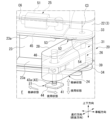
- FIG. 1 is an enlarged perspective view of an overturn prevention device according to a first embodiment of the present invention
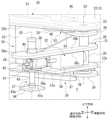
- FIG. 1 is a perspective view showing a state in which a cover is removed from the overturn prevention device according to the first embodiment of the present invention
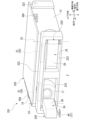
- FIG. It is a perspective view of the conveying apparatus in 2nd Embodiment of this invention. It is a perspective view of the conveying apparatus in 3rd Embodiment of this invention.
- FIG. 1 is a perspective view of a carriage 100 provided with a transport device 1.
- the traveling direction of the trolley 100 is simply referred to as the traveling direction or the longitudinal direction.
- a direction along the horizontal direction and perpendicular to the traveling direction is called a vehicle width direction.
- the vertical direction along the direction of gravity is simply referred to as the vertical direction.
- the upper side and the lower side when the carriage 100 is placed on the floor surface F so as to be able to travel are simply referred to as the upper side and the lower side.
- the carriage 100 includes a conveying device 1 and a positioner 2 arranged on a vehicle body 3 constituting the conveying device 1 .
- the positioner 2 holds a work (not shown) and changes the orientation of the work.
- the positioner 2 includes a support portion 4, a tilt arm drive portion 5 provided on the support portion 4, a tilt arm 6 supported by the support portion 4 via the tilt arm drive portion 5, and a tilt arm 6 provided on the tilt arm 6. and a rotary table 7.
- the support section 4 includes two base frames 8 and support columns 9 rising from the two base frames 8 .
- the two base frames 8 are, for example, rectangular pipe-shaped members elongated in the front-rear direction. However, the shape of the base frame 8 is not limited to the square pipe-like member, and various shapes can be adopted.
- a strut 9 is provided at one end 8a of the two base frames 8 located on one side in the front-rear direction. In the following description, the side on which the strut 9 is arranged in the front-rear direction is referred to as the rear. The side opposite to the side on which the strut 9 is arranged in the front-rear direction is referred to as the front.
- a tilt arm driving portion 5 is provided on the front surface 9 a of the column 9 .
- the tilt arm drive unit 5 includes a disk portion 11 supported on the front surface 9a of the support 9, and a motor 12 with a speed reducer provided on one side of the support 9 in the vehicle width direction.
- the disk portion 11 is rotatably supported with the front-rear direction as the rotation axis C1.
- the motor 12 with a speed reducer includes an electric motor 12a and a speed reducer 12b.
- the electric motor 12a includes, for example, an electromagnetic brake (not shown). A braking force is applied to the motor shaft (not shown) of the electric motor 12a by the electromagnetic brake.
- a deceleration unit 12b is connected to the motor shaft.
- the deceleration unit 12b decelerates and outputs the rotation input from the motor shaft.
- the speed reducer 12b for example, a so-called eccentric oscillating type speed reducer having a crankshaft to which the rotation of the motor shaft is input and an external gear (neither of which is shown) that oscillates and rotates with the rotation of the crankshaft. part is used.
- the eccentric oscillating speed reducer can obtain output rotation reduced from the rotation of the motor shaft by the oscillating rotation of the external gear. This output rotation is transmitted to the disk portion 11, and the disk portion 11 is rotated.
- An inclined arm 6 is provided on the front surface of the disc portion 11 .
- the tilt arm 6 is formed in an L shape.
- the inclined arm 6 includes a plate-shaped vertical wall 13 facing the disk portion 11 and a plate-shaped arm body 14 extending forward from one side of the vertical wall 13 in the plane direction.
- a rotary table 7 is provided on the arm body 14 .
- the rotary table 7 includes a table body 15 rotatably provided with respect to the arm body 14 and a motor 16 with a speed reducer provided at a position corresponding to one side of the table body 15 in the arm body 14 . Prepare.
- a rotation axis C ⁇ b>2 of the table body 15 extends along the thickness direction of the arm body 14 .
- a workpiece (not shown) is mounted on the table body 15 . Thereby, the positioner 2 holds the workpiece.
- the configuration of the motor 16 with a speed reducer is the same as the configuration of the motor 12 with a speed reducer provided in the tilt arm driving section 5 .
- the output rotation of the motor 16 with a speed reducer is transmitted to the table body 15, and the table body 15 is rotated.
- the two reduction gear-equipped motors 12 and 16 may not have the same configuration. Furthermore, it is sufficient that the corresponding device can be driven as a drive source.
- the positioner 2 can change the posture of the workpiece by 360° by rotating the tilt arm 6 and rotating table 7 .
- the conveying device 1 includes a vehicle body 3 , a plurality of wheels 17 provided on the vehicle body 3 , and an overturn prevention device 20 provided on the vehicle body 3 .
- the vehicle body 3 includes a main body portion 21 and frames 22 provided at both ends of the main body portion 21 in the front-rear direction.
- the body portion 21 is formed in a rectangular parallelepiped box shape that is slightly elongated in the front-rear direction when viewed from the top-bottom direction.
- the positioner 2 is arranged on the upper surface 21 a of the body portion 21 with the base plate 18 interposed therebetween.
- a plurality of wheels 17 are provided on both sides in the vehicle width direction and on both sides in the front-rear direction of the main body 21 .
- the wheels 17 are rotationally driven by a travel drive section (not shown) provided in the body section 21 .
- a travel drive section (not shown) provided in the body section 21 .
- the conveying device 1 is moved.
- Various power sources such as an electric motor, a hydraulic motor, an engine, etc. that apply driving force to the wheels 17 can be employed as the traveling drive unit.
- the front frame 22 and the rear frame 22 are arranged line-symmetrically with the main body 21 interposed therebetween. Since the front frame 22 and the rear frame 22 have the same configuration, the two frames 22 are denoted by the same reference numerals in the following description.
- the frame body 22 extends over the entire vehicle width direction of the body portion 21 so as to cover the entire front end and rear end of the body portion 21 .
- a storage recess 23 is formed in the front frame 22 .
- the storage recesses 23 are arranged on both sides in the vehicle width direction.
- the two storage recesses 23 are formed so that the front and the outside in the vehicle width direction are open.
- a storage recess 23 is formed in the rear frame 22 .
- the storage recesses 23 are arranged on both sides in the vehicle width direction.
- the two storage recesses 23 are formed to open rearwardly and outwardly in the vehicle width direction.
- Anti-overturn devices 20 are provided at positions corresponding to the storage recesses 23 of the frame 22 , that is, at the four corners of the vehicle body 3 .
- FIG. 2 is an enlarged perspective view of the overturn prevention device 20.
- FIG. FIG. 3 is a perspective view showing the overturn prevention device 20 with the cover 28 removed.
- FIG. 3 corresponds to FIG. Since all four anti-tipping devices 20 have the same configuration, only one anti-tipping device 20 will be described below, and other anti-tipping devices 20 will be described as necessary.
- the overturn prevention device 20 is provided at the front and rear portions of the vehicle body 3 .
- the overturn prevention device 20 includes an overturn prevention arm 24 rotatably provided in the storage recess 23 of the frame 22 and a overturn prevention arm driving portion 25 provided above the storage recess 23 in the frame 22 .
- the overturn prevention arm 24 includes an arm portion 26, a stopper 27 provided on the arm portion 26, and a cover 28 that covers the arm portion 26 and part of the stopper 27 from the outside.
- the arm portion 26 includes an arm frame 31 and a stopper drive portion 32 supported by the arm frame 31 .
- the arm frame 31 has a cylindrical support shaft 35 that is rotatably supported by an upper support plate 33 provided on the overturn prevention arm driving portion 25 and a lower support plate 34 provided on the lower surface 23 a of the storage recess 23 .
- the upper support plate 33 and the lower support plate 34 are rectangular plate members whose thickness direction extends along the vertical direction and which is elongated in the vehicle width direction when viewed from the vertical direction.
- the upper support plate 33 and the lower support plate 34 are arranged outside the storage recess 23 in the vehicle width direction.
- a support shaft 35 Upper and lower ends of a support shaft 35 are rotatably supported by these support plates 33 and 34 .
- a rotation axis C3 of the support shaft 35 extends in the vertical direction.
- Three base plates 36, 37, 38 (first base plate 36, second base plate 37, third base plate 38) are integrally provided on the support shaft 35 at regular intervals in the direction of the rotation axis C3.
- the three base plates 36, 37, 38 may not be evenly spaced.
- the support shaft 35 does not have to consist of three base plates 36 , 37 , 38 . It is sufficient that the support shaft 35 (base plate) can support the stopper driving portion 32 .
- the first base plate 36 is arranged near the upper end of the support shaft 35 and slightly below the upper support plate 33 .
- the thickness direction of the first base plate 36 extends along the vertical direction.
- the vertical size of the first base plate 36 is larger than the outer diameter of the support shaft 35 .
- the second base plate 37 is arranged near the lower end of the support shaft 35 and slightly above the lower support plate 34 .
- the thickness direction of the second base plate 37 extends along the vertical direction.
- the second base plate 37 is formed to extend horizontally from the support shaft 35 . That is, the second base plate 37 is formed in a rectangular shape elongated in one direction when viewed from above and below.
- the third base plate 38 is arranged between the first base plate 36 and the second base plate 37 .
- the thickness direction of the third base plate 38 extends along the vertical direction.
- the third base plate 38 is formed to extend horizontally from the support shaft 35 . That is, the third base plate 38 is formed in a rectangular shape elongated in one direction when viewed from above and below.
- the extending direction of the third base plate 38 is the same as the extending direction of the second base plate 37 .
- the length of the third base plate 38 is longer than the length of the second base plate 37 . Therefore, the tip 38 a of the third base plate 38 is positioned farther from the support shaft 35 than the tip 37 a of the second base plate 37 is.
- a through hole 40 is formed through the third base plate 38 on the side of the tip 38a in the thickness direction.
- a later-described slide shaft 43 of the stopper 27 is inserted through the through hole 40 .
- a rib 46 is integrally provided between the upper surface 38b of the third base plate 38 and the outer peripheral surface of the support shaft 35 so as to span the upper surface 38b and the outer peripheral surface.
- the tip of the rib 46 is positioned slightly before the through hole 40 .
- the rib 46 is a reinforcing member for the arm frame 31 .
- a stopper driving portion 32 is provided between the lower surface 38c of the third base plate 38 and the upper surface 37b of the second base plate 37.
- the stopper driver 32 applies power to the stopper 27 .
- the stopper drive unit 32 includes an electric motor 39 as a drive source and an actuator 41 attached to a motor shaft 39 a of the electric motor 39 .
- a rotation axis C4 of the motor shaft 39a extends horizontally.
- the stopper drive unit 32 can use, for example, a hydraulic motor or the like instead of the electric motor 39 as a drive source.
- a worm reduction mechanism for example, is used as the actuator 41 .
- the worm speed reducer converts the rotational force of the motor shaft 39a into rotation about the rotational axis C5 along the vertical direction. Rotation of the motor shaft 39 a is transmitted to the stopper 27 via the actuator 41 .
- the stopper 27 includes a housing 42 that holds a nut (not shown) to which rotation of the actuator 41 is transmitted, a slide shaft 43 that engages with the nut, and a base plate 44 attached to the slide shaft 43.
- the housing 42 is fixed to the case 41 a of the actuator 41 .
- the slide shaft 43 is, for example, a trapezoidal screw.
- the slide shaft 43 extends along the rotation axis C5 and is supported by the housing 42 via a nut (not shown).
- the slide shaft 43 is supported so as not to rotate around the rotation axis C5.
- the upper portion of the slide shaft 43 protrudes above the third base plate 38 through the through hole 40 of the third base plate 38 .
- the slide shaft 43 slides relative to the housing 42 by rotating the motor shaft 39a. That is, the slide shaft 43 slides toward and away from the floor surface F by rotating the motor shaft 39a.
- the base plate 44 is attached to the lower end 43a of the slide shaft 43 so as to be in surface contact with the floor surface F. As shown in FIG.
- the fall prevention arm 24 configured in this way is driven by the fall prevention arm driving section 25 .
- the overturn prevention arm driving section 25 includes an electric motor 51 provided inside the frame 22 and a transmission mechanism 52 that transmits the rotational force of the electric motor 51 to the support shaft 35 of the overturn prevention arm 24 .
- the electric motor 51 is arranged on a support plate 45 provided above the housing recess 23 in the frame 22 .
- a rotation axis C6 of the electric motor 51 extends along the vehicle width direction.
- the transmission mechanism 52 includes a spur gear 53 arranged adjacent to the upper surface 23 b of the storage recess 23 , and a sector gear 54 integrally provided on the support shaft 35 and meshing with the spur gear 53 .
- the spur gear 53 is integrally provided with a shaft (not shown) provided coaxially with the spur gear 53 . This shaft is rotatably supported by the support plate 45 . Rotation of the electric motor 51 is transmitted to the shaft of the spur gear 53 via a not-shown bevel gear or the like. When the electric motor 51 is rotated, the spur gear 53 is rotated. Furthermore, the sector gear 54 meshing with the spur gear 53 is rotated.
- the support shaft 35 integrated with this sector gear 54 is rotated.
- the overturn prevention arm 24 is swung around the rotation axis C3.
- the overturn prevention arm 24 is displaced between a retracted state and a use state as the overturn prevention arm 24 swings.
- the overturn prevention arm 24 is completely stored in the storage recess 23 .
- the anti-toppling arm 24 projects obliquely forward and obliquely rearward from the storage recess 23 toward the outside in the vehicle width direction of the conveying device 1 .
- the storage state and use state that is, the action of the overturn prevention device 20, will be described in detail below.
- FIG. 1 In order to make the explanation easier to understand, the state of use of the anti-tipping device 20 on the left side facing forward in the traveling direction is shown.
- the overturn prevention device 20 on the right side facing forward in the direction of travel is shown in a retracted state.
- the four overturn prevention devices 20 can all be used in the same state, or can be used in separate states.
- the storage state will be explained. As shown in FIGS. 1 to 3, for example, when the trolley 100 is driven, the overturn prevention device 20 is put in the stored state.
- the slide shaft 43 is retracted and moved away from the floor surface F (see also the arrow in FIG. 2).
- the anti-toppling arm 24 is rotated around the rotation axis C3 until it is stored in the storage recess 23 of the frame 22 (see also the arrow in FIG. 2).
- This state is the stored state.
- the overturning prevention device 20 is not protruded in the front-rear direction from the frame 22 and the overturning prevention device 20 is not projected outwardly from the lateral side of the vehicle body 3.
- the overturn prevention device 20 includes the overturn prevention arm 24 that is rotatably supported around the rotation axis C3 that extends vertically with respect to the conveying device 1 .
- the overturn prevention arm 24 is displaced between a retracted state and a use state.
- the overturn prevention arm 24 can be sufficiently protruded outward in the width direction of the conveying device 1. Therefore, it is possible to reliably prevent the trolley 100 (conveyor 1) from overturning.
- the rotation axis C3, which is the rotation center of the overturn prevention arm 24, extends in the vertical direction.
- the overturn prevention arm 24 is rotated in the horizontal direction.
- the overturn prevention arm 24 is rotated vertically. In this case, for example, the overturn prevention arm 24 is lifted upward against gravity. Energy consumption increases when rotating the overturn prevention arm 24 .
- the overturn prevention arm 24 is rotated in the horizontal direction, it is not rotated against gravity. For this reason, energy consumption can be reduced when rotating the anti-toppling arm 24 .
- the overturn prevention arm 24 includes an arm portion 26 that is displaced between a retracted state and a use state, and a stopper 27 (slide shaft 43) provided on the arm portion 26.
- the stopper 27 (slide shaft 43 ) approaches the floor surface F from the arm portion 26 and separates from the floor surface F. In this manner, by driving the overturn prevention arm 24 in two steps by the arm portion 26 and the stopper 27, the overturn prevention arm 24 can be securely accommodated in the conveying apparatus 1.
- the stopper 27 does not operate with respect to the arm portion 26, it becomes difficult to reliably store the overturn prevention arm 24 inside the transport device 1 in the retracted state.
- the slide shaft 43 (pedestal plate 44) must be brought close to the floor surface F and the slide shaft 43 must be abutted against the floor surface F in use.
- the slide shaft 43 must be separated from the floor surface F in the retracted state. For this reason, it becomes difficult to operate the overturn prevention arm 24 so as to be securely accommodated in the transport device 1 .
- the arm portion 26 is displaced with respect to the conveying device 1 and the slide shaft 43 is moved with respect to the arm portion 26 .
- the anti-toppling arm 24 can be reliably accommodated within the carrier device 1 . Therefore, the overturn prevention device 20 does not become an obstacle when the truck 100 (conveying device 1) travels, and the restrictions on the range of use of the truck 100 can be relaxed.
- the overturn prevention device 20 includes an overturn prevention arm driving portion 25 and a stopper driving portion 32 . Therefore, it is possible to automatically switch between the retracted state and the used state of the overturn prevention arm 24 . Therefore, it is possible to provide the overturn prevention device 20 that is easy to use.
- a switch may be provided on one of the trucks 100 to automatically operate the overturn prevention arm 24 .
- the anti-toppling arm 24 may be stored or used.
- a control unit that comprehensively controls the driving of the carriage 100 may be provided, and the overturn prevention arms 24 may be retracted when a travel start signal (signal for starting the wheels 17) is received.
- the overturn prevention arm 24 may be put into use when the start signal for the positioner 2 (the start signal for the motors 12 and 16 with reduction gears) is received.
- Two anti-overturn devices 20 are provided on each of the frames 22 provided in the longitudinal direction of the main body 21 of the vehicle body 3. That is, the overturn prevention device 20 (overturn prevention arm 24) is provided between the wheels 17 on both sides in the vehicle width direction. Therefore, the overturn prevention arm 24 can reliably prevent the vehicle body from overturning while suppressing the amount of displacement of the overturn prevention arm 24 as much as possible.
- the anti-overturn arm 24 can be securely housed in the vehicle body 3. - ⁇
- the overturn prevention arm 24 when the overturn prevention arm 24 is provided on the upper part of the vehicle body 3, the distance of the overturn prevention device 20 (overturn prevention arm 24) from the floor surface F becomes long, and the movement amount of the overturn prevention device 20 becomes long.
- the anti-overturn device 20 protrudes from the upper part of the vehicle body 3, and the exterior design of the conveying device 1 deteriorates.
- the overturn prevention device 20 (overturn prevention arm 24) on the frame 22, the exterior design of the conveying device 1 can be improved.
- FIG. 4 is a perspective view of a conveying device according to a second embodiment of the invention. As shown in FIG. 4, the second embodiment differs from the first embodiment in that overturn prevention devices 220 are provided on both sides of the vehicle body 203 in the vehicle width direction.
- the conveying device 201 of the second embodiment constitutes a carriage in combination with the positioner 2 (see FIG. 1) arranged on the vehicle body 203, for example.
- the vehicle body 203 includes a frame 222 instead of the frame 22 of the first embodiment.
- the frame bodies 222 are provided on both sides of the vehicle body 203 in the vehicle width direction.
- the frame bodies 222 on both sides in the vehicle width direction are arranged line-symmetrically with respect to each other with the body portion 21 interposed therebetween. Since each frame 222 has the same configuration, the two frames 222 are denoted by the same reference numerals in the following description.
- the frame 222 extends over the entire front-rear direction of the main body 21 so as to cover the entire lateral side of the main body 21 and the wheels 17 arranged in the front-rear direction from the outside in the vehicle width direction.
- a storage recess 223 is formed in each frame 222 .
- Two storage recesses 223 are formed side by side in the front-rear direction.
- Each storage recess 223 is formed so that the outside in the vehicle width direction is open.
- the storage recess 223 penetrates the frame 222 in the vehicle width direction and faces the wheel 17 .
- the electric motor 51 of the overturn prevention arm driving portion 25 is arranged in the frame 222 above the storage recess 223 .
- the vehicle body 203 is provided with connecting parts 260 for towing other vehicles at the front and rear parts of the vehicle body 203 .
- another vehicle is a bogie that does not have a drive source for traveling.
- the connecting part 260 is coupled to the front end and the rear end of the body part 21 respectively.
- the connecting portion 260 may be provided only at one of the front portion and the rear portion of the vehicle body 203, or may be omitted.
- the overturn prevention arms 24 are provided in the storage recesses 223 in a one-to-one correspondence.
- the overturn prevention arm 24 is provided outside the wheel 17 in the vehicle width direction.
- the overturn prevention arm 24 overlaps the wheel 17 when viewed from the vehicle width direction.
- the overturn prevention arm 24 is swung about the rotation axis C3.
- the rotation axis C3 extends along the vertical direction.
- the rotation axis C ⁇ b>3 passes through a portion of each of the storage recesses 223 that is closer to the outer end in the front-rear direction.
- the outer side in the front-rear direction is the direction away from the center of the conveying device 201 in the front-rear direction.
- the overturn prevention arm 24 is displaced between a retracted state and a use state as it swings about the rotation axis C3. In the stored state, the overturn prevention arm 24 is completely stored in the storage recess 223 . In the state of use, the overturn prevention arm 24 protrudes outward in the vehicle width direction from the frame 222 . In order to facilitate understanding of the explanation, FIG. 4 shows the state of use of the overturn prevention device 220 behind in the traveling direction. The overturn prevention arm 24 may protrude obliquely forward or obliquely rearward toward the outside in the vehicle width direction when in use.
- the above-described second embodiment has the same effect as the above-described first embodiment.
- the overturn prevention arm 24 protrudes outward in the vehicle width direction from a frame 222 that is a side portion of the vehicle body 203 in the vehicle width direction in use. For this reason, it becomes easier to secure a space in front and rear of the vehicle body 203 for arranging other objects such as a truck to be towed.
- the overturn prevention arm protrudes from the rear portion of the vehicle body when in use, it is necessary to set the range through which the overturn prevention arm at the rear of the vehicle body passes as a region in which other objects cannot be placed when the conveying device stops. The same applies when the overturn prevention arm protrudes from the front portion of the vehicle body.
- the conveying device 201 is provided with connecting portions 260 for towing other vehicles at the front and rear portions of the vehicle body 203 . For this reason, it becomes possible to bring the towed other vehicle closer to the conveying device 201 . Therefore, it becomes easy to reduce the inner ring difference during towing and running, and the restrictions on the range of use of the conveying device 201 can be relaxed.
- the overturn prevention arm 24 is provided outside the wheel 17 in the vehicle width direction. As a result, it is possible to prevent the layout of the overturn prevention arm 24 from deteriorating due to the presence of the wheels 17 . Therefore, the arm length of the overturn prevention arm 24 can be increased to further stabilize the posture of the cart.
- FIG. 5 is a perspective view of a conveying device according to a third embodiment of the invention. As shown in FIG. 5, the third embodiment is different from the second embodiment in that the overturn prevention arm 24 is provided between the front and rear wheels 17 .
- a conveying device 301 of the third embodiment constitutes a carriage in combination with a positioner 2 (see FIG. 1) arranged on a vehicle body 303, for example, in the same manner as in the second embodiment.
- the vehicle body 303 includes a frame 322 instead of the frame 222 of the second embodiment.
- the frame bodies 322 are provided on both sides of the vehicle body 303 in the vehicle width direction.
- the frame bodies 322 on both sides in the vehicle width direction are arranged line-symmetrically with respect to each other with the body portion 21 interposed therebetween. Since each frame 322 has the same configuration, two frames 322 are denoted by the same reference numerals in the following description.
- the frame body 322 extends over the entire front-rear direction of the body portion 21 so as to cover the entire side portion of the body portion 21 in the vehicle width direction from the outside in the vehicle width direction.
- Each frame 322 is arranged at the same position as the wheels 17 in the vehicle width direction so as to overlap the pair of wheels 17 arranged in the front-rear direction when viewed in the front-rear direction.
- a wheel house 370 and a storage recess 323 are formed in each frame 322 .
- a pair of wheel houses 370 are formed in the front and rear so as to correspond to the pair of front and rear wheels 17 on a one-to-one basis.
- the frame 322 surrounds the wheel 17 from three directions except for the downward direction around the wheel house 370 when viewed in the vehicle width direction.
- Two storage recesses 323 are formed side by side in the front-rear direction between the pair of front and rear wheel houses 370 .
- Each storage recess 323 is formed so that the outside in the vehicle width direction is open.
- the electric motor 51 of the overturn prevention arm driving portion 25 is arranged in the frame 322 above the storage recess 323 .
- the frame 322 has a bumper portion 322a.
- the bumper portion 322a is provided at the outer end portion of the frame 322 in the front-rear direction.
- the bumper portion 322a covers the wheel 17 from the outside in the front-rear direction.
- the bumper portion 322 a protrudes outward in the front-rear direction from the main body portion 21 and forms an end portion of the conveying device 301 in the front-rear direction.
- the bumper portion 322a may hold parts for unmanned travel, such as an interpersonal/objective sensor and a cushion.
- the overturn prevention arms 24 are provided in the storage recesses 323 in a one-to-one correspondence.
- the overturn prevention arm 24 is provided between the pair of front and rear wheels 17 so as to overlap the wheels 17 arranged in the front and rear direction when viewed in the front and rear direction.
- the overturn prevention arm 24 is swung about the rotation axis C3.
- the rotation axis C3 extends along the vertical direction.
- the rotation axis C ⁇ b>3 passes through a portion of each storage recess 323 that is closer to the outer end in the front-rear direction.
- the overturn prevention arm 24 is displaced between a retracted state and a use state as it swings about the rotation axis C3.
- the overturn prevention arm 24 is completely stored in the storage recess 323 .
- the overturn prevention arm 24 protrudes outward in the vehicle width direction from the frame 322 .
- FIG. 5 for the sake of easy understanding of the explanation, the anti-tipping device 20 forward in the traveling direction is shown in use.
- the overturn prevention arm 24 may protrude obliquely forward or obliquely rearward toward the outside in the vehicle width direction when in use.
- the above-described third embodiment has the same effect as the above-described second embodiment.
- the overturn prevention arm 24 is provided between the pair of front and rear wheels 17 so as to overlap the wheels 17 arranged in the front and rear direction when viewed in the front and rear direction.
- the overturn prevention arms 24 do not protrude forward or backward beyond the wheels 17 arranged in the front-rear direction. Therefore, the bumper portion 322a can be formed at the end portion of the conveying device 301 in the front-rear direction using a member different from the overturn prevention arm 24 .
- the anti-overturn arm 24 can be stored between the pair of front and rear wheels 17. Therefore, when the overturn prevention arms 24 are provided on both sides of the vehicle body 303 in the vehicle width direction, it is possible to prevent the transfer device 301 from increasing in size in the vehicle width direction.
- the present invention is not limited to the above-described embodiments, but includes various modifications of the above-described embodiments within the scope of the present invention.
- the overturn prevention device 20 is provided in the carrier devices 1, 201, and 301 constituting the carriage 100 has been described.
- the overturn prevention devices 20, 220, and 320 are not limited to this, and can be used for various mobile objects (mobile robots, etc.).
- the overturn prevention device 20 may be used not only for a moving object having a driving source for traveling, but also for a truck having no driving source for traveling.
- the overturn prevention devices 220 and 320 may be provided on the side portions in the vehicle width direction of the vehicle body of the truck to be towed.
- the conveying device 1 travels in one direction (the front-rear direction) has been described.
- the conveying device 1 may be configured to be able to advance in all directions.
- the wheels may be so-called omni wheels or mecanum wheels. By configuring in this way, it becomes possible to advance the conveying device 1 in all directions.
- the actuator 41 uses, for example, a worm speed reduction mechanism.
- a worm speed reduction mechanism A case where the stopper 27 is configured by a trapezoidal screw (slide shaft 43) or a nut has been described.
- the present invention is not limited to this, and various linear motion motors such as the electric motor 39 that converts rotary motion into linear motion can be employed so as to slide the slide shaft 43 .
- a pinion rack or the like may be employed as the actuator 41 instead of the worm reduction mechanism.
- two anti-overturn devices 20 are provided on each of the frames 22 provided in the longitudinal direction of the main body 21 of the vehicle body 3. explained. That is, the case where the overturn prevention device 20 (overturn prevention arm 24) is provided between the wheels 17 on both sides in the vehicle width direction has been described. However, it is not limited to this, and the overturn prevention device 20 (overturn prevention arm 24) may be provided between the wheels 17 on both sides in the front-rear direction.
- the number of overturn prevention devices 20 installed is not limited to four, but may be any number.
- the fall prevention device 20 may be provided only in that direction.
- the overturn prevention device 20 includes the overturn prevention arm 24 rotatably supported around the rotation axis C3 extending vertically with respect to the conveying device 1, and the arm portion 26 of the overturn prevention arm 24.
- the overturn prevention device 20 is not limited to this, and the overturn prevention device 20 may be configured to include an overturn prevention arm 24 that is rotatably supported at least around the rotation axis C3.
- the overturn prevention device 20 does not have to be rotatable around the rotation axis C3.
- the overturn prevention arm 24 of the overturn prevention device 20 includes an arm portion 26 that is displaced between a retracted state and a use state, and is provided on the arm portion 26 so that the arm portion 26 approaches the floor F and moves away from the floor F.
- the stopper 27 that In this case, the arm portion 26 may be displaced between the stored state and the use state by configuring the arm portion 26 to slide with respect to the vehicle body 3 (frame body 22).
- the electric motor 51 of the overturn prevention arm driving portion 25 is arranged above the frames 22, 222, and 322.
- the present invention is not limited to this, and the electric motor may be arranged at a position between the pair of fall prevention arms 24 in the frame.
- a connecting portion 260 for towing another vehicle may be provided at the front or rear portion of the conveying device 1 of the first embodiment.
- the connecting portion 260 is provided on the frame 22 after giving the frame 22 rigidity enough to tow another vehicle through the connecting portion 260, or the connecting portion 260 is provided on the base plate 18. good.
- the connecting portion 260 is provided separately from the overturn prevention arm 24 .
- the anti-overturn arm 24 projecting outward in the vehicle width direction may be used as the connecting portion. In this case, other vehicles can run parallel to the transport device.
- those composed of a plurality of objects may be integrated, and conversely, those composed of a single object may be divided into a plurality of objects. be able to. Regardless of whether they are integrated or not, it is sufficient that they are constructed so as to achieve the object of the invention.
- the fall prevention device and transport device described above can ease restrictions on the range of use.
Landscapes
- Engineering & Computer Science (AREA)
- Transportation (AREA)
- Structural Engineering (AREA)
- Mechanical Engineering (AREA)
- Civil Engineering (AREA)
- Life Sciences & Earth Sciences (AREA)
- Geology (AREA)
- Handcart (AREA)
Priority Applications (4)
| Application Number | Priority Date | Filing Date | Title |
|---|---|---|---|
| JP2023569174A JPWO2023119980A1 (https=) | 2021-12-24 | 2022-11-18 | |
| CN202280077126.1A CN118284546A (zh) | 2021-12-24 | 2022-11-18 | 防翻倒装置和输送装置 |
| EP22910698.4A EP4454958A4 (en) | 2021-12-24 | 2022-11-18 | ROLLOVER PREVENTION DEVICE AND TRANSPORT DEVICE |
| US18/711,761 US20250018902A1 (en) | 2021-12-24 | 2022-11-18 | Overturn prevention device and conveyance device |
Applications Claiming Priority (4)
| Application Number | Priority Date | Filing Date | Title |
|---|---|---|---|
| JP2021-210953 | 2021-12-24 | ||
| JP2021210953 | 2021-12-24 | ||
| JP2022-070401 | 2022-04-21 | ||
| JP2022070401 | 2022-04-21 |
Publications (1)
| Publication Number | Publication Date |
|---|---|
| WO2023119980A1 true WO2023119980A1 (ja) | 2023-06-29 |
Family
ID=86902198
Family Applications (1)
| Application Number | Title | Priority Date | Filing Date |
|---|---|---|---|
| PCT/JP2022/042846 Ceased WO2023119980A1 (ja) | 2021-12-24 | 2022-11-18 | 転倒防止装置及び搬送装置 |
Country Status (4)
| Country | Link |
|---|---|
| US (1) | US20250018902A1 (https=) |
| EP (1) | EP4454958A4 (https=) |
| JP (1) | JPWO2023119980A1 (https=) |
| WO (1) | WO2023119980A1 (https=) |
Citations (6)
| Publication number | Priority date | Publication date | Assignee | Title |
|---|---|---|---|---|
| JPS50106327A (https=) * | 1973-08-06 | 1975-08-21 | ||
| JPS55147954U (https=) * | 1979-04-12 | 1980-10-24 | ||
| JPS58170253U (ja) * | 1982-04-22 | 1983-11-14 | 日立建機株式会社 | 簡易クレ−ン用アウトリガ−装置 |
| JP2006053731A (ja) | 2004-08-11 | 2006-02-23 | Yaskawa Electric Corp | 移動体の姿勢保持・転倒防止装置 |
| JP2009051443A (ja) * | 2007-08-29 | 2009-03-12 | Tadano Ltd | レッカー車 |
| US20220070401A1 (en) | 2020-09-01 | 2022-03-03 | Pixart Imaging Inc. | Pixel circuit outputting time difference data and image data, and operating method of pixel array |
Family Cites Families (13)
| Publication number | Priority date | Publication date | Assignee | Title |
|---|---|---|---|---|
| AT387208B (de) * | 1986-04-04 | 1988-12-27 | Voest Alpine Ag | Transportfahrzeug sowie einrichtung zum ueberwachen der kippsicherheit der last auf einem derartigen transportfahrzeug |
| IL141125A0 (en) * | 2001-01-26 | 2002-02-10 | Vehicle lifting system | |
| US8181392B1 (en) * | 2009-10-01 | 2012-05-22 | Farber Raymond E | Automatic gate arm damage prevention system |
| KR101156170B1 (ko) * | 2010-04-01 | 2012-06-18 | 한국생산기술연구원 | 전복방지 시스템이 구비된 이동용 리프트 장치 |
| US20160339850A1 (en) * | 2015-05-22 | 2016-11-24 | Jon A. Williams, JR. | Articulating hitch lift system |
| US10399833B2 (en) * | 2015-12-28 | 2019-09-03 | Bosch Automotive Service Solutions Inc. | Vehicle lift adapter system |
| JP6758757B2 (ja) * | 2016-07-13 | 2020-09-23 | ジヤトコ株式会社 | 搬送システム |
| US9938687B1 (en) * | 2017-02-20 | 2018-04-10 | Cnh Industrial America Llc | Arm assembly for a work vehicle with support actuator and stop |
| US10842693B2 (en) * | 2017-06-13 | 2020-11-24 | Purdue Research Foundation | Motorized mount for seating system |
| US20180361943A1 (en) * | 2017-06-14 | 2018-12-20 | Michael D. Ellenbogen | Lift System for Roof-Mounted Storage on Vehicles |
| JP7064462B2 (ja) * | 2019-02-27 | 2022-05-10 | 本田技研工業株式会社 | 車両搬送装置 |
| JP7114536B2 (ja) * | 2019-09-10 | 2022-08-08 | 株式会社東芝 | 運搬装置 |
| CN113442881B (zh) * | 2020-03-25 | 2022-08-26 | 广东博智林机器人有限公司 | 一种底盘及agv小车 |
-
2022
- 2022-11-18 JP JP2023569174A patent/JPWO2023119980A1/ja active Pending
- 2022-11-18 WO PCT/JP2022/042846 patent/WO2023119980A1/ja not_active Ceased
- 2022-11-18 EP EP22910698.4A patent/EP4454958A4/en active Pending
- 2022-11-18 US US18/711,761 patent/US20250018902A1/en active Pending
Patent Citations (6)
| Publication number | Priority date | Publication date | Assignee | Title |
|---|---|---|---|---|
| JPS50106327A (https=) * | 1973-08-06 | 1975-08-21 | ||
| JPS55147954U (https=) * | 1979-04-12 | 1980-10-24 | ||
| JPS58170253U (ja) * | 1982-04-22 | 1983-11-14 | 日立建機株式会社 | 簡易クレ−ン用アウトリガ−装置 |
| JP2006053731A (ja) | 2004-08-11 | 2006-02-23 | Yaskawa Electric Corp | 移動体の姿勢保持・転倒防止装置 |
| JP2009051443A (ja) * | 2007-08-29 | 2009-03-12 | Tadano Ltd | レッカー車 |
| US20220070401A1 (en) | 2020-09-01 | 2022-03-03 | Pixart Imaging Inc. | Pixel circuit outputting time difference data and image data, and operating method of pixel array |
Non-Patent Citations (1)
| Title |
|---|
| See also references of EP4454958A4 |
Also Published As
| Publication number | Publication date |
|---|---|
| US20250018902A1 (en) | 2025-01-16 |
| EP4454958A1 (en) | 2024-10-30 |
| JPWO2023119980A1 (https=) | 2023-06-29 |
| EP4454958A4 (en) | 2025-12-24 |
Similar Documents
| Publication | Publication Date | Title |
|---|---|---|
| JP6994236B2 (ja) | 車両のリフト搬送台車、縦列無人走行台車、車両縦列駐車システムおよび車両縦列駐車方法 | |
| JP6178667B2 (ja) | タイヤ挟持装置とそれを備えた自動車搬送装置 | |
| JP5900982B2 (ja) | 保管施設において自動車を横方向に自動保管する装置及び方法 | |
| CN115783588B (zh) | 一种穿梭车及仓储系统 | |
| GB2234214A (en) | Narrow aisle lift truck | |
| JP2014201296A (ja) | 対象物移動装置 | |
| JP5998091B2 (ja) | 台車の駆動アシストユニット | |
| WO2023119980A1 (ja) | 転倒防止装置及び搬送装置 | |
| JPH10181420A (ja) | 多目的車両 | |
| WO2014157307A1 (ja) | 台車の駆動アシストユニット | |
| JP5016881B2 (ja) | 車両移動装置 | |
| WO2014157309A1 (ja) | 台車の駆動アシストユニット | |
| CN110371215B (zh) | 自动导引运输车 | |
| JP2016124484A (ja) | 被牽引車両 | |
| CN118284546A (zh) | 防翻倒装置和输送装置 | |
| CN119078991A (zh) | 一种具有高稳定性的agv机器人 | |
| KR102938840B1 (ko) | 주차 로봇 | |
| JP7551075B2 (ja) | 車両搬送装置及び車両搬送方法 | |
| JP7542884B1 (ja) | 台車搬送装置 | |
| JP6607642B2 (ja) | リアバンパ装置 | |
| JP2020066272A (ja) | 可動式バンパ装置 | |
| CN115573609A (zh) | 车辆搬运装置 | |
| JP5279590B2 (ja) | 自走式高所作業台車 | |
| CN210208643U (zh) | 一种稳定运行的铁水转运系统 | |
| JP6198433B2 (ja) | 対象物移動装置 |
Legal Events
| Date | Code | Title | Description |
|---|---|---|---|
| 121 | Ep: the epo has been informed by wipo that ep was designated in this application |
Ref document number: 22910698 Country of ref document: EP Kind code of ref document: A1 |
|
| ENP | Entry into the national phase |
Ref document number: 2023569174 Country of ref document: JP Kind code of ref document: A |
|
| WWE | Wipo information: entry into national phase |
Ref document number: 18711761 Country of ref document: US |
|
| WWE | Wipo information: entry into national phase |
Ref document number: 202280077126.1 Country of ref document: CN |
|
| NENP | Non-entry into the national phase |
Ref country code: DE |
|
| ENP | Entry into the national phase |
Ref document number: 2022910698 Country of ref document: EP Effective date: 20240724 |