WO2023112433A1 - 1,2-ジクロロー1,2-ジフルオロエチレンの水素置換体の製造方法 - Google Patents
1,2-ジクロロー1,2-ジフルオロエチレンの水素置換体の製造方法 Download PDFInfo
- Publication number
- WO2023112433A1 WO2023112433A1 PCT/JP2022/037013 JP2022037013W WO2023112433A1 WO 2023112433 A1 WO2023112433 A1 WO 2023112433A1 JP 2022037013 W JP2022037013 W JP 2022037013W WO 2023112433 A1 WO2023112433 A1 WO 2023112433A1
- Authority
- WO
- WIPO (PCT)
- Prior art keywords
- hydrogen
- difluoroethylene
- dichloro
- catalyst
- cfo
- Prior art date
- Legal status (The legal status is an assumption and is not a legal conclusion. Google has not performed a legal analysis and makes no representation as to the accuracy of the status listed.)
- Ceased
Links
Images
Classifications
-
- C—CHEMISTRY; METALLURGY
- C07—ORGANIC CHEMISTRY
- C07B—GENERAL METHODS OF ORGANIC CHEMISTRY; APPARATUS THEREFOR
- C07B61/00—Other general methods
-
- C—CHEMISTRY; METALLURGY
- C07—ORGANIC CHEMISTRY
- C07C—ACYCLIC OR CARBOCYCLIC COMPOUNDS
- C07C17/00—Preparation of halogenated hydrocarbons
- C07C17/25—Preparation of halogenated hydrocarbons by splitting-off hydrogen halides from halogenated hydrocarbons
-
- C—CHEMISTRY; METALLURGY
- C07—ORGANIC CHEMISTRY
- C07C—ACYCLIC OR CARBOCYCLIC COMPOUNDS
- C07C21/00—Acyclic unsaturated compounds containing halogen atoms
- C07C21/02—Acyclic unsaturated compounds containing halogen atoms containing carbon-to-carbon double bonds
- C07C21/18—Acyclic unsaturated compounds containing halogen atoms containing carbon-to-carbon double bonds containing fluorine
Definitions
- the present disclosure relates to a method for producing a hydrogen-substituted 1,2-dichloro-1,2-difluoroethylene.
- CFC chlorofluorocarbons
- HCFC hydrochlorofluorocarbons
- CFCs and HCFCs have been pointed out to affect the ozone layer in the stratosphere, and are currently subject to regulation.
- HFC hydrofluorocarbons such as difluoromethane, tetrafluoroethane, pentafluoroethane
- HFOs hydrofluoroolefins
- GWP global warming potential
- HFO-1132 is prepared by reacting 1,2-dichloro-1,2-difluoroethylene (hereinafter also referred to as “CFO-1112”) with hydrogen in the presence of a hydrogenation catalyst such as a Pd catalyst to obtain a hydrogen-substituted product.
- CFO-1112 1,2-dichloro-1,2-difluoroethylene
- HCFO-1122a 1,2-difluoroethylene and 1-chloro-1,2-difluoroethylene
- HFO-1132 and HCFO-1122a are collectively referred to as “CFO-1112
- An object of the present invention is to provide a method for producing a hydrogen-substituted 1,2-dichloro-1,2-difluoroethylene which can selectively produce a hydrogen-substituted product.
- Means for solving the above problems include the following aspects.
- ⁇ 2> The 1,2-dichloro-1,2-difluoro according to ⁇ 1> above, wherein in the mixed metal catalyst, the ratio of the mass of the platinum group metal to the mass of the second metal is 1/1 or less.
- the mixed metal catalyst is supported by a carrier, and the total supported amount of the platinum group metal and the second metal supported on the carrier is 1 to 20 parts by mass with respect to 100 parts by mass of the carrier.
- ⁇ 4> The method for producing a hydrogen-substituted 1,2-dichloro-1,2-difluoroethylene according to ⁇ 3>, wherein the carrier contains activated carbon.
- ⁇ 5> 1, according to any one of ⁇ 1> to ⁇ 4> above, wherein the temperature at which the 1,2-dichloro-1,2-difluoroethylene and the hydrogen are reacted is 150 to 400°C.
- ⁇ 6> any one of ⁇ 1> to ⁇ 5> above, wherein the molar ratio of the amount of hydrogen used to the amount of 1,2-dichloro-1,2-difluoroethylene used is 1 to 50;
- ⁇ 7> The 1,2-dichloro-1, according to any one of ⁇ 1> to ⁇ 6>, wherein the platinum group metal is one or more metals selected from the group consisting of platinum and nickel.
- ⁇ 8> The 1,2-dichloro-1, according to any one of ⁇ 1> to ⁇ 7>, wherein the second metal is one or more metals selected from the group consisting of copper and silver.
- ⁇ 9> The above ⁇ 1> to ⁇ , wherein the hydrogen-substituted 1,2-dichloro-1,2-difluoroethylene contains at least one of 1,2-difluoroethylene and 1-chloro-1,2-difluoroethylene. 8>.
- the hydrogen-substituted 1,2-dichloro-1,2-difluoroethylene includes 1,2-difluoroethylene and 1-chloro-1,2-difluoroethylene, and the 1-chloro-1,2 - 1, according to any one of ⁇ 1> to ⁇ 9>, wherein difluoroethylene is recovered and the 1-chloro-1,2-difluoroethylene is reacted with hydrogen in the presence of the mixed metal catalyst.
- a method for producing a hydrogen-substituted 2-dichloro-1,2-difluoroethylene is reacted with hydrogen in the presence of the mixed metal catalyst.
- a method for producing a hydrogen-substituted 1,2-dichloro-1,2-difluoroethylene that can suppress the production of by-products and selectively produce a hydrogen-substituted CFO-1112. can.
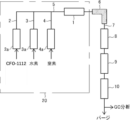
- FIG. 1 is a schematic diagram showing an embodiment of a reactor that can be used in the method for producing a hydrogen-substituted 1,2-dichloro-1,2-difluoroethylene of the present disclosure.
- each component may contain multiple types of applicable substances.
- the content rate or content of each component is the total content rate or content of the multiple types of substances present in the composition unless otherwise specified. means quantity.
- CFO-1112, HFO-1132, and HCFO-1122a exist as geometric isomers, Z-isomer and E-isomer, depending on the position of the substituent on the double bond.
- a compound name or a compound abbreviation indicates at least one selected from the group consisting of Z isomer and E isomer, more specifically, Z isomer or E isomer, Alternatively, it represents a mixture of Z isomer and E isomer in an arbitrary ratio.
- (E) or (Z) is attached to the end of a compound name or a compound abbreviation, the (E)-form or (Z)-form of the respective compound is indicated.
- CFO-1112(Z) indicates the Z form
- CFO-1112(E) indicates the E form.
- the method for producing a hydrogen-substituted CFO-1112 of the present disclosure is one selected from the group consisting of palladium, platinum, nickel, iridium, rhodium and ruthenium.
- a metal mixed catalyst containing a first catalyst containing the above platinum group metals and a second catalyst containing at least one second metal selected from the group consisting of copper, silver, gold, zinc, chromium and cobalt CFO-1112 with hydrogen.
- production of by-products can be suppressed, and hydrogen-substituted CFO-1112 can be selectively produced.
- CFO-1112 produced by the production method of the present disclosure may contain at least one of HFO-1132 and HCFO-1122a.
- the production method of the present disclosure recovers it by a conventionally known method such as distillation, and 1-chloro-1,2- in the presence of a mixed metal catalyst. Difluoroethylene may be reacted with hydrogen. As a result, HFO-1132, which is a hydrogen-substituted product of HCFO-1122a, is obtained.
- the mixed metal catalyst used in the production method of the present disclosure contains the first catalyst containing the platinum group metal and the second catalyst containing the second metal.
- the ratio of the mass of the platinum group metal to the mass of the second metal is preferably 1/1 or less, more preferably 1/20 or less, and 1/60. The following is more preferable, 1/80 or less is particularly preferable, and 1/100 or less is most preferable.
- the ratio is preferably 1/600 or more, more preferably 1/500 or more, and even more preferably 1/300 or more.
- the first catalyst contains one or more platinum group metals selected from the group consisting of palladium, platinum, nickel, iridium, rhodium and ruthenium.
- platinum group metals selected from the group consisting of palladium, platinum, nickel, iridium, rhodium and ruthenium.
- the first catalyst include palladium, platinum, nickel, iridium, rhodium, ruthenium, oxides thereof, and halides thereof.
- platinum and nickel It preferably contains one or more metals selected from the group consisting of
- the valence of the platinum group metal is not particularly limited, but from the viewpoint of improving the reactivity between CFO-1112 and hydrogen, it is preferably divalent or tetravalent, more preferably divalent.
- the second catalyst contains one or more second metals selected from the group consisting of copper, silver, gold, zinc, chromium and cobalt.
- the second catalyst includes copper, silver, gold, zinc, chromium, cobalt, oxides thereof, and halides thereof. From the viewpoint of suppressing the production of by-products, It preferably contains one or more selected metals. Examples of the halides include fluorides and chlorides, and chlorides are preferred from the viewpoint of suppressing the production of by-products.
- the mixed metal catalyst contains a first catalyst selected from the group consisting of platinum and platinum halides and a second catalyst selected from the group consisting of copper and copper halides.
- the mixed metal catalyst may be supported by a carrier.
- the metal mixed catalyst is supported on a support, from the viewpoint of improving the specific surface area of the metal mixed catalyst and improving the reactivity between CFO-1112 and hydrogen, the platinum group metal supported on the support with respect to 100 parts by mass of the support and
- the total amount of the second metal supported is preferably 1 to 20 parts by mass, more preferably 2 to 15 parts by mass, and even more preferably 3 to 10 parts by mass.
- the carrier includes at least one selected from the group consisting of activated carbon, alumina, chromia, silica, zirconia, alkali metal oxides and alkaline earth metal oxides, and has a large surface area for supporting metals. For this reason, activated carbon is preferred.
- the carrier may be subjected to a treatment such as acid washing in order to enhance the function of supporting the catalyst.
- a conventionally known method can be adopted as a method for preparing a mixed metal catalyst supported on a carrier. industrial Practice", 2nd. (McGraw-Hill, N. York, 1991), pp. 87-112, by either precipitation or impregnation methods.
- the reaction of CFO-1112 and hydrogen may be carried out in a reactor.
- the shape and structure of the reactor are not particularly limited.
- a cylindrical vertical reactor that can be filled with a catalyst inside the reactor.
- Materials for the reactor include glass, iron, nickel, stainless steel, iron, nickel, and alloys thereof.
- the reactor may be internally equipped with a heating unit such as an electric heater.
- the reactor may have a sheath tube into which a thermometer is inserted to measure the temperature inside.
- the temperature at which CFO-1112 and hydrogen are reacted is preferably 150 to 400°C, and 200 to 380°C. More preferably, 270 to 370°C is even more preferable.
- the reaction temperature refers to the temperature of the environment where CFO-1112 and hydrogen react, and when the reaction is carried out in a reactor, the temperature inside the reactor corresponds to the reaction temperature.
- the molar ratio of the amount of hydrogen used to the amount of CFO-1112 used is preferably 1 to 50. , more preferably 2 to 30, more preferably 2 to 20, and particularly preferably 2 to 10.
- the reaction between CFO-1112 and hydrogen may be either a liquid phase reaction or a gas phase reaction, and the gas phase reaction is preferred from the viewpoint of improving the reactivity between CFO-1112 and hydrogen.
- a liquid phase reaction means a reaction between CFO-1112 in a liquid state and hydrogen
- a gas phase reaction means a reaction between CFO-1112 in a gaseous state and hydrogen.
- the above reaction may be carried out in any of a batch system, a semi-continuous system and a continuous flow system.
- a gas phase reaction will be described in detail.
- gaseous CFO-1112 and hydrogen are separately and continuously supplied into a reactor, and gaseous state is generated in the presence of a metal mixed catalyst packed in the reactor. of CFO-1112 and hydrogen.
- a gas inert to the reaction may be supplied to the reactor from the viewpoint of being effective in adjusting the flow rate, suppressing by-products, suppressing deactivation of the catalyst, and the like.
- Diluent gases include nitrogen, carbon dioxide, helium, argon, and the like.
- the time for gas phase reaction between CFO-1112 and hydrogen (hereinafter also referred to as "gas phase reaction time”) is preferably 1 second to 1000 seconds, 5 seconds to 800 seconds is more preferable, and 10 seconds to 500 seconds is even more preferable.
- the reaction time means the residence time of CFO-1112 and hydrogen in the reactor.
- the pressure of the reaction system (pressure inside the reactor) in the gas phase reaction is preferably 0 to 2.0 MPa, more preferably 0 to 0.5 MPa.
- the pressure inside the reactor may be negative pressure.
- the pressure inside the reactor is particularly preferably normal pressure (atmospheric pressure) from the viewpoint of ease of handling. In the present disclosure, pressure indicates gauge pressure unless otherwise specified.
- the liquid phase reaction will be explained in detail.
- the liquid phase reaction between CFO-1112 and hydrogen can be carried out by continuously or discontinuously supplying hydrogen into a reactor in which a mixture of CFO-1112 and a mixed metal catalyst exists in a liquid state. Further, the hydrogen-substituted CFO-1112 produced by the reaction can be continuously or discontinuously withdrawn from the reactor.
- the liquid phase reaction time between CFO-1112 and hydrogen (hereinafter also referred to as “liquid phase reaction time”) is 0.1 to 100 hours. Preferably, 0.5 hours to 50 hours, and even more preferably 1 hour to 20 hours.
- a liquid phase reaction may be carried out in the presence of a solvent, if desired.
- the solvent include straight-chain perfluoroalkyl compounds having 5 to 8 carbon atoms represented by CF 3 (CF 2 )nCF 3 (wherein n represents an integer of 3 to 6). .
- reference numeral 20 designates a reactor used for gas phase reactions.
- Reactor 20 comprises reactor 1 .
- the reactor 1 is connected to a CFO-1112 supply line 2, a hydrogen supply line 3, and a diluent gas supply line 4.
- the reactor 1 includes a heating section such as an electric heater (not shown).
- the supply line 2 and the supply line 3 are connected before the reactor 1 and connected to the reactor 1.
- each reactor is separately connected. 1 may be connected.
- feed line 2, feed line 3 and feed line 4 are connected before the reactor, and the mixture of CFO-1112, hydrogen and diluent gas is fed to reactor 1 via mixture feed line 5. supplied to
- the supply line 2, the supply line 3 and the supply line 4 are provided with preheaters (preheaters) 2a, 3a and 4a provided with electric heaters and the like, respectively.
- the CFO-1112, hydrogen and nitrogen supplied to the reactor 1 are preferably preheated to predetermined temperatures by preheaters 2a, 3a and 4a, respectively, before being supplied to the reactor 1. Thereby, CFO-1112, hydrogen and nitrogen can be efficiently heated to a predetermined reaction temperature inside the reactor 1 .
- Preheaters 2a, 3a and 4a are preferably, but not essential, installed.
- an outlet line 7 is connected to the outlet of the reactor 1 via a cooling section 6 such as a heat exchanger.
- the outlet line 7 is further connected with a recovery tank 8 for water vapor and acid liquid, an alkali washing device 9, and a dehydration tower 10 in this order.
- the reaction mixture taken out from the reactor 1 is treated after the exit line 7 to remove acidic substances such as hydrogen chloride and hydrogen fluoride, water vapor and water.
- the gas thus obtained is hereinafter referred to as "outlet gas".
- Each component in the outlet gas is analyzed and quantified by an analyzer 11 such as gas chromatography (GC).
- GC gas chromatography
- the outlet gas contains at least one of HFO-1132 and HCFO-1122a.
- Compounds other than HFO-1132 and HCFO-1122a contained in the outlet gas include CFO-1112, water, hydrogen, hydrogen chloride, and hydrogen fluoride.
- HFO-1132 contained in the outlet gas can be removed and recovered by a conventionally known method such as distillation.
- HCFO-1122a has a boiling point of ⁇ 15 to 15° C.
- HFO-1132 has a boiling point of ⁇ 44 to ⁇ 28° C. Since there is a large difference in boiling points, recovery by distillation is possible.
- the recovered HCFO-1122a may be returned to the reactor as part of the feedstock, thereby improving the production efficiency of HFO-1132.
- the mixed metal catalyst for the production of hydrogen-substituted 1,2-dichloro-1,2-difluoroethylene of the present disclosure includes at least one platinum group selected from the group consisting of palladium, platinum, nickel, iridium, rhodium and ruthenium. It contains a first catalyst containing a metal and a second catalyst containing at least one second metal selected from the group consisting of copper, silver, gold, zinc, chromium and cobalt. Preferred aspects such as the ratio of the mass of the platinum group metal to the mass of the second metal are as described above, and are omitted here.
- Examples 1 to 10 are examples
- Example 11 is a comparative example.
- the supported catalyst in the flask is transferred to the reaction tube, and then the reaction tube is kept at 200° C. and 16.7 mL of nitrogen gas is supplied. /sec for 16 hours and dried.
- activated carbon carrying a mixed metal catalyst A containing copper (I) chloride and platinum (II) chloride (referred to as CuCl—PtCl 2 catalyst in Table 1) was obtained.
- the mass ratio of Pt to the mass of Cu supported on the activated carbon (Pt/Cu) was 1/100.
- the total amount of Cu and Pt carried on the activated carbon per 100 parts by mass of the activated carbon was 6 parts by mass.
- activated carbon carrying a mixed metal catalyst B containing copper (I) chloride and palladium chloride (referred to as CuCl—PdCl 2 in Table 1) was obtained.
- the mass ratio of Pd to the mass of Cu supported on the activated carbon (Pd/Cu) was 1/100.
- the total amount of Cu and Pd carried on the activated carbon per 100 parts by mass of the activated carbon was 6 parts by mass.
- activated carbon carrying a mixed metal catalyst C containing copper (I) chloride and nickel (II) chloride (referred to as CuCl—NiCl 2 in Table 1) was obtained.
- the ratio of the mass of Ni to the mass of Cu supported on the activated carbon (N i/Cu) was 1/100.
- the total amount of Cu and Ni carried on the activated carbon per 100 parts by mass of the activated carbon was 6 parts by mass.
- activated carbon supporting catalyst X containing palladium(II) chloride (referred to as Pd/C catalyst in Table 1) was obtained.
- the amount of Pd carried on the activated carbon was 0.5 parts by mass with respect to 100 parts by mass of the activated carbon.
- Example 1 A reaction apparatus 20 shown in FIG. 1 described above was prepared.
- a reaction tube made of SUS304, inner diameter 35.3 mm installed in an electric furnace was used.
- a thermometer was inserted into the sheath tube of the reaction tube to measure the internal temperature.
- the reaction tube was filled with activated carbon carrying mixed metal catalyst A with a length of 50 cm.
- the temperature inside the reaction tube was controlled at 249°C.
- Reactor 1 was continuously fed with CFO-1112, hydrogen and nitrogen through feed lines 2-4, which were stainless steel tubes, respectively.
- the molar ratio of CFO-1112, hydrogen and nitrogen supplied to the reactor 1 was controlled to be 1:2:0.1.
- the mixed gas flow rate (supply amount per unit time) was controlled so that the residence time of the mixed gas (CFO-1112, hydrogen and nitrogen) inside the reactor 1 was 23 seconds.
- the pressure inside the reactor 1 was the same as the atmospheric pressure.
- the preheaters 2a to 4a electric furnaces set to a furnace temperature of 200° C. were used.
- the composition analysis of the resulting outlet gas was performed using gas chromatography (GC).
- GC gas chromatography
- DB-1301 length 60 m ⁇ inner diameter 250 ⁇ m ⁇ thickness 1 ⁇ m, manufactured by Agilent Technologies
- HFO-1132, HCFO-1122a, dichlorodifluoroethane (hereinafter also referred to as “HCFC-132”), difluoroethane (hereinafter also referred to as “HFC-152”) in the outlet gas relative to the molar amount of CFO-1112 supplied to the reactor ) and fluoroethane (hereinafter also referred to as “HFC-161”) were determined (unit: %).
- Example 2 After obtaining the outlet gas in the same manner as in Example 1, except that the temperature inside the reaction tube was changed to 269° C. and the residence time was changed to 22.1 seconds, HFO-1132 selectivity, HCFO-1122a selectivity , HCFC-132 selectivity, HFC-152 selectivity, HFC-161 selectivity, conversion and E/Z were determined and summarized in Table 1.
- Example 3 In the same manner as in Example 1, except that the molar ratio of CFO-1112, hydrogen and nitrogen supplied to reactor 1 was changed to 1:3:0.1 and the residence time was changed to 16.7 seconds. After obtaining the outlet gas, HFO-1132 selectivity, HCFO-1122a selectivity, HCFC-132 selectivity, HFC-152 selectivity, HFC-161 selectivity, conversion and E/Z were determined and summarized in Table 1. rice field.
- Example 4 Change the temperature in the reaction tube to 301° C., change the residence time to 33.9 seconds, and change the molar ratio of CFO-1112, hydrogen and nitrogen supplied to the reactor 1 to 1:1:0.1. After obtaining the outlet gas, HFO-1132 selectivity, HCFO-1122a selectivity, HCFC-132 selectivity, HFC-152 selectivity, HFC-161 selectivity, conversion and E/Z was determined and summarized in Table 1.
- Example 5 After obtaining the outlet gas, the HFO-1132 selectivity, HCFO-1122a selectivity, HCFC-132 selectivity, HFC-152 selectivity, HFC-161 selectivity, conversion and E/Z were determined and summarized in Table 1.
- Example 6 Change the temperature in the reaction tube to 301° C., change the residence time to 17.4 seconds, and change the molar ratio of CFO-1112, hydrogen and nitrogen supplied to the reactor 1 to 1:3:0.1. After obtaining the outlet gas, HFO-1132 selectivity, HCFO-1122a selectivity, HCFC-132 selectivity, HFC-152 selectivity, HFC-161 selectivity, conversion and E/Z was determined and summarized in Table 1.
- Example 7 Using activated carbon in which the mass ratio of Pt and Cu of the activated carbon supporting the mixed metal catalyst A was changed to 1/20, the temperature in the reaction tube was changed to 303 ° C., the residence time was changed to 16.1 seconds, and After obtaining the outlet gas in the same manner as in Example 1, except that the molar ratio of CFO-1112, hydrogen and nitrogen supplied to reactor 1 was changed to 1:2:0.1, HFO-1132 selectivity, HCFO-1122a selectivity, HCFC-132 selectivity, HFC-152 selectivity, HFC-161 selectivity, conversion and E/Z were determined and summarized in Table 1.
- Example 8 Using activated carbon with a length of 30 cm supporting metal mixed catalyst B instead of the activated carbon supporting metal mixed catalyst A, changing the temperature in the reaction tube to 200 ° C., changing the residence time to 28.9 seconds, and After obtaining the outlet gas in the same manner as in Example 1, except that the molar ratio of CFO-1112, hydrogen and nitrogen supplied to reactor 1 was changed to 1:1:0.1, HFO-1132 selectivity, HCFO-1122a selectivity, HCFC-132 selectivity, HFC-152 selectivity, HFC-161 selectivity, conversion and E/Z were determined and summarized in Table 1.
- Example 9 After obtaining the outlet gas in the same manner as in Example 7, except that the temperature inside the reaction tube was changed to 281° C. and the residence time was changed to 24.7 seconds, HFO-1132 selectivity, HCFO-1122a selectivity, HCFC-132 selectivity, HFC-152 selectivity, HFC-161 selectivity, conversion and E/Z were determined and summarized in Table 1.
- Example 10 Using activated carbon with a length of 30 cm supporting mixed metal catalyst C instead of activated carbon supporting mixed metal catalyst A, changing the temperature in the reaction tube to 352° C., changing the residence time to 14.8 seconds, and After obtaining the outlet gas in the same manner as in Example 1, except that the molar ratio of CFO-1112, hydrogen and nitrogen supplied to reactor 1 was changed to 1:2:0.1, HFO-1132 selectivity, HCFO-1122a selectivity, HCFC-132 selectivity, HFC-152 selectivity, HFC-161 selectivity, conversion and E/Z were determined and summarized in Table 1.
- Example 11 Catalyst X was used instead of activated carbon supporting mixed metal catalyst A, the temperature in the reaction tube was changed to 80°C, the residence time was changed to 35.5 seconds, nitrogen was not supplied to reactor 1, and After obtaining the outlet gas in the same manner as in Example 1, except that the molar ratio of CFO-1112 and hydrogen supplied to the reactor 1 was changed to 1:2, HFO-1132 selectivity, HCFO-1122a selectivity , HCFC-132 selectivity, HFC-152 selectivity, HFC-161 selectivity and conversion were determined and summarized in Table 1.
- the first catalyst containing one or more platinum group metals selected from the group consisting of palladium, platinum, nickel, iridium, rhodium and ruthenium and the group consisting of copper, silver, gold, zinc, chromium and cobalt
- platinum group metals selected from the group consisting of palladium, platinum, nickel, iridium, rhodium and ruthenium and the group consisting of copper, silver, gold, zinc, chromium and cobalt
Landscapes
- Chemical & Material Sciences (AREA)
- Organic Chemistry (AREA)
- Organic Low-Molecular-Weight Compounds And Preparation Thereof (AREA)
Priority Applications (1)
| Application Number | Priority Date | Filing Date | Title |
|---|---|---|---|
| JP2023567556A JPWO2023112433A1 (cg-RX-API-DMAC7.html) | 2021-12-14 | 2022-10-03 |
Applications Claiming Priority (2)
| Application Number | Priority Date | Filing Date | Title |
|---|---|---|---|
| JP2021-202874 | 2021-12-14 | ||
| JP2021202874 | 2021-12-14 |
Publications (1)
| Publication Number | Publication Date |
|---|---|
| WO2023112433A1 true WO2023112433A1 (ja) | 2023-06-22 |
Family
ID=86774322
Family Applications (1)
| Application Number | Title | Priority Date | Filing Date |
|---|---|---|---|
| PCT/JP2022/037013 Ceased WO2023112433A1 (ja) | 2021-12-14 | 2022-10-03 | 1,2-ジクロロー1,2-ジフルオロエチレンの水素置換体の製造方法 |
Country Status (2)
| Country | Link |
|---|---|
| JP (1) | JPWO2023112433A1 (cg-RX-API-DMAC7.html) |
| WO (1) | WO2023112433A1 (cg-RX-API-DMAC7.html) |
Cited By (2)
| Publication number | Priority date | Publication date | Assignee | Title |
|---|---|---|---|---|
| WO2025080722A1 (en) * | 2023-10-09 | 2025-04-17 | Mattiq, Inc. | Mixed metal iridium ruthenium palladium electrocatalysts |
| WO2025072100A3 (en) * | 2023-09-29 | 2025-09-18 | The Chemours Company Fc, Llc | A process of coproducing e/z-1,2-difluoroethylene and compositions thereof |
Citations (8)
| Publication number | Priority date | Publication date | Assignee | Title |
|---|---|---|---|---|
| JPS6230730A (ja) * | 1985-06-10 | 1987-02-09 | アウシモント・ソチエタ・ペル・アツイオニ | 1,2−ジフルオルエチレンおよび1−クロル−1,2−ジフルオルエチレンの製造方法 |
| JPH01287044A (ja) * | 1988-01-15 | 1989-11-17 | Ausimont Spa | 1,2―ジフルオロエタンおよび1,1,2―トリフルオロエタンの製造方法 |
| JPH04288028A (ja) * | 1990-11-06 | 1992-10-13 | Elf Atochem Sa | フルオロエチレン及びクロロフルオロエチレンの製造 |
| JPH07126197A (ja) * | 1993-02-01 | 1995-05-16 | Central Glass Co Ltd | フッ素化炭化水素の製造方法 |
| JP2013237624A (ja) * | 2012-05-14 | 2013-11-28 | Asahi Glass Co Ltd | 1,2−ジクロロ−1,2−ジフルオロエチレンおよび1,2−ジフルオロエチレンの製造方法 |
| WO2016031777A1 (ja) * | 2014-08-25 | 2016-03-03 | 旭硝子株式会社 | ハイドロフルオロオレフィンの製造方法 |
| JP2016056132A (ja) * | 2014-09-10 | 2016-04-21 | 旭硝子株式会社 | 1,2−ジフルオロエチレンの製造方法 |
| WO2020105608A1 (ja) * | 2018-11-20 | 2020-05-28 | ダイキン工業株式会社 | 1,2-ジフルオロエチレンの製造方法 |
-
2022
- 2022-10-03 JP JP2023567556A patent/JPWO2023112433A1/ja active Pending
- 2022-10-03 WO PCT/JP2022/037013 patent/WO2023112433A1/ja not_active Ceased
Patent Citations (8)
| Publication number | Priority date | Publication date | Assignee | Title |
|---|---|---|---|---|
| JPS6230730A (ja) * | 1985-06-10 | 1987-02-09 | アウシモント・ソチエタ・ペル・アツイオニ | 1,2−ジフルオルエチレンおよび1−クロル−1,2−ジフルオルエチレンの製造方法 |
| JPH01287044A (ja) * | 1988-01-15 | 1989-11-17 | Ausimont Spa | 1,2―ジフルオロエタンおよび1,1,2―トリフルオロエタンの製造方法 |
| JPH04288028A (ja) * | 1990-11-06 | 1992-10-13 | Elf Atochem Sa | フルオロエチレン及びクロロフルオロエチレンの製造 |
| JPH07126197A (ja) * | 1993-02-01 | 1995-05-16 | Central Glass Co Ltd | フッ素化炭化水素の製造方法 |
| JP2013237624A (ja) * | 2012-05-14 | 2013-11-28 | Asahi Glass Co Ltd | 1,2−ジクロロ−1,2−ジフルオロエチレンおよび1,2−ジフルオロエチレンの製造方法 |
| WO2016031777A1 (ja) * | 2014-08-25 | 2016-03-03 | 旭硝子株式会社 | ハイドロフルオロオレフィンの製造方法 |
| JP2016056132A (ja) * | 2014-09-10 | 2016-04-21 | 旭硝子株式会社 | 1,2−ジフルオロエチレンの製造方法 |
| WO2020105608A1 (ja) * | 2018-11-20 | 2020-05-28 | ダイキン工業株式会社 | 1,2-ジフルオロエチレンの製造方法 |
Cited By (2)
| Publication number | Priority date | Publication date | Assignee | Title |
|---|---|---|---|---|
| WO2025072100A3 (en) * | 2023-09-29 | 2025-09-18 | The Chemours Company Fc, Llc | A process of coproducing e/z-1,2-difluoroethylene and compositions thereof |
| WO2025080722A1 (en) * | 2023-10-09 | 2025-04-17 | Mattiq, Inc. | Mixed metal iridium ruthenium palladium electrocatalysts |
Also Published As
| Publication number | Publication date |
|---|---|
| JPWO2023112433A1 (cg-RX-API-DMAC7.html) | 2023-06-22 |
Similar Documents
| Publication | Publication Date | Title |
|---|---|---|
| CN115160988B (zh) | 包含三氟乙烯的组合物 | |
| EP2546223B1 (en) | Method for producing fluorinated organic compounds | |
| CN103483141B (zh) | 氟丙烷、卤代丙烯以及2-氯-3,3,3-三氟-1-丙烯与hf的共沸组合物和1,1,1,2,2-五氟丙烷与hf的共沸组合物的制备方法 | |
| JP5570219B2 (ja) | 2,3,3,3−テトラフルオロプロペンの製造方法 | |
| CN103524297B (zh) | 加氢脱氯制备二氢氟化烯烃的方法 | |
| JP6650523B2 (ja) | 1−クロロ−3,3,3−トリフルオロプロピレン、2,3,3,3−テトラフルオロプロピレン及び1,3,3,3−テトラフルオロプロピレンの同時生産方法 | |
| JP5828761B2 (ja) | ジヒドロフルオロアルケンを製造するための高選択性方法 | |
| CN106660908B (zh) | 氢氟烯烃的制造方法 | |
| WO2017104828A1 (ja) | ハイドロフルオロオレフィンの製造方法 | |
| EP2091898A1 (en) | Processes for producing 2,3,3,3-tetrafluoropropene and/or 1,2,3,3-tetrafluoropropene | |
| JP6827810B2 (ja) | ハイドロフルオロオレフィンの製造方法 | |
| JPWO2018012511A1 (ja) | 1−クロロ−1,2−ジフルオロエチレンの製造方法 | |
| JP6881457B2 (ja) | 1−クロロ−2,3,3,3−テトラフルオロプロペンの製造方法 | |
| JP6780696B2 (ja) | 1−クロロ−2,3,3,3−テトラフルオロプロペンの製造方法 | |
| CA2167698A1 (en) | Process for combining chlorine-containing molecules to synthesize fluorine-containing products | |
| JP5817591B2 (ja) | 2,3,3,3−テトラフルオロプロペンの製造方法 | |
| JP4871261B2 (ja) | ジフルオロメタン、1,1,1−トリフルオロエタンおよび1,1−ジフルオロエタンの製造方法 | |
| JP2021107328A (ja) | 含塩素プロペンの製造方法 | |
| CN113527046A (zh) | HFO-1234ze的制备方法 | |
| JP7719333B2 (ja) | 1-クロロ-2,3,3,3-テトラフルオロプロペンの製造方法 | |
| CN105189422B (zh) | 用于制备氟代烯烃的方法 | |
| JP7484900B2 (ja) | 1-クロロ-2,3,3,3-テトラフルオロプロペンの製造方法 | |
| JP2015120669A (ja) | (e)−1,3,3,3−テトラフルオロプロペンの製造方法 | |
| JP7151259B2 (ja) | 1-クロロ-2,3,3-トリフルオロプロペンの製造方法 | |
| AU2024353441A1 (en) | Process of coproducing hfo-e/z-1132 and compositions thereof |
Legal Events
| Date | Code | Title | Description |
|---|---|---|---|
| 121 | Ep: the epo has been informed by wipo that ep was designated in this application |
Ref document number: 22906968 Country of ref document: EP Kind code of ref document: A1 |
|
| WWE | Wipo information: entry into national phase |
Ref document number: 2023567556 Country of ref document: JP |
|
| NENP | Non-entry into the national phase |
Ref country code: DE |
|
| 122 | Ep: pct application non-entry in european phase |
Ref document number: 22906968 Country of ref document: EP Kind code of ref document: A1 |