WO2023090271A1 - 硫化リチウムの製造方法 - Google Patents
硫化リチウムの製造方法 Download PDFInfo
- Publication number
- WO2023090271A1 WO2023090271A1 PCT/JP2022/042106 JP2022042106W WO2023090271A1 WO 2023090271 A1 WO2023090271 A1 WO 2023090271A1 JP 2022042106 W JP2022042106 W JP 2022042106W WO 2023090271 A1 WO2023090271 A1 WO 2023090271A1
- Authority
- WO
- WIPO (PCT)
- Prior art keywords
- gas
- lithium
- lithium carbonate
- hydrogen gas
- sulfide
- Prior art date
- Legal status (The legal status is an assumption and is not a legal conclusion. Google has not performed a legal analysis and makes no representation as to the accuracy of the status listed.)
- Ceased
Links
Images
Classifications
-
- C—CHEMISTRY; METALLURGY
- C01—INORGANIC CHEMISTRY
- C01B—NON-METALLIC ELEMENTS; COMPOUNDS THEREOF; METALLOIDS OR COMPOUNDS THEREOF NOT COVERED BY SUBCLASS C01C
- C01B17/00—Sulfur; Compounds thereof
- C01B17/22—Alkali metal sulfides or polysulfides
- C01B17/24—Preparation by reduction
- C01B17/28—Preparation by reduction with reducing gases
-
- C—CHEMISTRY; METALLURGY
- C01—INORGANIC CHEMISTRY
- C01B—NON-METALLIC ELEMENTS; COMPOUNDS THEREOF; METALLOIDS OR COMPOUNDS THEREOF NOT COVERED BY SUBCLASS C01C
- C01B17/00—Sulfur; Compounds thereof
- C01B17/22—Alkali metal sulfides or polysulfides
-
- H—ELECTRICITY
- H01—ELECTRIC ELEMENTS
- H01B—CABLES; CONDUCTORS; INSULATORS; SELECTION OF MATERIALS FOR THEIR CONDUCTIVE, INSULATING OR DIELECTRIC PROPERTIES
- H01B1/00—Conductors or conductive bodies characterised by the conductive materials; Selection of materials as conductors
- H01B1/06—Conductors or conductive bodies characterised by the conductive materials; Selection of materials as conductors mainly consisting of other non-metallic substances
- H01B1/10—Conductors or conductive bodies characterised by the conductive materials; Selection of materials as conductors mainly consisting of other non-metallic substances sulfides
-
- C—CHEMISTRY; METALLURGY
- C01—INORGANIC CHEMISTRY
- C01P—INDEXING SCHEME RELATING TO STRUCTURAL AND PHYSICAL ASPECTS OF SOLID INORGANIC COMPOUNDS
- C01P2002/00—Crystal-structural characteristics
- C01P2002/70—Crystal-structural characteristics defined by measured X-ray, neutron or electron diffraction data
- C01P2002/72—Crystal-structural characteristics defined by measured X-ray, neutron or electron diffraction data by d-values or two theta-values, e.g. as X-ray diagram
-
- C—CHEMISTRY; METALLURGY
- C01—INORGANIC CHEMISTRY
- C01P—INDEXING SCHEME RELATING TO STRUCTURAL AND PHYSICAL ASPECTS OF SOLID INORGANIC COMPOUNDS
- C01P2006/00—Physical properties of inorganic compounds
- C01P2006/80—Compositional purity
-
- Y—GENERAL TAGGING OF NEW TECHNOLOGICAL DEVELOPMENTS; GENERAL TAGGING OF CROSS-SECTIONAL TECHNOLOGIES SPANNING OVER SEVERAL SECTIONS OF THE IPC; TECHNICAL SUBJECTS COVERED BY FORMER USPC CROSS-REFERENCE ART COLLECTIONS [XRACs] AND DIGESTS
- Y02—TECHNOLOGIES OR APPLICATIONS FOR MITIGATION OR ADAPTATION AGAINST CLIMATE CHANGE
- Y02E—REDUCTION OF GREENHOUSE GAS [GHG] EMISSIONS, RELATED TO ENERGY GENERATION, TRANSMISSION OR DISTRIBUTION
- Y02E60/00—Enabling technologies; Technologies with a potential or indirect contribution to GHG emissions mitigation
- Y02E60/10—Energy storage using batteries
Definitions
- the present invention relates to a method for producing lithium sulfide.
- Lithium sulfide was generally synthesized by reacting hydrogen sulfide on a lithium source compound.
- a reaction containing hydrogen sulfide gas and hydrogen gas in a method for producing lithium sulfide by reacting lithium hydroxide, which is a lithium source, with hydrogen sulfide, by reacting hydrogen gas and sulfur vapor, a reaction containing hydrogen sulfide gas and hydrogen gas
- a method for producing particulate lithium sulfide is described by generating a gas and bringing the generated reaction gas into contact with particulate lithium hydroxide to react the two.
- an object of the present invention is to provide a method for producing lithium sulfide that does not use hydrogen sulfide as a starting material.
- the present invention comprises a firing step of firing lithium carbonate in an atmosphere containing sulfur gas and hydrogen gas,
- the present invention provides a method for producing lithium sulfide, wherein the sulfur gas is contained in the atmosphere so that the number of moles of sulfur element with respect to the number of moles of lithium carbonate is 6.0 or more and 19.0 or less.
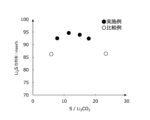
- FIG. 1 is a graph showing the relationship between the number of moles of elemental sulfur supplied per 1 mole of lithium carbonate and the proportion of lithium sulfide contained in the product, for examples and comparative examples.
- lithium carbonate Li 2 CO 3
- lithium carbonate has extremely low hygroscopicity, and its particle size can be easily adjusted. It has comparatively advantageous features.
- lithium sulfide which is the target product
- the reaction apparatus used for production may be a continuous apparatus or a batch-type apparatus.
- the lithium carbonate powder preferably has an average particle size of, for example, 1 ⁇ m or more, more preferably 3 ⁇ m or more, and particularly preferably 6 ⁇ m or more.
- the average particle size is, for example, preferably 100 ⁇ m or less, more preferably 80 ⁇ m or less, and particularly preferably 55 ⁇ m or less.
- the average particle size of lithium carbonate referred to in this specification is the volume cumulative particle size D50 at a cumulative volume of 50% by volume measured by a laser diffraction scattering particle size distribution measurement method.
- the lithium carbonate can be subjected to the firing step in an atmosphere containing sulfur gas and hydrogen gas while the lithium carbonate powder is left stationary or fluidized.
- the firing process can be performed in an open system. Conducting the firing process in an open system means that the reaction system in which the firing process is performed does not exist in a closed space.
- the lithium carbonate firing step in the present production method can be performed while an atmosphere containing sulfur gas and hydrogen gas is circulated through the lithium carbonate powder. Specifically, lithium carbonate can be fired while a mixed gas containing sulfur gas and hydrogen gas is circulated in a heating furnace in which lithium carbonate powder is placed. By adopting such a firing method, lithium carbonate can be industrially produced efficiently.
- the mixed gas used for firing may contain, for example, only sulfur gas and hydrogen gas, or may contain other gases in addition to sulfur gas and hydrogen gas.
- gases include various inert gases such as nitrogen gas and rare gases such as argon.
- the mixed gas does not contain gases other than sulfur gas, hydrogen gas, and an inert gas that is used as necessary, in order to successfully produce the target lithium sulfide.
- the reaction for producing lithium sulfide from lithium carbonate in the production method of the present invention is represented by the following formula (1).
- the mixed gas used for firing lithium carbonate contains only sulfur gas and hydrogen gas.
- an inert gas such as nitrogen gas is used as a diluent gas, the diluent gas and hydrogen gas are mixed, and sulfur gas is mixed therein to prepare a mixed gas to be supplied to lithium carbonate.
- the ratio of hydrogen gas to the total of both is preferably, for example, 1.0% by volume or more, more preferably 1.5% by volume or more. 0 vol % or more is more preferable.
- the ratio is, for example, preferably 4.0% by volume or less, more preferably 3.5% by volume or less, and even more preferably 3.0% by volume or less. This is because good safety and reaction efficiency can be obtained.
- the sulfur gas to be mixed with the hydrogen gas can be obtained by liquefying solid sulfur by heating and then vaporizing it. At this time, it is preferable from the viewpoint of efficiency to heat solid sulfur to, for example, 200° C. or higher and 380° C. or lower under atmospheric pressure.
- the amount of mixed gas containing hydrogen gas and sulfur gas supplied to lithium carbonate is appropriately determined in relation to the amount of lithium carbonate. Specifically, it is as follows.
- the supply amount is determined in relation to the number of moles of lithium carbonate, which is the object to be fired. That is, sulfur gas is preferably contained in the firing atmosphere so that the number of moles of sulfur element relative to the number of moles of lithium carbonate is within a predetermined range. Specifically, the number of moles of sulfur element relative to 1 mole of lithium carbonate is, for example, preferably 6.0 mol or more, more preferably 7.8 mol or more, and 7.9 mol or more. is more preferred. On the other hand, the number of moles of the sulfur element is, for example, preferably 19.0 moles or less, more preferably 17.9 moles or less, and even more preferably 14.9 moles or less. By-production of impurities is suppressed, and high-purity lithium sulfide is obtained. Lithium sulfate (Li 2 SO 4 ) is a typical substance that is a by-product of the firing of lithium carbonate.
- the amount of elemental sulfur supplied to lithium carbonate can be calculated from the amount of decrease in solid sulfur, for example, when sulfur gas is generated by heating solid sulfur.
- the supply amount is determined in relation to the number of moles of lithium carbonate, which is the object to be fired. That is, it is preferable that the value of the number of moles of hydrogen gas with respect to the number of moles of lithium carbonate is contained in the firing atmosphere so as to be within a predetermined range. Specifically, it is preferably contained in the firing atmosphere so as to be 8.5 or more and 12.0 or less. That is, the number of moles of hydrogen gas per 1 mole of lithium carbonate is, for example, preferably 8.5 moles or more, more preferably 9.0 moles or more, and even more preferably 9.5 moles or more. .
- the number of moles of the hydrogen gas is, for example, preferably 12.0 moles or less, more preferably 11.0 moles or less, and even more preferably 10.0 moles or less.
- the amount of hydrogen gas supplied to lithium carbonate can be measured, for example, by a flow meter installed between the hydrogen gas source (eg hydrogen gas cylinder) and the reaction system (eg heating furnace).
- the hydrogen gas source eg hydrogen gas cylinder
- the reaction system eg heating furnace
- the firing temperature is preferably, for example, 650°C or higher, more preferably 700°C or higher, and even more preferably 723°C or higher, which is the melting point of lithium carbonate.
- the firing temperature is, for example, preferably 1,310° C. or lower, more preferably 1,000° C. or lower, and 800° C. or lower, from the viewpoint of good reaction efficiency of lithium carbonate and prevention of decomposition of lithium carbonate. is more preferable.
- the mixed gas containing sulfur gas and hydrogen gas When the mixed gas containing sulfur gas and hydrogen gas is supplied to lithium carbonate to bake the lithium carbonate, the mixed gas may be supplied to lithium carbonate after the temperature of the reaction system reaches 650 ° C. or higher. This is preferable from the viewpoint of reliably producing lithium sulfide. For example, when lithium carbonate is placed in a heating furnace and fired, it is preferable to circulate the mixed gas in the heating furnace after the temperature in the heating furnace reaches 650° C. or higher.
- the mixed gas is not supplied into the reaction system, and only the inert gas is supplied into the reaction system, from the viewpoint of suppressing the generation of impurities such as lithium sulfate.
- an inert gas such as nitrogen gas is circulated in the heating furnace until the temperature in the heating furnace reaches 650 ° C., and the mixed gas is It is preferable not to circulate.
- the firing time is set so that lithium sulfide is reliably generated after setting the supply amounts of elemental sulfur and hydrogen gas to the values described above.
- the diffraction peak at the position of is peak A
- the value of Ib relative to Ia that is, the value of Ib / Ia is preferably 0.024 or less, more preferably
- the value of Ic relative to Ia is preferably 0.19 or less, more preferably 0.070 or less, and even more preferably 0.040 or less.
- peak A is a diffraction peak derived from the (200) plane of lithium sulfide
- peak B is a diffraction peak derived from the (110) plane of lithium carbonate
- peak C is a (11- 1) Diffraction peaks originating from planes.
- part of the mixed gas supplied for firing lithium carbonate may be discharged from the reaction system in an unreacted state, or a by-product of the reaction may be discharged from the reaction system.
- a by-product of the reaction may be discharged from the reaction system.
- sulfur gas when sulfur gas is discharged from the reaction system in an unreacted state, the sulfur gas can be solidified and removed, for example, by cooling the discharged gas.
- hydrogen sulfide gas is discharged from the reaction system as a by-product of the reaction, for example, by bubbling the discharged gas into an aqueous solution of hypochlorous acid or its salt, hydrogen sulfide is oxidized and removed. can do.
- lithium sulfate as an impurity may partially remain in an unreacted state, but it is preferable that no lithium sulfate remains.
- a reaction step for removing lithium sulfate may be further performed. A decrease in the purity of lithium sulfide due to residual lithium sulfate can be suppressed.
- the powder of lithium sulfide containing lithium sulfate (hereinafter, this lithium sulfide is conveniently referred to as "unrefined lithium sulfide”) is left standing or fluidized, and hydrogen gas is
- the unpurified lithium sulfide and hydrogen gas can be subjected to a heating step in an atmosphere containing.
- the heating step can be performed in an open system. Performing the heating step in an open system means that the reaction system in which the heating step is performed does not exist in a closed space.
- the step of heating unpurified lithium sulfide in the present production method can be performed while an atmosphere containing hydrogen gas is circulated through the unpurified lithium sulfide powder.
- the heating furnace in which the unpurified lithium sulfide powder is placed is heated while circulating 100% hydrogen gas or a mixed gas containing hydrogen gas to heat the unpurified lithium sulfide. can do.
- lithium sulfate which is an impurity contained in the unpurified lithium sulfide, reacts with hydrogen gas, and lithium sulfate is reduced to form lithium sulfide. As a result, the purity of lithium sulfide is increased.
- the high purity of lithium sulfide is not particularly limited, but for example, the ratio of lithium sulfide in the product obtained in the present invention is preferably 87% by mass or more. It is preferably 89% by mass or more, and more preferably 90% by mass or more.
- the mixed gas may contain various inert gases such as nitrogen gas and argon as other gases in addition to hydrogen gas. of noble gases such as It is preferable to use the hydrogen gas diluted with an inert gas from the viewpoint of carrying out the present production method safely and from the viewpoint of efficiently carrying out the reaction.
- the mixing ratio of the inert gas and the hydrogen gas the ratio of the hydrogen gas to the total of both is preferably, for example, 1.0% by volume or more, more preferably 1.5% by volume or more. More preferably, it is 0% by volume or more.
- the ratio is, for example, preferably 4.0% by volume or less, more preferably 3.5% by volume or less, and even more preferably 3.0% by volume or less. This is because high safety and good reaction efficiency can be obtained.
- the atmosphere used when heating unpurified lithium sulfide is preferably 100% hydrogen gas, or hydrogen gas diluted to a predetermined concentration with an inert gas. From the viewpoint of obtaining high-purity lithium sulfide, it is preferable that it is not contained in the lithium sulfide.
- the heating temperature for reacting unrefined lithium sulfide and hydrogen gas is, for example, preferably 750° C. or higher, more preferably 842° C. or higher.
- the heating temperature is, for example, preferably 1377° C. or lower, more preferably 1000° C. or lower, and even more preferably 900° C. or lower. This is because the lithium sulfate contained in the unrefined lithium sulfide can be sufficiently reduced and removed with hydrogen gas.
- the heating temperature is, for example, the heating temperature of the heating furnace when the unpurified lithium sulfide is placed in the heating furnace.
- the hydrogen gas When unpurified lithium sulfide is heated and reacted with hydrogen gas, the hydrogen gas may be passed after the unpurified lithium sulfide is heated to the predetermined temperature described above, or before reaching the predetermined temperature. Hydrogen gas may be circulated from the
- the time for reacting unrefined lithium sulfide with hydrogen gas in a heated state can be appropriately adjusted according to other conditions such as heating temperature.
- the reaction time is preferably set so that the lithium sulfate contained in the unpurified lithium sulfide is sufficiently removed.
- the reaction time in the present invention is preferably 1 hour or longer, more preferably 2 hours or longer, and still more preferably 3 hours or longer.
- the flow rate of hydrogen gas to be supplied for reacting with unrefined lithium sulfide can be appropriately adjusted according to the reaction temperature and reaction time.
- the flow rate is preferably such that the number of moles of hydrogen gas with respect to the number of moles of lithium carbonate is, for example, 0.019 mol/min or more and 0.038 mol/min or less. This is because the lithium sulfate contained in the unpurified lithium sulfide can be sufficiently removed.
- the flow of the hydrogen gas is stopped and the heating of the reaction system is stopped to allow the reaction to proceed. is preferably stopped. This is because the intended lithium sulfide can be obtained with high purity.
- the obtained lithium sulfide can be subjected to a pulverization step and a sieving step as a post-treatment to obtain a powder having an appropriate particle size distribution.
- Lithium sulfide obtained by this production method is useful, for example, as a raw material for a sulfide-based solid electrolyte for lithium ion batteries.
- lithium sulfide and diphosphorus pentasulfide ( P2S5 ) or other sulfides can be mechanically milled to synthesize solid electrolytes such as Li7P3S11 and LiPS4 .
- P2S5 diphosphorus pentasulfide
- LiPS4 Li7P3S11 and LiPS4
- a lithium halide such as lithium chloride (LiCl) and/or lithium bromide (LiBr) in an inert gas atmosphere or a hydrogen sulfide atmosphere.
- a crystalline solid electrolyte for example, a solid electrolyte having a crystal phase with an aldirodite-type crystal structure can be synthesized.
- the substance to be reacted with lithium sulfide to synthesize the solid electrolyte is not particularly limited.
- silicon sulfide (SiS 2 ), germanium sulfide (GeS 2 ), and the like can be used in addition to the above-described diphosphorus pentasulfide.
- Example 1 Preparation of mixed gas Hydrogen gas (concentration 3.5 vol%) diluted with nitrogen gas was prepared. Separately, solid sulfur was prepared and placed in a flask, and the flask was heated to 200° C. to 380° C. with a mantle heater to vaporize the solid sulfur and generate sulfur gas. Then, sulfur gas and hydrogen gas diluted with nitrogen gas were mixed to obtain a mixed gas. The ratio of sulfur gas and hydrogen gas in this mixed gas was set to a predetermined ratio by adjusting the heating temperature of solid sulfur, the flow rate of hydrogen gas diluted with nitrogen gas, and the like.
- Lithium carbonate powder having a D50 of 5.9 ⁇ m was prepared. A predetermined amount of lithium carbonate powder was placed in a tubular furnace.
- Examples 2 to 4 and Comparative Examples 1 and 2 The values shown in Table 1 were used for the baking time. Also, the number of moles of sulfur element and the number of moles of hydrogen gas supplied to lithium carbonate were set as shown in the same table per 1 mole of lithium carbonate. Lithium sulfide was produced in the same manner as in Example 1 except for these.
- the lithium sulfide obtained in each example has higher purity than the lithium sulfide obtained in the comparative example.
- lithium sulfide can be produced without using hydrogen sulfide as a starting material.
Landscapes
- Chemical & Material Sciences (AREA)
- Organic Chemistry (AREA)
- Inorganic Chemistry (AREA)
- Battery Electrode And Active Subsutance (AREA)
- Conductive Materials (AREA)
Priority Applications (4)
| Application Number | Priority Date | Filing Date | Title |
|---|---|---|---|
| EP22895553.0A EP4438553A4 (en) | 2021-11-22 | 2022-11-11 | PROCESS FOR THE PRODUCTION OF LITHIUM SULFIDE |
| KR1020247014785A KR20240109989A (ko) | 2021-11-22 | 2022-11-11 | 황화리튬의 제조 방법 |
| JP2023561572A JPWO2023090271A1 (https=) | 2021-11-22 | 2022-11-11 | |
| CN202280074064.9A CN118215637A (zh) | 2021-11-22 | 2022-11-11 | 硫化锂的制造方法 |
Applications Claiming Priority (2)
| Application Number | Priority Date | Filing Date | Title |
|---|---|---|---|
| JP2021-189601 | 2021-11-22 | ||
| JP2021189601 | 2021-11-22 |
Publications (1)
| Publication Number | Publication Date |
|---|---|
| WO2023090271A1 true WO2023090271A1 (ja) | 2023-05-25 |
Family
ID=86396922
Family Applications (1)
| Application Number | Title | Priority Date | Filing Date |
|---|---|---|---|
| PCT/JP2022/042106 Ceased WO2023090271A1 (ja) | 2021-11-22 | 2022-11-11 | 硫化リチウムの製造方法 |
Country Status (5)
| Country | Link |
|---|---|
| EP (1) | EP4438553A4 (https=) |
| JP (1) | JPWO2023090271A1 (https=) |
| KR (1) | KR20240109989A (https=) |
| CN (1) | CN118215637A (https=) |
| WO (1) | WO2023090271A1 (https=) |
Cited By (2)
| Publication number | Priority date | Publication date | Assignee | Title |
|---|---|---|---|---|
| WO2024214614A1 (ja) * | 2023-04-11 | 2024-10-17 | 三菱マテリアル株式会社 | 硫化リチウムの製造方法 |
| CN120622416A (zh) * | 2025-08-13 | 2025-09-12 | 浙江工业大学 | 一种以还原性气体还原硫酸锂制备高纯度电池级硫化锂的方法 |
Families Citing this family (3)
| Publication number | Priority date | Publication date | Assignee | Title |
|---|---|---|---|---|
| KR102909660B1 (ko) * | 2024-10-30 | 2026-01-09 | 주식회사 에코프로이노베이션 | 탄산 리튬으로부터 황화 리튬의 제조 방법 |
| KR102909656B1 (ko) * | 2024-10-30 | 2026-01-09 | 주식회사 에코프로이노베이션 | 황산 리튬으로부터 황화 리튬의 제조 방법 |
| CN119873757B (zh) * | 2025-01-19 | 2025-07-04 | 峨眉山嘉美高纯材料有限公司 | 一种高纯硫化锂的制备方法及装置 |
Citations (8)
| Publication number | Priority date | Publication date | Assignee | Title |
|---|---|---|---|---|
| JPH09110404A (ja) * | 1995-10-13 | 1997-04-28 | Furukawa Co Ltd | 硫化リチウムの製造方法 |
| JPH09278423A (ja) * | 1996-04-16 | 1997-10-28 | Furukawa Co Ltd | 硫化リチウムの製造方法 |
| JPH09283156A (ja) * | 1996-04-16 | 1997-10-31 | Matsushita Electric Ind Co Ltd | リチウムイオン伝導性固体電解質およびその製造方法 |
| JP2012221819A (ja) * | 2011-04-12 | 2012-11-12 | Mitsui Mining & Smelting Co Ltd | リチウムイオン電池固体電解質材料用硫化リチウムの製造方法 |
| JP2015003843A (ja) * | 2013-06-21 | 2015-01-08 | 東レ・ファインケミカル株式会社 | 金属硫化物の製造方法 |
| JP2016150860A (ja) | 2015-02-16 | 2016-08-22 | 古河機械金属株式会社 | 硫化リチウムの製造方法 |
| JP2016204219A (ja) * | 2015-04-24 | 2016-12-08 | 出光興産株式会社 | 硫化リチウム、及び硫化物固体電解質の製造方法 |
| JP2018087133A (ja) * | 2018-01-09 | 2018-06-07 | 東レ・ファインケミカル株式会社 | 硫化リチウム製造装置 |
Family Cites Families (2)
| Publication number | Priority date | Publication date | Assignee | Title |
|---|---|---|---|---|
| GB2464455B (en) * | 2008-10-14 | 2010-09-15 | Iti Scotland Ltd | Lithium-containing transition metal sulfide compounds |
| JP6256754B2 (ja) * | 2013-02-27 | 2018-01-10 | 東レ・ファインケミカル株式会社 | 硫化リチウムの製造方法 |
-
2022
- 2022-11-11 WO PCT/JP2022/042106 patent/WO2023090271A1/ja not_active Ceased
- 2022-11-11 JP JP2023561572A patent/JPWO2023090271A1/ja active Pending
- 2022-11-11 KR KR1020247014785A patent/KR20240109989A/ko active Pending
- 2022-11-11 CN CN202280074064.9A patent/CN118215637A/zh active Pending
- 2022-11-11 EP EP22895553.0A patent/EP4438553A4/en active Pending
Patent Citations (8)
| Publication number | Priority date | Publication date | Assignee | Title |
|---|---|---|---|---|
| JPH09110404A (ja) * | 1995-10-13 | 1997-04-28 | Furukawa Co Ltd | 硫化リチウムの製造方法 |
| JPH09278423A (ja) * | 1996-04-16 | 1997-10-28 | Furukawa Co Ltd | 硫化リチウムの製造方法 |
| JPH09283156A (ja) * | 1996-04-16 | 1997-10-31 | Matsushita Electric Ind Co Ltd | リチウムイオン伝導性固体電解質およびその製造方法 |
| JP2012221819A (ja) * | 2011-04-12 | 2012-11-12 | Mitsui Mining & Smelting Co Ltd | リチウムイオン電池固体電解質材料用硫化リチウムの製造方法 |
| JP2015003843A (ja) * | 2013-06-21 | 2015-01-08 | 東レ・ファインケミカル株式会社 | 金属硫化物の製造方法 |
| JP2016150860A (ja) | 2015-02-16 | 2016-08-22 | 古河機械金属株式会社 | 硫化リチウムの製造方法 |
| JP2016204219A (ja) * | 2015-04-24 | 2016-12-08 | 出光興産株式会社 | 硫化リチウム、及び硫化物固体電解質の製造方法 |
| JP2018087133A (ja) * | 2018-01-09 | 2018-06-07 | 東レ・ファインケミカル株式会社 | 硫化リチウム製造装置 |
Non-Patent Citations (1)
| Title |
|---|
| See also references of EP4438553A4 |
Cited By (2)
| Publication number | Priority date | Publication date | Assignee | Title |
|---|---|---|---|---|
| WO2024214614A1 (ja) * | 2023-04-11 | 2024-10-17 | 三菱マテリアル株式会社 | 硫化リチウムの製造方法 |
| CN120622416A (zh) * | 2025-08-13 | 2025-09-12 | 浙江工业大学 | 一种以还原性气体还原硫酸锂制备高纯度电池级硫化锂的方法 |
Also Published As
| Publication number | Publication date |
|---|---|
| CN118215637A (zh) | 2024-06-18 |
| KR20240109989A (ko) | 2024-07-12 |
| JPWO2023090271A1 (https=) | 2023-05-25 |
| EP4438553A1 (en) | 2024-10-02 |
| EP4438553A4 (en) | 2025-11-12 |
Similar Documents
| Publication | Publication Date | Title |
|---|---|---|
| WO2023090271A1 (ja) | 硫化リチウムの製造方法 | |
| JP7071899B2 (ja) | 固体電解質の製造方法 | |
| JP7257574B2 (ja) | 固体電解質の製造方法 | |
| JP6761024B2 (ja) | 固体電解質及び固体電解質の製造方法 | |
| JP2014169196A (ja) | 硫化リチウムの製造方法及び無機固体電解質の製造方法 | |
| JP2013075816A (ja) | 硫化リチウム、その製造方法及び無機固体電解質の製造方法 | |
| WO2014192309A1 (ja) | 固体電解質の製造方法 | |
| WO2013069243A1 (ja) | 固体電解質 | |
| JP6936251B2 (ja) | 硫化物固体電解質の製造方法 | |
| JPWO2016204253A1 (ja) | 固体電解質の製造方法 | |
| JPWO2014010169A1 (ja) | イオン伝導性物質の製造方法、イオン伝導性物質、結晶化イオン伝導性物質及び電池 | |
| JP6063464B2 (ja) | 硫化物系ガラスと硫化物系ガラスセラミックスの製造方法 | |
| JP2018095522A (ja) | 硫黄含有複合体、その製造方法、及び固体電解質の製造方法 | |
| CN114207898A (zh) | 固体电解质及其制造方法 | |
| CN111788641B (zh) | 具有硫银锗矿型晶体结构的硫化物固体电解质的制造方法 | |
| WO2023090283A1 (ja) | 硫化リチウムの製造方法 | |
| JP6162981B2 (ja) | 硫化リチウムの製造方法及び無機固体電解質の製造方法 | |
| JP2016204219A (ja) | 硫化リチウム、及び硫化物固体電解質の製造方法 | |
| WO2023090282A1 (ja) | 硫化リチウム及びその製造方法並びに硫化物固体電解質の製造方法 | |
| Yamada et al. | Growth of idiomorphic LiMnPO 4 crystals in molten NaCl–KCl and LiF–NaCl–KCl fluxes | |
| JP2015005371A (ja) | 硫化物系固体電解質の製造方法 | |
| WANG et al. | Synthesis of BaxTiSy in Sulfur Melt |
Legal Events
| Date | Code | Title | Description |
|---|---|---|---|
| 121 | Ep: the epo has been informed by wipo that ep was designated in this application |
Ref document number: 22895553 Country of ref document: EP Kind code of ref document: A1 |
|
| WWE | Wipo information: entry into national phase |
Ref document number: 2023561572 Country of ref document: JP |
|
| WWE | Wipo information: entry into national phase |
Ref document number: 18706459 Country of ref document: US |
|
| WWE | Wipo information: entry into national phase |
Ref document number: 202280074064.9 Country of ref document: CN |
|
| WWE | Wipo information: entry into national phase |
Ref document number: 2022895553 Country of ref document: EP |
|
| NENP | Non-entry into the national phase |
Ref country code: DE |
|
| ENP | Entry into the national phase |
Ref document number: 2022895553 Country of ref document: EP Effective date: 20240624 |