WO2023080101A1 - ハイドロゲル - Google Patents
ハイドロゲル Download PDFInfo
- Publication number
- WO2023080101A1 WO2023080101A1 PCT/JP2022/040592 JP2022040592W WO2023080101A1 WO 2023080101 A1 WO2023080101 A1 WO 2023080101A1 JP 2022040592 W JP2022040592 W JP 2022040592W WO 2023080101 A1 WO2023080101 A1 WO 2023080101A1
- Authority
- WO
- WIPO (PCT)
- Prior art keywords
- hydrogel
- amorphous carbon
- ophthalmic
- acrylate
- solution
- Prior art date
- Legal status (The legal status is an assumption and is not a legal conclusion. Google has not performed a legal analysis and makes no representation as to the accuracy of the status listed.)
- Ceased
Links
Images


Classifications
-
- G—PHYSICS
- G02—OPTICS
- G02C—SPECTACLES; SUNGLASSES OR GOGGLES INSOFAR AS THEY HAVE THE SAME FEATURES AS SPECTACLES; CONTACT LENSES
- G02C7/00—Optical parts
- G02C7/02—Lenses; Lens systems ; Methods of designing lenses
- G02C7/04—Contact lenses for the eyes
-
- A—HUMAN NECESSITIES
- A61—MEDICAL OR VETERINARY SCIENCE; HYGIENE
- A61K—PREPARATIONS FOR MEDICAL, DENTAL OR TOILETRY PURPOSES
- A61K9/00—Medicinal preparations characterised by special physical form
- A61K9/0012—Galenical forms characterised by the site of application
- A61K9/0048—Eye, e.g. artificial tears
- A61K9/0051—Ocular inserts or implants
-
- G—PHYSICS
- G02—OPTICS
- G02C—SPECTACLES; SUNGLASSES OR GOGGLES INSOFAR AS THEY HAVE THE SAME FEATURES AS SPECTACLES; CONTACT LENSES
- G02C7/00—Optical parts
- G02C7/10—Filters, e.g. for facilitating adaptation of the eyes to the dark; Sunglasses
Definitions
- the present invention relates to hydrogels, and more particularly to hydrogels containing amorphous carbon.
- drug therapy which is one of the treatment methods for various diseases, may take measures such as stopping medication if side effects are significant, or changing drugs if alternative treatments are possible.
- side effects are not severe or alternative treatments are not possible, medication is often continued.
- QOL quality of life
- TS-1 (TS-1) is known as an anticancer drug, one of the medications prescribed for many cancer treatments (see Non-Patent Document 1).
- TS-1 is composed of tegafur, gimeracil and oteracil potassium, and fluorouracil (5FU) produced by metabolism of tegafur in the body is a prodrug that exhibits anticancer activity.
- fluorouracil 5FU
- One of the side effects of TS-1 medication is lacrimation due to lacrimal obstruction.
- the main method of symptomatic treatment is to remove the lacrimation physically by instilling physiological saline or the like into the eye, and preventive therapy is desired.
- Patent Document 1 discloses a method of removing 5FU by chemically bonding it to a heterocyclic compound, which is a constituent of an ophthalmic lens substrate, before 5FU in tears develops side effects. .
- medicinal charcoal is used for decontamination of the gastrointestinal tract, which is one of the countermeasures when the target is not absorbed into the gastrointestinal tract in the case of overdose of drugs or accidental ingestion of toxic substances.
- This medicinal charcoal is an antidiarrheal agent or antiflatulent agent for adsorption and detoxification in diarrhea, adsorption of gases produced by abnormal fermentation in the digestive tract, autopoisoning and drug poisoning.
- activated charcoal itself is orally administered.
- Patent Document 1 uses a heterocyclic compound, which has a structure capable of forming a base pair with 5FU in tears, as a constituent component of a hydrogel that is an ophthalmic lens base material, thereby chemically Since it is a mechanism that captures 5FU in an ophthalmic lens substrate by a simple bond, the combination of a compound to be captured and an ophthalmic lens substrate is limited. Therefore, when capturing different compounds by the same mechanism, the constituent components of the ophthalmic lens substrate must be changed according to the chemical structure of the target compound, which poses a problem of versatility.
- the present invention provides a hydrogel for use in which a plurality of target compounds are used as constituents of a base material, for example, in the case of capturing a predetermined compound derived from a therapeutic drug that remains in tear fluid by an ophthalmic hydrogel.
- An object of the present invention is to provide a highly versatile hydrogel that can be captured without bending.
- the present inventors have investigated a method for removing multiple target compounds, including 5FU, from tear fluid using a single ocular hydrogel. Focused on adsorption. In particular, the physical adsorption of 5FU was evaluated using various substances, and it was found that 5FU can be adsorbed more effectively when amorphous carbon is used than when other substances are used. .
- the present invention is an invention that has been completed based on such successful examples and findings.
- hydrogels of the following aspects are provided.
- [1] A hydrogel containing amorphous carbon.
- [3] The hydrogel of [2], wherein the ophthalmic hydrogel is in the shape of a contact lens, and the amorphous carbon is annularly arranged on the surface and/or inside, excluding the optical region.
- [4] The hydrogel according to [2], wherein the ocular hydrogel is ring-shaped or magatama-shaped, and the amorphous carbon is uniformly distributed over the entire surface and/or interior.
- [5] The hydrogel according to any one of [1] to [4], wherein the amorphous carbon physically adsorbs a predetermined compound.
- amorphous carbon in the hydrogel can physically adsorb a plurality of target compounds such as 5FU.
- target compounds such as 5FU.
- the hydrogel of the present invention when the hydrogel is for eye use, for example, the amorphous carbon physically adsorbs a plurality of target compounds.
- the gel base material can capture multiple target compounds, and has excellent versatility.
- 5FU retained in tears is physically adsorbed to amorphous carbon, and thus 5FU is removed from tears. It is expected that the occurrence of tear flow, which is one of the side effects, can be suppressed in advance.
- the eye hydrogel in the case where the hydrogel is for eye use, in particular, is in the shape of a normal contact lens, and the amorphous carbon is the surface and/or Or it is arranged in an annular shape inside, or the ocular hydrogel has an annular shape with an opening in the optical center including the optical region, or it is used by inserting it between the lower eyelid and the eyeball Maintaining the quality of vision (QOV) during wearing of the ophthalmic hydrogel (visibility not worsen).
- QOV quality of vision
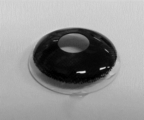
- FIG. 1 is a perspective view (photographic image) from above the front face side showing an example (contact lens shape) of an ophthalmic hydrogel of one embodiment of the present invention.
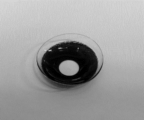
- FIG. FIG. 2 is a perspective view (photographic image) of the hydrogel for eye shown in FIG. 1 from above the base surface side;
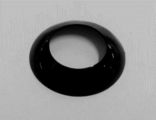
- FIG. 10 is a perspective view (photographic image) from above the front face side showing another example (annular shape) of the ophthalmic hydrogel of one embodiment of the present invention.
- FIG. 4 is a perspective view (photographic image) of the hydrogel for eye shown in FIG. 3 from above the base surface side;
- FIG. 3 is a perspective view (photographic image) from above the front face side showing another example (magatama shape) of the hydrogel for eyes according to one embodiment of the present invention.
- hydrogel which is one aspect of the present invention, will be described in detail below, but the present invention can take various aspects as long as it achieves its purpose.
- ⁇ in a numerical range is a range that includes the numerical values before and after it.
- 0% to 100% means a range of 0% or more and 100% or less.
- “Monomer” means a paired term with “polymer”, and means a molecule that can be polymerized by a polymerizable group in the molecule and that can be used as a constituent component of a polymer.
- Polymer means a molecule formed by polymerizing monomers.
- (Meth)acrylate is a generic term that includes both acrylate and methacrylate.
- a hydrogel of one embodiment of the present invention contains amorphous carbon and contains at least a hydrophilic monomer as a base component.
- a hydrogel can swell by containing water (hydration swelling) by containing a hydrophilic monomer.
- the hydrogel of one embodiment of the present invention is particularly useful as an ophthalmic material that is directly attached to the eye.
- the structure of such an ophthalmic hydrogel is not particularly limited as long as the QOV is ensured. Examples include a magatama shape suitable for use by inserting between the lower eyelid and the eyeball.
- the amorphous carbon in the hydrogel when used as an ophthalmic material that is directly attached to the eye, physically binds a plurality of target compounds including 5FU. Because it can be adsorbed effectively, certain compounds from medications that are retained in tears, for example, can be entrapped by the ophthalmic hydrogel.
- Amorphous carbon is an allotrope of carbon other than diamond and graphite that does not exhibit a distinct crystalline state. Examples of such amorphous carbon include soot, charcoal, coke, carbon black, and the like.
- the amorphous carbon contained in the hydrogel of one embodiment of the present invention is not particularly limited, but from the viewpoint of dispersibility in the raw material solution of the hydrogel, powdered activated carbon and carbon black having a nano-sized pore structure is preferably used.
- the average particle size of powdered activated carbon and carbon black is preferably 500 nm or less, more preferably 300 nm or less, in consideration of dispersibility in various solutions.
- Amorphous carbon is preferably contained in a ratio of 1.0% by mass to 20% by mass in the production method (1) described later with respect to the total amount of the constituent components of the hydrogel, and the production method (2) described later. is preferably contained in a proportion of 0.1% by mass to 1.0% by mass.
- the hydrogel of one embodiment of the present invention includes, for example, a hydrogel formed using a hydrophilic monomer, a hydrogel formed using a hydrophilic monomer, a hydrophobic monomer, a crosslinkable monomer, or both, and the like. be done.
- the hydrophilic monomer is not particularly limited as long as it has a hydrophilic group and a (meth)acrylic group or a vinyl group in the molecule.
- examples include hydroxymethyl (meth)acrylate, 2-hydroxyethyl (meth)acrylate, 2-hydroxypropyl (meth)acrylate, 2,3-dihydroxypropyl (meth)acrylate, 2-polyethylene glycol (meth)acrylate, acrylamide, 2-polypropylene glycol (meth)acrylate, N,N-dimethylmethacrylamide, N- Vinylpyrrolidone (NVP), N,N-dimethylacrylamide (DMAA), (meth)acrylic acid, polyethylene glycol mono(meth)acrylate, glyceryl (meth)acrylate (glycerol (meth)acrylate), N-vinyl-N-methyl Acetamide, N-vinyl-N-ethylacetamide, N-vinyl-N-ethylformamide, N-vin
- Hydrophobic monomers include, for example, trifluoroethyl (meth)acrylate, methacrylamide, siloxanyl (meth)acrylate, methyl (meth)acrylate, n-butyl (meth)acrylate, tert-butyl (meth)acrylate, benzyl (meth)acrylate, ) acrylate, ethylhexyl (meth)acrylate, lauryl (meth)acrylate and the like.
- One of the above hydrophobic monomers may be used alone, or two or more thereof may be used in combination so as to obtain a hydrogel having desired physical properties.
- crosslinkable monomers include ethylene glycol di(meth)acrylate, diethylene glycol di(meth)acrylate, triethylene glycol di(meth)acrylate, propylene glycol di(meth)acrylate, dipropylene glycol di(meth)acrylate, (Meth)acrylate crosslinking monomers such as trimethylolpropane tri(meth)acrylate, pentaerythritol tri(meth)acrylate, pentaerythritol tetra(meth)acrylate, dipentaerythritol hexa(meth)acrylate; allyl methacrylate, diallyl maleate , diallyl fumarate, diallyl succinate, diallyl phthalate, triallyl cyanurate, triallyl isocyanurate, diethylene glycol bisallyl carbonate, triallyl phosphate, triallyl trimellitate, diallyl ether, N,N-diallylmelamine, divinylbenzene,
- crosslinkable monomers may be used singly or in combination of two or more so as to obtain a hydrogel having desired physical properties.
- a bifunctional crosslinkable monomer is more preferably used.
- the crosslinkable monomer is preferably contained in a proportion of 5% by mass or less, more preferably 3% by mass or less, relative to the total amount of constituent components of the hydrogel.
- the content of the crosslinkable monomer exceeds 5% by mass, the crosslinkability becomes strong, and especially in the hydrogel for eyes, the flexibility may be lowered, and the practicality such as application to contact lenses may be deteriorated.
- the structure of the ophthalmic hydrogel of one embodiment of the present invention is, for example, a normal contact lens shape as shown in FIGS. Circular arrangement is preferable from the viewpoint of QOV. Further, when the structure of the ophthalmic hydrogel of one embodiment of the present invention is, for example, as shown in FIGS.
- the amorphous carbon is preferably distributed evenly over the entire surface and/or interior.
- the optical region refers to the central portion of the lens, which corresponds to the diameter of the pupil (approximately 6 mm).
- a conventionally known method can be employed as long as a hydrogel containing amorphous carbon can be obtained.
- methods for disposing amorphous carbon on the surface and/or inside of the eye hydrogel include the following methods (1) and (2). is mentioned.
- the amorphous carbon/raw material monomer solution obtained by dispersing amorphous carbon in the raw material monomer solution contained as a constituent component of the hydrogel base material serving as the amorphous carbon carrier. is subjected to a copolymerization reaction in a mold for forming an ophthalmic hydrogel, whereby an ophthalmic hydrogel in which amorphous carbon is uniformly distributed throughout the surface and/or inside of the ocular hydrogel is obtained. can get.
- this method (1) is suitable when the structure of the hydrogel for eye is to have a ring shape as shown in FIGS. 3 and 4, or to have a magatama shape as shown in FIG. .
- the raw material monomer solution has a predetermined viscosity, the dispersibility of the amorphous carbon is improved.
- the polymer compound is not particularly limited as long as it is soluble in the raw material monomer, and examples thereof include polyvinyl alcohol and polyvinylpyrrolidone.
- the position of amorphous carbon can be controlled.
- the structure of the ophthalmic hydrogel is formed into a contact lens shape as shown in FIGS. 1 and 2, it is necessary to impart certain optical characteristics when worn, so the above method (2) is preferable. .
- the method (2) will be described in detail below.
- an ocular hydrogel in which amorphous carbon is arranged only on the surface and an ocular hydrogel in which amorphous carbon is arranged only inside Gels or ophthalmic hydrogels can be produced with amorphous carbon disposed within and on the surface.
- an ophthalmic hydrogel obtained by forming a layer composed of an amorphous carbon dispersion solution so as not to contact the optical region of the ophthalmic hydrogel. can maintain constant optical properties.
- the formation of the layer composed of the amorphous carbon dispersion solution is carried out by a method usually used for forming a thin film layer on the surface of a contact lens or a spectacle lens.
- a method usually used for forming a thin film layer on the surface of a contact lens or a spectacle lens can be adopted.
- Examples of such a layer forming method include a pad printing method, a spin casting method, and a dipping method. method is preferred.
- the amorphous carbon dispersion solution has a predetermined viscosity, thereby improving the dispersibility of the amorphous carbon in the solution, and forming the mold.
- the film formability on the surface or the surface of the first hydrogel substrate is also improved.
- a method of incorporating a polymer compound into the amorphous carbon dispersion solution can be mentioned.
- a method for incorporating a polymer compound there is a method of kneading amorphous carbon into a previously prepared polymer compound solution.
- a method of kneading the amorphous carbon into the polymer compound solution includes, but is not limited to, a method using a vortex mixer, a method using a magnetic stirrer, and the like.
- a hydrophilic monomer is used as a base component.
- the amorphous carbon dispersion solution also has hydrophilicity.
- a suitable amorphous carbon-dispersed solution can be obtained by using a polymer compound solution that is also hydrophilic.
- hydrophilic polymer compound solutions include poly 2-hydroxyethyl methacrylate solution (hereinafter also referred to as “p-HEMA solution”), poly 2-hydroxyethyl acrylate solution (hereinafter also referred to as “p-HEA solution”).
- PVA solution polyvinyl alcohol solution
- PVP solution polyvinylpyrrolidone solution
- a thermal polymerization initiator or a photopolymerization initiator represented by a peroxide or an azo compound can be added when the raw material monomer solution is subjected to the copolymerization reaction.
- Such polymerization initiators include general radical polymerization initiators such as lauroyl peroxide, cumene hydroperoxide, benzoyl peroxide, and other peroxide polymerization initiators; azobisdimethylvaleronitrile, azobisisobutyl; Azo polymerization initiators such as lonitrile and the like can be mentioned, and one of these can be used alone, or two or more of them can be used in combination.
- the amount of the polymerization initiator to be added is not particularly limited as long as it is sufficient to promote the copolymerization reaction of the monomers. If the amount of the polymerization initiator added is less than 10 ppm, the polymerization reaction may be insufficient and an eye hydrogel having appropriate strength may not be obtained. On the other hand, if the amount of the polymerization initiator added exceeds 10000 ppm, the polymerization rate will be high and the reaction will be uneven, possibly failing to obtain a polymer having appropriate strength.
- the copolymerization reaction is carried out by placing the constituent components of the hydrogel to which the polymerization initiator is added into a mold made of metal, glass, plastic, etc., sealing it, and placing it in a constant temperature bath or the like.
- the temperature is raised in the range of 25° C. to 120° C. either continuously or continuously to complete the polymerization in 5 to 120 hours, or the polymerization is completed by irradiating ultraviolet rays, electron beams, gamma rays, etc. can be done.
- Solution polymerization can also be employed by adding water or an organic solvent to the hydrogel constituents.
- the mold is cooled to room temperature, the obtained copolymer is peeled from the mold, cut and polished as necessary, A hydrogel is obtained by swelling with hydration.
- Liquids (swelling liquids) to be used include, for example, water, physiological saline, and isotonic buffers.
- the swelling liquid is heated to 60° C. to 100° C. and immersed for a certain period of time to obtain a swollen state.
- Amorphous carbon "MA7" (average particle size: 24 nm, manufactured by Mitsubishi Chemical Corporation) was added to the hydrophilic polymer compound solution [1] prepared at the content ratio shown in Table 1, and then sufficiently mixed using a vortex mixer. The mixture was stirred and kneaded to prepare a 20% amorphous carbon dispersion solution [1]. Next, after corona discharge is applied to the surface of the male mold for forming ophthalmic hydrogel, the amorphous carbon dispersion solution [1] is printed using a pad printer and allowed to air dry at room temperature for 1 hour.
- a layer [1] composed of the amorphous carbon dispersion solution was formed on the surface of the male mold of the mold.
- Etafilcon a copolymer of 2-hydroxyethyl methacrylate, methacrylic acid, and trimethylolpropane triacrylate
- a hydrogel base material [1] is placed in a female mold for forming an ophthalmic hydrogel.
- the male mold having the layer [1] formed on the surface was fitted, and the temperature was raised in the range of 50° C. to 100° C. over 25 hours to complete the copolymerization reaction.
- Comparative ophthalmic hydrogel [A] was prepared in the same manner as in Production Example 1 of amorphous carbon-containing ophthalmic hydrogel, except that layer [1] using amorphous carbon dispersion solution [1] was not formed. 20 sheets of each of ⁇ [B] were produced.
- Amorphous carbon "MA7" (average particle size: 24 nm, Mitsubishi (manufactured by Chemical Co., Ltd.) was added, and the mixture was sufficiently stirred and kneaded using a vortex mixer to prepare a 20% amorphous carbon/raw material monomer solution [1].
- the amorphous carbon/raw material monomer solution [1] was injected into the female mold of a ring-shaped mold for forming ophthalmic hydrogel, and the male mold was fitted. The temperature was raised over time to complete the copolymerization reaction.
- amorphous carbon/raw material monomer solution [2] is injected into the female mold of a magatama-shaped mold for forming hydrogel for eye use, the male mold is fitted, and the temperature is maintained at 50° C. to 100° C. for 25 hours. The temperature was raised over a period of time to complete the copolymerization reaction.
- magatama-shaped copolymer was removed from the mold and immersed in distilled water of about 80°C for about 4 hours to swell with hydration, thereby producing an amorphous carbon-containing ophthalmic hydrogel shown in Fig. 5. [12] was produced. A total of 20 pieces of ophthalmic hydrogel [12] were produced by repeating the above method.
- Comparative ophthalmic hydrogel [D] was prepared in the same manner as in Production Example 12 of amorphous carbon-containing ophthalmic hydrogel, except that hydrophilic polymer compound solution [1] containing amorphous carbon was not added. 20 sheets were produced.
- a 10 ppm solution of 5FU in Dulbecco's phosphate buffer was prepared as a 5FU immersion solution.
- One sheet each of ophthalmic hydrogels [1] to [12] and [A] to [D] was immersed in 4 mL of 5FU immersion liquid and shaken at room temperature for 24 hours.
- the ophthalmic hydrogel removed from the 5FU immersion solution is immersed in 4 mL of Dulbecco's phosphate buffer at room temperature for 24 hours to wash away 5FU on the surface of the hydrogel that is not adsorbed to carbon black.
- We obtained a hydrogel for 20 ophthalmic hydrogels adsorbed with 5FU were produced for each of the ocular hydrogels [1] to [12] and [A] to [D].
- the rate of increase with respect to the 5FU adsorption amount of ophthalmic hydrogel [A] is shown in Table 1, and for ocular hydrogels [6] to [10]
- Table 2 shows the rate of increase with respect to the amount of 5FU adsorbed by Ophthalmic Hydrogel [B].
- Table 4 shows the rate of increase with respect to the 5FU adsorption amount of ophthalmic hydrogel [D] for ocular hydrogel [12].
- the hydrogel of the present invention when the hydrogel is an ophthalmic hydrogel, for example, 5FU retained in tears is adsorbed to amorphous carbon when the ophthalmic hydrogel is worn. , is expected to suppress the occurrence of tear flow, which is one of the side effects of 5FU.
Landscapes
- Health & Medical Sciences (AREA)
- Ophthalmology & Optometry (AREA)
- Physics & Mathematics (AREA)
- General Health & Medical Sciences (AREA)
- General Physics & Mathematics (AREA)
- Optics & Photonics (AREA)
- Epidemiology (AREA)
- Life Sciences & Earth Sciences (AREA)
- Animal Behavior & Ethology (AREA)
- Pharmacology & Pharmacy (AREA)
- Public Health (AREA)
- Veterinary Medicine (AREA)
- Medicinal Chemistry (AREA)
- Chemical & Material Sciences (AREA)
- Prostheses (AREA)
- Medicinal Preparation (AREA)
- Compositions Of Macromolecular Compounds (AREA)
Priority Applications (4)
| Application Number | Priority Date | Filing Date | Title |
|---|---|---|---|
| JP2023558021A JPWO2023080101A1 (https=) | 2021-11-02 | 2022-10-31 | |
| CN202280071051.6A CN118140172A (zh) | 2021-11-02 | 2022-10-31 | 水凝胶 |
| EP22889921.7A EP4428602A4 (en) | 2021-11-02 | 2022-10-31 | HYDROGEL |
| US18/704,484 US20250102828A1 (en) | 2021-11-02 | 2022-10-31 | Hydrogel |
Applications Claiming Priority (2)
| Application Number | Priority Date | Filing Date | Title |
|---|---|---|---|
| JP2021179262 | 2021-11-02 | ||
| JP2021-179262 | 2021-11-02 |
Publications (1)
| Publication Number | Publication Date |
|---|---|
| WO2023080101A1 true WO2023080101A1 (ja) | 2023-05-11 |
Family
ID=86241142
Family Applications (1)
| Application Number | Title | Priority Date | Filing Date |
|---|---|---|---|
| PCT/JP2022/040592 Ceased WO2023080101A1 (ja) | 2021-11-02 | 2022-10-31 | ハイドロゲル |
Country Status (6)
| Country | Link |
|---|---|
| US (1) | US20250102828A1 (https=) |
| EP (1) | EP4428602A4 (https=) |
| JP (1) | JPWO2023080101A1 (https=) |
| CN (1) | CN118140172A (https=) |
| TW (1) | TW202320816A (https=) |
| WO (1) | WO2023080101A1 (https=) |
Citations (5)
| Publication number | Priority date | Publication date | Assignee | Title |
|---|---|---|---|---|
| JPS6250126A (ja) * | 1985-06-05 | 1987-03-04 | ボ−シユ アンド ロ−ム インコ−ポレイテイド | 異るポリマ−組成物の物品を製造するための方法 |
| JP2015018179A (ja) * | 2013-07-12 | 2015-01-29 | 株式会社ユニバーサルビュー | コンタクトレンズ |
| JP2018203832A (ja) | 2017-05-31 | 2018-12-27 | 株式会社シード | 複素環式化合物が担持可能なハイドロゲル |
| WO2020016918A1 (ja) * | 2018-07-17 | 2020-01-23 | イクエンメディカル株式会社 | ピンホールコンタクトレンズ及びピンホールコンタクトレンズの製造方法 |
| JP2021179262A (ja) | 2020-05-11 | 2021-11-18 | 前田建設工業株式会社 | 給気制御装置及び空調システム |
Family Cites Families (2)
| Publication number | Priority date | Publication date | Assignee | Title |
|---|---|---|---|---|
| US10816823B2 (en) * | 2015-05-04 | 2020-10-27 | École Polytechnique Fédérale de Lausanne | Ophthalmic contact lens with compressible affinity matrix |
| JP2020132755A (ja) * | 2019-02-19 | 2020-08-31 | 国立大学法人広島大学 | ハイドロゲルおよびハイドロゲルの製造方法 |
-
2022
- 2022-10-31 JP JP2023558021A patent/JPWO2023080101A1/ja active Pending
- 2022-10-31 EP EP22889921.7A patent/EP4428602A4/en active Pending
- 2022-10-31 CN CN202280071051.6A patent/CN118140172A/zh active Pending
- 2022-10-31 WO PCT/JP2022/040592 patent/WO2023080101A1/ja not_active Ceased
- 2022-10-31 US US18/704,484 patent/US20250102828A1/en active Pending
- 2022-10-31 TW TW111141333A patent/TW202320816A/zh unknown
Patent Citations (5)
| Publication number | Priority date | Publication date | Assignee | Title |
|---|---|---|---|---|
| JPS6250126A (ja) * | 1985-06-05 | 1987-03-04 | ボ−シユ アンド ロ−ム インコ−ポレイテイド | 異るポリマ−組成物の物品を製造するための方法 |
| JP2015018179A (ja) * | 2013-07-12 | 2015-01-29 | 株式会社ユニバーサルビュー | コンタクトレンズ |
| JP2018203832A (ja) | 2017-05-31 | 2018-12-27 | 株式会社シード | 複素環式化合物が担持可能なハイドロゲル |
| WO2020016918A1 (ja) * | 2018-07-17 | 2020-01-23 | イクエンメディカル株式会社 | ピンホールコンタクトレンズ及びピンホールコンタクトレンズの製造方法 |
| JP2021179262A (ja) | 2020-05-11 | 2021-11-18 | 前田建設工業株式会社 | 給気制御装置及び空調システム |
Non-Patent Citations (1)
| Title |
|---|
| See also references of EP4428602A4 |
Also Published As
| Publication number | Publication date |
|---|---|
| CN118140172A (zh) | 2024-06-04 |
| TW202320816A (zh) | 2023-06-01 |
| JPWO2023080101A1 (https=) | 2023-05-11 |
| US20250102828A1 (en) | 2025-03-27 |
| EP4428602A1 (en) | 2024-09-11 |
| EP4428602A4 (en) | 2025-10-22 |
Similar Documents
| Publication | Publication Date | Title |
|---|---|---|
| US10591749B2 (en) | Medical device, combination of coating solutions, and method for producing medical device | |
| KR101426977B1 (ko) | 은 나노입자를 포함하는 항균성 의료 장치 | |
| KR102902625B1 (ko) | 개선된 시력 속성을 나타내는 콘택트 렌즈 | |
| EP3822696B1 (en) | Method for obtaining contact lenses with dynamically controlled sagitta and clearance | |
| JP6956633B2 (ja) | 軟質コンタクトレンズ | |
| JP2022514817A (ja) | 選択的に濡れやすい、酸素透過性のレンズ | |
| JP4219485B2 (ja) | 光学性含水ゲルからなる眼科用材料 | |
| JP6510497B2 (ja) | アニオン性薬物含有医療用デバイス | |
| CN1914028A (zh) | 制备着色接触透镜的方法 | |
| WO2023080101A1 (ja) | ハイドロゲル | |
| CN103282053B (zh) | 药物缓释性医疗用器械 | |
| TW202517229A (zh) | 環狀元件 | |
| CN115167005A (zh) | 一种基于氧化石墨烯的载药型隐形眼镜的制备方法 | |
| TW202005964A (zh) | 使用隱形眼鏡之系統及方法(一) | |
| JP7340284B2 (ja) | 有効成分を担持及び徐放可能なナノ粒子、その製造方法並びに眼用装置への応用 | |
| RU2779564C1 (ru) | Способы изготовления фотопоглощающих контактных линз и фотопоглощающие контактные линзы, полученные посредством их | |
| JP6861413B2 (ja) | 角膜上皮疾患の予防または治療用の環状デバイス | |
| JP2025003297A (ja) | 薬物組成物を含有するコンタクトレンズ及びその製造方法 | |
| WO2024127114A1 (en) | Transition metal complexes as visible light absorbers | |
| WO2025009589A1 (ja) | シリコーンハイドロゲル、コンタクトレンズ、シリコーンハイドロゲルの製造方法、及びコンタクトレンズの製造方法 | |
| WO2020004362A1 (ja) | アニオン性薬剤含有眼用デバイス | |
| TW202208466A (zh) | 硬式透氧隱形眼鏡高分子材料結構聚合方法 | |
| KR20190131953A (ko) | 콘택트렌즈용 코팅액 조성물, 그 제조방법 및 이를 이용한 코팅방법 |
Legal Events
| Date | Code | Title | Description |
|---|---|---|---|
| 121 | Ep: the epo has been informed by wipo that ep was designated in this application |
Ref document number: 22889921 Country of ref document: EP Kind code of ref document: A1 |
|
| ENP | Entry into the national phase |
Ref document number: 2023558021 Country of ref document: JP Kind code of ref document: A |
|
| WWE | Wipo information: entry into national phase |
Ref document number: 202280071051.6 Country of ref document: CN |
|
| WWE | Wipo information: entry into national phase |
Ref document number: 2022889921 Country of ref document: EP |
|
| NENP | Non-entry into the national phase |
Ref country code: DE |
|
| ENP | Entry into the national phase |
Ref document number: 2022889921 Country of ref document: EP Effective date: 20240603 |
|
| WWP | Wipo information: published in national office |
Ref document number: 18704484 Country of ref document: US |