WO2023054589A1 - 食品用油脂組成物、これを含む食品及び植物肉、オレオゲルの食感改善剤、並びに食品用油脂組成物の製造方法 - Google Patents
食品用油脂組成物、これを含む食品及び植物肉、オレオゲルの食感改善剤、並びに食品用油脂組成物の製造方法 Download PDFInfo
- Publication number
- WO2023054589A1 WO2023054589A1 PCT/JP2022/036452 JP2022036452W WO2023054589A1 WO 2023054589 A1 WO2023054589 A1 WO 2023054589A1 JP 2022036452 W JP2022036452 W JP 2022036452W WO 2023054589 A1 WO2023054589 A1 WO 2023054589A1
- Authority
- WO
- WIPO (PCT)
- Prior art keywords
- oil
- wax
- fat composition
- food
- fatty acid
- Prior art date
- Legal status (The legal status is an assumption and is not a legal conclusion. Google has not performed a legal analysis and makes no representation as to the accuracy of the status listed.)
- Ceased
Links
Images




Classifications
-
- A—HUMAN NECESSITIES
- A23—FOODS OR FOODSTUFFS; TREATMENT THEREOF, NOT COVERED BY OTHER CLASSES
- A23J—PROTEIN COMPOSITIONS FOR FOODSTUFFS; WORKING-UP PROTEINS FOR FOODSTUFFS; PHOSPHATIDE COMPOSITIONS FOR FOODSTUFFS
- A23J3/00—Working-up of proteins for foodstuffs
- A23J3/14—Vegetable proteins
- A23J3/16—Vegetable proteins from soybean
-
- A—HUMAN NECESSITIES
- A23—FOODS OR FOODSTUFFS; TREATMENT THEREOF, NOT COVERED BY OTHER CLASSES
- A23D—EDIBLE OILS OR FATS, e.g. MARGARINES, SHORTENINGS OR COOKING OILS
- A23D9/00—Other edible oils or fats, e.g. shortenings or cooking oils
- A23D9/007—Other edible oils or fats, e.g. shortenings or cooking oils characterised by ingredients other than fatty acid triglycerides
-
- A—HUMAN NECESSITIES
- A23—FOODS OR FOODSTUFFS; TREATMENT THEREOF, NOT COVERED BY OTHER CLASSES
- A23D—EDIBLE OILS OR FATS, e.g. MARGARINES, SHORTENINGS OR COOKING OILS
- A23D9/00—Other edible oils or fats, e.g. shortenings or cooking oils
- A23D9/007—Other edible oils or fats, e.g. shortenings or cooking oils characterised by ingredients other than fatty acid triglycerides
- A23D9/013—Other fatty acid esters, e.g. phosphatides
-
- A—HUMAN NECESSITIES
- A23—FOODS OR FOODSTUFFS; TREATMENT THEREOF, NOT COVERED BY OTHER CLASSES
- A23J—PROTEIN COMPOSITIONS FOR FOODSTUFFS; WORKING-UP PROTEINS FOR FOODSTUFFS; PHOSPHATIDE COMPOSITIONS FOR FOODSTUFFS
- A23J3/00—Working-up of proteins for foodstuffs
- A23J3/22—Working-up of proteins for foodstuffs by texturising
- A23J3/225—Texturised simulated foods with high protein content
- A23J3/227—Meat-like textured foods
-
- A—HUMAN NECESSITIES
- A23—FOODS OR FOODSTUFFS; TREATMENT THEREOF, NOT COVERED BY OTHER CLASSES
- A23L—FOODS, FOODSTUFFS OR NON-ALCOHOLIC BEVERAGES, NOT OTHERWISE PROVIDED FOR; PREPARATION OR TREATMENT THEREOF
- A23L29/00—Foods or foodstuffs containing additives; Preparation or treatment thereof
- A23L29/10—Foods or foodstuffs containing additives; Preparation or treatment thereof containing emulsifiers
-
- A—HUMAN NECESSITIES
- A23—FOODS OR FOODSTUFFS; TREATMENT THEREOF, NOT COVERED BY OTHER CLASSES
- A23L—FOODS, FOODSTUFFS OR NON-ALCOHOLIC BEVERAGES, NOT OTHERWISE PROVIDED FOR; PREPARATION OR TREATMENT THEREOF
- A23L35/00—Foods or foodstuffs not provided for in groups A23L5/00 - A23L33/00; Preparation or treatment thereof
- A23L35/10—Emulsified foodstuffs
-
- A—HUMAN NECESSITIES
- A23—FOODS OR FOODSTUFFS; TREATMENT THEREOF, NOT COVERED BY OTHER CLASSES
- A23L—FOODS, FOODSTUFFS OR NON-ALCOHOLIC BEVERAGES, NOT OTHERWISE PROVIDED FOR; PREPARATION OR TREATMENT THEREOF
- A23L5/00—Preparation or treatment of foods or foodstuffs, in general; Food or foodstuffs obtained thereby; Materials therefor
Definitions
- the present invention relates to a food oil and fat composition, food and vegetable meat containing the same, an oleogel texture improving agent, and a method for producing a food oil and fat composition.
- An oleogel is an oil and fat composition that consists of a liquid oil and a small amount of a gelling agent, and is solidified by incorporating the liquid oil into the network structure formed by the gelling agent. Since oleogel does not contain trans fatty acids, it is said to have less adverse effects on the body than hydrogenated oils solidified by hydrogenation of unsaturated fatty acids. In addition, oleogel has a lower saturated fatty acid content than solid animal and vegetable fats and hardened oils. Therefore, when oleogel is ingested, it is difficult to excessively ingest saturated fatty acids, which increase the risk of obesity and cardiovascular disease. For these reasons, oleogel has recently attracted attention as a substitute for solid fats and hydrogenated oils.
- Patent Document 1 describes an organogel to be mixed with chopped food or paste food provided to people who have difficulty swallowing or chewing.
- the organogel contains fats and oils and fat gelling agents, and the fat gelling agents include extremely hardened oils, emulsifiers, waxes, and the like.
- Patent Documents 2 and 3 describe that a wax oleogel can be produced by mixing oil and wax.
- an object of the present invention is to provide an oil and fat composition that is excellent in texture, such as melted texture, suitable for food applications.
- the inventors proceeded with research to solve the above problems. As a result, the inventors have found that the properties of the oil and fat composition can be improved by adding a sucrose fatty acid ester as an emulsifier to the oil and fat composition containing the oil and wax, and have completed the present invention.
- the gist of the present invention is as follows.
- a edible oil/fat composition comprising oil/fat, wax, and sucrose fatty acid ester.
- the fat, the wax and the sucrose fatty acid ester are contained in a total of 30 to 100% by weight, the total content of the wax and the sucrose fatty acid ester is 7.5% by weight or more, and the sucrose relative to the wax
- a wax oleogel texture improving agent comprising a sucrose fatty acid ester.
- a food comprising the food fat composition according to any one of [1] to [8].
- the vegetable meat according to [11] which further contains a binder.
- a method for producing a food fat composition containing a fat, a wax, and a sucrose fatty acid ester, wherein the total content of the wax and the sucrose fatty acid ester is 7.5% by weight or more, and the wax A step of mixing the fat, the wax and the sucrose fatty acid ester so that the content ratio (weight ratio) of the sucrose fatty acid ester to the is 0.01 or more and 5.0 or less, and obtained by the step A method for producing a fat and oil composition for food, comprising a step of cooling and solidifying the mixture after heating and dissolving it.
- FIG. 10 is a graph showing the storage elastic modulus G′ and the loss elastic modulus G′′ at each strain value ⁇ for Comparative Example 7 and Examples 5 and 7.
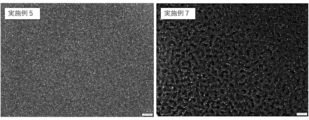
- FIG. It is a microscope image of Examples 8, 9, and 10. (Photo substitute for drawing)
- One embodiment of the present invention is a fat composition containing fat, wax, and sucrose fatty acid ester.
- the fat and oil composition of the present embodiment is suitably used for food applications. That is, the fat and oil composition of the present embodiment is preferably a food fat and oil composition.
- the oil and fat composition of the present embodiment is preferably an oleogel that is solidified by incorporating liquid oil into the network structure of wax (gelling agent).
- the wax is usually in a crystalline state.
- the wax crystals in oleogel are usually coarse and form a rigid network.
- the size and shape of the crystals vary with the conditions of nucleation and crystal growth.
- the fat and oil composition according to one embodiment of the present invention has good meltability in the mouth. The reason for this is presumed to be that the sucrose fatty acid ester interacts with the wax, thereby changing the crystal shape of the wax, suppressing coarsening, and forming fine wax crystals. That is, it is thought that the network structure formed by fine crystals has moderate hardness at room temperature, and is easily deformed or collapsed by an external force at a temperature close to body temperature.
- the fats and oils contained in the fat and oil composition of the present embodiment are preferably edible fats and oils. Moreover, it is preferable that it is a liquid oil (hereinafter sometimes referred to as "liquid fat") at normal temperature (normal temperature is defined as 25° C. in the present invention).
- liquid fats and oils include rapeseed oil, soybean oil, sunflower oil, olive oil, fractionated palm oil (palm olein), corn oil, rice oil, cottonseed oil, sesame oil, peanut oil, almond oil, linseed oil, perilla oil, fish oil, medium-chain fatty acid triglycerides, and the like.
- rapeseed oil soybean oil, sunflower oil, fractionated palm oil (palm olein), rice oil, linseed oil and medium-chain fatty acid triglycerides are preferred, and rapeseed oil is particularly preferred.
- the melting point of the fat and oil contained in the fat and oil composition of the present embodiment is preferably 15° C. or lower, more preferably 5° C. or lower.
- the amount of liquid fat contained in the fat contained in the fat composition of the present embodiment is preferably 50% by weight or more, more preferably 75% by weight or more, and more preferably 90% by weight or more. It is preferably 95% by weight or more, and particularly preferably 95% by weight or more.
- the oil and fat contained in the oil and fat composition of the present embodiment may be one type or a mixture of two or more types.
- fats and oils that are solid at room temperature (hereinafter sometimes referred to as "solid fats and oils") may be contained.
- solid fats and oils include palm oil, coconut oil, cacao oil, hydrogenated oil, beef tallow, lard, and milk fat.
- solid fat When solid fat is included, it is preferably 50% by weight or less, more preferably 25% by weight or less, and more preferably 10% by weight or less of the fat contained in the fat composition of the present embodiment. It is preferably 5% by weight or less, and particularly preferably 5% by weight or less.
- the ratio of saturated fatty acids contained in fats and oils is preferably low from the viewpoint of reducing the risk of obesity and cardiovascular disease. Therefore, the saturated fatty acid contained in the oil and fat contained in the oil and fat composition of the present embodiment is preferably 50% by weight or less, more preferably 25% by weight or less, and further preferably 10% by weight or less. It is preferably 5% by weight or less, and particularly preferably 5% by weight or less.
- the content of fats and oils relative to the total amount of fats, waxes and sucrose fatty acid esters contained in the fat composition of the present embodiment is usually 50% by weight or more, preferably 70% by weight or more, more preferably 90% by weight or more. . Moreover, it is usually 99.89% by weight or less, preferably 98% by weight or less.
- the wax contained in the oil and fat composition of the present embodiment may be synthetic wax, vegetable wax, or animal wax.
- Vegetable waxes are preferred. Vegetable waxes are not particularly limited, but specific examples include rice bran wax, carnauba wax, sunflower wax, candelilla wax, berry wax, corn wax, beeswax, jojoba wax, and ouricry wax. . Among these, rice bran wax and candelilla wax are preferred. Only one type of wax may be used, or two or more types may be used in combination.
- the melting point of the wax is preferably 90° C. or lower from the viewpoint of improving the smoothness in the mouth. Although the lower limit is not particularly limited, it is preferably 25° C. or higher, more preferably 40° C. or higher.
- Waxes contain wax esters and/or hydrocarbons.
- the number of carbon atoms in the wax ester and the hydrocarbon contained in the wax is preferably 20 or more and 70 or less.
- a wax ester is a compound in which a fatty acid and an aliphatic alcohol are ester-bonded.
- the number of carbon atoms in the wax ester is preferably 30 or more, more preferably 40 or more, and more preferably 62 or less.
- the number of carbon atoms in the hydrocarbon contained in the wax is preferably 60 or less, more preferably 40 or less.
- the hydrocarbon is preferably a chain hydrocarbon, and the chain hydrocarbon may be linear or branched.
- the proportion of the wax ester in the wax is not particularly limited, but is usually 15% by weight or more, preferably 80% by weight or more, more preferably 90% by weight or more, and usually 98% by weight or less.
- the proportion of hydrocarbons in the wax is usually 0.1% by weight or more and 75% by weight or less.
- the wax may contain components other than wax esters and hydrocarbons.
- Other components specifically include fatty acids, fatty alcohols, resins, hydroxy acid esters, and the like.
- the size of the wax crystals contained in the oil and fat composition of the present embodiment is preferably large in that the oil and fat composition of the present embodiment tends to have an appropriate hardness at room temperature. It is preferably small in that it is easily deformed or collapsed by an external force at a high temperature such as , and is easy to melt in the mouth. Therefore, the size of the wax crystals contained in the oil and fat composition of the present embodiment is preferably 0.1 ⁇ m or more, more preferably 1.0 ⁇ m or more. On the other hand, it is preferably 20 ⁇ m or less, more preferably 10 ⁇ m or less.
- the crystal size is preferably 1.0 ⁇ m or more, more preferably 2.0 ⁇ m or more. preferable. On the other hand, it is preferably 15 ⁇ m or less, more preferably 10 ⁇ m or less.
- the crystal size is preferably 0.1 ⁇ m or more, more preferably 1.0 ⁇ m or more. On the other hand, it is preferably 7.0 ⁇ m or less, more preferably 3.5 ⁇ m or less.
- the size of wax crystals can be measured by microscopic observation. Specifically, the fat and oil composition is melted by heating, spread thinly on a slide glass, and then confirmed at normal temperature using a polarizing microscope. Using image analysis software (WinROOF2015), the length of the long side of the crystal is measured, and the average value of 20 or more crystals is calculated.
- WinROOF2015 image analysis software
- the content of wax with respect to the total amount of fat, wax, and sucrose fatty acid ester contained in the fat and oil composition of the present embodiment is usually 0.1% by weight or more, preferably 0.5% by weight or more, and more
- the content is preferably 1.0% by weight or more, and is usually 50% by weight or less, preferably 25% by weight or less, and more preferably 15% by weight or less.
- the sucrose fatty acid ester is preferably lipophilic from the viewpoint of interaction with wax.
- the HLB value is preferably 0 or more and 5 or less, more preferably 0 or more and 3 or less.
- the HLB value is usually used in the field of emulsifiers and is an index representing the balance between hydrophilicity and hydrophobicity.
- the HLB value can be determined by a commonly used calculation formula, such as Griffin, Davis, Kawakami's formula, organic conceptual diagram, or the like. Also, the HLB value described in a catalog or the like may be used.
- the fatty acid constituting the sucrose fatty acid ester is preferably a fatty acid having 10 or more and 24 or less carbon atoms, more preferably 12 or more and 24 or less, and further preferably 14 or more and 24 or less. Specific examples include lauric acid, palmitic acid, stearic acid, behenic acid, oleic acid, and erucic acid.
- the sucrose fatty acid ester may be a monoester, or a polyester such as a diester or triester. Further, it may be a polyester composed of two or more types of fatty acids. Only one type of sucrose fatty acid ester may be used, or two or more types may be used in combination.
- sucrose fatty acid esters Commercial products of sucrose fatty acid esters include "Ryoto Sugar Ester L-195", "Ryoto Sugar Ester P-170", “Ryoto Sugar Ester S-070”, “Ryoto Sugar Ester S-170", “Ryoto Sugar Ester S-270”, “Ryoto Sugar Ester S-370", “Ryoto Sugar Ester S-570”, “Ryoto Sugar Ester O-170", “Ryoto Sugar Ester B-370”, “Ryoto Sugar Ester ER-290”, “Ryoto Sugar Ester POS-135” (manufactured by Mitsubishi Chemical Corporation, trade names); “DK Ester F-10”, “DK Ester F-20W”, “DK Ester F-50” (manufactured by Dai-ichi Kogyo Seiyaku Co., Ltd., trade name); and the like.
- the content of sucrose fatty acid ester with respect to the total amount of fat, wax, and sucrose fatty acid ester contained in the oil and fat composition of the present embodiment is preferably 0.01% by weight or more, more preferably 0.05% by weight or more. On the other hand, it is usually 10% by weight or less, preferably 5% by weight or less, more preferably 2.5% by weight or less.
- the content ratio (weight ratio) of the sucrose fatty acid ester to the wax is preferably 0.01 or more, more preferably 0.05 or more, and on the other hand, 5.0 or less. is preferably 2.0 or less, and even more preferably 1.0 or less.
- the oil and fat composition of the present embodiment may contain emulsifiers other than sucrose fatty acid esters.
- the emulsifier content is preferably small.
- the sucrose fatty acid ester is considered to form an oleogel network structure together with the wax. Therefore, the total content of wax and sucrose fatty acid ester contained in the oil and fat composition of the present embodiment is preferably large in that the oil and fat composition of the present embodiment tends to have an appropriate hardness at room temperature. On the other hand, it is preferable that the amount of the material is small because it is easily deformed and collapsed by an external force at a high temperature such as the temperature in the mouth, and the meltability in the mouth is likely to be improved. Therefore, the total content of wax and sucrose fatty acid ester contained in the oil and fat composition of the present embodiment is preferably 7.5% by weight or more, more preferably 8.0% by weight or more.
- 0% by weight or more is more preferable, and 10% by weight or more is particularly preferable. On the other hand, it is preferably 30.0% by weight or less, more preferably 25.0% by weight or less, even more preferably 20.0% by weight or less, and 15.0% by weight or less. Especially preferred.
- the sucrose fatty acid ester is expected to reduce the size of wax crystals. That is, the sucrose fatty acid ester can be used as a texture-improving agent for wax oleogel containing fat and wax.
- the size of the wax crystals in the oil and fat composition (containing sucrose fatty acid ester) of the present embodiment is 0 compared to the size of the wax crystals in the case where the sucrose fatty acid ester is removed from the oil and fat composition of the present embodiment. It is preferably 0.47 or less, more preferably 0.36 or less.
- the oil and fat composition of the present embodiment may contain ingredients added to foods such as sweeteners, stabilizers, flavors, antioxidants, salts, etc., as necessary, as long as the functions of the present invention are not impaired. good.
- Sweeteners include sugars, sugar alcohols, high-intensity sweeteners, etc. Specific examples include the following sweeteners.
- Sugars monosaccharides such as glucose, fructose, wood sugar, sorbose, galactose, and isomerized sugar; disaccharides such as sucrose, maltose, lactose, isomerized lactose, and palatinose; fructo-oligosaccharide, malto-oligosaccharide, isomalto-oligosaccharide, galacto-oligosaccharide , coupling sugar, oligosaccharides such as palatinose; sugar alcohols: monosaccharide alcohols such as erythritol, sorbitol, xylitol, mannitol; disaccharide alcohols such as maltitol, isomaltitol, lactitol; maltotriitol, isomalt trisaccharide alcohols such as
- Stabilizers include galactomannan, xanthan gum, carrageenan, gum arabic, tamarind gum, gellan gum, glucomannan, and cellulose.
- Antioxidants include plant extracts such as rosemary extract, tea extract, green coffee bean extract, grape seed extract, bayberry extract, tocopherol, tocotrienol, ascorbic acid palmitate, dibutylhydroxytoluene, butyl hydroxyanisole and the like.
- Salts include, for example, common salt, chlorides such as potassium chloride and magnesium chloride; carbonates such as sodium carbonate, potassium carbonate and calcium carbonate; bicarbonates such as sodium bicarbonate; disodium phosphate, trisodium phosphate, Phosphates such as dipotassium phosphate and tripotassium phosphate; sodium polyphosphate; citrates such as sodium citrate; sodium lactate; Salts containing magnesium are particularly preferred, and those that can be used for foods include whey minerals, magnesium chloride, magnesium oxide, magnesium carbonate, magnesium sulfate, bittern (crude seawater magnesium chloride), dolomite, crude salt, magnesium stearate, and phosphoric acid.
- chlorides such as potassium chloride and magnesium chloride
- carbonates such as sodium carbonate, potassium carbonate and calcium carbonate
- bicarbonates such as sodium bicarbonate
- disodium phosphate, trisodium phosphate, Phosphates such as dipotassium phosphate and tripotassium
- the melting point of the oil and fat composition of the present embodiment is not particularly limited, but is usually 15° C. or higher, preferably 25° C. or higher, more preferably 35° C. or higher. On the other hand, it is usually 90° C. or lower, preferably 80° C. or lower, more preferably 75° C. or lower. Within the above range, when the oil and fat composition of the present embodiment is used for food, texture such as hardness and mouthfeel tends to be good.
- the viscoelasticity of a material is represented by the storage modulus G′, the loss modulus G′′, and their ratio, the loss tangent tan ⁇ .
- the loss tangent tan ⁇ is greater than 1, ie G′ ⁇ G′′, The substance exhibits solid properties, and when the loss tangent tan ⁇ is smaller than 1, that is, G′>G′′, the substance exhibits liquid properties. , the loss tangent tan ⁇ becomes larger than 1.
- the strain value ⁇ exceeds a certain value, the loss tangent tan ⁇ usually becomes smaller than 1 and the gel structure collapses. There is also a report that the lower the value ⁇ , the better the mouthfeel.
- the storage elastic modulus G′ of the oil and fat composition of the present embodiment is not particularly limited when the strain value ⁇ is 0.01 at 35° C., which is near the mouth temperature, but is usually 10 Pa or more, and 20 Pa or more. is preferable, and 100 Pa or more is more preferable. Also, it is usually 200,000 Pa or less, preferably 100,000 Pa or less, more preferably 50,000 Pa or less, and particularly preferably 20,000 Pa or less. When it is within the above range, it is easy to obtain a gel with good shape retention and coherence.
- the loss elastic modulus G′′ of the oil and fat composition of the present embodiment when the strain value ⁇ is 0.01 at 35° C. is not particularly limited, but is usually 10 Pa or more, preferably 100 Pa or more.
- the gel has good shape retention and coherence. easy to do.
- the strain value ⁇ when the loss tangent tan ⁇ at 35° C. is 1 is not particularly limited, but is usually 0.1 or more and 1.0 or less, 0.1 or more and 0.7 or less, more preferably 0.1 or more and 0.5 or less, and particularly preferably 0.1 or more and 0.4 or less.
- the meltability in the mouth tends to be good.
- the dynamic viscoelasticity of the oil and fat composition of this embodiment is measured using a dynamic viscoelasticity measuring device.
- the sensory evaluation of the oil and fat composition of this embodiment can be performed as follows.
- the oil and fat composition of the present embodiment is placed on the tongue and chewed by rubbing the tongue and upper jaw, and the rough feeling (smoothness) felt and how it spreads in the mouth (dissolving in the mouth) can be evaluated.
- Evaluation of smoothness should just evaluate relative smoothness with the composition except the sucrose fatty acid ester from the oil-and-fat composition of this embodiment.
- the evaluation of the mouth is relative to the composition excluding the sucrose fatty acid ester from the oil and fat composition of the present embodiment, as to whether it spreads in the mouth faster and does not leave lumps or roughness in the mouth. You can do it with
- the oil and fat composition of the present embodiment tends to exhibit the above-described physical properties, and is particularly likely to have good meltability when used for food. is preferred. Therefore, the total amount of the fat, wax, and sucrose fatty acid ester contained in the fat and oil composition of the present embodiment is preferably 30% by weight or more, more preferably 60% by weight or more, and 80% by weight. It is more preferable that it is above. In addition, an upper limit is 100 weight%.
- the oil and fat composition of the present embodiment is produced by a method comprising a step of mixing fat, wax and sucrose fatty acid ester in the above ratio, and a step of heating and dissolving the mixture obtained by the above step, followed by cooling and solidifying.
- the heating temperature is preferably high in terms of facilitating the dissolution of wax and sucrose fatty acid ester in fats and oils, and low in order to prevent reaction and deterioration of each component. Therefore, the heating temperature is preferably 40° C. or higher, more preferably 60° C. or higher, and is preferably 120° C. or lower, more preferably 100° C. or lower. Cooling after heating and dissolving may be performed slowly or rapidly to room temperature. Stirring may be performed during cooling.
- the fat and oil composition of the present embodiment can be used as a substitute for solid fat and hardened oil in various foods.
- foods and drinks such as cream foods and milk substitutes; nutritional supplements in retort pouches; functional foods such as liquid diets, high-calorie diets and nutritional products for infants; oral vaccines; Processed oils and fats; Curry, coffee creamer, mayonnaise, dressing, mousse, pasta sauce, stew, demi-glace sauce, white sauce, tomato sauce and other sauces and soups; Compound seasonings; yogurts, cheeses, ice creams, creams, caramel, candy, chewing gum, chocolate, cookies, biscuits, cakes, pies, snacks, crackers, Japanese confectionery, rice confectionery, bean confectionery, jellies, confectionery such as puddings ⁇ Desserts; Processed livestock products such as hamburgers, meatballs, and canned seasoned meat; Processed marine products; Alternative meats; Frozen foods; Examples include tube nutrition preparations and the like.
- the oil-and-fat composition of the present embodiment has excellent meltability, it is preferably used for food applications, and more preferably used for meat substitute applications. That is, the food containing the oil and fat composition of the present embodiment is preferable in terms of excellent texture. In addition, meat substitutes containing the oil and fat composition of the present embodiment are preferable in terms of excellent texture.
- the fat composition of the present embodiment contains less saturated fatty acids and trans fatty acids than conventional solid fats and oils. Therefore, it is particularly preferable to use the oil-and-fat composition of the present embodiment for vegetable meat in terms of health benefits. That is, the vegetable meat containing the fat and oil composition of the present embodiment (hereinafter sometimes referred to as "the vegetable meat of the present embodiment") is preferable in that it has excellent texture and is healthy.
- the vegetable meat of the present embodiment is a kind of substitute meat for animal meat, and refers to substitute meat using vegetable protein. In the present invention, vegetable meat also includes those using vegetable protein instead of animal protein used in so-called processed meat such as sausage and ham.
- the vegetable meat of this embodiment contains the fat and oil composition of one embodiment of the present invention and a vegetable protein.
- Vegetable proteins include pea protein, soy protein, mung bean protein, chickpea protein, broad bean protein, bean protein such as lentil protein, shiitake mushroom protein, wheat protein, and the like. Among these, soybean protein is preferable because it rarely causes allergic symptoms and is rich in nutrients.
- the amounts of the oil-and-fat composition and the vegetable protein contained in the vegetable meat of the present embodiment may be appropriately adjusted according to the cooking method of the vegetable meat, the type of dishes using the vegetable meat, and the like.
- the vegetable meat of the present embodiment preferably contains 10 to 90% by weight of vegetable protein and 0.1 to 50% by weight of oil and fat composition. In addition, the vegetable meat of the present embodiment preferably contains 0.1 to 83% by weight of the fat and oil composition relative to the vegetable protein.
- the vegetable meat of the present embodiment preferably contains a binding agent.
- a binding agent is an agent that binds components in vegetable meat such as vegetable proteins and oils and fats. Specific examples include cellulose derivatives, polysaccharide thickeners, starch and the like.
- the binder contained in the vegetable meat is preferably 0.1% by weight or more, more preferably 0.5% by weight or more, and 1.0% by weight or more. On the other hand, it is preferably 10.0% by weight or less, more preferably 8.0% by weight or less, and particularly preferably 5.0% by weight or less.
- the vegetable meat of the present embodiment may further contain sweeteners such as sugar, seasonings such as salt and soy sauce, extracts, dietary fiber, and the like.
- Raw materials used in each example are shown below.
- ⁇ Rapeseed oil J-Oil Mills Co., Ltd.
- Smooth canola oil ratio of saturated fatty acids: 4 to 8%
- RBX Role bran wax
- Rice wax SS-2 carbon number of wax ester: 40 to 56
- Candelilla wax CLX: Toa Kasei Co., Ltd.
- the length of the long side of the crystal of the emulsifier-free rice bran wax of Comparative Example 1 was as large as about 20 ⁇ m.
- the crystals of rice bran wax to which glycerin monobehenate, propylene glycol monobehenate, sorbitan tribehenate, or soybean lecithin were added had a long side length of 10 to 10. It was about 15 ⁇ m, which was about 1/2 to 3/4 of Comparative Example 1.
- the length of the long side of the crystals of the rice bran wax to which the sucrose fatty acid ester was added in Examples 1, 3 and 4 was as small as about 3 to 9 ⁇ m. This size is about 1/10 to 1/2 of the length of the long side of crystals of rice bran wax to which no emulsifier is added, and can be said to be fine.
- the length of the long side of the crystal of the candelilla wax of Comparative Example 7 to which no emulsifier was added was about 7 ⁇ m, and large crystals were confirmed.
- the length of the long side of crystals of candelilla wax to which glycerol monobehenate, propylene glycol monobehenate, or soybean lecithin was added was about 6 to 9 ⁇ m, and no emulsifier was added.
- the length of the long side of the crystal of the candelilla wax to which sorbitan tribehenate was added in Comparative Example 11 was about 3.5 ⁇ m, which was about half the size of Comparative Example 7.
- the length of the long side of the crystal of the candelilla wax to which the sucrose fatty acid ester was added in Examples 5 and 7 was about 1 to 2 ⁇ m, which is about 1/7 to 1/4 the size of Comparative Example 7. , These were remarkably fine compared with Comparative Examples 7-9, 11, and 12.
- sucrose fatty acid ester to wax can reduce the crystal size of wax to about 1/10 to 1/2.
- the storage elastic moduli G', The loss elastic modulus G′′ and loss tangent tan ⁇ were measured. The results are shown in FIGS. 10.
- the strain value ⁇ was low, supporting the improvement effect of sucrose fatty acid ester on the smoothness of the oleogel.
- the sucrose fatty acid ester having 16 to 22 carbon atoms was added
- tan ⁇ was 1 compared to Comparative Examples 7, 8, 11, and 12.
- the strain value ⁇ was low, and it was confirmed that the sucrose fatty acid ester was effective in improving the smoothness of the oleogel.
- Comparative Example 1 which used rice bran wax as the wax and did not use an emulsifier, had a rough texture on the tongue, was not smooth, and had poor meltability in the mouth.
- Comparative Examples 3 to 5 in which emulsifiers other than sucrose fatty acid esters were added, had the same level of smoothness or worse than Comparative Example 1, and the same level of meltability in the mouth as Comparative Example 1.
- Examples 1, 2, and 4 in which sucrose fatty acid ester was added, had smoothness equal to or higher than that of Comparative Example 1, and Example 1 in particular was very smooth.
- Comparative Example 7 which used candelilla wax as the wax and did not use an emulsifier, left a large lump on the tongue, was not smooth, and had poor meltability in the mouth.
- Comparative Examples 9 to 11 in which emulsifiers other than sucrose fatty acid esters were added, slightly larger lumps remained in the mouth compared to Comparative Example 7, and melting in the mouth was about the same as in Comparative Example 7.
- Examples 5 to 7, in which sucrose fatty acid ester was added had a smoothness equal to or higher than that of Comparative Example 7, and Example 7 in particular was very smooth.
- sucrose fatty acid ester improves the smoothness of the oil and fat composition (improves the rough texture) and improves the meltability in the mouth (the effect of spreading quickly in the mouth when chewing). was substantiated. These effects are considered to be due to the refinement of the wax crystals by containing the sucrose fatty acid ester (see the results of microscopic observation).
- vegetable meat (meat-like processed food) was produced using soy protein so as to have each composition shown in Table 6 (addition amount in the table is % by weight).
- onion powder, dark soy sauce, white sugar, yeast extract, salt, emulsion curd, and a fat composition were uniformly stirred and mixed using a stirrer ("KM300" manufactured by Aikosha Seisakusho Co., Ltd.).
- Granular soybean protein that had been rehydrated for 30 minutes was added thereto, and the mixture was further stirred and kneaded until a cohesive and uniform dough was obtained.
- the coherent dough is molded to a diameter of 6 cm and a thickness of 2 cm, baked on both sides for 90 seconds each using an iron plate at 220 ° C, and then placed in a convenction oven ("TSCO-6EDN” manufactured by Taniko Co., Ltd.). was used to bake at 150° C. and 100% steam for an additional 10 minutes to produce vegetable meat.
- TSCO-6EDN manufactured by Taniko Co., Ltd.
- Examples 11 and 12 are superior in softness, coherence and moistness during mastication compared to Comparative Example 13, the texture of vegetable meat is improved by the oil and fat composition according to one embodiment of the present invention. It was confirmed that the oil and fat composition according to one embodiment of the present invention is an excellent texture improving agent, and that the vegetable meat according to one embodiment of the present invention has excellent texture. It is considered that these excellent textures are brought about by refinement of wax crystals contained in the oil and fat composition and changes in physical properties.
Landscapes
- Chemical & Material Sciences (AREA)
- Life Sciences & Earth Sciences (AREA)
- Engineering & Computer Science (AREA)
- Food Science & Technology (AREA)
- Polymers & Plastics (AREA)
- Health & Medical Sciences (AREA)
- Nutrition Science (AREA)
- Biochemistry (AREA)
- Oil, Petroleum & Natural Gas (AREA)
- Molecular Biology (AREA)
- Edible Oils And Fats (AREA)
Priority Applications (4)
| Application Number | Priority Date | Filing Date | Title |
|---|---|---|---|
| CN202280066013.1A CN118042937A (zh) | 2021-09-29 | 2022-09-29 | 食品用油脂组合物、包含其的食品和植物肉、油凝胶的口感改善剂、以及食品用油脂组合物的制造方法 |
| EP22876453.6A EP4410113A4 (en) | 2021-09-29 | 2022-09-29 | OIL-AND-FAT COMPOSITION FOR FOOD, PLANT-BASED FOOD AND MEAT, OLEOGEL TEXTURE IMPROVER AND METHOD FOR PRODUCING OIL-AND-FAT COMPOSITION FOR FOOD |
| JP2023551850A JPWO2023054589A1 (https=) | 2021-09-29 | 2022-09-29 | |
| US18/620,430 US20240237669A1 (en) | 2021-09-29 | 2024-03-28 | Oil-and-fat composition for food, food and plant-based meat containing same, oleogel texture-improving agent, and method for producing oil-and-fat composition for food |
Applications Claiming Priority (2)
| Application Number | Priority Date | Filing Date | Title |
|---|---|---|---|
| JP2021-159573 | 2021-09-29 | ||
| JP2021159573 | 2021-09-29 |
Related Child Applications (1)
| Application Number | Title | Priority Date | Filing Date |
|---|---|---|---|
| US18/620,430 Continuation US20240237669A1 (en) | 2021-09-29 | 2024-03-28 | Oil-and-fat composition for food, food and plant-based meat containing same, oleogel texture-improving agent, and method for producing oil-and-fat composition for food |
Publications (1)
| Publication Number | Publication Date |
|---|---|
| WO2023054589A1 true WO2023054589A1 (ja) | 2023-04-06 |
Family
ID=85782894
Family Applications (1)
| Application Number | Title | Priority Date | Filing Date |
|---|---|---|---|
| PCT/JP2022/036452 Ceased WO2023054589A1 (ja) | 2021-09-29 | 2022-09-29 | 食品用油脂組成物、これを含む食品及び植物肉、オレオゲルの食感改善剤、並びに食品用油脂組成物の製造方法 |
Country Status (5)
| Country | Link |
|---|---|
| US (1) | US20240237669A1 (https=) |
| EP (1) | EP4410113A4 (https=) |
| JP (1) | JPWO2023054589A1 (https=) |
| CN (1) | CN118042937A (https=) |
| WO (1) | WO2023054589A1 (https=) |
Cited By (4)
| Publication number | Priority date | Publication date | Assignee | Title |
|---|---|---|---|---|
| WO2023210637A1 (ja) * | 2022-04-26 | 2023-11-02 | 三菱ケミカル株式会社 | 肉様食品用改質剤及び肉様食品 |
| IT202400000756A1 (it) | 2024-01-17 | 2025-07-17 | Cereal Docks S P A | Oleogel a base di olio di girasole linoleico, metodo di preparazione e usi |
| WO2025190932A1 (de) * | 2024-03-11 | 2025-09-18 | Technikum Laubholz Gmbh | Monophasige gele von unpolaren flüssigkeiten mit nicht-ionischen tensiden |
| WO2025258278A1 (ja) * | 2024-06-13 | 2025-12-18 | 富士フイルム株式会社 | 脂肪塊模擬構造体、脂肪塊模擬構造体の製造方法、及び代替肉 |
Citations (8)
| Publication number | Priority date | Publication date | Assignee | Title |
|---|---|---|---|---|
| JPH01228427A (ja) * | 1988-03-09 | 1989-09-12 | Masatake Iimori | 油脂組成物及びその製造法 |
| JPH04237458A (ja) * | 1991-01-21 | 1992-08-25 | Nisshin Oil Mills Ltd:The | 低カロリー油脂 |
| JPH05236874A (ja) * | 1991-02-28 | 1993-09-17 | Fuji Oil Co Ltd | コーヒークリーム及びその製造法 |
| US20040052921A1 (en) | 1999-05-18 | 2004-03-18 | Cargill Incorporated, A Delaware Corporation | Fat compositions |
| WO2012114995A1 (ja) | 2011-02-24 | 2012-08-30 | 日清オイリオグループ株式会社 | 嚥下・咀嚼困難者用食品の摂食補助用オルガノゲル及び嚥下・咀嚼困難者用食品 |
| WO2021046642A1 (en) | 2019-09-11 | 2021-03-18 | Smart Base Ltd. | Wax oleogels as fat substitutes |
| US20210127720A1 (en) * | 2019-11-04 | 2021-05-06 | Helsingin Yliopisto | Method to produce oleogels |
| CN112931633A (zh) * | 2021-01-29 | 2021-06-11 | 江南大学 | 一种荷载维生素c油凝胶与起酥油共混物的制备方法和产品及其应用 |
Family Cites Families (5)
| Publication number | Priority date | Publication date | Assignee | Title |
|---|---|---|---|---|
| JPS5942843A (ja) * | 1982-09-02 | 1984-03-09 | Miyoshi Oil & Fat Co Ltd | 流動状油脂の製造法 |
| AU2125895A (en) * | 1994-04-22 | 1995-11-16 | Kraft Foods, Inc. | Tablespread product containing liquid fat and process for preparing same |
| CN107594047B (zh) * | 2009-06-12 | 2025-09-23 | Wm.雷格利Jr.公司 | 耐热巧克力组合物 |
| US11849741B2 (en) * | 2015-10-20 | 2023-12-26 | Savage River, Inc. | Meat-like food products |
| JP7572963B2 (ja) * | 2019-09-30 | 2024-10-24 | 株式会社J-オイルミルズ | 組成物 |
-
2022
- 2022-09-29 JP JP2023551850A patent/JPWO2023054589A1/ja active Pending
- 2022-09-29 CN CN202280066013.1A patent/CN118042937A/zh active Pending
- 2022-09-29 EP EP22876453.6A patent/EP4410113A4/en active Pending
- 2022-09-29 WO PCT/JP2022/036452 patent/WO2023054589A1/ja not_active Ceased
-
2024
- 2024-03-28 US US18/620,430 patent/US20240237669A1/en active Pending
Patent Citations (8)
| Publication number | Priority date | Publication date | Assignee | Title |
|---|---|---|---|---|
| JPH01228427A (ja) * | 1988-03-09 | 1989-09-12 | Masatake Iimori | 油脂組成物及びその製造法 |
| JPH04237458A (ja) * | 1991-01-21 | 1992-08-25 | Nisshin Oil Mills Ltd:The | 低カロリー油脂 |
| JPH05236874A (ja) * | 1991-02-28 | 1993-09-17 | Fuji Oil Co Ltd | コーヒークリーム及びその製造法 |
| US20040052921A1 (en) | 1999-05-18 | 2004-03-18 | Cargill Incorporated, A Delaware Corporation | Fat compositions |
| WO2012114995A1 (ja) | 2011-02-24 | 2012-08-30 | 日清オイリオグループ株式会社 | 嚥下・咀嚼困難者用食品の摂食補助用オルガノゲル及び嚥下・咀嚼困難者用食品 |
| WO2021046642A1 (en) | 2019-09-11 | 2021-03-18 | Smart Base Ltd. | Wax oleogels as fat substitutes |
| US20210127720A1 (en) * | 2019-11-04 | 2021-05-06 | Helsingin Yliopisto | Method to produce oleogels |
| CN112931633A (zh) * | 2021-01-29 | 2021-06-11 | 江南大学 | 一种荷载维生素c油凝胶与起酥油共混物的制备方法和产品及其应用 |
Non-Patent Citations (2)
| Title |
|---|
| FUCHIBE, DAISUKE ET AL.: "Control of physical properties of oily gel by combined use of sugar fatty acid ester and paraffin wax", LECTURE ABSTRACTS OF THE 85TH COLOR MATERIALS RESEARCH PRESENTATION; 20131024 - 20131025, COLOR MATERIAL ASSOCIATION, JP, 1 January 2013 (2013-01-01) - 25 October 2013 (2013-10-25), JP, pages 208 - 209, XP009547163 * |
| See also references of EP4410113A4 |
Cited By (4)
| Publication number | Priority date | Publication date | Assignee | Title |
|---|---|---|---|---|
| WO2023210637A1 (ja) * | 2022-04-26 | 2023-11-02 | 三菱ケミカル株式会社 | 肉様食品用改質剤及び肉様食品 |
| IT202400000756A1 (it) | 2024-01-17 | 2025-07-17 | Cereal Docks S P A | Oleogel a base di olio di girasole linoleico, metodo di preparazione e usi |
| WO2025190932A1 (de) * | 2024-03-11 | 2025-09-18 | Technikum Laubholz Gmbh | Monophasige gele von unpolaren flüssigkeiten mit nicht-ionischen tensiden |
| WO2025258278A1 (ja) * | 2024-06-13 | 2025-12-18 | 富士フイルム株式会社 | 脂肪塊模擬構造体、脂肪塊模擬構造体の製造方法、及び代替肉 |
Also Published As
| Publication number | Publication date |
|---|---|
| EP4410113A1 (en) | 2024-08-07 |
| EP4410113A4 (en) | 2025-01-22 |
| CN118042937A (zh) | 2024-05-14 |
| US20240237669A1 (en) | 2024-07-18 |
| JPWO2023054589A1 (https=) | 2023-04-06 |
Similar Documents
| Publication | Publication Date | Title |
|---|---|---|
| WO2023054589A1 (ja) | 食品用油脂組成物、これを含む食品及び植物肉、オレオゲルの食感改善剤、並びに食品用油脂組成物の製造方法 | |
| AU2003244070B2 (en) | Oil-in-water emulsion composition | |
| EP0560944B1 (en) | Reduced calorie triglyceride mixtures | |
| PT100615B (pt) | Substituto da gordura com baixo teor calorico, a base de um ester de acido gordo de sorbitol, e alimentos que contem o referido ester | |
| JP6970517B2 (ja) | 菓子用生地 | |
| KR101916490B1 (ko) | 연하·저작곤란자용 식품의 섭식보조용 오르가노겔 및 연하·저작곤란자용 식품 | |
| US20230354860A1 (en) | Starch composition for food products and method for producing said starch composition | |
| JP2025172983A (ja) | 食品、該食品の製造方法、及び、食品の付着性の低減方法 | |
| CN107708427A (zh) | 可塑性油脂组合物 | |
| JP2020028238A (ja) | 冷凍菓子用油脂組成物 | |
| JP2006006277A (ja) | 油脂の染み出し抑制剤 | |
| JP2009284859A (ja) | 飲食品の甘味増強剤および甘味増強方法 | |
| JP7461127B2 (ja) | ケーキ生地起泡用水中油型乳化組成物 | |
| CN104378999A (zh) | 一种香草醛和乙基香草醛的配混物在食品产品中的新用途 | |
| US20100093657A1 (en) | Low glycemic mixtures | |
| JPS6342659A (ja) | 含油ゼリ−食品 | |
| KR101892281B1 (ko) | 발림성이 우수한 스프레드 | |
| JP6892255B2 (ja) | 豆腐様流動性食品およびその製造方法 | |
| KR102464175B1 (ko) | 오메가-7을 함유하는 정제어유 분말 조성물 및 이의 제조방법 | |
| JP7748794B2 (ja) | Hmb由来の異味抑制剤、hmb由来の異味抑制剤を含む飲食品、及びhmb由来の異味の抑制方法 | |
| JP2006006171A (ja) | ミネラル含有ソフトキャンディ | |
| JP2003246729A (ja) | 多価不飽和脂肪酸の生体利用率向上組成物 | |
| JP7575882B2 (ja) | 固形状大豆食品、固形状大豆食品の製造方法、及び固形状大豆食品の黄色を薄くする方法 | |
| JP2020103192A (ja) | 絹生揚げ用油脂組成物 | |
| JP7279467B2 (ja) | 粉末油脂用油脂組成物、粉末油脂 |
Legal Events
| Date | Code | Title | Description |
|---|---|---|---|
| 121 | Ep: the epo has been informed by wipo that ep was designated in this application |
Ref document number: 22876453 Country of ref document: EP Kind code of ref document: A1 |
|
| WWE | Wipo information: entry into national phase |
Ref document number: 2023551850 Country of ref document: JP |
|
| WWE | Wipo information: entry into national phase |
Ref document number: 202280066013.1 Country of ref document: CN |
|
| NENP | Non-entry into the national phase |
Ref country code: DE |
|
| ENP | Entry into the national phase |
Ref document number: 2022876453 Country of ref document: EP Effective date: 20240429 |