WO2023013678A1 - 熱易解体性粘着性組成物又は熱分解性バインダー組成物 - Google Patents
熱易解体性粘着性組成物又は熱分解性バインダー組成物 Download PDFInfo
- Publication number
- WO2023013678A1 WO2023013678A1 PCT/JP2022/029807 JP2022029807W WO2023013678A1 WO 2023013678 A1 WO2023013678 A1 WO 2023013678A1 JP 2022029807 W JP2022029807 W JP 2022029807W WO 2023013678 A1 WO2023013678 A1 WO 2023013678A1
- Authority
- WO
- WIPO (PCT)
- Prior art keywords
- group
- groups
- thermally decomposable
- meth
- binder composition
- Prior art date
- Legal status (The legal status is an assumption and is not a legal conclusion. Google has not performed a legal analysis and makes no representation as to the accuracy of the status listed.)
- Ceased
Links
Images




Classifications
-
- C—CHEMISTRY; METALLURGY
- C09—DYES; PAINTS; POLISHES; NATURAL RESINS; ADHESIVES; COMPOSITIONS NOT OTHERWISE PROVIDED FOR; APPLICATIONS OF MATERIALS NOT OTHERWISE PROVIDED FOR
- C09J—ADHESIVES; NON-MECHANICAL ASPECTS OF ADHESIVE PROCESSES IN GENERAL; ADHESIVE PROCESSES NOT PROVIDED FOR ELSEWHERE; USE OF MATERIALS AS ADHESIVES
- C09J11/00—Features of adhesives not provided for in group C09J9/00, e.g. additives
- C09J11/02—Non-macromolecular additives
- C09J11/06—Non-macromolecular additives organic
-
- C—CHEMISTRY; METALLURGY
- C09—DYES; PAINTS; POLISHES; NATURAL RESINS; ADHESIVES; COMPOSITIONS NOT OTHERWISE PROVIDED FOR; APPLICATIONS OF MATERIALS NOT OTHERWISE PROVIDED FOR
- C09J—ADHESIVES; NON-MECHANICAL ASPECTS OF ADHESIVE PROCESSES IN GENERAL; ADHESIVE PROCESSES NOT PROVIDED FOR ELSEWHERE; USE OF MATERIALS AS ADHESIVES
- C09J133/00—Adhesives based on homopolymers or copolymers of compounds having one or more unsaturated aliphatic radicals, each having only one carbon-to-carbon double bond, and at least one being terminated by only one carboxyl radical, or of salts, anhydrides, esters, amides, imides, or nitriles thereof; Adhesives based on derivatives of such polymers
- C09J133/04—Homopolymers or copolymers of esters
- C09J133/14—Homopolymers or copolymers of esters of esters containing halogen, nitrogen, sulfur or oxygen atoms in addition to the carboxy oxygen
-
- Y—GENERAL TAGGING OF NEW TECHNOLOGICAL DEVELOPMENTS; GENERAL TAGGING OF CROSS-SECTIONAL TECHNOLOGIES SPANNING OVER SEVERAL SECTIONS OF THE IPC; TECHNICAL SUBJECTS COVERED BY FORMER USPC CROSS-REFERENCE ART COLLECTIONS [XRACs] AND DIGESTS
- Y02—TECHNOLOGIES OR APPLICATIONS FOR MITIGATION OR ADAPTATION AGAINST CLIMATE CHANGE
- Y02W—CLIMATE CHANGE MITIGATION TECHNOLOGIES RELATED TO WASTEWATER TREATMENT OR WASTE MANAGEMENT
- Y02W30/00—Technologies for solid waste management
- Y02W30/50—Reuse, recycling or recovery technologies
- Y02W30/62—Plastics recycling; Rubber recycling
Definitions
- the present invention provides a heat-dismantling adhesive composition or a heat-decomposing binder composition, an adhesive product containing the heat-dismantling pressure-sensitive adhesive composition, a product containing the heat-dismantling binder composition, a ceramic sintered body, and a screen-printed material. or to a method of manufacturing a product selected from multilayer ceramic capacitors.
- an easily dismantling adhesive composition comprising a (meth)acrylic acid ester-based polymer containing a (meth)acrylic acid ester-based monomer unit having a tertiary alkoxycarbonyloxy group at its end, and a thermal acid generator.
- a thermally decomposable binder composition comprising a (meth)acrylic acid ester-based polymer containing a (meth)acrylic acid ester-based monomer unit having a tertiary alkoxycarbonyloxy group at its end.
- the binder used for these is desired to be a binder that is thermally decomposed into volatile components during the sintering process and does not produce a carbon-containing residue while having the properties of a binder. Attempts have been made on such easily dismantling pressure-sensitive adhesives and binders.
- a tacky adhesive composition is disclosed that is capable of Japanese Patent Application Laid-Open No. 2017-186184 (Patent Document 2) discloses a binder containing a copolymer having a polyvinyl butyral main chain and a polyacrylic acid graft chain.
- Patent Document 2 discloses a binder containing a copolymer having a polyvinyl butyral main chain and a polyacrylic acid graft chain.
- the adhesive adhesive composition that can be peeled off by light cannot be used for materials that cannot be irradiated with light or materials that cannot be irradiated with light due to their structure. Removal of the carbon component after heating was not sufficient.
- JP-A-2004-043732 Japanese Patent Application Laid-Open No. 2017-186184 Japanese Patent Application Laid-Open No. 2019-210405 Japanese Patent Application Laid-Open No. 2020-012013
- the inventors have repeatedly studied adhesives and binders that are easily dismantled and decomposable by a method different from light, and have found that by using a polymer that decomposes when heated, an adhesive that is easily dismantled and decomposable. and developed a binder [Japanese Patent Application Laid-Open No. 2019-210405 (Patent Document 3), Japanese Patent Application Laid-Open No. 2020-012013 (Patent Document 4)].
- Patent Document 3 Japanese Patent Application Laid-Open No. 2019-210405
- Patent Document 4 Japanese Patent Application Laid-Open No. 2020-012013
- a (meth)acrylic acid ester-based polymer containing a (meth)acrylic acid ester-based monomer unit having a tertiary alkoxycarbonyloxy group at its end and a thermal acid generator.
- a thermally decomposable adhesive composition or a thermally decomposable binder composition using the composition, the polymer is rapidly decomposed by heating while having sufficient adhesiveness/adhesiveness and stability before heating.
- the inventors have found that the tackiness/adhesiveness can be reduced, leading to the present invention.
- the present invention provides an easily dismantling adhesive comprising a (meth)acrylic acid ester-based polymer containing a (meth)acrylic acid ester-based monomer unit having a terminal tertiary alkoxycarbonyloxy group, and a thermal acid generator.
- a thermally decomposable binder composition is provided.
- an adhesive product having an adhesive layer containing the easily dismantleable adhesive composition.
- a product comprising the thermally decomposable binder composition.
- a method for manufacturing a product selected from a ceramic sintered body, a screen-printed product, or a laminated ceramic capacitor wherein the mixture comprises a member constituting the product and the above-described thermally decomposable binder composition. and heating the coated or shaped mixture to decompose the binder.
- a heat-dismantling pressure-sensitive adhesive composition capable of rapidly decomposing a polymer by heating to rapidly reduce the pressure-sensitive adhesiveness/adhesiveness while having sufficient pressure-sensitive adhesiveness and stability before heating, or A thermally decomposable binder composition can be provided.
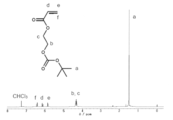
- FIG. 1 shows the 1 H-NMR spectrum of BHEA.
- FIG. 1 shows the 1 H-NMR spectrum of BHBA.
- FIG. 1 shows the 1 H-NMR spectrum of BHEMA;
- FIG. 1 shows the 1 H-NMR spectrum of PBHEA.
- FIG. 1 shows the 1 H-NMR spectrum of PBHBA.
- FIG. 1 shows the 1 H-NMR spectrum of PBHEMA;
- FIG. 2 shows the 1 H-NMR spectrum of P(BHBA-co-HBA).
- FIG. 1 shows the 1 H-NMR spectrum of P(BHEA-co-2EHA-co-HBA).
- FIG. 2 shows the 1 H-NMR spectrum of P(BHBA-co-2HEA-co-HBA).
- thermogravimetry curves of PBHEA, P(BHEA-co-2EHA-co-HBA)1 and P(BHEA-co-2EHA-co-HBA)2.
- 1 is a graph showing TG curves of PBHBA, P(BHBA-co-HBA)1, P(BHBA-co-HBA)2 and P(BHBA-co-HBA)3.
- Fig. 3 is a graph showing TG curves of P(BHBA-co-2HEA-co-HBA) 1-7.
- 4 is a graph showing the results of a holding force test on SUS plates coated with P(BHBA-co-2HEA-co-HBA)2 and 5.
- FIG. 1 is a graph showing TG curves of thermal acid generators.
- 4 is a graph showing the results of a 180° peeling test performed on the pressure-sensitive adhesive tapes of Comparative Examples 1 and 2.
- FIG. 10 is a graph showing the results of a 180° peel test on the pressure-sensitive adhesive tapes of Comparative Example 3 and Examples 1 and 2.
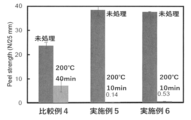
- FIG. 10 is a graph showing the results of a 180° peeling test on the pressure-sensitive adhesive tapes of Comparative Example 4, Examples 5 and 6.
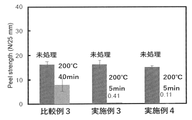
- FIG. 10 is a graph showing the results of a 180° peeling test performed on the pressure-sensitive adhesive tapes of Comparative Example 3, Examples 3 and 4.
- FIG. 10 is a graph showing the results of a 180° peeling test on the pressure-sensitive adhesive tapes of Comparative Example 4, Examples 7 and 8.
- FIG. 10 is a graph showing the results of a 180° peeling test on the pressure-sensitive adhesive tapes of Comparative Example 4, Examples 7 and 8.
- FIG. 10 is a graph showing the results of a 180° peeling test performed on the pressure-sensitive adhesive tape of Example 3 after heat treatment at 150°C. 2 is a graph showing TG curves of PBHEMA (Comparative Example 5) and thermal acid generator-mixed polymer compositions of Examples 9-11. 2 is a graph showing the TG curves of PBHEMA (Comparative Example 5), the composition of Comparative Example 6, and the thermal acid generator mixed polymer compositions of Examples 9 and 12.
- FIG. 10 is a graph showing the weight change when the composition of Comparative Example 6 was subjected to isothermal heating.
- FIG. 10 is a graph showing the change in weight when the thermal acid generator-mixed polymer composition of Example 9 is subjected to isothermal heating.
- FIG. 10 is a graph showing the change in weight when the thermal acid generator-mixed polymer composition of Example 12 was subjected to isothermal heating.
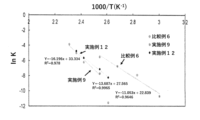
- FIG. 2 is a graph showing Arrhenius plots of the composition of Comparative Example 6 and the thermal acid generator-mixed polymer compositions of Examples 9 and 12.
- the easily dismantling adhesive composition or thermally decomposable binder composition of the present invention comprises a (meth)acrylic acid ester-based polymer containing a (meth)acrylic acid ester-based monomer unit having a tertiary alkoxycarbonyloxy group at the end, and a thermal acid generator. At least one type of (meth)acrylic acid ester-based polymer containing (meth)acrylic acid ester-based monomer units having terminal tertiary alkoxycarbonyloxy groups contained in the easily dismantling adhesive composition and the heat-decomposable binder composition It may contain a plurality of types of polymers.
- "(meth)acryl” in the present invention means acryl and/or methacryl.
- a (meth)acrylic acid ester-based monomer having a tertiary alkoxycarbonyloxy group at the terminal means that the hydrogen atom of the carboxy group in (meth)acrylic acid having a substituent preferably at the ⁇ -position is at the terminal
- the hydrocarbon group can be an aliphatic hydrocarbon or an aromatic hydrocarbon.
- the aliphatic hydrocarbon has a straight chain of up to 12 carbon atoms (preferably 10 carbon atoms), a branched chain (if possible, specifically a case of 4 or more carbon atoms, hereinafter the same in the present specification) or a cyclic (When possible, specifically when the number of carbon atoms is 3 or more; hereinafter the same in the present specification) hydrocarbons (preferably saturated hydrocarbons) can be mentioned.
- Aromatic hydrocarbons include optionally substituted monocyclic or bicyclic aromatic hydrocarbons having up to 12 carbon atoms (preferably 10 carbon atoms).
- the alkyls in the tertiary alkoxycarbonyloxy group are each independently straight or branched alkyls having 1 to 4 carbon atoms. Alkyl preferably has 1 to 3 carbon atoms, more preferably 1 or 2 carbon atoms, and more preferably 1 carbon atom.
- the form of the (meth)acrylic acid ester-based monomer having a tertiary alkoxycarbonyloxy group at its end is not particularly limited, but for example the following formula (I):
- R1 is selected from a hydrogen atom and an optionally substituted alkyl group having up to 4 carbon atoms
- R2, R3 and R4 are each independently linear chain or A is selected from branched alkyl groups
- A is selected from divalent groups derived from aliphatic hydrocarbons and aromatic hydrocarbons, which may have a substituent.
- linear or branched alkyl groups having up to 4 carbon atoms include, for example, methyl group, ethyl group, n-propyl group, i-propyl group, n-butyl group, i-butyl group, sec -butyl group, t-butyl group and the like.
- A is not particularly limited as long as it is selected from divalent groups derived from aliphatic hydrocarbons and aromatic hydrocarbons, which may have a substituent. It is preferably selected from the group consisting of optionally substituted linear, branched or cyclic alkyl groups and aryl groups with up to 12 carbon atoms, and A is a substituent with up to 10 carbon atoms A is more preferably selected from the group consisting of linear, branched or cyclic alkyl groups and aryl groups, which may have a substituent of up to 8 carbon atoms , A is more preferably selected from the group consisting of linear or branched or cyclic alkyl groups and aryl groups; A is more preferably selected from the group consisting of alkyl groups and aryl groups of and A is from linear or branched or cyclic alkyl groups and aryl groups having up to 5 carbon atoms, which may have a substituent and A is selected from the group consisting of linear,
- Divalent groups derived from aliphatic hydrocarbons include, for example, methylene group, ethylene group, trimethylene group, tetramethylene group, pentamethylene group, hexamethylene group, heptamethylene group, octamethylene group, nonamethylene group and decamethylene group.
- Linear alkylene group such as ethylidene group, propylene group, 1,2-butylene group, branched alkylene group such as 1,2-dimethylethylene group, cyclopropylene group, cyclobutylene group, cyclopentylene group, cyclohexane group
- Cycloalkylene groups such as a silene group, a cyclooctylene group, a cyclononylene group, and a cyclodecylene group are included.
- divalent groups derived from aromatic hydrocarbons include phenylene groups, biphenylene groups, naphthalenediyl groups and the like.
- Substituents are not particularly limited, but may be substituted with halogen atoms (especially F, Cl, Br, I), hydroxy groups, nitro groups, cyano groups, and halogen atoms having up to 4 carbon atoms. Linear or branched alkyl groups, alkoxy groups, carboxy groups and the like can be mentioned.
- R1 is not particularly limited as long as it is selected from a hydrogen atom and an optionally substituted alkyl group having up to 4 carbon atoms; It is preferably an unsubstituted alkyl group, and R1 is a hydrogen atom, methyl group, ethyl group, n-propyl group, i-propyl group, n-butyl group, i-butyl group, or sec-butyl group.
- R1 is a hydrogen atom, a methyl group, an ethyl group, an n-propyl group or an i-propyl group, and R1 is a hydrogen atom, a methyl group or an ethyl group; more preferably, R1 is a hydrogen atom or a methyl group.
- R2, R3 and R4 are not particularly limited as long as they are independently selected from linear or branched alkyl groups having up to 4 carbon atoms, but R2, R3 and R4 are the same or different. , methyl group, ethyl group, n-propyl group, i-propyl group, n-butyl group, i-butyl group, sec-butyl group or t-butyl group, and R2, R3 and R4 are It is preferably selected from methyl group, ethyl group, n-propyl group and i-propyl group, more preferably R2, R3 and R4 are methyl group or ethyl group, and R2, R3 and R4 are methyl group. It is more preferable to have
- Examples of the (meth)acrylic acid ester-based monomer having a tertiary alkoxycarbonyloxy group at the end represented by the above formula (I) include, for example, 2-(tert-butoxycarbonyloxy)ethyl acrylate (BHEA) or 4-(tert-butoxycarbonyloxy)butyl acrylate (BHBA) is preferred, and BHBA is more preferred.
- BHEA 2-(tert-butoxycarbonyloxy)ethyl acrylate
- BHBA 4-(tert-butoxycarbonyloxy)butyl acrylate
- a (meth)acrylic acid ester-based monomer having a tertiary alkoxycarbonyloxy group at its end includes, for example, a (meth)acrylic monomer having a hydroxy group at its end and a dialkyl dicarbonate. and are suspended in a solvent and reacted in the presence of a catalyst.
- the catalyst include 4-dimethylaminopyridine (DMAP), trialkylamine (alkyl has 1 to 4 carbon atoms, for example), and the like.
- Examples of solvents include toluene, chloroform, dichloromethane, acetone, methyl ethyl ketone and the like.
- the easily dismantling adhesive composition or thermally decomposable binder composition of the present invention contains a (meth)acrylic acid ester polymer containing a (meth)acrylic acid ester monomer unit having a tertiary alkoxycarbonyloxy group at its end.
- the (meth)acrylic acid ester-based polymer of the present invention may be a polymer (homopolymer) of only a (meth)acrylic acid ester-based monomer having a tertiary alkoxycarbonyloxy group at its end.
- a copolymer may be copolymerized with a monomer other than the (meth)acrylic acid ester-based monomer having a terminal group.
- a copolymer may be a copolymer having a specific sequence pattern (eg, a block copolymer) or a copolymer having randomly arranged monomers.
- the amount of units derived from a (meth)acrylic monomer having a tertiary alkoxycarbonyloxy group at the end contained in the copolymer is not particularly limited, for example, 1.0, 1.5, 2.0, 2.5, 3, 3.5, 4, 4.5, 5.0, 5.5, 6, 7, 7.5, 8, 9, 9.9, 10, 10.1, 10.5, 11, 12, 12.5, 13, 13.5, 14, 14.5, 15, 15.5, 16, 17, 18, 19, 20, 21, 22, 23, 24, 25, 26, 27, 28, 29, 30, 31, 32, 33, 34, 35, 36, 37, 38, 39, 40, 41, 42, 43, 44, 45, 46, 47, 48, 49, 50, 51, 52, 53, 54, 55, 56, 57, 58, 59, 60, 62.5, 65, 67.5, 70, 71, 72.5 75, 77.5, 80, 85 , 90, 95, 98, 99, 99.9 mol%.
- the copolymer preferably contains 1 to 99 mol, more preferably 5 to 95 mol%, of units derived from a (meth)acrylic monomer having a tertiary alkoxycarbonyloxy group at the end, and 10 to More preferably 90 mol%, more preferably 15 to 90 mol%, more preferably 20 to 90 mol%, more preferably 25 to 90 mol%, 30 to 85 mol% It is more preferably contained, more preferably 30 to 80 mol%, more preferably 30 to 75 mol%, more preferably 30 to 70 mol%.
- ⁇ Monomers other than (meth)acrylic acid ester-based monomers having a tertiary alkoxycarbonyloxy group at the end examples include vinyl-based monomers not having a tertiary alkoxycarbonyloxy group at the end, and 1,1-disubstituted ethylene type monomers. etc.
- the amount of units derived from monomers other than (meth)acrylic acid ester-based monomers having terminal tertiary alkoxycarbonyloxy groups is not particularly limited, but is, for example, 1.0, 1.5, 2.0, 2.5, 3, 3.5, 4, 4.5.
- It preferably contains 1 to 99 mol, more preferably 5 to 95 mol%, and 10 to 90 mol% of a unit derived from a (meth)acrylic monomer having a tertiary alkoxycarbonyloxy group at its end. More preferably 15 to 90 mol%, more preferably 20 to 90 mol%, more preferably 25 to 90 mol%, more preferably 30 to 85 mol% More preferably, it contains 30 to 80 mol %, more preferably 30 to 75 mol %, and more preferably 30 to 70 mol %.
- vinyl-based monomers having no terminal tertiary alkoxycarbonyloxy group include (meth)acrylic-based monomers and styrene-based monomers.
- (Meth)acrylic monomers include methyl (meth)acrylate, ethyl (meth)acrylate, propyl (meth)acrylate, butyl (meth)acrylate, pentyl (meth)acrylate, hexyl (meth)acrylate, and octyl (meth)acrylate.
- alkyl esters of (meth)acrylic acid such as
- the alkyl group constituting the (meth)acrylic monomer may be linear or branched.
- Styrenic monomers include, for example, styrene, ⁇ -methylstyrene, vinyltoluene, ethylstyrene, i-propylstyrene, t-butylstyrene, dimethylstyrene, bromostyrene, chlorostyrene and the like.
- the vinyl-based monomer is preferably a (meth)acrylic monomer having an alkyl group having 2 to 12 carbon atoms, and a (meth)acrylic monomer having an alkyl group having 4 to 10 carbon atoms. is more preferred.
- the vinyl-based monomer may contain a (meth)acrylic-based monomer having a hydroxyl group at its end. You may have one or more hydroxy groups. Examples of hydroxy-terminated (meth)acrylic monomers include hydroxymethyl (meth)acrylate, hydroxyethyl (meth)acrylate, hydroxypropyl (meth)acrylate, hydroxybutyl (meth)acrylate, and hydroxypentyl (meth)acrylate. Hydroxyalkyl esters of (meth)acrylic acid such as acrylate, hydroxyhexyl (meth)acrylate, and hydroxyoctyl (meth)acrylate can be mentioned. A hydroxyalkyl group constituting a (meth)acrylic monomer may be linear or branched.
- a 1,1-disubstituted ethylenic monomer not having a tertiary alkoxycarbonyl group at its terminal (hereinafter also simply referred to as a 1,1-disubstituted monomer) is a methacrylic monomer having a tertiary alkoxycarbonyl group at its terminal. It is not particularly limited as long as it can be copolymerized with. 1,1-Disubstituted monomers are, for example, the following formula (II):
- R7 is selected from an ester group, a phenyl group, an alkyl group, a cycloalkyl group, an alkylcarbonyloxy group, an alkoxy group, a nitrile group and a halogen; selected from alkyl groups of numbers 1 to 8.
- Alkyl groups may be linear or branched, and may contain substituents.
- R7 is an ester group
- the ester group is a primary alkyl ester.
- R8 is a methyl group, methyl methacrylate, ethyl methacrylate, n-propyl methacrylate, n-butyl methacrylate, pentyl methacrylate, hexyl methacrylate, octyl methacrylate, decyl methacrylate, dodecyl methacrylate, methacryl Tetradecyl acid, hexadecyl methacrylate, octadecyl methacrylate, i-butyl methacrylate, isoamyl methacrylate, cyclohexylmethyl methacrylate, 2-ethylhexyl methacrylate, benzyl methacrylate, phenethyl methacrylate, 2-hydroxye
- Examples include ⁇ -methylstyrene when R7 is a phenyl group and R8 is a methyl group.
- examples include isobutene, diisobutylene, oligoisobutylene and polyisobutylene.
- examples include ⁇ -methylvinylcyclohexane, ⁇ -methylvinylcyclopentane, limonene and the like.
- examples include isopropenyl acetate when R7 is an alkylcarbonyloxy group and R8 is a methyl group.
- R7 is an alkoxy group and R8 is a methyl group
- ⁇ -methyl vinyl alkyl ether and the like can be mentioned.
- R7 is a nitrile group and R8 is a methyl group
- examples include methacrylonitrile.
- R7 is an ester group and R8 is a substituted alkyl group
- itaconic acid ester can be mentioned.
- the itaconic acid ester has, for example, the following formula (III):
- R9 is selected from an alkyl group having 1 to 6 carbon atoms, a phenyl group, and a cycloalkyl group, which may have a substituent.
- You may have a structure represented by Substituents are as described above.
- the (meth)acrylic acid ester-based polymer according to the present invention is a monomer containing at least a (meth)acrylic acid ester-based monomer having a tertiary alkoxycarbonyloxy group at the end, in the presence of any polymerization initiator or catalyst described later. It can be obtained by polymerizing with The tertiary alkoxycarbonyloxy group of the (meth)acrylic acid ester-based monomer having a tertiary alkoxycarbonyloxy group at its end is decomposed by heating to generate gas. For example, when the tertiary alkoxy group is a tert-butoxy group, carbon dioxide and isobutene are generated.
- the adhesive is foamed by heating.
- (Meth)acrylic acid ester polymers containing (meth)acrylic acid ester monomer units having tertiary alkoxycarbonyloxy groups at their ends can reduce the adhesiveness of the adhesive due to the effects of area reduction, etc.
- a pressure-sensitive adhesive composition containing can be easily peeled off from an adherend after heating, that is, it becomes a pressure-sensitive adhesive composition having easy dismantling properties.
- easy dismantling means that the adhesive strength after heating is 50% or less of the adhesive strength of the adhesive before heating.
- the adhesive strength may be reduced to 50% or less of the adhesive strength before heating by heating at 100°C or higher for 40 minutes or less, or the adhesive strength before heating may be reduced by heating at 200°C or higher for 40 minutes or less. It may be 50% or less of the adhesive strength, or it may be 50% or less of the adhesive strength before heating by heating at 200°C or higher for 30 minutes or less, or 20% or less at 200°C or higher.
- the adhesive strength may be reduced to 50% or less of the adhesive strength before heating by heating within minutes, or the adhesive strength may be reduced to 50% or less of the adhesive strength before heating by heating at 200°C or higher for 10 minutes or less.
- the adhesive strength may be reduced to 30% or less of the adhesive strength before heating by heating at 200°C or higher for 20 minutes or less, or by heating at 200°C or higher for 20 minutes or less. It may be 20% or less of the adhesive strength of the previous adhesive, or it may be 10% or less of the adhesive strength before heating by heating at 200 ° C or higher for 20 minutes or less, The adhesive strength may be reduced to 10% or less of the adhesive strength before heating by heating at 200° C. or higher for 10 minutes or less.
- the adherend refers to an object that provides a place to which an object to be fixed is fixed via an adhesive composition or an adhesive product containing an easily dismantleable adhesive composition described below.
- a thermally decomposable binder refers to a binder that can be decomposed and easily removed by firing at 150° C. or higher, for example.
- the weight of the binder after heating may be 20% or less of the weight of the binder before heating.
- the (meth)acrylic acid ester-based polymer of the present invention has little carbon residue after heating, and the weight after heating by heating at 500° C. becomes 20% or less of the weight before heating. Therefore, the thermally decomposable binder composition of the present invention containing this (meth)acrylic acid ester-based polymer can be suitably used as a binder for ceramic sintered bodies, screen-printed articles, or laminated ceramic capacitors, for example.
- the copolymer may have a crosslinked structure.
- a cross-linked structure may be formed, for example, by reacting hydroxy groups present in the copolymer with a cross-linking agent.
- the cross-linking agent include compounds having two or more cross-linkable groups selected from isocyanate groups, glycidyl groups, aziridinyl groups, and the like. Among these, compounds having two or more isocyanate groups are preferred.
- Compounds having two or more isocyanate groups include aliphatic isocyanates such as hexamethylene diisocyanate (HDI), lysine diisocyanate, and lysine triisocyanate; Aromatic isocyanates such as cyclic isocyanate, diphenylmethane diisocyanate, tolylene diisocyanate, naphthalene diisocyanate, p-phenylene diisocyanate, xylene diisocyanate, tetramethylxylylene diisocyanate and tolidine diisocyanate can be mentioned.
- aliphatic isocyanates such as hexamethylene diisocyanate (HDI), lysine diisocyanate, and lysine triisocyanate
- Aromatic isocyanates such as cyclic isocyanate, diphenylmethane diisocyanate, tolylene diisocyanate, naphthalene diisocyanate
- the cross-linking agent may cross-link the copolymer in advance before the adhesive is used, or may cross-link the copolymer by heating after being mixed with the copolymer at the time of use.
- the temperature and time for heating for cross-linking can be appropriately determined according to the cross-linking agent used.
- the (meth)acrylate polymer of the present invention preferably exhibits a glass transition temperature (Tg) of -80 to 150°C.
- Tg glass transition temperature
- the range of polymer Tg is e.g.
- Tg is preferably in the range of -50 to 100°C, more preferably in the range of -50 to 20°C, if the (meth)acrylic acid ester-based polymer of the present invention is used in an easily dismantling adhesive composition. More preferably in the range of -50 to 0°C, more preferably in the range of -50 to -10°C, more preferably in the range of -50 to -20°C . If the (meth)acrylate polymer of the present invention is used in a thermally decomposable binder composition, Tg is preferably in the range of -50 to 150°C, more preferably in the range of -20 to 150°C. is more preferred.
- the polystyrene-equivalent number-average molecular weight (Mn) of the (meth)acrylic acid ester-based polymer of the present invention is not particularly limited, and can be appropriately adjusted according to the application.
- Mn is preferably 10,000 to 3,000,000, more preferably 20,000 to 2,000,000. A range of 20,000 to 1,000,000 may be used.
- Mn is preferably 5,000 to 2,000,000.
- Mn is preferably 5000 to 200000, more preferably 6000 to 180000, more preferably 7000 to 160000, more preferably 8000 to 130000, more preferably 9000 to 100000. .
- Mw/Mn (Mw is the weight average molecular weight) of the (meth)acrylic acid ester polymer of the present invention is not particularly limited, it preferably exhibits an Mw/Mn of 1 to 10. Mw/Mn is more preferably in the range of 1-5, more preferably in the range of 1-4.
- the T d5 of the (meth)acrylic acid ester-based polymer of the present invention is not particularly limited, but may have a T d5 in the range of 150 to 250°C, and may have a T d5 in the range of 160 to 240°C. and may have a T d5 in the range of 180-230°C.
- T d5 refers to the temperature (thermal decomposition initiation temperature) at which the weight of the polymer decreases by 5% in the TG curve obtained by thermogravimetric measurement of the polymer.
- Tmax of the (meth)acrylic acid ester-based polymer of the present invention is not particularly limited, but may have Tmax in the range of 150 to 250 ° C., T max in the range of 170 to 250 ° C. and may have a T max in the range of 200-250°C.
- T max refers to the temperature at which the thermal decomposition rate of the polymer is maximized in the TG curve obtained by thermogravimetric measurement of the polymer.
- the (meth)acrylic acid ester-based polymer of the present invention includes, for example, a polymer obtained by homopolymerizing only 2-(tert-butoxycarbonyloxy)ethyl acrylate (BHEA), 4-(tert-butoxycarbonyloxy)butyl acrylate ( BHBA) only, copolymer of BHEA and 2-hydroxyethyl acrylate (HEA), copolymer of BHBA and 4-hydroxybutyl acrylate (HBA), BHEA and HBA A copolymer of BHBA and HEA A copolymer of BHEA, 2-ethylhexyl acrylate (2EHA) and HBA A copolymer of BHBA, 2EHA and HBA It may be a polymer, a polymer obtained by copolymerizing BHBA, 2EHA and HEA, or a polymer obtained by copolymerizing BHEA, 2EHA and HEA.
- BHEA 2-(ter
- a polymer obtained by homopolymerizing only BHBA a polymer obtained by randomly copolymerizing BHBA and HBA, and a polymer obtained by copolymerizing BHBA, 2EHA and HBA. is more preferably a polymer obtained by copolymerizing These polymers may be polymerized regularly or randomly.
- the (meth)acrylic ester-based polymer of the present invention includes, for example, a (meth)acrylic ester-based monomer having a tertiary alkoxycarbonyloxy group at its terminal and a vinyl-based monomer having no tertiary alkoxycarbonyloxy group at its terminal. and a 1,1-disubstituted ethylene type monomer having no terminal tertiary alkoxycarbonyloxy group are dissolved in a solvent and polymerized in the presence of a polymerization initiator or catalyst. Selection of a solvent, polymerization conditions (temperature, time, etc.) and the like can be appropriately set according to the conditions of the monomers and polymerization initiators to be used.
- the polymerization initiator may be an initiator for radical polymerization (azo initiator, peroxide, redox initiator), an anionic polymerization initiator (alkyl lithium, Grignard compound), or a transition metal. It may be a catalyst for coordination polymerization using a catalyst. UV irradiation or radiation irradiation may be performed using a polymerization initiator or without using a polymerization initiator. Examples of catalysts include azobisisobutyronitrile (AIBN), azobisdimethylvaleronitrile, benzoyl peroxide, lauryl peroxide and the like.
- AIBN azobisisobutyronitrile
- azobisdimethylvaleronitrile benzoyl peroxide
- lauryl peroxide lauryl peroxide and the like.
- solvents include, but are not limited to, ethers (e.g., anisole, diethyl ether, tetrahydrofuran, etc.), alkanes (e.g., hexane, heptane, octane, cyclohexane, etc.), alcohols (methanol, ethanol, propanol, butanol, etc.). ), and carboxylic acid esters (ethyl acetate, butyl acetate, etc.).
- the polymerization conditions in the case of a thermal polymerization initiator, for example, the conditions include heating in the range of 0 to 120° C. for 0.5 to 48 hours.
- thermal acid generator refers to a substance that generates an acid upon heating.
- the acid is a strong acid.
- Thermal acid generators also include those known as thermal cationic polymerization initiators.
- strong acid refers to an acid having an acid dissociation constant (pKa) of 0 or less in water at 25°C.
- the temperature at which the thermal acid generator generates acid is not particularly limited, but it may be a substance that generates acid by heating at a temperature of 80°C or higher, or a substance that generates acid by heating at a temperature of 90°C or higher. It may be a substance, or a substance that generates an acid by heating at a temperature of 100° C. or higher.
- the thermal acid generator is a substance that generates a strong acid when heated at a temperature of 90°C or higher, and more preferably a substance that generates a strong acid when heated at a temperature of 100°C or higher.
- the temperature at which the thermal acid generator generates acid is preferably 250°C or lower, more preferably 240°C or lower, more preferably 230°C or lower, more preferably 220°C or lower, It is more preferably 210°C or lower, more preferably 200°C or lower.
- the temperature at which the thermal acid generator generates acid is preferably 90° C. or higher and 250° C. or lower, more preferably 100° C. or higher and 250° C. or lower, and more preferably 100° C. or higher and 220° C. or lower. More preferably, the temperature is 100°C or higher and 200°C or lower.
- the temperature at which the thermal acid generator generates acid may be the T dx temperature of the thermal acid generator.
- the T dx of the thermal acid generator is not particularly limited . It may have a T dx in the range of 160°C.
- T dx refers to the temperature at which the weight of the thermal acid generator decreases by x% in the TG curve obtained by performing thermogravimetry on the thermal acid generator (for example, T d5 (if any, refers to the temperature at which the weight of the thermal acid generator has decreased by 5%).
- T dx include T d5 , T d10 , T d15 , T d20 , T d25 , T d30 , T d35 , T d40 , T d45 , T d50 and the like.
- the T d5 may have a T d5 in the range of 60 to 200°C, may have a T d5 in the range of 70 to 180°C, and may have a T d5 in the range of 90 to 160°C. It may have a T d5 in the range.
- the T max of the thermal acid generator refers to the temperature at which the rate of weight loss in a specific period is maximized in the TG curve obtained by thermogravimetric measurement of the thermal acid generator.
- thermal acid generators include ester compounds.
- ester compounds include inorganic esters such as sulfate esters, nitrate esters, carbonate esters and phosphate esters, and organic esters such as sulfonate esters and carboxylate esters. and more preferably an ester that generates a strong acid when heated at a temperature of 100° C. or higher.
- esters that generate a strong acid when heated to 100° C. or higher include sulfonate esters, sulfate esters, nitrate esters and the like, and sulfonate esters are preferred.
- a sulfonic acid ester can be synthesized, for example, by reacting an alcohol with sulfonic acid chloride in the presence of pyridine.
- the sulfonic acid ester is, for example, the following formula (IV)
- R5 is selected from the group consisting of optionally substituted linear, branched or cyclic alkyl groups and aryl groups with up to 18 carbon atoms
- R6 is selected from the group consisting of up to 10 carbon atoms , a linear or branched or cyclic alkyl group optionally having a substituent, wherein the substituent is a halogen atom, a hydroxy group, a nitro group, a cyano group, and up to 4 carbon atoms, selected from the group consisting of linear or branched alkyl groups, alkoxy groups and carboxy groups optionally substituted by halogen atoms) and those having a structure represented by
- R5 is not particularly limited as long as it is selected from linear, branched or cyclic alkyl groups and aryl groups having up to 18 carbon atoms, which may have a substituent.
- optionally substituted preferably selected from linear, branched or cyclic alkyl and aryl groups up to 15 carbon atoms, optionally substituted, preferably selected from straight-chain, branched or cyclic alkyl groups and aryl groups, selected from straight-chain, branched or cyclic alkyl groups and aryl groups having up to 10 carbon atoms and optionally having substituents; more preferably selected from the group consisting of optionally substituted aryl groups having up to 10 carbon atoms, and more preferably R5 is a benzyl group.
- R6 is not particularly limited as long as it is selected from the group consisting of linear, branched or cyclic alkyl groups having up to 10 carbon atoms and which may have a substituent. It is preferably selected from the group consisting of linear, branched or cyclic alkyl groups of 1 to 8, which may have a substituent, and more preferably R6 is an isopropyl group or a cyclohexyl group.
- Examples of the sulfonic acid ester represented by the above formula (IV) include alkyl (o-, m-, p-)toluenesulfonate having 2 to 4 carbon atoms and cycloalkyl toluenesulfonate having 6 to 8 carbon atoms.
- Specific examples include cyclohexyl p-toluenesulfonate (CTS), propyl p-toluenesulfonate (PTS), isopropyl p-toluenesulfonate (ITS), and isopropyl methanesulfonate (IMS).
- CTS or ITS is preferable.
- Thermal acid generators other than the ester compounds described above include, for example, aliphatic or aromatic sulfonium salts, aliphatic or aromatic iodonium salts, aliphatic or aromatic phosphonium salts, aliphatic or aromatic ammonium salts, and the like. . Among these, aliphatic or aromatic sulfonium salts are preferred, and aromatic sulfonium salts are more preferred. These thermal acid generators may be used alone or in combination of two or more.
- the aforementioned salts are, for example, with the cations of aliphatic or aromatic sulfonium, aliphatic or aromatic iodonium, aliphatic or aromatic phosphonium, aliphatic or aromatic ammonium, BF 4 ⁇ , PF 6 ⁇ , SbF 6 ⁇ , and anions selected from AsF6- , CF3SO3- , ( CF3SO2 ) 2N- and B ( C6F5 ) 4- .
- aromatic sulfonium salts include bis(4-(diphenylsulfonio)phenyl)sulfide bishexafluorophosphate, bis(4-(diphenylsulfonio)phenyl)sulfide bishexafluoroantimonate, bis(4-(diphenyl sulfonio)phenyl)sulfide bistetrafluoroborate, bis(4-(diphenylsulfonio)phenyl)sulfide tetrakis(pentafluorophenyl)borate, diphenyl-4-(phenylthio)phenylsulfonium hexafluorophosphate, diphenyl-4-(phenylthio) ) phenylsulfonium hexafluoroantimonate, diphenyl-4-(phenylthio)phenylsulfonium tetrafluoroborate, di
- aromatic iodonium salts include diphenyliodonium hexafluorophosphate, diphenyliodonium hexafluoroantimonate, diphenyliodonium tetrafluoroborate, diphenyliodonium tetrakis(pentafluorophenyl)borate, bis(dodecylphenyl)iodonium hexafluorophosphate, bis( Dodecylphenyl)iodonium hexafluoroantimonate, bis(dodecylphenyl)iodonium tetrafluoroborate, bis(dodecylphenyl)iodonium tetrakis(pentafluorophenyl)borate, 4-methylphenyl-4-(1-methylethyl)phenyliodonium hexafluoro Phosphate, 4-methylphenyl-4-(1-methylethy
- aromatic diazonium salts include phenyldiazonium hexafluorophosphate, phenyldiazonium hexafluoroantimonate, phenyldiazonium tetrafluoroborate, and phenyldiazonium tetrakis(pentafluorophenyl)borate.
- Aromatic ammonium salts include, for example, 1-benzyl-2-cyanopyridinium hexafluorophosphate, 1-benzyl-2-cyanopyridinium hexafluoroantimonate, 1-benzyl-2-cyanopyridinium tetrafluoroborate, 1-benzyl- 2-Cyanopyridinium tetrakis(pentafluorophenyl)borate, 1-(naphthylmethyl)-2-cyanopyridinium hexafluorophosphate, 1-(naphthylmethyl)-2-cyanopyridinium hexafluoroantimonate, 1-(naphthylmethyl)- 2-cyanopyridinium tetrafluoroborate, 1-(naphthylmethyl)-2-cyanopyridinium tetrakis(pentafluorophenyl)borate and the like.
- the content of the thermal acid generator in the heat-dismantling adhesive composition or the heat-decomposable binder composition is not particularly limited.
- the range of the content of the generator is, for example, the thermal acid generator is 0.1, 0.15, 0.2, 0.25, 0.3, 0.35, 0.4, 0.45, 0.49, 0.5 with respect to 100 parts by weight of the (meth)acrylic acid ester polymer.
- the thermal acid generator is preferably contained in an amount of 0.1 to 10 parts by weight, more preferably 0.1 to 7 parts by weight, and 0.1 to 5 parts by weight with respect to 100 parts by weight of the (meth)acrylic acid ester polymer. is more preferably contained in
- a (meth)acrylic acid ester containing a (meth)acrylic acid ester-based monomer unit having a tertiary alkoxycarbonyloxy group at the end Additives other than the system polymer and the thermal acid generator may be contained.
- additives include organic solvents, tackifiers, plasticizers, antioxidants, ultraviolet absorbers, antioxidants, flame retardants, antifungal agents, silane coupling agents, fillers, colorants and the like.
- additives may be contained in an amount of 40% by weight or less, preferably 35% by weight or less, based on the total weight of the heat-dismantling adhesive composition or the heat-decomposable binder composition. It is more preferably 25% by weight or less, more preferably 20% by weight or less, more preferably 15% by weight or less, and 10% by weight or less. is more preferable, and 5% by weight or less is more preferable.
- organic solvents examples include aliphatic hydrocarbons such as hexane and heptane, esters such as methyl acetate, ethyl acetate, and propyl acetate, and aromatic hydrocarbons such as toluene, xylene, and ethylbenzene.
- An organic solvent may be used independently and may be used in combination of multiple types.
- tackifiers include rosin-based resins, terpene-based resins, terpene-phenol-based resins, coumarone-indene-based resins, styrene-based resins, xylene-based resins, phenol-based resins, and petroleum resins.
- the tackifier may be used alone or in combination of multiple types.
- plasticizers include polyols such as glycerin, diglycerin, triglycerin, ethylene glycol, propylene glycol and polyethylene glycol; Aromatic polycarboxylic acid esters such as polycarboxylic acid esters, terephthalic acid esters, isophthalic acid esters, phthalic acid esters, trimellitic acid esters, and benzoic acid esters, and polyesters.
- the plasticizer may be used alone or in combination of multiple types.
- antioxidants examples include phenol-based antioxidants, amine-based antioxidants, lactone-based antioxidants, phosphorus-based antioxidants, sulfur-based antioxidants, and the like. Antioxidants may be used alone or in combination of multiple types.
- ultraviolet absorbers examples include benzotriazole-based compounds, benzophenone-based compounds, benzoate-based compounds, triazine-based compounds, and cyanoacrylate-based compounds.
- a single ultraviolet absorber may be used, or a plurality of types may be used in combination.
- Anti-aging agents include, for example, aromatic secondary amine compounds, monophenol compounds, bisphenol compounds, polyphenol compounds, benzimidazole compounds, and phosphorous compounds.
- An anti-aging agent may be used independently and may be used in combination of multiple types.
- flame retardants examples include phosphorus- and halogen-containing organic compounds, bromine- or chlorine-containing organic compounds, ammonium polyphosphate, aluminum hydroxide, antimony oxide, and other additive and reactive flame retardants.
- a flame retardant may be used independently and may be used in combination of multiple types.
- Antifungal agents include arsenous acid, cuprous oxide, mercury oxide, organic sulfur compounds, phenol compounds, benzthiazole compounds, isothiazoline compounds, quaternary ammonium salt compounds, phosphonium salt compounds, and benzimidazole compounds. , pyridine-based compounds, and the like.
- the fungicides may be used alone or in combination of multiple types.
- silane coupling agents examples include 3-aminopropyltrimethoxysilane, 3-mercaptopropyltrimethoxysilane, 3-glycidoxypropyltrimethoxysilane, 3-isocyanatopropyltrimethoxysilane and the like.
- a silane coupling agent may be used alone or in combination of multiple types.
- the amount of the silane coupling agent is preferably 10% by weight or less, more preferably 5% by weight or less, relative to the total weight of the heat-dismantling adhesive composition or heat-decomposable binder composition. .
- fillers examples include silica, diatomaceous earth, alumina, zinc oxide, magnesium oxide, calcium carbonate, magnesium carbonate, calcium sulfate, barium sulfate, calcium silicate, carbon black, talc, mica, bentonite, activated clay, glass fiber, and glass. Beads, aluminum nitride, carbon fiber, and the like.
- the filler may be used alone or in combination of multiple types.
- colorants include inorganic pigments such as carbon black, titanium oxide, zinc oxide, iron oxide and mica, and organic pigments such as coupling azo, condensed azo, anthraquinone, thioindigo, dioxazone and phthalocyanine pigments. A pigment etc. are mentioned. Colorants may be used alone or in combination of multiple types.
- the present invention provides an adhesive product (hereinafter also simply referred to as an adhesive product) containing an easily dismantleable adhesive composition.
- the heat-dismantling adhesive composition is as described above.
- One form of the adhesive product is composed of, for example, an adherend and an easily dismantleable adhesive layer formed so as to be in contact with the adherend.
- another form of the adhesive product it is composed of a core material and two easily dismantleable adhesive layers formed so as to be in contact with both sides of the core material.
- the heat dismantling adhesive layer of these adhesive products contains a heat dismantling adhesive composition.
- the adhesive product of this embodiment functions as a substance that fixes a substance to be fixed to an adherend by the adhesive product (an object to be fixed) to the adherend.
- the adherend is not particularly limited.
- adherends include metals such as Fe, Cu, Al, Ag, Au, Ti, Ni, W, Co, and Mg, metal plates and metal products made of alloys thereof, wooden plywood and workbench, and plastic plates. and plastic products.
- the fixed target is also not particularly limited. Examples thereof include metals such as iron, aluminum, copper, silver, and gold, or metal plates, metal products, and plastic products made of alloys of these metals.
- the shape of the adhesive product is not particularly limited, but it can take an appropriate form, such as an adhesive tape or an adhesive sheet, depending on the application.
- the surface to be used of the heat-dismantling pressure-sensitive adhesive layer may be protected until it is used with a release-treated polyethylene terephthalate film, release paper, or the like.
- the base material of the present embodiment refers to a planar object to which the heat-dismantling adhesive composition is applied.
- Base materials used for adhesive products include, for example, PET and polyimide films, carbon fibers, paper, woven fabrics, non-woven fabrics, and the like.
- a foil or plate made of a metal such as aluminum, copper, silver, or gold, or an alloy of these metals may be used.
- the thickness is also not particularly limited.
- the heat-dismantling pressure-sensitive adhesive layer may be formed not only on one side of the substrate but also on both sides. In this case, the base material is called the core material. By using the base material or the core material, the pressure-sensitive adhesive product can have strength, and workability during use can be improved.
- the heat-dismantling pressure-sensitive adhesive layer can be formed, for example, by applying the heat-dismantling pressure-sensitive adhesive composition to a base material or a core material.
- the method of applying the heat-dismantling adhesive composition is not particularly limited. can.
- the thickness of the heat-dismantling adhesive layer is not particularly limited, but it is preferably in the range of 10 to 1000 ⁇ m, more preferably in the range of 15 to 750 ⁇ m, and more preferably in the range of 20 to 500 ⁇ m. .
- the heat-dismantling adhesive layer preferably has an adhesive strength of 3N/25mm or more, more preferably 5N/25mm or more, and more preferably 7N/25mm or more.
- the present invention provides an article of manufacture comprising the thermally decomposable binder composition.
- the thermally decomposable binder composition is as described above.
- Examples of the form of the product containing the thermally decomposable binder composition include a ceramic firing binder product for producing a ceramic powder compact, a glass firing binder product for producing a glass powder compact, and a green sheet.
- Binder products for green sheet production for producing may use the thermally decomposable binder composition of the present invention as it is, or may contain the additives described above.
- the ceramic powder those used for members constituting ceramic sintered bodies, screen-printed materials, or multilayer ceramic capacitors, which will be described later, can be used.
- the glass powder examples include, but are not limited to, PbO- B2O3 - SiO2 - based glass, PbO- B2O3 - based glass, PbO- B2O3 - SiO2 - Al2O3 - based glass, ZnO Powder of -B2O3 -SiO2 system glass, Na2OB2O3 - SiO2 system glass, BaO-CaO -SiO2 system glass, PbO- B2O3 - SiO2 -MgO system glass, etc. be done.
- the product containing the thermally decomposable binder composition may be in a pasty state in which the thermally decomposable binder composition is suspended in a solvent.
- solvents include water and the above-described organic solvents.
- emulsifiers include, but are not limited to, nonionic surfactants such as polyethylene glycol monolaurate and polyethylene glycol monostearate.
- the amount of the solvent for the thermally decomposable binder composition is not particularly limited, but can be, for example, 50 to 2000 parts by weight with respect to 100 parts by weight of the thermally decomposable binder composition.
- the amount of the emulsifier in the thermally decomposable binder composition is not particularly limited, but can be, for example, 1 to 200 parts by weight with respect to 100 parts by weight of the thermally decomposable binder composition.
- the T d5 of the easily dismantling adhesive composition or thermally decomposable binder composition of the present invention is not particularly limited, but may have a T d5 in the range of 70 to 250°C.
- T d5 may have a T d5 in the range of 90-200°C; may have a T d5 in the range of 100-190°C; It may have a T d5 in the range.
- T d5 is the value of the easily dismantleable adhesive composition or the heat decomposable binder in the TG curve obtained by performing thermogravimetric measurement on the easily dismantleable adhesive composition or the heat decomposable binder. It refers to the temperature at which the weight is reduced by 5% (thermal decomposition initiation temperature).
- Tmax of the easily dismantling adhesive composition or thermally decomposable binder composition of the present invention is not particularly limited, but may have a Tmax in the range of 130 to 250°C, and may be in the range of 140 to 240°C. and may have a T max in the range of 150-220°C.
- T max is the temperature of the easily dismantleable adhesive composition or the heat decomposable binder in the TG curve obtained by performing thermogravimetry on the easily dismantleable adhesive composition or the heat decomposable binder. It refers to the temperature at which the decomposition rate is maximum.
- the present invention also provides a method of making a self-adhesive product comprising the heat-dismantle self-adhesive composition.
- Adhesive products can be produced by applying the easily dismantleable adhesive composition to a substrate or core material.
- the heat-dismantleable pressure-sensitive adhesive composition, the heat-dismantleable pressure-sensitive adhesive layer, the substrate, and the adhesive product including the heat-dismantleable pressure-sensitive adhesive composition are as described above.
- Products that utilize the thermally decomposable binder composition of the present invention include, for example, ceramic sintered bodies, screen-printed articles, and laminated ceramic capacitors.
- the present invention provides a method of manufacturing an article selected from ceramic sintered bodies, screen prints or laminated ceramic capacitors using a thermally decomposable binder composition.
- a ceramic sintered body, a screen-printed material, or a laminated ceramic capacitor is a mixture (hereinafter simply referred to as a mixture) obtained by mixing a member constituting a ceramic sintered body, a screen-printed material, or a laminated ceramic capacitor with the thermally decomposable binder composition of the present invention.
- the thermally decomposable binder composition used may be suspended in a solvent.
- a product containing the aforementioned thermally decomposable binder composition may be used.
- the members constituting the ceramic sintered body, the screen-printed article, or the laminated ceramic capacitor are not particularly limited, and those used for the production thereof can be used.
- constituent materials include resins such as phenol and polyvinyl acetal, elemental metals such as Fe, Cu, Al, Ag, Au, Ti, Ni, W, Co, and Mg, alloys thereof, Al 2 O 3 , SiO2 , ZnO, BaTiO3 , MgO, TiO2 , CeO2 (cerium oxide), Y2O3 (yttrium oxide), TiAl, MoSi2 , 2MgO.2Al2O3.5SiO2 , 3Al2O3 .
- the member and the thermally decomposable binder composition described above can be mixed by any method.
- mortars, ball mills, bead mills, hammer mills, pin mills, roller mills or jet mills can be used.
- the organic solvent those mentioned above can be used.
- the component may be crushed prior to mixing the component with the thermally decomposable binder composition.
- a method for crushing the member is not particularly limited, and a ball mill, bead mill, hammer mill, pin mill, roller mill, jet mill, or the like can be used.
- the mixture may be powder or slurry.
- the amount of thermally decomposable binder composition in the mixture is not particularly limited, but can be, for example, 1 to 30% by weight relative to the total weight of the mixture.
- the method of applying the mixture is not particularly limited.
- the coating method described above can be used.
- Molding (or lamination) may be carried out by repeating coating of a mixture (same or different mixture) on an object to which the mixture has been applied.
- the thickness of the coating film is not particularly limited, it can be in the range of 10 nm to 10 mm, for example.
- the pressure of the press may for example be selected from pressures in the range 50-2000 MPa.
- the method of molding the mixture is not particularly limited, and can be appropriately selected depending on the application. For example, mechanical press molding, isostatic pressure (CIP) press molding, extrusion molding, injection molding and the like can be mentioned.
- CIP isostatic pressure
- the heating conditions can be set as appropriate.
- the sintering temperature can be, for example, 100°C or higher and 2000°C or lower, preferably 120°C or higher and 1900°C or lower, preferably 150°C or higher and 1800°C or lower, and 170°C or higher and 1700°C or lower. preferably 200° C. or higher and 1600° C. or lower.
- the heating time is not particularly limited, but can be set, for example, from 5 minutes to 10 hours, can be in the range of 5 minutes to 7 hours, and can be in the range of 5 minutes to 5 hours. , can range from 5 minutes to 2 hours.
- thermally decomposable binder composition of the present invention can be decomposed in a short heating time, the heat treatment can be completed in a short time, which is advantageous in terms of production cost and the like.
- the present invention provides a method for separating a fixed object using the heat-dismantling adhesive composition or adhesive product described above. Separation of the object to be fixed is performed, for example, by fixing the object to be fixed to the adherend using the easily dismantleable adhesive composition or adhesive product, and then separating the easily dismantleable adhesive composition or the adhesive product from the composition.
- a temperature e.g., 100°C or higher, preferably 200°C or lower
- an appropriate time e.g. 10 minutes or longer, (preferably 40 minutes or less
- Heating may be performed on both the easily dismantleable adhesive composition or adhesive product and the fixing object to which it is fixed, or may be performed only on the easily dismantleable adhesive composition or adhesive product.
- the heating temperature may be a temperature that does not damage the fixed object.
- One embodiment of the present invention includes the use of a heat-dismantleable adhesive composition for the manufacture of a self-adhesive product comprising the heat-dismantleable adhesive composition.
- a heat-dismantling pressure-sensitive adhesive layer on a substrate (or a core material) using the heat-dismantling pressure-sensitive adhesive composition, it is possible to produce an adhesive product containing the heat-dismantling pressure-sensitive adhesive composition. can.
- the details of the heat-dismantleable adhesive composition, the heat-dismantleable pressure-sensitive adhesive layer, the substrate, and the adhesive product including the heat-dismantleable pressure-sensitive adhesive composition are as described above.
- One embodiment of the present invention is a thermally decomposable adhesive composition or a thermally decomposable binder composition containing a (meth)acrylic acid ester-based polymer containing 4-(tert-butoxycarbonyloxy)butyl acrylate monomer units.
- the (meth)acrylic acid ester-based polymer is as described above, except that it contains 4-(tert-butoxycarbonyloxy)butyl acrylate monomer as a monomer unit.
- Item 1 A thermally decomposable adhesive composition or thermal decomposition comprising a (meth)acrylic acid ester-based polymer containing a (meth)acrylic acid ester-based monomer unit having a tertiary alkoxycarbonyloxy group at its end, and a thermal acid generator binder composition.
- Item 2 Item 2. The easily dismantling adhesive composition or thermally decomposable binder composition according to Item 1, wherein the thermal acid generator is an ester that decomposes at 90°C or higher to generate a strong acid.
- Item 3 Item 3. The easily dismantling adhesive composition or thermally decomposable binder composition according to Item 2, wherein the ester is a sulfonic acid ester.
- the sulfonic acid ester has the following formula (I): (In the formula, R5 is selected from the group consisting of optionally substituted linear or branched or cyclic alkyl groups and aryl groups having up to 18 carbon atoms; R6 is selected from the group consisting of linear, branched or cyclic alkyl groups having up to 10 carbon atoms and optionally having a substituent; The substituents are halogen atoms, hydroxy groups, nitro groups, cyano groups, and groups consisting of linear or branched alkyl groups, alkoxy groups and carboxy groups having up to 4 carbon atoms and optionally substituted with halogen atoms. selected from) Item 4.
- R5 is selected from the group consisting of optionally substituted aryl groups having up to 10 carbon atoms, wherein R6 is selected from the group consisting of linear, branched or cyclic alkyl groups having 2 to 8 carbon atoms and optionally having a substituent; Item 5.
- the (meth)acrylic acid ester-based monomer unit is represented by the following formula (II): (In the formula, R1 is selected from a hydrogen atom and an optionally substituted alkyl group having up to 4 carbon atoms, R2, R3 and R4 are independently selected from linear or branched alkyl groups having up to 4 carbon atoms, A is selected from divalent groups derived from aliphatic hydrocarbons and aromatic hydrocarbons, which may have a substituent) Item 6.
- the easily dismantling adhesive composition or thermally decomposable binder composition according to any one of items 1 to 5, which is a (meth)acrylic ester monomer unit represented by.
- Item 7 A is selected from the group consisting of optionally substituted linear or branched or cyclic alkyl groups and aryl groups having up to 12 carbon atoms;
- the substituents are halogen atoms, hydroxy groups, nitro groups, cyano groups, and groups consisting of linear or branched alkyl groups, alkoxy groups and carboxy groups having up to 4 carbon atoms and optionally substituted with halogen atoms. selected from Item 7.
- Item 10 Item 10.
- Item 11 The easily dismantling adhesive composition according to any one of Items 1 to 10, wherein the thermal acid generator is contained in an amount of 0.1 to 10 parts by weight with respect to 100 parts by weight of the (meth)acrylic acid ester polymer. material or thermally decomposable binder composition.
- Item 12 12.
- a pressure-sensitive adhesive product having a pressure-sensitive adhesive layer containing the heat-dismantling pressure-sensitive adhesive composition according to any one of items 1 to 11.
- Item 13 A product comprising the thermally decomposable binder composition according to any one of Items 1-11.
- Item 14 A method for manufacturing a product selected from ceramic sintered bodies, screen prints or multilayer ceramic capacitors, comprising: Coating or molding a mixture containing members constituting the product and the thermally decomposable binder composition according to any one of Items 1 to 11, A method, characterized in that the coated or molded mixture is heated to decompose the binder.
- Item 15 A method for dismantling a pair of members fixed via an adhesive layer, A method comprising heating at least part of the adhesive layer, wherein the adhesive layer comprises the easily dismantleable adhesive composition according to any one of Items 1 to 11. .
- Item 16 Item 16. The method according to item 14 or 15, wherein the heating is performed at a temperature at which the thermal acid generator in the easily dismantleable adhesive composition generates an acid or higher.
- Cyclohexyl p-toluenesulfonate (CTS) and isopropyl p-toluenesulfonate (ITS) manufactured by Tokyo Chemical Industry Co., Ltd. were used as they were.
- p-Toluenesulfonic acid (TsOH) manufactured by Tokyo Chemical Industry Co., Ltd. and heavy chloroform manufactured by Aldrich Co., Ltd. were used.
- 2,2'-Azobisisobutyronitrile (AIBN) used was obtained by dissolving Wako Pure Chemical Industries, Ltd. product in chloroform and then recrystallizing it by removing the solvent.
- the heat treatment was performed using a vacuum constant temperature dryer VOS-300SD manufactured by Tokyo Rikakikai Co., Ltd. or AVO-200NB-CR manufactured by AS ONE Corporation.
- thermal weight loss, glass transition temperature (Tg), 1 H-NMR spectrum, molecular weight measurement, adhesive strength test, and heat treatment were measured using the following equipment under the following conditions
- thermo weight loss The weight loss due to heating was measured using a differential thermal/thermogravimetric simultaneous measurement device DTG-80 manufactured by Shimadzu Corporation. Weight loss was measured. Alternatively, isothermal heating was carried out at a constant temperature, and changes in weight reduction with heating time were measured.
- Tg Glass transition temperature
- a holding force test was conducted by preparing a stainless steel (SUS) plate coated with each polymer as follows. A toluene solution was prepared by dissolving each polymer in toluene to a concentration of 10% by weight. This was dropped onto a stainless steel (SUS) plate (SUS430: 50 mm ⁇ 150 mm, thickness 0.5 mm) that had been washed with acetone and dried, and was applied so that the application area was 10 mm ⁇ 10 mm. After coating, the SUS plate was vacuum-dried for 2 hours to remove the solvent. Then, the coated surfaces of two SUS plates coated with the same polymer were superimposed, and a 2 kg hand roller was applied at a speed of 20 mm/s with an adhesive tape.
- SUS stainless steel
- the SUS plate was crimped by reciprocating twice in the length direction. Thirty minutes after crimping, the crimped SUS plate was vertically fixed with a clip. After fixing, a weight of a predetermined weight was attached to the lower SUS plate, and the time until it fell was measured. Each measurement condition was measured three times or more, and the average value was used as the measured value.
- the adhesive tape was cut into strips with a width of 25 mm, and lightly attached to a stainless steel (SUS) plate (SUS430) that had been washed with toluene the day before and dried at normal temperature and pressure.
- a hand roller of 2 kg was reciprocated twice in the length direction of the adhesive tape at a speed of 20 mm/s to the attached adhesive tape, thereby crimping the adhesive tape.
- 30 minutes after crimping, using AUTOGRAPH AGS-1kNX the force required to peel off the adhesive tape at an angle of 180° from the SUS plate at a pulling speed of 300mm/min (180°peel) (adhesive strength: N/25mm ) was measured.
- thermo property evaluation The thermal properties of each polymer prepared were measured. The measurement results are shown in Table 6 below.
- the residual amount in the table is the residual amount of the polymer after the rapid weight loss observed at around 200° C. relative to the amount of the polymer before heating.
- the theoretical value is a value when it is assumed that all t-butoxycarbonyl groups (BOC groups) are decomposed and gaseous carbon dioxide and isobutene are eliminated from the polymer.
- Measured TG curves are shown in FIGS. 10A to 10C, respectively.
- Thermal property evaluation of thermal acid generator Thermal properties of two thermal acid generators, isopropyl p-toluenesulfonate (ITS) and cyclohexyl p-toluenesulfonate (CTS), were measured. The measurement results are shown in Table 8 below and FIG.
- the residual amount in the table is the residual amount of the thermal acid generator after rapid weight reduction observed around 100 to 200° C. relative to the thermal acid generator before heating.
- the theoretical value is a value when it is assumed that all the ester sites of the thermal acid generator are decomposed.
- the T max of the decomposition in the first stage is the temperature at which the weight loss rate is maximized in the interval of 100 ° C to 180 ° C
- the T max of the decomposition in the second stage is 190 ° C to 300 ° C.
- °C is the temperature at which the rate of weight loss is maximum.
- Table 8 and FIG. 12 show that ITS and CTS show weight loss due to decomposition of the ester site and are particularly suitable as thermal acid generators.
- Table 10 shows the results of Comparative Examples 1 to 4 and Examples 1, 2, 5 and 6, and Table 11 shows the results of Comparative Examples 1, 2 and Examples 3, 4, 7 and 8, respectively. These results are also shown in FIGS. 13A-13E, respectively.
- the P(BHBA-co-2HEA-co-HBA) copolymer-thermal acid generator mixed polymer composition showed adhesive strength even in a short time of about 5 to 10 minutes when heated at 200°C. It can be seen that it drops significantly.
- FIG. 14A shows the adhesive tape of Example 4 heated for 10 minutes
- FIG. 14B shows the adhesive tape of Example 7 heated for 5 minutes. From FIGS. 14A and 14B, traces of foaming of the copolymer can be seen on the adhesive tape after heating. From these results, it was shown that the addition of the thermal acid generator generated acid by heating and accelerated the decomposition of the BOC group. -It was shown that the thermal acid generator-mixed polymer composition can be easily peeled off by heating for a short time.
- Table 12 and FIG. 15 show the results of heat treatment of the adhesive tape of Example 3 at 150°C.
- Table 12 shows that the film can be easily peeled off even by heating at 150°C.
- thermo acid generator mixed polymer compositions Four types of thermal acid generator mixed polymer compositions (Examples 9 to 12) were prepared by mixing prepared PBHEMA with ITS or CTS as a thermal acid generator. . Table 13 shows the correspondence of the four thermal acid generator mixed polymer compositions. The CTS numbers in the table are weight ratios for the copolymer to which the thermal acid generator was added.
- thermo properties of thermal acid generator-mixed polymer compositions of Examples 9-12 The thermal properties of the prepared thermal acid generator-mixed polymer compositions of Examples 9 to 11 were measured. The measurement results are shown in Table 14 and FIG. 16 below. For comparison, the thermal properties of PBHEMA (Comparative Example 5) alone were also measured.
- the decomposition temperature of PBHEMA can be lowered by combining with a thermal acid generator. Also, the value of T d5 decreased with increasing concentration of thermal acid generator. From this, it is possible to control the decomposition temperature of a (meth)acrylic acid ester-based polymer containing a (meth)acrylic acid ester-based monomer unit having a tertiary alkoxycarbonyloxy group at the end by adjusting the concentration of the thermal acid generator. It has been shown.
- the composition of Comparative Example 6 to which p-toluenesulfonic acid was added had a low decomposition temperature, and even if the amount added was 1 wt%, the thermal acid generator mixed polymer of Example 11 with 5 wt% of ITS was added. It can be seen that the decomposition temperature is close to that of the composition.
- the decomposition reaction proceeds even at a low temperature of 60°C in the composition of Comparative Example 6, whereas the thermal acid generator-mixed polymer compositions of Examples 9 and 12 undergo decomposition reaction at a temperature of 100°C or less. It can be seen that it does not progress and has high thermal stability. It is also found that the decomposition reaction of the thermal acid generator-mixed polymer compositions of Examples 9 and 12 does not proceed at a temperature of 100°C or lower, but the decomposition reaction proceeds rapidly at a high temperature of 150°C.
- composition of Comparative Example 6 uses a simple acid, so decomposition proceeds from the time of mixing, whereas the use of a thermal acid generator allows decomposition of the BOC group of the polymer when mixed with the polymer. It is believed that this is because the protective group of the thermal acid generator is released by heating without causing a reaction, generating acid and decomposing the BOC group in the polymer.
Landscapes
- Chemical & Material Sciences (AREA)
- Organic Chemistry (AREA)
- Addition Polymer Or Copolymer, Post-Treatments, Or Chemical Modifications (AREA)
Priority Applications (1)
| Application Number | Priority Date | Filing Date | Title |
|---|---|---|---|
| JP2023540384A JPWO2023013678A1 (https=) | 2021-08-06 | 2022-08-03 |
Applications Claiming Priority (2)
| Application Number | Priority Date | Filing Date | Title |
|---|---|---|---|
| JP2021129980 | 2021-08-06 | ||
| JP2021-129980 | 2021-08-06 |
Publications (1)
| Publication Number | Publication Date |
|---|---|
| WO2023013678A1 true WO2023013678A1 (ja) | 2023-02-09 |
Family
ID=85155772
Family Applications (1)
| Application Number | Title | Priority Date | Filing Date |
|---|---|---|---|
| PCT/JP2022/029807 Ceased WO2023013678A1 (ja) | 2021-08-06 | 2022-08-03 | 熱易解体性粘着性組成物又は熱分解性バインダー組成物 |
Country Status (2)
| Country | Link |
|---|---|
| JP (1) | JPWO2023013678A1 (https=) |
| WO (1) | WO2023013678A1 (https=) |
Cited By (1)
| Publication number | Priority date | Publication date | Assignee | Title |
|---|---|---|---|---|
| JP7798223B1 (ja) * | 2025-06-25 | 2026-01-14 | artience株式会社 | 粘着剤組成物、該粘着剤組成物からなる粘着剤層および粘着シート |
Citations (9)
| Publication number | Priority date | Publication date | Assignee | Title |
|---|---|---|---|---|
| JP2004043732A (ja) * | 2002-07-15 | 2004-02-12 | Three M Innovative Properties Co | 発泡性接着剤組成物 |
| JP2007186607A (ja) * | 2006-01-13 | 2007-07-26 | Konica Minolta Medical & Graphic Inc | 発泡性接着剤組成物 |
| JP2015007189A (ja) * | 2013-06-25 | 2015-01-15 | Dic株式会社 | 接着剤組成物 |
| JP2015007190A (ja) * | 2013-06-25 | 2015-01-15 | Dic株式会社 | 樹脂フィルム及び粘着テープ |
| JP2015189883A (ja) * | 2014-03-28 | 2015-11-02 | 富士フイルム株式会社 | 感光性樹脂組成物、積層体、半導体デバイスの製造方法、半導体デバイス |
| WO2016121815A1 (ja) * | 2015-01-27 | 2016-08-04 | 日産化学工業株式会社 | 易解体性樹脂薄膜形成組成物及び易解体性樹脂薄膜 |
| JP2019167465A (ja) * | 2018-03-23 | 2019-10-03 | 三洋化成工業株式会社 | アクリル重合体及びアクリル重合体を含有する粘着剤 |
| JP2019210405A (ja) * | 2018-06-06 | 2019-12-12 | 公立大学法人大阪 | 易解体性アクリル系粘着剤及び一対の部材の分離方法 |
| JP2020012013A (ja) * | 2018-07-12 | 2020-01-23 | 公立大学法人大阪 | 熱分解性バインダー用のメタクリル酸エステル系ポリマー及び製品の製造方法 |
-
2022
- 2022-08-03 JP JP2023540384A patent/JPWO2023013678A1/ja active Pending
- 2022-08-03 WO PCT/JP2022/029807 patent/WO2023013678A1/ja not_active Ceased
Patent Citations (9)
| Publication number | Priority date | Publication date | Assignee | Title |
|---|---|---|---|---|
| JP2004043732A (ja) * | 2002-07-15 | 2004-02-12 | Three M Innovative Properties Co | 発泡性接着剤組成物 |
| JP2007186607A (ja) * | 2006-01-13 | 2007-07-26 | Konica Minolta Medical & Graphic Inc | 発泡性接着剤組成物 |
| JP2015007189A (ja) * | 2013-06-25 | 2015-01-15 | Dic株式会社 | 接着剤組成物 |
| JP2015007190A (ja) * | 2013-06-25 | 2015-01-15 | Dic株式会社 | 樹脂フィルム及び粘着テープ |
| JP2015189883A (ja) * | 2014-03-28 | 2015-11-02 | 富士フイルム株式会社 | 感光性樹脂組成物、積層体、半導体デバイスの製造方法、半導体デバイス |
| WO2016121815A1 (ja) * | 2015-01-27 | 2016-08-04 | 日産化学工業株式会社 | 易解体性樹脂薄膜形成組成物及び易解体性樹脂薄膜 |
| JP2019167465A (ja) * | 2018-03-23 | 2019-10-03 | 三洋化成工業株式会社 | アクリル重合体及びアクリル重合体を含有する粘着剤 |
| JP2019210405A (ja) * | 2018-06-06 | 2019-12-12 | 公立大学法人大阪 | 易解体性アクリル系粘着剤及び一対の部材の分離方法 |
| JP2020012013A (ja) * | 2018-07-12 | 2020-01-23 | 公立大学法人大阪 | 熱分解性バインダー用のメタクリル酸エステル系ポリマー及び製品の製造方法 |
Cited By (1)
| Publication number | Priority date | Publication date | Assignee | Title |
|---|---|---|---|---|
| JP7798223B1 (ja) * | 2025-06-25 | 2026-01-14 | artience株式会社 | 粘着剤組成物、該粘着剤組成物からなる粘着剤層および粘着シート |
Also Published As
| Publication number | Publication date |
|---|---|
| JPWO2023013678A1 (https=) | 2023-02-09 |
Similar Documents
| Publication | Publication Date | Title |
|---|---|---|
| KR101992461B1 (ko) | 높은 몰질량 및 좁은 몰질량 분포를 갖는 감압 접착제 및 이를 제조하는 방법 | |
| KR101993910B1 (ko) | 좁은 몰 질량 분포를 지니는 응집성 폴리아크릴레이트 접착제 화합물을 생산하는 방법 | |
| KR102601075B1 (ko) | (메타)아크릴계 블록 공중합체 | |
| KR102655922B1 (ko) | (메트)아크릴계 블록 공중합체 및 그것을 함유하는 활성 에너지선 경화성 조성물 | |
| JP7547810B2 (ja) | 加飾フィルム用粘着剤組成物及びその用途 | |
| JPWO2019021843A1 (ja) | 粘着剤組成物および粘着フィルム | |
| WO2023013678A1 (ja) | 熱易解体性粘着性組成物又は熱分解性バインダー組成物 | |
| KR101988145B1 (ko) | 경화성 조성물 및 막 | |
| JP7121981B2 (ja) | 熱分解性バインダー用のメタクリル酸エステル系ポリマー及び製品の製造方法 | |
| JP7053992B2 (ja) | 剥離剤組成物及び剥離シート | |
| JP5333975B2 (ja) | (メタ)アクリル酸エステル共重合体およびこれを含んでなる粘着剤組成物ならびに(メタ)アクリル酸エステル共重合体の製造方法 | |
| JP7044489B2 (ja) | 難燃性粘着剤組成物及び難燃性粘着テープ | |
| JP7133201B2 (ja) | 易解体性アクリル系粘着剤及び一対の部材の分離方法 | |
| JP7707689B2 (ja) | 粘着剤組成物および粘着シート | |
| JP7294107B2 (ja) | 粘着剤組成物、粘着フィルム | |
| JP6498518B2 (ja) | ブロック共重合体ならびにその製造方法および用途 | |
| JP2016060797A (ja) | 活性エネルギー線硬化性組成物 | |
| JP6004788B2 (ja) | 樹脂組成物および重合体の製造方法 | |
| JP2016041794A (ja) | 活性エネルギー線硬化性組成物 | |
| JP2020007503A (ja) | 活性エネルギー線硬化性組成物 | |
| JP2018188501A (ja) | 活性エネルギー線硬化性ハードコート剤およびハードコートフィルム | |
| Hajiali | Designing Polymer Coatings for Aerospace Industry | |
| CN119894947A (zh) | 包含聚合的高Tg单体的低聚物 | |
| JP2020007502A (ja) | 活性エネルギー線硬化性組成物 | |
| JP2016204610A (ja) | (メタ)アクリル系重合体組成物 |
Legal Events
| Date | Code | Title | Description |
|---|---|---|---|
| 121 | Ep: the epo has been informed by wipo that ep was designated in this application |
Ref document number: 22853097 Country of ref document: EP Kind code of ref document: A1 |
|
| DPE2 | Request for preliminary examination filed before expiration of 19th month from priority date (pct application filed from 20040101) | ||
| WWE | Wipo information: entry into national phase |
Ref document number: 2023540384 Country of ref document: JP |
|
| NENP | Non-entry into the national phase |
Ref country code: DE |
|
| 122 | Ep: pct application non-entry in european phase |
Ref document number: 22853097 Country of ref document: EP Kind code of ref document: A1 |