WO2022260049A1 - インクジェット用及び隔壁形成用硬化性組成物、発光デバイス及び発光デバイスの製造方法 - Google Patents
インクジェット用及び隔壁形成用硬化性組成物、発光デバイス及び発光デバイスの製造方法 Download PDFInfo
- Publication number
- WO2022260049A1 WO2022260049A1 PCT/JP2022/022994 JP2022022994W WO2022260049A1 WO 2022260049 A1 WO2022260049 A1 WO 2022260049A1 JP 2022022994 W JP2022022994 W JP 2022022994W WO 2022260049 A1 WO2022260049 A1 WO 2022260049A1
- Authority
- WO
- WIPO (PCT)
- Prior art keywords
- curable composition
- compound
- inkjet
- meth
- light
- Prior art date
- Legal status (The legal status is an assumption and is not a legal conclusion. Google has not performed a legal analysis and makes no representation as to the accuracy of the status listed.)
- Ceased
Links
Images


Classifications
-
- C—CHEMISTRY; METALLURGY
- C09—DYES; PAINTS; POLISHES; NATURAL RESINS; ADHESIVES; COMPOSITIONS NOT OTHERWISE PROVIDED FOR; APPLICATIONS OF MATERIALS NOT OTHERWISE PROVIDED FOR
- C09D—COATING COMPOSITIONS, e.g. PAINTS, VARNISHES OR LACQUERS; FILLING PASTES; CHEMICAL PAINT OR INK REMOVERS; INKS; CORRECTING FLUIDS; WOODSTAINS; PASTES OR SOLIDS FOR COLOURING OR PRINTING; USE OF MATERIALS THEREFOR
- C09D11/00—Inks
- C09D11/30—Inkjet printing inks
- C09D11/32—Inkjet printing inks characterised by colouring agents
- C09D11/322—Pigment inks
-
- C—CHEMISTRY; METALLURGY
- C09—DYES; PAINTS; POLISHES; NATURAL RESINS; ADHESIVES; COMPOSITIONS NOT OTHERWISE PROVIDED FOR; APPLICATIONS OF MATERIALS NOT OTHERWISE PROVIDED FOR
- C09D—COATING COMPOSITIONS, e.g. PAINTS, VARNISHES OR LACQUERS; FILLING PASTES; CHEMICAL PAINT OR INK REMOVERS; INKS; CORRECTING FLUIDS; WOODSTAINS; PASTES OR SOLIDS FOR COLOURING OR PRINTING; USE OF MATERIALS THEREFOR
- C09D11/00—Inks
- C09D11/30—Inkjet printing inks
- C09D11/32—Inkjet printing inks characterised by colouring agents
- C09D11/324—Inkjet printing inks characterised by colouring agents containing carbon black
-
- C—CHEMISTRY; METALLURGY
- C09—DYES; PAINTS; POLISHES; NATURAL RESINS; ADHESIVES; COMPOSITIONS NOT OTHERWISE PROVIDED FOR; APPLICATIONS OF MATERIALS NOT OTHERWISE PROVIDED FOR
- C09D—COATING COMPOSITIONS, e.g. PAINTS, VARNISHES OR LACQUERS; FILLING PASTES; CHEMICAL PAINT OR INK REMOVERS; INKS; CORRECTING FLUIDS; WOODSTAINS; PASTES OR SOLIDS FOR COLOURING OR PRINTING; USE OF MATERIALS THEREFOR
- C09D11/00—Inks
- C09D11/30—Inkjet printing inks
- C09D11/32—Inkjet printing inks characterised by colouring agents
- C09D11/324—Inkjet printing inks characterised by colouring agents containing carbon black
- C09D11/326—Inkjet printing inks characterised by colouring agents containing carbon black characterised by the pigment dispersant
-
- C—CHEMISTRY; METALLURGY
- C09—DYES; PAINTS; POLISHES; NATURAL RESINS; ADHESIVES; COMPOSITIONS NOT OTHERWISE PROVIDED FOR; APPLICATIONS OF MATERIALS NOT OTHERWISE PROVIDED FOR
- C09D—COATING COMPOSITIONS, e.g. PAINTS, VARNISHES OR LACQUERS; FILLING PASTES; CHEMICAL PAINT OR INK REMOVERS; INKS; CORRECTING FLUIDS; WOODSTAINS; PASTES OR SOLIDS FOR COLOURING OR PRINTING; USE OF MATERIALS THEREFOR
- C09D11/00—Inks
- C09D11/30—Inkjet printing inks
- C09D11/38—Inkjet printing inks characterised by non-macromolecular additives other than solvents, pigments or dyes
-
- G—PHYSICS
- G09—EDUCATION; CRYPTOGRAPHY; DISPLAY; ADVERTISING; SEALS
- G09F—DISPLAYING; ADVERTISING; SIGNS; LABELS OR NAME-PLATES; SEALS
- G09F9/00—Indicating arrangements for variable information in which the information is built-up on a support by selection or combination of individual elements
- G09F9/30—Indicating arrangements for variable information in which the information is built-up on a support by selection or combination of individual elements in which the desired character or characters are formed by combining individual elements
Definitions
- the present invention relates to a curable composition for inkjet and for forming partition walls, which is applied by using an inkjet device.
- the present invention also relates to a light-emitting device using the curable composition and a method for producing the light-emitting device.
- a conventional light emitting device includes a first member such as a substrate, a second member such as a glass member, a light emitting member arranged on the surface of the first member and capable of emitting infrared light, and the and a plastic housing connecting the first member and the second member.
- the plastic housing is usually arranged so as to surround the light-emitting member, and is made of a material that does not easily leak infrared light (for example, Patent Document 1 below).
- a curable composition is applied in a frame shape so as to surround the light-emitting member, and the applied curable composition is cured to form partition walls. It is conceivable to manufacture a light-emitting device by In this case, the curable composition is required to have the ability to form partition walls having a large aspect ratio (height/width) and high infrared light shielding properties.
- a curable composition for inkjet and partition wall formation (hereinafter sometimes abbreviated as "curable composition") containing a photopolymerization initiator, a thermosetting agent, and an infrared light shielding agent is provided. .
- the infrared light shielding agent contains carbon black, a metal complex having a phthalocyanine skeleton, or a metal complex having a naphthalocyanine skeleton.
- the metal complex in the metal complex having a phthalocyanine skeleton is a vanadium complex or a copper complex
- the metal complex in the metal complex having a naphthalocyanine skeleton is vanadium complex, or a copper complex.
- the carbon black has an average primary particle size of 20 nm or more and 100 nm or less.
- thermosetting compound contains a thermosetting compound having two or more cyclic ether groups.
- the photocurable compound contains a photocurable compound having a dicyclopentadiene skeleton.
- thermosetting compound contains a photo- and thermosetting compound having a (meth)acryloyl group.
- the photocurable compound contains a photocurable compound having a total of 3 or more (meth)acryloyl groups and vinyl groups.
- the content of the photocurable compound is 10% by weight or more and 75% by weight or less.
- thermosetting agent contains an aromatic amine compound.
- the aromatic amine compound contains 1,3-bis(3-aminophenoxy)benzene or bis[4-(3-aminophenoxy)phenyl]sulfone. .
- the curable composition further contains a dispersant.
- the dispersant has an acid value of 10 mgKOH/g or more and 100 mgKOH/g or less, and the dispersant has an amine value of 10 mgKOH/g or more and 100 mgKOH/g or less. is.
- a first member a light emitting member disposed on a first surface of the first member, and a light emitting member disposed on the first surface of the first member and a partition wall, wherein the partition wall is a cured product of the above-described inkjet and partition-forming curable composition.
- the light-emitting device includes a second member, the light-emitting member is a light-emitting member capable of irradiating infrared light, and the partition wall The partition is arranged on the first surface of the member so as to surround the light emitting member, and the partition adheres the first member and the second member.
- the above-described curable composition for inkjet and for forming partition walls is applied onto the first surface of the first member on which the light-emitting member is arranged,
- a method for manufacturing a light-emitting device comprising: a coating step of forming a curable composition layer; be done.
- the method for manufacturing a light-emitting device includes disposing a second member on the surface of the B-stage compound layer opposite to the first member side. and a thermosetting step of thermally curing the B-stage compound layer by heating. Place 2 members.
- the curable composition for inkjet and for forming partition walls according to the present invention comprises a photocurable compound having a total of two or more (meth)acryloyl groups and vinyl groups and not having a cyclic ether group, and a cyclic ether group. a thermosetting compound, a photopolymerization initiator, a thermosetting agent, and an infrared light shielding agent. Since the curable composition for inkjet and for forming barrier ribs according to the present invention has the above configuration, barrier ribs having a large aspect ratio and high infrared light shielding properties can be formed.
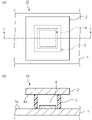
- FIG. 1(a) is a plan view schematically showing a light-emitting device obtained by using the curable composition for inkjet and for forming partition walls according to the first embodiment of the present invention
- FIG. 2 is a cross-sectional view schematically showing the light-emitting device
- FIG. 2A to 2C are cross-sectional views for explaining each step of the method of manufacturing the light-emitting device shown in FIG. 1.
- FIG. 3D to 3F are cross-sectional views for explaining each step of the method of manufacturing the light emitting device shown in FIG.
- curable composition for inkjet and for forming partition walls (Curable composition for inkjet and for forming partition walls)
- the curable composition for inkjet and for forming partition walls (hereinafter sometimes abbreviated as "curable composition") according to the present invention is applied and used using an inkjet device (a curable composition, an inkjet application using equipment and use to form barriers).
- the curable composition according to the present invention is different from a curable composition applied by screen printing and is different from a curable composition applied by a dispenser.
- the curable composition according to the present invention includes a photocurable compound having a total of two or more (meth)acryloyl groups and vinyl groups and having no cyclic ether group, and a thermosetting compound having a cyclic ether group. , a photoinitiator, a heat curing agent, and an infrared light shielding agent.
- photocurable compound having a total of two or more (meth)acryloyl groups and vinyl groups and having no cyclic ether group may be referred to as "(A) photocurable compound”.
- thermosetting compound having a cyclic ether group may be referred to as "(B) thermosetting compound”.
- the curable composition according to the present invention contains (A) a photocurable compound, (B) a thermosetting compound, a photopolymerization initiator, a thermosetting agent, and an infrared light shielding agent.
- the curable composition according to the present invention has the above configuration, partition walls having a large aspect ratio and high infrared light shielding properties can be formed.
- the curable composition according to the present invention can form barrier ribs having an aspect ratio (height/width) required for a light-emitting device.
- the infrared light emitted from the light-emitting member leaks to an unintended region, the performance of the light-emitting device is degraded. Since the curable composition according to the present invention can form barrier ribs with high infrared light shielding properties, the infrared light emitted from the light-emitting member is less likely to leak to unintended locations.
- the curable composition can be applied in the vicinity of the light-emitting member with high accuracy using an inkjet device, so the light-emitting device can be miniaturized.
- the curable composition according to the present invention has the above configuration, it is possible to increase the bonding strength between the member to be bonded and the partition wall.
- the curable composition is a photo- and thermo-curable composition because it contains (A) a photo-curable compound and (B) a thermo-curable compound.
- the curable composition is preferably cured by heating after being cured by irradiation with light.
- (meth)acryloyl means one or both of “acryloyl” and “methacryloyl”
- (meth)acrylate means one or both of "acrylate” and “methacrylate”. means both.
- the CH 2 ⁇ C(H or CH 3 ) group possessed by the (meth)acryloyl group is not included in the vinyl group.
- the curable composition contains (A) a photocurable compound.
- the photocurable compound is a photocurable compound having a total of two or more (meth)acryloyl groups and vinyl groups and no cyclic ether group.
- the photocurable compound may have a (meth)acryloyl group, may have a vinyl group, or may have both a (meth)acryloyl group and a vinyl group. .
- the photocurable compound has a (meth)acryloyl group or a vinyl group. In this case, (A) the photocurable compound has at least one of a (meth)acryloyl group and a vinyl group.
- the photocurable compound may have a (meth)acryloyl group and a vinyl group.
- the photocurable compound may have a (meth)acryloyl group or a vinyl group.
- a (meth)acryloyl group and a vinyl group are photocurable functional groups.
- the photocurable compound does not have an epoxy group (cyclic ether group), for example.
- As for a photocurable compound only 1 type may be used and 2 or more types may be used together.
- the photocurable compound has a total of two or more (meth)acryloyl groups and vinyl groups.
- the curable composition contains an infrared light shielding agent, generally the photoreactivity (photocurability) of the curable composition tends to decrease, but in the present invention, the number of photocurable functional groups is large.
- the curing of the curable composition can be favorably progressed by irradiation with light, and after photocuring can increase the rate of formation of a three-dimensional structure in the crosslinked state.
- partition walls having a large aspect ratio can be formed even when the curable composition contains an infrared light shielding agent.
- the photocurable compound preferably contains a photocurable compound having a total of 3 or more (meth)acryloyl groups and vinyl groups, and a total of 4 or more (meth)acryloyl groups and vinyl groups. More preferably, it contains a curable compound.
- the photocurable compound further preferably contains a photocurable compound having a total of 5 or more (meth)acryloyl groups and vinyl groups, and has a total of 6 or more (meth)acryloyl groups and vinyl groups. It is particularly preferred to contain a photocurable compound. In this case, photocurability can be further enhanced, and partition walls having a higher aspect ratio can be formed.
- the total number of (meth)acryloyl groups and vinyl groups in the photocurable compound may be 100 or less, 50 or less, or 10 or less.
- the photocurable compound includes a photocurable compound having a total of two (meth)acryloyl groups and vinyl groups, and a photocurable compound having a total of three or more (meth)acryloyl groups and vinyl groups. preferably included.
- the photocurable compound includes a photocurable compound having a total of two (meth)acryloyl groups and vinyl groups, and a photocurable compound having a total of four or more (meth)acryloyl groups and vinyl groups.
- the photocurable compound includes a photocurable compound having a total of two (meth)acryloyl groups and vinyl groups, and a photocurable compound having a total of 5 or more (meth)acryloyl groups and vinyl groups. More preferably, it contains (A)
- the photocurable compound includes a photocurable compound having a total of two (meth)acryloyl groups and vinyl groups, and a photocurable compound having a total of six or more (meth)acryloyl groups and vinyl groups. It is particularly preferred to include In this case, photocurability can be further enhanced, and partition walls having a higher aspect ratio can be formed.
- the photocurable compound contains a (meth)acryloyl group. preferably have two or more (meth)acryloyl groups.
- the photocurable compound is preferably a (meth)acrylate compound, more preferably a polyfunctional (meth)acrylate compound.
- the photocurable compound may contain a bifunctional (meth)acrylate compound, may contain a trifunctional (meth)acrylate compound, or may contain a tetrafunctional (meth)acrylate compound. may contain a pentafunctional (meth)acrylate compound, or may contain a hexafunctional (meth)acrylate compound.
- the photocurable compound may contain a (meth)acrylate compound having a functionality of seven or more. For example, "bifunctional" in a bifunctional (meth)acrylate compound indicates that there are two (meth)acryloyl groups.
- the photocurable compound preferably contains a bifunctional (meth)acrylate compound, more preferably contains a trifunctional or higher (meth)acrylate compound, and includes a tetrafunctional or higher (meth)acrylate compound. is even more preferable.
- the photocurable compound more preferably contains a penta- or higher-functional (meth)acrylate compound, particularly preferably a hexa- or higher-functional (meth)acrylate compound. In this case, photocurability can be further enhanced, and partition walls having a higher aspect ratio can be formed. In addition, the curable composition layer can be formed with even higher accuracy.
- bifunctional (meth)acrylate compound examples include ethoxylated bisphenol A di(meth)acrylate, tricyclodecanedimethanol di(meth)acrylate, 1,4-butanediol di(meth)acrylate, 1,6 -hexanediol di(meth)acrylate, 1,9-nonane di(meth)acrylate, 1,10-decanediol di(meth)acrylate, neopentyl glycol di(meth)acrylate, 2,4-dimethyl-1,5- Pentanediol di(meth)acrylate, butylethylpropanediol di(meth)acrylate, ethoxylated cyclohexanemethanol di(meth)acrylate, polyethylene glycol di(meth)acrylate, oligoethylene glycol di(meth)acrylate, ethylene glycol di(meth)acrylate ) acrylate, 2-ethyl-2-but
- trifunctional (meth)acrylate compound examples include, for example, glycerin propoxy tri(meth)acrylate, trimethylolpropane tri(meth)acrylate, trimethylolethane tri(meth)acrylate, trimethylolpropane alkylene oxide-modified tri(meth) ) acrylate, pentaerythritol tri(meth)acrylate, dipentaerythritol tri(meth)acrylate, trimethylolpropane tri((meth)acryloyloxypropyl) ether, alkylene oxide modified tri(meth)acrylate isocyanurate, dipentaerythritol propionate) tri(meth)acrylate, tri((meth)acryloyloxyethyl)isocyanurate, sorbitol tri(meth)acrylate, and the like.
- tetrafunctional (meth)acrylate compounds include pentaerythritol tetra(meth)acrylate, sorbitol tetra(meth)acrylate, ditrimethylolpropane tetra(meth)acrylate, and dipentaerythritol propionate tetra(meth)acrylate. is mentioned.
- pentafunctional (meth)acrylate compounds examples include sorbitol penta(meth)acrylate and dipentaerythritol penta(meth)acrylate.
- hexafunctional (meth)acrylate compounds include dipentaerythritol hexa(meth)acrylate, sorbitol hexa(meth)acrylate, and alkylene oxide-modified hexa(meth)acrylate of phosphazene.
- (A) photocurable compounds having a vinyl group include vinyl ethers, ethylene derivatives, and dicyclopentadiene.
- the photocurable compound preferably contains a photocurable compound having a polyol skeleton, and more preferably contains a (meth)acrylate compound having a polyol skeleton.
- the bonding strength between the members to be bonded (the first member and the second member) and the partition wall can be further increased.
- the number (functional number) of (meth)acryloyl groups possessed by the (meth)acrylate compound having the polyol skeleton may be two, two or more, or three or more. , may be 4 or more, may be 5 or more, or may be 6 or more.
- the number of (meth)acryloyl groups in the (meth)acrylate compound having the polyol skeleton may be 100 or less, 50 or less, or 10 or less.
- the photocurable compound preferably contains a photocurable compound having a dicyclopentadiene skeleton, and more preferably contains a (meth)acrylate compound having a dicyclopentadiene skeleton.
- the dicyclopentadiene skeleton is a rigid skeleton, curing shrinkage of the curable composition is reduced. can be further enhanced.
- the number (functional number) of (meth)acryloyl groups possessed by the (meth)acrylate compound having a dicyclopentadiene skeleton may be 2, may be 2 or more, or may be 3 or more. may be four or more, five or more, or six or more.
- the number of (meth)acryloyl groups in the (meth)acrylate compound having a dicyclopentadiene skeleton may be 100 or less, 50 or less, or 10 or less.
- the content of (A) the photocurable compound is preferably 10% by weight or more, more preferably 15% by weight or more, still more preferably 20% by weight or more, preferably 75% by weight. Below, more preferably 70% by weight or less, still more preferably 65% by weight or less.
- the content of the photocurable compound is at least the above lower limit and below the above upper limit, the photocurability can be further enhanced, and partition walls having a still larger aspect ratio can be formed.
- the content of (A) the photocurable compound is equal to or less than the above upper limit, the adhesion strength between the member to be adhered (the first member and the second member) and the partition wall can be further increased.
- the content of the photocurable compound having a polyol skeleton is preferably 10% by weight or more, more preferably 15% by weight or more, still more preferably 20% by weight or more, preferably 75% by weight. % by weight or less, more preferably 70% by weight or less, and even more preferably 65% by weight or less.
- the content of the photocurable compound having a polyol skeleton is the lower limit or more and the upper limit or less, the photocurability can be further enhanced, and partition walls having a higher aspect ratio can be formed.
- the content of the photocurable compound having a polyol skeleton is the lower limit or more and the upper limit or less, the adhesion strength between the member to be adhered (the first member and the second member) and the partition wall is further increased. be able to.
- the content of the photocurable compound having a polyol skeleton in 100% by weight of the photocurable compound is preferably 10% by weight or more, more preferably 20% by weight or more, and more preferably 90% by weight or less. is 80% by weight or less.
- the content of the photocurable compound having a polyol skeleton is the lower limit or more and the upper limit or less, the photocurability can be further enhanced, and partition walls having a higher aspect ratio can be formed.
- the adhesive strength between the member to be adhered (the first member and the second member) and the partition wall can be further increased.
- the content of (A) the photocurable compound other than the photocurable compound having the polyol skeleton is preferably 10% by weight or more, more preferably 20% by weight or more, and still more preferably is 30% by weight or more, preferably 65% by weight or less, more preferably 60% by weight or less, and even more preferably 55% by weight or less.
- the content of the (A) photocurable compound other than the photocurable compound having a polyol skeleton is at least the above lower limit, the photocurability can be further enhanced, and partition walls having a larger aspect ratio can be formed. be able to.
- the content of the photocurable compound having a dicyclopentadiene skeleton is preferably 5% by weight or more, more preferably 10% by weight or more, and still more preferably 15% by weight or more. is 65% by weight or less, more preferably 60% by weight or less, and still more preferably 55% by weight or less.
- the photocurability can be further enhanced, and partition walls having a much larger aspect ratio can be formed.
- the content of the photocurable compound having a dicyclopentadiene skeleton is equal to or less than the above upper limit, it is possible to further increase the adhesive strength between the member to be adhered (the first member and the second member) and the partition wall. can.
- the content of the photocurable compound having a dicyclopentadiene skeleton in 100% by weight of the photocurable compound is preferably 10% by weight or more, more preferably 20% by weight or more, and preferably 90% by weight or less, More preferably, it is 80% by weight or less.
- the photocurability can be further enhanced, and partition walls having a much larger aspect ratio can be formed.
- the adhesion strength between the member to be adhered (the first member and the second member) and the partition wall is increased. can be further enhanced.
- the curable composition contains (B) a thermosetting compound.
- the thermosetting compound is a thermosetting compound having a cyclic ether group.
- a cyclic ether group is a thermosetting functional group.
- As for the thermosetting compound only one type may be used, or two or more types may be used in combination.
- thermosetting compound examples include an epoxy group and the like.
- thermosetting compound may have only one type of cyclic ether group, or may have two or more types.
- thermosetting compound The cyclic ether group possessed by the thermosetting compound is preferably an epoxy group.
- the thermosetting compound preferably has an epoxy group.
- the thermosetting compound is preferably an epoxy compound.
- the curable composition layer can be formed with high accuracy.
- thermosetting properties can be further enhanced, and partition walls having a higher aspect ratio can be formed.
- the bonding strength between the members to be bonded (the first member and the second member) and the partition wall can be further increased.
- the thermosetting compound may contain a thermosetting compound having one cyclic ether group, may contain a thermosetting compound having two cyclic ether groups, and may contain two cyclic ether groups. A thermosetting compound having one or more cyclic ether groups may be included, or a thermosetting compound having three or more cyclic ether groups may be included.
- the thermosetting compound may contain an epoxy compound having one epoxy group, may contain an epoxy compound having two epoxy groups, or may contain an epoxy compound having two or more epoxy groups. or may contain an epoxy compound having three or more epoxy groups.
- the number of cyclic ether groups or the number of epoxy groups in the thermosetting compound may be 100 or less, 50 or less, or 10 or less.
- the thermosetting compound (B) preferably contains a thermosetting compound having two or more cyclic ether groups, and has two or more epoxy groups. More preferably, it contains an epoxy compound.
- the curable composition layer can be formed with high precision.
- thermosetting properties can be further enhanced, and partition walls having a higher aspect ratio can be formed.
- the bonding strength between the members to be bonded (the first member and the second member) and the partition wall can be further increased.
- epoxy compounds examples include bisphenol A type epoxy compounds, bisphenol F type epoxy compounds, bisphenol S type epoxy compounds, phenol novolac type epoxy compounds, biphenyl type epoxy compounds, biphenyl novolac type epoxy compounds, biphenol type epoxy compounds, and naphthalene type epoxy compounds.
- fluorene type epoxy compound, phenol aralkyl type epoxy compound, naphthol aralkyl type epoxy compound, dicyclopentadiene type epoxy compound, anthracene type epoxy compound, epoxy compound having adamantane skeleton, epoxy compound having tricyclodecane skeleton, naphthylene ether type Epoxy compounds, epoxy compounds having a triazine core in the skeleton, and the like are included.
- thermosetting compound may have a (meth)acryloyl group or may not have a (meth)acryloyl group.
- the thermosetting compound may contain a thermosetting compound having a (meth)acryloyl group, or may not contain a thermosetting compound having a (meth)acryloyl group.
- thermosetting compound having a (meth)acryloyl group is a photo- and thermosetting compound.
- thermosetting compound having a (meth)acryloyl group may be referred to as "(B1) photo- and thermosetting compound”.
- the photo- and thermosetting compound is a photo- and thermosetting compound having a (meth)acryloyl group and a cyclic ether group.
- Photo- and thermosetting compounds may be used alone, or two or more of them may be used in combination.
- thermosetting compound preferably contains (B1) a light and a thermosetting compound.
- the photocurability can be further improved, and the partition walls having a higher aspect ratio while maintaining good adhesion strength between the members to be bonded (the first member and the second member) and the partition walls. can be formed.
- the photocurable and thermosetting compound may have one (meth)acryloyl group, or two or more.
- Photo- and thermosetting compounds include glycidyl (meth)acrylate, 4-hydroxybutyl (meth)acrylate glycidyl ether, and the like.
- the photocurable and thermosetting compound preferably contains glycidyl (meth)acrylate or 4-hydroxybutyl (meth)acrylate glycidyl ether, more preferably 4-hydroxybutyl (meth)acrylate glycidyl ether.
- photocurability can be further enhanced, and partition walls having a higher aspect ratio can be formed.
- the content of the thermosetting compound (B) is preferably 5% by weight or more, more preferably 10% by weight or more, even more preferably 15% by weight or more, and still more preferably 20% by weight. % by weight or more, particularly preferably 30% by weight or more.
- the content of the thermosetting compound (B) is preferably 80% by weight or less, more preferably 70% by weight or less, even more preferably 60% by weight or less, and still more preferably 40% by weight. % by weight or less, even more preferably 35% by weight or less, particularly preferably 30% by weight or less.
- a curable composition layer can be formed with high precision as content of a thermosetting compound is more than the said minimum and below the said upper limit.
- thermosetting properties can be further enhanced, and partition walls having a higher aspect ratio can be formed.
- the bonding strength between the members to be bonded (the first member and the second member) and the partition wall can be further increased.
- the content of (B1) the photocurable and thermosetting compound is preferably 10% by weight or more, more preferably 20% by weight or more, and still more preferably 30% by weight or more.
- the content of (B1) the photocurable and thermosetting compound is preferably 80% by weight or less, more preferably 70% by weight or less, even more preferably 60% by weight or less, and still more preferably is 40% by weight or less, even more preferably 35% by weight or less, and particularly preferably 30% by weight or less.
- (B1) When the content of the photocurable and thermosetting compound is at least the above lower limit and below the above upper limit, the photocurability and thermosetting properties can be further enhanced, and partition walls having a higher aspect ratio can be formed. can be done. Further, when the content of (B1) light and thermosetting compound is equal to or higher than the above lower limit, the adhesion strength between the member to be adhered (the first member and the second member) and the partition wall can be further increased.
- thermosetting compound In 100% by weight of thermosetting compound, the content of (B1) light and thermosetting compound is preferably 10% by weight or more, more preferably 20% by weight or more, and still more preferably 30% by weight or more. is 90% by weight or less, more preferably 80% by weight or less, and still more preferably 70% by weight or less.
- (B1) When the content of the photocurable compound and the thermosetting compound is at least the above lower limit, photocurability can be further enhanced, and partition walls having a still larger aspect ratio can be formed. Further, when the content of (B1) light and thermosetting compound is equal to or less than the above upper limit, the adhesive strength between the member to be adhered (the first member and the second member) and the partition wall can be further increased.
- the total content of (A) the photocurable compound and (B) the thermosetting compound is preferably 55% by weight or more, more preferably 60% by weight or more, and still more preferably is 65% by weight or more.
- a curable composition layer can be formed with high precision as the said total content is more than the said minimum. Further, when the total content is equal to or higher than the lower limit, the photocurability and thermosetting properties can be further enhanced, and partition walls having a still higher aspect ratio can be formed. Furthermore, the bonding strength between the members to be bonded (the first member and the second member) and the partition wall can be further increased.
- the upper limit of the total content of (A) the photocurable compound and (B) the thermosetting compound in 100% by weight of the curable composition is not particularly limited. In 100% by weight of the curable composition, the total content of (A) the photocurable compound and (B) the thermosetting compound is preferably 95% by weight or less, more preferably 90% by weight, and still more preferably 85% by weight or less.
- the curable composition contains a photopolymerization initiator. Only one kind of the photopolymerization initiator may be used, or two or more kinds thereof may be used in combination.
- photopolymerization initiator examples include photoradical polymerization initiators and photocationic polymerization initiators.
- the photopolymerization initiator is preferably a radical photopolymerization initiator.
- the photoradical polymerization initiator is a compound that generates radicals upon exposure to light and initiates a radical polymerization reaction.
- the radical photopolymerization initiator include benzoin compounds such as benzoin, benzoin methyl ether, benzoin ethyl ether, and benzoin isopropyl ether; alkylphenone compounds such as 2-hydroxy-2-methyl-1-phenyl-propan-1-one; Acetophenone compounds such as acetophenone, 2,2-dimethoxy-2-phenylacetophenone, 2,2-diethoxy-2-phenylacetophenone, 1,1-dichloroacetophenone; 2-methyl-1-[4-(methylthio)phenyl]- 2-morpholinopropan-1-one, 2-benzyl-2-dimethylamino-1-(4-morpholinophenyl)-butan-1-one, 2-benzyl-2-dimethylamino-1-(4-morpholino Phenyl)-butanone-1,
- a photopolymerization initiation aid may be used together with the photoradical polymerization initiator.
- the photopolymerization initiation aid include N,N-dimethylaminobenzoic acid ethyl ester, N,N-dimethylaminobenzoic acid isoamyl ester, pentyl-4-dimethylaminobenzoate, triethylamine and triethanolamine.
- Photopolymerization initiation aids other than these may be used. Only one type of the photopolymerization initiation aid may be used, or two or more types may be used in combination.
- a titanocene compound such as CGI-784 (manufactured by Ciba Specialty Chemicals) that absorbs in the visible light region may be used to promote the photoreaction.
- photocationic polymerization initiator examples include sulfonium salts, iodonium salts, metallocene compounds and benzoin tosylate. Only one kind of the photocationic polymerization initiator may be used, or two or more kinds thereof may be used in combination.
- the content of the photopolymerization initiator is preferably 0.1% by weight or more, more preferably 0.5% by weight or more, still more preferably 1% by weight or more, preferably 30% by weight. % by weight or less, more preferably 20% by weight or less, and even more preferably 10% by weight or less.
- the curable composition contains a thermosetting agent. Only one kind of the thermosetting agent may be used, or two or more kinds thereof may be used in combination.
- thermosetting agent examples include organic acids, amine compounds, amide compounds, hydrazide compounds, imidazole compounds, imidazoline compounds, phenol compounds, urea compounds, polysulfide compounds and acid anhydrides.
- a modified polyamine compound such as an amine-epoxy adduct may be used as the thermosetting agent.
- Thermosetting agents other than these may be used.
- the amine compound means a compound having one or more amino groups.
- the amine compound may be a primary amine, a secondary amine, or a tertiary amine.
- Examples of the amine compounds include aliphatic amine compounds, alicyclic amine compounds, aromatic amine compounds, hydrazides, and guanidine derivatives.
- the aliphatic amine compound may be an aliphatic polyamine.
- the alicyclic amine compound may be an alicyclic polyamine.
- the aromatic amine compound may be an aromatic polyamine.
- amine compound examples include epoxy compound-added polyamine (reaction product of epoxy compound and polyamine), Michael-added polyamine (reaction product of ⁇ , ⁇ -unsaturated ketone and polyamine), Mannich-added polyamine (condensation of polyamine with formalin and phenol adducts), thiourea-added polyamines (reaction products of thiourea and polyamines), and ketone-blocked polyamines (reaction products of ketone compounds and polyamines [ketimine]).
- epoxy compound-added polyamine reaction product of epoxy compound and polyamine
- Michael-added polyamine reaction product of ⁇ , ⁇ -unsaturated ketone and polyamine
- Mannich-added polyamine condensation of polyamine with formalin and phenol adducts
- thiourea-added polyamines reaction products of thiourea and polyamines
- ketone-blocked polyamines reaction products of ketone compounds and polyamines [ketimine]
- aliphatic polyamines examples include diethylenetriamine, triethylenetetramine, tetraethylenepentamine, and diethylaminopropylamine.
- alicyclic polyamine examples include mensenediamine, isophoronediamine, N-aminoethylpiperazine, 3,9-bis(3-aminopropyl)-2,4,8,10-tetraoxaspiro(5,5)undecane adducts, bis(4-amino-3-methylcyclohexyl)methane, bis(4-aminocyclohexyl)methane and the like.
- aromatic polyamine examples include m-phenylenediamine, p-phenylenediamine, o-xylenediamine, m-xylenediamine, p-xylenediamine, 4,4-diaminodiphenylmethane, 4,4′-diamino-3,3′.
- hydrazide examples include carbodihydrazide, adipic acid dihydrazide, sebacic acid dihydrazide, dodecanedioic acid dihydrazide, and isophthalic acid dihydrazide.
- guanidine derivative examples include dicyandiamide, 1-o-tolyldiguanide, ⁇ -2,5-dimethylguanide, ⁇ , ⁇ -diphenyldiguanidide, ⁇ , ⁇ -bisguanylguanidinodiphenyl ether, p-chlorophenyldiguanide, ⁇ , ⁇ -hexamethylenebis[ ⁇ -(p-chlorophenol)]diguanide, phenyldiguanide oxalate, acetylguanidine, diethylcyanoacetylguanidine, and the like.
- phenol compounds include polyhydric phenol compounds.
- examples of the polyhydric phenol compound include phenol, cresol, ethylphenol, butylphenol, octylphenol, bisphenol A, tetrabromobisphenol A, bisphenol F, bisphenol S, 4,4′-biphenylphenol, naphthalene skeleton-containing phenol novolac resin, A xylylene skeleton-containing phenol novolac resin, a dicyclopentadiene skeleton-containing phenol novolac resin, a fluorene skeleton-containing phenol novolac resin, and the like are included.
- Examples of the acid anhydride include phthalic anhydride, tetrahydrophthalic anhydride, hexahydrophthalic anhydride, methyltetrahydrophthalic anhydride, methyl nadic anhydride, dodecyl succinic anhydride, chlorendic anhydride, pyromellitic anhydride, Examples include benzophenonetetracarboxylic anhydride, methylcyclohexenetetracarboxylic anhydride, trimellitic anhydride, and polyazelaic anhydride.
- the thermosetting agent preferably contains an amine compound, and is preferably an amine compound.
- the amine compound is preferably an aromatic amine compound.
- the aromatic amine compound is 1,3-bis(3-aminophenoxy)benzene or bis[4-( It preferably contains 3-aminophenoxy)phenyl]sulfone.
- the aromatic amine compound includes at least one of 1,3-bis(3-aminophenoxy)benzene and bis[4-(3-aminophenoxy)phenyl]sulfone.
- the aromatic amine compound may contain 1,3-bis(3-aminophenoxy)benzene and bis[4-(3-aminophenoxy)phenyl]sulfone.
- the aromatic amine compound may contain 1,3-bis(3-aminophenoxy)benzene and may contain bis[4-(3-aminophenoxy)phenyl]sulfone.
- the content of the thermosetting agent is preferably 1% by weight or more, more preferably 5% by weight or more, still more preferably 10% by weight or more, preferably 40% by weight or less, and more It is preferably 30% by weight or less, more preferably 25% by weight or less.
- the curable composition contains an infrared light shielding agent.
- an infrared light shielding agent By including an infrared light shielding agent in the curable composition, the infrared light shielding property of the barrier ribs formed from the curable composition can be enhanced. Only one type of the infrared light shielding agent may be used, or two or more types may be used in combination.
- the infrared light shielding agent is not particularly limited as long as it is a particle or compound having the ability to shield infrared light.
- Examples of the infrared light shielding agent include carbon black, carbon nanotubes, graphene, lanthanum hexaboride compounds, cesium tungsten oxide compounds, dithiol compounds, naphthoquinone compounds, aminium compounds, immonium compounds, azo compounds, phthalocyanine compounds, and naphthalocyanine compounds. , anthracyanine compounds, quinacridone compounds, pentaphene compounds, dioxazine compounds, perylene compounds, and indole compounds.
- the infrared light shielding agent preferably contains carbon black, a phthalocyanine compound, or a naphthalocyanine compound.
- Carbon black, a metal complex having a phthalocyanine skeleton, or naphthalocyanine More preferably, it contains a metal complex having a skeleton.
- the infrared light shielding agent contains at least one of carbon black, a phthalocyanine compound, and a naphthalocyanine compound.
- the infrared light shielding agent may contain at least two of carbon black, a phthalocyanine compound, and a naphthalocyanine compound, and may contain carbon black, a phthalocyanine compound, and a naphthalocyanine compound.
- the infrared light shielding agent may contain carbon black, may contain a phthalocyanine compound, or may contain a naphthalocyanine compound.
- the infrared light-shielding agent more preferably contains carbon black. Excellent light absorption in a local region of near-infrared light, (A) formation of partition walls with a higher aspect ratio without inhibiting the photocuring reaction of the photocurable compound, and infrared light shielding properties From the viewpoint of further increasing
- the average primary particle size of the carbon black is preferably 15 nm or more, more preferably 20 nm or more, still more preferably 30 nm or more, preferably 100 nm or less, and more preferably is 90 nm or less.
- the average primary particle size of the carbon black is at least the lower limit, the dispersibility of the carbon black in the curable composition is improved when the curable composition is applied while being heated and circulated using an inkjet device. Since the aspect ratio can be further increased, the ink-jet dischargeability of the curable composition can be improved, and partition walls having a still higher aspect ratio can be formed.
- the average primary particle size of the carbon black can be measured using a transmission electron microscope (TEM).
- TEM transmission electron microscope
- Examples of transmission electron microscopes include "JEM-ARM200F” manufactured by JEOL Ltd., and the like.
- the major axis and minor axis of the particle image obtained using a transmission electron microscope are measured, and the geometric mean value (long axis ⁇ minor axis) 1/2 of the measured values is defined as the primary particle size of the carbon black. It is preferable to measure the primary particle diameters of 100 carbon black particles and arithmetically average them to obtain the average primary particle diameter of the carbon black.
- the metal complex having a phthalocyanine skeleton is a phthalocyanine compound.
- the metal complex in the metal complex having a phthalocyanine skeleton is preferably a vanadium complex or a copper complex.
- the phthalocyanine compound is preferably a phthalocyanine containing a vanadium atom or a copper atom.
- the metal complex having a naphthalocyanine skeleton is a naphthalocyanine compound.
- the metal complex in the metal complex having the naphthalocyanine skeleton is preferably a vanadium complex or a copper complex.
- the naphthalocyanine compound is preferably naphthalocyanine containing a vanadium atom or a copper atom.
- the content of the infrared light shielding agent is preferably 0.1% by weight or more, more preferably 0.5% by weight or more, preferably 10% by weight or less, and more preferably 5% by weight or less.
- the content of the infrared light shielding agent is equal to or more than the lower limit and equal to or less than the upper limit, the infrared light shielding property can be further enhanced, and partition walls having a higher aspect ratio can be formed.
- the curable composition may contain a photocurable compound having a total of one (meth)acryloyl group and one vinyl group and no cyclic ether group. In this case, the storage stability of the curable composition can be further enhanced.
- the "photocurable compound having a total of one (meth)acryloyl group and one vinyl group and having no cyclic ether group” may be referred to as "(C) photocurable compound”.
- the photocurable compound may have a (meth)acryloyl group or a vinyl group.
- the photocurable compound has only one of a (meth)acryloyl group and a vinyl group.
- the photocurable compound may have a (meth)acryloyl group or a vinyl group.
- a (meth)acryloyl group and a vinyl group are photocurable functional groups.
- the photocurable compound does not have an epoxy group (cyclic ether group), for example.
- As for a photocurable compound only 1 type may be used and 2 or more types may be used together.
- the (C) photocurable compound (monofunctional (meth)acrylate compound) having a (meth)acryloyl group includes methyl (meth)acrylate, ethyl (meth)acrylate, n-propyl (meth)acrylate, i-propyl (meth) acrylate, n-butyl (meth) acrylate, i-butyl (meth) acrylate, sec-butyl (meth) acrylate, t-butyl (meth) acrylate, 2-hydroxyethyl (meth) acrylate, 2-hydroxypropyl (meth) acrylate, 3-hydroxypropyl (meth) acrylate, 2-hydroxybutyl (meth) acrylate, 3-hydroxybutyl (meth) acrylate, 4-hydroxybutyl (meth) acrylate, allyl (meth) acrylate, benzyl (meth) ) acrylate, cyclohexyl (meth) acrylate
- (C) photocurable compounds having a vinyl group include vinyl ethers, ethylene derivatives, styrene, chloromethylstyrene, ⁇ -methylstyrene, maleic anhydride, N-vinylpyrrolidone, and N-vinylformamide.
- the content of the photocurable compound (C) in 100% by weight of the curable composition is preferably 30% by weight or less, more preferably 20% by weight or less, and even more preferably 10% by weight or less. (C) If the content of the photocurable compound is equal to or less than the above upper limit, the content of (A) the photocurable compound that can be included in the curable composition can be increased, and as a result, light Curability can be further enhanced, and partition walls having a higher aspect ratio can be formed.
- the lower limit of the content of the photocurable compound (C) in 100% by weight of the curable composition is not particularly limited.
- the content of the photocurable compound (C) may be 0% by weight or more, may exceed 0% by weight, or may be 1% by weight or more. , 5% by weight or more.
- the curable composition may not contain (C) a photocurable compound.
- the total content of (A) a photocurable compound, (B) a thermosetting compound and (C) a photocurable compound is preferably 55% by weight or more, more preferably is 60% by weight or more, more preferably 65% by weight or more.
- a curable composition layer can be formed with high precision as the said total content is more than the said minimum.
- barrier ribs having a higher aspect ratio can be formed.
- the bonding strength between the members to be bonded (the first member and the second member) and the partition wall can be further increased.
- the upper limit of the total content of (A) the photocurable compound, (B) the thermosetting compound and (C) the photocurable compound is not particularly limited.
- the total content of (A) the photocurable compound, (B) the thermosetting compound and (C) the photocurable compound is preferably 95% by weight or less, more preferably 90% by weight or less, and even more preferably 85% by weight. % by weight or less.
- the curable composition may or may not contain a curing accelerator. Only one kind of the curing accelerator may be used, or two or more kinds thereof may be used in combination.
- curing accelerator examples include tertiary amines, imidazoles, quaternary ammonium salts, quaternary phosphonium salts, organic metal salts, phosphorus compounds and urea compounds.
- the content of the curing accelerator is preferably 0.01% by weight or more, more preferably 0.05% by weight or more, preferably 10% by weight or less, more preferably 5% by weight. % or less.
- the curable composition may or may not contain a solvent. Only one kind of the solvent may be used, or two or more kinds thereof may be used in combination.
- Examples of the solvent include water and organic solvents.
- the solvent is preferably an organic solvent.
- organic solvent examples include alcohols such as ethanol, ketones such as acetone, methyl ethyl ketone, and cyclohexanone, aromatic hydrocarbons such as toluene, xylene, and tetramethylbenzene, cellosolve, methyl cellosolve, butyl cellosolve, carbitol, and methyl carbitol.
- butyl carbitol propylene glycol monomethyl ether, dipropylene glycol monomethyl ether, dipropylene glycol diethyl ether, tripropylene glycol monomethyl ether and other glycol ethers, ethyl acetate, butyl acetate, butyl lactate, cellosolve acetate, butyl cellosolve acetate, carbitol Acetate, butyl carbitol acetate, propylene glycol monomethyl ether acetate, dipropylene glycol monomethyl ether acetate, esters such as propylene carbonate, aliphatic hydrocarbons such as octane and decane, and petroleum solvents such as petroleum ether and naphtha. mentioned.
- the smaller the content of the solvent in the curable composition the better.
- the content of the solvent in 100% by weight of the curable composition is preferably 5% by weight or less, more preferably 1% by weight or less, and still more preferably 0.5% by weight. 5% by weight or less. Most preferably, the curable composition does not contain the solvent.
- the curable composition may or may not contain a dispersant.
- the curable composition preferably contains a dispersant.
- the dispersibility of carbon black in the curable composition is further improved when the curable composition is heated and circulated using an inkjet device. By increasing it, the ink-jet dischargeability of the curable composition can be improved, and partition walls having a higher aspect ratio can be formed.
- the dispersant has a structure in which a hydrophilic skeleton and a lipophilic skeleton are linked by covalent bonds within one molecule.
- the dispersant include surfactants such as cationic dispersants, anionic dispersants, nonionic dispersants, amphoteric dispersants, silicone dispersants, fluorine-based dispersants, and polymeric dispersants. be done. Only one kind of the dispersant may be used, or two or more kinds thereof may be used in combination.
- Examples of the cationic dispersant include resins and compounds having amino groups.
- the cationic dispersant preferably has an amino group.
- the cationic dispersant may have one amino group, two amino groups, three amino groups, or four amino groups.
- the number of amino groups in the cationic dispersant may be 100 or less, 50 or less, or 10 or less.
- the cationic dispersant may not be a thermosetting agent.
- anionic dispersant examples include resins and compounds having a carboxyl group, a sulfonic acid group, a sulfate ester group, or a phosphate ester group.
- the anionic dispersant preferably has a carboxyl group, a sulfonic acid group, a sulfate ester group, or a phosphate ester group.
- nonionic dispersant examples include a nonionic dispersant having a polyoxyethylene group and a nonionic dispersant having an amide group.
- nonionic dispersants having a polyoxyethylene group examples include polyoxyethylene alkyl ethers, polyoxyethylene alkylaryl ethers, acetylene glycol, and polyoxyethylene glycol ester copolymers.
- nonionic dispersants having an amide group examples include polyoxyethylene fatty acid amides.
- polymer-based dispersant examples include BYK-9076 (manufactured by BYK), DISPERBYK-145 (manufactured by BYK), Floren GW-1500 (manufactured by Kyoeisha Chemical Co., Ltd.), EfkaPX4701 (manufactured by BASF), and Hinotect T. -6000 (manufactured by Kawaken Fine Chemicals Co., Ltd.) and the like.
- the molecular weight of the dispersant is preferably 500 or more, more preferably 1000 or more, and still more preferably 2000 or more. is 50,000 or less, more preferably 25,000 or less, and still more preferably 10,000 or less.
- the acid value of the dispersant is preferably 0 mgKOH/g or more, more preferably 10 mgKOH/g or more, still more preferably 20 mgKOH/g or more, preferably 100 mgKOH/g or less, and more preferably 90 mgKOH/g or less.
- the acid value of the dispersant is at least the lower limit and no more than the upper limit, the inkjet dischargeability of the curable composition can be enhanced, partition walls having a higher aspect ratio can be formed, and the pot life can be improved.
- the amine value of the dispersant is preferably 0 mgKOH/g or more, more preferably 10 mgKOH/g or more, still more preferably 20 mgKOH/g or more, preferably 100 mgKOH/g or less, and more preferably 90 mgKOH/g or less.
- the amine value of the dispersant is the lower limit or more and the upper limit or less, the ink-jet dischargeability of the curable composition can be enhanced, partition walls having a higher aspect ratio can be formed, and the pot life can be improved.
- the acid value of the dispersant is 10 mgKOH/g or more and 100 mgKOH/g or less. It is preferable that the dispersant has an amine value of 10 mgKOH/g or more and 100 mgKOH/g or less.
- the curable composition may contain components other than the components described above.
- the above-mentioned other components are not particularly limited, but include adhesion aids such as coupling agents, fillers, leveling agents, antifoaming agents, polymerization inhibitors, and the like.
- the viscosity of the curable composition at 25° C. and 10 rpm is preferably 3 mPa ⁇ s or more, more preferably 5 mPa ⁇ s or more, still more preferably 10 mPa ⁇ s or more, still more preferably 160 mPa ⁇ s or more, preferably 2000 mPa. ⁇ s or less, more preferably 1600 mPa ⁇ s or less, and still more preferably 1500 mPa ⁇ s or less.
- the viscosity of the curable composition at 25° C. and 10 rpm is 160 mPa s or more and 1600 mPa. ⁇ It is particularly preferable that the value is equal to or less than s.
- the above viscosity is measured at 25°C using an E-type viscometer (for example, "TVE22L” manufactured by Toki Sangyo Co., Ltd.) in accordance with JIS K2283.
- E-type viscometer for example, "TVE22L” manufactured by Toki Sangyo Co., Ltd.
- the curable composition can be used to bond the first member and the second member, and to form a partition wall.
- the curable composition is preferably used by being applied on the first surface of the first member.
- the curable composition is preferably applied on the first surface of the first member so as to surround the light emitting member arranged on the first surface of the first member.
- the curable composition is preferably applied in a frame shape on the first surface of the first member.
- the curable composition is preferably used to form frame-shaped partition walls.
- a light-emitting member is preferably present inside the frame-shaped partition.
- An internal space is preferably present inside the partition. It is preferable that a gap exists inside the partition wall.
- first member The details of the first member, the second member, and the light emitting member will be described later.
- a light-emitting device comprises a first member, a light-emitting member arranged on the first surface of the first member, and a partition wall arranged on the first surface of the first member. and the partition wall is a cured product of the above-described inkjet and partition-forming curable composition.
- the light emitting device preferably includes a second member.
- the partition bond the first member and the second member.
- the partition is preferably arranged on the first surface of the first member so as to surround the light emitting member.
- the method for manufacturing the light-emitting device includes the following steps (1) to (4).
- a thermosetting step of thermally curing the B-stage compound layer by heating.
- FIG. 1(a) is a plan view schematically showing a light-emitting device obtained by using the curable composition for inkjet and for forming partition walls according to the first embodiment of the present invention
- FIG. 2 is a cross-sectional view schematically showing the light-emitting device
- FIG. 1(b) is a cross-sectional view taken along line II in FIG. 1(a).
- a light-emitting device 10 shown in FIG. 1 includes a first member 1, a second member 2, a partition wall 3, and a light-emitting member 4.
- the partition wall 3 is a cured product of the curable composition described above.
- the partition wall 3 is a light and heat cured product of the curable composition described above.
- the partition wall 3 bonds the first surface 1 a of the first member 1 and the first surface 2 a of the second member 2 .
- the partition wall 3 is arranged on the first surface 1 a of the first member 1 and on the first surface 2 a of the second member 2 .
- the partition wall 3 is arranged on the first surface 1 a of the first member 1 so as to surround the light emitting member 4 .
- the partition wall 3 is not arranged on the surface of the light emitting member 4 .
- the partition wall 3 has a frame shape. A space is formed by a portion surrounded by the first member 1, the second member 2, and the partition wall 3. As shown in FIG.
- FIG. 1 An example of a method for manufacturing the light emitting device shown in FIG. 1 will be described with reference to FIGS. 2(a) to (c) and FIGS. 3(d) to (f).
- a curable composition is applied using an inkjet device onto the first surface 1a of the first member 1 on which the light emitting member 4 is arranged, and the curable composition is applied.
- a composition layer 3A is formed (coating step).
- a curable composition is applied to the upper surface of the first member 1 to form a curable composition layer 3A.
- a curable composition is discharged from the discharge section 51 of the inkjet device.
- the curable composition layer 3A is irradiated with light from the light irradiation unit 52 of the inkjet device, and the curing of the curable composition layer 3A is advanced to obtain a B-stage product.
- a layer 3B is formed (photocuring step).
- the B-staged material layer 3B is a pre-cured material layer of a curable composition.
- the curable composition may be applied to a specific region, and then the entire applied curable composition may be irradiated with light to form a B-stage compound layer. .
- the B-stage compound layer may be formed by irradiating the applied curable composition with light every time a plurality of drops of the curable composition are applied.
- the B-stage compound layer may be formed by irradiating the applied curable composition with light every time one drop of the curable composition is applied.
- the photo-curing step it is determined whether or not to repeat the coating step and the photo-curing step.
- the curable composition is coated on the surface side opposite to the first member side of the formed B-stage compound layer.
- FIGS. 2(c) and 3(d) are diagrams showing the second coating process and the second photocuring process, respectively.
- a curable composition is applied to the surface of the B-stage compound layer 3B opposite to the first member 1 side, and the surface of the B-stage compound layer 3B is A curable composition layer 3A is formed thereon.
- the applied curable composition layer 3A is irradiated with light from the light irradiation unit 52 of the inkjet device to form the B-stage compound layer 3B.
- the coating step and the photocuring step are performed in the thickness direction of the curable composition layer in FIGS. ) are performed twice.
- the thickness of the B-stage compound layer can be increased, and the aspect ratio (thickness / width) can be increased.
- Each of the coating step and the photocuring step may be performed twice or more, or may be performed three times or more.
- the B-stage compound layer 3B arranged so as to surround the light emitting member 4 is formed.
- the second member 2 is placed on the surface opposite to the first member 1 side of the B-stage compound layer 3B arranged so as to surround the light emitting member 4. (arrangement step).
- the second member 2 is placed on the surface of the frame-shaped B-stage compound layer 3B. Pressure may be applied when positioning the second member.
- the B-stage compound layer 3B is thermally cured by heating (thermal curing step).
- the B-stage compound layer 3B is thermally cured.
- the partition wall 3 is formed.
- the partition wall 3 is a light and thermoset layer of a curable composition.
- the light emitting device 10 shown in FIG. 1 can be obtained.
- the coating step it is preferable to apply (discharge) the curable composition while circulating it, from the viewpoint of forming partition walls having a higher aspect ratio.
- the inkjet device is not particularly limited, and an inkjet device capable of applying the curable composition according to the present invention can be used.
- the inkjet device includes an ink tank in which the curable composition is stored, a discharge section connected to the ink tank and discharging the curable composition, and one end connected to the discharge section. , and a circulation flow path portion, the other end of which is connected to the ink tank, and the inside of which the curable composition flows.
- the inkjet dischargeability of the curable composition can be enhanced, and partition walls having a higher aspect ratio can be formed.
- the circulation flow path section may or may not have a buffer tank and a pump inside the circulation flow path section. It is preferable that the circulation flow path section has the buffer tank inside the circulation flow path section, and preferably has the pump. Further, the circulation flow path section may include a flow rate meter, a thermometer, a filter, a liquid level sensor, etc., in addition to the buffer tank and the pump.
- the temperature of the curable composition can be increased by introducing a heater into the ink tank or using a heater in the circulation flow path. It is possible to adjust.
- the temperature of the circulating curable composition is preferably 30° C. or higher, more preferably 40° C. Above, preferably 120° C. or lower, more preferably 100° C. or lower.
- Ultraviolet rays are preferably irradiated in the photo-curing step.
- the illuminance and irradiation time of the ultraviolet rays in the photocuring step can be appropriately changed depending on the composition of the curable composition and the coating thickness of the curable composition.
- the UV illuminance in the photocuring step may be, for example, 1000 mW/cm 2 or more, 5000 mW/cm 2 or more, 10000 mW/cm 2 or less, or 8000 mW/cm 2 or less.
- the UV irradiation time in the photocuring step may be, for example, 0.01 seconds or more, 0.1 seconds or more, 400 seconds or less, or 100 seconds or less. good too.
- the arranging step it is preferable to arrange the second member on the surface of the B-stage compound layer arranged so as to surround the light-emitting member.
- the surface of the frame-shaped B-stage compound layer is attached to the second member.
- thermosetting step is preferably performed after the arranging step.
- the heating temperature and heating time in the thermosetting step can be appropriately changed according to the composition of the curable composition and the thickness of the B-staged material layer.
- the heating temperature in the thermosetting step may be, for example, 100° C. or higher, 120° C. or higher, 250° C. or lower, or 200° C. or lower.
- the heating time in the thermosetting step may be, for example, 5 minutes or longer, 30 minutes or longer, 600 minutes or shorter, or 300 minutes or shorter.
- the width, height, shape, etc. of the partition wall can be changed as appropriate.
- the width of the partition wall is preferably 5 ⁇ m or more, more preferably 10 ⁇ m or more, still more preferably 25 ⁇ m or more, preferably 300 ⁇ m or less, more preferably 200 ⁇ m or less, and still more preferably 100 ⁇ m or less.
- the width of the partition wall is equal to or greater than the lower limit, the strength of the partition wall can be increased.
- a light-emitting device can be further miniaturized as the width of the said partition is below the said upper limit.
- the width of the partition wall is equal to or greater than the lower limit, the infrared light shielding property can be further enhanced.
- the height of the partition wall is preferably 50 ⁇ m or more, more preferably 100 ⁇ m or more, still more preferably 200 ⁇ m or more, preferably 3000 ⁇ m or less, more preferably 2000 ⁇ m or less, and still more preferably 1000 ⁇ m or less.
- the partition wall can be formed with a higher aspect ratio.
- a light-emitting device can be further miniaturized as the height of the said partition is below the said upper limit. Further, when the height of the partition wall is equal to or less than the upper limit, it is possible to effectively suppress the occurrence of distortion of the partition wall.
- the aspect ratio (ratio of height to width (height/width)) of the partition walls is preferably 3 or more, more preferably 5 or more, still more preferably 10 or more, preferably 100 or less, more preferably 50 or less, and Preferably it is 30 or less.
- the aspect ratio (height/width) is at least the lower limit, the size of the light emitting device can be further reduced.
- the aspect ratio (height/width) is equal to or less than the upper limit, the strength of the partition wall can be increased.
- Examples of the first member include a circuit board, a semiconductor element, a silicon substrate, and the like.
- a transparent member or the like can be used as the second member.
- the second member which is the transparent member, include transparent glass members such as diffusion glass and IR cut glass.
- the second member is preferably a transparent glass member.
- the light-emitting member is preferably a light-emitting member capable of emitting infrared light.
- a 3D sensor light source etc. are mentioned as said light-emitting member.
- thermosetting compound (B) Photo- and thermosetting compound: 4-hydroxybutyl (meth)acrylate glycidyl ether ("4HBAGE” manufactured by Mitsubishi Chemical Corporation)
- Bifunctional epoxy compound bisphenol A type epoxy compound ("850CRP” manufactured by DIC)
- ((C) photocurable compound) Monofunctional (meth)acrylate compound: 2-ethylhexyl acrylate ("2EHA” manufactured by Nippon Shokubai Co., Ltd.)
- Phthalocyanine vanadium complex (“HA-1” manufactured by Nippon Shokubai Co., Ltd.) Phthalocyanine copper complex (manufactured by Yamada Chemical Industry Co., Ltd. "FDN-006") Phthalocyanine metal complex (manufactured by Yamada Chemical Industry Co., Ltd.
- Carbon black 1 (“SF Black BJ2296” manufactured by Sanyo Pigment Co., Ltd., average primary particle size 35 nm) Carbon black 2 (“MA600” manufactured by Mitsubishi Chemical Corporation, average primary particle size 20 nm) Carbon black 3 (“PD-605" manufactured by Mikuni Shiso Co., Ltd., average primary particle size 65 nm) Carbon black 4 ("#10” manufactured by Mitsubishi Chemical Corporation, average primary particle size 75 nm) Carbon black 5 (“#20” manufactured by Mitsubishi Chemical Corporation, average primary particle size 50 nm) Carbon black 6 (“#85” manufactured by Mitsubishi Chemical Corporation, average primary particle size 40 nm) Carbon black 7 (“MA220” manufactured by Mitsubishi Chemical Corporation, average primary particle size 55 nm) Carbon black 8 (“MCF88” manufactured by Mitsubishi Chemical Corporation, average primary particle size 18 nm) Carbon black 9 (manufactured by Mitsubishi Chemical Corporation "#850", average primary particle size 17 nm)
- Examples 1 to 40 and Comparative Examples 1 and 2 The components shown in Tables 1 to 9 were blended in the compounding amounts (pure amounts) shown in Tables 1 to 9 and uniformly mixed to obtain a curable composition for inkjet and for forming partition walls.
- the coating step and the photocuring step were repeated in the thickness direction of the formed B-stage compound layer.
- the obtained B-staged material layer was heated and thermally cured to form partition walls (light and thermally cured material layers) (thermosetting step).
- the shape of the partition wall was observed using a laser microscope ("OLS4100" manufactured by Olympus Corporation).
- partition walls with a width of 300 ⁇ m and a height of 1 mm, 2) partition walls with a width of 200 ⁇ m and a height of 1 mm, and 3) partition walls with a width of 100 ⁇ m and a height of 1 mm.
- A means that the partition walls having the above shape were formed
- B means that the partition walls having the above shape could not be formed.
- the obtained curable composition was applied onto the first member using an inkjet head of a piezo inkjet printer equipped with an ultraviolet irradiation device (coating step). Next, the applied curable composition was irradiated with ultraviolet rays to form a B-stage compound layer (photocuring step). The coating step and the photocuring step were repeated in the thickness direction of the formed B-stage compound layer. Next, the obtained B-stage compound layer was heated to be thermally cured (thermal curing step).
- thermoset layer obtained light and infrared transmittance at a wavelength of 950 nm (optical path length: 100 ⁇ m) of the thermoset layer were measured using a spectrophotometer (“U-4100” manufactured by Hitachi High-Tech Co., Ltd.).
Landscapes
- Chemical & Material Sciences (AREA)
- Engineering & Computer Science (AREA)
- Life Sciences & Earth Sciences (AREA)
- Materials Engineering (AREA)
- Wood Science & Technology (AREA)
- Organic Chemistry (AREA)
- Physics & Mathematics (AREA)
- General Physics & Mathematics (AREA)
- Theoretical Computer Science (AREA)
- Addition Polymer Or Copolymer, Post-Treatments, Or Chemical Modifications (AREA)
- Inks, Pencil-Leads, Or Crayons (AREA)
- Ink Jet Recording Methods And Recording Media Thereof (AREA)
Priority Applications (3)
| Application Number | Priority Date | Filing Date | Title |
|---|---|---|---|
| KR1020237031967A KR20240018411A (ko) | 2021-06-09 | 2022-06-07 | 잉크젯용 및 격벽 형성용 경화성 조성물, 발광 디바이스 및 발광 디바이스의 제조 방법 |
| CN202280040792.8A CN117460795A (zh) | 2021-06-09 | 2022-06-07 | 喷墨用及隔壁形成用固化性组合物、发光设备及发光设备的制造方法 |
| JP2023527879A JP7836303B2 (ja) | 2021-06-09 | 2022-06-07 | インクジェット用及び隔壁形成用硬化性組成物、発光デバイス及び発光デバイスの製造方法 |
Applications Claiming Priority (2)
| Application Number | Priority Date | Filing Date | Title |
|---|---|---|---|
| JP2021-096876 | 2021-06-09 | ||
| JP2021096876 | 2021-06-09 |
Publications (1)
| Publication Number | Publication Date |
|---|---|
| WO2022260049A1 true WO2022260049A1 (ja) | 2022-12-15 |
Family
ID=84426046
Family Applications (1)
| Application Number | Title | Priority Date | Filing Date |
|---|---|---|---|
| PCT/JP2022/022994 Ceased WO2022260049A1 (ja) | 2021-06-09 | 2022-06-07 | インクジェット用及び隔壁形成用硬化性組成物、発光デバイス及び発光デバイスの製造方法 |
Country Status (5)
| Country | Link |
|---|---|
| JP (1) | JP7836303B2 (https=) |
| KR (1) | KR20240018411A (https=) |
| CN (1) | CN117460795A (https=) |
| TW (1) | TW202313871A (https=) |
| WO (1) | WO2022260049A1 (https=) |
Cited By (5)
| Publication number | Priority date | Publication date | Assignee | Title |
|---|---|---|---|---|
| WO2024172153A1 (ja) * | 2023-02-17 | 2024-08-22 | 積水化学工業株式会社 | インクジェット用硬化性組成物及び電子部品 |
| WO2024204095A1 (ja) * | 2023-03-28 | 2024-10-03 | 積水化学工業株式会社 | 隔壁形成用インクジェット組成物、ledモジュール及びledモジュールの製造方法 |
| WO2024204093A1 (ja) * | 2023-03-28 | 2024-10-03 | 積水化学工業株式会社 | 隔壁形成用インクジェット組成物、ledモジュール及びledモジュールの製造方法 |
| WO2024214809A1 (ja) * | 2023-04-12 | 2024-10-17 | 積水化学工業株式会社 | 非水系インクジェット用硬化性組成物、硬化物付き基板、硬化物付き基板の製造方法及び電子部品の製造方法 |
| WO2026063522A1 (ja) * | 2024-09-20 | 2026-03-26 | 積水化学工業株式会社 | インクジェット用硬化性組成物、電子部品及び電子部品の製造方法 |
Citations (7)
| Publication number | Priority date | Publication date | Assignee | Title |
|---|---|---|---|---|
| JP2006099033A (ja) * | 2004-09-22 | 2006-04-13 | Samsung Electronics Co Ltd | ブラックマトリクス用組成物及びこれを用いたブラックマトリクスパターンの形成方法 |
| JP2009037234A (ja) * | 2007-07-10 | 2009-02-19 | Nippon Steel Chem Co Ltd | カラーフィルター隔壁形成用感光性樹脂組成物及びこれを用いて形成した遮光性カラーフィルター隔壁並びにカラーフィルター |
| JP2012184412A (ja) * | 2011-02-14 | 2012-09-27 | Sekisui Chem Co Ltd | インクジェット用硬化性組成物及び電子部品の製造方法 |
| WO2016129670A1 (ja) * | 2015-02-12 | 2016-08-18 | 積水化学工業株式会社 | インクジェット用硬化性組成物及び電子部品の製造方法 |
| JP2016196579A (ja) * | 2015-04-03 | 2016-11-24 | 積水化学工業株式会社 | インクジェット用マーキング材料、電子部品の製造方法及び電子部品 |
| JP2020177147A (ja) * | 2019-04-18 | 2020-10-29 | Jsr株式会社 | 赤外線カットフィルム、光学フィルタ、生体認証装置及び撮像装置 |
| WO2022085183A1 (ja) * | 2020-10-23 | 2022-04-28 | コニカミノルタ株式会社 | 記録方法及び印刷物の作製方法 |
Family Cites Families (5)
| Publication number | Priority date | Publication date | Assignee | Title |
|---|---|---|---|---|
| JP2013091788A (ja) * | 2012-10-10 | 2013-05-16 | Nippon Shokubai Co Ltd | インクジェット用硬化性組成物 |
| US9441084B2 (en) * | 2013-03-13 | 2016-09-13 | Poly6 Techniques | One-pot, high-performance recycling method for polymer waste achieved through renewable polymer synthesis |
| WO2015025593A1 (ja) | 2013-08-20 | 2015-02-26 | シャープ株式会社 | 近接センサ |
| JP6852298B2 (ja) * | 2015-08-21 | 2021-03-31 | 東亞合成株式会社 | インクジェットインキ用硬化型組成物 |
| WO2019189185A1 (ja) * | 2018-03-30 | 2019-10-03 | 太陽インキ製造株式会社 | インクジェット用硬化性組成物、その硬化物、及びその硬化物を有する電子部品 |
-
2022
- 2022-06-07 WO PCT/JP2022/022994 patent/WO2022260049A1/ja not_active Ceased
- 2022-06-07 JP JP2023527879A patent/JP7836303B2/ja active Active
- 2022-06-07 CN CN202280040792.8A patent/CN117460795A/zh active Pending
- 2022-06-07 KR KR1020237031967A patent/KR20240018411A/ko active Pending
- 2022-06-09 TW TW111121366A patent/TW202313871A/zh unknown
Patent Citations (7)
| Publication number | Priority date | Publication date | Assignee | Title |
|---|---|---|---|---|
| JP2006099033A (ja) * | 2004-09-22 | 2006-04-13 | Samsung Electronics Co Ltd | ブラックマトリクス用組成物及びこれを用いたブラックマトリクスパターンの形成方法 |
| JP2009037234A (ja) * | 2007-07-10 | 2009-02-19 | Nippon Steel Chem Co Ltd | カラーフィルター隔壁形成用感光性樹脂組成物及びこれを用いて形成した遮光性カラーフィルター隔壁並びにカラーフィルター |
| JP2012184412A (ja) * | 2011-02-14 | 2012-09-27 | Sekisui Chem Co Ltd | インクジェット用硬化性組成物及び電子部品の製造方法 |
| WO2016129670A1 (ja) * | 2015-02-12 | 2016-08-18 | 積水化学工業株式会社 | インクジェット用硬化性組成物及び電子部品の製造方法 |
| JP2016196579A (ja) * | 2015-04-03 | 2016-11-24 | 積水化学工業株式会社 | インクジェット用マーキング材料、電子部品の製造方法及び電子部品 |
| JP2020177147A (ja) * | 2019-04-18 | 2020-10-29 | Jsr株式会社 | 赤外線カットフィルム、光学フィルタ、生体認証装置及び撮像装置 |
| WO2022085183A1 (ja) * | 2020-10-23 | 2022-04-28 | コニカミノルタ株式会社 | 記録方法及び印刷物の作製方法 |
Cited By (5)
| Publication number | Priority date | Publication date | Assignee | Title |
|---|---|---|---|---|
| WO2024172153A1 (ja) * | 2023-02-17 | 2024-08-22 | 積水化学工業株式会社 | インクジェット用硬化性組成物及び電子部品 |
| WO2024204095A1 (ja) * | 2023-03-28 | 2024-10-03 | 積水化学工業株式会社 | 隔壁形成用インクジェット組成物、ledモジュール及びledモジュールの製造方法 |
| WO2024204093A1 (ja) * | 2023-03-28 | 2024-10-03 | 積水化学工業株式会社 | 隔壁形成用インクジェット組成物、ledモジュール及びledモジュールの製造方法 |
| WO2024214809A1 (ja) * | 2023-04-12 | 2024-10-17 | 積水化学工業株式会社 | 非水系インクジェット用硬化性組成物、硬化物付き基板、硬化物付き基板の製造方法及び電子部品の製造方法 |
| WO2026063522A1 (ja) * | 2024-09-20 | 2026-03-26 | 積水化学工業株式会社 | インクジェット用硬化性組成物、電子部品及び電子部品の製造方法 |
Also Published As
| Publication number | Publication date |
|---|---|
| CN117460795A (zh) | 2024-01-26 |
| JPWO2022260049A1 (https=) | 2022-12-15 |
| KR20240018411A (ko) | 2024-02-13 |
| JP7836303B2 (ja) | 2026-03-26 |
| TW202313871A (zh) | 2023-04-01 |
Similar Documents
| Publication | Publication Date | Title |
|---|---|---|
| JP7836303B2 (ja) | インクジェット用及び隔壁形成用硬化性組成物、発光デバイス及び発光デバイスの製造方法 | |
| JP5617201B2 (ja) | 光硬化性インクジェット用インク | |
| JP6329102B2 (ja) | インクジェット用組成物、半導体装置の製造方法、電子部品及び電子部品の製造方法 | |
| US12528956B2 (en) | Ink-jet adhesive, method for producing electronic component, and electronic component | |
| JP6329100B2 (ja) | インクジェット用マーキング材料、電子部品の製造方法及び電子部品 | |
| JP6391545B2 (ja) | インクジェット用接着剤、半導体装置の製造方法及び電子部品 | |
| JP5862901B2 (ja) | 光硬化性インクジェット用インク | |
| WO2023120515A1 (ja) | 隔壁形成用インクジェット組成物、ledモジュール、ledモジュールの製造方法及びインクジェット組成物 | |
| US12610853B2 (en) | Curable composition for inkjet and air cavity formation, electronic component, and method for manufacturing electronic component | |
| JP2022135603A (ja) | インクジェット塗布用及びled用硬化性組成物、ledモジュール、ledモジュールの製造方法及びled表示装置 | |
| WO2024172153A1 (ja) | インクジェット用硬化性組成物及び電子部品 | |
| JP7649261B2 (ja) | 積層構造体の製造方法、積層構造体、及びインクジェット用組成物セット | |
| WO2024080336A1 (ja) | インクジェット用及びエアキャビティ形成用硬化性組成物、及び電子部品 | |
| CN117062886A (zh) | 喷墨用粘接剂、电子部件的制造方法及电子部件 | |
| JP6514619B2 (ja) | 電子部品の製造方法 | |
| WO2024080335A1 (ja) | 電子部品の製造方法、及び電子部品 | |
| WO2024204095A1 (ja) | 隔壁形成用インクジェット組成物、ledモジュール及びledモジュールの製造方法 | |
| WO2026063522A1 (ja) | インクジェット用硬化性組成物、電子部品及び電子部品の製造方法 | |
| JP2025147756A (ja) | インクジェット用及びエアキャビティ形成用硬化性組成物、電子部品、及び電子部品の製造方法 | |
| JP6391543B2 (ja) | 電子部品の製造方法 | |
| JP2024070162A (ja) | インクジェット用及びled保護用硬化性組成物、ledモジュール、ledモジュールの製造方法、及びled表示装置 |
Legal Events
| Date | Code | Title | Description |
|---|---|---|---|
| 121 | Ep: the epo has been informed by wipo that ep was designated in this application |
Ref document number: 22820228 Country of ref document: EP Kind code of ref document: A1 |
|
| ENP | Entry into the national phase |
Ref document number: 2023527879 Country of ref document: JP Kind code of ref document: A |
|
| WWE | Wipo information: entry into national phase |
Ref document number: 202280040792.8 Country of ref document: CN |
|
| NENP | Non-entry into the national phase |
Ref country code: DE |
|
| 122 | Ep: pct application non-entry in european phase |
Ref document number: 22820228 Country of ref document: EP Kind code of ref document: A1 |