WO2022220202A1 - 演出出力玩具 - Google Patents
演出出力玩具 Download PDFInfo
- Publication number
- WO2022220202A1 WO2022220202A1 PCT/JP2022/017444 JP2022017444W WO2022220202A1 WO 2022220202 A1 WO2022220202 A1 WO 2022220202A1 JP 2022017444 W JP2022017444 W JP 2022017444W WO 2022220202 A1 WO2022220202 A1 WO 2022220202A1
- Authority
- WO
- WIPO (PCT)
- Prior art keywords
- operation input
- unit
- toy
- output toy
- effect output
- Prior art date
- Legal status (The legal status is an assumption and is not a legal conclusion. Google has not performed a legal analysis and makes no representation as to the accuracy of the status listed.)
- Ceased
Links
Images


Classifications
-
- A—HUMAN NECESSITIES
- A63—SPORTS; GAMES; AMUSEMENTS
- A63H—TOYS, e.g. TOPS, DOLLS, HOOPS OR BUILDING BLOCKS
- A63H33/00—Other toys
-
- G—PHYSICS
- G06—COMPUTING OR CALCULATING; COUNTING
- G06M—COUNTING MECHANISMS; COUNTING OF OBJECTS NOT OTHERWISE PROVIDED FOR
- G06M3/00—Counters with additional facilities
Definitions
- the present invention relates to an effect output toy, and more particularly to an effect output toy that outputs an effect in response to an operation performed by a user.
- Patent Document 1 counting the number of revolutions of the steering wheel is started by pressing the start switch. On the other hand, if such a procedure for inputting the start switch can be omitted, the operation of the production output toy can be enjoyed more easily, and the interest of the production output toy can be improved.
- a presentation output toy in one embodiment includes an operation input unit, a detection unit that detects an input to the operation input unit, a first operation input that is detected by the detection unit, and a second operation input that follows the first operation input.
- a timing unit for timing a time interval between two operation inputs; and when the time interval measured by the timing unit is less than a predetermined first time, the first operation input and the second operation input are continuously performed.
- a determination unit that determines that the operation input is an operation input; a counting unit that counts the number of consecutive operation inputs by adding the number of operation inputs determined by the determination unit to be continuous operation inputs; and an effect output unit that outputs a predetermined effect based on the number of consecutive operations performed.
- the X, Y and Z directions described in this application are orthogonal to each other.
- the Z direction may be described as the vertical direction, height direction, or thickness direction of a structure in this application.
- a plane formed by the X direction and the Y direction forms a plane perpendicular to the Z direction.
- the expression "planar view” means viewing a plane consisting of the X and Y directions from the Z direction, and viewing a plane perpendicular to the Z direction.
- the effect output toy of the present embodiment is a toy that rotates the operation input part appearing on the surface of the effect output toy and outputs different effects according to the content of the rotating operation.
- the effect output toy 1 has a main body 2 and an operation input section 3 which is a rotating part provided to be axially rotatable with respect to the main body 2 .
- the body portion 2 includes a bowl-shaped first container 2a and a bowl-shaped second container 2b that are combined with their respective openings facing each other.
- the first container 2a has a circular opening penetrating between the inside and the outside of the body portion 2 .
- the operation input unit 3 has a disk shape.
- a mark 4 formed of unevenness is provided on the front side surface of the operation input unit 3, that is, the surface exposed to the outside of the effect output toy 1.
- the surface on the front side of the operation input section 3 here is the outer surface opposite to the main body section 2 side.
- the location where the mark 4 is provided is a position other than the center in plan view on the front side surface of the operation input unit 3 , for example, near the edge of the circular operation input unit 3 . Since the mark 4 is provided near the edge of the operation input unit 3 in this way, the operator can easily recognize that the operation input unit 3 is rotating by visually recognizing the mark 4 .
- the operation input unit 3 is a portion that is rotated by the operator.
- the mark 4 has an annular portion projecting from the front side of the operation input portion 3 to the outside opposite to the body portion 2 side, and a center side of the annular portion recessed toward the body portion 2 side. and a concave portion.
- the operator can rotate the operation input unit 3 by, for example, applying force in the rotational direction while pressing the finger against the recess.
- the operator can also rotate the operation input unit 3 by applying a force in the direction of rotation while pressing a rod-shaped tool against the recess, for example.
- the mark 4 made of unevenness also defines the position when the operator performs an operation input to the operation input unit 3 .
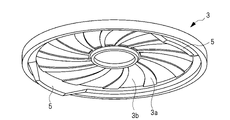
- FIG. 3 shows a perspective view of the operation input unit 3 as seen from the back side.
- the back surface of the operation input unit 3 is the surface opposite to the surface on the front side of the operation input unit 3, and is the surface on the side of the main unit 2 (see FIG. 1).
- the operation input unit 3 has a thin disk-like shape, and a pair of input projections 5 protruding toward the back surface side (body unit 2 side) are provided on the periphery of the back surface. ing.
- the two input projections 5 are provided at positions facing each other across the center of the operation input portion 3 in the radial direction.
- a first portion 3a having a relatively large thickness in the thickness direction along the axial direction of the operation input unit 3 and a A second portion 3b having a smaller thickness is provided on the back surface of the operation input unit 3.
- the first portions 3 a and the second portions 3 b are arranged alternately in the circumferential direction surrounding the central portion of the back surface of the operation input portion 3 .
- Each of the first portion 3a and the second portion 3b extends in an arc from the periphery of the back surface of the operation input section 3 toward the center of the back surface of the operation input section 3 from the periphery of the rotating section. is doing. Therefore, the first portion 3 a and the second portion 3 b form a spiral shape when viewed from the back side of the operation input section 3 .
- the operation input unit 3 is made of a transmissive material that easily transmits light. Therefore, since the first portion 3a has a large thickness, it is relatively difficult for light to pass therethrough in the thickness direction, but the second portion 3b has a small thickness and functions as a light transmitting portion. That is, the light transmitting portion is configured by a concave portion positioned inside the main body portion 2 of the operation input portion 3 .
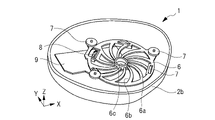
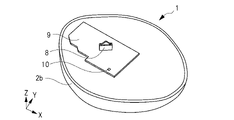
- FIG. 3 and 4 show perspective views of the internal structure of the main body 2 (see FIG. 1). 3 and 4, the illustration of the structure for fixing the inner plate 6, the roller 7, the printed circuit board 9, etc. may be omitted.
- the effect output toy 1 shown in FIG. 3 has a structure in which the first container 2a and the operation input section 3 in FIG. 1 are removed.
- the effect output toy 1 shown in FIG. 4 has a structure in which the first container 2a and the operation input section 3, and the inner plate 6 and the roller 7 (see FIG. 3) of FIG. 1 are removed.
- a printed circuit board 9 is fixed to the second container 2b.
- a light emitting section 10 that emits light toward the side of the operation input section 3 is mounted.
- the light emitting unit 10 is, for example, an LED (Light Emitting Diode) that emits light over a wide range with weak directivity.
- an internal plate 6 is fixed to the second container 2b between the printed circuit board 9 and the operation input portion 3, that is, between the light emitting portion 10 and the operation input portion 3. ing.
- the internal plate 6 has a through hole 6c between the light emitting portion 10 and the central portion of the operation input portion 3.
- the internal plate 6 has through holes 6b arranged in the circumferential direction of the through holes 6c so as to surround the through holes 6c in plan view.
- the internal plate 6 has support portions 6a between the through-holes 6b adjacent in the circumferential direction of the through-holes 6c. In other words, a plurality of support portions 6a are provided side by side in the circumferential direction of the through hole 6c.
- a through hole 6b penetrating toward is formed.
- Each of the support portion 6a and the through hole 6b extends in an arc from the through hole 6c side toward the outside.
- the light-emitting portion 10, the through holes 6b and 6c, and the operation input portion 3 are arranged at overlapping positions in plan view, and the through hole 6c and the central portion of the operation input portion 3 overlap in plan view.
- the rear surface of the operation input section 3 faces the front surface of the internal plate 6 provided with the through holes 6b and 6c, and the through holes 6b and the support section 6a face the periphery of the operation input section 3. It extends in an arc from a position facing the center of the operation input unit 3 .
- a plurality of rollers 7 are provided around the substantially circular region in which the through holes 6b and 6c are provided.
- the rollers 7 are mounted, for example, axially rotatably with respect to the inner plate 6 .
- a part of the rollers 7 has a rotating shaft along the radial direction of the operation input unit 3 and is arranged at a position in contact with the back surface of the operation input unit 3 .
- Another part of the rollers 7 has a rotation axis parallel to the rotation axis of the operation input unit 3, and is arranged at a position adjacent to the operation input unit 3 in a plan view. It is arranged so that the peripheral side faces contact the peripheral side faces of the operation input unit 3 .
- the operation input unit 3 is supported on its rear surface and side surfaces by the plurality of rollers 7, and the periphery of the front surface of the operation input unit 3 contacts the first container 2a. Therefore, even if the operation input unit 3 does not have a rod-shaped rotating shaft, it can be rotated with respect to the main unit 2 . Further, if the operation input unit 3 is made of a material that has high friction and does not slip easily, it becomes easy to rotate the operation input unit 3 while pressing the mark 4 (see FIG. 1). In this case, even if the operation input unit 3 is made of a material that has a large friction and does not slip easily, the operation input unit 3 is supported by the plurality of rollers 7, so that it can rotate smoothly.
- the part 10 constitutes a light emitting mechanism.
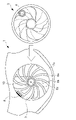
- the plan view shown in FIG. 5 shows the inner plate 6 and the light emitting part 10 visible from the opening of the first container 2a, and the operation input part 3 removed from the main body part 2.
- outlines of the first portion 3a and the second portion 3b (see FIG. 2) on the back surface of the operation input section 3 are indicated by dashed lines.
- the first portion 3a and the second portion 3b form a spiral shape when seen through in plan view.
- Each of the through holes 6b and 6c has a spiral shape in plan view.
- the spiral formed by the first portion 3a and the second portion 3b and the spiral formed by the through-holes 6b and 6c have opposite spiral directions when superimposed on each other.
- the light transmitting unit (second portion 3b) overlaps with the through hole 6b.
- the light emitted from the portion 10 to the light transmission portion appears to spread from the center side of the operation input portion 3 to the peripheral portion side, or to move from the peripheral portion side to the central portion side.
- the front surface of the operation input unit 3 (the outer surface opposite to the main unit 2 side) is provided with a pattern composed of shapes formed by unevenness. .
- the pattern is, for example, a spiral pattern.
- This spiral pattern extends along the direction in which the light transmitting portion extends in an arc. That is, in a plan view, the pattern and the spiral formed by the first portion 3a and the second portion 3b have the same spiral direction.
- the printed circuit board 9 is provided with a detection section 8 inside the main body section 2 .
- the detection unit 8 is, for example, a press switch having a sliding portion that is pressed by the input projection 5 of the operation input unit 3 and slides in the axial direction of the operation input unit 3 . That is, according to the rotation operation of the operation input unit 3, the input projection 5 presses the press switch. As a result, an input using the operation input unit 3 is performed.
- the sliding portion that contacts the operation input unit 3 is, for example, a triangle, and the slanted surface of the triangular portion contacts the input projection 5 so that the sliding portion is pressed without blocking the rotation of the operation input unit 3 .
- the sliding portion protrudes from the inner plate 6 toward the operation input portion 3 .
- the effect output toy includes a detection unit 21 for detecting an input to the operation input unit 3, a first operation input detected by the detection unit 21, and a second operation input subsequent to the first operation input. and a timing unit 23 for timing the time interval between .
- the effect output toy also has a determination unit that determines that the first operation input and the second operation input are continuous operation inputs in response to the fact that the time interval measured by the clock unit 23 is less than a predetermined first time. 24.
- the effect output toy includes a counting unit 25 that counts the number of continuous operation inputs by adding the number of operation inputs determined to be continuous operation inputs by the determination unit 24, and the continuous operation counted by the counting unit 25. and an effect output unit 26 for outputting a predetermined effect based on the number of times.
- the timer section 23 , the determination section 24 and the counting section 25 are included in the control section 22 .
- the detection section 21 is connected to the control section 22
- the control section 22 is connected to the effect output section 26 .
- the detection unit 21 corresponds to the detection unit 8 shown in FIGS. 3 to 5, for example.
- the effect output unit 26 is, for example, the light emitting unit 10 shown in FIG. 5, and may be a speaker that outputs sound.
- the detection unit 21, the control unit 22, and the effect output unit 26 are all contained within the main unit 2 shown in FIG.
- An input to the operation input unit 3 is performed by turning the switch, which is the detection unit 21 , from an off state to an on state according to the rotation of the operation input unit 3 .
- the effect output toy of the present embodiment is a toy that outputs effects by continuously rotating the operation input unit 3 .
- the operator rotates the operation input unit 3 (rotating unit) and the input projection 5 presses the detection unit 8, thereby performing the first operation input.
- the other input projection 5 presses the detection unit 8 again, thereby performing a second operation input.
- the timer unit 23 shown in FIG. 6 measures the time interval between the first operation input and the second operation input following the first operation input, and if the time interval is less than, for example, 0.3 seconds (first time). If there is, the determination unit 24 determines that the continuous operation input has been performed.
- the counting unit 25 adds the number of operation inputs that are determined to be continuous operation inputs, and when the continuous operation inputs are continuously performed, for example, six times or more, the effect output unit 26 outputs a relatively long or flashy effect. Output the first effect. This effect output is performed by one or both of light and sound. Further, when the consecutive operation inputs are consecutively less than six times, for example, the effect output unit 26 outputs a second effect shorter than the first effect.
- Six consecutive operation inputs means that the operation input unit 3 rotates three times. The greater the number of continuous rotations (the longer the duration of continuous operation), the longer the presentation or the more flashy presentation is output, thereby improving the interest.
- the effect output unit 26 outputs the effect when the number of consecutive operations counted by the counting unit 25 is equal to or greater than the predetermined number of times and when the number of consecutive operations counted by the counting unit 25 is less than the predetermined number of times. , the contents of the output are made different.
- the effect output toy of the present embodiment can start an input to the operation input unit 3 at any timing desired by the user without performing an operation (activation operation) other than the operation input unit 3. Therefore, it is possible to operate easily, and it is possible to realize high interest by different effects that are output according to the content of continuous operation.
- the time interval counted by the timer 23 is less than the predetermined third time. It is conceivable to vary the performance contents to be output depending on whether the number of times of input is greater than or less than the number of times of operation input whose time interval measured by the timer 23 is equal to or longer than a predetermined third time. Specifically, the operation input unit 3 is rotated within 4 seconds (second time) from a predetermined timing, and the time interval measured by the clock unit 23 during the 4 seconds is 0.4 seconds (third time).
- the effect output unit 26 produces a relatively long or flashy effect.
- the effect output unit 26 outputs a relatively short effect. In this way, the number of fast rotations and the number of slow rotations within a predetermined period of time may be compared, and different effects may be output according to the ratio.
- one input projection 5 may be provided, but by providing two or more, the amount of rotation of the operation input unit 3 after the first operation input until the second operation input is performed can be reduced. can be done. This makes it easier for even an operator who is not good at rotating the operation input unit 3 to successfully perform continuous rotation. Further, by providing two or more input projections 5, it is possible to suppress variations in the amount of rotation required for successful continuous rotation.
- the direction of rotation of the operation input unit 3 does not need to be constant, and the direction of rotation may be changed during continuous rotation.
Landscapes
- Physics & Mathematics (AREA)
- General Physics & Mathematics (AREA)
- Engineering & Computer Science (AREA)
- Theoretical Computer Science (AREA)
- Toys (AREA)
- Carbon And Carbon Compounds (AREA)
- Steroid Compounds (AREA)
- Confectionery (AREA)
Applications Claiming Priority (2)
| Application Number | Priority Date | Filing Date | Title |
|---|---|---|---|
| JP2021068676A JP7102575B1 (ja) | 2021-04-14 | 2021-04-14 | 演出出力玩具 |
| JP2021-068676 | 2021-04-14 |
Publications (1)
| Publication Number | Publication Date |
|---|---|
| WO2022220202A1 true WO2022220202A1 (ja) | 2022-10-20 |
Family
ID=81782475
Family Applications (1)
| Application Number | Title | Priority Date | Filing Date |
|---|---|---|---|
| PCT/JP2022/017444 Ceased WO2022220202A1 (ja) | 2021-04-14 | 2022-04-08 | 演出出力玩具 |
Country Status (4)
| Country | Link |
|---|---|
| JP (2) | JP7102575B1 (https=) |
| CN (2) | CN118416498A (https=) |
| TW (1) | TWI803233B (https=) |
| WO (1) | WO2022220202A1 (https=) |
Families Citing this family (2)
| Publication number | Priority date | Publication date | Assignee | Title |
|---|---|---|---|---|
| JP7159962B2 (ja) * | 2019-04-16 | 2022-10-25 | 株式会社三洋物産 | 遊技機 |
| JP7793100B1 (ja) * | 2025-06-25 | 2025-12-26 | 株式会社バンダイ | 演出出力玩具、および副玩具体 |
Citations (3)
| Publication number | Priority date | Publication date | Assignee | Title |
|---|---|---|---|---|
| JP3021509U (ja) * | 1995-08-09 | 1996-02-27 | 株式会社トミー | 形態変化玩具 |
| JP2002307354A (ja) * | 2000-11-07 | 2002-10-23 | Sega Toys:Kk | 電子玩具 |
| JP2016106658A (ja) * | 2014-12-02 | 2016-06-20 | 株式会社バンダイ | 演出出力玩具 |
Family Cites Families (12)
| Publication number | Priority date | Publication date | Assignee | Title |
|---|---|---|---|---|
| JP2005269567A (ja) | 2004-03-22 | 2005-09-29 | Hitachi Ltd | 携帯端末 |
| JP2006323943A (ja) | 2005-05-19 | 2006-11-30 | Sony Corp | 再生装置,プログラム及び再生制御方法 |
| JP4980638B2 (ja) | 2006-03-30 | 2012-07-18 | 株式会社バンダイナムコゲームス | プログラム、情報記憶媒体、ゲーム装置およびゲーム装置管理装置 |
| JP2009054201A (ja) * | 2007-08-23 | 2009-03-12 | Funai Electric Co Ltd | コンテンツ再生装置 |
| CN201832424U (zh) * | 2010-04-28 | 2011-05-18 | 深圳市宝安公明李松蓢勤乐制品厂 | 一种电子玩偶 |
| JP4932953B1 (ja) | 2011-07-05 | 2012-05-16 | 株式会社バンダイ | 動作玩具及び可動部材 |
| JP5802322B1 (ja) * | 2014-12-02 | 2015-10-28 | 株式会社バンダイ | 演出玩具 |
| JP6270163B2 (ja) * | 2015-01-21 | 2018-01-31 | 株式会社バンダイ | 演出出力玩具 |
| US20170106297A1 (en) | 2015-10-15 | 2017-04-20 | Spin Master Ltd. | Assembly with toy character in housing |
| CN105678990A (zh) * | 2015-12-31 | 2016-06-15 | 赵旭 | 一种遥控器及其检测、控制方法 |
| JP6660916B2 (ja) * | 2017-05-31 | 2020-03-11 | 株式会社バンダイ | 演出出力玩具 |
| JP2020185066A (ja) * | 2019-05-10 | 2020-11-19 | 株式会社セガ トイズ | 競技玩具 |
-
2021
- 2021-04-14 JP JP2021068676A patent/JP7102575B1/ja active Active
-
2022
- 2022-03-09 TW TW111108638A patent/TWI803233B/zh not_active IP Right Cessation
- 2022-03-22 CN CN202410677667.9A patent/CN118416498A/zh active Pending
- 2022-03-22 CN CN202210287395.2A patent/CN114570037B/zh active Active
- 2022-04-08 WO PCT/JP2022/017444 patent/WO2022220202A1/ja not_active Ceased
- 2022-07-06 JP JP2022109359A patent/JP7746228B2/ja active Active
Patent Citations (3)
| Publication number | Priority date | Publication date | Assignee | Title |
|---|---|---|---|---|
| JP3021509U (ja) * | 1995-08-09 | 1996-02-27 | 株式会社トミー | 形態変化玩具 |
| JP2002307354A (ja) * | 2000-11-07 | 2002-10-23 | Sega Toys:Kk | 電子玩具 |
| JP2016106658A (ja) * | 2014-12-02 | 2016-06-20 | 株式会社バンダイ | 演出出力玩具 |
Also Published As
| Publication number | Publication date |
|---|---|
| TWI803233B (zh) | 2023-05-21 |
| JP2022163727A (ja) | 2022-10-26 |
| JP7102575B1 (ja) | 2022-07-19 |
| JP7746228B2 (ja) | 2025-09-30 |
| JP2022163631A (ja) | 2022-10-26 |
| CN118416498A (zh) | 2024-08-02 |
| CN114570037B (zh) | 2024-06-18 |
| TW202239450A (zh) | 2022-10-16 |
| CN114570037A (zh) | 2022-06-03 |
Similar Documents
| Publication | Publication Date | Title |
|---|---|---|
| WO2022220202A1 (ja) | 演出出力玩具 | |
| KR101881339B1 (ko) | 마그네틱 노브 어셈블리 | |
| JP5707606B2 (ja) | 回転式入力装置及び電子機器 | |
| JP2006073311A (ja) | 操作入力装置およびこれを用いた電子機器 | |
| WO2020105437A1 (ja) | 操作装置 | |
| JP4508849B2 (ja) | 回転つまみのストッパー構造 | |
| EP3989600B1 (en) | Adjustable jog wheel brake for dj controller | |
| JP5694587B1 (ja) | 演出出力玩具 | |
| JP2022163727A5 (https=) | ||
| JP2011100187A (ja) | 回転入力装置および電子機器 | |
| KR20080028487A (ko) | 조작 입력 장치 및 이것을 이용한 전자 기기 | |
| JP2014175194A (ja) | 入力装置 | |
| JP6270163B2 (ja) | 演出出力玩具 | |
| JP2005174806A (ja) | 多機能スイッチ | |
| JP5421089B2 (ja) | 遊技機用のボタンユニット | |
| JP6953328B2 (ja) | 操作端末および補助パネル | |
| KR102338950B1 (ko) | 휠 어셈블리 인터페이스를 갖는 게임장치 | |
| EP3989601B1 (en) | Turntable with press detecting unit | |
| JP2016219342A (ja) | 入力装置 | |
| JP2753684B2 (ja) | ゲーム機用コントローラ | |
| JP2015153576A (ja) | 節度切り替え装置、およびカメラ | |
| KR100782781B1 (ko) | 회전형 멀티키 | |
| JP4000736B2 (ja) | トラックボール装置およびこれを用いた電子機器 | |
| WO2025253442A1 (ja) | 音響装置 | |
| CN120033023A (zh) | 同轴旋转结构 |
Legal Events
| Date | Code | Title | Description |
|---|---|---|---|
| 121 | Ep: the epo has been informed by wipo that ep was designated in this application |
Ref document number: 22788127 Country of ref document: EP Kind code of ref document: A1 |
|
| NENP | Non-entry into the national phase |
Ref country code: DE |
|
| 122 | Ep: pct application non-entry in european phase |
Ref document number: 22788127 Country of ref document: EP Kind code of ref document: A1 |