WO2022208993A1 - 空気極/セパレータ接合体及び金属空気二次電池 - Google Patents
空気極/セパレータ接合体及び金属空気二次電池 Download PDFInfo
- Publication number
- WO2022208993A1 WO2022208993A1 PCT/JP2021/043185 JP2021043185W WO2022208993A1 WO 2022208993 A1 WO2022208993 A1 WO 2022208993A1 JP 2021043185 W JP2021043185 W JP 2021043185W WO 2022208993 A1 WO2022208993 A1 WO 2022208993A1
- Authority
- WO
- WIPO (PCT)
- Prior art keywords
- separator
- ldh
- air electrode
- layer
- hydroxide ion
- Prior art date
- Legal status (The legal status is an assumption and is not a legal conclusion. Google has not performed a legal analysis and makes no representation as to the accuracy of the status listed.)
- Ceased
Links
Images






Classifications
-
- H—ELECTRICITY
- H01—ELECTRIC ELEMENTS
- H01M—PROCESSES OR MEANS, e.g. BATTERIES, FOR THE DIRECT CONVERSION OF CHEMICAL ENERGY INTO ELECTRICAL ENERGY
- H01M50/00—Constructional details or processes of manufacture of the non-active parts of electrochemical cells other than fuel cells, e.g. hybrid cells
- H01M50/40—Separators; Membranes; Diaphragms; Spacing elements inside cells
- H01M50/489—Separators, membranes, diaphragms or spacing elements inside the cells, characterised by their physical properties, e.g. swelling degree, hydrophilicity or shut down properties
- H01M50/497—Ionic conductivity
-
- H—ELECTRICITY
- H01—ELECTRIC ELEMENTS
- H01M—PROCESSES OR MEANS, e.g. BATTERIES, FOR THE DIRECT CONVERSION OF CHEMICAL ENERGY INTO ELECTRICAL ENERGY
- H01M12/00—Hybrid cells; Manufacture thereof
- H01M12/08—Hybrid cells; Manufacture thereof composed of a half-cell of a fuel-cell type and a half-cell of the secondary-cell type
-
- H—ELECTRICITY
- H01—ELECTRIC ELEMENTS
- H01M—PROCESSES OR MEANS, e.g. BATTERIES, FOR THE DIRECT CONVERSION OF CHEMICAL ENERGY INTO ELECTRICAL ENERGY
- H01M4/00—Electrodes
- H01M4/02—Electrodes composed of, or comprising, active material
- H01M4/62—Selection of inactive substances as ingredients for active masses, e.g. binders, fillers
- H01M4/624—Electric conductive fillers
- H01M4/625—Carbon or graphite
-
- H—ELECTRICITY
- H01—ELECTRIC ELEMENTS
- H01M—PROCESSES OR MEANS, e.g. BATTERIES, FOR THE DIRECT CONVERSION OF CHEMICAL ENERGY INTO ELECTRICAL ENERGY
- H01M4/00—Electrodes
- H01M4/02—Electrodes composed of, or comprising, active material
- H01M4/64—Carriers or collectors
- H01M4/66—Selection of materials
- H01M4/661—Metal or alloys, e.g. alloy coatings
- H01M4/662—Alloys
-
- H—ELECTRICITY
- H01—ELECTRIC ELEMENTS
- H01M—PROCESSES OR MEANS, e.g. BATTERIES, FOR THE DIRECT CONVERSION OF CHEMICAL ENERGY INTO ELECTRICAL ENERGY
- H01M4/00—Electrodes
- H01M4/86—Inert electrodes with catalytic activity, e.g. for fuel cells
-
- H—ELECTRICITY
- H01—ELECTRIC ELEMENTS
- H01M—PROCESSES OR MEANS, e.g. BATTERIES, FOR THE DIRECT CONVERSION OF CHEMICAL ENERGY INTO ELECTRICAL ENERGY
- H01M50/00—Constructional details or processes of manufacture of the non-active parts of electrochemical cells other than fuel cells, e.g. hybrid cells
- H01M50/40—Separators; Membranes; Diaphragms; Spacing elements inside cells
- H01M50/409—Separators, membranes or diaphragms characterised by the material
- H01M50/431—Inorganic material
- H01M50/434—Ceramics
-
- H—ELECTRICITY
- H01—ELECTRIC ELEMENTS
- H01M—PROCESSES OR MEANS, e.g. BATTERIES, FOR THE DIRECT CONVERSION OF CHEMICAL ENERGY INTO ELECTRICAL ENERGY
- H01M50/00—Constructional details or processes of manufacture of the non-active parts of electrochemical cells other than fuel cells, e.g. hybrid cells
- H01M50/40—Separators; Membranes; Diaphragms; Spacing elements inside cells
- H01M50/409—Separators, membranes or diaphragms characterised by the material
- H01M50/449—Separators, membranes or diaphragms characterised by the material having a layered structure
- H01M50/451—Separators, membranes or diaphragms characterised by the material having a layered structure comprising layers of only organic material and layers containing inorganic material
-
- H—ELECTRICITY
- H01—ELECTRIC ELEMENTS
- H01M—PROCESSES OR MEANS, e.g. BATTERIES, FOR THE DIRECT CONVERSION OF CHEMICAL ENERGY INTO ELECTRICAL ENERGY
- H01M50/00—Constructional details or processes of manufacture of the non-active parts of electrochemical cells other than fuel cells, e.g. hybrid cells
- H01M50/40—Separators; Membranes; Diaphragms; Spacing elements inside cells
- H01M50/46—Separators, membranes or diaphragms characterised by their combination with electrodes
-
- H—ELECTRICITY
- H01—ELECTRIC ELEMENTS
- H01M—PROCESSES OR MEANS, e.g. BATTERIES, FOR THE DIRECT CONVERSION OF CHEMICAL ENERGY INTO ELECTRICAL ENERGY
- H01M50/00—Constructional details or processes of manufacture of the non-active parts of electrochemical cells other than fuel cells, e.g. hybrid cells
- H01M50/40—Separators; Membranes; Diaphragms; Spacing elements inside cells
- H01M50/489—Separators, membranes, diaphragms or spacing elements inside the cells, characterised by their physical properties, e.g. swelling degree, hydrophilicity or shut down properties
- H01M50/491—Porosity
-
- Y—GENERAL TAGGING OF NEW TECHNOLOGICAL DEVELOPMENTS; GENERAL TAGGING OF CROSS-SECTIONAL TECHNOLOGIES SPANNING OVER SEVERAL SECTIONS OF THE IPC; TECHNICAL SUBJECTS COVERED BY FORMER USPC CROSS-REFERENCE ART COLLECTIONS [XRACs] AND DIGESTS
- Y02—TECHNOLOGIES OR APPLICATIONS FOR MITIGATION OR ADAPTATION AGAINST CLIMATE CHANGE
- Y02E—REDUCTION OF GREENHOUSE GAS [GHG] EMISSIONS, RELATED TO ENERGY GENERATION, TRANSMISSION OR DISTRIBUTION
- Y02E60/00—Enabling technologies; Technologies with a potential or indirect contribution to GHG emissions mitigation
- Y02E60/10—Energy storage using batteries
Definitions
- the present invention relates to an air electrode/separator assembly and a metal-air secondary battery.
- One of the innovative battery candidates is the metal-air secondary battery.
- oxygen which is the positive electrode active material
- the space inside the battery container can be used to the maximum for filling the negative electrode active material, which in principle results in a high energy density.
- an alkaline aqueous solution such as potassium hydroxide is used as the electrolyte, and a separator (partition wall) is used to prevent short-circuiting between the positive and negative electrodes.
- a battery has been proposed that includes a layered double hydroxide (LDH) separator that selectively allows hydroxide ions to permeate while blocking the penetration of zinc dendrites.
- LDH layered double hydroxide
- Patent Document 1 International Publication No. 2013/073292
- an LDH separator is used in a zinc-air secondary battery to prevent both the short circuit between the positive and negative electrodes due to zinc dendrites and the contamination of carbon dioxide. It is disclosed to be provided in between.
- Patent Document 2 International Publication No.
- Patent Document 3 International Publication No. 2016/067884 discloses various methods for forming an LDH dense film on the surface of a porous substrate to obtain a composite material (LDH separator).
- a starting material capable of providing starting points for LDH crystal growth is uniformly attached to a porous substrate, and the porous substrate is subjected to hydrothermal treatment in an aqueous raw material solution to form an LDH dense film on the surface of the porous substrate.
- It includes a step of forming LDH-like compounds are known as hydroxides and/or oxides having a layered crystal structure similar to LDH, although they cannot be called LDH. exhibit ionic conduction properties.
- Patent Document 4 International Publication No. 2020/255856 describes hydroxide ions containing a porous substrate and a layered double hydroxide (LDH)-like compound that closes the pores of the porous substrate.
- a conductive separator is disclosed.
- Patent Document 5 International Publication No. 2015/146671 describes a cathode/separator junction comprising an cathode layer containing an cathode catalyst, an electron-conducting material, and a hydroxide ion-conducting material on an LDH separator. body is disclosed.
- Patent Document 6 International Publication No. 2018/163353 discloses a method of manufacturing an air electrode/separator assembly by directly bonding an air electrode layer containing LDH and carbon nanotubes (CNT) onto an LDH separator. disclosed.
- Patent Document 7 discloses a hydroxide ion conductive separator, an interface layer covering one side of the separator and containing a hydroxide ion conductive material and a conductive material, and an interface
- An air electrode/separator assembly comprising an air electrode layer provided on the layer and including an outermost catalyst layer composed of a porous current collector and a layered double hydroxide (LDH) covering the surface thereof.
- LDH layered double hydroxide
- a metal-air secondary battery using a hydroxide ion-conducting separator such as an LDH separator has the excellent advantage of being able to prevent both the short circuit between the positive and negative electrodes due to metal dendrites and the contamination of carbon dioxide. .
- the hydroxide ion-conducting separator such as the LDH separator prevents the penetration of the electrolyte into the air electrode, the electrolyte does not exist in the air electrode layer, and therefore the electrolyte does not permeate into the air electrode.
- an air electrode/separator assembly capable of retaining water generated during charging in the air electrode is desired.
- the present inventors have now found, in order from the top, a and iv) a water-repellent porous layer having water repellency and air permeability. It was found that excellent charge/discharge performance was exhibited.
- an object of the present invention to provide an air electrode/separator assembly that exhibits excellent charge/discharge performance when used as a metal-air secondary battery while including a hydroxide ion conductive separator such as an LDH separator. It is in.
- FIG. 1 a hydroxide ion conducting separator
- an interfacial layer comprising a hydroxide ion conducting material and a conductive material covering one side of the hydroxide ion conducting separator
- an air electrode layer provided on the interfacial layer and including a catalyst layer composed of a porous current collector and a layered double hydroxide (LDH) covering the surface thereof; a water-repellent porous layer covering the
- the fluororesin material is at least one selected from the group consisting of a fully fluorinated resin, a partially fluorinated resin, polyvinyl fluoride, and a fluorinated resin copolymer. body.
- the water-repellent porous layer is composed of a porous material coated with water-repellent fine particles.
- the porous material is at least one selected from the group consisting of polymer materials, metal meshes, and carbon sheets.
- the water-repellent porous layer has a thickness of 0.01 to 1 mm.
- the water-repellent porous layer has a porosity of 30% or more.
- Item 9 Item 9. Item 9. Item 9. Item 9. Item 9. Item 9. The item 1, wherein the hydroxide ion conductive material contained in the interfacial layer is the same kind of material as the hydroxide ion conductive material contained in the hydroxide ion conductive separator. Air electrode/separator assembly. [Item 10] Item 10. The air according to item 9, wherein the hydroxide ion conductive material contained in the interface layer and the hydroxide ion conductive material contained in the hydroxide ion conductive separator are both LDH and/or LDH-like compounds. Pole/separator assembly. [Item 11] Item 11.
- the carbon material is at least one selected from the group consisting of carbon black, graphite, carbon nanotubes, graphene, and reduced graphene oxide.
- the catalyst layer has a porosity of 60% or more.
- Item 14 Item 1, wherein the LDH contained in the catalyst layer has the form of a plurality of LDH plate-like particles, and the plurality of LDH plate-like particles are bonded perpendicularly or obliquely to the surface of the porous current collector. 14. The air electrode/separator assembly according to any one of items 1 to 13. [Item 15] Item 15. The air electrode/separator assembly according to Item 14, wherein the plurality of LDH plate-like particles are connected to each other in the catalyst layer. [Item 16] Item 16. The air electrode/separator assembly according to any one of Items 1 to 15, wherein the porous current collector is composed of at least one selected from the group consisting of carbon, nickel, stainless steel, and titanium.
- the air electrode/separator assembly according to any one of Items 1 to 16, wherein the porous current collector has a thickness of 0.1 to 1 mm.
- the catalyst layer is a mixture containing a hydroxide ion conductive material, a conductive material, an organic polymer, and an air electrode catalyst (however, the hydroxide ion conductive material can be the same material as the air electrode catalyst, and the conductive 18.
- 19 19.
- the hydroxide ion conducting separator is a layered double hydroxide (LDH) separator.
- Item 20 The air electrode/separator assembly according to Item 19, wherein the LDH separator is composited with a porous substrate.
- FIG. 1 is a schematic cross-sectional view conceptually showing an air electrode/separator assembly according to one embodiment of the present invention.
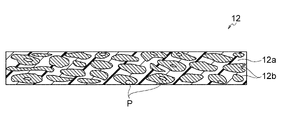
- FIG. 1 is a schematic cross-sectional view conceptually showing an LDH separator used in the present invention.
- FIG. 1 is a schematic cross-sectional view conceptually showing one aspect of plate-like particles bonded perpendicularly or obliquely to the surface of an LDH separator used in the present invention.
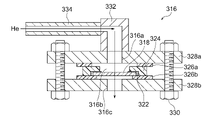
- FIG. FIG. 2 is a conceptual diagram showing an example of a He permeation measurement system used in Example A1; 4B is a schematic cross-sectional view of a sample holder and its peripheral configuration used in the measurement system shown in FIG. 4A;
- FIG. 4 is an SEM image of the surface of the LDH separator produced in Example A1.
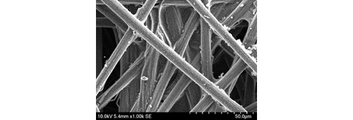
- Example 2 is an SEM image of the surface of carbon fibers forming carbon paper in the catalyst layer produced in Example B1.
- 6B is an enlarged SEM image of the surface of the carbon fiber shown in FIG. 6A.
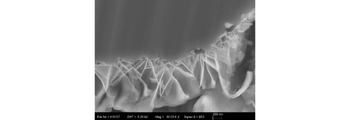
- 6B is an SEM image of a cross section near the surface of the carbon fiber shown in FIG. 6A. 2 is a graph showing charge-discharge characteristics measured for an evaluation cell produced in Example B1.
- FIG. 1 shows one embodiment of an air electrode/separator assembly using a layered double hydroxide (LDH) separator as a hydroxide ion conductive separator.
- LDH layered double hydroxide
- the interface layer 14 is a layer that covers one side of the LDH separator 12 and contains a hydroxide ion conductive material and an electrically conductive material.
- the air electrode layer 16 is a layer in contact with the interface layer 14 and is composed of a porous current collector and a catalyst layer.
- the water-repellent porous layer 19 is a layer that covers the surface of the air electrode layer 16 opposite to the LDH separator 12 .
- a metal-air secondary battery using an LDH separator has the excellent advantage of being able to prevent both the short circuit between the positive and negative electrodes due to metal dendrites and the contamination of carbon dioxide.
- the LDH separator prevents permeation of the electrolytic solution into the air electrode, water does not exist in the air electrode layer, and water must be supplied from the outside during discharge.
- the air electrode/separator assembly advantageously solves this problem.
- the details of the mechanism are not necessarily clear, but it is thought to be as follows. That is, by covering the air electrode layer 16 with the water-repellent porous layer 19, the water generated during charging can be retained in the air electrode layer 16, and as a result, it is not necessary to supply the water necessary for discharging from the outside. Gone. Further, since the water-repellent porous layer 19 is porous, it secures oxygen passages, and the water-repellent porous layer 19 can be introduced without interfering with the charging and discharging reaction.
- the LDH separator 12 is a separator containing a layered double hydroxide (LDH) and/or an LDH-like compound (hereinafter collectively referred to as a hydroxide ion-conducting layered compound). It is defined as selectively passing hydroxide ions using oxide ion conductivity.
- LDH-like compounds are hydroxides and/or oxides of layered crystal structure similar to LDH, although they may not be called LDH, and can be said to be equivalents of LDH.
- LDH layered double hydroxide
- LDH-like compounds are hydroxides and/or oxides of layered crystal structure similar to LDH, although they may not be called LDH, and can be said to be equivalents of LDH.
- LDH can be interpreted as including not only LDH but also LDH-like compounds.
- LDH separators can be known ones as disclosed in Patent Documents 1 to 5, and LDH separators composited with a porous substrate are preferred.
- a particularly preferred LDH separator 12 includes a porous substrate 12a made of a polymeric material and a hydroxide ion-conducting layered compound 12b that closes the pores P of the porous substrate.
- the LDH separator 12 of this aspect will be described later.
- a laminated battery is constructed by alternately incorporating a plurality of air electrode/separator assemblies 10 together with a plurality of metal negative electrodes into a battery container.
- a battery module is constructed by housing a plurality of stacked batteries in one module container. For example, by pressurizing a zinc-air secondary battery, the gap between the negative electrode and the LDH separator 12 that allows zinc dendrite growth is minimized (preferably, the gap is eliminated), thereby making zinc dendrite extension more effective. can be expected to prevent
- the hydroxide ion conductive separator is a separator containing a hydroxide ion conductive material, which selectively allows hydroxide ions to pass through exclusively by utilizing the hydroxide ion conductivity of the hydroxide ion conductive material.
- the hydroxide ion-conducting separator is therefore gas- and/or water-impermeable, in particular gas-impermeable. That is, the hydroxide ion conducting material constitutes all or part of the hydroxide ion conducting separator with such a high degree of density that it exhibits gas impermeability and/or water impermeability. Definitions of gas impermeability and/or water impermeability shall be given below with respect to LDH separator 12 .
- the hydroxide ion-conducting separator may be composited with the porous substrate.
- the interfacial layer 14 includes a hydroxide ion conductive material and an electrically conductive material.
- the hydroxide ion conductive material contained in the interfacial layer 14 has the form of a plurality of plate-like particles 13, and as conceptually shown in FIG. Connected vertically or diagonally.
- the hydroxide ion conductive material contained in the interfacial layer 14 is not particularly limited as long as it has hydroxide ion conductivity and has the form of plate-like particles, but is preferably LDH and/or LDH-like. is a compound. In particular, when observing the microstructure of the surface of the LDH separator 12 produced according to a known technique, as shown in FIG.
- the interfacial resistance is reduced by the presence of such oriented plate-like particles (hydroxide ion conductive material) and the conductive material between the LDH separator 12 and the air electrode layer 16. can be significantly reduced. Therefore, by adopting the same material as the LDH and/or LDH-like compound contained in the LDH separator 12 as the hydroxide ion conductive material contained in the interfacial layer 14, the interfacial layer 14 is formed when the LDH separator 12 is produced. LDH plate-like particles 13 can be prepared at the same time.
- the conductive material contained in the interface layer 14 preferably contains a carbon material.
- the interface layer 14 may be produced by applying a slurry or solution containing a carbon material (for example, carbon ink such as graphene ink) to the surface of the LDH separator 12 to which the plate-like particles 13 are bonded vertically or obliquely.
- a carbon material for example, carbon ink such as graphene ink
- the interface layer 14 may be produced by bringing the catalyst layer and the LDH separator 12 into close contact with each other and making the plate-like particles 13 on the surface of the LDH separator 12 bite into the catalyst layer.
- the interface layer 14 is formed by the portion of the .DELTA.
- the air electrode layer 16 is desirably composed of a porous current collector and a catalyst layer.
- the porous current collector is not particularly limited as long as it is composed of a conductive material having gas diffusion properties, but is composed of at least one selected from the group consisting of carbon, nickel, stainless steel, and titanium. is preferred, and carbon is more preferred.
- Specific examples of porous current collectors include carbon paper, nickel foam, stainless non-woven fabric, and any combination thereof, preferably carbon paper.
- a commercially available porous material can be used as the current collector.
- the thickness of the porous current collector is determined from the viewpoint of securing a wide reaction area, that is, a three-phase interface consisting of an ion-conducting phase (LDH), an electronic-conducting phase (porous current collector), and a gas phase (air). , preferably 0.1 to 1 mm, more preferably 0.1 to 0.5 mm, still more preferably 0.1 to 0.3 mm.
- the porosity of the catalyst layer is preferably 60% or more, more preferably 70% or more, and still more preferably 70 to 95%. Especially in the case of carbon paper, it is more preferably 60 to 90%, still more preferably 70 to 90%, and particularly preferably 75 to 85%.
- the catalyst layer is preferably filled with a mixture comprising a hydroxide ion conducting material, an electrically conducting material, an organic polymer, and a cathode catalyst.
- the hydroxide ion conducting material may be the same material as the cathode catalyst, and examples of such materials include LDHs containing transition metals (such as Ni-Fe-LDH, Co-Fe-LDH, and Ni-Fe-LDH). -V-LDH).
- Mg-Al-LDH is an example of a hydroxide ion conductive material that also serves as an air electrode catalyst.
- the conductive material may be the same material as the air electrode catalyst, and examples of such materials include carbon materials, metal nanoparticles, nitrides such as TiN, and LaSr 3 Fe 3 O 10 .
- the hydroxide ion conductive material contained in the catalyst layer is not particularly limited as long as it is a material having hydroxide ion conductivity, but it is preferably LDH and/or an LDH-like compound.
- the composition of LDH is not particularly limited, but the general formula: M 2+ 1 ⁇ x M 3+ x (OH) 2 A n ⁇ x/n ⁇ mH 2 O (wherein M 2+ is at least one divalent positive M 3+ is at least one trivalent cation, A n- is an n-valent anion, n is an integer of 1 or more, and x is 0.1 to 0.4. , m is any real number).
- M 2+ can be any divalent cation, and preferred examples include Ni 2+ , Mg 2+ , Ca 2+ , Mn 2+ , Fe 2+ , Co 2+ , Cu 2+ and Zn 2+ . . M 3+ can be any trivalent cation, but preferred examples include Fe 3+ , V 3+ , Al 3+ , Co 3+ , Cr 3+ , In 3+ .
- each of M 2+ and M 3+ is a transition metal ion.
- M 2+ is a divalent transition metal ion such as Ni 2+ , Mn 2+ , Fe 2+ , Co 2+ , Cu 2+ , and particularly preferably Ni 2+
- M 3+ is Fe 3+ , V 3+ , Co 3+ , Cr 3+ and the like, and particularly preferably Fe 3+ , V 3+ and/or Co 3+
- part of M 2+ may be substituted with metal ions other than transition metals such as Mg 2+ , Ca 2+ and Zn 2+
- part of M 3+ may be substituted with transition metals such as Al 3+ and In 3+ .
- n- may be substituted with metal ions other than A n- can be any anion, but preferred examples include NO 3- , CO 3 2- , SO 4 2- , OH - , Cl - , I - , Br - , F - and more NO 3- and/or CO 3 2- are preferred. Therefore, in the above general formula, it is preferred that M 2+ contains Ni 2+ , M 3+ contains Fe 3+ and A n- contains NO 3- and/or CO 3 2- .
- n is an integer of 1 or more, preferably 1-3.
- x is 0.1 to 0.4, preferably 0.2 to 0.35.
- m is any real number. More specifically, m is a real number to an integer greater than or equal to 0, typically greater than 0 or greater than or equal to 1.
- the conductive material contained in the catalyst layer is preferably at least one selected from the group consisting of conductive ceramics and carbon materials.
- conductive ceramics include LaNiO 3 , LaSr 3 Fe 3 O 10 , and the like.
- carbon materials include, but are not limited to, carbon black, graphite, carbon nanotubes, graphene, reduced graphene oxide, and any combination thereof, and various other carbon materials can also be used.
- the air electrode catalyst contained in the catalyst layer is preferably at least one selected from the group consisting of LDH and other metal hydroxides, metal oxides, metal nanoparticles, and carbon materials, more preferably It is at least one selected from the group consisting of LDH, metal oxides, metal nanoparticles, and carbon materials.
- the LDH is as described above for the hydroxide ion conductive material, and is particularly preferable in that it can function as both the air electrode catalyst and the hydroxide ion conductive material.
- metal hydroxides include Ni--Fe--OH, Ni--Co--OH and any combination thereof, which may further contain a third metal element.
- metal oxides include Co3O4 , LaNiO3 , LaSr3Fe3O10 , and any combination thereof.
- metal nanoparticles typically metal particles with a particle size of 2 to 30 nm
- carbon materials include, but are not limited to, carbon black, graphite, carbon nanotubes, graphene, reduced graphene oxide, and any combination thereof, as described above, and various other carbon materials are also used. be able to. From the viewpoint of improving the catalytic performance of the carbon material, the carbon material preferably further contains a metal element and/or other elements such as nitrogen, boron, phosphorus, and sulfur.
- a known binder resin can be used as the organic polymer contained in the catalyst layer.
- organic polymers include butyral-based resins, vinyl alcohol-based resins, celluloses, vinyl acetal-based resins, fluorine-based resins, and the like, with butyral-based resins and fluorine-based resins being preferred.
- the catalyst layer may have a portion with low porosity in order to efficiently exchange hydroxide ions with the LDH separator 12 .
- the porosity of the low porosity portion is preferably 30 to 60%, more preferably 35 to 60%, still more preferably 40 to 55%.
- the average pore diameter in the low porosity portion of the catalyst layer is preferably 5 ⁇ m or less, more preferably 0.5 to 4 ⁇ m, still more preferably 1 to 3 ⁇ m.
- the porosity and average pore diameter of the catalyst layer were measured by a) polishing the cross-section of the catalyst layer with a cross-section polisher (CP), and b) using a SEM (scanning electron microscope) to examine the cross-section of the catalyst layer at a magnification of 10,000. Images are acquired in two fields, c) based on the image data of the acquired cross-sectional images, image analysis software (eg, Image-J) is used to binarize the images, and d) the area of each pore in each of the two fields of view. is obtained, the porosity and the pore diameter of each pore are calculated, and the average value thereof is used as the porosity and the average pore diameter of the catalyst layer.
- image analysis software eg, Image-J
- the pore diameter is obtained by converting the length per pixel of the image from the actual size, assuming that each pore is a perfect circle, and dividing the area of each pore obtained from image analysis by the circumference ratio. It can be calculated by multiplying the square root by 2, and the porosity can be calculated by dividing the number of pixels corresponding to pores by the number of pixels in the total area and multiplying by 100.
- the catalyst layer can be produced by preparing a paste containing a hydroxide ion conductive material, a conductive material, an organic polymer, and an air electrode catalyst and applying it to the surface of the LDH separator 12 .
- the paste is prepared by appropriately adding an organic polymer (binder resin) and an organic solvent to a mixture of a hydroxide ion conductive material, a conductive material, and an air electrode catalyst, and using a known kneader such as a three-roll mill. You should go.
- organic solvents include alcohols such as butyl carbitol and terpineol, acetate solvents such as butyl acetate, and N-methyl-2-pyrrolidone.
- the paste can be applied to the LDH separator 12 by printing. This printing can be carried out by various known printing methods, but is preferably carried out by screen printing.
- the air electrode/separator assembly is preferably used in metal-air secondary batteries. That is, according to a preferred embodiment of the present invention, a metal air separator comprising an air electrode/separator assembly, a metal negative electrode, and an electrolytic solution, in which the electrolytic solution is isolated from the air electrode layer 16 via the LDH separator 12.
- a secondary battery is provided.
- a zinc-air secondary battery using a zinc electrode as a metal negative electrode is particularly preferred.
- the metal-air secondary battery preferably has a structure in which the metal negative electrode, the LDH separator 12, the air electrode layer 16, and the water-repellent porous layer 19 are stacked in order from the top. Therefore, the metal-air secondary battery is preferably a stationary metal-air secondary battery.
- a stationary metal-air secondary battery is a stationary metal-air secondary battery that is installed after securing a predetermined space, and is distinguished from a portable metal-air secondary battery.
- the metal negative electrode, the LDH separator 12, the air electrode layer 16, and the water-repellent porous layer 19 are vertically stacked in a "horizontal" state.
- horizontal means that the main surface of the object (that is, the layer surface of each layer and the film surface of the separator) is substantially parallel to the horizontal plane.
- sideways and parallel should not be interpreted strictly, and it is permissible to have an inclination that can be recognized as sideways or approximately parallel (to the horizontal plane) in light of common sense or social conventions. and Therefore, “horizontally” does not necessarily mean that the angle between the horizontal plane and the main surface is 0 degrees, which is completely parallel, and the angle between the horizontal plane and the main surface is less than 30 degrees, less than 20 degrees, less than 10 degrees, or 5 degrees. may be less than
- the water-repellent porous layer 19 according to a preferred embodiment of the present invention will be described below.
- the water-repellent porous layer of this embodiment is required to have a predetermined air permeability, and its porosity is preferably 30% or more, more preferably 30 to 90%, still more preferably 50 to 80%, and particularly preferably 60 to 90%. 70%.
- the measurement of the porosity may be performed in the same manner as the measurement of the porosity of the catalyst layer described above.
- the thickness of the water-repellent porous layer 19 is preferably 0.01-1 mm, more preferably 0.01-0.1 mm.
- Examples of the water-repellent porous material forming the water-repellent porous layer 19 include fluororesins such as fully fluorinated resins, partially fluorinated resins, and polyvinyl fluoride.
- a porous material coated with water-repellent fine particles may be used as the water-repellent porous layer 19 .
- the porous material is not particularly limited as long as it has air permeability, but preferred examples thereof include a resin porous sheet, a metal mesh, and a carbon sheet, and more preferably a resin porous sheet.
- Preferred examples of the water-repellent fine particles include fluororesins.
- the air electrode layer 16 By covering the air electrode layer 16 with the water-repellent porous layer 19 having water repellency and air permeability, O 2 necessary for the charge/discharge reaction can enter and exit the air electrode, and water generated during charging can pass through the air electrode layer. 16. Water remaining in the cathode layer 16 is used for reactions during charging. Since the reaction of water is completed within the air electrode layer 16 in this way, humidification from the outside is unnecessary.
- LDH Separator LDH separator 12 according to a preferred embodiment of the present invention will now be described. Although the following description assumes a zinc-air secondary battery, the LDH separator 12 according to this embodiment can also be applied to other metal-air secondary batteries such as lithium-air secondary batteries. As described above, the LDH separator 12 of this embodiment, as conceptually shown in FIG. . In FIG. 2, the area of the hydroxide ion-conducting layered compound 12b is not connected between the upper surface and the lower surface of the LDH separator 12, but this is because the section is drawn two-dimensionally.
- the area of the hydroxide ion conductive layered compound 12b is connected between the upper surface and the lower surface of the LDH separator 12, thereby increasing the hydroxide ion conductivity of the LDH separator 12.
- the porous substrate 12a is made of a polymer material, and the pores of the porous substrate 12a are closed with the hydroxide ion-conducting layered compound 12b.
- the pores of the porous base material 12a do not have to be completely closed, and residual pores P may slightly exist.
- the LDH separator 12 By closing the pores of the polymeric porous substrate 12a with the hydroxide ion-conducting layered compound 12b and densifying it to a high degree, the LDH separator 12 can more effectively suppress short circuits caused by zinc dendrites. can be provided.
- the LDH separator 12 of this embodiment not only has the desired ion conductivity required for a separator based on the hydroxide ion conductivity possessed by the hydroxide ion conducting layered compound 12b, but also has flexibility. and excellent in strength. This is due to the flexibility and strength of the polymer porous substrate 12a itself contained in the LDH separator 12. That is, since the LDH separator 12 is densified in such a manner that the pores of the porous polymer substrate 12a are sufficiently blocked with the hydroxide ion-conducting layered compound 12b, the porous polymer substrate 12a and the hydroxide The material ion-conducting layered compound 12b is harmoniously integrated as a highly composite material. It can be said that this is offset or reduced by the flexibility and strength of the material 12a.
- the LDH separator 12 of this embodiment is desired to have extremely few residual pores P (pores not blocked by the hydroxide ion conducting layered compound 12b). Due to the residual pores P, the LDH separator 12 has an average porosity of, for example, 0.03% or more and less than 1.0%, preferably 0.05% or more and 0.95% or less, more preferably 0.05% or more and 0.9% or less, more preferably 0.05 to 0.8%, and most preferably 0.05 to 0.5%. When the average porosity is within the above range, the pores of the porous substrate 12a are sufficiently blocked with the hydroxide ion conducting layered compound 12b, resulting in an extremely high degree of denseness, which is attributed to zinc dendrites. A short circuit can be suppressed more effectively.
- the LDH separator 12 can exhibit sufficient functions as a hydroxide ion-conducting separator.
- the average porosity was measured by a) cross-sectional polishing of the LDH separator with a cross-section polisher (CP), and b) a cross-sectional image of the functional layer at a magnification of 50,000 times with an FE-SEM (field emission scanning electron microscope). Two fields of view are acquired, c) based on the image data of the acquired cross-sectional image, the porosity of each of the two fields of view is calculated using image inspection software (e.g., HDDevelop, manufactured by MVTecSoftware), and the average value of the obtained porosities is calculated. It can be done by asking.
- image inspection software e.g., HDDevelop, manufactured by MVTecSoftware
- the LDH separator 12 is a separator containing a hydroxide ion-conducting layered compound 12b, and separates a positive electrode plate and a negative electrode plate so as to allow hydroxide ion conduction when incorporated in a zinc secondary battery. That is, the LDH separator 12 functions as a hydroxide ion conducting separator. Therefore, the LDH separator 12 is gas impermeable and/or water impermeable. Therefore, the LDH separator 12 is preferably densified to be gas impermeable and/or water impermeable.
- having gas impermeability means that helium gas is brought into contact with one side of the measurement object in water at a differential pressure of 0.5 atm, as described in Patent Documents 2 and 3. This means that no bubbles caused by the helium gas are observed from the other side even when the surface is exposed.
- the term “having water impermeability” means that water in contact with one side of the object to be measured does not permeate to the other side, as described in Patent Documents 2 and 3. . That is, the fact that the LDH separator 12 has gas impermeability and/or water impermeability means that the LDH separator 12 has a high degree of denseness to the extent that gas or water does not pass through.
- the LDH separator 12 selectively passes only hydroxide ions due to its hydroxide ion conductivity, and can function as a battery separator. Therefore, the structure is extremely effective in physically preventing penetration of the separator by zinc dendrites generated during charging, thereby preventing short circuits between the positive and negative electrodes. Since the LDH separator 12 has hydroxide ion conductivity, it is possible to efficiently move necessary hydroxide ions between the positive electrode plate and the negative electrode plate, thereby realizing charge-discharge reactions in the positive electrode plate and the negative electrode plate. can be done.
- the LDH separator 12 preferably has a He permeability per unit area of 3.0 cm/min-atm or less, more preferably 2.0 cm/min-atm or less, still more preferably 1.0 cm/min-atm or less. is.
- a separator having a He permeability of 3.0 cm/min ⁇ atm or less can extremely effectively suppress permeation of Zn (typically permeation of zinc ions or zincate ions) in the electrolytic solution. In this way, it is theoretically considered that the separator of this embodiment can effectively suppress the growth of zinc dendrites when used in a zinc secondary battery by significantly suppressing Zn permeation.
- the He permeation rate is determined through a step of supplying He gas to one side of the separator to allow the He gas to permeate the separator, and a step of calculating the He permeation rate and evaluating the compactness of the hydroxide ion conductive separator. measured.
- the degree of He permeation is determined by the formula F/(P ⁇ S) using the permeation amount F of He gas per unit time, the differential pressure P applied to the separator when the He gas permeates, and the membrane area S through which the He gas permeates. calculate.
- He gas has the smallest constitutional unit among a wide variety of atoms and molecules that can constitute gas, and is extremely low in reactivity. That is, He does not form molecules, and constitutes He gas by He atoms alone.
- hydrogen gas is composed of H 2 molecules, a single He atom is smaller as a gas constituent unit.
- H2 gas is dangerous because it is a combustible gas.
- the hydroxide ion conducting layered compound 12b which is LDH and/or an LDH-like compound, closes the pores of the porous substrate 12a.
- LDH is composed of a plurality of hydroxide base layers and intermediate layers interposed between the plurality of hydroxide base layers.
- the hydroxide base layer is mainly composed of metal elements (typically metal ions) and OH groups.
- the intermediate layer of LDH is composed of anions and H2O .
- the anion is a monovalent or higher anion, preferably a monovalent or divalent ion.
- the anions in LDH include OH - and/or CO 3 2- .
- LDH also has excellent ionic conductivity due to its inherent properties.
- LDH is M 2+ 1 ⁇ x M 3+ x (OH) 2 A n ⁇ x/n ⁇ mH 2 O, where M 2+ is a divalent cation and M 3+ is a trivalent is a cation, A n- is an n-valent anion, n is an integer of 1 or more, x is 0.1 to 0.4, and m is 0 or more). known to represent.
- M 2+ can be any divalent cation, but preferred examples include Mg 2+ , Ca 2+ and Zn 2+ , more preferably Mg 2+ .
- M 3+ can be any trivalent cation, but preferred examples include Al 3+ or Cr 3+ , more preferably Al 3+ .
- a n- can be any anion, but preferred examples include OH - and CO 3 2- . Therefore, in the above basic composition formula, it is preferred that M 2+ contains Mg 2+ , M 3+ contains Al 3+ , and A n- contains OH - and/or CO 3 2- .
- n is an integer of 1 or more, preferably 1 or 2.
- x is 0.1 to 0.4, preferably 0.2 to 0.35.
- m is any number denoting the number of moles of water and is a real number equal to or greater than 0, typically greater than 0 or 1 or greater.
- the above basic compositional formula is merely a formula of a "basic composition" which is generally representatively exemplified for LDH, and the constituent ions can be appropriately replaced.
- part or all of M 3+ in the above basic composition formula may be replaced with a cation having a valence of tetravalent or higher. may be changed as appropriate.
- the hydroxide base layer of LDH may contain Ni, Al, Ti and OH groups.
- the intermediate layer is composed of anions and H2O as described above.
- the alternately laminated structure itself of the hydroxide basic layer and the intermediate layer is basically the same as the generally known alternately laminated structure of LDH. , Ti and OH groups, it is possible to exhibit excellent alkali resistance.
- the LDH of this embodiment is because Al, which was conventionally thought to be easily eluted in alkaline solutions, becomes less likely to be eluted in alkaline solutions due to some interaction with Ni and Ti. be done.
- Ni in LDH can take the form of nickel ions.
- Nickel ions in LDH are typically considered to be Ni 2+ , but are not particularly limited as they may have other valences such as Ni 3+ .
- Al in LDH can take the form of aluminum ions.
- Aluminum ions in LDH are typically considered to be Al 3+ , but are not particularly limited as other valences are possible.
- Ti in LDH can take the form of titanium ions. Titanium ions in LDH are typically considered to be Ti 4+ , but are not particularly limited as they may have other valences such as Ti 3+ .
- the hydroxide base layer may contain other elements or ions as long as it contains Ni, Al, Ti and OH groups.
- the hydroxide base layer preferably contains Ni, Al, Ti and OH groups as main constituents. That is, the hydroxide base layer preferably consists mainly of Ni, Al, Ti and OH groups.
- the hydroxide base layer is therefore typically composed of Ni, Al, Ti, OH groups and possibly unavoidable impurities. Unavoidable impurities are arbitrary elements that can be unavoidably mixed in the manufacturing method, and can be mixed in LDH, for example, derived from raw materials and base materials. As mentioned above, since the valences of Ni, Al and Ti are not always certain, it is impractical or impossible to strictly specify LDH by a general formula.
- the hydroxide base layer is composed mainly of Ni 2+ , Al 3+ , Ti 4+ and OH groups
- the corresponding LDH has the general formula: Ni 2+ 1-xy Al 3+ x Ti 4+ y (OH) 2 A n ⁇ (x+2y)/n ⁇ mH 2 O
- a n ⁇ is an n-valent anion
- n is an integer of 1 or more, preferably 1 or 2, and 0 ⁇ x ⁇ 1, preferably 0.01 ⁇ x ⁇ 0.5, 0 ⁇ y ⁇ 1, preferably 0.01 ⁇ y ⁇ 0.5, 0 ⁇ x+y ⁇ 1, m is 0 or more, typically 0 or a real number equal to or greater than 1).
- LDH-like compound is a hydroxide and/or oxide with a layered crystal structure similar to LDH, although it may not be called LDH.
- Preferred LDH-like compounds are described below.
- the LDH separator 12 includes the hydroxide ion-conducting layered compound 12b and the porous substrate 12a (typically composed of the porous substrate 12a and the hydroxide ion-conducting layered compound 12b). 12, the hydroxide ion-conducting layered compound fills the pores of the porous substrate so as to exhibit hydroxide ion conductivity and gas impermeability (and thus function as an LDH separator exhibiting hydroxide ion conductivity). block the It is particularly preferable that the hydroxide ion-conducting layered compound 12b is incorporated throughout the thickness direction of the polymeric porous substrate 12a.
- the thickness of the LDH separator is preferably 3-80 ⁇ m, more preferably 3-60 ⁇ m, still more preferably 3-40 ⁇ m.
- the porous base material 12a is made of a polymeric material.
- the porous polymer substrate 12a has the following characteristics: 1) flexibility (and therefore, it is difficult to break even if it is thin); 4) Easy to manufacture and handle.
- 5) the LDH separator containing a porous substrate made of a polymeric material can be easily folded or sealingly bonded by making use of the advantage derived from the above 1) flexibility.
- Preferred examples of polymeric materials include polystyrene, polyether sulfone, polypropylene, epoxy resin, polyphenylene sulfide, fluororesin (tetrafluorinated resin: PTFE, etc.), cellulose, nylon, polyethylene, and any combination thereof. .
- thermoplastic resins suitable for hot pressing polystyrene, polyether sulfone, polypropylene, epoxy resin, polyphenylene sulfide, fluororesin (tetrafluorinated resin: PTFE, etc.), nylon, polyethylene and any of them and the like.
- All of the various preferred materials described above have alkali resistance as resistance to battery electrolyte.
- Particularly preferred polymer materials are polyolefins such as polypropylene and polyethylene, and most preferably polypropylene or polyethylene, because they are excellent in hot water resistance, acid resistance and alkali resistance and are low in cost.
- the hydroxide ion-conducting layered compound is incorporated throughout the thickness direction of the porous substrate (for example, most or almost all of the inside of the porous substrate).
- the pores are filled with the hydroxide ion-conducting layered compound) is particularly preferred.
- a commercially available microporous polymer membrane can be preferably used as such a porous polymer substrate.
- the LDH separator of this embodiment is produced by (i) preparing a composite material containing a hydroxide ion-conducting layered compound according to a known method (see, for example, Patent Documents 1 to 3) using a polymeric porous substrate, and (ii) It can be produced by pressing this hydroxide ion-conducting layered compound-containing composite material.
- the pressing method may be, for example, roll pressing, uniaxial pressing, CIP (cold isostatic pressing), or the like, and is not particularly limited, but is preferably roll pressing. It is preferable to carry out this pressing while heating since the porous polymeric substrate is softened and the pores of the porous substrate can be sufficiently blocked with the hydroxide ion-conducting layered compound.
- a sufficiently softening temperature for example, in the case of polypropylene and polyethylene, it is preferable to heat at 60 to 200°C.
- the average porosity resulting from residual pores in the LDH separator can be significantly reduced.
- the LDH separator can be densified to an extremely high degree, and therefore short circuits caused by zinc dendrites can be more effectively suppressed.
- the morphology of the residual pores can be controlled, whereby an LDH separator with desired denseness or average porosity can be obtained.
- the method for producing a composite material containing a hydroxide ion-conducting layered compound (i.e., a crude LDH separator) before being pressed is not particularly limited, and a known method for producing an LDH-containing functional layer and a composite material (i.e., an LDH separator) (such as See Patent Documents 1 to 3) can be produced by appropriately changing various conditions.
- a porous substrate is prepared, and (2) a titanium oxide sol or a mixed sol of alumina and titania is applied to the porous substrate and heat-treated to form a titanium oxide layer or an alumina-titania layer, (3) immersing the porous substrate in a raw material aqueous solution containing nickel ions (Ni 2+ ) and urea; (4) hydrothermally treating the porous substrate in the raw material aqueous solution;
- a functional layer containing a hydroxide ion-conducting layered compound and a composite material ie, LDH separator
- a titanium oxide layer or an alumina-titania layer on the porous substrate in the above step (2), not only is the raw material for the hydroxide ion conducting layered compound provided, but also the hydroxide ion conducting layered compound crystal is formed.
- a highly densified hydroxide ion conducting layered compound-containing functional layer can be uniformly formed in the porous substrate.
- the presence of urea in the above step (3) raises the pH value by generating ammonia in the solution using hydrolysis of urea, and coexisting metal ions form hydroxides. can obtain a hydroxide ion-conducting layered compound.
- the hydrolysis is accompanied by the generation of carbon dioxide, a hydroxide ion-conducting layered compound whose anion is a carbonate ion type can be obtained.
- the alumina in (2) above and titania mixed sol to the substrate is preferably carried out in such a manner that the mixed sol penetrates all or most of the inside of the substrate.
- preferable application methods include dip coating, filtration coating, and the like, and dip coating is particularly preferable.
- the adhesion amount of the mixed sol can be adjusted by adjusting the number of coatings such as dip coating.
- the substrate coated with the mixed sol by dip coating or the like may be dried and then subjected to the steps (3) and (4).
- the LDH separator may contain an LDH-like compound.
- LDH-like compounds are (a) is a hydroxide and/or oxide having a layered crystal structure containing Mg and one or more elements containing at least Ti selected from the group consisting of Ti, Y and Al, or (b) (i ) Ti, Y, and optionally Al and/or Mg, and (ii) an additional element M that is at least one selected from the group consisting of In, Bi, Ca, Sr, and Ba.
- (c) is a hydroxide and/or oxide, or (c) is a hydroxide and/or oxide of layered crystal structure comprising Mg, Ti, Y, and optionally Al and/or In, said (c) in the LDH-like compound is present in the form of a mixture with In(OH) 3 .
- the LDH-like compound is a hydroxide having a layered crystal structure containing Mg and at least one element containing at least Ti selected from the group consisting of Ti, Y and Al. and/or an oxide.
- Typical LDH-like compounds are therefore complex hydroxides and/or complex oxides of Mg, Ti, optionally Y and optionally Al.
- the LDH-like compound preferably does not contain Ni.
- the LDH-like compound may further contain Zn and/or K. By doing so, the ionic conductivity of the LDH separator can be further improved.
- LDH-like compounds can be identified by X-ray diffraction. Specifically, when X-ray diffraction is performed on the surface of the LDH separator, the A peak derived from an LDH-like compound is detected in the range.
- LDH is a material with an alternating layer structure in which exchangeable anions and H 2 O are present as intermediate layers between stacked hydroxide elementary layers.
- a peak due to the crystal structure of LDH that is, the (003) peak of LDH
- a peak due to the crystal structure of LDH that is, the (003) peak of LDH
- the interlayer distance of the layered crystal structure can be determined by Bragg's equation using 2 ⁇ corresponding to the peak derived from the LDH-like compound in X-ray diffraction.
- the interlayer distance of the layered crystal structure constituting the LDH-like compound thus determined is typically 0.883 to 1.8 nm, more typically 0.883 to 1.3 nm.
- the atomic ratio of Mg/(Mg+Ti+Y+Al) in the LDH-like compound determined by energy dispersive X-ray spectroscopy (EDS) is preferably 0.03 to 0.25, It is more preferably 0.05 to 0.2.
- the atomic ratio of Ti/(Mg+Ti+Y+Al) in the LDH-like compound is preferably 0.40 to 0.97, more preferably 0.47 to 0.94.
- the atomic ratio of Y/(Mg+Ti+Y+Al) in the LDH-like compound is preferably 0 to 0.45, more preferably 0 to 0.37.
- the atomic ratio of Al/(Mg+Ti+Y+Al) in the LDH-like compound is preferably 0 to 0.05, more preferably 0 to 0.03. Within the above range, the alkali resistance is even more excellent, and the effect of suppressing short circuits caused by zinc dendrites (that is, dendrite resistance) can be more effectively realized.
- LDH separators have the general formula: M 2+ 1 ⁇ x M 3+ x (OH) 2 A n ⁇ x/n ⁇ mH 2 O (wherein M 2+ is a divalent cation, M 3+ is a trivalent cation, A n- is an n-valent anion, n is an integer of 1 or more, x is 0.1 to 0.4, and m is 0 or more.
- M 2+ is a divalent cation
- M 3+ is a trivalent cation
- a n- is an n-valent anion
- n is an integer of 1 or more
- x is 0.1 to 0.4
- m is 0 or more.
- the atomic ratios in LDH-like compounds generally deviate from the general formula for LDH. Therefore, it can be said that the LDH-like compound in this aspect generally has a composition ratio (atomic ratio) different from conventional LDH.
- an EDS analyzer eg, X-act, manufactured by Oxford Instruments
- X-act e.g., X-act, manufactured by Oxford Instruments
- the LDH-like compound has a layered crystal structure comprising (i) Ti, Y and optionally Al and/or Mg and (ii) an additional element M It can be hydroxide and/or oxide. Accordingly, typical LDH-like compounds are complex hydroxides and/or complex oxides of Ti, Y, additional element M, optionally Al and optionally Mg.
- the additive element M is In, Bi, Ca, Sr, Ba, or a combination thereof.
- the atomic ratio of Ti/(Mg+Al+Ti+Y+M) in the LDH-like compound determined by energy dispersive X-ray spectroscopy (EDS) is preferably 0.50 to 0.85, It is more preferably 0.56 to 0.81.
- the atomic ratio of Y/(Mg+Al+Ti+Y+M) in the LDH-like compound is preferably 0.03-0.20, more preferably 0.07-0.15.
- the atomic ratio of M/(Mg+Al+Ti+Y+M) in the LDH-like compound is preferably 0.03-0.35, more preferably 0.03-0.32.
- the atomic ratio of Mg/(Mg+Al+Ti+Y+M) in the LDH-like compound is preferably 0 to 0.10, more preferably 0 to 0.02.
- the atomic ratio of Al/(Mg+Al+Ti+Y+M) in the LDH-like compound is preferably 0 to 0.05, more preferably 0 to 0.04.
- LDH separators have the general formula: M 2+ 1 ⁇ x M 3+ x (OH) 2 A n ⁇ x/n ⁇ mH 2 O (wherein M 2+ is a divalent cation, M 3+ is a trivalent cation, A n- is an n-valent anion, n is an integer of 1 or more, x is 0.1 to 0.4, and m is 0 or more.
- M 2+ is a divalent cation
- M 3+ is a trivalent cation
- a n- is an n-valent anion
- n is an integer of 1 or more
- x is 0.1 to 0.4
- m is 0 or more.
- the atomic ratios in LDH-like compounds generally deviate from the general formula for LDH. Therefore, it can be said that the LDH-like compound in this aspect generally has a composition ratio (atomic ratio) different from conventional LDH.
- an EDS analyzer eg, X-act, manufactured by Oxford Instruments
- X-act e.g., X-act, manufactured by Oxford Instruments
- the LDH-like compound is a hydroxide and/or oxide of layered crystal structure comprising Mg, Ti, Y and optionally Al and/or In.
- the LDH-like compound may be present in the form of a mixture with In(OH) 3 .
- the LDH-like compounds of this embodiment are hydroxides and/or oxides of layered crystal structure containing Mg, Ti, Y, and optionally Al and/or In.
- Typical LDH-like compounds are therefore complex hydroxides and/or complex oxides of Mg, Ti, Y, optionally Al and optionally In.
- the LDH-like compound In that can be contained in the LDH-like compound is not only intentionally added to the LDH-like compound, but also inevitably mixed into the LDH-like compound due to the formation of In(OH) 3 or the like. can be anything. Although the above elements may be replaced with other elements or ions to the extent that the basic properties of the LDH-like compound are not impaired, the LDH-like compound preferably does not contain Ni.
- LDH separators have the general formula: M 2+ 1 ⁇ x M 3+ x (OH) 2 A n ⁇ x/n ⁇ mH 2 O (wherein M 2+ is a divalent cation, M 3+ is a trivalent cation, A n- is an n-valent anion, n is an integer of 1 or more, x is 0.1 to 0.4, and m is 0 or more.
- M 2+ is a divalent cation
- M 3+ is a trivalent cation
- a n- is an n-valent anion
- n is an integer of 1 or more
- x is 0.1 to 0.4
- m is 0 or more.
- the atomic ratios in LDH-like compounds generally deviate from the above general formula for LDH. Therefore, it can be said that the LDH-like compound in this aspect generally has a composition ratio (atomic ratio) different from conventional LDH.
- the mixture according to embodiment (c) above contains not only LDH-like compounds but also In(OH) 3 (typically composed of LDH-like compounds and In(OH) 3 ).
- the inclusion of In(OH) 3 can effectively improve the alkali resistance and dendrite resistance of the LDH separator.
- the content of In(OH) 3 in the mixture is not particularly limited, and is preferably an amount that can improve the alkali resistance and dendrite resistance without substantially impairing the hydroxide ion conductivity of the LDH separator.
- In(OH) 3 may have a cubic crystal structure, or may have a structure in which In(OH) 3 crystals are surrounded by an LDH-like compound.
- In(OH) 3 can be identified by X-ray diffraction.
- Example A1 An LDH separator was produced by the following procedure and evaluated.
- Porous Polymer Substrate A commercially available polyethylene microporous membrane having a porosity of 50%, an average pore diameter of 0.1 ⁇ m and a thickness of 20 ⁇ m was prepared as a porous polymer substrate, and 2.0 cm ⁇ 2. It was cut to a size of 0 cm.
- the mixed sol was applied to the substrate prepared in (1) above by dip coating. Dip coating was carried out by immersing the substrate in 100 ml of the mixed sol, lifting it vertically, and drying it in a drier at 90° C. for 5 minutes.
- Nickel nitrate hexahydrate Ni(NO 3 ) 2.6H 2 O, manufactured by Kanto Kagaku Co., Ltd.
- urea ((NH 2 ) 2 CO, manufactured by Sigma - Aldrich)
- Nickel nitrate hexahydrate was weighed to 0.015 mol/L and put into a beaker, and ion-exchanged water was added to bring the total amount to 75 ml.
- Urea weighed at a ratio of urea/NO 3 ⁇ (molar ratio) 16 was added to the mixture, and further stirred to obtain an aqueous raw material solution.
- Evaluation 1 Identification of LDH separator Using an X-ray diffractometer (RINT TTR III, manufactured by Rigaku Corporation), the crystal phase of the LDH separator was determined under the measurement conditions of voltage: 50 kV, current value: 300 mA, measurement range: 10 to 70 °. Measurements were taken to obtain the XRD profile. For the obtained XRD profile, JCPDS card No. Identification was carried out using the diffraction peak of LDH (hydrotalcite compound) described in 35-0964. The LDH separator of this example was identified to be LDH (hydrotalcite compound).
- Evaluation 2 Measurement of thickness The thickness of the LDH separator was measured using a micrometer. The thickness was measured at three points, and the average value thereof was adopted as the thickness of the LDH separator. As a result, the thickness of the LDH separator of this example was 13 ⁇ m.
- Evaluation 3 Measurement of average porosity A cross-section of the LDH separator was polished with a cross-section polisher (CP), and a cross-section image of the LDH separator was obtained in two fields at a magnification of 50,000 with an FE-SEM (ULTRA55, manufactured by Carl Zeiss). did. Based on this image data, image inspection software (HDDevelop, manufactured by MVTecSoftware) was used to calculate the porosity of each of the two fields of view, and the average value thereof was taken as the average porosity of the LDH separator. As a result, the average porosity of the LDH separator of this example was 0.8%.
- He permeation measurement A He permeation test was performed as follows in order to evaluate the denseness of the LDH separator from the viewpoint of He permeation.
- a He permeation measurement system 310 shown in FIGS. 4A and 4B was constructed.
- He gas from a gas cylinder filled with He gas is supplied to a sample holder 316 via a pressure gauge 312 and a flow meter 314 (digital flow meter). It is constructed such that it is permeated from one surface of the separator 318 to the other surface and discharged.
- the sample holder 316 has a structure including a gas supply port 316a, a closed space 316b and a gas discharge port 316c, and was assembled as follows. First, an adhesive 322 was applied along the outer circumference of the LDH separator 318, and attached to a jig 324 (made of ABS resin) having an opening in the center. Butyl rubber packings are provided as sealing members 326a and 326b at the upper and lower ends of the jig 324, and support members 328a and 328b (made of PTFE) having openings formed of flanges are applied from the outside of the sealing members 326a and 326b. ).
- the closed space 316b is defined by the LDH separator 318, the jig 324, the sealing member 326a and the support member 328a.
- the support members 328a and 328b were tightly fastened together by fastening means 330 using screws so that He gas would not leak from portions other than the gas discharge port 316c.
- a gas supply pipe 334 was connected via a joint 332 to the gas supply port 316 a of the sample holder 316 thus assembled.
- He gas was supplied to the He permeation measurement system 310 through the gas supply pipe 334 and allowed to permeate the LDH separator 318 held in the sample holder 316 .
- the gas supply pressure and flow rate were monitored by the pressure gauge 312 and flow meter 314 .
- the He permeability was calculated.
- the He permeation rate is calculated based on the permeation amount F (cm 3 /min) of He gas per unit time, the differential pressure P (atm) applied to the LDH separator during He gas permeation, and the membrane area S (cm 2 ), it was calculated by the formula of F/(P ⁇ S).
- the permeation amount F (cm 3 /min) of He gas was directly read from the flow meter 314 .
- a gauge pressure read from the pressure gauge 312 was used as the differential pressure P.
- the He gas was supplied so that the differential pressure P was within the range of 0.05 to 0.90 atm.
- the He permeability per unit area of the LDH separator was 0.0 cm/min ⁇ atm.
- Example B1-B3 An air electrode/separator assembly comprising two layers, an interface layer and a catalyst layer, on the LDH separator produced in Example A1 was produced by the following procedure and evaluated.
- Nickel nitrate hexahydrate Ni(NO 3 ) 2 6H 2 O, manufactured by Kanto Chemical Co., Inc.
- urea ((NH 2 ) 2 CO, manufactured by Mitsui Chemicals, Inc.)
- Nickel nitrate hexahydrate was weighed so as to be 0.03 mol/L and put into a beaker, and deionized water was added to make the total amount 75 ml.
- urea was added to the solution so that the urea concentration was 0.96 mol/l, and the mixture was further stirred to obtain an aqueous raw material solution.
- FIGS. 6A-6C are obtained.
- FIG. 6B is an enlarged image of the surface of the carbon fibers forming the carbon paper shown in FIG. 6A
- FIG. 6C is an enlarged cross-sectional image near the surface of the carbon fibers shown in FIG. 6A. From these figures, it was observed that a large number of LDH plate-like particles were vertically or obliquely bonded to the surface of the carbon fibers constituting the carbon paper, and that these LDH plate-like particles were connected to each other.
- Example B3 an interface layer (thickness: 0.2 ⁇ m) containing LDH plate-like particles (originating from the LDH separator) and carbon (originating from the carbon slurry) was simultaneously formed between the LDH separator and the air electrode layer.
- a PTFE porous film manufactured by Chukoh Kasei Co., Ltd., SEF-010 was adhered onto the catalyst layer (air electrode layer) to form a water-repellent porous layer (porosity: 65%).
- SEF-010 a PTFE porous film
- a metal zinc plate was laminated as a negative electrode on the air electrode/separator assembly and the LDH separator side so that the negative electrode faces upward.
- the obtained laminate was sandwiched with a pressing jig in a state in which the sealing member was engaged with the outer peripheral portion of the LDH separator so as to be able to adhere thereto, and was firmly fixed with a screw.
- This holding jig has an oxygen introduction port on the air electrode side and a liquid injection port through which an electrolytic solution can be introduced on the metal zinc plate side.
- a 5.4 M KOH aqueous solution saturated with zinc oxide was added to the negative electrode side of the assembly thus obtained to prepare an evaluation cell.
- Example B2 comparative example
- Example B3 comparative example
- Example B3 comparative example
Landscapes
- Chemical & Material Sciences (AREA)
- Chemical Kinetics & Catalysis (AREA)
- Electrochemistry (AREA)
- General Chemical & Material Sciences (AREA)
- Engineering & Computer Science (AREA)
- Inorganic Chemistry (AREA)
- Materials Engineering (AREA)
- Manufacturing & Machinery (AREA)
- Ceramic Engineering (AREA)
- Hybrid Cells (AREA)
Priority Applications (4)
| Application Number | Priority Date | Filing Date | Title |
|---|---|---|---|
| CN202180094241.5A CN116998051A (zh) | 2021-03-30 | 2021-11-25 | 空气极/隔板接合体及金属空气二次电池 |
| JP2023510218A JP7639120B2 (ja) | 2021-03-30 | 2021-11-25 | 空気極/セパレータ接合体及び金属空気二次電池 |
| DE112021007019.3T DE112021007019T5 (de) | 2021-03-30 | 2021-11-25 | Luftelektrode/separator-anordnung und metall-luft-sekundärbatterie |
| US18/449,007 US20230395945A1 (en) | 2021-03-30 | 2023-08-14 | Air electrode/separator assembly and metal-air secondary battery |
Applications Claiming Priority (2)
| Application Number | Priority Date | Filing Date | Title |
|---|---|---|---|
| JP2021058869 | 2021-03-30 | ||
| JP2021-058869 | 2021-03-30 |
Related Child Applications (1)
| Application Number | Title | Priority Date | Filing Date |
|---|---|---|---|
| US18/449,007 Continuation US20230395945A1 (en) | 2021-03-30 | 2023-08-14 | Air electrode/separator assembly and metal-air secondary battery |
Publications (1)
| Publication Number | Publication Date |
|---|---|
| WO2022208993A1 true WO2022208993A1 (ja) | 2022-10-06 |
Family
ID=83458335
Family Applications (1)
| Application Number | Title | Priority Date | Filing Date |
|---|---|---|---|
| PCT/JP2021/043185 Ceased WO2022208993A1 (ja) | 2021-03-30 | 2021-11-25 | 空気極/セパレータ接合体及び金属空気二次電池 |
Country Status (5)
| Country | Link |
|---|---|
| US (1) | US20230395945A1 (https=) |
| JP (1) | JP7639120B2 (https=) |
| CN (1) | CN116998051A (https=) |
| DE (1) | DE112021007019T5 (https=) |
| WO (1) | WO2022208993A1 (https=) |
Cited By (1)
| Publication number | Priority date | Publication date | Assignee | Title |
|---|---|---|---|---|
| CN119725980A (zh) * | 2024-12-19 | 2025-03-28 | 大连理工大学 | 一种不同价态金属阳离子缺陷的ldh作为锂硫电池功能化隔膜材料的制备方法 |
Citations (6)
| Publication number | Priority date | Publication date | Assignee | Title |
|---|---|---|---|---|
| JPH0982372A (ja) * | 1995-09-14 | 1997-03-28 | Matsushita Electric Ind Co Ltd | ボタン形空気亜鉛電池 |
| JP2003151647A (ja) * | 2001-08-27 | 2003-05-23 | Toshiba Battery Co Ltd | 空気電池 |
| WO2015119041A1 (ja) * | 2014-02-04 | 2015-08-13 | シャープ株式会社 | 空気極及び金属空気電池 |
| WO2020246176A1 (ja) * | 2019-06-05 | 2020-12-10 | 日本碍子株式会社 | 空気極/セパレータ接合体及び金属空気二次電池 |
| WO2020246177A1 (ja) * | 2019-06-05 | 2020-12-10 | 日本碍子株式会社 | 空気極/セパレータ接合体及び金属空気二次電池 |
| WO2020246178A1 (ja) * | 2019-06-05 | 2020-12-10 | 日本碍子株式会社 | 空気極/セパレータ接合体及び金属空気二次電池 |
Family Cites Families (7)
| Publication number | Priority date | Publication date | Assignee | Title |
|---|---|---|---|---|
| EP2782185B1 (en) | 2011-11-16 | 2016-04-20 | NGK Insulators, Ltd. | Zinc-air secondary battery |
| JP6441900B2 (ja) | 2014-03-28 | 2018-12-19 | 日本碍子株式会社 | 金属空気電池用空気極 |
| JP6345559B2 (ja) * | 2014-09-26 | 2018-06-20 | シャープ株式会社 | 空気極及び金属空気電池 |
| WO2016067884A1 (ja) | 2014-10-28 | 2016-05-06 | 日本碍子株式会社 | 層状複水酸化物緻密膜の形成方法 |
| WO2016076047A1 (ja) | 2014-11-13 | 2016-05-19 | 日本碍子株式会社 | 亜鉛二次電池に用いられるセパレータ構造体 |
| JP6550193B2 (ja) | 2017-03-09 | 2019-07-24 | 日本碍子株式会社 | セパレータ/空気極複合体の製造方法 |
| DE112020000085T5 (de) | 2019-06-19 | 2021-05-20 | Ngk Insulators, Ltd. | Für hydroxidionen leitfähiger separator und zinksekundärbatterie |
-
2021
- 2021-11-25 DE DE112021007019.3T patent/DE112021007019T5/de active Pending
- 2021-11-25 CN CN202180094241.5A patent/CN116998051A/zh active Pending
- 2021-11-25 JP JP2023510218A patent/JP7639120B2/ja active Active
- 2021-11-25 WO PCT/JP2021/043185 patent/WO2022208993A1/ja not_active Ceased
-
2023
- 2023-08-14 US US18/449,007 patent/US20230395945A1/en active Pending
Patent Citations (6)
| Publication number | Priority date | Publication date | Assignee | Title |
|---|---|---|---|---|
| JPH0982372A (ja) * | 1995-09-14 | 1997-03-28 | Matsushita Electric Ind Co Ltd | ボタン形空気亜鉛電池 |
| JP2003151647A (ja) * | 2001-08-27 | 2003-05-23 | Toshiba Battery Co Ltd | 空気電池 |
| WO2015119041A1 (ja) * | 2014-02-04 | 2015-08-13 | シャープ株式会社 | 空気極及び金属空気電池 |
| WO2020246176A1 (ja) * | 2019-06-05 | 2020-12-10 | 日本碍子株式会社 | 空気極/セパレータ接合体及び金属空気二次電池 |
| WO2020246177A1 (ja) * | 2019-06-05 | 2020-12-10 | 日本碍子株式会社 | 空気極/セパレータ接合体及び金属空気二次電池 |
| WO2020246178A1 (ja) * | 2019-06-05 | 2020-12-10 | 日本碍子株式会社 | 空気極/セパレータ接合体及び金属空気二次電池 |
Cited By (1)
| Publication number | Priority date | Publication date | Assignee | Title |
|---|---|---|---|---|
| CN119725980A (zh) * | 2024-12-19 | 2025-03-28 | 大连理工大学 | 一种不同价态金属阳离子缺陷的ldh作为锂硫电池功能化隔膜材料的制备方法 |
Also Published As
| Publication number | Publication date |
|---|---|
| JPWO2022208993A1 (https=) | 2022-10-06 |
| US20230395945A1 (en) | 2023-12-07 |
| CN116998051A (zh) | 2023-11-03 |
| JP7639120B2 (ja) | 2025-03-04 |
| DE112021007019T5 (de) | 2023-12-07 |
Similar Documents
| Publication | Publication Date | Title |
|---|---|---|
| JP7195425B2 (ja) | 空気極/セパレータ接合体及び金属空気二次電池 | |
| WO2020255856A1 (ja) | 水酸化物イオン伝導セパレータ及び亜鉛二次電池 | |
| TWI829813B (zh) | 層狀雙氫氧化合物隔離膜及鋅二次電池 | |
| US12166237B2 (en) | Air electrode/separator assembly and zinc-air secondary battery | |
| WO2020246176A1 (ja) | 空気極/セパレータ接合体及び金属空気二次電池 | |
| US20230395944A1 (en) | Air electrode/separator assembly and metal-air secondary battery | |
| US11862815B2 (en) | Air electrode/separator assembly and metal-air secondary battery | |
| JP7714410B2 (ja) | Ldhセパレータ及び亜鉛二次電池 | |
| TWI762749B (zh) | 層狀雙氫氧化合物隔離膜及鋅二次電池 | |
| US20230395945A1 (en) | Air electrode/separator assembly and metal-air secondary battery | |
| JP7717825B2 (ja) | Ldhセパレータ及びその製造方法、並びに亜鉛二次電池 | |
| WO2022113448A1 (ja) | Ldh様化合物セパレータ及び亜鉛二次電池 | |
| JP7577223B2 (ja) | 空気極/セパレータ接合体及び金属空気二次電池 | |
| JP7381764B2 (ja) | Ldhセパレータ | |
| JP7441308B2 (ja) | Ldhセパレータ及び亜鉛二次電池 | |
| WO2022209009A1 (ja) | 空気極/セパレータ接合体及び金属空気二次電池 | |
| JP7577128B2 (ja) | Ldhセパレータ及び亜鉛二次電池 | |
| WO2025187368A1 (ja) | 空気極/セパレータ接合体及び金属空気二次電池 | |
| JP2024140241A (ja) | Ldhセパレータ及び亜鉛二次電池 | |
| WO2024202370A1 (ja) | Ldhセパレータ及び亜鉛二次電池 | |
| WO2021229917A1 (ja) | Ldhセパレータ及び亜鉛二次電池 |
Legal Events
| Date | Code | Title | Description |
|---|---|---|---|
| 121 | Ep: the epo has been informed by wipo that ep was designated in this application |
Ref document number: 21935146 Country of ref document: EP Kind code of ref document: A1 |
|
| WWE | Wipo information: entry into national phase |
Ref document number: 2023510218 Country of ref document: JP |
|
| WWE | Wipo information: entry into national phase |
Ref document number: 202180094241.5 Country of ref document: CN |
|
| WWE | Wipo information: entry into national phase |
Ref document number: 112021007019 Country of ref document: DE |
|
| 122 | Ep: pct application non-entry in european phase |
Ref document number: 21935146 Country of ref document: EP Kind code of ref document: A1 |