WO2022202080A1 - フレキシブルプリント基板の製造方法 - Google Patents
フレキシブルプリント基板の製造方法 Download PDFInfo
- Publication number
- WO2022202080A1 WO2022202080A1 PCT/JP2022/007678 JP2022007678W WO2022202080A1 WO 2022202080 A1 WO2022202080 A1 WO 2022202080A1 JP 2022007678 W JP2022007678 W JP 2022007678W WO 2022202080 A1 WO2022202080 A1 WO 2022202080A1
- Authority
- WO
- WIPO (PCT)
- Prior art keywords
- liquid photosensitive
- resin composition
- photosensitive resin
- less
- substrate
- Prior art date
- Legal status (The legal status is an assumption and is not a legal conclusion. Google has not performed a legal analysis and makes no representation as to the accuracy of the status listed.)
- Ceased
Links
Images


Classifications
-
- B—PERFORMING OPERATIONS; TRANSPORTING
- B05—SPRAYING OR ATOMISING IN GENERAL; APPLYING FLUENT MATERIALS TO SURFACES, IN GENERAL
- B05D—PROCESSES FOR APPLYING FLUENT MATERIALS TO SURFACES, IN GENERAL
- B05D1/00—Processes for applying liquids or other fluent materials
- B05D1/28—Processes for applying liquids or other fluent materials performed by transfer from the surfaces of elements carrying the liquid or other fluent material, e.g. brushes, pads, rollers
-
- B—PERFORMING OPERATIONS; TRANSPORTING
- B05—SPRAYING OR ATOMISING IN GENERAL; APPLYING FLUENT MATERIALS TO SURFACES, IN GENERAL
- B05D—PROCESSES FOR APPLYING FLUENT MATERIALS TO SURFACES, IN GENERAL
- B05D1/00—Processes for applying liquids or other fluent materials
- B05D1/34—Applying different liquids or other fluent materials simultaneously
-
- B—PERFORMING OPERATIONS; TRANSPORTING
- B05—SPRAYING OR ATOMISING IN GENERAL; APPLYING FLUENT MATERIALS TO SURFACES, IN GENERAL
- B05D—PROCESSES FOR APPLYING FLUENT MATERIALS TO SURFACES, IN GENERAL
- B05D3/00—Pretreatment of surfaces to which liquids or other fluent materials are to be applied; After-treatment of applied coatings, e.g. intermediate treating of an applied coating preparatory to subsequent applications of liquids or other fluent materials
-
- B—PERFORMING OPERATIONS; TRANSPORTING
- B05—SPRAYING OR ATOMISING IN GENERAL; APPLYING FLUENT MATERIALS TO SURFACES, IN GENERAL
- B05D—PROCESSES FOR APPLYING FLUENT MATERIALS TO SURFACES, IN GENERAL
- B05D7/00—Processes, other than flocking, specially adapted for applying liquids or other fluent materials to particular surfaces or for applying particular liquids or other fluent materials
-
- B—PERFORMING OPERATIONS; TRANSPORTING
- B05—SPRAYING OR ATOMISING IN GENERAL; APPLYING FLUENT MATERIALS TO SURFACES, IN GENERAL
- B05D—PROCESSES FOR APPLYING FLUENT MATERIALS TO SURFACES, IN GENERAL
- B05D7/00—Processes, other than flocking, specially adapted for applying liquids or other fluent materials to particular surfaces or for applying particular liquids or other fluent materials
- B05D7/14—Processes, other than flocking, specially adapted for applying liquids or other fluent materials to particular surfaces or for applying particular liquids or other fluent materials to metal, e.g. car bodies
-
- B—PERFORMING OPERATIONS; TRANSPORTING
- B05—SPRAYING OR ATOMISING IN GENERAL; APPLYING FLUENT MATERIALS TO SURFACES, IN GENERAL
- B05D—PROCESSES FOR APPLYING FLUENT MATERIALS TO SURFACES, IN GENERAL
- B05D7/00—Processes, other than flocking, specially adapted for applying liquids or other fluent materials to particular surfaces or for applying particular liquids or other fluent materials
- B05D7/24—Processes, other than flocking, specially adapted for applying liquids or other fluent materials to particular surfaces or for applying particular liquids or other fluent materials for applying particular liquids or other fluent materials
-
- G—PHYSICS
- G03—PHOTOGRAPHY; CINEMATOGRAPHY; ANALOGOUS TECHNIQUES USING WAVES OTHER THAN OPTICAL WAVES; ELECTROGRAPHY; HOLOGRAPHY
- G03F—PHOTOMECHANICAL PRODUCTION OF TEXTURED OR PATTERNED SURFACES, e.g. FOR PRINTING, FOR PROCESSING OF SEMICONDUCTOR DEVICES; MATERIALS THEREFOR; ORIGINALS THEREFOR; APPARATUS SPECIALLY ADAPTED THEREFOR
- G03F7/00—Photomechanical, e.g. photolithographic, production of textured or patterned surfaces, e.g. printing surfaces; Materials therefor, e.g. comprising photoresists; Apparatus specially adapted therefor
- G03F7/004—Photosensitive materials
-
- G—PHYSICS
- G03—PHOTOGRAPHY; CINEMATOGRAPHY; ANALOGOUS TECHNIQUES USING WAVES OTHER THAN OPTICAL WAVES; ELECTROGRAPHY; HOLOGRAPHY
- G03F—PHOTOMECHANICAL PRODUCTION OF TEXTURED OR PATTERNED SURFACES, e.g. FOR PRINTING, FOR PROCESSING OF SEMICONDUCTOR DEVICES; MATERIALS THEREFOR; ORIGINALS THEREFOR; APPARATUS SPECIALLY ADAPTED THEREFOR
- G03F7/00—Photomechanical, e.g. photolithographic, production of textured or patterned surfaces, e.g. printing surfaces; Materials therefor, e.g. comprising photoresists; Apparatus specially adapted therefor
- G03F7/16—Coating processes; Apparatus therefor
-
- H—ELECTRICITY
- H05—ELECTRIC TECHNIQUES NOT OTHERWISE PROVIDED FOR
- H05K—PRINTED CIRCUITS; CASINGS OR CONSTRUCTIONAL DETAILS OF ELECTRIC APPARATUS; MANUFACTURE OF ASSEMBLAGES OF ELECTRICAL COMPONENTS
- H05K3/00—Apparatus or processes for manufacturing printed circuits
- H05K3/22—Secondary treatment of printed circuits
- H05K3/28—Applying non-metallic protective coatings
Definitions
- the present invention relates to a method for manufacturing a flexible printed circuit board.
- fine openings With the miniaturization, weight reduction and multi-functionality of electronic components, the openings of flexible printed circuit boards that are built into electronic devices are becoming finer (hereafter referred to as "fine openings"), enabling components to be mounted on lands with reduced diameters. ) is required.
- a liquid photosensitive resin composition is applied to the component mounting portion of the flexible printed circuit board (hereinafter sometimes simply referred to as "substrate") before the protective film is formed.
- substrate component mounting portion of the flexible printed circuit board
- flexible printed circuit boards are usually provided with through holes and non-through holes (blind vias). It is necessary to embed a liquid photosensitive resin composition. For this reason, the flexible printed circuit board is also required to sufficiently embed the liquid photosensitive resin composition in through holes and non-through holes (hereinafter sometimes referred to as "embedding property").
- through holes and non-through holes may be collectively referred to as "holes”.
- a hole means one hole or a plurality of holes.
- substrates provided with holes include substrates provided with only through holes, substrates provided with only non-through holes, and substrates provided with both through holes and non-through holes.
- the coating film made of the resin composition for protective film (hereinafter sometimes simply referred to as "coating film”) has poor appearance and the coating film is formed. It is difficult to suppress the occurrence of poor appearance of the board. Both of the poor appearance of the coating film and the poor appearance of the substrate on which the coating film is formed lead to a decrease in product yield.
- the present invention has been made in view of these problems, and its object is to provide a method for manufacturing a flexible printed circuit board that can suppress the occurrence of poor appearance of the coating film and of the substrate on which the coating film is formed. That is.
- the method for producing a flexible printed circuit board according to the present invention comprises applying a liquid photosensitive resin to both surfaces of a substrate having a film-like support and wiring provided on both sides of the film-like support using a vertical lifting roll coater.
- a step of applying the composition is provided.
- a hole is provided in the substrate.
- the vertical lifting roll coater comprises a pair of coating rolls each having a plurality of independent ring-shaped grooves. The roll diameter of the coating roll is 70 mm or more and 150 mm or less.
- the liquid photosensitive resin composition has a viscosity of 1.0 Pa s or more and 15.0 Pa s or less after being rotated at a rotation speed of 50 rpm for 3 minutes, and a viscosity after being rotated at a rotation speed of 50 rpm for 3 minutes.
- the ratio of the viscosity after rotating for 3 minutes at a rotation speed of 5 rpm is 1.5 or more and 3.0 or less.
- the elastic modulus of the cured film of the liquid photosensitive resin composition is 0.1 GPa or more and 1.5 GPa or less.
- both the width and the length of the film-like support are 200 mm or more and 600 mm or less.
- the film-like support has a thickness of 8.0 ⁇ m or more and 50.0 ⁇ m or less.
- the wiring has a thickness of 8 ⁇ m or more and 50 ⁇ m or less.
- the hole has a diameter of 50 ⁇ m or more and 250 ⁇ m or less.
- the film-like support is polyimide, polyamide, polyester, polycarbonate, polyarylate, polytetrafluoroethylene, polychlorotrifluoroethylene, polyvinylidene fluoride, or polyfluoride.
- One or more selected from the group consisting of vinyl chloride, perfluoroalkoxy fluororesin, ethylene tetrafluoride/propylene hexafluoride copolymer, ethylene/tetrafluoroethylene copolymer, and ethylene/chlorotrifluoroethylene copolymer Contains polymer.
- the liquid photosensitive resin composition has a viscosity after rotating for 24 hours at a rotation speed of 50 rpm with respect to a viscosity after rotating for 3 minutes at a rotation speed of 50 rpm. ratio is 1.20 or less.
- the liquid photosensitive resin composition comprises a binder polymer, a photoradical polymerization initiator, a thermosetting resin, and particles having an average particle size of 0.01 ⁇ m or more and 100 ⁇ m or less. , and an organic solvent.
- the binder polymer includes a polymer having a urethane bond in one molecule, a polymer having an imide group in one molecule, and a (meth)acryloyl group in one molecule. and one or more polymers selected from the group consisting of polymers having a carboxy group in one molecule.
- the organic solvent is a water-soluble organic solvent having a boiling point of 180°C or higher.
- the content of the particles is 5 parts by weight or more and 100 parts by weight or less with respect to 100 parts by weight of the binder polymer.
- the particles are crosslinked polymer particles.
- the present invention it is possible to provide a method for manufacturing a flexible printed circuit board that can suppress the occurrence of poor appearance of the coating film and of the substrate on which the coating film is formed.
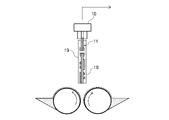
- FIG. 1 is a cross-sectional view of a main part for explaining an example of a method for manufacturing a flexible printed circuit board according to the present invention
- FIG. 4 is another cross-sectional view of a main part for explaining an example of the method for manufacturing a flexible printed circuit board according to the present invention
- FIG. 4 is another cross-sectional view of a main part for explaining an example of the method for manufacturing a flexible printed circuit board according to the present invention
- FIG. 4 is another cross-sectional view of a main part for explaining an example of the method for manufacturing a flexible printed circuit board according to the present invention
- FIG. 4 is another cross-sectional view of a main part for explaining an example of the method for manufacturing a flexible printed circuit board according to the present invention
- FIG. 4 is another cross-sectional view of a main part for explaining an example of the method for manufacturing a flexible printed circuit board according to the present invention
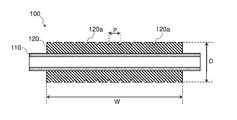
- 1 is a cross-sectional view of a coating roll used in an example of a method for manufacturing a flexible printed circuit board according to the present invention, cut along a plane including its axis;
- a “roll coater” is a coating device having a pair of rotatable coating rolls.
- the application method of the roll coater includes a vertical lifting method in which the liquid photosensitive resin composition is applied to the substrate while lifting the substrate in the vertical direction, and a liquid photosensitive resin composition in which the substrate is conveyed in the horizontal direction and applied to the substrate.
- a vertical lift type roll coater can simplify the application device and save space compared to a horizontal transfer type roll coater.
- the vertical lifting type roll coater can dry the substrate coated with the liquid photosensitive resin composition in a suspended state, it is possible to suppress adhesion of foreign substances in the drying process of the coating film.
- the "thickness" of the film-like support is obtained by randomly selecting 10 measurement points from an electron microscope image of a cross section of the film-like support cut in the thickness direction, and measuring the thickness of the selected 10 measurement points. Arithmetic mean of 10 measurements obtained.
- the "thickness” of the wiring is obtained by randomly selecting 10 measurement points from an electron microscope image of a cross section of the wiring cut in the thickness direction, and measuring the thickness of the selected 10 measurement points. It is the arithmetic mean value of the measured values.
- “Viscosity” is the viscosity measured at a measurement temperature of 25°C using a Brookfield rotational viscometer. The method for measuring the viscosity is the same method as in Examples described later or a method based thereon.
- the cured film of the liquid photosensitive resin composition is a coating film made of the cured liquid photosensitive resin composition.
- the cured film of the liquid photosensitive resin composition may be simply referred to as "cured film”.
- the term “after curing” refers to a state in which the elastic modulus of the coating film is no longer increased even by further heating. Specifically, it refers to a state in which even when the coating film is further heated at a temperature of 150° C. for 60 minutes, the increase in the elastic modulus of the coating film is kept within less than 0.01 GPa.
- the method for measuring the elastic modulus is the same method as in Examples described later or a method based thereon.
- Photoradical polymerization initiator refers to a compound that generates radicals as active species upon irradiation with light.
- Average particle diameter is a volume-based median diameter (particle diameter for 50% cumulative distribution value) measured using a laser diffraction/scattering particle size distribution analyzer (for example, "LA-950V2" manufactured by Horiba Ltd.). is.
- system may be added after the name of the compound to generically refer to the compound and its derivatives.
- the polymer name is expressed by adding "system” after the compound name, it means that the repeating unit of the polymer is derived from the compound or its derivative.
- acryl and methacryl may be collectively referred to as "(meth)acryl”.
- acrylates and methacrylates may be collectively referred to as "(meth)acrylates”.
- an acryloyl group and a methacryloyl group may be collectively referred to as a "(meth)acryloyl group”.
- the components, functional groups, and the like exemplified in this specification may be used alone or in combination of two or more.
- a method for manufacturing a flexible printed circuit board includes a step of applying a liquid photosensitive resin composition to both surfaces of a substrate using a vertical lifting roll coater.
- the substrate has a film-like support and wiring provided on both sides of the film-like support.
- a hole is provided in the substrate.
- a vertical lifting roll coater has a pair of coating rolls each having a plurality of independent ring-shaped grooves. The roll diameter of the coating roll is 70 mm or more and 150 mm or less.
- the liquid photosensitive resin composition has a viscosity of 1.0 Pa ⁇ s or more and 15.0 Pa ⁇ s or less after being rotated at a rotation speed of 50 rpm for 3 minutes.
- the liquid photosensitive resin composition has a viscosity ratio of 1.5 to 3.0 after being rotated at 5 rpm for 3 minutes to the viscosity after being rotated at 50 rpm for 3 minutes.
- the elastic modulus of the cured film of the liquid photosensitive resin composition is 0.1 GPa or more and 1.5 GPa or less.
- the liquid photosensitive resin composition when the liquid photosensitive resin composition is applied, the liquid photosensitive resin composition is applied to both sides of the substrate at the same time. It can be applied while embedding the resin composition.
- the ratio (B/A) of the viscosity B after rotating the liquid photosensitive resin composition for 3 minutes at 50 rpm to the viscosity A after rotating at 50 rpm for 3 minutes is the thixotropic index value. It is sometimes abbreviated as “TI value”.
- the viscosity after rotating the liquid photosensitive resin composition at a rotation speed of 50 rpm for 3 minutes can be simply referred to as "viscosity". be.
- the viscosity can be adjusted, for example, by changing the solid content concentration of the liquid photosensitive resin composition.
- the TI value can be adjusted, for example, by changing the amount of particles (for example, component (D) described below) in the liquid photosensitive resin composition.
- the vertical lifting roll coater used in this embodiment comprises a pair of coating rolls, each coating roll having a plurality of ring-shaped grooves. Each of the plurality of ring-shaped grooves is independent. For this reason, in the present embodiment, when applying a liquid photosensitive resin composition to a substrate, a coating roll provided with one spiral groove (hereinafter sometimes simply referred to as "spiral groove") is used. Compared with the case of coating, the substrate provided with the film-like support and the grooves are evenly in contact with each other. Moreover, in this embodiment, when the liquid photosensitive resin composition is applied to the substrate, the liquid photosensitive resin composition is applied to both surfaces of the substrate at the same time. For these reasons, in the present embodiment, when the liquid photosensitive resin composition is applied to the substrate, the roll pressure can be uniformly transmitted to the substrate, so deformation of the substrate can be suppressed.
- the elastic modulus of the cured film of the liquid photosensitive resin composition is in the range of 0.1 GPa or more and 1.5 GPa or less, and the roll diameter of the coating roll is 150 mm or less. According to this, when the liquid photosensitive resin composition is applied to the substrate, it is possible to suppress breakage (more specifically, tearing) of the substrate due to roll pressure.
- the liquid photosensitive resin composition when the liquid photosensitive resin composition is applied to the substrate, deformation of the substrate and breakage of the substrate can be suppressed, thereby suppressing appearance defects of the substrate on which the coating film is formed. can.
- the support is not in the form of a film (hard substrate, multilayer substrate, etc.). can withstand the roll pressure during coating, so the substrate is less likely to be deformed or broken.
- the film-like support usually cannot withstand the roll pressure during coating. , deformation and breakage of the substrate are likely to occur.
- the roll diameter of the coating roll is 70 mm or more, there is a tendency that a phenomenon (liquid pooling) in which the liquid photosensitive resin composition is excessively retained between the coating roll and the substrate is less likely to occur. . Therefore, in the present embodiment, in the coating film formed by applying the liquid photosensitive resin composition, the occurrence of traces of grooves of the coating roll and streaking tends to be suppressed. Further, in the present embodiment, the viscosity of the liquid photosensitive resin composition is 1.0 Pa s or more and 15.0 Pa s or less, and the TI value of the liquid photosensitive resin composition is 1.5 or more and 3.0 or less. Therefore, in the coating film formed by applying the liquid photosensitive resin composition, the occurrence of pinholes and coating unevenness tends to be suppressed. For these reasons, according to the present embodiment, it is possible to suppress the occurrence of poor appearance of the coating film.
- the viscosity of the liquid photosensitive resin composition is preferably 1.5 Pa ⁇ s or more and 13.0 Pa ⁇ s or less in order to further suppress the occurrence of poor appearance of the coating film. More preferably, it is 0 Pa ⁇ s or more and 12.0 Pa ⁇ s or less.
- the TI value of the liquid photosensitive resin composition is preferably 1.6 or more and 2.7 or less, and 1.7 or more and 2 0.5 or less is more preferable.
- the elastic modulus of the cured film of the liquid photosensitive resin composition is 0.2 GPa or more and 1.4 GPa or less. , and more preferably 0.3 GPa or more and 1.3 GPa or less.
- the elastic modulus of the cured film of the liquid photosensitive resin composition depends on, for example, the type and amount of the binder polymer in the liquid photosensitive resin composition, and the particles in the liquid photosensitive resin composition (for example, (D) described later) Component) can be adjusted by changing at least one of the type and amount thereof.
- both the width and the height of the film-like support are 150 mm or more and 650 mm or less. It is more preferably 200 mm or more and 600 mm or less, and more preferably 250 mm or more and 550 mm or less.
- the "width of the film-like support” means the width of the film-like support in the direction parallel to the axial direction of the coating roll when the liquid photosensitive resin composition is applied to the substrate.
- the “vertical width of the film-like support” means the width of the film-like support in the direction perpendicular to the axial direction of the coating roll when the liquid photosensitive resin composition is applied to the substrate.
- the thickness of the film-like support is preferably 8.0 ⁇ m or more, more preferably 10.0 ⁇ m or more, in order to further suppress the occurrence of poor appearance of the substrate on which the coating film is formed. is more preferable, and 12.0 ⁇ m or more is even more preferable. Further, in the present embodiment, the thickness of the film-like support is preferably 50.0 ⁇ m or less in order to further suppress the occurrence of poor appearance of the coating film.
- the thickness of the wiring is preferably 8 ⁇ m or more and 50 ⁇ m or less, more preferably 10 ⁇ m or more and 50 ⁇ m or less, and 15 ⁇ m or more and 50 ⁇ m or less in order to further suppress the occurrence of poor appearance of the coating film. is more preferable.
- the diameter of the holes provided in the substrate (opening diameter) must be , preferably 50 ⁇ m or more and 250 ⁇ m or less, more preferably 50 ⁇ m or more and 200 ⁇ m or less.
- the liquid photosensitive resin composition has a ratio (C/A) of viscosity C after rotating at 50 rpm for 24 hours to viscosity A after rotating at 50 rpm for 3 minutes (C/A) is 1.20 or less. It is preferably 1.15 or less, more preferably 1.15 or less.
- the ratio (C/A) of the viscosity C after rotating the liquid photosensitive resin composition at 50 rpm for 24 hours to the viscosity A after rotating at 50 rpm for 3 minutes is referred to as the "viscosity ratio over time.”
- the lower limit of the viscosity ratio over time is not particularly limited, and may be, for example, 1.00. Note that sticking of the substrate to the coating roll leads to a decrease in product yield.
- the viscosity ratio over time can be adjusted, for example, by changing the type of organic solvent contained in the liquid photosensitive resin composition. When an organic solvent with a high boiling point is used, the viscosity ratio over time becomes small.
- the following condition 1 is preferably satisfied, and the following conditions 1 and 2 are more preferably satisfied. preferable.
- the occurrence of poor appearance of the coating film and the appearance of the substrate on which the coating film is formed is further suppressed, and the vertical lifting roll coater is operated continuously for a long time to obtain the liquid photosensitive resin composition.
- Condition 1 The film-like support has a horizontal width and a vertical width of 200 mm or more and 600 mm or less, and a thickness of the film-like support of 8.0 ⁇ m or more and 50.0 ⁇ m or less.
- Condition 2 The thickness of the wiring is 8 ⁇ m or more and 50 ⁇ m or less.
- Condition 3 The viscosity ratio over time of the liquid photosensitive resin composition is 1.20 or less.
- 1 to 5 to be referred to are cross-sectional views of essential parts for explaining an example (in particular, a coating step) of the method of manufacturing a flexible printed circuit board according to the present embodiment. 1 to 5, the left side of the drawing is the upstream side of the manufacturing process, and the right side of the drawing is the downstream side of the manufacturing process.
- the substrate 11 suspended by the suspension jig 10 is transferred from the upstream side of the manufacturing process to the upper side of the pair of coating rolls 12a and 12b (Fig. 1).
- the coating roll 12a is the coating roll positioned upstream in the manufacturing process
- the coating roll 12b is the coating roll positioned downstream in the manufacturing process.
- Both the application roll 12a and the application roll 12b have a roll diameter of 70 mm or more and 150 mm or less.
- the substrate 11 has a film-like support 13 and wirings 14 provided on both sides of the film-like support 13 .
- a hole 15 is provided in the substrate 11 .
- the width of the wiring 14 is, for example, 10 ⁇ m or more and 200 ⁇ m or less.
- the interval (pitch) between the wirings 14 is, for example, 10 ⁇ m or more and 200 ⁇ m or less.
- a gap is provided between the application roll 12a and the application roll 12b to the extent that the substrate 11 can be passed therethrough.
- the coating roll 12a is in contact with a doctor bar 16a on the upstream side of the manufacturing process, and a predetermined pressure (for example, 0.5 kgf/cm 2 or more and 3.0 kgf/cm 2 or less) is applied from the doctor bar 16a.
- the coating roll 12b is in contact with a doctor bar 16b on the downstream side of the manufacturing process, and a predetermined pressure (for example, 0.5 kgf/cm 2 or more and 3.0 kgf/cm 2 or less) is applied from the doctor bar 16b.
- the application roll 12a and the application roll 12b each rotate at a predetermined rotational speed (for example, 1 m/min or more and 10 m/min or less).
- a liquid photosensitive resin composition 17 is stored between the coating roll 12a and the doctor bar 16a and between the coating roll 12b and the doctor bar 16b.
- a liquid photosensitive resin composition 17 is transferred to the surface of the coating roll 12a and the surface of the coating roll 12b.
- the suspension jig 10 descends from the state shown in FIG. 1, the suspended substrate 11 passes between the coating rolls 12a and 12b, and the upper end of the substrate 11 passes between the coating rolls 12a and 12b. to a location (see FIG. 2) located between Then, as shown in FIG. 2, the hanging jig 10 separates the substrate 11 and the fixing jig 18 grips the lower end portion of the substrate 11 .
- the rotating application rolls 12a and 12b push the substrate 11 in such a way that pressure is applied to the substrate 11 with the substrate 11 sandwiched therebetween, and the fixing jig 18 separates the lower end of the substrate 11 (FIG. 3).
- the substrate 11 is lifted upward while the liquid photosensitive resin composition 17 is simultaneously applied to both surfaces of the substrate 11 because the coating rolls 12a and 12b are rotating.
- the pressing amount of the application roll 12a and the application roll 12b is, for example, in the range of 100 ⁇ m or more and 200 ⁇ m or less.
- the upper end portion of the substrate 11 lifted up while being simultaneously coated with the liquid photosensitive resin composition 17 on both sides is gripped by the hanging jig 10 (FIG. 4).
- the holes 15 provided in the substrate 11 are filled with the liquid photosensitive resin composition 17, and coating films 19 made of the liquid photosensitive resin composition 17 are formed on both surfaces of the substrate 11. .
- the hanging jig 10 By gripping the upper end of the substrate 11 with the hanging jig 10 while the hanging jig 10 is brought as close to the coating roll 12a and the coating roll 12b as possible, the winding of the substrate 11 around the coating roll 12a or the coating roll 12b is prevented. can be prevented.
- the substrate 11 with the coating films 19 formed on both sides is transferred to the downstream side of the manufacturing process while suspended by the suspension jig 10 (FIG. 5). Then, the substrate 11 transferred to the downstream side of the manufacturing process is put into a drying oven (not shown) and dried. For example, the substrate 11 is transported to a drying oven while suspended. Then, the substrate 11 is dried while passing through the inside of the drying furnace.
- the coating film 19 formed on the substrate 11 is exposed to hot air from which environmental foreign matter has been removed by a filter. Since the support of the substrate 11 is in the form of a film, when drying a plurality of substrates 11 at the same time, if the space between the substrates 11 is narrow, the substrates 11 will be fanned by the circulation of hot air in the drying furnace, and the substrates 11 will be separated from each other. becomes easier to stick. Therefore, when drying a plurality of substrates 11 at the same time, it is preferable to make the distance between the substrates 11 larger than the vertical width of the substrates 11 .
- the drying temperature of the substrate 11 is preferably 60°C or higher and 130°C or lower, and more preferably 70°C or higher and 120°C or lower.
- the drying temperature of the substrate 11 can be appropriately set according to the number of substrates 11 put into the drying furnace and the coating speed.
- the drying time for the substrate 11 is preferably 1 minute or more and 60 minutes or less, more preferably 3 minutes or more and 40 minutes or less.
- the drying time can be appropriately set according to the number of substrates 11 put into the drying furnace and the coating speed.
- FIG. 6 is a cross-sectional view of a coating roll 100, which is an example of the coating roll 12a and the coating roll 12b, cut along a plane including the axis thereof.
- the coating roll 100 shown in FIG. 6 has a metal core 110 having a cylindrical hollow portion and a surface layer roll 120 arranged on the outer peripheral surface of the core 110 .
- the surface layer roll 120 is a roll onto which the liquid photosensitive resin composition 17 (see FIG. 1) is transferred, and is made of, for example, rubber having elasticity in an atmosphere at a temperature of 25°C.
- the rubber constituting the surface layer roll 120 is not particularly limited, but rubber having chemical resistance and wear resistance such as butyl rubber, ethylene propylene rubber, urethane rubber, and nitrile rubber is preferable.
- the surface layer roll 120 has a plurality of ring-shaped grooves 120a.
- Each of the plurality of ring-shaped grooves 120a is independent.
- the cross-sectional shape of the ring-shaped groove 120a is not particularly limited, and a shape such as a V-shape or a U-shape can be adopted.
- the cross-sectional shape of the ring-shaped groove 120a is V-shaped. is preferred.
- the pitch P of the ring-shaped grooves 120a is, for example, 500 ⁇ m or more and 1000 ⁇ m or less.
- the opening width of the ring-shaped groove 120a is, for example, 500 ⁇ m or more and 1000 ⁇ m or less.
- the depth of the ring-shaped groove 120a is, for example, 200 ⁇ m or more and 900 ⁇ m or less.
- the width W of the surface layer roll 120 may be appropriately selected according to the method of suspending the substrate 11 (see FIG. 1). For example, as shown in FIG. 1, when only the upper end of the substrate 11 is gripped by the hanging jig 10, the width W of the surface layer roll 120 should be wider than the width of the substrate 11, so that the liquid photosensitive resin to the substrate 11 This is preferable because the coating area of the composition 17 can be widened. On the other hand, when the left and right ends of the substrate 11 are gripped by a hanging jig (not shown), the substrate 11 can be easily gripped by making the width W of the surface layer roll 120 narrower than the width of the substrate 11 . It is preferable because it can be done.
- the roll diameter D of the coating roll 100 is 70 mm or more and 150 mm or less.
- the roll diameter D of the coating roll 100 is preferably 80 mm or more and 140 mm or less, and more preferably 90 mm or more and 130 mm or less. is more preferably 100 mm or more and 120 mm or less.
- the film-like support is not particularly limited, but from the viewpoint of heat resistance, chemical resistance and dimensional stability, polyimide, polyamide, polyester, polycarbonate, polyarylate, polytetrafluoroethylene, polychlorotrifluoroethylene, polyfluoride selected from the group consisting of vinylidene, polyvinyl fluoride, perfluoroalkoxy fluororesin, ethylene tetrafluoride/propylene hexafluoride copolymer, ethylene/tetrafluoroethylene copolymer, and ethylene/chlorotrifluoroethylene copolymer
- a film-like support containing one or more polymers is preferred, and a film-like support containing polyimide is more preferred.
- the film-like support may contain additives such as fillers as components other than the polymer.
- the polymer content in the film-like support is preferably 70% by weight or more, preferably 80% by weight, based on the total weight of the film-like support. It is more preferably 90% by weight or more, and may be 100% by weight.
- the wiring provided on the film-like support is not particularly limited, but from the viewpoint of wiring shape stability and wiring miniaturization, wiring formed by etching an electrolytic copper foil or a rolled copper foil by a subtractive method, or Wiring formed by screen-printing copper paste or silver paste on a film-like support is preferred.
- the hole provided in the substrate is not particularly limited, but from the viewpoint of hole shape stability and interlayer connection reliability, a laser processing machine (more specifically, carbon dioxide laser, UV laser, YAG laser, excimer laser, etc.)
- a hole is formed in a flexible copper-clad laminate having a film-like support using a processing machine used) or an NC drilling machine, etc., and the inside of the hole is subjected to cleaning treatment (desmear treatment) and carbon treatment, followed by copper plating treatment.
- cleaning treatment desmear treatment
- carbon treatment followed by copper plating treatment.
- electroless copper plating treatment, electrolytic copper plating treatment, etc. is preferable.
- the liquid photosensitive resin composition is not particularly limited, but from the viewpoint of coatability, patterning property and curability, a binder polymer (hereinafter sometimes referred to as "(A) component”), a photoradical polymerization initiator. (hereinafter sometimes referred to as “(B) component”), thermosetting resin (hereinafter sometimes referred to as “(C) component”), particles with an average particle size of 0.01 ⁇ m or more and 100 ⁇ m or less (A liquid photosensitive resin composition containing an organic solvent (hereinafter sometimes referred to as "(E) component”) is preferred.
- component (A) for example, a polymer that is soluble in component (E) and has a polyethylene glycol-equivalent weight average molecular weight of 1,000 or more and 1,000,000 or less can be used.
- the method for measuring the weight-average molecular weight in terms of polyethylene glycol is the same method as in Examples described later or a method based thereon.
- component (A) is soluble in component (E) means that 5 parts by weight of component (A) is added to 100 parts by weight of component (E), and the mixture is stirred at a temperature of 40°C for 1 hour. After that, it is cooled to a temperature of 25° C. and left for 24 hours.
- the weight average molecular weight of component (A) By setting the weight average molecular weight of component (A) to 1,000 or more, the flexibility and chemical resistance of the resulting cured film can be improved. Further, by setting the weight average molecular weight of the component (A) to 1,000,000 or less, it is possible to suppress excessive increase in the viscosity of the liquid photosensitive resin composition.
- component (A) include polyurethane-based resins, (meth)acrylic-based resins, polyvinyl-based resins, polystyrene-based resins, polyethylene-based resins, polypropylene-based resins, polyimide-based resins, polyamide-based resins, polyacetal-based resins, and polycarbonates. resins, polyester resins, polyphenylene ether resins, polyphenylene sulfide resins, polyether sulfone resins, polyether ether ketone resins, and the like, and these can be used alone or in combination of two or more.
- a polymer having a urethane bond in one molecule selected from the group consisting of a polymer having a urethane bond in one molecule, a polymer having an imide group in one molecule, a polymer having a (meth)acryloyl group in one molecule, and a polymer having a carboxy group in one molecule. It is preferable to use one or more polymers as the component (A).
- the resulting cured film tends to have improved low resilience and folding resistance, and warpage of the cured film tends to be reduced. Further, when a polymer having an imide group in one molecule is used as the component (A), the resulting cured film tends to have improved heat resistance, flame retardancy and electrical insulation reliability. Further, when a polymer having a (meth)acryloyl group in one molecule is used as the component (A), the photosensitivity of the liquid photosensitive resin composition is improved, and the chemical resistance of the resulting cured film tends to be improved. be. Further, when a polymer having a carboxy group in one molecule is used as the component (A), the alkali developability of the liquid photosensitive resin composition is improved, and the adhesiveness between the obtained cured film and the substrate tends to be improved. be.
- the (A) component may be a polymer having multiple types of functional groups in one molecule.
- the obtained cured film has low resilience, folding resistance, heat resistance, flame retardancy and electrical insulation reliability. There is a tendency for the curvature of the cured film to decrease while improving.
- the component (A) when a polymer having a urethane bond, a carboxy group and a (meth)acryloyl group in one molecule is used, the photosensitivity and alkali developability of the liquid photosensitive resin composition, and the resulting cured film Low resilience, folding resistance, chemical resistance, and adhesion between the resulting cured film and the substrate are improved, and warping of the cured film tends to be reduced. Therefore, the polymer having urethane bonds in one molecule preferably further has one or more functional groups selected from the group consisting of imide groups, carboxyl groups and (meth)acryloyl groups.
- a "polymer having a urethane bond in one molecule” means a polymer having at least one urethane bond in one molecule.
- a polymer having a urethane bond in one molecule for example, a reaction product of a diol compound represented by the following general formula (1) and a diisocyanate compound represented by the following general formula (2), which is represented by the following general formula Examples thereof include polymers having repeating units represented by (3).
- R 1 and X 1 each independently represent a divalent organic group.
- Diol compounds represented by general formula (1) include, for example, ethylene glycol, diethylene glycol, propylene glycol, 1,3-butanediol, 1,4-butanediol, 1,5-pentanediol, neopentyl glycol, 3 -methyl-1,5-pentanediol, 1,6-hexanediol, 1,8-octanediol, 2-methyl-1,8-octanediol, 1,9-nonanediol, 1,10-decanediol, 1 ,4-cyclohexanediol, 1,4-cyclohexanedimethanol and other alkylene diols; polyethylene glycol, polypropylene glycol, polytetramethylene glycol, random copolymers of tetramethylene glycol and neopentyl glycol, etc.; polyester diol obtained by reacting a hydric
- a diol compound represented by the general formula (1) Preferred are long-chain diols such as polyoxyalkylene diols, polyester diols, polycarbonate diols and polycaprolactone diols.
- Diisocyanate compounds represented by the general formula (2) include, for example, diphenylmethane-2,4'-diisocyanate, 3,2'- or 3,3'- or 4,2'- or 4,3'- or 5 , 2'- or 5,3'- or 6,2'- or 6,3'-dimethyldiphenylmethane-2,4'-diisocyanate, 3,2'- or 3,3'- or 4,2'- or 4,3'- or 5,2'- or 5,3'- or 6,2'- or 6,3'-diethyldiphenylmethane-2,4'-diisocyanate, 3,2'- or 3,3'- or 4,2'- or 4,3'- or 5,2'- or 5,3'- or 6,2'- or 6,3'-dimethoxydiphenylmethane-2,4'-diisocyanate, diphenylmethane-4, 4'-diisocyanate, diphenylmethane-3,3'-
- a liquid photosensitive resin composition having excellent photosensitivity when used as the diisocyanate compound represented by the general formula (2), a liquid photosensitive resin composition having excellent photosensitivity. It is preferable because it can be obtained.
- the reaction with the diisocyanate compound may be performed after mixing the two or more diol compounds, or each diol compound and diisocyanate compound may be reacted separately. good. Further, after reacting the diol compound and the diisocyanate compound, the obtained terminal isocyanate compound may be further reacted with another diol compound, and the reaction product may be reacted with another diisocyanate compound. Moreover, it is the same when using two or more types of diisocyanate compounds. In this manner, a desired polymer having urethane bonds in one molecule can be synthesized.
- the reaction temperature between the diol compound and the diisocyanate compound is preferably 40°C or higher and 160°C or lower, more preferably 60°C or higher and 150°C or lower, from the viewpoint of shortening the reaction time and suppressing gelation.
- the reaction time between the diol compound and the diisocyanate compound can be appropriately selected depending on the amount of the starting material and the reaction conditions employed.
- the reaction may be carried out in the presence of a catalyst such as a compound containing a metal such as an alkali metal, an alkaline earth metal, tin, zinc, titanium, or cobalt, or a metalloid; or a tertiary amine.
- the diol compound and the diisocyanate compound can be reacted without using a solvent, it is desirable to react them in an organic solvent in order to control the reaction.
- the organic solvent used here is not particularly limited, for example, the organic solvents listed as specific examples of the component (E) described later can be used.
- the amount of the organic solvent used in the reaction is such that the weight concentration of the solute in the reaction solution, that is, the solution concentration is 5% by weight or more and 90% by weight or less.
- the weight concentration of the solute in the reaction solution is more preferably 10% by weight or more and 80% by weight or less.
- Polymers having urethane bonds and (meth)acryloyl groups in one molecule include, for example, in addition to diol compounds and diisocyanate compounds, compounds represented by the following general formula (4) (hereinafter referred to as “compound (4)” may be described), and a compound represented by the following general formula (5) (hereinafter sometimes referred to as “compound (5)”). Obtained by performing a polymerization reaction.
- m represents an integer of 1 or more and 3 or less
- R 2 represents an m+1 valent organic group
- R 3 represents a hydrogen atom or a methyl group.
- n represents an integer of 1 or more and 3 or less
- X2 represents an n+1 - valent organic group
- X3 represents a hydrogen atom or a methyl group.
- Examples of compound (4) include 2-hydroxyethyl (meth)acrylate, 2-hydroxypropyl (meth)acrylate, 2-hydroxybutyl (meth)acrylate, 2-hydroxy-3-phenoxypropyl (meth)acrylate, 2 -hydroxy-1-acryloxy-3-methacryloxypropane, o-phenylphenol glycidyl ether (meth) acrylate, polyethylene glycol mono (meth) acrylate, pentaerythritol tri (meth) acrylate, tris (2-hydroxyethyl) isocyanurate di (Meth) acrylate, 1,4-cyclohexanedimethanol mono (meth) acrylate, 4-hydroxyphenyl (meth) acrylate, 2-(4-hydroxyphenyl) ethyl (meth) acrylate and the like, these alone or Two or more types can be used in combination.
- Examples of the compound (5) include 2-acryloyloxyethyl isocyanate, 2-methacryloyloxyethyl isocyanate, 1,1-(bisacryloyloxymethyl)ethyl isocyanate, 2-(2-methacryloyloxyethyloxy)ethyl isocyanate and the like. These can be used alone or in combination of two or more.
- a polymer having a urethane bond and a carboxy group in one molecule is, for example, in addition to a diol compound and a diisocyanate compound, a compound represented by the following general formula (6) (hereinafter referred to as "compound (6)" There is) as a monomer, it is obtained by performing a polymerization reaction.
- R4 represents a trivalent organic group.
- Examples of compound (6) include 2,2-bis(hydroxymethyl)propionic acid, 2,2-bis(2-hydroxyethyl)propionic acid, 2,2-bis(3-hydroxypropyl)propionic acid, 2 ,3-dihydroxy-2-methylpropionic acid, 2,2-bis(hydroxymethyl)butanoic acid, 2,2-bis(2-hydroxyethyl)butanoic acid, 2,2-bis(3-hydroxypropyl)butanoic acid , 2,3-dihydroxybutanoic acid, 2,4-dihydroxy-3,3-dimethylbutanoic acid, 2,3-dihydroxyhexadecanoic acid, 2,3-dihydroxybenzoic acid, 2,4-dihydroxybenzoic acid, 2,5 -dihydroxybenzoic acid, 2,6-dihydroxybenzoic acid, 3,4-dihydroxybenzoic acid, 3,5-dihydroxybenzoic acid and the like, and these can be used alone or in combination of two or more.
- an aliphatic compound (6) In order to increase the photosensitivity of the liquid photosensitive resin composition, it is preferable to use an aliphatic compound (6).
- a polymer having a urethane bond and an imide group in one molecule can be obtained, for example, by performing a polymerization reaction using a tetracarboxylic dianhydride as a monomer in addition to a diol compound and a diisocyanate compound.
- tetracarboxylic dianhydrides include pyromellitic dianhydride, 3,3′,4,4′-biphenyltetracarboxylic dianhydride, p-phenylenebis(trimellitate anhydride), 2,3, 6,7-naphthalenetetracarboxylic dianhydride, 1,2,5,6-naphthalenetetracarboxylic dianhydride, 2,2′,3,3′-biphenyltetracarboxylic dianhydride, 3,3′ ,4,4′-benzophenonetetracarboxylic dianhydride, 4,4′-oxydiphthalic anhydride, 9,9-bis(3,4-dicarboxyphenyl)fluorene dianhydride, 4,4′-(hexa fluoroisopropylidene)diphthalic anhydride, dicyclohexyl-3,3′,4,4′-tetracarboxylic dianhydride, 1,2,4,5-
- a "polymer having an imide group in one molecule” means a polymer having at least one imide group in one molecule.
- the polymer having an imide group in one molecule include the above-described polymer having a urethane bond and an imide group in one molecule.
- a tetracarboxylic dianhydride more specifically, a compound listed as a tetracarboxylic dianhydride for synthesizing a polymer having a urethane bond and an imide group in one molecule described above, etc.
- a diamine a polymer having an imide group in one molecule can also be obtained.
- the method for reacting the tetracarboxylic anhydride and the diamine is not particularly limited, but includes, for example, the methods shown in Methods 1 to 3 below.
- a polyamic acid solution is prepared by adding a diamine to a solution in which a tetracarboxylic dianhydride is dispersed or dissolved in an organic solvent and reacting.
- the total amount of diamine to be added is preferably adjusted to a ratio of 0.50 mol or more and 1.50 mol or less per 1 mol of tetracarboxylic dianhydride.
- the resulting polyamic acid solution is heated to 100° C. or higher and 300° C. or lower, more preferably 150° C. or higher and 250° C. or lower for imidization.
- Method 2 Prepare a polyamic acid solution in the same manner as Method 1 above. Add an imidization catalyst (preferably, tertiary amines such as pyridine, picoline, isoquinoline, trimethylamine, triethylamine, and tributylamine) and a dehydrating agent (such as acetic anhydride) to the prepared polyamic acid solution, and heat at 180° C. above 60° C. C. or below to imidize.
- an imidization catalyst preferably, tertiary amines such as pyridine, picoline, isoquinoline, trimethylamine, triethylamine, and tributylamine
- a dehydrating agent such as acetic anhydride
- Method 3 Prepare a polyamic acid solution in the same manner as Method 1 above.
- the prepared polyamic acid solution is placed in a vacuum oven set at 100° C. or higher and 250° C. or lower, and heated under reduced pressure for imidization.
- a "polymer having a (meth)acryloyl group in one molecule” means a polymer having at least one (meth)acryloyl group in one molecule.
- examples of the polymer having a (meth)acryloyl group in one molecule include the above-mentioned polymer having a urethane bond and a (meth)acryloyl group in one molecule.
- a polymer having a (meth)acryloyl group in one molecule can be obtained by reacting an epoxy resin with (meth)acrylic acid.
- Resin biphenyl type epoxy resin, phenoxy type epoxy resin, naphthalene type epoxy resin, phenol novolac type epoxy resin, cresol novolak type epoxy resin, trisphenolmethane type epoxy resin, dicyclopentadiene type epoxy resin, amine type epoxy resin, flexible curable epoxy resins, urethane-modified epoxy resins, rubber-modified epoxy resins, chelate-modified epoxy resins, heterocyclic-containing epoxy resins, etc., and these can be used alone or in combination of two or more.
- bisphenol A type epoxy resins include jER (registered trademark) 828, jER (registered trademark) 1001, and jER (registered trademark) 1002 manufactured by Mitsubishi Chemical Corporation, and Adeka Resin (registered trademark) manufactured by ADEKA.
- EP-4100E ADEKA RESIN (registered trademark) EP-4300E, trade names RE-310S and RE-410S manufactured by Nippon Kayaku Co., Ltd., trade names manufactured by DIC Corporation Epiclon 840S, Epiclon 850S, Epiclon 1050, Epiclon 7050, Nippon Steel Epoxy Epotoot (registered trademark) YD-115, Epotoot (registered trademark) YD-127, Epotoot (registered trademark) YD-128, and the like manufactured by the manufacturer.
- bisphenol F type epoxy resins include jER (registered trademark) 806 and jER (registered trademark) 807 manufactured by Mitsubishi Chemical Corporation, Adeka Resin (registered trademark) EP-4901E manufactured by ADEKA, and Adeka Resin (registered trademark).
- a specific example of the bisphenol S type epoxy resin is Epiclon EXA-1514 manufactured by DIC Corporation.
- hydrogenated bisphenol A epoxy resin examples include jER (registered trademark) YX8000, jER (registered trademark) YX8034, jER (registered trademark) YL7170 manufactured by Mitsubishi Chemical Corporation, and Adeka Resin (registered trademark) manufactured by ADEKA.
- EP-4080E trade name Epiclon EXA-7015 manufactured by DIC Corporation, trade name Epototh (registered trademark) YD-3000 and Epotote (registered trademark) YD-4000D manufactured by Nippon Steel Epoxy Manufacturing Co., Ltd., and the like.
- biphenyl-type epoxy resins include trade names jER (registered trademark) YX4000, jER (registered trademark) YL6121H, jER (registered trademark) YL6640, jER (registered trademark) YL6677 manufactured by Mitsubishi Chemical Corporation, and Nippon Kayaku Co., Ltd. NC-3000, NC-3000H, etc. under the trade names of
- phenoxy-type epoxy resins include trade names jER (registered trademark) 1256, jER (registered trademark) 4250, and jER (registered trademark) 4275 manufactured by Mitsubishi Chemical Corporation.
- naphthalene-type epoxy resins include DIC's trade names Epiclon HP-4032, Epiclon HP-4700, and Epiclon HP-4200, and Nippon Kayaku's trade names NC-7000L.
- phenolic novolac epoxy resins include jER (registered trademark) 152 and jER (registered trademark) 154 manufactured by Mitsubishi Chemical Corporation, EPPN (registered trademark) -201-L manufactured by Nippon Kayaku Co., Ltd., Epiclon N-740 and Epiclon N-770 (trade names) manufactured by DIC Corporation, Epotote (registered trademark) YDPN-638 (trade name) manufactured by Nippon Steel Epoxy Manufacturing Co., Ltd., and the like can be mentioned.
- cresol novolac epoxy resins include trade names EOCN (registered trademark)-1020, EOCN (registered trademark)-102S, EOCN (registered trademark)-103S, and EOCN (registered trademark)-104S manufactured by Nippon Kayaku Co., Ltd. , Epiclon N-660, Epiclon N-670, Epiclon N-680 and Epiclon N-695 manufactured by DIC.
- trisphenolmethane-type epoxy resins include EPPN (registered trademark)-501H, EPPN (registered trademark)-501HY, and EPPN (registered trademark)-502H manufactured by Nippon Kayaku.
- dicyclopentadiene type epoxy resin examples include Nippon Kayaku's trade name XD-1000 and DIC's trade name Epiclon HP-7200.
- amine-type epoxy resins include jER (registered trademark) 604 and jER (registered trademark) 630 manufactured by Mitsubishi Chemical Corporation, Epotote (registered trademark) YH-434 manufactured by Nippon Steel Epoxy Manufacturing Co., Ltd., and Epotote. (registered trademark) YH-434L, trade names TETRAD (registered trademark)-X and TERRAD (registered trademark)-C manufactured by Mitsubishi Gas Chemical Company.
- flexible epoxy resins include trade names jER (registered trademark) 871, jER (registered trademark) 872, jER (registered trademark) YL7175, jER (registered trademark) YL7217 manufactured by Mitsubishi Chemical Corporation, and products manufactured by DIC Corporation. Trade name Epiclon EXA-4850 and the like can be mentioned.
- urethane-modified epoxy resins include Adeka Resin (registered trademark) EPU-6, Adeka Resin (registered trademark) EPU-73, and Adeka Resin (registered trademark) EPU-78-11 manufactured by ADEKA.
- rubber-modified epoxy resins include Adeka Resin (registered trademark) EPR-4023, Adeka Resin (registered trademark) EPR-4026, and Adeka Resin (registered trademark) EPR-1309 manufactured by ADEKA.
- chelate-modified epoxy resins include Adeka Resin (registered trademark) EP-49-10 and Adeka Resin (registered trademark) EP-49-20 manufactured by ADEKA.
- heterocyclic-containing epoxy resins include TEPIC (registered trademark) manufactured by Nissan Chemical Industries, Ltd., and the like.
- the method for reacting the epoxy resin and (meth)acrylic acid is not particularly limited, but for example, (meth)acrylic acid and an esterification catalyst (e.g., , trimethylamine, tertiary amines such as triethylamine; phosphorus compounds such as triphenylphosphine; imidazole compounds such as 2-ethyl-4-methylimidazole; There is a method to make
- the total amount of (meth)acrylic acid to be added is preferably adjusted to a ratio of 0.1 mol or more and 1.0 mol or less per 1 mol of the epoxy group of the epoxy resin.
- a "polymer having a carboxy group in one molecule” means a polymer having at least one carboxy group in one molecule.
- examples of the polymer having a carboxy group in one molecule include the above-described polymers having a urethane bond and a carboxy group in one molecule.
- a polymer having a carboxy group in one molecule can be obtained by reacting an epoxy resin with (meth)acrylic acid and then reacting it with a polybasic acid anhydride.
- a method of obtaining a polymer having a carboxy group in one molecule by reacting an epoxy resin with (meth)acrylic acid and then further reacting with a polybasic acid anhydride for example, an epoxy resin and (meth)
- a method of adding a polybasic acid anhydride and heating to 60° C. or higher and 150° C. or lower to cause the reaction is exemplified.
- the total amount of polybasic acid anhydride to be added is preferably adjusted so that the acid value of the resulting solid content is 10 mgKOH/g or more and 160 mgKOH/g or less.
- a polymer having a carboxy group in one molecule can also be obtained by reacting (meth)acrylic acid and (meth)acrylic acid ester.
- the method of reacting (meth)acrylic acid and (meth)acrylic ester is not particularly limited, but for example, (meth)acrylic acid and (meth)acrylic ester are mixed in a solvent in the presence of a radical polymerization initiator A method of performing a radical polymerization reaction under the conditions is mentioned.
- the (meth)acrylic acid ester is not particularly limited, but examples include methyl (meth)acrylate, ethyl (meth)acrylate, butyl (meth)acrylate (n-butyl (meth)acrylate), (meth) isobutyl acrylate, t-butyl (meth)acrylate, hexyl (meth)acrylate, 2-ethylhexyl (meth)acrylate, octyl (meth)acrylate, nonyl (meth)acrylate, decyl (meth)acrylate, Dodecyl (meth)acrylate, stearyl (meth)acrylate, benzyl (meth)acrylate and the like can be mentioned, and these can be used alone or in combination of two or more.
- the (meth)acrylic acid ester may be methyl (meth)acrylate, ethyl (meth)acrylate, (meth)acryl At least one selected from the group consisting of butyl acid and benzyl (meth)acrylate is preferred.
- radical polymerization initiators include azo compounds such as azobisisobutyronitrile, azobis(2-methylbutyronitrile), 2,2'-azobis-2,4-dimethylvaleronitrile; t-butyl hydro organic peroxides such as peroxide, cumene hydroperoxide, benzoyl peroxide, dicumyl peroxide, di-t-butyl peroxide; persulfates such as potassium persulfate, sodium persulfate and ammonium persulfate; hydrogen peroxide etc., and these can be used alone or in combination of two or more.
- azo compounds such as azobisisobutyronitrile, azobis(2-methylbutyronitrile), 2,2'-azobis-2,4-dimethylvaleronitrile
- t-butyl hydro organic peroxides such as peroxide, cumene hydroperoxide, benzoyl peroxide, dicumyl peroxide, di-t-
- the amount of the radical polymerization initiator used is 0.001 parts by weight or more and 5 parts by weight with respect to 100 parts by weight of the monomer used. It is preferably 0.01 part by weight or more and 1 part by weight or less.
- the amount of the solvent used in the radical polymerization reaction should be such that the weight concentration of the solute in the reaction solution, that is, the solution concentration is 5% by weight or more and 90% by weight or less. Amount is preferred.
- the weight concentration of the solute in the reaction solution is more preferably 20% by weight or more and 70% by weight or less.
- the reaction temperature of the radical polymerization reaction is preferably 20°C or higher and 120°C or lower, more preferably 50°C or higher and 100°C or lower, from the viewpoint of shortening the reaction time and suppressing gelation.
- the reaction time of the radical polymerization reaction can be appropriately selected depending on the amount of the starting material and the reaction conditions employed.
- the content of the component (A) is 10% by weight or more relative to the total amount of the liquid photosensitive resin composition. It is preferably 50% by weight or less, more preferably 20% by weight or more and 40% by weight or less.
- ⁇ (B) component ⁇ Component (B) is not particularly limited, but examples include Michler's ketone, 4,4'-bis(diethylamino)benzophenone, 4,4',4''-tris(dimethylamino)triphenylmethane, 2,2'- Bis(2-chlorophenyl)-4,4',5,5'-tetraphenyl-1,2'-diimidazole, acetophenone, benzoin, 2-methylbenzoin, benzoin methyl ether, benzoin ethyl ether, benzoin isopropyl ether, benzoin isobutyl ether, 2-t-butylanthraquinone, 1,2-benzo-9,10-anthraquinone, methylanthraquinone, thioxanthone, 2,4-diethylthioxanthone, 2-isopropylthioxanthone, 1-hydroxycyclohexylpheny
- the content of the component (B) should be 0.5% by weight or more and 5% by weight or less with respect to the total amount of the liquid photosensitive resin composition. It is preferably 0.8% by weight or more and 4% by weight or less.
- ⁇ (C) component ⁇ Component (C) is not particularly limited, but examples include epoxy resins, oxetane resins, phenol resins, isocyanate resins, blocked isocyanate resins, bismaleimide resins, bisallylnadiimide resins, polyester resins (e.g., unsaturated polyester resins, etc.).
- diallyl phthalate resin silicone resin, vinyl ester resin, melamine resin, polybismaleimide triazine resin (BT resin), cyanate resin (e.g., cyanate ester resin), urea resin, guanamine resin, sulfonamide resin, aniline resin, polyurea resin
- BT resin polybismaleimide triazine resin
- cyanate resin e.g., cyanate ester resin
- urea resin e.g., cyanate ester resin
- urea resin e.g., cyanate ester resin
- examples include thiourethane resins, polyazomethine resins, episulfide resins, benzoxazine resins, copolymer resins thereof, modified resins obtained by modifying these resins, mixtures of these resins together or with other resins, and the like.
- component (C) is preferably an epoxy resin, more preferably a polyfunctional epoxy resin.
- a "multifunctional epoxy resin” refers to a compound containing at least two epoxy groups per molecule.
- the polyfunctional epoxy resin is not particularly limited, but for example, those listed as specific examples of the above-mentioned "epoxy resin as a raw material for obtaining a polymer having a (meth)acryloyl group in one molecule" may be used. can be done.
- the liquid photosensitive resin composition may contain a curing agent as component (C).
- the curing agent for component (C) is not particularly limited, but includes, for example, phenolic novolak resins, cresol novolac resins, naphthalene-type phenolic resins and other phenolic resins; amino resins; urea resins; melamine; It can be used alone or in combination of two or more.
- the liquid photosensitive resin composition may contain a curing accelerator as component (C).
- the curing accelerator of component (C) is not particularly limited, but for example, phosphine compounds such as triphenylphosphine; tertiary amines; alcohol amine compounds such as trimethanolamine and triethanolamine; Borate compounds such as diazabicyclo[5,4,0]-7-undecenium tetraphenylborate; imidazole, 2-ethylimidazole, 2-ethyl-4-methylimidazole, 2-phenylimidazole, 2-undecylimidazole, Imidazole compounds such as 1-benzyl-2-methylimidazole, 2-heptadecylimidazole, 2-isopropylimidazole, 2,4-dimethylimidazole, 2-phenyl-4-methylimidazole; 2-methylimidazoline, 2-ethylimidazoline , 2-isopropylimidazoline, 2-phen
- component (A) for example, when using a polymer having an acid value of 10 mgKOH/g or more (preferably a polymer having an acid value of 10 mgKOH/g or more and 160 mgKOH/g or less), the curing agent and curing accelerator of component (C) The agent may not be blended with the liquid photosensitive resin composition.
- the acid value of component (A) can be adjusted, for example, by changing the charged amount of a monomer having one or more groups selected from the group consisting of a carboxy group and a carboxylic acid anhydride group when synthesizing component (A). can be adjusted by
- the content of component (C) should be 1% by weight or more and 10% by weight or less with respect to the total amount of the liquid photosensitive resin composition. It is preferably 3% by weight or more and 8% by weight or less.
- ⁇ (D) component ⁇ Component (D) is not particularly limited as long as it is particles having an average particle size of 0.01 ⁇ m or more and 100 ⁇ m or less.
- one or more particles selected from the group consisting of inorganic particles and organic particles can be used.
- the average particle size of component (D) is 0.01 ⁇ m or more and 50 ⁇ m or less. and more preferably 0.01 ⁇ m or more and 10 ⁇ m or less.
- component (D) include inorganic substances such as silica, mica, talc, clay, barium titanate, barium sulfate, wollastonite, calcium carbonate, magnesium carbonate, aluminum oxide, titanium oxide, silicon nitride, and aluminum nitride.
- Particles include organic particles such as core-shell rubbers and crosslinked polymers, and these can be used alone or in combination of two or more.
- silica particles are preferable from the viewpoint of increasing the hardness and adhesiveness of the obtained cured film while suppressing curing shrinkage of the obtained cured film.
- Silica particles include fused silica particles, crushed silica particles, spherical silica particles, crystalline silica particles, fumed silica particles, and the like.
- the organic particles are preferably crosslinked polymer particles from the viewpoint of improving the flexibility and chemical resistance of the resulting cured film while improving the dispersibility of the roll pressure during coating, and are crosslinked polymers having an average particle size of 1 ⁇ m or more and 10 ⁇ m or less. Particles are more preferable, and crosslinked polymer particles having an average particle size of 1 ⁇ m or more and 5 ⁇ m or less are even more preferable.
- Specific examples of the crosslinked polymer particles include Dainic Beads (registered trademark) manufactured by Dainichiseika Kogyo Co., Ltd., UCN-8070CM Clear, UCN-8150CM Clear, UCN-5070D Clear, UCN-5150D Clear, Negami Kogyo Co., Ltd.
- polyurethane particles As the component (D), it is preferable to use polyurethane particles as the component (D). In order to increase the flexibility of the resulting cured film while increasing the dispersibility of the roll pressure during coating, it is preferable to use crosslinked polyurethane particles, which are crosslinked polymer particles, as the component (D).
- the content of component (D) is 5 parts by weight or more per 100 parts by weight of component (A). It is preferably 100 parts by weight or less, more preferably 5 parts by weight or more and 80 parts by weight or less, still more preferably 10 parts by weight or more and 80 parts by weight or less, and 20 parts by weight or more and 80 parts by weight or less. is even more preferred.
- component (E) is a component used to adjust the viscosity of the liquid photosensitive resin composition.
- component (E) include sulfoxide solvents such as dimethyl sulfoxide and diethyl sulfoxide; formamide solvents such as N,N-dimethylformamide and N,N-diethylformamide; N,N-dimethylacetamide, N,N- acetamide solvents such as diethylacetamide; pyrrolidone solvents such as N-methyl-2-pyrrolidone and N-vinyl-2-pyrrolidone; hexamethylphosphoramide; ⁇ -butyrolactone and the like.
- these organic solvents and aromatic hydrocarbons (more specifically, xylene, toluene, etc.) can be used in combination.
- Components (E) include 1,2-dimethoxyethane, bis(2-methoxyethyl)ether, bis[2-(2-methoxyethoxyethyl)]ether, 1,2-diethoxyethane, bis(2 -ethoxyethyl)ether, bis(2-butoxyethyl)ether and other symmetrical glycol diether solvents; methyl acetate, ethyl acetate, isopropyl acetate, n-propyl acetate, butyl acetate, propylene glycol monomethyl ether acetate, ethylene glycol monobutyl ether Acetate, diethylene glycol monoethyl ether acetate, diethylene glycol monobutyl ether acetate, 3-methoxybutyl acetate, ethylene glycol monomethyl ether acetate, ethylene glycol monoethyl ether acetate, dipropylene glycol methyl ether acetate, propylene glycol diacetate, 1,
- a water-soluble organic solvent having a boiling point of 180°C or higher is preferable to use as the component (E).
- a water-soluble organic solvent with a boiling point of 180°C or higher is difficult to volatilize, and the change in viscosity due to moisture absorption is relatively small. Even if the coater is operated continuously for a long time, the change in viscosity of the liquid photosensitive resin composition is relatively small.
- the boiling point of component (E) is preferably 250° C. or lower in order to shorten the drying time of the coating film.
- water-soluble organic solvent having a boiling point of 180°C or higher refers to a solvent that has a boiling point of 180°C or higher at 1 atm and a temperature of 20°C at 1 atm. It refers to an organic solvent in which the mixture maintains a uniform appearance when mixed.
- water-soluble organic solvents having a boiling point of 180° C. or higher include triethylene glycol dimethyl ether, tetraethylene glycol dimethyl ether, polyethylene glycol dimethyl ether, diethylene glycol diethyl ether, dipropylene glycol methyl ether, diethylene glycol monomethyl ether, diethylene glycol monoethyl ether, and diethylene glycol monobutyl ether. , diethylene glycol monohexyl ether, triethylene glycol monomethyl ether, diethylene glycol monoethyl ether acetate, diethylene glycol monobutyl ether acetate, etc., and these can be used alone or in combination of two or more.
- the content of component (E) should be 10% by weight or more and 80% by weight with respect to the total amount of the liquid photosensitive resin composition. % or less, more preferably 20 wt % or more and 70 wt % or less.
- the liquid photosensitive resin composition may contain, as other components (components different from components (A) to (E)), a radically polymerizable compound, a flame retardant, an antifoaming agent, a leveling agent, a colorant, Various additives such as adhesion aids and polymerization inhibitors may be included.
- the total content of other components is, for example, 20% by weight or less, preferably 10% by weight or less, relative to the total amount of the liquid photosensitive resin composition.
- a radically polymerizable compound refers to a compound containing a radically polymerizable group in one molecule, in which a polymerization reaction proceeds with a radical polymerization initiator.
- a compound having a molecular weight (weight average molecular weight in the case of a polymer) of less than 1,000 is preferred.
- compounds having at least one unsaturated double bond in one molecule are preferred, and compounds having one or more groups selected from the group consisting of (meth)acryloyl groups and vinyl groups are more preferred.
- the liquid photosensitive resin composition When the component (A) does not have a (meth)acryloyl group, the liquid photosensitive resin composition preferably contains a radically polymerizable compound as a component capable of photoradical polymerization. That is, the liquid photosensitive resin composition preferably contains the (A) component having a (meth)acryloyl group, or contains a radically polymerizable compound as another component. Further, even if the component (A) has a (meth)acryloyl group, the liquid photosensitive resin composition preferably contains a radically polymerizable compound in order to increase the reactivity of radical photopolymerization.
- radically polymerizable compounds are given below.
- ethylene oxide is described as "EO” below.
- EO average added mole number of EO
- Specific examples of radically polymerizable compounds include EO-modified bisphenol F diacrylate (n: 2 to 50), EO-modified bisphenol A diacrylate (n: 2 to 50), EO-modified bisphenol S diacrylate (n: 2 EO-modified bisphenol F dimethacrylate (n: 2 to 50), EO-modified bisphenol A dimethacrylate (n: 2 to 50), EO-modified bisphenol S dimethacrylate (n: 2 to 50), 1,6-hexanediol diacrylate, neopentyl glycol diacrylate, ethylene glycol diacrylate, pentaerythritol diacrylate, trimethylolpropane triacrylate, pentaerythritol triacrylate, dipentaerythritol hexaacryl
- EO-modified bisphenol F diacrylate (n: 2 or more and 50 or less), EO Modified bisphenol A diacrylate (n: 2 to 50), EO-modified bisphenol S diacrylate (n: 2 to 50), EO-modified bisphenol F dimethacrylate (n: 2 to 50), EO-modified bisphenol A dimethacrylate (n: 2 or more and 50 or less), and EO-modified bisphenol S dimethacrylate (n: 2 or more and 50 or less).
- the content of the radically polymerizable compound should be adjusted to that of the liquid photosensitive resin composition. It is preferably 1% by weight or more and 10% by weight or less with respect to the total amount.
- Flame retardants include halogen-based flame retardants, phosphorus-based flame retardants, metal hydroxides, antimony-based flame retardants, and the like.
- a halogen-based flame retardant is a compound that contains at least one halogen atom in one molecule and suppresses the combustion of organic matter.
- halogen-based flame retardants include, for example, brominated compounds and chlorine-based compounds, and these can be used alone or in combination of two or more.
- a phosphorus-based flame retardant is a compound that contains at least one phosphorus atom in one molecule and suppresses the combustion of organic matter.
- Phosphorus-based flame retardants include, for example, red phosphorus, condensed phosphoric ester compounds, cyclic organic phosphorus compounds, phosphazene compounds, phosphorus-containing polyol compounds, phosphorus-containing amine compounds, ammonium polyphosphate, melamine phosphate, Phosphinates and the like can be mentioned, and these can be used alone or in combination of two or more.
- metal hydroxides that function as flame retardants include aluminum hydroxide and magnesium hydroxide, and these can be used alone or in combination of two or more.
- An antimony-based flame retardant is a compound that contains at least one antimony atom in one molecule and suppresses the combustion of organic matter.
- antimony-based flame retardants include antimony trioxide.
- antifoaming agents examples include acrylic compounds, vinyl compounds, and butadiene compounds.
- leveling agents examples include acrylic compounds and vinyl compounds.
- coloring agents include phthalocyanine compounds, azo compounds, and carbon black.
- adhesion aids include silane coupling agents, triazole-based compounds, tetrazole-based compounds, and triazine-based compounds.
- polymerization inhibitors examples include hydroquinone and hydroquinone monomethyl ether.
- the liquid photosensitive resin composition can be prepared, for example, by pulverizing, dispersing and mixing the components (A) to (E) and other components used as necessary.
- the pulverization/dispersion method is not particularly limited, but examples thereof include a method using a kneading device such as a bead mill, a ball mill, and a three-roll mill. Among them, the method of pulverizing, dispersing, and mixing using a three-roll mill is preferable because the particle size distribution becomes uniform.
- the above-described step of drying the substrate is optional.
- a fine opening forming step and a curing step shown below can be mentioned.
- the coating film after the drying step is irradiated with active energy rays (more specifically, ultraviolet rays, visible light, electron beams, etc.) through a negative photomask to partially expose the coating film.
- active energy rays more specifically, ultraviolet rays, visible light, electron beams, etc.
- the coating film is patterned by washing away the unexposed areas with a developing solution using a developing method such as spraying, puddle, immersion, or ultrasonic waves to form fine openings. Since the time required for opening varies depending on the spray pressure and flow rate of the developing device and the temperature of the developer, it is desirable to find the optimal device conditions as appropriate.
- an alkaline aqueous solution is preferable.
- the developer may contain water-soluble organic solvents such as methanol, ethanol, 1-propanol, 2-propanol and N-methyl-2-pyrrolidone.
- water-soluble organic solvents such as methanol, ethanol, 1-propanol, 2-propanol and N-methyl-2-pyrrolidone.
- alkaline compound contained in the alkaline aqueous solution include hydroxides, carbonates or hydrogen carbonates of alkali metals, alkaline earth metals or ammonium ions, and amine compounds.
- the concentration of the alkaline compound in the alkaline aqueous solution is preferably 0.01% by weight or more and 20% by weight or less, more preferably 0.02% by weight or more and 10% by weight or less.
- the temperature of the developer depends on the composition of the liquid photosensitive resin composition and the composition of the alkaline developer, but is generally 0° C. or higher and 80° C. or lower, preferably 10° C. or higher and 60° C. or lower. .
- the cleaning liquid include water, an acidic aqueous solution, and the like.
- the coating film (patterned coating film) in which the fine openings are formed is subjected to heat treatment.
- a cured film with excellent heat resistance can be obtained by performing heat treatment to react reactive groups remaining in the molecular structure constituting the coating film (for example, reactive groups of component (C), etc.). .
- a flexible printed circuit board is obtained through the above steps.
- the thickness of the cured film is determined in consideration of the thickness of the wiring and the like, and is preferably 2 ⁇ m or more and 50 ⁇ m or less.
- the final curing temperature in the curing step is preferably low for the purpose of preventing oxidation of the wiring and the like and not lowering the adhesion between the wiring and the film-like support.
- the final curing temperature is preferably 100° C.
- the curing time at the final curing temperature is, for example, 1 minute or more and 120 minutes or less.
- the cured film formed according to the present embodiment tends to be less warped after the curing process while being excellent in flexibility, flame retardancy, and electrical insulation reliability. Therefore, the cured film formed according to this embodiment is particularly suitable as an insulating material for flexible printed circuit boards.
- TEGDM solution of polycarbonate diol (“PCDL T5652” manufactured by Asahi Kasei Co., Ltd., weight average molecular weight: 2,000) was added to the contents of the container over 1 hour, and then the resulting solution was heated to 80°C. The mixture was stirred for 2 hours.
- the TEGDM solution of polycarbonate diol was a solution obtained by dissolving 50.00 g (0.025 mol) of polycarbonate diol in 35.00 g of TEGDM.
- 15.51 g (0.050 mol) of 4,4′-oxydiphthalic anhydride was added to the contents of the container, and the contents of the container were stirred for 1 hour while being heated to 190°C.
- the TEGDM solution of the above polycarbonate diol, 2,2-bis(hydroxymethyl)butanoic acid and 2-hydroxyethyl methacrylate was composed of 50.00 g (0.025 mol) of polycarbonate diol and 2,2-bis(hydroxymethyl)butane. It was a solution prepared by dissolving 3.70 g (0.025 mol) of acid and 13.02 g (0.100 mol) of 2-hydroxyethyl methacrylate in 40.00 g of TEGDM.
- the solid content concentration of the obtained resin solution SP2 was 52% by weight.
- the weight average molecular weight and acid value of binder polymer P2 were 8,600 and 18 mgKOH/g, respectively.
- the mixture containing the methacrylic acid-based compound was prepared by mixing 12.0 g (0.14 mol) of methacrylic acid and 28.0 g (0.16 mol) of benzyl methacrylate in an atmosphere at a temperature of 25°C. , 60.0 g (0.42 mol) of butyl methacrylate, and 0.5 g of azobisisobutyronitrile as a radical polymerization initiator. After completion of dropping, the contents of the vessel were heated to 90°C while stirring. Next, the contents of the container were stirred for 2 hours while the temperature of the contents of the container was maintained at 90° C. to obtain a resin solution SP3 containing a binder polymer P3 having a carboxyl group in one molecule. The solid content concentration of the obtained resin solution SP3 was 50% by weight. The weight average molecular weight and acid value of binder polymer P3 were 48,000 and 78 mgKOH/g, respectively.
- the DEGDE solution of polycarbonate diol was a solution obtained by dissolving 50.00 g (0.025 mol) of polycarbonate diol in 35.00 g of DEGDE.
- 26.02 g (0.050 mol) of 2,2-bis[4-(3,4-dicarboxyphenoxy)phenyl]propane dianhydride was added to the container contents, and the container contents were heated to 190°C. Stir while warming for 1 hour.
- ⁇ Preparation of liquid photosensitive resin composition Any of the resin solutions SP1 to SP4 obtained by the preparation method described above and each component described in Tables 1 to 7 described later (specifically, components other than the component (A)) are stirred with a stirring blade. Apparatus mixed. Next, the resulting mixture was passed through a three-roll mill twice, and then defoamed with a deaerator to obtain liquid photosensitive resin compositions used in Examples 1 to 25 and Comparative Examples 1 to 8, respectively. . When the average particle size of the particles in the obtained liquid photosensitive resin composition was measured, it was 10 ⁇ m or less in all of Examples 1 to 25 and Comparative Examples 1 to 8.
- Each liquid photosensitive resin composition was applied to a part of a polytetrafluoroethylene sheet having a thickness of 25 ⁇ m (an area having an area of 200 mm ⁇ 200 mm) using a Baker applicator. At this time, the coating amount of the liquid photosensitive resin composition was adjusted so that the thickness of the cured film was 20 ⁇ m. Next, after drying the coating film made of the liquid photosensitive resin composition under the conditions of a drying temperature of 80° C. and a drying time of 20 minutes, the entire coating film is exposed by irradiating ultraviolet rays under the conditions of an integrated exposure amount of 300 mJ/cm 2 . did.
- the exposed coating film was subjected to spray development for 90 seconds at a discharge pressure of 1.0 kgf/mm 2 . .
- the developed coating film was heated in an oven at a temperature of 150° C. for 60 minutes to form a cured film of the liquid photosensitive resin composition on the polytetrafluoroethylene sheet.
- the formed cured film was peeled off from the polytetrafluoroethylene sheet and cut into a size of 200 mm in length and 15 mm in width to obtain a test piece with a thickness of 20 ⁇ m.
- the elastic modulus of the cured film was measured under the following conditions.
- Each liquid photosensitive resin composition was applied onto a part (200 mm ⁇ 200 mm area) of a 25 ⁇ m-thick polyimide film ("Apical (registered trademark) 25NPI" manufactured by Kaneka) using a Baker applicator. At this time, the coating amount of the liquid photosensitive resin composition was adjusted so that the thickness of the cured film was 20 ⁇ m. Next, after drying the coating film made of the liquid photosensitive resin composition under the conditions of a drying temperature of 80 ° C. and a drying time of 20 minutes, circular light-shielding regions with diameters of 30 ⁇ m, 50 ⁇ m, 80 ⁇ m, 100 ⁇ m, 120 ⁇ m, 150 ⁇ m and 200 ⁇ m.
- the coating film was exposed to ultraviolet rays through a negative photomask having a cumulative exposure amount of 300 mJ/cm 2 .
- a 1.0% by weight sodium carbonate aqueous solution temperature: 30° C.
- the exposed coating film was subjected to spray development for 90 seconds at a discharge pressure of 1.0 kgf/mm 2 .
- the developed coating film was washed with pure water and then heated in an oven at a temperature of 150° C. for 60 minutes to form a cured film of the liquid photosensitive resin composition on the polyimide film.
- the resulting cured film was observed with an optical microscope, and the smallest diameter of the formed holes was taken as an evaluation value for microaperture.
- a flexible film was obtained by laminating electrolytic copper foil (thickness: 12 ⁇ m) on both sides of a polyimide film (“Pixio (registered trademark) BP FRS-522#SW” manufactured by Kaneka Co., Ltd., thickness: 12.5 ⁇ m) as a film-like support.
- the laminate on which the comb pattern was formed was immersed in a 10% by volume sulfuric acid aqueous solution for 1 minute, and then washed with pure water. Then, each liquid photosensitive resin composition was applied onto the comb pattern using a Baker applicator. At this time, the coating amount of the liquid photosensitive resin composition was adjusted so that the thickness of the cured film on the comb pattern was 20 ⁇ m. Next, after drying the coating film made of the liquid photosensitive resin composition under the conditions of a drying temperature of 80° C. and a drying time of 20 minutes, the entire coating film is exposed by irradiating ultraviolet rays under the conditions of an integrated exposure amount of 300 mJ/cm 2 . did.
- the exposed coating film was subjected to spray development for 90 seconds at a discharge pressure of 1.0 kgf/mm 2 .
- the developed coating film was washed with pure water and then heated in an oven at a temperature of 150° C. for 60 minutes to form a cured film of the liquid photosensitive resin composition on the comb pattern.
- the laminate containing the obtained cured film was cut into a size of 15 mm wide ⁇ 200 mm long to obtain a test piece.
- This test piece is rounded into a loop with an outer circumference of 50 mm and fixed to a repulsive force measuring device ("Loop Stiffness Tester (registered trademark)" manufactured by Toyo Seiki Seisakusho Co., Ltd.).
- the repulsive force from the test piece rolled into a loop shape was measured. It can be evaluated that the smaller the repulsive force, the more excellent the low repulsive properties of the cured film.
- Each liquid photosensitive resin composition was applied onto an electrolytic copper foil having a thickness of 35 ⁇ m using a Baker applicator. At this time, the coating amount of the liquid photosensitive resin composition was adjusted so that the thickness of the cured film was 20 ⁇ m. Next, after drying the coating film made of the liquid photosensitive resin composition under the conditions of a drying temperature of 80° C. and a drying time of 20 minutes, the entire coating film is exposed by irradiating ultraviolet rays under the conditions of an integrated exposure amount of 300 mJ/cm 2 . did.
- the exposed coating film was subjected to spray development for 90 seconds at a discharge pressure of 1.0 kgf/mm 2 . .
- the developed coating film After washing the developed coating film with pure water, it is heated in an oven at a temperature of 150° C. for 60 minutes to form a cured film of the liquid photosensitive resin composition on the electrolytic copper foil, and a test piece is prepared. Obtained. An operation of immersing the obtained test piece in a solder bath at a temperature of 260° C. and then pulling it out after 10 seconds was performed three times in succession.
- each liquid photosensitive resin composition was applied onto the comb pattern using a Baker applicator. At this time, the coating amount of the liquid photosensitive resin composition was adjusted so that the thickness of the cured film on the comb pattern was 20 ⁇ m. Next, after drying the coating film made of the liquid photosensitive resin composition under the conditions of a drying temperature of 80° C. and a drying time of 20 minutes, the entire coating film is exposed by irradiating ultraviolet rays under the conditions of an integrated exposure amount of 300 mJ/cm 2 . did.
- the exposed coating film was subjected to spray development for 90 seconds at a discharge pressure of 1.0 kgf/mm 2 . .
- the developed coating film is heated in an oven at a temperature of 150° C. for 60 minutes to form a cured film of the liquid photosensitive resin composition on the comb pattern to obtain a test piece. rice field.
- a DC voltage of 100 V was applied to both terminal portions of the test piece, and changes in resistance value between both terminals were observed.
- a flexible copper-clad laminate was prepared by laminating electrolytic copper foils on both sides of a polyimide film ("Pixio (registered trademark) BP FRS#SW" manufactured by Kaneka Corporation) as a film-like support. 600 through-holes each having a diameter (opening diameter) of 30 ⁇ m, 50 ⁇ m, 80 ⁇ m, 100 ⁇ m, 130 ⁇ m, 190 ⁇ m, 240 ⁇ m and 290 ⁇ m were formed in this flexible copper clad laminate. Next, cleaning treatment (desmear treatment) inside the through holes and carbon treatment were performed.
- a liquid photosensitive resin composition (any of the liquid photosensitive resin compositions described in Tables 1 to 7 described later) is applied using a vertical lifting roll coater equipped with a pair of coating rolls. ) was applied. At this time, the liquid photosensitive resin composition was simultaneously coated on both sides of the substrate.
- the coating conditions were as follows. In addition, in the following coating conditions, the "coating roll” means "each of a pair of coating rolls”.
- ⁇ Material of the surface layer of the coating roll (surface layer roll): ethylene propylene rubber ⁇ Width of the surface layer roll: 680 mm ⁇ Roll diameter of coating roll: As described in Tables 1 to 7 described later ⁇ Type of grooves in coating roll: As described in Tables 1 to 7 described later ⁇ Groove pitch of coating roll: 700 ⁇ m ⁇ Opening width of the groove of the coating roll: 700 ⁇ m ⁇ Cross-sectional shape of the groove of the coating roll: V-shaped ⁇ Depth of the groove of the coating roll: 350 ⁇ m ⁇ Doctor bar pressure: 1.5 kgf/cm 2 ⁇ Pressing amount of application roll: 150 ⁇ m ⁇ Rotational speed of coating roll: 5 m/min
- the substrate coated with the liquid photosensitive resin composition was dried under the conditions of a drying temperature of 80°C and a drying time of 20 minutes while being suspended.
- the thickness of the coating film made of the liquid photosensitive resin composition after drying was 20 ⁇ m on both sides.
- the blending amount of component (E) also includes the amount of the organic solvent in resin solution SP1, resin solution SP2, resin solution SP3, or resin solution SP4.
- “-” means that the component was not blended.
- the "ring-shaped groove” is a plurality of independent ring-shaped grooves.
- each pair of coating rolls used had a plurality of ring-shaped grooves. In Examples 1 to 25, each of the plurality of ring-shaped grooves was independent.
- the roll diameter of the coating roll used in coating the liquid photosensitive resin composition using a vertical lifting roll coater was 70 mm or more and 150 mm or less.
- the viscosity of the liquid photosensitive resin composition used was 1.0 Pa ⁇ s or more and 15.0 Pa ⁇ s or less.
- the TI value of the liquid photosensitive resin composition used was 1.5 or more and 3.0 or less.
- the elastic modulus of the cured film of the liquid photosensitive resin composition used was 0.1 GPa or more and 1.5 GPa or less.
- Examples 1 to 25 the evaluation of the coating film appearance was A or B. Therefore, the production methods of Examples 1 to 25 were able to suppress the occurrence of poor appearance of the coating film. In Examples 1 to 25, the evaluation of the appearance of the substrate on which the coating film was formed was A or B. Therefore, the production methods of Examples 1 to 25 were able to suppress the occurrence of poor appearance of the substrate on which the coating film was formed.
- Comparative Example 1 the viscosity of the liquid photosensitive resin composition used exceeded 15.0 Pa ⁇ s. In Comparative Example 1, the TI value of the liquid photosensitive resin composition used exceeded 3.0. In Comparative Example 2, the elastic modulus of the cured film of the liquid photosensitive resin composition used exceeded 1.5 GPa. In Comparative Example 3, the viscosity of the liquid photosensitive resin composition used exceeded 15.0 Pa ⁇ s. In Comparative Example 4, the TI value of the liquid photosensitive resin composition used exceeded 3.0. In Comparative Example 5, the TI value of the liquid photosensitive resin composition used was less than 1.5. In Comparative Example 6, the roll diameter of the application roll used when applying the liquid photosensitive resin composition using a vertical lifting roll coater exceeded 150 mm.
- the roll diameter of the coating roll used when applying the liquid photosensitive resin composition using a vertical lifting roll coater was less than 70 mm.
- the grooves of the coating roll used when applying the liquid photosensitive resin composition using a vertical lifting roll coater were spiral grooves.
- Comparative Examples 1, 3 to 5 and 7 the appearance of the coating film was evaluated as C. Therefore, the manufacturing methods of Comparative Examples 1, 3 to 5 and 7 could not suppress the occurrence of poor appearance of the coating film.
- Comparative Examples 2, 6 and 8 the evaluation of the appearance of the substrate on which the coating film was formed was C. Therefore, the manufacturing methods of Comparative Examples 2, 6 and 8 could not suppress the occurrence of poor appearance of the substrate on which the coating film was formed.
Landscapes
- Engineering & Computer Science (AREA)
- Life Sciences & Earth Sciences (AREA)
- Wood Science & Technology (AREA)
- Physics & Mathematics (AREA)
- General Physics & Mathematics (AREA)
- Manufacturing & Machinery (AREA)
- Microelectronics & Electronic Packaging (AREA)
- Non-Metallic Protective Coatings For Printed Circuits (AREA)
- Materials For Photolithography (AREA)
- Application Of Or Painting With Fluid Materials (AREA)
Abstract
Description
本実施形態に係るフレキシブルプリント基板の製造方法は、基板の両面に、垂直吊り上げ式ロールコーターを用いて液状感光性樹脂組成物を塗布する工程を備える。基板は、フィルム状支持体と、フィルム状支持体の両面に設けられた配線とを有する。基板には、穴が設けられている。垂直吊り上げ式ロールコーターは、各々独立した複数個のリング状溝を有する一対の塗布ロールを備える。塗布ロールのロール径は、70mm以上150mm以下である。液状感光性樹脂組成物は、回転数50rpmで3分間回転させた後の粘度が1.0Pa・s以上15.0Pa・s以下である。液状感光性樹脂組成物は、回転数50rpmで3分間回転させた後の粘度に対する回転数5rpmで3分間回転させた後の粘度の比が1.5以上3.0以下である。液状感光性樹脂組成物の硬化膜の弾性率は、0.1GPa以上1.5GPa以下である。液状感光性樹脂組成物を塗布する際、基板の両面に液状感光性樹脂組成物を同時に塗布する。
条件1:フィルム状支持体の横幅及び縦幅が、いずれも200mm以上600mm以下であり、かつフィルム状支持体の厚みが、8.0μm以上50.0μm以下である。
条件2:配線の厚みが、8μm以上50μm以下である。
条件3:液状感光性樹脂組成物の経時粘度比が、1.20以下である。
フィルム状支持体としては、特に限定されないが、耐熱性、耐薬品性及び寸法安定性の観点から、ポリイミド、ポリアミド、ポリエステル、ポリカーボネート、ポリアリレート、ポリテトラフルオロエチレン、ポリクロロトリフルオロエチレン、ポリフッ化ビニリデン、ポリフッ化ビニル、ペルフルオロアルコキシフッ素樹脂、四フッ化エチレン・六フッ化プロピレン共重合体、エチレン・四フッ化エチレン共重合体、及びエチレン・クロロトリフルオロエチレン共重合体からなる群より選ばれる一種以上のポリマーを含むフィルム状支持体が好ましく、ポリイミドを含むフィルム状支持体がより好ましい。フィルム状支持体は、ポリマー以外の成分として、例えばフィラー等の添加剤を含んでもよい。ただし、柔軟性に優れるフィルム状支持体とするためには、フィルム状支持体中のポリマーの含有率が、フィルム状支持体全量に対して、70重量%以上であることが好ましく、80重量%以上であることがより好ましく、90重量%以上であることが更に好ましく、100重量%であってもよい。
フィルム状支持体に設けられる配線としては、特に限定されないが、配線形状安定性及び配線微細化の観点から、電解銅箔若しくは圧延銅箔をサブトラクティブ法でエッチングすることにより形成された配線、又は、銅ペースト若しくは銀ペーストをフィルム状支持体上にスクリーン印刷することにより形成された配線が好ましい。
基板に設けられる穴としては、特に限定されないが、穴形状安定性及び層間接続信頼性の観点から、レーザー加工機(より具体的には、炭酸ガスレーザー、UVレーザー、YAGレーザー、エキシマレーザー等を用いた加工機)やNCドリル加工機等を用いて、フィルム状支持体を有するフレキシブル銅張積層板に穴を形成し、穴内を、クリーニング処理(デスミア処理)及びカーボン処理した後、銅めっき処理(無電解銅めっき処理、電解銅めっき処理等)したものが好ましい。
液状感光性樹脂組成物としては、特に限定されないが、塗布性、パターニング性及び硬化性の観点から、バインダーポリマー(以下、「(A)成分」と記載することがある)、光ラジカル重合開始剤(以下、「(B)成分」と記載することがある)、熱硬化性樹脂(以下、「(C)成分」と記載することがある)、平均粒子径0.01μm以上100μm以下の粒子(以下、「(D)成分」と記載することがある)、及び有機溶媒(以下、「(E)成分」と記載することがある)を含有する液状感光性樹脂組成物が好ましい。
(A)成分としては、例えば、(E)成分に対して可溶性であり、かつポリエチレングリコール換算の重量平均分子量が1,000以上1,000,000以下のポリマーを使用できる。ポリエチレングリコール換算の重量平均分子量の測定方法は、後述する実施例と同じ方法又はそれに準ずる方法である。なお、「(A)成分が(E)成分に対して可溶性である」とは、(E)成分100重量部に対して(A)成分を5重量部添加し、温度40℃で1時間攪拌した後、温度25℃まで冷却して24時間放置した溶液が、不溶解物及び析出物がない溶液であることを意味する。
「1分子中にウレタン結合を有するポリマー」とは、1分子中に少なくとも1つのウレタン結合を有するポリマーを意味する。1分子中にウレタン結合を有するポリマーとしては、例えば、下記一般式(1)で表されるジオール化合物と、下記一般式(2)で表されるジイソシアネート化合物との反応物である、下記一般式(3)で表される繰り返し単位を有するポリマーが挙げられる。


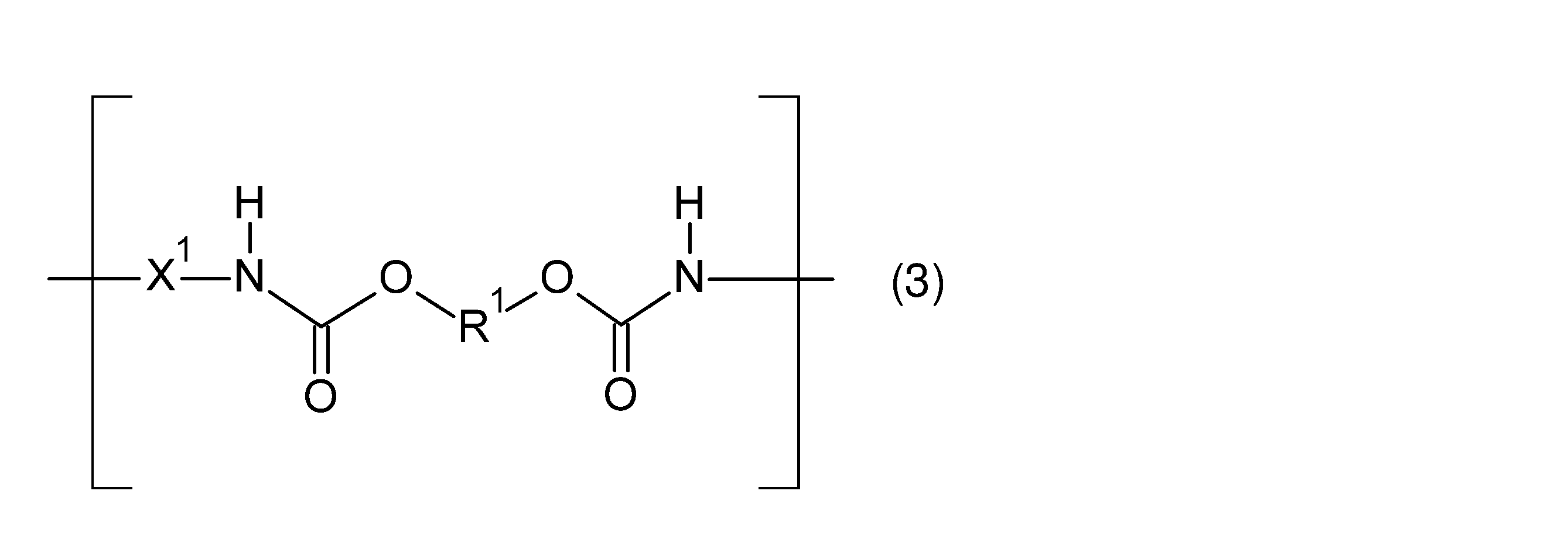

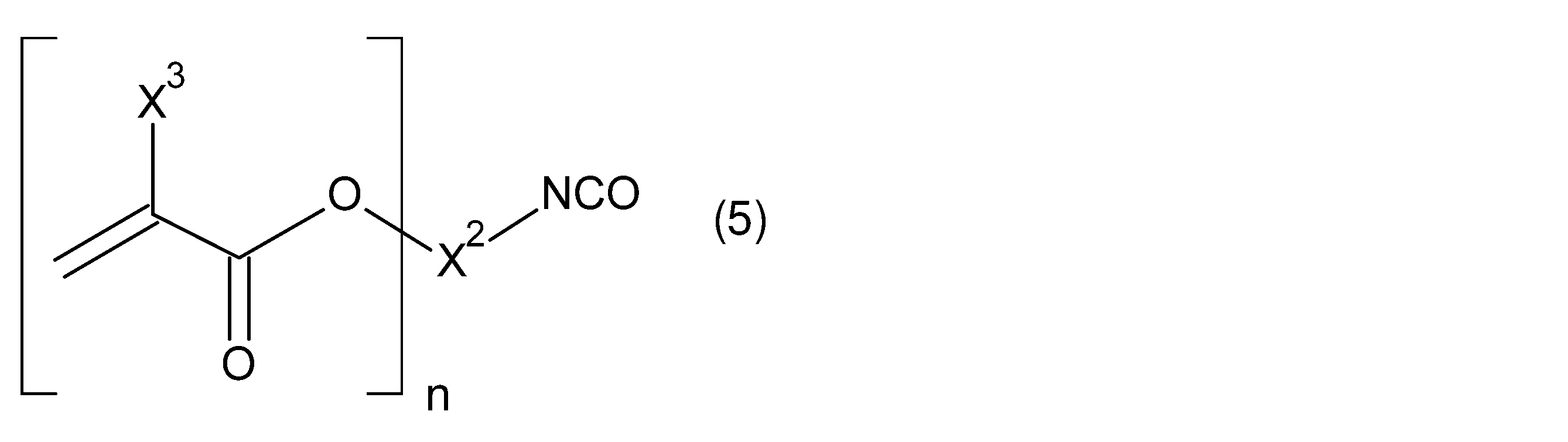

「1分子中にイミド基を有するポリマー」とは、1分子中に少なくとも1つのイミド基を有するポリマーを意味する。1分子中にイミド基を有するポリマーとしては、例えば、上述した1分子中にウレタン結合とイミド基とを有するポリマーが挙げられる。また、例えば、テトラカルボン酸二無水物(より具体的には、上述した1分子中にウレタン結合とイミド基とを有するポリマーを合成するためのテトラカルボン酸二無水物として挙げられた化合物等)と、ジアミンとを反応させることにより、1分子中にイミド基を有するポリマーを得ることもできる。
「1分子中に(メタ)アクリロイル基を有するポリマー」とは、1分子中に少なくとも1つの(メタ)アクリロイル基を有するポリマーを意味する。1分子中に(メタ)アクリロイル基を有するポリマーとしては、例えば、上述した1分子中にウレタン結合と(メタ)アクリロイル基とを有するポリマーが挙げられる。また、例えば、エポキシ樹脂と、(メタ)アクリル酸とを反応させることにより、1分子中に(メタ)アクリロイル基を有するポリマーを得ることもできる。
「1分子中にカルボキシ基を有するポリマー」とは、1分子中に少なくとも1つのカルボキシ基を有するポリマーを意味する。1分子中にカルボキシ基を有するポリマーとしては、例えば、上述した1分子中にウレタン結合とカルボキシ基とを有するポリマーが挙げられる。また、例えば、エポキシ樹脂と(メタ)アクリル酸とを反応させた後に、更に多塩基酸無水物を反応させることにより、1分子中にカルボキシ基を有するポリマーを得ることもできる。
(B)成分としては、特に限定されないが、例えば、ミヒラーズケトン、4,4’-ビス(ジエチルアミノ)ベンゾフェノン、4,4’,4’’-トリス(ジメチルアミノ)トリフェニルメタン、2,2’-ビス(2-クロロフェニル)-4,4’,5,5’-テトラフェニル-1,2’-ジイミダゾール、アセトフェノン、ベンゾイン、2-メチルベンゾイン、ベンゾインメチルエーテル、ベンゾインエチルエーテル、ベンゾインイソプロピルエーテル、ベンゾインイソブチルエーテル、2-t-ブチルアントラキノン、1,2-ベンゾ-9,10-アントラキノン、メチルアントラキノン、チオキサントン、2,4-ジエチルチオキサントン、2-イソプロピルチオキサントン、1-ヒドロキシシクロヘキシルフェニルケトン、ジアセチルベンジル、ベンジルジメチルケタール、ベンジルジエチルケタール、4,4’-ジアジドカルコン、2,2-ジメトキシ-1,2-ジフェニルエタン-1-オン、2-ヒドロキシ-2-メチル-1-フェニルプロパン-1-オン、1-[4-(2-ヒドロキシエトキシ)-フェニル]-2-ヒドロキシ-2-メチル-1-プロパン-1-オン、2-メチル-1-[4-(メチルチオ)フェニル]-2-モルフォリノプロパン-1-オン、2-ベンジル-2-ジメチルアミノ-1-(4-モルフォリノフェニル)-ブタノン-1、ビス(2,4,6-トリメチルベンゾイル)-フェニルフォスフィンオキシド、ビス(2,6-ジメトキシベンゾイル)-2,4,4-トリメチルペンチルフォスフィンオキシド、(2,4,6-トリメチルベンゾイル)ジフェニルホスフィンオキシド、エチル-4-ジメチルアミノベンゾエート、2-エチルヘキシル-4-ジメチルアミノベンゾエート等が挙げられ、これらを単独で又は2種類以上を組み合わせて使用できる。
(C)成分としては、特に限定されないが、例えば、エポキシ樹脂、オキセタン樹脂、フェノール樹脂、イソシアネート樹脂、ブロックイソシアネート樹脂、ビスマレイミド樹脂、ビスアリルナジイミド樹脂、ポリエステル樹脂(例えば不飽和ポリエステル樹脂等)、ジアリルフタレート樹脂、珪素樹脂、ビニルエステル樹脂、メラミン樹脂、ポリビスマレイミドトリアジン樹脂(BT樹脂)、シアネート樹脂(例えばシアネートエステル樹脂等)、ユリア樹脂、グアナミン樹脂、スルホアミド樹脂、アニリン樹脂、ポリウレア樹脂、チオウレタン樹脂、ポリアゾメチン樹脂、エピスルフィド樹脂、ベンゾオキサジン樹脂、これらの共重合体樹脂、これらの樹脂を変性させた変性樹脂、これらの樹脂同士又は他の樹脂との混合物等が挙げられる。
(D)成分としては、平均粒子径0.01μm以上100μm以下の粒子である限り、特に限定されず、例えば、無機粒子及び有機粒子からなる群より選択される一種以上の粒子を使用できる。(D)成分を液状感光性樹脂組成物に配合することにより、液状感光性樹脂組成物の粘度やチクソ性を調整できる。
(E)成分は、液状感光性樹脂組成物の粘度を調整するために使用される成分である。(E)成分としては、例えば、ジメチルスルホキシド、ジエチルスルホキシド等のスルホキシド系溶媒;N,N-ジメチルホルムアミド、N,N-ジエチルホルムアミド等のホルムアミド系溶媒;N,N-ジメチルアセトアミド、N,N-ジエチルアセトアミド等のアセトアミド系溶媒;N-メチル-2-ピロリドン、N-ビニル-2-ピロリドン等のピロリドン系溶媒;ヘキサメチルホスホルアミド;γ-ブチロラクトン等を挙げることができる。更に、必要に応じて、これらの有機溶媒と、芳香族炭化水素(より具体的には、キシレン、トルエン等)とを組み合わせて用いることもできる。
液状感光性樹脂組成物は、必要に応じて、その他の成分((A)成分~(E)成分と異なる成分)として、ラジカル重合性化合物、難燃剤、消泡剤、レベリング剤、着色剤、接着助剤、重合禁止剤等の各種添加剤を含んでいてもよい。その他の成分の合計含有率は、液状感光性樹脂組成物全量に対して、例えば、20重量%以下であり、10重量%以下であることが好ましい。
液状感光性樹脂組成物は、例えば、上記(A)~(E)成分、及び必要に応じて使用するその他の成分を粉砕・分散させて混合することにより、調製することができる。粉砕・分散方法としては、特に限定されないが、例えば、ビーズミル、ボールミル、3本ロールミル等の混練装置を用いる方法が挙げられる。中でも、3本ロールミルを用いて粉砕・分散させて混合する方法は、粒度分布が均一になるため好ましい。
本実施形態では、液状感光性樹脂組成物を塗布する工程以外は、上述した基板を乾燥する工程(乾燥工程)を含めて任意の工程である。任意の工程としては、乾燥工程以外に、例えば、以下に示す微細開口形成工程及び硬化工程が挙げられる。
乾燥工程の後の塗膜に、ネガ型のフォトマスクを通して、活性エネルギー線(より具体的には、紫外線、可視光線、電子線等)を照射し、塗膜の一部を露光する。これにより、塗膜の露光部において光ラジカル重合可能な成分が重合する。次いで、未露光部を、スプレー、パドル、浸漬、超音波等の現像方式を用いて、現像液で洗い流すことにより、塗膜をパターニングし、微細開口を形成する。なお、現像装置の噴霧圧力や流速、現像液の温度により、開口するまでの時間が異なるため、適宜最適な装置条件を見出すことが望ましい。
次いで、微細開口が形成された塗膜(パターニングされた塗膜)の加熱処理を行う。加熱処理を行って、塗膜を構成する分子構造中に残存する反応性基(例えば、(C)成分の反応性基等)を反応させることにより、耐熱性に富む硬化膜を得ることができる。以上の工程を経て、フレキシブルプリント基板が得られる。硬化膜の厚みは、配線の厚み等を考慮して決定されるが、2μm以上50μm以下であることが好ましい。硬化工程における最終硬化温度は、配線等の酸化を防ぎ、配線とフィルム状支持体との密着性を低下させないことを目的として、低温であることが好ましい。最終硬化温度は、100℃以上250℃以下であることが好ましく、より好ましくは120℃以上200℃以下であり、更に好ましくは130℃以上180℃以下である。最終硬化温度における硬化時間は、例えば、1分以上120分以下である。本実施形態により形成された硬化膜は、柔軟性、難燃性、及び電気絶縁信頼性に優れつつ、硬化工程後の反りが小さい傾向がある。そのため、本実施形態により形成された硬化膜は、フレキシブルプリント基板の絶縁材料として特に適している。
バインダーポリマーP1~P4の重量平均分子量は、下記条件で測定した。
・使用装置:東ソー社製「HLC-8220GPC」
・カラム:東ソー社製「TSKgel Super AWM-H」(6.0mmI.D.×15cm)×2本
・ガードカラム:東ソー社製「TSKguardcolumn Super AW-H」×1本
・溶離液:LiBr(濃度:30mmоl/L)及びH3PO4(濃度:20mmоl/L)を溶解したN,N-ジメチルホルムアミド溶液
・流速:0.6mL/分
・カラム温度:40℃
・検出器:RI(示差屈折計)
・RIの検出条件:ポラリティ(+)、レスポンス(0.5秒)
・試料濃度:5mg/mL
・標準品:PEG(ポリエチレングリコール)
バインダーポリマーP1~P4の酸価は、JIS K 5601-2-1(1999年)に記載の方法で測定した。
樹脂溶液SP1~SP4の固形分濃度は、JIS K 5601-1-2(2008年)に記載の方法で測定した。測定する際の乾燥条件は、170℃×1時間であった。
以下、(A)成分としてのバインダーポリマーP1~P4をそれぞれ含む樹脂溶液SP1~SP4の調製方法について説明する。なお、以下において、特記しない限り、窒素気流下で反応(攪拌)を行った。
攪拌機、温度計、及び窒素導入管を備えた反応容器に、重合用溶媒としてのトリエチレングリコールジメチルエーテル(以下、「TEGDM」と記載することがある)35.00gと、ノルボルネンジイソシアネート10.31g(0.050モル)とを仕込み、容器内容物を窒素気流下で攪拌しながら80℃に加温して、ノルボルネンジイソシアネートをTEGDMに溶解させた。次いで、容器内容物に、ポリカーボネートジオール(旭化成社製「PCDL T5652」、重量平均分子量:2,000)のTEGDM溶液を1時間かけて添加した後、得られた溶液を、80℃に加温しつつ2時間攪拌した。なお、上記ポリカーボネートジオールのTEGDM溶液は、ポリカーボネートジオール50.00g(0.025モル)をTEGDM35.00gに溶解した溶液であった。次いで、容器内容物に4,4’-オキシジフタル酸無水物15.51g(0.050モル)を添加し、容器内容物を190℃に加温しつつ1時間攪拌した。次いで、容器内容物を80℃まで冷却した後、容器内容物に純水3.60g(0.200モル)を添加した。次いで、容器内容物を110℃に加温しつつ5時間還流し、1分子中にウレタン結合とイミド基とを有するバインダーポリマーP1を含む樹脂溶液SP1を得た。得られた樹脂溶液SP1の固形分濃度は53重量%であった。また、バインダーポリマーP1の重量平均分子量及び酸価は、それぞれ9,200及び86mgKOH/gであった。
攪拌機、温度計、及び窒素導入管を備えた反応容器に、重合用溶媒としてのTEGDM40.00gと、ノルボルネンジイソシアネート20.62g(0.100モル)とを仕込み、容器内容物を窒素気流下で攪拌しながら80℃に加温して、ノルボルネンジイソシアネートをTEGDMに溶解させた。次いで、容器内容物に、ポリカーボネートジオール(旭化成社製「PCDL T5652」、重量平均分子量:2,000)、2,2-ビス(ヒドロキシメチル)ブタン酸及び2-ヒドロキシエチルメタクリレートのTEGDM溶液を1時間かけて添加した。得られた溶液を80℃に加温しつつ5時間攪拌し、1分子中にウレタン結合とカルボキシ基とメタクリロイル基とを有するバインダーポリマーP2を含む樹脂溶液SP2を得た。なお、上記ポリカーボネートジオール、2,2-ビス(ヒドロキシメチル)ブタン酸及び2-ヒドロキシエチルメタクリレートのTEGDM溶液は、ポリカーボネートジオール50.00g(0.025モル)と2,2-ビス(ヒドロキシメチル)ブタン酸3.70g(0.025モル)と2-ヒドロキシエチルメタクリレート13.02g(0.100モル)とをTEGDM40.00gに溶解した溶液であった。得られた樹脂溶液SP2の固形分濃度は52重量%であった。また、バインダーポリマーP2の重量平均分子量及び酸価は、それぞれ8,600及び18mgKOH/gであった。
攪拌機、温度計、及び窒素導入管を備えた反応容器に、重合用溶媒としてのTEGDM100.00gを仕込み、容器内容物を窒素気流下で攪拌しながら80℃まで昇温した。次いで、容器内容物の温度を80℃に保持した状態で、滴下漏斗を用いて反応容器にメタクリル酸系化合物を含む混合物を3時間かけて滴下した。なお、上記メタクリル酸系化合物を含む混合物は、温度25℃の雰囲気下で予め混合しておいた、メタクリル酸12.0g(0.14モル)、メタクリル酸ベンジル28.0g(0.16モル)、メタクリル酸ブチル60.0g(0.42モル)、及びラジカル重合開始剤としてのアゾビスイソブチロニトリル0.5gの混合物であった。滴下終了後、容器内容物を攪拌しながら90℃まで昇温した。次いで、容器内容物の温度を90℃に保持した状態で、容器内容物を2時間攪拌し、1分子中にカルボキシ基を有するバインダーポリマーP3を含む樹脂溶液SP3を得た。得られた樹脂溶液SP3の固形分濃度は50重量%であった。また、バインダーポリマーP3の重量平均分子量及び酸価は、それぞれ48,000及び78mgKOH/gであった。
攪拌機、温度計、及び窒素導入管を備えた反応容器に、重合用溶媒としてのジエチレングリコールジエチルエーテル(以下、「DEGDE」と記載することがある)35.00gと、ノルボルネンジイソシアネート10.31g(0.050モル)とを仕込み、容器内容物を窒素気流下で攪拌しながら80℃に加温して、ノルボルネンジイソシアネートをDEGDEに溶解させた。次いで、容器内容物にポリカーボネートジオール(旭化成社製「PCDL T5652」、重量平均分子量:2,000)のDEGDE溶液を1時間かけて添加した後、得られた溶液を80℃に加温しつつ2時間攪拌した。なお、上記ポリカーボネートジオールのDEGDE溶液は、ポリカーボネートジオール50.00g(0.025モル)をDEGDE35.00gに溶解した溶液であった。次いで、容器内容物に2,2-ビス[4-(3,4-ジカルボキシフェノキシ)フェニル]プロパン二無水物26.02g(0.050モル)を添加し、容器内容物を190℃に加温しつつ1時間攪拌した。次いで、容器内容物を80℃まで冷却した後、容器内容物に純水3.60g(0.200モル)を添加した。次いで、容器内容物を110℃に加温しつつ5時間還流し、1分子中にウレタン結合とイミド基とを有するバインダーポリマーP4を含む樹脂溶液SP4を得た。得られた樹脂溶液SP4の固形分濃度は55重量%であった。また、バインダーポリマーP4の重量平均分子量及び酸価は、それぞれ5,500及び90mgKOH/gであった。
上述した調製方法で得られた樹脂溶液SP1~SP4のいずれかと、後述する表1~表7に記載の各成分(詳しくは、(A)成分以外の成分)とを、攪拌翼を備えた攪拌装置で混合した。次いで、得られた混合物を、3本ロールミルに2回通した後、脱泡装置で脱泡し、実施例1~25及び比較例1~8で使用する液状感光性樹脂組成物をそれぞれ得た。なお、得られた液状感光性樹脂組成物中の粒子の平均粒子径を測定したところ、実施例1~25及び比較例1~8のいずれについても10μm以下であった。
[粘度の測定方法]
各液状感光性樹脂組成物の粘度(後述する表1~表7に記載の粘度)は、ブルックフィールド型回転粘度計(ブルックフィールド社製「HBDV-I」)を用いて以下の条件で測定を開始し、測定(回転)開始から3分後にブルックフィールド型回転粘度計が示した粘度とした。以下、ここで測定された粘度を「V50」と記載することがある。
・スピンドル:No.3
・測定温度:25℃
・回転数:50rpm
各液状感光性樹脂組成物について、回転数を5rpmに変更したこと以外は、上記[粘度の測定方法]と同じ条件で測定を開始し、測定(回転)開始から3分後にブルックフィールド型回転粘度計が示した粘度と、上記V50とからTI値を算出した。
各液状感光性樹脂組成物について、上記[粘度の測定方法]と同じ条件で測定を開始し、測定(回転)開始から24時間後にブルックフィールド型回転粘度計が示した粘度と、上記V50とから経時粘度比を算出した。
各液状感光性樹脂組成物を、ベーカー式アプリケーターを用いて、厚み25μmのポリテトラフルオロエチレン製シート上の一部(面積200mm×200mmの領域)に塗布した。この際、硬化膜の厚みが20μmとなるように、液状感光性樹脂組成物の塗布量を調整した。次いで、液状感光性樹脂組成物からなる塗膜を、乾燥温度80℃かつ乾燥時間20分の条件で乾燥した後、積算露光量300mJ/cm2の条件で塗膜全面に紫外線を照射して露光した。次いで、1.0重量%の炭酸ナトリウム水溶液(温度:30℃)を現像液として用いて、露光後の塗膜に対し、吐出圧1.0kgf/mm2の条件で90秒間スプレー現像を行った。次いで、現像後の塗膜を、純水で洗浄した後、温度150℃のオーブン中で60分間加熱して、ポリテトラフルオロエチレン製シート上に液状感光性樹脂組成物の硬化膜を形成した。そして、形成した硬化膜を、ポリテトラフルオロエチレン製シートから剥がして、長さ200mmかつ幅15mmの大きさに裁断し、厚み20μmの試験片を得た。得られた試験片を用いて、硬化膜の弾性率を下記条件で測定した。
・使用装置:引張試験機(島津製作所社製「オートグラフS型」)
・測定温度:23℃
・引っ張り速度:50mm/分
各液状感光性樹脂組成物を、ベーカー式アプリケーターを用いて、厚み25μmのポリイミドフィルム(カネカ社製「アピカル(登録商標)25NPI」)の一部(面積200mm×200mmの領域)上に塗布した。この際、硬化膜の厚みが20μmとなるように、液状感光性樹脂組成物の塗布量を調整した。次いで、液状感光性樹脂組成物からなる塗膜を、乾燥温度80℃かつ乾燥時間20分の条件で乾燥した後、直径30μm、50μm、80μm、100μm、120μm、150μm及び200μmの円形状の遮光領域を有するネガ型フォトマスクを介して、積算露光量300mJ/cm2の条件で塗膜に紫外線を照射して露光した。次いで、1.0重量%の炭酸ナトリウム水溶液(温度:30℃)を現像液として用いて、露光後の塗膜に対し、吐出圧1.0kgf/mm2の条件で90秒間スプレー現像を行った。次いで、現像後の塗膜を、純水で洗浄した後、温度150℃のオーブン中で60分間加熱して、ポリイミドフィルム上に液状感光性樹脂組成物の硬化膜を形成した。得られた硬化膜を光学顕微鏡で観察し、形成された穴のうち最小の直径を、微細開口性の評価値とした。
まず、フィルム状支持体としてのポリイミドフィルム(カネカ社製「ピクシオ(登録商標)BP FRS-522#SW」、厚み:12.5μm)の両面に電解銅箔(厚み:12μm)を貼り合わせたフレキシブル銅張積層板を準備した。このフレキシブル銅張積層板の片面の銅箔をパターニングし、フィルム状支持体上にライン幅/スペース幅=100μm/100μmの櫛形パターンを形成した。次いで、櫛形パターンが形成された積層板を、10体積%の硫酸水溶液中に1分間浸漬した後、純水で洗浄した。次いで、各液状感光性樹脂組成物を、ベーカー式アプリケーターを用いて、櫛形パターン上に塗布した。この際、櫛形パターン上における硬化膜の厚みが20μmとなるように、液状感光性樹脂組成物の塗布量を調整した。次いで、液状感光性樹脂組成物からなる塗膜を、乾燥温度80℃かつ乾燥時間20分の条件で乾燥した後、積算露光量300mJ/cm2の条件で塗膜全面に紫外線を照射して露光した。次いで、1.0重量%の炭酸ナトリウム水溶液(温度:30℃)を現像液として用いて、露光後の塗膜に対し、吐出圧1.0kgf/mm2の条件で90秒間スプレー現像を行った。次いで、現像後の塗膜を、純水で洗浄した後、温度150℃のオーブン中で60分間加熱して、櫛形パターン上に液状感光性樹脂組成物の硬化膜を形成した。次いで、得られた硬化膜を含む積層体を、幅15mm×長さ200mmの大きさに裁断し、試験片を得た。この試験片を、外周50mmのループ状に丸めて反発力測定装置(東洋精機製作所社製「ループステフネステスタ(登録商標)」)に固定し、ループ状に丸めた試験片を、最短ループ径が10mmになるまで押し込み、ループ状に丸めた試験片からの反発力を測定した。反発力が小さいほど、低反発性に優れる硬化膜であると評価できる。
各液状感光性樹脂組成物を、ベーカー式アプリケーターを用いて、厚み35μmの電解銅箔上に塗布した。この際、硬化膜の厚みが20μmとなるように、液状感光性樹脂組成物の塗布量を調整した。次いで、液状感光性樹脂組成物からなる塗膜を、乾燥温度80℃かつ乾燥時間20分の条件で乾燥した後、積算露光量300mJ/cm2の条件で塗膜全面に紫外線を照射して露光した。次いで、1.0重量%の炭酸ナトリウム水溶液(温度:30℃)を現像液として用いて、露光後の塗膜に対し、吐出圧1.0kgf/mm2の条件で90秒間スプレー現像を行った。次いで、現像後の塗膜を、純水で洗浄した後、温度150℃のオーブン中で60分間加熱して、電解銅箔上に液状感光性樹脂組成物の硬化膜を形成し、試験片を得た。得られた試験片を温度260℃の半田浴に浸漬した後、10秒後に引き上げる操作を1回の操作として、この操作を3回連続で行った。次いで、硬化膜表面の状態を目視で観察し、硬化膜表面において膨れや剥がれが確認されなかった場合を「A(半田耐熱性に優れている)」と評価した。一方、硬化膜表面において膨れや剥がれが確認された場合を「B(半田耐熱性に優れていない)」と評価した。
まず、フィルム状支持体としてのポリイミドフィルム(カネカ社製「ピクシオ(登録商標)BP FRS-142#SW」、厚み:25μm)の両面に電解銅箔(厚み:12μm)を貼り合わせたフレキシブル銅張積層板を準備した。このフレキシブル銅張積層板の片面の銅箔をパターニングし、フィルム状支持体上にライン幅/スペース幅=100μm/100μmの櫛形パターンを形成した。次いで、櫛形パターンが形成された積層板を、10体積%の硫酸水溶液中に1分間浸漬した後、純水で洗浄した。次いで、各液状感光性樹脂組成物を、ベーカー式アプリケーターを用いて、櫛形パターン上に塗布した。この際、櫛形パターン上における硬化膜の厚みが20μmとなるように、液状感光性樹脂組成物の塗布量を調整した。次いで、液状感光性樹脂組成物からなる塗膜を、乾燥温度80℃かつ乾燥時間20分の条件で乾燥した後、積算露光量300mJ/cm2の条件で塗膜全面に紫外線を照射して露光した。次いで、1.0重量%の炭酸ナトリウム水溶液(温度:30℃)を現像液として用いて、露光後の塗膜に対し、吐出圧1.0kgf/mm2の条件で90秒間スプレー現像を行った。次いで、現像後の塗膜を、純水で洗浄した後、温度150℃のオーブン中で60分間加熱して、櫛形パターン上に液状感光性樹脂組成物の硬化膜を形成し、試験片を得た。次いで、温度85℃かつ相対湿度85%の環境下、試験片の両端子部分に100Vの直流電圧を印加し、両端子間の抵抗値の変化を観察した。そして、印加開始から1000時間経過した際に1.0×108Ω以上の抵抗値を示した場合を「A(電気絶縁信頼性に優れている)」と評価した。一方、印加開始から1000時間経過した際に1.0×108Ω未満の抵抗値を示した場合を「B(電気絶縁信頼性に優れていない)」と評価した。
各液状感光性樹脂組成物を、ベーカー式アプリケーターを用いて、厚み25μmのポリイミドフィルム(カネカ社製「アピカル(登録商標)25NPI」)の一部(面積100mm×100mmの領域)上に塗布した。この際、乾燥後の液状感光性樹脂組成物からなる塗膜の厚みが20μmとなるように、液状感光性樹脂組成物の塗布量を調整した。次いで、塗膜を、乾燥温度80℃かつ乾燥時間20分の条件で乾燥し、塗膜付きフィルムを得た。次いで、塗膜付きフィルムを50mm×30mmの短冊状に切り出して、塗膜を内側にして塗膜面同士を重ね合わせ、重ね合わせた部分に300gの重りを3秒間置いた後、重りを取り除き、重ね合わせた部分を引き剥がした。そして、引き剥がした後の塗膜面を目視観察し、塗膜面に貼り付いた跡が残っていなかった場合を「A(良い)」と評価し、塗膜面に貼り付いた跡が残っていた場合を「B(良くない)」と評価した。
まず、フィルム状支持体としてのポリイミドフィルム(カネカ社製「ピクシオ(登録商標)BP FRS#SW」)の両面に電解銅箔を貼り合わせたフレキシブル銅張積層板を準備した。このフレキシブル銅張積層板に、直径(開口直径)30μm、50μm、80μm、100μm、130μm、190μm、240μm及び290μmの貫通穴を各600個設けた。次いで、貫通穴内のクリーニング処理(デスミア処理)及びカーボン処理を行った。次いで、貫通穴内を電解銅めっき処理した後、両面の電解銅箔をパターニングすることにより配線を形成し、フィルム状支持体と、フィルム状支持体の両面に設けられた配線とを有し、かつ貫通穴が設けられた基板を得た。実施例1~25及び比較例1~8のそれぞれについて、後述する表1~表7に、使用した基板の縦幅及び横幅、使用したフィルム状支持体の厚み、並びに使用した基板の配線の厚みを示す。
上記手順で作製した基板の両面に、一対の塗布ロールを備える垂直吊り上げ式ロールコーターを用いて液状感光性樹脂組成物(後述する表1~表7に記載の液状感光性樹脂組成物のいずれか)を塗布した。この際、基板の両面に液状感光性樹脂組成物を同時に塗布した。塗布条件は以下の通りであった。なお、以下の塗布条件において、「塗布ロール」は、「一対の塗布ロールのそれぞれ」を意味する。
・塗布ロールの表層(表層ロール)の材質:エチレンプロピレンゴム
・表層ロールの幅:680mm
・塗布ロールのロール径:後述する表1~表7に記載のとおり
・塗布ロールの溝の種類:後述する表1~表7に記載のとおり
・塗布ロールの溝のピッチ:700μm
・塗布ロールの溝の開口幅:700μm
・塗布ロールの溝の断面形状:V字状
・塗布ロールの溝の深さ:350μm
・ドクターバーの圧力:1.5kgf/cm2
・塗布ロールの押し込み量:150μm
・塗布ロールの回転速度:5m/分
[埋め込み性]
乾燥後の各基板の貫通穴(詳しくは、直径30μm、50μm、80μm、100μm、130μm、190μm、240μm及び290μmの各600個の貫通穴)を光学顕微鏡で観察し、充填率が100%である場合(600個の貫通穴が全て充填されている場合)の貫通穴の最大の直径を、埋め込み性の評価値とした。例えば、「埋め込み性の評価値が50μmである」とは、直径30μm及び50μmの貫通穴については各600個の貫通穴が全て充填されているが、直径80μmの貫通穴については600個の貫通穴の一部又は全部が充填されていないことを意味する。よって、この評価値が大きいほど、埋め込み性に優れると評価できる。
上記<液状感光性樹脂組成物の基板への塗布及び塗膜の形成>で説明した条件で、垂直吊り上げ式ロールコーターを24時間連続で運転し、液状感光性樹脂組成物を基板へ塗布する際、基板の塗布ロールへの貼り付きの有無を目視で確認した。そして、基板の塗布ロールへの貼り付きについて、以下の基準で判定した。
A:運転開始から24時間後まで、基板のロールへの貼り付きが確認されなかった。
B:運転開始から3分後までは基板のロールへの貼り付きが確認されなかったが、3分後から24時間後までの間に基板のロールへの貼り付きが確認された。
C:運転開始から3分後までに基板のロールへの貼り付きが確認された。
乾燥後の各基板の塗膜を目視観察し、ピンホール、配線を覆う塗膜の被覆ムラ、塗布ロールの溝の跡、及びスジ引きについて、それぞれ有無を確認した。そして、塗膜の外観について、以下の基準で判定した。判定がA又はBの場合、「塗膜の外観不良の発生を抑制できている」と評価した。一方、判定がCの場合、「塗膜の外観不良の発生を抑制できていない」と評価した。
A:ピンホール、被覆ムラ、溝の跡及びスジ引きのいずれも確認されなかった。
B:ピンホール、被覆ムラ、溝の跡及びスジ引きのうち少なくとも1つの欠陥箇所が合計1箇所又は2箇所確認された。
C:ピンホール、被覆ムラ、溝の跡及びスジ引きのうち少なくとも1つの欠陥箇所が合計3箇所以上確認された。
乾燥後の各基板の外観を目視観察し、基板の破れ及び基板の変形について、それぞれ有無を確認した。そして、塗膜が形成された基板の外観について、以下の基準で判定した。判定がA又はBの場合、「塗膜が形成された基板の外観不良の発生を抑制できている」と評価した。一方、判定がCの場合、「塗膜が形成された基板の外観不良の発生を抑制できていない」と評価した。
A:基板の破れ及び基板の変形のいずれも確認されなかった。
B:基板の破れは確認されなかったが、基板の変形が確認された。
C:基板の破れ及び基板の変形のいずれも確認された。
実施例1~25及び比較例1~8について、使用した液状感光性樹脂組成物の成分及びその配合量、使用した基板の縦幅及び横幅、使用したフィルム状支持体の厚み、使用した基板の配線の厚み、使用した塗布ロールのロール径、使用した塗布ロールの溝の種類、使用した液状感光性樹脂組成物の物性及び評価結果、並びに基板の評価結果を、表1~表7に示す。なお、表1~表7において、液状感光性樹脂組成物の組成の欄の数値は、当該成分の配合量(単位:重量部)である。表1~表7において、(E)成分(有機溶媒)の配合量には、樹脂溶液SP1、樹脂溶液SP2、樹脂溶液SP3又は樹脂溶液SP4中の有機溶媒の量も含まれる。表1~表7において、「-」は、当該成分を配合しなかったことを意味する。表1~表7において、「リング状溝」は、各々独立した複数個のリング状溝である。
・369:光ラジカル重合開始剤としての2-ベンジル-2-ジメチルアミノ-1-(4-モルフォリノフェニル)-ブタノン-1(IGM Resins社製「Omnirad(登録商標)369」)
・828:エポキシ樹脂(三菱ケミカル社製「jER(登録商標)828」)
・8070:架橋ポリウレタン粒子(大日精化工業社製「ダイミックビーズ(登録商標)UCN-8070CMクリヤー」、平均粒子径:7μm)
・972:シリカ粒子(日本アエロジル社製「アエロジル(登録商標)R-972」、平均粒子径:0.016μm)
・1000:架橋ポリウレタン粒子(根上工業社製「アートパール(登録商標)C-1000T」、平均粒子径:3μm)
・TEGDM:トリエチレングリコールジメチルエーテル(沸点216℃の水溶性有機溶媒)
・DEGDE:ジエチレングリコールジエチルエーテル(沸点189℃の水溶性有機溶媒)
・321:EO変性ビスフェノールAジメタクリレート(昭和電工マテリアルズ社製「ファンクリル(登録商標)FA-321M」、EOの平均付加モル数:10)
・2000:ブタジエン系消泡剤(共栄社化学社製「フローレン AC-2000」)
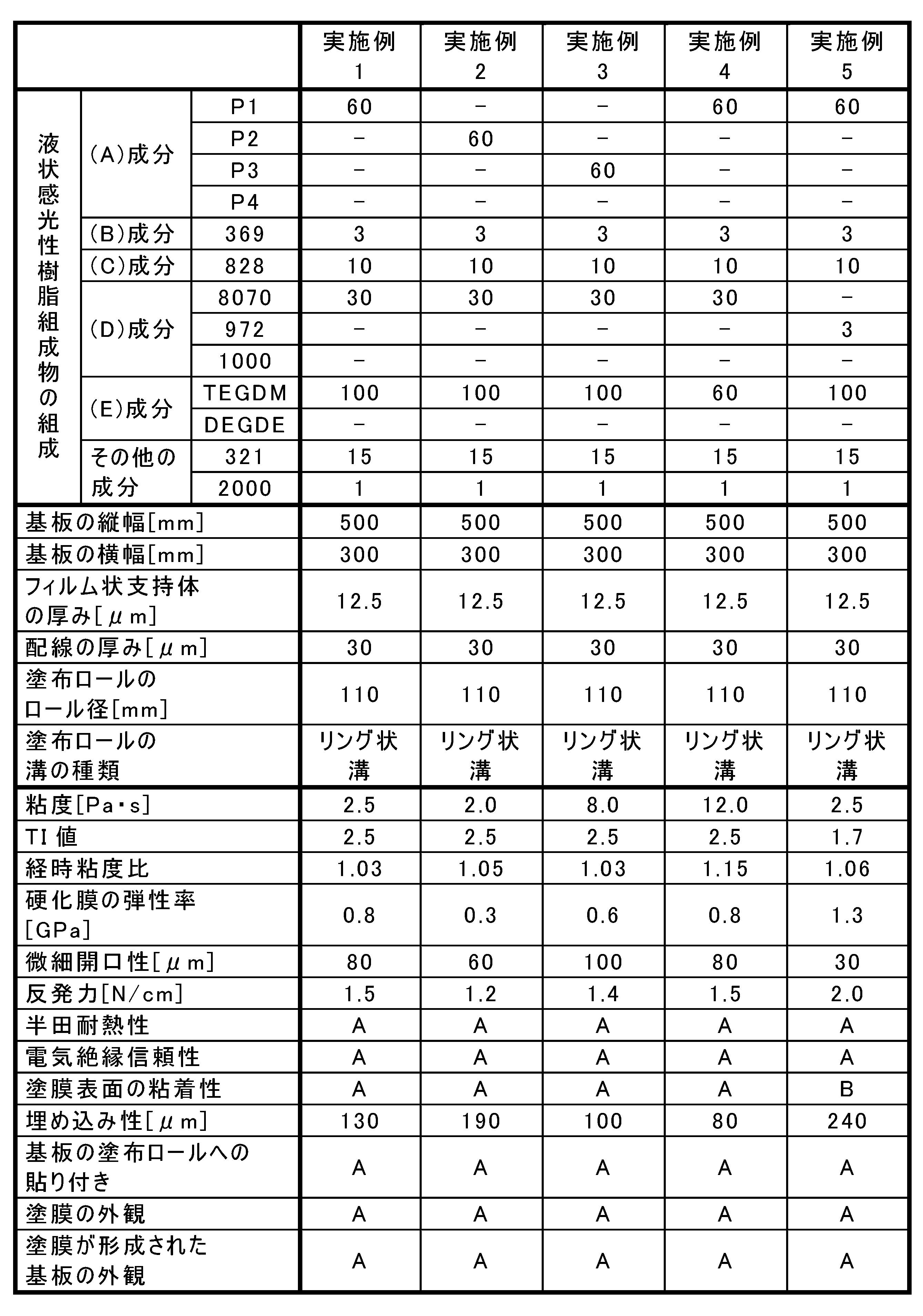
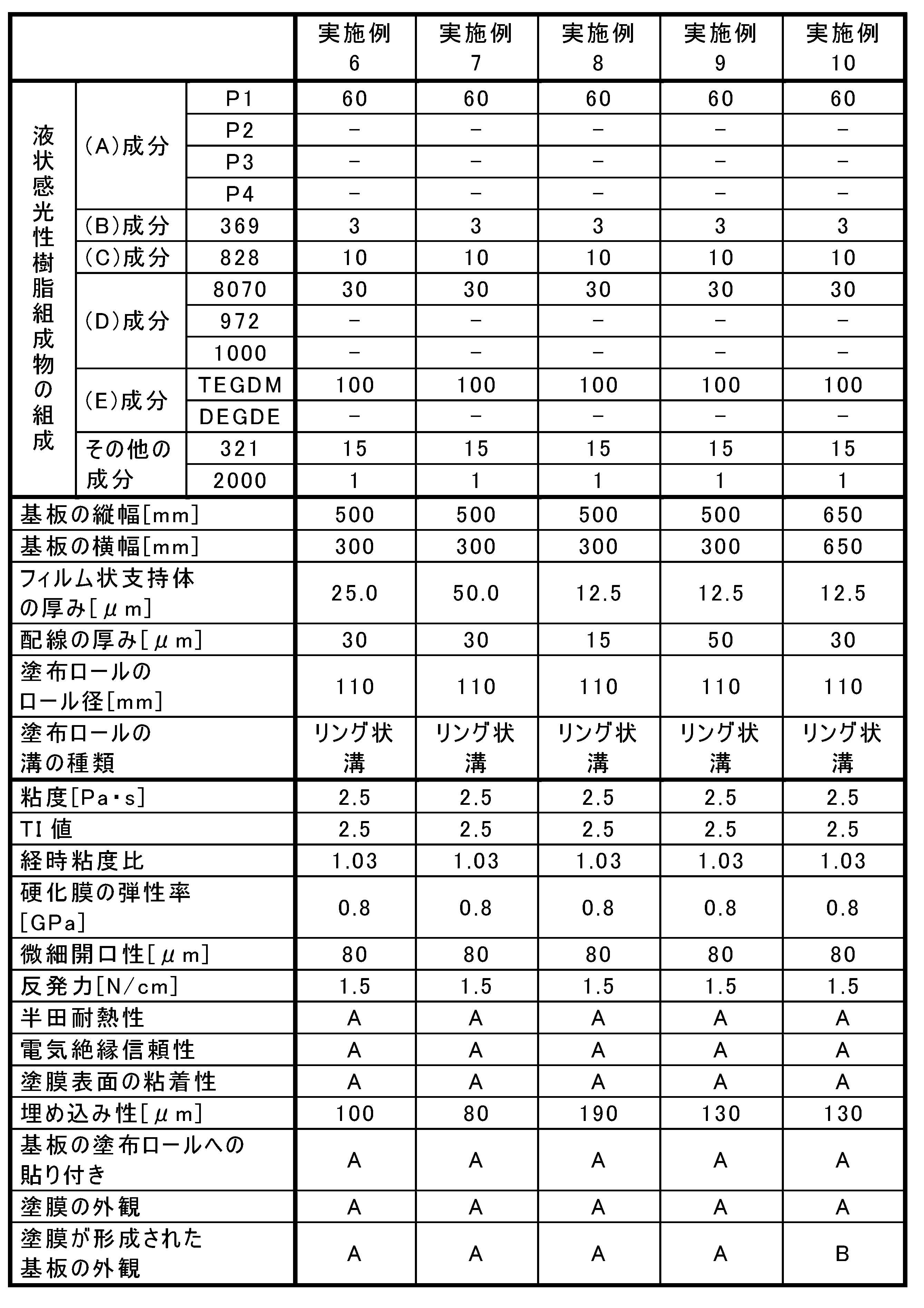
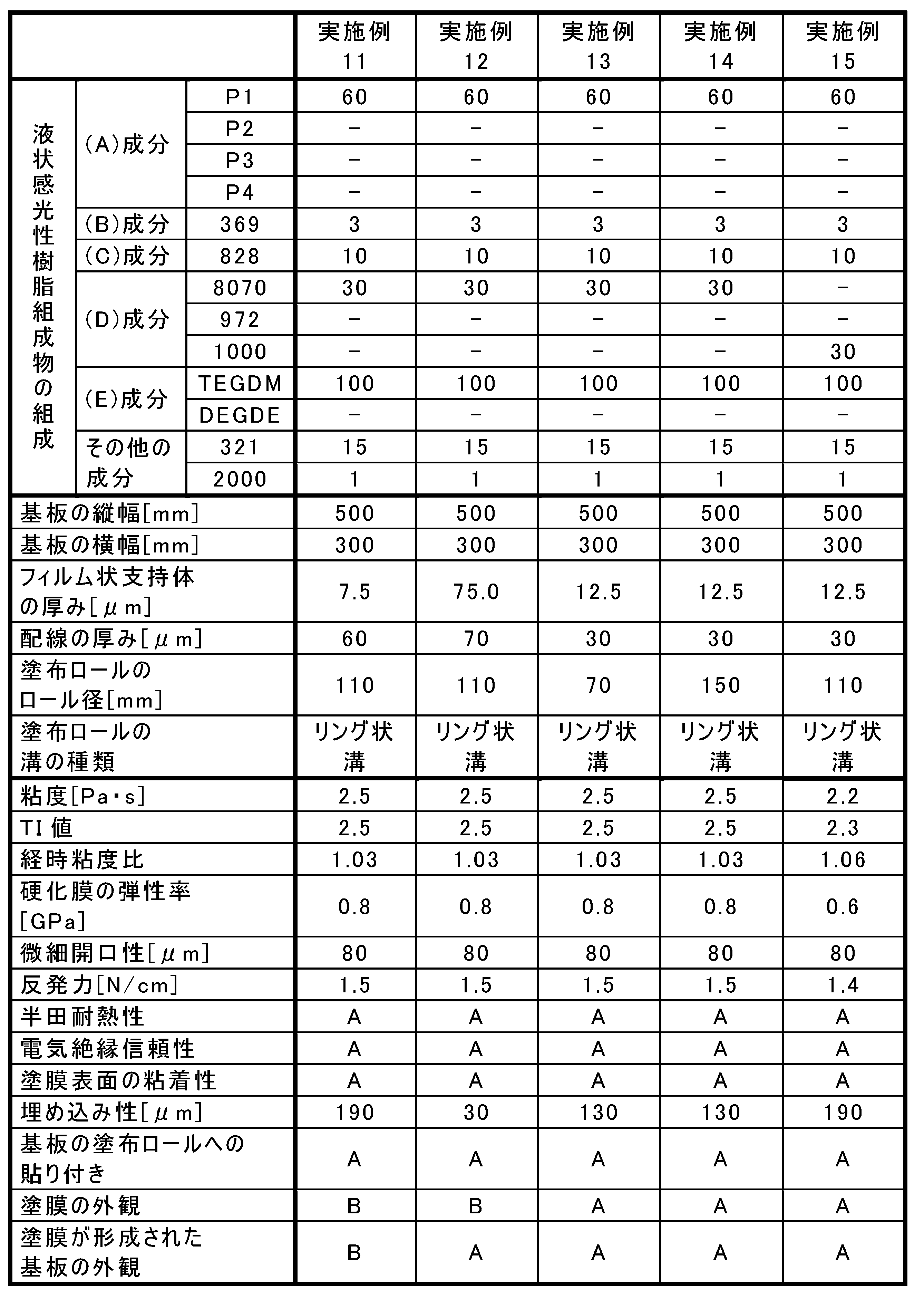
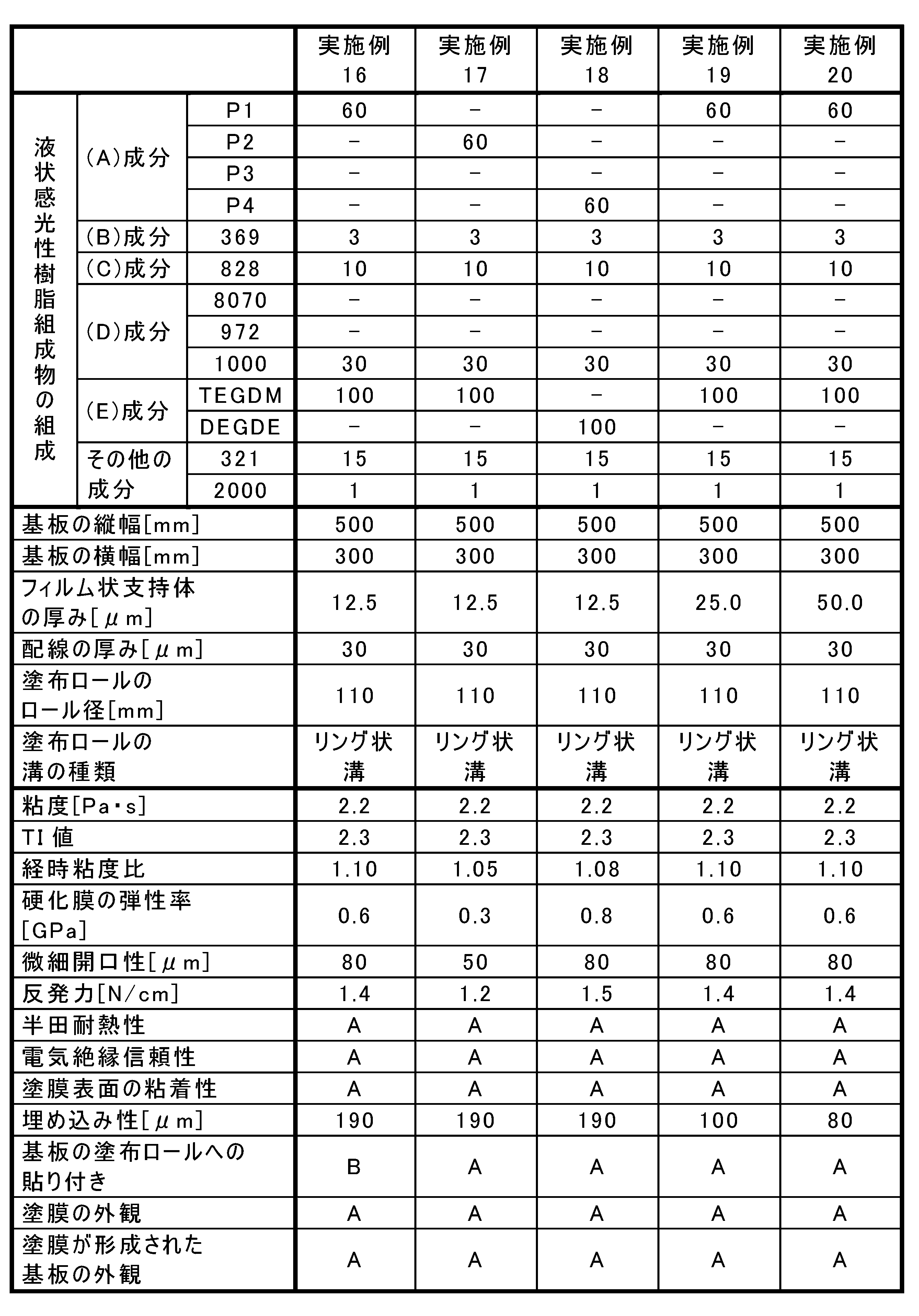


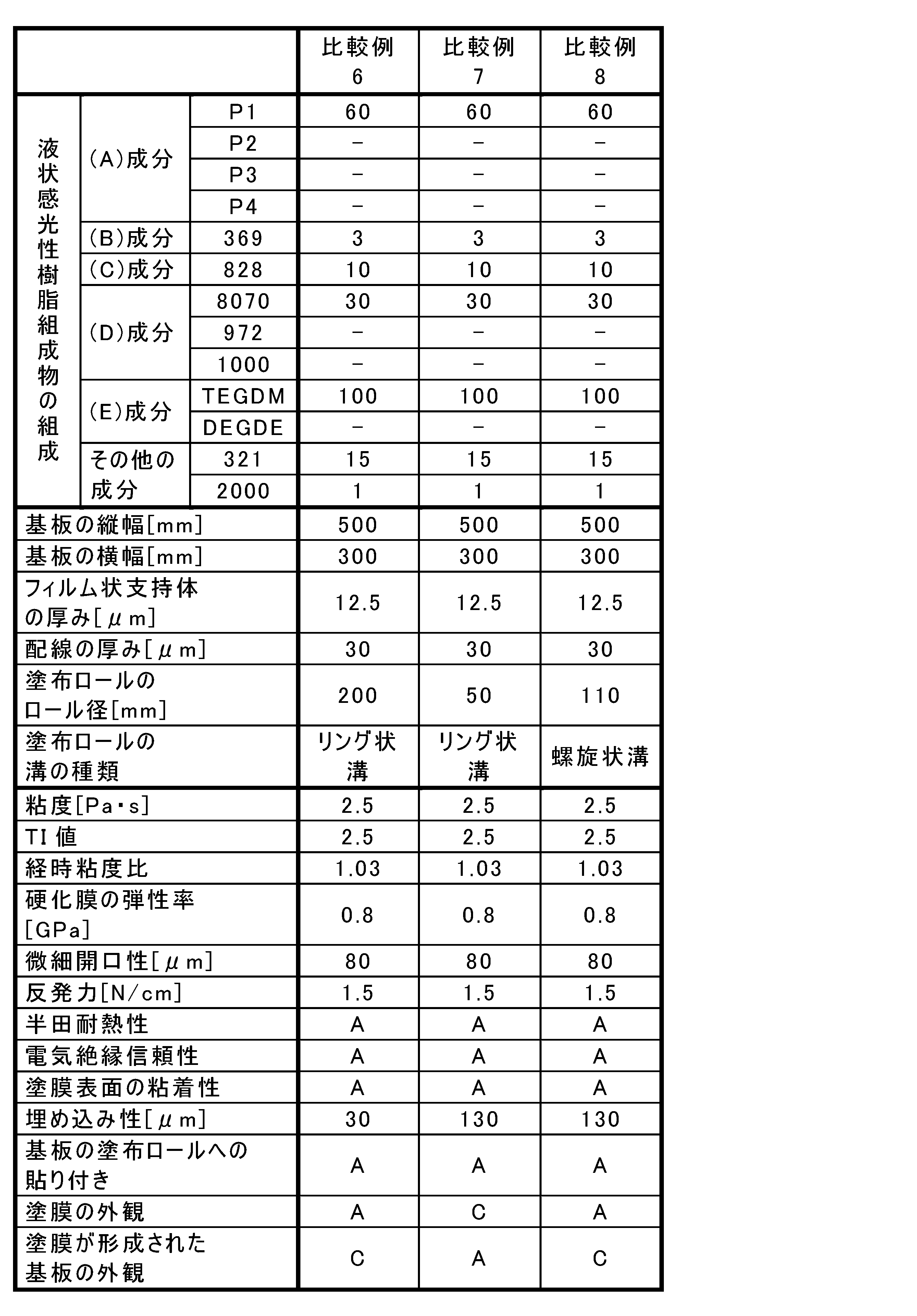
12a、12b、100 塗布ロール
13 フィルム状支持体
14 配線
15 穴
17 液状感光性樹脂組成物
120a リング状溝
Claims (12)
- フィルム状支持体と、前記フィルム状支持体の両面に設けられた配線とを有する基板の両面に、垂直吊り上げ式ロールコーターを用いて液状感光性樹脂組成物を塗布するフレキシブルプリント基板の製造方法であって、
前記基板には、穴が設けられており、
前記垂直吊り上げ式ロールコーターは、各々独立した複数個のリング状溝を有する一対の塗布ロールを備え、
前記塗布ロールのロール径が、70mm以上150mm以下であり、
前記液状感光性樹脂組成物は、回転数50rpmで3分間回転させた後の粘度が1.0Pa・s以上15.0Pa・s以下であり、かつ回転数50rpmで3分間回転させた後の粘度に対する回転数5rpmで3分間回転させた後の粘度の比が1.5以上3.0以下であり、
前記液状感光性樹脂組成物の硬化膜の弾性率が、0.1GPa以上1.5GPa以下であり、
前記液状感光性樹脂組成物を塗布する際、前記基板の両面に前記液状感光性樹脂組成物を同時に塗布する、フレキシブルプリント基板の製造方法。 - 前記フィルム状支持体の横幅及び縦幅が、いずれも200mm以上600mm以下である、請求項1に記載のフレキシブルプリント基板の製造方法。
- 前記フィルム状支持体の厚みが、8.0μm以上50.0μm以下である、請求項1又は2に記載のフレキシブルプリント基板の製造方法。
- 前記配線の厚みが、8μm以上50μm以下である、請求項1~3のいずれか一項に記載のフレキシブルプリント基板の製造方法。
- 前記穴の直径が、50μm以上250μm以下である、請求項1~4のいずれか一項に記載のフレキシブルプリント基板の製造方法。
- 前記フィルム状支持体は、ポリイミド、ポリアミド、ポリエステル、ポリカーボネート、ポリアリレート、ポリテトラフルオロエチレン、ポリクロロトリフルオロエチレン、ポリフッ化ビニリデン、ポリフッ化ビニル、ペルフルオロアルコキシフッ素樹脂、四フッ化エチレン・六フッ化プロピレン共重合体、エチレン・四フッ化エチレン共重合体、及びエチレン・クロロトリフルオロエチレン共重合体からなる群より選ばれる一種以上のポリマーを含む、請求項1~5のいずれか一項に記載のフレキシブルプリント基板の製造方法。
- 前記液状感光性樹脂組成物は、回転数50rpmで3分間回転させた後の粘度に対する回転数50rpmで24時間回転させた後の粘度の比が1.20以下である、請求項1~6のいずれか一項に記載のフレキシブルプリント基板の製造方法。
- 前記液状感光性樹脂組成物は、バインダーポリマー、光ラジカル重合開始剤、熱硬化性樹脂、平均粒子径0.01μm以上100μm以下の粒子、及び有機溶媒を含有する、請求項1~7のいずれか一項に記載のフレキシブルプリント基板の製造方法。
- 前記バインダーポリマーは、1分子中にウレタン結合を有するポリマー、1分子中にイミド基を有するポリマー、1分子中に(メタ)アクリロイル基を有するポリマー、及び1分子中にカルボキシ基を有するポリマーからなる群より選ばれる一種以上のポリマーである、請求項8に記載のフレキシブルプリント基板の製造方法。
- 前記有機溶媒は、沸点180℃以上の水溶性有機溶媒である、請求項8又は9に記載のフレキシブルプリント基板の製造方法。
- 前記粒子の含有量が、前記バインダーポリマー100重量部に対して、5重量部以上100重量部以下である、請求項8~10のいずれか一項に記載のフレキシブルプリント基板の製造方法。
- 前記粒子は、架橋ポリマー粒子である、請求項8~11のいずれか一項に記載のフレキシブルプリント基板の製造方法。
Priority Applications (3)
| Application Number | Priority Date | Filing Date | Title |
|---|---|---|---|
| KR1020227044408A KR102516437B1 (ko) | 2021-03-25 | 2022-02-24 | 플렉시블 프린트 기판의 제조 방법 |
| CN202280005219.3A CN115918275B (zh) | 2021-03-25 | 2022-02-24 | 柔性印刷基板的制造方法 |
| JP2022542044A JP7153167B1 (ja) | 2021-03-25 | 2022-02-24 | フレキシブルプリント基板の製造方法 |
Applications Claiming Priority (4)
| Application Number | Priority Date | Filing Date | Title |
|---|---|---|---|
| JP2021050882 | 2021-03-25 | ||
| JP2021-050881 | 2021-03-25 | ||
| JP2021-050882 | 2021-03-25 | ||
| JP2021050881 | 2021-03-25 |
Publications (1)
| Publication Number | Publication Date |
|---|---|
| WO2022202080A1 true WO2022202080A1 (ja) | 2022-09-29 |
Family
ID=83397044
Family Applications (1)
| Application Number | Title | Priority Date | Filing Date |
|---|---|---|---|
| PCT/JP2022/007678 Ceased WO2022202080A1 (ja) | 2021-03-25 | 2022-02-24 | フレキシブルプリント基板の製造方法 |
Country Status (4)
| Country | Link |
|---|---|
| JP (1) | JP7153167B1 (ja) |
| KR (1) | KR102516437B1 (ja) |
| CN (1) | CN115918275B (ja) |
| WO (1) | WO2022202080A1 (ja) |
Citations (3)
| Publication number | Priority date | Publication date | Assignee | Title |
|---|---|---|---|---|
| JP2000156556A (ja) * | 1998-11-20 | 2000-06-06 | Kansai Paint Co Ltd | スルーホール部を有する基板へのレジスト層形成方法及びプリント配線基板の製造方法 |
| JP2004071825A (ja) * | 2002-08-06 | 2004-03-04 | Taiyo Ink Mfg Ltd | 多層プリント配線板の製造方法 |
| WO2012081295A1 (ja) * | 2010-12-14 | 2012-06-21 | 株式会社カネカ | 新規な感光性樹脂組成物及びその利用 |
Family Cites Families (9)
| Publication number | Priority date | Publication date | Assignee | Title |
|---|---|---|---|---|
| JPH1065348A (ja) * | 1996-08-21 | 1998-03-06 | Ibiden Co Ltd | 多層プリント配線板の製造方法 |
| EP1009206A3 (en) * | 1998-12-02 | 2003-01-15 | Ajinomoto Co., Inc. | Method of vacuum-laminating adhesive film |
| JP2002306998A (ja) * | 2001-04-16 | 2002-10-22 | Sumitomo Chem Co Ltd | 板状塗工物の製造方法とそのための塗布装置 |
| CN100342983C (zh) * | 2005-03-18 | 2007-10-17 | 叶步章 | 可限制pcb油墨涂覆范围的滚筒装置 |
| TW201524288A (zh) | 2013-12-11 | 2015-06-16 | Microcosm Technology Co Ltd | 塗佈設備及塗佈方法 |
| JP6345947B2 (ja) | 2014-02-27 | 2018-06-20 | 株式会社タムラ製作所 | 感光性樹脂組成物 |
| CN109983403B (zh) | 2016-11-18 | 2023-02-17 | 株式会社有泽制作所 | 感光性树脂组合物、使用该感光性树脂组合物的阻焊膜、柔性印刷布线板及图像显示装置 |
| JPWO2019160126A1 (ja) * | 2018-02-19 | 2021-02-25 | 株式会社カネカ | 感光性樹脂組成物、硬化膜、プリント配線板およびその製造方法、ならびに感光性樹脂組成物作製キット |
| JP2020148971A (ja) | 2019-03-14 | 2020-09-17 | 株式会社タムラ製作所 | 感光性樹脂組成物 |
-
2022
- 2022-02-24 JP JP2022542044A patent/JP7153167B1/ja active Active
- 2022-02-24 WO PCT/JP2022/007678 patent/WO2022202080A1/ja not_active Ceased
- 2022-02-24 CN CN202280005219.3A patent/CN115918275B/zh active Active
- 2022-02-24 KR KR1020227044408A patent/KR102516437B1/ko active Active
Patent Citations (3)
| Publication number | Priority date | Publication date | Assignee | Title |
|---|---|---|---|---|
| JP2000156556A (ja) * | 1998-11-20 | 2000-06-06 | Kansai Paint Co Ltd | スルーホール部を有する基板へのレジスト層形成方法及びプリント配線基板の製造方法 |
| JP2004071825A (ja) * | 2002-08-06 | 2004-03-04 | Taiyo Ink Mfg Ltd | 多層プリント配線板の製造方法 |
| WO2012081295A1 (ja) * | 2010-12-14 | 2012-06-21 | 株式会社カネカ | 新規な感光性樹脂組成物及びその利用 |
Also Published As
| Publication number | Publication date |
|---|---|
| CN115918275B (zh) | 2023-10-27 |
| KR20230005409A (ko) | 2023-01-09 |
| KR102516437B1 (ko) | 2023-03-31 |
| CN115918275A (zh) | 2023-04-04 |
| JP7153167B1 (ja) | 2022-10-13 |
| JPWO2022202080A1 (ja) | 2022-09-29 |
Similar Documents
| Publication | Publication Date | Title |
|---|---|---|
| JP5064950B2 (ja) | 新規な感光性樹脂組成物、それから得られる感光性樹脂組成物溶液、感光性フィルム、絶縁膜及び絶縁膜付きプリント配線板 | |
| JP6134403B2 (ja) | 新規な感光性樹脂組成物及びその利用 | |
| JP5049175B2 (ja) | 新規な感光性樹脂組成物、それから得られる感光性樹脂組成物溶液、感光性フィルム、絶縁膜及び絶縁膜付きプリント配線板 | |
| JP6360792B2 (ja) | 補強板一体型フレキシブルプリント基板 | |
| TWI627875B (zh) | 導電層一體型軟性印刷基板 | |
| JP6006716B2 (ja) | 新規な絶縁膜及び絶縁膜付きプリント配線板 | |
| JP5760099B2 (ja) | 新規な絶縁膜用樹脂組成物及びその利用 | |
| JP2009300873A (ja) | 新規な回路基板の製造方法 | |
| JP5097025B2 (ja) | 新規なポリイミド前駆体組成物及びその利用 | |
| WO2022202082A1 (ja) | フレキシブルプリント基板の製造方法 | |
| JP7153167B1 (ja) | フレキシブルプリント基板の製造方法 | |
| JP2011126922A (ja) | 新規な樹脂組成物及びその利用 | |
| WO2022202081A1 (ja) | フレキシブルプリント基板の製造方法 | |
| JP2009280661A (ja) | 新規なポリイミド前駆体組成物、その利用及びそれらの製造方法 | |
| JP2010006868A (ja) | 新規な硬化膜及びその利用 | |
| JP2019012793A (ja) | 導電層一体型フレキシブルプリント基板 |
Legal Events
| Date | Code | Title | Description |
|---|---|---|---|
| ENP | Entry into the national phase |
Ref document number: 2022542044 Country of ref document: JP Kind code of ref document: A |
|
| 121 | Ep: the epo has been informed by wipo that ep was designated in this application |
Ref document number: 22774878 Country of ref document: EP Kind code of ref document: A1 |
|
| ENP | Entry into the national phase |
Ref document number: 20227044408 Country of ref document: KR Kind code of ref document: A |
|
| NENP | Non-entry into the national phase |
Ref country code: DE |
|
| 122 | Ep: pct application non-entry in european phase |
Ref document number: 22774878 Country of ref document: EP Kind code of ref document: A1 |