WO2022202046A1 - 中空粒子およびその製造方法、並びに、中空粒子の利用 - Google Patents
中空粒子およびその製造方法、並びに、中空粒子の利用 Download PDFInfo
- Publication number
- WO2022202046A1 WO2022202046A1 PCT/JP2022/007089 JP2022007089W WO2022202046A1 WO 2022202046 A1 WO2022202046 A1 WO 2022202046A1 JP 2022007089 W JP2022007089 W JP 2022007089W WO 2022202046 A1 WO2022202046 A1 WO 2022202046A1
- Authority
- WO
- WIPO (PCT)
- Prior art keywords
- hollow particles
- metal foil
- dispersion
- monomer
- resin
- Prior art date
- Legal status (The legal status is an assumption and is not a legal conclusion. Google has not performed a legal analysis and makes no representation as to the accuracy of the status listed.)
- Ceased
Links
Images

Classifications
-
- B—PERFORMING OPERATIONS; TRANSPORTING
- B01—PHYSICAL OR CHEMICAL PROCESSES OR APPARATUS IN GENERAL
- B01J—CHEMICAL OR PHYSICAL PROCESSES, e.g. CATALYSIS OR COLLOID CHEMISTRY; THEIR RELEVANT APPARATUS
- B01J13/00—Colloid chemistry, e.g. the production of colloidal materials or their solutions, not otherwise provided for; Making microcapsules or microballoons
- B01J13/02—Making microcapsules or microballoons
- B01J13/06—Making microcapsules or microballoons by phase separation
- B01J13/14—Polymerisation; cross-linking
-
- B—PERFORMING OPERATIONS; TRANSPORTING
- B32—LAYERED PRODUCTS
- B32B—LAYERED PRODUCTS, i.e. PRODUCTS BUILT-UP OF STRATA OF FLAT OR NON-FLAT, e.g. CELLULAR OR HONEYCOMB, FORM
- B32B15/00—Layered products comprising a layer of metal
- B32B15/04—Layered products comprising a layer of metal comprising metal as the main or only constituent of a layer, which is next to another layer of the same or of a different material
- B32B15/08—Layered products comprising a layer of metal comprising metal as the main or only constituent of a layer, which is next to another layer of the same or of a different material of synthetic resin
-
- C—CHEMISTRY; METALLURGY
- C08—ORGANIC MACROMOLECULAR COMPOUNDS; THEIR PREPARATION OR CHEMICAL WORKING-UP; COMPOSITIONS BASED THEREON
- C08F—MACROMOLECULAR COMPOUNDS OBTAINED BY REACTIONS ONLY INVOLVING CARBON-TO-CARBON UNSATURATED BONDS
- C08F12/00—Homopolymers and copolymers of compounds having one or more unsaturated aliphatic radicals, each having only one carbon-to-carbon double bond, and at least one being terminated by an aromatic carbocyclic ring
- C08F12/34—Monomers containing two or more unsaturated aliphatic radicals
-
- C—CHEMISTRY; METALLURGY
- C08—ORGANIC MACROMOLECULAR COMPOUNDS; THEIR PREPARATION OR CHEMICAL WORKING-UP; COMPOSITIONS BASED THEREON
- C08L—COMPOSITIONS OF MACROMOLECULAR COMPOUNDS
- C08L55/00—Compositions of homopolymers or copolymers, obtained by polymerisation reactions only involving carbon-to-carbon unsaturated bonds, not provided for in groups C08L23/00 - C08L53/00
- C08L55/04—Polyadducts obtained by the diene synthesis
-
- C—CHEMISTRY; METALLURGY
- C08—ORGANIC MACROMOLECULAR COMPOUNDS; THEIR PREPARATION OR CHEMICAL WORKING-UP; COMPOSITIONS BASED THEREON
- C08L—COMPOSITIONS OF MACROMOLECULAR COMPOUNDS
- C08L71/00—Compositions of polyethers obtained by reactions forming an ether link in the main chain; Compositions of derivatives of such polymers
- C08L71/08—Polyethers derived from hydroxy compounds or from their metallic derivatives
- C08L71/10—Polyethers derived from hydroxy compounds or from their metallic derivatives from phenols
- C08L71/12—Polyphenylene oxides
-
- H—ELECTRICITY
- H05—ELECTRIC TECHNIQUES NOT OTHERWISE PROVIDED FOR
- H05K—PRINTED CIRCUITS; CASINGS OR CONSTRUCTIONAL DETAILS OF ELECTRIC APPARATUS; MANUFACTURE OF ASSEMBLAGES OF ELECTRICAL COMPONENTS
- H05K1/00—Printed circuits
- H05K1/02—Details
- H05K1/03—Use of materials for the substrate
Definitions
- the present invention relates to hollow particles, a method for producing the same, and utilization of hollow particles.
- Methods for reducing the dielectric of the resin material include making the resin material porous using air having a Dk of 1, adding hollow particles to the resin material, and the like. , various techniques are known.
- Patent Literature 1 discloses a resin composition that has a low dielectric constant and a low dielectric loss tangent and can produce a laminate with a small coefficient of thermal expansion.
- the resin composition contains a thermosetting resin and hollow particles, and the hollow particles have a single-layer shell with a thickness of 0.01 to 4 ⁇ m and an average particle size of 0.1 to 30 ⁇ m. and the volume ratio of the internal voids to the total volume of the hollow particles is 40 to 80%.
- the hollow particles have the advantage that they do not require heat treatment at high temperatures, which can lead to shell breakage, which is a problem with glass hollow particles.
- Patent Document 1 discloses a prepreg obtained by impregnating a fibrous base material with the resin composition and then heating and drying the fibrous base material, and a prepreg and a metal foil laminated and heated. A metal foil clad laminate obtained by compression is disclosed.
- the layer material (insulating layer) made from the resin composition or the like described in Patent Document 1 has a low dielectric constant, a low dielectric loss tangent, the adhesion strength of the insulating layer to the metal foil, and the combination of the fiber material and the resin. There is a problem that compatibility between the interfacial adhesive properties of the two is insufficient.
- One aspect of the present invention has been made in view of the above problems, and an object of the present invention is to achieve a low dielectric It is an object of the present invention to provide hollow particles excellent in efficiency, low dielectric loss tangent, enhanced adhesive strength of an insulating layer to a metal foil, and enhanced interfacial adhesiveness between a fiber material and a resin.
- One embodiment of the present invention includes the following aspects.
- [2] A dispersion obtained by dispersing the hollow particles according to [1] in a solvent.
- a metal foil-clad laminate obtained by heating and pressurizing a laminated prepreg obtained by stacking the prepregs according to [4] and a metal foil.
- a metal foil-clad laminate comprising an insulating layer containing the resin composition and a fibrous base material according to [3], and a metal foil in contact with the insulating layer.
- a printed circuit board comprising the metal foil-clad laminate according to [5] or [6].
- a step of producing core-shell particles The aqueous medium, which is the dispersion medium of the dispersion in which the core-shell particles are dispersed, is replaced with a solvent having a boiling point of 100°C or less, and the solvent having a boiling point of 100°C or less is included in the core instead of the hydrocarbon having 8 or more carbon atoms.
- obtaining a dispersion of hollow particles A method for producing a dispersion of hollow particles, wherein the hollow particles have an average particle size of 0.010 to 1 ⁇ m.
- the insulating layer when dispersed in a matrix resin and used as a material for an insulating layer such as a circuit board, the insulating layer has a low dielectric constant, a low dielectric loss tangent, and the metal of the insulating layer. It is possible to provide hollow particles that are excellent in enhancing adhesion strength to foils and enhancing interfacial adhesiveness between fiber materials and resins.
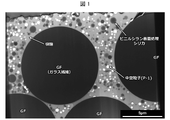
- FIG. 1 is a TEM image (observation magnification of 12,500 times) of an insulating layer to which hollow particles (P-1) are added according to an example of the present invention.
- FIG. 4 is a TEM image (observation magnification of 12,500 times) of an insulating layer to which hollow particles (P-2) of a comparative example of the present invention are added;
- FIG. 1 is a TEM image (observation magnification of 12,500 times) of an insulating layer to which hollow particles (P-1) are added according to an example of the present invention.
- FIG. 4 is a TEM image (observation magnification of 12,500 times) of an insulating layer to which hollow particles (P-2) of a comparative example of the present invention are added;
- core-shell particles which are precursors of hollow particles
- the mixture is stirred by mechanical energy to produce core-shell particles.
- core-shell particles with a very small average particle size for example, core-shell particles with an average particle size of the order of nanometers
- the average particle size of hollow particles produced from the core-shell particles is also very small. I found that it can be done, and came to complete the present invention.
- the present inventors have found that such hollow particles having a very small average particle size can be dispersed in a matrix resin and used as a material for an insulating layer of a circuit board or the like.
- the dielectric constant and dielectric loss tangent of the layer can be lowered, and the adhesive strength of the insulating layer to the metal foil and the interfacial adhesiveness between the fiber material and the resin can be enhanced. came to.
- Hollow particles are composed of (i) a polymer or copolymer of a monomer having an aromatic ring and a plurality of reactive groups, and (ii) a monomer having an aromatic ring and a plurality of reactive groups. , a copolymer with a monomer having an aromatic ring and one reactive group, and an average particle size of 0.010 to 1 ⁇ m.
- Hollow particles according to one embodiment of the present invention are composed of (i) a polymer or copolymer of a monomer having an aromatic ring and a plurality of reactive groups, and (ii) a monomer having an aromatic ring and a plurality of reactive groups. , an aromatic ring and a copolymer with a monomer having one reactive group, and an average particle size of 0.010 to 1 ⁇ m.
- the average particle diameter of the hollow particles is 0.010 to 1 ⁇ m, preferably 0.010 to 0.500 ⁇ m, more preferably 0.010 to 0.300 ⁇ m.
- the volume ratio of the internal space to the total volume is preferably 15 to 70%, more preferably 20 to 70%, and 30 to 70%. More preferred. Air has a dielectric constant of 1 and a dielectric loss tangent of 0. Therefore, with this configuration, when the hollow particles are dispersed in the matrix resin and used as a material for an insulating layer such as a circuit board, the dielectric constant and dielectric loss tangent of the insulating layer can be made lower.
- a higher volume ratio is preferable from the viewpoint of lowering the dielectric, but if the volume ratio exceeds 70%, there is a risk that the hollow particles will be damaged by pressure during the production of the laminate. On the other hand, if the volume ratio is less than 15%, a sufficient dielectric reduction effect may not be expected. Therefore, with this configuration, it is also possible to prevent damage to the hollow particles.
- the shell constituting the hollow particle according to one embodiment of the present invention includes (i) an aromatic ring and a plurality (for example, 2 to 6, 2 to 5, 2 to 4, 2 to 3, or 2 ) and (ii) an aromatic ring and a plurality (for example, 2 to 6, 2 to 5, 2 to 4, 2 to 3, or 2 ) and a copolymer of a monomer having an aromatic ring and one reactive group (or both).
- the reactive group is limited to Examples include functional groups having carbon-carbon unsaturated double bonds, and reactive functional groups such as epoxy groups and oxazine rings.
- the dielectric constant and dielectric loss tangent of the insulating layer can be further lowered, and the metal of the insulating layer
- a functional group is preferred.
- the number of aromatic rings in the monomer is There is no limitation, and the number may be one, or plural (eg, 2 to 10, 2 to 5, 2 to 3).
- the type of aromatic ring possessed by the monomer is not limited, and may be, for example, at least one selected from the group consisting of benzene rings, non-benzene aromatic rings, heteroaromatic rings, and condensed aromatic rings.
- the "monomer having an aromatic ring and a plurality of reactive groups" described in (i) and (ii) above is not limited, and examples thereof include divinylbenzene, divinylbiphenyl, divinylnaphthalene, diallyl phthalate, triallyl cyanurate, 2,2′-diallyl bisphenol A, bisphenol A diallyl ether, triallyl trimellitate, triallyl trimesate, bis(4-allyloxyphenyl) sulfone, diallyldiphenylsilane, diallyl 2,6-naphthalenedicarboxylate, N,N - At least one selected from the group consisting of divinylaniline, diisopropenylbenzene, bisphenol A dimethacrylate, ethoxylated bisphenol A dimethacrylate, ethoxylated bisphenol A diacrylate, and propoxylated bisphenol A diacrylate.
- the hollow particles are dispersed in a matrix resin and used as a material for an insulating layer such as a circuit board, the dielectric constant and dielectric loss tangent of the insulating layer can be further lowered, and the insulating layer is more resistant to the metal foil.
- the monomer having the aromatic ring and a plurality of reactive groups is divinylbenzene, divinylbiphenyl, divinyl It is preferably at least one selected from the group consisting of naphthalene, diallyl phthalate, triallyl cyanurate, and bisphenol A diallyl ether.
- the "monomer having an aromatic ring and one reactive group" described in (ii) above is not limited, and examples thereof include monovinyl aromatic monomers, acrylic monomers, and vinyl ether monomers. At least one selected from the group consisting of Examples of monovinyl aromatic monomers include styrene, ethylvinylbenzene, ⁇ -methylstyrene, vinyltoluene, ⁇ -chlorostyrene, o-chlorostyrene, m-chlorostyrene, p-chlorostyrene, vinylbiphenyl and vinylnaphthalene. Examples of acrylic monomers include phenyl acrylate, and examples of vinyl ether monomers include vinyl phenyl ether.
- the "monomer having an aromatic ring and one reactive group" described in (ii) above may contain one or a mixture of two or more of these monomers.
- the hollow particles are dispersed in a matrix resin and used as a material for an insulating layer such as a circuit board, the dielectric constant and dielectric loss tangent of the insulating layer can be further lowered, and the insulating layer is more resistant to the metal foil.
- the monomer having the aromatic ring and one reactive group is, among these, styrene, ethylvinylbenzene, vinyl It is preferably at least one selected from the group consisting of biphenyl and vinylnaphthalene.
- the "monomer having an aromatic ring and a plurality of reactive groups” forming these may be the same monomer or different monomers. There may be. Further, regarding the “copolymer” described in (ii) above, “a monomer having an aromatic ring and a plurality of reactive groups” and “a monomer having an aromatic ring and one reactive group” forming the copolymer may be the same monomer or different monomers.
- the "copolymer” described in the above (i) and (ii) is the "monomer having an aromatic ring and a plurality of reactive groups" and/or the "aromatic ring and one reactive A structural unit derived from the monomer A other than the "monomer having a group” may be included.
- the monomer A is not limited, and examples thereof include monomers having a plurality of reactive groups that do not contain aromatic rings, such as ethylene glycol dimethacrylate and tetraethylene glycol dimethacrylate; methyl acrylate, ethyl acrylate, and butyl acrylate.
- the usage ratio of both monomers for forming a copolymer of the "monomer having an aromatic ring and a plurality of reactive groups” and the "monomer having an aromatic ring and one reactive group” described in (ii) above is , with respect to the total amount of "a monomer having an aromatic ring and a plurality of reactive groups” and "a monomer having an aromatic ring and one reactive group” because it allows densification of the shell of the hollow particles.
- "a monomer having an aromatic ring and a plurality of reactive groups” is preferably 50% by weight or more, more preferably 80% by weight or more, and even more preferably 90% by weight or more.
- divinylbenzene when the "monomer having an aromatic ring and a plurality of reactive groups" is divinylbenzene, commercially available divinylbenzene is usually a mixture of isomers with different vinyl group substitution positions, and ethylvinylbenzene and its isomers.
- a commercially available product containing divinylbenzene and its isomers at a high concentration and containing ethylvinylbenzene and its isomers at a low content for example, a divinylbenzene concentration of 96% by weight is used. is desirable.
- a dispersion according to one embodiment of the present invention is a dispersion obtained by dispersing the hollow particles according to one embodiment of the present invention in a solvent.
- the solvent is not limited, and examples thereof include solvents having a boiling point of 100° C. or less.
- the solvent with a boiling point of 100° C. or less is not limited, for example, alcohols such as methanol (boiling point: approximately 65° C.), ethanol (boiling point: approximately 78° C.), 2-propanol (boiling point: approximately 82° C.); ketones such as methyl ethyl ketone (boiling point: approximately 56°C) and methyl ethyl ketone (boiling point: approximately 80°C); esters such as methyl acetate (boiling point: approximately 57°C) and ethyl acetate (boiling point: approximately 77°C); tetrahydrofuran (boiling point: approximately 65°C ), 1,3-dioxolane (boiling point: about 75° C.); benzene (boiling point: about 80° C
- a resin composition according to one embodiment of the present invention is a resin composition containing the hollow particles according to one embodiment of the present invention and a matrix resin.
- the matrix resin examples include, but are not limited to, epoxy resin, benzoxazine, cyanate resin, polyimide (PI), bismaleimide (BMI), polyfunctional styrene compound (eg, divinylbenzene), silicone resin, polyester resin, liquid Crystal polymer (LCP), hydrocarbon resin, polyphenylene ether (PPE), modified polyphenylene ether (modified PPE) (also referred to as modified polyphenylene oxide (modified PPO)), cyclic olefin copolymer (COC), poly(p-phenylene sulfide) (PPS), poly(ether sulfone) (PES), poly(ether ether ketone) (PEEK), or polytetrafluoroethylene (PTFE).
- PPE polyphenylene ether
- modified PPE modified polyphenylene ether
- COC cyclic olefin copolymer
- PPS poly(p-phenylene sulfide)
- PES poly
- epoxy resin cyanate resin, bismaleimide (BMI), hydrocarbon resin, polyphenylene ether (PPE), and modified polyphenylene ether (modified PPE) are preferred from the viewpoint of physical properties such as dielectric properties and heat resistance.
- Ethers (PPE) and modified polyphenylene ethers (modified PPE) are more preferred, and modified polyphenylene ethers (modified PPE) are even more preferred.
- One or a mixture of two or more of these matrix resins can be used.
- polyphenylene ethers having crosslinkable functional groups are preferred.
- the polyphenylene ether having a crosslinkable functional group is preferably a modified polyphenylene ether terminally modified with a substituent having a carbon-carbon unsaturated double bond. According to the above configuration, a resin composition having better dielectric properties can be obtained.
- substituents having carbon-carbon unsaturated double bonds include, but are not limited to, substituents containing carbon-carbon unsaturated double bonds including acrylate groups, methacrylate groups, and arylene groups.
- Both the number average molecular weight and the weight average molecular weight of the matrix resin are preferably 1000 or more. If both the number average molecular weight and the weight average molecular weight are 1000 or more, a resin composition having better dielectric properties can be obtained.
- the number-average molecular weight and weight-average molecular weight may be those measured by a general molecular weight measurement method, and specific examples include values measured using gel permeation chromatography (GPC).
- a prepreg according to one embodiment of the present invention is a prepreg obtained by impregnating a base material with the resin composition according to one embodiment of the present invention and drying the resin composition by heating.
- the base material is not limited, and examples include inorganic fibers (e.g., carbon fibers, glass fibers, metal fibers, ceramic fibers), and organic synthetic fibers (e.g., polyamide fibers, polyester fibers, polyolefin fibers, novoloid fibers). ) can be mentioned.
- the form of the substrate is not limited, and a woven fabric, a non-woven fabric, or the like can be used. Among these, glass cloth is preferable in terms of mechanical strength and the like, and flattened glass cloth is more preferable. Specifically, the flattening process of the glass cloth can be carried out, for example, by continuously pressurizing the glass cloth with press rolls at an arbitrary pressure to compress the yarn flat.
- the thickness of the fibrous base material for example, one with a thickness of 0.04 to 0.3 mm can be generally used.
- a metal foil-clad laminate according to an embodiment of the present invention is a metal foil-clad laminate obtained by heating and pressurizing a laminate prepreg obtained by stacking prepregs according to an embodiment of the present invention and a metal foil.
- the metal foil may be arranged on either the upper surface or the lower surface of the laminated prepreg, or the metal foil may be arranged on both the upper surface and the lower surface of the laminated prepreg.
- a metal foil-clad laminate according to one embodiment of the present invention comprises an insulating layer containing the resin composition according to one embodiment of the present invention and a fibrous base material, and a metal foil in contact with the insulating layer. It is a tension laminate.
- the metal foil may be arranged on either the upper surface or the lower surface of the insulating layer, or the metal foil may be arranged on both the upper surface and the lower surface of the insulating layer.
- the number of prepregs contained in the laminated prepreg is not limited, and may be, for example, 1-50, 2-40, 2-30, 2-20, or 2-10.
- the metal foil is not limited, and examples thereof include copper foil, silver foil, and gold foil. Among these, copper foil is preferred from the viewpoint of cost and conductivity. Also, the thickness of the metal foil such as copper foil is not particularly limited, but can be, for example, 9 to 70 ⁇ m.
- the ten-point average roughness (Rz) of the surface of the metal foil is not limited, and is, for example, 2.0 ⁇ m or less, preferably 1.5 ⁇ m or less, and more preferably 1.0 ⁇ m or less. According to the above configuration, the obtained metal foil-clad laminate has better dielectric properties.
- the ten-point average roughness of the surface of the metal foil can be measured, for example, by a method based on JISB 0601, a method using scanning electron microscopy, and the like.
- the surface ten-point average roughness is measured using the peeled metal foil by the method described above. can.
- the fibrous base material is not limited. Novoloid fibers) can be mentioned.
- the form of the substrate is not limited, and a woven fabric, a non-woven fabric, or the like can be used. Among these, glass cloth is preferable in terms of mechanical strength and the like, and flattened glass cloth is more preferable.
- a printed circuit board according to one embodiment of the present invention is a printed circuit board including a metal foil-clad laminate according to one embodiment of the present invention.
- a printed circuit board according to an embodiment of the present invention is a metal foil-clad laminate provided with a conductor pattern that functions as a circuit, for example, by etching the metal foil on the surface of the metal foil-clad laminate according to an embodiment of the present invention. It may be a printed circuit board including a foil-clad laminate or consisting of the metal foil-clad laminate.
- a method for producing a dispersion of hollow particles according to an embodiment of the present invention comprises: A mixture obtained by adding at least a surfactant containing an anionic surfactant, a monomer containing an aromatic ring and a monomer having a plurality of reactive groups, and a hydrocarbon having 8 or more carbon atoms to an aqueous medium.
- the core is composed of the hydrocarbon having 8 or more carbon atoms
- the shell is composed of a polymer of monomers containing the aromatic ring and a monomer having a plurality of reactive groups.
- a step B of producing core-shell particles The aqueous medium, which is the dispersion medium of the dispersion in which the core-shell particles are dispersed, is replaced with a solvent having a boiling point of 100°C or less, and the solvent having a boiling point of 100°C or less is included in the core instead of the hydrocarbon having 8 or more carbon atoms.
- a step C of obtaining a dispersion of hollow particles The hollow particles have an average particle size of 0.010 to 1 ⁇ m.
- Step A At least a surfactant containing an anionic surfactant, monomers containing a monomer having an aromatic ring and a plurality of reactive groups, and a hydrocarbon having 8 or more carbon atoms are added to an aqueous medium.
- the aqueous medium is not limited, and examples thereof include aqueous media containing 50% by volume or more, 70% by volume or more, 90% by volume or more, or 100% by volume of water. Components other than water contained in the aqueous medium are not limited.
- the surfactant containing the anionic surfactant is not particularly limited as long as it is used in a well-known method (e.g., emulsion polymerization, mini-emulsion polymerization, etc.).
- Fatty acid soaps such as oleic acid potash soap, castor oil potash soap, semi-hardened beef tallow fatty acid soda soap, semi-hardened beef tallow fatty acid potash soap, sodium stearate soap; alkyl sulfate ester salts such as sodium lauryl sulfate and ammonium lauryl sulfate; dodecyl benzene sulfone Alkylbenzenesulfonates such as sodium phosphate; dialkyl sulfosuccinate; alkenyl succinate (dipotassium salt); alkyl phosphate; naphthalene sulfonic acid formalin condensate such as sodium salt of ⁇ -naphthalene sulfonic acid
- cationic surfactants or nonionic surfactants may be used as surfactants other than anionic surfactants.
- polymer dispersion stabilizers such as polyvinyl alcohol, alkyl-substituted cellulose, polyvinylpyrrolidone, and polyacrylic acid derivatives may be used together.
- cationic surfactants include alkylamine salts such as coconutamine acetate, laurylamine acetate and stearylamine acetate; alkylbenzyldimethylammonium chlorides such as hexadecylbenzyldimethylammonium chloride and laurylbenzyldimethylammonium chloride; lauryltrimethyl Alkyltrimethylammonium chloride such as ammonium chloride, hexadecyltrimethylammonium chloride, stearyltrimethylammonium chloride and cocoyltrimethylammonium chloride;
- alkylamine salts such as coconutamine acetate, laurylamine acetate and stearylamine acetate
- alkylbenzyldimethylammonium chlorides such as hexadecylbenzyldimethylammonium chloride and laurylbenzyldimethylammonium chloride
- lauryltrimethyl Alkyltrimethylammonium chloride such as
- nonionic surfactants include polyoxyethylene lauryl ether, polyoxyethylene cetyl ether, polyoxyethylene stearyl ether, polyoxyethylene oleyl ether, polyoxyethylene myristyl ether, polyoxyethylene octyldodecyl ether, Polyoxyethylene alkyl ethers such as polyoxyethylene tridecyl ether; Polyoxyethylene alkylphenyl ethers such as polyoxyethylene nonylphenyl ether, polyoxyethylene octylphenyl ether, polyoxyethylene dodecylphenyl ether, and polyoxyethylene ⁇ -naphthyl ether polyoxyethylene styrenated phenyl ether, polyoxyalkylene alkyl ether such as polyoxyalkylene trialkyl ether having 3 or more carbon atoms in the alkylene group; sorbitan monolaurate, sorbitan monopalmitate, sorbitan monostearate, sorbitan di
- the amount of the surfactant containing the anionic surfactant used is 100 parts by weight of the total amount of the monomer containing the aromatic ring and the monomer having a plurality of reactive groups and the hydrocarbon having 8 or more carbon atoms. 0.1 parts by weight or more is preferable, and 0.25 parts by weight or more is more preferable. When the amount is 0.25 parts by weight or more, emulsification can be easily performed by mechanical energy, and the stability of the emulsion is good.
- the particle size of the droplets in the emulsion and in the subsequent steps B and C, core-shell particles with a very small average particle size (for example, core-shell particles with an average particle size of the order of nanometers) ) can be produced, and the average particle size of the hollow particles produced from the core-shell particles can be made very small.
- the concentration of the surfactant including the anionic surfactant is appropriately selected so that the fine droplets in the dispersion do not coalesce in the dispersion.
- the hydrocarbon having 8 or more carbon atoms is not limited, and examples thereof include hydrocarbons having 8 to 30 carbon atoms, hydrocarbons having 8 to 25 carbon atoms, hydrocarbons having 8 to 20 carbon atoms, and hydrocarbons having 8 to 15 carbon atoms. Hydrocarbons and hydrocarbons having 8 to 10 carbon atoms can be mentioned.
- the hydrocarbon having 8 or more carbon atoms dissolves the monomers containing the aromatic ring and a monomer having a plurality of reactive groups, and the initiator described in the subsequent step B, but the aromatic ring and the plurality of A monomer having low compatibility with a polymer of monomers containing a monomer having a reactive group, promoting phase separation of these polymers, and containing the above-mentioned aromatic ring and a monomer having a plurality of reactive groups. It has properties that do not interfere with the formation of similar polymer films. The use of hexadecane as a hydrocarbon having such properties is particularly preferred.
- the essential properties required for the hydrocarbon having 8 or more carbon atoms are low compatibility with a polymer of monomers containing a monomer having an aromatic ring and a plurality of reactive groups, and the carbon A monomer containing a monomer having an aromatic ring and a plurality of reactive groups under the conditions of the interfacial tension ( ⁇ X ) between a hydrocarbon of number 8 or more and an aqueous medium and the method for producing hollow particles used in the present invention
- ⁇ X interfacial tension
- ⁇ P interfacial tension
- the amount of the hydrocarbon having 8 or more carbon atoms to be used is 50 to 500 parts by weight, particularly 100 to 200 parts by weight, based on 100 parts by weight of the monomer containing the monomer having an aromatic ring and a plurality of reactive groups. preferably.
- the method of applying mechanical energy to the mixed liquid is not limited, it is preferably a method capable of applying large mechanical energy to the mixed liquid.
- Examples of the method or an apparatus that enables the method include rotary stirring emulsifiers such as propeller mixers, homomixers, and dispersers, ultrasonic treatment devices such as ultrasonic homogenizers, high-pressure emulsifiers such as high-pressure homogenizers, and a membrane emulsification method using porous glass (SPG).
- SPG membrane emulsification method using porous glass
- core-shell particles with a very small average particle size can be produced in the subsequent steps B and C, and the core-shell particles can be produced.
- the average particle size of the hollow particles produced from can also be very small.
- the temperature condition when mechanical energy is applied is preferably below the temperature that affects the decomposition of the initiator described later, for example, about 0 to 40°C.
- step B the dispersion liquid prepared in step A is heated and stirred to polymerize the monomers containing the monomer having the aromatic ring and a plurality of reactive groups, and the obtained polymer has the carbon number
- the presence of 8 or more hydrocarbons promotes phase separation to form a single-layer shell, that is, a shell composed of a polymer of monomers containing the aromatic ring and a monomer having a plurality of reactive groups.
- the core contains the hydrocarbon having 8 or more carbon atoms.
- step B core-shell particles are produced in which the core is composed of the hydrocarbon having 8 or more carbon atoms and the shell is composed of a polymer of monomers containing the aromatic ring and a monomer having a plurality of reactive groups. It is a process to do.
- the method of heating and stirring the dispersion is not limited, and the dispersion may be heated and stirred using a commercially available device.
- the temperature for heating the dispersion liquid is not particularly limited as long as it is a temperature at which the polymerization of the monomer containing the aromatic ring and the monomer having a plurality of reactive groups is initiated by the initiator described below.
- the temperature for heating the dispersion can be, for example, 30-90°C, 60-80°C, 65-75°C, or 70°C.
- the time for heating and stirring varies depending on the composition of the dispersion, but is, for example, about 1 to 24 hours.
- the heating and stirring of the dispersion is preferably carried out in an atmosphere of an inert gas such as nitrogen gas or argon gas.
- Both a water-soluble initiator and an oil-soluble initiator can be used for the polymerization of the monomer containing the aromatic ring and a plurality of reactive groups.
- the initiator may be dissolved in the monomer containing the aromatic ring and the monomer having a plurality of reactive groups and/or the hydrocarbon having 8 or more carbon atoms in the step of preparing the mixed solution in step A. and may be added to the dispersion at the stage of heating and stirring the dispersion.
- Water-soluble initiators include peroxides such as potassium persulfate and water-soluble azo initiators.
- Oil-soluble initiators include azo initiators such as azobisisobutyronitrile, cumene hydroperoxide, t-butyl hydroperoxide, dicumyl peroxide, di-t-butyl peroxide, benzoyl peroxide, peroxide and peroxides such as lauroyl oxide.
- azo initiators such as azobisisobutyronitrile, cumene hydroperoxide, t-butyl hydroperoxide, dicumyl peroxide, di-t-butyl peroxide, benzoyl peroxide, peroxide and peroxides such as lauroyl oxide.
- the polymerization is carried out, for example, by ferrous sulfate-sodium formaldehyde sulfoxylate-ethylenediaminetetraacetic acid 2Na salt, ferrous sulfate-glucose-sodium pyrophosphate, ferrous sulfate-sodium pyrophosphate-sodium phosphate.
- Polymerization can be efficiently completed even at a low polymerization temperature by using a redox system such as
- the amount of the initiator used is preferably 1 part by weight or more, more preferably 3 parts by weight or more, and 5 parts by weight or more with respect to 100 parts by weight of the monomer containing the monomer having an aromatic ring and a plurality of reactive groups. More preferred. If the amount of the initiator is less than 1 part by weight, the polymerization of the monomer containing the aromatic ring and the monomer having a plurality of reactive groups may not proceed sufficiently.
- the reactive functional groups remaining in the shell made of a polymer of monomers containing the aromatic ring and a monomer having a plurality of reactive groups are utilized.
- additional polymers can be formed on the shell.
- the type of the other polymer formed on the shell is not particularly limited.
- (meth)acrylate monomers, aromatic vinyl monomers, (Co)polymers obtained by polymerizing one or more selected from vinyl cyanide monomers, unsaturated carboxylic acid derivatives, (meth)acrylamide derivatives, trialkenyl isocyanurate compounds, and maleimide derivatives, etc. are preferred. .
- the polymer formed on the shell contains (a) the above-mentioned (meth)acrylic acid ester-based monomer, aromatic vinyl-based monomer, cyanide one or more selected from the group consisting of vinyl chloride monomers, unsaturated carboxylic acid derivatives, (meth)acrylamide derivatives, trialkenyl isocyanurate compounds, and maleimide derivatives; and (b) an epoxy group, a carboxyl group, and a hydroxyl group. , an amino group, and one or more vinyl monomers having a functional group selected from the group consisting of a carbon-carbon double bond.
- These functional groups may have reactivity with matrix resins, curing agents, reaction initiators, curing catalysts, or the like. As a result, it is possible to effectively prevent the polymer-bearing hollow particles formed on the shells from reaggregating under curing conditions and deteriorating the dispersed state.
- Examples of the (meth)acrylic acid ester-based monomers include (meth)acrylic esters such as methyl (meth)acrylate, ethyl (meth)acrylate, butyl (meth)acrylate, and 2-ethylhexyl (meth)acrylate. acid alkyl esters. Methyl methacrylate is also called methyl methacrylate.
- aromatic vinyl-based monomers include styrene, alkyl-substituted styrenes such as ⁇ -methylstyrene, and halogen-substituted styrenes such as bromostyrene and chlorostyrene.
- Vinyl cyanide monomers include (meth)acrylonitrile, substituted (meth)acrylonitrile, and the like.
- unsaturated carboxylic acid derivatives include (meth)acrylic acid, itaconic acid, crotonic acid, and maleic anhydride.
- (Meth)acrylamide derivatives include (meth)acrylamide (including N-substituents) and the like.
- Trialkenyl isocyanurate compounds include triallyl isocyanurate (TAIC) and the like.
- Maleimide derivatives include maleimide (including N-substituted compounds) and the like.
- Examples of monomers having a reactive functional group include (meth)acrylic acid esters having a reactive side chain, such as 2-hydroxyethyl (meth)acrylate, 2-aminoethyl (meth)acrylate, ( Glycidyl meth)acrylate, etc.;
- Examples of vinyl ethers having a reactive functional group include glycidyl vinyl ether, allyl vinyl ether, and the like. Glycidyl methacrylate is also called glycidyl methacrylate.
- step C the aqueous medium, which is the dispersion medium of the dispersion in which the core-shell particles prepared in step B are dispersed, is replaced with a solvent having a boiling point of 100°C or less, and the hydrocarbon having a boiling point of 100 or more is substituted for the hydrocarbon having 8 or more carbon atoms.
- This is a step of obtaining a dispersion of hollow particles in which a solvent at a temperature of °C or less is included in the core.
- the solvent having a boiling point of 100° C. or less is not limited, and examples thereof include alcohols such as methanol (boiling point: approximately 65° C.), ethanol (boiling point: approximately 78° C.), 2-propanol (boiling point: approximately 82° C.); acetone ( ketones such as methyl ethyl ketone (boiling point: approximately 56°C) and methyl ethyl ketone (boiling point: approximately 80°C); esters such as methyl acetate (boiling point: approximately 57°C) and ethyl acetate (boiling point: approximately 77°C); ° C.), 1,3-dioxolane (boiling point: about 75° C.); benzene (boiling point: about 80° C.), n-hexane (boiling point: about 69° C.), and the like.
- alcohols such as methanol (b
- the solvent having a boiling point of 100 ° C. or less is compatible with the hydrocarbon having 8 or more carbon atoms that is the core in the core-shell particles, and the aromatic ring and the plurality of reactive groups that are the shell. It is preferable not to dissolve the polymer of the monomers containing the monomer having A solvent having a boiling point of 100°C or less is substituted for the aqueous medium as the dispersion medium of the dispersion in which the core-shell particles prepared in step B are dispersed, and the solvent having a boiling point of 100°C or less is substituted for the hydrocarbon having 8 or more carbon atoms.
- the method for obtaining a dispersion of hollow particles enclosing in the core is not limited.
- the coagulated particles are filtered off.
- a dispersion liquid of hollow particles in which the solvent having a boiling point of 100° C. or lower is included in the core is obtained.
- an aqueous medium such as water is added to the dispersion liquid of the hollow particles, stirred and mixed to obtain coagulated particles, isolated, and then re-dispersed in a solvent having a boiling point of 100° C. or less. to obtain a dispersion of hollow particles.
- another solvent having a boiling point of 100°C or less is added to a dispersion of hollow particles in which a solvent having a boiling point of 100°C or less is included in the core, and then the original solvent having a boiling point of 100°C or less is distilled using the difference in boiling points. By removing it, it is also possible to obtain a dispersion of hollow particles in which the cores contain another solvent having a boiling point of 100° C. or less.
- the content of hollow particles in the dispersion of hollow particles in which the core contains a solvent having a boiling point of 100° C. or less instead of the hydrocarbon having 8 or more carbon atoms is 1 to 1 with respect to the total weight (100% by weight) of the dispersion. 40% by weight is preferred.
- a method for producing a dispersion of hollow particles according to an embodiment of the present invention comprises drying the dispersion of hollow particles produced by the method for producing a dispersion of hollow particles according to an embodiment of the present invention.
- a step D of removing the solvent having a boiling point of 100° C. or less contained in the core of the hollow particles to obtain the hollow particles is included.
- the method for drying the dispersion liquid of the hollow particles is not limited.
- the dispersion liquid of the hollow particles is dried to remove the solvent having a boiling point of 100° C. or less contained in the core.
- drying under reduced pressure (devolatilization under reduced pressure) or drying in a vacuum environment can dry the dispersion liquid of the hollow particles under low temperature conditions, so exposing the hollow particles to high temperature conditions can be avoided. , as a result, it is possible to avoid deterioration of the quality of the hollow particles.
- the temperature for drying the dispersion of the hollow particles is not limited, and may be set as appropriate based on the boiling point of the solvent having a boiling point of 100°C or less contained in the core of the hollow particles.
- a method for producing a metal foil-clad laminate according to an embodiment of the present invention mixes a dispersion of hollow particles produced by a method for producing a dispersion of hollow particles according to an embodiment of the present invention with a matrix resin.
- Step E is a step of mixing the hollow particle dispersion produced by the method for producing a hollow particle dispersion according to an embodiment of the present invention with a matrix resin to obtain a resin composition.
- the matrix resin is not limited, and examples thereof include epoxy resin, benzoxazine, cyanate resin, polyimide (PI), bismaleimide (BMI), polyfunctional styrene compound (eg, divinylbenzene), silicone resin, polyester resin, liquid crystal.
- epoxy resin benzoxazine, cyanate resin, polyimide (PI), bismaleimide (BMI), polyfunctional styrene compound (eg, divinylbenzene), silicone resin, polyester resin, liquid crystal.
- Polymer LCP
- hydrocarbon resin polyphenylene ether (PPE), modified polyphenylene ether (modified PPE) (also referred to as modified polyphenylene oxide (modified PPO).), cyclic olefin copolymer (COC), poly (p-phenylene sulfide) ) (PPS), poly(ether sulfone) (PES), poly(ether ether ketone) (PEEK), or polytetrafluoroethylene (PTFE).
- PPE polyphenylene ether
- modified PPE modified polyphenylene oxide
- COC cyclic olefin copolymer
- PPS poly (p-phenylene sulfide)
- PES poly(ether sulfone)
- PEEK poly(ether ether ketone)
- PTFE polytetrafluoroethylene
- the solid content of the hollow particles according to one embodiment of the present invention in the resin composition is preferably 1 to 30 parts by weight with respect to 100 parts by weight of the matrix resin. According to this configuration, the dielectric constant and dielectric loss tangent of the insulating layer in the obtained metal foil clad laminate can be lowered, and the adhesion strength of the insulating layer to the metal foil and the interfacial adhesion between the fiber material and the resin can be improved. It has the advantage of being able to further strengthen the properties.
- the resin composition may contain a cross-linking agent, an inorganic filler, other additives, etc., in addition to the dispersion liquid of the hollow particles and the matrix resin.
- a cross-linking agent for example, a cross-linking agent having a carbon-carbon unsaturated double bond, particularly (a) having two or more carbon-carbon unsaturated double bonds in one molecule, and (b) A compound that functions as a cross-linking agent for the matrix resin is preferred. According to this configuration, the crosslinked structure of the matrix resin becomes strong, and the obtained metal foil-clad laminate has excellent heat resistance.
- cross-linking agents include triallyl isocyanurate compounds such as triallyl isocyanurate (TAIC), polyfunctional methacrylate compounds having two or more methacrylic groups in the molecule, and two acrylic groups in the molecule. polyfunctional acrylate compounds having one or more, and vinylbenzyl compounds such as styrene and divinylbenzene having a vinylbenzyl group in the molecule.
- TAIC triallyl isocyanurate
- polyfunctional methacrylate compounds having two or more methacrylic groups in the molecule and two acrylic groups in the molecule.
- polyfunctional acrylate compounds having one or more and vinylbenzyl compounds such as styrene and divinylbenzene having a vinylbenzyl group in the molecule.
- the compounds exemplified above may be used alone, or two or more compounds may be used in combination.
- a compound having two or more carbon-carbon unsaturated double bonds per molecule and a compound having one carbon-carbon unsaturated double bond per molecule may be used in combination.
- Specific examples of compounds having one carbon-carbon unsaturated double bond in one molecule include compounds having one vinyl group in one molecule (monovinyl compounds).
- the content of the matrix resin in the resin composition is 50 to 99 parts by weight with respect to a total of 100 parts by weight of the matrix resin and the cross-linking agent in the resin composition. parts by weight, more preferably 65 to 95 parts by weight. Further, the content of the cross-linking agent in the resin composition is preferably 1 to 50 parts by weight, preferably 5 to 35 parts by weight, with respect to the total 100 parts by weight of the matrix resin and the cross-linking agent in the resin composition. Parts by weight are more preferred.
- the content ratio of the matrix resin and the cross-linking agent component (matrix resin: cross-linking agent) in the resin composition is preferably 99:1 to 50:50, more preferably 95:5 to 65:35. It is more preferable to have If the contents of the matrix resin and the cross-linking agent satisfy the above ratios, the obtained metal foil-clad laminate will have excellent heat resistance and excellent adhesion between the insulating layer and the metal foil. Become. It is considered that this is because the curing reaction between the matrix resin and the cross-linking agent proceeds favorably.
- the inorganic filler that can be used in one embodiment of the present invention is not particularly limited.
- Inorganic fillers include, for example, spherical silica, barium sulfate, silicon oxide powder, crushed silica, calcined talc, barium titanate, titanium oxide, clay, alumina, mica, boehmite, zinc borate, zinc stannate, and other metal oxides. and metal hydrates.
- the resin composition contains an inorganic filler, the resulting metal foil-clad laminate can be inhibited from thermal expansion and have improved dimensional stability.
- silica As the inorganic filler, it is preferable to use silica because it can improve the heat resistance and dielectric loss tangent of the obtained metal foil-clad laminate.
- the content of the inorganic filler in the resin composition is 100 wt. As a part, it is preferably 40 to 200 parts by weight. When the content of the inorganic filler is within 200 parts by weight as described above, the impregnation of the resin composition into the fibrous base material during the preparation of the insulating layer is reduced, and the adhesion between the insulating layer and the metal foil is reduced. No risk of decline.
- antifoaming agents such as silicone antifoaming agents and acrylate ester antifoaming agents, flame retardants, heat stabilizers, antistatic agents, synergists, ultraviolet absorbers, dyes and pigments, lubricants, and dispersants such as wetting and dispersing agents;
- the resin composition preferably further contains a reaction initiator.
- a reaction initiator it is possible to improve the glass transition temperature and heat resistance of the obtained metal foil clad laminate.
- the resin composition contains a cross-linking agent and a reaction initiator, the reactivity between the matrix resin and the cross-linking agent can be enhanced, and the glass transition temperature and heat resistance of the obtained metal foil clad laminate can be further improved. becomes possible.
- the reaction initiator is not particularly limited as long as it can promote the curing reaction between the matrix resin and the cross-linking agent. Specifically, for example, ⁇ , ⁇ '-bis(t-butylperoxy-m-isopropyl)benzene, 2,5-dimethyl-2,5-bis(t-butylperoxy)hexane, benzoyl peroxide, 3,3′,5,5′-tetramethyl-1,4-diphenoquinone, chloranil, 2,4,6-tri-t-butylphenoxyl, t-butylperoxyisopropyl monocarbonate, azobisisobutyronitrile, etc. oxidizing agents.
- a carboxylic acid metal salt or the like can be used together with the reaction initiator. According to this configuration, the curing reaction can be further accelerated.
- the reaction initiator may be used alone or in combination of two or more.
- the content thereof is 0.00 parts per 100 parts by weight in total of the matrix resin and the hollow particles according to one embodiment of the present invention (+crosslinking agent, if necessary). It is preferably 01 to 3 parts by weight.
- the method for obtaining the resin composition according to one embodiment of the present invention is not particularly limited. Solvents, lubricants, or the like may be used as appropriate. Specific examples of the solvent to be used include [4-1. A solvent having a boiling point of 100.degree.
- a matrix resin, a dispersion of hollow particles produced by a method for producing a dispersion of hollow particles according to an embodiment of the present invention, and optionally components such as a cross-linking agent, a reaction initiator, and other additives are prepared. , If necessary, it is added to a solvent or the like to be dissolved and mixed. At this time, it may be heated, if necessary. After that, optionally used, for example, an inorganic filler or the like is added. Subsequently, by dispersing these until a predetermined dispersed state is obtained, a liquid resin composition (also called resin varnish) is obtained. Devices such as ball mills, bead mills, planetary mixers and roll mills can be used for mixing and dispersion.
- the cross-linking agent may volatilize when the resin varnish is used to produce a prepreg, which will be described later. Therefore, in order to make the content of the cross-linking agent contained in the finally obtained metal foil-clad laminate the above-described content, the amount of volatilization of the cross-linking agent at the time of prepreg production must be taken into consideration. It is necessary to set the blending amount of the cross-linking agent inside.
- Step F is a step of impregnating a base material with the resin composition obtained in Step E and drying the resin composition by heating to produce a prepreg.
- the base material is not limited, and [3-3. prepreg] can be preferably used. That is, for example, a base material composed of inorganic fibers (e.g., carbon fibers, glass fibers, metal fibers, ceramic fibers) and organic synthetic fibers (e.g., polyamide fibers, polyester fibers, polyolefin fibers, novoloid fibers) can be mentioned.
- the form of the substrate is not limited, and a woven fabric, a non-woven fabric, or the like can be used. Among these, glass cloth is preferable in terms of mechanical strength and the like, and flattened glass cloth is more preferable.
- the flattening process of the glass cloth can be carried out, for example, by continuously pressurizing the glass cloth with press rolls at an arbitrary pressure to compress the yarn flat.
- the thickness of the base material for example, one with a thickness of 0.04 to 0.3 mm can be generally used.
- the method for impregnating the base material with the resin composition is not limited.
- a method of applying to the This impregnation can be repeated multiple times if desired. At this time, it is also possible to repeat the impregnation using a plurality of resin compositions having different compositions and/or concentrations to finally adjust the desired composition (content ratio) and resin amount.
- the method of drying the resin composition by heating is not limited, and for example, a method of heating and drying the substrate impregnated with the resin composition using an oven can be mentioned.
- the heating temperature is not limited and can be, for example, 20°C to 200°C, 50°C to 200°C, 50°C to 150°C, or 80°C to 140°C.
- the heating time is not limited and can be, for example, 1 minute to 1 hour, 1 minute to 30 minutes, 1 minute to 15 minutes, or 1 minute to 5 minutes.
- the resin composition When the resin composition is dried by heating, it may be dried by heating at a temperature A for a desired time, and then dried by heating at a temperature B different from the temperature A for a desired time.
- a prepreg in which the resin is semi-cured is obtained.
- Step G is a step of forming a metal foil-clad laminate by heating and pressurizing a laminated prepreg obtained by stacking the prepregs produced in step F and a metal foil.
- the metal foil may be placed on either the top surface or the bottom surface of the laminated prepreg, or the metal foil may be placed on both the top surface and the bottom surface of the laminated prepreg.
- the number of prepregs contained in the laminated prepreg is not limited, and may be, for example, 1-50, 2-40, 2-30, 2-20, or 2-10.
- the metal foil is not limited, and examples thereof include copper foil, silver foil, and gold foil. Among these, copper foil is preferred from the viewpoint of cost and conductivity. Also, the thickness of the metal foil such as copper foil is not particularly limited, but can be, for example, 9 to 70 ⁇ m.
- the ten-point average roughness (Rz) of the surface of the metal foil is not limited, and is, for example, 2.0 ⁇ m or less, preferably 1.5 ⁇ m or less, and more preferably 1.0 ⁇ m or less. According to the above configuration, the obtained metal foil-clad laminate has better dielectric properties.
- the ten-point average roughness of the surface of the metal foil can be measured, for example, by a method based on JISB 0601, a method using scanning electron microscopy, and the like.
- the surface ten-point average roughness is measured using the peeled metal foil by the method described above. can.
- the method of the heat and pressure molding is not limited, and can be performed using a hot press machine, for example.
- the temperature, pressure, and time during hot-press molding are not limited, and can be appropriately set according to the thickness of the metal foil-clad laminate to be manufactured, the composition of the resin composition of the prepreg, and the like.
- the temperature is 150 to 250° C. or 170 to 220° C.
- the pressure is 1.0 to 7.0 MPa or 1.5 to 5.0 MPa
- the time is 1 to 200 minutes or 60 to 150 minutes. can.
- the resin contained in the prepreg may be in a semi-cured state, but in step G the resin is completely cured. Further, in step G, the metal foil and the prepreg are brought into close contact with each other as the resin in the prepreg is cured.
- the metal foil-clad laminate comprises a cured prepreg and metal foil.
- the portion other than the metal foil is the insulating layer, and in other words, it can be said that the cured product of the prepreg is the insulating layer.
- the present invention can also be configured as follows.
- the monomer having an aromatic ring and a plurality of reactive groups is divinylbenzene, divinylbiphenyl, divinylnaphthalene, diallyl phthalate, triallyl cyanurate, 2,2'-diallylbisphenol A, bisphenol A diallyl ether, trimellit triallyl acid, triallyl trimesate, bis(4-allyloxyphenyl) sulfone, diallyldiphenylsilane, diallyl 2,6-naphthalenedicarboxylate, N,N-divinylaniline, diisopropenylbenzene, bisphenol A dimethacrylate, ethoxylation
- the hollow particle according to any one of [1] to [3], which is at least one selected from the group consisting of bisphenol A dimethacrylate, ethoxylated bisphenol A diacrylate, and propoxylated bisphenol A diacrylate.
- [5] A dispersion obtained by dispersing the hollow particles according to any one of [1] to [4] in a solvent.
- a resin composition containing the hollow particles according to any one of [1] to [4] and a matrix resin is a resin composition containing the hollow particles according to any one of [1] to [4] and a matrix resin.
- the matrix resin is epoxy resin, benzoxazine, cyanate resin, polyimide, bismaleimide, polyfunctional styrene compound, silicon resin, polyester resin, liquid crystal polymer, hydrocarbon resin, polyphenylene ether, modified polyphenylene ether, cyclic olefin.
- a metal foil-clad laminate obtained by heating and pressurizing a laminated prepreg obtained by stacking the prepregs according to [8] and a metal foil.
- a metal foil-clad laminate comprising an insulating layer containing the resin composition and a fibrous base material according to [6] or [7], and a metal foil in contact with the insulating layer.
- a printed circuit board comprising the metal foil-clad laminate according to [9] or [10].
- a step of producing core-shell particles The aqueous medium, which is the dispersion medium of the dispersion in which the core-shell particles are dispersed, is replaced with a solvent having a boiling point of 100°C or less, and the solvent having a boiling point of 100°C or less is included in the core instead of the hydrocarbon having 8 or more carbon atoms.
- obtaining a dispersion of hollow particles A method for producing a dispersion of hollow particles, wherein the hollow particles have an average particle size of 0.010 to 1 ⁇ m.
- volume average particle size The volume average particle diameter ( ⁇ m) of the droplets in the emulsion before core-shell particle formation and the volume average particle diameter ( ⁇ m) of the core-shell particles were measured in the state of the emulsion with the dynamic light scattering particle size distribution analyzer LB. -550 (manufactured by HORIBA, Ltd.) was used for measurement. The number of accumulation times was set to 50 times.
- the average particle diameter of the hollow particles and the volume ratio of the internal space to the total volume of the hollow particles were determined using a transmission electron microscope (TEM) H-7650 (manufactured by Hitachi High-Tech). A dispersion liquid in which hollow particles were dispersed was dropped onto a grid mesh with a supporting film, and then dried to remove the solvent, thereby obtaining an observation sample. For 35 hollow particles on the observation photograph, the average value of the outer diameter is taken as the average particle diameter, and the average value of the volume ratio calculated according to the following formula from the outer diameter and inner diameter (hollow part diameter) is the total volume of the hollow particles.
- the average value (average volume ratio) of the volume ratio of the internal space relative to the volume ratio (%) (inner diameter/outer diameter) 3 ⁇ 100.
- a small piece obtained by cutting the insulating layer was embedded in an embedding resin for TEM, an ultra-thin section was produced by FIB processing, and the ultra-thin section was observed by TEM.
- the samples were stained with RuO 4 during TEM observation.
- the dispersed state of the hollow particles it was evaluated whether or not the hollow particles entered and dispersed even in the region where the fibers were densely arranged inside the fiber bundle. Also, the interfacial adhesiveness was judged from the presence or absence of peeling at the fiber/resin interface.
- the 90 degree metal foil (copper foil) peel strength of the metal foil clad laminate was measured according to JIS C6481.
- a strip-shaped metal foil pattern having a width of 10 mm was formed on the insulating layer by etching the copper foil of the outer layer of the metal foil-clad laminate.
- a universal testing machine AGS-X manufactured by Shimadzu Corporation was used to peel off the metal foil at an angle of 90 degrees at a speed of 50 mm/min, and the peel strength at that time was measured. The obtained value was taken as the 90 degree metal foil peel strength.
- the dielectric constant and dielectric loss tangent of the insulating layer of the metal foil-clad laminate were evaluated.
- the insulating layer obtained by removing the copper foil of the outer layer of the metal foil-clad laminate by etching was subjected to temperature and humidity control overnight in an environment of 22-24°C and 45-55% relative humidity, and then analyzed with a network analyzer.
- Example 1 1709 parts by weight of pure water, 0.50 parts by weight of sodium dodecylbenzenesulfonate, 100 parts by weight of divinylbenzene from which the polymerization inhibitor has been removed in advance, 100 parts by weight of hexadecane, and 6 parts by weight of benzoyl peroxide are added to an ultrasonic homogenizer UP200St ( (manufactured by Hielscher) to obtain an emulsion (the volume average particle size of droplets in the emulsion is 0.185 ⁇ m).
- UP200St ultrasonic homogenizer
- the emulsified liquid was put into a separable flask equipped with a stirrer, a reflux condenser, a nitrogen blowing port, a raw material addition port, and a thermometer, and the emulsified liquid was heated to 70° C. while stirring under a nitrogen stream. . After purging with nitrogen for 30 minutes, the polymerization reaction was carried out at 70°C for 9 hours. Subsequently, a dispersion prepared by mixing 2.5 parts by weight of benzoyl peroxide, 34 parts by weight of toluene, 0.17 parts by weight of sodium dodecylbenzenesulfonate, and 70 parts by weight of pure water was divided into three parts.
- the collected coagulated particles were further dispersed in a mixed solvent of 117 parts by weight of acetone and 50 parts by weight of hexane, and the mixed solvent was stirred at 40° C. for 30 minutes. Stirring was stopped and the mixed solvent was allowed to stand, and the separated solidified particle layer and transparent solvent layer were separated by natural filtration using filter paper.
- the collected coagulated particles are dispersed in 46 parts by weight of acetone, and the hexadecane in the core is replaced with an organic solvent having a low boiling point, thereby obtaining an acetone dispersion (S-1) in which hollow particles containing an organic solvent are dispersed in the core. got
- acetone dispersion (S-1) was transferred to an eggplant flask, 526 parts by weight of methyl ethyl ketone was added to 100 parts by weight of the dispersion.
- the acetone and hexane used above were removed by devolatilization under reduced pressure at 70° C., thereby obtaining a methyl ethyl ketone dispersion (S-2) in which hollow particles were dispersed.
- the methyl ethyl ketone dispersion (S-2) was put into the sample bottle. After 250 parts by weight of pure water was added to 100 parts by weight of the methyl ethyl ketone dispersion (S-2) and mixed, the coagulated particles and the transparent solvent were separated by filtration using gauze. 75 parts by weight of pure water was added to the coagulated particles and mixed, and 19 parts by weight of methyl ethyl ketone was added and stirred. After that, the coagulated particles and the transparent solvent were separated by filtration using gauze. 50 parts by weight of methyl ethyl ketone was added to the collected coagulated particles to obtain a methyl ethyl ketone dispersion (S-3) in which hollow particles were dispersed.
- S-3 methyl ethyl ketone dispersion
- the average particle diameter of the hollow particles (P-1) obtained by drying the methyl ethyl ketone dispersion (S-4) was 0.222 ⁇ m, and the average volume ratio of the internal space to the total volume was 50%. From the TEM observation of the cured resin (modified PPE and TAIC) to which the hollow particles (P-1) were added, no penetration of the resin into the inside of the hollow particles was observed, and the hollow structure was maintained.
- Example 2 42% by weight of modified polyphenylene ether (modified PPE), 18% by weight of TAIC, 1% by weight of Luperox 101, 9% by weight of the methyl ethyl ketone dispersion (S-4) of Example 1 as hollow particles (P-1), and vinylsilane surface
- modified PPE modified polyphenylene ether
- TAIC modified polyphenylene ether
- S-4 methyl ethyl ketone dispersion
- S-4 methyl ethyl ketone dispersion
- P-1 methyl ethyl ketone dispersion
- vinylsilane surface The treated silica dispersion was mixed at 30% by weight as silica.
- Methyl ethyl ketone for dilution was added to the mixture to adjust the total solid concentration to 30% by weight to obtain a resin varnish containing hollow particles.
- the resin varnish was poured into a metal vat, and a glass cloth was immersed in the resin varnish.
- the glass cloth impregnated with the resin varnish was dried by heating at 80° C. for 15 minutes and at 140° C. for 5 minutes using an oven to obtain a prepreg.
- the prepreg was cut into small pieces of 8.5 x 5.0 cm, eight pieces of the small pieces were laminated, and copper foil was placed under the laminate of the small pieces.
- the laminate containing the small piece laminate and the copper foil was set in a tabletop hot press and subjected to the above-described A metal foil-clad laminate was obtained by heat-curing the laminate.
- the amount of hollow particles (P-1) in the resin composition (modified PPE, TAIC, and hollow particles (P-1)) constituting the insulating layer of the metal foil-clad laminate was 20 vol%.
- the 90-degree metal foil peel strength of the metal foil clad laminate, the dielectric constant and dielectric loss tangent of the insulating layer of the metal foil clad laminate, the dispersion state of the hollow particles (P-1) inside the fiber bundle in the insulating layer, and The adhesion (peeling) of the fiber/resin interface was evaluated. Table 1 shows the evaluation results. Also, FIG. 1 shows a TEM image of the insulating layer.
- Modified polyphenylene ether (modified PPE) is 48% by weight, TAIC is 21% by weight, hollow particles are not blended, the total solid content is 60% by weight, and heat drying is performed in an oven at 80 ° C. for 5 minutes.
- a metal foil-clad laminate was obtained in the same manner as in Example 2, except that the temperature was changed to 140° C. for 5 minutes.
- Example 2 A metal foil-clad laminate was prepared in the same manner as in Example 2, except that the hollow particles (P-2) on the market were used in place of the hollow particles (P-1) at 9% by weight, and the total solid concentration was 50% by weight. got
- the amount of hollow particles (P-2) in the resin composition (modified PPE, TAIC, and hollow particles (P-2)) constituting the insulating layer of the metal foil-clad laminate was 20 vol %.
- the state of dispersion of the hollow particles (P-2) inside the fiber bundle in the insulating layer of the metal foil-clad laminate and the adhesiveness (peeling) of the fiber/resin interface were evaluated.
- Table 1 shows the evaluation results.
- a TEM image of the insulating layer is shown in FIG. (summary) From Table 1, in Example 2 using hollow particles (P-1), the dielectric constant and dielectric loss tangent of the insulating layer of the metal foil clad laminate are lower than Comparative Example 1 not using hollow particles, It was possible to make the dielectric low.
- the 90 degree metal foil peel strength is higher than in Comparative Example 1, and by adding the hollow particles (P-1) to the insulating layer of the metal foil clad laminate, the insulating layer and the metal Adhesion with the foil was
- the hollow particles (P-2) used in Comparative Example 2 are large particles having an average particle diameter of more than 1 ⁇ m, and the hollow particles (P-2) enter even the region where the fibers inside the glass fiber bundle are densely arranged. It was not loaded (see Figure 2). As a result, in Comparative Example 2, the residual stress at the fiber/resin interface generated due to the difference in linear expansion coefficient between the fiber and the resin during the cooling process after the metal foil-clad laminate was heat-molded could be relaxed. However, peeling occurred at the fiber/resin interface.
- the hollow particles (P-1) used in Example 2 had a small average particle diameter, and the hollow particles (P-1) entered and dispersed even in the region where the fibers inside the glass fiber bundle were densely arranged. (See Figure 1).
- the residual stress at the fiber/resin interface generated due to the difference in linear expansion coefficient between the fiber and the resin during the cooling process after the metal foil-clad laminate was heat-molded could be relaxed. , no peeling occurred at the fiber/resin interface.
- the hollow particles of the present invention it is possible to suppress delamination of the fiber/resin interface in the insulating layer of the metal foil clad laminate, and to suppress deterioration of the mechanical properties of the insulating layer of the metal foil clad laminate. is.
- the present invention can be used for electrical materials for high-speed lines in the field of communications.
Landscapes
- Chemical & Material Sciences (AREA)
- Organic Chemistry (AREA)
- Chemical Kinetics & Catalysis (AREA)
- Health & Medical Sciences (AREA)
- Medicinal Chemistry (AREA)
- Polymers & Plastics (AREA)
- Dispersion Chemistry (AREA)
- Engineering & Computer Science (AREA)
- Microelectronics & Electronic Packaging (AREA)
- Graft Or Block Polymers (AREA)
Abstract
中空粒子を含有する層材(絶縁層)の、低誘電率化、低誘電正接化、絶縁層の金属箔に対する密着強度の強化、および、繊維材料と樹脂との界面接着性の強化に優れた中空粒子を提供する。(i)芳香環および複数の反応性基を有するモノマーの重合体または共重合体、および(ii)芳香環および複数の反応性基を有するモノマーと、芳香環および1つの反応性基を有するモノマーとの共重合体、のいずれかを含有するシェルを有し、平均粒子径が0.010~1μmである中空粒子を用いる。
Description
本発明は、中空粒子およびその製造方法、並びに、中空粒子の利用に関する。
近年、通信業界の5G(高速回線)化に対応するため、伝送損失の低い樹脂材料、すなわち誘電率(Dk)および誘電正接(Df)の低い樹脂材料の開発が行われている。
樹脂材料の低誘電化(低誘電率化および低誘電正接化)の方法には、Dkが1である空気を利用した、樹脂材料の多孔質化、および、樹脂材料への中空粒子の添加など、様々な技術が知られている。
特許文献1には、低誘電率および低誘電正接を有し、かつ、熱膨張係数が小さい積層板を製造することができる樹脂組成物が開示されている。前記樹脂組成物は熱硬化性樹脂および中空粒子を含有しており、前記中空粒子は、厚みが0.01~4μmである単層構造のシェルを有し、平均粒径が0.1~30μmであり、かつ、中空粒子の全体積に対する内部空隙の体積比率が40~80%である、ものである。前記中空粒子は、ガラス製中空粒子において課題となるシェルの破損を招く高温での熱処理を必要とすることがない利点を有する。また、特許文献1には、当該樹脂組成物を繊維質基材に含浸させた後、当該繊維質基材を加熱乾燥して得られるプリプレグ、およびそのプリプレグと金属箔とを積層して加熱加圧成形して得られる金属箔張積層板が開示されている。
しかしながら、特許文献1に記載の樹脂組成物などから作製された層材(絶縁層)は、低誘電率化、低誘電正接化、絶縁層の金属箔に対する密着強度、および、繊維材料と樹脂との界面接着性の両立が不十分であるという問題を有する。
本発明の一態様は、前記問題点に鑑みなされたものであり、その目的は、マトリクス樹脂中に分散させ、回路基板などの絶縁層の材料として用いた場合に、当該絶縁層の、低誘電率化、低誘電正接化、絶縁層の金属箔に対する密着強度の強化、および、繊維材料と樹脂との界面接着性の強化に優れた中空粒子を提供することである。
本発明の一実施形態は、以下の態様を含む。
〔1〕(i)芳香環および複数の反応性基を有するモノマーの重合体または共重合体、および(ii)芳香環および複数の反応性基を有するモノマーと、芳香環および1つの反応性基を有するモノマーとの共重合体、のいずれかを含有するシェルを有し、平均粒子径が0.010~1μmである、中空粒子。
〔2〕〔1〕に記載の中空粒子を溶媒に分散させてなる分散液。
〔3〕〔1〕に記載の中空粒子と、マトリクス樹脂と、を含有する、樹脂組成物。
〔4〕〔3〕に記載の樹脂組成物を基材に含浸し、前記樹脂組成物を加熱乾燥してなるプリプレグ。
〔5〕〔4〕に記載のプリプレグを積み重ねた積層プリプレグと、金属箔とを加熱加圧成形してなる金属箔張積層板。
〔6〕〔3〕に記載の樹脂組成物および繊維質基材を含む絶縁層と、前記絶縁層と接する金属箔と、を備える金属箔張積層板。
〔7〕〔5〕または〔6〕に記載の金属箔張積層板を含むプリント基板。
〔8〕水性媒体に、少なくとも、アニオン性界面活性剤を含む界面活性剤、芳香環および複数の反応性基を有するモノマーを含有するモノマー類、および、炭素数8以上の炭化水素を添加して得られる混合液に、機械的エネルギーを印加することによって、前記水性媒体中に、少なくとも、前記モノマー類と、前記炭化水素とを含む微小液滴が分散した分散液を調製する工程と、
前記分散液を加熱攪拌することによって、コアが前記炭素数8以上の炭化水素によって構成され、シェルが前記芳香環および複数の反応性基を有するモノマーを含有するモノマー類の重合体によって構成されるコアシェル粒子を作製する工程と、
前記コアシェル粒子が分散する前記分散液の分散媒である水性媒体を沸点100℃以下の溶媒に置換して、前記炭素数8以上の炭化水素の代わりに沸点100℃以下の溶媒をコアに内包した中空粒子の分散液を得る工程と、を含み、
前記中空粒子の平均粒子径が0.010~1μmである、中空粒子の分散液の製造方法。
前記分散液を加熱攪拌することによって、コアが前記炭素数8以上の炭化水素によって構成され、シェルが前記芳香環および複数の反応性基を有するモノマーを含有するモノマー類の重合体によって構成されるコアシェル粒子を作製する工程と、
前記コアシェル粒子が分散する前記分散液の分散媒である水性媒体を沸点100℃以下の溶媒に置換して、前記炭素数8以上の炭化水素の代わりに沸点100℃以下の溶媒をコアに内包した中空粒子の分散液を得る工程と、を含み、
前記中空粒子の平均粒子径が0.010~1μmである、中空粒子の分散液の製造方法。
〔9〕〔8〕に記載の製造方法によって製造された中空粒子の分散液を乾燥させることによって、前記中空粒子のコアに内包された前記沸点100℃以下の溶媒を除去して中空粒子を得る工程を含む、中空粒子の製造方法。
〔10〕〔8〕に記載の製造方法によって製造された中空粒子の分散液と、マトリクス樹脂とを混合して樹脂組成物を得る工程と、
前記樹脂組成物を基材に含浸し、前記樹脂組成物を加熱乾燥してプリプレグを作製する工程と、
前記プリプレグを積み重ねた積層プリプレグと、金属箔とを加熱加圧成形して金属箔張積層板を作製する工程と、を含む、金属箔張積層板の製造方法。
前記樹脂組成物を基材に含浸し、前記樹脂組成物を加熱乾燥してプリプレグを作製する工程と、
前記プリプレグを積み重ねた積層プリプレグと、金属箔とを加熱加圧成形して金属箔張積層板を作製する工程と、を含む、金属箔張積層板の製造方法。
本発明の一実施形態によれば、マトリクス樹脂中に分散させ、回路基板などの絶縁層の材料として用いた場合に、当該絶縁層の、低誘電率化、低誘電正接化、絶縁層の金属箔に対する密着強度の強化、および、繊維材料と樹脂との界面接着性の強化に優れた中空粒子を提供することができる。
本発明の一実施形態について以下に説明するが、本発明はこれに限定されるものではない。本発明は、以下に説明する各構成に限定されるものではなく、請求の範囲に示した範囲で種々の変更が可能である。また、異なる実施形態または実施例にそれぞれ開示された技術的手段を組み合わせて得られる実施形態または実施例についても、本発明の技術的範囲に含まれる。さらに、各実施形態にそれぞれ開示された技術的手段を組み合わせることにより、新しい技術的特徴を形成することができる。なお、本明細書中に記載された学術文献及び特許文献の全てが、本明細書中において参考文献として援用される。また、本明細書において特記しない限り、数値範囲を表す「A~B」は、「A以上(Aを含みかつAより大きい)B以下(Bを含みかつBより小さい)」を意図する。
〔1.本発明の一実施形態の技術的思想〕
本発明者等は、鋭意検討の結果、特定の材料を含む混合液から中空粒子の前駆体であるコアシェル粒子を製造する時に、機械的エネルギーによって当該混合液を撹拌しながらコアシェル粒子を製造すれば、平均粒子径が非常に小さなコアシェル粒子(例えば、平均粒子径がナノメートルのオーダーのコアシェル粒子)を製造することができるとともに、当該コアシェル粒子から製造される中空粒子の平均粒子径も非常に小さくできることを見出し、本発明を完成するに至った。
本発明者等は、鋭意検討の結果、特定の材料を含む混合液から中空粒子の前駆体であるコアシェル粒子を製造する時に、機械的エネルギーによって当該混合液を撹拌しながらコアシェル粒子を製造すれば、平均粒子径が非常に小さなコアシェル粒子(例えば、平均粒子径がナノメートルのオーダーのコアシェル粒子)を製造することができるとともに、当該コアシェル粒子から製造される中空粒子の平均粒子径も非常に小さくできることを見出し、本発明を完成するに至った。
更に、本発明者等は、鋭意検討の結果、このような平均粒子径が非常に小さな中空粒子は、マトリクス樹脂中に分散させ、回路基板などの絶縁層の材料として用いた場合に、当該絶縁層の、誘電率、および誘電正接を低くすることができるとともに、絶縁層の金属箔に対する密着強度、および、繊維材料と樹脂との界面接着性を強化することができることを見出し、本発明を完成するに至った。
〔2.中空粒子〕
本発明の一実施形態に係る中空粒子は、(i)芳香環および複数の反応性基を有するモノマーの重合体または共重合体、および(ii)芳香環および複数の反応性基を有するモノマーと、芳香環および1つの反応性基を有するモノマーとの共重合体、のいずれかを含有するシェルを有し、平均粒子径が0.010~1μmである、中空粒子である。
本発明の一実施形態に係る中空粒子は、(i)芳香環および複数の反応性基を有するモノマーの重合体または共重合体、および(ii)芳香環および複数の反応性基を有するモノマーと、芳香環および1つの反応性基を有するモノマーとの共重合体、のいずれかを含有するシェルを有し、平均粒子径が0.010~1μmである、中空粒子である。
本発明の一実施形態に係る中空粒子は、(i)芳香環および複数の反応性基を有するモノマーの重合体または共重合体、および(ii)芳香環および複数の反応性基を有するモノマーと、芳香環および1つの反応性基を有するモノマーとの共重合体、の両方を含有するシェルを有し、平均粒子径が0.010~1μmである、中空粒子であってもよい。
中空粒子の平均粒子径は、0.010~1μmであるが、0.010~0.500μmであることが好ましく、0.010~0.300μmであることがより好ましい。
本発明の一実施形態に係る中空粒子は、全体積に対する内部空間の体積比率が15~70%であることが好ましく、20~70%であることがより好ましく、30~70%であることが更に好ましい。空気は、誘電率が1であり、誘電正接が0である。それ故に、当該構成であれば、中空粒子をマトリクス樹脂中に分散させ、回路基板などの絶縁層の材料として用いた場合に、当該絶縁層の誘電率および誘電正接をより低くすることができる。体積比率が高い方が低誘電化の観点から好ましいが、体積比率が70%を超えると積層板作製時の加圧によって中空粒子が破損する恐れがある。また、体積比率が15%未満になると逆に十分な低誘電化効果が見込めない恐れがある。それ故に、当該構成であれば、中空粒子の破損を防ぐこともできる。
本発明の一実施形態に係る中空粒子を構成するシェルは、(i)芳香環および複数(例えば、2~6個、2~5個、2~4個、2~3個、または、2個)の反応性基を有するモノマーの重合体または共重合体、および(ii)芳香環および複数(例えば、2~6個、2~5個、2~4個、2~3個、または、2個)の反応性基を有するモノマーと、芳香環および1つの反応性基を有するモノマーとの共重合体、のいずれか(または、両方)を含有する。
前記(i)および/または(ii)に記載の「芳香環および複数の反応性基を有するモノマー」および「芳香環および1つの反応性基を有するモノマー」に関して、反応性基としては、限定されず、例えば、炭素-炭素不飽和二重結合を有する官能基、エポキシ基やオキサジン環のような反応性の官能基を挙げることができる。中空粒子をマトリクス樹脂中に均一に分散させ、回路基板などの絶縁層の材料として用いた場合に、当該絶縁層の、誘電率、および誘電正接をより低くすることができるとともに、絶縁層の金属箔に対する密着強度、および、繊維材料と樹脂との界面接着性をより強化することができるという観点から、前記反応性基は、炭素-炭素不飽和二重結合(例えば、C=C)を有する官能基であることが好ましい。
前記(i)および/または(ii)に記載の「芳香環および複数の反応性基を有するモノマー」および「芳香環および1つの反応性基を有するモノマー」に関して、モノマーが有する芳香環の数は限定されず、1個であってもよいし、複数個(例えば、2~10個、2~5個、2~3個)であってもよい。また、モノマーが有する芳香環の種類は限定されず、例えば、ベンゼン環、非ベンゼン系芳香環、複素芳香環、および、縮合芳香環からなる群より選択される少なくとも1つであってもよい。
前記(i)および(ii)に記載の「芳香環および複数の反応性基を有するモノマー」としては、限定されず、例えば、ジビニルベンゼン、ジビニルビフェニル、ジビニルナフタレン、ジアリルフタレート、トリアリルシアヌレート、2,2’-ジアリルビスフェノールA、ビスフェノールAジアリルエーテル、トリメリット酸トリアリル、トリアリルトリメセート、ビス(4-アリルオキシフェニル)スルホン、ジアリルジフェニルシラン、2,6-ナフタレンジカルボン酸ジアリル、N,N-ジビニルアニリン、ジイソプロペニルベンゼン、ビスフェノールAジメタクリレート、エトキシ化ビスフェノールAジメタクリレート、エトキシ化ビスフェノールAジアクリレート、および、プロポキシ化ビスフェノールAジアクリレートからなる群より選択される少なくとも1種を挙げることができる。中空粒子をマトリクス樹脂中に分散させ、回路基板などの絶縁層の材料として用いた場合に、当該絶縁層の、誘電率、および誘電正接をより低くすることができるとともに、絶縁層の金属箔に対する密着強度、および、繊維材料と樹脂との界面接着性をより強化することができるという観点から、前記芳香環および複数の反応性基を有するモノマーは、これらの中でも、ジビニルベンゼン、ジビニルビフェニル、ジビニルナフタレン、ジアリルフタレート、トリアリルシアヌレート、および、ビスフェノールAジアリルエーテルからなる群より選択される少なくとも1種であることが好ましい。
前記(ii)に記載の「芳香環および1つの反応性基を有するモノマー」としては、限定されず、例えば、モノビニル芳香族単量体、アクリル系単量体、および、ビニルエーテル系単量体等からなる群より選択される少なくとも1種を挙げることができる。例えば、モノビニル芳香族単量体として、スチレン、エチルビニルベンゼン、α-メチルスチレン、ビニルトルエン、α-クロロスチレン、o-クロロスチレン、m-クロロスチレン、p-クロロスチレン、ビニルビフェニル、ビニルナフタレンが挙げられ、アクリル系単量体として、アクリル酸フェニルが挙げられ、ビニルエーテル系単量体として、ビニルフェニルエーテルが挙げられる。前記(ii)に記載の「芳香環および1つの反応性基を有するモノマー」は、これらモノマーの1種、または、2種以上の混合物を含んでもよい。中空粒子をマトリクス樹脂中に分散させ、回路基板などの絶縁層の材料として用いた場合に、当該絶縁層の、誘電率、および誘電正接をより低くすることができるとともに、絶縁層の金属箔に対する密着強度、および、繊維材料と樹脂との界面接着性をより強化することができるという観点から、前記芳香環および1つの反応性基を有するモノマーは、これらの中でも、スチレン、エチルビニルベンゼン、ビニルビフェニル、および、ビニルナフタレンからなる群より選択される少なくとも1種であることが好ましい。
前記(i)に記載の「重合体」および「共重合体」に関して、これらを形成する「芳香環および複数の反応性基を有するモノマー」は、同じモノマーであってもよいし、異なるモノマーであってもよい。また、前記(ii)に記載の「共重合体」に関して、当該共重合体を形成する「芳香環および複数の反応性基を有するモノマー」および「芳香環および1つの反応性基を有するモノマー」の各々は、同じモノマーであってもよいし、異なるモノマーであってもよい。
前記(i)および(ii)に記載の「共重合体」は、本発明の効果を奏する限り、「芳香環および複数の反応性基を有するモノマー」および/または「芳香環および1つの反応性基を有するモノマー」以外のモノマーAに由来する構造単位を含んでいてもよい。当該モノマーAとしては、限定されず、例えば、エチレングリコールジメタクリレート、テトラエチレングリコールジメタクリレート等の芳香環を含まない複数の反応性基を有するモノマー類;アクリル酸メチル、アクリル酸エチル、アクリル酸ブチル、アクリル酸2-エチルヘキシル、アクリル酸シクロヘキシル、メタクリル酸メチル、メタクリル酸ヘキシル、メタクリル酸2-エチルヘキシル等の芳香環を含まないアクリル系単量体;ビニルメチルエーテル、ビニルエチルエーテル、ビニルn-ブチルエーテル、ビニルシクロヘキシルエーテル等の芳香環を含まないビニルエーテル系単量体;エチレン、プロピレン、ブテン等のモノオレフィン系単量体;ブタジエン、イソプレン等のジオレフィン類からなる群より選択される少なくとも1種を挙げることができる。
前記(ii)に記載の「芳香環および複数の反応性基を有するモノマー」と「芳香環および1つの反応性基を有するモノマー」との共重合体を形成するための両モノマーの使用比率は、中空粒子のシェルの緻密化が可能であるという理由から、「芳香環および複数の反応性基を有するモノマー」と「芳香環および1つの反応性基を有するモノマー」との合計量に対して、「芳香環および複数の反応性基を有するモノマー」が50重量%以上であることが好ましく、80重量%以上であることがより好ましく、90重量%以上であることがさらに好ましい。例えば「芳香環および複数の反応性基を有するモノマー」がジビニルベンゼンである場合、通常市販のジビニルベンゼンはビニル基の置換位置が異なる異性体、およびエチルビニルベンゼンとその異性体等の混合物であり、本発明の一実施形態においては、ジビニルベンゼンとその異性体を高濃度に含有し、エチルビニルベンゼンとその異性体の含有量が少ない市販品(例えば、ジビニルベンゼン濃度が96重量%)を用いることが望ましい。
前記(i)および/または(ii)に記載の「芳香環および複数の反応性基を有するモノマー」および「芳香環および1つの反応性基を有するモノマー」に関して、効率的な重合の進行のため、使用前に予め吸着剤や塩基を用いた処理により、モノマーに含有される重合禁止剤を除去しておくことが好ましい。
〔3.分散液、樹脂組成物、プリプレグ、金属箔張積層板、および、プリント基板〕
〔3-1.分散液〕
本発明の一実施形態に係る分散液は、本発明の一実施形態に係る中空粒子を溶媒に分散させてなる分散液である。
〔3-1.分散液〕
本発明の一実施形態に係る分散液は、本発明の一実施形態に係る中空粒子を溶媒に分散させてなる分散液である。
前記溶媒は、限定されず、例えば、沸点100℃以下の溶媒を挙げることができる。
沸点100℃以下の溶媒は、限定されず、例えば、メタノール(沸点:略65℃)、エタノール(沸点:略78℃)、2-プロパノール(沸点:略82℃)等のアルコール類;アセトン(沸点:略56℃)、メチルエチルケトン(沸点:略80℃)等のケトン類;酢酸メチル(沸点:略57℃)、酢酸エチル(沸点:略77℃)等のエステル類;テトラヒドロフラン(沸点:略65℃)、1,3-ジオキソラン(沸点:略75℃)等のエーテル類;ベンゼン(沸点:略80℃)、n-ヘキサン(沸点:略69℃)等を挙げることができる。当該構成であれば、低温条件下にて、分散液から溶媒を除去することができるとともに、中空粒子の品質が低下することを防ぎながら、中空粒子のみを得ることができる。
沸点100℃以下の溶媒は、限定されず、例えば、メタノール(沸点:略65℃)、エタノール(沸点:略78℃)、2-プロパノール(沸点:略82℃)等のアルコール類;アセトン(沸点:略56℃)、メチルエチルケトン(沸点:略80℃)等のケトン類;酢酸メチル(沸点:略57℃)、酢酸エチル(沸点:略77℃)等のエステル類;テトラヒドロフラン(沸点:略65℃)、1,3-ジオキソラン(沸点:略75℃)等のエーテル類;ベンゼン(沸点:略80℃)、n-ヘキサン(沸点:略69℃)等を挙げることができる。当該構成であれば、低温条件下にて、分散液から溶媒を除去することができるとともに、中空粒子の品質が低下することを防ぎながら、中空粒子のみを得ることができる。
〔3-2.樹脂組成物〕
本発明の一実施形態に係る樹脂組成物は、本発明の一実施形態に係る中空粒子と、マトリクス樹脂とを含有する樹脂組成物である。
本発明の一実施形態に係る樹脂組成物は、本発明の一実施形態に係る中空粒子と、マトリクス樹脂とを含有する樹脂組成物である。
前記マトリクス樹脂としては、限定されず、例えば、エポキシ樹脂、ベンゾオキサジン、シアネート樹脂、ポリイミド(PI)、ビスマレイミド(BMI)、多官能スチレン化合物(例えば、ジビニルベンゼン)、シリコン樹脂、ポリエステル樹脂、液状結晶ポリマー(LCP)、ハイドロカーボン樹脂、ポリフェニレンエーテル(PPE)、変性ポリフェニレンエーテル(変性PPE)(変性ポリフェニレンオキシド(変性PPO)とも称する。)、環状オレフィン共重合体(COC)、ポリ(p-フェニレンスルフィド)(PPS)、ポリ(エーテルスルフォン)(PES)、ポリ(エーテルエーテルケトン)(PEEK)、または、ポリテトラフルオロエチレン(PTFE)を挙げることができる。これらの中でも、誘電特性、耐熱性等の物性の観点から、エポキシ樹脂、シアネート樹脂、ビスマレイミド(BMI)、ハイドロカーボン樹脂、ポリフェニレンエーテル(PPE)、および変性ポリフェニレンエーテル(変性PPE)が好ましく、ポリフェニレンエーテル(PPE)および変性ポリフェニレンエーテル(変性PPE)がより好ましく、変性ポリフェニレンエーテル(変性PPE)がさらに好ましい。なお、これらマトリクス樹脂の1種もしくは2種以上の混合物を使用できる。
変性ポリフェニレンエーテルの中でも架橋可能な官能基を有するポリフェニレンエーテルであることが好ましい。架橋可能な官能基を有するポリフェニレンエーテルとしては、炭素-炭素不飽和二重結合を有する置換基により末端変性された変性ポリフェニレンエーテルであることが好ましい。前記構成によると、より優れた誘電特性を有する樹脂組成物が得られる。炭素-炭素不飽和二重結合を有する置換基としては、特に限定はされないが、例えば、アクリレート基、メタクリレート基、およびアリーレン基を含む炭素-炭素不飽和二重結合含有の置換基が挙げられる。
前記マトリクス樹脂の数平均分子量および重量平均分子量は、ともに1000以上であることが好ましい。数平均分子量および重量平均分子量がともに1000以上であれば、より優れた誘電特性を有する樹脂組成物が得られる。ここで、数平均分子量および重量平均分子量は、一般的な分子量測定方法で測定したものであればよく、具体的には、ゲルパーミエーションクロマトグラフィ(GPC)を用いて測定した値等が挙げられる。
〔3-3.プリプレグ〕
本発明の一実施形態に係るプリプレグは、本発明の一実施形態に係る樹脂組成物を基材に含浸し、前記樹脂組成物を加熱乾燥してなるプリプレグである。
本発明の一実施形態に係るプリプレグは、本発明の一実施形態に係る樹脂組成物を基材に含浸し、前記樹脂組成物を加熱乾燥してなるプリプレグである。
前記基材は、限定されず、例えば、無機繊維(例えば、炭素繊維、ガラス繊維、金属繊維、セラミック繊維)、および、有機合成繊維(例えば、ポリアミド繊維、ポリエステル系繊維、ポリオレフィン系繊維、ノボロイド繊維)によって構成された基材を挙げることができる。基材の形態は限定されず、織物や不織布等が使用できる。これらの中でも、機械強度等の点でガラスクロスが好ましく、偏平処理加工したガラスクロスがより好ましい。ガラスクロスの偏平処理加工としては、具体的には、例えば、ガラスクロスを任意の圧力でプレスロールにて連続的に加圧して、ヤーンを偏平に圧縮することにより行うことができる。なお、繊維質基材の厚みとしては、例えば、0.04~0.3mmのものを一般的に使用できる。
〔3-4.金属箔張積層板〕
本発明の一実施形態に係る金属箔張積層板は、本発明の一実施形態に係るプリプレグを積み重ねた積層プリプレグと、金属箔とを加熱加圧成形してなる金属箔張積層板である。当該金属箔張積層板では、積層プリプレグの上面または下面の何れか一方に金属箔が配置されていてもよいし、積層プリプレグの上面および下面の両方に金属箔が配置されていてもよい。
本発明の一実施形態に係る金属箔張積層板は、本発明の一実施形態に係るプリプレグを積み重ねた積層プリプレグと、金属箔とを加熱加圧成形してなる金属箔張積層板である。当該金属箔張積層板では、積層プリプレグの上面または下面の何れか一方に金属箔が配置されていてもよいし、積層プリプレグの上面および下面の両方に金属箔が配置されていてもよい。
本発明の一実施形態に係る金属箔張積層板は、本発明の一実施形態に係る樹脂組成物および繊維質基材を含む絶縁層と、前記絶縁層と接する金属箔と、を備える金属箔張積層板である。当該金属箔張積層板では、絶縁層の上面または下面の何れか一方に金属箔が配置されていてもよいし、絶縁層の上面および下面の両方に金属箔が配置されていてもよい。
前記積層プリプレグに含まれるプリプレグの数は、限定されず、例えば、1~50枚、2~40枚、2~30枚、2~20枚、または、2~10枚であり得る。
前記金属箔は、限定されず、例えば、銅箔、銀箔、および、金箔を挙げることができる。コストおよび導電性の観点から、これらの中では、銅箔が好ましい。また、銅箔等の金属箔の厚みは特に限定されないが、例えば、9~70μmとすることができる。
前記金属箔の表面の十点平均粗さ(Rz)は、限定されず、例えば、2.0μm以下であり、好ましくは1.5μm以下であり、より好ましくは1.0μm以下である。前記構成によれば、得られる金属箔張積層板は、より優れた誘電特性を有する。金属箔の表面の十点平均粗さは、例えば、JISB 0601に準拠した方法、および走査型電子顕微鏡観察を用いた方法などによって、測定できる。また、金属箔張積層板に積層された金属箔については、金属箔張積層板から金属箔を剥がした後、剥がした金属箔を用いて上述した方法にて表面の十点平均粗さを測定できる。
前記繊維質基材は、限定されず、例えば、無機繊維(例えば、炭素繊維、ガラス繊維、金属繊維、セラミック繊維)、および、有機合成繊維(例えば、ポリアミド繊維、ポリエステル系繊維、ポリオレフィン系繊維、ノボロイド繊維)によって構成された基材を挙げることができる。基材の形態は限定されず、織物や不織布等が使用できる。これらの中でも、機械強度等の点でガラスクロスが好ましく、偏平処理加工したガラスクロスがより好ましい。
〔3-5.プリント基板〕
本発明の一実施形態に係るプリント基板は、本発明の一実施形態に係る金属箔張積層板を含むプリント基板である。
本発明の一実施形態に係るプリント基板は、本発明の一実施形態に係る金属箔張積層板を含むプリント基板である。
本発明の一実施形態に係るプリント基板は、例えば、本発明の一実施形態に係る金属箔張積層板の表面の金属箔をエッチング加工等することによって回路として機能する導体パターンが設けられた金属箔張積層板を含む、または、当該金属箔張積層板からなる、プリント基板であってもよい。
〔4.中空粒子の分散液の製造方法、中空粒子の製造方法、および、金属箔張積層板の製造方法〕
〔4-1.中空粒子の分散液の製造方法〕
本発明の一実施形態に係る中空粒子の分散液の製造方法は、
水性媒体に、少なくとも、アニオン性界面活性剤を含む界面活性剤、芳香環および複数の反応性基を有するモノマーを含有するモノマー類、および、炭素数8以上の炭化水素を添加して得られる混合液に、機械的エネルギーを印加することによって、前記水性媒体中に、少なくとも、前記モノマー類と、前記炭化水素とを含む微小液滴が分散した分散液を調製する工程Aと、
前記分散液を加熱攪拌することによって、コアが前記炭素数8以上の炭化水素によって構成され、シェルが前記芳香環および複数の反応性基を有するモノマーを含有するモノマー類の重合体によって構成されるコアシェル粒子を作製する工程Bと、
前記コアシェル粒子が分散する前記分散液の分散媒である水性媒体を沸点100℃以下の溶媒に置換して、前記炭素数8以上の炭化水素の代わりに沸点100℃以下の溶媒をコアに内包した中空粒子の分散液を得る工程Cと、を含み、
前記中空粒子の平均粒子径が0.010~1μmである。
〔4-1.中空粒子の分散液の製造方法〕
本発明の一実施形態に係る中空粒子の分散液の製造方法は、
水性媒体に、少なくとも、アニオン性界面活性剤を含む界面活性剤、芳香環および複数の反応性基を有するモノマーを含有するモノマー類、および、炭素数8以上の炭化水素を添加して得られる混合液に、機械的エネルギーを印加することによって、前記水性媒体中に、少なくとも、前記モノマー類と、前記炭化水素とを含む微小液滴が分散した分散液を調製する工程Aと、
前記分散液を加熱攪拌することによって、コアが前記炭素数8以上の炭化水素によって構成され、シェルが前記芳香環および複数の反応性基を有するモノマーを含有するモノマー類の重合体によって構成されるコアシェル粒子を作製する工程Bと、
前記コアシェル粒子が分散する前記分散液の分散媒である水性媒体を沸点100℃以下の溶媒に置換して、前記炭素数8以上の炭化水素の代わりに沸点100℃以下の溶媒をコアに内包した中空粒子の分散液を得る工程Cと、を含み、
前記中空粒子の平均粒子径が0.010~1μmである。
(工程A)
工程Aは、水性媒体に、少なくとも、アニオン性界面活性剤を含む界面活性剤、芳香環および複数の反応性基を有するモノマーを含有するモノマー類、および、炭素数8以上の炭化水素を添加して得られる混合液に、機械的エネルギーを印加することによって、前記水性媒体中に、少なくとも、前記モノマー類と、前記炭化水素とを含む微小液滴が分散した分散液を調製する工程である。
工程Aは、水性媒体に、少なくとも、アニオン性界面活性剤を含む界面活性剤、芳香環および複数の反応性基を有するモノマーを含有するモノマー類、および、炭素数8以上の炭化水素を添加して得られる混合液に、機械的エネルギーを印加することによって、前記水性媒体中に、少なくとも、前記モノマー類と、前記炭化水素とを含む微小液滴が分散した分散液を調製する工程である。
前記水性媒体としては、限定されず、例えば、水を50体積%以上、70体積%以上、90体積%以上、または、100体積%含む、水性媒体を挙げることができる。水性媒体に含まれる水以外の成分は、限定されない。
前記芳香環および複数の反応性基を有するモノマーを含有するモノマー類としては、〔2.中空粒子〕の欄で説明した、芳香環および複数の反応性基を有するモノマー、および、芳香環および1つの反応性基を有するモノマーを挙げることができる。
前記アニオン性界面活性剤を含む界面活性剤としては、周知の方法(例えば、乳化重合、ミニエマルション重合等)で使用されるものであれば特に限定されず、例えば、アニオン性界面活性剤として、オレイン酸カリ石鹸、ヒマシ油カリ石鹸、半硬化牛脂脂肪酸ソーダ石鹸、半硬化牛脂脂肪酸カリ石鹸、ステアリン酸ソーダ石鹸、等の脂肪酸石鹸;ラウリル硫酸ナトリウム、ラウリル硫酸アンモニウム等のアルキル硫酸エステル塩;ドデシルベンゼンスルホン酸ナトリウム等のアルキルベンゼンスルホン酸塩;アルキルジフェニルエーテルジスルホン酸塩、アルキルナフタレンスルホン酸塩、アルカンスルホン酸塩、ジ(2-エチルヘキシル)スルホコハク酸塩(ナトリウム塩)、ジオクチルスルホコハク酸塩(ナトリウム塩)等のジアルキルスルホコハク酸塩;アルケニルコハク酸塩(ジカリウム塩);アルキルリン酸エステル塩;β-ナフタレンスルホン酸ホルマリン縮合物のナトリウム塩等のナフタレンスルホン酸ホルマリン縮合物;ポリオキシエチレンアルキルフェニルエーテル硫酸エステル塩;ポリオキシエチレンラウリルエーテル硫酸ナトリウム等のポリオキシエチレンアルキルエーテル硫酸塩;ポリオキシエチレンアルキル硫酸エステル;ポリオキシエチレンスチレン化フェニルエーテル硫酸エステル塩を挙げることができる。これらのアニオン性界面活性剤の中でも、乳化安定性が高く、簡便に小粒径の中空粒子を作製可能であることから、ドデシルベンゼンスルホン酸ナトリウム等のアルキルベンゼンスルホン酸塩が好ましい。
また、本発明の効果を奏する限り、アニオン性界面活性剤以外の界面活性剤として、カチオン性界面活性剤、または、ノニオン性界面活性剤を使用してもよい。また、必要に応じて、ポリビニルアルコール、アルキル置換セルロース、ポリビニルピロリドン、ポリアクリル酸誘導体などの高分子分散安定剤を併用してもよい。カチオン性界面活性剤としては、例えば、ココナットアミンアセテート、ラウリルアミンアセテート、ステアリルアミンアセテート等のアルキルアミン塩;ヘキサデシルベンジルジメチルアンモニウムクロライド、ラウリルベンジルジメチルアンモニウムクロライド等のアルキルベンジルジメチルアンモニウムクロライド;ラウリルトリメチルアンモニウムクロライド、ヘキサデシルトリメチルアンモニウムクロライド、ステアリルトリメチルアンモニウムクロライド、ココイルトリメチルアンモニウムクロライド等のアルキルトリメチルアンモニウムクロライド;ジデシルジメチルアンモニウム、ジヤシアルキルジメチルアンモニウム等のジアルキルジメチルクロライド等を挙げることができる。
ノニオン性界面活性剤の具体例としては、例えば、ポリオキシエチレンラウリルエーテル、ポリオキシエチレンセチルエーテル、ポリオキシエチレンステアリルエーテル、ポリオキシエチレンオレイルエーテル、ポリオキシエチレンミリスチルエーテル、ポリオキシエチレンオクチルドデシルエーテル、ポリオキシエチレントリデシルエーテル等のポリオキシエチレンアルキルエーテル;ポリオキシエチレンノニルフェニルエーテル、ポリオキシエチレンオクチルフェニルエーテル、ポリオキシエチレンドデシルフェニルエーテル、ポリオキシエチレンβ-ナフチルエーテル等のポリオキシエチレンアルキルフェニルエーテル;ポリオキシエチレンスチレン化フェニルエーテル、アルキレン基の炭素数が3以上であるポリオキシアルキレントリアルキルエーテル等のポリオキシアルキレンアルキルエーテル;ソルビタンモノラウレート、ソルビタンモノパルミテート、ソルビタンモノステアレート、ソルビタンジステアレート、ソルビタントリステアレート、ソルビタンモノオレエート、ソルビタントリオレエート等のソルビタン脂肪酸エステル;ポリエチレングリコールモノラウレート、ポリエチレングリコールモノステアレート、ポリエチレングリコールジステアレート、ポリエチレングリコールモノオレエート等のポリオキシエチレン脂肪酸エステル;ポリオキシエチレンソルビタンモノラウレート、ポリオキシエチレンソルビタンモノパルミテート、ポリオキシエチレンソルビタンモノステアレート、ポリオキシエチレンソルビタントリステアレート、ポリオキシエチレンソルビタンモノオレエート等のポリオキシエチレンソルビタン脂肪酸エステル;ポリオキシエチレンアルキルアミン;グリセロールモノステアレート、グリセロールモノオレエート等のグリセリン脂肪酸エステル;オキシエチレン-オキシプロピレンブロック重合体等を挙げることができる。
前記アニオン性界面活性剤を含む界面活性剤の使用量は、前記芳香環および複数の反応性基を有するモノマーを含有するモノマー類と、前記炭素数8以上の炭化水素との合計量100重量部に対して、0.1重量部以上が好ましく、0.25重量部以上がさらに好ましい。0.25重量部以上であれば、機械的エネルギーにより簡便に乳化が可能であり、乳化液の安定性も良好である。さらに、乳化液中の液滴の小粒径化が可能であり、後段の工程Bおよび工程Cにおいて、平均粒子径が非常に小さなコアシェル粒子(例えば、平均粒子径がナノメートルのオーダーのコアシェル粒子)を製造することができるとともに、当該コアシェル粒子から製造される中空粒子の平均粒子径も非常に小さくできる。また、前記アニオン性界面活性剤を含む界面活性剤の濃度は、前記分散液において、分散液中の微小液滴が合体しないような濃度となるように適宜選択される。
前記炭素数8以上の炭化水素としては、限定されず、例えば、炭素数8~30の炭化水素、炭素数8~25の炭化水素、炭素数8~20の炭化水素、炭素数8~15の炭化水素、炭素数8~10の炭化水素を挙げることができる。
前記炭素数8以上の炭化水素は、前記芳香環および複数の反応性基を有するモノマーを含有するモノマー類、および、後段の工程Bに記載した開始剤を溶解するが、前記芳香環および複数の反応性基を有するモノマーを含有するモノマー類の重合体に対して相溶性が低く、これら重合体の相分離を促進し、かつ、前記芳香環および複数の反応性基を有するモノマーを含有するモノマー類の重合皮膜の形成を妨げない性質を有する。このような性質を有する炭化水素として、ヘキサデカンの使用が特に好ましい。
前記炭素数8以上の炭化水素に求められる本質的な性質としては、前記芳香環および複数の反応性基を有するモノマーを含有するモノマー類の重合体に対して相溶性が低く、かつ、前記炭素数8以上の炭化水素と水性媒体との間の界面張力(γX)と、本発明で用いる中空粒子の製造方法の条件下で前記芳香環および複数の反応性基を有するモノマーを含有するモノマー類を前記炭素数8以上の炭化水素に溶解してなる溶液を重合に供して得られるポリマー吸着表面と水性媒体との間の界面張力(γP)との関係において、γX≧γPの条件が成立することである。前記炭素数8以上の炭化水素の使用量は、前記芳香環および複数の反応性基を有するモノマーを含有するモノマー類100重量部に対して、50~500重量部、特に100~200重量部とするのが好ましい。
前記混合液に機械的エネルギーを加える方法は、限定されないが、混合液に対して大きな機械的エネルギーを加えることができる方法であることが好ましい。当該方法または当該方法を可能にする装置としては、例えば、プロペラミキサー、ホモミキサー、ディスパー等の回転攪拌型乳化機、超音波ホモジナイザーのような超音波処理装置、高圧ホモジナイザーのような高圧乳化機、および、多孔質ガラス(SPG)を利用した膜乳化法等を挙げることができる。特に、本発明の一実施形態においては、乳化液中の液滴の小粒径化が可能なため、超音波ホモジナイザーの使用が好適である。当該構成であれば、後段の工程Bおよび工程Cにおいて、平均粒子径が非常に小さなコアシェル粒子(例えば、平均粒子径がナノメートルのオーダーのコアシェル粒子)を製造することができるとともに、当該コアシェル粒子から製造される中空粒子の平均粒子径も非常に小さくできる。機械的エネルギーを加えるときの温度条件は、後述の開始剤の分解に影響する温度以下であることが好ましく、例えば、0~40℃程度のであることが好ましい。
(工程B)
工程Bでは、工程Aで調製された分散液を加熱攪拌することによって、前記芳香環および複数の反応性基を有するモノマーを含有するモノマー類が重合し、得られた重合体は、前記炭素数8以上の炭化水素の存在により相分離が促進され、単層構造のシェル、すなわち前記芳香環および複数の反応性基を有するモノマーを含有するモノマー類の重合体からなるシェルが形成される。一方、コアには前記炭素数8以上の炭化水素が内包されている。すなわち、工程Bは、コアが前記炭素数8以上の炭化水素によって構成され、シェルが前記芳香環および複数の反応性基を有するモノマーを含有するモノマー類の重合体によって構成されるコアシェル粒子を作製する工程である。
工程Bでは、工程Aで調製された分散液を加熱攪拌することによって、前記芳香環および複数の反応性基を有するモノマーを含有するモノマー類が重合し、得られた重合体は、前記炭素数8以上の炭化水素の存在により相分離が促進され、単層構造のシェル、すなわち前記芳香環および複数の反応性基を有するモノマーを含有するモノマー類の重合体からなるシェルが形成される。一方、コアには前記炭素数8以上の炭化水素が内包されている。すなわち、工程Bは、コアが前記炭素数8以上の炭化水素によって構成され、シェルが前記芳香環および複数の反応性基を有するモノマーを含有するモノマー類の重合体によって構成されるコアシェル粒子を作製する工程である。
前記分散液を加熱撹拌する方法は、限定されず、市販の装置によって分散液を加熱撹拌すればよい。また、分散液を加熱する温度は、前記芳香環および複数の反応性基を有するモノマーを含有するモノマー類が後述の開始剤によって重合開始される温度であればよく、特に限定されない。分散液を加熱する温度は、例えば、30~90℃、60~80℃、65~75℃、または、70℃であり得る。加熱攪拌する時間は、分散液の組成に応じて変動するが、例えば1~24時間程度である。また、前記分散液の加熱撹拌は、窒素ガス、アルゴンガス等の不活性ガス雰囲気下で行うのが好ましい。
前記芳香環および複数の反応性基を有するモノマーを含有するモノマー類の重合において使用される開始剤は、水溶性開始剤および油溶性開始剤のどちらも使用することが可能である。開始剤は前記工程Aの前記混合液を調製する段階で、前記芳香環および複数の反応性基を有するモノマーを含有するモノマー類および/または前記炭素数8以上の炭化水素に溶解させてもよいし、前記分散液を加熱攪拌する段階で、分散液に添加してもよい。水溶性開始剤としては、過硫酸カリウム等の過酸化物や水溶性アゾ開始剤が挙げられる。油溶性開始剤としては、アゾビスイソブチロニトリル等のアゾ開始剤や、クメンハイドロパーオキサイド、t-ブチルハイドロパーオキサイド、ジクミルパーオキサイド、ジ-t-ブチルパーオキサイド、過酸化ベンゾイル、過酸化ラウロイル等の過酸化物等が挙げられる。
前記重合を、例えば、硫酸第一鉄-ホルムアルデヒドスルフォキシル酸ソーダ-エチレンジアミンテトラアセティックアシッド・2Na塩、硫酸第一鉄-グルコース-ピロリン酸ナトリウム、硫酸第一鉄-ピロリン酸ナトリウム-リン酸ナトリウム等のレドックス系で行うと、低い重合温度でも効率的に重合を完了することができる。
開始剤の使用量は、前記芳香環および複数の反応性基を有するモノマーを含有するモノマー類100重量部に対して、1重量部以上が好ましく、3重量部以上がより好ましく、5重量以上がさらに好ましい。開始剤量が1重量部より少ないと、前記芳香環および複数の反応性基を有するモノマーを含有するモノマー類の重合が十分進行しない恐れがある。
また、本発明の一実施形態において、コアシェル粒子を作製後、前記芳香環および複数の反応性基を有するモノマーを含有するモノマー類の重合体からなるシェルに残存する反応性の官能基を利用して、さらに別の重合体をシェル上に形成させることもできる。シェル上に形成される別の重合体の種類は特に限定されず、例えば、マトリクス樹脂との親和性が高い点で、(メタ)アクリル酸エステル系単量体、芳香族ビニル系単量体、シアン化ビニル系単量体、不飽和カルボン酸誘導体、(メタ)アクリルアミド誘導体、トリアルケニルイソシアヌレート化合物、および、マレイミド誘導体より選ばれる1種以上を重合して得られる(共)重合体等が好ましい。
特にマトリクス樹脂との化学反応性を持たせるために、前記シェル上に形成される重合体は、(a)上述した(メタ)アクリル酸エステル系単量体、芳香族ビニル系単量体、シアン化ビニル系単量体、不飽和カルボン酸誘導体、(メタ)アクリルアミド誘導体、トリアルケニルイソシアヌレート化合物、および、マレイミド誘導体からなる群より選ばれる1種以上と、(b)エポキシ基、カルボキシル基、水酸基、アミノ基、および、炭素-炭素二重結合からなる群より選ばれる官能基を有する1種類以上のビニル単量体と、を共重合して得られる共重合体であることがより好ましい。これらの官能基は、マトリクス樹脂、硬化剤、反応開始剤、あるいは硬化触媒等との反応性を有していてもよい。その結果、硬化条件下で前記シェル上に形成される重合体を有した中空粒子同士が再凝集し分散状態が悪化することを効果的に抑制することができる。
前記(メタ)アクリル酸エステル系単量体としては、例えば(メタ)アクリル酸メチル、(メタ)アクリル酸エチル、(メタ)アクリル酸ブチル、(メタ)アクリル酸2-エチルヘキシル等の(メタ)アクリル酸アルキルエステルが挙げられる。メタクリル酸メチルは、メチルメタクリレートともいう。芳香族ビニル系単量体としては、例えば、スチレン、α-メチルスチレン等のアルキル置換スチレン、ブロモスチレン、クロロスチレン等のハロゲン置換スチレン類等が挙げられる。シアン化ビニル系単量体としては、(メタ)アクリロニトリル、置換(メタ)アクリロニトリル等が挙げられる。不飽和カルボン酸誘導体としては、例えば(メタ)アクリル酸、イタコン酸、クロトン酸、無水マレイン酸等が挙げられる。(メタ)アクリルアミド誘導体としては、(メタ)アクリルアミド(N-置換物を含む)等が挙げられる。トリアルケニルイソシアヌレート化合物としては、トリアリルイソシアヌレート(TAIC)等が挙げられる。マレイミド誘導体としては、マレイン酸イミド(N-置換物を含む)等が挙げられる。反応性官能基を有する単量体としては、例えば、反応性側鎖を有する(メタ)アクリル酸エステル類として、(メタ)アクリル酸2-ヒドロキシエチル、(メタ)アクリル酸2-アミノエチル、(メタ)アクリル酸グリシジル等;反応性官能基を有するビニルエーテルとして、グリシジルビニルエーテル、アリルビニルエーテル等が挙げられる。メタクリル酸グリシジルは、グリシジルメタクリレートともいう。
(工程C)
工程Cは、工程Bで作製されたコアシェル粒子が分散する前記分散液の分散媒である水性媒体を沸点100℃以下の溶媒に置換して、前記炭素数8以上の炭化水素の代わりに沸点100℃以下の溶媒をコアに内包した中空粒子の分散液を得る工程である。
工程Cは、工程Bで作製されたコアシェル粒子が分散する前記分散液の分散媒である水性媒体を沸点100℃以下の溶媒に置換して、前記炭素数8以上の炭化水素の代わりに沸点100℃以下の溶媒をコアに内包した中空粒子の分散液を得る工程である。
前記沸点100℃以下の溶媒は、限定されず、例えば、メタノール(沸点:略65℃)、エタノール(沸点:略78℃)、2-プロパノール(沸点:略82℃)等のアルコール類;アセトン(沸点:略56℃)、メチルエチルケトン(沸点:略80℃)等のケトン類;酢酸メチル(沸点:略57℃)、酢酸エチル(沸点:略77℃)等のエステル類;テトラヒドロフラン(沸点:略65℃)、1,3-ジオキソラン(沸点:略75℃)等のエーテル類;ベンゼン(沸点:略80℃)、n-ヘキサン(沸点:略69℃)等を挙げることができる。
本発明の一実施形態において、沸点100℃以下の溶媒は、コアシェル粒子中のコアである前記炭素数8以上の炭化水素と相溶し、かつ、シェルである前記芳香環および複数の反応性基を有するモノマーを含有するモノマー類の重合体を溶解しないことが好ましい。工程Bで作製されたコアシェル粒子が分散する前記分散液の分散媒である水性媒体を沸点100℃以下の溶媒に置換して、前記炭素数8以上の炭化水素の代わりに沸点100℃以下の溶媒をコアに内包した中空粒子の分散液を得る方法としては、限定されず、例えば、コアシェル粒子の分散液と沸点100℃以下の溶媒とを加温し、撹拌混合して凝固粒子を得、凝固液を静置した後、凝固粒子を濾別する。回収した凝固粒子を再度沸点100℃以下の溶媒に再分散させることで、沸点100℃以下の溶媒をコアに内包した中空粒子の分散液を得る。あるいは、必要に応じて、前記中空粒子の分散液に水のような水性媒体を添加し攪拌混合して凝固粒子を得、単離した後、再度沸点100℃以下の溶媒に再分散させる等して中空粒子の分散液を得てもよい。また、沸点100℃以下の溶媒をコアに内包した中空粒子の分散液に、別の沸点100℃以下の溶媒を加えた後、沸点の差を利用して元の沸点100℃以下の溶媒を留去することで、別の沸点100℃以下の溶媒をコアに内包した中空粒子の分散液を得ることもできる。
前記炭素数8以上の炭化水素の代わりに沸点100℃以下の溶媒をコアに内包した中空粒子の分散液における中空粒子の含有率は、前記分散液の総重量(100重量%)に対し1~40重量%であることが好ましい。
〔4-2.中空粒子の製造方法〕
本発明の一実施形態に係る中空粒子の分散液の製造方法は、本発明の一実施形態に係る中空粒子の分散液の製造方法によって製造された中空粒子の分散液を乾燥させることによって、前記中空粒子のコアに内包された前記沸点100℃以下の溶媒を除去して中空粒子を得る工程Dを含む。
本発明の一実施形態に係る中空粒子の分散液の製造方法は、本発明の一実施形態に係る中空粒子の分散液の製造方法によって製造された中空粒子の分散液を乾燥させることによって、前記中空粒子のコアに内包された前記沸点100℃以下の溶媒を除去して中空粒子を得る工程Dを含む。
前記中空粒子の分散液を乾燥させる方法は、限定されず、例えば、自然乾燥、大気圧下での乾燥、減圧乾燥(減圧脱揮)、あるいは必要に応じて真空環境下で乾燥することによって、中空粒子の分散液を乾燥させ、これによって、コアに内包された沸点100℃以下の溶媒を除去すればよい。特に減圧乾燥(減圧脱揮)、あるいは真空環境下での乾燥により、低温条件下にて中空粒子の分散液を乾燥させることができるので、中空粒子を高温条件下に曝すことを避けることができ、その結果、中空粒子の品質が低下することを避けることができる。
前記中空粒子の分散液を乾燥させる温度は、限定されず、中空粒子のコアに内包された沸点100℃以下の溶媒の沸点に基づいて、適宜、設定すればよい。
〔4-3.金属箔張積層板の製造方法〕
本発明の一実施形態に係る金属箔張積層板の製造方法は、本発明の一実施形態に係る中空粒子の分散液の製造方法によって製造された中空粒子の分散液と、マトリクス樹脂とを混合して樹脂組成物を得る工程Eと、
前記樹脂組成物を基材に含浸し、前記樹脂組成物を加熱乾燥してプリプレグを作製する工程Fと、
前記プリプレグを積み重ねた積層プリプレグと、金属箔とを加熱加圧成形して金属箔張積層板を作製する工程Gと、を含む。
本発明の一実施形態に係る金属箔張積層板の製造方法は、本発明の一実施形態に係る中空粒子の分散液の製造方法によって製造された中空粒子の分散液と、マトリクス樹脂とを混合して樹脂組成物を得る工程Eと、
前記樹脂組成物を基材に含浸し、前記樹脂組成物を加熱乾燥してプリプレグを作製する工程Fと、
前記プリプレグを積み重ねた積層プリプレグと、金属箔とを加熱加圧成形して金属箔張積層板を作製する工程Gと、を含む。
(工程E)
工程Eは、本発明の一実施形態に係る中空粒子の分散液の製造方法によって製造された中空粒子の分散液と、マトリクス樹脂とを混合して樹脂組成物を得る工程である。
工程Eは、本発明の一実施形態に係る中空粒子の分散液の製造方法によって製造された中空粒子の分散液と、マトリクス樹脂とを混合して樹脂組成物を得る工程である。
前記マトリクス樹脂は、限定されず、例えば、エポキシ樹脂、ベンゾオキサジン、シアネート樹脂、ポリイミド(PI)、ビスマレイミド(BMI)、多官能スチレン化合物(例えば、ジビニルベンゼン)、シリコン樹脂、ポリエステル樹脂、液状結晶ポリマー(LCP)、ハイドロカーボン樹脂、ポリフェニレンエーテル(PPE)、変性ポリフェニレンエーテル(変性PPE)(変性ポリフェニレンオキシド(変性PPO)とも称する。)、環状オレフィン共重合体(COC)、ポリ(p-フェニレンスルフィド)(PPS)、ポリ(エーテルスルフォン)(PES)、ポリ(エーテルエーテルケトン)(PEEK)、または、ポリテトラフルオロエチレン(PTFE)を挙げることができる。
前記樹脂組成物における本発明の一実施形態に係る中空粒子の固形分としての含有量は、前記マトリクス樹脂100重量部に対して、1重量部~30重量部であることが好ましい。当該構成によると、得られる金属箔張積層板における絶縁層の、誘電率、および誘電正接をより低くすることができるとともに、絶縁層の金属箔に対する密着強度、および、繊維材料と樹脂の界面接着性をより強化することができる、という利点を有する。
また、前記樹脂組成物は、前記中空粒子の分散液と、前記マトリクス樹脂以外に、架橋剤、無機充填剤、およびその他の添加剤等を含んでもよい。架橋剤としては、例えば、炭素-炭素不飽和二重結合を有する架橋剤、特に、(a)1分子中に炭素-炭素不飽和二重結合を2個以上有しており、かつ(b)マトリクス樹脂の架橋剤として機能する化合物であることが好ましい。当該構成によると、マトリクス樹脂の架橋構造が強固なものとなり、得られる金属箔張積層板が優れた耐熱性を有するものとなる。より具体的には、架橋剤としては、例えば、トリアリルイソシアヌレート(TAIC)等のトリアルケニルイソシアヌレート化合物、分子中にメタクリル基を2個以上有する多官能メタクリレート化合物、分子中にアクリル基を2個以上有する多官能アクリレート化合物、並びに、分子中にビニルベンジル基を有するスチレンおよびジビニルベンゼン等のビニルベンジル化合物、などが挙げられる。前述した化合物を用いる場合、マトリクス樹脂との硬化反応により架橋がより好適に形成されると考えられ、金属箔張積層板の耐熱性をより高めることができる。
前記架橋剤は、前記に例示した化合物を単独で用いてもよいし、2種以上の化合物を組み合わせて用いてもよい。また、炭素-炭素不飽和二重結合を1分子中に2個以上有する化合物と、炭素-炭素不飽和二重結合を1分子中に1個有する化合物とを併用してもよい。炭素-炭素不飽和二重結合を1分子中に1個有する化合物としては、具体的には、1分子中にビニル基を1個有する化合物(モノビニル化合物)などが挙げられる。
前記樹脂組成物が架橋剤成分を含む場合、前記樹脂組成物中のマトリクス樹脂の含有量が、前記樹脂組成物中のマトリクス樹脂と架橋剤との合計100重量部に対して、50~99重量部であることが好ましく、65~95重量部であることがより好ましい。また、前記樹脂組成物中の架橋剤の含有量が、前記樹脂組成物中のマトリクス樹脂と架橋剤との合計100重量部に対して、1~50重量部であることが好ましく、5~35重量部であることがより好ましい。すなわち、前記樹脂組成物におけるマトリクス樹脂と架橋剤成分との含有比(マトリクス樹脂:架橋剤)が、重量比で99:1~50:50であることが好ましく、95:5~65:35であることがより好ましい。マトリクス樹脂および架橋剤の各含有量が、前記比を満たすような含有量であれば、得られる金属箔張積層板が耐熱性に優れ、絶縁層と金属箔との密着性に優れたものとなる。このことは、マトリクス樹脂と架橋剤との硬化反応が好適に進行するためと考えられる。
本発明の一実施形態において使用できる前記無機充填剤としては、特に限定されるものではない。無機充填剤は、例えば、球状シリカ、硫酸バリウム、酸化ケイ素粉、破砕シリカ、焼成タルク、チタン酸バリウム、酸化チタン、クレー、アルミナ、マイカ、ベーマイト、ホウ酸亜鉛、スズ酸亜鉛、その他の金属酸化物および金属水和物などが挙げられる。前記樹脂組成物が無機充填剤を含んでいる場合、得られる金属箔張積層板において、熱膨張を抑制でき、寸法安定性を高めることができる。
無機充填剤としては、得られる金属箔張積層板の耐熱性および誘電正接を優れたものにすることができるため、シリカを用いることが好ましい。
前記樹脂組成物が無機充填剤を含有する場合、前記樹脂組成物における無機充填剤の含有量は、マトリクス樹脂、本発明の一実施形態に係る中空粒子および前記架橋剤の合計含有量を100重量部として、40~200重量部であることが好ましい。無機充填剤の含有量が前記のように200重量部以内である場合、絶縁層作製時の繊維質基材への樹脂組成物の含浸性の低下、および絶縁層と金属箔との密着性の低下の恐れがない。
前記その他の添加剤としては、例えば、シリコーン系消泡剤、およびアクリル酸エステル系消泡剤などの消泡剤、難燃剤、熱安定剤、帯電防止剤、相乗剤、紫外線吸収剤、染料および顔料、滑剤、並びに湿潤分散剤などの分散剤、などが挙げられる。
前記樹脂組成物は、さらに反応開始剤を含むことが好ましい。前記樹脂組成物が反応開始剤を含む場合、得られる金属箔張積層板のガラス転移温度および耐熱性を向上させることが可能となる。また、前記樹脂組成物が架橋剤および反応開始剤を含む場合、マトリクス樹脂と架橋剤との反応性を高めることができ、得られる金属箔張積層板のガラス転移温度および耐熱性をより向上させることが可能となる。
反応開始剤は、マトリクス樹脂と架橋剤との硬化反応を促進することができるものであれば、特に限定されない。具体的には、例えば、α,α’-ビス(t-ブチルパーオキシ-m-イソプロピル)ベンゼン、2,5-ジメチル-2,5-ビス(t-ブチルパーオキシ)ヘキサン、過酸化ベンゾイル、3,3’,5,5’-テトラメチル-1,4-ジフェノキノン、クロラニル、2,4,6-トリ-t-ブチルフェノキシル、t-ブチルペルオキシイソプロピルモノカーボネート、アゾビスイソブチロニトリルなどの酸化剤が挙げられる。また、必要に応じて、カルボン酸金属塩などを反応開始剤と併用することができる。当該構成によれば、硬化反応を一層促進させるができる。また、反応開始剤は、1種を単独で用いてもよく、2種以上を組み合わせて用いてもよい。
前記樹脂組成物が反応開始剤を含む場合、その含有量は、マトリクス樹脂、本発明の一実施形態に係る中空粒子(必要に応じて+架橋剤)の合計100重量部に対して、0.01~3重量部であることが好ましい。
本発明の一実施形態に係る樹脂組成物を得る方法は、特に限定されない。適宜溶媒又は滑剤等を使用してもよい。使用する溶媒の具体例としては、〔4-1.中空粒子の分散液の製造方法〕の工程Cの説明において記載した沸点100℃以下の溶媒が好適である。
まず、マトリクス樹脂、本発明の一実施形態に係る中空粒子の分散液の製造方法によって製造された中空粒子の分散液、任意で架橋剤、反応開始剤、およびその他の添加剤等の各成分を、必要に応じて溶媒等に投入して溶解混合する。このとき、必要に応じて、加熱してもよい。その後、任意で用いられる、例えば、無機充填材等を添加する。続いて、これらを所定の分散状態になるまで分散させることにより、液状の樹脂組成物(樹脂ワニスとも呼ぶ)が得られる。混合および分散には、ボールミル、ビーズミル、プラネタリーミキサー、ロールミルなどの装置を用いることができる。
なお、前記樹脂ワニスが架橋剤を含む場合、樹脂ワニスを用いて後述のプリプレグを製造するときに、架橋剤が揮発する場合がある。そのため、最終的に得られる金属箔張積層板中に含まれる架橋剤の含有量を前記で説明した含有量とするためには、プリプレグ製造時の架橋剤の揮発量を考慮して、樹脂ワニス中の架橋剤の配合量を設定する必要がある。
(工程F)
工程Fは、工程Eにて得られた樹脂組成物を基材に含浸し、前記樹脂組成物を加熱乾燥してプリプレグを作製する工程である。
工程Fは、工程Eにて得られた樹脂組成物を基材に含浸し、前記樹脂組成物を加熱乾燥してプリプレグを作製する工程である。
前記基材は、限定されず、〔3-3.プリプレグ〕で説明した繊維質基材を好適に用いることができる。すなわち、例えば、無機繊維(例えば、炭素繊維、ガラス繊維、金属繊維、セラミック繊維)、および、有機合成繊維(例えば、ポリアミド繊維、ポリエステル系繊維、ポリオレフィン系繊維、ノボロイド繊維)によって構成された基材を挙げることができる。基材の形態は限定されず、織物や不織布等が使用できる。これらの中でも、機械強度等の点でガラスクロスが好ましく、偏平処理加工したガラスクロスがより好ましい。ガラスクロスの偏平処理加工としては、具体的には、例えば、ガラスクロスを任意の圧力でプレスロールにて連続的に加圧して、ヤーンを偏平に圧縮することにより行うことができる。なお、基材の厚みとしては、例えば、0.04~0.3mmのものを一般的に使用できる。
前記樹脂組成物を基材に含浸させる方法は、限定されず、例えば、バット内に樹脂組成物を収容し、当該樹脂組成物に前記基材を浸漬させる方法、前記樹脂組成物を前記基材に塗布する方法等を挙げることができる。この含浸は、必要に応じて複数回繰り返すことも可能である。また、このとき、組成および/または濃度の異なる複数種の樹脂組成物を用いて含浸を繰り返し、最終的に希望とする組成(含有比)および樹脂量に調整することも可能である。
前記樹脂組成物を加熱乾燥させる方法は、限定されず、例えば、オーブンを用いて、樹脂組成物が含浸した基材を加熱して乾燥させる方法を挙げることができる。加熱温度は、限定されず、例えば、20℃~200℃、50℃~200℃、50℃~150℃、または、80℃~140℃であり得る。加熱時間は、限定されず、例えば、1分間~1時間、1分間~30分間、1分間~15分間、または、1分間~5分間であり得る。なお、樹脂組成物を加熱乾燥させる場合には、温度Aにて所望の時間、加熱乾燥させた後、更に、温度Aとは異なる温度Bにて所望の時間、加熱乾燥させてもよい。前記樹脂組成物を加熱乾燥させることで、樹脂が半硬化したプリプレグが得られる。
(工程G)
工程Gは、工程Fにて作製されたプリプレグを積み重ねた積層プリプレグと、金属箔とを加熱加圧成形して金属箔張積層板を作製する工程である。当該工程では、積層プリプレグの上面または下面の何れか一方に金属箔を配置してもよいし、積層プリプレグの上面および下面の両方に金属箔を配置してもよい。
工程Gは、工程Fにて作製されたプリプレグを積み重ねた積層プリプレグと、金属箔とを加熱加圧成形して金属箔張積層板を作製する工程である。当該工程では、積層プリプレグの上面または下面の何れか一方に金属箔を配置してもよいし、積層プリプレグの上面および下面の両方に金属箔を配置してもよい。
前記積層プリプレグに含まれるプリプレグの数は、限定されず、例えば、1~50枚、2~40枚、2~30枚、2~20枚、または、2~10枚であり得る。
前記金属箔は、限定されず、例えば、銅箔、銀箔、および、金箔を挙げることができる。コストおよび導電性の観点から、これらの中では、銅箔が好ましい。また、銅箔等の金属箔の厚みは特に限定されないが、例えば、9~70μmとすることができる。
前記金属箔の表面の十点平均粗さ(Rz)は、限定されず、例えば、2.0μm以下であり、好ましくは1.5μm以下であり、より好ましくは1.0μm以下である。前記構成によれば、得られる金属箔張積層板は、より優れた誘電特性を有する。金属箔の表面の十点平均粗さは、例えば、JISB 0601に準拠した方法、および走査型電子顕微鏡観察を用いた方法などによって、測定できる。また、金属箔張積層板に積層された金属箔については、金属箔張積層板から金属箔を剥がした後、剥がした金属箔を用いて上述した方法にて表面の十点平均粗さを測定できる。
前記加熱加圧成形の方法は、限定されず、例えば、ホットプレス機を用いて行うことができる。加熱加圧成形時の温度、圧力、および、時間は、限定されず、製造する金属箔張積層板の厚みおよびプリプレグの樹脂組成物の組成等により適宜設定することができる。例えば、温度を150~250℃、または170~220℃、圧力を1.0~7.0MPa、または1.5~5.0MPa、時間を1~200分間、または60~150分間とすることができる。
プリプレグに含まれる樹脂は半硬化状態であり得るが、工程Gにおいて、樹脂は完全に硬化される。また、工程Gでは、プリプレグ中の樹脂の硬化と共に、金属箔とプリプレグとの密着が生じる。換言すれば、金属箔張積層板は、プリプレグの硬化物と金属箔とを備える。また、金属箔張積層板において、金属箔以外の部分が絶縁層であり、換言すれば、プリプレグの硬化物が絶縁層である、ともいえる。
本発明は、以下のように構成することもできる。
〔1〕(i)芳香環および複数の反応性基を有するモノマーの重合体または共重合体、および(ii)芳香環および複数の反応性基を有するモノマーと、芳香環および1つの反応性基を有するモノマーとの共重合体、のいずれかを含有するシェルを有し、平均粒子径が0.010~1μmである、中空粒子。
〔2〕全体積に対する内部空間の体積比率が15~70%である、〔1〕に記載の中空粒子。
〔3〕前記反応性基が、炭素-炭素不飽和二重結合を有する官能基である、〔1〕または〔2〕に記載の中空粒子。
〔4〕前記芳香環および複数の反応性基を有するモノマーは、ジビニルベンゼン、ジビニルビフェニル、ジビニルナフタレン、ジアリルフタレート、トリアリルシアヌレート、2,2’-ジアリルビスフェノールA、ビスフェノールAジアリルエーテル、トリメリット酸トリアリル、トリアリルトリメセート、ビス(4-アリルオキシフェニル)スルホン、ジアリルジフェニルシラン、2,6-ナフタレンジカルボン酸ジアリル、N,N-ジビニルアニリン、ジイソプロペニルベンゼン、ビスフェノールAジメタクリレート、エトキシ化ビスフェノールAジメタクリレート、エトキシ化ビスフェノールAジアクリレート、および、プロポキシ化ビスフェノールAジアクリレートからなる群より選択される少なくとも1種である、〔1〕~〔3〕のいずれかに記載の中空粒子。
〔5〕〔1〕~〔4〕のいずれかに記載の中空粒子を溶媒に分散させてなる分散液。
〔6〕〔1〕~〔4〕のいずれかに記載の中空粒子と、マトリクス樹脂と、を含有する、樹脂組成物。
〔7〕前記マトリクス樹脂が、エポキシ樹脂、ベンゾオキサジン、シアネート樹脂、ポリイミド、ビスマレイミド、多官能スチレン化合物、シリコン樹脂、ポリエステル樹脂、液状結晶ポリマー、ハイドロカーボン樹脂、ポリフェニレンエーテル、変性ポリフェニレンエーテル、環状オレフィン共重合体、ポリ(p-フェニレンスルフィド)、ポリ(エーテルスルフォン)、ポリ(エーテルエーテルケトン)、または、ポリテトラフルオロエチレンである、〔6〕に記載の樹脂組成物。
〔8〕〔6〕または〔7〕に記載の樹脂組成物を基材に含浸し、前記樹脂組成物を加熱乾燥してなるプリプレグ。
〔9〕〔8〕に記載のプリプレグを積み重ねた積層プリプレグと、金属箔とを加熱加圧成形してなる金属箔張積層板。
〔10〕〔6〕または〔7〕に記載の樹脂組成物および繊維質基材を含む絶縁層と、前記絶縁層と接する金属箔と、を備える金属箔張積層板。
〔11〕〔9〕または〔10〕に記載の金属箔張積層板を含むプリント基板。
〔12〕水性媒体に、少なくとも、アニオン性界面活性剤を含む界面活性剤、芳香環および複数の反応性基を有するモノマーを含有するモノマー類、および、炭素数8以上の炭化水素を添加して得られる混合液に、機械的エネルギーを印加することによって、前記水性媒体中に、少なくとも、前記モノマー類と、前記炭化水素とを含む微小液滴が分散した分散液を調製する工程と、
前記分散液を加熱攪拌することによって、コアが前記炭素数8以上の炭化水素によって構成され、シェルが前記芳香環および複数の反応性基を有するモノマーを含有するモノマー類の重合体によって構成されるコアシェル粒子を作製する工程と、
前記コアシェル粒子が分散する前記分散液の分散媒である水性媒体を沸点100℃以下の溶媒に置換して、前記炭素数8以上の炭化水素の代わりに沸点100℃以下の溶媒をコアに内包した中空粒子の分散液を得る工程と、を含み、
前記中空粒子の平均粒子径が0.010~1μmである、中空粒子の分散液の製造方法。
前記分散液を加熱攪拌することによって、コアが前記炭素数8以上の炭化水素によって構成され、シェルが前記芳香環および複数の反応性基を有するモノマーを含有するモノマー類の重合体によって構成されるコアシェル粒子を作製する工程と、
前記コアシェル粒子が分散する前記分散液の分散媒である水性媒体を沸点100℃以下の溶媒に置換して、前記炭素数8以上の炭化水素の代わりに沸点100℃以下の溶媒をコアに内包した中空粒子の分散液を得る工程と、を含み、
前記中空粒子の平均粒子径が0.010~1μmである、中空粒子の分散液の製造方法。
〔13〕〔12〕に記載の製造方法によって製造された中空粒子の分散液を乾燥させることによって、前記中空粒子のコアに内包された前記沸点100℃以下の溶媒を除去して中空粒子を得る工程を含む、中空粒子の製造方法。
〔14〕〔12〕に記載の製造方法によって製造された中空粒子の分散液と、マトリクス樹脂とを混合して樹脂組成物を得る工程と、
前記樹脂組成物を基材に含浸し、前記樹脂組成物を加熱乾燥してプリプレグを作製する工程と、
前記プリプレグを積み重ねた積層プリプレグと、金属箔とを加熱加圧成形して金属箔張積層板を作製する工程と、を含む、金属箔張積層板の製造方法。
前記樹脂組成物を基材に含浸し、前記樹脂組成物を加熱乾燥してプリプレグを作製する工程と、
前記プリプレグを積み重ねた積層プリプレグと、金属箔とを加熱加圧成形して金属箔張積層板を作製する工程と、を含む、金属箔張積層板の製造方法。
以下、実施例および比較例によって本発明の一実施形態をより詳細に説明する。本発明は以下の実施例に限定されるものではない。
〔体積平均粒子径〕
コアシェル粒子形成前の乳化液中の液滴の体積平均粒子径(μm)、および、コアシェル粒子の体積平均粒子径(μm)は、乳化液の状態で動的光散乱式粒径分布測定装置LB-550(堀場製作所社製)を用いて測定した。積算回数は50回とした。
コアシェル粒子形成前の乳化液中の液滴の体積平均粒子径(μm)、および、コアシェル粒子の体積平均粒子径(μm)は、乳化液の状態で動的光散乱式粒径分布測定装置LB-550(堀場製作所社製)を用いて測定した。積算回数は50回とした。
〔中空粒子の平均粒子径、および、中空粒子の全体積に対する内部空間の平均体積比率の測定〕
中空粒子の平均粒子径、および、中空粒子の全体積に対する内部空間の体積比率は、透過型電子顕微鏡(TEM)H-7650(日立ハイテク社製)を用いて求めた。中空粒子を分散させた分散液を支持膜付グリッドメッシュ上に滴下した後、乾燥させて溶媒を除去したものを観察試料とした。観察写真上の中空粒子35個について、外径の平均値を平均粒子径とし、また、外径および内径(中空部径)から下式に従い算出した体積比率の平均値を、中空粒子の全体積に対する内部空間の体積比率の平均値(平均体積比率)とした:体積比率(%)=(内径/外径)3×100。
中空粒子の平均粒子径、および、中空粒子の全体積に対する内部空間の体積比率は、透過型電子顕微鏡(TEM)H-7650(日立ハイテク社製)を用いて求めた。中空粒子を分散させた分散液を支持膜付グリッドメッシュ上に滴下した後、乾燥させて溶媒を除去したものを観察試料とした。観察写真上の中空粒子35個について、外径の平均値を平均粒子径とし、また、外径および内径(中空部径)から下式に従い算出した体積比率の平均値を、中空粒子の全体積に対する内部空間の体積比率の平均値(平均体積比率)とした:体積比率(%)=(内径/外径)3×100。
〔中空粒子の内部への樹脂の侵入の有無の確認〕
中空粒子の内部への樹脂の侵入の有無を、透過型電子顕微鏡(TEM)H-7650(日立ハイテク社製)を用いて確認した。中空粒子を添加した樹脂成分(変性PPEおよびTAIC)の硬化物の小片をTEM用包埋樹脂に埋めてウルトラミクロトームで超薄切片を切り出し、当該超薄切片をTEM観察した。中空粒子のコアと、中空粒子の背景に存在する樹脂成分の硬化物とのコントラストを比較することによって、中空粒子の内部への樹脂の侵入の有無を判断した。
中空粒子の内部への樹脂の侵入の有無を、透過型電子顕微鏡(TEM)H-7650(日立ハイテク社製)を用いて確認した。中空粒子を添加した樹脂成分(変性PPEおよびTAIC)の硬化物の小片をTEM用包埋樹脂に埋めてウルトラミクロトームで超薄切片を切り出し、当該超薄切片をTEM観察した。中空粒子のコアと、中空粒子の背景に存在する樹脂成分の硬化物とのコントラストを比較することによって、中空粒子の内部への樹脂の侵入の有無を判断した。
〔絶縁層中の中空粒子の繊維束内部における分散状態、および、繊維/樹脂界面の接着性(剥離)の評価〕
金属箔張積層板の絶縁層中の中空粒子の繊維束内部(例えば、ガラス繊維束内部)における分散状態、および、絶縁層を構成する繊維と樹脂との界面における接着性(剥離)を、透過型電子顕微鏡(TEM)H-7650(日立ハイテク社製)を用いて評価した。
金属箔張積層板の絶縁層中の中空粒子の繊維束内部(例えば、ガラス繊維束内部)における分散状態、および、絶縁層を構成する繊維と樹脂との界面における接着性(剥離)を、透過型電子顕微鏡(TEM)H-7650(日立ハイテク社製)を用いて評価した。
絶縁層を切断して得られた小片をTEM用包埋樹脂中に埋めて、FIB加工により超薄切片を作製し、当該超薄切片をTEM観察した。TEM観察の際にはRuO4を用いて試料を染色した。中空粒子の分散状態について、繊維束内部の繊維が密に並んでいる領域にまで中空粒子が入り込んで分散しているか否かを評価した。また、繊維/樹脂界面の剥離の有無から界面接着性を判断した。
〔90度金属箔ピール強度〕
金属箔張積層板の90度金属箔(銅箔)ピール強度をJIS C6481に準拠して測定した。金属箔張積層板の外層の銅箔をエッチングして、絶縁層上に幅10mmの短冊状の金属箔のパターンを形成した。万能試験機AGS-X(島津製作所社製)により、50mm/分の速度で金属箔を90度に引き剥がし、その時の引き剥がし強さを測定した。得られた値を、90度金属箔ピール強度とした。
金属箔張積層板の90度金属箔(銅箔)ピール強度をJIS C6481に準拠して測定した。金属箔張積層板の外層の銅箔をエッチングして、絶縁層上に幅10mmの短冊状の金属箔のパターンを形成した。万能試験機AGS-X(島津製作所社製)により、50mm/分の速度で金属箔を90度に引き剥がし、その時の引き剥がし強さを測定した。得られた値を、90度金属箔ピール強度とした。
〔絶縁層の誘電特性の評価〕
金属箔張積層板の絶縁層の誘電率および誘電正接を評価した。金属箔張積層板の外層の銅箔をエッチングによって除去して得られた絶縁層を、22~24℃、45~55%相対湿度の環境下で一晩調温・調湿した後、ネットワークアナライザE5071C(キーサイトテクノロジー社製)に空洞共振器法誘電率測定装置(関東電子応用開発社製)を接続した装置を使用して、周波数10GHz、22~24℃、45~55%相対湿度の環境下にて、絶縁層の誘電率および誘電正接を測定した。
金属箔張積層板の絶縁層の誘電率および誘電正接を評価した。金属箔張積層板の外層の銅箔をエッチングによって除去して得られた絶縁層を、22~24℃、45~55%相対湿度の環境下で一晩調温・調湿した後、ネットワークアナライザE5071C(キーサイトテクノロジー社製)に空洞共振器法誘電率測定装置(関東電子応用開発社製)を接続した装置を使用して、周波数10GHz、22~24℃、45~55%相対湿度の環境下にて、絶縁層の誘電率および誘電正接を測定した。
〔実施例・比較例に用いる材料〕
<樹脂>
・変性PPE(メタクリル変性ポリフェニレンエーテル、SA9000、サビック社製、数平均分子量Mn:1,000~3,000):
<中空粒子>
・後述する実施例1にて作製した中空粒子(P-1)、または、市販の中空粒子(平均粒子径4μm)(P-2):
<架橋剤>
・TAIC(トリアリルイソシアヌレート、日本化成製):
<無機充填剤>
・ビニルシラン表面処理シリカ(アドマファイン、アドマテックス社製、70重量%分散液(分散媒:メチルエチルケトン)、平均粒子径0.5μm):
<反応開始剤>
・Luperox101(2,5-ジメチル-2,5-ビス(t-ブチルパーオキシ)ヘキサン、アルケマ社製):
<繊維質基材>
・ガラスクロス(7628、E-ガラス、日東紡社製):
<金属箔>
・銅箔(HS2-VSP、三井金属社製、35μm厚)。
<樹脂>
・変性PPE(メタクリル変性ポリフェニレンエーテル、SA9000、サビック社製、数平均分子量Mn:1,000~3,000):
<中空粒子>
・後述する実施例1にて作製した中空粒子(P-1)、または、市販の中空粒子(平均粒子径4μm)(P-2):
<架橋剤>
・TAIC(トリアリルイソシアヌレート、日本化成製):
<無機充填剤>
・ビニルシラン表面処理シリカ(アドマファイン、アドマテックス社製、70重量%分散液(分散媒:メチルエチルケトン)、平均粒子径0.5μm):
<反応開始剤>
・Luperox101(2,5-ジメチル-2,5-ビス(t-ブチルパーオキシ)ヘキサン、アルケマ社製):
<繊維質基材>
・ガラスクロス(7628、E-ガラス、日東紡社製):
<金属箔>
・銅箔(HS2-VSP、三井金属社製、35μm厚)。
(実施例1)
純水1709重量部、ドデシルベンゼンスルホン酸ナトリウム0.50重量部、予め重合禁止剤を除去したジビニルベンゼン100量部、ヘキサデカン100重量部、および、過酸化ベンゾイル6重量部を、超音波ホモジナイザーUP200St(Hielscher社製)を用いて均一に混合して、乳化液を得た(乳化液中の液滴の体積平均粒子径は0.185μm)。
純水1709重量部、ドデシルベンゼンスルホン酸ナトリウム0.50重量部、予め重合禁止剤を除去したジビニルベンゼン100量部、ヘキサデカン100重量部、および、過酸化ベンゾイル6重量部を、超音波ホモジナイザーUP200St(Hielscher社製)を用いて均一に混合して、乳化液を得た(乳化液中の液滴の体積平均粒子径は0.185μm)。
当該乳化液を撹拌機、還流冷却器、窒素吹込口、原料追加口、および、温度計を備えたセパラブルフラスコに投入し、窒素気流下、攪拌しながら、乳化液を70℃まで昇温した。30分間の窒素置換後、70℃にて9時間重合反応させた。続いて、過酸化ベンゾイル2.5重量部、トルエン34重量部、ドデシルベンゼンスルホン酸ナトリウム0.17重量部、および、純水70重量部を混合して作製した分散液を3分割し、まず1/3量をセパラブルフラスコ中の反応液に投入した。その後、1.5時間経過後に該分散液の1/3量をセパラブルフラスコ中の反応液に投入し、さらに1.5時間経過後に該分散液の1/3量をセパラブルフラスコ中の反応液に投入した。その後2時間攪拌を継続して重合反応させ、ラテックス状のコアシェル粒子を得た。最終的に種々の希釈水等も含む純水の総量は1786重量部となった。得られたコアシェル粒子の体積平均粒子径は0.213μmであった。
続いて、撹拌機、還流冷却器、および、温度計を備えたセパラブルフラスコに、前記で得られたラテックス状のコアシェル粒子100重量部を投入した。続いて、セパラブルフラスコにアセトン100重量部を投入し、パラブルフラスコ中の反応液を、室温で5分間撹拌した後、40℃で30分間攪拌した。攪拌を止めてパラブルフラスコ中の反応液を静置し、凝固粒子層と透明な溶媒層とに分離したものを、濾紙を用いた自然濾過で濾別した。回収した凝固粒子をさらにアセトン117重量部およびヘキサン50重量部の混合溶媒中に分散させ、当該混合溶媒を40℃で30分間攪拌した。攪拌を止めて当該混合溶媒を静置し、凝固粒子層と透明な溶媒層とに分離したものを、濾紙を用いた自然濾過で濾別した。回収した凝固粒子をアセトン46重量部中に分散させて、コアをヘキサデカンから低沸点の有機溶媒に置換させることによって、コアに有機溶媒を内包した中空粒子が分散したアセトン分散液(S-1)を得た。
前記アセトン分散液(S-1)をナスフラスコに移した後、分散液100重量部に対してメチルエチルケトン526重量部を添加した。70℃で減圧脱揮して前記で使用したアセトンとヘキサンとを除去することによって、中空粒子が分散したメチルエチルケトン分散液(S-2)を得た。
さらに、前記メチルエチルケトン分散液(S-2)をサンプル瓶に投入した。メチルエチルケトン分散液(S-2)100重量部に対して純水250重量部を添加して混合した後、凝固粒子と透明な溶媒とに分離したものを、ガーゼを用いて濾別した。凝固粒子に純水75重量部を加えて混合し、さらにメチルエチルケトン19重量部を添加して攪拌した後、凝固粒子と透明な溶媒とに分離したものを、ガーゼを用いて濾別した。回収した凝固粒子にメチルエチルケトン50重量部を添加し、中空粒子が分散したメチルエチルケトン分散液(S-3)を得た。
続いて、前記メチルエチルケトン分散液(S-3)をナスフラスコに移した後、メチルエチルケトン分散液(S-3)100重量部に対してメチルエチルケトン264重量部を添加した。70℃で減圧脱揮することによって、前記で使用した純水を除去し、これによって、中空粒子が分散したメチルエチルケトン分散液(S-4)を得た。
メチルエチルケトン分散液(S-4)を乾燥させて得られた中空粒子(P-1)の平均粒子径は0.222μmであり、全体積に対する内部空間の平均体積比率は50%であった。中空粒子(P-1)を添加した樹脂(変性PPE及びTAIC)硬化物のTEM観察より、中空粒子内部への樹脂の侵入はみられず、中空構造を維持していた。
(実施例2)
変性ポリフェニレンエーテル(変性PPE)42重量%、TAIC18重量%、Luperox101を1重量%、実施例1のメチルエチルケトン分散液(S-4)を中空粒子(P-1)として9重量%、および、ビニルシラン表面処理シリカ分散液をシリカとして30重量%となるように混合した。当該混合物に希釈用のメチルエチルケトンを添加し、全固形分濃度が30重量%となるよう調節し、中空粒子が添加された樹脂ワニスを得た。
変性ポリフェニレンエーテル(変性PPE)42重量%、TAIC18重量%、Luperox101を1重量%、実施例1のメチルエチルケトン分散液(S-4)を中空粒子(P-1)として9重量%、および、ビニルシラン表面処理シリカ分散液をシリカとして30重量%となるように混合した。当該混合物に希釈用のメチルエチルケトンを添加し、全固形分濃度が30重量%となるよう調節し、中空粒子が添加された樹脂ワニスを得た。
当該樹脂ワニスを金属バット内に注ぎ、当該樹脂ワニス中にガラスクロスを浸漬した。樹脂ワニスを含浸させたガラスクロスを、オーブンを用いて、80℃にて15分間、および、140℃にて5分間の加熱処理を行って乾燥させ、プリプレグを得た。
当該プリプレグを8.5×5.0cmの小片に切断し、当該小片を8枚積層した後、当該小片の積層体の下に銅箔を配置した。小片の積層体および銅箔を含む積層物を卓上ホットプレス機にセットし、200℃にて2.3MPaの圧力下で2分間、及び、200℃で4.7MPaの圧力下で63分間、前記積層物を加熱硬化させることによって、金属箔張積層板を得た。
金属箔張積層板の絶縁層を構成する樹脂組成物(変性PPE、TAIC、および、中空粒子(P-1))中の中空粒子(P-1)の量は、20vol%であった。この金属箔張積層板の90度金属箔ピール強度、金属箔張積層板の絶縁層の誘電率および誘電正接、絶縁層中の繊維束内部における中空粒子(P-1)の分散状態、並びに、繊維/樹脂界面の接着性(剥離)を評価した。評価結果を表1に示す。また、絶縁層のTEM画像を図1に示す。
(比較例1)
変性ポリフェニレンエーテル(変性PPE)を48重量%とし、TAICを21重量%とし、中空粒子の配合は行わず、全固形分濃度を60重量%とし、オーブンでの加熱乾燥を80℃にて5分間および140℃にて5分間とした以外は実施例2と同様の方法により、金属箔張積層板を得た。
変性ポリフェニレンエーテル(変性PPE)を48重量%とし、TAICを21重量%とし、中空粒子の配合は行わず、全固形分濃度を60重量%とし、オーブンでの加熱乾燥を80℃にて5分間および140℃にて5分間とした以外は実施例2と同様の方法により、金属箔張積層板を得た。
当該金属箔張積層板の90度金属箔ピール強度、並びに、金属箔張積層板の絶縁層の誘電率および誘電正接を評価した。評価結果を表1に示す。
(比較例2)
中空粒子(P-1)の代わりに市販の中空粒子(P-2)を9重量%とし、全固形分濃度を50重量%とした以外は実施例2と同様の方法により金属箔張積層板を得た。
中空粒子(P-1)の代わりに市販の中空粒子(P-2)を9重量%とし、全固形分濃度を50重量%とした以外は実施例2と同様の方法により金属箔張積層板を得た。
金属箔張積層板の絶縁層を構成する樹脂組成物(変性PPE、TAIC、および、中空粒子(P-2))中の中空粒子(P-2)の量は、20vol%であった。金属箔張積層板の絶縁層中の繊維束内部における中空粒子(P-2)の分散状態、および、繊維/樹脂界面の接着性(剥離)を評価した。評価結果を表1に示す。また、絶縁層のTEM画像を図2に示す。

(まとめ)
表1より、中空粒子(P-1)を用いた実施例2は、中空粒子を用いない比較例1よりも、金属箔張積層板の絶縁層の誘電率および誘電正接が低くなっており、低誘電化できていた。また、実施例2は、比較例1よりも90度金属箔ピール強度が増加しており、中空粒子(P-1)を金属箔張積層板の絶縁層に添加することで、絶縁層と金属箔との密着性が向上していた。
表1より、中空粒子(P-1)を用いた実施例2は、中空粒子を用いない比較例1よりも、金属箔張積層板の絶縁層の誘電率および誘電正接が低くなっており、低誘電化できていた。また、実施例2は、比較例1よりも90度金属箔ピール強度が増加しており、中空粒子(P-1)を金属箔張積層板の絶縁層に添加することで、絶縁層と金属箔との密着性が向上していた。
比較例2に用いた中空粒子(P-2)は平均粒子径が1μmを超える大きな粒子であり、ガラス繊維束内部の繊維が密に並んでいる領域にまで中空粒子(P-2)が入り込めていなかった(図2参照)。その結果、比較例2では、金属箔張積層板の加熱成形後の冷却過程で、繊維と樹脂との線膨張係数の差に基づいて生じた繊維/樹脂界面の残留応力を緩和することができず、繊維/樹脂界面には剥離が発生していた。
実施例2に用いた中空粒子(P-1)は、平均粒子径が小さく、ガラス繊維束内部の繊維が密に並んでいる領域にまで中空粒子(P-1)が入り込んで分散していた(図1参照)。その結果、実施例2では、金属箔張積層板の加熱成形後の冷却過程で、繊維と樹脂との線膨張係数の差に基づいて生じた繊維/樹脂界面の残留応力を緩和することができ、繊維/樹脂界面には剥離は発生していなかった。すなわち、本発明の中空粒子を用いることによって、金属箔張積層板の絶縁層における繊維/樹脂界面の剥離を抑制し、金属箔張積層板の絶縁層の力学的性質の低下を抑えることが可能である。
本発明は、通信分野の高速回線用の電材に利用することができる。
Claims (14)
- (i)芳香環および複数の反応性基を有するモノマーの重合体または共重合体、および(ii)芳香環および複数の反応性基を有するモノマーと、芳香環および1つの反応性基を有するモノマーとの共重合体、のいずれかを含有するシェルを有し、
平均粒子径が0.010~1μmである、中空粒子。 - 全体積に対する内部空間の体積比率が15~70%である、請求項1に記載の中空粒子。
- 前記反応性基が、炭素-炭素不飽和二重結合を有する官能基である、請求項1または2に記載の中空粒子。
- 前記芳香環および複数の反応性基を有するモノマーは、ジビニルベンゼン、ジビニルビフェニル、ジビニルナフタレン、ジアリルフタレート、トリアリルシアヌレート、2,2’-ジアリルビスフェノールA、ビスフェノールAジアリルエーテル、トリメリット酸トリアリル、トリアリルトリメセート、ビス(4-アリルオキシフェニル)スルホン、ジアリルジフェニルシラン、2,6-ナフタレンジカルボン酸ジアリル、N,N-ジビニルアニリン、ジイソプロペニルベンゼン、ビスフェノールAジメタクリレート、エトキシ化ビスフェノールAジメタクリレート、エトキシ化ビスフェノールAジアクリレート、および、プロポキシ化ビスフェノールAジアクリレートからなる群より選択される少なくとも1種である、請求項1~3のいずれか1項に記載の中空粒子。
- 請求項1~4のいずれか1項に記載の中空粒子を溶媒に分散させてなる分散液。
- 請求項1~4のいずれか1項に記載の中空粒子と、マトリクス樹脂と、を含有する、樹脂組成物。
- 前記マトリクス樹脂が、エポキシ樹脂、ベンゾオキサジン、シアネート樹脂、ポリイミド、ビスマレイミド、多官能スチレン化合物、シリコン樹脂、ポリエステル樹脂、液状結晶ポリマー、ハイドロカーボン樹脂、ポリフェニレンエーテル、変性ポリフェニレンエーテル、環状オレフィン共重合体、ポリ(p-フェニレンスルフィド)、ポリ(エーテルスルフォン)、ポリ(エーテルエーテルケトン)、または、ポリテトラフルオロエチレンである請求項6に記載の樹脂組成物。
- 請求項6または7に記載の樹脂組成物を基材に含浸し、前記樹脂組成物を加熱乾燥してなるプリプレグ。
- 請求項8に記載のプリプレグを積み重ねた積層プリプレグと、金属箔とを加熱加圧成形してなる金属箔張積層板。
- 請求項6または7に記載の樹脂組成物および繊維質基材を含む絶縁層と、前記絶縁層と接する金属箔と、を備える金属箔張積層板。
- 請求項9または10に記載の金属箔張積層板を含むプリント基板。
- 水性媒体に、少なくとも、アニオン性界面活性剤を含む界面活性剤、芳香環および複数の反応性基を有するモノマーを含有するモノマー類、および、炭素数8以上の炭化水素を添加して得られる混合液に、機械的エネルギーを印加することによって、前記水性媒体中に、少なくとも、前記モノマー類と、前記炭化水素とを含む微小液滴が分散した分散液を調製する工程と、
前記分散液を加熱攪拌することによって、コアが前記炭素数8以上の炭化水素によって構成され、シェルが前記芳香環および複数の反応性基を有するモノマーを含有するモノマー類の重合体によって構成されるコアシェル粒子を作製する工程と、
前記コアシェル粒子が分散する前記分散液の分散媒である水性媒体を沸点100℃以下の溶媒に置換して、前記炭素数8以上の炭化水素の代わりに沸点100℃以下の溶媒をコアに内包した中空粒子の分散液を得る工程と、を含み、
前記中空粒子の平均粒子径が0.010~1μmである、中空粒子の分散液の製造方法。 - 請求項12に記載の製造方法によって製造された中空粒子の分散液を乾燥させることによって、前記中空粒子のコアに内包された前記沸点100℃以下の溶媒を除去して中空粒子を得る工程を含む、中空粒子の製造方法。
- 請求項12に記載の製造方法によって製造された中空粒子の分散液と、マトリクス樹脂とを混合して樹脂組成物を得る工程と、
前記樹脂組成物を基材に含浸し、前記樹脂組成物を加熱乾燥してプリプレグを作製する工程と、
前記プリプレグを積み重ねた積層プリプレグと、金属箔とを加熱加圧成形して金属箔張積層板を作製する工程と、を含む、金属箔張積層板の製造方法。
Priority Applications (1)
| Application Number | Priority Date | Filing Date | Title |
|---|---|---|---|
| JP2023508814A JPWO2022202046A1 (ja) | 2021-03-26 | 2022-02-22 |
Applications Claiming Priority (2)
| Application Number | Priority Date | Filing Date | Title |
|---|---|---|---|
| JP2021-054108 | 2021-03-26 | ||
| JP2021054108 | 2021-03-26 |
Publications (1)
| Publication Number | Publication Date |
|---|---|
| WO2022202046A1 true WO2022202046A1 (ja) | 2022-09-29 |
Family
ID=83396953
Family Applications (1)
| Application Number | Title | Priority Date | Filing Date |
|---|---|---|---|
| PCT/JP2022/007089 Ceased WO2022202046A1 (ja) | 2021-03-26 | 2022-02-22 | 中空粒子およびその製造方法、並びに、中空粒子の利用 |
Country Status (2)
| Country | Link |
|---|---|
| JP (1) | JPWO2022202046A1 (ja) |
| WO (1) | WO2022202046A1 (ja) |
Cited By (3)
| Publication number | Priority date | Publication date | Assignee | Title |
|---|---|---|---|---|
| JP7396735B1 (ja) | 2022-11-25 | 2023-12-12 | 三水株式会社 | 中空粒子の製造方法 |
| WO2024122426A1 (ja) * | 2022-12-06 | 2024-06-13 | 日本ゼオン株式会社 | 樹脂組成物、プリプレグ、金属箔張積層板、及びプリント基板 |
| WO2024122428A1 (ja) * | 2022-12-06 | 2024-06-13 | 日本ゼオン株式会社 | 樹脂組成物、プリプレグ、金属箔張積層板、及びプリント基板 |
Citations (4)
| Publication number | Priority date | Publication date | Assignee | Title |
|---|---|---|---|---|
| WO2004067638A1 (ja) * | 2003-01-28 | 2004-08-12 | Matsushita Electric Works, Ltd. | 中空粒子を含有する樹脂組成物、同組成物を含むプリプレグおよび積層板 |
| JP2006008750A (ja) * | 2004-06-22 | 2006-01-12 | Matsushita Electric Works Ltd | 電気絶縁性樹脂組成物、プリプレグ、積層板及び多層プリント配線板 |
| JP2008031409A (ja) * | 2006-06-27 | 2008-02-14 | Matsushita Electric Works Ltd | 低誘電樹脂組成物、プリプレグ、金属張積層板、プリント配線板 |
| JP2019114312A (ja) * | 2017-12-25 | 2019-07-11 | 東レ株式会社 | 塗布型磁気記録媒体用ポリエステルフィルムおよび磁気記録媒体 |
-
2022
- 2022-02-22 WO PCT/JP2022/007089 patent/WO2022202046A1/ja not_active Ceased
- 2022-02-22 JP JP2023508814A patent/JPWO2022202046A1/ja active Pending
Patent Citations (4)
| Publication number | Priority date | Publication date | Assignee | Title |
|---|---|---|---|---|
| WO2004067638A1 (ja) * | 2003-01-28 | 2004-08-12 | Matsushita Electric Works, Ltd. | 中空粒子を含有する樹脂組成物、同組成物を含むプリプレグおよび積層板 |
| JP2006008750A (ja) * | 2004-06-22 | 2006-01-12 | Matsushita Electric Works Ltd | 電気絶縁性樹脂組成物、プリプレグ、積層板及び多層プリント配線板 |
| JP2008031409A (ja) * | 2006-06-27 | 2008-02-14 | Matsushita Electric Works Ltd | 低誘電樹脂組成物、プリプレグ、金属張積層板、プリント配線板 |
| JP2019114312A (ja) * | 2017-12-25 | 2019-07-11 | 東レ株式会社 | 塗布型磁気記録媒体用ポリエステルフィルムおよび磁気記録媒体 |
Cited By (6)
| Publication number | Priority date | Publication date | Assignee | Title |
|---|---|---|---|---|
| JP7396735B1 (ja) | 2022-11-25 | 2023-12-12 | 三水株式会社 | 中空粒子の製造方法 |
| WO2024111605A1 (ja) * | 2022-11-25 | 2024-05-30 | 三水株式会社 | 中空粒子及びその製造方法 |
| WO2024122426A1 (ja) * | 2022-12-06 | 2024-06-13 | 日本ゼオン株式会社 | 樹脂組成物、プリプレグ、金属箔張積層板、及びプリント基板 |
| WO2024122428A1 (ja) * | 2022-12-06 | 2024-06-13 | 日本ゼオン株式会社 | 樹脂組成物、プリプレグ、金属箔張積層板、及びプリント基板 |
| KR20250116651A (ko) | 2022-12-06 | 2025-08-01 | 니폰 제온 가부시키가이샤 | 수지 조성물, 프리프레그, 금속박장 적층판, 및 프린트 기판 |
| KR20250119535A (ko) | 2022-12-06 | 2025-08-07 | 니폰 제온 가부시키가이샤 | 수지 조성물, 프리프레그, 금속박장 적층판, 및 프린트 기판 |
Also Published As
| Publication number | Publication date |
|---|---|
| JPWO2022202046A1 (ja) | 2022-09-29 |
Similar Documents
| Publication | Publication Date | Title |
|---|---|---|
| JP4171489B2 (ja) | 中空粒子を含有する樹脂組成物、同組成物を含むプリプレグおよび積層板 | |
| WO2022202046A1 (ja) | 中空粒子およびその製造方法、並びに、中空粒子の利用 | |
| CN102161823B (zh) | 复合材料、用其制作的高频电路基板及其制作方法 | |
| JP7410859B2 (ja) | 金属張積層板、プリント配線板およびその製造方法 | |
| JP6092520B2 (ja) | ポリフェニレンエーテル粒子を含むプリプレグ | |
| KR20210130710A (ko) | 소수성화된 용융 실리카를 포함하는 저 손실 유전체 복합재 | |
| JP7845189B2 (ja) | 中空粒子 | |
| WO2016138759A1 (zh) | 一种树脂组合物以及使用它的预浸料和层压板 | |
| JP5970214B2 (ja) | ポリフェニレンエーテル粒子を含む分散液 | |
| CN114797697B (zh) | 双马来酰亚胺树脂中空聚合物微球及其制备方法和改性氰酸酯树脂的方法 | |
| CN103608387A (zh) | 含有聚苯醚颗粒的预浸料 | |
| US20240416313A1 (en) | Hollow particles, method for producing hollow particles, resin compositon, and molded body | |
| JP2000313818A (ja) | 架橋樹脂粒子、有機絶縁材用組成物、有機絶縁材、封止材、および回路基板 | |
| TW202239770A (zh) | 空心粒子 | |
| JP3331737B2 (ja) | 積層板の製造方法 | |
| JPH0931220A (ja) | プリプレグの製造方法 | |
| EP4632012A1 (en) | Resin composition, prepreg, metal foil-clad laminate, and printed substrate | |
| JP2000315845A (ja) | 回路基板 | |
| JP7644072B2 (ja) | 低誘電損失不織布、その製造、およびその使用 | |
| CN115698183A (zh) | 布线板材料用树脂组合物、和使用其的预浸料、带树脂的膜、带树脂的金属箔、覆金属箔层压板及布线板 | |
| WO2022181387A1 (ja) | 中空粒子及びその製造方法、並びに、中空粒子の利用 | |
| JPH11145572A (ja) | 絶縁材料、絶縁板およびプリント配線板 | |
| TWI659995B (zh) | 一種聚合物樹脂及其在高頻電路板中的應用 | |
| CN117980138A (zh) | 金属包覆层压板、印刷布线板及其制造方法 | |
| TW202544001A (zh) | 低介電樹脂用固化劑、低介電樹脂組合物、樹脂膜、預浸料、覆金屬層壓板及覆金屬層壓板的製造方法 |
Legal Events
| Date | Code | Title | Description |
|---|---|---|---|
| 121 | Ep: the epo has been informed by wipo that ep was designated in this application |
Ref document number: 22774846 Country of ref document: EP Kind code of ref document: A1 |
|
| ENP | Entry into the national phase |
Ref document number: 2023508814 Country of ref document: JP Kind code of ref document: A |
|
| NENP | Non-entry into the national phase |
Ref country code: DE |
|
| 122 | Ep: pct application non-entry in european phase |
Ref document number: 22774846 Country of ref document: EP Kind code of ref document: A1 |