WO2022158177A1 - プライマー組成物 - Google Patents
プライマー組成物 Download PDFInfo
- Publication number
- WO2022158177A1 WO2022158177A1 PCT/JP2021/046197 JP2021046197W WO2022158177A1 WO 2022158177 A1 WO2022158177 A1 WO 2022158177A1 JP 2021046197 W JP2021046197 W JP 2021046197W WO 2022158177 A1 WO2022158177 A1 WO 2022158177A1
- Authority
- WO
- WIPO (PCT)
- Prior art keywords
- group
- primer composition
- independently
- carbon atoms
- compound represented
- Prior art date
- Legal status (The legal status is an assumption and is not a legal conclusion. Google has not performed a legal analysis and makes no representation as to the accuracy of the status listed.)
- Ceased
Links
Classifications
-
- C—CHEMISTRY; METALLURGY
- C09—DYES; PAINTS; POLISHES; NATURAL RESINS; ADHESIVES; COMPOSITIONS NOT OTHERWISE PROVIDED FOR; APPLICATIONS OF MATERIALS NOT OTHERWISE PROVIDED FOR
- C09D—COATING COMPOSITIONS, e.g. PAINTS, VARNISHES OR LACQUERS; FILLING PASTES; CHEMICAL PAINT OR INK REMOVERS; INKS; CORRECTING FLUIDS; WOODSTAINS; PASTES OR SOLIDS FOR COLOURING OR PRINTING; USE OF MATERIALS THEREFOR
- C09D5/00—Coating compositions, e.g. paints, varnishes or lacquers, characterised by their physical nature or the effects produced; Filling pastes
- C09D5/002—Priming paints
-
- C—CHEMISTRY; METALLURGY
- C09—DYES; PAINTS; POLISHES; NATURAL RESINS; ADHESIVES; COMPOSITIONS NOT OTHERWISE PROVIDED FOR; APPLICATIONS OF MATERIALS NOT OTHERWISE PROVIDED FOR
- C09D—COATING COMPOSITIONS, e.g. PAINTS, VARNISHES OR LACQUERS; FILLING PASTES; CHEMICAL PAINT OR INK REMOVERS; INKS; CORRECTING FLUIDS; WOODSTAINS; PASTES OR SOLIDS FOR COLOURING OR PRINTING; USE OF MATERIALS THEREFOR
- C09D133/00—Coating compositions based on homopolymers or copolymers of compounds having one or more unsaturated aliphatic radicals, each having only one carbon-to-carbon double bond, and at least one being terminated by only one carboxyl radical, or of salts, anhydrides, esters, amides, imides, or nitriles thereof; Coating compositions based on derivatives of such polymers
- C09D133/04—Homopolymers or copolymers of esters
- C09D133/06—Homopolymers or copolymers of esters of esters containing only carbon, hydrogen and oxygen, the oxygen atom being present only as part of the carboxyl radical
- C09D133/08—Homopolymers or copolymers of acrylic acid esters
-
- C—CHEMISTRY; METALLURGY
- C09—DYES; PAINTS; POLISHES; NATURAL RESINS; ADHESIVES; COMPOSITIONS NOT OTHERWISE PROVIDED FOR; APPLICATIONS OF MATERIALS NOT OTHERWISE PROVIDED FOR
- C09D—COATING COMPOSITIONS, e.g. PAINTS, VARNISHES OR LACQUERS; FILLING PASTES; CHEMICAL PAINT OR INK REMOVERS; INKS; CORRECTING FLUIDS; WOODSTAINS; PASTES OR SOLIDS FOR COLOURING OR PRINTING; USE OF MATERIALS THEREFOR
- C09D133/00—Coating compositions based on homopolymers or copolymers of compounds having one or more unsaturated aliphatic radicals, each having only one carbon-to-carbon double bond, and at least one being terminated by only one carboxyl radical, or of salts, anhydrides, esters, amides, imides, or nitriles thereof; Coating compositions based on derivatives of such polymers
- C09D133/04—Homopolymers or copolymers of esters
- C09D133/06—Homopolymers or copolymers of esters of esters containing only carbon, hydrogen and oxygen, the oxygen atom being present only as part of the carboxyl radical
- C09D133/10—Homopolymers or copolymers of methacrylic acid esters
-
- C—CHEMISTRY; METALLURGY
- C09—DYES; PAINTS; POLISHES; NATURAL RESINS; ADHESIVES; COMPOSITIONS NOT OTHERWISE PROVIDED FOR; APPLICATIONS OF MATERIALS NOT OTHERWISE PROVIDED FOR
- C09D—COATING COMPOSITIONS, e.g. PAINTS, VARNISHES OR LACQUERS; FILLING PASTES; CHEMICAL PAINT OR INK REMOVERS; INKS; CORRECTING FLUIDS; WOODSTAINS; PASTES OR SOLIDS FOR COLOURING OR PRINTING; USE OF MATERIALS THEREFOR
- C09D5/00—Coating compositions, e.g. paints, varnishes or lacquers, characterised by their physical nature or the effects produced; Filling pastes
-
- C—CHEMISTRY; METALLURGY
- C09—DYES; PAINTS; POLISHES; NATURAL RESINS; ADHESIVES; COMPOSITIONS NOT OTHERWISE PROVIDED FOR; APPLICATIONS OF MATERIALS NOT OTHERWISE PROVIDED FOR
- C09D—COATING COMPOSITIONS, e.g. PAINTS, VARNISHES OR LACQUERS; FILLING PASTES; CHEMICAL PAINT OR INK REMOVERS; INKS; CORRECTING FLUIDS; WOODSTAINS; PASTES OR SOLIDS FOR COLOURING OR PRINTING; USE OF MATERIALS THEREFOR
- C09D7/00—Features of coating compositions, not provided for in group C09D5/00; Processes for incorporating ingredients in coating compositions
- C09D7/40—Additives
- C09D7/60—Additives non-macromolecular
- C09D7/63—Additives non-macromolecular organic
-
- C—CHEMISTRY; METALLURGY
- C09—DYES; PAINTS; POLISHES; NATURAL RESINS; ADHESIVES; COMPOSITIONS NOT OTHERWISE PROVIDED FOR; APPLICATIONS OF MATERIALS NOT OTHERWISE PROVIDED FOR
- C09J—ADHESIVES; NON-MECHANICAL ASPECTS OF ADHESIVE PROCESSES IN GENERAL; ADHESIVE PROCESSES NOT PROVIDED FOR ELSEWHERE; USE OF MATERIALS AS ADHESIVES
- C09J11/00—Features of adhesives not provided for in group C09J9/00, e.g. additives
- C09J11/02—Non-macromolecular additives
- C09J11/06—Non-macromolecular additives organic
-
- C—CHEMISTRY; METALLURGY
- C09—DYES; PAINTS; POLISHES; NATURAL RESINS; ADHESIVES; COMPOSITIONS NOT OTHERWISE PROVIDED FOR; APPLICATIONS OF MATERIALS NOT OTHERWISE PROVIDED FOR
- C09J—ADHESIVES; NON-MECHANICAL ASPECTS OF ADHESIVE PROCESSES IN GENERAL; ADHESIVE PROCESSES NOT PROVIDED FOR ELSEWHERE; USE OF MATERIALS AS ADHESIVES
- C09J133/00—Adhesives based on homopolymers or copolymers of compounds having one or more unsaturated aliphatic radicals, each having only one carbon-to-carbon double bond, and at least one being terminated by only one carboxyl radical, or of salts, anhydrides, esters, amides, imides, or nitriles thereof; Adhesives based on derivatives of such polymers
- C09J133/04—Homopolymers or copolymers of esters
- C09J133/06—Homopolymers or copolymers of esters of esters containing only carbon, hydrogen and oxygen, the oxygen atom being present only as part of the carboxyl radical
- C09J133/08—Homopolymers or copolymers of acrylic acid esters
-
- C—CHEMISTRY; METALLURGY
- C09—DYES; PAINTS; POLISHES; NATURAL RESINS; ADHESIVES; COMPOSITIONS NOT OTHERWISE PROVIDED FOR; APPLICATIONS OF MATERIALS NOT OTHERWISE PROVIDED FOR
- C09J—ADHESIVES; NON-MECHANICAL ASPECTS OF ADHESIVE PROCESSES IN GENERAL; ADHESIVE PROCESSES NOT PROVIDED FOR ELSEWHERE; USE OF MATERIALS AS ADHESIVES
- C09J133/00—Adhesives based on homopolymers or copolymers of compounds having one or more unsaturated aliphatic radicals, each having only one carbon-to-carbon double bond, and at least one being terminated by only one carboxyl radical, or of salts, anhydrides, esters, amides, imides, or nitriles thereof; Adhesives based on derivatives of such polymers
- C09J133/04—Homopolymers or copolymers of esters
- C09J133/06—Homopolymers or copolymers of esters of esters containing only carbon, hydrogen and oxygen, the oxygen atom being present only as part of the carboxyl radical
- C09J133/10—Homopolymers or copolymers of methacrylic acid esters
-
- C—CHEMISTRY; METALLURGY
- C09—DYES; PAINTS; POLISHES; NATURAL RESINS; ADHESIVES; COMPOSITIONS NOT OTHERWISE PROVIDED FOR; APPLICATIONS OF MATERIALS NOT OTHERWISE PROVIDED FOR
- C09J—ADHESIVES; NON-MECHANICAL ASPECTS OF ADHESIVE PROCESSES IN GENERAL; ADHESIVE PROCESSES NOT PROVIDED FOR ELSEWHERE; USE OF MATERIALS AS ADHESIVES
- C09J5/00—Adhesive processes in general; Adhesive processes not provided for elsewhere, e.g. relating to primers
- C09J5/02—Adhesive processes in general; Adhesive processes not provided for elsewhere, e.g. relating to primers involving pretreatment of the surfaces to be joined
-
- C—CHEMISTRY; METALLURGY
- C09—DYES; PAINTS; POLISHES; NATURAL RESINS; ADHESIVES; COMPOSITIONS NOT OTHERWISE PROVIDED FOR; APPLICATIONS OF MATERIALS NOT OTHERWISE PROVIDED FOR
- C09J—ADHESIVES; NON-MECHANICAL ASPECTS OF ADHESIVE PROCESSES IN GENERAL; ADHESIVE PROCESSES NOT PROVIDED FOR ELSEWHERE; USE OF MATERIALS AS ADHESIVES
- C09J2203/00—Applications of adhesives in processes or use of adhesives in the form of films or foils
- C09J2203/326—Applications of adhesives in processes or use of adhesives in the form of films or foils for bonding electronic components such as wafers, chips or semiconductors
Definitions
- the present invention relates to a primer composition, and more particularly, to a primer composition that imparts adhesion between adherends such as polyimide resins and cured silicone products.
- silicone rubber is excellent in heat resistance, cold resistance, light resistance, electrical insulation, etc., it has been conventionally used for adhesive sealing materials, electrical insulation materials, potting materials, etc. At this time, if the adhesive strength of the silicone rubber to the base material is insufficient, the base material is generally treated with a primer in advance.
- Primer compositions for cured products of addition-curable silicone compositions used for adhesive sealing materials, electrical insulating materials, potting materials, etc. include silane coupling agents and/or their reaction products, polyester resins, and acrylic resins.
- compositions, compositions comprising phenyl group-containing siloxanes, alkylsilicates, chlorosilanes, and the like are known.
- the present invention has been made in view of the above circumstances, and an object of the present invention is to provide a primer composition capable of firmly adhering an adherend such as a polyimide resin and a cured silicone product.
- the present inventors have made intensive studies to achieve the above object, and found that a composition containing a (meth)acrylic acid ester (co)polymer and an organosilicon compound having a specific functional group introduced therein can be used as a coating material such as a polyimide resin.
- a coating material such as a polyimide resin.
- the inventors have found that an adherent and a cured silicone product can be firmly adhered, and completed the present invention.
- the present invention 1.
- A a (co)polymer of an acrylate, a methacrylate, or both;
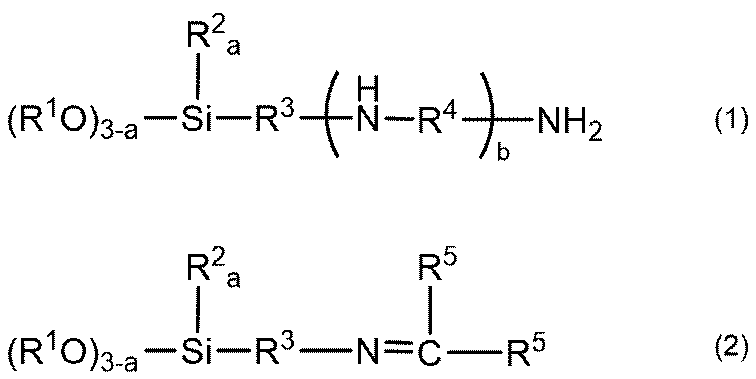
- B an organosilicon compound represented by the following formula (1), an organosilicon compound represented by the following formula (2), or both;
- R 1 and R 2 are each independently an alkyl group having 1 to 4 carbon atoms
- R 3 is each independently a divalent hydrocarbon group having 1 to 30 carbon atoms
- R 4 are each independently an alkylene group or carbonyl group having 1 to 6 carbon atoms
- R 5 is each independently a monovalent hydrocarbon group having 1 to 20 carbon atoms
- a is each independently 0 or 1
- b is an integer from 0 to 3.
- C one or more condensation catalysts selected from tetraalkoxytitanium, tetraalkoxyzirconium, tetraalkoxytin, trialkoxyaluminum and partial hydrolysates thereof;
- D a primer composition containing a solvent, 2.
- R 6 is each independently an alkyl group having 1 to 4 carbon atoms
- R 7 is each independently a carbon atom optionally substituted with a halogen atom, an acryl group, a methacryl group or an epoxy group.
- c is an integer of 1 to 4
- d is an integer of 0 to 3
- c+d 4.
- the primer composition of the present invention can strongly bond adherends such as polyimide resins and cured silicone products, and is particularly useful as an adhesive for semiconductor devices that require high reliability.
- the primer composition according to the present invention contains (A) a (meth)acrylate (co)polymer, (B) an organosilicon compound, (C) a condensation catalyst and (D) a solvent.
- Component (A) is an acrylic acid ester, a methacrylic acid ester, or a (co)polymer of both.
- a primer composition containing such component (A) forms a flexible film on the adherend and forms a bond with the addition-curable silicone composition through an addition reaction.
- the (meth)acrylic acid ester constituting the component (A) an alkyl (meth)acrylic acid ester having an alkyl group having 1 to 12 carbon atoms, particularly 1 to 4 carbon atoms is preferable.
- acrylic esters examples include methyl acrylate, ethyl acrylate, n-butyl acrylate, isobutyl acrylate, isopentyl acrylate, n-hexyl acrylate, isooctyl acrylate, 2-ethylhexyl acrylate, acrylic acid-n-octyl, isononyl acrylate, n-decyl acrylate, isodecyl acrylate and the like.
- methacrylates include methyl methacrylate, ethyl methacrylate, n-butyl methacrylate, isobutyl methacrylate, isopentyl methacrylate, n-hexyl methacrylate, isooctyl methacrylate, 2-ethylhexyl methacrylate, and methacrylic acid. acid-n-octyl, isononyl methacrylate, n-decyl methacrylate, isodecyl methacrylate and the like.
- the (meth)acrylic acid ester constituting the component (A) it is preferable to use one having one or more SiH groups in one molecule.
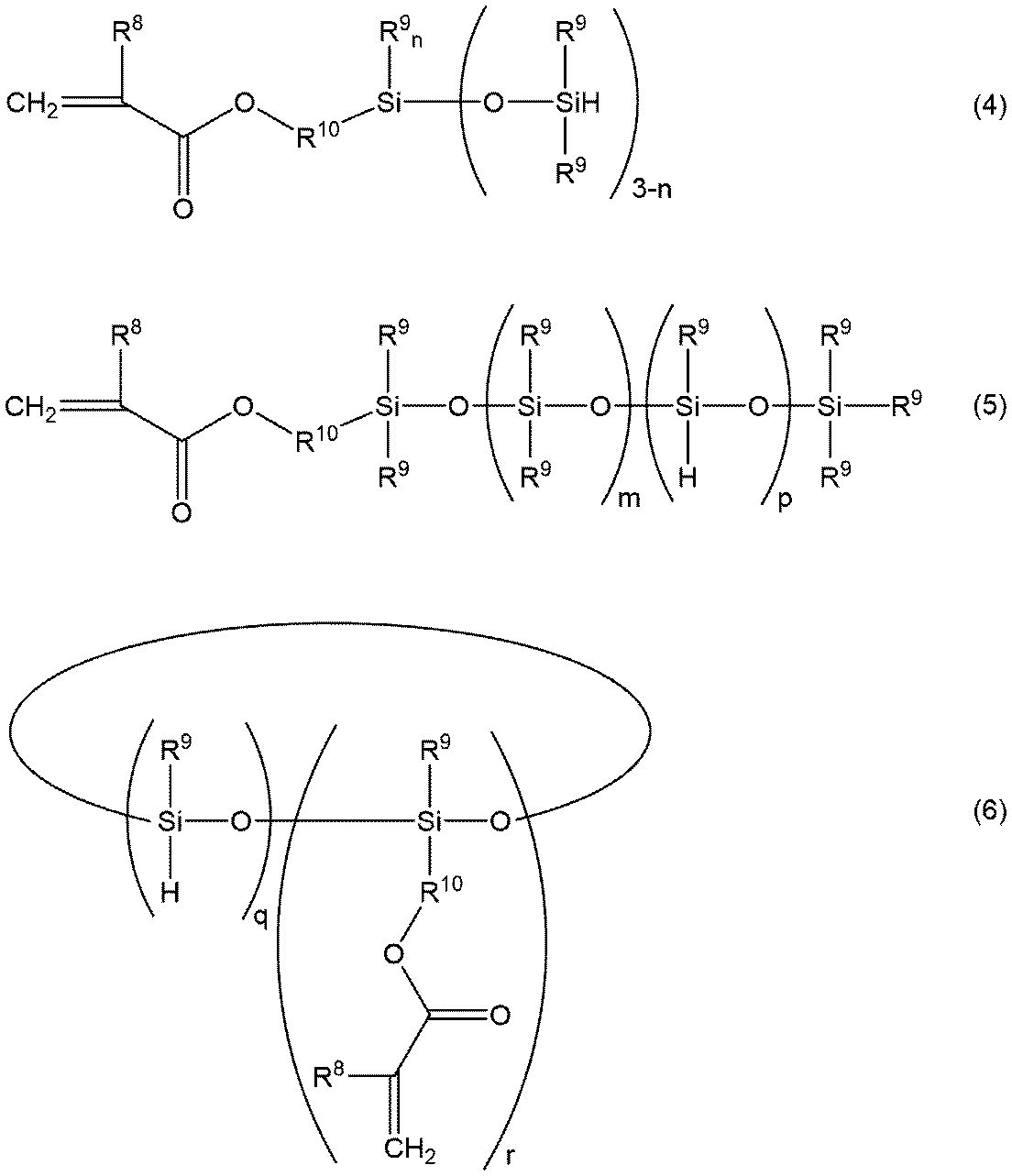
- Examples of (meth)acrylic acid esters having one or more SiH groups in one molecule include compounds represented by the following formulas (4) to (6).
- R 8 are each independently a hydrogen atom or a methyl group.
- R 9 are each independently a monovalent organic group.
- the monovalent organic group for R 9 is preferably an unsubstituted or substituted monovalent hydrocarbon group having 1 to 10 carbon atoms, particularly 1 to 3 carbon atoms.
- Monovalent hydrocarbon groups include linear or branched chains such as methyl, ethyl, n-propyl, i-propyl, n-butyl, i-butyl, s-butyl, t-butyl, pentyl, neopentyl, hexyl and octyl.
- Cycloalkyl groups such as cyclohexyl; Alkenyl groups such as vinyl, allyl (2-propenyl) and 1-propenyl; Aryl groups such as phenyl, tolyl, xylyl and naphthyl; Aralkyl groups and the like, and those in which some or all of the hydrogen atoms of these groups are substituted with halogen atoms such as fluorine, bromine and chlorine, cyano groups and the like, such as chloromethyl, chloropropyl, bromoethyl, trifluoropropyl, cyanoethyl and the like.
- R 9 is preferably a methyl group, an ethyl group or a phenyl group, particularly preferably a methyl group.
- R 10 are each independently a divalent organic group.
- divalent organic group for R 10 an unsubstituted or substituted divalent hydrocarbon group having 1 to 10 carbon atoms, particularly 1 to 3 carbon atoms is preferred.
- divalent hydrocarbon groups include linear or branched alkylene groups such as methylene, ethylene, propylene, trimethylene, tetramethylene, pentamethylene, hexamethylene, heptamethylene and octamethylene; cycloalkylene groups such as cyclohexylene; arylene groups such as phenylene and naphthylene;
- some or all of the hydrogen atoms in these groups may be substituted with halogen atoms such as fluorine, bromine or chlorine, or cyano groups, such as tetrafluoroethylene, hexafluoropropylene, and the like.
- R 10 is preferably a methylene group, an ethylene group or a trimethylene group, and particularly preferably a trim
- each bracketed siloxane unit may be arbitrary.
- These (meth)acrylic acid esters may be used singly or in combination of two or more.
- Component (A) preferably contains a compound represented by formula (4), and in particular, the compound represented by formula (4) can be used in combination with another acrylic acid ester and/or methacrylic acid ester. is preferred.
- the compound represented by formula (4) is preferably 1:1 to 20:1, more preferably 1:1 to 15:1, and even more preferably 1:1 to 10:1.
- Examples of the compound represented by formula (4) include the following.
- Examples of the compound represented by formula (5) include the following. (In the formula, m and p are the same as above. The arrangement of each bracketed siloxane unit may be arbitrary.)
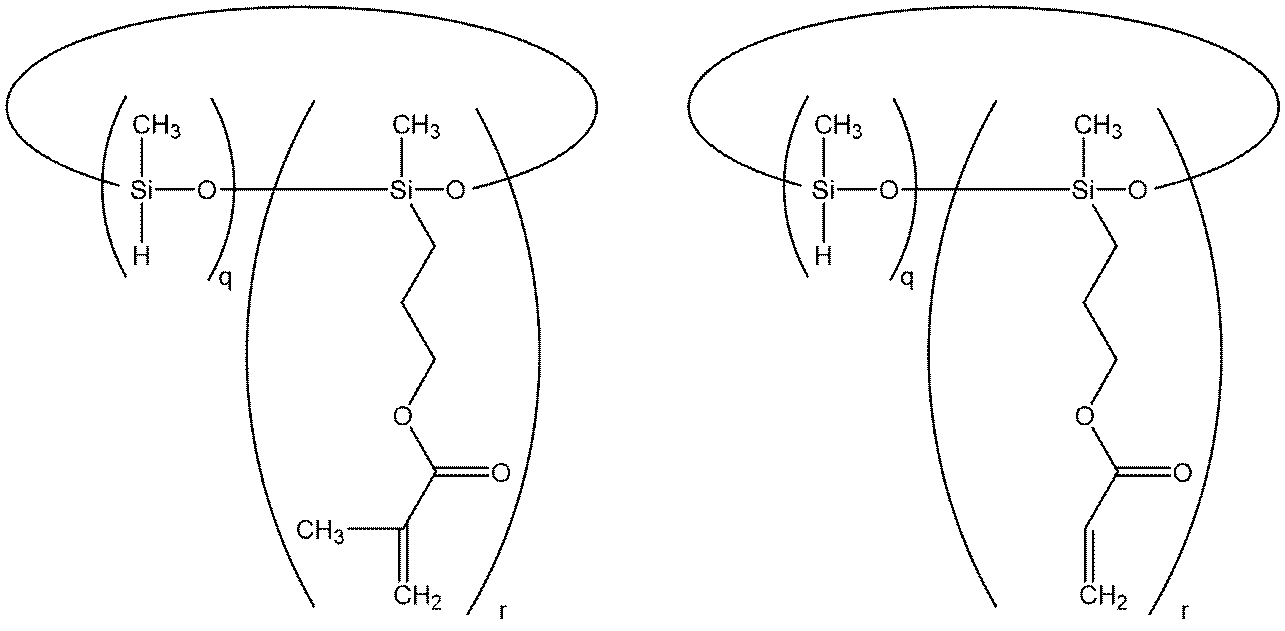
- Examples of the compound represented by formula (6) include the following. (In the formula, q and r are the same as above. The arrangement of each siloxane unit may be arbitrary.)
- Component (A) can be obtained by polymerizing a (meth)acrylic acid ester using a radical polymerization initiator such as 2,2'-azobisisobutyronitrile (AIBN), as described later.
- the weight average molecular weight of component (A) is not particularly limited, but is preferably 100 to 500,000, more preferably 10,000 to 200,000.
- a weight average molecular weight is a standard polystyrene conversion value by a gel permeation chromatography (GPC).
- the amount of component (A) to be blended is not particularly limited as long as it is an amount that dissolves in component (D), which will be described later. 10% by mass, more preferably 0.5 to 5% by mass. Within such a range, it is possible to prevent the surface of the obtained film from becoming uneven, and to obtain sufficient performance as a primer composition.
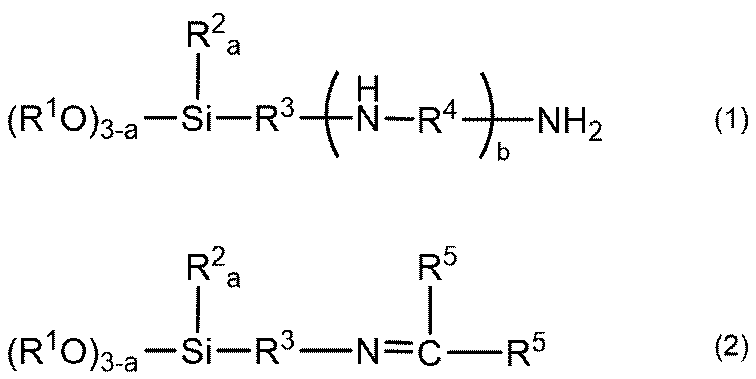
- Component (B) is an organosilicon compound represented by the following formula (1), an organosilicon compound represented by the following formula (2), or both.
- R 1 and R 2 are each independently an alkyl group having 1 to 4 carbon atoms.
- alkyl groups having 1 to 4 carbon atoms for R 1 and R 2 include methyl, ethyl, n-propyl, i-propyl, n-butyl, i-butyl, s-butyl and t-butyl. , ethyl groups are preferred.
- R 3 is each independently a divalent hydrocarbon group having 1 to 30 carbon atoms.
- Divalent hydrocarbon groups represented by R 3 include linear or branched alkylene groups such as methylene, ethylene, propylene, trimethylene, tetramethylene, pentamethylene, hexamethylene, heptamethylene and octamethylene; cyclohexylene; arylene groups such as phenylene and naphthylene, preferably those having 3 to 8 carbon atoms, and more preferably a trimethylene group.
- R 4 is each independently an alkylene group having 1 to 6 carbon atoms or a carbonyl group.
- the alkylene group having 1 to 6 carbon atoms for R 4 includes linear or branched alkylene groups such as methylene, ethylene, propylene, trimethylene, tetramethylene, pentamethylene and hexamethylene; cycloalkylene groups such as cyclohexylene; An arylene group such as phenylene and the like can be mentioned.
- a carbonyl group is preferred as R 4 .
- Each R 5 is independently a monovalent hydrocarbon group having 1 to 20 carbon atoms.
- monovalent hydrocarbon groups having 1 to 20 carbon atoms for R 5 include methyl, ethyl, n-propyl, i-propyl, n-butyl, i-butyl, s-butyl, t-butyl, pentyl, neopentyl and hexyl. , octyl, etc.; cycloalkyl groups, such as cyclohexyl; vinyl, allyl, propenyl, etc. alkenyl groups; phenyl, tolyl, xylyl, naphthyl, etc.
- R 5 is preferably an alkyl group having 1 to 10 carbon atoms, particularly preferably an alkyl group having 1 to 8 carbon atoms, and more preferably a methyl group, ethyl group, n-propyl group or butyl group.
- a is independently 0 or 1, preferably 0; b is an integer from 0 to 3, preferably 0; (B) component can be used individually by 1 type or in combination of 2 or more types.
- Component (B) preferably contains a compound represented by formula (1), more preferably R 4 is a carbonyl group.
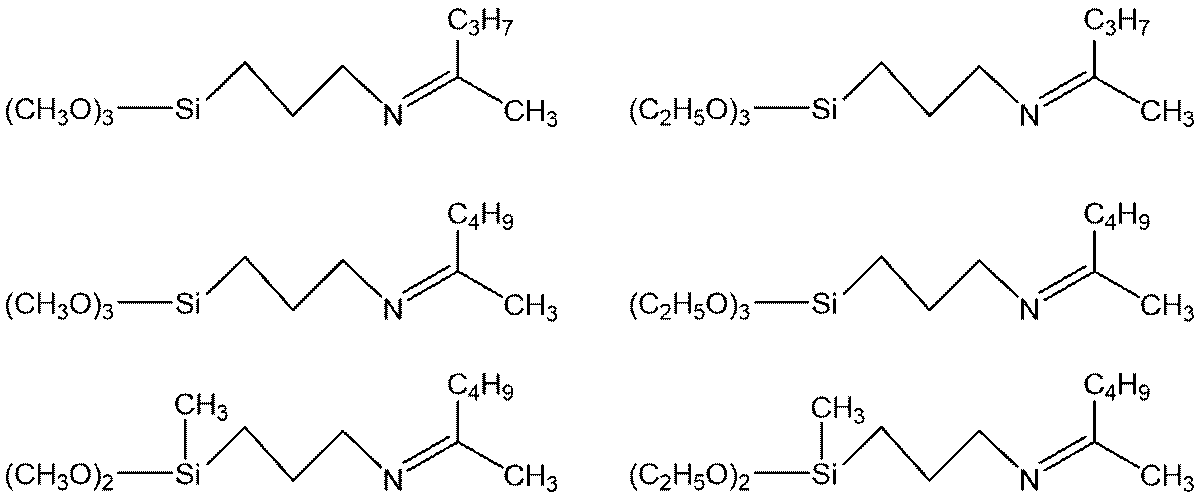
- Examples of the compound represented by formula (1) include the following.
- Examples of the compound represented by formula (2) include the following.
- the blending amount of component (B) is preferably 0.1 to 20% by mass, more preferably 0.1 to 10% by mass, and still more preferably 0.5 to 5% by mass of the entire composition. Within such a range, it is possible to prevent the surface of the obtained film from becoming uneven, and to obtain sufficient performance as a primer composition.
- the condensation catalyst of component (C) is one or more condensation catalysts selected from tetraalkoxytitanium, tetraalkoxyzirconium, tetraalkoxytin, trialkoxyaluminum and partial hydrolysates thereof, It accelerates the condensation reaction in the alkoxysilyl groups of component (B).
- the alkoxy group of component (C) preferably has an alkyl group having 1 to 6 carbon atoms, particularly preferably 1 to 4 carbon atoms. butoxy, t-butoxy and the like.
- tetraalkoxytitanium examples include tetramethoxytitanium, tetraethoxytitanium, tetra-n-propoxytitanium, tetraisopropoxytitanium, tetra-n-butoxytitanium and the like, with tetra-n-butoxytitanium being particularly preferred.
- tetraalkoxyzirconium examples include tetramethoxyzirconium, tetraethoxyzirconium, tetra-n-propoxyzirconium, tetraisopropoxyzirconium, tetra-n-butoxyzirconium and the like, with tetra-n-butoxyzirconium being particularly preferred.
- tetraalkoxytin examples include tetramethoxytin, tetraethoxytin, tetra-n-propoxytin, tetraisopropoxytin, tetra-n-butoxytin, tetra-t-butoxytin and the like, with tetra-t-butoxytin being particularly preferred.
- trialkoxyaluminum examples include aluminum (III) ethoxide, aluminum (III) isopropoxide, aluminum (III)-s-butoxide, aluminum (III)-n-butoxide, mono-s-butoxyaluminum diisopropylate, and the like. and aluminum (III)-n-butoxide, mono-s-butoxyaluminum diisopropylate are preferred. These may be used individually by 1 type, or may be used in combination of 2 or more type.
- the blending amount of component (C) is preferably 1 to 300 parts by mass, more preferably 20 to 250 parts by mass, per 100 parts by mass of component (B). With such a range, a coating excellent in strength can be obtained.
- the solvent for component (D) is not particularly limited as long as it dissolves components (A), (B), (C) and optional components described later.
- organic solvents can be used.
- solvents include aromatic hydrocarbon solvents such as xylene, toluene, and benzene; aliphatic hydrocarbon solvents such as heptane, hexane, and ligroin; and halogenated hydrocarbon solvents such as trichlorethylene, perchlorethylene, and methylene chloride.
- ester solvents such as ethyl acetate and 1-propylene glycol methyl ether acetate; ether solvents such as tetrahydrofuran and diethyl ether; ketone solvents such as methyl isobutyl ketone, methyl ethyl ketone and cyclohexanone; alcohol solvents such as ethanol, isopropanol and butanol. ; rubber volatile oil, silicone solvent and the like.
- ethyl acetate, 1-propylene glycol methyl ether acetate, tetrahydrofuran and acetone are preferably used.
- the component (D) may be used alone or in combination of two or more as a mixed solvent, depending on the evaporation rate during the coating operation of the primer composition.
- the amount of component (D) is not particularly limited, but is preferably 60% by mass or more, more preferably 80 to 95% by mass, and still more preferably 85 to 90% by mass of the entire primer composition. Within such a range, a coating film of the primer composition can be formed uniformly, and irregularities on the surface of the coating film can be suppressed.
- the amount of the component (D) is the total amount in the composition including the solvent in the solution.
- the primer composition of the present invention may further contain an organosilicon compound represented by the following formula (3) as component (E).
- component (E) R6O ) cR7dSi ( 3 )
- Each R 6 is independently an alkyl group having 1 to 4 carbon atoms.
- alkyl groups having 1 to 4 carbon atoms for R 6 include methyl, ethyl, n-propyl, i-propyl, n-butyl, i-butyl, s-butyl and t-butyl. is preferred.
- R 7 is each independently a C 1-10 monovalent hydrocarbon group optionally substituted with a halogen atom, acryl group, methacryl group or epoxy group.
- Examples of the monovalent hydrocarbon group having 1 to 10 carbon atoms for R 7 include the same as those exemplified for the monovalent hydrocarbon group for R 9 , preferably a methyl group or a phenyl group.
- c is an integer of 1 to 4, preferably 3 or 4;
- Component (E) includes, for example, tetramethoxysilane, tetraethoxysilane, tetra-n-propoxysilane, tetra-n-butoxysilane, methyltrimethoxysilane, methyltriethoxysilane, dimethyldimethoxysilane, dimethyldiethoxysilane, and the like. are mentioned. Among these, tetramethoxysilane and tetraethoxysilane are particularly preferred.
- the amount of component (E) when used is not particularly limited, but is preferably 1 to 20% by mass, more preferably 2 to 10% by mass of the entire composition.
- the primer composition of the present invention may further contain other optional components such as phosphors, reinforcing fillers, dyes, pigments, heat resistance improvers, antioxidants, adhesion promoters, and Agents and the like may be added.
- primer composition of the present invention for example, the above components (A), (B), (C) and (D) and, if necessary, component (E) and other optional components are uniformly mixed with a mixing stirrer. obtained by a method or the like.
- the primer composition of the present invention can be suitably used to improve adhesion between an adherend and a cured silicone product.
- a method for bonding an adherend and a cured silicone product using the primer composition of the present invention for example, the primer composition of the present invention is supplied onto the adherend, and the primer composition is supplied to the adherend.
- a method such as placing a curable silicone composition on an adherend and curing the silicone composition can be employed.
- the primer composition of the present invention can be supplied onto the adherend by a known method such as brush coating or spray coating. After supplying the primer composition onto the adherend, air-dry it for 5 minutes to 24 hours, preferably 10 minutes to 12 hours, then apply the curable silicone composition, and heat at room temperature (25 ° C.) or heat. The adherend and the cured silicone material may be adhered by curing the silicone composition under the conditions described above. Similarly, the adherend and the silicone cured product may be adhered.
- the adherend used in the present invention includes organic resins such as acrylic resins, phenolic resins, epoxy resins, polycarbonate resins, polyethylene terephthalate resins, polybutylene terephthalate resins, polyamide resins, polyimide resins, and polypropylene resins, various metals, glass, and the like.
- organic resins such as acrylic resins, phenolic resins, epoxy resins, polycarbonate resins, polyethylene terephthalate resins, polybutylene terephthalate resins, polyamide resins, polyimide resins, and polypropylene resins, various metals, glass, and the like.
- polyimide resins are particularly preferred.
- Examples of polyimide resins include HJA-A4-100 (manufactured by Kitashin Co., Ltd.), Kapton 100H, and Kapton 100EN (both of which are manufactured by Toray Industries, Inc.).
- curable silicone compositions include addition-curable, peroxide-curable, condensation-curable, and the like, but addition-curable silicone rubber compositions are preferred in the present invention.
- addition-curable silicone rubber composition known ones can be used. Usually, an organopolysiloxane having two or more alkenyl groups such as a vinyl group in one molecule and two SiH groups in one molecule are used. It is possible to use those containing the above-mentioned organohydrogenpolysiloxane and an addition reaction catalyst such as a platinum group metal-based catalyst.
- Addition-curable silicone rubber compositions include, for example, KE-106 and KER-2600 (manufactured by Shin-Etsu Chemical Co., Ltd.).
- the weight average molecular weight of the obtained copolymer was 95,000 as a standard polystyrene conversion value measured by GPC (HLC-8320GPC, manufactured by Tosoh Corporation) using tetrahydrofuran as a developing solvent.
- Examples 1-1 to 1-7, Comparative Examples 1-1 and 1-2 The following components were mixed in the amounts shown in Table 1 to prepare primer compositions (I) to (VII) and comparative primer compositions (VIII) and (IX). In addition, the numerical value in Table 1 represents a mass part.
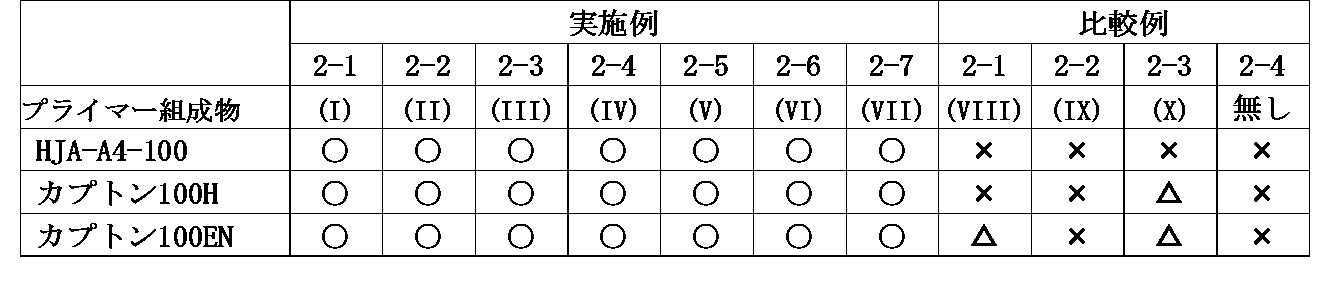
- Examples 2-1 to 2-7, Comparative Examples 2-1 and 2-2 The primer compositions (I) to (VII) and the comparative primer compositions (VIII) and (IX) obtained in Examples 1-1 to 1-7 and Comparative Examples 1-1 and 1-2 are described below. Adhesion was evaluated by an adhesion test. Table 2 shows the results.
- the case where the cured silicone material peeled off when the laminated sheet was folded was x.
- ⁇ A case in which the cured silicone product did not peel off even when the laminated sheet was folded and cohesive failure occurred when the cured silicone product was to be peeled off by hand was evaluated as ⁇ .
- Examples 2-1 to 2-7 are Comparative Examples 2-1 to 2-3 using a primer composition different from the primer composition of the present invention and Comparative Examples 2-1 to 2-3 using no primer composition. It can be seen that the adhesion of the addition-curable silicone cured product to the polyimide sheet is remarkably improved as compared with Comparative Examples 2-4.
Landscapes
- Chemical & Material Sciences (AREA)
- Organic Chemistry (AREA)
- Life Sciences & Earth Sciences (AREA)
- Engineering & Computer Science (AREA)
- Materials Engineering (AREA)
- Wood Science & Technology (AREA)
- Paints Or Removers (AREA)
Abstract
Description
なお、本発明に関連する先行技術文献としては、下記のものが挙げられる。
1. (A)アクリル酸エステル、メタクリル酸エステルまたはこれらの両方の(共)重合体と、
(B)下記式(1)で表される有機ケイ素化合物、下記式(2)で表される有機ケイ素化合物またはこれらの両方と、
(C)テトラアルコキシチタン、テトラアルコキシジルコニウム、テトラアルコキシスズ、トリアルコキシアルミニウムおよびこれらの部分加水分解物から選ばれる1種以上の縮合触媒と、
(D)溶剤と
を含有するプライマー組成物、
2. (A)成分を構成するアクリル酸エステル、メタクリル酸エステルまたはこれらの両方が、1分子中に1個以上のSiH基を有する化合物を含む1記載のプライマー組成物、
3. (B)成分が、上記式(1)で表される有機ケイ素化合物を含み、かつ、R4が、カルボニル基である1または2記載のプライマー組成物、
4. さらに、(E)下記式(3)で表される有機ケイ素化合物を含む1~3のいずれかに記載のプライマー組成物、
(R6O)cR7 dSi (3)
(式中、R6は、互いに独立に、炭素数1~4のアルキル基であり、R7は、互いに独立に、ハロゲン原子、アクリル基、メタクリル基またはエポキシ基で置換されていてもよい炭素数1~10の1価炭化水素基であり、cは、1~4の整数であり、dは、0~3の整数であり、c+d=4である。)
5. 1~4のいずれかに記載のプライマー組成物を被着体上に供給する工程と、
前記プライマー組成物を供給した被着体上に、硬化性シリコーン組成物を配置し、このシリコーン組成物を硬化させる工程と
を有する被着体とシリコーン硬化物との接着方法、
6. 被着体が、ポリイミド樹脂である5記載の接着方法
を提供する。
本発明に係るプライマー組成物は、(A)(メタ)アクリル酸エステル(共)重合体、(B)有機ケイ素化合物、(C)縮合触媒および(D)溶剤を含有する。
(A)成分は、アクリル酸エステル、メタクリル酸エステルまたはこれらの両方の(共)重合体である。
このような(A)成分を含有するプライマー組成物は、被着体上に可撓性のある膜を形成し、付加硬化型シリコーン組成物と付加反応による結合を形成する。
(A)成分を構成する(メタ)アクリル酸エステルとしては、アルキル基の炭素数が1~12、特に炭素数1~4の(メタ)アクリル酸アルキルエステルが好ましい。
1分子中に1個以上のSiH基を有する(メタ)アクリル酸エステルとしては、下記式(4)~(6)で表される化合物等が挙げられる。
R9は、互いに独立に、1価の有機基である。R9の1価の有機基としては、炭素数1~10、特に炭素数1~3の非置換または置換の1価炭化水素基が好ましい。1価炭化水素基としては、メチル、エチル、n-プロピル、i-プロピル、n-ブチル、i-ブチル、s-ブチル、t-ブチル、ペンチル、ネオペンチル、ヘキシル、オクチル等の直鎖状または分岐鎖状アルキル基;シクロヘキシル等のシクロアルキル基;ビニル、アリル(2-プロペニル)、1-プロペニル等のアルケニル基;フェニル、トリル、キシリル、ナフチル等のアリール基;ベンジル、フェニルエチル、フェニルプロピル等のアラルキル基等や、これらの基の水素原子の一部または全部がフッ素、臭素、塩素等のハロゲン原子、シアノ基等で置換されたもの、例えば、クロロメチル、クロロプロピル、ブロモエチル、トリフルオロプロピル、シアノエチルなどが挙げられる。R9としては、メチル基、エチル基、フェニル基が好ましく、メチル基が特に好ましい。
これらの(メタ)アクリル酸エステルは、1種単独で用いても、2種以上を併用してもよい。(A)成分は、式(4)で表される化合物を含むことが好ましく、特に、他のアクリル酸エステルおよび/またはメタクリル酸エステルと、式(4)で表される化合物とを併用することが好ましい。
この場合、他のアクリル酸エステルおよび/またはメタクリル酸エステルと、式(4)で表される化合物との使用比率に特に制限はないが、モル比で、他のアクリル酸エステルおよび/またはメタクリル酸エステル:式(4)で表される化合物が、1:1~20:1が好ましく、1:1~15:1がより好ましく、1:1~10:1がより一層好ましい。


(式中、qおよびrは、上記と同じである。各シロキサン単位の配列は、任意であってよい。)
(A)成分の重量平均分子量は、特に制限されるものではないが、100~500,000が好ましく、より好ましくは、10,000~200,000である。なお、本発明において、重量平均分子量は、ゲルパーミエーションクロマトグラフィー(GPC)による標準ポリスチレン換算値である。
(B)成分は、下記式(1)で表される有機ケイ素化合物、下記式(2)で表される有機ケイ素化合物またはこれらの両方である。
(B)成分は1種を単独で、または2種以上を組み合わせて用いることができる。(B)成分は、式(1)で表される化合物を含むことが好ましく、R4が、カルボニル基であるものがより好ましい。

(C)成分の縮合触媒は、テトラアルコキシチタン、テトラアルコキシジルコニウム、テトラアルコキシスズ、トリアルコキシアルミニウムおよびこれらの部分加水分解物から選ばれる1種以上の縮合触媒であり、(B)成分のアルコキシシリル基における縮合反応を促進させるものである。
(C)成分のアルコキシ基としては、アルキル基の炭素数が1~6、特に炭素数1~4のものが好ましく、例えば、メトキシ、エトキシ、n-プロポキシ、イソプロポキシ、n-ブトキシ、s-ブトキシ、t-ブトキシ等が挙げられる。
テトラアルコキシジルコニウムとしては、テトラメトキシジルコニウム、テトラエトキシジルコニウム、テトラ-n-プロポキシジルコニウム、テトライソプロポキシジルコニウム、テトラ-n-ブトキシジルコニウム等が例示され、テトラ-n-ブトキシジルコニウムが特に好ましい。
テトラアルコキシスズとしては、テトラメトキシスズ、テトラエトキシスズ、テトラ-n-プロポキシスズ、テトライソプロポキシスズ、テトラ-n-ブトキシスズ、テトラ-t-ブトキシスズ等が例示され、テトラ-t-ブトキシスズが特に好ましい。
トリアルコキシアルミニウムとしては、アルミニウム(III)エトキサイド、アルミニウム(III)イソプロポキサイド、アルミニウム(III)-s-ブトキサイド、アルミニウム(III)-n-ブトキサイド、モノ-s-ブトキシアルミニウムジイソプロピレート等が例示され、アルミニウム(III)-n-ブトキサイド、モノ-s-ブトキシアルミニウムジイソプロピレートが好ましい。
これらは1種を単独で使用しても、2種以上を組み合わせて使用してもよい。
(D)成分の溶剤としては、上記(A)、(B)、(C)成分および後述する任意成分を溶解するものであれば特に限定されるものではなく、公知の有機溶剤を使用することができる。
溶剤としては、例えば、キシレン、トルエン、ベンゼン等の芳香族炭化水素系溶剤;ヘプタン、ヘキサン、リグロイン等の脂肪族炭化水素系溶剤;トリクロロエチレン、パークロロエチレン、塩化メチレン等のハロゲン化炭化水素系溶剤;酢酸エチル、1-プロピレングリコールメチルエーテルアセテート等のエステル系溶剤;テトラヒドロフラン、ジエチルエーテル等のエーテル系溶剤;メチルイソブチルケトン、メチルエチルケトン、シクロヘキサノン等のケトン系溶剤;エタノール、イソプロパノール、ブタノール等のアルコール系溶剤;ゴム揮発油、シリコーン系溶剤などが挙げられる。これらの中でも酢酸エチル、1-プロピレングリコールメチルエーテルアセテート、テトラヒドロフラン、アセトンが好適に用いられる。
本発明のプライマー組成物には、さらに、(E)成分として、下記式(3)で表される有機ケイ素化合物を添加してもよい。
(R6O)cR7 dSi (3)
R7は、互いに独立に、ハロゲン原子、アクリル基、メタクリル基またはエポキシ基で置換されていてもよい炭素数1~10の1価炭化水素基である。R7の炭素数1~10の1価炭化水素基としては、R9の1価炭化水素基として例示したものと同じものが挙げられ、メチル基、フェニル基が好ましい。
cは、1~4の整数であり、好ましくは3または4であり、dは、0~3の整数であり、好ましくは0または1であり、c+d=4である。
本発明のプライマー組成物には、本発明の目的を損なわない範囲で、さらに、その他の任意成分として、蛍光体、補強性充填剤、染料、顔料、耐熱性向上剤、酸化防止剤、接着促進剤等を添加してもよい。
本発明のプライマー組成物は、例えば、上記(A)、(B)、(C)および(D)成分ならびに必要に応じて(E)成分およびその他の任意成分を混合撹拌機により均一に混合する方法等により得られる。
本発明のプライマー組成物は、被着体とシリコーン硬化物との接着性を向上させるのに好適に用いることができる。本発明のプライマー組成物を用いて被着体とシリコーン硬化物とを接着させる方法としては、例えば、被着体上に、本発明のプライマー組成物を供給し、このプライマー組成物を供給した被着体上に硬化性シリコーン組成物を配置して、シリコーン組成物を硬化させる方法等を採用することができる。
メタクリル酸メチル40質量部、下記構造式(7)で表されるSiH基含有メタクリル酸エステル14質量部、酢酸エチル230質量部、AIBN0.25質量部を90℃で6時間加熱撹拌し、共重合体を含有する不揮発分8質量%(105℃×3時間における値)の酢酸エチル溶液を得た。
得られた共重合体の重量平均分子量は、GPC(HLC-8320GPC、東ソー(株)製)を用いてテトラヒドロフランを展開溶媒として測定した標準ポリスチレン換算値として95,000であった。
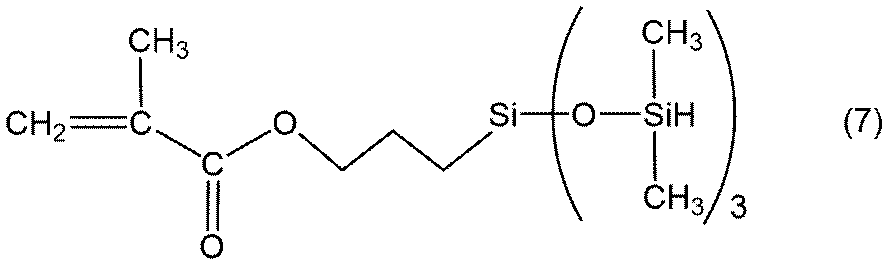
表1に示す配合量で下記の各成分を混合し、プライマー組成物(I)~(VII)、比較用プライマー組成物(VIII),(IX)を製造した。なお、表1中の数値は、質量部を表す。



(D):酢酸エチル
(E):テトラエトキシシラン

実施例1-1~1-7および比較例1-1,1-2で得られたプライマー組成物(I)~(VII)、比較用プライマー組成物(VIII),(IX)について、下記の接着試験により接着性を評価した。結果を表2に示す。
付加硬化型シリコーン用プライマー組成物(X)(PRIMER NO4(カーボンファンクショナルシラン系プライマー)、信越化学工業(株)製)をそのまま用いて、下記の接着試験により接着性を評価した。結果を表2に示す。
プライマー組成物を用いない以外は、下記の接着試験により接着性を評価した。結果を表2に示す。
被着体として30mm×30mmに切り出した3種のポリイミドシート(HJA-A4-100、(株)北新製;カプトン100H、東レ(株)製;カプトン100EN、東レ(株)製)を用い、プライマー組成物を被着体に刷毛塗りし、25℃にて15分間風乾した。この上に付加硬化型シリコーン組成物(KE-106、信越化学工業(株)製)を垂らし、硬化させ、積層シートを作製した。
得られた積層シート上のシリコーン硬化物の中央付近にカッターナイフで切れ込みを入れ、積層シートを折り曲げた際のシリコーン硬化物の状態を確認した。積層シートを折り曲げた際に、シリコーン硬化物が剥離した場合を×、積層シートを折り曲げてもシリコーン硬化物が剥離しないものの、シリコーン硬化物を手で引き剥がそうとした際に全面剥離した場合を△、積層シートを折り曲げてもシリコーン硬化物が剥離せず、シリコーン硬化物を手で引き剥がそうとした際に凝集破壊した場合を〇として評価した。
Claims (6)
- (A)アクリル酸エステル、メタクリル酸エステルまたはこれらの両方の(共)重合体と、
(B)下記式(1)で表される有機ケイ素化合物、下記式(2)で表される有機ケイ素化合物またはこれらの両方と、

(C)テトラアルコキシチタン、テトラアルコキシジルコニウム、テトラアルコキシスズ、トリアルコキシアルミニウムおよびこれらの部分加水分解物から選ばれる1種以上の縮合触媒と、
(D)溶剤と
を含有するプライマー組成物。 - (A)成分を構成するアクリル酸エステル、メタクリル酸エステルまたはこれらの両方が、1分子中に1個以上のSiH基を有する化合物を含む請求項1記載のプライマー組成物。
- (B)成分が、上記式(1)で表される有機ケイ素化合物を含み、かつ、R4が、カルボニル基である請求項1または2記載のプライマー組成物。
- さらに、(E)下記式(3)で表される有機ケイ素化合物を含む請求項1~3のいずれか1項記載のプライマー組成物。
(R6O)cR7 dSi (3)
(式中、R6は、互いに独立に、炭素数1~4のアルキル基であり、R7は、互いに独立に、ハロゲン原子、アクリル基、メタクリル基またはエポキシ基で置換されていてもよい炭素数1~10の1価炭化水素基であり、cは、1~4の整数であり、dは、0~3の整数であり、c+d=4である。) - 請求項1~4のいずれか1項記載のプライマー組成物を被着体上に供給する工程と、
前記プライマー組成物を供給した被着体上に、硬化性シリコーン組成物を配置し、このシリコーン組成物を硬化させる工程と
を有する被着体とシリコーン硬化物との接着方法。 - 被着体が、ポリイミド樹脂である請求項5記載の接着方法。
Priority Applications (3)
| Application Number | Priority Date | Filing Date | Title |
|---|---|---|---|
| JP2022577036A JP7626147B2 (ja) | 2021-01-19 | 2021-12-15 | プライマー組成物 |
| CN202180091031.0A CN116848203B (zh) | 2021-01-19 | 2021-12-15 | 底漆组合物 |
| KR1020237026419A KR20230134124A (ko) | 2021-01-19 | 2021-12-15 | 프라이머 조성물 |
Applications Claiming Priority (2)
| Application Number | Priority Date | Filing Date | Title |
|---|---|---|---|
| JP2021006372 | 2021-01-19 | ||
| JP2021-006372 | 2021-01-19 |
Publications (1)
| Publication Number | Publication Date |
|---|---|
| WO2022158177A1 true WO2022158177A1 (ja) | 2022-07-28 |
Family
ID=82548265
Family Applications (1)
| Application Number | Title | Priority Date | Filing Date |
|---|---|---|---|
| PCT/JP2021/046197 Ceased WO2022158177A1 (ja) | 2021-01-19 | 2021-12-15 | プライマー組成物 |
Country Status (5)
| Country | Link |
|---|---|
| JP (1) | JP7626147B2 (ja) |
| KR (1) | KR20230134124A (ja) |
| CN (1) | CN116848203B (ja) |
| TW (1) | TWI899410B (ja) |
| WO (1) | WO2022158177A1 (ja) |
Citations (1)
| Publication number | Priority date | Publication date | Assignee | Title |
|---|---|---|---|---|
| JP2001262066A (ja) * | 2000-03-15 | 2001-09-26 | Kanegafuchi Chem Ind Co Ltd | プライマー組成物および接着方法 |
Family Cites Families (6)
| Publication number | Priority date | Publication date | Assignee | Title |
|---|---|---|---|---|
| JP5199530B2 (ja) * | 2004-12-08 | 2013-05-15 | 株式会社カネカ | 耐汚染性付与組成物、塗料組成物および該塗料組成物から得られる塗膜 |
| JP5205006B2 (ja) * | 2007-08-08 | 2013-06-05 | 株式会社カネカ | 硬化性組成物を用いた塗装方法および塗装物 |
| JP5356729B2 (ja) * | 2008-05-26 | 2013-12-04 | 株式会社カネカ | プライマー組成物 |
| JP4870176B2 (ja) * | 2009-01-23 | 2012-02-08 | 信越化学工業株式会社 | プライマー組成物およびそれを用いた光半導体装置 |
| JP6892343B2 (ja) * | 2017-07-20 | 2021-06-23 | 株式会社カネカ | プライマー用硬化剤 |
| JP7001014B2 (ja) | 2018-08-02 | 2022-01-19 | 信越化学工業株式会社 | ジエン系ゴムとシリコーンゴムとの接着方法 |
-
2021
- 2021-12-15 JP JP2022577036A patent/JP7626147B2/ja active Active
- 2021-12-15 WO PCT/JP2021/046197 patent/WO2022158177A1/ja not_active Ceased
- 2021-12-15 CN CN202180091031.0A patent/CN116848203B/zh active Active
- 2021-12-15 KR KR1020237026419A patent/KR20230134124A/ko active Pending
- 2021-12-28 TW TW110149055A patent/TWI899410B/zh active
Patent Citations (1)
| Publication number | Priority date | Publication date | Assignee | Title |
|---|---|---|---|---|
| JP2001262066A (ja) * | 2000-03-15 | 2001-09-26 | Kanegafuchi Chem Ind Co Ltd | プライマー組成物および接着方法 |
Also Published As
| Publication number | Publication date |
|---|---|
| JP7626147B2 (ja) | 2025-02-04 |
| KR20230134124A (ko) | 2023-09-20 |
| CN116848203B (zh) | 2025-02-25 |
| TW202242042A (zh) | 2022-11-01 |
| TWI899410B (zh) | 2025-10-01 |
| CN116848203A (zh) | 2023-10-03 |
| JPWO2022158177A1 (ja) | 2022-07-28 |
Similar Documents
| Publication | Publication Date | Title |
|---|---|---|
| JP5130995B2 (ja) | 無溶剤型シリコーン粘着剤組成物 | |
| RU2539296C2 (ru) | Антиадгезионные материалы на основе фторсиликоновой смеси | |
| KR102925702B1 (ko) | 실리콘 박리제 조성물, 박리지 및 박리 필름 | |
| JP6990167B2 (ja) | シリコーン剥離剤組成物、剥離紙及び剥離フィルム | |
| JP7092196B2 (ja) | シリコーン粘着剤組成物及びこれを用いた粘着テープ又は粘着フィルム | |
| KR20100136426A (ko) | 부가 반응 경화형 실리콘 점착제 조성물 및 점착 테이프 | |
| JP5115300B2 (ja) | 基材密着性良好なシリコーン粘着剤組成物およびシリコーン粘着テープ | |
| KR20150037760A (ko) | 대전 방지성 박리 필름 | |
| JPH0548261B2 (ja) | ||
| JP5553395B2 (ja) | シリコーン粘着層を含む積層体 | |
| US5561184A (en) | Room temperature curable silicone composition | |
| JP3024445B2 (ja) | 剥離剤用シリコーン組成物及び剥離紙 | |
| JP6115680B2 (ja) | オイルブリード性シリコーンゴム用接着剤組成物 | |
| CN1863885A (zh) | 压敏粘合剂组合物 | |
| JP2010184953A (ja) | シリコーン粘着テープ及びその製造方法 | |
| JP2002371261A (ja) | 紫外線硬化型シリコーン粘着剤組成物 | |
| WO2022158177A1 (ja) | プライマー組成物 | |
| JPH066699B2 (ja) | シリコ−ンゴム用接着剤 | |
| JP4900614B2 (ja) | 接着性シリコーンゴム組成物 | |
| KR20230002732A (ko) | 폴리오가노실록산 하이브리드 감압성 접착제 및 이의 제조와 사용 방법 | |
| JP6319168B2 (ja) | 縮合反応生成物の製造方法、該縮合反応生成物を含有する室温硬化性オルガノポリシロキサン組成物の製造方法 | |
| JP2008024777A (ja) | シリコーンゴム用付加硬化型シリコーン粘着剤組成物及び該組成物から得られる粘着テープ | |
| JP2922416B2 (ja) | プライマー組成物 | |
| JP2011194792A (ja) | 印刷用ブランケット | |
| KR102692406B1 (ko) | 실리콘 수지와 폴리올레핀계 수지의 접착용 프라이머 조성물, 및 실리콘 수지와 폴리올레핀계 수지의 접착 방법 |
Legal Events
| Date | Code | Title | Description |
|---|---|---|---|
| 121 | Ep: the epo has been informed by wipo that ep was designated in this application |
Ref document number: 21921279 Country of ref document: EP Kind code of ref document: A1 |
|
| ENP | Entry into the national phase |
Ref document number: 2022577036 Country of ref document: JP Kind code of ref document: A |
|
| WWE | Wipo information: entry into national phase |
Ref document number: 202180091031.0 Country of ref document: CN |
|
| ENP | Entry into the national phase |
Ref document number: 20237026419 Country of ref document: KR Kind code of ref document: A |
|
| WWE | Wipo information: entry into national phase |
Ref document number: 1020237026419 Country of ref document: KR |
|
| NENP | Non-entry into the national phase |
Ref country code: DE |
|
| 122 | Ep: pct application non-entry in european phase |
Ref document number: 21921279 Country of ref document: EP Kind code of ref document: A1 |
|
| WWG | Wipo information: grant in national office |
Ref document number: 202180091031.0 Country of ref document: CN |