WO2022158172A1 - フレキソ印刷版用感光性樹脂構成体、及びフレキソ印刷版の製造方法 - Google Patents
フレキソ印刷版用感光性樹脂構成体、及びフレキソ印刷版の製造方法 Download PDFInfo
- Publication number
- WO2022158172A1 WO2022158172A1 PCT/JP2021/046025 JP2021046025W WO2022158172A1 WO 2022158172 A1 WO2022158172 A1 WO 2022158172A1 JP 2021046025 W JP2021046025 W JP 2021046025W WO 2022158172 A1 WO2022158172 A1 WO 2022158172A1
- Authority
- WO
- WIPO (PCT)
- Prior art keywords
- photosensitive resin
- flexographic printing
- group
- infrared
- layer
- Prior art date
- Legal status (The legal status is an assumption and is not a legal conclusion. Google has not performed a legal analysis and makes no representation as to the accuracy of the status listed.)
- Ceased
Links
Images

Classifications
-
- G—PHYSICS
- G03—PHOTOGRAPHY; CINEMATOGRAPHY; ANALOGOUS TECHNIQUES USING WAVES OTHER THAN OPTICAL WAVES; ELECTROGRAPHY; HOLOGRAPHY
- G03F—PHOTOMECHANICAL PRODUCTION OF TEXTURED OR PATTERNED SURFACES, e.g. FOR PRINTING, FOR PROCESSING OF SEMICONDUCTOR DEVICES; MATERIALS THEREFOR; ORIGINALS THEREFOR; APPARATUS SPECIALLY ADAPTED THEREFOR
- G03F7/00—Photomechanical, e.g. photolithographic, production of textured or patterned surfaces, e.g. printing surfaces; Materials therefor, e.g. comprising photoresists; Apparatus specially adapted therefor
- G03F7/004—Photosensitive materials
- G03F7/09—Photosensitive materials characterised by structural details, e.g. supports, auxiliary layers
- G03F7/11—Photosensitive materials characterised by structural details, e.g. supports, auxiliary layers having cover layers or intermediate layers, e.g. subbing layers
-
- C—CHEMISTRY; METALLURGY
- C08—ORGANIC MACROMOLECULAR COMPOUNDS; THEIR PREPARATION OR CHEMICAL WORKING-UP; COMPOSITIONS BASED THEREON
- C08F—MACROMOLECULAR COMPOUNDS OBTAINED BY REACTIONS ONLY INVOLVING CARBON-TO-CARBON UNSATURATED BONDS
- C08F212/00—Copolymers of compounds having one or more unsaturated aliphatic radicals, each having only one carbon-to-carbon double bond, and at least one being terminated by an aromatic carbocyclic ring
- C08F212/02—Monomers containing only one unsaturated aliphatic radical
- C08F212/04—Monomers containing only one unsaturated aliphatic radical containing one ring
- C08F212/06—Hydrocarbons
- C08F212/08—Styrene
-
- B—PERFORMING OPERATIONS; TRANSPORTING
- B41—PRINTING; LINING MACHINES; TYPEWRITERS; STAMPS
- B41C—PROCESSES FOR THE MANUFACTURE OR REPRODUCTION OF PRINTING SURFACES
- B41C1/00—Forme preparation
- B41C1/10—Forme preparation for lithographic printing; Master sheets for transferring a lithographic image to the forme
-
- B—PERFORMING OPERATIONS; TRANSPORTING
- B41—PRINTING; LINING MACHINES; TYPEWRITERS; STAMPS
- B41F—PRINTING MACHINES OR PRESSES
- B41F5/00—Rotary letterpress machines
- B41F5/24—Rotary letterpress machines for flexographic printing
-
- C—CHEMISTRY; METALLURGY
- C08—ORGANIC MACROMOLECULAR COMPOUNDS; THEIR PREPARATION OR CHEMICAL WORKING-UP; COMPOSITIONS BASED THEREON
- C08F—MACROMOLECULAR COMPOUNDS OBTAINED BY REACTIONS ONLY INVOLVING CARBON-TO-CARBON UNSATURATED BONDS
- C08F10/00—Homopolymers and copolymers of unsaturated aliphatic hydrocarbons having only one carbon-to-carbon double bond
- C08F10/04—Monomers containing three or four carbon atoms
- C08F10/08—Butenes
- C08F10/10—Isobutene
-
- C—CHEMISTRY; METALLURGY
- C08—ORGANIC MACROMOLECULAR COMPOUNDS; THEIR PREPARATION OR CHEMICAL WORKING-UP; COMPOSITIONS BASED THEREON
- C08F—MACROMOLECULAR COMPOUNDS OBTAINED BY REACTIONS ONLY INVOLVING CARBON-TO-CARBON UNSATURATED BONDS
- C08F120/00—Homopolymers of compounds having one or more unsaturated aliphatic radicals, each having only one carbon-to-carbon double bond, and only one being terminated by only one carboxyl radical or a salt, anhydride, ester, amide, imide or nitrile thereof
- C08F120/02—Monocarboxylic acids having less than ten carbon atoms; Derivatives thereof
- C08F120/10—Esters
- C08F120/12—Esters of monohydric alcohols or phenols
- C08F120/14—Methyl esters, e.g. methyl (meth)acrylate
-
- C—CHEMISTRY; METALLURGY
- C08—ORGANIC MACROMOLECULAR COMPOUNDS; THEIR PREPARATION OR CHEMICAL WORKING-UP; COMPOSITIONS BASED THEREON
- C08F—MACROMOLECULAR COMPOUNDS OBTAINED BY REACTIONS ONLY INVOLVING CARBON-TO-CARBON UNSATURATED BONDS
- C08F210/00—Copolymers of unsaturated aliphatic hydrocarbons having only one carbon-to-carbon double bond
- C08F210/04—Monomers containing three or four carbon atoms
- C08F210/08—Butenes
- C08F210/10—Isobutene
-
- C—CHEMISTRY; METALLURGY
- C09—DYES; PAINTS; POLISHES; NATURAL RESINS; ADHESIVES; COMPOSITIONS NOT OTHERWISE PROVIDED FOR; APPLICATIONS OF MATERIALS NOT OTHERWISE PROVIDED FOR
- C09D—COATING COMPOSITIONS, e.g. PAINTS, VARNISHES OR LACQUERS; FILLING PASTES; CHEMICAL PAINT OR INK REMOVERS; INKS; CORRECTING FLUIDS; WOODSTAINS; PASTES OR SOLIDS FOR COLOURING OR PRINTING; USE OF MATERIALS THEREFOR
- C09D123/00—Coating compositions based on homopolymers or copolymers of unsaturated aliphatic hydrocarbons having only one carbon-to-carbon double bond; Coating compositions based on derivatives of such polymers
- C09D123/02—Coating compositions based on homopolymers or copolymers of unsaturated aliphatic hydrocarbons having only one carbon-to-carbon double bond; Coating compositions based on derivatives of such polymers not modified by chemical after-treatment
- C09D123/18—Homopolymers or copolymers of hydrocarbons having four or more carbon atoms
- C09D123/20—Homopolymers or copolymers of hydrocarbons having four or more carbon atoms having four to nine carbon atoms
-
- C—CHEMISTRY; METALLURGY
- C09—DYES; PAINTS; POLISHES; NATURAL RESINS; ADHESIVES; COMPOSITIONS NOT OTHERWISE PROVIDED FOR; APPLICATIONS OF MATERIALS NOT OTHERWISE PROVIDED FOR
- C09D—COATING COMPOSITIONS, e.g. PAINTS, VARNISHES OR LACQUERS; FILLING PASTES; CHEMICAL PAINT OR INK REMOVERS; INKS; CORRECTING FLUIDS; WOODSTAINS; PASTES OR SOLIDS FOR COLOURING OR PRINTING; USE OF MATERIALS THEREFOR
- C09D123/00—Coating compositions based on homopolymers or copolymers of unsaturated aliphatic hydrocarbons having only one carbon-to-carbon double bond; Coating compositions based on derivatives of such polymers
- C09D123/02—Coating compositions based on homopolymers or copolymers of unsaturated aliphatic hydrocarbons having only one carbon-to-carbon double bond; Coating compositions based on derivatives of such polymers not modified by chemical after-treatment
- C09D123/18—Homopolymers or copolymers of hydrocarbons having four or more carbon atoms
- C09D123/20—Homopolymers or copolymers of hydrocarbons having four or more carbon atoms having four to nine carbon atoms
- C09D123/22—Copolymers of isobutene; Butyl rubber ; Homo- or copolymers of other iso-olefines
-
- C—CHEMISTRY; METALLURGY
- C09—DYES; PAINTS; POLISHES; NATURAL RESINS; ADHESIVES; COMPOSITIONS NOT OTHERWISE PROVIDED FOR; APPLICATIONS OF MATERIALS NOT OTHERWISE PROVIDED FOR
- C09D—COATING COMPOSITIONS, e.g. PAINTS, VARNISHES OR LACQUERS; FILLING PASTES; CHEMICAL PAINT OR INK REMOVERS; INKS; CORRECTING FLUIDS; WOODSTAINS; PASTES OR SOLIDS FOR COLOURING OR PRINTING; USE OF MATERIALS THEREFOR
- C09D125/00—Coating compositions based on homopolymers or copolymers of compounds having one or more unsaturated aliphatic radicals, each having only one carbon-to-carbon double bond, and at least one being terminated by an aromatic carbocyclic ring; Coating compositions based on derivatives of such polymers
- C09D125/02—Homopolymers or copolymers of hydrocarbons
- C09D125/04—Homopolymers or copolymers of styrene
- C09D125/08—Copolymers of styrene
-
- G—PHYSICS
- G03—PHOTOGRAPHY; CINEMATOGRAPHY; ANALOGOUS TECHNIQUES USING WAVES OTHER THAN OPTICAL WAVES; ELECTROGRAPHY; HOLOGRAPHY
- G03F—PHOTOMECHANICAL PRODUCTION OF TEXTURED OR PATTERNED SURFACES, e.g. FOR PRINTING, FOR PROCESSING OF SEMICONDUCTOR DEVICES; MATERIALS THEREFOR; ORIGINALS THEREFOR; APPARATUS SPECIALLY ADAPTED THEREFOR
- G03F7/00—Photomechanical, e.g. photolithographic, production of textured or patterned surfaces, e.g. printing surfaces; Materials therefor, e.g. comprising photoresists; Apparatus specially adapted therefor
- G03F7/20—Exposure; Apparatus therefor
- G03F7/2002—Exposure; Apparatus therefor with visible light or UV light, through an original having an opaque pattern on a transparent support, e.g. film printing, projection printing; by reflection of visible or UV light from an original such as a printed image
- G03F7/2014—Contact or film exposure of light sensitive plates such as lithographic plates or circuit boards, e.g. in a vacuum frame
- G03F7/2016—Contact mask being integral part of the photosensitive element and subject to destructive removal during post-exposure processing
- G03F7/202—Masking pattern being obtained by thermal means, e.g. laser ablation
-
- C—CHEMISTRY; METALLURGY
- C08—ORGANIC MACROMOLECULAR COMPOUNDS; THEIR PREPARATION OR CHEMICAL WORKING-UP; COMPOSITIONS BASED THEREON
- C08F—MACROMOLECULAR COMPOUNDS OBTAINED BY REACTIONS ONLY INVOLVING CARBON-TO-CARBON UNSATURATED BONDS
- C08F210/00—Copolymers of unsaturated aliphatic hydrocarbons having only one carbon-to-carbon double bond
- C08F210/14—Monomers containing five or more carbon atoms
Definitions
- the present invention relates to a photosensitive resin composition for flexographic printing plates and a method for producing flexographic printing plates.
- a photosensitive resin composition layer, an infrared ablation layer that can be excised by infrared rays, and a cover film are generally formed on a substrate such as PET (polyethylene terephthalate) resin as a master plate for producing a flexographic printing plate. Those laminated in order are used.
- An infrared-ablative infrared ablation layer generally contains an infrared absorber, which is a material opaque to radiation other than infrared rays, and a resin.
- a technique of arranging microcells on the surface of a printing plate is known as a technique for further increasing the definition of printed images and improving ink transferability during printing.
- the resolution of laser drawing equipment used in the manufacturing process of flexographic printing plates has been improved, and the laser resolution has increased from the conventional 2,540 DPI to 4,000, 5,080 DPI, and further to 8,000 DPI. It is predicted that change will continue.
- Patent Document 1 As a resin, a copolymer of a monovinyl-substituted aromatic hydrocarbon and a conjugated diene or a copolymer of a monovinyl-substituted aromatic hydrocarbon and a conjugated diene is hydrogenated. The technique used is proposed. Further, Patent Document 2 proposes a technique of using polyamide as a resin, and Patent Document 3 proposes a partially saponified polyvinyl acetate having a degree of saponification of 60 to 100 mol% and a cationic polymer as a resin. The technique used is proposed. Furthermore, Patent Document 4 proposes a technique of using a modified olefin as a resin.
- the infrared ablation layer using the binder described above can obtain sufficient energy for ablation in fine patterns (such as 1 ⁇ 1 pixel and 2 ⁇ 2 pixel images) at high resolution such as 8000 DPI. Therefore, it was difficult to form minute microcells.
- the present invention provides a photosensitive resin composition for a flexographic printing plate having an infrared ablation layer that is excellent in laser sensitivity even when sufficient drawing energy cannot be obtained by increasing the resolution. , and a method for producing a flexographic printing plate using the same.
- the present inventors have developed a photosensitive resin composition for a flexographic printing plate having a photosensitive resin composition layer and an infrared ablation layer having a specific configuration. The present inventors have found that the problem can be solved and completed the present invention.
- the present invention is as follows. [1] at least a support (a); a photosensitive resin composition layer (b) laminated on the support (a); and an infrared ablation layer (c) laminated on the photosensitive resin composition layer (b),
- the infrared ablation layer (c) contains a resin having a structural unit c1 represented by the following general formula (1).
- a photosensitive resin construction for flexographic printing plates. (Here, in formula (1), R 1 and R 2 each independently represent a nonpolar group, and R 3 and R 4 each independently represent a hydrogen atom or a nonpolar group.)
- the content of the structural unit (c1) is 40% by mass or more and 100% by mass or less with respect to the total amount of the resin.
- R 3 and R 4 in the general formula (1) each independently represent a hydrogen atom, an alkyl group, an aryl group, a cycloalkyl group, a phenyl group, an alkenyl group, an aralkyl group, a cycloalkenyl group, an alkynyl group, a silyl group, is a siloxanyl group;
- R 3 and R 4 in the general formula (1) are hydrogen atoms, [1] The photosensitive resin structure for a flexographic printing plate according to any one of [1] to [3].
- R 1 and R 2 in the general formula (1) are each independently an alkyl group, an aryl group, a cycloalkyl group, a phenyl group, an alkenyl group, an aralkyl group, a cycloalkenyl group, an alkynyl group, a silyl group, and a siloxanyl group; be, [1] The photosensitive resin structure for a flexographic printing plate according to any one of [1] to [4]. [6] R 1 and R 2 in the general formula (1) are each independently an alkyl group or a phenyl group, [1] The photosensitive resin structure for a flexographic printing plate according to any one of [1] to [5].
- R 1 and R 2 in the general formula (1) are alkyl groups, [1] The photosensitive resin structure for a flexographic printing plate according to any one of [1] to [6]. [8] The resin further has a structural unit (c2) containing an aromatic group in a side chain, unlike the structural unit (c1). [1] The photosensitive resin structure for a flexographic printing plate according to any one of [1] to [7]. [9] The structural unit (c2) contains a structural unit derived from a monovinyl-substituted aromatic hydrocarbon, [1] The photosensitive resin structure for a flexographic printing plate according to any one of [1] to [8].
- the infrared ablation layer (c) contains carbon black, pH of the carbon black is 2.0 or more and 5.0 or less, [1] The photosensitive resin structure for a flexographic printing plate according to any one of [1] to [9]. [11] The infrared ablation layer (c) contains a dispersant, The dispersant has a solubility parameter (SP value) of 9.5 or more and 12.5 or less. [1] The photosensitive resin structure for a flexographic printing plate according to any one of [1] to [10].
- SP value solubility parameter
- the compounding ratio (resin/carbon black) of the resin and the carbon black in the infrared ablation layer (c) is in the range of 80/20 to 50/50, [1]
- a manufacturing method can be provided.
- FIG. 1 is a schematic cross-sectional view of a photosensitive resin structure for a flexographic printing plate according to the present embodiment
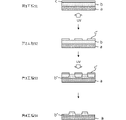
- FIG. BRIEF DESCRIPTION OF THE DRAWINGS It is the schematic which shows the manufacturing method of a flexographic printing plate using the photosensitive resin structure for flexographic printing plates of this embodiment.
- this embodiment an embodiment of the present invention (hereinafter referred to as “this embodiment”) will be described in detail, but the present invention is not limited to this, and various modifications are possible without departing from the gist thereof. is.
- the photosensitive resin composition for a flexographic printing plate of the present embodiment comprises at least a support (a), a photosensitive resin composition layer (b) laminated on the support (a), and the photosensitive resin and an infrared ablative layer (c) laminated on the composition layer (b), wherein the infrared ablative layer (c) contains a resin having a structural unit (c1) represented by the following general formula (1): do.
- R 1 and R 2 each independently represent a nonpolar group
- R 3 and R 4 each independently represent a hydrogen atom and a nonpolar group.
- FIG. 1 shows a schematic cross-sectional view of the photosensitive resin composition for a flexographic printing plate of this embodiment (hereinafter also simply referred to as "this composition").
- This structure comprises a support (a), a photosensitive resin composition layer (b) on which the uneven pattern of the flexographic printing plate is formed, and an infrared ablation layer (c) that functions as a mask when the uneven pattern is formed. It is laminated, and another layer may be provided between each layer as needed. This structure will be described in detail below.
- the support (a) used in this structure is not particularly limited, and examples thereof include polyester films, polyamide films, polyacrylonitrile films, and polyvinyl chloride films.
- polyester film is preferable as the support (a).
- the polyester used for the support (a) is not particularly limited, and examples thereof include polyethylene terephthalate, polybutylene terephthalate, polyethylene naphthalate and the like.
- the thickness of the support (a) is not particularly limited, it is preferably 50 to 300 ⁇ m.
- an adhesive layer may be provided on the support (a) for the purpose of increasing the adhesive strength between the support (a) and the photosensitive resin composition layer (b) described later.
- the adhesive layer is not particularly limited, but includes, for example, the adhesive layer described in WO2004/104701.
- Photosensitive resin composition layer (b) This construct has a photosensitive resin composition layer (b) on a support (a).
- the photosensitive resin composition layer (b) may be directly laminated on the support (a), or may be indirectly laminated via the adhesive layer or the like.
- the photosensitive resin composition layer (b) is not particularly limited, but contains, for example, a thermoplastic elastomer (b-1), preferably an ethylenically unsaturated compound (b-2), a photopolymerization initiator (b -3), it may further contain a liquid diene. Moreover, the photosensitive resin composition layer (b) may further contain an auxiliary additive component, if necessary. Each component will be described in detail below.
- thermoplastic elastomer (b-1) examples include, but are not limited to, copolymers having structural units derived from a monovinyl-substituted aromatic hydrocarbon and structural units derived from a conjugated diene.
- the thermoplastic elastomer (b-1) may further have structural units derived from other monomers. The use of such a thermoplastic elastomer tends to further improve the printing durability of the flexographic printing plate produced using the present composition.
- thermoplastic elastomer (b-1) may be a random copolymer or a block copolymer. and is preferably a block copolymer. The use of such a thermoplastic elastomer tends to further improve the printing durability of the flexographic printing plate produced using the present composition.
- the monovinyl-substituted aromatic hydrocarbon constituting the thermoplastic elastomer (b-1) is not particularly limited, but examples include styrene, t-butylstyrene, 1,1-diphenylethylene, N,N-dimethyl-p- aminoethylstyrene, N,N-diethyl-p-aminoethylstyrene, vinylpyridine, p-methylstyrene, p-methoxystyrene, tertiary butylstyrene, ⁇ -methylstyrene, 1,1-diphenylethylene and the like. . These may be used individually by 1 type, and may be used in combination of 2 or more type.
- styrene is preferable as the monovinyl-substituted aromatic hydrocarbon from the viewpoint that the photosensitive resin composition layer (b) can be smoothly molded at a relatively low temperature.
- the conjugated diene constituting the thermoplastic elastomer (b-1) is not particularly limited, but examples include butadiene, isoprene, 2,3-dimethyl-1,3-butadiene, 2-methyl-1,3-pentadiene, 1 ,3-hexadiene, 4,5-diethyl-1,3-octadiene, 3-butyl-1,3-octadiene, chloroprene and the like. These may be used individually by 1 type, and may be used in combination of 2 or more type.
- butadiene is preferable as the conjugated diene from the viewpoint of the printing durability of the flexographic printing plate produced using this composition.
- the number average molecular weight (Mn) of the thermoplastic elastomer (b-1) is preferably 20,000 or more and 300,000 or less, and 50,000 or more and 200,000 or less, from the viewpoint of viscosity at room temperature. is more preferable.
- the number average molecular weight can be measured by gel permeation chromatography (GPC) and is represented by polystyrene equivalent molecular weight.
- thermoplastic elastomer (b-1) is a block copolymer having a polymer block comprising a monovinyl-substituted aromatic hydrocarbon and a polymer block comprising a conjugated diene
- the thermoplastic elastomer (b-1) is, for example, a linear block copolymer represented by the following general formula group (I) and/or a linear block copolymer or radial block copolymer represented by the following general formula group (II) Including polymers.
- A represents a polymer block composed of monovinyl-substituted aromatic hydrocarbons.
- B represents a polymer block composed of a conjugated diene.
- X is silicon tetrachloride, tin tetrachloride, epoxidized soybean oil, polyhalogenated hydrocarbon compound, carboxylic acid ester compound, polyvinyl compound, bisphenol type epoxy compound, alkoxysilane compound, halogenated silane compound, ester compound, etc.
- a residue of a coupling agent or a residue of a polymerization initiator such as a polyfunctional organolithium compound is shown.
- n, k and m represent integers of 1 or more, for example 1-5.
- the contents of conjugated dienes and monovinyl-substituted aromatic hydrocarbons in the thermoplastic elastomer (b-1) can be measured using a nuclear magnetic resonance spectrometer ( 1 H-NMR).
- 1 H-NMR nuclear magnetic resonance spectrometer
- JNM-LA400 manufactured by JEOL, trade name
- deuterated chloroform is used as the solvent
- the sample concentration is 50 mg/mL
- the observation frequency is 400 MHz
- the chemical Measurement can be performed by using TMS (tetramethylsilane) as a shift reference, setting the pulse delay to 2.904 seconds, the number of scans to 64, the pulse width to 45°, and the measurement temperature to 25°C.
- the copolymerization ratio (mass ratio) between the monovinyl-substituted aromatic hydrocarbon and the conjugated diene is monovinyl Substituted aromatic hydrocarbon/conjugated diene is preferably in the range of 10/80 to 90/20, more preferably in the range of 10/90 to 85/15, and in the range of 10/90 to 60/40. It is even more preferable to have
- thermoplastic elastomer (b-1) may be introduced with other functional groups, chemically modified by hydrogenation or the like, or copolymerized with other components. .
- the content of the thermoplastic elastomer (b-1) in the photosensitive resin composition layer (b) is determined, from the viewpoint of the printing durability of the flexographic printing plate obtained using the present construction, in the photosensitive resin composition layer (
- the total amount of b) is 100% by mass, it is preferably 40% by mass or more, more preferably 40% by mass or more and 80% by mass or less, and further preferably 45% by mass or more and 80% by mass or less. More preferably, it is 45% by mass or more and 75% by mass or less.
- the photosensitive resin composition layer (b) preferably contains the ethylenically unsaturated compound (b-2) as described above.
- the ethylenically unsaturated compound (b-2) is a compound having a radically polymerizable unsaturated double bond.
- Examples of such ethylenically unsaturated compounds (b-2) include, but are not limited to, olefins such as ethylene, propylene, vinyltoluene, styrene, and divinylbenzene; acetylenes; (meth)acrylic acid and/or Unsaturated nitriles such as acrylonitrile; Unsaturated amides such as acrylamide and methacrylamide and derivatives thereof; Unsaturated dicarboxylic acids such as maleic anhydride, maleic acid and fumaric acid and derivatives thereof; Vinyl acetates ; N-vinylpyrrolidone; N-vinylcarbazole; and N-substituted maleimide compounds.
- olefins such as ethylene, propylene, vinyltoluene, styrene, and divinylbenzene
- acetylenes acetylenes
- the ethylenically unsaturated compound (b-2) includes (meth)acrylic acid and/or its Derivatives are preferred.
- Examples of the above derivatives include, but are not limited to, cycloalkyl, bicycloalkyl, cycloalkenyl, bicycloalkenyl, etc. alicyclic compounds; benzyl, phenyl, phenoxy, naphthalene skeleton, anthracene Aromatic compounds having skeleton, biphenyl skeleton, phenanthrene skeleton, fluorene skeleton, etc.; compounds having alkyl group, halogenated alkyl group, alkoxyalkyl group, hydroxyalkyl group, aminoalkyl group, glycidyl group, etc.; alkylene glycol, polyoxyalkylene ester compounds with polyhydric alcohols such as glycol, polyalkylene glycol and trimethylolpropane; and compounds having a polysiloxane structure such as polydimethylsiloxane and polydiethylsiloxane.
- the ethylenically unsaturated compound (b-2) may also be a heteroaromatic compound containing elements such as nitrogen and sulfur.
- the (meth)acrylic acid and/or derivatives thereof are not particularly limited, but examples include diacrylates and dimethacrylates of alkanediols such as hexanediol and nonanediol; ethylene glycol, diethylene glycol, propylene glycol, dipropylene glycol, polyethylene glycol, butylene glycol diacrylates and dimethacrylates; trimethylolpropane tri(meth)acrylate; dimethyloltricyclodecane di(meth)acrylate; isobornyl (meth)acrylate; phenoxypolyethylene glycol (meth)acrylate; meth)acrylate and the like. These may be used individually by 1 type, and may be used in combination of 2 or more types.
- the number average molecular weight (Mn) of the ethylenically unsaturated compound (b-2) is 100 from the viewpoint of improving the nonvolatility of the ethylenically unsaturated compound (b-2) during production and/or storage of the present structure. From the viewpoint of compatibility with other components, it is preferably less than 1000, more preferably 200 or more and 800 or less.
- the content of the ethylenically unsaturated compound (b-2) in the photosensitive resin composition layer (b) is determined from the viewpoint of the printing durability of the flexographic printing plate obtained using the present construction.
- the total amount of (b) is 100% by mass, it is preferably 2% by mass or more and 30% by mass or less, more preferably 2% by mass or more and 25% by mass or less, and 2% by mass or more and 20% by mass or less. is more preferable.
- the photosensitive resin composition layer (b) preferably contains a photopolymerization initiator (b-3).
- the photopolymerization initiator (b-3) is a compound that absorbs light energy and generates radicals. Examples thereof include compounds having a functioning site and a site functioning as a decaying photopolymerization initiator in the same molecule.
- photopolymerization initiator (b-3) examples include, but are not limited to, benzophenone, 4,4-bis(diethylamino)benzophenone, 3,3',4,4'-benzophenonetetracarboxylic acid anhydride. , 3,3′,4,4′-tetramethoxybenzophenone, etc.; anthraquinones, such as t-butylanthraquinone and 2-ethylanthraquinone; 2,4-diethylthioxanthone, isopropylthioxanthone, 2,4-dichlorothioxanthone, etc.
- the photopolymerization initiator (b-3) is preferably a compound having a carbonyl group, such as benzophenones and thioxanthones. Aromatic carbonyl compounds are more preferred.
- the content of the photopolymerization initiator (b-3) in the photosensitive resin composition layer (b) is determined, from the viewpoint of the printing durability of the flexographic printing plate produced using the present construction, in the photosensitive resin composition layer (
- the total amount of b) is 100% by mass, it is preferably 0.1% by mass or more and 10% by mass or less, more preferably 0.1% by mass or more and 5% by mass or less, and 0.5% by mass. It is more preferable that the content is not less than 5% by mass or less.
- the photosensitive resin composition layer (b) preferably contains a liquid diene.
- a liquid diene is a compound having a liquid carbon-carbon double bond.
- the "liquid state" of the "liquid diene” means a property of being easily flow-deformed and capable of being solidified into the deformed shape by cooling.
- a liquid diene has elastomeric properties such that when an external force is applied, it instantly deforms in response to the external force, and recovers its original shape in a short period of time when the external force is removed.
- the liquid diene is not particularly limited, but examples include liquid polybutadiene, liquid polyisoprene, modified liquid polybutadiene, modified liquid polyisoprene, liquid acrylonitrile-butadiene copolymer, and liquid styrene-butadiene copolymer. mentioned.
- the liquid diene is a copolymer having a diene content of 50% by mass or more.
- liquid polybutadiene is preferable as the liquid diene from the viewpoint of the mechanical properties of the present composition and the flexographic printing plate using the same.
- the 1,2-vinyl bond content of the liquid diene is preferably 1% or more and 80% or less from the viewpoint of making the hardness of the present structure and the flexographic printing plate using the same appropriate, 5% or more and 70% or less is more preferable, and 5% or more and 65% or less is even more preferable.
- 1,2-vinyl bond amount means that 1 , the ratio of those incorporated by 2-bonds.
- the amount of 1,2-vinyl bonds can be obtained from the peak ratio of 1 H-NMR (magnetic resonance spectrum) of liquid polybutadiene.
- 1,2-polybutadiene which is a liquid polybutadiene having a 1,2-vinyl bond, has a vinyl double bond as a side chain, so the reactivity of radical polymerization is high, and the photosensitive resin composition layer It is preferable from the viewpoint of increasing the hardness of (b).
- Liquid polybutadiene is usually a mixture of 1,2-polybutadiene having 1,2-vinyl bonds and 1,4-polybutadiene having 1,4-vinyl bonds. Incorporating 1,4-polybutadiene into the liquid diene is effective in improving the flexibility of the flexographic printing plate.
- 1,4-polybutadiene includes cis-type 1,4-polybutadiene and trans-type 1,4-polybutadiene.
- 1,4-Polybutadiene, both cis-type and trans-type has a vinyl group that is a double bond inside, so it has low reactivity in radical polymerization and can form a flexible resin. .
- the average value is used as the 1,2-vinyl bond amount.
- a liquid polybutadiene having a 1,2-vinyl bond content of 10% or less and a liquid polybutadiene having a 1,2-vinyl bond content of 80% or more are used. It is preferable to adjust the total amount of 1,2-vinyl bonds by mixing with polybutadiene. More preferably, a liquid polybutadiene having a 1,2-vinyl bond content of 5% or less and a liquid polybutadiene having a 1,2-vinyl bond content of 80% or more are mixed to adjust the total 1,2-vinyl bond content. preferably.
- the number average molecular weight of the liquid diene is not particularly limited as long as it is liquid at 20° C., but is preferably 500 or more from the viewpoint of the printing durability and handleability of the flexographic printing plate obtained using this composition. It is 60,000 or less, more preferably 500 or more and 50,000 or less, and still more preferably 800 or more and 50,000 or less.
- the content of the liquid diene in the photosensitive resin composition layer (b) is set so that the total amount of the photosensitive resin composition layer (b) is 100 mass from the viewpoint of the printing durability of the present structure and the flexographic printing plate using the same. %, preferably 10% by mass or more and 40% by mass or less, more preferably 15% by mass or more and 40% by mass or less, and even more preferably 20% by mass or more and 40% by mass or less.
- the auxiliary additive component is not particularly limited, but includes, for example, a polar group-containing polymer, a plasticizer other than a liquid diene, a thermal polymerization inhibitor other than a stabilizer, an antioxidant, an ultraviolet absorber, a dye/pigment, and the like.
- the polar group-containing polymer is not particularly limited. polymers. More specifically, a carboxyl group-containing acrylonitrile-butadiene rubber, a carboxyl group-containing styrene-butadiene rubber, a polymer of an aliphatic conjugated diene containing a carboxyl group, a phosphoric acid group, or an emulsification of an ethylenically unsaturated compound having a carboxyl group Examples include polymers, sulfonic acid group-containing polyurethanes, and carboxyl group-containing butadiene latexes. These polar group-containing polymers may be used alone or in combination of two or more.
- carboxyl group-containing butadiene latex is preferable as the polar group-containing polymer from the viewpoint of obtaining high resolution in the flexographic printing plate using this composition.
- Plasticizers other than liquid dienes are not particularly limited. Examples include hydrocarbon oils such as naphthenic oil and paraffin oil; liquid dienes such as liquid acrylonitrile-butadiene copolymers and liquid styrene-butadiene copolymers. polystyrene having a number average molecular weight of 2000 or less; ester plasticizers such as sebacate and phthalate. These other plasticizers may have hydroxyl groups or carboxyl groups. Further, these other plasticizers may be provided with a photopolymerizable reactive group such as a (meth)acryloyl group. Other plasticizers may be used alone or in combination of two or more.
- thermal polymerization inhibitor and antioxidant those commonly used in the field of resin materials or rubber materials can be used. Specifically, phenol-based materials are mentioned.
- phenolic materials include, but are not limited to, vitamin E, tetrakis-(methylene-3-(3′,5′-di-t-butyl-4′-hydroxyphenyl)propionate)methane, 2,5-di-t-butyl hydroquinone, 2,6-di-t-butyl-p-cresol, 2-t-butyl-6-(3-t-butyl-2-hydroxy-5-methylbenzyl)- 4-methylphenyl acrylate and the like.
- the thermal polymerization inhibitor and the antioxidant may be used alone or in combination of two or more.
- the ultraviolet absorber is not particularly limited, but includes, for example, known benzophenone-based compounds, salicylate-based compounds, acrylonitrile-based compounds, metal complex-based compounds, and hindered amine-based compounds. Dyes and pigments shown below may also be used as the ultraviolet absorber.
- ultraviolet absorbers examples include, but are not particularly limited to, 2-ethoxy-2'-ethyloxalic acid bisanilide, 2,2'-dihydroxy-4-methoxybenzophenone, and the like.
- Dyes and pigments are effective as coloring means for improving visibility.
- Dyes are not particularly limited, but examples include water-soluble basic dyes, acid dyes, direct dyes, and water-insoluble sulfur dyes, oil-soluble dyes, disperse dyes, and the like.
- Anthraquinone dyes, indigoid dyes, and azo dyes are particularly preferred, and azo oil-soluble dyes and the like are more preferred.
- the pigment is not particularly limited, but includes, for example, natural pigments, synthetic inorganic pigments, synthetic organic pigments, and the like.
- Synthetic organic pigments include azo-based pigments, triphenylmethane-based pigments, quinoline-based pigments, anthraquinone-based pigments, and phthalocyanine-based pigments.
- the total amount of the auxiliary additive components described above is preferably 0% by mass or more and 10% by mass or less, and 0% by mass or more and 5% by mass or less when the total amount of the photosensitive resin composition layer (b) is 100% by mass. It is more preferably 0% by mass or more and 3% by mass or less.
- an infrared ablation layer (c) is laminated on the photosensitive resin composition layer (b) described above.
- the infrared ablation layer (c) contains a predetermined resin, is ablationable with an infrared laser, and functions as a layer for shielding light rays other than infrared rays.
- high sensitivity to laser means that when drawing is performed with the same laser energy, the volume to be ablated is larger, especially in the depth direction.
- the infrared ablation layer instantaneously reaches a high temperature of several hundred degrees due to infrared irradiation. At that time, if the resin is easy to depolymerize, decomposition of the main chain in the resin will occur efficiently even if the ablation is for a short period of time. On the other hand, in the case of a resin that is difficult to depolymerize, for example, a resin having a polar group in the side chain, only the side chain is decomposed during ablation, and the main chain is less likely to be cut. Therefore, the resin remains in the infrared ablation layer even after infrared irradiation.
- Resins obtained by condensation polymerization are known to undergo cleavage of the main chain after formation of a ring structure during decomposition.
- infrared ablation which is heat treatment in a short period of time, does not easily reduce the molecular weight, resulting in poor laser sensitivity.
- the infrared ablation layer (c) contains a resin that is easily depolymerized.
- cleavage of the main chain tends to initiate from thermally unstable portions such as branches present in the polymer.
- the side chain corresponding to the branch has polarity, the decomposition of the side chain tends to predominantly occur, and the main chain is less likely to break, which is not preferable.
- the side chains of the resin contained in the infrared ablation layer (c) are non-polar groups.
- the contribution of intramolecular or intermolecular chain transfer cannot be ignored when main chain cleavage proceeds. Therefore, it is better not to have a tertiary hydrogen that is easily abstracted by chain transfer. That is, it is important that the portion corresponding to the plane of symmetry of branching is also a non-polar group.
- the resin contained in the infrared ablation layer (c) of the present embodiment has a structural unit (c1) containing a quaternary carbon atom to which two nonpolar groups are bonded, as represented by the following general formula (1). However, if necessary, it may have other structural units. (Here, in formula (1), R 1 and R 2 each independently represent a nonpolar group, and R 3 and R 4 each independently represent a hydrogen atom and a nonpolar group.)
- monomer means a compound before polymerization
- structural unit means a predetermined repeating unit formed by polymerizing a monomer
- the nonpolar group in general formula (1) is not particularly limited as long as it is a group composed of carbon atoms and/or silicon atoms and hydrogen atoms. Examples include alkyl groups, aryl groups, cycloalkyl groups, and phenyl groups. , an alkenyl group, an aralkyl group, a cycloalkenyl group, an alkynyl group, a silyl group, a siloxanyl group, and the like. In addition, a hydrogen atom is not included in the non-polar group.
- the groups represented by R 1 , R 2 , R 3 and R 4 are preferably alkyl groups and phenyl groups.
- the indicated group is an alkyl group or a phenyl group
- the nonpolar groups of R 3 and R 4 are an alkyl group or a phenyl group
- the groups indicated by R 1 and R 2 are an alkyl group or a phenyl group.
- R 3 and R 4 are more preferably hydrogen atoms. This tends to further improve developability with a solvent-based developer, which will be described later.
- the dispersibility of carbon black which will be described later, tends to be further improved, and the developability with an aqueous developer tends to be further improved.
- the group represented by R 1 is preferably an alkyl group, a phenyl group, or an acyl group.
- the number of carbon atoms in the nonpolar group is preferably 1 or more and 20 or less, more preferably 1 or more and 10 or less, and still more preferably 1 or more and 5 or less.
- Monomers satisfying the general formula (1) are not particularly limited, but examples include isobutylene, 2-methyl-2-butene, 2,3dimethyl-2-butene, and other substituted with an alkyl group of, modified products thereof; ⁇ -methylstyrene, cis-(1-methyl-1-propenyl)benzene, trans-(1-methyl-1-propenyl)benzene, and these methyl groups
- Examples include those substituted with other alkyl groups such as ethyl groups, modified products thereof; 1,1-diphenylethylene and the like.
- the structural unit (c1) in the resin not only does the resin alone have excellent developability in a solvent-based developer, but the highly polar carbon black described later can be dispersed while maintaining high dispersibility. It is thus possible to exhibit high developability with an aqueous developer.
- R 3 and R 4 in general formula (1) are a hydrogen atom, an alkyl group, an aryl group, a cycloalkyl group, a phenyl group, an alkenyl group, an aralkyl group, a cycloalkenyl group, an alkynyl group, a silyl group, and a siloxanyl group; are preferred, and both are more preferably hydrogen atoms.
- the depolymerization property of the resin is further improved, so that the laser sensitivity of the infrared ablative layer (c) tends to be further improved.
- the developability with a solvent-based developer is further improved, and the dispersibility of carbon black is further improved, so that the developability with an aqueous developer tends to be further improved.
- isobutylene, ⁇ -methylstyrene, and those in which the methyl group is replaced with another alkyl group such as an ethyl group can be mentioned as those satisfying such a constitution.
- the use of a monomer having a phenyl group such as ⁇ -methylstyrene tends to further improve the pinhole resistance of the infrared ablation layer (c).
- the use of such a monomer tends to further improve the developability with water-based developers and solvent-based developers.
- R 1 and R 2 each independently represent an alkyl group, an aryl group, a cycloalkyl group, a phenyl group, an alkenyl group, an aralkyl group, a cycloalkenyl group, an alkynyl group, a silyl group, and a siloxanyl group. is preferred, an alkyl group and a phenyl group are more preferred, and each independently an alkyl group is further preferred. Rubber-like elasticity can be obtained by R 1 and/or R 2 being an alkyl group. Therefore, it can become a soft portion in the elastomer, and tends to further improve the flexibility of the infrared ablative layer (c). In addition, since R 1 and/or R 2 are phenyl groups, the composition tends to be molded smoothly at a relatively low temperature.
- the structural unit (c1) may be used singly or in combination of two or more.
- the above resin may contain, as the structural unit (c1), a structural unit in which R 1 and R 2 are alkyl groups, and a structural unit in which one of R 1 and R 2 is an alkyl group and the other is a phenyl group. may have This can improve the properties of both the alkyl group and the phenyl group.
- isobutylene and those in which the methyl group thereof is substituted with another alkyl group such as an ethyl group can be mentioned as those satisfying such a constitution.
- the content of the structural unit (c1) is preferably 40% by mass or more, more preferably 50% by mass or more, still more preferably 60% by mass or more, based on the total amount of the resin. It is preferably 70% by mass or more, and more preferably 80% by mass or more. In addition, the content of the structural unit (c1) is preferably 100% by mass or less, more preferably 95% by mass or less, still more preferably 90% by mass or less, based on the total amount of the resin. It is preferably 85% by mass or less, and more preferably 80% by mass or less. Upper and lower limits of these numerical values can be combined arbitrarily.
- the content of the structural unit (c1) is 40% by mass or more, the laser sensitivity and flexibility of the infrared ablation layer (c) tend to be further improved. Moreover, when the content of the structural unit (c1) is 100% by mass or less, the resistance to pinholes of the infrared ablation layer (c) tends to be further improved.
- the content of the structural unit (c1) is within the above range, the developability in the solvent-based developer is further improved, and the dispersibility of carbon black is further improved, so that the content in the aqueous developer is improved. Developability tends to be further improved.
- the resin used in the infrared ablative layer (c) preferably contains a structural unit (c2) containing an aromatic group in its side chain, apart from the structural unit (c1).
- a structural unit (c2) a structural unit (c2) derived from a monovinyl-substituted aromatic hydrocarbon is preferred.
- the monovinyl aromatic hydrocarbon may be chemically bonded to the monomer represented by the general formula (1), or may be added as a separate resin. From the viewpoint of the above, it is preferable that they are chemically bonded to form a copolymer.
- the resin contains the structural unit (c2) derived from a monovinyl-substituted aromatic hydrocarbon, the pinhole resistance tends to be further improved.
- Examples of monovinyl aromatic hydrocarbon compounds include, but are not limited to, styrene, t-butylstyrene, N,N-dimethyl-p-aminoethylstyrene, N,N-diethyl-p-aminoethylstyrene, vinylpyridine, Examples include monomers such as p-methylstyrene and tertiary butylstyrene. Among these, styrene is preferable because the structure can be molded smoothly at a relatively low temperature.
- the structural unit (c2) may be used alone or in combination of two or more.
- the content of the structural unit (c2) is preferably 0% by mass or more, more preferably 5% by mass or more, still more preferably 10% by mass or more, and still more preferably It is 15% by mass or more, and more preferably 20% by mass or more.
- the content of the structural unit (c2) is preferably 60% by mass or less, more preferably 55% by mass or less, still more preferably 50% by mass or less, based on the total amount of the resin. It is preferably 45% by mass or less, and more preferably 40% by mass or less. Upper and lower limits of these numerical values can be combined arbitrarily.
- the content of the structural unit (c2) is 0% by mass or more, the resistance to pinholes of the infrared ablation layer (c) tends to be further improved. Further, when the content of the structural unit (c2) is 60% by mass or less, the laser sensitivity and flexibility of the infrared ablative layer (c) tend to be further improved.
- “0% by mass or more” includes both a mode containing the structural unit (c2) and a mode not containing the structural unit (c2). Upper and lower limits of these numerical values can be combined arbitrarily.
- the contents and ratios of the structural units (c1) and (c2) in the resin used in the infrared ablation layer (c) can be measured using a nuclear magnetic resonance spectrometer ( 1 H-NMR).
- the infrared ablation layer (c) may contain other resins besides the above resins.
- the content of the resin is preferably 50% by mass or more, more preferably 70% by mass or more and 100% by mass or less, based on the total resin components of the infrared ablative layer (c).
- the content of the resin is within the above range, the laser sensitivity and flexibility of the infrared ablative layer (c) tend to be further improved.
- a resin having a polar group in a side chain it is preferable that the above resin is contained in an amount of 70% or more in all resin components from the viewpoint of laser sensitivity.
- the content of the resin is preferably 20% by mass or more, more preferably 30% by mass or more, and even more preferably 40% by mass or more, relative to the total amount of the infrared ablative layer (c). .
- the content of the resin is preferably 90% by mass or less, more preferably 80% by mass or less, and preferably 70% by mass or less, relative to the total amount of the infrared ablation layer (c). More preferred. Upper and lower limits of these numerical values can be combined arbitrarily.
- the content of the resin is 20% by mass or more, the resistance to pinholes and flexibility of the infrared ablation layer (c) tend to be further improved. Further, when the content of the resin is 90% by mass or less, the laser sensitivity and shielding properties of the infrared ablation layer (c) tend to be further improved.
- the content of the resin is within the above range, the developability in a solvent-based developer and an aqueous developer and the dispersibility of carbon black tend to be further improved.
- the infrared-ablable layer (c) may contain an infrared-absorbing substance for performing an ablation process.
- an infrared-absorbing substance for performing an ablation process.
- the infrared absorbing substance a single substance or a compound having strong absorption in the range of 750 to 2000 nm is usually used.
- infrared absorbing substances include, but are not limited to, inorganic pigments such as carbon black, graphite, copper chromite, and chromium oxide; pigments such as polyphthalocyanine compounds, cyanine pigments, and metal thiolate pigments. be done.
- inorganic pigments such as carbon black, graphite, copper chromite, and chromium oxide
- pigments such as polyphthalocyanine compounds, cyanine pigments, and metal thiolate pigments. be done.
- Carbon black in particular, can be used in a wide range of particle sizes from 13 nm to 85 nm, and is therefore preferable as an infrared absorbing substance.
- Carbon black can also function as a shielding substance described below.
- the infrared ablative layer (c) plays a role as a mask, it may contain a shielding substance against non-infrared rays such as ultraviolet rays.
- a substance that reflects or absorbs ultraviolet light can be used as the shielding substance against non-infrared rays. UV absorbers, carbon black, graphite and the like can be mentioned.
- the total content of the infrared absorbing substance and the shielding substance is preferably 10% by mass or more and 80% by mass or less, preferably 20% by mass or more and 70% by mass or less, relative to the total amount of the infrared ablation layer (c), It is preferably 30% by mass or more and 60% by mass or less.
- the total content of the infrared absorbing substance and the shielding substance is within the above range, laser sensitivity and shielding properties tend to be further improved.
- the infrared ablation layer (c) is excellent for both solvent-based developers and water-based developers. It has been found that the developability is improved.
- the infrared ablative layer (c) of the present embodiment preferably contains carbon black as an infrared absorbing material for performing ablation processing and as a non-infrared shielding material for serving as a mask.
- the pH of carbon black is preferably 2.0 or more and 5.5 or less.
- Low pH carbon black is in a state in which a large number of functional groups are introduced on its surface, and is more hydrophilic than ordinary carbon black. This makes it possible to exhibit excellent developability particularly with respect to an aqueous developer.
- the pH of carbon black is more preferably 2.5 or more and 5.0 or less, more preferably 2.5 or more and 4.5 or less.
- the pH of carbon black is a value measured with a glass electrode pH meter after preparing a mixture of carbon black and distilled water according to ASTM D1512.
- Carbon black is classified into, for example, furnace black, channel black, thermal black, acetylene black, lamp black, etc., depending on the method of production thereof, but furnace black is preferred in order to obtain the desired properties.
- Furnace black is a method of obtaining carbon black by injecting petroleum- or coal-based oil into high-temperature gas as a raw material for incomplete combustion, and can be produced using a widely known method.
- Carbon black that has been conventionally used to form a black matrix can be used as long as it satisfies the above requirements.
- Specific examples include MA7, MA8, MA11, MA14, MA77, MA100, MA100R, MA100S, MA220, MA230, #970, #1000, #2350, #2360 manufactured by Mitsubishi Chemical, Toka Black #8300 manufactured by Tokai Carbon, etc. is mentioned.
- the film thickness of the infrared ablation layer (c) of this construction is preferably thick from the viewpoint of ensuring the light shielding property against ultraviolet rays in the process of exposing the photosensitive resin construction for printing plates. From the viewpoint of increasing the strength, the thinner the better.
- the content of carbon black is preferably 10% by mass or more and 70% by mass or less, more preferably 20% by mass or more and 60% by mass or less, and still more preferably 30% by mass, based on the total amount of the infrared ablative layer (c). It is more than mass % and below 50 mass %. When the content of carbon black is within the above range, laser sensitivity and shielding properties tend to be further improved.
- the compounding ratio of the resin and carbon black (resin/carbon black) in the infrared ablation layer (c) is preferably in the range of 80/20 to 50/50, more preferably 75/25 to 55/45. range, more preferably 70/30 to 60/40.
- the compounding ratio (resin/carbon black) is within the above range, laser sensitivity and shielding properties tend to be further improved.
- the infrared ablative layer (c) preferably contains a dispersant for the purpose of assisting the dispersibility of carbon black.
- the dispersant is preferably a compound having an adsorption portion capable of interacting with the surface functional group of the infrared absorbent and a resin-compatible portion compatible with the binder polymer.
- the adsorption portion of the dispersant is not particularly limited, but examples include amino groups, amide groups, urethane groups, carboxyl groups, carbonyl groups, sulfone groups, and nitro groups. Among these, an amino group, an amide group, and a urethane group are preferable.
- the resin-compatible part is not particularly limited, but examples include saturated alkyl, unsaturated alkyl, polyether, polyester, poly(meth)acryl, and polyol.
- the solubility parameter (SP value) of the dispersant is preferably 9.5 or more and 12.5 or less, more preferably 10.0 or more and 12.0 or less.
- SP value The solubility parameter (SP value) is within the above range, the dispersibility of carbon black is further improved, and the developability with an aqueous developer tends to be further improved.
- V is the molar molecular volume of the solvent
- ⁇ E is the cohesion energy (evaporation energy).
- the molar molecular volume and cohesive energy of the solvent can also be determined from known values, such as the document "POLYMER ENGINEERING AND SCIENCE, Vol. 14, 147-154, 1974".
- solubility parameter SP value
- a poor solvent with a lower SP value than the good solvent is added dropwise to a solution in which a sample with an unknown SP value is dissolved in a good solvent with a known SP value, and the solute begins to precipitate. Measure the volume of the anti-solvent.
- a poor solvent with a higher SP value than the good solvent is added dropwise to a solution in which a newly prepared sample with an unknown SP value is dissolved in a good solvent with a known SP value, and the solute begins to precipitate. Measure the volume of the anti-solvent. It can be obtained by applying the volume of each poor solvent obtained here to the following formula (2).
- Vml is the volume of a poor solvent with a low SP value
- V mh is the volume of a poor solvent with a high SP value
- ⁇ ml is the SP value of a poor solvent with a low SP value
- ⁇ mh is a poor solvent with a high SP value.
- the content of the dispersing agent in the infrared ablative layer (c) of the present embodiment is within a range that can ensure the strength of the infrared ablative layer (c) while uniformly dispersing the infrared absorber in the infrared ablative layer (c). It is preferred to select and add. If the content of the dispersing agent is too small, the infrared absorbing agent cannot be sufficiently dispersed in the infrared ablative layer (c). .
- the content of the dispersant is preferably 0.1% by mass or more and 50% by mass or less, more preferably 1% by mass or more and 30% by mass or less, relative to the entire infrared ablation layer (c). It is more preferably 3% by mass or more and 20% by mass or less.
- the content of the dispersant is preferably 0.5 parts by mass or more with respect to 100 parts by mass of carbon black, and 1 part by mass or more. It is more preferable that the amount is 3 parts by mass or more. From the viewpoint of the film strength of the infrared ablation layer, the content of the dispersant is preferably 50 parts by mass or less, more preferably 30 parts by mass or less, with respect to 100 parts by mass of carbon black. It is more preferably not more than parts by mass.
- the dispersant in the infrared ablative layer (c) preferably has a branched structure.
- high dispersibility can be obtained because the dispersant has low crystallinity.
- the weight average molecular weight of the dispersant in the infrared ablation layer (c) of the present embodiment is preferably selected within a range in which the dispersant does not bleed out while uniformly dispersing the infrared absorbent in the infrared ablation layer.
- the dispersing agent When the dispersing agent bleeds out, it cannot interact with the infrared absorbing agent, such as carbon black, resulting in poor dispersion and heavy peeling.
- the weight average molecular weight of the dispersant measured in terms of standard polystyrene by gel permeation column chromatography is preferably 1000 or more and 10000 or less, more preferably 2000 or more and 7000 or less, and 2500 or more and 5000 or less. More preferred.
- the film thickness of the infrared ablation layer (c) of this structure is preferably thick from the viewpoint of ensuring the shielding property against ultraviolet rays in the step of performing exposure processing on this structure, and from the viewpoint of increasing the ablation property. Thinner is better.
- the thickness of the infrared ablation layer (c) is preferably 0.1 ⁇ m or more and 20 ⁇ m or less, more preferably 0.5 ⁇ m or more and 15 ⁇ m or less, and even more preferably 1.0 ⁇ m or more and 10 ⁇ m or less.
- the optical density of the infrared ablation layer (c) is preferably 2 or more, more preferably 3 or more.
- the optical density can be measured using a D200-II transmission densitometer (manufactured by GretagMacbeth). Also, the optical density is the so-called visual sensitivity (ISO visual), and the light to be measured is in the wavelength range of about 400 to 750 nm.
- ISO visual visual sensitivity
- the method for forming the infrared ablation layer (c) is not particularly limited.
- a resin solution is prepared using a predetermined solvent.
- carbon black and a dispersant are added thereto, the carbon black is dispersed in the resin solution, and then coated on a cover film such as a polyester film, and then the cover film is used as a photosensitive resin composition layer.
- a cover film such as a polyester film
- the cover film is used as a photosensitive resin composition layer.
- a method for dispersing carbon black in a resin solution it is effective to use both forced stirring with a stirring blade and stirring using ultrasonic waves and various mills.
- a method of pre-kneading a resin, carbon black and a dispersant using an extruder or a kneader and then dissolving the mixture in a solvent is also effective for obtaining good dispersibility of carbon black.
- carbon black may be forcibly dispersed in the resin in the form of a latex solution.
- Solvents such as solutions and dispersions for forming the infrared ablation layer (c) can be appropriately selected in consideration of the solubility of the resin and infrared absorber used. Only one kind of solvent may be used, or two or more kinds of solvents may be mixed and used.
- the infrared ablation layer (c) it is effective to improve the film quality of the infrared ablation layer (c) by mixing a solvent with a relatively low boiling point and a solvent with a high boiling point to control the volatilization speed of the solvent.
- Solvents for forming the infrared ablative layer (c) are not particularly limited, but examples include toluene, xylene, cyclohexane, methyl acetate, ethyl acetate, propyl acetate, butyl acetate, amyl acetate, methyl ethyl ketone, acetone, cyclohexanone, Ethylene glycol, propylene glycol, ethanol, water, propylene glycol monomethyl ether, propylene glycol monomethyl ether acetate, dimethylacetamide, dimethylformamide, n-propyl alcohol, i-propyl alcohol, 1,4-dioxane, tetrahydrofuran, diethyl ether, n- Hexane, n-heptane, n-pentane, acetonitrile, analogues thereof and the like can be mentioned.
- the cover film for forming the infrared ablation layer (c) of this structure is preferably a film with excellent dimensional stability, such as polyethylene terephthalate film.
- the cover film may be used in an untreated state, but if necessary, it may be used with functions such as release treatment and antistatic treatment.
- This construct may further have one or more intermediate layers (d) between the photosensitive resin composition layer (b) and the infrared ablative layer (c).
- the intermediate layer (d) is not particularly limited, but can be, for example, an oxygen inhibiting layer, an adhesive layer and/or a protective layer. Each layer will be described below.
- the intermediate layer (d) is preferably an oxygen-blocking layer having oxygen-blocking ability.
- the photosensitive resin composition layer (b) When the photosensitive resin composition layer (b) is cured by irradiation with ultraviolet rays, curing proceeds by radical polymerization. If oxygen coexists during this radical polymerization, the radical-generating compound reacts with oxygen to suppress the polymerization reaction. When the polymerization reaction is inhibited in this way, there is a possibility that unreacted portions remain in the exposed areas of the photosensitive resin composition layer (b). Since this unreacted portion is removed in the fourth step, which will be described later, the pattern finally formed on the flexographic printing plate has a curved portion at the tip. This is because the portion of the photosensitive resin composition layer (b) on the infrared ablation layer (c) side is particularly susceptible to polymerization inhibition by oxygen, and the photosensitive resin composition layer ( This is because unreacted portions tend to occur in b).
- the intermediate layer (d) has an oxygen inhibiting ability to reduce the amount of oxygen in contact with the photosensitive resin composition layer (b). .
- the intermediate layer (d) may be an adhesive layer that improves the adhesion between the photosensitive resin composition layer (b) and the infrared ablation layer (c). This tends to improve handleability.
- the intermediate layer (d) may also have the function of protecting the infrared ablation layer (c).
- the infrared ablative layer (c) laminated with the cover film is transported, the infrared ablative layer (c) comes into contact with the roll, and tight winding occurs during transport of the film roll. In the roll, the infrared ablative layer (c) and the cover film laminated thereon may rub against each other. As a result, the infrared ablation layer (c) may be physically chipped and pinholes may occur.
- the intermediate layer (d) constituting the structure preferably has physical strength and heat resistance as a protective layer.
- the method for producing a flexographic printing plate of the present embodiment includes, using the present structure, a first step of irradiating ultraviolet rays from the support (a) side, and irradiating the infrared ablation layer (c) with infrared rays. A second step of drawing a pattern, and a third step of pattern exposure by irradiating the photosensitive resin composition layer (b) with ultraviolet rays using the pattern-drawn infrared ablation layer (c) as a mask. and a fourth step of removing the infrared ablation layer (c) and the unexposed portion of the photosensitive resin composition layer (b).
- a step of post-exposure treatment is performed as necessary, and a flexographic printing plate (letterpress printing plate) is obtained from the cured product of the photosensitive resin composition layer.
- the surface of the flexographic printing plate may be brought into contact with a liquid containing a silicone compound and/or a fluorine compound.
- the method of irradiating the photosensitive resin composition layer (b) with ultraviolet rays from the support (a) side is not particularly limited, and a known irradiation unit can be used.
- the wavelength of the ultraviolet rays irradiated at this time is preferably 150 to 500 nm, more preferably 300 to 400 nm.
- the ultraviolet light source is not particularly limited, but for example, low-pressure mercury lamps, high-pressure mercury lamps, ultra-high-pressure mercury lamps, metal halide lamps, xenon lamps, zirconium lamps, carbon arc lamps, fluorescent lamps for ultraviolet rays, etc. can be used.
- this first step may be performed before or after the second step, which will be described later.
- the method of drawing a pattern by irradiating the infrared ablation layer (c) with infrared rays is not particularly limited, and a known irradiation unit can be used.
- the irradiation of the infrared rays to the infrared ablation layer (c) can be performed from the infrared ablation layer (c) side.
- this structure has a cover film
- the cover film is first peeled off before infrared irradiation. Thereafter, the infrared ablation layer (c) is pattern-irradiated with infrared rays to decompose the resin in the infrared-irradiated portions, and the pattern is drawn. Thereby, a mask for the infrared ablation layer (c) can be formed on the photosensitive resin composition layer (b).
- suitable infrared lasers include, for example, ND/YAG lasers (eg, 1064 nm) or diode lasers (eg, 830 nm).
- Laser systems suitable for CTP plate making technology are commercially available, for example the diode laser system CDI Spark (ESKO GRAPHICS) can be used.
- the laser system includes a rotating cylindrical drum that holds the structure, an IR laser illumination device, and a layout computer, with image information transmitted directly from the layout computer to the laser device.
- the patterned infrared ablation layer (c) is used as a mask to irradiate the photosensitive resin composition layer (b) with ultraviolet rays for pattern exposure.
- the light passing through the mask accelerates the curing reaction of the photosensitive resin composition layer (b), and the pattern formed on the infrared ablation layer (c) reverses the unevenness, thereby forming the photosensitive resin composition layer.
- the ultraviolet irradiation may be applied to the entire surface of the structure.
- the third step can be performed with this structure attached to the laser cylinder, but generally, this structure is removed from the laser device and irradiated using a conventional irradiation unit.
- a conventional irradiation unit the same units as those exemplified for the ultraviolet irradiation in the first step can be used.
- the fourth step is to remove the infrared ablation layer (b) and the unexposed portions of the photosensitive resin composition layer (c).
- the removal method is not particularly limited, and conventionally known methods can be applied.
- the photosensitive resin composition layer (b) of this structure is exposed, and then the unexposed portion is washed away with a solvent for solvent development or a washing liquid for water development, or 40 C. to 200.degree. C., the unexposed portion is removed by bringing it into contact with a predetermined absorbing layer capable of absorption, and removing the absorbing layer.
- a flexographic printing plate is manufactured by post-exposure processing as necessary.
- an intermediate layer (d) is provided between the infrared ablation layer (c) and the photosensitive resin composition layer (b), it may be removed simultaneously in the development step.
- the developing solvent used for solvent development of the unexposed area is not particularly limited, but examples thereof include esters such as heptyl acetate and 3-methoxybutyl acetate; hydrocarbons such as petroleum fractions, toluene and decalin. and mixtures of alcohols such as propanol, butanol, and pentanol with chlorinated organic solvents such as tetrachlorethylene.
- esters such as heptyl acetate and 3-methoxybutyl acetate
- hydrocarbons such as petroleum fractions, toluene and decalin.
- mixtures of alcohols such as propanol, butanol, and pentanol with chlorinated organic solvents such as tetrachlorethylene.
- water an alkaline aqueous solution, a neutral detergent, and a surfactant can be suitably used as the washing liquid for water development.
- surfactants examples include anionic surfactants, amphoteric surfactants, and nonionic surfactants. These may be used individually by 1 type, and may be used in mixture of 2 or more types.
- anionic surfactants include, but are not limited to, sulfates, higher alcohol sulfates, higher alkyl ether sulfates, sulfated olefins, alkylbenzenesulfonates, ⁇ -olefinsulfonates, and phosphates. salts, dithiophosphate salts, and the like.
- amphoteric surfactant is not particularly limited, but includes, for example, an amino acid type amphoteric surfactant, a betaine type amphoteric surfactant and the like.
- nonionic surfactants include, but are not limited to, higher alcohol ethylene oxide adducts, alkylphenol ethylene oxide adducts, fatty acid ethylene oxide adducts, polyhydric alcohol fatty acid ester ethylene oxide adducts, and higher alkylamine ethylene oxide adducts.
- Polyethylene glycol type surfactants such as fatty acid amide ethylene oxide adducts, polypropylene glycol ethylene oxide adducts, glycerol fatty acid esters, pentaerythritol fatty acid esters, sorbitol and sorbitan fatty acid esters, alkyl esters of polyhydric alcohols, alkanolamines and polyhydric alcohol surfactants such as fatty acid amides of the type.
- a pH adjuster may be used for the alkaline aqueous solution.
- the pH adjuster may be either an organic material or an inorganic material, but is preferably one that can adjust the pH to 9 or higher.
- Examples of pH adjusters include, but are not limited to, sodium hydroxide, sodium carbonate, potassium carbonate, sodium silicate, sodium metasilicate, sodium succinate and the like.
- the heat-developable absorption layer is not particularly limited, but examples thereof include non-woven fabric materials, paper materials, fiber fabrics, open-cell foams, and porous materials. Among these, nonwoven materials made of nylon, polyester, polypropylene, polyethylene, and combinations of these nonwoven materials are preferred, and nonwoven continuous webs of nylon or polyester are more preferred.
- the flexographic printing method of the present embodiment comprises a first step of irradiating ultraviolet rays from the support (a) side using the above-described photosensitive resin composition for flexographic printing plates, and irradiating the infrared ablation layer (c) with infrared rays. and a third step of pattern exposure by irradiating the photosensitive resin composition layer (b) with ultraviolet rays using the pattern-drawn infrared ablation layer (c) as a mask.
- the first to fourth steps in the flexographic printing method are as described above.
- a fifth step is a step of printing using the flexographic printing plate obtained by the first to fourth steps.
- the printing method using the flexographic printing plate is not particularly limited as long as it is a method of applying ink to the raised portions of the flexographic printing plate and transferring the ink to the substrate.
- Tufprene A manufactured by Asahi Kasei, styrene-butadiene-styrene block copolymer 60 parts by weight
- B-2000 manufactured by Nippon Petrochemicals, liquid polybutadiene
- 1,9-nonanediol diacrylate 7 parts by weight 2 , 2-dimethoxy-2-phenylacetophenone and 0.3 parts by mass of 2,6-di-t-butyl-p-cresol were kneaded with a pressure kneader to prepare a photosensitive resin composition.
- the photosensitive resin composition is put into an extrusion molding machine, and a support (polyethylene terephthalate film) is attached to one side of the photosensitive resin composition layer extruded from the T-shaped die to form a photosensitive resin composition.
- a release film (Mitsubishi Chemical Co., Ltd., Diafoil MRV100) was adhered to the opposite side of the support layer of the support layer to obtain a laminate of the support and the photosensitive resin composition layer.
- a liquid tube was connected, and the isobutylene monomer was sent into the polymerization vessel by nitrogen pressure.
- 0.647 g (2.8 mmol) of p-dicumyl chloride and 1.22 g (14 mmol) of N,N-dimethylacetamide were added.
- 8.67 mL (79.1 mmol) of titanium tetrachloride was further added to initiate polymerization. After stirring at the same temperature for 1.5 hours from the start of polymerization, about 1 mL of the polymerization solution was taken out for sampling.
- Resins 2 to 9 were obtained in the same manner as Resin 1 except that the types of monomers used and the compounding ratio were changed as shown in Table 1 below. Table 1 below shows constituent materials and physical properties of the resin.
- the carbon black dispersion obtained as described above was coated on a PET film with a thickness of 100 ⁇ m as a cover film so that the film thickness after drying was 2.5 ⁇ m, and dried at 90 ° C. for 2 minutes. After treatment, an infrared ablative layer laminate 1, which is a laminate of the infrared ablative layer and the cover film, was obtained.
- Infrared Ablation Layer Laminates 2 to 10 were obtained in the same manner as for infrared ablative layer laminate 1, except that the resins used were changed as shown in Table 2 below.
- Tufprene 315 (Asahi Kasei, styrene-butadiene block copolymer) 7.8 parts by mass, toluene 70.4 parts by mass, and propylene glycol 1-monomethyl ether 2-acetate (PMA) 17.6 parts by mass, mixed. and the Tufprene 315 was dissolved in the solvent. After that, carbon black (MCF-88 manufactured by Mitsubishi Chemical) was further added and mixed in a bead mill for 4 hours to obtain a carbon black dispersion.
- PMA propylene glycol 1-monomethyl ether 2-acetate
- An infrared ablation layer laminate 11 was obtained in the same manner as the infrared ablation layer laminate 1 except that the carbon black dispersion obtained as described above was used.
- polyamide Macromelt 6900 manufactured by Henkel
- toluene 44.0 parts by mass of toluene
- 2-propanol 2-propanol
- An infrared ablative layer laminate 12 was obtained in the same manner as the infrared ablative layer laminate 1 except that the carbon black dispersion obtained as described above was used.
- Carbon black (manufactured by Mitsubishi Chemical, #1000) was mixed with the resulting solution and kneaded and dispersed using a three-roll mill to obtain a carbon black dispersion.
- An infrared ablation layer laminate 13 was obtained in the same manner as the infrared ablation layer laminate 1 except that the carbon black dispersion obtained as described above was used.
- An infrared ablation layer laminate 14 was obtained in the same manner as the infrared ablation layer laminate 1 except that the carbon black dispersion obtained as described above was used.
- An infrared ablative layer laminate 15 was obtained in the same manner as the infrared ablative layer laminate 1 except that the carbon black dispersion obtained as described above was used.
- Example 1 ((4) Preparation of photosensitive resin structure for flexographic printing plate) ⁇ Example 1>
- the release film is peeled off from the laminate of the support and the photosensitive resin composition layer, and the infrared ablation layer laminate 1 is placed at a temperature of 25° C. and a humidity of 40% so that the infrared ablation layer is in contact with the photosensitive resin composition layer.
- Laminate in the environment place the cover film surface on a hot plate set at 120 ° C. so that it is in contact with the heating part of the hot plate, and apply heat for 1 minute to form the photosensitive resin composition for a flexographic printing plate of Example 1. Got 1 body.
- the photosensitive resin structure 1 for flexographic printing plates of Example 1 produced as described above was evaluated as follows. The evaluation results are shown in Table 3 below. The evaluation was carried out by cutting the photosensitive resin composition for flexographic printing plate into a size of 10 cm ⁇ 15 cm and peeling off the cover film.
- the ablation portion was observed using a laser microscope (VK-X100, manufactured by Keyence Corporation; objective lens 100x), and the length of the surface of the infrared ablation layer in the longitudinal direction (2 pixels side) that was scraped by the laser,
- the length of the interface with the photosensitive resin composition layer was measured, and the length of the interface with the photosensitive resin composition layer/surface of the infrared ablation layer was evaluated as an index of laser sensitivity as follows.
- the hole penetrates and the interface with the photosensitive resin composition/surface of the infrared ablation layer has a length of 0.50 or more
- D The hole penetrates and the length of the interface with the photosensitive resin composition / the surface of the infrared ablation layer is less than 0.30
- the photosensitive resin structure for a flexographic printing plate is bent 180° (to the extent that the support contacts) starting from the vicinity of the center so that the support faces inward, and then tested to see if wrinkles occur on the surface of the infrared ablation layer. and evaluated as follows. (Evaluation criteria) A: No wrinkles. B: Wrinkles are generated, but they are very slightly generated only at the ends of the structure. C: Wrinkles are generated, and multiple wrinkles are generated at the ends of the structure. D: Wrinkles are generated, and wrinkles are observed not only at the ends of the structure but also near the center. E: Wrinkles occur on the entire surface of the structure.
- the infrared ablative layer laminate 1 was laminated at a temperature of 180° C. so that the infrared ablative layer was in contact with the photosensitive resin composition layer to obtain a sample.
- this sample after removing the cover film of the infrared ablation layer, it was placed on a light table and examined under a microscope.
- the number of pinholes with a length of 20 ⁇ m or more was counted, the average value was calculated, and the value (number/m 2 ) was calculated and evaluated as follows.
- evaluation criteria A: The number of pinholes is less than 2 (pieces/m 2 ) on average.
- B The average number of pinholes is 2 (pieces/m 2 ) or more and less than 5 (pieces/m 2 ).
- C The average number of pinholes is 5 (pieces/m 2 ) or more and less than 10 (pieces/m 2 ).
- D The average number of pinholes is 10 (pieces/m 2 ) or more and less than 20 (pieces/m 2 ).
- E The average number of pinholes is 20 (pieces/m 2 ) or more.
- Photosensitive resin constituents 2 to 15 for flexographic printing plates of Examples 2 to 15 were prepared in the same manner as in Example 1, except that the types of infrared ablation layer laminates were changed to infrared ablation layer laminates 2 to 12, respectively. It was produced and evaluated. The evaluation results are shown in Table 3 below.
- the aqueous dispersion of the obtained hydrophilic copolymer was dried in a vacuum dryer at 50°C to remove water and obtain a hydrophilic copolymer.
- UV transmittance ultraviolet transmittance
- base film a support having an adhesive layer
- the UV transmittance of the support is measured using an ultraviolet exposure machine AFP-1500 (manufactured by Asahi Kasei Co., Ltd., trade name), and a UV illuminance meter MO-2 type machine (manufactured by Oak Manufacturing, trade name, UV-35 filter). was measured and calculated.
- AFP-1500 manufactured by Asahi Kasei Co., Ltd., trade name
- MO-2 type machine manufactured by Oak Manufacturing, trade name, UV-35 filter
- liquid polybutadiene [LBR-352: manufactured by Kuraray Co., Ltd.] 32 parts by weight, 8 parts by weight of 1,9-nonanediol diacrylate, 5 parts by weight of 1,6-hexanediol dimethacrylate, 2 parts by weight of 2,2-dimethoxyphenylacetophenone , 2,6-di-t-butyl-p-cresol 1 part by mass, carbinol-modified silicone oil [KF-6000: manufactured by Shin-Etsu Chemical Co., Ltd.] 1 part by mass of a liquid mixture was added little by little over 15 minutes, and the addition was completed. The mixture was further kneaded for 20 minutes to obtain a photosensitive resin composition.
- LBR-352 manufactured by Kuraray Co., Ltd.
- the photosensitive resin composition is put into an extrusion molding machine, and the adhesive layer forming surface of the support is attached to one surface of the photosensitive resin composition layer extruded from the T-shaped die, A release film (Mitsubishi Chemical Co., Ltd., Diafoil MRV100) was attached to the side of the photosensitive resin composition layer opposite to the support lamination side to obtain a laminate of the support and the photosensitive resin composition layer. .
- a liquid tube was connected, and the isobutylene monomer was sent into the polymerization vessel by nitrogen pressure.
- 0.647 g (2.8 mmol) of p-dicumyl chloride and 1.22 g (14 mmol) of N,N-dimethylacetamide were added.
- 8.67 mL (79.1 mmol) of titanium tetrachloride was further added to initiate polymerization. After stirring at the same temperature for 1.5 hours from the start of polymerization, about 1 mL of the polymerization solution was taken out for sampling.
- Resins 102 to 105 were obtained in the same manner as Resin 101 except that the types of monomers used and the compounding ratio were changed as shown in Table 4 below. Table 4 below shows constituent materials and physical properties of the resin.
- the carbon black dispersion obtained as described above was coated on a PET film with a thickness of 100 ⁇ m as a cover film so that the film thickness after drying was 3.0 ⁇ m, and dried at 90 ° C. for 2 minutes. After treatment, an infrared ablative layer laminate 101, which is a laminate of the infrared ablative layer and the cover film, was obtained.
- Infrared Ablation Layer Laminates 102 to 107, 109 to 119, and 129 were obtained in the same manner as the infrared ablative layer laminate 101, except that the resins used were changed as shown in Table 5 below.
- MA77 manufactured by Mitsubishi Chemical used as carbon black has a pH of 2.5
- Toka Black #8300 manufactured by Tokai Carbon
- Toka Black #5500 manufactured by Tokai Carbon
- pH was 6.0.
- the SP value of Disparon DA-703-50 (manufactured by Kusumoto Kasei Co., Ltd.) used as a dispersant is 11.0
- the SP value of Solsperse S11200 (manufactured by Nippon Lubrizol Co., Ltd.) is 9.5
- the SP value of S18000 (manufactured by Nippon Lubrizol Co., Ltd.) was 8.1
- the SP value of Ajisper PB881 manufactured by Ajinomoto Fine-Techno
- These SP values were determined by the turbidity point titration method (same below).
- An infrared ablation layer laminate 108 was obtained in the same manner as the infrared ablation layer laminate 101 except that the carbon black dispersion obtained as described above was used.
- An infrared ablative layer laminate 121 was obtained in the same manner as the infrared ablative layer laminate 1 except that the obtained carbon black dispersion was used.
- An infrared ablative layer laminate 123 was obtained in the same manner as the infrared ablative layer laminate 101 except that the obtained carbon black dispersion was used.
- An infrared ablative layer laminate 125 was obtained in the same manner as the infrared ablative layer laminate 101 except that the obtained carbon black dispersion was used.
- an acid-modified polymer UC-3510, manufactured by Toagosei Co., Ltd.
- a hydrogenated styrene-butadiene-styrene elastomer manufactured by Asahi Kasei Co., Ltd., Tuftec H1051
- An infrared ablative layer laminate 127 was obtained in the same manner as the infrared ablative layer laminate 101 except that the obtained carbon black dispersion was used. Table 5 below shows constituent materials.
- Example 101 ((104) Production of photosensitive resin composition for flexographic printing plate) ⁇ Example 101>
- the release film is peeled off from the laminate of the support and the photosensitive resin composition layer, and the infrared ablation layer laminate 101 is placed at a temperature of 25° C. and a humidity of 40% so that the infrared ablation layer is in contact with the photosensitive resin composition layer.
- Laminate in the environment place the cover film surface on a hot plate set at 120 ° C. so that it contacts the heating part of the hot plate, and apply heat for 1 minute to form the photosensitive resin composition for a flexographic printing plate of Example 101.
- Got body 101 The release film is peeled off from the laminate of the support and the photosensitive resin composition layer, and the infrared ablation layer laminate 101 is placed at a temperature of 25° C. and a humidity of 40% so that the infrared ablation layer is in contact with the photosensitive resin composition layer.
- Laminate in the environment place the cover film surface on a hot plate set
- the flexographic printing plate photosensitive resin structure 101 of Example 101 produced as described above was evaluated as follows. The evaluation results are shown in Table 6 below. The evaluation was carried out by cutting the photosensitive resin composition for flexographic printing plate into a size of 10 cm ⁇ 15 cm and peeling off the cover film.
- a photosensitive resin structure for a flexographic printing plate is fixed by sticking double-sided tape to a rotating drum of an "AFP-1500" developing machine (manufactured by Asahi Kasei Co., Ltd., trade name) using 3-methoxybutyl acetate as a developer. , development was carried out at a liquid temperature of 25° C., and drying was carried out at 60° C. for 2 hours. The time required to develop 0.8 mm was measured.
- the release film was peeled off from the laminate of the support and the photosensitive resin composition layer, and development was carried out.
- the developability of the infrared ablative layer was evaluated by how much the developing time changed due to the presence of the infrared ablative layer. (Evaluation criteria) A: Development time deteriorates by less than 30 seconds due to the presence of the infrared ablation layer. B: Development time deteriorates from 30 seconds to less than 1 minute due to the existence of the infrared ablation layer. C: Development time deteriorates from 1 minute to less than 2 minutes due to the existence of the infrared ablation layer. D: The presence of the infrared ablation layer deteriorates the development time by 2 minutes or more and less than 3 minutes. E: Due to the existence of the infrared ablation layer, even if 3 minutes or more of time is added, it cannot be washed sufficiently.
- a developing machine (JOW-A3-P) manufactured by Nippon Denshi Seiki Co., Ltd. was filled with a 1% aqueous solution of Nissan soap, the cover film of the infrared ablative layer of the original printing plate obtained in (2) was peeled off, and development was carried out at a solution temperature of 40°C. It was dried at 60°C for 10 minutes. The time required to develop 0.8 mm was measured.
- the release film was peeled off from the laminate of the support and the photosensitive resin composition layer, and development was carried out.
- the developability of the infrared ablative layer was evaluated by how much the developing time changed due to the presence of the infrared ablative layer. (Evaluation criteria) A: Even with the infrared ablative layer, the development time deteriorated by less than 1 minute. B: Development time deteriorates from 1 minute to less than 2 minutes due to the existence of the infrared ablation layer. C: Development time deteriorates from 2 minutes to less than 3 minutes due to the existence of the infrared ablation layer. D: Development time deteriorates from 3 minutes to less than 5 minutes due to the existence of the infrared ablation layer. E: Due to the existence of the infrared ablation layer, even if 5 minutes or more of time is added, it cannot be washed sufficiently.
- Examples 102 to 119 and Comparative Examples 101 to 110 Photosensitive resins for flexographic printing plates of Examples 102 to 119 and Comparative Examples 101 to 110 in the same manner as in Example 101, except that the types of infrared ablation layer laminates were changed to infrared ablation layer laminates 102 to 129, respectively. Constructs 102 to 129 were produced and evaluated. The evaluation results are shown in Table 6 below.
- the photosensitive resin composition for flexographic printing plates of the present invention has industrial applicability in a wide range of general commercial printing fields.
- SYMBOLS 1 Photosensitive resin composition for flexographic printing plates, a... Support, b... Photosensitive resin composition layer, b'... Pattern-exposed photosensitive resin composition layer, c... Infrared ablation layer, c'... Pattern Infrared ablation layer with imaged
Landscapes
- Chemical & Material Sciences (AREA)
- Organic Chemistry (AREA)
- Engineering & Computer Science (AREA)
- Chemical Kinetics & Catalysis (AREA)
- Medicinal Chemistry (AREA)
- Polymers & Plastics (AREA)
- Health & Medical Sciences (AREA)
- Physics & Mathematics (AREA)
- Life Sciences & Earth Sciences (AREA)
- Materials Engineering (AREA)
- Wood Science & Technology (AREA)
- General Physics & Mathematics (AREA)
- Architecture (AREA)
- Structural Engineering (AREA)
- Manufacturing & Machinery (AREA)
- Mechanical Engineering (AREA)
- Optics & Photonics (AREA)
- Photosensitive Polymer And Photoresist Processing (AREA)
- Materials For Photolithography (AREA)
- Printing Plates And Materials Therefor (AREA)
- Manufacture Or Reproduction Of Printing Formes (AREA)
Priority Applications (4)
| Application Number | Priority Date | Filing Date | Title |
|---|---|---|---|
| CN202180090270.4A CN116745129A (zh) | 2021-01-20 | 2021-12-14 | 柔性印刷版用感光性树脂结构体和柔性印刷版的制造方法 |
| US18/037,437 US12019374B2 (en) | 2021-01-20 | 2021-12-14 | Photosensitive resin structure for flexographic printing plate and method for producing flexographic printing plate |
| EP21921274.3A EP4282656A4 (en) | 2021-01-20 | 2021-12-14 | PHOTOSENSITIVE RESIN STRUCTURE FOR FLEXOGRAPHIC PRINTING PLATE AND METHOD FOR PRODUCING A FLEXOGRAPHIC PRINTING PLATE |
| JP2022577032A JP7474875B2 (ja) | 2021-01-20 | 2021-12-14 | フレキソ印刷版用感光性樹脂構成体、及びフレキソ印刷版の製造方法 |
Applications Claiming Priority (4)
| Application Number | Priority Date | Filing Date | Title |
|---|---|---|---|
| JP2021007168 | 2021-01-20 | ||
| JP2021-007168 | 2021-01-20 | ||
| JP2021-007103 | 2021-01-20 | ||
| JP2021007103 | 2021-01-20 |
Publications (1)
| Publication Number | Publication Date |
|---|---|
| WO2022158172A1 true WO2022158172A1 (ja) | 2022-07-28 |
Family
ID=82548341
Family Applications (1)
| Application Number | Title | Priority Date | Filing Date |
|---|---|---|---|
| PCT/JP2021/046025 Ceased WO2022158172A1 (ja) | 2021-01-20 | 2021-12-14 | フレキソ印刷版用感光性樹脂構成体、及びフレキソ印刷版の製造方法 |
Country Status (4)
| Country | Link |
|---|---|
| US (1) | US12019374B2 (https=) |
| EP (1) | EP4282656A4 (https=) |
| JP (1) | JP7474875B2 (https=) |
| WO (1) | WO2022158172A1 (https=) |
Cited By (2)
| Publication number | Priority date | Publication date | Assignee | Title |
|---|---|---|---|---|
| WO2025143201A1 (ja) * | 2023-12-27 | 2025-07-03 | 旭化成株式会社 | 印刷版の製造方法 |
| EP4553578A4 (en) * | 2022-07-05 | 2025-12-24 | Asahi Chemical Ind | FILM FOR THE MANUFACTURE OF A FLEXOGRAPHIC IMAGE, LAMINATED AND METHOD FOR MANUFACTURED A FLEXOGRAPHIC IMAGE |
Citations (9)
| Publication number | Priority date | Publication date | Assignee | Title |
|---|---|---|---|---|
| JP2916408B2 (ja) | 1995-05-01 | 1999-07-05 | イー・アイ・デュポン・ドウ・ヌムール・アンド・カンパニー | 赤外アブレーション性層をもつフレキソグラフ用エレメントおよびフレキソグラフ印刷板の作成方法 |
| JP2002357907A (ja) * | 2001-03-06 | 2002-12-13 | E I Du Pont De Nemours & Co | フレキソ印刷版の製造方法および該方法に使用する感光性要素 |
| WO2004104701A1 (ja) | 2003-05-23 | 2004-12-02 | Asahi Kasei Chemicals Corporation | フレキソ印刷用感光性構成体 |
| JP4080068B2 (ja) | 1997-09-16 | 2008-04-23 | 旭化成ケミカルズ株式会社 | フレキソ印刷版用感光性構成体 |
| JP2010237583A (ja) * | 2009-03-31 | 2010-10-21 | Toray Ind Inc | 水系現像感光性樹脂印刷原版 |
| JP2014119594A (ja) * | 2012-12-17 | 2014-06-30 | Jsr Corp | 赤外線アブレーション層を有するフレキソ印刷版用感光性樹脂積層体 |
| JP2015011330A (ja) | 2013-07-02 | 2015-01-19 | 日本電子精機株式会社 | 改良された赤外線アブレーション層を有するフレキソ印刷版用感光性樹脂積層体 |
| JP2016188900A (ja) | 2015-03-30 | 2016-11-04 | 東レ株式会社 | 感光性樹脂積層体 |
| WO2020122001A1 (ja) * | 2018-12-10 | 2020-06-18 | 旭化成株式会社 | フレキソ印刷原版及びフレキソ印刷版の製造方法 |
Family Cites Families (13)
| Publication number | Priority date | Publication date | Assignee | Title |
|---|---|---|---|---|
| US5506086A (en) * | 1995-05-01 | 1996-04-09 | E. I. Du Pont De Nemours And Company | Process for making a flexographic printing plate |
| US20040241573A1 (en) | 2003-06-02 | 2004-12-02 | Ray Kevin Barry | Thermally sensitive, white light safe mask for use in flexography |
| US7226709B1 (en) | 2006-06-20 | 2007-06-05 | Eastman Kodak Company | Digital mask-forming film and method of use |
| JP4980038B2 (ja) * | 2006-09-20 | 2012-07-18 | 東京応化工業株式会社 | 保護膜形成用材料及びホトレジストパターンの形成方法 |
| JP2009063873A (ja) | 2007-09-07 | 2009-03-26 | Toray Ind Inc | 感光性印刷版原版 |
| JP2009119810A (ja) | 2007-11-19 | 2009-06-04 | Asahi Kasei Chemicals Corp | レーザー彫刻用感光性樹脂組成物 |
| TWI363785B (en) * | 2007-11-30 | 2012-05-11 | Ind Tech Res Inst | Ink composition and fabrication method of color conversion film |
| US20110236705A1 (en) * | 2010-03-29 | 2011-09-29 | Ophira Melamed | Flexographic printing precursors and methods of making |
| JP5710961B2 (ja) | 2010-12-24 | 2015-04-30 | 住友理工株式会社 | フレキソ印刷版原版 |
| JP6232279B2 (ja) | 2013-12-24 | 2017-11-15 | 住友理工株式会社 | 赤外線アブレーション層用積層体、フレキソ印刷版原版、赤外線アブレーション層用積層体の製造方法 |
| JP6598338B2 (ja) | 2016-09-23 | 2019-10-30 | 旭化成株式会社 | アブレーション層、感光性樹脂構成体、及び当該感光性樹脂構成体を用いた凸版印刷版の製造方法 |
| JP7229332B2 (ja) | 2019-02-27 | 2023-02-27 | 旭化成株式会社 | フレキソ印刷原版及びフレキソ印刷版の製造方法 |
| WO2020209145A1 (ja) | 2019-04-12 | 2020-10-15 | 富士フイルム株式会社 | 水現像性フレキソ印刷版原版、フレキソ印刷版および感光性樹脂組成物 |
-
2021
- 2021-12-14 EP EP21921274.3A patent/EP4282656A4/en active Pending
- 2021-12-14 WO PCT/JP2021/046025 patent/WO2022158172A1/ja not_active Ceased
- 2021-12-14 JP JP2022577032A patent/JP7474875B2/ja active Active
- 2021-12-14 US US18/037,437 patent/US12019374B2/en active Active
Patent Citations (9)
| Publication number | Priority date | Publication date | Assignee | Title |
|---|---|---|---|---|
| JP2916408B2 (ja) | 1995-05-01 | 1999-07-05 | イー・アイ・デュポン・ドウ・ヌムール・アンド・カンパニー | 赤外アブレーション性層をもつフレキソグラフ用エレメントおよびフレキソグラフ印刷板の作成方法 |
| JP4080068B2 (ja) | 1997-09-16 | 2008-04-23 | 旭化成ケミカルズ株式会社 | フレキソ印刷版用感光性構成体 |
| JP2002357907A (ja) * | 2001-03-06 | 2002-12-13 | E I Du Pont De Nemours & Co | フレキソ印刷版の製造方法および該方法に使用する感光性要素 |
| WO2004104701A1 (ja) | 2003-05-23 | 2004-12-02 | Asahi Kasei Chemicals Corporation | フレキソ印刷用感光性構成体 |
| JP2010237583A (ja) * | 2009-03-31 | 2010-10-21 | Toray Ind Inc | 水系現像感光性樹脂印刷原版 |
| JP2014119594A (ja) * | 2012-12-17 | 2014-06-30 | Jsr Corp | 赤外線アブレーション層を有するフレキソ印刷版用感光性樹脂積層体 |
| JP2015011330A (ja) | 2013-07-02 | 2015-01-19 | 日本電子精機株式会社 | 改良された赤外線アブレーション層を有するフレキソ印刷版用感光性樹脂積層体 |
| JP2016188900A (ja) | 2015-03-30 | 2016-11-04 | 東レ株式会社 | 感光性樹脂積層体 |
| WO2020122001A1 (ja) * | 2018-12-10 | 2020-06-18 | 旭化成株式会社 | フレキソ印刷原版及びフレキソ印刷版の製造方法 |
Non-Patent Citations (2)
| Title |
|---|
| POLYMER ENGINEERING AND SCIENCE, vol. 14, 1974, pages 147 - 154 |
| See also references of EP4282656A4 |
Cited By (2)
| Publication number | Priority date | Publication date | Assignee | Title |
|---|---|---|---|---|
| EP4553578A4 (en) * | 2022-07-05 | 2025-12-24 | Asahi Chemical Ind | FILM FOR THE MANUFACTURE OF A FLEXOGRAPHIC IMAGE, LAMINATED AND METHOD FOR MANUFACTURED A FLEXOGRAPHIC IMAGE |
| WO2025143201A1 (ja) * | 2023-12-27 | 2025-07-03 | 旭化成株式会社 | 印刷版の製造方法 |
Also Published As
| Publication number | Publication date |
|---|---|
| US20240012328A1 (en) | 2024-01-11 |
| EP4282656A1 (en) | 2023-11-29 |
| EP4282656A4 (en) | 2024-07-17 |
| JPWO2022158172A1 (https=) | 2022-07-28 |
| JP7474875B2 (ja) | 2024-04-25 |
| US12019374B2 (en) | 2024-06-25 |
Similar Documents
| Publication | Publication Date | Title |
|---|---|---|
| US11796914B2 (en) | Photosensitive resin structure for printing plate, and method for producing same | |
| JP7028560B2 (ja) | フレキソ印刷版 | |
| JP7474875B2 (ja) | フレキソ印刷版用感光性樹脂構成体、及びフレキソ印刷版の製造方法 | |
| JP7489475B2 (ja) | フレキソ印刷版用感光性構成体、及びフレキソ印刷版の製造方法 | |
| KR100833743B1 (ko) | 플렉소 인쇄판용 감광성 수지 | |
| JP7836681B2 (ja) | フレキソ印刷版用感光性樹脂構成体、及びフレキソ印刷版の製造方法 | |
| JP2020173308A (ja) | 印刷版用感光性樹脂組成物、印刷版用感光性樹脂構成体、及び印刷版の製造方法 | |
| WO2024009674A1 (ja) | フレキソ印刷版製造用フィルム、積層体、及びフレキソ印刷版の製造方法 | |
| CN112020203A (zh) | 柔性印刷原版、及柔性印刷版的制造方法 | |
| CN116745129A (zh) | 柔性印刷版用感光性树脂结构体和柔性印刷版的制造方法 | |
| JP7724169B2 (ja) | フレキソ印刷版用感光性樹脂構成体、フレキソ印刷版の製造方法、及び印刷方法 | |
| JP7095956B2 (ja) | 印刷版用感光性樹脂版の製造方法 | |
| JP2024029911A (ja) | フレキソ印刷版用感光性樹脂構成体、及びフレキソ印刷版の製造方法 | |
| JP6397194B2 (ja) | 印刷版用感光性樹脂組成物、印刷版用感光性樹脂構成体、及び印刷版 | |
| JP7108376B2 (ja) | フレキソ印刷原版及びフレキソ印刷版 | |
| JP2018116109A (ja) | 印刷版用感光性樹脂版の製造方法 | |
| WO2024225145A1 (ja) | フレキソ印刷原版、及びフレキソ印刷版の製造方法 | |
| JP7720483B2 (ja) | フレキソ印刷原版、フレキソ印刷版の製造方法、フレキソ印刷版、及びフレキソ印刷方法 | |
| JP2003177514A (ja) | 感光性印刷用原版 | |
| JP2019109444A (ja) | フレキソ印刷用感光性樹脂版の製造方法 | |
| US20250313029A1 (en) | Photosensitive resin composition, flexographic printing raw plate, and manufacturing method of flexographic printing plate | |
| JP2018205542A (ja) | 印刷版用感光性樹脂版の製造方法 | |
| WO2025206369A1 (ja) | フレキソ印刷原版、フレキソ印刷版の製造方法、フレキソ印刷方法、及び支持体 | |
| CN117980832A (zh) | 柔性印刷版的制造方法和印刷方法 | |
| JP2018116110A (ja) | 印刷版用感光性樹脂版の製造方法 |
Legal Events
| Date | Code | Title | Description |
|---|---|---|---|
| 121 | Ep: the epo has been informed by wipo that ep was designated in this application |
Ref document number: 21921274 Country of ref document: EP Kind code of ref document: A1 |
|
| ENP | Entry into the national phase |
Ref document number: 2022577032 Country of ref document: JP Kind code of ref document: A |
|
| WWE | Wipo information: entry into national phase |
Ref document number: 18037437 Country of ref document: US |
|
| WWE | Wipo information: entry into national phase |
Ref document number: 202180090270.4 Country of ref document: CN |
|
| NENP | Non-entry into the national phase |
Ref country code: DE |
|
| ENP | Entry into the national phase |
Ref document number: 2021921274 Country of ref document: EP Effective date: 20230821 |