WO2022138681A1 - 金属部材 - Google Patents
金属部材 Download PDFInfo
- Publication number
- WO2022138681A1 WO2022138681A1 PCT/JP2021/047438 JP2021047438W WO2022138681A1 WO 2022138681 A1 WO2022138681 A1 WO 2022138681A1 JP 2021047438 W JP2021047438 W JP 2021047438W WO 2022138681 A1 WO2022138681 A1 WO 2022138681A1
- Authority
- WO
- WIPO (PCT)
- Prior art keywords
- copper
- metal member
- layer
- less
- metal
- Prior art date
- Legal status (The legal status is an assumption and is not a legal conclusion. Google has not performed a legal analysis and makes no representation as to the accuracy of the status listed.)
- Ceased
Links
Images



Classifications
-
- H—ELECTRICITY
- H05—ELECTRIC TECHNIQUES NOT OTHERWISE PROVIDED FOR
- H05K—PRINTED CIRCUITS; CASINGS OR CONSTRUCTIONAL DETAILS OF ELECTRIC APPARATUS; MANUFACTURE OF ASSEMBLAGES OF ELECTRICAL COMPONENTS
- H05K1/00—Printed circuits
- H05K1/02—Details
- H05K1/0271—Arrangements for reducing stress or warp in rigid printed circuit boards, e.g. caused by loads, vibrations or differences in thermal expansion
-
- H—ELECTRICITY
- H05—ELECTRIC TECHNIQUES NOT OTHERWISE PROVIDED FOR
- H05K—PRINTED CIRCUITS; CASINGS OR CONSTRUCTIONAL DETAILS OF ELECTRIC APPARATUS; MANUFACTURE OF ASSEMBLAGES OF ELECTRICAL COMPONENTS
- H05K1/00—Printed circuits
- H05K1/02—Details
-
- H—ELECTRICITY
- H05—ELECTRIC TECHNIQUES NOT OTHERWISE PROVIDED FOR
- H05K—PRINTED CIRCUITS; CASINGS OR CONSTRUCTIONAL DETAILS OF ELECTRIC APPARATUS; MANUFACTURE OF ASSEMBLAGES OF ELECTRICAL COMPONENTS
- H05K1/00—Printed circuits
- H05K1/02—Details
- H05K1/03—Use of materials for the substrate
- H05K1/05—Insulated conductive substrates, e.g. insulated metal substrate
-
- H—ELECTRICITY
- H05—ELECTRIC TECHNIQUES NOT OTHERWISE PROVIDED FOR
- H05K—PRINTED CIRCUITS; CASINGS OR CONSTRUCTIONAL DETAILS OF ELECTRIC APPARATUS; MANUFACTURE OF ASSEMBLAGES OF ELECTRICAL COMPONENTS
- H05K1/00—Printed circuits
- H05K1/02—Details
- H05K1/14—Structural association of two or more printed circuits
-
- H—ELECTRICITY
- H05—ELECTRIC TECHNIQUES NOT OTHERWISE PROVIDED FOR
- H05K—PRINTED CIRCUITS; CASINGS OR CONSTRUCTIONAL DETAILS OF ELECTRIC APPARATUS; MANUFACTURE OF ASSEMBLAGES OF ELECTRICAL COMPONENTS
- H05K3/00—Apparatus or processes for manufacturing printed circuits
- H05K3/02—Apparatus or processes for manufacturing printed circuits in which the conductive material is applied to the surface of the insulating support and is thereafter removed from such areas of the surface which are not intended for current conducting or shielding
- H05K3/06—Apparatus or processes for manufacturing printed circuits in which the conductive material is applied to the surface of the insulating support and is thereafter removed from such areas of the surface which are not intended for current conducting or shielding the conductive material being removed chemically or electrolytically, e.g. by photo-etch process
-
- H—ELECTRICITY
- H10—SEMICONDUCTOR DEVICES; ELECTRIC SOLID-STATE DEVICES NOT OTHERWISE PROVIDED FOR
- H10W—GENERIC PACKAGES, INTERCONNECTIONS, CONNECTORS OR OTHER CONSTRUCTIONAL DETAILS OF DEVICES COVERED BY CLASS H10
- H10W70/00—Package substrates; Interposers; Redistribution layers [RDL]
- H10W70/60—Insulating or insulated package substrates; Interposers; Redistribution layers
Definitions
- the present invention relates to a metal member.
- the conductor wiring of printed wiring boards is also being miniaturized.
- SAP Semi-Additive Process
- MSAP Modified Semi-Additive Process
- a subtractive method, or the like is used according to a desired wiring width.
- a wiring pattern is formed by dissolving unnecessary parts other than the wiring pattern in the copper foil with an etching solution. Specifically, first, in order to obtain adhesion with the resist applied to the copper foil, the surface of the copper foil attached to the entire surface of the resin base material is subjected to soft etching or blackening treatment. Then, after applying the resist in a desired wiring shape, a portion not covered with the resist is used with an etching solution that dissolves copper such as a ferric chloride solution, a cupric chloride solution, and a hydrogen peroxide-sulfuric acid system. Dissolve the copper.
- an etching solution that dissolves copper such as a ferric chloride solution, a cupric chloride solution, and a hydrogen peroxide-sulfuric acid system. Dissolve the copper.
- the surface of the copper foil is formed of copper or copper oxide, so the copper foil melts from the surface side at a uniform rate. Then, since more is melted toward the surface side of the copper foil, the width of the copper wiring remaining without melting becomes wider in the lower part than in the upper part, and the cross-sectional shape of the copper wiring becomes trapezoidal (Japanese Patent Laid-Open No. 2010-267891). Gazette). In the trapezoidal wiring, the hem is widened, so if the etching is insufficient, the copper circuit will be short-circuited, and if the etching is strengthened to prevent the short circuit, the upper surface of the wiring will become extremely thin, which is not preferable as a conductor circuit.
- a substrate having a patterned photoresist is immersed in an electrolytic copper plating bath. Since the copper pillars are formed by the precipitation of copper, when viewed from the cross section, the side surfaces are linear along the shape of the photoresist, and the corners of the upper surface are rounded rectangles.
- the purpose is to provide a new metal member and a manufacturing method thereof.
- a metal member having an upper surface, a lower surface and a side surface, the upper surface and the lower surface are parallel to each other, and the side surface is recessed inward can relieve stress.
- the present invention has been completed.
- One embodiment of the present invention is a metal member having an upper surface, a lower surface, and a side surface, wherein the upper surface and the lower surface are parallel to each other, and the side surface is recessed inward.
- the side surface may have a shape that draws a gentle arc.
- the area of the cross section parallel to the upper surface and the lower surface may be the smallest at a predetermined portion between 40 and 60% of the distance between the upper surface and the lower surface.
- the thinning rate of the predetermined portion may be 50% or more and 99% or less, and may be 55% or more and 99% or less.
- the upper surface and the lower surface are square, the upper surface and the lower surface have a first facing side and a second facing side, respectively, and the lengths of the first facing sides are the second facing sides. Is the length of the side equal to or longer than that of the first facing side, parallel to the upper surface and the lower surface, and perpendicular to the straight line in the straight line portion of the first facing side?
- the upper surface and the lower surface are perpendicular to the lower surface.
- the straight line 2 ⁇ m away from the line segment, and the line derived from the side surface At a predetermined ratio of the cross section including the center of the upper surface and the center of the lower surface, at the intersection of the end point of the line segment derived from the upper surface, the straight line 2 ⁇ m away from the line segment, and the line derived from the side surface.
- the angle between the straight line connecting the intersection on the same side as the end point and the line segment derived from the upper surface may be less than 90 °.
- the line segment connecting the two intersections of the straight line parallel to the line segment derived from the upper surface and the two line segments derived from the side surface is derived from the upper surface. It may be the shortest in a predetermined portion between 40 and 60% between the line segment to be formed and the line segment derived from the lower surface.
- the metal member may contain copper.
- the metal member may be a copper pillar or a conductor for a printed wiring board.
- the side surface of the metal member may be embedded in the resin.
- the coefficient of thermal expansion of the metal contained in the metal member may be different from the coefficient of thermal expansion of the resin.
- the coefficient of thermal expansion of the metal may differ from the coefficient of thermal expansion of the resin by 0.3 ppm / K or more.
- FIG. 1 is a schematic view of a copper member having an upper surface, a lower surface, and a side surface in one embodiment of the present invention.
- (A) View from the top surface (B) Represents a perspective view.
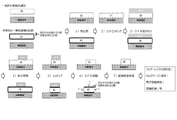
- FIG. 2 is a diagram showing a method of manufacturing a general printed wiring board member and a method of manufacturing a printed wiring board member according to an embodiment of the present invention.
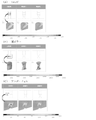
- FIG. 3 shows a conductor (left in each row) according to an embodiment of the present invention, a printed wiring board member (in each row) in which a conductor is laminated on one side of an insulator, and a printed wiring in which conductors are laminated on both sides of an insulator. It is a schematic diagram of the cross section of the board member (right of each row).
- the first surface (1) (which may be referred to as the upper surface in the present specification) has a plating film containing a metal other than copper (A to C).
- the second surface (2) (which may be referred to as a lower surface in the present specification), which is a thermocompression bonding surface with a resin base material, may have no plating film containing a metal other than copper (A). Case (B) is shown.
- the second surface (2) may be processed to increase the degree of adhesion (C).
- the third surface (3) (which may be referred to as a side surface in the present specification) may be the wiring made of copper as it is, or has a copper wiring protective layer such as a copper oxide layer or a rust preventive layer. You may.
- FIG. 4 is a cross-sectional image of the copper wiring after photoresist peeling produced from Examples 1 to 5 and Comparative Examples 1 to 5 of the present invention by a scanning electron microscope (SEM). Only Comparative Example 5 is an image of copper wiring after copper plating.
- FIG. 5 is a schematic view of a member for a printed wiring board used in an embodiment of the present invention.
- FIG. 6 is a diagram showing the results of a simulation performed using a printed wiring board member in an embodiment of the present invention.
- FIG. 7 is a schematic diagram of the copper pillar used in the embodiment of the present invention.
- FIG. 8 is a diagram showing the results of a simulation performed using a copper pillar in an embodiment of the present invention.
- One embodiment of the present invention is a metal member having an upper surface, a lower surface and a side surface, the upper surface and the lower surface are parallel to each other, and at least one side surface is recessed inward.
- the fact that the side surface is recessed inward means that, for example, when imagining a side surface that connects the upper surface and the lower surface in a straight line, the side surface is inside the virtual side surface and outside the virtual side surface. Refers to the case where it does not exist.
- the shapes of the upper surface and the lower surface are not particularly limited, and may be a polygon such as a triangle or a quadrangle, a circle or an ellipse, or a polygon having curved sides.
- the side surface is basically a curved surface that is concave inward and may be partially flat, but a shape that draws a gentle arc is preferable.
- This metal member (1) When the upper surface and the lower surface are quadrangular The upper surface and the lower surface have a first facing side and a second facing side, respectively. The length of the first opposite side is equal to or longer than the length of the second opposite side. The first opposite sides are parallel and A given section of a cross section that is perpendicular to the top and bottom surfaces and is perpendicular to the straight line in the straight section of the first opposing side or perpendicular to the tangent of the curve in the curved section of the first opposing side.
- Percentage or (2) if the top and bottom are circular or elliptical A predetermined percentage of a cross section that is perpendicular to the top and bottom surfaces and includes the center of the top surface and the center of the bottom surface. In, the intersection of the end point of the line segment derived from the upper surface, the straight line 2 ⁇ m away from the line segment and the line derived from the side surface, and the straight line connecting the intersection points on the same side as the end point, and the origin of the upper surface. A metal member having an angle of less than 90 ° with a line segment.
- parallel and vertical include not only perfect parallel and vertical, but also perfect parallel or vertical to ⁇ 10 °.
- the width of the cross section may be the narrowest in the predetermined portion between 40 and 60% of the distance between the upper surface and the lower surface, but is preferably the narrowest in the predetermined portion between 45 and 55%. It should be noted that this ratio represents the ratio of the distance from the upper surface when the distance between the upper surface and the lower surface is 100%.
- the metal member may be a part of a structure such as copper wiring of a printed wiring board.
- the integrated copper wiring may be a portion cut out so that the upper surface and the lower surface form a quadrangle. That is, it is sufficient that a part of the structure has the structure specified in the present specification.
- the upper surface and the lower surface have a first facing side and a second facing side, respectively.
- the first facing side of the upper surface is a line formed by intersecting the upper surface and the side surface
- the first facing side of the lower surface is a line formed by intersecting the lower surface and the side surface.
- the first opposite sides may be parallel, and may be a straight line or a curved line, respectively.
- the connecting line segment preferably has an inwardly recessed shape, and is preferably the shortest at a predetermined portion between 40 to 60% between the line segment derived from the upper surface and the line segment derived from the lower surface. , 45% to 55%, more preferably the shortest in a predetermined portion.
- this ratio represents the ratio of the distance from the line segment derived from the upper surface when the distance between the line segment derived from the upper surface and the line segment derived from the lower surface is 100%.
- the difference in length between the side and the minimum portion of the metal width is preferably 0.2 ⁇ m or more, and more preferably 0.4 ⁇ m or more. It is preferably 0.6 ⁇ m or more, more preferably 0.8 ⁇ m or more, more preferably 1.0 ⁇ m or more, still more preferably 1.5 ⁇ m or more, and 2.0 ⁇ m or more. It is more preferable that it is 2.6 ⁇ m or more, and it is more preferable that it is 2.6 ⁇ m or more.
- this cross section in the shape having the narrowest width in the metal middle abdomen, it is the intersection of the end point of the line segment derived from the upper surface and the straight line 2 ⁇ m away from the line segment and the line derived from the side surface.
- the angle between the straight line connecting the intersections on the same side and the line segment derived from the upper surface is less than 90 °, preferably less than 80 °, more preferably less than 70 °, 60 °. It is more preferably less than °, even more preferably less than 50 °, and even more preferably less than 40 °.
- the upper surface and the lower surface are circular or elliptical, they are perpendicular to the upper surface and are separated from the end point of the line segment derived from the upper surface by 2 ⁇ m from the line segment at a predetermined ratio in the cross section including the center of the upper surface and the center of the lower surface.
- the angle between the straight line connecting the straight line and the line derived from the side surface and connecting the intersection on the same side as the end point and the line segment derived from the upper surface is less than 90 °, but less than 80 °. It is preferably less than 70 °, more preferably less than 60 °, still more preferably less than 50 °, still more preferably less than 40 °.
- the ratio of the length of the line segment derived from the lower surface to the length of the line segment derived from the upper surface is not particularly limited, but is preferably smaller than 1.4 and smaller than 1.2. Is more preferable, and less than 1.0 is further preferable. The larger this value is, the wider the trapezoidal shape of the cross section becomes, and the more the shape is not suitable for stress relaxation. Further, in the case of a printed wiring board, it is difficult to miniaturize the wiring, and in the case of a copper pillar, it is difficult to reduce the pitch.
- the metal member does not include a layered structure and may have a structure in which one or more kinds of metals or alloys are uniformly distributed throughout, and the metals or alloys include copper, silver, platinum, nickel, lead, and stainless steel. Etc. can be exemplified.
- the metal member may consist of a layered structure, for example, the metal member may include a first layer and a second layer, in which case the first layer and the second layer are on the underside. The first layer and the second layer are laminated in this order from the beginning.
- the first layer and the second layer contain the first metal and the second metal, respectively, or are formed from the first metal and the second metal.
- the metal or alloy of both the first metal and the second metal include copper, silver, platinum, nickel, lead, and stainless steel.
- the side surface of the metal member is embedded in resin. This is because the stress relaxation effect becomes large.
- the top and / or bottom may also be embedded in the resin.
- the type of the resin is not particularly limited, and may be a thermoplastic resin or a thermosetting resin, and may be a polyphenylene ether (PPE), an epoxy, a polyphenylene oxide (PPO), a polybenzoxazole (PBO), or a polytetra. Fluoroethylene (PTFE), liquid crystal polymer (LCP), triphenylfosite (TPPI), fluororesin, polyetherimide, polyetheretherketone, polycycloolefin, bismaleimide resin, low dielectric constant polyimide, cyanate resin, or these.
- the coefficient of thermal expansion of the metal contained in the metal member is preferably different from the coefficient of thermal expansion of the resin, and more preferably 0.3 ppm / K or more. This is because the larger the difference in the coefficient of thermal expansion, the greater the stress relaxation effect.
- the shape of the metal member of the present disclosure is effective for stress relaxation of the resin, and the peeling of the metal member and the resin can be suppressed.
- the metal contained in the first layer may be a metal used for wiring of the printed wiring board, and copper, silver, platinum and the like can be exemplified. , Copper is preferred. The purity of copper is preferably high, and it is preferably a pure metal of 99.9% by mass or more. The copper may be tough pitch copper, deoxidized copper, or oxygen-free copper, but it is more preferable that the copper is oxygen-free copper having an oxygen content of 0.0005% by mass or less.
- the copper member contains copper it is preferably contained in the first layer, in which case the second layer preferably contains a metal other than copper or is made of a metal other than copper.
- the metal contained in the second layer is not particularly limited, but at least one metal selected from the group consisting of Sn, Ag, Zn, Al, Ti, Bi, Cr, Fe, Co, Ni, Pd, Au and Pt. May be included. In particular, in order to impart acid resistance and heat resistance, it is preferable to contain metals having higher acid resistance and heat resistance than copper, such as Ni, Pd, Au and Pt.
- the layer of the second conductor may be present on the underside of the conductor.
- a layer containing copper oxide may be provided on a part or all of the upper surface thereof or a part or all of the lower surface thereof.
- This copper oxide contains copper oxide ( CuO) and / or cuprous oxide (Cu2O).
- the layer containing the copper oxide can be formed by oxidizing the surface of the conductor. By this oxidation treatment, the surface of the conductor is roughened, so that the adhesion with the photoresist is improved. After the oxidation treatment, a dissolving agent may be used to adjust the shape of the convex portion on the surface of the oxidized conductor. Further, the surface of the layer containing the copper oxide may be reduced with a reducing agent.
- the amount of adhesion of the second layer is not particularly limited, but is preferably 0.5 to 9.0 mg / dm 2 , preferably 0.89 to 8.9 mg / dm 2 .
- the cross-sectional shape is a trapezoid in which the line segment corresponding to the side surface is linear. With such a trapezoid, the stress relaxation effect becomes small, and it becomes more difficult to make fine wiring.
- the amount of adhesion of the second layer can be calculated by dissolving the second layer in, for example, an acidic solution, measuring the amount of metal by ICP analysis, and dividing by the plane viewing area of the structure.
- the value of L * a * b * brightness L * in the surface of the second layer is less than 60, less than 55, less than 50, less than 45, less than 40, less than 35, less than 30, less than 25 or less than 20.
- the smaller this value the less the reflection of the exposure light.
- the upper surface of the second layer does not have a fragile layer (WBL) due to surface oxidation or alteration. This is because when the fragile layer is formed, the adhesion to the resist layer is lowered.
- the susceptibility to the formation of a fragile layer can be evaluated, for example, by the heat resistance of the surface.
- the heat resistance can be evaluated, for example, by the color change of the upper surface of the second layer when heat-treated. When the color change is small, it is considered that a fragile layer is unlikely to occur and good adhesion to the resist layer can be obtained.
- the level of heat resistance is not particularly limited, but for example, when heat-treated at 225 ° C. for 30 minutes and the surface colors are compared before and after the heat treatment, the surface color change ( ⁇ E * ab) is 10 or less, 5 or less, and 3 or less. It is preferably 2 or less or 1 or less.
- the maximum height roughness (Rz) of the surface of the second layer is preferably 1.0 ⁇ m or less, 0.9 ⁇ m or less, or 0.8 ⁇ m or less, preferably 0. It is preferably 1 ⁇ m or more, 0.2 ⁇ m or more, or 0.3 ⁇ m or more.
- the number of protrusions on the first layer can be counted, for example, in a scanning electron microscope (SEM) image (magnification x 50,000) in which a cross section of the copper foil is observed with a focused ion beam (FIB) and is high.
- SEM scanning electron microscope
- FIB focused ion beam
- the average number of convex portions having a diameter of 50 nm or more is preferably 9 or more, more preferably 19 or more, and further preferably 20 or more per 3.8 ⁇ m. If the number is 8 or less, the adhesion with the photoresist decreases.
- the average length (RSm) of the roughness curve element on the surface of the second layer is 750 nm or less, 700 nm or less, 650 nm or less, 600 nm or less, 550 nm or less, 450 nm or less, or It is preferably 350 nm or less, preferably 100 nm or more, 200 nm or more, or 300 nm or more.
- RSm represents the average of the lengths (that is, the lengths of contour curve elements: Xs1 to Xsm) in which unevenness for one cycle included in the roughness curve at a certain reference length (lr) occurs, and is expressed by the following equation. It is calculated by.
- 10% of the arithmetic mean roughness (Ra) is defined as the minimum height in the unevenness
- 1% of the reference length (lr) is defined as the minimum length
- the unevenness for one cycle is defined.
- An embodiment of the present invention is also a member for a printed wiring board including the conductor for the printed wiring board and an insulator laminated on the bottom surface of the conductor. Further, the printed wiring board member is a member for the printed wiring board according to the embodiment of the present invention, and may form a part of the printed wiring board.
- the member for a printed wiring board includes the above-mentioned conductor for a printed wiring board and an insulator laminated on the bottom surface of the conductor.
- This conductor includes a layer of the first conductor corresponding to the first layer and a layer of the second conductor corresponding to the second layer, and the layer of the first conductor and the layer of the second conductor are:
- the layers of the first conductor and the layer of the second conductor are laminated in this order from the insulator side, and the first conductor has a property of being removed faster than the second conductor by the etching method for forming the conductor.
- the conductor may be made of a single metal foil such as an electrolytic metal foil or a rolled metal foil, or a plurality of metal foils may be laminated.
- the thickness of the metal foil is not particularly limited, but is preferably 0.1 ⁇ m or more and 100 ⁇ m or less, and more preferably 0.5 ⁇ m or more and 50 ⁇ m or less.
- the metal foil also includes a plate-shaped metal, in which case it may be 1 mm or more, 2 mm or more or 10 mm or more, or 10 cm or less, 5 cm or less or 2.5 cm or less.
- the insulator may contain a sheet-shaped resin base material impregnated with a resin (also referred to as a prepreg), or may be made of a sheet-shaped resin base material impregnated with a resin.
- the printed wiring board member can be manufactured by attaching a metal foil to one side or both sides of an insulator.
- the printed wiring board member consists of three layers (that is, a metal layer, an adhesive layer, and an adhesive layer) in which a metal foil and a resin base material are bonded together using an adhesive, which is mainly used for mounting a TAB (tape-automated bonding) method.
- a resin layer may be a resin layer), or it may be two layers (that is, a metal layer and a resin layer) that do not use an adhesive and are used for mounting a COF (chip on film) method.
- a resin base material may be placed on a base material such as paper or glass and thermocompression bonded, and in that case, copper is attached to the surface opposite to the base material.
- this printed wiring board member is called a copper-clad laminate (CCL).
- the resin contained in the resin base material is not particularly limited, but may be a thermoplastic resin or a thermosetting resin, and may be a polyphenylene ether (PPE), an epoxy, a polyphenylene oxide (PPO), or a polybenzoxazole (PBO). ), Polytetrafluoroethylene (PTFE), liquid crystal polymer (LCP), triphenylfosite (TPPI), fluororesin, polyetherimide, polyetheretherketone, polycycloolefin, bismaleimide resin, low dielectric constant polyimide, cyanate. It is preferably a resin or a mixed resin thereof.
- the resin base material may further contain an inorganic filler or glass fiber.
- the thickness of the resin base material is not particularly limited, but is preferably 1 ⁇ m or more and 100 mm or less.
- the conductor may have an insulator not only on the bottom surface but also on its side surface and its surroundings including the top surface.
- the insulator may be a sheet-shaped resin base material impregnated with a resin (also referred to as a prepreg), a sheet-shaped resin base material impregnated with a resin, or a solder resist or a solder paste. It may be an insulating material used for a printed circuit board such as.
- the coefficient of thermal expansion of a conductor and the coefficient of thermal expansion of an insulator differs when heated, and distortion occurs between the conductor and the insulator.
- the effect of is especially expected.
- the difference is preferably 0.1 ppm / K or more, more preferably 0.2 ppm / K or more, and even more preferably 0.3 ppm / K or more.
- the tensile elastic modulus is preferably 0.5 GPa or more, more preferably 1.0 GPa or more, further preferably 3.0 GPa or more, still more preferably 10 GPa or more.
- the wiring has a shape consisting of three or more layers in the printed wiring board, distortion is likely to occur between the layers, for example, when heated, so the effect of stress relaxation due to the shape of this wiring is particularly expected.
- the coefficient of thermal expansion of the insulator is one or more of the coefficients of thermal expansion in the vertical direction and the horizontal direction. It may be different from the coefficient of thermal expansion of the metal. Further, since it is Tg or less that the stress is applied more, it is preferable to use a value of Tg or less for the coefficient of thermal expansion.
- a semiconductor chip connecting member such as a copper pillar.
- the shape of the semiconductor chip connecting member is not particularly limited, and for example, the upper surface and the lower surface may be polygonal, circular, or elliptical, but are preferably quadrangular or circular.
- the copper pillar becomes a square pillar in the former case and a cylinder in the latter case.
- the size is not particularly limited, but the height is preferably 1 to 500 ⁇ m, and the maximum width (in the case of a quadrangular column) or the maximum diameter (in the case of a cylinder or an elliptical column) is preferably 1 ⁇ m to 10 mm.
- the difference between the coefficient of thermal expansion of the copper pillar and the coefficient of thermal expansion of the underfill is preferably 0.1 ppm / K or more, and 0.2 ppm / K or more. It is more preferably present, and more preferably 0.3 ppm / K or more.
- the tensile elastic modulus is preferably 0.5 GPa or more, more preferably 1.0 GPa or more, further preferably 3.0 GPa or more, still more preferably 10 GPa or more.
- the coefficient of thermal expansion of the insulator is one or more of the coefficients of thermal expansion in the vertical direction and the horizontal direction. It may be different from the coefficient of thermal expansion of the metal. Further, since it is Tg or less that the stress is applied more, it is preferable to use a value of Tg or less for the coefficient of thermal expansion.
- the method for producing the metal member disclosed in the present specification is not particularly limited, and a known method for casting a metal can be used.
- the following method can be used. That is, on the surface of the conductor foil containing the first conductor, the first step of forming the layer of the second conductor, and on the surface of the conductor foil opposite to the surface on which the layer of the second conductor is formed.
- the second step of laminating the insulating layer, the third step of forming the resist layer on the surface of the conductor foil on which the second conductor layer is formed, and the etching treatment of the conductor foil on which the resist layer is formed are performed.
- a fourth step and a fifth step of removing the resist layer from the etched conductor foil are performed.
- the sixth step of covering the periphery of the conductor with an insulating material may be arbitrarily performed.
- the manufacturing method will be described in detail using copper wiring as an example.
- the surface of the copper foil may be oxidized with an oxidizing agent to form a layer of copper oxide, and fine irregularities may be formed on the surface.
- the oxidation treatment may be a single-sided treatment or a double-sided treatment.
- a roughening treatment step such as soft etching or etching is not necessary, but it may be performed.
- a degreasing treatment an acid cleaning for homogenizing the surface by removing the natural oxide film, or an alkali treatment for preventing the acid from being brought into the oxidation step after the acid cleaning may be performed.
- the method of alkaline treatment is not particularly limited, but is preferably 0.1 to 10 g / L, more preferably 1 to 2 g / L in an alkaline aqueous solution, for example, a sodium hydroxide aqueous solution at 30 to 50 ° C. for 0.5 to 2 minutes. It should be processed to some extent.
- the oxidizing agent is not particularly limited, and for example, an aqueous solution of sodium chlorite, sodium hypochlorite, potassium chlorate, potassium perchlorate or the like can be used.
- Various additives for example, phosphates such as trisodium phosphate dodecahydrate
- surface active molecules include porphyrin, porphyrin-membered ring, expanded porphyrin, ring-reduced porphyrin, linear porphyrin polymer, porphyrin sandwich coordination complex, porphyrin sequence, silane, tetraorgano-silane, aminoethyl-aminopropyl-trimethoxysilane.
- (3-Aminopropyl) trimethoxysilane (1- [3- (trimethoxysilyl) propyl] urea) ((l- [3- (Trimethoxysylyl) propyl] urea)), (3-aminopropyl) triethoxy Silane, ((3-glycidyloxypropyl) trimethoxysilane), (3-chloropropyl) trimethoxysilane, (3-glycidyloxypropyl) trimethoxysilane, dimethyldichlorosilane, 3- (trimethoxysilyl) propylmethacrylate, Ethyltriacetoxysilane, triethoxy (isobutyl) silane, triethoxy (octyl) silane, tris (2-methoxyethoxy) (vinyl) silane, chlorotrimethylsilane, methyltrichlorosilane, silicon tetrachloride
- the oxidation reaction conditions are not particularly limited, but the temperature of the chemical solution for oxidation is preferably 40 to 95 ° C, more preferably 45 to 80 ° C.
- the reaction time is preferably 0.5 to 30 minutes, more preferably 1 to 10 minutes.
- the layer containing the copper oxide may be partially dissolved with a dissolving agent.
- the dissolving agent used in this dissolution step is not particularly limited, but is preferably a chelating agent, particularly a biodegradable chelating agent, such as ethylenediamine tetraacetic acid, diethanolglycine, L-glutamate diacetic acid / tetrasodium, ethylenediamine-N, N'. -Disuccinic acid, 3-hydroxy-2, 2'-sodium iminodisuccinate, methylglycine 2 sodium acetate, 4 sodium aspartate diacetate, N- (2-hydroxyethyl) disodium iminodiacetate, sodium gluconate, etc. It can be exemplified.
- a biodegradable chelating agent such as ethylenediamine tetraacetic acid, diethanolglycine, L-glutamate diacetic acid / tetrasodium, ethylenediamine-N, N'. -Disuccinic acid, 3-hydroxy-2, 2'-sodium
- the pH of the chemical solution for dissolution is not particularly limited, but is preferably alkaline, more preferably pH 8 to 10.5, further preferably pH 9.0 to 10.5, and pH 9.8 to 10. It is more preferably 2.
- the copper oxide contained in the formed layer containing the copper oxide may be partially reduced by using a reducing agent.
- a reducing agent used in this reducing step include dimethylamine borane (DMAB), diborane, sodium borohydride, hydrazine and the like.
- a layer of the second conductor is formed with respect to the copper foil on which the layer containing the copper oxide is formed.
- the layer of the second conductor can be formed as a plating film by, for example, plating the surface of the layer of the first conductor.
- the plating method is not particularly limited, and examples thereof include electrolytic plating, electroless plating, chemical conversion treatment, and vacuum vapor deposition such as sputtering. However, electrolytic plating is preferable because it is preferable to form a uniform and thin plating film.
- the copper oxide on the surface is first reduced, and the charge is used to become cuprous oxide or pure copper, so that it is before plating. There is a time lag, after which the metal forming the second layer begins to precipitate.
- the amount of charge varies depending on the type of plating solution and the amount of copper oxide. For example, when Ni plating is applied to a copper member, in order to keep the thickness within a preferable range, 15 C per area dm 2 of the copper member to be electroplated. It is preferable to give a charge of 75 C or more, and it is more preferable to give a charge of 25 C or more and 65 C or less.
- the copper oxide formed by the oxidation treatment is partially reduced to copper, and the conductivity of the layer containing the copper oxide is increased, which is the same conductor as copper, which is a conductor forming a structure. Conduction is possible with layers containing metals other than copper.
- the method for confirming continuity is not particularly limited, but for example, copper, which is a conductor forming a structure, and copper other than copper, which is also a conductor, are used for a plane viewing area of 4 ⁇ m 2 of a plating layer containing a metal other than copper.
- AFM interatomic force microscope
- the region where the current value is -60 nA or less is a plating film containing a metal other than copper.
- conduction is established between copper, which is a conductor forming a structure, and a layer containing a metal other than copper. It may be.
- a wiring pattern is formed using a structure and a member for a printed wiring board is manufactured, an electronic component is mounted on a layer containing a metal other than copper, and if it functions as an electric circuit, the structure is formed. It may be assumed that there is continuity between copper, which is a conductor, and a layer containing a metal other than copper.
- the conductors produced in these steps may be subjected to a coupling treatment using a silane coupling agent or the like, a molecular bonding treatment, or a rust preventive treatment using benzotriazoles or the like. good.
- an insulating layer is laminated on the surface of the conductor foil opposite to the surface on which the second conductor layer is formed.
- the insulating layer contains a resin base material or is made of a resin base material
- the insulating layer can be laminated, for example, by thermocompression bonding the resin base material to the conductor foil.
- the recommended conditions for example, temperature, pressure, time
- each base material manufacturer may be used.
- the following conditions can be considered as recommended conditions for each base material manufacturer.
- a composite copper member is formed on the resin base material by applying a pressure of 0 to 20 MPa at a temperature of 50 ° C. to 300 ° C. for 1 minute to 5 hours. It is preferably thermocompression bonded.
- the resin base material contains PPE resin or is made of PPE resin It is preferable to thermocompression-bond the composite copper member to the resin substrate by applying a pressure of 0 to 20 MPa at a temperature of 50 ° C. to 350 ° C. for 1 minute to 5 hours.
- thermocompression bonding is performed while heating to 100 ° C. under a pressure of 0.5 MPa, then the temperature and pressure are increased, and the temperature and pressure are held at 2.0 to 3.0 MPa and 200 to 210 ° C. for 120 minutes for further thermocompression bonding. .. 2-2)
- the resin base material is R5670 (manufactured by Panasonic Corporation)
- Thermocompression bonding is performed while heating to 110 ° C. under a pressure of 0.49 MPa, and then thermocompression bonding is performed by raising the temperature and pressure and holding at 2.94 MPa and 210 ° C. for 120 minutes.
- the resin base material contains PTFE resin or is made of PTFE resin. It is preferable to thermocompression-bond the composite copper member to the resin substrate by applying a pressure of 0 to 20 MPa at a temperature of 50 ° C. to 400 ° C. for 1 minute to 5 hours.
- the adhesion between the resin base material and the copper foil is high.
- Adhesion shall be measured as peel strength based on the 90 ° peel test (Japanese Industrial Standards (JIS) C5016 "Flexible printed wiring board test method"; corresponding international standards IEC249-1: 1982, IEC326-2: 1990). Can be done.
- the peel strength between the resin base material and the copper foil is not particularly limited, but is preferably 0.40 kgf / cm or more, 0.50 kgf / cm or more, or 0.60 kgf / cm or more.
- a resist layer is formed on the surface on which the second conductor layer is formed.
- the resist layer is a layer containing a photoresist that is cured or dissolved by photosensitization, and is not particularly limited, but is preferably formed of a dry film resist (DFR), a positive liquid resist, or a negative liquid resist.
- DFR dry film resist
- the DFR includes a binder polymer (including an alkali-developable type and a solvent-developable type) that contributes to film formability, and a monomer that causes a photopolymerization reaction by UV irradiation (for example, an acrylic ester-based or methacrylic ester-based monomer) and photopolymerization is started. It is preferable to include an agent.
- a dry film having a three-layer structure of a cover film / photoresist / carrier film. While the cover film is peeled off, the photoresist is thermocompression bonded to the structure and laminated, and after the lamination, the carrier film is peeled off to form a DFR which is a resist layer on the structure.
- Examples of the positive type liquid resist and the negative type liquid resist include novolak resin solubilized in an organic solvent.
- a resist layer can be formed by applying it to the surface of a structure and then drying it.
- the thickness of the resist layer is not particularly limited, but is preferably 5 ⁇ m to 200 ⁇ m.
- the Rz on the surface of the layer of the second conductor on which the resist layer is formed is preferably 1.0 ⁇ m or less, 0.9 ⁇ m or less, or 0.8 ⁇ m or less, preferably 0.1 ⁇ m or more. , 0.2 ⁇ m or more, or 0.3 ⁇ m or more is preferable.
- the RSm on the surface of the second conductor layer on which the resist layer is formed is preferably 750 nm or less, 700 nm or less, 650 nm or less, 600 nm or less, 550 nm or less, 450 nm or less, or 350 nm or less, preferably 100 nm or more and 200 nm or more. Alternatively, 300 nm or more is preferable.
- the number of convex portions of the first layer is, for example, 50 nm or more in height in a scanning electron microscope (SEM) image (magnification: ⁇ 50,000) in which a cross section of a copper foil is observed by a focused ion beam (FIB).
- SEM scanning electron microscope
- FIB focused ion beam
- the convex part is 3.8
- the average number of pieces per ⁇ m is preferably 9 or more, more preferably 19 or more, and further preferably 29 or more.
- the surface roughness and the number of protrusions are related to the adhesion of the resist layer. If Rz is too small or the number of convex portions is small, the adhesion with the resist layer is insufficient, and if it is too large, it becomes difficult to remove the photoresist after the etching treatment. On the other hand, if Rsm is too large, the adhesion to the resist layer is insufficient, and if it is too small, it becomes difficult to remove the photoresist after the etching treatment.
- the surface roughness is small and the number of convex portions is small, so that the adhesion with the dry film is weak, and the etching solution penetrates into the interface between the cobalt or nickel layer and the dry film. Etching also proceeds from the upper surface of the circuit.
- the etching solution permeates between the conductor surface and the photoresist, so that the upper part of the conductor has a rounded shape and the width of the upper part of the conductor becomes narrower. Therefore, the cross-sectional shape of the conductor is trapezoidal, and the difference between the upper wiring width and the lower wiring width becomes large. That is, this indicates that the ratio of the length of the line segment derived from the lower surface to the length of the line segment derived from the upper surface becomes large, and the etching factor becomes small.
- a straight line connecting an end point of a line segment derived from the upper surface, a straight line 2 ⁇ m away from the line segment and a line derived from a side surface, and an intersection point on the same side as the end point, and a line derived from the upper surface.
- the angle between the minutes and the minute is 90 ° or more.
- the photoresist is attached to the entire surface of the layer of the second conductor.
- Specific examples thereof include a method of attaching a photoresist while heating using a dry film, a method of applying a positive liquid resist or a negative liquid resist at room temperature, and drying.
- the copper foil may be soft-etched in order to increase the adhesion before forming the resist layer, but in the method of the present disclosure, sufficient adhesion can be obtained without performing the soft-etching treatment.
- the soft etching treatment include baflor polishing, scrub polishing, jet scrub polishing, chemical polishing, and combinations thereof.
- the chemical polishing method include impregnation with an aqueous solution containing sulfuric acid and hydrogen peroxide, an aqueous solution containing copper chloride, an aqueous solution containing persulfate, an organic solvent containing azimidbenzene, or an aqueous solution containing permanganic acid. can.
- the resist layer is irradiated with light and then developed to remove unnecessary resist.
- the photoresist is cured by exposure, light is irradiated along the wiring pattern, and when the photoresist is dissolved by exposure, light is irradiated to a portion other than the wiring pattern.
- the wavelength and amount of light to be irradiated may be in the range where the resin contained in the resist layer is cured or dissolved.
- light having a wavelength of 100 nm to 500 nm is preferable.
- light having a wavelength of 10 nm to 900 nm is preferable.
- the irradiation amount of light is not particularly limited, but is preferably 1 to 1000 mJ / cm 2 , more preferably 10 to 1000 mJ / cm 2 , and even more preferably 100 to 1000 mJ / cm 2 .
- the photoresist unnecessary for the wiring pattern is removed by development.
- the binder polymer contained in the photoresist is an alkali-developing type
- the alkaline treatment it is preferable to immerse the product in a 0.5% to 1.5% aqueous solution of NaCO 3 at 25 ° C. to 35 ° C. for 1.5 to 2.5 times the minimum development time, and then wash with water.
- the copper foil on which the resist layer is formed is etched.
- the copper foil part not protected by the resist layer is melted by etching treatment.
- Etching conditions are not particularly limited, but acid treatment is preferable, for example, at 20 ° C to 60 ° C, a hydrogen peroxide / hydrochloric acid mixed solution, a hydrogen peroxide / sulfuric acid mixed solution, 20% to 50% cupric chloride or chloride.
- acid treatment is preferable, for example, at 20 ° C to 60 ° C, a hydrogen peroxide / hydrochloric acid mixed solution, a hydrogen peroxide / sulfuric acid mixed solution, 20% to 50% cupric chloride or chloride.
- the copper foil corresponding to the first conductor has a property of being removed faster by the etching method than the plating film corresponding to the second conductor. That is, by the acid treatment, the copper foil dissolves faster than the plating film.
- the conductor after the etching process does not have a trapezoidal cross section, but has a quadrangle shape that is recessed inward at the central portion in the vertical direction.
- the resist layer is removed from the etched conductor foil.
- the removal method is not particularly limited, but when the binder polymer contained in the photoresist is an alkali-developed type, it is placed in a 1 to 5% NaOH aqueous solution at 40 ° C to 60 ° C within 180 seconds, 120 seconds or 90 seconds. It is preferable to wash the photoresist with water after removing the photoresist by impregnating it within.
- the Rz of the surface on which the plating film is formed after the photoresist is removed is preferably 1.0 ⁇ m or less, 0.9 ⁇ m or less, or 0.8 ⁇ m or less, and 0.1 ⁇ m or more and 0.2 ⁇ m or more. Alternatively, it is preferably 0.3 ⁇ m or more.
- the Rsm of the surface on which the plating film is formed after the photoresist is removed is preferably 750 nm or less, 700 nm or less, 650 nm or less, 600 nm or less, 550 nm or less, 450 nm or less, or 350 nm or less, preferably 100 nm or more. , 200 nm or more, or preferably 300 nm or more.
- a process of further forming a copper oxide layer on the copper side surface of the copper wiring (eg, exemplified in the third surface of FIG. 2) formed by etching, blackening.
- a copper wiring protective layer may be formed by performing a treatment, a rust preventive treatment and / or a coupling treatment.
- a treatment for roughening the side surface made of copper may be performed. It is preferable that these treatments do not affect the roughness of the plating film containing a metal other than copper and the surface roughness thereof of the copper wiring, and the continuity between the wiring made of copper and the plating film containing a metal other than copper.
- the plating film may be removed to the extent that the wiring shape is not impaired, and at the same time, part or all of the layer containing the copper oxide may be removed.
- the copper wiring protective layer is formed by further performing a treatment for increasing the wiring height by copper plating, a treatment for forming a copper oxide layer, a blackening treatment, a rust prevention treatment and / and a coupling treatment. good.
- a process of roughening the side surface may be performed. It is preferable that these treatments do not affect the roughness of the plating film containing a metal other than copper and the surface roughness thereof of the copper wiring, and the continuity between the wiring made of copper and the plating film containing a metal other than copper.
- the copper wiring thus manufactured has the upper surface and the lower surface parallel to each other.
- the side surface is recessed inward.
- the upper surface and the lower surface have a first facing side and a second facing side, respectively, and the length of the first facing side is the same as or longer than the length of the second facing side.
- the opposite sides of 1 are parallel, perpendicular to the upper surface, and perpendicular to the straight line in the straight line portion of the first facing side, or tangent to the curve in the curved line portion of the first facing side.
- the end point of the line segment derived from the upper surface, the intersection of the straight line 2 ⁇ m away from the line segment and the line derived from the side surface, and the intersection point on the same side as the end point are connected.
- the shape is such that the angle between the straight line and the line segment derived from the upper surface is less than 90 °.
- the periphery on the wiring may be covered with an insulator.
- This insulator may be a prepreg or an insulating sheet (inner layer wiring), or a solder resist or a solder paste (outer layer wiring), as long as it is an insulator having a coefficient of thermal expansion different from that of copper, the effect of stress relief can be exhibited.
- solder resist which is an ink serving as an insulating film
- the solder resist is 1) an alkali-developable solder resist that can form a fine pattern by exposing the uncured portion with a dilute alkaline phenomenon liquid, and 2) pattern printing by a screen printing method and UV.
- Examples thereof include a UV-curable solder resist of a type that cures by irradiating light (ultraviolet rays), and a heat-curable solder resist that is a type of solder resist that cures by heating after pattern printing by a screen printing method.
- Soldering treatment may be performed on the surface on which the plating film is formed in the portion not treated with solder resist. By this processing, it is possible to suppress the natural oxidation of the metal forming the circuit and improve the efficiency of soldering when mounting the electronic component.
- the printed circuit board can be manufactured by further soldering the electronic components.
- thermocompression bonding After removing the photoresist, a resin base material is thermocompression-bonded to the surface on which the plating film is formed, and copper wiring is placed on the resin substrate to fabricate a multilayer circuit board composed of a plurality of wiring layers. You may.
- the conditions for thermocompression bonding the recommended conditions (for example, temperature, pressure, time) of each base material manufacturer may be used.
- a printed wiring board (Printed Wiring Board: PWB) is manufactured, and further, electronic components are soldered to obtain a printed circuit board (Printed Circuit Board: PCB). Can be manufactured.
- PWB printed Wiring Board
- PCB printed circuit Board
- a copper pillar can be manufactured by using a known metal casting method, but can be manufactured in the same manner as the printed wiring board member as described above. First, a step of forming a copper oxide layer on the surface of copper, a step of forming a resist layer on the surface of copper on which the copper oxide layer is formed, and a step of etching the copper on which the resist layer is formed. It has a step of removing the resist layer from the etched copper. The details of each process are the same as those for printed wiring board members.
- solder paste (SnAg paste, etc.) is applied on the electrodes of the semiconductor chip or on the end faces of the terminal pins, the copper pillars are arranged so as to be in contact with the electrodes of the semiconductor chip, and then the paste is reflowed to make copper fine particles.
- Terminal pins can be attached.
- the shape can be adjusted while the resist layer is mounted.
- Example 1 Manufacture and structure of a conductor for a printed wiring board 1. Treatment of Copper Foil
- copper foil DR-WS, thickness: 18 ⁇ m
- H-VLP copper foil having a thickness of 18 ⁇ m was laminated on both sides of prepreg R5680J (thickness 100 ⁇ m).
- the surface on which the dry film AK3021 (manufactured by Asahi Kasei Corporation) was laminated was a glossy surface (a surface flatter than the opposite side).
- copper wiring was formed by the SAP (semi-additive) method.
- the copper foil was used as an oxidizing agent (sodium chlorite 45 g / L; sodium hydroxide 12 g / L; KBM-403 (3-glycidoxypropyltrimethoxysilane). It was immersed in 2 g / L) manufactured by Shin-Etsu Silicone Co., Ltd. at 73 ° C. for 1.75 minutes, and both sides of the copper foil were oxidized. The copper foil was oxidized, washed with water, and then dried.
- an oxidizing agent sodium chlorite 45 g / L; sodium hydroxide 12 g / L; KBM-403 (3-glycidoxypropyltrimethoxysilane. It was immersed in 2 g / L) manufactured by Shin-Etsu Silicone Co., Ltd. at 73 ° C. for 1.75 minutes, and both sides of the copper foil were oxidized. The copper foil was oxidized, washed with water, and then dried.
- Ni electrolytic plating solution (nickel sulfate 240 g / L; nickel chloride 45 g / L; citrate 3 sodium 20 g / L) was subsequently used for 50. Both sides of the copper foil were electroplated at ° C. under the condition of a current density of 0.5 A / dm 2 .
- Example 1 is 30 seconds
- Example 2 is 39 seconds
- Example 3 is 56 seconds
- Example 4 is 91 seconds
- Example 5 is 109 seconds
- Comparative Example 3 is 26 seconds
- Comparative Example 4 is 87 seconds, respectively. It was energized.
- the copper foil was electroplated, washed with water, and then dried.
- the scan width was 100 ⁇ m
- the scan type was an area
- the Light source was Blue
- the cutoff value was 1/5.
- the object lens was set to x100
- the contact lens was set to x14
- the digital zoom was set to x1
- the Z pitch was set to 10 nm
- data was acquired at three locations
- Rz was the average value of the three locations.
- SEM scanning electron microscope
- FIB focused ion beam
- the minimum part of the wiring width is the upper part of the wiring when the minimum part is within 2 ⁇ m from the upper part of the wiring, and the lower part of the wiring when the minimum part is within 2 ⁇ m from the lower part of the wiring. If it is in a place, it is the abdomen of the wiring. The length of the minimum part was measured from the SEM image.
- the upper side of the wiring measures the length of the uppermost side of the wiring and the lower side of the wiring measures the length of the lowest side of the wiring. Will be. In addition, when the middle abdomen of the wiring is the smallest part, the larger this value is, the more it is dented inward.
- the etching factor was calculated using the following formula. [formula]
- Comparative Example 4 the etching of the upper part of the wiring also progressed, the angle formed by the upper part of the wiring became larger than 90 °, the numerical value of the lower side / the upper side was also large, and the wiring shape became a trapezoid.
- the amount of the second layer is the same as that of Example 5, but it is considered that the adhesion between the upper part of the wiring and the DFR is low. Since Comparative Example 6 was formed by SAP, the angle formed by the upper left corner of the wiring was larger than 90 °. Further, as will be described later, since the minimum portion of the wiring width in all the comparative examples is the upper surface and the wiring shape is not recessed inward, the stress on the resin base material is large and there is no stress relaxation effect.
- the angle formed by the upper left corner of the wiring is less than 90 °, and the lower surface is relative to the length of the line segment derived from the upper surface.
- the ratio of the lengths of the derived line segments is as small as 1.37 or less, and it has excellent wiring formability.
- the minimum wiring width is the middle part, the wiring shape is recessed inward, and the length of the upper side-minimum.
- the number of convex portions having a height of 50 nm or more per 3.8 ⁇ m was 19 or more in each of the examples.
- the number of ⁇ 50 Dot peels was as small as 3 or less in the examples, and all the results showed high adhesion to the DFR in the examples.
- the wiring width that is, the length of the line segment connecting the two intersections of the straight line parallel to the line segment derived from the upper surface and the two line segments derived from the side surface, is minimized in the middle abdomen. In some cases, that is, at about the same distance as those line segments.
- Example 2 Confirmation of stress relaxation effect 1.
- a member for a printed wiring board (1) Manufacture of a member for a printed wiring board In Example 2, in order to confirm the stress relaxation effect, a member for a printed wiring board having the same configuration as that of the simulation model (FIG. 5) is used. did.
- the side surface of the copper member was subjected to an oxidation treatment in the same manner as in 1- (1).
- Comparative Examples 2 and 5 were blackened. The blackening treatment was carried out using a Meltex emplate at a temperature of 80 ° C. and a treatment time of 6 minutes and 20 seconds.
- the resin and the copper foil were laminated one above the other, and after the wiring of the outermost layer was formed, the wiring of the inner layer portion (corresponding to the copper wiring / resin layer in the second stage from the top of FIG. 5) was evaluated.
- a copper member having a coefficient of thermal expansion of 16.8 ppm / K was used, and a resin member having a coefficient of thermal expansion of Tg or less of 16.5 ppm / K and 30 ppm / K was used.
- the evaluation results are shown in Table 2.
- FIG. 7 shows a simulation analysis model.
- a structure composed of copper pillars and solder was installed at equal intervals as a connection between the printed wiring board (lower part in the figure) and the Si chip (upper part in the figure), and underfill was used as a reinforcing material in these gaps. ..
- the simulation was carried out by changing the shape of the copper pillar.
- a copper pillar having a coefficient of thermal expansion of 16.8 ppm / K was used, and an underfill having a coefficient of thermal expansion of Tg or less of 31 ppm / K was used.
- the copper shape was measured from the cross-sectional SEM using the same software as above, and modeled and analyzed by CAD.
- copper is used as an elastic body and the resin part is used as a viscoelastic body, and temperature and time-dependent physical property values are input, and viscoelastic stress analysis is performed when the temperature of the resin is lowered from the curing temperature to a low temperature.
- the strain and stress generated from the difference in the thermal expansion coefficient between the materials were output. The results are shown in FIG. Table 2 shows the obtained stress, strain, and warpage values.
- FIG. 6 illustrates the simulation results of the printed wiring board member.
- the diagram of the copper wiring is a diagram in which only the copper wiring portion is extracted from the simulation analysis result.
- the figure of the resin is the figure which extracted only the resin part.
- the example has more dark-colored portions than the comparative example. This indicates that in the case of the embodiment, the stress of the resin portion having a small yield stress is reduced, and the stress corresponding to the stress is transferred to the copper wiring having a large yield stress.
- FIG. 8 shows the simulation results of the copper pillars. Similar to FIG. 6, the lighter the color, the smaller the equivalent stress, and the darker the color, the larger the equivalent stress.
- the solder diagram is a diagram in which only the solder portion is extracted from the simulation analysis results.
- the copper pillar is only the part of the copper pillar, C.I.
- the underfill is a diagram in which only the underfill is extracted.
- the solder strain was lower, the equivalent stress of the underfile was lower, and the tensile stress of the copper pillar was larger than that of the comparative example. This indicates that the copper pillar shape of the embodiment reduces the stress of the solder and the underfill, and the stress is transferred to the copper pillar by that amount.
- the reason why the peeling does not occur in the examples is that the stress of the base material is transferred to the copper wiring having a large yield stress in the shape as in the examples.
- the metal member into a shape as in this embodiment, it is possible to relieve the stress generated on the metal member side.
Landscapes
- Engineering & Computer Science (AREA)
- Microelectronics & Electronic Packaging (AREA)
- Manufacturing & Machinery (AREA)
- Non-Insulated Conductors (AREA)
- Manufacture Of Alloys Or Alloy Compounds (AREA)
- Parts Printed On Printed Circuit Boards (AREA)
- Manufacturing Of Printed Wiring (AREA)
Priority Applications (2)
| Application Number | Priority Date | Filing Date | Title |
|---|---|---|---|
| KR1020237011727A KR20230124543A (ko) | 2020-12-25 | 2021-12-21 | 금속 부재 |
| JP2022571525A JPWO2022138681A1 (https=) | 2020-12-25 | 2021-12-21 |
Applications Claiming Priority (2)
| Application Number | Priority Date | Filing Date | Title |
|---|---|---|---|
| JP2020-218001 | 2020-12-25 | ||
| JP2020218001 | 2020-12-25 |
Publications (1)
| Publication Number | Publication Date |
|---|---|
| WO2022138681A1 true WO2022138681A1 (ja) | 2022-06-30 |
Family
ID=82159783
Family Applications (1)
| Application Number | Title | Priority Date | Filing Date |
|---|---|---|---|
| PCT/JP2021/047438 Ceased WO2022138681A1 (ja) | 2020-12-25 | 2021-12-21 | 金属部材 |
Country Status (4)
| Country | Link |
|---|---|
| JP (1) | JPWO2022138681A1 (https=) |
| KR (1) | KR20230124543A (https=) |
| TW (1) | TW202316919A (https=) |
| WO (1) | WO2022138681A1 (https=) |
Citations (3)
| Publication number | Priority date | Publication date | Assignee | Title |
|---|---|---|---|---|
| JP2015060947A (ja) * | 2013-09-19 | 2015-03-30 | イビデン株式会社 | 金属ポストを有するプリント配線板及び金属ポストを有するプリント配線板の製造方法 |
| JP2016122796A (ja) * | 2014-12-25 | 2016-07-07 | 新光電気工業株式会社 | 配線基板及び配線基板の製造方法 |
| WO2018116692A1 (ja) * | 2016-12-19 | 2018-06-28 | タツタ電線株式会社 | パッケージ基板及びパッケージ基板の製造方法 |
Family Cites Families (3)
| Publication number | Priority date | Publication date | Assignee | Title |
|---|---|---|---|---|
| JPS54108274A (en) * | 1978-02-15 | 1979-08-24 | Shindo Denshi Kougiyou Kk | Method of producing printed circuit board |
| JPS6435985A (en) * | 1987-07-30 | 1989-02-07 | Mitsubishi Electric Corp | Manufacture of printed board |
| JP2016066705A (ja) * | 2014-09-25 | 2016-04-28 | イビデン株式会社 | プリント配線板およびその製造方法 |
-
2021
- 2021-12-21 JP JP2022571525A patent/JPWO2022138681A1/ja active Pending
- 2021-12-21 WO PCT/JP2021/047438 patent/WO2022138681A1/ja not_active Ceased
- 2021-12-21 KR KR1020237011727A patent/KR20230124543A/ko active Pending
- 2021-12-24 TW TW110148725A patent/TW202316919A/zh unknown
Patent Citations (3)
| Publication number | Priority date | Publication date | Assignee | Title |
|---|---|---|---|---|
| JP2015060947A (ja) * | 2013-09-19 | 2015-03-30 | イビデン株式会社 | 金属ポストを有するプリント配線板及び金属ポストを有するプリント配線板の製造方法 |
| JP2016122796A (ja) * | 2014-12-25 | 2016-07-07 | 新光電気工業株式会社 | 配線基板及び配線基板の製造方法 |
| WO2018116692A1 (ja) * | 2016-12-19 | 2018-06-28 | タツタ電線株式会社 | パッケージ基板及びパッケージ基板の製造方法 |
Also Published As
| Publication number | Publication date |
|---|---|
| JPWO2022138681A1 (https=) | 2022-06-30 |
| KR20230124543A (ko) | 2023-08-25 |
| TW202316919A (zh) | 2023-04-16 |
Similar Documents
| Publication | Publication Date | Title |
|---|---|---|
| JP6415760B2 (ja) | キャリア付銅箔、並びに配線層付コアレス支持体及びプリント配線板の製造方法 | |
| US8069558B2 (en) | Method for manufacturing substrate having built-in components | |
| US11527415B2 (en) | Multilayer circuit board manufacturing method | |
| WO2017149810A1 (ja) | キャリア付銅箔及びその製造方法、並びに配線層付コアレス支持体及びプリント配線板の製造方法 | |
| KR102482171B1 (ko) | 시드층을 포함하는 전사필름 제조방법, 시드층의 선택적 에칭을 이용한 회로기판 제조방법 및 에칭액 조성물 | |
| KR20080046275A (ko) | 다층 프린트 배선판 및 그 제조 방법 | |
| TW201016890A (en) | Method for surface treatment of copper and copper | |
| CN106103082A (zh) | 带有载体箔的铜箔、覆铜层压板及印刷线路板 | |
| US20060060558A1 (en) | Method of fabricating package substrate using electroless nickel plating | |
| CN1254856C (zh) | 电路装置的制造方法 | |
| WO2010018790A1 (ja) | マルチ導通部を有する多層積層回路基板 | |
| WO2022138682A1 (ja) | 銅部材、プリント配線板用導体、プリント配線板用部材、プリント配線板、プリント回路板およびそれらの製造方法 | |
| WO2022138681A1 (ja) | 金属部材 | |
| KR102931323B1 (ko) | 복합 구리 배선 및 레지스트층을 갖는 적층체 | |
| JP2005340382A (ja) | フレキシブルプリント配線板及びそのフレキシブルプリント配線板の製造方法 | |
| TWI918818B (zh) | 銅構件、印刷佈線板用導體、印刷佈線板用構件、印刷佈線板、印刷電路板及該等的製造方法 | |
| CN1781348A (zh) | 印刷电路板,制造方法及电路装置 | |
| KR101151347B1 (ko) | 칩 내장형 인쇄회로기판 제조방법 | |
| TWI921161B (zh) | 層積體之製造方法 | |
| JP3543348B2 (ja) | 多層配線板の製造法 | |
| JP2000188455A (ja) | 転写法用複合材およびその製造方法ならびにそれを用いたプリント基板および半導体装置 | |
| TW202604719A (zh) | 層積體之製造方法 | |
| JP2021072369A (ja) | 半導体パッケージ及びその製造方法 | |
| JP4320841B2 (ja) | 複合リードフレームおよびそれを用いた半導体装置 | |
| WO2010021278A1 (ja) | 熱膨張係数の異なる樹脂フィルムを積層させた多層積層回路基板 |
Legal Events
| Date | Code | Title | Description |
|---|---|---|---|
| 121 | Ep: the epo has been informed by wipo that ep was designated in this application |
Ref document number: 21910821 Country of ref document: EP Kind code of ref document: A1 |
|
| ENP | Entry into the national phase |
Ref document number: 2022571525 Country of ref document: JP Kind code of ref document: A |
|
| NENP | Non-entry into the national phase |
Ref country code: DE |
|
| 122 | Ep: pct application non-entry in european phase |
Ref document number: 21910821 Country of ref document: EP Kind code of ref document: A1 |