WO2022137881A1 - 紫外線硬化型樹脂組成物 - Google Patents
紫外線硬化型樹脂組成物 Download PDFInfo
- Publication number
- WO2022137881A1 WO2022137881A1 PCT/JP2021/041725 JP2021041725W WO2022137881A1 WO 2022137881 A1 WO2022137881 A1 WO 2022137881A1 JP 2021041725 W JP2021041725 W JP 2021041725W WO 2022137881 A1 WO2022137881 A1 WO 2022137881A1
- Authority
- WO
- WIPO (PCT)
- Prior art keywords
- resin composition
- curable resin
- ultraviolet curable
- weight
- acid
- Prior art date
- Legal status (The legal status is an assumption and is not a legal conclusion. Google has not performed a legal analysis and makes no representation as to the accuracy of the status listed.)
- Ceased
Links
Images
Classifications
-
- C—CHEMISTRY; METALLURGY
- C08—ORGANIC MACROMOLECULAR COMPOUNDS; THEIR PREPARATION OR CHEMICAL WORKING-UP; COMPOSITIONS BASED THEREON
- C08F—MACROMOLECULAR COMPOUNDS OBTAINED BY REACTIONS ONLY INVOLVING CARBON-TO-CARBON UNSATURATED BONDS
- C08F265/00—Macromolecular compounds obtained by polymerising monomers on to polymers of unsaturated monocarboxylic acids or derivatives thereof as defined in group C08F20/00
- C08F265/04—Macromolecular compounds obtained by polymerising monomers on to polymers of unsaturated monocarboxylic acids or derivatives thereof as defined in group C08F20/00 on to polymers of esters
- C08F265/06—Polymerisation of acrylate or methacrylate esters on to polymers thereof
-
- B—PERFORMING OPERATIONS; TRANSPORTING
- B32—LAYERED PRODUCTS
- B32B—LAYERED PRODUCTS, i.e. PRODUCTS BUILT-UP OF STRATA OF FLAT OR NON-FLAT, e.g. CELLULAR OR HONEYCOMB, FORM
- B32B3/00—Layered products comprising a layer with external or internal discontinuities or unevennesses, or a layer of non-planar shape; Layered products comprising a layer having particular features of form
- B32B3/26—Layered products comprising a layer with external or internal discontinuities or unevennesses, or a layer of non-planar shape; Layered products comprising a layer having particular features of form characterised by a particular shape of the outline of the cross-section of a continuous layer; characterised by a layer with cavities or internal voids ; characterised by an apertured layer
- B32B3/30—Layered products comprising a layer with external or internal discontinuities or unevennesses, or a layer of non-planar shape; Layered products comprising a layer having particular features of form characterised by a particular shape of the outline of the cross-section of a continuous layer; characterised by a layer with cavities or internal voids ; characterised by an apertured layer characterised by a layer formed with recesses or projections, e.g. hollows, grooves, protuberances, ribs
-
- C—CHEMISTRY; METALLURGY
- C08—ORGANIC MACROMOLECULAR COMPOUNDS; THEIR PREPARATION OR CHEMICAL WORKING-UP; COMPOSITIONS BASED THEREON
- C08F—MACROMOLECULAR COMPOUNDS OBTAINED BY REACTIONS ONLY INVOLVING CARBON-TO-CARBON UNSATURATED BONDS
- C08F290/00—Macromolecular compounds obtained by polymerising monomers on to polymers modified by introduction of aliphatic unsaturated end or side groups
- C08F290/02—Macromolecular compounds obtained by polymerising monomers on to polymers modified by introduction of aliphatic unsaturated end or side groups on to polymers modified by introduction of unsaturated end groups
- C08F290/06—Polymers provided for in subclass C08G
- C08F290/067—Polyurethanes; Polyureas
-
- B—PERFORMING OPERATIONS; TRANSPORTING
- B32—LAYERED PRODUCTS
- B32B—LAYERED PRODUCTS, i.e. PRODUCTS BUILT-UP OF STRATA OF FLAT OR NON-FLAT, e.g. CELLULAR OR HONEYCOMB, FORM
- B32B27/00—Layered products comprising a layer of synthetic resin
- B32B27/36—Layered products comprising a layer of synthetic resin comprising polyesters
-
- C—CHEMISTRY; METALLURGY
- C08—ORGANIC MACROMOLECULAR COMPOUNDS; THEIR PREPARATION OR CHEMICAL WORKING-UP; COMPOSITIONS BASED THEREON
- C08F—MACROMOLECULAR COMPOUNDS OBTAINED BY REACTIONS ONLY INVOLVING CARBON-TO-CARBON UNSATURATED BONDS
- C08F2/00—Processes of polymerisation
- C08F2/38—Polymerisation using regulators, e.g. chain terminating agents, e.g. telomerisation
-
- C—CHEMISTRY; METALLURGY
- C08—ORGANIC MACROMOLECULAR COMPOUNDS; THEIR PREPARATION OR CHEMICAL WORKING-UP; COMPOSITIONS BASED THEREON
- C08F—MACROMOLECULAR COMPOUNDS OBTAINED BY REACTIONS ONLY INVOLVING CARBON-TO-CARBON UNSATURATED BONDS
- C08F2/00—Processes of polymerisation
- C08F2/44—Polymerisation in the presence of compounding ingredients, e.g. plasticisers, dyestuffs, fillers
-
- C—CHEMISTRY; METALLURGY
- C08—ORGANIC MACROMOLECULAR COMPOUNDS; THEIR PREPARATION OR CHEMICAL WORKING-UP; COMPOSITIONS BASED THEREON
- C08F—MACROMOLECULAR COMPOUNDS OBTAINED BY REACTIONS ONLY INVOLVING CARBON-TO-CARBON UNSATURATED BONDS
- C08F2/00—Processes of polymerisation
- C08F2/46—Polymerisation initiated by wave energy or particle radiation
- C08F2/48—Polymerisation initiated by wave energy or particle radiation by ultraviolet or visible light
- C08F2/50—Polymerisation initiated by wave energy or particle radiation by ultraviolet or visible light with sensitising agents
-
- C—CHEMISTRY; METALLURGY
- C08—ORGANIC MACROMOLECULAR COMPOUNDS; THEIR PREPARATION OR CHEMICAL WORKING-UP; COMPOSITIONS BASED THEREON
- C08F—MACROMOLECULAR COMPOUNDS OBTAINED BY REACTIONS ONLY INVOLVING CARBON-TO-CARBON UNSATURATED BONDS
- C08F220/00—Copolymers of compounds having one or more unsaturated aliphatic radicals, each having only one carbon-to-carbon double bond, and only one being terminated by only one carboxyl radical or a salt, anhydride ester, amide, imide or nitrile thereof
- C08F220/02—Monocarboxylic acids having less than ten carbon atoms; Derivatives thereof
- C08F220/52—Amides or imides
- C08F220/54—Amides, e.g. N,N-dimethylacrylamide or N-isopropylacrylamide
- C08F220/56—Acrylamide; Methacrylamide
-
- C—CHEMISTRY; METALLURGY
- C09—DYES; PAINTS; POLISHES; NATURAL RESINS; ADHESIVES; COMPOSITIONS NOT OTHERWISE PROVIDED FOR; APPLICATIONS OF MATERIALS NOT OTHERWISE PROVIDED FOR
- C09J—ADHESIVES; NON-MECHANICAL ASPECTS OF ADHESIVE PROCESSES IN GENERAL; ADHESIVE PROCESSES NOT PROVIDED FOR ELSEWHERE; USE OF MATERIALS AS ADHESIVES
- C09J11/00—Features of adhesives not provided for in group C09J9/00, e.g. additives
- C09J11/02—Non-macromolecular additives
- C09J11/06—Non-macromolecular additives organic
-
- C—CHEMISTRY; METALLURGY
- C09—DYES; PAINTS; POLISHES; NATURAL RESINS; ADHESIVES; COMPOSITIONS NOT OTHERWISE PROVIDED FOR; APPLICATIONS OF MATERIALS NOT OTHERWISE PROVIDED FOR
- C09J—ADHESIVES; NON-MECHANICAL ASPECTS OF ADHESIVE PROCESSES IN GENERAL; ADHESIVE PROCESSES NOT PROVIDED FOR ELSEWHERE; USE OF MATERIALS AS ADHESIVES
- C09J151/00—Adhesives based on graft polymers in which the grafted component is obtained by reactions only involving carbon-to-carbon unsaturated bonds; Adhesives based on derivatives of such polymers
- C09J151/003—Adhesives based on graft polymers in which the grafted component is obtained by reactions only involving carbon-to-carbon unsaturated bonds; Adhesives based on derivatives of such polymers grafted on to macromolecular compounds obtained by reactions only involving unsaturated carbon-to-carbon bonds
-
- C—CHEMISTRY; METALLURGY
- C09—DYES; PAINTS; POLISHES; NATURAL RESINS; ADHESIVES; COMPOSITIONS NOT OTHERWISE PROVIDED FOR; APPLICATIONS OF MATERIALS NOT OTHERWISE PROVIDED FOR
- C09J—ADHESIVES; NON-MECHANICAL ASPECTS OF ADHESIVE PROCESSES IN GENERAL; ADHESIVE PROCESSES NOT PROVIDED FOR ELSEWHERE; USE OF MATERIALS AS ADHESIVES
- C09J175/00—Adhesives based on polyureas or polyurethanes; Adhesives based on derivatives of such polymers
- C09J175/04—Polyurethanes
- C09J175/14—Polyurethanes having carbon-to-carbon unsaturated bonds
-
- C—CHEMISTRY; METALLURGY
- C09—DYES; PAINTS; POLISHES; NATURAL RESINS; ADHESIVES; COMPOSITIONS NOT OTHERWISE PROVIDED FOR; APPLICATIONS OF MATERIALS NOT OTHERWISE PROVIDED FOR
- C09J—ADHESIVES; NON-MECHANICAL ASPECTS OF ADHESIVE PROCESSES IN GENERAL; ADHESIVE PROCESSES NOT PROVIDED FOR ELSEWHERE; USE OF MATERIALS AS ADHESIVES
- C09J4/00—Adhesives based on organic non-macromolecular compounds having at least one polymerisable carbon-to-carbon unsaturated bond ; adhesives, based on monomers of macromolecular compounds of groups C09J183/00 - C09J183/16
-
- C—CHEMISTRY; METALLURGY
- C09—DYES; PAINTS; POLISHES; NATURAL RESINS; ADHESIVES; COMPOSITIONS NOT OTHERWISE PROVIDED FOR; APPLICATIONS OF MATERIALS NOT OTHERWISE PROVIDED FOR
- C09J—ADHESIVES; NON-MECHANICAL ASPECTS OF ADHESIVE PROCESSES IN GENERAL; ADHESIVE PROCESSES NOT PROVIDED FOR ELSEWHERE; USE OF MATERIALS AS ADHESIVES
- C09J4/00—Adhesives based on organic non-macromolecular compounds having at least one polymerisable carbon-to-carbon unsaturated bond ; adhesives, based on monomers of macromolecular compounds of groups C09J183/00 - C09J183/16
- C09J4/06—Organic non-macromolecular compounds having at least one polymerisable carbon-to-carbon unsaturated bond in combination with a macromolecular compound other than an unsaturated polymer of groups C09J159/00 - C09J187/00
-
- C—CHEMISTRY; METALLURGY
- C09—DYES; PAINTS; POLISHES; NATURAL RESINS; ADHESIVES; COMPOSITIONS NOT OTHERWISE PROVIDED FOR; APPLICATIONS OF MATERIALS NOT OTHERWISE PROVIDED FOR
- C09J—ADHESIVES; NON-MECHANICAL ASPECTS OF ADHESIVE PROCESSES IN GENERAL; ADHESIVE PROCESSES NOT PROVIDED FOR ELSEWHERE; USE OF MATERIALS AS ADHESIVES
- C09J7/00—Adhesives in the form of films or foils
- C09J7/20—Adhesives in the form of films or foils characterised by their carriers
- C09J7/22—Plastics; Metallised plastics
-
- C—CHEMISTRY; METALLURGY
- C09—DYES; PAINTS; POLISHES; NATURAL RESINS; ADHESIVES; COMPOSITIONS NOT OTHERWISE PROVIDED FOR; APPLICATIONS OF MATERIALS NOT OTHERWISE PROVIDED FOR
- C09J—ADHESIVES; NON-MECHANICAL ASPECTS OF ADHESIVE PROCESSES IN GENERAL; ADHESIVE PROCESSES NOT PROVIDED FOR ELSEWHERE; USE OF MATERIALS AS ADHESIVES
- C09J7/00—Adhesives in the form of films or foils
- C09J7/30—Adhesives in the form of films or foils characterised by the adhesive composition
- C09J7/38—Pressure-sensitive adhesives [PSA]
-
- H—ELECTRICITY
- H10—SEMICONDUCTOR DEVICES; ELECTRIC SOLID-STATE DEVICES NOT OTHERWISE PROVIDED FOR
- H10P—GENERIC PROCESSES OR APPARATUS FOR THE MANUFACTURE OR TREATMENT OF DEVICES COVERED BY CLASS H10
- H10P52/00—Grinding, lapping or polishing of wafers, substrates or parts of devices
-
- B—PERFORMING OPERATIONS; TRANSPORTING
- B32—LAYERED PRODUCTS
- B32B—LAYERED PRODUCTS, i.e. PRODUCTS BUILT-UP OF STRATA OF FLAT OR NON-FLAT, e.g. CELLULAR OR HONEYCOMB, FORM
- B32B2255/00—Coating on the layer surface
- B32B2255/10—Coating on the layer surface on synthetic resin layer or on natural or synthetic rubber layer
-
- B—PERFORMING OPERATIONS; TRANSPORTING
- B32—LAYERED PRODUCTS
- B32B—LAYERED PRODUCTS, i.e. PRODUCTS BUILT-UP OF STRATA OF FLAT OR NON-FLAT, e.g. CELLULAR OR HONEYCOMB, FORM
- B32B2255/00—Coating on the layer surface
- B32B2255/26—Polymeric coating
-
- B—PERFORMING OPERATIONS; TRANSPORTING
- B32—LAYERED PRODUCTS
- B32B—LAYERED PRODUCTS, i.e. PRODUCTS BUILT-UP OF STRATA OF FLAT OR NON-FLAT, e.g. CELLULAR OR HONEYCOMB, FORM
- B32B2307/00—Properties of the layers or laminate
- B32B2307/20—Properties of the layers or laminate having particular electrical or magnetic properties, e.g. piezoelectric
-
- B—PERFORMING OPERATIONS; TRANSPORTING
- B32—LAYERED PRODUCTS
- B32B—LAYERED PRODUCTS, i.e. PRODUCTS BUILT-UP OF STRATA OF FLAT OR NON-FLAT, e.g. CELLULAR OR HONEYCOMB, FORM
- B32B2307/00—Properties of the layers or laminate
- B32B2307/40—Properties of the layers or laminate having particular optical properties
- B32B2307/412—Transparent
-
- B—PERFORMING OPERATIONS; TRANSPORTING
- B32—LAYERED PRODUCTS
- B32B—LAYERED PRODUCTS, i.e. PRODUCTS BUILT-UP OF STRATA OF FLAT OR NON-FLAT, e.g. CELLULAR OR HONEYCOMB, FORM
- B32B2457/00—Electrical equipment
- B32B2457/14—Semiconductor wafers
-
- H—ELECTRICITY
- H10—SEMICONDUCTOR DEVICES; ELECTRIC SOLID-STATE DEVICES NOT OTHERWISE PROVIDED FOR
- H10P—GENERIC PROCESSES OR APPARATUS FOR THE MANUFACTURE OR TREATMENT OF DEVICES COVERED BY CLASS H10
- H10P72/00—Handling or holding of wafers, substrates or devices during manufacture or treatment thereof
- H10P72/70—Handling or holding of wafers, substrates or devices during manufacture or treatment thereof for supporting or gripping
- H10P72/74—Handling or holding of wafers, substrates or devices during manufacture or treatment thereof for supporting or gripping using temporarily an auxiliary support
-
- H—ELECTRICITY
- H10—SEMICONDUCTOR DEVICES; ELECTRIC SOLID-STATE DEVICES NOT OTHERWISE PROVIDED FOR
- H10P—GENERIC PROCESSES OR APPARATUS FOR THE MANUFACTURE OR TREATMENT OF DEVICES COVERED BY CLASS H10
- H10P72/00—Handling or holding of wafers, substrates or devices during manufacture or treatment thereof
- H10P72/70—Handling or holding of wafers, substrates or devices during manufacture or treatment thereof for supporting or gripping
- H10P72/74—Handling or holding of wafers, substrates or devices during manufacture or treatment thereof for supporting or gripping using temporarily an auxiliary support
- H10P72/7416—Handling or holding of wafers, substrates or devices during manufacture or treatment thereof for supporting or gripping using temporarily an auxiliary support used during dicing or grinding
Definitions
- the present invention relates to a method for manufacturing an ultraviolet curable resin composition, a cured product of an ultraviolet curable resin composition, a laminate, and a semiconductor wafer.
- an adhesive film (backgrinding tape) is applied to the circuit surface of the wafer in order to fix the wafer and prevent damage to electronic components. Is pasted.
- an adhesive film in which a contact layer with a wafer is laminated on a base film is generally used.
- the backgrinding tape provided with the unevenness absorbing layer in this way is not different from the conventional adhesive film in that it has a film shape, so that there is a limit to the unevenness absorption. Therefore, when such a back grind tape is used to back grind a wafer having a particularly large bump, grinding unevenness during wafer grinding may occur.
- the present inventors have studied a backgrinding tape having a new structure using an ultraviolet curable liquid resin composition instead of an adhesive film having an uneven absorption layer formed in advance. did.
- the surface 11a of the adherend 11 is attached to the surface 22 of the semiconductor wafer 20, and the adherend 11 and the base material 12 are attached via the liquid resin composition 10. It is constructed by laminating and curing the liquid resin composition 10. As a result, even when the semiconductor wafer 20 has a large bump (convex portion 21), the liquid resin composition 10 follows the convex portion 11c generated on the surface 11b of the adherend 11 and causes unevenness. Can be absorbed.
- Such a liquid resin composition 10 is required to be able to be stored in a liquid state for a long period of time until it is used, and to exhibit adhesive strength to the adherend 11 and the base material 12 when it is cured.
- the ultraviolet curable liquid resin composition has low storage stability during storage because it contains a photopolymerization initiator, and is exposed to leaked light or the temperature during storage is high. It has been found that unintended curing may occur depending on the storage conditions such as high temperature and not being exposed to oxygen that acts as a radical trap.
- the polymerization inhibitor In order to suppress this phenomenon, it is conceivable to add a polymerization inhibitor separately to the resin composition. In order to suppress the polymerization reaction by reacting with the radicals generated from the photopolymerization initiator and changing it into a stable substance, the polymerization inhibitor is intended from a small amount of radicals generated by light or heat during storage. It is possible to prevent the phenomenon of radical polymerization.
- this polymerization inhibitor may not be sufficiently cured when it is desired to be cured, the adhesive strength may be insufficient, or the ultraviolet illuminance or irradiation amount required to obtain sufficient adhesive strength. There is a drawback that it becomes very large.
- the present invention has been made in view of the above problems, and is an ultraviolet curable resin composition having excellent initial adhesive strength, adhesive strength after long-term storage, and storage stability, and curing using the composition. It is an object of the present invention to provide a method for manufacturing an object, a laminate, and a semiconductor wafer.
- the present inventors have diligently studied to solve the above problems. As a result, they have found that the above problems can be solved by using a polymerization inhibitor and a predetermined acid in the ultraviolet curable resin composition, and have completed the present invention.
- the present invention is as follows. [1] Monomers and / or oligomers with polymerizable unsaturated double bonds, Photopolymerization initiator and Polymerization inhibitors and Contains an acid having an acid dissociation constant (pKa1) of 4.0 or less in pure water. UV curable resin composition. [2] The absolute value difference between the solubility parameter of the polymerization inhibitor and the solubility parameter of the entire monomer in the resin composition is 4.0 (cal / cm 3 ) 1/2 or less. The ultraviolet curable resin composition according to [1]. [3] The content of the polymerization inhibitor is 0.02 to 2.0% by weight based on the total weight of the ultraviolet curable resin composition. The ultraviolet curable resin composition according to [1] or [2].
- the acid content is 0.005 to 2.0% by weight based on the total weight of the ultraviolet curable resin composition.
- the polymerization inhibitor contains an amine-based polymerization inhibitor.
- the photopolymerization initiator comprises a radical-generating photopolymerization initiator and / or an anion-generating photopolymerization initiator.
- the oligomer comprises a urethane acrylate oligomer.
- the monomer comprises monofunctional acrylamide, [1] The ultraviolet curable resin composition according to any one of [7]. [9] The surface tension of the monofunctional acrylamide is 30 to 38 mN / m. The ultraviolet curable resin composition according to [8]. [10] The viscosity at 25 ° C. is 200 to 10000 mPa ⁇ s. [1] The ultraviolet curable resin composition according to any one of [9]. [11] The ultraviolet curable resin composition according to any one of [1] to [10] is cured with ultraviolet rays. Hardened product. [12] A substrate having ultraviolet transparency and an adherend were cured and adhered via the ultraviolet curable resin composition according to any one of [1] to [10]. Laminated body.
- an ultraviolet curable resin composition having excellent initial adhesive strength, adhesive strength after long-term storage, and storage stability, and a cured product, a laminate, and a semiconductor wafer using the composition are manufactured.
- a method can be provided.
- the present embodiment will be described in detail, but the present invention is not limited thereto, and various modifications can be made without departing from the gist thereof. Is.
- the same elements are designated by the same reference numerals, and duplicate description will be omitted.
- the positional relationship such as up, down, left, and right shall be based on the positional relationship shown in the drawings unless otherwise specified.
- the dimensional ratios in the drawings are not limited to the ratios shown.
- the ultraviolet curable resin composition of the present embodiment includes a monomer having a polymerizable unsaturated double bond and / or an oligomer having a polymerizable unsaturated double bond. It contains a photopolymerization initiator, a polymerization inhibitor, and an acid having an acid dissociation constant (pKa1) of 4.0 or less in pure water (hereinafter, simply referred to as "acid”), and if necessary, adheres. It may contain an imparting agent and other additives.
- the monomer and oligomer are collectively referred to as a polymerizable compound.
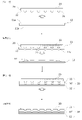
- FIG. 1 shows an example of a back grind process for a semiconductor wafer using the resin composition of the present embodiment.
- the semiconductor wafer 20 has a convex portion 21 on the surface 22.
- the surface 22 of the semiconductor wafer 20 and the surface 11a of the adherend 11 are bonded to protect the convex portion 21 (bonding step).
- a convex portion 11c as if the convex portion 21 was transferred may be formed on the surface 11b of the adherend 11.
- the adherend 11 and the base material 12 are laminated via the liquid resin composition 10 (lamination step), and ultraviolet rays are irradiated from the base material 12 side.
- the resin composition 10 is cured (curing step).
- the cured resin composition 10' is a concavo-convex absorption layer that absorbs the convex portion 21 (convex portion 11c).
- the back surface 23 of the semiconductor wafer 20 is ground (grinding step) with the laminate 30 of the adherend 11 and the cured resin composition 10'and the base material 12 in close contact with the surface 22 of the semiconductor wafer 20. After grinding, the laminated body 30 is peeled off.
- the in-plane pressure applied to the semiconductor wafer 20 in the grinding process can be made uniform regardless of the size of the convex portion 21. can. Therefore, it is possible to reduce the grinding unevenness caused by the convex portion 21.
- the unevenness step is formed by the liquid resin composition. Since it is absorbed and cured, it is possible to form an appropriate unevenness absorbing layer according to the unevenness of the semiconductor wafer.
- the adhesive performance between the cured resin composition 10'and the adherend 11 and the base material 12 can be further improved.
- the resin composition at the time of preparation is used, even if the above-mentioned deterioration in adhesive performance is not confirmed, the resin composition after storage for a predetermined period is used. It has been found that the adhesive performance of the resin composition to the adherend and the base material is deteriorated.
- the resin composition of the present embodiment it is possible to exhibit high adhesive strength even after long-term storage, particularly by using a predetermined acid. Further, the resin composition of the present embodiment is also excellent in that it can be easily applied (coatability) and that it can be cured with a low ultraviolet irradiation amount (curability).
- the ultraviolet curable resin composition of the present embodiment has a composition used for semiconductor processing, for example, a dicing tape for cutting a semiconductor wafer or a semiconductor package, or a concave-convex absorption layer when the back grind tape is bonded.
- the composition is not limited to the composition used for forming, and can also be used as an interlayer bonding resin composition for adhering a plurality of different members.
- the configuration of this embodiment will be described in detail.
- the resin composition of the present embodiment contains at least one type of a monomer having a polymerizable unsaturated double bond and / or an oligomer having a polymerizable unsaturated double bond as a polymerizable compound that can be polymerized by a photopolymerization initiator. ..
- the monomer and the oligomer may be used alone or in combination of two or more, or the monomer and the oligomer may be used in combination.
- the monomer is not particularly limited as long as it has a polymerizable unsaturated double bond, and is, for example, alkenes, vinyl ethers, (meth) acrylic acid, (meth) acrylic acid esters, and (meth) acrylamide. kind and the like.
- (meth) acrylate is a title that collectively describes acrylate and its corresponding methacrylate
- (meth) acrylic is a title that collectively describes acrylic and its corresponding methacrylic acid. be.
- (meth) acrylic acid, (meth) acrylic acid esters, and (meth) acrylamides are preferable, and acrylic acid, acrylic acid esters, and acrylamides are more preferable.
- acrylic acid, acrylic acid esters, and acrylamides are more preferable.
- the (meth) acrylic acid esters are not particularly limited, and are, for example, isoamyl (meth) acrylate, stearyl (meth) acrylate, lauryl (meth) acrylate, octyl (meth) acrylate, decyl (meth) acrylate, and isodecyl (meth).
- Acrylate (meth) acrylic acid esters such as acrylate, isomyristyl (meth) acrylate and isostearyl (meth) acrylate; alicyclic (meth) acrylic acid esters such as isobornyl (meth) acrylate and cyclohexyl acrylate; phenoxy. Examples thereof include aromatic (meth) acrylic acid esters such as ethyl (meth) acrylate and benzyl (meth) acrylate.
- aliphatic (meth) acrylic acid esters and alicyclic (meth) acrylic acid esters are preferable, and aliphatic (meth) acrylic acid esters and alicyclic (meth) acrylic acid esters are used in combination. Is more preferable.
- the surface tension of the (meth) acrylic acid esters is preferably 5 to 40 mN / m, more preferably 5 to 35 mN / m.
- the coatability is further improved, and the adhesive strength and the initial adhesive strength after long-term storage tend to be further improved.
- Surface tension can be measured by the suspension method.
- the total content of the aliphatic (meth) acrylic acid esters and the alicyclic (meth) acrylic acid esters is preferably 15 to 45% by weight, more preferably 20% by weight, based on the total weight of the resin composition. It is about 40% by weight, more preferably 25 to 35% by weight.
- the contents of the aliphatic (meth) acrylic acid esters and the alicyclic (meth) acrylic acid esters are within the above ranges, the initial adhesive strength, the adhesive strength after long-term storage, and the cured product are obtained. The hardness, coatability, and curability tend to be further improved.
- the (meth) acrylamides are not particularly limited, but are, for example, (meth) acrylamide, N, N-dimethyl (meth) acrylamide, N, N-diethyl (meth) acrylamide, hydroxyethyl (meth) acrylamide, and isopropyl (meth). ) Acrylamide, (meth) acryloylmorpholine, dimethylaminopropyl (meth) acrylamide and the like.
- the resin composition of the present embodiment preferably contains monofunctional acrylamide as a monomer.
- monofunctional acrylamide the compatibility of photopolymerization initiators, polymerization inhibitors, acids, etc. is further improved, and the wettability of the resin composition to the adherend is further improved, and the initial adhesive strength and long-term storage are improved. Later adhesive strength tends to improve.
- the surface tension of monofunctional acrylamide is preferably 30 to 38 mN / m.
- the surface tension of the monofunctional acrylamide is in the above range, the wettability of the resin composition to the adherend is further improved, and the initial adhesive strength and the adhesive strength after long-term storage tend to be further improved.
- monofunctional acrylamide include dimethylacrylamide (surface tension 37.12 mN / m) and diethyl acrylamide (surface tension 33.13 mN / m).
- the content of (meth) acrylamides is preferably 20 to 45% by weight, more preferably 25 to 40% by weight, still more preferably 30 to 35% by weight, based on the total weight of the resin composition. be.
- the content of (meth) acrylamide is within the above range, the hardness, coatability, and curability of the cured product tend to be further improved in addition to the initial adhesive strength and the adhesive strength after long-term storage.
- the number of polymerizable unsaturated double bonds of each of the above monomers is preferably 1 to 3, more preferably 1 to 2, and even more preferably 1.
- the oligomer is not particularly limited as long as it has a polymerizable unsaturated double bond, and examples thereof include urethane (meth) acrylate oligomers, epoxy (meth) acrylate oligomers, and polyester (meth) acrylate oligomers.
- urethane (meth) acrylate oligomers are preferable, and urethane acrylate oligomers are more preferable.
- the wettability of the resin composition to the base material and the adherend is further improved, and the adhesive force of the cured resin composition to the base material and the adherend tends to be further improved. It is in.
- the urethane (meth) acrylate oligomer is not particularly limited, and examples thereof include aromatic urethane acrylate oligomers and aliphatic urethane acrylate oligomers. Of these, aliphatic urethane acrylate oligomers are more preferable.
- aromatic urethane acrylate oligomers include aromatic urethane acrylate oligomers and aliphatic urethane acrylate oligomers. Of these, aliphatic urethane acrylate oligomers are more preferable.
- the number of polymerizable unsaturated double bonds contained in the oligomer is preferably 1 to 10, more preferably 2 to 6, and even more preferably 2 to 4.
- the weight average molecular weight of the oligomer is preferably 100,000 or less, more preferably 5,000 to 75,000, and even more preferably 10,000 to 50,000.
- the weight average molecular weight of the oligomer is within the above range, the viscosity of the resin composition is suppressed to be lower, and the coatability tends to be further improved.
- the content of the oligomer is preferably 12.5 to 37.5% by weight, more preferably 17.5 to 32.5% by weight, still more preferably 22. It is 5 to 27.5% by weight.
- the content of the oligomer is within the above range, the hardness, coatability, and curability of the cured product tend to be further improved in addition to the initial adhesive strength and the adhesive strength after long-term storage.
- a polymerization inhibitor is added to the resin composition of the present invention.
- a polymerization inhibitor By adding a polymerization inhibitor, it is possible to suppress an unintended curing reaction due to heat or the like between the polymerizable compound and the photopolymerization initiator, and improve storage stability.
- the polymerization inhibitor is not particularly limited, and examples thereof include a phenol-based polymerization inhibitor, a quinone-based polymerization inhibitor, an amine-based polymerization inhibitor, a nitroso-based polymerization inhibitor, and a transition metal-based polymerization inhibitor.
- Such a polymerization inhibitor is not particularly limited, and is, for example, methylhydroquinone, hydroquinone, 2,2-methylene-bis (4-methyl-6-terrary butylphenol), catechol, hydroquinone monomethyl ether, monotersial butyl.
- amine-based polymerization inhibitors are more preferable.
- storage stability, initial adhesive strength, and adhesive strength after long-term storage tend to be further improved.
- the ⁇ in the parentheses indicates the solubility parameter (SP value) of each compound.
- the absolute value difference from the solubility parameter (SP value) of the entire monomer having a polymerizable unsaturated double bond contained in the resin composition is 4.0 (cm 3 / mol) 1/2 or less. Is preferable.
- the SP value ⁇ of each monomer and the inhibitor was calculated by the Fedors method shown below.
- the structural formula of the polymerization inhibitor is divided into a characteristic group such as a methyl group, an ethyl group and a phenyl group, and a structure such as a functional group such as a hydroxyl group and an amino group.
- the solubility parameter was calculated by the following formula (1) using the total ⁇ Ei of the heat of vaporization factor Ei (cal / mol) and the total ⁇ Vi of the molar volume factor Vi (cm 3 / mol) determined for each structure.
- ⁇ [(MPa) 1/2 ] [ ⁇ Ei / ⁇ Vi] 1/2 (1)
- the SP value of the entire monomer is a value obtained by averaging the SP value of each monomer alone obtained by the above method based on the mole fraction of the constituent monomers in the entire monomer.
- the content of the polymerization inhibitor is preferably 0.02 to 2.0% by weight, more preferably 0.05 to 1.0% by weight, still more preferably, based on the total weight of the resin composition. It is 0.1 to 0.6% by weight.
- the content of the polymerization inhibitor is 0.02% by weight or more, the unintended reaction between the polymerizable compound and the photopolymerization initiator can be sufficiently suppressed, and the storage stability tends to be further improved. ..
- the content of the polymerization inhibitor is 2.0% by weight or less, the polymerization inhibitor tends to inhibit the curing reaction and suppress the decrease in hardness and adhesive strength of the cured product. Further, when the content of the polymerization inhibitor is 2.0% by weight or less, the precipitation of the polymerization inhibitor tends to be further suppressed during low temperature storage.
- the resin composition of the present embodiment contains an acid having an acid dissociation constant (pKa1) of 4.0 or less in the first stage in pure water.
- pKa1 an acid dissociation constant
- the acid dissociation constant the values described in the Chemical Handbook and Maruzen Co., Ltd. can be adopted.
- the reason why the adhesive exerts the adhesive force is not particularly limited, but for example, when the resin composition is cured, the acid permeates the base material and / or the adherend, and the resin composition and the base material are used. In addition to inducing electrostatic interaction at the interface with the adherend, the acid cures in a state of partial penetration into the adherend and exerts an anchor effect to enhance the adhesive strength. it is conceivable that.
- any acid including divalent or higher acids can be used as long as the acid dissociation constant (pKa1) of the first step in pure water is 4.0 or less.
- Such acids are not particularly limited, but are, for example, inorganic acids such as hydrochloric acid, sulfuric acid, nitric acid, and phosphoric acid; formic acid, chloroacetic acid, dichloroacetic acid, trichloroacetic acid, fluoroacetic acid, bromoacetic acid, iodoacetic acid, 2- (trifluoroacetic acid).
- Methyl) acrylic acid isophthalic acid, terephthalic acid, citric acid, trimesic acid, trimellitic acid, pyromellitic acid, ethylenediamine tetraacetic acid, maleic acid, fumaric acid, muconic acid, etc.
- Organic acids can be mentioned.
- the pKa1 is 3.2 or less.
- These acids include hydrochloric acid, sulfuric acid, nitrate, phosphoric acid, chloroacetic acid, dichloroacetic acid, trichloroacetic acid, fluoroacetic acid, bromoacetic acid, iodoacetic acid, 2- (trifluoromethyl) acrylic acid, picolinic acid, oxalic acid, phthalic acid.
- the acid is preferably an organic acid.
- the acid dissociation constant (pKa1) of the first step in pure water of the acid is 4.0 or less, preferably 3.2 or less, more preferably -10 to 3.2, and further preferably. It is -2 to 3.2, and particularly preferably 0 to 3.2.
- the acid dissociation constant (pKa1) of the acid is 4.0 or less, the effect of improving the adhesive force by the acid is further improved.
- the acid dissociation constant (pKa1) of the acid is -10 or more, the acid may modify other components such as the polymerizable compound of the resin composition, the adherend or the base material, or the resin composition. It is possible to prevent the members of the feeding device from being eroded.
- the acid does not have a polymerizable unsaturated double bond. As a result, it is possible to prevent the acid from being incorporated into the polymerization of the polymerizable compound, and it is possible to suppress a decrease in the amount of the acid that permeates the substrate or the adherend. Therefore, the effect of improving the adhesive strength by the acid tends to be more preferably exhibited.
- the acid content is preferably 0.005 to 2.0% by weight, more preferably 0.01 to 1.0% by weight, still more preferably 0, based on the total weight of the resin composition. It is 015 to 0.5% by weight.
- the acid content is 0.005% by weight or more, the effect of improving the adhesive strength by the acid tends to be further improved.
- the acid content is 2.0% by weight or less, the risk of corrosion of the pipe during storage in the metal pipe is reduced, and the acid that cannot be completely compatible with the pipe is separated or precipitated during long-term storage. Tends to be suppressed.
- the photopolymerization initiator is not particularly limited as long as it generates radicals or anions by irradiation with visible light or ultraviolet rays, and examples thereof include radical generation type photopolymerization initiators and / or anion generation type photopolymerization initiators. Be done. Among these, a radical-generating photopolymerization initiator is preferable. By using such a photopolymerization initiator, the polymerization rate is further improved and curing can be performed quickly.
- the radical-generating photopolymerization initiator is not particularly limited, and is, for example, benzophenone and its derivatives; benzyl and its derivatives; entraquinone and its derivatives; benzoin, benzoin methyl ether, benzoin ethyl ether, benzoin propyl ether, benzoin isobutyl ether.
- Benzoin derivatives such as benzyldimethylketal; acetophenone derivatives such as diethoxyacetophenone, 4-t-butyltrichloroacetophenone; 2-dimethylaminoethylbenzoate, p-dimethylaminoethylbenzoate, diphenyldisulfide, thioxanthone and its derivatives; 7,7-Dimethyl-2,3-dioxobicyclo [2.2.1] heptane-1-carboxylic acid, 7,7-dimethyl-2,3-dioxobicyclo [2.2.1] heptane-1 -Carboxy-2-bromoethyl ester, 7,7-dimethyl-2,3-dioxobicyclo [2.2.1] heptane-1-carboxy-2-methyl ester, 7,7-dimethyl-2,3- Phenylquinone derivatives such as dioxobicyclo [2.2.1] heptept
- ⁇ -Aminoalkylphenone derivatives such as benzyl-2-dimethylamino-1- (4-morpholinophenyl) -butanone-1; benzoyldiphenylphosphine oxide, 2,4,6-trimethylbenzoyldiphenylphosphine oxide, benzoyldiethoxypos Acylphosphine oxide derivatives such as finoxide, 2,4,6-trimethylbenzoyldimethoxyphenylphosphine oxide, 2,4,6-trimethylbenzoyldiethoxyphenylphosphinoxide; oxy-phenyl-acetic acid 2- [2-oxo- Examples thereof include oxyphenyl acetate esters such as 2-phenyl-acetoxy-ethoxy] -ethyl ester and oxy-phenyl-acetic acid 2- [2-hydroxy-ethoxy] -ethyl ester.
- a benzoin derivative, an acylphosphenyl oxide derivative, and an oxyphenyl acetate derivative are preferable in terms of excellent curability, and benzyldimethylketal, 2,4,6-trimethylbenzoyldiphenylphosphine oxide, and oxy-phenyl-ace.
- Tick acid 2- [2-oxo-2-phenyl-acetoxy-ethoxy] -ethyl ester and oxy-phenyl-acetylacid 2- [2-hydroxy-ethoxy] -ethyl ester are more preferred.
- the content of the photopolymerization initiator is preferably 0.01 to 10.0% by weight, more preferably 0.1 to 5.0% by weight, still more preferably, based on the total weight of the resin composition. Is 0.2 to 3.0% by weight.
- the content of the photopolymerization initiator is 0.01% by weight or more, the curing reaction proceeds favorably, and the hardness and adhesive strength of the cured product tend to be further improved.
- the content of the photopolymerization initiator is 10.0% by weight or less, the storage stability of the resin composition tends to be further improved.
- the curing proceeds only on the surface of the resin composition when irradiated with ultraviolet rays, and the curing does not proceed to the inside, and the adhesive strength of the cured product is increased. It tends to be suppressed from becoming low.
- the resin composition of the present embodiment may further contain a tackifier.
- a tackifier By including the tackifier, the stickiness of the cured product tends to be further improved.
- tackifier examples include, but are not limited to, terpene resin, terpene phenol resin, alicyclic saturated hydrocarbon resin, rosin ester, rosin, styrene resin, aliphatic hydrocarbon resin and the like. can. Among these, it is preferable to use a terpene phenol resin.
- the terpene resin is not particularly limited, and examples thereof include homopolymers and copolymers of terpene monomers.
- examples of the terpene monomer include ⁇ -pinene, ⁇ -pinene, limonene and the like, and these may be used alone or in combination.
- the terpene phenol resin is not particularly limited, and examples thereof include those produced by reacting a terpene compound with phenols by a conventionally known method, and the terpene phenol resin is not particularly limited, but 1 mol of the terpene compound and phenols. Examples thereof include those produced by reacting 0.1 to 50 mol with a conventionally known method.
- the terpene compound is not particularly limited, and examples thereof include myrcene, aloosimene, ⁇ -pinene, ⁇ -pinene, limonene, ⁇ -terpinene, ⁇ -terpinene, camphene, turbinolene, and delta-3-carene.
- ⁇ -pinene, ⁇ -pinene, limonene, myrcene, aloosimene, and ⁇ -terpinene are preferably used.
- the phenols are not particularly limited, and examples thereof include, but are not limited to, phenol, cresol, xylenol, catechol, resorcin, hydroquinone, bisphenol A, and the like.
- the ratio of phenols in the terpene phenol resin is about 25 to 50 mol%, but is not limited thereto.
- the hydroxyl value of the terpene phenol resin is about 50 to 250, but is not limited thereto.
- the softening point of the terpene phenol resin is preferably 100 ° C. or higher and 180 or lower. Within this range, peelability, adhesive residue and mass change after heating can be suppressed.
- the alicyclic saturated hydrocarbon resin is not particularly limited, and examples thereof include resins obtained by partially or completely hydrogenating an aromatic (C9) petroleum resin.
- the rosin is not particularly limited, and examples thereof include natural rosins such as gum rosin, tall oil rosin, and wood rosin, and hydrogenated rosins obtained by hydrogenating natural rosins.
- the rosin ester is not particularly limited, and examples thereof include the above-mentioned rosin methyl ester, triethylene glycol ester, and glycerin ester.
- the content of the tackifier resin is preferably 1 to 20% by weight, more preferably 3 to 15% by weight, based on the total weight of the resin composition.
- the content of the tackifier is within the above range, the adhesive strength tends to be further improved, and the coatability and hardness of the resin composition tend to be further improved.
- the resin composition of the present embodiment may contain other additives, if necessary.
- the other additives are not particularly limited, but are, for example, various elastomers such as commonly used acrylic rubber, urethane rubber, acrylonitrile-butadiene copolymer, methyl methacrylate-butadiene-styrene copolymer, and polar organic solvents. Examples thereof include additives such as inorganic fillers, reinforcing materials, plasticizers, thickeners, dyes, pigments, flame retardants, silane coupling agents, surfactants, and foaming agents.
- the resin composition of the present embodiment is preferably in a liquid state at room temperature (25 ° C.).
- the viscosity of the resin composition at 25 ° C. is preferably 200 to 10000 mPa ⁇ s, more preferably 250 to 5000 mPa ⁇ s, and even more preferably 300 to 2500 mPa ⁇ s.
- the viscosity is 200 mPa ⁇ s or more, the resin composition sandwiched between the adherend and the base material is more suppressed from flowing out before curing, and it tends to be easy to produce a cured product having a target thickness.
- the viscosity is 10,000 mPa ⁇ s or less
- the fluidity of the resin composition is further improved, and bubbles tend to be less likely to remain inside the cured product and at the interface between the cured product and the substrate or adherend after UV curing. be.
- the method for producing the ultraviolet curable resin composition of the present embodiment is not particularly limited as long as it is a method of mixing the above components, and any mixer can be used.
- the cured product of the present embodiment is obtained by curing the above resin composition with ultraviolet rays.
- the resin composition can be used not only as a backgrinding tape used in a method for manufacturing a semiconductor wafer, but also as an interlayer bonding resin composition for adhering a plurality of different members.
- the laminate of the present embodiment is obtained by curing and adhering a base material having ultraviolet light permeability and an adherend via the above resin composition.
- ultraviolet transmittance means that the transmittance is 50% or more with respect to ultraviolet rays having a wavelength of 365 nm.
- the base material having ultraviolet transmittance is not particularly limited, and for example, polyolefins such as polyethylene, polypropylene, polymethylpentene, and ethylene-vinyl acetate copolymer, and polyolefin ionomers, polyethylene terephthalate (PET), and polybutylene.
- polyolefins such as polyethylene, polypropylene, polymethylpentene, and ethylene-vinyl acetate copolymer
- polyolefin ionomers polyethylene terephthalate (PET), and polybutylene.
- PET polyethylene terephthalate
- Examples thereof include a base material containing terephthalate, polyamide, polyether sulfone, and ionomer resin.
- the material constituting the adherend is not particularly limited, and examples thereof include metal, glass, and resin.
- the laminate is preferably used for semiconductor processing.
- a sheet-shaped resin is preferable as the adherend.
- resins are not particularly limited, but are, for example, ionomer resins, ethylene-vinyl acetate copolymers, soft polypropylene resins, ethylene- (meth) acrylic acid copolymer resins, ethylene-butadiene copolymer resins, and ethylene.
- examples thereof include hydrogenated resin of butadiene copolymer, ethylene-1-butene copolymer resin, and soft acrylic resin.
- the cured product and the laminate can be produced by irradiating the ultraviolet curable resin composition with ultraviolet rays to cause a curing reaction.
- the resin composition is sandwiched between the base material and the adherend, and the resin composition is irradiated with ultraviolet rays from the direction of the base material having ultraviolet transparency to prepare the laminated body. Can be done.
- the irradiation conditions of ultraviolet rays are not particularly limited.
- the irradiation energy of ultraviolet rays is preferably 200 to 10000 mJ / cm 2 , more preferably 300 to 8000 mJ / cm 2 , and even more preferably 500 to 6000 mJ / cm 2 .
- the irradiation energy is 200 mJ / cm 2 or more, the resin composition is sufficiently cured, and the hardness and adhesive strength of the obtained cured product tend to be further improved.
- the irradiation energy is 10,000 mJ / cm 2 or less, excessive curing shrinkage is suppressed, and a situation in which the adhesive force is rather lowered tends to be avoided.
- the illuminance of the ultraviolet rays is preferably 15 to 120 mW / cm 2 , and more preferably 30 to 100 mW / cm 2 .
- the resin composition is sufficiently cured, and the hardness and adhesive strength of the obtained cured product tend to be further improved.
- the illuminance is 120 mW / cm 2 or less, it is suppressed that the curing proceeds only on the surface of the resin composition when irradiated with ultraviolet rays, the curing does not proceed to the inside, and the adhesive strength of the cured product is lowered. There is a tendency.
- the ultraviolet irradiation source is not particularly limited, but for example, a heavy hydrogen lamp, a high-pressure mercury lamp, an ultra-high pressure mercury lamp, a low-pressure mercury lamp, a xenon lamp, a xenon-mercury mixed lamp, a halogen lamp, an excima lamp, an injume lamp, and a tarium.
- Known ultraviolet irradiation sources such as lamps, LED lamps, and electrodeless discharge lamps can be mentioned. Among these, it is preferable to use an LED lamp whose irradiation amount and irradiation intensity can be easily adjusted.
- a bonding step of bonding an adherend to a surface provided with a convex portion of the semiconductor wafer, an adherend, and a base material having ultraviolet light transmission are subjected to the above ultraviolet rays.
- a laminating step of laminating via the curable resin composition, a curing step of curing the ultraviolet curable resin composition by irradiating ultraviolet rays from the base material side, and the convex portion of the semiconductor wafer are provided. It has a grinding step of grinding a surface opposite to the surface.
- the bonding step is a step of bonding the adherend 11 to the surface 22 provided with the convex portion 21 of the semiconductor wafer 20.
- the method of attaching the adherend 11 is not particularly limited, and the adherend 11 may be attached to the surface 22 of the semiconductor wafer 20 under normal pressure, or may be attached under reduced pressure. Further, in the bonding step, the adherend 11 may be bonded to the surface 22 of the semiconductor wafer 20 in a preheated state, or the adherend 11 may be bonded to the surface 22 of the semiconductor wafer 20 after being bonded. It may be heated. At this time, corresponding to the convex portion 21, a convex portion 11c as if the convex portion 21 was transferred may be formed on the surface 11b of the adherend 11.
- the laminating step is a step of laminating the adherend 11 and the base material 12 having ultraviolet light permeability via the resin composition 10.
- the adherend 11 and the base material 12 are laminated so as to spread the resin composition 10, so that the resin composition 10 is filled in an arbitrary shape between the adherend 11 and the base material 12. be able to.
- the convex portion 11c is absorbed and a smooth laminated body 30 can be obtained.
- the curing step is a step of curing the ultraviolet curable resin composition by irradiating the base material with ultraviolet rays.
- the irradiation conditions of ultraviolet rays are not particularly limited, but the same conditions as those described above can be adopted.
- the grinding step is a step of grinding the back surface 23 on the side opposite to the front surface 22 provided with the convex portion 21 of the semiconductor wafer 20.
- the back surface 23 of the semiconductor wafer 20 is ground with the laminate 30 of the adherend 11 and the cured resin composition 10'and the base material 12 in close contact with the surface 22 of the semiconductor wafer 20.
- the grinding conditions are not particularly limited, and conventionally known conditions can be applied.
- the laminate 30 is peeled off from the surface 22 of the semiconductor wafer 20.
- the peeling of the laminated body 30 is not particularly limited, but can be performed, for example, by bending the laminated body 30 in a direction in which the laminated body 30 is separated from the semiconductor wafer.
- delamination between the adherend 11 or the base material 12 and the cured resin composition 10' is unlikely to occur, and the surface of the semiconductor wafer 20 is not easily delaminated. It is possible to suppress the remaining in 22.
- a urethane acrylic oligomer (“UV3630ID80” manufactured by Mitsubishi Chemical Corporation, weight average molecular weight 35000) has a solid content equivalent of 23.920% by weight and has a polymerizable unsaturated double bond.
- As monomers isodecyl acrylate (“IDAA” manufactured by Osaka Organic Chemical Industry Co., Ltd.) 5.980% by weight, isobornyl acrylate (“IBXA” manufactured by Osaka Organic Chemical Industry Co., Ltd.) 10.960% by weight, lauryl acrylate (Osaka Organic Chemical Co., Ltd.) Industrial Co., Ltd.
- LA 12.460% by weight
- N N-diethylacrylamide
- terpene phenol resin Yasuhara Chemical Co., Ltd. "YS Polystar T145”
- citrate as an acid
- pKa1 3.1
- 2,4 as a photopolymerization initiator 6-trimethylbenzoyl-diphenyl-phosphine oxide (“Omnirad TPO” manufactured by IGM Resins B.V.) 2.000% by weight
- phenothiazine (“Phenothiazine” manufactured by Tokyo Kasei Kogyo Co., Ltd.) 0.300% by weight as a polymerization inhibitor was added and kneaded with a planetary stirrer (Shinky's "Awatori Rentaro AR-310", rotation speed 2000 rpm
- Viscosity of resin composition The viscosity of the prepared resin composition was measured at 25 ° C. with an E-type viscometer.
- Adhesive strength of cured product (initial)
- the resin composition immediately after being prepared as described above is applied onto an adherend (ionomer film) in a square shape having a side of 100 mm and a thickness of 50 ⁇ m, and a base material (PET film) having ultraviolet light permeability is applied from above. ) was placed between the resin composition and the resin composition so as not to allow air bubbles to enter, and the mixture was allowed to stand for 3 minutes.
- ultraviolet rays having a wavelength of 365 nm are irradiated from the base material side at an irradiation intensity of 60 mW / cm 2 and an irradiation amount of 600 mJ / cm 2 to cure the resin composition, thereby forming a laminate for measuring adhesive strength.
- an LED lamp ultraviolet rays having a wavelength of 365 nm are irradiated from the base material side at an irradiation intensity of 60 mW / cm 2 and an irradiation amount of 600 mJ / cm 2 to cure the resin composition, thereby forming a laminate for measuring adhesive strength.
- the prepared laminate was cut to a width of 20 mm and peeled from the adherend side at a speed of 300 mm / min at a speed of 300 mm / min in an environment of a temperature of 23 ° C and a relative humidity of 50% based on JIS Z 0237.
- Adhesive strength (initial). The obtained peel strength is the smaller value of the peel strength between the adherend and the cured product and the peel strength between the adherend and the base material.
- Adhesive strength (initial) is 15N / 20mm or more
- Adhesive strength of cured product (after storage for 130 days)
- the resin composition prepared as described above is sealed in a black polyethylene light-shielding container in an environment of a temperature of 23 ° C. and a relative humidity of 50% and stored for 130 days.
- the adhesive strength (after storage) was measured under the same conditions as above. Based on the obtained adhesive strength (after storage), the storage stability was evaluated according to the following evaluation criteria.
- evaluation criteria A (pass): Adhesive strength (after storage) is 15N / 20mm or more
- Adhesive strength (after storage) Less than 6N / 20mm
- the prepared test piece was measured for D hardness in a D hardness tester under an environment of a temperature of 23 ° C. and a relative humidity of 50% according to JIS K6253, and this value was taken as the hardness of the resin composition.
- the hardness was evaluated according to the following evaluation criteria based on the obtained hardness. (Evaluation criteria) A: Hardness is 15 or more and 60 or less B: Hardness is less than 15 or more than 60
- Example 4 23.960% by weight of the urethane acrylic oligomer of Example 1, 5.990% by weight of the isodecyl acrylate, 10.980% by weight of the isobornyl acrylate, 12.480% by weight of the lauryl acrylate, N, N-diethylacrylamide.
- the resin composition was prepared in the same manner as in Example 1 except that 31.960% by weight, terpenphenol resin was 12.480% by weight, and phenothiazine was 0.100% by weight.
- Example 5 23.870% by weight of the urethane acrylic oligomer of Example 1, 5.970% by weight of the isodecyl acrylate, 10.940% by weight of the isobornyl acrylate, 12.430% by weight of the lauryl acrylate, N, N-diethylacrylamide.
- the resin composition was prepared in the same manner as in Example 1 except that the content was 31.810% by weight, the terpenephenol resin was 12.430% by weight, and the phenothiazine was 0.500% by weight.
- Example 6 Except that the urethane acrylic oligomer of Example 1 was 23.930% by weight, the isobornyl acrylate was 10.970% by weight, the N, N-diethylacrylamide was 31.890% by weight, and the citric acid was 0.010% by weight. , A resin composition was prepared in the same manner as in Example 1.
- Example 7 23.810% by weight of the urethane acrylic oligomer of Example 1, 5.950% by weight of the isodecyl acrylate, 10.910% by weight of the isobornyl acrylate, 12.400% by weight of the lauryl acrylate, N, N-diethylacrylamide.
- the resin composition was prepared in the same manner as in Example 1 except that 31.734% by weight, terpenphenol resin was 12.400% by weight, and citric acid was 0.496% by weight.
- Example 8 23.980% by weight of the urethane acrylic oligomer of Example 1, 5.990% by weight of the isodecyl acrylate, 10.990% by weight of the isobornyl acrylate, 12.490% by weight of the lauryl acrylate, N, N-diethylacrylamide.
- the resin composition was prepared in the same manner as in Example 1 except that 31.970% by weight, terpenphenol resin was 12.490% by weight, and phenothiazine was 0.040% by weight.
- Example 9 23.750% by weight of the urethane acrylic oligomer of Example 1, 5.940% by weight of the isodecyl acrylate, 10.890% by weight of the isobornyl acrylate, 12.370% by weight of the lauryl acrylate, N, N-diethylacrylamide.
- the resin composition was prepared in the same manner as in Example 1 except that 31.630% by weight, terpenphenol resin was 12.370% by weight, and phenothiazine was 1.000% by weight.
- Example 10 Except that the urethane acrylic oligomer of Example 1 was 23.930% by weight, the isobornyl acrylate was 10.970% by weight, the N, N-diethylacrylamide was 31.897% by weight, and the citric acid was 0.003% by weight. , A resin composition was prepared in the same manner as in Example 1.
- Example 11 23.690% by weight of the urethane acrylic oligomer of Example 1, 5.920% by weight of the isodecyl acrylate, 10.860% by weight of the isobornyl acrylate, 12.340% by weight of the lauryl acrylate, N, N-diethylacrylamide.
- the resin composition was prepared in the same manner as in Example 1 except that 31.563% by weight, terpenphenol resin was 12.340% by weight, and citric acid was 0.987% by weight.
- Example 1 except that the urethane acrylic oligomer was 23.930% by weight, the isobornyl acrylate was 10.970% by weight, the N, N-diethylacrylamide was 31.900% by weight, and citric acid was not blended.
- a resin composition was prepared in the same manner as in 1.
- the ultraviolet curable resin composition of the present invention has excellent storage stability, is sufficiently cured even with a low UV irradiation amount, and exhibits sufficient adhesive force to a substrate or an adherend. Therefore, the ultraviolet curable resin composition and the cured product or laminate using the ultraviolet curable resin composition can be applied to many applications such as the uneven absorption layer of the semiconductor backgrind tape, which is used for interlayer adhesion by ultraviolet rays.
- 10 resin composition, 10'... cured resin composition, 11 ... adherend, 11a ... surface, 11b ... surface, 11c ... convex portion, 12 ... base material, 20 ... semiconductor wafer, 21 ... convex portion, 22 ... front surface, 23 ... back surface, 30 ... laminated body.
Landscapes
- Chemical & Material Sciences (AREA)
- Organic Chemistry (AREA)
- Chemical Kinetics & Catalysis (AREA)
- Health & Medical Sciences (AREA)
- Medicinal Chemistry (AREA)
- Polymers & Plastics (AREA)
- Adhesives Or Adhesive Processes (AREA)
- Polymerisation Methods In General (AREA)
- Macromonomer-Based Addition Polymer (AREA)
- Mechanical Treatment Of Semiconductor (AREA)
- Container, Conveyance, Adherence, Positioning, Of Wafer (AREA)
Priority Applications (5)
| Application Number | Priority Date | Filing Date | Title |
|---|---|---|---|
| EP21910034.4A EP4269103A4 (en) | 2020-12-23 | 2021-11-12 | Ultraviolet-curable resin composition |
| CN202180063490.8A CN116323200A (zh) | 2020-12-23 | 2021-11-12 | 紫外线固化型树脂组合物 |
| KR1020237014586A KR20230124887A (ko) | 2020-12-23 | 2021-11-12 | 자외선 경화형 수지 조성물 |
| US18/269,153 US20240043596A1 (en) | 2020-12-23 | 2021-11-12 | Ultraviolet curable resin composition |
| JP2022501358A JP7212200B2 (ja) | 2020-12-23 | 2021-11-12 | 紫外線硬化型樹脂組成物 |
Applications Claiming Priority (2)
| Application Number | Priority Date | Filing Date | Title |
|---|---|---|---|
| JP2020213953 | 2020-12-23 | ||
| JP2020-213953 | 2020-12-23 |
Publications (1)
| Publication Number | Publication Date |
|---|---|
| WO2022137881A1 true WO2022137881A1 (ja) | 2022-06-30 |
Family
ID=82158977
Family Applications (1)
| Application Number | Title | Priority Date | Filing Date |
|---|---|---|---|
| PCT/JP2021/041725 Ceased WO2022137881A1 (ja) | 2020-12-23 | 2021-11-12 | 紫外線硬化型樹脂組成物 |
Country Status (7)
| Country | Link |
|---|---|
| US (1) | US20240043596A1 (https=) |
| EP (1) | EP4269103A4 (https=) |
| JP (1) | JP7212200B2 (https=) |
| KR (1) | KR20230124887A (https=) |
| CN (1) | CN116323200A (https=) |
| TW (1) | TWI900700B (https=) |
| WO (1) | WO2022137881A1 (https=) |
Cited By (1)
| Publication number | Priority date | Publication date | Assignee | Title |
|---|---|---|---|---|
| JP7619407B1 (ja) | 2023-09-08 | 2025-01-22 | artience株式会社 | 活性エネルギー線硬化型組成物 |
Citations (6)
| Publication number | Priority date | Publication date | Assignee | Title |
|---|---|---|---|---|
| JPS57202315A (en) * | 1981-05-20 | 1982-12-11 | Dow Chemical Co | Thermosetting resin stabilized with oxalic acid and phenothiazine |
| JP2006001863A (ja) * | 2004-06-16 | 2006-01-05 | New Japan Chem Co Ltd | 重合性リン酸エステル及び該リン酸エステルを含有してなる光硬化性樹脂組成物 |
| WO2015033801A1 (ja) * | 2013-09-03 | 2015-03-12 | 東亞合成株式会社 | 硬化性樹脂組成物 |
| JP2015209390A (ja) * | 2014-04-25 | 2015-11-24 | 株式会社サクラクレパス | 光硬化性人工爪組成物 |
| JP2019065165A (ja) | 2017-09-29 | 2019-04-25 | 三井化学東セロ株式会社 | 粘着性フィルム |
| JP2019065168A (ja) | 2017-09-29 | 2019-04-25 | 三井化学東セロ株式会社 | 粘着性フィルム |
Family Cites Families (14)
| Publication number | Priority date | Publication date | Assignee | Title |
|---|---|---|---|---|
| JPS6018646B2 (ja) * | 1975-06-23 | 1985-05-11 | 三井東圧化学株式会社 | 硬化性樹脂の貯蔵方法 |
| JPS6063211A (ja) * | 1983-09-19 | 1985-04-11 | Nippon Oil & Fats Co Ltd | アクリル系熱硬化型樹脂組成物 |
| JP5165829B2 (ja) * | 2004-02-26 | 2013-03-21 | 日東電工株式会社 | ロール状ウエハ加工用粘着シート |
| JP6106355B2 (ja) * | 2011-02-07 | 2017-03-29 | 東亞合成株式会社 | プラスチック製フィルム又はシート用活性エネルギー線硬化型接着剤組成物 |
| BR112013025070A2 (pt) * | 2011-03-31 | 2017-02-14 | Fujifilm Corp | emulsão graxa contendo prostaglandina |
| JP2013047321A (ja) * | 2011-07-28 | 2013-03-07 | Nitto Denko Corp | 粘着シート |
| KR20130059291A (ko) * | 2011-11-28 | 2013-06-05 | 닛토덴코 가부시키가이샤 | 언더필재 및 반도체 장치의 제조 방법 |
| JP6235893B2 (ja) * | 2013-12-19 | 2017-11-22 | リンテック株式会社 | バックグラインドシート |
| US10825711B2 (en) * | 2015-10-05 | 2020-11-03 | Lintec Corporation | Sheet for semiconductor processing |
| JP6703597B2 (ja) * | 2016-03-31 | 2020-06-03 | 三井化学東セロ株式会社 | 半導体装置の製造方法 |
| JP6763564B2 (ja) * | 2016-05-27 | 2020-09-30 | 株式会社サクラクレパス | 疎水性ウレタン(メタ)アクリレートオリゴマー含有自爪塗布用光硬化性人工爪組成物 |
| JP7153011B2 (ja) * | 2017-03-30 | 2022-10-13 | 株式会社クラレ | 剥離紙原紙及びその製造方法、並びに剥離紙 |
| JP6808831B2 (ja) * | 2017-06-06 | 2021-01-06 | 富士フイルム株式会社 | 感光性樹脂組成物、硬化膜、積層体、硬化膜の製造方法、半導体デバイスおよび化合物 |
| CN110621754B (zh) * | 2017-11-16 | 2021-03-05 | 昭和电工株式会社 | 粘接剂、叠层体、电池外装用包装材料、电池壳体及电池壳体的制造方法 |
-
2021
- 2021-11-12 JP JP2022501358A patent/JP7212200B2/ja active Active
- 2021-11-12 WO PCT/JP2021/041725 patent/WO2022137881A1/ja not_active Ceased
- 2021-11-12 US US18/269,153 patent/US20240043596A1/en active Pending
- 2021-11-12 KR KR1020237014586A patent/KR20230124887A/ko active Pending
- 2021-11-12 CN CN202180063490.8A patent/CN116323200A/zh active Pending
- 2021-11-12 EP EP21910034.4A patent/EP4269103A4/en not_active Withdrawn
- 2021-12-01 TW TW110144866A patent/TWI900700B/zh active
Patent Citations (6)
| Publication number | Priority date | Publication date | Assignee | Title |
|---|---|---|---|---|
| JPS57202315A (en) * | 1981-05-20 | 1982-12-11 | Dow Chemical Co | Thermosetting resin stabilized with oxalic acid and phenothiazine |
| JP2006001863A (ja) * | 2004-06-16 | 2006-01-05 | New Japan Chem Co Ltd | 重合性リン酸エステル及び該リン酸エステルを含有してなる光硬化性樹脂組成物 |
| WO2015033801A1 (ja) * | 2013-09-03 | 2015-03-12 | 東亞合成株式会社 | 硬化性樹脂組成物 |
| JP2015209390A (ja) * | 2014-04-25 | 2015-11-24 | 株式会社サクラクレパス | 光硬化性人工爪組成物 |
| JP2019065165A (ja) | 2017-09-29 | 2019-04-25 | 三井化学東セロ株式会社 | 粘着性フィルム |
| JP2019065168A (ja) | 2017-09-29 | 2019-04-25 | 三井化学東セロ株式会社 | 粘着性フィルム |
Non-Patent Citations (3)
| Title |
|---|
| "Handbook of Chemistry", MARUZEN PUBLISHING CO., LTD. |
| R.F. FEDORS: "Polymer Engineering & Science", vol. 14, 1974, WILEY PUBLISHING, pages: 147 - 154 |
| See also references of EP4269103A4 |
Cited By (3)
| Publication number | Priority date | Publication date | Assignee | Title |
|---|---|---|---|---|
| JP7619407B1 (ja) | 2023-09-08 | 2025-01-22 | artience株式会社 | 活性エネルギー線硬化型組成物 |
| WO2025053051A1 (ja) * | 2023-09-08 | 2025-03-13 | artience株式会社 | 活性エネルギー線硬化型組成物、積層体 |
| JP2025038996A (ja) * | 2023-09-08 | 2025-03-21 | artience株式会社 | 活性エネルギー線硬化型組成物 |
Also Published As
| Publication number | Publication date |
|---|---|
| JP7212200B2 (ja) | 2023-01-24 |
| KR20230124887A (ko) | 2023-08-28 |
| US20240043596A1 (en) | 2024-02-08 |
| TW202225366A (zh) | 2022-07-01 |
| EP4269103A1 (en) | 2023-11-01 |
| EP4269103A4 (en) | 2024-06-19 |
| TWI900700B (zh) | 2025-10-11 |
| JPWO2022137881A1 (https=) | 2022-06-30 |
| CN116323200A (zh) | 2023-06-23 |
Similar Documents
| Publication | Publication Date | Title |
|---|---|---|
| US6376070B1 (en) | Sheet-form, curable pressure-sensitive adhesive | |
| JP5727371B2 (ja) | 光学部材用粘着剤組成物及び光学部材用粘着テープ | |
| JP2011190302A (ja) | 粘着剤組成物、粘着剤および粘着シート | |
| WO2011043269A1 (ja) | 粘着剤組成物の製造方法、粘着フィルムの製造方法、粘着剤用原料組成物及び粘着フィルム | |
| WO2012029960A1 (ja) | 樹脂組成物及び接着剤 | |
| JP2015507662A (ja) | 乾式結合性アクリレート接着剤層 | |
| WO2022137881A1 (ja) | 紫外線硬化型樹脂組成物 | |
| JP2014205841A (ja) | 粘着剤組成物、粘着剤および粘着シート | |
| JP5812989B2 (ja) | 組成物及び接着剤 | |
| WO2022137880A1 (ja) | 紫外線硬化型樹脂組成物 | |
| JP2012241069A (ja) | 接着剤組成物及び加工方法 | |
| JP5067548B2 (ja) | 光学機能部材一体型表示装置の製造方法 | |
| JP7503413B2 (ja) | 光硬化型樹脂組成物 | |
| JP2009275091A (ja) | 光学機能部材一体型表示装置用接着剤組成物、光学機能部材一体型表示装置及びその製造方法 | |
| JP2006225443A (ja) | 接着剤組成物 | |
| JPH09183957A (ja) | 光硬化性接着剤組成物 | |
| WO2023074554A1 (ja) | 光硬化性粘着シート | |
| JP4543140B2 (ja) | 回路基板保護用粘着シートおよびその製造方法 | |
| JP4380841B2 (ja) | 熱接着性組成物とその接着シ―ト類 | |
| JP2023009641A (ja) | (メタ)アクリル系ポリマー及び粘着剤 | |
| WO2023074555A1 (ja) | 光硬化性粘着シート | |
| WO2022250105A1 (ja) | 粘着剤用主剤、粘着剤組成物及び粘着フィルム | |
| CN114450373A (zh) | Uv固化型组合物及使用了其的uv固化型片材 | |
| JP2014194033A (ja) | 粘着剤組成物、粘着剤および粘着シート |
Legal Events
| Date | Code | Title | Description |
|---|---|---|---|
| ENP | Entry into the national phase |
Ref document number: 2022501358 Country of ref document: JP Kind code of ref document: A |
|
| 121 | Ep: the epo has been informed by wipo that ep was designated in this application |
Ref document number: 21910034 Country of ref document: EP Kind code of ref document: A1 |
|
| WWE | Wipo information: entry into national phase |
Ref document number: 18269153 Country of ref document: US |
|
| NENP | Non-entry into the national phase |
Ref country code: DE |
|
| ENP | Entry into the national phase |
Ref document number: 2021910034 Country of ref document: EP Effective date: 20230724 |
|
| WWW | Wipo information: withdrawn in national office |
Ref document number: 2021910034 Country of ref document: EP |