WO2022102702A1 - 殻付きエビ及びその製造方法 - Google Patents
殻付きエビ及びその製造方法 Download PDFInfo
- Publication number
- WO2022102702A1 WO2022102702A1 PCT/JP2021/041517 JP2021041517W WO2022102702A1 WO 2022102702 A1 WO2022102702 A1 WO 2022102702A1 JP 2021041517 W JP2021041517 W JP 2021041517W WO 2022102702 A1 WO2022102702 A1 WO 2022102702A1
- Authority
- WO
- WIPO (PCT)
- Prior art keywords
- shrimp
- shell
- cracks
- abdominal
- crack
- Prior art date
- Legal status (The legal status is an assumption and is not a legal conclusion. Google has not performed a legal analysis and makes no representation as to the accuracy of the status listed.)
- Ceased
Links
Images

Classifications
-
- A—HUMAN NECESSITIES
- A22—BUTCHERING; MEAT TREATMENT; PROCESSING POULTRY OR FISH
- A22C—PROCESSING MEAT, POULTRY, OR FISH
- A22C29/00—Processing shellfish or bivalves, e.g. oysters, lobsters; Devices therefor, e.g. claw locks, claw crushers, grading devices; Processing lines
- A22C29/02—Processing shrimps, lobsters or the like ; Methods or machines for the shelling of shellfish
-
- A—HUMAN NECESSITIES
- A23—FOODS OR FOODSTUFFS; TREATMENT THEREOF, NOT COVERED BY OTHER CLASSES
- A23L—FOODS, FOODSTUFFS OR NON-ALCOHOLIC BEVERAGES, NOT OTHERWISE PROVIDED FOR; PREPARATION OR TREATMENT THEREOF
- A23L17/00—Food-from-the-sea products; Fish products; Fish meal; Fish-egg substitutes; Preparation or treatment thereof
- A23L17/40—Shell-fish
Definitions
- the present invention relates to a shrimp with a shell, a heated body thereof, and a method for producing the shrimp with a shell.
- shrimp are eaten without their shells, and their plump texture is popular.
- shrimp shells are rich in calcium, and if the shrimp can be eaten together with the shells, the cost of removing the shells can be reduced, which is economically advantageous and can add value as a health food rich in minerals such as calcium.
- Patent Document 1 a dipping treatment with hydrochloric acid
- Patent Document 2 a step of applying reduced pressure heating and pressure heating
- Patent Document 3 treatment with an organic acid and a chitin degrading enzyme
- Japanese Unexamined Patent Publication No. 5-268916 Japanese Unexamined Patent Publication No. 2006-20527 Japanese Unexamined Patent Publication No. 2008-245624
- both the method using a strong acid such as hydrochloric acid and the method using reduced pressure heating and pressure heating have a problem that the texture and taste of shrimp meat are significantly deteriorated.
- a strong acid such as hydrochloric acid
- reduced pressure heating and pressure heating have a problem that the texture and taste of shrimp meat are significantly deteriorated.
- the treatment with an organic acid and a chitin-degrading enzyme since the optimum temperature of the chitin-degrading enzyme is around 35 ° C., it is necessary to boil the shrimp and then treat with the chitin-degrading enzyme for safety. Therefore, this method has a problem that the use of the obtained shelled shrimp is limited.
- An object of the present invention is to provide a shrimp with a shell having an improved hard texture of the shell and a method for producing the same without requiring the above-mentioned heat treatment such as strong acid, pressurization / depressurization, or enzyme treatment.
- the hardness of the shell when chewed with the back teeth and the sensation that the shell remains in the mouth after swallowing the shrimp are the eating of the shrimp with a shell. It was found that it greatly affects the difficulty. Then, by applying a specific treatment to the shrimp shell and then treating it with acetic acid or a salt thereof, the hardness of the shell when chewed with the back teeth can be effectively reduced, and the shell after swallowing the shrimp remains in the mouth. It was found that the sensation (feeling of the shell remaining in the mouth) can also be suppressed.
- the present invention is based on the above findings, and is a shrimp with a shell.
- a shelled shrimp having or having a crack extending in a direction intersecting the median plane and penetrating the shell in a thickness direction and containing acetic acid or a salt thereof.
- the present invention is a shrimp with a shell treated with acetic acid or a salt thereof, and comprises a plurality of cracks extending in different directions with a common starting point and penetrating the shell in the thickness direction in the shell on the side surface of the abdomen. It is intended to provide a shelled shrimp having a group of cracks or having cracks extending in a direction intersecting the median plane and penetrating the shell in a thickness direction.
- the abdominal side surface of an unheated shrimp shell with a shell is tapped with a tapping tool having a convex portion at the tip to form a crack penetrating in the thickness direction in the shell, and then acetic acid or a salt thereof.
- a tapping tool having a convex portion at the tip to form a crack penetrating in the thickness direction in the shell, and then acetic acid or a salt thereof.
- a method for producing a shrimp with a shell which is immersed in an aqueous solution of.
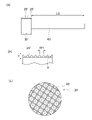
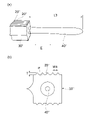
- FIG. 3 is a schematic view of the tapping tool shown in FIG. 3 with a convex portion viewed from the side. It is a schematic diagram which shows another example of the tapping tool used in the manufacturing method of the shrimp with a shell of this invention.
- A) is a schematic view of the convex portion as a side view
- (b) is a partially enlarged view thereof
- (c) is a plan view of a surface having the convex portion.
- FIG. 1 It is a schematic diagram which shows still another example of the tapping tool used in the manufacturing method of the shrimp with a shell of this invention.
- (A) is a perspective view
- (b) is a view of the convex portion as viewed from the handle side in the E direction.
- the present invention is a shrimp that eats together with the shell of the abdomen, and is preferably a frozen shrimp. Frozen shrimp with shells will be described below, but they may be changed to chilled shrimp with shells.
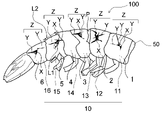
- FIG. 1 shows an embodiment of the shelled frozen shrimp 100 of the present embodiment.
- the shelled frozen shrimp 100 has an abdominal flesh 50 and a shell 10 covering the abdominal flesh 50.
- the shell 10 may cover only a part of the body 50 of the abdomen, or may cover the entire body 50 except for the cracks described later.
- the abdominal body 50 has six abdominal segments from the first abdominal segment 1 to the sixth abdominal segment 6.
- the shell 10 has an abdominal segment side instep 11 to an abdominal segment side instep 16.
- the head of the frozen shrimp 100 with a shell has been removed.
- the shelled frozen shrimp 100 may have an unremoved head.
- the shelled frozen shrimp 100 extends into the shell on the abdominal side surface in different directions with the starting point X in common, and penetrates the shell in the thickness direction. It also has a crack group Z (hereinafter, also simply referred to as a crack group Z). As shown in FIG. 1, the different directions here refer to different directions when the shrimp is viewed from the side.
- the crack group Z may have cracks that do not penetrate the shell as long as they have a plurality of cracks Y extending in different directions and penetrating in the thickness direction with one starting point in common.
- Frozen shrimp with shells are usually shrimp whose abdominal shells have not been removed.
- the term “unremoved” as used herein means that the process of forming cracks, which will be described later, is not included, and the shell is not stripped when producing a normal stripped shrimp.
- a part of the shell covering the abdominal segments 1 to 6 of the first abdominal segment 6 is unintentionally due to pretreatment such as head removal work. It may have been removed.
- the lateral insteps 11 to 16 of all the abdominal segments 1 to 6 of the first abdominal segment 1 to the sixth abdominal segment 6 have not been stripped and have not been removed.
- Shelled shrimp may or may not have abdominal limbs.
- the shrimp shell has a three-layer structure, the outermost layer is called the surface cuticle layer, the second layer is called the outer cuticle layer, and the third is the inner cuticle layer.
- the inner cuticle layer is the thickest and has a large amount of calcium deposited, and is also called the main layer or the calcified layer.
- the hardness of the shell is due to the action of calcium in the cuticle layer.
- a crack Y penetrating the shell including the inner cuticle layer exists on the side surface of the abdomen of the shrimp, and the crack Y extends from the starting point X in a plurality of different directions.
- the combination of having the crack group Z composed of such cracks Y and the softening treatment using acetic acid or a salt thereof makes the effect of improving the texture of the shell of the present embodiment excellent.
- One of the reasons is that the permeation of the immersion liquid containing acetic acid or a salt thereof into the shell tissue is promoted through a plurality of cracks Y extending from one starting point X in different directions and penetrating in the thickness direction. Conceivable.
- a plurality of cracks Y extending from one starting point X in different directions and penetrating in the thickness direction effectively improve the effect of reducing the hardness and the feeling of no residual mouth when chewed with the back teeth. ..
- the shelled frozen shrimp has a portion located between a plurality of cracks Y in the shell dented toward the shrimp body side (shrimp meat side) around at least one starting point X on the side surface of the abdomen. It is preferable to have. More specifically, the portion located between the plurality of cracks Y in the shell in the thickness direction of the shell (preferably the thickness direction of the shell in the non-recessed portion) is recessed toward the shrimp body side (shrimp meat side). Is preferable.
- a dent means that a plurality of cracks Y extending from the starting point X are formed by a process of giving an impact to the shell toward the shrimp body side (shrimp meat side) in the thickness direction of the shell.
- the shell between the cracks Y is recessed toward the shrimp body side (shrimp meat side) in the thickness direction around two or more starting points X in the crack groups. It is more preferable that the shell between the cracks Y is recessed toward the shrimp meat side in the thickness direction around each start point X.
- the depth of the dent is, for example, about 0.1 to 3 mm.
- the above "periphery" is an expression including the start point X, and may be described as the start point X and its surroundings. The dent is formed around the starting point X, and in many cases, the depth of the dent becomes deeper as the starting point X is approached.
- the thin skin of the shrimp is torn at the lower part (shrimp body side) of the starting point X in at least a part of the crack group on the side surface of the frozen shrimp with shell. It is considered that acetic acid or a salt thereof becomes easier to be formed by the treatment of having such a dent and tearing the thin skin of the shrimp on the shrimp body side in the thickness direction of the shell at the starting point X.
- the above-mentioned dent corresponds to a hitting mark when hit with a hitting tool having a convex portion in a suitable method for producing frozen shrimp with a shell, which will be described later.
- the shape around the start point X may be such that a plurality of cracks Y extending from the start point X in different directions in the side view of the shrimp are formed, but it is preferable to have the above-mentioned dents as described above. If the shell around the crack has a dented portion on the shrimp body side (shrimp meat side) in the middle of the crack, which is simply linear or zigzag and has no branch, the relevant portion is used as the starting point. It is regarded as a plurality of cracks Y extending in different directions from the starting point X. Such dents are often present especially at the bends of zigzag cracks. On the other hand, when there is no recessed portion in the middle, it is not regarded as a plurality of cracks Y extending in different directions from the starting point X, but is regarded as a single crack.
- the thin film connecting the abdominal insteps is broken between at least one abdominal segment from the viewpoint that acetic acid or a salt thereof can more easily permeate.
- the thin film connecting the abdominal segment side insteps 12 and 13 is broken at P between the second abdominal segment 2 and the third abdominal segment 3, and the abdominal segment side instep 12 and the abdominal segment side instep 13 are mutually connected. It is separated.
- the location where the thin film connecting the abdominal insteps is broken is not limited to the above.
- the frozen shrimp with a shell has a crack group Z composed of a plurality of cracks Y on both side surfaces of the abdomen because it is excellent in improving the texture of the shell such as the hardness of the shell when chewed with the back teeth.
- each side surface of the abdomen has a crack group Z composed of a plurality of cracks Y
- each side surface can optionally have the preferred configurations described above and below.
- a crack group Z having three or more cracks Y extending in different directions from one starting point X is formed in the shell on the side surface of the abdomen.
- two or more crack groups Z having two or more cracks Y extending in different directions from one starting point X are formed in the shell on at least one side surface of the abdomen. ..
- a crack group Z having four or more cracks Y starting from a common starting point X is formed on the side surface of the abdomen, and the crack group Z having a common starting point X as a starting point 4 is formed. It is more preferable that two or more crack groups Z having more than one crack Y are formed.
- the length of the crack Y is preferably 30% or more, more preferably 50% or more with respect to the maximum lateral length L2 of the abdominal segment. ..
- L1 is measured as the length of the path from the start point X, which is one end of the crack Y, to the other end.
- the maximum lateral length L2 of the abdominal segment is defined as the lateral length along the median line of the back of the abdominal segment where the crack is present.
- the length of the abdominal segment is measured with the shell covered. For example, in the example shown in FIG. 1, the length from the caudal end of the abdominal segment side instep 14 to the caudal end of the abdominal segment side instep 15 on the midline is L2.
- the frozen shrimp with a shell has one crack Y having a length L1 of 30% or more with respect to the maximum lateral length L2 of the abdominal segment on one side of the abdomen.
- the number is more preferably two or more, and the number is more preferably three or more.
- the length appearing on the outer surface is defined as the length of the crack. If the crack observed on one side extends to the other side, the length of the crack shall be the length observed on the side and does not include the portion extended to the other side.
- the frozen shrimp with a shell has one crack Y having a length L1 of 50% or more with respect to the maximum lateral length L2 of the abdominal segment on one side of the abdomen.
- the number is more preferably two or more, and the number is more preferably three or more.
- At least one side surface of the abdomen covers the first abdominal segment 1 to the third abdominal segment 3 (cranial portion, abdominal segment side instep 11 to 11 to).
- the shell covering the first abdominal segment 1 to the third abdominal segment 3 has a large shell area.
- the shell covering the 4th abdominal segment 4 to the 6th abdominal segment 6 is hard and easily remains in the mouth. Therefore, it is more effective to have at least one crack group on each of the abdominal side surface from the first abdominal segment 1 to the third abdominal segment 3 and the abdominal side surface from the fourth abdominal segment 4 to the sixth abdominal segment 6. The effect of improving the texture of the shell can be obtained.
- the frozen shrimp with a shell has the above-mentioned crack Y in two or more abdominal segments from the first abdominal segment 1 to the third abdominal segment 3 in terms of improving the texture of the shell. Further, it is more preferable to have the above-mentioned crack Y in two or more abdominal segments from the 4th abdominal segment 4 to the 6th abdominal segment 6 in terms of improving the texture of the shell. Further, it is preferable to have a crack penetrating the shell in at least the first abdominal segment 1 or the second abdominal segment 2 of the first abdominal segment 1 to the third abdominal segment 3 in order to improve the texture of the shell.
- having a crack penetrating the shell in at least the 5th abdominal segment 5 or the 6th abdominal segment 6 of the 4th to 6th abdominal segments (cranial side) improves the texture of the shell, especially the feeling of residual mouth. It is preferable in terms of improvement.
- the starting points X of the cracks Y may or may not exist in the same abdominal segment.
- the fissure Y in one fissure group does not have to be present in only one abdominal segment.
- a plurality of fissures Y constituting one crack group may be present in different abdominal segments. From the viewpoint of ease of manufacture, it is preferable that the starting point X is present in the same abdominal segment as the crack Y extending from the starting point X.
- the upper limit of the number of cracks penetrating the shell on one side of the abdomen in the shelled frozen shrimp is not particularly limited, but is preferably 300 or less, more preferably 200 or less, and particularly small.
- 100 or less are preferably mentioned, and 50 or less are more preferable.
- the number of cracks Y on one side surface of the abdomen is less than or equal to the number of each of the above mentioned as a preferable upper limit of the number of cracks penetrating the shell.
- the number of cracks is less than or equal to the above number in terms of improving production efficiency and reducing the influence on the body.
- the number of cracks Y extending from one starting point X in different directions is not particularly limited, but is preferably 20 or less at the maximum, more preferably 15 or less, and particularly preferably 10 or less. preferable.
- the frozen shrimp with a shell of the present invention may have a plurality of cracks Y extending in different directions from a common starting point X, as well as cracks penetrating other shells.
- Other cracks include cracks that are formed in the shell by only one and do not form a common starting point X. It was
- the ventral shell is cut with scissors from the head to the tail along the middle of the abdomen (median line).
- the shell is turned up from the head side (first abdominal segment 1) in order from the ventral side to the dorsal side. Check for dents such as gaps.
- the frozen shrimp with shells may be produced by adjusting the shape of the convex portion as a tapping tool in the preferred production method of the present invention described later.
- At least one of the above-mentioned forms of shrimp is present among all the shelled frozen shrimp in a package in which a plurality of shelled frozen shrimp are packaged, and it is preferable that the shrimp occupies 10% or more. It is more preferable to occupy 20% or more.
- Frozen shrimp with shells preferably contain acetic acid or a salt thereof because the effect of improving the texture of the shells is high.
- acetic acid or a salt thereof examples include alkali metal salts of acetic acid, and examples thereof include sodium acetate and potassium acetate.
- the frozen shrimp with shell contains acetic acid or a salt thereof, for example, by subjecting the frozen shrimp with shell to a homogenizer and subjecting the obtained sample to a high performance liquid chromatograph (HPLC).
- HPLC high performance liquid chromatograph
- the amount of acetic acid or its salt in the frozen shrimp with shells is the amount obtained by high performance liquid chromatography (HPLC) in the case of acetic acid, and in the case of acetate, the amount obtained by converting all the acetic acid roots into acetic acid (converted as acetic acid). It can be measured as a quantity).
- HPLC high performance liquid chromatography
- the amount of acetic acid in the frozen shrimp with shells is such that the degree of immersion of acetic acid or its salt in the shell is large and the shell softens, and it is easy to manufacture and taste.
- the frozen shrimp with shells may be heated, but when heated, the degree of immersion of acetic acid or a salt thereof in the shells is large and the shells are softened, and the shells are easy to manufacture.
- the amount of acetic acid in the frozen shrimp with shell is preferably 0.01 g or more and 10 g or less, more preferably 0.02 g or more and 5 g or less, and 0.05 g or more and 4 g or less per 100 g of shrimp. Is particularly preferable, and 0.1 g or more and 3 g or less are most preferable.
- the frozen shrimp with a shell having the above acetic acid amount can be obtained by the production method of the preferred examples described later. Further, the amount of acetic acid in the frozen shrimp with shells can be measured by the method described in Examples described later.
- Frozen shrimp with shells have a pH of 6.5 or more and 8.5 or less at room temperature (22 to 27 ° C.) obtained by adding 270 g of pure water to 30 g of shrimp and treating with a homogenizer for 1 minute. It is preferable in terms of excellent texture and taste of shrimp, and more preferably 7.0 or more and 8.0 or less. Frozen shrimp with shells in the above pH range can be obtained by using sodium acetate as acetic acid or a salt thereof in the preferred production method of the present invention described later. As the homogenizer, a Braun Multiquick blender or a similar product can be used, and the homogenization conditions may be the same as or higher than those in the examples described later.
- the liquid may have the above pH at any temperature in the temperature range of 22 to 27 ° C.
- Penaeid shrimp include Banamei (Litopenaeus vannamei), Black Tiger (Penaeus monodon), Penaeid shrimp (Marsupenaeus japonicus), Shiba shrimp (Metapenaeus joyneri), Pubalan (Metapenaeus dobsoni), Endeavor shrimp (Madorenaeus dobsoni), Endeavor shrimp (Madorenae) Monoceros), Taisho shrimp (Fenneropenaeus chinensis), Banana shrimp (Fenneropenaeus merguiensis), etc.
- Examples of Slipper lobsters include Ibacus, such as Ibacus ciliatus.
- Examples of the Pandalidae family include Pandalus nipponensis, Pandalus such as Pandalus eous, and Heterocarpus such as Heterocarpus Affinis.
- the size of the shrimp used in this embodiment is preferably U / 6 to 300/500 in terms of the international standard for shrimp size, which is how many shrimp can be contained per pound (453.6 g). , 6/8 to 100/200 sizes are particularly preferred.
- M and N are integers
- M / N size means that the size is M to N tails per pound.
- U means Under, and U / 6 refers to the standard of 6 fish or less per pound.
- the frozen shrimp with a shell of the present invention may be in an unheated state or may have been heated. If it has already been heated, it can be oil-conditioned, baked, steamed, or boiled.
- the unheated state means, for example, that the heat treatment of 60 ° C. or higher has not been performed, and it is preferable that the heat treatment of 50 ° C. or higher has not been performed, and the heating of 40 ° C. or higher is preferable. It is particularly preferable to indicate that the treatment has not been performed.
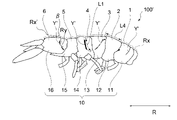
- the present invention extends in a direction intersecting the median plane and thickens the shell. It may be a shelled frozen shrimp 100'(see FIG. 2) having a crack Y'penetrating in the median direction.
- the median plane is a line Rx (see FIG. 2) extending along the back surface in the vertical direction R (see FIG. 2) from the cranial side to the caudal side at the center of the back surface of the shrimp in the width direction.
- the direction in which the crack Y'extends can be a straight line direction connecting both ends of the crack (for example, the Ry direction in FIG. 2), and the angle ⁇ formed by the straight line Ry direction with the median line Rx is preferably 40 ° or more. , 50 ° or more is more preferable, and 60 ° or more is particularly preferable.
- the angle ⁇ is an angle formed by the tangent line Rx'of the median line Rx at the intersection of the median line Rx and the straight line Ry.
- the peripheral portion of the crack Y' is recessed on the shrimp body side (shrimp meat side).
- the dent corresponds to a hitting mark when hit with a hitting tool having a convex portion in a suitable method for producing frozen shrimp with a shell, which will be described later.
- the recess may have a longitudinal direction extending in a direction intersecting the median plane Rx. When eating, the shrimp are often bitten off with the teeth in contact with the median plane, so having a crack Y'extending in the direction intersecting the median plane is effective for ease of eating. Conceivable.
- the maximum horizontally long L4 is measured in the same manner as L2 except that the subject is fixed to the second abdominal segment. Further, also in the case of this embodiment, it is preferable that the thin skin of the shrimp is torn in the lower part (shrimp body side) of the crack Y'because acetic acid or a salt thereof can easily penetrate into the shrimp shell. Also in this embodiment, the thin film connecting the adjacent abdominal insteps is broken in at least one abdominal segment of the shelled frozen shrimp because acetic acid or a salt thereof can more easily permeate. Is preferable. In this embodiment, the number of cracks Y'on one side surface of the abdomen is preferably 1 or more, more preferably 2 or more, and further preferably 3 or more.
- the number of cracks Y'where the length L1 along the path of the cracks Y'is 30% or more with respect to the maximum laterally long L4 of the second abdominal segment is preferably 1 or more, and preferably 2 or more. Is more preferable, and it is further preferable that the number is three or more. Further, on one side surface of the abdomen, it is preferable that the number of cracks Y'where the length L1 along the path of the crack Y'is 50% or more with respect to the maximum lateral length L4 of the second abdominal segment is one or more. Two or more are more preferable, and three or more are further preferable. It is also particularly preferable that the angle ⁇ of the crack having the above length is equal to or greater than the above lower limit.
- the abdomen has at least one crack Y'in the portion covering the first abdominal segment 1 to the third abdominal segment 3 (abdominal segment side insteps 11 to 13), and from the fourth abdominal segment 4 It is particularly preferable to have at least one crack Y'in the portion covering the sixth abdominal segment 6 (abdominal segment lateral insteps 14 to 16).
- the preferred items described in the form of FIG. 1 may appropriately correspond to the form of FIG.
- the abdominal side surface of a frozen shrimp shell with a raw material shell in an unheated state is tapped with a tapping tool having a convex portion at the tip to generate a crack penetrating the shell in the thickness direction, which is preferable.
- a crack group Z consisting of a plurality of cracks Y extending from a common starting point X in different directions and penetrating the shell in the thickness direction or a crack Y'prolonging in a direction intersecting the median plane and penetrating the shell in the thickness direction is formed. Then, it is immersed in an aqueous solution of acetic acid or a salt thereof.
- the frozen shrimp with shells is frozen after the dipping treatment.
- the timing of removing the head may be before the formation of the crack group Z or the crack Y', or the crack group Z or the crack Y. After forming', it may be before being immersed in an aqueous solution of acetic acid or a salt thereof, or after being immersed in an aqueous solution of acetic acid or a salt thereof. Above all, it is preferable that the timing of removing the head is before the formation of the crack group Z or the crack Y'from the viewpoint of operability.
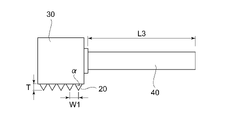
- a tapping tool having a convex portion at the tip is illustrated in FIGS. 3 and 4.
- the material of the tapping tool 30 of FIGS. 3 and 4 is not particularly limited, but it is preferable that the material is made of metal because it is easy to give an impact force to the shrimp.
- Examples of the metal type include stainless steel, iron, copper, brass, and aluminum, which are for food use and are preferably stainless steel in terms of weight and strength. It is more preferable that the tapping tool occupies 50% or more of its volume (in the case of having the handle 40 as shown in FIGS. 3 and 4, the volume of the portion other than the handle) with metal.
- the length of the handle 40 is preferably 15 to 30 cm from the viewpoint of ease of use.
- the weight of the tapping tool 30 having the handle 40 is not limited, but for example, the total weight including the weight of the handle is preferably 300 to 1000 g.
- Examples of the type having no handle include those having a convex portion at the tip of the roller.
- Examples of the same as the tapping tool 30 include, but are not limited to, the tapping tool 30'in FIG. 5 and the tapping tool 30'' in FIG.
- the shape of the convex portion 20 (or 20', 20'') of the tapping tool 30 (or 30', 30'') is such that it has a shape that tapers toward the tip, which is successful for the above-mentioned frozen shrimp with shells. It is preferable because it can be obtained well.
- the convex parts when the convex parts are viewed from two sides orthogonal to each other with the convex parts facing downward (or upward), the convex parts taper toward the tip regardless of which of the two sides is viewed.
- One preferable form is to have the shape of.
- An example of such is a conical or pyramidal ridge (see, for example, the ridges 20 and 20'shown in FIGS. 3-5).
- the crack group Z in the form of FIG. 1 can be manufactured.
- acetic acid or a salt thereof effectively penetrates into the shell due to such a group of cracks.
- the shell of the ventral side is hit with the main convex portions 20 and 20', at least a part between the abdominal segment side insteps is separated to form a gap, and not only the crack group Z but also the abdominal segment side insteps are separated. It is easy for acetic acid or a salt thereof to invade the inside of the shell through the gap.
- the convex portion when the convex portion is viewed from two sides orthogonal to each other with the convex portion facing downward (or upward), the convex portion is tapered toward the tip when viewed from one of the two directions.
- Another form is an example in which the shape has a shape and does not have a tapered shape when viewed from the other side.
- a plurality of convex portions are formed in a ridge shape. According to the convex portion of this shape, the crack Y'in the form of FIG. 2 can be manufactured.
- FIG. 6 is a shrimp with a shell in a state where the longitudinal direction of the convex portion 20'' (direction E in FIG. 6) intersects the vertical direction R (see FIG. 2) of the shrimp. Hitting tends to cause cracks Y'that intersect the median plane in the shell, and the abdominal segment side insteps are easily separated. It is preferable because it can be penetrated into the inside.
- the angle ⁇ of the tip of the convex portion is 40 ° to 80.
- the temperature is preferably °, more preferably 50 ° to 70 °.
- the above angle range is arbitrary when the tapping tool 30 (or 30', 30'') is arranged so that the protruding direction of the convex portion 20 (or 20', 20'') is downward (or upward). It suffices if it corresponds to the side view seen from one side.
- the tapping tool may be formed so that its tip has a curve, or may be formed on a flat surface or a bent portion that is gentler than the angle ⁇ .
- the tapping tool 30 (or 30', 30'') is viewed from any one side when the convex portion 20 (or 20', 20'') is arranged so that the protruding direction is downward (or upward).
- the convex portion 20 (or 20', 20'') has at least a triangular shape having the tip of the above-mentioned angle ⁇ or the above-mentioned triangular shape having a flat or gently curved or curved tip. It is preferable to have it at the tip thereof.
- the height T of the convex portion is not particularly limited, and may be 2 mm to 7 mm depending on the size of the shrimp, such as Banamei or Black Tiger.
- the ratio (T / W2) of the height T of the convex portion 20 (or 20', 20'') and the thickness W2 (not shown) of the frozen shrimp with raw material shell shall be 0.1 to 0.8. Is preferable, and 0.15 to 0.5 is more preferable.
- the thickness of the frozen shrimp with a shell here refers to the maximum width between the sides of the abdomen of the frozen shrimp with a shell.
- the convex portion 20 (or 20', 20'') has a tapping tool 30 (or 30', 30'') at the tip thereof as shown in FIG.
- the preferable height of the portion having the tapered shape is the above-mentioned convex portion 20.
- a height similar to the preferred height of (or 20', 20'') can be mentioned.
- the tapered shape referred to here includes the above-mentioned shape in which the tip is flat or gently bent or curved.
- the distance between adjacent convex portions 20 (or 20', 20'') (in the example of FIG. 3, the distance between adjacent vertices of the convex portions 20) W1 is
- the size of the shrimp is not particularly limited, but is preferably 2 mm to 20 mm because it is easy to apply to a whiteleg shrimp or a black tiger, which is easy to eat together with the shell, and more preferably 3 mm to 15 mm.
- the ratio W1 / W2 of the frozen shrimp with shells to the thickness W2 is preferably 0.1 to 1.3, and more preferably 0.2 to 1.0.
- the above-mentioned frozen shrimp with a shell of the present invention can be successfully obtained.
- the raw material shelled shrimp after the beating treatment is immersed in an aqueous solution of acetic acid or a salt thereof.
- the dipping treatment softens the shell.
- the acetate include those mentioned above, and sodium acetate is particularly preferable in terms of texture, taste and color tone of shrimp meat.
- an immersion liquid containing sodium acetate and not an acid such as acetic acid has a softening effect due to the immersion liquid. Excellent.
- the pH of the aqueous solution of sodium acetate used in the present invention is preferably 6.5 to 10.0 at 10 ° C., more preferably 7.0 to 8.5.
- the concentration of acetic acid or a salt thereof in an aqueous solution of acetic acid or a salt thereof as a dipping solution is preferably 1 to 5% by mass, preferably 2 to 4% by mass, from the viewpoint of the texture of the shell, the taste of the body, the texture and the like. % Is more preferable.
- the temperature of the aqueous solution of acetic acid or a salt thereof, which is the immersion liquid, is preferably 5 to 30 ° C, more preferably 10 to 20 ° C.
- the time for immersing in the soaking solution of acetic acid or a salt thereof is preferably 8 to 18 hours, more preferably 10 to 16 hours from the viewpoint of the texture of the shell, the taste of the body, the texture and the like.
- Shrimp with shells soaked in an aqueous solution of acetic acid or a salt thereof is appropriately subjected to a treatment such as freezing.
- a treatment such as freezing.
- the shrimp may be frozen after being immersed in an aqueous solution of acetic acid or a salt thereof without washing.
- the shrimp with shells obtained after immersion in the aqueous solution can be frozen without washing with water or the like, and the shrimp with shells are excellent in texture and taste. Will be. In this case, the manufacturing cost is reduced, which is preferable.
- the shrimp may be immersed in a water-retaining agent before the above-mentioned dipping treatment with acetic acid or a salt thereof.
- the water retention agent include phosphates, bicarbonates, citric acids, and citrates.
- the phosphate include orthophosphate, metaphosphate, polyphosphate, pyrophosphate and the like.
- alkali metal salts are particularly preferable.
- Examples of the orthophosphate include monosodium phosphate, disodium phosphate, and trisodium phosphate
- examples of the metaphosphate include sodium metaphosphate, potassium metaphosphate, and sodium hexametaphosphate
- examples of the polyphosphate include polyphosphorus.
- examples thereof include sodium acid and sodium tripolyphosphate
- examples of the pyrophosphate include sodium pyrophosphate and potassium pyrophosphate.
- a hydrogen carbonate for example, sodium hydrogen carbonate can be mentioned.
- Examples of the citrate include monosodium citrate, disodium citrate, trisodium citrate, monopotassium citrate, dipotassium citrate, and tripotassium citrate.
- the water retention agent may be only one of these, or may be a combination of two or more.
- the total amount of the water-retaining agent in the immersion liquid consisting of the aqueous solution of the water-retaining agent is preferably 0.5% by mass or more and 10.0% by mass or less, and 1.0% by mass or more and 3.0% by mass or less. % Or less is more preferable.
- a dipping solution consisting of an aqueous solution of a water-retaining agent When a dipping solution consisting of an aqueous solution of a water-retaining agent is used, it is preferable to soak it at 5 to 15 ° C. for 1 to 3 hours in that the shrimp flavor can be maintained.
- a dipping solution consisting of an aqueous solution of a water-retaining agent it is possible to perform a dipping treatment with acetic acid or an aqueous solution thereof for 5 to 20 minutes after draining at 5 to 20 ° C. to improve the dipping efficiency of acetic acid or a salt thereof. It is preferable in terms of points.
- the unheated shrimp with shells obtained by the above steps can be eaten together with the shells, and can be used for various cooking such as oiling, boiling, steaming, and baking. Further, the heated shrimp with shells obtained by heating in this way also contains acetic acid or a salt thereof, as shown in Examples described later, and falls under the shrimp with shells of the present invention.
- the timing of freezing or chilling the unheated shrimp with shells and the heated shrimp with shells may be any time as long as it is after the immersion of the aqueous solution of acetic acid or a salt thereof in the immersion liquid.
- the term "treated with acetic acid or a salt thereof" refers to shrimp that have been treated with an aqueous solution of acetic acid or a salt thereof in an immersion liquid.
- an unheated frozen shrimp with a shell can be stored in a frozen state as it is after being immersed in an aqueous solution of acetic acid or a salt thereof.
- various types of cooking are performed in any state such as frozen or chilled.
- the shrimp with shells may be cooked and then stored frozen or chilled as they are.
- the freezing state usually means storage in a temperature range of less than 10 ° C., and freezing is usually carried out at a temperature lower than -3 ° C and higher than ⁇ 45 ° C.
- the frozen shrimp with shells of the present invention has the effects of reducing the hardness of the shell and the feeling of residual shell when chewed with the back teeth when thawed by microwave heating or natural thawing. It is what you get.
- the shelled shrimp of the present invention can be used as a frozen food, a food for heating a range, a food for diet, an oil-like product such as frying, various processed foods such as chilled food, and a raw material for producing the same.
- Example 1 (First step) The head is removed from the unheated whiteleg shrimp, and the meat tenderizer with a hammer shown in FIGS. 3 and 4 (made of metal (stainless steel), the protrusion apex spacing W1 is 10 mm, the height T of the convex portion is 5 mm, and the convex portion The angle ⁇ is 60 °, the number of convex parts facing the shrimp is 25, the ratio W1 / W2 to the shrimp thickness W2 is 0.6, the T / W2 is 0.3, the weight is 370 g, and the length of the handle.
- the whiteleg shrimp was beaten with (L3 is 20 cm) to form crack group Z corresponding to the morphology described in FIG. 1 on both side surfaces of the abdominal shell.
- At least one crack group is formed in the portion covering the first abdominal segment 1 to the third abdominal segment 3 on both sides of the shrimp, and the fourth abdominal segment 4 to the sixth abdominal segment are formed. At least one crack group was formed in the portion covering up to 6. At least two fissures on one side of the abdomen formed four or more fissures Y extending from their starting point. In one aspect of the abdomen, the number of cracks Y having a length L1 of 30% or more with respect to the maximum lateral length L2 of the abdominal segment is 9 or more, and with respect to the maximum lateral length L2 of the abdominal segment having a crack in the shell. The number of cracks Y having a length L1 of 50% or more was 5 or more.
- the thin film connecting the lateral insteps of the abdominal segment was torn between at least one abdominal segment.
- at least one crack group was torn to the inner thin skin of the shell at the lower part (shrimp body side) of the starting point X.
- the shell located between the cracks Y was dented toward the shrimp body. The depth of the dent was in the range of 0.1 to 3 mm.
- at least one crack group Z is formed in the portion of each abdominal segment from the first abdominal segment to the sixth abdominal segment that covers the first abdominal segment 1 or the second abdominal segment 2.
- the shrimp with shells that had undergone the first step were immersed in a dipping solution (10 ° C.) containing a water-retaining agent for 2 hours.
- the composition of the dipping solution containing the water-retaining agent was 2% by mass of sodium hydrogen carbonate, 1% by mass of sodium chloride, 1% by mass of yeast, and 96% by mass of water.
- the shrimp with shells was immersed in a 3.0 mass% sodium acetate aqueous solution (10 ° C., pH 8.1) for 14 hours.
- the shrimp after soaking were separated from the dipping solution and frozen at ⁇ 30 ° C. without washing to obtain frozen shrimp with shells.
- Example 1 and Comparative Examples 1 to 4 were fried in cooking oil at 180 ° C. from a frozen state and frozen. After this is naturally thawed, it is eaten by 6 specialized panelists, and the hardness of the shell when chewed with the back teeth based on the following evaluation criteria (hardness felt when chewing with the back teeth until swallowing) and the feeling of residual mouth (the hardness felt when chewing with the back teeth until swallowing) and the feeling of residual mouth ( The degree to which shells remain after swallowing) was evaluated.
- the average value of the evaluation points of the six panelists is shown below.
- the hard texture of the shell can be effectively reduced, and the feeling of residual mouth of the shell is suppressed.
- Example 2 The first step was carried out in the same manner as in Example 1.
- a frozen shrimp with a shell was obtained in the same manner as in Example 1 except that a 3.0% by mass aqueous acetic acid solution was used instead of the 3.0% by mass sodium acetate aqueous solution as the dipping solution.
- Example 1 The following heated samples 1 to 4 were obtained from the unheated frozen shrimp with shells obtained in Example 1.
- Heating sample 1 Boiled treatment: In Example 1, 10 unheated shrimp with shells after soaking in an aqueous sodium acetate solution and before freezing were prepared. This shrimp was boiled in hot water close to 100 ° C. for 2 minutes from a chilled state, then drained, cooled at room temperature, and then frozen at ⁇ 30 ° C. (heated sample 1).
- Heating sample 2 Steaming treatment: After soaking in the sodium acetate aqueous solution in Example 1, 10 unheated shrimp with shells before freezing were put into a chilled state. This shrimp was steamed from a chilled state at 100 ° C.
- the acetic acid content of the unheated frozen shrimp with shells and the heated frozen shrimp with shells (heated samples 1 to 4) of Example 1 was measured by the following method. (Acetic acid amount measurement method) About 10 frozen shrimp with shells, 10 fish were left at room temperature and thawed naturally. The thawed shrimp was homogenized together with the shell in a food mixer. A predetermined amount of the homogenized shrimp (1.5 to 2.5 g for Example 1, 3 to 5 g for the heated sample 1 to 4 and the blank below) was measured. To this, 5 ml of 5 mass% perchloric acid and pure water were added, and the mixture was shaken for 10 minutes to extract acetic acid.
- Table 2 shows the amount of acetic acid when the amount of homogenized shrimp is 100 g.
- HPLC measurement conditions HPLC: LC-20AD manufactured by Shimadzu Corporation Column: Sim-pack SCR-102H x 2, ⁇ 8.0 mm x 300 mm (manufactured by Shimadzu Corporation) Column temperature: 45 ° C Detector: Electric conductivity meter CDD-10Avp (manufactured by Shimadzu Corporation) Flow rate: mobile phase 0.8 ml / min, reaction solution 0.8 ml / min Mobile phase: 5 mmol / L, p-toluenesulfonic acid Reaction solution: 0.1 mmol / L EDTA and 20 mmol / L Bis-Tris content 5 mmol / L p-toluenesulfonic acid injection amount: 10 ⁇ L
- Example 2 As a blank, the same unheated frozen shrimp with shells as in Example 1 was used in Example 1 except that the shrimp was immersed in a dipping solution containing a water-retaining agent and then not immersed in an aqueous sodium acetate solution.
- acetic acid amount was measured in the same manner as in Example 1, acetic acid (root) was not detected (detection limit 0.01 g / 100 g).
- Example 1 (Texture and taste evaluation) When the frozen shrimp with shells obtained in Example 1 and the frozen shrimp with shells obtained in Example 2 were fried and cooked by the same method as described in [Sensory Evaluation], they were eaten and compared.
- the shrimp with a shell from which the shrimp of Example 1 was fried had the same shell texture as the shrimp with a shell from which the shrimp of Example 2 was fried. Further, the shrimp with a shell fried shrimp of Example 1 has a softer texture, less acidity, and a shrimp-like color tone than the shrimp with a shell fried shrimp of Example 2. Was excellent.
- Example 3 (First step) The head is removed from the unheated whiteleg shrimp, and the tapping tool (made of metal (steel), weight 250 g, handle length L3 is 21 cm, protrusion apex spacing W1 is 5 mm, and convex height T is. 3 mm, the angle ⁇ of the convex part is 60 °, the number of convex parts facing the shrimp is 51, the ratio of the shrimp to the thickness W2 is 0.4, T / W2 is 0.2). The shells on both sides of the abdomen of the whiteleg shrimp were tapped to form a crack group Z corresponding to the morphology of FIG.
- the tapping tool made of metal (steel), weight 250 g, handle length L3 is 21 cm, protrusion apex spacing W1 is 5 mm, and convex height T is. 3 mm, the angle ⁇ of the convex part is 60 °, the number of convex parts facing the shrimp is 51, the ratio of the shrimp to the thickness W2 is 0.4, T
- At least one crack group is formed in the portion covering the first abdominal segment 1 to the third abdominal segment 3, and the fourth abdominal segment 4 to the sixth abdominal segment 6 are formed.
- At least one crack group Z was formed in the covering portion.
- At least two crack groups Z on one side of the abdomen formed two or more cracks Y extending from their starting point.
- the number of cracks Y having a length L1 of 30% or more with respect to the maximum lateral length L2 of the abdominal segment is 10 or more, and the length with respect to the maximum lateral length L2 of the abdominal segment having a crack.
- the number of cracks Y in which L1 was 50% or more was 4 or more.
- the thin film connecting the lateral insteps of the abdominal segment was torn between at least one abdominal segment.
- the thin skin inside the shell was torn at the lower part of the starting point X of at least one crack group.
- the shell located between the cracks Y was dented toward the shrimp body. The depth of the dent was in the range of 0.1 to 3 mm.
- at least one crack group Z is formed in the portion of each abdominal segment from the first abdominal segment to the sixth abdominal segment that covers the first abdominal segment 1 or the second abdominal segment 2.
- at least one crack group Z was formed in the portion covering the 5th abdominal segment 5 or the 6th abdominal segment 6.
- the maximum number of cracks Y extending from one starting point X was 4.
- the number of cracks (the number of cracks penetrating the shell) on one side of the abdomen in the shelled shrimp was 12.
- the obtained shell-crushed shrimp was subjected to the same second step as in Example 1 to obtain a frozen shrimp with a shell.
- Example 4 The head is removed from the unheated whiteleg shrimp, and the meat tenderizer with a hammer (made of metal (stainless steel), protrusion apex spacing W1 is 6 mm, convex height T is 5 mm, convex angle ⁇ ', shown in FIG. Is 80 °, the number of convex parts facing the shrimp is 5, the ratio of the shrimp to the thickness W2 is 0.4, the T / W2 is 0.4, the weight is 365 g, and the handle length is 19 cm).
- the whiteleg shrimp was beaten to form a crack Y'corresponding to the form described in FIG. 2 in the shell.
- At least one crack Y' is formed in the portion covering the first abdominal segment 1 to the third abdominal segment 3, and the shrimp covers the fourth abdominal segment 4 to the sixth abdominal segment 6.
- At least one crack Y' was formed in the part to be cracked.
- the number of cracks Y'with a length L1 of 30% or more with respect to the second abdominal segment L4 is 5 or more, and a length L1 is 50% with respect to the second abdominal segment L4.
- the number of cracks Y'above is 3 or more.
- the angle (acute angle) with respect to the median line in the direction in which they extend was 60 ° or more.
- the thin film connecting the abdominal segment side insteps was torn between at least one abdominal segment side instep.
- At least one crack Y' was torn to the inner thin skin of the shell at the lower part (shrimp body side).
- the shells around one crack Y' were dented toward the shrimp meat in the thickness direction of the shells.
- the depth of the dent was in the range of 0.1 to 3 mm.
- at least one crack Y' is formed in the first abdominal segment 1 or the second abdominal segment 2 of each abdominal segment from the first abdominal segment to the sixth abdominal segment on at least one side surface of the abdomen.
- At least one crack Y' was formed in the 5th abdominal segment 5 or the 6th abdominal segment 6.
- the number of cracks Y'on one side of the abdomen in the shelled shrimp was six.
- the obtained shell-crushed shrimp was subjected to the same second step as in Example 1 to obtain a frozen shrimp with a shell.
- the whole shell was chewed with the back teeth when it was eaten without the need for the treatment conventionally required for softening the shell, such as treatment with strong acid, reduced pressure heating / heating and pressurization, and treatment with chitin-degrading enzyme.
- a shrimp with a shell in which the hardness of the shell is effectively reduced and the feeling of residual mouth of the shell is suppressed, and a method for producing the shrimp.
Landscapes
- Life Sciences & Earth Sciences (AREA)
- Engineering & Computer Science (AREA)
- Zoology (AREA)
- Food Science & Technology (AREA)
- Wood Science & Technology (AREA)
- Marine Sciences & Fisheries (AREA)
- Health & Medical Sciences (AREA)
- Nutrition Science (AREA)
- Chemical & Material Sciences (AREA)
- Polymers & Plastics (AREA)
- Meat, Egg Or Seafood Products (AREA)
- Processing Of Meat And Fish (AREA)
Priority Applications (1)
| Application Number | Priority Date | Filing Date | Title |
|---|---|---|---|
| JP2022506964A JP7084564B1 (ja) | 2020-11-13 | 2021-11-11 | 殻付きエビ及びその製造方法 |
Applications Claiming Priority (2)
| Application Number | Priority Date | Filing Date | Title |
|---|---|---|---|
| JP2020189477 | 2020-11-13 | ||
| JP2020-189477 | 2020-11-13 |
Publications (1)
| Publication Number | Publication Date |
|---|---|
| WO2022102702A1 true WO2022102702A1 (ja) | 2022-05-19 |
Family
ID=81601292
Family Applications (1)
| Application Number | Title | Priority Date | Filing Date |
|---|---|---|---|
| PCT/JP2021/041517 Ceased WO2022102702A1 (ja) | 2020-11-13 | 2021-11-11 | 殻付きエビ及びその製造方法 |
Country Status (2)
| Country | Link |
|---|---|
| JP (1) | JP7084564B1 (enExample) |
| WO (1) | WO2022102702A1 (enExample) |
Cited By (1)
| Publication number | Priority date | Publication date | Assignee | Title |
|---|---|---|---|---|
| JP2025158035A (ja) * | 2024-04-03 | 2025-10-16 | マルハニチロ株式会社 | 殻付き喫食用エビ |
Families Citing this family (1)
| Publication number | Priority date | Publication date | Assignee | Title |
|---|---|---|---|---|
| WO2024070433A1 (ja) * | 2022-09-29 | 2024-04-04 | マルハニチロ株式会社 | 殻付き喫食用エビの製造方法 |
Citations (7)
| Publication number | Priority date | Publication date | Assignee | Title |
|---|---|---|---|---|
| JPH05268916A (ja) * | 1992-03-25 | 1993-10-19 | Nakajima Suisan Kk | 食品素材の製造法 |
| JPH0870819A (ja) * | 1994-09-01 | 1996-03-19 | Marutomo Kk | 即席佃煮 |
| JP2002017308A (ja) * | 2000-07-06 | 2002-01-22 | Japan Techno:Kk | 甲殻類の甲羅又は殻の褐変若しくは黒化防止方法 |
| JP2006020527A (ja) * | 2004-07-06 | 2006-01-26 | Nichirei Corp | 甲殻類加工品の製造方法 |
| JP2008245624A (ja) * | 2007-03-30 | 2008-10-16 | Kagoshima Univ | エビの殻の軟化方法 |
| CN107647326A (zh) * | 2017-09-11 | 2018-02-02 | 浙江海洋大学 | 一种即食带壳虾的处理剂配方及即食带壳虾的加工方法 |
| CN109007652A (zh) * | 2018-07-23 | 2018-12-18 | 宁波市农业科学研究院 | 一种高水分软壳虾干的加工方法 |
-
2021
- 2021-11-11 WO PCT/JP2021/041517 patent/WO2022102702A1/ja not_active Ceased
- 2021-11-11 JP JP2022506964A patent/JP7084564B1/ja active Active
Patent Citations (7)
| Publication number | Priority date | Publication date | Assignee | Title |
|---|---|---|---|---|
| JPH05268916A (ja) * | 1992-03-25 | 1993-10-19 | Nakajima Suisan Kk | 食品素材の製造法 |
| JPH0870819A (ja) * | 1994-09-01 | 1996-03-19 | Marutomo Kk | 即席佃煮 |
| JP2002017308A (ja) * | 2000-07-06 | 2002-01-22 | Japan Techno:Kk | 甲殻類の甲羅又は殻の褐変若しくは黒化防止方法 |
| JP2006020527A (ja) * | 2004-07-06 | 2006-01-26 | Nichirei Corp | 甲殻類加工品の製造方法 |
| JP2008245624A (ja) * | 2007-03-30 | 2008-10-16 | Kagoshima Univ | エビの殻の軟化方法 |
| CN107647326A (zh) * | 2017-09-11 | 2018-02-02 | 浙江海洋大学 | 一种即食带壳虾的处理剂配方及即食带壳虾的加工方法 |
| CN109007652A (zh) * | 2018-07-23 | 2018-12-18 | 宁波市农业科学研究院 | 一种高水分软壳虾干的加工方法 |
Cited By (1)
| Publication number | Priority date | Publication date | Assignee | Title |
|---|---|---|---|---|
| JP2025158035A (ja) * | 2024-04-03 | 2025-10-16 | マルハニチロ株式会社 | 殻付き喫食用エビ |
Also Published As
| Publication number | Publication date |
|---|---|
| JP7084564B1 (ja) | 2022-06-14 |
| JPWO2022102702A1 (enExample) | 2022-05-19 |
Similar Documents
| Publication | Publication Date | Title |
|---|---|---|
| JP7084564B1 (ja) | 殻付きエビ及びその製造方法 | |
| KR101873170B1 (ko) | 명태 반건조 코다리 제조방법 | |
| CN106901251A (zh) | 一种新型酥脆口感鱿鱼片的生产方法 | |
| JP4774008B2 (ja) | 甲殻類または畜肉類の風味品質改良剤およびそれを用いた甲殻類または畜肉類の処理法 | |
| JP5866218B2 (ja) | 食感を改良した加熱済み開きえびの製造方法 | |
| KR100844453B1 (ko) | 제육편육 제조방법 | |
| JP7368652B1 (ja) | 殻付きエビ及びその製造方法 | |
| Farrimond | The Science of Cooking: Every question answered to perfect your cooking | |
| JP6876887B1 (ja) | 浸漬剤並びに魚介類加工品及びその製造方法 | |
| JP7676755B2 (ja) | 食肉加工品の製造方法 | |
| JP6898504B2 (ja) | 冷凍エビ及びその製造方法 | |
| CN104366586A (zh) | 鲤鱼鱼丸及其制备方法 | |
| CN103005511A (zh) | 一种三文鱼的加工方法 | |
| KR101728697B1 (ko) | 어계탕의 제조 방법 및 어계탕 | |
| JP6069767B2 (ja) | 魚介類又は畜肉類収縮抑制剤 | |
| JP7789404B2 (ja) | 魚介類又は食肉の食感改良剤 | |
| JP7258560B2 (ja) | 魚の切り身の軟らか焼成品とその製造方法 | |
| Rukshana et al. | Impact of different processing methods on proximate chemical compositions and nutritional contents of skipjack tuna (katsuwonus pelamis linnaeus, 1758)-Balaya fish | |
| JP7510016B1 (ja) | 殻付き喫食用エビの製造方法 | |
| CN108029991A (zh) | 一种烤味野猪肉方便熟食 | |
| KR20250145173A (ko) | 닭발을 튀기는 방법과 그 닭발 | |
| KR20100021292A (ko) | 전복 김치 제조방법 및 이로부터 제조된 전복 김치 | |
| CN108029990A (zh) | 野猪肉制品及其快速制造工艺 | |
| CN106722392A (zh) | 一种海鲜团儿及其加工方法 | |
| JP6209692B1 (ja) | えび肉加熱体の製造方法 |
Legal Events
| Date | Code | Title | Description |
|---|---|---|---|
| ENP | Entry into the national phase |
Ref document number: 2022506964 Country of ref document: JP Kind code of ref document: A |
|
| 121 | Ep: the epo has been informed by wipo that ep was designated in this application |
Ref document number: 21891947 Country of ref document: EP Kind code of ref document: A1 |
|
| NENP | Non-entry into the national phase |
Ref country code: DE |
|
| 122 | Ep: pct application non-entry in european phase |
Ref document number: 21891947 Country of ref document: EP Kind code of ref document: A1 |