WO2022085547A1 - キャリアペプチドフラグメントおよびその利用 - Google Patents
キャリアペプチドフラグメントおよびその利用 Download PDFInfo
- Publication number
- WO2022085547A1 WO2022085547A1 PCT/JP2021/037981 JP2021037981W WO2022085547A1 WO 2022085547 A1 WO2022085547 A1 WO 2022085547A1 JP 2021037981 W JP2021037981 W JP 2021037981W WO 2022085547 A1 WO2022085547 A1 WO 2022085547A1
- Authority
- WO
- WIPO (PCT)
- Prior art keywords
- foreign substance
- amino acid
- cell
- introducing
- peptide fragment
- Prior art date
- Legal status (The legal status is an assumption and is not a legal conclusion. Google has not performed a legal analysis and makes no representation as to the accuracy of the status listed.)
- Ceased
Links
Images

Classifications
-
- C—CHEMISTRY; METALLURGY
- C07—ORGANIC CHEMISTRY
- C07K—PEPTIDES
- C07K14/00—Peptides having more than 20 amino acids; Gastrins; Somatostatins; Melanotropins; Derivatives thereof
- C07K14/435—Peptides having more than 20 amino acids; Gastrins; Somatostatins; Melanotropins; Derivatives thereof from animals; from humans
- C07K14/46—Peptides having more than 20 amino acids; Gastrins; Somatostatins; Melanotropins; Derivatives thereof from animals; from humans from vertebrates
- C07K14/47—Peptides having more than 20 amino acids; Gastrins; Somatostatins; Melanotropins; Derivatives thereof from animals; from humans from vertebrates from mammals
-
- C—CHEMISTRY; METALLURGY
- C07—ORGANIC CHEMISTRY
- C07K—PEPTIDES
- C07K19/00—Hybrid peptides, i.e. peptides covalently bound to nucleic acids, or non-covalently bound protein-protein complexes
-
- C—CHEMISTRY; METALLURGY
- C12—BIOCHEMISTRY; BEER; SPIRITS; WINE; VINEGAR; MICROBIOLOGY; ENZYMOLOGY; MUTATION OR GENETIC ENGINEERING
- C12N—MICROORGANISMS OR ENZYMES; COMPOSITIONS THEREOF; PROPAGATING, PRESERVING, OR MAINTAINING MICROORGANISMS; MUTATION OR GENETIC ENGINEERING; CULTURE MEDIA
- C12N15/00—Mutation or genetic engineering; DNA or RNA concerning genetic engineering, vectors, e.g. plasmids, or their isolation, preparation or purification; Use of hosts therefor
- C12N15/09—Recombinant DNA-technology
- C12N15/11—DNA or RNA fragments; Modified forms thereof; Non-coding nucleic acids having a biological activity
-
- C—CHEMISTRY; METALLURGY
- C12—BIOCHEMISTRY; BEER; SPIRITS; WINE; VINEGAR; MICROBIOLOGY; ENZYMOLOGY; MUTATION OR GENETIC ENGINEERING
- C12N—MICROORGANISMS OR ENZYMES; COMPOSITIONS THEREOF; PROPAGATING, PRESERVING, OR MAINTAINING MICROORGANISMS; MUTATION OR GENETIC ENGINEERING; CULTURE MEDIA
- C12N5/00—Undifferentiated human, animal or plant cells, e.g. cell lines; Tissues; Cultivation or maintenance thereof; Culture media therefor
- C12N5/10—Cells modified by introduction of foreign genetic material
Definitions
- the present invention relates to a method of introducing (transferring) a foreign substance from the outside of a eukaryotic cell into the inside of the cell, and a carrier peptide fragment used in the method. It should be noted that this application claims priority based on Japanese Patent Application No. 2020-177944 filed on October 23, 2020, and the entire contents of the application are incorporated herein by reference. There is.
- Patent Document 1 discloses a cell-permeable carrier peptide for introducing a foreign substance such as a polypeptide or DNA into a cell.
- This patent document describes that a bioactive substance such as a polypeptide or DNA can be introduced into cells with high efficiency by using a carrier peptide conjugate in which a cell-permeable carrier peptide and a heterologous polypeptide or DNA are linked.
- Patent Document 2 describes the nuclear localization signal of LIM kinase 2, which is one of the protein kinases involved in intracellular signal transduction present in human endothelial cells, which is described in Non-Patent Document 1.
- a construct for introducing a foreign substance containing the amino acid sequence shown in SEQ ID NO: 2 known as Nucleolar localization signal (hereinafter, also referred to as “NoLS”) and a target foreign substance is disclosed. Since the amino acid sequence is an excellent cell membrane permeable peptide, the construct can pass through the cell membrane of eukaryotic cells with high efficiency. This makes it possible to efficiently introduce the foreign substance of interest from the outside of the eukaryotic cell into the cytoplasm of the cell.
- an object of the present invention is to provide a method for efficiently introducing a target foreign substance from the outside of a eukaryotic cell into at least the cytoplasm of the cell. ..
- Another object of the present invention is to provide a carrier peptide fragment that efficiently introduces a target foreign substance from the outside of a eukaryotic cell into the cytoplasm of the cell, and a construct of the foreign substance.
- the present inventor has searched for an amino acid sequence that has excellent cell membrane permeability introduced from the extracellular space into the cell and can be preferably used as a carrier peptide (carrier peptide fragment).
- carrier peptide fragment mitochondrial-derived humanin (HN) present in human cells having the amino acid sequence set forth in SEQ ID NO: 1 is introduced from the outside of the cell into the cell.
- HN mitochondrial-derived humanin
- Humanin is a peptide consisting of 24 amino acid residues reported in Non-Patent Document 2.
- Humanin has been known to have a function of suppressing cell death of nerve cells, and has been known to be a peptide secreted from the intracellular body to the outside of the cell. However, it is not known that it is introduced into the cell from the outside of the cell with high efficiency, and the property was first discovered by the present inventor.
- the method disclosed herein is at least from outside the eukaryotic cell (particularly various animal cells represented by humans and other mammals having no cell wall) (that is, outside the cell membrane) to inside the cytoplasm of the cell. It is a method of introducing (transferring) the target foreign substance into the cell.
- the method for introducing foreign substances disclosed here is (1) The following amino acid sequence: MAPRGFSCLLLTSEIDLPVKRRA (SEQ ID NO: 1) A step of preparing a structure for introducing a foreign substance having the carrier peptide fragment comprising the carrier peptide fragment and the foreign substance of the above object bound to the N-terminal side and / or the C-terminal side of the carrier peptide fragment.
- the "foreign substance” is an inorganic compound or an organic compound that can be directly or indirectly bound to the N-terminal side or the C-terminal side of the carrier peptide fragment via an appropriate linker, and is a eukaryotic cell. It has a molecular size and chemical properties that can be introduced into it.
- a target foreign substance typically an organic compound such as a polypeptide, nucleic acid, dye, or drug
- the construct for introducing a foreign substance constructed by indirectly binding via a target or appropriate linker is supplied into a sample containing the eukaryotic cell of interest (typically, a culture containing the cell) (i.e., By adding to a living eukaryotic cell), the foreign substance of interest can be introduced into the cytoplasm from the outside of the eukaryotic cell (outside the cell membrane) through the cell membrane with high efficiency.
- the foreign substance is characterized by being any organic compound selected from the group consisting of a polypeptide, a nucleic acid, a dye and a drug. Constructs made to contain this type of organic compound are efficiently introduced into the cell of interest.
- the "polypeptide” refers to a polymer having a structure in which a plurality of amino acids are bonded by peptide bonds. The polypeptide is not limited by the number of peptide bonds (ie, the number of amino acid residues).
- the polypeptide includes a peptide generally called a peptide having 10 or more and less than 300 amino acid residues and a protein (typically a polymer compound consisting of 300 or more amino acid residues). ..
- polypeptides and proteins are not strictly separated.
- polymers (including oligomers) composed of a plurality of amino acid residues are collectively referred to as polypeptides.
- nucleic acid refers to a polymer of nucleotides and includes DNA and RNA. The “nucleic acid” is not limited by the number of bases.
- the foreign substance is a mature polypeptide derived from any biological species or a precursor polypeptide thereof, and the construct for introducing a foreign substance is the same. It is a synthetic polypeptide having an amino acid sequence corresponding to a mature polypeptide as a foreign substance or a precursor polypeptide thereof and an amino acid sequence of the carrier peptide fragment. According to such a configuration, a synthetic polypeptide having the amino acid sequence of the mature polypeptide or its precursor polypeptide and the amino acid sequence of the carrier peptide fragment can be efficiently introduced into a target eukaryotic cell.
- the amino acid sequence corresponding to the mature polypeptide as the foreign substance or its precursor polypeptide is arranged on the N-terminal side of the carrier peptide fragment. There is. According to such a configuration, the amino acid sequence of the mature polypeptide or its precursor polypeptide can be more efficiently introduced into the target eukaryotic cell.
- the eukaryotic cell to which the above-mentioned construct for introducing a foreign substance is introduced is a human or non-human mammalian cell. With such a configuration, foreign substances can be efficiently introduced into the cytoplasm of human or non-human mammalian cells.
- the present invention is to achieve at least the cell from the outside (that is, the outside of the cell membrane) of a eukaryotic cell (particularly various animal cells represented by humans and other mammals having no cell wall).
- a construct for introducing a foreign substance artificially prepared for introducing (transferring) a foreign substance of interest into the cytoplasm of the cell comprises a carrier peptide fragment consisting of MAPRGFSCLLLTSEIDLPVKRRA (SEQ ID NO: 1) and the foreign substance of the above-mentioned object bound to the N-terminal side and / or the C-terminal side of the carrier peptide fragment. , Have.
- a preferred embodiment of the foreign substance introduction construct disclosed herein is, as described above, the foreign substance being any organic compound selected from the group consisting of polypeptides, nucleic acids, dyes and agents.
- the foreign substance is a mature polypeptide derived from any biological species or a precursor polypeptide thereof, and the construct for introducing a foreign substance is a mature polypeptide as the foreign substance or a precursor poly thereof. It is a synthetic polypeptide having an amino acid sequence corresponding to the peptide and an amino acid sequence of the carrier peptide fragment. Further, more preferably, the amino acid sequence corresponding to the mature polypeptide as the foreign substance or the precursor polypeptide thereof is arranged on the N-terminal side of the carrier peptide fragment.
- FIG. 1 shows a test in which sample 1 having the amino acid sequence shown in SEQ ID NO: 1 and FAM was added to a culture medium of HeLa cells (Example 1), and sample 2 having the amino acid sequence shown in SEQ ID NO: 2 and FAM.
- Fluorescence intensity and cells obtained by analyzing cultured cells with a flow cytometer in the added test (Example 2), the FAM-added test (Example 3), and the DMSO-only test (Example 4). It is a histogram showing the relationship with a number.
- the X-axis shows the fluorescence intensity and the Y-axis shows the number of cells.
- amino acids may be represented by one-letter notation (however, three-letter notation in the sequence listing) based on the nomenclature for amino acids shown in the IUPAC-IUB guideline.
- amino acid residue is a term that includes the N-terminal amino acid and the C-terminal amino acid of the peptide chain, unless otherwise specified.
- synthetic peptide means that the peptide chain does not exist independently and stably in the natural world, but is artificially chemically synthesized or biosynthesized (that is, production based on genetic engineering). A peptide fragment that can be stably present in a given composition.
- peptide refers to an amino acid polymer having a plurality of peptide bonds, and is not limited by the number of amino acid residues. In the amino acid sequence described in the present specification, the left side always represents the N-terminal side and the right side represents the C-terminal side.
- the construct for introducing a foreign substance disclosed herein comprises a carrier peptide fragment consisting of MAPRGFSCLLLTSEIDLPVKRRA (SEQ ID NO: 1) and the foreign substance of the above-mentioned object bound to the N-terminal side and / or the C-terminal side of the carrier peptide fragment.
- the "carrier peptide fragment” disclosed here is a sequence defined (understood) by the amino acid sequence shown in SEQ ID NO: 1, and is an amino acid sequence that exerts cell membrane permeability of eukaryotic cells.
- the amino acid sequence shown in SEQ ID NO: 1 is a full-length amino acid sequence of humanin (HN) derived from mitochondria present in human cells, and is an amino acid sequence consisting of a total of 24 amino acid residues.
- HN humanin
- humanin has been known to have an effect of suppressing cell death of nerve cells (Non-Patent Document 2).
- the amino acid sequence shown in SEQ ID NO: 1 is a carrier peptide fragment having excellent cell membrane permeability introduced from outside the cell into the cell, the carrier peptide fragment and the N-terminal side and / or C of the carrier peptide fragment
- the foreign substance-introducing construct having the target foreign substance bound to the terminal side is introduced from the outside of the eukaryotic cell at least in the cytoplasm of the cell with higher efficiency.
- carrier peptide fragment is typically the same amino acid sequence as the amino acid sequence shown in SEQ ID NO: 1, but includes a modified sequence of such an amino acid sequence as long as it does not impair cell membrane permeability. do.
- the "modified sequence” is an amino acid sequence formed by substituting, deleting and / or adding (inserting) one or several (typically two or three) amino acid residues. Modified amino acid sequence). Such minor modified sequences are readily available to those of skill in the art based on the information disclosed herein and are therefore included in the "carrier peptide fragment" as a technical idea disclosed herein.
- modified sequences herein include, for example, sequences resulting from so-called conservative amino acid replacements in which one, two or three amino acid residues are conservatively substituted.
- Typical examples of similar substitutions are, for example, a sequence in which a basic amino acid residue is replaced with another basic amino acid residue (for example, mutual substitution between a lysine residue and an arginine residue), or a hydrophobic amino acid residue is another.
- Examples thereof include sequences substituted with hydrophobic amino acid residues of (for example, mutual substitution of leucine residue, isoleucine residue, and valine residue).
- the structure for introducing a foreign substance is designed and constructed by directly or indirectly binding (linking) a desired foreign substance to the N-terminal side and / or the C-terminal side of the carrier fragment via an appropriate linker.
- the linker is not particularly limited, and may be a peptidic linker or a non-peptide linker. Although not particularly limited, it is preferable that the amino acid sequence constituting the peptide linker is a flexible amino acid sequence that does not easily cause steric hindrance.
- the peptide linker contains 1 or 2 or more amino acid residues selected from, for example, glycine, alanine, serine and the like, and 10 or less (more preferably 1 or more and 5 or less, for example, 1 or 2).
- the non-peptide linker is not particularly limited, and for example, an alkyl linker, a PEG (polyethylene glycol) linker, an aminohexanoyl spacer, or the like may be used.
- the foreign substance is typically an organic compound such as a polypeptide, nucleic acid, dye or drug.
- the foreign substance can be, for example, a polypeptide.
- the peptide chain is designed to include the amino acid sequence constituting the polypeptide and the amino acid sequence constituting the carrier peptide fragment, and the peptide chain is biosynthesized or chemically synthesized. Thereby, a structure for introducing a target foreign substance can be produced.
- antitumor agents including nucleic acids such as various DNAs or RNAs, dyes (eg, various fluorescent dye compounds such as FAM and FITC), or agents (eg, nucleic acid based antitumor agents such as 5-fluorouracil (5FU)).
- An organic compound that functions as an antiviral agent such as azidothymidine (AZT) is directly or indirectly bound to the N-terminal side and / or C-terminal side of the above-mentioned carrier peptide fragment by various conventionally known scientific methods. It is possible to construct a structure for introducing foreign substances. Although not particularly limited, the functions of the foreign substance are, for example, promotion of stem cell differentiation induction (stem cell differentiation induction activity), suppression of tumor cell growth (antitumor activity), and suppression of virus-infected cell growth (antivirus). Activity) etc.
- the number of foreign substances that bind to the carrier peptide fragment is not particularly limited. That is, one or more foreign substances may be bound to one carrier peptide fragment.
- a polypeptide, nucleic acid, drug or the like may be bound to the N-terminal side of one carrier peptide fragment, and a dye may be bound to the C-terminal side. It is preferable to bind the dye to the carrier peptide fragment because it facilitates the evaluation of the introduction efficiency and intracellular localization of the foreign substance-introducing construct into eukaryotic cells.
- the polypeptide (amino acid sequence) to be adopted is not particularly limited.
- a substance having a relatively large number of amino acid residues such as a polypeptide or protein having a number of amino acid residues of about 100 to 1000, can be adopted as a foreign substance.
- the total number of amino acid residues constituting the synthetic peptide prepared as a construct for introducing a foreign substance is several to several tens (for example, 10) or more, and 1000 or less is appropriate, preferably 1000 or less. It is 600 or less, more preferably 500 or less, and particularly preferably 300 or less (for example, 10 to 300).
- Polypeptides of such length are easy to synthesize (biosynthesis, chemical synthesis) and easy to use.
- protypes As foreign substances, mature or precursors (protypes) of polypeptides involved in functions such as development, differentiation, proliferation, canceration, homeostasis (homeostasis), and regulation of metabolism of various cells and tissues (organs). , Pre-pro type is included.) Is preferable.
- the method for introducing a foreign substance disclosed here is to be implemented. You can also.
- the eukaryotic cell to which the foreign substance is introduced is a human or other mammalian stem cell
- the use of a mature form of a polypeptide having various physiological activities involved in the induction of differentiation of the stem cell or a precursor thereof can be used.
- the "stem cells” include somatic stem cells, embryonic stem cells, and induced pluripotent stem cells (hereinafter referred to as iPS cells).
- iPS cells induced pluripotent stem cells
- the eukaryotic cell to which the foreign substance is introduced is a cancer cell (tumor cell)
- the polypeptide that can inhibit cancer cells (tumor cells) from suppressing the function of the immune surveillance mechanism is preferable to use.
- the eukaryotic cells to be introduced are bacterially infected cells or virus-infected cells, various polypeptides involved in the induction of apoptosis of the infected cells and the growth of bacteria or viruses in the infected cells are suppressed.
- the polypeptide as a foreign substance is formed by substituting, deleting and / or adding (inserting) one or several amino acid residues as long as the function is maintained. It may contain a modified amino acid sequence.
- the structure for introducing a foreign substance is preferably one in which at least one amino acid residue is amidated.
- Amidation of the carboxyl group of an amino acid residue (typically the C-terminal amino acid residue of a peptide chain) improves structural stability (eg, protease resistance) in the cytoplasm and nucleus of the foreign substance introduction construct. obtain.
- structural stability eg, protease resistance
- the hydrophilicity of the structure is improved, the water solubility of the structure can be improved.
- the foreign substance is bound to the N-terminal side of the carrier peptide fragment, it is preferable to amidate the C-terminal amino acid residue of the carrier peptide fragment.
- the foreign substance is a polypeptide and the polypeptide is bound to the C-terminal side of the carrier peptide fragment, it is preferable to amidate the C-terminal amino acid residue of the polypeptide.
- those having a relatively short peptide chain are easily produced according to a general chemical synthesis method.
- a general chemical synthesis method For example, either a conventionally known solid phase synthesis method or a liquid phase synthesis method may be adopted.
- a solid-phase synthesis method in which Boc (t-butyloxycarbonyl) or Fmoc (9-fluorenylmethoxycarbonyl) is applied as a protecting group for an amino group is suitable.
- the peptide chain having a desired amino acid sequence and a modified (C-terminal amidation, etc.) portion can be synthesized by a solid-phase synthesis method using a commercially available peptide synthesizer.
- a part of the peptide chain may be synthesized by the above method, and for example, only a carrier peptide fragment or a peptide chain containing a carrier peptide fragment and a peptide linker moiety may be synthesized.
- the peptide moiety may be produced by biosynthesis based on a genetic engineering technique. That is, a polynucleotide (typically DNA) of a nucleotide sequence (including an ATG start codon) encoding a desired amino acid sequence is synthesized. It includes various regulatory elements (promoter, ribosome binding site, terminator, enhancer, expression level controlling) for expressing the synthesized polynucleotide (DNA) and the amino acid sequence in the host cell. ), A recombinant vector having a gene construct for expression is constructed according to the host cell.
- a polynucleotide typically DNA
- a nucleotide sequence including an ATG start codon
- a recombinant vector having a gene construct for expression is constructed according to the host cell.
- this recombinant vector is introduced into a given host cell (eg, yeast, insect cell, plant cell) and the host cell or tissue or individual containing the cell is cultured under predetermined conditions. This makes it possible to produce the desired peptide intracellularly. Then, the peptide moiety can be obtained by isolating the peptide moiety from the host cell (in the medium if secreted) and performing refolding, purification, or the like as necessary.
- the method for constructing the recombinant vector and the method for introducing the constructed recombinant vector into the host cell the methods conventionally used in the art may be adopted as they are, and the method itself particularly features the present technique. Since it is not a thing, a detailed description will be omitted.
- a fusion protein expression system can be utilized for efficient mass production in host cells. That is, a gene (DNA) encoding the amino acid sequence of the target polypeptide is chemically synthesized, and the synthesized gene is provided by an appropriate fusion protein expression vector (for example, the pET series provided by Novagen and Amasham Bioscience). It is introduced into a suitable site of a GST (Glutathione S-transferase) fusion protein expression vector such as the pGEX series. Then, the host cell (typically Escherichia coli) is transformed with the vector. The obtained transformant is cultured to prepare the desired fusion protein. The protein is then extracted and purified.
- a gene DNA
- the synthesized gene is provided by an appropriate fusion protein expression vector (for example, the pET series provided by Novagen and Amasham Bioscience). It is introduced into a suitable site of a GST (Glutathione S-transferase) fusion protein expression vector such as the pGEX series
- the obtained purified fusion protein is cleaved with a predetermined enzyme (protease), and the released target peptide fragment (that is, the designed artificial polypeptide) is recovered by a method such as affinity chromatography.
- a predetermined enzyme protease
- affinity chromatography a method such as affinity chromatography.
- a template DNA for a cell-free protein synthesis system ie, a synthetic gene fragment containing a nucleotide sequence encoding the amino acid sequence of the peptide portion of the foreign substance introduction construct
- various compounds required for the synthesis of the peptide portion are constructed.
- the so-called cell-free protein synthesis system can be adopted to synthesize the target polypeptide in vitro.
- Shimizu et al. Nature Biotechnology, 19, 751-755 (2001)
- Madin et al. Madin et al. (Madin et al., Proc. Natl. Acad. Sci.
- a single-stranded or double-stranded polynucleotide containing a nucleotide sequence encoding a peptide portion of a construct for introducing a foreign substance and / or a nucleotide sequence complementary to the sequence is easily produced (synthesized) by a conventionally known method. be able to. That is, by selecting the codon corresponding to each amino acid residue constituting the designed amino acid sequence, the nucleotide sequence corresponding to the amino acid sequence is easily determined and provided. Then, once the nucleotide sequence is determined, a polynucleotide (single strand) corresponding to the desired nucleotide sequence can be easily obtained by using a DNA synthesizer or the like.
- the obtained single-stranded DNA can be used as a template, and various enzymatic synthetic means (typically PCR) can be used to obtain the desired double-stranded DNA.
- the polynucleotide may be in the form of DNA or may be in the form of RNA (mRNA or the like).
- the DNA can be provided in double or single strands. When provided as a single strand, it may be a coding strand (sense strand) or a non-coding strand (antisense strand) having a complementary sequence.
- the polynucleotide thus obtained can be used as a material for constructing a recombinant gene (expression cassette) for peptide production in various host cells or in a cell-free protein synthesis system. can.
- the structure for introducing a foreign substance can be suitably used as an active ingredient of a composition for use based on the function of the foreign substance.
- the structure for introducing a foreign substance may be in the form of a salt as long as the function of the foreign substance is not lost.
- an acid addition salt obtained by an addition reaction with an inorganic acid or an organic acid usually used according to a conventional method can be used. Accordingly, the "constructs for introducing foreign substances" described herein and in the claims include those in such salt form.
- the structure for introducing a foreign substance may be provided as a composition which may contain various carriers which are pharmaceutically acceptable depending on the form of use, in addition to the structure for introducing a foreign substance as an active ingredient.
- a carrier for example, a carrier generally used in peptide drugs as a diluent, an excipient, etc. is preferable. Examples of such a carrier may be appropriately different depending on the use and form of the structure for introducing a foreign substance, but typically include water, a physiological buffer solution, and various organic solvents.
- the carrier may be a non-drying oil such as an aqueous solution of an alcohol (ethanol or the like) having an appropriate concentration, glycerol, olive oil, or a liposome.
- examples of secondary components that can be contained in the pharmaceutical composition include various fillers, bulking agents, binders, wetting agents, surfactants, pigments, fragrances and the like.
- compositions are not particularly limited.
- typical forms include liquids, suspensions, emulsions, aerosols, foams, granules, powders, tablets, capsules, ointments.
- it since it is used for injection or the like, it can be used as a freeze-dried product or a granulated product for preparing a drug solution by dissolving it in physiological saline or an appropriate buffer solution (for example, PBS) immediately before use.
- physiological saline or an appropriate buffer solution for example, PBS
- PBS buffer solution
- the process itself for preparing various forms of drugs (compositions) using a structure for introducing a foreign substance (main component) and various carriers (secondary components) may follow a conventionally known method, and the pharmaceutical method itself may be used. Does not characterize this technology, so detailed description will be omitted.
- Detailed sources of prescribing information include, for example, Comprehensive Medicinal Chemistry, supervised by Corwin Hansch, published by Pergamon Press (1990).
- a method for introducing a foreign substance introduction structure in vivo (in vivo) or in vitro (in vitro) using the foreign substance introduction structure (composition) disclosed herein is provided.
- steps (1) to (3) (1) A structure for introducing a foreign substance having a carrier peptide fragment consisting of the amino acid sequence shown in SEQ ID NO: 1 and the foreign substance of interest bound to the N-terminal side and / or the C-terminal side of the carrier peptide fragment.
- the above-mentioned "eukaryotic cell” includes, for example, various tissues, organs, organs, blood, lymph, etc. in vivo.
- the above-mentioned “eukaryotic cell” includes, for example, various cell masses, tissues, organs, organs, blood, and lymph fluid excised from a living body, cell lines, and the like.
- compositions containing the constructs disclosed herein can be used in vivo in methods and doses according to their form and purpose.
- a liquid preparation it is administered in a desired amount to the affected part (for example, malignant tumor tissue, virus-infected tissue, inflamed tissue, etc.) of a patient (that is, a living body) by intravenous injection, intramuscular, subcutaneous, intradermal or intraperitoneal injection. be able to.
- a solid form such as a tablet or a gel-like or aqueous jelly-like substance such as an ointment can be directly applied to a predetermined tissue (that is, an affected part such as a tissue or organ containing, for example, tumor cells, virus-infected cells, inflammatory cells, etc.). Can be administered to. Alternatively, solid forms such as tablets can be orally administered. In the case of oral administration, it is preferable to apply an encapsulation or protective (coating) material in order to suppress digestive enzyme degradation in the gastrointestinal tract.
- an appropriate amount of the composition disclosed herein (that is, an appropriate amount of a construct for introducing a foreign substance) is applied at least once to the target eukaryotic cell. It is recommended to supply it to the culture medium of nuclear cells.
- the amount and number of feeds per supply are not particularly limited because they may vary depending on the type of eukaryotic cells to be cultured, the cell density (cell density at the start of culture), the number of passages, the culture conditions, the type of medium, and the like. ..
- the carrier peptide fragment concentration in the culture medium is generally within the range of 0.05 ⁇ M or more and 100 ⁇ M or less, for example, within the range of 0.5 ⁇ M or more and 50 ⁇ M or less, or for example, within the range of 1 ⁇ M or more and 20 ⁇ M or less. It is preferable to add multiple times or more.
- An example of the in vitro introduction method is shown in the following examples.
- the method for evaluating the introduction efficiency of the structure for introducing foreign substances is not particularly limited.
- a dye typically a fluorescent dye compound
- microscopic observation eg, fluorescent microscopic observation
- flow cytometry or the like
- the introduction efficiency of the construct can be evaluated by an immunoscientific method (Western blotting, immune cell staining, etc.) using an antibody that specifically recognizes the peptide portion of the construct.
- Peptide 1 is a carrier peptide fragment consisting of the amino acid sequence shown in SEQ ID NO: 1 disclosed herein.
- Peptide 2 is an amino acid sequence known as a nucleolus localization signal (NoLS) of LIM kinase 2 present in human endothelial cells shown in SEQ ID NO: 2, and is a carrier peptide fragment disclosed in Patent Document 2.
- NoLS nucleolus localization signal
- Both Peptide 1 and Peptide 2 were synthesized by carrying out a solid phase synthesis method (Fmoc method) according to a manual using a commercially available peptide synthesizer.
- FAM C 21 H 12 O 7 : 5 (6) -Carboxyfluorescein, molecular weight 376.3, excitation wavelength 495 nm, which is a fluorescent dye as a foreign substance, was added to the amino acid residues on the N-terminal side of Peptide 1 and Peptide 2.
- a structure for introducing a foreign substance also referred to as "sample 1" and a structure for introducing a foreign substance (also referred to as “sample 2”) having peptide 1 by directly binding the fluorescent wavelength (520 nm) according to a conventional method.
- Samples 1 and 2 were diluted with DMSO, respectively, to prepare sample solution 1 having a concentration of 2 mM in sample 1 and sample solution 2 having a concentration of 2 mM in sample 2.
- HeLa cells were cultured in DMEM (Dulbecco's modified Eagle's medium (Fuji Film Wako Pure Chemical Industries, Ltd., Cat No. 043-30085)) containing 10% FBS (fetal bovine serum), which is a general culture medium. HeLa cells adhered to the culture plate were washed with PBS, 0.25% trypsin / EDTA solution was added, and the cells were incubated at 37 ° C. for 3 minutes. After the incubation, DMEM containing 10% FBS was added to inactivate trypsin, and then centrifugation was performed at 150 ⁇ g for 5 minutes to precipitate cells.
- DMEM Dulbecco's modified Eagle's medium (Fuji Film Wako Pure Chemical Industries, Ltd., Cat No. 043-30085)
- FBS fetal bovine serum
- DMEM containing 10% FBS was added to the precipitate (cell pellet) to prepare a cell suspension of approximately 1 ⁇ 10 5 cells / mL. 2 mL of the cell suspension was added to a well of a commercially available 6-well plate (manufactured by Iwaki), and cells were seeded (approximately 2 ⁇ 10 5 cells / well). The cells were then adhered to the bottom of the well by culturing at 37 ° C. for 3 hours under 5% CO 2 conditions. In order to evaluate the cell membrane permeability in triplets, cells were seeded in 3 wells for the test of Example 1, and the subsequent operations were performed on each well.
- the 2 mM sample solution 1 was diluted with DMEM containing 10% FBS to prepare a sample solution 1 having a concentration of 20 ⁇ M in the sample 1.
- 1 mL of the 20 ⁇ M sample solution 1 was added to the well (that is, the concentration of sample 1 of the culture solution in the well was 10 ⁇ M, and the DMSO concentration was 0. It was set to 5%).
- the cells were then incubated under 5% CO 2 conditions at 37 ° C. for 20 hours. After such 20 hours of incubation, the culture supernatant was removed from the wells and the cells in the wells were washed twice with 1 mL PBS.
- trypsin was inactivated by adding 400 ⁇ L of DMEM containing 10% FBS to the wells, and then the cell suspension in the wells was transferred to a tube to collect cells. Then, 600 ⁇ L of PBS was further added to the wells, and the wells were washed. Then, by transferring the PBS in the well to the tube, the cells remaining in the well were collected in the tube. This tube was centrifuged at 4 ° C. and 210 ⁇ g for 5 minutes.
- the supernatant was removed, the precipitate (cell pellet) was suspended (washed) in 1 mL PBS, and the precipitate was centrifuged under the same conditions as above. After repeating this operation twice, the supernatant was removed to obtain cells (cell pellets) cultured in the sample 1-containing medium.
- the cell membrane permeability of Sample 1 was evaluated for the obtained cells (cell pellets) using a flow cytometer.
- An On-Chip Flow cytometer (manufactured by On-Chip Biotechnologies Co., LTD.) was used as a flow cytometer.
- the resulting cell pellet was suspended in 50 ⁇ L PBS.
- 50 ⁇ L of the 2 ⁇ sample buffer for the flow cytometer was further added to prepare a cell suspension for analysis.
- a gate is set for the cell population to be analyzed, and the inside of the gate is set. Fluorescence intensity was measured for the cell population. The analysis was performed so that the cell population was at least 5000 cells or more.
- the fluorescence detector FL2 optical detection wavelength of 543 nm
- the measurement results were analyzed using commercially available analysis software "FlowJo (registered trademark)" (manufactured by TreeStar) to obtain an average fluorescence intensity (MFI) of the cell population to be measured.
- Example 2 The procedure was carried out in the same manner as in Example 1 except that the sample solution 1 was used as the sample solution 2.
- Example 3 The same procedure as in Example 1 was carried out except that the sample solution 1 was used as a FAM solution diluted with DMSO.
- the concentration of the FAM solution was used to be the same as the concentration of the sample 1 solution (that is, the FAM concentration of the culture solution in the well was 10 ⁇ M and the DMSO concentration was 0.5%).
- Example 4 The procedure was carried out in the same manner as in Example 1 except that the sample solution 1 was used as DMSO.
- FIG. 1 shows a histogram of the flow cytometry of the test example closest to the average value of MFI among the triplets in each example.
- Example 1 in which the structure 1 for introducing a foreign substance having a peptide 1 and a fluorescent dye (FAM) was added, and the structure 2 for introducing a foreign substance containing the peptide 2 and a fluorescent dye (FAM) were added.
- Example 2 since the histogram was shifted to the right on the X-axis as compared with Example 3 in which only FAM was added, the fluorescent dye (FAM) as a foreign substance was efficiently transferred to the cytoplasm of HeLa cells by Peptide 1 and Peptide 2. It was confirmed that it was introduced into.
- Example 1 Compared Example 1 and Example 2, since the histogram of Example 1 was shifted to the right on the X-axis than that of Example 2, the foreign substance containing peptide 1 was more than the structure for introducing foreign substance containing peptide 2. It was confirmed that the introduction construct has higher cell membrane permeability and can introduce foreign substances from the outside of the cell to the inside of the cell with higher efficiency. It was confirmed that the efficiency (cell membrane permeability) of Example 1 was about twice as high as that of Example 2 when compared with the MFI shown in Table 3. In addition, although detailed data are not shown, according to the studies by the present inventors, regardless of whether the foreign substance is not only a fluorescent dye but also a polypeptide, nucleic acid, or drug, the foreign substance can be efficiently used in cells. It was confirmed that it was introduced into the cytoplasm from the outside through the cell membrane.
- the target foreign substance is introduced from the outside of the eukaryotic cell into at least the cytoplasm of the cell.
- a method comprising the use of a carrier peptide fragment consisting of SEQ ID NO: 1 is provided.
- Such carrier peptide fragments are suitable for the purpose of introducing a foreign substance of interest into the cytoplasm.
- a target foreign substance into the cytoplasm from the outside of eukaryotic cells (particularly various animal cells represented by humans and other mammals having no cell wall). Artificially crafted constructs are provided.
- the target foreign substance can be effectively introduced into the target cell, and a living tissue such as a cell into which the foreign substance has been introduced and an organ containing the cell containing the foreign substance can be obtained. ..
- a therapeutic agent for a disease can be provided.
Landscapes
- Chemical & Material Sciences (AREA)
- Health & Medical Sciences (AREA)
- Life Sciences & Earth Sciences (AREA)
- Organic Chemistry (AREA)
- Genetics & Genomics (AREA)
- Biochemistry (AREA)
- Engineering & Computer Science (AREA)
- Molecular Biology (AREA)
- General Health & Medical Sciences (AREA)
- Zoology (AREA)
- Biophysics (AREA)
- Biomedical Technology (AREA)
- Medicinal Chemistry (AREA)
- Proteomics, Peptides & Aminoacids (AREA)
- Biotechnology (AREA)
- Bioinformatics & Cheminformatics (AREA)
- Wood Science & Technology (AREA)
- General Engineering & Computer Science (AREA)
- Toxicology (AREA)
- Gastroenterology & Hepatology (AREA)
- Microbiology (AREA)
- Cell Biology (AREA)
- Plant Pathology (AREA)
- Physics & Mathematics (AREA)
- Peptides Or Proteins (AREA)
Abstract
本開示により、真核細胞の外部から少なくとも該細胞の細胞質内に目的とする外来物質を効率よく導入する技術が提供される。ここで開示される方法は、真核細胞の外部から少なくとも該細胞の細胞質内に目的とする外来物質を導入する方法であって、(1)MAPRGFSCLLLLTSEIDLPVKRRA(配列番号1)から成るキャリアペプチドフラグメントと、該キャリアペプチドフラグメントのN末端側及び/又はC末端側に結合した上記目的の外来物質と、を有する外来物質導入用構築物を用意する工程と、(2)上記外来物質導入用構築物を、目的とする真核細胞を含む試料中に供給する工程と、(3)上記外来物質導入用構築物が供給された上記試料をインキュベートして、該試料中の真核細胞内に上記構築物を導入する工程と、を包含する。
Description
本発明は、真核細胞の外部から該細胞の内部に外来物質を導入(移送)する方法と、該方法に用いられるキャリアペプチドフラグメントに関する。なお、本出願は2020年10月23日に出願された日本国特許出願第2020-177944号に基づく優先権を主張しており、その出願の全内容は本明細書中に参照として組み入れられている。
従来から、ヒトやそれ以外の哺乳動物等の細胞(真核細胞)内にポリペプチド等の外来物質、とりわけ生理活性物質を導入し、当該細胞(さらには該細胞から成る組織や器官)の形質を転換したり或いは当該細胞の機能を改善・向上させることが行われている。
例えば、特許文献1には、ポリペプチド、DNA等の外来物質を細胞内に導入するための細胞透過性キャリアペプチドが開示されている。この特許文献には、細胞透過性キャリアペプチドと異種ポリペプチド、DNA等を連結したキャリアペプチドコンジュゲートを用いることによって、ポリペプチド、DNA等の生理活性物質を高効率に細胞内に導入できると記載されている。
また例えば、特許文献2には、非特許文献1に記載されている、ヒト内皮細胞に存在する細胞内情報伝達に関与するプロテインキナーゼの1種であるLIMキナーゼ2の核小体局在シグナル(Nucleolar localization signal:以下「NoLS」ともいう。)として知られる配列番号2に記載のアミノ酸配列と、目的とする外来物質とを含む外来物質導入用構築物が開示されている。該アミノ酸配列は優れた細胞膜透過性ペプチドであるため、該構築物は、真核細胞の細胞膜を高効率に通過することができる。これにより、上記目的とする外来物質を真核細胞の外部から該細胞の細胞質内に効率よく導入することができる。
また例えば、特許文献2には、非特許文献1に記載されている、ヒト内皮細胞に存在する細胞内情報伝達に関与するプロテインキナーゼの1種であるLIMキナーゼ2の核小体局在シグナル(Nucleolar localization signal:以下「NoLS」ともいう。)として知られる配列番号2に記載のアミノ酸配列と、目的とする外来物質とを含む外来物質導入用構築物が開示されている。該アミノ酸配列は優れた細胞膜透過性ペプチドであるため、該構築物は、真核細胞の細胞膜を高効率に通過することができる。これにより、上記目的とする外来物質を真核細胞の外部から該細胞の細胞質内に効率よく導入することができる。
ジャーナル・オブ・バイオロジカル・ケミストリー(JOUNAL OF BIOLOGICAL CHEMISTRY)、281巻35号、2006年、pp.25223-25230
PROCEEDINGS OF THE NATIONAL ACADEMY OF SCIENCES OF THE UNITED STATES OF AMERICA (PNAS)、98巻11号、2001年、pp.6336-6341
近年では、優れた膜透過性を有するペプチドに対する関心がますます高まっており、医療などの観点から、従来よりもさらに効率よく外来物質を目的とする細胞に導入する技術の開発が望まれている。
そこで本発明は、かかる要望に対応すべく創出されたものであり、真核細胞の外部から少なくとも該細胞の細胞質内に目的とする外来物質を効率よく導入する方法を提供することを目的とする。また、本発明は、目的とする外来物質を効率よく真核細胞の外部から該細胞の細胞質内に導入させるキャリアペプチドフラグメントと、当該外来物質との構築物を提供することを目的とする。
上記目的を実現すべく、本発明者は、細胞外から細胞内へ導入される優れた細胞膜透過性を有し、キャリアペプチド(キャリアペプチドフラグメント)として好ましく使用し得るアミノ酸配列を探索した。その結果、本発明者は、配列番号1に記載のアミノ酸配列からなるヒト細胞に存在するミトコンドリア由来のヒューマニン(humanin:HN)が細胞外から細胞内へ導入される優れた細胞膜透過性を有し、キャリアペプチドフラグメントとして好ましく用いることができることを見出した。ヒューマニンは、非特許文献2で報告された24アミノ酸残基から成るペプチドである。ヒューマニンは、これまで神経細胞の細胞死の抑制等の機能があることが知られており、細胞内から細胞外へ分泌されるペプチドであることは知られていた。しかしながら、細胞外から細胞内へ高効率に導入されることは知られておらず、本発明者によりその性質が初めて見出された。
即ち、ここで開示される方法は、真核細胞(特に細胞壁を有しないヒトやそれ以外の哺乳動物に代表される種々の動物細胞)の外部(即ち細胞膜の外側)から少なくとも該細胞の細胞質内に目的とする外来物質を導入する(移送する)方法である。ここで開示される外来物質導入方法は、
(1)以下のアミノ酸配列:
MAPRGFSCLLLLTSEIDLPVKRRA(配列番号1)
から成るキャリアペプチドフラグメントと、上記キャリアペプチドフラグメントのN末端側及び/又はC末端側に結合した上記目的の外来物質と、を有する外来物質導入用構築物を用意する工程と、
(2)上記外来物質導入用構築物を、目的とする真核細胞を含む試料中に供給する工程と、
(3)上記外来物質導入用構築物が供給された上記試料をインキュベートして、該試料中の真核細胞内に上記構築物を導入する工程と、を包含する。
ここで、「外来物質」とは、上記キャリアペプチドフラグメントのN末端側またはC末端側に直接的または適当なリンカーを介して間接的に結合可能な無機化合物および有機化合物であって、真核細胞内に導入可能な分子サイズ及び化学的性質を有するものをいう。
(1)以下のアミノ酸配列:
MAPRGFSCLLLLTSEIDLPVKRRA(配列番号1)
から成るキャリアペプチドフラグメントと、上記キャリアペプチドフラグメントのN末端側及び/又はC末端側に結合した上記目的の外来物質と、を有する外来物質導入用構築物を用意する工程と、
(2)上記外来物質導入用構築物を、目的とする真核細胞を含む試料中に供給する工程と、
(3)上記外来物質導入用構築物が供給された上記試料をインキュベートして、該試料中の真核細胞内に上記構築物を導入する工程と、を包含する。
ここで、「外来物質」とは、上記キャリアペプチドフラグメントのN末端側またはC末端側に直接的または適当なリンカーを介して間接的に結合可能な無機化合物および有機化合物であって、真核細胞内に導入可能な分子サイズ及び化学的性質を有するものをいう。
上記構成の外来物質導入方法によると、目的とする外来物質(典型的にはポリペプチド、核酸、色素、薬剤等の有機化合物)を上記キャリアペプチドフラグメントのN末端側及び/又はC末端側に直接的または適当なリンカーを介して間接的に結合させて構築した外来物質導入用構築物を、対象とする真核細胞を含む試料(典型的には該細胞を含む培養物)中に供給する(即ち生存する真核細胞に添加する)ことによって、当該目的の外来物質を真核細胞の外部(細胞膜の外側)から細胞膜を通過させて細胞質内に高効率に導入することができる。
ここで開示される外来物質導入方法の好ましい一態様では、上記外来物質は、ポリペプチド、核酸、色素および薬剤から成る群から選択されるいずれかの有機化合物であることを特徴とする。この種の有機化合物を含むように作製された構築物は、効率よく目的の細胞内に導入される。
ここで、「ポリペプチド」とは、複数のアミノ酸がペプチド結合により結合した構造を有するポリマーをいう。ポリペプチドは、ペプチド結合の数(即ち、アミノ酸残基数)によって限定されない。即ち、ポリペプチドは、アミノ酸残基数が10以上300未満程度の一般にペプチドと呼ばれるものと、一般にタンパク質(典型的には300以上のアミノ酸残基から成る高分子化合物)と呼ばれるものとを包含する。当該分野においては、ポリペプチドとタンパク質とは厳密に区分されていない。本明細書においては、複数のアミノ酸残基から成るポリマー(オリゴマーを包含する。)を、ポリペプチドと総称する。
また、「核酸」とは、ヌクレオチドの重合体をいい、DNAおよびRNAを包含する。「核酸」は、塩基数によって限定されない。
ここで、「ポリペプチド」とは、複数のアミノ酸がペプチド結合により結合した構造を有するポリマーをいう。ポリペプチドは、ペプチド結合の数(即ち、アミノ酸残基数)によって限定されない。即ち、ポリペプチドは、アミノ酸残基数が10以上300未満程度の一般にペプチドと呼ばれるものと、一般にタンパク質(典型的には300以上のアミノ酸残基から成る高分子化合物)と呼ばれるものとを包含する。当該分野においては、ポリペプチドとタンパク質とは厳密に区分されていない。本明細書においては、複数のアミノ酸残基から成るポリマー(オリゴマーを包含する。)を、ポリペプチドと総称する。
また、「核酸」とは、ヌクレオチドの重合体をいい、DNAおよびRNAを包含する。「核酸」は、塩基数によって限定されない。
また、ここで開示される外来物質導入方法の好ましい一態様では、上記外来物質は、何れかの生物種由来の成熟ポリペプチドまたはその前駆体ポリペプチドであり、上記外来物質導入用構築物は、該外来物質としての成熟ポリペプチドまたはその前駆体ポリペプチドに対応するアミノ酸配列と上記キャリアペプチドフラグメントのアミノ酸配列とを有する合成ポリペプチドである。
かかる構成によると、上記成熟ポリペプチドまたはその前駆体ポリペプチドのアミノ酸配列と、キャリアペプチドフラグメントのアミノ酸配列とを有する合成ポリペプチドを、目的とする真核細胞内に効率よく導入することができる。
かかる構成によると、上記成熟ポリペプチドまたはその前駆体ポリペプチドのアミノ酸配列と、キャリアペプチドフラグメントのアミノ酸配列とを有する合成ポリペプチドを、目的とする真核細胞内に効率よく導入することができる。
また、ここで開示される外来物質導入方法の好ましい一態様では、上記外来物質としての成熟ポリペプチドまたはその前駆体ポリペプチドに対応するアミノ酸配列は、上記キャリアペプチドフラグメントのN末端側に配置されている。
かかる構成によると、上記成熟ポリペプチドまたはその前駆体ポリペプチドのアミノ酸配列を、より効率よく目的とする真核細胞内に導入することができる。
かかる構成によると、上記成熟ポリペプチドまたはその前駆体ポリペプチドのアミノ酸配列を、より効率よく目的とする真核細胞内に導入することができる。
また、ここで開示される外来物質導入方法の好ましい一態様では、上記外来物質導入用構築物を導入する対象の真核細胞がヒトまたはヒト以外の哺乳動物の細胞である。
かかる構成によると、外来物質をヒトまたはヒト以外の哺乳動物の細胞の細胞質内に効率的に導入することができる。
かかる構成によると、外来物質をヒトまたはヒト以外の哺乳動物の細胞の細胞質内に効率的に導入することができる。
また、本発明は、上記目的を実現するべく、真核細胞(特に細胞壁を有しないヒトやそれ以外の哺乳動物に代表される種々の動物細胞)の外部(即ち細胞膜の外側)から少なくとも該細胞の細胞質内に目的とする外来物質を導入する(移送する)ために人為的に作製された外来物質導入用構築物を提供する。
即ち、ここで開示される外来物質導入用構築物は、MAPRGFSCLLLLTSEIDLPVKRRA(配列番号1)から成るキャリアペプチドフラグメントと、該キャリアペプチドフラグメントのN末端側及び/又はC末端側に結合した上記目的の外来物質と、を有する。
かかる構築物を利用して、上述したここで開示される外来物質導入方法を実施することにより、目的とする真核細胞に目的とする外来物質を効率よく導入することができる。
即ち、ここで開示される外来物質導入用構築物は、MAPRGFSCLLLLTSEIDLPVKRRA(配列番号1)から成るキャリアペプチドフラグメントと、該キャリアペプチドフラグメントのN末端側及び/又はC末端側に結合した上記目的の外来物質と、を有する。
かかる構築物を利用して、上述したここで開示される外来物質導入方法を実施することにより、目的とする真核細胞に目的とする外来物質を効率よく導入することができる。
ここで開示される外来物質導入用構築物の好ましい一態様は、上述のとおり、上記外来物質はポリペプチド、核酸、色素および薬剤から成る群から選択されるいずれかの有機化合物である。
また、好ましくは、上記外来物質は、何れかの生物種由来の成熟ポリペプチドまたはその前駆体ポリペプチドであり、上記外来物質導入用構築物は、該外来物質としての成熟ポリペプチドまたはその前駆体ポリペプチドに対応するアミノ酸配列と上記キャリアペプチドフラグメントのアミノ酸配列とを有する合成ポリペプチドである。
また、さらに好ましくは、上記外来物質としての成熟ポリペプチドまたはその前駆体ポリペプチドに対応するアミノ酸配列は、上記キャリアペプチドフラグメントのN末端側に配置されている。
また、好ましくは、上記外来物質は、何れかの生物種由来の成熟ポリペプチドまたはその前駆体ポリペプチドであり、上記外来物質導入用構築物は、該外来物質としての成熟ポリペプチドまたはその前駆体ポリペプチドに対応するアミノ酸配列と上記キャリアペプチドフラグメントのアミノ酸配列とを有する合成ポリペプチドである。
また、さらに好ましくは、上記外来物質としての成熟ポリペプチドまたはその前駆体ポリペプチドに対応するアミノ酸配列は、上記キャリアペプチドフラグメントのN末端側に配置されている。
以下、本開示の好適な実施形態を説明する。本明細書において特に言及している事項以外の事柄であって本技術の実施に必要な事柄(例えばペプチドの化学合成法、細胞培養技法、ペプチドや核酸を成分として含む組成物の調製に関するような一般的事項)は、細胞工学、生理学、医学、薬学、有機化学、生化学、遺伝子工学、タンパク質工学、分子生物学、遺伝学等の分野における従来技術に基づく当業者の設計事項として把握され得る。
また、本技術は、本明細書に開示されている内容と当該分野における技術常識とに基づいて実施することができる。なお、以下の説明では、場合によってアミノ酸をIUPAC-IUBガイドラインで示されたアミノ酸に関する命名法に準拠した1文字表記(ただし配列表では3文字表記)で表す。なお、本明細書において「アミノ酸残基」とは、特に言及する場合を除いて、ペプチド鎖のN末端アミノ酸及びC末端アミノ酸を包含する用語である。
また、本技術は、本明細書に開示されている内容と当該分野における技術常識とに基づいて実施することができる。なお、以下の説明では、場合によってアミノ酸をIUPAC-IUBガイドラインで示されたアミノ酸に関する命名法に準拠した1文字表記(ただし配列表では3文字表記)で表す。なお、本明細書において「アミノ酸残基」とは、特に言及する場合を除いて、ペプチド鎖のN末端アミノ酸及びC末端アミノ酸を包含する用語である。
また、本明細書において、「合成ペプチド」とは、そのペプチド鎖がそれのみ独立して自然界に安定的に存在するものではなく、人為的な化学合成あるいは生合成(即ち遺伝子工学に基づく生産)によって製造され、所定の組成物中で安定して存在し得るペプチド断片をいう。ここで「ペプチド」とは、複数のペプチド結合を有するアミノ酸ポリマーを指す用語であり、アミノ酸残基の数によって限定されない。
なお、本明細書中に記載されるアミノ酸配列は、常に左側がN末端側であり右側がC末端側を表す。
なお、本明細書中に記載されるアミノ酸配列は、常に左側がN末端側であり右側がC末端側を表す。
ここで開示される外来物質導入用構築物は、MAPRGFSCLLLLTSEIDLPVKRRA(配列番号1)から成るキャリアペプチドフラグメントと、該キャリアペプチドフラグメントのN末端側及び/又はC末端側に結合した上記目的の外来物質と、を有する。
ここで開示される「キャリアペプチドフラグメント」は、配列番号1に示すアミノ酸配列により規定(把握)される配列であって、真核細胞の細胞膜透過性を発揮させるアミノ酸配列である。
ここで開示される「キャリアペプチドフラグメント」は、配列番号1に示すアミノ酸配列により規定(把握)される配列であって、真核細胞の細胞膜透過性を発揮させるアミノ酸配列である。
配列番号1に示すアミノ酸配列は、ヒト細胞に存在するミトコンドリア由来のヒューマニン(humanin:HN)の全長アミノ酸配列であって、合計24アミノ酸残基からなるアミノ酸配列である。従来、ヒューマニンは神経細胞の細胞死を抑制する効果を示すことが知られている(非特許文献2)。
配列番号1に示すアミノ酸配列は、細胞外から細胞内へ導入される優れた細胞膜透過性を有するキャリアペプチドフラグメントであるため、該キャリアペプチドフラグメントと、該キャリアペプチドフラグメントのN末端側及び/又はC末端側に結合した目的とする外来物質とを有する外来物質導入用構築物は、真核細胞の外部から少なくとも該細胞の細胞質内により高い効率で導入される。
配列番号1に示すアミノ酸配列は、細胞外から細胞内へ導入される優れた細胞膜透過性を有するキャリアペプチドフラグメントであるため、該キャリアペプチドフラグメントと、該キャリアペプチドフラグメントのN末端側及び/又はC末端側に結合した目的とする外来物質とを有する外来物質導入用構築物は、真核細胞の外部から少なくとも該細胞の細胞質内により高い効率で導入される。
ここで開示される「キャリアペプチドフラグメント」は、典型的には、配列番号1に示すアミノ酸配列と同一のアミノ酸配列であるが、細胞膜透過性を損なわない限りは、かかるアミノ酸配列の改変配列を包含する。ここで、「改変配列」とは、1個または数個(典型的には2個又は3個)のアミノ酸残基が置換、欠失及び/又は付加(挿入)されて形成されたアミノ酸配列(改変アミノ酸配列)である。そのような軽微な改変配列は、ここで開示される情報に基づいて当業者にとって容易に利用され得るため、ここで開示される技術的思想としての「キャリアペプチドフラグメント」に包含される。
本明細書における改変配列の例としては、例えば、1個、2個または3個のアミノ酸残基が保守的に置換したいわゆる同類置換(conservative amino acid replacement)によって生じた配列が挙げられる。同類置換の典型例としては、例えば、塩基性アミノ酸残基が別の塩基性アミノ酸残基に置換した配列(例えばリジン残基とアルギニン残基との相互置換)や、疎水性アミノ酸残基が別の疎水性アミノ酸残基に置換した配列(例えばロイシン残基、イソロイシン残基、およびバリン残基の相互置換)等が挙げられる。
本明細書における改変配列の例としては、例えば、1個、2個または3個のアミノ酸残基が保守的に置換したいわゆる同類置換(conservative amino acid replacement)によって生じた配列が挙げられる。同類置換の典型例としては、例えば、塩基性アミノ酸残基が別の塩基性アミノ酸残基に置換した配列(例えばリジン残基とアルギニン残基との相互置換)や、疎水性アミノ酸残基が別の疎水性アミノ酸残基に置換した配列(例えばロイシン残基、イソロイシン残基、およびバリン残基の相互置換)等が挙げられる。
外来物質導入用構築物は上記キャリアフラグメントのN末端側及び/又はC末端側に、所望する外来物質を直接的または適当なリンカーを介して間接的に結合(連結)することによって、設計・構築され得る。
リンカーは、特に限定されるものではなく、ペプチド性リンカーであってもよく、非ペプチド性リンカーであってもよい。特に限定されるものではないが、ペプチド性リンカーを構成するアミノ酸配列は立体障害を生じさせにくく、かつ、柔軟なアミノ酸配列であることが好ましい。ペプチド性リンカーは、例えば、グリシン、アラニン、およびセリン等から選択されるアミノ酸残基を1種または2種以上含む、10個以下(より好ましくは1個以上5個以下、例えば1個、2個、3個、4個、または5個のアミノ酸残基)のアミノ酸残基からなるリンカーであり得る。また、かかるリンカーとして、βアラニンを用いてもよい。非ペプチド性リンカーとしては、特に限定されるものではないが、例えばアルキルリンカー、PEG(ポリエチレングリコール)リンカー、アミノヘキサノイルスペーサ等を用いてもよい。
リンカーは、特に限定されるものではなく、ペプチド性リンカーであってもよく、非ペプチド性リンカーであってもよい。特に限定されるものではないが、ペプチド性リンカーを構成するアミノ酸配列は立体障害を生じさせにくく、かつ、柔軟なアミノ酸配列であることが好ましい。ペプチド性リンカーは、例えば、グリシン、アラニン、およびセリン等から選択されるアミノ酸残基を1種または2種以上含む、10個以下(より好ましくは1個以上5個以下、例えば1個、2個、3個、4個、または5個のアミノ酸残基)のアミノ酸残基からなるリンカーであり得る。また、かかるリンカーとして、βアラニンを用いてもよい。非ペプチド性リンカーとしては、特に限定されるものではないが、例えばアルキルリンカー、PEG(ポリエチレングリコール)リンカー、アミノヘキサノイルスペーサ等を用いてもよい。
外来物質は、典型的にはポリペプチド、核酸、色素、薬剤等の有機化合物である。
外来物質は、例えば、ポリペプチドであり得る。外来物質がポリペプチドである場合には、該ポリペプチドを構成するアミノ酸配列と、キャリアペプチドフラグメントを構成するアミノ酸配列とを含むようにペプチド鎖を設計し、該ペプチド鎖を生合成あるいは化学合成することによって、目的の外来物質導入用構築物を作製することができる。また、種々のDNA又はRNAのような核酸、色素(例えばFAMやFITC等の種々の蛍光色素化合物)、あるいは薬剤(例えば5-フルオロウラシル(5FU)等の核酸系抗腫瘍剤を含む抗腫瘍剤やアジドチミジン(AZT)等の抗ウイルス剤等)として機能する有機化合物を従来公知の種々の科学的手法により、上述したキャリアペプチドフラグメントのN末端側及び/又はC末端側に直接的もしくは間接的に結合させて外来物質導入用構築物を構築することができる。
特に限定するものではないが、外来物質が有する機能は、例えば、幹細胞の分化誘導の促進(幹細胞分化誘導活性)、腫瘍細胞の増殖抑制(抗腫瘍活性)、ウイルス感染細胞の増殖抑制(抗ウイルス活性)等であり得る。
外来物質は、例えば、ポリペプチドであり得る。外来物質がポリペプチドである場合には、該ポリペプチドを構成するアミノ酸配列と、キャリアペプチドフラグメントを構成するアミノ酸配列とを含むようにペプチド鎖を設計し、該ペプチド鎖を生合成あるいは化学合成することによって、目的の外来物質導入用構築物を作製することができる。また、種々のDNA又はRNAのような核酸、色素(例えばFAMやFITC等の種々の蛍光色素化合物)、あるいは薬剤(例えば5-フルオロウラシル(5FU)等の核酸系抗腫瘍剤を含む抗腫瘍剤やアジドチミジン(AZT)等の抗ウイルス剤等)として機能する有機化合物を従来公知の種々の科学的手法により、上述したキャリアペプチドフラグメントのN末端側及び/又はC末端側に直接的もしくは間接的に結合させて外来物質導入用構築物を構築することができる。
特に限定するものではないが、外来物質が有する機能は、例えば、幹細胞の分化誘導の促進(幹細胞分化誘導活性)、腫瘍細胞の増殖抑制(抗腫瘍活性)、ウイルス感染細胞の増殖抑制(抗ウイルス活性)等であり得る。
外来物質導入用構築物において、キャリアペプチドフラグメントと結合する外来物質の数は特に限定されない。即ち、1のキャリアペプチドフラグメントに対して1又はそれ以上の外来物質を結合させてもよい。特に限定するものではないが、例えば、1のキャリアペプチドフラグメントのN末端側にポリペプチド、核酸、薬剤等を結合させておき、C末端側に色素を結合させてもよい。キャリアペプチドフラグメントに色素を結合させることにより、外来物質導入用構築物の真核細胞への導入効率および細胞内における局在を評価することが容易となるため好ましい。
なお、外来物質がポリペプチドの場合、採用するポリペプチド(アミノ酸配列)は、特に限定されない。例えばアミノ酸残基数が100~1000程度のポリペプチド若しくはタンパク質のような、比較的アミノ酸残基数が多いものも外来物質として採用し得る。
典型的には、外来物質導入用構築物として作製する合成ペプチドを構成する総アミノ酸残基数は、数個乃至数十個(例えば10個)以上であって、1000以下が適当であり、好ましくは600以下であり、さらに好ましくは500以下であり、特に300以下(例えば10~300)が好適である。このような長さのポリペプチドは合成(生合成、化学合成)が容易であり、使用しやすい。
典型的には、外来物質導入用構築物として作製する合成ペプチドを構成する総アミノ酸残基数は、数個乃至数十個(例えば10個)以上であって、1000以下が適当であり、好ましくは600以下であり、さらに好ましくは500以下であり、特に300以下(例えば10~300)が好適である。このような長さのポリペプチドは合成(生合成、化学合成)が容易であり、使用しやすい。
外来物質としては、種々の細胞や組織(器官)の発生、分化、増殖、がん化、ホメオスタシス(恒常性)、代謝の調節、等の機能にかかわるポリペプチドの成熟型あるいは前駆体(プロ型、プレプロ型を包含する。)が好ましい。また、機能が従来知られていないポリペプチドを細胞内に導入して当該ポリペプチドの細胞内(生体組織内)における機能の解明のために、ここに開示される外来物質導入方法を実施することもできる。
例えば、外来物質の導入する対象となる真核細胞がヒトその他哺乳動物の幹細胞である場合、当該幹細胞の分化誘導に関与する種々の生理活性を有するポリペプチドの成熟型またはその前駆体の利用が好ましい。なお、「幹細胞」は、体性幹細胞、胚性幹細胞、人工多能性幹細胞(Induced pluripotent stem cells:以下iPS細胞という。)を包含する。また、外来物質の導入する対象となる真核細胞ががん細胞(腫瘍細胞)である場合、当該がん細胞(腫瘍細胞)のアポトーシス誘導に関与する種々のポリペプチドの利用が好ましい。あるいは、この場合においては、がん細胞(腫瘍細胞)が免疫監視機構の機能を抑制することを阻害し得るポリペプチドの利用が好ましい。さらに、導入の対象となる真核細胞が細菌感染細胞やウイルス感染細胞である場合、当該感染細胞のアポトーシス誘導に関与する種々のポリペプチドや、当該感染細胞において細菌もしくはウイルスが増殖することを抑制し得るポリペプチドや、当該感染細胞から細菌もしくはウイルスの感染が拡大することを抑制し得るポリペプチドの利用が好ましい。
なお、キャリアペプチドフラグメントと同様、外来物質としてのポリペプチドは、その機能を保持する限りにおいて、1個または数個のアミノ酸残基が置換、欠失及び/又は付加(挿入)されて形成される改変アミノ酸配列を含んでいてもよい。
例えば、外来物質の導入する対象となる真核細胞がヒトその他哺乳動物の幹細胞である場合、当該幹細胞の分化誘導に関与する種々の生理活性を有するポリペプチドの成熟型またはその前駆体の利用が好ましい。なお、「幹細胞」は、体性幹細胞、胚性幹細胞、人工多能性幹細胞(Induced pluripotent stem cells:以下iPS細胞という。)を包含する。また、外来物質の導入する対象となる真核細胞ががん細胞(腫瘍細胞)である場合、当該がん細胞(腫瘍細胞)のアポトーシス誘導に関与する種々のポリペプチドの利用が好ましい。あるいは、この場合においては、がん細胞(腫瘍細胞)が免疫監視機構の機能を抑制することを阻害し得るポリペプチドの利用が好ましい。さらに、導入の対象となる真核細胞が細菌感染細胞やウイルス感染細胞である場合、当該感染細胞のアポトーシス誘導に関与する種々のポリペプチドや、当該感染細胞において細菌もしくはウイルスが増殖することを抑制し得るポリペプチドや、当該感染細胞から細菌もしくはウイルスの感染が拡大することを抑制し得るポリペプチドの利用が好ましい。
なお、キャリアペプチドフラグメントと同様、外来物質としてのポリペプチドは、その機能を保持する限りにおいて、1個または数個のアミノ酸残基が置換、欠失及び/又は付加(挿入)されて形成される改変アミノ酸配列を含んでいてもよい。
外来物質導入用構築物は、少なくとも一つのアミノ酸残基がアミド化されているものが好ましい。アミノ酸残基(典型的にはペプチド鎖のC末端アミノ酸残基)のカルボキシル基がアミド化されると、外来物質導入用構築物の細胞質内および核内における構造安定性(例えばプロテアーゼ耐性)が向上し得る。また、かかる構築物の親水性が向上するため、当該構築物の水溶性を向上させることができる。
例えば、キャリアペプチドフラグメントのN末端側に外来物質が結合している場合、キャリアペプチドフラグメントのC末端アミノ酸残基をアミド化することが好ましい。また、例えば外来物質がポリペプチドであり、かかるポリペプチドがキャリアペプチドフラグメントのC末端側に結合している場合は、当該ポリペプチドのC末端アミノ酸残基をアミド化することが好ましい。
例えば、キャリアペプチドフラグメントのN末端側に外来物質が結合している場合、キャリアペプチドフラグメントのC末端アミノ酸残基をアミド化することが好ましい。また、例えば外来物質がポリペプチドであり、かかるポリペプチドがキャリアペプチドフラグメントのC末端側に結合している場合は、当該ポリペプチドのC末端アミノ酸残基をアミド化することが好ましい。
外来物質導入用構築物のうちペプチド鎖(外来物質として構成されるポリペプチド、キャリアペプチドフラグメントおよびペプチド性リンカーを包含する)の比較的短いものは、一般的な化学合成法に準じて容易に製造することができる。例えば、従来公知の固相合成法又は液相合成法のいずれを採用してもよい。アミノ基の保護基としてBoc(t-butyloxycarbonyl)或いはFmoc(9-fluorenylmethoxycarbonyl)を適用した固相合成法が好適である。即ち、市販のペプチド合成機を用いた固相合成法により、所望するアミノ酸配列、修飾(C末端アミド化等)部分を有する上記ペプチド鎖を合成することができる。なお、上記方法でペプチド鎖の一部のみを合成してもよく、例えば、キャリアペプチドフラグメントのみ、または、キャリアペプチドフラグメントとペプチド性リンカー部分とを含むペプチド鎖を合成し得る。
或いは、遺伝子工学的手法に基づいてペプチド部分を生合成により作製してもよい。即ち、所望するアミノ酸配列をコードするヌクレオチド配列(ATG開始コドンを含む。)のポリヌクレオチド(典型的にはDNA)を合成する。そして、合成したポリヌクレオチド(DNA)と該アミノ酸配列を宿主細胞内で発現させるための種々の調節エレメント(プロモーター、リボゾーム結合部位、ターミネーター、エンハンサー、発現レベルを制御する種々のシスエレメントを包含する。)とから成る発現用遺伝子構築物を有する組換えベクターを、宿主細胞に応じて構築する。
一般的な技法によって、この組換えベクターを所定の宿主細胞(例えばイースト、昆虫細胞、植物細胞)に導入し、所定の条件で当該宿主細胞又は該細胞を含む組織や個体を培養する。このことにより、目的とするペプチドを細胞内で生産させることができる。そして、宿主細胞(分泌された場合は培地中)からペプチド部分を単離し、必要に応じてリフォールディング、精製等を行うことによって、目的のペプチド部分を得ることができる。
なお、組換えベクターの構築方法及び構築した組換えベクターの宿主細胞への導入方法等は、当該分野で従来から行われている方法をそのまま採用すればよく、かかる方法自体は特に本技術を特徴付けるものではないため、詳細な説明は省略する。
一般的な技法によって、この組換えベクターを所定の宿主細胞(例えばイースト、昆虫細胞、植物細胞)に導入し、所定の条件で当該宿主細胞又は該細胞を含む組織や個体を培養する。このことにより、目的とするペプチドを細胞内で生産させることができる。そして、宿主細胞(分泌された場合は培地中)からペプチド部分を単離し、必要に応じてリフォールディング、精製等を行うことによって、目的のペプチド部分を得ることができる。
なお、組換えベクターの構築方法及び構築した組換えベクターの宿主細胞への導入方法等は、当該分野で従来から行われている方法をそのまま採用すればよく、かかる方法自体は特に本技術を特徴付けるものではないため、詳細な説明は省略する。
例えば、宿主細胞内で効率よく大量に生産させるために融合タンパク質発現システムを利用することができる。すなわち、目的のポリペプチドのアミノ酸配列をコードする遺伝子(DNA)を化学合成し、該合成遺伝子を適当な融合タンパク質発現用ベクター(例えばノバジェン社から提供されているpETシリーズおよびアマシャムバイオサイエンス社から提供されているpGEXシリーズのようなGST(Glutathione S-transferase)融合タンパク質発現用ベクター)の好適なサイトに導入する。そして該ベクターにより宿主細胞(典型的には大腸菌)を形質転換する。得られた形質転換体を培養して目的の融合タンパク質を調製する。次いで、該タンパク質を抽出及び精製する。次いで、得られた精製融合タンパク質を所定の酵素(プロテアーゼ)で切断し、遊離した目的のペプチド断片(即
ち設計した人工ポリペプチド)をアフィニティクロマトグラフィー等の方法によって回収する。このような従来公知の融合タンパク質発現システム(例えばアマシャムバイオサイエンス社により提供されるGST/Hisシステムを利用し得る。)を用いることによって、目的の外来物質導入用構築物(人工ポリペプチド)を製造することができる。
或いは、無細胞タンパク質合成システム用の鋳型DNA(即ち、外来物質導入用構築物のペプチド部分のアミノ酸配列をコードするヌクレオチド配列を含む合成遺伝子断片)を構築し、ペプチド部分の合成に必要な種々の化合物(ATP、RNAポリメラーゼ、アミノ酸類等)を使用し、いわゆる無細胞タンパク質合成システムを採用して目的のポリペプチドをインビトロ合成することができる。無細胞タンパク質合成システムについては、例えばShimizuらの論文(Shimizu et al., Nature Biotechnology, 19, 751-755(2001))、Madinらの論文(Madin et al., Proc. Natl. Acad. Sci. USA, 97(2), 559-564(2000))が参考になる。これら論文に記載された技術に基づいて、本願出願時点において既に多くの企業がポリペプチドの受託生産を行っており、また、無細胞タンパク質合成用キット(例えば、日本の(株)セルフリーサイエンスから入手可能)が市販されている。
ち設計した人工ポリペプチド)をアフィニティクロマトグラフィー等の方法によって回収する。このような従来公知の融合タンパク質発現システム(例えばアマシャムバイオサイエンス社により提供されるGST/Hisシステムを利用し得る。)を用いることによって、目的の外来物質導入用構築物(人工ポリペプチド)を製造することができる。
或いは、無細胞タンパク質合成システム用の鋳型DNA(即ち、外来物質導入用構築物のペプチド部分のアミノ酸配列をコードするヌクレオチド配列を含む合成遺伝子断片)を構築し、ペプチド部分の合成に必要な種々の化合物(ATP、RNAポリメラーゼ、アミノ酸類等)を使用し、いわゆる無細胞タンパク質合成システムを採用して目的のポリペプチドをインビトロ合成することができる。無細胞タンパク質合成システムについては、例えばShimizuらの論文(Shimizu et al., Nature Biotechnology, 19, 751-755(2001))、Madinらの論文(Madin et al., Proc. Natl. Acad. Sci. USA, 97(2), 559-564(2000))が参考になる。これら論文に記載された技術に基づいて、本願出願時点において既に多くの企業がポリペプチドの受託生産を行っており、また、無細胞タンパク質合成用キット(例えば、日本の(株)セルフリーサイエンスから入手可能)が市販されている。
外来物質導入用構築物のペプチド部分をコードするヌクレオチド配列及び/又は該配列と相補的なヌクレオチド配列を含む一本鎖又は二本鎖のポリヌクレオチドは、従来公知の方法によって容易に製造(合成)することができる。即ち、設計したアミノ酸配列を構成する各アミノ酸残基に対応するコドンを選択することによって、かかるアミノ酸配列に対応するヌクレオチド配列が容易に決定され、提供される。そして、ひとたびヌクレオチド配列が決定されれば、DNA合成機等を利用して、所望するヌクレオチド配列に対応するポリヌクレオチド(一本鎖)を容易に得ることができる。さらに得られた一本鎖DNAを鋳型として用い、種々の酵素的合成手段(典型的にはPCR)を採用して目的の二本鎖DNAを得ることができる。また、ポリヌクレオチドは、DNAの形態であってもよく、RNA(mRNA等)の形態であってもよい。DNAは、二本鎖又は一本鎖で提供され得る。一本鎖で提供される場合は、コード鎖(センス鎖)であってもよく、それと相補的な配列の非コード鎖(アンチセンス鎖)であってもよい。
こうして得られるポリヌクレオチドは、上述のように、種々の宿主細胞中で又は無細胞タンパク質合成システムにて、ペプチド生産のための組換え遺伝子(発現カセット)を構築するための材料として使用することができる。
こうして得られるポリヌクレオチドは、上述のように、種々の宿主細胞中で又は無細胞タンパク質合成システムにて、ペプチド生産のための組換え遺伝子(発現カセット)を構築するための材料として使用することができる。
外来物質導入用構築物は、外来物質の機能に基づく用途の組成物の有効成分として好適に使用し得る。なお、外来物質導入用構築物は、外来物質の機能を失わない限りにおいて塩の形態であってもよい。例えば、常法に従って通常使用されている無機酸または有機酸を付加反応させることにより得られ得る酸付加塩を使用することができる。従って、本明細書および請求の範囲に記載の「外来物質導入用構築物」は、かかる塩形態のものを包含する。
外来物質導入用構築物は、有効成分としての外来物質導入用構築物のほか、使用形態に応じて医薬(薬学)上許容され得る種々の担体を含み得る組成物として提供され得る。
上記担体としては、例えば、希釈剤、賦形剤等としてペプチド医薬において一般的に使用される担体が好ましい。かかる担体としては、外来物質導入用構築物の用途や形態に応じて適宜異なり得るが、典型的には、水、生理学的緩衝液、種々の有機溶媒が挙げられる。また、かかる担体は、適当な濃度のアルコール(エタノール等)水溶液、グリセロール、オリーブ油のような不乾性油であり得、或いはリポソームであってもよい。また、医薬用組成物に含有させ得る副次的成分としては、種々の充填剤、増量剤、結合剤、付湿剤、界面活性剤、色素、香料等が挙げられる。
上記担体としては、例えば、希釈剤、賦形剤等としてペプチド医薬において一般的に使用される担体が好ましい。かかる担体としては、外来物質導入用構築物の用途や形態に応じて適宜異なり得るが、典型的には、水、生理学的緩衝液、種々の有機溶媒が挙げられる。また、かかる担体は、適当な濃度のアルコール(エタノール等)水溶液、グリセロール、オリーブ油のような不乾性油であり得、或いはリポソームであってもよい。また、医薬用組成物に含有させ得る副次的成分としては、種々の充填剤、増量剤、結合剤、付湿剤、界面活性剤、色素、香料等が挙げられる。
組成物の形態は、特に限定されない。例えば、典型的な形態として、液剤、懸濁剤、乳剤、エアロゾル、泡沫剤、顆粒剤、粉末剤、錠剤、カプセル、軟膏が挙げられる。また、注射等に用いるため、使用直前に生理食塩水または適当な緩衝液(例えばPBS)等に溶解して薬液を調製するための凍結乾燥物、造粒物とすることもできる。
外来物質導入用構築物(主成分)および種々の担体(副成分)を材料にして種々の形態の薬剤(組成物)を調製するプロセス自体は従来公知の方法に準じればよく、かかる製剤方法自体は本技術を特徴付けるものでもないため詳細な説明は省略する。処方に関する詳細な情報源として、例えばComprehensive Medicinal Chemistry, Corwin Hansch監修,Pergamon Press刊(1990)が挙げられる。
外来物質導入用構築物(主成分)および種々の担体(副成分)を材料にして種々の形態の薬剤(組成物)を調製するプロセス自体は従来公知の方法に準じればよく、かかる製剤方法自体は本技術を特徴付けるものでもないため詳細な説明は省略する。処方に関する詳細な情報源として、例えばComprehensive Medicinal Chemistry, Corwin Hansch監修,Pergamon Press刊(1990)が挙げられる。
ここで開示される外来物質導入用構築物(組成物)を用いて、生体内(インビボ)、または、生体外(インビトロ)において外来物質導入用構築物を導入する方法が提供される。当該方法では、おおまかにいって、以下の(1)~(3)の工程:
(1)配列番号1に示されるアミノ酸配列からなるキャリアペプチドフラグメントと、該キャリアペプチドフラグメントのN末端側及び/又はC末端側に結合した前記目的とする外来物質と、を有する外来物質導入用構築物を用意する工程と、
(2)外来物質導入用構築物を、目的とする真核細胞を含む試料中に供給する工程と、
(3)外来物質導入用構築物が供給された試料をインキュベートして、該試料中の真核細胞内にかかる構築物を導入する工程と、を包含する。
(1)配列番号1に示されるアミノ酸配列からなるキャリアペプチドフラグメントと、該キャリアペプチドフラグメントのN末端側及び/又はC末端側に結合した前記目的とする外来物質と、を有する外来物質導入用構築物を用意する工程と、
(2)外来物質導入用構築物を、目的とする真核細胞を含む試料中に供給する工程と、
(3)外来物質導入用構築物が供給された試料をインキュベートして、該試料中の真核細胞内にかかる構築物を導入する工程と、を包含する。
上記「真核細胞」は、インビボにおいては、例えば種々の組織、臓器、器官、血液、およびリンパ液等を包含する。上記「真核細胞」は、インビトロにおいては、例えば生体から摘出された種々の細胞塊、組織、臓器、器官、血液、およびリンパ液ならびに、セルライン等を包含する。
上述したここで開示される構築物を含む組成物は、インビボにおいて、その形態および目的に応じた方法や用量で使用することができる。例えば、液剤として、静脈内、筋肉内、皮下、皮内若しくは腹腔内への注射によって患者(即ち生体)の患部(例えば悪性腫瘍組織、ウイルス感染組織、炎症組織等)に所望する量だけ投与することができる。あるいは、錠剤等の固体形態のものや軟膏等のゲル状若しくは水性ジェリー状のものを、直接所定の組織(即ち、例えば腫瘍細胞、ウイルス感染細胞、炎症細胞等を含む組織や器官等の患部)に投与することができる。あるいは、錠剤等の固体形態のものは経口投与することができる。経口投与の場合は、消化管内での消化酵素分解を抑止すべくカプセル化や保護(コーティング)材の適用が好ましい。
あるいは、生体外(インビトロ)において培養している真核細胞に対し、ここで開示される組成物の適当量(即ち、外来物質導入用構築物の適当量)を、少なくとも1回、目的とする真核細胞の培養液に供給するとよい。1回当たりの供給量および供給回数は、培養する真核細胞の種類、細胞密度(培養開始時の細胞密度)、継代数、培養条件、培地の種類、等の条件によって異なり得るため特に限定されない。例えば、培養液中のキャリアペプチドフラグメント濃度が概ね0.05μM以上100μM以下の範囲内、例えば0.5μM以上50μM以下の範囲内、また例えば1μM以上20μM以下の範囲内となるように1回、2回またはそれ以上の複数回添加することが好ましい。
なお、インビトロにおける導入方法について、一例を下記実施例において示している。
なお、インビトロにおける導入方法について、一例を下記実施例において示している。
外来物質導入用構築物の導入効率を評価する方法は、特に限定されない。例えば、該構築物に色素(典型的には蛍光色素化合物)が結合している場合には、顕微鏡観察(例えば蛍光顕微鏡観察)やフローサイトメトリー等を使用して、真核細胞への導入効率を評価することができる。また、上記構築物のペプチド部分を特異的に認識する抗体を用いた免疫科学的手法(ウエスタンブロットや免疫細胞染色等)によっても上記構築物の導入効率を評価し得る。
以下、本技術に関するいくつかの実施例を説明するが、本技術をかかる実施例に示すものに限定することを意図したものではない。
<外来物質導入用構築物の作製>
表1に示す2種の合成ペプチド(ペプチド1~2)を用意した。ペプチド1はここで開示される配列番号1に示すアミノ酸配列からなるキャリアペプチドフラグメントである。ペプチド2は、配列番号2に示すヒト内皮細胞に存在するLIMキナーゼ2の核小体局在シグナル(NoLS)として知られるアミノ酸配列であり、特許文献2で開示されているキャリアペプチドフラグメントである。
ペプチド1およびペプチド2はいずれも、市販のペプチド合成機を用いてマニュアルどおりに固相合成法(Fmoc法)を実施することによって合成した。ペプチド2においては、C末端アミノ酸残基のカルボキシル基(-COOH)はアミド化(-CONH2)されたものを合成した。
なお、ペプチド合成機の使用態様自体は本技術を特徴付けるものではないため、詳細な説明は省略する。
表1に示す2種の合成ペプチド(ペプチド1~2)を用意した。ペプチド1はここで開示される配列番号1に示すアミノ酸配列からなるキャリアペプチドフラグメントである。ペプチド2は、配列番号2に示すヒト内皮細胞に存在するLIMキナーゼ2の核小体局在シグナル(NoLS)として知られるアミノ酸配列であり、特許文献2で開示されているキャリアペプチドフラグメントである。
ペプチド1およびペプチド2はいずれも、市販のペプチド合成機を用いてマニュアルどおりに固相合成法(Fmoc法)を実施することによって合成した。ペプチド2においては、C末端アミノ酸残基のカルボキシル基(-COOH)はアミド化(-CONH2)されたものを合成した。
なお、ペプチド合成機の使用態様自体は本技術を特徴付けるものではないため、詳細な説明は省略する。

次に、ペプチド1およびペプチド2のN末端側のアミノ酸残基に、外来物質として蛍光色素であるFAM(C21H12O7:5(6)-Carboxyfluorescein、分子量376.3、励起波長495nm、蛍光波長520nm)を常法に基づいて直接結合させ、ペプチド1を備えた外来物質導入用構築物(「サンプル1」ともいう)およびペプチド2を備えた外来物質導入用構築物(「サンプル2」ともいう)を作製した。サンプル1およびサンプル2をそれぞれDMSOで希釈し、サンプル1の濃度が2mMのサンプル溶液1およびサンプル2の濃度が2mMのサンプル溶液2を調製した。
<サンプル1およびサンプル2の細胞膜透過性評価>
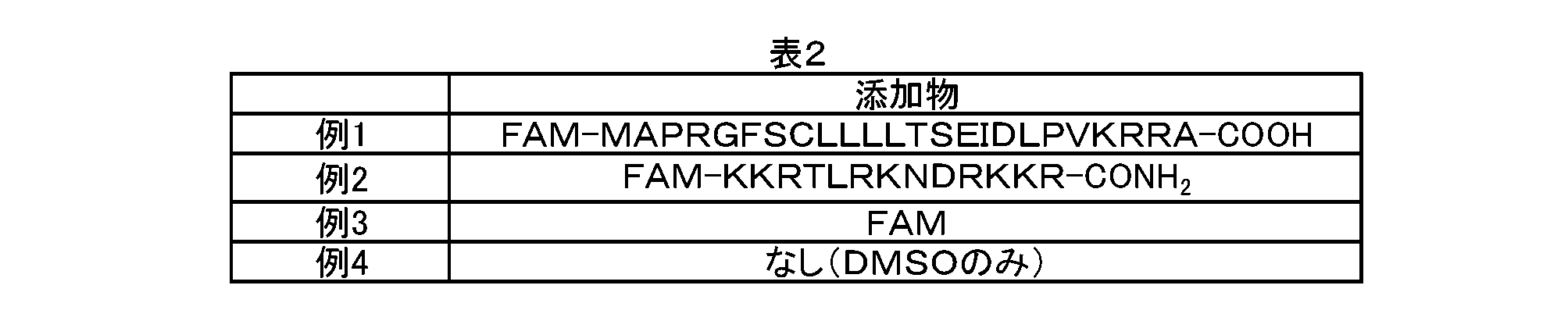
真核細胞としてHeLa細胞(ヒト子宮頸がん細胞由来の樹立細胞株)を使用し、サンプル1およびサンプル2の細胞膜透過性を評価した。表2に示すように、HeLa細胞の培養液に対し、サンプル溶液1を添加した試験を例1、サンプル溶液2を添加した試験を例2、DMSOで希釈したFAM溶液を添加した試験を例3、DMSOのみを添加した試験を例4とした。
真核細胞としてHeLa細胞(ヒト子宮頸がん細胞由来の樹立細胞株)を使用し、サンプル1およびサンプル2の細胞膜透過性を評価した。表2に示すように、HeLa細胞の培養液に対し、サンプル溶液1を添加した試験を例1、サンプル溶液2を添加した試験を例2、DMSOで希釈したFAM溶液を添加した試験を例3、DMSOのみを添加した試験を例4とした。
(例1)
HeLa細胞を一般的な培養培地である10%FBS(fetal bovine serum)含有DMEM(Dulbecco’s modified Eagle’s medium(富士フィルム和光純薬株式会社製、Cat No.043-30085))で培養した。
培養プレートに接着したHeLa細胞をPBSで洗浄後、0.25%トリプシン/EDTA溶液を添加し、37℃中で3分間インキュベートを行った。該インキュベート後、上記10%FBS含有DMEMを加え、トリプシンを不活性化させた後、150×gで5分間の遠心分離を行い細胞を沈殿させた。遠心分離によって生じた上清を取り除いた後、沈殿(細胞ペレット)に上記10%FBS含有DMEMを加え、凡そ1×105cells/mLの細胞懸濁液を調製した。該細胞懸濁液を市販の6穴(ウェル)プレート(Iwaki社製)のウェルに2mL加え、細胞を播種した(凡そ2×105cells/ウェル)。そして、5%CO2条件下において37℃で3時間培養することによって、細胞をウェルの底面に接着させた。なお、細胞膜透過性評価を3連で行うため、例1の試験用に3ウェルに細胞を播種し、以降の操作は各ウェルに対して実施した。
HeLa細胞を一般的な培養培地である10%FBS(fetal bovine serum)含有DMEM(Dulbecco’s modified Eagle’s medium(富士フィルム和光純薬株式会社製、Cat No.043-30085))で培養した。
培養プレートに接着したHeLa細胞をPBSで洗浄後、0.25%トリプシン/EDTA溶液を添加し、37℃中で3分間インキュベートを行った。該インキュベート後、上記10%FBS含有DMEMを加え、トリプシンを不活性化させた後、150×gで5分間の遠心分離を行い細胞を沈殿させた。遠心分離によって生じた上清を取り除いた後、沈殿(細胞ペレット)に上記10%FBS含有DMEMを加え、凡そ1×105cells/mLの細胞懸濁液を調製した。該細胞懸濁液を市販の6穴(ウェル)プレート(Iwaki社製)のウェルに2mL加え、細胞を播種した(凡そ2×105cells/ウェル)。そして、5%CO2条件下において37℃で3時間培養することによって、細胞をウェルの底面に接着させた。なお、細胞膜透過性評価を3連で行うため、例1の試験用に3ウェルに細胞を播種し、以降の操作は各ウェルに対して実施した。
次に、上記2mMサンプル溶液1を上記10%FBS含有DMEMで希釈し、サンプル1の濃度が20μMのサンプル溶液1を準備した。上記3時間培養後のウェルから培養上清を1mL取り除いた後、該ウェルに上記20μMサンプル溶液1を1mL添加した(即ち、ウェル中の培養液のサンプル1の濃度が10μM、DMSO濃度が0.5%となるようにした)。そして、細胞を5%CO2条件下で、37℃で20時間インキュベートを行った。かかる20時間のインキュベート後、ウェルから培養上清を取り除き、1mLのPBSでウェル中の細胞を2回洗浄した。次に、ウェルに200μLの0.25%トリプシン/EDTA溶液を添加し、37℃中で3分間インキュベートを行った。該インキュベート後、ウェルに400μLの上記10%FBS含有DMEMを添加することでトリプシンを不活性化した後、ウェル中の細胞懸濁液をチューブに移し、細胞を回収した。その後、さらにウェルに600μLのPBSを添加し、ウェルを洗浄した。そして、ウェル中のPBSを上記チューブへと移すことにより、ウェル中に残った細胞を上記チューブへと回収した。このチューブを4℃、210×gの条件で5分間遠心分離を行った。遠心分離後、上清を取り除き、沈殿(細胞ペレット)を1mLのPBSで懸濁(洗浄)し、上記と同じ条件で遠心分離を行った。この操作を2回繰り返した後、上清を取り除き、サンプル1含有培地で培養した細胞(細胞ペレット)を得た。
上記得られた細胞(細胞ペレット)について、フローサイトメータを用いてサンプル1の細胞膜透過性の評価を行った。フローサイトメータとして、On-Chip Flowcytometer(株式会社オンチップ・バイオテクノロジーズ(On-Chip Biotechnologies Co.,LTD.)製)を使用した。
かかる解析のために、上記得られた細胞ペレットを50μLのPBSで懸濁した。この懸濁液に、さらに50μLの上記フローサイトメータ用の2×sample bufferを加え、解析用の細胞懸濁液を用意した。
かかる解析のために、上記得られた細胞ペレットを50μLのPBSで懸濁した。この懸濁液に、さらに50μLの上記フローサイトメータ用の2×sample bufferを加え、解析用の細胞懸濁液を用意した。
上記のフローサイトメータを用いて前方散乱(forward scatter:FSC)および側方散乱(side scatter:SSC)に基づくゲーティングを行い、解析対象とする細胞集団についてのゲートを設定し、かかるゲート内の細胞集団について、蛍光強度を測定した。なお、該細胞集団は少なくとも5000個以上となるように解析を行った。蛍光強度の測定には、FAMの蛍光波長を検出可能な上記フローサイトメータの蛍光検出器FL2(最適検出波長543nm付近)を使用した。かかる測定結果について、市販の解析ソフト「FlowJo(登録商標)」(TreeStar社製)を用いて解析を行い、測定対象細胞集団の平均蛍光強度(mean fluorescent intensity:MFI)を得た。
(例2)
上記サンプル溶液1を上記サンプル溶液2とした以外は例1と同様に実施した。
(例3)
上記サンプル溶液1をDMSOで希釈したFAM溶液とした以外は例1と同様に実施した。なお、該FAM溶液の濃度はサンプル1溶液の濃度と同じとなるように用いた(即ち、ウェル中の培養液のFAM濃度が10μM、DMSO濃度が0.5%となるように用いた)。
(例4)
上記サンプル溶液1をDMSOとした以外は例1と同様に実施した。
上記サンプル溶液1を上記サンプル溶液2とした以外は例1と同様に実施した。
(例3)
上記サンプル溶液1をDMSOで希釈したFAM溶液とした以外は例1と同様に実施した。なお、該FAM溶液の濃度はサンプル1溶液の濃度と同じとなるように用いた(即ち、ウェル中の培養液のFAM濃度が10μM、DMSO濃度が0.5%となるように用いた)。
(例4)
上記サンプル溶液1をDMSOとした以外は例1と同様に実施した。
例1~4について得られた結果を表3および図1に示す。表3には、各例における3連のMFIの平均値を示す。図1には、各例において3連のうち、MFIの平均値に最も近い試験例のフローサイトメトリーのヒストグラムを示す。

図1に示すように、ペプチド1と蛍光色素(FAM)とを備える外来物質導入用構築物1を添加した例1、ペプチド2と蛍光色素(FAM)とを備える外来物質導入用構築物2を添加した例2は、FAMのみを添加した例3よりも、ヒストグラムがX軸の右方向にシフトしていたため、ペプチド1およびペプチド2により、外来物質としての蛍光色素(FAM)が効率よくHeLa細胞の細胞質へと導入されたことが確かめられた。さらに、例1と例2を比較すると、例2よりも例1のヒストグラムの方がX軸の右方向へシフトしていたため、ペプチド2を備える外来物質導入用構築物よりもペプチド1を備える外来物質導入用構築物の方が細胞膜透過性が高く、外来物質をより高い効率で細胞外部から細胞内部へと導入できることが確かめられた。その効率(細胞膜透過性)は、表3で示すMFIで比較すると、例1は例2よりも約2倍高いことが確かめられた。
また、詳細なデータは示していないが、本発明者らの検討によって、外来物質が蛍光色素のみならず、ポリペプチド、核酸、および薬剤のいずれであっても、かかる外来物質は、効率よく細胞の外部から、細胞膜を通して細胞質内に導入されることが確認された。
また、詳細なデータは示していないが、本発明者らの検討によって、外来物質が蛍光色素のみならず、ポリペプチド、核酸、および薬剤のいずれであっても、かかる外来物質は、効率よく細胞の外部から、細胞膜を通して細胞質内に導入されることが確認された。
以上のことから明らかなように、ここで開示される技術によると、外来物質導入方法の特に好適な一態様として、真核細胞の外部から少なくとも該細胞の細胞質内に目的とする外来物質を導入する方法であって、配列番号1から成るキャリアペプチドフラグメントを使用することを特徴とする方法が提供される。かかるキャリアペプチドフラグメントは、細胞質内に、目的とする外来物質を導入する目的に好適である。
以上、ここで開示される技術の具体例を詳細に説明したが、これらは例示にすぎず、請求の範囲を限定するものではない。請求の範囲に記載の技術には、以上に例示した具体例を様々に変形、変更したものが含まれる。
ここで開示される技術によると、真核細胞(特に細胞壁を有しないヒトやそれ以外の哺乳動物に代表される種々の動物細胞)の外部から細胞質内に目的とする外来物質を導入するために人為的に作製された構築物が提供される。かかる構築物を利用することにより、目的の細胞に目的の外来物質を効果的に導入させ、該外来物質が導入された細胞並びに該外来物質を含む細胞を含む器官等の生体組織を得ることができる。また、かかる構築物を利用することにより、疾患に対する治療薬を提供することができる。
配列番号2 合成ペプチド
Claims (9)
- 真核細胞の外部から少なくとも該細胞の細胞質内に目的とする外来物質をインビトロにおいて導入する方法であって、
(1)以下のアミノ酸配列:
MAPRGFSCLLLLTSEIDLPVKRRA(配列番号1)
から成るキャリアペプチドフラグメントと、
前記キャリアペプチドフラグメントのN末端側及び/又はC末端側に結合した前記目的の外来物質と、
を有する外来物質導入用構築物を用意する工程と、
(2)前記外来物質導入用構築物を、目的とする真核細胞を含む試料中に供給する工程と、
(3)前記外来物質導入用構築物が供給された前記試料をインキュベートして、該試料中の真核細胞内に前記構築物を導入する工程と、
を包含する方法。 - 前記外来物質は、ポリペプチド、核酸、色素および薬剤から成る群から選択されるいずれかの有機化合物である、請求項1に記載の方法。
- 前記外来物質は、何れかの生物種由来の成熟ポリペプチドまたはその前駆体ポリペプチドであり、前記外来物質導入用構築物は、該外来物質としての成熟ポリペプチドまたはその前駆体ポリペプチドに対応するアミノ酸配列と前記キャリアペプチドフラグメントのアミノ酸配列とを有する合成ポリペプチドである、請求項2に記載の方法。
- 前記外来物質としての成熟ポリペプチドまたはその前駆体ポリペプチドに対応するアミノ酸配列は、前記キャリアペプチドフラグメントのN末端側に配置されている、請求項3に記載の方法。
- 前記外来物質導入用構築物を導入する対象の真核細胞がヒトまたはヒト以外の哺乳動物の細胞である、請求項1~4の何れか一項に記載の方法。
- 真核細胞の外部から少なくとも該細胞の細胞質内に目的とする外来物質を導入するために作製された外来物質導入用構築物であって、
以下のアミノ酸配列:
MAPRGFSCLLLLTSEIDLPVKRRA(配列番号1)
から成るキャリアペプチドフラグメントと、
該キャリアペプチドフラグメントのN末端側及び/又はC末端側に結合した前記目的とする外来物質と、
を有する外来物質導入用構築物。 - 前記外来物質は、ポリペプチド、核酸、色素および薬剤から成る群から選択されるいずれかの有機化合物である、請求項6に記載の構築物。
- 前記外来物質は、何れかの生物種由来の成熟ポリペプチドまたはその前駆体ポリペプチドであり、該外来物質としての成熟ポリペプチドまたはその前駆体ポリペプチドに対応するアミノ酸配列と前記キャリアペプチドフラグメントのアミノ酸配列とを有する合成ポリペプチドである、請求項7に記載の構築物。
- 前記外来物質としての成熟ポリペプチドまたはその前駆体ポリペプチドに対応するアミノ酸配列は、前記キャリアペプチドフラグメントのN末端側に配置されている、請求項8に記載の構築物。
Priority Applications (2)
| Application Number | Priority Date | Filing Date | Title |
|---|---|---|---|
| US18/249,988 US20230399368A1 (en) | 2020-10-23 | 2021-10-14 | Carrier peptide fragment and use thereof |
| JP2022557426A JPWO2022085547A1 (ja) | 2020-10-23 | 2021-10-14 |
Applications Claiming Priority (2)
| Application Number | Priority Date | Filing Date | Title |
|---|---|---|---|
| JP2020177944 | 2020-10-23 | ||
| JP2020-177944 | 2020-10-23 |
Publications (1)
| Publication Number | Publication Date |
|---|---|
| WO2022085547A1 true WO2022085547A1 (ja) | 2022-04-28 |
Family
ID=81290836
Family Applications (1)
| Application Number | Title | Priority Date | Filing Date |
|---|---|---|---|
| PCT/JP2021/037981 Ceased WO2022085547A1 (ja) | 2020-10-23 | 2021-10-14 | キャリアペプチドフラグメントおよびその利用 |
Country Status (3)
| Country | Link |
|---|---|
| US (1) | US20230399368A1 (ja) |
| JP (1) | JPWO2022085547A1 (ja) |
| WO (1) | WO2022085547A1 (ja) |
Citations (3)
| Publication number | Priority date | Publication date | Assignee | Title |
|---|---|---|---|---|
| WO2011013698A1 (ja) * | 2009-07-29 | 2011-02-03 | 東亞合成株式会社 | キャリアペプチドフラグメント及びその利用 |
| WO2011013700A1 (ja) * | 2009-07-29 | 2011-02-03 | 東亞合成株式会社 | キャリアペプチドフラグメント及びその利用 |
| WO2011013699A1 (ja) * | 2009-07-29 | 2011-02-03 | 東亞合成株式会社 | キャリアペプチドフラグメントとその利用 |
Family Cites Families (8)
| Publication number | Priority date | Publication date | Assignee | Title |
|---|---|---|---|---|
| JP3854995B2 (ja) * | 2000-01-21 | 2006-12-06 | 関西ティー・エル・オー株式会社 | 細胞透過性キャリアペプチド |
| JP2005170798A (ja) * | 2003-12-08 | 2005-06-30 | Kenichi Sawada | ネフローゼ症候群の治療剤 |
| JP4596391B2 (ja) * | 2005-02-10 | 2010-12-08 | 国立大学法人大阪大学 | 細胞透過性ペプチド |
| CN101189262A (zh) * | 2005-04-22 | 2008-05-28 | 独立行政法人科学技术振兴机构 | Humanin受体或Humanin样多肽受体 |
| US7662624B2 (en) * | 2005-11-09 | 2010-02-16 | Ontherix, Inc. | Metal-binding therapeutic peptides |
| US7928186B2 (en) * | 2006-08-02 | 2011-04-19 | Phoenix Pharmaceuticals, Inc. | Cell permeable bioactive peptide conjugates |
| KR100980378B1 (ko) * | 2007-12-04 | 2010-09-07 | 조선대학교산학협력단 | 고농도 우레아하에서 안정된 활성을 갖는 디유비퀴틸레이팅효소를 이용한 펩티드의 제조방법 |
| KR20100042305A (ko) * | 2008-10-16 | 2010-04-26 | 조선대학교산학협력단 | 열안정성 단백질을 함유하는 융합단백질 및 이를 이용한 단백질의 정제방법 |
-
2021
- 2021-10-14 US US18/249,988 patent/US20230399368A1/en active Pending
- 2021-10-14 WO PCT/JP2021/037981 patent/WO2022085547A1/ja not_active Ceased
- 2021-10-14 JP JP2022557426A patent/JPWO2022085547A1/ja active Pending
Patent Citations (3)
| Publication number | Priority date | Publication date | Assignee | Title |
|---|---|---|---|---|
| WO2011013698A1 (ja) * | 2009-07-29 | 2011-02-03 | 東亞合成株式会社 | キャリアペプチドフラグメント及びその利用 |
| WO2011013700A1 (ja) * | 2009-07-29 | 2011-02-03 | 東亞合成株式会社 | キャリアペプチドフラグメント及びその利用 |
| WO2011013699A1 (ja) * | 2009-07-29 | 2011-02-03 | 東亞合成株式会社 | キャリアペプチドフラグメントとその利用 |
Non-Patent Citations (2)
| Title |
|---|
| MELONI BRUNO P., MASTAGLIA FRANK L., KNUCKEY NEVILLE W.: "Cationic Arginine-Rich Peptides (CARPs): A Novel Class of Neuroprotective Agents With a Multimodal Mechanism of Action", FRONTIERS IN NEUROLOGY, vol. 11, 25 February 2020 (2020-02-25), pages 108, XP055873065, ISSN: 1664-2295, DOI: 10.3389/fneur.2020.00108 * |
| NIIKURA TAKAKO; TAJIMA HIROHISA; KITA YOSHIKO: "Neuronal cell death in Alzheimer's disease and a neuroprotective factor, humanin", CURRENT NEUROPHARMACOLOGY, BENTHAM SCIENCE PUBLISHERS, HILVERSUM, NL, vol. 4, no. 2, 1 April 2006 (2006-04-01), NL , pages 139 - 147, XP009172916, ISSN: 1570-159X, DOI: 10.2174/157015906776359577 * |
Also Published As
| Publication number | Publication date |
|---|---|
| US20230399368A1 (en) | 2023-12-14 |
| JPWO2022085547A1 (ja) | 2022-04-28 |
Similar Documents
| Publication | Publication Date | Title |
|---|---|---|
| JP7041853B1 (ja) | キャリアペプチドフラグメントおよびその利用 | |
| EP4124621B1 (en) | Carrier peptide fragment for nucleolar localization and use thereof | |
| US20220008547A1 (en) | Carrier Peptide Fragment and use Thereof | |
| EP4001302B1 (en) | Carrier peptide fragment and use thereof | |
| JP7096990B1 (ja) | 外来物質導入用構築物およびその利用 | |
| JP7792068B2 (ja) | ペプチドフラグメントおよびその利用 | |
| JP7769869B2 (ja) | 外来物質導入用構築物およびその利用 | |
| WO2022085547A1 (ja) | キャリアペプチドフラグメントおよびその利用 | |
| US12617817B2 (en) | Carrier peptide fragment and use thereof | |
| WO2023248846A1 (ja) | キャリアペプチドフラグメント及びその利用 | |
| WO2024053630A1 (ja) | キャリアペプチドフラグメント及びその利用 | |
| WO2024004599A1 (ja) | キャリアペプチドフラグメント及びその利用 | |
| WO2024084932A1 (ja) | キャリアペプチドフラグメント及びその利用 | |
| WO2024128081A1 (ja) | 合成ペプチド及び構築物 | |
| WO2024048050A1 (ja) | キャリアペプチドフラグメント及びその利用 | |
| WO2024128080A1 (ja) | 合成ペプチド及び構築物 | |
| WO2024128079A1 (ja) | 合成ペプチド及び構築物 | |
| WO2024018865A1 (ja) | キャリアペプチドフラグメント及びその利用 | |
| WO2026034435A1 (ja) | ペプチドフラグメント及びその利用 |
Legal Events
| Date | Code | Title | Description |
|---|---|---|---|
| 121 | Ep: the epo has been informed by wipo that ep was designated in this application |
Ref document number: 21882688 Country of ref document: EP Kind code of ref document: A1 |
|
| ENP | Entry into the national phase |
Ref document number: 2022557426 Country of ref document: JP Kind code of ref document: A |
|
| NENP | Non-entry into the national phase |
Ref country code: DE |
|
| 122 | Ep: pct application non-entry in european phase |
Ref document number: 21882688 Country of ref document: EP Kind code of ref document: A1 |