WO2022080083A1 - 電気化学素子用電極活物質およびその製造方法、電気化学素子用電極材料、電気化学素子用電極、電気化学素子、並びに移動体 - Google Patents
電気化学素子用電極活物質およびその製造方法、電気化学素子用電極材料、電気化学素子用電極、電気化学素子、並びに移動体 Download PDFInfo
- Publication number
- WO2022080083A1 WO2022080083A1 PCT/JP2021/034246 JP2021034246W WO2022080083A1 WO 2022080083 A1 WO2022080083 A1 WO 2022080083A1 JP 2021034246 W JP2021034246 W JP 2021034246W WO 2022080083 A1 WO2022080083 A1 WO 2022080083A1
- Authority
- WO
- WIPO (PCT)
- Prior art keywords
- electrode
- active material
- electrochemical element
- positive electrode
- electrochemical
- Prior art date
- Legal status (The legal status is an assumption and is not a legal conclusion. Google has not performed a legal analysis and makes no representation as to the accuracy of the status listed.)
- Ceased
Links
Images


Classifications
-
- H—ELECTRICITY
- H01—ELECTRIC ELEMENTS
- H01M—PROCESSES OR MEANS, e.g. BATTERIES, FOR THE DIRECT CONVERSION OF CHEMICAL ENERGY INTO ELECTRICAL ENERGY
- H01M4/00—Electrodes
- H01M4/02—Electrodes composed of, or comprising, active material
- H01M4/36—Selection of substances as active materials, active masses, active liquids
- H01M4/48—Selection of substances as active materials, active masses, active liquids of inorganic oxides or hydroxides
- H01M4/485—Selection of substances as active materials, active masses, active liquids of inorganic oxides or hydroxides of mixed oxides or hydroxides for inserting or intercalating light metals, e.g. LiTi2O4 or LiTi2OxFy
-
- C—CHEMISTRY; METALLURGY
- C01—INORGANIC CHEMISTRY
- C01B—NON-METALLIC ELEMENTS; COMPOUNDS THEREOF; METALLOIDS OR COMPOUNDS THEREOF NOT COVERED BY SUBCLASS C01C
- C01B25/00—Phosphorus; Compounds thereof
- C01B25/14—Sulfur, selenium, or tellurium compounds of phosphorus
-
- C—CHEMISTRY; METALLURGY
- C01—INORGANIC CHEMISTRY
- C01G—COMPOUNDS CONTAINING METALS NOT COVERED BY SUBCLASSES C01D OR C01F
- C01G33/00—Compounds of niobium
-
- C—CHEMISTRY; METALLURGY
- C01—INORGANIC CHEMISTRY
- C01G—COMPOUNDS CONTAINING METALS NOT COVERED BY SUBCLASSES C01D OR C01F
- C01G33/00—Compounds of niobium
- C01G33/006—Compounds containing niobium, with or without oxygen or hydrogen, and containing two or more other elements
-
- C—CHEMISTRY; METALLURGY
- C01—INORGANIC CHEMISTRY
- C01G—COMPOUNDS CONTAINING METALS NOT COVERED BY SUBCLASSES C01D OR C01F
- C01G49/00—Compounds of iron
- C01G49/0018—Mixed oxides or hydroxides
- C01G49/0045—Mixed oxides or hydroxides containing aluminium
-
- H—ELECTRICITY
- H01—ELECTRIC ELEMENTS
- H01G—CAPACITORS; CAPACITORS, RECTIFIERS, DETECTORS, SWITCHING DEVICES, LIGHT-SENSITIVE OR TEMPERATURE-SENSITIVE DEVICES OF THE ELECTROLYTIC TYPE
- H01G11/00—Hybrid capacitors, i.e. capacitors having different positive and negative electrodes; Electric double-layer [EDL] capacitors; Processes for the manufacture thereof or of parts thereof
- H01G11/22—Electrodes
- H01G11/30—Electrodes characterised by their material
-
- H—ELECTRICITY
- H01—ELECTRIC ELEMENTS
- H01G—CAPACITORS; CAPACITORS, RECTIFIERS, DETECTORS, SWITCHING DEVICES, LIGHT-SENSITIVE OR TEMPERATURE-SENSITIVE DEVICES OF THE ELECTROLYTIC TYPE
- H01G11/00—Hybrid capacitors, i.e. capacitors having different positive and negative electrodes; Electric double-layer [EDL] capacitors; Processes for the manufacture thereof or of parts thereof
- H01G11/54—Electrolytes
- H01G11/56—Solid electrolytes, e.g. gels; Additives therein
-
- H—ELECTRICITY
- H01—ELECTRIC ELEMENTS
- H01M—PROCESSES OR MEANS, e.g. BATTERIES, FOR THE DIRECT CONVERSION OF CHEMICAL ENERGY INTO ELECTRICAL ENERGY
- H01M10/00—Secondary cells; Manufacture thereof
- H01M10/05—Accumulators with non-aqueous electrolyte
- H01M10/052—Li-accumulators
- H01M10/0525—Rocking-chair batteries, i.e. batteries with lithium insertion or intercalation in both electrodes; Lithium-ion batteries
-
- H—ELECTRICITY
- H01—ELECTRIC ELEMENTS
- H01M—PROCESSES OR MEANS, e.g. BATTERIES, FOR THE DIRECT CONVERSION OF CHEMICAL ENERGY INTO ELECTRICAL ENERGY
- H01M10/00—Secondary cells; Manufacture thereof
- H01M10/05—Accumulators with non-aqueous electrolyte
- H01M10/056—Accumulators with non-aqueous electrolyte characterised by the materials used as electrolytes, e.g. mixed inorganic/organic electrolytes
- H01M10/0561—Accumulators with non-aqueous electrolyte characterised by the materials used as electrolytes, e.g. mixed inorganic/organic electrolytes the electrolyte being constituted of inorganic materials only
- H01M10/0562—Solid materials
-
- H—ELECTRICITY
- H01—ELECTRIC ELEMENTS
- H01M—PROCESSES OR MEANS, e.g. BATTERIES, FOR THE DIRECT CONVERSION OF CHEMICAL ENERGY INTO ELECTRICAL ENERGY
- H01M4/00—Electrodes
- H01M4/02—Electrodes composed of, or comprising, active material
- H01M4/13—Electrodes for accumulators with non-aqueous electrolyte, e.g. for lithium-accumulators; Processes of manufacture thereof
- H01M4/131—Electrodes based on mixed oxides or hydroxides, or on mixtures of oxides or hydroxides, e.g. LiCoOx
-
- H—ELECTRICITY
- H01—ELECTRIC ELEMENTS
- H01M—PROCESSES OR MEANS, e.g. BATTERIES, FOR THE DIRECT CONVERSION OF CHEMICAL ENERGY INTO ELECTRICAL ENERGY
- H01M4/00—Electrodes
- H01M4/02—Electrodes composed of, or comprising, active material
- H01M4/13—Electrodes for accumulators with non-aqueous electrolyte, e.g. for lithium-accumulators; Processes of manufacture thereof
- H01M4/139—Processes of manufacture
- H01M4/1391—Processes of manufacture of electrodes based on mixed oxides or hydroxides, or on mixtures of oxides or hydroxides, e.g. LiCoOx
-
- H—ELECTRICITY
- H01—ELECTRIC ELEMENTS
- H01M—PROCESSES OR MEANS, e.g. BATTERIES, FOR THE DIRECT CONVERSION OF CHEMICAL ENERGY INTO ELECTRICAL ENERGY
- H01M4/00—Electrodes
- H01M4/02—Electrodes composed of, or comprising, active material
- H01M4/36—Selection of substances as active materials, active masses, active liquids
- H01M4/48—Selection of substances as active materials, active masses, active liquids of inorganic oxides or hydroxides
- H01M4/483—Selection of substances as active materials, active masses, active liquids of inorganic oxides or hydroxides for non-aqueous cells
-
- H—ELECTRICITY
- H01—ELECTRIC ELEMENTS
- H01M—PROCESSES OR MEANS, e.g. BATTERIES, FOR THE DIRECT CONVERSION OF CHEMICAL ENERGY INTO ELECTRICAL ENERGY
- H01M4/00—Electrodes
- H01M4/02—Electrodes composed of, or comprising, active material
- H01M4/62—Selection of inactive substances as ingredients for active masses, e.g. binders, fillers
-
- C—CHEMISTRY; METALLURGY
- C01—INORGANIC CHEMISTRY
- C01P—INDEXING SCHEME RELATING TO STRUCTURAL AND PHYSICAL ASPECTS OF SOLID INORGANIC COMPOUNDS
- C01P2002/00—Crystal-structural characteristics
- C01P2002/50—Solid solutions
-
- C—CHEMISTRY; METALLURGY
- C01—INORGANIC CHEMISTRY
- C01P—INDEXING SCHEME RELATING TO STRUCTURAL AND PHYSICAL ASPECTS OF SOLID INORGANIC COMPOUNDS
- C01P2002/00—Crystal-structural characteristics
- C01P2002/70—Crystal-structural characteristics defined by measured X-ray, neutron or electron diffraction data
- C01P2002/72—Crystal-structural characteristics defined by measured X-ray, neutron or electron diffraction data by d-values or two theta-values, e.g. as X-ray diagram
-
- C—CHEMISTRY; METALLURGY
- C01—INORGANIC CHEMISTRY
- C01P—INDEXING SCHEME RELATING TO STRUCTURAL AND PHYSICAL ASPECTS OF SOLID INORGANIC COMPOUNDS
- C01P2006/00—Physical properties of inorganic compounds
- C01P2006/40—Electric properties
-
- H—ELECTRICITY
- H01—ELECTRIC ELEMENTS
- H01M—PROCESSES OR MEANS, e.g. BATTERIES, FOR THE DIRECT CONVERSION OF CHEMICAL ENERGY INTO ELECTRICAL ENERGY
- H01M4/00—Electrodes
- H01M4/02—Electrodes composed of, or comprising, active material
- H01M2004/026—Electrodes composed of, or comprising, active material characterised by the polarity
- H01M2004/027—Negative electrodes
-
- H—ELECTRICITY
- H01—ELECTRIC ELEMENTS
- H01M—PROCESSES OR MEANS, e.g. BATTERIES, FOR THE DIRECT CONVERSION OF CHEMICAL ENERGY INTO ELECTRICAL ENERGY
- H01M4/00—Electrodes
- H01M4/02—Electrodes composed of, or comprising, active material
- H01M2004/026—Electrodes composed of, or comprising, active material characterised by the polarity
- H01M2004/028—Positive electrodes
-
- H—ELECTRICITY
- H01—ELECTRIC ELEMENTS
- H01M—PROCESSES OR MEANS, e.g. BATTERIES, FOR THE DIRECT CONVERSION OF CHEMICAL ENERGY INTO ELECTRICAL ENERGY
- H01M2300/00—Electrolytes
- H01M2300/0017—Non-aqueous electrolytes
- H01M2300/0065—Solid electrolytes
- H01M2300/0068—Solid electrolytes inorganic
- H01M2300/008—Halides
-
- Y—GENERAL TAGGING OF NEW TECHNOLOGICAL DEVELOPMENTS; GENERAL TAGGING OF CROSS-SECTIONAL TECHNOLOGIES SPANNING OVER SEVERAL SECTIONS OF THE IPC; TECHNICAL SUBJECTS COVERED BY FORMER USPC CROSS-REFERENCE ART COLLECTIONS [XRACs] AND DIGESTS
- Y02—TECHNOLOGIES OR APPLICATIONS FOR MITIGATION OR ADAPTATION AGAINST CLIMATE CHANGE
- Y02E—REDUCTION OF GREENHOUSE GAS [GHG] EMISSIONS, RELATED TO ENERGY GENERATION, TRANSMISSION OR DISTRIBUTION
- Y02E60/00—Enabling technologies; Technologies with a potential or indirect contribution to GHG emissions mitigation
- Y02E60/10—Energy storage using batteries
Definitions
- the present invention relates to an electrochemical element having excellent load characteristics and charge / discharge cycle characteristics, an electrode active material that can constitute the electrochemical element, a manufacturing method thereof, an electrode material and an electrode, and a moving body having the electrochemical element. Is.
- Non-aqueous electrolyte secondary batteries which are a type of electrochemical element, are used in portable electronic devices such as mobile phones and notebook personal computers, and as power sources for electric vehicles. As a result, non-aqueous electrolyte secondary batteries are also required to be smaller, lighter, and have higher capacity and energy density.
- lithium-containing composite oxide is usually used as the positive electrode active material, and graphite or the like is used as the negative electrode active material.
- lithium titanate has a problem in that the theoretical capacity [175 mAh / g (600 mAh / cm 3 )] is smaller than the theoretical capacity of graphite [372 mAh / g (830 mAh / cm 3 )].
- non-aqueous electrolyte secondary batteries are also required to improve load characteristics and charge / discharge cycle characteristics, but materials such as those disclosed in Patent Documents 1 to 5 and Non-Patent Documents 1 to 4 are used as active materials. If so, it is difficult to achieve both load characteristics and charge / discharge cycle characteristics.
- the present invention has been made in view of the above circumstances, and an object thereof is an electrochemical element having excellent load characteristics and charge / discharge cycle characteristics, an electrode active material that can constitute the electrochemical element, a manufacturing method thereof, and an electrode material. And an electrode, and a moving body having the electrochemical element.
- the electrode active material for an electrochemical element of the present invention has a monoclinic crystal structure and is characterized by being an oxide satisfying the following general formula (1).
- A is at least one element of Li and Na
- M 1 is Fe, Mn, Zn, Cu, Ag, Mg, Ca, Sr, Ba, Co, Eu, Y, Bi
- M 2 is at least one selected from the group consisting of K, Ti, Ni, Zr, V, Mo, Ta and W. 0 ⁇ x ⁇ 1.1, 0 ⁇ y ⁇ 24, 0 ⁇ z ⁇ 2, -1 ⁇ ⁇ ⁇ 2, 0 ⁇ 0.4x.
- the electrode material for an electrochemical element of the present invention is characterized by containing the electrode active material for an electrochemical element of the present invention.
- the electrode for an electrochemical element of the present invention is characterized by containing the electrode active material for an electrochemical element of the present invention or the electrode material for an electrochemical element of the present invention.
- the electrochemical element of the present invention has a positive electrode and a negative electrode, and one of the positive electrode and the negative electrode is the electrode for the electrochemical element of the present invention.
- the mobile body of the present invention is characterized by having the electrochemical element of the present invention.
- the electrode active material for an electrochemical element of the present invention is produced through a step of firing an oxide represented by the general formula (1) or a precursor thereof in a vacuum atmosphere in a carbon container. Therefore, the characteristic can be further enhanced.
- an electrochemical element having excellent load characteristics and charge / discharge cycle characteristics an electrode active material that can constitute the electrochemical element, a manufacturing method thereof, an electrode material and an electrode, and a moving body having the electrochemical element are provided. Can be provided.
- FIG. 2 is a cross-sectional view taken along the line II of FIG.
- the electrode active material for an electrochemical element of the present embodiment (hereinafter, may be simply referred to as “active material”) has a monoclinic crystal structure and is an oxide satisfying the following general formula (1). be.
- A is at least one element of Li and Na
- M 1 is Fe, Mn, Zn, Cu, Ag, Mg, Ca, Sr, Ba, Co, Eu, Y, Bi
- M 2 is at least one selected from the group consisting of K, Ti, Ni, Zr, V, Mo, Ta and W. 0 ⁇ x ⁇ 1.1, 0 ⁇ y ⁇ 24, 0 ⁇ z ⁇ 2, -1 ⁇ ⁇ ⁇ 2, 0 ⁇ 0.4x.
- the oxide represented by the general formula (1) is based on AlNb 11 O 29 , and a part of Al is substituted with the element M 1 , so that the oxide is more crystalline than AlNb 11 O 29 .
- the lattice constant becomes large, and the diffusivity of the element A ion inside increases. Therefore, in the electrochemical device constructed by using the active material of the present embodiment, its load characteristics are improved.
- AlNb 11 O 29 Al has an action of stabilizing the crystal structure thereof, and by substituting a part thereof with the element M 1 , the stability of the crystal structure of the oxide is impaired.
- an electrochemical element composed of this oxide as an active material it is expected that the capacity will be more likely to decrease (charge / discharge cycle characteristics will decrease) when charging and discharging are repeated. ..
- the electrochemical element composed of this oxide as an active material is used.
- the capacity decrease when charging and discharging are repeated can be suppressed better than when AlNb 11 O 29 is used.
- the reason is that by containing the element M1 whose ion radius is larger than Nb (Nb 5+ ) or Al (Al 3+ ), the lattice constant of the oxide at the stage before the element A ion as a carrier is inserted is set.
- the active material of the present embodiment it is possible to achieve both improvement of the load characteristics of the electrochemical element and maintenance of high charge / discharge cycle characteristics.
- the oxide represented by the general formula ( 1 ) has Fe, Mn, Zn, Cu, Ag, Mg, Ca, Sr, Ba, Co, Eu, Y, Bi, La, Ce and Nd as the element M1.
- Sm and Gd may contain only one element, or may contain two or more.
- M1 Fe, Mn, Zn, and Cu are preferable, and Zn and Cu are preferable because they are particularly easy to replace Al due to the electron configuration and have a high effect of increasing the electron conductivity of the oxide. Is more preferable.
- the oxide represented by the general formula (1) contains an element M 1 in which a plurality of valences are mixed, for example, Fe 3+ / Fe 2+ and Cu 2+ / Cu + .
- Many oxygen deficiencies may occur [that is, ⁇ becomes greater than 0 in the general formula (1)], which causes the electron conductivity and ionic conductivity of the oxide represented by the general formula (1). Is improved. Therefore, when the oxide represented by the general formula (1) contains Fe or Cu as the element M, further improvement in the load characteristics of the electrochemical device can be expected.
- the oxide represented by the general formula ( 1 ) is selected from the group consisting of K, Ti, Ni, Zr, V, Mo, Ta and W, in addition to the element M1 that partially replaces Al. It may contain at least one element M 2 . Whether these elements M 2 substitute Nb in the oxide represented by the general formula (1) having a monoclinic crystal structure without replacing a part of Al constituting the crystal. , Or a component that dissolves in the crystal or is contained as an impurity.
- the oxide represented by the general formula (1) may not contain the element M 2 and its amount z may be 0, but when the element M 2 is contained, the amount z may be 0. If it is 2 or less, it is acceptable because it does not affect the performance of the active material of the present embodiment. Further, the oxide represented by the general formula (1) may contain water.
- Al is a component for enhancing the structural stability of the oxide, and by the action of this Al, the active material is reversible during charging and discharging of the electrochemical element. Sex improves.
- the total x of the amount of Al and the amount of the element M 1 is from 0. It is large, and is preferably 0.8 or more from the viewpoint of better exerting each of the above-mentioned actions by Al and the element M1.
- the amount of Al and the element M1 in the oxide are too large, the amount of Nb in the oxide may be too small and its action may not be exhibited well. Therefore, the amount of Al and the element The total x with the amount of M 1 is 1.1 or less, preferably 1.05 or less.
- the amount ⁇ of the element M 1 is larger than 0, and from the viewpoint of ensuring a better effect of enhancing the load characteristics on the electrochemical element, 0. It is preferably 05 or more.
- the amount ⁇ of the element M1 in the oxide represented by the general formula ( 1 ) is 0.4x or less, which is more specific. It is preferably 0.44 or less, and more preferably 0.4 or less.
- the element A is at least one element of Li and Na, and is occluded in the oxide or stored in the oxide by charging / discharging of the electrochemical element. Depart from (ie, act as a carrier).
- the oxide may or may not contain the element A.
- the ion of the element A is inserted by, for example, charging the electrochemical element used as the negative electrode active material or predoping the ion of the element A before using it in the electrochemical element. Will contain the element A.
- the amount y of the element A in the oxide represented by the general formula (1) is 0 or more and 24 or less.
- the amount of oxygen is originally 29 as in AlNb 11 O 29 , but may vary depending on the presence of the element M 1 and the like.
- ⁇ is -1 or more, 2 or less, preferably 1.95 or less.
- oxygen deficiency occurs in the oxide.
- the electron conductivity of the active material containing the oxide and the conductivity of the element A ion By using such an active material, it is possible to further increase the energy density of the electrochemical element.
- ⁇ regarding the amount of oxygen is the amount of the elements M 1 , the elements M 2 , Nb and Al forming cations, and the amount of oxygen forming an anion. Determined by.
- the oxide represented by the general formula (1) includes a material satisfying the following general formula (2).
- the element M 1 in the general formula (2) is at least one of Zn and Cu, and has 0 ⁇ ⁇ 0.4 and 0 ⁇ ⁇ ⁇ 0.5 ⁇ .
- the amount ⁇ of the element M1 in the general formula (2) is preferably 0.05 or more, preferably 0.4 or less, and more preferably 0.35 or less.
- ⁇ regarding the amount of oxygen is 0 or more and 0.5 ⁇ or less, but as described above, 0 ⁇ ⁇ 0.4, so the value of ⁇ is 0 or more and 0. It becomes 2 or less.
- the oxide represented by the general formula (1) and satisfying the general formula (2) becomes, for example, satisfying the following general formula (3) by inserting Li ions.
- the element M 1 , the amount ⁇ thereof, and ⁇ relating to the amount of oxygen are the same as in the general formula (2), and 0 ⁇ y ⁇ 22.
- the oxide represented by the general formula (1) is subjected to a reduction treatment.
- Nb is usually pentavalent (Nb 5+ ), but by reduction treatment, tetravalent Nb (Nb 4+ ) is mixed. Since Nb 4+ has a larger ionic radius than Nb 5+ , the presence of tetravalent Nb in the oxide increases the lattice size of the oxide having a monoclinic crystal structure.
- the oxide represented by the general formula (1) contains the element M 1 , but also oxygen deficiency occurs due to the reduction treatment [as a result, the value of ⁇ in the general formula (1). Will increase].
- the action due to the increase in the lattice size and the action due to the oxygen deficiency function synergistically to further improve the electron conductivity and the diffusivity of the element A ion. .. Therefore, by using the active material containing the oxide that has been subjected to the reduction treatment, it is possible to further increase the energy density of the electrochemical device, for example.
- the oxide in the active material is reduced to the extent that the electron conductivity of the active material and the diffusivity of the element A ion are further improved. It can be said that it has been done.
- the active material containing the oxide changes its color from white to yellow to blue by being subjected to a reduction treatment. Therefore, when the above (b) is satisfied, that is, when the relationship of A1 ⁇ A2 is satisfied and the relationship of A3 ⁇ A2 is satisfied, the oxide in the active material is the electron conductivity of the active material and the element A. It can be determined that the oxide has been reduced to the extent that the diffusivity of the ions is improved.
- the oxide to be reduced for example, at least one of the elements represented by the general formula (1) in which the element M 1 is selected from the group consisting of Fe, Cu and Zn.
- the element M 1 is selected from the group consisting of Fe, Cu and Zn.
- An element having 0 ⁇ ⁇ 2 can be mentioned.
- the ratio of the element M 1 differs between the surface and the inside thereof, and the element M 1 tends to be unevenly distributed on the surface portion.
- the atomic ratio P of the element M 1 to Nb determined by X-ray photoelectron spectroscopy (XPS) (the ratio of the number of elements M 1 atom when the number of Nb atoms is 100).
- the same applies to the atomic ratio Q) and the atomic ratio Q of the element M 1 to Nb determined by Inductive Coupled Plusma Atomic Emission Spectroscopy (ICP-AES) satisfies the relationship of P> Q. Is preferable. In this case, the effect of improving the energy density of the electrochemical device becomes better.
- the proportion of the oxide having a monoclinic crystal structure and represented by the general formula (1) in the total amount of the active material is 20% by mass or more. It is preferably 50% by mass or more, and may be 100% by mass.
- the active material of this embodiment Since the active material of this embodiment has excellent output, it is not easily affected by the polarization caused by the diffusion of Li ions inside the active material due to the increase in the particle size of the active material particles. For the same reason, the primary particles of the active material may form aggregates (secondary particles). However, from the viewpoint of improving the load characteristics and charge / discharge cycle characteristics of the electrochemical element, in the case of secondary particles, it is preferable that the primary particles of the active material are sintered with each other, and the primary particles are preferable. More preferred.
- the method for producing the active material of the present embodiment is not particularly limited, but is a precursor of an active material [oxide represented by the general formula ( 1 )] such as various metal oxides such as Nb, Al, and element M1.
- an active material [oxide represented by the general formula ( 1 )] such as various metal oxides such as Nb, Al, and element M1.
- Nioboxide [ The oxide represented by the general formula (1)] can be synthesized and produced.
- the solid phase reaction method it is preferable to calcinate at a temperature of 800 ° C. or higher, and more preferably in the range of 900 ° C. to 1400 ° C. from the viewpoint of enhancing the mutual diffusion of various metal ions.
- the firing time is not particularly limited, but the firing time can be 1 to 1000 hours.
- the firing temperature exceeds 1200 ° C., oxygen is gradually released from the sample, so that a crystal phase other than the monoclinic crystal phase is generated or the composition does not satisfy the general formula (1). It is more preferable that the holding time at 1200 ° C. or higher is 10 hours or less.
- the cooling rate of the sample during firing is not particularly limited as long as a monoclinic crystal phase can be obtained, but in order to obtain a stable monoclinic crystal phase at a high temperature, the cooling rate is 15 ° C./min. It is preferably 60 ° C./min (including natural cooling).
- the quenching treatment may be performed in a cooling rate in the range of 1 ° C./sec to 1000 ° C./sec.
- the precursor may be placed in a carbon container and fired in a vacuum atmosphere.
- the temperature is preferably 800 ° C. to 1200 ° C., and the time is preferably 1 to 1000 hours, for example.
- under vacuum atmosphere in the present specification means that the pressure in the firing furnace is lower vacuum (100 Pa to 31 kPa) or less in ISO 3529-1, and medium vacuum (0.1 Pa to 0.1 Pa). It is more preferably 100 Pa) or less.
- the composition of the active material of this embodiment can be analyzed using, for example, ICP-AES.
- ICP-AES energy dispersive X-ray spectroscope
- WDS wavelength dispersive X-ray spectroscope
- SEM electron microscope
- TEM transmission electron microscope
- the oxygen deficiency amount ⁇ contained in the active material of the present embodiment is an oxygen nitrogen analysis manufactured by LECO Japan GK with respect to the sum of the molar amounts of the elements M 1 , element M 2 , Al and Nb determined by ICP-AES analysis. It is determined by the molar amount of oxygen determined by using an apparatus (ON736 or the like).
- the molar amount Z (%) of Nb 4+ with respect to the total Nb molar amount in the active material of the present embodiment is obtained from the area ratio of the peak attributed to Nb3d5 / 2 in the XPS spectrum.
- the crystal structure of the active material of the present embodiment measures a powder X-ray diffraction (powder XRD) pattern using a Rigaku RINT2500VPC (X-ray used: CuK ⁇ ray) and collates it with a Powder Diffraction File (PDF) database.
- the crystal structure can be determined by analysis by the Rietveld method.
- Si (111) Si (111).
- the lattice constant (d 010 ) in the b-axis direction of the unit cell can be calculated by setting the wavelength of the X-ray to 1.5418 ⁇ and doubling the plane spacing obtained from the peak attributed to the diffraction of the (020) plane.
- the surface facing the surface of the electrode that is joined to the current collector is flattened so that it is parallel to the current collector, and then fixed to the sample table for powder XRD to create a powder XRD pattern for the electrode.
- the active material of the present embodiment is contained in the positive electrode as the positive electrode active material, electrochemistry is performed after charging with a constant current of 10 ⁇ A under the condition of an upper limit voltage of 3 V and then holding the active material at a constant voltage of 3 V for 100 hours.
- the powder XRD pattern of the electrode can be obtained.
- FIB focused ion beam
- a sample piece is extracted from a molded body of a sample containing a substance, mounted on a TEM sample table, and then thinned to form a thin piece having a thickness of 100 nm or less, and selected area electron diffraction using TEM. : SAD) The simple oblique crystal structure can be confirmed by acquiring the pattern and analyzing it.
- ⁇ Measuring method of absorbance of active materials for electrochemical devices For the absorbance of the active material of the present embodiment, a suspension in which 5 mg of the active material is dispersed in 20 ml of water is put into a 1 cm square cuvette using an ultrasonic disperser, and a near-infrared-visible spectrophotometer is used. It is obtained by measuring the absorbance at wavelengths of 500 nm, 600 nm and 700 nm.
- the P is obtained from the ratio of the area of the peak attributed to the element M1 to the area of the peak attributed to the XPS spectrum Nb.
- the Q is the ratio of the molar amount of the element M1 to the molar amount of Nb determined by ICP-AES.
- Electrode material for an electrochemical element of the present embodiment contains the electrode active material for an electrochemical element of the embodiment, and together with the active material, electrochemical.
- Other materials for constituting the electrode for the element can be contained. Examples of such a material include a conductive auxiliary agent such as carbon black, a binder, a solid electrolyte, and the like, and the electrode material may be one or more of these, if necessary, as the active material of the above-described embodiment. Can be contained with.
- the electrode material may have another material adhered to the surface of the active material, or may be a mixture of the active material and the other material, and the active material and the other material may be used together. ..
- the electrode material contains carbon black
- examples of the carbon black include thermal black, furnace black, channel black, ketjen black, and acetylene black.
- the content of carbon black in the electrode material can be, for example, 0.1 to 25 parts by mass with respect to 100 parts by mass of the active material of the embodiment.
- the binder may be a fluororesin such as polyvinylidene fluoride (PVDF).
- PVDF polyvinylidene fluoride
- the content of the binder in the electrode material can be, for example, 0.1 to 25 parts by mass with respect to 100 parts by mass of the active material of the embodiment.
- the solid electrolyte is not particularly limited as long as it has Li ion conductivity, and for example, a sulfide-based solid electrolyte, a hydride-based solid electrolyte, and a halide-based solid electrolyte. , Oxide-based solid electrolyte, etc. can be used.
- Examples of the sulfide-based solid electrolyte include particles such as Li 2 SP 2 S 5 , Li 2 S-SiS 2 , Li 2 SP 2 S 5 -GeS 2 , and Li 2 SB 2 S 3 glass.
- the thio-LISION type which has been attracting attention as having high Li ion conductivity in recent years [Li 10 GeP 2 S 12 , Li 9.54 Si 1.74 P 1.44 S 11.7 Cl 0 .3 , etc., Li 12-12ab + c + 6d-e M 1 3 + ab-c-d M 2 b M 3 c M 4 d M 5 12-e X e (where M 1 is Si, Ge or Sn, M 2 is P or V, M 3 is Al, Ga, Y or Sb, M 4 is Zn, Ca or Ba, M 5 is S or S and O, and X is F, Cl, Br or Li 7-f + g PS 6 - x Cl x + y (however, 0.
- Examples of the hydride-based solid electrolyte include a solid solution of LiBH 4 , LiBH 4 and the following alkali metal compound (for example, one having a molar ratio of LiBH 4 to the alkali metal compound of 1: 1 to 20: 1). Can be mentioned.
- Examples of the alkali metal compound in the solid solution include lithium halide (LiI, LiBr, LiF, LiCl, etc.), rubidium halide (RbI, RbBr, RbF, RbCl, etc.), and cesium halide (CsI, CsBr, CsF, CsCl, etc.).
- halide-based solid electrolyte examples include monoclinic type LiAlCl 4 , defective spinel type or layered structure LiInBr 4 , and monoclinic type Li 6-3m Ym X 6 (however, 0 ⁇ m ⁇ 2 and 0 ⁇ m ⁇ 2).
- X Cl or Br
- oxide-based solid electrolyte examples include garnet-type Li 7 La 3 Zr 2 O 12 , NASICON-type Li 1 + O Al 1 + O Ti 2-O (PO 4 ) 3 , Li 1 + p Al 1 + p Ge 2-p (PO 4 ). ) 3 , Perobskite type Li 3q La 2 / 3-q TiO 3 and the like can be mentioned.
- a sulfide-based solid electrolyte is preferable because it has high Li ion conductivity, a sulfide-based solid electrolyte containing Li and P is more preferable, and Li ion conductivity is particularly high and chemically stable.
- a argylodite-type sulfide-based solid electrolyte having high properties is more preferable.
- the content of the solid electrolyte in the electrode material can be, for example, 0.1 to 500 parts by mass with respect to 100 parts by mass of the active material of the above embodiment.
- Electrode for electrochemical devices
- the electrode for an electrochemical element of the present embodiment contains the active material of the embodiment or the electrode material of the embodiment, and is an electrochemical element such as a secondary battery. Used as a positive or negative electrode.
- a molded body formed by molding an electrode mixture containing an active material or an electrode material, or a layer made of a molded body of the electrode mixture (electrode mixture layer) is collected.
- electrode mixture layer a layer made of a molded body of the electrode mixture (electrode mixture layer)
- examples thereof include those having a structure formed on an electric body.
- the electrode mixture constituting the electrode contains a necessary material from the conductive auxiliary agent, the binder, the solid electrolyte, and the like together with the active material. Further, the electrode mixture constituting the electrode when the electrode material of the embodiment is used can also contain a necessary material from among a conductive auxiliary agent, a binder, a solid electrolyte and the like together with the electrode material. Depending on the composition of the electrode material, the electrode mixture may be composed of the electrode material alone.
- Examples of the conductive auxiliary agent for the electrode mixture include various carbon blacks exemplified above as those that can be used for the electrode material, graphite (natural graphite, artificial graphite), graphene, vapor-grown carbon fiber, carbon nanofiber, and the like.
- Examples thereof include carbon materials such as carbon nanotubes; a single substance of Cu, Ni, Al, Au, Pd, a powder of an alloy thereof, or a porous body thereof; and these may be used alone or in combination of two or more. May be used together.
- the content of the conductive auxiliary agent in the electrode mixture is preferably 0 to 25% by mass.
- the same binder as those exemplified above can be used as those that can be used as the electrode material. It should be noted that even if a binder is not used, for example, when the electrode mixture contains a sulfide-based solid electrolyte (including the case where the electrode material constituting the electrode mixture contains a sulfide-based solid electrolyte). If good moldability can be ensured in forming a molded body of the electrode mixture, the electrode material may not contain a binder.
- the content thereof (including the amount of the binder when the electrode material used in the electrode mixture contains a binder) is preferably 15% by mass or less. Further, it is preferably 0.5% by mass or more.
- the content thereof is preferably 0.5% by mass or less. , 0.3% by mass or less, more preferably 0% by mass (that is, no binder is contained).
- the solid electrolytes related to the electrode mixture include various sulfide-based solid electrolytes, hydride-based solid electrolytes, halide-based solid electrolytes, and oxide-based solid electrolytes that can be used as electrode materials and are exemplified above. One or more of the above can be used. In order to improve the characteristics of the electrochemical element, it is desirable to contain a sulfide-based solid electrolyte, and it is more desirable to contain an argylodite-type sulfide-based solid electrolyte.
- the average particle size of the solid electrolyte is preferably 0.1 ⁇ m or more, more preferably 0.2 ⁇ m or more, from the viewpoint of reducing the grain boundary resistance, while between the active material and the solid electrolyte. From the viewpoint of forming a sufficient contact interface, the thickness is preferably 10 ⁇ m or less, and more preferably 5 ⁇ m or less.
- the average particle size of various particles (solid electrolyte, positive electrode active material, etc.) referred to in the present specification is determined by using a particle size distribution measuring device (such as the Microtrack particle size distribution measuring device "HRA9320" manufactured by Nikkiso Co., Ltd.). It means the value (D 50 ) of the 50% diameter in the integrated fraction of the volume standard when the integrated volume is obtained from.
- a particle size distribution measuring device such as the Microtrack particle size distribution measuring device "HRA9320" manufactured by Nikkiso Co., Ltd.
- the content thereof (including the amount of the solid electrolyte when the electrode material used in the electrode mixture contains the solid electrolyte) may be 4 to 80% by mass. preferable.
- the content of the active material in the electrode mixture (the amount of the active material used in the electrode mixture or the active material derived from the electrode material) is preferably 20 to 95% by mass.
- the electrode has a current collector
- the following can be used as the current collector.
- a metal foil such as aluminum, nickel, or stainless steel, a punching metal, a mesh, an expanded metal, a foamed metal; a carbon sheet; or the like can be used as the current collector.
- the current collector when the electrode serves as the negative electrode of the electrochemical element, copper, nickel, aluminum foil, punching metal, net, expanded metal, foamed metal; carbon sheet; or the like can be used.
- the molded body of the electrode mixture is, for example, an electrode mixture prepared by mixing the active material of the embodiment or the electrode material of the embodiment with a conductive auxiliary agent, a binder, a solid electrolyte, or the like added as needed. Can be formed by compressing by pressure molding or the like.
- an electrode having a current collector it can be manufactured by bonding the molded body of the electrode mixture formed by the above method by crimping it to the current collector.
- the electrode mixture and the solvent are mixed to prepare an electrode mixture-containing composition, which is placed on a substrate such as a current collector or a solid electrolyte layer (in the case of forming an all-solid-state battery) facing the electrode.
- a molded body of the electrode mixture may be formed by applying the mixture to the electrode, drying the mixture, and then performing a pressing process.
- the solvent of the electrode mixture-containing composition water or an organic solvent such as N-methyl-2-pyrrolidone (NMP) can be used.
- NMP N-methyl-2-pyrrolidone
- the solid electrolyte is also contained in the electrode mixture-containing composition, it is preferable to select a solvent that does not easily deteriorate the solid electrolyte.
- sulfide-based solid electrolytes and hydride-based solid electrolytes cause a chemical reaction with a very small amount of water, and are therefore represented by hydrocarbon solvents such as hexane, heptane, octane, nonane, decane, decalin, toluene, and xylene. It is preferable to use a non-polar aprotic solvent.
- a super dehydrating solvent having a water content of 0.001% by mass (10 ppm) or less.
- fluorine-based solvents such as “Bertrel (registered trademark)” manufactured by Mitsui Dupont Fluorochemical, “Zeorolla (registered trademark)” manufactured by Zeon Corporation, and “Novec (registered trademark)” manufactured by Sumitomo 3M, as well as , Dichloromethane, diethyl ether and other non-aqueous organic solvents can also be used.
- the thickness of the molded body of the electrode mixture (in the case of an electrode having a current collector, the thickness of the molded body of the electrode mixture per one side of the current collector; hereinafter the same) is usually 50 ⁇ m or more. From the viewpoint of increasing the capacity of the electrochemical element, it is preferably 200 ⁇ m or more.
- the load characteristics of the electrochemical element are generally easily improved by thinning the positive electrode and the negative electrode, but according to the electrode of the present embodiment, the load is applied even when the molded body of the electrode mixture is as thick as 200 ⁇ m or more. It is possible to enhance the characteristics. Therefore, in the present embodiment, the effect becomes more remarkable when the thickness of the molded body of the electrode mixture is, for example, 200 ⁇ m or more.
- the thickness of the molded body of the electrode mixture is usually 3000 ⁇ m or less.
- the thickness of the electrode combination layer is determined. It is preferably 50 to 1000 ⁇ m.
- the electrochemical element of the present embodiment has a positive electrode and a negative electrode, and any one of the positive electrode and the negative electrode may be an electrode for the electrochemical element of the embodiment, and the other configurations and structures are particularly high. There are no restrictions, and various configurations and structures adopted in conventionally known electrochemical elements such as secondary batteries can be applied.
- the electrochemical element of the present embodiment includes a secondary battery having a separator and an electrolytic solution interposed between the positive electrode and the negative electrode, an all-solid secondary battery having a solid electrolyte layer between the positive electrode and the negative electrode, and the like.
- An electrochemical element such as a secondary battery; a super capacitor; is included, and the secondary battery, which is a typical embodiment of the electrochemical element of the present embodiment, will be described in detail below.
- FIG. 1 shows a sectional view schematically showing a secondary battery which is an example of the electrochemical element of this embodiment.
- the secondary battery 1 shown in FIG. 1 has a positive electrode 10, a negative electrode 20, and a positive electrode 10 and a negative electrode in an exterior body formed of an outer can 40, a sealing can 50, and a resin gasket 60 interposed between them.
- a separator (solid electrolyte layer when the secondary battery is an all-solid secondary battery) 30 and an electrolytic solution (when the secondary battery is a secondary battery having an electrolytic solution) are enclosed between the separator 20 and the battery. ..
- the sealing can 50 is fitted to the opening of the outer can 40 via the gasket 60, and the opening end of the outer can 40 is tightened inward, whereby the gasket 60 comes into contact with the sealing can 50.
- the opening of the outer can 40 is sealed and the inside of the battery has a sealed structure.
- Stainless steel can be used for the outer can and the sealing can.
- polypropylene, nylon, etc. can be used as the material of the gasket, and if heat resistance is required in relation to the use of the battery, tetrafluoroethylene-perfluoroalkoxyethylene copolymer (PFA), etc. can be used.
- PFA tetrafluoroethylene-perfluoroalkoxyethylene copolymer
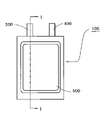
- FIGS. 2 and 3 show drawings schematically showing another example of the secondary battery which is an example of the electrochemical element of the present embodiment.
- FIG. 2 is a plan view of the secondary battery
- FIG. 3 is a sectional view taken along line II of FIG.
- the secondary battery 100 shown in FIGS. 2 and 3 accommodates an electrode body 200 in a laminated film exterior body 500 composed of two metal laminated films, and the laminated film exterior body 500 has an outer peripheral portion thereof. It is sealed by heat-sealing the upper and lower metal laminating films.
- the electrode body 200 is configured by laminating a positive electrode, a negative electrode, and a solid electrolyte layer interposed between them.
- the electrode body 200 is configured by laminating a positive electrode, a negative electrode, and a separator interposed therein.
- an electrolyte electrolytic solution or the like
- At least one of the positive electrode and the negative electrode of the electrode body 200 is the electrode of the embodiment.
- each layer constituting the laminated film exterior body 500 and each component (positive electrode, negative electrode, etc.) forming the electrode body 200 are distinguished. Not shown.
- the positive electrode of the electrode body 200 is connected to the positive electrode external terminal 300 in the battery 100, and although not shown, the negative electrode of the electrode body 200 is also connected to the negative electrode external terminal 400 in the battery 100. There is.
- the positive electrode external terminal 300 and the negative electrode external terminal 400 are drawn out on one end side to the outside of the laminating film exterior body 500 so that they can be connected to an external device or the like.
- the electrode mixture containing a solid electrolyte is used.
- the electrode mixture according to the electrode of the embodiment may not contain a solid electrolyte.
- the charging / discharging of the battery is performed. It is necessary to introduce Li (Li ion) involved in the above into the active material according to the electrode of the embodiment.
- the active material of the above-described embodiment is pre-doped with Li ions (extra-system pre-doped) by a conventional method, or when the non-aqueous electrolyte secondary battery has a non-aqueous electrolyte solution, the same is used.
- a Li source (metal Li foil, Li alloy foil, etc.) is placed in a place where it can come into contact with the internal non-aqueous electrolyte solution, and Li ions are doped in the active material of the electrode of the embodiment in the battery (inside the system).
- a method such as pre-doping) can be adopted.
- a predoping electrode having a Li source attached to the surface of the current collector and electrically connected to the negative electrode can be used.
- the negative electrode may be, for example, a negative electrode mixture containing only a negative electrode active material and a conductive auxiliary agent, or a negative electrode mixture. Examples thereof include those having a structure in which a layer made of a molded body (negative electrode mixture layer) is formed on a current collector.
- the negative electrode active material for example, graphite, pyrolytic carbons, cokes, glassy carbons, fired organic polymer compounds, mesophase carbon microbeads (MCMB), carbon fibers and other lithium can be stored and released.
- MCMB mesophase carbon microbeads
- One or a mixture of two or more carbon-based materials is used.
- simple substances containing elements such as Al, Si, Sn, Ge, Bi, Sb, In, Zn, and P, compounds and alloys thereof; charged with a low voltage close to that of a lithium metal such as a lithium-containing nitride or a lithium-containing sulfide.
- a compound that can be discharged; a lithium metal can also be used as a negative electrode active material.
- the content of the negative electrode active material in the negative electrode mixture is preferably 15 to 100% by mass.
- the conductive auxiliary agent for the negative electrode the same one as exemplified above as one that can be used for the electrode of the above embodiment can be used.
- the content of the conductive auxiliary agent in the negative electrode mixture is preferably 0.1 to 15% by mass.
- the negative electrode mixture can contain the solid electrolyte.
- the solid electrolyte of the negative electrode includes various sulfide-based solid electrolytes, hydride-based solid electrolytes, halide-based solid electrolytes, and oxide-based solid electrolytes that can be used as the electrode material of the above-described embodiment and exemplified above. One or more of them can be used. In order to improve the battery characteristics, it is desirable to contain a sulfide-based solid electrolyte, and it is more desirable to contain an algyrodite-type sulfide-based solid electrolyte.
- the content of the solid electrolyte in the negative electrode mixture is preferably 4 to 90% by mass.
- the negative electrode mixture may contain a binder, and may not be contained when good moldability can be ensured without using a binder, such as in the case of a negative electrode containing a sulfide-based solid electrolyte. You may.
- a binder such as in the case of a negative electrode containing a sulfide-based solid electrolyte. You may.
- the binder the same ones as exemplified above as those that can be used for the electrodes of the above-described embodiment can be used.
- the content thereof is preferably 15% by mass or less, and more preferably 0.5% by mass or more.
- the content thereof is preferably 0.5% by mass or less, more preferably 0.3% by mass or less. It is more preferably 0% by mass (that is, it does not contain a binder).
- the same current collector as exemplified above can be used as the current collector as the current collector of the above embodiment can be used when the electrode is the negative electrode.
- the molded body of the negative electrode mixture is, for example, compressed by pressure molding or the like by mixing a negative electrode active material with a conductive auxiliary agent, a binder, a solid electrolyte, etc. added as needed. Can be formed with. In the case of a negative electrode composed of only a molded body of a negative electrode mixture, it can be manufactured by the above method.
- a negative electrode having a current collector it can be manufactured by bonding the molded body of the negative electrode mixture formed by the above method by crimping it to the current collector.
- a negative electrode mixture-containing composition in which the negative electrode mixture is dispersed in a solvent is applied to the current collector, dried, and then, if necessary. It can also be manufactured by a method of forming a molded body (negative electrode mixture layer) of a negative electrode mixture on the surface of a current collector by performing pressure molding such as a calender treatment.
- the solvent of the composition containing the negative electrode mixture water, an organic solvent such as NMP, or the like can be used.
- the negative electrode mixture-containing composition also contains a solid electrolyte, it is desirable to select a solvent that does not easily deteriorate the solid electrolyte, and the solvent for the electrode mixture-containing composition containing the solid electrolyte is first selected. It is preferable to use the same solvent as the various solvents exemplified.
- the thickness of the molded body of the negative electrode mixture (in the case of a negative electrode having a current collector, the thickness of the molded body of the positive electrode mixture per one side of the current collector; hereinafter the same) is usually 50 ⁇ m or more. From the viewpoint of increasing the capacity of the battery, it is preferably 200 ⁇ m or more. The thickness of the molded product of the negative electrode mixture is usually 2000 ⁇ m or less.
- the thickness of the negative electrode mixture layer is 50 to 1000 ⁇ m. It is preferable to have.
- the positive electrode may be, for example, a molded body of a positive electrode mixture containing a positive electrode active material, a conductive auxiliary agent, or the like, or a molded body of a positive electrode mixture. Examples thereof include those having a structure in which a layer (positive electrode mixture layer) is formed on a current collector.
- the positive electrode active material is not particularly limited as long as it is a positive electrode active material used in a conventionally known secondary battery, that is, an active material capable of storing and releasing Li ions.
- Specific examples of the positive electrode active material include LiMr Mn 2-r O 4 (where M is Li, Na, K, B, Mg, Ca, Sr, Ba, Ti, V, Cr, Zr, Fe, Co. , Ni, Cu, Zn, Al, Sn, Sb, In, Nb, Ta, Mo, W, Y, Ru and Rh, at least one element selected from the group consisting of 0 ⁇ r ⁇ 1).
- Represented spinnel type lithium manganese composite oxide Li r Mn (1-s-r) Nis M t O (2-u) F v (where M is Co, Mg, Al, B, Ti, V , Cr, Fe, Cu, Zn, Zr, Mo, Sn, Ca, Sr and W, which are at least one element selected from the group consisting of 0.8 ⁇ r ⁇ 1.2, 0 ⁇ s ⁇ 0.
- LiCo 1-r M r O 2 a layered compound represented by LiCo 1-r M r O 2
- M is at least one element selected from the group consisting of Al, Mg, Ti, V, Cr, Zr, Fe, Ni, Cu, Zn, Ga, Ge, Nb, Mo, Sn, Sb and Ba.
- LiNi 1-r Mr O 2 where M is Al, Mg, Ti, Zr, Fe, Co, Cu, Zn, which is a lithium cobalt composite oxide represented by 0 ⁇ r ⁇ 0.5).
- Type composite oxide Li 2 M 1-r N r P 2 O 7 (where M is at least one element selected from the group consisting of Fe, Mn and Co, and N is Al, Mg, Ti. , Zr, Ni, Cu, Zn, Ga, Ge, Nb, Mo, Sn, Sb, V and Ba, which is at least one element selected from the group and is represented by 0 ⁇ r ⁇ 0.5).
- M is at least one element selected from the group consisting of Fe, Mn and Co
- N Al
- Mg Ti.
- Examples thereof include pyrrolate compounds, and only one of these may be used, or two or more thereof may be used in combination.
- the average particle size of the positive electrode active material is preferably 1 ⁇ m or more, more preferably 2 ⁇ m or more, and preferably 10 ⁇ m or less. It is more preferably 8 ⁇ m or less.
- the positive electrode active material may be primary particles or secondary particles in which the primary particles are aggregated. When a positive electrode active material having an average particle size in the above range is used, many interfaces with the solid electrolyte contained in the positive electrode can be obtained, so that the load characteristics of the battery are further improved.
- the positive electrode active material has a reaction suppressing layer on its surface for suppressing the reaction with the solid electrolyte contained in the positive electrode.
- the solid electrolyte may oxidize to form a resistance layer and the ionic conductivity in the molded body may decrease.
- a reaction suppression layer that suppresses the reaction with the solid electrolyte on the surface of the positive electrode active material and preventing direct contact between the positive electrode active material and the solid electrolyte, the ionic conductivity in the molded body due to the oxidation of the solid electrolyte The decrease can be suppressed.
- the reaction suppressing layer may be made of a material having ionic conductivity and capable of suppressing the reaction between the positive electrode active material and the solid electrolyte.
- the material that can form the reaction suppression layer for example, an oxide containing Li and at least one element selected from the group consisting of Nb, P, B, Si, Ge, Ti and Zr, more specifically.
- Examples include Nb-containing oxides such as LiNbO 3 , Li 3 PO 4 , Li 3 BO 3 , Li 4 SiO 4 , Li 4 GeO 4 , LiTIO 3 , LiZrO 3 , Li 2 WO 4 .
- the reaction suppression layer may contain only one of these oxides, or may contain two or more of these oxides, and a plurality of these oxides may be a composite compound. May be formed. Among these oxides, it is preferable to use an Nb - containing oxide, and it is more preferable to use LiNbO3.
- the reaction suppressing layer is preferably present on the surface in an amount of 0.1 to 1.0 part by mass with respect to 100 parts by mass of the positive electrode active material. Within this range, the reaction between the positive electrode active material and the solid electrolyte can be satisfactorily suppressed.
- Examples of the method for forming the reaction suppressing layer on the surface of the positive electrode active material include a sol-gel method, a mechanofusion method, a CVD method, a PVD method, and an ALD method.
- the content of the positive electrode active material in the positive electrode mixture is preferably 20 to 95% by mass.
- the conductive auxiliary agent for the positive electrode the same one as exemplified above as one that can be used for the electrode of the above embodiment can be used.
- the content of the conductive auxiliary agent in the positive electrode mixture is preferably 0.1 to 15% by mass.
- the positive electrode mixture contains a solid electrolyte.
- the positive electrode solid electrolyte includes various sulfide-based solid electrolytes, hydride-based solid electrolytes, halide-based solid electrolytes, and oxide-based solid electrolytes that can be used as the electrode material of the above-described embodiment and are exemplified above. One or more of them can be used. In order to improve the battery characteristics, it is desirable to contain a sulfide-based solid electrolyte, and it is more desirable to contain an algyrodite-type sulfide-based solid electrolyte.
- the content of the solid electrolyte in the positive electrode mixture is preferably 4 to 80% by mass.
- the positive electrode mixture may contain a binder, and may not be contained when good moldability can be ensured without using a binder, such as in the case of a positive electrode containing a sulfide-based solid electrolyte. You may.
- a binder such as in the case of a positive electrode containing a sulfide-based solid electrolyte. You may.
- the binder the same ones as exemplified above as those that can be used for the electrodes of the above-described embodiment can be used.
- the content thereof is preferably 15% by mass or less, and more preferably 0.5% by mass or more.
- the content thereof is preferably 0.5% by mass or less, more preferably 0.3% by mass or less. It is more preferably 0% by mass (that is, it does not contain a binder).
- the same current collector as exemplified above can be used as the current collector as it can be used when the electrode of the above embodiment is a positive electrode.
- the molded body of the positive electrode mixture is, for example, a positive electrode mixture prepared by mixing a positive electrode active material or a conductive auxiliary agent with a binder or a solid electrolyte added as needed, and compressing the positive electrode mixture by pressure molding or the like.
- a positive electrode mixture prepared by mixing a positive electrode active material or a conductive auxiliary agent with a binder or a solid electrolyte added as needed, and compressing the positive electrode mixture by pressure molding or the like.
- a positive electrode having a current collector it can be manufactured by bonding an adult of the positive electrode mixture formed by the above method by crimping it to the current collector.
- a positive electrode mixture-containing composition in which the above-mentioned positive electrode mixture is dispersed in a solvent is applied to the current collector, dried, and then, if necessary. It can also be produced by a method of forming a molded body (positive electrode mixture layer) of a positive electrode mixture on the surface of a current collector by performing pressure molding such as a calender treatment.
- an organic solvent such as NMP can be used as the solvent of the positive electrode mixture-containing composition.
- NMP an organic solvent such as NMP
- the thickness of the molded body of the positive electrode mixture (in the case of a positive electrode having a current collector, the thickness of the molded body of the positive electrode mixture per one side of the current collector; hereinafter the same) is usually 50 ⁇ m or more. From the viewpoint of increasing the capacity of the battery, it is preferably 200 ⁇ m or more. The thickness of the molded product of the positive electrode mixture is usually 2000 ⁇ m or less.
- the thickness of the positive electrode mixture layer is 50 to 1000 ⁇ m. It is preferable to have.
- the solid electrolyte in the solid electrolyte layer interposed between the positive electrode and the negative electrode may be various types that can be used as the electrode material of the above embodiment and exemplified above.
- One or more of sulfide-based solid electrolytes, hydride-based solid electrolytes, halide-based solid electrolytes, and oxide-based solid electrolytes can be used.
- it is desirable to contain a sulfide-based solid electrolyte in order to improve the battery characteristics, it is desirable to contain a sulfide-based solid electrolyte, and it is more desirable to contain an algyrodite-type sulfide-based solid electrolyte.
- the positive electrode, the negative electrode, and the solid electrolyte layer all contain a sulfide-based solid electrolyte, and it is further desirable that the argilodite-type sulfide-based solid electrolyte is contained.
- the solid electrolyte layer may have a porous body such as a non-woven fabric made of resin as a support.
- the solid electrolyte layer is a method of compressing the solid electrolyte by pressure molding or the like; a composition for forming a solid electrolyte layer prepared by dispersing the solid electrolyte in a solvent is applied onto a base material, a positive electrode, and a negative electrode, and dried. If necessary, it can be formed by a method of performing pressure molding such as press processing: or the like.
- the thickness of the solid electrolyte layer is preferably 10 to 500 ⁇ m.
- the separator interposed between the positive electrode and the negative electrode should have sufficient strength and can retain a large amount of non-aqueous electrolyte. Therefore, a microporous film or a non-woven fabric containing polyethylene, polypropylene, or an ethylene-propylene copolymer having a thickness of 10 to 50 ⁇ m and an opening ratio of 30 to 70% is preferable.
- non-aqueous electrolyte solution an organic solvent in which an electrolyte salt such as a lithium salt is dissolved is used.
- the organic solvent is not particularly limited, and is, for example, a chain ester such as dimethyl carbonate, diethyl carbonate, ethylmethyl carbonate, or methylpropyl carbonate; a dielectric such as ethylene carbonate, propylene carbonate, butylene carbonate, or vinylene carbonate. Examples thereof include a cyclic ester having a high rate; a mixed solvent of a chain ester and a cyclic ester; and a mixed solvent of a cyclic ester having a chain ester as a main solvent is particularly suitable.
- Examples of the electrolyte salt to be dissolved in the organic solvent in the preparation of the non-aqueous electrolyte solution include LiPF 6 , LiBF 4 , LiAsF 6 , LiSbF 6 , LiCF 3 SO 3 , LiC 4 F 9 SO 3 , LiCF 3 CO 2 , and Li 2 .
- Rf and Rf'are fluoroalkyl groups are used alone or in admixture of two or more.
- the concentration of the electrolyte salt in the non-aqueous electrolyte solution is not particularly limited, but is preferably 0.3 mol / l or more, more preferably 0.4 mol / l or more, and 1.7 mol / l or more. It is preferably less than or equal to, and more preferably 1.5 mol / l or less.
- a gel-like electrolyte obtained by gelling the non-aqueous electrolyte solution with a gelling agent made of a polymer or the like can also be used.
- an aqueous electrolyte When the negative electrode of the secondary battery is the electrode of the above embodiment, an aqueous electrolyte can also be used.
- the aqueous electrolyte include a composition in which more than 4 mol to 15 mol of water is mixed with 1 mol of an alkali metal salt containing an organic anion having a fluoroalkyl group as a component.
- the positive electrode and the negative electrode can be used in a battery in the form of a laminated electrode body laminated via a solid electrolyte layer or a separator, or a wound electrode body obtained by winding the laminated electrode body.
- an electrode body having a solid electrolyte layer it is preferable to perform pressure molding in a state where the positive electrode, the negative electrode and the solid electrolyte layer are laminated from the viewpoint of increasing the mechanical strength of the electrode body.
- the form of the secondary battery is as shown in FIG. 1, which has an outer body composed of an outer can, a sealing can, and a gasket, that is, a form generally called a coin-shaped battery or a button-shaped battery.
- FIGS. 2 and 3 in addition to those having an exterior body made of a resin film or a metal-resin laminated film, a metal bottomed tubular (cylindrical or square tubular) outer can. And may have an exterior body having a sealing structure for sealing the opening.
- Example 1 ⁇ Synthesis of active substances> Active materials were synthesized using a solid phase reaction method using powders of various metal oxides (all obtained from High Purity Chemistry Co., Ltd.) as starting materials. Nb 2 O 5 (purity:> 99.9%), ⁇ -Al 2 O 3 (purity:> 99.99%) and ZnO (purity:> 99.99%), 14.507 g, 427.6 mg, respectively. , 80.3 mg was weighed and mixed. The mixture of starting materials is added to a zirconia container having an internal volume of 500 ml together with ethanol: 15 g and YSZ balls having a diameter of 5 mm: 120 g, and a planetary ball mill [Fritsch's "planaterym”.
- the precursor powder of the active substance is obtained by drying the slurry obtained by separating the zirconia balls from the sample after the mixing treatment for 3 hours under the condition of 250 rpm with "ill pulveristte 5" (trade name)]. Obtained.
- the precursor powder was transferred to an alumina crucible, heated to 1150 ° C. at a heating rate of 16 ° C./min under an air atmosphere, kept as it was for 8 hours, and naturally cooled to room temperature.
- the obtained powder was crushed in a mortar for 5 minutes and passed through a sieve having an opening of 150 ⁇ m to obtain a crude product of an active substance.
- a lithium metal plate having a diameter of 10 mm and a thickness of 100 ⁇ m and an indium metal plate having a diameter of 10 mm and a thickness of 100 ⁇ m bonded by a rolling method is placed as a negative electrode on the solid electrolyte layer side of the laminate, and then the diameter is 10 mm and the thickness is 10 mm.
- a 1 mm SUS disk was placed on the positive electrode side and the negative electrode side and fixed to form a laminated electrode body. Using the laminated electrode body, a sheet-shaped all-solid-state battery similar to that shown in FIG. 2 was produced.
- Laminating film A positive electrode current collector foil (SUS foil) and a negative electrode current collector foil (SUS foil) are placed laterally on the inner surface of the aluminum laminate film constituting the exterior body with a certain distance between them. I pasted them side by side.
- Each of the current collector foils has a main body portion facing the positive electrode side surface or the negative electrode side surface of the laminated electrode body, and a positive electrode external terminal 300 and a negative electrode external terminal 400 protruding from the main body portion toward the outside of the battery. The one cut into a shape having a portion was used.
- the laminated electrode body is placed on the negative electrode collecting foil of the laminated film outer body, and the laminated electrode body is wrapped with the laminated film outer body so that the positive electrode current collecting foil is arranged on the positive electrode of the laminated electrode body.
- the remaining three sides of the laminated film exterior body were sealed by heat fusion under vacuum to obtain a sheet-shaped all-solid-state secondary battery.
- Example 2 A sheet-shaped all-solid-state secondary battery was produced in the same manner as in Example 1 except that the active material was changed to the monoclinic Zn 0.2 Al 0.7 Nb 11.1 O 29 . It was confirmed in the same manner as in Example 1 that the active material used for the positive electrode was a monoclinic crystal type crystal.
- Example 3 A sheet-shaped all-solid-state secondary battery was produced in the same manner as in Example 1 except that the active material was changed to the monoclinic Zn 0.3 Al 0.55 Nb 11.15 O 29 . It was confirmed in the same manner as in Example 1 that the active material used for the positive electrode was a monoclinic crystal type crystal.
- Example 4 A sheet-shaped all-solid-state secondary battery was produced in the same manner as in Example 1 except that the active material was changed to the monoclinic type Cu 0.1 Al 0.85 Nb 11.05 O 29 . It was confirmed in the same manner as in Example 1 that the active material used for the positive electrode was a monoclinic crystal type crystal.
- Example 5 A sheet-shaped all-solid-state secondary battery was produced in the same manner as in Example 1 except that the active material was changed to the monoclinic type Cu 0.2 Al 0.7 Nb 11.1 O 29 . It was confirmed in the same manner as in Example 1 that the active material used for the positive electrode was a monoclinic crystal type crystal.
- Example 6 A sheet-shaped all-solid-state secondary battery was produced in the same manner as in Example 1 except that the active material was changed to the monoclinic type Cu 0.3 Al 0.55 Nb 11.15 O 29 . It was confirmed in the same manner as in Example 1 that the active material used for the positive electrode was a monoclinic crystal type crystal.
- Comparative Example 1 A sheet-shaped all-solid-state secondary battery was produced in the same manner as in Example 1 except that the active material was changed to the monoclinic type AlNb 11 O 29 . It was confirmed in the same manner as in Example 1 that the active material used for the positive electrode was a monoclinic crystal type crystal.
- Comparative Example 2 A sheet-shaped all-solid-state secondary battery was produced in the same manner as in Example 1 except that the active material was changed to the monoclinic type Zn 0.67 Nb 11.33 O 29 (Zn 2 Nb 34 O 87 ). It was confirmed in the same manner as in Example 1 that the active material used for the positive electrode was a monoclinic crystal type crystal.
- Comparative Example 3 A sheet-shaped all-solid-state secondary battery was produced in the same manner as in Example 1 except that the active material was changed to the monoclinic Zn 0.566 Al 0.1 Nb 11.31 O 29 . It was confirmed in the same manner as in Example 1 that the active material used for the positive electrode was a monoclinic crystal type crystal.
- Comparative Example 4 A sheet-shaped all-solid-state secondary battery was produced in the same manner as in Example 1 except that the active material was changed to the monoclinic Ti 2 Nb 10 O 29 . It was confirmed in the same manner as in Example 1 that the active material used for the positive electrode was a monoclinic crystal type crystal.
- Comparative Example 5 A sheet-shaped all-solid-state secondary battery was produced in the same manner as in Example 1 except that the active material was changed to the monoclinic TiNb 2 O 7 . It was confirmed in the same manner as in Example 1 that the active material used for the positive electrode was a monoclinic crystal type crystal.
- the charging capacity (0.24C charging capacity) was measured by constantly charging with a current value of 24C until the voltage became 1.88V. Then, for each battery, the 0.24C charge capacity was divided by the initial capacity to obtain the capacity retention rate, and the load characteristics were evaluated by this.
- the sheet-shaped all-solid-state secondary batteries of Examples 1 to 6 having a positive electrode using an oxide represented by the general formula (1) as an active material have a capacity retention rate and a capacity retention rate at the time of load characteristic evaluation. Both of the capacity retention rates at the time of charge / discharge cycle characteristic evaluation were high, and they had excellent load characteristics and charge / discharge cycle characteristics.
- the battery of Comparative Example 1 using a positive electrode using an oxide containing no element M1 as an active material and Comparative Examples 2, 4 and 5 using a positive electrode using an oxide containing no Al as an active material.
- the battery of Comparative Example 3 using a battery and a positive electrode using an oxide having an inappropriate amount of element M1 as an active material has either a capacity retention rate at the time of load characteristic evaluation or a capacity retention rate at the time of charge / discharge cycle characteristic evaluation. It was lower than the battery of the example, and the load characteristic and the charge / discharge cycle characteristic were inferior.
- Example 7 ⁇ Preparation of positive electrode material> 0.86 g of lithium and 38.7 g of pentaethoxyniobium were mixed in 394 g of dehydrated ethanol to prepare a coating solution for forming a reaction-suppressing layer. Next, in a coating apparatus using a rolling fluidized bed, the reaction-suppressing layer forming coating solution was applied on 1000 g of the positive electrode active material (LiNi 0.5 Mn 1.5 O 4 ) at a rate of 2 g per minute. Applied. By heat-treating the obtained powder at 350 ° C., a positive electrode material having a reaction suppressing layer composed of 2 parts by mass of LiNbO 3 formed on the surface thereof was obtained with respect to 100 parts by mass of the positive electrode active material.
- the positive electrode active material LiNi 0.5 Mn 1.5 O 4
- a positive electrode mixture was prepared by mixing the positive electrode material, gas phase growth carbon fiber (conductive auxiliary agent), and Li 5.8 PS 4.6 Cl 1.6 (sulfide-based solid electrolyte). The mixing ratio of the positive electrode material, the conductive auxiliary agent, and the sulfide-based solid electrolyte was 67: 4: 29 in mass ratio.
- This positive electrode mixture 102 mg is put into a powder molding die having a diameter of 7.5 mm, and molding is performed at a pressure of 1000 kgf / cm 2 using a press machine to prepare a positive electrode made of a cylindrical positive electrode mixture molded body. bottom.
- a flexible graphite sheet "PERMA-FOIL (product name)" (thickness: 0.1 mm, apparent density: 1.1 g / cm 3 ) manufactured by Toyo Tanso Co., Ltd. punched out to the same size as the laminated electrode body.
- Two sheets were prepared, and one of them was placed on the inner bottom surface of a stainless steel sealing can fitted with an annular gasket made of polypropylene.
- the laminated electrode body is superposed on the graphite sheet with the negative electrode on the graphite sheet side, another sheet of the graphite sheet is placed on the laminated electrode body, and the outer can made of stainless steel is further covered.
- Example 8 A flat all-solid-state secondary battery was produced in the same manner as in Example 7 except that the negative electrode active material was changed to the monoclinic type Cu 0.1 Al 0.85 Nb 11.05 O 29 .
- Comparative Example 6 A flat all-solid-state secondary battery was produced in the same manner as in Example 7 except that the negative electrode active material was changed to the monoclinic type AlNb 11 O 29 .
- the all-solid-state batteries of Example 7, Example 8 and Comparative Example 6 are constantly charged with a current value of 0.07 C until the voltage reaches 3.8 V, and then a constant voltage until the current value reaches 0.005 C. After charging, constant current discharge was performed at a current value of 0.07 C until the voltage reached 1.5 V, and the initial capacity was determined. Constant current charging and constant voltage charging were performed again, and then constant current step discharge was performed, and the discharge capacity (constant current step discharge capacity) at each current value was measured. In the constant current step discharge, the charged battery is discharged with a constant current until the voltage reaches 1.5 V at a current value of 0.6 C, and then until the voltage reaches 1.5 V at a current value of 0.3 C.
- the charged battery is discharged with a constant current until the voltage reaches 1.5 V at a current value of 0.6 C, and then until the voltage reaches 1.5 V at a current value of 0.3 C. This was performed by constant current discharge and then constant current discharge at a current value of 0.1 C until the voltage reached 1.5 V. Then, the sum (0.1C discharge capacity) of all the constant current step discharge capacities of 0.6C to 0.1C was obtained. Subsequently, each battery is charged with a constant current at a current value of 0.3C until it reaches 3.8V, and then charged with a constant voltage until it reaches 0.005C, and then 0.6C to 0 under the same conditions as described above. A constant current step discharge of .1C was performed, and a 0.1C discharge capacity was measured.
- the operation at the time of initial capacity measurement is set as the first cycle, the final constant voltage charge is performed at a current value of 0.3 C, and then the constant current step discharge operation is performed.
- the cycle is set, the 0.1C discharge capacity of the third cycle is divided by the 0.1C discharge capacity of the charge / discharge cycle (second cycle) in which constant current charging is performed at a current value of 0.1C.
- the charge / discharge cycle characteristics were evaluated.
- Table 2 shows the evaluation results of the all-solid-state batteries of Example 7, Example 8 and Comparative Example 6 as relative values when the result of the all-solid-state battery of Comparative Example 6 is 100.
- the flat all-solid-state secondary batteries of Examples 7 and 8 having a negative electrode using an oxide represented by the general formula (1) as an active material have a capacity retention rate and a capacity retention rate at the time of load characteristic evaluation. Both of the capacity retention rates at the time of charge / discharge cycle characteristic evaluation were high, and they had excellent load characteristics and charge / discharge cycle characteristics.
- the battery of Comparative Example 6 using the negative electrode using the oxide containing no element M 1 as the active material has both the capacity retention rate at the time of load characteristic evaluation and the capacity retention rate at the time of charge / discharge cycle characteristic evaluation.
- the load characteristic and the charge / discharge cycle characteristic were inferior.
- Example 9 A sheet-shaped all-solid-state secondary battery was produced in the same manner as in Example 1 except that the active material was changed to the monoclinic type Cu 0.21 Al 0.74 Nb 11.05 O 27.89 . It was confirmed in the same manner as in Example 1 that the active material was a monoclinic crystal type. The composition of the active material was determined by ICP-AES measurement and measurement by an oxygen-nitrogen analyzer.
- Example 10 A mixture of powders of various metal oxides (all obtained from High Purity Chemical Co., Ltd.) is placed in a carbon container and fired at 1000 ° C. for 4 hours in a vacuum atmosphere with a pressure of 100 Pa or less for reduction treatment. , A monoclinic type Cu 0.14 Al 0.73 Nb 11.13 O 28.00 was obtained. A sheet-shaped all-solid-state secondary battery was produced in the same manner as in Example 1 except that the active material was changed to the monoclinic type Cu 0.14 Al 0.73 Nb 11.13 O 28.00 . .. It was confirmed in the same manner as in Example 1 that the active material was a monoclinic crystal type. The composition of the active material was determined by ICP-AES measurement and measurement by an oxygen-nitrogen analyzer.
- Example 11 A sheet-shaped all-solid-state secondary battery was produced in the same manner as in Example 1 except that the active material was changed to the monoclinic Fe 0.20 Al 0.83 Nb 10.97 O 28.23 . It was confirmed in the same manner as in Example 1 that the active material was a monoclinic crystal type. The composition of the active material was determined by ICP-AES measurement and measurement by an oxygen-nitrogen analyzer.
- Comparative Example 7 A sheet-shaped all-solid-state secondary battery was produced in the same manner as in Example 1 except that the active material was changed to a monoclinic type Al 0.87 Nb 11.13 O 28.47 which had been subjected to a reduction treatment. It was confirmed in the same manner as in Example 1 that the active material was a monoclinic crystal type. The composition of the active material was determined by ICP-AES measurement and measurement by an oxygen-nitrogen analyzer.
- the load characteristics and charge / discharge cycle characteristics of the sheet-shaped all-solid-state secondary batteries of Examples 9 to 11 and Comparative Example 7 were evaluated in the same manner as the batteries of Example 1 except that the lower limit discharge voltage was changed to 0.18 V. At the same time, the battery capacity was divided by the weight of the active material contained in the electrode to obtain the energy density per active material weight.
- the sheet-shaped all-solid-state secondary batteries of Examples 9 to 11 having a positive electrode using an oxide represented by the general formula (1) as an active material have a capacity at the time of load characteristic evaluation. Both the retention rate and the capacity retention rate at the time of charge / discharge cycle characteristic evaluation were high, and compared to having excellent load characteristics and charge / discharge cycle characteristics, the aluminum niobium composite oxide containing no element M1 was used. In the battery of Comparative Example 7 having a positive electrode as an active material, both the capacity retention rate at the time of load characteristic evaluation and the capacity retention rate at the time of charge / discharge cycle characteristic evaluation were inferior.
- the reduction treatment is performed in a carbon container, the Z value is suitable, the absorbances A1, A2 and A3 satisfy the relationship of A1 ⁇ A2 and A3 ⁇ A2, and the atomic ratio P and the atomic ratio Q are P.
- the battery of Example 10 having a positive electrode using the oxide as an active material satisfying the relationship of> Q includes the batteries of Examples 9 and 11 having a positive electrode using the oxide as an active material which has not been subjected to the reduction treatment.
- the energy density was higher than that of the battery of Comparative Example 7 having a positive electrode using an aluminum niobium composite oxide containing no element M 1 as an active material.
- the present invention can be implemented in a form other than the above as long as it does not deviate from the gist thereof.
- the embodiments disclosed in the present application are examples, and the present invention is not limited to these embodiments.
- the scope of the present invention shall be construed in preference to the description of the attached claims over the description of the above specification, and all changes within the scope of the claims shall be within the scope of the claims. included.
- the electrochemical element of the present invention includes a secondary battery having a conventionally known non-aqueous electrolyte (non-aqueous electrolyte solution or gel-like electrolyte), a secondary battery having an aqueous electrolyte, an all-solid secondary battery, and a super capacitor. It can be applied to the same applications as. Further, the electrode for an electrochemical element of the present invention can constitute the electrochemical element of the present invention, and the active material for an electrochemical element of the present invention and the electrode material for an electrochemical element of the present invention are the electrodes for an electrochemical element of the present invention. Can be configured.
- the electrochemical element of the present invention has excellent load characteristics, applications in which such characteristics are often required, for example, industrial equipment and mobile vehicles (electric vehicles and hybrid cars, etc.) It is suitable for power supply applications for vehicles such as electric motorcycles, ships, submarines, radio-controlled models, flying objects such as rockets and artificial satellites, and drones.
- vehicles such as electric motorcycles, ships, submarines, radio-controlled models, flying objects such as rockets and artificial satellites, and drones.
- some moving objects, such as hybrid cars charge the battery used by regenerative energy, but in this case, the charging current and voltage may not be stable, so in the battery Dendrite of element A is likely to occur, which may cause deterioration of the battery.
- the electrochemical element of the present invention uses an oxide that is unlikely to generate dendrite of element A as an active material, it is possible to suppress deterioration caused by dendrite of element A even if it is charged by regenerative energy. Therefore, it can be preferably applied to a moving body or the like that may perform such charging.
Landscapes
- Chemical & Material Sciences (AREA)
- Organic Chemistry (AREA)
- Engineering & Computer Science (AREA)
- Inorganic Chemistry (AREA)
- Electrochemistry (AREA)
- Chemical Kinetics & Catalysis (AREA)
- General Chemical & Material Sciences (AREA)
- Materials Engineering (AREA)
- Power Engineering (AREA)
- Manufacturing & Machinery (AREA)
- Microelectronics & Electronic Packaging (AREA)
- Condensed Matter Physics & Semiconductors (AREA)
- General Physics & Mathematics (AREA)
- Physics & Mathematics (AREA)
- Battery Electrode And Active Subsutance (AREA)
- Inorganic Compounds Of Heavy Metals (AREA)
- Secondary Cells (AREA)
- Electric Double-Layer Capacitors Or The Like (AREA)
- Compounds Of Iron (AREA)
Priority Applications (6)
| Application Number | Priority Date | Filing Date | Title |
|---|---|---|---|
| CN202180029604.7A CN115428191B (zh) | 2020-10-16 | 2021-09-17 | 电化学元件用电极活性物质及其制造方法、电化学元件用电极材料、电化学元件用电极、电化学元件以及移动体 |
| EP25197939.9A EP4632860A3 (en) | 2020-10-16 | 2021-09-17 | Electrode active material for electrochemical element and method for producing same, electrode material for electrochemical element, electrode for electrochemical element, electrochemical element, and mobile object |
| EP21879824.7A EP4230586A4 (en) | 2020-10-16 | 2021-09-17 | ELECTRODE ACTIVE MATERIAL FOR AN ELECTROCHEMICAL ELEMENT AND METHOD FOR PRODUCING SAME, ELECTRODE MATERIAL FOR AN ELECTROCHEMICAL ELEMENT, ELECTROCHEMICAL ELEMENT AND MOBILE OBJECT |
| US17/924,268 US20230178720A1 (en) | 2020-10-16 | 2021-09-17 | Electrode active material for electrochemical element, method for manufacturing the same, electrode material for electrochemical element, electrode for electrochemical element, electrochemical element, and movable body |
| JP2022519369A JP7168819B2 (ja) | 2020-10-16 | 2021-09-17 | 電気化学素子用電極活物質およびその製造方法、電気化学素子用電極材料、電気化学素子用電極、電気化学素子、並びに移動体 |
| JP2022171912A JP7824857B2 (ja) | 2020-10-16 | 2022-10-27 | 電気化学素子用電極活物質およびその製造方法、電気化学素子用電極材料、電気化学素子用電極、電気化学素子、並びに移動体 |
Applications Claiming Priority (2)
| Application Number | Priority Date | Filing Date | Title |
|---|---|---|---|
| JP2020-174408 | 2020-10-16 | ||
| JP2020174408 | 2020-10-16 |
Publications (1)
| Publication Number | Publication Date |
|---|---|
| WO2022080083A1 true WO2022080083A1 (ja) | 2022-04-21 |
Family
ID=81209161
Family Applications (1)
| Application Number | Title | Priority Date | Filing Date |
|---|---|---|---|
| PCT/JP2021/034246 Ceased WO2022080083A1 (ja) | 2020-10-16 | 2021-09-17 | 電気化学素子用電極活物質およびその製造方法、電気化学素子用電極材料、電気化学素子用電極、電気化学素子、並びに移動体 |
Country Status (5)
| Country | Link |
|---|---|
| US (1) | US20230178720A1 (https=) |
| EP (2) | EP4230586A4 (https=) |
| JP (2) | JP7168819B2 (https=) |
| CN (1) | CN115428191B (https=) |
| WO (1) | WO2022080083A1 (https=) |
Cited By (4)
| Publication number | Priority date | Publication date | Assignee | Title |
|---|---|---|---|---|
| WO2023140311A1 (ja) * | 2022-01-21 | 2023-07-27 | マクセル株式会社 | 全固体電池用正極、並びに全固体電池およびその製造方法 |
| JP2023154800A (ja) * | 2022-04-08 | 2023-10-20 | 真志 廣岡 | 電極、電解層、二次電池 |
| WO2024070429A1 (ja) * | 2022-09-29 | 2024-04-04 | 太陽誘電株式会社 | 負極活物質および全固体電池 |
| KR20240109291A (ko) * | 2022-05-06 | 2024-07-10 | 에키온 테크놀러지스 리미티드 | 전극 활물질 |
Families Citing this family (5)
| Publication number | Priority date | Publication date | Assignee | Title |
|---|---|---|---|---|
| GB202013576D0 (en) | 2020-08-28 | 2020-10-14 | Echion Tech Limited | Active electrode material |
| US12381210B2 (en) | 2019-10-18 | 2025-08-05 | Echion Technologies Limited | Li/Na-ion battery anode materials |
| GB2595761B (en) | 2020-06-03 | 2022-07-13 | Echion Tech Limited | Active electrode material |
| KR102646793B1 (ko) * | 2021-07-23 | 2024-03-13 | 삼성전자주식회사 | 커패시터, 이를 포함하는 전자 소자, 및 이의 제조방법 |
| CN117117174B (zh) * | 2023-10-25 | 2024-03-19 | 宁波容百新能源科技股份有限公司 | 钠离子电池正极材料及其制备方法和应用 |
Citations (10)
| Publication number | Priority date | Publication date | Assignee | Title |
|---|---|---|---|---|
| JP2017134972A (ja) * | 2016-01-27 | 2017-08-03 | 太平洋セメント株式会社 | 二次電池用負極活物質の製造方法 |
| CN107742716A (zh) * | 2017-10-12 | 2018-02-27 | 海南大学 | 一种锂离子电池的电极材料及其制备方法 |
| JP2018160365A (ja) | 2017-03-22 | 2018-10-11 | 株式会社東芝 | 活物質、電極、二次電池、電池パック、及び車両 |
| JP2019053945A (ja) | 2017-09-19 | 2019-04-04 | 株式会社東芝 | 活物質、電極、二次電池、電池パック、及び車両 |
| CN109904441A (zh) * | 2018-12-29 | 2019-06-18 | 瑞声科技(新加坡)有限公司 | 一种锂离子电池负极材料、非水电解质锂离子电池及其制备方法 |
| JP2019160729A (ja) | 2018-03-16 | 2019-09-19 | 株式会社東芝 | 活物質、電極、二次電池、電池パック、及び車両 |
| WO2020070958A1 (ja) | 2018-10-01 | 2020-04-09 | パナソニックIpマネジメント株式会社 | ハロゲン化物固体電解質材料およびこれを用いた電池 |
| WO2020070955A1 (ja) | 2018-10-01 | 2020-04-09 | パナソニックIpマネジメント株式会社 | ハロゲン化物固体電解質材料およびこれを用いた電池 |
| WO2021074594A1 (en) * | 2019-10-18 | 2021-04-22 | Echion Technologies Limited | Li/na-ion battery anode materials |
| JP2021082420A (ja) | 2019-11-15 | 2021-05-27 | 昭和電工マテリアルズ株式会社 | 負極活物質、負極、電池セル |
Family Cites Families (5)
| Publication number | Priority date | Publication date | Assignee | Title |
|---|---|---|---|---|
| JP6396243B2 (ja) * | 2015-03-19 | 2018-09-26 | 株式会社東芝 | リチウムイオン二次電池用負極活物質、負極、リチウムイオン二次電池、電池パック、及び車 |
| JP6505561B2 (ja) * | 2015-09-16 | 2019-04-24 | 株式会社東芝 | 電池用活物質、非水電解質電池及び電池パック |
| JP7110611B2 (ja) * | 2018-02-06 | 2022-08-02 | 住友金属鉱山株式会社 | 非水系電解質二次電池用正極活物質とその製造方法、非水系電解質二次電池用正極活物質の評価方法、および非水系電解質二次電池 |
| WO2020046444A1 (en) * | 2018-08-27 | 2020-03-05 | Nanotek Instruments, Inc. | Lithium metal secondary battery containing an electrochemically stable anode-protecting layer |
| EP4292984B1 (en) * | 2021-03-11 | 2026-01-14 | Maxell, Ltd. | Electrode active material for electrochemical elements, electrode material for electrochemical elements, electrode for electrochemical elements, electrochemical element, and mobile object |
-
2021
- 2021-09-17 EP EP21879824.7A patent/EP4230586A4/en active Pending
- 2021-09-17 US US17/924,268 patent/US20230178720A1/en active Pending
- 2021-09-17 CN CN202180029604.7A patent/CN115428191B/zh active Active
- 2021-09-17 JP JP2022519369A patent/JP7168819B2/ja active Active
- 2021-09-17 EP EP25197939.9A patent/EP4632860A3/en active Pending
- 2021-09-17 WO PCT/JP2021/034246 patent/WO2022080083A1/ja not_active Ceased
-
2022
- 2022-10-27 JP JP2022171912A patent/JP7824857B2/ja active Active
Patent Citations (11)
| Publication number | Priority date | Publication date | Assignee | Title |
|---|---|---|---|---|
| JP2017134972A (ja) * | 2016-01-27 | 2017-08-03 | 太平洋セメント株式会社 | 二次電池用負極活物質の製造方法 |
| JP2018160365A (ja) | 2017-03-22 | 2018-10-11 | 株式会社東芝 | 活物質、電極、二次電池、電池パック、及び車両 |
| JP2019053945A (ja) | 2017-09-19 | 2019-04-04 | 株式会社東芝 | 活物質、電極、二次電池、電池パック、及び車両 |
| CN107742716A (zh) * | 2017-10-12 | 2018-02-27 | 海南大学 | 一种锂离子电池的电极材料及其制备方法 |
| JP2019160729A (ja) | 2018-03-16 | 2019-09-19 | 株式会社東芝 | 活物質、電極、二次電池、電池パック、及び車両 |
| WO2020070958A1 (ja) | 2018-10-01 | 2020-04-09 | パナソニックIpマネジメント株式会社 | ハロゲン化物固体電解質材料およびこれを用いた電池 |
| WO2020070955A1 (ja) | 2018-10-01 | 2020-04-09 | パナソニックIpマネジメント株式会社 | ハロゲン化物固体電解質材料およびこれを用いた電池 |
| CN109904441A (zh) * | 2018-12-29 | 2019-06-18 | 瑞声科技(新加坡)有限公司 | 一种锂离子电池负极材料、非水电解质锂离子电池及其制备方法 |
| WO2021074594A1 (en) * | 2019-10-18 | 2021-04-22 | Echion Technologies Limited | Li/na-ion battery anode materials |
| WO2021074592A1 (en) | 2019-10-18 | 2021-04-22 | Echion Technologies Limited | Active electrode material |
| JP2021082420A (ja) | 2019-11-15 | 2021-05-27 | 昭和電工マテリアルズ株式会社 | 負極活物質、負極、電池セル |
Non-Patent Citations (6)
| Title |
|---|
| ACS APPLIED MATERIAL INTERFACES, vol. 11, 2019, pages 6086 - 6096 |
| ELECTROCHEMISTRY COMMUNICATIONS, vol. 25, 2012, pages 39 - 42 |
| JOURNAL OF MATERIALS CHEMISTRY A, vol. 7, 2019, pages 25537 - 25547 |
| JOURNAL OF POWER SOURCES, vol. 328, 2016, pages 336 - 344 |
| See also references of EP4230586A4 |
| XIAOMING LOU, RENJIE LI, XIANGZHEN ZHU, LIJIE LUO, YONGJUN CHEN, CHUNFU LIN, HONGLIANG LI, X. S. ZHAO: "New Anode Material for Lithium-Ion Batteries: Aluminum Niobate (AlNb 11 O 29 )", APPLIED MATERIALS & INTERFACES, AMERICAN CHEMICAL SOCIETY, US, vol. 11, no. 6, 13 February 2019 (2019-02-13), US , pages 6089 - 6096, XP055761577, ISSN: 1944-8244, DOI: 10.1021/acsami.8b20246 * |
Cited By (5)
| Publication number | Priority date | Publication date | Assignee | Title |
|---|---|---|---|---|
| WO2023140311A1 (ja) * | 2022-01-21 | 2023-07-27 | マクセル株式会社 | 全固体電池用正極、並びに全固体電池およびその製造方法 |
| JP2023154800A (ja) * | 2022-04-08 | 2023-10-20 | 真志 廣岡 | 電極、電解層、二次電池 |
| KR20240109291A (ko) * | 2022-05-06 | 2024-07-10 | 에키온 테크놀러지스 리미티드 | 전극 활물질 |
| KR102732859B1 (ko) | 2022-05-06 | 2024-11-21 | 에키온 테크놀러지스 리미티드 | 전극 활물질 |
| WO2024070429A1 (ja) * | 2022-09-29 | 2024-04-04 | 太陽誘電株式会社 | 負極活物質および全固体電池 |
Also Published As
| Publication number | Publication date |
|---|---|
| CN115428191B (zh) | 2024-11-01 |
| CN115428191A (zh) | 2022-12-02 |
| EP4230586A4 (en) | 2025-01-29 |
| EP4632860A2 (en) | 2025-10-15 |
| US20230178720A1 (en) | 2023-06-08 |
| JP7168819B2 (ja) | 2022-11-09 |
| EP4632860A3 (en) | 2026-01-14 |
| JP2023001199A (ja) | 2023-01-04 |
| JP7824857B2 (ja) | 2026-03-05 |
| JPWO2022080083A1 (https=) | 2022-04-21 |
| EP4230586A1 (en) | 2023-08-23 |
Similar Documents
| Publication | Publication Date | Title |
|---|---|---|
| JP7168819B2 (ja) | 電気化学素子用電極活物質およびその製造方法、電気化学素子用電極材料、電気化学素子用電極、電気化学素子、並びに移動体 | |
| US11362366B2 (en) | Secondary battery composite electrolyte, secondary battery, and battery pack | |
| US20250158030A1 (en) | Phosphorus-carbon composite material, phosphorus-carbon composite material production method, negative electrode active material, negative electrode for lithium secondary battery, and lithium secondary battery | |
| US11329316B2 (en) | Secondary battery composite electrolyte, secondary battery, and battery pack | |
| JP6963866B2 (ja) | 全固体電池用負極および全固体電池 | |
| EP3813164B1 (en) | Positive electrode active material and battery | |
| CN101388460B (zh) | 用作正极材料的物质和包含该物质的电池 | |
| CN111566856A (zh) | 二次电池用负极活性物质和二次电池 | |
| CN111741928A (zh) | 金属复合氢氧化物及其制造方法、非水电解质二次电池用正极活性物质及其制造方法、以及非水电解质二次电池 | |
| JP2021144906A (ja) | 全固体電池用正極および全固体電池 | |
| JP2025013702A (ja) | 全固体二次電池用負極、その製造方法および全固体二次電池 | |
| US20240228317A9 (en) | Electrode active material for electrochemical element, electrode material for electrochemical element, electrode for electrochemical element, electrochemical element, and movable body | |
| WO2023189818A1 (ja) | 全固体電池用電極および全固体電池 | |
| JP7267163B2 (ja) | 全固体電池用正極および全固体電池 | |
| WO2024157725A1 (ja) | 全固体二次電池用電極および全固体二次電池 | |
| JPWO2024157725A5 (https=) | ||
| US20250201802A1 (en) | Electrode for non-aqueous electrolyte secondary battery, and non-aqueous electrolyte secondary battery | |
| KR20250144424A (ko) | 전고체 이차 전지용 정극 및 전고체 이차 전지 | |
| JPWO2024195636A5 (https=) | ||
| JP7657576B2 (ja) | 全固体電池用正極および全固体電池 | |
| JP7457688B2 (ja) | リチウムイオン二次電池用正極活物質の製造方法 | |
| EP4184607A1 (en) | Nonaqueous-electrolyte secondary battery negative electrode and nonaqueous-electrolyte secondary battery | |
| WO2025258604A1 (ja) | 全固体二次電池 | |
| JP2023168051A (ja) | リチウムイオン電池用電極、それを用いた全固体リチウム二次電池及びリチウムイオン二次電池 |
Legal Events
| Date | Code | Title | Description |
|---|---|---|---|
| ENP | Entry into the national phase |
Ref document number: 2022519369 Country of ref document: JP Kind code of ref document: A |
|
| 121 | Ep: the epo has been informed by wipo that ep was designated in this application |
Ref document number: 21879824 Country of ref document: EP Kind code of ref document: A1 |
|
| NENP | Non-entry into the national phase |
Ref country code: DE |
|
| ENP | Entry into the national phase |
Ref document number: 2021879824 Country of ref document: EP Effective date: 20230516 |