WO2022065152A1 - オレフィンの製造方法およびオレフィン化反応用触媒 - Google Patents
オレフィンの製造方法およびオレフィン化反応用触媒 Download PDFInfo
- Publication number
- WO2022065152A1 WO2022065152A1 PCT/JP2021/033896 JP2021033896W WO2022065152A1 WO 2022065152 A1 WO2022065152 A1 WO 2022065152A1 JP 2021033896 W JP2021033896 W JP 2021033896W WO 2022065152 A1 WO2022065152 A1 WO 2022065152A1
- Authority
- WO
- WIPO (PCT)
- Prior art keywords
- group
- olefin
- reaction
- carrier
- oxide
- Prior art date
- Legal status (The legal status is an assumption and is not a legal conclusion. Google has not performed a legal analysis and makes no representation as to the accuracy of the status listed.)
- Ceased
Links
Images


Classifications
-
- C—CHEMISTRY; METALLURGY
- C07—ORGANIC CHEMISTRY
- C07C—ACYCLIC OR CARBOCYCLIC COMPOUNDS
- C07C1/00—Preparation of hydrocarbons from one or more compounds, none of them being a hydrocarbon
- C07C1/20—Preparation of hydrocarbons from one or more compounds, none of them being a hydrocarbon starting from organic compounds containing only oxygen atoms as heteroatoms
-
- C—CHEMISTRY; METALLURGY
- C07—ORGANIC CHEMISTRY
- C07C—ACYCLIC OR CARBOCYCLIC COMPOUNDS
- C07C1/00—Preparation of hydrocarbons from one or more compounds, none of them being a hydrocarbon
- C07C1/20—Preparation of hydrocarbons from one or more compounds, none of them being a hydrocarbon starting from organic compounds containing only oxygen atoms as heteroatoms
- C07C1/24—Preparation of hydrocarbons from one or more compounds, none of them being a hydrocarbon starting from organic compounds containing only oxygen atoms as heteroatoms by elimination of water
-
- B—PERFORMING OPERATIONS; TRANSPORTING
- B01—PHYSICAL OR CHEMICAL PROCESSES OR APPARATUS IN GENERAL
- B01J—CHEMICAL OR PHYSICAL PROCESSES, e.g. CATALYSIS OR COLLOID CHEMISTRY; THEIR RELEVANT APPARATUS
- B01J23/00—Catalysts comprising metals or metal oxides or hydroxides, not provided for in group B01J21/00
- B01J23/10—Catalysts comprising metals or metal oxides or hydroxides, not provided for in group B01J21/00 of rare earths
-
- B—PERFORMING OPERATIONS; TRANSPORTING
- B01—PHYSICAL OR CHEMICAL PROCESSES OR APPARATUS IN GENERAL
- B01J—CHEMICAL OR PHYSICAL PROCESSES, e.g. CATALYSIS OR COLLOID CHEMISTRY; THEIR RELEVANT APPARATUS
- B01J23/00—Catalysts comprising metals or metal oxides or hydroxides, not provided for in group B01J21/00
- B01J23/38—Catalysts comprising metals or metal oxides or hydroxides, not provided for in group B01J21/00 of noble metals
- B01J23/54—Catalysts comprising metals or metal oxides or hydroxides, not provided for in group B01J21/00 of noble metals combined with metals, oxides or hydroxides provided for in groups B01J23/02 - B01J23/36
- B01J23/66—Silver or gold
- B01J23/68—Silver or gold with arsenic, antimony, bismuth, vanadium, niobium, tantalum, polonium, chromium, molybdenum, tungsten, manganese, technetium or rhenium
- B01J23/688—Silver or gold with arsenic, antimony, bismuth, vanadium, niobium, tantalum, polonium, chromium, molybdenum, tungsten, manganese, technetium or rhenium with manganese, technetium or rhenium
-
- C—CHEMISTRY; METALLURGY
- C07—ORGANIC CHEMISTRY
- C07B—GENERAL METHODS OF ORGANIC CHEMISTRY; APPARATUS THEREFOR
- C07B61/00—Other general methods
-
- C—CHEMISTRY; METALLURGY
- C07—ORGANIC CHEMISTRY
- C07C—ACYCLIC OR CARBOCYCLIC COMPOUNDS
- C07C2523/00—Catalysts comprising metals or metal oxides or hydroxides, not provided for in group C07C2521/00
- C07C2523/10—Catalysts comprising metals or metal oxides or hydroxides, not provided for in group C07C2521/00 of rare earths
-
- C—CHEMISTRY; METALLURGY
- C07—ORGANIC CHEMISTRY
- C07C—ACYCLIC OR CARBOCYCLIC COMPOUNDS
- C07C2523/00—Catalysts comprising metals or metal oxides or hydroxides, not provided for in group C07C2521/00
- C07C2523/16—Catalysts comprising metals or metal oxides or hydroxides, not provided for in group C07C2521/00 of arsenic, antimony, bismuth, vanadium, niobium, tantalum, polonium, chromium, molybdenum, tungsten, manganese, technetium or rhenium
- C07C2523/32—Manganese, technetium or rhenium
- C07C2523/36—Rhenium
-
- C—CHEMISTRY; METALLURGY
- C07—ORGANIC CHEMISTRY
- C07C—ACYCLIC OR CARBOCYCLIC COMPOUNDS
- C07C2523/00—Catalysts comprising metals or metal oxides or hydroxides, not provided for in group C07C2521/00
- C07C2523/38—Catalysts comprising metals or metal oxides or hydroxides, not provided for in group C07C2521/00 of noble metals
- C07C2523/48—Silver or gold
- C07C2523/50—Silver
-
- C—CHEMISTRY; METALLURGY
- C07—ORGANIC CHEMISTRY
- C07C—ACYCLIC OR CARBOCYCLIC COMPOUNDS
- C07C2523/00—Catalysts comprising metals or metal oxides or hydroxides, not provided for in group C07C2521/00
- C07C2523/38—Catalysts comprising metals or metal oxides or hydroxides, not provided for in group C07C2521/00 of noble metals
- C07C2523/48—Silver or gold
- C07C2523/52—Gold
-
- C—CHEMISTRY; METALLURGY
- C07—ORGANIC CHEMISTRY
- C07C—ACYCLIC OR CARBOCYCLIC COMPOUNDS
- C07C2523/00—Catalysts comprising metals or metal oxides or hydroxides, not provided for in group C07C2521/00
- C07C2523/38—Catalysts comprising metals or metal oxides or hydroxides, not provided for in group C07C2521/00 of noble metals
- C07C2523/54—Catalysts comprising metals or metal oxides or hydroxides, not provided for in group C07C2521/00 of noble metals combined with metals, oxides or hydroxides provided for in groups C07C2523/02 - C07C2523/36
- C07C2523/66—Silver or gold
- C07C2523/68—Silver or gold with arsenic, antimony, bismuth, vanadium, niobium, tatalum, polonium, chromium, molybdenum, tungsten, manganese, technetium or rhenium
Definitions
- the present disclosure relates to a method for producing an olefin using an adjacent diol as a raw material.
- the present disclosure also relates to a catalyst used in the production of an olefin using an adjacent diol as a raw material.
- Unsaturated compounds such as alcohols having carbon-carbon unsaturated bonds in molecules such as allyl alcohol (unsaturated alcohols) and ethers having carbon-carbon unsaturated bonds in molecules such as dihydrofuran (unsaturated ethers) , Synthetic intermediates, pharmaceuticals, pesticides, fragrances, etc. are important compounds.
- allyl alcohol which is one of unsaturated alcohols
- a method for producing dihydrofuran, which is one of unsaturated ethers, by isomerization of epoxy butene is known (see, for example, Patent Documents 3 to 5).
- glycerin which is a raw material derived from biomass
- iron oxide-based composite oxide catalyst in which an alkali metal is supported on a composite oxide of at least one of zirconia, titania, and alumina and iron oxide is used to convert glycerin to allyl alcohol.
- zirconia, titania, and alumina and iron oxide is used to convert glycerin to allyl alcohol.
- Japanese Unexamined Patent Publication No. 2009-10794 Japanese Unexamined Patent Publication No. 2012-232903 Japanese Unexamined Patent Publication No. 2000-297083 Japanese Unexamined Patent Publication No. 2000-63302 Japanese Unexamined Patent Publication No. 8-59645 International Publication No. 2011/108509 Japanese Unexamined Patent Publication No. 2017-51941
- Patent Document 7 discloses a catalyst capable of obtaining an olefin with a high selectivity by using an adjacent diol that can be used as a raw material derived from biomass as a raw material.
- a method capable of producing an olefin with a higher selectivity and a higher yield is expected.
- an object of the present disclosure is to provide a method capable of producing an olefin with a high selectivity and a high yield by using an adjacent diol as a raw material.
- the inventors of the present disclosure respond by using a specific catalyst in the reaction using the adjacent diol as a raw material and using conditions that do not substantially contain a solvent. It has been found that the olefin to be produced is produced with high selectivity and high yield. The present disclosure relates to what has been completed based on these findings.
- the present disclosure includes an olefination step of producing an olefin by reacting a compound having two adjacent carbon atoms having a hydroxy group with hydrogen, and the compound having two adjacent carbon atoms having a hydroxy group in the olefinization step.
- the reaction between and hydrogen is carried on the carrier, at least one oxide selected from the group consisting of the oxides of the Group 6 element and the oxides of the Group 7 element supported on the carrier, and the carrier.
- a method for producing an olefin which comprises proceeding under a condition of substantially no solvent in the presence of a catalyst containing at least one metal selected from the group consisting of silver, iridium, and gold. I will provide a.
- the compound in which the two adjacent carbon atoms have a hydroxy group is a liquid under the conditions of the reaction, and the olefin is a gas under the conditions of the reaction.
- the compound in which the two adjacent carbon atoms have a hydroxy group includes a compound having two or more sets of structures in which the two adjacent carbon atoms have a hydroxy group, and as the olefin, the two or more sets of the adjacent carbons are used.
- An olefin in which all the atoms form a carbon-carbon double bond may be produced.
- the compound having two adjacent carbon atoms having a hydroxy group includes a compound having two sets of structures in which two adjacent carbon atoms have a hydroxy group, and a diene may be produced as the olefin.
- the compound in which the two adjacent carbon atoms have a hydroxy group contains erythritol, and 1,3-butadiene may be produced as the olefin.
- the olefinization step it is preferable to produce the olefin with a selectivity of 70% or more.
- At least one oxide selected from the group consisting of the oxides of the Group 6 element and the oxides of the Group 7 element contains rhenium oxide.
- the carrier is preferably at least one inorganic oxide selected from the group consisting of cerium oxide, silica, magnesia, zinc oxide, alumina, zirconia, and titania.
- the catalyst is supported on the carrier, a film of at least one oxide selected from the group consisting of the oxides of Group 6 elements and the oxides of Group 7 elements supported on the carriers, and the carrier. It is preferably provided with at least one metal film selected from the group consisting of silver, iridium, and gold.
- the reaction time in the olefinization step is preferably 10 to 60 hours.
- the reaction temperature in the olefinization step is preferably 50 to 250 ° C.
- the present disclosure is a catalyst used in a reaction of producing an olefin by reacting a compound having a hydroxy group with two adjacent carbon atoms and hydrogen, and is a carrier and a group 6 supported on the carrier. At least one selected from the group consisting of elemental oxides and Group 7 elemental oxides, and at least one selected from the group consisting of silver, iridium, and gold supported on the carrier.
- a catalyst for an olefination reaction which comprises a metal film of the above.
- an olefin corresponding to the adjacent diol can be produced with a high selectivity and a high yield by using the adjacent diol as a raw material. Further, since no solvent is used in the olefination reaction, the cost of recovering the solvent and the cost of supplementing the altered solvent are not required, and the equipment can be simplified. Further, when a biomass-derived raw material is used, a biomass-derived olefin can be produced with a high selectivity by the above-mentioned production method. Therefore, when a raw material derived from biomass is used, the burden on the environment is small and it greatly contributes to the construction of a sustainable society.
- 3 is a graph showing the conversion rate, product yield and selectivity in the reduction reaction of erythritol of Example 1.
- 3 is a graph showing the conversion rate, product yield and selectivity in the reduction reaction of erythritol of Comparative Example 1.
- the method for producing an olefin according to an embodiment of the present disclosure substantially contains a solvent in the presence of a specific catalyst by a reaction between a compound (adjacent diol) in which two adjacent carbon atoms have a hydroxy group and hydrogen. It includes at least a step of producing an olefin under conditions that do not.
- the "step of producing an olefin by the reaction of an adjacent diol with hydrogen” may be referred to as a "olefinization step".
- an olefin corresponding to the adjacent diol can be produced.
- the olefinization step is performed in the presence of a specific catalyst. Thereby, in the olefinization step, the olefin corresponding to the adjacent diol can be produced with high selectivity and high yield.
- the olefinization step is performed under conditions that do not substantially contain a solvent. In this case, there is no solvent for dissolving or dispersing the adjacent diol as a raw material and the olefin which is the product of the olefination reaction. In addition, the produced olefin is difficult to dissolve or disperse in the adjacent diol. Therefore, by performing the olefinization step under the condition that the solvent is substantially not contained, the contact opportunity between the olefin and the catalyst is reduced, the further hydrogenation reaction of the produced olefin is suppressed, and the olefin is increased. It can be obtained with selectivity and high yield.
- a "solvent" is a substance other than an adjacent diol which is a raw material and an olefin which is a product, which is a liquid under reaction conditions.
- substantially containing no solvent means that the solvent is not positively added to the reaction mixture containing at least the adjacent diol and the above catalyst.
- the content ratio of the solvent in the raw material mixture is, for example, 0.1 part by mass or less, 0.05 part by mass or less, and 0.01 part by mass or less with respect to the total amount (100 parts by mass) of the adjacent diols. May be.
- Examples of the solvent include water and organic solvents.
- Examples of the organic solvent include alcohols such as methanol, ethanol, isopropanol, n-butanol and 2-butanol; sulfoxides such as dimethylsulfoxide (DMSO); amides such as dimethylformamide (DMF) and dimethylacetamide (DMAc); 1 , 4-Dioxane and other ethers; esters; ketones; aliphatic hydrocarbons; alicyclic hydrocarbons; aromatic hydrocarbons; halogenated hydrocarbons and the like.
- DMSO dimethylsulfoxide
- amides such as dimethylformamide (DMF) and dimethylacetamide (DMAc)
- 1 4-Dioxane and other ethers
- esters ketones
- aliphatic hydrocarbons alicyclic hydrocarbons
- aromatic hydrocarbons halogenated hydrocarbons and the like.
- the reaction between the adjacent diol and hydrogen is a gas-solid two-phase reaction in which the gaseous (vaporized) adjacent diol and hydrogen are reacted in the presence of the catalyst (solid).
- it may be a gas-liquid solid three-phase reaction in which a liquid adjacent diol is reacted with hydrogen in the presence of the catalyst (solid).
- the above reaction is carried out. It is preferable to proceed in a gas-liquid solid three-phase system.
- a raw material liquid containing the adjacent diol as an essential component (not including a solid catalyst) and hydrogen are sealed in the reactor. Then, it can be advanced by heating in the presence of the above catalyst.
- the catalyst may be used alone or in combination of two or more.
- the concentration of the adjacent diol in the raw material liquid is not particularly limited, but is preferably 30% by mass or more (for example, 30 to 100% by mass), and more preferably 60% by mass. As mentioned above, it is more preferably 80% by mass or more, further preferably 90% by mass or more, and particularly preferably 99% by mass or more.
- concentration of the adjacent diol is 30% by mass or more, the reaction rate (conversion rate) of the adjacent diol tends to be improved.
- the specific catalyst is at least one oxide selected from the group consisting of a carrier and an oxide of a Group 6 element and an oxide of a Group 7 element carried on the carrier (simply "oxide"). (May be referred to as) and a type of metal selected from the group consisting of silver, iridium, and gold supported on the carrier.
- Examples of the Group 6 element include chromium (Cr), molybdenum (Mo), tungsten (W), praseodymium (Pr) and the like.
- Examples of the Group 7 element include manganese (Mn), technetium (Tc), rhenium (Re), neodymium (Nd) and the like.
- a group 7 element is preferable, and rhenium is more preferable.
- the above oxides may be used alone or in combination of two or more.
- a known or conventional carrier used for the catalyst can be used, and is not particularly limited, and for example, an inorganic carrier such as an inorganic oxide or activated carbon, an organic carrier such as an ion exchange resin, or the like can be used. Can be mentioned. Of these, activated carbon and inorganic oxides are preferable, and inorganic oxides are more preferable, from the viewpoint of being more excellent in reaction activity.
- the activated carbon known or conventional activated carbon can be used, and the activated carbon obtained from any raw material such as plant-based, mineral-based, and resin-based can be used without particular limitation.
- the activated carbon include the product name "Vulcan XC72" (manufactured by CABOT), the product name "BP2000” (manufactured by CABOT), the product name “Shirasagi FAC-10” (manufactured by Japan Enviro Chemicals Co., Ltd.), and the product name " Commercial products such as “Shirasagi M” (manufactured by Japan Enviro Chemicals Co., Ltd.), product name “Shirasagi C” (manufactured by Japan Enviro Chemicals Co., Ltd.), and product name "Carboraffin” (manufactured by Japan Enviro Chemicals Co., Ltd.) can also be used. ..
- inorganic oxide a known or commonly used inorganic oxide can be used, and is not particularly limited, and for example, cerium oxide (CeO 2 ), titania (TIO 2 ), zirconia (ZrO 2 ), magnesia (MgO). ), Zinc oxide (ZnO), silica (SiO 2 ), alumina (Al 2 O 3 ), composites of two or more of these inorganic oxides (for example, zeolite and the like) and the like.
- CeO 2 cerium oxide
- TiO 2 titania
- ZrO 2 zirconia
- MgO magnesia
- Zinc oxide ZnO
- silica SiO 2
- Al 2 O 3 alumina
- composites of two or more of these inorganic oxides for example, zeolite and the like
- inorganic oxide inorganic metal oxide selected from the group consisting of cerium oxide, silica, magnesia, zinc oxide, alumina, zirconia, and titania from the viewpoint of better selectivity of olefin as a product.
- inorganic metal oxide selected from the group consisting of cerium oxide, silica, magnesia, zinc oxide, alumina, zirconia, and titania from the viewpoint of better selectivity of olefin as a product.
- cerium oxide is more preferable.
- the above-mentioned inorganic oxides may be used alone or in combination of two or more.
- Examples of the inorganic oxide include the product name "TIO-4" (Titania, manufactured by Nippon Aerosil Co., Ltd.), the product name "500A” (Magnesia, manufactured by Ube Kosan Co., Ltd.), and the product name "G-6” (silica). , Fuji Silysia Chemical Ltd.), product name "KHO-24” (alumina, manufactured by Sumitomo Chemical Co., Ltd.), product name "Zirconia” (manufactured by Wako Pure Chemical Industries, Ltd.), etc. can also be used. ..
- the specific surface area of the carrier is not particularly limited, but the oxide and the specific metal described below can be well dispersed, the aggregation of these can be suppressed, and the catalytic activity per unit mass can be improved. , 50 m 2 / g or more (for example, 50 to 1500 m 2 / g, preferably 100 to 1000 m 2 / g). When the specific surface area of the carrier is within the above range, the catalytic activity per unit mass tends to be further improved.
- the average particle size of the carrier is not particularly limited, but is preferably 100 to 10000 ⁇ m, more preferably 1000 to 10000 ⁇ m in terms of reactivity and not accompanied by excessive pressure loss when the reaction is carried out in a continuous flow format. It is 10000 ⁇ m.
- the shape of the carrier may be powdery, granular, molded (molded), or the like, and is not particularly limited.
- the amount of the oxide carried on the carrier (the total amount of these oxides when two or more kinds of oxides are contained) (in terms of the metal atoms (Group 6 element, Group 7 element) constituting the oxide) is particularly high.
- 0.01 to 50% by mass is preferable, more preferably 0.05 to 30% by mass, and further preferably 0.1 with respect to the total amount (100% by mass) of the oxide, the specific metal, and the carrier. It is -10% by mass, particularly preferably 0.15 to 3% by mass.
- the supported amount of the oxide is 0.01% by mass or more, the selectivity and yield of a specific olefin tend to be further improved.
- the amount of the oxide supported is 50% by mass or less, the conversion rate of the adjacent diol is improved, and the yield of the specific olefin tends to be further improved.
- the smaller the amount of the oxide supported in the above range the smaller the particle size of the specific metal described later, which is supported on the carrier, which tends to reduce the activity of the catalyst, the life of the catalyst, and the corresponding life. It is presumed that the selectivity of olefin is relatively high.
- the method for supporting the oxide on the carrier is not particularly limited, and the oxide can be supported on the carrier by a known or conventional supporting method. Specific examples thereof include an impregnation method, a coprecipitation method, and a precipitation precipitation method. Above all, the impregnation method is preferable from the viewpoint of improving the conversion rate of the adjacent diol and improving the yield of the olefin.
- a carrier or a specific metal described later is supported on a solution containing Group 6 elements and Group 7 elements constituting the oxide (for example, in the case of renium, an aqueous solution of ammonium perrhenate).
- the carrier After impregnating the carrier with the carrier, the carrier may be supported by drying, firing (preferably firing in air), and further reducing with hydrogen or the like, if necessary.
- the concentration of the solution containing the above-mentioned Group 6 elements and the above-mentioned Group 7 elements, the impregnation of the carrier, and the number of times of the drying treatment and the firing treatment are adjusted to adjust the above oxides.
- the amount of carrier can be controlled.
- the temperature at which the solution containing the Group 6 element or the Group 7 element is impregnated, the temperature at which the carrier impregnated with the solution is dried, and the temperature at which the carrier is fired are particularly limited. Not done. Further, the reduction may be carried out by a coprecipitation method or a precipitation precipitation method from the viewpoint of enhancing the activity at the initial stage of the reaction and being able to bring out the catalytic performance more sufficiently.
- the temperature at the time of firing or the temperature at the time of reduction after supporting the oxide on the carrier is not particularly limited, but is preferably 400 to 700 ° C., more preferably 450 to 550 ° C. in an air atmosphere or a hydrogen atmosphere, for example. Is.
- passivation may be performed if necessary. Passivation tends to facilitate the handling of the catalyst.
- the passivation can be carried out by a known or conventional method, and is not particularly limited, but can be carried out, for example, by exposing to an oxygen atmosphere at a temperature near room temperature.
- the catalyst is further supported on the carrier and is at least one metal selected from the group consisting of silver (Ag), iridium (Ir), and gold (Au) (sometimes referred to as "specific metal").
- the catalyst comprises a carrier, the oxide carried on the carrier, and at least one metal selected from the group consisting of silver, iridium, and gold supported on the carrier (hence, the catalyst).
- the above-mentioned oxide and the above-mentioned specific metal are supported on the above-mentioned carrier (the same carrier)).
- silver is particularly selected from the viewpoint of further improving the conversion rate of adjacent diols and the selectivity and yield of olefins (particularly, the conversion rate of erythritol, the selectivity and yield of 1,3-butadiene).
- (Ag) is preferable.
- the specific metal may be used alone or in combination of two or more.
- the embodiment of the specific metal contained in the catalyst is not particularly limited, and examples thereof include an embodiment in which a metal alone, a metal salt, a metal oxide, a metal hydroxide, or a metal complex is supported on a carrier. Can be mentioned.
- the method of supporting the specific metal on the carrier is not particularly limited, and a known or conventional supporting method can be used. Specific examples thereof include an impregnation method, a coprecipitation method, and a precipitation precipitation method. Above all, the impregnation method and the precipitation precipitation method are preferable from the viewpoint of improving the conversion rate of the adjacent diol.
- the carrier can be supported in the same manner as the method of supporting the oxide, and a solution containing the specific metal (for example, an aqueous solution of calcinate in the case of gold and silver nitrate in the case of silver) can be supported.
- a solution containing the specific metal for example, an aqueous solution of calcinate in the case of gold and silver nitrate in the case of silver
- An aqueous solution or the like is impregnated into a carrier or a carrier on which the above oxide is supported, dried and calcined (preferably calcined in air), and further reduced with hydrogen or the like as necessary.
- a carrier carrying the oxide is further impregnated with a solution containing the specific metal, dried, fired, and then further reduced with hydrogen or the like, if necessary. And so on.
- the temperature at which the solution containing the specific metal is impregnated, the temperature at which the carrier impregnated with the solution is dried, the temperature at which the carrier is fired, and the temperature at which the carrier is reduced are not particularly limited. Further, the reduction may be carried out by a coprecipitation method or a precipitation precipitation method from the viewpoint of enhancing the activity at the initial stage of the reaction and being able to bring out the catalytic performance more sufficiently.
- the temperature at the time of firing or the temperature at the time of reduction after supporting the specific metal on the carrier is not particularly limited, but is preferably 400 to 700 ° C., more preferably 450 to 550 ° C. in an air atmosphere or a hydrogen atmosphere, for example. Is.
- the reduction treatment after impregnating the above-mentioned group 6 element or group 7 element-containing solution and the reduction treatment after impregnating the solution containing the specific metal are, for example, impregnation of both solutions. Later, it can be carried out at the same time by heating in a hydrogen atmosphere (for example, the heating temperature is preferably 100 to 700 ° C, more preferably 150 to 550 ° C).
- a solution containing the specific metal for example, an aqueous solution of gold chloride acid in the case of gold, an aqueous solution of silver nitrate (I) in the case of silver, etc.
- an alkaline aqueous solution if necessary.
- the pH is adjusted to 6 to 10
- the carrier or the carrier carrying the oxide is added thereto, and after a lapse of a predetermined time, the mixture is washed with water, dried and fired (preferably in the air).
- a method of reducing the amount with hydrogen or the like can be mentioned.
- the temperature at which the pH is adjusted with the alkaline aqueous solution, the temperature at which the carrier is dried, the temperature at which the carrier is fired, and the temperature at which the carrier is reduced are not particularly limited.
- the preferred method for preparing the catalyst is preferably (i) a method in which the oxide and the specific metal are sequentially supported on a carrier by an impregnation method, and (ii) a method in which the specific metal is supported on a carrier by a precipitation precipitation method.
- the above oxide is supported by the impregnation method
- the carrier is supported by the above oxide by the impregnation method
- the above-mentioned specific metal is supported by the precipitation precipitation method
- the co-precipitation method A method of preparing a carrier on which the specific metal is supported and supporting the oxide on the carrier by an impregnation method can be mentioned.
- the order of supporting by the impregnation method may be the support of the oxide first or the support of the specific metal first. Above all, it is preferable that the specific metal is supported first. Further, it is preferable to perform firing after each of the above-mentioned specific metal support and the above-mentioned oxide support.
- the catalyst preferably includes a carrier, a film of the specific metal supported and formed on the carrier, and a film of the oxide supported and formed on the carrier.
- a catalyst is fired after the specific metal is supported and then fired after the oxide is supported in the method (i) in which the oxide and the specific metal are sequentially supported on the carrier by the impregnation method. It can be produced by performing.
- the specific metal is sequentially supported without firing, a film in which the specific metal and the oxide are compatible is formed.
- the catalyst is provided with the specific metal film and the oxide film in this order on the carrier.
- the specific metal film is not limited to a film made of a single substance of the specific metal, and may be a film of a metal compound such as a film of a metal oxide.
- the ratio (molar ratio, metal conversion) [specific metal / Group 6 element and Group 7 element] is not particularly limited, but is preferably 0.002 to 50, more preferably 0.005 to 10, and even more preferably 0. It is 0.01 to 5, particularly preferably 0.01 to 0.7.
- the amount of the specific metal used can be appropriately adjusted within the above range depending on the temperature, time, etc. at which the adjacent diol and hydrogen are reacted. It is particularly preferable that the ratio of rhenium to silver (molar ratio, metal equivalent) [Ag / Re] is within the above range.
- the average particle size of the catalyst is not particularly limited, but is preferably 100 to 10000 ⁇ m, more preferably 1000 to 10000 ⁇ m in terms of reactivity and not accompanied by excessive pressure loss when the reaction is carried out in a continuous flow format. It is 10000 ⁇ m.
- the shape of the catalyst is not particularly limited, and examples thereof include powder, granular, and molded (molded body).
- the adjacent diol is a compound containing at least a structure in which two adjacent carbon atoms have a hydroxy group. Further, the adjacent diol (unreacted adjacent diol) recovered from the reaction mixture obtained as a result of the olefination step described later can also be reused.
- the adjacent diol is preferably liquid under the conditions of the reaction.
- the adjacent diol preferably has two or more sets of structures in which two adjacent carbon atoms have a hydroxy group, and two or more sets of adjacent structures in which two adjacent carbon atoms have a hydroxy group (particularly, two sets). ) It is more preferable to have.
- the adjacent diol may be, for example, an adjacent diol produced by chemical synthesis or an adjacent diol obtained by using biomass (that is, an adjacent diol derived from biomass).
- biomass that is, an adjacent diol derived from biomass.
- the adjacent diol is not particularly limited, but is preferably a compound represented by the following formula (1).
- R 1 , R 2 , R 3 , and R 4 are the same or different, and are the same or different, hydrogen atom, monovalent organic group, monovalent oxygen atom-containing group, one. Indicates a valent nitrogen atom-containing group or a monovalent sulfur atom-containing group.
- the monovalent organic group include a substituted or unsubstituted hydrocarbon group (monovalent hydrocarbon group), an alkoxy group, an alkenyloxy group, an aryloxy group, an aralkyloxy group, an acyloxy group, a carboxy group, and an alkoxy group.
- Examples thereof include a carbonyl group, an aryloxycarbonyl group, an aralkyloxycarbonyl group, an epoxy group, an alkylthio group, an alkenylthio group, an arylthio group, an aralkylthio group, a cyano group, an isocyanato group, a carbamoyl group and an isothiocyanate group.
- At least two groups of R 1 to R 4 may be bonded to each other to form a ring.
- hydrocarbon group examples include an aliphatic hydrocarbon group, an alicyclic hydrocarbon group, an aromatic hydrocarbon group, and a group in which two or more of these are bonded.
- Examples of the aliphatic hydrocarbon group include an alkyl group, an alkenyl group and an alkynyl group.
- Examples of the alkyl group include a C 1-20 alkyl group (preferably C 1- ) such as a methyl group, an ethyl group, a propyl group, an isopropyl group, a butyl group, a hexyl group, an octyl group, an isooctyl group, a decyl group and a dodecyl group. 10 Alkyl group, more preferably C 1-4 alkyl group) and the like.
- alkenyl group examples include a vinyl group, an allyl group, a metalyl group, a 1-propenyl group, an isopropenyl group, a 1-butenyl group, a 2-butenyl group, a 3-butenyl group, a 1-pentenyl group and a 2-pentenyl group.
- Examples thereof include a C 2-20 alkenyl group (preferably a C 2-10 alkenyl group, more preferably a C 2-4 alkenyl group) such as a 3-pentenyl group, a 4-pentenyl group and a 5-hexenyl group.
- alkynyl group examples include a C 2-20 alkynyl group such as an ethynyl group and a propynyl group (preferably a C 2-10 alkynyl group, more preferably a C 2-4 alkynyl group).
- a C 2-20 alkynyl group such as an ethynyl group and a propynyl group (preferably a C 2-10 alkynyl group, more preferably a C 2-4 alkynyl group).
- an alkyl group preferably a C 1-20 alkyl group, more preferably a C 1-10 alkyl group, still more preferably a C 1-4 alkyl group is preferable.
- Examples of the alicyclic hydrocarbon group include a C 3-12 cycloalkyl group such as a cyclopropyl group, a cyclobutyl group, a cyclopentyl group, a cyclohexyl group and a cyclododecyl group; and a C 3-12 cyclo such as a cyclohexenyl group.
- Alkenyl group examples thereof include a crosslinked cyclic hydrocarbon group of C 4-15 such as a bicycloheptenyl group and a bicycloheptenyl group.
- aromatic hydrocarbon group examples include aryl groups such as phenyl group and naphthyl group (for example, C 6-14 aryl group, particularly C 6-10 aryl group).
- Examples of the group in which the aliphatic hydrocarbon group and the alicyclic hydrocarbon group are bonded include a cyclohexylmethyl group and a methylcyclohexyl group.
- Examples of the group in which the aliphatic hydrocarbon group and the aromatic hydrocarbon group are bonded include C 7-18 aralkyl groups such as benzyl group and phenethyl group (particularly C 7-10 aralkyl group) and C such as cinnamyl group.
- Examples thereof include a C 1-4 alkyl-substituted aryl group such as a 6-10 aryl-C 2-6 alkenyl group and a tolyl group, and a C 2-4 alkenyl-substituted aryl group such as a styryl group.
- the above hydrocarbon group may be a hydrocarbon group having a substituent (substituted hydrocarbon group).
- the number of carbon atoms of the substituent in the above-mentioned substituted hydrocarbon group is preferably 0 to 20, more preferably 0 to 10.
- the substituent include halogen atoms such as fluorine atom, chlorine atom, bromine atom and iodine atom; hydroxy group; alkoxy group such as methoxy group, ethoxy group, propoxy group, isopropyloxy group, butoxy group and isobutyloxy group.
- alkenyloxy group such as allyloxy group (preferably C 2-6 alkenyloxy group, more preferably C 2-4 alkenyloxy group)
- the aromatic ring may have a substituent such as a C 1-4 alkyl group, a C 2-4 alkenyl group, a halogen atom, or a C 1-4 alkoxy group, such as a phenoxy group, a triloxy group, or a naphthyloxy group.
- Aryloxy group (preferably C 6-14 aryloxy group); aralkyloxy group such as benzyloxy group and phenethyloxy group (preferably C 7-18 aralkyloxy group); acetyloxy group, propionyloxy group, (meth) Acryloyloxy group, benzoyloxy group and other acyloxy groups (preferably C 1-12 acyloxy group); mercapto group; methylthio group, ethylthio group and other alkylthio groups (preferably C 1-6 alkylthio group, more preferably C 1- 4 Alkylthio group); Alkenylthio group such as allylthio group (preferably C 2-6 alkenylthio group, more preferably C 2-4 alkenylthio group); C in aromatic ring such as phenylthio group, trilthio group, naphthylthio group, etc.
- aralkyloxy group such as benzyloxy group and phenethyl
- An arylthio group (preferably a C 6-14 arylthio group) which may have a substituent such as a 1-4 alkyl group, a C 2-4 alkenyl group, a halogen atom, a C 1-4 alkoxy group; a benzylthio group, a phenethyl Aralkylthio group such as thio group (preferably C 7-18 aralkylthio group); carboxy group; alkoxycarbonyl group such as methoxycarbonyl group, ethoxycarbonyl group, propoxycarbonyl group, butoxycarbonyl group (preferably C 1-6 alkoxy) -Carbonyl group); aryloxycarbonyl group such as phenoxycarbonyl group, triloxycarbonyl group, naphthyloxycarbonyl group (preferably C 6-14 aryloxy-carbonyl group); aralkyloxycarbonyl group such as benzyloxycarbonyl group (preferably) Is a C 7
- No or dialkylamino group (preferably mono or di-C 1-6 alkylamino group); acylamino group such as acetylamino group, propionylamino group, benzoylamino group (preferably C 1-11 acylamino group); glycidyloxy group Epoxy group-containing groups such as; oxetanyl group-containing groups such as ethyloxetanyloxy group; acyl groups such as acetyl group, propionyl group, benzoyl group; oxo group; Examples thereof include groups bonded via.
- the number of substituents contained in the substituted hydrocarbon group is not particularly limited.
- Examples of the monovalent oxygen atom-containing group include a hydroxy group, an alkoxy group, a hydroperoxy group, an alkenyloxy group, an aryloxy group, an aralkyloxy group, an acyloxy group, an isocyanato group, a sulfo group, and a carbamoyl group.
- Examples thereof include a substituted hydrocarbon group (oxygen atom-containing hydrocarbon group) in which one or more of the above is introduced as a substituent.
- Examples of the monovalent nitrogen atom-containing group include an amino group or a substituted amino group (mono or dialkylamino group, acylamino group, etc.), a cyano group, an isocyanato group, an isothiocyanate group, a carbamoyl group, and one or more of these.
- Examples thereof include a substituted hydrocarbon group (nitrogen atom-containing hydrocarbon group) introduced as a substituent.
- the monovalent sulfur atom-containing group for example, a mercapto group (thiol group), a sulfo group, an alkylthio group, an alkenylthio group, an arylthio group, an aralkylthio group, an isothiocyanate group, and one or more of these are substituted.
- a substituted hydrocarbon group sulfur atom-containing hydrocarbon group introduced as a group.
- the above-mentioned monovalent organic group, monovalent oxygen atom-containing group, monovalent nitrogen atom-containing group, and monovalent sulfur atom-containing group may overlap with each other.
- Examples of the ring in which at least two groups of R 1 to R 4 may be bonded to each other include an alicyclic hydrocarbon ring, an alicyclic heterocycle, and condensation of these with an aromatic ring. Rings, fused rings of two or more of these, and the like can be mentioned.
- Examples of the alicyclic hydrocarbon ring include a C 3-10 alicyclic hydrocarbon ring (preferably C) such as a cyclopropane ring, a cyclobutene ring, a cyclobutene ring, a cyclopentane ring, a cyclopentane ring, a cyclohexane ring, and a cyclohexene ring.
- alicyclic heterocycle examples include those in which one or more carbon atoms forming the alicyclic hydrocarbon ring are replaced with oxygen atoms, sulfur atoms, nitrogen atoms and the like.
- examples of the alicyclic heterocycle include an oxygen atom-containing heterocycle such as an oxylan ring, an oxetane ring, and an oxolan ring.
- the ring may have a substituent which may be possessed by the above-mentioned substituted hydrocarbon group.
- R 1 and R 2 in the above formula (1) one is a hydrogen atom and the other is a hydrogen atom, a hydrocarbon group (particularly an alkyl group), or a monovalent oxygen atom-containing group (particularly hydroxy).
- Group-substituted or alkoxy-substituted hydrocarbon groups) are preferred.
- R 3 and R 4 in the above formula (1) one is a hydrogen atom and the other is a hydrocarbon group (particularly an alkyl group) or a monovalent oxygen atom-containing group (particularly, a hydroxy group substitution).
- an alkoxy group-substituted hydrocarbon group is preferable.
- An alicyclic hydrocarbon ring may be formed by R 1 or R 2 and R 3 or R 4 .
- R 1 or R 2 and R 3 or R 4 may form an oxygen atom-containing heterocycle.
- the adjacent diol is not particularly limited, but has a total carbon number of 2 to 20, more preferably 3 to 10, and even more preferably 3 to 8.
- 1,4-anhydroerythritol in the above formula (1).
- R 1 and R 3 are hydrogen atoms, and R 2 and R 4 form an oxorane ring
- glycerin in the above formula (1), R 1 to R 3 are hydrogen atoms, and R 4 Is a hydroxymethyl group
- erythritol in the above formula (1), R 1 to R 3 are hydrogen atoms and R 4 is a 1,2-dihydroxyethyl group
- 1,2-octanediol 1,4-anhydroerythritol
- R 1 to R 3 are hydrogen atoms and R 4 is a hexyl group
- 1,2-cyclohexanediol in the above formula (1), R 1 and R 3 are hydrogen.
- 1,4-Anhydroerythritol (3,4-dihydroxyoxolan) is a compound having a structure formed by dehydration condensation of the hydroxyl groups at the 1- and 4-positions of erythritol.
- the 1,4-anhydroerythritol may be, for example, 1,4-anhydroerythritol produced by chemical synthesis, or 1,4-anhydroerythritol derived from a saccharide such as glucose by a fermentation technique. It may be present, and is not particularly limited.
- 1,4-anhydroerythritol derived by the above fermentation technique for example, erythritol derived from a saccharide such as glucose by the fermentation technique is used as a raw material, and the erythritol is produced by an intramolecular dehydration reaction 1.
- 4-Anhydroerythritol and the like can be mentioned.
- the intramolecular dehydration reaction can be carried out by a known or conventional method, and is not particularly limited.
- 1,4-anhydroerythritol 1,4-anhydroerythritol (unreacted 1,4-anhydroerythritol) recovered from the reaction mixture obtained by the above olefinization step can also be reused. can.
- the glycerin may be, for example, purified glycerin or crude glycerin. Further, the glycerin may be glycerin chemically synthesized from ethylene, propylene or the like, or may be biomass-derived glycerin produced by a transesterification reaction of vegetable oil or the like in the production of biodiesel, and is not particularly limited. As the glycerin, glycerin (unreacted glycerin) recovered from the reaction mixture obtained by the olefinization step can also be reused.
- the olefin that is, the olefin produced by reacting the adjacent diol with hydrogen in the presence of the catalyst is an olefin corresponding to the adjacent diol as a raw material.
- the reaction in the olefinization step using the catalyst as a catalyst the two hydroxy groups of the adjacent diols are bonded to each other by the reaction (DODH: Deoxy-dehydration) for simultaneously removing the two hydroxy groups of the adjacent diols.
- DODH Deoxy-dehydration
- An olefin having a carbon-carbon double bond or an isomer thereof is produced with high efficiency between adjacent carbon atoms.
- the olefin is preferably a gas under the conditions of the reaction.
- the adjacent diol is a compound having two or more sets of structures in which two adjacent carbon atoms have a hydroxy group
- the adjacent diol has adjacent carbon atoms to which the two hydroxy groups are bonded by olefination.
- the adjacent diol or an isomer of the olefin is produced. ..
- the adjacent diol is a compound having two sets of structures in which two adjacent carbon atoms have a hydroxy group
- a diene a conjugated diene in the case of an adjacent diol having two or more sets adjacent to each other
- the adjacent diol are used.
- the isomer of the above diene is produced.
- Olefin is more likely to react with hydrogen in the reactor.
- a compound in which a part thereof is hydrogenated is also produced.
- only a part of the two adjacent carbon atoms in the adjacent diol may form a carbon-carbon double bond, and a hydroxy group may remain.
- the produced olefin (particularly, an olefin in which two or more sets of adjacent two adjacent carbon atoms form a carbon-carbon double bond) is more likely to be produced. Due to its stable presence, the product olefin can be obtained with even higher selectivity (eg, 70% or higher, especially 80% or higher) and high yield.
- erythritol with hydrogen usually butadiene, 1-butene, 2-butene, 2-butene-1,4-diol, 1-butene-3,4-diol, 1,4-butanediol, 1 , 2-Butanediol, 2,3-Butanediol and many other compounds can be produced.
- the two hydroxy groups in the erythritol are bonded to each other as the product olefin. It is possible to obtain 1,3-butadiene, which is an olefin in which two sets of carbon-carbon double bonds are formed between adjacent carbon atoms, with high selectivity (for example, 87% or more) and high yield.
- the adjacent diol is a liquid and the olefin is a gas.
- the solubility of the olefin in the adjacent diol is lower than that in the solvent, and in the absence of the solvent, most of the olefin is present in the gas. Therefore, after the olefinization step, the chance of contact between the gaseous olefin and the catalyst is reduced, and the further hydrogenation reaction of the produced olefin is suppressed, so that the olefin can be obtained in high yield and high selectivity. be able to.
- the hydrogen can be used in a state of substantially only hydrogen, or can be used in a state of being diluted with an inert gas such as nitrogen, argon or helium. Further, hydrogen (unreacted hydrogen) recovered from the reaction mixture obtained as a result of the olefinization step can be reused.
- the amount (content) of the catalyst used is not particularly limited, but is preferably 0.1 to 300 parts by mass, more preferably 1 to 200 parts by mass, and further preferably 5 to 150 parts by mass with respect to 100 parts by mass of the adjacent diol. It is a mass part. When the amount used is 0.1 parts by mass or more, the effect of using the catalyst tends to be more sufficiently obtained. On the other hand, when the amount used is 300 parts by mass or less, the conversion rate of the adjacent diol tends to improve. After completion of the reaction, it is preferable to provide a step of removing the catalyst by filtration or the like.
- the reaction between the adjacent diol and hydrogen may proceed in the presence of a solid acid. That is, the raw material liquid may contain a solid acid in addition to the adjacent diol and solvent described above.
- the solid acid is a solid exhibiting the characteristics of Bronsted acid and / or Lewis acid (either one or both of Bronsted acid and Lewis acid), and Hammett's acidity function (H 0 ) is 6.8 or less. belongs to.
- solid acid a known or commonly used solid acid can be used, and is not particularly limited, but for example, an inorganic acid or an organic acid (for example, silica, alumina, zeolite, silica-alumina, etc.) is used as a carrier (for example, silica, alumina, zeolite, silica-alumina, etc.).
- Solids carrying organic sulfonic acids, etc. crystalline metal silicates such as gallium silicates, aluminosilicates, borosilicates, etc. (eg, H-ZSM-5, which is a proton-type zeolite); heteropolyacids or salts thereof; carriers (eg,).
- the solid acid As the solid acid, a commercially available product can also be used. By proceeding the reaction in the coexistence of a solid acid, the reaction between the above-mentioned adjacent diol and hydrogen can be promoted.
- the solid acid may be used alone or in combination of two or more.
- the amount (content) of the solid acid used is not particularly limited, but is preferably 0.1 to 50 parts by mass, more preferably 1 with respect to 100 parts by mass of the adjacent diol. ⁇ 20 parts by mass.
- a solid acid is allowed to coexist, it is preferable to provide a step of removing the solid acid by filtration or the like after the reaction is completed.
- the raw material liquid may contain other components.
- the raw material liquid may contain impurities derived from the raw material of the adjacent diol (adjacent diol, raw material of the adjacent diol, etc.), but such impurities may deteriorate the catalyst.
- the raw material liquid is not particularly limited, but can be obtained by mixing an adjacent diol with a solid acid and other components as necessary.
- a known or conventional stirrer or the like can be used for mixing.
- the molar ratio of hydrogen to adjacent diol [hydrogen (mol) / adjacent diol (mol)] to be subjected to the above reaction is not particularly limited, but is preferably 1 to 100, more preferably 1 to 1. 50, more preferably 1 to 30.
- the reaction rate (conversion rate) of the adjacent diol tends to improve.
- the utility cost for recovering unreacted hydrogen tends to be reduced.
- the reaction temperature between the adjacent diol and hydrogen in the above reaction is not particularly limited, but is preferably 50 to 250 ° C, more preferably 60 to 220 ° C, and even more preferably 70 to 200 ° C.
- the reaction temperature is 50 ° C. or higher, the reaction rate (conversion rate) of the adjacent diol tends to improve.
- the reaction temperature is 250 ° C. or lower, decomposition of the adjacent diol (for example, cleavage of the carbon-carbon bond) is unlikely to occur, and the yield of the corresponding olefin tends to be improved.
- the reaction temperature may be controlled to be constant (substantially constant) in the above reaction, or may be controlled to change stepwise or continuously.
- the reaction time between the adjacent diol and hydrogen in the above reaction is not particularly limited, but is preferably 0.1 to 200 hours, more preferably 1 to 150 hours, still more preferably 3 to 100 hours, and particularly preferably 10 to 60 hours. be.
- the reaction time is 0.1 hour or more, the reaction rate (conversion rate) of the adjacent diol tends to improve.
- the reaction time is 200 hours or less, the selectivity of the corresponding olefin tends to be improved.
- the reaction time is not particularly limited, but from the viewpoint of further improving the selectivity of 2,5-dihydrofuran, 30 hours or less (for example, 0 minutes). More than 30 hours or less), more preferably 1 to 25 hours. On the other hand, from the viewpoint of improving the conversion rate of 1,4-anhydroerythritol, 6 hours or more (for example, 6 to 200 hours) is preferable, and 13 hours or more (for example, 13 to 40 hours) is more preferable.
- the reaction time is not particularly limited, but is preferably 50 hours or less (for example, more than 0 minutes and 50 hours or less) from the viewpoint of further improving the selectivity of allyl alcohol. It is preferably 1 to 50 hours.
- 10 hours or more for example, 10 to 200 hours
- 20 hours or more for example, 20 to 50 hours
- the reaction pressure between the adjacent diol and hydrogen in the above reaction is not particularly limited, but is preferably 0.1 to 50 MPa, more preferably 0.5 to 30 MPa, still more preferably. It is 1 to 15 MPa.
- the reaction pressure is 0.1 MPa or more, the reaction rate (conversion rate) of the adjacent diol tends to improve.
- the reaction pressure exceeds 50 MPa, the reactor needs to have a high pressure resistance, so that the manufacturing cost tends to increase.
- the above reaction can be carried out in any format such as batch format, semi-batch format, continuous distribution format and the like. Further, when it is desired to increase the amount of the olefin obtained from the predetermined amount of the adjacent diol, a process of separating and recovering the unreacted adjacent diol after the reaction is completed and recycling it may be adopted. By adopting this recycling process, it is possible to increase the amount of corresponding olefin produced when a predetermined amount of adjacent diol is used.
- a known or conventional reactor can be used as the reactor, and for example, a batch reactor, a fluidized bed reactor, a fixed bed reactor, or the like can be used.
- a trickle bed reactor can be used as the fixed bed reactor.
- the trickle bed reactor has a catalyst packed bed filled with a solid catalyst inside, and a liquid (for example, the raw material liquid in the olefinization step) and a gas (in the olefinization step) with respect to the catalyst packed bed.
- It is a type of reactor (fixed bed continuous reactor) in which both hydrogen) and the reactor are circulated in a downward flow (gas-liquid downward parallel flow) from above the reactor.
- the raw material liquid and hydrogen are continuously supplied from above the trickle bed reactor, and then the adjacent diol and hydrogen in the raw material liquid are reacted inside the reactor in the presence of the catalyst in the catalyst packed bed.
- the reaction product To produce the corresponding olefin (reaction product).
- the reaction mixture containing the olefin is continuously taken out from the reaction mixture take-out line below the trickle bed reactor, and then, if necessary, hydrogen is separated from the reaction mixture by a high-pressure gas-liquid separator and then purified. Purify and isolate olefins in the process. Further, the hydrogen separated by the high-pressure gas-liquid separator can be supplied to the trickle bed reactor again through the hydrogen recycling line and reused for the reaction.
- the reaction when the adjacent diol as a raw material is a liquid, the reaction can proceed in a gas-liquid solid three-phase system without vaporizing the adjacent diol, which is advantageous in terms of cost. be.
- the raw material liquid containing the adjacent diol flows downward while forming a thin film on the catalyst surface, so that the distance from the raw material liquid-hydrogen interface (gas-liquid interface) to the catalyst surface is short.
- the hydrogen dissolved in the raw material liquid can be easily diffused to the catalyst surface, and the corresponding olefin can be efficiently produced.
- the process of separating the catalyst from the reaction product of the adjacent diol and hydrogen is not required, and the catalyst can be easily regenerated, so that the production process is simple and the cost is excellent.
- the material, shape, size (for example, tower diameter, tower length, etc.) of the trickle bed reactor are not particularly limited, and are selected from known or conventional trickle bed reactors according to the scale of the reaction and the like. It can be selected as appropriate.
- the trickle bed reactor may be one composed of a single reaction tube or a multi-stage reactor composed of a plurality of reaction tubes.
- the number of reaction tubes can be appropriately selected and is not particularly limited.
- the reactor may be one in which a plurality of reaction tubes are installed in series, or a plurality of reaction tubes are arranged in parallel. It may be a thing.
- the catalyst packed bed inside the trickle bed reactor may be divided (separated) into two or more positions, for example, in order to suppress overheating due to the heat of reaction.
- the method for producing the olefin may include other steps, if necessary, in addition to the olefinization step.
- Other steps include, for example, a step of preparing and purifying the raw material solution before supplying the raw material solution and hydrogen to the reactor, a reaction mixture discharged (outflowing) from the reactor (for example, adjacent diols, hydrogen, and the like. Examples thereof include a step of separating and purifying (a mixture of products such as olefins). It should be noted that these steps may be carried out on a line different from the above-mentioned olefinization step, or may be carried out as a series of steps (in-line) with the above-mentioned olefinization step.
- the method for producing an olefin may include, for example, a step of producing an adjacent diol as a raw material in the step before the olefinization step.
- the step of producing the adjacent diol is a step of producing 1,4-anhydroerythritol.
- a step of producing 1,4-anhydroerythritol a step of producing 1,4-anhydroerythritol by an intramolecular dehydration reaction of erythritol (sometimes referred to as a "dehydration reaction step") is particularly preferable.
- the intramolecular dehydration reaction of erythritol in the above dehydration reaction step can be carried out by a well-known method and is not particularly limited, but can be carried out, for example, by heating erythritol in the presence of an acid catalyst.
- the dehydration reaction step may be carried out on a separate line from the olefinization step, or may be carried out as a series of steps with the olefinization step.
- the erythritol used as a raw material in the dehydration reaction step is not particularly limited, and may be erythritol produced by chemical synthesis or erythritol derived from a saccharide such as glucose by a fermentation technique. Above all, from the viewpoint of reducing the burden on the environment, it is preferable to use erythritol derived from sugars such as glucose by fermentation technology. Further, erythritol (unreacted erythritol) recovered from the reaction mixture obtained by the dehydration reaction step can also be reused.
- a known or commonly used acid can be used and is not particularly limited, but for example, hydrochloric acid, sulfuric acid, nitric acid, phosphoric acid, polyphosphoric acid, metaphosphoric acid and condensed phosphoric acid.
- Inorganic acids such as hydrobromic acid, perchloric acid, hypochlorite, chloric acid; organic acids such as p-toluenesulfonic acid, trichloroacetic acid, trifluoroacetic acid, trifluoromethanesulfonic acid; cation exchange resin, Examples thereof include solid acids such as zeolite, silica alumina, and heteropolyacids (for example, phosphomolybdic acid).
- solid acids are preferred because they are easy to separate from products and regenerate.
- Commercially available products may be used as the acid catalyst, and examples thereof include the commercial product name "Amberlyst” (manufactured by Dow Chemical Co., Ltd.) and the trade name "Nafion” (manufactured by DuPont) as commercial products of solid acid. Will be done.
- the acid (acid catalyst) may be used alone or in combination of two or more.
- the above reaction can be carried out in the absence of a solvent or in the presence of a solvent.
- the solvent include water; alcohols such as methanol, ethanol, isopropanol and n-butanol; ethers such as 1,4-dioxane; dimethyl sulfoxide (DMSO), dimethylformamide (DMF), dimethylacetamide (DMAc) and the like.
- DMSO dimethyl sulfoxide
- DMF dimethylformamide
- DMAc dimethylacetamide
- Highly polar organic solvents and the like can be mentioned.
- the reaction temperature (heating temperature) of the above reaction is not particularly limited, but is preferably 40 to 240 ° C, more preferably 80 to 200 ° C, and even more preferably 120 to 180 ° C. By controlling the reaction temperature within the above range, the intramolecular dehydration reaction of erythritol can proceed more efficiently.
- the reaction temperature may be controlled to be constant (substantially constant) in the reaction, or may be controlled to change stepwise or continuously.
- the time (reaction time) of the above reaction is not particularly limited, but is preferably 1 to 100 hours, more preferably 2 to 50 hours, and even more preferably 3 to 30 hours. If the reaction time is less than 1 hour, the reaction rate (conversion rate) of erythritol may not be sufficiently increased. On the other hand, if the reaction time exceeds 100 hours, it may be disadvantageous in terms of cost.
- the above reaction can be carried out under any atmosphere such as an air atmosphere or an atmosphere of an inert gas such as nitrogen or argon.
- an inert gas atmosphere it is preferable to carry out the treatment in an inert gas atmosphere.
- the above reaction (intramolecular dehydration reaction) can be carried out under normal pressure, pressure, or reduced pressure.
- pressure for example, when water is used as a solvent, the reaction temperature can be raised to 100 ° C. or higher by carrying out the reaction under pressure, so that the conversion rate of erythritol can be efficiently increased.
- the above reaction can be carried out in any format such as a batch format, a semi-batch format, and a continuous distribution format.
- 1,4-Anhydroerythritol is produced by the above dehydration reaction step.
- the 1,4-anhydroerythritol thus obtained is subsequently used as a raw material in the olefinization step, and is known or used by a known or conventional method (for example, distillation, from the reaction mixture obtained by the dehydration reaction step). It can be used after being isolated by adsorption, ion exchange, crystallization, extraction, etc., or it can be used without being isolated from the above reaction mixture (after removing the acid catalyst, etc. if necessary). You can also.
- the trade name "HS” (cerium oxide, manufactured by Daiichi Rare Element Chemical Industry Co., Ltd.) was pre-baked under the condition of 600 ° C. for 3 hours (heating rate 10 ° C./min) in an air atmosphere.
- the silver nitrate (I) aqueous solution was added in 5 portions to 0.997 g of cerium oxide after firing heated to 80 ° C. in 5 portions, and the mixture was impregnated with stirring. This was dried at 110 ° C. overnight (12 hours or more) in a dryer, and then calcined under the conditions of 500 ° C. for 3 hours (heating rate 10 ° C./min) in an air atmosphere.
- Example 1 A stirrer chip, 0.3 g of the catalyst (ReO X -Ag / CeO 2 ) obtained in Production Example 1 weighed, and 0.25 g of erythritol were placed in a glass inner cylinder for an autoclave.
- the inner cylinder for the autoclave was placed in a 190 mL autoclave (high-pressure batch reactor), covered with an inner lid, covered with a packing, closed with a hexagon wrench, and sealed.
- the operation of filling 1 MPa of hydrogen into the autoclave, exhausting the gas, and returning the pressure to a slightly higher pressure than the atmospheric pressure was repeated three times to replace the air in the autoclave with hydrogen.
- the autoclave was filled with hydrogen so as to exhibit 8 MPa at the reaction temperature and 5.8 MPa at room temperature. Subsequently, the autoclave was set in a magnetic stirrer additional heating device, heated so that the temperature inside the autoclave became 140 ° C., and stirred at 250 rpm for a predetermined reaction time while maintaining the reaction temperature at 140 ° C. The reaction was started when the temperature reached 138 ° C, which was 2 ° C lower than the reaction temperature of 140 ° C. The temperature rising rate was adjusted so that the temperature rising time was about 40 minutes. Then, the reactor was taken out, cooled to about 100 ° C. in a water bath, and the entire amount of gas in the reactor was recovered.
- the entire amount of gas in the reactor was recovered again. After the gas was recovered, the reactor was cooled to room temperature in a water bath, and a recovery solvent (a mixed solution of 10 g of 1,4-dioxane and 5 g of water) was added to the autoclave to recover the liquid phase.
- a recovery solvent a mixed solution of 10 g of 1,4-dioxane and 5 g of water
- Example 2 Except that 0.3 g of the catalyst (ReO X- Au / CeO 2 ) obtained in Production Example 2 was used instead of 0.3 g of the catalyst (ReO X -Ag / CeO 2 ) obtained in Production Example 1. , The operation was carried out in the same manner as in Example 1.
- Comparative Example 2 Except that 0.3 g of the catalyst (ReO X- Au / CeO 2 ) obtained in Production Example 2 was used instead of 0.3 g of the catalyst (ReO X -Ag / CeO 2 ) obtained in Production Example 1. , The operation was performed in the same manner as in Comparative Example 1.
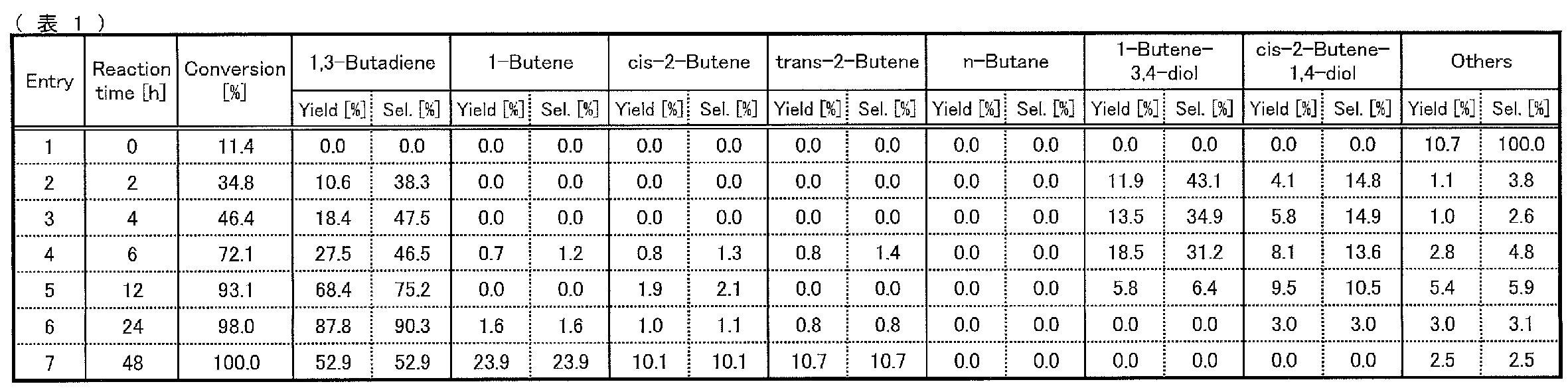
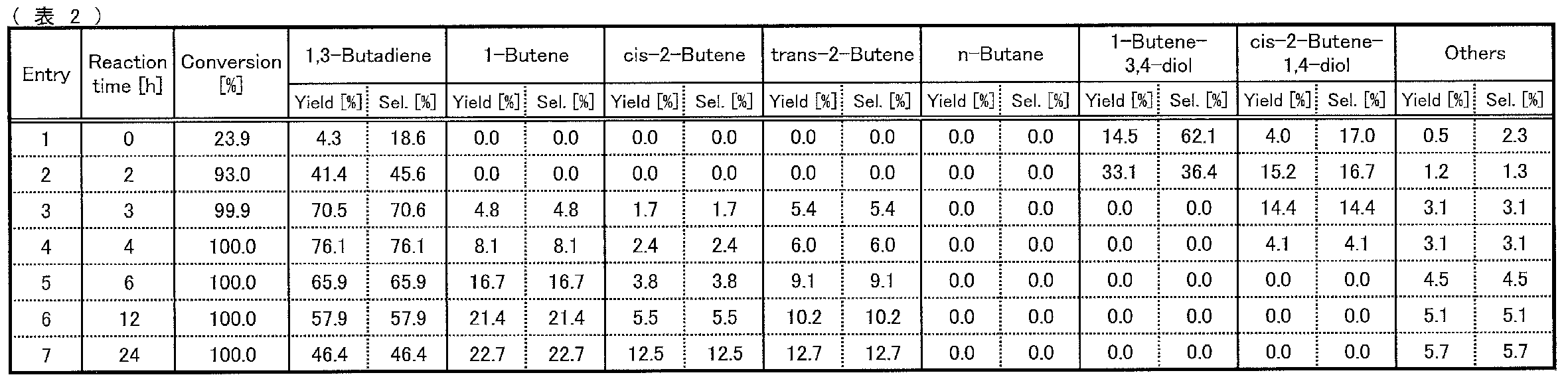
- Example 1 From the amount of erythritol and each product contained in the gas phase and the liquid phase by the above gas phase analysis and the above liquid phase analysis, the conversion rate of erythritol, the yield of the product and the selectivity were calculated.
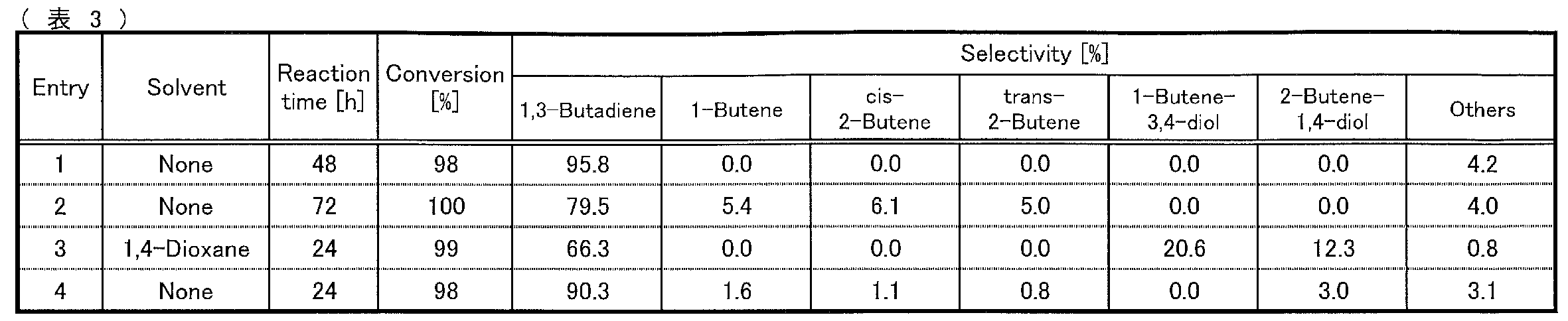
- the results of Example 1 are shown in Tables 1 and 1, and the results of Comparative Example 1 are shown in Tables 2 and 2, respectively.
- the conversion rate is based on the following formula (1), the yield is based on the following formula (2), and the selectivity is based on the following formula (3), and the carbon balance (CB) is 100. It was calculated assuming%. The actual C.I. B. was 93-97%.
- Conversion rate (%) ⁇ input group mass (mol) -residual group mass (mol) ⁇ / input group mass (mol) ⁇ 100 (1)
- Yield of substance A (%) amount of substance A produced (mol) / ⁇ total amount of product (mol) + residual group mass (mol) ⁇ x 100
- Selectivity of substance A (%) amount of substance A produced (mol) / total amount of products (mol) x 100 (3)
- Appendix 1 A compound comprising an olefination step of producing an olefin by reacting a compound having two adjacent carbon atoms having a hydroxy group with hydrogen, and having two adjacent carbon atoms having a hydroxy group in the olefinization step.
- the reaction between and hydrogen is carried on the carrier, at least one oxide selected from the group consisting of the oxides of the Group 6 element and the oxides of the Group 7 element supported on the carrier, and the carrier.
- a method for producing an olefin which comprises proceeding under a condition of substantially no solvent in the presence of a catalyst containing at least one metal selected from the group consisting of silver, iridium, and gold. ..
- Appendix 2 The method for producing an olefin according to Appendix 1, wherein the compound in which two adjacent carbon atoms have a hydroxy group is a liquid under the conditions of the reaction, and the olefin is a gas under the conditions of the reaction. ..
- the compound in which two adjacent carbon atoms have a hydroxy group includes a compound having two or more sets of structures in which two adjacent carbon atoms have a hydroxy group, and as the olefin, the two or more sets of the adjacent compounds.
- the compound in which two adjacent carbon atoms have a hydroxy group includes a compound having two sets of structures in which two adjacent carbon atoms have a hydroxy group, and the diene is produced as the olefin, according to Appendix 1. Method for producing olefins.
- the compound in which two adjacent carbon atoms have a hydroxy group includes a compound having two adjacent sets of structures in which two adjacent carbon atoms have a hydroxy group, and a diene is produced as the olefin.
- Appendix 6 The method for producing an olefin according to Appendix 1, wherein the compound in which two adjacent carbon atoms have a hydroxy group contains erythritol and 1,3-butadiene is produced as the olefin.
- [Appendix 7] The method for producing an olefin according to any one of Supplementary notes 1 to 6, wherein the olefin is produced at a selectivity of 70% or more (preferably 80% or more) in the olefinization step.
- [Appendix 8] The description in any one of the appendices 1 to 7, wherein at least one oxide selected from the group consisting of the oxides of the Group 6 element and the oxides of the Group 7 element contains rhenium oxide.
- the carrier is at least one inorganic oxide (preferably cerium oxide) selected from the group consisting of cerium oxide, silica, magnesia, zinc oxide, alumina, zirconia, and titania.
- the method for producing an olefin according to any one of them includes the carrier and a film of at least one oxide selected from the group consisting of the oxides of Group 6 elements and the oxides of Group 7 elements carried on the carriers.
- [Appendix 11] The method for producing an olefin according to Appendix 10, wherein the catalyst comprises a metal film and an oxide film on the carrier in this order.
- [Appendix 12] The method for producing an olefin according to any one of Supplementary notes 1 to 11, wherein the reaction time in the olefinization step is 10 to 60 hours.
- [Appendix 13] The method for producing an olefin according to any one of Supplementary notes 1 to 12, wherein the reaction temperature in the olefinization step is 50 to 250 ° C.
- the content ratio of the solvent in the raw material mixture in the olefinization step is 0.1 part by mass or less (100 parts by mass) with respect to the total amount (100 parts by mass) of the compound in which the two adjacent carbon atoms have a hydroxy group.
- Substantially free of water and organic solvents eg, alcohols, sulfoxides, amides, ethers, esters, ketones, aliphatic hydrocarbons, alicyclic hydrocarbons, aromatic hydrocarbons, halogenated hydrocarbons).
- a catalyst for an olefination reaction which comprises a film of at least one metal selected from the group consisting of iridium and gold.
- [Appendix 17] The catalyst for olefination reaction according to Appendix 16, wherein the metal film and the oxide film are provided on the carrier in this order.
- [Appendix 18] The catalyst for olefination reaction according to Appendix 16 or 17, wherein at least one oxide selected from the group consisting of the oxides of the Group 6 element and the oxides of the Group 7 element contains rhenium oxide. ..
- the carrier is at least one inorganic oxide (preferably cerium oxide) selected from the group consisting of cerium oxide, silica, magnesia, zinc oxide, alumina, zirconia, and titania.
- the catalyst for olefination reaction according to any one.
- the olefin production method and catalyst of the present disclosure can be used for the production of olefins using adjacent diols as raw materials.
Landscapes
- Chemical & Material Sciences (AREA)
- Organic Chemistry (AREA)
- Engineering & Computer Science (AREA)
- Materials Engineering (AREA)
- Chemical Kinetics & Catalysis (AREA)
- Organic Low-Molecular-Weight Compounds And Preparation Thereof (AREA)
- Catalysts (AREA)
Abstract
Description
上記特定の触媒は、担体と、該担体に担持された、第6族元素の酸化物および第7族元素の酸化物からなる群より選択された少なくとも一種の酸化物(単に「酸化物」と称する場合がある)と、該担体に担持された、銀、イリジウム、および金からなる群より選択された一種の金属とを含む。
上記隣接ジオールは、隣接する2つの炭素原子がヒドロキシ基を有する構造を少なくとも含む化合物である。また、後述のオレフィン化工程を経た結果得られる反応混合物から回収した隣接ジオール(未反応の隣接ジオール)を再利用することもできる。上記隣接ジオールは上記反応の条件下において液体であることが好ましい。

上記オレフィン、すなわち、上記触媒の存在下で上記隣接ジオールと水素とを反応させて生成するオレフィンは、原料の隣接ジオールに対応するオレフィンである。なお、触媒として上記触媒を用いた上記オレフィン化工程における反応では、隣接ジオールの2つのヒドロキシ基を同時に除去する反応(DODH:Deoxy-dehydration)により、隣接ジオールの2つのヒドロキシ基がそれぞれ結合している隣接炭素原子同士で炭素-炭素二重結合を有するオレフィンまたはその異性体が高効率で生成する。上記オレフィンは上記反応の条件下において気体であることが好ましい。
上記水素(水素ガス)は、実質的に水素のみの状態で使用することもできるし、窒素、アルゴン、ヘリウム等の不活性ガスなどにより希釈した状態で使用することもできる。また、上記オレフィン化工程を経た結果得られる反応混合物から回収した水素(未反応の水素)を再利用することもできる。
上記脱水反応工程におけるエリスリトールの分子内脱水反応は、周知の方法により実施することができ、特に限定されないが、例えば、酸触媒の存在下でエリスリトールを加熱することにより進行させることができる。なお、上記脱水反応工程は、上記オレフィン化工程とは別ラインで実施してもよいし、上記オレフィン化工程と一連の工程として実施してもよい。
[触媒(ReOX-Ag/CeO2)の製造]
硝酸銀(I)(AgNO3、富士フイルム和光純薬株式会社製)6mgを、蒸留水10mLで希釈した硝酸銀(I)水溶液を作製した。また、過レニウム酸アンモニウム(NH4ReO4、三津和化学薬品株式会社製)29mgを、20℃の蒸留水10mLに溶解させ、過レニウム酸アンモニウム水溶液を作製した。そして、商品名「HS」(酸化セリウム、第一稀元素化学工業株式会社製)を、空気雰囲気下で600℃、3時間(昇温速度10℃/min)の条件で前焼成を行った。次いで、80℃に加熱した焼成後の酸化セリウム0.997gに、液だまりができないように上記硝酸銀(I)水溶液を5回に分けて全量加え、攪拌して含浸させた。これを乾燥機内にて110℃で一晩(12時間以上)乾燥させた後、空気雰囲気下で、500℃、3時間(昇温速度10℃/min)の条件で焼成を行った。焼成後、さらに、80℃に加熱しながら、液だまりができないように上記過レニウム酸アンモニウム水溶液を5回に分けて全量加え、攪拌して含浸させた。これを乾燥機内にて110℃で一晩(12時間以上)乾燥させた後、空気雰囲気下で、500℃、3時間(昇温速度10℃/min)の条件で焼成を行った。このようにして、レニウムの担持量が1質量%、[Ag/Re]=0.3である触媒(ReOX-Ag/CeO2)を得た。
[触媒(ReOX-Au/CeO2)の製造]
硝酸銀(I)水溶液の代わりに、テトラクロロ金(III)酸四水和物(HAuCl4・4H2O、富士フイルム和光純薬株式会社製)11mgを、蒸留水10mLで希釈したテトラクロロ金(III)酸水溶液を用いたこと、及び酸化セリウムを0.975gとしたこと以外は製造例1と同様にして、レニウムの担持量が1重量%、[Au/Re]=0.3である触媒(ReOX-Au/CeO2)を製造した。
ガラス製のオートクレーブ用内筒に、スターラーチップと、秤量した製造例1で得られた触媒(ReOX-Ag/CeO2)0.3gと、エリスリトール0.25gとを入れた。上記オートクレーブ用内筒を190mLオートクレーブ(高圧回分式反応装置)に入れ、中蓋をし、パッキンを挟み蓋をして、六角レンチを使って締め、密封した。次いで、オートクレーブの内部に1MPaの水素を張り込んだ後に排気して大気圧より少し高圧に戻す操作を3回繰り返し、オートクレーブ内の空気を水素で置換した。このオートクレーブに、反応温度で8MPaを示すよう、室温で5.8MPaを示すように水素を充填した。
続いて、オートクレーブをマグネットスターラー付加熱装置にセットし、オートクレーブ内部の温度が140℃になるように加熱し、反応温度を140℃に維持しながら250rpmで所定の反応時間撹拌した。反応開始時は、反応温度である140℃よりも2℃低い138℃となった時とした。昇温速度は、昇温時間が40分程度となるように調節した。
その後、反応器を取り出し、水浴にて100℃程度まで冷却し、反応器内の気体を全量回収した。さらに、回収した量と同量程度の水素を導入した後、再度、反応器内の気体を全量回収した。
気体の回収後、水浴にて反応器を室温まで冷却し、オートクレーブ内に回収溶媒(1,4-ジオキサン10gと水5gの混合溶液)を添加して液相を回収した。
ガラス製のオートクレーブ用内筒に、スターラーチップと、秤量した製造例1で得られた触媒(ReOX-Ag/CeO2)0.3gと、エリスリトール0.25gと、1,4-ジオキサン4gとを入れたこと以外は、実施例1と同様にして操作を行った。
製造例1で得られた触媒(ReOX-Ag/CeO2)0.3gに代えて、製造例2で得られた触媒(ReOX-Au/CeO2)0.3gを用いたこと以外は、実施例1と同様にして操作を行った。
製造例1で得られた触媒(ReOX-Ag/CeO2)0.3gに代えて、製造例2で得られた触媒(ReOX-Au/CeO2)0.3gを用いたこと以外は、比較例1と同様にして操作を行った。
(1)気相分析(FID-GC)
回収した気体が充填されたガスバッグに内部標準物質としてのジクロロメタン0.1mLを入れ、ガスクロマトグラフィー(ガスクロマトグラフ装置:「GC-2025」(株式会社島津製作所製)、カラム:Rtx1-PONA、検出器:FID)を用いたFID分析およびGC-MSにより分析した。これより、気相中のエリスリトールおよび各生成物の量を算出した。なお、1,3-ブタジエンおよび1-ブテンはFID-GC分析により分離できなかったため、下記の気相分析(GC-MS)により分離を行い、収率および選択率を算出した。上記ガスクロマトグラフィーの詳細条件は以下の通りである。
<FID-GC条件>
カラムサイズ:内径0.25mm×長さ100mm×膜厚0.5μm
カラム温度:40℃で25分間維持後、昇温速度100℃/minで240℃まで昇温し、12分間維持
気化室温度:270℃
検出器温度:300℃
キャリアガス:N2
GC設定パラメータ
カラム入口圧:100.0kPa
カラム流量:0.44mL/min
線速度:10.2cm/sec
全流量:42.8mL/min
スプリット比:90.0
制御モード:圧力
上記気相分析(FID-GC)に付したサンプルについて、ガスクロマトグラフィー(ガスクロマトグラフ装置:「GCMS-QP2010 SE」(株式会社島津製作所製)、カラム:Rtx1-PONA)を用いEI法により分析した。分析結果から、1,3-ブタジエンのMSスペクトルである54と1-ブテンのMSスペクトルである56のピークエリア値の面積比を算出し、そのピークエリア値の面積比とFID-GCでのエリア値の合計値とから、気相中の1,3-ブタジエンおよび1-ブテンの量を算出した。上記ガスクロマトグラフィーの詳細条件は以下の通りである。
<GC-MS条件>
カラムサイズ:内径0.25mm×長さ100mm×膜厚0.5μm
カラム温度:40℃で20分間維持後、昇温速度100℃/minで240℃まで昇温し、12分間維持
気化室温度:270℃
検出器温度:300℃
キャリアガス:He
GC設定パラメータ
カラム入口圧:900.0kPa
カラム流量:4.32mL/min
線速度:75.0cm/sec
全流量:396.5mL/min
スプリット比:90.0
制御モード:圧力
回収した液相に内部標準物質としてのジプロピレングリコールジメチルエーテル0.1mLを加え、メンブレンフィルターでろ過して分析用サンプルを作製した。これを、ガスクロマトグラフィー(ガスクロマトグラフ装置:「GC-2014」(株式会社島津製作所製)、カラム:TC-WAX、検出器:FID)を用いたFID分析およびGC-MSにより分析した。これより、液相中の各生成物の量を算出した。上記ガスクロマトグラフィーの詳細条件は以下の通りである。
<FID-GC条件>
カラムサイズ:内径0.25mm×長さ30mm×膜厚0.25μm
カラム温度:50℃で5分間維持後、昇温速度10℃/minで230℃まで昇温し、12分間維持
気化室温度:250℃
検出器温度:240℃
キャリアガス:N2
GC設定パラメータ
カラム入口圧:75.0kPa
カラム流量:0.96mL/min
線速度:25.2cm/sec
全流量:32.7mL/min
スプリット比:30.0
制御モード:圧力
上記液相分析(FID-GC)で作製した分析用サンプルを、ジプロピレングリコールジメチルエーテルで10倍希釈した。これを、高速液体クロマトグラフィー(「LC-20A」(株式会社島津製作所製)、カラム:Aminex HPX-87H、移動相:0.01M H2SO4aq.、流速:0.6mL/min、オーブン温度:50℃)により分析した。これより、液相中のエリスリトールの量を算出した。
転化率(%)={投入基質量(mol)-残存基質量(mol)}/投入基質量(mol)×100 (1)
物質Aの収率(%)=物質Aの生成量(mol)/{生成物の合計量(mol)+残存基質量(mol)}×100 (2)
物質Aの選択率(%)=物質Aの生成量(mol)/生成物の合計量(mol)×100 (3)
[付記1]隣接する2つの炭素原子がヒドロキシ基を有する化合物と水素との反応によりオレフィンを生成させるオレフィン化工程を含み、前記オレフィン化工程における前記隣接する2つの炭素原子がヒドロキシ基を有する化合物と水素との反応を、担体と、該担体に担持された、第6族元素の酸化物および第7族元素の酸化物からなる群より選択された少なくとも一種の酸化物と、前記担体に担持された、銀、イリジウム、および金からなる群より選択された少なくとも一種の金属とを含む触媒の存在下、溶媒を実質的に含有しない条件下で進行させることを特徴とする、オレフィンの製造方法。
[付記2]前記隣接する2つの炭素原子がヒドロキシ基を有する化合物は前記反応の条件下において液体であり、前記オレフィンは前記反応の条件下において気体である、付記1に記載のオレフィンの製造方法。
[付記3]前記隣接する2つの炭素原子がヒドロキシ基を有する化合物は隣接する2つの炭素原子がヒドロキシ基を有する構造を2組以上有する化合物を含み、前記オレフィンとして、前記2組以上の前記隣接する2つの炭素原子同士全てが炭素-炭素二重結合を形成しているオレフィンを製造する、付記1に記載のオレフィンの製造方法。
[付記4]前記隣接する2つの炭素原子がヒドロキシ基を有する化合物は隣接する2つの炭素原子がヒドロキシ基を有する構造を2組有する化合物を含み、前記オレフィンとしてジエンを製造する、付記1に記載のオレフィンの製造方法。
[付記5]前記隣接する2つの炭素原子がヒドロキシ基を有する化合物は隣接する2つの炭素原子がヒドロキシ基を有する構造を隣接して2組有する化合物を含み、前記オレフィンとしてジエンを製造する、付記1に記載のオレフィンの製造方法。
[付記6]前記隣接する2つの炭素原子がヒドロキシ基を有する化合物はエリスリトールを含み、前記オレフィンとして1,3-ブタジエンを製造する、付記1に記載のオレフィンの製造方法。
[付記7]前記オレフィン化工程において、前記オレフィンを選択率70%以上(好ましくは80%以上)で製造する、付記1~6のいずれか1つに記載のオレフィンの製造方法。
[付記8]前記第6族元素の酸化物および第7族元素の酸化物からなる群より選択された少なくとも一種の酸化物が酸化レニウムを含む、付記1~7のいずれか1つに記載のオレフィンの製造方法。
[付記9]前記担体が、酸化セリウム、シリカ、マグネシア、酸化亜鉛、アルミナ、ジルコニア、およびチタニアからなる群より選択された少なくとも一種の無機酸化物(好ましくは酸化セリウム)である付記1~8のいずれか1つに記載のオレフィンの製造方法。
[付記10]前記触媒は、前記担体と、前記担体に担持された、第6族元素の酸化物及び第7族元素の酸化物からなる群より選択された少なくとも一種の酸化物の膜と、前記担体に担持された、銀、イリジウム、及び金からなる群より選択された少なくとも一種の金属の膜とを備える、付記1~9のいずれか1つに記載のオレフィンの製造方法。
[付記12]前記オレフィン化工程における反応時間が10~60時間である付記1~11のいずれか1つに記載のオレフィンの製造方法。
[付記13]前記オレフィン化工程における反応温度が50~250℃である付記1~12のいずれか1つに記載のオレフィンの製造方法。
[付記14]前記オレフィン化工程における原料混合物中の溶媒の含有割合が、前記隣接する2つの炭素原子がヒドロキシ基を有する化合物の総量(100質量部)に対して、0.1質量部以下(好ましくは0.05質量部以下、より好ましくは0.01質量部以下)である、付記1~13のいずれか1つに記載のオレフィンの製造方法。
[付記15]水および有機溶媒(例えば、アルコール、スルホキシド、アミド、エーテル、エステル、ケトン、脂肪族炭化水素、脂環式炭化水素、芳香族炭化水素、ハロゲン化炭化水素)を実質的に含有しない条件下で前記オレフィン化工程における前記反応を進行させる、付記1~14のいずれか1つに記載のオレフィンの製造方法。
[付記16]隣接する2つの炭素原子がヒドロキシ基を有する化合物と水素との反応によりオレフィンを生成させる反応に用いられる触媒であって、
担体と、前記担体に担持された、第6族元素の酸化物及び第7族元素の酸化物からなる群より選択された少なくとも一種の酸化物の膜と、前記担体に担持された、銀、イリジウム、及び金からなる群より選択された少なくとも一種の金属の膜とを備えることを特徴とするオレフィン化反応用触媒。
[付記17]前記担体上に、前記金属の膜と、前記酸化物の膜とをこの順に備える、付記16に記載のオレフィン化反応用触媒。
[付記18]前記第6族元素の酸化物および第7族元素の酸化物からなる群より選択された少なくとも一種の酸化物が酸化レニウムを含む、付記16または17に記載のオレフィン化反応用触媒。
[付記19]前記担体が、酸化セリウム、シリカ、マグネシア、酸化亜鉛、アルミナ、ジルコニア、およびチタニアからなる群より選択された少なくとも一種の無機酸化物(好ましくは酸化セリウム)である付記16~18のいずれか1つに記載のオレフィン化反応用触媒。
Claims (12)
- 隣接する2つの炭素原子がヒドロキシ基を有する化合物と水素との反応によりオレフィンを生成させるオレフィン化工程を含み、前記オレフィン化工程における前記隣接する2つの炭素原子がヒドロキシ基を有する化合物と水素との反応を、担体と、該担体に担持された、第6族元素の酸化物および第7族元素の酸化物からなる群より選択された少なくとも一種の酸化物と、前記担体に担持された、銀、イリジウム、および金からなる群より選択された少なくとも一種の金属とを含む触媒の存在下、溶媒を実質的に含有しない条件下で進行させることを特徴とする、オレフィンの製造方法。
- 前記隣接する2つの炭素原子がヒドロキシ基を有する化合物は前記反応の条件下において液体であり、前記オレフィンは前記反応の条件下において気体である、請求項1に記載のオレフィンの製造方法。
- 前記隣接する2つの炭素原子がヒドロキシ基を有する化合物は隣接する2つの炭素原子がヒドロキシ基を有する構造を2組以上有する化合物を含み、前記オレフィンとして、前記2組以上の前記隣接する2つの炭素原子同士全てが炭素-炭素二重結合を形成しているオレフィンを製造する、請求項1に記載のオレフィンの製造方法。
- 前記隣接する2つの炭素原子がヒドロキシ基を有する化合物は隣接する2つの炭素原子がヒドロキシ基を有する構造を2組有する化合物を含み、前記オレフィンとしてジエンを製造する、請求項1に記載のオレフィンの製造方法。
- 前記隣接する2つの炭素原子がヒドロキシ基を有する化合物はエリスリトールを含み、前記オレフィンとして1,3-ブタジエンを製造する、請求項1に記載のオレフィンの製造方法。
- 前記オレフィン化工程において、前記オレフィンを選択率70%以上で製造する、請求項1~5のいずれか1項に記載のオレフィンの製造方法。
- 前記第6族元素の酸化物および第7族元素の酸化物からなる群より選択された少なくとも一種の酸化物が酸化レニウムを含む、請求項1~6のいずれか1項に記載のオレフィンの製造方法。
- 前記担体が、酸化セリウム、シリカ、マグネシア、酸化亜鉛、アルミナ、ジルコニア、およびチタニアからなる群より選択された少なくとも一種の無機酸化物である請求項1~7のいずれか1項に記載のオレフィンの製造方法。
- 前記触媒は、前記担体と、前記担体に担持された、第6族元素の酸化物及び第7族元素の酸化物からなる群より選択された少なくとも一種の酸化物の膜と、前記担体に担持された、銀、イリジウム、及び金からなる群より選択された少なくとも一種の金属の膜とを備える、請求項1~8のいずれか1項に記載のオレフィンの製造方法。
- 前記オレフィン化工程における反応時間が10~60時間である請求項1~9のいずれか1項に記載のオレフィンの製造方法。
- 前記オレフィン化工程における反応温度が50~250℃である請求項1~10のいずれか1項に記載のオレフィンの製造方法。
- 隣接する2つの炭素原子がヒドロキシ基を有する化合物と水素との反応によりオレフィンを生成させる反応に用いられる触媒であって、
担体と、前記担体に担持された、第6族元素の酸化物及び第7族元素の酸化物からなる群より選択された少なくとも一種の酸化物の膜と、前記担体に担持された、銀、イリジウム、及び金からなる群より選択された少なくとも一種の金属の膜とを備えることを特徴とするオレフィン化反応用触媒。
Priority Applications (3)
| Application Number | Priority Date | Filing Date | Title |
|---|---|---|---|
| JP2022551916A JPWO2022065152A1 (ja) | 2020-09-28 | 2021-09-15 | |
| CN202180065920.XA CN116234787A (zh) | 2020-09-28 | 2021-09-15 | 烯烃的制造方法及烯烃化反应用催化剂 |
| US18/028,589 US12410109B2 (en) | 2020-09-28 | 2021-09-15 | Method for producing olefin and olefination reaction catalyst |
Applications Claiming Priority (2)
| Application Number | Priority Date | Filing Date | Title |
|---|---|---|---|
| JP2020-162491 | 2020-09-28 | ||
| JP2020162491 | 2020-09-28 |
Publications (1)
| Publication Number | Publication Date |
|---|---|
| WO2022065152A1 true WO2022065152A1 (ja) | 2022-03-31 |
Family
ID=80846454
Family Applications (1)
| Application Number | Title | Priority Date | Filing Date |
|---|---|---|---|
| PCT/JP2021/033896 Ceased WO2022065152A1 (ja) | 2020-09-28 | 2021-09-15 | オレフィンの製造方法およびオレフィン化反応用触媒 |
Country Status (5)
| Country | Link |
|---|---|
| US (1) | US12410109B2 (ja) |
| JP (1) | JPWO2022065152A1 (ja) |
| CN (1) | CN116234787A (ja) |
| TW (1) | TW202231356A (ja) |
| WO (1) | WO2022065152A1 (ja) |
Citations (4)
| Publication number | Priority date | Publication date | Assignee | Title |
|---|---|---|---|---|
| JP2009275029A (ja) * | 2008-04-16 | 2009-11-26 | Univ Of Tsukuba | グリセリンの還元方法、および触媒 |
| JP2015003892A (ja) * | 2013-06-24 | 2015-01-08 | 宇部興産株式会社 | ポリオール化合物の製造方法 |
| JP2017051941A (ja) * | 2015-09-08 | 2017-03-16 | 株式会社ダイセル | オレフィン化反応用触媒及びオレフィンの製造方法 |
| JP2017057179A (ja) * | 2015-09-18 | 2017-03-23 | 昭和シェル石油株式会社 | 反応装置及び炭化水素の製造方法 |
Family Cites Families (6)
| Publication number | Priority date | Publication date | Assignee | Title |
|---|---|---|---|---|
| DE4422671A1 (de) | 1994-06-30 | 1996-01-04 | Basf Ag | Verfahren zur Herstellung von 2,5-Dihydrofuran |
| JP2000063302A (ja) | 1998-08-18 | 2000-02-29 | Central Glass Co Ltd | フッ素化プロパンの製造方法 |
| JP2000297083A (ja) | 1999-04-15 | 2000-10-24 | Mitsubishi Chemicals Corp | 2,5−ジヒドロフランの製造方法 |
| JP2009107949A (ja) | 2007-10-29 | 2009-05-21 | Nippon Shokubai Co Ltd | アリルアルコール化合物の製造方法 |
| JP5721238B2 (ja) | 2010-03-01 | 2015-05-20 | 国立大学法人北海道大学 | 低品位グリセリンからのアリルアルコールとプロピレンの製造方法、及びそのための触媒 |
| JP5657465B2 (ja) | 2011-04-28 | 2015-01-21 | 株式会社クラレ | アリルアルコール化合物の製造方法 |
-
2021
- 2021-09-15 WO PCT/JP2021/033896 patent/WO2022065152A1/ja not_active Ceased
- 2021-09-15 JP JP2022551916A patent/JPWO2022065152A1/ja active Pending
- 2021-09-15 CN CN202180065920.XA patent/CN116234787A/zh active Pending
- 2021-09-15 US US18/028,589 patent/US12410109B2/en active Active
- 2021-09-23 TW TW110135326A patent/TW202231356A/zh unknown
Patent Citations (4)
| Publication number | Priority date | Publication date | Assignee | Title |
|---|---|---|---|---|
| JP2009275029A (ja) * | 2008-04-16 | 2009-11-26 | Univ Of Tsukuba | グリセリンの還元方法、および触媒 |
| JP2015003892A (ja) * | 2013-06-24 | 2015-01-08 | 宇部興産株式会社 | ポリオール化合物の製造方法 |
| JP2017051941A (ja) * | 2015-09-08 | 2017-03-16 | 株式会社ダイセル | オレフィン化反応用触媒及びオレフィンの製造方法 |
| JP2017057179A (ja) * | 2015-09-18 | 2017-03-23 | 昭和シェル石油株式会社 | 反応装置及び炭化水素の製造方法 |
Non-Patent Citations (1)
| Title |
|---|
| ANONYMOUS: "Demonstration project for manufacturing C4 chemical products from biomass", DAICEL CO., LTD., 30 March 2020 (2020-03-30), XP055914529, Retrieved from the Internet <URL:https://warp.da.ndl.go.jp/info:ndljp/pid/11518682/www.env.go.jp/recycle/R01_003_Daicel.pdf> * |
Also Published As
| Publication number | Publication date |
|---|---|
| CN116234787A (zh) | 2023-06-06 |
| US20230339827A1 (en) | 2023-10-26 |
| US12410109B2 (en) | 2025-09-09 |
| JPWO2022065152A1 (ja) | 2022-03-31 |
| TW202231356A (zh) | 2022-08-16 |
Similar Documents
| Publication | Publication Date | Title |
|---|---|---|
| CN104718196B (zh) | 3‑羟基四氢呋喃的制造方法、1,3‑丁二醇的制造方法 | |
| CN106414383A (zh) | 用于产生烯醇的工艺和其用于产生1,3‑丁二烯的用途 | |
| JP6871446B2 (ja) | オレフィン化反応用触媒及びオレフィンの製造方法 | |
| JP6345654B2 (ja) | テトラヒドロフランの製造方法 | |
| EP3227258A1 (en) | A method for synthesizing an alkenoic acid | |
| CN104667924A (zh) | 一种用于甘油加氢制1,3-丙二醇的催化剂及其制备方法 | |
| US11040334B2 (en) | Catalyst for reduction reaction of 3,4-dihydroxytetrahydrofuran, and method for producing 3,4-dihydroxytetrahydrofuran reduced product | |
| WO2013133208A1 (ja) | テトラヒドロフラン化合物の製造方法 | |
| WO2022065152A1 (ja) | オレフィンの製造方法およびオレフィン化反応用触媒 | |
| JP5797587B2 (ja) | 1,4−アンヒドロエリスリトールの水素化分解物の製造方法 | |
| JP5827925B2 (ja) | エリスリトールの水素化分解物の製造方法 | |
| JP6263434B2 (ja) | 1,3−プロパンジオールの製造方法 | |
| JP5736251B2 (ja) | エリスリトールの水素化分解物の製造方法 | |
| JP5914122B2 (ja) | プロパンジオールの製造方法 | |
| JP6089037B2 (ja) | シス−ローズオキシドの生成方法 | |
| JP7404098B2 (ja) | 3,4-ジヒドロキシテトラヒドロフランの還元反応用触媒 | |
| JP7786568B2 (ja) | アルキル基含有不飽和環状エーテル製造用触媒、アルキル基含有不飽和環状エーテルの製造方法、及びアルキル基含有飽和環状エーテルの製造方法 | |
| KR102954487B1 (ko) | 알킬기 함유 불포화 환상 에테르 제조용 촉매, 알킬기 함유 불포화 환상 에테르의 제조 방법, 및 알킬기 함유 포화 환상 에테르의 제조 방법 | |
| JP6988642B2 (ja) | アリル化合物の異性化方法 |
Legal Events
| Date | Code | Title | Description |
|---|---|---|---|
| 121 | Ep: the epo has been informed by wipo that ep was designated in this application |
Ref document number: 21872282 Country of ref document: EP Kind code of ref document: A1 |
|
| ENP | Entry into the national phase |
Ref document number: 2022551916 Country of ref document: JP Kind code of ref document: A |
|
| NENP | Non-entry into the national phase |
Ref country code: DE |
|
| 122 | Ep: pct application non-entry in european phase |
Ref document number: 21872282 Country of ref document: EP Kind code of ref document: A1 |
|
| WWG | Wipo information: grant in national office |
Ref document number: 18028589 Country of ref document: US |