WO2022045304A1 - 2-(ハロゲン化メチル)ナフタレン及び2-ナフチルアセトニトリルの製造方法 - Google Patents
2-(ハロゲン化メチル)ナフタレン及び2-ナフチルアセトニトリルの製造方法 Download PDFInfo
- Publication number
- WO2022045304A1 WO2022045304A1 PCT/JP2021/031570 JP2021031570W WO2022045304A1 WO 2022045304 A1 WO2022045304 A1 WO 2022045304A1 JP 2021031570 W JP2021031570 W JP 2021031570W WO 2022045304 A1 WO2022045304 A1 WO 2022045304A1
- Authority
- WO
- WIPO (PCT)
- Prior art keywords
- reaction
- naphthalene
- methylnaphthalene
- reactor
- present
- Prior art date
- Legal status (The legal status is an assumption and is not a legal conclusion. Google has not performed a legal analysis and makes no representation as to the accuracy of the status listed.)
- Ceased
Links
Images
Classifications
-
- C—CHEMISTRY; METALLURGY
- C07—ORGANIC CHEMISTRY
- C07C—ACYCLIC OR CARBOCYCLIC COMPOUNDS
- C07C255/00—Carboxylic acid nitriles
- C07C255/01—Carboxylic acid nitriles having cyano groups bound to acyclic carbon atoms
- C07C255/32—Carboxylic acid nitriles having cyano groups bound to acyclic carbon atoms having cyano groups bound to acyclic carbon atoms of a carbon skeleton containing at least one six-membered aromatic ring
- C07C255/33—Carboxylic acid nitriles having cyano groups bound to acyclic carbon atoms having cyano groups bound to acyclic carbon atoms of a carbon skeleton containing at least one six-membered aromatic ring with cyano groups linked to the six-membered aromatic ring, or to the condensed ring system containing that ring, by saturated carbon chains
-
- C—CHEMISTRY; METALLURGY
- C07—ORGANIC CHEMISTRY
- C07C—ACYCLIC OR CARBOCYCLIC COMPOUNDS
- C07C17/00—Preparation of halogenated hydrocarbons
- C07C17/093—Preparation of halogenated hydrocarbons by replacement by halogens
- C07C17/10—Preparation of halogenated hydrocarbons by replacement by halogens of hydrogen atoms
- C07C17/14—Preparation of halogenated hydrocarbons by replacement by halogens of hydrogen atoms in the side-chain of aromatic compounds
-
- C—CHEMISTRY; METALLURGY
- C07—ORGANIC CHEMISTRY
- C07C—ACYCLIC OR CARBOCYCLIC COMPOUNDS
- C07C22/00—Cyclic compounds containing halogen atoms bound to an acyclic carbon atom
- C07C22/02—Cyclic compounds containing halogen atoms bound to an acyclic carbon atom having unsaturation in the rings
- C07C22/04—Cyclic compounds containing halogen atoms bound to an acyclic carbon atom having unsaturation in the rings containing six-membered aromatic rings
-
- C—CHEMISTRY; METALLURGY
- C07—ORGANIC CHEMISTRY
- C07C—ACYCLIC OR CARBOCYCLIC COMPOUNDS
- C07C253/00—Preparation of carboxylic acid nitriles
- C07C253/14—Preparation of carboxylic acid nitriles by reaction of cyanides with halogen-containing compounds with replacement of halogen atoms by cyano groups
Definitions
- the present invention relates to a method for producing 2- (methyl halide) naphthalene and 2-naphthylacetonitrile, which are useful as synthetic intermediates for pharmaceutical products and the like.
- 2- (Methyl halide) naphthalene is useful as a synthetic raw material or intermediate for various pharmaceuticals, pesticides, chemical products and the like. Further, a naphthalene compound having a chemical structure similar to 2- (methyl halide) naphthalene is also expected to be used as a synthetic raw material or a synthetic intermediate for various pharmaceuticals, pesticides and chemical products. For example, 2- (methyl halide) naphthalene and 2-naphthyl acetonitrile having a similar chemical structure are useful as synthetic raw materials or intermediates for attention deficit / hyperactivity disorder (ADHD) therapeutic agents.
- ADHD attention deficit / hyperactivity disorder
- 2- (methyl halide) naphthalene and 2-naphthyl acetonitrile are (1R, 5S) -1- (naphthalene-2-yl) -3-azabicyclo [3.1.0] hexane ( It can be suitably used as a synthetic raw material or a synthetic intermediate of (generic name: centanafazine).
- a batch reaction method has been known as a method for producing 2- (methyl halide) naphthalene.
- Non-Patent Document 1 a method of adding 2-methylnaphthalene, N-bromosuccinimide, dichloromethane, benzene and trityl fluoroborate to a batch reaction vessel and photoreacting them at room temperature under light irradiation to produce 2- (bromomethyl) naphthalene.
- the photoreaction refers to a general chemical reaction in which a molecule absorbs energy by irradiation with light to bring the molecule into an excited state with a high energy level, and the excited molecule causes a reaction. Photoreactions are also called photochemical reactions.
- Non-Patent Document 1 is a reaction using a benzene solvent, and it is extremely difficult to use a benzene solvent industrially in terms of safety, and the yield of the obtained 2- (bromomethyl) naphthalene is also industrially high. Not satisfactory. Therefore, a safer and more productive industrial manufacturing method is desired.
- a continuous halogenation reaction method has been known in order to increase productivity. For example, a method for continuously producing 4-tert-butylbenzyl bromide by irradiating a solution of 4-tert-butyltoluene and N-bromosuccinimide with an acetonitrile solvent with light in a flow-type photochemical reactor is known. (Non-Patent Document 2).
- Non-Patent Document 3 describes that 2-naphthyl acetonitrile is produced by cyanating 2- (methyl halide) naphthalene.
- An object of the present invention is to provide a method for producing 2- (methyl halide) naphthalene safely and inexpensively and a method for producing 2-naphthylacetonitrile under high selectivity and good yield. ..
- the present inventors have reacted 2-methylnaphthalene with a halogenating agent in a specific organic solvent under light irradiation, whereby high selectivity, good yield, safe and inexpensive.
- 2- (methyl halide) naphthalene can be obtained and 2-naphthyl acetonitrile can be obtained, and completed the present invention. That is, the present invention is characterized by the following.
- the general formula (1) including a halogenation step of reacting 2-methylnaphthalene with a halogenating agent under light irradiation in an organic solvent selected from halogenated hydrocarbons, aliphatic esters and aliphatic hydrocarbons. ):
- X represents a halogen atom.
- a method for producing 2- (methyl halide) naphthalene represented by. [2] The production method according to the above [1], wherein the halogenating agent is a brominating agent. [3] The production method according to [1] or [2], wherein the light irradiation is performed using light having a wavelength of 280 nm to 700 nm. [4] The production method according to any one of [1] to [3], wherein the reaction is carried out in the range of ⁇ 20 ° C. to 100 ° C. [5] The production method according to any one of [1] to [4], wherein the reaction is carried out in the absence of an additive.
- 2- (methyl halide) naphthalene of the present invention 2- (methyl halide) naphthalene can be produced safely and inexpensively with high selectivity and good yield. Further, according to the method for producing 2-naphthylacetonitrile of the present invention, 2-naphthylacetonitrile can be produced safely and inexpensively with high selectivity and good yield.
- 2-methylnaphthalene is a halogenating agent in an organic solvent selected from halogenated hydrocarbons, aliphatic esters and aliphatic hydrocarbons under light irradiation.
- organic solvent selected from halogenated hydrocarbons, aliphatic esters and aliphatic hydrocarbons under light irradiation.
- X represents a halogen atom.
- 2- (Methyl halide) naphthalene represented by hereinafter, may be referred to as halogenated naphthalene) (hereinafter, this step may be referred to as "halogenation step of the present invention”).
- Halogen atom means a fluorine atom, a chlorine atom, a bromine atom or an iodine atom.
- the "halogen atom” is preferably a chlorine atom, a bromine atom or an iodine atom, and particularly preferably a bromine atom from the viewpoint of reactivity.
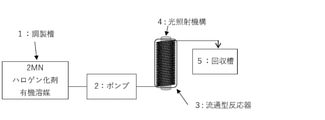
- Examples of the method for carrying out the halogenation step of the present invention include a method in which 2-methylnaphthalene, a halogenating agent and an organic solvent are mixed in a batch reactor and irradiated with light under reaction conditions to cause a reaction. Further, as shown in FIG. 1, 2-methylnaphthalene (2MN) prepared in the preparation tank 1 and an organic solvent were used while irradiating the transmissive flow reactor 3 provided with the light irradiation mechanism 4 of the present invention with light. The mixed solution of the halogenating agent is continuously pumped by the pump 2, 2-methylnaphthalene is continuously halogenated in the flow reactor 3, and 2- (halogenation) flows out from the flow reactor 3.
- a method using a flow synthesis reactor in which the reaction solution containing methyl) naphthalene is recovered in the recovery tank 5 can be mentioned.
- the halogenation step of the present invention is preferably carried out by a flow synthesis reaction using a flow synthesis reactor. This flow synthesis reactor will be described later.
- 2-methylnaphthalene which is a raw material for producing 2- (methyl halide) naphthalene
- a commercially available product may be used, or a known method or a method obtained thereto may be used.
- the organic solvent used in the present invention is selected from halogenated hydrocarbons, aliphatic esters and aliphatic hydrocarbons, and these may be used alone or in an arbitrary ratio of two or more.
- halogenated hydrocarbons and aliphatic esters alone.
- Halogenated hydrocarbons are aliphatic hydrocarbons substituted with one or more halogen atoms and are usually halogenated with 1 to 10 carbon atoms, preferably 1 to 8 carbon atoms, particularly preferably 1 to 6 carbon atoms. Examples include aliphatic hydrocarbons.
- halogenated hydrocarbon examples include dichloromethane, chloroform, carbon tetrachloride, trichlorethylene, tetrachlorethylene, dichloroethane, and 1,1,2,2-tetrachloroethane, and examples thereof include reactivity, selectivity, safety and availability. From the viewpoint of the above, dichloromethane and dichloroethane are preferable, and dichloromethane is particularly preferable.
- Aliphatic esters are aliphatic hydrocarbons having one or more ester bonds, and usually include aliphatic esters having 1 to 10 carbon atoms, preferably 1 to 8 carbon atoms, and particularly preferably 1 to 6 carbon atoms. Be done.
- the aliphatic ester examples include acetates of methyl acetate, ethyl acetate and propyl acetate, and from the viewpoint of reactivity, selectivity and availability, methyl acetate and ethyl acetate are preferable, and they are safe. From the viewpoint, methyl acetate is particularly preferable.
- the aliphatic hydrocarbon is a cyclic or chain aliphatic hydrocarbon, and examples thereof include an aliphatic hydrocarbon having 5 to 12 carbon atoms, preferably 5 to 10 carbon atoms, and particularly preferably 5 to 8 carbon atoms. ..
- cyclic aliphatic hydrocarbon examples include cyclopentane, cyclohexane, cycloheptan, cyclooctane, methylcyclopentane, ethylcyclopentane, methylcyclohexane, ethylcyclohexane, 1,2-dimethylcyclohexane, 1,3-dimethylcyclohexane, and 1 , 4-Dimethylcyclohexane, isopropylcyclohexane, n-propylcyclohexane, t-butylcyclohexane, n-butylcyclohexane, and isobutylcyclohexane, preferably cyclopentane, cyclohexane, cycloheptane, and cyclooctane from the viewpoint of reactivity.
- cyclopentane particularly preferred are cyclopentane, cyclohexane, and cycloheptane.
- chain aliphatic hydrocarbon include n-pentane, n-hexane, n-heptane, n-octane and the like, and n-hexane and n-heptane are preferable from the viewpoint of reactivity.
- the amount of the organic solvent used is usually 1 to 200 times by weight, preferably 2 to 150 times by weight, particularly preferably 3 times by weight to 2-methylnaphthalene. It is 100 times by weight.
- 2-methylnaphthalene and a halogenating agent as raw materials are dissolved in an organic solvent to form a uniform solution and the reaction proceeds, but in some cases, the raw materials are not completely dissolved. It may be in the form of a slurry.
- the halogenating agent is not particularly limited as long as it can halogenate 2-methylnaphthalene.
- the halogenating agent include a brominating agent, an iodizing agent and a chlorinating agent, and it is preferable to use a brominating agent from the viewpoint of reactivity.
- Two or more kinds of halogenating agents may be used in any ratio, but it is preferable to use them alone from the viewpoint of cost and reactivity.
- brominating agent examples include N-bromosuccinimide, 1,3-dibromo-5,5-dimethylhydantin, N, N, N', N'-tetrabromobenzene-1,3-disulfoneamide, and molecular form. Bromine is mentioned, and N-bromosuccinimide and 1,3-dibromo-5,5-dimethylhydantoin are preferable from the viewpoint of reactivity, and N-bromosuccinimide is particularly preferable.
- Examples of the chlorinating agent include N-chlorosuccinimide, 1,3-dichloro-5,5-dimethylhydantoin, and molecular chlorine, and N-chlorosuccinimide is preferable from the viewpoint of reactivity.
- Examples of the iodine agent include N-iodosuccinimide, 1,3-diiodo-5,5-dimethylhydantoin, and molecular iodine, and N-iodosuccinimide is preferable from the viewpoint of reactivity.
- the amount of the halogenating agent used varies depending on the halogenating agent used, and is not particularly limited as long as it is an amount capable of halogenating 2-methylnaphthalene.
- the lower limit of the halogen atom content is usually 1 mol or more, and the upper limit is 10 mol or less, preferably 5 mol or less, and particularly preferably 2 mol or less.
- additives such as a catalyst and a photosensitizer may be used, if necessary.
- a photosensitizer is used as an additive, for example, benzophenone, 4,4-bis (dimethoxy) thiobenzophenone, 4,4-bis (dimethylamino) benzophenone, 4,4-bis (dimethylamino) thiobenzophenone.
- 4,4-bis (dimethoxy) benzophenone known photosensitizers can be used alone or in any proportion of two or more of them.
- the amount of the photosensitizer used is usually 0.01 mol% to 10 mol% with respect to 1 mol of 2-methylnaphthalene from the viewpoint of reactivity.
- reaction temperature of the halogenation step of the present invention is usually ⁇ 20 ° C. or higher, preferably ⁇ 10 ° C. or higher, particularly preferably 0 ° C. or higher, and the upper limit is usually ⁇ 20 ° C. or higher. It is 100 ° C. or lower, preferably 90 ° C. or lower, and particularly preferably 80 ° C. or lower. If the reaction temperature is too low, the reactivity may decrease, and if it is too high, a side reaction may occur and the yield and selectivity may decrease.
- reaction pressure The halogenation step of the present invention can be carried out under normal pressure or pressure, for example, the lower limit is usually 0.1 MPa or more, and the upper limit is usually 1 MPa or less, preferably 0.8 MPa or less, particularly preferably 0. It is 6 MPa or less.
- the reaction can be efficiently performed by applying back pressure to the flow path of the reactor to be used by using a back pressure valve or the like to adjust the pressure.
- the reaction time of the halogenation step of the present invention means the time (retention time) in which the raw material mixture (mixture of 2-methylnaphthalene, halogenating agent and organic solvent) stays in the photochemical reactor used in the present invention. ..
- the reaction time varies depending on the reaction temperature and the reaction pressure, but is usually 0.1 minutes to 240 minutes, preferably 1 minute to 120 minutes.
- the reaction time means the residence time of the raw material mixture under light irradiation.
- the halogenation step of the present invention may be carried out in a nitrogen atmosphere or in an atmosphere containing oxygen such as an air atmosphere. From the viewpoint of reactivity, it is preferable to carry out the halogenation step in an atmosphere containing oxygen.
- the wavelength of the light to be irradiated can be appropriately selected depending on the organic solvent used, but from the viewpoint of reactivity and selectivity, it is usually 270 nm to 800 nm, preferably 280 nm to 700 nm, and more preferably 290 nm to 600 nm, particularly. It preferably contains light having a wavelength of 300 nm to 550 nm.
- the wavelength of light means the emission wavelength of a light source.
- the radiant flux of light of the present invention is usually 1 J / sec to 4000 J / sec, preferably 2 J / sec to 3000 J / sec, and particularly preferably 3 J / sec to 2000 J / sec from the viewpoint of reactivity.
- reaction method 2-methylnaphthalene is reacted with a halogenating agent under light irradiation in the above-mentioned specific organic solvent, but the reaction method is not particularly limited. From the viewpoint of reactivity, it is industrially preferable to use a flow synthesis reactor (flow type reactor) equipped with a light irradiation mechanism.
- a flow synthesis reactor flow type reactor equipped with a light irradiation mechanism.
- a mixed solution of 2-methylnaphthalene (2MN), a halogenating agent and an organic solvent is prepared in the preparation tank 1, and the mixture is prepared by a pump 2 in a flow synthesis reactor (flow type reactor) 3.
- the halogenation reaction is carried out in the flow synthesis reactor 3 under the desired light irradiation by the light irradiation mechanism 4, and the reaction solution is recovered in the recovery tank 5.
- the material of the photochemical reactor used in the present invention is not particularly limited as long as it has excellent chemical resistance and transmits light from a light source, and examples thereof include glass and a transparent synthetic resin having chemical resistance. Further, the size of the photochemical reactor can be appropriately selected depending on the production scale.
- the type of the photochemical reactor is not particularly limited, but a batch type reactor or a flow synthesis reactor can be used.
- Batch reactor As the batch reactor, one equipped with a flow path for introducing and discharging a substrate and the like, a jacket with temperature control, a stirrer and the like can be used.
- Flow synthesis reactor As the flow synthesis reactor, a tubular one can be usually used.
- the size of the tube can be appropriately selected depending on the production scale, and for example, the inner diameter is usually 1 mm to 20 mm.
- the length of the tube can be appropriately selected according to the desired residence time.
- As the shape of the tube a straight shape, a curved shape or a spiral shape is usually mentioned, and a spiral shape is particularly preferable from the viewpoint of reactivity.
- the flow synthesis reactor may be provided with a temperature control mechanism.
- the introduction and discharge of the substrate and the like into the flow synthesis reactor can be quantitatively performed by sending a liquid using a syringe pump, a diaphragm pump, a mass controller or the like.
- a back pressure valve or an in-line analyzer may be provided in the flow path on the reaction liquid outflow side from the flow synthesis reactor.
- the present invention it is preferable to have a light irradiation mechanism for irradiating the photochemical reactor with light.
- the photochemical reactor is a flow synthesis reactor
- the tubular portion where the reaction is carried out has a structure capable of irradiating a predetermined light.
- the spiral tubular reactor It is preferable to provide a light irradiation mechanism having a light source inside the.
- 2- (Methyl halide) naphthalene which is the target product, is isolated from the reaction solution obtained in the halogenation step of the present invention by a conventional method. Isolation is performed, for example, by mixing the obtained reaction solution with water or an alkaline aqueous solution to neutralize the solution, separating the solution, concentrating the obtained organic layer, precipitating the desired product, and separating the solid and liquid. It can be done by doing. If necessary, known purification means such as recrystallization and column chromatography may be performed.
- the 2- (methyl halide) naphthalene obtained in the present invention can be used as a raw material for various pharmaceuticals or intermediates thereof.
- 2- (methyl halide) naphthalene obtained in the present invention for example, as a synthetic raw material or a synthetic intermediate of centanafazine, which is a therapeutic agent for attention deficit / hyperactivity disorder (ADHD).
- ADHD attention deficit / hyperactivity disorder
- the useful 2-naphthylacetonitrile can be produced in high yield.
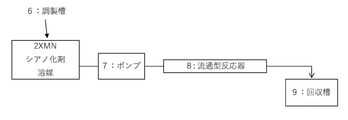
- Examples of the method for carrying out the cyanation step of the present invention include a method in which 2- (methyl halide) naphthalene, a cyanating agent and a solvent are mixed in a batch reactor and reacted under reaction conditions. Further, as shown in FIG. 2, a mixed solution of 2- (methyl halide) naphthalene, a solvent and a cyanating agent prepared in the preparation tank 6 was continuously pumped to the flow reactor 8 by a pump 7. A method in which 2- (methyl halide) naphthalene is continuously cyanated in the flow reactor 8 and the reaction solution containing 2-naphthyl acetonitrile flowing out of the flow reactor 8 is recovered in the recovery tank 9. Can be mentioned. Further, the cyanation step may be carried out according to a known method such as Non-Patent Document 3.
- an aqueous solvent such as water or an organic solvent such as alcohol or nitrile can be used alone or in an arbitrary ratio of two or more of them.
- the solvent is preferably a mixed solvent of water and nitrile from the viewpoint of cost and reactivity.
- water such as pure water, ion-exchanged water, and industrial water, or a mixture of water with an appropriate hydrophilic organic solvent such as ketones, alcohols, glycol ethers, etc. can be used. Water is preferred from the standpoint of cost and reactivity.
- an aliphatic alcohol having 1 to 10 carbon atoms, preferably 1 to 8 carbon atoms, particularly preferably 1 to 6 carbon atoms can be used.
- Nitrile is an organic having a structure represented by R? C ⁇ N (R is an aliphatic hydrocarbon group having 1 to 10 carbon atoms, preferably 1 to 8 carbon atoms, particularly preferably 1 to 6 carbon atoms).
- R is an aliphatic hydrocarbon group having 1 to 10 carbon atoms, preferably 1 to 8 carbon atoms, particularly preferably 1 to 6 carbon atoms.
- the compound include acetonitrile and propionitrile. From the viewpoint of reactivity, acetonitrile is preferable.
- the organic solvent is preferably nitrile, particularly preferably acetonitrile, from the viewpoint of cost and reactivity.
- the amount of the solvent used is usually 1 to 200 times by weight, preferably 2 to 150 times by weight, particularly preferably 3 with respect to 2- (methyl halide) naphthalene. It is 100 times by weight to 100 times by weight.
- the cyanating agent examples include inorganic cyanating agents such as sodium cyanide, potassium cyanide, and lithium cyanide, and organic cyanating agents such as tetrabutylammonium cyanide, which are preferably inorganic cyanated from the viewpoint of reactivity. It is an agent.
- the inorganic cyanating agent is preferably sodium cyanide and potassium cyanide, and is particularly preferably sodium cyanide from the viewpoint of reactivity.
- the amount of the cyanating agent used is usually 1 mol to 10 mol, preferably 1 mol to 5 mol, and particularly preferably 1 mol to 2 mol with respect to 1 mol of 2- (methyl halide) naphthalene from the viewpoint of reactivity.
- reaction temperature of the cyanation step of the present invention is usually 0 ° C. or higher, preferably 20 ° C. or higher, particularly preferably 40 ° C. or higher, and the upper limit is usually 100 ° C. or higher. Below, it is preferably 90 ° C. or lower, and particularly preferably 80 ° C. or lower.
- reaction time of the cyanation step of the present invention is usually 0.1 hour to 24 hours, preferably 1 hour to 12 hours.
- reaction pressure The lower limit of the reaction pressure in the cyanation step of the present invention is usually 0.1 MPa or more, and the upper limit is usually 1 MPa or less.
- the order of supply of 2- (methyl halide) naphthalene, cyanating agent and solvent can be appropriately selected.
- a batch reactor for example, a mixed solution of 2- (methyl halide) naphthalene and a solvent is used as a spreading solution, and a mixed solution of a cyanating agent and a solvent is supplied to react under reaction conditions. It can be performed.
- a flow synthesis reactor each raw material may be supplied collectively or may be supplied in a plurality of times.
- a mixed solution of 2- (methyl halide) naphthalene, a cyanating agent and a solvent can be supplied to a flow synthesis reactor under reaction conditions to carry out the reaction. Further, the reaction is carried out by supplying the mixture of the cyanating agent and the solvent to the flow synthesis reactor while circulating the mixture of 2- (methyl halide) naphthalene with the solvent in the flow synthesis reactor. Can be done.
- reaction method can be carried out by the above-mentioned batch type reaction or flow type reaction.
- ⁇ Reactor> As the reactor, the above-mentioned flow synthesis reactor or batch reactor can be used.
- 2-naphthyl acetonitrile which is the target product from the reaction solution obtained in the cyanation step of the present invention, is isolated by a conventional method. Isolation may be carried out by, for example, a treatment such as neutralization, separation, concentration and filtration of the obtained reaction solution, or by a known purification means such as crystallization and column chromatography.
- the reaction time is the light irradiation time unless otherwise specified.
- the conversion rate and selectivity were calculated according to the following formulas.
- a (C) in the calculation formula represents the area ratio (%) of the analysis result of the analysis condition 1 of the compound C, and for example, A (2MN) is the area value of 2MN with respect to the total area value of the analysis result of the analysis condition 1. Represents the area ratio (%) of.
- each abbreviation represents the following compound.
- 2MN 2-methylnaphthalene
- 2XMN 2- (methyl halide)
- naphthalene 2BMN 2- (bromomethyl) naphthalene
- 2DBMN 2- (dibromomethyl) naphthalene
- 1BMN 1-bromo-2-methylnaphthalene
- 1B2BMN 2- (bromomethyl) -1-bromonaphthalene
- NpAN 2-naphthylnitrile
- DCM dichloromethane
- DCE dichloroethane
- MeCN acetonitrile
- c-Hex cyclohexane
- AT acetone
- AcOME methyl acetate
- IPA isopropanol
- NBS N-bromosuccinimide
- DMDBH 1,3-dibromo-5 , 5-Dimethylhydranthin
- the light sources used for light irradiation are as shown in Table 1.
- the range of the emission wavelength includes a measurement error of about ⁇ 10 nm.
- Example 1 A mixed solution (2MN: 0.1 mol / L, NBS: 0.105 mol / L) in which 2MN and the halogenating agent NBS were dissolved in DCM was placed in a flow synthesis reactor maintained at a jacket temperature of 20 ° C. under an air atmosphere. Under the light irradiation of the light source 1, the reaction was carried out by supplying and distributing the mixture so that the reaction time was 25 minutes. At that time, a diaphragm pump was used to maintain the supply rate of the mixed solution at 240 ⁇ L / min. Table 3 shows the results of analysis of the obtained reaction solution by the analysis method 1. The obtained reaction solution contained 2 BMN (chemical purity 94.2%, selectivity 100.0%). 2BMN: 1 1 H-NMR (400 MHz, CDCL 3 ): ⁇ 7.84-7.80 (m, 4H), 7.52-7.48 (m, 3H), 4.67 (s, 2H)
- Example 2 In Example 1, the reaction was carried out in the same manner as in Example 1 except that the type of organic solvent, the concentration of 2MN and the amount of the halogenating agent used were changed as shown in Table 3. Table 4 shows the results of analysis of the obtained reaction solution in the same manner as in Example 1.
- Example 1 the reaction was carried out in the same manner as in Example 1 except that the type of organic solvent, the concentration of 2MN and the amount of the halogenating agent used were changed as shown in Table 3.
- Table 4 shows the results of analysis of the obtained reaction solution in the same manner as in Example 1.
- Example 5 In Example 1, the reaction was carried out in the same manner as in Example 1 except that the type of halogenating agent and the amount used thereof were changed as shown in Table 5. Table 5 shows the results of analysis of the obtained reaction solution in the same manner as in Example 1.
- Example 7 In Example 1, the reaction was carried out in the same manner as in Example 1 except that the light source was changed as shown in Table 6. Table 6 shows the results of analysis of the obtained reaction solution in the same manner as in Example 1.
- Example 9 In Example 1, the reaction was carried out in the same manner as in Example 1 except that the reaction temperature and the residence time were changed as shown in Table 7. Table 7 shows the results of analysis of the obtained reaction solution in the same manner as in Example 1.
- Example 11 In Example 1, the reaction was carried out in the same manner as in Example 1 except that the type of solvent and the reaction time were changed as shown in Table 8. Table 8 shows the results of analysis of the obtained reaction solution in the same manner as in Example 1.
- Example 14 In Example 12, the reaction was carried out in the same manner as in Example 12 except that the reaction atmosphere was changed as shown in Table 9. Table 9 shows the results of analysis of the obtained reaction solution by the analysis method 2.
- Example 12 the reaction was carried out in the same manner as in Example 12 except that the 2MN concentration, the amount of the halogenating agent used, the reaction temperature and the reaction time were changed as shown in Table 10.
- Table 10 shows the results of analysis of the obtained reaction solution in the same manner as in Example 12.
- Example 22 A closed glass reactor equipped with a cooling condenser, a heating jacket and a stirrer was charged with a mixed solvent of 32 mL of acetonitrile / 8 mL of water, followed by 8.00 g (36.18 mmol) of 2BMN and 2.12 g of sodium cyanide (43. 42 mmol) was added, and the jacket temperature was raised to 60 ° C. with stirring, and then the reaction was carried out at the same temperature for 4 hours.
- NpAN was contained as a main product in the obtained reaction solution (conversion rate 99.1%).
- 2- (methyl halide) naphthalene of the present invention 2- (methyl halide) is useful as a synthetic raw material or an intermediate for pharmaceuticals from 2-methylnaphthalene efficiently at high conversion rate and selectivity at low cost.
- (Methyl halide) Naphthalene can be produced.
- a high yield of 2-naphthylacetonitrile, which is safe and inexpensive, efficient with high conversion rate and selectivity, and useful as a synthetic raw material or an intermediate for pharmaceutical products. can be manufactured in.
- the 2- (methyl halide) naphthalene and 2-naphthyl acetonitrile obtained in the present invention are industrially useful because they can be used as synthetic raw materials or intermediates for various pharmaceutical products.
Landscapes
- Chemical & Material Sciences (AREA)
- Organic Chemistry (AREA)
- Health & Medical Sciences (AREA)
- Chemical Kinetics & Catalysis (AREA)
- Toxicology (AREA)
- Organic Low-Molecular-Weight Compounds And Preparation Thereof (AREA)
Priority Applications (5)
| Application Number | Priority Date | Filing Date | Title |
|---|---|---|---|
| US18/007,370 US20240109840A1 (en) | 2020-08-31 | 2021-08-27 | Method for producing 2-(halogenated methyl)naphthalene and 2-naphthyl acetonitrile |
| CN202180059790.9A CN116348440A (zh) | 2020-08-31 | 2021-08-27 | 2-(卤化甲基)萘和2-萘乙腈的制造方法 |
| JP2022545740A JP7571147B2 (ja) | 2020-08-31 | 2021-08-27 | 2-(ハロゲン化メチル)ナフタレン及び2-ナフチルアセトニトリルの製造方法 |
| KR1020237003081A KR102784858B1 (ko) | 2020-08-31 | 2021-08-27 | 2-(할로겐화메틸)나프탈렌 및 2-나프틸아세토니트릴의 제조 방법 |
| EP21861725.6A EP4174049B1 (en) | 2020-08-31 | 2021-08-27 | Method for producing 2-(halogenated methyl)naphthalene and 2-naphthyl acetonitrile |
Applications Claiming Priority (2)
| Application Number | Priority Date | Filing Date | Title |
|---|---|---|---|
| JP2020-146244 | 2020-08-31 | ||
| JP2020146244 | 2020-08-31 |
Publications (1)
| Publication Number | Publication Date |
|---|---|
| WO2022045304A1 true WO2022045304A1 (ja) | 2022-03-03 |
Family
ID=80355403
Family Applications (1)
| Application Number | Title | Priority Date | Filing Date |
|---|---|---|---|
| PCT/JP2021/031570 Ceased WO2022045304A1 (ja) | 2020-08-31 | 2021-08-27 | 2-(ハロゲン化メチル)ナフタレン及び2-ナフチルアセトニトリルの製造方法 |
Country Status (6)
| Country | Link |
|---|---|
| US (1) | US20240109840A1 (https=) |
| EP (1) | EP4174049B1 (https=) |
| JP (1) | JP7571147B2 (https=) |
| KR (1) | KR102784858B1 (https=) |
| CN (1) | CN116348440A (https=) |
| WO (1) | WO2022045304A1 (https=) |
Cited By (1)
| Publication number | Priority date | Publication date | Assignee | Title |
|---|---|---|---|---|
| WO2024174285A1 (zh) * | 2023-02-21 | 2024-08-29 | 苏州大学 | 一种基于流动相利用金属卤盐制备卤代化合物的方法 |
Citations (3)
| Publication number | Priority date | Publication date | Assignee | Title |
|---|---|---|---|---|
| JP2001039904A (ja) * | 1999-07-29 | 2001-02-13 | Sumikin Chemical Co Ltd | ブロモアルキルナフタレンの製造方法 |
| JP2009511427A (ja) * | 2005-09-02 | 2009-03-19 | 独立行政法人科学技術振興機構 | 活性炭素原子のルイス酸触媒によるハロゲン化 |
| WO2013047136A1 (ja) * | 2011-09-27 | 2013-04-04 | 富士フイルム株式会社 | インプリント用硬化性組成物、パターン形成方法およびパターン |
Family Cites Families (4)
| Publication number | Priority date | Publication date | Assignee | Title |
|---|---|---|---|---|
| EP2762473B1 (en) * | 2011-09-29 | 2016-08-31 | Mitsui Chemicals Agro, Inc. | Production method for 4, 4-difluoro-3,4-dihydroisoquinoline derivative |
| CN105541716B (zh) * | 2015-03-26 | 2024-02-23 | Agc株式会社 | 吡唑衍生物的制造方法 |
| US20190071406A1 (en) * | 2016-03-16 | 2019-03-07 | Nissan Chemical Corporation | Method for producing isocyanuric acid derivative having two hydrocarbon groups |
| RU2733381C2 (ru) * | 2016-03-31 | 2020-10-01 | Тояма Кемикал Ко., Лтд. | Способ получения 5-(бромметил)-1-бензотиофена |
-
2021
- 2021-08-27 KR KR1020237003081A patent/KR102784858B1/ko active Active
- 2021-08-27 CN CN202180059790.9A patent/CN116348440A/zh active Pending
- 2021-08-27 EP EP21861725.6A patent/EP4174049B1/en active Active
- 2021-08-27 WO PCT/JP2021/031570 patent/WO2022045304A1/ja not_active Ceased
- 2021-08-27 US US18/007,370 patent/US20240109840A1/en active Pending
- 2021-08-27 JP JP2022545740A patent/JP7571147B2/ja active Active
Patent Citations (3)
| Publication number | Priority date | Publication date | Assignee | Title |
|---|---|---|---|---|
| JP2001039904A (ja) * | 1999-07-29 | 2001-02-13 | Sumikin Chemical Co Ltd | ブロモアルキルナフタレンの製造方法 |
| JP2009511427A (ja) * | 2005-09-02 | 2009-03-19 | 独立行政法人科学技術振興機構 | 活性炭素原子のルイス酸触媒によるハロゲン化 |
| WO2013047136A1 (ja) * | 2011-09-27 | 2013-04-04 | 富士フイルム株式会社 | インプリント用硬化性組成物、パターン形成方法およびパターン |
Non-Patent Citations (6)
| Title |
|---|
| ADV. SYNTH. CATAL., 2018, pages 4197 - 4204 |
| AMIJS CATELIJNE H. M., VAN KLINK GERARD P. M., VAN KOTEN GERARD: "Carbon tetrachloride free benzylic brominations of methyl aryl halides", GREEN CHEMISTRY, ROYAL SOCIETY OF CHEMISTRY, GB, vol. 5, no. 4, 1 January 2003 (2003-01-01), GB , pages 470, XP055903058, ISSN: 1463-9262, DOI: 10.1039/b304673g * |
| NI SHENGJUN, MAHMOUD ABD EL ALEEM ALI ALI EL REMAILY, JOHAN FRANZÉN: "Carbocation Catalyzed Bromination of Alkyl Arenes, a Chemoselective sp3 vs. sp2 C-H functionalization", ADVANCED SYNTHESIS & CATALYSIS, vol. 360, no. 21, 13 September 2018 (2018-09-13), pages 4197 - 4204, XP055903055, DOI: 10.1002/adsc.201800788 * |
| SASIAMBARRENA LEANDRO D.; CÁNEPA ALICIA S.; LUNA CONSTANZA N.; BRAVO RODOLFO D. : "Intramolecular sulfonylamidomethylation of 2-(2-naphthyl) and 2-(1-naphthyl)ethanesulfonamides: synthesis of new class of naphthosultams", TETRAHEDRON LETTERS, ELSEVIER, AMSTERDAM , NL, vol. 56, no. 16, 1 January 1900 (1900-01-01), Amsterdam , NL , pages 2054 - 2058, XP029150464, ISSN: 0040-4039, DOI: 10.1016/j.tetlet.2015.02.130 * |
| See also references of EP4174049A4 |
| TETRAHEDRON LETTERS, vol. 56, 2015, pages 2054 - 2058 |
Cited By (1)
| Publication number | Priority date | Publication date | Assignee | Title |
|---|---|---|---|---|
| WO2024174285A1 (zh) * | 2023-02-21 | 2024-08-29 | 苏州大学 | 一种基于流动相利用金属卤盐制备卤代化合物的方法 |
Also Published As
| Publication number | Publication date |
|---|---|
| EP4174049A1 (en) | 2023-05-03 |
| EP4174049B1 (en) | 2025-11-26 |
| US20240109840A1 (en) | 2024-04-04 |
| KR102784858B1 (ko) | 2025-03-26 |
| JP7571147B2 (ja) | 2024-10-22 |
| JPWO2022045304A1 (https=) | 2022-03-03 |
| EP4174049A4 (en) | 2024-09-11 |
| CN116348440A (zh) | 2023-06-27 |
| KR20230028530A (ko) | 2023-02-28 |
Similar Documents
| Publication | Publication Date | Title |
|---|---|---|
| CN107573342B (zh) | 一种1,1’-乙撑-2,2’-联吡啶二氯盐的制备方法 | |
| CN111527064A (zh) | 有机材料或与其相关的改善 | |
| EP2456741B1 (fr) | Procede de preparation de composes fluores | |
| JPWO2020050368A1 (ja) | ビルスマイヤー試薬の製造方法 | |
| CN117616008A (zh) | 9-氨甲基四环素类化合物的合成方法 | |
| CN104058925B (zh) | 1,1,1,2,3‑五氯丙烷的连续制备方法 | |
| JP7571147B2 (ja) | 2-(ハロゲン化メチル)ナフタレン及び2-ナフチルアセトニトリルの製造方法 | |
| JP6804520B2 (ja) | 5−ブロモメチル−1−ベンゾチオフェンの製造方法 | |
| JP2019081748A (ja) | ハロゲン化合物の製造方法 | |
| TW202323234A (zh) | 醛化合物及二氫異㗁唑化合物的製造方法 | |
| CN112041298A (zh) | 芳香族腈化合物的制造方法 | |
| JPWO2014103947A1 (ja) | ハロゲン化アニリンおよびその製造方法 | |
| JPS5916837A (ja) | P−第3ブチル−ベンザル−ブロマイドおよび核の所でハロゲン置換されたその誘導体 | |
| TWI403504B (zh) | 2-鹵基咪唑化合物之製造方法 | |
| WO1999054275A1 (en) | Process for producing chloromethylphenylacetic acid | |
| JP5197106B2 (ja) | ハロゲン化フタル酸化合物の製造法 | |
| CN119192000B (zh) | 连续流反应制备他喷他多或其可药用盐的方法 | |
| JP2647757B2 (ja) | 芳香族ハロゲン化物の製造方法 | |
| CN119176758B (zh) | 一种固载催化制备他喷他多或其可药用盐的方法 | |
| WO2020119507A1 (zh) | 一种连续制备5-氰二醇的方法 | |
| WO2017033813A1 (ja) | アルケニルハライドの製造方法 | |
| JP6815154B2 (ja) | テトラハロメタンの製造方法 | |
| CN105037166B (zh) | 2,2‑二(4‑(4‑氨基苯氧基)苯基)六氟丙烷及其中间体的制备方法 | |
| CN114276223A (zh) | 一种α-碘-α-三氟甲基芳基乙酮的合成方法 | |
| CN119019307A (zh) | 一种维生素d3的制备方法 |
Legal Events
| Date | Code | Title | Description |
|---|---|---|---|
| 121 | Ep: the epo has been informed by wipo that ep was designated in this application |
Ref document number: 21861725 Country of ref document: EP Kind code of ref document: A1 |
|
| ENP | Entry into the national phase |
Ref document number: 20237003081 Country of ref document: KR Kind code of ref document: A |
|
| WWE | Wipo information: entry into national phase |
Ref document number: 202317005885 Country of ref document: IN Ref document number: 18007370 Country of ref document: US |
|
| ENP | Entry into the national phase |
Ref document number: 2022545740 Country of ref document: JP Kind code of ref document: A |
|
| ENP | Entry into the national phase |
Ref document number: 2021861725 Country of ref document: EP Effective date: 20230127 |
|
| NENP | Non-entry into the national phase |
Ref country code: DE |
|
| WWG | Wipo information: grant in national office |
Ref document number: 2021861725 Country of ref document: EP |