WO2022044753A1 - エンコーダ - Google Patents
エンコーダ Download PDFInfo
- Publication number
- WO2022044753A1 WO2022044753A1 PCT/JP2021/029083 JP2021029083W WO2022044753A1 WO 2022044753 A1 WO2022044753 A1 WO 2022044753A1 JP 2021029083 W JP2021029083 W JP 2021029083W WO 2022044753 A1 WO2022044753 A1 WO 2022044753A1
- Authority
- WO
- WIPO (PCT)
- Prior art keywords
- unit
- pattern
- light
- light receiving
- output
- Prior art date
- Legal status (The legal status is an assumption and is not a legal conclusion. Google has not performed a legal analysis and makes no representation as to the accuracy of the status listed.)
- Ceased
Links
Images





Classifications
-
- G—PHYSICS
- G01—MEASURING; TESTING
- G01D—MEASURING NOT SPECIALLY ADAPTED FOR A SPECIFIC VARIABLE; ARRANGEMENTS FOR MEASURING TWO OR MORE VARIABLES NOT COVERED IN A SINGLE OTHER SUBCLASS; TARIFF METERING APPARATUS; MEASURING OR TESTING NOT OTHERWISE PROVIDED FOR
- G01D5/00—Mechanical means for transferring the output of a sensing member; Means for converting the output of a sensing member to another variable where the form or nature of the sensing member does not constrain the means for converting; Transducers not specially adapted for a specific variable
- G01D5/26—Mechanical means for transferring the output of a sensing member; Means for converting the output of a sensing member to another variable where the form or nature of the sensing member does not constrain the means for converting; Transducers not specially adapted for a specific variable characterised by optical transfer means, i.e. using infrared, visible, or ultraviolet light
- G01D5/32—Mechanical means for transferring the output of a sensing member; Means for converting the output of a sensing member to another variable where the form or nature of the sensing member does not constrain the means for converting; Transducers not specially adapted for a specific variable characterised by optical transfer means, i.e. using infrared, visible, or ultraviolet light with attenuation or whole or partial obturation of beams of light
- G01D5/34—Mechanical means for transferring the output of a sensing member; Means for converting the output of a sensing member to another variable where the form or nature of the sensing member does not constrain the means for converting; Transducers not specially adapted for a specific variable characterised by optical transfer means, i.e. using infrared, visible, or ultraviolet light with attenuation or whole or partial obturation of beams of light the beams of light being detected by photocells
- G01D5/347—Mechanical means for transferring the output of a sensing member; Means for converting the output of a sensing member to another variable where the form or nature of the sensing member does not constrain the means for converting; Transducers not specially adapted for a specific variable characterised by optical transfer means, i.e. using infrared, visible, or ultraviolet light with attenuation or whole or partial obturation of beams of light the beams of light being detected by photocells using displacement encoding scales
- G01D5/34776—Absolute encoders with analogue or digital scales
-
- G—PHYSICS
- G01—MEASURING; TESTING
- G01D—MEASURING NOT SPECIALLY ADAPTED FOR A SPECIFIC VARIABLE; ARRANGEMENTS FOR MEASURING TWO OR MORE VARIABLES NOT COVERED IN A SINGLE OTHER SUBCLASS; TARIFF METERING APPARATUS; MEASURING OR TESTING NOT OTHERWISE PROVIDED FOR
- G01D5/00—Mechanical means for transferring the output of a sensing member; Means for converting the output of a sensing member to another variable where the form or nature of the sensing member does not constrain the means for converting; Transducers not specially adapted for a specific variable
- G01D5/26—Mechanical means for transferring the output of a sensing member; Means for converting the output of a sensing member to another variable where the form or nature of the sensing member does not constrain the means for converting; Transducers not specially adapted for a specific variable characterised by optical transfer means, i.e. using infrared, visible, or ultraviolet light
- G01D5/32—Mechanical means for transferring the output of a sensing member; Means for converting the output of a sensing member to another variable where the form or nature of the sensing member does not constrain the means for converting; Transducers not specially adapted for a specific variable characterised by optical transfer means, i.e. using infrared, visible, or ultraviolet light with attenuation or whole or partial obturation of beams of light
- G01D5/34—Mechanical means for transferring the output of a sensing member; Means for converting the output of a sensing member to another variable where the form or nature of the sensing member does not constrain the means for converting; Transducers not specially adapted for a specific variable characterised by optical transfer means, i.e. using infrared, visible, or ultraviolet light with attenuation or whole or partial obturation of beams of light the beams of light being detected by photocells
- G01D5/347—Mechanical means for transferring the output of a sensing member; Means for converting the output of a sensing member to another variable where the form or nature of the sensing member does not constrain the means for converting; Transducers not specially adapted for a specific variable characterised by optical transfer means, i.e. using infrared, visible, or ultraviolet light with attenuation or whole or partial obturation of beams of light the beams of light being detected by photocells using displacement encoding scales
- G01D5/3473—Circular or rotary encoders
-
- G—PHYSICS
- G01—MEASURING; TESTING
- G01D—MEASURING NOT SPECIALLY ADAPTED FOR A SPECIFIC VARIABLE; ARRANGEMENTS FOR MEASURING TWO OR MORE VARIABLES NOT COVERED IN A SINGLE OTHER SUBCLASS; TARIFF METERING APPARATUS; MEASURING OR TESTING NOT OTHERWISE PROVIDED FOR
- G01D5/00—Mechanical means for transferring the output of a sensing member; Means for converting the output of a sensing member to another variable where the form or nature of the sensing member does not constrain the means for converting; Transducers not specially adapted for a specific variable
- G01D5/12—Mechanical means for transferring the output of a sensing member; Means for converting the output of a sensing member to another variable where the form or nature of the sensing member does not constrain the means for converting; Transducers not specially adapted for a specific variable using electric or magnetic means
- G01D5/244—Mechanical means for transferring the output of a sensing member; Means for converting the output of a sensing member to another variable where the form or nature of the sensing member does not constrain the means for converting; Transducers not specially adapted for a specific variable using electric or magnetic means influencing characteristics of pulses or pulse trains; generating pulses or pulse trains
- G01D5/24471—Error correction
- G01D5/24485—Error correction using other sensors
-
- G—PHYSICS
- G01—MEASURING; TESTING
- G01D—MEASURING NOT SPECIALLY ADAPTED FOR A SPECIFIC VARIABLE; ARRANGEMENTS FOR MEASURING TWO OR MORE VARIABLES NOT COVERED IN A SINGLE OTHER SUBCLASS; TARIFF METERING APPARATUS; MEASURING OR TESTING NOT OTHERWISE PROVIDED FOR
- G01D5/00—Mechanical means for transferring the output of a sensing member; Means for converting the output of a sensing member to another variable where the form or nature of the sensing member does not constrain the means for converting; Transducers not specially adapted for a specific variable
- G01D5/26—Mechanical means for transferring the output of a sensing member; Means for converting the output of a sensing member to another variable where the form or nature of the sensing member does not constrain the means for converting; Transducers not specially adapted for a specific variable characterised by optical transfer means, i.e. using infrared, visible, or ultraviolet light
- G01D5/28—Mechanical means for transferring the output of a sensing member; Means for converting the output of a sensing member to another variable where the form or nature of the sensing member does not constrain the means for converting; Transducers not specially adapted for a specific variable characterised by optical transfer means, i.e. using infrared, visible, or ultraviolet light with deflection of beams of light, e.g. for direct optical indication
- G01D5/30—Mechanical means for transferring the output of a sensing member; Means for converting the output of a sensing member to another variable where the form or nature of the sensing member does not constrain the means for converting; Transducers not specially adapted for a specific variable characterised by optical transfer means, i.e. using infrared, visible, or ultraviolet light with deflection of beams of light, e.g. for direct optical indication the beams of light being detected by photocells
-
- G—PHYSICS
- G01—MEASURING; TESTING
- G01D—MEASURING NOT SPECIALLY ADAPTED FOR A SPECIFIC VARIABLE; ARRANGEMENTS FOR MEASURING TWO OR MORE VARIABLES NOT COVERED IN A SINGLE OTHER SUBCLASS; TARIFF METERING APPARATUS; MEASURING OR TESTING NOT OTHERWISE PROVIDED FOR
- G01D5/00—Mechanical means for transferring the output of a sensing member; Means for converting the output of a sensing member to another variable where the form or nature of the sensing member does not constrain the means for converting; Transducers not specially adapted for a specific variable
- G01D5/26—Mechanical means for transferring the output of a sensing member; Means for converting the output of a sensing member to another variable where the form or nature of the sensing member does not constrain the means for converting; Transducers not specially adapted for a specific variable characterised by optical transfer means, i.e. using infrared, visible, or ultraviolet light
- G01D5/32—Mechanical means for transferring the output of a sensing member; Means for converting the output of a sensing member to another variable where the form or nature of the sensing member does not constrain the means for converting; Transducers not specially adapted for a specific variable characterised by optical transfer means, i.e. using infrared, visible, or ultraviolet light with attenuation or whole or partial obturation of beams of light
- G01D5/34—Mechanical means for transferring the output of a sensing member; Means for converting the output of a sensing member to another variable where the form or nature of the sensing member does not constrain the means for converting; Transducers not specially adapted for a specific variable characterised by optical transfer means, i.e. using infrared, visible, or ultraviolet light with attenuation or whole or partial obturation of beams of light the beams of light being detected by photocells
- G01D5/347—Mechanical means for transferring the output of a sensing member; Means for converting the output of a sensing member to another variable where the form or nature of the sensing member does not constrain the means for converting; Transducers not specially adapted for a specific variable characterised by optical transfer means, i.e. using infrared, visible, or ultraviolet light with attenuation or whole or partial obturation of beams of light the beams of light being detected by photocells using displacement encoding scales
- G01D5/34707—Scales; Discs, e.g. fixation, fabrication, compensation
- G01D5/34715—Scale reading or illumination devices
-
- G—PHYSICS
- G01—MEASURING; TESTING
- G01D—MEASURING NOT SPECIALLY ADAPTED FOR A SPECIFIC VARIABLE; ARRANGEMENTS FOR MEASURING TWO OR MORE VARIABLES NOT COVERED IN A SINGLE OTHER SUBCLASS; TARIFF METERING APPARATUS; MEASURING OR TESTING NOT OTHERWISE PROVIDED FOR
- G01D5/00—Mechanical means for transferring the output of a sensing member; Means for converting the output of a sensing member to another variable where the form or nature of the sensing member does not constrain the means for converting; Transducers not specially adapted for a specific variable
- G01D5/26—Mechanical means for transferring the output of a sensing member; Means for converting the output of a sensing member to another variable where the form or nature of the sensing member does not constrain the means for converting; Transducers not specially adapted for a specific variable characterised by optical transfer means, i.e. using infrared, visible, or ultraviolet light
- G01D5/32—Mechanical means for transferring the output of a sensing member; Means for converting the output of a sensing member to another variable where the form or nature of the sensing member does not constrain the means for converting; Transducers not specially adapted for a specific variable characterised by optical transfer means, i.e. using infrared, visible, or ultraviolet light with attenuation or whole or partial obturation of beams of light
- G01D5/34—Mechanical means for transferring the output of a sensing member; Means for converting the output of a sensing member to another variable where the form or nature of the sensing member does not constrain the means for converting; Transducers not specially adapted for a specific variable characterised by optical transfer means, i.e. using infrared, visible, or ultraviolet light with attenuation or whole or partial obturation of beams of light the beams of light being detected by photocells
- G01D5/347—Mechanical means for transferring the output of a sensing member; Means for converting the output of a sensing member to another variable where the form or nature of the sensing member does not constrain the means for converting; Transducers not specially adapted for a specific variable characterised by optical transfer means, i.e. using infrared, visible, or ultraviolet light with attenuation or whole or partial obturation of beams of light the beams of light being detected by photocells using displacement encoding scales
- G01D5/34776—Absolute encoders with analogue or digital scales
- G01D5/34792—Absolute encoders with analogue or digital scales with only digital scales or both digital and incremental scales
-
- G—PHYSICS
- G01—MEASURING; TESTING
- G01P—MEASURING LINEAR OR ANGULAR SPEED, ACCELERATION, DECELERATION, OR SHOCK; INDICATING PRESENCE, ABSENCE, OR DIRECTION, OF MOVEMENT
- G01P21/00—Testing or calibrating of apparatus or devices covered by the preceding groups
- G01P21/02—Testing or calibrating of apparatus or devices covered by the preceding groups of speedometers
-
- G—PHYSICS
- G01—MEASURING; TESTING
- G01P—MEASURING LINEAR OR ANGULAR SPEED, ACCELERATION, DECELERATION, OR SHOCK; INDICATING PRESENCE, ABSENCE, OR DIRECTION, OF MOVEMENT
- G01P3/00—Measuring linear or angular speed; Measuring differences of linear or angular speeds
- G01P3/42—Devices characterised by the use of electric or magnetic means
- G01P3/44—Devices characterised by the use of electric or magnetic means for measuring angular speed
- G01P3/48—Devices characterised by the use of electric or magnetic means for measuring angular speed by measuring frequency of generated current or voltage
- G01P3/481—Devices characterised by the use of electric or magnetic means for measuring angular speed by measuring frequency of generated current or voltage of pulse signals
- G01P3/486—Devices characterised by the use of electric or magnetic means for measuring angular speed by measuring frequency of generated current or voltage of pulse signals delivered by photo-electric detectors
-
- G—PHYSICS
- G01—MEASURING; TESTING
- G01D—MEASURING NOT SPECIALLY ADAPTED FOR A SPECIFIC VARIABLE; ARRANGEMENTS FOR MEASURING TWO OR MORE VARIABLES NOT COVERED IN A SINGLE OTHER SUBCLASS; TARIFF METERING APPARATUS; MEASURING OR TESTING NOT OTHERWISE PROVIDED FOR
- G01D2218/00—Indexing scheme relating to details of testing or calibration
Definitions
- This disclosure relates to encoders.
- an encoder that detects the rotation of the rotating shaft of a motor is known.
- a pattern along the measurement direction, a light source that emits light to the pattern, and a light source that is arranged along the measurement direction and emitted from the light source and transmitted or reflected from the pattern are received.
- An encoder having a plurality of light receiving elements configured as described above is disclosed.
- the encoder includes a rotating plate having a first pattern and a second pattern, an irradiation unit that irradiates the first pattern and the second pattern with light, and the irradiation unit that is irradiated from the irradiation unit.
- the first pattern and the second pattern include light emitted from the irradiation unit and a light receiving unit that receives light emitted from the irradiation unit and receives light via the second pattern.
- the first unit region that guides the light to the light receiving portion and the second unit region that does not guide the light emitted from the irradiation portion to the light receiving portion are arranged in the circumferential direction about the rotation axis of the rotating plate.
- the order in which the first unit region and the second unit region are arranged in the first pattern and the order in which the first unit region and the second unit region are arranged in the second pattern are reversed. ing.
- the encoder includes a rotating plate having a pattern, an irradiation unit that irradiates the pattern with light, and a light receiving unit that is irradiated from the irradiation unit and receives light that has passed through the pattern.
- the first unit region that guides the light emitted from the irradiation unit to the light receiving portion and the second unit region that does not guide the light emitted from the irradiation unit to the light receiving portion are rotated.
- the first unit region and the second unit region are arranged in the circumferential direction about the rotation axis of the plate, and when the first unit region and the second unit region are referred to as unit regions, M pieces for outputting position information indicating the position of the detection target.
- the first sequence which is the sequence of the unit areas of the above, and the sequence of N of the unit areas adjacent to the first sequence, N for outputting the correction information for correcting the position information.
- It has a second sequence, which is a sequence of the unit regions.
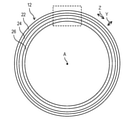
- FIG. 1 is a diagram showing a motor including an encoder according to the embodiment.
- FIG. 2A is a diagram showing a rotating plate of the encoder of FIG. 1.
- FIG. 2B is a diagram showing a rotating plate of the encoder of FIG. 1.
- FIG. 3 is a block diagram showing a functional configuration of the encoder of FIG. 1.
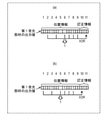
- FIG. 4 is a diagram for explaining an example of a determination method by the determination unit of the encoder of FIG. 1.
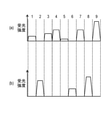
- FIG. 5 is a diagram showing an example of the light receiving intensity of the light received by the light receiving portion of the encoder of FIG. 1.
- FIG. 6 is a diagram for explaining an example of a determination method and a correction method by the correction unit of the encoder of FIG. 1.
- FIG. 1 is a diagram showing a motor including an encoder according to the embodiment.
- FIG. 2A is a diagram showing a rotating plate of the encoder of FIG. 1.
- FIG. 2B is a diagram showing a rotating plate of the encoder of FIG
- FIG. 7 is a diagram showing a calculation circuit for calculating a value for forming a first pattern in the rotary plate of the encoder of FIG. 1.
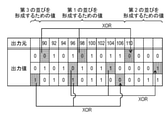
- FIG. 8 is a diagram showing a table on which the values obtained by the calculation circuit of FIG. 7 are posted.
- FIG. 9 is a diagram showing a data flow during operation of the correction unit of the encoder of FIG. 1.
- FIG. 10 is a diagram for explaining another example of the correction method by the correction unit of the encoder of FIG. 1.
- FIG. 11 is a diagram for explaining another example of the correction method by the correction unit of the encoder of FIG. 1.
- FIG. 12 is a diagram for explaining still another example of the correction method by the correction unit of the encoder of FIG. 1.
- FIG. 13 is a diagram showing another example of the light receiving intensity of the light received by the light receiving portion of the encoder of FIG. 1.
- FIG. 14 is a diagram showing a calculation circuit for calculating a value for forming a first pattern different from the first pattern of the encoder of FIG. 1.
- FIG. 15 is a diagram showing a table on which the values obtained by the calculation circuit of FIG. 14 are posted.
- each figure is a schematic diagram and is not necessarily exactly illustrated.
- the same reference numerals are given to substantially the same configurations, and duplicate explanations will be omitted or simplified.
- FIG. 1 is a diagram showing a motor 1 including the encoder 10 according to the embodiment.
- 2A and 2B are views showing the rotating plate 12 of the encoder 10 of FIG.
- FIG. 2A is a view of the rotating plate 12 as viewed from the axial direction
- FIG. 2B is an enlarged view showing a portion surrounded by a dotted line in FIG. 2A.
- the case 6 the first pattern 24, and the second pattern 26 are shown in a cross-sectional view.
- the axial direction indicates the direction in which the rotation axis A extends (see the arrow X in FIG. 1)
- the radial direction is the radial direction centered on the rotation axis A (FIGS.
- the motor 1 includes a main body 2, a stator 3, a rotor 4, a rotating shaft 5, a case 6, and an encoder 10.
- the main body 2 is a housing for accommodating the stator 3, the rotor 4, and the like.
- the stator 3 is fixed to the inner surface of the main body 2.
- the rotor 4 is rotatably provided with respect to the stator 3.
- the rotating shaft 5 has a rod shape such as a columnar shape, is fixed to the inner surface of the rotor 4, and rotates around the rotating axis A. For example, when electric power is supplied to the motor 1, the rotating shaft 5 rotates with the rotor 4 about the rotating axis A as the center of rotation based on the electric power.
- An encoder 10 is provided at one end of the rotating shaft 5 in the axial direction.
- a load (not shown) or the like that is rotationally driven by the rotation of the rotating shaft 5 is attached to the other end of the rotating shaft 5 in the axial direction.
- the rotating shaft 5 is formed of a magnetic metal such as iron.
- the case 6 is attached to the main body 2 so as to cover one end of the rotating shaft 5 in the axial direction, the encoder 10 and the like.
- the case 6 is made of a magnetic metal such as iron.
- the encoder 10 detects the rotation of the detection target. Specifically, the encoder 10 detects the position (rotational position) of the detection target, the rotation direction of the detection target, the rotation speed of the detection target, and the like.
- the detection target is the rotation axis 5. That is, the encoder 10 detects the position of the rotary shaft 5, the rotation direction of the rotary shaft 5, the rotation speed of the rotary shaft 5, and the like.
- the encoder 10 is provided at one end of the rotating shaft 5 in the axial direction. As shown in FIGS. 1 and 2A and 2B, the encoder 10 includes a rotating plate 12, a first substrate 14, a second substrate 16, an irradiation unit 18, and a light receiving unit 20.
- the rotating plate 12 is a rotating plate that rotates about the rotation axis A as the center of rotation, and has a main body 22, a first pattern 24, and a second pattern 26.
- the main body 22 has a plate shape extending in a direction orthogonal to the axial direction, and is circular when viewed from the axial direction.
- the main body 22 is attached to one end of the rotation shaft 5 in the axial direction, and rotates together with the rotation shaft 5 with the rotation axis A as the rotation center.
- the axis of the main body 22 and the rotation axis A coincide with each other.
- the main body 22 is formed of transparent glass or the like that allows light to pass through.
- the first pattern 24 is provided on the main surface of the main body 22 on the first substrate 14 side.
- the first pattern 24 is provided in an annular shape along the circumferential direction.
- the first pattern 24 rotates together with the main body 22.
- the first pattern 24 is an absolute pattern.
- the first pattern 24 has a plurality of first light guide portions 28 and a plurality of first non-light guide portions 30.
- the plurality of first light guide portions 28 are provided side by side at intervals in the circumferential direction.
- Each of the plurality of first light guide units 28 is configured by arranging the first unit regions 32 that guide the light emitted from the irradiation unit 18 to the light receiving unit 20 in the circumferential direction. That is, each of the plurality of first light guide units 28 is a region composed of one or more first unit regions 32, and guides the light emitted from the irradiation unit 18 to the light receiving unit 20.
- the first unit region 32 is a region having a predetermined size.
- the first unit region 32 is formed of transparent glass or the like that allows light to pass through.
- the number of first unit regions 32 constituting each of the plurality of first light guide portions 28 is not uniform.
- the dimensions of each of the plurality of first light guide portions 28 in the circumferential direction are determined by the number of first unit regions 32 constituting the first light guide unit 28, and each of the plurality of first light guide portions 28 in the circumferential direction. The dimensions of are not uniform. In FIG. 2B, only a part of the first unit region 32 is shown (see the two-dot chain line) in order to avoid complicating the drawing.
- the plurality of first non-light guide portions 30 are provided side by side at intervals in the circumferential direction. Specifically, each of the plurality of first non-light guide sections 30 is arranged between adjacent first light guide sections 28 among the plurality of first light guide sections 28. That is, the first pattern 24 has a configuration in which the first light guide unit 28 and the first non-light guide unit 30 are arranged alternately in the circumferential direction. Each of the plurality of first non-light guide portions 30 is configured by arranging second unit regions 34 that do not guide the light emitted from the irradiation unit 18 to the light receiving unit 20 in the circumferential direction.
- each of the plurality of first non-light guide portions 30 is a region composed of one or more second unit regions 34, and when light is irradiated from the irradiation unit 18, the light receiving unit does not transmit the light. Do not lead to 20.
- the second unit region 34 is a region having a predetermined size, and when light is irradiated from the irradiation unit 18, the light is not transmitted and is not guided to the light receiving unit 20.
- the size of the second unit area 34 is the same as the size of the first unit area 32.
- the second unit region 34 is formed by black chrome plating or the like that does not transmit light.
- the number of second unit regions 34 constituting each of the plurality of first non-light guide portions 30 is not uniform.
- the dimensions of each of the plurality of first non-light guide portions 30 in the circumferential direction are determined by the number of second unit regions 34 constituting the first non-light guide portion 30, and the plurality of first non-light guide portions in the circumferential direction are determined.
- Each dimension of 30 is not uniform.
- FIG. 2B only a part of the second unit region 34 is shown (see the alternate long and short dash line) in order to avoid complicating the drawing.
- each of the plurality of first light guide portions 28 is configured by arranging one or more first unit regions 32 in the circumferential direction, and each of the plurality of first non-light guide portions 30 is one or more.
- the second unit region 34 of is arranged in the circumferential direction. That is, the first pattern 24 has a configuration in which the first unit region 32 and the second unit region 34 are arranged in the circumferential direction.
- the second pattern 26 is provided on the main surface of the main body 22 on the first substrate 14 side.
- the second pattern 26 is provided inward in the radial direction with respect to the first pattern 24, and is provided in an annular shape along the circumferential direction.
- the second pattern 26 rotates together with the main body 22.
- the second pattern 26 is an absolute pattern.
- the second pattern 26 has a plurality of second light guide portions 36 and a plurality of second non-light guide portions 38.
- the plurality of second light guide portions 36 are provided side by side at intervals in the circumferential direction.
- Each of the plurality of second light guide units 36 is configured by arranging the first unit regions 40 that guide the light emitted from the irradiation unit 18 to the light receiving unit 20 in the circumferential direction. That is, each of the plurality of second light guide units 36 is a region composed of one or more first unit regions 40, and guides the light emitted from the irradiation unit 18 to the light receiving unit 20.
- the first unit region 40 is a region having a predetermined size, and when light is irradiated from the irradiation unit 18, the light is transmitted and guided to the light receiving unit 20.
- the size of the first unit region 40 in the second pattern 26 and the size of the first unit region 32 in the first pattern 24 are different.
- the first unit region 40 is formed of transparent glass or the like that allows light to pass through.
- the number of first unit regions 40 constituting each of the plurality of second light guide portions 36 is not uniform.
- the dimensions of each of the plurality of second light guides 36 in the circumferential direction are determined by the number of first unit regions 40 constituting the second light guide 36, and the dimensions of the plurality of second light guides 36 in the circumferential direction. Is not uniform.
- FIG. 2B only a part of the first unit region 40 is shown (see the two-dot chain line) in order to avoid complicating the drawing.
- Each of the plurality of second light guide portions 36 corresponds to each of the plurality of first non-light guide portions 30.
- each of the plurality of second light guides 36 is radially adjacent to the corresponding first non-light guide 30 among the plurality of first non-light guides 30.
- the number of the first unit regions 40 constituting the second light guide unit 36 and the number of the second unit regions 34 constituting the first non-light guide unit 30 corresponding to the second light guide unit 36 are the same. be.
- each of the plurality of first unit regions 40 in the second pattern 26 corresponds to each of the plurality of second unit regions 34 in the first pattern 24.
- each of the plurality of first unit regions 40 in the second pattern 26 is radially adjacent to the corresponding second unit region 34 of the plurality of second unit regions 34 in the first pattern 24. Fit.
- the plurality of second non-light guide portions 38 are provided side by side at intervals in the circumferential direction. Specifically, each of the plurality of second non-light guide portions 38 is arranged between adjacent second light guide portions 36 among the plurality of second light guide portions 36. That is, the second pattern 26 has a configuration in which the second light guide portion 36 and the second non-light guide portion 38 are arranged alternately in the circumferential direction. Each of the plurality of second non-light guide portions 38 is configured by arranging the second unit regions 42 that do not guide the light emitted from the irradiation unit 18 to the light receiving unit 20 in the circumferential direction.
- each of the plurality of second non-light guide portions 38 is a region composed of one or more second unit regions 42, and when light is irradiated from the irradiation unit 18, the light receiving unit does not transmit the light. Do not lead to 20.
- the second unit region 42 is a region having a predetermined size, and when light is irradiated from the irradiation unit 18, the light is not transmitted and is not guided to the light receiving unit 20.
- the size of the second unit area 42 is the same as the size of the first unit area 40. Further, the size of the second unit region 42 in the second pattern 26 and the size of the second unit region 34 in the first pattern 24 are different.
- the second unit region 42 is formed by black chrome plating or the like that does not transmit light.
- the number of second unit regions 42 constituting each of the plurality of second non-light guide portions 38 is not uniform.
- the dimensions of each of the plurality of second non-light guide portions 38 in the circumferential direction are determined by the number of the second unit regions 42 constituting the second non-light guide portion 38, and the plurality of second non-light guide portions in the circumferential direction are determined.
- Each dimension of 38 is not uniform. In FIG. 2B, only a part of the second unit region 42 is shown (see the alternate long and short dash line) in order to avoid complicating the drawing.
- Each of the plurality of second non-light guide portions 38 corresponds to each of the plurality of first light guide portions 28.
- each of the plurality of second non-light guide portions 38 is radially adjacent to the corresponding first light guide portion 28 among the plurality of first light guide portions 28.
- the number of the second unit regions 42 constituting the second non-light guide unit 38 and the number of the first unit regions 32 constituting the first light guide unit 28 corresponding to the second non-light guide unit 38 are the same. Is.
- each of the plurality of second unit regions 42 in the second pattern 26 corresponds to each of the plurality of first unit regions 32 in the first pattern 24.
- each of the plurality of second unit regions 42 in the second pattern 26 is radially adjacent to the corresponding first unit region 32 of the plurality of first unit regions 32 in the first pattern 24. Fit.
- each of the plurality of second light guide portions 36 is configured by arranging one or more first unit regions 40 in the circumferential direction, and each of the plurality of second non-light guide portions 38 is one or more.
- the second unit region 42 of is arranged in the circumferential direction. That is, the second pattern 26 has a configuration in which the first unit region 40 and the second unit region 42 are arranged in the circumferential direction.
- each of the plurality of first unit regions 40 in the second pattern 26 corresponds to each of the plurality of second unit regions 34 in the first pattern 24, and each of the plurality of second unit regions 42 in the second pattern 26.
- the order in which the first unit region 32 and the second unit region 34 in the first pattern 24 are arranged and the second in the second pattern 26.
- the order in which the 1-unit area 40 and the 2nd unit area 42 are arranged is reversed.
- the first unit region 32 and the second unit region 34 in the first pattern 24 are the rotation direction (arrow B) of the rotating plate 12 with respect to the first unit region 40 and the second unit region 42 in the second pattern 26.
- the first unit region 32 in the first pattern 24 and the second unit region 42 in the second pattern 26 are provided so as to be inverted in the radial direction. They are arranged side by side, and the second unit area 34 in the first pattern 24 and the first unit area 40 in the second pattern 26 are arranged in different radial directions.
- the second pattern is such that the light from the irradiation unit 18 is also irradiated to the second unit region 42 corresponding to the first unit region 32.
- 26 is provided. Further, when the light from the irradiation unit 18 is irradiated to the second unit region 34, the light from the irradiation unit 18 is also irradiated to the first unit region 40 corresponding to the second unit region 34.
- Two patterns 26 are provided.
- the first substrate 14 extends in a direction orthogonal to the axial direction.
- the first substrate 14 is provided at a distance from the rotating plate 12 in the axial direction and faces the rotating plate 12.
- the first substrate 14 is fixed to the inner surface of the case 6 and does not rotate together with the rotating shaft 5.
- the second substrate 16 extends in a direction orthogonal to the axial direction.
- the second substrate 16 is provided at a distance from the rotating plate 12 in the axial direction and faces the rotating plate 12.
- the second substrate 16 is provided on the side opposite to the first substrate 14 with respect to the rotating plate 12.
- the second substrate 16 is fixed to the inner surface of the case 6 and does not rotate together with the rotating shaft 5.
- the irradiation unit 18 has a first light emitting unit 44 and a second light emitting unit 46, and irradiates the first pattern 24 and the second pattern 26 with light.
- the first light emitting unit 44 is attached to the first substrate 14 so as to face the first pattern 24 in the axial direction, and irradiates the first pattern 24 with light.
- the first light emitting unit 44 is realized by a light emitting module or the like.
- the second light emitting unit 46 is attached to the first substrate 14 so as to face the second pattern 26 in the axial direction, and irradiates the second pattern 26 with light.
- the second light emitting unit 46 is realized by a light emitting module or the like.
- the light receiving unit 20 receives the light emitted from the irradiation unit 18 to the first pattern 24 and passed through the first pattern 24, and the light received from the irradiation unit 18 to the second pattern 26 and passed through the second pattern 26. ..
- the light receiving unit 20 has a first light receiving member 48 and a second light receiving member 50.
- the first light receiving member 48 is attached to the second substrate 16 so as to face the first pattern 24 in the axial direction, and receives light transmitted through the first pattern 24. Further, the first light receiving member 48 binarizes the intensity of the received light and outputs the light.
- the first light receiving member 48 is realized by a light receiving element or the like.
- the second light receiving member 50 is attached to the second substrate 16 so as to face the second pattern 26 in the axial direction, and receives light transmitted through the second pattern 26. Further, the second light receiving member 50 binarizes the intensity of the received light and outputs the light.
- the second light receiving member 50 is realized by a light receiving element or the like.
- FIG. 3 is a block diagram showing a functional configuration of the encoder 10 of FIG. The functional configuration of the encoder 10 will be described with reference to FIG.
- the encoder 10 further includes a determination unit 52 and a correction unit 54.
- the first light receiving member 48 binarizes the intensity of the received light, outputs it, and transmits it to the determination unit 52. Specifically, the first light receiving member 48 compares the intensity of the received light with a predetermined threshold value set in advance, and outputs one of the two values according to the result of the comparison. .. In this embodiment, the first light receiving member 48 outputs "1" when the intensity of the received light is equal to or higher than a predetermined threshold value, and "0" when the intensity of the received light is smaller than the predetermined threshold value. Is output.
- the second light receiving member 50 binarizes the intensity of the received light, outputs it, and transmits it to the determination unit 52. Specifically, the second light receiving member 50 compares the intensity of the received light with a predetermined threshold value set in advance, and outputs one of the two values according to the result of the comparison. .. In this embodiment, the second light receiving member 50 outputs "1" when the intensity of the received light is equal to or higher than a predetermined threshold value, and "0" when the intensity of the received light is smaller than the predetermined threshold value. Is output.
- the determination unit 52 acquires the output value of the first light receiving member 48 and the output value of the second light receiving member 50, and determines whether or not these output values are incorrect. Specifically, when the output value of the second light receiving member 50 is a value obtained by inverting the output value of the first light receiving member 48, the determination unit 52 determines the output value of the first light receiving member 48 and the second light receiving member. It is determined that the output value of 50 is not incorrect, and the determination result is output. When the output value of the second light receiving member 50 is not a value obtained by inverting the output value of the first light receiving member 48, the determination unit 52 determines the output value of the first light receiving member 48 and the output value of the second light receiving member 50. It is determined that one of them is incorrect, and the determination result is output. For example, the determination unit 52 is realized by a processor or the like.
- the determination unit 52 determines that these output values are correct.
- the determination unit 52 determines that one of these output values is incorrect. do.
- the correction unit 54 incorrect the output value of the first light receiving member 48. Determine if it is.
- the correction unit 54 corrects the output value of the first light receiving member 48 to a correct value and outputs the correct value.
- the determination method and the correction method by the correction unit 54 will be described later.
- the correction unit 54 is realized by a processor or the like.
- FIG. 4 is a diagram for explaining an example of a determination method by the determination unit 52 of the encoder 10 of FIG.
- FIG. 4A is a diagram schematically showing the output values of the first pattern 24 and the first light receiving member 48
- FIG. 4B is a diagram showing the output values of the second pattern 26 and the second light receiving member 50
- FIG. 4 (c) is a diagram schematically showing a total value of an output value of the first light receiving member 48 and an output value of the second light receiving member 50
- FIG. 5 is a diagram showing an example of the light receiving intensity of the light received by the light receiving unit 20 of the encoder 10 of FIG.
- FIG. 5A shows an example of the light receiving intensity of the light received by the first light receiving member 48
- FIG. 5B shows an example of the light receiving intensity of the light received by the second light receiving member 50.
- An example of the determination method by the determination unit 52 will be described with reference to FIGS. 4 and 5.
- the first unit region 32 and the second unit region 34 are aligned in the rotation direction of the rotating plate 12 (see arrow B in FIG. 4).
- the rotation direction of the rotary plate 12 is also simply referred to as a rotation direction.
- the direction of rotation coincides with the circumferential direction and is along the circumferential direction.
- the first unit area 32 and the second unit area 34 are also simply referred to as a unit area.
- the first pattern 24 has M units for outputting position information indicating the position of the rotation axis 5 to be detected.
- the first sequence which is a sequence of areas
- the sequence of N unit areas adjacent to the first sequence which is a sequence of N unit areas for outputting correction information for correcting position information.
- the first light receiving member 48 receives the LED light emitted from the irradiation unit 18 and transmitted through the first pattern 24, and outputs the light intensity obtained by binarizing the intensity of the received light. For example, when the first light receiving member 48 faces the first unit region 32 and sufficiently receives the light transmitted through the first unit region 32, the intensity of the received light becomes equal to or higher than a predetermined threshold value, and "1" is set. Output. On the other hand, when the first light receiving member 48 faces the second unit region 34 and the light cannot be sufficiently received by the second unit region 34, the intensity of the received light becomes smaller than a predetermined threshold value, and "0". Is output.
- the first light receiving member 48 sequentially faces any of the first unit region 32 and the second unit region 34 arranged in the circumferential direction, and the first unit region 32 and the second unit region 34 Each time it faces any of them, the light receiving intensity is binarized and output.
- the first light receiving member 48 outputs nine values by facing each unit area in the first arrangement.
- the head in the rotation direction of the first arrangement is the first unit region 32, and the first light receiving member 48 is irradiated from the irradiation unit 18 by facing the first unit region 32 and is irradiated from the first unit region 32. Receives the light transmitted through.
- the head in the rotation direction is also simply referred to as the head.
- the intensity of the light received by the first light receiving member 48 by facing the first unit region 32 becomes equal to or higher than a predetermined threshold value, and the first light receiving member 48 is “1”. Is output.
- the second from the beginning of the first arrangement is the second unit region 34, and when the first light receiving member 48 faces the second unit region 34, the first light receiving member 48 sufficiently receives the light emitted from the irradiation unit 18. Can not. Therefore, since the intensity of the light received by the first light receiving member 48 by facing the second unit region 34 is smaller than a predetermined threshold value, the first light receiving member 48 outputs "0".
- the nine output values output based on the first sequence in this way are position information indicating the position of the rotating shaft 5, and the position of the rotating shaft 5 and the like can be specified by the combination of the nine output values. ..
- a foreign substance 7 that obstructs the transmission of light is attached to the first unit region 32, which is the fifth from the beginning of the first arrangement, and the first light receiving member 48 is the first unit region 32.
- the intensity of the received light becomes smaller than a predetermined threshold value, and "0" is output. That is, in this case, the output value obtained based on the first unit area 32 is “0”.
- the first unit region 40 and the second unit region 42 are aligned in the rotation direction.
- the first unit area 40 and the second unit area 42 are also simply referred to as unit areas.
- the second pattern 26 has M units for outputting position information indicating the position of the rotation axis 5 to be detected.
- the first sequence which is a sequence of areas
- the sequence of N unit areas adjacent to the first sequence which is a sequence of N unit areas for outputting correction information for correcting position information.
- the second light receiving member 50 receives the LED light that is irradiated from the irradiation unit 18 and transmitted through the second pattern 26, and the intensity of the received light is binarized and output. For example, when the second light receiving member 50 faces the first unit region 40 and receives light transmitted through the first unit region 40, the intensity of the received light becomes equal to or higher than a predetermined threshold value and outputs "1". .. On the other hand, when the second light receiving member 50 faces the second unit region 42 and the light cannot be sufficiently received by the second unit region 42, the intensity of the received light becomes smaller than a predetermined threshold value, and "0". Is output.
- the second light receiving member 50 sequentially faces any of the first unit region 40 and the second unit region 42 arranged in the circumferential direction, and the first unit region 40 and the second unit region 42 Each time it faces any of them, the light receiving intensity is binarized and output.
- the second light receiving member 50 outputs nine values by facing each unit region in the first row.
- the head of the first arrangement is the second unit region 42, and the second light receiving member 50 cannot sufficiently receive the light emitted from the irradiation unit 18 when facing the second unit region 42.
- the intensity of the light received by the second light receiving member 50 by facing the second unit region 34 is smaller than a predetermined threshold value, so that the second light receiving member 50 is set to ". 0 "is output.
- the second from the beginning of the first arrangement is the first unit region 40, and when the second light receiving member 50 faces the first unit region 40, it is irradiated from the irradiation unit 18 and the first unit region. Receives the light transmitted through 40. Since the intensity of the light received by the second light receiving member 50 by facing the first unit region 40 is equal to or higher than a predetermined threshold value, the second light receiving member 50 outputs "1".
- the order of the first arrangement in the second pattern 26 and the order of the first arrangement in the first pattern 24 are reversed. Therefore, by inverting the output value of the second light receiving member 50 that is output based on the first arrangement in the second pattern 26, the first light receiving member 48 that is output based on the first arrangement in the first pattern 24 It becomes the same as the output value, and the position information indicating the position of the rotation axis 5 is obtained.
- the order of the second arrangement in the second pattern 26 and the order of the second arrangement in the first pattern 24 are reversed. Therefore, by inverting the output value of the second light receiving member 50 that is output based on the second arrangement in the second pattern 26, the first light receiving member 48 that is output based on the second arrangement in the first pattern 24 It becomes the same as the output value, and the correction information for correcting the position information is obtained.
- inverting the output value means changing “1" to “0” and changing "0" to "1".
- the determination unit 52 totals the output value of the first light receiving member 48 and the output value of the second light receiving member 50 corresponding to the output value, thereby causing the second light receiving member. It is determined whether or not the output value of 50 is a value obtained by inverting the output value of the first light receiving member 48. Specifically, the determination unit 52 totals the output value of the first light receiving member 48 and the output value of the second light receiving member 50 corresponding to the output value, and if the total value is "1", these The output values of are inverted with each other, and it is determined that these output values are not incorrect.
- the determination unit 52 totals the output value of the first light receiving member 48 and the output value of the second light receiving member 50 corresponding to the output value, and if the total value is "0", these output values are mutual. It is determined that one of these output values is incorrect without being inverted to.
- the determination unit 52 determines that these output values are correct.
- the second unit area of one pattern and the second pattern of the other pattern corresponding to the second unit area are provided.
- the output value output based on the unit area is "0".
- the foreign matter 7 adheres to both the first unit region of one pattern and the first unit region of the other pattern corresponding to the first unit region it is also based on the two first unit regions.
- the output value to be output may be "0". In this way, when two patterns in which the first unit area and the second unit area are arranged in the same order are provided, the value is output based on the second unit area, or the first unit area to which foreign matter is attached. It cannot be determined whether the value is output based on. Therefore, the position of the rotating shaft 5 may be erroneously detected without noticing that the output value is incorrect, and the detection accuracy is lowered.
- the encoder 10 in the embodiment can suppress a decrease in detection accuracy as described above.
- FIG. 6 is a diagram for explaining an example of a determination method and a correction method by the correction unit 54 of the encoder 10 of FIG.
- FIG. 6A is a diagram illustrating a case where an output value output based on the unit area at the beginning of the second sequence is used
- FIG. 6B is the second from the beginning of the second sequence. It is a figure explaining the case of using the output value output based on the unit area of.
- the determination unit 52 outputs an output value based on the third unit area from the beginning of the first arrangement of the first pattern 24, and the beginning of the first arrangement of the second pattern 26. If it is determined that one of the output values output based on the third unit area is incorrect, whether or not the output value output based on the unit area of the first pattern 24 is correct is determined. A method of determining and correcting the output value when it is incorrect will be described.
- the correction unit 54 acquires two output values output based on the second sequence in addition to the nine output values output based on the first sequence. ..
- the two output values output based on the second sequence are output values output from the first light receiving member 48, similar to the nine output values output based on the first sequence.
- the two output values output based on the second sequence are correction information for correcting at least one of the nine output values, which is position information indicating the position of the rotation axis 5.
- the output values output based on the unit area at the beginning of the second sequence are the beginning of the first sequence, the third from the beginning, the fifth from the beginning, the sixth from the beginning, and the seventh from the beginning.
- the output values output based on each of the th and the eighth unit areas from the beginning whether or not one output value determined by the determination unit 52 to be incorrect is incorrect. This is information for determining, and is information for correcting the one output value when the one output value is incorrect.
- the first value is the exclusive OR of the output values output based on the beginning of the first sequence and the third unit area from the beginning, and is based on the first value and the fifth unit area from the beginning.
- the value obtained by taking the exclusive OR of the output values output in the above is set as the second value, and the value obtained by taking the exclusive OR of the output values output based on the second value and the sixth unit area from the beginning is taken.
- the third value is the exclusive OR of the output values output based on the third value and the seventh unit area from the beginning, and the fourth value is the fourth value and the eighth unit area from the beginning.
- the output value output based on the unit area at the beginning of the second sequence is "0"
- the beginning of the first sequence the third from the beginning
- the fifth from the beginning the sixth from the beginning
- the total value of the output values output based on each of the 7th and 8th unit areas from the beginning is an even number.
- the output value output based on the unit area at the beginning of the second sequence is "1"
- the beginning of the first sequence the third from the beginning, the fifth from the beginning, the sixth from the beginning, and the beginning.
- the total value of the output values output based on each of the 7th and 8th unit areas from the beginning is an odd number.
- the output value obtained based on the unit area at the beginning of the second sequence is “0”.
- the total value of the output values output based on each of the first, the third from the beginning, the fifth from the beginning, the sixth from the beginning, the seventh from the beginning, and the eighth unit area from the beginning of the first sequence. Is "0" + “0” + “1” + “1” + “0” + “1” "3", which is an odd number. Therefore, any of the output values output based on each of the first, third, fifth, sixth, seventh, and eighth unit areas of the first sequence. Turns out to be wrong.
- the output value output based on the third unit area from the beginning of the first sequence of the first pattern 24, and the third from the beginning of the first sequence of the second pattern 26 It is determined that one of the output values output based on the unit area is incorrect. Therefore, the correction unit 54 is assigned to each of the head, the third from the head, the fifth from the head, the sixth from the head, the seventh from the head, and the eighth unit area from the head of the first sequence of the first pattern 24. Of the output values output based on the above, it is determined that the output value obtained based on the third unit area from the beginning is incorrect, and the output value is corrected from "0" to "1" and output.
- the determination unit 52 outputs the output value based on the fourth unit area from the beginning of the first arrangement of the first pattern 24, and the beginning of the first arrangement of the second pattern 26. If it is determined that one of the output values output based on the fourth unit area is incorrect, whether or not the output value output based on the unit area of the first pattern 24 is correct is determined. A method of determining and correcting the output value when it is incorrect will be described.
- the correction unit 54 is based on the second sequence in addition to the nine output values obtained based on the first sequence, as in the case shown in FIG. 6 (a). Acquire the two output values to be obtained.
- the output values output based on the second unit area from the beginning of the second sequence are the second from the beginning, the fourth from the beginning, the sixth from the beginning, and the beginning from the beginning of the first sequence. Whether or not one of the output values output based on the 7th, 8th from the beginning, and 9th from the beginning, which is determined by the determination unit 52 to be incorrect, is incorrect. This is information for determining whether or not, and is information for correcting the one value when the one value is incorrect.
- the 6th value is the exclusive OR of the output values output based on the 2nd from the beginning and the 4th unit area from the beginning of the first sequence, and the 6th value and the 6th unit from the beginning.
- the 7th value is the value obtained by taking the exclusive OR of the output values output based on the area, and the 7th value and the exclusive OR of the output values output based on the 7th unit area from the beginning are taken.
- the 8th value is the 8th value
- the 9th value is the value obtained by taking the exclusive OR of the 8th value and the output value output based on the 8th unit area from the beginning, and the 9th value and the 9th from the beginning.
- the 10th value is the value obtained by taking the exclusive OR of the output values output based on the unit area of, the output value output based on the second unit area from the beginning of the second sequence is Equal to the 10th value.
- the output value obtained based on the second unit area from the beginning of the second sequence is "0"
- the second sequence from the beginning the fourth from the beginning
- the sixth from the beginning
- the total value of the output values output based on each of the 7th, 8th, and 9th unit areas from the beginning is an even number.
- the output value output based on the second unit area from the beginning of the second sequence is "0". Also, the output value output based on each of the second from the beginning, the fourth from the beginning, the sixth from the beginning, the seventh from the beginning, the eighth from the beginning, and the ninth unit area from the beginning of the first sequence.
- FIG. 7 is a diagram showing a calculation circuit 56 for calculating a value for forming the first pattern 24 in the rotary plate 12 of the encoder 10 of FIG. 1.
- FIG. 8 is a table showing the values obtained by the calculation circuit 56 of FIG.
- the calculation circuit 56 shown in FIG. 7 is a circuit for calculating a value based on the M code (irreducible polynomial): X9 + X8 + X7 + X6 + X5 + X3 + 1.
- the calculation circuit 56 has a plurality of registers 58 to 74 and a plurality of XOR circuits 76 to 86.
- Each of the plurality of registers 58 to 74 stores the value used for the calculation by the calculation circuit 56, and each of the plurality of registers 58 to 74 outputs the stored value.
- the value output from the register 60 is input to the register 58.
- the value output from the register 62 is input to the XOR circuit 76 and the register 60.
- the value output from the register 64 is input to the register 62.
- the value output from the register 66 is input to the XOR circuit 78 and the register 64.
- the value output from the register 68 is input to the XOR circuit 80 and the register 66.
- the value output from the register 70 is input to the XOR circuit 82 and the register 68.
- the value output from the register 72 is input to the XOR circuit 84 and the register 70.
- the value output from the register 74 is input to the register 72.
- Each of the plurality of XOR circuits 76 to 86 calculates the exclusive OR of the two input values and outputs the calculated value.
- the value output from the register 58 and the value output from the register 62 are input to the XOR circuit 76, and the XOR circuit 76 calculates the exclusive OR of these two values and calculates the calculated value.
- the value output from the register 66 and the value output from the XOR circuit 76 are input to the XOR circuit 78, and the XOR circuit 78 calculates the exclusive OR of these two values and the calculated value. Is output.
- the value output from the register 68 and the value output from the XOR circuit 78 are input to the XOR circuit 80, and the XOR circuit 80 calculates the exclusive OR of these two values and the calculated value. Is output.
- the value output from the register 70 and the value output from the XOR circuit 80 are input to the XOR circuit 82, and the XOR circuit 82 calculates the exclusive OR of these two values and the calculated value. Is output.
- the value output from the register 72 and the value output from the XOR circuit 82 are input to the XOR circuit 84, and the XOR circuit 84 calculates the exclusive OR of these two values and the calculated value. Is output.
- a predetermined value input from the outside and a value output from the XOR circuit 84 are input to the XOR circuit 86, and the XOR circuit 86 calculates and calculates the exclusive OR of these two values. Output the value.
- a predetermined value is one predetermined value.
- the value output from the XOR circuit 86 is input to the register 74.
- Each of the plurality of registers 58 to 74 outputs the input value each time a new value is input.
- Each of the plurality of XOR circuits 76 to 86 calculates and outputs the exclusive OR of the two input values each time two new values are input.
- the registers 58, 60, 64, 70, and 74 output "0"
- the registers 62, 66, 68, and 72 output "1".
- the XOR circuit 76 outputs "1" which is the exclusive OR of "0” and “1".
- the XOR circuit 78 outputs "0” which is the exclusive OR of “1” and “1”
- the XOR circuit 80 outputs "1” which is the exclusive OR of "1” and “0”.
- the XOR circuit 82 outputs "1” which is the exclusive OR of "0” and “1”
- the XOR circuit 84 outputs "0” which is the exclusive OR of "1” and “1”. Is output. "0” is input to the XOR circuit 86 from the outside, and the XOR circuit 86 outputs "0” which is the exclusive OR of "0” and "0".
- each of the plurality of registers 58 to 74 outputs the input value each time a new value is input.
- Each of the plurality of XOR circuits 76 to 86 calculates and outputs the exclusive OR of the two input values each time two new values are input. By repeatedly calculating and outputting the exclusive OR in this way, the value as shown in FIG. 8 can be obtained.
- the nine output values output from the plurality of registers 58 to 74 are values for forming the first sequence.
- the nine output values output from the plurality of registers 58 to 74 are "001011010".
- the second unit region 34 are arranged in this order in the circumferential direction, so that the first arrangement can be formed.
- the value output from the register 60 is then output from the register 58, the value output from the register 62 is then output from the register 60, and the value output from the register 64 is then output from the register 62.
- the value output from the register 66 is then output from the register 64, and the value output from the register 68 is then output from the register 66.
- the value output from the register 70 is then output from the register 68, the value output from the register 72 is then output from the register 70, and the value output from the register 74 is then output from the register 72.
- the values output and output from the XOR circuit 86 are then output from the register 74, and the XOR circuit 86 calculates and outputs new values based on these values. This is repeated.
- the nine output values output from the plurality of registers 58 to 74 are values for forming the first sequence.
- the value output from the XOR circuit 86 together with the nine output values and the value output from the XOR circuit 86 next to the value correspond to the first sequence formed based on the nine output values. It is a value for forming the second sequence to be performed.
- the first pattern 24 formed using the values shown in FIG. 8 has a plurality of first sequences.
- the plurality of first sequences in the first pattern 24 are continuously formed with the unit regions shifted by one. That is, the arrangement of the nine unit areas in the first pattern 24 is the first arrangement, and the arrangement of nine units in which the unit areas are shifted by one in the circumferential direction with respect to the arrangement of the nine unit areas is also included. This is the first line.
- the order in which the first unit area 32 and the second unit area 34 are arranged is different from each other. That is, a plurality of first sequences are formed so that the sequences of the nine output values obtained based on each of the plurality of first sequences are not the same.
- the first pattern 24 formed using the values shown in FIG. 8 has a plurality of second sequences.
- the plurality of second sequences in the first pattern 24 correspond to each of the plurality of first sequences described above, and each of the plurality of second sequences corresponds to two adjacent first sequences. It is a sequence of unit areas of.
- Each of the plurality of second sequences is a sequence for outputting correction information for correcting the output value output based on the corresponding first sequence.
- the plurality of second sequences in the first pattern 24 are continuously formed with the unit regions shifted by one. That is, the arrangement of the two unit areas in the first pattern 24 is the second arrangement, and the arrangement of the two unit areas in which the unit areas are displaced by one in the circumferential direction from the arrangement of the two unit areas is also included. This is the second line.
- FIG. 9 is a diagram showing a data flow during operation of the correction unit 54 of the encoder 10 of FIG.
- "1" indicates the first unit area 32
- "0" indicates the second unit area 34.
- FIG. 9 describes a case where the foreign matter 7 is attached to the third unit region from the beginning of the first arrangement of the first pattern 24.
- the determination unit 52 uses the nine output values output by the first light receiving member 48 and the nine output values output by the second light receiving member 50, and these output values. Judge whether there is an error in. The determination method by the determination unit 52 will be omitted here by referring to the above description.
- the determination unit 52 transmits error location information indicating an output value that may be incorrect to the correction unit 54.
- the correction unit 54 recognizes an output value that may be erroneous among the output values of the first light receiving member 48 output based on the first sequence based on the error location information.
- the error location information indicates that the output value output based on the third unit area from the beginning may be incorrect.
- the correction unit 54 makes an error determination as to whether or not the output value that may be incorrect is incorrect. Specifically, the correction unit 54 determines whether or not the output value of the first light receiving member 48, which may be erroneous, is erroneous by using an output value other than the output value. .. The determination method by the correction unit 54 will be omitted here by referring to the above description.
- the correction unit 54 When the output value of the first light receiving member 48 is incorrect, the correction unit 54 performs a correction operation on the pre-correction data and calculates the post-correction data.
- the corrected data is a value obtained by correcting the output value of the first light receiving member 48.
- the correction method by the correction unit 54 will be omitted here by referring to the above description.
- the correction unit 54 patrols and determines whether or not there is any other erroneous output value among the output values of the first light receiving member 48.
- the correction unit 54 corrects all the correctable output values, then selects raw data or corrected data and outputs the data to the outside.
- the raw data is the same value as the output value of the first light receiving member 48.
- the correction unit 54 outputs corrected data for the incorrect output value.
- FIG. 10 is a diagram for explaining another example of the correction method by the correction unit 54 of the encoder 10 of FIG.
- FIG. 10A is a diagram illustrating correction of one output value of the output value of the first light receiving member 48
- FIG. 10B is a diagram of the output value of the first light receiving member 48. It is a figure explaining the correction of the other one output value. A case where two output values out of the output values of the first light receiving member 48 are corrected will be described with reference to FIG.
- the correction unit 54 has two outputs based on the second sequence in addition to the nine output values (position information) output based on the first sequence. Get the value (correction information).
- the correction unit 54 corrects the output value output based on the second unit area from the beginning of the first sequence.
- FIG. 11 is a diagram for explaining another example of the correction method by the correction unit 54 of the encoder 10 of FIG.
- FIG. 11A is a diagram illustrating correction of one output value of the output value of the first light receiving member 48
- FIG. 11B is a diagram of the output value of the first light receiving member 48. It is a figure explaining the correction of the other one output value. A case where two output values out of the output values of the first light receiving member 48 are corrected will be described with reference to FIG.
- the correction unit 54 corrects the output value output based on the fifth unit area from the beginning of the first sequence using the corrected value.
- FIG. 12 is a diagram for explaining still another example of the correction method by the correction unit 54 of the encoder 10 of FIG.
- FIG. 12A is a diagram illustrating correction of one output value of the output value of the first light receiving member 48
- FIG. 12B is a diagram of the output value of the first light receiving member 48. It is a figure explaining the correction of the other one output value. A case where two output values of the output values of the first light receiving member 48 are corrected will be described with reference to FIG. 12.
- the correction unit 54 corrects the output value output based on the fourth unit area from the beginning of the first sequence using the corrected value.
- the correction unit 54 can further correct other output values by using the corrected output value.
- the encoder 10 according to the embodiment has been described above.
- the encoder 10 is irradiated from the rotating plate 12 having the first pattern 24 and the second pattern 26, the irradiation unit 18 that irradiates the first pattern 24 and the second pattern 26 with light, and the irradiation unit 18.
- the first pattern 24 includes a light receiving unit 20 that receives light that has passed through the first pattern 24 and light that has been emitted from the irradiation unit 18 and has passed through the second pattern 26, and the first pattern 24 receives the light that has been emitted from the irradiation unit 18.
- the first unit region 32 that guides the light receiving unit 20 and the second unit region 34 that does not guide the light emitted from the irradiation unit 18 to the light receiving unit 20 are arranged in the circumferential direction about the rotation axis A of the rotating plate 12.
- the second pattern 26 has a configuration, a first unit region 40 that guides the light emitted from the irradiation unit 18 to the light receiving unit 20, and a second unit that does not guide the light emitted from the irradiation unit 18 to the light receiving unit 20.
- the region 42 has a configuration in which the regions 42 are arranged in the circumferential direction about the rotation axis A of the rotary plate 12, and the order in which the first unit region 32 and the second unit region 34 in the first pattern 24 are arranged and the second pattern The order in which the first unit area 40 and the second unit area 42 are arranged in 26 is reversed.
- the light guided from the first pattern 24 and the light guided from the second pattern 26 can be inverted. Specifically, when the first pattern 24 guides the light to the light receiving unit 20, the second pattern 26 does not guide the light to the light receiving unit 20, and when the first pattern 24 does not guide the light to the light receiving unit 20, the second pattern 26 does not guide the light to the light receiving unit 20.
- the pattern 26 can guide light to the light receiving unit 20 and so on. Therefore, when the light is not guided to the light receiving unit 20 from both the first pattern 24 and the second pattern 26, it is possible to notice that some abnormality has occurred.
- the encoder 10 further includes a determination unit 52, and the light receiving unit 20 receives light emitted from the irradiation unit 18 and passed through the first pattern 24, and the intensity of the received light is binary. It has a first light receiving member 48 that is converted and output, and a second light receiving member 50 that receives light emitted from the irradiation unit 18 and passes through the second pattern 26, and binarizes the intensity of the received light and outputs the light.
- the second pattern 26 is provided so that the output value of the second light receiving member 50 is the inverted value of the output value of the first light receiving member 48, and the determination unit 52 has the output value of the second light receiving member 50. If the output value of the first light receiving member 48 is not inverted, it is determined that either the output value of the first light receiving member 48 or the output value of the second light receiving member 50 is incorrect, and the determination result is determined. Output.
- the output value of the first light receiving member 48 based on the light passing through the first pattern 24 and the output value of the second light receiving member 50 based on the light passing through the second pattern 26 can be inverted. If these output values are not inverted, the determination unit 52 determines that one of these output values is incorrect. Therefore, it is possible to easily notice that the output value is incorrect, and it is possible to further suppress the occurrence of erroneous detection, so that it is possible to further suppress the deterioration of the detection accuracy.
- the first pattern 24 is a sequence of nine unit areas for outputting position information indicating the position of the rotation axis 5, when the first unit area 32 and the second unit area 34 are referred to as unit areas.
- a second sequence which is a sequence of 1 and a sequence of two unit areas adjacent to the first sequence, which is a sequence of two unit areas for outputting correction information for correcting position information. And have.
- the first pattern 24 has a second sequence, which is a sequence of two unit areas for outputting correction information for correcting position information. Therefore, when the first arrangement does not normally guide the light from the irradiation unit 18 to the light receiving unit 20 and the position information is incorrect, the position information can be corrected by using the correction information, and the deterioration of the detection accuracy can be suppressed. ..
- the first pattern 24 has a plurality of first sequences and a plurality of second sequences corresponding to each of the plurality of first sequences.
- correction information can be obtained for each of the plurality of position information obtained based on the plurality of first sequences. Therefore, even if any of the plurality of position information is incorrect, it can be corrected by using the corresponding correction information, and it is possible to suppress the deterioration of the detection accuracy.
- FIG. 13 is a diagram showing another example of the light receiving intensity of the light received by the light receiving unit 20 of the encoder 10 of FIG. 13 (a) is a diagram showing another example of the light receiving intensity of the light received by the first light receiving member 48
- FIG. 13 (b) is a diagram showing another example of the light receiving intensity of the light received by the second light receiving member 50. It is a figure which shows an example.
- the correction unit 54 corrects the error of the output value output based on the first sequence by using the output value output based on the second sequence.
- the correction unit 54 acquires the light receiving intensity of the light received by the first light receiving member 48 and the light receiving intensity of the light received by the second light receiving member 50, and uses these obtained to obtain the light receiving intensity based on the first sequence.
- the error in the obtained output value may be corrected.
- the correction unit 54 determines the light receiving intensity of the light received by the first light receiving member 48 and the light receiving intensity of the light received by the first light receiving member 48 based on the fifth unit region from the beginning of the first arrangement of the first pattern 24.
- the light receiving intensity of the light received by the second light receiving member 50 is acquired based on the fifth unit region from the beginning of the first arrangement of the two patterns 26.
- the correction unit 54 compares these acquired light-receiving intensities and corrects an error in the output value based on the comparison result.
- the light receiving intensity of the light received by the first light receiving member 48 is larger than the light receiving intensity of the light received by the second light receiving member 50. Therefore, the correction unit 54 corrects the output value of the first light receiving member 48 to "1" and outputs it, and outputs the output value of the second light receiving member 50 as "0".
- FIG. 14 is a diagram showing a calculation circuit 88 for calculating a value for forming a first pattern different from the first pattern 24 of the encoder 10 of FIG.
- FIG. 15 is a table showing the values obtained by the calculation circuit 88 of FIG.
- the calculation circuit 88 shown in FIG. 14 is a circuit for calculating a value based on the M code (irreducible polynomial): X9 + X5 + 1.
- the calculation circuit 88 has a plurality of registers 90 to 106 and a plurality of XOR circuits 108 and 110.
- the value output from the register 90 is input to the XOR circuit 108.
- the value output from the register 92 is input to the register 90.
- the value output from the register 94 is input to the register 92.
- the value output from the register 96 is input to the register 94.
- the value output from the register 98 is input to the XOR circuit 108 and the register 96.
- the value output from the register 100 is input to the register 98.
- the value output from the register 102 is input to the register 100.
- the value output from the register 104 is input to the register 102.
- the value output from the register 106 is input to the register 104.
- the value output from the register 90 and the value output from the register 98 are input to the XOR circuit 108, and the XOR circuit 108 calculates the exclusive OR of these two values and calculates the calculated value. Output.
- a predetermined value input from the outside and a value output from the XOR circuit 108 are input to the XOR circuit 110, and the XOR circuit 110 calculates and calculates the exclusive OR of these two values. Output the value.
- a predetermined value is one predetermined value.
- the value output from the XOR circuit 110 is input to the register 106.
- the first sequence which is a sequence of nine unit areas
- the second sequence which is a sequence of four unit areas
- the sequence of one unit area By using the values shown in FIG. 15, the first sequence, which is a sequence of nine unit areas, the second sequence, which is a sequence of four unit areas, and the sequence of one unit area.
- a first pattern having a third sequence for outputting correction information for correcting position information obtained based on the first sequence can be formed.
- the third row is adjacent to the first row on the opposite side of the second row.
- the output value output based on the first unit area of the second sequence is the exclusive OR of the two output values output based on the first unit area of the first sequence and the fifth unit area from the beginning. Is the value taken.
- the output value output based on the fourth unit area from the beginning of the second sequence is the two outputs output based on the fourth unit area from the beginning and the eighth unit area from the beginning of the first sequence.
- the value is the exclusive OR of the values.
- the output value output based on the 9th unit area from the beginning of the 1st sequence is output based on the beginning of the 3rd sequence and the 4th unit area from the beginning of the 1st sequence.
- the value is the exclusive OR of the two output values. Since it has such a relationship, the position information obtained based on the first sequence can be corrected by using the correction information obtained based on the second sequence and the correction information obtained based on the third sequence. ..
- the encoder 10 includes the first pattern 24 and the second pattern 26 has been described, but the present invention is not limited to this.
- the encoder 10 may not include the second pattern 26.
- the encoder receives the light received from the rotating plate 12 having the first pattern 24, the irradiation unit 18 that irradiates the first pattern 24 with light, and the light emitted from the irradiation unit 18 and passed through the first pattern 24.
- the first pattern 24 includes a unit 20, a first unit region 32 that guides the light emitted from the irradiation unit 18 to the light receiving unit 20, and a second pattern 24 that does not guide the light emitted from the irradiation unit 18 to the light receiving unit 20.
- the position of the rotation shaft 5 is defined.
- the first sequence which is a sequence of nine unit areas for outputting the indicated position information
- the sequence of two unit areas adjacent to the first sequence which are correction information for correcting the position information.
- has a second sequence which is a sequence of two unit areas for outputting.
- the first pattern 24 has a second sequence, which is a sequence of two unit areas for outputting correction information for correcting position information. Therefore, when the first arrangement does not normally guide the light from the irradiation unit 18 to the light receiving unit 20 and the position information is incorrect, the position information can be corrected by using the correction information, and the deterioration of the detection accuracy can be suppressed. ..
- the detection target by the encoder 10 is the rotation axis 5
- the present invention is not limited to this.
- the detection target by the encoder 10 does not have to be the rotation axis 5, and may be a rotating body.
- the first unit region 32 and the first unit region 40 transmit the light emitted from the irradiation unit 18 and guide the light to the light receiving unit 20
- the present invention is not limited to this.
- the first unit region may reflect the light emitted from the irradiation unit and guide it to the light receiving unit.
- the main body of the rotating plate is formed by SUS or the like
- the first unit region is formed by chrome plating or the like that reflects light
- the second unit region is formed by black chrome plating or the like that does not reflect light. Will be done.
- the present invention is not limited to this.
- the second pattern may be provided radially outward of the first pattern.
- first unit region 32 and the second unit region 42 corresponding to the first unit region 32 are adjacent to each other in the radial direction, but the present invention is not limited to this.
- first unit region 32 and the second unit region 42 corresponding to the first unit region 32 may not be adjacent to each other in the radial direction, and may be provided at positions displaced in the radial direction.
- the present invention is not limited to this.
- the second unit region 34 and the first unit region 40 corresponding to the second unit region 34 may not be adjacent to each other in the radial direction, and may be provided at positions displaced in the radial direction.
- the first pattern 24 and the second pattern 26 are provided on the main surface of the main body 22 on the first substrate 14 side, but the present invention is not limited to this.
- the first pattern and the second pattern may be formed by forming the main body of the rotating plate with a material that does not transmit light and forming the first unit region by a through hole penetrating the main body of the rotating plate. .. In this case, a part of the main body of the rotating plate becomes the second unit area.
- the first arrangement is an arrangement of nine unit areas
- the second arrangement is an arrangement of two or four unit areas
- the third arrangement is one.
- the case where the unit area is arranged has been described, but the present invention is not limited to this.
- the encoder according to the present disclosure can be used to detect the rotation of the rotating shaft of a motor that drives the load to rotate.
Landscapes
- Physics & Mathematics (AREA)
- General Physics & Mathematics (AREA)
- Optical Transform (AREA)
Priority Applications (3)
| Application Number | Priority Date | Filing Date | Title |
|---|---|---|---|
| JP2022545606A JPWO2022044753A1 (https=) | 2020-08-25 | 2021-08-05 | |
| CN202180052082.2A CN115943291B (zh) | 2020-08-25 | 2021-08-05 | 编码器 |
| US18/100,387 US11982551B2 (en) | 2020-08-25 | 2023-01-23 | Encoder using rotatable plate, light source and light receiver |
Applications Claiming Priority (2)
| Application Number | Priority Date | Filing Date | Title |
|---|---|---|---|
| JP2020-142141 | 2020-08-25 | ||
| JP2020142141 | 2020-08-25 |
Related Child Applications (1)
| Application Number | Title | Priority Date | Filing Date |
|---|---|---|---|
| US18/100,387 Continuation US11982551B2 (en) | 2020-08-25 | 2023-01-23 | Encoder using rotatable plate, light source and light receiver |
Publications (1)
| Publication Number | Publication Date |
|---|---|
| WO2022044753A1 true WO2022044753A1 (ja) | 2022-03-03 |
Family
ID=80355078
Family Applications (1)
| Application Number | Title | Priority Date | Filing Date |
|---|---|---|---|
| PCT/JP2021/029083 Ceased WO2022044753A1 (ja) | 2020-08-25 | 2021-08-05 | エンコーダ |
Country Status (4)
| Country | Link |
|---|---|
| US (1) | US11982551B2 (https=) |
| JP (1) | JPWO2022044753A1 (https=) |
| CN (1) | CN115943291B (https=) |
| WO (1) | WO2022044753A1 (https=) |
Citations (3)
| Publication number | Priority date | Publication date | Assignee | Title |
|---|---|---|---|---|
| JPH01318920A (ja) * | 1988-06-21 | 1989-12-25 | Nikon Corp | アブソリュートエンコーダ |
| JPH04131713A (ja) * | 1990-09-25 | 1992-05-06 | Nikon Corp | センサ続み誤りの検出および訂正が可能な1トラック型アブソリュート・エンコーダ |
| JP2016014534A (ja) * | 2014-06-30 | 2016-01-28 | シチズンホールディングス株式会社 | 測長器、変位量算出手段及び測長器のスケール部とパターン読取部との位置合わせ方法 |
Family Cites Families (18)
| Publication number | Priority date | Publication date | Assignee | Title |
|---|---|---|---|---|
| JP2005043327A (ja) * | 2003-07-25 | 2005-02-17 | Hamamatsu Photonics Kk | アブソリュートエンコーダ及び角度検出方法 |
| JP2009047595A (ja) * | 2007-08-21 | 2009-03-05 | Mitsutoyo Corp | 絶対位置測長型エンコーダ |
| JP5141704B2 (ja) * | 2010-03-17 | 2013-02-13 | 三菱電機株式会社 | 画像読取装置 |
| JP5829464B2 (ja) * | 2011-09-01 | 2015-12-09 | 株式会社ミツトヨ | 絶対測長型エンコーダ |
| JP5618094B2 (ja) * | 2011-10-05 | 2014-11-05 | 株式会社安川電機 | 光全周エンコーダ及びモータシステム |
| KR101353349B1 (ko) * | 2012-04-25 | 2014-01-21 | 알에스오토메이션주식회사 | 광학 인코더 |
| CN104718434A (zh) * | 2013-03-11 | 2015-06-17 | 株式会社安川电机 | 编码器、带编码器的电机及伺服系统 |
| EP3052897B1 (en) * | 2013-10-01 | 2019-07-17 | Renishaw PLC | Measurement encoder |
| JP6004194B2 (ja) * | 2013-11-05 | 2016-10-05 | 株式会社安川電機 | エンコーダ、エンコーダ付きモータ、サーボシステム |
| JP6196539B2 (ja) * | 2013-11-19 | 2017-09-13 | 株式会社東京精密 | 光学式エンコーダ |
| JP6421410B2 (ja) * | 2013-11-28 | 2018-11-14 | 株式会社ニコン | エンコーダ用スケール、エンコーダ、駆動装置、及びステージ装置 |
| US10119842B1 (en) * | 2014-08-05 | 2018-11-06 | X Development Llc | Encoder design and use |
| JP2016118486A (ja) * | 2014-12-22 | 2016-06-30 | 株式会社安川電機 | エンコーダ及びエンコーダ付きモータ |
| JP6651371B2 (ja) | 2016-02-05 | 2020-02-19 | 株式会社ミツトヨ | 光電式エンコーダ |
| US10724877B2 (en) * | 2017-10-23 | 2020-07-28 | Mitutoyo Corporation | Compact pseudorandom scale and read head for an inductive type absolute position encoder |
| JP7086469B2 (ja) | 2018-05-09 | 2022-06-20 | 株式会社ミツトヨ | 電磁誘導式エンコーダ |
| JP2019211361A (ja) * | 2018-06-06 | 2019-12-12 | ファナック株式会社 | エンコーダ |
| CN110864711B (zh) | 2018-08-27 | 2022-03-11 | 台达电子工业股份有限公司 | 编码器及其位置检测方法 |
-
2021
- 2021-08-05 JP JP2022545606A patent/JPWO2022044753A1/ja active Pending
- 2021-08-05 CN CN202180052082.2A patent/CN115943291B/zh active Active
- 2021-08-05 WO PCT/JP2021/029083 patent/WO2022044753A1/ja not_active Ceased
-
2023
- 2023-01-23 US US18/100,387 patent/US11982551B2/en active Active
Patent Citations (3)
| Publication number | Priority date | Publication date | Assignee | Title |
|---|---|---|---|---|
| JPH01318920A (ja) * | 1988-06-21 | 1989-12-25 | Nikon Corp | アブソリュートエンコーダ |
| JPH04131713A (ja) * | 1990-09-25 | 1992-05-06 | Nikon Corp | センサ続み誤りの検出および訂正が可能な1トラック型アブソリュート・エンコーダ |
| JP2016014534A (ja) * | 2014-06-30 | 2016-01-28 | シチズンホールディングス株式会社 | 測長器、変位量算出手段及び測長器のスケール部とパターン読取部との位置合わせ方法 |
Also Published As
| Publication number | Publication date |
|---|---|
| US11982551B2 (en) | 2024-05-14 |
| US20230160725A1 (en) | 2023-05-25 |
| CN115943291B (zh) | 2025-07-22 |
| CN115943291A (zh) | 2023-04-07 |
| JPWO2022044753A1 (https=) | 2022-03-03 |
Similar Documents
| Publication | Publication Date | Title |
|---|---|---|
| US11187559B2 (en) | Code disk, optical detector, optical absolute rotary encoder and encoded-value-outputting method with error detection and correction | |
| JP5391157B2 (ja) | 回転角度検出装置 | |
| KR20200002823A (ko) | 회전 각도 검출 장치 및 회전 각도 검출 방법 | |
| CN102798405A (zh) | 电容式旋转编码器和感应旋转角度的方法 | |
| CN101290220A (zh) | 位置测量装置 | |
| Das et al. | Design of an absolute shaft encoder using optically modulated binary code | |
| US20160164383A1 (en) | Encoder and motor with encoder | |
| US20170276522A1 (en) | Photoelectric encoder | |
| WO2022044753A1 (ja) | エンコーダ | |
| JP2015102552A (ja) | マルチターン‐ロータリエンコーダ | |
| JP2015105849A (ja) | アブソリュートエンコーダ、信号処理方法、およびプログラム | |
| CN101922947A (zh) | 一种光电编码器 | |
| CN102183268A (zh) | 光学编码器 | |
| JP5294009B2 (ja) | 絶対位置検出装置および絶対位置検出装置を搭載したモータ | |
| US7078677B2 (en) | Optical encoder disk having a region that continuously increases in size | |
| CN101984328A (zh) | 一种单码道光电编码器 | |
| JP2004144667A (ja) | 位置情報の異常検出装置 | |
| JP6054995B2 (ja) | クロストークを防止する光学式エンコーダ | |
| US9354087B2 (en) | Single track three-channel encoder with differential index | |
| JP4682598B2 (ja) | エンコーダ及びエンコーダシステム | |
| US7534993B2 (en) | Position-measuring device | |
| JP2010145333A (ja) | ロータリエンコーダ | |
| CN111735483B (zh) | 一种增量式光电编码器绝对位置识别方法 | |
| US12078517B2 (en) | Encoder including moving plate, irradiator, light receiver and determination part to specify error position | |
| JP2019215306A (ja) | 光学式ロータリーエンコーダ |
Legal Events
| Date | Code | Title | Description |
|---|---|---|---|
| 121 | Ep: the epo has been informed by wipo that ep was designated in this application |
Ref document number: 21861181 Country of ref document: EP Kind code of ref document: A1 |
|
| ENP | Entry into the national phase |
Ref document number: 2022545606 Country of ref document: JP Kind code of ref document: A |
|
| NENP | Non-entry into the national phase |
Ref country code: DE |
|
| 122 | Ep: pct application non-entry in european phase |
Ref document number: 21861181 Country of ref document: EP Kind code of ref document: A1 |
|
| WWG | Wipo information: grant in national office |
Ref document number: 202180052082.2 Country of ref document: CN |