WO2022013903A1 - ペロブスカイト型複合酸化物粉末 - Google Patents
ペロブスカイト型複合酸化物粉末 Download PDFInfo
- Publication number
- WO2022013903A1 WO2022013903A1 PCT/JP2020/027172 JP2020027172W WO2022013903A1 WO 2022013903 A1 WO2022013903 A1 WO 2022013903A1 JP 2020027172 W JP2020027172 W JP 2020027172W WO 2022013903 A1 WO2022013903 A1 WO 2022013903A1
- Authority
- WO
- WIPO (PCT)
- Prior art keywords
- composite oxide
- perovskite
- particle size
- type composite
- oxide powder
- Prior art date
- Legal status (The legal status is an assumption and is not a legal conclusion. Google has not performed a legal analysis and makes no representation as to the accuracy of the status listed.)
- Ceased
Links
Images




Classifications
-
- C—CHEMISTRY; METALLURGY
- C01—INORGANIC CHEMISTRY
- C01G—COMPOUNDS CONTAINING METALS NOT COVERED BY SUBCLASSES C01D OR C01F
- C01G53/00—Compounds of nickel
- C01G53/40—Complex oxides containing nickel and at least one other metal element
- C01G53/70—Complex oxides containing nickel and at least one other metal element containing rare earths, e.g. LaNiO3
-
- C—CHEMISTRY; METALLURGY
- C01—INORGANIC CHEMISTRY
- C01G—COMPOUNDS CONTAINING METALS NOT COVERED BY SUBCLASSES C01D OR C01F
- C01G53/00—Compounds of nickel
- C01G53/80—Compounds containing nickel, with or without oxygen or hydrogen, and containing one or more other elements
- C01G53/82—Compounds containing nickel, with or without oxygen or hydrogen, and containing two or more other elements
-
- H—ELECTRICITY
- H01—ELECTRIC ELEMENTS
- H01M—PROCESSES OR MEANS, e.g. BATTERIES, FOR THE DIRECT CONVERSION OF CHEMICAL ENERGY INTO ELECTRICAL ENERGY
- H01M4/00—Electrodes
- H01M4/86—Inert electrodes with catalytic activity, e.g. for fuel cells
-
- H—ELECTRICITY
- H01—ELECTRIC ELEMENTS
- H01M—PROCESSES OR MEANS, e.g. BATTERIES, FOR THE DIRECT CONVERSION OF CHEMICAL ENERGY INTO ELECTRICAL ENERGY
- H01M4/00—Electrodes
- H01M4/86—Inert electrodes with catalytic activity, e.g. for fuel cells
- H01M4/90—Selection of catalytic material
- H01M4/9016—Oxides, hydroxides or oxygenated metallic salts
- H01M4/9025—Oxides specially used in fuel cell operating at high temperature, e.g. SOFC
- H01M4/9033—Complex oxides, optionally doped, of the type M1MeO3, M1 being an alkaline earth metal or a rare earth, Me being a metal, e.g. perovskites
-
- H—ELECTRICITY
- H01—ELECTRIC ELEMENTS
- H01M—PROCESSES OR MEANS, e.g. BATTERIES, FOR THE DIRECT CONVERSION OF CHEMICAL ENERGY INTO ELECTRICAL ENERGY
- H01M4/00—Electrodes
- H01M4/86—Inert electrodes with catalytic activity, e.g. for fuel cells
- H01M4/90—Selection of catalytic material
- H01M4/9091—Unsupported catalytic particles; loose particulate catalytic materials, e.g. in fluidised state
-
- H—ELECTRICITY
- H01—ELECTRIC ELEMENTS
- H01M—PROCESSES OR MEANS, e.g. BATTERIES, FOR THE DIRECT CONVERSION OF CHEMICAL ENERGY INTO ELECTRICAL ENERGY
- H01M8/00—Fuel cells; Manufacture thereof
- H01M8/10—Fuel cells with solid electrolytes
- H01M8/12—Fuel cells with solid electrolytes operating at high temperature, e.g. with stabilised ZrO2 electrolyte
-
- H—ELECTRICITY
- H01—ELECTRIC ELEMENTS
- H01M—PROCESSES OR MEANS, e.g. BATTERIES, FOR THE DIRECT CONVERSION OF CHEMICAL ENERGY INTO ELECTRICAL ENERGY
- H01M8/00—Fuel cells; Manufacture thereof
- H01M8/10—Fuel cells with solid electrolytes
- H01M8/12—Fuel cells with solid electrolytes operating at high temperature, e.g. with stabilised ZrO2 electrolyte
- H01M8/124—Fuel cells with solid electrolytes operating at high temperature, e.g. with stabilised ZrO2 electrolyte characterised by the process of manufacturing or by the material of the electrolyte
- H01M8/1246—Fuel cells with solid electrolytes operating at high temperature, e.g. with stabilised ZrO2 electrolyte characterised by the process of manufacturing or by the material of the electrolyte the electrolyte consisting of oxides
-
- C—CHEMISTRY; METALLURGY
- C01—INORGANIC CHEMISTRY
- C01P—INDEXING SCHEME RELATING TO STRUCTURAL AND PHYSICAL ASPECTS OF SOLID INORGANIC COMPOUNDS
- C01P2002/00—Crystal-structural characteristics
- C01P2002/30—Three-dimensional structures
- C01P2002/34—Three-dimensional structures perovskite-type (ABO3)
-
- C—CHEMISTRY; METALLURGY
- C01—INORGANIC CHEMISTRY
- C01P—INDEXING SCHEME RELATING TO STRUCTURAL AND PHYSICAL ASPECTS OF SOLID INORGANIC COMPOUNDS
- C01P2002/00—Crystal-structural characteristics
- C01P2002/60—Compounds characterised by their crystallite size
-
- C—CHEMISTRY; METALLURGY
- C01—INORGANIC CHEMISTRY
- C01P—INDEXING SCHEME RELATING TO STRUCTURAL AND PHYSICAL ASPECTS OF SOLID INORGANIC COMPOUNDS
- C01P2004/00—Particle morphology
- C01P2004/51—Particles with a specific particle size distribution
-
- C—CHEMISTRY; METALLURGY
- C01—INORGANIC CHEMISTRY
- C01P—INDEXING SCHEME RELATING TO STRUCTURAL AND PHYSICAL ASPECTS OF SOLID INORGANIC COMPOUNDS
- C01P2004/00—Particle morphology
- C01P2004/60—Particles characterised by their size
- C01P2004/62—Submicrometer sized, i.e. from 0.1-1 micrometer
-
- C—CHEMISTRY; METALLURGY
- C01—INORGANIC CHEMISTRY
- C01P—INDEXING SCHEME RELATING TO STRUCTURAL AND PHYSICAL ASPECTS OF SOLID INORGANIC COMPOUNDS
- C01P2006/00—Physical properties of inorganic compounds
- C01P2006/12—Surface area
-
- H—ELECTRICITY
- H01—ELECTRIC ELEMENTS
- H01M—PROCESSES OR MEANS, e.g. BATTERIES, FOR THE DIRECT CONVERSION OF CHEMICAL ENERGY INTO ELECTRICAL ENERGY
- H01M8/00—Fuel cells; Manufacture thereof
- H01M8/10—Fuel cells with solid electrolytes
- H01M8/12—Fuel cells with solid electrolytes operating at high temperature, e.g. with stabilised ZrO2 electrolyte
- H01M2008/1293—Fuel cells with solid oxide electrolytes
-
- H—ELECTRICITY
- H01—ELECTRIC ELEMENTS
- H01M—PROCESSES OR MEANS, e.g. BATTERIES, FOR THE DIRECT CONVERSION OF CHEMICAL ENERGY INTO ELECTRICAL ENERGY
- H01M2300/00—Electrolytes
- H01M2300/0017—Non-aqueous electrolytes
- H01M2300/0065—Solid electrolytes
- H01M2300/0068—Solid electrolytes inorganic
- H01M2300/0071—Oxides
-
- Y—GENERAL TAGGING OF NEW TECHNOLOGICAL DEVELOPMENTS; GENERAL TAGGING OF CROSS-SECTIONAL TECHNOLOGIES SPANNING OVER SEVERAL SECTIONS OF THE IPC; TECHNICAL SUBJECTS COVERED BY FORMER USPC CROSS-REFERENCE ART COLLECTIONS [XRACs] AND DIGESTS
- Y02—TECHNOLOGIES OR APPLICATIONS FOR MITIGATION OR ADAPTATION AGAINST CLIMATE CHANGE
- Y02E—REDUCTION OF GREENHOUSE GAS [GHG] EMISSIONS, RELATED TO ENERGY GENERATION, TRANSMISSION OR DISTRIBUTION
- Y02E60/00—Enabling technologies; Technologies with a potential or indirect contribution to GHG emissions mitigation
- Y02E60/30—Hydrogen technology
- Y02E60/50—Fuel cells
Definitions
- the present invention relates to a composite oxide powder having a perovskite-type structure, and more specifically, as an air electrode material for a solid oxide fuel cell (SOFC: Solid Oxide Fuel Cell, hereinafter, may be simply referred to as “SOFC”). It relates to a preferably used composite oxide powder.
- SOFC Solid Oxide Fuel Cell
- the SOFC single cell has a structure in which an air electrode (cathode) having a porous structure, a dense solid electrolyte containing an oxide ion conductor, and a fuel electrode (anode) having a porous structure are laminated in this order ( See FIG. 9).
- an O 2 (oxygen) -containing gas such as air is supplied to the air electrode, and a fuel gas such as H 2 (hydrogen) is supplied to the fuel electrode.
- the operating temperature of such SOFCs has been about 800 ° C to 1000 ° C in the past, but in recent years, the operating temperature of SOFCs has been lowered. However, the minimum temperature of SOFCs that have been put into practical use is still high at 600 ° C. or higher.
- SOFC air electrode materials basically have high oxygen ion conductivity, high electron conductivity, thermal expansion equal to or close to that of electrolytes, and are chemically chemical. It is required to have high stability, good compatibility with other constituent materials, a porous sintered body, and a certain strength.
- Patent Document 1 As a material for the air electrode of such a solid oxide fuel cell, in Patent Document 1, the element contained in the A site of the perovskite type composite oxide represented by the general formula ABO 3 is La, and it is contained in the B site. Perovskite-type composite oxide powders in which the elements to be used are Co and Ni have been proposed.
- the material used for the air electrode of the solid oxide fuel cell should have as low resistance as possible and high conductivity. It is not easy to find the composition of such materials from innumerable combinations. If conductivity can be ensured regardless of the material composition, it can be expected to contribute to the improvement of power generation efficiency of fuel cells.
- the object of the present invention is to obtain high conductivity in a perovskite-type composite oxide powder having a specific composition.
- the perovskite-type composite oxide powder according to the present invention that achieves the above object is a perovskite-type composite oxide powder represented by the general formula ABO 3- ⁇ (where ⁇ represents an oxygen deficiency amount and 0 ⁇ ⁇ ⁇ 1).
- the element contained in the A site is La (lantern), and the element contained in the B site is Co (cobalt) and Ni (nickel), which are determined by the Williamson-Hall method.
- the crystallite diameter is 20 nm or more and 100 nm or less.
- the ratio D 50N / D 50V of the cumulative 50% particle size D 50N calculated by the number distribution and the cumulative 50% particle size D 50V calculated by the volume distribution Is preferably 0.7 or more.
- the relationship of 10% cumulative particle size D 10V , 50% cumulative particle size D 50V , and 90% cumulative particle size D 90V in the volume distribution is 1.0 ⁇ (D). 90V ⁇ D 10V ) / D 50V ⁇ 1.2 is preferable.
- an air electrode for a solid oxide fuel cell formed by containing the perovskite type composite oxide powder according to any one of the above.
- a solid oxide fuel cell including a fuel electrode, a solid electrolyte, and an air electrode, wherein the solid oxide fuel cell using the above-mentioned air electrode as the air electrode is used.
- a perovskite-type composite oxide powder having higher conductivity can be realized.
- a perovskite-type composite oxide powder having higher conductivity.
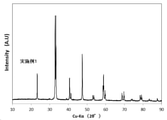
- FIG. It is an XRD diagram of Example 1.
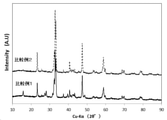
- FIG. It is an XRD diagram of Comparative Example 1 (solid line) and Comparative Example 2 (broken line).
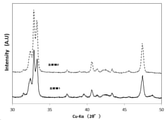
- It is an enlarged view (2 ⁇ 30 ° to 50 °) of the XRD figure of the comparative example 1 (solid line) and the comparative example 2 (broken line).
- Comparative Example 1 solid line
- Comparative Example 2 It is sectional drawing which shows typically an example of a solid oxide fuel cell.
- the perovskite-type composite oxide powder according to the present invention is represented by the general formula ABO 3- ⁇ , and La is contained in the A site and Co and Ni are contained in the B site.
- the perovskite-type composite oxide having such a composition may be referred to as “LCN”.
- ⁇ indicates the amount of oxygen deficiency including 0, and the range of the value of ⁇ is 0 ⁇ ⁇ ⁇ 1.
- the amount of Co and Ni contained in the B site can be adjusted arbitrarily.
- y in the formula is preferably 0.1 ⁇ y ⁇ 0.7, and further 0.3 ⁇ y ⁇ 0.65. Is more preferable.
- the crystallite diameter is 20 nm or more and 100 nm or less. If the crystallite diameter is less than 20 nm, the grain boundaries in the particles constituting the powder may increase and the conductivity may deteriorate. On the other hand, if the crystallite diameter exceeds 100 nm, it approaches the primary particle diameter of the particles constituting the powder, and it is considered that the conductivity deteriorates.
- the preferred lower limit of the crystallite diameter of the LCN according to the present invention is 45 nm, and the preferred upper limit is 80 nm.
- the crystallite diameter of the LCN according to the present invention is represented by the general formula ABO 3- ⁇ from the diffraction line peak of the X-ray diffraction pattern obtained by the X-ray diffraction measurement by the analysis software attached to the measuring device.
- the normal crystallite diameter analysis is calculated by the Scherrer formula, but in the case of the Scherrer method, it is assumed that the spread of the diffraction line is caused only by the crystallite size, but in the actual crystal, the lattice strain of the crystallite also affects. Therefore, in the present invention, the Williamson-Hole method is adopted to calculate the crystallite size in order to separate the influence of this lattice strain.
- the ratio of the peak height due to the component not incorporated into the perovskite type structure to the peak height of the maximum diffraction line of the perovskite type composite oxide is preferably 10% or less, more preferably 5% or less, and more preferably 1% or less.
- an LCN having a peak height of 10% or less of the peak height of the maximum diffraction line is determined to be a perovskite-type composite oxide single-phase LCN.
- the LCN according to the present invention is preferably a perovskite-type composite oxide single phase.
- the BET specific surface area of the LCN powder is preferably 10 m 2 / g or less.
- the BET specific surface area of the LCN powder is 10 m 2 / g or less, the increase in viscosity is suppressed when the LCN powder is made into a slurry or a paint to be used as an air electrode material, and the coatability of the slurry or the paint is improved.
- a more preferable BET specific surface area of the LCN powder is 9.0 m 2 / g or less, and more preferably 8.0 m 2 / g or less.
- the BET specific surface area of the LCN powder is preferably 2.5 m 2 / g or more.
- the BET specific surface area of the LCN powder is 2.5 m 2 / g or more, when the air electrode of the fuel cell is formed by using the LCN powder, an appropriate amount of pores can be formed on the surface of the air electrode, and the gas. The contact area with the fuel cell is increased, and the replacement efficiency when constructing the fuel cell can be improved.
- the cumulative 50% particle size D 50N calculated by the number distribution of the LCN powder according to the present embodiment by the laser diffraction scattering particle size distribution measuring device is preferably 0.35 ⁇ m or more and 2.1 ⁇ m or less. Further, it is preferable that the cumulative 50% particle diameter D 50V calculated by the volume distribution of the LCN powder according to the present embodiment by the laser diffraction scattering particle size distribution measuring device is 0.5 ⁇ m or more and 3.0 ⁇ m or less.
- LCN powder according to the present embodiment preferably has a specific D 50 N / D 50 V between D 50 N and D 50 V is 0.7 or more.
- D 50N and D 50V deviate greatly, it indicates that the number of particles existing in the unit volume is extremely large.
- D 50N is small, it indicates that many particles having a small particle diameter are present. It is presumed that if a large number of particles having a small particle size are present, the sintering of particles in the air electrode is likely to proceed. It is not preferable that the particle size is too small, because if the sintering progresses too much, the air permeability of the gas becomes poor.
- D 50V is too large, it indicates that there are too few particles having a small particle diameter.
- D 50N / D 50V is less than 1 at the maximum.
- the LCN powder has a 10% cumulative particle diameter D 10V , a 50% cumulative particle diameter D 50V , and a 90% cumulative particle diameter D 90V in the volume distribution measured by the laser diffraction scattering particle size distribution measuring device (D 90V ⁇ D 10V). ) / D
- the value of 50V is preferably 1.2 or less.
- the value of (D 90V ⁇ D 10V ) / D 50V is 1.2 or less, the volume distribution becomes sharp and the number of contact points during firing increases, so that LCN powder is used during firing to form the air electrode of the fuel cell. Necking between each other increases, and conductivity can be improved.
- the value of (D 90V ⁇ D 10V ) / D 50V is preferably 1.0 or more.
- the voids formed between the particles are adjusted to an appropriate shape.
- the size of the voids can be adjusted to an appropriate level by causing the particles to be sintered at the contact points between the particles.
- the method for producing the LCN powder according to the present invention will be specifically described.
- a method for producing LCN powder a wet method in which a precursor or the like is formed in a liquid and heat-treated to form a composite oxide, and a dry method in which raw materials are weighed, mixed as they are, and fired to form a composite oxide.
- it is preferable to manufacture by a wet method As a result of diligent studies by the present inventors, it was found that the crystallite diameter of the LCN can be increased to a size which is usually difficult by the dry method according to the wet method.
- the method for producing the LCN powder by the wet method will be illustrated below, but it is possible to appropriately adjust the LCN powder within a range that does not deviate from the purpose of the method exemplified here.
- a raw material solution containing a raw material containing lanthanum, cobalt, and an element of nickel is previously added to an alkaline solution such as aqueous ammonia to neutralize the LCN powder.
- an alkaline solution such as aqueous ammonia
- a method of producing a slurry containing a neutralization product of a perovskite-type composite oxide can be adopted. It is preferable that the raw material does not remain in the form of impurities at the firing stage and escapes as a gas.
- carbonic acid as the neutralization product to be produced.
- the neutralization product sometimes referred to as “precursor” in the present specification
- it can react with carbon dioxide in the air to locally carbonate and crystallize. It is suppressed.
- carbonic acid in this system may be added as a carbonate. Since the neutralization product thus obtained is amorphous nanoparticles in which each element is uniformly mixed, the elements are easily diffused during calcination, and monophasicization and crystallite growth are promoted. The effect is obtained.
- the temperature at which the neutralization product is formed is preferably 60 ° C. or lower, more preferably 50 ° C. or lower, and even more preferably 40 ° C. or lower.
- substances that tend to become gases such as carbonic acid and ammonia contained in the liquid are dispersed from the liquid, so that a neutralization product can be preferably obtained.
- the neutralized product of the perovskite-type composite oxide obtained in the present embodiment is amorphous nanoparticles in which each element is uniformly mixed, the elements can be easily diffused during firing to form a monophase. The effect of promoting the growth of crystals can be obtained.
- the obtained neutralization product is separated from the slurry as needed, washed, and then dried to obtain a precursor obtained by drying the neutralization product.
- a method for separating from the slurry for example, any of methods such as filtration separation, separation and recovery by a filter press, and direct drying by spray drying or freeze drying can be adopted. Any known method can be adopted for filtration separation and filter press.
- the pH may be adjusted in order to adjust the obtained precursor to a desired size or the like.
- the drying temperature for drying the neutralized product is preferably 150 ° C. or higher and 350 ° C. or lower, more preferably 200 ° C. or higher and 300 ° C. or lower. Drying at a temperature extremely outside this drying temperature range is not preferable because a part of the powder may become perovskite or moisture may remain in the precursor powder without being completely dried.
- the dried precursor powder can be miniaturized by crushing it.
- the crushing may be performed after the firing step described later.
- pulverization may not be required.
- the apparatus used for pulverization include a mortar, a sample mill, a henschel mixer, a hammer mill, a jet mill, a pulperizer, an impeller mill, an impact mill, and the like when dry pulverization is adopted.
- the rotation speed is preferably in the range of 9000 rpm or more and 16000 rpm or less.
- the rotation speed and crushing time of the impact mill are related to the firing temperature and the firing time in the firing process. The higher the firing temperature and the longer the firing time, the larger the rotation speed of the impact mill and the longer the crushing time. desirable.
- the prepared precursor powder is calcined in a calcining furnace to obtain an LCN.
- a calcining furnace conventionally known ones such as a shuttle kiln having an electric or gas heat source, a roller harsher kiln, and a rotary kiln can be used.
- the firing temperature is preferably higher than 1000 ° C. in order to increase the crystallite diameter of the particles constituting the perovskite-type composite oxide powder. Further, when the firing temperature is 1500 ° C. or lower, it is preferable because the calcined product can be easily dissized after firing.
- the rate of temperature rise during firing may be 10 ° C./min or less, and the atmosphere during firing may be an atmospheric atmosphere, or firing may be performed in nitrogen containing 1 ppm or more and 20% or less of oxygen. By slowing the firing, the crystallite diameter can be adjusted. Then, the inside of the firing furnace and the inside of the firing container are set as an open system, and the temperature is raised while removing the gas component generated from the raw material salt of the component raw material.
- the open system refers to a reaction system in which the inside of the firing furnace and the inside of the firing container are not sealed and the gas that is the atmosphere can flow in and out.
- the pulverization may be either wet pulverization or dry pulverization, or both may be used in combination.
- any of the devices and the like listed as examples at the time of precursor pulverization can be adopted.
- wet pulverization examples thereof include a wet ball mill, a sand grinder, an attritor, a pearl mill, an ultrasonic homogenizer, a pressure homogenizer, and an ultimateizer.
- a pearl mill it is preferable to use a pearl mill.
- any of the existing wet crushers such as known vertical flow tube bead mills, horizontal flow tube bead mills, and strong crushing rush type viscomills can be used for crushing.
- a horizontal flow tube type bead mill is preferably used.
- the horizontal flow tube type bead mill is more suitable than the vertical flow tube type bead mill because it is uniformly crushed while staying in the vessel and can be crushed more uniformly at the same flow rate.
- the horizontal flow tube type bead mill is economically preferable because the processing flow rate is larger than that of the strong pulverization type rush type viscomill.
- balls made of a hard raw material such as glass, ceramic, alumina, and zirconia may be used.
- the particle size of the ball for obtaining a perovskite-type composite oxide having a desired particle size is preferably about 0.1 mm or more and 5.0 mm or less, and more preferably 0.5 mm or more and 2.0 mm or less.
- an organic solvent such as water or ethanol which is easily removed at a relatively low boiling point can be used. From the viewpoint of manufacturing cost, it is preferable to use water as a dispersion medium.
- the particle size distribution of the calcined product (perovskite type composite oxide powder) after pulverization is such that the cumulative 50% D 50V calculated by the laser diffraction scattering particle size distribution measuring device in the volume distribution is in the range of 0.5 ⁇ m or more and 3.0 ⁇ m or less. It is preferable to have a mountain distribution.
- FIG. 9 is a cross-sectional configuration diagram schematically showing an example of a solid oxide fuel cell.
- a fuel gas typically hydrogen (H 2 ) but also a hydrocarbon (methane (CH 4 )) or the like
- H 2 hydrogen
- CH 4 hydrocarbon
- the air electrode 3 contains oxygen (O 2 ).
- oxygen in the air becomes oxide ions at the air electrode 3.
- Oxide ions are supplied from the air electrode 3 to the fuel electrode 1 via the solid electrolyte 2.
- the fuel electrode 1 reacts with the fuel gas to generate water (H 2 O), and emits electrons for generating electricity.
- SOFC depends on the configuration of the fuel cell to be applied and the manufacturing process, but a laminate such as a fuel electrode and a solid electrolyte membrane is prepared in advance, and the above-mentioned air electrode material is formed on the laminate by a printing method, vapor deposition, or the like. An air electrode is formed by forming and sintering a layer containing the above, and a fuel cell is manufactured.
- the film thickness of the air electrode may be appropriately determined according to the cell structure and the like, and is not particularly limited, but is preferably 20 ⁇ m or more and 50 ⁇ m or less, for example.
- the material of the air electrode may be only the LCN powder of the present embodiment, the perovskite composite oxide powder having a different composition, or one or more kinds of perovskite composite oxide powders having different particle sizes, and the present embodiment.
- the LCN powders in the form may be mixed and used.
- the electrolyte material used for the above-mentioned air electrode material can be used, and examples thereof include a rare earth element-doped ceria-based solid oxide electrolyte and a rare earth element-doped zirconia-based solid oxide electrolyte.
- the thickness of the solid electrolyte layer is thickened to the extent that the denseness of the solid electrolyte layer is maintained, while the thickness of the solid electrolyte layer is balanced so as to be thin enough to provide the conductivity of oxygen ions or hydrogen ions preferable for a fuel cell. It is set and is preferably 0.1 ⁇ m or more and 50 ⁇ m or less, and more preferably 1 ⁇ m or more and 20 ⁇ m or less.
- the fuel electrode may have a porous structure and may be configured to be in contact with the supplied fuel gas, and a material conventionally used for a solid oxide fuel cell can be used.
- a material conventionally used for a solid oxide fuel cell can be used.
- the film thickness of the fuel electrode is preferably 20 ⁇ m or more and 1 mm or less, more preferably 20 ⁇ m or more and 250 ⁇ m or less, from the viewpoint of durability, thermal expansion rate and the like.
- the structure of the SOFC can be a conventionally known flat type, polygonal type, cylindrical type (Tubular), or a flat cylindrical type (FlatTubular) in which the peripheral side surface of the cylinder is vertically crushed, and the shape and size can be used. Is not particularly limited.
- the flat SOFC includes, for example, an electrolyte supported type (ESC: Electrolyte-Supported Cell) with a thickened electrolyte and air with a thickened air electrode.
- An extremely supported type CSC: Cathode-Supported Cell
- a metal-supported cell in which a porous metal sheet is placed under the fuel electrode can also be used.
- Example 1 Solution prepared by dissolving lanthanum oxide in nitric acid (La concentration: 15.17 mass%, NO 3 -: 270g / L) 535g and cobalt nitrate hexahydrate (Co (NO 3) 2 ⁇ 6H 2 O) 73g, nickel nitrate hexahydrate (Ni (NO 3) 2 ⁇ 6H 2 O) 123g, respectively was prepared a mixed solution dissolved in deionized water 269 g.
- Firing 50 g of the obtained precursor is placed in a round rutsubo (a container having a diameter of 90 mm and a height of 75 mm), set in an electric muffle furnace (KM-160 manufactured by Toyo Seisakusho Co., Ltd.), and heated from room temperature to 800.
- the temperature is raised to 3.1 ° C / min and 800 ° C to 1080 ° C at a heating rate of 2.6 ° C / min, held at 1080 ° C (firing temperature) for 2 hours, and then calcined to room temperature.
- the physical characteristics of the obtained composite oxide powder were measured by the following measuring method.
- BET specific surface area The BET specific surface area of the obtained perovskite-type composite oxide powder was measured by the BET one-point method by nitrogen adsorption using a BET specific surface area measuring device (HM model-1210 manufactured by Mountech Co., Ltd.). In the BET specific surface area measurement, the degassing condition before the measurement was 105 ° C. for 20 minutes. The measurement results are shown in Table 1 for both Examples 1 and 2 and Comparative Examples 1 and 2.
- XRD X-ray diffraction
- ICDS Organic Crystal Structure Database
- PDXL2 integrated powder X-ray analysis software
- the obtained perovskite-type composite oxide powder was observed using a field-emission scanning electron microscope (S-4700 manufactured by Hitachi High-Technologies Corporation).
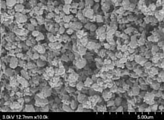
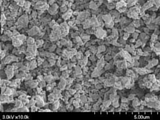
- Example 2 A precursor was obtained in the same manner up to the filtration / drying step of Example 1. 50 g of the obtained precursor is placed in a square sheath, set in a continuous firing furnace, and the temperature rise rate from room temperature to 900 ° C. is 3.1 ° C./min, and the temperature rise rate from 900 ° C. to 1060 ° C. is 2.4. The temperature was raised at ° C./min, and the mixture was kept at 1060 ° C. (calcination temperature) for 2 hours for firing, and then naturally cooled to room temperature. The obtained fired product was pulverized with a sample mill and a sand grinder in the same manner as in Example 1 to obtain a perovskite-type composite oxide powder according to Example 2. It was confirmed that the XRD pattern of the particles was the same as that shown in Example 1. Therefore, it can be said that the obtained substance is a perovskite single phase. Moreover, the SEM photograph of the obtained oxide powder is shown in FIG.
- the slurry was then dried at 125 ° C.
- the obtained dried product is crushed by a sample mill crusher (manufactured by Kyoritsu Riko Co., Ltd., model name: SK-M10) at a charge amount of 50 g / B and a rotation speed of 16000 rpm for 30 seconds x 2 times.
- a dry ground product was obtained.
- the obtained dried pulverized product was fired and pulverized in the same manner as in Comparative Example 1 to obtain a perovskite-type composite oxide powder according to Comparative Example 2.
- the particle size distribution of the obtained perovskite-type composite oxide powder was measured in the same manner as in Example 1, the cumulative 50% particle size D 50V on a volume basis was 0.77 ⁇ m.
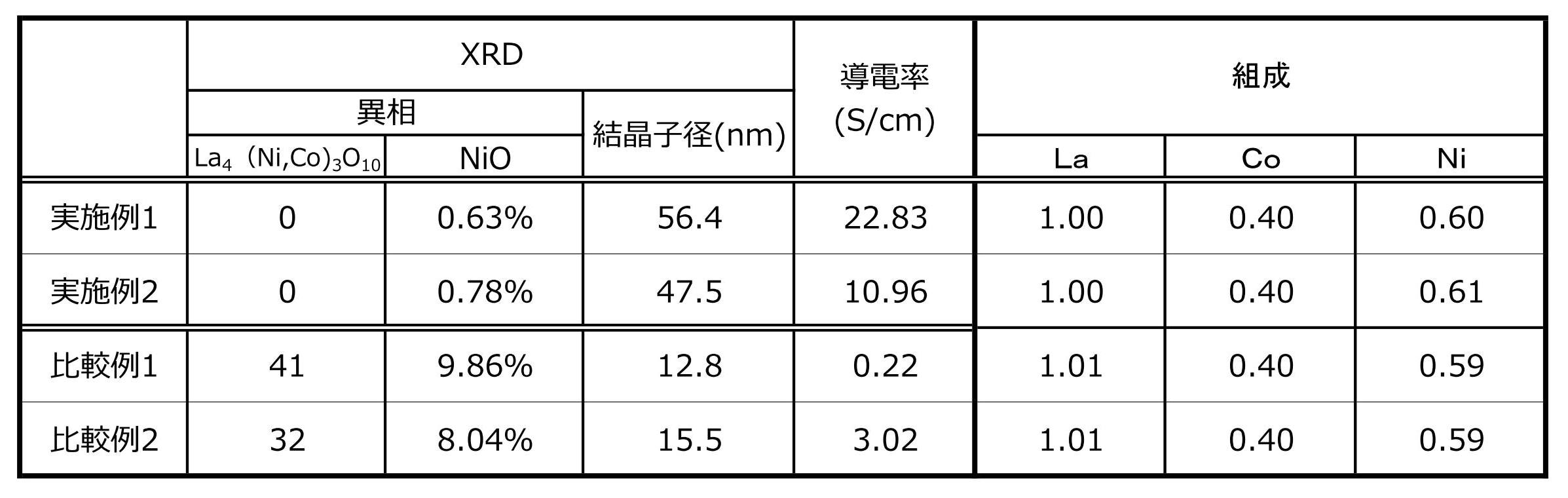
- the perovskite-type composite oxide powder of Example 1 having a composition of La 1.0 Co 0.4 Ni 0.6 O 3- ⁇ and a crystallite diameter of 56.4 nm, and La 1.0 Co 0.4.
- the perovskite-type composite oxide powder of Example 2 having a composition of Ni 0.61 O 3- ⁇ and having a composition of 47.5 nm has conductivitys of 22.83 (S / cm) and 10.96 (S / cm). ) And high conductivity was obtained.
- Comparative Example 1 having a composition of La 1.01 Co 0.4 Ni 0.59 O 3- ⁇ and crystallite diameters of 12.8 nm and 15.5 nm, which are smaller than the specified range of the present invention.
- the composite oxide powder of Comparative Example 2 has a conductivity of 0.22 (S / cm) and 3.02 (S / cm), which are significantly lower than those of the perovskite-type composite oxide powder of Examples 1 and 2. It was a thing.
- the perovskite type composite oxide powder according to the present invention also secures conductivity as an electrode, it is expected to exhibit suitable characteristics as an air electrode of a solid oxide type fuel cell and a solid oxide type fuel cell. .. Further, these perovskite-type composite oxide powders have electron conductivity, and for example, an adsorbent, a catalyst carrier, a separation membrane, an oxygen electrode such as a fuel cell, an electrode such as a capacitor, a member of a functional filter, and further. It can also be used as a gas sensor, lithium storage device, dye-sensitized solar cell, and the like.
Landscapes
- Chemical & Material Sciences (AREA)
- Engineering & Computer Science (AREA)
- Chemical Kinetics & Catalysis (AREA)
- Electrochemistry (AREA)
- General Chemical & Material Sciences (AREA)
- Materials Engineering (AREA)
- Manufacturing & Machinery (AREA)
- Life Sciences & Earth Sciences (AREA)
- Organic Chemistry (AREA)
- Sustainable Energy (AREA)
- Sustainable Development (AREA)
- Inorganic Chemistry (AREA)
- General Life Sciences & Earth Sciences (AREA)
- Geology (AREA)
- Inert Electrodes (AREA)
- Inorganic Compounds Of Heavy Metals (AREA)
- Fuel Cell (AREA)
Abstract
Description
本発明に係るLCN粉末の製造方法について具体的に説明する。LCN粉末の製造方法としては、液中で前駆体などを形成させ、それを熱処理することで複合酸化物化する湿式法と、原料を秤量してそのまま混合し焼成して複合酸化物とする乾式法とがあるが、本発明の目的を達成するためには湿式法で製造するのが好ましい。本発明者らが鋭意検討した結果、湿式法によれば、LCNの結晶子径を乾式法では通常困難である大きさまで大きくすることが可能であるとの知見を得たことによる。以下にLCN粉末の湿式法による製造方法について例示するが、ここで例示した方法の趣旨を逸脱しない範囲において適宜調整することは可能である。
作製した前駆体粉末は焼成炉にて焼成し、LCNを得る。焼成炉は、熱源が電気式又はガス式のシャトルキルン、ローラハースキルン、ロータリーキルンなど従来公知のものが使用できる。焼成温度は、ペロブスカイト型複合酸化物粉末を構成する粒子の結晶子径を大きくするために1000℃よりも高温で焼成するのが好ましい。また、焼成温度が1500℃以下であると焼成後の焼成物の解粒が容易となるため好ましい。
次に、焼成後の造粒物(焼成物)を粉砕する。粉砕は、湿式粉砕及び乾式粉砕の一方であっても、それらを併用してもかまわない。乾式粉砕時には、前駆体粉砕時に例示列挙した装置等をいずれも採用することができる。また、湿式粉砕を採用する場合には、湿式ボールミル、サンドグラインダー、アトライター、パールミル、超音波ホモジナイザー、圧力ホモジナイザー、アルティマイザーなどが挙げられる。これらを用いて湿式粉砕又は湿式破砕を行うことにより、上述の条件に沿ったペロブスカイト型複合酸化物を構成することができる。特に、パールミルを使用することが好ましい。湿式での粉砕を行うにあたりパールミルを選択するときには、知られている縦型流通管式ビーズミル、横型流通管式ビーズミル、強粉砕型突流式ビスコミルなどの既存の湿式粉砕機のいずれでも粉砕可能であるが、好ましくは横型流通管式ビーズミルを使用する。横型流通管式ビーズミルは縦型流通管式ビーズミルと比較してベッセル内に滞留している間は均一に粉砕が行われ、同一流量においてより均一な粉砕が可能となるため好適である。また、横型流通管式ビーズミルは強粉砕型突流式ビスコミルよりも処理流量が大きいため経済的に好ましい。粉砕メディアとしてはガラス、セラミック、アルミナ、ジルコニア等の硬質原料で製造されたボールを使用すると良い。所望の粒子径を有したペロブスカイト型複合酸化物を得るためのボールの粒子径は0.1mm以上5.0mm以下程度が好ましく、0.5mm以上2.0mm以下がより好ましい。湿式粉砕の場合に使用する分散媒として水や比較的低沸点で除かれやすいエタノール等の有機溶媒を用いることができる。製造コストの観点からは、水を分散媒とすることが好ましい。粉砕後の焼成物(ペロブスカイト型複合酸化物粉末)の粒度分布は、レーザー回折散乱粒度分布測定装置により体積分布で算出される累積50%D50Vが0.5μm以上3.0μm以下の範囲で一山分布とするのが好ましい。
固体酸化物型燃料電池について説明する。図9は、固体酸化物型燃料電池の一例を模式的に示した断面構成図である。支持体となる薄板状あるいはシート状の燃料極1と、燃料極1の表面に形成された固体電解質膜2と、固体電解質膜2の表面に形成された薄板状あるいはシート状の空気極3とが積層された構造を有する。
硝酸に酸化ランタンを溶解させた溶液(La濃度:15.17質量%、NO3 -:270g/L)535gと、硝酸コバルト六水和物(Co(NO3)2・6H2O)73g、硝酸ニッケル六水和物(Ni(NO3)2・6H2O)123gと、をそれぞれイオン交換水269gに溶解させ混合溶液を作成した。
このようにして得られた中和生成物をろ過した後に水洗し、得られた中和生成物のウエットケーキを直径5mmの細長い円柱形のペレット状に成形した。この成形後直ぐにペレット状の成形体を空気を通風しながら250℃で2時間加熱して乾燥し黒色の前駆体を得た。
得られた前駆体50gを丸型ルツボ(直径90mm、高さ75mmの容器)内に入れ、電気マッフル炉(株式会社東洋製作所製のKM-160)内へセットし、室温から800℃まで昇温速度3.1℃/分、800℃から1080℃まで昇温速度2.6℃/分で昇温し、1080℃(焼成温度)で2時間保持して焼成した後、室温まで自然冷却した。
また、誘導結合プラズマ(ICP)発光分析装置(アジレント・テクノロジー株式会社製 720ES)によって実施例1のペロブスカイト型複合酸化物粉末の組成分析を行った結果、表2に示す組成を有していた。他の実施例及び比較例の複合酸化物粉末についても同様にして組成分析を行った。結果は表2に併せて示す。
得られたペロブスカイト型複合酸化物粉末のBET比表面積を、BET比表面積測定装置(株式会社マウンテック製のHM model―1210)を用いて窒素吸着によるBET1点法で測定した。なお、当該BET比表面積測定において、測定前の脱気条件は105℃、20分間とした。測定結果は実施例1、2、比較例1、2とも表1に合わせて示す。
得られたペロブスカイト型複合酸化物粉末0.15gを、500ppmのヘキサメタリン酸ナトリウムを含有する水60mLに添加し、超音波ホモジナイザーにより30秒間分散させて得られたペロブスカイト型複合酸化物粉末を含むスラリーを使用して、ペロブスカイト型複合酸化物粉末の体積基準の累積10%粒径(D10V)、累積50%粒径(D50V)、累積90%粒径(D90V)、個数基準の累積10%粒径(D10N)、累積50%粒径(D50N)、累積90%粒径(D90N)をマイクロトラック粒度分布測定装置(日機装株式会社製のMT3300EXII)を用いて(粒子屈折率を2.40、溶媒屈折率を1.333、計算モードをMT3300IIとして)測定した。測定結果は実施例1、2、比較例1、2とも表1に合わせて示す。
得られたペロブスカイト型複合酸化物粉末のXRD測定を株式会社リガク製のUltimaIVを用いて行った。測定条件としては、管球はCuを用い、管電圧は40kV、管電流は40mA、発散スリット1/2°、散乱スリット8mm、受光スリットは解放設定、ステップ幅は0.02°、計測時間は4°/分の設定とした。得られたX線回折パターンに基づいて、上記のX線回折(XRD)装置に付属の解析ソフトウェア(株式会社リガク製の統合粉末X線解析ソフトウェアPDXL2用ICDS(Inorganic Crystal Structure Database))により、得られたペロブスカイト型複合酸化物粉末の結晶相の同定、および不純成分の組成の解析を行った。
また、ペロブスカイト型複合酸化物粉末のピークを分離して得られた2θ=10°~90°の範囲のピークからウィリアムソン-ホール法を用いて結晶子径を求めた。
得られたペロブスカイト型複合酸化物粉末を電界放出型走査型電子顕微鏡(株式会社日立ハイテクノロジーズ製 S-4700)を用いて観察した。
複合酸化物粉末の導電率の測定は、半径10mmのユニットに測定粉末を2g仕込み、粉体抵抗測定システム(株式会社 三菱ケミカルアナリテック社製 MCP-PD51)を用いて圧力16N(ニュートン)で圧粉し、抵抗率計(株式会社 三菱ケミカルアナリテック社製 MCP-T610)を用いて4探針プローブ法で導電率を測定した。測定した結果は表2に併せて示した。
実施例1のろ過・乾燥工程までは同様にして前駆体を得た。得られた前駆体50gを角型のサヤ内に入れ、連続焼成炉内へセットし、室温から900℃まで昇温速度3.1℃/分、900℃から1060℃まで昇温速度2.4℃/分で昇温させ、1060℃(焼成温度)で2時間保持して焼成した後、室温まで自然冷却した。得られた焼成物を、実施例1と同様にして、サンプルミル及びサンドグラインダーで粉砕処理し、実施例2に係るペロブスカイト型複合酸化物粉末を得た。粒子のXRDパターンは実施例1に示したものと同じであることが確認された。そのため、得られた物質はペロブスカイト単相であるといえる。また、得られた酸化物粉末のSEM写真を図6に示す。
(原料の作製)
La1.0Co0.4Ni0.6O3-δの組成を有する複合酸化物粉末が得られるよう、La2O3を27.1g、Co3O4を5.4g、NiOを7.5g秤量し、自動乳鉢を使用して、30分間原料を混合した(以下、「原料混合物」という。)。
得られた原料混合物50gを丸型ルツボ(直径90mm、高さ75mmの容器)内に入れ、電気マッフル炉(株式会社東洋製作所製のKM-160)内へセットし、室温から800℃まで昇温速度3.1℃/分、800℃から1080℃まで昇温速度2.6℃/分で昇温させ、1080℃(焼成温度)で2時間保持して焼成した後、室温まで自然冷却した。
得られた焼成物をサンプルミル粉砕装置(協立理工株式会社製、機種名:SK-M10)を用い、20g/Bの仕込量で回転数16000rpmで30秒×2回の粉砕処理をすることで、比較例1に係るペロブスカイト型複合酸化物粉末を得た。
La1.0Co0.4Ni0.6O3-δの組成を有する複合酸化物粉末が得られるよう、La2O3を27.1g、Co3O4を5.4g、NiOを7.5g、純水を99g、酢酸を1.5g秤量し、ポットを20℃の冷却水で冷却しながら、回転数1500rpmで60分間粉砕処理し、原料スラリーを作製した。
次に、このスラリーを125℃で乾燥させた。得られた乾燥物をサンプルミル粉砕装置(協立理工株式会社製、機種名:SK-M10)により50g/Bの仕込量、回転数16000rpmで30秒×2回の粉砕処理をすることで、乾燥粉砕物を得た。

Claims (5)
- 一般式ABO3-δ(δは酸素欠損量を表し0≦δ<1である。)で示されるペロブスカイト型複合酸化物粉末であって、
Aサイトに含有される元素はLaであり、
Bサイトに含有される元素はCo及びNiであり、
ウィリアムソン-ホール法により求められる結晶子径が20nm以上100nm以下であることを特徴とするペロブスカイト型複合酸化物粉末。 - マイクロトラック粒度分布測定により算出される粒度分布において、個数分布で算出される累積50%粒子径D50Nと体積分布で算出される累積50%粒子径D50Vの比D50N/D50Vが0.7以上である請求項1に記載のペロブスカイト型複合酸化物粉末。
- マイクロトラック粒度分布測定により算出される粒度分布において、体積分布における10%累積粒子径D10V、50%累積粒子径D50V、90%累積粒子径D90Vの関係が1.0≦(D90V-D10V)/D50V≦1.2である請求項1または2に記載のペロブスカイト型複合酸化物粉末。
- 請求項1から3のいずれかに記載のペロブスカイト型複合酸化物粉末を含み形成される固体酸化物型燃料電池用の空気極。
- 燃料極と、固体電解質と、空気極とを備えた固体酸化物型燃料電池であって、
前記空気極として前記請求項4に記載の空気極を用いた固体酸化物型燃料電池。
Priority Applications (6)
| Application Number | Priority Date | Filing Date | Title |
|---|---|---|---|
| JP2022535983A JP7474328B2 (ja) | 2020-07-11 | 2020-07-11 | ペロブスカイト型複合酸化物粉末 |
| KR1020227036274A KR102763799B1 (ko) | 2020-07-11 | 2020-07-11 | 페로브스카이트형 복합 산화물 분말 |
| EP20945597.1A EP4180398A4 (en) | 2020-07-11 | 2020-07-11 | PEROVSKITE TYPE COMPOSITE OXIDE POWDER |
| CN202080102503.3A CN115768727A (zh) | 2020-07-11 | 2020-07-11 | 钙钛矿型复合氧化物粉末 |
| PCT/JP2020/027172 WO2022013903A1 (ja) | 2020-07-11 | 2020-07-11 | ペロブスカイト型複合酸化物粉末 |
| US18/007,535 US20230216065A1 (en) | 2020-07-11 | 2020-07-11 | Perovskite-type composite oxide powder |
Applications Claiming Priority (1)
| Application Number | Priority Date | Filing Date | Title |
|---|---|---|---|
| PCT/JP2020/027172 WO2022013903A1 (ja) | 2020-07-11 | 2020-07-11 | ペロブスカイト型複合酸化物粉末 |
Publications (1)
| Publication Number | Publication Date |
|---|---|
| WO2022013903A1 true WO2022013903A1 (ja) | 2022-01-20 |
Family
ID=79555202
Family Applications (1)
| Application Number | Title | Priority Date | Filing Date |
|---|---|---|---|
| PCT/JP2020/027172 Ceased WO2022013903A1 (ja) | 2020-07-11 | 2020-07-11 | ペロブスカイト型複合酸化物粉末 |
Country Status (6)
| Country | Link |
|---|---|
| US (1) | US20230216065A1 (ja) |
| EP (1) | EP4180398A4 (ja) |
| JP (1) | JP7474328B2 (ja) |
| KR (1) | KR102763799B1 (ja) |
| CN (1) | CN115768727A (ja) |
| WO (1) | WO2022013903A1 (ja) |
Cited By (1)
| Publication number | Priority date | Publication date | Assignee | Title |
|---|---|---|---|---|
| JP7555447B1 (ja) | 2023-03-30 | 2024-09-24 | Dowaエレクトロニクス株式会社 | ペロブスカイト型複合酸化物粉末 |
Citations (4)
| Publication number | Priority date | Publication date | Assignee | Title |
|---|---|---|---|---|
| JP2008305670A (ja) | 2007-06-07 | 2008-12-18 | Nippon Telegr & Teleph Corp <Ntt> | 固体電解質型燃料電池セル |
| CN102658152A (zh) * | 2012-04-19 | 2012-09-12 | 常州优特科新能源科技有限公司 | 一种氧电极钙钛矿型催化剂的制备方法 |
| JP2014075337A (ja) * | 2012-09-14 | 2014-04-24 | Toto Ltd | 固体酸化物形燃料電池セル及びその製造方法 |
| CN106935879A (zh) * | 2017-04-21 | 2017-07-07 | 常州联德电子有限公司 | 一种固体氧化物燃料电池复合阴极集流材料的制备方法 |
Family Cites Families (6)
| Publication number | Priority date | Publication date | Assignee | Title |
|---|---|---|---|---|
| JP2675337B2 (ja) * | 1988-07-01 | 1997-11-12 | キヤノン株式会社 | 互いに転接する一対のローラのニップ幅の自動測定装置 |
| JP4875410B2 (ja) * | 2006-06-13 | 2012-02-15 | トヨタ自動車株式会社 | 微粒子担持カーボン粒子およびその製造方法ならびに燃料電池用電極 |
| CN110199055B (zh) * | 2017-02-21 | 2021-12-24 | 旭化成株式会社 | 阳极、水电解用阳极、电解单元以及氢的制造方法 |
| JP6913490B2 (ja) * | 2017-03-24 | 2021-08-04 | Dowaエレクトロニクス株式会社 | ペロブスカイト型複合酸化物粉末およびその製造方法 |
| JP7071828B2 (ja) * | 2018-01-10 | 2022-05-19 | Dowaエレクトロニクス株式会社 | ペロブスカイト型複合酸化物粉末およびその製造方法 |
| JP7194547B2 (ja) * | 2018-10-01 | 2022-12-22 | Dowaエレクトロニクス株式会社 | 複合酸化物粉末 |
-
2020
- 2020-07-11 US US18/007,535 patent/US20230216065A1/en active Pending
- 2020-07-11 WO PCT/JP2020/027172 patent/WO2022013903A1/ja not_active Ceased
- 2020-07-11 KR KR1020227036274A patent/KR102763799B1/ko active Active
- 2020-07-11 JP JP2022535983A patent/JP7474328B2/ja active Active
- 2020-07-11 EP EP20945597.1A patent/EP4180398A4/en active Pending
- 2020-07-11 CN CN202080102503.3A patent/CN115768727A/zh active Pending
Patent Citations (4)
| Publication number | Priority date | Publication date | Assignee | Title |
|---|---|---|---|---|
| JP2008305670A (ja) | 2007-06-07 | 2008-12-18 | Nippon Telegr & Teleph Corp <Ntt> | 固体電解質型燃料電池セル |
| CN102658152A (zh) * | 2012-04-19 | 2012-09-12 | 常州优特科新能源科技有限公司 | 一种氧电极钙钛矿型催化剂的制备方法 |
| JP2014075337A (ja) * | 2012-09-14 | 2014-04-24 | Toto Ltd | 固体酸化物形燃料電池セル及びその製造方法 |
| CN106935879A (zh) * | 2017-04-21 | 2017-07-07 | 常州联德电子有限公司 | 一种固体氧化物燃料电池复合阴极集流材料的制备方法 |
Non-Patent Citations (1)
| Title |
|---|
| See also references of EP4180398A4 |
Cited By (5)
| Publication number | Priority date | Publication date | Assignee | Title |
|---|---|---|---|---|
| JP7555447B1 (ja) | 2023-03-30 | 2024-09-24 | Dowaエレクトロニクス株式会社 | ペロブスカイト型複合酸化物粉末 |
| WO2024203265A1 (ja) | 2023-03-30 | 2024-10-03 | Dowaエレクトロニクス株式会社 | ペロブスカイト型複合酸化物粉末 |
| JP2024142466A (ja) * | 2023-03-30 | 2024-10-11 | Dowaエレクトロニクス株式会社 | ペロブスカイト型複合酸化物粉末 |
| KR20240166030A (ko) | 2023-03-30 | 2024-11-25 | 도와 일렉트로닉스 가부시키가이샤 | 페로브스카이트형 복합 산화물 분말 |
| EP4516743A4 (en) * | 2023-03-30 | 2025-12-17 | Dowa Electronics Materials Co Ltd | Perovskite-type composite oxide powder |
Also Published As
| Publication number | Publication date |
|---|---|
| JP7474328B2 (ja) | 2024-04-24 |
| KR20220154809A (ko) | 2022-11-22 |
| KR102763799B1 (ko) | 2025-02-05 |
| CN115768727A (zh) | 2023-03-07 |
| US20230216065A1 (en) | 2023-07-06 |
| EP4180398A4 (en) | 2024-04-17 |
| JPWO2022013903A1 (ja) | 2022-01-20 |
| EP4180398A1 (en) | 2023-05-17 |
Similar Documents
| Publication | Publication Date | Title |
|---|---|---|
| Raghvendra et al. | Synthesis of La0. 9Sr0. 1Ga0. 8Mg0. 2O3-δ electrolyte via ethylene glycol route and its characterizations for IT-SOFC | |
| KR101587305B1 (ko) | 산화니켈-안정화 지르코니아 복합 산화물 및 그의 제조 방법, 이 복합 산화물을 함유하는 고체 산화물형 연료 전지용 연료극 | |
| JP6805054B2 (ja) | 水蒸気電解セル | |
| JP2020135987A (ja) | 電気化学セル | |
| JP7201446B2 (ja) | 複合酸化物粉末 | |
| JP2022184894A (ja) | 複合酸化物粉末 | |
| US8367273B2 (en) | Method for preparation of the solid oxide fuel cell single cell | |
| JP7474328B2 (ja) | ペロブスカイト型複合酸化物粉末 | |
| JP6625855B2 (ja) | 水蒸気電解用セルおよびその製造方法 | |
| JP6625856B2 (ja) | 水蒸気電解用セル | |
| JP7555447B1 (ja) | ペロブスカイト型複合酸化物粉末 | |
| JP6367636B2 (ja) | 水蒸気電解用セル | |
| JP7477729B2 (ja) | 複合酸化物粉末およびその製造方法 | |
| JP2024142461A (ja) | ペロブスカイト型複合酸化物粉末 | |
| JPH09302438A (ja) | Ni/YSZサーメット及びその製造方法 | |
| JP5626837B2 (ja) | ニッケル系合金粉末の製造方法 | |
| JP2006012764A (ja) | 固体電解質型燃料電池の電極用材料および電極 | |
| JP2026056732A (ja) | 複合酸化物粉末及びその製造方法、空気極材料ならびに固体酸化物型燃料電池 | |
| KR20180033796A (ko) | 무기 산화물 분말 및 이의 제조방법 | |
| Lim et al. | Characterization of spherical NiO-YSZ anode composites for solid oxide fuel cells synthesized by ultrasonic spray pyrolysis | |
| WO2016017251A1 (ja) | 水蒸気電解用セル |
Legal Events
| Date | Code | Title | Description |
|---|---|---|---|
| 121 | Ep: the epo has been informed by wipo that ep was designated in this application |
Ref document number: 20945597 Country of ref document: EP Kind code of ref document: A1 |
|
| ENP | Entry into the national phase |
Ref document number: 2022535983 Country of ref document: JP Kind code of ref document: A |
|
| ENP | Entry into the national phase |
Ref document number: 20227036274 Country of ref document: KR Kind code of ref document: A |
|
| NENP | Non-entry into the national phase |
Ref country code: DE |
|
| ENP | Entry into the national phase |
Ref document number: 2020945597 Country of ref document: EP Effective date: 20230213 |