WO2022004689A1 - 粉体塗料用多段共重合体およびその製造方法、粉体塗料組成物 - Google Patents
粉体塗料用多段共重合体およびその製造方法、粉体塗料組成物 Download PDFInfo
- Publication number
- WO2022004689A1 WO2022004689A1 PCT/JP2021/024448 JP2021024448W WO2022004689A1 WO 2022004689 A1 WO2022004689 A1 WO 2022004689A1 JP 2021024448 W JP2021024448 W JP 2021024448W WO 2022004689 A1 WO2022004689 A1 WO 2022004689A1
- Authority
- WO
- WIPO (PCT)
- Prior art keywords
- polymer
- mass
- powder coating
- copolymer
- stage
- Prior art date
- Legal status (The legal status is an assumption and is not a legal conclusion. Google has not performed a legal analysis and makes no representation as to the accuracy of the status listed.)
- Ceased
Links
Images
Classifications
-
- C—CHEMISTRY; METALLURGY
- C08—ORGANIC MACROMOLECULAR COMPOUNDS; THEIR PREPARATION OR CHEMICAL WORKING-UP; COMPOSITIONS BASED THEREON
- C08F—MACROMOLECULAR COMPOUNDS OBTAINED BY REACTIONS ONLY INVOLVING CARBON-TO-CARBON UNSATURATED BONDS
- C08F265/00—Macromolecular compounds obtained by polymerising monomers on to polymers of unsaturated monocarboxylic acids or derivatives thereof as defined in group C08F20/00
- C08F265/04—Macromolecular compounds obtained by polymerising monomers on to polymers of unsaturated monocarboxylic acids or derivatives thereof as defined in group C08F20/00 on to polymers of esters
-
- C—CHEMISTRY; METALLURGY
- C08—ORGANIC MACROMOLECULAR COMPOUNDS; THEIR PREPARATION OR CHEMICAL WORKING-UP; COMPOSITIONS BASED THEREON
- C08L—COMPOSITIONS OF MACROMOLECULAR COMPOUNDS
- C08L101/00—Compositions of unspecified macromolecular compounds
-
- C—CHEMISTRY; METALLURGY
- C08—ORGANIC MACROMOLECULAR COMPOUNDS; THEIR PREPARATION OR CHEMICAL WORKING-UP; COMPOSITIONS BASED THEREON
- C08L—COMPOSITIONS OF MACROMOLECULAR COMPOUNDS
- C08L51/00—Compositions of graft polymers in which the grafted component is obtained by reactions only involving carbon-to-carbon unsaturated bonds; Compositions of derivatives of such polymers
-
- C—CHEMISTRY; METALLURGY
- C08—ORGANIC MACROMOLECULAR COMPOUNDS; THEIR PREPARATION OR CHEMICAL WORKING-UP; COMPOSITIONS BASED THEREON
- C08L—COMPOSITIONS OF MACROMOLECULAR COMPOUNDS
- C08L67/00—Compositions of polyesters obtained by reactions forming a carboxylic ester link in the main chain; Compositions of derivatives of such polymers
-
- C—CHEMISTRY; METALLURGY
- C09—DYES; PAINTS; POLISHES; NATURAL RESINS; ADHESIVES; COMPOSITIONS NOT OTHERWISE PROVIDED FOR; APPLICATIONS OF MATERIALS NOT OTHERWISE PROVIDED FOR
- C09D—COATING COMPOSITIONS, e.g. PAINTS, VARNISHES OR LACQUERS; FILLING PASTES; CHEMICAL PAINT OR INK REMOVERS; INKS; CORRECTING FLUIDS; WOODSTAINS; PASTES OR SOLIDS FOR COLOURING OR PRINTING; USE OF MATERIALS THEREFOR
- C09D133/00—Coating compositions based on homopolymers or copolymers of compounds having one or more unsaturated aliphatic radicals, each having only one carbon-to-carbon double bond, and at least one being terminated by only one carboxyl radical, or of salts, anhydrides, esters, amides, imides, or nitriles thereof; Coating compositions based on derivatives of such polymers
- C09D133/04—Homopolymers or copolymers of esters
- C09D133/06—Homopolymers or copolymers of esters of esters containing only carbon, hydrogen and oxygen, the oxygen atom being present only as part of the carboxyl radical
- C09D133/08—Homopolymers or copolymers of acrylic acid esters
-
- C—CHEMISTRY; METALLURGY
- C09—DYES; PAINTS; POLISHES; NATURAL RESINS; ADHESIVES; COMPOSITIONS NOT OTHERWISE PROVIDED FOR; APPLICATIONS OF MATERIALS NOT OTHERWISE PROVIDED FOR
- C09D—COATING COMPOSITIONS, e.g. PAINTS, VARNISHES OR LACQUERS; FILLING PASTES; CHEMICAL PAINT OR INK REMOVERS; INKS; CORRECTING FLUIDS; WOODSTAINS; PASTES OR SOLIDS FOR COLOURING OR PRINTING; USE OF MATERIALS THEREFOR
- C09D133/00—Coating compositions based on homopolymers or copolymers of compounds having one or more unsaturated aliphatic radicals, each having only one carbon-to-carbon double bond, and at least one being terminated by only one carboxyl radical, or of salts, anhydrides, esters, amides, imides, or nitriles thereof; Coating compositions based on derivatives of such polymers
- C09D133/04—Homopolymers or copolymers of esters
- C09D133/06—Homopolymers or copolymers of esters of esters containing only carbon, hydrogen and oxygen, the oxygen atom being present only as part of the carboxyl radical
- C09D133/10—Homopolymers or copolymers of methacrylic acid esters
-
- C—CHEMISTRY; METALLURGY
- C09—DYES; PAINTS; POLISHES; NATURAL RESINS; ADHESIVES; COMPOSITIONS NOT OTHERWISE PROVIDED FOR; APPLICATIONS OF MATERIALS NOT OTHERWISE PROVIDED FOR
- C09D—COATING COMPOSITIONS, e.g. PAINTS, VARNISHES OR LACQUERS; FILLING PASTES; CHEMICAL PAINT OR INK REMOVERS; INKS; CORRECTING FLUIDS; WOODSTAINS; PASTES OR SOLIDS FOR COLOURING OR PRINTING; USE OF MATERIALS THEREFOR
- C09D133/00—Coating compositions based on homopolymers or copolymers of compounds having one or more unsaturated aliphatic radicals, each having only one carbon-to-carbon double bond, and at least one being terminated by only one carboxyl radical, or of salts, anhydrides, esters, amides, imides, or nitriles thereof; Coating compositions based on derivatives of such polymers
- C09D133/04—Homopolymers or copolymers of esters
- C09D133/06—Homopolymers or copolymers of esters of esters containing only carbon, hydrogen and oxygen, the oxygen atom being present only as part of the carboxyl radical
- C09D133/10—Homopolymers or copolymers of methacrylic acid esters
- C09D133/12—Homopolymers or copolymers of methyl methacrylate
-
- C—CHEMISTRY; METALLURGY
- C09—DYES; PAINTS; POLISHES; NATURAL RESINS; ADHESIVES; COMPOSITIONS NOT OTHERWISE PROVIDED FOR; APPLICATIONS OF MATERIALS NOT OTHERWISE PROVIDED FOR
- C09D—COATING COMPOSITIONS, e.g. PAINTS, VARNISHES OR LACQUERS; FILLING PASTES; CHEMICAL PAINT OR INK REMOVERS; INKS; CORRECTING FLUIDS; WOODSTAINS; PASTES OR SOLIDS FOR COLOURING OR PRINTING; USE OF MATERIALS THEREFOR
- C09D151/00—Coating compositions based on graft polymers in which the grafted component is obtained by reactions only involving carbon-to-carbon unsaturated bonds; Coating compositions based on derivatives of such polymers
-
- C—CHEMISTRY; METALLURGY
- C09—DYES; PAINTS; POLISHES; NATURAL RESINS; ADHESIVES; COMPOSITIONS NOT OTHERWISE PROVIDED FOR; APPLICATIONS OF MATERIALS NOT OTHERWISE PROVIDED FOR
- C09D—COATING COMPOSITIONS, e.g. PAINTS, VARNISHES OR LACQUERS; FILLING PASTES; CHEMICAL PAINT OR INK REMOVERS; INKS; CORRECTING FLUIDS; WOODSTAINS; PASTES OR SOLIDS FOR COLOURING OR PRINTING; USE OF MATERIALS THEREFOR
- C09D167/00—Coating compositions based on polyesters obtained by reactions forming a carboxylic ester link in the main chain; Coating compositions based on derivatives of such polymers
-
- C—CHEMISTRY; METALLURGY
- C09—DYES; PAINTS; POLISHES; NATURAL RESINS; ADHESIVES; COMPOSITIONS NOT OTHERWISE PROVIDED FOR; APPLICATIONS OF MATERIALS NOT OTHERWISE PROVIDED FOR
- C09D—COATING COMPOSITIONS, e.g. PAINTS, VARNISHES OR LACQUERS; FILLING PASTES; CHEMICAL PAINT OR INK REMOVERS; INKS; CORRECTING FLUIDS; WOODSTAINS; PASTES OR SOLIDS FOR COLOURING OR PRINTING; USE OF MATERIALS THEREFOR
- C09D201/00—Coating compositions based on unspecified macromolecular compounds
-
- C—CHEMISTRY; METALLURGY
- C09—DYES; PAINTS; POLISHES; NATURAL RESINS; ADHESIVES; COMPOSITIONS NOT OTHERWISE PROVIDED FOR; APPLICATIONS OF MATERIALS NOT OTHERWISE PROVIDED FOR
- C09D—COATING COMPOSITIONS, e.g. PAINTS, VARNISHES OR LACQUERS; FILLING PASTES; CHEMICAL PAINT OR INK REMOVERS; INKS; CORRECTING FLUIDS; WOODSTAINS; PASTES OR SOLIDS FOR COLOURING OR PRINTING; USE OF MATERIALS THEREFOR
- C09D5/00—Coating compositions, e.g. paints, varnishes or lacquers, characterised by their physical nature or the effects produced; Filling pastes
- C09D5/03—Powdery paints
Definitions
- the present invention relates to a multi-stage copolymer for powder coating and a method for producing the same, and a powder coating composition containing the multi-stage copolymer for powder coating.
- the present application claims priority based on Japanese Patent Application No. 2020-11178 filed in Japan on June 29, 2020, the contents of which are incorporated herein by reference.
- powder paints that do not generate organic solvents when baking coating films are excellent in working environment because they do not contain organic solvents, and are non-hazardous and resource-saving are used in a wide range of fields.
- powder paints Compared to solvent-based paints, powder paints have the characteristic that they can be coated with a thick film of 30 to 100 ⁇ m in a single coat, in addition to being solvent-free.
- the powder coating material has a problem that the processability of the coating film is deteriorated due to the thickening of the coating film obtained by the coating.
- polyester-based powder paints are often used for outdoor applications such as road materials and building materials.
- polyester-based powder coating materials having a higher degree of weather resistance have been studied from the viewpoint of maintenance-free. With respect to this polyester-based powder coating material having a high degree of weather resistance, there is an increasing demand for improving the toughness of the obtained coating film.
- Patent Document 1 discloses an example in which a multilayer polymer obtained by graft-polymerizing a vinyl-based monomer to a rubber-like polymer is applied to a powder coating material.
- Patent Document 1 describes the processability and resistance of a coating film by dispersing a multi-stage copolymer having a polymer layer having a glass transition temperature of 20 ° C. or lower and a polymer layer having a glass transition temperature of 60 ° C. or higher in a powder coating material. It is disclosed that the impact resistance can be improved. However, it is desired to develop a powder coating film that can obtain a coating film having further improved toughness.
- Patent Documents 2 to 4 disclose examples in which multilayer polymer particles are applied as an impact resistance modifier. Specifically, in Patent Documents 2 to 4, a multi-step polymer having a basic structure of a hard-soft-hard three-layer is added to a hard resin such as a methacrylic resin to provide impact resistance and haze temperature. A technique for improving dependence, impact whitening resistance, etc. is disclosed. However, since the above-mentioned technique relates to application to resin materials for molded members, when the above-mentioned technique is applied to powder coating materials, the dispersibility of the multi-step polymer in the thermoplastic resin is insufficient. there were. Further, since the powder coating composition containing the multi-step polymer tends to increase the melt viscosity, the appearance and toughness of the coating film obtained from the powder coating composition are insufficient.
- the present invention has been made in view of the above circumstances, and is a multi-stage copolymer for powder coating materials and a method for producing the same, and multi-stages for powder coating materials, which can obtain a coating film having a good appearance and excellent toughness. It is an object of the present invention to provide a powder coating composition containing a copolymer.
- Multi-stage copolymer for powder coating material composed of at least three polymer components of the first-stage polymer (A), the second-stage polymer (B), and the third-stage polymer (C). It ’s a polymer, The glass transition temperature of the polymer (A) is ⁇ 15 ° C. or higher, the glass transition temperature of the polymer (B) is ⁇ 20 ° C. or lower, and the glass transition temperature of the polymer (C) is 60 ° C. or higher. When the total amount of the multi-stage copolymer for powder coating is 100% by mass, the multi-stage copolymer for powder coating contains 1% by mass or more and 30% by mass or less of the polymer (A).
- a multi-stage copolymer for powder coating materials which comprises at least an inner layer, an intermediate layer and an outer layer.
- the inner layer contains the polymer (A) having a glass transition temperature of ⁇ 15 ° C. or higher, and contains the polymer (A).
- the intermediate layer contains the polymer (B) having a glass transition temperature of ⁇ 20 ° C. or lower, and contains the polymer (B).
- the outer layer is a copolymer containing a polymer (C) having a glass transition temperature of 60 ° C. or higher.
- a multi-stage copolymer for powder coating materials composed of at least three polymer components of the polymer (A), the polymer (B), and the polymer (C).
- the polymer (A) When the total amount of the monomer units in the polymer (A) is 100% by mass, the polymer (A) contains 35% by mass or more and 99.5% by mass or less of the methyl methacrylate unit, and is a polyfunctional single.
- the polymer (B) has 70% by mass of alkyl (meth) acrylate units having 4 to 8 carbon atoms in the alkyl group.
- the polymer (C) contains 70% by mass or more and 100% by mass or less of methyl methacrylate
- the multistage copolymer for powder coating material according to any one of [1] to [8], wherein the volume average particle diameter of the secondary particles is 1 ⁇ m or more and 500 ⁇ m or less.
- the weight of the polymer (A) is 1% by mass or more and 30% by mass or less.
- the method for producing a multi-stage copolymer for powder coating according to any one of [1] to [10].
- the first monomer mixture for constituting the polymer (A) is polymerized to obtain a first dispersion liquid containing the polymer (A), and then the polymer (1) is added to the first dispersion liquid.
- a second dispersion liquid containing the polymer (A) and the polymer (B) by dropping a second monomer mixture for constituting B) to polymerize the second monomer mixture.
- a third monomer mixture for forming the polymer (C) was added dropwise to the second dispersion to polymerize the third monomer mixture, and the polymer (
- a method for producing a multi-stage copolymer for powder coating materials which comprises a step (2) of obtaining a powder containing the multi-stage copolymer by spray-drying the third dispersion liquid.
- a powder coating composition comprising the multi-stage copolymer for powder coating according to any one of [1] to [10] and a thermoplastic resin.
- a powder coating composition containing a multi-stage copolymer for powder coating and a method for producing the same, and a multi-stage copolymer for powder coating, which can obtain a coating film having a good appearance and excellent toughness. can be provided.
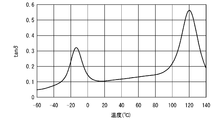
- FIG. 3 is a diagram showing a tan ⁇ curve between ⁇ 60 ° C. and 140 ° C. calculated by measuring the temperature dispersion of the dynamic viscoelasticity of the multistage copolymer in Example 1.
- the multi-stage copolymer for powder coating of the embodiment of the present invention (hereinafter referred to as "the present embodiment") is a first-stage polymer (A), a second-stage polymer (B), and a three-stage polymer. It is composed of at least three polymer components of the polymer (C) of the eye, and the glass transition temperature of the polymer (A) is ⁇ 15 ° C. or higher, and the glass transition temperature of the polymer (B) is ⁇ 20 ° C. or lower. When the glass transition temperature of the polymer (C) is 60 ° C. or higher and the total amount of the multi-stage copolymer for powder coating is 100% by mass, the polymer (A) is 1% by mass or more and 30% by mass. Including the following.
- the glass transition temperature (hereinafter, also referred to as “Tg”) is a value obtained from the following FOX equation (formula (1)).
- Tg glass transition temperature
- the unit of Tg is "° C.”
- the standard analytical values described in the "Polymer Data Handbook” edited by the Polymer Society should be adopted.
- the following formula (1) is used from Tg of the homopolymer of each monomer. Can be calculated. Table 1 shows the literature values of Tg of a typical homopolymer.
- Wn represents the mass fraction of the monomer n
- Tgn represents the glass transition temperature (° C.) of the homopolymer of the monomer n.
- the mass fraction is the ratio of the charged amount of the monomer n to the total charged amount of all the monomers.
- Tg may be measured for the homopolymer using a known method such as differential scanning calorimetry, thermomechanical analysis, and dynamic viscoelasticity measurement.
- Tg may be measured by the above method.
- the Tg of the polymer (A) is ⁇ 15 ° C. or higher, preferably 0 ° C. or higher.
- a multistage copolymer capable of providing a powder coating composition capable of forming a coating film having excellent toughness and appearance can be obtained.
- the Tg of the polymer (B) is ⁇ 20 ° C. or lower, preferably ⁇ 40 ° C. or lower.
- a multi-stage copolymer capable of providing a powder coating composition capable of forming a coating film having excellent toughness can be obtained.
- the Tg of the polymer (C) is 60 ° C. or higher, preferably 80 ° C. or higher.
- the dispersion of the multi-stage copolymer with respect to the thermoplastic resin is good, so that it is possible to provide a powder coating composition capable of forming a coating film having an excellent appearance.
- a copolymer can be obtained.
- the other multi-stage copolymer for powder coating of the present invention is composed of at least three polymer components of the polymer (A), the polymer (B), and the polymer (C), and is composed of the multi-stage copolymer for powder coating.
- the peak on the low temperature side preferably exists at -60 ° C to 15 ° C, more preferably -60 ° C to 5 ° C, and -60 ° C to ⁇ 5 ° C is more preferred.
- the peak on the high temperature side is preferably present at 60 ° C. to 140 ° C., more preferably 70 ° C. to 140 ° C., and even more preferably 80 ° C. to 140 ° C.
- the dynamic viscoelasticity of the multi-stage copolymer for powder coating can be measured by a known method.
- the dynamic viscoelasticity is a powder produced by press-molding with a press-molding machine at 180 ° C. and 3 MPa for 10 minutes using a viscoelasticity measuring device DMA6100 (manufactured by Hitachi High-Tech Science Co., Ltd.).
- a tan ⁇ curve was calculated by measuring a film-like test piece of a multi-stage copolymer for body paint in a measurement bending mode at a frequency of 1 Hz in the range of ⁇ 100 ° C. to 150 ° C.
- composition of Polymer (A), Polymer (B) and Polymer (C) The compositions of the polymer (A), the polymer (B) and the polymer (C) constituting the multi-stage copolymer for powder coating material of the present embodiment are as follows.
- the polymer (A) is a polyfunctional monomer having a methyl methacrylate unit of 35% by mass or more and 99.5% by mass or less, assuming that the total amount of the monomer units constituting the polymer (A) is 100% by mass.
- the unit is preferably 0.5% by mass or more and 5% by mass or less, the methyl methacrylate unit is 40% by mass or more and 99.5% by mass or less, and the polyfunctional monomer unit is 0.5% by mass or more and 5% by mass or less.
- the polymer (A) contains 0.5% by mass or more of the polyfunctional monomer unit, the dispersion of the multistage copolymer in the thermoplastic resin becomes good, so that a coating film having an excellent appearance can be formed. It is possible to obtain a multi-stage copolymer capable of providing a powder coating composition.
- the polymer (A) contains 5% by mass or less of the polyfunctional monomer unit, a multistage copolymer capable of providing a powder coating composition capable of forming a coating film having excellent toughness can be obtained.
- the monomer forming the polyfunctional monomer unit is a monomer having at least two or more polymerizable groups in the molecule, and is, for example, allyl acrylate, allyl methacrylate, diallyl maleate, diallyl fumarate, and the like.
- examples thereof include unsaturated carboxylic acid allyl esters such as diallyl itaconate, ethylene glycol dimethacrylate, propylene glycol dimethacrylate, 1,3-butylene glycol dimethacrylate, 1,4-butylene glycol dimethacrylate, and divinylbenzene. These monomers may be used alone or in combination of two or more.
- the polymer (B) contains 70% by mass or more of the alkyl (meth) acrylate units having 4 to 8 carbon atoms in the alkyl group. It is preferable to contain 99.5% by mass or less and 0.5% by mass or more and 5% by mass or less of the polyfunctional monomer unit, and 85% by mass of the alkyl (meth) acrylate unit having 4 to 8 carbon atoms in the alkyl group. It is more preferable to contain% or more and 99.5% by mass or less and 0.5% by mass or more and 5% by mass or less of the polyfunctional monomer unit.
- a multistage copolymer that can provide a coating composition can be obtained.
- the polymer (B) contains 0.5% by mass or more of the polyfunctional monomer unit, the dispersion of the multistage copolymer in the thermoplastic resin becomes good, so that a coating film having an excellent appearance can be formed. It is possible to obtain a multi-stage copolymer capable of providing a powder coating composition.
- the polymer (B) contains 5% by mass or less of the polyfunctional monomer unit, a multistage copolymer capable of providing a powder coating composition capable of forming a coating film having excellent toughness can be obtained.
- Examples of the monomer forming the alkyl (meth) acrylate unit having 4 to 8 carbon atoms in the alkyl group include n-butyl (meth) acrylate, s-butyl (meth) acrylate, and (meth) acrylic.
- Examples thereof include (meth) acrylic acid esters such as i-butyl acid acid, t-butyl (meth) acrylic acid, hexyl (meth) acrylic acid, cyclohexyl (meth) acrylic acid, and 2-ethylhexyl (meth) acrylic acid.
- These (meth) acrylic acid esters may be used alone or in combination of two or more.
- “(meth) acrylate” is a general term for acrylate and methacrylate
- "(meth) acrylic acid” is a general term for acrylic acid and methacrylic acid.
- Examples of the monomer forming the polyfunctional monomer unit in the polymer (B) include the monomer forming the polyfunctional monomer unit in the polymer (A).
- the polymer (C) preferably contains 70% by mass or more and 100% by mass or less of methyl methacrylate, and 70% by mass or more. It is more preferable to contain 99.5% by mass or less.
- the polymer (C) contains 70% by mass or more and 100% by mass or less of methyl methacrylate, so that a powder capable of forming a coating film having an excellent appearance can be formed. It is possible to obtain a multi-stage copolymer capable of providing a body coating composition.
- the polymer (C) Since the polymer (C) has good dispersion of the multi-stage copolymer with respect to the thermoplastic resin, it is possible to obtain a multi-stage copolymer capable of providing a powder coating composition capable of forming a coating film having an excellent appearance. Therefore, it is preferable to contain a polyfunctional monomer unit.
- the polyfunctional monomer unit include a monomer forming the polyfunctional monomer unit in the above polymer (A).
- the polymer (C) can contain a reactive group-containing monomer unit.
- the monomer forming the reactive group-containing monomer unit is a polymerizable monomer having a functional group in its molecule that can react with the thermoplastic resin or the curing agent constituting the powder coating composition. ..
- the functional group include a hydroxyl group, a carboxyl group, an epoxy group and the like.
- Examples of the polymerizable monomer having a hydroxyl group include 2-hydroxyethyl (meth) acrylate, 2-hydroxypropyl (meth) acrylate, and 2-hydroxybutyl (meth) acrylate.
- Examples of the polymerizable monomer having a carboxyl group include methacrylic acid and acrylic acid.
- Examples of the polymerizable monomer having an epoxy group include glycidyl (meth) acrylate and the like. Since the polymer (C) contains a reactive group-containing monomer unit, the dispersion of the multistage copolymer in the thermoplastic resin is good, so that a powder coating composition capable of forming a coating film having an excellent appearance can be formed. It is possible to obtain a multi-stage copolymer capable of providing the above. Further, since the polymer (C) contains a reactive group-containing monomer unit, it can react with the thermoplastic resin or the curing agent constituting the powder coating composition, so that a coating film having excellent toughness can be obtained.
- the reactive group-containing monomer unit is preferably a monomer unit formed of a polymerizable monomer having at least one of a hydroxyl group, a carboxyl group and an epoxy group.
- the polymer (C) preferably contains 70% by mass or more and 100% by mass or less of the methyl methacrylate unit, and the methyl methacrylate unit. It is more preferable to contain 70% by mass or more and 99.5% by mass or less and 0.5% by mass or more and 5% by mass or less of the polyfunctional monomer unit.
- the polymer (C) contains 0.5% by mass or more of the polyfunctional monomer unit, the dispersion of the multistage copolymer in the thermoplastic resin becomes good, so that a coating film having an excellent appearance can be formed. It is possible to obtain a multi-stage copolymer capable of providing a powder coating composition.
- the polymer (C) contains 5% by mass or less of the polyfunctional monomer unit, a multistage copolymer capable of providing a powder coating composition capable of forming a coating film having excellent toughness can be obtained.
- the polymer (A), the polymer (B) and the polymer (C) may contain a monomer unit other than the above-mentioned monomer unit.
- the monomer (hereinafter, also referred to as “other monomer”) that forms a monomer unit other than the monomer unit is not particularly limited as long as it can be radically polymerized, but is, for example, methyl methacrylate. Examples thereof include (meth) acrylate compounds, aromatic vinyl compounds, vinyl cyanide compounds and the like other than the monomers forming the reactive group-containing monomer unit.
- the aromatic vinyl compound include styrene, ⁇ -methylstyrene, p-methylstyrene and the like.
- the vinyl cyanide compound include acrylonitrile and methacrylonitrile. These other monomers may be used alone or in combination of two or more.
- the multi-stage copolymer for powder coating material of the present embodiment preferably has a volume average particle diameter of 0.1 ⁇ m or more and 10 ⁇ m or less, more preferably 0.3 ⁇ m or more and 3 ⁇ m or less, and 0. It is more preferably 4 ⁇ m or more and 1 ⁇ m or less.
- the primary particles refer to the smallest unit polymer particles constituting the powder containing the multi-stage copolymer recovered as the powder of the multi-stage copolymer.
- volume average particle diameter of the primary particles is 0.1 ⁇ m or more, it is possible to suppress an increase in viscosity at the time of melting the powder coating composition, and provide a powder coating composition capable of forming a coating film having an excellent appearance.
- a multi-stage copolymer that can be obtained can be obtained.
- the volume average particle diameter of the primary particles is 10 ⁇ m or less, a multistage copolymer capable of providing a powder coating composition capable of forming a coating film having excellent toughness can be obtained.
- the volume average particle diameter of the primary particles of the multistage copolymer can be measured by a known method, for example, a laser diffraction method (laser diffraction / scattering method).
- the volume average particle size of the primary particles is measured in a dispersion containing a multi-stage copolymer using a laser diffraction / scattering type particle size distribution measuring device (product name: LA-960, manufactured by Horiba Seisakusho Co., Ltd.).
- LA-960 laser diffraction / scattering type particle size distribution measuring device
- the multi-stage copolymer for powder coating material of the present embodiment preferably has a volume average particle diameter of 1 ⁇ m or more and 500 ⁇ m or less, more preferably 1 ⁇ m or more and 300 ⁇ m or less, and 1 ⁇ m or more and 100 ⁇ m or less. It is more preferable to have.
- the secondary particles refer to a powder containing a multi-stage copolymer obtained by recovering the multi-stage copolymer as a powder. When the volume average particle diameter of the secondary particles is 1 ⁇ m or more, powdering and the like can be suppressed, so that the handleability as a powder is good.
- the volume average particle diameter of the secondary particles is 500 ⁇ m or less, the dispersibility with the compound constituting the powder coating material is good, and a multi-stage powder coating composition capable of forming a coating film having an excellent appearance can be provided.
- a copolymer can be obtained.
- the volume average particle diameter of the secondary particles of the multistage copolymer can be measured by a known method, for example, a laser diffraction method (laser diffraction / scattering method), similarly to the volume average particle diameter of the primary particles.
- the volume average particle diameter of the secondary particles is a dispersion liquid containing a multi-stage copolymer using a laser diffraction / scattering type particle diameter distribution measuring device (product name: LA-960, manufactured by Horiba Seisakusho Co., Ltd.).
- LA-960 laser diffraction / scattering type particle diameter distribution measuring device
- the multi-stage copolymer for powder coating of the present embodiment is a polymer (B) obtained by polymerizing a monomer mixture in the presence of the polymer (A), and the polymer (A) and the polymer (B). ) Is preferably contained in the polymer (C) obtained by polymerizing the monomer mixture in the presence of the polymer.
- This makes it possible to obtain a multi-stage copolymer capable of providing a powder coating composition capable of forming a coating film having excellent appearance and toughness.
- the monomer which is a monomer unit constituting each of the polymer (A), the polymer (B) and the polymer (C) the above-mentioned ones can be used.
- the polymer (A) when the total of the polymer (A), the polymer (B) and the polymer (C) is 100% by mass, the polymer (A) is 1% by mass. It is preferable that the polymer (B) is contained in an amount of 30% by mass or more, 31% by mass or more and 94% by mass or less, and the polymer (C) is contained in an amount of 5% by mass or more and 39% by mass or less.
- the content of the polymer (A) is in the range of 1% by mass or more and 30% by mass or less, a multi-stage copolymer capable of providing a powder coating composition capable of forming a coating film having excellent toughness and appearance can be obtained. Can be done.
- a multi-stage copolymer capable of providing a powder coating composition capable of forming a coating film having excellent toughness can be obtained.
- the content of the polymer (C) is 5% by mass or more, the dispersion of the multistage copolymer in the thermoplastic resin is good, so that a powder coating composition capable of forming a coating film having an excellent appearance is provided.
- a multi-stage copolymer that can be obtained can be obtained.
- the content of the polymer (C) is 39% by mass or less, a multi-stage copolymer capable of providing a powder coating composition capable of forming a coating film having excellent toughness can be obtained.
- the multi-stage copolymer for powder coating of the present embodiment contains 2% by mass or more and 20% by mass or less of the polymer (A) and 45% by mass of the polymer (B) from the viewpoint of achieving both toughness and appearance of the coating film. It is more preferable to contain 93% by mass or less, 5% by mass or more and 35% by mass or less of the polymer (C), 3% by mass or more and 15% by mass or less of the polymer (A), and 50% by mass of the polymer (B). It is more preferable that the polymer (C) is contained in an amount of 93% by mass or more and 5% by mass or more and 35% by mass or less.
- the multi-stage copolymer for powder coating according to another embodiment of the present invention is a multi-stage copolymer for powder coating having at least an inner layer, an intermediate layer and an outer layer, and the inner layer has a glass transition temperature of ⁇ 15.
- the intermediate layer contains a polymer (B) having a glass transition temperature of ⁇ 20 ° C. or higher, and the outer layer contains a polymer (C) having a glass transition temperature of 60 ° C. or higher. ) Is a copolymer containing.
- An intermediate layer exists on the outside of the inner layer, and an outer layer exists on the outside of the intermediate layer.
- the polymer constituting the multi-stage copolymer contains a polymer other than the polymer (A), the polymer (B) and the polymer (C) (hereinafter, also referred to as "another polymer”). good.
- the other polymer may be present inside the polymer (A), inside the polymer (B), or outside the polymer (B). It may be present outside the polymer (C).
- Other polymers can be used as long as the functions of the multi-stage copolymer for powder coating of the present embodiment are not impaired.
- the content of other polymers is preferably 20% by mass or less.
- the multi-stage copolymer for powder coating of the present embodiment at least three of the first-stage polymer (A), the second-stage polymer (B), and the third-stage polymer (C). It is composed of polymer components, the glass transition temperature of the polymer (A) is ⁇ 15 ° C. or higher, the glass transition temperature of the polymer (B) is ⁇ 20 ° C. or lower, and the glass transition temperature of the polymer (C).
- the polymer (A) is contained in an amount of 1% by mass or more and 30% by mass or less, so that the appearance is good and the toughness is improved.
- composition for powder coating of the present embodiment can also be applied to the composition for powder coating of other embodiments of the present invention.
- the method for producing the multi-stage copolymer for powder coating according to the present embodiment is the method for producing the multi-stage copolymer for powder coating according to the present embodiment, and is the first simple polymer for forming the polymer (A).
- the polymer mixture is polymerized to obtain a first dispersion containing the polymer (A), and then a second monomer mixture for forming the polymer (B) is added dropwise to the first dispersion. Then, the second monomer mixture is polymerized to obtain a second dispersion liquid containing the polymer (A) and the polymer (B), and the polymer (C) is further formed in the second dispersion liquid.
- a third monomer mixture is added dropwise to polymerize the third monomer mixture to obtain a multi-stage copolymer containing the polymer (A), the polymer (B) and the polymer (C). It has a step (1) of obtaining a third dispersion liquid containing the third dispersion liquid and a step (2) of obtaining a powder containing a multi-stage copolymer by spray-drying the third dispersion liquid.
- the multi-stage copolymer for powder coating material of the present embodiment can be produced, for example, by a known emulsion polymerization method or the like.
- a suitable example is shown as a method for producing the multi-stage copolymer for powder coating according to the present embodiment, but the method for producing the multi-stage copolymer for powder coating according to the present embodiment is not limited to this. No.
- an example in which the emulsion polymerization method is used in the step (1) is shown.
- the step (1) is a step (1-1) of polymerizing the first monomer mixture for constituting the polymer (A) to obtain a first dispersion liquid containing the polymer (A), and the first step.
- a second monomer mixture for forming the polymer (B) is added dropwise to the dispersion liquid of No. 1 to polymerize the second monomer mixture, and the polymer (A) and the polymer (B) are combined.
- Step (1-1) In step (1-1), deionized water and, if necessary, an emulsifier are added to the reaction vessel, and then a first monomer mixture containing a monomer for constituting the polymer (A) is added. Then, the first monomer mixture is polymerized to obtain a first latex (first dispersion liquid) containing the first dispersion particles made of the polymer (A).
- Step (1-2) In the step (1-2), a second monomer mixture containing a monomer for constituting the polymer (B) is added dropwise to the first latex (first dispersion liquid) to obtain a second.
- the monomer mixture is polymerized to obtain a second latex (second dispersion) containing the second dispersion particles composed of the polymer (A) and the polymer (B).
- the second dispersed particle is a polymer having a two-layer structure in which the first stage (inner layer) is made of the polymer (A) and the second stage (outer layer) is made of the polymer (B).
- Step (1-3) In the step (1-3), a third monomer mixture containing a monomer for constituting the polymer (C) is added dropwise to the second latex (second dispersion liquid) to form a third.
- the first stage (inner layer) is composed of the polymer (A)
- the second stage (intermediate layer) is composed of the polymer (B)
- the third stage (outer layer) is composed of the polymer (C). It is a polymer with a three-layer structure.
- a radical polymerization initiator and an emulsifier are used for emulsion polymerization.
- the radical polymerization initiator is not particularly limited, and examples thereof include peroxides, azo-based initiators, and redox-based initiators in which an oxidizing agent and a reducing agent are combined.
- the emulsifier is not particularly limited, but is excellent in the stability of the latex during radical polymerization and can increase the polymerization rate.
- Various carboxylates such as acid soap are preferable.
- the polymerization temperature in emulsion polymerization varies depending on the type and amount of the radical polymerization initiator, but is preferably 40 ° C. or higher and 120 ° C. or lower, and more preferably 60 ° C. or higher and 95 ° C. or lower.
- a method for adding the radical polymerization initiator a method of adding the radical polymerization initiator to at least one of the aqueous phase and the monomer phase is used.
- Step (2) The multistage copolymer obtained by emulsion polymerization is usually in the form of latex. Therefore, in the step (2), the multi-stage copolymer is recovered from the latex (third latex) of the multi-stage copolymer obtained in the step (1).
- the step (2) as a method for recovering the multi-stage copolymer from the latex of the multi-stage copolymer, for example, the latex of the multi-stage copolymer is put into hot water in which a coagulant is dissolved to form a slurry.
- Examples thereof include a wet method for coagulating the polymer, and a spray drying method for recovering powder containing the multi-stage copolymer by spray-drying by spraying the latex of the multi-stage copolymer in a heated atmosphere.
- the agglomerated particles obtained by the spray drying method do not firmly bond to each other, so that it is difficult to form a higher-order particle structure, and the aggregated particles can be uniformly dispersed as primary particles and can be directly recovered.
- a spray drying method is preferable.
- the method for producing a multi-stage copolymer for powder coating material of the present embodiment includes the above-mentioned steps (1) and (2), it is a powder capable of forming a coating film having a good appearance and excellent toughness. It is possible to provide a multi-stage copolymer capable of providing a body coating composition.
- the powder coating composition of the present embodiment contains the above-mentioned multi-stage copolymer for powder coating and a thermoplastic resin.
- thermoplastic resin examples include polyester, epoxy resin, acrylic resin and the like.
- polyester is preferable from the viewpoint of toughness, appearance, light resistance, and cost of the powder coating composition containing the thermoplastic resin.
- the powder coating composition of the present embodiment contains polyester as the thermoplastic resin
- the powder coating composition is a polyester-based powder coating.
- the powder coating composition of the present embodiment contains polyester and an epoxy resin as basic components
- the powder coating composition is a polyester-epoxy hybrid powder coating.
- the powder coating composition of the present embodiment contains an acrylic resin as a basic component
- the powder coating composition is an acrylic powder coating.
- the powder coating composition of the present embodiment contains an epoxy resin as a basic component, it forms an epoxy-based powder coating.
- the polyester is not particularly limited as long as it is used as a polyester-based powder paint among those skilled in the art.
- a polyester resin having two or more hydroxyl groups or acid groups in one molecule and having a softening point in the range of 60 ° C. to 150 ° C. is generally used as a thermoplastic resin.
- the epoxy resin is not particularly limited as long as it is used as an epoxy-based powder paint among those skilled in the art. Those having an average of about two or more epoxy groups in one molecule are generally used, for example, bisphenol A type epoxy resin, bisphenol B type epoxy resin, bisphenol F type epoxy resin, novolak type epoxy resin, brominated epoxy. Examples thereof include resins and alicyclic epoxy resins.
- the acrylic resin is not particularly limited as long as it is used as an acrylic powder coating among those skilled in the art. For example, it corresponds to a softening point in the range of 60 ° C. to 150 ° C. synthesized by copolymerization of a (meth) acrylic acid ester-based monomer and a (meth) acrylic acid ester-based monomer having a glycidyl group in the molecule (meth). ) Acrylic acid ester copolymer is generally used as a thermoplastic resin.
- the content of the multi-stage copolymer for powder coating when the total amount of the powder coating composition is 100% by mass, the content of the multi-stage copolymer for powder coating is 1% by mass or more and 20% by mass or less. It is preferable that it is 1% by mass or more and 15% by mass or less, and further preferably 1% by mass or more and 10% by mass or less.
- the content of the multi-stage copolymer for powder coating is 1% by mass or more, it is possible to provide a powder coating composition capable of forming a good coating film having excellent toughness.
- the content of the multi-stage copolymer for powder coating material is 20% by mass or less, it is possible to provide a powder coating composition capable of suppressing an increase in melt viscosity of the powder coating composition and forming a smooth coating film. Can be done.
- the powder coating composition of the present embodiment may contain a curing agent, a pigment, and various other additives in addition to the above-mentioned multi-stage copolymer for powder coating and a thermoplastic resin.
- the powder coating composition of the present embodiment can usually be produced by a known method. That is, the powder coating composition of the present embodiment is a thermoplastic resin obtained by dry-mixing the multi-stage copolymer for powder coating, the thermoplastic resin, and if necessary, a curing agent, a pigment, and other additives. It can be manufactured by melting and kneading at a temperature equal to or higher than the softening point of the above, and then crushing and classifying as necessary. Examples of other additives include known additives used in ordinary powder coating compositions such as surface conditioners, ultraviolet absorbers, antioxidants, and armpit inhibitors.
- various mixers such as a Henschel mixer, a Banbury mixer, a high speed mixer, and a Nauter mixer can be used.
- the apparatus used for melt-kneading the powder coating composition include a heating roll machine, a heating kneader machine, and an eccluder.
- the crusher for crushing the powder coating composition after melt kneading include impact type crushers such as a hammer mill and a pin mill.
- the classifier for classifying the powder coating composition after pulverization include a vibrating sieve and the like.
- the powder coating composition of the present embodiment can be applied to an object to be coated by a general coating method such as an electrostatic coating method or a flow dipping method, and then heated and cured to form a coating film.
- a general coating method such as an electrostatic coating method or a flow dipping method
- the heating temperature (baking temperature) and time for forming the coating film can be appropriately set.
- the heating temperature is usually equal to or higher than the melting point of the thermoplastic resin.
- the object to be coated to which the powder coating composition of the present embodiment is applied includes, for example, metals such as iron, zinc, tin, stainless steel, copper and aluminum, inorganic substances such as glass, and these metals or inorganic substances. Examples thereof include those which have been subjected to plast treatment, a primer, an intermediate coating, or the like, if necessary.
- the film thickness of the coating film formed by the powder coating composition of the present embodiment is not particularly limited, but is preferably 15 ⁇ m or more and 1 mm or less.
- an undercoat coating film is applied to the coated surface (the surface to which the powder coating composition is applied) of the object to be coated by using a known undercoat paint. May be formed.
- the powder coating composition of the present embodiment since the multi-stage copolymer for powder coating and the thermoplastic resin are contained, a powder capable of forming a coating film having a good appearance and excellent toughness can be formed. Body paint compositions can be provided.
- part means “mass part”.
- volume average particle diameter of the primary particles of the multistage copolymer was measured by the following method. Using a laser diffraction / scattering type particle size distribution measuring device (product name: LA-960, manufactured by HORIBA, Ltd.), the primary particle size of the dispersed particles in the dispersion liquid containing the multistage copolymer was measured. The value obtained by averaging the primary particle diameters was taken as the volume average particle diameter of the primary particles. The relative refractive indexes of the resin particles and the dispersion medium were all set to 1.12. Ion-exchanged water was used as the dispersion medium.
- volume average particle diameter of the secondary particles of the multistage copolymer was measured by the following method. Using a laser diffraction / scattering type particle size distribution measuring device (product name: LA-960, manufactured by HORIBA, Ltd.), the secondary particle size of the dispersed particles in the dispersion liquid containing the multistage copolymer was measured. The value obtained by averaging the secondary particle diameters was taken as the volume average particle diameter of the secondary particles. The relative refractive indexes of the resin particles and the dispersion medium were all set to 1.12. Ion-exchanged water was used as the dispersion medium.
- the appearance of the coating film to which the powder coating composition was applied and cured was evaluated by the leveling property of the coating film.
- the leveling property of the coating film was evaluated by the following method.
- the powder coating composition was spray-coated on a metal substrate (test piece; Q-panelQD46, thickness 0.5 mm) and cured at 200 ° C. for 10 minutes to form a coating film having a film thickness of 100 ⁇ m.
- the microwave scan AW-4824 manufactured by BYK
- the long wavelength (LW) of the reflected light of the light applied to the coating film was measured. From the obtained measured values, the leveling property of the coating film was determined according to the following criteria. When the LW was less than 50, the leveling property was considered to be good.
- the toughness of the coating film to which the powder coating composition was applied and cured was evaluated by the cupping resistance of the coating film.
- the cupping resistance of the coating film was evaluated by the following method.
- the powder coating composition was spray-coated on a metal substrate (test piece; Q-panelQD46, thickness 0.5 mm) and cured at 200 ° C. for 10 minutes to form a coating film having a film thickness of 40 ⁇ m.
- the indentation depth of the coating film was measured according to ISO1520. From the obtained measured values, the cupping resistance was determined according to the following criteria. When the pushing depth was 2.5 mm or more, the cupping resistance was considered to be good. Pushing depth less than 2.5 mm: ⁇ , Pushing depth 2.5 mm or more and less than 4.0 mm: ⁇ , Pushing depth 4.0 mm or more: ⁇
- the toughness of the coating film to which the powder coating composition was applied and cured was evaluated by the impact resistance of the coating film.
- the impact resistance of the coating film was evaluated by the following method.
- the powder coating composition was spray-coated on a metal substrate (test piece; Q-panelQD46, thickness 0.5 mm) and cured at 200 ° C. for 10 minutes to form a coating film having a film thickness of 40 ⁇ m.
- the coating film surface side was subjected to a ball drop test according to ASTM D-2794, and inch pound (in-lbn) was measured as the impact resistance of the coating film. From the obtained measured values, the impact resistance was determined according to the following criteria. If the inch pound is 100 or more, the impact resistance is good. Less than 100in-lbn: ⁇ , 100in-lbn or more and less than 140in-lbn: ⁇ , 140in-lbn or more: ⁇
- Step (1-1) 63.8 parts of deionized water was placed in a separable flask with a capacity of 5 liters equipped with a thermometer, a nitrogen gas introduction tube, a stirring rod, a dropping funnel and a cooling tube, and nitrogen gas was aerated for 30 minutes to deionize the water. Substituted the dissolved oxygen in. Then, the aeration of nitrogen gas was stopped, and the temperature was raised to 80 ° C. while stirring at 200 rpm.
- Step (1-2) To the latex obtained in step (1-1), 0.04 part of Perex OT-P, 0.05 part of potassium persulfate, and 4 parts of deionized water were added, and 75.1 parts of n-butyl acrylate and allyl were added. 2.85 parts of methacrylate, 1.52 parts of 1,3-butylene glycol dimethacrylate, 0.75 parts of Perex OT-P, and 51.6 parts of deionized water were added dropwise over 180 minutes. Then, it was held for 1 hour to complete the polymerization, and a latex containing particles in which the polymer (B) was polymerized around the polymer (A) was obtained.
- Step (1-3) To the latex obtained in step (1-2), 17.7 parts of methyl methacrylate, 0.35 part of ethyl acrylate, 1.9 parts of 2-hydroxyethyl methacrylate, and 1,3-butylene glycol dimethacrylate 0. 20 parts, Perex OT-P 0.20 part, and 15 parts of deionized water were added dropwise over 140 minutes. Then, it was held for 2 hours to complete the polymerization, and a latex containing a multi-stage copolymer in which the polymer (C) was polymerized around the particles composed of the polymer (A) and the polymer (B) was obtained.
- the multi-stage copolymer (P-1) was obtained by spray drying under the above conditions.
- the volume average particle diameter of the primary particles of the multistage copolymer was 0.70 ⁇ m.
- FIG. 1 shows a tan ⁇ curve between -60 ° C and 140 ° C calculated by measuring the temperature dispersion of the dynamic viscoelasticity of the multistage copolymer.
- the Tg of each of the polymer (A), the polymer (B) and the polymer (C) is a formula from the Tg of the homopolymer shown in Table 1 corresponding to the monomer unit constituting each polymer. Calculated using (1).
- Example 2 Except for the fact that each component of the monomer, which is a monomer unit constituting the polymer (A), the polymer (B), and the polymer (C), has the mass ratio shown in Table 2, the same as in Example 1.
- a multistage copolymer (P-2) was obtained by the same method. The results are shown in Table 2.
- Example 3 Except for the fact that each component of the monomer, which is a monomer unit constituting the polymer (A), the polymer (B), and the polymer (C), has the mass ratio shown in Table 2, the same as in Example 1.
- a multistage copolymer (P-3) was obtained by the same method. The results are shown in Table 2.
- Example 4 Except for the fact that each component of the monomer, which is a monomer unit constituting the polymer (A), the polymer (B), and the polymer (C), has the mass ratio shown in Table 2, the same as in Example 1.
- a multistage copolymer (P-4) was obtained by the same method. The results are shown in Table 2.
- Example 5 Except for the fact that each component of the monomer, which is a monomer unit constituting the polymer (A), the polymer (B), and the polymer (C), has the mass ratio shown in Table 2, the same as in Example 1.
- a multistage copolymer (P-5) was obtained by the same method. The results are shown in Table 2.
- Example 6 Except for the fact that each component of the monomer, which is a monomer unit constituting the polymer (A), the polymer (B), and the polymer (C), has the mass ratio shown in Table 2, the same as in Example 1.
- a multistage copolymer (P-6) was obtained by the same method. The results are shown in Table 2.
- Step (1-1) 63.8 parts of deionized water was placed in a separable flask with a capacity of 5 liters equipped with a thermometer, a nitrogen gas introduction tube, a stirring rod, a dropping funnel and a cooling tube, and nitrogen gas was aerated for 30 minutes to deionize the water. Substituted the dissolved oxygen in. Then, the aeration of nitrogen gas was stopped, and the temperature was raised to 80 ° C. while stirring at 200 rpm.
- Step (1-2) To the latex obtained in step (1-1), 0.04 part of Perex OT-P, 0.05 part of potassium persulfate, and 4 parts of deionized water were added, and 70.0 parts of n-butyl acrylate and allyl were added. 2.66 parts of methacrylate, 1.42 parts of 1,3-butylene glycol dimethacrylate, 0.70 parts of Perex OT-P, and 48.1 parts of deionized water were added dropwise over 180 minutes. Then, it was held for 1 hour to complete the polymerization, and a latex containing particles in which the polymer (B) was polymerized around the polymer (A) was obtained.
- Step (1-3) To the latex obtained in step (1-2), 17.7 parts of methyl methacrylate, 0.35 part of ethyl acrylate, 1.9 parts of 2-hydroxyethyl methacrylate, and 1,3-butylene glycol dimethacrylate 0. 20 parts, Perex OT-P 0.20 part, and 15 parts of deionized water were added dropwise over 140 minutes. Then, it was held for 2 hours to complete the polymerization, and a latex containing a multi-stage copolymer in which the polymer (C) was polymerized around the particles composed of the polymer (A) and the polymer (B) was obtained.
- Step (2) The latex obtained in step (1-3) was spray-dried in the same manner as in Example 1 to obtain a multi-stage copolymer (P-8). The results are shown in Table 2.
- MMA Methyl methacrylate (manufactured by Mitsubishi Chemical Corporation) -"N-BA”: n-butyl acrylate (manufactured by Mitsubishi Chemical Corporation)
- AMA Allyl methacrylate (manufactured by Mitsubishi Chemical Corporation) -"BDMA”: 1,3-butylene glycol dimethacrylate (manufactured by Mitsubishi Chemical Corporation)
- EA Ethyl acrylate (manufactured by Mitsubishi Chemical Corporation) -"2-HEMA”: 2-hydroxyethyl methacrylate (manufactured by Mitsubishi Chemical Corporation)
- MAA Metallic acid
- Example 8> The constituents of the powder coating composition are as follows. -Polyester resin: SP-6400 (manufactured by Sun polymer international) -Curing agent: Triglycidyl isocyanurate (TGIC) (manufactured by Aalchem) -Leveling agent: Resiflow P-67 (manufactured by Estron Chemical) -Defoaming agent: Benzoin (manufactured by Estron chemical) -Pigment: TiPure R960 (manufactured by Venator) -Toughness-imparting agent: multi-stage copolymer (P-1)
- Example 9 A powder coating composition was obtained in the same manner as in Example 8 except that the multi-stage copolymer (P-2) was used instead of the multi-stage copolymer (P-1). A coating film was formed from the obtained powder coating composition, and the leveling property, cupping resistance and impact resistance of the coating film were evaluated. The results are shown in Table 3.
- Example 10 A powder coating composition was obtained in the same manner as in Example 8 except that the multi-stage copolymer (P-3) was used instead of the multi-stage copolymer (P-1). A coating film was formed from the obtained powder coating composition, and the leveling property, cupping resistance and impact resistance of the coating film were evaluated. The results are shown in Table 3.
- Example 11 A powder coating composition was obtained in the same manner as in Example 8 except that the multi-stage copolymer (P-4) was used instead of the multi-stage copolymer (P-1). A coating film was formed from the obtained powder coating composition, and the leveling property, cupping resistance and impact resistance of the coating film were evaluated. The results are shown in Table 3.
- Example 12 A powder coating composition was obtained in the same manner as in Example 8 except that the multi-stage copolymer (P-5) was used instead of the multi-stage copolymer (P-1). A coating film was formed from the obtained powder coating composition, and the leveling property, cupping resistance and impact resistance of the coating film were evaluated. The results are shown in Table 3.
- Example 13 A powder coating composition was obtained in the same manner as in Example 8 except that the multi-stage copolymer (P-6) was used instead of the multi-stage copolymer (P-1). A coating film was formed from the obtained powder coating composition, and the leveling property, cupping resistance and impact resistance of the coating film were evaluated. The results are shown in Table 3.
- Example 14 A powder coating composition was obtained in the same manner as in Example 8 except that the multi-stage copolymer (P-7) was used instead of the multi-stage copolymer (P-1). A coating film was formed from the obtained powder coating composition, and the leveling property, cupping resistance and impact resistance of the coating film were evaluated. The results are shown in Table 3.
- Example 2 A powder coating composition was obtained in the same manner as in Example 2 except that the multi-stage copolymer (P-8) was used instead of the multi-stage copolymer (P-1). A coating film was formed from the obtained powder coating composition, and the leveling property, cupping resistance and impact resistance of the coating film were evaluated. The results are shown in Table 3.
- the multi-stage copolymer for powder coating material of the present invention is suitable for outdoor applications such as road materials and building materials because it can provide a powder coating composition capable of forming a coating film having a good appearance and excellent toughness. Can be used for.
Landscapes
- Chemical & Material Sciences (AREA)
- Organic Chemistry (AREA)
- Life Sciences & Earth Sciences (AREA)
- Engineering & Computer Science (AREA)
- Materials Engineering (AREA)
- Wood Science & Technology (AREA)
- Chemical Kinetics & Catalysis (AREA)
- Health & Medical Sciences (AREA)
- Medicinal Chemistry (AREA)
- Polymers & Plastics (AREA)
- Paints Or Removers (AREA)
- Graft Or Block Polymers (AREA)
Priority Applications (3)
| Application Number | Priority Date | Filing Date | Title |
|---|---|---|---|
| JP2022534015A JP7616221B2 (ja) | 2020-06-29 | 2021-06-29 | 粉体塗料用多段共重合体およびその製造方法、粉体塗料組成物 |
| CN202180045900.6A CN115996964A (zh) | 2020-06-29 | 2021-06-29 | 粉末涂料用多段共聚物及其制造方法、粉末涂料组合物 |
| JP2024085141A JP2024109853A (ja) | 2020-06-29 | 2024-05-24 | 粉体塗料用多段共重合体およびその製造方法、粉体塗料組成物 |
Applications Claiming Priority (2)
| Application Number | Priority Date | Filing Date | Title |
|---|---|---|---|
| JP2020111778 | 2020-06-29 | ||
| JP2020-111778 | 2020-06-29 |
Publications (1)
| Publication Number | Publication Date |
|---|---|
| WO2022004689A1 true WO2022004689A1 (ja) | 2022-01-06 |
Family
ID=79316294
Family Applications (1)
| Application Number | Title | Priority Date | Filing Date |
|---|---|---|---|
| PCT/JP2021/024448 Ceased WO2022004689A1 (ja) | 2020-06-29 | 2021-06-29 | 粉体塗料用多段共重合体およびその製造方法、粉体塗料組成物 |
Country Status (3)
| Country | Link |
|---|---|
| JP (2) | JP7616221B2 (https=) |
| CN (1) | CN115996964A (https=) |
| WO (1) | WO2022004689A1 (https=) |
Cited By (1)
| Publication number | Priority date | Publication date | Assignee | Title |
|---|---|---|---|---|
| WO2026034626A1 (ja) * | 2024-08-09 | 2026-02-12 | 株式会社カネカ | 粉体塗料および塗膜 |
Families Citing this family (1)
| Publication number | Priority date | Publication date | Assignee | Title |
|---|---|---|---|---|
| CN115996964A (zh) * | 2020-06-29 | 2023-04-21 | 三菱化学株式会社 | 粉末涂料用多段共聚物及其制造方法、粉末涂料组合物 |
Citations (6)
| Publication number | Priority date | Publication date | Assignee | Title |
|---|---|---|---|---|
| JPH10259323A (ja) * | 1997-03-18 | 1998-09-29 | Toto Kasei Co Ltd | 粉体塗料組成物 |
| JP2002173637A (ja) * | 2000-12-07 | 2002-06-21 | Nippon Paint Co Ltd | 熱硬化性粉体塗料組成物 |
| JP2004238432A (ja) * | 2003-02-04 | 2004-08-26 | Kuraray Co Ltd | アクリル系重合体粉末、アクリルゾル及び成形物 |
| WO2005095480A1 (ja) * | 2004-03-30 | 2005-10-13 | Mitsubishi Rayon Co., Ltd. | 耐衝撃性改質剤及び樹脂組成物 |
| JP2011080050A (ja) * | 2009-09-09 | 2011-04-21 | Kansai Paint Co Ltd | 顔料分散樹脂の製造方法、顔料分散樹脂、顔料分散体及び塗料 |
| JP2015131930A (ja) * | 2014-01-15 | 2015-07-23 | コニカミノルタ株式会社 | 粉体塗料、その製造方法、および塗装物 |
Family Cites Families (3)
| Publication number | Priority date | Publication date | Assignee | Title |
|---|---|---|---|---|
| JP2007302830A (ja) * | 2006-05-12 | 2007-11-22 | Mitsubishi Rayon Co Ltd | 被覆用樹脂組成物及びそれを用いた積層成形品 |
| EP2975085B1 (en) * | 2013-03-15 | 2017-02-01 | Mitsubishi Rayon Co., Ltd. | Impact strength modifier for chlorine-containing resin, chlorine-containing resin composition, and molded article thereof |
| CN115996964A (zh) * | 2020-06-29 | 2023-04-21 | 三菱化学株式会社 | 粉末涂料用多段共聚物及其制造方法、粉末涂料组合物 |
-
2021
- 2021-06-29 CN CN202180045900.6A patent/CN115996964A/zh active Pending
- 2021-06-29 WO PCT/JP2021/024448 patent/WO2022004689A1/ja not_active Ceased
- 2021-06-29 JP JP2022534015A patent/JP7616221B2/ja active Active
-
2024
- 2024-05-24 JP JP2024085141A patent/JP2024109853A/ja active Pending
Patent Citations (6)
| Publication number | Priority date | Publication date | Assignee | Title |
|---|---|---|---|---|
| JPH10259323A (ja) * | 1997-03-18 | 1998-09-29 | Toto Kasei Co Ltd | 粉体塗料組成物 |
| JP2002173637A (ja) * | 2000-12-07 | 2002-06-21 | Nippon Paint Co Ltd | 熱硬化性粉体塗料組成物 |
| JP2004238432A (ja) * | 2003-02-04 | 2004-08-26 | Kuraray Co Ltd | アクリル系重合体粉末、アクリルゾル及び成形物 |
| WO2005095480A1 (ja) * | 2004-03-30 | 2005-10-13 | Mitsubishi Rayon Co., Ltd. | 耐衝撃性改質剤及び樹脂組成物 |
| JP2011080050A (ja) * | 2009-09-09 | 2011-04-21 | Kansai Paint Co Ltd | 顔料分散樹脂の製造方法、顔料分散樹脂、顔料分散体及び塗料 |
| JP2015131930A (ja) * | 2014-01-15 | 2015-07-23 | コニカミノルタ株式会社 | 粉体塗料、その製造方法、および塗装物 |
Cited By (1)
| Publication number | Priority date | Publication date | Assignee | Title |
|---|---|---|---|---|
| WO2026034626A1 (ja) * | 2024-08-09 | 2026-02-12 | 株式会社カネカ | 粉体塗料および塗膜 |
Also Published As
| Publication number | Publication date |
|---|---|
| JPWO2022004689A1 (https=) | 2022-01-06 |
| JP7616221B2 (ja) | 2025-01-17 |
| JP2024109853A (ja) | 2024-08-14 |
| CN115996964A (zh) | 2023-04-21 |
Similar Documents
| Publication | Publication Date | Title |
|---|---|---|
| US5981659A (en) | Precross-linked silicone elastomer particles with organopolymer shell as formulation constituent in powder coating materials | |
| JP2024109853A (ja) | 粉体塗料用多段共重合体およびその製造方法、粉体塗料組成物 | |
| JP5419941B2 (ja) | 粉体塗料組成物 | |
| WO2003062326A1 (en) | Fluororesin powder coating composition and article having coating film | |
| JP4364340B2 (ja) | 粉体塗料組成物 | |
| JP3071998B2 (ja) | 水性塗料組成物 | |
| JP2000017197A (ja) | 熱硬化性粉体塗料組成物 | |
| JPWO2009008420A1 (ja) | 粉体塗料用熱流動性調整剤とその製造方法、及び粉体塗料 | |
| JP5685001B2 (ja) | 制振材用エマルション及び制振材配合物 | |
| JP5945421B2 (ja) | 粉体塗料組成物及びその塗装物 | |
| JP5284914B2 (ja) | 制振材用樹脂組成物 | |
| WO1999057208A1 (en) | Thermosetting powder coating composition | |
| JP2009270064A (ja) | 制振材用エマルション組成物 | |
| JP2002173637A (ja) | 熱硬化性粉体塗料組成物 | |
| JP5685002B2 (ja) | 制振材用エマルション及び制振材組成物 | |
| WO2001044390A1 (en) | Fluororesin coating composition of aqueous slurry dispersion type | |
| KR20040030211A (ko) | 열경화성 분체 도료 조성물 | |
| JP7451985B2 (ja) | グラフト共重合体を含む粉体塗料組成物 | |
| WO2017204085A1 (ja) | 粉体塗料、粉体塗料の製造方法および塗装物品 | |
| JP2001123110A (ja) | 熱硬化型粉体塗料組成物 | |
| JP2023134864A (ja) | 粉体塗料の製造方法 | |
| JP2023104258A (ja) | プレコート金属板用塗料組成物、プレコート金属板及びその製造方法 | |
| JP2001294805A (ja) | 粉体塗料組成物 | |
| JP2001152082A (ja) | 粉体塗料組成物 | |
| JP2004059612A (ja) | 硬化型塗料組成物 |
Legal Events
| Date | Code | Title | Description |
|---|---|---|---|
| 121 | Ep: the epo has been informed by wipo that ep was designated in this application |
Ref document number: 21833517 Country of ref document: EP Kind code of ref document: A1 |
|
| ENP | Entry into the national phase |
Ref document number: 2022534015 Country of ref document: JP Kind code of ref document: A |
|
| NENP | Non-entry into the national phase |
Ref country code: DE |
|
| 122 | Ep: pct application non-entry in european phase |
Ref document number: 21833517 Country of ref document: EP Kind code of ref document: A1 |