WO2022004261A1 - ハロゲン化亜鉛フタロシアニン顔料及びその製造方法 - Google Patents
ハロゲン化亜鉛フタロシアニン顔料及びその製造方法 Download PDFInfo
- Publication number
- WO2022004261A1 WO2022004261A1 PCT/JP2021/021120 JP2021021120W WO2022004261A1 WO 2022004261 A1 WO2022004261 A1 WO 2022004261A1 JP 2021021120 W JP2021021120 W JP 2021021120W WO 2022004261 A1 WO2022004261 A1 WO 2022004261A1
- Authority
- WO
- WIPO (PCT)
- Prior art keywords
- pigment
- zinc phthalocyanine
- halogenated zinc
- mass
- water
- Prior art date
- Legal status (The legal status is an assumption and is not a legal conclusion. Google has not performed a legal analysis and makes no representation as to the accuracy of the status listed.)
- Ceased
Links
Images


Classifications
-
- C—CHEMISTRY; METALLURGY
- C09—DYES; PAINTS; POLISHES; NATURAL RESINS; ADHESIVES; COMPOSITIONS NOT OTHERWISE PROVIDED FOR; APPLICATIONS OF MATERIALS NOT OTHERWISE PROVIDED FOR
- C09B—ORGANIC DYES OR CLOSELY-RELATED COMPOUNDS FOR PRODUCING DYES, e.g. PIGMENTS; MORDANTS; LAKES
- C09B47/00—Porphines; Azaporphines
- C09B47/04—Phthalocyanines abbreviation: Pc
- C09B47/08—Preparation from other phthalocyanine compounds, e.g. cobaltphthalocyanineamine complex
- C09B47/10—Obtaining compounds having halogen atoms directly bound to the phthalocyanine skeleton
-
- C—CHEMISTRY; METALLURGY
- C09—DYES; PAINTS; POLISHES; NATURAL RESINS; ADHESIVES; COMPOSITIONS NOT OTHERWISE PROVIDED FOR; APPLICATIONS OF MATERIALS NOT OTHERWISE PROVIDED FOR
- C09B—ORGANIC DYES OR CLOSELY-RELATED COMPOUNDS FOR PRODUCING DYES, e.g. PIGMENTS; MORDANTS; LAKES
- C09B67/00—Influencing the physical, e.g. the dyeing or printing properties of dyestuffs without chemical reactions, e.g. by treating with solvents grinding or grinding assistants, coating of pigments or dyes; Process features in the making of dyestuff preparations; Dyestuff preparations of a special physical nature, e.g. tablets, films
- C09B67/0025—Crystal modifications; Special X-ray patterns
- C09B67/0026—Crystal modifications; Special X-ray patterns of phthalocyanine pigments
-
- C—CHEMISTRY; METALLURGY
- C09—DYES; PAINTS; POLISHES; NATURAL RESINS; ADHESIVES; COMPOSITIONS NOT OTHERWISE PROVIDED FOR; APPLICATIONS OF MATERIALS NOT OTHERWISE PROVIDED FOR
- C09B—ORGANIC DYES OR CLOSELY-RELATED COMPOUNDS FOR PRODUCING DYES, e.g. PIGMENTS; MORDANTS; LAKES
- C09B67/00—Influencing the physical, e.g. the dyeing or printing properties of dyestuffs without chemical reactions, e.g. by treating with solvents grinding or grinding assistants, coating of pigments or dyes; Process features in the making of dyestuff preparations; Dyestuff preparations of a special physical nature, e.g. tablets, films
- C09B67/006—Preparation of organic pigments
Definitions
- the present invention relates to a halogenated zinc phthalocyanine pigment and a method for producing the same.
- coloring compositions are used in various fields, and specific applications of coloring compositions include printing inks, paints, colorants for resins, colorants for fibers, and color materials for IT information recording (color filters). , Toner, inkjet) and the like.
- the dyes used in the coloring composition are mainly classified into pigments and dyes, but organic pigments, which are predominant in terms of coloring power, are attracting attention.
- the organic compounds constituting the organic pigment exist in the state of aggregates called crudo, in which fine particles aggregate with each other after synthesis. Therefore, usually, the synthesized organic compound cannot be used as a pigment as it is, and a pigmentation step for adjusting the particle size is performed.
- the aggregate (crude) of the organic compound pigmented in the pigmentation step is called a crude pigment, and a fine organic pigment can be obtained by grinding the crude pigment by kneading or the like.
- a halogenated zinc phthalocyanine pigment used for a green pixel portion of a color filter or the like is attracting attention (see, for example, Patent Document 1).
- An object of the present invention is to provide a halogenated zinc phthalocyanine pigment and a method for producing the same, which are used as a green pigment for a color filter and can exhibit excellent luminance.
- the present inventors have studied to achieve high brightness by a method other than miniaturization.
- this study process we conducted an advanced analysis of the halogenated zinc phthalocyanine (crude pigment) before pigmentation, and found that the color filter using the crude pigment has a strong orientation in the horizontal direction to the coating film. Found to have. Therefore, the present inventors have conceived that pigmentation is performed by a method that can relax the orientation as compared with the conventional pigmentation method using a kneader or the like, further studies are carried out, and the present invention is completed. rice field.
- One aspect of the present invention relates to a halogenated zinc phthalocyanine pigment.
- a coating film containing 1.00 parts by mass of this halogenated zinc phthalocyanine pigment, 0.95 parts by mass of a benzyl methacrylate-methacrylic acid copolymer, and 0.30 parts by mass of a dimethylaminoethyl methacrylate copolymer is 1 at 230 ° C.
- the average scattering intensity in the range of 17 ° to 21 ° in the scattering angle 2 ⁇ is obtained from the two-dimensional scattering image obtained by GI-WAXS measurement of the evaluation coating film.
- the standardized average scattering intensity with the average scattering intensity at an azimuth angle of 45 ° as 1 is obtained, the standardized average scattering intensity at an azimuth angle of 5 ° to 89 ° is 0.70 to 1.15.
- the brightness of the green color filter can be improved.
- the average primary particle size of the pigment is preferably 30 nm or less.
- a halogenated zinc phthalocyanine pigment which is used as a green pigment for a color filter and can exhibit excellent luminance, and a method for producing the same.
- FIG. 1 is a diagram showing two-dimensional scattering images of Reference Examples, Comparative Examples, and Examples.
- FIG. 2 is a diagram showing azimuth profile at azimuth angles of 5 ° to 89 ° in Reference Examples, Comparative Examples, and Examples.
- FIG. 3 is a diagram showing azimuth profile at azimuth angles of 45 ° to 55 ° in Reference Examples, Comparative Examples, and Examples.
- the halogenated zinc phthalocyanine pigment of one embodiment is composed of one or more particles containing one kind or a plurality of kinds of halogenated zinc phthalocyanines having different numbers of halogen atoms.
- the halogenated zinc phthalocyanine is a compound having a structure represented by the following formula (1). [In the formula (1), X 1 to X 16 each independently represent a hydrogen atom or a halogen atom. ]
- halogen atom examples include a fluorine atom, a chlorine atom, a bromine atom and an iodine atom.
- the halogenated zinc phthalocyanine preferably has at least one of a bromine atom and a chlorine atom as a halogen atom, and preferably has a bromine atom.
- the halogenated zinc phthalocyanine may have only one or both of a chlorine atom and a bromine atom as a halogen atom. That is, X 1 to X 16 in the above formula (1) may be a chlorine atom or a bromine atom.
- the average number of bromine atoms in one molecule of the compound represented by the formula (1) in the halogenated zinc phthalocyanine pigment is less than 13.
- the average number of bromine atoms may be 12 or less or 11 or less.
- the average number of bromine atoms may be 0.1 or more, 6 or more, or 8 or more.
- the above-mentioned upper limit value and lower limit value can be arbitrarily combined.
- the average number of bromine atoms may be 0.1 or more and less than 13, 8-12 or 8-11.
- the upper limit value and the lower limit value described individually can be arbitrarily combined.
- the average number of bromine atoms is less than 13
- the average number of halogen atoms in one molecule of the compound represented by the formula (1) in the halogenated zinc phthalocyanine pigment is 14 or less, 13 or less, It may be less than 13 or 12 or less.
- the average number of halogen atoms is 0.1 or more, and may be 8 or more or 10 or more.
- the average number of bromine atoms in one molecule of the compound represented by the formula (1) in the halogenated zinc phthalocyanine pigment is 5 or less and 3 or less. It may be 2.5 or less or less than 2.
- the average number of chlorine atoms may be 0.1 or more, 0.3 or more, 0.6 or more, 0.8 or more, 1 or more, 1.3 or more, or 2 or more.
- the average number of bromine atoms in one molecule of the compound represented by the formula (1) in the halogenated zinc phthalocyanine pigment is 13 or more.
- the average number of bromine atoms may be 14 or more.
- the average number of bromine atoms may be 15 or less.
- the average number of bromine atoms is 13 or more
- the average number of halogen atoms in one molecule of the compound represented by the formula (1) in the halogenated zinc phthalocyanine pigment is 13 or more, 14 or more, or It may be 15 or more.
- the average number of halogen atoms is 16 or less, and may be 15 or less.
- the average number of bromine atoms is 13 or more
- the average number of chlorine atoms in one molecule of the compound represented by the formula (1) in the halogenated zinc phthalocyanine pigment is 0.1 or more or one. It may be the above.
- the average number of chlorine atoms may be 3 or less or less than 2.
- the number of halogen atoms (for example, the number of bromine atoms and the number of chlorine atoms) is determined by halogenation using, for example, a matrix-assisted laser desorption / ionization flight time mass spectrometer (JMS-S3000 manufactured by JEOL Ltd.). It can be identified by mass spectrometry of zinc phthalocyanine pigments. Specifically, the number of each halogen atom can be calculated as a relative value per zinc atom from the mass ratio of the zinc atom and each halogen atom in the halogenated zinc phthalocyanine pigment.
- the halogenated zinc phthalocyanine pigment has an orientation parameter (A) of 0.70 to 1.15.
- the orientation parameter (A) is GI-WAXS (Grazing-) of a coating film for evaluation having a thickness of 4 ⁇ m formed by using 1.00 parts by mass of a halogenated zinc phthalocyanine pigment and 1.25 parts by mass of a resin. Incidence Wide-Angle X-ray Scattering, oblique incident wide-angle X-ray scattering) This is a parameter derived by measurement.
- GI-WAXS measurement is a method of measuring X-ray scattering generated by incident X-rays on a sample surface (surface of an evaluation coating film) at a minute angle of about 0.1 °.
- the structural information of the sample can be obtained by irradiating the sample surface with X-rays and measuring the scattered X-rays having a large scattering angle.
- a ring profile of the scattering intensity centered on the center of the X-ray beam is obtained as a two-dimensional X-ray scattering image (scattering profile).
- Orientation angle intensity distribution can be obtained, and structural information of the sample can be obtained by analyzing the obtained two-dimensional X-ray scattering image.
- the GI-WAXS measurement is used not only for crystal structure analysis and the like, but also for acquiring information on the degree of orientation of the sample.
- the orientation of the sample can be investigated by analyzing the two-dimensional X-ray scattering image (circular profile of the scattering intensity centered on the center of the X-ray beam) obtained by the two-dimensional detector.
- the orientation parameter (A) quantitatively represents the strength of orientation of the sample analyzed by this method.
- the orientation parameter (A) is obtained as follows. First, from the two-dimensional scattering image obtained by the GI-WAXS measurement, the average scattering intensity in the range of the azimuth angle of 5 ° to 89 ° and the scattering angle of 2 ⁇ in the range of 17 ° to 21 ° is obtained.
- the azimuth is an angle at which the horizontal plane of the detector is 0 °.
- the value of the azimuth angle of 45 ° is standardized to be 1.
- the normalized average scattering intensity (normalized average scattering intensity) at an azimuth angle of 5 ° to 89 ° thus obtained is defined as the orientation parameter (A).
- the normalized average scattering intensity indicates the strength of orientation
- the fact that the orientation parameter (A) is 0.70 to 1.15 indicates the intensity of orientation (at an azimuth angle of 5 ° to 89 °). It means that the minimum and maximum values of the normalized average scattering intensity) are within a certain range.
- the evaluation coating film used for the GI-WAXS measurement is specifically a coating film of an evaluation composition containing 1.00 parts by mass of a halogenated zinc phthalocyanine pigment, 1.25 parts by mass of a resin, and an organic solvent on a glass substrate. It can be obtained by forming on the above, drying the obtained coating film to remove the organic solvent, and further heating at 230 ° C. for 1 hour.
- the resin is a copolymer containing benzyl methacrylate and methacrylic acid (benzyl methacrylate-methacrylic acid copolymer) in an amount of 0.95 parts by mass and dimethylaminoethyl methacrylate as a polymerization unit (copolymer with dimethylaminoethyl methacrylate).
- Polymer Contains 0.30 parts by mass.
- the benzyl methacrylate-methacrylic acid copolymer is provided, for example, as Unidic ZL-295 (solution having a solid content of 40% by mass) manufactured by DIC Corporation.
- the weight average molecular weight Mw of the benzyl methacrylate-methacrylic acid copolymer is, for example, 12000 to 16000.
- the dimethylaminoethyl methacrylate copolymer is provided, for example, as BYK-LPN6919 (solution having a solid content of 60% by mass) manufactured by Big Chemie.
- the weight average molecular weight Mw of the dimethylaminoethyl methacrylate copolymer is, for example, 7000 to 11000.
- the dimethylaminoethyl methacrylate copolymer is, for example, 30 g of Pigment Green 58 (for example, FASTOGEN Green A110 manufactured by DIC Corporation) and a resin solution having a solid content of 40% by mass of the benzyl methacrylate-methacrylic acid copolymer (for example, DIC).
- ZL-295) 22.5 g manufactured by Co., Ltd., 132.5 g of propylene glycol monomethyl ether acetate, and 15 g of a resin solution having a solid content of 60% by mass of the dimethylaminoethyl methacrylate copolymer, 0.3 to 0.4 mm.
- the viscosity is a viscosity measured by a cone-plate type rotary viscometer (cone plate viscometer) (for example, RE550L of Toki Sangyo Co., Ltd.) according to JIS Z8803.
- organic solvent an organic solvent that does not dissolve the halogenated zinc phthalocyanine but can dissolve the above resin is preferable, and specifically, propylene glycol monomethyl ether acetate is preferable.
- the evaluation composition includes, for example, 0.992 parts by mass of a zinc halide phthalocyanine pigment, 0.744 parts by mass of a resin solution having a solid content of 40% by mass of a benzyl methacrylate-methacrylic acid copolymer, and a dimethylaminoethyl methacrylate co-weight.
- a paint shaker for example, Toyo
- a paint shaker using 10.96 parts by mass of a resin solution having a solid content of 60% by mass, 4.368 parts by mass of an organic solvent, and 15.2 parts by mass of zircon beads of 0.3 to 0.4 mm. After dispersing for 2 hours with a paint shaker manufactured by Seiki Co., Ltd.
- a pigment dispersion 3.000 parts by mass of the obtained pigment dispersion and 40% by mass of the solid content of the benzyl methacrylate-methacrylic acid copolymer. It may be prepared by mixing 0.735 parts by mass of a resin solution and 0.165 parts by mass of an organic solvent using a paint shaker (for example, a paint shaker manufactured by Toyo Seiki Co., Ltd.).
- a paint shaker for example, a paint shaker manufactured by Toyo Seiki Co., Ltd.
- the coating film of the evaluation composition can be formed by, for example, spin coating.
- the spin coating conditions may be adjusted so that the thickness of the finally obtained coating film is 4 ⁇ m.
- the glass substrate used for forming the coating film of the evaluation composition so-called white glass made of a highly transparent material such as borosilicate glass is preferable.
- Corning (registered trademark) EAGLE XG or the like can be used.
- the drying conditions are, for example, 70 to 100 ° C. for 1 to 10 minutes.
- a sample (evaluation coating film) prepared smoothly on a substrate is prepared so that the distance from the center of the sample (center of the surface of the evaluation coating film) to the detector is 102.5 mm.
- the substrate with a sample can be placed on the sample table of the GI-WAXS measuring device (diagonal incident X-ray scattering device), and the X-ray wavelength is 0.1 nm and the X-ray incident angle is 0.06 °. can.
- a high-intensity X-ray source capable of measuring more scattering in a short time for GI-WAXS measurement.
- a large-scale radiation facility for example, a light source such as SPring-8 in Hyogo Prefecture or Photon Factory in Ibaraki Prefecture can be used.
- the halogenated zinc phthalocyanine pigment having the orientation parameter (A) in the above range contributes to the development of excellent brightness when used as a green pigment for a color filter.
- the reason why such an effect is obtained is that when the zinc halide phthalocyanine pigment is oriented in the color filter, the white light (white transmitted light) transmitted through the color filter is scattered, and as a result, the brightness and the contrast are lowered.
- the halogenated zinc phthalocyanine pigment having an orientation parameter (A) of 0.70 to 1.15 is difficult to orient in the color filter. Therefore, by using the halogenated zinc phthalocyanine pigment, white light is emitted. It is presumed that this is because the scattering of light is suppressed.
- a halogenated zinc phthalocyanine pigment having the orientation parameter (A) in the above range is used as a green pigment for a color filter, excellent contrast tends to be obtained, which is also due to the same reason as described above. Inferred.
- the orientation parameter (A) is preferably 0.73 to 1.14, and more preferably 0.75 to 1.13 from the viewpoint that better brightness and contrast can be easily obtained.
- the halogenated zinc phthalocyanine pigment has an orientation parameter (C) of ⁇ 0.006 to 0.006.
- the orientation parameter (C) is an evaluation of a thickness of 4 ⁇ m formed by using 1 part by mass of a halogenated zinc phthalocyanine pigment and 1.25 parts by mass of a resin, similarly to the above-mentioned orientation parameter (A). It is a parameter derived by GI-WAXS measurement of the coating film.
- the evaluation composition used for the measurement, the method for forming the evaluation coating film, and the like, and the measurement method for GI-WAXS are the same as those for the orientation parameter (A).
- the orientation parameter (C) is obtained as follows. First, from the two-dimensional scattering image obtained by the GI-WAXS measurement, the average scattering intensity in the range of the azimuth angle of 45 ° to 55 ° and the scattering angle of 2 ⁇ of 17 ° to 21 ° is obtained. Next, by dividing each average scattering intensity of the azimuth angle of 45 ° to 55 ° by the average scattering intensity of the azimuth angle of 45 °, the value of the azimuth angle of 45 ° is standardized to be 1.
- the halogenated zinc phthalocyanine pigment tends to have a strong orientation at an azimuth angle of 45 ° to 55 °. Therefore, the fact that the slope of the approximate straight line is small means that the remarkable increase in orientation strength that tends to occur especially in the halogenated zinc phthalocyanine pigment is suppressed.
- the halogenated zinc phthalocyanine pigment having the orientation parameter (C) in the above range contributes to the development of excellent brightness when used as a green pigment for a color filter.
- the reason why such an effect is obtained is not clear, but since the halogenated zinc phthalocyanine pigment having an orientation parameter (C) of ⁇ 0.006 to 0.006 is difficult to orient in a color filter, the halogen is concerned. It is presumed that this is because the scattering of white transmitted light is suppressed by using the zinc phthalocyanine pigment.
- a halogenated zinc phthalocyanine pigment having an orientation parameter (C) in the above range is used as a green pigment for a color filter, excellent contrast tends to be obtained, which is also due to the same reason as described above. It is inferred that.
- the orientation parameter (C) is preferably ⁇ 0.0055 to 0.0055, and more preferably ⁇ 0.0050 to 0.0050, from the viewpoint that better brightness and contrast can be easily obtained. If the value of the orientation parameter (C) is small as an absolute value, it is considered that the same effect can be obtained regardless of whether it is + (plus) or ⁇ (minus). However, as a result of the study by the present inventors, it was found that the halogenated zinc phthalocyanine pigment tends to have a + (plus) value. Therefore, the orientation parameter (C) is more preferably 0 to 0.0055, and particularly preferably 0.001 to 0.0050.
- the average primary particle size of the halogenated zinc phthalocyanine pigment is preferably 30 nm or less, more preferably 25 nm or less, from the viewpoint that better brightness and contrast can be easily obtained.
- the average primary particle size of the halogenated zinc phthalocyanine pigment may be 10 nm or more.
- the average primary particle size is an average value of the major axis of the primary particle, and can be obtained by measuring the major axis of the primary particle in the same manner as the measurement of the average aspect ratio described later.
- the average aspect ratio of the primary particles of the halogenated zinc phthalocyanine pigment is, for example, 1.2 or more, 1.3 or more, 1.4 or more, or 1.5 or more.
- the average aspect ratio of the primary particles of the halogenated zinc phthalocyanine pigment is, for example, less than 2.0, 1.8 or less, 1.6 or less, or 1.4 or less.
- a halogenated zinc phthalocyanine pigment having such an average aspect ratio provides a better contrast.
- the zinc halide phthalocyanine pigment having an average aspect ratio of the primary particles in the range of 1.0 to 3.0 preferably does not contain primary particles having an aspect ratio of 5 or more, and contains primary particles having an aspect ratio of 4 or more. It is more preferable that there is no primary particle, and it is further preferable that the primary particle having an aspect ratio of more than 3 is not contained.
- the aspect ratio and average aspect ratio of the primary particles can be measured by the following methods. First, the particles in the field of view are photographed with a transmission electron microscope (for example, JEM-2010 manufactured by JEOL Ltd.). Then, the longer diameter (major diameter) and the shorter diameter (minor diameter) of the primary particles existing on the two-dimensional image are measured, and the ratio of the major diameter to the minor diameter is defined as the aspect ratio of the primary particles. Further, the average value of the major axis and the minor axis is obtained for 40 primary particles, and the ratio of the major axis to the minor axis is calculated using these values, and this is used as the average aspect ratio.
- a transmission electron microscope for example, JEM-2010 manufactured by JEOL Ltd.
- the halogenated zinc phthalocyanine pigment which is a sample, is ultrasonically dispersed in a solvent (for example, cyclohexane) and then photographed with a microscope. Further, a scanning electron microscope may be used instead of the transmission electron microscope.
- a solvent for example, cyclohexane
- the zinc halide phthalocyanine pigment described above can improve the brightness and contrast of the green color filter, it is suitably used as a green pigment for a color filter.
- the method for producing a halogenated zinc phthalocyanine pigment of one embodiment includes a first step of preparing a halogenated zinc phthalocyanine crude pigment and a second step of pigmentating the halogenated zinc phthalocyanine crude pigment (pigmentation step). , Have.
- a halogenated zinc phthalocyanine crude pigment is prepared.
- the halogenated zinc phthalocyanine crude pigment is, for example, obtained by precipitating halogenated zinc phthalocyanine immediately after synthesis (for example, an aggregate of halogenated zinc phthalocyanine), and is one kind or a plurality of kinds of halogens having different halogen atoms. Contains zinc phthalocyanine.
- the first step is a step of synthesizing zinc halide phthalocyanine by a known production method such as a chlorosulfonic acid method, a halogenated phthalonitrile method, a melting method, and a step of precipitating the synthesized zinc halide phthalocyanine for halogenation.
- a known production method such as a chlorosulfonic acid method, a halogenated phthalonitrile method, a melting method, and a step of precipitating the synthesized zinc halide phthalocyanine for halogenation.
- the step of synthesizing the halogenated zinc phthalocyanine may be, for example, a step of synthesizing the halogenated zinc phthalocyanine using a compound that reacts with water to generate an acid.
- Examples of the chlorosulfonic acid method include a method in which zinc phthalocyanine is dissolved in a sulfur oxide-based solvent such as chlorosulfonic acid, and chlorine gas and bromine are charged therein to halogenate the zinc phthalocyanine. The reaction at this time is carried out, for example, at a temperature of 20 to 120 ° C. and in the range of 3 to 20 hours.
- the chlorosulfonic acid method it is a compound in which a sulfur oxide-based solvent such as chlorosulfonic acid reacts with water to generate an acid.
- chlorosulfonic acid reacts with water to generate hydrochloric acid and sulfuric acid.
- halogenated phthalonitrile method for example, phthalic acid or phthalodinitrile in which a part or all of the hydrogen atom of the aromatic ring is substituted with a halogen atom such as chlorine, and a metal or metal salt of zinc are appropriately used.
- a method of synthesizing the corresponding halogenated zinc phthalocyanine using it as a starting material can be mentioned.
- a catalyst such as ammonium molybdate may be used if necessary.
- the reaction at this time is carried out, for example, at a temperature of 100 to 300 ° C. and in the range of 7 to 35 hours.
- Examples of the melting method include aluminum halides such as aluminum chloride and aluminum bromide, titanium halides such as titanium tetrachloride, alkali metal halides such as sodium chloride and sodium bromide, or alkaline earth metal halides (hereinafter, “alkali”).
- a compound serving as a solvent during halogenation such as aluminum halide, titanium halide, alkaline (earth) metal halide, and thionyl chloride, reacts with water to generate an acid.
- aluminum chloride reacts with water to generate hydrochloric acid.
- a suitable aluminum halide is aluminum chloride.
- the amount of aluminum halide added is usually 3 times or more, preferably 10 to 20 times by mole, based on zinc phthalocyanine.
- Aluminum halide may be used alone, but if an alkali (earth) metal halide is used in combination with aluminum halide, the melting temperature can be further lowered, which is advantageous in terms of operation.
- a suitable alkaline (earth) metal halide is sodium chloride.
- the amount of the alkali (earth) metal halide to be added is preferably 1 to 15 parts by mass with respect to 10 parts by mass of aluminum halide within the range of producing a molten salt.
- halogenating agent examples include chlorine gas, sulfuryl chloride, bromine and the like.
- the halogenation temperature is preferably 10 to 170 ° C, more preferably 30 to 140 ° C. Further, it is possible to pressurize in order to increase the reaction rate.
- the reaction time may be 5 to 100 hours, preferably 30 to 45 hours.
- the ratio of chloride, bromide and iodide in the molten salt is adjusted, and the amount of chlorine gas, bromine, iodine, etc. introduced and the reaction time are changed. It is preferable because the content ratio of the halogenated zinc phthalocyanine having a specific halogen atomic composition in the produced halogenated zinc phthalocyanine can be arbitrarily controlled. Further, according to the melting method, the decomposition of the raw material during the reaction is small, the yield from the raw material is more excellent, and the reaction can be carried out with an inexpensive device without using a strong acid.
- a halogenated zinc phthalocyanine having a halogen atomic composition different from that of the existing halogenated zinc phthalocyanine can be obtained by optimizing the raw material charging method, the catalyst species and the amount used thereof, the reaction temperature and the reaction time. More specifically, it is possible to obtain a halogenated zinc phthalocyanine having a halogen atomic composition that can be contained in the above-mentioned halogenated zinc phthalocyanine pigment.
- the obtained mixture is put into an acidic aqueous solution such as water or hydrochloric acid or a basic aqueous solution such as an aqueous sodium hydroxide solution to precipitate the produced zinc halide phthalocyanine.
- an acidic aqueous solution such as water or hydrochloric acid or a basic aqueous solution such as an aqueous sodium hydroxide solution
- a basic aqueous solution such as an aqueous sodium hydroxide solution
- the generation of the acid is suppressed.
- the crude pigment contains an acid, it is considered that the aggregation of the particles by the acid is promoted at the time of pigmentation and the miniaturization of the pigment particles is hindered. Therefore, finer pigment particles can be obtained.
- the first step may further include a post-treatment step of post-treating the precipitate after the precipitation step.
- the first step may further include, for example, a step of filtering the precipitate (first post-treatment step).
- the first post-treatment step may be a step of filtering and washing the precipitate, or may be a step of filtering, washing and drying the precipitate.
- the washing may be performed using, for example, an aqueous solvent such as water, sodium hydrogensulfate water, sodium hydrogencarbonate water, or sodium hydroxide water.
- an organic solvent such as acetone, toluene, methyl alcohol, ethyl alcohol, and dimethylformamide may be used, if necessary.
- cleaning with an organic solvent may be performed.
- the washing may be repeated a plurality of times (for example, 2 to 5 times). Specifically, it is preferable to perform washing until the pH of the filtrate becomes equal to the pH of the water used for washing (for example, the difference between the two is 0.2 or less).
- the first step may further include, for example, a step of dry grinding the precipitate (a second post-treatment step).
- Dry grinding may be performed in a crusher such as an attritor, a ball mill, a vibration mill, or a vibration ball mill.
- the dry pulverization may be performed while heating (for example, while heating so that the temperature inside the pulverizer becomes 40 ° C. to 200 ° C.).
- washing with water may be performed. By washing with water after dry grinding (particularly after dry grinding with an attritor), the amount of acid contained in the crude pigment can be further reduced.
- the washing may be either water washing (washing with water below 40 ° C.) or hot water washing (washing with water above 40 ° C.).
- the washing is preferably carried out until the pH of the filtrate becomes equal to the pH of the water used for washing (for example, the difference between the two is 0.2 or less).
- a treatment for improving the wettability of the precipitate for example, a treatment for bringing the precipitate into contact with a water-soluble organic solvent such as methanol
- Dry grinding and washing may be repeated multiple times.
- the first step may further include, for example, a step of kneading the precipitate together with water (third post-treatment step).
- a step of kneading the precipitate together with water By performing the third post-treatment step, the amount of acid contained in the crude pigment can be further reduced. Kneading can be performed using, for example, a kneader, a mix muller, or the like. The kneading may be carried out while heating. For example, the temperature of water may be 40 ° C. or higher. Inorganic salts may be added to the water. At this time, by allowing at least a part of the inorganic salt to exist in a solid state, the force applied during kneading can be improved.
- an organic solvent for example, an organic solvent that can be used in the second step described later
- the amount of the organic solvent used is preferably smaller than the amount of water used, and no organic solvent is used. Is more preferable.
- washing may be performed in the same manner as in the first post-treatment step. Kneading and washing may be repeated a plurality of times.
- the first step may further include, for example, a step of heating (for example, boiling) the precipitate in water (fourth post-treatment step).
- a step of heating for example, boiling
- the heating temperature in water may be, for example, 40 ° C. or higher and the boiling point or lower, and the heating time may be, for example, 1 to 300 minutes.
- An organic solvent for example, an organic solvent that can be used in the second step described later
- the mixing amount of the organic solvent is preferably 20 parts by mass or less with respect to 100 parts by mass of water. Is.
- the precipitate may be heated in water and then washed, and the precipitate is heated in water and then washed, and further heated and washed in water. May be repeated once or more (preferably twice or more). Cleaning may be performed in the same manner as in the first post-treatment step.
- first to fourth post-treatment steps may be carried out.
- the order thereof is not particularly limited.
- the halogenated zinc phthalocyanine crude pigment can be obtained by the first step, but as described above, in the present embodiment, the precipitate obtained in the first step may be used as it is as the halogenated zinc phthalocyanine crude pigment.
- the precipitate obtained by performing the above post-treatment step (at least one step of the first to fourth post-treatment steps) may be used as a halogenated zinc phthalocyanine crude pigment.
- water is used in the second step, it is not necessary to perform drying in the first step. That is, when water is used in the second step, the undried zinc halide phthalocyanine crude pigment (mixture of the halogenated zinc phthalocyanine crude pigment and water) obtained in the first step is used in the second step. May be used.
- the arithmetic standard deviation of the particle size distribution of the halogenated zinc phthalocyanine crude pigment is, for example, 15 nm or more.
- the arithmetic standard deviation of the particle size distribution of the halogenated zinc phthalocyanine crude pigment is, for example, 1500 nm or less.
- finer pigment particles can be easily obtained.
- the arithmetic standard deviation of the particle size distribution of the halogenated zinc phthalocyanine crude pigment can be measured using a dynamic light scattering type particle size distribution measuring device, and specifically, can be measured by the following methods and conditions.
- the halogenated zinc phthalocyanine crude pigment obtained in the first step is pigmented.
- a mixture containing a halogenated zinc phthalocyanine crude pigment and an organic solvent (hereinafter referred to as “mixture (A)") is pressed by a pair of opposing members (for example, a plate-shaped member).
- Mixture (A) a mixture containing a halogenated zinc phthalocyanine crude pigment and an organic solvent
- grinding step is included.
- the halogenated zinc phthalocyanine crude pigment can be miniaturized and at the same time the orientation thereof can be controlled.
- the grinding step can be carried out using a Hoover Marler (also referred to as an Automatic Hoover Marler).
- the pair of facing members are glass plates, and by applying a load from one of the glass plates to hold the mixture (A), the one glass plate is rotated in a direction perpendicular to the opposite direction. Grind the halogenated zinc phthalocyanine crude pigment.
- the amount of the mixture (A) used may be such that the mixture (A) does not protrude from the pair of members that hold the mixture (A) during grinding, and is appropriately adjusted according to the size of the members. It's okay.
- the pinching pressure (for example, the magnitude of the load applied from the glass plate) is preferably 5 kPa (kilopascal) or more, more preferably 10 kPa or more, from the viewpoint of increasing the shear stress applied to the mixture during grinding. More preferably, it is 20 kPa or more.
- the pinching pressure is preferably 200 kPa or less, more preferably 100 kPa or less, still more preferably 50 kPa or less, from the viewpoint of preventing the pigment particles from being crushed.
- the rotation condition of the member is preferably 50 to 3000 times at 30 to 300 rpm, more preferably 60 to 1000 times at 50 to 200 rpm, and further preferably 60 to 1000 times, from the viewpoint of increasing the shear stress applied to the mixture during grinding. 70 to 300 times at 70 to 150 rpm.
- the rotation speed is the rotation speed of the other member when it is assumed that one of the pair of members is stationary.
- the mixture (A) spreads on the surface of the member due to the rotation of the member. Therefore, after rotating the member a plurality of times, the pinching pressure is released and the mixture (A) spread on the surface of the member is moved to the center of the member. Therefore, grinding by pinching and rotation may be performed again.
- the preferred number of revolutions means the total number of revolutions.
- the temperature at the time of grinding (for example, the temperature of the surface in contact with the mixture of the members) is, for example, 0 to 100 ° C.
- the halogenated phthalocyanine crude pigment may be ground while being cooled or heated.
- the organic solvent it is preferable to use a halogenated zinc phthalocyanine crude pigment and a solvent that does not dissolve the inorganic salt described later.
- the organic solvent it is preferable to use an organic solvent capable of suppressing crystal growth.
- a water-soluble organic solvent can be preferably used.
- the organic solvent include diethylene glycol, glycerin, ethylene glycol, propylene glycol, 1,3-propanediol, 1,3-butanediol, liquid polyethylene glycol, liquid polypropylene glycol, 2- (methoxymethoxy) ethanol, and 2-butoxy.
- the organic solvent may be used alone or in combination of two or more.
- triol having 3 to 5 carbon atoms is preferably used, preferably 1,2,4-butanetriol, from the viewpoint of high viscosity and easy application of sufficient shear stress to the mixture (A). It is more preferred to use at least one selected from the group consisting of glycerin and 1,2,5-pentanetriol, and even more preferably 1,2,4-butanetriol.
- the amount of the organic solvent (for example, a water-soluble organic solvent) used is not particularly limited, but is preferably 1 to 500 parts by mass with respect to 100 parts by mass of the halogenated zinc phthalocyanine crude pigment.
- the amount of the organic solvent (for example, a water-soluble organic solvent) used may be 30 parts by mass or more or 50 parts by mass or more, and 400 parts by mass or less or 200 parts by mass with respect to 100 parts by mass of the halogenated zinc phthalocyanine crude pigment. It may be as follows.
- the halogenated zinc phthalocyanine crude pigment may be kneaded together with an inorganic salt for grinding. That is, in the grinding step, a mixture containing a halogenated zinc phthalocyanine crude pigment, an organic solvent, and an inorganic salt may be used as the mixture (A).
- the inorganic salt it is possible to improve the force applied to the halogenated zinc phthalocyanine crude pigment in the grinding step, and it becomes easier to obtain finer pigment particles.
- an inorganic salt having solubility in water and / or methanol is preferably used.
- inorganic salts such as sodium chloride, potassium chloride, lithium chloride and sodium sulfate are preferably used.
- the average particle size of the inorganic salt is preferably 0.5 to 50 ⁇ m. Such an inorganic salt can be easily obtained by finely pulverizing an ordinary inorganic salt.
- the mixture (A) used in the grinding step does not contain water.
- the amount of water used is, for example, 20 parts by mass or less and 10 parts by mass or less or 5 parts by mass or less with respect to 100 parts by mass of the halogenated zinc phthalocyanine crude pigment. good.
- an inorganic salt and an organic solvent When an inorganic salt and an organic solvent are used in the grinding step, a mixture containing a halogenated zinc phthalocyanine pigment, an inorganic salt and an organic solvent can be obtained. However, the organic solvent and the inorganic salt are removed from this mixture, and it is necessary. Depending on the situation, operations such as washing, filtering, drying, and pulverizing may be performed on a solid substance mainly composed of a halogenated zinc phthalocyanine pigment.
- washing with water washing with hot water, washing with an organic solvent (for example, an organic solvent having a small surface tension such as methanol), or a combination thereof can be adopted.
- the washing may be repeated in the range of 1 to 5 times.
- a water-soluble inorganic salt and a water-soluble organic solvent are used, the organic solvent and the inorganic salt can be easily removed by washing with water. If necessary, acid cleaning and alkaline cleaning may be performed.
- drying after washing and filtration examples include batch type or continuous type drying in which the pigment is dehydrated and / or the solvent is removed by heating at 80 to 120 ° C. by a heating source installed in a dryer. ..
- the dryer generally include a box-type dryer, a band dryer, a spray dryer and the like.
- spray-dry drying using a spray dryer is preferable because it is easy to disperse at the time of paste preparation.
- vacuum dry it is preferable to vacuum dry at 0 to 60 ° C.
- the crushing after drying is not an operation for increasing the specific surface area or reducing the average particle size of the primary particles, but the pigment is used as in the case of drying using a box dryer or a band dryer, for example. This is done to dissolve the pigment and pulverize it when it becomes a lamp shape or the like. For example, crushing with a mortar, a hammer mill, a disc mill, a pin mill, a jet mill, or the like can be mentioned.
- the second step prepares a mixture containing a crude pigment and water and having a pH of 2 to 12 (hereinafter referred to as “mixture (B)”), and adds the mixture (B).
- Mixture (B) a mixture containing a crude pigment and water and having a pH of 2 to 12
- the halogenated zinc phthalocyanine crude pigment can be miniaturized and at the same time its orientation can be controlled.
- the heating / pressurizing step can be carried out by using a heating / pressurizing device such as an autoclave.
- a heating / pressurizing device such as an autoclave.
- the mixture (B) is placed in a heatable and airtight container provided in the autoclave, and the mixture (B) is heated with the container sealed, so that the water contained in the mixture becomes steam.
- the air vapor can create a pressurized atmosphere in the closed space inside the container.
- the amount of the mixture (B) used is not particularly limited and may be appropriately changed according to the size of the device to be used and the like.
- the content of water in the mixture (B) is such that the pressure in the pressurized atmosphere tends to be in a suitable range, and a halogenated zinc phthalocyanine pigment that is finer and more difficult to orient can be easily obtained. It is preferably 300 parts by mass or more, more preferably 450 parts by mass or more, and further preferably 600 parts by mass or more with respect to 100 parts by mass.
- the content of water in the mixture (B) is such that the pressure in the pressurized atmosphere tends to be in a suitable range, and a halogenated zinc phthalocyanine pigment that is finer and more difficult to orient can be easily obtained.
- the amount of water in the mixture (B) is preferably such that the amount of water in the container is 10 to 90% by volume with respect to 100% by volume of the container standard volume of the container, and 40 to 80% by volume. It is more preferable that the amount is%.
- the pH of the mixture is preferably 11.5 or less, more preferably 10 from the viewpoint that the halogenated zinc phthalocyanine can be appropriately aggregated and the halogenated zinc phthalocyanine pigment which is finer and more difficult to orient can be easily obtained. It is as follows.
- the pH of the mixture is preferably 2.5 or more, more preferably 3 or more, from the viewpoint of not excessively aggregating the halogenated zinc phthalocyanine.
- the pH is 25 ° C.
- the pH of the mixture can be adjusted, for example, with a pH regulator.
- As the pH adjuster known and commonly used agents such as hydrochloric acid, sulfuric acid, phosphoric acid, potassium hydroxide and sodium hydroxide can be used.
- the pH at the start of heating is the pH at the start of heating, but in the present embodiment, the pH at the time of heating is more preferably within the above range.
- the heating / pressurizing step is, for example, a step of arranging the mixture (B) in the closed space and then raising the ambient temperature of the closed space to a predetermined temperature (final reached temperature), and a step of raising the ambient temperature to the predetermined temperature (the predetermined temperature). Includes a step of holding to the final temperature reached).
- the heating start temperature (for example, the atmospheric temperature in the closed space immediately after the mixture (B) is placed in the closed space) may be, for example, room temperature (20 to 30 ° C.).
- the predetermined temperature (final reached temperature) is preferably 80 ° C. or higher, more preferably 100 ° C. or higher, from the viewpoint of facilitating the disaggregation of the primary particles.
- the predetermined temperature (final reached temperature) is preferably 250 ° C. or lower, more preferably 230 ° C. or lower, from the viewpoint of facilitating the prevention of coarsening of the primary particles. After reaching a predetermined temperature, it is preferably held at 80 to 250 ° C, more preferably 100 to 230 ° C.
- the rate of temperature rise is preferably 10 ° C./min or less, more preferably 5 ° C./min or less, still more preferably 3 ° C./min, from the viewpoint of facilitating the adjustment of the particle size and the easy decoupling of the primary particles. Less than a minute.
- the heating rate may be 0.1 ° C./min or higher, 0.5 ° C./min or higher, or 1 ° C./min or higher.
- the holding time at a predetermined temperature is preferably 30 minutes or more, more preferably 60 minutes (1 hour) or more, from the viewpoint of facilitating the particle size adjustment.
- the holding time at a predetermined temperature (final reached temperature) is preferably 30 hours or less, more preferably 10 hours or less, from the viewpoint of facilitating the prevention of coarsening of the primary particles.
- the pressure in the pressurized atmosphere is preferably 0.05 MPa or more, more preferably 0.1 MPa or more, and more preferably 0.2 MPa or more when the predetermined temperature is reached, from the viewpoint of facilitating the disaggregation of the primary particles. It is more preferable to be. From the viewpoint of preventing the coarsening of the primary particles, the pressure in the pressurized atmosphere is preferably 2 MPa or less, more preferably 1.8 MPa or less, and preferably 1.7 MPa or less when the predetermined temperature is reached. More preferred.
- the heating (for example, raising and holding) in the heating / pressurizing step may be performed while stirring the mixture (B).
- the mixture (B) can be stirred, for example, by using an autoclave equipped with a stirring device such as a paddle or a propeller in a closed space as a heating / pressurizing device.
- a stirring device such as a paddle or a propeller in a closed space as a heating / pressurizing device.
- a stirrer for example, a concentric twin-screw stirrer manufactured by Asada Iron Works Co., Ltd. can be used.
- the stirring speed may be, for example, 30 to 200 rpm.
- an inert gas such as nitrogen or argon may be introduced into the closed container.
- the treated product obtained by the heating / pressurizing treatment of the mixture (B) is cooled by allowing it to cool, thereby mainly containing a halogenated zinc phthalocyanine pigment.
- the solid substance to be obtained is obtained.
- the solid matter mainly composed of the halogenated zinc phthalocyanine pigment may be washed, filtered, dried, crushed or the like in the same manner as after the grinding step described above.
- the reaction mixture was taken out into water, filtered, and washed with water to obtain a water-containing crude pigment WA1. Then, 10 g of the water-containing crude pigment WA1 was dried at 90 ° C. for 14 hours to obtain 4 g of a halogenated zinc phthalocyanine crude pigment (crude pigment A1). The washing with water was carried out until the difference between the pH of the filtrate and the pH of the water used for washing became ⁇ 0.2.
- Mass spectrometry of the crude pigment A1 by JMS-S3000 manufactured by JEOL Ltd. was performed, and it was confirmed that the halogenated zinc phthalocyanine had an average chlorine number of 1.8 and an average bromine number of 13.2.
- the Delay Time was 500 ns
- the Laser Integrity was 44%
- the reaction mixture was taken out into water, filtered, and washed with water to obtain a water-containing crude pigment WA2. Then, 10 g of the water-containing crude pigment WA2 was dried at 90 ° C. for 14 hours to obtain 4 g of a halogenated zinc phthalocyanine crude pigment (crude pigment A2). The washing with water was carried out until the difference between the pH of the filtrate and the pH of the water used for washing became ⁇ 0.2.
- This crude pigment A2 is used as Reference Example 1.
- the Delay Time was 500 ns
- the Laser Integrity was 46%
- the Resolution Power Value of the peak of m / z 1820 or more and 1860 or less was 30582.
- Example 1 Add 0.3 g of crude pigment A1, 3 g of crushed sodium chloride and 0.9 g of 1,2,4-butantriol to Automatic Huber Mara (Toyo Seiki Seisakusho), apply a load of 150 lbs from the top of the glass plate, and at 25 ° C. The glass plate was kneaded by rotating it 25 times. The kneaded material was scraped off with a spatula and recharged, a load of 150 lbs was applied again from the upper part of the glass plate, and the glass plate was kneaded by rotating the glass plate 25 times at 25 ° C.
- the kneaded material was scraped off with a spatula and recharged, a load of 150 lbs was applied again from the upper part of the glass plate, and the glass plate was kneaded by rotating the glass plate 50 times at 25 ° C. Since all the kneading was carried out at 100 rpm, the total grinding time was 1 minute.
- the kneaded product obtained above was taken out into 200 g of hot water and stirred for 1 hour. Then, it was filtered, washed with hot water, dried, and pulverized to obtain a green pigment G1.
- Example 2 A green pigment G2 was obtained in the same manner as in Example 1 except that the crude pigment A2 was used instead of the crude pigment A1.
- Example 4 Pre-pigment GP 0.3 g, crushed sodium chloride 3 g and 1,2,4-butantriol 0.9 g were charged into Automatic Huber Mara (Toyo Seiki Seisakusho), and a load of 150 lbs was applied from the upper part of the glass plate at 25 ° C. The glass plate was kneaded by rotating it 25 times. The kneaded material was scraped off with a spatula and recharged, a load of 150 lbs was applied again from the upper part of the glass plate, and the glass plate was kneaded by rotating the glass plate 25 times at 25 ° C.
- Automatic Huber Mara Toyo Seiki Seisakusho
- the kneaded material was scraped off with a spatula and recharged, a load of 150 lbs was applied again from the upper part of the glass plate, and the glass plate was kneaded by rotating the glass plate 50 times at 25 ° C. Since all the kneading was carried out at 100 rpm, the total grinding time was 1 minute.
- the kneaded product obtained above was taken out into 200 g of hot water and stirred for 1 hour. Then, it was filtered, washed with hot water, dried, and pulverized to obtain a green pigment G5.
- Example 5 12 g of the pre-pigment GP, 450 g of crushed sodium chloride, and 61 g of 1,2,4-butanetriol were charged in a dual-arm kneader and kneaded at 20 ° C. for 30 minutes. The kneaded product after kneading was taken out into 2 kg of water at 20 ° C. and stirred for 1 hour. Then, it was filtered, washed with hot water, dried, and pulverized to obtain a green pigment G6.
- orientation parameters (A) and (C) The orientation parameters (A) and (C) of the crude pigment A2 and the green pigments G1 to G6 were measured by the following methods.
- the case where the crude pigment A2 is used is referred to as Reference Example 1.
- the evaluation composition (CG) was spin-coated on a glass substrate, dried at 90 ° C. for 3 minutes, and then heated at 230 ° C. for 1 hour.
- the coloration in which the mass ratio of the crude pigment, the pre-pigment or the green pigment (G1 to G6) and the resin is 1: 1.25.
- a glass substrate for orientation evaluation having a film on the glass substrate was produced. Further, by adjusting the spin rotation speed at the time of spin coating, the thickness of the colored film obtained by heating at 230 ° C. for 1 hour was set to 4.0 ⁇ m.
- Corning registered trademark
- EAGLE XG thickness 1.1 mm
- the measurement mode is obliquely incident wide-angle X-ray scattering method (GrazingIncidence Wide Angle X).
- GI-WAXS wide-angle X-ray scattering method
- GI-WAXS measurement of the colored film on the glass substrate for orientation evaluation was performed under the condition of room temperature measurement.
- the camera length was 102.5 mm
- the X-ray wavelength was 0.1 nm
- the X-ray incident angle was 0.06 °
- the exposure time was 5 seconds.
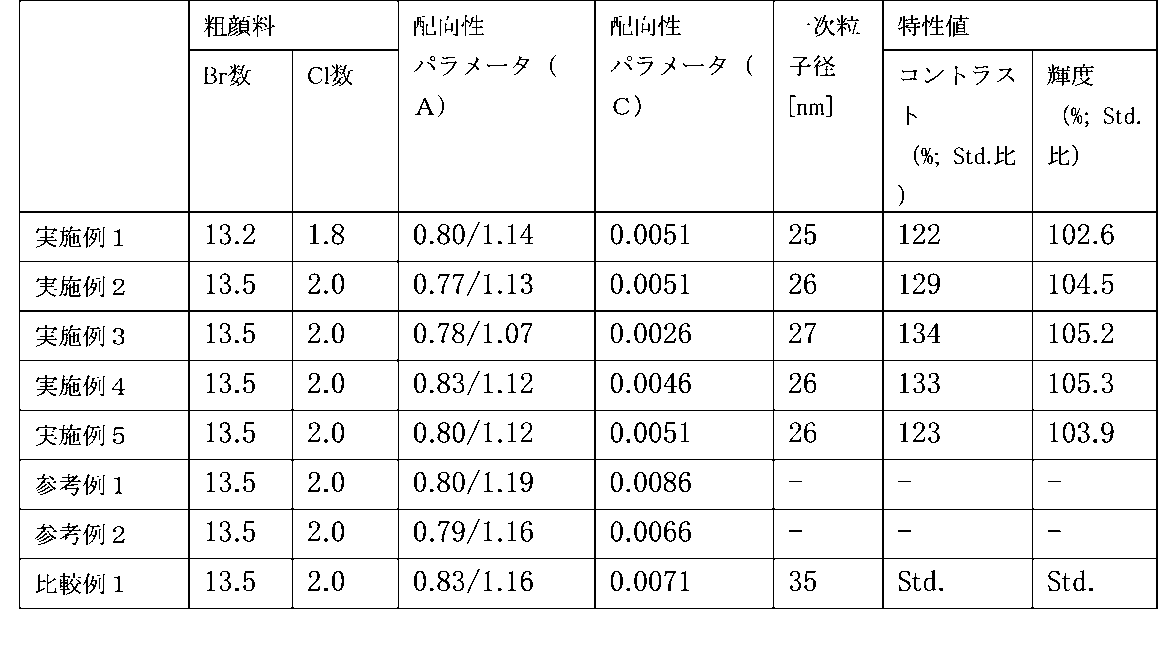
- Orientation parameters (A) and (C) were determined using the two-dimensional scattering image obtained by GI-WAXS measurement. The results are shown in Table 1, and the two-dimensional scattering images obtained in Reference Example 1, Comparative Example 1 and Example 3 are shown in FIGS. 1 (a), (b) and (c), respectively, and these two-dimensional scattering images are shown.
- the azimuth profile in the range of azimuth angle 5 ° to 89 ° graph with the standardized average scattering intensity (standardized intensity) as the vertical axis and the horizontal axis as the azimuth angle) derived from the image is shown in FIG. 2 (a).
- FIG. 2 is a graph relating to the orientation parameter (A)
- FIG. 3 is a graph relating to the orientation parameter (C).
- Example 3 ((c) in FIG. 1), the intensity was uniform and scattering on the annulus was obtained, and from a qualitative point of view, the orientation was relaxed in Example 3. I understand. Further, as shown in FIG. 2 (c), in Example 3, the minimum value / maximum value of the normalized average scattering intensity is 0.78 / 1.07, and the orientation parameter (A) is 0. Satisfy 70 to 1.15. Further, as shown in FIG. 3 (c), in Example 3, the slope of the linear approximation formula is 0.026, and the orientation parameter (C) satisfies ⁇ 0.006 to 0.006.
- Pigment Yellow 138 (Chromofine Yellow 6206EC manufactured by Dainichiseika Co., Ltd.) 1.65 g, DISPERBYK-161 (manufactured by Big Chemie) 3.85 g, Propylene Glycol Monomethyl Ether Acetate 11.00 g Zircon beads of 0.3 to 0.4 mm was dispersed for 2 hours with a paint shaker manufactured by Toyo Seiki Co., Ltd. to obtain a dispersion.
- the evaluation composition (CG1) was spin-coated on a glass substrate, dried at 90 ° C. for 3 minutes, and then heated at 230 ° C. for 1 hour. As a result, a glass substrate for contrast evaluation having a colored film on the glass substrate was produced. By adjusting the spin rotation speed at the time of spin coating, the thickness of the colored film obtained by heating at 230 ° C. for 1 hour was set to 1.8 ⁇ m.
- Corning registered trademark
- EAGLE XG thickness 1.1 mm
- a coating liquid obtained by mixing the yellow composition for toning (TY1) prepared above and the composition for evaluation (CG1) is spin-coated on a glass substrate, dried at 90 ° C. for 3 minutes, and then dried. It was heated at 230 ° C. for 1 hour. As a result, a glass substrate for luminance evaluation having a colored film on the glass substrate was produced. A colored film obtained by heating at 230 ° C. for 1 hour by adjusting the mixing ratio of the yellow composition for toning (TY1) and the composition for evaluation (CG1) and the spin rotation speed at the time of spin coating. A colored film having a chromaticity (x, y) of (0.275, 0.570) in the C light source was prepared. As the glass substrate, Corning (registered trademark) EAGLE XG (thickness 1.1 mm) was used.
- the contrast of the colored film on the glass substrate for contrast evaluation was measured by the contrast tester CT-1 manufactured by Tsubosaka Electric Co., Ltd., and the brightness of the colored film on the glass substrate for luminance evaluation was measured by U-3900 manufactured by Hitachi High-Tech Science. The results are shown in Table 1.
- the contrast and luminance shown in Table 1 are values based on the contrast and luminance of Comparative Example 1.
Landscapes
- Chemical & Material Sciences (AREA)
- Organic Chemistry (AREA)
- Chemical Kinetics & Catalysis (AREA)
- Optical Filters (AREA)
Abstract
Description
一実施形態のハロゲン化亜鉛フタロシアニン顔料は、1種又はハロゲン原子数の異なる複数種のハロゲン化亜鉛フタロシアニンを含有する、一又は複数の粒子で構成される。ここで、ハロゲン化亜鉛フタロシアニンは、下記式(1)で表される構造を有する化合物である。

[式(1)中、X1~X16は、各々独立に、水素原子又はハロゲン原子を表す。]
一実施形態のハロゲン化亜鉛フタロシアニン顔料の製造方法は、ハロゲン化亜鉛フタロシアニン粗顔料を用意する第1の工程と、当該ハロゲン化亜鉛フタロシアニン粗顔料を顔料化する第2の工程(顔料化工程)と、を有する。
(方法)
ハロゲン化亜鉛フタロシアニン粗顔料2.48gを、ビックケミー社製BYK-LPN6919 1.24g、DIC株式会社製ユニディックZL-295 1.86g、プロピレングリコールモノメチルエーテルアセテート10.92gと共に0.3~0.4mmのジルコンビーズを用いて、東洋精機株式会社製ペイントシェーカーで2時間分散して分散体を得る。ジルコンビーズをナイロンメッシュで取り除いた後の分散体0.02gをプロピレングリコールモノメチルエーテルアセテート20gで希釈して粒度分布測定用分散体を得る。
(条件)
・測定機器:動的光散乱式粒子径分布測定装置LB-550(株式会社堀場製作所製)
・測定温度:25℃
・測定試料:粒度分布測定用分散体
・データ解析条件:粒子径基準 散乱光強度、分散媒屈折率 1.402
(粗顔料A1の合成)
300mlフラスコに、塩化スルフリル(富士フイルム和光純薬工業株式会社製) 91g、塩化アルミニウム(関東化学株式会社製) 109g、塩化ナトリウム(東京化成工業株式会社製) 15g、亜鉛フタロシアニン(DIC株式会社製) 30g、臭素(富士フイルム和光純薬工業株式会社製) 230gを仕込んだ。130℃まで昇温し、130℃で40時間保持した。反応混合物を水に取り出した後、ろ過し、水洗することにより含水粗顔料WA1を得た。次いで、含水粗顔料WA1 10gを90℃で14時間乾燥することによりハロゲン化亜鉛フタロシアニン粗顔料(粗顔料A1) 4gを得た。なお、水洗は、ろ液のpHと洗浄に用いられる水のpHの差が±0.2になるまで行った。
300mlフラスコに、塩化スルフリル(富士フイルム和光純薬工業株式会社製) 91g、塩化アルミニウム(関東化学株式会社製) 109g、塩化ナトリウム(東京化成工業株式会社製) 19g、亜鉛フタロシアニン(DIC株式会社製) 28g、臭素(富士フイルム和光純薬工業株式会社製) 230gを仕込んだ。140℃まで昇温し、140℃で40時間保持した。反応混合物を水に取り出した後、ろ過し、水洗することにより含水粗顔料WA2を得た。次いで、含水粗顔料WA2 10gを90℃で14時間乾燥することによりハロゲン化亜鉛フタロシアニン粗顔料(粗顔料A2) 4gを得た。なお、水洗は、ろ液のpHと洗浄に用いられる水のpHの差が±0.2になるまで行った。この粗顔料A2を参考例1とする。
粗顔料A1 0.3g、粉砕した塩化ナトリウム 3g及び1,2,4-ブタントリオール 0.9gをオートマチックフーバーマーラ(東洋精機製作所)に仕込み、ガラス板上部から150lbsの荷重をかけ、25℃で、ガラス板を25回転させることで混練した。混練物をヘラでかきとって再度仕込み直し、再度ガラス板上部から150lbsの荷重をかけ、25℃で、ガラス板を25回転させることで混練した。その後、混練物をヘラでかきとって再度仕込み直し、再度ガラス板上部から150lbsの荷重をかけ、25℃で、ガラス板を50回転させることで混練した。なお、上記混練は、全て100rpmで実施したことから、合計磨砕時間は1分間であった。
粗顔料A1に代えて粗顔料A2を用いたこと以外は、実施例1と同様にして、緑色顔料G2を得た。
含水粗顔料WA2(粗顔料A2:水(質量比)=6:4) 75gを水 525gと共に1Lオートクレーブに仕込んだ。濃度5質量%の塩酸を使用して、処理対象物(含水粗顔料WA2と水の混合物)の水素イオン指数をpH5.5に調整した後、オートクレーブを密閉した。pHは横河電機株式会社製のPH71パーソナルpHメータで測定した。次いで、撹拌しながら2時間かけて200℃に昇温し、200℃で5時間保持した。200℃到達時におけるオートクレーブ内の圧力は1.55MPaであった。室温まで放冷した後、得られた処理物をろ過し、湯洗し、乾燥し、粉砕することにより、緑色顔料G3を得た。
粗顔料A2 45g、粉砕した塩化ナトリウム 450g、水 90gを双腕型ニーダーに仕込み、60℃で6時間混練した。混練後の混練物を80℃の水2kgに取り出し、1時間攪拌した。その後、ろ過し、湯洗、乾燥、粉砕することにより、プレ顔料GPを得た。
プレ顔料GP 0.3g、粉砕した塩化ナトリウム 3g及び1,2,4-ブタントリオール 0.9gをオートマチックフーバーマーラ(東洋精機製作所)に仕込み、ガラス板上部から150lbsの荷重をかけ、25℃で、ガラス板を25回転させることで混練した。混練物をヘラでかきとって再度仕込み直し、再度ガラス板上部から150lbsの荷重をかけ、25℃で、ガラス板を25回転させることで混練した。その後、混練物をヘラでかきとって再度仕込み直し、再度ガラス板上部から150lbsの荷重をかけ、25℃で、ガラス板を50回転させることで混練した。なお、上記混練は、全て100rpmで実施したことから、合計磨砕時間は1分間であった。
プレ顔料GP 12g、粉砕した塩化ナトリウム 450g、1,2,4-ブタントリオール 61gを双腕型ニーダーに仕込み、20℃で30分混練した。混練後の混練物を20℃の水2kgに取り出し、1時間攪拌した。その後、ろ過し、湯洗、乾燥、粉砕することにより、緑色顔料G6を得た。
粗顔料A2 40g、粉砕した塩化ナトリウム 400g、ジエチレングリコール 63gを双腕型ニーダーに仕込み、80℃で8時間混練した。混練後の混練物を80℃の水2kgに取り出し、1時間攪拌した。その後、ろ過し、湯洗、乾燥、粉砕することにより、緑色顔料G4を得た。
(平均一次粒子径の測定)
緑色顔料(G1~G6)をシクロヘキサンに超音波分散させてから顕微鏡で撮影し、二次元画像上の凝集体を構成する一次粒子40個の平均値から、一次粒子の平均粒子径(平均一次粒子径)を算出した。結果を表1に示す。
以下の方法で、粗顔料A2及び緑色顔料G1~G6の配向性パラメータ(A)及び(C)を測定した。なお、粗顔料A2を用いた場合を参考例1とする。
ピグメントイエロー138(大日精化社製クロモファインイエロー6206EC) 1.65gを、DISPERBYK-161(ビックケミー社製) 3.85g、プロピレングリコールモノメチルエーテルアセテート 11.00gと共に0.3~0.4mmのジルコンビーズを用いて、東洋精機株式会社製ペイントシェーカーで2時間分散して分散体を得た。
Claims (2)
- ハロゲン化亜鉛フタロシアニン顔料であって、
前記顔料1.00質量部と、ベンジルメタクリレート-メタクリル酸共重合体0.95質量部と、ジメチルアミノエチルメタクリレート共重合体0.30質量部とを含む塗膜を230℃で1時間加熱して厚さ4μmの評価用塗膜を形成し、当該評価用塗膜のGI-WAXS測定により得られる二次元散乱像から、散乱角2θが17°~21°の範囲の平均散乱強度を求め、方位角45°の前記平均散乱強度を1とする規格化平均散乱強度を求めたとき、
方位角5°~89°における前記規格化平均散乱強度が0.70~1.15である、ハロゲン化亜鉛フタロシアニン顔料。 - 平均一次粒子径が30nm以下である、請求項1に記載のハロゲン化亜鉛フタロシアニン顔料。
Priority Applications (4)
| Application Number | Priority Date | Filing Date | Title |
|---|---|---|---|
| JP2021574278A JP7464630B2 (ja) | 2020-07-01 | 2021-06-03 | ハロゲン化亜鉛フタロシアニン顔料及びその製造方法 |
| CN202180038558.7A CN115667416A (zh) | 2020-07-01 | 2021-06-03 | 卤化锌酞菁颜料及其制造方法 |
| US18/013,406 US20230287218A1 (en) | 2020-07-01 | 2021-06-03 | Halogenated zinc phthalocyanine pigment and production method for same |
| KR1020227045144A KR20230029657A (ko) | 2020-07-01 | 2021-06-03 | 할로겐화 아연 프탈로시아닌 안료 및 그 제조 방법 |
Applications Claiming Priority (2)
| Application Number | Priority Date | Filing Date | Title |
|---|---|---|---|
| JP2020114135 | 2020-07-01 | ||
| JP2020-114135 | 2020-07-01 |
Publications (1)
| Publication Number | Publication Date |
|---|---|
| WO2022004261A1 true WO2022004261A1 (ja) | 2022-01-06 |
Family
ID=79315961
Family Applications (1)
| Application Number | Title | Priority Date | Filing Date |
|---|---|---|---|
| PCT/JP2021/021120 Ceased WO2022004261A1 (ja) | 2020-07-01 | 2021-06-03 | ハロゲン化亜鉛フタロシアニン顔料及びその製造方法 |
Country Status (6)
| Country | Link |
|---|---|
| US (1) | US20230287218A1 (ja) |
| JP (1) | JP7464630B2 (ja) |
| KR (1) | KR20230029657A (ja) |
| CN (1) | CN115667416A (ja) |
| TW (1) | TWI876059B (ja) |
| WO (1) | WO2022004261A1 (ja) |
Cited By (3)
| Publication number | Priority date | Publication date | Assignee | Title |
|---|---|---|---|---|
| WO2023234095A1 (ja) | 2022-06-01 | 2023-12-07 | 富士フイルム株式会社 | 光検出素子、イメージセンサおよび光検出素子の製造方法 |
| WO2023234096A1 (ja) | 2022-06-01 | 2023-12-07 | 富士フイルム株式会社 | 光検出素子、イメージセンサおよび光検出素子の製造方法 |
| WO2023234094A1 (ja) | 2022-06-01 | 2023-12-07 | 富士フイルム株式会社 | 光検出素子、イメージセンサおよび光検出素子の製造方法 |
Citations (7)
| Publication number | Priority date | Publication date | Assignee | Title |
|---|---|---|---|---|
| JP2010175878A (ja) * | 2009-01-30 | 2010-08-12 | Fujifilm Corp | 着色感光性組成物、カラーフィルタ、および液晶表示装置 |
| JP2011039307A (ja) * | 2009-08-11 | 2011-02-24 | Toyo Ink Mfg Co Ltd | カラーフィルタ用着色組成物、及びカラーフィルタ |
| JP2011099974A (ja) * | 2009-11-05 | 2011-05-19 | Fujifilm Corp | 着色感光性組成物、カラーフィルタ、及び液晶表示装置 |
| WO2018043548A1 (ja) * | 2016-08-31 | 2018-03-08 | Dic株式会社 | カラーフィルタ用顔料組成物及びカラーフィルタ |
| WO2018051876A1 (ja) * | 2016-09-13 | 2018-03-22 | Dic株式会社 | ポリハロゲン化亜鉛フタロシアニン、ポリハロゲン化亜鉛フタロシアニン顔料及びこれを画素部に有するカラーフィルタ |
| JP2018097377A (ja) * | 2007-07-27 | 2018-06-21 | 三菱ケミカル株式会社 | カラーフィルタ用顔料分散液、カラーフィルタ用着色組成物、カラーフィルタ、及び液晶表示装置 |
| JP2020033525A (ja) * | 2018-08-31 | 2020-03-05 | Dic株式会社 | 顔料組成物、着色組成物及びカラーフィルタ |
Family Cites Families (8)
| Publication number | Priority date | Publication date | Assignee | Title |
|---|---|---|---|---|
| US7029526B2 (en) * | 2001-10-19 | 2006-04-18 | Ciba Specialty Chemicals Corporation | Process for making green pigment compositions useful for color filters and LCD's |
| JP5205715B2 (ja) * | 2006-06-16 | 2013-06-05 | 東洋インキScホールディングス株式会社 | ε型銅フタロシアニン顔料、その製造方法およびそれを用いた着色組成物 |
| JP5589842B2 (ja) * | 2008-07-04 | 2014-09-17 | 凸版印刷株式会社 | 液晶表示装置 |
| JP5689586B2 (ja) * | 2009-01-13 | 2015-03-25 | 富士フイルム株式会社 | 顔料分散組成物、着色感光性組成物、カラーフィルタ、カラーフィルタの製造方法、および液晶表示装置 |
| WO2010140519A1 (ja) * | 2009-06-05 | 2010-12-09 | 大日精化工業株式会社 | 緑色顔料、その製造方法、それを含んでなる着色剤およびそれを用いた着色方法 |
| JP5882109B2 (ja) * | 2012-04-03 | 2016-03-09 | 株式会社Dnpファインケミカル | 顔料分散組成物、カラーフィルタ用感光性着色樹脂組成物及びカラーフィルタ |
| KR102322272B1 (ko) * | 2013-08-05 | 2021-11-08 | 토요잉크Sc홀딩스주식회사 | 할로겐화 유기안료의 제조방법, 그 제조방법에 의해 얻어지는 할로겐화 유기안료 및 이것을 포함하는 착색 조성물 |
| KR102558140B1 (ko) | 2016-10-20 | 2023-07-21 | 이경환 | 모션 침대 제어를 위한 단말장치 및 그 동작 방법 |
-
2021
- 2021-06-03 CN CN202180038558.7A patent/CN115667416A/zh active Pending
- 2021-06-03 WO PCT/JP2021/021120 patent/WO2022004261A1/ja not_active Ceased
- 2021-06-03 KR KR1020227045144A patent/KR20230029657A/ko active Pending
- 2021-06-03 US US18/013,406 patent/US20230287218A1/en active Pending
- 2021-06-03 JP JP2021574278A patent/JP7464630B2/ja active Active
- 2021-06-15 TW TW110121704A patent/TWI876059B/zh active
Patent Citations (7)
| Publication number | Priority date | Publication date | Assignee | Title |
|---|---|---|---|---|
| JP2018097377A (ja) * | 2007-07-27 | 2018-06-21 | 三菱ケミカル株式会社 | カラーフィルタ用顔料分散液、カラーフィルタ用着色組成物、カラーフィルタ、及び液晶表示装置 |
| JP2010175878A (ja) * | 2009-01-30 | 2010-08-12 | Fujifilm Corp | 着色感光性組成物、カラーフィルタ、および液晶表示装置 |
| JP2011039307A (ja) * | 2009-08-11 | 2011-02-24 | Toyo Ink Mfg Co Ltd | カラーフィルタ用着色組成物、及びカラーフィルタ |
| JP2011099974A (ja) * | 2009-11-05 | 2011-05-19 | Fujifilm Corp | 着色感光性組成物、カラーフィルタ、及び液晶表示装置 |
| WO2018043548A1 (ja) * | 2016-08-31 | 2018-03-08 | Dic株式会社 | カラーフィルタ用顔料組成物及びカラーフィルタ |
| WO2018051876A1 (ja) * | 2016-09-13 | 2018-03-22 | Dic株式会社 | ポリハロゲン化亜鉛フタロシアニン、ポリハロゲン化亜鉛フタロシアニン顔料及びこれを画素部に有するカラーフィルタ |
| JP2020033525A (ja) * | 2018-08-31 | 2020-03-05 | Dic株式会社 | 顔料組成物、着色組成物及びカラーフィルタ |
Cited By (3)
| Publication number | Priority date | Publication date | Assignee | Title |
|---|---|---|---|---|
| WO2023234095A1 (ja) | 2022-06-01 | 2023-12-07 | 富士フイルム株式会社 | 光検出素子、イメージセンサおよび光検出素子の製造方法 |
| WO2023234096A1 (ja) | 2022-06-01 | 2023-12-07 | 富士フイルム株式会社 | 光検出素子、イメージセンサおよび光検出素子の製造方法 |
| WO2023234094A1 (ja) | 2022-06-01 | 2023-12-07 | 富士フイルム株式会社 | 光検出素子、イメージセンサおよび光検出素子の製造方法 |
Also Published As
| Publication number | Publication date |
|---|---|
| JPWO2022004261A1 (ja) | 2022-01-06 |
| KR20230029657A (ko) | 2023-03-03 |
| JP7464630B2 (ja) | 2024-04-09 |
| CN115667416A (zh) | 2023-01-31 |
| TWI876059B (zh) | 2025-03-11 |
| TW202212488A (zh) | 2022-04-01 |
| US20230287218A1 (en) | 2023-09-14 |
Similar Documents
| Publication | Publication Date | Title |
|---|---|---|
| JP7464630B2 (ja) | ハロゲン化亜鉛フタロシアニン顔料及びその製造方法 | |
| CN112189037B (zh) | 卤化锌酞菁颜料的制造方法 | |
| CN109642970B (zh) | 滤色器用颜料组合物和滤色器 | |
| JP6989050B1 (ja) | ハロゲン化亜鉛フタロシアニン顔料及びその製造方法 | |
| JP4752590B2 (ja) | ポリハロゲン化亜鉛フタロシアニン顔料組成物及びカラーフィルタ | |
| US12139615B2 (en) | Method for producing halogenated zinc phthalocyanine pigment | |
| JP6819826B1 (ja) | ハロゲン化亜鉛フタロシアニン顔料及びその製造方法 | |
| CN112334548B (zh) | 卤化锌酞菁颜料的制造方法 | |
| JP6923106B1 (ja) | カラーフィルタ用顔料の製造方法 | |
| JP6870785B1 (ja) | ハロゲン化亜鉛フタロシアニン顔料の製造方法 |
Legal Events
| Date | Code | Title | Description |
|---|---|---|---|
| ENP | Entry into the national phase |
Ref document number: 2021574278 Country of ref document: JP Kind code of ref document: A |
|
| 121 | Ep: the epo has been informed by wipo that ep was designated in this application |
Ref document number: 21834055 Country of ref document: EP Kind code of ref document: A1 |
|
| ENP | Entry into the national phase |
Ref document number: 20227045144 Country of ref document: KR Kind code of ref document: A |
|
| NENP | Non-entry into the national phase |
Ref country code: DE |
|
| 122 | Ep: pct application non-entry in european phase |
Ref document number: 21834055 Country of ref document: EP Kind code of ref document: A1 |