WO2021261545A1 - 流動食 - Google Patents
流動食 Download PDFInfo
- Publication number
- WO2021261545A1 WO2021261545A1 PCT/JP2021/023909 JP2021023909W WO2021261545A1 WO 2021261545 A1 WO2021261545 A1 WO 2021261545A1 JP 2021023909 W JP2021023909 W JP 2021023909W WO 2021261545 A1 WO2021261545 A1 WO 2021261545A1
- Authority
- WO
- WIPO (PCT)
- Prior art keywords
- liquid food
- liquid
- mass
- molecular weight
- present
- Prior art date
- Legal status (The legal status is an assumption and is not a legal conclusion. Google has not performed a legal analysis and makes no representation as to the accuracy of the status listed.)
- Ceased
Links
Images





Classifications
-
- A—HUMAN NECESSITIES
- A23—FOODS OR FOODSTUFFS; TREATMENT THEREOF, NOT COVERED BY OTHER CLASSES
- A23L—FOODS, FOODSTUFFS OR NON-ALCOHOLIC BEVERAGES, NOT OTHERWISE PROVIDED FOR; PREPARATION OR TREATMENT THEREOF
- A23L33/00—Modifying nutritive qualities of foods; Dietetic products; Preparation or treatment thereof
- A23L33/10—Modifying nutritive qualities of foods; Dietetic products; Preparation or treatment thereof using additives
- A23L33/115—Fatty acids or derivatives thereof; Fats or oils
-
- A—HUMAN NECESSITIES
- A23—FOODS OR FOODSTUFFS; TREATMENT THEREOF, NOT COVERED BY OTHER CLASSES
- A23L—FOODS, FOODSTUFFS OR NON-ALCOHOLIC BEVERAGES, NOT OTHERWISE PROVIDED FOR; PREPARATION OR TREATMENT THEREOF
- A23L29/00—Foods or foodstuffs containing additives; Preparation or treatment thereof
- A23L29/20—Foods or foodstuffs containing additives; Preparation or treatment thereof containing gelling or thickening agents
- A23L29/206—Foods or foodstuffs containing additives; Preparation or treatment thereof containing gelling or thickening agents of vegetable origin
- A23L29/25—Exudates, e.g. gum arabic, gum acacia, gum karaya or tragacanth
-
- A—HUMAN NECESSITIES
- A23—FOODS OR FOODSTUFFS; TREATMENT THEREOF, NOT COVERED BY OTHER CLASSES
- A23L—FOODS, FOODSTUFFS OR NON-ALCOHOLIC BEVERAGES, NOT OTHERWISE PROVIDED FOR; PREPARATION OR TREATMENT THEREOF
- A23L33/00—Modifying nutritive qualities of foods; Dietetic products; Preparation or treatment thereof
- A23L33/10—Modifying nutritive qualities of foods; Dietetic products; Preparation or treatment thereof using additives
-
- A—HUMAN NECESSITIES
- A23—FOODS OR FOODSTUFFS; TREATMENT THEREOF, NOT COVERED BY OTHER CLASSES
- A23L—FOODS, FOODSTUFFS OR NON-ALCOHOLIC BEVERAGES, NOT OTHERWISE PROVIDED FOR; PREPARATION OR TREATMENT THEREOF
- A23L33/00—Modifying nutritive qualities of foods; Dietetic products; Preparation or treatment thereof
- A23L33/10—Modifying nutritive qualities of foods; Dietetic products; Preparation or treatment thereof using additives
- A23L33/16—Inorganic salts, minerals or trace elements
-
- A—HUMAN NECESSITIES
- A23—FOODS OR FOODSTUFFS; TREATMENT THEREOF, NOT COVERED BY OTHER CLASSES
- A23L—FOODS, FOODSTUFFS OR NON-ALCOHOLIC BEVERAGES, NOT OTHERWISE PROVIDED FOR; PREPARATION OR TREATMENT THEREOF
- A23L33/00—Modifying nutritive qualities of foods; Dietetic products; Preparation or treatment thereof
- A23L33/10—Modifying nutritive qualities of foods; Dietetic products; Preparation or treatment thereof using additives
- A23L33/17—Amino acids, peptides or proteins
Definitions
- the present invention relates to a liquid food, a method for suppressing liquid phase separation of liquid food or imparting excellent thickening property, and an agent for the method.
- nasal or oral tube feeding, or gastrostomy or enteral fistula tube feeding has been used for elderly people or patients who have difficulty in oral intake of food.
- Nasal or oral tube feeding is performed via a tube that is inserted through the nose or mouth and reaches the esophagus, stomach, duodenum, or jejunum, and gastrostomy / enterostomy tube feeding is performed.
- This is a method of continuously administering nutrition such as a concentrated liquid diet through a tube in which an external fistula is surgically or endoscopically constructed in the site from the esophagus to the jejunum (mostly the stomach).
- low-viscosity foods (hereinafter referred to as general liquid foods) have been the mainstream of liquid foods such as concentrated liquid foods, and since they contain many proteins and lipids, there is a problem that liquid phase separation occurs over time. was there. In addition, due to its low viscosity, it had poor retention in the stomach and had a risk of diarrhea and reflux into the gastroesophagus. As a countermeasure against this weakness, there is an option to use a high-viscosity type liquid food that slows down the administration rate of the liquid food. However, the former involves the pain and pressure ulcer risk of the care recipient due to the prolonged administration.
- Patent Document 1 an emulsified food composition containing a predetermined amount of lipid, a thickener that gels in an acidic region, gum arabic or gati gum, and a divalent metal salt provides emulsification stability immediately after preparation. It is disclosed that it is excellent.
- the present invention relates to providing a means for suppressing liquid phase separation during storage of a liquid food containing a protein and / or a decomposition product thereof, a lipid, and a salt containing calcium or magnesium.
- the present invention relates to providing a new means for suppressing liquid phase separation without impairing the thickening property when the liquid food is thickened.
- the present inventors have completed the present invention based on the following new findings. As a result of diligent studies, the present inventors have found that (A) a protein and / or a decomposition product thereof, (B) a lipid, (C) a salt containing calcium or magnesium, and (D) a weight average molecular weight of 0. It has been found that a liquid diet in which liquid phase separation is suppressed can be produced by containing a small molecule gati gum of 05 ⁇ 10 6 to 0.7 ⁇ 10 6.
- the present inventors have found that in the case of the above-mentioned liquid food thickening mode, it has excellent thickening property.
- the present invention includes the following aspects.
- [1] Proteins and / or their degradation products, (B) Lipids, (C) Salts containing calcium or magnesium, and (D) Small molecules with a weight average molecular weight of 0.05 ⁇ 10 6 to 0.7 ⁇ 10 6.
- [2] (E) The liquid food according to [1], which contains a thickener that thickens in the presence of divalent metal ions.
- the liquid food according to [1] or [2] which is ingested orally or by tube and thickened by being mixed with gastric fluid in the stomach.
- [4] The liquid food according to any one of [1] to [3], which has a pH of 5.5 to 8.
- the content of the low molecular weight gati gum having a weight average molecular weight of 0.05 ⁇ 10 6 to 0.7 ⁇ 10 6 is 0.05 to 2.5% by mass.
- the liquid food according to any one.
- (D) Contains a low molecular weight gati gum having a weight average molecular weight of 0.05 ⁇ 10 6 to 0.7 ⁇ 10 6.
- the agent according to [10] wherein the liquid food is ingested orally or by tube and then thickened by being mixed with gastric fluid in the stomach.
- the agent according to [10] or [11] wherein the liquid food further contains (E) a thickener that thickens in the presence of divalent metal ions.
- liquid phase separation of liquid foods containing proteins and / or their decomposition products, lipids, and salts containing calcium or magnesium is suppressed.
- the liquid diet of the present invention has excellent thickening properties.
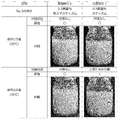
- Test Example 1 No. It is a photograph showing the appearance of the liquid phase after storing the gastric thickening liquid food sample containing different kinds of components as the component of No. 3 at 25 ° C. for 10 days. The white bars represent the transparent phase created by the separation.
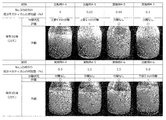
- Test Example 2 No. It is a photograph showing the appearance of the liquid phase after storing each intragastric thickening liquid food sample containing different amounts of small molecule gati gum (weight average molecular weight 150,000) as a component of No. 3 at 25 ° C. for 3 days. The white bars represent the transparent phase created by the separation.
- Test Example 3 No.
- White or black bars represent the transparent phase resulting from the separation.
- No. 3 is a photograph showing the appearance of a liquid phase after storing a general liquid food sample containing different amounts of small molecule gati gum (weight average molecular weight 150,000) at 25 ° C. for 1 or 3 days as a component of 3.
- the white bars represent the transparent phase created by the separation.
- No. It is a photograph showing the appearance of the liquid phase after storing a general liquid food sample containing a small molecule gati gum having a different weight average molecular weight as a component of No. 3 at 25 ° C. for 3 days.
- the white bars represent the transparent phase created by the separation.
- liquid phase separation of a liquid food means that when the liquid food is allowed to stand, a transparent phase appears in the suspended particles in the liquid food over time as compared with that before the standing. Refers to a phenomenon. That is, if a transparent phase is observed regardless of the presence or absence of precipitation or aggregation, it is considered that liquid phase separation has occurred.
- the "viscosity" of the liquid food refers to the property that the viscosity value becomes high when the viscosity of the liquid food is measured.
- the thickening includes a state in which the sample forms a gel, but at that time, for example, there is a bias in the formation of the gel, and when the sample separates into a gel-like part and a liquid part, the viscosity does not easily increase. Therefore, it is judged that the thickening property is low, and conversely, when the entire gel is uniformly gelled, the viscosity tends to increase and the thickening property is judged to be high.
- thickening agent thickens in the presence of divalent metal ions means that in a solution having the same concentration of the thickener but different only in the presence or absence of divalent metal ions. It indicates that the viscosity of the solution in which the valent metal ion is present is higher than the viscosity of the solution in which the valence metal ion is not contained.
- the liquid diet of the present invention comprises (A) a protein and / or a degradation product thereof, (B) a lipid, (C) a thickener that thickens in the presence of divalent metal ions, and (C) calcium or magnesium. It contains a salt and (D) a small molecule gati gum having a weight average molecular weight of 0.05 ⁇ 10 6 to 0.7 ⁇ 10 6.
- the liquid food of the present invention contains a protein and / or a decomposition product thereof as the component (A).
- proteins and / or protein degradation products are amino acids, peptides (polypeptides having less than 50 residues such as mono, di, tripeptides, tetrapeptides, oligopeptides, etc.), and proteins (number of residues). Is a single component of any one selected from the group consisting of 50 or more polypeptides), or a combination of two or more.
- a liquid diet containing at least a protein tends to be more easily phase-separated in the coexistence of a lipid and a salt containing calcium or magnesium than a liquid diet containing only a proteolytic product.
- component (D) liquid phase separation can be suppressed even when a protein is used.
- the type of protein and / or its decomposition product is not particularly limited, but for example, milk-derived protein (milk, defatted milk powder, whole fat powder milk, milk protein concentrate, milky protein (whey), casein, lactoferrin, etc.), and the like.
- Egg protein (egg white, albumin, etc.), meat / marine product-derived protein, gelatin, collagen, and other animal-derived proteins; soybean protein (defatted soymilk powder, etc.), pea protein, green bean protein, barley protein, wheat protein (gluten, etc.), rice
- One of the components selected from the group consisting of proteins, vegetable-derived proteins, plant-derived proteins such as fruit-derived proteins; microorganism-derived proteins such as yeast-derived proteins; and decomposition products of these proteins, or two or more components. Combinations can be mentioned.
- the component (A) of the present invention preferably contains at least one or more selected from the group consisting of milk-derived protein, plant-derived protein, and decomposition products thereof, and preferably contains milk-derived protein and soybean. It is more preferable to contain at least one or more selected from the group consisting of proteins and decomposition products thereof.
- a milk-derived protein or a decomposition product thereof contains a milky protein (whey protein concentrate: WPC, separated whey protein: WPI, etc.), casein (casein sodium, casein calcium, and other casein metal salts). ), Non-fat dry milk, whole milk protein, milk protein concentrate (MPC), isolated milk protein (MPI), and one or more selected from the group consisting of decomposition products thereof.
- the milk protein concentrate is a separated protein contained in milk and contains both casein and whey protein.
- Whey protein is a water-soluble protein that remains when casein, fat, fat-soluble components and the like are removed from milk.
- the main component of whey protein is a protein such as ⁇ -lactoglobulin, ⁇ -lactoglobulin, and lactoferrin, which may contain lactose, water-soluble vitamins, and salts.
- Casein is a protein having a phosphate group contained in milk, dairy products, etc., and is a protein that precipitates when milk or the like is adjusted to be acidic.
- the total content of the component (A) of the liquid food of the present invention is not particularly limited, but is preferably 0.5 to 20% by mass, more preferably 1 to 15% by mass, still more preferably, based on the total amount of the liquid food. Is 2 to 10% by mass.
- the total content of the component (A) of the liquid food of the present invention is, for example, 0.5% by mass or more, 1% by mass or more, 1.5% by mass or more, or 2% by mass or more with respect to the total amount of the liquid food. It may be, and may be, for example, 20% by mass or less, 15% by mass or less, or 10% by mass or less.
- the liquid food of the present invention contains a lipid as a component (B).
- the lipid is not particularly limited, but is, for example, rapeseed oil (canola oil), soybean oil, corn oil, rice oil, palm oil, palm oil, safflower oil, sunflower oil, perilla oil, sesame oil, flaxseed oil, olive oil, cottonseed oil.
- Vegetable oils such as peanut oil and cacao butter; Animal oils such as fish oil (squid oil, cod liver oil, etc.), beef fat, pork fat, etc .; ), Docosahexaenoic acid, Eikosapentaenoic acid and the like.
- the liquid diet of the present invention may contain these lipids alone or in combination of two or more.
- the total content of the component (B) of the liquid food of the present invention is not particularly limited, but is preferably 0.1 to 30% by mass, more preferably 0.5 to 15% by mass, based on the total amount of the liquid food. More preferably, it is 1 to 10% by mass.
- the total content of the component (B) of the liquid food of the present invention is, for example, 0.1% by mass or more, 0.2% by mass or more, 0.5% by mass or more, or 1% by mass with respect to the total amount of the liquid food. It may be more than or equal to, and may be, for example, 30% by mass or less, 20% by mass or less, 15% by mass or less, or 10% by mass or less.
- the liquid food of the present invention contains a salt containing calcium or magnesium as the component (C).
- a salt containing either one or both of calcium and magnesium can be used alone or in combination of two or more.
- the component (C) of the present invention is preferably a salt containing calcium.
- the component (C) of the present invention is insoluble or sparingly soluble in neutral water and is soluble in an acidic region.
- the component (C) that is insoluble or sparingly soluble in neutral water and soluble in the acidic region is not particularly limited, and is, for example, tricalcium phosphate, calcium monohydrogen phosphate, calcium dihydrogen phosphate, and steer. Examples thereof include calcium phosphate, calcium carbonate, calcium citrate, calcium gluconate, calcium sulfate, trimagnesium phosphate, magnesium carbonate and the like.
- the total content of calcium and magnesium in the liquid food of the present invention is not particularly limited, but is preferably 0.01 to 5% by mass, based on the total amount of the liquid food, from the viewpoint of significantly exerting the effect of the present invention. It is preferably 0.05 to 3% by mass, more preferably 0.2 to 2% by mass.
- the total content of calcium and magnesium in the liquid food of the present invention is, for example, 0.01% by mass or more, 0.02% by mass or more, 0.05% by mass or more, or 0.2% by mass with respect to the total amount of the liquid food. % Or more, and 5% by mass or less, 3% by mass or less, or 2% by mass or less.
- the liquid food of the present invention contains a small molecule gati gum having a weight average molecular weight of 0.05 ⁇ 10 6 to 0.7 ⁇ 10 6 as a component (D).
- a small molecule gati gum having a weight average molecular weight of 0.05 ⁇ 10 6 to 0.7 ⁇ 10 6 as a component (D).
- gatty gum is a polysaccharide derived from the sap (secretion) of gatinoki (Anogeissus latifolia Wallich), and is usually contained in water up to about 30% by mass under room temperature or higher temperature conditions. It is a water-soluble polysaccharide that dissolves.
- the small molecule gati gum is a low molecular weight gati gum.
- the small molecule gati gum used for the component (D) of the present invention is not particularly limited, and can be obtained by reducing the molecular size of gati gum by heat decomposition treatment, acid decomposition treatment, enzymatic decomposition treatment and the like.
- Examples of the method for producing a small molecule gati gum as a component (D) of the present invention include the production methods described in WO2018 / 062554, JP-A-2019-182886, or JP-A-2019-183144.
- the total content of the component (D) of the present invention is, for example, 0.05% by mass or more, 0.1% by mass or more, and 0.2% by mass with respect to the total amount of the liquid food from the viewpoint of suppressing liquid phase separation. It can be 0.3% by mass or more, 0.4% by mass or more or 0.5% by mass or more, and for example, 2.5% by mass or less and 2% by mass or less with respect to the total amount of liquid food. Alternatively, it can be 1.5% by mass or less. If the content of the small molecule gati gum is greater than 2.5% by mass or less than 0.05% by mass, the suppression of liquid phase separation of the liquid food may be insufficient.
- the total content of the component (D) of the present invention is, for example, 0.05% by mass or more and 0.1% by mass with respect to the total amount of the liquid food in order to impart excellent thickening property in the stomach. 0.2% by mass or more, 0.3% by mass or more, 0.4% by mass or more, 0.5% by mass or more, 0.6% by mass or more, 0.7% by mass or more, 0.8% by mass or more , 0.9% by mass or more, or 1% by mass or more.
- the weight average molecular weight of the low molecular ghatti used in component (D) of the present invention there is 0.7 ⁇ 10 6 or less, e.g., 0.6 ⁇ 10 6 or less , 0.5 ⁇ 10 6 or less, 0.4 ⁇ 10 6 or less, at 0.3 ⁇ 10 6 or less, or 0.2 ⁇ 10 6 or less, and, for example, 0.09 ⁇ 10 6 or more, or 0.1 ⁇ 106 or more. If the weight average molecular weight of the low molecular ghatti is greater than 0.7 ⁇ 10 6, or 0.05 ⁇ 10 6 If less than is sometimes suppressed in the liquid phase separation of the liquid food may be insufficient.
- the molecular weight and molecular weight distribution of the low molecular weight gati gum are determined by the following analytical method using gel permeation chromatography (GPC) described in WO2018 / 062554. Desired.
- GPC gel permeation chromatography
- Detector RI Mobile phase: 100 mM K 2 SO 4 Flow rate: 1.0 mL / min Temperature: 40 ° C
- the viscosity of an 8% by mass aqueous solution (20 ° C.) of the small molecule gatigam aqueous solution used for the component (D) of the present invention is preferably 70 mPa ⁇ s or less, more preferably 60 mPa ⁇ s or less, still more preferably 50 mPa ⁇ s or less. More preferably 40 mPa ⁇ s or less, particularly preferably 35 mPa ⁇ s or less, and even more preferably 30 mPa ⁇ s or less, for example, 1 mPa ⁇ s or more, 2 mPa ⁇ s or more, 3 mPa ⁇ s or more, 4 mPa ⁇ s or more.
- the viscosity of the 15 wt% aqueous solution (20 ° C.) of the small molecule gatigam aqueous solution of the component (D) of the present invention is preferably less than 100 mPa ⁇ s, more preferably less than 80 mPa ⁇ s, still more preferably less than 70 mPa ⁇ s, still more. It is preferably less than 60 mPa ⁇ s, particularly preferably less than 50 mPa ⁇ s, and more particularly preferably less than 40 mPa ⁇ s, for example, 10 mPa ⁇ s or more, 15 mPa ⁇ s or more.
- the viscosity of the small molecule gatigam aqueous solution is measured by putting 80 g of the gatigam aqueous solution in a 100 mL screw bottle (inner diameter: 3.7 cm) and using the following equipment and conditions.
- the liquid food of the present invention can contain a thickener that thickens in the presence of divalent metal ions as an optional component and further as a component (E).
- the thickener of the component (E) of the present invention is preferably a thickener that thickens in the presence of divalent metal ions regardless of the liquid property.
- the component (E) of the present invention is not particularly limited, but is preferably thickened in an acidic region in order to be thickened by being mixed with gastric fluid in the stomach.
- the acidic region is not particularly limited, but is, for example, a region having a pH of less than 5.5.
- the component (E) of the present invention is not particularly limited, but is, for example, alginic acid, alginate, pectin (HM pectin, LM pectin), carrageenan (kappa type, iota type, lambda type, etc.), gellan gum (deacylated gellan gum). 1 or 2 or more selected from the group consisting of LM pectin and alginate), and more preferably 1 or 2 or more selected from the group consisting of LM pectin and alginate.
- Alginic acid or alginate is used as a thickener, gelling agent, etc. for food additives, and is a polysaccharide extracted from seaweed.
- the alginate include various salts such as sodium alginate, potassium alginate, and ammonium alginate, but the alginate is not particularly limited.
- the alginic acid or a salt thereof is commercially available.
- Alginate is commercially available, and examples thereof include "Sun Support (trademark) P-196" and “Sun Support (trademark) P-197" manufactured by San-Ei Gen FFI Co., Ltd.
- Such alginic acid or a salt thereof is known to have acid resistance, heat resistance, pressure resistance, and stirring resistance, and any of these properties may be used.
- Pectin is a polysaccharide extracted from citrus fruits such as oranges, lemons, limes, and grapefruits, and plants such as apples and sugar beets, and is esterified with HM pectin (high methoxyl pectin) having an esterification degree of more than 50%. It is divided into LM pectin (low methoxyl pectin) having a degree of 50% or less.
- the pectin used in the present invention is preferably LM pectin, and more preferably one having an esterification degree of 40% or less.
- LM pectin is commercially available, and examples thereof include "Sun Support TM P-165" manufactured by Saneigen FFI Co., Ltd. Such pectin is known to have acid resistance, heat resistance, pressure resistance, and stirring resistance, and any of these properties may be used.
- the deacylated gellan gum contains glucose, glucuronic acid, and ramnorse as constituent sugars, and is bound to 1-3 of the main chain of gellan gum (native gellan gum) produced by fermentation with Sphingomonas elodea. It is obtained by removing the acyl group (acetyl group and glyceryl group) on glucose.
- the degree of deacyllation of the gellan gum used in the present invention is not particularly limited.
- the total content of the component (E) of the present invention is not particularly limited, but is preferably 0.05 to 5% by mass, more preferably 0.05 to 5% by mass, based on the total amount of the liquid food, from the viewpoint of significantly exerting the effect of the present invention. It is 0.1 to 3% by mass, more preferably 0.3 to 2% by mass.
- the total content of the component (E) of the present invention is, for example, 0.05% by mass or more, 0.1% by mass or more, 0.2% by mass or more, or 0.3% by mass or more with respect to the total amount of the liquid food. And, for example, 5% by mass or less, 4% by mass or less, 3% by mass or less, or 2% by mass or less.
- the total content of the component (D) with respect to 1 part by mass of the total content of the component (A) is not particularly limited, but is preferably 0.01 from the viewpoint of significantly exerting the effect of the present invention. It is ⁇ 10 parts by mass, more preferably 0.02 to 5 parts by mass, still more preferably 0.025 to 3 parts by mass.
- the total content of the component (D) with respect to 1 part by mass of the total content of the component (A) is, for example, 0.005 part by mass or more, 0 from the viewpoint of significantly exerting the effect of the present invention. It can be 008 parts by mass or more, 0.01 parts by mass or more, 0.02 parts by mass or more or 0.025 parts by mass or more, and, for example, 10 parts by mass or less, 5 parts by mass or less, and 3 parts by mass or less. , 2 parts by mass or less, 1 part by mass or less, 0.8 parts by mass or less, 0.6 parts by mass or less, or 0.5 parts by mass or less.
- the liquid food of the present invention further includes nutritional components (carbohydrates, minerals, vitamins, etc.), salts, taste components, extracts, sweeteners, sugar alcohols, high-sweetness sweeteners, etc.
- nutritional components carbohydrates, minerals, vitamins, etc.
- salts taste components
- extracts sweeteners, sugar alcohols, high-sweetness sweeteners, etc.
- Bitterness agents acidulants, fragrances, coloring agents
- food additives pH adjusters (trisodium citrate, etc.), defoaming agents, preservatives, antioxidants, thickeners, stabilizers, etc.
- polysaccharides 1 type or 2 or more types of celluloses such as microcrystalline cellulose
- the liquid food of the present invention preferably contains carbohydrates, minerals, vitamins and the like in addition to the components (A) to (E).
- sugar and dietary fiber generally used for food can be used.
- monosaccharides such as glucose and fructose
- ordinary various saccharides such as disaccharides such as maltose and sucrose
- sugar alcohols such as xylitol, sorbitol, glycerin and erythritol
- Dextrins oligosaccharides such as fructo-oligosaccharides, galactooligosaccharides, lactosucrose
- dietary fiber starch and the like.
- the sugar content of the liquid food in the present invention is not particularly limited, but is, for example, 0.5 to 30% by mass, preferably 1 to 20% by mass, based on the total amount of the liquid food.
- the mineral examples include sodium, potassium, iron, copper, zinc and the like, in addition to the component (C).
- the mineral is not particularly limited, but a salt treated as a food (including food additives) can be contained in the liquid food of the present invention.
- the mineral content of the liquid diet of the present invention can be appropriately set according to the recommended amount, the standard amount, the target amount or the upper limit amount described in the "Japanese Dietary Intake Standards (2020 Edition)" established by the Ministry of Health, Labor and Welfare. Usually, there are 6,000 to 20,000 mg / L as sodium, 2,000 to 3,500 mg / L as potassium, 10 to 40 mg / L as iron, 1.6 to 9 mg / L as copper, and 7 to 7 as zinc. It is 30 mg / L.
- vitamins examples include vitamin A, vitamin B 1 , B 2 , B 6 , B 12 , C, D, E, K, niacin, biotin, pantothenic acid, folic acid and the like.
- the vitamin content of the liquid diet of the present invention can be appropriately set according to the recommended amount, the standard amount, the target amount or the upper limit amount described in "Japanese Dietary Intake Standards (2020 Edition)", and is usually a vitamin.
- Vitamin B 12 is 2.4 to 100 mg / L
- vitamin C is 100 to 1,000 mg / L
- vitamin D is 0.0025 to 0.05 mg / L
- vitamin E is 8 to 600 mg / L
- vitamin K is 0. It is 055 to 30 mg / L, 13 to 30 mg / L as niacin, 0.03 to 0.1 mg / L as vitamin, 5 to 100 mg / L as pantothenic acid, and 0.2 to 1.0 mg / L as folic acid.
- the calorie value of the liquid food of the present invention is not particularly limited, and examples thereof include 0.1 to 7 kcal / mL, preferably 0.3 to 5 kcal / mL, and more preferably 0.5 to 3 kcal / mL.
- the liquid food of the present invention is a liquid food or drink that is liquid or intermediate between liquid and solid.
- liquid food of the present invention is a liquid food that is in a fluid and low viscosity state before ingestion and becomes thickened by being mixed with gastric fluid in the stomach.
- the liquid food of the present invention preferably contains the component (E) in addition to the components (A) to (D).
- “to thicken by being mixed with gastric juice in the stomach” is to thicken by adding 0.2 to 2 parts by mass of artificial gastric juice to 1 part by mass of the liquid food. You can check.
- the artificial gastric juice is an artificial gastric juice (2.0 g of sodium chloride, 7.0 mL of hydrochloric acid and 7.0 mL of hydrochloric acid) corresponding to the "dissolution test first solution" specified in the "general test method" of the 17th revised Japanese Pharmacopoeia. It is dissolved in water to make 1,000 mL, and refers to a solution with pH 1.2).
- the viscosity of a liquid food or a mixture of liquid food and artificial gastric juice represents a value measured at a measurement temperature of 20 ° C. and a rotation speed of 6 rpm using a B-type rotational viscometer.
- B-type rotational viscometer for example, BL VISCOMETER manufactured by Toki Sangyo Co., Ltd. can be used.
- the dedicated rotor NO. 1 to 4 shall be selected according to the sample viscosity and measured by the method described in the examples.
- liquid foods include swallowing foods; enteral nutritional supplements (pharmaceuticals administered by tube or orally); concentrated liquid foods and the like.
- the concentrated liquid food includes a natural concentrated liquid food made from natural food and an artificial concentrated liquid food composed of artificially processed or artificially synthesized natural food.
- Artificial concentrated liquid diets include, for example, semi-digestive nutrients (where the nitrogen source is protein), digestive nutrients (where the nitrogen source is amino acids and low molecular weight peptides), or elemental diets (where the nitrogen source is amino acids). (Those consisting only of).
- an artificial concentrated liquid food is preferable.
- Examples of the ingestion or administration form of the liquid food of the present invention include direct ingestion, oral ingestion via a straw or tube, nasal administration using a tube, transgastric fistula, oral tube administration and the like.
- the pH of the liquid food of the present invention is preferably 5.5 to 8.
- the viscosity of the liquid food of the present invention is not particularly limited, but is preferably 5 to 500 mPa ⁇ s, and more preferably 10 to 300 mPa ⁇ s.
- the viscosity of the mixture obtained by adding 1/3 part by mass of artificial gastric juice to 1 part by mass of the liquid food of the present invention and allowing it to stand for 60 minutes is not particularly limited, but is preferably 1, It is 000 to 30,000 mPa ⁇ s, more preferably 3,000 to 20,000 mPa ⁇ s, and even more preferably 4,000 to 20,000 mPa ⁇ s.
- the liquid food of the present invention suppresses liquid phase separation over time during storage.
- the liquid food of the present invention can maintain a low viscosity when suppressing liquid phase separation during storage, and therefore, when ingested or administered by tube, it has good tube-passability and is promptly ingested. Or it can be administered.
- the liquid food of the present invention has a smooth texture even after storage and is easy to ingest when ingested orally.
- the liquid food of the present invention when the liquid food of the present invention is mixed with gastric fluid in the stomach and can be thickened, it has a feature of being excellent in thickening property.
- a part of the liquid food thickens excessively rapidly under an acidic region, so that a part of the liquid food does not increase in viscosity and the whole viscosity increases.
- the liquid diet of the present invention can maintain the thickening property.
- the liquid food of the present invention can be produced by mixing the components (A) to (E) and other components by a conventional method.
- the method for producing a liquid food of the present invention further includes a homogenization step, a container filling step, and a heat sterilization step.
- the homogenization step is not particularly limited, and examples thereof include homogenization using a high-pressure homogenizer.
- the heat sterilization step is not particularly limited, and examples thereof include a retort sterilization process of heating at 105 to 131 ° C. for 5 to 60 minutes after filling the container.
- the method of the present invention comprises a liquid diet containing (A) a protein and / or a degradation product thereof, (B) a lipid, and (C) a salt containing calcium or magnesium, and (D) a weight average molecular weight of 0.05. It contains a small molecule gati gum of ⁇ 10 6 to 0.7 ⁇ 10 6 and is used for suppressing liquid phase separation or imparting excellent thickening property (improvement of thickening property). It is a feature.
- the methods of the invention are augmented in the presence of (A) proteins and / or degradation products thereof, (B) lipids, (C) salts containing calcium or magnesium, and (E) divalent metal ions.
- a liquid diet containing a thickening agent to be thickened contains (D) 0.05 to 2.5% by mass of low molecular weight gati gum having a weight average molecular weight of 0.05 ⁇ 10 6 to 0.7 ⁇ 10 6. It is characterized in that it is used for suppressing liquid phase separation of the liquid food or imparting excellent thickening property.
- the components (A) to (E) of the liquid food, other components, preferred forms and the like are the same as those described in the above [liquid food].
- the liquid food of the method of the present invention corresponds to the above-mentioned [liquid food] which does not contain the component (D).
- the component (D) is preferably applied to the liquid food so as to be the amount of the component (D) of the liquid food described in the above section [Liquid food].
- the agent of the present invention contains (D) a small molecule gati gum having a weight average molecular weight of 0.05 ⁇ 10 6 to 0.7 ⁇ 10 6. Suppression of liquid phase separation of liquid food containing (A) protein or its decomposition product, (B) lipid, and (C) salt containing calcium or magnesium, or imparting excellent thickening property (thickening property) It is characterized by being used for improvement).
- the agent of the invention contains (D) a small molecule gati gum having a weight average molecular weight of 0.05 ⁇ 10 6 to 0.7 ⁇ 10 6.
- Liquid food liquor containing (A) protein or degradation products thereof, (B) lipid, (C) salt containing calcium or magnesium, and (E) thickener that thickens in the presence of divalent metal ions. It is characterized by being used for suppressing phase separation or imparting excellent thickening property.
- the same low molecule gati gum of the component (D) in the above [liquid food] section can be used.
- the shape of the agent of the present invention is not particularly limited.
- a solid shape for example, powder, granule, tablet, etc.
- a liquid shape for example, dissolution liquid, dispersion liquid, etc.
- the content of the component (D) in the agent of the present invention is not particularly limited, but is, for example, 5 to 100% by mass, preferably 10 to 90% by mass, and more preferably 15 to 15 to the total amount of the agent. It is 85% by mass, more preferably 20 to 80% by mass.
- those in the solid form preferably further contain an excipient.
- excipients include starch decomposition products (dextrin, powdered candy, etc.), sugars (monosaccharides (glucose, fructose, etc.), disaccharides (eg, sucrose, lactose, maltose, trehalose, etc.), oligosaccharides (serooligo).
- the agent of the present invention contains an excipient, the content thereof is not particularly limited, but is, for example, 0.01 to 90% by mass, preferably 3 to 80% by mass, based on the total amount of the agent. %, More preferably 4 to 75% by mass, still more preferably 5 to 70% by mass.
- the agent of the present invention may contain a metal salt, an emulsifier, or the like for the purpose of improving dispersibility.
- the type of the metal salt is not particularly limited, and examples thereof include potassium salt, sodium salt, calcium salt, magnesium salt and the like, and specific examples thereof include chlorides, hydroxides, emulsions and citrates. Gluconate, phosphate, sulfate, malate and the like can be mentioned.
- calcium chloride, potassium chloride, sodium chloride, magnesium chloride, calcium lactate, sodium citrate, sodium gluconate, potassium gluconate and the like can be mentioned.
- the preferred metal salt is one or more selected from the group consisting of calcium chloride, potassium chloride, sodium citrate and sodium gluconate.
- the content of the metal salt in the agent of the present invention is not particularly limited, but may be, for example, 0.1 to 15% by mass, preferably 0.5 to 12% by mass, more preferably 0.5 to 12% by mass, based on the total amount of the agent. Is 0.8 to 8% by mass, more preferably 0.8 to 6% by mass, still more preferably 1 to 5% by mass.
- the type of emulsifier is not particularly limited, but for example, sucrose fatty acid ester, glycerin fatty acid ester (for example, monoglycerin fatty acid ester, polyglycerin fatty acid ester, polyglycerin condensed lysinol acid ester, organic acid monoglyceride, etc.), propylene glycol.
- sucrose fatty acid ester for example, monoglycerin fatty acid ester, polyglycerin fatty acid ester, polyglycerin condensed lysinol acid ester, organic acid monoglyceride, etc.
- propylene glycol propylene glycol
- Examples include fatty acid ester, sorbitan fatty acid ester, lecithin, enzymatically decomposed lecithin, enzymatically treated lecithin, stearoyl sodium lactate, stearoyl lactate calcium, kiraya extract, saponin, polysorbate (eg, polysorbate 20, polysorbate 60, polysorbate 65, polysorbate 80) and the like. Be done.
- the content of the emulsifier in the agent of the present invention is not particularly limited, and examples thereof include 0.1 to 10% by mass with respect to the total amount of the agent.
- the agent of the present invention is not particularly limited, but in addition to the component (D), excipients, metal salts, and emulsifiers, nutritional components and food additives (dietary fiber, pH adjuster, storage) that can be used in foods are further limited.
- excipients dietary fiber, pH adjuster, storage
- emulsifiers emulsifiers
- nutritional components dietary fiber, pH adjuster, storage
- One or more kinds of agents, antioxidants, thickeners, stabilizers, etc. can be blended.
- the liquid food in which the agent of the present invention is used corresponds to the liquid food described in the above [Liquid food] section which does not contain the component (D).
- the components (A) to (E), other components, preferable forms, etc. are the same as those described in the above [liquid food] section.
- the agent of the present invention is preferably added to the target liquid food so as to have the content of the component (D) with respect to the total amount of the liquid food described in the above [liquid food] section, for example.
- the present invention comprises (D) a protein and / or a degradation product thereof, (B) a lipid, and (C) a small molecule gatigam having a weight average molecular weight of 0.05 ⁇ 10 6 to 0.7 ⁇ 10 6.
- the liquid food may further contain a thickener that thickens in the presence of (E) divalent metal ions.
- Gati gum is GAIFOLIA SD (*) (weight average molecular weight 1.36 million), and small molecule gati gum is low molecule gati gum (weight average molecular weight 20,000, prepared based on the production method described in WO2018 / 062554). 90,000, 150,000, 200,000, 400,000, 600,000, 750,000) were used.
- the viscosities of the 15% by mass aqueous solution of the above-mentioned gati gum and small molecule gati gum were measured. 80 g of a 15% by mass aqueous solution was placed in a 100 mL screw bottle (inner diameter: 3.7 cm), and measurement was carried out under the following equipment and conditions. ⁇ Device and conditions> B-type rotational viscometer (Brookfield-type viscometer), rotor NO. 2 Rotation speed 60 rpm, measurement temperature: 20 ° C, measurement time: 1 minute
- the viscosity of the used gati gum was 328 mPa ⁇ s at a concentration of 15% by mass, and the viscosity of the low molecular weight gati gum (weight average molecular weight 150,000) was 17 mPa ⁇ s at a concentration of 15% by mass.
- Example 1-5 Comparative Example 1-5 was prepared. The viscosities of these samples and Example 1 were measured before mixing the artificial gastric juice and 60 minutes after mixing the artificial gastric juice. The results are shown in the same Table 3.
- the viscosity after 60 minutes of mixing the gastric juice decreased as the addition amount increased.
- the gel obtained by adding gastric fluid to the comparative example was loose and non-uniform, separation of the gel-like part and the liquid part was observed, and a decrease in thickening property was observed.
- gastric fluid was added to the sample of the example using the small molecule gati gum, the whole gel was uniformly gelled, and sufficient thickening property was observed. From the above, when the small molecule gati gum is used, even if the addition amount is increased as compared with the case where the gati gum is used, the thickening property is not impaired. Therefore, the addition concentration is increased by suppressing the liquid phase separation. It was clarified that sufficient thickening property in the stomach can be expected even if the necessity arises.
- the viscosity of the sample of the example after 60 minutes of mixing with the artificial gastric juice exceeded 4,000 mPa ⁇ s, and the thickening property was good.
Landscapes
- Life Sciences & Earth Sciences (AREA)
- Chemical & Material Sciences (AREA)
- Food Science & Technology (AREA)
- Nutrition Science (AREA)
- Health & Medical Sciences (AREA)
- Engineering & Computer Science (AREA)
- Polymers & Plastics (AREA)
- Mycology (AREA)
- Dispersion Chemistry (AREA)
- Proteomics, Peptides & Aminoacids (AREA)
- Inorganic Chemistry (AREA)
- Oil, Petroleum & Natural Gas (AREA)
- Coloring Foods And Improving Nutritive Qualities (AREA)
- Jellies, Jams, And Syrups (AREA)
Priority Applications (3)
| Application Number | Priority Date | Filing Date | Title |
|---|---|---|---|
| CN202180036963.5A CN115697083B (zh) | 2020-06-24 | 2021-06-24 | 流食 |
| EP21827943.8A EP4173493A4 (en) | 2020-06-24 | 2021-06-24 | Liquid food |
| JP2022532530A JP7781750B2 (ja) | 2020-06-24 | 2021-06-24 | 流動食 |
Applications Claiming Priority (2)
| Application Number | Priority Date | Filing Date | Title |
|---|---|---|---|
| JP2020-108300 | 2020-06-24 | ||
| JP2020108300 | 2020-06-24 |
Publications (1)
| Publication Number | Publication Date |
|---|---|
| WO2021261545A1 true WO2021261545A1 (ja) | 2021-12-30 |
Family
ID=79281220
Family Applications (1)
| Application Number | Title | Priority Date | Filing Date |
|---|---|---|---|
| PCT/JP2021/023909 Ceased WO2021261545A1 (ja) | 2020-06-24 | 2021-06-24 | 流動食 |
Country Status (4)
| Country | Link |
|---|---|
| EP (1) | EP4173493A4 (https=) |
| JP (1) | JP7781750B2 (https=) |
| CN (1) | CN115697083B (https=) |
| WO (1) | WO2021261545A1 (https=) |
Cited By (1)
| Publication number | Priority date | Publication date | Assignee | Title |
|---|---|---|---|---|
| JP7576144B1 (ja) | 2023-11-17 | 2024-10-30 | 森永製菓株式会社 | ゼリー食品 |
Citations (4)
| Publication number | Priority date | Publication date | Assignee | Title |
|---|---|---|---|---|
| WO2013146181A1 (ja) | 2012-03-30 | 2013-10-03 | 株式会社大塚製薬工場 | 乳化食品組成物 |
| WO2018062554A1 (ja) | 2016-09-30 | 2018-04-05 | 三栄源エフ・エフ・アイ株式会社 | 低分子ガティガム |
| JP2019182886A (ja) | 2018-03-30 | 2019-10-24 | 三栄源エフ・エフ・アイ株式会社 | 低分子ガティガムの製造方法 |
| JP2019183144A (ja) | 2018-03-30 | 2019-10-24 | 三栄源エフ・エフ・アイ株式会社 | 低分子ガティガムの製造方法 |
Family Cites Families (4)
| Publication number | Priority date | Publication date | Assignee | Title |
|---|---|---|---|---|
| WO2012081725A1 (ja) * | 2010-12-17 | 2012-06-21 | 株式会社カネカ | 乳化食品組成物 |
| JP6615750B2 (ja) * | 2014-04-17 | 2019-12-04 | 三栄源エフ・エフ・アイ株式会社 | 濃厚流動食 |
| JP6852741B2 (ja) * | 2018-04-04 | 2021-03-31 | Jfeスチール株式会社 | コークス炉の乾燥孔の補修方法 |
| JP7195209B2 (ja) * | 2018-04-17 | 2022-12-23 | 株式会社トクヤマ | フォトクロミック化合物、該フォトクロミック化合物を含む硬化性組成物、及び該硬化性組成物からなるフォトクロミック硬化体 |
-
2021
- 2021-06-24 CN CN202180036963.5A patent/CN115697083B/zh active Active
- 2021-06-24 EP EP21827943.8A patent/EP4173493A4/en active Pending
- 2021-06-24 JP JP2022532530A patent/JP7781750B2/ja active Active
- 2021-06-24 WO PCT/JP2021/023909 patent/WO2021261545A1/ja not_active Ceased
Patent Citations (4)
| Publication number | Priority date | Publication date | Assignee | Title |
|---|---|---|---|---|
| WO2013146181A1 (ja) | 2012-03-30 | 2013-10-03 | 株式会社大塚製薬工場 | 乳化食品組成物 |
| WO2018062554A1 (ja) | 2016-09-30 | 2018-04-05 | 三栄源エフ・エフ・アイ株式会社 | 低分子ガティガム |
| JP2019182886A (ja) | 2018-03-30 | 2019-10-24 | 三栄源エフ・エフ・アイ株式会社 | 低分子ガティガムの製造方法 |
| JP2019183144A (ja) | 2018-03-30 | 2019-10-24 | 三栄源エフ・エフ・アイ株式会社 | 低分子ガティガムの製造方法 |
Non-Patent Citations (1)
| Title |
|---|
| See also references of EP4173493A4 |
Cited By (3)
| Publication number | Priority date | Publication date | Assignee | Title |
|---|---|---|---|---|
| JP7576144B1 (ja) | 2023-11-17 | 2024-10-30 | 森永製菓株式会社 | ゼリー食品 |
| WO2025105418A1 (ja) * | 2023-11-17 | 2025-05-22 | 森永製菓株式会社 | ゼリー食品 |
| JP2025082747A (ja) * | 2023-11-17 | 2025-05-29 | 森永製菓株式会社 | ゼリー食品 |
Also Published As
| Publication number | Publication date |
|---|---|
| JPWO2021261545A1 (https=) | 2021-12-30 |
| CN115697083B (zh) | 2025-06-10 |
| EP4173493A1 (en) | 2023-05-03 |
| JP7781750B2 (ja) | 2025-12-08 |
| EP4173493A4 (en) | 2024-06-26 |
| CN115697083A (zh) | 2023-02-03 |
Similar Documents
| Publication | Publication Date | Title |
|---|---|---|
| CN103504293B (zh) | 液态营养组合物 | |
| RU2529158C2 (ru) | Жидкая энтеральная пищевая композиция с низким содержанием одновалентных ионов металлов | |
| US9737088B2 (en) | Emulsified food product composition | |
| JP5274889B2 (ja) | 経管投与用ゲル状酸性濃厚流動食又は栄養剤 | |
| JP7084926B2 (ja) | 高カロリー栄養組成物および包装体 | |
| JP7656399B2 (ja) | 高カロリー栄養組成物 | |
| TWI434659B (zh) | 包含碳水界面活性劑複合物之增黏營養乳劑 | |
| CN104144617A (zh) | 具有改进的感官性质的富含能量的液体营养组合物 | |
| JP2016526028A (ja) | 嚥下障害を治療するための方法 | |
| WO2013085059A1 (ja) | 栄養組成物の製造方法 | |
| JP5902815B2 (ja) | 酸性液状栄養剤 | |
| JP7337507B2 (ja) | 液状食品 | |
| JP5789981B2 (ja) | 液状栄養組成物 | |
| JP7781750B2 (ja) | 流動食 | |
| JP7116044B2 (ja) | 高カロリー栄養組成物および包装体 | |
| CN104394844B (zh) | 胃瘘用半固态化营养剂 | |
| JP7084925B2 (ja) | 高カロリー栄養組成物および包装体 | |
| JP7116043B2 (ja) | 高カロリー栄養組成物および包装体 | |
| JP7218987B2 (ja) | 酸性液状栄養組成物 | |
| JP2025027869A (ja) | たんぱく質胃排出調整用組成物、流動性栄養組成物、及び組成物 | |
| WO2025031901A1 (en) | Emulsion gels | |
| HK40007833A (en) | Emulsified food product composition | |
| JPWO2018179954A1 (ja) | 高カロリー栄養組成物および包装体 |
Legal Events
| Date | Code | Title | Description |
|---|---|---|---|
| 121 | Ep: the epo has been informed by wipo that ep was designated in this application |
Ref document number: 21827943 Country of ref document: EP Kind code of ref document: A1 |
|
| ENP | Entry into the national phase |
Ref document number: 2022532530 Country of ref document: JP Kind code of ref document: A |
|
| NENP | Non-entry into the national phase |
Ref country code: DE |
|
| ENP | Entry into the national phase |
Ref document number: 2021827943 Country of ref document: EP Effective date: 20230124 |
|
| WWG | Wipo information: grant in national office |
Ref document number: 202180036963.5 Country of ref document: CN |