WO2021221000A1 - 正極材料、および、電池 - Google Patents
正極材料、および、電池 Download PDFInfo
- Publication number
- WO2021221000A1 WO2021221000A1 PCT/JP2021/016566 JP2021016566W WO2021221000A1 WO 2021221000 A1 WO2021221000 A1 WO 2021221000A1 JP 2021016566 W JP2021016566 W JP 2021016566W WO 2021221000 A1 WO2021221000 A1 WO 2021221000A1
- Authority
- WO
- WIPO (PCT)
- Prior art keywords
- positive electrode
- active material
- battery
- solid electrolyte
- electrode active
- Prior art date
- Legal status (The legal status is an assumption and is not a legal conclusion. Google has not performed a legal analysis and makes no representation as to the accuracy of the status listed.)
- Ceased
Links
Images


Classifications
-
- H—ELECTRICITY
- H01—ELECTRIC ELEMENTS
- H01B—CABLES; CONDUCTORS; INSULATORS; SELECTION OF MATERIALS FOR THEIR CONDUCTIVE, INSULATING OR DIELECTRIC PROPERTIES
- H01B1/00—Conductors or conductive bodies characterised by the conductive materials; Selection of materials as conductors
- H01B1/06—Conductors or conductive bodies characterised by the conductive materials; Selection of materials as conductors mainly consisting of other non-metallic substances
- H01B1/08—Conductors or conductive bodies characterised by the conductive materials; Selection of materials as conductors mainly consisting of other non-metallic substances oxides
-
- H—ELECTRICITY
- H01—ELECTRIC ELEMENTS
- H01M—PROCESSES OR MEANS, e.g. BATTERIES, FOR THE DIRECT CONVERSION OF CHEMICAL ENERGY INTO ELECTRICAL ENERGY
- H01M4/00—Electrodes
- H01M4/02—Electrodes composed of, or comprising, active material
- H01M4/62—Selection of inactive substances as ingredients for active masses, e.g. binders, fillers
-
- H—ELECTRICITY
- H01—ELECTRIC ELEMENTS
- H01M—PROCESSES OR MEANS, e.g. BATTERIES, FOR THE DIRECT CONVERSION OF CHEMICAL ENERGY INTO ELECTRICAL ENERGY
- H01M10/00—Secondary cells; Manufacture thereof
- H01M10/05—Accumulators with non-aqueous electrolyte
- H01M10/052—Li-accumulators
-
- H—ELECTRICITY
- H01—ELECTRIC ELEMENTS
- H01M—PROCESSES OR MEANS, e.g. BATTERIES, FOR THE DIRECT CONVERSION OF CHEMICAL ENERGY INTO ELECTRICAL ENERGY
- H01M10/00—Secondary cells; Manufacture thereof
- H01M10/05—Accumulators with non-aqueous electrolyte
- H01M10/052—Li-accumulators
- H01M10/0525—Rocking-chair batteries, i.e. batteries with lithium insertion or intercalation in both electrodes; Lithium-ion batteries
-
- H—ELECTRICITY
- H01—ELECTRIC ELEMENTS
- H01M—PROCESSES OR MEANS, e.g. BATTERIES, FOR THE DIRECT CONVERSION OF CHEMICAL ENERGY INTO ELECTRICAL ENERGY
- H01M10/00—Secondary cells; Manufacture thereof
- H01M10/05—Accumulators with non-aqueous electrolyte
- H01M10/056—Accumulators with non-aqueous electrolyte characterised by the materials used as electrolytes, e.g. mixed inorganic/organic electrolytes
- H01M10/0561—Accumulators with non-aqueous electrolyte characterised by the materials used as electrolytes, e.g. mixed inorganic/organic electrolytes the electrolyte being constituted of inorganic materials only
- H01M10/0562—Solid materials
-
- H—ELECTRICITY
- H01—ELECTRIC ELEMENTS
- H01M—PROCESSES OR MEANS, e.g. BATTERIES, FOR THE DIRECT CONVERSION OF CHEMICAL ENERGY INTO ELECTRICAL ENERGY
- H01M4/00—Electrodes
- H01M4/02—Electrodes composed of, or comprising, active material
- H01M4/13—Electrodes for accumulators with non-aqueous electrolyte, e.g. for lithium-accumulators; Processes of manufacture thereof
-
- H—ELECTRICITY
- H01—ELECTRIC ELEMENTS
- H01M—PROCESSES OR MEANS, e.g. BATTERIES, FOR THE DIRECT CONVERSION OF CHEMICAL ENERGY INTO ELECTRICAL ENERGY
- H01M4/00—Electrodes
- H01M4/02—Electrodes composed of, or comprising, active material
- H01M4/13—Electrodes for accumulators with non-aqueous electrolyte, e.g. for lithium-accumulators; Processes of manufacture thereof
- H01M4/131—Electrodes based on mixed oxides or hydroxides, or on mixtures of oxides or hydroxides, e.g. LiCoOx
-
- H—ELECTRICITY
- H01—ELECTRIC ELEMENTS
- H01M—PROCESSES OR MEANS, e.g. BATTERIES, FOR THE DIRECT CONVERSION OF CHEMICAL ENERGY INTO ELECTRICAL ENERGY
- H01M4/00—Electrodes
- H01M4/02—Electrodes composed of, or comprising, active material
- H01M4/36—Selection of substances as active materials, active masses, active liquids
-
- H—ELECTRICITY
- H01—ELECTRIC ELEMENTS
- H01M—PROCESSES OR MEANS, e.g. BATTERIES, FOR THE DIRECT CONVERSION OF CHEMICAL ENERGY INTO ELECTRICAL ENERGY
- H01M4/00—Electrodes
- H01M4/02—Electrodes composed of, or comprising, active material
- H01M4/36—Selection of substances as active materials, active masses, active liquids
- H01M4/362—Composites
- H01M4/366—Composites as layered products
-
- H—ELECTRICITY
- H01—ELECTRIC ELEMENTS
- H01M—PROCESSES OR MEANS, e.g. BATTERIES, FOR THE DIRECT CONVERSION OF CHEMICAL ENERGY INTO ELECTRICAL ENERGY
- H01M4/00—Electrodes
- H01M4/02—Electrodes composed of, or comprising, active material
- H01M4/36—Selection of substances as active materials, active masses, active liquids
- H01M4/48—Selection of substances as active materials, active masses, active liquids of inorganic oxides or hydroxides
- H01M4/50—Selection of substances as active materials, active masses, active liquids of inorganic oxides or hydroxides of manganese
- H01M4/505—Selection of substances as active materials, active masses, active liquids of inorganic oxides or hydroxides of manganese of mixed oxides or hydroxides containing manganese for inserting or intercalating light metals, e.g. LiMn2O4 or LiMn2OxFy
-
- H—ELECTRICITY
- H01—ELECTRIC ELEMENTS
- H01M—PROCESSES OR MEANS, e.g. BATTERIES, FOR THE DIRECT CONVERSION OF CHEMICAL ENERGY INTO ELECTRICAL ENERGY
- H01M4/00—Electrodes
- H01M4/02—Electrodes composed of, or comprising, active material
- H01M4/36—Selection of substances as active materials, active masses, active liquids
- H01M4/48—Selection of substances as active materials, active masses, active liquids of inorganic oxides or hydroxides
- H01M4/52—Selection of substances as active materials, active masses, active liquids of inorganic oxides or hydroxides of nickel, cobalt or iron
- H01M4/525—Selection of substances as active materials, active masses, active liquids of inorganic oxides or hydroxides of nickel, cobalt or iron of mixed oxides or hydroxides containing iron, cobalt or nickel for inserting or intercalating light metals, e.g. LiNiO2, LiCoO2 or LiCoOxFy
-
- H—ELECTRICITY
- H01—ELECTRIC ELEMENTS
- H01M—PROCESSES OR MEANS, e.g. BATTERIES, FOR THE DIRECT CONVERSION OF CHEMICAL ENERGY INTO ELECTRICAL ENERGY
- H01M4/00—Electrodes
- H01M4/02—Electrodes composed of, or comprising, active material
- H01M4/36—Selection of substances as active materials, active masses, active liquids
- H01M4/58—Selection of substances as active materials, active masses, active liquids of inorganic compounds other than oxides or hydroxides, e.g. sulfides, selenides, tellurides, halogenides or LiCoFy; of polyanionic structures, e.g. phosphates, silicates or borates
-
- H—ELECTRICITY
- H01—ELECTRIC ELEMENTS
- H01M—PROCESSES OR MEANS, e.g. BATTERIES, FOR THE DIRECT CONVERSION OF CHEMICAL ENERGY INTO ELECTRICAL ENERGY
- H01M4/00—Electrodes
- H01M4/02—Electrodes composed of, or comprising, active material
- H01M4/36—Selection of substances as active materials, active masses, active liquids
- H01M4/58—Selection of substances as active materials, active masses, active liquids of inorganic compounds other than oxides or hydroxides, e.g. sulfides, selenides, tellurides, halogenides or LiCoFy; of polyanionic structures, e.g. phosphates, silicates or borates
- H01M4/5825—Oxygenated metallic salts or polyanionic structures, e.g. borates, phosphates, silicates, olivines
-
- H—ELECTRICITY
- H01—ELECTRIC ELEMENTS
- H01M—PROCESSES OR MEANS, e.g. BATTERIES, FOR THE DIRECT CONVERSION OF CHEMICAL ENERGY INTO ELECTRICAL ENERGY
- H01M4/00—Electrodes
- H01M4/02—Electrodes composed of, or comprising, active material
- H01M2004/026—Electrodes composed of, or comprising, active material characterised by the polarity
- H01M2004/028—Positive electrodes
-
- H—ELECTRICITY
- H01—ELECTRIC ELEMENTS
- H01M—PROCESSES OR MEANS, e.g. BATTERIES, FOR THE DIRECT CONVERSION OF CHEMICAL ENERGY INTO ELECTRICAL ENERGY
- H01M2300/00—Electrolytes
- H01M2300/0017—Non-aqueous electrolytes
- H01M2300/0065—Solid electrolytes
- H01M2300/0068—Solid electrolytes inorganic
-
- H—ELECTRICITY
- H01—ELECTRIC ELEMENTS
- H01M—PROCESSES OR MEANS, e.g. BATTERIES, FOR THE DIRECT CONVERSION OF CHEMICAL ENERGY INTO ELECTRICAL ENERGY
- H01M2300/00—Electrolytes
- H01M2300/0017—Non-aqueous electrolytes
- H01M2300/0065—Solid electrolytes
- H01M2300/0068—Solid electrolytes inorganic
- H01M2300/008—Halides
-
- Y—GENERAL TAGGING OF NEW TECHNOLOGICAL DEVELOPMENTS; GENERAL TAGGING OF CROSS-SECTIONAL TECHNOLOGIES SPANNING OVER SEVERAL SECTIONS OF THE IPC; TECHNICAL SUBJECTS COVERED BY FORMER USPC CROSS-REFERENCE ART COLLECTIONS [XRACs] AND DIGESTS
- Y02—TECHNOLOGIES OR APPLICATIONS FOR MITIGATION OR ADAPTATION AGAINST CLIMATE CHANGE
- Y02E—REDUCTION OF GREENHOUSE GAS [GHG] EMISSIONS, RELATED TO ENERGY GENERATION, TRANSMISSION OR DISTRIBUTION
- Y02E60/00—Enabling technologies; Technologies with a potential or indirect contribution to GHG emissions mitigation
- Y02E60/10—Energy storage using batteries
Definitions
- Patent Document 2 discloses an all-solid lithium battery containing a lithium ion conductive solid electrolyte mainly composed of sulfide and an active material whose surface is coated with a lithium ion conductive oxide.
- the present disclosure provides a positive electrode material capable of reducing battery resistance.
- FIG. 1 is a cross-sectional view showing a schematic configuration of a positive electrode material according to the first embodiment.
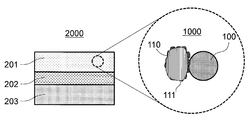
- FIG. 2 is a cross-sectional view showing a schematic configuration of the battery according to the second embodiment.
- FIG. 3 is a diagram showing a Nyquist diagram at 3.7 V of the battery in Comparative Example 1.
- FIG. 4A is a diagram showing an O1s spectrum of the active material used in Comparative Example 1 in X-ray photoelectron spectroscopy.
- FIG. 4B is a diagram showing an O1s spectrum of the active material used in Comparative Example 1 in X-ray photoelectron spectroscopy and an O1s spectrum of an active material whose surface is not coated with a coating material in X-ray photoelectron spectroscopy. ..
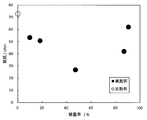
- FIG. 5 is a diagram showing the correlation between the coverage and resistance of the active materials of Comparative Examples 4 and Examples 1 to 6.
- Patent Document 1 discloses an all-solid-state secondary battery containing a solid electrolyte composed of a compound containing indium as a cation and a halogen element as an anion.
- a solid electrolyte composed of a compound containing indium as a cation and a halogen element as an anion.
- the potential of the positive electrode active material with respect to Li is 3.9 V or less on average, whereby a film composed of decomposition products due to oxidative decomposition of the solid electrolyte is formed. It is mentioned that it is suppressed and good charge / discharge characteristics are obtained.
- a positive electrode active material having an average potential of 3.9 V or less with respect to Li a general layered transition metal oxide positive electrode such as LiCoO 2 or LiNi 0.8 Co 0.15 Al 0.05 O 2 is disclosed.
- Patent Document 1 the detailed mechanism of oxidative decomposition has not been clarified.
- the present inventors investigated the resistance of the halide solid electrolyte to oxidative decomposition.
- a positive electrode active material having an average resistance to Li potential of 3.9 V or less is used. Even if there is, it has been found that the halide solid electrolyte is oxidatively decomposed during charging.
- the present inventors have a problem that the charge / discharge efficiency of the battery is lowered due to the oxidative decomposition of the halide solid electrolyte, and the cause may be the oxidation reaction of the halogen element contained in the halide solid electrolyte. I found it.
- a side reaction occurs in which electrons are also extracted from the halide solid electrolyte in contact with the positive electrode active material, and this side reaction ( That is, the charge is consumed in the oxidation reaction of the halide solid electrolyte).
- an oxide layer having poor lithium ion conductivity is formed between the positive electrode active material and the halide solid electrolyte. It is considered that this oxide layer functions as a large interfacial resistance in the electrode reaction of the positive electrode. In order to solve this problem, it is necessary to suppress the transfer of electrons to the halide solid electrolyte and suppress the formation of the oxide layer.
- the positive electrode material according to the second aspect is a positive electrode material containing a halide solid electrolyte
- the coating material for coating the positive electrode active material contains the oxide material according to the first aspect, and the entire surface of the positive electrode active material is covered. Not completely covered. That is, a part of the surface of the positive electrode active material is exposed.
- the oxide material is at least one selected from the group consisting of P, Si, and B. It may be included.
- the positive electrode material according to the seventh aspect can increase the lithium ion conductivity in the coating material. Specifically, when the coating material contains a lithium compound of an oxide called a glass-forming oxide such as phosphoric acid or silicic acid, a part of the coating material is amorphized and the ion conduction path is widened. Therefore, it is considered that the lithium ion conductivity can be increased. Thereby, the positive electrode material according to the fourth aspect can more effectively reduce the resistance of the battery.
- a glass-forming oxide such as phosphoric acid or silicic acid
- the positive electrode material according to the eighth aspect can more effectively reduce the resistance of the battery. Further, when the mass ratio of the oxide material to the positive electrode active material is 2.3% by mass or less, the ratio of the positive electrode active material and the first solid electrolyte in the positive electrode can be increased. Therefore, the positive electrode material according to the eighth aspect can increase the energy density of the battery.
- the mass ratio of the oxide material to the positive electrode active material is 0.25% by mass or more and 1 It may be .14% by mass or less.
- the X includes at least one selected from the group consisting of F, Cl, and Br. You may.
- the ionic conductivity of the first solid electrolyte can be further improved.
- the positive electrode material according to the fourteenth aspect can further improve the charge / discharge efficiency of the battery.
- the charge / discharge efficiency can be improved.
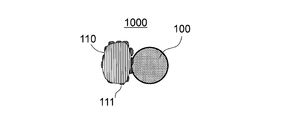
- FIG. 1 is a cross-sectional view showing a schematic configuration of the positive electrode material 1000 according to the first embodiment.
- the positive electrode material 1000 in the first embodiment includes a first solid electrolyte 100, a positive electrode active material 110, and a coating material 111 that covers the surface of the positive electrode active material 110.
- the first solid electrolyte 100 and the positive electrode active material 110 may be in the form of particles. A part of the surface of the positive electrode active material 110 is not covered with the coating material 111 and is exposed.
- a, b, and c are positive real numbers and satisfy the formula: a + b ⁇ c.
- M is at least one selected from the group consisting of metal elements other than Li and metalloid elements.
- X is at least one selected from the group consisting of F, Cl, Br and I.
- the coating material 111 is interposed between the positive electrode active material 110 and the first solid electrolyte 100 which is a halide solid electrolyte.
- the coating material 111 suppresses the transfer of electrons to the halide solid electrolyte. Therefore, since the side reaction of the halide solid electrolyte is suppressed, the formation of the oxide layer is suppressed, and as a result, the interfacial resistance of the electrode reaction is reduced.
- the positive electrode material 1000 in the present embodiment contains a halide solid electrolyte
- the coating material 111 for coating the positive electrode active material 110 contains an oxide material, and the entire surface of the positive electrode active material 110 is completely covered. Is not covered.
- the oxide material contained in the coating material 111 may contain at least one selected from the group consisting of P, Si, and B. According to this configuration, the coating material 111 having lower electron conductivity can be formed on the surface of the active material 110, so that the side reaction of the battery can be further reduced. Elements such as P, Si, and B form stronger covalent bonds with oxygen. Therefore, the electrons in the material forming the coating material 111 are delocalized, resulting in low electron conductivity. Therefore, even when the thickness of the coating layer formed of the coating material 111 is reduced, the transfer of electrons between the active material 110 and the first solid electrolyte 100 can be blocked, so that side reactions can be suppressed more effectively.
- the coating material 111 may contain at least one selected from the group consisting of lithium phosphate, lithium silicate, lithium borate, and lithium silicate. According to this configuration, the lithium ion conductivity in the coating material 111 can be increased. Thereby, the resistance of the battery can be reduced more effectively.
- the positive electrode active material 110 may be a lithium-containing transition metal oxide. According to this configuration, the energy density of the battery can be improved.
- Li 3 YX 6 Li 2 MgX 4 , Li 2 FeX 4 , Li (Al, Ga, In) X 4 , Li 3 (Al, Ga, In) X 6 and the like are used.
- the positive electrode active material 110 is, for example, a material having a property of occluding and releasing metal ions (for example, lithium ions).
- positive electrode active materials are lithium-containing transition metal oxides, transition metal fluorides, polyanionic materials, fluorinated polyanionic materials, transition metal sulfides, transition metal oxysulfides, transition metal oxynitrides, and the like.
- lithium-containing transition metal oxide is Li (Ni, Co, Al) O 2, Li (Ni, Co, Mn) O 2, or the like LiCoO 2.
- a lithium-containing transition metal oxide is used as the positive electrode active material, the manufacturing cost of the positive electrode can be reduced and the average discharge voltage can be increased.
- the energy density and charge / discharge efficiency of the battery can be further increased.
- the thickness of the coating material 111 is 100 nm or less, the thickness of the coating material 111 does not become too thick. Therefore, the internal resistance of the battery can be sufficiently reduced. As a result, the energy density of the battery can be increased.
- the median diameter of the positive electrode active material 110 may be larger than the median diameter of the first solid electrolyte 100. As a result, the positive electrode active material 110 and the first solid electrolyte 100 can form a good dispersed state.
- Examples of the shape of the battery 2000 in the second embodiment include a coin type, a cylindrical type, a square type, a sheet type, a button type, a flat type, and a laminated type.
- FIG. 4B is a diagram showing an O1s spectrum of the active material used in Comparative Example 1 in the XPS method and an O1s spectrum of the active material whose surface is not coated with the coating material in the XPS method.
- the positive electrode active material NCM used in Comparative Example 1 whose surface was not coated with the coating material was used. That is, the O1s spectrum of the active material whose surface is not coated with the coating material shown in FIG. 4B in the XPS method is also a diagram showing the O1s spectrum of the active material used in Comparative Example 4 in the XPS method. Therefore, in FIG. 4B, the two O1s spectra are shown to be the spectra of the active material used in Example 1 and Comparative Example 4, respectively.
- Table 1 shows the coverage of the active materials used in Comparative Examples 1 and 2 and the rate of change in resistance when a sulfide solid electrolyte is used as the first solid electrolyte.
- Comparing the resistance change rates of Comparative Example 1 and Comparative Example 2 it can be seen that the resistance change rate of Comparative Example 2 is larger in the negative direction and the resistance is further reduced. It is known that when the active material and the sulfide solid electrolyte come into direct contact with each other, a layer having high resistance is formed on the surface. Therefore, it is considered that this result is because lithium niobate, which has a high coverage, prevents contact between the active material and the sulfide solid electrolyte, and suppresses the formation of a resistance layer. It can be seen that when sulfide is used as the solid electrolyte, the lithium niobate coating having a high coverage is more effective.
- a battery was produced in the same manner as in Example 1 except that a positive electrode mixture was produced using a positive electrode active material whose surface was coated with the coating material of Example 2. The resistance of the obtained battery was evaluated in the same manner as in Comparative Example 1.
- Example 3 [Preparation of positive electrode active material whose surface is coated with a coating material]
- 6.3 mg of lithium hydroxide and 16.0 mg of triethyl phosphate were dissolved in an appropriate amount of ultra-dehydrated ethanol (manufactured by Wako Pure Chemical Industries, Ltd.) to prepare a coating material solution.
- a positive electrode active material whose surface was coated with a coating material was prepared by the same method as in Example 1 except for this.
- a battery was produced in the same manner as in Example 1 except that a positive electrode mixture was produced using a positive electrode active material whose surface was coated with the coating material of Example 3. The resistance of the obtained battery was evaluated in the same manner as in Comparative Example 1.
- a battery was produced in the same manner as in Example 1 except that a positive electrode mixture was produced using a positive electrode active material whose surface was coated with the coating material of Example 6. The resistance of the obtained battery was evaluated in the same manner as in Comparative Example 1.
- Table 3 shows the coating materials, assumed thickness, coating amount, coating ratio, and resistance at 3.7 V of Comparative Example 4 and Examples 1 to 6. Further, FIG. 5 is a diagram showing the correlation between the coverage and resistance of the active materials of Comparative Examples 4 and Examples 1 to 3 and 5 and 6.
- the assumed thickness was calculated from the BET specific surface area of the active material and the density of the coating material, assuming that it was covered over the entire surface area that can be measured by the BET specific surface area.
- BET specific surface area of the active material is 0.5 m 2 g -1, a density of the lithium phosphate 2.54Gcm -3, density of the lithium silicophosphate acid 2.47Gcm -3, and the density of the lithium silicate It was set to 2.39 gcm -3 .
- the coating amount is the mass ratio of the oxide material, which is the coating material, to the positive electrode active material.
- the mass ratio of the coating to the amount of active material was calculated assuming that the desired coating material, such as lithium phosphate, remained when all the volatile components such as water and carbon dioxide volatilized from the added coating material.
- the assumed reaction formula is shown in the following formula (3). 3 LiOH + (C 2 H 5 ) 3 PO 4 + 15 / 2O 2 ⁇ Li 3 PO 4 + 9H 2 O ⁇ + 6CO 2 ⁇ ... Equation (3)
Landscapes
- Chemical & Material Sciences (AREA)
- Chemical Kinetics & Catalysis (AREA)
- Electrochemistry (AREA)
- General Chemical & Material Sciences (AREA)
- Engineering & Computer Science (AREA)
- Inorganic Chemistry (AREA)
- Manufacturing & Machinery (AREA)
- Composite Materials (AREA)
- Materials Engineering (AREA)
- Physics & Mathematics (AREA)
- Condensed Matter Physics & Semiconductors (AREA)
- General Physics & Mathematics (AREA)
- Crystallography & Structural Chemistry (AREA)
- Battery Electrode And Active Subsutance (AREA)
- Secondary Cells (AREA)
Priority Applications (4)
| Application Number | Priority Date | Filing Date | Title |
|---|---|---|---|
| EP21797565.5A EP4145558A4 (en) | 2020-04-28 | 2021-04-26 | POSITIVE ELECTRODE MATERIAL, AND BATTERY |
| JP2022518046A JP7742577B2 (ja) | 2020-04-28 | 2021-04-26 | 正極材料、および、電池 |
| CN202180030510.1A CN115461888A (zh) | 2020-04-28 | 2021-04-26 | 正极材料和电池 |
| US18/046,504 US20230074539A1 (en) | 2020-04-28 | 2022-10-14 | Positive electrode material and battery |
Applications Claiming Priority (2)
| Application Number | Priority Date | Filing Date | Title |
|---|---|---|---|
| JP2020079582 | 2020-04-28 | ||
| JP2020-079582 | 2020-04-28 |
Related Child Applications (1)
| Application Number | Title | Priority Date | Filing Date |
|---|---|---|---|
| US18/046,504 Continuation US20230074539A1 (en) | 2020-04-28 | 2022-10-14 | Positive electrode material and battery |
Publications (1)
| Publication Number | Publication Date |
|---|---|
| WO2021221000A1 true WO2021221000A1 (ja) | 2021-11-04 |
Family
ID=78374114
Family Applications (1)
| Application Number | Title | Priority Date | Filing Date |
|---|---|---|---|
| PCT/JP2021/016566 Ceased WO2021221000A1 (ja) | 2020-04-28 | 2021-04-26 | 正極材料、および、電池 |
Country Status (5)
| Country | Link |
|---|---|
| US (1) | US20230074539A1 (https=) |
| EP (1) | EP4145558A4 (https=) |
| JP (1) | JP7742577B2 (https=) |
| CN (1) | CN115461888A (https=) |
| WO (1) | WO2021221000A1 (https=) |
Cited By (3)
| Publication number | Priority date | Publication date | Assignee | Title |
|---|---|---|---|---|
| KR20230136023A (ko) * | 2022-03-17 | 2023-09-26 | 도요타 지도샤(주) | 복합 입자, 정극, 전고체 전지, 및 복합 입자의 제조 방법 |
| JP2024124057A (ja) * | 2023-03-02 | 2024-09-12 | トヨタ自動車株式会社 | 正極活物質、正極、全固体電池、および、正極活物質の製造方法 |
| WO2024195636A1 (ja) | 2023-03-17 | 2024-09-26 | マクセル株式会社 | 全固体二次電池用正極および全固体二次電池 |
Families Citing this family (2)
| Publication number | Priority date | Publication date | Assignee | Title |
|---|---|---|---|---|
| CN116053438A (zh) * | 2023-01-05 | 2023-05-02 | 中国科学院化学研究所 | 一种高压全固态电池正极材料及其制备方法与应用 |
| CN120048844A (zh) * | 2023-11-27 | 2025-05-27 | 宁德时代新能源科技股份有限公司 | 正极极片及制备方法、电池、用电设备 |
Citations (6)
| Publication number | Priority date | Publication date | Assignee | Title |
|---|---|---|---|---|
| JPH0350064B2 (https=) * | 1986-11-04 | 1991-07-31 | Junichi Go | |
| JP2006244734A (ja) | 2005-02-28 | 2006-09-14 | National Univ Corp Shizuoka Univ | 全固体型リチウム二次電池 |
| WO2007004590A1 (ja) | 2005-07-01 | 2007-01-11 | National Institute For Materials Science | 全固体リチウム電池 |
| JP2015165463A (ja) * | 2014-03-03 | 2015-09-17 | トヨタ自動車株式会社 | リチウムイオン二次電池の正極、及びリチウムイオン二次電池の製造方法 |
| WO2019135315A1 (ja) * | 2018-01-05 | 2019-07-11 | パナソニックIpマネジメント株式会社 | 固体電解質材料、および、電池 |
| WO2019146216A1 (ja) * | 2018-01-26 | 2019-08-01 | パナソニックIpマネジメント株式会社 | 電池 |
Family Cites Families (3)
| Publication number | Priority date | Publication date | Assignee | Title |
|---|---|---|---|---|
| JP5552360B2 (ja) * | 2010-05-12 | 2014-07-16 | トヨタ自動車株式会社 | 複合正極活物質の製造方法、全固体電池の製造方法および複合正極活物質 |
| CN105098193A (zh) * | 2015-09-24 | 2015-11-25 | 宁德时代新能源科技有限公司 | 正极片以及包括该正极片的锂离子电池 |
| CN111557057B (zh) * | 2018-01-26 | 2024-04-19 | 松下知识产权经营株式会社 | 正极材料和使用它的电池 |
-
2021
- 2021-04-26 JP JP2022518046A patent/JP7742577B2/ja active Active
- 2021-04-26 WO PCT/JP2021/016566 patent/WO2021221000A1/ja not_active Ceased
- 2021-04-26 CN CN202180030510.1A patent/CN115461888A/zh active Pending
- 2021-04-26 EP EP21797565.5A patent/EP4145558A4/en not_active Withdrawn
-
2022
- 2022-10-14 US US18/046,504 patent/US20230074539A1/en active Pending
Patent Citations (6)
| Publication number | Priority date | Publication date | Assignee | Title |
|---|---|---|---|---|
| JPH0350064B2 (https=) * | 1986-11-04 | 1991-07-31 | Junichi Go | |
| JP2006244734A (ja) | 2005-02-28 | 2006-09-14 | National Univ Corp Shizuoka Univ | 全固体型リチウム二次電池 |
| WO2007004590A1 (ja) | 2005-07-01 | 2007-01-11 | National Institute For Materials Science | 全固体リチウム電池 |
| JP2015165463A (ja) * | 2014-03-03 | 2015-09-17 | トヨタ自動車株式会社 | リチウムイオン二次電池の正極、及びリチウムイオン二次電池の製造方法 |
| WO2019135315A1 (ja) * | 2018-01-05 | 2019-07-11 | パナソニックIpマネジメント株式会社 | 固体電解質材料、および、電池 |
| WO2019146216A1 (ja) * | 2018-01-26 | 2019-08-01 | パナソニックIpマネジメント株式会社 | 電池 |
Non-Patent Citations (1)
| Title |
|---|
| See also references of EP4145558A4 |
Cited By (8)
| Publication number | Priority date | Publication date | Assignee | Title |
|---|---|---|---|---|
| KR20230136023A (ko) * | 2022-03-17 | 2023-09-26 | 도요타 지도샤(주) | 복합 입자, 정극, 전고체 전지, 및 복합 입자의 제조 방법 |
| KR102924442B1 (ko) * | 2022-03-17 | 2026-02-09 | 도요타 지도샤(주) | 복합 입자, 정극, 전고체 전지, 및 복합 입자의 제조 방법 |
| JP2024124057A (ja) * | 2023-03-02 | 2024-09-12 | トヨタ自動車株式会社 | 正極活物質、正極、全固体電池、および、正極活物質の製造方法 |
| EP4425601A3 (en) * | 2023-03-02 | 2024-12-18 | Toyota Jidosha Kabushiki Kaisha | Positive electrode active material, positive electrode, all-solid-state battery, and method of producing positive electrode active material |
| JP7711724B2 (ja) | 2023-03-02 | 2025-07-23 | トヨタ自動車株式会社 | 正極活物質、正極、全固体電池、および、正極活物質の製造方法 |
| WO2024195636A1 (ja) | 2023-03-17 | 2024-09-26 | マクセル株式会社 | 全固体二次電池用正極および全固体二次電池 |
| KR20250144424A (ko) | 2023-03-17 | 2025-10-10 | 맥셀 주식회사 | 전고체 이차 전지용 정극 및 전고체 이차 전지 |
| EP4682970A1 (en) | 2023-03-17 | 2026-01-21 | Maxell, Ltd. | Positive electrode for all-solid-state secondary batteries, and all-solid-state secondary battery |
Also Published As
| Publication number | Publication date |
|---|---|
| EP4145558A1 (en) | 2023-03-08 |
| EP4145558A4 (en) | 2023-10-25 |
| CN115461888A (zh) | 2022-12-09 |
| JPWO2021221000A1 (https=) | 2021-11-04 |
| US20230074539A1 (en) | 2023-03-09 |
| JP7742577B2 (ja) | 2025-09-22 |
Similar Documents
| Publication | Publication Date | Title |
|---|---|---|
| US12266759B2 (en) | Positive electrode material and battery | |
| WO2022019099A1 (ja) | 正極材料および電池 | |
| JP7692162B2 (ja) | 正極材料、および、電池 | |
| WO2021221000A1 (ja) | 正極材料、および、電池 | |
| WO2019146308A1 (ja) | 電極材料、および、電池 | |
| JPWO2020174868A1 (ja) | 正極材料、および、電池 | |
| CN117897830A (zh) | 被覆活性物质、电极材料和电池 | |
| WO2021161752A1 (ja) | 被覆正極活物質、正極材料、電池、および被覆正極活物質の製造方法 | |
| CN117769766A (zh) | 正极材料、正极和电池 | |
| WO2023037757A1 (ja) | 正極材料、正極および電池 | |
| CN117321796A (zh) | 被覆活性物质、正极材料、正极和电池 | |
| WO2023286614A1 (ja) | 正極材料および電池 | |
| WO2023037769A1 (ja) | 正極材料、正極および電池 | |
| JP7843472B2 (ja) | 被覆活物質、正極材料、正極および電池 | |
| JP7507385B2 (ja) | 正極材料、および、電池 | |
| WO2021200086A1 (ja) | 正極材料および電池 | |
| WO2024029216A1 (ja) | 被覆活物質、正極材料、および電池 | |
| WO2023037815A1 (ja) | 被覆活物質、電極材料および電池 | |
| WO2023037816A1 (ja) | 被覆活物質、電極材料および電池 | |
| WO2023002827A1 (ja) | 正極材料および電池 | |
| CN117378055A (zh) | 被覆活性物质、电极材料和电池 | |
| CN117957675A (zh) | 正极材料、正极和电池 | |
| WO2024262185A1 (ja) | 被覆活物質、正極材料、正極、および電池 | |
| WO2022254984A1 (ja) | 正極材料、正極および電池 | |
| WO2021200084A1 (ja) | 正極材料および電池 |
Legal Events
| Date | Code | Title | Description |
|---|---|---|---|
| 121 | Ep: the epo has been informed by wipo that ep was designated in this application |
Ref document number: 21797565 Country of ref document: EP Kind code of ref document: A1 |
|
| ENP | Entry into the national phase |
Ref document number: 2022518046 Country of ref document: JP Kind code of ref document: A |
|
| NENP | Non-entry into the national phase |
Ref country code: DE |
|
| ENP | Entry into the national phase |
Ref document number: 2021797565 Country of ref document: EP Effective date: 20221128 |