WO2021205793A1 - Lc共振器およびlcフィルタ - Google Patents
Lc共振器およびlcフィルタ Download PDFInfo
- Publication number
- WO2021205793A1 WO2021205793A1 PCT/JP2021/008660 JP2021008660W WO2021205793A1 WO 2021205793 A1 WO2021205793 A1 WO 2021205793A1 JP 2021008660 W JP2021008660 W JP 2021008660W WO 2021205793 A1 WO2021205793 A1 WO 2021205793A1
- Authority
- WO
- WIPO (PCT)
- Prior art keywords
- resonator
- electrode
- capacitor
- bandpass filter
- plane
- Prior art date
- Legal status (The legal status is an assumption and is not a legal conclusion. Google has not performed a legal analysis and makes no representation as to the accuracy of the status listed.)
- Ceased
Links
Images












Classifications
-
- H—ELECTRICITY
- H03—ELECTRONIC CIRCUITRY
- H03H—IMPEDANCE NETWORKS, e.g. RESONANT CIRCUITS; RESONATORS
- H03H7/00—Multiple-port networks comprising only passive electrical elements as network components
- H03H7/01—Frequency selective two-port networks
- H03H7/0115—Frequency selective two-port networks comprising only inductors and capacitors
-
- H—ELECTRICITY
- H01—ELECTRIC ELEMENTS
- H01F—MAGNETS; INDUCTANCES; TRANSFORMERS; SELECTION OF MATERIALS FOR THEIR MAGNETIC PROPERTIES
- H01F17/00—Fixed inductances of the signal type
- H01F17/0006—Printed inductances
- H01F17/0013—Printed inductances with stacked layers
-
- H—ELECTRICITY
- H01—ELECTRIC ELEMENTS
- H01F—MAGNETS; INDUCTANCES; TRANSFORMERS; SELECTION OF MATERIALS FOR THEIR MAGNETIC PROPERTIES
- H01F27/00—Details of transformers or inductances, in general
- H01F27/28—Coils; Windings; Conductive connections
- H01F27/29—Terminals; Tapping arrangements for signal inductances
-
- H—ELECTRICITY
- H01—ELECTRIC ELEMENTS
- H01F—MAGNETS; INDUCTANCES; TRANSFORMERS; SELECTION OF MATERIALS FOR THEIR MAGNETIC PROPERTIES
- H01F27/00—Details of transformers or inductances, in general
- H01F27/40—Structural association with built-in electric component, e.g. fuse
-
- H—ELECTRICITY
- H01—ELECTRIC ELEMENTS
- H01G—CAPACITORS; CAPACITORS, RECTIFIERS, DETECTORS, SWITCHING DEVICES, LIGHT-SENSITIVE OR TEMPERATURE-SENSITIVE DEVICES OF THE ELECTROLYTIC TYPE
- H01G4/00—Fixed capacitors; Processes of their manufacture
- H01G4/40—Structural combinations of fixed capacitors with other electric elements, the structure mainly consisting of a capacitor, e.g. RC combinations
-
- H—ELECTRICITY
- H03—ELECTRONIC CIRCUITRY
- H03H—IMPEDANCE NETWORKS, e.g. RESONANT CIRCUITS; RESONATORS
- H03H5/00—One-port networks comprising only passive electrical elements as network components
- H03H5/02—One-port networks comprising only passive electrical elements as network components without voltage- or current-dependent elements
-
- H—ELECTRICITY
- H03—ELECTRONIC CIRCUITRY
- H03H—IMPEDANCE NETWORKS, e.g. RESONANT CIRCUITS; RESONATORS
- H03H7/00—Multiple-port networks comprising only passive electrical elements as network components
- H03H7/01—Frequency selective two-port networks
- H03H7/09—Filters comprising mutual inductance
-
- H—ELECTRICITY
- H03—ELECTRONIC CIRCUITRY
- H03H—IMPEDANCE NETWORKS, e.g. RESONANT CIRCUITS; RESONATORS
- H03H7/00—Multiple-port networks comprising only passive electrical elements as network components
- H03H7/01—Frequency selective two-port networks
- H03H7/17—Structural details of sub-circuits of frequency selective networks
- H03H7/1741—Comprising typical LC combinations, irrespective of presence and location of additional resistors
- H03H7/1766—Parallel LC in series path
-
- H—ELECTRICITY
- H03—ELECTRONIC CIRCUITRY
- H03H—IMPEDANCE NETWORKS, e.g. RESONANT CIRCUITS; RESONATORS
- H03H7/00—Multiple-port networks comprising only passive electrical elements as network components
- H03H7/01—Frequency selective two-port networks
- H03H7/17—Structural details of sub-circuits of frequency selective networks
- H03H7/1741—Comprising typical LC combinations, irrespective of presence and location of additional resistors
- H03H7/1775—Parallel LC in shunt or branch path
-
- H—ELECTRICITY
- H01—ELECTRIC ELEMENTS
- H01F—MAGNETS; INDUCTANCES; TRANSFORMERS; SELECTION OF MATERIALS FOR THEIR MAGNETIC PROPERTIES
- H01F17/00—Fixed inductances of the signal type
- H01F17/0006—Printed inductances
- H01F17/0013—Printed inductances with stacked layers
- H01F2017/0026—Multilayer LC-filter
-
- H—ELECTRICITY
- H03—ELECTRONIC CIRCUITRY
- H03H—IMPEDANCE NETWORKS, e.g. RESONANT CIRCUITS; RESONATORS
- H03H1/00—Constructional details of impedance networks whose electrical mode of operation is not specified or applicable to more than one type of network
- H03H2001/0021—Constructional details
- H03H2001/0085—Multilayer, e.g. LTCC, HTCC, green sheets
Definitions
- the present invention relates to an LC resonator and an LC filter.
- Patent Document 1 discloses a laminated band passband filter.
- the laminated band pass filter includes a plurality of LC parallel resonators.
- two via electrodes extend from the line electrode to the capacitor electrode and the ground connection electrode, respectively.
- a loop-shaped inductor is formed by the line electrode and the two via electrodes, and a capacitor is formed by the capacitor electrode and the ground connection electrode.
- the LC parallel resonators When viewed from the arrangement direction of a plurality of LC parallel resonators, the LC parallel resonators are arranged so that at least a part of the loop surface of each of the plurality of LC parallel resonators overlaps with each other, so that the LC parallel resonators are adjacent to each other.
- the degree of coupling between vessels can be increased. As a result, the bandwidth of the laminated band pass filter can be increased.
- the characteristics of the LC filter are often realized by adjusting the resonance frequency of the LC resonator whose impedance is an extreme value.
- increasing the number of LC resonators can increase the size of the filter, resulting in increased insertion loss.
- the present invention has been made to solve the above problems, and an object of the present invention is to suppress an increase in size of an LC filter while improving the characteristics of the LC filter.
- the LC resonator according to the embodiment of the present invention includes a first plane electrode, a second plane electrode, a first line electrode, a first via conductor, a second via conductor, and a third plane electrode. ..
- the second planar electrode faces at least a part of the first planar electrode in a specific direction.
- the first via conductor and the second via conductor extend in a specific direction from the first line electrode and are connected to the first plane electrode and the second plane electrode, respectively.
- the third planar electrode faces at least a part of the second planar electrode in a specific direction.
- the second plane electrode is arranged between the first plane electrode and the third plane electrode in a specific direction.
- the third plane electrode faces at least a part of the second plane electrode in a specific direction, and the second plane electrode faces the first plane electrode in the specific direction.
- FIG. 5 is an equivalent circuit diagram of an LC parallel resonator according to Comparative Example 1 of the first embodiment.
- FIG. 5 is an equivalent circuit diagram of an LC resonator according to Comparative Example 2 of the first embodiment. It is a figure which shows the passing characteristic of each of the LC resonator of FIG.
- FIG. 1 It is an equivalent circuit diagram of the LC resonator which concerns on the modification of Embodiment 1.
- FIG. It is an equivalent circuit diagram of the bandpass filter which is an example of the LC filter which concerns on Embodiment 2.
- FIG. It is an external perspective view of the bandpass filter of FIG. It is an external perspective view of the electrode structure formed in the laminated body of FIG. It is a figure which looked at the electrode structure of FIG. 12 from the Y-axis direction in a plan view. It is a figure which looked at the electrode structure of FIG. 12 from the X-axis direction in a plan view.
- FIG. 6 is a plan view of the electrode structure of FIG. 16 from the Y-axis direction.
- FIG. 6 is a plan view of the electrode structure of FIG. 16 from the X-axis direction.
- FIG. 6 is a figure which also shows the passing characteristic (straight line) of the bandpass filter of FIG. 10 and the passing characteristic (dotted line) of the bandpass filter of FIG.
- It is an equivalent circuit diagram of the bandpass filter which is an example of the LC filter which concerns on Embodiment 3.
- FIG. 2 is an external perspective view of an electrode structure formed inside the laminated body of FIG. 22.
- FIG. 3 is a plan view of the electrode structure of FIG. 23 from the Y-axis direction.
- FIG. 3 is a plan view of the electrode structure of FIG. 23 from the X-axis direction.
- It is a figure which shows the passing characteristic of the bandpass filter of FIG. It is an equivalent circuit diagram of the bandpass filter which concerns on the modification of Embodiment 3. It is an equivalent circuit diagram of the bandpass filter which concerns on Embodiment 4.
- FIG. It is a figure which shows the passing characteristic of the bandpass filter of FIG. 28. It is an equivalent circuit diagram of the bandpass filter which concerns on the modification of Embodiment 4.
- FIG. 1 is an equivalent circuit diagram of the LC resonator 1A according to the first embodiment.
- the LC resonator 1A is connected between the connection nodes of the input / output terminals P11 and P12 and the grounding point GND.
- the LC resonator 1A includes an inductor 10A, a capacitor 11A, and a capacitor 12A.
- the inductor 10A and the capacitor 11A are connected in parallel between one electrode of the capacitor 12A and the connection nodes of the input / output terminals P11 and P12 to form an LC parallel resonance circuit.
- the other electrode of capacitor 12A is grounded.
- the inductor 10A and the capacitor 12A are connected in series between the grounding point GND and the connection nodes of the input / output terminals P11 and P12 to form an LC series resonant circuit.
- FIG. 2 is an external perspective view of the LC resonator 1A of FIG.
- the X-axis, Y-axis, and Z-axis are orthogonal to each other. The same applies to FIGS. 3 to 5, 11 to 14, 16 to 18, and 22 to 25.
- the LC resonator 1A is formed as a laminated body 180 in which a plurality of dielectric layers are laminated in the Z-axis direction.
- a ground terminal G1 is formed on the bottom surface of the laminated body 190.
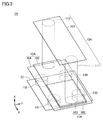
- FIG. 3 is an external perspective view of the electrode structure formed inside the laminate 180 of FIG.
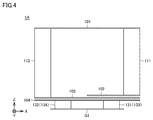
- FIG. 4 is a plan view of the electrode structure of FIG. 3 from the Y-axis direction.
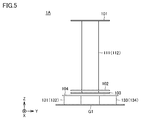
- FIG. 5 is a plan view of the electrode structure of FIG. 3 from the X-axis direction.
- the LC resonator 1A includes a line electrode 101 (first line electrode), a plane electrode 102 (first plane electrode), and a plane electrode 103 (second plane electrode).
- the via conductor 111 first via conductor
- the via conductor 112 second via conductor
- the ground electrode 104 third plane electrode
- the via conductors 131, 132, 133, 134 are provided.
- the flat electrode 103 faces at least a part of the flat electrode 102 in the Z-axis direction (specific direction).
- the plane electrodes 102 and 103 form a capacitor 11A.
- the line electrode 101 extends in the X-axis direction.
- the via conductors 111 and 112 extend from both ends of the line electrode 101 in the Z-axis direction, respectively, and are connected to the plane electrodes 102 and 103, respectively.
- the via conductor 111, the line electrode 101, and the via conductor 112 form an inductor 10A.
- the flat electrode 103 is arranged between the flat electrode 102 and the ground electrode 104 in the Z-axis direction.
- the ground electrode 104 faces at least a part of the flat electrode 103 in the Z-axis direction.
- the flat electrode 103 and the ground electrode 104 form a capacitor 12A.
- the ground electrode 104 is connected to the ground terminal G1 by each of the via conductors 131 to 134 and is grounded.
- the input / output terminals P11 and P21 in FIG. 1 are connected to, for example, a flat electrode 102 or a via conductor 111.
- the via conductors 111 and 112 forming the inductor 10A have different lengths in the Z-axis direction, and the via conductor 112 is longer than the via conductor 111. Therefore, the current concentration is biased between the central portion of the line electrode 101 and the via conductor 112. As a result, it is possible to improve the deterioration of the loss due to the current concentration occurring at the edge of the line electrode 101.
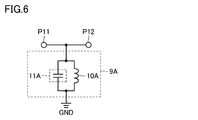
- FIG. 6 is an equivalent circuit diagram of the LC parallel resonator 9A according to Comparative Example 1 of the first embodiment.
- the configuration of the LC parallel resonator 9A is a configuration in which the capacitor 12A is removed from the LC resonator 1A in FIG. Other than these, the explanation is not repeated because it is the same. As shown in FIG. 6, the inductor 10A and the capacitor 11A are grounded.
- FIG. 7 is an equivalent circuit diagram of the LC resonator 9B according to Comparative Example 2 of the first embodiment.
- the configuration of the LC resonator 9B is a configuration in which a capacitor 13A is added to the LC parallel resonator 9A of FIG. Other than this, the explanation is not repeated because it is the same.
- the inductor 10A and the capacitor 13A are connected in series between the grounding point GND and the connection nodes of the input / output terminals P11 and P12.
- Capacitors 11A and 13A are connected in parallel between the grounding point GND and the connection nodes of the input / output terminals P11 and P12.
- the LC resonator 9B includes an LC parallel resonator formed by the inductor 10A and the capacitor 11A, and an LC series resonator formed by the inductor 10A and the capacitor 13A.
- FIG. 8 is a diagram showing the passing characteristics of the LC resonator 1A of FIG. 1, the LC parallel resonator 9A of FIG. 6, and the LC resonator 9B of FIG. 7 together.
- the curves C1, C9A, and C9B represent the passing characteristics of the LC resonator 1A, the passing characteristics of the LC parallel resonator 9A, and the passing characteristics of the LC resonator 9B, respectively.
- each passage characteristic shown in FIG. 8 is a passage characteristic when the respective capacitances of the capacitors 11A to 13A are the same.
- the amount of attenuation is minimized at the frequency f90.
- the amount of attenuation becomes maximum at the frequency f91, and the amount of attenuation becomes minimum at the frequency f92 (> f91).
- the amount of attenuation becomes maximum at the frequency f11, and the amount of attenuation becomes minimum at the frequency f12 (> f11).
- the passage characteristics of the LC parallel resonator 9A have an attenuation amount. There is no maximum attenuation pole.
- the attenuation characteristic which is an index of performance that does not allow signals outside the pass band to pass through, is improved as compared with the case where an LC filter is formed using the LC parallel resonator 9A. can do.
- the size of the LC filter can be reduced because a separate LC resonator for generating an attenuation pole is not required.
- the frequency at which the amount of attenuation is maximized and the frequency at which the amount of attenuation is minimized are both lower in the LC resonator 1A.
- the frequency at which the amount of attenuation is maximized and the frequency at which the amount of attenuation is minimized depend on the resonance frequency of the LC series resonator and the resonance frequency of the LC parallel resonator, respectively. The smaller the inductance of the inductor forming the LC resonator and the capacitance of the capacitor, the higher the resonance frequency of the LC resonator.
- the passage characteristics of the LC resonator 1A are made smaller than those of the LC resonator 9B. It can approach the passage characteristics. That is, when an LC filter having desired passing characteristics is realized, the size of the LC filter can be made smaller by using the LC resonator 1A than by using the LC resonator 9B.
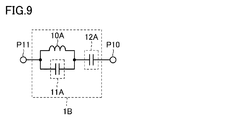
- FIG. 9 is an equivalent circuit diagram of the LC resonator 1B according to the modified example of the first embodiment.
- the third plane electrode of the capacitor 12A which was grounded in FIG. 1, is connected to the input / output terminal P10.
- the explanation is not repeated because it is the same.
- the LC resonator according to the first embodiment and the modified example it is possible to suppress the increase in size of the LC filter while improving the characteristics of the LC filter.
- the LC filter including the LC resonator according to the first embodiment will be described.
- a two-stage LC filter including two LC resonators will be described
- a four-stage LC filter including four LC resonators will be described.
- a five-stage LC filter including five LC resonators will be described.
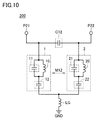
- FIG. 10 is an equivalent circuit diagram of a bandpass filter 200, which is an example of the LC filter according to the second embodiment.
- the bandpass filter 200 has an input / output terminal P21 (first terminal), an input / output terminal P22 (second terminal), an LC resonator 1 (first LC resonator), and an LC resonance.
- a device 2 (second LC resonator), a capacitor C12, and an inductor LG are provided.
- the bandpass filter 200 is a two-stage bandpass filter.
- the inductor LG is connected to the grounding point GND.
- the LC resonator 1 is connected between the input / output terminal P21 and the other end of the inductor LG.
- the LC resonator 2 is connected between the input / output terminal P22 and the other end of the inductor LG.
- a magnetic coupling M12 is formed between the LC resonators 1 and 2.
- the capacitor C12 is connected between the LC resonators 1 and 2.
- Capacitor C12 represents a capacitive coupling between LC resonators 1 and 2.
- the LC resonator 1 includes an inductor 10 and capacitors 11 and 12.
- the LC resonator 2 includes an inductor 20 and capacitors 21 and 22.
- Each of the LC resonators 1 and 2 has the same configuration as the LC resonator 1A shown in FIG. That is, the inductor 10 and the capacitors 11 and 12 correspond to the inductor 10A and the capacitors 11A and 12A, respectively.
- the inductor 20 and the capacitors 21 and 22 correspond to the inductor 10A and the capacitors 11A and 12A, respectively.
- FIG. 11 is an external perspective view of the bandpass filter 200 of FIG.
- the bandpass filter 200 is formed as a laminated body 280 in which a plurality of dielectric layers are laminated in the Z-axis direction.
- Input / output terminals P21 and P22 and a ground terminal G2 are formed on the bottom surface of the laminated body 280.
- the input / output terminals P21 and P22 and the ground terminal G2 are, for example, LGA (Land Grid Array) terminals in which plane electrodes are regularly arranged on the bottom surface of the laminated body 280.
- the bottom surface of the laminate 280 is connected to a circuit board (not shown).
- FIG. 12 is an external perspective view of the electrode structure formed inside the laminated body 280 of FIG.
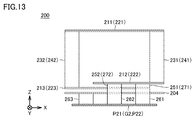
- FIG. 13 is a plan view of the electrode structure of FIG. 12 from the Y-axis direction.
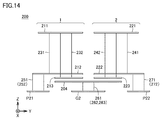
- FIG. 14 is a plan view of the electrode structure of FIG. 12 from the X-axis direction.
- the bandpass filter 200 includes a line electrode 211 (first line electrode), a plane electrode 212 (first plane electrode), and a plane electrode 213 (second plane electrode).
- a via conductor 231 (first via conductor) and a via conductor 232 (second via conductor) are provided.
- the bandpass filter 200 includes a line electrode 221 (first line electrode), a plane electrode 222 (first plane electrode), a plane electrode 223 (second plane electrode), and a via conductor 241 (first via conductor).
- a via conductor 242 (second via conductor) is further provided.
- the bandpass filter 200 further includes a ground electrode 204 (third plane electrode) and via conductors 251,252, 261,262, 263, 271,272.
- the flat electrode 213 faces at least a part of the flat electrode 212 in the Z-axis direction.
- the plane electrodes 212 and 213 form a capacitor 11.
- the flat electrode 212 is connected to the input / output terminal P21 by via conductors 251,252.
- the line electrode 211 extends in the X-axis direction.
- the via conductors 231 and 232 extend in the Z-axis direction from both ends of the line electrode 211, respectively, and are connected to the plane electrodes 212 and 213, respectively.
- the via conductor 231, the line electrode 211, and the via conductor 232 form an inductor 10.
- the plane electrode 213 is arranged between the plane electrode 212 and the ground electrode 204 in the Z-axis direction.
- the ground electrode 204 faces at least a part of the plane electrode 213 in the Z-axis direction.
- the plane electrode 213 and the ground electrode 204 form a capacitor 12.
- the flat electrode 223 faces at least a part of the flat electrode 222 in the Z-axis direction.
- the planar electrodes 222 and 223 form a capacitor 21.
- the plane electrode 222 is connected to the input / output terminal P22 by via conductors 271,272.
- the line electrode 221 extends in the X-axis direction.
- the via conductors 241,242 extend in the Z-axis direction from both ends of the line electrode 221 and are connected to the plane electrodes 222 and 223, respectively.
- the via conductor 241 and the line electrode 221 and the via conductor 242 form an inductor 20.
- the plane electrode 223 is arranged between the plane electrode 222 and the ground electrode 204 in the Z-axis direction.
- the ground electrode 204 faces at least a part of the plane electrode 223 in the Z-axis direction.
- the plane electrode 223 and the ground electrode 204 form a capacitor 22.
- the ground electrode 204 is connected to the ground terminal G2 by each of the via conductors 261 to 263 and is grounded.
- the via conductors 261 to 263 form an inductor LG.
- FIG. 15 is an equivalent circuit diagram of the bandpass filter 900 according to the comparative example of the second embodiment.
- the configuration of the bandpass filter 900 is such that the LC resonators 1 and 2 in FIG. 10 are replaced with LC parallel resonators 91 and 92, respectively.
- the configuration of the LC parallel resonator 91 is such that the capacitor 12 is removed from the LC resonator 1.
- the configuration of the LC parallel resonator 92 is such that the capacitor 22 is removed from the LC resonator 2. Other than these, the explanation is not repeated because it is the same.
- the inductor 10 and the capacitor 11 are grounded.
- the inductor 20 and the capacitor 21 are grounded.
- the bandpass filter 900 is formed as a laminated body in which a plurality of dielectric layers are laminated in the Z-axis direction. Since the external perspective view of the bandpass filter 900 is the same as the external perspective view of the bandpass filter 200 shown in FIG. 11, the description will not be repeated.
- the electrode structure formed inside the laminated body will be described with reference to FIGS. 16 to 18.
- FIG. 16 is an external perspective view of the electrode structure of the bandpass filter 900 of FIG.
- FIG. 17 is a plan view of the electrode structure of FIG. 16 from the Y-axis direction.
- FIG. 18 is a plan view of the electrode structure of FIG. 16 from the X-axis direction.
- the bandpass filter 900 includes a line electrode 911, a planar electrode 912, and via conductors 931 and 932.
- the bandpass filter 900 further includes a line electrode 921, a planar electrode 922, and via conductors 941 and 942.
- the bandpass filter 900 further includes a ground electrode 904, a flat electrode 903, and via conductors 950, 961, 962, 963, 970.
- the line electrode 911 extends in the X-axis direction.
- the via conductors 931 and 932 extend in the Z-axis direction from both ends of the line electrode 911, and are connected to the flat electrode 912 and the ground electrode 904, respectively.
- the via conductor 931, the line electrode 911, and the via conductor 932 form an inductor 10.
- the ground electrode 904 faces at least a part of the flat electrode 912 in the Z-axis direction.
- the plane electrode 912 and the ground electrode 904 form a capacitor 11.
- the plane electrode 912 is connected to the input / output terminal P21 by the via conductor 950.
- the line electrode 921 extends in the X-axis direction.
- the via conductors 941 and 942 extend in the Z-axis direction from both ends of the line electrode 921, and are connected to the flat electrode 922 and the ground electrode 904, respectively.
- the via conductor 941, the line electrode 921, and the via conductor 942 form an inductor 20.
- the ground electrode 904 faces at least a part of the flat electrode 922 in the Z-axis direction.
- the plane electrode 922 and the ground electrode 904 form a capacitor 21.
- the plane electrode 922 is connected to the input / output terminal P22 by a via conductor 970.
- the flat electrode 903 faces at least a part of the flat electrode 912 in the Z-axis direction and faces at least a part of the flat electrode 922.
- the plane electrodes 912,903,922 form the capacitor C12.
- the ground electrode 904 is connected to the ground terminal G2 by the via conductors 961 to 963 and is grounded.
- the via conductors 961 to 963 form an inductor LG.
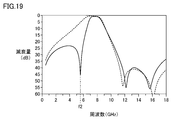
- FIG. 19 is a diagram showing the passing characteristics (straight line) of the bandpass filter 200 of FIG. 10 and the passing characteristics (dotted line) of the bandpass filter 900 of FIG. 15 together.
- the pass characteristic of the bandpass filter 900 no attenuation pole is generated in the frequency band on the low frequency side of the pass band.
- an attenuation pole is generated at a frequency f2 lower than the pass band.
- the steepness near the boundary on the low frequency side of the pass band is improved by the attenuation pole as compared with the bandpass filter 900. That is, in the bandpass filter 200, the function of the bandpass filter that limits the frequency of the passable signal to a desired frequency band is improved as compared with the bandpass filter 900.
- the LC resonator In the bandpass filter 200, the case where the LC resonator is directly connected to the input / output terminals has been described.
- the LC resonator may be electrically connected to the input / output terminals and may not be directly connected.
- the case where the LC resonator is capacitively coupled to the input / output terminal is included.
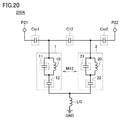
- FIG. 20 is an equivalent circuit diagram of the bandpass filter 200A according to the modified example of the second embodiment.
- the configuration of the bandpass filter 200A is a configuration in which capacitors Cio1 and Cio2 are added to the bandpass filter 200 of FIG. Other than these, the description is the same, so the description will not be repeated.
- the capacitor Cio1 is connected between the input / output terminal P21 and the connection nodes of the inductor 10 and the capacitor 11. That is, the first planar electrode included in the capacitor 11 is electrically connected to the input / output terminal P21.
- the capacitor Cio1 represents a capacitive coupling that occurs between the input / output terminal P21 and the LC resonator 1.
- the capacitor Cio2 is connected between the input / output terminal P22 and the connection nodes of the inductor 20 and the capacitor 21. That is, the first planar electrode included in the capacitor 21 is electrically connected to the input / output terminal P22.
- the capacitor Cio2 represents a capacitive coupling that occurs between the input / output terminal P22 and the LC resonator 2.
- the LC filter according to the second embodiment and the modified example it is possible to suppress the increase in size of the LC filter while improving the characteristics of the LC filter.
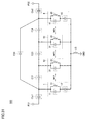
- FIG. 21 is an equivalent circuit diagram of the bandpass filter 300, which is an example of the LC filter according to the third embodiment.
- the bandpass filter 300 has an input / output terminal P31 (first terminal), an input / output terminal P32 (second terminal), an LC resonator 1 (first LC resonator), and an LC resonance.
- a device 2 and 3, an LC resonator 4 (second LC resonator), and capacitors C12, C23, and C34 are provided.
- the bandpass filter 300 is a four-stage bandpass filter.
- the capacitor 12 of the LC resonator 1 is connected to the input / output terminal P31.
- the capacitor C12 is connected between the LC resonators 1 and 2.
- Capacitor C12 represents a capacitive coupling between LC resonators 1 and 2.
- the capacitor C23 is connected between the LC resonators 2 and 3.
- Capacitor C23 represents the capacitive coupling that occurs between the LC resonators 2 and 3.
- the capacitor C34 is connected between the LC resonators 3 and 4.
- Capacitor C34 represents the capacitive coupling that occurs between the LC resonators 3 and 4.
- the capacitor 42 of the LC resonator 4 is connected to the input / output terminal P32.
- a magnetic coupling M12 is generated between the LC resonators 1 and 2.
- a magnetic coupling M23 is formed between the LC resonators 2 and 3.
- a magnetic coupling M34 is formed between the LC resonators 3 and 4.
- the LC resonators 1 and 2 have the same configuration as the LC resonator 1B in FIG. 9 and the LC resonator 1A in FIG. 1, respectively.
- the capacitor 12 and the inductor 10 are connected in series between the input / output terminals P31 and P32 in this order.
- the capacitor 12 represents a capacitive coupling between the LC parallel resonator formed by the inductor 10 and the capacitor 11 and the input / output terminal P31.
- the LC resonator 3 includes an inductor 30 and capacitors 31 and 32.
- the LC resonator 4 includes an inductor 40 and capacitors 41 and 42.
- Each of the LC resonators 3 and 4 has the same configuration as the LC resonator 1A in FIG. 1 and the LC resonator 1B in FIG. That is, the inductor 30, the capacitors 31 and 32 correspond to the inductor 10A and the capacitors 11A and 12A, respectively.
- the inductor 40 and the capacitors 41 and 42 correspond to the inductor 10A and the capacitors 11A and 12A, respectively.
- the capacitor C42 and the inductor 40 are connected in series between the input / output terminals P32 and P31 in this order.
- the capacitor 42 represents a capacitive coupling between the LC parallel resonator formed by the inductor 40 and the capacitor 41 and the input / output terminal P32.
- FIG. 22 is an external perspective view of the bandpass filter 300 of FIG. 21.
- the bandpass filter 300 is formed as a laminated body 380 in which a plurality of dielectric layers are laminated in the Z-axis direction.
- Input / output terminals P31 and P32 and a ground terminal G3 are formed on the bottom surface of the laminated body 380.
- the input / output terminals P31 and P32 and the ground terminal G3 are, for example, LGA (Land Grid Array) terminals in which plane electrodes are regularly arranged on the bottom surface of the laminated body 380.
- the bottom surface of the laminate 380 is connected to a circuit board (not shown).
- FIG. 23 is an external perspective view of the electrode structure formed inside the laminated body 380 of FIG. 22.
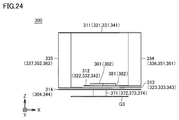
- FIG. 24 is a plan view of the electrode structure of FIG. 23 from the Y-axis direction.
- FIG. 25 is a plan view of the electrode structure of FIG. 23 from the X-axis direction.
- the bandpass filter 300 includes a line electrode 311 (first line electrode), a plane electrode 312 (first plane electrode), and a plane electrode 313 (second plane electrode).
- a plane electrode 314 (third plane electrode), a via conductor 334 (first via conductor), and a via conductor 335 (second via conductor) are provided.
- the bandpass filter 300 includes a line electrode 321 (first line electrode), a plane electrode 322 (first plane electrode), a plane electrode 323 (second plane electrode), and a via conductor 336 (first via conductor).
- a via conductor 337 (second via conductor) is further provided.
- the bandpass filter 300 includes a line electrode 331 (first line electrode), a plane electrode 332 (first plane electrode), a plane electrode 333 (second plane electrode), and a via conductor 351 (first via conductor).
- a via conductor 352 (second via conductor) is further provided.
- the bandpass filter 300 includes a line electrode 341 (first line electrode), a plane electrode 342 (first plane electrode), a plane electrode 343 (second plane electrode), and a plane electrode 344 (third plane electrode).
- a via conductor 361 (first via conductor) and a via conductor 362 (second via conductor) are further provided.
- the bandpass filter 300 includes a ground electrode 304 (third plane electrode), plane electrodes 301 and 302, and via conductors 371,372,373,374,381,382.
- the plane electrode 313 faces at least a part of the plane electrode 312 in the Z-axis direction.
- the plane electrodes 312 and 313 form a capacitor 11.
- the line electrode 311 extends in the X-axis direction.
- the via conductors 334 and 335 extend from both ends of the line electrode 311 in the Z-axis direction, respectively, and are connected to the flat electrodes 312 and 313, respectively.
- the via conductor 334, the line electrode 311 and the via conductor 335 form the inductor 10.
- the plane electrode 313 is arranged between the plane electrodes 312 and 314 in the Z-axis direction.
- the plane electrode 314 faces at least a part of the plane electrode 313 in the Z-axis direction.
- the plane electrodes 313 and 314 form a capacitor 12.
- the plane electrode 314 is connected to the input / output terminal P31 by the via conductor 371.
- the plane electrode 323 faces at least a part of the plane electrode 322 in the Z-axis direction.
- the plane electrodes 322 and 323 form a capacitor 21.
- the line electrode 321 extends in the X-axis direction.
- the via conductors 336 and 337 extend in the Z-axis direction from both ends of the line electrode 321 and are connected to the plane electrodes 322 and 323, respectively.
- the via conductor 336, the line electrode 321 and the via conductor 337 form an inductor 20.
- the plane electrode 323 is arranged between the plane electrode 322 and the ground electrode 304 in the Z-axis direction.
- the ground electrode 304 faces at least a part of the plane electrode 323 in the Z-axis direction.
- the plane electrode 323 and the ground electrode 304 form a capacitor 22.
- the plane electrode 301 is connected to the plane electrode 312 by a via conductor 381.
- the plane electrode 301 faces the plane electrode 322 in the Z-axis direction.
- the plane electrodes 301 and 322 form a capacitor 12.
- the flat electrode 333 faces at least a part of the flat electrode 332 in the Z-axis direction.
- the plane electrodes 332 and 333 form a capacitor 31.
- the line electrode 331 extends in the X-axis direction.
- the via conductors 351 and 352 extend from both ends of the line electrode 331 in the Z-axis direction, and are connected to the plane electrodes 332 and 333, respectively.
- the via conductor 351 and the line electrode 331 and the via conductor 352 form an inductor 30.
- the flat electrode 333 is arranged between the flat electrode 332 and the ground electrode 304 in the Z-axis direction.
- the ground electrode 304 faces at least a part of the plane electrode 333 in the Z-axis direction.
- the plane electrode 333 and the ground electrode 304 form a capacitor 32.
- the ground electrode 304 is connected to the ground terminal G3 by each of the via conductors 372 and 373 and is grounded.
- the via conductors 372 and 373 form the inductor LG.
- the plane electrode 343 faces at least a part of the plane electrode 342 in the Z-axis direction.
- the plane electrodes 342 and 343 form a capacitor 41.
- the line electrode 341 extends in the X-axis direction.
- the via conductors 361 and 362 extend from both ends of the line electrode 341 in the Z-axis direction, and are connected to the plane electrodes 342 and 343, respectively.
- the via conductor 361, the line electrode 341, and the via conductor 362 form an inductor 40.
- the plane electrode 343 is arranged between the plane electrodes 342 and 344 in the Z-axis direction.
- the plane electrode 344 faces at least a part of the plane electrode 343 in the Z-axis direction.
- the plane electrodes 343 and 344 form a capacitor 42.
- the plane electrode 344 is connected to the input / output terminal P32 by the via conductor 374.
- the flat electrode 302 is connected to the flat electrode 342 by a via conductor 382.
- the plane electrode 302 faces the plane electrode 332 in the Z-axis direction.
- the plane electrodes 302 and 332 form the capacitor C34.
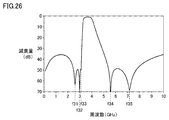
- FIG. 26 is a diagram showing the passing characteristics of the bandpass filter 300 of FIG. 21. As shown in FIG. 26, an attenuation pole is generated at frequencies f31, f32 (> f31) and f33 (> f32) lower than the pass band, and an attenuation pole is generated at frequencies f34 and f35 (> f34) higher than the pass band. It is happening.
- the capacitive coupling that occurs between the configurations included in the bandpass filter is the capacitance that occurs between adjacent configurations in the equivalent circuit, such as the capacitive coupling shown by each of the capacitors 12, C12, C23, C34, 42 in FIG. Not limited to binding.
- a capacitive coupling may be formed even between configurations that are not adjacent to each other in an equivalent circuit.
- FIG. 27 is an equivalent circuit diagram of the bandpass filter 300A according to the modified example of the third embodiment.
- the configuration of the bandpass filter 300A is a configuration in which capacitors C30 and C14 are added to the bandpass filter 300 of FIG. 21. Other than these, the description is the same, so the description will not be repeated.
- the capacitor C30 is connected between the input / output terminals P31 and P32.
- the capacitor C30 represents a capacitive coupling that occurs between the input / output terminals P31 and P32.
- the capacitor C14 is connected between the LC resonators 1 and 4.
- Capacitor C14 represents a capacitive coupling between LC resonators 1 and 4.
- the LC filter according to the third embodiment and the modified example it is possible to suppress the increase in size of the LC filter while improving the characteristics of the LC filter.
- FIG. 28 is an equivalent circuit diagram of the bandpass filter 400 according to the fourth embodiment.
- the configuration of the bandpass filter 400 is such that the LC resonators 1 and 4 of the bandpass filter 300 of FIG. 21 are grounded and capacitors Cio1, C14 and Cio2 are added. Other than these, the description is the same, so the description will not be repeated.
- the capacitors 12 and 42 are grounded.
- the capacitor Cio1 is connected between the input / output terminal P31 and the LC resonator 1.
- the capacitor Cio1 represents a capacitive coupling that occurs between the input / output terminal P31 and the LC resonator 1.
- the capacitor Cio2 is connected between the input / output terminal P32 and the LC resonator 4.
- the capacitor Cio2 represents a capacitive coupling that occurs between the input / output terminal P32 and the LC resonator 4.
- the capacitor C14 is connected between the LC resonators 1 and 4.
- Capacitor C14 represents a capacitive coupling between LC resonators 1 and 4.
- FIG. 29 is a diagram showing the passage characteristics of the bandpass filter 400 of FIG. 28. As shown in FIG. 29, an attenuation pole is generated at frequencies f41 and f42 (> f41) lower than the pass band, and an attenuation pole is generated at a frequency f43 higher than the pass band.
- FIG. 30 is an equivalent circuit diagram of the bandpass filter 400A according to the modified example of the fourth embodiment.
- the configuration of the bandpass filter 400A is a configuration in which capacitors Cio3, C13, C25, and Cio4 are added to the bandpass filter 400 of FIG. 28. Other than these, the description is the same, so the description will not be repeated.
- the capacitor Cio3 is connected between the input / output terminal P31 and the LC resonator 2.
- the capacitor Cio3 represents a capacitive coupling that occurs between the input / output terminal P31 and the LC resonator 2.
- the capacitor C13 is connected between the LC resonators 1 and 3.
- Capacitor C13 represents a capacitive coupling between LC resonators 1 and 3.
- the capacitor C25 is connected between the LC resonators 2 and 5.
- Capacitor C25 represents a capacitive coupling between LC resonators 2 and 5.
- the capacitor Cio4 represents a capacitive coupling that occurs between the input / output terminal P32 and the LC resonator 3.
- the LC filter according to the fourth embodiment and the modified example it is possible to suppress the increase in size of the LC filter while improving the characteristics of the LC filter.
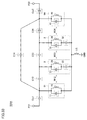
- FIG. 31 is an equivalent circuit diagram of the bandpass filter 500, which is an example of the LC filter according to the fifth embodiment.
- the configuration of the bandpass filter 500 is such that the LC resonators 2 and 3 of the bandpass filter 400 of FIG. 28 are replaced with LC parallel resonators 92 and 93, respectively.
- the configuration of the LC parallel resonator 92 is such that the capacitor 22 is removed from the LC resonator 2.
- the configuration of the LC parallel resonator 93 is such that the capacitor 32 is removed from the LC resonator 3. Other than these, the description is the same, so the description will not be repeated.
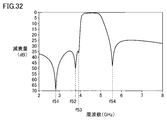
- FIG. 32 is a diagram showing the passage characteristics of the bandpass filter 500 of FIG. 31. As shown in FIG. 32, an attenuation pole is generated at frequencies f51, f52 (> f51) and f53 (> f52) lower than the pass band, and an attenuation pole is generated at a frequency f54 higher than the pass band.
- the bandpass filter according to the fifth embodiment a case where the LC resonator electrically connected to the input / output terminals has the same configuration as the LC resonator according to the first embodiment has been described.
- the bandpass filter according to the embodiment may include the LC resonator according to the first embodiment, and the LC resonator may not be connected to the input / output terminal.
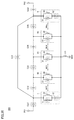
- FIG. 33 is an equivalent circuit diagram of the bandpass filter 500A according to the modified example of the fifth embodiment.
- the configuration of the bandpass filter 500A is such that the LC resonators 1 and 4 of the bandpass filter 400 of FIG. 28 are replaced with LC parallel resonators 91 and 94, respectively.
- the configuration of the LC parallel resonator 91 is such that the capacitor 12 is removed from the LC resonator 1.
- the configuration of the LC parallel resonator 94 is a configuration in which the capacitor 42 is removed from the LC resonator 4. Other than these, the description is the same, so the description will not be repeated.
- FIG. 34 is a diagram showing the passage characteristics of the bandpass filter 500A of FIG. 33. As shown in FIG. 33, an attenuation pole is generated at frequencies f55 and f56 (> f55) lower than the pass band, and an attenuation pole is generated at frequencies f57 and f58 (> f57) higher than the pass band.
- Each of the plurality of LC resonators included in the bandpass filter does not have to have the same configuration as the LC resonator according to the first embodiment.
- the manufacturing cost and size of the bandpass filter can be reduced. ..
- the configuration of the bandpass filter can be determined according to the desired characteristics, manufacturing cost, and size, so that the degree of freedom in designing the bandpass filter is increased. Can be improved.
- the capacitive coupling generated in the bandpass filter formed as a laminated body of a plurality of dielectric layers is not limited to the capacitive coupling shown in FIGS. 31 and 33, as in the fourth embodiment.
- the LC filter according to the fifth embodiment and the modified example it is possible to suppress the increase in size of the LC filter and improve the degree of freedom in designing the LC filter while improving the characteristics of the LC filter. Can be done.
- FIG. 35 is an equivalent circuit diagram of the bandpass filter 600 according to the sixth embodiment.
- the bandpass filter 600 includes an input / output terminal P61 (first terminal), an input / output terminal P62 (second terminal), an LC resonator 1 (first LC resonator), and LC parallel. It includes resonators 92, 93, 94, an LC resonator 5 (second LC resonator), and capacitors Cio1, C12, C23, C34, C45, Cio2, and C15.
- the bandpass filter 600 is a five-stage bandpass filter.
- the capacitor Cio1 is connected between the input / output terminal P61 and the LC resonator 1.
- the capacitor Cio1 represents a capacitive coupling that occurs between the input / output terminal P61 and the LC resonator 1.
- Capacitor C12 is connected between the LC resonator 1 and the LC parallel resonator 92.
- Capacitor C12 represents the capacitive coupling that occurs between the LC resonator 1 and the LC parallel resonator 92.
- Capacitor C23 is connected between the LC parallel resonators 92 and 93. Capacitor C23 represents the capacitive coupling that occurs between the LC parallel resonators 92 and 93.
- Capacitor C34 is connected between the LC parallel resonators 93 and 94.
- Capacitor C34 represents the capacitive coupling that occurs between the LC parallel resonators 93 and 94.
- Capacitor C45 is connected between the LC parallel resonator 94 and the LC resonator 5.
- Capacitor C45 represents the capacitive coupling that occurs between the LC parallel resonator 94 and the LC resonator 5.
- the capacitor Cio2 is connected between the LC resonator 5 and the input / output terminal P62.
- the capacitor Cio2 represents a capacitive coupling that occurs between the LC resonator 5 and the input / output terminal P62.
- Capacitor C15 is connected between LC resonators 1 and 5.
- Capacitor C15 represents the capacitive coupling that occurs between LC resonators 1 and 5.
- a magnetic coupling M12 is generated between the LC resonators 1 and 2.
- a magnetic coupling M23 is formed between the LC resonators 2 and 3.
- a magnetic coupling M34 is formed between the LC resonators 3 and 4.
- a magnetic coupling M45 is formed between the LC resonators 4 and 5.
- the LC resonator 1 is the same as the LC resonator 1 of the fourth and fifth embodiments.
- the LC resonator 5 includes an inductor 50 and capacitors 51 and 52.
- the LC resonator 5 has the same configuration as the LC resonator 1A of FIG. That is, the inductor 50 and the capacitors 51 and 52 correspond to the inductor 10A and the capacitors 11A and 12A, respectively.
- the LC parallel resonator 92 includes an inductor 20 and a capacitor 21.
- the LC parallel resonator 93 includes an inductor 30 and a capacitor 31.
- the LC parallel resonator 94 includes an inductor 40 and a capacitor 41.
- Each of the LC parallel resonators 92 to 94 has the same configuration as the LC parallel resonator 9A of FIG. That is, the inductor 20 and the capacitor 21 correspond to the inductor 10A and the capacitor 11A, respectively.
- the inductor 30 and the capacitor 31 correspond to the inductor 10A and the capacitor 11A, respectively.
- the inductor 40 and the capacitor 41 correspond to the inductor 10A and the capacitor 11A, respectively.
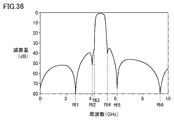
- FIG. 36 is a diagram showing the passage characteristics of the bandpass filter 600 of FIG. 35. As shown in FIG. 36, attenuation poles occur at frequencies f61, f62 (> f61), f63 (> f62) lower than the passband, and frequencies f64, f65 (> f64), f66 (>) higher than the passband. An attenuation pole is generated at f65).
- the capacitive coupling generated in the bandpass filter formed as a laminated body of a plurality of dielectric layers is not limited to the capacitive coupling shown in FIG. 35, as in the fourth and fifth embodiments.
- the LC filter according to the sixth embodiment it is possible to suppress the increase in size of the LC filter and improve the degree of freedom in designing the LC filter while improving the characteristics of the LC filter.
Landscapes
- Engineering & Computer Science (AREA)
- Power Engineering (AREA)
- Microelectronics & Electronic Packaging (AREA)
- Manufacturing & Machinery (AREA)
- Filters And Equalizers (AREA)
- Coils Or Transformers For Communication (AREA)
- Fixed Capacitors And Capacitor Manufacturing Machines (AREA)
Priority Applications (3)
| Application Number | Priority Date | Filing Date | Title |
|---|---|---|---|
| CN202180021278.5A CN115298957B (zh) | 2020-04-10 | 2021-03-05 | Lc谐振器以及lc滤波器 |
| JP2022514344A JP7559819B2 (ja) | 2020-04-10 | 2021-03-05 | Lc共振器およびlcフィルタ |
| US17/881,701 US12244283B2 (en) | 2020-04-10 | 2022-08-05 | LC resonator and LC filter |
Applications Claiming Priority (2)
| Application Number | Priority Date | Filing Date | Title |
|---|---|---|---|
| JP2020-070825 | 2020-04-10 | ||
| JP2020070825 | 2020-04-10 |
Related Child Applications (1)
| Application Number | Title | Priority Date | Filing Date |
|---|---|---|---|
| US17/881,701 Continuation US12244283B2 (en) | 2020-04-10 | 2022-08-05 | LC resonator and LC filter |
Publications (1)
| Publication Number | Publication Date |
|---|---|
| WO2021205793A1 true WO2021205793A1 (ja) | 2021-10-14 |
Family
ID=78023202
Family Applications (1)
| Application Number | Title | Priority Date | Filing Date |
|---|---|---|---|
| PCT/JP2021/008660 Ceased WO2021205793A1 (ja) | 2020-04-10 | 2021-03-05 | Lc共振器およびlcフィルタ |
Country Status (4)
| Country | Link |
|---|---|
| US (1) | US12244283B2 (https=) |
| JP (1) | JP7559819B2 (https=) |
| CN (1) | CN115298957B (https=) |
| WO (1) | WO2021205793A1 (https=) |
Cited By (2)
| Publication number | Priority date | Publication date | Assignee | Title |
|---|---|---|---|---|
| JP2023094017A (ja) * | 2021-12-23 | 2023-07-05 | 太陽誘電株式会社 | フィルタ、マルチプレクサおよび通信用モジュール |
| JP2024021356A (ja) * | 2022-08-03 | 2024-02-16 | Tdk株式会社 | 積層フィルタ |
Families Citing this family (1)
| Publication number | Priority date | Publication date | Assignee | Title |
|---|---|---|---|---|
| WO2022181606A1 (ja) * | 2021-02-24 | 2022-09-01 | パナソニックIpマネジメント株式会社 | フィルタ回路 |
Citations (5)
| Publication number | Priority date | Publication date | Assignee | Title |
|---|---|---|---|---|
| JP2006262349A (ja) * | 2005-03-18 | 2006-09-28 | Taiyo Yuden Co Ltd | 共振回路、フィルタ回路、多層基板並びに回路モジュール |
| WO2007119356A1 (ja) * | 2006-04-14 | 2007-10-25 | Murata Manufacturing Co., Ltd. | 積層帯域通過フィルタ |
| JP2013070288A (ja) * | 2011-09-23 | 2013-04-18 | Murata Mfg Co Ltd | 帯域通過フィルタ |
| JP2013128232A (ja) * | 2011-12-19 | 2013-06-27 | Murata Mfg Co Ltd | バンドパスフィルタ |
| WO2015059963A1 (ja) * | 2013-10-24 | 2015-04-30 | 株式会社村田製作所 | 複合lc共振器および帯域通過フィルタ |
Family Cites Families (2)
| Publication number | Priority date | Publication date | Assignee | Title |
|---|---|---|---|---|
| TWI442622B (zh) * | 2010-11-11 | 2014-06-21 | Murata Manufacturing Co | Laminated bandpass filter |
| CN104937845B (zh) * | 2013-10-24 | 2017-08-22 | 株式会社村田制作所 | 复合lc谐振器及带通滤波器 |
-
2021
- 2021-03-05 WO PCT/JP2021/008660 patent/WO2021205793A1/ja not_active Ceased
- 2021-03-05 CN CN202180021278.5A patent/CN115298957B/zh active Active
- 2021-03-05 JP JP2022514344A patent/JP7559819B2/ja active Active
-
2022
- 2022-08-05 US US17/881,701 patent/US12244283B2/en active Active
Patent Citations (5)
| Publication number | Priority date | Publication date | Assignee | Title |
|---|---|---|---|---|
| JP2006262349A (ja) * | 2005-03-18 | 2006-09-28 | Taiyo Yuden Co Ltd | 共振回路、フィルタ回路、多層基板並びに回路モジュール |
| WO2007119356A1 (ja) * | 2006-04-14 | 2007-10-25 | Murata Manufacturing Co., Ltd. | 積層帯域通過フィルタ |
| JP2013070288A (ja) * | 2011-09-23 | 2013-04-18 | Murata Mfg Co Ltd | 帯域通過フィルタ |
| JP2013128232A (ja) * | 2011-12-19 | 2013-06-27 | Murata Mfg Co Ltd | バンドパスフィルタ |
| WO2015059963A1 (ja) * | 2013-10-24 | 2015-04-30 | 株式会社村田製作所 | 複合lc共振器および帯域通過フィルタ |
Cited By (3)
| Publication number | Priority date | Publication date | Assignee | Title |
|---|---|---|---|---|
| JP2023094017A (ja) * | 2021-12-23 | 2023-07-05 | 太陽誘電株式会社 | フィルタ、マルチプレクサおよび通信用モジュール |
| JP7846525B2 (ja) | 2021-12-23 | 2026-04-15 | 太陽誘電株式会社 | フィルタ、マルチプレクサおよび通信用モジュール |
| JP2024021356A (ja) * | 2022-08-03 | 2024-02-16 | Tdk株式会社 | 積層フィルタ |
Also Published As
| Publication number | Publication date |
|---|---|
| CN115298957A (zh) | 2022-11-04 |
| US20220385260A1 (en) | 2022-12-01 |
| JPWO2021205793A1 (https=) | 2021-10-14 |
| JP7559819B2 (ja) | 2024-10-02 |
| CN115298957B (zh) | 2025-10-31 |
| US12244283B2 (en) | 2025-03-04 |
Similar Documents
| Publication | Publication Date | Title |
|---|---|---|
| CN110048686B (zh) | 层叠带通滤波器 | |
| US9035724B2 (en) | Multilayer band pass filter | |
| JP4525864B2 (ja) | 積層バランスフィルタ | |
| JP7559819B2 (ja) | Lc共振器およびlcフィルタ | |
| WO2012066873A1 (ja) | 積層帯域通過フィルタ | |
| US11811382B2 (en) | LC filter | |
| US12034426B2 (en) | Multilayer filter | |
| JP6904433B2 (ja) | バンドパスフィルタ | |
| US11817843B2 (en) | LC filter | |
| JP2023121294A (ja) | フィルタ | |
| US9882544B2 (en) | Electronic component | |
| JP5725158B2 (ja) | 電子部品 | |
| KR102953882B1 (ko) | 대역 통과 필터 | |
| JP4505827B2 (ja) | 電子部品 | |
| US20250379348A1 (en) | Filter | |
| JP4636280B2 (ja) | バンドパスフィルタ | |
| KR20250166658A (ko) | 대역 통과 필터 | |
| KR100550879B1 (ko) | 적층형 유전체 필터 | |
| JP4453085B2 (ja) | 電子部品 | |
| WO2023149240A1 (ja) | 電子部品 | |
| WO2018198608A1 (ja) | 電子部品 | |
| JPH07211586A (ja) | チップ型電子部品 | |
| JP2009273082A (ja) | 左手系フィルタ | |
| JP2011223136A (ja) | 電子部品 | |
| JP2009273083A (ja) | 左手系フィルタ |
Legal Events
| Date | Code | Title | Description |
|---|---|---|---|
| 121 | Ep: the epo has been informed by wipo that ep was designated in this application |
Ref document number: 21784450 Country of ref document: EP Kind code of ref document: A1 |
|
| ENP | Entry into the national phase |
Ref document number: 2022514344 Country of ref document: JP Kind code of ref document: A |
|
| NENP | Non-entry into the national phase |
Ref country code: DE |
|
| 122 | Ep: pct application non-entry in european phase |
Ref document number: 21784450 Country of ref document: EP Kind code of ref document: A1 |
|
| WWG | Wipo information: grant in national office |
Ref document number: 202180021278.5 Country of ref document: CN |