WO2021200899A1 - 光学用のプラスチックフィルム、並びに、それを用いた光学積層体、偏光板及び画像表示装置 - Google Patents
光学用のプラスチックフィルム、並びに、それを用いた光学積層体、偏光板及び画像表示装置 Download PDFInfo
- Publication number
- WO2021200899A1 WO2021200899A1 PCT/JP2021/013463 JP2021013463W WO2021200899A1 WO 2021200899 A1 WO2021200899 A1 WO 2021200899A1 JP 2021013463 W JP2021013463 W JP 2021013463W WO 2021200899 A1 WO2021200899 A1 WO 2021200899A1
- Authority
- WO
- WIPO (PCT)
- Prior art keywords
- less
- plastic film
- degrees
- film
- condition
- Prior art date
- Legal status (The legal status is an assumption and is not a legal conclusion. Google has not performed a legal analysis and makes no representation as to the accuracy of the status listed.)
- Ceased
Links
Images



Classifications
-
- G—PHYSICS
- G02—OPTICS
- G02B—OPTICAL ELEMENTS, SYSTEMS OR APPARATUS
- G02B5/00—Optical elements other than lenses
- G02B5/30—Polarising elements
- G02B5/3083—Birefringent or phase retarding elements
-
- B—PERFORMING OPERATIONS; TRANSPORTING
- B32—LAYERED PRODUCTS
- B32B—LAYERED PRODUCTS, i.e. PRODUCTS BUILT-UP OF STRATA OF FLAT OR NON-FLAT, e.g. CELLULAR OR HONEYCOMB, FORM
- B32B7/00—Layered products characterised by the relation between layers; Layered products characterised by the relative orientation of features between layers, or by the relative values of a measurable parameter between layers, i.e. products comprising layers having different physical, chemical or physicochemical properties; Layered products characterised by the interconnection of layers
- B32B7/02—Physical, chemical or physicochemical properties
- B32B7/023—Optical properties
-
- C—CHEMISTRY; METALLURGY
- C08—ORGANIC MACROMOLECULAR COMPOUNDS; THEIR PREPARATION OR CHEMICAL WORKING-UP; COMPOSITIONS BASED THEREON
- C08J—WORKING-UP; GENERAL PROCESSES OF COMPOUNDING; AFTER-TREATMENT NOT COVERED BY SUBCLASSES C08B, C08C, C08F, C08G or C08H
- C08J3/00—Processes of treating or compounding macromolecular substances
- C08J3/12—Powdering or granulating
-
- C—CHEMISTRY; METALLURGY
- C08—ORGANIC MACROMOLECULAR COMPOUNDS; THEIR PREPARATION OR CHEMICAL WORKING-UP; COMPOSITIONS BASED THEREON
- C08J—WORKING-UP; GENERAL PROCESSES OF COMPOUNDING; AFTER-TREATMENT NOT COVERED BY SUBCLASSES C08B, C08C, C08F, C08G or C08H
- C08J3/00—Processes of treating or compounding macromolecular substances
- C08J3/20—Compounding polymers with additives, e.g. colouring
- C08J3/203—Solid polymers with solid and/or liquid additives
-
- C—CHEMISTRY; METALLURGY
- C08—ORGANIC MACROMOLECULAR COMPOUNDS; THEIR PREPARATION OR CHEMICAL WORKING-UP; COMPOSITIONS BASED THEREON
- C08J—WORKING-UP; GENERAL PROCESSES OF COMPOUNDING; AFTER-TREATMENT NOT COVERED BY SUBCLASSES C08B, C08C, C08F, C08G or C08H
- C08J5/00—Manufacture of articles or shaped materials containing macromolecular substances
- C08J5/18—Manufacture of films or sheets
-
- G—PHYSICS
- G01—MEASURING; TESTING
- G01N—INVESTIGATING OR ANALYSING MATERIALS BY DETERMINING THEIR CHEMICAL OR PHYSICAL PROPERTIES
- G01N17/00—Investigating resistance of materials to the weather, to corrosion, or to light
-
- G—PHYSICS
- G02—OPTICS
- G02B—OPTICAL ELEMENTS, SYSTEMS OR APPARATUS
- G02B1/00—Optical elements characterised by the material of which they are made; Optical coatings for optical elements
- G02B1/10—Optical coatings produced by application to, or surface treatment of, optical elements
- G02B1/11—Anti-reflection coatings
-
- G—PHYSICS
- G02—OPTICS
- G02B—OPTICAL ELEMENTS, SYSTEMS OR APPARATUS
- G02B1/00—Optical elements characterised by the material of which they are made; Optical coatings for optical elements
- G02B1/10—Optical coatings produced by application to, or surface treatment of, optical elements
- G02B1/14—Protective coatings, e.g. hard coatings
-
- G—PHYSICS
- G02—OPTICS
- G02B—OPTICAL ELEMENTS, SYSTEMS OR APPARATUS
- G02B5/00—Optical elements other than lenses
- G02B5/30—Polarising elements
-
- G—PHYSICS
- G02—OPTICS
- G02B—OPTICAL ELEMENTS, SYSTEMS OR APPARATUS
- G02B5/00—Optical elements other than lenses
- G02B5/30—Polarising elements
- G02B5/3025—Polarisers, i.e. arrangements capable of producing a definite output polarisation state from an unpolarised input state
- G02B5/3033—Polarisers, i.e. arrangements capable of producing a definite output polarisation state from an unpolarised input state in the form of a thin sheet or foil, e.g. Polaroid
-
- G—PHYSICS
- G02—OPTICS
- G02F—OPTICAL DEVICES OR ARRANGEMENTS FOR THE CONTROL OF LIGHT BY MODIFICATION OF THE OPTICAL PROPERTIES OF THE MEDIA OF THE ELEMENTS INVOLVED THEREIN; NON-LINEAR OPTICS; FREQUENCY-CHANGING OF LIGHT; OPTICAL LOGIC ELEMENTS; OPTICAL ANALOGUE/DIGITAL CONVERTERS
- G02F1/00—Devices or arrangements for the control of the intensity, colour, phase, polarisation or direction of light arriving from an independent light source, e.g. switching, gating or modulating; Non-linear optics
- G02F1/01—Devices or arrangements for the control of the intensity, colour, phase, polarisation or direction of light arriving from an independent light source, e.g. switching, gating or modulating; Non-linear optics for the control of the intensity, phase, polarisation or colour
- G02F1/13—Devices or arrangements for the control of the intensity, colour, phase, polarisation or direction of light arriving from an independent light source, e.g. switching, gating or modulating; Non-linear optics for the control of the intensity, phase, polarisation or colour based on liquid crystals, e.g. single liquid crystal display cells
- G02F1/133—Constructional arrangements; Operation of liquid crystal cells; Circuit arrangements
- G02F1/1333—Constructional arrangements; Manufacturing methods
- G02F1/1335—Structural association of cells with optical devices, e.g. polarisers or reflectors
-
- G—PHYSICS
- G02—OPTICS
- G02F—OPTICAL DEVICES OR ARRANGEMENTS FOR THE CONTROL OF LIGHT BY MODIFICATION OF THE OPTICAL PROPERTIES OF THE MEDIA OF THE ELEMENTS INVOLVED THEREIN; NON-LINEAR OPTICS; FREQUENCY-CHANGING OF LIGHT; OPTICAL LOGIC ELEMENTS; OPTICAL ANALOGUE/DIGITAL CONVERTERS
- G02F1/00—Devices or arrangements for the control of the intensity, colour, phase, polarisation or direction of light arriving from an independent light source, e.g. switching, gating or modulating; Non-linear optics
- G02F1/01—Devices or arrangements for the control of the intensity, colour, phase, polarisation or direction of light arriving from an independent light source, e.g. switching, gating or modulating; Non-linear optics for the control of the intensity, phase, polarisation or colour
- G02F1/13—Devices or arrangements for the control of the intensity, colour, phase, polarisation or direction of light arriving from an independent light source, e.g. switching, gating or modulating; Non-linear optics for the control of the intensity, phase, polarisation or colour based on liquid crystals, e.g. single liquid crystal display cells
- G02F1/133—Constructional arrangements; Operation of liquid crystal cells; Circuit arrangements
- G02F1/1333—Constructional arrangements; Manufacturing methods
- G02F1/1335—Structural association of cells with optical devices, e.g. polarisers or reflectors
- G02F1/133528—Polarisers
-
- G—PHYSICS
- G02—OPTICS
- G02F—OPTICAL DEVICES OR ARRANGEMENTS FOR THE CONTROL OF LIGHT BY MODIFICATION OF THE OPTICAL PROPERTIES OF THE MEDIA OF THE ELEMENTS INVOLVED THEREIN; NON-LINEAR OPTICS; FREQUENCY-CHANGING OF LIGHT; OPTICAL LOGIC ELEMENTS; OPTICAL ANALOGUE/DIGITAL CONVERTERS
- G02F1/00—Devices or arrangements for the control of the intensity, colour, phase, polarisation or direction of light arriving from an independent light source, e.g. switching, gating or modulating; Non-linear optics
- G02F1/01—Devices or arrangements for the control of the intensity, colour, phase, polarisation or direction of light arriving from an independent light source, e.g. switching, gating or modulating; Non-linear optics for the control of the intensity, phase, polarisation or colour
- G02F1/13—Devices or arrangements for the control of the intensity, colour, phase, polarisation or direction of light arriving from an independent light source, e.g. switching, gating or modulating; Non-linear optics for the control of the intensity, phase, polarisation or colour based on liquid crystals, e.g. single liquid crystal display cells
- G02F1/133—Constructional arrangements; Operation of liquid crystal cells; Circuit arrangements
- G02F1/1333—Constructional arrangements; Manufacturing methods
- G02F1/1335—Structural association of cells with optical devices, e.g. polarisers or reflectors
- G02F1/13363—Birefringent elements, e.g. for optical compensation
-
- G—PHYSICS
- G09—EDUCATION; CRYPTOGRAPHY; DISPLAY; ADVERTISING; SEALS
- G09F—DISPLAYING; ADVERTISING; SIGNS; LABELS OR NAME-PLATES; SEALS
- G09F9/00—Indicating arrangements for variable information in which the information is built-up on a support by selection or combination of individual elements
-
- H—ELECTRICITY
- H05—ELECTRIC TECHNIQUES NOT OTHERWISE PROVIDED FOR
- H05B—ELECTRIC HEATING; ELECTRIC LIGHT SOURCES NOT OTHERWISE PROVIDED FOR; CIRCUIT ARRANGEMENTS FOR ELECTRIC LIGHT SOURCES, IN GENERAL
- H05B33/00—Electroluminescent light sources
- H05B33/02—Details
-
- H—ELECTRICITY
- H05—ELECTRIC TECHNIQUES NOT OTHERWISE PROVIDED FOR
- H05B—ELECTRIC HEATING; ELECTRIC LIGHT SOURCES NOT OTHERWISE PROVIDED FOR; CIRCUIT ARRANGEMENTS FOR ELECTRIC LIGHT SOURCES, IN GENERAL
- H05B33/00—Electroluminescent light sources
- H05B33/12—Light sources with substantially two-dimensional [2D] radiating surfaces
- H05B33/14—Light sources with substantially two-dimensional [2D] radiating surfaces characterised by the chemical or physical composition or the arrangement of the electroluminescent material, or by the simultaneous addition of the electroluminescent material in or onto the light source
-
- H—ELECTRICITY
- H10—SEMICONDUCTOR DEVICES; ELECTRIC SOLID-STATE DEVICES NOT OTHERWISE PROVIDED FOR
- H10K—ORGANIC ELECTRIC SOLID-STATE DEVICES
- H10K50/00—Organic light-emitting devices
- H10K50/10—OLEDs or polymer light-emitting diodes [PLED]
-
- H—ELECTRICITY
- H10—SEMICONDUCTOR DEVICES; ELECTRIC SOLID-STATE DEVICES NOT OTHERWISE PROVIDED FOR
- H10K—ORGANIC ELECTRIC SOLID-STATE DEVICES
- H10K59/00—Integrated devices, or assemblies of multiple devices, comprising at least one organic light-emitting element covered by group H10K50/00
- H10K59/10—OLED displays
-
- H—ELECTRICITY
- H10—SEMICONDUCTOR DEVICES; ELECTRIC SOLID-STATE DEVICES NOT OTHERWISE PROVIDED FOR
- H10K—ORGANIC ELECTRIC SOLID-STATE DEVICES
- H10K59/00—Integrated devices, or assemblies of multiple devices, comprising at least one organic light-emitting element covered by group H10K50/00
- H10K59/80—Constructional details
- H10K59/875—Arrangements for extracting light from the devices
- H10K59/879—Arrangements for extracting light from the devices comprising refractive means, e.g. lenses
-
- H—ELECTRICITY
- H10—SEMICONDUCTOR DEVICES; ELECTRIC SOLID-STATE DEVICES NOT OTHERWISE PROVIDED FOR
- H10K—ORGANIC ELECTRIC SOLID-STATE DEVICES
- H10K59/00—Integrated devices, or assemblies of multiple devices, comprising at least one organic light-emitting element covered by group H10K50/00
- H10K59/80—Constructional details
- H10K59/8793—Arrangements for polarized light emission
-
- C—CHEMISTRY; METALLURGY
- C08—ORGANIC MACROMOLECULAR COMPOUNDS; THEIR PREPARATION OR CHEMICAL WORKING-UP; COMPOSITIONS BASED THEREON
- C08J—WORKING-UP; GENERAL PROCESSES OF COMPOUNDING; AFTER-TREATMENT NOT COVERED BY SUBCLASSES C08B, C08C, C08F, C08G or C08H
- C08J2367/00—Characterised by the use of polyesters obtained by reactions forming a carboxylic ester link in the main chain; Derivatives of such polymers
- C08J2367/02—Polyesters derived from dicarboxylic acids and dihydroxy compounds
-
- G—PHYSICS
- G02—OPTICS
- G02F—OPTICAL DEVICES OR ARRANGEMENTS FOR THE CONTROL OF LIGHT BY MODIFICATION OF THE OPTICAL PROPERTIES OF THE MEDIA OF THE ELEMENTS INVOLVED THEREIN; NON-LINEAR OPTICS; FREQUENCY-CHANGING OF LIGHT; OPTICAL LOGIC ELEMENTS; OPTICAL ANALOGUE/DIGITAL CONVERTERS
- G02F2201/00—Constructional arrangements not provided for in groups G02F1/00 - G02F7/00
- G02F2201/50—Protective arrangements
-
- H—ELECTRICITY
- H10—SEMICONDUCTOR DEVICES; ELECTRIC SOLID-STATE DEVICES NOT OTHERWISE PROVIDED FOR
- H10K—ORGANIC ELECTRIC SOLID-STATE DEVICES
- H10K59/00—Integrated devices, or assemblies of multiple devices, comprising at least one organic light-emitting element covered by group H10K50/00
- H10K59/80—Constructional details
- H10K59/8791—Arrangements for improving contrast, e.g. preventing reflection of ambient light
Definitions
- the present disclosure relates to an optical plastic film, an optical laminate using the same, a polarizing plate, and an image display device.
- Various optical plastic films are often used for optical members such as image display devices.
- a plastic film for protecting a polarizing element constituting the polarizing plate is used.
- the "plastic film for protecting the polarizer” may be referred to as the "polarizer protective film”.
- a plastic film for an image display device represented by a polarizer protective film preferably has excellent mechanical strength. Therefore, a stretched plastic film is preferably used as the plastic film for the image display device.
- JP-A-2009-300611 Japanese Unexamined Patent Publication No. 2010-244059 Japanese Unexamined Patent Publication No. 2011-107198
- Patent Documents 1 and 2 the absorption axis of the polarizer and the slow axis of the stretched plastic film are arranged so as to be parallel or vertical to suppress rainbow unevenness.
- the polarizer and the stretched plastic film are arranged so as to have the relationship of Patent Documents 1 and 2
- the phenomenon may be referred to as "blackout”.
- Patent Document 3 describes that the light source of the image display device is a specific white light source, the in-plane phase difference of the stretched plastic film is increased to 3000 nm or more and 30,000 nm or less, and the absorption axis of the polarizer and the delay of the stretched plastic film.
- a liquid crystal display device capable of eliminating rainbow unevenness and blackout by arranging the phase axis at approximately 45 degrees is disclosed.
- Patent Document 3 needs to use a stretched plastic film having a large in-plane phase difference. Since the stretched plastic film having a large in-plane phase difference is usually uniaxially stretched, there is a problem that it is easily torn in the stretching direction. Further, in order to suppress blackout, it is necessary to delicately align the absorption axis of the polarizer and the slow axis of the stretched plastic film, so that the workability is inferior and the yield is high. It was difficult to do.
- the present disclosure is an optical plastic that can suppress rainbow unevenness when viewed with the naked eye and blackout when viewed with polarized sunglasses without increasing the in-plane phase difference and without requiring axis alignment.
- An object of the present invention is to provide a film, an optical laminate using the film, a polarizing plate, and an image display device.
- the present disclosure provides the following plastic films for optics, as well as optical laminates, polarizing plates and image display devices using the following plastic films.
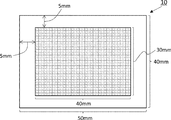
- An optical plastic film that satisfies the following conditions 1 and 2. ⁇ Condition 1> A large sample having a size of 200 mm ⁇ 300 mm is cut out from a plastic film. The large sample is divided into 30 small samples of 40 mm ⁇ 50 mm. A region of 30 mm ⁇ 40 mm excluding 5 mm from the edge of each small sample is subdivided into a number of regions of 47,000 or more, and then the in-plane phase difference of each subdivided region is measured.
- the proportion of the small samples showing an average in-plane phase difference of 50 nm or more and 1200 nm or less in each measurement region is 50% or more.
- the angle of the slow axis of each subdivided region of each small sample is measured in the same manner as in Condition 1.
- the proportion of the small samples having a standard deviation ⁇ calculated from the angle of the slow axis of each measurement region of 0.8 degrees or more is 50% or more.
- a polarizing plate having a polarizer, a first transparent protective plate arranged on one side of the polarizer, and a second transparent protective plate arranged on the other side of the polarizer.
- An image display device having a display element and a plastic film arranged on the light emitting surface side of the display element, wherein the plastic film is the optical plastic film according to the above [1]. Image display device.
- the plastic film for optics of the present disclosure and the optical laminate, polarizing plate, and image display device using the same, can be visually recognized by rainbow unevenness and polarized sunglasses when visually recognized by the naked eye without increasing the in-plane phase difference. Blackout can be suppressed.
- the optical plastic film of the present disclosure satisfies the following conditions 1 and 2.
- ⁇ Condition 1> A large sample having a size of 200 mm ⁇ 300 mm is cut out from a plastic film. The large sample is divided into 30 small samples of 40 mm ⁇ 50 mm. A region of 30 mm ⁇ 40 mm excluding 5 mm from the edge of each small sample is subdivided into a number of regions of 47,000 or more, and then the in-plane phase difference of each subdivided region is measured. Of the 30 small samples, the proportion of the small samples showing an average in-plane phase difference of 50 nm or more and 1200 nm or less in each measurement region is 50% or more.
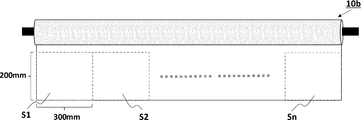
- a large sample having a size of 200 mm ⁇ 300 mm used in Condition 1 and Condition 2 is cut out from an arbitrary position on the plastic film.
- the large sample is divided into 30 small samples of 40 mm ⁇ 50 mm, and a region of 30 mm ⁇ 40 mm excluding 5 mm from the edge of each small sample is measured.
- the outer quadrangular region shows a small sample having a size of 40 mm ⁇ 50 mm
- the inner quadrangular region shows a region of 30 mm ⁇ 40 mm.
- the reason for measuring the region excluding 5 mm from the edge of the small sample is that when cutting the large sample, stress is likely to be applied near the edge of the plastic film, so that the optical axis near the edge of the small sample may be distorted. This is a consideration.
- the plastic film for optics may be in the form of a sheet or in the form of a roll, for example.
- a large sample is sampled as described below, 30 small samples are cut out from the large sample, and then conditions 1 and 2 are determined. Is preferable.
- any of the large samples may satisfy the conditions 1 and 2.
- the proportion of the large sample satisfying the conditions 1 and 2 is preferably 50% or more, more preferably 70% or more, still more preferably 70% or more among all the large samples. It is 90% or more, more preferably 100%. The same applies to condition 3 described later.
- condition 1 and condition 2 are satisfied for each roll width direction as described in (1) to (4) below.
- the roll-shaped plastic film has various physical properties that are likely to change in the width direction, but the various physical properties are almost the same in the flow direction. Therefore, when the large sample S1 satisfies the conditions 1 and 2, the position in the width direction on the roll is the same as that of the large sample S1, and it is assumed that the conditions 1 and 2 are satisfied in the entire flow direction of the roll. can.
- the large samples S2, ... Sn the same operations as in (2) to (3) above are performed, and it is determined whether or not the large samples S2, ... Sn satisfy the conditions 1 and 2. do. Then, among the large samples S2, ... Sn, those where the positions in the width direction are the same as those of the large sample satisfying the conditions 1 and 2 satisfy the conditions 1 and 2 in the entire flow direction of the roll. To imitate. The same applies to condition 3 described later.
- a 30 mm ⁇ 40 mm region excluding 5 mm from the edge of the small sample is subdivided into more than 47,000 regions, and then the in-plane phase difference and the in-plane phase difference and each subdivided region are obtained. It is necessary to measure the angle of the slow axis. If the number of subdivided regions is 47,000 or more, the value of the standard deviation ⁇ is sufficiently reliable. Therefore, the number of subdivided regions may be, for example, about 47,000, about 70,000, or about 100,000. Needless to say, the size of each subdivided region shall be substantially equal. Such a measurement can be performed by, for example, a birefringence two-dimensional distribution evaluation device.
- Examples of the birefringence two-dimensional distribution evaluation device include the trade name "WPA-200-L” of Photonic Lattice.
- WPA-200-L of Photonic Lattice
- a small sample is set on the stage of the device and previewed so that the number of pixels to display the area of 30 mm x 40 mm is 47,000 or more.
- the in-plane phase difference and the angle of the slow axis of each region subdivided into 47,000 or more can be measured.
- the in-plane phase difference of condition 1 and the phase difference in the thickness direction of condition 3 described later are the refractive index nx in the slow axis direction, which is the direction in which the refractive index is the largest at each measurement point, and the slow axis direction at each measurement point. It is represented by the following equations (1) and (2) by the refractive index ny in the phase-advancing axis direction, which is the direction orthogonal to the above, the refractive index nz in the thickness direction of the plastic film, and the thickness T [nm] of the plastic film.
- in-plane phase difference may be referred to as "Re”
- Thickness direction phase difference may be referred to as "Rth”.
- In-plane phase difference (Re) (nx-ny) x T [nm] (1)
- Phase difference in the thickness direction (Rth) ((nx + ny) /2-nz) ⁇ T [nm] (2)
- the optical plastic film of the present disclosure is required to satisfy the following condition 1.
- ⁇ Condition 1> A large sample having a size of 200 mm ⁇ 300 mm is cut out from a plastic film. The large sample is divided into 30 small samples of 40 mm ⁇ 50 mm. A region of 30 mm ⁇ 40 mm excluding 5 mm from the edge of each small sample is subdivided into a number of regions of 47,000 or more, and then the in-plane phase difference of each subdivided region is measured. Of the 30 small samples, the proportion of the small samples showing an average in-plane phase difference of 50 nm or more and 1200 nm or less in each measurement region is 50% or more. In the present specification, the conditions 1 and 2 mean values at a wavelength of 543 nm.
- the average in-plane phase difference of the plastic film is less than 50 nm, it is difficult to suppress blackout.
- the reason for this is that a plastic film having an average in-plane phase difference of less than 50 nm can hardly disturb the linearly polarized light and transmits the linearly polarized light as it is.
- the average in-plane phase difference of the plastic film exceeds 1200 nm, it is not possible to suppress rainbow unevenness when visually recognized with the naked eye. Further, even if there is a small sample showing an average in-plane phase difference of 50 nm or more and 1200 nm or less, if the ratio is less than 50%, blackout cannot be suppressed or rainbow unevenness when visually recognized with the naked eye is observed.
- the proportion of the small samples showing an average in-plane phase difference of 50 nm or more and 1200 nm or less in each measurement region is preferably 70% or more, more preferably 90% or more. It is more preferably 100%.
- the technique of setting the in-plane phase difference to 3000 nm or more as in Patent Document 3 cannot suppress rainbow unevenness when the shape of the spectral spectrum of the image display device is sharp.
- the in-plane phase difference is reduced as in the present disclosure, rainbow unevenness can be eliminated even if the shape of the spectral spectrum of the image display device is sharp.
- the average in-plane phase difference is preferably 100 nm or more, more preferably 150 nm or more, more preferably 200 nm or more, and more preferably 250 nm or more in order to make it easier to suppress blackout. It is more preferably 300 nm or more, more preferably 400 nm or more, more preferably 520 nm or more, and even more preferably 620 nm or more. If the average in-plane phase difference of the plastic film is too small, the standard deviation ⁇ of the angle of the slow axis may become too large.
- the average of the in-plane phase differences is preferably 100 nm or more, more preferably 520 nm or more, and further preferably 620 nm or more.
- the average in-plane phase difference is preferably 1100 nm or less, more preferably 1000 nm or less, and more preferably 950 nm or less in order to facilitate suppression of rainbow unevenness when visually recognized with the naked eye. More preferred. Further, if the average of the in-plane phase differences is large, the bending resistance, which will be described later, tends to decrease. By setting the average in-plane phase difference to 950 nm or less, it is possible to easily suppress a decrease in bending resistance.
- a plurality of upper limit options and a plurality of lower limit options when a plurality of upper limit options and a plurality of lower limit options are indicated, one selected from the upper limit options and one selected from the upper limit options are combined and numerical values are used. It can be an embodiment of the range.
- 950 nm or less 150 nm or more and 1200 nm or less, 150 nm or more and 1100 nm or less, 150 nm or more and 1000 nm or less, 150 nm or more and 950 nm or less, 200 nm or more and 1200 nm or less, 200 nm or more and 1100 nm or less, 200 nm or more and 1000 nm or less, 200 nm or more and 950 nm or less, 250 nm or more and 1200 nm or less, 250 nm or more.
- the standard deviation ⁇ of the in-plane phase difference of each subdivided region is not particularly limited, but the lower limit is preferably 5 nm or more, more preferably 10 nm or more, and more preferably 15 nm or more. It is more preferably 20 nm or more, the upper limit is preferably 100 nm or less, more preferably 70 nm or less, and further preferably 50 nm or less.
- the standard deviation ⁇ of the in-plane phase difference 5 nm or more and 100 nm or less, 5 nm or more and 70 nm or less, 5 nm or more and 50 nm or less, 10 nm or more and 100 nm or less, 10 nm or more and 70 nm or less, 10 nm or more and 50 nm or less, 15 nm or more and 100 nm or less. , 15 nm or more and 70 nm or less, 15 nm or more and 50 nm or less, 20 nm or more and 100 nm or less, 20 nm or more and 70 nm or less, and 20 nm or more and 50 nm or less.
- the optical plastic film of the present disclosure is required to satisfy the following condition 2.
- ⁇ Condition 2> For the 30 small samples, the angle of the slow axis of each subdivided region of each small sample is measured in the same manner as in Condition 1. Of the 30 small samples, the proportion of the small samples having a standard deviation ⁇ calculated from the angle of the slow axis of each measurement region of 0.8 degrees or more is 50% or more.
- the standard deviation ⁇ of the angle of the slow-phase axis is 0.8 degrees or more, which indicates that the slow-phase axis of the plastic film is deviated. If the standard deviation ⁇ is less than 0.8 degrees, blackout cannot be suppressed, Even if there is a small sample showing a standard deviation ⁇ of the angle of the slow axis of 0.8 degrees or more, if the ratio is less than 50%, the display information is read by partial blackout. I can't. Of the 30 small samples, the proportion of the small samples having a standard deviation ⁇ calculated from the angle of the slow axis of each measurement region of 0.8 degrees or more is preferably 70% or more, preferably 90% or more. It is more preferably present, and even more preferably 100%.
- the conventional plastic film for optics is designed so that the direction of the slow axis does not shift, but the plastic film for optics of the present disclosure is a conventional optical film in that the direction of the slow axis is intentionally shifted. And the composition is different. Further, it can be said that the plastic film for optics of the present disclosure is characterized in that it pays attention to the variation of the slow phase axis in a relatively narrow region of 30 mm ⁇ 40 mm.
- satisfying the condition 2 is preferable in that the bending resistance of the plastic film can be improved.
- the film breaks or a strong bending habit remains after the bending test.
- a uniaxially stretched film as in Patent Document 3 breaks when it is subjected to a bending test along the slow phase axis, and has a bending habit when it is subjected to a bending test in a direction orthogonal to the slow phase axis. It remains strong.
- the general-purpose biaxially stretched film has a strong bending habit when the bending test is performed in the direction orthogonal to the slow phase axis.
- the plastic film of the present disclosure is preferable in that it can suppress bending habits and breakage after the bending test regardless of the bending direction.
- the standard deviation ⁇ is preferably 0.9 degrees or more, more preferably 1.0 degrees or more, further preferably 1.2 degrees or more, and 1.6 degrees or more. It is even more preferable to have. By setting the standard deviation ⁇ to 1.6 degrees or more, the effect of suppressing blackout can be made extremely good. If the standard deviation ⁇ of the condition 2 is too large, the orientation of the plastic film is lowered, the mechanical strength and the pencil hardness are lowered, and wrinkles are generated due to environmental changes, which tends to adversely affect the visibility. Therefore, under condition 2, the standard deviation ⁇ is preferably 20.0 degrees or less, more preferably 15.0 degrees or less, more preferably 10.0 degrees or less, and 7.0 degrees. It is more preferably less than or equal to the degree, and more preferably less than or equal to 5.0 degrees.
- Examples of the embodiment in the range of the standard deviation ⁇ of the condition 2 include 0.8 degrees or more, 0.8 degrees or more and 20.0 degrees or less, 0.8 degrees or more and 15.0 degrees or less, 0.8 degrees or more and 10.0 degrees. Degree or less, 0.8 degree or more and 7.0 degree or less, 0.8 degree or more and 5.0 degree or less, 0.9 degree or more and 20.0 degree or less, 0.9 degree or more and 15.0 degree or less, 0.9 degree Degrees or more and 10.0 degrees or less, 0.9 degrees or more and 7.0 degrees or less, 0.9 degrees or more and 5.0 degrees or less, 1.0 degrees or more and 20.0 degrees or less, 1.0 degrees or more and 15.0 degrees Below, 1.0 degrees or more and 10.0 degrees or less, 1.0 degrees or more and 7.0 degrees or less, 1.0 degrees or more and 5.0 degrees or less, 1.2 degrees or more and 20.0 degrees or less, 1.2 degrees 15.0 degrees or less, 1.2 degrees or more and 10.0 degrees or less, 1.2 degrees or more and 7.0 degrees or less, 1.2
- the optical plastic film of the present disclosure preferably satisfies the following condition 2'.
- ⁇ Condition 2'> For the 30 small samples, the angle of the slow axis of each subdivided region of each small sample is measured in the same manner as in Condition 1. Of the 30 small samples, the proportion of the small samples having a standard deviation of 3 ⁇ calculated from the angle of the slow axis of each measurement region of 30.0 degrees or less is 50% or more.
- the standard deviation 3 ⁇ of the condition 2' is too large, the orientation of the plastic film may become too low, and the pencil hardness tends to decrease. Therefore, by setting the standard deviation 3 ⁇ to 30.0 degrees or less, the pencil hardness of the plastic film can be easily improved.
- the standard deviation 3 ⁇ is more preferably 25.0 degrees or less, more preferably 20.0 degrees or less, more preferably 15.0 degrees or less, and preferably 10.0 degrees or less. More preferred. If the standard deviation 3 ⁇ of the condition 2'is too small, the orientation of the plastic film becomes too high, and the plastic film may become brittle. Therefore, the standard deviation 3 ⁇ is preferably 2.4 degrees or more, more preferably 2.7 degrees or more, more preferably 3.0 degrees or more, and 3.6 degrees or more.
- the atmosphere of the measurement of condition 1 and condition 2 and other measurement such as condition 2', conditions 3 to 6 and total light transmittance is set to a temperature of 23 ° C. ⁇ 5 ° C., unless otherwise specified.
- Relative humidity is 40% or more and 65% or less.
- the sample shall be exposed to the atmosphere for 30 minutes or more before each measurement.
- the optical plastic film of the present disclosure preferably satisfies the following condition 3. ⁇ Condition 3> For each of the 30 small samples, the phase difference in the thickness direction is measured at the center of the 30 mm ⁇ 40 mm region. Of the 30 small samples, the proportion of the small samples showing a phase difference of 2000 nm or more in the thickness direction is 50% or more. In the present specification, the condition 3 means a value at a wavelength of 589.3 nm.
- the proportion of the small samples showing a phase difference in the thickness direction of 2000 nm or more is preferably 70% or more, more preferably 90% or more, and further preferably 100%.
- the phase difference in the thickness direction is more preferably 3000 nm or more, further preferably 4000 nm or more, and even more preferably 5000 nm or more.
- the upper limit of the phase difference in the thickness direction under the condition 3 is not particularly limited, but is preferably 15000 nm or less, more preferably 12000 nm or less, still more preferably 9000 nm or less in order to facilitate the condition 4 described later.
- phase difference range in the thickness direction of Condition 3 examples include 2000 nm or more, 2000 nm or more and 15000 nm or less, 2000 nm or more and 12000 nm or less, 2000 nm or more and 9000 nm or less, 3000 nm or more and 15000 nm or less, 3000 nm or more and 12000 nm or less, 3000 nm or more and 9000 nm or less, 4000 nm.
- Examples thereof include 15000 nm or less, 4000 nm or more and 12000 nm or less, 4000 nm or more and 9000 nm or less, 5000 nm or more and 15000 nm or less, 5000 nm or more and 12000 nm or less, 5000 nm or more and 9000 nm or less.
- the phase difference in the thickness direction of Condition 3 can be measured by, for example, the product name "RETS-100" manufactured by Otsuka Electronics Co., Ltd.
- the product name "RETS-100” manufactured by Otsuka Electronics Co., Ltd. it is preferable to prepare for the measurement according to the following procedures (A1) to (A4).
- (A1) First, in order to stabilize the light source of RETS-100, the light source is turned on and then left for 60 minutes or more. After that, the rotary photon method is selected and the ⁇ mode is selected.
- the ⁇ mode is a mode for measuring the phase difference in the angular direction and calculating Rth. By selecting this ⁇ mode, the stage becomes an inclined rotation stage.
- (A2) Next, the following measurement conditions are input to RETS-100.
- (Measurement condition) ⁇ Reference measurement range: Rotational photon method ⁇ Measurement spot diameter: ⁇ 5 mm ⁇ Inclination angle range: 0 ° -Measurement wavelength range: 400 nm or more and 800 nm or less-Average refractive index of plastic film.
- N 1.617.
- -Thickness Thickness separately measured by SEM
- the optical plastic film of the present disclosure preferably satisfies the following condition 4.
- ⁇ Condition 4> Among the 30 small samples, the ratio of the small samples showing an average of 0.20 or less of the in-plane phase difference with respect to the phase difference in the thickness direction is 50% or more.
- the average of the in-plane phase difference with respect to the phase difference in the thickness direction is "the average of the in-plane phase difference / the phase difference in the thickness direction".
- the fact that the average of the in-plane retardation / the phase difference in the thickness direction is small means that the degree of stretching of the plastic film for optics approaches uniform biaxiality. Therefore, by setting the ratio to 0.20 or less, the mechanical strength and pencil hardness of the plastic film can be easily improved, and the plastic film is wrinkled due to environmental changes, which adversely affects the visibility. Can be suppressed.
- the proportion of the small samples having the ratio of 0.20 or less is preferably 70% or more, more preferably 90% or more, still more preferably 100%. ..
- the ratio of condition 4 is more preferably 0.17 or less, and further preferably 0.15 or less.
- the lower limit of the ratio of condition 4 is not particularly limited. The lower limit of the ratio of condition 4 is usually about 0.01.
- Examples of the embodiment in the ratio range of the condition 4 include 0.20 or less, 0.01 or more and 0.20 or less, 0.01 or more and 0.17 or less, and 0.01 or more and 0.15 or less.
- the average of the in-plane phase differences of the condition 1 is 100 nm or more.
- the erosion rate from the surface of the plastic film constituting the small sample to a depth of 20 ⁇ m is measured at the center of the region of 30 mm ⁇ 40 mm.
- E 0-20 the average erosion rate from the surface of the plastic film constituting the small sample to a depth of 20 ⁇ m
- E 0-20 is 1.4 ⁇ m / g or more.
- the proportion of small samples is 50% or more.
- E 0-20 shall be measured under the following measurement conditions.
- Measurement conditions A test solution obtained by mixing pure water, a dispersion liquid, and spherical silica having an average particle size of within ⁇ 8% based on 4.2 ⁇ m at a mass ratio of 968: 2:30 is stored in a container.
- the test solution in the container is sent to the nozzle.
- Compressed air is sent into the nozzle, the test liquid is accelerated in the nozzle, and a predetermined amount of the test liquid is jetted perpendicularly to the plastic film from the injection hole at the tip of the nozzle to be contained in the test liquid.
- the spherical silica of Nozzle is made to collide with the plastic film.
- the cross-sectional shape of the nozzle is a square of 1 mm ⁇ 1 mm, and the distance between the injection hole and the plastic film is 4 mm. Further, the flow rates of the test solution and the compressed air supplied to the nozzle, the pressure of the compressed air, and the pressure of the test solution in the nozzle are set to predetermined values adjusted by calibration described later. After injecting a predetermined amount of the test solution, the injection of the test solution is temporarily stopped. After the injection of the test solution is temporarily stopped, the cross-sectional profile of the plastic film where the spherical silica collides with the test solution is measured.
- the operation in which the three steps of measuring the profile are one cycle is executed until the depth of the cross-sectional profile exceeds 20 ⁇ m. Then, in each cycle in which the depth of the cross-sectional profile is up to 20 ⁇ m, the depth ( ⁇ m) of the cross-sectional profile progressed in each cycle is divided by the injection amount (g) of the test liquid in each cycle.
- the erosion rate ( ⁇ m / g) is calculated.
- the E 0-20 is calculated by averaging the erosion rates of the plastic films in each cycle up to a cross-sectional profile depth of 20 ⁇ m.
- the test solution is stored in the container.
- the test solution in the container is sent to the nozzle. Compressed air is sent into the nozzle, the test liquid is accelerated in the nozzle, and an arbitrary amount of the test liquid is sprayed perpendicularly to an acrylic plate having a thickness of 2 mm from an injection hole at the tip of the nozzle.
- the spherical silica in the test solution is made to collide with the acrylic plate.
- the cross-sectional shape of the nozzle is a square of 1 mm ⁇ 1 mm, and the distance between the injection hole and the acrylic plate is 4 mm. After injecting an arbitrary amount of the test solution, the injection of the test solution is temporarily stopped.
- the cross-sectional profile of the part of the acrylic plate where the spherical silica collides with the test solution is measured.
- the erosion rate ( ⁇ m / g) of the acrylic plate obtained by dividing the depth ( ⁇ m) of the cross-sectional profile by the arbitrary amount (g) is calculated.
- the pressure of the compressed air, and the pressure of the test solution in the nozzle are adjusted and calibrated.
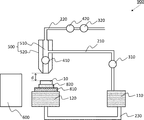
- Examples of the device for measuring the erosion rate as shown in FIG. 6 include the product number “MSE-A203” of the MSE test device manufactured by Palmeso Co., Ltd.
- the test solution to be prepared is stored in a container (110).
- the test solution is preferably stirred in the container (110).
- As the pure water general-purpose pure water can be used. Pure water generally has a specific resistance value of 0.1 M ⁇ ⁇ cm or more and 15 M ⁇ ⁇ cm or less.
- the dispersant is not particularly limited as long as it can disperse spherical silica. Examples of the dispersant include the trade name “Demol N” of Wako Pure Chemical Industries, Ltd.
- the average particle size of spherical silica is measured as the volume average value d50 in the particle size distribution measurement by the laser light diffraction method, and means the so-called "median diameter". do.
- the width of the particle size showing the frequency of 50 is ⁇ 10 based on 4.2 ⁇ m. It is preferably within%.
- the “width of the particle size indicating the frequency of 50” is “the particle size indicating the frequency of 50 and the particle size located in the positive direction from the particle size indicating the frequency of 100", and "the frequency is 50".
- the particle size shown is represented by "XY ( ⁇ m)" when the particle size located in the minus direction from the particle size indicating a frequency of 100 is defined as "Y”.
- the "width of the particle size indicating a frequency of 50" may be referred to as "the full width at half maximum of the particle size distribution”.
- Examples of spherical silica having an average particle size within ⁇ 8% based on 4.2 ⁇ m include model number “MSE-BS-5-3” designated by Palmeso Co., Ltd.
- the test solution in the container is sent to the nozzle (510).
- the test liquid can be sent to the nozzle through, for example, the test liquid pipe (210).
- a flow meter (310) for measuring the flow rate of the test liquid is arranged between the container (110) and the nozzle (510).
- the flow rate of the test solution shall be a value adjusted by the calibration.
- the nozzle (510) is arranged in the housing (520) constituting the injection unit (500).
- Compressed air is sent into the nozzle (510).
- the compressed air is sent to the nozzle through, for example, the compressed air pipe (220).
- the position where the compressed air is sent is preferably on the upstream side of the position where the test liquid is sent.
- the upstream side means the side far from the injection hole of the nozzle.
- a flow meter (320) for measuring the flow rate of the compressed air and a pressure gauge (420) for measuring the pressure of the compressed air are arranged before the compressed air reaches the nozzle (510).
- Compressed air can be supplied by an air compressor or the like (not shown). The flow rate and pressure of the compressed air shall be the values adjusted by the calibration.
- the test liquid When compressed air is sent into the nozzle (510), the test liquid is mixed and accelerated by the compressed air. Then, the accelerated test liquid is ejected from the injection hole at the tip of the nozzle (510) and then collides with the plastic film (10) perpendicularly.
- the plastic film is mainly worn by the spherical silica particles in the test solution.
- a pressure gauge (410) for measuring the pressure of the test solution in the nozzle is arranged in the nozzle (510).
- the pressure gauge (410) is preferably located on the downstream side of the position where the compressed air is sent and the position where the test liquid is sent.
- the pressure of the test solution in the nozzle (510) shall be a value adjusted by the calibration.
- FIG. 7 is an image diagram of a state in which the plastic film (10) is worn by the test liquid containing pure water (A1) and spherical silica (A2) injected from the injection unit (500).
- reference numeral A3 indicates air
- reference numeral A4 indicates a worn plastic film.
- test liquid contains water having an excellent cooling effect
- deformation and deterioration of the plastic film due to heat at the time of collision can be substantially eliminated. That is, the abnormal wear of the plastic film can be substantially eliminated.
- Water also has the role of cleaning the surface of the worn plastic film and achieving stable wear.
- water has a role of accelerating spherical silica particles and controlling the fluid of the test solution. Further, since a huge number of spherical silicas collide with the plastic film, it is possible to eliminate the influence of subtle differences in physical properties of the individual spherical silica particles.
- the measurement conditions of the present disclosure are such that the flow rate of the test solution supplied to the nozzle, the flow rate of the compressed air supplied to the nozzle, the pressure of the compressed air supplied to the nozzle, and the pressure of the test solution in the nozzle are calibrated.
- the cross-sectional shape of the nozzle is a 1 mm x 1 mm square and specifying the distance between the injection hole and the plastic film as 4 mm.
- the distance is the distance indicated by “d” in FIG. 6, and means the vertical distance between the injection hole at the tip of the nozzle and the plastic film. From the above, it can be said that the measurement conditions of the present disclosure are measurement conditions capable of forming statistically stable wear marks on the plastic film.
- the plastic film (10) may be attached to the sample mounting base (810) of the measuring device (900). It is preferable to prepare a laminated body in which a plastic film is attached to a support (820) such as a stainless steel plate, and attach the laminated body to a sample mounting base (810).
- a support (820) such as a stainless steel plate
- test solution sprayed on the plastic film (10) is collected by the receiver (120) and returned to the container (110) through the return pipe (230).
- the cross-sectional profile means the cross-sectional shape of the plastic film worn by the test solution.
- the plastic film is mainly worn by the spherical silica particles in the test solution.
- the cross-sectional profile can be measured by, for example, a cross-sectional profile acquisition unit (600) such as a stylus type surface shape measuring device and a laser interference type surface shape measuring device.
- the cross-section profile acquisition unit (600) is usually arranged at a position away from the plastic film (10) when the test liquid is sprayed. Therefore, it is preferable that at least one of the plastic film (10) and the cross-section profile acquisition portion (600) can be moved.
- the cross-sectional profile measuring means is a stylus type.
- a step of injecting a predetermined amount of the test solution from the injection port a step of temporarily stopping the injection of the test solution after injecting the predetermined amount of the test solution, and a step of temporarily stopping the injection of the test solution.
- the operation of measuring the cross-sectional profile in three steps is executed as one cycle until the depth of the cross-sectional profile exceeds 20 ⁇ m.
- the erosion rate of the plastic film in each cycle can be measured, and further, the variation in the erosion rate of the plastic film can be calculated.
- the cycle may continue after the depth of the cross-section profile exceeds 20 ⁇ m, but is preferably terminated when the depth of the cross-section profile exceeds 20 ⁇ m.
- the reason why the measurement is performed from the surface of the plastic film to a depth of 20 ⁇ m is that the physical properties of the plastic film tend to fluctuate in the vicinity of the surface, but tend to stabilize toward the inside. ..
- the erosion rate of each cycle can be expressed by the following [Equation 1].
- Erosion rate of each cycle ( ⁇ m / g) Depth of cross-sectional profile progressed in each cycle ( ⁇ m) / Injection amount of test solution in each cycle (g) [Equation 1]
- the depth of the cross-sectional profile advanced in each cycle ( ⁇ m) means that the depth of the cross-sectional profile of the nth cycle is x ( ⁇ m) and the depth of the cross-sectional profile of the n + 1th cycle is y.
- the depth ( ⁇ m) of the cross-sectional profile of the first cycle corresponds to the “depth of the cross-sectional profile advanced in each cycle ( ⁇ m)”.
- the depth of the cross-sectional profile in the nth cycle means the depth of the deepest position of the cross-sectional profile in the nth cycle.
- n is an integer of 1 or more.
- the “injection amount (g) of the test solution in each cycle” is, in principle, quantitative, but it may vary slightly from cycle to cycle.
- the injection amount of the test solution in each cycle is not particularly limited, but the lower limit is preferably 0.5 g or more, more preferably 1.0 g or more, and the upper limit is preferably 3.0 g or less, more preferably 2.0 g or less. be.
- the erosion rate ( ⁇ m / g) is calculated in each cycle up to a depth of 20 ⁇ m of the cross-sectional profile.
- E 0-20 is calculated by averaging the erosion rates of each cycle up to a depth of 20 ⁇ m in the cross-sectional profile. The above cycle is carried out until the depth of the cross-sectional profile exceeds 20 ⁇ m, but the data of the cycle in which the depth of the cross-sectional profile exceeds 20 ⁇ m is out of the data for calculating E 0-20.
- the present inventors examined using the values obtained in the evaluation including the depth direction by the picodenter such as the Martens hardness, the indentation hardness, and the elastic recovery work as an index of the pencil hardness.
- the above-mentioned parameters such as Martens hardness, indentation hardness, and elastic recovery work amount could not be used as an index of pencil hardness.
- the strength of the plastic film tends to increase when it is stretched.
- the uniaxially stretched plastic film tends to have better pencil hardness than the unstretched plastic film
- the biaxially stretched plastic film tends to have better pencil hardness than the uniaxially stretched plastic film.
- even the biaxially stretched plastic film may not have sufficient pencil hardness.
- the present inventors examined the erosion rate as an index of the pencil hardness of a plastic film. As described above, the softer the plastic film, the more easily it is scratched, and the harder the plastic film, the less likely it is to be scratched. Therefore, it is considered that the smaller the erosion rate, the better the pencil hardness.
- the plastic film can improve the pencil hardness by increasing the erosion rate E 0-20 to 1.4 ⁇ m / g or more. Further, the present inventors show that the erosion rate of the plastic film is larger in the biaxially stretched plastic film than in the uniaxially stretched plastic film, and the quality of the pencil hardness in the biaxially stretched plastic film is determined by the erosion rate. We found that it could be discriminated. As described above, the molecular orientation of the resin constituting the plastic film is also involved in the pencil hardness of the plastic film. Further, the plastic film tends to have better mechanical strength such as pencil hardness when ⁇ and 3 ⁇ are not too large.
- the reason why the erosion rate of the plastic film correlates with the pencil hardness is considered as follows.
- the test solution containing water and spherical silica is mixed with air and jetted in the form of mist. Therefore, the collision pressure of the spherical silica particles with respect to the plastic film can be suppressed to a low level. Therefore, when the plastic film is soft, the stress when the spherical silica collides with the plastic film is easily dispersed, so that the plastic film is less likely to be worn and the erosion rate is considered to be low.
- the difference in the erosion rate in the biaxially stretched plastic film is caused by the difference in the elongation of the molecular chains and the difference in the degree of orientation of the molecules.
- a biaxially stretched plastic film as a general rule, molecules are stretched in-plane, but there may be molecules that are not sufficiently stretched locally in-plane.
- the proportion of small samples with E 0-20 of 1.4 ⁇ m / g or more is preferably 70% or more, more preferably 90% or more, and 100%. Is even more preferable.
- the E 0-20 of the plastic film is more preferably 1.6 ⁇ m / g or more, more preferably 1.8 ⁇ m / g or more, in order to improve the pencil hardness. It is more preferably 9 ⁇ m / g or more, and more preferably 2.0 ⁇ m / g or more.
- E 0-20 is preferably 3.0 ⁇ m / g or less, more preferably 2.5 ⁇ m / g or less, and preferably 2.2 ⁇ m / g or less in order to make the plastic film hard to crack. More preferred.
- Embodiments in the preferred numerical range of E 0-20 are, for example, 1.4 ⁇ m / g or more and 3.0 ⁇ m / g or less, 1.4 ⁇ m / g or more and 2.5 ⁇ m / g or less, 1.4 ⁇ m / g or more and 2.2 ⁇ m.
- ⁇ m / G or less 1.6 ⁇ m / g or more and 3.0 ⁇ m / g or less, 1.6 ⁇ m / g or more and 2.5 ⁇ m / g or less, 1.6 ⁇ m / g or more and 2.2 ⁇ m / g or less, 1.8 ⁇ m / g or more 3 0.0 ⁇ m / g or less, 1.8 ⁇ m / g or more and 2.5 ⁇ m / g or less, 1.8 ⁇ m / g or more and 2.2 ⁇ m / g or less, 1.9 ⁇ m / g or more and 3.0 ⁇ m / g or less, 1.9 ⁇ m / g 2.5 ⁇ m / g or less, 1.9 ⁇ m / g or more and 2.2 ⁇ m / g or less, 2.0 ⁇ m / g or more and 3.0 ⁇ m / g or less, 2.0 ⁇ m / g or more and 3.0
- calibration Before measuring the erosion rate described above, the calibration shall be performed.
- calibration can be performed as follows.
- the test solution is stored in the container.
- the test solution in the container is sent to the nozzle. Compressed air is sent into the nozzle, the test liquid is accelerated in the nozzle, and an arbitrary amount of the test liquid is sprayed perpendicularly to an acrylic plate having a thickness of 2 mm from an injection hole at the tip of the nozzle.
- the spherical silica in the test solution is made to collide with the acrylic plate.
- the cross-sectional shape of the nozzle is a square of 1 mm ⁇ 1 mm, and the distance between the injection hole and the acrylic plate is 4 mm. After injecting an arbitrary amount of the test solution, the injection of the test solution is temporarily stopped.
- the cross-sectional profile of the part of the acrylic plate where the spherical silica collides with the test solution is measured.
- the erosion rate ( ⁇ m / g) of the acrylic plate obtained by dividing the depth ( ⁇ m) of the cross-sectional profile by the arbitrary amount (g) is calculated.
- the pressure of the compressed air, and the pressure of the test solution in the nozzle are adjusted and calibrated.
- the test solution used for calibration shall be the same as the test solution used under the measurement conditions to be carried out later.
- the measuring device used for calibration shall be the same as the measuring device used under the measurement conditions to be carried out later.
- the difference between the calibration and the measurement conditions to be performed later is that, for example, in the calibration, a standard sample acrylic plate having a thickness of 2 mm is used, whereas in the measurement conditions, a plastic film is used as the sample.
- the standard sample, an acrylic plate having a thickness of 2 mm is preferably a polymethylmethacrylate plate. Further, the standard sample, an acrylic plate having a thickness of 2 mm, has an AcE of 1.786 ⁇ m / g or more and 1.974 ⁇ m / g when the average erosion rate of the acrylic plate measured under the following measurement condition A is defined as AcE. It is preferably g or less. Further, as the spherical silica under the following measurement condition A, the model number "MSE-BS-5-3" designated by Palmeso Co., Ltd. can be mentioned.
- spherical silica corresponding to the model number "MSE-BS-5-3" specified by Palmeso Co., Ltd. for example, the part number of Potters-Ballotini Co., Ltd. "BS5-3" can be mentioned.
- ⁇ Measurement condition A> A test solution prepared by mixing pure water, a dispersant, and spherical silica having an average particle size of within ⁇ 8% based on 4.2 ⁇ m at a mass ratio of 968: 2:30 is stored in a container. The test solution in the container is sent to the nozzle.
- Compressed air is sent into the nozzle, the test liquid is accelerated in the nozzle, and a predetermined amount of the test liquid is jetted perpendicularly to the acrylic plate from the injection hole at the tip of the nozzle to be contained in the test liquid.
- the spherical silica of Nozzle is made to collide with the acrylic plate.
- the cross-sectional shape of the nozzle is a square of 1 mm ⁇ 1 mm, and the distance between the injection hole and the acrylic plate is 4 mm.
- the flow rate of the test solution and the compressed air supplied to the nozzle, the pressure of the compressed air, and the pressure of the test solution in the nozzle are such that the flow rate of the test solution is 100 ml / min or more and 150 ml / min or less.
- the air flow rate is 4.96 L / min or more and 7.44 L / min or less
- the compressed air pressure is 0.184 MPa or more and 0.277 MPa or less
- the pressure of the test solution in the nozzle is 0.169 MPa or more and 0.254 MPa or less.
- the test solution and the test solution so that the erosion rate of the acrylic plate is within the range of ⁇ 5% based on 1.88 ( ⁇ m / g) as a passing condition.
- the work of adjusting the flow rate of the compressed air, the pressure of the compressed air, and the pressure of the test liquid in the nozzle is carried out.
- the erosion rate is ⁇ 5% based on 1.88 ( ⁇ m / g)
- the erosion rate is 1.786 ( ⁇ m / g) or more and 1.974 ( ⁇ m / g) or less. It means that there is.
- the erosion rate from the surface of the plastic film constituting the small sample to a depth of 20 ⁇ m is measured at the center of the region of 30 mm ⁇ 40 mm.
- the variation in the erosion rate calculated from the erosion rate from the surface of the plastic film constituting the small sample to a depth of 20 ⁇ m is defined as ⁇ 0-20
- the 30 small samples ⁇ 0-20
- the proportion of small samples with / E 0-20 of 0.100 or less is 50% or more.
- ⁇ 0-20 can be calculated from the erosion rate of each cycle up to a depth of 20 ⁇ m of the cross-sectional profile under the above measurement conditions.
- ⁇ 0-20 / E 0-20 indicates the coefficient of variation of the erosion rate, and a small ⁇ 0-20 / E 0-20 means that the erosion rate is unlikely to fluctuate in the thickness direction of the plastic film. doing.
- ⁇ 0-20 / E 0-20 0.100 or less
- the erosion rate in the thickness direction is stable, and the pencil hardness can be made better.
- the film quality in the thickness direction of the plastic film can be made uniform. The homogeneity of the film quality in the thickness direction of the plastic film leads to the homogeneity of the film quality of the plastic film itself.
- the homogeneity of the film quality in the thickness direction of the plastic film is low, it may be difficult to stably form a functional layer on the plastic film. Therefore, by satisfying the condition 6, the quality of the optical laminate having the functional layer on the plastic film can be easily improved.
- the proportion of small samples in which ⁇ 0-20 / E 0-20 is 0.100 or less is preferably 70% or more, more preferably 90% or more, and 100. It is more preferably%.
- the upper limit of ⁇ 0-20 / E 0-20 is more preferably 0.080 or less, further preferably 0.070 or less, still more preferably 0.060 or less, still more preferably 0.055 or less. ..
- ⁇ 0-20 / E 0-20 is preferably 0.020 or more, and more preferably 0.035 or more.
- Embodiments in the preferred numerical range of ⁇ 0-20 / E 0-20 are, for example, 0.020 or more and 0.100 or less, 0.020 or more and 0.080 or less, 0.020 or more and 0.070 or less, 0.020. 0.060 or less, 0.020 or more and 0.055 or less, 0.035 or more and 0.100 or less, 0.035 or more and 0.080 or less, 0.035 or more and 0.070 or less, 0.035 or more and 0.060 or less , 0.035 or more and 0.055 or less.
- the plastic film can be produced, for example, by general-purpose sequential biaxial stretching.
- stretching in the flow direction of sequential biaxial stretching shortening the stretching time tends to decrease the erosion rate, and increasing the stretching time tends to increase the erosion rate.
- the reason for this is that when the stretching time is short, it is difficult for the molecules to be evenly stretched in the plane of the plastic film, while when the stretching time is long, the molecules are easily stretched evenly in the plane of the plastic film. .. That is, in order to set E 0-20 to 1.4 ⁇ m / g or more, it is preferable to lengthen the stretching time. Further, by lengthening the stretching time while appropriately increasing the stretching ratio so that the physical properties do not vary, it is possible to make E 0-20 more easily set to 1.4 ⁇ m / g or more.
- the plastic film for optics preferably has high orientation in the entire width direction.
- the state in which the orientation of the plastic film in the entire width direction is high means that the swing width of the slow axis in the entire width direction is 24.0 degrees or less in the plastic film having a width of 1000 mm.
- the runout width means a value that is half the difference between the minimum value and the maximum value of the angle of the slow axis in the entire width direction.
- a general-purpose biaxially stretched optical plastic film such as PET having a thickness of 15 ⁇ m or more and 100 ⁇ m or less, the swing width of the slow axis in the entire width direction of the plastic film becomes large due to the Boeing phenomenon.
- the swing width of the slow-phase axis in the entire width direction of the biaxially stretched optical plastic film having a width of 1000 mm is close to 30.0 degrees.
- Condition 2 of the plastic film for optics of the present disclosure specifies the variation of the slow-phase axis in a narrow region of 30 mm ⁇ 40 mm.
- the deflection width of the slow-phase axis in the entire width direction of the above-mentioned plastic film is specified.
- the difference is that it specifies the swing width of the slow axis in a wide area.
- the swing width is more preferably 20.0 degrees or less, and further preferably 17.0 degrees or less. If the runout width is too small, the plastic film may not be sufficiently biaxially stretched. Therefore, the swing width is preferably 4.0 degrees or more, more preferably 6.0 degrees or more, and even more preferably 8.0 degrees or more.
- the inclination of the slow axis with respect to the width direction or the flow direction of the plastic film for optics is preferably 24.0 degrees or less, and more preferably 20.0 degrees or less.
- the smaller the inclination of the slow axis with respect to the width direction of the plastic film the smaller the difference between the width direction of the cut out plastic film and the direction of the slow axis of the plastic film.
- the optical characteristics when applied can be easily stabilized. In order to make it easier to suppress blackout, a technique for increasing the inclination of the slow-phase axis with respect to the width direction of the plastic film is also being studied.
- the optical plastic film of the present disclosure can suppress blackout by satisfying the condition 2, it is not necessary to increase the inclination of the slow axis with respect to the width direction of the plastic film.
- the slow-phase axis of the plastic film can be measured as, for example, the "orientation angle (degree)" in the product name "RETS-100” manufactured by Otsuka Electronics Co., Ltd.
- the laminated structure of the plastic film examples include a single-layer structure and a multi-layer structure. Of these, a single-layer structure is preferable.
- the plastic film is preferably a stretched plastic film having a small in-plane phase difference in order to suppress rainbow unevenness while improving mechanical strength. Then, in order to reduce the in-plane phase difference of the stretched plastic film, fine stretching control such as making the stretching in the flow direction and the width direction evenly close is important.
- the single-layer structure is preferable in that the physical properties in the thickness direction are substantially uniform and finer stretching control can be performed than the multi-layer structure.
- the resin components constituting the plastic film include polyester, triacetyl cellulose (TAC), cellulose diacetate, cellulose acetate butyrate, polyamide, polyimide, polyether sulfone, polysulphon, polypropylene, polymethylpentene, polyvinyl chloride, and polyvinyl.
- TAC triacetyl cellulose
- cellulose diacetate cellulose diacetate butyrate
- polyamide polyimide
- polyether sulfone polysulphon
- polypropylene polymethylpentene
- polyvinyl chloride polyvinyl
- examples thereof include acetal, polyether ketone, polymethyl methacrylate, polycarbonate, polyurethane and amorphous olefin (Cyclo-Olfin-Polymer: COP).
- polyester is preferable because it tends to improve mechanical strength and pencil hardness. That is, the plastic film for optics is preferably a polyester film.
- the polyester film can easily be used as a surface material of an image display device because it tends to improve the hardness of a pencil or the like.
- many polycarbonate films and amorphous olefin films have a low pencil hardness of B or less. Therefore, in order to improve the pencil hardness of the polycarbonate film and the amorphous olefin film, it is essential to make the film thicker, provide a very thick functional layer, and cover it with a sputter film. It becomes.
- the polycarbonate film and the amorphous olefin film have disadvantages such as thickening when increasing the pencil hardness, and thus are difficult to use as a surface material of an image display device.
- the in-plane phase difference can be maintained even in the stretched plastic film. Consideration is being made to make it as small as possible.
- the optical characteristics such as the in-plane phase difference and the range of the variation of the slow axis are exhibited. It tends to be difficult to adjust the optical properties of the plastic film for optics of the present disclosure to a preferable range.
- polyester constituting the polyester film examples include polyethylene terephthalate (PET), polyethylene naphthalate (PEN) and polybutylene terephthalate (PBT).
- PET is preferable because it has low intrinsic birefringence and can easily reduce the in-plane phase difference.
- the plastic film may contain additives such as an ultraviolet absorber, a light stabilizer, an antioxidant, an antistatic agent, a flame retardant, an antioxidant and a surfactant.
- additives such as an ultraviolet absorber, a light stabilizer, an antioxidant, an antistatic agent, a flame retardant, an antioxidant and a surfactant.
- the thickness of the plastic film is preferably 10 ⁇ m or more, more preferably 20 ⁇ m or more, further preferably 25 ⁇ m or more, still more preferably 30 ⁇ m or more, in order to improve the mechanical strength. ..
- the thickness of the plastic film is preferably 75 ⁇ m or less, more preferably 60 ⁇ m or less, and further preferably 55 ⁇ m or less in order to easily satisfy the condition 1 and to improve the bending resistance. , 50 ⁇ m or less is more preferable.
- Examples of the thickness range of the plastic film include 10 ⁇ m or more and 75 ⁇ m or less, 10 ⁇ m or more and 60 ⁇ m or less, 10 ⁇ m or more and 55 ⁇ m or less, 10 ⁇ m or more and 50 ⁇ m or less, 20 ⁇ m or more and 75 ⁇ m or less, 20 ⁇ m or more and 60 ⁇ m or less, 20 ⁇ m or more and 55 ⁇ m or less, 20 ⁇ m or more and 50 ⁇ m.
- 25 ⁇ m or more and 75 ⁇ m or less, 25 ⁇ m or more and 60 ⁇ m or less, 25 ⁇ m or more and 55 ⁇ m or less, 25 ⁇ m or more and 50 ⁇ m or less, 30 ⁇ m or more and 75 ⁇ m or less, 30 ⁇ m or more and 60 ⁇ m or less, 30 ⁇ m or more and 55 ⁇ m or less, 30 ⁇ m or more and 50 ⁇ m or less can be mentioned.
- the optical plastic film preferably has a haze of JIS K7136: 2000 of 3.0% or less, more preferably 2.0% or less, and even more preferably 1.0% or less.
- the total light transmittance of JIS K7361-1: 1997 is preferably 80% or more, more preferably 85% or more, and further preferably 90% or more.
- the plastic film is preferably a stretched plastic film, more preferably a stretched polyester film, in order to improve mechanical strength and pencil hardness. Further, the stretched polyester film preferably has a single-layer structure of a polyester resin layer.
- the stretched plastic film can be obtained by stretching a resin layer containing components constituting the plastic film.
- the stretching method include biaxial stretching such as sequential biaxial stretching and simultaneous biaxial stretching, and uniaxial stretching such as longitudinal uniaxial stretching.
- biaxial stretching is preferable because it is easy to reduce the in-plane phase difference and to increase the mechanical strength and pencil hardness.
- the stretched plastic film is preferably a biaxially stretched plastic film.
- a biaxially stretched polyester film is preferable, and a biaxially stretched polyethylene terephthalate film is more preferable.
- the casting film is stretched in the flow direction and then stretched in the width direction of the film.
- Stretching in the flow direction is usually performed by the difference in peripheral speed of the stretching rolls and may be performed in one step, or may be performed in multiple steps using a plurality of stretching roll pairs.
- the draw ratio in the flow direction is usually 2 times or more and 15 times or less, and is preferably 2 times or more and 7 times or less, more preferably 3 times or more in order to suppress excessive variation in optical characteristics such as in-plane phase difference.
- the stretching temperature is preferably equal to or higher than the glass transition temperature of the resin and not more than the glass transition temperature of + 100 ° C. in order to suppress excessive variations in optical characteristics such as in-plane phase difference.
- 70 ° C. or higher and 120 ° C. or lower is preferable, 80 ° C. or higher and 110 ° C. or lower is more preferable, and 95 ° C. or higher and 110 ° C. or lower is further preferable.
- the film stretched in the flow direction may be provided with functions such as slipperiness, adhesiveness, and antistatic property by in-line coating. Further, before the in-line coating, a surface treatment such as a corona treatment, a frame treatment, or a plasma treatment may be performed, if necessary.
- the coating film formed in the in-line coating as described above is a very thin film having a thickness of 10 nm or more and 2000 nm or less. The coating film is further thinly stretched by the stretching treatment. In the present specification, such a thin layer is not counted as the number of layers constituting the plastic film.
- Stretching in the width direction is usually carried out by using a tenter method while gripping both ends of the film with clips and transporting the film.
- the draw ratio in the width direction is usually 2 times or more and 15 times or less.
- the draw ratio in the width direction is preferably 2 times or more and 5 times or less, more preferably 3 times or more and 5 times or less, and further preferably 3 times or more 4 in order to suppress excessive variation in optical characteristics such as in-plane phase difference. It is less than 5.5 times. Further, it is preferable to make the width stretching ratio higher than the longitudinal stretching ratio.
- the stretching temperature is preferably equal to or higher than the glass transition temperature of the resin and preferably not more than the glass transition temperature of + 120 ° C., and the temperature is preferably increased from upstream to downstream.
- the difference between the upstream temperature and the downstream temperature is preferably 20 ° C. or higher, more preferably 30 ° C. or higher, still more preferably 35 ° C. or higher, and further. It is preferably 40 ° C. or higher.
- the stretching temperature of the first stage is preferably 80 ° C. or higher and 120 ° C. or lower, more preferably 90 ° C. or higher and 110 ° C. or lower, and further preferably 95 ° C. or higher and 105 ° C. or lower.
- the plastic film sequentially biaxially stretched as described above is preferably heat-treated in a tenter at a stretching temperature or higher and lower than a melting point in order to impart flatness and dimensional stability.
- a stretching temperature or higher and lower in order to impart flatness and dimensional stability.
- additional stretching 1% or more and 10% or less in the first half of the heat treatment.
- the relaxation rate during heat treatment is preferably 0.5% or more and 5% or less, more preferably 0.5% or more and 3% or less, and more preferably 0.8, in order to suppress excessive variations in optical characteristics such as in-plane phase difference. % Or more and 2.5% or less are more preferable, and 1% or more and 2% or less are even more preferable.
- the relaxation rate during slow cooling is preferably 0.5% or more and 3% or less, more preferably 0.5% or more and 2% or less, in order to suppress excessive variations in optical characteristics such as in-plane phase difference.
- the temperature during slow cooling is preferably 80 ° C. or higher and 150 ° C. or lower, more preferably 90 ° C. or higher and 130 ° C. or lower, further preferably 100 ° C. or higher and 130 ° C. or lower, and 100 ° C. or higher and 120 ° C. or lower in order to improve flatness. Is even more preferable.
- Simultaneous biaxial stretching guides the casting film to the simultaneous biaxial tenter, transports the film while gripping both ends with clips, and stretches the film simultaneously and / or stepwise in the flow direction and the width direction.
- Simultaneous biaxial stretching machines include pantograph type, screw type, drive motor type, and linear motor type, but the draw ratio can be changed arbitrarily and the relaxation process can be performed at any place.
- the linear motor method is preferable.
- the magnification of simultaneous biaxial stretching is usually 6 times or more and 50 times or less as an area magnification, and is preferably 8 times or more and 30 times or less, more preferably, in order to suppress excessive variation in optical characteristics such as in-plane phase difference. Is 9 times or more and 25 times or less, more preferably 9 times or more and 20 times or less, and even more preferably 10 times or more and 15 times or less. Further, in the case of simultaneous biaxial stretching, it is preferable that the stretching ratios in the flow direction and the width direction are the same and the stretching speeds are substantially the same in order to suppress the in-plane orientation difference.
- the stretching temperature for simultaneous biaxial stretching is preferably equal to or higher than the glass transition temperature of the resin and not more than + 120 ° C. in order to suppress excessive variations in optical characteristics such as in-plane phase difference.
- 80 ° C. or higher and 160 ° C. or lower is preferable, 90 ° C. or higher and 150 ° C. or lower is more preferable, and 100 ° C. or higher and 140 ° C. or lower is further preferable.
- the film in the heat fixing chamber in the tenter In order to impart flatness and dimensional stability to the simultaneously biaxially stretched film, it is preferable to continuously heat-treat the film in the heat fixing chamber in the tenter to have a stretching temperature or higher and lower than a melting point.
- the heat treatment conditions are the same as the heat treatment conditions after the sequential biaxial stretching.
- the plastic film for optics may be in the form of a single leaf cut to a predetermined size, or may be in the form of a roll obtained by winding a long sheet into a roll.
- the size of the single leaf is not particularly limited, but the maximum diameter is about 14.2 inches or more and 500 inches or less.
- the "maximum diameter" means the maximum length when any two points of an optical plastic film are connected. For example, when the plastic film for optics is rectangular, the diagonal of the rectangle is the maximum diameter. When the plastic film for optics is circular, the diameter of the circle is the maximum diameter.
- the width and length of the roll shape are not particularly limited, but generally, the width is 300 mm or more and 9000 mm or less, and the length is about 100 m or more and 5000 m or less.
- the roll-shaped optical plastic film can be cut into a single-wafer shape according to the size of an image display device or the like. When cutting, it is preferable to exclude the end of the roll whose physical properties are not stable.
- the shape of the single leaf is also not particularly limited, and may be a polygon such as a triangle, a quadrangle, or a pentagon, a circular shape, or a random irregular shape.
- the optical plastic film of the present disclosure can be suitably used as a plastic film of an image display device. Further, as described above, the plastic film of the present disclosure can suppress bending habits and breakage after the bending test regardless of the bending direction. Therefore, the foldable type image display device and the rollable type. It can be more preferably used as a plastic film for an image display device and an image display device having a curved shape. Further, the optical plastic film of the present disclosure can be suitably used as a plastic film arranged on the light emitting surface side of the display element of the image display device. At this time, it is preferable to have a polarizer between the display element and the plastic film for optics of the present disclosure. Examples of the plastic film of the image display device include a plastic film used as a base material of various functional films such as a polarizer protective film, a surface protective film, an antireflection film, and a conductive film constituting a touch panel.
- optical laminate The optical laminate of the present disclosure has a functional layer on the above-mentioned optical plastic film of the present disclosure.
- the functional layer examples include one or more selected from a hard coat layer, an antireflection layer, an antiglare layer, a retardation layer, an adhesive layer, a transparent conductive layer, an antistatic layer, an antifouling layer and the like.
- the retardation layer represented by the liquid crystal layer tends to have weak physical characteristics such as pencil hardness and further insufficient light resistance. Therefore, when the optical laminate has a retardation layer, it is preferable to arrange the optical laminate so that the retardation layer side of the optical laminate faces the display element side with respect to the plastic film in the image display device.
- the functional layer of the optical laminate preferably includes an antireflection layer.
- the antireflection layer is preferably arranged on the outermost surface of the plastic film on the side having the functional layer.
- the optical plastic film constituting the optical laminate of the present disclosure tends to have a good pencil hardness by satisfying a predetermined suitable condition as described above. Therefore, the optical laminate of the present disclosure can also easily improve the pencil hardness. Therefore, the optical laminate of the present disclosure can be suitably used as a surface material of an image display device. When the optical laminate of the present disclosure is used as a surface material of an image display device, it should not have a retardation layer as a functional layer on the visual recognition side.
- the functional layer includes a hard coat layer and an antireflection layer.
- the functional layer includes a hard coat layer and an antireflection layer, it is preferable that the hard coat layer 41 and the antireflection layer 42 are arranged in this order on the plastic film 10 (FIG. 3).
- the functional layer includes a hard coat layer and an antireflection layer, the suitability as a surface material of the image display device can be enhanced.
- antireflection layer examples include a single-layer structure of a low-refractive-index layer; a two-layer structure of a high-refractive-index layer and a low-refractive-index layer; and a multi-layer structure of three or more layers.
- the low refractive index layer is preferably arranged on the outermost surface of the plastic film on the side having the functional layer.
- the lower limit of the refractive index of the low refractive index layer is preferably 1.10 or more, more preferably 1.20 or more, more preferably 1.26 or more, more preferably 1.28 or more, and more preferably 1.30 or more.
- the upper limit is preferably 1.48 or less, more preferably 1.45 or less, more preferably 1.40 or less, more preferably 1.38 or less, and even more preferably 1.32 or less.
- Examples of the refractive index range of the low refractive index layer include 1.10 or more and 1.48 or less, 1.10 or more and 1.45 or less, 1.10 or more and 1.40 or less, and 1.10 or more and 1.38 or less.
- the refractive index of the layers constituting the antireflection layer such as the low refractive index layer and the high refractive index layer means a value at
- the lower limit of the thickness of the low refractive index layer is preferably 80 nm or more, more preferably 85 nm or more, more preferably 90 nm or more, and the upper limit is preferably 150 nm or less, more preferably 110 nm or less, and more preferably 105 nm or less.
- Examples of the thickness range of the low refractive index layer include 80 nm or more and 150 nm or less, 80 nm or more and 110 nm or less, 80 nm or more and 105 nm or less, 85 nm or more and 150 nm or less, 85 nm or more and 110 nm or less, 85 nm or more and 105 nm or less, 90 nm or more and 150 nm or less, 90 nm. Examples thereof include 110 nm or less and 90 nm or more and 105 nm or less.
- the method for forming the low refractive index layer can be roughly divided into a wet method and a dry method.
- a wet method a method of forming by a sol-gel method using a metal alkoxide or the like, a method of coating a resin having a low refractive index such as a fluororesin to form the resin, and a low refractive index particles contained in the resin composition.
- a method of forming by applying a coating liquid for forming a refractive index layer can be mentioned.
- the wet method is superior to the dry method in terms of production efficiency, suppression of obliquely reflected hue, and chemical resistance.
- a coating liquid for forming a low refractive index layer in which low refractive index particles are contained in the binder resin composition is used. It is preferable to form.
- the low refractive index layer preferably contains a binder resin and low refractive index particles.
- the binder resin of the low refractive index layer preferably contains a cured product of the curable resin composition.
- the ratio of the cured product of the curable resin composition to the total binder resin of the low refractive index layer is preferably 50% by mass or more, more preferably 70% by mass or more, more preferably 90% by mass or more, and most preferably 100. It is mass%.
- the curable resin composition of the low refractive index layer include a thermosetting resin composition and an ionizing radiation curable resin composition.
- the curable resin composition such as the thermosetting resin composition or the ionizing radiation curable resin composition, a general-purpose composition can be used.
- the low refractive index particles preferably contain one or more selected from hollow particles and non-hollow particles. In order to balance low reflection and scratch resistance, it is preferable to use one or more selected from hollow particles and one or more selected from non-hollow particles in combination.
- the material of the hollow particles and the non-hollow particles may be any of an inorganic compound such as silica and magnesium fluoride, and an organic compound, but silica is preferable because of low refractive index and strength. That is, the low refractive index layer preferably contains hollow silica particles and non-hollow silica particles as the low refractive index particles.
- the lower limit of the average particle size of the hollow particle particles is preferably 50 nm or more, more preferably 60 nm or more, and the upper limit is preferably 100 nm or less. , 80 nm or less is more preferable.
- Examples of the embodiment in the range of the average particle size of the hollow particle particles include 50 nm or more and 100 nm or less, 50 nm or more and 80 nm or less, 60 nm or more and 100 nm or less, and 60 nm or more and 80 nm or less.
- the lower limit of the average particle size of the non-hollow particles is preferably 5 nm or more, more preferably 10 nm or more, and the upper limit is 20 nm or less. It is preferably present, and more preferably 15 nm or less.
- Examples of the embodiment in the range of the average particle size of the non-hollow particles include 5 nm or more and 20 nm or less, 5 nm or more and 15 nm or less, 10 nm or more and 20 nm or less, and 10 nm or more and 15 nm or less.
- the content of the hollow particles is preferably 100 parts by mass or more, and more preferably 150 parts by mass or more with respect to 100 parts by mass of the binder resin.
- the content of the hollow particles with respect to the binder resin is too large, the number of hollow particles exposed from the binder resin increases and the amount of the binder resin bonded between the particles decreases, so that the scratch resistance of the low refractive index layer and the like are increased. Tends to reduce the mechanical strength of the.
- the content of the hollow particles is preferably 400 parts by mass or less, and more preferably 300 parts by mass or less with respect to 100 parts by mass of the binder resin.
- Examples of the range of the content of hollow particles with respect to 100 parts by mass of the binder resin include 100 parts by mass or more and 400 parts by mass or less, 100 parts by mass or more and 300 parts by mass or less, 150 parts by mass or more and 400 parts by mass or less, and 150 parts by mass or more. 300 parts by mass or less can be mentioned.
- the content of the non-hollow particles is preferably 10 parts by mass or more, more preferably 50 parts by mass or more, and more preferably 70 parts by mass or more with respect to 100 parts by mass of the binder resin. , 100 parts by mass or more is more preferable.
- the content of the non-hollow particles is preferably 200 parts by mass or less, and more preferably 150 parts by mass or less with respect to 100 parts by mass of the binder resin.
- Examples of the content range of the non-hollow particles with respect to 100 parts by mass of the binder resin include 10 parts by mass or more and 200 parts by mass or less, 10 parts by mass or more and 150 parts by mass or less, 50 parts by mass or more and 200 parts by mass or less, and 50 parts by mass.
- Examples thereof include 150 parts by mass or less, 70 parts by mass or more and 200 parts by mass or less, 70 parts by mass or more and 150 parts by mass or less, 100 parts by mass or more and 200 parts by mass or less, and 100 parts by mass or more and 150 parts by mass or less.
- the high refractive index layer is arranged on the plastic film side rather than the low refractive index layer.
- the high refractive index layer is preferably formed between the hard coat layer and the low refractive index layer.
- the lower limit of the refractive index of the high refractive index layer is preferably 1.53 or more, more preferably 1.54 or more, more preferably 1.55 or more, more preferably 1.56 or more, and the upper limit is 1.85 or less. Is preferable, 1.80 or less is more preferable, 1.75 or less is more preferable, and 1.70 or less is more preferable. Examples of the refractive index range of the high refractive index layer include 1.53 or more and 1.85 or less, 1.53 or more and 1.80 or less, 1.53 or more and 1.75 or less, and 1.53 or more and 1.70 or less.
- the upper limit of the thickness of the high refractive index layer is preferably 200 nm or less, more preferably 180 nm or less, further preferably 150 nm or less, and the lower limit is preferably 50 nm or more, more preferably 70 nm or more.
- Examples of the embodiment in the thickness range of the high refractive index layer include 200 nm or less, 50 nm or more and 200 nm or less, 50 nm or more and 180 nm or less, 50 nm or more and 150 nm or less, 70 nm or more and 200 nm or less, 70 nm or more and 180 nm or less, and 70 nm or more and 150 nm or less.
- a high refractive index hard coat layer it is preferable to follow the thickness of the hard coat layer.
- the high refractive index layer can be formed from, for example, a coating liquid for forming a high refractive index layer containing a binder resin composition and high refractive index particles. That is, the high refractive index layer preferably contains a binder resin and high refractive index particles.
- the binder resin of the high refractive index layer preferably contains a cured product of the curable resin composition.
- the ratio of the cured product of the curable resin composition to the total binder resin of the high refractive index layer is preferably 50% by mass or more, more preferably 70% by mass or more, more preferably 90% by mass or more, and most preferably 100. It is mass%.
- the curable resin composition of the high refractive index layer include a thermosetting resin composition and an ionization radiation curable resin composition.
- the curable resin composition such as the thermosetting resin composition or the ionizing radiation curable resin composition, a general-purpose composition can be used.
- High-refractive index particles include antimony pentoxide (refractive index: about 1.79), zinc oxide (refractive index: about 1.90), titanium oxide (refractive index: about 2.3 or more and 2.7 or less), and oxidation.
- Cerium reffractive index: about 1.95
- tin-doped indium oxide reffractive index: about 1.95 or more and 2.00 or less
- antimony-doped tin oxide reffractive index: about 1.75 or more and 1.85 or less
- yttrium oxide Refractive index: about 1.87
- zirconium oxide reffractive index: about 2.10 and the like can be mentioned.
- the average particle size of the high-refractive index particles is preferably 2 nm or more, more preferably 5 nm or more, and even more preferably 10 nm or more.
- the average particle size of the high-refractive index particles is preferably 200 nm or less, more preferably 100 nm or less, more preferably 80 nm or less, more preferably 60 nm or less, and even more preferably 30 nm or less in order to suppress whitening and transparency.
- the average particle size of high refractive index particles 2 nm or more and 200 nm or less, 2 nm or more and 100 nm or less, 2 nm or more and 80 nm or less, 2 nm or more and 60 nm or less, 2 nm or more and 30 nm or less, 5 nm or more and 200 nm or less, 5 nm or more and 100 nm or less.
- the average particle size of the high-refractive index particles or the low-refractive index particles can be calculated by the following operations (y1) to (y3).
- (Y1) The cross section of the high refractive index layer or the low refractive index layer is imaged by STEM.
- the acceleration voltage of STEM is preferably 10 kV or more and 30 kV or less, and the magnification is preferably 50,000 times or more and 300,000 times or less. Examples of commercially available STEM products include "Product No .: S-4800" of a field emission scanning electron microscope manufactured by Hitachi High-Technologies Corporation.
- Y2 After extracting arbitrary 10 particles from the observation image, the particle size of each particle is calculated.
- the particle size is measured as the distance between two straight lines in a combination of the two straight lines so that the distance between the two straight lines is maximized when the cross section of the particle is sandwiched between two arbitrary parallel straight lines.
- the agglomerated particles are regarded as one particle and measured. (Y3) After performing the same operation 5 times on the observation image on another screen of the same sample, the value obtained from the number average of the particle diameters for a total of 50 particles is the average particle of the high refractive index particles or the low refractive index particles. The diameter.
- the hard coat layer preferably contains a cured product of a curable resin composition such as a thermosetting resin composition or an ionizing radiation curable resin composition as a main component.
- a curable resin composition such as the thermosetting resin composition or the ionizing radiation curable resin composition
- the main component means that it is 50% by mass or more of the resin component constituting the hard coat layer, preferably 70% by mass or more, and more preferably 90% by mass or more.
- the lower limit of the thickness of the hard coat layer is preferably 0.5 ⁇ m or more, more preferably 1 ⁇ m or more, and the upper limit is preferably 30 ⁇ m or less, more preferably 10 ⁇ m or less.
- Examples of the embodiment in the thickness range of the hard coat layer include 0.5 ⁇ m or more and 30 ⁇ m or less, 0.5 ⁇ m or more and 10 ⁇ m or less, 1 ⁇ m or more and 30 ⁇ m or less, and 1 ⁇ m or more and 10 ⁇ m or less.
- the optical laminate may be in the form of a single leaf cut to a predetermined size, or may be in the form of a roll obtained by winding a long sheet into a roll.
- the size of the single leaf is not particularly limited, but the maximum diameter is about 14.2 inches or more and 500 inches or less.
- the "maximum diameter” means the maximum length when any two points of the optical laminate are connected. For example, when the optical laminate is rectangular, the diagonal of the rectangle is the maximum diameter. When the optical laminate is circular, the diameter of the circle is the maximum diameter.
- the width and length of the roll shape are not particularly limited, but generally, the width is 300 mm or more and 9000 mm or less, and the length is about 100 m or more and 5000 m or less.
- the roll-shaped optical laminate can be cut into a single-wafer shape according to the size of an image display device or the like. When cutting, it is preferable to exclude the end of the roll whose physical properties are not stable.
- the shape of the single leaf is also not particularly limited, and may be a polygon such as a triangle, a quadrangle, or a pentagon, a circular shape, or a random irregular shape.
- the polarizing plate of the present disclosure has a polarizer, a first transparent protective plate arranged on one side of the polarizer, and a second transparent protective plate arranged on the other side of the polarizer.
- the polarizing plate is used, for example, to impart antireflection property by combining the polarizing plate and the ⁇ / 4 retardation plate.
- the ⁇ / 4 retardation plate is arranged on the display element of the image display device, and the polarizing plate is arranged on the viewer side of the ⁇ / 4 retardation plate.
- the polarizing plate is used to impart the function of a liquid crystal shutter.
- the liquid crystal display device is arranged in the order of the lower polarizing plate, the liquid crystal display element, and the upper polarizing plate, and the absorption axis of the polarizer of the lower polarizing plate and the absorption axis of the polarizer of the upper polarizing plate are orthogonal to each other. Be placed.
- the polarizing plate of the present disclosure it is preferable to use the polarizing plate of the present disclosure as the upper polarizing plate.
- the polarizing plate of the present disclosure includes the above-mentioned optical plastic film of the present disclosure as at least one of a first transparent protective plate and a second transparent protective plate.
- both the first transparent protective plate and the second transparent protective plate include the above-described optical plastic film of the present disclosure.
- the other transparent protective plate is not particularly limited, but is optically isotropic transparent protective plate. Is preferable.
- optical isotropic refers to an in-plane retardation of 20 nm or less, preferably 10 nm or less, and more preferably 5 nm or less.
- Acrylic films and triacetyl cellulose (TAC) films tend to impart optical isotropic properties.
- the transparent protective plate on the light emitting side includes the above-mentioned optical plastic film of the present disclosure. Is preferable.
- the polarizing plate of the present disclosure it is also preferable to use the above-mentioned optical laminate of the present disclosure as at least one of the first transparent protective plate and the second transparent protective plate.
- the polarizer examples include sheet-type polarizers such as polyvinyl alcohol film, polyvinyl formal film, polyvinyl acetal film, ethylene-vinyl acetate copolymerization system saponified film dyed and stretched with iodine and the like, and a large number arranged in parallel.
- Examples thereof include a wire grid type polarizing element made of the metal wire of the above, a lyotropic liquid crystal, a coating type polarizing element coated with a bicolor guest-host material, and a multilayer thin film type polarizing element.
- These polarizers may be reflective polarizers having a function of reflecting a polarizing component that does not transmit.
- the angle formed by the direction of the absorption axis of the polarizer and the average of the directions of the slow axis of the plastic film for optics is not particularly limited, but it is preferable to arrange them so as to be substantially parallel or substantially vertical.
- substantially parallel means within 0 degrees ⁇ 5 degrees, preferably within 0 degrees ⁇ 3 degrees, and more preferably within 0 degrees ⁇ 1 degrees.
- substantially vertical means that it is within 90 degrees ⁇ 5 degrees, preferably within 90 degrees ⁇ 3 degrees, and more preferably within 90 degrees ⁇ 1 degree.
- the angle formed by the direction of the absorption axis of the polarizer and the direction of the slow axis of the plastic film for optics is substantially parallel or substantially vertical, it becomes difficult to suppress blackout.
- the polarizing plate of the present disclosure uses the plastic film for optics of the present disclosure, blackout can be suppressed even if the angles are substantially parallel or substantially vertical. Further, by setting the angle to be substantially parallel or substantially vertical, the yield of the polarizer and the plastic film for optics can be easily improved.
- the polarizing plate may be in the form of a single leaf cut to a predetermined size, or may be in the form of a roll obtained by winding a long sheet into a roll.
- the size of the single leaf is not particularly limited, but the maximum diameter is about 14.2 inches or more and 500 inches or less.
- the "maximum diameter" means the maximum length when any two points of the polarizing plate are connected. For example, when the polarizing plate is rectangular, the diagonal line of the rectangle is the maximum diameter. When the polarizing plate is circular, the diameter of the circle is the maximum diameter.
- the width and length of the roll shape are not particularly limited, but generally, the width is 300 mm or more and 9000 mm or less, and the length is about 100 m or more and 5000 m or less.
- the roll-shaped polarizing plate can be cut into a single-wafer shape according to the size of an image display device or the like. When cutting, it is preferable to exclude the end of the roll whose physical properties are not stable.
- the shape of the single leaf is also not particularly limited, and may be a polygon such as a triangle, a quadrangle, or a pentagon, a circular shape, or a random irregular shape.
- the image display device of the present disclosure is an image display device having a display element and a plastic film arranged on the light emitting surface side of the display element, and the plastic film is the above-described plastic film for optics of the present disclosure. Is what.
- FIGS. 3 and 4 are cross-sectional views showing an embodiment of the image display device 100 of the present disclosure.
- the image display device 100 of FIGS. 3 and 4 has an optical plastic film 10 on the light emitting surface side of the display element 20.
- the upper side of FIGS. 3 and 4 is the light emitting surface side of the display element.
- Each of the image display devices 100 of FIGS. 3 and 4 has a polarizer 31 between the display element 20 and the optical plastic film 10.
- a first transparent protective plate (32) and a second transparent protective plate (33) are laminated on both sides of the polarizer 31.
- an optical plastic film 10 is used as the first transparent protective plate (32).
- the angle formed by the average of the direction of the absorption axis of the polarizer and the direction of the slow axis of the plastic film for optics is not particularly limited. , It is preferable to arrange them so as to be substantially parallel or substantially vertical.
- the image display device 100 is not limited to the forms shown in FIGS. 3 and 4.
- each member constituting the image display device 100 is arranged at a predetermined interval, but each member is integrated through an adhesive layer or the like. May be good.
- the image display device may have a member (not shown).
- the display element examples include an EL display element such as a liquid crystal display element, an organic EL display element and an inorganic EL display element, a plasma display element, and the like, and further, an LED display element such as a micro LED display element and a mini LED display element. Can be mentioned.
- the display element of the display device is a liquid crystal display element, a backlight is required on the surface of the liquid crystal display element opposite to the resin sheet.
- the display element preferably has a wide color gamut.
- the display elements having a wide color gamut have sharp RGB spectral spectra. If the shape of the spectral spectrum of the display element is sharp, it is difficult to suppress rainbow unevenness by a method of increasing the in-plane phase difference. Since the plastic film for optics of the present disclosure has a small in-plane phase difference, it is preferable because it is easy to suppress rainbow unevenness even when the color gamut of the display element is wide.
- the color gamut that can be reproduced by mixing the three colors of RGB is indicated by a triangle on the CIE-xy chromaticity diagram.
- the triangle is formed by defining the coordinates of the vertices of each color of RGB and connecting the vertices.
- the vertex coordinates of R have a large x value and a small y value
- the G vertex coordinates have a small x value and a y value.
- the coordinates of the vertices of B become larger, the value of x becomes smaller and the value of y becomes smaller.
- BT.2020-2 (hereinafter referred to as" BT.2020-2 ")
- ITU-R is an abbreviation for "International Telecommunication Union-Radiocommunication Sector”
- ITU-R Recommendation BT. 2020-2 is an international standard for the color gamut of Super Hi-Vision revised in October 2015.
- BT Based on the CIE-xy chromaticity diagram represented by the following formula.
- the coverage rate of 2020-2 is within the range described later, it is possible to easily improve the power and presence of the moving image.
- ⁇ BT. Formula expressing the coverage rate of 2020-2> [Of the area of the CIE-xy chromaticity diagram of the light emitted from the display element, BT. Area overlapping with the area of the CIE-xy chromaticity diagram of 2020-2 / BT. Area of CIE-xy chromaticity diagram of 2020-2] x 100 (%)
- the "area of the CIE-xy chromaticity diagram of the light emitted from the display element" required when calculating the coverage rate of 2020-2 is the CIE-Yxy color display when displaying red, green, and blue.
- the x-value and y-value of the system are measured, respectively, and can be calculated from the "red apex coordinates", “green apex coordinates", and "blue apex coordinates” obtained from the measurement results.
- the x-value and y-value of the CIE-Yxy color system can be measured by, for example, a spectral radiance meter CS-2000 manufactured by Konica Minolta.
- the display element is a BT.
- the coverage rate of 2020-2 is preferably 60% or more, and more preferably 65% or more. Since the plastic film for optics of the present disclosure has a small in-plane phase difference, the display element BT. Even if the coverage rate of 2020-2 is 60% or more, it is preferable in that rainbow unevenness can be easily suppressed.
- the image display device may be an image display device having a touch panel function.
- the touch panel include a resistive film type, a capacitance type, an electromagnetic induction type, an infrared type, and an ultrasonic type.
- the touch panel function may be one in which a function is added in the display element such as an in-cell touch panel liquid crystal display element, or one in which a touch panel is placed on the display element.
- the image display device of the present disclosure includes a foldable type image display device (foldable image display device) and a rollable type image display device (a rollable image display device that can be deformed from a curved shape to a flat shape). ), It is preferable that the image display device has a curved shape in that a more remarkable effect can be exhibited.
- the display element is preferably an organic EL display element.
- the image display device of the present disclosure has the above-mentioned plastic film for optics of the present disclosure on the light emitting surface side of the display element.
- the number of the optical plastic films of the present disclosure may be only one, or two or more.
- As the optical plastic film arranged on the light emitting surface side of the display element as a base material of various functional films such as a polarizer protective film, a surface protective film, an antireflection film, and a conductive film constituting a touch panel. Examples include the optical plastic film used.
- the image display device of the present disclosure may have other plastic films as long as the effects of the present disclosure are not impaired.
- the other plastic film is a plastic film that does not satisfy the conditions of the optical plastic film of the present disclosure.
- the other plastic film one having optical isotropic property is preferable.
- optical isotropic means an in-plane phase difference of 20 nm or less.
- the size of the image display device is not particularly limited, but the maximum diameter is about 14.2 inches or more and 500 inches or less.
- the "maximum diameter” means the maximum length when any two points of the image display device are connected. For example, when the image display device is rectangular, the diagonal line of the rectangle is the maximum diameter. When the image display device is circular, the diameter of the circle is the maximum diameter.
- the shape of the image display device is not particularly limited, and may be, for example, a polygon such as a triangle, a quadrangle, or a pentagon, a circle, or a random irregular shape.
- the atmosphere of the following measurement and evaluation shall be a temperature of 23 ° C. ⁇ 5 ° C. and a relative humidity of 40% or more and 65% or less.
- the sample shall be exposed to the atmosphere for at least 30 minutes prior to measurement and evaluation.
- each sample shall be sampled from a place where there are no defects in the optical plastic film and the functional layer.
- In-plane phase difference (Re), direction of slow phase axis From the roll-shaped optical plastic films of Examples 1 to 10 and Comparative Example 6 having a width of 2100 mm produced in "2" described later, a flow direction of 200 mm x a width direction. Seven large samples of 300 mm were cut out. The large sample in the center of the width direction is the sample 1 of each example, the large sample on the right side of the center in the width direction is the sample 2 of each example, and the large sample on the right side of the center of the width direction is the large sample of each example. Sample 3 and the large sample on the right end three to the right of the center in the width direction were designated as sample 4 of each example.
- one large sample of 200 mm ⁇ 300 mm is cut out from the optical plastic films of Comparative Examples 1 to 5 prepared in “2” described later, and 30 small samples of 40 mm ⁇ 50 mm are cut out from the large sample.
- a sample for measurement was obtained.
- the in-plane phase difference and the angle of the slow axis were measured in a region of 30 mm ⁇ 40 mm excluding 5 mm from the edge of the 40 mm ⁇ 50 mm measurement sample of Examples and Comparative Examples.
- the trade name "WPA-200-L" of Photonic Lattice Co., Ltd. was used as the measuring device.
- the measurement conditions were as follows.
- each large sample has conditions 1 to 1. It was determined whether or not 2 was satisfied. Those satisfying the conditions were designated as "A”, and those not satisfying the conditions were designated as "C”. The results are shown in Table 1 or 2.
- the average value of 30 small samples is calculated based on the average of the in-plane phase difference calculated from each small sample, the standard deviation ⁇ of the in-plane phase difference, and the standard deviation ⁇ of the angle of the slow axis. bottom.
- the results are shown in Table 3.
- the product name "WPA-200-L" of Photonic Lattice cannot measure the in-plane phase difference of 3000 nm or more. Therefore, in the measurement sample of Comparative Example 5, only the standard deviation ⁇ of the angle of the slow phase axis was measured using the trade name “WPA-200-L” of Photonic Lattice.
- the value of the in-plane center of the sample was measured using the trade name “RETS-100” manufactured by Otsuka Electronics Co., Ltd.
- the outer edge of the measurement sample and the outer edge of the area where the light source stage is projected are slightly spaced apart from each other.
- the actual size of the interval is preferably about 3 mm.
- Phase difference in the thickness direction (Rth) The phase difference in the thickness direction of the center of the 30 mm ⁇ 40 mm region excluding 5 mm from the edges of the 30 40 mm ⁇ 50 mm measuring samples prepared in 1-1 was measured.
- the trade name "RETS-100” manufactured by Otsuka Electronics Co., Ltd. was used. Based on the measurement results, it was determined whether or not the large sample satisfied the condition 3. Those satisfying the conditions were designated as "A”, and those not satisfying the conditions were designated as "C”. The results are shown in Table 1 or 2. Further, the average value of 30 small samples was calculated based on the phase difference in the thickness direction calculated from each small sample. The results are shown in Table 3.
- the evaluators were a total of 20 healthy people, 5 each in each age group from 20s to 50s with corrected visual acuity of 1.0 or more.
- ⁇ Configuration of image display device 1> (1) Backlight light source: White LED (2)
- Display element Liquid crystal display element with color filter (3)
- Light source side polarizing plate A TAC film is provided as a protective film on both sides of a polarizing element composed of PVA and iodine.
- Image display cell Liquid crystal cell
- Visualizing side polarizing plate A polarizing plate in which a TAC film is used as a polarizer protective film for a polarizing element composed of PVA and iodine. Arranged so that the direction of the absorber absorption axis is parallel to the horizontal direction of the screen.
- Size Diagonal 21.5 inches BT. Based on the CIE-xy chromaticity diagram of the image display device 1. The coverage rate for 2020-2 was 49%.
- Blackout 1 vertical placement
- Large samples of 200 mm ⁇ 300 mm of Examples and Comparative Examples prepared in 1-1 were placed on the polarizing plate on the visual side of the image display device 1 having the configuration shown in 1-4.
- Each sample was arranged so that the average direction of the slow axis of the sample was perpendicular to the horizontal direction of the screen. In other words, the angle formed by the absorption axis of the polarizing element of the viewing side polarizing plate and the average direction of the slow axis of the sample is 90 degrees.
- the average score of the evaluation of 20 people was calculated and ranked according to the following criteria.
- the 20 subjects were all healthy people with a visual acuity of 1.0 or higher.
- the visual acuity includes corrected visual acuity.
- ⁇ Phase advance axis direction> A strip-shaped sample having a flow direction of 30 mm and a width direction of 100 mm was cut out from the central portion of a large sample of 200 mm ⁇ 300 mm in the width direction of Examples 1 to 10 and Comparative Example 6 prepared in 1-1. In the central portion of the optical plastic film of Examples 1 to 10 and Comparative Example 6, the flow direction generally indicates the average direction of the phase advance axis. Further, a strip-shaped sample having a phase advancing axis direction of 30 mm and a phase advancing axis direction of 100 mm was cut out from the optical plastic films of Comparative Examples 1 to 5 prepared in "2" described later. The same measurements as above were performed on these samples, and the bending resistance in the phase-advancing axis direction was evaluated.
- the plastic film 10 By moving the fixing portion 60 as shown in FIGS. 5A to 5C, the plastic film 10 can be folded 180 degrees. Further, the optical film 10 is subjected to a continuous folding test so that the bent portion 10E of the plastic film 10 does not protrude from the lower end of the fixed portion 60, and the distance when the fixed portions 60 are closest to each other is controlled to 10 mm. The distance between the two opposing sides can be 10 mm.
- Pencil hardness As samples for the pencil hardness test, 30 40 mm ⁇ 50 mm measurement samples of Examples and Comparative Examples prepared in 1-1 were prepared. The sample was heated at 100 ° C. for 10 minutes. A pencil hardness test was performed on the heated sample. The pencil hardness test was carried out in a region of 30 mm ⁇ 40 mm excluding 5 mm from the edge of the sample. The pencil hardness test was carried out based on the pencil hardness test specified in JIS K5600-5-4: 1999, while the load, speed and judgment conditions were changed from the JIS specifications. Specifically, the load was 100 g and the speed was 3 mm / s. After applying the load to the heated sample, the sample was heated again at 100 ° C.
- the hardness 2B is not damaged 3 times or more out of 5 times, the hardness 2B is passed, and then the test with the hard hardness is proceeded.
- Table 1 or 2 shows the pencil hardness of the samples of Examples and Comparative Examples, and shows the number of evaluations that were not damaged out of the five evaluations. If the pencil hardness results of the 30 samples are not all the same, the pencil hardness of the worst evaluated result is shown in Table 1 or 2.
- the pass level is the one that is not damaged more than 3 times out of 5 evaluations.
- the mixture was extruded from a T-die and cast onto a cast drum whose surface temperature was controlled to 25 ° C. to obtain a casting film.
- the amount of the ultraviolet absorber in the casting film was 1 with respect to 100 parts by mass of PET. It was a mass part.
- the obtained casting film is heated by a roll group set to 95 ° C., and then heated by a radiation heater so that the film temperature at the 130 mm point of the stretched section 400 mm is 99 ° C. and the film temperature at the 150 mm point is 100 ° C. While stretching the film 3.3 times in the flow direction, the film was once cooled to obtain a uniaxially stretched film.
- the starting point is the stretching roll A and the ending point is the stretching roll B, and the stretching rolls A and B each have two nip rolls.
- the temperature uniformity of the film is disturbed by causing turbulence by blowing air at 80 ° C. and 5 m / s toward the film from the back of the radiation heater. ..
- both sides of the uniaxially stretched film were subjected to a corona discharge treatment in air to adjust the wetting tension of the base film to 55 mN / m.
- the following easy-slip layer coating liquid was in-line coated on the corona discharge-treated surfaces on both sides of the film to form an easy-slip layer.
- the uniaxially stretched film was guided to a tenter, preheated with hot air at 95 ° C., and then stretched 4.5 times in the film width direction at a temperature of 105 ° C. for the first stage and 135 ° C. for the second stage.
- the stretched amount of the film at the midpoint of the stretched section in the width direction is stretched in two steps so as to be 80% of the stretched amount at the end of the stretched section in the width direction. bottom.
- the above-mentioned "stretched amount” means the difference between the film width at the measurement point and the film width before stretching.
- the film stretched in the width direction was cooled by blowing air containing a turbulent flow of 5 m / s at 55 ° C. from the front and back of the film for about 2 seconds so that the film temperature uniformity was disturbed.
- heat treatment was performed with hot air in the tenter. The temperature of the hot air was gradually increased from 180 ° C to 245 ° C.
- a 1% relaxation treatment was performed in the width direction, and after quenching to 100 ° C., a 1% relaxation treatment was performed in the width direction. Then, it was wound up to obtain a biaxially stretched polyester film which is a plastic film for optics of Example 1 having a width of more than 2100 mm.
- Example 2 Examples except that the film temperature at the 130 mm point of the casting film was changed to 97 ° C., the film temperature at the 150 mm point was changed to 98 ° C., and the temperature of the wind including the turbulent flow blown to the film stretched in the width direction was changed to 60 ° C. In the same manner as in 1, a biaxially stretched polyester film, which is a plastic film for optics of Example 2, was obtained.
- Example 3 A biaxially stretched polyester film, which is a plastic film for optics of Example 3, was obtained in the same manner as in Example 2 except that the film temperature at the 130 mm point of the casting film was changed to 98 ° C.
- Example 4 The film temperature at the 130 mm point of the casting film is 98 ° C, the film temperature at the 150 mm point is 105 ° C, the stretching ratio in the flow direction is 3.9 times, and the temperature of the wind including turbulent flow blown to the film stretched in the width direction.
- a biaxially stretched polyester film, which is a plastic film for optics of Example 4 was obtained in the same manner as in Example 1 except that the temperature was changed to 60 ° C.
- Example 5 The film temperature at the 130 mm point of the casting film is 98 ° C, the film temperature at the 150 mm point is 105 ° C, the stretching ratio in the flow direction is 4.1 times, and the temperature of the wind including turbulent flow that blows the film stretched in the width direction.
- Example 6 The film temperature at the 130 mm point of the casting film is 98 ° C, the film temperature at the 150 mm point is 110 ° C, the stretching ratio in the flow direction is 3.5 times, and the temperature of the air blown from the back of the radiation heater during stretching in the flow direction is 90 ° C.
- Biaxial stretching which is the optical plastic film of Example 6, in the same manner as in Example 1 except that the temperature of the wind including the turbulent flow blown to the film stretched in the width direction was changed to 45 ° C. A polyester film was obtained.
- Example 7 The film temperature at the 130 mm point of the casting film is 95 ° C., the film temperature at the 150 mm point is 99 ° C., the stretch ratio in the flow direction is 3.1 times, the stretch ratio in the width direction is 3.8 times, and the film is stretched in the width direction.
- Example 8 Except for changing the film temperature at 130 mm of the casting film to 98 ° C, the stretching ratio in the flow direction to 3.9 times, and the temperature of the wind including turbulent flow to blow the film stretched in the width direction to 55 ° C. In the same manner as in Example 1, a biaxially stretched polyester film, which is a plastic film for optics of Example 8, was obtained.
- Example 9 The film temperature at the 130 mm point of the casting film is 95 ° C, the film temperature at the 150 mm point is 98 ° C, the stretching ratio in the flow direction is 4.1 times, and the temperature of the wind including turbulent flow that blows the film stretched in the width direction.
- Example 10 The film temperature at the 130 mm point of the casting film is 102 ° C., the film temperature at the 150 mm point is 110 ° C., the stretching ratio in the flow direction is 3.0 times, the stretching ratio in the width direction is 3.2 times, and the film is stretched in the width direction.
- Comparative Example 6 The film temperature at the 130 mm point of the casting film is 102 ° C., the film temperature at the 150 mm point is 110 ° C., the stretching ratio in the flow direction is 3.0 times, the stretching ratio in the width direction is 3.2 times, and the film is stretched in the width direction. Comparative Example in the same manner as in Example 1 except that the temperature of the wind including the turbulent flow to be blown was changed to 65 ° C. and the air was not blown from the back of the radiation heater when stretching in the flow direction. A biaxially stretched polyester film, which is a plastic film for optics of No. 6, was obtained.
- the ratios 1 to 5 mean the following ratios.
- Ratio 1 Ratio of small samples with an average in-plane phase difference of 50 nm or more and 1200 nm or less
- Ratio 2 Ratio of small samples with a standard deviation ⁇ of the angle of the slow axis of 0.8 degrees or more
- Ratio 3 Phase difference in the thickness direction
- Percentage ratio of small samples of 2000 nm or more 4 Percentage ratio of small samples with an average in-plane phase difference / phase difference ratio in the thickness direction of 0.20 or less 5: E 0-20 is 1.4 ⁇ m / g or more Percentage of small samples
- S1 indicates sample 1
- S2 indicates sample 2
- S3 indicates sample 3
- S4 indicates sample 4.
- the plastic film for optics of the examples was visually recognized by rainbow unevenness and polarized sunglasses when visually recognized with the naked eye without increasing the in-plane phase difference and without requiring axis alignment. It can be confirmed that the blackout can be suppressed. Further, it can be confirmed that the plastic film for optics of the example can suppress bending habits and breakage after the bending test regardless of the bending direction. Further, since the optical plastic film of the example satisfies the erosion rate of the condition 5, it can be confirmed that the pencil hardness is good. In particular, in the optical plastic films of Examples 1 to 3, Sample 2 of Example 4, Samples 1 and 2 of Example 5, and Examples 8 to 9, the proportion of small samples satisfying the erosion rate of Condition 5 is 90.
- the erosion rate of condition 5 is considered to mainly increase the strength in the thickness direction. Therefore, it is considered that the plastic film for optics of the example satisfying the erosion rate of the condition 5 can improve the pencil hardness. Above all, when the proportion of the small sample satisfying the erosion rate of the condition 5 is 90% or more, the pencil hardness can be easily improved. Further, among the examples, the optical plastic films of Examples 1 to 5 and 8 to 9 have good in-plane orientation because the ⁇ of the angle of the slow axis of the condition 2 is not too large.
- the plastic films for optics of Examples 1 to 5 and 8 to 9 having good in-plane orientation have little variation in physical properties in the plane, the pencil starts from a portion where the strength is locally weak. It is considered that the decrease in hardness can be easily suppressed. From these facts, among the examples, the optical plastic films of Examples 1 to 3, Sample 2 of Example 4, Samples 1 and 2 of Example 5, and Examples 8 to 9 have extremely good pencil hardness. It is thought that it can be done. Although not shown in the table, the plastic films of Examples 1 to 10 satisfy the condition 6 described in the main text of the specification. Therefore, it can be said that the plastic films of Examples 1 to 10 are plastic films having excellent homogeneity of film quality in the thickness direction and good coating suitability.
- Optical plastic film 10a Sheet-shaped plastic film 10b: Roll-shaped plastic film 20: Display element 30: Plate plate 31: Polarizer 32: First transparent protective plate 33: Second transparent protective plate 40 : Optical laminate 41: Hard coat layer 42: Antireflection layer 100: Image display device 110: Container 120: Receptor 210: Test liquid pipe 220: Compressed air pipe 230: Return pipe 310, 320: Flow meter 410, 420: Pressure gauge 500: Injection part 510: Nozzle 520: Housing 600: Cross-section profile acquisition part 810: Sample mounting base 820: Support 900: Erosion rate measuring device A1: Water A2: Spherical silica A3: Air A4: Worn Plastic film
Landscapes
- Physics & Mathematics (AREA)
- Chemical & Material Sciences (AREA)
- General Physics & Mathematics (AREA)
- Optics & Photonics (AREA)
- Nonlinear Science (AREA)
- Health & Medical Sciences (AREA)
- Engineering & Computer Science (AREA)
- Organic Chemistry (AREA)
- Chemical Kinetics & Catalysis (AREA)
- Medicinal Chemistry (AREA)
- Polymers & Plastics (AREA)
- Mathematical Physics (AREA)
- Crystallography & Structural Chemistry (AREA)
- Manufacturing & Machinery (AREA)
- Life Sciences & Earth Sciences (AREA)
- Materials Engineering (AREA)
- Biodiversity & Conservation Biology (AREA)
- Immunology (AREA)
- Environmental & Geological Engineering (AREA)
- Environmental Sciences (AREA)
- Analytical Chemistry (AREA)
- Biochemistry (AREA)
- General Health & Medical Sciences (AREA)
- Ecology (AREA)
- Pathology (AREA)
- Theoretical Computer Science (AREA)
- Polarising Elements (AREA)
- Manufacture Of Macromolecular Shaped Articles (AREA)
- Laminated Bodies (AREA)
- Surface Treatment Of Optical Elements (AREA)
- Liquid Crystal (AREA)
- Devices For Indicating Variable Information By Combining Individual Elements (AREA)
Priority Applications (13)
| Application Number | Priority Date | Filing Date | Title |
|---|---|---|---|
| CN202310868742.5A CN116879993B (zh) | 2020-03-31 | 2021-03-30 | 光学用的塑料膜、以及使用了该塑料膜的光学层积体、偏振片和图像显示装置 |
| KR1020257027730A KR20250127765A (ko) | 2020-03-31 | 2021-03-30 | 광학용의 플라스틱 필름, 그리고, 그것을 사용한 광학 적층체, 편광판 및 화상 표시 장치 |
| CN202180035179.2A CN115605789A (zh) | 2020-03-31 | 2021-03-30 | 光学用的塑料膜、以及使用了该塑料膜的光学层积体、偏振片和图像显示装置 |
| US17/907,433 US11885734B2 (en) | 2020-03-31 | 2021-03-30 | Optical plastic film, and optical laminate, polarization plate, and image |
| KR1020247016964A KR102850582B1 (ko) | 2020-03-31 | 2021-03-30 | 광학용의 플라스틱 필름, 그리고, 그것을 사용한 광학 적층체, 편광판 및 화상 표시 장치 |
| KR1020227037108A KR102669506B1 (ko) | 2020-03-31 | 2021-03-30 | 광학용의 플라스틱 필름, 그리고, 그것을 사용한 광학 적층체, 편광판 및 화상 표시 장치 |
| JP2022512263A JP7211555B2 (ja) | 2020-03-31 | 2021-03-30 | 光学用のプラスチックフィルム、並びに、それを用いた光学積層体、偏光板及び画像表示装置 |
| CN202510484321.1A CN120315080A (zh) | 2020-03-31 | 2021-03-30 | 光学用的塑料膜、以及使用了该塑料膜的光学层积体、偏振片和图像显示装置 |
| JP2023002796A JP2023052737A (ja) | 2020-03-31 | 2023-01-12 | 光学用のプラスチックフィルム、並びに、それを用いた光学積層体、偏光板及び画像表示装置 |
| JP2023143367A JP7371808B1 (ja) | 2020-03-31 | 2023-09-05 | 光学用のプラスチックフィルム、並びに、それを用いた光学積層体、偏光板及び画像表示装置 |
| JP2023143366A JP7371807B1 (ja) | 2020-03-31 | 2023-09-05 | 光学用のプラスチックフィルム、並びに、それを用いた光学積層体、偏光板及び画像表示装置 |
| US18/537,293 US12292373B2 (en) | 2020-03-31 | 2023-12-12 | Optical plastic film, and optical laminate, polarization plate, and image display device using same |
| US19/087,220 US20250215169A1 (en) | 2020-03-31 | 2025-03-21 | Optical plastic film, and optical laminate, polarization plate, and image display device using same |
Applications Claiming Priority (2)
| Application Number | Priority Date | Filing Date | Title |
|---|---|---|---|
| JP2020065374 | 2020-03-31 | ||
| JP2020-065374 | 2020-03-31 |
Related Child Applications (2)
| Application Number | Title | Priority Date | Filing Date |
|---|---|---|---|
| US17/907,433 A-371-Of-International US11885734B2 (en) | 2020-03-31 | 2021-03-30 | Optical plastic film, and optical laminate, polarization plate, and image |
| US18/537,293 Continuation US12292373B2 (en) | 2020-03-31 | 2023-12-12 | Optical plastic film, and optical laminate, polarization plate, and image display device using same |
Publications (1)
| Publication Number | Publication Date |
|---|---|
| WO2021200899A1 true WO2021200899A1 (ja) | 2021-10-07 |
Family
ID=77928972
Family Applications (1)
| Application Number | Title | Priority Date | Filing Date |
|---|---|---|---|
| PCT/JP2021/013463 Ceased WO2021200899A1 (ja) | 2020-03-31 | 2021-03-30 | 光学用のプラスチックフィルム、並びに、それを用いた光学積層体、偏光板及び画像表示装置 |
Country Status (6)
| Country | Link |
|---|---|
| US (3) | US11885734B2 (https=) |
| JP (4) | JP7211555B2 (https=) |
| KR (3) | KR102669506B1 (https=) |
| CN (3) | CN116879993B (https=) |
| TW (2) | TWI834032B (https=) |
| WO (1) | WO2021200899A1 (https=) |
Cited By (2)
| Publication number | Priority date | Publication date | Assignee | Title |
|---|---|---|---|---|
| WO2025100198A1 (ja) * | 2023-11-07 | 2025-05-15 | 日東電工株式会社 | 透明導電性フィルム |
| WO2025100197A1 (ja) * | 2023-11-07 | 2025-05-15 | 日東電工株式会社 | 透明導電性フィルム |
Citations (7)
| Publication number | Priority date | Publication date | Assignee | Title |
|---|---|---|---|---|
| WO2016080342A1 (ja) * | 2014-11-19 | 2016-05-26 | 東レ株式会社 | 積層フィルム |
| JP2016132765A (ja) * | 2015-01-22 | 2016-07-25 | 東レ株式会社 | ポリエステルフィルム |
| JP2016141058A (ja) * | 2015-02-03 | 2016-08-08 | 東レ株式会社 | 二軸配向ポリエステルフィルムおよびその製造方法 |
| JP2016190437A (ja) * | 2015-03-31 | 2016-11-10 | 東レ株式会社 | 二軸配向ポリエステルフィルムおよびその製造方法 |
| JP2019174636A (ja) * | 2018-03-28 | 2019-10-10 | コニカミノルタ株式会社 | 斜め延伸フィルム、偏光板、異形表示装置および斜め延伸フィルムの製造方法 |
| WO2020241732A1 (ja) * | 2019-05-30 | 2020-12-03 | 大日本印刷株式会社 | 光学用のプラスチックフィルム、偏光板及び画像表示装置 |
| WO2020241731A1 (ja) * | 2019-05-30 | 2020-12-03 | 大日本印刷株式会社 | 光学用のプラスチックフィルム、偏光板及び画像表示装置 |
Family Cites Families (33)
| Publication number | Priority date | Publication date | Assignee | Title |
|---|---|---|---|---|
| JPH0857950A (ja) * | 1994-08-22 | 1996-03-05 | Toyobo Co Ltd | 二軸延伸フィルム及びそれを用いた偏光板 |
| KR100671132B1 (ko) | 2004-09-22 | 2007-01-17 | 주식회사 엘지화학 | 액정표시장치용 폴리아릴레이트 보상필름 및 그 제조방법 |
| JP5044941B2 (ja) | 2005-02-02 | 2012-10-10 | 三菱瓦斯化学株式会社 | ポリエステルフィルム、及びその製造方法、ならびにその用途 |
| JP2007091943A (ja) * | 2005-09-29 | 2007-04-12 | Fujifilm Corp | セルロースアシレートフィルムとその製造方法、光学補償フィルム、反射防止フィルム、偏光板、及び画像表示装置 |
| JP2008102475A (ja) * | 2006-09-21 | 2008-05-01 | Fujifilm Corp | 偏光板及び液晶表示装置 |
| TWI434109B (zh) * | 2007-03-30 | 2014-04-11 | Sumitomo Chemical Co | A retardation film thin film, a retardation film, and a liquid crystal display device |
| JP2009300611A (ja) | 2008-06-11 | 2009-12-24 | Nitto Denko Corp | 偏光板及び液晶パネル |
| JP5724171B2 (ja) * | 2009-01-09 | 2015-05-27 | ソニー株式会社 | 光学素子およびその製造方法、原盤およびその製造方法、ならびに表示装置 |
| JP5451186B2 (ja) * | 2009-06-01 | 2014-03-26 | 帝人デュポンフィルム株式会社 | 偏光子支持基材用一軸配向芳香族ポリエステルフィルム |
| JP5519217B2 (ja) * | 2009-08-31 | 2014-06-11 | 帝人デュポンフィルム株式会社 | 偏光子支持基材用フィルム |
| JP4888853B2 (ja) * | 2009-11-12 | 2012-02-29 | 学校法人慶應義塾 | 液晶表示装置の視認性改善方法、及びそれを用いた液晶表示装置 |
| CN105348503A (zh) * | 2009-11-17 | 2016-02-24 | 三菱化学株式会社 | 聚碳酸酯树脂及由该聚碳酸酯树脂形成的透明膜 |
| JP5377252B2 (ja) * | 2009-11-27 | 2013-12-25 | 日東電工株式会社 | 画像表示装置 |
| JP5291048B2 (ja) | 2010-05-24 | 2013-09-18 | 日東電工株式会社 | 偏光板 |
| JP4691205B1 (ja) * | 2010-09-03 | 2011-06-01 | 日東電工株式会社 | 薄型高機能偏光膜を含む光学フィルム積層体の製造方法 |
| JP2012103443A (ja) * | 2010-11-09 | 2012-05-31 | Dainippon Printing Co Ltd | 位相差フィルム並びにこれを用いた偏光板及び表示装置 |
| KR102054269B1 (ko) * | 2013-03-29 | 2019-12-10 | 다이니폰 인사츠 가부시키가이샤 | 편광판, 화상 표시 장치 및 화상 표시 장치에 있어서의 명소 콘트라스트의 개선 방법 |
| CN105143967B (zh) * | 2013-04-19 | 2019-02-19 | 东洋纺株式会社 | 液晶显示装置、偏光板和偏振片保护膜 |
| WO2014185322A1 (ja) * | 2013-05-14 | 2014-11-20 | 東洋紡株式会社 | 液晶表示装置、偏光板及び偏光子保護フィルム |
| JP5549966B1 (ja) * | 2014-03-18 | 2014-07-16 | 大日本印刷株式会社 | 導電性フィルム、およびタッチパネルセンサ |
| KR102384787B1 (ko) * | 2014-04-09 | 2022-04-08 | 도레이 카부시키가이샤 | 편광자 보호용 폴리에스테르 필름 및 그것을 사용하여 이루어지는 편광판 |
| JP6645420B2 (ja) * | 2014-10-30 | 2020-02-14 | 東洋紡株式会社 | 液晶表示装置及び偏光板 |
| KR102690508B1 (ko) * | 2014-11-25 | 2024-07-30 | 도요보 가부시키가이샤 | 액정표시장치 및 편광판 |
| WO2016194488A1 (ja) * | 2015-05-29 | 2016-12-08 | 日東電工株式会社 | 積層体のロール、光学ユニット、有機el表示装置、透明導電性フィルム及び光学ユニットの製造方法 |
| JP6560133B2 (ja) * | 2015-05-29 | 2019-08-14 | 日東電工株式会社 | 積層体のロール、光学ユニット、有機el表示装置、透明導電性フィルム及び光学ユニットの製造方法 |
| JP7254514B6 (ja) * | 2015-11-27 | 2023-04-21 | エスケイシー・カンパニー・リミテッド | 偏光子用保護フィルム、偏光板、およびそれらを含む表示装置 |
| TWI649591B (zh) | 2016-05-31 | 2019-02-01 | 南韓商Skc股份有限公司 | 偏光件用保護膜、包含該膜之偏光板及具有該偏光板之顯示裝置 |
| US10668690B2 (en) * | 2016-07-01 | 2020-06-02 | Dai Nippon Printing Co., Ltd. | Optical layered body and display device |
| CN114325916B (zh) * | 2017-03-31 | 2023-10-13 | 东洋纺株式会社 | 液晶显示装置、偏光板和偏振片保护膜 |
| KR102097802B1 (ko) * | 2017-08-10 | 2020-04-06 | 삼성에스디아이 주식회사 | 액정표시장치 |
| JP7121479B2 (ja) * | 2017-11-14 | 2022-08-18 | 株式会社トッパンTomoegawaオプティカルフィルム | 光学積層体、偏光板及び表示装置 |
| KR102088921B1 (ko) * | 2018-11-30 | 2020-04-20 | 에스케이씨 주식회사 | 광학 필름, 이의 제조방법 및 이를 포함하는 광학 부품 |
| CN113412440B (zh) | 2019-05-31 | 2024-01-02 | 东洋纺株式会社 | 带指纹验证传感器的图像显示装置的表面保护薄膜用基材薄膜、表面保护薄膜和图像显示装置 |
-
2021
- 2021-03-30 JP JP2022512263A patent/JP7211555B2/ja active Active
- 2021-03-30 CN CN202310868742.5A patent/CN116879993B/zh active Active
- 2021-03-30 KR KR1020227037108A patent/KR102669506B1/ko active Active
- 2021-03-30 US US17/907,433 patent/US11885734B2/en active Active
- 2021-03-30 TW TW110111609A patent/TWI834032B/zh active
- 2021-03-30 TW TW113103144A patent/TW202417236A/zh unknown
- 2021-03-30 WO PCT/JP2021/013463 patent/WO2021200899A1/ja not_active Ceased
- 2021-03-30 CN CN202180035179.2A patent/CN115605789A/zh active Pending
- 2021-03-30 KR KR1020247016964A patent/KR102850582B1/ko active Active
- 2021-03-30 KR KR1020257027730A patent/KR20250127765A/ko active Pending
- 2021-03-30 CN CN202510484321.1A patent/CN120315080A/zh active Pending
-
2023
- 2023-01-12 JP JP2023002796A patent/JP2023052737A/ja not_active Withdrawn
- 2023-09-05 JP JP2023143366A patent/JP7371807B1/ja active Active
- 2023-09-05 JP JP2023143367A patent/JP7371808B1/ja active Active
- 2023-12-12 US US18/537,293 patent/US12292373B2/en active Active
-
2025
- 2025-03-21 US US19/087,220 patent/US20250215169A1/en active Pending
Patent Citations (7)
| Publication number | Priority date | Publication date | Assignee | Title |
|---|---|---|---|---|
| WO2016080342A1 (ja) * | 2014-11-19 | 2016-05-26 | 東レ株式会社 | 積層フィルム |
| JP2016132765A (ja) * | 2015-01-22 | 2016-07-25 | 東レ株式会社 | ポリエステルフィルム |
| JP2016141058A (ja) * | 2015-02-03 | 2016-08-08 | 東レ株式会社 | 二軸配向ポリエステルフィルムおよびその製造方法 |
| JP2016190437A (ja) * | 2015-03-31 | 2016-11-10 | 東レ株式会社 | 二軸配向ポリエステルフィルムおよびその製造方法 |
| JP2019174636A (ja) * | 2018-03-28 | 2019-10-10 | コニカミノルタ株式会社 | 斜め延伸フィルム、偏光板、異形表示装置および斜め延伸フィルムの製造方法 |
| WO2020241732A1 (ja) * | 2019-05-30 | 2020-12-03 | 大日本印刷株式会社 | 光学用のプラスチックフィルム、偏光板及び画像表示装置 |
| WO2020241731A1 (ja) * | 2019-05-30 | 2020-12-03 | 大日本印刷株式会社 | 光学用のプラスチックフィルム、偏光板及び画像表示装置 |
Cited By (2)
| Publication number | Priority date | Publication date | Assignee | Title |
|---|---|---|---|---|
| WO2025100198A1 (ja) * | 2023-11-07 | 2025-05-15 | 日東電工株式会社 | 透明導電性フィルム |
| WO2025100197A1 (ja) * | 2023-11-07 | 2025-05-15 | 日東電工株式会社 | 透明導電性フィルム |
Also Published As
| Publication number | Publication date |
|---|---|
| US20250215169A1 (en) | 2025-07-03 |
| KR102850582B1 (ko) | 2025-08-27 |
| KR20240090750A (ko) | 2024-06-21 |
| TW202417236A (zh) | 2024-05-01 |
| US12292373B2 (en) | 2025-05-06 |
| CN120315080A (zh) | 2025-07-15 |
| CN116879993A (zh) | 2023-10-13 |
| JP2023052737A (ja) | 2023-04-12 |
| JP7371808B1 (ja) | 2023-10-31 |
| JPWO2021200899A1 (https=) | 2021-10-07 |
| TWI834032B (zh) | 2024-03-01 |
| KR20220152396A (ko) | 2022-11-15 |
| US20230126652A1 (en) | 2023-04-27 |
| KR20250127765A (ko) | 2025-08-26 |
| JP7371807B1 (ja) | 2023-10-31 |
| JP2023168344A (ja) | 2023-11-24 |
| JP7211555B2 (ja) | 2023-01-24 |
| US20240110860A1 (en) | 2024-04-04 |
| US11885734B2 (en) | 2024-01-30 |
| CN115605789A (zh) | 2023-01-13 |
| TW202204139A (zh) | 2022-02-01 |
| KR102669506B1 (ko) | 2024-05-29 |
| CN116879993B (zh) | 2025-05-02 |
| JP2023168345A (ja) | 2023-11-24 |
Similar Documents
| Publication | Publication Date | Title |
|---|---|---|
| JP7517345B2 (ja) | 光学フィルム、偏光板、画像表示装置及び光学フィルムの選定方法 | |
| US12210176B2 (en) | Plastic film for optical applications, polarization plate, and image display device | |
| US20250215169A1 (en) | Optical plastic film, and optical laminate, polarization plate, and image display device using same | |
| JP7173422B2 (ja) | 光学フィルム、偏光板、画像表示装置及び光学フィルムの選定方法 | |
| JP2025071105A (ja) | 光学用の二軸延伸プラスチックフィルム、偏光板、画像表示装置及び二軸延伸プラスチックフィルムの選定方法 |
Legal Events
| Date | Code | Title | Description |
|---|---|---|---|
| 121 | Ep: the epo has been informed by wipo that ep was designated in this application |
Ref document number: 21779414 Country of ref document: EP Kind code of ref document: A1 |
|
| ENP | Entry into the national phase |
Ref document number: 2022512263 Country of ref document: JP Kind code of ref document: A |
|
| ENP | Entry into the national phase |
Ref document number: 20227037108 Country of ref document: KR Kind code of ref document: A |
|
| NENP | Non-entry into the national phase |
Ref country code: DE |
|
| 122 | Ep: pct application non-entry in european phase |
Ref document number: 21779414 Country of ref document: EP Kind code of ref document: A1 |
|
| WWD | Wipo information: divisional of initial pct application |
Ref document number: 1020257027730 Country of ref document: KR |
|
| WWP | Wipo information: published in national office |
Ref document number: 1020257027730 Country of ref document: KR |