WO2021200839A1 - 加飾シート及び加飾樹脂成形品 - Google Patents
加飾シート及び加飾樹脂成形品 Download PDFInfo
- Publication number
- WO2021200839A1 WO2021200839A1 PCT/JP2021/013340 JP2021013340W WO2021200839A1 WO 2021200839 A1 WO2021200839 A1 WO 2021200839A1 JP 2021013340 W JP2021013340 W JP 2021013340W WO 2021200839 A1 WO2021200839 A1 WO 2021200839A1
- Authority
- WO
- WIPO (PCT)
- Prior art keywords
- resin
- layer
- decorative sheet
- resin layer
- base material
- Prior art date
- Legal status (The legal status is an assumption and is not a legal conclusion. Google has not performed a legal analysis and makes no representation as to the accuracy of the status listed.)
- Ceased
Links
Images


Classifications
-
- B—PERFORMING OPERATIONS; TRANSPORTING
- B32—LAYERED PRODUCTS
- B32B—LAYERED PRODUCTS, i.e. PRODUCTS BUILT-UP OF STRATA OF FLAT OR NON-FLAT, e.g. CELLULAR OR HONEYCOMB, FORM
- B32B27/00—Layered products comprising a layer of synthetic resin
Definitions
- This disclosure relates to decorative sheets and decorative resin molded products.
- decorative resin molded products in which a decorative sheet is laminated on the surface of the resin molded product are used for vehicle interior / exterior parts, building material interior materials, home appliance housings, and the like.
- a molding method in which a decorative sheet to which a design has been given in advance is integrated with the resin by injection molding or the like is used.
- a decorative sheet is molded into a three-dimensional shape in advance by a vacuum molding mold, the decorative sheet is inserted into an injection molding mold, and a fluid resin is injected into the mold.
- the insert molding method that integrates the resin and the decorative sheet, and the injection molding that integrates the decorative sheet inserted into the mold during injection molding with the molten resin injected into the cavity at the same time can be mentioned.
- a decorative sheet is also used in a decoration method such as a vacuum crimping method in which a prefabricated molded body is attached while being heated or pressurized.
- Patent Document 1 describes a first resin layer containing a matting agent on a base material layer, a second resin layer partially provided on the first resin layer, and the second resin layer.
- a decorative sheet having a rising layer containing the resin and organic particles provided in the above in this order is described.
- the second resin layer is partially laminated on the first resin layer containing the matting agent, and is laminated with the region where the second resin layer is laminated.
- the decorative sheet described in Patent Document 1 has a high degree of design and an excellent tactile sensation.
- the main purpose of the present disclosure is to provide a decorative sheet in which changes in the uneven shape due to molding are suppressed. Furthermore, the present disclosure also aims to provide a decorative resin molded product.
- Item 1 A decorative sheet with an uneven surface It has at least a base material layer and a plurality of unevenness-forming members arranged on one side of the base material layer.
- the surface of the base material layer on one side has an uneven shape and has an uneven shape.
- the uneven shape of the base material layer is a decorative sheet formed by the uneven forming member.
- Item 2. Item 2. The decorative sheet according to Item 1, which has a first resin layer at least in a part between the base material layer and the unevenness-forming member.
- Item 3. Item 2. The decorative sheet according to Item 2, wherein the first resin layer exists at a position corresponding to a position where the unevenness forming member exists.
- Item 5. Item 2. The decorative sheet according to any one of Items 2 to 4, which has a pattern layer between the base material layer and the first resin layer.
- Item 6. Item 2. The decorative sheet according to any one of Items 1 to 5, which has a second resin layer on at least a part of the unevenness-forming member on the side opposite to the base material layer side.
- Item 7. Item 6.
- Item 8. Item 2. The decorative sheet according to any one of Items 1 to 7, wherein the uneven shape on the surface of the decorative sheet is formed by the uneven forming member.
- Item 9. Item 2. The decorative sheet according to any one of Items 1 to 8, wherein the unevenness-forming member is not exposed on the surface of the decorative sheet.
- Item 10. Item 2. The decorative sheet according to any one of Items 1 to 9, wherein the unevenness-forming member is a particle.
- Item 11. A decorative resin molded product having an uneven shape on the surface. At least, it has a molding resin layer, a base material layer, and a plurality of unevenness-forming members arranged on one side of the base material layer in this order. The surface of the base material layer on one side has an uneven shape and has an uneven shape. The uneven shape of the base material layer is a decorative resin molded product formed by the uneven forming member.
- the decorative sheet of the present disclosure is a decorative sheet having an uneven shape on the surface, and includes at least a base material layer and a plurality of unevenness forming members arranged on one side of the base material layer.
- the surface of the base material layer on one side has a concavo-convex shape, and the concavo-convex shape of the base material layer is formed by the concavo-convex forming member. Since the decorative sheet of the present disclosure has such a configuration, changes in the uneven shape due to molding are suppressed. It can achieve both excellent tactile sensation and design.
- the decorative sheet of the present disclosure will be described in detail below.
- the numerical range indicated by “-” means “greater than or equal to” and “less than or equal to”, except for the parts specified as “greater than or equal to” and “less than or equal to”.
- the notation of 2 to 15 mm means 2 mm or more and 15 mm or less.
- (meth) acrylate means “acrylate or methacrylate”, and other similar substances have the same meaning.
- the decorative sheet 10 of the present disclosure has at least a plurality of unevenness-forming members arranged on one side of the base material layer 1 and the base material layer 1. It has 2.
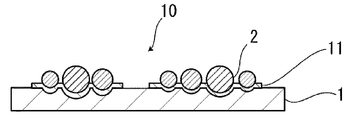
- the unevenness forming member 2 is partially provided on the base material layer 1. Further, a plurality of unevenness forming members 2 are provided on the base material layer 1. Further, the surface on one side of the base material layer 1 (the surface on the side where the unevenness forming member 2 exists) has an uneven shape, and the uneven shape of the base material layer 1 is formed by the unevenness forming member 2.
- NS unevenness forming member
- the uneven shape of the base material layer 1 is formed by the unevenness forming member 2 so that the uneven shape of the base material layer 1 follows the uneven shape formed by the presence of the plurality of unevenness forming members 2. It means that it is formed, and for example, as described later, by pushing the unevenness forming member 2 arranged on the base material layer 1, such an uneven shape can be formed on the base material layer 1. ..
- the uneven shape of the surface of the decorative sheet 10 of the present disclosure (the surface opposite to the base material layer 1) is preferably formed by the uneven forming member 2. That is, it is preferable that the uneven shape of the surface of the decorative sheet 10 is also formed by the presence of the plurality of uneven forming members 2.
- the uneven shape of the surface of the decorative sheet 10 shown in FIGS. 1 to 5 is a schematic view formed by the presence of the unevenness forming member 2.
- the first resin layer 11 is provided at least in a part between the base material layer 1 and the unevenness forming member 2.
- a composition (ink) in which a resin forming the above-mentioned resin and a plurality of unevenness-forming members 2 are mixed is laminated on a base material layer 1 (or another layer when another layer such as a pattern layer 3 described later is provided).
- the base material layer 1, the first resin layer 11, and the unevenness-forming member 2 can be laminated in the order of lamination.
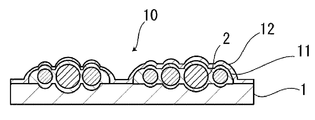
- the first resin layer 11 is laminated in such a manufacturing process, it is not only between the base material layer 1 and the unevenness forming member 2, but also on the side of the unevenness forming member 2 opposite to the base material layer 1. Also, a part of the first resin layer 11 will be laminated. That is, as shown in the schematic views of FIGS. 2 to 5, the first resin layer 11 exists on both sides of the base material layer 1 side of the unevenness forming member 2 and the side opposite to the base material layer 1 side. May be good.
- the decorative sheet of the present disclosure preferably has a second resin layer 12.
- the second resin layer 12 can be provided on at least a part of the unevenness forming member 2 on the side opposite to the base material layer 1 side, and as shown in FIG. 3, the unevenness is formed. It can be provided on the base material layer 1 side of the forming member 2.
- the second resin layer 12 may be provided on a part of the unevenness forming member 2 or may be provided on the entire surface. Further, the second resin layer 12 may be provided on a part of one side of the decorative sheet 10 or may be provided on the entire surface.
- FIGS. 2 to 5 show a mode in which the second resin layer 12 is provided on the entire surface of one side of the decorative sheet 10.
- the third resin layer 13 is provided. Further, when the second resin layer 12 is provided on the base material layer 1 side of the unevenness forming member 2, the unevenness forming member 2 side of the second resin layer 12 (when the first resin layer 11 is present, the first resin layer 11). It is preferable that the third resin layer 13 is provided between the and the second resin layer).
- the third resin layer 13 can be provided on at least a part of the second resin layer 12. As shown in the schematic view of FIG.
- the third resin layer 13 is preferably provided on a part of the second resin layer 12, and it is particularly preferable to synchronize the pattern of the second resin layer with the pattern of the pattern layer. ..
- the third resin layer 13 is the entire surface of the second resin layer 12 and is provided on the entire surface of the decorative sheet. Further, between the unevenness forming member 2 and the base material layer 1 (when the first resin layer 11 exists and the second resin layer 12 is provided on the side opposite to the base material layer 1 side of the unevenness forming member 2). , The third resin layer 13 may be provided between the first resin layer 1 and the base material layer 1.
- the decorative sheet 10 of the present disclosure may be provided with the pattern layer 3 if necessary.
- the pattern layer 3 may be provided on the base material layer 1 side of the unevenness forming member 2 (under the first resin layer 11 when the first resin layer 11 is provided), or the base material layer of the unevenness forming member 2. Although it may be provided on the side opposite to 1, it is preferably provided on the base material layer 1 side of the unevenness forming member 2. Further, the unevenness forming member 2 and the pattern layer 3 may be in contact with each other, or may be laminated via a first resin layer 11 or a primer layer described later.
- the decorative sheet 10 may be provided with a primer layer at an arbitrary position between the layers, or may be provided with a concealing layer or the like between the base material layer 1 and the pattern layer 3.
- a back surface adhesive layer or the like may be provided on the back surface of the base material layer (the side opposite to the unevenness forming member 2 side), or another layer may be provided at an arbitrary position.
- FIG. 1 shows a schematic cross-sectional view of an example of a decorative sheet in which a base material layer 1 / first resin layer 11 / unevenness forming member 2 are laminated in this order as one aspect of the laminated structure of the decorative sheet of the present disclosure. show.
- the base material layer 1 / first resin layer 11 / unevenness forming member 2 / first resin layer 11 / second resin layer 12 are laminated in this order.
- a schematic cross-sectional view of an example of a decorative sheet is shown. In FIG.
- FIG. 4 shows, as one aspect of the laminated structure of the decorative sheet of the present disclosure, the base material layer 1 / the pattern layer 3 / the second resin layer 12 / the first resin layer 11 / the unevenness forming member 2 / the first resin layer 11 / A schematic cross-sectional view of an example of a decorative sheet in which the second resin layer 12 is laminated in this order is shown.
- FIG. 4 shows, as one aspect of the laminated structure of the decorative sheet of the present disclosure, the base material layer 1 / the pattern layer 3 / the second resin layer 12 / the first resin layer 11 / the unevenness forming member 2 / the first resin layer 11 /
- FIG. 4 shows, as one aspect of the laminated structure of the decorative sheet of the present disclosure, the base material layer 1 / the pattern layer 3 / the second resin layer 12 / the first resin layer 11 / the unevenness forming member 2 / the first resin layer 11 /
- FIG. 4 shows, as one aspect of the laminated structure of the decorative sheet of the present disclosure,
- FIG. 5 shows, as one aspect of the laminated structure of the decorative sheet of the present disclosure, the base material layer 1 / the pattern layer 3 / the second resin layer 12 / the first resin layer 11 / the unevenness forming member 2 / the first resin layer 11 /
- a schematic cross-sectional view of an example of a decorative sheet in which the second resin layer 12 / third resin layer 13 are laminated in this order is shown.
- "/" means the delimiter between layers.
- the height of the convex portion of the surface uneven shape is preferably 5 ⁇ m or more, more preferably 10 ⁇ m or more from the viewpoint of expressing an excellent tactile sensation.
- the upper limit of the height of the convex portion is preferably 50 ⁇ m or less, more preferably 40 ⁇ m or less.
- the tactile sensation and designability of the decorative sheet can be more preferably enhanced.
- the height of the uneven convex portion on the surface of the decorative sheet is calculated as an average value of 10 measured values by observing the cross section of the decorative sheet with a scanning electron microscope (SEM). It is the value that was set.
- the design can be expressed by using the gloss difference of each layer. That is, the first resin layer 11, the second resin layer 12, the third resin layer 13, the pattern layer 3, the primer layer, and the like, which are provided as needed, are made relatively high gloss or low gloss, respectively, and further.
- the design such as a three-dimensional effect can be exhibited by the gloss difference when the decorative sheet is observed from the observation side (the side opposite to the base material layer 1 side).
- the base material layer 1 is a resin sheet (resin film) that serves as a support in the decorative sheet of the present disclosure.
- the surface on one side of the base material layer 1 (the surface on the side where the unevenness forming member 2 exists) has an uneven shape. Further, the uneven shape of the base material layer 1 is formed by the uneven forming member 2. As described above, when the uneven shape of the base material layer 1 is formed by the unevenness forming member 2, the uneven shape of the base material layer 1 is formed so as to follow the uneven shape formed by the presence of the plurality of unevenness forming members 2. It means that a shape is formed. For example, as described later, by pushing the unevenness-forming member 2 arranged on the base material layer 1, such an uneven shape is formed on the base material layer 1. Can be formed.
- the depth of the concave-convex concave portion of the base material layer 1 (the average depth of the concave-convex concave portion of the base material layer 1) is such that the unevenness-forming member 2 is not completely embedded in the base material layer 1 (preferably). Is not particularly limited as long as the height of half or more of the unevenness forming member 2 in the cross section of the decorative sheet 10 in the thickness direction is not embedded in the base material layer 1, but is, for example, 2 to 20 ⁇ m. It is about 5 to 15 ⁇ m, more preferably about 5 to 10 ⁇ m.
- the depth of the concave-convex-shaped concave portion of the base material layer 1 is about 5 to 50% of the particle size of the uneven-convex forming member 2. More specifically, the average ratio (%) of the maximum depth of the recesses of the base material layer to the average particle size of the unevenness-forming member is preferably about 5 to 50%, more preferably about 10 to 40%. More preferably, it is about 20 to 40%.
- the resin component used for the base material layer 1 is not particularly limited and may be appropriately selected depending on the moldability, compatibility with the molding resin, etc., but a resin film made of a thermoplastic resin is preferable. ..
- the thermoplastic resin include acrylonitrile-butadiene-styrene resin (hereinafter sometimes referred to as "ABS resin") and acrylonitrile-styrene-acrylic acid ester resin (hereinafter referred to as "ASA resin”). ), Acrylic resin, polyolefin resin such as polypropylene, polyethylene, polycarbonate resin, vinyl chloride resin, polyethylene terephthalate (PET) and the like. Among these, ABS resin and acrylic resin are preferable from the viewpoint of moldability. Further, the base material layer 1 may be formed of a single-layer sheet of these resins, or may be formed of a multi-layer sheet of the same or different resins.
- the flexural modulus of the base material layer 1 is not particularly limited.
- the flexural modulus of the base material layer 1 of the decorative sheet of the present disclosure at 25 ° C. is preferably 500 to 4,000 MPa. 750 to 3,000 MPa can be mentioned.
- the flexural modulus at 25 ° C. is a value measured in accordance with JIS K7171: 2016.
- the flexural modulus at 25 ° C. is 500 MPa or more, the decorative sheet has sufficient rigidity, and the surface characteristics and moldability are further improved even when subjected to the insert molding method.
- the flexural modulus at 25 ° C. is 4,000 MPa or less, sufficient tension can be applied when manufacturing by roll-to-roll, and slack is less likely to occur. It can be done, and the so-called pattern register becomes good.
- the base material layer 1 may be surface-treated on one side or both sides in order to improve the adhesion to the layer provided on the base material layer 1.
- the surface treatment include a chemical surface treatment such as an oxidation method and a physical surface treatment such as an unevenness method.
- a chemical surface treatment such as an oxidation method
- a physical surface treatment such as an unevenness method.
- corona discharge treatment, chromium oxidation treatment, flame treatment, hot air treatment, ozone ultraviolet treatment method and the like can be mentioned.
- examples of the unevenness method include a sandblasting method, a solvent treatment method and the like.
- the base material layer 1 may be subjected to a treatment such as forming a known adhesive layer.
- the base material layer 1 may or may not be colored with a colorant. Further, the base material layer 1 may be in any of opaque, colorless and transparent, colored transparent, and translucent.
- the colorant used for the base material layer 1 is not particularly limited, but preferably a colorant that does not discolor even under a temperature condition of 150 ° C. or higher, and specifically, an existing dry color, paste color, or masterbatch resin. Examples include compositions.
- the thickness of the base material layer 1 is appropriately set according to the use of the decorative sheet, the molding method for integrating with the molding resin, etc., but is usually about 25 to 1000 ⁇ m and about 50 to 700 ⁇ m. More specifically, when the decorative sheet of the present disclosure is used for the insert molding method, the thickness of the base material layer 1 is usually about 50 to 1000 ⁇ m, preferably about 100 to 700 ⁇ m, and more preferably 100 to 500 ⁇ m. The degree can be mentioned. When the decorative sheet of the present disclosure is subjected to the injection molding simultaneous decoration method, the thickness of the base material layer 1 is usually about 25 to 200 ⁇ m, preferably about 50 to 200 ⁇ m, and more preferably about 70 to 200 ⁇ m. Can be mentioned. The thickness of the base material layer 1 is the thickness at a position where the concave-convex-shaped recess is not formed.
- the uneven shape of the surface of the decorative sheet 10 of the present disclosure is formed by the uneven forming member 2. That is, it is preferable that the uneven shape of the surface of the decorative sheet 10 is also formed by the presence of the plurality of uneven forming members 2.
- the uneven shape of the surface of the decorative sheet 10 shown in FIGS. 1 to 5 is a schematic shape formed by the presence of the uneven forming member 2.
- An aggregate of a plurality of unevenness forming members 2 can form one convex portion having an uneven shape on the surface of the decorative sheet, and each uneven forming member 2 can form one convex portion having an uneven shape on the surface of the decorative sheet. It is also possible to form a part. As shown in the schematic views of FIGS. 1 to 5, usually, the convex portion formed by the individual unevenness forming member 2 and the convex portion formed by the aggregate of the plurality of unevenness forming members 2 are combined to form the uneven shape of the decorative sheet. To shape. In the present disclosure, the unevenness forming member 2 has a convex shape in a schematic cross-sectional view as shown in FIGS. 1 to 5.
- the convex portion formed by the concave-convex forming member 2 is formed not only in a form in which conical or columnar protrusions are formed on the surface of the decorative sheet, but also in the form in which the protrusions are linearly extended like a conduit pattern. Also includes forms. Further, as long as the effect of the present disclosure is not impaired, a form in which the top portion protrudes from the layer when another layer is present on the unevenness forming member 2 is also included.
- the concave-convex forming member 2 is exposed on the surface of the decorative sheet 10 from the viewpoint of ease of manufacturing and suppressing detachment of the unevenness-forming member 2 from the decorative sheet 10. It is preferable that there is no such thing.
- the concavo-convex forming member 2 in the present disclosure is preferably formed by printing together with the formation of the first resin layer 11 described later so as to give a desired tactile sensation based on the concavo-convex shape to the surface of the decorative sheet. That is, in the process of manufacturing the decorative sheet, the composition (ink) obtained by mixing the resin forming the first resin layer 11 and the plurality of unevenness-forming members 2 is applied to the base material layer 1 (the pattern layer 3 described later) and the like. By laminating (printing) on the other layer), the base material layer 1, the first resin layer 11, and the concavo-convex forming member 2 can be laminated in the order of laminating.
- the unevenness forming member 2 is preferably particles. Since the concavo-convex forming member 2 is a particle, the concavo-convex forming member 2 can suitably contribute to both the excellent tactile sensation and the design of the decorative sheet without forming the concavo-convex forming member 2 thickly.
- the average particle size of the particles in the decorative sheet of the present disclosure is preferably 5 ⁇ m or more, more preferably 10 ⁇ m or more, still more preferably 15 ⁇ m or more, still more preferably 20 ⁇ m or more, from the viewpoint of exhibiting an excellent tactile sensation.
- the upper limit of the average particle size is preferably 60 ⁇ m or less, more preferably 50 ⁇ m or less, still more preferably less than 50 ⁇ m, still more preferably 40 ⁇ m or less, and particularly preferably 35 ⁇ m or less. ..
- the average particle size of the particles can be more preferably enhanced.
- the particles are not particularly limited and may be either organic particles or inorganic particles, but organic particles are preferable. That is, at least one of organic particles and inorganic particles may be used as the unevenness forming member 2, and it is preferable that organic particles are used.
- the organic particles are not particularly limited, and resin beads are usually used.
- the resin beads include acrylic beads, urethane beads, nylon beads, styrene beads, and the like. Among these, it is preferable to use acrylic beads or urethane beads from the viewpoint of suppressing whitening of the unevenness forming member 2, imparting an excellent tactile sensation, and enhancing the scratch resistance of the decorative sheet.
- acrylic beads or urethane beads from the viewpoint of suppressing whitening of the decorative sheet, it is preferable to use acrylic beads or urethane beads, and from the viewpoint of enhancing the scratch resistance of the decorative sheet, it is preferable to use urethane beads.
- crosslinked resin beads include crosslinked acrylic beads and crosslinked urethane beads.
- the unevenness-forming member 2 is an organic particle
- its average particle size is preferably 15 ⁇ m or more, more preferably 20 ⁇ m or more.
- the upper limit of the average particle size is preferably 60 ⁇ m or less, more preferably 50 ⁇ m or less, still more preferably less than 50 ⁇ m, still more preferably 40 ⁇ m or less, and particularly preferably 35 ⁇ m or less. ..
- the preferred range of particle size of the organic particles is 15-60 ⁇ m, 15-50 ⁇ m, 15 ⁇ m or more and less than 50 ⁇ m, 15-40 ⁇ m, 15-35 ⁇ m, 20-60 ⁇ m, 20-50 ⁇ m, 20 ⁇ m or more and less than 50 ⁇ m, 20-40 ⁇ m, 20-.
- the organic particles For example, 35 ⁇ m. It is preferable that at least 90% or more of the organic particles satisfy these particle sizes on the basis of the number of organic particles from the viewpoint of preferably achieving the effects of the present disclosure. If the average particle size of the organic particles is less than 15 ⁇ m, an excellent tactile sensation may not be obtained due to the uneven shape of the decorative sheet. Further, if the average particle size of the organic particles exceeds 60 ⁇ m, the production stability is lowered, and it may be difficult to form the unevenness forming member 2 having a desired shape with good reproducibility.
- the uneven forming member 2 When the uneven forming member 2 is made into a resin composition (ink) together with the resin forming the first resin layer 11 described later and laminated on the base material layer 1 by printing, from the viewpoint of ink transfer stability, the uneven forming member 2 is formed.
- the average particle size of the organic particles is preferably 1/2 or less of the plate depth.
- the average particle size is randomly selected by observing a cross section in the thickness direction of the layer with a scanning electron microscope (SEM) under the conditions of an acceleration voltage of 3.0 kV and a magnification of 50,000 times. It means the average value (arithmetic mean diameter) of the particle diameters measured for the non-aggregates of the 100 particles.
- the concavo-convex forming member 2 When the organic particles as the concavo-convex forming member 2 are formed into a resin composition together with the resin forming the first resin layer 11 described later and laminated on the base material layer 1 by printing, the concavo-convex forming member 2 is formed on the resin. It is preferably contained in a proportion of 50% by mass or less, and more preferably 40% by mass or less in the solid content of the composition. When the content of the organic particles is 50% by mass or less, the organic particles are uniformly distributed on the coating film (concavo-convex forming member 2), so that the tactile sensation is stable.
- the content of the organic particles is preferably 2% by mass, more preferably 10% by mass or more. If the content of the organic particles is less than 2% by mass, the tactile sensation is insufficient, and the thixotropic property of the ink is insufficient, which may make it difficult to form the unevenness forming member 2 by thick printing.
- the inorganic particles are not particularly limited as long as they are particles formed of an inorganic compound, and examples thereof include silica particles, calcium carbonate particles, barium sulfate particles, alumina particles, and glass balloon particles, and among these, silica is preferable. Particles can be mentioned. One type of inorganic particles may be used alone, or two or more types may be used in combination.
- the average particle size of the inorganic particles is, for example, about 0.5 to 20 ⁇ m, preferably about 1 to 10 ⁇ m.
- the average particle size of the inorganic particles is obtained by observing the cross section of the layer in the thickness direction with a scanning electron microscope (SEM) under the conditions of an acceleration voltage of 3.0 kV and a magnification of 50,000 times, and randomly. It means the average value (arithmetic average diameter) of the particle diameters measured for the non-aggregates of 100 selected particles.
- SEM scanning electron microscope
- first resin layer 11 In the decorative sheet 10 of the present disclosure, as shown in FIGS. 1 to 5, it is preferable that the first resin layer 11 is provided at least in a part between the base material layer 1 and the unevenness forming member 2.
- the first resin layer 11 may be formed on the entire surface of the decorative sheet 10 or may be partially formed.
- a composition (ink) in which a resin and a plurality of unevenness-forming members 2 are mixed is laminated (printed) on a base material layer 1 (or another layer when another layer such as a pattern layer 3 described later is provided).
- the base material layer 1, the first resin layer 11, and the unevenness-forming member 2 can be laminated in the order of lamination.
- the first resin layer 11 is laminated in such a manufacturing process, it is not only between the base material layer 1 and the unevenness forming member 2, but also on the side of the unevenness forming member 2 opposite to the base material layer 1. Also, a part of the first resin layer 11 will be laminated. That is, as shown in the schematic views of FIGS. 2 to 5, the first resin layer 11 exists on both sides of the base material layer 1 side of the unevenness forming member 2 and the side opposite to the base material layer 1 side. May be good.
- the first resin layer 11 When printing a composition (ink) in which the resin forming the first resin layer 11 and the plurality of unevenness forming members 2 are mixed, the first resin layer 11 is at a position where the unevenness forming member 2 does not exist. Since it is not separated by the uneven forming member 2, it is a single layer.
- the first resin layer 11 preferably exists at a position corresponding to the position where the unevenness forming member 2 exists. As described above, since the first resin layer 11 is suitably used for arranging the unevenness forming member 2 on the base material layer 1, in the decorative sheet 10 of the present disclosure, the unevenness forming member 2 and the first unevenness forming member 2 are used. It is also preferable that the region (sliding top) including the resin layer 11 forms one cohesive convex portion.
- the total ratio of the areas where the plurality of raised tops are provided is the base material. Taking the area of one surface of the layer 1 as 100%, it is preferably 3 to 80%, more preferably 3 to 50%, further preferably 5 to 50%, and 5 to 40%. Is more preferable, and 6 to 30% is further preferable. By providing the ridge in the above range, it is possible to obtain a decorative sheet having a more excellent tactile sensation.
- the area where the ridge is provided is the base material layer of the ridge. It is the area of the surface on one side.
- the average thickness (height) of the raised portion is preferably 5 ⁇ m or more, more preferably 10 ⁇ m or more, still more preferably 15 ⁇ m or more, and particularly preferably 20 ⁇ m or more, from the viewpoint of expressing an excellent tactile sensation.
- the upper limit of the average thickness of the ridge is preferably 50 ⁇ m or less, preferably less than 50 ⁇ m in twist, and more preferably 40 ⁇ m or less.
- the average thickness of the raised portion is a value calculated as an average value of 10 measured values by observing the cross section of the decorative sheet with a scanning electron microscope (SEM).
- SEM scanning electron microscope
- the resin forming the first resin layer 11 is preferably a curable resin such as a thermosetting resin or an ionizing radiation curable resin (for example, an electron beam curable resin) from the viewpoint of preferably exerting the effects of the present disclosure.
- a curable resin such as a thermosetting resin or an ionizing radiation curable resin (for example, an electron beam curable resin) from the viewpoint of preferably exerting the effects of the present disclosure.
- an ionizing radiation curable resin is preferable from the viewpoint of high surface hardness, productivity and the like.
- thermosetting resin examples include unsaturated polyester resin, polyurethane resin (including two-component curable polyurethane), epoxy resin, aminoalkyd resin, phenol resin, urea resin, diallyl phthalate resin, melamine resin, guanamine resin, and melamine.
- unsaturated polyester resin polyurethane resin (including two-component curable polyurethane)
- epoxy resin aminoalkyd resin
- phenol resin urea resin
- diallyl phthalate resin diallyl phthalate resin
- melamine resin guanamine resin
- melamine resin examples of the thermosetting resin
- -Urea cocondensation resin silicon resin, polysiloxane resin and the like can be mentioned.
- a curing agent such as a cross-linking agent and a polymerization initiator, and a polymerization accelerator can be added to the above resin.
- a curing agent isocyanate, organic sulfonate, etc. can be added to unsaturated polyester resin, polyurethane resin, etc., and organic amine, etc. can be added to epoxy resin.
- Peroxides such as methyl ethyl ketone peroxide and radical initiators such as azoisobutylnitrile can be added to the unsaturated polyester resin.
- thermosetting resin for example, a solution of the thermosetting resin is applied by a coating method such as a roll coating method, a gravure coating method, a gravure printing method, or a silk screen printing method, and dried. And a method of curing.
- a coating method such as a roll coating method, a gravure coating method, a gravure printing method, or a silk screen printing method, and dried. And a method of curing.
- An ionizing radiation curable resin is a resin that is crosslinked and cured by irradiation with ionizing radiation, and specifically, a prepolymer, an oligomer, and a monomer having a polymerizable unsaturated bond or an epoxy group in the molecule. Examples thereof include those obtained by appropriately mixing at least one of the above.
- ionizing radiation means an electromagnetic wave or a charged particle beam having an energy quantum capable of polymerizing or cross-linking a molecule, and usually ultraviolet rays (UV) or electron beams (EB) are used, but in addition, X It also includes electromagnetic waves such as rays and ⁇ rays, and charged particle rays such as ⁇ rays and ion rays.
- the electron beam curable resin can be made solvent-free, does not require a photopolymerization initiator, and has stable curing characteristics. Therefore, in forming the first resin layer 11. Suitable for use.
- a (meth) acrylate monomer having a radically polymerizable unsaturated group in the molecule is preferable, and a polyfunctional (meth) acrylate monomer is particularly preferable.
- the polyfunctional (meth) acrylate monomer may be a (meth) acrylate monomer having two or more (bifunctional or higher), preferably three or more (trifunctional or higher) polymerizable unsaturated bonds in the molecule.
- polyfunctional (meth) acrylate examples include ethylene glycol di (meth) acrylate, propylene glycol di (meth) acrylate, 1,4-butanediol di (meth) acrylate, and 1,6-hexanediol di (meth) acrylate.
- a (meth) acrylate oligomer having a radically polymerizable unsaturated group in the molecule is preferable, and among them, two or more polymerizable unsaturated bonds in the molecule.
- a polyfunctional (meth) acrylate oligomer having (bifunctional or higher) is preferable.
- the polyfunctional (meth) acrylate oligomer include polycarbonate (meth) acrylate, acrylic silicone (meth) acrylate, urethane (meth) acrylate, epoxy (meth) acrylate, polyester (meth) acrylate, and polyether (meth) acrylate.
- Examples thereof include polybutadiene (meth) acrylate, silicone (meth) acrylate, and oligomers having a cationically polymerizable functional group in the molecule (for example, novolak type epoxy resin, bisphenol type epoxy resin, aliphatic vinyl ether, aromatic vinyl ether and the like).
- the polycarbonate (meth) acrylate is not particularly limited as long as it has a carbonate bond in the polymer main chain and a (meth) acrylate group in the terminal or side chain, and for example, a polycarbonate polyol (meth) is used. It can be obtained by esterification with acrylic acid.
- the polycarbonate (meth) acrylate may be, for example, urethane (meth) acrylate having a polycarbonate skeleton.
- the urethane (meth) acrylate having a polycarbonate skeleton can be obtained, for example, by reacting a polycarbonate polyol, a polyisocyanate compound, and a hydroxy (meth) acrylate.
- Acrylic silicone (meth) acrylate can be obtained by radical copolymerizing a silicone macromonomer with a (meth) acrylate monomer.
- Urethane (meth) acrylate can be obtained, for example, by esterifying a polyurethane oligomer obtained by reacting a polyether polyol or a polyester polyol with a polyisocyanate compound with (meth) acrylic acid.
- Epoxy (meth) acrylate can be obtained, for example, by reacting (meth) acrylic acid with the oxylan ring of a bisphenol type epoxy resin or a novolak type epoxy resin having a relatively low molecular weight to esterify it.
- a carboxyl-modified epoxy (meth) acrylate in which this epoxy (meth) acrylate is partially modified with a dibasic carboxylic acid anhydride can also be used.
- the polyester (meth) acrylate can be obtained, for example, by esterifying the hydroxyl groups of a polyester oligomer having hydroxyl groups at both ends obtained by condensation of a polyvalent carboxylic acid and a polyhydric alcohol with (meth) acrylic acid, or to a polyvalent carboxylic acid. It can be obtained by esterifying the hydroxyl group at the end of the oligomer obtained by adding an alkylene oxide with (meth) acrylic acid.
- the polyether (meth) acrylate can be obtained by esterifying the hydroxyl group of the polyether polyol with (meth) acrylic acid.
- Polybutadiene (meth) acrylate can be obtained by adding (meth) acrylic acid to the side chain of the polybutadiene oligomer.
- Silicone (meth) acrylate can be obtained by adding (meth) acrylic acid to the terminal or side chain of silicone having a polysiloxane bond in the main chain.
- the polyfunctional (meth) acrylate oligomer polycarbonate (meth) acrylate, urethane (meth) acrylate and the like are particularly preferable. These oligomers may be used alone or in combination of two or more.
- the decorative sheet is required to have three-dimensional moldability, such as when it is used for manufacturing a decorative resin molded product, from the viewpoint of obtaining excellent three-dimensional moldability among the above-mentioned ionizing radiation curable resins, it is preferable to use polyfunctional polycarbonate (meth) acrylate. Further, from the viewpoint of achieving both three-dimensional moldability and scratch resistance, it is more preferable to use a polyfunctional polycarbonate (meth) acrylate in combination with a polyfunctional (meth) acrylate.
- a polyfunctional (meth) acrylate monomer When a polyfunctional (meth) acrylate monomer is used as the ionizing radiation curable resin, it is preferably used in combination with a thermoplastic resin such as an acrylic resin from the viewpoint of obtaining excellent three-dimensional moldability, and three-dimensional molding is performed. From the viewpoint of achieving both property and scratch resistance, it is more preferable that the mass ratio of the polyfunctional (meth) acrylate monomer to the thermoplastic resin in the ionizing radiation curable resin composition is 25:75 to 75:25. ..
- the polyfunctional polycarbonate (meth) acrylate and the polyfunctional (meth) acrylate will be described in detail.
- the polyfunctional polycarbonate (meth) acrylate is not particularly limited as long as it has a carbonate bond in the polymer main chain and two or more (meth) acrylates in the terminal or side chain. Further, from the viewpoint of improving cross-linking and curing of the (meth) acrylate, the number of functional groups per molecule is preferably 2 to 6.
- the polyfunctional polycarbonate (meth) acrylate may be used alone or in combination of two or more.
- the polyfunctional polycarbonate (meth) acrylate is obtained, for example, by converting some or all of the hydroxyl groups of the polycarbonate polyol into (meth) acrylate (acrylic acid ester or methacrylic acid ester).
- This esterification reaction can be carried out by a usual esterification reaction.
- 1) a method of condensing a polycarbonate polyol with an acrylic acid halide or a methacrylate halide in the presence of a base and 2) a method of condensing a polycarbonate polyol with an acrylic acid anhydride or a methacrylate anhydride in the presence of a catalyst.
- 3) a method of condensing the polycarbonate polyol and acrylic acid or methacrylic acid in the presence of an acid catalyst can be mentioned.
- Polycarbonate polyol is a polymer having a carbonate bond in the polymer main chain and having 2 or more, preferably 2 to 50, more preferably 3 to 50 hydroxyl groups in the terminal or side chain.
- a typical method for producing the polycarbonate polyol is a method by polycondensation reaction with a diol compound (A), a trihydric or higher polyhydric alcohol (B), and a compound (C) as a carbonyl component.
- the diol compound (A) used as a raw material for the polycarbonate polyol is represented by the general formula HO-R 1-OH.
- R 1 is a divalent hydrocarbon group having 2 to 20 carbon atoms, and may contain an ether bond in the group.
- R 1 is, for example, a linear or branched alkylene group, a cyclohexylene group, or a phenylene group.
- diol compound examples include ethylene glycol, 1,2-propylene glycol, diethylene glycol, dipropylene glycol, triethylene glycol, polyethylene glycol, neopentyl glycol, 1,3-propanediol, 1,4-butanediol, and 1, , 5-Pentanediol, 3-Methyl-1,5-Pentanediol, 1,6-hexanediol, 1,8-octanediol, 1,3-bis (2-hydroxyethoxy) benzene, 1,4-bis (2) -Hydroxyethoxy) benzene, neopentyl glycol, 1,4-cyclohexanediol, 1,4-cyclohexanedimethanol and the like can be mentioned. These diols may be used alone or in combination of two or more.
- trihydric or higher polyhydric alcohols (B) used as raw materials for polycarbonate polyols include alcohols such as trimethylolpropane, trimethylolethane, pentaerythritol, ditrimethylolpropane, dipentaerythritol, glycerin, and sorbitol. Can be mentioned. Further, the trihydric or higher polyhydric alcohol may be an alcohol having a hydroxyl group obtained by adding 1 to 5 equivalents of ethylene oxide, propylene oxide, or other alkylene oxide to the hydroxyl group of the polyhydric alcohol. good. These polyhydric alcohols may be used alone or in combination of two or more.
- the compound (C) as a carbonyl component used as a raw material for a polycarbonate polyol is a compound selected from carbonic acid diester, phosgene, or an equivalent thereof.
- Specific examples of the compound include carbonate diesters such as dimethyl carbonate, diethyl carbonate, diisopropyl carbonate, diphenyl carbonate, ethylene carbonate, and propylene carbonate; phosgene; formic acid halide such as methyl chloroformate, ethyl chloroformate, and phenyl chloroformate. Esters and the like can be mentioned. These compounds may be used alone or in combination of two or more.
- the polycarbonate polyol is synthesized by polycondensing the diol compound (A), the trihydric or higher polyhydric alcohol (B), and the compound (C) as a carbonyl component under general conditions.
- the charged molar ratio of the diol compound (A) and the polyhydric alcohol (B) may be set in the range of, for example, 50:50 to 99: 1.
- the molar ratio of the compound (C) to be the carbonyl component to the diol compound (A) and the polyhydric alcohol (B) is, for example, 0.2 to 2 with respect to the hydroxyl groups of the diol compound and the polyhydric alcohol. It may be set in the equivalent range.
- the equivalent number (eq. / Mol) of the hydroxyl groups present in the polycarbonate polyol after the polycondensation reaction at the above-mentioned charging ratio is, for example, 3 or more, preferably 3 to 50, more preferably 3 to 50 on average in one molecule. 3 to 20 can be mentioned.
- a required amount of (meth) acrylate groups are formed by the esterification reaction described later, and an appropriate flexibility is imparted to the polyfunctional polycarbonate (meth) acrylate resin.
- the terminal functional group of this polycarbonate polyol is usually an OH group, but a part thereof may be a carbonate group.
- this polycarbonate polyol can also be produced by a transesterification reaction between a polycarbonate diol and a polyhydric alcohol having a valence of 3 or more.
- the molecular weight of the polyfunctional polycarbonate (meth) acrylate is not particularly limited, and examples thereof include a weight average molecular weight of 55,000 or more, preferably 10,000 or more.
- the upper limit of the weight average molecular weight of the polyfunctional polycarbonate (meth) acrylate is not particularly limited, but from the viewpoint of controlling the viscosity so as not to become too high, for example, 100,000 or less, preferably 50 million or less can be mentioned. Be done.
- the weight average molecular weight of the polyfunctional polycarbonate (meth) acrylate is preferably 10,000 to 50,000, more preferably 10,000 to 20,000.
- the weight average molecular weight of the polyfunctional polycarbonate (meth) acrylate in the present specification is a value measured by the gel permeation chromatography method using polystyrene as a standard substance.
- the content of the polyfunctional polycarbonate (meth) acrylate in the ionizing radiation curable resin composition used for forming the first resin layer 11 is not particularly limited as long as the effects of the present disclosure are exhibited, but is injection molded. From the viewpoint of maintaining the uneven shape of the surface of the decorative sheet even with heat and pressure at times and more effectively suppressing the deterioration of the high texture expressed on the decorative sheet, it is preferably 50% by mass or more. , More preferably 80% by mass or more, still more preferably 85% by mass or more.
- the polyfunctional (meth) acrylate is not particularly limited, but a polyfunctional urethane (meth) acrylate is preferable.
- the polyfunctional urethane (meth) acrylate is not particularly limited as long as it has a urethane bond in the polymer main chain and two or more (meth) acrylates in the terminal or side chain.
- Such a polyfunctional urethane (meth) acrylate can be obtained, for example, by esterifying a polyurethane oligomer obtained by reacting a polyether polyol or a polyester polyol with a polyisocyanate with (meth) acrylic acid.
- the number of functional groups per molecule of the polyfunctional urethane (meth) acrylate is preferably 2 to 12 from the viewpoint of improving cross-linking and curing. Further, the polyfunctional (meth) acrylate may be a silicone-modified one. The polyfunctional (meth) acrylate may be used alone or in combination of two or more.
- the molecular weight of the polyfunctional (meth) acrylate is not particularly limited, and examples thereof include a weight average molecular weight of 2,000 or more, preferably 5,000 or more.
- the upper limit of the weight average molecular weight of the polyfunctional (meth) acrylate is not particularly limited, but from the viewpoint of controlling the viscosity so as not to become too high, for example, 30,000 or less, preferably 10,000 or less can be mentioned.
- the weight average molecular weight of the polyfunctional (meth) acrylate in the present specification is a value measured by the gel permeation chromatography method using polystyrene as a standard substance.
- the content of the polyfunctional (meth) acrylate in the ionizing radiation curable resin composition used for forming the first resin layer 11 is not particularly limited as long as the effects of the present disclosure are exhibited, but is injection molded. From the viewpoint of maintaining the uneven shape of the surface of the decorative sheet even with heat and pressure at times and more effectively suppressing the deterioration of the high texture expressed on the decorative sheet, it is preferably 50% by mass or less. , More preferably 20% by mass or less, still more preferably 15% by mass or less.
- polyfunctional polycarbonate (meth) acrylate and the polyfunctional (meth) acrylate are used in combination in the ionizing radiation curable resin composition used for forming the first resin layer 11, their mass ratios (polyfunctional polycarbonate (meth) acrylate) are used.
- Acrylate examples of the polyfunctional (meth) acrylate include preferably about 50:50 to 99: 1, more preferably about 80:20 to 99: 1, and further preferably about 85:15 to 99: 1.
- the first resin layer 11 is formed, for example, by preparing the above-mentioned ionizing radiation curable resin composition, applying it, and cross-linking and curing it.
- the viscosity of the ionizing radiation curable resin composition may be any viscosity that can form an uncured resin layer on the layer adjacent to the first resin layer 11 by the coating method described later.
- known coating liquids such as a gravure coat, a bar coat, a roll coat, a reverse roll coat, and a comma coat are applied onto a layer adjacent to the first resin layer 11 so as to have the above-mentioned thickness. It is applied by a method, preferably a gravure coat, to form an uncured resin layer.
- the uncured resin layer thus formed is irradiated with ionizing radiation such as an electron beam and ultraviolet rays to cure the uncured resin layer to form the first resin layer 11.
- ionizing radiation such as an electron beam and ultraviolet rays
- the acceleration voltage thereof can be appropriately selected depending on the resin to be used and the thickness of the layer, but usually an acceleration voltage of about 70 to 300 kV can be mentioned.
- the higher the acceleration voltage the higher the penetrating ability. Therefore, when a resin that is easily deteriorated by electron beam irradiation is used under the first resin layer 11, the electron beam penetrating depth and the first. 1
- the acceleration voltage is selected so that the thicknesses of the resin layers 11 are substantially the same. As a result, the irradiation of the extra electron beam to the layer located below the first resin layer 11 can be suppressed, and the deterioration of each layer due to the excess electron beam can be minimized.
- the irradiation dose is preferably an amount at which the crosslink density of the first resin layer 11 is saturated, and is usually selected in the range of 5 to 300 kGy (0.5 to 30 Mrad), preferably 10 to 50 kGy (1 to 5 Mrad).
- the electron beam source is not particularly limited, and for example, various electron beam accelerators such as cockloft Walton type, Van de Graaff type, resonance transformer type, insulated core transformer type, linear type, dynamitron type, and high frequency type can be used. Can be used.
- ultraviolet rays When ultraviolet rays are used as ionizing radiation, light rays containing ultraviolet rays having a wavelength of 190 to 380 nm may be emitted.
- the ultraviolet source is not particularly limited, and examples thereof include a high-pressure mercury lamp, a low-pressure mercury lamp, a metal halide lamp, and a carbon arc lamp.
- Various additives can be blended in the first resin layer 11 according to the desired physical properties to be provided in the first resin layer 11.
- this additive include weather resistance improvers such as ultraviolet absorbers and light stabilizers, abrasion resistance improvers, polymerization inhibitors, cross-linking agents, infrared absorbers, antistatic agents, adhesive improvers, and leveling agents. Examples thereof include a thixophilic imparting agent, a coupling agent, a plasticizer, an antifoaming agent, a filler, a solvent, and a coloring agent.
- weather resistance improvers such as ultraviolet absorbers and light stabilizers, abrasion resistance improvers, polymerization inhibitors, cross-linking agents, infrared absorbers, antistatic agents, adhesive improvers, and leveling agents.
- a thixophilic imparting agent a coupling agent, a plasticizer, an antifoaming agent, a filler, a solvent, and a coloring agent.
- the first resin is used from the viewpoint of suppressing deformation of the raised portion, forming a desired shape, and improving three-dimensional moldability.
- the ionizing thermosetting resin constituting the layer 11 it is preferable to use polycarbonate (meth) acrylate.
- the first resin layer 11 is ionized and radiation curable from the viewpoint of improving the three-dimensional moldability while improving the scratch resistance of the decorative sheet. It is also preferable to use a mixture of a resin and a thermoplastic resin.
- the type of the thermoplastic resin and the preferable mixing ratio of the ionizing radiation curable resin and the thermoplastic resin can be the same as those described for the second resin layer 12 described later.
- the decorative sheet 10 of the present disclosure preferably has a second resin layer 12.
- the second resin layer 12 may be provided on a part of the unevenness forming member 2 or may be provided on the entire surface. Further, the second resin layer 12 may be provided on a part of the decorative sheet 10 or may be provided on the entire surface. From the viewpoint of protecting the layer on the base material layer 1 side of the second resin layer 12, the second resin layer 12 is preferably provided on the entire surface of the unevenness-forming member 2, and may be provided on the entire surface of the decorative sheet 10. More preferred.
- the second resin layer 12 may be provided on the base material layer 1 side of the unevenness forming member 2, or may be provided on the side opposite to the base material layer 1 of the unevenness forming member 2.
- the second resin layer 12 is preferably in contact with the unevenness forming member 2 or the first resin layer 11.
- the second resin layer 12 can contain a matting agent, for example, for the purpose of adjusting the gloss of the decorative sheet 10.
- Examples of the resin constituting the second resin layer 12 include phenol resin, urea resin, diallyl phthalate, melamine resin, guanamine resin, unsaturated polyester resin, polyurethane resin, epoxy resin, aminoalkyd resin, and melamine-urea copolymer. , Silicon resin, polysiloxane, polyethylene terephthalate, polybutylene terephthalate, polyamide, polyethylene, polypropylene, ethylene-vinyl acetate copolymer, ethylene-acrylic acid copolymer, ethylene-acrylic acid ester copolymer, ionomer, polymethylpentene , Acrylic acid ester, methacrylic acid ester, polycarbonate, cellulose triacetate and the like.
- the second resin layer 12 may be formed by using an ionizing radiation curable resin.
- an ionizing radiation curable resin As for the details of the ionizing radiation curable resin, the same ones as detailed in the column of [1st resin layer 11] are exemplified.
- the matting agent is not particularly limited, and known ones can be widely used.
- the matting agent include inorganic particles such as silica, alumina, calcium carbonate, magnesium carbonate, aluminosilicate, and barium sulfate; resin (organic) particles such as acrylic beads, polyethylene, urethane resin, polycarbonate, and polyamide (nylon). Can be mentioned.
- the average particle size of the particles is preferably 0.5 to 20 ⁇ m, more preferably 0.5 to 10 ⁇ m.
- the amount of the matting agent added is preferably 2 to 40% by mass, more preferably 5 to 30% by mass, based on the resin composition (excluding the solvent) forming the second resin layer 12.
- the shape of the particles is polyhedral, spherical, scaly, or the like. Of the above-mentioned inorganic particles and organic particles, silica is preferable.
- the thickness of the second resin layer 12 is preferably adjusted in consideration of the size of the unevenness forming member 2 and the uneven shape of the decorative sheet. From this point of view, the thickness of the second resin layer 12 is preferably about 2 to 10 ⁇ m, more preferably about 0.1 to 20 ⁇ m, still more preferably about 0.3 to 10 ⁇ m, still more preferably 0.5 to 5 ⁇ m. The degree can be mentioned. The thickness of the second resin layer 12 means the thickness of the second resin layer 12 that is not located on the unevenness forming member 2.
- the decorative sheet of the present disclosure is used for injection molding or vacuum forming, from the viewpoint of improving the three-dimensional moldability while improving the scratch resistance of the decorative sheet, the ionizing radiation curability constituting the second resin layer 12 is obtained.
- the resin it is preferable to use the above-mentioned polycarbonate (meth) acrylate.
- the second resin layer 12 is ionized and radiation-curable from the viewpoint of improving the three-dimensional moldability while improving the scratch resistance of the decorative sheet. It is also preferable to use a mixture of a resin and a thermoplastic resin.
- the thermoplastic resin include acrylic resin, urethane resin, olefin resin and the like, and acrylic resin is particularly preferable.
- the mixing ratio of the ionizing radiation curable resin and the thermoplastic resin is preferably about 10:90 to 75:25, more preferably about 25:75 to 50:50 in terms of mass ratio.
- the second resin layer 12 when the second resin layer 12 is provided on the side opposite to the base material layer 1 side of the unevenness forming member 2, the second resin layer 12 It is preferable that the third resin layer 13 is provided on the side opposite to the unevenness forming member 2 side. Further, when the second resin layer 12 is provided on the base material layer 1 side of the unevenness forming member 2, the unevenness forming member 2 side of the second resin layer 12 (when the first resin layer 11 is present, the first resin layer 11). It is preferable that the third resin layer 13 is provided between the and the second resin layer). The third resin layer 13 can be provided on at least a part of the second resin layer 12.
- the third resin layer 13 is the entire surface of the second resin layer 12 and is provided on the entire surface of the decorative sheet. Further, between the unevenness forming member 2 and the base material layer 1 (when the first resin layer 11 exists and the second resin layer 12 is provided on the side opposite to the base material layer 1 side of the unevenness forming member 2). , The third resin layer 13 may be provided between the first resin layer 1 and the base material layer 1.
- the third resin layer 13 is partially provided on the second resin layer 12, and the second resin layer 12 containing the matting agent is exposed and unexposed.
- the decorative sheet of the present disclosure can be given a high degree of design.
- the third resin layer 13 preferably has a higher luster than the second resin layer 12. That is, the second resin layer 12 has a relatively low gloss due to the inclusion of a matting agent, the third resin layer 13 has a relatively high gloss, and is between the second resin layer 12 and the third resin layer. It is preferable that a gloss difference is provided.
- tuning means a position where the position where the unevenness forming member 2 exists (particularly, the position of the raised portion) and the position where the third resin layer 13 is formed are related to each other in a plan view. It shall mean that it exists in. Specifically, when the third resin layer 13 is present at the same position as (a) the unevenness forming member 2 (particularly, the position of the above-mentioned raised portion) in a plan view, (b) the unevenness forming member 2 (particularly).
- the third resin layer 13 When the third resin layer 13 is present at a position different from (the position of the above-mentioned ridge), (c) a certain distance at a position distant from the unevenness-forming member 2 (particularly, the position of the above-mentioned ridge). The case where the third resin layer 13 is present while keeping the direction is included.
- the third resin layer 13 is preferably a transparent resin layer.
- transparent includes all of colorless transparent, colored transparent, translucent and the like.
- Examples of the resin constituting the third resin layer 13 include phenol resin, urea resin, diallyl phthalate, melamine resin, guanamine resin, unsaturated polyester resin, polyurethane resin, epoxy resin, aminoalkyd resin, and melamine-urea copolymer. , Silicon resin, polysiloxane, polyethylene terephthalate, polybutylene terephthalate, polyamide, polyethylene, polypropylene, ethylene-vinyl acetate copolymer, ethylene-acrylic acid copolymer, ethylene-acrylic acid ester copolymer, ionomer, polymethylpentene , Acrylic acid ester, methacrylic acid ester, polycarbonate, cellulose triacetate and the like. Further, the above-mentioned ionizing radiation curable resin may be used. These resins can be used alone or in combination of two or more.
- the third resin layer 13 can contain a matting agent for gloss adjustment.
- the content of the matting agent in the third resin layer 13 is preferably smaller than the content of the matting agent in the second resin layer 12.
- the gloss of the third resin layer 13 is made higher than the gloss of the second resin layer 12.
- Examples of the matting agent used for the third resin layer 13 are the same as those mentioned in the second resin layer 12.
- the amount of the matting agent added is preferably 0.5 to 20% by mass, more preferably 1 to 15% by mass based on the resin composition (excluding the solvent) forming the third resin layer 13.
- the content of the matting agent in the third resin layer 13 is smaller than the content of the matting agent in the second resin layer 12 per unit mass of the solid content of the resin composition forming the third resin layer 13. It means that the mass of the matting agent contained in is smaller than the mass of the matting agent contained per unit mass of the solid content of the resin composition forming the second fat layer 12.
- the third resin layer 13 is provided in synchronization with the pattern of the pattern layer 3.
- the synchronization between the pattern of the pattern layer 3 and the third resin layer 13 means, for example, the position of the pattern of the pattern layer 3 and the third resin layer 13 when the decorative sheet is observed in a plane. Examples include a mode in which the position where the third resin layer 13 is formed (so-called positive) and a mode in which the position of the pattern of the pattern layer 3 and the position where the third resin layer 13 is not formed correspond (so-called negative). ..
- the pattern layer 3 has a wood grain pattern, and a third resin layer 13 having a gloss higher than that of the pattern layer 3 is provided on a portion other than the winter grain pattern and / or the conduit pattern of the wood grain. Is preferable. As a result, the luster of the winter grain pattern and / or the conduit pattern portion of the wood grain is lowered, so that an excellent design property similar to that of natural wood can be obtained.
- a plate in which the winter grain pattern and / or the conduit pattern of the same wood grain as the pattern layer 3 is inverted is used, and a known printing method is used. It is preferable to print using. As the printing method, a gravure printing method, a screen printing method and the like are preferable.
- the third resin layer 13 may be colored, it is particularly desirable not to add a colorant.
- the thickness of the third resin layer 13 is preferably about 0.1 to 20 ⁇ m, more preferably about 0.5 to 10 ⁇ m, and further preferably about 1 to 5 ⁇ m from the viewpoint of achieving both excellent tactile sensation and designability. ..
- the third resin layer 13 is formed from the viewpoint of improving the scratch resistance of the decorative sheet 10 and improving the three-dimensional moldability.
- the ionizing radiation curable resin it is preferable to use polycarbonate (meth) acrylate.
- the polycarbonate (meth) acrylate the same one as exemplified in the column of [1st resin layer 11] can be used.
- the third resin layer 13 is ionized from the viewpoint of improving the three-dimensional moldability while improving the scratch resistance of the decorative sheet 10. It is also preferable to use a mixture of a curable resin and a thermoplastic resin.
- the type of the thermoplastic resin and the preferable mixing ratio of the ionizing radiation curable resin and the thermoplastic resin can be the same as those described in the column of [1st resin layer 11].
- the pattern layer 3 is a layer provided as needed for the purpose of imparting decorativeness to the decorative sheet.
- the pattern layer 3 may be provided on the base material layer 1 side of the unevenness forming member 2 (under the first resin layer 11 when the first resin layer 11 is provided), or the base material layer of the unevenness forming member 2. Although it may be provided on the side opposite to 1, it is preferably provided on the base material layer 1 side of the unevenness forming member 2. Further, the unevenness forming member 2 and the pattern layer 3 may be in contact with each other, or may be laminated via a first resin layer 11 or a primer layer described later.
- the pattern layer 3 can be, for example, a layer in which a desired pattern is formed by using an ink composition.
- an ink composition used for forming the pattern layer 3
- a binder in which a colorant such as a pigment or a dye, an extender pigment, a solvent, a stabilizer, a plasticizer, a catalyst, a curing agent or the like is appropriately mixed is used. ..
- the binder used in the ink composition is not particularly limited, and for example, polyurethane resin, vinyl chloride-vinyl acetate copolymer, vinyl chloride-vinyl acetate-acrylic copolymer, chlorinated polypropylene resin, acrylic resin, polyester.
- examples thereof include resins, polyamide resins, butyral resins, polystyrene resins, nitrocellulose resins, cellulose acetate resins and the like. These binders may be used alone or in combination of two or more.
- the colorant used in the ink composition is not particularly limited, and is, for example, carbon black (black), iron black, titanium white, antimony white, yellow lead, titanium yellow, petal pattern, cadmium red, ultramarine blue, and cobalt blue.
- Inorganic pigments such as; organic pigments or dyes such as quinacridone red, isoindolinone yellow, phthalocyanine blue; metal pigments composed of scaly foil pieces such as aluminum and brass; scaly foils such as titanium dioxide-coated mica and basic lead carbonate. Examples include pearl luster (pearl) pigments composed of pieces.
- the pattern formed by the pattern layer 3 is also not particularly limited, but for example, a stone pattern imitating the surface of a rock such as a wood grain pattern or a marble pattern (for example, a travertin marble pattern), a cloth grain or a cloth-like pattern is imitated.
- a stone pattern imitating the surface of a rock such as a wood grain pattern or a marble pattern (for example, a travertin marble pattern)
- a cloth grain or a cloth-like pattern is imitated.
- Examples thereof include a fabric pattern, a tiled pattern, a brick pile pattern, and the like, which may be a pattern such as a parquet or a patchwork in which these are combined, or a solid color (so-called solid color).
- These patterns are formed by multicolor printing with ordinary yellow, red, blue, and black process colors, but they can also be printed with special colors by preparing plates of the individual colors that make up the pattern. Can be formed.
- the thickness of the pattern layer 3 is not particularly limited, and examples thereof include 1 to 30 ⁇ m, preferably 1 to 20 ⁇ m.
- the pattern layer 3 may be a metal thin film layer.
- the metal forming the metal thin film layer include tin, indium, chromium, aluminum, nickel, copper, silver, gold, platinum, zinc, and alloys containing at least one of these.
- the method for forming the metal thin film layer is not particularly limited, and examples thereof include a vapor deposition method such as a vacuum vapor deposition method, a sputtering method, and an ion plating method using the above-mentioned metal.
- the metal thin film layer may be provided on the entire surface or may be provided partially. Further, in order to improve the adhesion with the adjacent layer, a primer layer using a known resin may be provided on the front surface or the back surface of the metal thin film layer.
- the primer layer is provided at an arbitrary position between the layers, if necessary, for the purpose of improving the adhesion between the layers contained in the decorative sheet.
- the primer layer is preferably provided between the pattern layer 3 and the first resin layer 11.
- the primer composition constituting the primer layer includes urethane resin, (meth) acrylic resin, (meth) acrylic-urethane copolymer, vinyl chloride-vinyl acetate copolymer, polyester resin, butyral resin, chlorinated polypropylene, and chlorine.
- urethane resin, (meth) acrylic resin, and (meth) acrylic-urethane copolymer are preferable.
- polyurethane resin polyurethane containing polyol (polyolcohol) as the main component and isocyanate as the cross-linking agent (curing agent) can be used.
- polyol those having two or more hydroxyl groups in the molecule, for example, polyester polyol, polyethylene glycol, polypropylene glycol, acrylic polyol, polyether polyol and the like are used.
- isocyanate examples include polyvalent isocyanate having two or more isocyanate groups in the molecule, aromatic isocyanate such as 4,4-diphenylmethane diisocyanate, hexamethylene diisocyanate, isophorone diisocyanate, hydrogenated tolylene diisocyanate, and hydrogenated diphenylmethane diisocyanate.
- aromatic isocyanate such as 4,4-diphenylmethane diisocyanate, hexamethylene diisocyanate, isophorone diisocyanate, hydrogenated tolylene diisocyanate, and hydrogenated diphenylmethane diisocyanate.
- Etc. an aliphatic (or alicyclic) isocyanate is used. It is also possible to mix urethane resin and butyral resin.
- acrylic polyol or polyester polyol as a polyol with hexamethylene diisocyanate or 4,4-diphenylmethane diisocyanate as a cross-linking agent, and in particular, acrylic polyol and hexamethylene diisocyanate are used in combination. Is preferable.
- the (meth) acrylic resin is a homopolymer of (meth) acrylic acid ester, a copolymer of two or more different (meth) acrylic acid ester monomers, or a combination of (meth) acrylic acid ester and another monomer.
- Polymers include, specifically, methyl poly (meth) acrylate, ethyl poly (meth) acrylate, propyl poly (meth) acrylate, butyl poly (meth) acrylate, methyl (meth) acrylate-.
- a (meth) acrylic resin composed of a single polymer or a copolymer containing the (meth) acrylic acid ester such as the above is preferably used.
- the (meth) acrylic-urethane copolymer for example, an acrylic-urethane (polyester urethane) block copolymer is preferable.
- the curing agent the above-mentioned various isocyanates are used.
- the acrylic-urethane (polyester urethane) block copolymer the acrylic / urethane ratio (mass ratio) is preferably adjusted in the range of 9/1 to 1/9, more preferably 8/2 to 2/8, if desired. Is preferable.
- the thickness of the primer layer is not particularly limited, but is, for example, about 0.5 to 20 ⁇ m, preferably 1 to 5 ⁇ m.
- the primer layer uses the primer composition, gravure coat, gravure reverse coat, gravure offset coat, spinner coat, roll coat, reverse roll coat, kiss coat, wheeler coat, dip coat, solid coat by silk screen, wire bar coat, flow. It is formed by a normal coating method such as a coat, a comma coat, a flow coat, a brush coat, a spray coat, or a transfer coating method.
- the transfer coating method is a method in which a coating film of a primer layer or an adhesive layer is formed on a thin sheet (film base material), and then the surface of the target layer in the decorative sheet is coated.
- the concealing layer is the base material layer 1 and the pattern layer 3 if the pattern layer 3 is provided between the base material layer 1 and the unevenness forming member 2 for the purpose of suppressing the color change and variation of the base material layer 1. It is a layer provided between the two as needed.
- the concealing layer is generally formed as an opaque color layer because the base material layer 1 is provided to prevent the base material layer 1 from adversely affecting the color tone and the pattern of the decorative sheet.
- the concealing layer is formed by using an ink composition in which a binder is appropriately mixed with a colorant such as a pigment or a dye, an extender pigment, a solvent, a stabilizer, a plasticizer, a catalyst, a curing agent, or the like.
- a colorant such as a pigment or a dye, an extender pigment, a solvent, a stabilizer, a plasticizer, a catalyst, a curing agent, or the like.
- the ink composition for forming the concealing layer is appropriately selected from those used for the above-mentioned pattern layer 3 and used.
- the concealing layer is usually set to a thickness of about 1 to 20 ⁇ m and is formed as a so-called solid printing layer.
- the concealing layer is a usual printing method such as gravure printing, offset printing, silk screen printing, printing by transfer from a transfer sheet, inkjet printing; gravure coating, gravure reverse coating, gravure offset coating, spinner coating, roll coating, reverse roll. It is formed by a normal coating method such as a coat.
- the back surface adhesive layer is a layer provided as necessary on the side opposite to the outer surface of the decorative sheet for the purpose of improving the adhesion with the molding resin when molding the decorative resin molded product.
- thermoplastic resin or a curable resin is used depending on the molding resin used for the decorative resin molded product.
- thermoplastic resin used for forming the back surface adhesive layer examples include acrylic resin, acrylic modified polyolefin resin, chlorinated polyolefin resin, vinyl chloride / vinyl acetate copolymer, thermoplastic urethane resin, thermoplastic polyester resin, and polyamide. Examples include resins and rubber-based resins. These thermoplastic resins may be used alone or in combination of two or more.
- thermosetting resin used for forming the back surface adhesive layer examples include urethane resin and epoxy resin. These thermosetting resins may be used alone or in combination of two or more.
- the decorative sheet 10 of the present disclosure described above has at least an unevenness forming member 2 on one surface of the base material layer 1, and the uneven shape on the one side of the base material layer 1 is formed. It can be manufactured so as to be formed by the concave-convex shape member 2. As described above, the decorative sheet 10 is laminated with a first resin layer 11, a second resin layer 12, a third resin layer 13, a pattern layer 3, a primer layer, a concealing layer, a back surface adhesive layer, and the like, if necessary. You can also do it.
- the components used for forming each layer, the thickness, specific conditions of the method for forming each layer, and the like are as described in the column of composition of each layer.
- the uneven shape of the base material layer 1 in the decorative sheet 10 of the present disclosure is such that, for example, in the process of manufacturing the decorative sheet, the unevenness forming member arranged on one side of the base material layer is pushed into the base material layer 1 side.
- the decorative resin molded product 20 of the present disclosure is formed by integrating a molding resin with the decorative sheet of the present disclosure. That is, the decorative resin molded product 20 of the present disclosure is a decorative resin molded product having an uneven shape on the surface, as shown in the schematic view of FIG. 6, and at least the molding resin layer 5 and the base material layer. 1 and a plurality of unevenness forming members 2 arranged on one side of the base material layer 1 are provided in this order, and the surface of one side of the base material layer 1 has an uneven shape, and the unevenness of the base material layer 1 is formed.
- the shape is characterized in that it is formed by the unevenness forming member 2.
- the decorative resin molded product of the present disclosure is produced by, for example, various injection molding methods such as an insert molding method, an injection molding simultaneous decoration method, a blow molding method, and a gas injection molding method using the decorative sheet of the present disclosure.
- various injection molding methods such as an insert molding method, an injection molding simultaneous decoration method, a blow molding method, and a gas injection molding method using the decorative sheet of the present disclosure.
- the decorative sheet of the present disclosure by subjecting the decorative sheet of the present disclosure to various injection molding methods to produce a decorative resin molded product, the decorative sheet and the molded resin layer can exhibit excellent adhesion.
- an insert molding method and an injection molding simultaneous decoration method are preferably mentioned.
- the decorative sheet of the present disclosure is vacuum-formed (offline pre-molding) into the surface shape of the molded product in advance by a vacuum forming mold, and then the excess portion is trimmed if necessary. Obtain a molded sheet.
- This molding sheet is inserted into an injection molding mold, the injection molding mold is molded, the fluid resin is injected into the mold and solidified, and the decorative sheet is integrated on the outer surface of the resin molded product at the same time as the injection molding. By making it a decorative resin molded product, a decorative resin molded product is manufactured.
- the decorative resin molded product of the present disclosure is manufactured by an insert molding method including the following steps.
- a vacuum forming process in which the decorative sheet of the present disclosure is preliminarily formed into a three-dimensional shape by a vacuum forming mold.
- the trimming process to obtain a molded sheet by trimming the excess part of the vacuum-formed decorative sheet, and the molding sheet is inserted into the injection molding mold, the injection molding mold is closed, and the fluid resin is injected into the injection molding mold.
- An integration process that integrates the resin and the molded sheet.
- the decorative sheet may be heated for molding.
- the heating temperature at this time is not particularly limited and may be appropriately selected depending on the type of resin constituting the decorative sheet, the thickness of the decorative sheet, and the like. For example, when an ABS resin film is used as the base material layer 1. If so, it can usually be about 120 to 200 ° C. Further, in the integration step, the temperature of the resin in the flowing state is not particularly limited, but can usually be about 180 to 320 ° C.
- the decoration sheet of the present disclosure is placed in a female mold that also serves as a vacuum molding mold provided with injection molding suction holes, and pre-molding (in-line pre-molding) is performed with this female mold.
- pre-molding in-line pre-molding
- the injection molding mold is molded, the fluid resin is injection-filled in the mold and solidified, and at the same time as the injection molding, the decorative sheet of the present disclosure is integrated with the outer surface of the resin molded product. As a result, a decorative resin molded product is manufactured.
- the decorative resin molded product of the present disclosure is manufactured by an injection molding simultaneous decoration method including the following steps.
- the decorative sheet of the present disclosure is installed so that the base material layer 1 side of the decorative sheet faces the molded surface of the movable mold having a molded surface of a predetermined shape, and then the decorative sheet is heated and softened.
- a resin molded body is formed, and an integration step of laminating and integrating the resin molded body and the decorative sheet, and resin molding in which all layers of the decorative sheet are laminated by separating the movable mold from the fixed mold. Extraction process to take out the body.
- the heating temperature of the decoration sheet is not particularly limited, and may be appropriately selected depending on the type of resin constituting the decoration sheet, the thickness of the decoration sheet, and the like.
- the temperature can usually be about 70 to 130 ° C.
- the temperature of the resin in the fluid state is not particularly limited, but can usually be about 180 to 320 ° C.
- the decorative resin molded product of the present disclosure is a decoration method such as a vacuum crimping method in which a decorative sheet of the present disclosure is attached onto a three-dimensional resin molded body (molded resin layer 5) prepared in advance. Can also be produced by.
- a vacuum crimping method first, the decorative sheet and the resin molded body of the present disclosure are placed in a vacuum crimping machine including a first vacuum chamber located on the upper side and a second vacuum chamber located on the lower side. Installed in the vacuum crimping machine so that the vacuum chamber side and the resin molded body are on the second vacuum chamber side and the base material layer 1 side of the decorative sheet faces the resin molded body side, and the two vacuum chambers are in a vacuum state. do.
- the resin molded body is installed on an elevating table that can be raised and lowered up and down, which is provided on the second vacuum chamber side.
- the molded body is pressed against the decorative sheet using an elevating table, and the resin molded body is stretched while stretching the decorative sheet by utilizing the pressure difference between the two vacuum chambers. Stick on the surface of.
- the decorative resin molded product of the present disclosure can be obtained by opening the two vacuum chambers to atmospheric pressure and trimming the extra portion of the decorative sheet as needed.
- the vacuum crimping method it is preferable to include a step of heating the decorative sheet in order to soften the decorative sheet and improve moldability before the step of pressing the molded body against the decorative sheet.
- the vacuum crimping method including this step is sometimes called a vacuum heating crimping method in particular.
- the heating temperature in the step may be appropriately selected depending on the type of resin constituting the decorative sheet, the thickness of the decorative sheet, and the like, but even when a polyester resin film or an acrylic resin film is used as the base material layer 1.
- the temperature can usually be about 60 to 200 ° C.
- the molding resin layer 5 may be formed by selecting a resin according to the intended use.
- the molding resin forming the molding resin layer 5 may be a thermoplastic resin or a thermosetting resin.
- thermoplastic resin examples include polyolefin resins such as polyethylene and polypropylene, ABS resin, styrene resin, polycarbonate resin, acrylic resin, vinyl chloride resin and the like, which are particularly excellent in adhesion to the base material layer 1. Therefore, among these, ABS resin is preferable. These thermoplastic resins may be used alone or in combination of two or more.
- thermosetting resin examples include urethane resin and epoxy resin. These thermosetting resins may be used alone or in combination of two or more.
- the decorative resin molded products of the present disclosure include, for example, interior or exterior materials of vehicles such as automobiles; fittings such as window frames and door frames; interior materials of buildings such as walls, floors and ceilings; television receivers and air conditioners. Housing for home appliances such as machines; can be used as containers.
- Example 1 A black ABS raw material is prepared as a base material layer, and a fully colored layer (concealing layer) having a thickness of 1 ⁇ m and a thickness of 4 ⁇ m are obtained by gravure printing using an ink in which a colorant is mixed with a copolymer of vinyl chloride and vinyl acetate.
- the wood grain pattern layer was painted in sequence. The wood grain pattern was formed so that the winter wood grain part became dark.
- the ionizing radiation curable resin (EB1) made of a bifunctional urethane acrylate (weight average molecular weight 30,000) having a polycarbonate skeleton forming the first resin layer is 60% by mass, and urethane forming a plurality of unevenness-forming members.
- An ink containing 40% by mass of beads (average particle diameter 20 ⁇ m, particle diameter 10 to 70 ⁇ m) was prepared and coated by printing using a pattern plate having a plate depth of 90 ⁇ m, and a first resin layer was placed on the pattern layer. And the area including a plurality of unevenness forming members was printed in a pattern.
- the first resin layer, the plurality of unevenness forming members, and the second resin layer were present in this order on the pattern layer.
- the pattern was a wood grain pattern and was formed so that the area ratio to one surface of the base material layer was 25%.
- EB1 ionizing radiation curable resin
- a second resin layer having a thickness of 5 ⁇ m was formed by gravure printing (solid printing on the entire surface) from above the first resin layer and the region including the plurality of unevenness-forming members.
- the second resin layer was set to have a gloss of 1.0 (60 ° gloss).
- silica particles average particle size 2 ⁇ m
- an ionizing radiation curable resin EB1 composed of a bifunctional urethane acrylate (weight average molecular weight 30,000) having a polycarbonate skeleton.
- EB1 ionizing radiation curable resin
- a third resin layer having a thickness of 2 ⁇ m was formed by gravure printing in a pattern excluding the winter grain portion of the wood grain pattern of the pattern layer so as to be synchronized with the wood grain pattern.
- the third resin layer was set to have a gloss of 10.0 (60 ° gloss).
- the metal roll was sandwiched between the back surface side of the base material and the rubber roll (hardness 70 degrees) against the third resin layer side, and a pressure of 2 kg / cm 2 was applied to push the unevenness forming member into the base material layer.
- an electron beam having an acceleration voltage of 165 kV and an irradiation dose of 50 kGy (5Mrad) is irradiated from the third resin layer side to form an ionized thermosetting resin of the first resin layer, the second resin layer, and the third resin layer. It was cured to obtain a decorative sheet. In the obtained decorative sheet, it was confirmed that the unevenness-forming member was pushed into the base material layer.
- Example 2 A decorative sheet was obtained in the same manner as in Example 1 except that urethane beads (average particle diameter 10 ⁇ m, particle diameter 3 to 40 ⁇ m) were used as the urethane beads forming the plurality of unevenness-forming members. In the decorative sheet obtained in Example 2, it was confirmed that the unevenness-forming member was pushed into the base material layer.
- urethane beads average particle diameter 10 ⁇ m, particle diameter 3 to 40 ⁇ m
- Example 3 A decorative sheet was obtained in the same manner as in Example 1 except that urethane beads (average particle diameter 50 ⁇ m, particle diameter 10 to 80 ⁇ m) were used as the urethane beads forming the plurality of unevenness-forming members. In the decorative sheet obtained in Example 3, it was confirmed that the unevenness-forming member was pushed into the base material layer.
- urethane beads average particle diameter 50 ⁇ m, particle diameter 10 to 80 ⁇ m
- Example 4 Examples except that an ink containing an ionizing radiation curable resin made of a bifunctional urethane acrylate (weight average molecular weight 30,000) having a polycarbonate skeleton containing no silica particles was used to form the second resin layer. A decorative sheet was obtained in the same manner as in 1. In the decorative sheet obtained in Example 4, it was confirmed that the unevenness-forming member was pushed into the base material layer.
- an ink containing an ionizing radiation curable resin made of a bifunctional urethane acrylate (weight average molecular weight 30,000) having a polycarbonate skeleton containing no silica particles was used to form the second resin layer.
- a decorative sheet was obtained in the same manner as in 1. In the decorative sheet obtained in Example 4, it was confirmed that the unevenness-forming member was pushed into the base material layer.
- Example 5 A decorative sheet was obtained in the same manner as in Example 1 except that the third resin layer was not provided. In the decorative sheet obtained in Example 5, it was confirmed that the unevenness-forming member was pushed into the base material layer.
- EB2 ionizing radiation curable resin
- Example 1 A decorative sheet was obtained in the same manner as in Example 1 except that the rubber roll was not pressed from above the third resin layer. In the decorative sheet obtained in Comparative Example 1, it was confirmed that the unevenness-forming member was not pushed into the base material layer.
- Example 2 A decorative sheet was obtained in the same manner as in Example 5 except that the rubber roll was not pressed from above the third resin layer. In the decorative sheet obtained in Comparative Example 2, it was confirmed that the unevenness-forming member was not pushed into the base material layer.
- Example 3 A decorative sheet was obtained in the same manner as in Example 1 except that the second resin layer and the third resin layer were not provided and the rubber roll was not pressed from above the third resin layer. In the decorative sheet obtained in Comparative Example 3, it was confirmed that the unevenness-forming member was not pushed into the base material layer.
- the surface on one side of the base material layer has a concavo-convex shape, and the base material layer is formed with a concavo-convex shape due to the concavo-convex forming member being pushed.
- the difference in tactile sensation between the decorative sheet and the decorative resin molded product was small, and the change in the uneven shape due to molding was suppressed.
- Base material layer 2 ... Concavo-convex forming member 11 ... First resin layer 12 ... Second resin layer 13 ... Third resin layer 3 ... Pattern layer 5 ... Molded resin layer 10 ... Decorative sheet 20 ... Decorative resin molded product
Landscapes
- Laminated Bodies (AREA)
Priority Applications (1)
| Application Number | Priority Date | Filing Date | Title |
|---|---|---|---|
| JP2022512223A JP7115659B2 (ja) | 2020-03-31 | 2021-03-29 | 加飾シート及び加飾樹脂成形品 |
Applications Claiming Priority (2)
| Application Number | Priority Date | Filing Date | Title |
|---|---|---|---|
| JP2020-065217 | 2020-03-31 | ||
| JP2020065217 | 2020-03-31 |
Publications (1)
| Publication Number | Publication Date |
|---|---|
| WO2021200839A1 true WO2021200839A1 (ja) | 2021-10-07 |
Family
ID=77927489
Family Applications (1)
| Application Number | Title | Priority Date | Filing Date |
|---|---|---|---|
| PCT/JP2021/013340 Ceased WO2021200839A1 (ja) | 2020-03-31 | 2021-03-29 | 加飾シート及び加飾樹脂成形品 |
Country Status (2)
| Country | Link |
|---|---|
| JP (1) | JP7115659B2 (https=) |
| WO (1) | WO2021200839A1 (https=) |
Cited By (1)
| Publication number | Priority date | Publication date | Assignee | Title |
|---|---|---|---|---|
| CN115320193A (zh) * | 2022-06-28 | 2022-11-11 | 保定乐凯新材料股份有限公司 | 多层膜及具有表面触感、制造模内转印用多层膜制备方法 |
Citations (5)
| Publication number | Priority date | Publication date | Assignee | Title |
|---|---|---|---|---|
| JPS5014566B1 (https=) * | 1970-10-29 | 1975-05-29 | ||
| JPS5016684B1 (https=) * | 1970-10-29 | 1975-06-14 | ||
| JPS54131408A (en) * | 1978-03-31 | 1979-10-12 | Dantani Plywood Co | Method of making stereoscopiccpatterned ornamental material |
| JPH05309811A (ja) * | 1992-05-11 | 1993-11-22 | Achilles Corp | 光輝性装飾シートおよびその製造方法 |
| JP2017065261A (ja) * | 2015-09-28 | 2017-04-06 | 大日本印刷株式会社 | 化粧シート、化粧板及び加飾樹脂成形品 |
Family Cites Families (6)
| Publication number | Priority date | Publication date | Assignee | Title |
|---|---|---|---|---|
| JPS5423171U (https=) * | 1977-07-19 | 1979-02-15 | ||
| JPS54116279U (https=) * | 1978-01-31 | 1979-08-15 | ||
| JP3103472B2 (ja) * | 1993-11-05 | 2000-10-30 | フクビ化学工業株式会社 | 表面凹凸シート及びその製造方法 |
| JP2003334901A (ja) | 2002-05-21 | 2003-11-25 | Achilles Corp | 防汚機能を有する装飾シート |
| KR100952146B1 (ko) | 2009-08-06 | 2010-04-13 | 삼성유리공업 주식회사 | 입체장식용 판재의 제조방법 및 장치 |
| JP2015217517A (ja) | 2014-05-13 | 2015-12-07 | 凸版印刷株式会社 | 転写フィルム、及びこれを用いた転写成形品 |
-
2021
- 2021-03-29 JP JP2022512223A patent/JP7115659B2/ja active Active
- 2021-03-29 WO PCT/JP2021/013340 patent/WO2021200839A1/ja not_active Ceased
Patent Citations (5)
| Publication number | Priority date | Publication date | Assignee | Title |
|---|---|---|---|---|
| JPS5014566B1 (https=) * | 1970-10-29 | 1975-05-29 | ||
| JPS5016684B1 (https=) * | 1970-10-29 | 1975-06-14 | ||
| JPS54131408A (en) * | 1978-03-31 | 1979-10-12 | Dantani Plywood Co | Method of making stereoscopiccpatterned ornamental material |
| JPH05309811A (ja) * | 1992-05-11 | 1993-11-22 | Achilles Corp | 光輝性装飾シートおよびその製造方法 |
| JP2017065261A (ja) * | 2015-09-28 | 2017-04-06 | 大日本印刷株式会社 | 化粧シート、化粧板及び加飾樹脂成形品 |
Cited By (2)
| Publication number | Priority date | Publication date | Assignee | Title |
|---|---|---|---|---|
| CN115320193A (zh) * | 2022-06-28 | 2022-11-11 | 保定乐凯新材料股份有限公司 | 多层膜及具有表面触感、制造模内转印用多层膜制备方法 |
| CN115320193B (zh) * | 2022-06-28 | 2025-07-15 | 保定乐凯新材料股份有限公司 | 多层膜及具有表面触感、制造模内转印用多层膜制备方法 |
Also Published As
| Publication number | Publication date |
|---|---|
| JP7115659B2 (ja) | 2022-08-09 |
| JPWO2021200839A1 (https=) | 2021-10-07 |
Similar Documents
| Publication | Publication Date | Title |
|---|---|---|
| JP6965743B2 (ja) | 加飾シート | |
| JP6477480B2 (ja) | 加飾シート、加飾樹脂成形品、及び加飾樹脂成形品の製造方法 | |
| JP7210981B2 (ja) | 積層体及び加飾物品 | |
| CN103842176A (zh) | 装饰片及使用其而成的装饰树脂成形品 | |
| JP6657599B2 (ja) | 加飾シート | |
| CN110815995A (zh) | 装饰片和装饰树脂成型品 | |
| JP2016193494A (ja) | 加飾シート | |
| JP6972527B2 (ja) | 加飾シート、加飾樹脂成形品、及びこれらの製造方法 | |
| JP6232884B2 (ja) | 加飾シート | |
| JP6984767B2 (ja) | 加飾シート及び加飾樹脂成形品 | |
| JP7600590B2 (ja) | 加飾シート及び加飾樹脂成形品 | |
| JP7172365B2 (ja) | 加飾シート、加飾樹脂成形品、及びこれらの製造方法 | |
| JP7501057B2 (ja) | 加飾シート及び加飾樹脂成形品 | |
| JP6690366B2 (ja) | 加飾シート及び加飾樹脂成形品の製造方法 | |
| JP6724468B2 (ja) | 加飾シート及び加飾樹脂成形品 | |
| JP7263725B2 (ja) | 加飾シート、加飾樹脂成形品、及びこれらの製造方法 | |
| JP7115659B2 (ja) | 加飾シート及び加飾樹脂成形品 | |
| WO2021199360A1 (ja) | 加飾シート及び加飾樹脂成形品 | |
| JP7172374B2 (ja) | 加飾シート、その製造方法、及び加飾樹脂成形品 | |
| JP7375417B2 (ja) | 加飾シート及び加飾樹脂成形品 | |
| JP7013746B2 (ja) | 加飾シート及び加飾樹脂成形品 | |
| JP2022157462A (ja) | 加飾シート、加飾樹脂成形品、及び加飾樹脂成形品の製造方法 | |
| JP6675039B1 (ja) | 加飾シート及び加飾樹脂成形品 | |
| JP2020049771A (ja) | 加飾シート及び加飾樹脂成形品 | |
| JP6946629B2 (ja) | 加飾シート、加飾樹脂成形品、及び加飾樹脂成形品の製造方法 |
Legal Events
| Date | Code | Title | Description |
|---|---|---|---|
| 121 | Ep: the epo has been informed by wipo that ep was designated in this application |
Ref document number: 21780024 Country of ref document: EP Kind code of ref document: A1 |
|
| ENP | Entry into the national phase |
Ref document number: 2022512223 Country of ref document: JP Kind code of ref document: A |
|
| NENP | Non-entry into the national phase |
Ref country code: DE |
|
| 122 | Ep: pct application non-entry in european phase |
Ref document number: 21780024 Country of ref document: EP Kind code of ref document: A1 |