WO2021200797A1 - 変性hdlの定量方法、及びそれに用いる分析用試薬 - Google Patents
変性hdlの定量方法、及びそれに用いる分析用試薬 Download PDFInfo
- Publication number
- WO2021200797A1 WO2021200797A1 PCT/JP2021/013229 JP2021013229W WO2021200797A1 WO 2021200797 A1 WO2021200797 A1 WO 2021200797A1 JP 2021013229 W JP2021013229 W JP 2021013229W WO 2021200797 A1 WO2021200797 A1 WO 2021200797A1
- Authority
- WO
- WIPO (PCT)
- Prior art keywords
- hdl
- protein
- denatured
- modified
- binding protein
- Prior art date
- Legal status (The legal status is an assumption and is not a legal conclusion. Google has not performed a legal analysis and makes no representation as to the accuracy of the status listed.)
- Ceased
Links
Images



Classifications
-
- G—PHYSICS
- G01—MEASURING; TESTING
- G01N—INVESTIGATING OR ANALYSING MATERIALS BY DETERMINING THEIR CHEMICAL OR PHYSICAL PROPERTIES
- G01N33/00—Investigating or analysing materials by specific methods not covered by groups G01N1/00 - G01N31/00
- G01N33/48—Biological material, e.g. blood, urine; Haemocytometers
- G01N33/50—Chemical analysis of biological material, e.g. blood, urine; Testing involving biospecific ligand binding methods; Immunological testing
- G01N33/92—Chemical analysis of biological material, e.g. blood, urine; Testing involving biospecific ligand binding methods; Immunological testing involving lipids, e.g. cholesterol, lipoproteins, or their receptors
-
- C—CHEMISTRY; METALLURGY
- C07—ORGANIC CHEMISTRY
- C07K—PEPTIDES
- C07K14/00—Peptides having more than 20 amino acids; Gastrins; Somatostatins; Melanotropins; Derivatives thereof
- C07K14/435—Peptides having more than 20 amino acids; Gastrins; Somatostatins; Melanotropins; Derivatives thereof from animals; from humans
- C07K14/745—Blood coagulation or fibrinolysis factors
-
- G—PHYSICS
- G01—MEASURING; TESTING
- G01N—INVESTIGATING OR ANALYSING MATERIALS BY DETERMINING THEIR CHEMICAL OR PHYSICAL PROPERTIES
- G01N2333/00—Assays involving biological materials from specific organisms or of a specific nature
- G01N2333/435—Assays involving biological materials from specific organisms or of a specific nature from animals; from humans
- G01N2333/745—Assays involving non-enzymic blood coagulation factors
- G01N2333/7456—Factor V
-
- G—PHYSICS
- G01—MEASURING; TESTING
- G01N—INVESTIGATING OR ANALYSING MATERIALS BY DETERMINING THEIR CHEMICAL OR PHYSICAL PROPERTIES
- G01N2470/00—Immunochemical assays or immunoassays characterised by the reaction format or reaction type
- G01N2470/04—Sandwich assay format
-
- G—PHYSICS
- G01—MEASURING; TESTING
- G01N—INVESTIGATING OR ANALYSING MATERIALS BY DETERMINING THEIR CHEMICAL OR PHYSICAL PROPERTIES
- G01N2800/00—Detection or diagnosis of diseases
- G01N2800/04—Endocrine or metabolic disorders
- G01N2800/042—Disorders of carbohydrate metabolism, e.g. diabetes, glucose metabolism
-
- G—PHYSICS
- G01—MEASURING; TESTING
- G01N—INVESTIGATING OR ANALYSING MATERIALS BY DETERMINING THEIR CHEMICAL OR PHYSICAL PROPERTIES
- G01N2800/00—Detection or diagnosis of diseases
- G01N2800/32—Cardiovascular disorders
Definitions
- the present invention relates to a method for quantifying modified HDL that can be used for determining the risk of lifestyle-related diseases and its healing effect, and an analytical reagent used therefor.
- HDL High-Density Lipoprotein, high-density lipoprotein
- HDL is a type of so-called cholesterol, which has a high specific gravity and a small particle size. It is known that HDL is responsible for the transport of cholesterol from tissues to the liver. HDL is sometimes referred to as "good cholesterol” because it reduces the risk of arteriosclerosis when blood levels are high.
- LDL Low-Density Lipoprotein, low-density lipoprotein having a low specific density is known as "bad cholesterol”. The concentrations of HDL and LDL are used as indicators of health examination.
- HDL As the physiological activity of HDL, it not only suppresses the oxidation of LDL, but also reduces the cytotoxicity due to the oxidized LDL through an increase in NO and exerts an anti-arteriosclerosis effect.
- blood degenerative HDL is increasing in patients with coronary artery disease, which acts on blood vessels via LOX-1 to promote arteriosclerosis, and in human arteriosclerosis lesions, HDL apoprotein ApoAI It has been clarified that a large amount of denatured substances are accumulated. From these results, in order to use HDL as an index for health diagnosis, it is necessary not only to measure the concentration of HDL, but also to separately quantify HDL having the original physiological activity and HDL whose activity has changed due to denaturation or the like. There is. In particular, if degenerative HDL can be quantified, it is considered that it can be used for verification of diseases related to the circulatory system and blood and their risks, including the above-mentioned coronary artery diseases.
- Patent Document 1 is a method for measuring dysfunctional HDL contained in a sample, in which the sample is brought into contact with a receptor for dysfunctional HDL, the dysfunctional HDL in the sample is bound to the receptor, and the dysfunctional HDL in the sample is bound to the receptor.
- the receptor is LOX-1 or a variant thereof, and the receptor is immobilized on a carrier, and the dysfunctional HDL bound to the receptor is dysfunctional HDL.
- the present inventors are a fusion in which the full protein sequence or partial fragment protein sequence of ApoA1 is directly or via a spacer to the LOX-1 binding protein sequence that binds to LOX-1. It discloses a protein and a measurement kit for high-density lipoprotein using the protein. This technique can measure HDL that has undergone various degenerations by measuring HDL that is simultaneously recognized by LOX-1 and anti-ApoA1 antibodies, and the LOX-1 antibody against LOX-1 (anti-LOX-1 antibody). A fusion protein obtained by fusing a protein that specifically binds to LOX-1 and ApoA1 such as a binding site is used.
- fusion protein various denatured HDL can be recognized at the same time, and it is used to measure the receptor binding activity and the physiological activity itself. It does not contain lipids, can be stored for a long period of time, and can be reproduced. It is intended to obtain a fusion protein that can be adjusted in a flexible manner and can serve as a reference that can reduce variations between measurement tests and increase reliability.
- modified HDL can be quantified in the laboratory by the technique described in Patent Document 1.
- the technique of Patent Document 2 of the present inventors is more sophisticated than the conventional technique. It was expected that it would be easy to apply these to establish a method that could be used to quantify denatured HDL, even if it was not very sophisticated.
- Patent Document 1 has not yet become widespread. Furthermore, even if the technique of Patent Document 2 of the present inventors is used, the result of quantification of denatured HDL may not be constant when it is carried out under conditions other than the laboratory or using different samples. Various factors such as the difference in the test technique of the person who implements the technique were considered as well as the conditions in the laboratory. Considering the above-mentioned historical background and the fact that it should be possible to measure even if the conditions are somewhat inferior for clinical application, the present inventors have changed the quantification technique of denatured HDL to a more versatile quantification technique. We proceeded with diligent research with the goal of improving it.
- the present invention has been made in view of the above circumstances, and an object of the present invention is to be able to quantify denatured HDL more stably and accurately than before, and to perform cardiovascular disease, diabetes or diabetic disease, or the like. It is an object of the present invention to provide a method for quantifying modified HDL useful for determining the degree of progress, and an analytical reagent used for the quantification method.
- the method for quantifying modified HDL wherein the modified HDL-binding protein is a protein having a site partially homologous to the C1-C2 domain, which is a phospholipid recognition site of Factor V.
- the method for quantifying modified HDL wherein the protein having a site partially homologous to the C1-C2 domain is MFG-E8, Del-1 or Factor VIII.
- the method for quantifying modified HDL, wherein the modified HDL-binding protein is a recombinant protein.
- the method for quantifying modified HDL wherein the quantification forms a complex of the modified HDL and the modified HDL binding protein, and the complex is quantified by immunoassay.
- the method for quantifying modified HDL which is carried out by the ELISA method using an ELISA plate on which the modified HDL-binding protein or a protein that binds the modified HDL-binding protein is immobilized.
- the method for quantifying the modified HDL wherein the quantification forms a complex of the modified HDL, the modified HDL binding protein and the LOX-1 protein, and the complex is quantified by immunoassay.
- the method for quantifying denatured HDL which uses serum or plasma as a sample in the quantification.
- the method for quantifying modified HDL which comprises a step of using serum as a sample and adding the modified HDL-binding protein to the sample.
- An analytical reagent used for quantifying denatured HDL for determining cardiovascular disease, diabetes or diabetic disease, their risk, or the degree thereof, and denatured that can bind to the denatured HDL comprising a HDL-binding protein, wherein the denatured HDL-binding protein contains a protein having an L-chain site sequence of Factor V or a variant thereof.
- the reagent for analysis, wherein the denatured HDL-binding protein contains a sequence of a phospholipid recognition site of Factor V.
- the reagent for analysis, wherein the denatured HDL-binding protein comprises a Factor V sequence.
- the reagent for analysis, wherein the denatured HDL-binding protein is a protein having a site having a partial homology with the C1-C2 domain, which is a phospholipid recognition site of Factor V.
- the reagent for analysis, wherein the protein having a site partially homologous to the C1-C2 domain is MFG-E8, Del-1 or Factor VIII.
- the reagent for analysis, wherein the denatured HDL-binding protein is a recombinant protein.
- the reagent for analysis, wherein the cardiovascular disease is myocardial infarction or stroke caused by arteriosclerosis or its progression.
- denatured HDL can be quantified more stably and accurately than before, and a method for quantifying denatured HDL useful for determining cardiovascular disease, diabetes or diabetic disease, or the degree of progression thereof, and An analytical reagent used for the quantification method is obtained.
- First Embodiment (Method for quantifying denatured HDL)
- the modified HDL and the modified HDL binding protein are bound to each other in quantifying the modified HDL contained in the sample.
- the complex in which this denatured HDL-binding protein and denatured HDL are bound is quantified.
- the denatured HDL in the present embodiment includes HDL having some structural difference from HDL that originally has physiological activity in the living body, and in particular, refers to one in which physiological activity is reduced due to the difference in those structures. ..
- the mechanism by which HDL becomes denatured HDL includes, for example, chemical modification or partial or complete degradation of constituent proteins, genetic defects and mutations, abnormalities or changes in higher-order structures, or binding to molecules that cause loss of activity. Factors are included.
- denatured HDL examples include oxidized HDL in which either a protein or lipid site constituting HDL is oxidized.
- modified HDL examples include HClO-HDL, HNE-HDL, Carbamylated HDL and MDA-HDL.
- the modified HDL and the modified HDL binding protein are bound to each other, and the conjugate of the modified HDL binding protein and the modified HDL is quantified.
- the modified HDL-binding protein of the present embodiment broadly refers to a protein that can directly interact with the modified HDL, for example, the protein itself can bind to the modified HDL.
- Denatured HDL may have acquired activity that interacts with receptors that cause adverse reactions to the body.
- the denatured HDL is bound to the receptor via the denatured HDL binding protein, that is, the denatured HDL and the denatured HDL binding protein are directly bound, and this denatured HDL binding protein is bound to the receptor.
- Examples of the denatured HDL-binding protein include Factor V, a mutant thereof, and a protein having partial homology. As a receptor that may bind to denatured HDL via another protein, there is a LOX-1 protein described later.
- the denatured HDL binding protein comprises a protein having the sequence of the L chain site of Factor V or a variant thereof.
- Factor V Factor V
- Factor V is known as a protein that constitutes the coagulation system, is a protein of approximately 330 kDa composed of the A1-A2-B-A3-C1-C2 domain, and H consisting of the A1-A2 domain. It is roughly divided into a chain (heavy chain) and an L chain (light chain) consisting of the A3-C1-C2 domain. It is known that the H chain mainly binds to the cell membrane, and the L chain recognizes and binds to phospholipids via the C1-C2 domain.
- the mutant refers to one in which a part of the sequence has been replaced, and in the present embodiment, it is preferable that a site other than the L chain site of Factor V is mainly replaced.
- the denatured HDL binding protein is a protein containing this site or a variant thereof, so that the denatured HDL and the denatured HDL binding protein are bound and quantified. Can be used for. Further, by using a protein having an L chain site sequence that is a part of Factor V as the denatured HDL binding protein, a protein having a site that binds to the denatured HDL but having a structure different from that of Factor V is used. be able to. That is, a protein that is easier to obtain than Factor V or a protein that is easier to test can be used.
- a protein that is more easily available than Factor V for example, by using only the L chain site and the minimum sequence, a protein that has a shorter overall length than Factor V and is easily produced as a recombinant protein can be used.
- a protein that can be easily tested a protein that can be more easily preserved or immobilized on a plate can be used by changing the sequence other than the L chain.
- the denatured HDL-binding protein contains the sequence of the phospholipid recognition site of Factor V.
- the phospholipid recognition site contained in the L chain can recognize denatured HDL and effectively bind to it.
- the denatured HDL-binding protein preferably contains the Factor V sequence.
- the sequence of Factor V is the total length of the Factor V protein, and Factor V itself may be used, or a fusion or binding with another protein, a modified protein, or the like may be used.
- the denatured HDL-binding protein is also preferably a protein having a site partially homologous to the C1-C2 domain, which is a phospholipid recognition site of Factor V.
- the protein having a site having a site partially homologous to such a C1-C2 domain include MFG-E8, Del-1 or Factor VIII. Further, these proteins, variants, and proteins containing a part of the sequences of these proteins may be used.
- the denatured HDL binding protein for example, it is also preferable to use a recombinant protein.
- the recombinant protein is a protein obtained by expressing it by gene recombination.
- the recombinant protein may be fused or mutated with other structures as needed.
- the modified HDL contained in the sample is quantified.
- the sample broadly refers to a sample containing a component extracted from an organism. It is preferable to use a liquid sample of the above-mentioned component, or to add a liquid to the above-mentioned component to prepare a liquid sample.
- the sample for example, the body fluid of an organism can be directly used as a sample.
- the body fluid of an organism for example, human blood or saliva can be used. Serum, plasma, or the like can be used as the blood sample. In the present embodiment, these body fluids are used as samples and subjected to the above-mentioned quantification.
- serum it is preferable to use serum as a sample.
- a denatured HDL-binding protein having a sequence of the L chain portion of Factor V that directly binds to the denatured HDL is bound to the denatured HDL in the sample. Therefore, even if serum that may not contain a factor that directly binds to denatured HDL is used as a sample, denatured HDL can be quantified stably and accurately.
- serum is easier to obtain and store than other body fluid samples such as plasma.
- a sample that is cryopreserved in the form of serum is actually common internationally, so it is a useful technique.
- the denatured HDL can be detected by using plasma as a sample, but serum is used as a sample.
- serum is used as a sample.
- the present inventors have focused on Factor V as the supplementary substance.
- Factor V As a reaction in vivo, when denatured HDL binds to LOX-1, it binds via Factor V. Specifically, the phosphatidylserine (PS) recognition site contained in Factor V binds to denatured HDL, and the LOX-1 recognition site binds to LOX-1.
- PS phosphatidylserine
- the sensitivity of detecting denatured HDL in serum increases substantially according to the amount of addition. Therefore, by adding a denatured HDL-binding protein such as Factor V to a sample such as serum, the denatured HDL can be quantified.
- a known means for quantifying protein can be used.
- an immunological method can be used for the above-mentioned quantification.
- an enzyme enzyme immunoassay, EIA, ELISA
- a fluorescent substance fluorescent immunoassay, FIA
- a radioactive substance radioactive substance (radioimmunoassay, RIA) or the like
- EIA enzyme immunoassay
- FIA fluorescent immunoassay
- RIA radioactive substance
- ELISA is desirable because it is relatively inexpensive, simple, and can analyze a large number of samples.
- the ELISA method can be used for the quantification.
- the denatured HDL-binding protein is immobilized on an ELISA plate.
- a known method can be appropriately used for immobilization (immobilization) of the denatured HDL-binding protein.
- the receptor can be attached to a known carrier (support).
- a sample is added to the ELISA plate, the denatured HDL contained in the sample is bound to the denatured HDL binding protein, the ELISA plate is washed to remove unbound substances, and an antibody capable of detecting the denatured HDL or complex is used. When detected, it is possible to quantify the target to be quantified and the complex of the HDL-binding protein that denatures the denatured HDL.
- an antibody that binds to the HDL sequence can be appropriately used.
- the complex of the denatured HDL and the denatured HDL binding protein is detected on the ELISA plate, so that it is the denatured HDL detected on the plate.
- the antibody that binds to the denatured HDL in this embodiment either a monoclonal antibody or a polyclonal antibody can be used.
- the modified HDL-binding protein 20 is immobilized on the plate 40.
- the denatured HDL-binding protein 20 is a protein having homology with Factor V protein, which comprises, for example, an L chain site 21 and an H chain site 22.
- the plate 40 is an ELISA plate.
- the plate 40 is then washed to remove the unbound denatured HDL-binding protein 20.
- a sample derived from body fluid is injected into the plate 40.
- the modified HDL10 in the sample binds to the L chain site 21 on the plate 40.
- the complex on the plate 40 is quantified with denaturing HDL or antibody 30 that binds to the complex.
- an anti-apolipoprotein AI antibody (anti-ApoA1) is used as the antibody 30.
- the denatured HDL-binding protein that directly binds to the denatured HDL is immobilized on the plate without using the denatured HDL receptor such as LOX-1 as in the prior art, so that the denatured HDL receptor is unnecessary.
- the denatured HDL receptor such as LOX-1
- the denatured HDL-binding protein it is more effective than using a denatured HDL receptor such as LOX-1 for quantification. The quantification can be easily performed.
- Analytical reagent used for denaturing modified HDL Next, analytical reagents used in the above-mentioned method for quantifying modified HDL in body fluids will be described.
- This analytical reagent is used for quantification of denatured HDL in body fluid, and is used for quantification of cardiovascular disease, diabetes or diabetic disease, or denatured HDL in body fluid for determining the degree of progression thereof. Can be done.
- the analytical reagent contains the modified HDL-binding protein described above. By including the denatured HDL-binding protein, it is possible to quantify the denatured HDL having physiological activity.
- the analytical reagent of the present embodiment may contain other components contained in the immunoassay reagent.
- the analytical reagent of the present embodiment may be provided as a kit having a plurality of the above configurations.
- the kit may include analytical reagents containing a modified HDL binding protein for the quantification of modified HDL.
- the kit may also include carriers, ELISA plates, color-developing substrates, antibodies, etc. for use in the above-mentioned quantification operations.
- an ELISA plate on which the above-mentioned protein is immobilized may be included.
- the ELISA plate on which the protein is immobilized may be provided, and the denatured HDL-binding protein may be provided as an analytical plate containing a protein having an L chain site sequence of Factor V or a variant thereof.
- the modified HDL quantification method of the present embodiment can stably and accurately quantify the modified HDL as compared with the prior art.
- the stable and accurate quantification of this embodiment means that the conventional method has a difference in detection sensitivity itself depending on the sample or the detection sensitivity is low, whereas the method of this embodiment is based on the conditions of the sample.
- the modified HDL can be quantified with a certain high sensitivity regardless of the inclusions other than the modified HDL.
- the method for quantifying denatured HDL of the present embodiment can be used for determining diseases, their risks, and the degree of progression because stable and accurate quantification of denatured HDL can be performed.
- Diseases that are considered to be related to HDL are widely targeted, and examples thereof include cardiovascular diseases, diabetes mellitus, and diabetic diseases.
- Cardiovascular diseases include myocardial infarction or stroke caused by arteriosclerosis or its progression.
- the method for quantifying denatured HDL and the reagent for analysis of the present embodiment can be used, for example, in quantifying HDL in body fluids, by measuring denatured HDL, causing the above-mentioned cardiovascular disease and / or diabetes or diabetic. It can be used as a method for diagnosing morbidity to a disease.
- the risk of morbidity to the disease and / or the degree of progression thereof may be diagnosed from the change in the ratio of denatured HDL to the total amount of HDL.
- a standard product of protein, a healthy body fluid sample, etc. are used as a standard product, a calibration curve, a contrast table, etc. are created, and the quantification results of the sample sample to be diagnosed are compared with the calibration curve, the contrast table, etc.
- the process used for diagnosis is also included. It can also be used to determine and diagnose the morbidity, risk of morbidity, and / or the degree of progression of obesity-related diseases such as hypertension and sleep apnea syndrome.
- the present embodiment is more stable and reliable by further interposing a denatured HDL-binding protein than the conventional technique which has been attempted to quantify by detecting a complex of a denatured HDL and a LOX-1 protein. Is to be detected high.
- the quantification can be performed by improving the method, equipment, etc. that have been performed in the prior art using the LOX-1 protein.
- LOX-1 is a molecule discovered by the present inventor (Sawamura T et al. Nature 386, 73-77, 1997) and is known as one of the lectin-like oxidized LDL receptors.
- the detailed structure of LOX-1 has also been clarified, and it is a membrane protein that penetrates the cell membrane once, has a lectin-like domain, and this lectin-like domain is a recognition site for oxidized LDL (Japanese Patent Laid-Open No. 9). It is known that a soluble component is also present in blood, and that a modified high-density lipoprotein (HDL) acts as a ligand for LOX-1 (Japanese Patent Laid-Open No. 2012, etc.). -10045, Patent No. 6231307, etc.).
- HDL modified high-density lipoprotein
- the LOX-1 protein for example, it is also preferable to use a recombinant LOX-1 protein.
- the recombinant LOX-1 protein is a LOX-1 protein obtained by expressing it by gene recombination.
- the recombinant LOX-1 protein may be fused or mutated with other structures as needed.
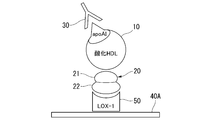
- the quantification of the complex of denatured HDL, denatured HDL binding protein and LOX-1 protein can be performed using a so-called sandwich ELISA.
- the outline of the quantification method of this embodiment is shown in FIG.
- LOX-1 protein 50 is immobilized on the plate 40A.
- the denatured HDL-binding protein 20 is bound to the LOX-1 protein 50 on the plate 40A.
- the denatured HDL10 is bound to the complex of the LOX-1 protein 50 and the denatured HDL-binding protein 20.
- the complex on plate 40A can then be quantified with the denatured HDL described above or the antibody 30 that binds to the complex.
- An anti-Factor-V antibody can also be used as the antibody 30.
- serum may be used as a sample, and the sample may be provided with a step of adding the modified HDL-binding protein.
- a complex in which the modified HDL-binding protein and the modified HDL are bound is formed on the LOX-1 on the ELISA plate, and the ELISA plate is formed.
- the above conjugate can be quantified with the modified HDL described above or an antibody that binds to the complex.
- the analytical reagent used in the quantification method of the present embodiment may contain a recombinant LOX-1 protein for quantification of denatured HDL having pathological activity.
- the recombinant LOX-1 protein interacts with the denatured HDL, so that the denatured HDL can be quantified by immunoassay for the complex of the denatured HDL, the denatured HDL binding protein and the LOX-1. It can be carried out.
- the analytical reagent of the present embodiment may be provided as a kit having a plurality of the above configurations.
- the kit may include an analytical reagent containing a modified HDL binding protein and an analytical reagent containing a LOX-1 protein for the quantification of modified HDL.
- the ELISA method was carried out according to the following procedure. Recombinant human LOX-1 (61-273aa) was immobilized on a 384-well plate at 0.15 ⁇ g / well. After washing twice with PBS, blocking was performed with 1% casein-Na. After washing 3 times with PBS, plasma or serum samples supplemented with Factor V were incubated at room temperature for 2 hours. As the sample diluent, 1% casein-Na, 10 mM HEPES, 150 mM NaCl, pH 7.4, 100 ⁇ M APMSF was used.
- the anti-apyerA1 antibody (chicken # 1) prepared at 1 ⁇ g / ml was added after washing 3 times with PBS, and the mixture was incubated at room temperature for 1 hour.
- HRP-labeled anti-chicken IgY antibody diluted 3 times with PBS and diluted 4000-fold was added and incubated at room temperature for 1 hour.
- the mixture was washed 5 times with PBS, a TMB solution (manufactured by Bio-Rad) was added to a plate, and the reaction was carried out at room temperature. The reaction was stopped with 2M sulfuric acid, and the absorbance at 450 nm was measured.
- the modified HDL concentration (ng / ml) was calculated using a calibration curve prepared using oxidized HDL oxidized with copper sulfate as a standard product.
- FIG. 3 The detection result by the ELISA method is shown in FIG. 3 (a), (b), (c), (d), and (e) show plasma (plasma) and serum (serum) collected from different subjects (A, B, C, D, E), respectively. The result was shown.
- the complex on the vertical axis is resistant to denatured HDL (including those in which the binding of LOX-1 denatured HDL is mediated by other proteins) that has formed some complex with immobilized LOX-1.
- the concentration detected by the ap republicA1 antibody is shown, and the horizontal axis shows the concentration of added Factor V.
- serum as shown in FIGS.
- plasma may contain proteins such as Factor V that mediate the binding of LOX-1 and denatured HDL, but the content differs depending on the sample, its collection, storage method, etc., and Factor V is added. It is thought that the effects of Based on these results, Factor V binds to modified HDL, and modified HDL and LOX-1 are bound via Factor V, and this binding is performed depending on the amount of Factor V added. It was shown that the detection sensitivity was improved.
- proteins such as Factor V that mediate the binding of LOX-1 and denatured HDL
- FIGS. 4 to 7 when a plate on which LOX-1 is not immobilized is used, there is no difference in the detected amount between the case where Factor V is added to the sample and the case where Factor V is not added to the sample. From this result, it is shown that Factor V increases the amount of detection of LOX-1, Factor V and modified HDL binding to form a complex. Comparing FIGS. 4 and 5 and FIGS. 6 and 7, in FIGS. 5 and 7 using serum, the amount of detection increased by adding Factor V, as opposed to FIGS. 4 and 6 using plasma. ing. As for this result, as in Test Example 1, it is considered that the substance that seems not to be contained in the serum is supplemented by the addition of Factor V.
- nHDL unmodified HDL
- modified HDL As the modified HDL, Cu 2+ - réellexHDL, which is an oxidized HDL obtained by oxidizing HDL with copper sulfate, was used.
- Factor V was immobilized on a 384-well plate (manufactured by greener). After washing twice with PBS, blocking was performed with 1% casein-Na.
- nHDL or Cu 2+ - etcxHDL prepared at 1 ⁇ g / ml with sample diluent (1% casein-Na, 10 mM HEPES, 150 mM NaCl, pH 7.4, 100 ⁇ M APMSF) is incubated at room temperature for 2 hours. bottom.
- sample diluent 1% casein-Na, 10 mM HEPES, 150 mM NaCl, pH 7.4, 100 ⁇ M APMSF
- the anti-apsteadA1 antibody (chicken # 1) prepared at 1 ⁇ g / ml was added after washing 3 times with PBS, and the mixture was incubated at room temperature for 1 hour.
- HRP-labeled anti-chicken IgY antibody diluted 3 times with PBS and diluted 4000-fold was added and incubated at room temperature for 1 hour.
- the mixture was washed 5 times with PBS, a TMB solution (manufactured by Bio-Rad) was added to a plate, and the reaction was carried out at room temperature. The reaction was stopped with 2M sulfuric acid, and the absorbance at 450 nm was measured.
- Test Example 4 Denatured HDL in human plasma and serum was detected using a Factor V-immobilized plate prepared in the same manner as in Test Example 3. Denatured HDL was quantified by the ELISA method using plasma and serum samples collected from subjects X and Y. Factor V was immobilized on a 384-well plate (manufactured by greener). After washing twice with PBS, blocking was performed with 1% casein-Na. After washing 3 times with PBS, plasma or serum samples were incubated at room temperature for 2 hours. The anti-apyerA1 antibody (chicken # 1) prepared at 1 ⁇ g / ml was added after washing 3 times with PBS, and the mixture was incubated at room temperature for 1 hour.
- HRP-labeled anti-chicken IgY antibody diluted 3 times with PBS and diluted 4000-fold was added and incubated at room temperature for 1 hour. After the antibody reaction, the mixture was washed 5 times with PBS, a TMB solution (manufactured by Bio-Rad) was added to a plate, and the reaction was carried out at room temperature. The reaction was stopped with 2M sulfuric acid, and the absorbance at 450 nm was measured.
- FIG. 10 The sample collected from the subject X is shown in FIG. 10 (a), and the sample collected from the subject Y is shown in FIG. 10 (b).
- LOX-1 solid phase in the prior art
- This technique is more sensitive than the technique of immobilizing LOX-1, and not only can be more easily quantified than the sandwich method using LOX-1 and Factor V, but also for both plasma and serum.
- quantification can be performed stably and reliably with high sensitivity.
- a method for quantifying modified HDL capable of quantifying modified HDL more stably and accurately than before, and an analytical reagent used for the quantification method can be obtained.
- This quantification method and analytical reagent can be used for determining the risk or degree of progression of morbidity to cardiovascular disease, diabetes and diabetic disease.
Landscapes
- Health & Medical Sciences (AREA)
- Life Sciences & Earth Sciences (AREA)
- Molecular Biology (AREA)
- Chemical & Material Sciences (AREA)
- Engineering & Computer Science (AREA)
- Hematology (AREA)
- Urology & Nephrology (AREA)
- Biomedical Technology (AREA)
- Immunology (AREA)
- Biochemistry (AREA)
- Biophysics (AREA)
- General Health & Medical Sciences (AREA)
- Medicinal Chemistry (AREA)
- Microbiology (AREA)
- General Physics & Mathematics (AREA)
- Endocrinology (AREA)
- Pathology (AREA)
- Analytical Chemistry (AREA)
- Biotechnology (AREA)
- Cell Biology (AREA)
- Physics & Mathematics (AREA)
- Food Science & Technology (AREA)
- Organic Chemistry (AREA)
- Toxicology (AREA)
- Zoology (AREA)
- Gastroenterology & Hepatology (AREA)
- Genetics & Genomics (AREA)
- Proteomics, Peptides & Aminoacids (AREA)
- Investigating Or Analysing Biological Materials (AREA)
- Peptides Or Proteins (AREA)
Priority Applications (4)
| Application Number | Priority Date | Filing Date | Title |
|---|---|---|---|
| CN202180037523.1A CN115698713A (zh) | 2020-03-30 | 2021-03-29 | 改性hdl的定量方法以及用于该定量方法的分析用试剂 |
| JP2022512194A JP7628320B2 (ja) | 2020-03-30 | 2021-03-29 | 変性hdlの定量方法、及びそれに用いる分析用試薬 |
| US17/907,746 US20230288437A1 (en) | 2020-03-30 | 2021-03-29 | Quantification method for modified hdl, and analysis reagent for use in same method |
| EP21781075.3A EP4130030A4 (en) | 2020-03-30 | 2021-03-29 | Quantification method for modified hdl, and analysis reagent for use in same method |
Applications Claiming Priority (2)
| Application Number | Priority Date | Filing Date | Title |
|---|---|---|---|
| JP2020059965 | 2020-03-30 | ||
| JP2020-059965 | 2020-03-30 |
Publications (1)
| Publication Number | Publication Date |
|---|---|
| WO2021200797A1 true WO2021200797A1 (ja) | 2021-10-07 |
Family
ID=77929007
Family Applications (1)
| Application Number | Title | Priority Date | Filing Date |
|---|---|---|---|
| PCT/JP2021/013229 Ceased WO2021200797A1 (ja) | 2020-03-30 | 2021-03-29 | 変性hdlの定量方法、及びそれに用いる分析用試薬 |
Country Status (5)
| Country | Link |
|---|---|
| US (1) | US20230288437A1 (https=) |
| EP (1) | EP4130030A4 (https=) |
| JP (1) | JP7628320B2 (https=) |
| CN (1) | CN115698713A (https=) |
| WO (1) | WO2021200797A1 (https=) |
Citations (11)
| Publication number | Priority date | Publication date | Assignee | Title |
|---|---|---|---|---|
| JPH0933525A (ja) * | 1995-07-21 | 1997-02-07 | Yamasa Shoyu Co Ltd | 酸化hdlの測定法及びキット |
| JPH0998787A (ja) | 1994-11-30 | 1997-04-15 | Nippon Chemiphar Co Ltd | 変性低密度リポ蛋白質受容体 |
| WO2003006989A1 (fr) * | 2001-07-12 | 2003-01-23 | Kyowa Medex Co., Ltd. | Procede de quantification de lipoproteines denaturees, reactifs pour la quantification de lipoproteines denaturees, procede de detection de maladies du systeme circulatoire et reactifs pour la detection de maladies du systeme circulatoire |
| US20100055796A1 (en) * | 2007-04-11 | 2010-03-04 | Markku Ahotupa | Estimation and biological consequences of oxidative metabolism |
| JP4671823B2 (ja) * | 2004-09-27 | 2011-04-20 | シスメックス株式会社 | 血液凝固因子の不活化方法及び血液凝固因子不活化試料 |
| JP2012100585A (ja) | 2010-11-10 | 2012-05-31 | National Cerebral & Cardiovascular Center | 融合タンパク質、核酸、ベクター、細胞、labの測定方法、並びに、lab測定用キット |
| WO2015098901A1 (ja) * | 2013-12-27 | 2015-07-02 | 独立行政法人国立循環器病研究センター | 抗血液凝固剤 |
| JP6231307B2 (ja) | 2013-06-27 | 2017-11-15 | 中野 恵正 | 機能不全hdlの測定方法、機能不全hdl測定用キット、並びに、生活習慣病マーカーの測定方法 |
| JP2018024007A (ja) | 2016-08-12 | 2018-02-15 | 旭サナック株式会社 | ワーク姿勢変更装置および多工程圧造機 |
| WO2018079674A1 (ja) * | 2016-10-31 | 2018-05-03 | 国立大学法人大阪大学 | 脂質異常症治療が必要な被検者の選別方法及び選別用試薬 |
| WO2019159934A1 (ja) * | 2018-02-14 | 2019-08-22 | 国立大学法人信州大学 | 融合タンパク質、及びそれを用いた高密度リポタンパク質の測定キット |
Family Cites Families (3)
| Publication number | Priority date | Publication date | Assignee | Title |
|---|---|---|---|---|
| ATE512982T1 (de) * | 2001-08-17 | 2011-07-15 | Exothera L L C | Verfahren und zusammensetzung zum gezielten einbringen in exosome |
| JP2003279571A (ja) * | 2002-03-20 | 2003-10-02 | Kyowa Hakko Kogyo Co Ltd | 炎症性疾患検出方法、検出薬、およびその予防治療薬探索方法 |
| CN109580960A (zh) * | 2019-01-14 | 2019-04-05 | 周明 | 细胞外囊泡的分离方法、以及检测细胞外囊泡表面标志物的方法和试剂盒 |
-
2021
- 2021-03-29 US US17/907,746 patent/US20230288437A1/en active Pending
- 2021-03-29 EP EP21781075.3A patent/EP4130030A4/en active Pending
- 2021-03-29 CN CN202180037523.1A patent/CN115698713A/zh active Pending
- 2021-03-29 WO PCT/JP2021/013229 patent/WO2021200797A1/ja not_active Ceased
- 2021-03-29 JP JP2022512194A patent/JP7628320B2/ja active Active
Patent Citations (11)
| Publication number | Priority date | Publication date | Assignee | Title |
|---|---|---|---|---|
| JPH0998787A (ja) | 1994-11-30 | 1997-04-15 | Nippon Chemiphar Co Ltd | 変性低密度リポ蛋白質受容体 |
| JPH0933525A (ja) * | 1995-07-21 | 1997-02-07 | Yamasa Shoyu Co Ltd | 酸化hdlの測定法及びキット |
| WO2003006989A1 (fr) * | 2001-07-12 | 2003-01-23 | Kyowa Medex Co., Ltd. | Procede de quantification de lipoproteines denaturees, reactifs pour la quantification de lipoproteines denaturees, procede de detection de maladies du systeme circulatoire et reactifs pour la detection de maladies du systeme circulatoire |
| JP4671823B2 (ja) * | 2004-09-27 | 2011-04-20 | シスメックス株式会社 | 血液凝固因子の不活化方法及び血液凝固因子不活化試料 |
| US20100055796A1 (en) * | 2007-04-11 | 2010-03-04 | Markku Ahotupa | Estimation and biological consequences of oxidative metabolism |
| JP2012100585A (ja) | 2010-11-10 | 2012-05-31 | National Cerebral & Cardiovascular Center | 融合タンパク質、核酸、ベクター、細胞、labの測定方法、並びに、lab測定用キット |
| JP6231307B2 (ja) | 2013-06-27 | 2017-11-15 | 中野 恵正 | 機能不全hdlの測定方法、機能不全hdl測定用キット、並びに、生活習慣病マーカーの測定方法 |
| WO2015098901A1 (ja) * | 2013-12-27 | 2015-07-02 | 独立行政法人国立循環器病研究センター | 抗血液凝固剤 |
| JP2018024007A (ja) | 2016-08-12 | 2018-02-15 | 旭サナック株式会社 | ワーク姿勢変更装置および多工程圧造機 |
| WO2018079674A1 (ja) * | 2016-10-31 | 2018-05-03 | 国立大学法人大阪大学 | 脂質異常症治療が必要な被検者の選別方法及び選別用試薬 |
| WO2019159934A1 (ja) * | 2018-02-14 | 2019-08-22 | 国立大学法人信州大学 | 融合タンパク質、及びそれを用いた高密度リポタンパク質の測定キット |
Non-Patent Citations (6)
| Title |
|---|
| HIRATA, A. ET AL.: "The relationship between serum levels of LOX-1 ligand containing ApoAI as a novel marker of dysfunctional HDL and coronary artery calcification in middle-aged Japanese men", ATHEROSCLEROSIS, vol. 313, 23 September 2020 (2020-09-23), pages 20 - 25, XP086337054, DOI: 10.1016/j.atherosclerosis.2020.09.013 * |
| KAKINO, A. ET AL.: "A Novel Cell -free, Non- fluorescent Method to Measure LOX-1-Binding Activity Corresponding to The Functional Activity of HDL", JOURNAL OF ATHEROSCLEROSIS AND THROMBOSIS, vol. 26, no. 11, 2019, pages 947 - 958, XP055853034, DOI: 10.5551/jat.47183 * |
| KAKINO, A. ET AL.: "A NOVEL METHOD TO QUANTIFY THE BIOLOCICAL ACTIVITY OF MODIFIED HDL", INTERNATIONAL SYMPOSIUM ON ATHEROSCLEROSIS (ISA) 2018 ABSTRACT BOOK, vol. 32, 5 June 2018 (2018-06-05), pages 35, XP055635076 * |
| KAKINO, AKEMI: "2P-386 Development of a novel method to measure modified HDL activity", 92ND ANNUAL MEETING OF THE JAPANESE BIOCHEMICAL SOCIETY; SEPTEMBER 18-20, 2019, vol. 92, 30 November 2018 (2018-11-30), JP, pages 706 - 707, XP009541009 * |
| SAWAMURA T ET AL., NATURE, vol. 386, 1997, pages 73 - 77 |
| See also references of EP4130030A4 |
Also Published As
| Publication number | Publication date |
|---|---|
| EP4130030A4 (en) | 2024-03-27 |
| EP4130030A1 (en) | 2023-02-08 |
| JP7628320B2 (ja) | 2025-02-10 |
| CN115698713A (zh) | 2023-02-03 |
| US20230288437A1 (en) | 2023-09-14 |
| JPWO2021200797A1 (https=) | 2021-10-07 |
Similar Documents
| Publication | Publication Date | Title |
|---|---|---|
| US20240103018A1 (en) | Galectin-3 immunoassay | |
| WO2007103568A2 (en) | Methods and compositions for the diagnosis of diseases of the aorta | |
| US20100323376A1 (en) | Method for Measuring Lipoprotein-Specific Apolipoproteins | |
| EP2095106A2 (en) | Methods and compositions for diagnosis and prognosis of renal artery stenosis | |
| JP2008102129A (ja) | 急性肺塞栓症用生化学マーカー | |
| JP6231307B2 (ja) | 機能不全hdlの測定方法、機能不全hdl測定用キット、並びに、生活習慣病マーカーの測定方法 | |
| JP4523587B2 (ja) | A型及びb型急性大動脈解離と急性心筋梗塞の鑑別方法及び鑑別用キット | |
| US20060234315A1 (en) | Markers for sudden death in heart failure | |
| US7659125B2 (en) | Latex reagent for adiponectin analysis and method of adiponectin analysis | |
| JP7628320B2 (ja) | 変性hdlの定量方法、及びそれに用いる分析用試薬 | |
| Lin et al. | Positive interference from contrast media in cardiac troponin I immunoassays | |
| JP7719507B2 (ja) | アディポネクチンの定量方法及びそれに用いる分析用試薬 | |
| WO2004111645A1 (ja) | 急性大動脈解離の判定方法及び判定用試薬 | |
| JP2011038858A (ja) | 血栓症の早期診断のための検査方法と検査試薬およびキット | |
| WO2009099228A1 (ja) | 心不全の予知および検査方法と検査試薬およびキット | |
| JP2008516218A (ja) | 急性冠症候群の疑いを除外するinvitro診断方法 | |
| WO2007119481A1 (ja) | 血中腸型脂肪酸結合蛋白測定による急性腸炎診断 | |
| Bock | Test strategies for the detection of myocardial damage | |
| EP2860527A1 (en) | Marker for acute coronary syndrome, and use thereof | |
| JP2006343127A (ja) | 代謝性症候群マーカーおよびその利用 | |
| JP2006337322A (ja) | 血栓形成マーカーおよびその利用 |
Legal Events
| Date | Code | Title | Description |
|---|---|---|---|
| 121 | Ep: the epo has been informed by wipo that ep was designated in this application |
Ref document number: 21781075 Country of ref document: EP Kind code of ref document: A1 |
|
| ENP | Entry into the national phase |
Ref document number: 2022512194 Country of ref document: JP Kind code of ref document: A |
|
| NENP | Non-entry into the national phase |
Ref country code: DE |
|
| ENP | Entry into the national phase |
Ref document number: 2021781075 Country of ref document: EP Effective date: 20221031 |