WO2021199469A1 - 巻線機、およびコイルの製造方法 - Google Patents
巻線機、およびコイルの製造方法 Download PDFInfo
- Publication number
- WO2021199469A1 WO2021199469A1 PCT/JP2020/039027 JP2020039027W WO2021199469A1 WO 2021199469 A1 WO2021199469 A1 WO 2021199469A1 JP 2020039027 W JP2020039027 W JP 2020039027W WO 2021199469 A1 WO2021199469 A1 WO 2021199469A1
- Authority
- WO
- WIPO (PCT)
- Prior art keywords
- winding
- gripping member
- central axis
- motor
- pair
- Prior art date
- Legal status (The legal status is an assumption and is not a legal conclusion. Google has not performed a legal analysis and makes no representation as to the accuracy of the status listed.)
- Ceased
Links
Images





Classifications
-
- H—ELECTRICITY
- H01—ELECTRIC ELEMENTS
- H01F—MAGNETS; INDUCTANCES; TRANSFORMERS; SELECTION OF MATERIALS FOR THEIR MAGNETIC PROPERTIES
- H01F41/00—Apparatus or processes specially adapted for manufacturing or assembling magnets, inductances or transformers; Apparatus or processes specially adapted for manufacturing materials characterised by their magnetic properties
- H01F41/02—Apparatus or processes specially adapted for manufacturing or assembling magnets, inductances or transformers; Apparatus or processes specially adapted for manufacturing materials characterised by their magnetic properties for manufacturing cores, coils, or magnets
- H01F41/04—Apparatus or processes specially adapted for manufacturing or assembling magnets, inductances or transformers; Apparatus or processes specially adapted for manufacturing materials characterised by their magnetic properties for manufacturing cores, coils, or magnets for manufacturing coils
- H01F41/06—Coil winding
- H01F41/082—Devices for guiding or positioning the winding material on the former
- H01F41/088—Devices for guiding or positioning the winding material on the former using revolving flyers
-
- H—ELECTRICITY
- H01—ELECTRIC ELEMENTS
- H01F—MAGNETS; INDUCTANCES; TRANSFORMERS; SELECTION OF MATERIALS FOR THEIR MAGNETIC PROPERTIES
- H01F41/00—Apparatus or processes specially adapted for manufacturing or assembling magnets, inductances or transformers; Apparatus or processes specially adapted for manufacturing materials characterised by their magnetic properties
- H01F41/02—Apparatus or processes specially adapted for manufacturing or assembling magnets, inductances or transformers; Apparatus or processes specially adapted for manufacturing materials characterised by their magnetic properties for manufacturing cores, coils, or magnets
- H01F41/04—Apparatus or processes specially adapted for manufacturing or assembling magnets, inductances or transformers; Apparatus or processes specially adapted for manufacturing materials characterised by their magnetic properties for manufacturing cores, coils, or magnets for manufacturing coils
- H01F41/06—Coil winding
- H01F41/061—Winding flat conductive wires or sheets
-
- H—ELECTRICITY
- H01—ELECTRIC ELEMENTS
- H01F—MAGNETS; INDUCTANCES; TRANSFORMERS; SELECTION OF MATERIALS FOR THEIR MAGNETIC PROPERTIES
- H01F41/00—Apparatus or processes specially adapted for manufacturing or assembling magnets, inductances or transformers; Apparatus or processes specially adapted for manufacturing materials characterised by their magnetic properties
- H01F41/02—Apparatus or processes specially adapted for manufacturing or assembling magnets, inductances or transformers; Apparatus or processes specially adapted for manufacturing materials characterised by their magnetic properties for manufacturing cores, coils, or magnets
- H01F41/04—Apparatus or processes specially adapted for manufacturing or assembling magnets, inductances or transformers; Apparatus or processes specially adapted for manufacturing materials characterised by their magnetic properties for manufacturing cores, coils, or magnets for manufacturing coils
- H01F41/06—Coil winding
- H01F41/061—Winding flat conductive wires or sheets
- H01F41/063—Winding flat conductive wires or sheets with insulation
-
- H—ELECTRICITY
- H01—ELECTRIC ELEMENTS
- H01F—MAGNETS; INDUCTANCES; TRANSFORMERS; SELECTION OF MATERIALS FOR THEIR MAGNETIC PROPERTIES
- H01F41/00—Apparatus or processes specially adapted for manufacturing or assembling magnets, inductances or transformers; Apparatus or processes specially adapted for manufacturing materials characterised by their magnetic properties
- H01F41/02—Apparatus or processes specially adapted for manufacturing or assembling magnets, inductances or transformers; Apparatus or processes specially adapted for manufacturing materials characterised by their magnetic properties for manufacturing cores, coils, or magnets
- H01F41/04—Apparatus or processes specially adapted for manufacturing or assembling magnets, inductances or transformers; Apparatus or processes specially adapted for manufacturing materials characterised by their magnetic properties for manufacturing cores, coils, or magnets for manufacturing coils
- H01F41/06—Coil winding
- H01F41/071—Winding coils of special form
-
- H—ELECTRICITY
- H01—ELECTRIC ELEMENTS
- H01F—MAGNETS; INDUCTANCES; TRANSFORMERS; SELECTION OF MATERIALS FOR THEIR MAGNETIC PROPERTIES
- H01F41/00—Apparatus or processes specially adapted for manufacturing or assembling magnets, inductances or transformers; Apparatus or processes specially adapted for manufacturing materials characterised by their magnetic properties
- H01F41/02—Apparatus or processes specially adapted for manufacturing or assembling magnets, inductances or transformers; Apparatus or processes specially adapted for manufacturing materials characterised by their magnetic properties for manufacturing cores, coils, or magnets
- H01F41/04—Apparatus or processes specially adapted for manufacturing or assembling magnets, inductances or transformers; Apparatus or processes specially adapted for manufacturing materials characterised by their magnetic properties for manufacturing cores, coils, or magnets for manufacturing coils
- H01F41/06—Coil winding
- H01F41/071—Winding coils of special form
- H01F41/073—Winding onto elongate formers
-
- H—ELECTRICITY
- H01—ELECTRIC ELEMENTS
- H01F—MAGNETS; INDUCTANCES; TRANSFORMERS; SELECTION OF MATERIALS FOR THEIR MAGNETIC PROPERTIES
- H01F41/00—Apparatus or processes specially adapted for manufacturing or assembling magnets, inductances or transformers; Apparatus or processes specially adapted for manufacturing materials characterised by their magnetic properties
- H01F41/02—Apparatus or processes specially adapted for manufacturing or assembling magnets, inductances or transformers; Apparatus or processes specially adapted for manufacturing materials characterised by their magnetic properties for manufacturing cores, coils, or magnets
- H01F41/04—Apparatus or processes specially adapted for manufacturing or assembling magnets, inductances or transformers; Apparatus or processes specially adapted for manufacturing materials characterised by their magnetic properties for manufacturing cores, coils, or magnets for manufacturing coils
- H01F41/06—Coil winding
- H01F41/09—Winding machines having two or more work holders or formers
-
- H—ELECTRICITY
- H01—ELECTRIC ELEMENTS
- H01F—MAGNETS; INDUCTANCES; TRANSFORMERS; SELECTION OF MATERIALS FOR THEIR MAGNETIC PROPERTIES
- H01F41/00—Apparatus or processes specially adapted for manufacturing or assembling magnets, inductances or transformers; Apparatus or processes specially adapted for manufacturing materials characterised by their magnetic properties
- H01F41/02—Apparatus or processes specially adapted for manufacturing or assembling magnets, inductances or transformers; Apparatus or processes specially adapted for manufacturing materials characterised by their magnetic properties for manufacturing cores, coils, or magnets
- H01F41/04—Apparatus or processes specially adapted for manufacturing or assembling magnets, inductances or transformers; Apparatus or processes specially adapted for manufacturing materials characterised by their magnetic properties for manufacturing cores, coils, or magnets for manufacturing coils
- H01F41/06—Coil winding
- H01F41/09—Winding machines having two or more work holders or formers
- H01F41/092—Turrets; Turntables
-
- H—ELECTRICITY
- H01—ELECTRIC ELEMENTS
- H01F—MAGNETS; INDUCTANCES; TRANSFORMERS; SELECTION OF MATERIALS FOR THEIR MAGNETIC PROPERTIES
- H01F41/00—Apparatus or processes specially adapted for manufacturing or assembling magnets, inductances or transformers; Apparatus or processes specially adapted for manufacturing materials characterised by their magnetic properties
- H01F41/02—Apparatus or processes specially adapted for manufacturing or assembling magnets, inductances or transformers; Apparatus or processes specially adapted for manufacturing materials characterised by their magnetic properties for manufacturing cores, coils, or magnets
- H01F41/04—Apparatus or processes specially adapted for manufacturing or assembling magnets, inductances or transformers; Apparatus or processes specially adapted for manufacturing materials characterised by their magnetic properties for manufacturing cores, coils, or magnets for manufacturing coils
- H01F41/06—Coil winding
- H01F41/094—Tensioning or braking devices
-
- H—ELECTRICITY
- H02—GENERATION; CONVERSION OR DISTRIBUTION OF ELECTRIC POWER
- H02K—DYNAMO-ELECTRIC MACHINES
- H02K15/00—Processes or apparatus specially adapted for manufacturing, assembling, maintaining or repairing of dynamo-electric machines
- H02K15/04—Processes or apparatus specially adapted for manufacturing, assembling, maintaining or repairing of dynamo-electric machines of windings prior to their mounting into the machines
-
- H—ELECTRICITY
- H02—GENERATION; CONVERSION OR DISTRIBUTION OF ELECTRIC POWER
- H02K—DYNAMO-ELECTRIC MACHINES
- H02K15/00—Processes or apparatus specially adapted for manufacturing, assembling, maintaining or repairing of dynamo-electric machines
- H02K15/04—Processes or apparatus specially adapted for manufacturing, assembling, maintaining or repairing of dynamo-electric machines of windings prior to their mounting into the machines
- H02K15/043—Processes or apparatus specially adapted for manufacturing, assembling, maintaining or repairing of dynamo-electric machines of windings prior to their mounting into the machines winding flat conductive wires or sheets
-
- Y—GENERAL TAGGING OF NEW TECHNOLOGICAL DEVELOPMENTS; GENERAL TAGGING OF CROSS-SECTIONAL TECHNOLOGIES SPANNING OVER SEVERAL SECTIONS OF THE IPC; TECHNICAL SUBJECTS COVERED BY FORMER USPC CROSS-REFERENCE ART COLLECTIONS [XRACs] AND DIGESTS
- Y02—TECHNOLOGIES OR APPLICATIONS FOR MITIGATION OR ADAPTATION AGAINST CLIMATE CHANGE
- Y02P—CLIMATE CHANGE MITIGATION TECHNOLOGIES IN THE PRODUCTION OR PROCESSING OF GOODS
- Y02P70/00—Climate change mitigation technologies in the production process for final industrial or consumer products
- Y02P70/50—Manufacturing or production processes characterised by the final manufactured product
Definitions
- the present invention relates to a winding machine and a method for manufacturing a coil.
- Japanese Patent Application Laid-Open No. 2012-139098 describes a method for manufacturing a coil that winds a coil while holding the winding by moving the wire rod guide holding portion according to the timing at which the winding is wound. Has been done.
- one object of the present invention is to provide a winding machine capable of suitably manufacturing a coil with a simple structure, and a method for manufacturing a coil using such a winding machine.
- One aspect of the winding machine of the present invention is a winding core around which the winding is wound, a first winding jig and a second winding jig arranged so as to sandwich the winding core in the axial direction of the central axis of the winding core.
- a winding jig and a first gripping member and a second gripping member located outside the winding core in the radial direction about the central axis are provided.
- the radial outer edge portion of the first winding jig and the radial outer edge portion of the second winding jig are located outside the winding core in the radial direction.
- Each of the first gripping member and the second gripping member has a pair of rollers that can grip the windings. At least one of the first gripping member and the second gripping member is rotatable about the central axis. Twice
- One aspect of the method for manufacturing a coil of the present invention includes a step of winding a winding using the above-mentioned winding machine.
- the coil can be suitably manufactured while the winding machine has a simple structure.
- FIG. 1 is a cross-sectional view schematically showing the motor of the present embodiment.
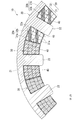
- FIG. 2 is a cross-sectional view showing a part of the stator of the present embodiment, and is a cross-sectional view taken along the line II-II in FIG.
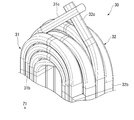
- FIG. 3 is a perspective view showing a part of the coil of the present embodiment.
- FIG. 4 is a flowchart showing a procedure in the coil manufacturing method of the present embodiment.
- FIG. 5 is a cross-sectional view showing a part of the procedure in the coil manufacturing method of the present embodiment.
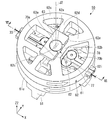
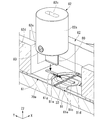
- FIG. 6 is a perspective view showing the winding machine of the present embodiment.
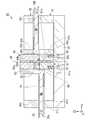
- FIG. 7 is a cross-sectional view showing the winding machine of the present embodiment, and is a cross-sectional view taken along the line VII-VII in FIG.
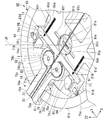
- FIG. 8 is a perspective view showing a state in which the winding machine of the present embodiment is being assembled.
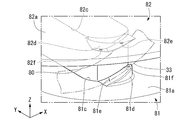
- FIG. 9 is a perspective view showing the first guide portion and the second guide portion of the present embodiment.
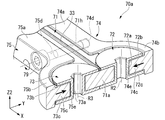
- FIG. 10 is a perspective sectional view showing a part of the first gripping member of the present embodiment.
- FIG. 11 is a perspective cross-sectional view showing a part of the first gripping member of the present embodiment, and is a partially enlarged view of FIG.
- FIG. 12 is a perspective sectional view showing a part of the assembling procedure of the winding machine of the present embodiment.
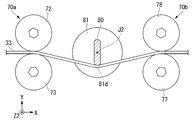
- FIG. 13 is a diagram showing a part of a winding winding procedure using the winding machine of the present embodiment.
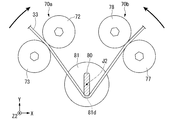
- FIG. 14 is a diagram showing another part of the winding winding procedure using the winding machine of the present embodiment.
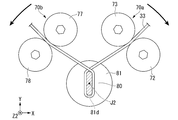
- FIG. 15 is a diagram showing still another part of the winding winding procedure using the winding machine of the present embodiment.
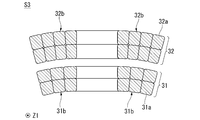
- FIG. 16 is a partial cross-sectional view showing a state in which the winding is wound around the winding core of the present embodiment.
- FIG. 17 is a perspective view showing a part of the second winding body of the present embodiment.
- FIG. 18 is a cross-sectional view showing another part of the procedure in the coil manufacturing method of the present embodiment.
- the motor 1 of the present embodiment is an inner rotor type motor.
- the central shaft of the motor 1 is the motor shaft J1.
- the motor shaft J1 is a virtual shaft extending in one direction. In each figure, the direction in which the motor shaft J1 extends is indicated by the Z1 shaft.
- the axial direction of the motor shaft J1 is referred to as “motor axial direction”
- the radial direction centered on the motor shaft J1 is referred to as “motor radial direction”
- the circumferential direction centered on the motor shaft J1 is referred to as "motor shaft direction”. It is called "motor circumferential direction”. Twice
- the motor 1 includes a housing 2, a rotor 3, a stator 10, a bearing holder 4, and bearings 5a and 5b.
- the housing 2 houses the rotor 3, the stator 10, the bearing holder 4, and the bearings 5a and 5b.
- the rotor 3 can rotate about the motor shaft J1.
- the rotor 3 has a shaft 3a and a rotor body 3b. Twice
- the shaft 3a extends in the motor shaft direction along the motor shaft J1.
- the shaft 3a is, for example, a columnar shape extending in the motor axis direction about the motor shaft J1.
- the shaft 3a is rotatably supported around the motor shaft J1 by bearings 5a and 5b.
- the rotor body 3b is fixed to the outer peripheral surface of the shaft 3a.
- the rotor body 3b has a rotor core fixed to the outer peripheral surface of the shaft 3a and a magnet fixed to the rotor core.
- the bearing holder 4 holds the bearing 5b. Twice
- the stator 10 faces the rotor 3 in the radial direction of the motor via a gap.
- the stator 10 is located on the outer side of the rotor 3 in the motor radial direction.
- the stator 10 has a stator core 20, a plurality of coils 30, and an insulator 40.
- the stator core 20 has an annular core back 21 that surrounds the motor shaft J1 and a plurality of teeth 22 that extend inward in the radial direction of the motor from the core back 21.
- the core back 21 has, for example, a cylindrical shape centered on the motor shaft J1. Twice
- the plurality of teeth 22 are arranged at intervals along the circumferential direction of the motor.
- the plurality of teeth 22 are arranged at equal intervals, for example, along the circumferential direction of the motor.
- the plurality of teeth 22 are integrally molded with the core back 21.
- Each tooth 22 has a substantially rectangular parallelepiped shape extending linearly along the radial direction of the motor.
- the dimensions of the teeth 22 in the circumferential direction of the motor are substantially constant over the entire radial direction of the motor. Twice
- Umbrella portions protruding on both sides in the circumferential direction of the motor may be provided at the inner end portion of the teeth 22 in the radial direction of the motor.
- the teeth 22 may be a separate member from the core back 21.
- the teeth 22 has a core back, for example, by press-fitting a convex portion provided at the outer end portion of the teeth 22 in the motor radial direction into a concave portion provided on the inner side surface of the core back 21 in the motor radial direction. It may be fixed to 21. Twice
- the plurality of coils 30 are mounted on the plurality of teeth 22 respectively.
- the coil 30 is attached to the teeth 22 via the insulator 40.
- each tooth 22 is passed in the radial direction of the motor.
- the inner end of the teeth 22 in the motor radial direction protrudes inward in the motor radial direction from the coil 30. Twice
- the coil 30 is configured by winding a flat wire. Therefore, the space factor of the coil 30 can be improved as compared with the case of using a round wire.
- a "flat wire” is a wire rod having a quadrangular cross-sectional shape or a substantially quadrangular cross-sectional shape. As used herein, the term “substantially square” includes a square with rounded corners.
- the flat wire constituting the coil 30 in the present embodiment is an enamel wire having an enamel coating on its surface. Twice
- the coil 30 includes a pair of axially extending portions 30b extending in the motor axial direction on both sides of the teeth 22 on which the coil 30 is mounted in the circumferential direction of the motor.
- the pair of axially extending portions 30b sandwich the teeth 22 in the circumferential direction of the motor.
- the axial extension portion 30b is formed by bundling a plurality of flat wires constituting the coil 30.
- the contour shape of the axially extended portion 30b in the cross section orthogonal to the motor axial direction is, for example, a fan shape in which the dimension in the circumferential direction of the motor decreases toward the inside in the radial direction of the motor. Twice
- the "fan shape” refers to two arcs having the same center of curvature but different radii, and two arcs extending in the radial direction of a circle centered on the center of curvature and connecting both ends of the two arcs. Includes shapes surrounded by lines. Further, in the present specification, the "fan shape” includes a case where the shape is strictly a fan shape and a case where the shape is a substantially fan shape. As used herein, the term "substantially fan-shaped” includes a shape in which a fan-shaped arc is approximated by a plurality of line segments.
- the contour shape of the axially extended portion 30b in the cross section orthogonal to the motor axial direction is a shape surrounded by the above-mentioned two arcs and two line segments.
- the center of curvature of the contour shape of the axially extended portion 30b in the cross section orthogonal to the motor axial direction is located inside the core back 21 in the motor radial direction and is located at a position different from that of the motor shaft J1. Twice
- the coil 30 includes a first winding body 31 and a second winding body 32.
- the first winding body 31 and the second winding body 32 are each formed by winding a flat wire.
- the first winding body 31 constitutes an inner portion of the coil 30 in the radial direction of the motor.
- the second winding body 32 constitutes a portion of the coil 30 on the outer side in the radial direction of the motor. That is, the second winding body 32 is located on the outer side in the motor radial direction of the first winding body 31. Twice
- the second winding body 32 is connected to the first winding body 31. More specifically, as shown in FIG. 3, one end 31c of the flat wire forming the first winding body 31 is connected to one end 32c of the flat wire forming the second winding body 32. As a result, the first winding body 31 and the second winding body 32 are connected in series to form one coil 30.
- the method of connecting the one end 31c and the one end 32c is not particularly limited.
- the one end 31c and the one end 32c may be fixed by soldering, laser welding, or ultrasonic bonding. Further, the one end portion 31c and the one end portion 32c may be provided with recesses that mesh with each other. Twice
- N is an arbitrary integer of 1 or more
- M is an arbitrary integer larger than N.
- the first winding body 31 is an N-layer winding body aligned and wound in two rows arranged in the radial direction of the motor.
- the second winding body 32 is an M-layer winding body aligned and wound in two rows arranged in the radial direction of the motor.
- the first winding body 31 is configured by stacking three layers of windings aligned and wound in two rows arranged in the radial direction of the motor.
- N 3
- the first winding body 31 is a three-layer winding body aligned and wound in two rows arranged in the radial direction of the motor.
- the total number of turns of the first winding body 31 is 6. Twice
- the second winding body 32 is configured by stacking four layers of windings aligned and wound in two rows arranged in the radial direction of the motor. That is, in the present embodiment, M is 4, and the second winding body 32 is a four-layer winding body aligned and wound in two rows arranged in the radial direction of the motor. As a result, the total number of turns of the second winding body 32 is 8. Therefore, the total number of turns of the coil 30 is 14. Twice
- the first winding body 31 has a pair of first axially extending portions 31b extending in the motor axial direction on both sides of the teeth 22 on which the first winding body 31 is mounted in the motor circumferential direction.
- the contour shape of the extension portion 31b in the first axial direction in the cross section orthogonal to the motor axial direction is, for example, a fan shape in which the dimension in the circumferential direction of the motor decreases toward the inside in the radial direction of the motor. More specifically, the contour shape of the first axial extension portion 31b in the cross section orthogonal to the motor axial direction is a shape surrounded by two arcs and two line segments, similarly to the above-mentioned axial extension portion 30b. Is. Twice
- the cross-sectional shape of the portion of the flat wire constituting the first winding body 31 that constitutes the first axial extension portion 31b is a trapezoidal shape in which the dimension in the motor circumferential direction decreases toward the inside in the motor radial direction.
- the cross-sectional shape of the portion of the flat wire constituting the first winding body 31 that constitutes the first axial extension portion 31b is an angle at which the dimension in the motor circumferential direction decreases toward the inside in the motor radial direction. It has a round trapezoidal shape.
- the portion of the flat wire constituting the first winding body 31 that constitutes the first axial extension portion 31b is referred to as the first coil wire portion 31a.
- Each of the pair of first axial extension portions 31b is configured by bundling a plurality of first coil wire portions 31a.
- each first axial extension portion 31b is configured by bundling six first coil wire portions 31a.
- each of the first axial extension portions 31b is composed of two rows of three first coil wire portions 31a arranged in the motor circumferential direction in the motor radial direction. Of the two rows arranged in the motor radial direction, the dimensions in the motor circumferential direction in the cross section of the first coil wire portion 31a forming the outer row in the motor radial direction are the dimensions of the first coil wire portion 31a forming the inner row in the motor radial direction.
- the dimension in the motor radial direction in the cross section of the first coil wire portion 31a forming the outer row in the motor radial direction is larger than the dimension in the motor radial direction in the cross section of the first coil wire portion 31a forming the inner row in the motor radial direction. small.
- the cross-sectional areas of the first coil wire portions 31a are the same as each other. Twice
- the second winding body 32 has a pair of second axially extending portions 32b extending in the motor axial direction on both sides of the teeth 22 on which the second winding body 32 is mounted in the motor circumferential direction.
- the pair of second axial extension portions 32b are arranged adjacent to each other on the outer side in the motor radial direction of the pair of first axial extension portions 31b.
- the axially stretched portion 30b of the coil 30 is composed of the first axially stretched portion 31b and the second axially stretched portion 32b adjacent to each other in the radial direction of the motor. That is, the axially stretched portion 30b has a first axially stretched portion 31b provided on the first winding body 31 and a second axially stretched portion 32b provided on the second winding body 32. Twice
- the contour shape of the extension portion 32b in the second axial direction in the cross section orthogonal to the motor axial direction is, for example, a fan shape in which the dimension in the circumferential direction of the motor decreases toward the inside in the radial direction of the motor. More specifically, the contour shape of the second axial extension portion 32b in the cross section orthogonal to the motor axial direction is a shape surrounded by two arcs and two line segments, similarly to the above-mentioned axial extension portion 30b. Is. Twice
- the cross-sectional shape of the portion of the flat wire constituting the second winding body 32 that constitutes the second axial extension portion 32b is a trapezoidal shape in which the dimension in the motor circumferential direction decreases toward the inside in the motor radial direction.
- the cross-sectional shape of the portion of the flat wire constituting the second winding body 32 constituting the extension portion 32b in the second axial direction is an angle in which the dimension in the circumferential direction of the motor decreases toward the inside in the radial direction of the motor. It has a round trapezoidal shape.
- the portion of the flat wire constituting the second winding body 32 that constitutes the second axial extension portion 32b is referred to as the second coil wire portion 32a. Twice
- Each of the pair of second axially extending portions 32b is configured by bundling a plurality of second coil wire portions 32a.
- each second axial extension portion 32b is configured by bundling eight second coil wire portions 32a.
- each second axial extension portion 32b is composed of four rows of second coil wire portions 32a arranged in the motor circumferential direction in two rows arranged in the motor radial direction. Of the two rows arranged in the radial direction of the motor, the dimensions in the circumferential direction of the motor in the cross section of the second coil wire portion 32a forming the outer row in the radial direction of the motor are the dimensions of the second coil wire portion 32a forming the inner row in the radial direction of the motor.
- the dimension in the motor circumferential direction in the cross section of the second coil wire portion 32a is smaller than the dimension in the motor circumferential direction in the cross section of the first coil wire portion 31a. Twice
- the dimension in the motor radial direction in the cross section of the second coil wire portion 32a forming the outer row in the motor radial direction is larger than the dimension in the motor radial direction in the cross section of the second coil wire portion 32a forming the inner row in the motor radial direction. small.
- the dimension in the motor radial direction in the cross section of the second coil wire portion 32a is larger than the dimension in the motor radial direction in the cross section of the first coil wire portion 31a.
- the cross-sectional areas of the second coil wire portions 32a are the same as each other. Twice
- one end portion 31c connected to the second winding body 32 is obliquely pulled out from one of the pair of first axial extension portions 31b to one side (+ Z1 side) in the motor axial direction. ing. From one of the pair of second axial extension portions 32b, one end portion 32c connected to the first winding body 31 is obliquely pulled out to one side in the motor axial direction.
- the first axially stretched portion 31b from which one end 31c is pulled out and the second axially stretched portion 32b from which one end 32c is pulled out are located on opposite sides of the teeth 22 in the circumferential direction of the motor. Twice
- the cross-sectional shape of the portion of the flat wire constituting the first winding body 31 other than the first axial extension portion 31b is, for example, a square shape with rounded corners.
- the cross-sectional shape of the portion of the flat wire constituting the second winding body 32 other than the extension portion 32b in the second axial direction is, for example, a square shape with rounded corners. Twice
- the insulator 40 is, for example, a sheet-shaped insulating member.
- the insulator 40 may be an insulating tape or an insulating paper.
- the insulator 40 is provided for each of the pair of axially stretched portions 30b.
- the insulator 40 is wound around each of the pair of axially stretched portions 30b.
- the insulator 40 provided in the axially stretched portion 30b surrounds the axially stretched portion 30b in a cross section orthogonal to the motor axial direction.
- the insulator 40 is provided over substantially the entire axial direction of the motor of the axially stretched portion 30b. Twice
- the method for manufacturing the coil 30 described above includes a first winding step S1, a second winding step S2, a compression step S3, and a connection step S4.
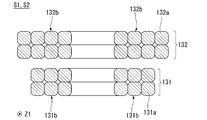
- the first winding step S1 is a step of winding a flat wire to form the first winding body 131.
- the second winding step S2 is a step of winding a flat wire to form a second winding body 132. Either the first winding step S1 or the second winding step S2 may be performed first, or may be performed at the same time. Twice
- the first winding body 131 is a winding body before becoming the first winding body 31 described above.
- the first winding body 131 has a square shape with rounded corners in the cross-sectional shape of the plurality of first coil wire portions 131a constituting the first axial extension portion 131b.
- the contour shape of the first axial extension portion 131b in the cross section orthogonal to the motor axial direction is, for example, substantially rectangular.
- the cross-sectional shape of the flat wire constituting the first winding body 131 is the same in any portion.
- the first winding body 131 is a three-layer winding body aligned and wound in two rows arranged in the radial direction of the motor. Twice
- the second winding body 132 is a winding body before becoming the second winding body 32 described above.
- the second winding body 132 has a square shape with rounded corners in the cross-sectional shape of the plurality of second coil wire portions 132a constituting the extension portion 132b in the second axial direction.
- the contour shape of the second axial extension portion 132b in the cross section orthogonal to the motor axial direction is, for example, substantially rectangular.
- the cross-sectional shape of the flat wire constituting the second winding body 132 is the same in any portion.
- the cross-sectional shape of the flat wire forming the second winding body 132 is the same as the cross-sectional shape of the flat wire forming the first winding body 131.
- the second winding body 132 is a four-layer winding body aligned and wound in two rows arranged in the radial direction of the motor. Twice
- the first winding step S1 and the second winding step S2 are performed by using the winding machine 50 shown in FIGS. 6 to 11. That is, the first winding step S1 and the second winding step S2 are steps of winding the winding 33 using the winding machine 50.
- the winding 33 is a flat wire.
- the winding machine 50 of the present embodiment includes a base member 51, a first holding member 61, a second holding member 62, a bearing member 63, a first gripping member 70a, and a second gripping member 70a.
- a grip member 70b, a winding core 80, a first winding jig 81, and a second winding jig 82 are provided.
- the winding machine 50 includes elastic members 65a and 65b.
- the winding machine 50 includes a first guide portion 81d and a second guide portion 82d. Twice
- the direction parallel to the central axis J2 of the winding core 80 is indicated by the Z2 axis.
- the axial direction of the central axis J2 is simply referred to as the "axial direction”
- the radial direction centered on the central axis J2 is simply referred to as the “diameter direction”
- the circumferential direction is simply called the “circumferential direction”.
- the positive side (+ Z side) of the Z2 axis in the axial direction is referred to as "upper side”
- the negative side ( ⁇ Z side) of the Z2 axis in the axial direction is referred to as the lower side.
- the upper side corresponds to "one side in the axial direction”
- the lower side corresponds to "the other side in the axial direction”. Twice
- the direction orthogonal to the axial direction and parallel to the X axis shown in each figure is called “left-right direction X”
- the direction orthogonal to the axial direction and parallel to the Y axis shown in each figure is “front and back”. Called “direction Y”.
- the left-right direction X and the front-back direction Y are directions orthogonal to each other.
- the positive side (+ X side) of the left-right direction X is called the "right side”
- the negative side (-X side) of the left-right direction X is called the "left side”.
- the positive side (+ Y side) of the front-rear direction Y is called the "front side”
- the negative side (-Y side) of the front-back direction Y is called the "rear side”. Twice
- the left-right direction, front-rear direction, upper side, lower side, right side, left side, front side, and rear side are simply names for explaining the arrangement relationship of each part, and the actual arrangement relationship etc. are these names. It may be an arrangement relation or the like other than the arrangement relation shown by. Twice
- the base member 51 extends in a direction orthogonal to the axial direction.
- a first winding jig 81 is fixed to the central portion of the base member 51 by a bolt 52. Twice
- the first winding jig 81 is a columnar shape extending in the axial direction.
- the first winding jig 81 is, for example, a columnar shape centered on the central axis J2.
- the first winding jig 81 projects upward from the central portion of the base member 51.
- the first winding jig 81 has a first winding jig main body 81a and a first support portion 81b. Twice
- the first winding jig main body 81a has a columnar shape centered on the central axis J2.
- the first winding jig main body 81a has a first hole portion 81c that is recessed downward from the upper surface of the first winding jig main body 81a.
- the first hole portion 81c penetrates the first winding jig main body 81a in the axial direction.
- the central axis J2 passes through the inside of the first hole portion 81c.
- the first hole portion 81c is, for example, a rectangular hole with rounded corners long in the front-rear direction Y.
- the first hole portion 81c may be a hole having a bottom portion on the lower side. Twice
- the first support portion 81b is located inside the first hole portion 81c.
- the first support portion 81b protrudes inward in the radial direction from the inner peripheral surface of the first hole portion 81c, for example.
- the first support portion 81b is located, for example, in the upper portion of the inside of the first hole portion 81c. Twice
- the second winding jig 82 is located above the first winding jig 81.
- the first winding jig 81 and the second winding jig 82 are arranged so as to sandwich the winding core 80 in the axial direction.
- the second winding jig 82 is arranged on the upper side of the first winding jig 81 with a gap.
- the axial distance between the first winding jig 81 and the second winding jig 82 is larger than twice the thickness of the winding 33 and smaller than three times the thickness of the winding 33.
- the second winding jig 82 is a columnar shape extending in the axial direction.
- the second winding jig 82 is, for example, a columnar shape centered on the central axis J2.
- the outer diameter of the second winding jig 82 is, for example, the same as the outer diameter of the first winding jig 81.
- the second winding jig 82 includes a second winding jig main body 82a and a second support portion 82b. And have.
- the second winding jig main body 82a has a columnar shape centered on the central axis J2.
- the second winding jig main body 82a has a second hole portion 82c that is recessed upward from the lower surface of the second winding jig main body 82a.
- the second hole portion 82c penetrates the second winding jig main body 82a in the axial direction.
- the central axis J2 passes through the inside of the second hole portion 82c.
- the second hole portion 82c is, for example, a rectangular hole with rounded corners long in the front-rear direction Y.
- the second hole 82c may be a hole having a bottom on the upper side.
- the second support portion 82b is located inside the second hole portion 82c.
- the second support portion 82b protrudes inward in the radial direction from the inner peripheral surface of the second hole portion 82c, for example.
- the second support portion 82b is located, for example, in the lower portion of the inside of the second hole portion 82c. Twice
- a winding 33 is wound around the winding core 80.
- the winding core 80 is a columnar shape extending in the axial direction about the central axis J2. As shown in FIG. 12, the winding core 80 is, for example, a substantially square columnar shape that is long in the front-rear direction Y and flat in the left-right direction X. As shown in FIG. 7, the winding core 80 is located between the first winding jig 81 and the second winding jig 82 in the axial direction. The lower portion of the winding core 80 is inserted into the first hole portion 81c from above. The lower portion of the winding core 80 is fitted into the first hole portion 81c. The upper portion of the winding core 80 is inserted into the second hole portion 82c from the lower side. The upper portion of the winding core 80 is fitted into the second hole portion 82c. Twice
- the upper portion of the winding core 80 is fixed to the second winding jig 82 by, for example, a set screw 83.
- the set screw 83 is tightened inward in the radial direction from the outer peripheral surface of the second winding jig 82.
- the radial inner end of the set screw 83 is pressed against the side surface of the winding core 80 in the left-right direction X.
- the central portion of the winding core 80 in the axial direction is exposed in the axial gap between the first winding jig 81 and the second winding jig 82. Twice
- the lower end of the winding core 80 is in contact with the first support 81b from above in the first hole 81c.
- the upper end of the winding core 80 is in contact with the second support 82b from below in the second hole 82c.
- the winding core 80, the first winding jig 81, and the second winding jig 82 are positioned in the axial direction with respect to each other.
- the first winding jig 81 and the second winding jig 82 project radially outward from the winding core 80. That is, the radial outer edge portion of the first winding jig 81 and the radial outer edge portion of the second winding jig 82 are located outside the winding core 80 in the radial direction. Twice
- the first guide portion 81d is located around the winding core 80.
- the first guide portion 81d projects from the first winding jig 81 toward the second winding jig 82. More specifically, the first guide portion 81d projects upward from the peripheral edge portion of the first hole portion 81c in the upper surface of the first winding jig main body 81a.
- the first guide portion 81d and the first winding jig 81 are, for example, a part of the same single member.
- the first guide portion 81d is located, for example, on the rear side ( ⁇ Y side) of the first hole portion 81c.
- the radial inner surface of the first guide portion 81d is in contact with the outer peripheral surface of the winding core 80. That is, the first guide portion 81d is connected to the outer peripheral surface of the winding core 80.
- the radial outer surface of the first guide portion 81d has, for example, the same shape as the outer peripheral surface of the winding core 80, which is in contact with the first guide portion 81d, when viewed in the axial direction.
- the radial outer surface of the first guide portion 81d is, for example, a curved surface that is slightly curved in a direction that is convex toward the rear side. Twice
- the first guide portion 81d has a first guide surface 81e and a first top surface 81f.
- the first guide surface 81e is a surface facing upward.
- the first guide surface 81e is an inclined surface located on the upper side toward one side in the circumferential direction. In the present embodiment, one side in the circumferential direction is the side that advances counterclockwise with respect to the central axis J2 when viewed from above.
- the first top surface 81f is connected to one end of the first guide surface 81e in the circumferential direction.
- the first top surface 81f is, for example, a flat surface facing upward and orthogonal to the axial direction.
- the first guide surface 81e and the first top surface 81f form an upper surface of the first guide portion 81d. Twice
- the second guide portion 82d is located around the winding core 80.
- the second guide portion 82d projects from the second winding jig 82 toward the first winding jig 81. More specifically, the second guide portion 82d projects downward from the peripheral edge portion of the second hole portion 82c in the lower surface of the second winding jig main body 82a.
- the second guide portion 82d and the second winding jig 82 are, for example, a part of the same single member.
- the second guide portion 82d is located, for example, on the rear side ( ⁇ Y side) of the second hole portion 82c.
- the radial inner surface of the second guide portion 82d is in contact with the outer peripheral surface of the winding core 80.
- the second guide portion 82d is connected to the outer peripheral surface of the winding core 80.
- the radial outer surface of the second guide portion 82d has, for example, the same shape as the outer peripheral surface of the winding core 80, which is in contact with the second guide portion 82d, when viewed in the axial direction.
- the radial outer surface of the second guide portion 82d is, for example, a curved surface that is slightly curved in a direction that is convex toward the rear side. Twice
- the second guide portion 82d has a second guide surface 82e and a second top surface 82f.
- the second guide surface 82e is a surface facing downward.
- the second guide surface 82e is an inclined surface located on the upper side toward one side in the circumferential direction.
- the shape of the second guide surface 82e is the same as the shape of the first guide surface 81e.
- the first guide surface 81e and the second guide surface 82e are arranged so as to face each other with a gap in the axial direction. Twice
- the second top surface 82f is connected to the other end of the second guide surface 82e in the circumferential direction.
- the other side in the circumferential direction is the side that advances clockwise around the central axis J2 when viewed from above.
- the second top surface 82f is, for example, a flat surface facing downward and orthogonal to the axial direction.
- the first top surface 81f and the second top surface 82f are arranged apart from each other in the circumferential direction. A part of the first top surface 81f overlaps with one end of the second guide surface 82e in the circumferential direction when viewed in the axial direction, for example.
- a part of the second top surface 82f overlaps with the other end of the first guide surface 81e in the circumferential direction when viewed in the axial direction.
- the first guide portion 81d and the second guide portion 82d are arranged in positions opposite to each other in the axial direction, but have, for example, similar shapes to each other. Twice
- the first holding member 61 is a member that holds the first gripping member 70a.
- the first holding member 61 is located above the base member 51.
- the first holding member 61 is supported from below by the base member 51.
- the first holding member 61 is an annular shape surrounding the first winding jig 81.
- the outer peripheral surface of the first holding member 61 is, for example, an annular shape centered on the central axis J2.
- the first holding member 61 has a first annular portion 61c, a first bearing portion 61b, a plurality of first connecting portions 61d, and a pair of protruding wall portions 61j. Twice
- the first annular portion 61c is an annular shape surrounding the central axis J2.
- the first annular portion 61c is, for example, an annular shape centered on the central axis J2.
- the first annular portion 61c has a first guide hole 61i that penetrates the left ( ⁇ X side) end of the first annular portion 61c in the left-right direction X.
- the first guide hole 61i is open on the upper side. Twice
- the first bearing portion 61b is located apart from the first annular portion 61c in the radial direction.
- the first bearing portion 61b has, for example, a substantially rectangular shape that is long in the front-rear direction Y when viewed in the axial direction.
- the first bearing portion 61b has a first bearing hole 61e that penetrates the first bearing portion 61b in the axial direction.
- the first bearing hole 61e is a substantially circular hole centered on the central axis J2.
- the first bearing hole 61e is opened on the left side ( ⁇ X side), for example.
- a first winding jig 81 is fitted inside the first bearing hole 61e in the radial direction.
- the first winding jig 81 rotatably supports the first holding member 61 around the central axis J2 via the inner peripheral surface of the first bearing hole 61e.
- the first holding member 61 is rotatable in both directions around the central axis J2. Twice
- the first bearing portion 61b has a pair of guide grooves 61f and 61g.
- the guide grooves 61f and 61g are recessed downward from the upper surface of the first bearing portion 61b and extend in the front-rear direction Y.
- the guide groove 61f and the guide groove 61g are arranged so as to sandwich the central axis J2 in the front-rear direction Y.
- the guide groove 61f is located on the front side (+ Y side) of the first bearing hole 61e.
- the rear end ( ⁇ Y side) end of the guide groove 61f is open to the inside of the first bearing hole 61e.
- the guide groove 61g is located on the rear side of the first bearing hole 61e.
- the front end of the guide groove 61g is opened radially inward of the first bearing hole 61e. Twice
- the first bearing portion 61b has a pair of accommodating grooves 61h.
- the accommodating groove 61h is recessed downward from the upper surface of the first bearing portion 61b and extends in the left-right direction X.
- the left end ( ⁇ X side) end of the accommodating groove 61h is open to the left side surface of the first bearing portion 61b.
- the pair of accommodating grooves 61h are arranged so as to sandwich the first bearing hole 61e in the front-rear direction Y.
- the pair of accommodating grooves 61h are located radially outside the pair of guide grooves 61f and 61g.
- the elastic members 65a and 65b are accommodated in each of the pair of accommodating grooves 61h.
- the elastic members 65a and 65b are, for example, coil springs extending in the left-right direction X.
- the width of the pair of accommodating grooves 61h in the front-rear direction Y is narrowed at the upper opening. As a result, the elastic members 65a and 65b are prevented from coming out upward from the accommodating groove 61h. Twice
- the plurality of first connecting portions 61d are located between the first bearing portion 61b and the first annular portion 61c in the radial direction.
- the plurality of first connecting portions 61d connect the first bearing portion 61b and the first annular portion 61c.
- the plurality of first connecting portions 61d extend from the radial outer surface of the first bearing portion 61b to the radial inner surface of the first annular portion 61c.
- the plurality of first connecting portions 61d are arranged at intervals in the circumferential direction. Twice
- the pair of protruding wall portions 61j project upward from the first connecting portions 61d, which are different from each other.
- the pair of protruding wall portions 61j are arranged apart from each other on the left side ( ⁇ X side) of the first bearing portion 61b.
- Each of the pair of protruding wall portions 61j is arranged apart from each other on the left side of each of the pair of accommodating grooves 61h.
- the pair of protruding wall portions 61j are arranged so as to sandwich a pair of rollers 72, 73, which will be described later, in the front-rear direction Y. Twice
- the first holding member 61 has a pair of pressing members 64 arranged so as to sandwich the pair of protruding wall portions 61j in the front-rear direction Y.
- Each of the pair of pressing members 64 is fixed to the upper surface of the first connecting portion 61d which is different from each other.
- the pressing member 64 is fixed to the first connecting portion 61d by, for example, a bolt. Twice
- the second holding member 62 is a member that holds the second gripping member 70b. As shown in FIG. 7, the second holding member 62 is located above the first holding member 61. The second holding member 62 is supported from below by the first holding member 61. As shown in FIG. 6, the second holding member 62 is an annular shape surrounding the second winding jig 82. The upper end of the second winding jig 82 protrudes upward from the upper surface of the second holding member 62, for example.
- the outer peripheral surface of the second holding member 62 is, for example, an annular shape centered on the central axis J2. The outer diameter of the second holding member 62 is, for example, the same as the outer diameter of the first holding member 61.
- the second holding member 62 has a second annular portion 62c, a second bearing portion 62b, and a plurality of second connecting portions 62d. Twice
- the second annular portion 62c is an annular portion surrounding the central axis J2.
- the second annular portion 62c is, for example, an annular shape centered on the central axis J2.
- the second annular portion 62c overlaps with the first annular portion 61c when viewed in the axial direction.
- the second annular portion 62c has a second guide hole 62i that penetrates the right (+ X side) end of the second annular portion 62c in the left-right direction X.
- the second guide hole 62i is open downward. Twice
- the second bearing portion 62b is located inside the second annular portion 62c in the radial direction.
- the second bearing portion 62b has, for example, a substantially rectangular shape that is long in the front-rear direction Y when viewed in the axial direction.
- the second bearing portion 62b has a fitting hole 62e that penetrates the second bearing portion 62b in the axial direction.
- the fitting hole 62e is, for example, a rectangular hole long in the front-rear direction Y.
- the second bearing portion 62b has a pair of accommodating grooves on the lower surface. 2nd bearing 6 An elastic member (not shown) is accommodated in each of the accommodating grooves of 2b.
- the plurality of second connecting portions 62d are located between the second bearing portion 62b and the second annular portion 62c in the radial direction.
- the plurality of second connecting portions 62d connect the second bearing portion 62b and the second annular portion 62c.
- the plurality of second connecting portions 62d extend from the radial outer surface of the second bearing portion 62b to the radial inner surface of the second annular portion 62c.
- the plurality of second connecting portions 62d are arranged at intervals in the circumferential direction. Twice
- the bearing member 63 is a substantially rectangular parallelepiped member that is long in the front-rear direction Y.
- the bearing member 63 is fitted into the fitting hole 62e.
- the bearing member 63 is attached to the second holding member 62 so as not to rotate relative to the central axis J2.
- the upper end of the bearing member 63 projects upward from the upper surface of the second holding member 62. Twice
- the bearing member 63 has a second bearing hole 63a that penetrates the bearing member 63 in the axial direction.
- the second bearing hole 63a is a substantially circular hole centered on the central axis J2.
- the second bearing hole 63a is opened on the right side (+ X side), for example.
- a second winding jig 82 is fitted inside the second bearing hole 63a in the radial direction.
- the second winding jig 82 rotatably supports the bearing member 63 and the second holding member 62 around the central axis J2 via the inner peripheral surface of the second bearing hole 63a.
- the second holding member 62 is rotatable in both directions around the central axis J2. As a result, the first holding member 61 and the second holding member 62 can rotate in opposite directions around the central axis J2. Twice
- the first gripping member 70a and the second gripping member 70b are located outside the winding core 80 in the radial direction.
- the first gripping member 70a and the second gripping member 70b are arranged so as to sandwich the central axis J2 in the left-right direction X when viewed in the axial direction.
- the first gripping member 70a is located on the outer side in the radial direction of the first winding jig 81.
- the second gripping member 70b is located on the outer side in the radial direction of the second winding jig 82.
- the first gripping member 70a is located on the left side ( ⁇ X side) of the first winding jig 81.
- the second gripping member 70b is located on the right side (+ X side) of the second winding jig 82. Twice
- the first gripping member 70a is held above the first holding member 61.
- the second gripping member 70b is held under the second holding member 62.
- the first gripping member 70a and the second gripping member 70b are arranged so as to be displaced in the axial direction.
- the first gripping member 70a is located below the second gripping member 70b. Twice
- the first gripping member 70a and the second gripping member 70b have similar structures to each other.
- the first gripping member 70a and the second gripping member 70b are arranged so as to be inverted in the axial direction. In the following description, only the first gripping member 70a may be described on behalf of the first gripping member 70a and the second gripping member 70b. Twice
- the first gripping member 70a has a base material 71, a pair of rollers 72, 73, and a pair of holding members 74, 75.
- the base material 71 is located on the outer side in the radial direction of the first winding jig 81.
- the base material 71 has a radial extension portion 71a, a pair of first arm portions 71b, 71c, and a pair of second arm portions 71d, 71e.
- the radial extension portion 71a extends in the radial direction.
- the direction in which the radially extending portion 71a extends in the initial state is, for example, the left-right direction X.
- the radial extension portion 71a is, for example, a square columnar shape. Twice
- the pair of first arm portions 71b and 71c extend from the radially inner end of the radial extension portion 71a to both sides in the front-rear direction Y orthogonal to both the direction in which the radial extension portion 71a extends and the axial direction. There is.
- the first arm portion 71b extends from the radially inner end portion of the radial extension portion 71a to the front side (+ Y side), for example.
- the first arm portion 71c extends from the radially inner end portion of the radial extension portion 71a to the rear side ( ⁇ Y side), for example.
- Each of the pair of first arm portions 71b and 71c is passed between each of the pair of protruding wall portions 61j and the first bearing portion 61b in the left-right direction X.
- the pair of first arm portions 71b and 71c are supported from below by the first connecting portion 61d. Twice
- the pair of second arm portions 71d and 71e extend from each of the tip portions of the pair of first arm portions 71b and 71c in the left-right direction X where the radial extension portion 71a extends.
- the second arm portion 71d extends from the front side (+ Y side) end portion of the first arm portion 71b to the left side ( ⁇ X side).
- the second arm portion 71e extends to the left from the rear ( ⁇ Y side) end of the first arm portion 71c.
- the pair of second arm portions 71d and 71e are arranged so as to sandwich the pair of protruding wall portions 61j in the front-rear direction Y.
- the pair of second arm portions 71d and 71e are located between the protruding wall portion 61j and the pressing member 64 in the front-rear direction Y, respectively. A part of the pair of second arm portions 71d and 71e is covered from above by the pressing member 64. Therefore, even if the first gripping member 70a tries to move upward, the pair of second arm portions 71d and 71e are caught by the pressing member 64. As a result, the first gripping member 70a is prevented from coming off from the first holding member 61 upward. Twice
- the pair of rollers 72 and 73 are arranged so as to sandwich the radial extension portion 71a in the front-rear direction Y.
- the roller 72 is located, for example, on the front side (+ Y side) of the radial extension portion 71a.
- the roller 73 is located, for example, on the rear side ( ⁇ Y side) of the radial extension portion 71a.
- the roller 72 can rotate around the rotation axis R2.
- the roller 73 can rotate around the rotation axis R3.
- the rotation axis R2 and the rotation axis R3 are parallel to the central axis J2. That is, in the present embodiment, the axial direction of the rotation axes R2 and R3 is the axial direction of the central axis J2. Twice
- the roller 72 has a cylindrical portion 72a, a first roller portion 72b, and a second roller portion 72c.
- the tubular portion 72a has a cylindrical shape that opens on both sides in the axial direction with the rotation axis R2 as the center.
- the outer peripheral surface of the tubular portion 72a is cylindrical.
- the inner peripheral surface of the tubular portion 72a has a hexagonal tubular shape.
- the first roller portion 72b extends from the upper end portion of the cylindrical portion 72a to the outside in the radial direction centered on the rotation axis R2.
- the first roller portion 72b is an annular shape centered on the rotation axis R2.
- the first roller portion 72b has, for example, a plate shape in which the plate surface faces the axial direction. Twice
- the outer peripheral surface of the first roller portion 72b is a contact portion 72f that can come into contact with the winding 33 in the radial direction centered on the rotation axis R2 of the roller 72. That is, the roller 72 has a contact portion 72f.
- a pair of collar portions 72d and 72e are provided on the outer peripheral surface of the first roller portion 72b. That is, the roller 72 has a pair of collar portions 72d and 72e.
- the pair of flange portions 72d and 72e project from the contact portion 72f to the outside in the radial direction about the rotation axis R2 of the roller 72.
- the pair of flanges 72d and 72e are annular around the rotation axis R2.
- the pair of collar portions 72d and 72e are arranged so as to face each other with a space in the axial direction of the rotation shaft R2.
- the collar portion 72d is located, for example, at the upper end of the contact portion 72f.
- the collar portion 72e is located, for example, at the lower end of the contact portion 72f.
- the pair of flange portions 72d and 72e sandwich the front side (+ Y side) edge portion of the winding 33 in the axial direction. Twice
- the second roller portion 72c extends from the lower end portion of the tubular portion 72a to the outside in the radial direction centered on the rotation axis R2.
- the second roller portion 72c is an annular shape centered on the rotation axis R2.
- the second roller portion 72c has, for example, a plate shape in which the plate surface faces the axial direction.
- the outer diameter of the second roller portion 72c is, for example, larger than the outer diameter of the first roller portion 72b.
- a radial stretching portion 71a and a protruding portion 74c which will be described later, are located between the first roller portion 72b and the second roller portion 72c in the axial direction.
- the first roller portion 72b and the second roller portion 72c sandwich the front side (+ Y side) portion of the radial extension portion 71a in the axial direction. Twice
- the shape of the roller 73 is the same as the shape of the roller 72.
- the roller 73 has a cylindrical portion 73a, a first roller portion 73b, and a second roller portion 73c.
- a radial stretching portion 71a and a protruding portion 75c, which will be described later, are located between the first roller portion 73b and the second roller portion 73c in the axial direction.
- the first roller portion 73b and the second roller portion 73c sandwich a portion on the rear side ( ⁇ Y side) of the radial extension portion 71a in the axial direction.
- the roller 73 has a contact portion 73f and a pair of collar portions 73d and 73e, similarly to the roller 72. That is, each of the pair of rollers 72 and 73 has a contact portion and a pair of flange portions.
- the pair of flange portions 73d and 73e axially sandwich the rear edge portion of the winding 33. Twice
- the first roller portion 72b and the first roller portion 73b can be gripped by sandwiching the winding 33 in the front-rear direction Y.
- the pair of rollers 72 and 73 can be gripped with the winding 33 sandwiched between them.
- each of the contact portion 72f and the contact portion 73f comes into contact with the winding 33 in the radial direction centered on the rotation shafts R2 and R3, and the winding 33 is sandwiched.
- the second roller portion 72c and the second roller portion 73c are in contact with each other in the radial direction centered on the rotation shafts R2 and R3. Twice
- the pair of holding members 74 and 75 are arranged so as to sandwich the radial extending portion 71a and the pair of rollers 72 and 73 in the front-rear direction Y.
- the sandwiching member 74 is located on the front side (+ Y side) of the radial extension portion 71a and the roller 72.
- the sandwiching member 75 is located on the rear side (-Y side) of the radial extension portion 71a and the roller 73. Twice
- the sandwiching member 74 has a straight portion 74a, a curved portion 74b, and a protruding portion 74c.
- the straight portion 74a extends in the left-right direction X where the radial extending portion 71a extends.
- the straight portion 74a is located on the front side (+ Y side) of the radial extension portion 71a.
- the straight portion 74a has a portion that axially sandwiches the front side portion of the radially extending portion 71a.
- the curved portion 74b is connected to the radial inner end of the straight portion 74a.
- the curved portion 74b is located on the front side of the roller 72.
- the curved portion 74b extends in the circumferential direction around the rotation axis R2.
- the curved portion 74b is curved in a direction that is convex to the front side when viewed in the axial direction. Twice
- the protruding portion 74c protrudes from the curved portion 74b toward the radially extending portion 71a.
- the protruding portion 74c protrudes from the curved portion 74b to the rear side ( ⁇ Y side), for example.
- the protruding portion 74c is located between the first roller portion 72b and the second roller portion 72c in the axial direction.
- the protruding portion 74c has a bearing recess 74e that is recessed in a direction away from the radial extending portion 71a.
- the bearing recess 74e is recessed from the rear end of the protrusion 74c to the front (+ Y side).
- a cylindrical portion 72a is located inside the bearing recess 74e.
- the inner surface of the bearing recess 74e rotatably supports the cylindrical portion 72a around the rotation shaft R2.
- the inner surface of the bearing recess 74e is pressed from the front side against the outer peripheral surface of the cylindrical portion 72a.
- the tubular portion 72a is sandwiched in the front-rear direction Y by the protruding portion 74c and the radial extending portion 71a. Twice
- the shape of the sandwiching member 75 is arranged substantially symmetrically with respect to the shape of the sandwiching member 74 in the front-rear direction Y.
- the sandwiching member 75 has a straight portion 75a, a curved portion 75b, and a protruding portion 75c.
- the straight portion 75a extends in the left-right direction X where the radial extending portion 71a extends.
- the straight portion 75a is located on the rear side (-Y side) of the radially extending portion 71a.
- the straight portion 75a has a portion that axially sandwiches the rear portion of the radially extending portion 71a.
- the curved portion 75b is connected to the radial inner end of the straight portion 75a.
- the curved portion 75b is located on the rear side of the roller 73.
- the curved portion 75b extends in the circumferential direction around the rotation axis R3.
- the curved portion 75b is curved in a direction that is convex to the rear side when viewed in the axial direction. Twice
- the protruding portion 75c protrudes from the curved portion 75b toward the radially extending portion 71a.
- the protruding portion 75c protrudes from the curved portion 75b to the front side (+ Y side), for example.
- the protruding portion 74c is located between the first roller portion 73b and the second roller portion 73c in the axial direction.
- the protruding portion 75c has a bearing recess 75e that is recessed in a direction away from the radial extending portion 71a.
- the bearing recess 75e is recessed from the front end of the protrusion 75c to the rear ( ⁇ Y side).
- a cylindrical portion 73a is located inside the bearing recess 75e.
- the inner surface of the bearing recess 75e rotatably supports the cylindrical portion 73a around the rotation shaft R3.
- the inner surface of the bearing recess 75e is pressed from the rear side against the outer peripheral surface of the cylindrical portion 73a.
- the tubular portion 73a is sandwiched in the front-rear direction Y by the protruding portion 75c and the radial extending portion 71a.
- the sandwiching member 75 has a through hole 75d that penetrates the straight portion 75a in the front-rear direction Y.
- a bolt 79 is passed through the through hole 75d from the rear side (-Y side).
- the bolt 79 penetrates the through hole 71h provided in the radial extension portion 71a in the front-rear direction Y and is tightened into the female screw hole 74d provided in the straight portion 74a of the holding member 74.
- the force for sandwiching the winding 33 by the first roller portions 72b and 73b can also be adjusted. That is, by adjusting the tightening amount of the bolt 79, the radial frictional force generated between the first roller portions 72b and 73b and the winding 33 can be adjusted.
- the radial frictional force generated between the first roller portions 72b and 73b and the winding 33 is referred to as "holding static friction force of the winding 33". Twice
- the first gripping member 70a moves radially with respect to the first holding member 61 within a range in which the pair of first arm portions 71b and 71c can move between the first bearing portion 61b and the protruding wall portion 61j. It is held possible. As shown in FIG. 8, the radial outer portion of the first gripping member 70a is passed through the first guide hole 61i in the radial direction. The radial outer portion of the first gripping member 70a is fitted into the first guide hole 61i. In the present embodiment, the radial outer portion of the first gripping member 70a includes a radial outer portion of the radial extending portion 71a and a radial outer portion of the straight portions 74a, 75a. The radial outer end of the first gripping member 70a projects radially outward from the first holding member 61. Twice
- a radial outward elastic force FE is applied to the first gripping member 70a by the elastic members 65a and 65b. That is, the elastic members 65a and 65b apply a force to the pair of rollers 72 and 73 in a direction away from the winding core 80.
- the elastic member 65a applies an elastic force FE facing left side ( ⁇ X direction) to the first arm portion 71b.
- the elastic member 65b applies a left-facing elastic force FE to the first arm portion 71c. Twice
- the total value of the elastic force FE applied by the two elastic members 65a and 65b is smaller than the holding static friction force of the winding 33. Further, the rotational moment generated in the rollers 72 and 73 by applying the elastic force FE of the two elastic members 65a and 65b to the first gripping member 70a is smaller than the rotational static friction force of the rollers 72 and 73. Therefore, even if the elastic force FE is applied to the rollers 72 and 73 by the elastic members 65a and 65b, the rollers 72 and 73 do not rotate around the rotation axes R2 and R3, and between the rollers 72 and 73 and the winding 33. No slippage occurs.
- the winding 33 can be sandwiched and pulled by the pair of rollers 72 and 73, and tension T can be applied to the winding 33.
- the magnitude of the tension T is the sum of the magnitudes of the elastic force FE applied by the two elastic members 65a and 65b. Twice
- the second gripping member 70b has a pair of rollers 77, 78 that can be gripped by sandwiching the winding 33.
- the pair of rollers 77, 78 are located slightly above the pair of rollers 72, 73 of the first gripping member 70a.
- the second gripping member 70b is held so as to be movable in the radial direction with respect to the second holding member 62, similarly to the first gripping member 70a.
- the radial outer portion of the second gripping member 70b is radially passed through the second guide hole 62i.
- the radial outer portion of the second gripping member 70b is fitted into the second guide hole 62i.
- the radial outer end of the second gripping member 70b projects radially outward from the second holding member 62. Twice
- the first holding member 61 and the second holding member 62 can rotate in both directions around the central axis J2
- the second gripping member 70b held by the center axis J2 can also rotate in both directions around the central axis J2.
- the first gripping member 70a and the second gripping member 70b can rotate in opposite directions around the central axis J2. Twice
- the operator or the like makes the first winding body 131 and the second winding body 132 by using the winding machine 50 described above.
- the second winding body 132 is made by the winding machine 50 will be described.
- "worker etc.” includes a worker who performs each work, an assembly apparatus and the like. Each operation may be performed only by the operator, may be performed only by the assembling device, or may be performed by the operator and the assembling device. Twice
- the operator or the like holds the first holding member 61 and the second gripping member 70b that hold the first gripping member 70a in a state where the winding 33 is gripped by the first gripping member 70a and the second gripping member 70b.
- the second holding member 62 is assembled on the base member 51.
- the second winding jig 82, the winding core 80, and the bearing member 63 are not assembled.
- the winding 33 is in a state of extending linearly from the first gripping member 70a to the second gripping member 70b when viewed in the axial direction. In this state, the winding 33 passes over the first hole 81c of the first winding jig 81. Twice
- the operator or the like assembles the second winding jig 82 in a state where the winding core 80 is fixed.
- the operator or the like inserts the winding core 80 into the guide groove 61g from above, and moves the winding core 80 and the second winding jig 82 to the rear side ( ⁇ Y side) along the guide groove 61g.
- the operator or the like fits the winding core 80 into the first hole portion 81c.
- the winding core 80 pushes and bends the portion of the winding 33 arranged on the first hole portion 81c to the rear side.
- the portion of the winding 33 located between the portion gripped by the first gripping member 70a and the portion gripped by the second gripping member 70b is directed toward the rear side. It will be in a slightly curved state. Twice
- the portion of the winding 33 that contacts the rear end (-Y side) of the winding core 80 is located between the first guide portion 81d and the second guide portion 82d in the axial direction.
- the portion of the winding 33 that contacts the rear end of the winding core 80 is obliquely arranged along the first guide surface 81e and the second guide surface 82e.
- the operator or the like rotates the first holding member 61 and the second holding member 62 around the central axis J2 in opposite directions with respect to the winding machine 50 in the initial state, so that the winding 33 becomes the winding core 80. I will wind it around.
- the operator or the like rotates the first holding member 61 clockwise around the central axis J2 when viewed from above, and rotates the second holding member 62 counterclockwise around the central axis J2 when viewed from above.
- the first gripping member 70a and the second gripping member 70b rotate in opposite directions around the central axis J2, and the winding 33 is wound around the winding core 80. go.
- the second winding body 132 wound around the winding core 80 is produced as shown in FIG. Twice
- the cross section of the plurality of second coil wire portions 132a in the second winding body 132 shows the order of winding virtually numerically.
- the second coil wire portion 132a located on the lower side of the plurality of second coil wire portions 132a laminated in two layers in the axial direction is a portion wound around the winding core 80 by the first gripping member 70a.
- the second coil wire portion 132a located on the upper side of the plurality of second coil wire portions 132a laminated in two layers in the axial direction is a portion wound around the winding core 80 by the second gripping member 70b. Twice
- the winding 33 As the winding 33 is wound around the winding core 80, the winding 33 is pulled inward in the radial direction. Therefore, the first gripping member 70a that grips the winding 33 is also pulled inward in the radial direction and moves. As a result, the elastic members 65a and 65b are more compressed and deformed, and the elastic force FE applied from the elastic members 65a and 65b to the pair of rollers 72 and 73 increases. Then, when the rotational moment applied to the pair of rollers 72 and 73 by the elastic force FE becomes larger than the rotational static friction force of the rollers 72 and 73, the pair of rollers 72 and 73 rotate and the windings 33 are sequentially sent out. go.
- the winding 33 can be sent out in a state where the tension T is suitably applied to the winding 33. Since the holding static friction force of the winding 33 is larger than the elastic force FE when the pair of rollers 72 and 73 start to rotate, slippage occurs between the winding 33 and the pair of rollers 72 and 73. Can be suppressed.
- the winding 33 is sent out from the pair of rollers 77 and 78 in the same manner as the first gripping member 70a. Twice
- each of the first gripping member 70a and the second gripping member 70b has a pair of rollers that can be gripped by sandwiching the winding 33. At least one of the first gripping member 70a and the second gripping member 70b is rotatable around the central axis J2. Therefore, the winding 33 can be wound around the winding core 80 by rotating the rotatable gripping member of the first gripping member 70a and the second gripping member 70b around the central axis J2.
- the first winding jig 81 and the second winding jig 82 are arranged with the winding core 80 sandwiched in the axial direction, the first winding jig 81 and the second winding jig 82 wind the winding. It is possible to prevent the 33 from moving in the axial direction. Further, since the winding 33 can be gripped by the pair of rollers 72, 73 and the pair of rollers 77, 78, the winding 33 is rotated by rotating each roller while applying tension T to the winding 33 as described above. It can be sent out. As a result, the winding 33 can be wound around the winding core 80 along the outer peripheral surface of the winding core 80.
- the winding 33 can be suitably wound around the winding core 80 without providing a member or the like that moves according to the timing at which the winding 33 is wound. Therefore, the coil 30 can be suitably manufactured while the winding machine 50 has a simple structure. Twice
- the first gripping member 70a and the second gripping member 70b can rotate in opposite directions around the central axis J2. Therefore, as described above, the first gripping member 70a and the second gripping member 70b can be simultaneously rotated around the central axis J2 in opposite directions, and the winding 33 can be wound around the winding core 80.
- the winding 33 is wound around the winding core 80 for one or more turns, the portion of the winding 33 that is sent out from the first gripping member 70a and wound around the winding core 80. And the portion sent out from the second gripping member 70b and wound around the winding core 80 overlap in the axial direction.
- the portion of the winding 33 wound by one of the first grip member 70a and the second grip member 70b is wound by the other of the first grip member 70a and the second grip member 70b. It can be pressed in the axial direction by the portion of the winding 33.
- the portion of the winding 33 wound by the first gripping member 70a is suppressed from moving downward by the first winding jig 81, and the second gripping member 70b is prevented from moving downward.
- the portion of the winding 33 that is wound around the wire suppresses the movement upward.
- the portion of the winding 33 that is wound by the second gripping member 70b is prevented from moving upward by the second winding jig 82, and is wound by the first gripping member 70a.
- the portion of the line 33 suppresses the downward movement.
- the windings 33 can be suitably aligned and wound, and the coil 30 can be manufactured more preferably. Twice
- the winding machine 50 includes a first holding member 61 for holding the first gripping member 70a and a second holding member 62 for holding the second gripping member 70b.
- the first holding member 61 is an annular shape surrounding the first winding jig 81.
- the second holding member 62 is an annular shape surrounding the second winding jig 82.
- the first holding member 61 and the second holding member 62 can rotate in opposite directions around the central axis J2. Therefore, by rotating the first holding member 61 and the second holding member 62 in the opposite directions around the central axis J2, the first gripping member 70a and the second gripping member 70b can be easily revolved around the central axis J2. Can be done. Twice
- the winding machine 50 has a first guide portion 81d located around the winding core 80.
- the first guide portion 81d has a first guide surface 81e located on the upper side toward one side in the circumferential direction around the central axis J2. Therefore, as shown in FIG. 9, when the winding 33 is attached to the winding machine 50, the portion of the winding 33 that comes into contact with the winding core 80 is inclined in the axial direction along the first guide surface 81e and obliquely. Can be placed in.
- the portion of the winding 33 wound in the first winding by the first gripping member 70a and the portion of the winding 33 wound in the first winding by the second gripping member 70b are suitably displaced in the axial direction. Can be placed. Therefore, the portion of the winding 33 wound in the second winding by the first gripping member 70a and the second gripping member 70b is preferably axially relative to the portion of the winding 33 wound in the first winding. Easy to stack. Twice
- the portion of the winding 33 wound in the second winding by the first gripping member 70a is inserted into the lower side of the portion wound in the first winding by the second gripping member 70b.
- the portion wound by the second grip member 70b in the second winding can easily enter the upper side of the portion wound by the first grip member 70a in the first winding. Twice
- the end portion of the winding 33 wound in the second winding by the first gripping member 70a can be supported from the front side (+ Y side) by the radial outer surface of the first guide portion 81d. Therefore, the end portion of the winding 33 wound in the second winding by the first gripping member 70a enters the lower side of the portion of the winding 33 obliquely arranged along the first guide portion 81d. Can be suppressed. Therefore, it is possible to suitably superimpose the portion of the winding 33 wound on the third winding by the first grip member 70a on the outside of the portion of the winding 33 wound on the first winding by the first grip member 70a. can. Therefore, the windings 33 can be more preferably aligned and wound. Twice
- the winding 33 can be suitably aligned and wound. Therefore, the winding 33 can be wound at a relatively high speed with a relatively strong tension T applied to the winding 33. Twice
- the winding machine 50 has a second guide portion 82d located around the winding core 80.
- the second guide portion 82d has a second guide surface 82e that is located on the upper side toward one side in the circumferential direction around the central axis J2.
- the first guide surface 81e and the second guide surface 82e are arranged so as to face each other with a gap in the axial direction. Therefore, the portion of the winding 33 in contact with the winding core 80 can be more preferably arranged so as to be inclined obliquely in the axial direction by the first guide surface 81e and the second guide surface 82e. As a result, the winding 33 can be more preferably aligned and wound. Twice
- the end portion of the winding 33 wound in the second winding by the second gripping member 70b can be supported from the front side (+ Y side) by the radial outer surface of the second guide portion 82d. Therefore, the end portion of the winding 33 wound in the second winding by the second gripping member 70b is a portion of the winding 33 obliquely arranged between the first guide portion 81d and the second guide portion 82d. It is possible to suppress the entry into the upper side of. Therefore, it is possible to suitably superimpose the portion of the winding 33 wound on the third winding by the second grip member 70b on the outside of the portion of the winding 33 wound on the first winding by the second grip member 70b. can. As a result, the winding 33 can be more preferably aligned and wound. Twice
- the first guide portion 81d and the second guide portion 82d are connected to the outer peripheral surface of the winding core 80. Therefore, the portion of the winding 33 that has been brought into contact with the winding core 80 can be easily brought into contact with the first guide portion 81d and the second guide portion 82d. As a result, the winding 33 can be suitably guided by the first guide portion 81d and the second guide portion 82d. Therefore, the winding 33 can be more preferably aligned and wound. Twice
- the first guide portion 81d protrudes from the first winding jig 81 toward the second winding jig 82
- the second guide portion 82d is the first from the second winding jig 82. It protrudes toward the winding jig 81. Therefore, by changing the axial distance between the first winding jig 81 and the second winding jig 82, the axial distance between the first guide portion 81d and the second guide portion 82d can be easily changed. As a result, even if the thickness of the winding 33 is changed, the distance between the first guide portion 81d and the second guide portion 82d can be changed according to the thickness of the winding 33. 33 can be suitably wound around the winding core 80. Twice
- the roller 72 has collar portions 72d, 72e protruding from the contact portion 72f on the outer side in the radial direction about the rotation axis R2 of the roller 72.
- the roller 73 has collar portions 73d and 73e protruding outward in the radial direction about the rotation axis R3 of the roller 73 from the contact portion 73f. Therefore, the flange portions 72d, 72e, 73d, 73e can press the winding 33 in contact with the contact portions 72f, 73f in the axial direction. As a result, it is possible to prevent the winding 33 gripped by the first gripping member 70a from being displaced in the axial direction.
- the flange portion provided on the second gripping member 70b can prevent the winding 33 gripped by the second gripping member 70b from being displaced in the axial direction. Therefore, when the winding 33 is wound by the first gripping member 70a and the second gripping member 70b, the portion of the winding 33 that the first gripping member 70a winds and the winding that the second gripping member 70b winds around.
- the portions of the wire 33 intersect with each other in the axial direction, it is possible to prevent the portions of the winding 33 from coming into contact with each other. Therefore, the winding 33 can be wound more preferably. Further, it is possible to suppress the winding 33 from tilting. As a result, it is possible to prevent the winding 33 from being twisted. Twice
- the pair of rollers 72 and 73 have a pair of collar portions arranged so as to face each other at intervals in the axial direction of the rotation shafts R2 and R3. Therefore, the winding 33 can be sandwiched and pressed in the axial direction by the pair of flange portions 72d, 72e and the pair of flange portions 73d, 73e, respectively. As a result, it is possible to further prevent the winding 33 from being displaced in the axial direction with respect to the pair of rollers 72 and 73.
- the winding 33 when winding the winding 33, it is possible to further prevent the portion of the winding 33 wound by the first gripping member 70a and the portion of the winding 33 wound by the second grip member 70b from coming into contact with each other. Therefore, the winding 33 can be wound more preferably. Further, it is possible to further suppress the winding 33 from tilting. As a result, twisting of the winding 33 can be further suppressed. Twice
- the winding machine 50 includes elastic members 65a and 65b that apply a force to the pair of rollers 72 and 73 in a direction away from the winding core 80. Therefore, the tension T can be applied to the windings 33 gripped by the pair of rollers 72 and 73 by the force received from the elastic members 65a and 65b. As a result, tension T can be easily applied to the winding 33. Twice
- the winding 33 wound around the winding core 80 is a flat wire. Therefore, it is easy to align and wind the winding 33 with respect to the winding core 80. Twice
- the second winding body 132 made by using the winding machine 50 is provided with a first recess 132d caused by the provision of the first guide portion 81d.
- the first recess 132d is provided in the circumferentially extending portion 132c that connects the ends in the motor axial direction of the pair of second axially extending portions 132b. More specifically, the first recess 132d is provided in the first winding of the circumferentially extending portion 132c.
- the first recess 132d is recessed in the radial direction of the motor.
- the second winding body 132 is also provided with a second recess formed by the provision of the second guide portion 82d.
- the second recess is provided in a portion of the circumferentially stretched portion 132c opposite to the side where the first recess 132d is provided in the radial direction of the motor. Twice
- the compression step S3 is a step of compressing and deforming the first winding body 131 and the second winding body 132.
- the compression step S3 includes a first compression step S3a and a second compression step S3b.
- the first compression step S3a is a step of compressing and deforming the first winding body 131.
- the second compression step S3b is a step of compressing and deforming the second winding body 132.
- the first compression step S3a and the second compression step S3b are provided before the connection step S4. Either of the first compression step S3a and the second compression step S3b may be performed first, or may be performed at the same time. Twice
- the contour shape of the first axial extension portion 131b in the cross section orthogonal to the motor axial direction becomes a fan shape in which the dimension in the motor circumferential direction decreases toward the inside in the motor radial direction. It can be transformed.
- the cross-sectional shape of the portion of the flat wire constituting the first winding body 131 that constitutes the first axial extension portion 131b that is, the cross-sectional shape of the first coil wire portion 131a becomes inward in the motor radial direction. It can be transformed into a trapezoidal shape with smaller dimensions in the circumferential direction of the motor.
- the first axially stretched portion 131b becomes the first axially stretched portion 31b, and the above-mentioned first winding body 31 is produced. Twice
- the contour shape of the second axial extension portion 132b in the cross section orthogonal to the motor axial direction becomes a fan shape in which the dimension in the motor circumferential direction decreases toward the inside in the motor radial direction. It can be transformed.
- the cross-sectional shape of the portion of the flat wire constituting the second winding body 132 that constitutes the second axial extension portion 132b that is, the cross-sectional shape of the second coil wire portion 132a becomes inward in the motor radial direction. It can be transformed into a trapezoidal shape with smaller dimensions in the circumferential direction of the motor.
- the second axially stretched portion 132b becomes the second axially stretched portion 32b, and the above-mentioned second winding body 32 is produced. Twice
- the contour shape of the first axial extension portion 131b in the cross section orthogonal to the motor axial direction is deformed into a fan shape in which the dimension in the motor circumferential direction becomes smaller toward the inside in the motor radial direction.
- the contour shape of the second axial extension portion 132b in the cross section orthogonal to the motor shaft J1 is deformed into a fan shape in which the dimension in the motor circumferential direction becomes smaller toward the inside in the motor radial direction. Twice
- each axially stretched portion is press-processed by a die surrounding each axially stretched portion of each winding body to compress and deform each winding body. ..
- connection step S4 is a step of arranging the second winding body 32 on the outer side in the motor radial direction of the first winding body 31 and connecting the first winding body 31 and the second winding body 32.
- connection step S4 of the present embodiment one end 31c of the first winding body 31 and one end 32c of the second winding body 32 are connected.
- the method of connecting the one end 31c and the one end 32c is not particularly limited.
- the coil 30 is manufactured by the above steps. Twice
- the coil 30 includes a first winding body 31 and a second winding body 32 connected to the first winding body 31.
- the first winding body 31 is an N-layer winding body aligned and wound in two rows arranged in the radial direction of the motor.
- the second winding body 32 is an M-layer winding body that is aligned and wound in two rows arranged in the radial direction of the motor.
- M is any integer greater than N. Therefore, the number of layers of the second winding body 32 located outside the motor radial direction of the first winding body 31 is larger than the number of layers of the first winding body 31.
- the motor 1 is an inner rotor type motor
- the distance between the teeth 22 adjacent to each other in the circumferential direction of the motor increases toward the outside in the radial direction of the motor. Therefore, by making the number of layers of the second winding body 32 located outside the motor radial direction of the first winding body 31 larger than the number of layers of the first winding body 31, space efficiency is improved between the teeth 22. , More windings can be placed. Thereby, the total number of turns of the coil 30 can be suitably increased. Twice
- the total number of turns of the coil is the number obtained by multiplying the number of alignments by the number of layers. Therefore, for example, when there is a limit on at least one of the number of alignments and the number of layers, there is a possibility that the total number of turns of the coil that can be adopted is limited.
- the number of layers of the first winding body 31 and the number of layers of the second winding body 32 are different from each other. Therefore, by adjusting the number of layers of each winding body, the number of layers can be adjusted. It is easy to adjust the total number of turns of the coil 30. Therefore, the degree of freedom of the total number of turns of the coil 30 that can be adopted can be improved.
- the total number of turns of the coil 30 can be any even number of 6 or more. Twice
- the contour shape of the axially extended portion 30b in the cross section orthogonal to the motor axial direction is a fan shape in which the dimension in the circumferential direction of the motor decreases toward the inside in the radial direction of the motor. Therefore, the coils 30 can be suitably packed and arranged between the teeth 22 adjacent to each other in the circumferential direction of the motor. This makes it easier to improve the space factor of the coil 30. Twice
- the cross-sectional shape of the coil wire portion located inside the motor radial direction has a dimension in the motor circumferential direction. It becomes smaller and the dimension in the radial direction of the motor becomes larger.
- the cross-sectional shape of the coil wire portion located outside in the radial direction of the motor has a larger dimension in the circumferential direction of the motor and a smaller dimension in the radial direction of the motor.
- the cross-sectional shape of at least a part of the coil wire portion tends to be flat. In this case, the eddy current loss of the coil tends to be large.
- the number of layers of the second winding body 32 located outside the motor radial direction of the first winding body 31 is larger than the number of layers of the first winding body 31. Therefore, the number of layers of the second winding body 32 constituting the axially outer portion of the axially stretched portion 30b in the motor radial direction can be relatively large, while the number of layers constituting the axially extending portion 30b forming the inner portion in the motor radial direction can be relatively large.
- the number of layers of one winding body 31 can be made relatively small.
- the contour shape of the axially stretched portion is fan-shaped due to a large amount of deformation of the flat wires as described above depending on the number of layers and the like. In some cases, it was difficult to compress and deform. Therefore, when the contour shape of the axially stretched portion is made into a fan shape, the number of layers or the like is likely to be limited, and there is a possibility that the total number of coil turns that can be adopted is limited.
- the contour shape of the axially extended portion can be fan-shaped while suppressing the amount of deformation of each coil wire portion as described above. Therefore, it is possible to suppress that the total number of turns of the coil 30 that can be adopted is limited, and it is easy to adopt the desired total number of turns of the coil 30 within an even number range of 6 or more. Twice
- the first compression step S3a and the second compression step S3b are provided before the connection step S4. Therefore, the first winding body 131 and the second winding body 132 are respectively deformed to form the first winding body 31 and the second winding body 32, and then the first winding body 31 and the second winding body 32 are formed.
- the winding body 32 can be connected. As a result, each winding body can be easily compressed and deformed as compared with the case where the first winding body 131 and the second winding body 132 are collectively compression-deformed after being joined. Twice
- the present invention is not limited to the above-described embodiment, and other configurations may be adopted within the scope of the technical idea of the present invention.
- the type of winding wound by the winding machine is not particularly limited.
- the winding may be, for example, a round wire.
- One of the first gripping member and the second gripping member may not be rotatable around the central axis of the winding core.
- the winding core may be rotatable around the central axis.
- the first gripping member and the second gripping member may be rotatable in only one direction around the central axis. Twice
- the first guide portion may be provided on the winding core.
- the first guide portion does not have to have the first guide surface.
- the first guide portion may not be provided.
- the second guide portion may be provided on the winding core.
- the second guide portion does not have to have the second guide surface.
- the second guide portion may not be provided. Twice
- One of the pair of rollers of the first gripping member does not have to have a collar.
- One of the pair of rollers of the second gripping member may not have a collar.
- the collar may not be provided.
- the elastic member may be any member as long as a force is applied to the pair of rollers in a direction away from the winding core.
- One elastic member may be provided for each gripping member, or three or more elastic members may be provided. The elastic member may not be provided. Twice
- N is not particularly limited as long as it is an integer of 1 or more.
- M is not particularly limited as long as it is an integer larger than N.
- L is not particularly limited as long as it is an integer larger than M.
- N may be 1, M may be 2, and L may be 3. That is, the first winding body may be a one-layer winding body, the second winding body may be a two-layer winding body, and the third winding body may be three. It may be a wound body of layers.
- M may be 2 or more larger than N, and L may be 2 or more larger than M.
- N, M, and L are preferably, for example, 10 or less.
- M is preferably, for example, 3 times or less of N.
- the step of compressing and deforming the first winding body and the step of compressing and deforming the second winding body may be provided after the step of connecting the first winding body and the second winding body.
- the step of compressing and deforming the first winding body and the second winding body may not be provided.
- the coil produced by the winding machine of the present invention is not particularly limited.
- the coil produced by the winding machine of the present invention may be the first winding body itself or the second winding body itself. Twice
- the motor to which the coil produced by the winding machine of the present invention is applied is not particularly limited.
- the motor to which the coil produced by the winding machine of the present invention is applied may be an outer rotor type motor.
- the configurations and methods described in the present specification can be appropriately combined within a range that does not contradict each other.
Landscapes
- Engineering & Computer Science (AREA)
- Power Engineering (AREA)
- Manufacturing & Machinery (AREA)
- Manufacture Of Motors, Generators (AREA)
Priority Applications (3)
| Application Number | Priority Date | Filing Date | Title |
|---|---|---|---|
| JP2020571879A JPWO2021199469A1 (https=) | 2020-03-31 | 2020-10-16 | |
| US17/908,598 US12354790B2 (en) | 2020-03-31 | 2020-10-16 | Winding machine and method of manufacturing coil |
| CN202080099233.5A CN115362622B (zh) | 2020-03-31 | 2020-10-16 | 绕线机以及线圈的制造方法 |
Applications Claiming Priority (2)
| Application Number | Priority Date | Filing Date | Title |
|---|---|---|---|
| JP2020-062127 | 2020-03-31 | ||
| JP2020062127 | 2020-03-31 |
Publications (1)
| Publication Number | Publication Date |
|---|---|
| WO2021199469A1 true WO2021199469A1 (ja) | 2021-10-07 |
Family
ID=77928895
Family Applications (1)
| Application Number | Title | Priority Date | Filing Date |
|---|---|---|---|
| PCT/JP2020/039027 Ceased WO2021199469A1 (ja) | 2020-03-31 | 2020-10-16 | 巻線機、およびコイルの製造方法 |
Country Status (4)
| Country | Link |
|---|---|
| US (1) | US12354790B2 (https=) |
| JP (1) | JPWO2021199469A1 (https=) |
| CN (1) | CN115362622B (https=) |
| WO (1) | WO2021199469A1 (https=) |
Families Citing this family (1)
| Publication number | Priority date | Publication date | Assignee | Title |
|---|---|---|---|---|
| CN119650295B (zh) * | 2025-02-17 | 2025-04-25 | 金动力智能科技(深圳)有限公司 | 用于ai服务器电感的自动化剥漆焊锡绕线一体机及工艺 |
Citations (5)
| Publication number | Priority date | Publication date | Assignee | Title |
|---|---|---|---|---|
| US5174013A (en) * | 1988-06-16 | 1992-12-29 | Nippondenso Co., Ltd. | Winding apparatus and method which deforms the wire during winding |
| JP2001028869A (ja) * | 1999-05-13 | 2001-01-30 | Toyota Motor Corp | 巻線機 |
| JP2002369465A (ja) * | 2001-06-06 | 2002-12-20 | Asmo Co Ltd | 回転電機子の巻線方法 |
| JP2006333623A (ja) * | 2005-05-26 | 2006-12-07 | Honda Motor Co Ltd | 巻線方法及び巻線装置 |
| WO2020017308A1 (ja) * | 2018-07-19 | 2020-01-23 | Nittoku株式会社 | 巻線装置及び巻線方法 |
Family Cites Families (35)
| Publication number | Priority date | Publication date | Assignee | Title |
|---|---|---|---|---|
| US3141806A (en) * | 1960-04-14 | 1964-07-21 | H I Thompson Fiber Glass Compa | Apparatus for forming a wound hollow structure of fiber reinforced tape |
| US3927456A (en) * | 1968-04-16 | 1975-12-23 | Possis Corp | Coil winding machine with improved wire gripping and cutting means |
| JPS6037027B2 (ja) * | 1978-11-30 | 1985-08-23 | ソニー株式会社 | フライヤ−式巻線装置 |
| US4616788A (en) * | 1985-02-05 | 1986-10-14 | The Globe Tool & Engineering Co. | Method and apparatus for winding dynamoelectric devices |
| US4870742A (en) * | 1987-01-02 | 1989-10-03 | Cooper Power Systems, Inc. | Coil winding machine |
| US5144735A (en) * | 1988-06-08 | 1992-09-08 | General Electric Company | Apparatus for assembling a permanent magnet rotor |
| US6315270B1 (en) * | 1999-07-22 | 2001-11-13 | Marconi Communications, Inc. | Cable pulley |
| SI1324471T1 (sl) * | 2001-12-28 | 2010-07-30 | Atop Spa | Postopek in naprava za napeljevanje žice na večpolne statorje ovite z napravo z navijalno roko |
| US7188403B2 (en) * | 2004-01-13 | 2007-03-13 | Asmo Co., Ltd. | Manufacturing method of armature comprising core constituted by assembling split core members |
| KR100639706B1 (ko) * | 2005-05-06 | 2006-10-30 | 전용성 | 타원형 및 다각형 토로이달 코일 권선기 |
| TW200802437A (en) * | 2006-07-18 | 2008-01-01 | Nittoku Eng | Filament winding machine and filament winding method |
| JP5196913B2 (ja) * | 2007-08-27 | 2013-05-15 | 日特エンジニアリング株式会社 | スピンドル巻線装置 |
| MY158716A (en) * | 2009-03-27 | 2016-11-15 | Murata Manufacturing Co | Winding method and device for electronic component |
| JP2011129704A (ja) * | 2009-12-17 | 2011-06-30 | Johnan Corp | 巻線方法及び巻線装置並びにアンテナ |
| JP2013193875A (ja) * | 2012-03-22 | 2013-09-30 | Toshiba Corp | 捲回装置、捲回方法 |
| JP2012139098A (ja) | 2012-04-16 | 2012-07-19 | Hitachi Ltd | 集中巻きコイルの製造方法 |
| JP5936268B2 (ja) * | 2012-08-08 | 2016-06-22 | 日特エンジニアリング株式会社 | 巻線装置及び線材の端子への絡げ方法 |
| JP6140566B2 (ja) * | 2013-07-31 | 2017-05-31 | アイシン・エィ・ダブリュ株式会社 | コイル装着方法及びコイル装着治具 |
| JP6501379B2 (ja) * | 2013-12-27 | 2019-04-17 | 日特エンジニアリング株式会社 | 巻線装置 |
| JP6218326B2 (ja) * | 2014-03-04 | 2017-10-25 | 日特エンジニアリング株式会社 | 巻線装置及び巻線方法 |
| JP6257083B2 (ja) * | 2014-03-27 | 2018-01-10 | 日特エンジニアリング株式会社 | コイル成形装置及びコイル成形方法 |
| JP6436381B2 (ja) * | 2014-08-27 | 2018-12-12 | 日本電産株式会社 | モータ用電機子及びモータ |
| JP6477592B2 (ja) * | 2016-05-13 | 2019-03-06 | 株式会社村田製作所 | セラミックコア、巻線型電子部品及びセラミックコアの製造方法 |
| US11482913B2 (en) * | 2017-09-28 | 2022-10-25 | Nidec Corporation | Coil manufacturing method, coil manufacturing device, coil, and motor |
| US11478840B2 (en) * | 2017-09-28 | 2022-10-25 | Nidec Corporation | Manufacturing method of wire rod, manufacturing apparatus of wire rod, wire rod, and motor |
| JP2019068605A (ja) * | 2017-09-29 | 2019-04-25 | 日本電産サーボ株式会社 | ステータ、モータ |
| WO2019065929A1 (ja) * | 2017-09-29 | 2019-04-04 | 日本電産株式会社 | モータ |
| JP2020014287A (ja) * | 2018-07-13 | 2020-01-23 | 日本電産株式会社 | 巻線装置 |
| EP3624315B1 (en) * | 2018-09-11 | 2021-03-24 | Nortech System SA | Flyer winding machine for internal stators of brushless motors |
| US20210376670A1 (en) * | 2018-09-27 | 2021-12-02 | Nidec Corporation | Stator and motor |
| JP7173874B2 (ja) * | 2019-01-11 | 2022-11-16 | 京セラ株式会社 | コア部品、その製造方法、およびインダクタ |
| JP2021057931A (ja) * | 2019-09-26 | 2021-04-08 | 日本電産株式会社 | ステータ及びモータ |
| JP7418186B2 (ja) * | 2019-11-18 | 2024-01-19 | Nittoku株式会社 | 巻線機及び巻線方法 |
| US12348095B2 (en) * | 2020-01-17 | 2025-07-01 | Nidec Corporation | Coil with contour shape, stator, and motor having same |
| TWI852417B (zh) * | 2023-03-21 | 2024-08-11 | 財團法人金屬工業研究發展中心 | 繞線裝置及其繞線方法 |
-
2020
- 2020-10-16 JP JP2020571879A patent/JPWO2021199469A1/ja active Pending
- 2020-10-16 WO PCT/JP2020/039027 patent/WO2021199469A1/ja not_active Ceased
- 2020-10-16 CN CN202080099233.5A patent/CN115362622B/zh active Active
- 2020-10-16 US US17/908,598 patent/US12354790B2/en active Active
Patent Citations (5)
| Publication number | Priority date | Publication date | Assignee | Title |
|---|---|---|---|---|
| US5174013A (en) * | 1988-06-16 | 1992-12-29 | Nippondenso Co., Ltd. | Winding apparatus and method which deforms the wire during winding |
| JP2001028869A (ja) * | 1999-05-13 | 2001-01-30 | Toyota Motor Corp | 巻線機 |
| JP2002369465A (ja) * | 2001-06-06 | 2002-12-20 | Asmo Co Ltd | 回転電機子の巻線方法 |
| JP2006333623A (ja) * | 2005-05-26 | 2006-12-07 | Honda Motor Co Ltd | 巻線方法及び巻線装置 |
| WO2020017308A1 (ja) * | 2018-07-19 | 2020-01-23 | Nittoku株式会社 | 巻線装置及び巻線方法 |
Also Published As
| Publication number | Publication date |
|---|---|
| CN115362622A (zh) | 2022-11-18 |
| US20230154676A1 (en) | 2023-05-18 |
| US12354790B2 (en) | 2025-07-08 |
| JPWO2021199469A1 (https=) | 2021-10-07 |
| CN115362622B (zh) | 2025-11-07 |
Similar Documents
| Publication | Publication Date | Title |
|---|---|---|
| US10910928B2 (en) | Stator assembly method and stator assembly apparatus | |
| CN101615508B (zh) | 扁立线圈绕线方法及绕线装置 | |
| JP5171224B2 (ja) | 回転電機 | |
| US20160099616A1 (en) | Iron core member, inner rotor type stator for rotating electrical machine, and method for manufacturing inner rotor type stator for rotating electrical machine | |
| JP3621625B2 (ja) | 回転電機の鉄心及びその製造方法 | |
| JP7028261B2 (ja) | ステータの製造方法およびステータ | |
| JP2000201458A (ja) | 鉄心装置及びその製造方法 | |
| JP2002291186A (ja) | 平角線の巻付け構造および巻付け方法 | |
| JP3430109B2 (ja) | 内転型電動機の固定子 | |
| WO2021199469A1 (ja) | 巻線機、およびコイルの製造方法 | |
| JP2703066B2 (ja) | 電動機 | |
| KR101638724B1 (ko) | 권선 장치, 권선 방법, 및 전기자의 제조 방법 | |
| CN108702044B (zh) | 旋转电机的定子、使用了该定子的旋转电机以及旋转电机的定子的制造方法 | |
| JP3957300B2 (ja) | ステッピングモータ | |
| JP3432452B2 (ja) | 巻線機 | |
| JP3316762B1 (ja) | 鉄心装置の製造方法 | |
| JP2015019507A (ja) | 回転電機の積層鉄心、回転電機の固定子及び回転電機の積層鉄心の製造方法 | |
| JP2025069462A (ja) | コイル、モータ、およびコイルの製造方法 | |
| JP6811781B2 (ja) | 回転電機のステータ、および、その製造方法 | |
| CN109417339A (zh) | 绕线装置及线圈的绕线方法 | |
| JP6824014B2 (ja) | 巻線装置 | |
| JP2020162392A (ja) | 回転電機 | |
| JP6477331B2 (ja) | 回転電機の固定子鉄心の製造方法および製造装置 | |
| JP7371450B2 (ja) | 巻線形成方法及び巻線形成装置 | |
| JP6595695B2 (ja) | ステータ及び導線巻回方法 |
Legal Events
| Date | Code | Title | Description |
|---|---|---|---|
| ENP | Entry into the national phase |
Ref document number: 2020571879 Country of ref document: JP Kind code of ref document: A |
|
| 121 | Ep: the epo has been informed by wipo that ep was designated in this application |
Ref document number: 20928765 Country of ref document: EP Kind code of ref document: A1 |
|
| NENP | Non-entry into the national phase |
Ref country code: DE |
|
| 122 | Ep: pct application non-entry in european phase |
Ref document number: 20928765 Country of ref document: EP Kind code of ref document: A1 |
|
| WWG | Wipo information: grant in national office |
Ref document number: 17908598 Country of ref document: US |
|
| WWG | Wipo information: grant in national office |
Ref document number: 202080099233.5 Country of ref document: CN |