WO2021192752A1 - 多孔質アルミナ及び触媒 - Google Patents
多孔質アルミナ及び触媒 Download PDFInfo
- Publication number
- WO2021192752A1 WO2021192752A1 PCT/JP2021/006087 JP2021006087W WO2021192752A1 WO 2021192752 A1 WO2021192752 A1 WO 2021192752A1 JP 2021006087 W JP2021006087 W JP 2021006087W WO 2021192752 A1 WO2021192752 A1 WO 2021192752A1
- Authority
- WO
- WIPO (PCT)
- Prior art keywords
- mass
- sio
- addition rate
- alumina
- porous alumina
- Prior art date
- Legal status (The legal status is an assumption and is not a legal conclusion. Google has not performed a legal analysis and makes no representation as to the accuracy of the status listed.)
- Ceased
Links
Images




Classifications
-
- B—PERFORMING OPERATIONS; TRANSPORTING
- B01—PHYSICAL OR CHEMICAL PROCESSES OR APPARATUS IN GENERAL
- B01J—CHEMICAL OR PHYSICAL PROCESSES, e.g. CATALYSIS OR COLLOID CHEMISTRY; THEIR RELEVANT APPARATUS
- B01J23/00—Catalysts comprising metals or metal oxides or hydroxides, not provided for in group B01J21/00
- B01J23/70—Catalysts comprising metals or metal oxides or hydroxides, not provided for in group B01J21/00 of the iron group metals or copper
- B01J23/76—Catalysts comprising metals or metal oxides or hydroxides, not provided for in group B01J21/00 of the iron group metals or copper combined with metals, oxides or hydroxides provided for in groups B01J23/02 - B01J23/36
- B01J23/83—Catalysts comprising metals or metal oxides or hydroxides, not provided for in group B01J21/00 of the iron group metals or copper combined with metals, oxides or hydroxides provided for in groups B01J23/02 - B01J23/36 with rare earths or actinides
-
- C—CHEMISTRY; METALLURGY
- C01—INORGANIC CHEMISTRY
- C01F—COMPOUNDS OF THE METALS BERYLLIUM, MAGNESIUM, ALUMINIUM, CALCIUM, STRONTIUM, BARIUM, RADIUM, THORIUM, OR OF THE RARE-EARTH METALS
- C01F7/00—Compounds of aluminium
- C01F7/02—Aluminium oxide; Aluminium hydroxide; Aluminates
-
- B—PERFORMING OPERATIONS; TRANSPORTING
- B01—PHYSICAL OR CHEMICAL PROCESSES OR APPARATUS IN GENERAL
- B01J—CHEMICAL OR PHYSICAL PROCESSES, e.g. CATALYSIS OR COLLOID CHEMISTRY; THEIR RELEVANT APPARATUS
- B01J23/00—Catalysts comprising metals or metal oxides or hydroxides, not provided for in group B01J21/00
- B01J23/02—Catalysts comprising metals or metal oxides or hydroxides, not provided for in group B01J21/00 of the alkali- or alkaline earth metals or beryllium
-
- B—PERFORMING OPERATIONS; TRANSPORTING
- B01—PHYSICAL OR CHEMICAL PROCESSES OR APPARATUS IN GENERAL
- B01J—CHEMICAL OR PHYSICAL PROCESSES, e.g. CATALYSIS OR COLLOID CHEMISTRY; THEIR RELEVANT APPARATUS
- B01J21/00—Catalysts comprising the elements, oxides, or hydroxides of magnesium, boron, aluminium, carbon, silicon, titanium, zirconium, or hafnium
- B01J21/12—Silica and alumina
-
- B—PERFORMING OPERATIONS; TRANSPORTING
- B01—PHYSICAL OR CHEMICAL PROCESSES OR APPARATUS IN GENERAL
- B01J—CHEMICAL OR PHYSICAL PROCESSES, e.g. CATALYSIS OR COLLOID CHEMISTRY; THEIR RELEVANT APPARATUS
- B01J23/00—Catalysts comprising metals or metal oxides or hydroxides, not provided for in group B01J21/00
- B01J23/002—Mixed oxides other than spinels, e.g. perovskite
-
- B—PERFORMING OPERATIONS; TRANSPORTING
- B01—PHYSICAL OR CHEMICAL PROCESSES OR APPARATUS IN GENERAL
- B01J—CHEMICAL OR PHYSICAL PROCESSES, e.g. CATALYSIS OR COLLOID CHEMISTRY; THEIR RELEVANT APPARATUS
- B01J23/00—Catalysts comprising metals or metal oxides or hydroxides, not provided for in group B01J21/00
- B01J23/70—Catalysts comprising metals or metal oxides or hydroxides, not provided for in group B01J21/00 of the iron group metals or copper
- B01J23/76—Catalysts comprising metals or metal oxides or hydroxides, not provided for in group B01J21/00 of the iron group metals or copper combined with metals, oxides or hydroxides provided for in groups B01J23/02 - B01J23/36
- B01J23/78—Catalysts comprising metals or metal oxides or hydroxides, not provided for in group B01J21/00 of the iron group metals or copper combined with metals, oxides or hydroxides provided for in groups B01J23/02 - B01J23/36 with alkali- or alkaline earth metals
-
- B—PERFORMING OPERATIONS; TRANSPORTING
- B01—PHYSICAL OR CHEMICAL PROCESSES OR APPARATUS IN GENERAL
- B01J—CHEMICAL OR PHYSICAL PROCESSES, e.g. CATALYSIS OR COLLOID CHEMISTRY; THEIR RELEVANT APPARATUS
- B01J35/00—Catalysts, in general, characterised by their form or physical properties
- B01J35/60—Catalysts, in general, characterised by their form or physical properties characterised by their surface properties or porosity
- B01J35/61—Surface area
- B01J35/615—100-500 m2/g
-
- B—PERFORMING OPERATIONS; TRANSPORTING
- B01—PHYSICAL OR CHEMICAL PROCESSES OR APPARATUS IN GENERAL
- B01J—CHEMICAL OR PHYSICAL PROCESSES, e.g. CATALYSIS OR COLLOID CHEMISTRY; THEIR RELEVANT APPARATUS
- B01J35/00—Catalysts, in general, characterised by their form or physical properties
- B01J35/70—Catalysts, in general, characterised by their form or physical properties characterised by their crystalline properties, e.g. semi-crystalline
- B01J35/737—Hexaaluminate-type AB12O19
-
- B—PERFORMING OPERATIONS; TRANSPORTING
- B01—PHYSICAL OR CHEMICAL PROCESSES OR APPARATUS IN GENERAL
- B01J—CHEMICAL OR PHYSICAL PROCESSES, e.g. CATALYSIS OR COLLOID CHEMISTRY; THEIR RELEVANT APPARATUS
- B01J37/00—Processes, in general, for preparing catalysts; Processes, in general, for activation of catalysts
- B01J37/02—Impregnation, coating or precipitation
- B01J37/0201—Impregnation
-
- B—PERFORMING OPERATIONS; TRANSPORTING
- B01—PHYSICAL OR CHEMICAL PROCESSES OR APPARATUS IN GENERAL
- B01J—CHEMICAL OR PHYSICAL PROCESSES, e.g. CATALYSIS OR COLLOID CHEMISTRY; THEIR RELEVANT APPARATUS
- B01J37/00—Processes, in general, for preparing catalysts; Processes, in general, for activation of catalysts
- B01J37/02—Impregnation, coating or precipitation
- B01J37/0201—Impregnation
- B01J37/0207—Pretreatment of the support
-
- B—PERFORMING OPERATIONS; TRANSPORTING
- B01—PHYSICAL OR CHEMICAL PROCESSES OR APPARATUS IN GENERAL
- B01J—CHEMICAL OR PHYSICAL PROCESSES, e.g. CATALYSIS OR COLLOID CHEMISTRY; THEIR RELEVANT APPARATUS
- B01J37/00—Processes, in general, for preparing catalysts; Processes, in general, for activation of catalysts
- B01J37/02—Impregnation, coating or precipitation
- B01J37/03—Precipitation; Co-precipitation
- B01J37/031—Precipitation
- B01J37/033—Using Hydrolysis
-
- B—PERFORMING OPERATIONS; TRANSPORTING
- B01—PHYSICAL OR CHEMICAL PROCESSES OR APPARATUS IN GENERAL
- B01J—CHEMICAL OR PHYSICAL PROCESSES, e.g. CATALYSIS OR COLLOID CHEMISTRY; THEIR RELEVANT APPARATUS
- B01J37/00—Processes, in general, for preparing catalysts; Processes, in general, for activation of catalysts
- B01J37/04—Mixing
-
- B—PERFORMING OPERATIONS; TRANSPORTING
- B01—PHYSICAL OR CHEMICAL PROCESSES OR APPARATUS IN GENERAL
- B01J—CHEMICAL OR PHYSICAL PROCESSES, e.g. CATALYSIS OR COLLOID CHEMISTRY; THEIR RELEVANT APPARATUS
- B01J37/00—Processes, in general, for preparing catalysts; Processes, in general, for activation of catalysts
- B01J37/08—Heat treatment
- B01J37/082—Decomposition and pyrolysis
- B01J37/088—Decomposition of a metal salt
-
- B—PERFORMING OPERATIONS; TRANSPORTING
- B01—PHYSICAL OR CHEMICAL PROCESSES OR APPARATUS IN GENERAL
- B01J—CHEMICAL OR PHYSICAL PROCESSES, e.g. CATALYSIS OR COLLOID CHEMISTRY; THEIR RELEVANT APPARATUS
- B01J37/00—Processes, in general, for preparing catalysts; Processes, in general, for activation of catalysts
- B01J37/16—Reducing
- B01J37/18—Reducing with gases containing free hydrogen
-
- B—PERFORMING OPERATIONS; TRANSPORTING
- B01—PHYSICAL OR CHEMICAL PROCESSES OR APPARATUS IN GENERAL
- B01J—CHEMICAL OR PHYSICAL PROCESSES, e.g. CATALYSIS OR COLLOID CHEMISTRY; THEIR RELEVANT APPARATUS
- B01J2235/00—Indexing scheme associated with group B01J35/00, related to the analysis techniques used to determine the catalysts form or properties
- B01J2235/15—X-ray diffraction
-
- B—PERFORMING OPERATIONS; TRANSPORTING
- B01—PHYSICAL OR CHEMICAL PROCESSES OR APPARATUS IN GENERAL
- B01J—CHEMICAL OR PHYSICAL PROCESSES, e.g. CATALYSIS OR COLLOID CHEMISTRY; THEIR RELEVANT APPARATUS
- B01J2523/00—Constitutive chemical elements of heterogeneous catalysts
-
- C—CHEMISTRY; METALLURGY
- C01—INORGANIC CHEMISTRY
- C01P—INDEXING SCHEME RELATING TO STRUCTURAL AND PHYSICAL ASPECTS OF SOLID INORGANIC COMPOUNDS
- C01P2006/00—Physical properties of inorganic compounds
- C01P2006/12—Surface area
-
- Y—GENERAL TAGGING OF NEW TECHNOLOGICAL DEVELOPMENTS; GENERAL TAGGING OF CROSS-SECTIONAL TECHNOLOGIES SPANNING OVER SEVERAL SECTIONS OF THE IPC; TECHNICAL SUBJECTS COVERED BY FORMER USPC CROSS-REFERENCE ART COLLECTIONS [XRACs] AND DIGESTS
- Y02—TECHNOLOGIES OR APPLICATIONS FOR MITIGATION OR ADAPTATION AGAINST CLIMATE CHANGE
- Y02P—CLIMATE CHANGE MITIGATION TECHNOLOGIES IN THE PRODUCTION OR PROCESSING OF GOODS
- Y02P20/00—Technologies relating to chemical industry
- Y02P20/50—Improvements relating to the production of bulk chemicals
- Y02P20/52—Improvements relating to the production of bulk chemicals using catalysts, e.g. selective catalysts
Definitions
- the present invention relates to porous alumina obtained by adding silica and a solid basic oxide to aluminum oxide, and a catalyst using the porous alumina as a catalyst carrier.
- the present invention relates to porous aluminum oxide to which barium oxide is added as a solid basic oxide. Quality Alumina and catalysts.
- Porous alumina materials having a large specific surface area such as ⁇ -alumina are useful as catalyst carriers and filters for supporting catalytic substances, and conventionally, studies have been made to improve their properties (for example, Patent Documents 1 to 1 to See 5 mag).
- a conventional porous alumina material having a large specific surface area such as ⁇ -alumina easily shifts to the ⁇ phase at a high temperature of 1000 ° C. or higher in an extremely short time, or at a lower temperature for a long time.
- the specific surface area is significantly reduced.
- the transition to the ⁇ phase tends to be more prominent under a water vapor atmosphere or under high pressure.
- a solid acidic additive such as silica (SiO 2 )
- SiO 2 silica
- the heat resistance can be significantly improved and a large specific surface area can be maintained even at high temperatures, but the solid of the porous alumina material.
- the acidity increases. Therefore, when a porous alumina material containing a solid acidic additive is used as a catalyst carrier, carbon precipitation (coking) is likely to occur on the surface of the catalyst in a reaction targeting hydrocarbons, which causes catalyst deactivation. .. Therefore, the catalyst carrier used in a reaction using a hydrocarbon such as a steam reforming reaction is required to have not only heat resistance but also caulking resistance. It is well known that caulking is more likely to occur when the solid acidity of the porous carrier is increased, as disclosed in Non-Patent Documents 1 and 2 above.
- FIG. 1 shows the relationship between the SiO 2 addition rate and the specific surface area of porous alumina to which only silica is added, which is prepared by the same kneading method as the comparative sample described later.
- Sample A obtained by firing at 1000 ° C. for 5 hours in air
- Sample B obtained by adding heat treatment at 1200 ° C. for 5 hours to Sample A
- Sample C obtained by adding heat treatment at 1200 ° C. for 30 hours to Sample A.
- Each specific surface area was measured by the nitrogen adsorption BET method.
- the specific surface area after the heat treatment is greatly improved as the SiO 2 addition rate is increased, and it is clear that silica is effective in improving the heat resistance of the porous alumina.
- FIG. 2 shows the measurement results of the solid acid amount and the solid base amount on the surface of the porous alumina by the thermal desorption method (TPD, base probe molecule: NH 3 , acid probe molecule: CO 2) for sample A.
- TPD thermal desorption method
- the present invention has been made in view of the above-mentioned problems, and an object of the present invention is to provide porous alumina having excellent heat resistance and coking resistance, and further, the porous alumina is used as a catalyst carrier. To provide a catalyst.
- the inventor of the present application combines silica and barium oxide, which is a solid basic oxide, as an additive to be added to porous alumina having a large specific surface area such as ⁇ -alumina, and appropriately adjusts the addition amounts of silica and barium oxide.
- silica and barium oxide which is a solid basic oxide
- porous alumina having a large specific surface area such as ⁇ -alumina
- the ratio of the amount of SiO 2 added to the total mass of the amount of aluminum oxide and SiO 2 added is defined as the SiO 2 addition rate (mass%).
- the ratio of the amount of BaO added to the total mass of the amount of aluminum oxide and the amount of SiO 2 added was defined as the BaO addition rate (mass%).
- the amount of SiO 2 added is an amount obtained by converting the content of silicon (Si) in the porous alumina into the content of SiO 2.
- the amount of BaO added is an amount obtained by converting the content of barium (Ba) in the porous alumina into the content of BaO.
- the SiO 2 addition rate is 3% by mass or less and the BaO addition rate is 14% by mass or less.
- the specific surface area of the porous alumina measured by a predetermined measuring method after heat treatment at 1200 ° C. for 30 hours sets the SiO 2 addition rate to 3% by mass and the BaO addition rate to 0% by mass with respect to the porous alumina. To be greater than or equal to the similarly measured reference specific surface area of the reference porous alumina for comparison.
- the first feature is that the silica and the barium oxide are added to the aluminum oxide, respectively.
- the specific surface area As a method for measuring the specific surface area, it is natural that the same measuring method is used for the porous alumina according to the present invention and the reference porous alumina for comparison.
- the specific surface area is measured as shown in FIG. A well-known nitrogen adsorption BET method similar to the above can be used.
- the amount of SiO 2 added is defined as the amount obtained by converting the content of silicon (Si) in the porous alumina into the content of SiO 2
- the amount of barium added is the amount of barium (Ba) in the porous alumina.
- the content is specified as the amount converted to the BaO content, and these specifications specify that each addition amount of the prepared porous alumina is the amount of silica and barium oxide added by the X-ray fluorescence analyzer.
- the added silica and barium oxide are solid phase with alumina. This is in consideration of the fact that a case where an aluminate phase is formed by the reaction can be assumed.
- the solid acid amount is equal to or less than the standard solid acid amount within the range of 3% by mass or less of SiO 2 and 14% by mass or less of the BaO addition rate. Moreover, since the SiO 2 addition rate and the BaO addition rate are set so that the specific surface area after the heat treatment at 1200 ° C. for 30 hours is equal to or larger than the reference specific surface area, only silica is added for the reason described below. Porous alumina having better heat resistance and coking resistance than porous alumina can be obtained.
- porous alumina having the SiO 2 addition rate and the BaO addition rate of 3% by mass and 0% by mass, respectively, is used as the reference porous alumina which is the evaluation standard of the heat resistance and the caulking resistance will be described.
- SiO 2 doping ratio is in the range of 0.5 mass% to 20 mass%
- BaO doping ratio is 0 mass% of the porous alumina as a carrier
- Ni (15 wt%) and La (La 2 O 3 The result of carrying out the steam reforming reaction on the steam reforming catalyst carrying (10% by mass in terms of conversion) and evaluating the amount of coking is shown.
- Porous alumina was prepared in the same manner as the comparative sample having a BaO addition rate of 0% by mass prepared by the kneading method described later.
- the steam reforming catalyst was prepared by the impregnation method as follows.
- the above-mentioned porous alumina was impregnated in a mixed aqueous solution of nickel nitrate and lanthanum nitrate at room temperature for 1 hour, evaporated to dryness using an evaporator, and then fired at 450 ° C. for 5 hours.
- the powder catalyst carrying Ni-La was pressure-molded with a press machine, pulverized in a mortar until it became granular, and sieved to size 180 ⁇ m or more and 250 ⁇ m or less.
- the amount of coking was measured using a carbon sulfur analyzer (manufactured by LECO Japan GK: CS-200), which was a mixture of 0.03 g of a catalyst sample that had undergone a steam reforming reaction and 1 g of a combustion improver (tin-plated copper).
- a carbon sulfur analyzer manufactured by LECO Japan GK: CS-200
- CS-200 a mixture of 0.03 g of a catalyst sample that had undergone a steam reforming reaction and 1 g of a combustion improver (tin-plated copper).
- oxygen was used as a carrier gas (flow rate 3 L / min) in a high-frequency combustion furnace to burn carbon in the sample.
- Gasified carbon by high-temperature combustion was detected by an infrared absorption method, and the amount of carbon was measured.
- FIG. 4 shows a porous alumina having a SiO 2 addition rate of 0% by mass to 5% by mass and a BaO addition rate of 0% by mass prepared by the same preparation method as that of the porous alumina of the steam reforming catalyst of FIG. 5 samples (shown by ⁇ ) and 1 sample of porous alumina with a SiO 2 addition rate of 1% by mass and a BaO addition rate of 5% by mass prepared in the same manner as the evaluation sample prepared by the kneading method described later.
- the result of measuring the phase transition temperature to the ⁇ phase using is shown.
- phase transition temperature For the phase transition temperature, use a thermal weight measuring device (Rigaku, differential differential thermal balance, Thermoplus EVO2 TG-DTA TG8120), put 20 mg of the sample in a pan made of Pt, and raise the temperature from room temperature to 20 ° C./min. It was measured by raising the temperature with. Exothermic reaction is observed when alumina undergoes a phase transition from ⁇ , ⁇ -alumina to ⁇ -alumina. Therefore, the exothermic peak temperature of the differential thermal analysis (DTA) curve was determined as the phase transition temperature.
- DTA differential thermal analysis
- the SiO 2 addition rate increases to 0% by mass, 1% by mass, 2% by mass, 3% by mass, and 5% by mass.
- the phase transition temperature increases to 1201 ° C., 1282 ° C., 1290 ° C., 1396 ° C., and 1416 ° C., and it can be seen that the heat resistance is improved as the SiO 2 addition rate increases.
- the SiO 2 addition rate increases from 0% by mass to 3% by mass
- the phase transition temperature increases by 195 ° C. from 1201 ° C. to 1396 ° C., whereas the SiO 2 addition rate increases from 3% by mass.
- the phase transition temperature is 1282. It can be seen that the temperature increases by 129 ° C from ° C to 1411 ° C.
- SiO 2 doping ratio is in the 3 wt% or less of BaO addition rate, 5 It can be seen that the heat resistance can be significantly improved by setting it within a predetermined preferable range including mass%.
- the porous alumina (reference porous alumina) having the SiO 2 addition rate and the BaO addition rate of 3% by mass and 0% by mass, respectively, has heat resistance and caulking resistance. ..
- SiO 2 doping ratio is lower than 3 wt% the heat resistance is reduced, conversely, for coking resistance when SiO 2 addition rate is increased from 3% by mass decreases, SiO 2 addition rate 3% by weight, It is a singular point where both heat resistance and caulking resistance can be achieved at the same time. That is, with the porous alumina to which only silica is added, it is practically impossible to achieve both heat resistance and caulking resistance exceeding the standard porous alumina.
- the reference porous alumina has the heat resistance and the caulking resistance. It can be said that it is appropriate as an evaluation standard for sex.
- the ionic radius of Si is almost the same as the ionic radius of aluminum (Al), and Si ions are incorporated into the structure of ⁇ -alumina by decomposition of the alumina precursor at around 450 ° C.
- ⁇ -alumina having a spinel structure there are many pores at the octahedral site.
- Si ions at the tetrahedral site are replaced with Si ions and the total number of pores is reduced, so that pregelatinization is suppressed and heat resistance is improved.
- the addition of silica is effective in preventing clogging of the micropores of alumina, and is effective in improving heat resistance in a temperature range of 1100 ° C. or lower.
- Ba ions may exist as aluminate (barium hexaaluminate: BaO ⁇ 6Al 2 O 3 and barium monoaluminate: BaO ⁇ Al 2 O 3 ) by a solid phase reaction with alumina at a high temperature of 1000 ° C. or higher.
- aluminate barium hexaaluminate: BaO ⁇ 6Al 2 O 3 and barium monoaluminate: BaO ⁇ Al 2 O 3
- Aluminate is formed on the surface of alumina particles and suppresses pregelatinization inside the alumina particles. Since the aluminate on the particle surface is cubic (fcc) and has the same structure as ⁇ -alumina, a strong interaction occurs by sharing oxygen ions on the surface of the alumina particles. This interaction suppresses pregelatinization inside the alumina particles.
- aluminate When Ba is added to alumina alone, it is necessary to produce aluminate based on a solid phase reaction. For that purpose, calcination at 1000 ° C. or higher is required, and the micropores of alumina are lost without suppressing pregelatinization in the temperature raising process before the formation of aluminate, and the specific surface area is greatly reduced.
- the alumina in which silica coexists can suppress the clogging of micropores in the temperature range of 1100 ° C. or lower in the temperature raising process before the formation of aluminate and suppress the decrease in specific surface area due to the effect of adding silica. Further, at a high temperature above the temperature range, aluminate is produced by the solid phase reaction of Ba, and the pregelatinization of alumina is suppressed.
- the specific surface area after heat treatment at 1200 ° C. for 30 hours becomes the reference ratio. It has been confirmed by the diligent research of the inventor of the present application that the surface area increases beyond the surface area and decreases toward the reference specific surface area when the maximum value is exceeded (see FIGS. 11 and 14). Therefore, when the SiO 2 addition rate is within the range of 3% by mass or less and the BaO addition rate is within the range of 14% by mass or less, the specific surface area after heat treatment at 1200 ° C. for 30 hours is equal to or more than the reference specific surface area, that is, the reference porosity.
- the specific surface area of the porous alumina is equal to or more than the reference specific surface area within the range of 0.7% by mass or more and 3% by mass or less of the SiO 2 addition rate. Therefore, it is preferable that the silica and the barium oxide are added to the aluminum oxide, respectively.
- the specific surface area of the porous alumina is equal to or more than the reference specific surface area within the range of 0.5% by mass or more and 14% by mass or less of the BaO addition rate.
- the silica and the barium oxide are added to the aluminum oxide, respectively.
- the SiO 2 addition rate is in the range of 0.7% by mass or more and 3% by mass or less, or the BaO addition rate is 0.5% by mass or more 14 Within the range of mass% or less, there will be a more reliable combination of the SiO 2 addition rate and the BaO addition rate in which both heat resistance and caulking resistance are improved.
- the porous alumina of the first feature is obtained when the SiO 2 addition rate is Xs (mass%) and the BaO addition rate is Xb (mass%). 0.7% by mass ⁇ Xs ⁇ 1% by mass and 5% by mass ⁇ Xb ⁇ 10% by mass, or 1% by mass ⁇ Xs ⁇ 2% by mass and 3% by mass ⁇ Xb ⁇ 10% by mass, or.
- the second feature is that 2% by mass ⁇ Xs ⁇ 3% by mass and 1% by mass ⁇ Xb ⁇ 14% by mass.
- the porous alumina according to the present invention is a porous alumina obtained by adding silica (SiO 2 ) and barium oxide (BaO) to aluminum oxide (Al 2 O 3).
- the SiO 2 addition ratio defined by the ratio of the additive amount of SiO 2 to the total weight of the aluminum oxide and additive amount of SiO 2 (mass%) and Xs (mass%), however, the additive amount of SiO 2, the porous Quality This is the amount obtained by converting the content of silicon (Si) in alumina into the content of SiO 2.
- the BaO addition amount is the porous. It is an amount obtained by converting the content of barium (Ba) in alumina into the content of BaO. 0.7% by mass ⁇ Xs ⁇ 1% by mass and 5% by mass ⁇ Xb ⁇ 10% by mass, or 1% by mass ⁇ Xs ⁇ 2% by mass and 3% by mass ⁇ Xb ⁇ 10% by mass, or.
- the third feature is that 2% by mass ⁇ Xs ⁇ 3% by mass and 1% by mass ⁇ Xb ⁇ 14% by mass.
- the reference porous alumina (SiO 2 addition rate: 3% by mass, BaO addition) is within the specified ranges of the SiO 2 addition rate Xs and the BaO addition rate Xb. Rate: 0% by mass), both heat resistance and caulking resistance are definitely improved.
- the porous alumina of the second or third feature has 1% by mass ⁇ Xs ⁇ 3% by mass and 3% by mass ⁇ Xb ⁇ 10% by mass.
- both heat resistance and caulking resistance can be further improved.
- the catalyst according to the present invention is characterized by comprising the porous alumina of the first or second feature and the catalyst substance supported on the porous alumina.
- heat resistance and caulking resistance can be improved as compared with a conventional catalyst using porous alumina as a carrier.
- the porous alumina according to the present invention by using barium oxide as a solid basic oxide, the amount of silica and barium oxide added can be appropriately adjusted, and high heat resistance capable of maintaining a large specific surface area even at high temperatures. Since the amount of silica added can be suppressed and the increase in the amount of solid acid can be suppressed, high coking resistance can be realized, and high-performance porous alumina having excellent heat resistance and coking resistance can be provided. can do. Further, by using the porous alumina as a catalyst carrier, it is possible to provide a catalyst having excellent heat resistance and caulking resistance.
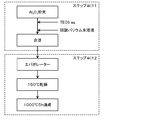
- Process transition diagram showing the outline of the method for preparing porous alumina according to the present invention by the kneading method Process transition diagram showing the outline of the method for preparing porous alumina according to the present invention by the first type impregnation method. Process transition diagram showing the outline of the method for preparing porous alumina according to the present invention by the second type impregnation method.
- a graph showing an XRD diffraction pattern showing the crystal structure of the evaluation sample shown in FIG. A list showing the measurement results of the specific surface areas of a plurality of evaluation samples and comparative samples having different SiO 2 addition rates and BaO addition rates prepared by the kneading method after heat treatment at 1200 ° C. for 30 hours.
- Process transition diagram showing the outline of the method for preparing porous alumina according to the present invention by the precipitation method.
- the present embodiment A preferred embodiment of the porous alumina according to the present invention (hereinafter, appropriately referred to as “the present embodiment”) will be described.
- the porous alumina (hereinafter, appropriately referred to as “the present alumina”) according to the present embodiment is composed of alumina (aluminum oxide, Al 2 O 3 ) and two types of oxides, silica (SiO 2 ) and barium oxide (BaO). Is a porous alumina to which is added.
- this alumina is alumina to which silica and barium oxide are added, and when it is simply referred to as “alumina", it is alumina to which silica and barium oxide are not added.
- the method for preparing the present alumina basically includes a step for adding silica to alumina and a step for adding barium oxide to alumina.
- an impregnation method, a kneading method, a precipitation method, a sol-gel method, etc. can be candidates depending on the difference in the process for adding barium oxide, but in the present embodiment, the heat resistance and caulking resistance of the present alumina Kneading and impregnation methods are used in the preparation of samples for sex assessment.
- the addition rates of silica and barium oxide added to the present alumina in the present embodiment are defined as follows.
- the unit of the following SiO 2 addition rate and BaO addition rate is "mass%".
- SiO 2 addition rate SiO 2 addition amount / (alumina mass + SiO 2 addition amount) x 100
- BaO addition rate BaO addition amount / (mass of alumina + SiO 2 addition amount) x 100
- the amount of SiO 2 added is the amount obtained by converting the Si content in the present alumina into the content of SiO 2
- the amount of BaO added is the amount obtained by converting the Ba content in the present alumina into the amount of BaO.
- the Si content is the content of all Si present as a simple substance and a compound in the present alumina
- the Ba content is the content of all Ba existing as a simple substance and a compound in the present alumina.
- the reference mass as a calculation standard of SiO 2 addition rate and BaO addition rate not contain BaO amount, in the process according to the present alumina below, SiO 2 addition rate and BaO added This is because it was more convenient to unify the rate setting to (mass of alumina + amount of SiO 2 added).
- the SiO 2 addition rate and the BaO addition rate can be easily converted into an addition rate based on the reference mass including the BaO addition amount. Further, if necessary, the unit of each addition rate can be converted from "mass%" to "mol%".
- the method for preparing the present alumina by the kneading method is roughly classified into an alkoxysilane solution containing an alkoxysilane, a mixed solvent containing water and alcohol, and an inorganic acid, and aluminum containing an aluminum compound and water.
- Step # K2 a step of adding an aqueous solution of a barium compound to the precipitate and kneading it (step # K3), and a step of drying and firing the precipitate kneaded with the barium compound to produce alumina, It comprises a step (step # K4) of forming a porous alumina (this alumina) containing silica and barium oxide.
- TEOS tetraethoxysilane
- alcohol for example, ethanol is preferably used
- inorganic acid is preferably used.
- hydrochloric acid or nitrate is preferably used, but is not limited thereto.
- the aluminum solution of step # K1 is preferably prepared by dissolving aluminum nitrate in water or dissolving aluminum hydroxide in an aqueous nitrate solution from the viewpoint of improving heat resistance.
- the mixing ratio of the alkoxysilane and the aluminum compound in the mixed solution prepared in step # K1 is such that the addition rate of silica (SiO 2 addition rate) in the porous alumina formed in step # K3 becomes a desired value. It will be adjusted.
- the alkoxysilane and aluminum compound in the mixed solution prepared in step # K1 are uniformly dissolved in the mixed solvent composed of water and alcohol. In other words, the mixed solution forms a single liquid phase without phase separation.
- a precipitating agent containing a basic compound is added to the acidic mixed solution, preferably while heating at 40 ° C. to 100 ° C. (for example, while heating and refluxing at 100 ° C.).
- the basic compound By adding the basic compound until the pH of the mixed solution reaches about 8 (for example, 8 to 8.5), the aluminum hydroxide and the silicon compound coprecipitate.
- the silicon compound contained in the precipitate formed by coprecipitation can be alkoxysilane or a hydrolyzed condensate thereof.
- the precipitant contains, for example, at least one basic compound selected from the group consisting of aqueous ammonia, sodium hydroxide, potassium hydroxide and urea. Of these, ammonia water is preferable.
- step # K3 it is preferable to remove the precipitate from the mixed solution by a usual method such as filtration and wash it with room temperature water (distilled water).
- An aqueous solution of a barium compound is added to the precipitate after washing with water and kneaded.
- the aqueous solution of the barium compound is preferably prepared by dissolving barium nitrate in water to prepare an aqueous solution of barium nitrate, or by dissolving barium hydroxide in water to prepare an aqueous solution of barium hydroxide.
- step # K4 the precipitate kneaded with the barium compound is dried for a predetermined time in, for example, a dryer at 150 ° C., and then the dried precipitate is pulverized in, for example, a mortar and pestle.
- porous alumina this alumina
- alumina is mainly composed of intermediate alumina such as ⁇ -alumina and ⁇ -alumina.
- the method for preparing the present alumina by the impregnation method is the first type of impregnation method in which silica and barium oxide are added to the ready-made porous alumina by the impregnation method to prepare the present alumina, and the silica-added porous method in which silica is added to the alumina.
- First type impregnation method As shown in FIG. 6, the first type of impregnation method is roughly classified into a step of impregnating a ready-made porous alumina (Al 2 O 3 powder) with an alkoxysilane solution and an aqueous solution of a barium compound (step # I11). And the step (step # I12) of drying and firing the porous alumina impregnated with the alkoxysilane solution and the aqueous solution of the barium compound to form the porous alumina (this alumina) containing alumina, silica and barium oxide. Is configured with.
- porous alumina composed mainly of intermediate alumina such as ⁇ -alumina and ⁇ -alumina is used.
- C20 made by Nippon Light Metal is used as the ready-made porous alumina, but the present invention is not limited to the porous alumina made by Nippon Light Metal, and may be prepared independently. ..
- TEOS is preferably used as in step # K1 of the kneading method.
- the aqueous solution of the barium compound in step # I11 is prepared by dissolving barium nitrate in water to prepare an aqueous solution of barium nitrate, or by dissolving barium hydroxide in water, as in step # K3 of the kneading method. Therefore, it is preferable to prepare it as an aqueous solution of barium hydroxide.
- step # I12 the porous alumina impregnated with the alkoxysilane solution and the aqueous solution of the barium compound is dried in, for example, 150 ° C. in air or with a rotary evaporator, and then calcined in, for example, 1000 ° C. in air for 5 hours.
- porous alumina this alumina
- alumina, silica, and barium oxide can be obtained.
- Second type impregnation method As shown in FIG. 7, the second type of impregnation method is roughly classified by mixing an alkoxysilane solution containing an alkoxysilane, a mixed solvent containing water and alcohol, and an inorganic acid with an aluminum solution containing an aluminum compound and water. Then, in the step of preparing a mixed solution in which the aluminum compound and the alkoxysilane are dissolved in the mixed solvent (step # I21), aluminum hydroxide is co-precipitated with the silicon compound in the mixed solvent to form a precipitate.
- the step of impregnating the aqueous solution of the compound (step # I24) and the silica-added porous alumina impregnated with the aqueous solution of the barium compound are dried and calcined to obtain the porous alumina containing alumina, silica and barium oxide (this alumina). It is configured to include a step of forming (step # I25).
- Steps # I21 and # I22 of the second type impregnation method are basically the same as steps # K1 and # K2 of the kneading method described above, and duplicate explanations are omitted.
- the methods for preparing the silica-added porous alumina in steps # I21 to # I23 include the method for preparing the silica-added porous alumina described later by the kneading method of the comparative sample having a BaO addition rate of 0% by mass, and steps # K4 and step # I23. It is the same except for the difference in firing temperature.
- the silica-added porous alumina used in step # I24 is replaced with the one prepared in steps # I21 to # I23, and ready-made silica-added porous alumina is used. May be good.
- step # I23 it is preferable that the precipitate is taken out of the mixed solution by a usual method such as filtration and washed with room temperature water (distilled water). The precipitate is dried, most of the solvent is removed, and then pulverized in a mortar or the like to be pulverized.
- Silica-added porous alumina is formed by calcining the dried and powdered precipitate.
- the alumina constituting the silica-added porous alumina is mainly composed of intermediate alumina such as ⁇ -alumina and ⁇ -alumina.
- the firing temperature is preferably 400 to 1000 ° C. If the firing temperature is too high, the transition of aluminum oxide to the ⁇ phase may proceed and the specific surface area may decrease.
- the firing time is preferably about 1 hour to several tens of hours.
- step # I24 as in step # K3 of the kneading method, the aqueous solution of the barium compound is prepared by dissolving barium nitrate in water to prepare an aqueous solution of barium nitrate, or by dissolving barium hydroxide in water. , It is preferable to prepare as an aqueous solution of barium hydroxide.
- step # I25 similarly to step # I12 of the first type impregnation method, the porous alumina impregnated with the aqueous solution of the barium compound is dried in air, for example, at 150 ° C. or with a rotary evaporator, and then dried. For example, it is calcined in air at 1000 ° C. for 5 hours to obtain porous alumina (this alumina) containing alumina, silica, and barium oxide.
- This alumina prepared by the kneading method and the first or second type impregnation method is mainly composed of intermediate alumina such as ⁇ -alumina and ⁇ -alumina.
- the present alumina is in the form of a powder obtained by crushing secondary particles in which needle-like or fibrous primary particles are aggregated and sieving them into a predetermined particle size range (for example, 100 ⁇ m to 500 ⁇ m).
- the shape of the alumina can be various shapes such as a powder shape, a pellet shape, a disc shape, and a honeycomb shape.
- the amount of silicon and barium added to the alumina is defined by the amount of each solution added. That is, since the entire amount of silicon and barium in the solution is added to the alumina by evaporative drying of the added solution, the above-mentioned SiO 2 addition rate and BaO addition rate are the mass of the given alumina or the alkoxysilane solution. It is uniquely determined by the amount used and the amount added to each solution.
- step # K1 As the alkoxysilane solution of step # K1, 7.52 g of ethanol was added to 5.00 g of TEOS and stirred at room temperature for 5 minutes, then 1.25 g of hydrochloric acid (37% by mass) was added, and the mixture was further stirred at room temperature for 5 minutes. 71.23 g of water was mixed with this mixed solution to obtain a transparent and uniform 5.88 mass% TEOS solution.
- step # K1 the TEOS solution obtained in the above manner was added to a predetermined amount of a 20 mass% aluminum nitrate aqueous solution to obtain a uniform mixed solution.
- the mixed solution was heated to reflux, 28% by mass aqueous ammonia was added dropwise until the pH reached 8.5, and the mixture was stirred. With the dropping of ammonia water, aluminum hydroxide and silicic acid compound co-precipitated, and a precipitate was formed in the solution. This precipitate was filtered by suction filtration using No. 1 filter paper. The precipitate was washed with distilled water.
- a predetermined amount of barium nitrate aqueous solution was added to the precipitate after washing with water and kneaded. Then, it was dried in a dryer at 150 ° C. for 20 hours. The dried precipitate was pulverized in a mortar and calcined in air at 1000 ° C. for 5 hours to obtain a sample for evaluation of the present alumina.
- comparative samples three types of comparative samples were also prepared: only the SiO 2 addition rate was 0% by mass, only the BaO addition rate was 0% by mass, and both the SiO 2 addition rate and the BaO addition rate were 0% by mass.
- the evaluation sample and the comparison sample are represented by the symbols SK (Xs, Xb). Xs indicates the SiO 2 addition rate (mass%), and Xb indicates the BaO addition rate (mass%).
- a comparative sample of Xs 0% by mass was prepared in step # K1 by using a blank solution containing no TEOS (a solution containing ethanol and hydrochloric acid whose concentration was adjusted with water) instead of the TEOS solution.
- a comparative sample having Xb 0% by mass was prepared in step # K3 by omitting the step of adding an aqueous solution of a barium compound to the precipitate after suction filtration and washing with water and kneading.
- the specific surface area of each sample was measured by the nitrogen adsorption BET method using a fully automatic gas adsorption amount measurement (BELSORP-max manufactured by MicrotracBEL) under the following three types of heat treatment conditions.
- the first heat treatment condition is a state before the other two types of heat treatment (before heat treatment).
- the second heat treatment condition is a state (1200 ° C. for 5 hours) after the temperature is raised from room temperature to 1200 ° C. at 10 ° C./min, the heating is stopped, and the temperature is maintained at 1200 ° C. for 5 hours.
- the third heat treatment condition is a state (1200 ° C. for 30 hours) after the temperature is raised from room temperature to 1200 ° C. at 10 ° C./min, the heating is stopped, and the temperature is maintained at 1200 ° C. for 30 hours.
- the crystal structure of each sample was measured by a two-dimensional high-speed detector by irradiating with Cuk ⁇ using an X-ray diffractometer (ULTIMA III manufactured by Rigaku).
- the amounts of Al, Si and Ba in each sample were analyzed by the glass bead method using a fluorescent X-ray analyzer (Supermini manufactured by Rigaku).
- the amount of solid acid base of each sample was measured by a thermal desorption method (TPD, base probe molecule: NH 3 , acid probe molecule: CO 2 ) using a catalyst evaluation device (BELCAT manufactured by Microtrac BEL).
- the sample evaluation method is the same for the evaluation of the heat resistance and caulking resistance of the present alumina prepared by the first type impregnation method described later.
- FIG. 9 shows XRD diffraction showing the crystal structures of one evaluation sample and three comparative samples prepared by the kneading method under each heat treatment condition of 1200 ° C. for 5 hours and 1200 ° C. for 30 hours before heat treatment. Show the pattern.
- the evaluation sample and the comparison sample used are SK (1,7), SK (0,0), SK (1,0), and SK (0,7).
- FIG. 10 shows the XRD diffraction patterns of the evaluation sample SK (1,7) shown in FIG. 9 under the three types of heat treatment conditions in one graph.
- FIG. 11 shows the results of measuring the specific surface area of the evaluation sample and the comparative sample prepared by the kneading method after the heat treatment at 1200 ° C. for 30 hours by increasing the number of samples.
- the number of samples is 90 for evaluation and 24 for comparison, and the range of SiO 2 addition rate and BaO addition rate is as wide as 0 ⁇ Xs ⁇ 30 and 0 ⁇ Xb ⁇ 100.
- the specific surface area of the evaluation sample SK (1,7) was higher than that of the comparison sample SK (3,0), and SiO 2 Even if the addition rate is reduced from 3% by mass to 1% by mass, the ratio of the comparison sample (corresponding to the reference porous alumina for comparison) to which only silica is added in an appropriate amount by adding an appropriate amount of barium oxide. It was confirmed that a specific surface area larger than the surface area (corresponding to the standard specific surface area) could be obtained.
- the specific surface area reaches a maximum value exceeding the reference specific surface area and then decreases to the reference specific surface area or less. do.
- the range of the BaO addition rate Xb at which the same specific surface area is equal to or greater than the reference specific surface area becomes wider as the SiO 2 addition rate Xs increases.
- the specific surface area after the heat treatment at 1200 ° C. for 30 hours is 1-1 to 1 with respect to the reference porous alumina. It can be seen that it can be maintained or improved in the range of 724 times. Even if the SiO 2 addition rate Xs decreases from 3% by mass to 0.7% by mass, the BaO addition rate Xb is in the range of 5% by mass ⁇ Xb ⁇ 10% by mass, and the same specific surface area is 1 to 1 of the reference specific surface area.
- the heat resistance is 0.034 times, which is almost the same as that of the standard porous alumina.
- the same specific surface area is 1 to 1 of the reference specific surface area in the range of 3% by mass ⁇ Xb ⁇ 10% by mass in the BaO addition rate Xb.
- the heat resistance is 414 times, which is almost equal to or higher than that of the standard porous alumina.
- the SiO 2 addition rate Xs decreases from 3% by mass to 2% by mass, the same specific surface area is 1-1 to 1 of the reference specific surface area in the range of 1% by mass ⁇ Xb ⁇ 14% by mass of the BaO addition rate Xb.
- the heat resistance is .655 times, which is almost equal to or higher than that of the standard porous alumina.
- the BaO addition rate Xb is in the range of 0.5% by mass ⁇ Xb ⁇ 14% by mass, and the same specific surface area is 1.207 to 1.724 of the reference specific surface area. It doubles and enables heat resistance that is 20% or more higher than that of standard porous alumina.
- the SiO 2 addition rate Xs is in the range of 1 to 3% by mass
- by bringing the BaO addition rate Xb close to 5% by mass the specific surface area can be improved by about 1.4 to 1.7 times the standard specific surface area. It is obtained, and the heat resistance can be further improved.
- the first effective range of the SiO 2 addition rate Xs and the BaO addition rate Xb at which the specific surface area after the heat treatment at 1200 ° C. for 30 hours is equal to or more than the reference specific surface area is as follows. 0.7% by mass ⁇ Xs ⁇ 1% by mass, 5% by mass ⁇ Xb ⁇ 10% by mass, or 1% by mass ⁇ Xs ⁇ 2% by mass, 3% by mass ⁇ Xb ⁇ 10% by mass, or 2% by mass ⁇ Xs ⁇ 3% by mass and 1% by mass ⁇ Xb ⁇ 14% by mass.
- the surface area is larger than the reference specific surface area, and in the vicinity of the thick line frame in FIG. 11, the specific surface area after heat treatment at 1200 ° C. for 30 hours may be greater than or equal to the reference specific surface area.
- FIG. 12 shows the results of measuring the amount of solid acid and the amount of solid base of one evaluation sample and five comparative samples prepared by the kneading method.
- the evaluation samples and comparison samples used were SK (1,7), SK (0,0), SK (1,0), SK (3,0), SK (5,0), SK (0,0,). 7).
- FIG. 13 shows the results of measuring the amount of solid acid in the evaluation sample and the comparative sample prepared by the kneading method by increasing the number of samples.
- the number of samples is 15 for evaluation and 9 for comparison, and the range of SiO 2 addition rate and BaO addition rate is as wide as 0 ⁇ Xs ⁇ 5 and 0 ⁇ Xb ⁇ 14.
- the amount of solid acid in the evaluation sample SK (1,7) decreased to a level equal to or less than the amount of solid acid in the comparative sample SK (0,0) in which the SiO 2 addition rate Xs and the BaO addition rate Xb were 0% by mass. ing.
- the solid acid amount of this alumina is the comparative sample SK (3) which corresponds to the reference porous alumina. It can be seen that the amount of solid acid is less than 0), and the coking resistance is improved with respect to the standard porous alumina.
- the specific surface area of this alumina after heat treatment at 1200 ° C. for 30 hours is for comparison within the range where the SiO 2 addition rate Xs is 3% by mass or less and the BaO addition rate Xb is 14% by mass or less.
- SiO 2 addition rate Xs and BaO that are equal to or greater than the specific surface area (reference specific surface area) of sample SK (3,0) and equal to or less than the amount of solid acid of comparative sample SK (3,0). It was found that the effective range of the addition rate Xb exists in a wide range, and it was confirmed that the mixed addition of silica and barium oxide within the effective range is effective for both the improvement of heat resistance and the improvement of coking resistance. rice field.
- the effective range is the first effective range of the SiO 2 addition rate Xs and the BaO addition rate Xb at which the specific surface area of the above-mentioned alumina after heat treatment at 1200 ° C. for 30 hours is equal to or larger than the reference specific surface area.
- the range of the SiO 2 addition rate Xs and the BaO addition rate Xb is set to 1% by mass ⁇ Xs ⁇ 3% by mass, 3% by mass ⁇ Xb ⁇ 10 mass with respect to the above effective range.
- step # I11 the TEOS solution was not used in the comparative sample having a SiO 2 addition rate of 0% by mass, and the barium nitrate aqueous solution was not used in the comparative sample having a BaO addition rate of 0% by mass, and the impregnation treatment was performed. went.
- the evaluation sample and the comparison sample are represented by the symbols SI (Xs, Xb). Xs indicates the SiO 2 addition rate (mass%), and Xb indicates the BaO addition rate (mass%).
- FIG. 14 shows the results of measuring the specific surface area of the evaluation sample and the comparative sample prepared by the first type impregnation method after heat treatment at 1200 ° C. for 30 hours.
- the number of samples is 20 for evaluation and 3 for comparison, and the range of SiO 2 addition rate and BaO addition rate is 0 ⁇ Xs ⁇ 3 and 0 ⁇ Xb ⁇ 14.
- the specific surface area is still in the range of 0.7% by mass or more and 3% by mass or less of SiO 2 addition rate Xs and 1% by mass or more and 14% by mass or less of BaO addition rate Xb even after heat treatment at 1200 ° C. for 30 hours.
- the second effective range of SiO 2 addition rate Xs and BaO addition rate Xb which is equal to or larger than the specific surface area (corresponding to the reference specific surface area) of the comparative sample SI (3,0) corresponding to the reference porous alumina, exists in a wide range. It can be seen (the area surrounded by the thick line frame in FIG. 14).
- the second effective range is consistent with the first effective range for the evaluation sample prepared by the kneading method shown in FIG. Further, at the same SiO 2 addition rate Xs, when the BaO addition rate Xb increases from 1% by mass, the specific surface area reaches the maximum value exceeding the reference specific surface area, and then decreases to the reference specific surface area or less.
- the range of the BaO addition rate Xb at which the same specific surface area is equal to or greater than the reference specific surface area becomes wider as the SiO 2 addition rate Xs increases, which is also consistent with the measurement results shown in FIG.
- FIG. 15 shows the measurement results of the amount of solid acid in the evaluation sample and the comparison sample prepared by the first type impregnation method.
- the number of samples is 12 for evaluation and 8 for comparison, and the range of SiO 2 addition rate and BaO addition rate is 0 ⁇ Xs ⁇ 5, 0 ⁇ Xb ⁇ 20.
- the SiO 2 addition rate Xs is in the range of 0% by mass to 5% by mass
- the BaO addition rate Xb is 0% by mass with respect to the solid acid amount of the comparative sample. It was confirmed that the amount of solid acid decreased monotonically as the BaO addition rate Xb increased from 0% by mass to 20% by mass. As described above, the point that the amount of solid acid monotonously decreases as the BaO addition rate Xb increases is consistent with the case of the evaluation sample prepared by the kneading method shown in FIG.
- the first sample is the same as the evaluation sample prepared by the kneading method shown in FIG. Even in this alumina prepared by the type impregnation method, the amount of solid acid is less than the amount of solid acid in the comparative sample SI (3,0) corresponding to the reference porous alumina, and the coking resistance to the reference porous alumina is high. It turns out to be improved.
- the SiO 2 addition rate Xs is 3 mass in the present alumina prepared by the first type impregnation method as well as the evaluation samples prepared by the kneading method shown in FIGS. 11 and 13.
- the specific surface area of this alumina after heat treatment at 1200 ° C. for 30 hours is equal to or greater than the specific surface area (reference specific surface area) of the comparative sample SI (3.0) within the range of% or less and the BaO addition rate Xb of 14% by mass or less.
- the effective range of the SiO 2 addition rate Xs and the BaO addition rate Xb in which the solid acid amount of this alumina is equal to or less than the solid acid amount of the comparative sample SI (3,0) exists in a wide range. ..
- the effective range is the second effective range of the SiO 2 addition rate Xs and the BaO addition rate Xb at which the specific surface area of the above-mentioned alumina after heat treatment at 1200 ° C. for 30 hours is equal to or larger than the reference specific surface area.
- ⁇ -alumina is pregelatinized faster than the formation of barium hexaaluminate, which is the key to suppressing sintering, and the specific surface area is reduced by high-temperature heat treatment.
- the addition of silica can delay the pregelatinization to some extent in the initial stage of sintering, but the pregelatinization cannot be completely prevented by the long-time firing at 1200 ° C.
- the specific surface area can be kept high as a result of the mixed addition of silica and barium oxide delaying the initial pregelatinization of silica and subsequently suppressing the formation of ⁇ -alumina by the formation of barium hexaaluminate. Be done.
- [4] Another embodiment of the method for preparing the present alumina In the above embodiment, the kneading method and the first and second types of impregnation methods have been described as the method for preparing the present alumina, but the method for preparing the present alumina can accurately control the SiO 2 addition rate and the BaO addition rate.
- the preparation method is not limited to a specific preparation method.
- a preparation method such as a precipitation method or a sol-gel method is assumed.
- the preparation method by the precipitation method will be briefly described.
- the method for preparing the present alumina by the precipitation method is roughly divided into an alkoxysilane solution containing an alkoxysilane, a mixed solvent containing water and alcohol, and an inorganic acid, and an aqueous solution of a barium compound, which is an aluminum compound.
- a mixed solution in which the aluminum compound, alkoxysilane, and barium compound are dissolved in the mixed solvent by mixing with an aluminum solution containing water and water (step # P1), and aluminum hydroxide in the mixed solvent.
- step # P2 To form a first precipitate by co-precipitating with a silicon compound (step # P2), and once the solution containing the precipitate is cooled to 60 ° C. or lower, ammonium carbonate is added to carbonate barium.
- step # P3 the precipitate containing the barium compound is filtered and washed by suction filtration, and the filtered and washed precipitate is dried and fired to produce aluminum oxide.
- step # P4 of forming a porous alumina (this alumina) containing silica and barium oxide.
- the alkoxysilane solution, aluminum solution, and aqueous solution of the barium compound used in step # P1 are used in the alkoxysilane solution, aluminum solution, and step # K3 used in step # K1 of the kneading method described above. It is the same as the aqueous solution of silane compound, and duplicate explanations are omitted.
- a TEOS solution is exemplified as an alkoxysilane solution
- a barium nitrate aqueous solution is exemplified as an aqueous solution of a barium compound.
- step # P2 is basically the same as step # K2 of the kneading method described above, and duplicate explanations will be omitted.
- step # P3 is required because the barium compound does not coprecipitate as barium hydroxide with the aluminum hydroxide and the silicon compound.
- step # P3 the solution containing the precipitate is cooled to 60 ° C. or lower in order to avoid the decomposition because ammonium carbonate decomposes into carbon dioxide gas, ammonia, and water at 60 ° C. or higher.
- This alumina is prepared by, for example, the above-mentioned kneading method, impregnation method, precipitation method, etc. so that the SiO 2 addition rate and the BaO addition rate are within the above-mentioned effective range, and two types of alumina, silica and barium oxide. It is a porous alumina to which the oxide of the above is mixed and added. Therefore, the SiO 2 addition rate and the BaO addition rate are, on average, within the above-mentioned effective range with respect to the total amount of the prepared alumina.
- the SiO 2 addition rate and the BaO addition rate are not within the above-mentioned effective ranges (alumina alone, porous alumina in which only silica is added to alumina, porous alumina in which only barium oxide is added to alumina, Heterogeneous porous alumina in which silica and barium oxide are added to alumina, porous alumina in which oxides other than silica and barium oxide are added to alumina, etc.) are mixed with this alumina and partially or In the case of being locally present, even if the SiO 2 addition rate and the BaO addition rate are outside the above-mentioned effective range on average with respect to the total amount of the present alumina and the dissimilar porous alumina, the present alumina However, when it exists separately from the dissimilar porous alumina and has the desired characteristics (specific surface area after heat treatment at 1200 ° C.
- the present alumina may take a form in which the above-mentioned heterogeneous porous alumina is partially or locally present.
- the present alumina is silica in alumina.
- a small amount of components (oxides, etc.) other than barium oxide may be added as compared with silica and barium oxide.
- this alumina has excellent heat resistance, and is therefore useful as a catalyst carrier, a filter, or the like that carries a catalytically active component. Further, since this alumina is excellent in caulking resistance in addition to excellent heat resistance as described above, it is suitable as a catalyst carrier used in a reaction using a hydrocarbon such as a steam reforming reaction.
- the present invention is suitably used for porous alumina in which silica and barium oxide are added to aluminum oxide, and a catalyst using the porous alumina as a carrier.
Landscapes
- Chemical & Material Sciences (AREA)
- Organic Chemistry (AREA)
- Engineering & Computer Science (AREA)
- Materials Engineering (AREA)
- Chemical Kinetics & Catalysis (AREA)
- Life Sciences & Earth Sciences (AREA)
- Geology (AREA)
- Inorganic Chemistry (AREA)
- Physics & Mathematics (AREA)
- Thermal Sciences (AREA)
- Catalysts (AREA)
Priority Applications (6)
| Application Number | Priority Date | Filing Date | Title |
|---|---|---|---|
| JP2022509413A JP7598580B2 (ja) | 2020-03-26 | 2021-02-18 | 多孔質アルミナ及び触媒 |
| US17/909,296 US20230105883A1 (en) | 2020-03-26 | 2021-02-18 | Porous alumina and catalyst |
| CN202180013686.6A CN115066396B (zh) | 2020-03-26 | 2021-02-18 | 多孔质氧化铝和催化剂 |
| EP21774080.2A EP4129907A4 (en) | 2020-03-26 | 2021-02-18 | POROUS ALUMINA AND CATALYST |
| KR1020227027641A KR102856497B1 (ko) | 2020-03-26 | 2021-02-18 | 다공질 알루미나 및 촉매 |
| JP2024202884A JP7742591B2 (ja) | 2020-03-26 | 2024-11-21 | 多孔質アルミナ及び触媒 |
Applications Claiming Priority (2)
| Application Number | Priority Date | Filing Date | Title |
|---|---|---|---|
| JP2020-056175 | 2020-03-26 | ||
| JP2020056175 | 2020-03-26 |
Publications (1)
| Publication Number | Publication Date |
|---|---|
| WO2021192752A1 true WO2021192752A1 (ja) | 2021-09-30 |
Family
ID=77892436
Family Applications (1)
| Application Number | Title | Priority Date | Filing Date |
|---|---|---|---|
| PCT/JP2021/006087 Ceased WO2021192752A1 (ja) | 2020-03-26 | 2021-02-18 | 多孔質アルミナ及び触媒 |
Country Status (6)
| Country | Link |
|---|---|
| US (1) | US20230105883A1 (https=) |
| EP (1) | EP4129907A4 (https=) |
| JP (2) | JP7598580B2 (https=) |
| KR (1) | KR102856497B1 (https=) |
| CN (1) | CN115066396B (https=) |
| WO (1) | WO2021192752A1 (https=) |
Cited By (1)
| Publication number | Priority date | Publication date | Assignee | Title |
|---|---|---|---|---|
| WO2023182247A1 (ja) | 2022-03-25 | 2023-09-28 | 株式会社ルネッサンス・エナジー・リサーチ | SiO2Al2O3含有ゾル溶液の合成方法、及び、多孔質アルミナ膜の形成方法 |
Citations (4)
| Publication number | Priority date | Publication date | Assignee | Title |
|---|---|---|---|---|
| JPS57171436A (en) * | 1981-03-24 | 1982-10-22 | Du Pont | Improved catalyst for manufacturing methylamine |
| JPS63119851A (ja) * | 1986-11-07 | 1988-05-24 | Toyo C C I Kk | 触媒燃焼反応用耐熱性触媒及びその製造方法 |
| JPS63242917A (ja) * | 1987-03-27 | 1988-10-07 | Agency Of Ind Science & Technol | 耐熱性アルミナ複合酸化物の製造方法 |
| WO2012096386A1 (ja) * | 2011-01-14 | 2012-07-19 | 株式会社ルネッサンス・エナジー・リサーチ | 多孔質アルミナ材料及びその製造方法、並びに触媒 |
Family Cites Families (12)
| Publication number | Priority date | Publication date | Assignee | Title |
|---|---|---|---|---|
| GB1028753A (en) * | 1961-09-11 | 1966-05-04 | Ici Ltd | Improvements in and relating to catalyst supports and catalytic compositions for use in the steam reforming of hydrocarbons |
| US5916839A (en) * | 1995-10-13 | 1999-06-29 | Samsung Electro-Mechanics Co., Ltd. | Catalyst for purifying automobile exhausts |
| JP4065944B2 (ja) | 2002-12-25 | 2008-03-26 | 独立行政法人産業技術総合研究所 | 高耐熱・高強度アルミナ多孔体の製造法 |
| JP2009061383A (ja) | 2007-09-06 | 2009-03-26 | Nagoya Institute Of Technology | 耐熱性アルミナ担体とその製造方法 |
| CN101462050B (zh) * | 2007-12-19 | 2011-05-18 | 中国石油化工股份有限公司 | 介孔复合氧化物和催化剂及其制备方法与芳构化方法 |
| JP5339478B2 (ja) * | 2010-08-31 | 2013-11-13 | キヤノンマーケティングジャパン株式会社 | 情報処理システム、情報処理装置、及びその制御方法及びプログラム |
| US9744522B2 (en) * | 2011-01-14 | 2017-08-29 | Renaissance Energy Research Corporation | Porous alumina material, process for producing same, and catalyst |
| EP2808081A4 (en) | 2012-01-23 | 2015-08-26 | N E Chemcat Corp | BARIUM SULPHATE CONTAINING ALUMINUM MATERIAL AND EXHAUST GAS CLEANING CATALYST THEREOF |
| WO2014051091A1 (ja) | 2012-09-28 | 2014-04-03 | Dic株式会社 | α-アルミナ微粒子及びその製造方法 |
| CN105585037B (zh) * | 2014-10-23 | 2017-04-26 | 中国石油化工股份有限公司 | 一种介孔γ‑氧化铝的制备方法 |
| CN106955694B (zh) * | 2016-01-08 | 2019-11-12 | 中国石油化工股份有限公司 | 一种α-氧化铝载体、由其制备的银催化剂及其应用 |
| CN107413389B (zh) * | 2016-05-23 | 2020-07-24 | 中国石油化工股份有限公司 | 用于银催化剂的α-氧化铝载体及其制备方法与应用 |
-
2021
- 2021-02-18 US US17/909,296 patent/US20230105883A1/en active Pending
- 2021-02-18 JP JP2022509413A patent/JP7598580B2/ja active Active
- 2021-02-18 WO PCT/JP2021/006087 patent/WO2021192752A1/ja not_active Ceased
- 2021-02-18 CN CN202180013686.6A patent/CN115066396B/zh active Active
- 2021-02-18 EP EP21774080.2A patent/EP4129907A4/en active Pending
- 2021-02-18 KR KR1020227027641A patent/KR102856497B1/ko active Active
-
2024
- 2024-11-21 JP JP2024202884A patent/JP7742591B2/ja active Active
Patent Citations (4)
| Publication number | Priority date | Publication date | Assignee | Title |
|---|---|---|---|---|
| JPS57171436A (en) * | 1981-03-24 | 1982-10-22 | Du Pont | Improved catalyst for manufacturing methylamine |
| JPS63119851A (ja) * | 1986-11-07 | 1988-05-24 | Toyo C C I Kk | 触媒燃焼反応用耐熱性触媒及びその製造方法 |
| JPS63242917A (ja) * | 1987-03-27 | 1988-10-07 | Agency Of Ind Science & Technol | 耐熱性アルミナ複合酸化物の製造方法 |
| WO2012096386A1 (ja) * | 2011-01-14 | 2012-07-19 | 株式会社ルネッサンス・エナジー・リサーチ | 多孔質アルミナ材料及びその製造方法、並びに触媒 |
Non-Patent Citations (3)
| Title |
|---|
| KI-YONG LEE ET AL.: "Deactivation by coke deposition on the HZSM-5 catalysts in the methanol-to-hydrocarbon conversion", JOURNAL OF PHYSICS AND CHEMISTRY OF SOLIDS, vol. 73, 2012, pages 1542 - 1545, XP028944978, DOI: 10.1016/j.jpcs.2012.09.005 |
| See also references of EP4129907A4 |
| TORN NUMAGUCHI ET AL.: "Evaluation of the Activity and Carbon Deposition of Methane Steam Reforming Catalysts", JOURNAL OF THE JAPAN PETROLEUM INSTITUTE, vol. 39, no. 3, 1996 |
Cited By (7)
| Publication number | Priority date | Publication date | Assignee | Title |
|---|---|---|---|---|
| WO2023182247A1 (ja) | 2022-03-25 | 2023-09-28 | 株式会社ルネッサンス・エナジー・リサーチ | SiO2Al2O3含有ゾル溶液の合成方法、及び、多孔質アルミナ膜の形成方法 |
| JPWO2023182247A1 (https=) * | 2022-03-25 | 2023-09-28 | ||
| KR20240125048A (ko) | 2022-03-25 | 2024-08-19 | 가부시키가이샤 르네상스 에너지 리서치 | SiO2Al2O3 함유 졸 용액의 합성 방법, 및, 다공질 알루미나막의 형성 방법 |
| KR102753605B1 (ko) | 2022-03-25 | 2025-01-10 | 가부시키가이샤 르네상스 에너지 리서치 | SiO2Al2O3 함유 졸 용액의 합성 방법, 및, 다공질 알루미나막의 형성 방법 |
| JP7678492B2 (ja) | 2022-03-25 | 2025-05-16 | 株式会社ルネッサンス・エナジー・リサーチ | SiO2Al2O3含有ゾル溶液の合成方法、及び、多孔質アルミナ膜の形成方法 |
| US12343703B2 (en) | 2022-03-25 | 2025-07-01 | Renaissance Energy Research Corporation | Method for synthesizing SiO2Al2O3 containing sol solution and method for forming porous alumina film |
| US12440825B2 (en) | 2022-03-25 | 2025-10-14 | Renaissance Energy Research Corporation | Method for synthesizing SiO2Al2O3 containing sol solution and method for forming porous alumina film |
Also Published As
| Publication number | Publication date |
|---|---|
| US20230105883A1 (en) | 2023-04-06 |
| KR20220127285A (ko) | 2022-09-19 |
| JP7742591B2 (ja) | 2025-09-22 |
| KR102856497B1 (ko) | 2025-09-05 |
| JPWO2021192752A1 (https=) | 2021-09-30 |
| JP7598580B2 (ja) | 2024-12-12 |
| EP4129907A4 (en) | 2024-05-29 |
| JP2025019168A (ja) | 2025-02-06 |
| CN115066396A (zh) | 2022-09-16 |
| CN115066396B (zh) | 2024-11-12 |
| EP4129907A1 (en) | 2023-02-08 |
Similar Documents
| Publication | Publication Date | Title |
|---|---|---|
| KR101286799B1 (ko) | 알루미나 또는 옥시수산화 알루미늄 기재 상에 란탄 페로브스카이트를 포함하는 조성물, 제조 방법 및 촉매에서의 용도 | |
| KR100890773B1 (ko) | 산화 제2세륨 및 그 제조법 및 배기가스 정화용 촉매 | |
| CN111389399B (zh) | 一种用于水煤气变换反应的铜基催化剂及其制备方法 | |
| US10010876B2 (en) | Catalyst for high temperature steam reforming | |
| CN103339061B (zh) | 多孔质氧化铝材料及其制造方法、以及催化剂 | |
| JP2022525736A (ja) | 酸素貯蔵用のセリア含有混合酸化物 | |
| JPH06182201A (ja) | 高温で安定な触媒及びその調製法ならびにその触媒を用いて化学反応を実施する方法 | |
| CN102674413B (zh) | 一种用于co和h2甲烷化的催化剂及其制备方法 | |
| CN111250144A (zh) | 载体为改性球形介孔二氧化硅的非贵金属系丙烷脱氢催化剂及其制法和应用 | |
| KR102035714B1 (ko) | 탄화수소 개질용 니켈 촉매 | |
| JP7742591B2 (ja) | 多孔質アルミナ及び触媒 | |
| CN114471589A (zh) | 催化剂、耐硫变换催化反应的方法和甲烷的制备方法 | |
| CN103619471A (zh) | 排气净化用催化剂以及载体 | |
| JP2002173370A (ja) | チタニア系多孔体及び触媒 | |
| CN106732632A (zh) | 一种加氢脱硫催化剂及制备方法 | |
| KR20170027674A (ko) | 수증기 메탄 개질용 저온 고효율 니켈계 촉매 및 이의 이용 | |
| TWI891075B (zh) | 用於甲烷乾式重組反應的觸媒及其製備方法 | |
| CN119746867B (zh) | Fe基催化剂及其制备方法和应用、水汽变换反应的方法 | |
| CN113457699A (zh) | 一种含磷的基质材料及其制备方法与应用 | |
| US20250229256A1 (en) | Exhaust gas purifying catalyst | |
| JP7621381B2 (ja) | Al-P複合酸化物およびこれを用いた排気ガス浄化用触媒 | |
| CN103372451B (zh) | 一种负载型催化剂的制备方法 | |
| JP4897989B2 (ja) | 排気ガス浄化用触媒の製造方法 | |
| CN111250086A (zh) | 载体为改性鸡蛋壳状介孔材料的非贵金属系丙烷脱氢催化剂及其制法和应用 | |
| JP2025111359A (ja) | 排ガス浄化用触媒 |
Legal Events
| Date | Code | Title | Description |
|---|---|---|---|
| 121 | Ep: the epo has been informed by wipo that ep was designated in this application |
Ref document number: 21774080 Country of ref document: EP Kind code of ref document: A1 |
|
| ENP | Entry into the national phase |
Ref document number: 2022509413 Country of ref document: JP Kind code of ref document: A |
|
| NENP | Non-entry into the national phase |
Ref country code: DE |
|
| ENP | Entry into the national phase |
Ref document number: 2021774080 Country of ref document: EP Effective date: 20221026 |