WO2021187411A1 - 動物細胞の培養方法 - Google Patents
動物細胞の培養方法 Download PDFInfo
- Publication number
- WO2021187411A1 WO2021187411A1 PCT/JP2021/010343 JP2021010343W WO2021187411A1 WO 2021187411 A1 WO2021187411 A1 WO 2021187411A1 JP 2021010343 W JP2021010343 W JP 2021010343W WO 2021187411 A1 WO2021187411 A1 WO 2021187411A1
- Authority
- WO
- WIPO (PCT)
- Prior art keywords
- group
- medium
- active ingredient
- methyl
- culture
- Prior art date
- Legal status (The legal status is an assumption and is not a legal conclusion. Google has not performed a legal analysis and makes no representation as to the accuracy of the status listed.)
- Ceased
Links
- JDJSMZZHKZLBOB-OIBJUYFYSA-N CC(C)C[C@]1(C(OC)=O)SC[C@@H](C(O)=O)N1 Chemical compound CC(C)C[C@]1(C(OC)=O)SC[C@@H](C(O)=O)N1 JDJSMZZHKZLBOB-OIBJUYFYSA-N 0.000 description 1
Images



Classifications
-
- C—CHEMISTRY; METALLURGY
- C12—BIOCHEMISTRY; BEER; SPIRITS; WINE; VINEGAR; MICROBIOLOGY; ENZYMOLOGY; MUTATION OR GENETIC ENGINEERING
- C12N—MICROORGANISMS OR ENZYMES; COMPOSITIONS THEREOF; PROPAGATING, PRESERVING, OR MAINTAINING MICROORGANISMS; MUTATION OR GENETIC ENGINEERING; CULTURE MEDIA
- C12N5/00—Undifferentiated human, animal or plant cells, e.g. cell lines; Tissues; Cultivation or maintenance thereof; Culture media therefor
- C12N5/0018—Culture media for cell or tissue culture
-
- C—CHEMISTRY; METALLURGY
- C12—BIOCHEMISTRY; BEER; SPIRITS; WINE; VINEGAR; MICROBIOLOGY; ENZYMOLOGY; MUTATION OR GENETIC ENGINEERING
- C12N—MICROORGANISMS OR ENZYMES; COMPOSITIONS THEREOF; PROPAGATING, PRESERVING, OR MAINTAINING MICROORGANISMS; MUTATION OR GENETIC ENGINEERING; CULTURE MEDIA
- C12N5/00—Undifferentiated human, animal or plant cells, e.g. cell lines; Tissues; Cultivation or maintenance thereof; Culture media therefor
- C12N5/06—Animal cells or tissues; Human cells or tissues
- C12N5/0602—Vertebrate cells
-
- C—CHEMISTRY; METALLURGY
- C07—ORGANIC CHEMISTRY
- C07D—HETEROCYCLIC COMPOUNDS
- C07D277/00—Heterocyclic compounds containing 1,3-thiazole or hydrogenated 1,3-thiazole rings
- C07D277/02—Heterocyclic compounds containing 1,3-thiazole or hydrogenated 1,3-thiazole rings not condensed with other rings
- C07D277/04—Heterocyclic compounds containing 1,3-thiazole or hydrogenated 1,3-thiazole rings not condensed with other rings having no double bonds between ring members or between ring members and non-ring members
- C07D277/06—Heterocyclic compounds containing 1,3-thiazole or hydrogenated 1,3-thiazole rings not condensed with other rings having no double bonds between ring members or between ring members and non-ring members with carbon atoms having three bonds to hetero atoms with at the most one bond to halogen, e.g. ester or nitrile radicals, directly attached to ring carbon atoms
-
- C—CHEMISTRY; METALLURGY
- C12—BIOCHEMISTRY; BEER; SPIRITS; WINE; VINEGAR; MICROBIOLOGY; ENZYMOLOGY; MUTATION OR GENETIC ENGINEERING
- C12P—FERMENTATION OR ENZYME-USING PROCESSES TO SYNTHESISE A DESIRED CHEMICAL COMPOUND OR COMPOSITION OR TO SEPARATE OPTICAL ISOMERS FROM A RACEMIC MIXTURE
- C12P21/00—Preparation of peptides or proteins
-
- C—CHEMISTRY; METALLURGY
- C12—BIOCHEMISTRY; BEER; SPIRITS; WINE; VINEGAR; MICROBIOLOGY; ENZYMOLOGY; MUTATION OR GENETIC ENGINEERING
- C12P—FERMENTATION OR ENZYME-USING PROCESSES TO SYNTHESISE A DESIRED CHEMICAL COMPOUND OR COMPOSITION OR TO SEPARATE OPTICAL ISOMERS FROM A RACEMIC MIXTURE
- C12P21/00—Preparation of peptides or proteins
- C12P21/02—Preparation of peptides or proteins having a known sequence of two or more amino acids, e.g. glutathione
-
- C—CHEMISTRY; METALLURGY
- C12—BIOCHEMISTRY; BEER; SPIRITS; WINE; VINEGAR; MICROBIOLOGY; ENZYMOLOGY; MUTATION OR GENETIC ENGINEERING
- C12N—MICROORGANISMS OR ENZYMES; COMPOSITIONS THEREOF; PROPAGATING, PRESERVING, OR MAINTAINING MICROORGANISMS; MUTATION OR GENETIC ENGINEERING; CULTURE MEDIA
- C12N2500/00—Specific components of cell culture medium
- C12N2500/30—Organic components
-
- C—CHEMISTRY; METALLURGY
- C12—BIOCHEMISTRY; BEER; SPIRITS; WINE; VINEGAR; MICROBIOLOGY; ENZYMOLOGY; MUTATION OR GENETIC ENGINEERING
- C12N—MICROORGANISMS OR ENZYMES; COMPOSITIONS THEREOF; PROPAGATING, PRESERVING, OR MAINTAINING MICROORGANISMS; MUTATION OR GENETIC ENGINEERING; CULTURE MEDIA
- C12N2500/00—Specific components of cell culture medium
- C12N2500/30—Organic components
- C12N2500/32—Amino acids
-
- C—CHEMISTRY; METALLURGY
- C12—BIOCHEMISTRY; BEER; SPIRITS; WINE; VINEGAR; MICROBIOLOGY; ENZYMOLOGY; MUTATION OR GENETIC ENGINEERING
- C12N—MICROORGANISMS OR ENZYMES; COMPOSITIONS THEREOF; PROPAGATING, PRESERVING, OR MAINTAINING MICROORGANISMS; MUTATION OR GENETIC ENGINEERING; CULTURE MEDIA
- C12N2501/00—Active agents used in cell culture processes, e.g. differentation
- C12N2501/999—Small molecules not provided for elsewhere
Definitions
- the present invention relates to a method for culturing animal cells.
- One aspect of the present invention relates to a method for producing a target substance such as a protein by an animal cell.
- a medium containing amino acids such as cysteine (Cys) is widely used for culturing animal cells. Cys spontaneously oxidizes in the medium and is converted to cystine ((Cys) 2). Since (Cys) 2 has low solubility, it easily precipitates in a liquid medium. For this reason, Cys is a factor in the storage instability of the liquid medium.
- Cys can condense with ⁇ -keto acids such as pyruvic acid (Pyr) and ⁇ -ketoglutaric acid to form thiazolidine derivatives (Non-Patent Document 1). It has been reported that the use of ⁇ -keto acid stabilizes the medium and that the thiazolidine derivative is effective for culturing animal cells (Non-Patent Document 1).
- ⁇ -keto acids such as pyruvic acid (Pyr) and ⁇ -ketoglutaric acid
- (2RS, 4R) -2-methyl-2,4-thiazolidinedicarboxylic acid 2-ethyl ester ((2RS, 4R) -2-methyl-2,4-thiazolidinedicarboxylic acid 2-ethyl ester) and (2RS, 4R)- Cysteine derivatives such as 2-methyl-2,4-thiazolidinedicarboxylic acid ((2RS, 4R) -2-methyl-2,4-thiazolidinedicarboxylic acid) are known as components of cosmetics (Patent Document 1).
- An object of the present invention is to provide a novel technique for culturing animal cells.
- the present inventors have found that a specific cysteine derivative functions as a substitute for cysteine when culturing animal cells, and have completed the present invention.
- a medium for culturing animal cells Contains active ingredients, The medium: the active ingredient is a compound represented by the formula (I) described later.
- the active ingredient is a compound represented by the formula (I) described later.
- R 1 indicates a C1-22 alkyl group which may have a substituent
- R 2 indicates a hydrogen atom and a C6-12 which may have a substituent. Indicates a linear C1-6 alkyl group which may have an aryl group or a substituent.
- the "R 1 " is a C1-6 alkyl group substituted with a C1-12 alkyl group or a C6-12 aryl group which may have a substituent
- / or the "R 2 " is A linear C1-6 alkyl group substituted with a hydrogen atom, a linear C1-6 alkyl group, a C6-12 aryl group optionally having a substituent, or a linear C1 substituted with a C1-7 acyl group. -6 alkyl group, The medium.
- the active ingredient is (2RS, 4R) -2-methyl-2,4-thiazolidinedicarboxylic acid 2-ethyl ester, (2RS, 4R) -2-methyl-2,4-thiazolidinedicarboxylic acid 2-methyl ester, ( 2RS, 4R) -2-methyl-2,4-thiazolidinedicarboxylic acid 2-i-propyl ester, (2RS, 4R) -2-methyl-2,4-thiazolidinedicarboxylic acid 2-n-butyl ester, (2RS, 4R) 4R) -2-Methyl-2,4-thiazolidinedicarboxylic acid 2-t-butyl ester, (2RS, 4R) -2-methyl-2,4-thiazolidinedicarboxylic acid 2-n-octyl ester, (2RS, 4R) From -2,4-thiazolidinedicarboxylic acid 2-ethyl ester, (2RS, 4R) -2- (4-hydroxyphenyl)
- the medium, wherein the active ingredient is a compound selected from the group consisting of (2RS, 4R) -2-methyl-2,4-thiazolidinedicarboxylic acid 2-ethyl ester and its 2R and 2S forms.
- the medium, wherein the active ingredient is a compound selected from the group consisting of (2RS, 4R) -2-methyl-2,4-thiazolidinedicarboxylic acid 2-methyl ester and its 2R and 2S forms.
- the medium which is the initial medium.
- It is a manufacturing method of the target substance. Including culturing animal cells capable of producing the target substance in a medium; and recovering the target substance. The culture was carried out in the presence of the active ingredient and The active ingredient is a compound represented by the formula (I) described later, Method: In the formula (I), “R 1 " indicates a C1-22 alkyl group which may have a substituent, and “R 2 " indicates a hydrogen atom and a C6-12 which may have a substituent. Indicates a linear C1-6 alkyl group which may have an aryl group or a substituent. [12] The method, wherein the target substance is a protein.
- a method of culturing animal cells Including culturing animal cells in medium The culture was carried out in the presence of the active ingredient and The active ingredient is a compound represented by the formula (I) described later, Method:
- R 1 indicates a C1-22 alkyl group which may have a substituent
- R 2 indicates a hydrogen atom and a C6-12 which may have a substituent. Indicates a linear C1-6 alkyl group which may have an aryl group or a substituent.
- the "R 1 " is a C1-6 alkyl group substituted with a C1-12 alkyl group or a C6-12 aryl group which may have a substituent
- / or the "R 2 " is A linear C1-6 alkyl group substituted with a hydrogen atom, a linear C1-6 alkyl group, a C6-12 aryl group optionally having a substituent, or a linear C1 substituted with a C1-7 acyl group. -6 alkyl group, The method.
- the active ingredient is (2RS, 4R) -2-methyl-2,4-thiazolidinedicarboxylic acid 2-ethyl ester, (2RS, 4R) -2-methyl-2,4-thiazolidinedicarboxylic acid 2-methyl ester, ( 2RS, 4R) -2-methyl-2,4-thiazolidinedicarboxylic acid 2-i-propyl ester, (2RS, 4R) -2-methyl-2,4-thiazolidinedicarboxylic acid 2-n-butyl ester, (2RS, 4R) 4R) -2-Methyl-2,4-thiazolidinedicarboxylic acid 2-t-butyl ester, (2RS, 4R) -2-methyl-2,4-thiazolidinedicarboxylic acid 2-n-octyl ester, (2RS, 4R) From -2,4-thiazolidinedicarboxylic acid 2-ethyl ester, (2RS, 4R) -2- (4-hydroxyphenyl)
- the method wherein the particular period is the entire period of culture or the period during which the viable cell density of animal cells in the medium is at least 5 ⁇ 10 6 cells / mL.
- the active ingredient is supplied to the medium in an amount of 0.1 mM or more per day throughout a specific period of culture.
- the method wherein the particular period is the entire period of culture or the period during which the viable cell density of animal cells in the medium is at least 5 ⁇ 10 6 cells / mL.
- the active ingredient is supplied to the medium in an amount of 0.3 mM or more per day throughout a specific period during culturing.
- the method wherein the particular period is the entire period of culture or the period during which the viable cell density of animal cells in the medium is at least 5 ⁇ 10 6 cells / mL.
- the method wherein the culture comprises performing perfusion culture using a fed-batch medium containing the active ingredient.
- the culture was carried out in the presence of a cysteine-related substance and The method, wherein the cysteine-related substance is selected from cysteine and its derivatives other than the active ingredient.
- the method wherein the cysteine-related substance is selected from cysteine, cystine, and cystenylpyruvic acid.
- the method wherein the cysteine-related substance is contained in the medium at the start of culturing.
- a method for producing a compound represented by the formula (I) described later A method comprising reacting L-cysteine with a pyruvic acid derivative represented by the formula (II) described below in a water-containing medium to produce crystals of the compound; and recovering the crystals.
- R 1 represents a C1-C6 alkyl group
- R 2 represents a methyl group.
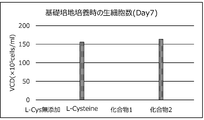
- the figure which shows the influence which cysteine or a cysteine derivative in a basal medium has on the proliferation of CHO cells.
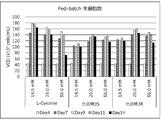
- the figure which shows the influence which the concentration of cysteine or a cysteine derivative in a feed medium has on the growth of CHO cells.
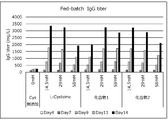
- the figure which shows the influence which the concentration of cysteine or a cysteine derivative in a feed medium has on the antibody production by CHO cells.
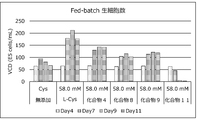
- the figure which shows the influence which the concentration of cysteine or a cysteine derivative in a feed medium has on the growth of CHO cells.
- the figure which shows the influence which the concentration of cysteine or a cysteine derivative in a feed medium has on the antibody production by CHO cells.
- Active ingredient In the present invention, the active ingredient is used.
- the active ingredient is a compound represented by the following formula (I):
- R 1 represents a C1-22 alkyl group which may have a substituent.
- R 2 represents a hydrogen atom, a C6-12 aryl group which may have a substituent, or a C1-6 alkyl group which may have a substituent.
- R 2 specifically refers to a hydrogen atom, a C6-12 aryl group which may have a substituent, or a linear C1-6 alkyl group which may have a substituent. May be shown. Incidentally, the "R 1" and “R 2", respectively, may be referred to as “R 1" and "R 2".
- C1-22 alkyl group of "R 1 " may or may not have a substituent.
- C6-12 aryl group or C1-6 alkyl group “R 2" may have a substituent or may not have.
- C1-22 alkyl group means a C1-22 alkyl group having no substituent, and the description of a C1-22 alkyl group having no substituent means C1-22 having a substituent. It can also be applied mutatis mutandis to alkyl groups.
- C6-12 aryl group means a C6-12 aryl group having no substituent, and the description of a C6-12 aryl group having no substituent means C6 having a substituent. It can also be applied mutatis mutandis to a -12 aryl group.
- C1-6 alkyl group means a C1-6 alkyl group having no substituent
- description of a C1-6 alkyl group having no substituent means C1 having a substituent. It can also be applied mutatis mutandis to a -6 alkyl group. The same applies to other functional groups that may have a substituent.
- the C1-22 alkyl group has a substituent means that one or more of the hydrogen atoms constituting the C1-22 alkyl group are substituted with the substituent.
- the C6-12 aryl group has a substituent means that one or more of the hydrogen atoms constituting the C6-12 aryl group are substituted with the substituent.
- the C1-6 alkyl group has a substituent means that one or more of the hydrogen atoms constituting the C1-6 alkyl group are substituted with the substituent.
- C1-22 alkyl group "R 1", the number of C6-12 aryl group “R 2” or a hydrogen atom which is substituted with a substituent in the C1-6 alkyl group “R 2”, are, for example, 1 to It may be 5, 1 to 4, 1 to 3, or 1 to 2, and specifically, it may be 1, 2, 3, 4, or 5.
- C1-22 alkyl group "R 1", C6-12 aryl group “R 2” or the number of hydrogen atoms substituted with a substituent in the C1-6 alkyl group "R 2”, the "R 1" C1-22 alkyl groups may be replaced with the number of substituents having the C1-6 alkyl group C6-12 aryl group "R 2" or "R 2",. If two or more hydrogen atoms are substituted with substituents, the substituents are selected independently for each hydrogen atom. The same applies to other functional groups that may have a substituent.
- C1-22 alkyl group means an alkyl group having 1 to 22 carbon atoms.
- the C1-22 alkyl group may be a straight chain or a branched chain.
- the carbon number of the C1-22 alkyl group is 1, 2, 3, 4, 5, 6, 7, 8, 8, 9, 10, 11, 12, 13, 14, 14 It may be 15, 16, 17, 18, 19, 20, 21, or 22.
- the number of carbon atoms of the C1-22 alkyl group is, for example, 1 or more, 2 or more, 3 or more, 4 or more, 5 or more, 6 or more, 7 or more, 8 or more, 9 or more, or 10 22 or less, 21 or less, 20 or less, 19 or less, 18 or less, 17 or less, 16 or less, 15 or less, 14 or less, 13 or less, 12 pieces Below, 11 or less, 10 or less, 9 or less, 8 or less, 7 or less, 6 or less, 5 or less, or 4 or less may be used, and the range of combinations thereof is consistent. May be good.
- the number of carbon atoms of the C1-22 alkyl group may be, for example, 1 to 22, 1 to 12, or 1 to 6.
- Cn alkyl group An alkyl group having n carbon atoms is also referred to as a "Cn alkyl group".
- C1-12 alkyl group means an alkyl group having 1 to 12 carbon atoms.
- C1-6 alkyl group means an alkyl group having 1 to 6 carbon atoms.
- Examples of the C1-22 alkyl group include methyl group, ethyl group, isopropyl group, propyl group, butyl group, isobutyl group, sec-butyl group, tert-butyl group, pentyl group, sec-pentyl group, tert-pentyl group and isopentyl.
- the C1-22 alkyl group include a methyl group, an ethyl group and an isopropyl group.
- C1-6 alkyl group means an alkyl group having 1 to 6 carbon atoms.
- the C1-6 alkyl group may be a straight chain or a branched chain.
- the C1-6 alkyl group may be linear in particular.
- Examples of the C1-6 alkyl group include methyl group, ethyl group, isopropyl group, propyl group, butyl group, isobutyl group, sec-butyl group, tert-butyl group, pentyl group, sec-pentyl group, tert-pentyl group and isopentyl.
- a group and a hexyl group can be mentioned.
- the C1-6 alkyl group may be a C1-6 alkyl group other than the isobutyl group.
- Examples of the linear C1-6 alkyl group include a methyl group, an ethyl group, a propyl group, a butyl group, a pentyl group, and a hexyl group.
- Examples of the C1-6 alkyl group (for example, a linear C1-6 alkyl group) include a methyl group and an ethyl group.
- Examples of the C1-6 alkyl group (for example, a linear C1-6 alkyl group) include a methyl group.
- C6-12 aryl group means an aryl group having 6 to 12 carbon atoms. Examples of the C6-12 aryl group include a phenyl group, a 1-naphthyl group, and a 2-naphthyl group. Examples of the C6-12 aryl group include a phenyl group.
- the substituents that the C1-22 alkyl group of "R 1 " may have include a C6-12 aryl group that may have a substituent and an aromatic heterocycle that may have a substituent.
- a group, a C3-10 cycloalkyl group which may have a substituent, a C3-10 cycloalkenyl group which may have a substituent, and a non-aromatic heterocyclic group which may have a substituent. can be mentioned.
- C6-12 aryl groups (including C6-12 aryl group "R 2"), an aromatic heterocyclic group, C3-10 cycloalkyl group, a is C3-10 cycloalkenyl group and a non-aromatic heterocyclic group
- the substituents may be a hydroxyl group, an oxo group, a halogen atom, a C1-7 alkyl group, a C1-7 alkoxy group, a C1-7 alkylenedioxy group, a C1-7 acyl group, an amino group and a C1-7 alkyl.
- Amino groups can be mentioned.
- C6-12 aryl groups (including C6-12 aryl group "R 2"), an aromatic heterocyclic group, C3-10 cycloalkyl group, C3-10 cycloalkenyl group and a non-aromatic heterocyclic group, are each Also may have, for example, the same or different 1-5, or 1-3 substituents selected from these substituents.
- halogen atom examples include a fluorine atom, a chlorine atom, a bromine atom, and an iodine atom.
- C1-7 alkyl group means an alkyl group having 1 to 7 carbon atoms.
- the C1-7 alkyl group may be a straight chain or a branched chain.
- Examples of the C1-7 alkyl group include methyl group, ethyl group, isopropyl group, propyl group, butyl group, isobutyl group, sec-butyl group, tert-butyl group, pentyl group, sec-pentyl group, tert-pentyl group and isopentyl.
- Examples include a group, a hexyl group, and a heptyl group.
- Examples of the C1-7 alkyl group include a methyl group and an ethyl group.
- C1-7 alkoxy group means an alkoxy group having 1 to 7 carbon atoms.
- the C1-7 alkoxy group may be a straight chain or a branched chain.
- Examples of the C1-7 alkoxy group include a methoxy group, an ethoxy group, a propoxy group, an isopropyloxy group, a butoxy group, an isobutyloxy group, a tert-butyloxy group, a pentyloxy group, a hexyloxy group and a heptyloxy group.
- Examples of the C1-7 alkoxy group include a methoxy group and an ethoxy group.
- C1-7 alkylenedioxy group means an alkylenedioxy group having 1 to 7 carbon atoms.
- the C1-7 alkylenedioxy group may be a straight chain or a branched chain.
- Examples of the C1-7 alkylenedioxy group include methylenedioxy group, ethylenedioxy group, trimethylenedioxy group, tetramethylenedioxy group, pentamethylenedioxy group, hexamethylenedioxy group and heptamethylenedioxy group.
- Examples of the C1-7 alkylenedioxy group include a methylenedioxy group and an ethylenedioxy group.
- the "C1-7 acyl group” means an acyl group having 1 to 7 carbon atoms.
- the C1-7 acyl group may be a straight chain or a branched chain.
- Examples of the C1-7 acyl group include a carboxyl group, a carboxamide group, a C1-7 alkanoyl group, a benzoyl group, a C1-6 alkoxy-carbonyl group and a phenoxycarbonyl group.
- the "C1-7 alkanoyl group” means an alkanoyl group having 1 to 7 carbon atoms.
- the C1-7 alkanoyl group may be a straight chain or a branched chain.
- Examples of the C1-7 alkanoyl group include a formyl group, an acetyl group, a propionyl group, a butyryl group, an isobutyryl group, a pentanoyl group, a hexanoyl group and a heptanoyle group.
- the "C1-6 alkoxy-carbonyl group” means a carbonyl group having a C1-6 alkoxy group.
- the "C1-6 alkoxy group” means an alkoxy group having 1 to 6 carbon atoms.
- the C1-6 alkoxy group may be a straight chain or a branched chain.
- Examples of the C1-6 alkoxy-carbonyl group include a methoxycarbonyl group, an ethoxycarbonyl group, a propoxycarbonyl group, an isopropoxycarbonyl group, a butoxycarbonyl group, an isobutoxycarbonyl group, a sec-butoxycarbonyl group, and a tert-butoxycarbonyl group. .. Examples of the C1-6 alkoxy-carbonyl group include a methoxycarbonyl group and an ethoxycarbonyl group.
- C6-12 aryl groups (including C6-12 aryl group "R 2"), an aromatic heterocyclic group, C3-10 cycloalkyl group, a is C3-10 cycloalkenyl group and a non-aromatic heterocyclic group
- the C1-7 acyl group which may be used include a C1-7 alkanoyl group, a benzoyl group, a C1-6 alkoxy-carbonyl group and a phenoxycarbonyl group.
- C1-6 alkyl group has optionally may be C1-7 acyl group "R 2", more particularly, a carboxyl group, a carboxamide group, a methoxycarbonyl group, and ethoxycarbonyl group.
- R 2 C1-7 acyl group
- one of the hydrogen atoms at the end of the alkyl group may be substituted with a C1-7 acyl group.
- terminal hydrogen atom of the alkyl group for the C1-6 alkyl group "R 2", five is a hydrogen atom of the methyl group in the C1 alkyl group (methyl group), in C2 or more alkyl groups It means a hydrogen atom bonded to a terminal carbon atom on the side not bonded to a member ring, respectively.
- C1-7 alkylamino group means an amino group mono- or di-substituted with a C1-7 alkyl group.
- Examples of the C1-7 alkylamino group include methylamino group, ethylamino group, propylamino group, isopropylamino group, butylamino group, isobutylamino group, tert-butylamino group, pentylamino group, isopentylamino group and neopentyl.
- Examples thereof include an amino group, a tert-pentylamino group, a hexylamino group, and a heptylamino group.
- aromatic heterocyclic group has a carbon atom and 1 to 4 heteroatoms selected from a nitrogen atom, an oxygen atom, and a sulfur atom, and the number of atoms constituting the ring is 5 to 14 members.
- the aromatic cyclic group may be of a monocyclic type or a condensed ring type.
- the aromatic heterocyclic group may be, in particular, a 5- or 6-membered monocyclic aromatic heterocyclic group.
- Examples of the monocyclic aromatic heterocyclic group include a thienyl group (thiophen-2-yl group, thiophen-3-yl group, etc.), a frill group (fran-2-yl group, furan-3-yl group, etc.), and pyrrolyl.
- the fused cyclic aromatic heterocyclic group includes a quinolyl group, an isoquinolyl group, a quinazolinyl group, a quinoxalyl group, a phthalazinyl group, a synnolinyl group, a naphthyldinyl group, an indolyl group, a benzoimidazolyl group, an indolinyl group, a benzofuranyl group, a benzothienyl group and a benzoxa.
- Zolyl group, benzothiazolyl group, benzodioxynyl group, benzothiazolyl group, tetrahydroquinolyl group, dihydrobenzofuranyl group, dihydrobenzothienyl group, dihydrobenzodioxynyl group, indenothiazolyl group, tetrahydrobenzothiazolyl Groups include 5,7-dihydropyrrolo [3,4-d] pyrimidinyl group, 6,7-dihydro-5H-cyclopentapyrimidinyl group, imidazo [2,1-b] thiazolyl group, pteridinyl group, prinyl group. ..
- C3-10 cycloalkyl group means a cyclic saturated hydrocarbon group having 3 to 10 carbon atoms.
- Examples of the C3-10 cycloalkyl group include a cyclopropyl group, a cyclobutyl group, a cyclopentyl group, a cyclohexyl group, a cycloheptyl group, and a cyclooctyl group.
- C3-10 cycloalkenyl group means a cyclic partially unsaturated hydrocarbon group having 3 to 10 carbon atoms and containing one or more double bonds.
- Examples of the C3-10 cycloalkenyl group include a cyclopropenel group, a cyclobutenyl group, a cyclopentenyl group, a cyclohexenyl group, a cycloheptenyl group, and a cyclooctenyl group.
- a “non-aromatic heterocyclic group” is a ring having 3 to 14 atoms having a carbon atom and 1 to 4 heteroatoms selected from a nitrogen atom, an oxygen atom, and a sulfur atom.
- the non-aromatic heterocyclic group may be of a monocyclic type or a condensed ring type.
- the non-aromatic heterocyclic group may be, in particular, a 3- to 8-membered monocyclic non-aromatic heterocyclic group.
- the non-aromatic heterocyclic group may be, more particularly, a 5- or 6-membered monocyclic non-aromatic heterocyclic group.
- the sulfur atom may be monooxidized or dioxidized.
- Examples of the monocyclic non-aromatic heterocyclic group include an oxylanyl group, a thiolanyl group, an aziridinyl group, an azetidinyl group, an oxetanyl group, a pyrrolidinyl group, a tetrahydrofuranyl group, a tetrahydrothienyl group, an oxazolinyl group, an oxazolidinyl group and an isooxazolinyl group.
- Condensed cyclic non-aromatic heterocyclic groups include isochromanyl group, dihydrobenzopyranyl group, isochromenyl group, chromenyl group (2H-chromenyl group, 4H-chromenyl group, etc.), 1,2,3,4-tetrahydroisoquino. Examples thereof include a lyl group, a 1,2,3,4-tetrahydroquinolyl group, a 2,3-dihydrobenzofuranyl group and a benzo [1,3] dioxolyl group.
- substituent may be C6-12 aryl groups (including C6-12 aryl group which may have a substituent "R 2"), specifically, a hydroxyl group and C1-7 alkoxy C6-12 aryl groups (phenyl group, naphthyl group, etc.) which may be substituted with the same or different 1 to 5 (1 to 3 or the like) substituents selected from the groups (methoxy group, ethoxy group, etc.) ).
- substituent group which may be C6-12 aryl group optionally having a (including also may C6-12 aryl group which may have a substituent "R 2") and more specifically, 4-hydroxyphenyl group , 4-methoxyphenyl group, 3,4-dihydroxyphenyl group, 4-hydroxy-3-methoxyphenyl group, 3-hydroxy-4-methoxyphenyl group, 2,4-dihydroxyphenyl group.
- C3-10 cycloalkyl group that may have a substituent include a cyclohexyl group and a cyclopentyl group.
- C3-10 cycloalkenyl group which may have a substituent include a cyclohexenyl group.
- non-aromatic heterocyclic group which may have a substituent specifically, it is substituted with the same or different 1 to 5 (1 to 3 or the like) substituent selected from a hydroxyl group and an oxo group.
- substituents include a non-aromatic heterocyclic group (pyranyl group, tetrahydropyranyl group, etc.) which may be used.
- the non-aromatic heterocyclic group which may have a substituent more specifically, a tetrahydro-2H-pyran-2-yl group and a 5-hydroxy-4-oxo-4H-pyran-2-yl group.
- Examples of the non-aromatic heterocyclic group which may have a substituent include a 5-hydroxy-4-oxo-4H-pyran-2-yl group.
- C1-22 alkyl group which may have a substituent of "R 1 " specifically, C1-12 which may be substituted with a C6-12 aryl group which may have a substituent.
- Examples thereof include a C1-12 alkyl group which may be substituted with an alkyl group or a non-aromatic heterocyclic group which may have a substituent.
- the C1-22 alkyl group which may have a substituent of "R 1 " more specifically, it has a C1-12 alkyl group (preferably a C1-6 alkyl group) and a substituent.
- Examples thereof include a C1-6 alkyl group substituted with a C6-12 aryl group, and a C1-6 alkyl group substituted with a non-aromatic heterocyclic group which may have a substituent.
- a C1-22 alkyl group which may have a substituent of "R 1 " more specifically, a methyl group, an ethyl group, a propyl, an isopropyl group, a butyl group, a hexyl group, an octyl group, a dodecyl group, and the like.
- C1-6 alkyl group which may have a substituent of "R 2 " specifically, C1-6 which may be substituted with a C6-12 aryl group which may have a substituent.
- examples thereof include an alkyl group, a C1-6 alkyl group which may be substituted with a non-aromatic heterocyclic group which may have a substituent, and a C1-6 alkyl group which may be substituted with a C1-7 acyl group. Be done.
- the C1-6 alkyl group which may have a substituent of "R 2 " more specifically, it is substituted with a C1-6 alkyl group and a C6-12 aryl group which may have a substituent.
- Examples thereof include a C1-6 alkyl group substituted with a non-aromatic heterocyclic group optionally having a substituent, and a C1-6 alkyl group substituted with a C1-7 acyl group.
- a C1-6 alkyl group which may have a substituent of "R 2 ", more specifically, a methyl group, an ethyl group, an isopropyl group, a hexyl group, a 4-hydroxyphenyl methyl group and a 4-hydroxyphenyl group.
- Ethyl group (2- (4-hydroxyphenyl) ethyl group, etc.), 3,4-dihydroxyphenylethyl group (2- (3,4-dihydroxyphenyl) ethyl group, etc.), (5-Hydroxy-4-oxo-4H, etc.) -Pyran-2-yl) methyl group, C1-6 alkyl group substituted with carboxyl group (2-carboxyethyl group, etc.), C1-6 alkyl group substituted with carboxamide group (2-carboxamide ethyl group, etc.), Examples thereof include a C1-6 alkyl group substituted with a methoxycarbonyl group (2-methoxycarbonylethyl group, etc.) and a C1-6 alkyl group substituted with an ethoxycarbonyl group (2-ethoxycarbonylethyl group, etc.).
- Examples of the C1-6 alkyl group which may have a substituent of "R 2" include a methyl group and a 4-hydroxyphenylmethyl group. Examples of the C1-6 alkyl group which may have a substituent of "R 2" include a methyl group.
- C1-6 alkyl group which may have a substituent "R 2" is an even or C1-6 alkyl group optionally having a substituent, it is other than isobutyl group You can. Further, in one embodiment, the C1-6 alkyl group which may have a substituent of "R 2 " is a C1-6 alkyl group which may have a substituent and has a substituent. It may be other than the isobutyl group which may be present. The C1-6 alkyl group which may have a substituent of "R 2 " may be, in particular, a linear C1-6 alkyl group which may have a substituent.
- R 2 As good linear C1-6 alkyl group optionally having a substituent "R 2", it is the above exemplified "R 2" of the substituent may C1-6 alkyl group optionally having, Examples thereof include those in which the C1-6 alkyl group is a linear C1-6 alkyl group. That is, as a linear C1-6 alkyl group which may have a substituent of "R 2 ", specifically, even if it is substituted with a C6-12 aryl group which may have a substituent. It may be substituted with a good linear C1-6 alkyl group, a non-aromatic heterocyclic group which may have a substituent, a linear C1-6 alkyl group, or a C1-7 acyl group.
- a good linear C1-6 alkyl group can be mentioned.
- the linear C1-6 alkyl group which may have a substituent of "R 2 " more specifically, a linear C1-6 alkyl group and a C6-12 aryl which may have a substituent.
- Chain C1-6 alkyl groups can be mentioned.
- linear C1-6 alkyl group which may have a substituent of "R 2 ", more specifically, a methyl group, an ethyl group, a hexyl group, a 4-hydroxyphenylmethyl group, a 4-hydroxyphenylethyl group.
- Examples of the linear C1-6 alkyl group which may have a substituent of "R 2" include a methyl group and a 4-hydroxyphenylmethyl group. Examples of the linear C1-6 alkyl group which may have a substituent of "R 2" include a methyl group.
- the active ingredient may be, for example, a 2R form, a 2S form, or a combination thereof (that is, a mixture of 2R form and 2S form diastereomers).
- the notation of "2RS" in the compound name means that the compound is a combination of 2R and 2S compounds (that is, a mixture of 2R and 2S diastereomers).
- the ratio of the 2R form to the 2S form in the diastereomer mixture is not particularly limited.
- the ratio of the 2R form or the 2S form in the diastereomer mixture is, for example, 1% or more, 3% or more, 5% or more, 10% or more, 20% or more in terms of molar ratio with respect to the total amount of the 2R form and the 2S form.
- the ratio of the 2R form or the 2S form in the diastereomer mixture is, for example, 1 to 99%, 10 to 90%, 20 to 80% in terms of molar ratio with respect to the total amount of the 2R form and the 2S form. It may be 30 to 70%, or 40 to 60%.
- the 2R body or the 2S body is selected as the active ingredient, it is sufficient to use the 2R body or the 2S body as the active ingredient, and it does not prevent the 2S body or the 2R body from being used in combination.
- (2RS, 4R) -2-methyl-2,4-thiazolidinedicarboxylic acid 2-ethyl ester ((2RS, 4R) -2-methyl-2,4-thiazolidinedicarboxylic acid 2-ethyl (Ester), (2RS, 4R) -2-methyl-2,4-thiazolidinedicarboxylic acid 2-methyl ester, (2RS, 4R) -2-methyl-2,4-thiazolidinedicarboxylic acid 2-i-propyl ester, (2RS, 4R) -2-methyl-2,4-thiazolidinedicarboxylic acid 2-i-propyl ester.
- the active ingredients are, in particular, (2RS, 4R) -2-methyl-2,4-thiazolidinedicarboxylic acid 2-ethyl ester, (2RS, 4R) -2-methyl-2,4-thiazolidinedicarboxylic acid 2-methyl ester. , (2RS, 4R) -2-methyl-2,4-thiazolidinedicarboxylic acid 2-i-propyl ester, (2RS, 4R) -2,4-thiazolidinedicarboxylic acid 2-ethyl ester, (2RS, 4R) -2 Included are -(4-hydroxyphenyl) methyl-2,4-thiazolidinedicarboxylic acid 2-methyl ester, and their 2R and 2S forms.
- the active ingredient further includes (2RS, 4R) -2-methyl-2,4-thiazolidinedicarboxylic acid 2-ethyl ester and its 2R and 2S forms.
- the active ingredient may be used as a free substance, as a salt, or as a combination thereof. That is, unless otherwise specified, the term “active ingredient” may mean a free active ingredient, a salt thereof, or a combination thereof. In other words, “the compound represented by the formula (I)” may mean a compound represented by the free form (I), a salt thereof, or a combination thereof, unless otherwise specified.
- the salt is not particularly limited as long as it can be used for culturing animal cells.
- a salt for an acidic group such as a carboxyl group
- a salt with an alkali metal such as ammonium salt, sodium and potassium
- a salt with an alkaline earth metal such as calcium and magnesium
- an aluminum salt such as calcium and magnesium
- an aluminum salt such as calcium and magnesium
- an aluminum salt such as calcium and magnesium
- a zinc salt such as calcium and magnesium
- a triethylamine and an ethanolamine salts with organic amines such as morpholin, pyrrolidine, piperidine, piperazin, dicyclohexylamine, and salts with basic amino acids such as arginine and lysine.
- salts for basic groups such as amino groups
- examples of salts for basic groups such as amino groups include salts with inorganic acids such as hydrochloric acid, sulfuric acid, phosphoric acid, nitrate and hydrobromic acid, acetic acid, citric acid, benzoic acid, maleic acid, fumaric acid and tartrate acid.
- the salt one kind of salt may be used, or two kinds or more kinds of salts may be used in combination.
- the active ingredient eg, free form or salt
- the active ingredient may include non-hydrates and hydrates unless otherwise noted.
- the active ingredient may be, for example, one having high stability in a medium.
- “High stability in medium” means, for example, when a medium containing 58 mM of the active ingredient is prepared and stored at 5 ° C. under light-shielding conditions, 15 days or more, 20 days or more, and 25 days. It may mean that no precipitation of crystals is visually observed as described above or for 30 days or more.
- the active ingredient a commercially available product may be used, or an appropriately manufactured and obtained product may be used.
- the method for producing the active ingredient is not particularly limited, and for example, a known method can be used.
- the active ingredient can be produced, for example, by chemical synthesis (Japanese Patent No. 5439849).
- the active ingredient can be easily produced from Compound II (pyruvic acid derivative) and Compound III (L-cysteine) by, for example, the following reaction.
- the structural formula of compound II is also referred to as “formula (II)”.
- Compound II is a pyruvic acid derivative represented by the formula (II).
- R 1" and “R 2" of the compounds I and II, respectively, is the same as “R 1" and "R 2" in the formula (I).
- any of the components capable of forming a salt may be used as a free form, as a salt, or as a combination thereof.
- the terms “Compound II” or “pyruvic acid derivative” may mean free Compound II, or a salt thereof, or a combination thereof, unless otherwise specified.
- the term “Compound III” or “L-Cysteine” may mean a free compound III, a salt thereof, or a combination thereof, unless otherwise specified.
- the salt the description about the salt of the active ingredient can be applied mutatis mutandis.
- all of these components may include non-hydrates and hydrates unless otherwise specified.
- the reaction of Compound II with Compound III can be carried out in a suitable solvent such as water, aqueous buffer, alcohol, or hydrous alcohol.
- the produced active ingredient (Compound I) can be isolated and purified by a known separation means such as concentration under reduced pressure, solvent extraction, crystallization, dissolution, or chromatography.
- the structure of the produced active ingredient (Compound I) can be confirmed by a known analytical means such as NMR.
- reaction of Compound II and Compound III can be carried out in a water-containing medium to produce crystals of the active ingredient in the medium, and the crystals can be recovered to obtain the active ingredient. ..
- the present invention is a method for producing an active ingredient.
- methods comprising reacting Compound II and Compound III in a water-containing medium to produce crystals of the active ingredient; and recovering the crystals.
- the same method is also referred to as a "direct crystallization method”.
- R 1 When the active ingredient is produced by the direct crystallization method, “R 1 " may be, in particular, a C1-C6 alkyl group. When the active ingredient is produced by the direct crystallization method, “R 1 " may be more particularly a methyl group or an ethyl group. When the active ingredient is produced by the direct crystallization method, “R 2 " may be, in particular, a methyl group.
- the reaction between Compound II and Compound III can proceed by allowing these compounds to coexist in a water-containing medium.
- compound III may be dissolved or suspended in a water-containing medium, and compound II may be added dropwise to the resulting solution or suspension.
- the amounts of Compound II and Compound III used can be appropriately set.
- the amount of Compound II used may be, for example, 0.5 to 2 mol or 1 to 2 mol with respect to 1 mol of Compound III used.
- the water-containing medium is not particularly limited as long as it is a medium containing water and crystals of the active ingredient are formed in the medium (that is, the produced active ingredient crystallizes in the medium).
- the water-containing medium may be water itself or a mixture of water and other components.
- Such mixtures include aqueous buffers and hydrous alcohols.
- the pH of the water-containing medium may be adjusted. Acids and / or alkalis can be used, for example, to adjust the pH.
- the water content in the water-containing medium is, for example, 70% (w / w) or more, 80% (w / w) or more, 90% (w / w) or more, 95% (w / w) or more, 97% ( It may be w / w) or more, or 99% (w / w) or more.
- the reaction pH may be, for example, 5 to 9 or 6 to 8.
- the reaction temperature may be, for example, 0 ° C. or higher, 10 ° C. or higher, 20 ° C.
- the temperature may be 40 ° C. or lower, or 30 ° C. or lower, and a consistent combination thereof may be used.
- the reaction temperature may be, for example, 10 ° C. to 40 ° C., or room temperature (for example, about 25 ° C.).
- the reaction time may be, for example, 1 hour or more, 5 hours or more, 10 hours or more, 15 hours or more, 20 hours or more, or 25 hours or more, 36 hours or less, 30 hours or less, 24 hours or less, 20 hours.
- the following, or 15 hours or less, may be a consistent combination thereof.
- the reaction time may be, for example, 1 to 24 hours.
- the reaction may be carried out, for example, with stirring or shaking. By carrying out the reaction of Compound II and Compound III in this way, crystals of the active ingredient are formed in the water-containing medium.
- the recovery of the crystals of the active ingredient can be carried out by a known solid-liquid separation means such as filtration or centrifugation.
- an active ingredient mainly containing a 2S form or a 2R form may be obtained.
- an active ingredient mainly containing a 2S form may be obtained by the direct crystallization method.
- the ratio of the 2S-form or the 2R-form to the active ingredient obtained by the direct crystallization method may be, for example, 60% or more, 70% or more, or 80% or more in terms of molar ratio.
- the “amount” or “concentration” of the active ingredient may mean the total amount or total concentration of the selected ingredients unless otherwise specified.
- the method of the present invention is a method for culturing animal cells, which comprises culturing animal cells in a medium, and the culturing is carried out in the presence of an active ingredient.
- the target substance may be produced by culturing animal cells. That is, when an animal cell has a target substance-producing ability, the target substance can be produced by culturing the cell. That is, one aspect of the method of the present invention is a method for producing a target substance, which comprises culturing animal cells capable of producing the target substance in a medium and recovering the target substance, and the culture is the active ingredient. It may be a method carried out in the presence of.
- the target substance is not particularly limited as long as it can be produced by animal cells.
- examples of the target substance include proteins.
- a protein produced as a target substance is also referred to as a "target protein”.
- Animal cells are not particularly limited. The animal cell can be appropriately selected depending on various conditions such as the use of the animal cell. For example, when an animal cell is used for producing a target protein, the animal cell is not particularly limited as long as it can express the target protein.
- Animal cells are also referred to as "hosts," "expression hosts,” or "host cells.” Animals include mammals, birds and amphibians. Animals include mammals in particular. Mammals include rodents and primates. Rodents include hamsters, mice, rats and guinea pigs. Examples of hamsters include Chinese hamsters. Primates include humans, monkeys and chimpanzees. Examples of monkeys include African green monkeys. Examples of birds include chickens. Amphibians include Xenopus laevis.
- tissue or cell from which the animal cell is derived is not particularly limited.
- Tissues or cells from which animal cells are derived include ovaries, kidneys, adrenal glands, tongue epithelium, olfactory epithelium, pineal gland, thyroid gland, and melanocytes.
- Examples of Chinese hamster cells include Chinese hamster ovary-derived cell lines (CHO).
- Specific examples of CHO include CHO-DG44, CHO-K1, CHO DUX (DHFR-), CHO-S, and CHO-MK.
- human cells include human fetal kidney cell-derived cell lines (HEK).
- HEK include HEK293 and HEK293T.
- African green monkey cells include African green monkey renal cell-derived cell lines (COS).
- Specific examples of COS include COS-1.
- Specific examples of Xenopus cells include Xenopus oocytes.
- Animal cell capable of producing a target substance means an animal cell capable of producing a target substance.
- animal cells capable of producing a target substance means an ability to produce a target substance (for example, express a target protein) and accumulate it in a culture to a extent that it can be recovered when cultured in a medium. It may mean an animal cell having.
- "Accumulation in culture” may specifically mean accumulation in medium, cell surface, intracellular, or a combination thereof. The case where the target substance accumulates extracellularly (for example, in the medium or on the cell surface) is also referred to as "secretion" or "secretory production” of the target substance.
- the animal cell may have a secretory production ability (the ability to secrete and produce the target substance) of the target substance.
- the accumulated amount of the target substance may be, for example, 10 ⁇ g / L or more, 1 mg / L or more, 100 mg / L or more, or 1 g / L or more as the accumulated amount in the culture.
- the animal cell may have the ability to produce one kind of target substance, or may have the ability to produce two or more kinds of target substances.
- the animal cell may be one that originally has the ability to produce the target substance, or may be one that has been modified to have the ability to produce the target substance. In addition, the animal cells may be modified so as to enhance the inherent ability to produce the target substance.
- An animal cell having a target substance-producing ability can be obtained, for example, by imparting the target substance-producing ability to the animal cell as described above, or by enhancing the target substance-producing ability of the animal cell as described above. ..
- the target protein-producing ability can be imparted or enhanced by introducing a gene encoding the target protein.
- the gene encoding the target protein is also referred to as the "target protein gene".
- the target protein is not particularly limited as long as it can be expressed using animal cells as a host.
- the protein may be a host-derived protein or a heterologous protein.
- the "heterologous protein” refers to a protein that is exogenous to a host that produces the protein (ie, an animal cell capable of producing the protein of interest).
- the target protein may be, for example, a naturally occurring protein, a modified protein thereof, or an artificially designed amino acid sequence protein.
- the target protein may be, for example, a protein derived from a microorganism, a protein derived from a plant, a protein derived from an animal, or a protein derived from a virus.
- the protein of interest may be, in particular, a protein of human origin.
- the target protein may be a monomeric protein or a multimeric protein.
- the target protein may be a secretory protein or a non-secretory protein.
- the "protein” also includes what is called a peptide, such as an oligopeptide or a polypeptide.
- target protein examples include enzymes, bioactive proteins, receptor proteins, antigen proteins, and other proteins.
- Enzymes include cellase, transglutaminase, protein glutaminase, isomaltodextranase, protease, endopeptidase, exopeptidase, aminopeptidase, carboxypeptidase, collagenase, and chitinase.
- bioactive proteins include growth factors (growth factors), hormones, cytokines, and antibody-related molecules.
- Growth factors include epidermal growth factor (EGF), insulin-like growth factor-1 (IGF-1), and transforming growth factor (TGF). ), Nerve growth factor (NGF), Brain-derived neurotrophic factor (BDNF), Vascular endothelial growth factor (VEGF), Granulocyte- colony stimulating factor (G-CSF), granulocyte-macrophage-colony stimulating factor (GM-CSF), platelet-derived growth factor (PDGF), erythropoietin (EPO), Thrombopoietin (TPO), acidic fibroblast growth factor (aFGF or FGF1), basic fibroblast growth factor (bFGF or FGF2), keratinocyte growth factor ; KGF-1 or FGF7, KGF-2 or FGF10), hepatocellular growth factor (HGF), stem cell factor (SCF), activin (Activin). Examples of activin include activin A, C, and E.
- hormones include insulin, glucagon, somatostatin, human growth hormone (hGH), parathyroid hormone (PTH), calcitonin, and exenatide.
- Cytokines include interleukin, interferon, and tumor necrosis factor (TNF).
- the bioactive protein may be the whole protein or a part thereof.
- a portion having a physiological activity can be mentioned.
- Specific examples of the portion having physiological activity include the physiologically active peptide Teriparatide consisting of 34 amino acid residues at the N-terminal of a mature parathyroid hormone (PTH).
- Antibody-related molecule may mean a protein comprising a molecular species consisting of a single domain selected from the domains constituting a complete antibody or a combination of two or more domains. Domains that make up a complete antibody include heavy chain domains VH, CH1, CH2, and CH3, and light chain domains VL and CL.
- the antibody-related molecule may be a monomeric protein or a multimeric protein as long as it contains the above-mentioned molecular species. When the antibody-related molecule is a multimeric protein, it may be a homomultimer composed of a single type of subunit, or a heteromultimer composed of two or more types of subunits. May be good.
- antibody-related molecules include a complete antibody, Fab, F (ab'), F (ab') 2 , Fc, a dimer consisting of a heavy chain (H chain) and a light chain (L chain), and Fc. Fusion protein, heavy chain (H chain), light chain (L chain), single chain Fv (scFv), sc (Fv) 2 , disulfide bond Fv (sdFv), diabody, VHH fragment (nanobody®) Be done. More specific examples of antibody-related molecules include Trastuzumab, Adalimumab, and Nivolumab.
- the receptor protein examples include a physiologically active protein and a receptor protein for other physiologically active substances.
- Other bioactive substances include neurotransmitters such as dopamine.
- the receptor protein may be an orphan receptor whose corresponding ligand is unknown.
- the antigen protein is not particularly limited as long as it can elicit an immune response.
- the antigen protein can be appropriately selected, for example, according to the target of the assumed immune response.
- the antigen protein can be used, for example, as a vaccine.
- LFABP Liver-type fatty acid-binding protein
- fluorescent protein include Green Fluorescent Protein (GFP).
- immunoglobulin binding protein include Protein A, Protein G, and Protein L.
- albumin include human serum albumin.
- fibroin-like protein include those disclosed in WO2017 / 090665 and WO2017 / 171001.
- Laminin is a protein having a heterotrimeric structure consisting of ⁇ chain, ⁇ chain, and ⁇ chain.
- laminin include mammalian laminin.
- the laminin subunit chains ie, ⁇ chain, ⁇ chain, and ⁇ chain
- the laminin subunit chains include 5 types of ⁇ chain ( ⁇ 1 to ⁇ 5), 3 types of ⁇ chain ( ⁇ 1 to ⁇ 3), and 3 types of ⁇ chain ( ⁇ 1). ⁇ ⁇ 3) can be mentioned.
- Laminin constitutes various isoforms by combining these subunit chains.
- laminin specifically, for example, laminin 111, laminin 121, laminin 211, laminin 213, laminin 221, laminin 311, laminin 321, laminin 332, laminin 411, laminin 421, laminin 423, laminin 511, laminin 521, laminin. 523 can be mentioned.
- a partial sequence of laminin includes laminin E8, which is an E8 fragment of laminin.
- laminin E8 has a heterotrimeric structure consisting of an ⁇ chain E8 fragment ( ⁇ chain E8), a ⁇ chain E8 fragment ( ⁇ chain E8), and a ⁇ chain E8 fragment ( ⁇ chain E8). It is a protein that has.
- the subunit chains of laminin E8 are collectively referred to as “E8 subunit chains”.
- Examples of the E8 subunit chain include the E8 fragment of the laminin subunit chain exemplified above.
- Laminin E8 constitutes various isoforms by combining these E8 subunit chains.
- Specific examples of the laminin E8 include laminin 111E8, laminin 121E8, laminin 211E8, laminin 221E8, laminin 332E8, laminin 421E8, laminin 411E8, laminin 511E8, and laminin 521E8.
- the target protein may be, for example, a protein having a known or natural amino acid sequence of the above-mentioned protein. Further, the target protein may be, for example, a variant of a protein having a known or natural amino acid sequence of the above-mentioned protein. Variants include proteins having an amino acid sequence in which one or several amino acids are substituted, deleted, inserted or added at one or several positions in a known or natural amino acid sequence. Specifically, "1 or several" means, for example, 1 to 50, 1 to 40, 1 to 30, preferably 1 to 20, more preferably 1 to 10, and even more preferably 1. It may mean up to 5, particularly preferably 1 to 3.
- Variants include, for example, 50% or more, 65% or more, 80% or more, preferably 90% or more, more preferably 95% or more, still more preferably 97% or more, particularly with respect to the entire known or natural amino acid sequence.
- a protein having an amino acid sequence having 99% or more identity is also mentioned.
- the protein specified by the species of origin is not limited to the protein itself found in the species, but includes proteins having the amino acid sequence of the protein found in the species and variants thereof.
- Variants may or may not be found in the species. That is, for example, "human-derived protein” is not limited to the protein itself found in humans, but includes proteins having an amino acid sequence of proteins found in humans and variants thereof.
- the target protein gene is not particularly limited as long as it encodes the target protein as described above.
- the target protein gene may be, for example, a gene having a known or natural base sequence of a gene encoding a protein as described above. Further, the target protein gene may be, for example, a variant of a gene having a known or natural base sequence of a gene encoding a protein as described above.
- the protein gene of interest may be modified, for example, to encode a protein having a variant sequence as exemplified above.
- the target protein gene may be one in which any codon is replaced with an equivalent codon.
- the target protein gene may be modified to have an optimum codon, for example, depending on the codon usage frequency of the host cell.
- the term "gene” is not limited to DNA as long as it encodes the corresponding expression product, and may include any polynucleotide. That is, the "target protein gene” may mean any polynucleotide encoding the target protein.
- the target protein gene may be DNA, RNA, or a combination thereof.
- the target protein gene may be single-stranded or double-stranded.
- the target protein gene may be single-stranded DNA or single-stranded RNA.
- the target protein gene may be double-stranded DNA, double-stranded RNA, or a hybrid strand consisting of a DNA strand and an RNA strand.
- the protein gene of interest may contain both DNA and RNA residues in a single polynucleotide strand.
- the target protein gene may or may not contain an intron.
- the mode of the target protein gene can be appropriately selected according to various conditions such as the means for expressing the target protein.
- the expression “having a (amino acid or base) sequence” means “including the (amino acid or base) sequence” and includes the case of “consisting of the (amino acid or base) sequence”.
- the target protein is expressed from the target protein gene. That is, an animal cell capable of producing a target protein has a target protein gene. Specifically, an animal cell having a target protein-producing ability has a target protein gene capable of expressing it. It is sufficient that the animal cell having the target protein-producing ability has the target protein gene until the target protein is expressed to a desired degree. That is, the animal cell capable of producing the target protein may or may not have the target protein gene after the expression of the target protein.
- "expression of target protein gene” and "expression of target protein” may be used synonymously.
- the target protein gene can be obtained by cloning from an organism having the target protein gene. Nucleic acids such as genomic DNA and cDNA containing the same gene can be used for cloning. The target protein gene can also be obtained by chemical synthesis (Gene, 60 (1), 115-127 (1987)).
- the acquired target protein gene can be used as it is or after being appropriately modified. That is, the variant can be obtained by modifying the target protein gene.
- the gene can be modified by a known method.
- a site-specific mutation method can be used to introduce a desired mutation into a target site of DNA.
- a site-specific mutation method a method using PCR (Higuchi, R., 61, in PCR technology, Erlich, H. A. Eds., Stockton press (1989); Carter, P., Meth. In Enzymol., 154, 382 (1987)) and methods using phage (Kramer, W. and Frits, H. J., Meth. In Enzymol., 154, 350 (1987); Kunkel, T. A. et al., Meth . In Enzymol., 154, 367 (1987)).
- the variant of the target protein gene may be directly obtained by chemical synthesis.
- the form of introducing the target protein gene into the host cell is not particularly limited.
- the target protein gene may be retained in the host cell so that it can be expressed. Specifically, for example, when a target protein gene is introduced in a form requiring transcription such as DNA, the target protein gene is retained in a host cell so as to be expressible under the control of a promoter functioning in the host cell. Just do it.
- the protein gene of interest may be extrachromosomally present or introduced onto the chromosome. When introducing two or more genes, each gene need only be retained in the host cell so that it can be expressed.
- the promoter for expressing the target protein gene is not particularly limited as long as it functions in the host cell.
- "Promoter functioning in a host cell” means a promoter having promoter activity in a host cell.
- the promoter may be a host cell-derived promoter or a heterologous promoter.
- the promoter may be a promoter unique to the target protein gene or a promoter of another gene.
- the promoter may be a stronger promoter than the unique promoter of the target protein gene.
- Promoters that function in animal cells include the SV40 promoter, EF1a promoter, RSV promoter, CMV promoter, and SRalpha promoter. Further, as the promoter, a highly active form of a conventional promoter may be obtained and used by using various reporter genes. Methods for assessing promoter strength and examples of potent promoters are described in Goldstein et al.'S paper (Prokaryotic promoters in biotechnology. Biotechnol. Annu. Rev., 1, 105-128
- the target protein gene can be introduced into a host cell using, for example, a vector containing the same gene.
- a vector containing a target protein gene is also referred to as an "expression vector of the target protein gene".
- the expression vector of the target protein gene can be constructed, for example, by ligating a DNA fragment containing the target protein gene with the vector.
- the gene By introducing the expression vector of the target protein gene into the host cell, the gene can be introduced into the host cell.
- the vector may comprise a marker such as a drug resistance gene.
- the vector may include an expression regulatory sequence such as a promoter for expressing the inserted gene.
- the vector can be appropriately selected according to various conditions such as the type of host cell and the form of introduction of the target protein gene.
- Examples of vectors that can be used for gene transfer into animal cells include plasmid vectors and viral vectors.
- the viral vector include a retroviral vector and an adenoviral vector.
- Examples of the plasmid vector include a pcDNA series vector (pcDNA3.1 and the like; Thermo Fisher Scientific), a pBApo-CMV series vector (Takara Bio), and pCI-neo (Promega).
- the vector can be integrated into the chromosome of the host cell, can autonomously replicate outside the chromosome of the host cell, or can be temporarily retained outside the chromosome of the host cell.
- a vector having an origin of replication of a virus can replicate autonomously outside the chromosomes of animal cells.
- the pcDNA series vector has an SV40 origin of replication and can autonomously replicate extrachromosomally in host cells expressing the SV40 large T antigen (COS-1, HEK293T, etc.).
- the target protein gene can also be introduced into a host cell by, for example, introducing a nucleic acid fragment containing the gene into the host cell.
- nucleic acid fragments include linear DNA and linear RNA.
- linear RNA include mRNA and cRNA.
- the method for introducing nucleic acids such as vectors and nucleic acid fragments into host cells can be appropriately selected according to various conditions such as the type of host cells.
- Examples of the method for introducing a nucleic acid such as a vector or a nucleic acid fragment into an animal cell include a DEAE dextran method, a calcium phosphate method, a lipofection method, an electroporation method, and a microinjection method.
- the vector is a viral vector
- the vector can be introduced into the host cell by infecting the host cell with the vector (virus).
- a cell that originally has the target protein gene may be modified and used so that the expression of the target protein gene is increased.
- Increased gene expression means that the per-cell expression level of the gene is increased as compared to unmodified cells.
- unmodified cell as used herein means a control cell that has not been modified to increase the expression of the target gene. Examples of unmodified cells include wild-type cells and cells from which they are modified.
- Methods for increasing the expression of the target protein gene include increasing the number of copies of the target protein gene and improving the transcription efficiency and translation efficiency of the target protein gene. An increase in the number of copies of the target protein gene can be achieved by introducing the target protein gene into a host cell. The introduction of the target protein gene can be carried out as described above.
- the target protein gene to be introduced may be derived from a host cell or a heterologous gene. Improvements in transcription efficiency and translation efficiency of the target protein gene can be achieved by modifying the expression regulatory sequences of genes such as promoters. For example, improvement in transcription efficiency of a target protein gene can be achieved by replacing the promoter of the target protein gene with a stronger promoter.
- Culturing of animal cells is carried out in the presence of the active ingredient. That is, the culture of animal cells is carried out using the active ingredient.
- the culture performance of animal cells may be improved. That is, by culturing the animal cells in the presence of the active ingredient, the culture results of the animal cells may be improved as compared with the case of culturing the animal cells in the absence of the active ingredient.
- Examples of culturing animal cells in the absence of the active ingredient include culturing the animal cells under the same conditions as culturing the animal cells in the presence of the active ingredient, except that the active ingredient is not used. Be done.
- the use of the active ingredient may improve the culture performance of the animal cells, especially during the period in which the animal cells are present in the medium at a sufficient viable cell density.
- Improvements in animal cell culture results include improved animal cell proliferation, improved animal cell viability, improved animal cell production of target substances, and extended animal cell culture periods.
- the extension of the culture period of the animal cells includes the extension of the period during which the growth of the animal cells continues, the extension of the period during which the animal cells are maintained (that is, the survival of the animal cells), and the extension of the target substance such as the target protein by the animal cells. There is an extension of the period during which production continues.
- one aspect of the method of the present invention may be a method for improving the culture performance of animal cells. That is, one aspect of the method of the present invention may be, for example, a method for improving the proliferation of animal cells. Further, one aspect of the method of the present invention may be, for example, a method for improving the survival rate of animal cells. Further, one aspect of the method of the present invention may be, for example, a method for improving the production of a target substance by an animal cell. Further, one aspect of the method of the present invention may be, for example, a method of extending the culture period of animal cells. The present invention also provides the use of active ingredients to improve the culture performance of animal cells.
- the active ingredient may function as a substitute for cysteine.
- the active ingredient acts as a substitute for cysteine may mean that some or all of the cysteine that can be used in culturing animal cells can be replaced by the active ingredient. Therefore, the use of the active ingredient may reduce the amount of cysteine-related substances used, such as cysteine, in culturing animal cells, for example. The use of the active ingredient may reduce the amount of cysteine-related material used, especially during the period in which the animal cells are present in the medium at sufficient viable cell density.
- the functioning of the active ingredient as a substitute for cysteine shall be confirmed, for example, by confirming that the deterioration of the culture performance of animal cells due to the reduction in the amount of cysteine used can be partially or completely complemented by the use of the active ingredient. Can be done.
- the fact that the active ingredient functions as a substitute for cysteine is specifically determined by, for example, culturing animal cells by injecting a feed medium containing the active ingredient according to the conditions described in Examples. It can be confirmed by confirming that the culture performance of animal cells is improved as compared with the case where animal cells are cultured by feeding a feed medium containing neither an active ingredient nor a cysteine-related substance. ..
- one aspect of the method of the present invention may be a method of reducing the amount of cysteine-related substances used in culturing animal cells.
- the present invention also provides the use of active ingredients to reduce the amount of cysteine-related substances used in culturing animal cells.
- “Culture of animal cells” is not limited to those intended for the proliferation of animal cells, but also includes those not intended for the proliferation of animal cells, such as maintenance of animal cells and production of target substances by animal cells. good.
- the medium composition and culture conditions are not particularly limited as long as the purpose of culturing animal cells can be achieved, except that the culture is carried out in the presence of the active ingredient.
- the medium composition and culture conditions can be configured so that animal cells proliferate.
- the purpose is to maintain animal cells
- the medium composition and culture conditions can be configured so that the animal cells are maintained (that is, the animal cells survive).
- the purpose is to produce a target substance such as a target protein
- the medium composition and culture conditions can be configured so that the target substance is produced (for example, the target protein is expressed). If not intended for the growth of animal cells, the animal cells may or may not grow during culturing.
- the animal cells may proliferate during culturing, even if they are not intended for the growth of the animal cells.
- the medium composition and culture conditions can be appropriately set according to various conditions such as the type of animal cells.
- the culture can be carried out, for example, using the usual medium and normal conditions used for culturing animal cells as they are or with appropriate modifications, except that the culture is carried out in the presence of the active ingredient.
- Culturing can be carried out using, for example, a liquid medium.
- the medium used for culturing may be a commercially available medium or a medium prepared by oneself.
- Commercially available media that can be used for culturing animal cells specifically, D-MEM (Dulbecco's Modified Eagle Medium), CELLiST Basal Media BASAL3, BASAL4P, BASAL10 (Ajinomoto Co., Ltd.), Opti-MEM (Thermo Fisher Scientific), RPMI 1640 (Thermo Fisher Scientific), CD293 (Thermo Fisher Scientific), CHO-S-SFMII (Thermo Fisher Scientific), CHO-SF (Sigma-Aldrich), EX-CELL CD CHO (Sigma-Aldrich), EX-CELLTM302 ( Sigma-Aldrich), IS CHO-CD (Irvine Scientific), IS CHO-CDXP (Irvine Scientific) and the like.
- D-MEM Dulbecco's
- the medium may contain various medium components such as carbon sources, amino acids, vitamins, inorganic components, cysteine-related substances, pH buffers, growth factors, serum, serum albumin, selective agents, gene expression inducers and the like.
- Glucose is mentioned as a carbon source.
- amino acids include 20 types of amino acids constituting proteins and their derivatives.
- the amino acid may be, for example, L-form.
- Cysteine-related substance is a general term for cysteine and its derivatives, excluding the active ingredient.
- Examples of the cysteine derivative include cystine and thiazolidine derivatives.
- thiazolidine derivatives include cystenylpyruvic acid.
- cysteine-related substances include cysteine and cystenylpyruvic acid.
- Cysteine may be, for example, L-cysteine.
- the cysteine constituting the cysteine derivative may be, for example, L-cysteine.
- vitamins include vitamin A, vitamin B1, vitamin B2, vitamin B3, vitamin B5, vitamin B6, vitamin B7, vitamin B9, vitamin B12, vitamin C, vitamin D, vitamin E, and vitamin K and their precursors. Be done.
- Inorganic components include sodium, potassium, calcium, magnesium, phosphorus and their ions, or trace elements such as Co, Cu, F, Fe, Mn, Mo, Ni, Se, Si, Ni, Bi, V, and It is a component containing Zn.
- the pH buffer include sodium hydrogen carbonate, phosphate and HEPES.
- Growth factors include insulin, IGF-1, and FGF.
- any component that can form a salt may be used as a free form, as a salt, or as a combination thereof. That is, for example, the term "L-cysteine” may mean a free form of L-cysteine, a salt thereof, or a combination thereof, unless otherwise specified.
- the salt the description about the salt of the active ingredient can be applied mutatis mutandis.
- all of these components may include non-hydrates and hydrates unless otherwise specified.
- the seeding amount of animal cells at the start of culture is, for example, 1 ⁇ 10 3 cells / mL or more, 1 ⁇ 10 4 cells / mL or more, 1 ⁇ 10 5 cells / mL or more, 1 ⁇ 10 6 cells / mL or more, or It may be 1 ⁇ 10 7 cells / mL or more, 1 ⁇ 10 8 cells / mL or less, 1 ⁇ 10 7 cells / mL or less, 1 ⁇ 10 6 cells / mL or less, 1 ⁇ 10 5 cells / mL or less, Alternatively, it may be 1 ⁇ 10 4 cells / mL or less, or a consistent combination thereof.
- Cultivation may be started, for example, in a state where animal cells are present in the medium at a sufficient viable cell density, or in a state where the animal cells are not present in the medium at a sufficient viable cell density.
- Animal cells are present in the medium at a sufficient viable cell density means, for example, that the viable cell density of the animal cells in the medium is 1 ⁇ 10 6 cells / mL or more and 2 ⁇ 10 6 cells / mL or more. 3, ⁇ 10 6 cells / mL or more, 4 ⁇ 10 6 cells / mL or more, 5 ⁇ 10 6 cells / mL or more, 6 ⁇ 10 6 cells / mL or more, 7 ⁇ 10 6 cells / mL or more, 8 ⁇ 10 6 It may mean that it is cells / mL or more, 9 ⁇ 10 6 cells / mL or more, or 1 ⁇ 10 7 cells / mL or more.
- the viable cell density of the animal cells in the medium is 5 ⁇ 10 6 cells / mL or more.
- “Animal cells are not present in the medium at a sufficient viable cell density” means, for example, that the viable cell density of the animal cells in the medium is less than 1 ⁇ 10 7 cells / mL, less than 9 ⁇ 10 6 cells / mL. , 8 ⁇ 10 6 cells / mL or less, 7 ⁇ 10 6 cells / mL or less, 6 ⁇ 10 6 cells / mL or less, 5 ⁇ 10 6 cells / mL or less, 4 ⁇ 10 6 cells / mL or less, 3 ⁇ 10 6 It may mean less than cells / mL, less than 2 ⁇ 10 6 cells / mL, or less than 1 ⁇ 10 6 cells / mL. "Animal cells are not present in sufficient viable cell density in the medium", in particular, it may mean that the viable cell density of animal cells in a medium is less than 5 ⁇ 10 6 cells / mL.
- the number of living cells can be measured using, for example, a living-and-dead cell autoanalyzer Vi-CELL TM XR (Beckman Coulter).
- the culture may be divided into a seed culture and a main culture.
- the culture When the culture is divided into a seed culture and a main culture, at least the main culture may be carried out in the presence of the active ingredient.
- the seed culture When the culture is divided into a seed culture and a main culture, the seed culture may or may not be carried out in the presence of the active ingredient.
- the description about the culture for example, “culture period (culture period)" or "start of culture" should be read as that for the main culture unless otherwise specified. be able to.
- the culture conditions of the seed culture and the main culture may or may not be the same.
- the culture conditions of the main culture can be applied mutatis mutandis to the culture conditions of the seed culture.
- the target substance When the purpose is to produce a target substance such as a target protein, the target substance may be produced at least during the main culture period.
- animal cells may be sufficiently proliferated by seed culture, and then a target substance such as a target protein may be produced by main culture.
- Culturing can be carried out by batch culture, fed-batch culture, continuous culture, or a combination thereof.
- continuous culture include perfusion culture.
- the medium at the start of culturing is also referred to as "initial medium” or “basal medium”.
- the medium supplied to the culture system (for example, the initial medium) in the fed-batch culture or the continuous culture is also referred to as "fed-batch medium”.
- supplying a fed-batch medium to a culture system in fed-batch culture or continuous culture is also referred to as "fed-batch".
- Fed-batch may be carried out throughout the period of the culture or only for a part of the period of the culture. Fed-batch may be carried out continuously or intermittently.
- withdrawal of the culture broth may be carried out. Withdrawal of the culture medium may be carried out throughout the whole period of the culture, or may be carried out only during a part of the culture. The withdrawal of the culture broth may be carried out continuously or intermittently. The withdrawal and feeding of the culture medium may or may not be performed at the same time.
- the culture is divided into a seed culture and a main culture, the culture forms of the seed culture and the main culture may or may not be the same.
- Various components such as the active ingredient may be contained in the initial medium, the fed-batch medium, or both. That is, in the process of culturing, various components such as the active ingredient may be supplied to the medium alone or in any combination. All of these components may be supplied once or multiple times, or may be supplied continuously.
- the composition of the initial medium and the fed-batch medium eg, the type and / or concentration of the components contained
- the composition of the initial medium and the fed-batch medium may or may not be the same. That is, the type of the component contained in the initial medium may or may not be the same as the type of the component contained in the fed-batch medium. Further, the concentration of each component contained in the initial medium may or may not be the same as the concentration of each component contained in the fed-batch medium.
- the composition of the initial medium and the fed-batch medium may be the same.
- two or more fed-batch media having different compositions may be used.
- the composition of each fed-batch medium may or may not be the same.
- various components such as the active ingredient may be supplied to the medium in a form such as powder that is not contained in the fed-batch medium.
- the culture may be carried out in a CO 2- containing atmosphere such as 5 to 15% CO 2.
- the pH of the medium may be, for example, near neutral. "Near neutral” may mean, for example, pH 6-8, pH 6.5-7.5, or pH 6.8-7.2.
- the pH of the medium can be adjusted as needed.
- the pH of the medium is various alkaline or acidic substances such as ammonia gas, aqueous ammonia, sodium carbonate, sodium bicarbonate, potassium carbonate, potassium bicarbonate, magnesium carbonate, sodium hydroxide, potassium hydroxide, calcium hydroxide, magnesium hydroxide, etc. Can be adjusted using.
- the culture temperature may be, for example, 30 to 38 ° C.
- the culture period is, for example, 0.5 days or more, 1 day or more, 2 days or more, 3 days or more, 4 days or more, 5 days or more, 6 days or more, 7 days or more, 8 days or more, 9 days or more, 10 days. More than 12 days, more than 15 days, or more than 20 days, 60 days or less, 50 days or less, 40 days or less, 30 days or less, 25 days or less, 20 days or less, 15 days or less, 12 days Hereinafter, it may be 10 days or less, 9 days or less, 8 days or less, or 7 days or less, and may be a consistent combination thereof. Specifically, the culture period may be, for example, 1 to 60 days, 3 to 25 days, or 5 to 20 days. At the time of culturing, the expression of a gene such as a target protein gene may be induced as appropriate.
- “Culture is carried out in the presence of the active ingredient” may mean, for example, that the medium contains the active ingredient, that is, the culture is carried out in a medium containing the active ingredient.
- the concentration of the active ingredient in the medium is, for example, 0.5 mM or more, 0.6 mM or more, 0.7 mM or more, 0.8 mM or more, 0.9 mM or more, 0.92 mM or more, 1 mM or more, 1.2 mM or more, 1.
- the concentration of the active ingredient in the medium may be, for example, 0.92 mM or more. Specifically, the concentration of the active ingredient in the medium may be, for example, 0.5 to 20 mM, 1 to 15 mM, or 1.5 to 10 mM.
- the active ingredient may be contained in the medium for the entire period of the culture, or may be contained in the medium only for a part of the period of the culture. That is, "the culture is carried out in the presence of the active ingredient” or “the culture is carried out in a medium containing the active ingredient” means that the active ingredient is contained in the medium for at least a part of the period of the culture. Sufficiently, the active ingredient does not need to be contained in the medium for the entire period of culture.
- the active ingredient may be contained in the medium at the start of the culture, or may be supplied to the medium after the start of the culture. Further, the active ingredient may be contained in the medium at the start of culturing, and may be further supplied to the medium after the start of culturing (for example, after consumption of the active ingredient).
- the active ingredient may be contained in the medium at the above-exemplified concentration during the entire period of the culture, or may be contained in the medium at the above-exemplified concentration only during a part of the culture. That is, "culture is carried out in the presence of a certain concentration of active ingredient” or “culture is carried out in a medium having a certain concentration of active ingredient” means that the concentration of active ingredient in the medium is at least a part of the culture. It suffices that the concentration of the active ingredient in the medium is within the range of the concentration during the whole period of the culture.
- the active ingredient may be contained in the medium at the above-exemplified concentration at the start of culturing, or may be supplied to the medium at the above-exemplified concentration after the start of culturing.
- the active ingredient is contained in the medium at the above-exemplified concentration at the start of culturing, and is further supplied to the medium at the above-exemplified concentration after the start of culturing (for example, after consumption of the active ingredient). May be good.
- the “partial period of culture” for the use of the active ingredient is not particularly limited as long as the desired effect of the active ingredient is obtained.
- the “partial period of culture” for the use of the active ingredient can be appropriately set according to various conditions such as the type of the active ingredient, the type of animal cells, the length of the culture period, and the desired production amount of the target substance.
- the “partial period” for the use of the active ingredient is, for example, 10% or more, 20% or more, 30% or more, 40% or more, 50% or more, 60% or more, 70% or more, 80 for the entire period of culture.
- the period may be% or more, 90% or more, 95% or more, 97% or more, or 99% or more.
- the "partial period" for the use of the active ingredient is, for example, 0.5 days or more, 1 day or more, 2 days or more, 3 days or more, 4 days or more, 5 days or more, 6 days or more, 7 days.
- the period may be 8 days or more, 9 days or more, 10 days or more, 12 days or more, or 15 days or more.
- the "partial period of culture" for the use of the active ingredient may include, for example, a period during which the animal cells are present in the medium at a sufficient viable cell density or a portion thereof. "A part of the period during which the animal cells are present in the medium at a sufficient viable cell density” is, for example, 50% or more, 60% or more of the period during which the animal cells are present in the medium at a sufficient viable cell density. The period may be 70% or more, 80% or more, 90% or more, 95% or more, 97% or more, or 99% or more.
- the concentration of the active ingredient in the medium may be set to the above-exemplified concentration as an average value over a specific period during culturing, for example. That is, “the culture is carried out in the presence of a certain concentration of active ingredient” or “the culture is carried out in a medium of a certain concentration of active ingredient” means that the culture is effective in the medium throughout a specific period of time during the culture. It may mean that the average value of the component concentrations is within the range of the concentration.
- the "average value of the active ingredient concentration in the medium during a specific period during culturing” is not particularly limited as long as the fluctuation of the active ingredient concentration during a specific period during culturing can be grasped. It may mean the average value of the active ingredient concentration in the medium measured every 60 minutes, every 30 minutes, every 20 minutes, or every 10 minutes throughout a particular period of time.
- the “specific period during culturing” for the use of the active ingredient includes the entire period of culturing and the period during which animal cells are present in the medium at a sufficient viable cell density.
- the “specific period during culture” for the use of the active ingredient includes, in particular, the period during which the animal cells are present in the medium at a sufficient viable cell density.
- culturing is carried out in the presence of the active ingredient may mean, for example, that the active ingredient is supplied to the medium.
- the active ingredient may be supplied to the medium throughout the whole period of the culture, or may be supplied to the medium only during a part of the culture.
- the supply of the active ingredient to the medium may be started or carried out, for example, during the period when the animal cells are present in the medium at a sufficient viable cell density, and the period during which the animal cells are not present in the medium at a sufficient viable cell density. May be started or implemented.
- the active ingredient may be supplied to the medium continuously or intermittently, for example.
- the active ingredient may be supplied to the medium daily or every few days, for example.
- the amount of active ingredient supplied to the medium is, for example, 0.1 mM or more, 0.15 mM or more, 0.2 mM or more, 0.25 mM or more, 0.3 mM or more, 0. 35 mM or more, 0.4 mM or more, 0.45 mM or more, 0.5 mM or more, 0.55 mM or more, 0.6 mM or more, 0.65 mM or more, 0.7 mM or more, 0.75 mM or more, 0.8 mM or more, 0.
- the amount of active ingredient supplied to the medium is specifically, for example, 0.1-10 mM, 0.1-2 mM, 0.2-1.5 mM, or 0
- the concentration of the active ingredient in the fed-batch medium is not particularly limited as long as the desired amount of the active ingredient can be supplied.
- the concentration of the active ingredient in the fed-batch medium may be, for example, in the range of the concentration of the active ingredient in the medium exemplified above.
- the concentration of the active ingredient in the fed-batch medium may be in the range of the concentration of the active ingredient in the above-exemplified medium.
- the concentration of the active ingredient in the fed-batch medium is, for example, 1 times or more, 1.1 times or more, 1.3 times or more, 1.5 times or more, 2 times or more the concentration of the active ingredient in the above-exemplified medium.
- the concentration may be 3 times or more, 5 times or more, 7 times or more, 10 times or more, 15 times or more, or 20 times or more, and 100 times or less, 70 times or less, 50 times or less, 30 times or less, 20 times or more.
- the concentration may be 10 times or less, or 5 times or less, and may be a consistent combination thereof.
- the concentration of the active ingredient in the fed-batch medium is, for example, 1 mM or more, 2 mM or more, 5 mM or more, 10 mM or more, 15 mM or more, 20 mM or more, 25 mM or more, 30 mM or more, 35 mM or more, 40 mM or more, 45 mM or more, 50 mM or more.
- the concentration of the active ingredient in the fed-batch medium may be, for example, 5 to 100 mM, 10 to 90 mM, or 20 to 80 mM.
- Culturing may be carried out in the presence of cysteine-related substances. That is, culturing of animal cells may be carried out using cysteine-related substances. Cysteine-related substances may be used, for example, to allow sufficient growth of animal cells. Specifically, the cysteine-related substance may be used, for example, when culturing is started in a state where animal cells are not present in the medium at a sufficient viable cell density.
- “Culture is carried out in the presence of a cysteine-related substance” may mean, for example, that the medium contains a cysteine-related substance, that is, the culture is carried out in a medium containing a cysteine-related substance. ..
- the concentrations of cysteine-related substances in the medium are, for example, 0.1 mM or more, 0.2 mM or more, 0.3 mM or more, 0.4 mM or more, 0.5 mM or more, 0.6 mM or more, 0.
- 7 mM or more, 0.8 mM or more, 0.9 mM or more, 1 mM or more, 1.1 mM or more, 1.2 mM or more, 1.3 mM or more, 1.4 mM or more, or 1.5 mM or more may be 10 mM or less, 7 mM or less, 5 mM or less, 3 mM or less, 2.5 mM or less, 2 mM or less, 1.5 mM or less, 1.4 mM or less, 1.3 mM or less, 1.2 mM or less, 1.1 mM or less, 1 mM or less, 0.92 mM or less, It may be 0.9 mM or less, 0.8 mM or less, 0.7 mM or less, 0.6 mM or less, or 0.5 mM or less, and may be a consistent combination thereof.
- the "cysteine-related substance concentration converted to the cysteine concentration” means a value obtained by multiplying the cysteine-related substance concentration by the number of sites corresponding to cysteine in one molecule of the cysteine-related substance. For example, when the cystine concentration is X, the cystine concentration converted into the cysteine concentration is calculated as 2X. Specifically, the concentration of cysteine-related substances in the medium is, for example, 0.1 to 10 mM, 0.1 to 3 mM, 0.5 to 2 mM, or 1 to 1.5 mM in terms of cysteine concentration. May be good.
- the cysteine-related substance may be contained in the medium for the entire period of the culture, or may be contained in the medium only for a part of the period of the culture. That is, "culture is carried out in the presence of a cysteine-related substance" or "culture is carried out in a medium containing a cysteine-related substance” means that the cysteine-related substance is contained in the medium for at least a part of the period of the culture. It is sufficient if this is done, and it is not necessary that the cysteine-related substance is contained in the medium for the entire period of the culture.
- the cysteine-related substance may be contained in the medium at the start of the culture, or may be supplied to the medium after the start of the culture.
- cysteine-related substance may be contained in the medium at the start of culturing, and may be further supplied to the medium after the start of culturing (for example, after consumption). Cysteine-related substances may be contained in the medium, at least at the beginning of the culture.
- the cysteine-related substance may be contained in the medium at the above-exemplified concentration during the entire culture period, or may be contained in the medium at the above-exemplified concentration only during a part of the culture period. That is, "culture is carried out in the presence of a certain concentration of cysteine-related substance" or "culture is carried out in a medium having a certain concentration of cysteine-related substance” means that the concentration of cysteine-related substance in the medium is the culture. It is sufficient that the concentration is within the range of the concentration for at least a part of the period, and it is not necessary that the concentration of the cysteine-related substance in the medium is within the range of the concentration for the entire period of the culture.
- the cysteine-related substance may be contained in the medium at the above-exemplified concentration at the start of culturing, or may be supplied to the medium at the above-exemplified concentration after the start of culturing. Further, the cysteine-related substance may be contained in the medium at the above-exemplified concentration at the start of culturing, and may be further supplied to the medium at the above-exemplified concentration after the start of culturing (for example, after consumption). ..
- the cysteine-related substance may be contained in the medium, in particular, at least at the concentration exemplified above at the start of culturing.
- the "partial period of culture” for the use of cysteine-related substances is not particularly limited as long as the desired effect of the cysteine-related substances can be obtained.
- the “partial period of culture” for the use of the cysteine-related substance can be appropriately set according to various conditions such as the type of animal cells, the length of the culture period, and the desired production amount of the target substance.
- the “partial period of culture” for the use of cysteine-related substances is, for example, 1% or more, 3% or more, 5% or more, 10% or more, 20% or more, 30% or more, 40% of the entire period of culture.
- cysteine-related substances may be a period of 90% or less, 80% or less, 70% or less, 60% or less, 50% or less, 40% or less, 30% or less, 20% or less, or 10% or less. It may be a period of, or a consistent combination thereof.
- the "partial period" for the use of cysteine-related substances is, for example, a period of 0.5 days or more, 1 day or more, 2 days or more, 3 days or more, 4 days or more, or 5 days or more. It may be a period of 15 days or less, 10 days or less, 7 days or less, 5 days or less, or 3 days or less, and may be a consistent combination thereof.
- the "partial period of culture" for the use of cysteine-related substances may include, for example, a period during which animal cells are not present in the medium at a sufficient viable cell density or a portion thereof. "A part of the period during which the animal cells are not present in the medium at a sufficient viable cell density” is, for example, 50% or more, 60% or more of the period during which the animal cells are not present in the medium at a sufficient viable cell density. The period may be 70% or more, 80% or more, 90% or more, 95% or more, 97% or more, or 99% or more.
- the concentration of the cysteine-related substance in the medium may be set to the above-exemplified concentration as an average value over a specific period during culturing, for example. That is, "culture is carried out in the presence of a certain concentration of cysteine-related substance” or "culture is carried out in a medium having a certain concentration of cysteine-related substance” means that the culture is carried out in the medium throughout a specific period during the culture. It may mean that the average value of the cysteine-related substance concentration of is within the range of the concentration.
- the "average value of the cysteine-related substance concentration in the medium during the specific period during the culture” is not particularly limited as long as the fluctuation of the cysteine-related substance concentration in the medium during the specific period during the culture can be grasped. It may mean the average concentration of cysteine-related substances in the medium measured every 60 minutes, every 30 minutes, every 20 minutes, or every 10 minutes throughout a particular period of culture.
- the “specific period during culture” for the use of cysteine-related substances includes the entire period of culture and the period during which animal cells are not present in the medium at a sufficient viable cell density.
- “Specific periods during culture” for the use of cysteine-related substances include, in particular, the period during which animal cells are not present in the medium at sufficient viable cell density.
- culturing is carried out in the presence of a cysteine-related substance may mean, for example, that the cysteine-related substance is supplied to the medium.
- the cysteine-related substance may be supplied to the medium throughout the whole period of the culture, or may be supplied to the medium only during a part of the culture. Supply of the cysteine-related substance to the medium may be started or carried out, for example, during the period when the animal cells are present in the medium at a sufficient viable cell density, and the animal cells are not present in the medium at a sufficient viable cell density. It may be started or implemented during the period.
- the cysteine-related substance may be continuously supplied to the medium or may be intermittently supplied to the medium, for example.
- the cysteine-related substance may be supplied to the medium every day or every few days, for example.
- the amount of cysteine-related substance supplied to the medium may be set so that, for example, the concentration of the cysteine-related substance in the medium as illustrated above is achieved.
- the amount of cysteine-related substance supplied to the medium is, for example, the supply of the active ingredient to the medium in a molar ratio in terms of cysteine concentration throughout the period in which animal cells are present in the medium at a sufficient viable cell density.
- the amount may be 50% or less, 40% or less, 30% or less, 20% or less, 10% or less, 5% or less, 2% or less, 1% or less, or zero.
- the amount of cysteine-related substances supplied to the medium is, for example, 1 mM or less, 0.5 mM or less per day in terms of cysteine concentration throughout the period in which animal cells are present in the medium at a sufficient viable cell density. It may be 0.2 mM or less, 0.1 mM or less, 0.01 mM or less, 0.001 mM or less, or zero.
- the concentration of the cysteine-related substance in the fed-batch medium is not particularly limited as long as the desired supply amount of the cysteine-related substance can be obtained.
- the concentration of the cysteine-related substance in the fed-batch medium may be, for example, in the range of the concentration of the cysteine-related substance in the above-exemplified medium.
- the concentration of the cysteine-related substance in the fed-batch medium may be in the range of the concentration of the cysteine-related substance in the above-exemplified medium.
- the concentration of cysteine-related substances in the fed-batch medium is, for example, 1 times or more, 1.1 times or more, 1.3 times or more, 1.5 times or more, and 2 times the concentration of cysteine-related substances in the above-exemplified medium.
- the concentration may be 3 times or more, 5 times or more, 7 times or more, 10 times or more, 15 times or more, or 20 times or more, 100 times or less, 70 times or less, 50 times or less, 30 times or less,
- the concentration may be 20 times or less, 10 times or less, or 5 times or less, and may be a consistent combination thereof.
- the concentration of various components can be measured, for example, by a known method used for detecting or identifying a compound. Such methods include, for example, HPLC, UPLC, LC / MS, GC / MS, NMR. These methods can also be used to confirm that the target substance has been produced. One of these methods may be used alone, or two or more thereof may be used in combination as appropriate.
- Animal cells can be cultured as described above.
- the target substance is produced (for example, the target protein is expressed) by culturing the animal cell as described above, and thus contains the target substance.
- the culture to be used is obtained.
- the target substance such as the target protein may be accumulated in the medium, the cell surface, the cell, or a combination thereof.
- the production of the target protein can be confirmed by a known method used for protein detection or identification.
- a known method used for protein detection or identification examples include SDS-PAGE, Western blotting, mass spectrometry, N-terminal amino acid sequence analysis, and enzyme activity measurement.
- SDS-PAGE SDS-PAGE
- Western blotting Western blotting
- mass spectrometry mass spectrometry
- N-terminal amino acid sequence analysis N-terminal amino acid sequence analysis
- enzyme activity measurement One of these methods may be used alone, or two or more thereof may be used in combination as appropriate.
- the target protein can be recovered as appropriate. Specifically, the target protein can be recovered as an appropriate fraction containing the target protein. Examples of such a fraction include cultures, culture supernatants, cultured cells, and processed products of cultured cells (crushed products, lysates, extracts (cell-free extracts). Cultured cells include, for example, It may be obtained in the form of immobilized cells immobilized with a carrier such as acrylamide or carrageenan.
- the target protein may be further purified to the desired degree.
- the target protein When the target protein accumulates in the medium, the target protein can be purified from the supernatant after removing the solid content of cells or the like from the culture by centrifugation or the like.
- the target protein When the target protein accumulates in the cell, the target protein can be purified from the processed product after being subjected to a treatment such as crushing, lysing, or extracting the cell, for example.
- the cells can be recovered from the culture by centrifugation or the like.
- Treatments such as cell disruption, lysis, and extraction can be performed by known methods. Examples of such a method include an ultrasonic crushing method, a dynomill method, a bead crushing method, a French press crushing method, and a lysozyme treatment. One of these methods may be used alone, or two or more thereof may be used in combination as appropriate.
- the target protein When the target protein accumulates on the cell surface, the target protein can be purified from the solubilized product after being solubilized, for example.
- Solubilization can be performed by a known method. Such methods include, for example, increasing salt concentration and using surfactants. One of these methods may be used alone, or two or more thereof may be used in combination as appropriate.
- Purification of the target protein can be performed by a known method used for protein purification.
- a known method used for protein purification include sulfur fractionation, ion exchange chromatography, hydrophobic chromatography, affinity chromatography, gel filtration chromatography, and isoelectric point precipitation.
- sulfur fractionation ion exchange chromatography
- hydrophobic chromatography affinity chromatography
- gel filtration chromatography gel filtration chromatography
- isoelectric point precipitation One of these methods may be used alone, or two or more thereof may be used in combination as appropriate.
- the target protein may be obtained in a free state or in a state of an immobilized enzyme immobilized on a solid phase such as a resin.
- the recovered target protein may be appropriately formulated.
- the dosage form is not particularly limited and can be appropriately set according to various conditions such as the intended use of the target protein. Dosage forms include, for example, liquids, suspensions, powders, tablets, pills and capsules. In formulation, pharmacologically acceptable additives such as excipients, binders, disintegrants, lubricants, stabilizers, flavoring agents, odorants, fragrances, diluents, surfactants, etc. Can be used.
- the medium of the present invention is a medium for culturing animal cells containing an active ingredient.
- the medium of the present invention can be used, for example, in the method of the present invention.
- the description of the medium used in the method of the present invention can be applied mutatis mutandis.
- the medium of the present invention may or may not further contain a cysteine-related substance.
- the medium of the present invention may be, for example, a basal medium (initial medium) or a fed-batch medium.
- the fed-batch medium may be used for, for example, fed-batch culture or continuous culture.
- the fed-batch medium may be, for example, one used for perfusion culture.
- the description of the active ingredient concentration in the medium (including the description of the active ingredient concentration in the flow medium) in the method of the present invention exemplified above can be applied mutatis mutandis.
- cysteine-related substance concentration in the medium of the present invention for example, the description of the cysteine-related substance concentration in the medium (including the description of the cysteine-related substance concentration in the feed medium) in the method of the present invention exemplified above can be applied mutatis mutandis.
- L-cysteine used in the following experiments is L-cysteine hydrochloride monohydrate. Unless otherwise specified, all L-cysteine derivatives used in the following experiments are free forms.
- Example 1 Evaluation of the effect of the addition of the L-cysteine derivative on the basal medium on the growth of CHO cells
- the effect of the addition of the L-cysteine derivative on the basal medium on the growth of CHO cells was evaluated. ..
- L-cysteine derivative examples include (2RS, 4R) -2-methyl-2,4-thiazolidinedicarboxylic acid 2-ethyl ester ((2RS, 4R) -2-methyl-2,4-thiazolidinedicarboxylic acid 2-ethyl ester; Hereinafter referred to as "Compound 1") and (2RS, 4R) -2-methyl-2,4-thiazolidinedicarboxylic acid ((2RS, 4R) -2-methyl-2,4-thiazolidinedicarboxylic acid; hereinafter, "Compound 2" ”) was used.
- CHO cells CHO cells modified to produce a monoclonal antibody were used.
- Basal media (Ajinomoto Co., Inc .: BASAL3) was prepared and used as a medium without L-cysteine.
- L-Cysteine, Compound 1 or Compound 2 was added to a medium containing no L-Cysteine to prepare a medium containing L-Cysteine 1.3 mM, Compound 1 1.3 mM, and Compound 2 1.3 mM.
- Example 2 Evaluation of the effect of addition of L-cysteine derivative on Feed medium on CHO cell proliferation and antibody production-1
- the effect of adding the L-cysteine derivative to the Feed medium on the proliferation of CHO cells and antibody production was evaluated.
- Compounds 1 and 2 were used as the L-cysteine derivative.
- As the CHO cells CHO cells modified to produce a monoclonal antibody were used.
- basal medium LR3-IGF-1 SIGMA-ALDRICH: I1271-1MG, final concentration 50 ⁇ g / mL
- Basal media Ajinomoto Co., Ltd .: containing BASAL3, L-cysteine 1.3 mM
- L-Glutamine Thermo Fisher SCIENTIFIC: 25030081, final concentration 6 mM
- Feed Medium 82 g / L Cellvento® Feed-210 (Merck: 1.02488.0005), 70 g / L glucose (Wako Pure Chemical Industries, Ltd .: 043-31163), and L-cysteine, Compound 1 , Or a Feed medium containing Compound 2 at 14.5 mM, 29 mM, or 58 mM (9 types in total) was prepared.
- an L-cysteine-free Feed medium containing only 82 g / L Cellvento® Feed-210 and 70 g / L glucose was prepared.
- a tyrosine concentrate (L-Tyrosine disodium salt dihydrate (Merck: 122666-87-9) 149.64 g / L, pH 11.3) was prepared.
- Cell culture medium was sampled on days 4, 7, 9, 11, and 14 of the start of culture, and the number of viable cells was measured using a living-and-dead cell autoanalyzer Vi-CELLTM XR (Beckman Coulter) to determine the amount of antibody produced. It was measured using Octet QK (FORTEBIO).
- Example 3 Evaluation of stability of L-cysteine derivative in Feed medium
- the stability of L-cysteine derivative in Feed medium was evaluated.
- Compounds 1 and 2 were used as the L-cysteine derivative.
- Feed-210 instructions include Feed medium containing 58 mM Compound 2 and L-cysteine-free Feed medium containing only 82 g / L Cellvento® Feed-210 and 70 g / L glucose.
- the medium was prepared at pH 5.2 to 5.6 described in 1 and pH 7.0 under the neutral conditions used for normal culture, and a total of 8 types of Feed media were obtained. Both Feed media were prepared as clear solutions.
- Example 4 Production of L-Cysteine derivative (Production Example 1) By the following method, (2RS, 4R) -2-methyl-2,4-thiazolidinedicarboxylic acid 2-methyl ester (hereinafter, also referred to as "Compound 3”), which mainly contains the 2S form, was obtained. .. The structure of the 2S form of Compound 3 is shown in the following formula (I-3S).
- L-cysteine hydrochloride monohydrate (4.98 g, 28.35 mmol) was suspended in water (29.5 mL), and an 8% aqueous sodium hydroxide solution (16.84 mL) was added little by little to adjust the pH to 6.99. After that, ethyl pyruvate (3.8 mL, 34.12 mmol) was added dropwise little by little. The reaction mixture was stirred at room temperature for 10 hours and then at 10 ° C. for 12 hours, and the precipitated crystals were filtered off to obtain acicular crystals (about 90% de) mainly containing the 2R form of Compound 1. ..
- Compound 9 (diastereomer mixture) was obtained as a light brown candy-like substance by the same method as in Production Example 1 using L-cysteine and methyl 4-hydroxyphenylpyruvate as raw materials. An equimolar amount of sodium hydrogen carbonate was added to the aqueous suspension of compound 9, dissolved, and then concentrated to dryness under reduced pressure to give the corresponding Na salt as a light brown solid. Na salt was used for the subsequent experiments.
- Example 5 Evaluation of the effect of addition of L-cysteine derivative on Feed medium on CHO cell proliferation and antibody production-2
- Basal medium LR3-IGF-1 SIGMA-ALDRICH: I1271-1MG, final concentration 50 ⁇ g / mL
- Basal media (Ajinomoto Co., Ltd .: containing BASAL3, L-cysteine 1.3 mM)
- L-Glutamine Thermo Fisher SCIENTIFIC: 25030081, final concentration 6 mM
- Feed medium 82 g / L Cellvento® Feed-210 (Merck: 1.02488.0005), 70 g / L glucose (Wako Pure Chemical Industries, Ltd .: 043-31163), and L-cysteine, compound.
- Feed media containing 14.5 mM, 29 mM, or 58 mM of 3S or Compound 3R, respectively, were prepared.
- a tyrosine concentrate L-Tyrosine disodium salt dihydrate (Merck: 122666-87-9) 74.82 g / L, pH 11.3) was prepared.
- Cell culture medium was sampled on days 4, 7, 9, 11, and 14 of the start of culture, and the number of viable cells was measured using a live-and-dead cell autoanalyzer Vi-CELLTM XR (Beckman Coulter). And the amount of antibody produced on day 14 was measured using Octet QK (FORTEBIO).
- Example 6 Evaluation of the effect of addition of L-cysteine derivative on Feed medium on CHO cell proliferation and antibody production-3
- Basal medium LR3-IGF-1 SIGMA-ALDRICH: I1271-1MG, final concentration 50 ⁇ g / mL
- Basal media (Ajinomoto Co., Ltd .: containing BASAL3, L-cysteine 1.3 mM)
- L-Glutamine Thermo Fisher SCIENTIFIC: 25030081, final concentration 6 mM
- Feed medium 82 g / L Cellvento® Feed-210 (Merck: 1.02488.0005), 70 g / L glucose (Wako Pure Chemical Industries, Ltd .: 043-31163), and L-cysteine, compound. 4.
- a Feed medium containing 58 mM of each of Compound 8, Compound 9, or Compound 11 was prepared.
- an L-cysteine-free Feed medium containing only 82 g / L Cellvento® Feed-210 and 70 g / L glucose was prepared.
- a tyrosine concentrate (L-Tyrosine disodium salt dihydrate (Merck: 122666-87-9) 74.82 g / L, pH 11.3) was prepared.
- Example 7 Evaluation of stability of L-cysteine derivative in buffer solution
- the stability of L-cysteine derivative in buffer solution was evaluated.
- compounds 1, 2, 3S, 3R, 4, 6, 8 and 9 were used as the L-cysteine derivative.
- PBS Tablets (Takara Bio Inc., product code T900) was dissolved in distilled water to obtain a PBS buffer solution of 9.57 mM and pH 7.4. Dissolve L-cysteine or compound 1, 2, 3S, 3R, 4, 6, 8 or 9 in PBS buffer to 58 mM, and add sodium bicarbonate solution as necessary to adjust the pH to 7.0-7.2. , A total of 9 kinds of solutions were obtained. All of these solutions were prepared as clear solutions.
- animal cells can be cultured.
- animal cells can be used to produce a target substance such as a protein.
Landscapes
- Life Sciences & Earth Sciences (AREA)
- Engineering & Computer Science (AREA)
- Health & Medical Sciences (AREA)
- Organic Chemistry (AREA)
- Chemical & Material Sciences (AREA)
- Wood Science & Technology (AREA)
- Zoology (AREA)
- Biotechnology (AREA)
- Biomedical Technology (AREA)
- Genetics & Genomics (AREA)
- Bioinformatics & Cheminformatics (AREA)
- Biochemistry (AREA)
- Microbiology (AREA)
- General Engineering & Computer Science (AREA)
- General Health & Medical Sciences (AREA)
- Cell Biology (AREA)
- Molecular Biology (AREA)
- General Chemical & Material Sciences (AREA)
- Chemical Kinetics & Catalysis (AREA)
- Proteomics, Peptides & Aminoacids (AREA)
- Pharmaceuticals Containing Other Organic And Inorganic Compounds (AREA)
Priority Applications (5)
| Application Number | Priority Date | Filing Date | Title |
|---|---|---|---|
| JP2022508342A JPWO2021187411A1 (https=) | 2020-03-16 | 2021-03-15 | |
| CN202180021549.7A CN115279893A (zh) | 2020-03-16 | 2021-03-15 | 动物细胞的培养方法 |
| KR1020227032137A KR20220154694A (ko) | 2020-03-16 | 2021-03-15 | 동물 세포의 배양 방법 |
| EP21771431.0A EP4123013A4 (en) | 2020-03-16 | 2021-03-15 | Animal cell culturing method |
| US17/943,792 US20230044979A1 (en) | 2020-03-16 | 2022-09-13 | Animal cell culturing method |
Applications Claiming Priority (2)
| Application Number | Priority Date | Filing Date | Title |
|---|---|---|---|
| JP2020045363 | 2020-03-16 | ||
| JP2020-045363 | 2020-03-16 |
Related Child Applications (1)
| Application Number | Title | Priority Date | Filing Date |
|---|---|---|---|
| US17/943,792 Continuation US20230044979A1 (en) | 2020-03-16 | 2022-09-13 | Animal cell culturing method |
Publications (1)
| Publication Number | Publication Date |
|---|---|
| WO2021187411A1 true WO2021187411A1 (ja) | 2021-09-23 |
Family
ID=77770951
Family Applications (1)
| Application Number | Title | Priority Date | Filing Date |
|---|---|---|---|
| PCT/JP2021/010343 Ceased WO2021187411A1 (ja) | 2020-03-16 | 2021-03-15 | 動物細胞の培養方法 |
Country Status (6)
| Country | Link |
|---|---|
| US (1) | US20230044979A1 (https=) |
| EP (1) | EP4123013A4 (https=) |
| JP (1) | JPWO2021187411A1 (https=) |
| KR (1) | KR20220154694A (https=) |
| CN (1) | CN115279893A (https=) |
| WO (1) | WO2021187411A1 (https=) |
Families Citing this family (2)
| Publication number | Priority date | Publication date | Assignee | Title |
|---|---|---|---|---|
| CN117165511A (zh) * | 2023-08-15 | 2023-12-05 | 上海迈邦生物科技有限公司 | 一种细胞培养用的中性补料培养基及其制备方法和应用 |
| WO2025109193A1 (en) * | 2023-11-24 | 2025-05-30 | Sanofi | Synthesized thiazolidines as a cysteine delivery method in cell culture feed |
Citations (6)
| Publication number | Priority date | Publication date | Assignee | Title |
|---|---|---|---|---|
| JP2005534303A (ja) * | 2002-07-30 | 2005-11-17 | マサチューセッツ・インスティテュート・オブ・テクノロジー | 初代肝細胞の潅流法およびプレーティング法、ならびにこれに使用する培地 |
| JP2009227660A (ja) * | 2008-02-28 | 2009-10-08 | Ajinomoto Co Inc | システイン誘導体 |
| JP2010001239A (ja) * | 2008-06-19 | 2010-01-07 | Nippon Rikagaku Yakuhin Kk | 外用組成物 |
| WO2011149093A1 (ja) * | 2010-05-28 | 2011-12-01 | 味の素株式会社 | システイン誘導体 |
| WO2017090665A1 (ja) | 2015-11-25 | 2017-06-01 | 味の素株式会社 | フィブロイン様タンパク質の製造法 |
| WO2017171001A1 (ja) | 2016-03-31 | 2017-10-05 | 味の素株式会社 | フィブロイン様タンパク質改変体および細胞培養方法 |
Family Cites Families (4)
| Publication number | Priority date | Publication date | Assignee | Title |
|---|---|---|---|---|
| JPS5439849B2 (https=) | 1974-03-08 | 1979-11-30 | ||
| JP2012239432A (ja) * | 2011-05-20 | 2012-12-10 | Ajinomoto Co Inc | 動物細胞培養用培地および該培地を用いた物質の製造方法 |
| KR101628589B1 (ko) * | 2011-11-30 | 2016-06-08 | 아지노모토 가부시키가이샤 | 미백 화장료 |
| WO2017188082A1 (ja) * | 2016-04-27 | 2017-11-02 | 味の素株式会社 | 培地添加剤 |
-
2021
- 2021-03-15 KR KR1020227032137A patent/KR20220154694A/ko not_active Withdrawn
- 2021-03-15 JP JP2022508342A patent/JPWO2021187411A1/ja active Pending
- 2021-03-15 CN CN202180021549.7A patent/CN115279893A/zh active Pending
- 2021-03-15 WO PCT/JP2021/010343 patent/WO2021187411A1/ja not_active Ceased
- 2021-03-15 EP EP21771431.0A patent/EP4123013A4/en not_active Withdrawn
-
2022
- 2022-09-13 US US17/943,792 patent/US20230044979A1/en active Pending
Patent Citations (7)
| Publication number | Priority date | Publication date | Assignee | Title |
|---|---|---|---|---|
| JP2005534303A (ja) * | 2002-07-30 | 2005-11-17 | マサチューセッツ・インスティテュート・オブ・テクノロジー | 初代肝細胞の潅流法およびプレーティング法、ならびにこれに使用する培地 |
| JP2009227660A (ja) * | 2008-02-28 | 2009-10-08 | Ajinomoto Co Inc | システイン誘導体 |
| JP5439849B2 (ja) | 2008-02-28 | 2014-03-12 | 味の素株式会社 | システイン誘導体 |
| JP2010001239A (ja) * | 2008-06-19 | 2010-01-07 | Nippon Rikagaku Yakuhin Kk | 外用組成物 |
| WO2011149093A1 (ja) * | 2010-05-28 | 2011-12-01 | 味の素株式会社 | システイン誘導体 |
| WO2017090665A1 (ja) | 2015-11-25 | 2017-06-01 | 味の素株式会社 | フィブロイン様タンパク質の製造法 |
| WO2017171001A1 (ja) | 2016-03-31 | 2017-10-05 | 味の素株式会社 | フィブロイン様タンパク質改変体および細胞培養方法 |
Non-Patent Citations (5)
| Title |
|---|
| GENE, vol. 60, no. 1, 1987, pages 115 - 127 |
| GOLDSTEIN ET AL., PROKARYOTIC PROMOTERS IN BIOTECHNOLOGY, BIOTECHNOL. ANNU. REV., vol. 1, 1995, pages 105 - 128 |
| KUSCHELEWSKI J ET AL.: "Antioxidant effect of thiazolidine molecules in cell culture media improves stability and performance", BIOTECHNOL PROG, vol. 33, no. 3, May 2017 (2017-05-01), pages 759 - 770, XP055859123, DOI: 10.1002/btpr.2458 |
| KUSCHELEWSKI JENNIFER, SCHNELLBAECHER ALISA, PERING SASCHA, WEHSLING MARIA, ZIMMER ALINE: "Antioxidant effect of thiazolidine molecules in cell culture media improves stability and performance", BIOTECHNOLOGY PROGRESS, AMERICAN CHEMICAL SOCIETY, vol. 33, no. 3, 1 May 2017 (2017-05-01), pages 759 - 770, XP055859123, ISSN: 8756-7938, DOI: 10.1002/btpr.2458 * |
| See also references of EP4123013A4 |
Also Published As
| Publication number | Publication date |
|---|---|
| EP4123013A4 (en) | 2024-08-21 |
| EP4123013A1 (en) | 2023-01-25 |
| JPWO2021187411A1 (https=) | 2021-09-23 |
| KR20220154694A (ko) | 2022-11-22 |
| US20230044979A1 (en) | 2023-02-09 |
| CN115279893A (zh) | 2022-11-01 |
Similar Documents
| Publication | Publication Date | Title |
|---|---|---|
| US20230272336A1 (en) | Cell culture method using amino acid-enriched medium | |
| JP4864892B2 (ja) | ポリペプチドの製造 | |
| KR101540124B1 (ko) | 항노화 화합물을 사용하는 단백질의 생산 방법 | |
| JP2016056214A (ja) | TNFR−Ig融合タンパク質の製法 | |
| JP2008511328A (ja) | 抗アミロイドベータ抗体の製法 | |
| US20230044979A1 (en) | Animal cell culturing method | |
| WO2010050448A1 (ja) | ペプチド含有動物細胞培養用培地 | |
| EP2943582A1 (en) | Methods for improved production and recovery of recombinant proteins from eukaryotic cell cultures | |
| CN111417715A (zh) | 细胞培养方法 | |
| CN104271734A (zh) | 用于真核细胞的培养基 | |
| CA2852021C (en) | Addition of iron to improve cell culture | |
| JPWO2009090787A1 (ja) | 生理活性ペプチドまたはタンパク質製造方法、および組換え動物細胞 | |
| JP7513034B2 (ja) | タンパク質の製造方法 | |
| WO2020035050A1 (zh) | 用于调节哺乳动物细胞乳酸代谢的培养基及其应用 | |
| EP4455263A1 (en) | Composition for culturing animal cells | |
| KR101007171B1 (ko) | 세포 배양 배지 | |
| WO2008069244A1 (ja) | 糖蛋白質組成物の製造方法 |
Legal Events
| Date | Code | Title | Description |
|---|---|---|---|
| 121 | Ep: the epo has been informed by wipo that ep was designated in this application |
Ref document number: 21771431 Country of ref document: EP Kind code of ref document: A1 |
|
| ENP | Entry into the national phase |
Ref document number: 2022508342 Country of ref document: JP Kind code of ref document: A |
|
| NENP | Non-entry into the national phase |
Ref country code: DE |
|
| ENP | Entry into the national phase |
Ref document number: 2021771431 Country of ref document: EP Effective date: 20221017 |
|
| WWW | Wipo information: withdrawn in national office |
Ref document number: 1020227032137 Country of ref document: KR |
|
| WWW | Wipo information: withdrawn in national office |
Ref document number: 2021771431 Country of ref document: EP |