WO2021177070A1 - 非晶質複合金属酸化物、ガーネット型リチウム複合金属酸化物、焼結体、固体電解質層、電気化学デバイス用電極、電気化学デバイス - Google Patents
非晶質複合金属酸化物、ガーネット型リチウム複合金属酸化物、焼結体、固体電解質層、電気化学デバイス用電極、電気化学デバイス Download PDFInfo
- Publication number
- WO2021177070A1 WO2021177070A1 PCT/JP2021/006601 JP2021006601W WO2021177070A1 WO 2021177070 A1 WO2021177070 A1 WO 2021177070A1 JP 2021006601 W JP2021006601 W JP 2021006601W WO 2021177070 A1 WO2021177070 A1 WO 2021177070A1
- Authority
- WO
- WIPO (PCT)
- Prior art keywords
- metal oxide
- composite metal
- garnet
- lithium
- sintered body
- Prior art date
- Legal status (The legal status is an assumption and is not a legal conclusion. Google has not performed a legal analysis and makes no representation as to the accuracy of the status listed.)
- Ceased
Links
Images





Classifications
-
- C—CHEMISTRY; METALLURGY
- C01—INORGANIC CHEMISTRY
- C01F—COMPOUNDS OF THE METALS BERYLLIUM, MAGNESIUM, ALUMINIUM, CALCIUM, STRONTIUM, BARIUM, RADIUM, THORIUM, OR OF THE RARE-EARTH METALS
- C01F17/00—Compounds of rare earth metals
- C01F17/20—Compounds containing only rare earth metals as the metal element
- C01F17/206—Compounds containing only rare earth metals as the metal element oxide or hydroxide being the only anion
- C01F17/224—Oxides or hydroxides of lanthanides
- C01F17/229—Lanthanum oxides or hydroxides
-
- H—ELECTRICITY
- H01—ELECTRIC ELEMENTS
- H01B—CABLES; CONDUCTORS; INSULATORS; SELECTION OF MATERIALS FOR THEIR CONDUCTIVE, INSULATING OR DIELECTRIC PROPERTIES
- H01B1/00—Conductors or conductive bodies characterised by the conductive materials; Selection of materials as conductors
- H01B1/06—Conductors or conductive bodies characterised by the conductive materials; Selection of materials as conductors mainly consisting of other non-metallic substances
-
- H—ELECTRICITY
- H01—ELECTRIC ELEMENTS
- H01M—PROCESSES OR MEANS, e.g. BATTERIES, FOR THE DIRECT CONVERSION OF CHEMICAL ENERGY INTO ELECTRICAL ENERGY
- H01M10/00—Secondary cells; Manufacture thereof
- H01M10/05—Accumulators with non-aqueous electrolyte
- H01M10/052—Li-accumulators
-
- H—ELECTRICITY
- H01—ELECTRIC ELEMENTS
- H01M—PROCESSES OR MEANS, e.g. BATTERIES, FOR THE DIRECT CONVERSION OF CHEMICAL ENERGY INTO ELECTRICAL ENERGY
- H01M10/00—Secondary cells; Manufacture thereof
- H01M10/05—Accumulators with non-aqueous electrolyte
- H01M10/056—Accumulators with non-aqueous electrolyte characterised by the materials used as electrolytes, e.g. mixed inorganic/organic electrolytes
- H01M10/0561—Accumulators with non-aqueous electrolyte characterised by the materials used as electrolytes, e.g. mixed inorganic/organic electrolytes the electrolyte being constituted of inorganic materials only
- H01M10/0562—Solid materials
-
- H—ELECTRICITY
- H01—ELECTRIC ELEMENTS
- H01M—PROCESSES OR MEANS, e.g. BATTERIES, FOR THE DIRECT CONVERSION OF CHEMICAL ENERGY INTO ELECTRICAL ENERGY
- H01M4/00—Electrodes
- H01M4/02—Electrodes composed of, or comprising, active material
- H01M4/13—Electrodes for accumulators with non-aqueous electrolyte, e.g. for lithium-accumulators; Processes of manufacture thereof
-
- H—ELECTRICITY
- H01—ELECTRIC ELEMENTS
- H01M—PROCESSES OR MEANS, e.g. BATTERIES, FOR THE DIRECT CONVERSION OF CHEMICAL ENERGY INTO ELECTRICAL ENERGY
- H01M4/00—Electrodes
- H01M4/02—Electrodes composed of, or comprising, active material
- H01M4/62—Selection of inactive substances as ingredients for active masses, e.g. binders, fillers
-
- Y—GENERAL TAGGING OF NEW TECHNOLOGICAL DEVELOPMENTS; GENERAL TAGGING OF CROSS-SECTIONAL TECHNOLOGIES SPANNING OVER SEVERAL SECTIONS OF THE IPC; TECHNICAL SUBJECTS COVERED BY FORMER USPC CROSS-REFERENCE ART COLLECTIONS [XRACs] AND DIGESTS
- Y02—TECHNOLOGIES OR APPLICATIONS FOR MITIGATION OR ADAPTATION AGAINST CLIMATE CHANGE
- Y02E—REDUCTION OF GREENHOUSE GAS [GHG] EMISSIONS, RELATED TO ENERGY GENERATION, TRANSMISSION OR DISTRIBUTION
- Y02E60/00—Enabling technologies; Technologies with a potential or indirect contribution to GHG emissions mitigation
- Y02E60/10—Energy storage using batteries
Definitions
- the present invention relates to an amorphous composite metal oxide and a method for producing the same, a garnet-type lithium composite metal oxide and the method for producing the same, a sintered body and the method for producing the same, a solid electrolyte layer, an electrode for an electrochemical device, and an electrochemical device. ..
- the present application claims priority based on Japanese Patent Application No. 2020-034853 filed in Japan on March 2, 2020, the contents of which are incorporated herein by reference.
- Lithium-ion secondary batteries are widely used as a power source for small electronic devices such as smartphones and notebook personal computers.
- lithium-ion secondary batteries are expected to be used for large-scale power sources such as hybrid automobiles, electric automobiles and other automobiles, or stationary storage batteries.
- research and development of an all-solid-state lithium ion secondary battery that does not use a flammable electrolyte has been carried out.
- the solid electrolyte used in the all-solid-state lithium-ion secondary battery is required to have high lithium-ion conductivity.
- Li 6.5 La 3 Zr 1.5 Ta 0.5 O 12 can be synthesized at low temperature by using fluorite type La 3 Zr 1.5 Ta 0.5 O 8.75 as a precursor.
- a method has been proposed in which a precursor of a composite metal oxide is calcined at a temperature of 400 to 1400 ° C. to produce an ultrafine composite metal oxide that is monophasic and has a uniform chemical composition. For example, see Patent Document 3).
- the conventional sintered body of composite metal oxide has insufficient ionic conductivity. Therefore, there is a demand for a composite metal oxide that becomes a sintered body having high ionic conductivity by sintering. Further, it is preferable that the composite metal oxide used as a material for an electrochemical device can be sintered at a low temperature.
- the present invention has been made in view of the above circumstances, and is a composite that can be sintered at a low temperature and can be used as a raw material for a garnet-type lithium composite metal oxide that becomes a sintered body having high ionic conductivity by sintering. It is an object of the present invention to provide a metal oxide and a method for producing the same. Further, the present invention is produced by firing a mixture of the composite metal oxide of the present invention and a lithium salt, can be sintered at a low temperature, and by sintering, a garnet-type lithium becomes a sintered body having high ionic conductivity. It is an object of the present invention to provide a composite metal oxide and a method for producing the same.
- the present invention also provides a sintered body having high ionic conductivity containing the garnet-type lithium composite metal oxide of the present invention, a method for producing the same, a solid electrolyte layer, an electrode for an electrochemical device, and an electrochemical device. The purpose.
- the present inventors have conducted extensive research in order to solve the above problems. As a result, they have found that a garnet-type lithium composite metal oxide may be produced by mixing and firing an amorphous composite metal oxide having a specific chemical composition and a lithium salt, and the present invention has been made. Completed. That is, the present invention provides the following configurations.
- A is an element that becomes a divalent cation.
- E is an element that becomes a trivalent cation.
- G is an element that becomes a tetravalent cation.
- J is 5 It is an element that becomes a valent cation.
- L is an element that becomes a hexavalent cation.
- X is 0 to 0.3
- y 0 to 0.3
- z is 0 to 1.0.
- q is 0 to 0.5.
- A is one or more selected from Mn, Fe, Co, Ni, and Mg
- E is one or more selected from B, Al, Ga, and In.
- G is one or more selected from Zr, Hf, Sn, and Ti.
- J is one or more selected from Nb, Ta, V, and Bi.
- L is one or two selected from Mo and W.
- a method for producing a garnet-type lithium composite metal oxide which comprises a firing step of firing a mixture of the amorphous composite metal oxide and the lithium salt according to the above [1] or [2].
- a garnet-type lithium composite metal oxide composed of a compound represented by the following formula (2).
- A is a divalent cation.
- E is an element that becomes a trivalent cation.
- G is an element that becomes a tetravalent cation.
- J is an element that becomes a pentavalent cation.
- L is a hexavalent cation. It is an element that becomes an ion.
- X is 0 to 0.3
- y 0 to 0.3
- z is 0 to 1.0
- q is 0 to 0.5.
- A is one or more selected from Mn, Fe, Co, Ni, and Mg
- E is one or more selected from B, Al, Ga, and In.
- G is one or more selected from Zr, Hf, Sn, and Ti.
- J is one or more selected from Nb, Ta, V, and Bi.
- a method for producing a sintered body which comprises a sintering step of sintering a raw material containing the garnet-type lithium composite metal oxide according to the above [8] or [9].
- a sintering step of sintering a raw material containing the garnet-type lithium composite metal oxide according to the above [8] or [9].
- the raw material is hot-pressed at a temperature of 300 ° C. or higher and 700 ° C. or lower.
- the method for producing a sintered body according to the above [12] wherein hot pressing is performed at a pressure of 100 MPa or more and 2000 MPa or less.
- a solid electrolyte layer made of a sintered body containing the garnet-type lithium composite metal oxide according to the above [8] or [9].
- An electrode for an electrochemical device made of a sintered body containing the garnet-type lithium composite metal oxide according to the above [8] or [9] and an active material.
- a positive electrode, a solid electrolyte layer, and a negative electrode are included. Any one or more selected from the positive electrode, the solid electrolyte layer, and the negative electrode is made of a sintered body containing the garnet-type lithium composite metal oxide according to the above [8] or [9]. Electrochemical device.
- the amorphous composite metal oxide of the present invention can be used as a raw material for a garnet-type lithium composite metal oxide that can be sintered at a low temperature and becomes a sintered body having high ionic conductivity by sintering.
- Garnet-type lithium composite metal oxidation that can be sintered at a low temperature by firing a mixture of the amorphous composite metal oxide of the present invention and a lithium salt, and becomes a sintered body with high ionic conductivity by sintering.
- the garnet-type lithium composite metal oxide of the present invention can be sintered to obtain a sintered body having high ionic conductivity. Therefore, the sintered body containing the garnet-type lithium composite metal oxide of the present invention is suitable as a solid electrolyte layer and / or an electrode of an electrochemical device.
- a mixture of the amorphous composite metal oxide of the present invention and a lithium salt is calcined. Therefore, for example, a garnet-type lithium composite metal oxide can be produced at a lower firing temperature as compared with the case where a composite metal oxide having a fluorite-type structure is used instead of the amorphous composite metal oxide of the present invention. ..
- the garnet-type lithium composite metal oxide of the present invention has a small particle size in which grain growth is suppressed by firing. Therefore, the garnet-type lithium composite metal oxide of the present invention has good reactivity and can be sintered at a low temperature. Therefore, the sintered body containing the garnet-type lithium composite metal oxide of the present invention can be efficiently produced.
- the firing is lower than that in the case of firing a mixture of a composite metal oxide having a fluorite-type structure and a lithium salt.
- the method for producing a garnet-type lithium composite metal oxide of the present invention for example, as compared with the case where a composite metal oxide having a fluorite-type structure is used instead of the amorphous composite metal oxide of the present invention, the amount of lithium salt used as a raw material can be reduced.
- FIG. 5 shows the results of X-ray diffraction of a lithium composite metal oxide powder produced using lithium oxide as a lithium salt and X-ray diffraction of a lithium composite metal oxide powder produced using lithium peroxide as a lithium salt. It is a chart which showed the result. It is a photograph of the powder of the lithium composite metal oxide produced by using lithium oxide as a lithium salt in Example 4 by using a field emission scanning electron microscope (FE-SEM).
- FE-SEM field emission scanning electron microscope
- the present inventors have conventionally used it as a raw material (precursor) in order to obtain a garnet-type lithium composite metal oxide that can be sintered at a low temperature and becomes a sintered body having high ionic conductivity by sintering.
- a garnet-type lithium composite metal oxide that can be sintered at a low temperature and becomes a sintered body having high ionic conductivity by sintering.
- an amorphous composite metal oxide can be produced by performing a heat treatment for producing a fluorite-shaped composite metal oxide in a low temperature range in which a crystalline phase does not appear. Do you get it.
- Amorphous composite metal oxide has better reactivity than composite metal oxide having a fluorite-type structure. Therefore, by using an amorphous composite metal oxide as a raw material (precursor) of the garnet-type lithium composite metal oxide, the firing temperature is lower than that in the case of using the composite metal oxide having a fluorite-type structure. Can produce garnet-type lithium composite metal oxides. As a result, grain growth due to calcination is suppressed, and a garnet-type lithium composite metal oxide having a small particle size can be obtained.
- the garnet-type lithium composite metal oxide having a small particle size has good reactivity and can be sintered at a low temperature.
- the present inventors have repeatedly studied the chemical composition for obtaining a composite metal oxide of an amorphous solid.
- the chemical composition of the amorphous composite metal oxide has a chemical composition capable of adopting a fluorite-type structure (MO 1.75 (M in the formula is La, Zr, Hf, Ta, Nb, V, Bi, Mo). , W, Mn, Fe, Co, Ni, Mg, B, Al, Ga, In.))
- the chemical composition of the amorphous composite metal oxide is not restricted by the crystal structure, and even if the ratio of M (metal element) is larger than the above chemical composition capable of forming a fluorite-type structure, O ( It was found that even if the ratio of oxygen) is excessive, an amorphous composite metal oxide is produced by performing the heat treatment in a low temperature range where the crystal phase does not appear.
- the present inventors have investigated a method for producing a garnet-type lithium composite metal oxide by using an amorphous composite metal oxide as a raw material instead of the composite metal oxide having a fluorite-type structure.
- an amorphous composite metal oxide having a specific chemical composition and a lithium salt are mixed and fired, thereby mixing and firing a fluorite-shaped composite metal oxide and a lithium salt.
- a garnet-type lithium composite metal oxide having a specific chemical composition can be produced at a low firing temperature.
- a part of the occupied seat of lithium can be replaced by a divalent cation such as magnesium and a trivalent cation such as boron, aluminum, gallium, and indium. Presumed.
- a divalent cation such as magnesium
- a trivalent cation such as boron, aluminum, gallium, and indium.
- the method for producing a garnet-type lithium composite metal oxide in which a part of the occupied seat of lithium is replaced by divalent cations and / or trivalent cations is unknown, and its chemical composition is also unknown. rice field.
- an amorphous composite metal oxide as a raw material (precursor)
- a garnet-type lithium composite in which a part of the occupied seat of lithium is replaced by divalent cations and / or trivalent cations. It was also unclear whether metal oxides could be produced.
- the ionic conductivity of a sintered body obtained by sintering a garnet-type lithium composite metal oxide produced by using an amorphous composite metal oxide as a raw material has not been known so far.
- the present inventors have further studied, and a garnet-type lithium composite metal oxide produced by using an amorphous composite metal oxide as a raw material is sintered to become a sintered body having high ionic conductivity. Was confirmed, and the present invention was completed.
- the amorphous composite metal oxide of the present embodiment comprises a compound represented by the following formula (1).
- A is an element that becomes a divalent cation.
- E is an element that becomes a trivalent cation.
- G is an element that becomes a tetravalent cation.
- J is 5 It is an element that becomes a valent cation.
- L is an element that becomes a hexavalent cation.
- X is 0 to 0.3, y is 0 to 0.3, and z is 0 to 1.0.
- q is 0 to 0.5.
- the chemical composition of the compound represented by the formula (1) is the chemical composition obtained by subtracting Li 2 O at a ratio of (7-2x-3y-z-2q) / 2 from the chemical composition of the garnet-type lithium composite metal oxide described later. Corresponds to the composition.
- the amorphous composite metal oxide of the present embodiment does not give a clear diffraction line in the X-ray diffraction measurement, and only the halo pattern peculiar to the amorphous substance is observed.
- the amorphous composite metal oxide of the present embodiment is not restricted in chemical composition due to its crystal structure.
- the amorphous composite metal oxide of the present embodiment has, for example, a chemical composition capable of forming a tantalum-type structure (MO 1.75 (M in the formula is La, Zr, Hf, Ta, Nb, It is a metal element selected from V, Bi, Mo, W, Mn, Fe, Co, Ni, Mg, B, Al, Ga, and In))) and is not limited to a specific chemical composition. That is, the chemical composition may have an excess ratio of M (metal element) or O (oxygen) than the above chemical composition capable of forming a fluorite-type structure. Specifically, even if the proportion of elements such as magnesium, boron, aluminum, gallium, and indium is larger than the above chemical composition capable of forming a fluorite-type structure, it may be an amorphous composite metal oxide.
- A is an element that becomes a divalent cation.
- the local structure of the lithium conduction path is optimized, and it becomes a raw material for obtaining a lithium composite metal oxide having high lithium ion conductivity, which is preferable.
- A is a raw material for obtaining a lithium composite metal oxide having higher lithium ion conductivity, it is preferably one or more selected from Mn, Fe, Co, Ni, and Mg, and Co. It is more preferable to contain any one selected from Mg and Fe, and it is particularly preferable to contain Mg or Fe.
- E is an element that becomes a trivalent cation.
- the local structure of the lithium conduction path is optimized, and it becomes a raw material for obtaining a lithium composite metal oxide having high lithium ion conductivity, which is preferable.
- E is a raw material for obtaining a lithium composite metal oxide having higher lithium ion conductivity, it is preferably one or more selected from B, Al, Ga, and In, and B, Ga, It is more preferable to contain any one selected from In, and it is particularly preferable to contain B or In.
- G is an element that becomes a tetravalent cation.
- the lattice volume is optimized by the difference in ionic radius, and it becomes a raw material for obtaining a garnet-type lithium composite metal oxide having high lithium ion conductivity. Therefore, G is an essential element.
- G is a raw material for obtaining a lithium composite metal oxide having higher lithium ion conductivity, it is preferably one or more selected from Zr, Hf, Sn, and Ti, and contains Zr. It is more preferable, and it is particularly preferable to contain only Zr.
- J is an element that becomes a pentavalent cation.
- the amount of lithium is optimized and it becomes a raw material for obtaining a lithium composite metal oxide having high lithium ion conductivity, which is preferable.
- J is a raw material for obtaining a lithium composite metal oxide having higher lithium ion conductivity, it is preferably one or more selected from Nb, Ta, V, and Bi, and contains Ta. It is more preferable, and it is particularly preferable to contain only Ta.
- L is an element that becomes a hexavalent cation.
- the amount of lithium is optimized and it becomes a raw material for obtaining a lithium composite metal oxide having high lithium ion conductivity, which is preferable.
- L is a raw material for obtaining a lithium composite metal oxide having higher lithium ion conductivity, it is preferably one or two selected from Mo and W.
- x is 0 to 0.3. Therefore, A may not be included.
- x is preferably 0.05 or more so that the effect of containing A can be sufficiently obtained. Further, x is set to 0.3 or less so that the lithium ion conductivity is not lowered due to the content of A being too large. In the compound represented by the formula (1), x is preferably 0.25 or less.
- y is 0 to 0.3. Therefore, E may not be included.
- y is preferably 0.05 or more so that the effect of containing E can be sufficiently obtained. Further, y is set to 0.3 or less so that the lithium ion conductivity is not lowered due to the content of E being too large. In the compound represented by the formula (1), y is preferably 0.25 or less.
- z is 0 to 1.0. Therefore, J may not be included.
- z is preferably 0.05 or more so that the effect of containing J can be sufficiently obtained. Further, z is set to 1.0 or less so as to secure the content of G in the compound represented by the formula (1) and to prevent a decrease in lithium ion conductivity due to an excessive content of J. do. In the compound represented by the formula (1), z is preferably 0.6 or less.
- q is 0 to 0.5. Therefore, L may not be included.
- q is preferably 0.05 or more so that the effect of containing L can be sufficiently obtained. Further, q is set to 0.5 or less so as to secure the content of G in the compound represented by the formula (1) and to prevent a decrease in lithium ion conductivity due to an excessive content of L. do.
- q is preferably 0.4 or less.
- the amorphous composite metal oxide of the present embodiment is preferably produced by the production method shown below.
- a precursor containing a component corresponding to a metal element in an amorphous composite metal oxide composed of a compound represented by the formula (1) is synthesized.
- a method for synthesizing the precursor for example, a complex polymerization method (Petchini method) can be used.
- a gel is prepared by subjecting a chelate compound and a polyalcohol to an esterification reaction, and the gel is calcined to synthesize a precursor composed of an amorphous oxide.
- a raw material containing a metal element contained in the target amorphous composite metal oxide is dissolved in a solvent.
- the raw material may be one containing each metal element contained in the amorphous composite metal oxide at a ratio corresponding to the chemical composition of the target amorphous composite metal oxide.
- a mixture of a plurality of types of compounds containing a metal element contained in the target amorphous composite metal oxide can be mentioned.
- the compound containing a metal element include oxides of metal elements, carbonates, hydroxides, nitrates, chlorides and the like.
- an alcohol solvent such as methanol, hexanol or propanol
- an organic solvent such as aromatic or ether
- water may be used. Only one type of solvent may be used, or two or more types may be mixed and used.
- a chelating agent is added to a solvent in which a raw material containing a metal element is dissolved, and the metal ion is reacted with the chelating agent to produce a chelating compound.
- the chelating agent include citric acid, oxycarboxylic acid, ethylenediaminetetraacetic acid and the like. Only one type of chelating agent may be used, or two or more types may be mixed and used.
- a chelate polymerization agent is added to a solution containing the chelate compound and a solvent, and the mixture is heated.
- the chelate compound and the chelate polymerization agent are subjected to an esterification reaction to gel.
- the chelate polymerization agent for example, polyalcohol such as ethylene glycol and propylene glycol can be used. Only one type of chelate polymerization agent may be used, or two or more types may be mixed and used.
- a chelating agent is added to a solvent in which a raw material containing a metal element is dissolved to generate a chelate compound, and then the chelate compound is used.
- a method of adding a chelate polymer to a solution containing a solvent and causing an esterification reaction can be used.
- the method for producing an amorphous composite metal oxide of the present embodiment is not limited to the above-mentioned production method.
- a chelating agent and a chelate polymerizing agent are mixed in a solvent in which a raw material containing a metal element is dissolved. It may be added at the same time to generate a chelate compound, and an esterification reaction of the produced chelate compound may be carried out.
- the heating method for esterifying the chelate compound and the chelate polymerization agent is not particularly limited, and for example, a hot plate, an electrically heated muffle furnace, a mantle heater, or the like can be used.
- the heating temperature for the esterification reaction is preferably 100 ° C. or higher, more preferably 140 ° C. or higher in order to accelerate the esterification reaction.
- the gel obtained by the esterification reaction is calcined.
- the method for firing the gel is not particularly limited, and for example, an electric heating type muffle furnace, a mantle heater, or the like can be used.
- the material of the container used for firing the gel is not particularly limited, and for example, alumina, non-alumina ceramics, glass and the like can be used.
- the firing temperature of the gel is preferably 300 ° C. or higher, more preferably 350 ° C. or higher in order to break the carbon-carbon bond and the carbon-hydrogen bond contained in the gel.
- the precursor obtained by firing the gel may be crushed using a mortar or the like.
- the method for pulverizing the precursor is not particularly limited, and the precursor can be pulverized wet or dry using, for example, a known pulverizer such as a mixer.
- a heat treatment step of heat-treating the precursor is performed.
- the heat treatment temperature of the precursor in the heat treatment step may be a temperature lower than the temperature at which the crystal phase appears and is equal to or higher than the temperature at which the residue derived from the organic substance can be removed, and can be appropriately set according to the chemical composition of the raw material.
- the heat treatment temperature in the heat treatment step is preferably in the range of 400 ° C. to 800 ° C., and more preferably in the range of 600 ° C. to 750 ° C.
- the heat treatment time in the heat treatment step may be appropriately determined according to the heat treatment temperature and the like as long as the residue derived from the organic substance can be volatilized.
- the heat treatment atmosphere in the heat treatment step is not particularly limited, and can be carried out, for example, in an oxidizing atmosphere or in the atmosphere.
- the cooling method after the heat treatment is not particularly limited, and for example, a method of allowing it to cool naturally in a heat treatment furnace or a method of slowly cooling it can be used.
- the amorphous composite metal oxide obtained after the heat treatment step may be pulverized by a known method, if necessary. Further, the crushed amorphous composite metal oxide may be subjected to the same heat treatment as the above-mentioned heat treatment step for the precursor. Further, the pulverization of the amorphous composite metal oxide and the heat treatment similar to the heat treatment step of the precursor may be carried out once or twice while changing the maximum temperature in the heat treatment step as necessary. When the heat treatment step is performed a plurality of times, the degree of pulverization performed before the heat treatment step can be appropriately adjusted according to the heat treatment temperature and the like.
- the precursor In the heat treatment step of heat-treating the precursor, it is not necessary to remove a part or all of the residue derived from organic substances such as soot remaining in the precursor.
- the organic matter-derived residue remaining in the precursor has electron conductivity by carbonization. Therefore, if the residual organic matter-derived residue is not removed, the precursor will be imparted with electron conductivity by the organic matter-derived residue.
- the precursor may not be heat-treated. Further, the precursor may be heat-treated without removing a part or all of the organic matter-derived residue remaining in the precursor.
- a heat treatment atmosphere is used as a reducing atmosphere or an inert gas. There is a way to create an atmosphere. Further, the amount of organic matter-derived residue remaining in the precursor may be controlled by appropriately changing the heat treatment atmosphere, heat treatment temperature, and heat treatment time.
- the method for producing the amorphous composite metal oxide of the present embodiment is not limited to the above-mentioned production method, and can be produced by appropriately combining known methods. Specifically, in the method for producing an amorphous composite metal oxide of the present embodiment, not only the above-mentioned complex polymerization method but also a solution method such as a co-precipitation method, a sol-gel method, or a hydrothermal synthesis method may be used. Alternatively, a vapor phase reaction synthesis method such as a vacuum vapor deposition method, a sputtering method, a pulse laser deposition method, or a chemical vapor phase reaction method may be used, or a mechanochemical reaction such as ball mill pulverization may be used.
- the method for producing a garnet-type lithium composite metal oxide of the present embodiment includes a firing step of firing a mixture of the amorphous composite metal oxide and the lithium salt of the present embodiment.
- lithium salt an inorganic lithium salt or an organic lithium salt containing lithium such as lithium oxide, lithium peroxide, lithium hydroxide, lithium hydroxide hydrate, lithium carbonate, lithium acetate and lithium nitrate can be used. Since the decomposition temperature is low and the reactivity is high, it is preferable to use one or more selected from lithium oxide, lithium peroxide, lithium hydroxide, and lithium carbonate, and lithium oxide or lithium peroxide is used. Is more preferable.
- the mixing ratio of the lithium salt in the mixture of the amorphous composite metal oxide and the lithium salt of the present embodiment is 1 to 1 of the amount of lithium elements corresponding to the chemical composition of the target garnet-type lithium composite metal oxide. It is preferably 6.6 times, more preferably 1.01 to 1.3 times.
- the method for mixing the amorphous composite metal oxide and the lithium salt of the present embodiment is not particularly limited, and the mixture is mixed wet or dry using, for example, a known mixing device such as a mixer or a ball mill. do it.
- the firing temperature in the firing step can be appropriately set depending on the chemical composition of the target garnet-type lithium composite metal oxide.
- the amorphous composite metal oxide of the present embodiment reacts with the lithium salt to efficiently produce the target garnet-type lithium composite metal oxide, which is preferable. ..
- the mixture is calcined at a temperature of 700 ° C. or lower, a garnet-type lithium composite metal oxide having a small particle size in which grain growth is suppressed by calcining can be obtained, which is preferable.
- the firing time in the firing step can be appropriately determined according to the firing temperature and the like.
- the firing atmosphere in the firing step is not particularly limited, and can be carried out in argon gas, nitrogen gas, oxygen gas, dry air, or the like, and an atmosphere having a low water and carbon dioxide gas concentration is preferable.
- the cooling method after firing is not particularly limited, and for example, a method of spontaneous cooling in the furnace used for firing or a method of slow cooling can be used.
- the garnet-type lithium composite metal oxide obtained after the firing step is highly reactive with water and carbon dioxide. Therefore, it is desirable to handle the obtained garnet-type lithium composite metal oxide in a dry environment such as in a dry room or a glove box.
- the garnet-type lithium composite metal oxide obtained after the firing step may be pulverized by a known method, if necessary. Further, the crushed garnet-type lithium composite metal oxide may be calcined in the same manner as in the calcining step of the above mixture. Further, the pulverization of the garnet-type lithium composite metal oxide and the calcination similar to the calcination step of the mixture may be carried out once or twice while changing the maximum temperature in the calcination step as necessary. When the firing step is performed a plurality of times, the degree of pulverization performed before the firing step can be appropriately adjusted according to the firing temperature and the like.
- the crushed garnet-type lithium composite metal oxide may be used as a material for the garnet-type lithium composite metal oxide after being washed with water, dried, and treated to exchange lithium for hydrogen. That is, a garnet-type lithium composite metal oxide that has been treated to exchange lithium for hydrogen is mixed with the above-mentioned lithium salt to form a mixture, which is then fired to produce a garnet-type lithium composite metal oxide. You may.
- the temperature of the water used is preferably in the range of room temperature to 100 ° C.
- the garnet-type lithium composite metal oxide of the present embodiment is produced by a manufacturing method including a firing step of firing a mixture of the amorphous composite metal oxide and the lithium salt of the present embodiment. Therefore, the garnet-type lithium composite metal oxide of the present embodiment is of a single phase composed of the compound represented by the following formula (2).
- A is a divalent cation.
- E is an element that becomes a trivalent cation.
- G is an element that becomes a tetravalent cation.
- J is an element that becomes a pentavalent cation.
- L is a hexavalent cation. It is an element that becomes an ion.
- X is 0 to 0.3, y is 0 to 0.3, z is 0 to 1.0, and q is 0 to 0.5.
- A, E, G, J, L, x, y, z, q in formula (2) are the same as A, E, G, J, L, x, y, z, q in (1). ..
- the particle size of the garnet-type lithium composite metal oxide of the present embodiment is preferably in the range of 10 to 1500 nm, and more preferably in the range of 40 to 800 nm.
- a sintered body having good ionic conductivity can be produced by, for example, a method of sintering a raw material containing the garnet-type lithium composite metal oxide at a low temperature of 700 ° C. or less, which is preferable. ..
- the particle size of the garnet-type lithium composite metal oxide is 10 nm or more, the garnet-type lithium composite metal oxide obtained after the firing step can be used as a raw material for the sintered body without being crushed, which is preferable.
- the garnet-type lithium composite metal oxide of the present embodiment is represented by the formula (2) produced by a manufacturing method including a firing step of firing a mixture of the amorphous composite metal oxide and the lithium salt of the present embodiment. It is a single phase consisting of the above compounds. Therefore, the garnet-type lithium composite metal oxide of the present invention can be sintered to obtain a sintered body having high ionic conductivity.
- a garnet-type lithium composite metal oxide of the present embodiment In the method for producing a garnet-type lithium composite metal oxide of the present embodiment, a mixture of the lithium salt and the amorphous composite metal oxide of the present embodiment having good reactivity with the lithium salt is fired. Therefore, a garnet-type lithium composite metal oxide can be produced at a low firing temperature. As a result, the garnet-type lithium composite metal oxide of the present embodiment has a small particle size in which grain growth is suppressed by firing. Therefore, the garnet-type lithium composite metal oxide of the present embodiment has good reactivity and can be sintered at a low temperature.
- the garnet-type lithium composite metal oxide of the present embodiment can be produced at a low firing temperature. Therefore, in the method for producing a garnet-type lithium composite metal oxide of the present embodiment, the amount of lithium salt in the mixture that volatilizes during firing can be reduced. Therefore, in the method for producing a garnet-type lithium composite metal oxide of the present embodiment, the amount of lithium salt used as a raw material can be reduced.
- the conventional technique when producing a single-phase garnet-type lithium composite metal oxide, it is necessary to bake at a high temperature of more than 700 ° C. There wasn't.
- the firing temperature is 400 ° C. or lower. At low temperatures, the fluorite-type composite metal oxide did not react with the lithium salt, and the target garnet-type lithium composite metal oxide could not be obtained in some cases.
- the sintered body of the present embodiment contains the garnet-type lithium composite metal oxide of the present embodiment.
- the sintered body of the present embodiment may contain components other than the garnet-type lithium composite metal oxide, depending on the use of the sintered body and the like.
- Examples of other components include components contained in electrodes of an all-solid-state lithium secondary battery. Specific examples thereof include active materials, conductive auxiliary agents, and polymers.
- the content of other components contained in the sintered body can be appropriately determined depending on the use of the sintered body and the like. For example, when the sintered body is used as an electrode of an all-solid-state lithium secondary battery, the content of other components contained in the sintered body can be 10% by mass to 90% by mass. , 20% by mass to 80% by mass is preferable.
- the shape of the sintered body can be appropriately determined according to the intended use of the sintered body, and is not particularly limited.
- the shape of the sintered body may be, for example, a powder, a plate (sheet), or a film.
- the shape of the sintered body may be the shape of the solid electrolyte layer of the all-solid-state lithium secondary battery or the shape of the electrode.
- the method for producing a sintered body of the present embodiment includes a sintering step of sintering a raw material containing a garnet-type lithium composite metal oxide of the present embodiment.
- the raw material to be sintered in the sintering step may contain components other than the garnet-type lithium composite metal oxide. Examples of other components include the above-mentioned components such as components contained in electrodes of an all-solid-state lithium secondary battery.
- the form of the raw material containing the garnet-type lithium composite metal oxide to be sintered in the sintering step is not particularly limited.
- the form of the raw material may be, for example, a powder or a preformed molded product.
- the raw material to be sintered in the sintering step is a molded product, for example, it may be a molded product pressure-molded into a plate shape (sheet shape) by a method such as hydrostatic pressure pressurization or uniaxial pressurization, or it may be coated. It may be a molded product formed into a film by using an engineering technique, a film forming technique, or the like.
- Examples of the coating technique include a screen printing method, an electrophoresis (EPD) method, a doctor blade method, a spray coating method, an inkjet method, and a spin coating method.
- Examples of the film forming technology include a vapor deposition method, a sputtering method, a chemical vapor deposition (CVD) method, an electrochemical vapor deposition method, an ion beam method, a laser ablation method, an atmospheric pressure plasma film forming method, and a reduced pressure plasma film forming method. Can be mentioned.
- the sintering method in the sintering step is not particularly limited, and for example, known methods such as hot pressing, hot isotropic pressure pressurization, and current sintering can be used.
- the garnet-type lithium composite metal oxide of the present embodiment has good reactivity because it has a small particle size in which grain growth is suppressed by firing. Therefore, by hot-pressing the raw materials at a temperature of 300 ° C.
- a sintered body in which the raw materials are sufficiently bonded to each other can be obtained. Further, by hot-pressing the raw material at a temperature of 700 ° C. or lower, the temperature raising time and the temperature lowering time can be shortened as compared with the case where the raw material is hot-pressed at a temperature of more than 700 ° C., and the sintered body can be efficiently manufactured. ..
- the raw material In the sintering step, it is preferable to hot press the raw material at a temperature of 300 ° C. or higher and 700 ° C. or lower and a pressure of 100 MPa or higher and 2000 MPa or lower.
- the pressure of the hot press is more preferably 200 MPa or more and 1000 MPa or less.
- the pressure of the hot press is 100 MPa or more, a dense sintered body can be obtained, which is preferable.
- the pressure of the hot press is 2000 MPa or less, the damage to the die of the hot press is small and the die can be reused, which is preferable.
- the sintered body of the present embodiment contains the garnet-type lithium composite metal oxide of the present invention. Therefore, it has high lithium ion conductivity and can be suitably used as a solid electrolyte layer and / or an electrode of an all-solid-state lithium secondary battery. Moreover, the sintered body of the present embodiment can be efficiently produced by sintering the raw material containing the garnet-type lithium composite metal oxide of the present embodiment at a low temperature.
- a method of producing a sintered body by sintering a raw material containing a garnet-type lithium composite metal oxide of the present embodiment has been described as an example, but the sintered body of the present invention is described.
- it may be produced by the method shown below. That is, a step of firing a mixture of an amorphous composite metal oxide composed of a compound represented by the formula (1) and a lithium salt, and a step of sintering the garnet-type lithium composite metal oxide obtained thereby. And may be produced by a method of simultaneously or continuously.
- FIG. 1 is a schematic view for explaining an example of the all-solid-state lithium secondary battery of the present embodiment.
- the all-solid-state lithium secondary battery 10 shown in FIG. 1 includes a positive electrode 11, a negative electrode 12, a solid electrolyte layer 5, and an exterior body 1 accommodating them.
- the solid electrolyte layer 5 is sandwiched between the positive electrode 11 and the negative electrode 12.
- the all-solid-state lithium secondary battery 10 may be a laminate in which a positive electrode 11, a negative electrode 12, and a solid electrolyte layer 5 are laminated, or a wound body in which the laminate is wound. You may.
- the positive electrode 11 has a positive electrode active material layer 4 provided on the positive electrode current collector 3.
- the negative electrode 12 has a negative electrode active material layer 6 provided on the negative electrode current collector 7.
- a positive electrode tab 2 is electrically connected to the positive electrode current collector 3.
- the negative electrode tab 8 is electrically connected to the negative electrode current collector 7.
- the solid electrolyte layer 5 is made of a sintered body containing the garnet-type lithium composite metal oxide of the above-described embodiment.
- the positive electrode active material layer 4 is made of a sintered body containing the garnet-type lithium composite metal oxide of the above-described embodiment and the positive electrode active material.
- the positive electrode active material layer 4 contains a garnet-type lithium composite metal oxide and a positive electrode active material, but the present invention is not limited to this, and the positive electrode active material layer 4 may be made of a sintered body composed of the positive electrode active material. good.
- the positive electrode active material is not particularly limited as long as it is a compound in which lithium ions are inserted and removed reversibly, and a known positive electrode active material used in a lithium ion secondary battery can be used.
- LiCoO 2 , LiNiO 2 , Li (Ni, Mn, Co) O 2 , Li (Ni, Co, Al) O 2 , Li 2 MnO 3- Li (Ni, Mn, Co) O 2 , Li (Ni, Mn) 2 O 4 , Li (Co, Mn) 2 O 4 , Li (Mn, Al) 2 O 4 , LiFePO 4 , LiMnPO 4 , LiCoPO 4 , LiNiPO 4 and the like can be used.
- the negative electrode active material layer 6 is made of a sintered body containing the garnet-type lithium composite metal oxide of the above-described embodiment and the negative electrode active material.
- the negative electrode active material layer 6 contains a garnet-type lithium composite metal oxide and a negative electrode active material, but the present invention is not limited to this, and the negative electrode active material layer 6 may be made of a sintered body composed of the negative electrode active material. good.
- the negative electrode active material is not particularly limited as long as it is a compound in which lithium ion insertion / desorption occurs reversibly, and a known negative electrode active material used in a lithium ion secondary battery can be used.
- the negative electrode active material graphite, hard carbon, soft carbon, graphene, carbon nanotube, SiO, Si, Sn, In, Li, Li 4 Ti 5 O 12 , H 2 Ti 12 O 25 , TiNb 2 O 7 and the like can be used. Can be used.
- the positive electrode active material layer 4 and / or the negative electrode active material layer 6 may be made of a polymer, an oxide, as other dissimilar materials in order to improve the bonding with the positive electrode current collector 3 or the negative electrode current collector 7, if necessary. , Sulfide, hydride, halide and the like may be contained. Further, the positive electrode active material layer 4 and / or the negative electrode active material layer 6 contains a conductive auxiliary agent such as carbon black, carbon nanotubes, graphite, and titanium oxide for the purpose of improving electron conductivity, if necessary. May be.
- the positive electrode active material layer 4 can be produced, for example, by sintering a raw material containing the garnet-type lithium composite metal oxide of the above-described embodiment and the positive electrode active material into a sintered body.
- the solid electrolyte layer 5 can be produced, for example, by sintering the garnet-type lithium composite metal oxide of the above-described embodiment into a sintered body.
- the negative electrode active material layer 6 can be produced, for example, by sintering a raw material containing the garnet-type lithium composite metal oxide of the above-described embodiment and the negative electrode active material into a sintered body.
- the positive electrode current collector 3 is attached to the positive electrode active material layer 4 by a known method to form the positive electrode 11.
- the negative electrode current collector 7 is attached to the negative electrode active material layer 6 by a known method to form a negative electrode 12.
- the solid electrolyte layer 5 and the positive electrode 11 are laminated in this order on the negative electrode 12 to form a laminated body.
- the positive electrode tab 2 is connected to the positive electrode current collector 3 of the positive electrode 11 forming the laminated body by a known method. Further, the negative electrode tab 8 is connected to the negative electrode current collector 7 of the negative electrode 12 by a known method. After that, the laminated body is stored in the exterior body 1 and sealed. By the above steps, the all-solid-state lithium secondary battery 10 of the present embodiment is obtained.
- an all-solid-state lithium secondary battery has been described as an example of the electrochemical device of the present invention, but the electrochemical device of the present invention is limited to the all-solid-state lithium secondary battery. It may be an electrochemical device such as a lithium air battery or a lithium sulfur battery.
- Example 1 Manufacturing of amorphous composite metal oxide
- the following metal compounds are weighed and used as raw materials so that each metal element is contained in a ratio corresponding to the chemical composition shown in (1-1) to (1-13) below, and the following chelating agent and chelate polymerizing agent are used. And, the powder of the composite metal oxide having the chemical composition shown in (1-1) to (1-13) was produced by the method shown below.
- Citric acid manufactured by Wako Pure Chemical Industries, Ltd., 98%)
- Cyhelate Polymerizer Ethylene glycol (manufactured by Wako Pure Chemical Industries, Ltd., 99.5%)
- the above weighed raw material was dissolved in ethanol as a solvent. Then, the above-mentioned chelating agent and chelate polymerization agent were added to a solvent in which the raw materials were dissolved, and the mixture was heated at 140 ° C. for 4 to 5 hours using a hot plate while mixing with a stirrer. As a result, a chelate compound was generated, and the produced chelate compound was esterified to gel (polymerize).
- the gel obtained by the esterification reaction was calcined at 350 ° C. using a mantle heater to obtain a precursor (calcination powder) composed of an amorphous oxide. Then, the calcined powder was crushed using an agate mortar and heat-treated at 700 ° C. for 4 hours in an electric furnace (FP101 manufactured by Yamato Scientific Co., Ltd.). Through the above steps, a powder of a composite metal oxide having the chemical composition shown in (1-1) to (1-13) above was obtained.
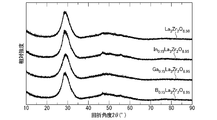
- FIG. 2 shows a chart showing the X-ray diffraction results of some of the composite metal oxide powders produced in Example 1.
- FIG. 2 shows (1-1) La 3 Zr 2 O 8.50 , (1-2) B 0.15 La 3 Zr 2 O 8.95 , and (1-3) In 0.
- Example 2 Manufacturing of amorphous composite metal oxide
- the metal compound used in Example 1 and the following metal compound are weighed and used as a raw material so that each metal element is contained in a ratio corresponding to the chemical composition shown in (1-14) to (1-33) below. Except for the above, powders of composite metal oxides having the chemical compositions shown in (1-14) to (1-33) were produced in the same manner as in Example 1.
- TaCl 5 (Rare Metallic, 99.9%) NbCl 5 (manufactured by Rare Metallic, 99.9%) CoCl 2 (manufactured by High Purity Chemical Laboratory, 99.9%) NiCl 2 ⁇ 6H 2 O (Wako Pure Chemical Industries, Ltd., special grade reagent) MgCl 2 (manufactured by High Purity Chemical Laboratory, 99.9%) FeCl 2 (manufactured by High Purity Chemical Laboratory, 99.9%) BiCl 3 (Wako Pure Chemical Industries, Ltd., Wako Special Grade) SnCl 4 ⁇ 5H 2 O (Wako Pure Chemical Industries, Ltd., 98%) MoCl 6 (manufactured by Wako Pure Chemical Industries, Ltd., 99.5%) WCl 6 (manufactured by Wako Pure Chemical Industries, Ltd., 99%)
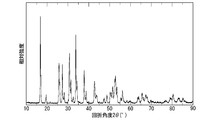
- FIG. 3 shows a chart showing the X-ray diffraction results of some of the composite metal oxide powders produced in Example 2.
- FIG. 3 shows (1-14) La 3 Zr 1.5 Ta 0.5 O 8.75 and (1-15) Co 0.10 La 3 Zr 1.75 Ta 0.25 O produced in Example 2.
- Example 3 Manufacturing of amorphous composite metal oxide Except that the metal compounds used in Example 2 were weighed and used as raw materials so that each metal element was contained in a ratio corresponding to the chemical composition shown in (1-44) to (1-55) below. In the same manner as in Example 1, powders of composite metal oxides having the chemical compositions shown in (1-44) to (1-55) were produced.
- FIG. 4 shows a chart showing the X-ray diffraction results of some of the composite metal oxide powders produced in Example 3.
- FIG. 4 shows (1-44) B 0.10 La 3 Zr 1.80 Ta 0.20 O 8.75 and (1-50) Ga 0.10 La 3 Zr 1.80 Ta produced in Example 3.
- Example 4 Manufacture of garnet-type lithium composite metal oxide
- the mixing ratio of the lithium salt in the mixture corresponds to the chemical composition of the target garnet-type lithium composite metal oxide (2-1) Li 6.5 La 3 Zr 1.5 Ta 0.5 O 12.
- the amount of lithium element was set to 1.1 times.
- Lithium salt Lithium oxide Li 2 O (manufactured by High Purity Chemical Laboratory, purity 99.9%) Lithium peroxide Li 2 O 2 (manufactured by High Purity Chemical Laboratory, purity 99.9%)
- the obtained mixture was calcined by heating in an argon gas atmosphere at 400 ° C. (maximum temperature) for 12 hours using a vacuum type gas replacement furnace (KDF-75plus, manufactured by Denken Hydental Co., Ltd.). .. After calcination, the mixture was naturally allowed to cool in the furnace used for calcination to obtain a powder of the target lithium composite metal oxide.
- Example 4 an X-ray diffractometer (X-ray diffractometer) was used for the lithium composite metal oxide powder produced using lithium oxide as the lithium salt and the lithium composite metal oxide powder produced using lithium peroxide as the lithium salt, respectively.
- X-ray diffraction measurement was performed using a product of Rigaku Co., Ltd., trade name: RINT-2550V), and the crystal structure was examined. The result is shown in FIG.
- FIG. 5 shows the X-ray diffraction result of the lithium composite metal oxide powder produced using lithium oxide as the lithium salt and the X-ray diffraction of the lithium composite metal oxide powder produced using lithium peroxide as the lithium salt. It is a chart which showed the result.
- both the lithium composite metal oxide produced using lithium oxide and the lithium composite metal oxide produced using lithium peroxide as the lithium salt are garnet type belonging to the cubic system.
- the lithium composite metal oxide using lithium oxide and the lithium composite metal oxide using lithium peroxide are both regardless of the type of lithium salt used. However, it was confirmed that it was a single phase of a garnet-type lithium composite metal oxide having the same chemical composition.
- Example 4 As the lithium salt produced in Example 4, a lithium composite metal oxide powder using lithium oxide and a lithium composite metal oxide powder using lithium peroxide were subjected to an electro-emission scanning electron microscope (FE), respectively. -SEM) (manufactured by HITACHI, S-4300) was used for observation. As a result, it was confirmed that the particle size of any lithium composite metal oxide powder was 0.1 ⁇ m or less.
- FIG. 6 is a photograph of a powder of a lithium composite metal oxide produced by using lithium oxide as a lithium salt in Example 4 by using a field emission scanning electron microscope (FE-SEM). From the particle size in the photograph, the particle size of the garnet-type lithium composite metal oxide produced using lithium oxide as the lithium salt was estimated. As a result, the particle size was in the range of 50 to 100 nm. Similarly, it was possible to estimate that the particle size of the lithium composite metal oxide produced using lithium peroxide as the lithium salt produced in Example 4 was also in the range of 50 to 100 nm.
- FE-SEM field emission scanning electron microscope
- Example 5 Manufacture of garnet-type lithium composite metal oxide (1-18) Mg 0.15 La 3 Zr 1.75 Ta 0.25 O 8.775 , (1-19) Fe 0.10 La 3 Zr 1.75 Ta 0.25 O produced in Example 2. 8.725 , (1-22) B 0.15 La 3 Zr 1.75 Ta 0.25 O
- Each of the amorphous composite metal oxides having the chemical composition shown in 8.85 and the excess as a lithium salt.
- the target lithium composite metal oxide was obtained, except that a mixture was obtained using lithium oxide Li 2 O 2 (manufactured by High Purity Chemical Laboratory, purity 99.9%). Obtained powder.
- FIG. 7 shows (2-2) Li 6.45 Mg 0.15 La 3 Zr 1.75 Ta 0.25 O 12 and (2-3) Li 6.45 Fe 0.10 La produced in Example 5. 3 Zr 1.75 Ta 0.25 O 12 , (2-4) Li 6.30 B 0.15 La 3 Zr 1.75 Ta 0.25 O 12 of the lithium composite metal oxide having the chemical composition shown in It is a chart which showed the powder X-ray diffraction result.
- an amorphous composite metal oxide having the chemical composition shown in (1-18) Mg 0.15 La 3 Zr 1.75 Ta 0.25 O 8.775 in Example 5 was used.
- the lithium composite metal oxide powder produced in use a diffraction peak showing a slight precipitation of lithium carbonate was observed in the X-ray diffraction measurement.
- no diffraction peak showing an impurity phase derived from Mg was observed.
- the lithium composite metal oxide produced by using the amorphous composite metal oxide having the chemical composition shown in (1-18) is a garnet-type (2-2) Li belonging to the cubic system. It was confirmed that it was a single phase of the chemical composition shown by 6.45 Mg 0.15 La 3 Zr 1.75 Ta 0.25 O 12.
- the lithium composite metal oxide produced by using the amorphous composite metal oxide having the chemical composition shown in (1-19) is a garnet-type (2-3) Li belonging to the cubic system. It was confirmed that it was a single phase of the chemical composition shown by 6.45 Fe 0.10 La 3 Zr 1.75 Ta 0.25 O 12.
- the lithium composite metal oxide produced by using the amorphous composite metal oxide having the chemical composition shown in (1-22) is a garnet-type (2-4) Li belonging to the cubic system. It was confirmed that it was a single phase of the chemical composition shown by 6.30 B 0.15 La 3 Zr 1.75 Ta 0.25 O 12.
- Example 6 Manufacture of garnet-type lithium composite metal oxide
- Manufactured, purity 99.9%) was mixed using a planetary ball mill (Fritsch, P-7) to obtain a mixture.
- the mixing ratio of the lithium salt in the mixture is 1.05, which is the amount of lithium element corresponding to the chemical composition shown in (2-5) Li 7 La 3 Zr 2 O 12 of the target garnet-type lithium composite metal oxide. Doubled.
- the obtained mixture was calcined by heating in an argon gas atmosphere at 600 ° C. (maximum temperature) for 12 hours using a vacuum type gas replacement furnace (KDF-75plus, manufactured by Denken Hydental Co., Ltd.). .. After calcination, the mixture was naturally allowed to cool in the furnace used for calcination to obtain a powder of the target lithium composite metal oxide.
- FIG. 8 is a chart showing the powder X-ray diffraction results of the lithium composite metal oxide having the chemical composition shown in (2-5) Li 7 La 3 Zr 2 O 12 produced in Example 6.
- Example 7 Manufacture of garnet-type lithium composite metal oxide (1-21) B 0.10 La 3 Zr 1.75 Ta 0.25 O 8.775 , (1-22) B 0.15 La 3 Zr 1.75 Ta 0.25 O produced in Example 2. 8.85 , (1-31) In 0.10 La 3 Zr 1.75 Ta 0.25 O 8.775 , (1-32) In 0.15 La 3 Zr 1.75 Ta 0.25 O 8.
- a mixture was obtained using each of the amorphous composite metal oxides having the chemical composition shown in No. 85 and lithium oxide Li 2 O (manufactured by High Purity Chemical Laboratory, purity 99.9%) as a lithium salt. Except for the above, a powder of the target lithium composite metal oxide was obtained in the same manner as in Example 6.
- Example 7 The crystal structure of each of the lithium composite metal oxide powders produced in Example 7 was examined by performing X-ray diffraction measurements using an X-ray diffractometer (manufactured by Rigaku Co., Ltd., trade name RINT-2550V). As a result, in Example 7, the chemical composition shown by (1-21) B 0.10 La 3 Zr 1.75 Ta 0.25 O 8.775 , and (1-22) B 0.15 La 3 Zr 1
- the powders of each lithium composite metal oxide produced using the amorphous composite metal oxide having the chemical composition shown in .75 Ta 0.25 O 8.85 were all slightly in the X-ray diffraction measurement. A diffraction peak indicating the precipitation of lithium oxide was observed. However, no diffraction peak showing an impurity phase derived from B was observed in any of them.
- the lithium composite metal oxide produced by using the amorphous composite metal oxide having the chemical composition shown in (1-21) is a garnet-type (2-6) Li belonging to the cubic system. It was confirmed that it was a single phase of the chemical composition shown by 6.45 B 0.10 La 3 Zr 1.75 Ta 0.25 O 12. Further, the lithium composite metal oxide produced by using the amorphous composite metal oxide having the chemical composition shown in (1-22) is a garnet-type (2-4) Li 6. It was confirmed that it was a single phase of the chemical composition shown by 30 B 0.15 La 3 Zr 1.75 Ta 0.25 O 12.
- the cubic lattice constant was refined by the least squares method using the plane spacing and the plane index for the main peaks. ..
- Example 7 the chemical composition shown by (1-31) In 0.10 La 3 Zr 1.75 Ta 0.25 O 8.775 , and (1-32) In 0.15 La 3 Zr 1.
- the powders of each lithium composite metal oxide produced using the amorphous composite metal oxide having the chemical composition shown in 75 Ta 0.25 O 8.85 were all slightly oxidized in the X-ray diffraction measurement. A diffraction peak indicating the precipitation of lithium was observed. However, no diffraction peak showing an impurity phase derived from In was observed in any of them.
- the lithium composite metal oxide produced by using the amorphous composite metal oxide having the chemical composition shown in (1-31) is a garnet-type (2-7) Li belonging to the cubic system. It was confirmed that it was a single phase of the chemical composition shown by 6.45 In 0.10 La 3 Zr 1.75 Ta 0.25 O 12. Further, the lithium composite metal oxide produced by using the amorphous composite metal oxide having the chemical composition shown in (1-32) is a garnet-type (2-8) Li 6. It was confirmed that it was a single phase of the chemical composition shown by 30 In 0.15 La 3 Zr 1.75 Ta 0.25 O 12.
- the cubic lattice constant was refined by the least squares method using the plane spacing and plane index of the main peaks. ..
- FIG. 9 shows a chart showing the X-ray diffraction results of some of the lithium composite metal oxide powders produced in Example 7.
- FIG. 9 shows the lithium composite metal oxide having the chemical composition shown in (2-4) Li 6.30 B 0.15 La 3 Zr 1.75 Ta 0.25 O 12 produced in Example 7 and ( 2-8) It is a chart which showed the X-ray diffraction result of the powder of the lithium composite metal oxide having the chemical composition shown by Li 6.30 In 0.15 La 3 Zr 1.75 Ta 0.25 O 12.
- Example 8 Manufacturing of sintered body
- Powder was prepared as a raw material.
- the raw material is filled in a hot press die (manufactured by AS ONE) having a diameter of 10 mm, and the hot press is performed using a hot press device (manufactured by AS ONE) at a temperature of 400 ° C. and a pressure of 370 MPa for 2 hours.
- the raw material was sintered to obtain a sintered body having a thickness of 1 mm.
- the conductivity of the obtained sintered body at room temperature was determined by the method shown below. That is, the impedance of the sintered body at a plurality of frequencies was measured using a frequency response analyzer (FRA) (manufactured by Solartron, 1260 type) to obtain a Nyquist diagram (call call plot).
- FIG. 10 shows a call-call plot of the sintered body. The impedance was measured with a frequency of 32 MHz to 100 Hz and an amplitude voltage of 100 mV. In addition, an Au electrode was used as the blocking electrode. Then, the resistance value of the sintered body was obtained from the arc of the Cole Cole plot shown in FIG. Then, the conductivity of the sintered body was calculated from the obtained resistance value. As a result, the conductivity of the sintered body of Example 8 at room temperature was 3.6 ⁇ 10-5 S / cm. From this, it was confirmed that the sintered body of Example 8 had high ionic conductivity.
- FFA frequency response analyzer
- Example 9 Manufacturing of sintered body
- the powder of lithium cobalt oxide (LiCoO 2 ) (manufactured by Nippon Kagaku Kogyo Co., Ltd., trade name: Cellseed) were prepared as raw materials.
- the garnet-type lithium composite metal oxide powder having the chemical composition shown in (2-1) and the lithium cobalt oxide have a chemical composition so that the content of the lithium cobalt oxide in the sintered body is 50% by mass.
- a sintered body was obtained in the same manner as in Example 8 except that the powder was mixed with the above powder to obtain a raw material.
- the conductivity at room temperature was determined in the same manner as in Example 8.
- the conductivity of the sintered body of Example 9 at room temperature was 2.0 ⁇ 10-5 S / cm, which was equivalent to that of the sintered body of Example 8 containing no lithium cobalt oxide. .. From this, it was confirmed that the sintered body of Example 9 had high ionic conductivity like the sintered body of Example 8.
- Example 9 In the Nyquist diagram (Cole Cole plot) of the sintered body of Example 9, an arc showing ionic conductivity derived from a garnet-type lithium composite metal oxide and an electron conductivity derived from lithium cobalt oxide are shown. Two arcs were observed. From this, it was clarified that the sintered body of Example 9 has both good ionic conductivity and electron conductivity. This is because the hot press was performed at a low temperature (400 ° C. in Example 9), so that the reaction at the interface between the garnet-type lithium composite metal oxide and the lithium cobalt oxide was suppressed, and the garnet was produced at a low temperature. It is presumed that this is due to the formation of a good electrolyte-active material interface by using the powder.
- Example 10 All-solid-state lithium secondary battery
- the solid electrolyte layer made of the sintered body of Example 8 and the electrode layer made of the sintered body of Example 9 as the positive electrode were laminated, and hot press sintering was performed at 400 ° C. to obtain a laminated body.
- a metallic lithium sheet as a negative electrode was attached to the surface of the obtained laminate on the solid electrolyte layer side.
- a flat cell HS cell manufactured by Hosen Co., Ltd.
- an all-solid-state lithium secondary battery using a gold sheet as a positive electrode current collector and a stainless steel plate as a negative electrode current collector was produced.
- the obtained all-solid-state lithium secondary battery was subjected to cyclic voltammetry measurement at 60 ° C.
- Example 10 operates as a battery.
- Comparative Example 1 Manufacturing of composite metal oxides (1-14)
- the metal compound used in Example 2 is weighed and used as a raw material so that each metal element is contained in a proportion corresponding to the chemical composition shown in La 3 Zr 1.5 Ta 0.5 O 8.75.
- a precursor temporary baking powder
- the calcined powder was crushed using an agate mortar and heat-treated at 1000 ° C. for 4 hours in an electric furnace (FP101 manufactured by Yamato Kagaku Co., Ltd.). Through the above steps, a powder of the composite metal oxide of Comparative Example 1 having the chemical composition shown in (1-14) was obtained.
- the crystal structure of the composite metal oxide powder of Comparative Example 1 was examined by performing X-ray diffraction measurement using an X-ray diffractometer (manufactured by Rigaku Co., Ltd., trade name SmartLab). As a result, in the diffraction result of the composite metal oxide of Comparative Example 1, a diffraction peak showing a fluorite-like structure was observed, and it was confirmed that the composite metal oxide of Comparative Example 1 had a single phase.
- the obtained mixture was calcined by heating in an argon gas atmosphere at 400 ° C. (maximum temperature) for 12 hours using a vacuum type gas replacement furnace (KDF-75plus, manufactured by Denken Hydental Co., Ltd.). .. After firing, it was naturally allowed to cool in the furnace used for firing to obtain a powder of the fired product. Further, powders of the fired product were obtained in the same manner as described above except that the maximum temperatures at the time of firing the mixture were 450 ° C. and 500 ° C., respectively.
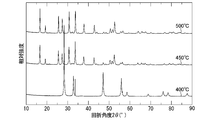
- the fired product produced under the conditions of the maximum temperature at the time of firing the mixture at 400 ° C., 450 ° C., and 500 ° C. was X by using an X-ray diffractometer (manufactured by Rigaku Co., Ltd., trade name RINT-2550V). X-ray diffraction measurement was performed to examine the crystal structure. The result is shown in FIG.
- FIG. 11 is a chart showing the X-ray diffraction results of the fired product produced in Comparative Example 1 under the conditions of the maximum temperature at the time of firing at 400 ° C., 450 ° C., and 500 ° C.
- a diffraction peak derived from a composite metal oxide having a fluorite-type structure used as a raw material for firing and oxidation As shown in FIG. 11, as a result of X-ray diffraction measurement of a fired product having a maximum temperature of 400 ° C. at the time of firing, a diffraction peak derived from a composite metal oxide having a fluorite-type structure used as a raw material for firing and oxidation. A diffraction peak derived from lithium was observed, and no diffraction peak indicating a garnet-type composite metal oxide was observed. From this, it was confirmed that when the maximum temperature at the time of firing was 400 ° C., the composite metal oxide having a fluorite-shaped structure did not react with lithium oxide.
- Comparative Example 2 Manufacturing of composite metal oxides (1-31) In 0.10 La 3 Zr 1.75 Ta 0.25 O The metal compound used in Example 2 was used so as to contain each metal element in a proportion corresponding to the chemical composition shown in 8.775. Weighed and used as a raw material, and a powder of the composite metal oxide of Comparative Example 2 was obtained in the same manner as in Comparative Example 1.
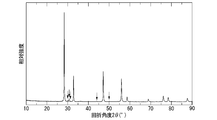
- FIG. 12 is a chart showing the results of X-ray diffraction in the powder of the composite metal oxide of Comparative Example 2.
- a diffraction peak caused by the formation of an impurity phase such as indium lanthanum oxide InLaO 3 (diffraction peak indicated by an arrow in FIG. 12). ) was recognized. Therefore, it was clarified that the composite metal oxide of Comparative Example 2 was not a single phase having a fluorite-type structure. From this, it was found that the chemical composition shown in (1-31) does not form a single phase of the fluorite-type structure.
- the obtained mixture was calcined by heating in an argon gas atmosphere at 600 ° C. (maximum temperature) for 12 hours using a vacuum type gas replacement furnace (KDF-75plus, manufactured by Denken Hydental Co., Ltd.). .. After firing, it was naturally allowed to cool in the furnace used for firing to obtain a powder of the fired product.
- the fired product produced in Comparative Example 2 was subjected to X-ray diffraction measurement using an X-ray diffractometer (manufactured by Rigaku Co., Ltd., trade name RINT-2550V), and the crystal structure was examined. As a result, a diffraction peak indicating indium lanthanum oxide InLaO 3 derived from the composite metal oxide of Comparative Example 2 was observed. From this, it was confirmed that the fired product produced in Comparative Example 2 was not a single phase.
- Comparative Example 3 Manufacturing of sintered body
- the chemical composition shown in (2-1) Li 6.5 La 3 Zr 1.5 Ta 0.5 O 12 is the same as in Comparative Example 1 except that the maximum temperature at the time of firing the mixture is 600 ° C.
- a powder of a calcined product composed of a single phase of a garnet-type composite metal oxide having the above was obtained.
- a sintered body having a thickness of 1 mm was obtained in the same manner as in Example 8.
- the conductivity at room temperature was determined in the same manner as in Example 8.
- the conductivity of the sintered body of Comparative Example 3 at room temperature was 2.9 ⁇ 10-6 S / cm. From this, it was found that the sintered body of Comparative Example 3 had lower ionic conductivity than the sintered body of Example 8.
- This is an amorphous composite metal oxidation as a raw material even if it is a garnet-type composite metal oxide having the chemical composition shown in (2-1) Li 6.5 La 3 Zr 1.5 Ta 0.5 O 12.
- the constituent elements other than lithium in the raw material do not have a specific crystal structure as compared with the case where the product produced in Comparative Example 3 is used.
- Example 8 Although it is in an amorphous state, it is well mixed at the atomic level, so it is highly reactive, and even in a sintered body, fine particles form a dense composition and have a uniform chemical composition distribution. .. From this, it is presumed that the sintered body of Example 8 obtained high ionic conductivity as compared with the case of using the one produced in Comparative Example 3.
- the amorphous composite metal oxide of the present invention can be used as a raw material for a garnet-type lithium composite metal oxide that can be sintered at a low temperature and becomes a sintered body having high ionic conductivity by sintering.
- Garnet-type lithium composite metal oxidation that can be sintered at a low temperature by firing a mixture of the amorphous composite metal oxide of the present invention and a lithium salt, and becomes a sintered body with high ionic conductivity by sintering.
- the garnet-type lithium composite metal oxide of the present invention can be sintered to obtain a sintered body having high ionic conductivity. Therefore, the sintered body containing the garnet-type lithium composite metal oxide of the present invention is suitable as a solid electrolyte layer and / or an electrode of an electrochemical device.
Landscapes
- Chemical & Material Sciences (AREA)
- General Chemical & Material Sciences (AREA)
- Electrochemistry (AREA)
- Chemical Kinetics & Catalysis (AREA)
- Engineering & Computer Science (AREA)
- Organic Chemistry (AREA)
- Inorganic Chemistry (AREA)
- Manufacturing & Machinery (AREA)
- Condensed Matter Physics & Semiconductors (AREA)
- Geology (AREA)
- Life Sciences & Earth Sciences (AREA)
- Physics & Mathematics (AREA)
- Materials Engineering (AREA)
- General Physics & Mathematics (AREA)
- Secondary Cells (AREA)
- Inorganic Compounds Of Heavy Metals (AREA)
- Conductive Materials (AREA)
- Battery Electrode And Active Subsutance (AREA)
- Compounds Of Alkaline-Earth Elements, Aluminum Or Rare-Earth Metals (AREA)
Priority Applications (2)
| Application Number | Priority Date | Filing Date | Title |
|---|---|---|---|
| CN202180018045.XA CN115210184B (zh) | 2020-03-02 | 2021-02-22 | 非晶质复合金属氧化物、石榴石型锂复合金属氧化物、烧结体、固态电解质层、电化学装置用电极及电化学装置 |
| KR1020227030121A KR102730233B1 (ko) | 2020-03-02 | 2021-02-22 | 비정질 복합 금속 산화물, 가넷형 리튬 복합 금속 산화물, 소결체, 고체 전해질층, 전기화학 디바이스용 전극, 전기화학 디바이스 |
Applications Claiming Priority (2)
| Application Number | Priority Date | Filing Date | Title |
|---|---|---|---|
| JP2020-034853 | 2020-03-02 | ||
| JP2020034853A JP7478414B2 (ja) | 2020-03-02 | 2020-03-02 | 非晶質複合金属酸化物、ガーネット型リチウム複合金属酸化物、焼結体、固体電解質層、電気化学デバイス用電極、電気化学デバイス |
Publications (1)
| Publication Number | Publication Date |
|---|---|
| WO2021177070A1 true WO2021177070A1 (ja) | 2021-09-10 |
Family
ID=77614498
Family Applications (1)
| Application Number | Title | Priority Date | Filing Date |
|---|---|---|---|
| PCT/JP2021/006601 Ceased WO2021177070A1 (ja) | 2020-03-02 | 2021-02-22 | 非晶質複合金属酸化物、ガーネット型リチウム複合金属酸化物、焼結体、固体電解質層、電気化学デバイス用電極、電気化学デバイス |
Country Status (4)
| Country | Link |
|---|---|
| JP (1) | JP7478414B2 (https=) |
| KR (1) | KR102730233B1 (https=) |
| CN (1) | CN115210184B (https=) |
| WO (1) | WO2021177070A1 (https=) |
Families Citing this family (2)
| Publication number | Priority date | Publication date | Assignee | Title |
|---|---|---|---|---|
| EP4438579A1 (en) * | 2023-03-24 | 2024-10-02 | Samsung Electronics Co., Ltd. | Solid-state electrolyte, preparation method of solid-state electrolyte, and lithium battery comprising solid-state electrolyte |
| JP2025138551A (ja) * | 2024-03-11 | 2025-09-25 | Dowaホールディングス株式会社 | La、Zrを含む非晶質複合金属酸化物粉末、およびその粉末、ガーネット型リチウム複合金属酸化物、全固体電池の製造方法 |
Citations (3)
| Publication number | Priority date | Publication date | Assignee | Title |
|---|---|---|---|---|
| JP2010534383A (ja) * | 2007-07-02 | 2010-11-04 | ビーエーエスエフ ソシエタス・ヨーロピア | ガーネット構造を有するイオン伝導体 |
| JP2017214247A (ja) * | 2016-05-31 | 2017-12-07 | 旭化成株式会社 | 複合酸化物前駆体を製造する方法 |
| JP2019121463A (ja) * | 2017-12-28 | 2019-07-22 | トヨタ自動車株式会社 | 電池 |
Family Cites Families (13)
| Publication number | Priority date | Publication date | Assignee | Title |
|---|---|---|---|---|
| JPS5634865B2 (https=) | 1973-02-21 | 1981-08-13 | ||
| JPS5945432B2 (ja) | 1979-12-04 | 1984-11-06 | トリニテイ工業株式会社 | 廃塗料、洗浄廃シンナ−等廃液の回収装置 |
| JPH11322308A (ja) | 1998-05-18 | 1999-11-24 | Kasei Optonix Co Ltd | 複合金属酸化物の製造方法 |
| EP2767512B1 (de) * | 2004-03-06 | 2017-05-10 | Basf Se | Chemisch stabiler fester Lithiumionenleiter |
| JP2007214247A (ja) * | 2006-02-08 | 2007-08-23 | Matsushita Electric Ind Co Ltd | 発光モジュールとその製造方法 |
| JP4867618B2 (ja) * | 2006-11-28 | 2012-02-01 | 住友化学株式会社 | 熱電変換材料 |
| JP5151692B2 (ja) * | 2007-09-11 | 2013-02-27 | 住友電気工業株式会社 | リチウム電池 |
| CN101186493B (zh) * | 2007-11-30 | 2010-05-19 | 华南理工大学 | 一种提高铋层结构压电铁电陶瓷材料致密度的方法 |
| JP5131854B2 (ja) * | 2008-12-18 | 2013-01-30 | 独立行政法人産業技術総合研究所 | リチウムイオン伝導性酸化物およびその製造方法、並びに該酸化物により構成された固体電解質 |
| EP2903073B1 (en) * | 2013-10-24 | 2018-08-29 | LG Chem, Ltd. | Solid electrolyte particles, method for preparing same, and lithium secondary battery containing same |
| KR102358438B1 (ko) * | 2014-12-30 | 2022-02-04 | 삼성전자주식회사 | 복합 양극 활물질, 그 제조방법, 이를 포함하는 양극 및 리튬이차전지 |
| KR102373218B1 (ko) * | 2016-05-24 | 2022-03-10 | 스미또모 가가꾸 가부시끼가이샤 | 정극 활물질, 그 제조 방법 및 리튬 이온 이차 전지용 정극 |
| JP6962094B2 (ja) * | 2017-09-21 | 2021-11-05 | トヨタ自動車株式会社 | ガーネット型イオン伝導性酸化物、及び、酸化物電解質焼結体の製造方法 |
-
2020
- 2020-03-02 JP JP2020034853A patent/JP7478414B2/ja active Active
-
2021
- 2021-02-22 CN CN202180018045.XA patent/CN115210184B/zh active Active
- 2021-02-22 KR KR1020227030121A patent/KR102730233B1/ko active Active
- 2021-02-22 WO PCT/JP2021/006601 patent/WO2021177070A1/ja not_active Ceased
Patent Citations (3)
| Publication number | Priority date | Publication date | Assignee | Title |
|---|---|---|---|---|
| JP2010534383A (ja) * | 2007-07-02 | 2010-11-04 | ビーエーエスエフ ソシエタス・ヨーロピア | ガーネット構造を有するイオン伝導体 |
| JP2017214247A (ja) * | 2016-05-31 | 2017-12-07 | 旭化成株式会社 | 複合酸化物前駆体を製造する方法 |
| JP2019121463A (ja) * | 2017-12-28 | 2019-07-22 | トヨタ自動車株式会社 | 電池 |
Also Published As
| Publication number | Publication date |
|---|---|
| JP7478414B2 (ja) | 2024-05-07 |
| KR20220137048A (ko) | 2022-10-11 |
| KR102730233B1 (ko) | 2024-11-15 |
| CN115210184A (zh) | 2022-10-18 |
| CN115210184B (zh) | 2024-05-28 |
| JP2021138554A (ja) | 2021-09-16 |
Similar Documents
| Publication | Publication Date | Title |
|---|---|---|
| US11581576B2 (en) | Annealed garnet electrolyte separators | |
| Cai et al. | High electrochemical stability Al-doped spinel LiMn2O4 cathode material for Li-ion batteries | |
| Wang et al. | Accelerating the development of LLZO in solid‐state batteries toward commercialization: a comprehensive review | |
| Liu et al. | Enhanced electrochemical performance of bulk type oxide ceramic lithium batteries enabled by interface modification | |
| CN108886145B (zh) | 非晶相氧化物基正极活性材料及其制备方法和应用 | |
| Ha et al. | Enhanced electrochemical and thermal stability of surface-modified LiCoO2 cathode by CeO2 coating | |
| KR20160032664A (ko) | 전고체형 리튬 이온 이차 전지 | |
| JP2016119257A (ja) | 固体電解質、それを用いた全固体電池及び固体電解質の製造方法 | |
| WO2019194290A1 (ja) | 複合酸化物、並びにそれを電解質材料に使用した電気化学デバイス | |
| JP2011222415A (ja) | 固体電解質材料、リチウム電池および固体電解質材料の製造方法 | |
| WO2022009811A1 (ja) | 焼結体電極、電池用部材、並びに焼結体電極及び電池用部材の製造方法、固体電解質前駆体溶液、固体電解質前駆体、並びに固体電解質 | |
| JP2019125547A (ja) | 固体電解質粉末、並びにそれを用いてなる電極合材及び全固体ナトリウムイオン二次電池 | |
| WO2021251405A1 (ja) | 固体電解質材料、固体電解質、これらの製造方法および全固体電池 | |
| EP4438579A1 (en) | Solid-state electrolyte, preparation method of solid-state electrolyte, and lithium battery comprising solid-state electrolyte | |
| KR102730233B1 (ko) | 비정질 복합 금속 산화물, 가넷형 리튬 복합 금속 산화물, 소결체, 고체 전해질층, 전기화학 디바이스용 전극, 전기화학 디바이스 | |
| CN118281179B (zh) | 钠电池用正极材料及其制备方法、正极极片、钠电池 | |
| CN120303217A (zh) | 活性电极材料 | |
| US20240372136A1 (en) | Solid-state electrolyte, preparation method of solid-state electrolyte, and lithium battery comprising solid-state electrolyte | |
| EP4588902A1 (en) | Solid electrolyte, method of manufacturing the same, and lithium battery including the solid electrolyte | |
| KR102783239B1 (ko) | 리튬 이온 전도성 고체 전해질 | |
| US20250337005A1 (en) | Hybrid all-solid-state secondary battery and method of manufacturing the same | |
| KR20240143914A (ko) | 고체전해질, 그 제조방법 및 이를 포함하는 리튬전지 | |
| KR20260033878A (ko) | 산화물계와 황화물계 고체 전해질의 합성을 이용한 하이브리드 전고체 이차전지 | |
| KR20260033877A (ko) | 이온 전도도를 향상시키 위하여 산화물계 고체 전해질과 황화물계 고체 전해질을 혼합한 고체 전해질 | |
| CN118693335A (zh) | 固态电解质、固态电解质的制备方法、和包括固态电解质的锂电池 |
Legal Events
| Date | Code | Title | Description |
|---|---|---|---|
| 121 | Ep: the epo has been informed by wipo that ep was designated in this application |
Ref document number: 21764146 Country of ref document: EP Kind code of ref document: A1 |
|
| ENP | Entry into the national phase |
Ref document number: 20227030121 Country of ref document: KR Kind code of ref document: A |
|
| NENP | Non-entry into the national phase |
Ref country code: DE |
|
| 122 | Ep: pct application non-entry in european phase |
Ref document number: 21764146 Country of ref document: EP Kind code of ref document: A1 |