WO2021166990A1 - 化合物、熱可塑性樹脂、光学部材、光学レンズ - Google Patents
化合物、熱可塑性樹脂、光学部材、光学レンズ Download PDFInfo
- Publication number
- WO2021166990A1 WO2021166990A1 PCT/JP2021/006065 JP2021006065W WO2021166990A1 WO 2021166990 A1 WO2021166990 A1 WO 2021166990A1 JP 2021006065 W JP2021006065 W JP 2021006065W WO 2021166990 A1 WO2021166990 A1 WO 2021166990A1
- Authority
- WO
- WIPO (PCT)
- Prior art keywords
- group
- carbon atoms
- substituted
- groups
- atom
- Prior art date
- Legal status (The legal status is an assumption and is not a legal conclusion. Google has not performed a legal analysis and makes no representation as to the accuracy of the status listed.)
- Ceased
Links
- 0 CCC(C)(C(*C=C***)C(C(C)C*=*C(C)C*)C1=O)C1=C* Chemical compound CCC(C)(C(*C=C***)C(C(C)C*=*C(C)C*)C1=O)C1=C* 0.000 description 6
- VYMDYUXWHCJQDK-UHFFFAOYSA-N OCCCOc(ccc1c23)cc1ccc2[o]c(cc1)c3c(cc2)c1cc2OCCCO Chemical compound OCCCOc(ccc1c23)cc1ccc2[o]c(cc1)c3c(cc2)c1cc2OCCCO VYMDYUXWHCJQDK-UHFFFAOYSA-N 0.000 description 2
- BCZQPQCITLNBGG-UHFFFAOYSA-N OCCCOc1cc(cccc2)c2c2c1[o]c1c2c(cccc2)c2cc1OCCCO Chemical compound OCCCOc1cc(cccc2)c2c2c1[o]c1c2c(cccc2)c2cc1OCCCO BCZQPQCITLNBGG-UHFFFAOYSA-N 0.000 description 2
- JRLULHVQJISLCR-UHFFFAOYSA-N OCCCOc1cc2c3c4c(cc(cc5)OCCCO)c5ccc4[o]c3ccc2cc1 Chemical compound OCCCOc1cc2c3c4c(cc(cc5)OCCCO)c5ccc4[o]c3ccc2cc1 JRLULHVQJISLCR-UHFFFAOYSA-N 0.000 description 2
- UIBSBWQXLZYYBR-UHFFFAOYSA-N OCCOc(ccc1c23)cc1ccc2[o]c(cc1)c3c(cc2)c1cc2OCCO Chemical compound OCCOc(ccc1c23)cc1ccc2[o]c(cc1)c3c(cc2)c1cc2OCCO UIBSBWQXLZYYBR-UHFFFAOYSA-N 0.000 description 2
- CZUBGKWWEMNWAK-UHFFFAOYSA-N OCCOc1cc(c2c(cc3)[o]c4ccc(ccc(OCCO)c5)c5c24)c3cc1 Chemical compound OCCOc1cc(c2c(cc3)[o]c4ccc(ccc(OCCO)c5)c5c24)c3cc1 CZUBGKWWEMNWAK-UHFFFAOYSA-N 0.000 description 2
- ROYKIYHYUOKXGT-UHFFFAOYSA-N CC(C12)(C(OCCO)=Cc3c1cccc3)Oc1c2c(cccc2)c2cc1OCCO Chemical compound CC(C12)(C(OCCO)=Cc3c1cccc3)Oc1c2c(cccc2)c2cc1OCCO ROYKIYHYUOKXGT-UHFFFAOYSA-N 0.000 description 1
- YWEUKXRICMXNII-UHFFFAOYSA-N OCCCCCOc(cc(cccc1)c1c12)c1[o]c1c2c2ccccc2cc1OCCCCCO Chemical compound OCCCCCOc(cc(cccc1)c1c12)c1[o]c1c2c2ccccc2cc1OCCCCCO YWEUKXRICMXNII-UHFFFAOYSA-N 0.000 description 1
- YZZLKADDEZVXCB-UHFFFAOYSA-N OCCCCCOc(cc1)cc(cc2)c1c1c2[o]c(cc2)c1c(cc1)c2cc1OCCCCCO Chemical compound OCCCCCOc(cc1)cc(cc2)c1c1c2[o]c(cc2)c1c(cc1)c2cc1OCCCCCO YZZLKADDEZVXCB-UHFFFAOYSA-N 0.000 description 1
- WKNFVHILPJSGDD-UHFFFAOYSA-N OCCCCCOc(cc1)cc(cc2)c1c1c2[o]c(cc2)c1c(cc1)c2cc1OCCCCO Chemical compound OCCCCCOc(cc1)cc(cc2)c1c1c2[o]c(cc2)c1c(cc1)c2cc1OCCCCO WKNFVHILPJSGDD-UHFFFAOYSA-N 0.000 description 1
- PJWVGUZPGFAMMO-UHFFFAOYSA-N OCCCCCOc1cc([o]c2cc(OCCOCCO)c(cccc3)c3c22)c2c2c1cccc2 Chemical compound OCCCCCOc1cc([o]c2cc(OCCOCCO)c(cccc3)c3c22)c2c2c1cccc2 PJWVGUZPGFAMMO-UHFFFAOYSA-N 0.000 description 1
- QNHLWAJVNCFGOB-UHFFFAOYSA-N OCCCCCOc1cc2c3c4c(cc(cc5)OCCCCCO)c5ccc4[o]c3ccc2cc1 Chemical compound OCCCCCOc1cc2c3c4c(cc(cc5)OCCCCCO)c5ccc4[o]c3ccc2cc1 QNHLWAJVNCFGOB-UHFFFAOYSA-N 0.000 description 1
- NOQFWUBSPJGTOB-UHFFFAOYSA-N OCCCCCOc1cccc(cc2)c1c1c2[o]c(ccc2ccc3)c1c2c3OCCCCCO Chemical compound OCCCCCOc1cccc(cc2)c1c1c2[o]c(ccc2ccc3)c1c2c3OCCCCCO NOQFWUBSPJGTOB-UHFFFAOYSA-N 0.000 description 1
- VZVOWCDWSDYANE-UHFFFAOYSA-N OCCCCCOc1cccc2c1ccc1c2c(c2c(cc3)c(OCCCCCO)ccc2)c3[o]1 Chemical compound OCCCCCOc1cccc2c1ccc1c2c(c2c(cc3)c(OCCCCCO)ccc2)c3[o]1 VZVOWCDWSDYANE-UHFFFAOYSA-N 0.000 description 1
- BJCUDGPOKINMCA-UHFFFAOYSA-N OCCCCOc1cc([o]c2c3c(cccc4)c4c(OCCCCO)c2)c3c2c1cccc2 Chemical compound OCCCCOc1cc([o]c2c3c(cccc4)c4c(OCCCCO)c2)c3c2c1cccc2 BJCUDGPOKINMCA-UHFFFAOYSA-N 0.000 description 1
- IYFFJYKTFYFCAT-UHFFFAOYSA-N OCCCCOc1cc(cccc2)c2c2c1[o]c1c2c2ccccc2cc1OCCCCO Chemical compound OCCCCOc1cc(cccc2)c2c2c1[o]c1c2c2ccccc2cc1OCCCCO IYFFJYKTFYFCAT-UHFFFAOYSA-N 0.000 description 1
- XQNZUIGKKWYTRY-UHFFFAOYSA-N OCCCCOc1cc2c3c4c(cc(cc5)OCCCCO)c5ccc4[o]c3ccc2cc1 Chemical compound OCCCCOc1cc2c3c4c(cc(cc5)OCCCCO)c5ccc4[o]c3ccc2cc1 XQNZUIGKKWYTRY-UHFFFAOYSA-N 0.000 description 1
- YFJFITLVLAAJIS-UHFFFAOYSA-N OCCCCOc1cccc(cc2)c1c1c2[o]c(ccc2ccc3)c1c2c3OCCCCO Chemical compound OCCCCOc1cccc(cc2)c1c1c2[o]c(ccc2ccc3)c1c2c3OCCCCO YFJFITLVLAAJIS-UHFFFAOYSA-N 0.000 description 1
- ANZXJJRBILINPF-UHFFFAOYSA-N OCCCCOc1cccc2c1ccc1c2c(c2c(cc3)c(OCCCCO)ccc2)c3[o]1 Chemical compound OCCCCOc1cccc2c1ccc1c2c(c2c(cc3)c(OCCCCO)ccc2)c3[o]1 ANZXJJRBILINPF-UHFFFAOYSA-N 0.000 description 1
- VVNSYFHCVOOUCC-UHFFFAOYSA-N OCCCOc1c(cccc2)c2c2c(c(cccc3)c3c(OCCCO)c3)c3[o]c2c1 Chemical compound OCCCOc1c(cccc2)c2c2c(c(cccc3)c3c(OCCCO)c3)c3[o]c2c1 VVNSYFHCVOOUCC-UHFFFAOYSA-N 0.000 description 1
- NAJOBCYDSXAXSL-UHFFFAOYSA-N OCCCOc1cccc(cc2)c1c1c2[o]c(ccc2ccc3)c1c2c3OCCCO Chemical compound OCCCOc1cccc(cc2)c1c1c2[o]c(ccc2ccc3)c1c2c3OCCCO NAJOBCYDSXAXSL-UHFFFAOYSA-N 0.000 description 1
- FWKFUZGAQYXESQ-UHFFFAOYSA-N OCCCOc1cccc2c3c(c4cccc(OCCCO)c4cc4)c4[o]c3ccc12 Chemical compound OCCCOc1cccc2c3c(c4cccc(OCCCO)c4cc4)c4[o]c3ccc12 FWKFUZGAQYXESQ-UHFFFAOYSA-N 0.000 description 1
- CZQCWBFBVJEEGB-UHFFFAOYSA-N OCCOc1c(ccc2c3c4c(cccc5OCCO)c5ccc4[o]2)c3ccc1 Chemical compound OCCOc1c(ccc2c3c4c(cccc5OCCO)c5ccc4[o]2)c3ccc1 CZQCWBFBVJEEGB-UHFFFAOYSA-N 0.000 description 1
- HNNCLBGJLHWZEP-UHFFFAOYSA-N OCCOc1cc([o]c2c3c(cccc4)c4c(OCCO)c2)c3c2c1cccc2 Chemical compound OCCOc1cc([o]c2c3c(cccc4)c4c(OCCO)c2)c3c2c1cccc2 HNNCLBGJLHWZEP-UHFFFAOYSA-N 0.000 description 1
- JMODRNSZWZPWFO-UHFFFAOYSA-N OCCOc1cc(cccc2)c2c2c1[o]c1c2c(cccc2)c2cc1OCCO Chemical compound OCCOc1cc(cccc2)c2c2c1[o]c1c2c(cccc2)c2cc1OCCO JMODRNSZWZPWFO-UHFFFAOYSA-N 0.000 description 1
- VONVQCOAEPMZEL-UHFFFAOYSA-N OCCOc1cccc(cc2)c1c1c2[o]c(ccc2ccc3)c1c2c3OCCO Chemical compound OCCOc1cccc(cc2)c1c1c2[o]c(ccc2ccc3)c1c2c3OCCO VONVQCOAEPMZEL-UHFFFAOYSA-N 0.000 description 1
Images




Classifications
-
- C—CHEMISTRY; METALLURGY
- C07—ORGANIC CHEMISTRY
- C07D—HETEROCYCLIC COMPOUNDS
- C07D307/00—Heterocyclic compounds containing five-membered rings having one oxygen atom as the only ring hetero atom
- C07D307/77—Heterocyclic compounds containing five-membered rings having one oxygen atom as the only ring hetero atom ortho- or peri-condensed with carbocyclic rings or ring systems
-
- C—CHEMISTRY; METALLURGY
- C08—ORGANIC MACROMOLECULAR COMPOUNDS; THEIR PREPARATION OR CHEMICAL WORKING-UP; COMPOSITIONS BASED THEREON
- C08G—MACROMOLECULAR COMPOUNDS OBTAINED OTHERWISE THAN BY REACTIONS ONLY INVOLVING UNSATURATED CARBON-TO-CARBON BONDS
- C08G64/00—Macromolecular compounds obtained by reactions forming a carbonic ester link in the main chain of the macromolecule
- C08G64/04—Aromatic polycarbonates
- C08G64/06—Aromatic polycarbonates not containing aliphatic unsaturation
-
- G—PHYSICS
- G02—OPTICS
- G02B—OPTICAL ELEMENTS, SYSTEMS OR APPARATUS
- G02B1/00—Optical elements characterised by the material of which they are made; Optical coatings for optical elements
- G02B1/04—Optical elements characterised by the material of which they are made; Optical coatings for optical elements made of organic materials, e.g. plastics
Definitions
- the present disclosure relates to compounds, thermoplastic resins, optical members, and optical lenses.
- This application claims priority based on Japanese Patent Application No. 2020-02526 filed with the Japan Patent Office on February 18, 2020, the contents of which are incorporated herein by reference.
- Optical glass and optical resin are used as materials for optical lenses used in various optical products such as cameras, video cameras, mobile phones with cameras, videophones, and doorphones with cameras.
- Optical glass and the like can realize various required optical characteristics and are excellent in environmental resistance.
- optical glass and the like have a problem of poor workability and low productivity.
- the optical resin has an advantage that it can be mass-produced by injection molding. Because of this advantage, for example, as a camera lens, an optical lens made of an optical resin such as polycarbonate is used. As a resin for a lens, polycarbonate having a carbonate bond of bisphenol A is widely used. The refractive index of this polycarbonate is 1.586.
- Patent Document 1 discloses an optical lens made of polycarbonate in which 9,9-bis [4- (2-hydroxyethoxy) phenyl] fluorene is carbonate-bonded.
- Patent Document 2 discloses a lens comprising a composition containing 9,9-bis [4- (2-hydroxyethoxy) phenyl] fluorene and 3,11-dihydroxyethoxynaphthophene carbonate-bonded polycarbonate.
- the refractive index of polycarbonate obtained by carbonate-bonding 9,9-bis [4- (2-hydroxyethoxy) phenyl] fluorene of Patent Document 1 is 1.639, and further increase in the refractive index is required. Since the polycarbonate of Patent Document 2 has a dinaphthophene skeleton, it has a higher refractive index than the polycarbonate of Patent Document 1. However, as examined by the present inventors, this polycarbonate may generate sulfur dioxide near the molding temperature. Since this sulfur dioxide is an acidic substance, it causes corrosion of the mold. Therefore, the polycarbonate of Patent Document 2 is inferior in practicality because it is difficult to repeatedly use the mold at the time of molding.
- thermoplastic resin having either one or both of a carbonate bond and a polyester bond
- the heat has a high refractive index, good moldability, and does not cause concern for corrosion of the mold.
- An object of the present invention is to provide a compound from which a plastic resin can be obtained; a thermoplastic resin having a high refractive index, good moldability, and no concern about corroding a mold; and an optical member and an optical lens containing the thermoplastic resin. And.
- B 1 and B 2 independently exhibit polymerization-reactive groups;
- L 1 and L 2 are each independently an alkylene group having 1 to 10 carbon atoms which may be substituted, an arylene group having 4 to 10 carbon atoms which may be substituted, or 6 carbon atoms which may be substituted.
- B 3 and B 4 independently represent a hydroxy group, an organic substituent having 1 to 10 carbon atoms, or a halogen atom.
- B 1 and B 2 are hydroxyester groups and are represented by the following formula (f3).
- formula (f3) the bond positions of L 1 and L 2 , m, n, (L 1 O) m and (L 2 O) n , and any of the carbon atoms of substitution position numbers 1 to 6, 8 to 13.
- B 5 and B 6 are each independently an alkylene group having 1 to 10 carbon atoms which may be substituted, an arylene group having 4 to 10 carbon atoms which may be substituted, or 6 carbon atoms which may be substituted. Shows up to 12 aralkylene groups.
- L 1 and L 2 each independently represent an alkylene group having 1 to 10 carbon atoms which may be substituted.
- m and n represent integers of 1 to 4.
- thermoplastic resin comprising a structure in which a plurality of divalent structural units are linked via a divalent linking group; at least a part of the plurality of divalent structural units is represented by the following formula (1).
- L 1 and L 2 are independently substituted alkylene groups having 1 to 10 carbon atoms which may be substituted, arylene groups having 4 to 10 carbon atoms which may be substituted, or substituted.
- At least a part of the plurality of divalent structural units is a structural unit represented by the formula (1); and; a structural unit represented by the following formula (2), represented by the following formula (3).
- R 1 represents a direct bond, an oxygen atom, or an optionally substituted alkylene group having 1 to 40 carbon atoms
- R 2 to R 9 are independently hydrogen atoms, an alkyl group having 1 to 10 carbon atoms which may be substituted, an aryl group having 3 to 14 carbon atoms which may be substituted, and a carbon which may be substituted.
- L 3 and L 4 are independently substituted alkylene groups having 1 to 10 carbon atoms, optionally substituted arylene groups having 4 to 10 carbon atoms, or optionally substituted arylene groups having 6 carbon atoms. Shows ⁇ 12 aralkylene groups; o indicates an integer from 0 to 4; p represents an integer from 0 to 4.
- R 10 to R 21 are each independently a hydrogen atom, an alkyl group having 1 to 10 carbon atoms which may be substituted, and an aryl group having 3 to 14 carbon atoms which may be substituted.
- L 5 and L 6 are each independently an alkylene group having 1 to 10 carbon atoms which may be substituted, an arylene group having 4 to 10 carbon atoms which may be substituted, or 6 carbon atoms which may be substituted. Shows up to 12 aralkylene groups; q indicates an integer from 0 to 4; r indicates an integer from 0 to 4.
- V represents an optionally substituted arylene group;
- the substituent of V is a hydrogen atom, an alkyl group having 1 to 10 carbon atoms which may be substituted, an aryl group having 3 to 14 carbon atoms which may be substituted, and 1 to 10 carbon atoms which may be substituted.
- L 7 and L 8 are each independently an alkylene group having 1 to 10 carbon atoms which may be substituted, an arylene group having 4 to 10 carbon atoms which may be substituted, or 6 carbon atoms which may be substituted.
- R 25 to R 32 are each independently a hydrogen atom, an alkyl group having 1 to 10 carbon atoms which may be substituted, an aryl group having 3 to 14 carbon atoms which may be substituted, and a carbon which may be substituted.
- K 1 is a hydrogen atom, an alkyl group having 1 to 10 carbon atoms which may be substituted, an aryl group having 3 to 14 carbon atoms which may be substituted, and a carbon which may be substituted.
- u indicates an integer from 0 to 4; When u is 2 or more, each K 1 may be the same or different.
- K 2 is independently substituted with a hydrogen atom, an alkyl group having 1 to 10 carbon atoms which may be substituted, and an aryl group having 3 to 14 carbon atoms which may be substituted.
- each K 1 may be the same or different.
- one of the two bonds is bonded to any one of the carbon atoms of substitution position numbers 1 to 6, and the other bond is the carbon atom of substitution position numbers 8 to 13. Combined with any one of; Of the carbon atoms of substitution position numbers 1 to 6 and 8 to 13, the carbon atom to which the bond is not bonded has an independent hydrogen atom and an alkyl group having 1 to 10 carbon atoms which may be substituted.
- An aryl group having 3 to 14 carbon atoms which may be substituted an acyl group having 1 to 10 carbon atoms which may be substituted, an alkoxy group having 1 to 10 carbon atoms which may be substituted, and an alkoxy group having 1 to 10 carbon atoms which may be substituted.
- thermoplastic according to any one of [9] or [10], wherein either one or both of the carbonate bond and the ester bond contains a carbonyl carbon derived from a carbonic acid diester represented by the following formula ( réelle). resin.
- E 5 and E 6 are independently substituted aliphatic hydrocarbon groups having 1 to 18 carbon atoms or aromatic hydrocarbon groups which may be substituted; E 5 and E 6 may be the same or different.
- the thermoplastic resin according to any one of [9] to [13] which has a refractive index of 1.62 or more.
- thermoplastic resin when used as a monomer of a thermoplastic resin having either one or both of a carbonate bond and a polyester bond, it has a high refractive index, good moldability, and may corrode the mold. It is possible to provide a compound that can obtain a thermoplastic resin that does not exist; a thermoplastic resin that has a high refractive index, good moldability, and does not have a concern of corroding a mold; and an optical member and an optical lens containing the thermoplastic resin.
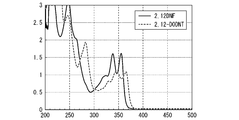
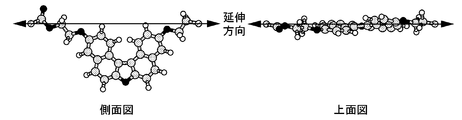
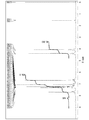
- UV absorption spectra of 2,12 DNF and 2,12-DODNT Stretched chain structure of polycarbonate using 2,12 DNF. Stretched chain structure of polycarbonate using 3,11 DNF. Stretched chain structure of polycarbonate using 6,8DNF. NMR spectrum of the polycarbonate copolymer of Example 1. NMR spectrum of the polycarbonate copolymer of Example 11. NMR spectrum of the polycarbonate copolymer of Example 14.
- B 1 and B 2 independently show polymerization-reactive groups;
- L 1 and L 2 are each independently an alkylene group having 1 to 10 carbon atoms which may be substituted, an arylene group having 4 to 10 carbon atoms which may be substituted, or 6 carbon atoms which may be substituted.
- a hydrogen atom or an arbitrary substituent is independently bonded to a carbon atom to which (L 1 O) m or (L 2 O) n is not bonded.
- the optional substituents include, for example, an alkyl group having 1 to 10 carbon atoms which may be substituted; an aryl group having 3 to 14 carbon atoms which may be substituted; and 1 to 10 carbon atoms which may be substituted.
- Linear alkylene groups such as methylene group, ethylene group, n-propylene group, n-butylene group, n-pentylene group, n-hexylene, n-heptylene, n-octylene, n-nonalene and n-decylene; 1-methylethylene group, 2-methylethylene group, 1-ethylethylene group, 2-ethylethylene group, 1-methylpropylene group, 2-methylpropylene group, 1,1-dimethylethylene group, 2,2-dimethylpropylene Examples thereof include an alkylene group containing a branched chain such as a group and a 3-methylpropylene group; an alkylene group containing an alicyclic structure; an alkylene group containing a heterocyclic structure; However, in L 1 or L 2 , the numerical value of the substitution position shall be given from the carbon on the dinaphthofuran side.
- examples of the alicyclic structure include those shown in the following [E] group.
- examples of the alkylene group containing an alicyclic structure include a group composed of an alicyclic structure and two linear or branched alkylene groups bonded to any two positions of the alicyclic structure. This group can also be said to be a group in which an alicyclic structure is interposed between two linear or branched alkylene groups.
- the bonding position of the two alkylene groups in the alicyclic structure is arbitrary, and the two alkylene groups may be bonded to the same carbon atom.
- examples of the heterocyclic structure include those shown in the following [F] group.
- examples of the alkylene group containing a heterocyclic structure include a heterocyclic group and a group consisting of two linear or branched alkylene groups bonded to any two positions of the heterocyclic structure. This group can also be said to be a group in which a heterocyclic structure is interposed between two linear or branched alkylene groups.
- the bonding position of the two alkylene groups in the heterocyclic structure is arbitrary, and the same carbon atom may be substituted by the two bonding hands.
- linear or branched alkylene group bonded to the alicyclic structure or the heterocyclic structure are not limited to these, but are a methylene group, an ethylene group, an n-propylene group, and an n-butylene.
- Linear alkylene group such as group, n-pentylene group, n-hexylene; 1-methylethylene group, 2-methylethylene group, 1-ethylethylene group, 2-ethylethylene group, 1-methylpropylene group, 2 -Alkylene groups containing branched chains such as methylpropylene group, 1,1-dimethylethylene group, 2,2-dimethylpropylene group, 3-methylpropylene group (however, the numerical value of the substitution position here is bonded to the above ring structure. It is assumed that it is attached from the carbon produced).
- the substituent that the alkylene group having 1 to 10 carbon atoms may have is a halogen atom (for example, a fluorine atom, a chlorine atom, a bromine atom, an iodine atom); an alkyl group having 1 to 10 carbon atoms (for example, a methyl group). , Ethyl group, isopropyl group); alkoxy group having 1 to 10 carbon atoms (for example, methoxy group, ethoxy group); acyl group having 1 to 10 carbon atoms (for example, acetyl group, benzoyl group); acylamino group having 1 to 10 carbon atoms.
- a halogen atom for example, a fluorine atom, a chlorine atom, a bromine atom, an iodine atom
- an alkyl group having 1 to 10 carbon atoms for example, a methyl group.
- Ethyl group isopropyl group
- acetamide group benzoylamide group
- nitro group cyano group
- halogen atom for example, fluorine atom, chlorine atom, bromine atom, iodine atom
- alkyl group having 1 to 10 carbon atoms for example, methyl group, ethyl group, isopropyl
- alkoxy group having 1 to 10 carbon atoms for example, a methoxy group or an ethoxy group
- an acyl group having 1 to 10 carbon atoms for example, an acetyl group or a benzoyl group
- an acylamino group having 1 to 10 carbon atoms (for example, an acetamide group).
- Benzoylamide group an aryl group having 4 to 10 carbon atoms which may have 1 to 3 substituents selected from a nitro group, a cyano group and the like (eg, a phenyl group, a naphthyl group, etc.) and the like can be mentioned. ..
- the number of the substituents is not particularly limited, but is preferably 1 to 3. When there are two or more substituents, the types of substituents may be the same or different.
- alkylene group having 1 to 10 carbon atoms which may be substituted include a phenylmethylene group, a 1-phenylethylene group, a 1-phenylpropylene group, a 1-cyclohexylpropylene group, and 1,1,2,2-.
- Examples include a tetrafluoroethylene group.
- arylene group having 4 to 10 carbon atoms in the "arylene group having 4 to 10 carbon atoms which may be substituted” are not limited to these.
- Phenylene groups such as 1,2-phenylene group, 1,3-phenylene group, 1,4-phenylene group; naphthylene group such as 1,5-naphthylene group, 2,6-naphthylene group; 2,5-pyridylene group, Examples thereof include hetero-arylene groups such as 2,4-furylene groups.
- the substituent that the arylene group having 4 to 10 carbon atoms may have is a halogen atom (for example, a fluorine atom, a chlorine atom, a bromine atom, an iodine atom); an alkyl group having 1 to 10 carbon atoms (for example, a methyl group). , Ethyl group, isopropyl group); alkoxy group having 1 to 10 carbon atoms (for example, methoxy group, ethoxy group); acyl group having 1 to 10 carbon atoms (for example, acetyl group, benzoyl group); acylamino group having 1 to 10 carbon atoms.
- a halogen atom for example, a fluorine atom, a chlorine atom, a bromine atom, an iodine atom
- an alkyl group having 1 to 10 carbon atoms for example, a methyl group).
- Ethyl group isopropyl group
- acetamide group benzoylamide group
- nitro group cyano group
- halogen atom for example, fluorine atom, chlorine atom, bromine atom, iodine atom
- alkyl group having 1 to 10 carbon atoms for example, methyl group, ethyl group, isopropyl
- alkoxy group having 1 to 10 carbon atoms for example, a methoxy group or an ethoxy group
- an acyl group having 1 to 10 carbon atoms for example, an acetyl group or a benzoyl group
- an acylamino group having 1 to 10 carbon atoms (for example, an acetamide group).
- Benzoylamide group an aryl group having 4 to 10 carbon atoms (for example, a phenyl group, a naphthyl group) and the like which may have 1 to 3 substituents selected from a nitro group, a cyano group and the like can be mentioned.
- the number of the substituents is not particularly limited, but is preferably 1 to 3. When there are two or more substituents, the types of substituents may be the same or different.
- arylene group having 4 to 10 carbon atoms which may be substituted include 2-methyl-1,4-phenylene group, 3-methyl-1,4-phenylene group, 3,5-dimethyl-1, 4-phenylene group, 3-methoxy-1,4-phenylene group, 3-trifluoromethyl-1,4-phenylene group, 2,5-dimethoxy-1,4-phenylene group, 2,3,5,6- Tetrafluoro-1,4-phenylene group, 2,3,5,6-tetrachloro-1,4-phenylene group, 3-nitro-1,4-phenylene group, 3-cyano-1,4-phenylene group Can be mentioned.
- each of the aromatic ring structure examples thereof include a group composed of two linear or branched alkylene groups bonded to any two positions.
- the aromatic ring structure may be a hydrocarbon ring structure such as a benzene ring or a naphthalene ring, or a heterocyclic structure such as a furan ring or a pyridine ring.
- Specific examples of the aralkylene group having 6 to 12 carbon atoms include, but are not limited to, those shown in the following [G] group.
- the substituent that the aralkylene group having 6 to 12 carbon atoms may have is a halogen atom (for example, a fluorine atom, a chlorine atom, a bromine atom, an iodine atom); an alkyl group having 1 to 10 carbon atoms (for example, a methyl group). , Ethyl group, isopropyl group); alkoxy group having 1 to 10 carbon atoms (for example, methoxy group, ethoxy group); acyl group having 1 to 10 carbon atoms (for example, acetyl group, benzoyl group); acylamino group having 1 to 10 carbon atoms.
- a halogen atom for example, a fluorine atom, a chlorine atom, a bromine atom, an iodine atom
- an alkyl group having 1 to 10 carbon atoms for example, a methyl group.
- Ethyl group isopropyl group
- acetamide group benzoylamide group
- nitro group cyano group
- halogen atom for example, fluorine atom, chlorine atom, bromine atom, iodine atom
- alkyl group having 1 to 10 carbon atoms for example, methyl group, ethyl group, isopropyl
- alkoxy group having 1 to 10 carbon atoms for example, a methoxy group or an ethoxy group
- an acyl group having 1 to 10 carbon atoms for example, an acetyl group or a benzoyl group
- an acylamino group having 1 to 10 carbon atoms (for example, an acetamide group).
- Benzoylamide group an aryl group having 4 to 10 carbon atoms (for example, a phenyl group, a naphthyl group, etc.) which may have 1 to 3 substituents selected from a nitro group, a cyano group and the like can be mentioned.
- the number of the substituents is not particularly limited, but is preferably 1 to 3. When there are two or more substituents, the types of substituents may be the same or different.
- aralkylene group having 6 to 10 carbon atoms which may be substituted include 2-methyl-1,4-xylylene group, 2,5-dimethyl-1,4-xylylene group, 2-methoxy-1, 4-Xylylene group, 2,5-dimethoxy-1,4-xylylene group, 2,3,5,6-tetrafluoro-1,4-xylylene group, ⁇ , ⁇ -dimethyl-1,4-xylylene group, ⁇ , ⁇ , ⁇ ', ⁇ '-tetramethyl-1,4-xylylene group.
- Each of L 1 and L 2 is preferably an alkylene group having 1 to 10 carbon atoms which may be substituted, from the viewpoint of low-cost raw material procurement and easiness of synthesis, and is a linear alkylene group or an alicyclic structure.
- An alkylene group containing is more preferable. Methylene group, ethylene group, n-propylene group, n-butylene group, n-pentylene group, n-hexylene, n-heptylene, n-octylene, n-nonalene, n-decylene, 2,2-dimethylpropylene group,
- An alkylene group containing an alicyclic structure as shown in the following [H] group is more preferable.
- substitution position of the two methylene groups in each alicyclic structure shown in the above [H] group is arbitrary, and two methylene groups may be bonded to the same carbon atom.
- methylene group, ethylene group, n-propylene group, n-butylene group, n-pentylene group, n-hexylene group, n-heptylene group, n-octylene group, n-nonalene group, n-decylene group. 2,2-Dimethylpropylene groups are preferred.
- n-propylene group, n-butylene group, n-pentylene group, n-hexylene group, n-heptylene, n- An octylene group, an n-nonalene group, and an n-decylene group are more preferable.
- the concentration of the dinaphthofuran structure in the unit structure can be increased. Therefore, from the viewpoint of high refractive index, n-butylene group, n-propylene group, ethylene group and methylene group are more preferable.
- an ethylene group is particularly preferable because it has an excellent balance between optical properties and mechanical strength and excellent thermal stability.
- the polymerizable reactive group is an ester group, a carboxy group-containing group, an acid halide-containing group, or a hydroxy ester group
- a methylene group or an ethylene group is particularly preferable because it has an excellent balance between optical properties and mechanical strength.
- the methylene group and the ethylene group also have an advantage that they can be introduced in a short stage and industrially at low cost.
- L 1 or L 2 is an alkylene group having 2 to 10 carbon atoms which may be substituted
- hydrogen is added to the ⁇ -position carbon atom of L 1 or L 2 bonded to the polymerization reactive group, particularly the hydroxy group. It is preferable that the atoms are not bonded.
- a hydrogen atom is not bonded to the ⁇ -carbon atom, olefins are not generated by proton desorption during polymerization, so that the heat resistance is high and the thermal stability is excellent.
- alkylene group in which a hydrogen atom is not bonded to the ⁇ -carbon atom of the hydroxy group for example, all the hydrogen atoms of the ⁇ -carbon atom of the linear alkylene group such as 2,2-dimethylpropylene group are alkyl. Examples include groups substituted with groups.
- n and n represent integers from 0 to 4, respectively. In one preferred embodiment, m and n represent integers from 1 to 4, respectively.
- B 1 is directly bonded to any one of the carbon atoms of substitution position numbers 1 to 6.
- B 1 is attached to any one of the carbon atoms of substitution position numbers 1 to 6 via (L 1 O) m.
- B 2 is directly bonded to any one of the carbon atoms of substitution position numbers 8 to 13.
- B 2 is attached to any one of the carbon atoms of substitution position numbers 8 to 13 via (L 2 O) n.
- n is preferably 3 or 4, respectively.
- m and n are preferably 1 or 2, respectively. From the viewpoint of excellent balance between optical characteristics and mechanical strength, 1 is particularly preferable for each of m and n. m and n may be the same value or different values.
- m and n have different values from the viewpoint that the asymmetric skeleton lowers the glass transition temperature of the thermoplastic resin and the molding processability is more excellent.
- m or n is an integer of 2 to 4
- m L 1 or n L 2 may be the same or different.
- (L 1 O) m is attached to the carbon atom of substitution position number 2 and (L 2 O) n is attached to the carbon atom of substitution position number 12. In this case, the refractive index of the obtained thermoplastic resin is further increased. In another preferred embodiment, (L 1 O) m is attached to the carbon atom of substitution position number 3 and (L 2 O) n is attached to the carbon atom of substitution position number 11. In this case, the refractive index of the obtained thermoplastic resin is further increased. In addition, the glass transition temperature of the thermoplastic resin becomes high, and the heat resistance becomes high.
- alkyl group having 1 to 10 carbon atoms in the "alkyl group having 1 to 10 carbon atoms which may be substituted” among any substituents are not limited to these, but methyl.
- Linear alkyl groups such as groups, ethyl groups, n-propyl groups, n-butyl groups, n-pentyl groups, n-hexyls, n-decyl; isopropyl groups, 2-methylpropyl groups, 2,2-dimethyl
- An alkyl group containing a branched chain such as a propyl group and a 2-ethylhexyl group; a cyclic alkyl group such as a cyclopropyl group, a cyclopentyl group, a cyclohexyl group and a cyclooctyl group can be mentioned.
- the substituent that the alkyl group having 1 to 10 carbon atoms may have is a halogen atom (for example, a fluorine atom, a chlorine atom, a bromine atom, an iodine atom); an alkyl group having 1 to 10 carbon atoms (for example, a methyl group). , Ethyl group, isopropyl group); alkoxy group having 1 to 10 carbon atoms (for example, methoxy group, ethoxy group); acyl group having 1 to 10 carbon atoms (for example, acetyl group, benzoyl group); acylamino group having 1 to 10 carbon atoms.
- a halogen atom for example, a fluorine atom, a chlorine atom, a bromine atom, an iodine atom
- an alkyl group having 1 to 10 carbon atoms for example, a methyl group.
- Ethyl group isopropyl group
- acetamide group benzoylamide group
- nitro group cyano group
- halogen atom for example, fluorine atom, chlorine atom, bromine atom, iodine atom
- alkyl group having 1 to 10 carbon atoms for example, methyl group, ethyl group, isopropyl
- alkoxy group having 1 to 10 carbon atoms for example, a methoxy group or an ethoxy group
- an acyl group having 1 to 10 carbon atoms for example, an acetyl group or a benzoyl group
- an acylamino group having 1 to 10 carbon atoms (for example, an acetamide group).
- Benzoylamide group an aryl group having 3 to 14 carbon atoms which may have 1 to 3 substituents selected from a nitro group, a cyano group and the like (for example, a phenyl group and a naphthyl group) and the like can be mentioned.
- the number of the substituents is not particularly limited, but is preferably 1 to 3.
- the types of substituents may be the same or different.
- Specific examples of the alkyl group having 1 to 10 carbon atoms which may be substituted include a trifluoromethyl group, a benzyl group, a 4-methoxybenzyl group, and a methoxymethyl group.
- aryl group having 3 to 14 carbon atoms in the "aryl group having 3 to 14 carbon atoms which may be substituted” among any substituents are not limited to these, but phenyl.
- phenyl examples thereof include a group, a 1-naphthyl group, a 2-naphthyl group, a 1-imidazolyl group, a 2-pyridyl group, a 2-furyl group, a 9-carbazoyl group and the like.
- the substituent that the aryl group having 3 to 14 carbon atoms may have is a halogen atom (for example, a fluorine atom, a chlorine atom, a bromine atom, an iodine atom); an alkyl group having 1 to 10 carbon atoms (for example, a methyl group). , Ethyl group, isopropyl group); alkoxy group having 1 to 10 carbon atoms (for example, methoxy group, ethoxy group); acyl group having 1 to 10 carbon atoms (for example, acetyl group, benzoyl group); acylamino group having 1 to 10 carbon atoms.
- a halogen atom for example, a fluorine atom, a chlorine atom, a bromine atom, an iodine atom
- an alkyl group having 1 to 10 carbon atoms for example, a methyl group).
- Ethyl group isopropyl group
- acetamide group benzoylamide group
- nitro group cyano group
- halogen atom for example, fluorine atom, chlorine atom, bromine atom, iodine atom
- alkyl group having 1 to 10 carbon atoms for example, methyl group, ethyl group, isopropyl
- alkoxy group having 1 to 10 carbon atoms for example, a methoxy group or an ethoxy group
- an acyl group having 1 to 10 carbon atoms for example, an acetyl group or a benzoyl group
- an acylamino group having 1 to 10 carbon atoms (for example, an acetamide group).
- Benzoylamide group an aryl group having 3 to 14 carbon atoms (for example, a phenyl group, a naphthyl group, etc.) which may have 1 to 3 substituents selected from a nitro group, a cyano group and the like; ..
- the number of the substituents is not particularly limited, but is preferably 1 to 3.
- the types of substituents may be the same or different.
- Specific examples of the aryl group having 3 to 14 carbon atoms which may be substituted include 2-methylphenyl group, 4-methylphenyl group, 3,5-dimethylphenyl group, 4-benzoylphenyl group and 4-methoxyphenyl.
- acyl group having 1 to 10 carbon atoms in the "acyl group having 1 to 10 carbon atoms which may be substituted” among any substituents are not limited to these, but formyl.
- An aliphatic acyl group such as a group, an acetyl group, a propionyl group, a 2-methylpropionyl group, a 2,2-dimethylpropionyl group, a 2-ethylhexanoyl group; a benzoyl group, a 1-naphthylcarbonyl group, a 2-naphthylcarbonyl group, Examples thereof include aromatic acyl groups such as a 2-furylcarbonyl group.
- the substituent that the acyl group having 1 to 10 carbon atoms may have is a halogen atom (for example, a fluorine atom, a chlorine atom, a bromine atom, an iodine atom); an alkyl group having 1 to 10 carbon atoms (for example, a methyl group). , Ethyl group, isopropyl group); alkoxy group having 1 to 10 carbon atoms (for example, methoxy group, ethoxy group); acyl group having 1 to 10 carbon atoms (for example, acetyl group, benzoyl group); acylamino group having 1 to 10 carbon atoms.
- a halogen atom for example, a fluorine atom, a chlorine atom, a bromine atom, an iodine atom
- an alkyl group having 1 to 10 carbon atoms for example, a methyl group).
- Ethyl group isopropyl group
- acetamide group benzoylamide group
- nitro group cyano group
- halogen atom for example, fluorine atom, chlorine atom, bromine atom, iodine atom
- alkyl group having 1 to 10 carbon atoms for example, methyl group, ethyl group, isopropyl
- alkoxy group having 1 to 10 carbon atoms for example, a methoxy group or an ethoxy group
- an acyl group having 1 to 10 carbon atoms for example, an acetyl group or a benzoyl group
- an acylamino group having 1 to 10 carbon atoms (for example, an acetamide group).
- Benzoylamide group an aryl group having 3 to 14 carbon atoms (for example, a phenyl group, a naphthyl group), which may have 1 to 3 substituents selected from a nitro group, a cyano group and the like; and the like.
- the number of the substituents is not particularly limited, but is preferably 1 to 3. When there are two or more substituents, the types of substituents may be the same or different.
- acyl group having 1 to 10 carbon atoms which may be substituted include a chloroacetyl group, a trifluoroacetyl group, a methoxyacetyl group, a phenoxyacetyl group, a 4-methoxybenzoyl group, a 4-nitrobenzoyl group, and 4 -Cyanobenzoyl group, 4-trifluoromethylbenzoyle group can be mentioned.
- alkoxy group having 1 to 10 carbon atoms which may be substituted are not limited to these, but are methoxy group, ethoxy group, isopropoxy group, t-. Examples thereof include a butoxy group and a trifluoromethoxy group.
- aryloxy group having 3 to 14 carbon atoms which may be substituted among any substituents include, but are not limited to, a phenoxy group.
- acyloxy group having 1 to 10 carbon atoms which may be substituted" among the arbitrary substituents include, but are not limited to, an acetoxy group and a benzoyloxy group.
- alkenyl group having 2 to 10 carbon atoms which may be substituted include, but are not limited to, vinyl groups.
- alkynyl group having 2 to 10 carbon atoms which may be substituted among any substituents include, but are not limited to, an ethynyl group.
- halogen atom among the arbitrary substituents include a fluorine atom, a chlorine atom, a bromine atom, and an iodine atom.
- a phenyl group, a naphthyl group, an acyl group, a 9-carbazoyl group, a halogen atom, a nitro group and a cyano group are preferable from the viewpoint of high refractive index, and phenyl from the viewpoint of high refractive index and inexpensive synthesis.
- a group, a naphthyl group, a bromine atom and a cyano group are more preferable, and a phenyl group and a naphthyl group are particularly preferable from the viewpoint of coloring and thermal stability.
- the types of arbitrary substituents may be the same or different, but they are preferably the same from the viewpoint of inexpensive synthesis.
- the number of arbitrary substituents contained in the compound (f) is not particularly limited, but is preferably 8 or less, more preferably 6 or less, still more preferably 4 or less, from the viewpoint of easiness of synthesis. From the viewpoint of industrially inexpensive production, the number of arbitrary substituents of compound (f) is preferably 0. That is, it is preferable that a hydrogen atom is bonded to a carbon atom to which (L 1 O) m or (L 2 O) n is not bonded among the carbon atoms of substitution position numbers 1 to 6 and 8 to 13.
- polymerization reactive group for example, a group having a hydroxy group (hereinafter, also referred to as “hydroxy group-containing group”), an ester group, and an ester group having a hydroxy group (hereinafter, “hydroxy ester”).
- hydroxy group-containing group a group having a hydroxy group
- ester group an ester group having a hydroxy group
- examples include a group having a carboxy group (hereinafter, also referred to as a “carboxy group-containing group”) and a group having an acid halide (hereinafter, also referred to as an “acid halide-containing group”).
- the compound (f) having such a polymerization-reactive group can be used as a monomer of a thermoplastic resin (polyester, polycarbonate, polyester carbonate, etc.) having either one or both of a carbonate bond and a polyester bond.
- hydroxy group-containing group examples include, but are not limited to, a hydroxy group, a hydroxymethyl group, a 2-hydroxyethyl group, a 3-hydroxypropyl group, a hydroxybutyl group, and 2,2-dimethyl-3.
- -Hydroxypropyl group, 2-methoxymethyl-2-methylpropylene group, 4-hydroxyphenyl group, 4-hydroxy-3-methylphenyl group, 4- (2-hydroxyethoxy) phenyl group, (4- (hydroxymethyl) Cyclohexane-1-yl) methyl group can be mentioned.
- ester group examples include, but are not limited to, a methoxycarbonyl group, an ethoxycarbonyl group, a phenoxycarbonyl group, a methoxycarbonylmethyl group, an ethoxycarbonylmethyl group, a 2- (ethoxycarbonyl) ethyl group, and 2 -(Methoxycarbonyl) propyl group can be mentioned.
- hydroxy ester group examples include, but are not limited to, 2-hydroxyethoxycarbonyl group, 3-hydroxy-2,2-dimethylpropyleneoxycarbonyl group, and 2- (2-hydroxyethoxy) carbonylethyl.
- Examples include a 2- (2-hydroxyethoxy) carbonylpropyl group, a 2- (4-hydroxybutoxy) carbonylethyl group, and a 2-[[4- (hydroxymethyl) cyclohexane-1-yl] methoxy] carbonylethyl group. ..
- Specific examples of the carboxy group-containing group include, but are not limited to, a carboxy group, a carboxymethyl group, and a carboxyethyl group.
- Specific examples of the acid halide-containing group include, but are not limited to, acid chloride, acid bromide, carbonylmethyl chloride group, and bromoated carbonylmethyl group.
- a hydroxy group-containing group, an ester group, a carboxy group-containing group, and a hydroxy ester group are preferable from the viewpoint of usefulness as a monomer of a thermoplastic resin having either one or both of a carbonate bond and a polyester bond.
- a hydroxy group is more preferable because it can be widely used for thermoplastic resins such as polycarbonate, polyester, and polyester carbonate.
- a hydroxy ester group is more preferable from the viewpoint of imparting appropriate flexibility and fluidity to a thermoplastic resin having either one or both of a carbonate bond and a polyester bond.
- a 2-hydroxyethoxycarbonyl group is more preferred because it can be industrially produced at low cost.
- thermoplastic resins such as polyester and polyester carbonate
- a phenoxycarbonyl group is more preferable.
- acid chloride-containing groups are preferable, and acid chlorides and acid bromides that can be industrially inexpensively produced are preferable. Is even more preferable.
- B 1 and B 2 may be the same or different. Combinations of B 1 and B 2 in different cases include, for example, a hydroxymethyl group and an ethoxycarbonyl group; a 2- (2-hydroxyethoxy) carbonyl group and a carboxyl group; a 2- (2-hydroxyethoxy) carbonylethyl group. And a carboxylethyl group; and the like. Since the production of compound (f) tends to be carried out in a short process, it is preferable that B 1 and B 2 are the same.
- Compound (f) can be used as a monomer for various thermoplastic resins, but it is preferable that the compound (f) has only two polymerization reactive groups, B 1 and B 2. That is, the substituents that act as polymerization-reactive groups under the polymerization conditions for producing various thermoplastic resins are 1 to 6, 8 to which (L 1 O) m or (L 2 O) n is not bonded. It is preferable that it is not included in the replacement position numbers of to 13.
- B 1 and B 2 in formula (f) are hydroxy groups.
- the compound (f) in which B 1 and B 2 are hydroxy groups is the following compound (f1).
- Compound (f1) is a monomer (an example of a dihydroxy compound) that has good optical performance and can be commonly used for polyester, polycarbonate, and polyester carbonate, which are preferable thermoplastic resins.
- L 1 and L 2 are independently substituted alkylene groups having 1 to 10 carbon atoms, optionally substituted arylene groups having 4 to 10 carbon atoms, or optionally substituted carbon atoms. Shows number 6-12 aralkylene groups; m indicates an integer from 0 to 4; n indicates an integer from 0 to 4; (L 1 O) m is bonded to any one of the carbon atoms of substitution position numbers 1 to 6; (L 2 O) n is attached to any one of the carbon atoms of substitution position numbers 8 to 13; Of the carbon atoms of substitution position numbers 1 to 6 and 8 to 13, the carbon atom to which (L 1 O) m or (L 2 O) n is not bonded may be independently substituted with a hydrogen atom.
- alkenyl group having 2 to 10 carbon atoms, an alkynyl group having 2 to 10 carbon atoms which may be substituted, a silicon atom having a substituent, a halogen atom, a nitro group or a cyano group are bonded.
- L 1 , L 2 , m, n, and any substituents in the formula (f1) are the same as described above.
- a hydrogen atom is bonded to a carbon atom to which (L 1 O) m or (L 2 O) n is not bonded among the carbon atoms of substitution position numbers 1 to 6 and 8 to 13. Is preferable.
- B 1 and B 2 in formula (f) are ester groups.
- the compound (f) in which B 1 and B 2 are ester groups is a monomer (diester compound) that can be commonly used for polyester and polyester carbonate, which are preferable thermoplastic resins because of their good optical performance.
- 2- (Methoxycarbonyl) ethyl group, 2- (ethoxycarbonyl) ethyl group, 2 as ester groups can be easily introduced using industrially available methyl acrylate, ethyl acrylate, and methyl methacrylate.
- -(Methoxycarbonyl) propyl group is preferred.
- polyester carbonate which is a preferable thermoplastic resin. From the possible point of view, a phenoxycarbonylalkyl group is preferable as the ester group.
- the 2- (phenoxycarbonyl) methyl group, 2- (phenoxycarbonyl) ethyl group, and 2- (phenoxycarbonyl) propyl group are introduced by using 2-bromoacetate phenyl, phenyl acrylate, and phenyl methacrylate; -It is particularly preferable because it can be introduced by ester exchange from bromoacetic acid ester, 2-chloroacetic acid ester, 2-iodoacetic acid ester, acrylic acid ester, and methacrylic acid ester.
- the compound (f) in which B 1 and B 2 are ester groups is, for example, the following compound (f2).
- B 3 and B 4 independently represent a hydroxy group, an organic substituent having 1 to 10 carbon atoms, or a halogen atom.
- L 1 and L 2 are each independently an alkylene group having 1 to 10 carbon atoms which may be substituted, an arylene group having 4 to 10 carbon atoms which may be substituted, or 6 carbon atoms which may be substituted.
- alkenyl group having 2 to 10 carbon atoms, an alkynyl group having 2 to 10 carbon atoms which may be substituted, a silicon atom having a substituent, a halogen atom, a nitro group or a cyano group are bonded.
- L 1 , L 2 , m, n, and any substituents in the formula (f2) are the same as described above.
- a hydrogen atom is bonded to a carbon atom to which (L 1 O) m or (L 2 O) n is not bonded among the carbon atoms of substitution position numbers 1 to 6 and 8 to 13. Is preferable.
- organic substituent having 1 to 10 carbon atoms in B 3 and B 4 are not limited to these, but are limited to methoxy group, ethoxy group, n-propyloxy group, n-butyloxy group and n.
- -Linear alkyloxy groups such as pentyloxy group, n-hexyloxy, n-decyloxy; isopropyloxy group, 2-methylpropyloxy group, 2,2-dimethylpropyloxy group, 2-ethylhexyloxy group, etc.
- Alkyloxy group containing branched chain Cyclic alkyloxy group such as cyclopropyloxy group, cyclopentyloxy group, cyclohexyloxy group, cyclooctyloxy group; phenoxy group, 1-naphthyloxy group, 2-naphthyloxy group, 2- Aryloxy groups such as pyridyloxy group and 2-furyloxy group; aralkyloxy groups such as benzyloxy group, 2-phenylethoxy group and p-methoxybenzyloxy group can be mentioned.
- Specific examples of the halogen atom include, but are not limited to, a chlorine atom and a bromine atom.
- B 3 and B 4 are preferably methoxy or ethoxy groups in that polyester and polyester carbonate can be efficiently synthesized by removing the low boiling point alcohol generated by transesterification with the dihydroxy compound.
- B 3 and is preferably B 4 is an aryloxy group.
- a phenoxy group having a small molecular weight and which can be distilled off as phenol after the synthesis of polyester carbonate is particularly preferable.
- B 1 and B 2 in formula (f) are hydroxyester groups.
- the compound (f) in which B 1 and B 2 are hydroxy ester groups is a monomer that can be commonly used for polyester and polyester carbonate, which are preferable thermoplastic resins because of their good optical performance.
- the compound (f) in which B 1 and B 2 are hydroxyester groups is, for example, the following compound (f3).
- B 5 , B 6 , L 1 and L 2 are independently substituted alkylene groups having 1 to 10 carbon atoms, optionally substituted arylene groups having 4 to 10 carbon atoms, or substitutions.
- alkenyl group having 2 to 10 carbon atoms, an alkynyl group having 2 to 10 carbon atoms which may be substituted, a silicon atom having a substituent, a halogen atom, a nitro group or a cyano group are bonded.
- L 1 , L 2 , m, n, and any substituents in the formula (f3) are the same as described above.
- "Alkylene groups having 1 to 10 carbon atoms which may be substituted", "arylene groups having 4 to 10 carbon atoms which may be substituted", and “arylene groups having 4 to 10 carbon atoms which may be substituted” and " 6 carbon atoms which may be substituted” in B 5 and B 6 aralkylene group and 12 ", respectively, are similar to those in L 1 and L 2.
- a hydrogen atom is bonded to a carbon atom to which (L 1 O) m or (L 2 O) n is not bonded among the carbon atoms of substitution position numbers 1 to 6 and 8 to 13. Is preferable.
- Specific examples of the compound (f) include compounds shown in the following groups [I-1] to [I-5].
- Ph indicates a phenyl group
- Me indicates a methyl group
- Et indicates an ethyl group
- Cl indicates a chloro group
- Br indicates a bromo group. ..
- the compounds in which a hydrogen atom is not bonded to the ⁇ -carbon atom of the hydroxy group have an olefin produced by proton elimination during polymerization. It is preferable because it has high heat resistance.
- the compounds of the following structural formula group in which two methyl groups are bonded to the ⁇ -carbon atom of the hydroxy group are preferable from the viewpoint of procuring inexpensive raw materials.
- the method for producing the compound (f) is not limited in any way.
- an example of the compound (f1) in which the polymerizable reactive group (B 1 , B 2 ) is a hydroxy group-containing group can be produced by the production method A represented by the following formula.
- the compound (D2) is obtained by directly binding the compound (D1a) and the compound (D1b). Subsequently, to obtain two one compound by introducing a modifying group P 1 to the hydroxy group of the (D3) of the compound (D2). Subsequently, the compound (D4) is obtained by dehydrating and ring-closing the compound (D3). Then, obtain the compound (D5) a modifying group P 1 of the compound (D4) by desorbed. Then, the compound (f1) is obtained by extending the hydroxy group of the compound (D5).
- Compound (D1a) and compound (D1b) are each optionally substituted dihydroxynaphthalene, one of the two hydroxy groups is bonded to the carbon atom at the 2-position of the naphthalene ring, and the other is at the 3- to 8-position. It is bonded to any one of the carbon atoms.
- the carbon atom to which the hydroxy group is not bonded is independently a hydrogen atom or an arbitrary substituent (with 1 to 10 carbon atoms which may be substituted).
- Alkyl group optionally substituted aryl group having 3 to 14 carbon atoms, optionally substituted acyl group having 1 to 10 carbon atoms, optionally substituted alkoxy group having 1 to 10 carbon atoms, substituted.
- An alkenyl group, an alkynyl group having 2 to 10 carbon atoms which may be substituted, a silicon atom having a substituent, a halogen atom, a nitro group or a cyano group) are bonded.
- a hydrogen atom is bonded to the carbon atom at the 1-position of the naphthalene ring.
- the compound (D1a) and the compound (D1b) may be the same or different.
- Examples of the method of directly binding the compound (D1a) and the compound (D1b) include a method of reacting (oxidation coupling) between the compound (D1a) and the compound (D1b) in the presence of an oxidizing agent.
- the oxidizing agent include iron (III) chloride, copper (II) sulfate, potassium peroxodisulfate, copper (II) acetylacetonate, copper (II) chloride, hydrogen peroxide, and di-tert-butyl peroxide.
- the amount of the oxidizing agent used is, for example, 0.1 to 5.0 mol with respect to 1 mol of the total of the compound (D1a) and the compound (D1b).
- the reaction temperature is, for example, 0 to 120 ° C.
- the reaction time is, for example, 0.5 to 12 hours.
- the reaction can be carried out in the presence of a solvent such as water or isopropanol.
- the reaction product is purified.
- various purification methods such as extraction, concentration, column chromatography, filtration, and washing can be appropriately adopted.
- the modifying group P 1 is not particularly limited as long as it functions as a protecting group for the hydroxy group. Examples thereof include a methyl group, an acetyl group, a benzyl group, a pivaloyl group and a tosyl group.
- the amount of sulfuric acid used is, for example, 0.001 to 5.0 mol per 1 mol of compound (D2).
- the reaction temperature is, for example, 0 to 150 ° C.
- the reaction time is, for example, 1 to 200 hours. After the reaction, if necessary, the reaction product is purified.
- Examples of the method of dehydrating and ring-closing compound (D3) include a method of heating compound (D3) in the presence of paratoluenesulfonic acid in an organic solvent.
- Examples of the organic solvent include toluene, xylene, trimethylbenzene, chlorobenzene, tetralin, and ortodichlorobenzene.
- the amount of paratoluenesulfonic acid used is, for example, 0.01 to 5 mol per 1 mol of compound (D3).
- the heating temperature is, for example, 0 to 200 ° C.
- the heating time is, for example, 1 to 200 hours. After the reaction, if necessary, the reaction product is purified.
- Compound modifying group P 1 of (D4) as a method of desorbing may be changed depending on the type of modifying group P 1, the various methods of deprotection may be employed as appropriate.
- the modifying group P 1 is a methyl group, it can be eliminated with a strong acid such as boron tribromide.
- the reaction temperature at this time is, for example, -100 to 100 ° C.
- the reaction time is, for example, 1 to 100 hours. After the reaction, if necessary, the reaction product is purified.
- Examples of the method for extending the hydroxy group of the compound (D5) include a method of reacting the compound (D5) with an alkylene carbonate (ethylene carbonate or the like) in the presence of potassium carbonate.
- a compound (f1) in which L 1 and L 2 are alkylene groups is obtained.
- the amount of potassium carbonate used is, for example, 0.01 to 5.0 mol per 1 mol of compound (D5).
- the reaction temperature is, for example, 0 to 180 ° C.
- the reaction time is, for example, 0.5 to 200 hours.
- the reaction can be carried out in the presence of a solvent such as dimethylformamide. After the reaction, if necessary, the reaction product is purified.
- the hydroxy group bonded to the carbon atom at the 3- to 8-position of the naphthalene ring of the compound (D2) is reacted with dihydroxybenzene with an acid. , Obtained by closing the ring.
- the compound (f1) in which L 1 and L 2 are aralkylene groups can be obtained, for example, by using a (bromomethyl) benzyl alcohol and a base in extending the hydroxy group of the compound (D5).
- alkyl bromoacetate alkyl chloroacetic acid and a base when extending the hydroxy group of compound (D5)
- an example of compound (f2) in which the polymerizable reactive group (B 1 , B 2) is an ester group is obtained. be able to.
- the following compounds (D1a') and (D1b') are used instead of the compounds (D1a) and (D1b) for direct bonding, and then the compound (D5) is synthesized in the same process as the compound (D5).
- An example of f2) can also be obtained.
- an example of the compound (f3) in which the polymerizable reactive group (B 1 , B 2) is a hydroxy ester group can be obtained.
- the refractive index is 1.655 and the glass transition temperature is 144 ° C. Rate ratio is achieved. It is considered that the reason why the refractive index of the dinaphthophene skeleton is high is that it contains a sulfur atom having a high polarizability and that it has a fused and expanded conjugated structure. The reason why the glass transition temperature is low despite having an extended conjugated structure is that the thiophene and naphthalene rings are not coplanar due to steric hindrance between the naphthalene rings, so that the interaction between the aromatic rings in the resin Is considered to be inhibited.
- the inclusion of sulfur atoms with a high polarizability is considered to be a factor in the high refractive index of the dinaphthophene skeleton.
- it showed a very high refractive index like the dinaphthophene skeleton.
- the thiophene ring and the naphthalene ring are greatly distorted due to the large sulfur atom in the skeleton.
- the dinaphthofuran skeleton contains oxygen atoms, which have a smaller atomic size, instead of sulfur atoms.
- the dinaphthofuran skeleton has a conjugated structure more expanded than that of dinaphthothiophene by suppressing the strain of the furan ring and the naphthalene ring, and thus the dinaphthofuran skeleton exhibits a high refractive index as well as the dinaphthothiophene skeleton. ..
- the dinaphthofuran skeleton has an increased absorption coefficient on the long wavelength side as compared with the dinaphthothiophene skeleton. This supports the above consideration (see FIG. 1).
- the dinaphthoflan skeleton is considered to have more suppressed strain than the dinaphthophene skeleton
- the resin containing the dinaphthoflan skeleton showed a low glass transition temperature and showed good molding processability. It is considered that this is because (L 1 O) m or (L 2 O) n is bound to the dinaphthofuran skeleton.
- a plurality of divalent structural units are divalent linking groups (hereinafter, also simply referred to as “linking groups”). Includes structures connected via.
- a linking group may be bonded to a unit located at the end of the plurality of structural units, or a polymerization-reactive group may be bonded to the unit.
- At least a part of the plurality of structural units is the structural unit (1).
- a plurality of structural units are composed of structural units (1) and structural units (2) to (8). It is preferable to include at least one selected from the group.
- at least a portion of the plurality of divalent structural units is structural unit (1); as well as structural unit (2), structural unit (3), structural unit (4), structural unit (5), At least one selected from the group consisting of a structural unit (6), a structural unit (7), and a structural unit (8).
- the plurality of structural units may further include other structural units other than the structural units (1) to (8) to the extent that the characteristics of the present invention are not impaired. Structural units (1) to (8) and other structural units will be described in detail later.
- the linking group which is a carbonate bond and the linking group which is an ester bond may coexist.
- a part of the linking group may be a bond other than the carbonate bond and the ester bond. Examples of other bonds include amide bonds, phosphonate bonds, sulfone bonds and the like. From the viewpoint that the thermoplastic resin can be synthesized inexpensively and easily, it is preferable that all the linking groups in the thermoplastic resin are either carbonate bonds or ester bonds.
- the linking group is asymmetric, such as an ester bond, the linking group may link two adjacent structural units in any orientation.
- thermoplastic resin is a thermoplastic resin having a repeating unit represented by the following formula (X).
- Q 1 indicates a structural unit based on a dihydroxy compound
- Q 2 indicates a structural unit based on a dicarboxylic acid compound
- a indicates 0 or 1.
- the "structural unit based on a dihydroxy compound” is a portion obtained by removing two hydroxy groups from a dihydroxy compound having two hydroxy groups.
- the "structural unit based on a dicarboxylic acid compound” is a portion obtained by removing two functional groups from a dicarboxylic acid compound having two carboxyl groups or an ester-forming derivative thereof (ester or the like).
- X 1 represents an OH, OX 2 or halogen atom
- X 2 represents an organic substituent having 1 to 10 carbon atoms.
- thermoplastic resin having a repeating unit represented by the formula (X) examples include polycarbonate, polyester, and polyester carbonate.
- a is 0.
- a is 1.
- polyester carbonate it has a repeating unit in which a is 0 and a repeating unit in which a is 1.
- thermoplastic resin having a repeating unit represented by formula (X) at least a part of the repeating unit represented by the formula (X), at least one of Q 1 and Q 2 is a structural unit (1) It is a repeating unit.
- the thermoplastic resin is a polycarbonate, polyester or polyester carbonate obtained by using a dihydroxy compound which is at least a part of the compound (f1), Q 1 in at least a part of the repeating unit represented by the formula (X). Is the structural unit (1).
- Q 2 may be any of the structural units (1) to (8), it may be other structural units.
- thermoplastic resin is a polyester or polyester carbonate obtained by using a dicarboxylic acid compound which is at least a compound (f2) or a compound (f3), at least one of the repeating units represented by the formula (X). in part, Q 2 is a structural unit (1).
- Q 1 may be any of the structural units (1) to (8), and may be another structural unit.
- the structural unit based on the compound (f) can be either Q 1 (structural unit based on the dihydroxy compound) or Q 2 (structural unit based on the dicarboxylic acid compound). ..
- the thermoplastic resin may have a plurality of types of repeating units in which any one or more of Q 1 , a and Q 2 in the formula (X) are different from each other.
- the structural unit (1) is represented by the following formula (1).
- L 1 and L 2 are independently substituted alkylene groups having 1 to 10 carbon atoms, optionally substituted arylene groups having 4 to 10 carbon atoms, or optionally substituted carbon atoms. Shows number 6-12 aralkylene groups; m indicates an integer from 0 to 4; n indicates an integer from 0 to 4; (L 1 O) m is bonded to any one of the carbon atoms of substitution position numbers 1 to 6; (L 2 O) n is attached to any one of the carbon atoms of substitution position numbers 8 to 13; Of the carbon atoms of substitution position numbers 1 to 6 and 8 to 13, the carbon atoms to which (L 1 O) m or (L 2 O) n is not bonded are independently hydrogen atoms, even if they are substituted.
- a good alkenyl group having 2 to 10 carbon atoms, an alkynyl group having 2 to 10 carbon atoms which may be substituted, a silicon atom having a substituent, a halogen atom, a nitro group or a cyano group are bonded.
- structural unit (1) examples include structural units as shown in the following [J-1] to [J-3] groups.
- the following structural units are most preferable from the viewpoint of low-cost raw material procurement and low birefringence.
- thermoplastic resin having the structural unit (1) can be produced, for example, by a polymerization reaction of the compound (f) of the present disclosure.
- the structural unit (2) is represented by the following formula (2).
- the thermoplastic resin preferably contains the structural unit (2) from the viewpoint of adjusting the balance of the preferable glass transition temperature, which is considered to have a high refractive index and good moldability, and from the viewpoint of procuring an inexpensive raw material.
- R 1 indicates a direct bond, an oxygen atom, or an optionally substituted alkylene group having 1 to 40 carbon atoms
- R 2 to R 9 are independently hydrogen atoms, an alkyl group having 1 to 10 carbon atoms which may be substituted, an aryl group having 3 to 14 carbon atoms which may be substituted, and a carbon which may be substituted.
- L 3 and L 4 are each independently an alkylene group having 1 to 10 carbon atoms which may be substituted, an arylene group having 4 to 10 carbon atoms which may be substituted, or 6 carbon atoms which may be substituted.
- L 3 and L 4 are preferably alkylene groups having 1 to 4 carbon atoms which may be substituted independently, and more preferably ethylene groups.
- o and p are preferably 0 or 1 independently.
- the structural unit (2) is preferably represented by the following formula (2-1).
- R 1 indicates a direct bond, an oxygen atom, or an optionally substituted alkylene group having 1 to 40 carbon atoms
- R 3 , R 4 , R 7 and R 8 are each independently a hydrogen atom, an alkyl group having 1 to 10 carbon atoms which may be substituted, an aryl group having 3 to 14 carbon atoms which may be substituted, and a substituent.
- the structural unit (2) is preferably represented by the following formula (2-2), which has a symmetrical structure.
- R 1 indicates a direct bond, an oxygen atom, or an optionally substituted alkylene group having 1 to 40 carbon atoms
- R 4 and R 7 are independently hydrogen atoms and optionally substituted alkylene groups, respectively.
- L 3 and L 4 each independently represent an optionally substituted alkylene group having 1 to 10 carbon atoms; o represents 0 or 1; p represents 0 or 1.
- the structural unit (2) is preferably represented by the following formula (2-3).
- R 1 indicates a direct bond, an oxygen atom, or an optionally substituted alkylene group having 1 to 40 carbon atoms
- R 4 represents a hydrogen atom, an alkyl group having 1 to 4 carbon atoms which may be substituted
- L 3 and L 4 each independently represent an optionally substituted alkylene group having 1 to 10 carbon atoms
- o represents 0 or 1
- p represents 0 or 1.
- R 1 in the above formula (2-3) includes a methylene group and an alkyl methylene group having 2 to 40 carbon atoms.
- a dialkylmethylene group having 3 to 40 carbon atoms is preferable, and an alkylmethylene group having 2 to 40 carbon atoms is more preferable.
- R 1 in the above formula (2-3) is a methylene group.
- R 1 in the above formula (2-3) is more preferably an alkylmethylene group having 2 to 40 carbon atoms.
- the alkylmethylene group preferably has 2 to 4 carbon atoms.
- the alkylmethylene group preferably has 3 or more carbon atoms, more preferably 10 or more carbon atoms, and even more preferably 12 or more carbon atoms.
- the alkylmethylene group preferably has 40 or less carbon atoms, more preferably 30 or less carbon atoms, and even more preferably 20 or less carbon atoms. From the viewpoint of improving moldability and balancing the refractive index, the alkylmethylene group preferably has 7 to 15 carbon atoms. From the viewpoint of thermal stability, R 1 in the above formula (2-3) is preferably a dialkylmethylene group having 3 to 40 carbon atoms. From the viewpoint of moldability, the dialkylmethylene group preferably has 5 or more carbon atoms, more preferably 10 or more carbon atoms, and even more preferably 20 or more carbon atoms.
- the number of carbon atoms of the dialkylmethylene group is preferably 40 or less, more preferably 30 or less, still more preferably 20 or less. From the viewpoint of easiness of synthesis, the dialkylmethylene group preferably has 3 to 10 carbon atoms.
- R 4 in the above formula (2-3) is preferably a hydrogen atom. From the viewpoint of low-cost raw material procurement and glass transition temperature at which molding processability is good, R 4 in the above formula (2-3) is preferably a methyl group.
- o and p in the above formula (2-3) are preferably 0.
- o and p in the above formula (2-3) are preferably 1.
- structural unit (2) include structural units as shown in the following [ ⁇ ] group.
- thermoplastic resin having the structural unit (2) can be produced, for example, by a polymerization reaction of a monomer represented by the following formula (g).
- R 1 ⁇ R 9, L 3 , L 4, o and p are each the above formula (2) R 1 ⁇ R 9 in, L 3, L 4, o and p in the formula (g) be.
- Specific examples of the monomer represented by the formula (g) include the following.
- the structural unit (8) can be used alone by using it in combination with the structural unit (8) described later. Compared with the case, it is preferable because the glass transition temperature can be lowered and the molding processability can be improved without significantly impairing the refractive index.
- the thermoplastic resin containing these structural units does not have to contain the structural unit (1).
- the structural unit (3) is represented by the following formula (3).
- the structural unit (3) has an axially asymmetric structure and has a dense aromatic ring in the molecular skeleton, and thus has a high refractive index. Further, since the structural unit (3) inhibits the interaction between aromatic rings, the glass transition temperature is low and the molding processability is excellent.
- the thermoplastic resin preferably contains the structural unit (3) from the viewpoint of adjusting to a preferable glass transition temperature which is considered to have a high refractive index and good moldability.
- R 10 to R 21 are independently substituted with a hydrogen atom, an alkyl group having 1 to 10 carbon atoms which may be substituted, and an aryl group having 3 to 14 carbon atoms which may be substituted.
- L 5 and L 6 are each independently an alkylene group having 1 to 10 carbon atoms which may be substituted, an arylene group having 4 to 10 carbon atoms which may be substituted, or 6 carbon atoms which may be substituted. Shows up to 12 aralkylene groups; q indicates an integer from 0 to 4; r indicates an integer from 0 to 4.
- L 5 and L 6 in the formula (3) are preferably an alkylene group having 1 to 4 carbon atoms, and more preferably an ethylene group.
- the structural unit in which L 5 and L 6 in the formula (3) are ethylene groups is represented by the following formula (3-1).
- R 10 to R 21 are independently substituted with a hydrogen atom, an alkyl group having 1 to 10 carbon atoms which may be substituted, and an aryl group having 3 to 14 carbon atoms which may be substituted.
- the structural unit (3) is more preferably represented by the following formula (3-2), which has a symmetrical structure.
- R 10 to R 15 are independently hydrogen atoms, an alkyl group having 1 to 10 carbon atoms which may be substituted, an aryl group having 3 to 14 carbon atoms which may be substituted, and even if they are substituted.
- the structural unit (3) is preferably represented by the following formula (3-3).
- R 10 , R 13 and R 14 are independently substituted with a hydrogen atom, an alkyl group having 1 to 10 carbon atoms which may be substituted, and an aryl group having 3 to 14 carbon atoms which may be substituted. It may be an acyl group having 1 to 10 carbon atoms, an alkoxy group having 1 to 10 carbon atoms which may be substituted, an aryloxy group having 3 to 14 carbon atoms which may be substituted, and may be substituted.
- R 10 , R 13 and R 14 are independently substituted with a hydrogen atom and an aryl group having 3 to 14 carbon atoms which may be substituted.
- R 10 , R 13 and R 14 are independently substituted with a hydrogen atom and an aryl group having 3 to 14 carbon atoms which may be substituted.
- Aryloxy groups of 1 to 10, optionally substituted amino groups, halogen atoms, nitro groups, and cyano groups are preferable.
- R 10 , R 13 and R 14 are independently hydrogen atoms and optionally substituted aryl groups having 3 to 14 carbon atoms. It is an alkoxy group having 1 to 3 carbon atoms which may be substituted, an aryloxy group having 3 to 14 carbon atoms which may be substituted, an acyloxy group having 1 to 10 carbon atoms which may be substituted, and a cyano group. Is preferable.
- a structural unit as shown in the following [Q] group is preferable from the viewpoint of balancing coloring resistance, high refractive index, and ease of synthesis.
- thermoplastic resin having the structural unit (3) can be produced, for example, by a polymerization reaction of a monomer represented by the following formula (h).
- R 10 ⁇ R 21, L 5 , L 6, R 10 ⁇ R 21 of q and r are each the above formula (3) in, L 5, L 6, q and r in the formula (h) be.
- Specific examples of the monomer represented by the formula (h) include the following.
- the following monomer has a high refractive index and a glass transition temperature which is considered to have good molding processability, it can be used in combination with the structural unit (8) described later when the structural unit (8) is used alone. In comparison, it is preferable because the glass transition temperature can be lowered and the molding processability can be improved without significantly impairing the refractive index.
- the thermoplastic resin containing these structural units does not have to contain the structural unit (1).
- the structural unit (4) is represented by the following formula (4).
- the structural unit (4) has a small birefringence because the fluorene skeleton is located perpendicular to the main chain, and is excellent in terms of moldability.
- the thermoplastic resin preferably contains the structural unit (4).
- V indicates an optionally substituted arylene group;
- the substituent of V is a hydrogen atom, an alkyl group having 1 to 10 carbon atoms which may be substituted, an aryl group having 3 to 14 carbon atoms which may be substituted, and 1 to 10 carbon atoms which may be substituted.
- L 7 and L 8 are each independently an alkylene group having 1 to 10 carbon atoms which may be substituted, an arylene group having 4 to 10 carbon atoms which may be substituted, or 6 carbon atoms which may be substituted. Shows up to 12 aralkylene groups; s represents an integer from 0 to 4; t represents an integer from 0 to 4.
- s and t independently represent integers of 0 to 4, integers of 0 to 3 are preferable, and integers of 0 to 2 are more preferable from the viewpoint of high refractive index resin synthesis. From the viewpoint of adjusting to a preferable glass transition temperature considered to have good moldability and from the viewpoint of inexpensive synthesis, s and t are particularly preferably 0 or 1, respectively.
- the structural unit (4) is preferably represented by the following formula (4-1).
- V is an optionally substituted phenylene group or a naphthylene group; the substituent of V is a hydrogen atom, an alkyl group having 1 to 4 carbon atoms, or an aryl group having 6 to 20 carbon atoms which may be substituted. Indicates; s indicates 0 or 1; t indicates 0 or 1.
- the structural unit (4) is preferably represented by the following formula (4-2) from the viewpoint of adjusting to a preferable glass transition temperature which is considered to have good synthesis ease and moldability. From the viewpoint of ease of synthesis and refractive index, the structural unit (4) is preferably represented by the following formula (4-3).
- R 33 represents a hydrogen atom, a methyl group or a phenyl group; s represents 0 or 1; t represents 0 or 1.
- structural unit (4) include the following structural units.
- thermoplastic resin having the structural unit (4) can be produced, for example, by a polymerization reaction of a monomer represented by the following formula (i).
- the structural unit (5) is represented by the following formula (5). Since the structural unit (5) has a negatively large birefringence, the thermoplastic resin containing the structural unit (5) can reduce the birefringence and is excellent in terms of moldability. Further, since the structural unit (5) has a low photoelastic modulus, the thermoplastic resin containing the structural unit (5) has little change in phase difference due to stress, and is preferable from the viewpoint of moldability and reliability.
- R 22 , R 23 and R 24 are independently bonded and substituted with an alkylene group having 1 to 10 carbon atoms which may be directly bonded and an arylene group having 4 to 10 carbon atoms which may be substituted, respectively.
- R 25 to R 32 are each independently a hydrogen atom, an alkyl group having 1 to 10 carbon atoms which may be substituted, an aryl group having 3 to 14 carbon atoms which may be substituted, and a carbon which may be substituted.
- R 22 , R 23 and R 24 specific examples of the "arylene group having 4 to 10 carbon atoms" in the "arylene group having 4 to 10 carbon atoms which may be substituted” are not limited thereto.
- phenylene group such as 1,2-phenylene group, 1,3-phenylene group, 1,4-phenylene group; naphthylene group such as 1,5-naphthylene group, 2,6-naphthylene group; 2,5- Examples thereof include heteroarylene groups such as a pyridylene group and a 2,4-furylene group.
- the "aralkyl group having 6 to 10 carbon atoms" in the "aralkylene group having 6 to 12 carbon atoms which may be substituted” includes, for example, an aromatic ring structure and the above-mentioned aromatic groups, respectively. Examples thereof include a group composed of two linear or branched alkylene groups bonded to any two positions of the ring structure.
- the aromatic ring structure may be a hydrocarbon ring structure such as a benzene ring or a naphthalene ring, or a heterocyclic structure such as a furan ring or a pyridine ring.
- Specific examples of the aralkylene group having 6 to 10 carbon atoms include, but are not limited to, those shown in the following [G] group.
- the structural unit (5) is preferably represented by the following general formula (5-1).
- R 22 , R 23 and R 24 are independently bonded and substituted with an alkylene group having 1 to 10 carbon atoms which may be directly bonded and an arylene group having 4 to 10 carbon atoms which may be substituted, respectively.
- R 25 to R 32 are each independently a hydrogen atom, an alkyl group having 1 to 10 carbon atoms which may be substituted, an aryl group having 3 to 14 carbon atoms which may be substituted, and a carbon which may be substituted.
- Acyloxy group optionally substituted amino group, optionally substituted alkenyl group having 2 to 10 carbon atoms, optionally substituted alkynyl group having 2 to 10 carbon atoms, silicon atom having a substituent, Shows halogen atom, nitro group, or cyano group; v represents an integer of 0 to 2.
- Each of R 22 , R 23, and R 24 is preferably an alkylene group having 1 to 10 carbon atoms which may be substituted independently, and more preferably an alkylene group having 1 to 3 carbon atoms.
- the structural unit (5) is preferably represented by the following formula (5-2).
- R 22 , R 23 and R 24 each independently represent an alkylene group having 1 to 3 carbon atoms which may be directly bonded or substituted;
- R 27 , R 28 , R 30 and R 31 are each independently a hydrogen atom, an alkyl group having 1 to 10 carbon atoms which may be substituted, an aryl group having 3 to 14 carbon atoms which may be substituted, and a substituent.
- the structural unit (5) is preferably represented by the following formula (5-3).
- R 22 , R 23 and R 24 each independently represent a direct bond, a methylene group or an ethylene group.
- the structural unit (5) is preferably represented by the following formula (5-4).
- R 22 , R 23 and R 24 each independently represent a direct bond, a methylene group or an ethylene group.
- the structural unit (5) is preferably represented by the following formula (5-5).
- R 22 , R 23 and R 24 each independently represent a direct bond, a methylene group or an ethylene group.
- the following structural unit is preferable from the viewpoint of procuring inexpensive raw materials.
- thermoplastic resin containing a structural unit having a low photoelastic modulus has little change in phase difference due to stress, and is preferable from the viewpoint of moldability and reliability.
- thermoplastic resin having the structural unit (5) can be produced, for example, by a polymerization reaction of a monomer represented by the following formula (j).
- J 1 and J 2 Specific examples of the polymerization-reactive groups in J 1 and J 2 are not limited to these, but the same as the polymerization-reactive groups in B 1 and B 2 in the above formula (f) are used. Can be mentioned. A hydroxy group-containing group, an ester group, or a hydroxy ester group, a carboxy group-containing group, or an acid halide-containing group is preferable from the viewpoint that it can be used in a preferred polymer such as polyester, polycarbonate, or polyester carbonate. J 1 and J 2 may be the same or different.
- the combinations of J 1 and J 2 in different cases include, for example, a hydroxymethyl group and an ethoxycarbonyl group, a 2- (2-hydroxyethoxy) carbonyl group and a carboxyl group, and a 2- (2-hydroxyethoxy) carbonylethyl group. And a combination of a carboxyl ethyl group and the like. Since the production of the monomer represented by the formula (j) tends to be carried out in a short process, it is preferable that J 1 and J 2 are the same.
- the monomer represented by the formula (j) can be used as a raw material for a polymer having a divalent oligofluorene as a repeating unit, but there are only two polymerization reactive groups, J 1 and J 2. It is preferable that R 25 to R 32 do not contain a substituent that acts as a polymerization reactive group under the polymerization conditions for producing various resin compositions.
- J 1 and J 2 in formula (j) are hydroxy groups.
- the monomer in which J 1 and J 2 are hydroxy groups is a monomer that can be commonly used in polyester, polycarbonate, and polyester carbonate, which are preferable thermoplastic resins because of their good optical performance.
- Monomers in which J 1 and J 2 are hydroxy groups are represented by the following formula (j1).
- J 1 and J 2 in formula (j) are ester groups.
- the monomer having J 1 and J 2 as an ester group can be commonly used for polyester and polyester carbonate, which are preferable thermoplastic resins because of their good optical performance.
- the ester groups include 2- (methoxycarbonyl) ethyl group and 2- (ethoxycarbonyl) ethyl group.
- a 2- (methoxycarbonyl) propyl group is preferred.
- ester group is a phenoxycarbonylalkyl group.
- the 2- (phenoxycarbonyl) methyl group, 2- (phenoxycarbonyl) ethyl group, and 2- (phenoxycarbonyl) propyl group are introduced using phenyl 2-bromoacetate, phenyl acrylate, and phenyl methacrylate; It is particularly preferable because it can be introduced by ester exchange from 2-bromoacetic acid ester, 2-chloroacetic acid ester, 2-iodoacetic acid ester, acrylic acid ester, and methacrylic acid ester.
- the monomer in which J 1 and J 2 are ester groups is represented by, for example, the following formula (j2).
- J 3 and J 4 independently represent an organic substituent having 1 to 10 carbon atoms or a halogen atom.
- organic substituent having 1 to 10 carbon atoms in J 3 and J 4 are not limited to these, but are limited to methoxy group, ethoxy group, n-propoxy group, n-butoxy group and n-.
- Linear alkyloxy groups such as pentyloxy group, n-hexyloxy, n-decyloxy; branching of isopropyloxy group, 2-methylpropyloxy group, 2,2-dimethylpropyloxy group, 2-ethylhexyloxy group, etc.
- Alkyloxy group containing chain Cyclic alkyloxy group such as cyclopropyloxy group, cyclopentyloxy group, cyclohexyloxy group, cyclooctyloxy group; aryloxy such as phenoxy group, 1-naphthyloxy group, 2-naphthyloxy group Group; Heteroaryl group containing 1-imidazolyl group :, Heteroaryloxy group such as 2-pyridyloxy group and 2-furyloxy group; Aralkyl such as benzyloxy group, 2-phenylethoxy group and p-methoxybenzyloxy group Oxy group is mentioned.
- Specific examples of the halogen atom include, but are not limited to, a chlorine atom and a bromine atom.
- a methyl group, an ethyl group are preferable.
- J 3 and J 4 By charged diester compound for the transesterification reaction proceeds easily and dihydroxy compound and a carbonic acid diester to the reactor at once added, in terms capable of synthesizing polyester carbonate is a preferred polymer in one step, J 3 and it is preferable that J 4 is an aryl group.
- a phenyl group is particularly preferable because it has a small molecular weight and can be distilled off as phenol after the synthesis of polyester carbonate.
- J 3 and J 4 is an acid chloride-containing radical, industrially inexpensive Acid chlorides and acid bromides are more preferable because they can be produced in the same manner.
- the structural unit (6) is represented by the following formula (6). From the viewpoint of procuring inexpensive raw materials, the thermoplastic resin preferably contains the structural unit (6).
- K 1 is a hydrogen atom, an alkyl group having 1 to 10 carbon atoms which may be substituted, an aryl group having 3 to 14 carbon atoms which may be substituted, and 1 to 10 carbon atoms which may be substituted.
- u in the formula (6) is preferably an integer of 0 to 2.
- the structural unit (6) is preferably represented by the following formula (6-1) or (6-2).
- thermoplastic resin having the structural unit (6) can be produced, for example, by a polymerization reaction of a monomer represented by the following formula (k).
- each of K 1 and u in the formula (k) is the same as K 1 and u in the formula (6), respectively M 1 and M 2 independently substituted carbon atoms and optionally 1 to It is an alkyl group, a hydrogen atom, a phenyl group, or a halogen atom of 10.
- M 1 and M 2 independently substituted carbon atoms and optionally 1 to It is an alkyl group, a hydrogen atom, a phenyl group, or a halogen atom of 10.
- Specific examples of the monomer represented by the formula (k) include the following.
- the structural unit (7) is represented by the following formula (7). From the viewpoint of procuring inexpensive raw materials and synthesizing a high refractive index resin, the thermoplastic resin preferably contains the structural unit (7).
- K 2 is independently a hydrogen atom, an alkyl group having 1 to 10 carbon atoms which may be substituted, an aryl group having 3 to 14 carbon atoms which may be substituted, and a carbon number which may be substituted.
- w in the formula (7) is preferably an integer of 0 to 2.
- the structural unit (7) is preferably represented by the following formula (7-1) or (7-2).
- thermoplastic resin having the structural unit (7) can be produced, for example, by a polymerization reaction of a monomer represented by the following formula (l).
- each of K 2 and w in the formula (l) are the same as K 2 and w in the above formula (7), respectively N 1 and N 2 are independently substituted carbon atoms and optionally 1 to It is an alkyloxy group, a hydrogen atom, a phenoxy group, or a halogen atom of 10.
- Specific examples of the monomer represented by the formula (l) include the following.
- the structural unit (8) is represented by the following formula (8).
- the thermoplastic resin preferably contains the structural unit (8) from the viewpoint of adjusting to a preferable glass transition temperature, which is considered to have good synthesis ease and formability, and from the viewpoint of high refractive index resin synthesis.
- one of the two bonds in the equation is bonded to any one of the carbon atoms of substitution position numbers 1 to 6, and the other bond is of the carbon atom of substitution position numbers 8 to 13.
- the carbon atom to which the bond is not bonded has an independent hydrogen atom and an alkyl group having 1 to 10 carbon atoms which may be substituted.
- structural unit (8) include structural units as shown in the following [S] group.
- the following structural units are preferable from the viewpoints of low-cost raw material procurement, ease of synthesis, and low birefringence.
- thermoplastic resin having the structural unit (8) can be produced, for example, by a polymerization reaction of a monomer represented by the following formula (m).
- B 7 and B 8 independently show polymerization-reactive groups; B 7 is attached to any one of the carbon atoms at substitution position numbers 1-6; B 8 is attached to any one of the carbon atoms at substitution position numbers 8 to 13; Of the carbon atoms of substitution position numbers 1 to 6 and 8 to 13, the carbon atom to which B 7 or B 8 is not bonded is independently a hydrogen atom and an alkyl having 1 to 10 carbon atoms which may be substituted. A group, an aryl group having 3 to 14 carbon atoms which may be substituted, an acyl group having 1 to 10 carbon atoms which may be substituted, an alkoxy group having 1 to 10 carbon atoms which may be substituted, and being substituted.
- a group, an alkynyl group having 2 to 10 carbon atoms which may be substituted, a silicon atom having a substituent, a halogen atom, a nitro group or a cyano group are bonded.
- polymerization-reactive groups in B 7 and B 8 are not limited to these, but the same as the polymerization-reactive groups in B 1 and B 2 in the above formula (f) are used. Can be mentioned. A hydroxy group, an ester group, a carboxy group, an acid halide, and a hydroxy ester group are preferable because they can be used for polyester, polycarbonate, and polyester carbonate, which are preferable polymers.
- Specific examples of the monomer represented by the formula (m) include the following. In the compounds below, Ph represents a phenyl group, Me represents a methyl group, Et represents an ethyl group, Cl represents a chloro group, and Br represents a bromo group.
- thermoplastic resin having the structural unit (8) has a very high refractive index and heat resistance. From this point of view, as an example of a preferable thermoplastic resin, a thermoplastic resin having a repeating unit represented by the formula (X), at least a part of the repeating unit represented by the formula (X) is Q. at least one of the 1 and Q 2 include thermoplastic resins is a repeating unit a structural unit (8).
- the thermoplastic resin is a polycarbonate, polyester or polyester carbonate obtained by using a dihydroxy compound in which at least a part of B 7 and B 8 in the formula (m) is a compound having a hydroxy group, the thermoplastic resin is used.
- Q 1 in the formula (X) has repeating units is a structural unit (8).
- Q 2 may be any of the structural units (1) to (7) and other structural units.
- the thermoplastic resin, Q 2 in the formula (X) has repeating units is a structural unit (8).
- the repeating unit Q 1 may be any of the structural units (1) to (7) and other structural units.
- the thermoplastic resin may have a plurality of types of repeating units in which any one or more of Q 1 , a and Q 2 in the formula (X) are different from each other.
- Examples of other structural units include structural units based on other dihydroxy compounds and structural units based on other dicarboxylic acid compounds.
- dihydroxy compounds include ethylene glycol, propanediol, butanediol, pentanediol, hexanediol, heptanediol, octanediol, nonanediol, tricyclo [5.2.1.02,6] decandimethanol, and cyclohexane-1. , 4-Dimethanol, Decalin-2,6-Dimethanol, Norbornane Dimethanol, Pentacyclopentadecane Dimethanol, Cyclopentane-1,3-Dimethanol, Spiroglycol, Isosorbide, Isomannide, Isoidide and the like. These may be used alone or in combination of two or more types.
- the ratio of structural units based on other dihydroxy compounds to 100 mol% of the total structural units based on all dihydroxy compounds in the thermoplastic resin is preferably 60 mol% or less, more preferably 50 mol% or less, and 30 mol% or less. Is particularly preferable.
- dicarboxylic acid compounds include aliphatic dicarboxylic acids such as malonic acid, succinic acid, glutaric acid, adipic acid, pimelic acid, suberic acid, azelaic acid, methylmalonic acid and ethylmalonic acid; anthracendicarboxylic acid and phenanthrangecarboxylic acid.
- the ratio of structural units based on other dicarboxylic acid compounds to a total of 100 mol% of structural units based on all dicarboxylic acid compounds in the thermoplastic resin is preferably 60 mol% or less, more preferably 50 mol% or less, and more preferably 30 mol. % Or less is particularly preferable.
- composition ratio The content ratio of the structural unit (1) and the content ratios of the structural units (2) to (8) in the thermoplastic resin are preferably within the range in which the preferable refractive index and glass transition temperature described later are exhibited.
- the content ratio of the structural unit (1) includes all dihydroxy compounds, all dicarboxylic acid compounds, and all carbonates in the thermoplastic resin from the viewpoint of maintaining high refractive index, melt processability, mechanical strength, and formability. 2.5 mol% or more is preferable, 5 mol% or more is more preferable, 7.5 mol% or more is further preferable, and 12.5 mol% or more is further preferable, based on the total molar amount of all structural units based on. 25 mol% or more is particularly preferable. From the same viewpoint, the content ratio of the structural unit (1) is 5% by mass or more with respect to the total mass of all dihydroxy compounds, all dicarboxylic acid compounds, and all carbonate-based thermoplastic resins in the thermoplastic resin.
- the content ratio of the structural units (2) to (8) is based on the total molar amount of all dihydroxy compounds, all dicarboxylic acid compounds, and all carbonate-based structural units in the thermoplastic resin. More than 0 mol% is preferable, 1 mol% or more is more preferable, 5 mol% or more is further preferable, 10 mol% or more is further preferable, and 15 mol% or more is particularly preferable.
- the content ratio of the structural units (2) to (8) is 0 with respect to the total mass of all dihydroxy compounds, all dicarboxylic acid compounds, and all carbonate-based thermoplastic resins in the thermoplastic resin. More than mass% is preferable, 1% by mass or more is more preferable, 5% by mass or more is further preferable, 10% by mass or more is further preferable, and 20% by mass or more is particularly preferable. Further, 90% by mass or less is preferable, 85% by mass or less is more preferable, 80% by mass or less is further preferable, 70% by mass or less is further preferable, and 60% by mass or less is particularly preferable.
- the content ratio of the structural unit (1) is 0.1 mol% with respect to the total molar amount of all dihydroxy compounds, all dicarboxylic acid compounds, and all carbonate-based structural units in the thermoplastic resin.
- the content ratio of the structural unit (1) is 0.1% by mass with respect to the total mass of all dihydroxy compounds, all dicarboxylic acid compounds, and all carbonate-based thermoplastic resins in the thermoplastic resin.
- the content ratio of the structural units (2) to (8) is based on the total molar amount of all dihydroxy compounds, all dicarboxylic acid compounds, and all carbonate-based structural units in the thermoplastic resin.
- the content ratio of the structural units (2) to (8) is 50 with respect to the total mass of all dihydroxy compounds, all dicarboxylic acid compounds, and all carbonate-based thermoplastic resins in the thermoplastic resin.
- the refractive index (nD) of the thermoplastic resin at a wavelength of 589 nm measured at 20 ° C. is preferably 1.620 or higher, more preferably 1.645 or higher, further preferably 1.650 or higher, and even more preferably 1.660 or higher. , 1.680 or more is particularly preferable.
- nD is at least the above lower limit value, the spherical aberration of the lens using the thermoplastic resin can be reduced, and the focal length of the lens can be further shortened.
- the nD of the thermoplastic resin measured at 20 ° C. is preferably 1.600 or more, more preferably 1.610 or more, further preferably 1.620 or more, still more preferably 1.630 or more. 645 or more is particularly preferable.
- the glass transition temperature (Tg) of the thermoplastic resin is preferably 100 to 180 ° C, more preferably 100 to 175 ° C, further preferably 100 to 170 ° C, and particularly preferably 100 to 160 ° C.
- Tg is at least the above lower limit value
- the heat resistance is excellent
- it is at least the above upper limit value the molding processability is excellent.
- a particularly preferable glass transition temperature range it has high fluidity while maintaining the minimum heat resistance, and is extremely excellent in moldability.
- the glass transition temperature (Tg) of the thermoplastic resin is preferably 110 to 180 ° C, more preferably 120 to 180 ° C, further preferably 130 to 180 ° C, and particularly preferably 135 to 180 ° C.
- Tg is at least the above lower limit value
- the heat resistance is excellent
- it is at least the above upper limit value the molding processability is excellent.
- a particularly preferable glass transition temperature range is preferable because the resin has high heat resistance while maintaining the minimum fluidity, and thus has an excellent balance between heat resistance and moldability.
- thermoplastic resin having a high refractive index and a preferable glass transition temperature As described above, a structural unit that gives a very high refractive index and a glass transition temperature that is considered to have good molding processability (hereinafter, “high”). It is also preferable to include "n structural unit").
- n structural unit a structural unit having a refractive index of 1.67 or more, preferably 1.68 or more, of a thermoplastic resin composed of only the structural unit and a linking group which is a carbonate bond or an ester bond is preferable.
- the unit is more preferable, the structural unit of 1.69 or more is further preferable, and the structural unit of 1.70 or more is particularly preferable.
- the glass transition temperature of the thermoplastic resin composed only of a high n structural unit and a linking group which is a carbonate bond or an ester bond is preferably 50 to 295 ° C, more preferably 60 to 270 ° C, still more preferably 70 to 250 ° C. Most preferably 80 to 150 ° C.
- Examples of the high n structural unit satisfying the refractive index and the glass transition temperature include 2,12DNFE: 2,12-bis (2-hydroxyethoxy) dinaphthofuran of the structural unit (1).
- a structural unit having a refractive index of 1.70 or more of a thermoplastic resin composed of only the structural unit and a linking group which is a carbonate bond or an ester bond is preferable, and 1.71 or more.
- a certain structural unit is more preferable, and a structural unit having 1.715 or more is particularly preferable.
- the glass transition temperature of the thermoplastic resin composed of only a high n structural unit and a linking group which is a carbonate bond or an ester bond is preferably 350 ° C.
- Examples of the high n structural unit satisfying the refractive index and the glass transition temperature include 2,12 DNF: 2,12-dihydroxydinaphthofuran of the structural unit (8).
- the Abbe number ( ⁇ D) of the thermoplastic resin is preferably 23 or less, more preferably 22 or less, and even more preferably 21 or less.
- the absolute value of the photoelastic coefficient of the thermoplastic resin is preferably 130 ⁇ 10 -12 Pa -1 or less, more preferably 100 ⁇ 10 -12 Pa -1 or less, further preferably 80 ⁇ 10 -12 Pa -1 or less. 60 ⁇ 10-12 Pa -1 or less is even more preferable, and 40 ⁇ 10-12 Pa -1 or less is particularly preferable.
- the photoelastic coefficient is not more than the above upper limit value, the optical distortion of the lens using the thermoplastic resin becomes small.
- the photoelastic coefficient is measured by a device that combines a birefringence measuring device consisting of a He-Ne laser, a polarizer, a compensator, an analyzer, and a photodetector and a vibrating viscoelasticity measuring device.
- a birefringence measuring device consisting of a He-Ne laser, a polarizer, a compensator, an analyzer, and a photodetector and a vibrating viscoelasticity measuring device.
- the reducing viscosity of the thermoplastic resin is preferably 0.15 dL / g or more, more preferably 0.20 dL / g or more, and even more preferably 0.25 dl / g or more.
- the reducing viscosity of the thermoplastic resin is preferably 1.50 dL / g or less, more preferably 1.30 dL / g or less, further preferably 1.20 dL / g or less, and particularly preferably 1.15 dL / g or less.
- the reduced viscosity of the thermoplastic resin is 0.80 dL / g from the viewpoint of emphasizing moldability and strain suppression of the molded product while maintaining the minimum heat resistance, chemical resistance, wear resistance, and mechanical strength.
- the following is preferable, 0.75 dL / g or less is more preferable, and 0.70 dL / g or less is further preferable.
- the reducing viscosity of the thermoplastic resin is preferably 0.85 dL / g or more, preferably 0.90 dL. / G or more is more preferable, and 0.95 dl / g or more is further preferable. More specifically, the reduced viscosity of the thermoplastic resin is measured by the method described in the section of Examples described later.
- thermoplastic resin of the present disclosure can be produced by using compound (f) as a monomer. It is preferable to use the monomers represented by the above formulas (g), (h), (i), (j), (k), (l) or (m) in combination. Other monomers other than these may be used in combination. Examples of other monomers include the above-mentioned other dihydroxy compounds and other dicarboxylic acid compounds.
- thermoplastic resin of the present disclosure can be produced by a known production method of a thermoplastic resin having a carbonate bond or an ester bond, except that at least compound (f) is used as a monomer.
- a thermoplastic resin having a carbonate bond or an ester bond is, for example, a method of reacting a dihydroxy compound with a carbonate precursor (phosgen, carbonate diester, etc.), or reacting a dihydroxy compound with a dicarboxylic acid compound (dicarboxylic acid or an ester-forming derivative thereof).
- a carbonate precursor phosgen, carbonate diester, etc.
- dicarboxylic acid compound dicarboxylic acid or an ester-forming derivative thereof.
- Polycarbonate manufacturing method As a method for producing polycarbonate, it is preferable to include a method of melt polycondensation of a dihydroxy compound and a carbonic acid diester (melt polymerization method).
- the monomers that can be used are limited to aromatic dihydroxy compounds.
- the melt polymerization method can be applied to a wider range of structures including dihydroxy compounds having an alcoholic hydroxy group.
- the interfacial polymerization method also requires the use of highly toxic chlorine-containing solvents such as phosgene, methylene chloride, and chlorobenzene, and tends to have a high environmental load.
- a dicarboxylic acid compound may be used in combination during melt polymerization.
- Polyester carbonate can be obtained by substituting a part of the carbonic acid diester with a dicarboxylic acid compound in the above-mentioned method for producing polycarbonate.
- the dihydroxy compound containing the structural unit (1) examples include compounds in which the polymerization-reactive groups B 1 and B 2 in the above formula (f) are hydroxy group-containing groups (for example, a compound represented by the above formula (f1)). Can be mentioned.
- a dihydroxy compound having any one of the structural units (2) to (8) may be used in combination, or other dihydroxy compounds other than these may be used in combination.
- the dihydroxy compound having any one of the structural units (2) to (8) include a monomer represented by the above formula (g), (h) or (i), and polymerization in the above formula (j). Examples thereof include a monomer in which the reactive groups J 1 and J 2 are hydroxy group-containing groups, and a monomer in which the polymerization reactive groups B 7 and J 8 in the above formula (m) are hydroxy group-containing groups.
- the dihydroxy compound and the dicarboxylic acid compound When the dihydroxy compound and the dicarboxylic acid compound are melt polycondensed with the carbonic acid diester, at least a part of the dihydroxy compound may contain a structural unit (1), and at least a part of the dicarboxylic acid compound may contain a structural unit (1). ..
- the dicarboxylic acid compound containing the structural unit (1) include compounds in which the polymerization-reactive groups B 1 and B 2 in the above formula (f) are carboxy-containing groups, ester groups or hydroxy ester groups.
- a dihydroxy compound having any one of the structural units (2) to (8) may be used in combination, or other dicarboxylic acid compounds other than these may be used in combination.
- the polymerization reactive groups J 1 and J 2 in the above formula (j) are carboxy group-containing groups or ester groups.
- monomers, monomers represented by the above formula (k) or (l), the polymerization reactive group B 7 and J 8 in formula (m) may be mentioned monomers is a carboxy group-containing group or an ester group.
- a monomer in which 8 is a hydroxy ester group, that is, a hydroxy group having an ester skeleton is used, the polymerization reactive groups B 1 and B 2 in the above formula (f) or the polymerization reactive group B in the above formula (m).
- 7 and B 8 is also the case of using a monomer is a hydroxy group-containing group and a carboxy group-containing group, it is possible to obtain a polyester carbonates.
- hydroxy group having an ester skeleton examples include a 2-hydroxyethoxycarbonyl group and the like.
- B 1 and B 2 , B 7 and B 8 are hydroxy group-containing groups and carboxy group-containing groups are hydroxyethoxy group and ethoxycarbonyl group; 2- (2-hydroxyethoxy) carbonyl group and carboxy group. Group; etc.
- E 5 and E 6 are independently substituted aliphatic hydrocarbon groups having 1 to 18 carbon atoms or optionally substituted aromatic hydrocarbon groups, and E 5 and E 6 are respectively. May be the same as or different from.
- Examples of the carbonic acid diester represented by the above formula ( rev) include diaryl carbonates such as diphenyl carbonate, ditril carbonate, bis (chlorophenyl) carbonate, m-cresyl carbonate, dinaphthyl carnate, and bis (biphenyl) carbonate.
- Examples thereof include dialkyl carbonates such as dimethyl carbonate, diethyl carbonate, dibutyl carbonate and dicyclohexyl carbonate. Of these, diaryl carbonates are preferable, and diphenyl carbonate is particularly preferable.
- These carbonic acid diesters may be used alone or in combination of two or more.
- the molar ratio of the carbonic acid diester to the number of moles of the total dihydroxy compound used in the reaction is preferably 0.90 to 1.10, more preferably 0.96 to 1.05, and even more preferably 0.98 to 1.03.
- the molar ratio of the carbonic acid diester to the number of moles obtained by subtracting the number of moles of the total dihydroxy acid compound from the number of moles of the total dihydroxy compound is preferably 0.90 to 1.10, preferably 0.96. It is more preferably from 1.05 to 1.05, and even more preferably from 0.98 to 1.03.
- this molar ratio is smaller than 0.90, the terminal hydroxyl groups of the produced polycarbonate may increase, resulting in deterioration of the thermal stability of the polycarbonate or failure to obtain a desired high molecular weight substance. Further, when this molar ratio is larger than 1.10, not only the rate of transesterification reaction decreases under the same conditions and it becomes difficult to produce polycarbonate having a desired molecular weight, but also the amount of residual carbonic acid diester in the produced polycarbonate increases. Increased, this residual carbonic acid diester can volatilize during molding, leading to defects.
- Examples of the polymerization catalyst (transesterification catalyst) in melt polymerization include metal compounds of Groups 1 and 2 of the Long Periodic Table. Long Periodic Table In addition to the metal compounds of Group 1 and Group 2, even if a basic compound such as a basic boron compound, a basic phosphorus compound, a basic ammonium compound, or an amine compound is used in combination. good. However, it is particularly preferable to use only the metal compounds of Group 1 and Group 2 of the Long Periodic Table.
- the amount of the polymerization catalyst used is usually 0.1 ⁇ mol or more as a metal equivalent amount with respect to 1 mol of all the dihydroxy compounds used in the reaction. It is used in the range of 100 ⁇ mol, preferably in the range of 0.5 ⁇ mol to 50 ⁇ mol, and more preferably in the range of 1 ⁇ mol to 25 ⁇ mol. If the amount of the polymerization catalyst used is too small, it is difficult to obtain the polymerization activity required for producing a polycarbonate or polyester carbonate having a desired molecular weight. On the other hand, if the amount of the polymerization catalyst used is too large, the hue of the obtained polymer deteriorates, by-products are generated, the fluidity decreases, the amount of gel generated increases, and so on. It can be difficult.
- an ester of a titanium compound, a tin compound, a germanium compound, an antimony compound, a zirconium compound, a lead compound, an osmium compound or the like is used in combination with or without the above basic compound.
- Exchange catalysts can also be used.
- the amount of the transesterification catalyst used is usually in the range of 10 ⁇ mol to 1 mmol as a metal equivalent amount with respect to 1 mol of the total dihydroxy compound used in the reaction, preferably 20 ⁇ mol to 800 ⁇ mol, and particularly preferably 50 ⁇ mol to 500 ⁇ mol. be.
- Metal content When polycarbonate or polyester carbonate contains a large amount of metal and metal ions, there is a risk that polymerization, coloring during processing, and thermal decomposition are likely to occur. Therefore, in addition to keeping the metal compound added as a catalyst within the appropriate range as described above, it is preferable to reduce as much as possible the metal components contaminated in the raw material, the metal eluted from the reaction apparatus and the like. In particular, since the influence of Na, K, Cs, and Fe is remarkable, the total content of Na, K, Cs, and Fe in the polycarbonate or polyester carbonate is preferably 3 mass ppm or less.
- the amount of metal in the polycarbonate or polyester carbonate can be measured by using a method such as atomic emission, atomic absorption, or ICP after recovering the metal in the polycarbonate or polyester carbonate by a method such as wet ashing.
- the polymerization method When the polycarbonate or polyester carbonate is produced by the melt polymerization method, the dihydroxy compound and, if necessary, the dicarboxylic acid compound are reacted with the carbonic acid diester in the presence of a polymerization catalyst.
- the polymerization is usually carried out in a multi-step process of two or more steps, and one polymerization reactor may be carried out in two or more steps under different conditions; each using two or more reactors. It may be carried out in two or more steps by changing the conditions. From the viewpoint of production efficiency, it is carried out using two or more reactors, preferably three or more reactors, more preferably three to five reactors, and particularly preferably four reactors.
- the polymerization reaction may be a batch type, a continuous type, or a combination of a batch type and a continuous type. From the viewpoint of production efficiency and quality stability, the continuous type is preferable.
- the maximum internal temperature of the polymerization reactor is 130 ° C. to 250 ° C., preferably 140 ° C. to 240 ° C., and more preferably 150 ° C. to 230 ° C.
- a monohydroxy compound (carbonate diester) generated under a pressure of 110 kPa to 1 kPa, preferably 70 kPa to 3 kPa, more preferably 30 kPa to 5 kPa (absolute pressure) for 0.1 hour to 10 hours, preferably 0.5 hour to 3 hours.
- diphenyl carbonate is used as the above, the monohydroxy compound indicates phenol. It is carried out while distilling off the reaction system.
- the maximum internal temperature is 210 ° C. to 270 ° C., preferably 220 ° C. to 260 ° C., usually 0.1 hour to 10 hours, preferably 0.5 hour to 6 hours, particularly at 5 kPa or less, preferably 3 kPa. It is preferably carried out for 1 to 3 hours.
- the maximum internal temperature in all reaction stages is 270 ° C. or lower, particularly 260 ° C. or lower. Is preferable.
- the reaction by the interfacial polymerization method is usually a reaction between a dihydroxy compound and phosgene, and is reacted in the presence of an acid binder and an organic solvent.
- an acid binder for example, an alkali metal hydroxide such as sodium hydroxide or potassium hydroxide or an amine compound such as pyridine is used.
- an organic solvent for example, halogenated hydrocarbons such as methylene chloride and chlorobenzene are used.
- a catalyst such as a tertiary amine such as triethylamine, tetra-n-butylammonium bromide or tetra-n-butylphosphonium bromide, a quaternary ammonium compound or a quaternary phosphonium compound may be used.
- a catalyst such as a tertiary amine such as triethylamine, tetra-n-butylammonium bromide or tetra-n-butylphosphonium bromide, a quaternary ammonium compound or a quaternary phosphonium compound may be used.
- a catalyst such as a tertiary amine such as triethylamine, tetra-n-butylammonium bromide or tetra
- a monofunctional hydroxy compound usually used as a terminal terminator may be used in the polymerization reaction.
- monofunctional phenols are commonly used as terminal terminators for molecular weight regulation, and the resulting polymers are groups whose ends are based on monofunctional phenols. Is blocked by. Therefore, the thermoplastic resin has excellent thermal stability as compared with the case where phosgene is not used as the carbonate precursor.
- polyester manufacturing method In order to produce a polyester, for example, a dihydroxy compound and a dicarboxylic acid compound (dicarboxylic acid or an ester-forming derivative thereof) are subjected to an esterification reaction or a transesterification reaction, and the obtained reaction product is subjected to a polycondensation reaction to obtain a desired reaction product. It may be a high molecular weight compound.
- the ratio of ethylene glycol to the total molar amount of all dihydroxy compounds is preferably 0 to 50 mol%.
- the proportion of ethylene glycol is within the above range, the balance between heat resistance and moldability is excellent.
- an appropriate method can be selected and produced from various methods such as a direct polymerization method, a melt polymerization method such as a transesterification method, a solution polymerization method, and an interfacial polymerization method.
- a solution (organic phase) in which dicarboxylic acid chloride is dissolved in an organic solvent that is incompatible with water is mixed with an alkaline aqueous solution (aqueous phase) containing an aromatic diol and a polymerization catalyst, and the temperature is 50 ° C. or lower.
- a method of carrying out the polymerization reaction while stirring at a temperature of 25 ° C. or lower for 0.5 to 8 hours can be mentioned.
- the solvent used for the organic phase a solvent that is incompatible with water and dissolves polyester is preferable.
- chlorine-based solvents such as methylene chloride, 1,2-dichloroethane, chloroform and chlorobenzene
- aromatic hydrocarbon-based solvents such as toluene, benzene and xylene
- Methylene chloride is preferable because it is easy to use in production.
- alkaline aqueous solution used for the aqueous phase include aqueous solutions of sodium hydroxide, potassium hydroxide, sodium carbonate and the like.
- the melt polymerization method it is usually preferable to mix the dihydroxy compound and the dicarboxylic acid or its diester and react at 120 to 350 ° C., preferably 150 to 300 ° C., more preferably 180 to 270 ° C.
- the degree of decompression is changed stepwise, and finally, hydroxy compounds such as water and alcohol produced at 0.13 kPa or less are distilled off from the system, and the reaction time is usually about 1 to 10 hours.
- a transesterification catalyst and a polymerization catalyst can be used in order to increase the polymerization rate.
- the transesterification catalyst is not particularly limited, and various catalysts can be adopted. Examples thereof include compounds containing manganese, magnesium, titanium, zinc, aluminum, calcium, cobalt, sodium, lithium and lead elements. Specific examples thereof include oxides, acetates, carboxylates, hydrides, alcoholates, halides, carbonates and sulfates containing these elements. Among them, compounds such as manganese, magnesium, zinc, titanium, cobalt oxides, acetates, and alcoholates are preferable from the viewpoints of melt stability of the thermoplastic resin, hue, and a small amount of polymer insoluble foreign substances.
- transesterification catalysts may be used alone or in combination of two or more.
- the polymerization catalyst is not particularly limited, and various catalysts can be adopted. Examples thereof include antimony compounds, titanium compounds, germanium compounds, tin compounds and aluminum compounds. Examples of such compounds include antimony, titanium, germanium, tin, aluminum oxides, acetates, carboxylates, hydrides, alcoholates, halides, carbonates, sulfates and the like. These compounds may be used alone or in combination of two or more. Of these, tin compounds, titanium compounds, and germanium compounds are preferable from the viewpoint of melt stability and hue of the thermoplastic resin.
- the amount of the catalyst used is preferably in the range of 1 ⁇ 10 -8 to 1 ⁇ 10 -3 mol with respect to 1 mol of the dicarboxylic acid compound, for example, in total of the transesterification catalyst and the polymerization catalyst.
- an end sealant may be used for adjusting the molecular weight and improving the thermal stability.
- the terminal encapsulant include monofunctional hydroxy compounds, epoxy compounds, oxazoline compounds, isocyanate compounds, carbodiimide compounds, ketenimine compounds and the like.
- Copolymerization components other than the dihydroxy compound and the dicarboxylic acid compound may be contained in the thermoplastic resin of the present disclosure.
- Additives such as a heat stabilizer, an antioxidant, a mold release agent, a plasticizer, a filler, and an ultraviolet absorber are appropriately added to the thermoplastic resin of the present disclosure to obtain a thermoplastic resin composition. be able to.
- the release agent preferably contains an ester of alcohol and a fatty acid.
- the ratio of the ester to the total mass of the release agent is preferably 90% by mass or more, more preferably 95% by mass or more.
- Specific examples of the ester of the alcohol and the fatty acid include an ester of a monohydric alcohol and a fatty acid, a partial ester of a polyhydric alcohol and a fatty acid, or a total ester.
- the ester of the monohydric alcohol and the fatty acid an ester of a monohydric alcohol having 1 to 20 carbon atoms and a saturated fatty acid having 10 to 30 carbon atoms is preferable.
- As the partial ester or total ester of the polyhydric alcohol and the fatty acid a partial ester or the total ester of the polyhydric alcohol having 1 to 25 carbon atoms and the saturated fatty acid having 10 to 30 carbon atoms is preferable.
- Examples of the monohydric alcohol, the saturated fatty acid and the ester include stearyl stearate, palmityl palmitate, butyl stearate, methyl laurate and isopropyl palmitate. Of these, stearyl stearate is preferable.
- Examples of the partial ester or total ester of the polyhydric alcohol and the saturated fatty acid include stearic acid monoglyceride, stearic acid diglyceride, stearic acid triglyceride, stearic acid monosorbitate, behenic acid monoglyceride, pentaerythritol monostearate, and pentaerythritol tetrasteer.
- Partial or total ester of dipentaerythritol such as rate, pentaerythritol tetrapelargonate, propylene glycol monostearate, biphenylbiphenylate, sorbitan monostearate, 2-ethylhexyl stearate, dipentaerythritol hexastearate. And so on.
- stearic acid monoglyceride, stearic acid triglyceride, pentaerythritol tetrastearate, and a mixture of stearic acid triglyceride and stearyl stearate are preferable.
- the content of the release agent in the thermoplastic resin composition is preferably 0.005 to 2.0 parts by mass, more preferably 0.01 to 0.6 parts by mass, and 0 by mass with respect to 100 parts by mass of the thermoplastic resin. .02 to 0.5 parts by mass is more preferable.
- heat stabilizer examples include phosphorus-based heat stabilizers, sulfur-based heat stabilizers, and hindered phenol-based heat stabilizers.
- Examples of the phosphorus-based heat stabilizer include phosphorous acid, phosphoric acid, phosphonic acid, phosphonic acid, and esters thereof.
- triphenyl phosphite tris (nonylphenyl) phosphite, tris (2,4-di-tert-butylphenyl) phosphite, tris (2,6-di-tert-butylphenyl) phosphite, Tridecylphosphite, trioctylphosphite, trioctadecylphosphite, didecylmonophenylphosphite, dioctylmonophenylphosphite, diisopropylmonophenylphosphite, monobutyldiphenylphosphite, monodecyldiphenylphosphite, monooctyldiphenylphos Fight, bis (2,6
- the content of the phosphorus-based heat stabilizer in the thermoplastic resin composition is preferably 0.001 to 0.2 parts by mass with respect to 100 parts by mass of the thermoplastic resin.
- sulfur-based heat stabilizer examples include pentaerythritol-tetrakis (3-laurylthiopropionate), pentaerythritol-tetrakis (3-myristylthiopropionate), and pentaerythritol-tetrakis (3-stearylthiopropionate). ), Dilauryl-3, 3'-thiodipropionate, dimyristyl-3, 3'-thiodipropionate, distearyl-3, 3'-thiodipropionate and the like.
- pentaerythritol-tetrakis (3-laurylthiopropionate)
- pentaerythritol-tetrakis (3-laurylthiopropionate)
- pentaerythritol-tetrakis (3-myristylthiopropionate)
- dilauryl-3, 3'-thiodipropionate, dimyristyl-3, 3'-thio Dipropionate is preferred
- pentaerythritol-tetrakis (3-laurylthiopropionate) is particularly preferred.
- the content of the sulfur-based heat stabilizer in the thermoplastic resin composition is preferably 0.001 to 0.2 parts by mass with respect to 100 parts by mass of the thermoplastic resin.
- hindered phenol-based heat stabilizer examples include triethylene glycol-bis [3- (3-tert-butyl-5-methyl-4-hydroxyphenyl) propionate] and 1,6-hexanediol-bis [3]. -(3,5-di-tert-butyl-4-hydroxyphenyl) propionate], pentaerythritol-tetrakis [3- (3,5-di-tert-butyl-4-hydroxyphenyl) propionate], octadecyl-3- (3,5-di-tert-butyl-4-hydroxyphenyl) propionate, 1,3,5-trimethyl-2,4,6-tris (3,5-di-tert-butyl-4-hydroxybenzyl) benzene , N, N-hexamethylenebis (3,5-di-tert-butyl-4-hydroxy-hydrocinnamide), 3,5-di-tert-butyl-4-hydroxy-benzyl
- octadecyl-3- (3,5-di-tert-butyl-4-hydroxyphenyl) propionate and pentaerythritol-tetrakis [3- (3,5-di-tert-butyl-4-hydroxyphenyl) propionate] Is preferable.
- the content of the hindered phenol-based heat stabilizer in the thermoplastic resin composition is preferably 0.001 to 0.3 parts by mass with respect to 100 parts by mass of the thermoplastic resin. Phosphorus-based heat stabilizers and hindered phenol-based heat stabilizers can also be used in combination.
- At least one UV absorber selected from the group consisting of benzotriazole-based UV absorbers, benzophenone-based UV absorbers, triazine-based UV absorbers, cyclic iminoester-based UV absorbers, and cyanoacrylate-based UV absorbers. Is preferable.
- benzotriazole-based ultraviolet absorber examples include 2- (2-hydroxy-5-tert-octylphenyl) benzotriazol and 2,2'-methylenebis [4- (1,1,3,3-tetramethylbutyl). ) -6- (2H-benzotriazole-2-yl) phenol] and the like.
- benzophenone-based ultraviolet absorber examples include 2-hydroxy-4-n-dodecyloxybenzophenone and 2-hydroxy-4-methoxy-2'-carboxybenzophenone.
- Examples of the triazine-based ultraviolet absorber include 2- (4,6-diphenyl-1,3,5-triazine-2-yl) -5-[(hexyl) oxy] -phenol and 2- (4,6-). Examples thereof include bis (2.4-dimethylphenyl) -1,3,5-triazine-2-yl) -5-[(octyl) oxy] -phenol.
- cyclic iminoester-based ultraviolet absorber examples include 2,2'-p-phenylenebis (3,1-benzoxazine-4-one) and the like.
- cyanoacrylate-based ultraviolet absorber examples include 1,3-bis-[(2'-cyano-3', 3'-diphenylacryloyl) oxy] -2,2-bis [(2-cyano-3,3). -Diphenylacryloyl) oxy] methyl) propane, 1,3-bis-[(2-cyano-3,3-diphenylacryloyl) oxy] benzene and the like can be mentioned.
- the content of the ultraviolet absorber in the thermoplastic resin composition is preferably 0.01 to 3.0 parts by mass with respect to 100 parts by mass of the thermoplastic resin.
- the content of the ultraviolet absorber is within the above range, it is possible to impart sufficient weather resistance to the molded product of the thermoplastic resin composition depending on the application.
- thermoplastic resin of the present disclosure may be blended with another thermoplastic resin. Since the optical performance is good and there is a tendency for injection molding to be possible, it is preferable to coexist with other thermoplastic resins.
- the other thermoplastic resin to be co-existed include a polycondensation polymer, an olefin polymer, and an addition polymerization polymer, and a polycondensation polymer is preferable.
- polycondensation polymer examples include polycarbonate, polyester, polyamide, polyester carbonate, polyamide, and polyimide. Of these, polyester and polycarbonate are preferable. For example, bisphenol A, 9,9-bis [4- (2-hydroxyethoxy) phenyl] fluorene, 9,9-bis (6-hydroxy-2-naphthyl) fluorene, binaphthol, 2,2'-bis (2-).
- Polycarbonate, polyester, polyester using one or more types of hydroxyethoxy) -1,1'-binaphthalene (BNEO), 9,9-bis [6- (2-hydroxyethoxy) -2-naphthyl] fluorene (BNEF) Hydroxyl is preferred.
- These polycarbonates, polyesters, and polyester carbonates may be used alone or in combination of two or more.
- thermoplastic resin of the present disclosure is preferably optically transparent when molded, other thermoplastic resins blended with the thermoplastic resin of the present disclosure have compatibility with the thermoplastic resin of the present disclosure. Is preferable.
- thermoplastic resin of the present disclosure is used for optical members such as optical disks, transparent conductive substrates, optical cards, sheets, films, optical fibers, lenses, prisms, optical films, substrates, optical filters, hard coat films, and light guide plates. be able to.
- the thermoplastic resin of the present disclosure is suitable for an optical member, particularly a lens.
- the lens is an aspherical lens. Since it is possible to eliminate spherical aberration with a single lens in an aspherical lens, it is not necessary to remove spherical aberration by combining a plurality of spherical lenses, resulting in weight reduction and reduction in molding cost. It will be possible. Therefore, the aspherical lens is particularly useful as a camera lens among the lenses. In another preferred embodiment, the lens is a meniscus lens with one side convex and one side concave.
- the thermoplastic resin of the present disclosure has high molding fluidity, it is particularly useful as a material for a lens having a thin wall, a small size, and a complicated shape.
- the thickness of the central portion is 0.05 to 3.0 mm, more preferably 0.05 to 2.0 mm, and further preferably 0.1 to 2.0 mm.
- the diameter is 1.0 mm to 20.0 mm, more preferably 1.0 to 10.0 mm, and even more preferably 3.0 to 10.0 mm.
- the lens made of the thermoplastic resin of the present disclosure is molded by an arbitrary method such as mold molding, cutting, polishing, laser processing, electric discharge machining, and etching. Among these, mold molding is more preferable from the viewpoint of manufacturing cost. Examples of mold molding include injection molding, extrusion molding, compression molding, casting, and roll processing.
- the lens made of the thermoplastic resin of the present disclosure is manufactured by injection molding, it is preferably molded under the conditions of a cylinder temperature of 230 to 350 ° C. and a mold temperature of 70 to 170 ° C., a cylinder temperature of 250 to 300 ° C. and a mold. It is more preferable to mold under the condition of a temperature of 80 to 160 ° C.
- the cylinder temperature is 350 ° C. or lower, the thermoplastic resin is less likely to be decomposed and colored, and when the cylinder temperature is 230 ° C. or higher, the melt viscosity is low and molding is easy.
- the mold temperature is 170 ° C. or lower, it is easy to take out the molded piece made of the thermoplastic resin from the mold.
- the mold temperature is 70 ° C. or higher, it is possible to prevent the thermoplastic resin from quickly solidifying in the mold during molding, and it is easy to control the shape of the molded piece. In addition, it is easy to sufficiently transfer the mold attached to the mold.
- L 1 and L 2 are independently substituted alkylene groups having 1 to 10 carbon atoms, optionally substituted arylene groups having 4 to 10 carbon atoms, or optionally substituted carbon atoms.
- the aralkylene groups of the numbers 6 to 12, m indicate an integer of 1 to 4, n indicates an integer of 1 to 4, and so on.
- (L 1 O) m is bonded to any one of the carbon atoms of substitution position numbers 1 to 6
- (L 2 O) n is bonded to any one of the carbon atoms of substitution position numbers 8 to 13.
- the carbon atom to which (L 1 O) m or (L 2 O) n is not bonded may be independently substituted with a hydrogen atom.
- L 1 and L 2 in the above formula (f1) independently indicate alkylene groups having 1 to 10 carbon atoms which may be substituted, m and n indicate 1, and substitution position numbers 1 to 1 to Of the carbon atoms 6, 8 to 13, a hydrogen atom is bonded to a carbon atom to which HO (L 1 O) m or HO (L 2 O) n is not bonded. Any compound of.
- a structure in which a plurality of divalent structural units are linked via a divalent linking group is included. At least a part of the plurality of divalent structural units is a structural unit represented by the following formula (1).
- a thermoplastic resin in which at least a part of the divalent linking group is a carbonate bond or an ester bond.
- L 1 and L 2 are independently substituted alkylene groups having 1 to 10 carbon atoms, optionally substituted arylene groups having 4 to 10 carbon atoms, or optionally substituted carbon atoms.
- the aralkylene groups of the numbers 6 to 12, m indicate an integer of 1 to 4, n indicates an integer of 1 to 4, and so on.
- (L 1 O) m is bonded to any one of the carbon atoms of substitution position numbers 1 to 6
- (L 2 O) n is bonded to any one of the carbon atoms of substitution position numbers 8 to 13.
- the carbon atoms to which (L 1 O) m or (L 2 O) n is not bonded are independently hydrogen atoms, even if they are substituted.
- BNEF 9,9-bis 9,9-bis (6- (2-hydroxyethoxy) -2-naphthyl) fluorene.
- EG Ethylene glycol.
- 2,12-DHEDNT 2,12-bis (2-hydroxyethoxy) dinaphthothiophene.
- BPA Bisphenol A.
- DPC Diphenyl carbonate.
- PFM Bis [9- (2-phenoxycarbonylethyl) fluorene-9-yl] methane.
- DMT Dimethyl terephthalate.
- 2,12DNFM 2,12-bis (carboxymethoxy) dinaphtho [2,1-b: 1', 2'-d] furan.
- 3,11DNF 3,11-dihydroxydinaphthofuran.
- 6,8DNF 6,8-dihydroxydinaphthofuran.
- TBT Tetrabutoxytitanium.
- ⁇ Measurement method> The methods for measuring the glass transition temperature Tg, the refractive index, the Abbe number ⁇ D, the reduced viscosity, and the NMR of the polycarbonate copolymer (thermoplastic resin) of each example are as follows.
- Tg Using a differential scanning calorimeter (“EXSTAR 6220” manufactured by SII Nano Technology Co., Ltd.), about 10 mg of a sample was heated at a temperature rise rate of 10 ° C./min for measurement, and in accordance with JIS K 7121 (1987).
- the midpoint glass transition start temperature is obtained from the temperature at which the straight line at the same distance in the vertical axis direction from the extended straight line of the low temperature side baseline and the high temperature side baseline and the curve of the stepwise change part of the glass transition intersect. This value was taken as Tg.
- a film having a thickness of about 200 ⁇ m was prepared by press molding the sample at 200 ° C. to 250 ° C., and the obtained film was cut into strips having a width of about 8 mm and a length of 10 to 20 mm to obtain measurement test pieces.
- For the measurement test piece use an Abbe refractometer (“DR-M4” manufactured by Atago Co., Ltd.) with an interference filter having a wavelength of 656 nm (C line), 589 nm (D line), 546 nm (e line), and 486 nm (F line). , NC, nD, ne, nF, which are the refractive indexes of each wavelength, were measured.
- NMR NMR
- 1 1 H-NMR was measured with Bruker's "AVANCE III 950" at a resonance frequency of 950.3 MHz, a flip angle of 30 °, and a measurement temperature of 25 ° C.
- a measuring device was prepared by combining a birefringence measuring device consisting of a He-Ne laser, a polarizer, a compensator, an analyzer, and a photodetector and a viscoelasticity measuring device (“DVE-3” manufactured by Rheology). For details, see Journal of the Society of Rheology, Vol. 19, pp. 93-97 (1991)).
- the cut out sample was fixed to a viscoelasticity measuring device, and the storage elastic modulus E'was measured at a frequency of 96 Hz at room temperature of 25 ° C.
- the emitted laser light is passed through a polarizer, a sample, a compensator, and an analyzer in this order, picked up by a photodetector (photon), and passed through a lock-in amplifier with respect to the amplitude and distortion of a waveform with an angular frequency of ⁇ or 2 ⁇ .
- the phase difference was obtained, and the strain optical coefficient O'was obtained.
- the directions of the polarizer and the analyzer were adjusted so as to be orthogonal to each other and to form an angle of ⁇ / 4 with respect to the extension direction of the sample.
- the photoelastic coefficient C was obtained by the following equation using the storage elastic modulus E'and the strain optical coefficient O'.
- C O'/ E'
- the obtained organic layer is washed with saturated brine (500 mL), filtered, concentrated to obtain a solid, and the obtained solid is placed in a flask with ethyl acetate (60 mL) and n-heptane (600 mL), and 25
- the operation of stirring at ° C. for 16 hours and then filtering to obtain a solid was carried out twice to obtain 3,11-dihydroxydinaphthofuran (30 g, yield: 75%) as a brown solid.
- thermoplastic resin ⁇ Manufacturing of thermoplastic resin> (Raw materials used)
- BNEO A product of Osaka Gas Chemical Company.
- BNEO Synthesized by the method disclosed in JP-A-2016-204293.
- BNEF Synthesized by the method disclosed in WO 2018/230394.
- EG A product of Fujifilm Wako Pure Chemical Industries.
- BPA A product of Mitsubishi Chemical Engineering Plastics.
- DPC A product of Mitsubishi Chemical Corporation.
- PFM Synthesized by the method disclosed in Japanese Patent Application Laid-Open No. 2015-25111.
- DMT A product of Fujifilm Wako Pure Chemical Industries.
- Cesium carbonate Cs 2 CO 3 , product of Fujifilm Wako Pure Chemical Industries, Ltd.
- Calcium acetate monohydrate Ca (CH 3 COO) 2 ⁇ H 2 O, Kishida Chemical Co. product).
- Example 1 5. 1.27 g (0.0033 mol) of 2,12 DNFE, 12.88 g (0.0294 mol) of BPEF, 7.13 g (0.0333 mol) of DPC, and calcium acetate monohydrate as a catalyst. 75 ⁇ 10 -4 g (3.26 ⁇ 10-6 mol) was put into the reaction vessel as a 0.2% aqueous solution, and the heating tank temperature was heated to 150 ° C. under a nitrogen atmosphere, and stirred as necessary. The temperature was raised to 220 ° C. at normal pressure in 60 minutes to dissolve the raw materials.
- the pressure is reduced from normal pressure to 13.3 kPa in 40 minutes at 220 ° C., then held at 13.3 kPa for 60 minutes, and the generated phenol is extracted from the reaction vessel. rice field.
- the generated phenol was extracted from the reaction vessel while raising the heating tank temperature to 240 ° C. in 20 minutes and controlling the pressure to 0.200 kPa or less in 30 minutes. .. After reaching a predetermined stirring torque, the reaction was terminated, and the produced reaction product was taken out from the reaction vessel to obtain a polycarbonate copolymer.
- the reduced viscosity of the obtained polycarbonate copolymer was 0.158 dl / g.
- Example 2 3.89 g (0.0100 mol) of 2,12 DNFE, 10.24 g (0.0234 mol) of BPEF, 7.44 g (0.0347 mol) of DPC, and calcium acetate monohydrate as a catalyst 2.
- 94 ⁇ 10 -3 g (1.67 ⁇ 10-5 mol) was put into the reaction vessel as a 2% aqueous solution, the heating tank temperature was heated to 150 ° C. in a nitrogen atmosphere, and stirring was performed as necessary.
- a polycarbonate copolymer was obtained in the same manner as in Example 1 except that the raw material was dissolved by raising the temperature to 220 ° C. in 60 minutes at normal pressure. The reduced viscosity of the obtained polycarbonate copolymer was 0.247 dl / g.
- Example 3 3.36 g (0.0087 mol) of 2,12 DNFE, 10.89 g (0.0202 mol) of BNEF, 6.43 g (0.0300 mol) of DPC, and 2.54 calcium acetate monohydrate as a catalyst.
- a polycarbonate copolymer was obtained in the same manner as in Example 1 except that the raw material was dissolved by raising the temperature to 220 ° C. at normal pressure in 60 minutes. The reduced viscosity of the obtained polycarbonate copolymer was 0.429 dl / g.
- Example 4 1.07 g (0.0028 mol) of 2,12 DNFE, 10.87 g (0.0248 mol) of BPEF, 4.84 g (0.0226 mol) of DPC, 3.53 g (0.0055 mol) of PFM, And as a catalyst, 3.30 ⁇ 10 -3 g (1.87 ⁇ 10-5 mol) of calcium acetate monohydrate was put into the reaction vessel as a 2% aqueous solution, and the heating tank temperature was set to 150 ° C. under a nitrogen atmosphere. The temperature was raised to 180 ° C. in 60 minutes at normal pressure to dissolve the raw materials. Further, the temperature was raised to 250 ° C. in 120 minutes and held at 250 ° C.
- the temperature is raised from 250 ° C. to 270 ° C. in 90 minutes, and at the same time, the pressure is gradually reduced from normal pressure to 90 minutes while controlling the pressure to 0.200 kPa or less.
- Phenol was extracted from the reaction vessel. After reaching a predetermined stirring torque, the reaction was terminated, and the produced reaction product was taken out from the reaction vessel to obtain a polyester carbonate copolymer.
- the reduced viscosity of the obtained polycarbonate copolymer was 0.334 dl / g.
- Example 5 4.41 g (0.0114 mol) of 2,12 DNFE, 2.68 g (0.0061 mol) of BPEF, 11.20 g (0.0175 mol) of PFM, and 3.30 calcium acetate monohydrate as a catalyst.
- ⁇ 10 -3 g (1.87 ⁇ 10 -5 mol) was put into the reaction vessel as a 2% aqueous solution, the heating tank temperature was heated to 150 ° C. under a nitrogen atmosphere, and stirring was performed as necessary. The raw material was dissolved by raising the temperature to 180 ° C. at normal pressure in 60 minutes. Further, the temperature was raised to 250 ° C. in 120 minutes and held at 250 ° C. for 30 minutes to carry out the first-stage reaction.
- the temperature is raised from 250 ° C. to 270 ° C. in 90 minutes, and at the same time, the pressure is gradually reduced from normal pressure to 90 minutes while controlling the pressure to 0.200 kPa or less, and the reaction occurs.
- Phenol was extracted from the reaction vessel. After reaching a predetermined stirring torque, the reaction was terminated, and the produced reaction product was taken out from the reaction vessel to obtain a polyester copolymer.
- the reduced viscosity of the obtained polyester copolymer was 0.390 dl / g.
- Example 6 7.23 g (0.0186 mol) of 2,12 DNFE, 3.34 g (0.0062 mol) of BNEF, 2.70 g (0.0435 mol) of EG, 6.03 g (0.0310 mol) of DMT and 8.52 ⁇ 10 -4 g (2.50 ⁇ 10-6 mol) of TBT as a transesterification catalyst was charged into the reaction vessel as an EG solution.
- the temperature of the heating tank is heated to 150 ° C., stirring is performed as necessary, and the temperature is raised to 220 ° C. at normal pressure in 60 minutes to dissolve the raw materials, and the first stage of the reaction is performed. As a step, the temperature was raised to 250 ° C.
- Example 7 5.95 g (0.0153 mol) of 2,12 DNFE, 8.25 g (0.0153 mol) of BNEF, 6.83 g (0.0319 mol) of DPC, and 5.40 calcium acetate monohydrate as a catalyst.
- a polycarbonate copolymer was obtained in the same manner as in Example 1 except that ⁇ 10 -4 g (3.06 ⁇ 10-6 mol) was charged into the reaction vessel as a 2% aqueous solution. The reduced viscosity of the obtained polycarbonate copolymer was 0.274 dl / g.
- Example 8 2.46 g (0.0063 mol) of 2,12 DNFE, 8.32 g (0.0190 mol) of BPEF, 3.41 g (0.0063 mol) of BNEF, 7.04 g (0.0329 mol) of DPC, Polycarbonate in the same manner as in Example 1 except that 2.78 ⁇ 10 -4 g (1.58 ⁇ 10-6 mol) of calcium acetate monohydrate was charged into the reaction vessel as a 0.2% aqueous solution as a catalyst. A copolymer was obtained. The reduced viscosity of the obtained polycarbonate copolymer was 0.530 dl / g.
- Example 9 1.20 g (0.0031 mol) of 2,12 DNFE, 4.64 g (0.0124 mol) of BNEO, 8.35 g (0.0155 mol) of BNEF, 6.91 g (0.0322 mol) of DPC, Polycarbonate in the same manner as in Example 1 except that 2.73 ⁇ 10 -4 g (1.55 ⁇ 10-6 mol) of calcium acetate monohydrate was charged into the reaction vessel as a 0.2% aqueous solution as a catalyst. A copolymer was obtained. The reduced viscosity of the obtained polycarbonate copolymer was 0.273 dl / g.
- Example 10 1.24 g (0.0032 mol) of 2,12 DNFE, 11.21 g (0.0256 mol) of BPEF, 1.72 g (0.0032 mol) of BNEF, 7.12 g (0.0332 mol) of DPC, Polycarbonate in the same manner as in Example 1 except that 2.81 ⁇ 10 -4 g (1.60 ⁇ 10-6 mol) of calcium acetate monohydrate was charged into the reaction vessel as a 0.2% aqueous solution as a catalyst. A copolymer was obtained. The reduced viscosity of the obtained polycarbonate copolymer was 0.394 dl / g.
- the pressure is reduced from normal pressure to 13.3 kPa in 40 minutes at 240 ° C., then held at 13.3 kPa for 60 minutes, and the generated phenol is extracted from the reaction vessel. rice field.
- the generated phenol was extracted from the reaction vessel while raising the heating tank temperature to 270 ° C. in 20 minutes and controlling the pressure to 0.200 kPa or less in 30 minutes. .. After reaching a predetermined stirring torque, the reaction was terminated, and the produced reaction product was taken out from the reaction vessel to obtain a polycarbonate copolymer.
- the reduced viscosity of the obtained polycarbonate copolymer was 0.444 dl / g.
- Example 12 2,12DNFE of 14.06 g (0.0362 mol), 7.91 g (0.0369 mol) of DPC, and calcium acetate as a catalyst monohydrate 3.19 ⁇ 10 -4 g (1.81 ⁇ 10 - A polycarbonate copolymer was obtained in the same manner as in Example 1 except that 6 mol) was charged into the reaction vessel as a 0.2% aqueous solution.
- Example 13 4.24 g (0.0109 mol) of 2,12 DNFE, 3.16 g (0.0059 mol) of BNEF, 10.76 g (0.0168 mol) of PFM, and 3.30 calcium acetate monohydrate as a catalyst.
- a polyester copolymer was obtained in the same manner as in Example 5 except that ⁇ 10 -3 g (1.87 ⁇ 10 -5 mol) was charged into the reaction vessel as a 2% aqueous solution. The reduced viscosity of the obtained polyester copolymer was 0.587 dl / g.
- the pressure is reduced from normal pressure to 13.3 kPa in 40 minutes at 240 ° C., then held at 13.3 kPa for 60 minutes, and the generated phenol is extracted from the reaction vessel. rice field.
- the generated phenol was extracted from the reaction vessel while raising the heating tank temperature to 270 ° C. in 20 minutes and controlling the pressure to 0.200 kPa or less in 30 minutes. .. After reaching a predetermined stirring torque, the reaction was terminated, and the produced reaction product was taken out from the reaction vessel to obtain a polycarbonate copolymer.
- the reduced viscosity of the obtained polycarbonate copolymer was 0.220 dl / g.
- Example 15 3,11DNFE of 14.06 g (0.0362 mol), 7.91 g (0.0369 mol) of DPC, and calcium acetate monohydrate as a catalyst 1.91 ⁇ 10 -3 g (1.09 ⁇ 10 - A polycarbonate copolymer was obtained in the same manner as in Example 1 except that 5 mol) was charged into the reaction vessel as a 2% aqueous solution.
- Example 16 6.63 g (0.0171 mol) of 3,11 DNFE, 7.48 g (0.0171 mol) of BPEF, 7.46 g (0.0348 mol) of DPC, and 1.80 calcium acetate monohydrate as a catalyst.
- a polycarbonate copolymer was obtained in the same manner as in Example 1 except that ⁇ 10 -3 g (1.02 ⁇ 10 -5 mol) was charged into the reaction vessel as a 2% aqueous solution. The reduced viscosity of the obtained polycarbonate copolymer was 0.355 dl / g.
- Example 17 7.89 g (0.0180 mol) of BPEF, 2.39 g (0.0385 mol) of EG, 2.49 g (0.0128 mol) of DMT, 5.71 g (0.0128 mol) of 2,12 DNFM, And 1.98 ⁇ 10 ⁇ 2 g (1.12 ⁇ 10 -4 mol) of calcium acetate as a transesterification catalyst was put into the reaction vessel as a 2% aqueous solution. In a nitrogen atmosphere, the temperature of the heating tank is heated to 150 ° C., stirring is performed as necessary, and while the raw materials are dissolved, the temperature is raised to 250 ° C. in 180 minutes at normal pressure as the first step of the reaction.
- the transesterification reaction was carried out by warming, and a predetermined amount of methanol was distilled off and kept at 250 ° C. for 30 minutes. Then, 6.57 ⁇ 10 -3 g (6.28 ⁇ 10-5 mol) of germanium oxide serving as a polymerization catalyst was added as an aqueous solution.
- the temperature is raised from 250 ° C. to 270 ° C. in 90 minutes, the pressure is reduced from normal pressure to 0.2 kPa in 90 minutes, and then the generated water and excess EG are removed from the reaction vessel. I pulled it out.
- the reaction was terminated, and the produced reaction product was taken out from the reaction vessel to obtain a polyester copolymer.
- the reduced viscosity of the obtained polyester copolymer was 0.429 dl / g.
- Example 18 8.07 g (0.0150 mol) of BNEF, 3.16 g (0.0509 mol) of EG, 2.91 g (0.0150 mol) of DMT, 6.66 g (0.0150 mol) of 2,12 DNFM, And 1.98 ⁇ 10 ⁇ 2 g (1.12 ⁇ 10 -4 mol) of calcium acetate as a transesterification catalyst was put into the reaction vessel as a 2% aqueous solution. In a nitrogen atmosphere, the heating tank temperature is heated to 150 ° C., stirring is performed as necessary, and the temperature is raised to 250 ° C. at normal pressure in 180 minutes as the first step of the reaction while dissolving the raw materials.
- the transesterification reaction was carried out, a predetermined amount of methanol was distilled off, and the mixture was kept at 250 ° C. for 30 minutes. Then, 6.57 ⁇ 10 -3 g (6.28 ⁇ 10-5 mol) of germanium oxide serving as a polymerization catalyst was added as an aqueous solution.
- the temperature is raised from 250 ° C. to 270 ° C. in 90 minutes, the pressure is reduced from normal pressure to 0.2 kPa in 90 minutes, and then the pressure is maintained to generate excess water.
- the EG was extracted from the reaction vessel. After reaching a predetermined stirring torque, the reaction was terminated, and the produced reaction product was taken out from the reaction vessel to obtain a polyester copolymer.
- the reduced viscosity of the obtained polyester copolymer was 0.407 dl / g.
- the reduced viscosity of the obtained polycarbonate copolymer was 0.274 dl / g.
- nC 1.686
- nD 1.697
- ne 1.708
- nF 1.730
- Abbe number 16.
- the reduced viscosity of the obtained polycarbonate copolymer was 1.152 dl / g.
- nC 1.638
- nD 1.647
- ne 1.654
- nF 1.668
- Abbe number 22.
- Tables 1 and 2 show the measurement results of the copolymers of each example. In the table, the presence or absence of a sulfur-containing structure in the thermoplastic resin is shown.
- Acid gas generation was evaluated for the polycarbonate of Comparative Example 1. Approximately 10 mg of a sample (polycarbonate copolymer of Comparative Example 1) was placed in a heating furnace (infrared furnace), and the temperature was raised from room temperature to 330 ° C. at a heating rate of 50 ° C./min under a helium atmosphere containing 20% oxygen. The temperature was maintained for 30 minutes. GC / MS measurement of the gas generated at this time (GC analysis condition: maintain at 40 ° C. for 5 minutes, then raise the temperature to 280 ° C. at 10 ° C./min and maintain the temperature for 5 minutes. Ionization method: electron impact ionization method (EI) ), And confirmed the generation of sulfur-containing acid gas.
- EI electron impact ionization method
- the polycarbonate copolymer of Example 1 had a Tg preferable from the viewpoint of high fluidity (molding processability) and minimum heat resistance, and had a higher refractive index than that of Comparative Example 2. Further, by using the same molar amount of the dinaphthofuran compound as the amount of the dinaphthophene compound of Comparative Example 3, the refractive index improving effect equivalent to that of Comparative Example 3 is obtained even though the monomer containing no sulfur is used in the structure. It was observed. Further, since a monomer containing no sulfur is used, unlike Comparative Example 1, it is considered that sulfur dioxide, which is an acid gas, is not generated when heated at 330 ° C., which is near a general molding temperature. ..
- the polycarbonate copolymer of Comparative Example 3 uses the same sulfur-containing structure monomer as that of Comparative Example 1. Therefore, as in Comparative Example 1, it is considered that sulfur dioxide, which is an acid gas, is generated when heated at 330 ° C., which is near a general molding temperature.
- the polycarbonate copolymers of Examples 1 to 18 had a preferable Tg from the viewpoint of high fluidity and minimum heat resistance, and had a higher refractive index as compared with Comparative Example 4.
- a sulfur-free monomer is used in the structure. Therefore, unlike Comparative Example 1, it is considered that sulfur dioxide, which is an acid gas, is not generated when heated at 330 ° C., which is near a general molding temperature.
- the refractive index was 1.638.
- the refractive index was in the range of 1.647 to 1.686.
- thermoplastic resin is improved by using the compound of the present disclosure as the polymerization monomer of the thermoplastic resin. Further, from Examples 5 and 13, it can be seen that by copolymerizing PFM, the photoelastic coefficient becomes low, and a resin having a good balance in photoelastic coefficient, refractive index and Tg can be obtained.
- UV absorption spectrum 10 mg of 2,12 DNF was dissolved in 500 mL of chloroform, and the UV absorption spectrum was measured with UV3150 manufactured by Shimadzu Corporation. Separately, the UV absorption spectrum of 2,12-dihydroxydinaphthophene (hereinafter, also referred to as “2,12-DODNT”) was measured in the same manner as described above. The results are shown in FIG.
- the dinaphthofuran skeleton had an increased absorption coefficient on the long wavelength side as compared with the dinaphthothiophene skeleton.
- the thiophene ring and the naphthalene ring are greatly distorted due to the large sulfur atom in the skeleton, whereas the dinaphthofuran skeleton contains an oxygen atom having a smaller atomic size instead of the sulfur atom. Therefore, the strain of the furan ring and the naphthalene ring is suppressed.
- the dinaphthofuran skeleton had an expanded conjugated structure than the dinaphthothiophene skeleton, so that the absorption coefficient on the long wavelength side increased.
- the dinaphthofuran skeleton showed a high refractive index as well as the dinaphthothiophene skeleton.
- the obtained stretched chain structure is shown in FIG.
- the stretch-cut chain structure of the polycarbonate using 3,11 DNF as the dihydroxy compound and the polycarbonate using 6,8 DNF as the dihydroxy compound was determined in the same manner as described above.
- Each stretched chain structure is shown in FIGS. 3 and 4.
- the stretched chain structure is such that the ring is oriented horizontally with the stretching direction. Therefore, it is presumed that the polycarbonate structure using 3,11DNF or 6,8DNF as the dihydroxy compound has a relatively large birefringence.
- the ring is not horizontal to the stretching direction but is inclined. Therefore, it is considered that the polycarbonate structure using 2,12 DNF as the dihydroxy compound has relatively small birefringence. Therefore, 2,12 DNF is considered to be particularly preferable from the viewpoint of birefringence.
- thermoplastic resin when used as a monomer of a thermoplastic resin having either one or both of a carbonate bond and a polyester bond, it has a high refractive index, good moldability, and may corrode the mold.
- a compound that can obtain a thermoplastic resin that does not exist a thermoplastic resin that has a high refractive index, good moldability, and does not have a concern of corroding a mold; and an optical member and an optical lens containing the thermoplastic resin. ..
Landscapes
- Chemical & Material Sciences (AREA)
- Organic Chemistry (AREA)
- Physics & Mathematics (AREA)
- General Physics & Mathematics (AREA)
- Optics & Photonics (AREA)
- Health & Medical Sciences (AREA)
- Chemical Kinetics & Catalysis (AREA)
- Medicinal Chemistry (AREA)
- Polymers & Plastics (AREA)
- Polyesters Or Polycarbonates (AREA)
- Organic Low-Molecular-Weight Compounds And Preparation Thereof (AREA)
Priority Applications (2)
| Application Number | Priority Date | Filing Date | Title |
|---|---|---|---|
| CN202180013555.8A CN115087648B (zh) | 2020-02-18 | 2021-02-18 | 化合物、热塑性树脂、光学构件、光学透镜 |
| JP2022501959A JP7416196B2 (ja) | 2020-02-18 | 2021-02-18 | 化合物、熱可塑性樹脂、光学部材、光学レンズ |
Applications Claiming Priority (2)
| Application Number | Priority Date | Filing Date | Title |
|---|---|---|---|
| JP2020025216 | 2020-02-18 | ||
| JP2020-025216 | 2020-02-18 |
Publications (1)
| Publication Number | Publication Date |
|---|---|
| WO2021166990A1 true WO2021166990A1 (ja) | 2021-08-26 |
Family
ID=77392176
Family Applications (1)
| Application Number | Title | Priority Date | Filing Date |
|---|---|---|---|
| PCT/JP2021/006065 Ceased WO2021166990A1 (ja) | 2020-02-18 | 2021-02-18 | 化合物、熱可塑性樹脂、光学部材、光学レンズ |
Country Status (4)
| Country | Link |
|---|---|
| JP (1) | JP7416196B2 (https=) |
| CN (1) | CN115087648B (https=) |
| TW (1) | TW202138360A (https=) |
| WO (1) | WO2021166990A1 (https=) |
Families Citing this family (1)
| Publication number | Priority date | Publication date | Assignee | Title |
|---|---|---|---|---|
| CN118878803B (zh) * | 2024-09-30 | 2025-06-20 | 拓烯科技(衢州)有限公司 | 一种含硫聚碳酸酯树脂及其制备方法和应用 |
Citations (7)
| Publication number | Priority date | Publication date | Assignee | Title |
|---|---|---|---|---|
| JPH11510815A (ja) * | 1995-12-12 | 1999-09-21 | ピーピージー・インダストリーズ・インコーポレイテッド | 新規置換ナフトピラン |
| JP2009215425A (ja) * | 2008-03-10 | 2009-09-24 | Tokyo Univ Of Agriculture & Technology | ジナフトフラン単位を有するπ共役電子系ポリアリーレンエチニレン及びその製造方法 |
| WO2013011893A1 (ja) * | 2011-07-20 | 2013-01-24 | Dic株式会社 | (メタ)アクリレート化合物、ラジカル重合性組成物、硬化物及びプラスチックレンズ |
| CN103396386A (zh) * | 2013-07-04 | 2013-11-20 | 哈尔滨医科大学 | 双取代二萘并[2,1-b:1′,2′-d]呋喃类衍生物及其制备方法和应用 |
| JP2014196288A (ja) * | 2013-03-04 | 2014-10-16 | 国立大学法人東京工業大学 | ジナフトチオフェン化合物並びにジナフトチオフェン骨格を含む重合体及びその製造方法 |
| JP2016117803A (ja) * | 2014-12-19 | 2016-06-30 | Dic株式会社 | 活性エステル化合物、活性エステル樹脂、活性エステル化合物の製造方法、硬化性樹脂組成物、その硬化物、ビルドアップ用接着フィルム、半導体封止材料、プリプレグ、及び回路基板 |
| WO2021006011A1 (ja) * | 2019-07-08 | 2021-01-14 | ソニー株式会社 | 化合物、ポリマー及び有機材料、並びにこれを用いた光学装置、光学部品及び画像表示装置 |
Family Cites Families (1)
| Publication number | Priority date | Publication date | Assignee | Title |
|---|---|---|---|---|
| JP2007057916A (ja) * | 2005-08-25 | 2007-03-08 | Mitsubishi Gas Chem Co Inc | 光学レンズ |
-
2021
- 2021-02-18 CN CN202180013555.8A patent/CN115087648B/zh active Active
- 2021-02-18 JP JP2022501959A patent/JP7416196B2/ja active Active
- 2021-02-18 TW TW110105546A patent/TW202138360A/zh unknown
- 2021-02-18 WO PCT/JP2021/006065 patent/WO2021166990A1/ja not_active Ceased
Patent Citations (7)
| Publication number | Priority date | Publication date | Assignee | Title |
|---|---|---|---|---|
| JPH11510815A (ja) * | 1995-12-12 | 1999-09-21 | ピーピージー・インダストリーズ・インコーポレイテッド | 新規置換ナフトピラン |
| JP2009215425A (ja) * | 2008-03-10 | 2009-09-24 | Tokyo Univ Of Agriculture & Technology | ジナフトフラン単位を有するπ共役電子系ポリアリーレンエチニレン及びその製造方法 |
| WO2013011893A1 (ja) * | 2011-07-20 | 2013-01-24 | Dic株式会社 | (メタ)アクリレート化合物、ラジカル重合性組成物、硬化物及びプラスチックレンズ |
| JP2014196288A (ja) * | 2013-03-04 | 2014-10-16 | 国立大学法人東京工業大学 | ジナフトチオフェン化合物並びにジナフトチオフェン骨格を含む重合体及びその製造方法 |
| CN103396386A (zh) * | 2013-07-04 | 2013-11-20 | 哈尔滨医科大学 | 双取代二萘并[2,1-b:1′,2′-d]呋喃类衍生物及其制备方法和应用 |
| JP2016117803A (ja) * | 2014-12-19 | 2016-06-30 | Dic株式会社 | 活性エステル化合物、活性エステル樹脂、活性エステル化合物の製造方法、硬化性樹脂組成物、その硬化物、ビルドアップ用接着フィルム、半導体封止材料、プリプレグ、及び回路基板 |
| WO2021006011A1 (ja) * | 2019-07-08 | 2021-01-14 | ソニー株式会社 | 化合物、ポリマー及び有機材料、並びにこれを用いた光学装置、光学部品及び画像表示装置 |
Non-Patent Citations (8)
| Title |
|---|
| ARIENTI A. ET AL: "Highly selective conversion of hydroxylated biaryls to dibenzofuran derivatives over zeolite catalyst", JOURNAL OF THE CHEMICAL SOCIETY, PERKIN TRANSACTIONS 1, ROYAL SOCIETY OF CHEMISTRY, CAMBRIDGE, UK, vol. 9, 1 January 1997 (1997-01-01), Cambridge, UK, pages 1391 - 1393, XP002979502, ISSN: 0300-922X, DOI: 10.1039/a607282h * |
| BAJIC MIROSLAV, GRACE M. KARMINSKI-ZAMOLA, NIKOLA BLAZEVIC: "Twofold Photochemical Dehydrocyclization Reaction of Substituted 2,5-Distyrylthiophenes and 2,5-Distyrylfurans", CROATICA CHEMICA ACTA, HRVATSKO KEMIJSKO DRUSTVO,CROATIAN CHEMICAL SOCIETY, HR, vol. 65, no. 4, 1 January 1992 (1992-01-01), HR, pages 835 - 846, XP055850114, ISSN: 0011-1643 * |
| CAMERON DONALD W., GEOFFREY I. FEUTRILL, LINDA J.H. PANNAN: "Synthesis of a natural polychloro dinaphthofuran quinone", TETRAHEDRON LETTERS, vol. 21, no. 14, 1 January 1980 (1980-01-01), pages 1385 - 1386, XP055850116, DOI: 10.1016/S0040-4039(00)74584-9 * |
| CUI, YONG: "New Rigid Angular Dicarboxylic Acid for the Construction of Nanoscopic Supramolecules: From a Molecular Rectangle to a 1-D Coordination Polymer", INORGANIC CHEMISTRY, vol. 41, no. 5, 30 November 2001 (2001-11-30), Easton , US, pages 1033 - 1035, XP009530726, ISSN: 0020-1669, DOI: 10.1021/ic015627c * |
| KENTARO NAKANISHI, DAISUKE FUKATSU, KAZUTO TAKAISHI, TAIKI TSUJI, KEITA UENAKA, KOUJI KURAMOCHI, TAKEO KAWABATA, KAZUNORI TSUBAKI: "Oligonaphthofurans: Fan-Shaped and Three-Dimensional π-Compounds", JOURNAL OF THE AMERICAN CHEMICAL SOCIETY, AMERICAN CHEMICAL SOCIETY, vol. 136, no. 19, 14 May 2014 (2014-05-14), pages 7101 - 7109, XP055281395, ISSN: 0002-7863, DOI: 10.1021/ja502209w * |
| KONG HUIHUI, YANG SHA, GAO HONGYING, TIMMER ALEXANDER, HILL JONATHAN P., DÍAZ ARADO OSCAR, MÖNIG HARRY, HUANG XINYAN, TANG QIN, JI: "Substrate-Mediated C–C and C–H Coupling after Dehalogenation", JOURNAL OF THE AMERICAN CHEMICAL SOCIETY, AMERICAN CHEMICAL SOCIETY, vol. 139, no. 10, 15 March 2017 (2017-03-15), pages 3669 - 3675, XP055850112, ISSN: 0002-7863, DOI: 10.1021/jacs.6b10936 * |
| SHOUDA TAKAAKI, NAKANISHI KENTARO, SASAMORI TAKAHIRO, TOKITOH NORIHIRO, KURAMOCHI KOUJI, TSUBAKI KAZUNORI: "Synthesis and Structures of Zigzag Shaped [12]Cyclo- p -phenylene Composed of Dinaphthofuran Units and Biphenyl Units", THE JOURNAL OF ORGANIC CHEMISTRY, AMERICAN CHEMICAL SOCIETY, vol. 82, no. 15, 4 August 2017 (2017-08-04), pages 7850 - 7855, XP055850113, ISSN: 0022-3263, DOI: 10.1021/acs.joc.7b01053 * |
| ULRICH WEISS, HENRY MARSHALL FALES, KARL HEINRICH WEISGRABER: "compound 10, Experimental", LIEBIGS ANNALEN DER CHEMIE., vol. 1979, no. 6, 29 June 1979 (1979-06-29), DE, pages 914 - 919, XP009530615, ISSN: 0170-2041 * |
Also Published As
| Publication number | Publication date |
|---|---|
| TW202138360A (zh) | 2021-10-16 |
| JP7416196B2 (ja) | 2024-01-17 |
| CN115087648A (zh) | 2022-09-20 |
| JPWO2021166990A1 (https=) | 2021-08-26 |
| CN115087648B (zh) | 2024-07-02 |
Similar Documents
| Publication | Publication Date | Title |
|---|---|---|
| JP7227345B2 (ja) | 光学レンズ | |
| JP6916026B2 (ja) | 熱可塑性樹脂 | |
| KR102100099B1 (ko) | 수지 조성물, 연신 필름, 원 편광판 및 화상 표시 장치 | |
| JP7221706B2 (ja) | 熱可塑性樹脂および光学部材 | |
| JP7146059B2 (ja) | ジオール化合物、ポリカーボネートおよびその製造方法 | |
| JP2024533305A (ja) | アリール(ヘタリール)置換ビスフェノール化合物及び熱可塑性樹脂 | |
| KR20240063879A (ko) | (헤트)아릴 치환된 비스페놀 화합물 및 열가소성 수지 | |
| JP7270718B2 (ja) | 熱可塑性樹脂および光学部材 | |
| JP7416196B2 (ja) | 化合物、熱可塑性樹脂、光学部材、光学レンズ | |
| JP7590067B2 (ja) | 樹脂、その製造方法、樹脂組成物、および成形品 | |
| KR102941323B1 (ko) | 폴리카보네이트 및 이를 포함하는 광학 소자 | |
| CN116635451A (zh) | 聚碳酸酯及其制备方法 | |
| JP7758426B2 (ja) | 樹脂及びその製造方法 | |
| JP2024112958A (ja) | 熱可塑性樹脂 | |
| JP7849238B2 (ja) | 熱可塑性樹脂および光学部材 | |
| JP2023026381A (ja) | 化合物、樹脂及びポリカーボネート樹脂 | |
| WO2023208837A1 (en) | Oligomeric binaphthyl compounds and thermoplastic resins | |
| JP2023539211A (ja) | ポリカーボネートおよびその製造方法 | |
| KR102865742B1 (ko) | 폴리카보네이트 및 이의 제조방법 | |
| WO2025088066A1 (en) | Oligomeric binaphthyl compounds and thermoplastic resins | |
| WO2025089429A1 (en) | Oligomeric binaphthyl compounds and thermoplastic resins | |
| KR102625057B1 (ko) | 디올 화합물, 폴리카보네이트 및 이의 제조방법 | |
| EP4514880A1 (en) | Oligomeric binaphtyl compounds and thermoplastic resins | |
| KR20250115379A (ko) | 바이나프틸 화합물 및 열가소성 수지 | |
| WO2025037568A1 (ja) | ポリカーボネート樹脂 |
Legal Events
| Date | Code | Title | Description |
|---|---|---|---|
| 121 | Ep: the epo has been informed by wipo that ep was designated in this application |
Ref document number: 21757696 Country of ref document: EP Kind code of ref document: A1 |
|
| ENP | Entry into the national phase |
Ref document number: 2022501959 Country of ref document: JP Kind code of ref document: A |
|
| NENP | Non-entry into the national phase |
Ref country code: DE |
|
| 122 | Ep: pct application non-entry in european phase |
Ref document number: 21757696 Country of ref document: EP Kind code of ref document: A1 |