WO2021161899A1 - 樹脂フィルム及びその製造方法 - Google Patents
樹脂フィルム及びその製造方法 Download PDFInfo
- Publication number
- WO2021161899A1 WO2021161899A1 PCT/JP2021/004177 JP2021004177W WO2021161899A1 WO 2021161899 A1 WO2021161899 A1 WO 2021161899A1 JP 2021004177 W JP2021004177 W JP 2021004177W WO 2021161899 A1 WO2021161899 A1 WO 2021161899A1
- Authority
- WO
- WIPO (PCT)
- Prior art keywords
- resin
- mass
- parts
- film
- acid ester
- Prior art date
- Legal status (The legal status is an assumption and is not a legal conclusion. Google has not performed a legal analysis and makes no representation as to the accuracy of the status listed.)
- Ceased
Links
Images
Classifications
-
- C—CHEMISTRY; METALLURGY
- C08—ORGANIC MACROMOLECULAR COMPOUNDS; THEIR PREPARATION OR CHEMICAL WORKING-UP; COMPOSITIONS BASED THEREON
- C08J—WORKING-UP; GENERAL PROCESSES OF COMPOUNDING; AFTER-TREATMENT NOT COVERED BY SUBCLASSES C08B, C08C, C08F, C08G or C08H
- C08J5/00—Manufacture of articles or shaped materials containing macromolecular substances
- C08J5/18—Manufacture of films or sheets
-
- B—PERFORMING OPERATIONS; TRANSPORTING
- B29—WORKING OF PLASTICS; WORKING OF SUBSTANCES IN A PLASTIC STATE IN GENERAL
- B29C—SHAPING OR JOINING OF PLASTICS; SHAPING OF MATERIAL IN A PLASTIC STATE, NOT OTHERWISE PROVIDED FOR; AFTER-TREATMENT OF THE SHAPED PRODUCTS, e.g. REPAIRING
- B29C48/00—Extrusion moulding, i.e. expressing the moulding material through a die or nozzle which imparts the desired form; Apparatus therefor
- B29C48/022—Extrusion moulding, i.e. expressing the moulding material through a die or nozzle which imparts the desired form; Apparatus therefor characterised by the choice of material
-
- B—PERFORMING OPERATIONS; TRANSPORTING
- B29—WORKING OF PLASTICS; WORKING OF SUBSTANCES IN A PLASTIC STATE IN GENERAL
- B29C—SHAPING OR JOINING OF PLASTICS; SHAPING OF MATERIAL IN A PLASTIC STATE, NOT OTHERWISE PROVIDED FOR; AFTER-TREATMENT OF THE SHAPED PRODUCTS, e.g. REPAIRING
- B29C48/00—Extrusion moulding, i.e. expressing the moulding material through a die or nozzle which imparts the desired form; Apparatus therefor
- B29C48/03—Extrusion moulding, i.e. expressing the moulding material through a die or nozzle which imparts the desired form; Apparatus therefor characterised by the shape of the extruded material at extrusion
- B29C48/07—Flat, e.g. panels
- B29C48/08—Flat, e.g. panels flexible, e.g. films
-
- B—PERFORMING OPERATIONS; TRANSPORTING
- B29—WORKING OF PLASTICS; WORKING OF SUBSTANCES IN A PLASTIC STATE IN GENERAL
- B29C—SHAPING OR JOINING OF PLASTICS; SHAPING OF MATERIAL IN A PLASTIC STATE, NOT OTHERWISE PROVIDED FOR; AFTER-TREATMENT OF THE SHAPED PRODUCTS, e.g. REPAIRING
- B29C48/00—Extrusion moulding, i.e. expressing the moulding material through a die or nozzle which imparts the desired form; Apparatus therefor
- B29C48/16—Articles comprising two or more components, e.g. co-extruded layers
- B29C48/18—Articles comprising two or more components, e.g. co-extruded layers the components being layers
- B29C48/21—Articles comprising two or more components, e.g. co-extruded layers the components being layers the layers being joined at their surfaces
-
- B—PERFORMING OPERATIONS; TRANSPORTING
- B29—WORKING OF PLASTICS; WORKING OF SUBSTANCES IN A PLASTIC STATE IN GENERAL
- B29C—SHAPING OR JOINING OF PLASTICS; SHAPING OF MATERIAL IN A PLASTIC STATE, NOT OTHERWISE PROVIDED FOR; AFTER-TREATMENT OF THE SHAPED PRODUCTS, e.g. REPAIRING
- B29C48/00—Extrusion moulding, i.e. expressing the moulding material through a die or nozzle which imparts the desired form; Apparatus therefor
- B29C48/25—Component parts, details or accessories; Auxiliary operations
- B29C48/88—Thermal treatment of the stream of extruded material, e.g. cooling
- B29C48/911—Cooling
- B29C48/9135—Cooling of flat articles, e.g. using specially adapted supporting means
- B29C48/914—Cooling drums
-
- B—PERFORMING OPERATIONS; TRANSPORTING
- B32—LAYERED PRODUCTS
- B32B—LAYERED PRODUCTS, i.e. PRODUCTS BUILT-UP OF STRATA OF FLAT OR NON-FLAT, e.g. CELLULAR OR HONEYCOMB, FORM
- B32B27/00—Layered products comprising a layer of synthetic resin
- B32B27/06—Layered products comprising a layer of synthetic resin as the main or only constituent of a layer, which is next to another layer of the same or of a different material
- B32B27/08—Layered products comprising a layer of synthetic resin as the main or only constituent of a layer, which is next to another layer of the same or of a different material of synthetic resin
-
- B—PERFORMING OPERATIONS; TRANSPORTING
- B32—LAYERED PRODUCTS
- B32B—LAYERED PRODUCTS, i.e. PRODUCTS BUILT-UP OF STRATA OF FLAT OR NON-FLAT, e.g. CELLULAR OR HONEYCOMB, FORM
- B32B27/00—Layered products comprising a layer of synthetic resin
- B32B27/18—Layered products comprising a layer of synthetic resin characterised by the use of special additives
-
- B—PERFORMING OPERATIONS; TRANSPORTING
- B32—LAYERED PRODUCTS
- B32B—LAYERED PRODUCTS, i.e. PRODUCTS BUILT-UP OF STRATA OF FLAT OR NON-FLAT, e.g. CELLULAR OR HONEYCOMB, FORM
- B32B27/00—Layered products comprising a layer of synthetic resin
- B32B27/30—Layered products comprising a layer of synthetic resin comprising vinyl (co)polymers; comprising acrylic (co)polymers
- B32B27/304—Layered products comprising a layer of synthetic resin comprising vinyl (co)polymers; comprising acrylic (co)polymers comprising vinyl halide (co)polymers, e.g. PVC, PVDC, PVF, PVDF
-
- B—PERFORMING OPERATIONS; TRANSPORTING
- B32—LAYERED PRODUCTS
- B32B—LAYERED PRODUCTS, i.e. PRODUCTS BUILT-UP OF STRATA OF FLAT OR NON-FLAT, e.g. CELLULAR OR HONEYCOMB, FORM
- B32B27/00—Layered products comprising a layer of synthetic resin
- B32B27/36—Layered products comprising a layer of synthetic resin comprising polyesters
-
- B—PERFORMING OPERATIONS; TRANSPORTING
- B32—LAYERED PRODUCTS
- B32B—LAYERED PRODUCTS, i.e. PRODUCTS BUILT-UP OF STRATA OF FLAT OR NON-FLAT, e.g. CELLULAR OR HONEYCOMB, FORM
- B32B7/00—Layered products characterised by the relation between layers; Layered products characterised by the relative orientation of features between layers, or by the relative values of a measurable parameter between layers, i.e. products comprising layers having different physical, chemical or physicochemical properties; Layered products characterised by the interconnection of layers
- B32B7/02—Physical, chemical or physicochemical properties
-
- C—CHEMISTRY; METALLURGY
- C08—ORGANIC MACROMOLECULAR COMPOUNDS; THEIR PREPARATION OR CHEMICAL WORKING-UP; COMPOSITIONS BASED THEREON
- C08L—COMPOSITIONS OF MACROMOLECULAR COMPOUNDS
- C08L27/00—Compositions of homopolymers or copolymers of compounds having one or more unsaturated aliphatic radicals, each having only one carbon-to-carbon double bond, and at least one being terminated by a halogen; Compositions of derivatives of such polymers
- C08L27/02—Compositions of homopolymers or copolymers of compounds having one or more unsaturated aliphatic radicals, each having only one carbon-to-carbon double bond, and at least one being terminated by a halogen; Compositions of derivatives of such polymers not modified by chemical after-treatment
- C08L27/12—Compositions of homopolymers or copolymers of compounds having one or more unsaturated aliphatic radicals, each having only one carbon-to-carbon double bond, and at least one being terminated by a halogen; Compositions of derivatives of such polymers not modified by chemical after-treatment containing fluorine atoms
- C08L27/16—Homopolymers or copolymers or vinylidene fluoride
-
- C—CHEMISTRY; METALLURGY
- C08—ORGANIC MACROMOLECULAR COMPOUNDS; THEIR PREPARATION OR CHEMICAL WORKING-UP; COMPOSITIONS BASED THEREON
- C08L—COMPOSITIONS OF MACROMOLECULAR COMPOUNDS
- C08L33/00—Compositions of homopolymers or copolymers of compounds having one or more unsaturated aliphatic radicals, each having only one carbon-to-carbon double bond, and only one being terminated by only one carboxyl radical, or of salts, anhydrides, esters, amides, imides or nitriles thereof; Compositions of derivatives of such polymers
- C08L33/04—Homopolymers or copolymers of esters
- C08L33/06—Homopolymers or copolymers of esters of esters containing only carbon, hydrogen and oxygen, which oxygen atoms are present only as part of the carboxyl radical
- C08L33/10—Homopolymers or copolymers of methacrylic acid esters
-
- B—PERFORMING OPERATIONS; TRANSPORTING
- B29—WORKING OF PLASTICS; WORKING OF SUBSTANCES IN A PLASTIC STATE IN GENERAL
- B29C—SHAPING OR JOINING OF PLASTICS; SHAPING OF MATERIAL IN A PLASTIC STATE, NOT OTHERWISE PROVIDED FOR; AFTER-TREATMENT OF THE SHAPED PRODUCTS, e.g. REPAIRING
- B29C2948/00—Indexing scheme relating to extrusion moulding
- B29C2948/92—Measuring, controlling or regulating
- B29C2948/92504—Controlled parameter
- B29C2948/92609—Dimensions
- B29C2948/92647—Thickness
-
- B—PERFORMING OPERATIONS; TRANSPORTING
- B29—WORKING OF PLASTICS; WORKING OF SUBSTANCES IN A PLASTIC STATE IN GENERAL
- B29C—SHAPING OR JOINING OF PLASTICS; SHAPING OF MATERIAL IN A PLASTIC STATE, NOT OTHERWISE PROVIDED FOR; AFTER-TREATMENT OF THE SHAPED PRODUCTS, e.g. REPAIRING
- B29C2948/00—Indexing scheme relating to extrusion moulding
- B29C2948/92—Measuring, controlling or regulating
- B29C2948/92504—Controlled parameter
- B29C2948/92704—Temperature
-
- B—PERFORMING OPERATIONS; TRANSPORTING
- B29—WORKING OF PLASTICS; WORKING OF SUBSTANCES IN A PLASTIC STATE IN GENERAL
- B29K—INDEXING SCHEME ASSOCIATED WITH SUBCLASSES B29B, B29C OR B29D, RELATING TO MOULDING MATERIALS OR TO MATERIALS FOR MOULDS, REINFORCEMENTS, FILLERS OR PREFORMED PARTS, e.g. INSERTS
- B29K2027/00—Use of polyvinylhalogenides or derivatives thereof as moulding material
- B29K2027/12—Use of polyvinylhalogenides or derivatives thereof as moulding material containing fluorine
- B29K2027/16—PVDF, i.e. polyvinylidene fluoride
-
- B—PERFORMING OPERATIONS; TRANSPORTING
- B29—WORKING OF PLASTICS; WORKING OF SUBSTANCES IN A PLASTIC STATE IN GENERAL
- B29K—INDEXING SCHEME ASSOCIATED WITH SUBCLASSES B29B, B29C OR B29D, RELATING TO MOULDING MATERIALS OR TO MATERIALS FOR MOULDS, REINFORCEMENTS, FILLERS OR PREFORMED PARTS, e.g. INSERTS
- B29K2033/00—Use of polymers of unsaturated acids or derivatives thereof as moulding material
- B29K2033/04—Polymers of esters
- B29K2033/12—Polymers of methacrylic acid esters, e.g. PMMA, i.e. polymethylmethacrylate
-
- B—PERFORMING OPERATIONS; TRANSPORTING
- B32—LAYERED PRODUCTS
- B32B—LAYERED PRODUCTS, i.e. PRODUCTS BUILT-UP OF STRATA OF FLAT OR NON-FLAT, e.g. CELLULAR OR HONEYCOMB, FORM
- B32B2250/00—Layers arrangement
- B32B2250/02—2 layers
-
- B—PERFORMING OPERATIONS; TRANSPORTING
- B32—LAYERED PRODUCTS
- B32B—LAYERED PRODUCTS, i.e. PRODUCTS BUILT-UP OF STRATA OF FLAT OR NON-FLAT, e.g. CELLULAR OR HONEYCOMB, FORM
- B32B2250/00—Layers arrangement
- B32B2250/24—All layers being polymeric
-
- B—PERFORMING OPERATIONS; TRANSPORTING
- B32—LAYERED PRODUCTS
- B32B—LAYERED PRODUCTS, i.e. PRODUCTS BUILT-UP OF STRATA OF FLAT OR NON-FLAT, e.g. CELLULAR OR HONEYCOMB, FORM
- B32B2264/00—Composition or properties of particles which form a particulate layer or are present as additives
- B32B2264/02—Synthetic macromolecular particles
- B32B2264/0214—Particles made of materials belonging to B32B27/00
- B32B2264/0278—Polyester particles
-
- B—PERFORMING OPERATIONS; TRANSPORTING
- B32—LAYERED PRODUCTS
- B32B—LAYERED PRODUCTS, i.e. PRODUCTS BUILT-UP OF STRATA OF FLAT OR NON-FLAT, e.g. CELLULAR OR HONEYCOMB, FORM
- B32B2270/00—Resin or rubber layer containing a blend of at least two different polymers
-
- B—PERFORMING OPERATIONS; TRANSPORTING
- B32—LAYERED PRODUCTS
- B32B—LAYERED PRODUCTS, i.e. PRODUCTS BUILT-UP OF STRATA OF FLAT OR NON-FLAT, e.g. CELLULAR OR HONEYCOMB, FORM
- B32B2307/00—Properties of the layers or laminate
- B32B2307/40—Properties of the layers or laminate having particular optical properties
- B32B2307/412—Transparent
-
- B—PERFORMING OPERATIONS; TRANSPORTING
- B32—LAYERED PRODUCTS
- B32B—LAYERED PRODUCTS, i.e. PRODUCTS BUILT-UP OF STRATA OF FLAT OR NON-FLAT, e.g. CELLULAR OR HONEYCOMB, FORM
- B32B2307/00—Properties of the layers or laminate
- B32B2307/50—Properties of the layers or laminate having particular mechanical properties
- B32B2307/538—Roughness
-
- B—PERFORMING OPERATIONS; TRANSPORTING
- B32—LAYERED PRODUCTS
- B32B—LAYERED PRODUCTS, i.e. PRODUCTS BUILT-UP OF STRATA OF FLAT OR NON-FLAT, e.g. CELLULAR OR HONEYCOMB, FORM
- B32B2307/00—Properties of the layers or laminate
- B32B2307/70—Other properties
- B32B2307/704—Crystalline
-
- B—PERFORMING OPERATIONS; TRANSPORTING
- B32—LAYERED PRODUCTS
- B32B—LAYERED PRODUCTS, i.e. PRODUCTS BUILT-UP OF STRATA OF FLAT OR NON-FLAT, e.g. CELLULAR OR HONEYCOMB, FORM
- B32B2307/00—Properties of the layers or laminate
- B32B2307/70—Other properties
- B32B2307/71—Resistive to light or to UV
-
- B—PERFORMING OPERATIONS; TRANSPORTING
- B32—LAYERED PRODUCTS
- B32B—LAYERED PRODUCTS, i.e. PRODUCTS BUILT-UP OF STRATA OF FLAT OR NON-FLAT, e.g. CELLULAR OR HONEYCOMB, FORM
- B32B2307/00—Properties of the layers or laminate
- B32B2307/70—Other properties
- B32B2307/732—Dimensional properties
-
- C—CHEMISTRY; METALLURGY
- C08—ORGANIC MACROMOLECULAR COMPOUNDS; THEIR PREPARATION OR CHEMICAL WORKING-UP; COMPOSITIONS BASED THEREON
- C08J—WORKING-UP; GENERAL PROCESSES OF COMPOUNDING; AFTER-TREATMENT NOT COVERED BY SUBCLASSES C08B, C08C, C08F, C08G or C08H
- C08J2327/00—Characterised by the use of homopolymers or copolymers of compounds having one or more unsaturated aliphatic radicals, each having only one carbon-to-carbon double bond, and at least one being terminated by a halogen; Derivatives of such polymers
- C08J2327/02—Characterised by the use of homopolymers or copolymers of compounds having one or more unsaturated aliphatic radicals, each having only one carbon-to-carbon double bond, and at least one being terminated by a halogen; Derivatives of such polymers not modified by chemical after-treatment
- C08J2327/12—Characterised by the use of homopolymers or copolymers of compounds having one or more unsaturated aliphatic radicals, each having only one carbon-to-carbon double bond, and at least one being terminated by a halogen; Derivatives of such polymers not modified by chemical after-treatment containing fluorine atoms
- C08J2327/16—Homopolymers or copolymers of vinylidene fluoride
-
- C—CHEMISTRY; METALLURGY
- C08—ORGANIC MACROMOLECULAR COMPOUNDS; THEIR PREPARATION OR CHEMICAL WORKING-UP; COMPOSITIONS BASED THEREON
- C08J—WORKING-UP; GENERAL PROCESSES OF COMPOUNDING; AFTER-TREATMENT NOT COVERED BY SUBCLASSES C08B, C08C, C08F, C08G or C08H
- C08J2333/00—Characterised by the use of homopolymers or copolymers of compounds having one or more unsaturated aliphatic radicals, each having only one carbon-to-carbon double bond, and only one being terminated by only one carboxyl radical, or of salts, anhydrides, esters, amides, imides, or nitriles thereof; Derivatives of such polymers
- C08J2333/04—Characterised by the use of homopolymers or copolymers of compounds having one or more unsaturated aliphatic radicals, each having only one carbon-to-carbon double bond, and only one being terminated by only one carboxyl radical, or of salts, anhydrides, esters, amides, imides, or nitriles thereof; Derivatives of such polymers esters
- C08J2333/06—Characterised by the use of homopolymers or copolymers of compounds having one or more unsaturated aliphatic radicals, each having only one carbon-to-carbon double bond, and only one being terminated by only one carboxyl radical, or of salts, anhydrides, esters, amides, imides, or nitriles thereof; Derivatives of such polymers esters of esters containing only carbon, hydrogen, and oxygen, the oxygen atom being present only as part of the carboxyl radical
- C08J2333/10—Homopolymers or copolymers of methacrylic acid esters
-
- C—CHEMISTRY; METALLURGY
- C08—ORGANIC MACROMOLECULAR COMPOUNDS; THEIR PREPARATION OR CHEMICAL WORKING-UP; COMPOSITIONS BASED THEREON
- C08J—WORKING-UP; GENERAL PROCESSES OF COMPOUNDING; AFTER-TREATMENT NOT COVERED BY SUBCLASSES C08B, C08C, C08F, C08G or C08H
- C08J2433/00—Characterised by the use of homopolymers or copolymers of compounds having one or more unsaturated aliphatic radicals, each having only one carbon-to-carbon double bond, and only one being terminated by only one carboxyl radical, or of salts, anhydrides, esters, amides, imides, or nitriles thereof; Derivatives of such polymers
- C08J2433/04—Characterised by the use of homopolymers or copolymers of compounds having one or more unsaturated aliphatic radicals, each having only one carbon-to-carbon double bond, and only one being terminated by only one carboxyl radical, or of salts, anhydrides, esters, amides, imides, or nitriles thereof; Derivatives of such polymers esters
- C08J2433/06—Characterised by the use of homopolymers or copolymers of compounds having one or more unsaturated aliphatic radicals, each having only one carbon-to-carbon double bond, and only one being terminated by only one carboxyl radical, or of salts, anhydrides, esters, amides, imides, or nitriles thereof; Derivatives of such polymers esters of esters containing only carbon, hydrogen, and oxygen, the oxygen atom being present only as part of the carboxyl radical
- C08J2433/10—Homopolymers or copolymers of methacrylic acid esters
-
- C—CHEMISTRY; METALLURGY
- C08—ORGANIC MACROMOLECULAR COMPOUNDS; THEIR PREPARATION OR CHEMICAL WORKING-UP; COMPOSITIONS BASED THEREON
- C08J—WORKING-UP; GENERAL PROCESSES OF COMPOUNDING; AFTER-TREATMENT NOT COVERED BY SUBCLASSES C08B, C08C, C08F, C08G or C08H
- C08J2433/00—Characterised by the use of homopolymers or copolymers of compounds having one or more unsaturated aliphatic radicals, each having only one carbon-to-carbon double bond, and only one being terminated by only one carboxyl radical, or of salts, anhydrides, esters, amides, imides, or nitriles thereof; Derivatives of such polymers
- C08J2433/04—Characterised by the use of homopolymers or copolymers of compounds having one or more unsaturated aliphatic radicals, each having only one carbon-to-carbon double bond, and only one being terminated by only one carboxyl radical, or of salts, anhydrides, esters, amides, imides, or nitriles thereof; Derivatives of such polymers esters
- C08J2433/06—Characterised by the use of homopolymers or copolymers of compounds having one or more unsaturated aliphatic radicals, each having only one carbon-to-carbon double bond, and only one being terminated by only one carboxyl radical, or of salts, anhydrides, esters, amides, imides, or nitriles thereof; Derivatives of such polymers esters of esters containing only carbon, hydrogen, and oxygen, the oxygen atom being present only as part of the carboxyl radical
- C08J2433/10—Homopolymers or copolymers of methacrylic acid esters
- C08J2433/12—Homopolymers or copolymers of methyl methacrylate
-
- C—CHEMISTRY; METALLURGY
- C08—ORGANIC MACROMOLECULAR COMPOUNDS; THEIR PREPARATION OR CHEMICAL WORKING-UP; COMPOSITIONS BASED THEREON
- C08L—COMPOSITIONS OF MACROMOLECULAR COMPOUNDS
- C08L2203/00—Applications
- C08L2203/16—Applications used for films
Definitions
- the present invention relates to a resin film containing a polyvinylidene fluoride-based resin and a method for producing the same.
- the present invention relates to a resin film containing a polyvinylidene fluoride-based resin that can be suitably used for laminating on a base material, and a method for producing the same.
- a resin film containing a polyvinylidene fluoride-based resin has excellent weather resistance and chemical resistance, it is suitably used for the outermost layer of a decorative film used for the interior or exterior of automobiles, electrical appliance members, and the like. ing.
- the decorative film is generally manufactured through a process of attaching the decorative layer to the outermost film. Laminating using an adhesive and thermal laminating are generally used as the bonding method.
- Patent Document 1 International Publication No. 2011/142453 provides a vinylidene fluoride resin (A) and an acrylic resin (B) in order to provide a film having high crystallinity, transparency, and surface smoothness.
- Patent Document 2 Japanese Unexamined Patent Publication No. 2012-187934
- a fluorinated (meth) acrylic resin containing a fluorinated alkyl (meth) acrylate component it can also be used for vehicle interior / exterior members and is transparent. It is described that a new fluororesin film having excellent properties, surface hardness, chemical resistance, and stain resistance was successfully produced. Further, in the document, the fluororesin laminated acrylic resin film in which the fluororesin film layer is laminated on at least one surface of the film layer made of the acrylic resin (A), and the fluororesin film layer is described as described above.
- a fluororesin laminated acrylic resin film which is formed by molding a fluororesin (C) containing a fluororesin (meth) acrylic resin (B) containing a fluororesin-containing alkyl (meth) acrylate polymer component, is specifically disclosed. ing.
- Patent Document 3 International Publication No. 2019/107302 describes a vinylidene fluoride-based resin multilayer film including two layers in which a surface layer is laminated on a back surface layer, wherein the surface layer is 80 mass of vinylidene fluoride resin. % Or more and 20% by mass or less of the methacrylic acid ester resin, the crystallinity of the surface layer is 45% or more, and the ratio of ⁇ crystals to the total crystal components of the vinylidene fluoride resin is 60%.
- the vinylidene fluoride-based resin multilayer film in which the thickness of the front surface layer is 15 ⁇ m or more and the back surface layer contains 90% by mass or more of the methacrylic acid ester-based resin is disclosed.
- the film can suppress discoloration of the film due to acid rain and discoloration of the film due to formation of a polyene structure by a hindered amine-based light stabilizer contained in the decorative film for a long period of time in a high temperature and high humidity environment. There is.
- the decorative film is often produced through a process of laminating the decorative layer to the outermost film by heat laminating.
- a method of surface-coating an automobile interior part with a decorative film there are film insert molding, in-mold molding, vacuum laminating molding and the like.
- film insert molding has become the mainstream. Since film insert molding heats the decorative film to perform pre-molding, the decorative film follows even parts with more complicated shapes than in-mold molding and vacuum laminating molding, resulting in a good surface. There is an advantage that a coated state can be realized.
- an object of the present invention is to provide, in one embodiment, a resin film containing a polyvinylidene fluoride-based resin, which has high transparency and is difficult to whiten even when heated and cooled, and a method for producing the same.
- Resin composition containing 50 to 80 parts by mass of polyvinylidene fluoride resin and 20 to 50 parts by mass of polymethacrylic acid ester resin with respect to 100 parts by mass of the total of polyvinylidene fluoride resin and polymethacrylic acid ester resin. It is a resin film composed of things The crystallinity of the resin composition is 15% to 35%, and the resin composition has a crystallinity of 15% to 35%. The ratio of the ⁇ -type crystal to the total mass of the ⁇ -type crystal and the ⁇ -type crystal in the resin composition is 0 to 15% by mass. The average thickness of the resin film is 5 to 200 ⁇ m. HAZE measured based on JIS K7136: 2000 of resin film is 20% or less.
- Resin film [2] The resin film according to [1], wherein the arithmetic mean roughness Ra measured based on JIS B0601: 2001 on at least one surface is 100 nm or less. [3] The resin film according to [1] or [2], wherein the HAZE measured based on JIS K7136: 2000 is 5% or less. [4] The resin film according to any one of [1] to [3], wherein the total light transmittance measured based on JIS K7375: 2008 is 90% or more. [5] It was heated in air from 25 ° C. to 170 ° C. with an average temperature rise rate of 3.5 ° C./sec, placed in a temperature environment of 25 ° C.
- the ratio of ⁇ -type crystals to the total mass of ⁇ -type crystals and ⁇ -type crystals in the resin composition constituting the surface layer is 0 to 15% by mass.
- the average thickness of the surface layer is 5 to 200 ⁇ m.
- the average thickness of the back surface layer is 5 to 300 ⁇ m.
- HAZE measured based on JIS K7136: 2000 of resin film is 20% or less.
- Resin film. [7] The resin film according to [6], wherein the arithmetic mean roughness Ra measured based on JIS B0601: 2001 on at least one of the outer surface of the front surface layer and the outer surface of the back surface layer is 100 nm or less.
- the resin film according to [6] or [7], wherein the HAZE measured based on JIS K7136: 2000 is 5% or less.
- the resin film according to any one of [6] to [9], wherein the amount of change ⁇ HAZE of the HAZE value measured based on JIS K7136: 2000 before and after the operation is 5% or less.
- the resin composition constituting the back surface layer contains 0.1 to 10 parts by mass of an ultraviolet absorber with respect to a total of 100 parts by mass of the polyvinylidene fluoride-based resin and the polymethacrylic acid ester-based resin [6] to [10].
- the resin composition constituting the back surface layer contains 0.1 to 10 parts by mass of crosslinked (meth) acrylic acid ester-based resin particles with respect to a total of 100 parts by mass of the polyvinylidene fluoride-based resin and the polymethacrylic acid ester-based resin.
- At least one surface of the melt-extruded film is brought into contact with the surface of a metal roll whose temperature has been adjusted to 30 to 50 ° C. to cool the film.
- [18] First containing 50 to 80 parts by mass of polyvinylidene fluoride resin and 20 to 50 parts by mass of polymethacrylic acid ester resin with respect to 100 parts by mass of the total of polyvinylidene fluoride resin and polymethacrylic acid ester resin.
- a second containing 0 to 30 parts by mass of the polyvinylidene fluoride resin and 70 to 100 parts by mass of the polymethacrylic acid ester resin with respect to 100 parts by mass of the total of the polyvinylidene fluoride resin and the polymethacrylic acid ester resin.
- the resin composition Melt coextrusion molding from a T-die into a film at a temperature of 200 ° C. to 260 ° C.
- the process to do Within 6 seconds after being extruded from the outlet of the T-die, the surface of the melt coextruded film on the first resin composition side is brought into contact with the surface of the metal roll whose temperature has been adjusted to 30 to 50 ° C. for cooling. And the process to do A method for producing a resin film containing. [19] The method for producing a resin film according to [17] or [18], wherein the arithmetic mean roughness Ra measured based on JIS B0601: 2001 on the surface of the metal roll is 100 nm or less.
- a resin film containing a polyvinylidene fluoride-based resin which has high transparency and is difficult to whiten even when heated and cooled, can be obtained. Therefore, the resin film according to the embodiment of the present invention can be suitably used for a process involving heating and cooling such as film insert molding.
- the resin film can be used by being attached to a base material, and can be used, for example, as the outermost layer of a decorative film.
- the resin film according to the first embodiment contains 50 to 80 parts by mass of the polyvinylidene fluoride resin and the polymethacrylic acid ester resin with respect to 100 parts by mass of the total of the polyvinylidene fluoride resin and the polymethacrylic acid ester resin. It can be composed of a resin composition containing 20 to 50 parts by mass of resin.
- the crystallinity of the resin composition can be 15% to 35% in one embodiment.
- the lower limit of the crystallinity is 15% or more, preferably 20% or more, excellent chemical resistance can be exhibited.
- the upper limit of the crystallinity is 35% or less, preferably 30% or less, the total amount of ⁇ -type crystals can be suppressed, so that the effect of preventing whitening is enhanced.
- the ratio of ⁇ -type crystals to the total mass of ⁇ -type crystals and ⁇ -type crystals in the resin composition is small. Specifically, the ratio is preferably 0 to 15% by mass, more preferably 0 to 10% by mass, more preferably 0 to 8% by mass, and 0 to 5% by mass. Is even more preferable.
- the ratio of ⁇ -type crystal to the total weight of the ⁇ type crystals and ⁇ type crystals in the resin composition the characteristics of the ⁇ type crystals from the infrared absorption spectrum of the resin composition obtained by the reflection method absorption wave 765cm -1 Absorption intensity (peak height ( ⁇ )) and absorption wave number of ⁇ -type crystal at 840 cm -1 (peak height ( ⁇ )) are measured and calculated from the following formulas.
- Ratio of ⁇ -type crystals (%) ( ⁇ ) / (( ⁇ ) + ( ⁇ )) ⁇ 100 (%)
- the thickness of the resin film according to the first embodiment is preferably 5 to 200 ⁇ m, more preferably 5 to 100 ⁇ m, further preferably 5 to 40 ⁇ m, and particularly preferably 10 to 20 ⁇ m. ..
- the resin film is 5 ⁇ m or more, the film-forming property can be improved and the protective function when used as a surface layer can be improved.
- the resin film is 200 ⁇ m or less, whitening becomes inconspicuous and transparency is improved. Cost reduction can be realized.
- the resin film according to the first embodiment may be formed of a single layer or a plurality of layers, but it is desirable that the total average thickness is within the above-mentioned thickness.
- the HAZE measured based on JIS K7136: 2000 of the resin film according to the first embodiment is preferably 20% or less, more preferably 10% or less, from the viewpoint of enhancing transparency. It is even more preferably 5% or less, most preferably 2% or less, and can be, for example, in the range of 0.1 to 20%.
- the resin film according to the first embodiment can have a feature that the HAZE change before and after heating is small.
- the mixture is heated in air from 25 ° C. to 170 ° C. at an average temperature rise rate of 3.5 ° C./sec, placed in a temperature environment of 25 ° C. within 1 second after reaching 170 ° C., and placed in air.
- the amount of change ⁇ HAZE of the HAZE value measured based on JIS K7136: 2000 after allowing to cool to 25 ° C. can be 5% or less, preferably 3% or less, more preferably 1 It can be less than or equal to, for example, 0.5 to 5%.
- the total light transmittance of the resin film according to the first embodiment measured based on JIS K7375: 2008 is preferably 80% or more, and preferably 85% or more, from the viewpoint of enhancing transparency. It is more preferably 90% or more, and it can be, for example, 80 to 95%.
- the arithmetic mean roughness Ra measured based on JIS B0601: 2001 on at least one surface, preferably both sides, of the resin film according to the first embodiment shall be 100 nm or less from the viewpoint of enhancing transparency. It is preferably 90 nm or less, and can be, for example, 70 to 100 nm.
- the polyvinylidene fluoride-based resin is 50 parts by mass or more with respect to 100 parts by mass in total of the polyvinylidene fluoride-based resin and the polymethacrylic acid ester-based resin, the characteristics such as chemical resistance, weather resistance and stain resistance are improved.
- the resin film according to the first embodiment is used as the front surface layer, which will be described later. Adhesiveness and adhesion can be improved when used in a laminated manner.
- the resin composition constituting the resin film according to the first embodiment includes, in addition to the polyvinylidene fluoride resin and the polymethacrylic acid ester resin, other resins, plasticizers, and the like, as long as the object of the present invention is not impaired.
- a heat stabilizer, an antioxidant, a light stabilizer, a crystal nucleating agent, an antiblocking agent, a sealing property improving agent, a mold release agent, a coloring agent, a pigment, a foaming agent, a flame retardant, and the like can be appropriately contained.
- the total content of the polyvinylidene fluoride-based resin and the polymethacrylic acid ester-based resin in the resin composition constituting the resin film is 80% by mass or more, and typically 90% by mass or more. Yes, more typically 95% by mass or more, and can also be 100% by mass.
- the resin composition constituting the resin film according to the first embodiment may contain an ultraviolet absorber, but it is preferable not to contain it from the viewpoint of cost and bleed-out.
- the polyvinylidene fluoride-based resin refers to a homopolymer of vinylidene fluoride, as well as a copolymer of vinylidene fluoride and a monomer copolymerizable with vinylidene fluoride.
- the monomer copolymerizable with vinylidene fluoride include vinyl fluoride, ethylene tetrafluoride, propylene hexafluoride, isobutylene hexafluoride, ethylene trifluoride, various alkyl vinyl fluoride ethers, and styrene.
- Ethylene, butadiene, known vinyl monomers such as propylene, and the like can be used alone or in combination of two or more.
- at least one selected from vinyl fluoride, ethylene tetrafluoride, propylene hexafluoride and ethylene trifluoride is preferable, and propylene hexafluoride is more preferable.
- Examples of the polymerization reaction for obtaining a polyvinylidene fluoride-based resin include known polymerization reactions such as radical polymerization and anionic polymerization.
- examples of the polymerization method include known polymerization methods such as suspension polymerization and emulsion polymerization. The degree of crystallinity, mechanical properties, etc. of the obtained resin change depending on the polymerization reaction and / or the polymerization method.
- the lower limit of the melting point of the polyvinylidene fluoride-based resin is preferably 150 ° C. or higher, more preferably 160 ° C. or higher.
- the upper limit of the melting point of the polyvinylidene fluoride-based resin is preferably 170 ° C. or lower, which is equal to the melting point of polyvinylidene fluoride (PVDF).
- the lower limit of the glass transition point (Tg) of the polymethacrylic acid ester resin is preferably 70 ° C. or higher, more preferably 80 ° C. or higher.
- the upper limit of Tg of the polymethacrylic acid ester resin is preferably 120 ° C. or lower.
- the melting point of the polyvinylidene fluoride resin and the Tg of the polymethacrylic acid ester resin can be measured by heat flux differential scanning calorimetry (heat flux DSC).
- heat flux DSC heat flux differential scanning calorimetry
- a DSC curve first run obtained when heating from room temperature to 200 ° C. with a sample mass of 1.5 mg and a heating rate of 10 ° C./min using a differential scanning calorimetry device DSC3100SA manufactured by Bruker AXS Co., Ltd. Can be obtained from.
- the polymethacrylic acid ester-based resin is a homopolymer of a methacrylic acid ester such as methyl methacrylate, a copolymer of a methacrylic acid ester and a monomer copolymerizable with the methacrylic acid ester, and is a resin.
- a film having a particle size of less than 1 ⁇ m including a film having a particle size that is so fine that the particle size cannot be specified and a film having a matrix phase formed).
- resin particles having a particle size of 1 ⁇ m or more in the resin film are not included in the polymethacrylic acid ester-based resin in the present specification.
- the particle size of the resin particles is fixed by sandwiching the resin film with a small metal universal force, cutting it with a single-edged knife so that the cross section of the resin film is smooth, and sandwiching the resin film with the universal force.
- a small metal universal force e.g., a stainless steel
- a single-edged knife e.g., a slit laser microscope
- Examples of the monomer copolymerizable with the methacrylate ester include (meth) acrylic acid esters such as butyl acrylate, butyl methacrylate, ethyl acrylate, and ethyl methacrylate; styrene, ⁇ -methylstyrene, and p-methyl.
- Aromatic vinyl monomers such as styrene, o-methylstyrene, t-butylstyrene, divinylbenzene, and tristyrene; vinyl cyanide monomers such as acrylonitrile and methacrylonitrile; glycidyl groups such as glycidyl (meth) acrylate Monomer; Vinyl carboxylate monomer such as vinyl acetate and vinyl butyrate; Olefin monomer such as ethylene, propylene and isobutylene; Diene monomer such as 1,3-butadiene and isoprene; Maleic acid, There are unsaturated carboxylic acid-based monomers such as maleic anhydride and (meth) acrylic acid; enon-based monomers such as vinyl methyl ketone, and these can be used alone or in combination of two or more.
- a homopolymer of methyl methacrylate or an acrylic type mainly composed of butyl methacrylate An acrylic rubber-modified acrylic copolymer obtained by copolymerizing a monomer mainly composed of methyl (meth) acrylate with respect to rubber is preferable.
- copolymer examples include random copolymers, graft copolymers, block copolymers (for example, linear types such as diblock copolymers, triblock copolymers, and gradient copolymers, and star-shaped copolymers polymerized by the arm-first method or the core-first method.
- examples thereof include a copolymer (copolymer), a copolymer obtained by polymerization using a macromonomer which is a polymer compound having a polymerizable functional group (macromonomer copolymer), and a mixture thereof.
- graft copolymers and block copolymers are preferable from the viewpoint of resin productivity.
- Examples of the polymerization reaction for obtaining a polymethacrylic acid ester-based resin include known polymerization reactions such as radical polymerization, living radical polymerization, living anionic polymerization, and living cationic polymerization.
- a polymerization method a known polymerization method such as bulk polymerization, suspension polymerization, emulsion polymerization, solution polymerization and the like can be mentioned. The mechanical properties of the obtained resin change depending on the polymerization reaction and the polymerization method.
- the resin film according to the first embodiment can be produced by carrying out the following steps, for example.
- Step 1 Contains 50 to 80 parts by mass of polyvinylidene fluoride resin and 20 to 50 parts by mass of polymethacrylic acid ester resin with respect to 100 parts by mass of the total of polyvinylidene fluoride resin and polymethacrylic acid ester resin.
- Step 2 A step of bringing at least one surface of the melt-extruded film into contact with the surface of a metal roll whose temperature has been adjusted to 30 to 50 ° C. for cooling within 6 seconds after being extruded from the outlet of the T-die.
- a molten resin composition extruded from the T-die at a temperature of 200 ° C. to 260 ° C. is used.
- the temperature of the metal roll is adjusted to 30 to 50 ° C., preferably 40 to 45 ° C. within 6 seconds, preferably within 4 seconds. It is desirable to bring it into contact with the surface of the.
- ⁇ -type crystals are likely to form and grow at around 140 ° C., they can rapidly pass through around 140 ° C. by quenching under the conditions, so that the formation of ⁇ -type crystals can be effectively suppressed.
- Examples of the method for controlling the temperature of the surface of the metal roll include a method of circulating a cooling medium such as cooling water inside the metal roll.
- melt extrusion molding method examples include a T-die method for forming a film using a T-die and a method using an inflation die.
- a rubber touch roll is placed facing the metal roll, and the molten resin composition extruded from the outlet of the die can be pinched between the metal roll (cast roll) and the touch roll. It is more preferable from the viewpoint of transferring the smooth surface of the metal roll to the film.
- the arithmetic mean roughness Ra measured based on JIS B0601: 2001 on the surface of the metal roll is preferably 100 nm or less, more preferably 80 nm or less, and even more preferably 60 nm or less. , 40 nm or less, even more preferably 20 nm or less, for example, 10 to 100 nm.
- the arithmetic mean roughness Ra measured based on JIS B0601: 2001 on the surface of the touch roll is preferably 150 nm or less, more preferably 120 nm or less, and can be, for example, 100 to 150 nm.
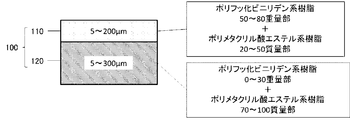
- FIG. 1 shows a schematic cross-sectional view showing a laminated structure of the resin film (100) according to the second embodiment.
- the resin film (100) includes at least a surface layer (110) and a back surface layer (120) laminated on the surface layer (110) in this order.
- the front surface layer (110) and the back surface layer (120) are directly bonded to each other without any other resin layer intervening.
- the HAZE measured based on JIS K7136: 2000 of the resin film according to the second embodiment is preferably 20% or less, more preferably 10% or less, from the viewpoint of enhancing transparency. It is even more preferably 5% or less, most preferably 2% or less, and can be, for example, in the range of 0.1 to 20%.
- the resin film according to the second embodiment can have a feature that the HAZE change before and after heating is small. Illustratively, it is heated in air from 25 ° C. to 170 ° C. with an average heating rate of 3.5 ° C./sec, placed in a temperature environment of 25 ° C. within 1 second after reaching 170 ° C., and 25 in air.
- the amount of change ⁇ HAZE of the HAZE value measured based on JIS K7136: 2000 after allowing to cool to ° C. can be 5% or less, preferably 3% or less, more preferably 1%. It can be as follows, for example, 0.5 to 5%.
- the total light transmittance of the resin film according to the second embodiment measured based on JIS K7375: 2008 is preferably 80% or more, and preferably 85% or more, from the viewpoint of enhancing transparency. It is more preferably 90% or more, and it can be, for example, 80 to 95%.
- the resin film according to the second embodiment is an arithmetic measurement based on JIS B0601: 2001 on at least one of the outer surface of the front surface layer and the outer surface of the back surface layer, preferably both, from the viewpoint of enhancing transparency.
- the average roughness Ra is preferably 100 nm or less, more preferably 90 nm or less, and can be, for example, 70 to 100 nm.
- the surface layer is 50 to 80 parts by mass of the polyvinylidene fluoride-based resin and 20 to 50 parts by mass of the polymethacrylic acid ester-based resin with respect to 100 parts by mass of the total of the polyvinylidene fluoride-based resin and the polymethacrylic acid ester-based resin. It can be composed of a resin composition contained therein.
- the resin composition constituting the surface layer including the composition, crystallinity, ratio of ⁇ -type crystals, thickness, HAZE, and total light transmittance. Since the same description as that of the embodiment of the composition is applied, the description thereof will be omitted.
- the thickness of the back surface layer is preferably 5 to 300 ⁇ m, more preferably 5 to 100 ⁇ m, even more preferably 10 to 75 ⁇ m, and particularly preferably 25 to 35 ⁇ m.
- the back surface layer may be formed of a single layer or a plurality of layers, but it is desirable that the total average thickness is within the above-mentioned thickness.
- the back surface layer contains 0 to 30 parts by mass of the polyvinylidene fluoride resin and 70 to 100 parts by mass of the polymethacrylic acid ester resin with respect to 100 parts by mass of the total of the polyvinylidene fluoride resin and the polymethacrylic acid ester resin. It can be composed of a resin composition contained therein.
- the adhesion with other layers such as the decorative layer described later is improved when the polymethacrylic acid ester resin is 70 parts by mass or more. Can be improved.
- weather resistance, adhesion to the front surface layer, and adhesion can be improved.
- the resin composition constituting the back surface layer includes an ultraviolet absorber, another resin, a plasticizer, and a heat stabilizer as long as the object of the present invention is not impaired.
- Antioxidants, light stabilizers, crystal nucleating agents, blocking inhibitors, sealability improving agents, mold release agents, coloring agents, pigments, foaming agents, flame retardants and the like can be appropriately contained.
- the total content of the polyvinylidene fluoride-based resin and the polymethacrylic acid ester-based resin in the back surface layer is 80% by mass or more, typically 90% by mass or more, and more typically. It is 95% by mass or more, and may be 100% by mass.
- the resin composition constituting the back surface layer preferably contains an ultraviolet absorber.
- ultraviolet absorber include, but are not limited to, hydroquinone-based, triazine-based, benzotriazole-based, benzophenone-based, cyanoacrylate-based, oxalic acid-based, hindered amine-based, and salicylic acid derivatives, which may be used alone or. Two or more types can be used in combination. Above all, it is preferable to contain a triazine-based compound, a benzotriazole-based compound, or a mixture thereof from the viewpoint of sustaining the ultraviolet blocking effect.
- the content of the ultraviolet absorber in the resin composition constituting the back surface layer is 0.1 to 10 parts by mass with respect to 100 parts by mass in total of the polyvinylidene fluoride-based resin and the polymethacrylic acid ester-based resin in the back surface layer. Is preferable.
- the content of the ultraviolet absorber in the resin composition constituting the back surface layer is 0.1 part by mass or more with respect to 100 parts by mass in total of the polyvinylidene fluoride-based resin and the polymethacrylic acid ester-based resin.
- an effect of further improving weather resistance and an ultraviolet absorbing effect can be expected, and in the resin composition constituting the back surface layer.
- the content of the ultraviolet absorber is 10 parts by mass or less, more preferably 5 parts by mass or less, based on 100 parts by mass of the total of the polyvinylidene fluoride resin and the polymethacrylic acid ester resin. , It is possible to prevent the ultraviolet absorber from bleeding out to the film surface, prevent deterioration of adhesion to the surface layer, and realize cost reduction.
- the resin composition constituting the back surface layer may contain crosslinked (meth) acrylic acid ester-based resin particles.
- the resin composition constituting the back surface layer contains a small amount of crosslinked (meth) acrylic acid ester-based resin particles, it is possible to produce a resin film having a slightly white turbidity and a small change in appearance. By using a resin film that is slightly cloudy from the beginning, a wider range of design expressions is possible.
- the content of the crosslinked (meth) acrylic acid ester-based resin particles in the resin composition constituting the back surface layer is 0.1 to 10 with respect to 100 parts by mass in total of the polyvinylidene fluoride-based resin and the polymethacrylic acid ester-based resin. It is preferably parts by mass.
- crosslinked (meth) acrylic acid ester-based resin particles include, but are not limited to, crosslinked polymethyl methacrylate, crosslinked polyethyl methacrylate, crosslinked polynormal butyl methacrylate, and the like, and these may be used alone or in combination of two or more. Can be used in combination. Above all, it is preferable to contain polymethylmethacrylate because the difference in refractive index from the back surface layer is small.
- the crosslinked (meth) acrylic acid ester-based resin particles refer to those having a particle size of 1 ⁇ m or more in the resin film.
- the particle size of the resin particles refers to the diameter of the smallest circle that can surround the resin particles when the resin film is observed by the method described above. Therefore, even if the crosslinked (meth) acrylic acid ester-based resin particles have a particle size of less than 1 ⁇ m in the resin film, the polymethacrylic acid ester-based resin can be obtained if the above-mentioned definition regarding the polymethacrylic acid ester-based resin is satisfied. Corresponds to.
- the arithmetic mean particle size of the crosslinked (meth) acrylic acid ester-based resin particles in the resin film is preferably 1 to 4 ⁇ m, more preferably 1.5 to 3.5 ⁇ m from the viewpoint of film appearance and film forming property.
- a laminate in which the front surface layer and the back surface layer are laminated can be manufactured by, for example, a melt coextrusion molding method in which a plurality of resins are adhered and laminated in a molten state using a plurality of extrusion molding machines.
- the melt coextrusion molding method includes a multi-manifold die method in which multiple resins are made into a sheet and then each layer is contact-bonded at the tip inside the T-die, and a plurality of resins are bonded in a merging device (feed block).
- feed block die method that expands into a sheet shape
- dual slot die method in which a plurality of resins are molded into a sheet state and then each layer is brought into contact with the tip of the outside of the T die to be bonded. It can also be manufactured by an inflation molding method using a round die.
- the resin film according to the second embodiment can be produced by carrying out the following steps, for example.
- Step 1 First containing 50 to 80 parts by mass of polyvinylidene fluoride resin and 20 to 50 parts by mass of polymethacrylic acid ester resin with respect to 100 parts by mass of the total of polyvinylidene fluoride resin and polymethacrylic acid ester resin.
- a second containing 0 to 30 parts by mass of the polyvinylidene fluoride resin and 70 to 100 parts by mass of the polymethacrylic acid ester resin with respect to 100 parts by mass of the total of the polyvinylidene fluoride resin and the polymethacrylic acid ester resin.
- Step 2 Within 6 seconds after being extruded from the outlet of the T-die, the surface of the melt coextruded film on the first resin composition side is brought into contact with the surface of the metal roll whose temperature has been adjusted to 30 to 50 ° C. for cooling. Process to do.
- a molten state extruded into a film from a T-die at a temperature of 200 ° C to 260 ° C. It is desirable to quench the laminate of the first resin composition and the second resin composition in the above from the surface on the first resin composition side. Specifically, the surface of the film melt-coextruded within 6 seconds, preferably within 4 seconds after being extruded from the outlet of the T-die, is surfaced at least on the first resin composition side at 30 to 50 ° C., preferably. It is desirable to bring it into contact with the surface of the metal roll whose temperature has been adjusted to 40 to 45 ° C. Examples of the method for controlling the temperature of the surface of the metal roll include a method of circulating a cooling medium such as cooling water inside the metal roll.
- a rubber touch roll is arranged so as to face the metal roll, and the laminated body of the first resin composition and the second resin composition in a molten state extruded from the outlet of the T die is brought into contact with the metal roll. Pinch between the rolls is more preferable from the viewpoint of transferring the smooth surface to the film.
- the arithmetic mean roughness Ra measured based on JIS B0601: 2001 on the surface of the metal roll is preferably 100 nm or less, more preferably 80 nm or less, and even more preferably 60 nm or less. , 40 nm or less, even more preferably 20 nm or less, for example, 10 to 100 nm.
- the arithmetic mean roughness Ra measured based on JIS B0601: 2001 on the surface of the touch roll is preferably 150 nm or less, more preferably 120 nm or less, and can be, for example, 100 to 150 nm.
- a base material may be laminated on each of the resin films according to the first embodiment and the second embodiment. Therefore, in one embodiment, the present invention provides a resin film in which a base material is laminated on any one surface of the resin film according to the first embodiment. Further, in another embodiment, the present invention provides a resin film in which a base material is laminated on the front surface layer and / or the back surface layer of the resin film according to the second embodiment.
- the average value of the total thickness of the resin film on which the base material is laminated is 50 to 1000 ⁇ m, it is preferable in terms of workability and cost of adhesion to automobile interior parts.
- the base material examples include layers such as a decorative layer, a protective layer, an adhesive layer, a printing layer, and a metal vapor deposition layer.
- One type of base material may be used as a single layer, or two or more types may be used in combination and laminated.
- a resin film in which a decorative layer is laminated on the back surface layer of the resin film according to the second embodiment is provided.
- a resin film obtained by forming a printing layer on the back surface layer of the resin film according to the second embodiment and laminating another base material (decorative layer or the like) on the printing layer. Provided.
- an acrylic resin, a polycarbonate resin, a polyvinyl chloride resin, a polyester resin, or a resin composition containing these resins can be used. Further, an additive such as a pigment can be appropriately added to the decorative layer.
- the resin film according to the first embodiment and the second embodiment has isotactic or syndiotactic polypropylene, high-density polyethylene, low-density polyethylene, polystyrene, polyethylene as layers other than the decorative layer. It can be multilayered with a film such as terephthalate or ethylene-vinyl acetate copolymer (EVA), and various decoration treatments such as embossing can be performed.
- a film such as terephthalate or ethylene-vinyl acetate copolymer (EVA)
- the resin films according to the first embodiment and the second embodiment can have high transparency and are difficult to whiten. Therefore, by applying the resin film to the surface of a base material having high brightness and glossiness in which whitening is conspicuous, this characteristic can be effectively utilized. Therefore, in a preferred embodiment, the 60 ° mirror gloss measured based on JIS Z8741: 1997 on the surface of the substrate to be bonded to the resin film is 100 to 600, typically 300 to 550.
- the L * with a light receiving angle of 15 ° in the L * a * b * color space based on JIS Z8781-4: 2013 is 0 to 20, typically 0 to 5.
- Examples of the method of laminating the base material on the resin films according to the first embodiment and the second embodiment include adhesive laminating and thermal laminating. Other known laminating methods can also be adopted. Further, it can be heat-molded using the resin films according to the first embodiment and the second embodiment. Examples of the method of heat molding include a method of laminating a base material on one side or both sides of a resin film, and then vacuum molding, pressure molding, and vacuum pressure molding.
- a decorative film for example, film insert molding, in-mold molding, and vacuum laminate molding (including vacuum / pressure molding such as TOM molding).
- film insert molding since the decorative film is heated and preformed, the decorative film follows even more complicated parts as compared with in-mold molding and vacuum laminating molding, which is good. There is an advantage that a surface coating state can be realized.
- the film insert molding involves heating and cooling, the resin films according to the first embodiment and the second embodiment are difficult to whiten even when heated and cooled, so that the film insert molding can be preferably applied.
- Single layer film > (1-1.
- Material As a polyvinylidene fluoride-based resin (PVDF), a trade name Kynar 1000HD (PVDF homopolymer having a melting point of 168 ° C.) manufactured by Arkema Co., Ltd. was prepared.
- PVDF polyvinylidene fluoride-based resin
- PMMA polymethacrylic acid ester resin
- Sumipex MGSS polymethylmethacrylate at Tg 101 ° C.
- each compound was obtained after kneading with a twin-screw extruder having a diameter of 30 mm according to the composition shown in Table 1.
- Each of the obtained compounds is melt-extruded using a T-die type single-screw extruder with a diameter of 40 mm, and the extruded film-shaped resin composition is used on a metal roll and a rubber touch roll through which cooling water flows.
- the film was sandwiched and cooled to obtain a film having a predetermined average thickness shown in Table 1.
- the temperature of the resin composition at the outlet (lip) of the T-die is 210 ° C.
- the time from being extruded from the outlet of the T-die until one surface of the film is brought into contact with the surface of the metal roll is 4 seconds.
- the arithmetic mean roughness Ra based on JIS B0601: 2001 on the surface of the touch roll was measured by a contact type surface roughness meter (Mitutoyo Co., Ltd., SJ210) and found to be 0.116 ⁇ m (however, Comparative Example 6 is 3.712 ⁇ m). there were.
- Crystallinity The crystallinity of the resin composition constituting each film produced under the above conditions was measured based on the enthalpy of fusion of crystals by the method described above.
- DSC DSC3100SA manufactured by BRUKER
- 1.5 mg of a film sample is sealed in an aluminum pan, and the temperature is raised from room temperature to 200 ° C. at a heating rate of 10 ° C./min. It was done under the conditions.
- Table 1 The results are shown in Table 1.
- the HAZE value (after heating) based on JIS K7136: 2000 was measured using a haze meter NDH7000 (manufactured by Nippon Denshoku Industries Co., Ltd.). The results are shown in Table 1.
- PVDF polyvinylidene fluoride-based resin
- Kynar1000HD PVDF homopolymer having a melting point of 168 ° C.
- Sumipex MGSS polymethylmethacrylate at Tg 101 ° C.
- PVDF polyvinylidene fluoride-based resin
- Kynar720 a homopolymer of vinylidene fluoride, melting point 169 ° C.
- BASF's trade name Tinuvin 1600 was prepared.
- crosslinked acrylic acid ester-based fine particles a trade name GM-0105 (medium volume particle size: 2 ⁇ m) manufactured by Aica Kogyo Co., Ltd. was prepared.
- the volume median particle size of the crosslinked (meth) acrylic acid ester resin particles used as a raw material refers to the 50% by volume particle size of the volume-based cumulative particle size distribution curve obtained by measuring by the laser diffraction / scattering method. Since none of the particles had a particle size of less than 1 ⁇ m, it can be considered that the entire amount blended in the raw material constitutes crosslinked (meth) acrylic acid ester-based resin particles in the resin film.
- the temperature of the resin composition at the outlet (lip) of the T-die is 210 ° C.
- the surface of the film on the surface layer side is made of a metal roll (however, Comparative Example 12 is a touch roll).
- the degree of crystallization of the resin composition constituting the surface layer of the film is fixed by fixing the time until contact with the surface of the film as 4 seconds and changing the surface temperature of the metal roll (“metal roll temperature” in the table). And the ratio of ⁇ -type crystals was controlled.
- the surface roughness of the contact surface (surface layer side) of the film with the touch roll was changed by changing the surface roughness of the touch roll.
- the surface roughness of the contact surface (back surface layer side) of the film with the touch roll was changed by changing the surface roughness of the touch roll.
- the arithmetic mean roughness Ra based on JIS B0601: 2001 on the surface of the touch roll was measured by a contact type surface roughness meter (Mitutoyo Co., Ltd., SJ210) and found to be 0.116 ⁇ m (however, Comparative Example 12 was 3.712 ⁇ m). there were.
- Crystallinity The crystallinity of the resin composition constituting the surface layer of each film produced under the above conditions was measured based on the enthalpy of fusion of crystals by the method described above.
- DSC DSC3100SA manufactured by BRUKER
- 1.5 mg of a film sample is sealed in an aluminum pan, and the temperature is raised from room temperature to 200 ° C. at a heating rate of 10 ° C./min. I went under the conditions.
- the results are shown in Table 2. Since the lower layer contains a large amount of polymethacrylic acid ester resin, it does not crystallize. Therefore, the entropy of fusion of the crystals obtained by the measurement in the state of the laminated film is substantially evaluated only for the crystals on the surface layer.
- the HAZE value (after heating) based on JIS K7136: 2000 was measured using a haze meter NDH7000 (manufactured by Nippon Denshoku Industries Co., Ltd.). The results are shown in Table 2.
- Example 16 since the composition, crystallinity, ratio of ⁇ -type crystals, average thickness, and HAZE of the resin composition constituting the resin film were all suitable, the transparency was high, and heating and cooling were performed. A resin film that is difficult to whiten was obtained. It also had excellent chemical resistance.
- Example 15 the surface roughness of the outer surface of the back surface layer was slightly larger than that of other Examples by adding the crosslinked acrylic acid ester-based fine particles to the back surface layer.
- Example 16 as the ratio of PVDF in the back surface layer increased, the compatibility of the ultraviolet absorber deteriorated, and bleed-out of the ultraviolet absorber was observed.
- Comparative Examples 1, 2, 8 and 9 since the composition of the resin composition constituting the resin film was inappropriate, the ratio of ⁇ -type crystals increased and whitening due to heating occurred. In Comparative Examples 3 and 10, the average thickness of the resin film was too thin, which made film formation difficult. In Comparative Examples 4 and 11, whitening was confirmed because the average thickness of the resin film was too thick. In Comparative Example 5, since the composition of the resin composition constituting the resin film was inappropriate, the crystallinity of the resin composition constituting the resin film did not increase, and the chemical resistance was inferior. In Comparative Example 6, the surface roughness of the contact surface of the resin film with the touch roll was large, and the transparency was insufficient.
- Comparative Example 12 the surface roughness of the outer surface of the surface layer of the resin film was large, and the transparency was insufficient.
- Comparative Examples 7 and 14 since the temperature of the metal roll during cooling was high, the ratio of ⁇ -type crystals was high and whitening occurred.
- Comparative Example 13 the transparency was insufficient due to the excessive amount of the crosslinked acrylic acid ester-based fine particles added and the large surface roughness on the outer surface of the back surface layer.
Landscapes
- Chemical & Material Sciences (AREA)
- Engineering & Computer Science (AREA)
- Organic Chemistry (AREA)
- Polymers & Plastics (AREA)
- Health & Medical Sciences (AREA)
- Chemical Kinetics & Catalysis (AREA)
- Medicinal Chemistry (AREA)
- Mechanical Engineering (AREA)
- Manufacturing & Machinery (AREA)
- Materials Engineering (AREA)
- Physics & Mathematics (AREA)
- Thermal Sciences (AREA)
- Manufacture Of Macromolecular Shaped Articles (AREA)
- Laminated Bodies (AREA)
- Extrusion Moulding Of Plastics Or The Like (AREA)
- Blow-Moulding Or Thermoforming Of Plastics Or The Like (AREA)
- Compositions Of Macromolecular Compounds (AREA)
Priority Applications (4)
| Application Number | Priority Date | Filing Date | Title |
|---|---|---|---|
| EP21753930.3A EP4105021A4 (en) | 2020-02-10 | 2021-02-04 | Resin film and method for producing same |
| CN202180012615.4A CN115052919A (zh) | 2020-02-10 | 2021-02-04 | 树脂膜及其制造方法 |
| JP2022500361A JP7559039B2 (ja) | 2020-02-10 | 2021-02-04 | 樹脂フィルム及びその製造方法 |
| US17/794,481 US20230348678A1 (en) | 2020-02-10 | 2021-02-04 | Resin film and method for producing same |
Applications Claiming Priority (2)
| Application Number | Priority Date | Filing Date | Title |
|---|---|---|---|
| JP2020020911 | 2020-02-10 | ||
| JP2020-020911 | 2020-02-10 |
Publications (1)
| Publication Number | Publication Date |
|---|---|
| WO2021161899A1 true WO2021161899A1 (ja) | 2021-08-19 |
Family
ID=77292144
Family Applications (1)
| Application Number | Title | Priority Date | Filing Date |
|---|---|---|---|
| PCT/JP2021/004177 Ceased WO2021161899A1 (ja) | 2020-02-10 | 2021-02-04 | 樹脂フィルム及びその製造方法 |
Country Status (5)
| Country | Link |
|---|---|
| US (1) | US20230348678A1 (https=) |
| EP (1) | EP4105021A4 (https=) |
| JP (1) | JP7559039B2 (https=) |
| CN (1) | CN115052919A (https=) |
| WO (1) | WO2021161899A1 (https=) |
Cited By (2)
| Publication number | Priority date | Publication date | Assignee | Title |
|---|---|---|---|---|
| NL2029984A (en) * | 2021-12-01 | 2023-01-26 | Jiaxing Gaozheng New Material Tech Co Ltd | Pvdf membrane and preparation device and method |
| WO2023013406A1 (ja) * | 2021-08-06 | 2023-02-09 | デンカ株式会社 | 積層フィルム |
Citations (5)
| Publication number | Priority date | Publication date | Assignee | Title |
|---|---|---|---|---|
| JP2005112972A (ja) * | 2003-10-07 | 2005-04-28 | Sumitomo Chemical Co Ltd | 樹脂組成物及び積層樹脂板 |
| WO2011142453A1 (ja) | 2010-05-14 | 2011-11-17 | 三菱レイヨン株式会社 | フィルム、その製造方法、積層フィルムもしくはシート、および積層体 |
| JP2012187934A (ja) | 2008-06-10 | 2012-10-04 | Kaneka Corp | フッ素樹脂積層アクリル系樹脂フィルム及びそれを含む成形品 |
| WO2019059369A1 (ja) * | 2017-09-22 | 2019-03-28 | デンカ株式会社 | 真空成形用樹脂フィルム |
| WO2019107302A1 (ja) | 2017-11-28 | 2019-06-06 | デンカ株式会社 | フッ化ビニリデン系樹脂多層フィルム |
Family Cites Families (5)
| Publication number | Priority date | Publication date | Assignee | Title |
|---|---|---|---|---|
| JPH0691734A (ja) * | 1992-09-08 | 1994-04-05 | Shin Etsu Chem Co Ltd | 透明性に優れたフッ化ビニリデン系樹脂フィルムの製造方法 |
| JP2011218646A (ja) * | 2010-04-08 | 2011-11-04 | Sumitomo Chemical Co Ltd | プロピレン樹脂製フィルムの製造方法 |
| JP5155497B2 (ja) * | 2011-03-29 | 2013-03-06 | 株式会社クラレ | ポリビニルアセタール系樹脂フィルムおよびそれを用いた多層構造体 |
| JP6461065B2 (ja) * | 2016-10-12 | 2019-01-30 | 住友化学株式会社 | 樹脂積層体及びその製造方法 |
| KR102511730B1 (ko) * | 2017-06-01 | 2023-03-20 | 덴카 주식회사 | 불화비닐리덴계 수지 필름 |
-
2021
- 2021-02-04 JP JP2022500361A patent/JP7559039B2/ja active Active
- 2021-02-04 EP EP21753930.3A patent/EP4105021A4/en not_active Withdrawn
- 2021-02-04 CN CN202180012615.4A patent/CN115052919A/zh active Pending
- 2021-02-04 WO PCT/JP2021/004177 patent/WO2021161899A1/ja not_active Ceased
- 2021-02-04 US US17/794,481 patent/US20230348678A1/en not_active Abandoned
Patent Citations (5)
| Publication number | Priority date | Publication date | Assignee | Title |
|---|---|---|---|---|
| JP2005112972A (ja) * | 2003-10-07 | 2005-04-28 | Sumitomo Chemical Co Ltd | 樹脂組成物及び積層樹脂板 |
| JP2012187934A (ja) | 2008-06-10 | 2012-10-04 | Kaneka Corp | フッ素樹脂積層アクリル系樹脂フィルム及びそれを含む成形品 |
| WO2011142453A1 (ja) | 2010-05-14 | 2011-11-17 | 三菱レイヨン株式会社 | フィルム、その製造方法、積層フィルムもしくはシート、および積層体 |
| WO2019059369A1 (ja) * | 2017-09-22 | 2019-03-28 | デンカ株式会社 | 真空成形用樹脂フィルム |
| WO2019107302A1 (ja) | 2017-11-28 | 2019-06-06 | デンカ株式会社 | フッ化ビニリデン系樹脂多層フィルム |
Cited By (3)
| Publication number | Priority date | Publication date | Assignee | Title |
|---|---|---|---|---|
| WO2023013406A1 (ja) * | 2021-08-06 | 2023-02-09 | デンカ株式会社 | 積層フィルム |
| JPWO2023013406A1 (https=) * | 2021-08-06 | 2023-02-09 | ||
| NL2029984A (en) * | 2021-12-01 | 2023-01-26 | Jiaxing Gaozheng New Material Tech Co Ltd | Pvdf membrane and preparation device and method |
Also Published As
| Publication number | Publication date |
|---|---|
| EP4105021A1 (en) | 2022-12-21 |
| JPWO2021161899A1 (https=) | 2021-08-19 |
| JP7559039B2 (ja) | 2024-10-01 |
| EP4105021A4 (en) | 2023-07-19 |
| US20230348678A1 (en) | 2023-11-02 |
| CN115052919A (zh) | 2022-09-13 |
Similar Documents
| Publication | Publication Date | Title |
|---|---|---|
| TWI715722B (zh) | 熱塑性樹脂薄膜與其製造方法、及積層體 | |
| CN105764981B (zh) | 丙烯酸系树脂膜 | |
| TWI686306B (zh) | 加飾用複數層薄片及立體成型體 | |
| US11685815B2 (en) | Vinylidene-fluoride resin film | |
| JP6594404B2 (ja) | 樹脂組成物、フィルムおよびそれらの製造方法、成形体、並びに物品 | |
| CN110546003A (zh) | 层叠膜、层叠成形体和它们的制造方法 | |
| WO2017217429A1 (ja) | 黒色フィルム | |
| WO2019059369A1 (ja) | 真空成形用樹脂フィルム | |
| CN110431182B (zh) | 树脂组合物、氟系薄膜、氟系层叠薄膜及层叠成型体 | |
| JP7322002B2 (ja) | (メタ)アクリル樹脂組成物、フィルムおよびその製造方法 | |
| WO2021161899A1 (ja) | 樹脂フィルム及びその製造方法 | |
| JP6742158B2 (ja) | アクリル系樹脂フィルムおよびそれを用いた積層フィルム並びに積層体 | |
| US20240343899A1 (en) | Film having methacrylic acid ester-based resin as main component | |
| JP7513722B2 (ja) | 積層フィルム及びその製造方法 | |
| CN117794987A (zh) | 以甲基丙烯酸酯系树脂为主成分的膜 | |
| JP7362729B2 (ja) | 積層フィルム | |
| JP7585803B2 (ja) | 樹脂組成物、フィルム及び成形体 | |
| JP7241088B2 (ja) | 熱可塑性樹脂多層フィルムとその製造方法および積層体 | |
| WO2017073077A1 (ja) | 射出成形複合体および加飾シート、並びにこれらの製造方法 | |
| JP7177776B2 (ja) | 積層体およびその製造方法 |
Legal Events
| Date | Code | Title | Description |
|---|---|---|---|
| 121 | Ep: the epo has been informed by wipo that ep was designated in this application |
Ref document number: 21753930 Country of ref document: EP Kind code of ref document: A1 |
|
| ENP | Entry into the national phase |
Ref document number: 2022500361 Country of ref document: JP Kind code of ref document: A |
|
| NENP | Non-entry into the national phase |
Ref country code: DE |
|
| ENP | Entry into the national phase |
Ref document number: 2021753930 Country of ref document: EP Effective date: 20220912 |
|
| WWW | Wipo information: withdrawn in national office |
Ref document number: 2021753930 Country of ref document: EP |