WO2021153400A1 - リチウム遷移金属複合酸化物の製造方法 - Google Patents
リチウム遷移金属複合酸化物の製造方法 Download PDFInfo
- Publication number
- WO2021153400A1 WO2021153400A1 PCT/JP2021/001963 JP2021001963W WO2021153400A1 WO 2021153400 A1 WO2021153400 A1 WO 2021153400A1 JP 2021001963 W JP2021001963 W JP 2021001963W WO 2021153400 A1 WO2021153400 A1 WO 2021153400A1
- Authority
- WO
- WIPO (PCT)
- Prior art keywords
- transition metal
- lithium
- container
- molded product
- composite oxide
- Prior art date
- Legal status (The legal status is an assumption and is not a legal conclusion. Google has not performed a legal analysis and makes no representation as to the accuracy of the status listed.)
- Ceased
Links
Images


Classifications
-
- C—CHEMISTRY; METALLURGY
- C04—CEMENTS; CONCRETE; ARTIFICIAL STONE; CERAMICS; REFRACTORIES
- C04B—LIME, MAGNESIA; SLAG; CEMENTS; COMPOSITIONS THEREOF, e.g. MORTARS, CONCRETE OR LIKE BUILDING MATERIALS; ARTIFICIAL STONE; CERAMICS; REFRACTORIES; TREATMENT OF NATURAL STONE
- C04B35/00—Shaped ceramic products characterised by their composition; Ceramics compositions; Processing powders of inorganic compounds preparatory to the manufacturing of ceramic products
- C04B35/01—Shaped ceramic products characterised by their composition; Ceramics compositions; Processing powders of inorganic compounds preparatory to the manufacturing of ceramic products based on oxide ceramics
-
- C—CHEMISTRY; METALLURGY
- C01—INORGANIC CHEMISTRY
- C01G—COMPOUNDS CONTAINING METALS NOT COVERED BY SUBCLASSES C01D OR C01F
- C01G53/00—Compounds of nickel
-
- C—CHEMISTRY; METALLURGY
- C01—INORGANIC CHEMISTRY
- C01G—COMPOUNDS CONTAINING METALS NOT COVERED BY SUBCLASSES C01D OR C01F
- C01G53/00—Compounds of nickel
- C01G53/40—Complex oxides containing nickel and at least one other metal element
-
- C—CHEMISTRY; METALLURGY
- C01—INORGANIC CHEMISTRY
- C01G—COMPOUNDS CONTAINING METALS NOT COVERED BY SUBCLASSES C01D OR C01F
- C01G53/00—Compounds of nickel
- C01G53/40—Complex oxides containing nickel and at least one other metal element
- C01G53/42—Complex oxides containing nickel and at least one other metal element containing alkali metals, e.g. LiNiO2
-
- C—CHEMISTRY; METALLURGY
- C01—INORGANIC CHEMISTRY
- C01G—COMPOUNDS CONTAINING METALS NOT COVERED BY SUBCLASSES C01D OR C01F
- C01G53/00—Compounds of nickel
- C01G53/80—Compounds containing nickel, with or without oxygen or hydrogen, and containing one or more other elements
- C01G53/82—Compounds containing nickel, with or without oxygen or hydrogen, and containing two or more other elements
-
- C—CHEMISTRY; METALLURGY
- C04—CEMENTS; CONCRETE; ARTIFICIAL STONE; CERAMICS; REFRACTORIES
- C04B—LIME, MAGNESIA; SLAG; CEMENTS; COMPOSITIONS THEREOF, e.g. MORTARS, CONCRETE OR LIKE BUILDING MATERIALS; ARTIFICIAL STONE; CERAMICS; REFRACTORIES; TREATMENT OF NATURAL STONE
- C04B35/00—Shaped ceramic products characterised by their composition; Ceramics compositions; Processing powders of inorganic compounds preparatory to the manufacturing of ceramic products
- C04B35/622—Forming processes; Processing powders of inorganic compounds preparatory to the manufacturing of ceramic products
- C04B35/64—Burning or sintering processes
-
- F—MECHANICAL ENGINEERING; LIGHTING; HEATING; WEAPONS; BLASTING
- F27—FURNACES; KILNS; OVENS; RETORTS
- F27B—FURNACES, KILNS, OVENS OR RETORTS IN GENERAL; OPEN SINTERING OR LIKE APPARATUS
- F27B21/00—Open or uncovered sintering apparatus; Other heat-treatment apparatus of like construction
-
- F—MECHANICAL ENGINEERING; LIGHTING; HEATING; WEAPONS; BLASTING
- F27—FURNACES; KILNS; OVENS; RETORTS
- F27D—DETAILS OR ACCESSORIES OF FURNACES, KILNS, OVENS OR RETORTS, IN SO FAR AS THEY ARE OF KINDS OCCURRING IN MORE THAN ONE KIND OF FURNACE
- F27D1/00—Casings; Linings; Walls; Roofs
- F27D1/0003—Linings or walls
- F27D1/0006—Linings or walls formed from bricks or layers with a particular composition or specific characteristics
-
- H—ELECTRICITY
- H01—ELECTRIC ELEMENTS
- H01M—PROCESSES OR MEANS, e.g. BATTERIES, FOR THE DIRECT CONVERSION OF CHEMICAL ENERGY INTO ELECTRICAL ENERGY
- H01M4/00—Electrodes
- H01M4/02—Electrodes composed of, or comprising, active material
- H01M4/36—Selection of substances as active materials, active masses, active liquids
- H01M4/48—Selection of substances as active materials, active masses, active liquids of inorganic oxides or hydroxides
- H01M4/52—Selection of substances as active materials, active masses, active liquids of inorganic oxides or hydroxides of nickel, cobalt or iron
- H01M4/525—Selection of substances as active materials, active masses, active liquids of inorganic oxides or hydroxides of nickel, cobalt or iron of mixed oxides or hydroxides containing iron, cobalt or nickel for inserting or intercalating light metals, e.g. LiNiO2, LiCoO2 or LiCoOxFy
-
- C—CHEMISTRY; METALLURGY
- C01—INORGANIC CHEMISTRY
- C01P—INDEXING SCHEME RELATING TO STRUCTURAL AND PHYSICAL ASPECTS OF SOLID INORGANIC COMPOUNDS
- C01P2004/00—Particle morphology
- C01P2004/60—Particles characterised by their size
- C01P2004/61—Micrometer sized, i.e. from 1-100 micrometer
-
- C—CHEMISTRY; METALLURGY
- C01—INORGANIC CHEMISTRY
- C01P—INDEXING SCHEME RELATING TO STRUCTURAL AND PHYSICAL ASPECTS OF SOLID INORGANIC COMPOUNDS
- C01P2006/00—Physical properties of inorganic compounds
- C01P2006/40—Electric properties
-
- C—CHEMISTRY; METALLURGY
- C04—CEMENTS; CONCRETE; ARTIFICIAL STONE; CERAMICS; REFRACTORIES
- C04B—LIME, MAGNESIA; SLAG; CEMENTS; COMPOSITIONS THEREOF, e.g. MORTARS, CONCRETE OR LIKE BUILDING MATERIALS; ARTIFICIAL STONE; CERAMICS; REFRACTORIES; TREATMENT OF NATURAL STONE
- C04B2235/00—Aspects relating to ceramic starting mixtures or sintered ceramic products
- C04B2235/02—Composition of constituents of the starting material or of secondary phases of the final product
- C04B2235/30—Constituents and secondary phases not being of a fibrous nature
- C04B2235/32—Metal oxides, mixed metal oxides, or oxide-forming salts thereof, e.g. carbonates, nitrates, (oxy)hydroxides, chlorides
- C04B2235/3201—Alkali metal oxides or oxide-forming salts thereof
- C04B2235/3203—Lithium oxide or oxide-forming salts thereof
-
- C—CHEMISTRY; METALLURGY
- C04—CEMENTS; CONCRETE; ARTIFICIAL STONE; CERAMICS; REFRACTORIES
- C04B—LIME, MAGNESIA; SLAG; CEMENTS; COMPOSITIONS THEREOF, e.g. MORTARS, CONCRETE OR LIKE BUILDING MATERIALS; ARTIFICIAL STONE; CERAMICS; REFRACTORIES; TREATMENT OF NATURAL STONE
- C04B2235/00—Aspects relating to ceramic starting mixtures or sintered ceramic products
- C04B2235/02—Composition of constituents of the starting material or of secondary phases of the final product
- C04B2235/30—Constituents and secondary phases not being of a fibrous nature
- C04B2235/32—Metal oxides, mixed metal oxides, or oxide-forming salts thereof, e.g. carbonates, nitrates, (oxy)hydroxides, chlorides
- C04B2235/3217—Aluminum oxide or oxide forming salts thereof, e.g. bauxite, alpha-alumina
-
- C—CHEMISTRY; METALLURGY
- C04—CEMENTS; CONCRETE; ARTIFICIAL STONE; CERAMICS; REFRACTORIES
- C04B—LIME, MAGNESIA; SLAG; CEMENTS; COMPOSITIONS THEREOF, e.g. MORTARS, CONCRETE OR LIKE BUILDING MATERIALS; ARTIFICIAL STONE; CERAMICS; REFRACTORIES; TREATMENT OF NATURAL STONE
- C04B2235/00—Aspects relating to ceramic starting mixtures or sintered ceramic products
- C04B2235/02—Composition of constituents of the starting material or of secondary phases of the final product
- C04B2235/30—Constituents and secondary phases not being of a fibrous nature
- C04B2235/32—Metal oxides, mixed metal oxides, or oxide-forming salts thereof, e.g. carbonates, nitrates, (oxy)hydroxides, chlorides
- C04B2235/327—Iron group oxides, their mixed metal oxides, or oxide-forming salts thereof
- C04B2235/3275—Cobalt oxides, cobaltates or cobaltites or oxide forming salts thereof, e.g. bismuth cobaltate, zinc cobaltite
-
- C—CHEMISTRY; METALLURGY
- C04—CEMENTS; CONCRETE; ARTIFICIAL STONE; CERAMICS; REFRACTORIES
- C04B—LIME, MAGNESIA; SLAG; CEMENTS; COMPOSITIONS THEREOF, e.g. MORTARS, CONCRETE OR LIKE BUILDING MATERIALS; ARTIFICIAL STONE; CERAMICS; REFRACTORIES; TREATMENT OF NATURAL STONE
- C04B2235/00—Aspects relating to ceramic starting mixtures or sintered ceramic products
- C04B2235/02—Composition of constituents of the starting material or of secondary phases of the final product
- C04B2235/30—Constituents and secondary phases not being of a fibrous nature
- C04B2235/32—Metal oxides, mixed metal oxides, or oxide-forming salts thereof, e.g. carbonates, nitrates, (oxy)hydroxides, chlorides
- C04B2235/327—Iron group oxides, their mixed metal oxides, or oxide-forming salts thereof
- C04B2235/3279—Nickel oxides, nickalates, or oxide-forming salts thereof
-
- C—CHEMISTRY; METALLURGY
- C04—CEMENTS; CONCRETE; ARTIFICIAL STONE; CERAMICS; REFRACTORIES
- C04B—LIME, MAGNESIA; SLAG; CEMENTS; COMPOSITIONS THEREOF, e.g. MORTARS, CONCRETE OR LIKE BUILDING MATERIALS; ARTIFICIAL STONE; CERAMICS; REFRACTORIES; TREATMENT OF NATURAL STONE
- C04B2235/00—Aspects relating to ceramic starting mixtures or sintered ceramic products
- C04B2235/60—Aspects relating to the preparation, properties or mechanical treatment of green bodies or pre-forms
- C04B2235/608—Green bodies or pre-forms with well-defined density
-
- C—CHEMISTRY; METALLURGY
- C04—CEMENTS; CONCRETE; ARTIFICIAL STONE; CERAMICS; REFRACTORIES
- C04B—LIME, MAGNESIA; SLAG; CEMENTS; COMPOSITIONS THEREOF, e.g. MORTARS, CONCRETE OR LIKE BUILDING MATERIALS; ARTIFICIAL STONE; CERAMICS; REFRACTORIES; TREATMENT OF NATURAL STONE
- C04B2235/00—Aspects relating to ceramic starting mixtures or sintered ceramic products
- C04B2235/65—Aspects relating to heat treatments of ceramic bodies such as green ceramics or pre-sintered ceramics, e.g. burning, sintering or melting processes
- C04B2235/656—Aspects relating to heat treatments of ceramic bodies such as green ceramics or pre-sintered ceramics, e.g. burning, sintering or melting processes characterised by specific heating conditions during heat treatment
- C04B2235/6567—Treatment time
-
- C—CHEMISTRY; METALLURGY
- C04—CEMENTS; CONCRETE; ARTIFICIAL STONE; CERAMICS; REFRACTORIES
- C04B—LIME, MAGNESIA; SLAG; CEMENTS; COMPOSITIONS THEREOF, e.g. MORTARS, CONCRETE OR LIKE BUILDING MATERIALS; ARTIFICIAL STONE; CERAMICS; REFRACTORIES; TREATMENT OF NATURAL STONE
- C04B2235/00—Aspects relating to ceramic starting mixtures or sintered ceramic products
- C04B2235/65—Aspects relating to heat treatments of ceramic bodies such as green ceramics or pre-sintered ceramics, e.g. burning, sintering or melting processes
- C04B2235/658—Atmosphere during thermal treatment
- C04B2235/6583—Oxygen containing atmosphere, e.g. with changing oxygen pressures
- C04B2235/6585—Oxygen containing atmosphere, e.g. with changing oxygen pressures at an oxygen percentage above that of air
-
- C—CHEMISTRY; METALLURGY
- C04—CEMENTS; CONCRETE; ARTIFICIAL STONE; CERAMICS; REFRACTORIES
- C04B—LIME, MAGNESIA; SLAG; CEMENTS; COMPOSITIONS THEREOF, e.g. MORTARS, CONCRETE OR LIKE BUILDING MATERIALS; ARTIFICIAL STONE; CERAMICS; REFRACTORIES; TREATMENT OF NATURAL STONE
- C04B2235/00—Aspects relating to ceramic starting mixtures or sintered ceramic products
- C04B2235/70—Aspects relating to sintered or melt-casted ceramic products
- C04B2235/74—Physical characteristics
- C04B2235/79—Non-stoichiometric products, e.g. perovskites (ABO3) with an A/B-ratio other than 1
-
- C—CHEMISTRY; METALLURGY
- C04—CEMENTS; CONCRETE; ARTIFICIAL STONE; CERAMICS; REFRACTORIES
- C04B—LIME, MAGNESIA; SLAG; CEMENTS; COMPOSITIONS THEREOF, e.g. MORTARS, CONCRETE OR LIKE BUILDING MATERIALS; ARTIFICIAL STONE; CERAMICS; REFRACTORIES; TREATMENT OF NATURAL STONE
- C04B2235/00—Aspects relating to ceramic starting mixtures or sintered ceramic products
- C04B2235/70—Aspects relating to sintered or melt-casted ceramic products
- C04B2235/95—Products characterised by their size, e.g. microceramics
-
- C—CHEMISTRY; METALLURGY
- C04—CEMENTS; CONCRETE; ARTIFICIAL STONE; CERAMICS; REFRACTORIES
- C04B—LIME, MAGNESIA; SLAG; CEMENTS; COMPOSITIONS THEREOF, e.g. MORTARS, CONCRETE OR LIKE BUILDING MATERIALS; ARTIFICIAL STONE; CERAMICS; REFRACTORIES; TREATMENT OF NATURAL STONE
- C04B38/00—Porous mortars, concrete, artificial stone or ceramic ware; Preparation thereof
- C04B38/007—Porous mortars, concrete, artificial stone or ceramic ware; Preparation thereof characterised by the pore distribution, e.g. inhomogeneous distribution of pores
- C04B38/0074—Porous mortars, concrete, artificial stone or ceramic ware; Preparation thereof characterised by the pore distribution, e.g. inhomogeneous distribution of pores expressed as porosity percentage
-
- H—ELECTRICITY
- H01—ELECTRIC ELEMENTS
- H01M—PROCESSES OR MEANS, e.g. BATTERIES, FOR THE DIRECT CONVERSION OF CHEMICAL ENERGY INTO ELECTRICAL ENERGY
- H01M4/00—Electrodes
- H01M4/02—Electrodes composed of, or comprising, active material
- H01M2004/021—Physical characteristics, e.g. porosity, surface area
-
- H—ELECTRICITY
- H01—ELECTRIC ELEMENTS
- H01M—PROCESSES OR MEANS, e.g. BATTERIES, FOR THE DIRECT CONVERSION OF CHEMICAL ENERGY INTO ELECTRICAL ENERGY
- H01M4/00—Electrodes
- H01M4/02—Electrodes composed of, or comprising, active material
- H01M2004/026—Electrodes composed of, or comprising, active material characterised by the polarity
- H01M2004/028—Positive electrodes
-
- Y—GENERAL TAGGING OF NEW TECHNOLOGICAL DEVELOPMENTS; GENERAL TAGGING OF CROSS-SECTIONAL TECHNOLOGIES SPANNING OVER SEVERAL SECTIONS OF THE IPC; TECHNICAL SUBJECTS COVERED BY FORMER USPC CROSS-REFERENCE ART COLLECTIONS [XRACs] AND DIGESTS
- Y02—TECHNOLOGIES OR APPLICATIONS FOR MITIGATION OR ADAPTATION AGAINST CLIMATE CHANGE
- Y02E—REDUCTION OF GREENHOUSE GAS [GHG] EMISSIONS, RELATED TO ENERGY GENERATION, TRANSMISSION OR DISTRIBUTION
- Y02E60/00—Enabling technologies; Technologies with a potential or indirect contribution to GHG emissions mitigation
- Y02E60/10—Energy storage using batteries
Definitions
- the present disclosure relates to a method for producing a lithium transition metal composite oxide.
- a secondary battery represented by a lithium ion secondary battery includes a positive electrode, a negative electrode, and an electrolyte, and the positive electrode contains, for example, a lithium transition metal composite oxide as a positive electrode active material.
- a lithium transition metal composite oxide for example, lithium nickel composite oxide or lithium nickelate (LiNiO 2 ), which is advantageous for increasing the capacity, is used, and a part of nickel is a dissimilar metal for the purpose of further improving battery performance. Is being replaced with.
- Patent Document 1 is a method for producing a positive electrode active material for a non-aqueous electrolyte secondary battery composed of a lithium nickel composite oxide, which comprises a nickel composite compound having an average particle size of 8 to 20 ⁇ m and a lithium compound.
- a firing container with a mixture obtained by mixing and having a bulk density of 1.0 to 2.2 g / mL and firing, the thickness of the mixture when placed in the firing container is t (mm). ) and was at the time, the time that the temperature of the mixture is kept below the temperature range 650 ° C. 550 ° C.
- Patent Document 2 provides a firing jig used for synthesizing a lithium-containing composite oxide used as a positive electrode active material for a non-aqueous electrolyte secondary battery by firing a mixture containing a lithium compound and a transition metal compound. It teaches that at least one metal element selected from the group consisting of scandium, titanium, vanadium, manganese, chromium, yttrium, zirconium and niobium and lithium are included. Further, from the viewpoint of durability, it is taught that the porosity of the firing jig is 0.5 to 40%.
- Patent Document 3 describes, as a method for producing a lithium-nickel composite oxide, a plurality of molded bodies obtained by molding a mixture containing a powder of a compound containing nickel and a compound containing lithium into an upper portion of a vertical furnace. Continuously or intermittently supplying the molded product from the furnace to the inside of the furnace, firing the molded product in the vertical furnace, and supplying a plurality of fired compacts from the lower part of the vertical furnace to the outside. Discloses methods that include continuous or intermittent discharge.
- One aspect of the present disclosure is a step of preparing a mixture containing a lithium-containing compound and a transition metal compound, a step of obtaining a molded product of the mixture, and firing the molded product in a container having at least one vent.
- the present invention relates to a method for producing a lithium transition metal composite oxide, which comprises a step of obtaining a calcined product.
- the crystallinity of the lithium transition metal composite oxide is improved.
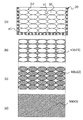
- FIG. 1 is a diagram conceptually showing a molded product filled in a container having ventilation holes.
- FIG. 2 is a diagram showing a method of obtaining the aspect ratio of the molded product.
- FIG. 3 is a flow chart of a method for producing a lithium transition metal composite oxide according to an embodiment of the present disclosure.
- FIG. 4 is a schematic perspective view in which a part of the square secondary battery is cut out.
- the method for producing a lithium transition metal composite oxide includes a step of preparing a mixture containing a lithium-containing compound and a transition metal compound (hereinafter, also referred to as a raw material mixture), and a molded product of the raw material mixture.
- the step of obtaining is included, and a step of calcining the molded product in a container having at least one vent to obtain a fired product (that is, a lithium transition metal composite oxide).
- the contact points between the particles in the molded product are increased, the thermal conductivity of the molded product is improved, and the molded product is fired. It is advantageous for the progress of. Further, since a gap is formed between the molded bodies, it is also advantageous for the progress of firing to improve the flowability of the gas (for example, the supply gas such as air and oxygen) in the container. Therefore, the crystallinity of the lithium transition metal composite oxide produced by firing is improved.
- the gas for example, the supply gas such as air and oxygen
- the moisture generated during firing is released as water vapor from the molded product.
- the effect of improving the flowability of the supplied gas is offset. Since the flow of water vapor is likely to be restricted inside the molded product, the pressure of the water vapor when it is released from the molded product tends to be high. Further, since the molded product is easily fired and the amount of water vapor generated is large, a large amount of water vapor is generated as compared with the case where the molded product is fired as a powder. Therefore, when the molded product is fired, it is considered that water vapor tends to stay in the container. As a result, it may be difficult to sufficiently improve the crystallinity of the lithium transition metal composite oxide, particularly when the amount of the molded product filled in the container is increased.
- the water vapor released from the molded body is likely to be immediately released to the outside of the container, and the water vapor is less likely to stay in the container.
- the concentration of the supply gas such as air and oxygen in the container is increased, so that the firing of the molded product is promoted. Therefore, even when the amount of the molded product filled in the container is increased, it becomes easy to improve the crystallinity of the lithium transition metal composite oxide.
- Ceramics are preferable as the material of the container in consideration of corrosion resistance to lithium-containing compounds and durability against high temperatures.
- the ceramics include alumina, silica, silica-alumina, aluminum nitride, silicon carbide, silicon nitride, zirconia, mullite, and cordylite.
- the container for accommodating the molded product may have, for example, a shape having a bottom portion and a side wall rising from the peripheral edge of the bottom portion. In this case, at least one of the bottom and the side wall may have at least one vent.
- the container is usually shaped with an open top. If the container has a generally rectangular parallelepiped shape, at least one of the four portions constituting the side wall may have at least one vent.
- the depth of the container (the height of the space that can accommodate the molded product inside the container) may be, for example, 20 mm or more and 300 mm or less, 100 mm or more and 300 mm or less, and 200 mm or more and 300 mm. It may be as follows. From the viewpoint of facilitating the handling of the molded product in the firing process of the molded product, the opening above the container may have, for example, a square shape having a length of 100 mm or more and 500 mm or less and a width of 100 mm or more and 500 mm or less.
- the porosity may be set to be as large as possible within a range in which the strength of the container can be secured, depending on the material of the container.
- the porosity at at least one of the bottom and the side wall may be, for example, 51% or more and 82% or less.
- the porosity is set to 82% or less, the strength of the container is maintained high, so that the life of the container can be extended.
- the bottom or side wall of the container may be a porous material having continuous pores.
- a porous material include a sponge-like (sponge-like) material and a sintered body of ceramic particles.
- a bottom or side wall made of a porous material with continuous pores it is possible to release water vapor and allow the supply gas to enter and exit through almost the entire bottom or side wall.
- the bottom or side wall of the container may be a porous material having through holes.
- the bottom or side wall made of a porous material with through holes is relatively strong and prolongs the life of the container.
- the average opening area of the through holes (that is, the ventilation holes) and the number of through holes may be appropriately selected according to the desired porosity.
- the average opening area of the ventilation holes is defined as the average value of the opening area per through hole that opens on the outer surface of the bottom or the side wall.
- the average value may be, for example, the average value of the opening areas of five or more through holes.
- the average opening area of the vents may be an area that the molded body cannot pass through, but it is desirable that the falling of the crushed material generated from the molded body can be suppressed as much as possible.
- the average opening area of the ventilation holes may be set to, for example, 0.7 mm 2 or more and 20 mm 2 or less, or 10 mm 2 or more and 20 mm 2 or less.
- the porosity occupied by the gaps in the molded product in the container may be, for example, 0.35 or more, or 0.4 or more.
- the upper limit of the porosity may be determined in consideration of productivity.
- the porosity refers to the ratio of the volume v21 of the space occupied by the gap of the molded body to the volume V2 of the "apparent space" occupied by the molded body regardless of the depth of the container.
- the apparent space volume V2 is the sum of the actual volume v22 of the molded body and the volume v21 of the gap.
- the porosity Rs is expressed by the following equation.
- d is the volume V2 of the apparent space, which is the bulk density obtained by dividing the total mass of the molded product filled in the container, and D is the true density of the molded product.
- the apparent space occupied by the molded body is the space from the inner surface of the bottom of the container 20 having the plurality of vent holes p1 to the filling level LU of the molded body 10.
- the shaded area in FIG. 1B indicates the space s1 occupied by the gap of the molded body 10, and the volume thereof is v21.
- the shaded area in FIG. 1C shows the space actually occupied by the molded body 10, and the volume thereof is v22.
- the maximum length L of the molded product may be, for example, 6 mm or more, 20 mm or more, or 25 mm or more. When such a large-sized molded product is used, the flow of gas in the gap between the molded products is likely to be promoted. On the other hand, from the viewpoint of allowing the firing of the central portion of the molded product to proceed more quickly, the maximum length L of the molded product may be, for example, 60 mm or less, or 40 mm or less.
- the ratio of the minimum length h of the molded body to the maximum length L of the molded body: h / L may be 0.4 or more and 1.0 or less (or less than 1.0), 0.4 or more and 0. It may be 9 or less.
- a flat-shaped (elliptical spherical (long spherical), almond-shaped, etc.) molded body is productive because the firing of the central portion of the molded body proceeds more quickly and a larger amount can be easily filled in the container. Is excellent.
- the maximum length L and the minimum length h of the molded body 10 are obtained from the smallest rectangular parallelepiped circumscribing the molded body. Of all the sides of the six quadrilaterals that make up the smallest rectangular parallelepiped, the length of the longest side is the maximum length L. On the other hand, of all the sides, the length of the shortest side is the minimum length h. As shown in FIG. 2, when the minimum rectangular parallelepiped 30 to which the molded body 10 circumscribes is defined, the maximum length L, the width w and the minimum length (height) h are determined, and the aspect ratio: h / L is calculated. can do.
- the maximum length L and the minimum length h of the molded product may be, for example, the average values of the 10 maximum length L and the minimum length h, which are obtained for any 10 molded products, respectively.
- the aspect ratio may be an average value of 10 aspect ratios obtained for any 10 molded products.
- the method for producing a lithium transition metal composite oxide includes a first step (S1) of preparing a raw material mixture containing a lithium-containing compound and a transition metal compound, and a second step (S1) of obtaining a molded product of the raw material mixture. S2) and a third step (S3) of calcining the molded body in a container having at least one vent to obtain a calcined body (that is, a lithium transition metal composite oxide).
- First step (S1) In the first step (S1) of preparing the raw material mixture, a lithium-containing compound and a transition metal compound, which are raw materials for the lithium transition metal composite oxide, are prepared and mixed.
- the method for mixing the lithium-containing compound and the transition metal compound is not particularly limited. For example, by mixing the lithium-containing compound and the transition metal compound in a dry manner, it is possible to obtain a raw material mixture in a state advantageous for use in the subsequent steps. In the dry mixing of the lithium-containing compound and the transition metal compound, the lithium-containing compound and the transition metal compound are mixed without using a dispersion medium such as water.
- Second step (S2) In the second step (S2) of obtaining a molded product of the raw material mixture, the raw material mixture is compressed at least once. That is, a pressure for aggregating the lithium-containing compound and the transition metal compound is applied to the raw material mixture.
- the molded product obtained in the second step may be a mass in which a plurality of particles (for example, 1000 or more) of the transition metal compound are aggregated.
- the method of molding the raw material mixture is not particularly limited. Molding of the raw material mixture can be performed using, for example, a briquette molding machine, a pellet molding machine, a granulator, a tableting machine, or the like.
- the raw material mixture may be precompressed in advance using, for example, a nip roll.
- a flake-shaped compressed product By passing the raw material mixture through the nip between the pair of rolls, for example, a flake-shaped compressed product can be obtained.
- the compressed body After that, the compressed body may be molded to obtain a molded body.
- the raw material mixture is formed by a dry method.
- dry compression the raw material mixture is compressed without the use of a dispersion medium such as water.
- the shape of the molded body is not particularly limited, but may be, for example, a spherical shape, an elliptical spherical shape (long spherical shape), a columnar shape, an elliptical columnar shape, a prismatic shape, a disk shape, an almond shape, or the like.
- Third step (S3) In the third step (S3) of obtaining a fired body (lithium transition metal composite oxide), a plurality of molded bodies are filled in a container having predetermined ventilation holes, and while supplying an oxidizing gas to the molded body in the container.
- the molded product is fired in an oxidizing atmosphere at, for example, 600 ° C. or higher and 850 ° C. or lower.
- the firing time may be, for example, 2 hours or more and 30 hours or less.
- Oxidizing gas usually contains oxygen.
- the oxidizing gas may be air or an atmosphere having a higher oxygen partial pressure than air.
- the oxygen concentration in the oxidizing atmosphere may be, for example, 20% or more.
- the height from the inner surface of the bottom of the container to the filling level LU of the molded product may be, for example, 90% or more of the depth of the container (the height of the space that can accommodate the molded product inside the container). Even when the filling amount of the molded product is large as described above, the firing proceeds sufficiently by providing the ventilation holes in the container.
- the firing furnace may be a vertical type or a horizontal type, but for example, a tunnel type horizontal firing furnace can be used.
- lithium hydroxide lithium oxide, lithium carbonate and the like
- lithium hydroxide has high reactivity with the transition metal compound and is advantageous for improving the crystallinity of the lithium transition metal composite oxide.
- ceramics having high corrosion resistance such as mullite as the material of the container.
- Lithium hydroxide is usually in the form of powder, and the average particle size of lithium hydroxide (D50: particle size at a cumulative volume of 50% measured by a laser diffraction type particle size distribution measuring device) is, for example, 10 ⁇ m or more and 500 ⁇ m or less. Is.
- lithium hydroxide When lithium hydroxide is used, it is preferable to heat-dry the lithium hydroxide in advance. When lithium hydroxide is heat-dried, the release of water is suppressed during firing of the molded product, and a lithium transition metal composite oxide having high crystallinity can be easily obtained.
- the heating temperature of lithium hydroxide is preferably 100 ° C. or higher and lower than the melting point. At 100 ° C. or higher, the water contained in lithium hydroxide can be efficiently removed. Further, when the heating temperature is equal to or lower than the melting point, the particle shape of lithium hydroxide is maintained, workability is improved, and a homogeneous raw material mixture of the lithium-containing compound and the transition metal compound can be easily obtained.
- the heating time of lithium hydroxide is, for example, 1 hour or more and 10 hours or less.
- the heating of lithium hydroxide may be carried out in the atmosphere, but it is preferably carried out in a non-oxidizing atmosphere containing nitrogen, argon or the like.
- transition metal compound examples include transition metal hydroxides, transition metal oxides, transition metal sulfates, transition metal nitrates, transition metal carbonates, transition metal oxalates, and the like.
- the metal contained in the transition metal compound examples include Ni, Co, Al, Mn, Nb, Zr, B, Mg, Fe, Cu, Zn, Sn, Na, K, Ba, Sr, Ca, W, Mo, Si, Examples thereof include Ti, Fe and Cr.
- the transition metal compound one kind may be used alone, or two or more kinds may be used. Further, a composite transition metal compound containing two or more kinds of metals may be used. Above all, it is preferable to use at least Ni in order to obtain a high-capacity positive electrode active material. Therefore, it is preferable to use a nickel-containing compound as the transition metal compound.
- Nickel-containing compounds include nickel hydroxide, nickel oxide, nickel sulfate, nickel nitrate, nickel carbonate, nickel oxalate and the like.
- the nickel-containing compound may contain a metal M1 other than lithium and nickel.
- a composite hydroxide containing nickel and metal M1 hereinafter, also referred to as composite hydroxide A
- a composite oxide containing nickel and metal M1 hereinafter, also referred to as composite oxide B
- the composite oxide B can be obtained, for example, by heating the composite hydroxide A to 300 ° C. or higher and 800 ° C. or lower.
- the composite oxide B obtained by heat-treating the composite hydroxide A as the material of the molded product, the generation of water from the molded product during firing is suppressed. Therefore, the decrease in the degree of contact between the lithium-containing compound and the composite oxide B and the decrease in the thermal conductivity of the molded product are suppressed, and the crystallinity of the fired product (lithium-nickel composite oxide) is likely to be improved. Above all, it is preferable to use a raw material mixture of lithium hydroxide and the composite oxide B for producing a molded product.
- the composite oxide B includes a state in which a part of Ni sites in the nickel oxide crystal lattice is replaced with the metal M1 or a state in which the metal M1 is solid-solved in nickel oxide.
- the heating temperature of the composite hydroxide A is within the above range, the composite oxide B can be efficiently obtained.
- the heating time of the composite hydroxide A is, for example, 30 minutes or more and 10 hours or less.
- the heating of the composite hydroxide A may be carried out in a non-oxidizing atmosphere containing nitrogen or the like, or may be carried out in an oxidizing atmosphere containing oxygen or the like.
- the oxidizing atmosphere may be air or an atmosphere having a higher oxygen partial pressure than air.
- the oxygen concentration in the oxidizing atmosphere is, for example, 20% or more.
- the composite hydroxide A can be produced by using a known method such as the coprecipitation method.
- an alkali is added to an aqueous solution containing a nickel salt and a salt of metal M1 to coprecipitate the composite hydroxide A.
- nickel salt nickel sulfate or the like can be used.
- metal M1 contains cobalt and aluminum
- cobalt sulfate, aluminum sulfate and the like can be used as the salt of the metal M1.
- sodium hydroxide or the like can be used.
- salts and alkalis are not limited to the above.
- Nickel is advantageous for high capacity and low cost.
- the metal M1 may contain cobalt or may contain a metal M2 other than cobalt. Cobalt is advantageous for extending the life of batteries.
- the metal M2 preferably contains at least aluminum. Aluminum is advantageous in improving thermal stability and the like. By using a lithium-containing composite oxide containing nickel and aluminum or a lithium-containing composite oxide containing nickel, cobalt and aluminum as the positive electrode active material, it is possible to increase the capacity and the life of the secondary battery. ..
- the metal M2 may further contain at least one selected from the group consisting of manganese, tungsten, niobium, magnesium, zirconium and zinc.
- the composite hydroxide A preferably contains a composite hydroxide containing nickel, cobalt, and metal M2.
- nickel, cobalt, and metal M2 can be easily dispersed uniformly in the molded product.
- Ni: Co: M2 (1-xy): x: y, x is 0 ⁇ x ⁇ 0. It is preferable that 15 and further, 0.01 ⁇ x ⁇ 0.15 is satisfied, and y satisfies 0.001 ⁇ y ⁇ 0.1. In this case, the effects of using nickel, cobalt, and metal M2 (or nickel and metal M2) can be obtained in a well-balanced manner.
- the composite hydroxide obtained by the coprecipitation method can form secondary particles in which primary particles are aggregated.
- the average particle size of the secondary particles of the composite hydroxide (D50: particle size at a cumulative volume of 50% measured by a laser diffraction type particle size distribution measuring device) is, for example, 2 ⁇ m or more and 20 ⁇ m or less.
- a molded product obtained from a raw material mixture containing lithium hydroxide and composite oxide B is fired at 600 ° C. or higher and 850 ° C. or lower to obtain a lithium nickel composite oxide (fired product), lithium nickelate (LiNiO 2) ), A layered rock salt type lithium nickel composite oxide in which a part of nickel is replaced with the metal M1 can be obtained.
- the battery performance can be further improved.
- Lithium nickel composite oxide has the formula: It is preferred to have a composition represented by Li a Ni 1-x-y Co x M2 y O 2. In the formula, a satisfies 0.9 ⁇ a ⁇ 1.1, x satisfies 0 ⁇ x ⁇ 0.15, further 0.01 ⁇ x ⁇ 0.15, and y satisfies 0.001 ⁇ . Satisfy y ⁇ 0.1.
- the lithium nickel composite oxide having the above composition As a composite hydroxide A, it may be used Ni 1-x-y Co x M2 y (OH) 2. Further, in the raw material mixture used for producing the molded product, the atomic ratio of lithium to the total of nickel and metal M1 in the composite oxide B: Li / (Ni + M1) is, for example, more than 0.9 and less than 1.1. As described above, lithium hydroxide and the composite oxide B may be mixed.
- the obtained fired body may be crushed into powder. Further, the powder may be classified so as to have a desired particle size distribution. A ball mill, a mortar, or the like is used to crush the fired body. A sieve or the like is used for classification.
- the lithium transition metal composite oxide can form secondary particles in which primary particles are aggregated.
- the average particle size of the secondary particles of the lithium transition metal composite oxide (D50: particle size at a cumulative volume of 50% measured by a laser diffraction type particle size distribution measuring device) is, for example, 2 ⁇ m or more and 20 ⁇ m or less.
- the lithium transition metal composite oxide obtained by the above production method is suitably used as a positive electrode active material for a secondary battery.
- the secondary battery includes a positive electrode containing a positive electrode active material that can electrochemically occlude and release lithium ions, a negative electrode that contains a negative electrode active material that can electrochemically occlude and release lithium ions, and an electrolyte.
- the positive electrode includes, for example, a positive electrode current collector and a positive electrode mixture layer formed on the surface of the positive electrode current collector.
- the positive electrode mixture contains a positive electrode active material as an essential component, and may contain a binder, a conductive agent, and the like as optional components.
- the negative electrode includes, for example, a negative electrode current collector and a negative electrode mixture layer formed on the surface of the negative electrode current collector.
- the negative electrode mixture contains a negative electrode active material as an essential component, and may contain a binder, a thickener, and the like as optional components.
- Examples of the negative electrode active material include carbon materials, silicon, silicon compounds, metallic lithium, and lithium alloys.
- Examples of the carbon material include graphite (natural graphite, artificial graphite, etc.), amorphous carbon, and the like.
- the electrolyte may be a liquid electrolyte in which a solute such as a lithium salt is dissolved in a solvent.
- a solvent a non-aqueous solvent can be used, and water may be used.
- the electrolyte may be a solid electrolyte.
- a separator is interposed between the positive electrode and the negative electrode.
- the separator has high ion permeability and has appropriate mechanical strength and insulation.
- a microporous thin film, a woven fabric, a non-woven fabric, or the like can be used.
- polyolefins such as polypropylene and polyethylene are preferable.
- FIG. 4 is a schematic perspective view in which a part of the square secondary battery is cut out.
- the battery includes a bottomed square battery case 4, an electrode group 1 housed in the battery case 4, and an electrolytic solution.
- the electrode group 1 is a winding type having a long strip-shaped negative electrode, a long strip-shaped positive electrode, and a separator interposed between them.
- One end of the negative electrode lead 3 is attached to the negative electrode current collector of the negative electrode, and the other end is connected to the negative electrode terminal 6 provided on the sealing plate 5.
- the negative electrode terminal 6 is insulated from the sealing plate 5 by a resin gasket 7.
- One end of the positive electrode lead 2 is attached to the positive electrode current collector of the positive electrode, and the other end is connected to the back surface of the sealing plate 5.
- the opening of the battery case 4 is sealed by laser welding the peripheral edge of the sealing plate 5 to the opening end.
- the electrolytic solution injection hole provided in the sealing plate 5 is closed by the sealing plug 8.
- Example 1 >> ⁇ First step> Lithium hydroxide monohydrate (average particle size (D50) 50 ⁇ m) was heated and dried at 150 ° C. for 1 hour to prepare lithium hydroxide. The coprecipitation method was used to obtain Ni 0.85 Co 0.12 Al 0.03 (OH) 2 (average particle size (D50) of secondary particles of about 15 ⁇ m) as the composite hydroxide A. Ni 0.85 Co 0.12 Al 0.03 (OH) 2 was heated in air at 700 ° C. for 2 hours to obtain Ni 0.85 Co 0.12 Al 0.03 O as the composite oxide B.
- Lithium hydroxide and Ni 0.85 Co 0.12 Al 0.03 O are dry-mixed so that the atomic ratio of Li to the total of Ni, Co and Al: Li / (Ni + Co + Al) is 1.05 / 1. Then, a raw material mixture was obtained.
- the density of the molded product A1 was approximately 1.75 g / cm 3 .
- the molded product A1 was filled in a rectangular parallelepiped container made of ceramics (Mullite Codylite) having an outer dimension of 330 mm in length ⁇ 330 mm in width ⁇ 220 mm in depth and a thickness of 10 mm at the bottom and side walls.
- Ceramics Molite Codylite
- a plurality of through holes having a diameter of 4 mm were provided on the bottom and side walls as ventilation holes, and the porosity of the bottom and side walls was set to 51%.
- the porosity Rs occupied by the gaps in the molded product A1 was 0.42.
- the mass of the molded product A1 filled in the container was 18 kg, and the height from the inner surface of the bottom to the filling level LU of the molded product A1 was 190 mm (90.5% of the depth of 210 mm of the container).
- the molded product A1 in the container was calcined at 750 ° C. for 5 hours in an oxidizing atmosphere (oxygen concentration 99%) to obtain a calcined product (lithium nickel composite oxide) A1.
- the composition of the obtained lithium nickel composite oxide was Li 1.05 Ni 0.85 Co 0.12 Al 0.03 O 2 .
- the composition of the lithium nickel composite oxide was confirmed by ICP emission spectroscopic analysis.
- Example 2 In the third step, a fired body A2 was obtained in the same manner as in Example 1 except that a plurality of through holes having a diameter of 4 mm were provided only on the side wall of the container and the porosity of the side wall was set to 51%.
- Example 3 In the third step, a container formed of sponge-like ceramic foam (mullite cordylite) having continuous pores with a diameter of 2 to 3 mm was used for the bottom and side walls, and the porosity of the bottom and side walls was set to 82%. , A fired body A3 was obtained in the same manner as in Example 1.
- sponge-like ceramic foam mullite cordylite
- Example 4 In the third step, a fired body A4 was obtained in the same manner as in Example 1 except that the diameter of the through hole was changed to 1 mm and the porosity of the bottom and side walls was set to 51%.
- Example 5 In the third step, a container formed of sponge-like ceramic foam (mullite cordylite) having elliptical continuous pores with a minor axis of 3 mm and a major axis of 5 mm was used for the bottom and side walls, and the porosity of the bottom and side walls was 52%.
- a fired body A5 was obtained in the same manner as in Example 1 except that the setting was set to.
- Example 6 In the third step, a fired body A6 was obtained in the same manner as in Example 1 except that a plurality of through holes having a diameter of 4 mm were provided only at the bottom of the container and the porosity at the bottom was set to 51%.
- Example 7 In the second step, the raw material mixture was molded into a spherical shape having a diameter of 6 mm to obtain a molded product A2. The density of the molded product A2 was approximately 1.75 g / cm 3 . Using the molded body A2, the fired body A7 was obtained in the same manner as in Example 1 except that the porosity Rs occupied by the gaps of the molded body A2 was set to 0.37 and the mass of the molded body A2 to be filled in the container was reduced to 13 kg. rice field.
- Comparative Example 1 In the third step, except that no through holes were provided in either the bottom or the side wall, a non-perforated plate material was used (porosity 0%), and the mass of the molded product A1 to be filled in the container was reduced to 13 kg. A fired body B1 was obtained in the same manner as in Example 1.
- Reference example 1 The second step is omitted, the raw material mixture is filled in the container as powder, no through holes are provided in either the bottom or the side wall, a non-perforated plate material is used (porosity 0%), and the raw material to be filled in the container.
- a fired body C1 was obtained in the same manner as in Example 1 except that the mass of the mixture was reduced to 8 kg.
- the crystallinity of the fired body is obtained even when the filling mass of the molded body in the container is increased by providing the vent holes in the container. Can be understood to be significantly improved.
- the filling mass of the raw material mixture in the container is considerably small. In this case, sufficient crystallinity can be obtained without providing a vent in the container.
- a container having the same size as that used in the above embodiment it is required to fill one container with at least 13 kg or more of the raw material mixture. In that case, it can be understood that it is essential to make the raw material mixture into a molded product.
- the filling mass of the molded body in the container has a great influence on the crystallinity. Further, it can be understood that by providing the vent holes in the container, the filling mass of the molded product in the container can be remarkably increased while maintaining the high crystallinity of the fired product.
- the lithium transition metal composite oxide obtained by the production method according to the present disclosure is suitably used, for example, as a positive electrode active material for a secondary battery that requires a high capacity.
- Electrode group 2 Positive electrode lead 3 Negative electrode lead 4 Battery case 5 Seal plate 6 Negative terminal 7 Gasket 8 Seal
Landscapes
- Chemical & Material Sciences (AREA)
- Engineering & Computer Science (AREA)
- Organic Chemistry (AREA)
- Inorganic Chemistry (AREA)
- Ceramic Engineering (AREA)
- Manufacturing & Machinery (AREA)
- Chemical Kinetics & Catalysis (AREA)
- Electrochemistry (AREA)
- General Chemical & Material Sciences (AREA)
- General Engineering & Computer Science (AREA)
- Mechanical Engineering (AREA)
- Materials Engineering (AREA)
- Structural Engineering (AREA)
- Battery Electrode And Active Subsutance (AREA)
Priority Applications (4)
| Application Number | Priority Date | Filing Date | Title |
|---|---|---|---|
| EP21747518.5A EP4098636B1 (en) | 2020-01-30 | 2021-01-21 | Method for producing lithium transition metal complex oxide |
| CN202180011057.XA CN115003644A (zh) | 2020-01-30 | 2021-01-21 | 锂过渡金属复合氧化物的制造方法 |
| JP2021574684A JPWO2021153400A1 (https=) | 2020-01-30 | 2021-01-21 | |
| US17/794,763 US20230057410A1 (en) | 2020-01-30 | 2021-01-21 | Method for producing lithium transition metal complex oxide |
Applications Claiming Priority (2)
| Application Number | Priority Date | Filing Date | Title |
|---|---|---|---|
| JP2020-014234 | 2020-01-30 | ||
| JP2020014234 | 2020-01-30 |
Publications (1)
| Publication Number | Publication Date |
|---|---|
| WO2021153400A1 true WO2021153400A1 (ja) | 2021-08-05 |
Family
ID=77078535
Family Applications (1)
| Application Number | Title | Priority Date | Filing Date |
|---|---|---|---|
| PCT/JP2021/001963 Ceased WO2021153400A1 (ja) | 2020-01-30 | 2021-01-21 | リチウム遷移金属複合酸化物の製造方法 |
Country Status (5)
| Country | Link |
|---|---|
| US (1) | US20230057410A1 (https=) |
| EP (1) | EP4098636B1 (https=) |
| JP (1) | JPWO2021153400A1 (https=) |
| CN (1) | CN115003644A (https=) |
| WO (1) | WO2021153400A1 (https=) |
Citations (9)
| Publication number | Priority date | Publication date | Assignee | Title |
|---|---|---|---|---|
| JPH11135118A (ja) * | 1996-09-12 | 1999-05-21 | Dowa Mining Co Ltd | 非水二次電池用正極活物質とその製造方法 |
| JP2000123829A (ja) * | 1998-10-20 | 2000-04-28 | Sumitomo Chem Co Ltd | リチウムイオン二次電池活物質の製造方法 |
| JP2000203950A (ja) * | 1998-11-05 | 2000-07-25 | Ngk Spark Plug Co Ltd | 筒状セラミックス成形体の焼成方法 |
| JP2005257171A (ja) * | 2004-03-11 | 2005-09-22 | Mitsubishi Chemicals Corp | 焼成容器、及びリチウム二次電池電極材料用リチウム遷移金属複合酸化物の製造方法 |
| JP2008103100A (ja) | 2006-10-17 | 2008-05-01 | Matsushita Electric Ind Co Ltd | 非水電解質二次電池用正極活物質およびその焼成用治具 |
| JP2010241626A (ja) * | 2009-04-03 | 2010-10-28 | Maruei Sangyo Gousakusha Co Ltd | 通気性焼成治具及びその製造方法 |
| JP2011146309A (ja) | 2010-01-15 | 2011-07-28 | Sumitomo Metal Mining Co Ltd | 非水系電解質二次電池用正極活物質およびその製造方法、ならびに該正極活物質を用いた非水系電解質二次電池 |
| WO2012133525A1 (ja) * | 2011-03-30 | 2012-10-04 | 京セラ株式会社 | 焼成用部材およびこれを用いた焼成用容器ならびに正極材料の製造方法 |
| JP2019099406A (ja) | 2017-11-30 | 2019-06-24 | 住友金属鉱山株式会社 | リチウムニッケル複合酸化物の製造方法および非水系電解質二次電池の製造方法 |
Family Cites Families (20)
| Publication number | Priority date | Publication date | Assignee | Title |
|---|---|---|---|---|
| JPH0562678A (ja) * | 1991-08-30 | 1993-03-12 | Matsushita Electric Ind Co Ltd | 非水電解液二次電池用活物質の製造法 |
| US5567539A (en) * | 1994-05-23 | 1996-10-22 | Fuji Photo Film Co., Ltd. | Non-aqueous secondary cell |
| JP2002145672A (ja) * | 2000-08-28 | 2002-05-22 | Mino Ceramic Co Ltd | セラミックスセッター及びその製造方法 |
| JP4443783B2 (ja) * | 2001-03-06 | 2010-03-31 | イソライト工業株式会社 | 電子部品焼成用セッター |
| JP2003151627A (ja) * | 2001-11-09 | 2003-05-23 | Sony Corp | 電 池 |
| JP2003306386A (ja) * | 2002-04-09 | 2003-10-28 | Mino Ceramic Co Ltd | アルミナセラミックスセッター及びその製造方法 |
| JP2004022507A (ja) * | 2002-06-20 | 2004-01-22 | Sony Corp | 電極およびそれを用いた電池 |
| JP2005249235A (ja) * | 2004-03-01 | 2005-09-15 | Yt:Kk | 熱処理用さや及びその製造方法 |
| CN101679074B (zh) * | 2008-02-04 | 2012-02-22 | 松下电器产业株式会社 | 含锂过渡金属氧化物的制造方法 |
| JP5737596B2 (ja) * | 2010-10-15 | 2015-06-17 | トヨタ自動車株式会社 | 二次電池 |
| JP6006662B2 (ja) * | 2013-03-05 | 2016-10-12 | 信越化学工業株式会社 | 珪素含有粒子の製造方法、非水電解質二次電池の負極材の製造方法、および、非水電解質二次電池の製造方法 |
| US10522830B2 (en) * | 2013-11-22 | 2019-12-31 | Sumitomo Metal Mining Co., Ltd. | Positive electrode active material for nonaqueous electrolyte secondary batteries and production method thereof, and nonaqueous electrolyte secondary battery |
| US10471411B2 (en) * | 2014-07-03 | 2019-11-12 | Advanced Materials Technology | Porous media compositions and methods for producing the same |
| JP6492543B2 (ja) * | 2014-10-30 | 2019-04-03 | 住友金属鉱山株式会社 | ニッケルコバルトアルミニウム複合水酸化物の製造方法及び非水系電解質二次電池用正極活物質の製造方法 |
| CN107406274B (zh) * | 2015-03-13 | 2020-05-26 | 三井金属矿业株式会社 | 具有层结构的锂金属复合氧化物的制造方法 |
| JP6426820B1 (ja) * | 2017-11-30 | 2018-11-21 | 住友化学株式会社 | リチウム含有遷移金属複合酸化物、リチウム二次電池用正極活物質、リチウム二次電池用正極、リチウム二次電池及びリチウム含有遷移金属複合酸化物の製造方法 |
| US12334538B2 (en) * | 2018-08-29 | 2025-06-17 | Panasonic Intellectual Property Management Co., Ltd. | Non-aqueous electrolyte secondary battery |
| JP7507434B2 (ja) * | 2018-12-28 | 2024-06-28 | パナソニックIpマネジメント株式会社 | リチウム含有複合酸化物の製造方法 |
| JP7230515B2 (ja) * | 2019-01-10 | 2023-03-01 | 住友金属鉱山株式会社 | リチウムイオン二次電池用正極活物質の製造方法、及び、成形体 |
| EP4036060A4 (en) * | 2019-09-26 | 2023-09-27 | Fuji Pigment Co., Ltd. | COMPOSITE OXIDE POWDER, METHOD FOR PRODUCING A COMPOSITE OXIDE POWDER, METHOD FOR PRODUCING A SOLID ELECTROLYTE BODY AND METHOD FOR PRODUCING A LITHIUM ION SECONDARY BATTERY |
-
2021
- 2021-01-21 JP JP2021574684A patent/JPWO2021153400A1/ja active Pending
- 2021-01-21 US US17/794,763 patent/US20230057410A1/en active Pending
- 2021-01-21 WO PCT/JP2021/001963 patent/WO2021153400A1/ja not_active Ceased
- 2021-01-21 EP EP21747518.5A patent/EP4098636B1/en active Active
- 2021-01-21 CN CN202180011057.XA patent/CN115003644A/zh active Pending
Patent Citations (9)
| Publication number | Priority date | Publication date | Assignee | Title |
|---|---|---|---|---|
| JPH11135118A (ja) * | 1996-09-12 | 1999-05-21 | Dowa Mining Co Ltd | 非水二次電池用正極活物質とその製造方法 |
| JP2000123829A (ja) * | 1998-10-20 | 2000-04-28 | Sumitomo Chem Co Ltd | リチウムイオン二次電池活物質の製造方法 |
| JP2000203950A (ja) * | 1998-11-05 | 2000-07-25 | Ngk Spark Plug Co Ltd | 筒状セラミックス成形体の焼成方法 |
| JP2005257171A (ja) * | 2004-03-11 | 2005-09-22 | Mitsubishi Chemicals Corp | 焼成容器、及びリチウム二次電池電極材料用リチウム遷移金属複合酸化物の製造方法 |
| JP2008103100A (ja) | 2006-10-17 | 2008-05-01 | Matsushita Electric Ind Co Ltd | 非水電解質二次電池用正極活物質およびその焼成用治具 |
| JP2010241626A (ja) * | 2009-04-03 | 2010-10-28 | Maruei Sangyo Gousakusha Co Ltd | 通気性焼成治具及びその製造方法 |
| JP2011146309A (ja) | 2010-01-15 | 2011-07-28 | Sumitomo Metal Mining Co Ltd | 非水系電解質二次電池用正極活物質およびその製造方法、ならびに該正極活物質を用いた非水系電解質二次電池 |
| WO2012133525A1 (ja) * | 2011-03-30 | 2012-10-04 | 京セラ株式会社 | 焼成用部材およびこれを用いた焼成用容器ならびに正極材料の製造方法 |
| JP2019099406A (ja) | 2017-11-30 | 2019-06-24 | 住友金属鉱山株式会社 | リチウムニッケル複合酸化物の製造方法および非水系電解質二次電池の製造方法 |
Non-Patent Citations (1)
| Title |
|---|
| See also references of EP4098636A4 |
Also Published As
| Publication number | Publication date |
|---|---|
| US20230057410A1 (en) | 2023-02-23 |
| EP4098636A1 (en) | 2022-12-07 |
| JPWO2021153400A1 (https=) | 2021-08-05 |
| EP4098636B1 (en) | 2026-03-18 |
| CN115003644A (zh) | 2022-09-02 |
| EP4098636A4 (en) | 2023-08-09 |
Similar Documents
| Publication | Publication Date | Title |
|---|---|---|
| JP7160075B2 (ja) | リチウムイオン二次電池用正極活物質及びリチウムイオン二次電池 | |
| US10020507B2 (en) | Positive electrode active material for lithium secondary battery and positive electrode including same | |
| KR101206128B1 (ko) | 리튬 이온 전지 캐소드 재료용 리튬-니켈-코발트-망간 혼합금속 산화물의 고체상 합성 | |
| KR20090065527A (ko) | 미세분말 화합물, 그의 제조 방법 및 리튬 이차 전지에서의 그의 용도 | |
| KR20120099118A (ko) | 리튬 이온 전지용 정극 활물질, 리튬 이온 전지용 정극, 및 리튬 이온 전지 | |
| CN113195415B (zh) | 含锂复合氧化物的制造方法 | |
| CN108028375B (zh) | 正极活性物质、正极、以及锂离子二次电池 | |
| KR20120042973A (ko) | 리튬 이온 전지용 정극 활물질, 리튬 이온 전지용 정극, 및 리튬 이온 전지 | |
| JP7444534B2 (ja) | 非水系電解質二次電池用正極活物質の製造方法、及び、成形体 | |
| WO2020145116A1 (ja) | リチウムイオン二次電池用正極活物質の製造方法、及び、成形体 | |
| JP7224754B2 (ja) | 非水系電解質二次電池用正極活物質前駆体、非水系電解質二次電池用正極活物質、非水系電解質二次電池用正極活物質前駆体の製造方法、非水系電解質二次電池用正極活物質の製造方法 | |
| JP7444535B2 (ja) | 非水系電解質二次電池用正極活物質の製造方法、及び、成形体 | |
| JP7135354B2 (ja) | 非水系電解質二次電池用正極活物質前駆体、非水系電解質二次電池用正極活物質前駆体の製造方法、非水系電解質二次電池用正極活物質の製造方法 | |
| JP7338133B2 (ja) | 非水系電解質二次電池用正極活物質前駆体、非水系電解質二次電池用正極活物質前駆体の製造方法、非水系電解質二次電池用正極活物質の製造方法 | |
| JP7143611B2 (ja) | 非水系電解質二次電池用正極活物質の製造方法、成形体、集合体、及び、非水系電解質二次電池の製造方法 | |
| WO2021153400A1 (ja) | リチウム遷移金属複合酸化物の製造方法 | |
| JP2023105032A (ja) | 非水系電解質二次電池用正極活物質の製造方法 | |
| JP7706075B2 (ja) | リチウム遷移金属複合酸化物の製造方法 | |
| JP7645464B2 (ja) | リチウムニッケル複合酸化物の製造方法 | |
| JP2019175697A (ja) | 非水系電解質二次電池用正極活物質の製造方法、成形体、及び、非水系電解質二次電池の製造方法 | |
| JP2019175699A (ja) | 非水系電解質二次電池用正極活物質の製造方法、成形体、及び、非水系電解質二次電池の製造方法 | |
| JP7143610B2 (ja) | 非水系電解質二次電池用正極活物質の製造方法、成形体、集合体、及び、非水系電解質二次電池の製造方法 | |
| JP2020158189A (ja) | ホッパーおよびそれを用いた二次電池用正極活物質の焼成装置 |
Legal Events
| Date | Code | Title | Description |
|---|---|---|---|
| 121 | Ep: the epo has been informed by wipo that ep was designated in this application |
Ref document number: 21747518 Country of ref document: EP Kind code of ref document: A1 |
|
| ENP | Entry into the national phase |
Ref document number: 2021574684 Country of ref document: JP Kind code of ref document: A |
|
| NENP | Non-entry into the national phase |
Ref country code: DE |
|
| ENP | Entry into the national phase |
Ref document number: 2021747518 Country of ref document: EP Effective date: 20220830 |
|
| WWG | Wipo information: grant in national office |
Ref document number: 2021747518 Country of ref document: EP |