WO2021149698A1 - 熱硬化性樹脂組成物、プリプレグ、積層板、プリント配線板及び半導体パッケージ - Google Patents
熱硬化性樹脂組成物、プリプレグ、積層板、プリント配線板及び半導体パッケージ Download PDFInfo
- Publication number
- WO2021149698A1 WO2021149698A1 PCT/JP2021/001766 JP2021001766W WO2021149698A1 WO 2021149698 A1 WO2021149698 A1 WO 2021149698A1 JP 2021001766 W JP2021001766 W JP 2021001766W WO 2021149698 A1 WO2021149698 A1 WO 2021149698A1
- Authority
- WO
- WIPO (PCT)
- Prior art keywords
- group
- component
- resin composition
- thermosetting resin
- compound
- Prior art date
- Legal status (The legal status is an assumption and is not a legal conclusion. Google has not performed a legal analysis and makes no representation as to the accuracy of the status listed.)
- Ceased
Links
- PAYRUJLWNCNPSJ-UHFFFAOYSA-N Nc1ccccc1 Chemical compound Nc1ccccc1 PAYRUJLWNCNPSJ-UHFFFAOYSA-N 0.000 description 1
- UHOVQNZJYSORNB-UHFFFAOYSA-N c1ccccc1 Chemical compound c1ccccc1 UHOVQNZJYSORNB-UHFFFAOYSA-N 0.000 description 1
Classifications
-
- C—CHEMISTRY; METALLURGY
- C08—ORGANIC MACROMOLECULAR COMPOUNDS; THEIR PREPARATION OR CHEMICAL WORKING-UP; COMPOSITIONS BASED THEREON
- C08L—COMPOSITIONS OF MACROMOLECULAR COMPOUNDS
- C08L79/00—Compositions of macromolecular compounds obtained by reactions forming in the main chain of the macromolecule a linkage containing nitrogen with or without oxygen or carbon only, not provided for in groups C08L61/00 - C08L77/00
- C08L79/04—Polycondensates having nitrogen-containing heterocyclic rings in the main chain; Polyhydrazides; Polyamide acids or similar polyimide precursors
- C08L79/08—Polyimides; Polyester-imides; Polyamide-imides; Polyamide acids or similar polyimide precursors
-
- B—PERFORMING OPERATIONS; TRANSPORTING
- B32—LAYERED PRODUCTS
- B32B—LAYERED PRODUCTS, i.e. PRODUCTS BUILT-UP OF STRATA OF FLAT OR NON-FLAT, e.g. CELLULAR OR HONEYCOMB, FORM
- B32B15/00—Layered products comprising a layer of metal
- B32B15/04—Layered products comprising a layer of metal comprising metal as the main or only constituent of a layer, which is next to another layer of the same or of a different material
- B32B15/08—Layered products comprising a layer of metal comprising metal as the main or only constituent of a layer, which is next to another layer of the same or of a different material of synthetic resin
-
- B—PERFORMING OPERATIONS; TRANSPORTING
- B32—LAYERED PRODUCTS
- B32B—LAYERED PRODUCTS, i.e. PRODUCTS BUILT-UP OF STRATA OF FLAT OR NON-FLAT, e.g. CELLULAR OR HONEYCOMB, FORM
- B32B27/00—Layered products comprising a layer of synthetic resin
-
- B—PERFORMING OPERATIONS; TRANSPORTING
- B32—LAYERED PRODUCTS
- B32B—LAYERED PRODUCTS, i.e. PRODUCTS BUILT-UP OF STRATA OF FLAT OR NON-FLAT, e.g. CELLULAR OR HONEYCOMB, FORM
- B32B27/00—Layered products comprising a layer of synthetic resin
- B32B27/38—Layered products comprising a layer of synthetic resin comprising epoxy resins
-
- C—CHEMISTRY; METALLURGY
- C08—ORGANIC MACROMOLECULAR COMPOUNDS; THEIR PREPARATION OR CHEMICAL WORKING-UP; COMPOSITIONS BASED THEREON
- C08G—MACROMOLECULAR COMPOUNDS OBTAINED OTHERWISE THAN BY REACTIONS ONLY INVOLVING UNSATURATED CARBON-TO-CARBON BONDS
- C08G77/00—Macromolecular compounds obtained by reactions forming a linkage containing silicon with or without sulfur, nitrogen, oxygen or carbon in the main chain of the macromolecule
- C08G77/04—Polysiloxanes
- C08G77/22—Polysiloxanes containing silicon bound to organic groups containing atoms other than carbon, hydrogen and oxygen
- C08G77/26—Polysiloxanes containing silicon bound to organic groups containing atoms other than carbon, hydrogen and oxygen nitrogen-containing groups
-
- C—CHEMISTRY; METALLURGY
- C08—ORGANIC MACROMOLECULAR COMPOUNDS; THEIR PREPARATION OR CHEMICAL WORKING-UP; COMPOSITIONS BASED THEREON
- C08J—WORKING-UP; GENERAL PROCESSES OF COMPOUNDING; AFTER-TREATMENT NOT COVERED BY SUBCLASSES C08B, C08C, C08F, C08G or C08H
- C08J5/00—Manufacture of articles or shaped materials containing macromolecular substances
- C08J5/24—Impregnating materials with prepolymers which can be polymerised in situ, e.g. manufacture of prepregs
-
- C—CHEMISTRY; METALLURGY
- C08—ORGANIC MACROMOLECULAR COMPOUNDS; THEIR PREPARATION OR CHEMICAL WORKING-UP; COMPOSITIONS BASED THEREON
- C08K—Use of inorganic or non-macromolecular organic substances as compounding ingredients
- C08K3/00—Use of inorganic substances as compounding ingredients
- C08K3/01—Use of inorganic substances as compounding ingredients characterized by their specific function
- C08K3/013—Fillers, pigments or reinforcing additives
-
- C—CHEMISTRY; METALLURGY
- C08—ORGANIC MACROMOLECULAR COMPOUNDS; THEIR PREPARATION OR CHEMICAL WORKING-UP; COMPOSITIONS BASED THEREON
- C08K—Use of inorganic or non-macromolecular organic substances as compounding ingredients
- C08K5/00—Use of organic ingredients
- C08K5/16—Nitrogen-containing compounds
- C08K5/34—Heterocyclic compounds having nitrogen in the ring
- C08K5/35—Heterocyclic compounds having nitrogen in the ring having also oxygen in the ring
- C08K5/357—Six-membered rings
-
- C—CHEMISTRY; METALLURGY
- C08—ORGANIC MACROMOLECULAR COMPOUNDS; THEIR PREPARATION OR CHEMICAL WORKING-UP; COMPOSITIONS BASED THEREON
- C08L—COMPOSITIONS OF MACROMOLECULAR COMPOUNDS
- C08L61/00—Compositions of condensation polymers of aldehydes or ketones; Compositions of derivatives of such polymers
- C08L61/34—Condensation polymers of aldehydes or ketones with monomers covered by at least two of the groups C08L61/04, C08L61/18 and C08L61/20
-
- C—CHEMISTRY; METALLURGY
- C08—ORGANIC MACROMOLECULAR COMPOUNDS; THEIR PREPARATION OR CHEMICAL WORKING-UP; COMPOSITIONS BASED THEREON
- C08L—COMPOSITIONS OF MACROMOLECULAR COMPOUNDS
- C08L63/00—Compositions of epoxy resins; Compositions of derivatives of epoxy resins
-
- H—ELECTRICITY
- H05—ELECTRIC TECHNIQUES NOT OTHERWISE PROVIDED FOR
- H05K—PRINTED CIRCUITS; CASINGS OR CONSTRUCTIONAL DETAILS OF ELECTRIC APPARATUS; MANUFACTURE OF ASSEMBLAGES OF ELECTRICAL COMPONENTS
- H05K1/00—Printed circuits
- H05K1/02—Details
- H05K1/03—Use of materials for the substrate
-
- H—ELECTRICITY
- H05—ELECTRIC TECHNIQUES NOT OTHERWISE PROVIDED FOR
- H05K—PRINTED CIRCUITS; CASINGS OR CONSTRUCTIONAL DETAILS OF ELECTRIC APPARATUS; MANUFACTURE OF ASSEMBLAGES OF ELECTRICAL COMPONENTS
- H05K1/00—Printed circuits
- H05K1/02—Details
- H05K1/03—Use of materials for the substrate
- H05K1/0313—Organic insulating material
- H05K1/0353—Organic insulating material consisting of two or more materials, e.g. two or more polymers, polymer + filler, + reinforcement
- H05K1/0366—Organic insulating material consisting of two or more materials, e.g. two or more polymers, polymer + filler, + reinforcement reinforced, e.g. by fibres, fabrics
-
- H—ELECTRICITY
- H05—ELECTRIC TECHNIQUES NOT OTHERWISE PROVIDED FOR
- H05K—PRINTED CIRCUITS; CASINGS OR CONSTRUCTIONAL DETAILS OF ELECTRIC APPARATUS; MANUFACTURE OF ASSEMBLAGES OF ELECTRICAL COMPONENTS
- H05K3/00—Apparatus or processes for manufacturing printed circuits
- H05K3/46—Manufacturing multilayer circuits
-
- B—PERFORMING OPERATIONS; TRANSPORTING
- B32—LAYERED PRODUCTS
- B32B—LAYERED PRODUCTS, i.e. PRODUCTS BUILT-UP OF STRATA OF FLAT OR NON-FLAT, e.g. CELLULAR OR HONEYCOMB, FORM
- B32B2457/00—Electrical equipment
- B32B2457/08—PCBs, i.e. printed circuit boards
Definitions
- the present embodiment relates to a thermosetting resin composition, a prepreg, a laminated board, a printed wiring board, and a semiconductor package.
- Thermosetting resins are widely used in fields such as electronic components because the crosslinked structure peculiar to the cured product exhibits high heat resistance and dimensional stability.
- Maleimide resin is known as a thermosetting resin having high heat resistance, but since maleimide resin has low curability, various studies have been conducted to improve this.
- Patent Document 1 describes a specific structure as a thermosetting resin composition which can be molded at a relatively low temperature and is excellent in heat resistance after curing, water absorption characteristics, mechanical strength and thermal decomposition characteristics.
- a thermosetting resin composition containing a compound having a maleimide group and a compound having an allyl group or a methacryl group is disclosed.
- the insulating layer formed from the thermosetting resin composition of Patent Document 1 is inferior in adhesiveness to copper foil (hereinafter, also referred to as "copper foil adhesiveness”). It has been found.
- the subject of this embodiment is a thermosetting resin composition having good heat resistance and excellent copper foil adhesiveness, a prepreg using the same, a laminated board, a printed wiring board, and a semiconductor package. Is to provide.
- thermosetting resin composition containing.
- the component (a) contains a reaction product of (a1) a compound having at least two N-substituted maleimide groups and (a2) a silicone compound having at least two primary amino groups. , The thermosetting resin composition according to the above [1].
- thermosetting resin composition according to the above [1] or [2], wherein the component (b) is a compound having at least three unsaturated aliphatic hydrocarbon groups.
- the unsaturated aliphatic hydrocarbon group contained in the component (b) is at least one selected from the group consisting of an allyl group and a 1-propenyl group.
- the thermosetting resin composition according to. [5] The thermosetting resin composition according to any one of the above [1] to [4], wherein the component (c) is a compound represented by the following general formula (c-1). (In the formula, R c1 and R c2 are each independently a hydrocarbon group having 1 to 10 carbon atoms.
- n c1 and n c2 are independently integers from 0 to 4).
- thermosetting property according to any one of [1] to [6] above, wherein the content of the component (c) is 1 to 30 parts by mass with respect to 100 parts by mass of the component (a).
- Resin composition [8] The above [1] to [7], wherein the content ratio of the component (b) to the component (c) [component (b) / component (c)] is 1 to 15 in terms of mass ratio.
- the thermosetting resin composition according to any one of. [9] The thermosetting resin composition according to any one of the above [1] to [8], which further contains (d) an epoxy resin as the thermosetting resin.
- thermosetting resin composition according to any one of the above [1] to [9] which further contains (e) an inorganic filler.
- thermosetting resin composition having good heat resistance and excellent copper foil adhesiveness, and a prepreg, a laminated board, a printed wiring board, and a semiconductor package using the thermosetting resin composition. can.
- the numerical range indicated by using "-" indicates a range including the numerical values before and after "-" as the minimum value and the maximum value, respectively.
- the upper limit value or the lower limit value of the numerical range may be replaced with the value shown in the examples.
- the lower limit value and the upper limit value of the numerical range are arbitrarily combined with the lower limit value or the upper limit value of the other numerical range, respectively.
- each component and material exemplified in the present specification may be used alone or in combination of two or more.
- the content of each component in the thermosetting resin composition is the thermosetting resin composition unless otherwise specified, when a plurality of substances corresponding to each component are present in the thermosetting resin composition.
- a "resin component” means a component (a), a component (b), a component (c), a component (d) used as necessary, and other optional resins. Yes, (e) inorganic fillers, curing accelerators, additives, etc. are not included.
- the "solid content” is a non-volatile component excluding volatile components such as an organic solvent, and is a component that remains without volatilizing when the thermosetting resin composition is dried. Shown, including those in the form of liquid, starch syrup or wax at room temperature.
- thermosetting resin composition is (A) A compound having at least one N-substituted maleimide group [hereinafter, may be referred to as a component (a). ], (B) A compound having at least two unsaturated aliphatic hydrocarbon groups [hereinafter, may be referred to as a component (b). ], And (c) benzoxazine compound [hereinafter, may be referred to as component (c). ], It is a thermosetting resin composition containing.
- the thermosetting resin composition of the present embodiment has a property that each of the above components reacts with each other and is thermally cured by heating.
- each component contained in the thermosetting resin composition of the present embodiment will be described in detail.
- thermosetting resin composition of the present embodiment tends to obtain particularly excellent heat resistance and low thermal expansion property by containing the component (a).
- the component (a) one type may be used alone, or two or more types may be used in combination.
- the component (a) may be referred to as a compound having at least two N-substituted maleimide groups (hereinafter, referred to as the component (a1)) from the viewpoint of heat resistance and low thermal expansion. ] Is preferable. Further, as the component (a), the reaction between the component (a1) and the compound having at least two primary amino groups is preferable from the viewpoint of heat resistance, low thermal expansion property and copper foil adhesiveness, and (a1). A component and a silicone compound (a2) having at least two primary amino groups [hereinafter, may be referred to as a component (a2). ] And [Hereafter, it may be referred to as a modified maleimide resin (A). ] Is more preferable.
- a compound represented by the following general formula (a1-1) is preferable.
- X a1 is a group represented by the following general formulas (a1-2), (a1-3), (a1-4) or (a1-5).)
- R a1 is .P1 an aliphatic hydrocarbon group, or a halogen atom having 1-5 carbon atoms is an integer of 0-4. * Represents a binding site.
- R a2 is an aliphatic hydrocarbon group or a halogen atom having 1 to 5 carbon atoms, respectively.
- X a2 is an alkylene group having 1 to 5 carbon atoms and an alkylidene group having 2 to 5 carbon atoms.
- -O-, sulfide group, sulfonyl group, carbonyloxy group, -C ( O)-, single bond or group represented by the following general formula (a1-3'). It is an integer from 0 to 4. * Represents the binding site.
- R a3 is an aliphatic hydrocarbon group or a halogen atom having 1 to 5 carbon atoms, respectively.
- R1 is an independently integer of 0 to 4. * Represents a bond site.
- n1 is an integer from 1 to 10. * Represents the binding site.
- R a4 each independently, .U1 an aliphatic hydrocarbon group having a hydrogen atom or a C 1-5 an integer of 1-8. * Represents a binding site.
- examples of the aliphatic hydrocarbon group represented by R a1 for example, a methyl group, an ethyl group, n- propyl group, an isopropyl group, n- butyl group, an isobutyl group, t- butyl group , N-pentyl group and the like.
- examples of the halogen atom include a fluorine atom, a chlorine atom, a bromine atom and an iodine atom.
- p1 is an integer of 0 to 4, and from the viewpoint of availability, an integer of 0 to 2 is preferable, and 0 is more preferable. When p1 is an integer of 2 or more, the plurality of Ra1s may be the same or different.
- examples of the aliphatic hydrocarbon group having 1 to 5 carbon atoms and the halogen atom represented by Ra2 are the same as those in the case of Ra1.
- an aliphatic hydrocarbon group having 1 to 3 carbon atoms is preferable, a methyl group and an ethyl group are more preferable, and an ethyl group is further preferable.
- Examples of the alkylene group having 1 to 5 carbon atoms represented by X a2 include a methylene group, a 1,2-dimethylene group, a 1,3-trimethylene group, a 1,4-tetramethylene group, a 1,5-pentamethylene group and the like. Can be mentioned.
- alkylene group an alkylene group having 1 to 3 carbon atoms is preferable, and a methylene group is more preferable.
- an isopropylidene group is preferable.
- q1 is an integer of 0 to 4 independently of each other, and from the viewpoint of availability, an integer of 0 to 2 is preferable, and 0 or 2 is more preferable.
- aliphatic hydrocarbon group having 1 to 5 carbon atoms R a3 represents, as the halogen atom include the same ones as for R a2.
- the alkylene group having 1 to 5 carbon atoms represented by X a3 and the alkylidene group having 2 to 5 carbon atoms include an alkylene group having 1 to 5 carbon atoms represented by X a2 in the above general formula (a1-3) and 2 carbon atoms.
- the same group as the alkylidene group of ⁇ 5 can be mentioned.
- X a3 is preferably an alkylidene group having 2 to 5 carbon atoms, and more preferably an isopropylidene group.
- r1 is an integer of 0 to 4, and from the viewpoint of availability, an integer of 0 to 2 is preferable, and 0 is more preferable.
- a compound having a group represented by the general formula (a1-3) can be used as X a1 of the units represented by general formula (a1-1) are preferred, the Among them, as X a2 , a compound having a group represented by the above general formula (a1-3') is more preferable.
- n1 is an integer of 1 to 10, and from the viewpoint of availability, an integer of 1 to 5 is preferable, and an integer of 1 to 3 is more preferable.
- examples of the aliphatic hydrocarbon group having 1 to 5 carbon atoms represented by R a4 and the halogen atom are the same as those in the case of R a1 in the above general formula (a1-2). And the preferred ones are the same.
- u1 is an integer of 1 to 8, preferably an integer of 1 to 3, and more preferably 1.
- A2 As the component (a1) used without reacting with component, a compound having a group represented by the general formula (a1-4) as X a1 of the units represented by general formula (a1-1) is preferable.
- component (a1) examples include N, N'-ethylene bismaleimide, N, N'-hexamethylene bismaleimide, N, N'-(1,3-phenylene) bismaleimide, N, N'-[1). , 3- (2-Methylphenylene)] bismaleimide, N, N'-[1,3- (4-methylphenylene)] bismaleimide, N, N'-(1,4-phenylene) bismaleimide, bis ( 4-maleimidephenyl) methane, bis (3-methyl-4-maleimidephenyl) methane, 3,3'-dimethyl-5,5'-diethyl-4,4'-diphenylmethane bismaleimide, bis (4-maleimidephenyl) Ether, bis (4-maleimidephenyl) sulfone, bis (4-maleimidephenyl) sulfide, bis (4-maleimidephenyl) ketone, bis (4-maleimidecyclohexyl) methan
- bis (4-maleimidephenyl) methane bis (4-maleimidephenyl) sulfone, 3,3'-dimethyl-5,5'-diethyl from the viewpoint of high reaction rate and higher heat resistance.
- -4,4'-diphenylmethanebismaleimide 2,2-bis [4- (4-maleimidephenoxy) phenyl] propane is preferred, and 2,2-bis [4- (4-maleimidephenoxy) phenyl] propane is more preferred. ..
- a silicone compound having a primary amino group at at least one molecular terminal is preferable, and a primary amino group at both ends of the molecule.
- a silicone compound having the above is more preferable.
- the component (a2) may be a silicone compound having a primary amino group in the side chain, or may be a silicone compound having a primary amino group in the side chain and at least one of the molecular terminals.
- a silicone compound having a primary amino group at both ends of the molecule is preferable.
- an amino-modified silicone compound represented by the following general formula (a2-1) is preferably mentioned.
- R a21 independently represents an alkyl group, a phenyl group or a substituted phenyl group.
- R a22 and R a23 each independently represent an organic group.
- N represents an integer of 2 to 50.
- alkyl group represented by Ra21 an alkyl group having 1 to 5 carbon atoms is preferable, an alkyl group having 1 to 3 carbon atoms is more preferable, and an alkyl group having 1 or 2 carbon atoms is more preferable.
- Alkyl groups are more preferred.
- Examples of the alkyl group represented by Ra 21 include a methyl group, an ethyl group, a propyl group, a butyl group, a pentyl group and the like, and among these, a methyl group is preferable.
- Examples of the substituent in the substituted phenyl group represented by Ra 21 include an alkyl group, an alkenyl group, an alkynyl group and the like, and among these, an alkyl group is preferable.
- the alkyl group the same group as described above is preferably mentioned.
- a phenyl group or a methyl group is preferable, and a methyl group is more preferable, from the viewpoint of solubility with other resins.
- Examples of the organic group represented by R a22 or Ra23 include an alkylene group, an alkaneylene group, an alkynylene group, an arylene group, —O— or a linking group in which these are combined.
- a substituted or unsubstituted alkylene group a substituted or unsubstituted arylene group is preferable, and a substituted or unsubstituted alkylene group is more preferable.
- the alkylene group represented by R a22 or Ra23 include a methylene group, an ethylene group, a trimethylene group and the like, and a trimethylene group is preferable.
- the substituent of the alkylene group include an aryl group having 6 to 10 carbon atoms.
- the arylene group represented by R a22 or R a23 include a phenylene group and a naphthylene group.
- the substituent of the arylene group include an alkyl group having 1 to 5 carbon atoms.
- the functional group equivalent of the component (a2) is not particularly limited, but is preferably 400 to 6,000 g / eq, more preferably 400 to 5,000 g / eq from the viewpoint of low thermal expansion, and 450 to 3 , 500 g / eq is more preferred, 500 to 1,500 g / eq is particularly preferred, and 600 to 1,500 g / eq is most preferred.
- the functional group equivalent of the component (a2) means a primary amino group equivalent. As the component (a2), one type may be used alone, or two or more types may be used in combination.
- ком ⁇ онент (a2) a commercially available product can be used.
- examples of commercially available products include "KF-8010” (functional group equivalent: 430 g / eq), “X-22-161A” (functional group equivalent: 800 g / eq), which have primary amino groups at both ends.
- X-22-161A, X-22-161B, KF-8012, KF-8008, X-22-1660B-3, BY-16-853B, XF42-C5379 are available.
- X-22-161A, X-22-161B, KF-8012, and XF42-C5379 are preferable.
- the component (a2) from the viewpoint of improving the adhesiveness with the copper foil and reducing the thermal expansion, it is preferable to use a component having an azomethine group, and a component having an aromatic azomethine group.
- an azomethine-modified siloxane obtained by reacting with a dialdehyde compound may be referred to as an azomethine-modified siloxane (a2').
- dialdehyde compound examples include an aliphatic dialdehyde compound and an aromatic dialdehyde compound.
- aromatic dialdehyde compounds are preferable.
- the aromatic dialdehyde compound has an aromatic hydrocarbon group, and may also have an aliphatic hydrocarbon group as long as it has an aromatic hydrocarbon group.
- an aromatic aldehyde compound also includes a structure having an aromatic hydrocarbon group-an aliphatic hydrocarbon group-an aromatic hydrocarbon group in the molecule.
- aromatic dialdehyde compound examples include terephthalaldehyde, isophthalaldehyde, o-phthalaldehyde, 2,2'-bipyridine-4,4'-dicarboxyaldehyde and the like.
- terephthalaldehyde may be selected from the viewpoints that lower thermal expansion is possible, high reactivity is excellent, solubility in an organic solvent is excellent, and it is easily commercially available.
- the method for producing the azomethine-modified siloxane (a2') is not particularly limited.
- the amino-modified silicone compound represented by the general formula (a2-1) and the dialdehyde compound are dehydrated and condensed in an organic solvent. Can be manufactured by.
- the amounts of the amino-modified silicone compound represented by the general formula (a2-1) and the dialdehyde compound used are, for example, the first grade of the amino-modified silicone compound represented by the general formula (a2-1).
- the number of amino groups [amount of amino-modified silicone compound used / primary amino group equivalent of amino-modified silicone compound] is 1.1 of the number of aldehyde groups of dialdehyde compound [amount of dialdehyde compound used / aldehyde group equivalent of dialdehyde compound]. It is preferably twice or more, more preferably 1.5 to 5 times, still more preferably 2 to 4 times. By setting the value to 1.1 times or more, the reaction proceeds sufficiently, and the obtained azomethine-modified siloxane (a2') has a primary amino group at both ends of the molecular weight.
- the method for producing the modified maleimide resin (A) is not particularly limited.
- the carbon-carbon double bond of the maleimide group contained in the component (a1) is subjected to an addition reaction with the primary amino group contained in the component (a2).
- the modified maleimide resin (A) can be produced in the above.
- the molecular weight of the resin in the thermosetting resin composition can be easily controlled, and excellent low thermal expansion and elastic modulus tend to be obtained.
- the modified maleimide resin (A) is preferably produced while being heated and kept warm in an organic solvent.
- the reaction temperature is preferably 70 to 200 ° C., more preferably 80 to 150 ° C., and even more preferably 100 to 130 ° C.
- the reaction time is preferably 0.1 to 10 hours, more preferably 1 to 6 hours.
- a reaction catalyst may be used in the production of the modified maleimide resin (A), if necessary.
- the reaction catalyst include amines such as triethylamine, pyridine and tributylamine; imidazoles such as methylimidazole and phenylimidazole; and phosphorus-based catalysts such as triphenylphosphine.
- One type of reaction catalyst may be used alone, or two or more types may be used in combination.
- the number of maleimide groups of the component (a1) [the amount of the component (a1) used (g) / the functional group equivalent of the maleimide group of the component (a1) (g / eq)] is (a2).
- the number of primary amino groups of the component [the amount of the component (a2) used (g) / the functional group equivalent of the primary amino group of the component (a2) (g / eq)] is preferably 0.1 to 10 times. It is more preferably to 9 times, further preferably 1.1 to 9 times, and particularly preferably 2 to 8 times. When it is 0.1 times or more, particularly 2 times or more, gelation is suppressed and the heat resistance tends to be good, and when it is 10 times or less, the solubility in an organic solvent and heat resistance are good. It tends to be.
- the modified maleimide resin (A) is preferably produced in the presence of an organic solvent.
- the organic solvent is not particularly limited, and is, for example, an alcohol solvent such as ethanol, propanol, butanol, methyl cellosolve, butyl cellosolve, and propylene glycol monomethyl ether; a ketone solvent such as acetone, methyl ethyl ketone, methyl isobutyl ketone, and cyclohexanone; Ether-based solvents; aromatic solvents such as toluene, xylene and mesitylen; nitrogen atom-containing solvents such as dimethylformamide, dimethylacetamide and N-methylpyrrolidone; sulfur atom-containing solvents such as dimethylsulfooxide and the like can be mentioned.
- an alcohol solvent such as ethanol, propanol, butanol, methyl cellosolve, butyl cellosolve, and propylene glycol monomethyl ether
- organic solvent one type may be used alone, or two or more types may be used in combination.
- cyclohexanone, propylene glycol monomethyl ether, and methyl cellosolve are preferable from the viewpoint of solubility
- cyclohexanone and propylene glycol monomethyl ether are more preferable from the viewpoint of low toxicity, and they are highly volatile and remain as a residual solvent during the production of prepreg.
- Propylene glycol monomethyl ether is more preferable from the viewpoint of difficulty.
- the content of the component (a) in the thermosetting resin composition of the present embodiment is not particularly limited, but from the viewpoint of heat resistance, low thermal expansion property and copper foil adhesiveness, the thermosetting resin composition With respect to 100 parts by mass of the resin component in the resin component, 30 to 99 parts by mass is preferable, 40 to 95 parts by mass is more preferable, 50 to 90 parts by mass is further preferable, and 55 to 80 parts by mass is particularly preferable.
- thermosetting resin composition of the present embodiment tends to obtain particularly excellent heat resistance and desmear resistance by containing the component (b).
- the component (b) one type may be used alone, or two or more types may be used in combination.
- the component (b) is a compound having at least two unsaturated aliphatic hydrocarbon groups and a compound having at least three unsaturated aliphatic hydrocarbon groups from the viewpoint of heat resistance and desmear resistance. Is preferable.
- the unsaturated aliphatic hydrocarbon group contained in the component (b) is not particularly limited, but is preferably an unsaturated aliphatic hydrocarbon group capable of radical reaction, for example, a vinyl group or an iso. Examples thereof include a propenyl group, a 1-propenyl group, an allyl group, a 1-methylallyl group, a 3-butenyl group and the like.
- an unsaturated aliphatic hydrocarbon group having 2 to 10 carbon atoms is preferable, an unsaturated aliphatic hydrocarbon group having 2 to 5 carbon atoms is more preferable, and an allyl group and 1-propenyl are preferable from the viewpoint of desmear resistance. More preferably, one or more selected from the group consisting of groups.
- an unsaturated aliphatic hydrocarbon group is partially provided, such as a maleimide group and a (meth) acryloyl group, but the unsaturated aliphatic hydrocarbon group is viewed as a whole.
- a group that cannot be said to be a hydrocarbon group is not included in the "unsaturated aliphatic hydrocarbon group" in the component (b).
- (b1) a compound having an aromatic hydrocarbon group [hereinafter, may be referred to as compound (b1). ], (B2) Compound having a heterocyclic group [hereinafter, may be referred to as compound (b2). ] Etc. can be mentioned.
- Examples of the aromatic hydrocarbon group contained in the compound (b1) include benzene residues, naphthalene residues, biphenyl residues and the like. Among these, benzene residues and biphenyl residues are preferable.
- the residue here means a group in which at least one of the hydrogen atoms of the aromatic ring is substituted with a group other than the hydrogen atom.
- the aromatic hydrocarbon group may have a substituent such as a hydroxy group or an alkoxy group.
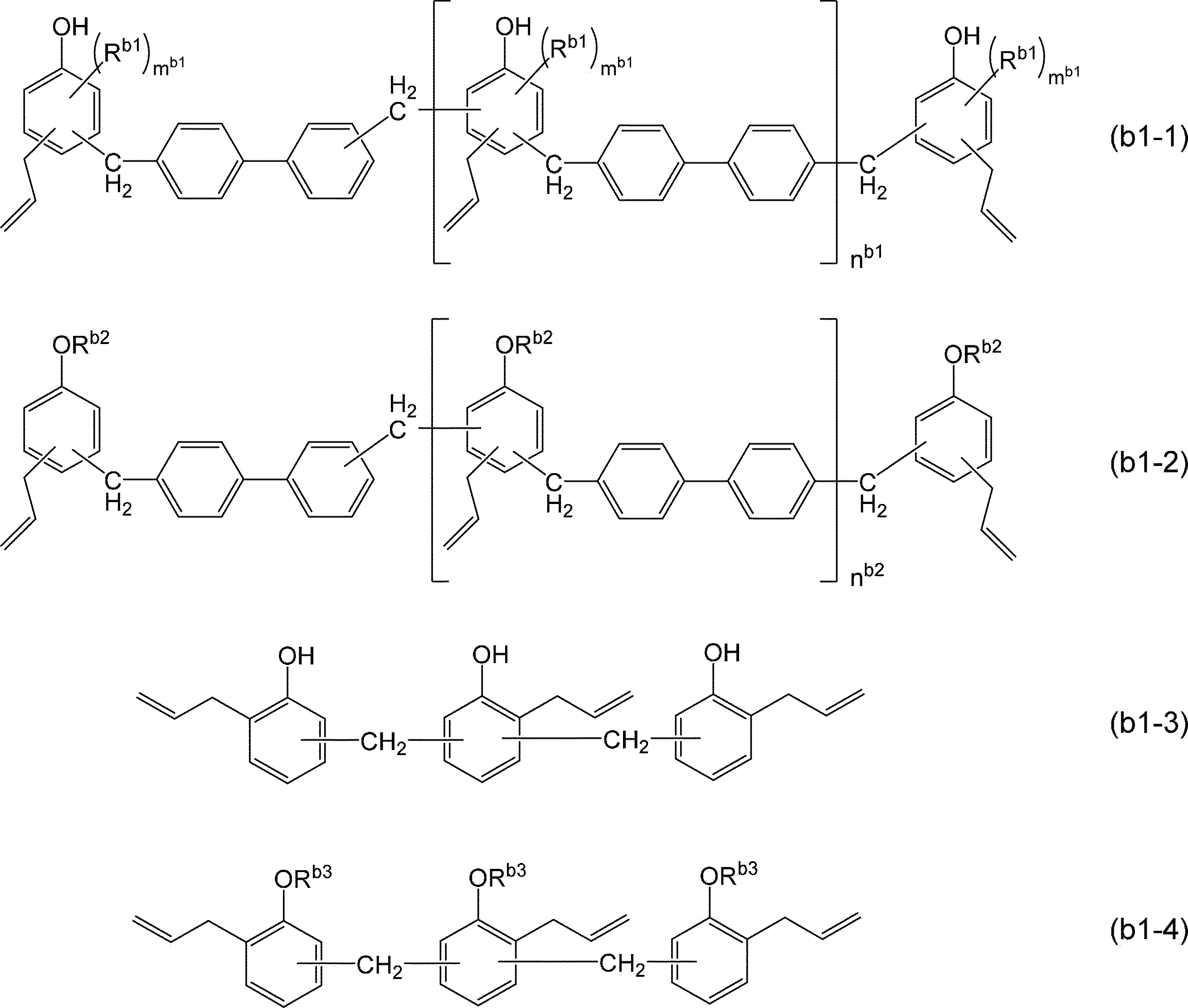
- Specific examples of the compound (b1) include the following compounds.
- R b1 to R b3 are independently organic groups.
- M b1 is independently 0 or 1.
- n b1 and n b2 are both parts enclosed in brackets. Represents the number of repeating units of, and each is independently 1 to 100.
- R b4 to R b7 are independently organic groups.
- M b2 and m b3 are independently 0 or 1.
- n b3 to n b6 are both enclosed in brackets. Represents the number of repeating units of the part that has been removed, and each is independently 1 to 100.
- R b8 and R b9 are each independently organic groups.
- N b7 to n b10 each represent the number of repeating units of the part enclosed in parentheses, and each independently represents 1 to 100. Is.
- examples of the organic group represented by R b1 to R b9 include an ethyl group, a propyl group, a butyl group, a pentyl group, a hexyl group, a heptyl group, an octyl group, a nonyl group, a decyl group, an undecyl group and a dodecyl group.
- Tridecyl group Tridecyl group, tetradecyl group, pentadecyl group, hexadecyl group, heptadecyl group, octadecyl group and other alkyl groups having 2 to 20 carbon atoms; phenyl group, biphenyl group, naphthyl group and other ring-forming aryl groups having 6 to 18 carbon atoms; Ring-forming groups such as a benzyl group An aralkyl group having 6 to 18 carbon atoms; an alicyclic hydrocarbon group having 5 to 18 carbon atoms such as an adamantyl group, a cyclohexyl group and a cyclopentadienyl group can be mentioned.
- the organic groups represented by R b1 , R b4 and R b6 may be bonded via —O— or —S—.
- the organic groups represented by R b1 to R b9 are all preferably bulky organic groups among the above options, for example, an alkyl group having 4 to 20 carbon atoms, an aryl group having 6 to 18 ring-forming carbon atoms, and the like. Ring-forming aralkyl groups having 6 to 18 carbon atoms and alicyclic hydrocarbon groups having 5 to 18 carbon atoms are more preferable, alkyl groups having 4 to 20 carbon atoms, aralkyl groups having 6 to 18 ring-forming carbon atoms, and 5 carbon atoms.
- Alicyclic hydrocarbon groups of ⁇ 18 are more preferred. Note that one if there are multiple R b1 in the molecule, may be each a plurality of R b1 same, may be different, and those that differ from the same thing coexist May be good. The same can be said for R b2 to R b9.
- m b1 to m b3 may be either 0 or 1 independently of each other. As n b1 to n b10 , 1 to 100 is preferable, and 3 to 30 is more preferable, respectively.
- R b10 is an aliphatic hydrocarbon group having 2 to 18 carbon atoms which may contain at least one selected from the group consisting of an ether group and a hydroxy group.
- the R b10 is preferably a group represented by any of the following general formulas (i) to (iii), for example.
- p b1 represents the number of repeating units of the methylene group and is an integer of 2 to 18.
- p b2 represents the number of repeating units of the oxyethylene group and is 0 or 1. * Is the binding site.
- the p b1 is preferably an integer of 2 to 10, more preferably an integer of 3 to 8, and even more preferably an integer of 3 to 5.
- the p b2 is preferably 1.
- the content of the component (b) in the thermosetting resin composition of the present embodiment is not particularly limited, but from the viewpoint of low thermal expansion and desmear resistance, the content of the component (b) is relative to the number of maleimide groups of the component (a).
- (B) It is preferable to adjust the ratio of the number of carbon-carbon double bonds in the component [the number of carbon-carbon double bonds / the number of maleimide groups] to be 0.01 to 0.3.
- the content of the component (b) in the thermosetting resin composition of the present embodiment is not particularly limited, but is thermally cured from the viewpoints of heat resistance, desmear resistance, low thermal expansion property, and copper foil adhesiveness.
- the content of the component (b) in the thermosetting resin composition of the present embodiment is not particularly limited, but from the viewpoints of heat resistance, desmear resistance, low thermal expansion property, and copper foil adhesiveness.
- (A) With respect to 100 parts by mass of the component 5 to 85 parts by mass is preferable, 7 to 60 parts by mass is more preferable, 10 to 45 parts by mass is further preferable, and 15 to 35 parts by mass is particularly preferable.
- thermosetting resin composition of the present embodiment contains (c) a benzoxazine compound.
- the benzoxazine compound in the present embodiment means a compound having at least one benzoxazine ring in the molecule.
- the benzoxazine ring here is a concept including those in which the hydrogen atom to be bonded is substituted with a substituent.
- the benzoxazine compound acts as a curing agent for the component (a) to improve the degree of curing of the component (a), and the heteroatom derived from the benzoxazine compound causes electrostatic mutual with copper. It is presumed that the cause is that the action is improved.
- the component (c) one type may be used alone, or two or more types may be used in combination.
- the number of benzoxazine rings (c) contained in one molecule may be 1 or more, and more preferably 2 or more.
- a known benzoxazine compound can be used, for example, Pd-type benzoxazine compound, Fa-type benzoxazine compound, ALP-d-type benzoxazine compound, T-ala-type benzoxazine. Examples include compounds.
- Examples of the component (c) include a compound represented by the following general formula (c-1), a compound represented by the following general formula (c-2), and a compound represented by the following general formula (c-3). And so on.
- R c1 and R c2 are each independently a hydrocarbon group having 1 to 10 carbon atoms.
- n c1 and n c2 are independently integers from 0 to 4).
- R c3 is independently a hydrocarbon group having 1 to 10 carbon atoms.
- R c4 is independently a hydrocarbon group having 1 to 10 carbon atoms or a hydrogen atom.
- N c3 is 0 to 3 Is an integer of.
- R c5 is a hydrocarbon group having 1 to 10 carbon atoms.
- R c6 is a hydrocarbon group or a hydrogen atom having 1 to 10 carbon atoms.
- N c4 is an integer of 0 to 4. .
- examples of the hydrocarbon group having 1 to 10 carbon atoms represented by R c1 and R c2 include a methyl group, an ethyl group, an n-propyl group, an isopropyl group and an n-butyl group.
- examples thereof include aliphatic hydrocarbon groups such as isobutyl group, t-butyl group, n-pentyl group, n-octyl group and n-decyl group; aromatic hydrocarbon groups such as phenyl group.
- n c1 and n c2 are independently integers of 0 to 4, and from the viewpoint of availability, an integer of 0 to 2 is preferable, and 0 is more preferable.
- the plurality of R c1s and the plurality of R c2s may be the same or different.
- examples of the alkylene group having 1 to 5 carbon atoms represented by X c1 include a methylene group, a 1,2-dimethylene group, a 1,3-trimethylene group and a 1,4-tetramethylene group. Groups, 1,5-pentamethylene groups and the like can be mentioned.
- alkylene group an alkylene group having 1 to 3 carbon atoms is preferable, and a methylene group is more preferable.
- examples of the alkylidene group having 2 to 5 carbon atoms represented by X c1 include an ethylidene group, a propylidene group, an isopropylidene group, a butylidene group, an isobutylidene group, a pentylidene group and an isopentylidene group. And so on. Among these, an isopropylidene group is preferable.
- examples of the hydrocarbon group having 1 to 10 carbon atoms represented by R c3 include a methyl group, an ethyl group, an n-propyl group, an isopropyl group, an n-butyl group and an isobutyl group.
- examples thereof include aliphatic hydrocarbon groups such as t-butyl group, n-pentyl group, n-octyl group and n-decyl group; aromatic hydrocarbon groups such as phenyl group.
- n c3 is an integer of 0 to 3, and from the viewpoint of availability, an integer of 0 to 2 is preferable, and 0 is more preferable.
- the alkylene group and an alkylidene group having 2 to 5 carbon atoms having 1 to 5 carbon atoms represented by X c2 the number of carbon atoms X c1 in the formula (c1) represents The same as the alkylene group of 1 to 5 and the alkylidene group having 2 to 5 carbon atoms can be mentioned.
- examples of the hydrocarbon group having 1 to 10 carbon atoms represented by R c4 include a methyl group, an ethyl group, an n-propyl group, an isopropyl group, an n-butyl group and an isobutyl group.
- Alkyl groups such as t-butyl group and n-pentyl group; aromatic hydrocarbon groups such as phenyl group and naphthyl group can be mentioned. Among these, an aromatic hydrocarbon group is preferable, and a phenyl group is more preferable.
- examples of the hydrocarbon group having 1 to 10 carbon atoms represented by R c5 include a methyl group, an ethyl group, an n-propyl group, an isopropyl group, an n-butyl group and an isobutyl group.
- examples thereof include aliphatic hydrocarbon groups such as t-butyl group, n-pentyl group, n-octyl group and n-decyl group; aromatic hydrocarbon groups such as phenyl group.
- n c4 is an integer of 0 to 4, and from the viewpoint of availability, an integer of 0 to 2 is preferable, and 0 is more preferable.
- the plurality of R c5s may be the same or different.
- the hydrocarbon group having 1 to 10 carbon atoms represented by R c6 is a hydrocarbon group having 1 to 10 carbon atoms represented by R c4 in the general formula (c-2). The same can be mentioned.
- the compound represented by the general formula (c-1) from the viewpoint of low thermal expansion and heat resistance, the above-mentioned compound
- the compound represented by the general formula (c-2) is preferable, and the compound represented by the above general formula (c-1) is more preferable.
- the compound represented by the general formula (c-1) is preferably a compound represented by the following formula (c-4), and the compound represented by the general formula (c-2) is preferably a compound represented by the following formula (c-2).
- the compound represented by c-5) is preferable.
- the content of the component (c) in the thermosetting resin composition of the present embodiment is not particularly limited, but is thermosetting from the viewpoints of heat resistance, low thermal expansion, moldability and copper foil adhesiveness.
- 0.2 to 20 parts by mass is preferable, 1 to 15 parts by mass is more preferable, 1 to 10 parts by mass is further preferable, and 1 to 8 parts by mass is particularly preferable.
- the content of the component (c) in the thermosetting resin composition of the present embodiment is not particularly limited, but from the viewpoints of heat resistance, low thermal expansion, moldability, and copper foil adhesiveness, a) With respect to 100 parts by mass of the component, 1 to 30 parts by mass is preferable, 1 to 20 parts by mass is more preferable, 1 to 15 parts by mass is further preferable, and 1 to 10 parts by mass is particularly preferable.
- the content ratio of the component (b) to the component (c) in the thermosetting resin composition of the present embodiment is not particularly limited, but is heat resistant. From the viewpoints of properties, low thermal expansion, moldability and copper foil adhesiveness, the mass ratio is preferably 1 to 15, more preferably 1 to 10, and even more preferably 1 to 8.
- thermosetting resin composition of the present embodiment is further referred to as (d) a thermosetting resin [hereinafter, referred to as a component (d). ] May be contained.
- a thermosetting resin hereinafter, referred to as a component (d).
- the adhesiveness to a metal foil can be further improved.
- the definition of (d) thermosetting resin in this embodiment does not include the components (a) to (c).
- the component (d) one type may be used alone, or two or more types may be used in combination.
- Examples of the component (d) include epoxy resin, phenol resin (however, the above component (b) is excluded), unsaturated imide resin (however, the above component (a) is excluded), cyanate resin, isocyanate resin, and the like.
- Examples include oxetane resin, amino resin, unsaturated polyester resin, allyl resin (however, the above component (b) is excluded), dicyclopentadiene resin, silicone resin, triazine resin, melamine resin, etc., and are selected from the group consisting of these. It is preferable that it is at least one kind.
- epoxy resin is preferable from the viewpoint of moldability and electrical insulation, and from the viewpoint of improving copper foil adhesiveness.
- epoxy resin examples include bisphenol A type epoxy resin, bisphenol F type epoxy resin, bisphenol S type epoxy resin, phenol novolac type epoxy resin, cresol novolac type epoxy resin, bisphenol A novolac type epoxy resin, and bisphenol F novolac type epoxy resin.
- Naphthalene skeleton-containing novolac type epoxy resin Naphthalene skeleton-containing novolac type epoxy resin, stillben type epoxy resin, triazine skeleton-containing epoxy resin, fluorene skeleton-containing epoxy resin, triphenol methane type epoxy resin, biphenyl type epoxy resin, xylylene type epoxy resin, biphenyl aralkyl type epoxy resin, naphthalene
- examples include type epoxy resin, dicyclopentadiene type epoxy resin, alicyclic epoxy resin, polyfunctional phenols, polycyclic aromatic diglycidyl ether compounds such as anthracene, and phosphorus-containing epoxy resin in which a phosphorus compound is introduced. Be done.
- naphthalene skeleton-containing novolac type epoxy resin biphenyl aralkyl type epoxy resin, bisphenol F type epoxy resin, bisphenol S type epoxy resin, naphthalene type epoxy resin, and dicyclopentadiene type epoxy resin are more preferable.
- Biphenyl aralkyl type epoxy resin is more preferable.
- thermosetting resin composition of the present embodiment contains (d) a thermosetting resin
- the content thereof is not particularly limited, but from the viewpoints of heat resistance, low thermal expansion property, and copper foil adhesiveness. Therefore, 1 to 20 parts by mass is preferable, 2 to 15 parts by mass is more preferable, and 4 to 12 parts by mass is further preferable with respect to 100 parts by mass of the resin component of the thermosetting resin composition.
- thermosetting resin composition of the present embodiment is further referred to as (e) an inorganic filler [hereinafter, referred to as (e) component. ] May be contained.
- component (e) the low thermal expansion property, desmear resistance, and the like are further improved.
- the component (e) one type may be used alone, or two or more types may be used in combination.
- the component (e) examples include silica, alumina, titanium oxide, mica, berylia, barium titanate, potassium titanate, strontium titanate, calcium titanate, aluminum carbonate, magnesium hydroxide, aluminum hydroxide, and aluminum silicate. , Calcium carbonate, calcium silicate, magnesium silicate, silicon nitride, boron nitride, clay, talc, aluminum borate, silicon carbide, quartz powder, short glass fibers, fine glass powder, hollow glass, etc. It is preferably at least one selected from the group. As the glass, E glass, T glass, D glass and the like are preferably mentioned. Among these, silica is preferable from the viewpoint of dielectric properties, heat resistance and low thermal expansion.
- silica examples include precipitated silica having a high water content produced by a wet method and dry silica produced by a dry method and containing almost no bound water or the like.
- the dry silica is further classified into crushed silica, fumed silica, molten spherical silica and the like depending on the manufacturing method.
- fused spherical silica is preferable from the viewpoint of low thermal expansion and fluidity when filled in a resin.
- the component (e) may be surface-treated with a coupling agent.
- the method of surface treatment with a coupling agent may be a method of surface-treating the inorganic filler before compounding by a dry method or a wet method, and the composition is obtained by blending the surface-untreated inorganic filler with other components.
- a so-called inorganic blend treatment method may be used in which a silane coupling agent is added to the composition after the product is prepared.
- the coupling agent include a silane-based coupling agent, a titanate-based coupling agent, a silicone oligomer, and the like. Among these, a silane-based coupling agent is preferable, and an aminosilane-based coupling agent is more preferable.
- the average particle size of the component (e) is not particularly limited, but is preferably 0.01 to 5 ⁇ m, more preferably 0.05 to 3 ⁇ m, and even more preferably 0.1 to 1 ⁇ m.
- the average particle size in the present embodiment is the particle size of a point corresponding to a volume of 50% when the cumulative frequency distribution curve based on the particle size is obtained with the total volume of particles as 100%, and is laser diffraction. It can be measured with a particle size distribution measuring device or the like using a scattering method.
- thermosetting resin composition of the present embodiment contains (e) an inorganic filler
- the content thereof is not particularly limited, but from the viewpoint of heat resistance, low thermal expansion, and copper foil adhesiveness. , 10 to 500 parts by mass is preferable, 50 to 400 parts by mass is more preferable, 100 to 300 parts by mass is further preferable, and 150 to 300 parts by mass is particularly preferable with respect to 100 parts by mass of the resin component of the thermosetting resin composition. preferable.
- thermosetting resin composition of the present embodiment is, for example, a thermoplastic resin, a curing accelerator, an organic filler, a flame retardant, an ultraviolet absorber, a peroxide, and an antioxidant within a range not contrary to the object of the present invention.
- a thermoplastic resin for example, a thermoplastic resin, a curing accelerator, an organic filler, a flame retardant, an ultraviolet absorber, a peroxide, and an antioxidant within a range not contrary to the object of the present invention.
- One or more selected from the group consisting of a photopolymerization initiator, a fluorescent whitening agent and an adhesiveness improver As for each of these other components, one type may be used alone, or two or more types may be used in combination.
- thermoplastic resin examples include polyethylene, polypropylene, polystyrene, polyphenylene ether resin, phenoxy resin, polycarbonate resin, polyester resin, polyamide resin, polyamideimide resin, polyimide resin, xylene resin, polyphenylene sulfide resin, polyetherimide resin, and poly.
- thermoplastic resin examples include polyethylene, polypropylene, polystyrene, polyphenylene ether resin, phenoxy resin, polycarbonate resin, polyester resin, polyamide resin, polyamideimide resin, polyimide resin, xylene resin, polyphenylene sulfide resin, polyetherimide resin, and poly.
- examples thereof include ether ether ketone resin, silicone resin, and tetrafluoroethylene resin.
- curing accelerator examples include imidazoles and derivatives thereof; organic phosphorus compounds such as phosphines and phosphonium salts, and additives of tertiary phosphines and quinones; secondary amines, tertiary amines, and quaternary amines. Examples include quaternary ammonium salts.
- organic filler examples include resin fillers made of polyethylene, polypropylene, polystyrene, polyphenylene ether resin, silicone resin, tetrafluoroethylene resin, etc., resin fillers having a core-shell structure, and the like.
- Examples of the flame retardant include aromatic phosphoric acid ester compounds, phosphazene compounds, phosphinic acid esters, metal salts of phosphinic acid compounds, red phosphorus, 9,10-dihydro-9-oxa-10-phosphaphenanthrene-10-oxide.
- Phosphazene flame retardants and their derivatives nitrogen flame retardants such as guanidine sulfamate, melamine sulfate, melamine polyphosphate, melamine cyanurate; halogen-containing flame retardants containing bromine, chlorine, etc .; inorganic such as antimony trioxide Examples include flame retardants.
- Examples of the ultraviolet absorber include a benzotriazole-based ultraviolet absorber.
- the peroxide those that promote the reaction between the component (a) and the component (b) are preferable, and examples thereof include organic peroxides such as ⁇ , ⁇ '-di (t-butylperoxy) diisopropylbenzene. Be done.
- the antioxidant include a hindered phenol-based antioxidant, a hindered amine-based antioxidant, and the like.
- Examples of the photopolymerization initiator include benzophenones, benzyl ketals, thioxanthone-based photopolymerization initiators, and the like.
- the fluorescent whitening agent include a fluorescent whitening agent of a stilbene derivative.
- Examples of the adhesiveness improving agent include urea compounds such as ureasilane and the above-mentioned coupling agent.
- thermosetting resin composition of the present embodiment may be in the state of a varnish in which each component is dissolved or dispersed in an organic solvent for use in the production of a prepreg or the like. That is, the varnish is also included in the thermosetting resin composition of the present embodiment.
- organic solvent used for the varnish include alcohol solvents such as methanol, ethanol, propanol, butanol, methyl cellosolve, butyl cellosolve and propylene glycol monomethyl ether; ketone solvents such as acetone, methyl ethyl ketone, methyl isobutyl ketone and cyclohexanone; butyl acetate.
- Ester solvent such as propylene glycol monomethyl ether acetate; Ether solvent such as tetrahydrofuran; Aromatic solvent such as toluene, xylene, mesitylen; Nitrogen atom-containing solvent such as dimethylformamide, dimethylacetamide, N-methylpyrrolidone; dimethylsulfoxide Such as sulfur atom-containing solvent and the like.
- organic solvent one type may be used alone, or two or more types may be used in combination.
- methyl ethyl ketone, methyl isobutyl ketone, cyclohexanone, methyl cellosolve, and propylene glycol monomethyl ether are preferable from the viewpoint of solubility, and methyl isobutyl ketone, cyclohexanone, and propylene glycol monomethyl ether are more preferable from the viewpoint of low toxicity.
- the solid content concentration of the varnish is preferably 40 to 90% by mass, more preferably 50 to 80% by mass. When the solid content concentration of the varnish is within the above range, the coatability can be kept good, and a prepreg having an appropriate amount of the thermosetting resin composition adhered can be obtained.
- the prepreg of the present embodiment contains the thermosetting resin composition of the present embodiment, and more specifically, contains a B-staged thermosetting resin composition.
- the prepreg of the present embodiment can be produced, for example, by impregnating a fiber base material with the thermosetting resin composition of the present embodiment and semi-curing (B-stage) by heating or the like.
- the fiber base material well-known materials used for various laminated boards for electrical insulating materials can be used. Examples of the material include inorganic fibers such as E glass, S glass, low dielectric glass, and Q glass; organic fibers such as low dielectric glass polyimide, polyester, and tetrafluoroethylene; and mixtures thereof.
- low-dielectric glass and Q glass are preferable from the viewpoint of obtaining a base material having excellent dielectric properties.
- These fiber substrates have shapes such as woven fabrics, non-woven fabrics, robinks, chopped strand mats, and surfaced mats.
- the material and shape of the fiber base material are selected according to the intended use and performance of the molded product, and if necessary, they can be used alone or in combination of two or more kinds of materials and shapes.
- As the thickness of the fiber base material for example, one having a thickness of about 0.03 to 0.5 mm can be used.
- these fiber base materials those surface-treated with a silane coupling agent or the like or those subjected to mechanical opening treatment are suitable from the viewpoints of heat resistance, moisture resistance, processability and the like.
- the amount of the thermosetting resin composition adhered to the fiber substrate is preferably 20 to 90 mass by mass. %, More preferably 30 to 80% by mass, still more preferably 40 to 70% by mass.
- the prepreg of the present embodiment is obtained by impregnating a fiber base material with a thermosetting resin composition, then heating and drying at a temperature of 100 to 200 ° C. for 1 to 30 minutes, and semi-curing (B-stage). Can be done.
- the laminated board of this embodiment is a laminated board containing the prepreg of this embodiment.
- the laminated board of this embodiment is obtained by laminating and molding the prepreg of this embodiment.
- one prepreg of the present embodiment is prepared, or 2 to 20 prepregs are prepared, and metal foils such as copper and aluminum are arranged on one side or both sides of the prepreg. It can be manufactured by.
- a laminated board having an insulating layer formed by using the prepreg of the present embodiment and a metal foil arranged on one side or both sides thereof can be obtained.
- the metal foil is not particularly limited as long as it is used for electrical insulating material applications.
- a laminated board having a structure in which metal foils are arranged on one side or both sides of the laminated board is particularly referred to as a metal-clad laminated board.
- the molding conditions when manufacturing the laminated board for example, the method of the laminated board for the electric insulating material and the multilayer board can be applied.
- the molding apparatus include a multi-stage press, a multi-stage vacuum press, continuous molding, an autoclave molding machine, and the like.
- the molding conditions include, for example, a temperature of 100 to 250 ° C., a pressure of 0.2 to 10 MPa, and a heating time of 0.1 to 5 hours.
- the prepreg of the present embodiment and the wiring board for the inner layer can be combined and laminated to produce a laminated plate.
- the printed wiring board of the present embodiment is a printed wiring board including the laminated board of the present embodiment.
- the printed wiring board of the present embodiment can be manufactured, for example, by circuit-processing the metal-clad laminate of the present embodiment.
- Examples of the circuit processing method include known methods such as a subtractive method, a full additive method, a semi-additive method (SAP: Semi Additive Process), and a modified semi-additive method (m-SAP: modified Semi Additive Process).
- a plurality of wiring-processed laminated plates can be laminated via the prepreg of the present embodiment and heat-pressed to collectively form multiple layers. After that, a multi-layer printed wiring board can be manufactured through the formation of through holes or blind via holes by drilling or laser processing and the formation of interlayer wiring by plating or conductive paste.
- the semiconductor package of this embodiment is a semiconductor package in which a semiconductor element is mounted on a printed wiring board of this embodiment.
- the semiconductor package of the present embodiment is manufactured, for example, by mounting a semiconductor element such as a semiconductor chip or a memory at a predetermined position on the printed wiring board of the present embodiment and sealing the semiconductor element with a sealing resin or the like. Can be done.
- a 5 mm ⁇ 5 mm square evaluation substrate was prepared by immersing a copper-clad laminate in a copper etching solution to remove the copper foil, and TMA test equipment (TA Instruments Japan Co., Ltd.) TMAQ400EM) was used to perform thermomechanical analysis by the compression method. After mounting the evaluation substrate on the above device, the temperature is raised to 260 ° C. at a temperature rising rate of 10 ° C./min, the temperature is lowered to 10 ° C. at a temperature lowering rate of 10 ° C./min, and then 320 ° C. The temperature was raised to. The coefficient of thermal expansion was measured twice in total, at the time of the first temperature rise and at the time of the second temperature rise. The average coefficient of thermal expansion from 30 ° C. to 100 ° C. in the second measurement was calculated and used as the value of the coefficient of thermal expansion.
- the amount of weight loss (g / m 2 ) after the desmear treatment was calculated with respect to the dry weight before the desmear treatment, and this was used as an index of the desmear resistance. The smaller the amount of weight loss after the desmear treatment, the better the desmear resistance.
- An evaluation substrate having an outer layer copper foil formed in a width of 3 mm was produced by immersing a copper-clad laminate in a copper etching solution. One end of the evaluation substrate was peeled off at the interface between the outer layer copper layer and the insulating layer, the peeled portion was grasped with a grasping tool, and the copper foil peel strength when peeled off in the vertical direction was measured using a tensile tester. The tensile speed was about 50 mm / min and the measurement temperature was room temperature.
- modified maleimide resin (A) In a reaction vessel having an internal volume of 2 L equipped with a thermometer, a stirrer and a moisture quantifier with a reflux condenser, 119 parts by mass (solid content equivalent amount) of the azomethine-modified siloxane-containing solution, 2,2-bis [4- (4). -Maleimide phenoxy) Phenyl] Propane ((a1) component) 161 parts by mass and 376 parts by mass of propylene glycol monomethyl ether were added and reacted at 120 ° C. for 4 hours to modify the modified maleimide resin (A) [hereinafter, modified maleimide resin (a). It is called -1). ] A containing solution was obtained.
- the temperature was raised to 240 ° C. at a pressure of 3.0 MPa and a heating rate of 4.0 ° C./min, and then held for 85 minutes.
- a copper-clad laminate was obtained by cooling for minutes. The above measurement and evaluation were carried out using the obtained copper-clad laminate. The results are shown in Table 1.
- Example 1 using the thermosetting resin composition of the present embodiment has the same glass transition temperature, solder heat resistance, and coefficient of thermal expansion as Comparative Example 1 which does not contain the component (c). It can be seen that the desmear resistance, the interlayer peel strength, and the copper foil peel strength are improved while having the effect. Further, Examples 2 to 5 using the thermosetting resin composition of the present embodiment have the same glass transition temperature, solder heat resistance, and coefficient of thermal expansion as those of Comparative Example 2 which does not contain the component (c). It can be seen that the desmear resistance, the interlayer peel strength, and the copper foil peel strength are improved while having the effect. From the above, it can be seen that the thermosetting resin composition of the present embodiment has excellent heat resistance and excellent copper foil adhesiveness.
- thermosetting resin composition of the present embodiment a laminated board having good heat resistance and excellent copper foil adhesiveness can be obtained. Therefore, a printed wiring board having a high density and a high number of layers can be obtained. Can be manufactured. Therefore, the thermosetting resin composition of the present embodiment is suitably used for a printed wiring board of an electronic device used for a computer, an information device terminal, or the like that processes a large amount of data at high speed. In particular, it can also be used for printed wiring boards of tablet-type personal computers and notebook-type personal computers, which are in great demand for thinning.
Landscapes
- Chemical & Material Sciences (AREA)
- Health & Medical Sciences (AREA)
- Chemical Kinetics & Catalysis (AREA)
- Medicinal Chemistry (AREA)
- Polymers & Plastics (AREA)
- Organic Chemistry (AREA)
- Engineering & Computer Science (AREA)
- Microelectronics & Electronic Packaging (AREA)
- Manufacturing & Machinery (AREA)
- Materials Engineering (AREA)
- Macromolecular Compounds Obtained By Forming Nitrogen-Containing Linkages In General (AREA)
- Reinforced Plastic Materials (AREA)
- Laminated Bodies (AREA)
Abstract
Description
熱硬化性樹脂は、その硬化物に特有の架橋構造が、高い耐熱性及び寸法安定性を発現するため、電子部品等の分野において広く使用されている。
耐熱性が高い熱硬化性樹脂としてマレイミド樹脂が知られているが、マレイミド樹脂は硬化性が低いため、これを改善するための種々の検討が行われている。
[1](a)少なくとも1個のN-置換マレイミド基を有する化合物、
(b)少なくとも2個の不飽和脂肪族炭化水素基を有する化合物、及び
(c)ベンゾオキサジン化合物、
を含有する、熱硬化性樹脂組成物。
[2]前記(a)成分が、(a1)少なくとも2個のN-置換マレイミド基を有する化合物と、(a2)少なくとも2個の1級アミノ基を有するシリコーン化合物と、の反応物を含有する、上記[1]に記載の熱硬化性樹脂組成物。
[3]前記(b)成分が、少なくとも3個の不飽和脂肪族炭化水素基を有する化合物である、上記[1]又は[2]に記載の熱硬化性樹脂組成物。
[4]前記(b)成分が有する不飽和脂肪族炭化水素基が、アリル基及び1-プロペニル基からなる群から選択される1種以上である、上記[1]~[3]のいずれかに記載の熱硬化性樹脂組成物。
[5]前記(c)成分が、下記一般式(c-1)で表される化合物である、上記[1]~[4]のいずれかに記載の熱硬化性樹脂組成物。

(式中、Rc1及びRc2は、各々独立に、炭素数1~10の炭化水素基である。Xc1は、炭素数1~5のアルキレン基、炭素数2~5のアルキリデン基、-O-、スルホニル基、カルボニルオキシ基、-C(=O)-又は単結合である。nc1及びnc2は、各々独立に、0~4の整数である。)
[6]前記(b)成分の含有量が、前記(a)成分100質量部に対して、5~85質量部である、上記[1]~[5]のいずれかに記載の熱硬化性樹脂組成物。
[7]前記(c)成分の含有量が、前記(a)成分100質量部に対して、1~30質量部である、上記[1]~[6]のいずれかに記載の熱硬化性樹脂組成物。
[8]前記(b)成分と前記(c)成分との含有量比〔(b)成分/(c)成分〕が、質量比で、1~15である、上記[1]~[7]のいずれかに記載の熱硬化性樹脂組成物。
[9]さらに、(d)熱硬化性樹脂として、エポキシ樹脂を含有する、上記[1]~[8]のいずれかに記載の熱硬化性樹脂組成物。
[10]さらに、(e)無機充填材を含有する、上記[1]~[9]のいずれかに記載の熱硬化性樹脂組成物。
[11]上記[1]~[10]のいずれかに記載の熱硬化性樹脂組成物を含有してなるプリプレグ。
[12]上記[11]に記載のプリプレグを含有してなる積層板。
[13]上記[12]に記載の積層板を含有してなるプリント配線板。
[14]上記[13]に記載のプリント配線板に半導体素子を搭載してなる半導体パッケージ。
本明細書中に記載されている数値範囲において、その数値範囲の上限値又は下限値は、実施例に示されている値に置き換えてもよい。また、数値範囲の下限値及び上限値は、それぞれ他の数値範囲の下限値又は上限値と任意に組み合わせられる。
本明細書に例示する各成分及び材料は、特に断らない限り、1種を単独で使用してもよいし、2種以上を併用してもよい。
本明細書において、熱硬化性樹脂組成物中の各成分の含有量は、熱硬化性樹脂組成物中に各成分に該当する物質が複数存在する場合、特に断らない限り、熱硬化性樹脂組成物中に存在する当該複数の物質の合計量を意味する。
本明細書における記載事項を任意に組み合わせた態様も本実施形態に含まれる。
本明細書に記載されている作用機序は推測であって、本実施形態に係る熱硬化性樹脂組成物の効果を奏する機序を限定するものではない。
本明細書における記載事項を任意に組み合わせた態様も本実施形態に含まれる。
また、本明細書において、「固形分」とは、有機溶媒等の揮発性成分を除いた不揮発分のことであり、熱硬化性樹脂組成物を乾燥させた際に揮発せずに残る成分を示し、室温で液状、水飴状又はワックス状のものも含む。
本実施形態の熱硬化性樹脂組成物は、
(a)少なくとも1個のN-置換マレイミド基を有する化合物[以下、(a)成分と称することがある。]、
(b)少なくとも2個の不飽和脂肪族炭化水素基を有する化合物[以下、(b)成分と称することがある。]、及び
(c)ベンゾオキサジン化合物[以下、(c)成分と称することがある。]、
を含有する、熱硬化性樹脂組成物である。
本実施形態の熱硬化性樹脂組成物は、加熱によって上記各成分が反応して熱硬化する性質を有する。
以下、本実施形態の熱硬化性樹脂組成物が含有する各成分について詳述する。
本実施形態の熱硬化性樹脂組成物は、(a)成分を含有することにより、特に優れた耐熱性及び低熱膨張性が得られる傾向にある。
(a)成分は、1種を単独で使用してもよいし、2種以上を併用してもよい。
また、(a)成分としては、耐熱性、低熱膨張性及び銅箔接着性の観点から、(a1)成分と、少なくとも2個の1級アミノ基を有する化合物との反応が好ましく、(a1)成分と、(a2)少なくとも2個の1級アミノ基を有するシリコーン化合物[以下、(a2)成分と称することがある。]との反応物[以下、変性マレイミド樹脂(A)と称することがある。]がより好ましい。
(a1)成分としては、下記一般式(a1-1)で表される化合物が好ましい。

(式中、Xa1は、下記一般式(a1-2)、(a1-3)、(a1-4)又は(a1-5)で表される基である。)
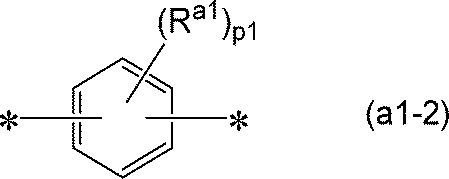
(式中、Ra1は、炭素数1~5の脂肪族炭化水素基又はハロゲン原子である。p1は、0~4の整数である。*は結合部位を表す。)
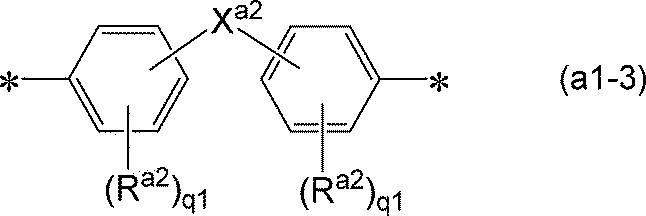
(式中、Ra2は、各々独立に、炭素数1~5の脂肪族炭化水素基又はハロゲン原子である。Xa2は、炭素数1~5のアルキレン基、炭素数2~5のアルキリデン基、-O-、スルフィド基、スルホニル基、カルボニルオキシ基、-C(=O)-、単結合又は下記一般式(a1-3’)で表される基である。q1は、各々独立に、0~4の整数である。*は結合部位を表す。)
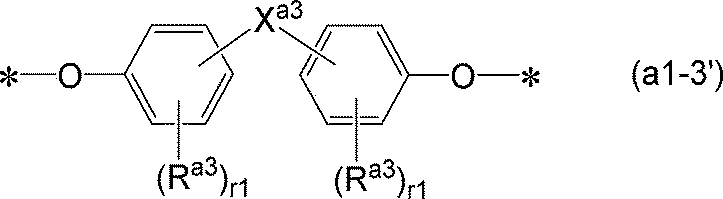
(式中、Ra3は、各々独立に、炭素数1~5の脂肪族炭化水素基又はハロゲン原子である。Xa3は、炭素数1~5のアルキレン基、炭素数2~5のアルキリデン基、-O-、スルフィド基、スルホニル基、カルボニルオキシ基、-C(=O)-又は単結合である。r1は、各々独立に、0~4の整数である。*は結合部位を表す。)
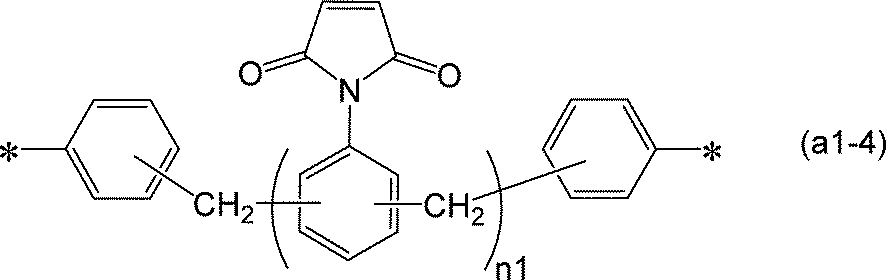
(式中、n1は、1~10の整数である。*は結合部位を表す。)

(式中、Ra4は、各々独立に、水素原子又は炭素数1~5の脂肪族炭化水素基である。u1は、1~8の整数である。*は結合部位を表す。)
p1は、0~4の整数であり、入手容易性の観点から、0~2の整数が好ましく、0がより好ましい。p1が2以上の整数である場合、複数のRa1同士は同一であっても異なっていてもよい。
Xa2が表す炭素数1~5のアルキレン基としては、例えば、メチレン基、1,2-ジメチレン基、1,3-トリメチレン基、1,4-テトラメチレン基、1,5-ペンタメチレン基等が挙げられる。該アルキレン基としては、炭素数1~3のアルキレン基が好ましく、メチレン基がより好ましい。
Xa2が表す炭素数2~5のアルキリデン基としては、例えば、エチリデン基、プロピリデン基、イソプロピリデン基、ブチリデン基、イソブチリデン基、ペンチリデン基、イソペンチリデン基等が挙げられる。これらの中でも、イソプロピリデン基が好ましい。
q1は、各々独立に、0~4の整数であり、入手容易性の観点から、0~2の整数が好ましく、0又は2がより好ましい。
Xa3が表す炭素数1~5のアルキレン基、炭素数2~5のアルキリデン基としては、上記一般式(a1-3)中のXa2が表す炭素数1~5のアルキレン基、炭素数2~5のアルキリデン基と同じものが挙げられる。
Xa3としては、上記選択肢の中でも、炭素数2~5のアルキリデン基が好ましく、イソプロピリデン基がより好ましい。
r1は、0~4の整数であり、入手容易性の観点から、0~2の整数が好ましく、0がより好ましい。
変性マレイミド樹脂(A)の原料として使用する(a1)成分としては、上記一般式(a1-1)のXa1として上記一般式(a1-3)で表される基を有する化合物が好ましく、その中でも、Xa2として、上記一般式(a1-3’)で表される基を有する化合物がより好ましい。
上記一般式(a1-5)中、Ra4が表す炭素数1~5の脂肪族炭化水素基、ハロゲン原子としては、上記一般式(a1-2)中のRa1の場合と同じものが挙げられ、好ましいものも同じである。
u1は、1~8の整数であり、1~3の整数が好ましく、1がより好ましい。
(a2)成分と反応させずに使用する(a1)成分としては、上記一般式(a1-1)のXa1として上記一般式(a1-4)で表される基を有する化合物が好ましい。
変性マレイミド樹脂(A)を製造するために(a1)成分と反応させる(a2)成分としては、少なくとも一方の分子末端に1級アミノ基を有するシリコーン化合物が好ましく、分子両末端に1級アミノ基を有するシリコーン化合物がより好ましい。また、(a2)成分は、側鎖に1級アミノ基を有するシリコーン化合物であってもよく、側鎖及び少なくとも一方の分子末端に1級アミノ基を有するシリコーン化合物であってもよい。
これらの中でも、分子両末端に1級アミノ基を有するシリコーン化合物が好ましい。このようなシリコーン化合物としては、下記一般式(a2-1)で表されるアミノ変性シリコーン化合物が好ましく挙げられる。

(式中、Ra21は、各々独立に、アルキル基、フェニル基又は置換フェニル基を示す。Ra22及びRa23は、各々独立に、有機基を示す。nは2~50の整数を示す。)
Ra21で表される置換フェニル基における置換基としては、例えば、アルキル基、アルケニル基、アルキニル基等が挙げられ、これらの中でも、アルキル基が好ましい。アルキル基としては、上記と同様のものが好ましく挙げられる。
Ra21で表される基の中でも、他の樹脂との溶解性の観点から、フェニル基又はメチル基が好ましく、メチル基がより好ましい。
Ra22又はRa23で表される有機基としては、例えば、アルキレン基、アルケニレン基、アルキニレン基、アリーレン基、-O-又はこれらが組み合わされた連結基等が挙げられる。これらの中でも、置換又は無置換のアルキレン基、置換又は無置換のアリーレン基が好ましく、置換又は無置換のアルキレン基がより好ましい。
Ra22又はRa23で表されるアルキレン基としては、例えば、メチレン基、エチレン基、トリメチレン基等が挙げられ、トリメチレン基が好ましい。また、該アルキレン基の置換基としては、例えば、炭素数6~10のアリール基等が挙げられる。
Ra22又はRa23で表されるアリーレン基としては、例えば、フェニレン基、ナフチレン基等が挙げられる。また、該アリーレン基の置換基としては、例えば、炭素数1~5のアルキル基等が挙げられる。
(a2)成分は、1種を単独で使用してもよいし、2種以上を併用してもよい。
市販品の中でも、低吸水率の観点から、X-22-161A、X-22-161B、KF-8012、KF-8008、X-22-1660B-3、BY-16-853B、XF42-C5379が好ましく、低熱膨張性の観点から、X-22-161A、X-22-161B、KF-8012、XF42-C5379が好ましい。
さらに、(a2)成分としては、銅箔との接着性の向上及び低熱膨張化の観点から、アゾメチン基を有しているものを使用することが好ましく、芳香族アゾメチン基を有しているものがより好ましく、ジアルデヒド化合物と反応させて得られるアゾメチン変性シロキサン[以下、アゾメチン変性シロキサン(a2’)と称することがある。]を使用することがさらに好ましい。ここで、芳香族アゾメチン基とは、アゾメチン基(-N=CH-)に少なくとも1つの芳香族基(好ましくは芳香族炭化水素基)が結合したものをいう。
上記ジアルデヒド化合物としては、例えば、脂肪族ジアルデヒド化合物、芳香族ジアルデヒド化合物等が挙げられる。これらの中でも、芳香族ジアルデヒド化合物が好ましい。該芳香族ジアルデヒド化合物は、芳香族炭化水素基を有しており、その限りにおいて、脂肪族炭化水素基を併せ持っていてもよい。例えば、分子内に芳香族炭化水素基-脂肪族炭化水素基-芳香族炭化水素基という構造を有している場合も、芳香族アルデヒド化合物に含まれる。
アゾメチン変性シロキサン(a2’)の製造方法に特に制限はなく、例えば、上記一般式(a2-1)で表されるアミノ変性シリコーン化合物と、上記ジアルデヒド化合物とを有機溶媒中で脱水縮合反応させることにより製造できる。ここで、上記一般式(a2-1)で表されるアミノ変性シリコーン化合物と上記ジアルデヒド化合物の使用量は、例えば、上記一般式(a2-1)で表されるアミノ変性シリコーン化合物の1級アミノ基数〔アミノ変性シリコーン化合物の使用量/アミノ変性シリコーン化合物の1級アミノ基当量〕が、ジアルデヒド化合物のアルデヒド基数〔ジアルデヒド化合物の使用量/ジアルデヒド化合物のアルデヒド基当量〕の1.1倍以上が好ましく、1.5~5倍がより好ましく、2~4倍がさらに好ましい。1.1倍以上とすることにより、反応を十分に進行させ、得られるアゾメチン変性シロキサン(a2’)が分子両末端に1級アミノ基を有するようになる。
変性マレイミド樹脂(A)の製造方法に特に制限はないが、例えば、(a1)成分が有するマレイミド基の炭素-炭素二重結合に、(a2)成分が有する1級アミノ基を付加反応させることで変性マレイミド樹脂(A)を製造することができる。
(a)成分として変性マレイミド樹脂(A)を製造することで、熱硬化性樹脂組成物中の樹脂の分子量を制御し易くなり、優れた低熱膨張性及び弾性率が得られる傾向にある。
変性マレイミド樹脂(A)の製造は、有機溶媒中で加熱保温しながら行なうことが好ましい。反応温度は、70~200℃が好ましく、80~150℃がより好ましく、100~130℃がさらに好ましい。反応時間は、0.1~10時間が好ましく、1~6時間がより好ましい。
本実施形態の熱硬化性樹脂組成物は、(b)成分を含有することによって、特に優れた耐熱性及び耐デスミア性が得られる傾向にある。
(b)成分は、1種を単独で使用してもよいし、2種以上を併用してもよい。
また、(b)成分が有する不飽和脂肪族炭化水素基としては、特に制限されるものではないが、ラジカル反応し得る不飽和脂肪族炭化水素基であることが好ましく、例えば、ビニル基、イソプロペニル基、1-プロペニル基、アリル基、1-メチルアリル基、3-ブテニル基等が挙げられる。これらの中でも、耐デスミア性の観点から、炭素数2~10の不飽和脂肪族炭化水素基が好ましく、炭素数2~5の不飽和脂肪族炭化水素基がより好ましく、アリル基及び1-プロペニル基からなる群から選択される1種以上がさらに好ましい。なお、本実施形態においては、マレイミド基及び(メタ)アクリロイル基等のように、一部に不飽和脂肪族炭化水素基を有しているが、その基全体として見たときに不飽和脂肪族炭化水素基とは言えない基は、(b)成分における「不飽和脂肪族炭化水素基」に含まれないこととする。
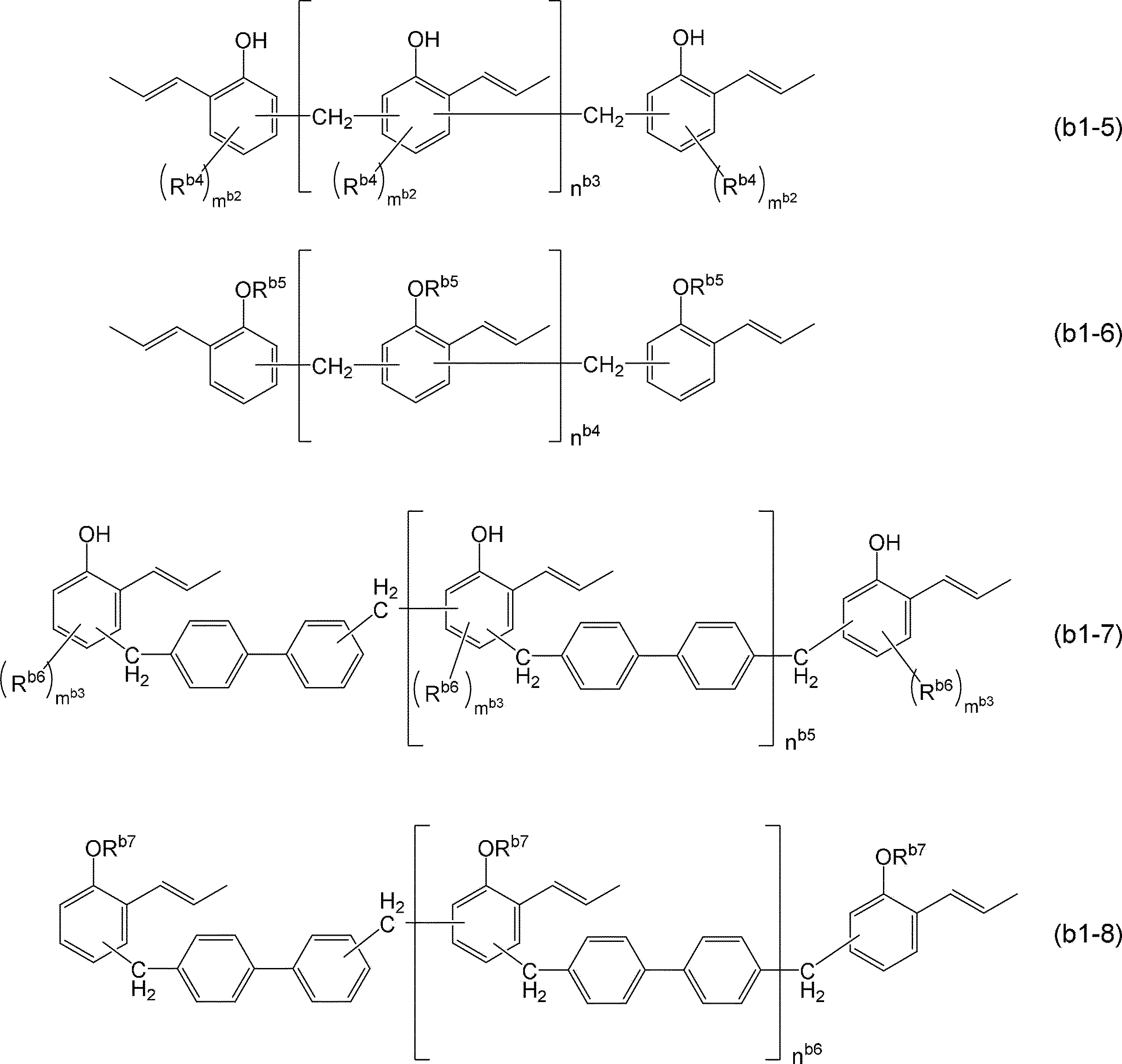
(式中、Rb4~Rb7は、各々独立に、有機基である。mb2及びmb3は、各々独立に、0又は1である。nb3~nb6はいずれも、鍵括弧で囲まれた部位の繰り返し単位数を表し、各々独立に、1~100である。)
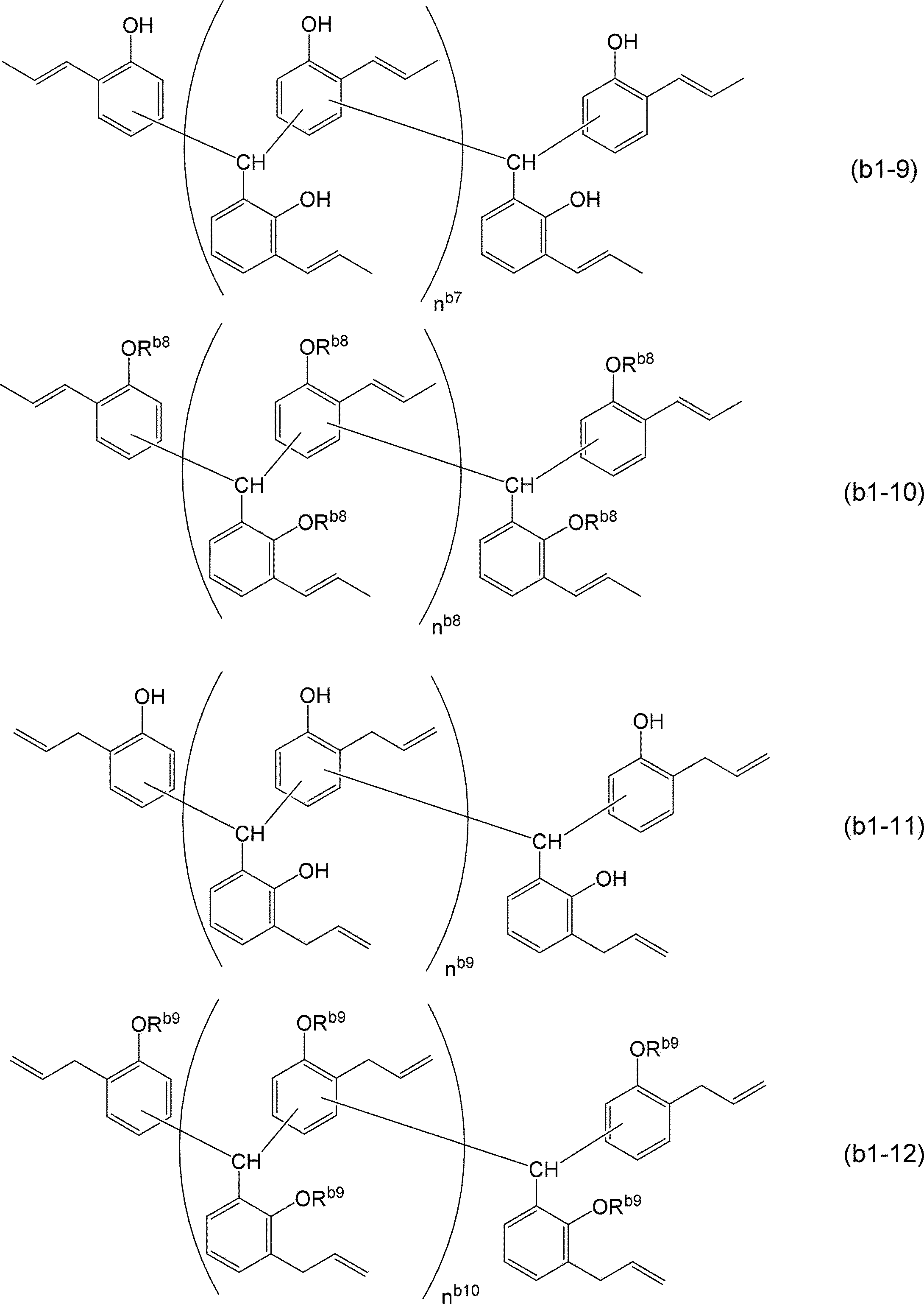
(式中、Rb8及びRb9は、各々独立に、有機基である。nb7~nb10は、いずれも丸括弧で囲まれた部位の繰り返し単位数を表し、各々独立に、1~100である。)
なお、1分子中に複数のRb1が存在する場合、複数のRb1は各々同一であってもよいし、異なっていてもよいし、同一のものと異なっているものとが混在していてもよい。Rb2~Rb9についてもこれと同様のことがいえる。
mb1~mb3は、各々独立に、0及び1のいずれでもよい。
nb1~nb10としては、各々独立に、1~100が好ましく、3~30がより好ましい。

(上記式中、Rb10は、エーテル基及びヒドロキシ基からなる群から選択される少なくとも1種を含んでいてもよい炭素数2~18の脂肪族炭化水素基である。)
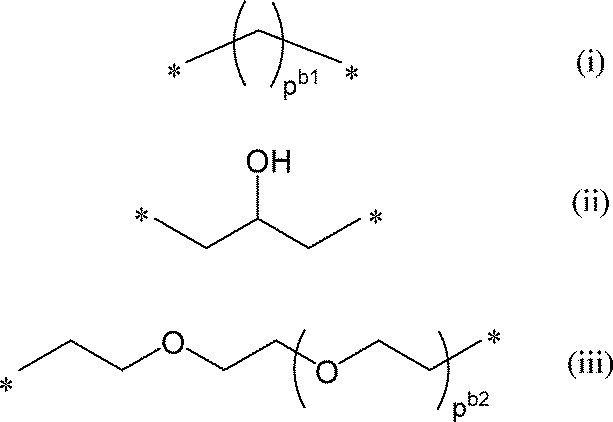
(式中、pb1はメチレン基の繰り返し単位数を表し、2~18の整数である。pb2はオキシエチレン基の繰り返し単位数を表し、0又は1である。*は結合部位である。)
前記pb2は、1が好ましい。
また、本実施形態の熱硬化性樹脂組成物における(b)成分の含有量は、特に制限されるものではないが、耐熱性、耐デスミア性、低熱膨張性及び銅箔接着性の観点から、(a)成分100質量部に対して、5~85質量部が好ましく、7~60質量部がより好ましく、10~45質量部がさらに好ましく、15~35質量部が特に好ましい。
本実施形態の熱硬化性樹脂組成物は、(c)ベンゾオキサジン化合物を含有するものである。
なお、本実施形態におけるベンゾオキサジン化合物とは、分子中にベンゾオキサジン環を少なくとも1個以上有する化合物を意味する。ここでのベンゾオキサジン環とは、結合する水素原子が置換基で置換されているものも含む概念である。
本実施形態の熱硬化性樹脂組成物は、(c)ベンゾオキサジン化合物を含有することにより、良好な耐熱性を有しながらも、優れた銅箔接着性を得ることができる。その原因は定かではないが、ベンゾオキサジン化合物が(a)成分の硬化剤として作用することにより(a)成分の硬化度が向上すること、ベンゾオキサジン化合物由来のヘテロ原子により銅との静電相互作用が向上すること等が原因と推測される。
(c)成分は、1種を単独で使用してもよいし、2種以上を併用してもよい。
(c)成分としては、公知のベンゾオキサジン化合物を用いることができ、例えば、P-d型ベンゾオキサジン化合物、F-a型ベンゾオキサジン化合物、ALP-d型ベンゾオキサジン化合物、T-ala型ベンゾオキサジン化合物等が挙げられる。

(式中、Rc1及びRc2は、各々独立に、炭素数1~10の炭化水素基である。Xc1は、炭素数1~5のアルキレン基、炭素数2~5のアルキリデン基、-O-、スルホニル基、カルボニルオキシ基、-C(=O)-又は単結合である。nc1及びnc2は、各々独立に、0~4の整数である。)
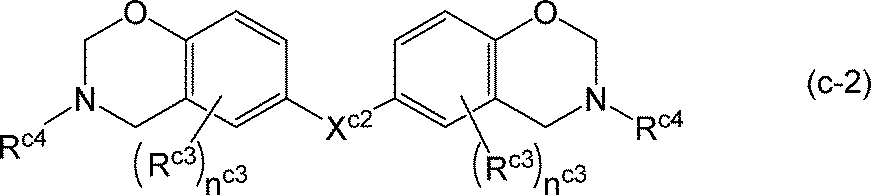
(式中、Rc3は、各々独立に、炭素数1~10の炭化水素基である。Rc4は、各々独立に、炭素数1~10の炭化水素基又は水素原子である。Xc2は、炭素数1~5のアルキレン基、炭素数2~5のアルキリデン基、-O-、スルホニル基、カルボニルオキシ基、-C(=O)-又は単結合である。nc3は、0~3の整数である。)

(式中、Rc5は、炭素数1~10の炭化水素基である。Rc6は、炭素数1~10の炭化水素基又は水素原子である。nc4は、0~4の整数である。)
上記一般式(c-1)中、nc1及びnc2は、各々独立に、0~4の整数であり、入手容易性の観点から、0~2の整数が好ましく、0がより好ましい。nc1及びnc2が2以上の整数である場合、複数のRc1同士及び複数のRc2同士は、同一であっても異なっていてもよい。
上記一般式(c-1)中、Xc1が表す炭素数1~5のアルキレン基としては、例えば、メチレン基、1,2-ジメチレン基、1,3-トリメチレン基、1,4-テトラメチレン基、1,5-ペンタメチレン基等が挙げられる。該アルキレン基としては、炭素数1~3のアルキレン基が好ましく、メチレン基がより好ましい。
上記一般式(c-1)中、Xc1が表す炭素数2~5のアルキリデン基としては、例えば、エチリデン基、プロピリデン基、イソプロピリデン基、ブチリデン基、イソブチリデン基、ペンチリデン基、イソペンチリデン基等が挙げられる。これらの中でも、イソプロピリデン基が好ましい。
上記一般式(c-2)中、nc3は、0~3の整数であり、入手容易性の観点から、0~2の整数が好ましく、0がより好ましい。
上記一般式(c-2)中、Xc2が表す炭素数1~5のアルキレン基及び炭素数2~5のアルキリデン基としては、上記一般式(c-1)中のXc1が表す炭素数1~5のアルキレン基及び炭素数2~5のアルキリデン基と同じものが挙げられる。
上記一般式(c-2)中、Rc4が表す炭素数1~10の炭化水素基としては、例えば、メチル基、エチル基、n-プロピル基、イソプロピル基、n-ブチル基、イソブチル基、t-ブチル基、n-ペンチル基等のアルキル基;フェニル基、ナフチル基等の芳香族炭化水素基などが挙げられる。これらの中でも、芳香族炭化水素基が好ましく、フェニル基がより好ましい。
上記一般式(c-3)中、nc4は、0~4の整数であり、入手容易性の観点から、0~2の整数が好ましく、0がより好ましい。nc4が2以上の整数である場合、複数のRc5同士は、同一であっても異なっていてもよい。
上記一般式(c-3)中、Rc6が表す炭素数1~10の炭化水素基としては、上記一般式(c-2)中のRc4が表す炭素数1~10の炭化水素基と同じものが挙げられる。
また、上記一般式(c-1)で表される化合物は、下記式(c-4)で表される化合物が好ましく、上記一般式(c-2)で表される化合物は、下記式(c-5)で表される化合物が好ましい。


また、本実施形態の熱硬化性樹脂組成物における(c)成分の含有量は、特に制限されるものではないが、耐熱性、低熱膨張性、成形性及び銅箔接着性の観点から、(a)成分100質量部に対して、1~30質量部が好ましく、1~20質量部がより好ましく、1~15質量部がさらに好ましく、1~10質量部が特に好ましい。
本実施形態の熱硬化性樹脂組成物は、さらに、(d)熱硬化性樹脂[以下、(d)成分と称することがある。]を含有していてもよい。本実施形態の熱硬化性樹脂組成物が(d)成分を含有することにより、特に、銅箔等の金属箔との接着性をより一層向上させることができる。なお、本実施形態における(d)熱硬化性樹脂の定義は、(a)~(c)成分を包含しないものとする。
(d)成分は、1種を単独で使用してもよいし、2種以上を併用してもよい。
これらの中でも、成形性の観点から、ナフタレン骨格含有ノボラック型エポキシ樹脂、ビフェニルアラルキル型エポキシ樹脂、ビスフェノールF型エポキシ樹脂、ビスフェノールS型エポキシ樹脂、ナフタレン型エポキシ樹脂、ジシクロペンタジエン型エポキシ樹脂がより好ましく、ビフェニルアラルキル型エポキシ樹脂がさらに好ましい。
本実施形態の熱硬化性樹脂組成物は、さらに、(e)無機充填材[以下、(e)成分と称することがある。]を含有していてもよい。本実施形態の熱硬化性樹脂組成物が(e)成分を含有することにより、低熱膨張性、耐デスミア性等がより一層優れたものになる。
(e)成分は、1種を単独で使用してもよいし、2種以上を併用してもよい。
これらの中でも、誘電特性、耐熱性及び低熱膨張性の観点から、シリカが好ましい。シリカとしては、例えば、湿式法で製造された含水率の高い沈降シリカと、乾式法で製造された結合水等をほとんど含まない乾式法シリカが挙げられる。乾式法シリカとしては、さらに、製造法の違いにより、破砕シリカ、フュームドシリカ、溶融球状シリカ等に分類される。これらの中でも、低熱膨張性及び樹脂に充填した際の流動性の観点から、溶融球状シリカが好ましい。
カップリング剤としては、シラン系カップリング剤、チタネート系カップリング剤、シリコーンオリゴマー等が挙げられ、これらの中でも、シラン系カップリング剤が好ましく、アミノシラン系カップリング剤がより好ましい。
ここで、本実施形態における平均粒子径とは、粒子の全体積を100%として粒子径による累積度数分布曲線を求めたとき、体積50%に相当する点の粒子径のことであり、レーザー回折散乱法を用いた粒度分布測定装置等で測定することができる。
本実施形態の熱硬化性樹脂組成物は、本発明の目的に反しない範囲で、例えば、熱可塑性樹脂、硬化促進剤、有機充填材、難燃剤、紫外線吸収剤、過酸化物、酸化防止剤、光重合開始剤、蛍光増白剤及び接着性向上剤からなる群から選択される1種以上を含有していてもよい。なお、これらのその他の成分は、各々について、1種を単独で用いてもよく、2種以上を併用してもよい。
過酸化物としては、(a)成分と(b)成分の反応を促進するものが好ましく、例えば、α,α’-ジ(t-ブチルパーオキシ)ジイソプロピルベンゼン等の有機過酸化物などが挙げられる。
酸化防止剤としては、例えば、ヒンダードフェノール系酸化防止剤、ヒンダードアミン系酸化防止剤等が挙げられる。
光重合開始剤としては、例えば、ベンゾフェノン類、ベンジルケタール類、チオキサントン系等の光重合開始剤が挙げられる。
蛍光増白剤としては、例えば、スチルベン誘導体の蛍光増白剤等が挙げられる。
接着性向上剤としては、例えば、尿素シラン等の尿素化合物、上記カップリング剤などが挙げられる。
本実施形態の熱硬化性樹脂組成物は、プリプレグ等の製造に用いるために、各成分が有機溶媒中に溶解又は分散されたワニスの状態としてもよい。つまり、ワニスも本実施形態の熱硬化性樹脂組成物に含まれる。
ワニスに用いる有機溶媒としては、例えば、メタノール、エタノール、プロパノール、ブタノール、メチルセロソルブ、ブチルセロソルブ、プロピレングリコールモノメチルエーテル等のアルコール系溶媒;アセトン、メチルエチルケトン、メチルイソブチルケトン、シクロヘキサノン等のケトン系溶媒;酢酸ブチル、プロピレングリコールモノメチルエーテルアセテート等のエステル系溶媒;テトラヒドロフラン等のエーテル系溶媒;トルエン、キシレン、メシチレン等の芳香族系溶媒;ジメチルホルムアミド、ジメチルアセトアミド、N-メチルピロリドン等の窒素原子含有溶媒;ジメチルスルホキシド等の硫黄原子含有溶媒などが挙げられる。有機溶媒は、1種を単独で使用してもよいし、2種以上を併用してもよい。
これらの中でも、溶解性の観点から、メチルエチルケトン、メチルイソブチルケトン、シクロヘキサノン、メチルセロソルブ、プロピレングリコールモノメチルエーテルが好ましく、低毒性である点から、メチルイソブチルケトン、シクロヘキサノン、プロピレングリコールモノメチルエーテルがより好ましい。
ワニスの固形分濃度は、40~90質量%が好ましく、50~80質量%がより好ましい。ワニスの固形分濃度が上記範囲内であると、塗工性を良好に保ち、適切な熱硬化性樹脂組成物付着量のプリプレグを得ることができる。
本実施形態のプリプレグは、本実施形態の熱硬化性樹脂組成物を含有してなるものであり、より詳細には、Bステージ化した熱硬化性樹脂組成物を含有するものである。
本実施形態のプリプレグは、例えば、本実施形態の熱硬化性樹脂組成物を、繊維基材に含浸し、加熱等により半硬化(Bステージ化)して製造することができる。
上記繊維基材としては、各種の電気絶縁材料用積層板に用いられている周知のものが使用できる。その材質の例としては、Eガラス、Sガラス、低誘電ガラス、Qガラス等の無機物繊維;低誘電ガラスポリイミド、ポリエステル、テトラフルオロエチレン等の有機繊維;並びにそれらの混合物などが挙げられる。特に、誘電特性が優れる基材を得る観点から、低誘電ガラス、Qガラスが好ましい。
本実施形態のプリプレグは、熱硬化性樹脂組成物を繊維基材に含浸した後、通常、100~200℃の温度で1~30分間加熱乾燥し、半硬化(Bステージ化)させて得ることができる。
本実施形態の積層板は、本実施形態のプリプレグを含有してなる積層板である。
本実施形態の積層板は、本実施形態のプリプレグを積層成形することで得られる。具体的には、例えば、本実施形態のプリプレグ1枚を準備するか又は2~20枚重ねたものを準備し、その片面又は両面に銅、アルミニウム等の金属箔を配置した構成で積層成形することにより製造することができる。該製造方法により、本実施形態のプリプレグを用いて形成された絶縁層と、その片面又は両面に配置された金属箔と、を有する積層板が得られる。金属箔は、電気絶縁材料用途で用いられるものであれば特に制限されない。なお、積層板の片面又は両面に金属箔が配置された構成を有する積層板を、特に、金属張り積層板と称する。
積層板を製造する際の成形条件は、例えば、電気絶縁材料用積層板及び多層板の手法を適用することができる。
成形装置としては、多段プレス、多段真空プレス、連続成形、オートクレーブ成形機等が挙げられる。
成形条件としては、例えば、温度100~250℃、圧力0.2~10MPa、加熱時間0.1~5時間の範囲で成形することができる。
また、本実施形態のプリプレグと内層用配線板とを組合せ、積層成形して、積層板を製造することもできる。
本実施形態のプリント配線板は、本実施形態の積層板を含有してなるプリント配線板である。
本実施形態のプリント配線板は、例えば、本実施形態の金属張り積層板を回路加工して製造することができる。
回路加工方法としては、例えば、サブトラクティブ法、フルアディティブ法、セミアディティブ法(SAP:Semi Additive Process)、モディファイドセミアディティブ法(m-SAP:modified Semi Additive Process)等の公知の方法が挙げられる。また、本実施形態のプリプレグを介して、配線加工した積層板を複数積層し、加熱プレス加工することによって一括して多層化することもできる。その後、ドリル加工又はレーザー加工によるスルーホール又はブラインドビアホールの形成と、めっき又は導電性ペーストによる層間配線の形成を経て、多層プリント配線板を製造することもできる。
本実施形態の半導体パッケージは、本実施形態のプリント配線板に半導体素子を搭載してなる半導体パッケージである。
本実施形態の半導体パッケージは、例えば、本実施形態のプリント配線板の所定の位置に半導体チップ、メモリ等の半導体素子を搭載し、封止樹脂等によって半導体素子を封止することによって製造することができる。
なお、各例で得られた銅張積層板は、以下の方法で性能を測定及び評価した。
銅張積層板を銅エッチング液に浸漬することにより銅箔を取り除いた幅4mm×長さ30mm×厚さ0.4mmの評価基板を作製し、動的粘弾性測定装置(株式会社ユービーエム製、商品名:DVE-V4)を用いてガラス転移温度を測定した。上記で作製された評価基板を検出器に取り付け、昇温速度5℃/分、周波数10Hz、測定温度範囲40~360℃の測定条件にて測定し、損失弾性率が最大になる温度をガラス転移温度とした。ガラス転移温度が高いほど、耐熱性に優れることを示す。なお、損失弾性率が360℃を超えた場合は「>360」として表1に記載した。
銅張積層板を25mm角の大きさに切り出した評価基板を作製し、該評価基板を温度288℃のはんだ浴に、最大で90分間フロートしながら、外観を観察することにより、膨れが発生するまでの時間を測定した。評価結果は、90分間フロートした時点で膨れが確認されなかったものを「A」として表1に記載した。
銅張積層板を銅エッチング液に浸漬することにより銅箔を取り除いた5mm×5mm角の評価基板を作製し、TMA試験装置(ティー・エイ・インスツルメント・ジャパン株式会社製、TMAQ400EM)を用いて圧縮法で熱機械分析を行った。評価基板を上記装置に装着後、昇温速度10℃/分で260℃まで昇温し、降温速度10℃/分で10℃まで降温した後、再度、昇温速度10℃/分で320℃まで昇温した。1回目の昇温時と2回目の昇温時の合計2回、熱膨張率を測定した。2回目の測定における30℃から100℃までの平均熱膨張率を算出し、これを熱膨張率の値とした。
銅張積層板を銅エッチング液に浸漬することにより銅箔を取り除いた40mm×40mmの評価基板を、膨潤液である「スエリングディップ・セキュリガントP」(グリコールエーテル類、水酸化ナトリウムの水溶液、アトテックジャパン株式会社製)に60℃で10分間浸漬し、次に粗化液である「コンセントレート・コンパクトP」(KMnO4:60g/L、NaOH:40g/Lの水溶液、アトテックジャパン株式会社製)に80℃で20分間浸漬し、最後に中和液である「リダクションショリューシン・セキュリガントP」(硫酸の水溶液、アトテックジャパン株式会社製)に40℃で5分間浸漬し、その後、80℃で10分間乾燥することで、デスミア処理を行った。
デスミア処理前の乾燥重量に対するデスミア処理後の重量減少量(g/m2)を算出し、これを耐デスミア性の指標とした。デスミア処理後の重量減少量が小さい程、耐デスミア性に優れる。
銅張積層板を銅エッチング液に浸漬することにより銅箔を取り除いた幅10mm×長さ100mm×厚さ0.4mmの評価基板を作製した。該評価基板の最表面の絶縁層の一端を、該絶縁層が積層されている絶縁層との界面で剥がして、剥がした部分をつかみ具でつかみ、引張り試験機を用いて垂直方向に引き剥がしたときの層間ピール強度を測定した。なお、引張り速度は約50mm/分、測定温度は室温とした。
銅張積層板を銅エッチング液に浸漬することにより、外層銅箔を3mm幅に形成した評価基板を作製した。該評価基板の一端を外層銅層と絶縁層との界面で剥がして、剥がした部分をつかみ具でつかみ、引張り試験機を用いて垂直方向に引き剥がしたときの銅箔ピール強度を測定した。なお、引張り速度は約50mm/分、測定温度は室温とした。
(1.アゾメチン変性シロキサン[(a2’)成分]の合成)
温度計、撹拌装置及び還流冷却管付き水分定量器を備えた容積2Lの反応容器に、両末端アミノ変性シリコーン「XF42-C5379」(商品名、モメンティブ・パフォーマンス・マテリアルズ・ジャパン合同会社製、官能基当量:740g/eq)592質量部、テレフタルアルデヒド33質量部及びプロピレングリコールモノメチルエーテル939質量部を投入し、115℃で2時間反応した。その後、125℃まで昇温して、常圧濃縮により脱水し、アゾメチン変性シロキサン含有溶液を得た。
(2.変性マレイミド樹脂(A)の合成)
温度計、撹拌装置及び還流冷却管付き水分定量器を備えた内容積2Lの反応容器に、上記アゾメチン変性シロキサン含有溶液119質量部(固形分換算量)、2,2-ビス[4-(4-マレイミドフェノキシ)フェニル]プロパン((a1)成分)161質量部、プロピレングリコールモノメチルエーテル376質量部を投入し、120℃で4時間反応させて変性マレイミド樹脂(A)[以下、変性マレイミド樹脂(a-1)と称する。]含有溶液を得た。
希釈溶媒としてメチルエチルケトンを使用し、表1に記載された配合組成で各成分を混合してから6時間撹拌し、固形分濃度(すなわち、有機溶媒を除く熱硬化性樹脂組成物の含有量)65質量%のワニスを調製した。
次に、得られたワニスを厚さ0.1mmのEガラスクロスに含浸塗工し、110℃で3分間加熱乾燥することにより、熱硬化性樹脂組成物の含有量が47~48質量%のプリプレグを得た。
このプリプレグを4枚重ね、12μmの電解銅箔を上下に配置し、圧力3.0MPa、昇温速度4.0℃/分で240℃まで昇温後、85分間保持し、放圧後、30分間冷却することによって銅張積層板を得た。得られた銅張積層板を用いて、上記測定及び評価を行った。結果を表1に示す。
[(a)成分:少なくとも1個のN-置換マレイミド基を有する化合物]
変性マレイミド樹脂(a-1):合成例1で合成した変性マレイミド樹脂(a-1)
アリル化フェノール樹脂:群栄化学工業株式会社製「LVA01」、下記式(b-8)で表される化合物。

3,3’-(メチレン-1,4-ジフェニレン)ビス(3,4-ジヒドロ-2H-1,3-ベンゾオキサジン):P-d型ベンゾオキサジン化合物、上記式(c-4)で表される化合物
ビフェニルアラルキル型エポキシ樹脂:日本化薬株式会社製、商品名「NC-3000-H」
溶融球状シリカ:平均粒子径0.5μm
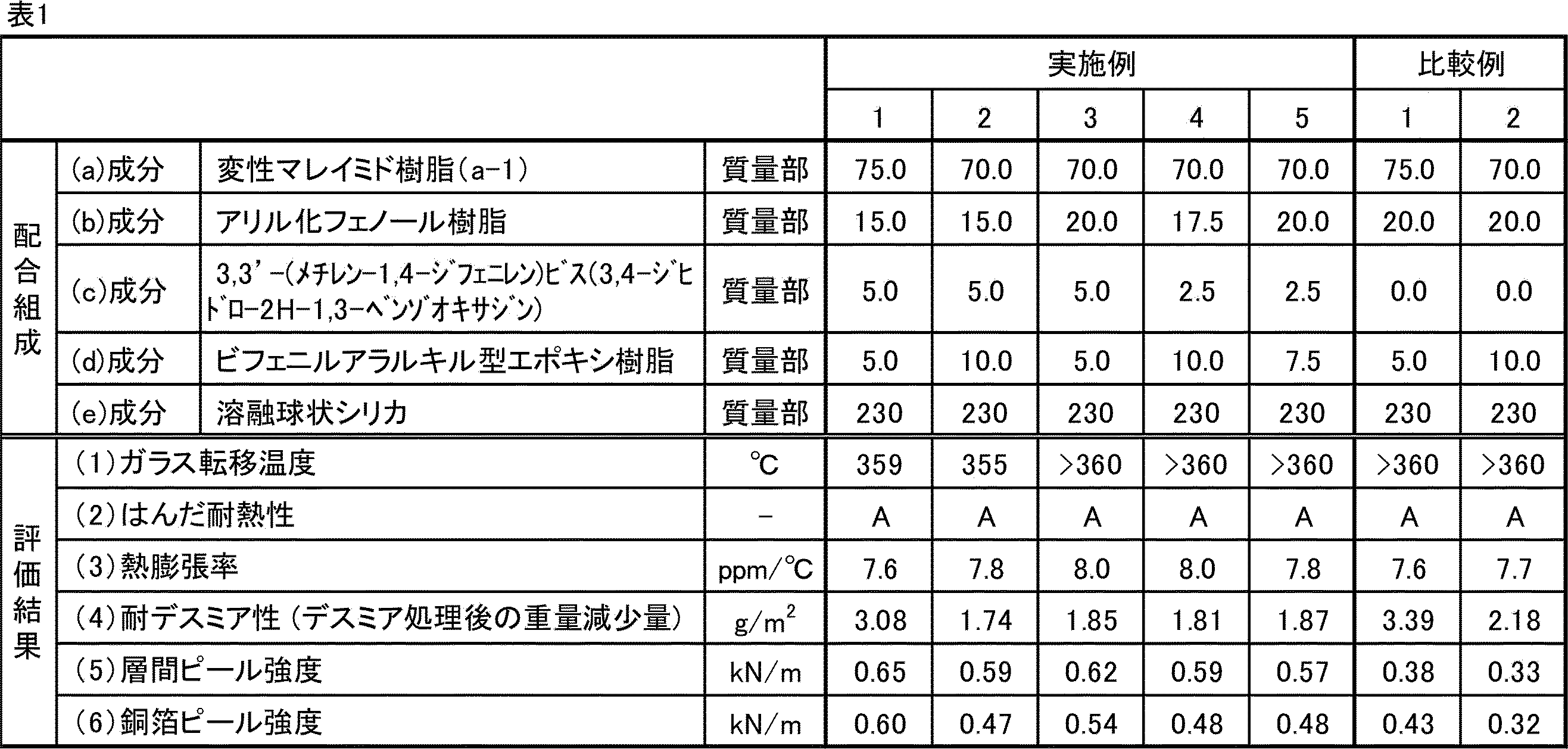
また、本実施形態の熱硬化性樹脂組成物を用いた実施例2~5は、(c)成分を含有しない比較例2に対して、同等のガラス転移温度、はんだ耐熱性、熱膨張率を有しながらも、耐デスミア性、層間ピール強度及び銅箔ピール強度が向上していることが分かる。
以上より、本実施形態の熱硬化性樹脂組成物が、良好な耐熱性を有しながらも、銅箔接着性に優れるものであることが分かる。
Claims (14)
- (a)少なくとも1個のN-置換マレイミド基を有する化合物、
(b)少なくとも2個の不飽和脂肪族炭化水素基を有する化合物、及び
(c)ベンゾオキサジン化合物、
を含有する、熱硬化性樹脂組成物。 - 前記(a)成分が、(a1)少なくとも2個のN-置換マレイミド基を有する化合物と、(a2)少なくとも2個の1級アミノ基を有するシリコーン化合物と、の反応物である、請求項1に記載の熱硬化性樹脂組成物。
- 前記(b)成分が、少なくとも3個の不飽和脂肪族炭化水素基を有する化合物である、請求項1又は2に記載の熱硬化性樹脂組成物。
- 前記(b)成分が有する不飽和脂肪族炭化水素基が、アリル基及び1-プロペニル基からなる群から選択される1種以上である、請求項1~3のいずれか1項に記載の熱硬化性樹脂組成物。
- 前記(c)成分が、下記一般式(c-1)で表される化合物である、請求項1~4のいずれか1項に記載の熱硬化性樹脂組成物。

(式中、Rc1及びRc2は、各々独立に、炭素数1~10の炭化水素基である。Xc1は、炭素数1~5のアルキレン基、炭素数2~5のアルキリデン基、-O-、スルホニル基、カルボニルオキシ基、-C(=O)-又は単結合である。nc1及びnc2は、各々独立に、0~4の整数である。) - 前記(b)成分の含有量が、前記(a)成分100質量部に対して、5~85質量部である、請求項1~5のいずれか1項に記載の熱硬化性樹脂組成物。
- 前記(c)成分の含有量が、前記(a)成分100質量部に対して、1~30質量部である、請求項1~6のいずれか1項に記載の熱硬化性樹脂組成物。
- 前記(b)成分と前記(c)成分との含有量比〔(b)成分/(c)成分〕が、質量比で、1~15である、請求項1~7のいずれか1項に記載の熱硬化性樹脂組成物。
- さらに、(d)熱硬化性樹脂として、エポキシ樹脂を含有する、請求項1~8のいずれか1項に記載の熱硬化性樹脂組成物。
- さらに、(e)無機充填材を含有する、請求項1~9のいずれか1項に記載の熱硬化性樹脂組成物。
- 請求項1~10のいずれか1項に記載の熱硬化性樹脂組成物を含有してなるプリプレグ。
- 請求項11に記載のプリプレグを含有してなる積層板。
- 請求項12に記載の積層板を含有してなるプリント配線板。
- 請求項13に記載のプリント配線板に半導体素子を搭載してなる半導体パッケージ。
Priority Applications (3)
| Application Number | Priority Date | Filing Date | Title |
|---|---|---|---|
| KR1020227022856A KR20220131515A (ko) | 2020-01-22 | 2021-01-20 | 열경화성 수지 조성물, 프리프레그, 적층판, 프린트 배선판 및 반도체 패키지 |
| JP2021572749A JP7666335B2 (ja) | 2020-01-22 | 2021-01-20 | 熱硬化性樹脂組成物、プリプレグ、積層板、プリント配線板及び半導体パッケージ |
| CN202180007708.8A CN114901751A (zh) | 2020-01-22 | 2021-01-20 | 热固化性树脂组合物、预浸渍体、层叠板、印刷线路板及半导体封装体 |
Applications Claiming Priority (2)
| Application Number | Priority Date | Filing Date | Title |
|---|---|---|---|
| JP2020-008469 | 2020-01-22 | ||
| JP2020008469 | 2020-01-22 |
Publications (1)
| Publication Number | Publication Date |
|---|---|
| WO2021149698A1 true WO2021149698A1 (ja) | 2021-07-29 |
Family
ID=76992979
Family Applications (1)
| Application Number | Title | Priority Date | Filing Date |
|---|---|---|---|
| PCT/JP2021/001766 Ceased WO2021149698A1 (ja) | 2020-01-22 | 2021-01-20 | 熱硬化性樹脂組成物、プリプレグ、積層板、プリント配線板及び半導体パッケージ |
Country Status (5)
| Country | Link |
|---|---|
| JP (1) | JP7666335B2 (ja) |
| KR (1) | KR20220131515A (ja) |
| CN (1) | CN114901751A (ja) |
| TW (1) | TWI874565B (ja) |
| WO (1) | WO2021149698A1 (ja) |
Cited By (1)
| Publication number | Priority date | Publication date | Assignee | Title |
|---|---|---|---|---|
| JP2023094095A (ja) * | 2021-12-23 | 2023-07-05 | 株式会社トクヤマ | 硬化性樹脂組成物 |
Citations (7)
| Publication number | Priority date | Publication date | Assignee | Title |
|---|---|---|---|---|
| WO2010055811A1 (ja) * | 2008-11-13 | 2010-05-20 | 東邦テナックス株式会社 | 熱硬化性樹脂組成物とそれを用いたプリプレグ |
| JP2014523953A (ja) * | 2011-07-28 | 2014-09-18 | プロタヴィック コリア カンパニー リミテッド | フレキシブルなビスマレイミド、ベンズオキサジン、エポキシ−無水物付加生成物複合接着剤 |
| JP2015017158A (ja) * | 2013-07-09 | 2015-01-29 | 三菱瓦斯化学株式会社 | 硬化性樹脂組成物、およびその硬化物 |
| JP2016132738A (ja) * | 2015-01-20 | 2016-07-25 | 日立化成株式会社 | 熱硬化性樹脂組成物、プリプレグ、樹脂付フィルム、積層板、多層プリント配線板及び半導体パッケージ |
| JP2017149859A (ja) * | 2016-02-25 | 2017-08-31 | 日立化成株式会社 | 熱硬化性樹脂組成物、プリプレグ、銅張積層板及びプリント配線板 |
| WO2019078300A1 (ja) * | 2017-10-20 | 2019-04-25 | 日本化薬株式会社 | 硬化性樹脂組成物、ワニス、プリプレグ、硬化物、及び、積層板または銅張積層板 |
| JP2019099755A (ja) * | 2017-12-07 | 2019-06-24 | 信越化学工業株式会社 | 熱硬化性樹脂組成物 |
Family Cites Families (4)
| Publication number | Priority date | Publication date | Assignee | Title |
|---|---|---|---|---|
| JP2013224341A (ja) | 2012-04-19 | 2013-10-31 | Kaneka Corp | 熱硬化性樹脂組成物及び有機溶剤を含有する半導体コーティング材料ならびにそれを塗布した被膜を有する半導体素子 |
| JP6357762B2 (ja) * | 2012-11-28 | 2018-07-18 | 日立化成株式会社 | 変性シロキサン化合物、熱硬化性樹脂組成物、プリプレグ、樹脂付きフィルム、積層板、多層プリント配線板及び半導体パッケージ |
| WO2017170844A1 (ja) | 2016-04-01 | 2017-10-05 | 日本化薬株式会社 | 熱硬化性樹脂組成物、プリプレグ及びその硬化物 |
| US10876000B2 (en) * | 2016-06-02 | 2020-12-29 | Showa Denko Materials Co., Ltd. | Thermosetting resin composition, prepreg, laminated board, printed wiring board, and high speed communication-compatible module |
-
2021
- 2021-01-20 CN CN202180007708.8A patent/CN114901751A/zh active Pending
- 2021-01-20 KR KR1020227022856A patent/KR20220131515A/ko active Pending
- 2021-01-20 WO PCT/JP2021/001766 patent/WO2021149698A1/ja not_active Ceased
- 2021-01-20 JP JP2021572749A patent/JP7666335B2/ja active Active
- 2021-01-21 TW TW110102262A patent/TWI874565B/zh active
Patent Citations (7)
| Publication number | Priority date | Publication date | Assignee | Title |
|---|---|---|---|---|
| WO2010055811A1 (ja) * | 2008-11-13 | 2010-05-20 | 東邦テナックス株式会社 | 熱硬化性樹脂組成物とそれを用いたプリプレグ |
| JP2014523953A (ja) * | 2011-07-28 | 2014-09-18 | プロタヴィック コリア カンパニー リミテッド | フレキシブルなビスマレイミド、ベンズオキサジン、エポキシ−無水物付加生成物複合接着剤 |
| JP2015017158A (ja) * | 2013-07-09 | 2015-01-29 | 三菱瓦斯化学株式会社 | 硬化性樹脂組成物、およびその硬化物 |
| JP2016132738A (ja) * | 2015-01-20 | 2016-07-25 | 日立化成株式会社 | 熱硬化性樹脂組成物、プリプレグ、樹脂付フィルム、積層板、多層プリント配線板及び半導体パッケージ |
| JP2017149859A (ja) * | 2016-02-25 | 2017-08-31 | 日立化成株式会社 | 熱硬化性樹脂組成物、プリプレグ、銅張積層板及びプリント配線板 |
| WO2019078300A1 (ja) * | 2017-10-20 | 2019-04-25 | 日本化薬株式会社 | 硬化性樹脂組成物、ワニス、プリプレグ、硬化物、及び、積層板または銅張積層板 |
| JP2019099755A (ja) * | 2017-12-07 | 2019-06-24 | 信越化学工業株式会社 | 熱硬化性樹脂組成物 |
Cited By (2)
| Publication number | Priority date | Publication date | Assignee | Title |
|---|---|---|---|---|
| JP2023094095A (ja) * | 2021-12-23 | 2023-07-05 | 株式会社トクヤマ | 硬化性樹脂組成物 |
| JP7742770B2 (ja) | 2021-12-23 | 2025-09-22 | 株式会社トクヤマ | 硬化性樹脂組成物 |
Also Published As
| Publication number | Publication date |
|---|---|
| JPWO2021149698A1 (ja) | 2021-07-29 |
| JP7666335B2 (ja) | 2025-04-22 |
| TWI874565B (zh) | 2025-03-01 |
| TW202136415A (zh) | 2021-10-01 |
| CN114901751A (zh) | 2022-08-12 |
| KR20220131515A (ko) | 2022-09-28 |
Similar Documents
| Publication | Publication Date | Title |
|---|---|---|
| JP6969843B2 (ja) | 樹脂組成物、及びこれを用いたプリプレグ、積層板、プリント配線板 | |
| JP6160675B2 (ja) | 樹脂組成物、これを用いたプリプレグ、積層板及びプリント配線板 | |
| WO2021132495A1 (ja) | 熱硬化性樹脂組成物、プリプレグ、積層板、プリント配線板及び半導体パッケージ | |
| CN112313281B (zh) | 热固化性树脂组合物、预浸渍体、层叠板、印刷线路板、半导体封装体以及热固化性树脂组合物的制造方法 | |
| JP7081127B2 (ja) | 熱硬化性樹脂組成物、プリプレグ、積層板、プリント配線板及び高速通信対応モジュール | |
| JP6259557B2 (ja) | 熱硬化性樹脂組成物、及びこれを用いたプリプレグ、積層板、プリント配線板 | |
| JP7103350B2 (ja) | コアレス基板用プリプレグ、コアレス基板、コアレス基板の製造方法及び半導体パッケージ | |
| JP6950233B2 (ja) | ビルドアップフィルム接着用熱硬化性樹脂組成物、熱硬化性樹脂組成物、プリプレグ、積層体、積層板、多層プリント配線板及び半導体パッケージ | |
| JP6299433B2 (ja) | 熱硬化性樹脂組成物、プリプレグ、樹脂付フィルム、積層板、多層プリント配線板及び半導体パッケージ | |
| JP7666335B2 (ja) | 熱硬化性樹脂組成物、プリプレグ、積層板、プリント配線板及び半導体パッケージ | |
| JP7243077B2 (ja) | プリプレグ、プリプレグの硬化物、積層板、プリント配線板及び半導体パッケージ | |
| JP2019099711A (ja) | 熱硬化性樹脂組成物、プリプレグ、積層板、プリント配線板及び高速通信対応モジュール | |
| JP7670048B2 (ja) | プリント配線板用熱硬化性樹脂組成物、プリプレグ、積層板、プリント配線板及び半導体パッケージ | |
| JP2021181505A (ja) | 樹脂組成物、プリプレグ、積層板、多層プリント配線板及び半導体パッケージ並びに多層プリント配線板の製造方法 | |
| KR20230129430A (ko) | 열경화성 수지 조성물, 프리프레그, 적층판, 금속 피복적층판, 프린트 배선판 및 고속 통신 대응 모듈 | |
| WO2024080195A1 (ja) | プリプレグ、積層板、プリント配線板及び半導体パッケージ | |
| JP2026016525A (ja) | 樹脂組成物、樹脂フィルム、樹脂付き金属箔、プリプレグ、積層板、多層プリント配線板及び半導体パッケージ | |
| HK40016036A (en) | Coreless substrate prepreg, coreless substrate, coreless substrate manufacturing method and semiconductor package | |
| JP2017071794A (ja) | 熱硬化性樹脂組成物、及びこれを用いたプリプレグ、積層板、プリント配線板 |
Legal Events
| Date | Code | Title | Description |
|---|---|---|---|
| 121 | Ep: the epo has been informed by wipo that ep was designated in this application |
Ref document number: 21743840 Country of ref document: EP Kind code of ref document: A1 |
|
| ENP | Entry into the national phase |
Ref document number: 2021572749 Country of ref document: JP Kind code of ref document: A |
|
| NENP | Non-entry into the national phase |
Ref country code: DE |
|
| 32PN | Ep: public notification in the ep bulletin as address of the adressee cannot be established |
Free format text: NOTING OF LOSS OF RIGHTS PURSUANT TO RULE 112(1) EPC (EPO FORM 1205A DATED 18/10/2022) |
|
| 122 | Ep: pct application non-entry in european phase |
Ref document number: 21743840 Country of ref document: EP Kind code of ref document: A1 |