WO2021132406A1 - 電極および電池 - Google Patents
電極および電池 Download PDFInfo
- Publication number
- WO2021132406A1 WO2021132406A1 PCT/JP2020/048307 JP2020048307W WO2021132406A1 WO 2021132406 A1 WO2021132406 A1 WO 2021132406A1 JP 2020048307 W JP2020048307 W JP 2020048307W WO 2021132406 A1 WO2021132406 A1 WO 2021132406A1
- Authority
- WO
- WIPO (PCT)
- Prior art keywords
- electrode
- solid electrolyte
- current collector
- electrolyte material
- battery
- Prior art date
- Legal status (The legal status is an assumption and is not a legal conclusion. Google has not performed a legal analysis and makes no representation as to the accuracy of the status listed.)
- Ceased
Links
Images

Classifications
-
- H—ELECTRICITY
- H01—ELECTRIC ELEMENTS
- H01M—PROCESSES OR MEANS, e.g. BATTERIES, FOR THE DIRECT CONVERSION OF CHEMICAL ENERGY INTO ELECTRICAL ENERGY
- H01M4/00—Electrodes
- H01M4/02—Electrodes composed of, or comprising, active material
- H01M4/13—Electrodes for accumulators with non-aqueous electrolyte, e.g. for lithium-accumulators; Processes of manufacture thereof
- H01M4/131—Electrodes based on mixed oxides or hydroxides, or on mixtures of oxides or hydroxides, e.g. LiCoOx
-
- H—ELECTRICITY
- H01—ELECTRIC ELEMENTS
- H01M—PROCESSES OR MEANS, e.g. BATTERIES, FOR THE DIRECT CONVERSION OF CHEMICAL ENERGY INTO ELECTRICAL ENERGY
- H01M10/00—Secondary cells; Manufacture thereof
- H01M10/05—Accumulators with non-aqueous electrolyte
- H01M10/052—Li-accumulators
- H01M10/0525—Rocking-chair batteries, i.e. batteries with lithium insertion or intercalation in both electrodes; Lithium-ion batteries
-
- H—ELECTRICITY
- H01—ELECTRIC ELEMENTS
- H01M—PROCESSES OR MEANS, e.g. BATTERIES, FOR THE DIRECT CONVERSION OF CHEMICAL ENERGY INTO ELECTRICAL ENERGY
- H01M10/00—Secondary cells; Manufacture thereof
- H01M10/05—Accumulators with non-aqueous electrolyte
- H01M10/056—Accumulators with non-aqueous electrolyte characterised by the materials used as electrolytes, e.g. mixed inorganic/organic electrolytes
- H01M10/0561—Accumulators with non-aqueous electrolyte characterised by the materials used as electrolytes, e.g. mixed inorganic/organic electrolytes the electrolyte being constituted of inorganic materials only
- H01M10/0562—Solid materials
-
- H—ELECTRICITY
- H01—ELECTRIC ELEMENTS
- H01M—PROCESSES OR MEANS, e.g. BATTERIES, FOR THE DIRECT CONVERSION OF CHEMICAL ENERGY INTO ELECTRICAL ENERGY
- H01M4/00—Electrodes
- H01M4/02—Electrodes composed of, or comprising, active material
- H01M4/62—Selection of inactive substances as ingredients for active masses, e.g. binders, fillers
-
- H—ELECTRICITY
- H01—ELECTRIC ELEMENTS
- H01M—PROCESSES OR MEANS, e.g. BATTERIES, FOR THE DIRECT CONVERSION OF CHEMICAL ENERGY INTO ELECTRICAL ENERGY
- H01M4/00—Electrodes
- H01M4/02—Electrodes composed of, or comprising, active material
- H01M4/64—Carriers or collectors
- H01M4/66—Selection of materials
- H01M4/661—Metal or alloys, e.g. alloy coatings
- H01M4/662—Alloys
-
- H—ELECTRICITY
- H01—ELECTRIC ELEMENTS
- H01M—PROCESSES OR MEANS, e.g. BATTERIES, FOR THE DIRECT CONVERSION OF CHEMICAL ENERGY INTO ELECTRICAL ENERGY
- H01M4/00—Electrodes
- H01M4/02—Electrodes composed of, or comprising, active material
- H01M2004/026—Electrodes composed of, or comprising, active material characterised by the polarity
- H01M2004/027—Negative electrodes
-
- H—ELECTRICITY
- H01—ELECTRIC ELEMENTS
- H01M—PROCESSES OR MEANS, e.g. BATTERIES, FOR THE DIRECT CONVERSION OF CHEMICAL ENERGY INTO ELECTRICAL ENERGY
- H01M2300/00—Electrolytes
- H01M2300/0017—Non-aqueous electrolytes
- H01M2300/0065—Solid electrolytes
- H01M2300/0068—Solid electrolytes inorganic
- H01M2300/008—Halides
-
- H—ELECTRICITY
- H01—ELECTRIC ELEMENTS
- H01M—PROCESSES OR MEANS, e.g. BATTERIES, FOR THE DIRECT CONVERSION OF CHEMICAL ENERGY INTO ELECTRICAL ENERGY
- H01M4/00—Electrodes
- H01M4/02—Electrodes composed of, or comprising, active material
- H01M4/62—Selection of inactive substances as ingredients for active masses, e.g. binders, fillers
- H01M4/621—Binders
Definitions
- This disclosure relates to electrodes and batteries.
- Patent Document 1 discloses a positive electrode containing a halide solid electrolyte, a positive electrode active material, and a positive electrode current collector, and a battery. Aluminum powder is used for the positive electrode current collector.
- the present disclosure provides electrodes with improved stability.
- the electrodes in one aspect of the present disclosure are Electrode mixture layer and Electrode current collector layer and It is an electrode equipped with The electrode current collector layer is in contact with the electrode mixture layer, and is in contact with the electrode mixture layer.
- the electrode mixture layer contains a solid electrolyte material and an active material, and contains.
- the solid electrolyte material comprises Li, M, and X.
- the M is at least one selected from the group consisting of metal elements other than Li and metalloid elements.
- the X is at least one selected from the group consisting of F, Cl, Br, and I.
- the iron content in the surface material in contact with the electrode mixture layer is 50% by mass or less.
- the present disclosure provides electrodes with improved stability.
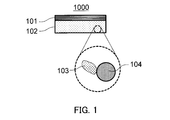
- FIG. 1 shows a cross-sectional view of the electrode 1000 according to the first embodiment.
- FIG. 2 shows a cross-sectional view of the battery 2000 according to the second embodiment.
- the electrode according to the first aspect of the present disclosure is Electrode mixture layer and Electrode current collector layer and It is an electrode equipped with The electrode current collector layer is in contact with the electrode mixture layer, and is in contact with the electrode mixture layer.
- the electrode mixture layer contains a solid electrolyte material and an active material.
- the solid electrolyte material comprises Li, M, and X.
- the M is at least one selected from the group consisting of metal elements other than Li and metalloid elements.
- the X is at least one selected from the group consisting of F, Cl, Br, and I.
- the iron content in the surface material in contact with the electrode mixture layer is 50% by mass or less.
- the electrode according to the first aspect can improve the stability.
- the iron content in the surface material may be 1.5% by mass or less.
- the electrode according to the second aspect can further improve the stability.
- the solid electrolyte material may be represented by the following composition formula (1).
- the ⁇ , the ⁇ , and the ⁇ are all values larger than 0.
- the ionic conductivity of the solid electrolyte material is improved, so that the ionic conductivity of the electrode can be improved.
- the charge / discharge characteristics of the battery can be improved.
- the M may contain yttrium.
- the charge / discharge characteristics of the battery can be further improved.
- the electrode current collector layer may contain aluminum as a main component.
- the electrode current collector layer may further contain an element other than aluminum.
- the electrode current collector layer may contain an aluminum alloy.
- Aluminum and aluminum alloys are lightweight metals with high electrical conductivity. Therefore, the electrodes according to the fifth to seventh aspects can not only improve the stability but also improve the weight energy density of the battery when used in the battery.
- the active material may be a positive electrode active material.
- the electrode according to the eighth aspect can improve the stability of the positive electrode.
- the active material may be a negative electrode active material.
- the electrode according to the ninth aspect can improve the stability of the negative electrode.
- the battery according to the tenth aspect of the present disclosure is With the positive electrode With the negative electrode An electrolyte layer arranged between the positive electrode and the negative electrode, It is a battery equipped with At least one of the positive electrode and the negative electrode selected from the group consisting of the positive electrode and the negative electrode is the electrode according to any one of the first to seventh aspects.
- the stability of the electrode can be improved.
- FIG. 1 shows a cross-sectional view of the electrode 1000 according to the first embodiment.
- the electrode 1000 in the first embodiment includes an electrode current collector layer 101 and an electrode mixture layer 102.
- the electrode current collector layer 101 is in contact with the electrode mixture layer 102.
- the electrode mixture layer 102 contains the active material 103 and the solid electrolyte material 104.
- the solid electrolyte material 104 contains Li, M, and X.
- M is at least one selected from the group consisting of metal elements other than Li and metalloid elements
- X is at least one selected from the group consisting of F, Cl, Br, and I. is there.
- the iron content in the surface material in contact with the electrode mixture layer 102 is 50% by mass or less.
- the electrode 1000 in the first embodiment suppresses a decrease in the ionic conductivity of the solid electrolyte material 104 due to charging / discharging of the battery (for example, an all-solid secondary battery), and the stability is improved.
- the surface material in contact with the electrode mixture layer 102 is the depth from the surface of the portion of the surface of the electrode current collector layer 101 that is in contact with the electrode mixture layer 102. It is a material of the electrode current collector layer 101 up to 50 nm.
- the iron content in the surface material is the ratio of the mass of iron contained in the surface material to the total mass of the surface material.
- the iron content in the surface material can be determined, for example, by scanning electron microscopy-energy dispersive X-ray spectroscopy (SEM-EDX). When the measurement by SEM-EDX is difficult, the iron content in the surface material may be determined by using, for example, X-ray photoelectron spectroscopy (XPS).
- the "metalloid elements” are B, Si, Ge, As, Sb and Te.
- metal element is used as (I) All elements contained in Groups 1 to 12 of the Periodic Table, except hydrogen, and (Ii) All elements contained in groups 13 to 16 of the periodic table, excluding B, Si, Ge, As, Sb, Te, C, N, P, O, S, and Se. Is.
- metal element and “metal element” are a group of elements that can become cations when an inorganic compound is formed with a halogen element.
- the solid electrolyte material 104 may be a halide solid electrolyte material.
- the "halide solid electrolyte material” means a solid electrolyte material containing a halogen element and not containing sulfur.
- the sulfur-free solid electrolyte material means a solid electrolyte material represented by a composition formula containing no sulfur element. Therefore, a very small amount of sulfur component, for example, a solid electrolyte material containing 0.1% by mass or less of sulfur is included in the sulfur-free solid electrolyte material.
- the halide solid electrolyte material may further contain oxygen as an anion other than the halogen element.
- the solid electrolyte material 104 is a halide solid electrolyte material containing Li, M, and X. Therefore, the solid electrolyte material 104 may be described as a halide solid electrolyte material 104.
- the electrode mixture layer 102 in the first embodiment contains a halide solid electrolyte material 104 and an active material 103.
- the halide solid electrolyte material 104, the active material 103, and the electrode mixture layer 102 will be described in detail below.
- the halide solid electrolyte material 104 is a material containing Li, M, and X. Element M and element X are as described above. According to the above configuration, the ionic conductivity of the halide solid electrolyte material 104 is further improved, so that the ionic conductivity of the electrode in the first embodiment can be further improved. Thereby, when the electrode in the first embodiment is used for a battery, the charge / discharge efficiency of the battery can be improved. In addition, the electrodes in the first embodiment can improve the thermal stability of the battery when used in the battery. Further, since the halide solid electrolyte material 104 does not contain sulfur, the electrode in the first embodiment can suppress the generation of hydrogen sulfide gas.
- the halide solid electrolyte material 104 may be a material represented by the following composition formula (1).
- ⁇ , ⁇ , and ⁇ are all values larger than 0.
- ⁇ can be, for example, 4 or 6.
- the ionic conductivity of the halide solid electrolyte material 104 is improved, so that the ionic conductivity of the electrode in the first embodiment can be improved.
- the charge / discharge efficiency of the battery can be further improved.
- the halide solid electrolyte material 104 containing Y may be represented by, for example, the following composition formula (2).
- the element Me is at least one selected from the group consisting of metal elements and metalloid elements other than Li and Y.
- m represents the valence of the element Me.
- mb is the sum of the values obtained by multiplying the composition ratio of each element by the valence of the element.
- Me is a case containing the element Me1 and the element Me2, valence of m 1 element Me1 in the composition ratio b 1 element Me1, the valence of the element Me2 the composition ratio b 2 elements Me2
- mb m 1 b 1 + m 2 b 2
- the element X is at least one selected from the group consisting of F, Cl, Br, and I.
- the element Me is, for example, at least one selected from the group consisting of Mg, Ca, Sr, Ba, Zn, Sc, Al, Ga, Bi, Zr, Hf, Ti, Sn, Ta, Gd and Nb. May be good.
- the halide solid electrolyte material 104 for example, the following materials can be used. According to the following materials, the ionic conductivity of the halide solid electrolyte material 104 is further improved, so that the ionic conductivity of the electrode 1000 in the first embodiment can be further improved. Thereby, when the electrode 1000 in the first embodiment is used for a battery, the charge / discharge efficiency of the battery can be further improved.
- the halide solid electrolyte material 104 may be a material represented by the following composition formula (A1). Li 6-3d Y d X 6 ... Equation (A1)
- the element X is at least one selected from the group consisting of Cl, Br, and I.
- d satisfies 0 ⁇ d ⁇ 2.
- the halide solid electrolyte material 104 may be a material represented by the following composition formula (A2). Li 3 YX 6 ... formula (A2)
- the element X is at least one selected from the group consisting of Cl, Br and I.
- the halide solid electrolyte material 104 may be a material represented by the following composition formula (A3). Li 3-3 ⁇ Y 1 + ⁇ Cl 6 ⁇ ⁇ ⁇ Equation (A3) Here, in the composition formula (A3), ⁇ satisfies 0 ⁇ ⁇ 0.15.
- the halide solid electrolyte material 104 may be a material represented by the following composition formula (A4). Li 3-3 ⁇ Y 1 + ⁇ Br 6 ⁇ ⁇ ⁇ Equation (A4) Here, in the composition formula (A4), ⁇ satisfies 0 ⁇ ⁇ 0.25.
- the halide solid electrolyte material 104 may be a material represented by the following composition formula (A5). Li 3-3 ⁇ + a Y 1 + ⁇ -a Me a Cl 6-xy Br x I y ⁇ ⁇ ⁇ Equation (A5)
- the element Me is at least one selected from the group consisting of Mg, Ca, Sr, Ba, and Zn.
- composition formula (A5) is -1 ⁇ ⁇ 2, 0 ⁇ a ⁇ 3, 0 ⁇ (3-3 ⁇ + a), 0 ⁇ (1 + ⁇ -a), 0 ⁇ x ⁇ 6, 0 ⁇ y ⁇ 6, and (x + y) ⁇ 6, Meet.
- the halide solid electrolyte material 104 may be a material represented by the following composition formula (A6). Li 3-3 ⁇ Y 1 + ⁇ -a Me a Cl 6-xy Br x I y ⁇ ⁇ ⁇ Equation (A6)
- the element Me is at least one selected from the group consisting of Al, Sc, Ga, and Bi.
- composition formula (A6) is -1 ⁇ ⁇ 1, 0 ⁇ a ⁇ 2, 0 ⁇ (1 + ⁇ -a), 0 ⁇ x ⁇ 6, 0 ⁇ y ⁇ 6, and (x + y) ⁇ 6, Meet.
- the halide solid electrolyte material 104 may be a material represented by the following composition formula (A7). Li 3-3 ⁇ -a Y 1 + ⁇ -a Me a Cl 6-xy Br x I y ⁇ ⁇ ⁇ Equation (A7)
- the element Me is at least one selected from the group consisting of Zr, Hf and Ti.
- composition formula (A7) is -1 ⁇ ⁇ 1, 0 ⁇ a ⁇ 1.5, 0 ⁇ (3-3 ⁇ -a), 0 ⁇ (1 + ⁇ -a), 0 ⁇ x ⁇ 6, 0 ⁇ y ⁇ 6, and (x + y) ⁇ 6, Meet.
- the halide solid electrolyte material 104 may be a material represented by the following composition formula (A8). Li 3-3 ⁇ -2a Y 1 + ⁇ -a Me a Cl 6-xy Br x I y ⁇ ⁇ ⁇ Equation (A8)
- the element Me is at least one selected from the group consisting of Ta and Nb.
- composition formula (A8) is -1 ⁇ ⁇ 1, 0 ⁇ a ⁇ 1.2, 0 ⁇ (3-3 ⁇ -2a), 0 ⁇ (1 + ⁇ -a), 0 ⁇ x ⁇ 6, 0 ⁇ y ⁇ 6, and (x + y) ⁇ 6, Meet.
- the halide solid electrolyte material 104 for example, Li 3 YX 6 , Li 2 MgX 4 , Li 2 FeX 4 , Li (Al, Ga, In) X 4 , Li 3 (Al, Ga, In). ) X 6 and the like can be used.
- the element X is at least one selected from the group consisting of F, Cl, Br, and I.
- this notation indicates at least one element selected from the element group in parentheses. That is, "(Al, Ga, In)" is synonymous with "at least one selected from the group consisting of Al, Ga, and In". The same applies to other elements.
- the shape of the halide solid electrolyte material 104 is not particularly limited, and may be, for example, needle-shaped, spherical, elliptical spherical, or the like.
- the shape of the halide solid electrolyte material 104 may be particulate.
- a binary halide is a compound composed of two kinds of elements including a halogen element.
- the raw material powder LiCl and the raw material powder YCl 3 are prepared in a molar ratio of 3: 1.
- the elemental species of "M” and "X" in the composition formula (1) can be determined.
- the values of " ⁇ ", " ⁇ ” and “ ⁇ ” in the composition formula (1) can be adjusted by adjusting the type of the raw material powder, the blending ratio of the raw material powder and the synthesis process.
- the raw material powders are reacted with each other using the method of mechanochemical milling.
- the raw material powder may be mixed and pulverized, and then sintered in a vacuum or in an inert atmosphere.
- the firing conditions may be, for example, firing in the range of 100 ° C. to 550 ° C. for 1 hour or more.
- composition of the crystal phase (that is, the crystal structure) of the halide solid electrolyte material can be adjusted or determined according to the reaction method and reaction conditions between the raw material powders.
- the active material 103 in the first embodiment is a positive electrode active material or a negative electrode active material.
- the positive electrode active material is, for example, a material having a property of occluding and releasing metal ions (for example, lithium ions).
- positive electrode active materials are lithium-containing transition metal oxides, transition metal fluorides, polyanionic materials, fluorinated polyanionic materials, transition metal sulfides, transition metal oxysulfides, transition metal oxynitrides, and the like.
- lithium-containing transition metal oxide is Li (Ni, Co, Al) O 2, Li (Ni, Co, Mn) O 2, or the like LiCoO 2.
- lithium nickel cobalt manganate may be used as the positive electrode active material.
- the positive electrode active material may be Li (Ni, Co, Mn) O 2 .
- the negative electrode active material is, for example, a material having the property of occluding and releasing metal ions (for example, lithium ions).
- negative electrode active materials are metal materials, carbon materials, oxides, nitrides, tin compounds, silicon compounds and the like.
- the metal material may be a simple substance metal or an alloy.
- metallic materials are lithium metals or lithium alloys.
- carbon materials include natural graphite, coke, developing carbon, carbon fibers, spheroidal carbon, artificial graphite, or amorphous carbon.
- the electrode mixture layer 102 contains the halide solid electrolyte material 104. According to this configuration, the ionic conductivity inside the electrode mixture layer 102 is increased, and operation at high output becomes possible.
- the median diameter of the halide solid electrolyte material 104 may be 100 ⁇ m or less.
- the active material 103 and the halide solid electrolyte material 104 can be well dispersed in the electrode mixture layer 102. This improves the charge / discharge characteristics of the battery.
- the median diameter of the halide solid electrolyte material 104 contained in the electrode mixture layer 102 may be smaller than the median diameter of the active material 103. As a result, the halide solid electrolyte material 104 and the active material 103 can be well dispersed.
- the median diameter of the active material 103 may be 0.1 ⁇ m or more and 100 ⁇ m or less.
- the median diameter of the active material is 0.1 ⁇ m or more, the active material 103 and the halide solid electrolyte material 104 can be well dispersed in the electrode mixture layer 102.
- the charge / discharge characteristics of the battery in which the electrode 1000 is used are improved.
- the median diameter of the active material 103 is 100 ⁇ m or less, the lithium diffusion rate in the active material is improved. Therefore, the battery in which the electrode 1000 is used can operate at a high output.
- the median diameter means a particle size in which the cumulative volume in the volume-based particle size distribution is 50%.
- the volume-based particle size distribution is determined by the laser diffraction / scattering method. The same applies to the following other materials.
- v1 indicates the volume fraction of the active material 103 when the total volume of the active material 103 and the solid electrolyte material 104 contained in the electrode mixture layer 102 is 100.
- 30 ⁇ v1 it is easy to secure a sufficient energy density of the battery.
- v1 ⁇ 95 the operation of the battery at high output becomes easier.
- the thickness of the electrode mixture layer 102 may be 10 ⁇ m or more and 500 ⁇ m or less. When the thickness of the electrode mixture layer 102 is 10 ⁇ m or more, it becomes easy to secure a sufficient energy density of the battery. When the thickness of the electrode mixture layer 102 is 500 ⁇ m or less, the operation of the battery at high output becomes easier.
- the active material 103 may be coated with a coating material in order to reduce the interfacial resistance with the halide solid electrolyte material 104.
- a coating material a material having low electron conductivity can be used.
- an oxide material, an oxide solid electrolyte material, or the like can be used.
- oxide material used for the coating material for example, SiO 2 , Al 2 O 3 , TiO 2 , B 2 O 3 , Nb 2 O 5 , WO 3 , ZrO 2 and the like can be used.
- oxide solid electrolyte material used for the coating material examples include Li-Nb-O compounds such as LiNbO 3 , Li-BO compounds such as LiBO 2 and Li 3 BO 3, and Li-Al- such as LiAlO 2.
- Li-Zr-O compounds, Li -Mo-O compounds such as Li 2 MoO 3 , Li-VO compounds such as LiV 2 O 5 , Li-WO compounds such as Li 2 WO 4 and the like can be used. ..
- the oxide solid electrolyte material has high ionic conductivity and high potential stability. Therefore, by using the oxide solid electrolyte material as the coating material, the charge / discharge efficiency of the battery can be further improved.
- Patent Document 1 discloses a positive electrode including a halide solid electrolyte, an active material, and a positive electrode current collector, and a battery.
- the battery disclosed in Patent Document 1 aluminum powder is used for the positive electrode current collector. That is, the positive electrode disclosed in Patent Document 1 contains a halide solid electrolyte, an active material, and an aluminum current collector. According to Patent Document 1, the positive electrode disclosed in Patent Document 1 can improve the charge / discharge efficiency of the battery by this configuration.
- Patent Document 1 does not clarify the details of the effect of the electrode containing the halide solid electrolyte, the active material, and the current collector on the stability of the electrode.
- the present inventors examined a battery containing a halide solid electrolyte material, an active material, and a current collector. As a result, the present inventors have stated that when the charge / discharge, that is, the redox reaction is repeated in a state where the halide solid electrolyte material is in contact with iron, iron corrosion occurs in the halide solid electrolyte material. I found it. Then, the present inventors have found that this causes a decrease in the ionic conductivity of the halide solid electrolyte material and an increase in the resistance of the halide solid electrolyte material, resulting in a problem that the stability of the electrode is lowered. This problem is considered to be caused by the reaction between the halide solid electrolyte material and iron.
- the reason is that the binding sites having high ionic bonding properties such as MX contained in the halide solid electrolyte material react. It is considered that such a phenomenon is unlikely to occur at a binding site having a high covalent bond, such as a PS bond possessed by a sulfide solid electrolyte material and an MO bond possessed by an oxide solid electrolyte material. .. That is, the above-mentioned problems are considered to be problems peculiar to the halide solid electrolyte material.
- the halide solid electrolyte material collects electricity by reducing the iron content of the surface material in contact with the electrode mixture layer containing the halide solid electrolyte material to 50% by mass or less with respect to the electrode current collector layer. It has been found that even in the configuration combined with the body, the decrease in ionic conductivity of the halide solid electrolyte material can be suppressed.
- the electrode 1000 according to the first embodiment in the electrode current collector layer 101, the iron content in the surface material in contact with the electrode mixture layer 102 containing the halide solid electrolyte material 104 is 50% by mass or less. is there. Thereby, the electrode 1000 in the first embodiment can improve the stability of the electrode 1000 by suppressing the decrease in the ionic conductivity of the halide solid electrolyte material 104 due to the charging and discharging of the battery.
- the iron content in the surface material in contact with the electrode mixture layer 102 containing the halide solid electrolyte material 104 is less than 7.9% by mass. May be good.
- the iron content in the above surface material is represented by atomic% (that is, at.%), And is represented by 4 at. It may be less than%.
- the iron content in the surface material in contact with the electrode mixture layer 102 containing the halide solid electrolyte material 104 is 1.5% by mass or less. May be good.
- the surface material in contact with the electrode mixture layer 102 in the electrode current collector layer 101 may be abbreviated as “surface material”.
- the iron content of the surface material of the surface of the electrode current collector layer 101, which is in contact with at least the electrode mixture layer 102, may be 0% by mass. That is, the surface material does not have to contain iron. Since the surface material does not contain iron, the decrease in ionic conductivity of the halide solid electrolyte material 104 can be further suppressed. Therefore, since the surface material does not contain iron, the electrode 1000 in the first embodiment can further improve the stability of the electrode 1000 while maintaining the high ionic conductivity of the halide solid electrolyte material 104.
- the iron content of the surface material may be 0.12% by mass or more.
- the surface material of the electrode current collector layer 101 is iron as long as the iron content of the surface material in contact with at least the electrode mixture layer 102 is 50% by mass or less. It may be contained.
- the electrode 1000 in the first embodiment realizes both the improvement of the strength of the electrode current collector layer 101 and the suppression of the decrease in the ionic conductivity of the halide solid electrolyte material 104. The stability of the electrode 1000 can be further improved.
- the surface material of the electrode current collector layer 101 is iron as long as the iron content of the surface material in contact with at least the electrode mixture layer 102 is 50% by mass or less. It may be contained.
- the electrode 1000 in the first embodiment realizes both the improvement of the strength of the electrode current collector layer 101 and the suppression of the decrease in the ionic conductivity of the halide solid electrolyte material 104. The stability of the electrode 1000 can be further improved.
- Examples of the material used for the surface material in the first embodiment are carbon (C), silicon (Si), bismuth (Bi), antimony (Sb), lead (Pb), tin (Sn), iron (Fe), and the like. Chromium (Cr), Zinc (Zn), Tantal (Ta), Nickel (Ni), Cobalt (Co), Cesium (Cd), Manganese (Mn), Zirconium (Zr), Titanium (Ti), Aluminum (Al), Berylium (Be), Lithium (Th), Magnesium (Mg), Sodium (Na), Calcium (Ca), Strontium (Sr), Barium (Ba), Potassium (K), Rubidium (Rb), Cesium (Cs), Lithium (Li), vanadium (V), tungsten (W), copper (Cu), silver (Ag), gold (Au), or platinum (Pt).
- the surface material in Embodiment 1 preferably contains at least one selected from the group consisting of carbon (C), iron (Fe), nickel (Ni), and aluminum (Al).
- the surface material may contain an alloy of the above metals.
- the surface material may contain aluminum as a main component.
- “the surface material contains aluminum as a main component” means that the aluminum content in the surface material is 50% by mass or more.
- the surface material may further contain elements other than aluminum.
- the surface material may contain an aluminum alloy.
- the surface material is made of only aluminum, that is, when the content of aluminum in the surface material is 100% by mass, the natural oxide film on the surface may increase the contact resistance with the electrode mixture layer 102. Therefore, it is desirable that the surface material contains an element other than aluminum. Further, the content of aluminum in the surface material may be 90% by mass or less, or 70% by mass or less.
- the surface materials are carbon (C), silicon (Si), bismuth (Bi), antimony (Sb), lead (Pb), tin (Sn), iron (Fe), chromium (Cr), zinc (Zn), and tantalum.
- Ti nickel (Ni), cobalt (Co), cadmium (Cd), manganese (Mn), zirconium (Zr), titanium (Ti), berylium (Be), lithium (Th), magnesium (Mg), sodium (Na), calcium (Ca), strontium (Sr), barium (Ba), potassium (K), rubidium (Rb), cesium (Cs), lithium (Li), vanadium (V), tungsten (W), copper
- It may contain at least one selected from the group consisting of (Cu), silver (Ag), gold (Au), and platinum (Pt).
- the copper content may be 4.5% by mass or less.
- the charge / discharge that is, the redox reaction is repeated in a state where the halide solid electrolyte material and copper are in contact with each other, elution, diffusion, and precipitation of copper may occur in the halide solid electrolyte material.
- the ionic conductivity of the halide solid electrolyte material may be reduced, and the reaction interface between the active material and the halide solid electrolyte material may be hindered, resulting in deterioration of the cycle characteristics of the battery.
- the cycle characteristics of the battery can be improved.
- the surface material may contain other elements or components other than the above materials as long as the above problems can be solved in consideration of contamination and the like.
- an unavoidable oxide film or the like may be formed on a part of the surface of the electrode current collector layer 101. That is, the surface material may contain unavoidable oxides and the like.
- the electrode current collector layer 101 may have at least a surface in contact with the electrode mixture layer 102 made of a surface material. Only the surface of the electrode current collector layer 101 may be made of a surface material, or the entire surface and the inside may be made of the same material as the surface material.
- the surface in contact with the electrode mixture layer 102 is composed of the surface material.
- Body layer 101 can be made.
- a solution of the surface material or a dispersion liquid of the surface material is applied on the surface of the material constituting the inside of the electrode current collector layer 101 by a gravure coater or a die coater, thereby forming the electrode mixture layer 102.
- An electrode current collector layer 101 whose contact surface is made of a surface material can be produced.
- the thickness of the electrode current collector layer 101 may be 0.1 ⁇ m or more and 1 mm or less.
- the strength of the electrode current collector layer 101 is improved, so that damage to the electrode current collector layer 101 is suppressed.
- the thickness of the electrode current collector layer 101 is 1 mm or less, the electric resistance of the electrode 1000 is reduced, and the operation of the battery at high output becomes easy. That is, if the thickness of the electrode current collector layer 101 is appropriately adjusted, stable production of the battery can be ensured and the battery can be operated at a high output.
- a metal or a metal alloy may be used as the material of the electrode current collector layer 101 in the first embodiment.
- metals include aluminum, iron, or copper.
- metal alloys are aluminum alloys or stainless steel (SUS).
- the electrode current collector layer 101 may contain aluminum as a main component.
- the electrode current collector layer 101 contains aluminum as a main component means that the aluminum content in the electrode current collector layer 101 is 50% by mass or more.
- Aluminum is a lightweight metal with high electrical conductivity. Therefore, the electrode 1000 provided with the electrode current collector layer 101 containing aluminum as a main component has excellent stability, and when used in a battery, the weight energy density of the battery can be improved. ..
- the electrode current collector layer 101 containing aluminum as a main component may further contain an element other than aluminum.
- the electrode current collector layer 101 is made of only aluminum, that is, when the content of aluminum in the electrode current collector layer 101 is 100%, the natural oxide film on the surface exhibits contact resistance with the electrode mixture layer 102. May increase. Therefore, it is desirable that the electrode current collector layer 101 contains an element other than aluminum. Further, the content of aluminum in the electrode current collector layer 101 may be 90% by mass or less, or 70% by mass or less.
- the electrode current collector layer 101 may contain an aluminum alloy.
- Aluminum alloy is lightweight and has high strength. Therefore, the electrode 1000 provided with the electrode current collector layer 101 containing an aluminum alloy can realize a battery having both high weight energy density and high durability.
- the aluminum alloy is not particularly limited. For example, Al—Cu alloy, Al—Mn alloy, Al—Mn—Cu alloy, Al—Fe—Cu alloy and the like are exemplified.
- An Al—Mn—Cu alloy may be used as the material of the electrode current collector layer 101 in the first embodiment.
- the Al—Mn—Cu alloy has high strength and excellent moldability and corrosion resistance. Therefore, the electrode 1000 provided with the electrode current collector layer 101 containing the Al—Mn—Cu alloy can further improve the stability of the electrode 1000.
- the electrode current collector layer 101 in the first embodiment one in which a carbon (C) material is provided as a surface material on the surface of the above aluminum alloy may be used.
- carbon materials are graphites such as natural graphite and artificial graphite, carbon blacks such as acetylene black and ketjen black, or conductive fibers such as carbon fibers.
- the carbon material may be coke, graphitized carbon, spherical carbon, amorphous carbon, or the like.
- a dispersion containing the halide solid electrolyte material 104 and the active material 103 constituting the electrode mixture layer 102 is coated on the electrode current collector layer 101.
- the method can be mentioned.
- a slurry in which the halide solid electrolyte material 104 and the active material 103 are dispersed in a solvent may be used.
- a solvent that does not react with the halide solid electrolyte for example, an aromatic solvent such as toluene can be used.
- coating methods are die coating method, gravure coating method, doctor blade method, bar coating method, spray coating method, or electrostatic coating method.
- FIG. 2 shows a cross-sectional view of the battery 2000 according to the second embodiment.
- the battery 2000 in the second embodiment includes a positive electrode 201, a negative electrode 203, and an electrolyte layer 202.
- At least one selected from the group consisting of the positive electrode 201 and the negative electrode 203 is the electrode (for example, the electrode 1000) in the above-described first embodiment. That is, at least one selected from the group consisting of the positive electrode 201 and the negative electrode 203 includes the electrode mixture layer 102 and the electrode current collector layer 101 described in the first embodiment.
- the electrolyte layer 202 is arranged between the positive electrode 201 and the negative electrode 203.
- the battery 2000 of the second embodiment can improve the stability of the electrodes.
- the positive electrode 201 may be the electrode 1000 in the first embodiment described above.
- the positive electrode 201 includes the electrode mixture layer 102 and the electrode current collector layer 101 described in the first embodiment.
- the stability of the electrodes of the battery 2000 can be further improved.
- the electrolyte layer 202 is a layer containing an electrolyte material.
- the electrolyte material is, for example, a solid electrolyte material. That is, the electrolyte layer 202 may be a solid electrolyte layer.
- As the solid electrolyte material contained in the electrolyte layer 202 for example, a sulfide solid electrolyte material, an oxide solid electrolyte material, a halide solid electrolyte material, a polymer solid electrolyte material, a complex hydride solid electrolyte material, and the like can be used. ..
- the solid electrolyte material may be, for example, a halide solid electrolyte material.
- the "oxide solid electrolyte material” means a solid electrolyte material containing oxygen.
- the oxide solid electrolyte material may further contain anions other than sulfur and halogen elements as anions other than oxygen.
- halide solid electrolyte material is as described in the first embodiment, and corresponds to the solid electrolyte material 104 contained in the electrode mixture layer 102 in the above-described first embodiment.
- the sulfide-based solid electrolyte material for example, Li 2 S-P 2 S 5, Li 2 S-SiS 2, Li 2 S-B 2 S 3, Li 2 S-GeS 2, Li 3.25 Ge 0.25 P 0.75 S 4 , And Li 10 GeP 2 S 12 and the like can be used. Further, Li X, Li 2 O, MO q , and / or Li p MO q and the like may be added thereto.
- the element X in "LiX" is at least one selected from the group consisting of F, Cl, Br and I.
- the element M in "MO q " and “Li p MO q " is at least one selected from the group consisting of P, Si, Ge, B, Al, Ga, In, Fe, and Zn. Further, p and q in “MO q “ and “Li p MO q " are both natural numbers.
- oxide solid electrolyte material examples include a NASICON type solid electrolyte material typified by LiTi 2 (PO 4 ) 3 and its element substituent, a (LaLi) TiO 3 based perovskite type solid electrolyte material, and Li 14 ZnGe 4 O.
- Li 4 SiO 4 , LiGeO 4 and LISION type solid electrolyte material typified by its element substitution material Li 7 La 3 Zr 2 O 12 and garnet type solid electrolyte material typified by its element substitution material, Li 3 PO Based on 4 and its N-substituted products, Li-BO compounds such as LiBO 2 and Li 3 BO 3 , glass to which Li 2 SO 4 , Li 2 CO 3 and the like are added, and glass ceramics are used. obtain.
- a compound of a polymer compound and a lithium salt can be used as the polymer solid electrolyte.
- the polymer compound may have an ethylene oxide structure.
- the polymer compound having an ethylene oxide structure can contain a large amount of lithium salt. Therefore, the ionic conductivity can be further increased.
- the lithium salt LiPF 6, LiBF 4, LiSbF 6, LiAsF 6, LiSO 3 CF 3, LiN (SO 2 F) 2, LiN (SO 2 CF 3) 2, LiN (SO 2 C 2 F 5) 2, LiN (SO 2 CF 3 ) (SO 2 C 4 F 9 ), LiC (SO 2 CF 3 ) 3, and the like can be used.
- One type of lithium salt may be used alone, or two or more types may be used in combination.
- LiBH 4- LiI LiBH 4- P 2 S 5 and the like
- LiBH 4- LiI LiBH 4- P 2 S 5 and the like
- the electrolyte layer 202 may contain a solid electrolyte material as a main component. That is, the electrolyte layer 202 may contain, for example, 70% or more (70% by mass or more) of the solid electrolyte material as a mass ratio with respect to the whole of the electrolyte layer 202.
- the charge / discharge characteristics of the battery 2000 can be further improved.
- the electrolyte layer 202 contains a solid electrolyte material as a main component, and further contains unavoidable impurities, a starting material, a by-product, a decomposition product, and the like used when synthesizing the solid electrolyte material. You may be.
- the electrolyte layer 202 may contain a solid electrolyte material in an amount of 100% (100% by mass) as a mass ratio to the whole of the electrolyte layer 202, excluding impurities that are unavoidably mixed, for example.
- the charge / discharge characteristics of the battery 2000 can be further improved.
- the electrolyte layer 202 may contain two or more of the materials listed as the solid electrolyte material.
- the electrolyte layer 202 may contain a halide solid electrolyte material and a sulfide solid electrolyte material.
- the thickness of the electrolyte layer 202 may be 1 ⁇ m or more and 300 ⁇ m or less.
- the thickness of the electrolyte layer 202 is 1 ⁇ m or more, the possibility that the positive electrode 201 and the negative electrode 203 are short-circuited is low. Further, when the thickness of the electrolyte layer 202 is 300 ⁇ m or less, the operation at high output becomes easy. That is, if the thickness of the electrolyte layer 202 is appropriately adjusted, sufficient safety of the battery 2000 can be ensured, and the battery 2000 can be operated at a high output.
- the shape of the solid electrolyte material contained in the battery 2000 is not limited.
- the shape of the solid electrolyte material may be, for example, needle-shaped, spherical, elliptical spherical, or the like.
- the shape of the solid electrolyte material may be, for example, particulate.
- At least one of the positive electrode 201 and the negative electrode 203 may contain an electrolyte material, for example, a solid electrolyte material may be contained.
- an electrolyte material for example, a solid electrolyte material may be contained.
- the solid electrolyte material the solid electrolyte material exemplified as the material constituting the electrolyte layer 202 can be used. According to the above configuration, the ionic conductivity (for example, lithium ion conductivity) inside the positive electrode 201 or the negative electrode 203 becomes high, and operation at high output becomes possible.
- the positive electrode 201 or the negative electrode 203 may use a sulfide solid electrolyte material as the solid electrolyte material and the above-mentioned halide solid electrolyte material as the coating material for coating the active material.
- the positive electrode 201 includes, for example, a material having a property of occluding and releasing metal ions (for example, lithium ions) as a positive electrode active material.
- a positive electrode active material the material exemplified in the above-mentioned first embodiment may be used.
- the median diameter of the solid electrolyte material may be 100 ⁇ m or less.
- the positive electrode active material and the solid electrolyte material can be well dispersed in the positive electrode 201. This improves the charge / discharge characteristics of the battery 2000.
- the median diameter of the solid electrolyte material contained in the positive electrode 201 may be smaller than the median diameter of the positive electrode active material. As a result, the solid electrolyte material and the positive electrode active material can be well dispersed.
- the median diameter of the positive electrode active material may be 0.1 ⁇ m or more and 100 ⁇ m or less.
- the median diameter of the positive electrode active material is 0.1 ⁇ m or more, the positive electrode active material and the solid electrolyte material can be well dispersed in the positive electrode 201.
- the charge / discharge characteristics of the battery 2000 are improved.
- the median diameter of the positive electrode active material is 100 ⁇ m or less, the lithium diffusion rate in the positive electrode active material is improved. Therefore, the battery 2000 can operate at a high output.
- v2 indicates the volume fraction of the positive electrode active material when the total volume of the positive electrode active material and the solid electrolyte material contained in the positive electrode 201 is 100.
- 30 ⁇ v2 is satisfied, it is easy to secure a sufficient energy density of the battery 2000.
- v2 ⁇ 95 is satisfied, the operation of the battery 2000 at a high output becomes easier.
- the thickness of the positive electrode 201 may be 10 ⁇ m or more and 500 ⁇ m or less. When the thickness of the positive electrode 201 is 10 ⁇ m or more, it becomes easy to secure a sufficient energy density of the battery 2000. When the thickness of the positive electrode 201 is 500 ⁇ m or less, the operation of the battery 2000 at high output becomes easier.
- the negative electrode 203 includes, for example, a material having a property of occluding and releasing metal ions (for example, lithium ions) as a negative electrode active material.
- a material having a property of occluding and releasing metal ions for example, lithium ions
- the negative electrode active material the material exemplified in the above-described first embodiment may be used.
- the median diameter of the negative electrode active material may be 0.1 ⁇ m or more and 100 ⁇ m or less.
- the median diameter of the negative electrode active material is 0.1 ⁇ m or more, the negative electrode active material and the solid electrolyte material can be well dispersed in the negative electrode 203. This improves the charge / discharge characteristics of the battery 2000.
- the median diameter of the negative electrode active material is 100 ⁇ m or less, the lithium diffusion rate in the negative electrode active material is improved. Therefore, the battery 2000 can operate at a high output.
- the median diameter of the negative electrode active material may be larger than the median diameter of the solid electrolyte material. As a result, the solid electrolyte material and the negative electrode active material can be well dispersed.
- v3 indicates the volume fraction of the negative electrode active material when the total volume of the negative electrode active material and the solid electrolyte material contained in the negative electrode 203 is 100.
- 30 ⁇ v3 it is easy to secure a sufficient energy density of the battery 2000.
- v3 ⁇ 95 the operation of the battery 2000 at a high output becomes easier.
- the thickness of the negative electrode 203 may be 10 ⁇ m or more and 500 ⁇ m or less. When the thickness of the negative electrode 203 is 10 ⁇ m or more, it becomes easy to secure a sufficient energy density of the battery 2000. When the thickness of the negative electrode 203 is 500 ⁇ m or less, the operation of the battery 2000 at high output becomes easier.
- the positive electrode active material and the negative electrode active material may be coated with a coating material in order to reduce the interfacial resistance between each active material and the solid electrolyte material.
- a coating material a material having low electron conductivity can be used.
- an oxide material, an oxide solid electrolyte material, or the like can be used.
- the coating material the material exemplified in the above-mentioned first embodiment may be used.
- At least one selected from the group consisting of the positive electrode 201, the electrolyte layer 202, and the negative electrode 203 may contain a binder for the purpose of improving the adhesion between the particles.
- the binder include polyvinylidene fluoride, polytetrafluoroethylene, polyethylene, polypropylene, aramid resin, polyamide, polyimide, polyamideimide, polyacrylic nitrile, polyacrylic acid, polyacrylic acid methyl ester, and polyacrylic acid ethyl ester.
- Polyacrylic acid hexyl ester polymethacrylic acid, polymethacrylic acid methyl ester, polymethacrylic acid ethyl ester, polymethacrylic acid hexyl ester, polyvinyl acetate, polyvinylpyrrolidone, polyether, polycarbonate, polyethersulfone, polyetherketone, Examples thereof include polyetheretherketone, polyphenylene sulfide, hexafluoropolypropylene, styrene butadiene rubber, carboxymethyl cellulose, and ethyl cellulose.
- a copolymer containing two or more selected from the group consisting of hexadiene as a monomer can also be used. One of these may be used alone, or two or more thereof may be used in combination.
- an elastomer may be used because of its excellent binding property.
- the elastomer is a polymer having elasticity.
- the elastomer used as a binder may be a thermoplastic elastomer or a thermosetting elastomer.
- the binder may include a thermoplastic elastomer.
- thermoplastic elastomer examples include styrene-ethylene-butylene-styrene (SEBS), styrene-ethylene-propylene-styrene (SEPS), styrene-ethylene-ethylene-propylene-styrene (SEEPS), butylene rubber (BR), and isoprene rubber ( IR), chloroprene rubber (CR), acrylonitrile-butadiene rubber (NBR), styrene-butylene rubber (SBR), styrene-butadiene-styrene (SBS), styrene-isoprene-styrene (SIS), hydride isoprene rubber (HIR), Examples thereof include butyl hydride rubber (HIIR), nitrile hydride rubber (HNBR), styrene-butylene hydride rubber (HSBR), vinylidene fluoride (PVdF), polytetrafluoride
- At least one selected from the group consisting of the positive electrode 201, the electrolyte layer 202, and the negative electrode 203 is a non-aqueous electrolyte solution, a gel electrolyte, for the purpose of facilitating the transfer of lithium ions and improving the output characteristics of the battery 2000.
- an ionic liquid may be contained.
- the non-aqueous electrolyte solution contains a non-aqueous solvent and a lithium salt dissolved in a non-aqueous solvent.
- a non-aqueous solvent a cyclic carbonate solvent, a chain carbonate solvent, a cyclic ether solvent, a chain ether solvent, a cyclic ester solvent, a chain ester solvent, a fluorine solvent and the like can be used.
- the cyclic carbonate solvent include ethylene carbonate, propylene carbonate, butylene carbonate and the like.
- Examples of the chain carbonate ester solvent include dimethyl carbonate, ethyl methyl carbonate, diethyl carbonate and the like.
- Examples of the cyclic ether solvent include tetrahydrofuran, 1,4-dioxane, 1,3-dioxolane and the like.
- Examples of the chain ether solvent include 1,2-dimethoxyethane and 1,2-diethoxyethane.
- Examples of the cyclic ester solvent include ⁇ -butyrolactone and the like.
- Examples of the chain ester solvent include methyl acetate.
- Fluorine solvents include fluoroethylene carbonate, methyl fluoropropionate, fluorobenzene, fluoroethyl methyl carbonate, fluorodimethylene carbonate and the like.
- As the non-aqueous solvent one non-aqueous solvent selected from these may be used alone, or a mixture of two or more non-aqueous solvents selected from these may be used.
- the non-aqueous electrolytic solution may contain at least one fluorine solvent selected from the group consisting of fluoroethylene carbonate, methyl fluoropropionate, fluorobenzene, fluoroethyl methyl carbonate, and fluorodimethylene carbonate.
- fluorine solvent selected from the group consisting of fluoroethylene carbonate, methyl fluoropropionate, fluorobenzene, fluoroethyl methyl carbonate, and fluorodimethylene carbonate.
- the lithium salt LiPF 6, LiBF 4, LiSbF 6, LiAsF 6, LiSO 3 CF 3, LiN (SO 2 F) 2, LiN (SO 2 CF 3) 2, LiN (SO 2 C 2 F 5) 2, Examples thereof include LiN (SO 2 CF 3 ) (SO 2 C 4 F 9 ) and LiC (SO 2 CF 3 ) 3 .
- the lithium salt one lithium salt selected from these may be used alone, or a mixture of two or more lithium salts selected from these may be used.
- the concentration of the lithium salt may be, for example, 0.5 mol / liter or more and 2 mol / liter or less.
- the gel electrolyte a material in which a non-aqueous electrolyte solution is contained in a polymer material can be used.
- the polymer material include polyethylene oxide, polyacrylic nitrile, polyvinylidene fluoride, polymethyl methacrylate, and polymers having ethylene oxide bonds.
- the cations constituting the ionic liquid include aliphatic quaternary cations such as tetraalkylammonium and tetraalkylphosphonium, pyrrolidiniums, morpholiniums, imidazoliniums, tetrahydropyrimidiniums, piperaziniums, and piperidiniums. It may be a nitrogen-containing heterocyclic aromatic cation such as aliphatic cyclic ammonium, pyridiniums, and imidazoliums.
- the ionic liquid may contain a lithium salt.
- At least one of the positive electrode 201 and the negative electrode 203 may contain a conductive auxiliary agent for the purpose of increasing electron conductivity.
- the conductive auxiliary agent include graphites such as natural graphite and artificial graphite, carbon blacks such as acetylene black and Ketjen black, conductive fibers such as carbon fibers and metal fibers, and carbon fluoride and aluminum.
- Conductive powders, conductive whiskers such as zinc oxide and potassium titanate, conductive metal oxides such as titanium oxide, conductive polymers such as polyaniline, polypyrrole, and polythiophene can be used. If a carbon material is used as the conductive auxiliary agent, the cost can be reduced.
- Examples of the battery shape include coin type, cylindrical type, square type, sheet type, button type, flat type, and laminated type.
- a current collector material for a positive electrode for example, a current collector material for a positive electrode, a material for forming a positive electrode, a material for forming an electrolyte layer, a material for forming a negative electrode, and a current collector material for a negative electrode are prepared. It may be produced by producing a laminate in which a positive electrode, an electrolyte layer, and a negative electrode are arranged in this order by a known method.
- the inside of the insulating outer cylinder was shielded from the outside air atmosphere, and the inside of the outer cylinder was sealed.
- Example 1 the evaluation sample of Example 1 was prepared.
- the iron content of the surface material of the electrode current collector layer in contact with the halide solid electrolyte material was 0.12% by mass.
- Example 2 In preparing the evaluation sample, an aluminum alloy A3003 (Fe content 0.7% by mass) was used as the electrode current collector layer. Items other than this were carried out in the same manner as the method of Example 1 described above, and an evaluation sample of Example 2 was obtained. The iron content of the surface material of the electrode current collector layer in contact with the halide solid electrolyte material was 0.7% by mass.
- Example 3 In the preparation of the evaluation sample, an aluminum alloy A8021 (Fe content 1.5% by mass) was used as the electrode current collector layer. Items other than this were carried out in the same manner as the method of Example 1 described above, and an evaluation sample of Example 3 was obtained. The iron content of the surface material of the electrode current collector layer in contact with the halide solid electrolyte material was 1.5% by mass.
- Cyclic voltammetry was performed under the following conditions using the evaluation samples of Examples 1 to 3 and Comparative Example 1 described above.
- the evaluation sample was placed in a constant temperature bath at 25 ° C.
- the electrodes of the present disclosure are It is provided with an electrode mixture layer and an electrode current collector layer.
- the electrode current collector layer is in contact with the electrode mixture layer, and is in contact with the electrode mixture layer.
- the electrode mixture layer contains a solid electrolyte material and an active material.
- the solid electrolyte material comprises Li, M, and X.
- the M is at least one selected from the group consisting of metal elements other than Li and metalloid elements.
- the X is at least one selected from the group consisting of F, Cl, Br, and I.
- the iron content in the surface material in contact with the electrode mixture layer is 50% by mass or less. It is an electrode.
- the battery of the present disclosure can be used as, for example, an all-solid-state lithium ion secondary battery.
Landscapes
- Chemical & Material Sciences (AREA)
- Engineering & Computer Science (AREA)
- General Chemical & Material Sciences (AREA)
- Chemical Kinetics & Catalysis (AREA)
- Electrochemistry (AREA)
- Materials Engineering (AREA)
- Manufacturing & Machinery (AREA)
- General Physics & Mathematics (AREA)
- Inorganic Chemistry (AREA)
- Condensed Matter Physics & Semiconductors (AREA)
- Physics & Mathematics (AREA)
- Secondary Cells (AREA)
- Battery Electrode And Active Subsutance (AREA)
Priority Applications (4)
| Application Number | Priority Date | Filing Date | Title |
|---|---|---|---|
| JP2021567583A JPWO2021132406A1 (https=) | 2019-12-27 | 2020-12-23 | |
| EP20906465.8A EP4084119A4 (en) | 2019-12-27 | 2020-12-23 | ELECTRODE AND BATTERY |
| CN202080088186.4A CN114846642A (zh) | 2019-12-27 | 2020-12-23 | 电极及电池 |
| US17/842,571 US20220320481A1 (en) | 2019-12-27 | 2022-06-16 | Electrode and battery |
Applications Claiming Priority (2)
| Application Number | Priority Date | Filing Date | Title |
|---|---|---|---|
| JP2019239696 | 2019-12-27 | ||
| JP2019-239696 | 2019-12-27 |
Related Child Applications (1)
| Application Number | Title | Priority Date | Filing Date |
|---|---|---|---|
| US17/842,571 Continuation US20220320481A1 (en) | 2019-12-27 | 2022-06-16 | Electrode and battery |
Publications (1)
| Publication Number | Publication Date |
|---|---|
| WO2021132406A1 true WO2021132406A1 (ja) | 2021-07-01 |
Family
ID=76574221
Family Applications (1)
| Application Number | Title | Priority Date | Filing Date |
|---|---|---|---|
| PCT/JP2020/048307 Ceased WO2021132406A1 (ja) | 2019-12-27 | 2020-12-23 | 電極および電池 |
Country Status (5)
| Country | Link |
|---|---|
| US (1) | US20220320481A1 (https=) |
| EP (1) | EP4084119A4 (https=) |
| JP (1) | JPWO2021132406A1 (https=) |
| CN (1) | CN114846642A (https=) |
| WO (1) | WO2021132406A1 (https=) |
Citations (5)
| Publication number | Priority date | Publication date | Assignee | Title |
|---|---|---|---|---|
| WO2017065145A1 (ja) * | 2015-10-15 | 2017-04-20 | セントラル硝子株式会社 | 非水電解液電池用電解液及びそれを用いた非水電解液電池 |
| WO2019135346A1 (ja) * | 2018-01-05 | 2019-07-11 | パナソニックIpマネジメント株式会社 | 正極材料、および、電池 |
| WO2019146217A1 (ja) | 2018-01-26 | 2019-08-01 | パナソニックIpマネジメント株式会社 | 電池 |
| WO2019146295A1 (ja) * | 2018-01-26 | 2019-08-01 | パナソニックIpマネジメント株式会社 | 負極材料およびそれを用いた電池 |
| WO2019230592A1 (ja) * | 2018-05-31 | 2019-12-05 | 富士フイルム株式会社 | 易接着層付集電体、電極、全固体二次電池、電子機器及び電気自動車、並びに、易接着層付集電体、電極及び全固体二次電池の製造方法 |
Family Cites Families (7)
| Publication number | Priority date | Publication date | Assignee | Title |
|---|---|---|---|---|
| JP5160849B2 (ja) * | 2007-09-27 | 2013-03-13 | 東洋アルミニウム株式会社 | 集電体用アルミニウム合金箔 |
| CN101841040A (zh) * | 2010-05-20 | 2010-09-22 | 东莞新能源科技有限公司 | 锂离子电池及其正极集流体 |
| JP5791718B2 (ja) * | 2011-07-29 | 2015-10-07 | 株式会社Uacj | 集電体、電極構造体、非水電解質電池、蓄電部品 |
| KR20130043308A (ko) * | 2011-10-20 | 2013-04-30 | 에스케이이노베이션 주식회사 | 이차전지 |
| CN107075714A (zh) * | 2014-09-30 | 2017-08-18 | 富士胶片株式会社 | 铝板 |
| JP6607694B2 (ja) * | 2015-04-30 | 2019-11-20 | 富士フイルム株式会社 | 全固体二次電池、電極活物質層用組成物および全固体二次電池用電極シートならびに全固体二次電池用電極シートおよび全固体二次電池の製造方法 |
| EP3745500A4 (en) * | 2018-01-26 | 2021-03-31 | Panasonic Intellectual Property Management Co., Ltd. | BATTERY |
-
2020
- 2020-12-23 CN CN202080088186.4A patent/CN114846642A/zh active Pending
- 2020-12-23 EP EP20906465.8A patent/EP4084119A4/en not_active Withdrawn
- 2020-12-23 JP JP2021567583A patent/JPWO2021132406A1/ja active Pending
- 2020-12-23 WO PCT/JP2020/048307 patent/WO2021132406A1/ja not_active Ceased
-
2022
- 2022-06-16 US US17/842,571 patent/US20220320481A1/en not_active Abandoned
Patent Citations (5)
| Publication number | Priority date | Publication date | Assignee | Title |
|---|---|---|---|---|
| WO2017065145A1 (ja) * | 2015-10-15 | 2017-04-20 | セントラル硝子株式会社 | 非水電解液電池用電解液及びそれを用いた非水電解液電池 |
| WO2019135346A1 (ja) * | 2018-01-05 | 2019-07-11 | パナソニックIpマネジメント株式会社 | 正極材料、および、電池 |
| WO2019146217A1 (ja) | 2018-01-26 | 2019-08-01 | パナソニックIpマネジメント株式会社 | 電池 |
| WO2019146295A1 (ja) * | 2018-01-26 | 2019-08-01 | パナソニックIpマネジメント株式会社 | 負極材料およびそれを用いた電池 |
| WO2019230592A1 (ja) * | 2018-05-31 | 2019-12-05 | 富士フイルム株式会社 | 易接着層付集電体、電極、全固体二次電池、電子機器及び電気自動車、並びに、易接着層付集電体、電極及び全固体二次電池の製造方法 |
Non-Patent Citations (1)
| Title |
|---|
| See also references of EP4084119A4 |
Also Published As
| Publication number | Publication date |
|---|---|
| JPWO2021132406A1 (https=) | 2021-07-01 |
| EP4084119A4 (en) | 2023-04-19 |
| CN114846642A (zh) | 2022-08-02 |
| EP4084119A1 (en) | 2022-11-02 |
| US20220320481A1 (en) | 2022-10-06 |
Similar Documents
| Publication | Publication Date | Title |
|---|---|---|
| JP7145439B6 (ja) | 電池 | |
| WO2022004397A1 (ja) | 正極材料および電池 | |
| WO2020261758A1 (ja) | イオン伝導体材料および電池 | |
| JP7486092B2 (ja) | 正極材料、および、電池 | |
| WO2019146217A1 (ja) | 電池 | |
| WO2019135322A1 (ja) | 正極材料、および、電池 | |
| JPWO2019146308A1 (ja) | 電極材料、および、電池 | |
| JPWO2019146236A1 (ja) | 正極材料、および、電池 | |
| JPWO2019135328A1 (ja) | 固体電解質材料、および、電池 | |
| JPWO2020137153A1 (ja) | 固体電解質材料およびそれを用いた電池 | |
| WO2021220924A1 (ja) | 正極材料、および、電池 | |
| WO2021075303A1 (ja) | 電池 | |
| JPWO2020137155A1 (ja) | 固体電解質材料およびそれを用いた電池 | |
| WO2021075243A1 (ja) | 固体電解質材料およびそれを用いた電池 | |
| WO2021157361A1 (ja) | 正極材料および電池 | |
| CN117203794A (zh) | 正极材料及电池 | |
| WO2021161752A1 (ja) | 被覆正極活物質、正極材料、電池、および被覆正極活物質の製造方法 | |
| JPWO2020137390A1 (ja) | 電池 | |
| WO2021220577A1 (ja) | 固体電解質材料およびそれを用いた電池 | |
| JPWO2020137391A1 (ja) | 電池 | |
| WO2022019098A1 (ja) | 正極材料および電池 | |
| WO2022091566A1 (ja) | 固体電解質材料およびそれを用いた電池 | |
| WO2021250985A1 (ja) | 固体電解質材料およびそれを用いた電池 | |
| JPWO2020137043A1 (ja) | リチウムイオン伝導性固体電解質材料、およびこれを用いた電池 | |
| WO2020261757A1 (ja) | 正極材料、および、電池 |
Legal Events
| Date | Code | Title | Description |
|---|---|---|---|
| 121 | Ep: the epo has been informed by wipo that ep was designated in this application |
Ref document number: 20906465 Country of ref document: EP Kind code of ref document: A1 |
|
| ENP | Entry into the national phase |
Ref document number: 2021567583 Country of ref document: JP Kind code of ref document: A |
|
| NENP | Non-entry into the national phase |
Ref country code: DE |
|
| ENP | Entry into the national phase |
Ref document number: 2020906465 Country of ref document: EP Effective date: 20220727 |