WO2021132001A1 - 光拡散板及び直下型面光源ユニット - Google Patents
光拡散板及び直下型面光源ユニット Download PDFInfo
- Publication number
- WO2021132001A1 WO2021132001A1 PCT/JP2020/047109 JP2020047109W WO2021132001A1 WO 2021132001 A1 WO2021132001 A1 WO 2021132001A1 JP 2020047109 W JP2020047109 W JP 2020047109W WO 2021132001 A1 WO2021132001 A1 WO 2021132001A1
- Authority
- WO
- WIPO (PCT)
- Prior art keywords
- light diffusing
- tert
- antioxidant
- phosphorus
- butyl
- Prior art date
- Legal status (The legal status is an assumption and is not a legal conclusion. Google has not performed a legal analysis and makes no representation as to the accuracy of the status listed.)
- Ceased
Links
Classifications
-
- G—PHYSICS
- G02—OPTICS
- G02B—OPTICAL ELEMENTS, SYSTEMS OR APPARATUS
- G02B5/00—Optical elements other than lenses
- G02B5/02—Diffusing elements; Afocal elements
-
- C—CHEMISTRY; METALLURGY
- C08—ORGANIC MACROMOLECULAR COMPOUNDS; THEIR PREPARATION OR CHEMICAL WORKING-UP; COMPOSITIONS BASED THEREON
- C08K—Use of inorganic or non-macromolecular organic substances as compounding ingredients
- C08K5/00—Use of organic ingredients
- C08K5/04—Oxygen-containing compounds
- C08K5/13—Phenols; Phenolates
-
- C—CHEMISTRY; METALLURGY
- C08—ORGANIC MACROMOLECULAR COMPOUNDS; THEIR PREPARATION OR CHEMICAL WORKING-UP; COMPOSITIONS BASED THEREON
- C08K—Use of inorganic or non-macromolecular organic substances as compounding ingredients
- C08K5/00—Use of organic ingredients
- C08K5/49—Phosphorus-containing compounds
- C08K5/51—Phosphorus bound to oxygen
- C08K5/52—Phosphorus bound to oxygen only
-
- C—CHEMISTRY; METALLURGY
- C08—ORGANIC MACROMOLECULAR COMPOUNDS; THEIR PREPARATION OR CHEMICAL WORKING-UP; COMPOSITIONS BASED THEREON
- C08L—COMPOSITIONS OF MACROMOLECULAR COMPOUNDS
- C08L25/00—Compositions of, homopolymers or copolymers of compounds having one or more unsaturated aliphatic radicals, each having only one carbon-to-carbon double bond, and at least one being terminated by an aromatic carbocyclic ring; Compositions of derivatives of such polymers
- C08L25/02—Homopolymers or copolymers of hydrocarbons
- C08L25/04—Homopolymers or copolymers of styrene
-
- F—MECHANICAL ENGINEERING; LIGHTING; HEATING; WEAPONS; BLASTING
- F21—LIGHTING
- F21S—NON-PORTABLE LIGHTING DEVICES; SYSTEMS THEREOF; VEHICLE LIGHTING DEVICES SPECIALLY ADAPTED FOR VEHICLE EXTERIORS
- F21S2/00—Systems of lighting devices, not provided for in main groups F21S4/00 - F21S10/00 or F21S19/00, e.g. of modular construction
-
- G—PHYSICS
- G02—OPTICS
- G02F—OPTICAL DEVICES OR ARRANGEMENTS FOR THE CONTROL OF LIGHT BY MODIFICATION OF THE OPTICAL PROPERTIES OF THE MEDIA OF THE ELEMENTS INVOLVED THEREIN; NON-LINEAR OPTICS; FREQUENCY-CHANGING OF LIGHT; OPTICAL LOGIC ELEMENTS; OPTICAL ANALOGUE/DIGITAL CONVERTERS
- G02F1/00—Devices or arrangements for the control of the intensity, colour, phase, polarisation or direction of light arriving from an independent light source, e.g. switching, gating or modulating; Non-linear optics
- G02F1/01—Devices or arrangements for the control of the intensity, colour, phase, polarisation or direction of light arriving from an independent light source, e.g. switching, gating or modulating; Non-linear optics for the control of the intensity, phase, polarisation or colour
- G02F1/13—Devices or arrangements for the control of the intensity, colour, phase, polarisation or direction of light arriving from an independent light source, e.g. switching, gating or modulating; Non-linear optics for the control of the intensity, phase, polarisation or colour based on liquid crystals, e.g. single liquid crystal display cells
- G02F1/133—Constructional arrangements; Operation of liquid crystal cells; Circuit arrangements
- G02F1/1333—Constructional arrangements; Manufacturing methods
- G02F1/1335—Structural association of cells with optical devices, e.g. polarisers or reflectors
- G02F1/1336—Illuminating devices
Definitions
- the present invention relates to a light diffusing plate and a direct surface light source unit.
- the light diffuser is used for a direct type liquid crystal display device or the like.
- the direct type liquid crystal display device is a display device including a liquid crystal cell and a backlight device arranged directly under the liquid crystal cell.
- An LED is used as a light source in the backlight device, and a light diffuser is arranged on the front side thereof. Things are being used.
- the styrene-based resin composition may be used as a resin constituting the light diffusing plate (Patent Document 1).
- LEDs used as light sources have become more powerful in order to respond to higher brightness, and due to an increase in calorific value and the like, long-term durability of conventional light diffusing plates made of styrene-based resin compositions has become insufficient. There is. In some cases, the strength did not meet the requirements.
- the present invention has been made in view of such a problem, and is a light diffusing plate containing a styrene resin composition, and provides a light diffusing plate having excellent long-term durability and strength.
- a light diffusing plate containing a styrene resin composition, wherein the styrene resin composition is a styrene resin (A), an antioxidant (B), and a light diffusing agent (C).
- the antioxidant (B) is a phosphorus-based antioxidant (B-1), a phenol-based antioxidant (B-2), and a phosphorus-phenol-based antioxidant (B-3).
- a total of 0.001 of the phosphorus-based antioxidant (B-1) and the phosphorus-phenol-based antioxidant (B-3) is added to 100 parts by mass of the styrene-based resin.
- the light diffuser Provided is a light diffusing plate containing 0.1 to 10 parts by mass of C) and having a content of t-butyl catechol contained in the styrene resin composition of 0.1 to 10 ⁇ g / g.
- the styrene resin composition contains t-butylcatechol, a phosphorus-based antioxidant, a phenol-based antioxidant, a phosphorus-phenol-based antioxidant, and a light diffusing agent. They have found that they are excellent in long-term durability and strength when the amount is within a predetermined range, and have completed the present invention.
- the phosphorus-based antioxidant (B-1) is 2,2'-methylenebis (4,6-di-tert-butyl-1-phenyloxy) (2-ethylhexyloxy) phosphorus, tris (2,).
- the phenolic antioxidant (B-2) is 6- [3- (3-tert-butyl-4-hydroxy-5-methylphenyl) propoxy] -2,4,8,10-tetra-.
- the phosphorus-phenolic antioxidant (B-3) is 6- [3- (3-tert-butyl-4-hydroxy-5-methylphenyl) propoxy] -2,4,8,10-.
- a light diffusing plate which is tetra-tert-butyldibenzo [d, f] [1,3,2] dioxaphosphepine.
- the light diffusing agent (C) is at least one selected from acrylic polymer crosslinked particles, styrene polymer crosslinked particles, and siloxane polymer crosslinked particles.
- the styrene resin (A) has a weight average molecular weight (Mw) of 200,000 to 400,000, and a ratio (Mw / Mn) of the weight average molecular weight (Mw) to the number average molecular weight (Mn) of 1.0 to Mn.
- a light diffuser that is 3.0.
- the light diffusing plate for the LED light source of the light diffusing plate Preferably, a direct type surface light source unit having the above-mentioned light diffusing plate.
- the light diffusing plate according to the embodiment of the present invention is a light diffusing plate containing a styrene resin composition.
- the thickness of the light diffusing plate is not limited, but is, for example, 1 to 3 mm.
- the light diffusing plate may be laminated with an ultraviolet absorbing layer containing an ultraviolet absorber or a light stabilizer.
- An antistatic agent may be applied to the surface of the light diffusing plate according to the embodiment.
- the antistatic agent By applying the antistatic agent, after the light diffusing plate is attached to the backlight device, the adhesion of dust and the like due to static electricity is suppressed, so that the light diffusing plate can be used for a long period of time without a decrease in brightness.
- the light diffusing plate of the present invention may have fine uneven shapes such as embossing formed on both sides or directions thereof, or a semicircular or elliptical lens shape or a prism shape on both sides or one side. May be formed.
- the styrene-based resin composition contains a styrene-based resin (A), a based antioxidant (B), and a light diffusing agent (C).
- the content of t-butylcatechol contained in the styrene resin composition is 0.1 to 10 ⁇ g / g. Within such a range, long-term durability and strength are excellent. Specifically, the content of t-butylcatechol is 0.1,0.5,1,1.5,2,2.5,3,4,5,6,7,8,9,10 ⁇ g / It is g, and may be within the range between any two of the numerical values exemplified here.
- t-butylcatechol If the content of t-butylcatechol is less than 0.1 ⁇ g / g, the effect of suppressing oxidative deterioration during thermoforming is small, so that the strength of the light diffusing plate is reduced and the content of t-butylcatechol is 10 ⁇ g / g. If it exceeds, t-butylcatechol itself becomes a coloring component, and not only the long-term durability of the light diffusing plate is lowered, but also the strength is lowered.
- the styrene-based resin (A) is a resin obtained by polymerizing a styrene-based monomer as a main component, and specifically, a resin containing a styrene-based monomer in an amount of more than 50%.
- the styrene-based monomer is a single aromatic styrene-based monomer such as styrene, ⁇ -methylstyrene, o-methylstyrene, p-methylstyrene, m-methylstyrene, ethylstyrene, and pt-butylstyrene.
- the styrene-based resin (A) may be a copolymer obtained by copolymerizing a monomer copolymerizable with the styrene-based monomer with the styrene-based monomer, and may be copolymerized with the styrene-based monomer.
- Possible monomers include, for example, an acrylic acid monomer such as acrylate and methacrylic acid, a vinyl cyanide monomer such as acrylonitrile and methacrylnitrile, and an acrylic type such as butyl acrylate, ethyl acrylate, methyl acrylate and methyl methacrylate.
- Examples thereof include monomers, ⁇ , ⁇ -ethylene unsaturated carboxylic acids such as maleic anhydride and fumaric acid, and imide-based monomers such as phenylmaleimide and cyclohexylmaleimide. These monomers may be used alone or in combination of two or more.
- the weight average molecular weight (Mw) of the styrene resin (A) is preferably 200,000 to 400,000, more preferably 200,000 to 290,000.
- the ratio (Mw / Mn) of the weight average molecular weight (Mw) to the number average molecular weight (Mn) of the styrene resin (A) is preferably 1.0 to 3.0, more preferably 1.5 to. It is 2.5.
- the ratio (Mz / Mw) of the Z average molecular weight (Mz) and the weight average molecular weight (Mw) of the styrene resin (A) is preferably 1.0 to 2.0. Within such a range, both moldability and strength of the light diffusing plate can be achieved.
- the weight average molecular weight (Mw) When the weight average molecular weight (Mw) is 200,000 or more, the strength is good, and when it is 400,000 or less, the moldability is good. Further, when the ratio of the weight average molecular weight (Mw) to the number average molecular weight (Mn) is 1.0 or more, the moldability is good, and when it is 3.0 or less, the strength is good. When the ratio (Mz / Mw) of the Z average molecular weight (Mz) to the weight average molecular weight (Mw) is 1.0 or more, the moldability is good, and when it is 2.0 or less, the strength is good.
- the antioxidant (B) contains at least one of a phosphorus-based antioxidant (B-1), a phenol-based antioxidant (B-2), and a phosphorus-phenolic antioxidant (B-3).
- the styrene-based resin composition contains a total of 0.001 to 0.5 of a phosphorus-based antioxidant (B-1) and a phosphorus-phenol-based antioxidant (B-3) with respect to 100 parts by mass of the styrene-based resin. It is contained in parts by mass, preferably 0.05 to 0.3 parts by mass. Within such a range, the light diffusing plate is excellent in long-term durability and strength.
- the total content of the phosphorus-based antioxidant (B-1) and the phosphorus-phenolic antioxidant (B-3) is 0.001,0 with respect to 100 parts by mass of the styrene-based resin. .005,0.01,0.02,0.03,0.04,0.05,0.1,0.15,0.2,0.25,0.3,0.35,0.4 , 0.45, 0.5 parts by mass, and may be within the range between any two of the numerical values exemplified here.
- a total of 0.001 to 0.5 parts by mass of a phenolic antioxidant (B-2) and a phosphorus / phenolic antioxidant (B-3) is contained, preferably 0.02 to 0.3 parts by mass. It is more preferably contained in an amount of 0.05 to 0.15 parts by mass. Within such a range, the light diffusing plate is excellent in long-term durability and strength.
- the total content of the phenolic antioxidant (B-2) and the phosphorus / phenolic antioxidant (B-3) is 0.001,0 with respect to 100 parts by mass of the styrene resin. .005,0.01,0.02,0.03,0.04,0.05,0.1,0.15,0.2,0.25,0.3,0.35,0.4 , 0.45, 0.5 parts by mass, and may be within the range between any two of the numerical values exemplified here.
- the phosphorus-based antioxidant (B-1) is a (sub) phosphoric acid ester having no phenolic hydroxyl group in the basic skeleton, and is preferably a trivalent phosphorus compound, a phosphite ester.
- Phenyl antioxidants (B-1) include, for example, 2,2'-methylenebis (4,6-di-tert-butyl-1-phenyloxy) (2-ethylhexyloxy) phosphorus, tris (2,4-).
- Di-tert-butylphenyl) phosphite 3,9-bis (2,6-di-tert-butyl-4-methylphenoxy) -2,4,8,10-tetraoxa-3,9-diphosphaspiro [5, 5]
- Undecane tetrakis (2,4-di-tert-butylphenyl) [1,1 biphenyl] -4,4'diylbisphosphonite, bis (2,4-di-tert-butyl-6-methylphenyl) At least one selected from ethyl phosphite and the like.
- Phenolic antioxidant (B-2) is an antioxidant that has a phenolic hydroxyl group in its basic skeleton and is not a (sub) phosphate ester.
- Phenolic antioxidants (B-2) include, for example, octadecyl-3- (3,5-di-tert-butyl-4-hydroxyphenyl) propionate and ethylenebis (oxyethylene) bis [3- (5-tert).
- Phosphite-phenolic antioxidants are (sub) phosphoric acid esters having a phenolic hydroxyl group in the basic skeleton, and preferably a trivalent phosphorus compound having a phenolic hydroxyl group in the basic skeleton. Phosphite esters. Phosphorus-phenolic antioxidant (B-3) is 6- [3- (3-tert-butyl-4-hydroxy-5-methylphenyl) propoxy] -2,4,8,10-tetra-tert- Butyldibenzo [d, f] [1,3,2] dioxaphosphepine and the like.
- the styrene resin composition contains 0.1 to 10 parts by mass, preferably 0.5 to 3 parts by mass, and more preferably 0.8 of the light diffusing agent (C) with respect to 100 parts by mass of the styrene resin. Includes up to 1.5 parts by mass. Within such a range, the light diffusing plate is excellent in long-term durability and strength.
- the content of the light diffusing agent (C) is 0.1, 0.2, 0.3, 0.4, 0.5, 0.6, with respect to 100 parts by mass of the styrene resin. 0.7, 0.8, 0.9, 1.0, 1.5, 2, 3, 4, 5, 6, 7, 8, 9, 10 parts by mass, and any of the numerical values exemplified here. It may be within the range between the two.
- the light diffusing agent (C) can be used as long as it is particles having a refractive index different from that of the styrene resin composition and has an effect of diffusing incident light.
- styrene polymer crosslinked particles can be used.
- Use organic particles such as acrylic polymer crosslinked particles and siloxane polymer crosslinked particles, and inorganic particles such as glass beads, silica particles, aluminum hydroxide particles, calcium carbonate particles, barium sulfate particles, titanium oxide particles, and talc.
- glass beads, silica particles, aluminum hydroxide particles, calcium carbonate particles, barium sulfate particles, titanium oxide particles, and talc can be done.
- at least one selected from acrylic polymer crosslinked particles, styrene polymer crosslinked particles, and siloxane polymer crosslinked particles is preferable.
- the average particle size of the light diffusing agent (C) is preferably 1 to 20 ⁇ m. If the average particle size of the light diffusing agent (C) is less than 1 ⁇ m, the hue may deteriorate, and if it exceeds 20 ⁇ m, the light diffusing property may not be sufficiently imparted.
- the type of additive is not particularly limited as long as it is generally used for plastics, but it is a flame retardant, a lubricant, a processing aid, an antiblocking agent, an antistatic agent, an antifogging agent, a light resistance improver, and a softening agent.
- the styrene-based resin composition of the present invention can be manufactured by adding an antioxidant (B) and a light diffusing agent (C) to a styrene resin (A). Is.
- the antioxidant (B) and the light diffusing agent (C) may be added at the time of polymerization of the styrene resin (A), or after the styrene resin (A) is polymerized, the antioxidant (B) and the antioxidant (B) may be added.
- the light diffusing agent (C) may be dry-blended and melt-kneaded with an extruder to produce the product.
- a pellet-shaped masterbatch obtained by melting and kneading the antioxidant (B) and the light diffusing agent (C) together with a small amount of styrene resin in advance was prepared, and the styrene resin (A) and the masterbatch were prepared. And may be dry-blended and then melt-kneaded for adjustment.
- Examples of the polymerization method of the styrene resin include known styrene polymerization methods such as a massive polymerization method, a solution polymerization method, a suspension polymerization method, and an emulsion polymerization method. From the viewpoint of quality and productivity, the bulk polymerization method and the solution polymerization method are preferable, and continuous polymerization is preferable.
- the solvent for example, alkylbenzenes such as benzene, toluene, ethylbenzene and xylene, ketones such as acetone and methyl ethyl ketone, and aliphatic hydrocarbons such as hexane and cyclohexane can be used.
- a polymerization initiator When the styrene resin (A) is polymerized, a polymerization initiator, a chain transfer agent, a cross-linking agent and other polymerization aids, and other polymerization aids can be used, if necessary.
- a radical polymerization initiator is preferable, and for example, 1,1-di (t-butylperoxy) cyclohexane, 2,2-di (t-butylperoxy) butane, 2,2-di (t-butylperoxy) butane, which are known and commonly used, are preferable.
- Peroxyketals such as di (4,5-di-t-butylperoxycyclohexyl) propane, 1,1-di (t-amylperoxy) cyclohexane, cumenehydroperoxide, t-butylhydroperoxide and the like.
- alkyl peroxides such as t-butylperoxyacetate, t-amylperoxyisononanoate, t-butylcumyl peroxide, di-t-butyl peroxide, dicumyl peroxide, di-t -Dialkyl peroxides such as hexyl peroxide, peroxyesters such as t-butyl peroxyacetate, t-butyl peroxybenzoate, t-butyl peroxyisopropyl monocarbonate, t-butyl peroxyisopropyl carbonate, polyether Peroxycarbonates such as tetrakis (t-butylperoxycarbonate), N, N'-azobis (cyclohexane-1-carbonitrile), N, N'-azobis (2-methylbutyronitrile), N, N' -Azobis (2,4-dimethylvaleronitrile), N, N'-azobis [2- (hydroxymethyl)
- the styrene resin can be produced by a method including a polymerization step, a volatilization step, and a granulation step.
- a known complete mixing tank type stirring tank, a tower reactor, or the like is used, and the polymerization reaction is controlled by adjusting the polymerization temperature or the like so as to obtain the target molecular weight, molecular weight distribution, and reaction conversion rate.
- the polymerization solution containing the polymer that has left the polymerization step is transferred to the devolatile step, and the unreacted monomer and the polymerization solvent are removed.
- the devolatilization process consists of a vacuum devolatilization tank with a heater and a devolatilization extruder with a vent.
- the molten polymer that has left the devolatile step is transferred to the granulation step.
- the molten resin is extruded into a strand shape from a porous die and processed into a pellet shape by a cold cut method, an aerial hot cut method, or an underwater hot cut method.
- the content of t-butylcatechol in the styrene resin composition can be adjusted at the start of polymerization of the styrene resin (A) and in the subsequent devolatile step. Further, the styrene resin (A) may be adjusted by adding the styrene resin (A), the antioxidant (B), the light diffusing agent (C) and the like before and after the addition.
- the light diffusing plate can be manufactured by molding a styrene resin composition by various methods such as extrusion molding and injection molding, but is preferably manufactured by extrusion molding.
- extrusion molding is a method in which a styrene resin composition is melt-kneaded using a single-screw extruder or a twin-screw extruder, continuously extruded from a T die, and then cooled and solidified by a cooling roll unit. Be done.
- an arbitrary uneven shape can be formed by providing a transfer mold on the surface of the cooling roll and changing the shape of the transfer mold.
- a method such as a coextrusion method, a sticking method, a heat bonding method, a solvent bonding method, a casting method, or a surface coating method can be adopted.
- the light diffusing plate according to the embodiment of the present invention can be used as a light diffusing plate for an LED light source.
- the direct type surface light source unit according to the embodiment of the present invention is a direct type surface light source unit having the above-mentioned light diffusing plate.
- ⁇ Vicat softening temperature> According to JIS K 7206, the measurement was performed at a heating rate of 50 ° C./hr and a test load of 50 N.
- TBC t-butylcatechol
- GC device Agilent 7890A
- Column Agilent DB-5ms (0.25mm id x 30m) Liquid phase film thickness 0.25 ⁇ m
- Injection port 300 ° C, 1.5 mL / min, (split ratio 1: 5)
- MS device Agilent 5975C
- Interface temperature 320 ° C
- MS detection conditions SIM measurement TBC (quantitative m / z 295, confirmation m / z 310)
- Total light transmittance, YI> Using a turbidity meter NDH5000 manufactured by Nippon Denshoku Kogyo Co., Ltd., the total light transmittance in the thickness direction of the light diffusing plate was measured in accordance with JIS-K7105.
- the YI of the light diffusing plate was measured by the reflection method using a colorimetric chromaticity meter NDJ4000 manufactured by Nippon Denshoku Kogyo Co., Ltd. in accordance with JIS-K7105.
- the central part of the light diffusing plate is hollowed out in a square shape of 115 mm ⁇ 115 mm, and the hollowed out portion is used.
- an evaluation test piece obtained by cutting out the light diffusing plate obtained in the comparative example to 115 mm ⁇ 115 mm or an evaluation test piece of 115 mm ⁇ 115 mm after the durability test is attached, and this is attached to the frame of the liquid crystal television after taking out. I put it on.
- the light diffusing plate was cut into a square shape of 200 mm ⁇ 200 mm and used as an evaluation test piece. Using a ball weighing 16.6 g, a 50% fracture height was measured according to JIS K-7211 and evaluated according to the following criteria. ⁇ : 50% destruction height exceeds 40 cm ⁇ : 50% destruction height is 20 to 40 cm X: 50% destruction height is less than 20 cm
- the polymerization initiator was added to the raw material solution at the inlet of the first reactor so as to have the addition concentration (concentration based on the mass with respect to the raw material styrene) shown in Table 1, and uniformly mixed.
- the polymerization initiators listed in Table 1 are as follows.
- Polymerization Initiator-1 2,2-di (4,5-t-butylperoxycyclohexyl) propane (Pertetra A manufactured by NOF CORPORATION was used)
- Polymerization Initiator-2 1,1-di (t-Butyl Peroxy) Cyclohexane (Perhexa C manufactured by NOF CORPORATION was used)
- a temperature gradient was applied along the flow direction, and the temperature was adjusted to the temperature shown in Table 1 at the intermediate portion and the outlet portion.
- a solution containing the polymer continuously taken out from the third reactor was introduced into a vacuum devolatilization tank with a preheater composed of two stages in series, and the preheater was adjusted to the resin temperature shown in Table 1.
- the strands are extruded into strands from a porous die, and the strands are cooled and cut by a cold cut method. It was pelletized.
- PS-2 to PS-5 were also synthesized in the same manner as PS-1 except that the conditions were changed according to Table 1.
- Example 1 0.2 parts by mass of phosphorus-based antioxidant (HP-10) and phosphorus-phenol with respect to 100 parts by mass of styrene resin (PS-1) containing t-butylcatechol (TBC) in the amount shown in Table 1.
- PS-1 styrene resin
- TBC t-butylcatechol
- GP system antioxidant
- MBX-8 1.0 part by mass of the light diffusing agent
- a light diffusing plate having a width of 800 mm and a thickness of 2.0 mm was obtained by discharging with a 0 mm T-die at a T-die temperature of 245 to 250 ° C., cooling and solidifying with three vertical cooling rolls, and trimming the end face.
- the initial optical characteristics of the light diffusing plate were measured based on each measuring method, and the initial intensity was also measured.
- the above durability test was performed, and the subsequent optical characteristics were measured based on each measuring method.
- Examples 2 to 15 and Comparative Examples 1 to 7 were also measured by obtaining a resin composition / light diffusing plate in the same manner as in Example 1 except that the conditions were changed according to the conditions shown in Tables 2 and 3. .. The results are shown in Tables 2 and 3.
- HP-10 2,2'-Methylenebis (4,6-di-tert-butyl-1-phenyloxy) (2-ethylhexyloxy) Phosphorus (manufactured by ADEKA; HP-10) 168: Tris (2,4-di-tert-butylphenyl) phosphite (manufactured by BASF Japan; Irgafos168) PEP-36: 3,9-bis (2,6-di-tert-butyl-4-methylphenoxy) -2,4,8,10-tetraoxa-3,9-diphosphaspiro [5.5] Undecane (ADEKA) Made; PEP-36) P-EPQ: Tetrakis (2,4-di-tert-butylphenyl) [1,1 biphenyl] -4,4'diylbisphosphonite (manufactured by BASF Japan; IrgafosP-
Landscapes
- Chemical & Material Sciences (AREA)
- Physics & Mathematics (AREA)
- Health & Medical Sciences (AREA)
- Organic Chemistry (AREA)
- Polymers & Plastics (AREA)
- Medicinal Chemistry (AREA)
- Chemical Kinetics & Catalysis (AREA)
- Nonlinear Science (AREA)
- Optics & Photonics (AREA)
- General Physics & Mathematics (AREA)
- General Engineering & Computer Science (AREA)
- Engineering & Computer Science (AREA)
- Crystallography & Structural Chemistry (AREA)
- Mathematical Physics (AREA)
- Compositions Of Macromolecular Compounds (AREA)
- Optical Elements Other Than Lenses (AREA)
Abstract
Description
好ましくは、前記リン系酸化防止剤(B-1)が、2,2'-メチレンビス(4,6-ジ-tert-ブチル-1-フェニルオキシ)(2-エチルヘキシルオキシ)ホスホラス、トリス(2,4-ジ-tert-ブチルフェニル)フォスファイト、3,9-ビス(2,6-ジ―tert-ブチル―4-メチルフェノキシ)-2,4,8,10-テトラオキサ―3,9-ジホスファスピロ〔5,5〕ウンデカン、テトラキス(2,4-ジ―tert-ブチルフェニル)〔1,1ビフェニル〕―4,4'ジイルビスホスホナイト、ビス(2,4-ジ―tert-ブチル―6-メチルフェニル)エチル亜リン酸エステルから選ばれる少なくとも1種である、光拡散板。
好ましくは、前記フェノール系酸化防止剤(B-2)が、6-[3-(3-tert-ブチル-4-ヒドロキシ-5-メチルフェニル)プロポキシ]-2,4,8,10-テトラ-tert-ブチルジベンゾ[d,f][1,3,2]ジオキサホスフェピン、オクタデシル-3-(3,5-ジ-tert-ブチル-4-ヒドロキシフェニル)プロピオネート、エチレンビス(オキシエチレン)ビス〔3-(5-tert-ブチル-4-ヒドロキシ-m-トリル)プロピオネート〕、ペンタエリスリトールテトラキス[3-(3,5-ジ-tert-ブチル-4-ヒドロキシフェニル)プロピオネート]、3,9-ビス[2-〔3-(3-tert-ブチル―4-ヒドロキシ―5-メチルフェニル)プロピオニルオキシ〕-1,1-ジメチルエチル]-2,4,8,10-テトラオキサスピロ[5,5]ウンデカンから選ばれる少なくとも1種である、光拡散板。
好ましくは、前記リン・フェノール系酸化防止剤(B-3)が、6-[3-(3-tert-ブチル-4-ヒドロキシ-5-メチルフェニル)プロポキシ]-2,4,8,10-テトラ-tert-ブチルジベンゾ[d,f][1,3,2]ジオキサホスフェピンである、光拡散板。
好ましくは、前記光拡散剤(C)が、アクリル系重合体架橋粒子、スチレン系重合体架橋粒子、シロキサン系重合体架橋粒子から選ばれる少なくとも1種である、光拡散板。
好ましくは、前記スチレン系樹脂(A)の重量平均分子量(Mw)が20万~40万で、重量平均分子量(Mw)と数平均分子量(Mn)の比(Mw/Mn)が1.0~3.0である、光拡散板。
好ましくは、上記光拡散板のLED光源用光拡散板。
好ましくは、上記光拡散板を有する、直下型面光源ユニット。
本発明の一実施形態にかかる光拡散板は、スチレン系樹脂組成物を含む光拡散板である。光拡散板の厚みは、制限されないが、例えば1~3mmである。また、光拡散板は、紫外線吸収剤や光安定剤を配合した紫外線吸収層が積層されていてもよい。
スチレン系樹脂組成物は、スチレン系樹脂(A)と、系酸化防止剤(B)と、光拡散剤(C)と、を含有する。また、スチレン系樹脂組成物に含まれるt-ブチルカテコールの含有量は、0.1~10μg/gである。このような範囲とすることで、長期耐久性及び強度に優れる。t-ブチルカテコールの含有量は、具体的には、0.1,0.5,1,1.5,2,2.5,3,4,5,6,7,8,9,10μg/gであり、ここで例示した数値の何れか2つの間の範囲内であってもよい。t-ブチルカテコールの含有量が0.1μg/g未満では、熱成形加工時における酸化劣化の抑制効果が小さいため、光拡散板の強度が低下し、t-ブチルカテコールの含有量が10μg/gを超えると、t-ブチルカテコール自体が着色成分となり、光拡散板の長期耐久性が低下するだけでなく、強度も低下する。
スチレン系樹脂(A)は、スチレン系単量体を主成分として重合して得られる樹脂であって、具体的には、スチレン系単量体を50%を超えて含む樹脂である。スチレン系単量体とは、芳香族スチレン系モノマーである、スチレン、α-メチルスチレン、o-メチルスチレン、p-メチルスチレン、m-メチルスチレン、エチルスチレン、p-t-ブチルスチレン等の単独または2種以上の混合物であり、好ましくはスチレンである。また、スチレン系樹脂(A)は、スチレン系単量体と共重合可能なモノマーを、スチレン系単量体と共重合して得られるコポリマーであってもよく、スチレン系単量体と共重合可能なモノマーとしては、例えば、アクリル酸、メタクリル酸等のアクリル酸モノマー、アクリロニトリル、メタクリロニトリル等のシアン化ビニルモノマー、アクリル酸ブチル、アクリル酸エチル、アクリル酸メチル、メタクリル酸メチル等のアクリル系モノマーや無水マレイン酸、フマル酸等のα,β-エチレン不飽和カルボン酸類、フェニルマレイミド、シクロヘキシルマレイミド等のイミド系モノマー類が挙げられる。これらのモノマーは、1種を単独または2種以上を組み合わせて使用することができる。
酸化防止剤(B)は、リン系酸化防止剤(B-1)、フェノール系酸化防止剤(B-2)、及びリン・フェノール系酸化防止剤(B-3)の少なくとも1種を含む。
スチレン系樹脂組成物は、スチレン系樹脂100質量部に対して、光拡散剤(C)を0.1~10質量部含み、好ましくは0.5~3質量部含み、より好ましくは0.8~1.5質量部含む。このような範囲とすることで、光拡散板は長期耐久性及び強度に優れる。光拡散剤(C)の含有量は、具体的には、スチレン系樹脂100質量部に対して、0.1,0.2,0.3,0.4,0.5,0.6,0.7,0.8,0.9,1.0、1.5、2、3、4、5、6、7、8、9、10質量部であり、ここで例示した数値の何れか2つの間の範囲内であってもよい。
スチレン系樹脂組成物には、本発明の特性を損なわない範囲で、必要に応じて種々の添加剤を配合することができる。添加剤の種類はプラスチックに一般的に用いられるものであれば特に制限はないが、難燃剤、滑剤、加工助剤、ブロッキング防止剤、帯電防止剤、防曇剤、耐光性向上剤、軟化剤、可塑剤、無機補強剤、架橋剤、顔料、染料、その他或いはこれらの混合物が挙げられる。
本発明のスチレン系樹脂組成物は、スチレン系樹脂(A)に酸化防止剤(B)と、光拡散剤(C)を添加することによって製造可能である。酸化防止剤(B)、及び、光拡散剤(C)は、スチレン系樹脂(A)の重合時に添加してもよいし、スチレン系樹脂(A)を重合後、酸化防止剤(B)と光拡散剤(C)をドライブレンドし、押出機で溶融混練して製造してもよい。また、酸化防止剤(B)、光拡散剤(C)を、予め少量のスチレン系樹脂と共に溶融混錬して得たペレット状のマスターバッチを作成し、スチレン系樹脂(A)と該マスターバッチとをドライブレンド後、溶融混練し、調整してもよい。
本発明の一実施形態にかかる光拡散板は、LED光源用光拡散板として用いることができる。
また、本発明の一実施形態にかかる直下型面光源ユニットは、上記光拡散板を有する直下型面光源ユニットである。
<分子量>
数平均分子量(Mn)、重量平均分子量(Mw)及びZ平均分子量(Mzは、ゲルパーミエイションクロマトグラフィー(GPC)を用いて、次の条件で測定した。
GPC機種:昭和電工株式会社製Shodex GPC-101
カラム:ポリマーラボラトリーズ社製 PLgel 10μm MIXED-B
移動相:テトラヒドロフラン
試料濃度:0.2質量%
温度:オーブン40℃、注入口35℃、検出器35℃
検出器:示差屈折計
分子量は単分散ポリスチレンの溶出曲線より各溶出時間における分子量を算出し、ポリスチレン換算の分子量として算出したものである。
JIS K 7210に従って、温度200℃、49N荷重の条件で測定した。
JIS K 7206に従って、昇温速度50℃/hr、試験荷重50Nで測定した。
スチレン系樹脂0.2gを少量のTHFに溶解した後、BSTFA(M,O-ビス(トリメチルシリル)トリフルオロアセトアミド)200μLを添加し、トリメチルシリル誘導体化処理を実施し、THFにて10mL定容した後、遠心分離によって分離した上澄み液について、ガスクロマトグラフ質量分析(GC/MS)にて、以下の条件で測定した。なお、濃度の決定には、予め作成した検量線を用いた。
GC装置 :Agilent社製 7890A
カラム :Agilent社製 DB-5ms(0.25mm i.d.×30m)
液相膜厚0.25μm
カラム温度:50℃(1min)→(20℃/min昇温)→
320℃(6.5min)計20min
注入口 :300℃、1.5mL/min、(スプリット比1:5)
注入量 :1μL
MS装置 :Agilent社製 5975C
インターフェイス温度:320℃
MS検出条件:SIM測定 TBC(定量用m/z 295、確認用m/z 310)
日本電色工業社製 濁度計NDH5000を用いて、JIS-K7105に準拠し、光拡散板の厚み方向の全光線透過率を測定した。
日本電色工業社製 測色色度計NDJ4000を用いて、JIS-K7105に準拠し、反射法により、光拡散板のYIを測定した。
市販の20インチ直下型LED液晶テレビから、液晶パネル、各種光学フィルム、光拡散板を取り出した後、この光拡散板の中央部を115mm×115mmの正方形状にくり抜き、このくり抜いた部分に、実施例、比較例で得られた光拡散板を115mm×115mmに切り出した評価試験片、若しくは、耐久試験後の115mm×115mmの評価試験片を装着し、これを前記取り出し後の液晶テレビのフレームに装着した。その後、光拡散板の前面側に市販の光拡散フィルムを2枚重ね、更にその前面側に輝度向上フィルム(スリーエム社製「DBFF」)を1枚重ね合わせ、LEDを点灯した状態で、マルチポイント輝度計を用いて、液晶テレビの前面の全範囲にわたって、各スポット(51×51=2601箇所)の輝度を測定し、これらの輝度の平均値を平均輝度(cd/m2)とした。更に、下記式により、平均輝度差(%)を求めた。
平均輝度差(%)={(実施例の平均輝度)-(比較例1の平均輝度)}/(比較例1の平均輝度)×100
オプテック社製 ゴニオフォトメーターを用いて、白色光の光源から光拡散板の表面に直角方向に入光させ、透過した光を、光拡散板の表面に直角方向を0度として、5度、20度、70度における輝度を測定し、下記式により拡散率を求めた。
光拡散率(%)=(20度の輝度+70度の輝度)/(5度の輝度×2)×100
光拡散板を、200mm×200mmに正方形状に切り出し、評価試験片とした。重量16.6gの球を使用し、JIS K-7211に従って、50%破壊高さを測定し、以下の基準により評価した。
○:50%破壊高さが40cm超
△:50%破壊高さが20~40cm
×:50%破壊高さが20cm未満
光拡散板を115mm×115mmに切り出した後、評価試験片を楠本化成製ギアオーブンHISPEC HT310を用いて、温度を80℃に設定した槽内で、1,000時間暴露した。
スチレン系樹脂PS-1~PS-5を表1の各条件に従い合成した。
完全混合型撹拌槽である第1反応器と第2反応器及び静的混合器付プラグフロー型反応器である第3反応器を直列に接続して重合工程を構成し、表1に示す条件によりスチレン系樹脂の製造を実施した。各反応器の容量は、第1反応器を39リットル、第2反応器を39リットル、第3反応器を16リットルとした。表1に記載の原料組成にて、原料溶液を作成し、第1反応器に原料溶液を表1に記載の流量にて連続的に供給した。重合開始剤は、第1反応器の入口で表1に記載の添加濃度(原料スチレンに対する質量基準の濃度)となるように原料溶液に添加し、均一混合した。表1に記載の重合開始剤は次の通りである。
重合開始剤-1 :2,2-ジ(4,4-t-ブチルパーオキシシクロヘキシル)プロパン(日油株式会社製パーテトラAを使用した。)
重合開始剤-2 :1,1-ジ(t-ブチルパーオキシ)シクロヘキサン(日油株式会社製パーヘキサCを使用した。)
なお、第3反応器では、流れの方向に沿って温度勾配をつけ、中間部分、出口部分で表1の温度となるよう調整した。
続いて、第3反応器より連続的に取り出した重合体を含む溶液を直列に2段より構成される予熱器付き真空脱揮槽に導入し、表1に記載の樹脂温度となるよう予熱器の温度を調整し、表1に記載の圧力に調整することで、未反応スチレン及びエチルベンゼンを分離した後、多孔ダイよりストランド状に押し出しして、コールドカット方式にて、ストランドを冷却および切断しペレット化した。

以下に示す方法で、実施例・比較例を実施した。
表1に示す量のt-ブチルカテコール(TBC)を含有するスチレン系樹脂(PS-1)100質量部に対し、リン系酸化防止剤(HP-10)0.2質量部と、リン・フェノール系酸化防止剤(GP)0.1質量部と、光拡散剤(MBX-8)1.0質量部をブレンダーで混合し、スクリュー径40mmの単軸押出機を用いて、シリンダー温度230℃、スクリュー回転数100rpmで混合し、スチレン系樹脂組成物を得た。
実施例2~15及び比較例1~7についても、表2及び表3に記載の条件に従い変更した以外は、実施例1と同様に樹脂組成物・光拡散板を得て、測定を行った。その結果は、表2及び表3に示す。
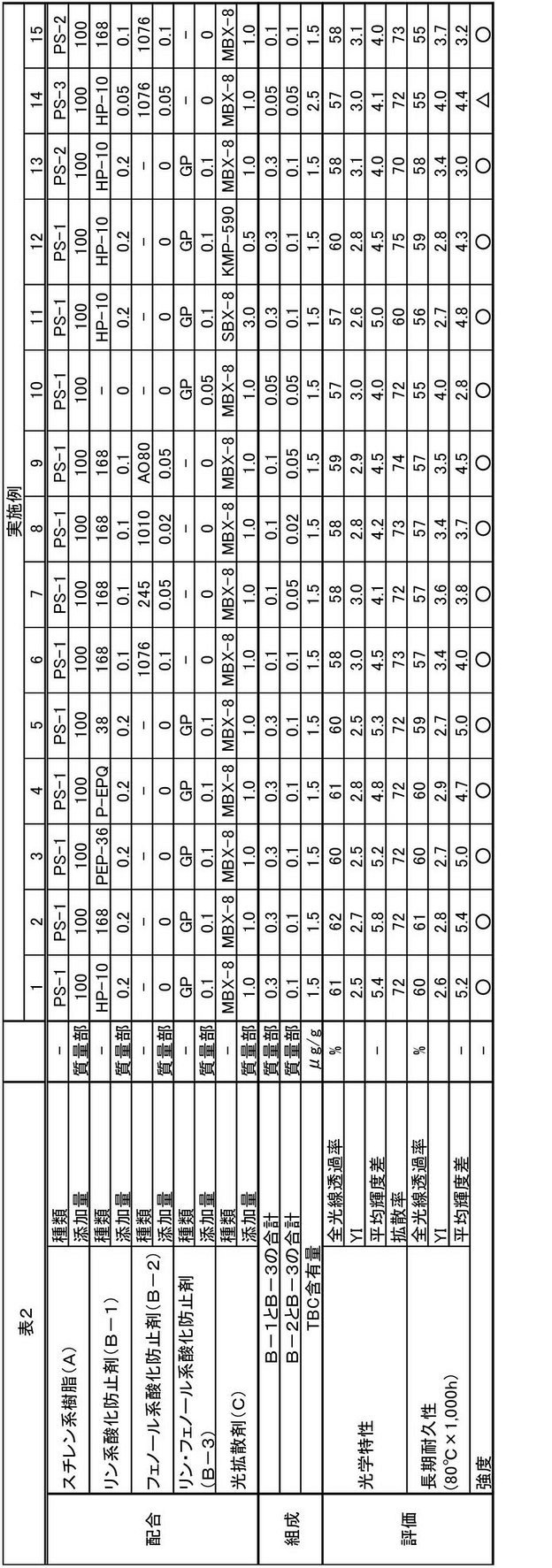

HP-10:2,2'-メチレンビス(4,6-ジ-tert-ブチル-1-フェニルオキシ)(2-エチルヘキシルオキシ)ホスホラス(ADEKA社製;HP-10)
168:トリス(2,4-ジ-tert-ブチルフェニル)フォスファイト(BASFジャパン社製;Irgafos168)
PEP-36:3,9-ビス(2,6-ジ-tert-ブチル-4-メチルフェノキシ)-2,4,8,10-テトラオキサ-3,9-ジホスファスピロ〔5.5〕ウンデカン(ADEKA社製;PEP-36)
P-EPQ:テトラキス(2,4-ジ-tert-ブチルフェニル)[1,1ビフェニル]-4,4'ジイルビスホスホナイト(BASFジャパン社製;IrgafosP-EPQ)
38:ビス(2,4-ジ-tert-ブチル-6-メチルフェニル)エチル亜リン酸エステル(BASFジャパン社製;Irgafos38)
GP:6-〔3-(3-tert-ブチル-4-ヒドロキシ-5-メチルフェニル)プロポキシ〕-2,4,8,10-テトラ-tert-ブチルジベンゾ〔d,f〕〔1,3,2〕ジオキサホスフェピン(住友化学社製;スミライザーGP)
1076:オクタデシル-3-(3,5-ジ-t-ブチル-4-ヒドロキシフェニル)プロピオネート(BASFジャパン社製;Irganox1076)
245:エチレンビス(オキシエチレン)ビス〔3-(5-tert-ブチル-4-ヒドロキシ-m-トリル)プロピオネート〕(BASFジャパン社製;Irganox245)
1010:ペンタエリスリトールテトラキス[3-(3,5-ジ-tert-ブチル-4-ヒドロキシフェニル)プロピオネート] (BASFジャパン社製;Irganox1010)
AO80:3,9-ビス[2-〔3-(3-tert-ブチル-4-ヒドロキシ-5-メチルフェニル)プロピオニルオキシ〕-1,1-ジメチルエチル]-2,4,8,10-テトラオキサスピロ[5.5]ウンデカン(ADEKA社製;AO-80)
MBX-8:アクリル系架橋粒子(平均粒子径8μm、積水化成品工業社製;MBX-8)
SBX-8:ポリスチレン系架橋粒子(平均粒子径8μm、積水化成品工業社製;SBX-8)
KMP-590:シリコーン系架橋粒子(平均粒子径2μm、信越化学工業社製;KMP-590)
Claims (8)
- スチレン系樹脂組成物を含む光拡散板であって、
前記スチレン系樹脂組成物が、スチレン系樹脂(A)と、酸化防止剤(B)と、光拡散剤(C)と、を含有し、
前記酸化防止剤(B)は、リン系酸化防止剤(B-1)、フェノール系酸化防止剤(B-2)、及びリン・フェノール系酸化防止剤(B-3)のうち少なくとも1種を含み、
前記スチレン系樹脂100質量部に対して、
前記リン系酸化防止剤(B-1)と前記リン・フェノール系酸化防止剤(B-3)を合計で0.001~0.5質量部、
前記フェノール系酸化防止剤(B-2)と前記リン・フェノール系酸化防止剤(B-3)を合計で0.001~0.5質量部、
前記光拡散剤(C)を0.1~10質量部、
含有し、
前記スチレン系樹脂組成物に含まれるt-ブチルカテコールの含有量が0.1~10μg/gである、光拡散板。 - 前記リン系酸化防止剤(B-1)が、
2,2'-メチレンビス(4,6-ジ-tert-ブチル-1-フェニルオキシ)(2-エチルヘキシルオキシ)ホスホラス、
トリス(2,4-ジ-tert-ブチルフェニル)フォスファイト、
3,9-ビス(2,6-ジ―tert-ブチル―4-メチルフェノキシ)-2,4,8,10-テトラオキサ―3,9-ジホスファスピロ〔5,5〕ウンデカン、
テトラキス(2,4-ジ―tert-ブチルフェニル)〔1,1ビフェニル〕―4,4'ジイルビスホスホナイト、
ビス(2,4-ジ―tert-ブチル―6-メチルフェニル)エチル亜リン酸エステルから選ばれる少なくとも1種である、請求項1に記載の光拡散板。 - 前記フェノール系酸化防止剤(B-2)が、
6-[3-(3-tert-ブチル-4-ヒドロキシ-5-メチルフェニル)プロポキシ]-2,4,8,10-テトラ-tert-ブチルジベンゾ[d,f][1,3,2]ジオキサホスフェピン、
オクタデシル-3-(3,5-ジ-tert-ブチル-4-ヒドロキシフェニル)プロピオネート、
エチレンビス(オキシエチレン)ビス〔3-(5-tert-ブチル-4-ヒドロキシ-m-トリル)プロピオネート〕、
ペンタエリスリトールテトラキス[3-(3,5-ジ-tert-ブチル-4-ヒドロキシフェニル)プロピオネート]、
3,9-ビス[2-〔3-(3-tert-ブチル―4-ヒドロキシ―5-メチルフェニル)プロピオニルオキシ〕-1,1-ジメチルエチル]-2,4,8,10-テトラオキサスピロ[5,5]ウンデカンから選ばれる少なくとも1種である、請求項1又は請求項2に記載の光拡散板。 - 前記リン・フェノール系酸化防止剤(B-3)が、6-[3-(3-tert-ブチル-4-ヒドロキシ-5-メチルフェニル)プロポキシ]-2,4,8,10-テトラ-tert-ブチルジベンゾ[d,f][1,3,2]ジオキサホスフェピンである、請求項1~請求項3のいずれか1項に記載の光拡散板。
- 前記光拡散剤(C)が、アクリル系重合体架橋粒子、スチレン系重合体架橋粒子、シロキサン系重合体架橋粒子から選ばれる少なくとも1種である、請求項1~請求項4のいずれか1項に記載の光拡散板。
- 前記スチレン系樹脂(A)の重量平均分子量(Mw)が20万~40万で、重量平均分子量(Mw)と数平均分子量(Mn)の比(Mw/Mn)が1.0~3.0である、請求項1~請求項5のいずれか1項に記載の光拡散板。
- LED光源用である請求項1~請求項6のいずれか1項に記載の光拡散板。
- 請求項1~請求項7のいずれか1項に記載の光拡散板を有する、直下型面光源ユニット。
Priority Applications (4)
| Application Number | Priority Date | Filing Date | Title |
|---|---|---|---|
| KR1020227025179A KR102952747B1 (ko) | 2019-12-24 | 2020-12-17 | 광확산판 및 직하형 면광원 유닛 |
| CN202080077557.9A CN114730022A (zh) | 2019-12-24 | 2020-12-17 | 光扩散板以及直下式面光源单元 |
| MX2022005316A MX2022005316A (es) | 2019-12-24 | 2020-12-17 | Placa de difusion de luz y unidad de fuente de luz de superficie directa. |
| JP2021567354A JP7629868B2 (ja) | 2019-12-24 | 2020-12-17 | 光拡散板及び直下型面光源ユニット |
Applications Claiming Priority (2)
| Application Number | Priority Date | Filing Date | Title |
|---|---|---|---|
| JP2019-232946 | 2019-12-24 | ||
| JP2019232946 | 2019-12-24 |
Publications (1)
| Publication Number | Publication Date |
|---|---|
| WO2021132001A1 true WO2021132001A1 (ja) | 2021-07-01 |
Family
ID=76573244
Family Applications (1)
| Application Number | Title | Priority Date | Filing Date |
|---|---|---|---|
| PCT/JP2020/047109 Ceased WO2021132001A1 (ja) | 2019-12-24 | 2020-12-17 | 光拡散板及び直下型面光源ユニット |
Country Status (6)
| Country | Link |
|---|---|
| JP (1) | JP7629868B2 (ja) |
| KR (1) | KR102952747B1 (ja) |
| CN (1) | CN114730022A (ja) |
| MX (1) | MX2022005316A (ja) |
| TW (1) | TW202132822A (ja) |
| WO (1) | WO2021132001A1 (ja) |
Citations (6)
| Publication number | Priority date | Publication date | Assignee | Title |
|---|---|---|---|---|
| JP2006299192A (ja) * | 2005-04-25 | 2006-11-02 | Asahi Kasei Chemicals Corp | シリコーン系粒子含有スチレン系樹脂組成物 |
| JP2006299191A (ja) * | 2005-04-25 | 2006-11-02 | Asahi Kasei Chemicals Corp | アクリル系樹脂粒子含有スチレン系樹脂組成物 |
| JP2009215476A (ja) * | 2008-03-12 | 2009-09-24 | Toyo Styrene Co Ltd | 光拡散板用スチレン系樹脂組成物及びその製造方法 |
| WO2010071152A1 (ja) * | 2008-12-17 | 2010-06-24 | 電気化学工業株式会社 | 光学用成形体及びそれを用いた導光板及び光拡散体 |
| WO2016129675A1 (ja) * | 2015-02-12 | 2016-08-18 | デンカ株式会社 | 光学用スチレン系樹脂組成物 |
| WO2017094748A1 (ja) * | 2015-11-30 | 2017-06-08 | デンカ株式会社 | 透明な高耐熱性スチレン系共重合体 |
Family Cites Families (11)
| Publication number | Priority date | Publication date | Assignee | Title |
|---|---|---|---|---|
| JP4890766B2 (ja) * | 2005-01-28 | 2012-03-07 | 帝人化成株式会社 | 光拡散性芳香族ポリカーボネート樹脂組成物 |
| JP4837981B2 (ja) * | 2005-11-18 | 2011-12-14 | 住化スタイロンポリカーボネート株式会社 | 光拡散性に優れた熱可塑性樹脂組成物およびそれからなる光拡散板 |
| KR20100028057A (ko) * | 2007-06-28 | 2010-03-11 | 스미토모 다우 가부시키가이샤 | 광확산 열가소성 수지 조성물 및 이의 광확산 시트 |
| JP4345035B2 (ja) * | 2007-09-11 | 2009-10-14 | Dic株式会社 | 光拡散板用樹脂組成物、光拡散板及びその製造方法 |
| TWI434074B (zh) | 2008-11-06 | 2014-04-11 | Sumitomo Chemical Co | A light diffusion plate, a light source device provided with the same, and a transmission type image display device |
| JP6262004B2 (ja) * | 2014-02-05 | 2018-01-17 | Psジャパン株式会社 | 導光板 |
| JP6243807B2 (ja) * | 2014-06-27 | 2017-12-06 | Psジャパン株式会社 | 耐熱スチレン系樹脂の製造方法、耐熱スチレン系樹脂組成物、押出シート及び成形品 |
| CN107418181B (zh) * | 2015-03-26 | 2020-04-21 | 住化Pc有限公司 | 聚碳酸酯树脂组合物及光学用成形品 |
| JP7064827B2 (ja) * | 2017-03-06 | 2022-05-11 | 東洋スチレン株式会社 | 光学用スチレン系樹脂組成物、成形品および導光体 |
| JP7274261B2 (ja) * | 2018-02-28 | 2023-05-16 | Psジャパン株式会社 | スチレン系樹脂組成物、シート、及び成形品 |
| JP7179503B2 (ja) * | 2018-06-08 | 2022-11-29 | 東洋スチレン株式会社 | スチレン系共重合体及びその成形品、シート |
-
2020
- 2020-12-17 MX MX2022005316A patent/MX2022005316A/es unknown
- 2020-12-17 JP JP2021567354A patent/JP7629868B2/ja active Active
- 2020-12-17 KR KR1020227025179A patent/KR102952747B1/ko active Active
- 2020-12-17 WO PCT/JP2020/047109 patent/WO2021132001A1/ja not_active Ceased
- 2020-12-17 CN CN202080077557.9A patent/CN114730022A/zh active Pending
- 2020-12-17 TW TW109144598A patent/TW202132822A/zh unknown
Patent Citations (6)
| Publication number | Priority date | Publication date | Assignee | Title |
|---|---|---|---|---|
| JP2006299192A (ja) * | 2005-04-25 | 2006-11-02 | Asahi Kasei Chemicals Corp | シリコーン系粒子含有スチレン系樹脂組成物 |
| JP2006299191A (ja) * | 2005-04-25 | 2006-11-02 | Asahi Kasei Chemicals Corp | アクリル系樹脂粒子含有スチレン系樹脂組成物 |
| JP2009215476A (ja) * | 2008-03-12 | 2009-09-24 | Toyo Styrene Co Ltd | 光拡散板用スチレン系樹脂組成物及びその製造方法 |
| WO2010071152A1 (ja) * | 2008-12-17 | 2010-06-24 | 電気化学工業株式会社 | 光学用成形体及びそれを用いた導光板及び光拡散体 |
| WO2016129675A1 (ja) * | 2015-02-12 | 2016-08-18 | デンカ株式会社 | 光学用スチレン系樹脂組成物 |
| WO2017094748A1 (ja) * | 2015-11-30 | 2017-06-08 | デンカ株式会社 | 透明な高耐熱性スチレン系共重合体 |
Also Published As
| Publication number | Publication date |
|---|---|
| CN114730022A (zh) | 2022-07-08 |
| KR102952747B1 (ko) | 2026-04-30 |
| MX2022005316A (es) | 2022-05-26 |
| KR20220118526A (ko) | 2022-08-25 |
| TW202132822A (zh) | 2021-09-01 |
| JP7629868B2 (ja) | 2025-02-14 |
| JPWO2021132001A1 (ja) | 2021-07-01 |
Similar Documents
| Publication | Publication Date | Title |
|---|---|---|
| CN108350125B (zh) | 甲基丙烯酸系树脂、甲基丙烯酸系树脂组合物、膜、制造方法 | |
| TWI585142B (zh) | A styrene resin composition for optics, a molded article, and a light guide plate | |
| CN108690162A (zh) | 甲基丙烯酸系树脂成型体、光学构件或汽车构件 | |
| JP6247373B1 (ja) | メタクリル系樹脂組成物、光学フィルム、光学部品 | |
| JP7590412B2 (ja) | 光学用スチレン系樹脂組成物、導光板及びエッジライト型面光源ユニット | |
| CN104245823A (zh) | 光学用苯乙烯系树脂组合物,成型品及导光板 | |
| JP2023080157A (ja) | メタクリル系樹脂、メタクリル系樹脂組成物、フィルム | |
| JP7606648B2 (ja) | 光学用スチレン系樹脂組成物、導光板、エッジライト型面光源ユニット、光拡散版、及び直下型面光源ユニット | |
| KR102669507B1 (ko) | 스티렌계 수지 조성물, 성형품 및 도광판 | |
| EP3822295B1 (en) | Methacrylic resin, moulded article, optical component or automotive component | |
| JP7519348B2 (ja) | スチレン系樹脂組成物、成形品及び導光板 | |
| EP3385290A1 (en) | Transparent highly heat-resistant styrene copolymer | |
| JP7629868B2 (ja) | 光拡散板及び直下型面光源ユニット | |
| CN111655784B (zh) | 光学用苯乙烯系树脂组合物以及光学部件 | |
| JP2021147561A (ja) | スチレン系樹脂組成物及びその製造方法、成形品および導光板 | |
| TWI831923B (zh) | 邊緣發光型導光板及邊緣發光型面光源單元 | |
| KR20080105477A (ko) | 광확산판용 수지 조성물 및 광확산판 | |
| WO2025164509A1 (ja) | スチレン系樹脂組成物、導光板及びエッジライト型面光源ユニット | |
| JP2019059882A (ja) | メタクリル系樹脂組成物、光学フィルム、光学部品 | |
| JP2016190425A (ja) | 光学用スチレン系多層成形品および導光板 |
Legal Events
| Date | Code | Title | Description |
|---|---|---|---|
| 121 | Ep: the epo has been informed by wipo that ep was designated in this application |
Ref document number: 20904832 Country of ref document: EP Kind code of ref document: A1 |
|
| ENP | Entry into the national phase |
Ref document number: 2021567354 Country of ref document: JP Kind code of ref document: A |
|
| ENP | Entry into the national phase |
Ref document number: 20227025179 Country of ref document: KR Kind code of ref document: A |
|
| NENP | Non-entry into the national phase |
Ref country code: DE |
|
| 122 | Ep: pct application non-entry in european phase |
Ref document number: 20904832 Country of ref document: EP Kind code of ref document: A1 |