WO2021117826A1 - 粘着テープ - Google Patents
粘着テープ Download PDFInfo
- Publication number
- WO2021117826A1 WO2021117826A1 PCT/JP2020/046109 JP2020046109W WO2021117826A1 WO 2021117826 A1 WO2021117826 A1 WO 2021117826A1 JP 2020046109 W JP2020046109 W JP 2020046109W WO 2021117826 A1 WO2021117826 A1 WO 2021117826A1
- Authority
- WO
- WIPO (PCT)
- Prior art keywords
- pressure
- weight
- sensitive adhesive
- adhesive tape
- adhesive layer
- Prior art date
- Legal status (The legal status is an assumption and is not a legal conclusion. Google has not performed a legal analysis and makes no representation as to the accuracy of the status listed.)
- Ceased
Links
Images

Classifications
-
- C—CHEMISTRY; METALLURGY
- C09—DYES; PAINTS; POLISHES; NATURAL RESINS; ADHESIVES; COMPOSITIONS NOT OTHERWISE PROVIDED FOR; APPLICATIONS OF MATERIALS NOT OTHERWISE PROVIDED FOR
- C09J—ADHESIVES; NON-MECHANICAL ASPECTS OF ADHESIVE PROCESSES IN GENERAL; ADHESIVE PROCESSES NOT PROVIDED FOR ELSEWHERE; USE OF MATERIALS AS ADHESIVES
- C09J167/00—Adhesives based on polyesters obtained by reactions forming a carboxylic ester link in the main chain; Adhesives based on derivatives of such polymers
-
- C—CHEMISTRY; METALLURGY
- C09—DYES; PAINTS; POLISHES; NATURAL RESINS; ADHESIVES; COMPOSITIONS NOT OTHERWISE PROVIDED FOR; APPLICATIONS OF MATERIALS NOT OTHERWISE PROVIDED FOR
- C09J—ADHESIVES; NON-MECHANICAL ASPECTS OF ADHESIVE PROCESSES IN GENERAL; ADHESIVE PROCESSES NOT PROVIDED FOR ELSEWHERE; USE OF MATERIALS AS ADHESIVES
- C09J7/00—Adhesives in the form of films or foils
- C09J7/30—Adhesives in the form of films or foils characterised by the adhesive composition
- C09J7/38—Pressure-sensitive adhesives [PSA]
Definitions
- the present invention relates to an adhesive tape.
- Adhesive tape is used, for example, for fixing parts and members that make up portable electronic terminals, cameras, personal computers, home appliances, automobiles, and the like.
- Examples of raw materials used for such adhesive tapes for fixing members include silicone-based adhesives and acrylic-based adhesives.
- silicone-based adhesive it is not economical because of its high cost.
- acrylic adhesives although the cost is low, petroleum is often used as the raw material, so there are problems of depletion of petroleum resources and carbon dioxide emission due to disposal treatment.
- a polyester-based adhesive tape with a high degree of biomass using a plant-derived raw material is used to specify the degree of biomass, gel fraction, molar ratio of carboxylic acid component to diol component, and adhesive strength to polycarbonate plate.
- Adhesive tapes defined in the above range have been proposed (see, for example, Patent Document 1).
- an object of the present invention is to provide an adhesive tape which has a high degree of biomass, has sufficient adhesive strength, and is also excellent in removability.
- an adhesive tape showing a high gel content and a high biomass content has high adhesive strength and excellent re-adhesiveness. It has been found that it exhibits peelability, and the present invention has been completed.
- the present invention includes the following aspects.
- It has a pressure-sensitive adhesive layer containing a polyester resin, the biomass degree of the pressure-sensitive adhesive layer is 80% by weight or more, the gel content of the pressure-sensitive adhesive layer is 40% by weight or more, and it is a stainless steel plate.
- An adhesive tape having an adhesive strength of 4 to 14 N / 20 mm.
- Mw weight average molecular weight
- the present invention can provide an adhesive tape having a high degree of biomass, sufficient adhesive strength, and excellent removability.
- the adhesive tape of the present invention has an adhesive layer containing a polyester resin.
- the biomass degree of the pressure-sensitive adhesive layer is 80% by weight or more.
- the gel fraction of the pressure-sensitive adhesive layer is 40% by weight or more.
- the adhesive strength of the pressure-sensitive adhesive layer to the stainless steel plate is 4 to 14 N / 20 mm.
- the pressure-sensitive adhesive layer according to the pressure-sensitive adhesive tape of the present invention is composed of a pressure-sensitive adhesive composition, and the pressure-sensitive adhesive composition may contain a cross-linking agent and a pressure-sensitive adhesive in addition to a polyester-based resin. In addition, the pressure-sensitive adhesive composition may further contain other components. ⁇ Polyester resin >>
- the pressure-sensitive adhesive composition according to the present invention contains a polyester-based resin.
- the polyester resin it is preferable to use at least a polyester obtained by polycondensing a carboxylic acid component and a diol component.
- the polyester synthesis method is not particularly limited, and a known polymerization method can be used.
- Polyester is preferably produced from plant-derived raw materials.
- the reason is that the plant-derived raw material is said to be carbon-neutral, and it is possible to obtain an environmentally friendly adhesive that is friendly to the global environment.
- the polyester contains a carboxylic acid component, and the carboxylic acid component preferably contains a dicarboxylic acid containing at least two carboxyl groups.
- dicarboxylic acids examples include sebacic acid, azelaic acid, and isophthalic acid.
- the dicarboxylic acid can be used alone or in combination of two or more.
- sebacic acid and azelaic acid are particularly preferable from the viewpoint of being plant-derived and being friendly to the global environment.
- Others include adipic acid, 1,4-cyclohexanedicarboxylic acid, 4-methyl-1,2-cyclohexanedicarboxylic acid, dodecenyl anhydride amber acid, fumaric acid, amber acid, dodecanedioic acid, hexahydrophthalic anhydride, tetrahydrophthalic anhydride.
- Acids maleic acid, maleic anhydride, itaconic acid, citraconic acid and other aliphatic and alicyclic dicarboxylic acids, terephthalic acid, orthophthalic acid, 1,5-naphthalenedicarboxylic acid, 2,6-naphthalenedicarboxylic acid, 4 , 4'-diphenyldicarboxylic acid, 2,2'-diphenyldicarboxylic acid, 4,4'-diphenyletherdicarboxylic acid and the like.
- the polyester contains a diol component, and the diol component preferably contains at least two hydroxyl groups in the molecule.
- the diol components are ethylene glycol, 1,2-propylene glycol, 1,3-propanediol, 2-methyl-1,3-propanediol, 1,2-butanediol, 1,3-butanediol, 1,4-.
- ethylene oxide adducts and propylene oxide adducts of bisphenol A ethylene oxide adducts and propylene oxide adducts of hydride bisphenol A, polytetramethylene glycols, polypropylene glycols
- examples thereof include polyethylene glycol and polycarbonate glycol.
- the diol component can be used alone or in combination of two or more.
- diethylene glycol and ethylene glycol can be used in combination.
- the weight average molecular weight (Mw) of the polyester resin according to the present invention is preferably 50,000 or more, more preferably 55,000 or more, more preferably 60,000 or more, still more preferably 80,000 or more, still more preferably. It is over 100,000.
- the weight average molecular weight (Mw) is preferably 150,000 or less, and more preferably 140,000 or less.
- the range of the weight average molecular weight (Mw) is preferably in the range of 50,000 to 150,000, more preferably in the range of 55,000 to 150,000, and particularly preferably 100,000 to 150,000. It is preferably in the range of.
- the weight average molecular weight is 60,000 or more, it exhibits a preferable removability by having a desired gel fraction.
- the weight average molecular weight is 100,000 or more, the cohesive force is high due to the high molecular weight, and high retention is exhibited.
- the weight average molecular weight is preferably 150,000 or less.
- the weight average molecular weight (Mw) can be measured from a calibration curve prepared from standard polystyrene by using gel permeation chromatography (GPC) on a solution of the polymer dissolved in tetrahydrofuran (THF). .. ⁇ Measurement conditions for weight average molecular weight of polyester resin >>
- the blending ratio of the dicarboxylic acid component and the diol component is preferably in the range of 1 to 2 equivalents of the diol component per 1 equivalent of the dicarboxylic acid, and more preferably in the range of 1.1 to 1.7 equivalents. ..
- a solvent-free system is particularly preferable from the viewpoint of environmental protection.
- a method for removing water generated by the polymerization (condensation polymerization) reaction a method of azeotropic dehydration using toluene or xylene, or a method of blowing an inert gas into the reaction system and producing water together with the inert gas, or Examples thereof include a method of discharging monoalcohol out of the reaction system and a method of storing it under reduced pressure.
- polymerization catalyst used in the polymerization (condensation polymerization) reaction those used for ordinary polyester polymerization catalysts can be used, and the polymerization catalyst is not particularly limited, but is, for example, germanium-based, titanium-based, or tin-based. , Antimony-based, zinc-based and various other metal compounds can be used. These may be used alone or in combination of two or more. Germanium dioxide is preferably used because of its high catalytic activity. ⁇ Crosslinking agent >>
- the pressure-sensitive adhesive composition according to the pressure-sensitive adhesive tape of the present invention may contain a cross-linking agent.
- a pressure-sensitive adhesive layer can be formed by cross-linking the above polyester-based resin with a cross-linking agent.
- the type of the cross-linking agent is not particularly limited as long as the effect of the present invention is exhibited, and can be appropriately selected depending on the intended purpose.
- an isocyanate-based cross-linking agent is preferable and has polyfunctionality. Isocyanate-based cross-linking agents are more preferable.
- the polyfunctional isocyanate compound is preferably, for example, a compound having at least two or more isocyanate groups in the molecule, more preferably three or more, and is not particularly limited, and specifically, a fat. Examples thereof include group polyisocyanates, alicyclic polyisocyanates, and aromatic polyisocyanates.
- the cross-linking agent may be used alone or in combination of two or more.
- aliphatic polyisocyanes examples include 1,2-ethylene diisocyanis, 1,2-tetramethylene diisocyanate, 1,3-tetramethylene diisocyanate, and tetramethylene diisocyanate such as 1,4-tetramethylene diisocyanate, 1,2.
- -Hexamethylene diisocyanis such as 1,3-hexamethylene diisocyanate, 1,4-hexamethylene diisocyanate, 1,5-hexamethylene diisocyanate, 1,6-hexamethylene diisocyanate, 2,5-hexamethylene diisocyanate, Examples thereof include 2-methyl-1,5-pentanediisocyanate, 3-methyl-1,5-pentanediisocyanate and lysine diisocyanate.
- alicyclic polyisocyanates examples include isophorone diisocyanate, cyclohexyl diisocyanate such as 1,2-cyclohexyl diisocyanate, 1,3-cyclohexyl diisocyanate, and 1,4-cyclohexyl diisocyanate, 1,2-cyclopentyl diisocyanate, and 1,3.
- cyclopentyl diisocyanate such as cyclopentyl diisocyanate, hydrogenated xylylene diisocyanate, hydrogenated tolylene diisocyanate, hydrogenated diphenylmethane diisocyanate, hydrogenated tetramethylxylene diisocyanate, and 4,4'-disichexylmethane diisocyanate.
- aromatic polyisocyanates examples include 2,4-tolylene diisocyanis, 2,6-tolylene diisocyanate, 4,4'-diphenylmethane diisocyanate, 2,4'-diphenylmethane diisocyanate, 2,2'-diphenylmethane diisocyanate, and the like.
- 4,4'-diphenyl ether diisocyanate 2-nitrodiphenyl-4,4'-diisocyanate, 2,2'-diphenylpropane-4,4'-diisocyanate, 3,3'-dimethyldiphenylmethane-4,4'-diisocyanate, 4,4'-diphenylpropane diisocyanate, m-phenylenediisocyanis, p-phenylenediisocyanate, naphthylene-1,4-diisocyanis, naphthylene-1,5-diisocyanate, 3,3'-dimethoxydiphenyl-4,4'-diisocyanate, Examples thereof include xylylene-1,4-diisocyanate and xylylene-1,3-diisocyanate.
- polyfunctional isocyanate compound in addition to aliphatic polyisocyanates, alicyclic polyisocyanates, and aromatic polyisocyanates, dimer or trimer of aromatic aliphatic polyisocyanates can be used.
- examples thereof include polymers such as polyisocyanate and polyester polyisocyanate.
- an adduct of tolylene diisocyanate and trimethylolpropane can be used.
- polyfunctional isocyanate compound Commercially available products can also be used as the polyfunctional isocyanate compound.
- trimer adduct of trimethylolpropane and tolylene diisocyanate the trade name is "Bernock D-40" (manufactured by DIC Co., Ltd.).
- trimer adduct of trimethylolpropane and hexamethylene diisocyanate examples include the trade name "Coronate HL” (manufactured by Nippon Polyurethane Industry Co., Ltd.).
- the blending amount of the cross-linking agent may be 1.4 to 5.0 parts by weight with respect to 100 parts by weight of the polyester resin which is the main component of the pressure-sensitive adhesive. preferable. Above all, it is more preferably in the range of 1.4 to 4.0 parts by mass, in the range of 1.4 to 3.0 parts by mass, and further preferably in the range of 1.4 to 2.0 parts by weight.
- the blending amount of the cross-linking agent is 1.4 parts by weight or more with respect to 100 parts by weight of the polyester resin, it has a desired gel fraction (for example, 40% by weight or more), so that good removability can be obtained. ..
- the pressure-sensitive adhesive can exhibit a desired adhesive strength.
- polyvalent isocyanurate in addition to the above-mentioned isocyanate compound, polyvalent isocyanurate, polyfunctional melamine compound, polyfunctional epoxy compound, polyfunctional oxazoline compound, polyfunctional aziridine compound, metal chelate compound and the like may be used. it can. ⁇ Adhesive enhancer >>
- a pressure-sensitive adhesive layer having desired characteristics is obtained by combining a pressure-sensitive adhesive together with a cross-linking agent with a polyester-based resin which is the main component of the pressure-sensitive adhesive. This can be expected, and in particular, improvement in adhesiveness (adhesiveness) can be expected.
- the tackifier is not particularly limited, and conventionally known ones can be used.
- a rosin-based tackifier, a terpene-based tackifier, a phenol-based tackifier, and an aliphatic petroleum resin can be used.
- a rosin-based or terpene-based tackifier produced from a plant-derived raw material. These can be used alone or in combination of two or more.
- rosin-based tackifier examples include unmodified rosins (raw rosins) such as gum rosin, wood rosin, and tall oil rosin, and modified rosins obtained by polymerizing, disproportionating, or hydrogenating these unmodified rosins. Polymerized rosins, stabilized rosins, disproportionated rosins, fully hydrogenated rosins, partially hydrogenated rosins and other chemically modified rosins), as well as various rosin derivatives.
- unmodified rosins raw rosins
- wood rosin wood rosin
- tall oil rosin modified rosins obtained by polymerizing, disproportionating, or hydrogenating these unmodified rosins.
- modified rosins obtained by polymerizing, disproportionating, or hydrogenating these unmodified rosins. Polymerized rosins, stabilized rosins, disproportionated rosins, fully hydrogenated rosins, partially hydrogenated
- the rosin derivative examples include a rosin phenol-based resin obtained by adding phenol to rosins (unmodified rosin, modified rosin, various rosin derivatives, etc.) with an acid catalyst and thermally polymerizing the rosin derivative; Modified rosins in which ester compounds of rosins esterified with alcohol (unmodified rosin esters) and modified rosins such as polymerized rosins, stabilized rosins, disproportionated rosins, fully hydrogenated rosins, and partially hydrogenated rosins are esterified with alcohols.
- Rosin ester-based resins such as ester compounds of (polymerized rosin ester, stabilized rosin ester, disproportionated rosin ester, fully hydrogenated rosin ester, partially hydrogenated rosin ester, etc.); unmodified rosin and modified rosin (polymerized rosin, stable). Unsaturated fatty acid-modified rosin-based resin obtained by modifying chemical rosin, disproportionated rosin, fully hydrogenated rosin, partially hydrogenated rosin, etc. with unsaturated fatty acids; unsaturated fatty acid-modified rosin obtained by modifying rosin ester-based resin with unsaturated fatty acids.
- Ester-based resins include unmodified rosins, modified rosins (polymerized rosins, stabilized rosins, disproportionated rosins, fully hydrogenated rosins, partially hydrogenated rosins, etc.), unsaturated fatty acid-modified rosin-based resins and unsaturated fatty acid-modified rosin ester-based resins.
- modified rosins polymerized rosins, stabilized rosins, disproportionated rosins, fully hydrogenated rosins, partially hydrogenated rosins, etc.
- unsaturated fatty acid-modified rosin-based resins include rosin alcohol-based resins obtained by reducing the carboxyl group in the resin; unmodified rosin, modified rosin, and metal salts of rosin-based resins (particularly rosin ester-based resins) such as various rosin derivatives.
- terpene-based tackifier examples include terpene-based resins such as ⁇ -pinene polymer, ⁇ -pinene polymer, and dipentene polymer, and terpene-based resins modified (phenolic modification, aromatic modification, hydrogenation modification). , Carbone-modified, etc.) modified terpene-based resin (for example, terpene phenol-based resin, styrene-modified terpene-based resin, aromatic-modified terpene-based resin, hydrogenated terpene-based resin, etc.) and the like.
- the tackifier has a softening point of 100 to 170 ° C., more preferably 100 to 165 ° C., and even more preferably 100 to 135 ° C.
- the blending amount of the tackifier is preferably 0 to 15 parts by weight with respect to 100 parts by weight of the polyester resin which is the main component of the pressure-sensitive adhesive.
- the pressure-sensitive adhesive layer used in the pressure-sensitive adhesive tape of the present invention may contain a hydrolysis inhibitor, and by containing the hydrolysis inhibitor, good re-peeling is performed, especially by improving durability under high temperature and high humidity. You can expect sex.
- the hydrolysis inhibitor is not particularly limited, and conventionally known ones can be used. Examples thereof include compounds that react with and bind to a carboxylic acid terminal group of a polyester resin, and specific examples thereof. Examples thereof include compounds having a functional group such as a carbodiimide group, an epoxy group and an oxazoline group. Among these, the carbodiimide group-containing compound is preferable because it has a high effect of eliminating the catalytic activity of the proton derived from the carboxyl group terminal group.
- carbodiimide group-containing compound examples include the carbodilite (registered trademark) series manufactured by Nisshinbo Chemical Co., Ltd. Among them, carbodilite (registered trademark) V-03, V-05, V-07, and V-09 are It is preferable because it has excellent compatibility with an organic solvent. ⁇ Other ingredients >>
- a cross-linking catalyst may be appropriately used in order to efficiently adjust the gel fraction of the pressure-sensitive adhesive layer used in the pressure-sensitive adhesive tape of the present invention.
- the catalyst include tetra-n-butyl titanate, tetraisopropyl titanate, butyl tin oxide, dioctyl tin diuralate, titanium acetoacetate, zirconium tetraacetyl acetonate and the like. These can be used alone or in combination of two or more.
- the blending amount of the cross-linking catalyst is not particularly limited, but is preferably 0.01 to 1 part by weight with respect to 100 parts by weight of the polyester resin which is the main component of the pressure-sensitive adhesive.
- the blending amount is 0.01 part by weight or more, the effect of adding the catalyst is obtained, and when it is 1 part by weight or less, the pot life can be maintained for a relatively long period of time, so that the stability of coating can be obtained.
- acetylacetone, methanol, methyl orthoacetate, etc. may be appropriately added as a delaying agent.
- an adhesive tape of the present invention for example, in the case of an adhesive tape having a base material (core), the pressure-sensitive adhesive composition is applied to one or both sides of the base material and dried. After forming the pressure-sensitive adhesive layer by the method (direct method) or by applying the pressure-sensitive adhesive composition to the surface of the release liner and drying or the like, the pressure-sensitive adhesive layer is transferred to one side or both sides of the base material. There is a method (transfer method) for producing by doing so.
- a method for producing an adhesive tape without a base material for example, a method of forming an adhesive layer by applying an adhesive composition to the surface of a release liner and drying the adhesive composition can be mentioned.
- Examples of the method of applying the pressure-sensitive adhesive composition to the base material or the release liner include a method of using an applicator, a roll coater, a gravure coater, a reverse coater, a spray coater, an air knife coater, a die coater and the like.
- Examples of the method for drying the pressure-sensitive adhesive composition include a method of drying at 50 ° C. to 140 ° C. for 30 seconds to 10 minutes. Further, after drying, further aging may be performed in the range of 30 ° C. to 50 ° C. from the viewpoint of accelerating the curing reaction. ⁇ Biomass degree >>
- the biomass degree of the pressure-sensitive adhesive layer according to the pressure-sensitive adhesive tape of the present invention is preferably 80% by weight or more, and more preferably 90% by weight or more.
- the biomass content is as high as 80% by weight or more, it is possible to obtain an environmentally friendly adhesive tape that is friendly to the global environment, which is a preferable embodiment.
- the biomass degree is the weight ratio of the plant-derived raw material used in producing the pressure-sensitive adhesive layer to the total weight of the pressure-sensitive adhesive layer, and is calculated by the following formula.
- Biomass degree (% by weight) of the pressure-sensitive adhesive layer 100 ⁇ [weight of plant-derived raw material (g)] / [total weight of pressure-sensitive adhesive layer (g)] ⁇ Gel fraction >>
- the gel fraction is 40% by weight or more in order to ensure good removability. Further, in order to enable excellent adhesive strength while ensuring removability, the gel fraction of the pressure-sensitive adhesive layer is preferably in the range of 40% by weight to 85% by weight. Further, in the present invention, it is preferable to prepare various conditions such as the molecular weight of polyester, the type and content of the cross-linking agent, and the type and content of the tackifier so that the gel fraction is within a desired range.
- the gel fraction of the pressure-sensitive adhesive layer is more preferably in the range of 45% by weight to 60% by weight, because the balance between the adhesive property and the removability becomes better.
- the adhesive strength can be evaluated based on the adhesive strength to the stainless steel plate.
- the adhesive strength to the stainless steel plate is preferably in the range of 4 to 14 N / 20 mm. When the adhesive force is 4N / 20 mm or more, the desired adhesive force can be obtained, so that it is suitable for fixing members of electronic devices and the like.
- SUS stainless steel
- a surface having an adhesive portion of a 20 mm wide adhesive tape (hereinafter referred to as a test piece) lined with a 25 ⁇ m-thick polyethylene terephthalate film is overlapped with a clean and smooth stainless steel plate, and a 2 kg roller is applied to the upper surface thereof.
- the adhesive tape was applied to the sticking surface of the stainless steel plate by 180. It was measured by peeling in the ° direction at a speed of 0.3 m / min.
- the re-peelability is evaluated by whether or not the above-mentioned test piece left under a predetermined environmental condition causes interfacial peeling when peeled off.
- a test piece prepared in the test of adhesive strength to a stainless steel (SUS) plate is attached to a stainless steel plate, and the temperature is 60 ° C. and the humidity is 90% for 500 hours.
- SUS stainless steel
- test piece prepared in the test of adhesive strength to a stainless steel (SUS) plate was attached to a stainless steel plate and placed in an environment of 85 ° C. (without humidity adjustment) for 500 hours.
- SUS stainless steel
- the adhesive layer has interfacial peeling property means that when the adhesive tape is peeled off from the adherend, it does not peel off between the layers of the adhesive tape or in the layer, and the adhesive remains on the adherend surface at the interface with the adherend. It means peeling without doing.
- the adhesive tape of the present invention is not particularly limited as long as it has an adhesive layer having a biomass content of 80% by weight or more.
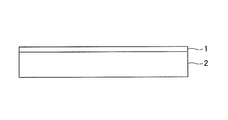
- FIG. 1 shows an adhesive layer having a release liner attached to one side (without a base material). The release liner may be attached to both sides of the pressure-sensitive adhesive layer.
- FIG. 2 includes a base material having a pressure-sensitive adhesive layer on one side and a release liner attached to the surface of the pressure-sensitive adhesive layer (with a base material).
- a pressure-sensitive adhesive layer a pressure-sensitive adhesive layer having two or more layers of the same or different raw materials bonded together to form a single pressure-sensitive adhesive layer (laminated body) may be used, or the base material may be used.
- the adhesive tape may have two or more layers and may have three or more adhesive layers.
- the adhesive tape of the present invention may be provided with a base material.
- a base material for example, a non-woven fabric base material or a resin film may be used.
- non-woven fabric base material examples include non-woven fabrics obtained by using chemical fibers such as Manila hemp, wood pulp, rayon, acetate fiber, polyester fiber, vinylon fiber (polyvinyl alcohol fiber), polyamide fiber, and a mixture thereof. Be done. Above all, it is more preferable to use a non-woven fabric produced by using 50% or more of a plant-derived raw material.
- a sheet obtained by using polyester such as polyethylene terephthalate, polyethylene naphthalate, polybutylene terephthalate, polyethylene furanoate, polyolefin, polyacrylate, polyvinyl chloride, polyethylene, polypropylene ethylene vinyl alcohol, polyurethane, polyamide, polyimide, etc.
- a non-foaming film base material such as glass can be used. The surface of these base materials may be subjected to antistatic treatment, corona treatment, or the like.
- a foam base material may be used.
- the foam base material for example, a polyolefin-based foam, a polyurethane-based foam, an acrylic-based foam, another rubber-based foam, or the like can be used.
- the surface of the foam base material may be subjected to antistatic treatment, corona treatment, or the like. Above all, it is more preferable to use the resin film produced by using 20% or more of a plant-derived raw material.
- an intermediate layer, an undercoat layer, or the like may be provided.
- the thickness of the base material can be appropriately selected depending on the material and form thereof, but for example, it is preferably 1000 ⁇ m or less, more preferably 1 to 1000 ⁇ m, and particularly preferably 2 to 500 ⁇ m. Is more preferably about 3 to 300 ⁇ m, and particularly preferably about 5 to 250 ⁇ m.
- ⁇ Release liner >>
- the pressure-sensitive adhesive layer of the present invention preferably has a release liner on at least one side.
- a release liner on one side (or both sides) of the pressure-sensitive adhesive layer, the surface of the pressure-sensitive adhesive layer can be protected and stored until the use of the pressure-sensitive adhesive layer (adhesive tape). Is also useful.
- the release liner is not particularly limited, and conventionally known ones can be appropriately used.
- a silicone-based, fluorine-based, long-chain alkyl-based or fatty acid amide-based release agent (release agent) is used.
- a coating-treated release coat layer can be used.
- the release liner base material either a single layer or a plurality of layers can be used.
- the base material for the release liner various thin leaves such as plastic film, paper, foam, metal leaf and the like can be used, and a plastic film is particularly preferable.
- the raw material of the plastic film include polyester such as polyethylene terephthalate, polyolefin such as polypropylene and ethylene-propylene copolymer, and thermoplastic resin such as polyvinyl chloride.
- a plastic film made of polylactic acid, polyester, polyamide or the like obtained from a plant-derived raw material, or paper can be preferably used.
- Table 1 summarizes the contents of the pressure-sensitive adhesive layer and the list of evaluation results. (Preparation of polyester resin)
- polyester resin (A-1) 0.14 equivalents of isophthalic acid, 0.5 equivalents of sebacic acid (derived from biomass), and azelaic acid (derived from biomass) as dicarboxylic acid components in a reaction can equipped with a thermometer, agitator, rectification tower, nitrogen introduction tube and vacuum device.
- the esterification reaction was carried out over 4 hours. Then, the internal temperature was raised to 270 ° C.
- polyester resin (A-1) The weight average molecular weight of the obtained polyester resin (A-1) was 138,000.
- the biomass degree of the polyester resin (A-1) was 92%.
- polyester resin (A-2) Preparation of polyester resin (A-2)
- a reaction can equipped with a thermometer, agitator, rectification tower, nitrogen introduction tube and vacuum device, 0.15 equivalent of isophthalic acid, 0.48 equivalent of sebacic acid (derived from biomass), and azelaic acid (derived from biomass) as dicarboxylic acid components.
- 0.15 equivalent of isophthalic acid, 0.48 equivalent of sebacic acid (derived from biomass), and azelaic acid (derived from biomass) as dicarboxylic acid components.
- ethylene glycol (derived from biomass) 1.48 equivalents as a polyol component
- 0.05 equivalents of diethylene glycol (derived from biomass) 0.0064% by weight of germanium dioxide as a catalyst
- the temperature gradually reaches 250 ° C.
- the esterification reaction was carried out over 4 hours. Then, the internal temperature was raised to 270 ° C.
- polyester resin (A-2) The weight average molecular weight of the obtained polyester resin (A-2) was 56,000.
- the biomass degree of the polyester resin (A-2) was 92%.
- the above adhesive is applied to the heavy peeling treated surface of the release liner (release paper having a thickness of 125 ⁇ m with both sides peeled), dried at 85 ° C. for 3 minutes, and the light peeling treated surface of another release liner.
- a pressure-sensitive adhesive layer having a thickness of 50 ⁇ m was prepared by laminating the adhesive layer. Then, it was aged in an environment of 40 ° C. for 96 hours to obtain a double-sided adhesive tape. Then, the double-sided adhesive tape was subjected to an evaluation test regarding the adhesive strength and removability evaluation 1. The details of the evaluation results are shown in Table 1. ⁇ Adhesive strength evaluation>
- test piece After peeling off the release liner (light peeling treatment side) of the double-sided adhesive tape, the test piece was lined with a polyethylene terephthalate film having a thickness of 25 ⁇ m and cut into a width of 20 mm.
- the release liner of the test piece was peeled off, attached to the surface of a clean and smooth stainless steel plate, and pressurized by reciprocating a 2 kg roller once on the upper surface, at 23 ° C. and 50 according to JISZ-0237. After leaving for 1 hour under the condition of% RH, using a tensile tester in an atmosphere of 23 ° C. and 50% RH, the adhesive strength to the stainless steel (SUS) plate (peeling direction: 180 °, tensile speed: 0.3 m). / Min) was measured.
- SUS stainless steel
- test piece prepared in the test of adhesive strength to stainless steel (SUS) plate is attached to the stainless steel plate, left for 500 hours in an environment of 60 ° C. and 90% humidity, and then peeled off from the stainless steel plate, the test piece peels off the interface. It was evaluated by whether or not it occurred. When interfacial peeling occurred, it was evaluated as having re-peeling property, and was indicated by " ⁇ " in Table 1. On the other hand, when peeling from the stainless steel plate, if interfacial peeling does not occur due to cohesive fracture or the like, it is evaluated that there is no re-peeling property, and it is indicated by "x" in Table 1.
- Biomass degree of adhesive layer 100 ⁇ [weight of plant-derived raw material (g)] / [total weight of pressure-sensitive adhesive layer (g)]
- the biomass degree (% by weight) of the pressure-sensitive adhesive layer is the same as the biomass degree of the pressure-sensitive adhesive that prepared the pressure-sensitive adhesive layer, and the "weight (g) of the plant-derived raw material” in the above formula is "(solvent). (Excluding) It is synonymous with "weight of plant-derived raw material contained in adhesive (g)", and “total weight of adhesive layer (g)” is “total weight of adhesive (excluding solvent)”. Is synonymous with. (Example 2)
- Example 3 In the same procedure as in Example 1, the blending amount was adjusted as shown in Table 1 to obtain a pressure-sensitive adhesive. Next, a double-sided adhesive tape was obtained in the same procedure as in Example 1. Then, the double-sided adhesive tape was subjected to the evaluation test for the above-mentioned adhesive strength evaluation and removability evaluation 1. The details of the evaluation results are shown in Table 1. Table 1 shows the values of the biomass degree of the pressure-sensitive adhesive layer calculated from the above formula. (Example 3)
- Example 4 In the same procedure as in Example 1, the blending amount was adjusted as shown in Table 1 to obtain a pressure-sensitive adhesive. Next, a double-sided adhesive tape was obtained in the same procedure as in Example 1. Then, the double-sided adhesive tape was subjected to the evaluation test for the above-mentioned adhesive strength evaluation and removability evaluation 1. The details of the evaluation results are shown in Table 1. Table 1 shows the values of the biomass degree of the pressure-sensitive adhesive layer calculated from the above formula. (Example 4)
- polyester resin (A-1) To 100 parts by weight of the polyester resin (A-1), 10 parts by weight of Arakawa Chemical Industry Co., Ltd. "Super Ester A-100” (biomass degree: 100% by weight) as a tackifier A, and "D-40" as a cross-linking agent. 2.4 parts by weight was blended to obtain a pressure-sensitive adhesive having a gel content of 45% by weight.
- the above adhesive is applied to the heavy peeling treated surface of a release liner (release paper having a thickness of 125 ⁇ m with both sides peeled) and dried at 85 ° C. for 3 minutes to form a 50 ⁇ m thick pressure-sensitive adhesive layer. Made. Then, it was aged in an environment of 40 ° C. for 96 hours to obtain a double-sided adhesive tape. Then, the double-sided adhesive tape was subjected to the evaluation test for the above-mentioned adhesive strength evaluation and removability evaluation 1. The details of the evaluation results are shown in Table 1. Table 1 shows the values of the biomass degree of the pressure-sensitive adhesive layer calculated from the above formula. (Example 5)
- Example 6 In the same procedure as in Example 4, the blending amount was adjusted as shown in Table 1 to obtain a pressure-sensitive adhesive. Next, a double-sided adhesive tape was obtained in the same procedure as in Example 4. Then, the double-sided adhesive tape was subjected to the evaluation test for the above-mentioned adhesive strength evaluation and removability evaluation 1. The details of the evaluation results are shown in Table 1. Table 1 shows the values of the biomass degree of the pressure-sensitive adhesive layer calculated from the above formula. (Example 6)
- the blending amount was prepared as shown in Table 1 by the same procedure as in Example 4 except that 10 parts by weight of Harima Chemicals Corporation "Haritac PCJ" (biomass degree: 95% by weight) was used as the tackifier B. Obtained adhesive.
- a double-sided adhesive tape was obtained in the same procedure as in Example 4. Then, the double-sided adhesive tape was subjected to the evaluation test for the above-mentioned adhesive strength evaluation and removability evaluation 1. The details of the evaluation results are shown in Table 1.
- Table 1 shows the values of the biomass degree of the pressure-sensitive adhesive layer calculated from the above formula.
- Example 7 2.5 parts by weight of "D-40” was blended with 100 parts by weight of the polyester resin (A-2) as a cross-linking agent to obtain a pressure-sensitive adhesive having a gel fraction of 40% by weight.
- the above adhesive is applied to the heavy peeling treated surface of the release liner (release paper having a thickness of 125 ⁇ m with both sides peeled), dried at 85 ° C. for 3 minutes, and the light peeling treated surface of another release liner.
- a pressure-sensitive adhesive layer having a thickness of 50 ⁇ m was prepared by laminating the adhesive layer. Then, it was aged in an environment of 40 ° C. for 96 hours to obtain a double-sided adhesive tape. Then, the double-sided adhesive tape was subjected to an evaluation test relating to the above-mentioned adhesive strength evaluation and removability evaluation 1. The details of the evaluation results are shown in Table 1. Table 1 shows the values of the biomass degree of the pressure-sensitive adhesive layer calculated from the above formula.
- Example 8 In the same procedure as in Example 7, the blending amount was adjusted as shown in Table 1 to obtain a pressure-sensitive adhesive. Next, a double-sided adhesive tape was obtained in the same procedure as in Example 7. Then, the double-sided adhesive tape was subjected to the evaluation test for the above-mentioned adhesive strength evaluation and removability evaluation 1. The details of the evaluation results are shown in Table 1. Table 1 shows the values of the biomass degree of the pressure-sensitive adhesive layer calculated from the above formula.
- Example 9 In the same procedure as in Example 7, the blending amount was adjusted as shown in Table 1 to obtain a pressure-sensitive adhesive. Next, a double-sided adhesive tape was obtained in the same procedure as in Example 7. Then, the double-sided adhesive tape was subjected to an evaluation test for adhesive strength evaluation and removability evaluation 1. The details of the evaluation results are shown in Table 1. Table 1 shows the values of the biomass degree of the pressure-sensitive adhesive layer calculated from the above formula. (Comparative Example 1)
- Example 2 With the same composition as in Example 4, only the cross-linking agent was changed to 1.1 parts by weight and blended to obtain a pressure-sensitive adhesive having a gel fraction of 20% by weight. Next, a double-sided adhesive tape was obtained in the same procedure as in Example 4. Then, the double-sided adhesive tape was subjected to the evaluation test for the above-mentioned adhesive strength evaluation and removability evaluation 1. The details of the evaluation results are shown in Table 1. Table 1 shows the values of the biomass degree of the pressure-sensitive adhesive layer calculated from the above formula. (Comparative Example 2)
- Example 3 With the same composition as in Example 5, only the cross-linking agent was changed to 1.1 parts by weight and blended to obtain a pressure-sensitive adhesive having a gel fraction of 18% by weight. Next, a double-sided adhesive tape was obtained in the same procedure as in Example 4. Then, the double-sided adhesive tape was subjected to the evaluation test for the above-mentioned adhesive strength evaluation and removability evaluation 1. The details of the evaluation results are shown in Table 1. Table 1 shows the values of the biomass degree of the pressure-sensitive adhesive layer calculated from the above formula. (Comparative Example 3)
- Example 6 With the same composition as in Example 6, only the cross-linking agent was changed to 1.3 parts by weight and blended to obtain a pressure-sensitive adhesive having a gel fraction of 17% by weight. Next, a double-sided adhesive tape was obtained in the same procedure as in Example 4. Then, the double-sided adhesive tape was subjected to the evaluation test for the above-mentioned adhesive strength evaluation and removability evaluation 1. The details of the evaluation results are shown in Table 1. Table 1 shows the values of the biomass degree of the pressure-sensitive adhesive layer calculated from the above formula.
- the double-sided adhesive tapes obtained in Examples 1 to 9 were left in an environment of 85 ° C. (without humidity adjustment) for 500 hours, and then peeled off from the stainless steel plate, depending on whether or not the test piece had interfacial peeling.
- the peelability was evaluated (removability evaluation 2 below).
- the removability of the adhesive tapes obtained in Examples 1 to 3 and Examples 7 to 9 was good ( ⁇ ) (the test results of Examples 10 to 15 were used respectively).
- test piece cause interfacial peeling when the test piece prepared in the test of adhesive strength to stainless steel (SUS) plate is left in an environment of 85 ° C. (without humidity adjustment) for 500 hours and then peeled off from the stainless steel plate? We evaluated whether or not.
- SUS stainless steel
- Examples 1 to 15 as shown in Table 1 and the like, a high biomass degree of 80% by weight or more, a gel fraction of 40% by weight or more, and a sufficient adhesion to the stainless steel plate of 4 to 14 N / 20 mm are sufficient.
- the adhesive tape has interfacial peeling even after being left in a high temperature / high humidity environment of 60 ° C. and 90% (or in a high temperature environment of 85 ° C.) for 500 hours. It showed good removability.
- the gel fraction was less than 40% by weight, and cohesive fracture (x) was confirmed in the removability test.
- the present invention relates to portable electronic (electric) devices such as mobile phones, smartphones, tablet PCs, portable music players, PDAs, digital cameras, videos, car navigation systems, personal computers, televisions, game machines, and air conditioners.
- portable electronic (electric) devices such as mobile phones, smartphones, tablet PCs, portable music players, PDAs, digital cameras, videos, car navigation systems, personal computers, televisions, game machines, and air conditioners.
Landscapes
- Chemical & Material Sciences (AREA)
- Organic Chemistry (AREA)
- Chemical Kinetics & Catalysis (AREA)
- Adhesive Tapes (AREA)
- Adhesives Or Adhesive Processes (AREA)
- Laminated Bodies (AREA)
Priority Applications (2)
| Application Number | Priority Date | Filing Date | Title |
|---|---|---|---|
| CN202080096576.6A CN115087713B (zh) | 2019-12-13 | 2020-12-10 | 粘合带 |
| JP2021564040A JP7211537B2 (ja) | 2019-12-13 | 2020-12-10 | 粘着テープ |
Applications Claiming Priority (2)
| Application Number | Priority Date | Filing Date | Title |
|---|---|---|---|
| JP2019-225645 | 2019-12-13 | ||
| JP2019225645 | 2019-12-13 |
Publications (1)
| Publication Number | Publication Date |
|---|---|
| WO2021117826A1 true WO2021117826A1 (ja) | 2021-06-17 |
Family
ID=76329950
Family Applications (1)
| Application Number | Title | Priority Date | Filing Date |
|---|---|---|---|
| PCT/JP2020/046109 Ceased WO2021117826A1 (ja) | 2019-12-13 | 2020-12-10 | 粘着テープ |
Country Status (3)
| Country | Link |
|---|---|
| JP (1) | JP7211537B2 (https=) |
| CN (1) | CN115087713B (https=) |
| WO (1) | WO2021117826A1 (https=) |
Cited By (1)
| Publication number | Priority date | Publication date | Assignee | Title |
|---|---|---|---|---|
| JPWO2024116443A1 (https=) * | 2022-11-29 | 2024-06-06 |
Citations (9)
| Publication number | Priority date | Publication date | Assignee | Title |
|---|---|---|---|---|
| JP2008013593A (ja) * | 2006-07-03 | 2008-01-24 | Nitto Denko Corp | 透明性に優れるポリエステル系粘着シート |
| JP2008195819A (ja) * | 2007-02-13 | 2008-08-28 | Nitto Denko Corp | ポリエステル系粘着剤組成物 |
| WO2010016514A1 (ja) * | 2008-08-06 | 2010-02-11 | 日東電工株式会社 | ポリエステル、ポリエステル組成物、粘着剤組成物、粘着剤層及び粘着シート |
| JP2010095672A (ja) * | 2008-10-20 | 2010-04-30 | Nitto Denko Corp | 無溶剤型ポリエステル系粘着剤組成物 |
| WO2011049114A1 (ja) * | 2009-10-20 | 2011-04-28 | 日東電工株式会社 | 両面粘着シート |
| WO2011055827A1 (ja) * | 2009-11-09 | 2011-05-12 | 日東電工株式会社 | 粘着剤組成物 |
| WO2011081163A1 (ja) * | 2009-12-28 | 2011-07-07 | 日東電工株式会社 | ポリエステル系粘着剤組成物 |
| JP2014196471A (ja) * | 2013-03-05 | 2014-10-16 | 日東電工株式会社 | 両面粘着テープ |
| WO2015093526A1 (ja) * | 2013-12-20 | 2015-06-25 | 日東電工株式会社 | 粘着剤組成物、粘着剤層、粘着テープ、及び、両面粘着テープ |
Family Cites Families (9)
| Publication number | Priority date | Publication date | Assignee | Title |
|---|---|---|---|---|
| JP5464810B2 (ja) * | 2008-03-13 | 2014-04-09 | 日本合成化学工業株式会社 | 剥離性粘着剤、剥離性粘着シート、剥離性粘着シートの剥離方法 |
| JP2010106086A (ja) * | 2008-10-29 | 2010-05-13 | Toyo Ink Mfg Co Ltd | 感圧式接着剤用ポリエステル樹脂及びそれを用いてなる感圧式接着剤組成物 |
| JP5368248B2 (ja) * | 2009-10-20 | 2013-12-18 | 日東電工株式会社 | マスキング用粘着テープ |
| JP5519996B2 (ja) * | 2009-10-20 | 2014-06-11 | 日東電工株式会社 | 表面保護用粘着シート |
| JP5456431B2 (ja) * | 2009-10-20 | 2014-03-26 | 日東電工株式会社 | 加熱剥離型粘着シート |
| JP6081233B2 (ja) * | 2012-03-16 | 2017-02-15 | 日東電工株式会社 | 粘着剤組成物、及び、粘着シート |
| JP5980674B2 (ja) * | 2012-12-28 | 2016-08-31 | 日東電工株式会社 | ポリエステル系粘着剤組成物、及び前記粘着剤組成物を用いた粘着シート |
| JP6036674B2 (ja) * | 2013-12-20 | 2016-11-30 | 王子ホールディングス株式会社 | 両面粘着シート、剥離シート付き両面粘着シート、その製造方法および透明積層体 |
| CN119570422A (zh) * | 2016-12-28 | 2025-03-07 | 三菱化学株式会社 | 聚酯系粘合剂组合物、聚酯系粘合剂、粘合片和带有粘合剂层的光学构件 |
-
2020
- 2020-12-10 WO PCT/JP2020/046109 patent/WO2021117826A1/ja not_active Ceased
- 2020-12-10 JP JP2021564040A patent/JP7211537B2/ja active Active
- 2020-12-10 CN CN202080096576.6A patent/CN115087713B/zh active Active
Patent Citations (9)
| Publication number | Priority date | Publication date | Assignee | Title |
|---|---|---|---|---|
| JP2008013593A (ja) * | 2006-07-03 | 2008-01-24 | Nitto Denko Corp | 透明性に優れるポリエステル系粘着シート |
| JP2008195819A (ja) * | 2007-02-13 | 2008-08-28 | Nitto Denko Corp | ポリエステル系粘着剤組成物 |
| WO2010016514A1 (ja) * | 2008-08-06 | 2010-02-11 | 日東電工株式会社 | ポリエステル、ポリエステル組成物、粘着剤組成物、粘着剤層及び粘着シート |
| JP2010095672A (ja) * | 2008-10-20 | 2010-04-30 | Nitto Denko Corp | 無溶剤型ポリエステル系粘着剤組成物 |
| WO2011049114A1 (ja) * | 2009-10-20 | 2011-04-28 | 日東電工株式会社 | 両面粘着シート |
| WO2011055827A1 (ja) * | 2009-11-09 | 2011-05-12 | 日東電工株式会社 | 粘着剤組成物 |
| WO2011081163A1 (ja) * | 2009-12-28 | 2011-07-07 | 日東電工株式会社 | ポリエステル系粘着剤組成物 |
| JP2014196471A (ja) * | 2013-03-05 | 2014-10-16 | 日東電工株式会社 | 両面粘着テープ |
| WO2015093526A1 (ja) * | 2013-12-20 | 2015-06-25 | 日東電工株式会社 | 粘着剤組成物、粘着剤層、粘着テープ、及び、両面粘着テープ |
Cited By (3)
| Publication number | Priority date | Publication date | Assignee | Title |
|---|---|---|---|---|
| JPWO2024116443A1 (https=) * | 2022-11-29 | 2024-06-06 | ||
| WO2024116443A1 (ja) * | 2022-11-29 | 2024-06-06 | Dic株式会社 | 湿気硬化型ポリウレタン樹脂組成物、接着剤、及び、積層体 |
| JP7677552B2 (ja) | 2022-11-29 | 2025-05-15 | Dic株式会社 | 湿気硬化型ポリウレタン樹脂組成物、接着剤、及び、積層体 |
Also Published As
| Publication number | Publication date |
|---|---|
| JPWO2021117826A1 (https=) | 2021-06-17 |
| CN115087713A (zh) | 2022-09-20 |
| CN115087713B (zh) | 2024-06-28 |
| JP7211537B2 (ja) | 2023-01-24 |
Similar Documents
| Publication | Publication Date | Title |
|---|---|---|
| JP6343463B2 (ja) | 両面粘着テープ | |
| CN105829482B (zh) | 粘合剂组合物、粘合剂层、粘合带以及双面粘合带 | |
| JP5368249B2 (ja) | 両面粘着シート | |
| CN102597151B (zh) | 粘合剂组合物 | |
| JP5368248B2 (ja) | マスキング用粘着テープ | |
| WO2011049116A1 (ja) | 加熱剥離型粘着シート | |
| WO2014136765A1 (ja) | 粘着剤層、粘着テープ、及び、両面粘着テープ | |
| WO2020218174A1 (ja) | 粘着剤および粘着シート | |
| JP2014169420A (ja) | 両面粘着テープ | |
| JP7211537B2 (ja) | 粘着テープ | |
| JP2025146951A (ja) | ポリエステル系樹脂組成物、粘着剤組成物、粘着剤、粘着シートおよび両面粘着シート | |
| JP7115649B2 (ja) | 粘着テープ | |
| JP2023024126A (ja) | ポリエステル系樹脂組成物、粘着剤組成物、粘着剤、粘着シートおよび積層体、並びにポリエステル系樹脂(a)およびその製法 | |
| JP5627280B2 (ja) | ポリエステルシートの製造方法 | |
| CN114945646B (zh) | 粘合剂组合物、粘合剂、粘合片和双面粘合片 | |
| JP7720901B2 (ja) | 粘着剤組成物および粘着シート | |
| JP7729048B2 (ja) | 粘着剤組成物、粘着剤、粘着シートおよび両面粘着シート | |
| JP2014169419A (ja) | 粘着剤層、粘着テープ、及び、両面粘着テープ | |
| JP2022058131A (ja) | ポリエステル系樹脂組成物、粘着剤組成物、粘着剤、粘着シートおよび両面粘着シート | |
| JP2022058084A (ja) | 粘着剤組成物、粘着剤、粘着シートおよび両面粘着シート | |
| JP7720795B2 (ja) | 粘着剤組成物および粘着シート | |
| JP2025083037A (ja) | 粘着シートおよび携帯電子機器 | |
| JP2026055638A (ja) | 粘着シート及び携帯電子機器 | |
| JP2025083036A (ja) | 粘着剤、粘着シートおよび携帯電子機器 |
Legal Events
| Date | Code | Title | Description |
|---|---|---|---|
| 121 | Ep: the epo has been informed by wipo that ep was designated in this application |
Ref document number: 20899328 Country of ref document: EP Kind code of ref document: A1 |
|
| ENP | Entry into the national phase |
Ref document number: 2021564040 Country of ref document: JP Kind code of ref document: A |
|
| NENP | Non-entry into the national phase |
Ref country code: DE |
|
| 122 | Ep: pct application non-entry in european phase |
Ref document number: 20899328 Country of ref document: EP Kind code of ref document: A1 |