WO2021085042A1 - 血圧計、血圧測定方法、およびプログラム - Google Patents
血圧計、血圧測定方法、およびプログラム Download PDFInfo
- Publication number
- WO2021085042A1 WO2021085042A1 PCT/JP2020/037772 JP2020037772W WO2021085042A1 WO 2021085042 A1 WO2021085042 A1 WO 2021085042A1 JP 2020037772 W JP2020037772 W JP 2020037772W WO 2021085042 A1 WO2021085042 A1 WO 2021085042A1
- Authority
- WO
- WIPO (PCT)
- Prior art keywords
- blood pressure
- time
- pressure value
- pressure measurement
- sphygmomanometer
- Prior art date
- Legal status (The legal status is an assumption and is not a legal conclusion. Google has not performed a legal analysis and makes no representation as to the accuracy of the status listed.)
- Ceased
Links
Images




Classifications
-
- A—HUMAN NECESSITIES
- A61—MEDICAL OR VETERINARY SCIENCE; HYGIENE
- A61B—DIAGNOSIS; SURGERY; IDENTIFICATION
- A61B5/00—Measuring for diagnostic purposes; Identification of persons
- A61B5/02—Detecting, measuring or recording for evaluating the cardiovascular system, e.g. pulse, heart rate, blood pressure or blood flow
- A61B5/021—Measuring pressure in heart or blood vessels
- A61B5/022—Measuring pressure in heart or blood vessels by applying pressure to close blood vessels, e.g. against the skin; Ophthalmodynamometers
- A61B5/02225—Measuring pressure in heart or blood vessels by applying pressure to close blood vessels, e.g. against the skin; Ophthalmodynamometers using the oscillometric method
-
- A—HUMAN NECESSITIES
- A61—MEDICAL OR VETERINARY SCIENCE; HYGIENE
- A61B—DIAGNOSIS; SURGERY; IDENTIFICATION
- A61B5/00—Measuring for diagnostic purposes; Identification of persons
- A61B5/02—Detecting, measuring or recording for evaluating the cardiovascular system, e.g. pulse, heart rate, blood pressure or blood flow
- A61B5/021—Measuring pressure in heart or blood vessels
- A61B5/022—Measuring pressure in heart or blood vessels by applying pressure to close blood vessels, e.g. against the skin; Ophthalmodynamometers
- A61B5/0225—Measuring pressure in heart or blood vessels by applying pressure to close blood vessels, e.g. against the skin; Ophthalmodynamometers the pressure being controlled by electric signals, e.g. derived from Korotkoff sounds
-
- A—HUMAN NECESSITIES
- A61—MEDICAL OR VETERINARY SCIENCE; HYGIENE
- A61B—DIAGNOSIS; SURGERY; IDENTIFICATION
- A61B5/00—Measuring for diagnostic purposes; Identification of persons
- A61B5/02—Detecting, measuring or recording for evaluating the cardiovascular system, e.g. pulse, heart rate, blood pressure or blood flow
- A61B5/021—Measuring pressure in heart or blood vessels
- A61B5/022—Measuring pressure in heart or blood vessels by applying pressure to close blood vessels, e.g. against the skin; Ophthalmodynamometers
-
- A—HUMAN NECESSITIES
- A61—MEDICAL OR VETERINARY SCIENCE; HYGIENE
- A61B—DIAGNOSIS; SURGERY; IDENTIFICATION
- A61B5/00—Measuring for diagnostic purposes; Identification of persons
- A61B5/02—Detecting, measuring or recording for evaluating the cardiovascular system, e.g. pulse, heart rate, blood pressure or blood flow
-
- A—HUMAN NECESSITIES
- A61—MEDICAL OR VETERINARY SCIENCE; HYGIENE
- A61B—DIAGNOSIS; SURGERY; IDENTIFICATION
- A61B5/00—Measuring for diagnostic purposes; Identification of persons
- A61B5/02—Detecting, measuring or recording for evaluating the cardiovascular system, e.g. pulse, heart rate, blood pressure or blood flow
- A61B5/021—Measuring pressure in heart or blood vessels
- A61B5/02108—Measuring pressure in heart or blood vessels from analysis of pulse wave characteristics
-
- A—HUMAN NECESSITIES
- A61—MEDICAL OR VETERINARY SCIENCE; HYGIENE
- A61B—DIAGNOSIS; SURGERY; IDENTIFICATION
- A61B5/00—Measuring for diagnostic purposes; Identification of persons
- A61B5/02—Detecting, measuring or recording for evaluating the cardiovascular system, e.g. pulse, heart rate, blood pressure or blood flow
- A61B5/021—Measuring pressure in heart or blood vessels
- A61B5/02141—Details of apparatus construction, e.g. pump units or housings therefor, cuff pressurising systems, arrangements of fluid conduits or circuits
-
- A—HUMAN NECESSITIES
- A61—MEDICAL OR VETERINARY SCIENCE; HYGIENE
- A61B—DIAGNOSIS; SURGERY; IDENTIFICATION
- A61B5/00—Measuring for diagnostic purposes; Identification of persons
- A61B5/02—Detecting, measuring or recording for evaluating the cardiovascular system, e.g. pulse, heart rate, blood pressure or blood flow
- A61B5/021—Measuring pressure in heart or blood vessels
- A61B5/022—Measuring pressure in heart or blood vessels by applying pressure to close blood vessels, e.g. against the skin; Ophthalmodynamometers
- A61B5/02233—Occluders specially adapted therefor
-
- A—HUMAN NECESSITIES
- A61—MEDICAL OR VETERINARY SCIENCE; HYGIENE
- A61B—DIAGNOSIS; SURGERY; IDENTIFICATION
- A61B5/00—Measuring for diagnostic purposes; Identification of persons
- A61B5/103—Measuring devices for testing the shape, pattern, colour, size or movement of the body or parts thereof, for diagnostic purposes
- A61B5/107—Measuring physical dimensions, e.g. size of the entire body or parts thereof
-
- A—HUMAN NECESSITIES
- A61—MEDICAL OR VETERINARY SCIENCE; HYGIENE
- A61B—DIAGNOSIS; SURGERY; IDENTIFICATION
- A61B5/00—Measuring for diagnostic purposes; Identification of persons
- A61B5/103—Measuring devices for testing the shape, pattern, colour, size or movement of the body or parts thereof, for diagnostic purposes
- A61B5/11—Measuring movement of the entire body or parts thereof, e.g. head or hand tremor or mobility of a limb
-
- A—HUMAN NECESSITIES
- A61—MEDICAL OR VETERINARY SCIENCE; HYGIENE
- A61B—DIAGNOSIS; SURGERY; IDENTIFICATION
- A61B5/00—Measuring for diagnostic purposes; Identification of persons
- A61B5/103—Measuring devices for testing the shape, pattern, colour, size or movement of the body or parts thereof, for diagnostic purposes
- A61B5/11—Measuring movement of the entire body or parts thereof, e.g. head or hand tremor or mobility of a limb
- A61B5/1116—Determining posture transitions
-
- A—HUMAN NECESSITIES
- A61—MEDICAL OR VETERINARY SCIENCE; HYGIENE
- A61B—DIAGNOSIS; SURGERY; IDENTIFICATION
- A61B5/00—Measuring for diagnostic purposes; Identification of persons
- A61B5/16—Devices for psychotechnics; Testing reaction times ; Devices for evaluating the psychological state
-
- A—HUMAN NECESSITIES
- A61—MEDICAL OR VETERINARY SCIENCE; HYGIENE
- A61B—DIAGNOSIS; SURGERY; IDENTIFICATION
- A61B5/00—Measuring for diagnostic purposes; Identification of persons
- A61B5/48—Other medical applications
- A61B5/4806—Sleep evaluation
- A61B5/4812—Detecting sleep stages or cycles
-
- A—HUMAN NECESSITIES
- A61—MEDICAL OR VETERINARY SCIENCE; HYGIENE
- A61B—DIAGNOSIS; SURGERY; IDENTIFICATION
- A61B2560/00—Constructional details of operational features of apparatus; Accessories for medical measuring apparatus
- A61B2560/02—Operational features
- A61B2560/029—Operational features adapted for auto-initiation
-
- A—HUMAN NECESSITIES
- A61—MEDICAL OR VETERINARY SCIENCE; HYGIENE
- A61B—DIAGNOSIS; SURGERY; IDENTIFICATION
- A61B2560/00—Constructional details of operational features of apparatus; Accessories for medical measuring apparatus
- A61B2560/04—Constructional details of apparatus
- A61B2560/0475—Special features of memory means, e.g. removable memory cards
-
- A—HUMAN NECESSITIES
- A61—MEDICAL OR VETERINARY SCIENCE; HYGIENE
- A61B—DIAGNOSIS; SURGERY; IDENTIFICATION
- A61B2562/00—Details of sensors; Constructional details of sensor housings or probes; Accessories for sensors
- A61B2562/02—Details of sensors specially adapted for in-vivo measurements
- A61B2562/0219—Inertial sensors, e.g. accelerometers, gyroscopes, tilt switches
-
- A—HUMAN NECESSITIES
- A61—MEDICAL OR VETERINARY SCIENCE; HYGIENE
- A61B—DIAGNOSIS; SURGERY; IDENTIFICATION
- A61B2562/00—Details of sensors; Constructional details of sensor housings or probes; Accessories for sensors
- A61B2562/02—Details of sensors specially adapted for in-vivo measurements
- A61B2562/0247—Pressure sensors
-
- A—HUMAN NECESSITIES
- A61—MEDICAL OR VETERINARY SCIENCE; HYGIENE
- A61B—DIAGNOSIS; SURGERY; IDENTIFICATION
- A61B5/00—Measuring for diagnostic purposes; Identification of persons
- A61B5/68—Arrangements of detecting, measuring or recording means, e.g. sensors, in relation to patient
- A61B5/6801—Arrangements of detecting, measuring or recording means, e.g. sensors, in relation to patient specially adapted to be attached to or worn on the body surface
- A61B5/6813—Specially adapted to be attached to a specific body part
- A61B5/6824—Arm or wrist
-
- A—HUMAN NECESSITIES
- A61—MEDICAL OR VETERINARY SCIENCE; HYGIENE
- A61B—DIAGNOSIS; SURGERY; IDENTIFICATION
- A61B5/00—Measuring for diagnostic purposes; Identification of persons
- A61B5/72—Signal processing specially adapted for physiological signals or for diagnostic purposes
- A61B5/7203—Signal processing specially adapted for physiological signals or for diagnostic purposes for noise prevention, reduction or removal
- A61B5/7207—Signal processing specially adapted for physiological signals or for diagnostic purposes for noise prevention, reduction or removal of noise induced by motion artifacts
-
- A—HUMAN NECESSITIES
- A61—MEDICAL OR VETERINARY SCIENCE; HYGIENE
- A61B—DIAGNOSIS; SURGERY; IDENTIFICATION
- A61B5/00—Measuring for diagnostic purposes; Identification of persons
- A61B5/72—Signal processing specially adapted for physiological signals or for diagnostic purposes
- A61B5/7235—Details of waveform analysis
- A61B5/7264—Classification of physiological signals or data, e.g. using neural networks, statistical classifiers, expert systems or fuzzy systems
- A61B5/7267—Classification of physiological signals or data, e.g. using neural networks, statistical classifiers, expert systems or fuzzy systems involving training the classification device
Definitions
- the present invention relates to a sphygmomanometer, and more particularly to a sphygmomanometer having a nighttime (sleeping) blood pressure measurement mode.
- the present invention also relates to a blood pressure measuring method for measuring blood pressure by such a sphygmomanometer.
- the present invention also relates to a program for causing a computer to execute such a blood pressure measuring method.
- Patent Document 1 International Publication No. 2018/1687797
- Patent Document 1 contains an error in the blood pressure value measured in the nighttime (sleeping) blood pressure measurement mode (the posture is). If it is determined that there is a possibility (a bad measurement error has occurred), the blood pressure is measured again after a preset time has elapsed.
- nocturnal blood pressure measurements are taken over an extended period of time (typically overnight), subjects are exposed to a variety of effects that can affect blood pressure, including changes in sleep, irregular pulse waves, postural changes, and body movements. Phenomenon can occur.
- the current blood pressure value may include a measurement error in the nighttime blood pressure measurement mode
- the blood pressure is measured again after a certain set time elapses. For this reason, if the set time is too long for the phenomenon that occurred in the subject (for example, if the body movement for several tens of seconds is waited for 30 minutes or more), the blood pressure is unnecessarily greatly deviated from the time when the blood pressure should be measured. There is a problem that the blood pressure value cannot be obtained at an appropriate time due to remeasurement at the time. On the other hand, if the set time is too short for the phenomenon that occurred in the subject, there is a problem that the phenomenon that has occurred is still continuing at the time of remeasurement and there is a high possibility that the correct blood pressure value cannot be obtained.
- the subject of the present invention is a blood pressure that can appropriately set the time of remeasurement according to the phenomenon that has occurred in the subject when the current blood pressure value measured in the nocturnal blood pressure measurement mode may include a measurement error.
- Another object of the present invention is to provide a program for causing a computer to execute such a blood pressure measuring method.
- the sphygmomanometer of this disclosure is A sphygmomanometer that measures blood pressure by temporarily pressing the subject's area to be measured with a blood pressure measurement cuff. It has a nighttime blood pressure measurement mode that automatically starts blood pressure measurement according to a predetermined schedule.
- a storage unit that stores the measured blood pressure value, In the nocturnal blood pressure measurement mode, a blood pressure measurement unit that automatically starts blood pressure measurement according to the schedule and measures the blood pressure when the blood pressure measurement cuff is in the pressurization process or the depressurization process.
- a difference determination unit that determines whether or not the measured current blood pressure value differs from the past blood pressure value stored in the storage unit beyond a predetermined allowable range.
- Phenomenon discrimination unit to discriminate and It is characterized by having a schedule resetting unit that variably sets the remeasurement time with respect to the measurement time of the blood pressure value this time according to which of the above-mentioned multiple types of phenomena has occurred. To do.
- the current blood pressure value differs from the past blood pressure value by exceeding a predetermined allowable range, in consideration of measurement error. It means that the blood pressure value is substantially different from the past blood pressure value.
- the "past blood pressure value” may be, for example, the previous blood pressure value obtained according to the above schedule in the nighttime blood pressure measurement mode, or the nighttime blood pressure value of the previous day obtained according to the above schedule in the nighttime blood pressure measurement mode. It may be an average value.
- Predetermined multiple types of phenomena typically refer to phenomena that can affect blood pressure values, such as changes in sleep state, generation of irregular pulse waves, changes in posture, and body movements.
- the "change in sleep state” refers to a change in sleep depth, for example, a change from non-REM sleep (deep sleep) to REM sleep (light sleep), a change from REM sleep (light sleep) to an awake state, and the like.
- “Generation of irregular pulse wave” refers to a state in which a pulse wave that should be repeated at a constant cycle and a constant intensity is disturbed (including an arrhythmia).
- Postural change refers to a phenomenon in which a subject shifts from one posture (typically in the supine position in the case of nocturnal blood pressure measurement) to another.
- Body movement refers to body movement (eg, repetitive movement) that does not correspond to a change in posture.
- Whether or not the phenomenon has occurred means whether or not the phenomenon has occurred at the time when the blood pressure value is measured. It should be noted that even when a plurality of predetermined types of phenomena have not occurred at all, they are included in the discrimination target.
- the “measurement time” of the blood pressure value refers to the time when the blood pressure measurement (usually takes about 1 to 2 minutes) is automatically started according to the above schedule, and is actually in the pressurization process or the depressurization process of the blood pressure measurement cuff. It is assumed that the blood pressure value is synonymous with the calculated time.
- the sphygmomanometer of this disclosure automatically starts blood pressure measurement according to the above schedule in the above nighttime blood pressure measurement mode.
- the blood pressure measuring unit measures the blood pressure when the blood pressure measuring cuff is in the pressurizing process or the depressurizing process (for example, the blood pressure value is calculated by the oscillometric method based on the pressure of the blood pressure measuring cuff). ..
- the difference determination unit determines whether or not the measured current blood pressure value differs from the past blood pressure value stored in the storage unit by exceeding a predetermined allowable range. This determines whether or not the current blood pressure value may include a measurement error.
- the phenomenon discriminating unit causes any of a plurality of predetermined types of phenomena in the subject. Whether or not it is determined.
- the schedule resetting unit variably sets the remeasurement time with respect to the current measurement time of the blood pressure value according to which of the plurality of types of phenomena has occurred. Therefore, according to this sphygmomanometer, when the current blood pressure value may include a measurement error, the time for remeasurement can be appropriately set according to the phenomenon that has occurred in the subject. As a result, it is possible to avoid that the remeasurement time is too late for the phenomenon that has occurred and that the remeasurement time is too early for the phenomenon that has occurred.
- the storage unit includes a time difference table that stores in advance the relative time difference for determining the time of the remeasurement for each of the plurality of types of phenomena.
- the schedule resetting unit reads out the relative time difference stored in the time difference table according to which of the plurality of types of phenomena has occurred, and the measurement time of the blood pressure value this time. It is characterized in that the time of the remeasurement is set by adding the relative time difference read out to the above.
- the "relative time difference for determining the remeasurement time” is, for example, 30 minutes for "change in posture” and 5 minutes for “body movement”, and the corresponding phenomena continue normally. It is assumed that it is set empirically in consideration of the time of.
- the time difference table stores in advance the relative time difference for determining the time of the remeasurement for each of the plurality of types of phenomena.
- the schedule resetting unit reads out the relative time difference stored in the time difference table according to which of the plurality of types of phenomena has occurred, and the measurement time of the blood pressure value this time.
- the time of the remeasurement is set by adding the relative time difference read out to the above. Thereby, the time of the remeasurement can be set smoothly.
- the schedule resetting unit performs the relative time difference read from the time difference table for the two or more phenomena occurring in an overlapping manner.
- the feature is to select the longest time difference.
- the schedule resetting unit uses the time difference table for the two or more phenomena occurring in an overlapping manner.
- the longest time difference is selected. That is, the time of the remeasurement is set according to the phenomenon that may continue for the longest time among the two or more phenomena that have occurred repeatedly. As a result, it is possible to avoid a situation in which the remeasurement is started while a certain phenomenon (the phenomenon that continues for the longest time) among the two or more phenomena that have occurred repeatedly is still continuing. ..
- the main body is characterized by incorporating the storage unit, the blood pressure measurement unit, the difference determination unit, the phenomenon determination unit, and the schedule resetting unit.
- the "blood pressure measuring unit” drives and controls, for example, a pump that supplies a pressurizing fluid to the blood pressure measuring cuff, a valve that exhausts the fluid from the blood pressure measuring cuff, and these pumps / valves. Contains elements.
- the sphygmomanometer of this embodiment can be integrally and compactly configured. Therefore, the handling by the user becomes convenient.
- the blood pressure measuring unit includes a pressure sensor that detects the pressure of the blood pressure measuring cuff, and is oscillometric based on the pressure of the blood pressure measuring cuff when the blood pressure measuring cuff is in the pressurizing process or the depressurizing process. Get the blood pressure by the method,
- the above phenomenon determination unit A sleep state determination unit that determines whether or not the sleep state of the subject has changed based on the pulse rate obtained from the pressure of the blood pressure measurement cuff.
- An irregular pulse wave determination unit that determines whether or not an irregular pulse wave has occurred based on the pulse wave interval obtained from the pressure of the blood pressure measurement cuff.
- a posture determination unit that includes an acceleration sensor integrally mounted on the main body and determines whether or not the posture of the subject has changed based on the output of the acceleration sensor. It is characterized by having a body movement determination unit that determines whether or not the subject has body movement based on the output of the acceleration sensor.
- the above-mentioned plurality of types of phenomena include changes in sleep state, generation of irregular pulse waves, and changes in posture. It is possible to determine whether or not four types of phenomena such as body movement have occurred.
- the sphygmomanometer of one embodiment is characterized in that the measured site is the wrist.
- the blood pressure monitor of this embodiment is a type that presses the wrist as the measurement site, it is expected that the degree of disturbing the sleep of the subject is less than that of the type that presses the upper arm (Imai et al). ., “Development and evaluation of a home nocturnal blood pressure monitoring system using a wrist-cuff device”, Blood Pressure Monitoring 2018, 23, P318-326). Therefore, this sphygmomanometer is suitable for nighttime (sleeping) blood pressure measurement.
- the blood pressure measurement method of this disclosure is It is a blood pressure measurement method for a sphygmomanometer that measures blood pressure by temporarily pressing the area to be measured by a blood pressure measurement cuff.
- the above blood pressure monitor It has a nighttime blood pressure measurement mode that automatically starts blood pressure measurement according to a predetermined schedule, and also has a nighttime blood pressure measurement mode. Equipped with a storage unit that stores the measured blood pressure value
- the above blood pressure measurement method is In the nocturnal blood pressure measurement mode, the blood pressure measurement is automatically started according to the schedule, and the blood pressure is measured when the blood pressure measurement cuff is in the pressurizing process or the depressurizing process.
- the time for remeasurement can be appropriately set according to the phenomenon that has occurred in the subject. As a result, it is possible to avoid that the remeasurement time is too late for the phenomenon that has occurred and that the remeasurement time is too early for the phenomenon that has occurred.
- this disclosed program is a program for causing a computer to execute the above blood pressure measurement method.
- the above blood pressure measurement method can be carried out by causing a computer to execute the program of this disclosure.
- the phenomenon that occurred in the subject when the current blood pressure value measured in the nocturnal blood pressure measurement mode may include a measurement error.
- the time for remeasurement can be set appropriately accordingly.
- the program of this disclosure also allows a computer to perform such a blood pressure measurement method.
- FIG. 7A is a diagram showing the passage of time of the cuff pressure PC accompanying the blood pressure measurement.
- FIG. 7B is a diagram showing the time passage of the pulse wave signal SM accompanying the blood pressure measurement.
- FIG. 7C is a diagram showing an envelope ENV set for a sequence of pulse wave amplitudes formed by the pulse wave signal SM. It is a figure explaining the method of the blood pressure calculation in a nocturnal blood pressure measurement mode.
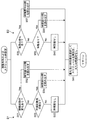
- 9 (A) and 9 (B) are diagrams showing how to determine whether or not the current blood pressure value measured in the nighttime blood pressure measurement mode is different from the past blood pressure value, respectively. .. It is a figure which shows the specific flow of the process of phenomenon discrimination and schedule reset in a nocturnal blood pressure measurement mode.
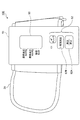
- FIG. 1 shows the appearance of the wrist type sphygmomanometer 100 according to the embodiment of the present invention.
- the sphygmomanometer 100 is roughly divided into a blood pressure measuring cuff 20 to be attached to the left wrist 90 (see FIG. 3 described later) as a measurement site, and a main body 10 integrally attached to the cuff 20. ing.
- the cuff 20 is a general one for a wrist-type sphygmomanometer, and has an elongated band-like shape so as to surround the left wrist 90 along the circumferential direction.
- the cuff 20 contains a fluid bag 22 (see FIG. 2) for pressing the left wrist 90.
- a carla having appropriate flexibility may be provided in the cuff 20.
- the main body 10 is integrally attached to a portion substantially in the center of the strip-shaped cuff 20 in the longitudinal direction.
- the portion to which the main body 10 is attached is planned to correspond to the palm side surface (palm side surface) 90a of the left wrist 90 in the mounted state.
- the main body 10 has a flat, substantially rectangular parallelepiped shape along the outer peripheral surface of the cuff 20.
- the main body 10 is formed to be small and thin so as not to interfere with the sleep of the user (in this example, the subject; the same applies hereinafter). Further, the corners of the main body 10 are rounded (the corners are rounded).
- a display 50 forming a display screen and an operation unit 52 for inputting an instruction from the user are input. And are provided.
- the display 50 is composed of an LCD (Liquid Crystal Display) and displays predetermined information according to a control signal from a CPU (Central Processing Unit) 110 described later.
- the systolic blood pressure (unit: mmHg), the diastolic blood pressure (unit: mmHg), and the pulse rate (unit: beat / minute) are displayed.
- the display 50 may consist of an organic EL (ElectroLuminescence) display or may include an LED (Light Emitting Diode).
- the operation unit 52 inputs an operation signal according to an instruction by the user to the CPU 110 described later.
- the operation unit 52 includes a measurement switch 52A for receiving a blood pressure measurement instruction by the user and a night measurement switch 52B for receiving an instruction to switch the mode between the normal blood pressure measurement mode and the nighttime blood pressure measurement mode.
- the "normal blood pressure measurement mode” means a mode in which, when a blood pressure measurement instruction is input by the measurement switch 52A, the blood pressure is measured in response to the blood pressure measurement instruction.
- the "nighttime blood pressure measurement mode” means a mode in which blood pressure measurement is automatically started according to a predetermined schedule so that the user can measure the blood pressure value during sleep.
- the predetermined schedule refers to a plan for measuring at a fixed time such as 1:00, 2:00, or 3:00 at midnight, or a plan for measuring once every two hours after the night measurement switch 52B is pressed.
- the measurement switch 52A and the night measurement switch 52B are both momentary type (self-recovery type) switches, and are turned on only while they are pressed down and turned off when they are released. Return.
- the measurement switch 52A When the measurement switch 52A is pressed down while the sphygmomanometer 100 is in the normal blood pressure measurement mode, it means a blood pressure measurement instruction, and the cuff 20 temporarily presses the area to be measured (left wrist 90). Blood pressure measurements are performed by the metric method.
- the measurement switch 52A When the measurement switch 52A is pressed down again during blood pressure measurement (for example, while pressurizing the cuff 20), it means an instruction to stop blood pressure measurement, and blood pressure measurement is stopped immediately.
- the night measurement switch 52B is pressed down while the sphygmomanometer 100 is in the normal blood pressure measurement mode, it means an instruction to shift to the night blood pressure measurement mode, and the sphygmomanometer 100 measures the night blood pressure from the normal blood pressure measurement mode. Move to mode. In the nocturnal blood pressure measurement mode, as described above, blood pressure measurement by the oscillometric method is automatically started according to a predetermined schedule. If the night measurement switch 52B is pressed again while the sphygmomanometer 100 is in the nighttime blood pressure measurement mode, it means an instruction to stop the nighttime blood pressure measurement mode, and the sphygmomanometer 100 shifts from the nighttime blood pressure measurement mode to the normal blood pressure measurement mode. To do.
- the user may instruct blood pressure measurement by interruption by pressing the measurement switch 52A, in addition to the predetermined schedule.
- the blood pressure measurement is temporarily performed by the cuff 20 in response to the interrupted blood pressure measurement instruction, and the blood pressure measurement is performed by the oscillometric method.
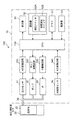
- FIG. 2 shows the block configuration of the sphygmomanometer 100.
- the cuff 20 includes a fluid bag 22 for pressing the left wrist 90 as a measurement site as described above.
- the fluid bag 22 and the main body 10 are connected by an air pipe 39 so that the fluid can flow.
- the main body 10 includes a CPU 110 as a control unit, a memory 51 as a storage unit, a power supply unit 53, an acceleration sensor 34, a pressure sensor 31, and a pump. 32 and a valve 33 are mounted. Further, the main body 10 includes an A / D conversion circuit 310 that converts the output of the pressure sensor 31 from an analog signal to a digital signal, a pump drive circuit 320 that drives the pump 32, and a valve drive circuit 330 that drives the valve 33. It is equipped with an A / D conversion circuit 340 that converts the output of the acceleration sensor 34 from an analog signal to a digital signal.
- the pressure sensor 31, the pump 32, and the valve 33 are commonly connected to the fluid bag 22 through the air pipe 39 so that the fluid can flow.
- the memory 51 contains a program for controlling the sphygmomanometer 100, data used for controlling the sphygmomanometer 100, setting data for setting various functions of the sphygmomanometer 100, data of measurement result of the blood pressure value, and pulse. The number, pulse wave interval, output data of the acceleration sensor 34, and the like are stored. Further, the memory 51 is used as a work memory or the like when a program is executed.
- the memory 51 stores an algorithm for the sitting position and an algorithm for the supine position as an algorithm for calculating blood pressure by the oscillometric method.
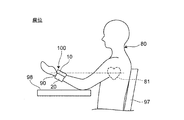
- the “sitting position” means that a user 80 who wears a sphygmomanometer 100 on his left wrist 90 sits on a chair 97 or the like, puts his left elbow on a table 98, and puts his left wrist 90 on his trunk.
- by raising it diagonally forward (hands up, elbows down) it means a posture in which the left wrist 90 (and sphygmomanometer 100) is maintained at the height level of the heart 81.
- This posture is recommended to improve the accuracy of blood pressure measurement because the height difference between the left wrist 90 of the user 80 and the heart 81 can be eliminated.
- a user 80 wearing a sphygmomanometer 100 on the left wrist 90 is placed on a horizontal floor surface 99 or the like with the left elbow extended along the trunk. It means lying on his back.
- the height difference ⁇ H between the left wrist 90 (and the sphygmomanometer 100) of the user 80 and the heart 81 occurs (the height of the heart 81 is higher than the height of the left wrist 90), so that the blood pressure measurement value is measured. There will be a gap.
- the blood pressure measurement value may deviate due to the bending and stretching of the left elbow. There is also sex.
- a blood pressure calculation algorithm for measuring the blood pressure in the recumbent position is used as opposed to the blood pressure calculation algorithm for measuring the blood pressure in the sitting position. It is desirable to change.
- the memory 51 stores an algorithm for the sitting position and an algorithm for the supine position as an algorithm for calculating blood pressure by the oscillometric method. The specific method of calculating blood pressure using these algorithms will be described later.
- the memory 51 determines the remeasurement time for each of a plurality of predetermined types of phenomena that may occur in the subject in the nocturnal blood pressure measurement mode.
- the relative time difference for this is stored in advance.
- the "predetermined multiple types of phenomena” are, in this example, four types of phenomena that can affect the blood pressure value: changes in sleep state, generation of irregular pulse waves, changes in posture, and body movements. Point to.
- the "change in sleep state” refers to a change in sleep depth, for example, a change from non-REM sleep (deep sleep) to REM sleep (light sleep), a change from REM sleep (light sleep) to an awake state, and the like.
- “Generation of irregular pulse wave” refers to a state in which a pulse wave that should be repeated at a constant cycle and a constant intensity is disturbed (including an arrhythmia).
- “Postural change” refers to a phenomenon in which a subject shifts from one posture (typically in the supine position in the case of nocturnal blood pressure measurement) to another.
- Body movement refers to body movement (eg, repetitive movement) that does not correspond to a change in posture.
- the time difference is "30 minutes” for changes in posture
- the time difference is “5 minutes” for body movements
- the time difference is “15 minutes” for changes in sleep state
- the time difference is "5 minutes” for the occurrence of irregular pulse waves.
- the CPU 110 shown in FIG. 2 controls the operation of the entire sphygmomanometer 100. Specifically, the CPU 110 acts as a pressure control unit according to a program for controlling the sphygmomanometer 100 stored in the memory 51, and drives the pump 32 and the valve 33 in response to an operation signal from the operation unit 52. Take control. Further, the CPU 110 functions as a blood pressure measuring unit, calculates a blood pressure value by using an algorithm for calculating blood pressure by an oscillometric method, and controls a display 50 and a memory 51.
- the power supply unit 53 includes a secondary battery, a CPU 110, a pressure sensor 31, a pump 32, a valve 33, an acceleration sensor 34, a display 50, a memory 51, an A / D conversion circuit 310, 340, and a pump drive circuit 320. , And each part of the valve drive circuit 330 is supplied with electric power.
- the acceleration sensor 34 includes a three-axis acceleration sensor integrally mounted on the main body 10, data representing the direction of the gravitational acceleration vector with respect to the main body 10 (hence, the posture of the subject wearing the main body 10), and the subject. Outputs data representing body movements.
- the A / D conversion circuit 340 converts the output of the acceleration sensor 34 from an analog signal to a digital signal and outputs it to the CPU 110.
- the acceleration sensor 34 functions as an element forming a phenomenon determination unit, particularly a posture determination unit and a body movement determination unit, which will be described later.
- the pump 32 supplies air as a fluid to the fluid bag 22 through the air pipe 39 in order to pressurize the pressure (cuff pressure) in the fluid bag 22 contained in the cuff 20.
- the valve 33 is opened and closed to discharge the air from the fluid bag 22 through the air pipe 39 or to fill the fluid bag 22 with air to control the cuff pressure.
- the pump drive circuit 320 drives the pump 32 based on a control signal given from the CPU 110.
- the valve drive circuit 330 opens and closes the valve 33 based on a control signal given from the CPU 110.
- the pressure sensor 31 and the A / D conversion circuit 310 function as a pressure detection unit that detects the pressure of the cuff.
- the pressure sensor 31 is a piezoresistive pressure sensor in this example, and outputs the pressure (cuff pressure) in the fluid bag 22 contained in the cuff 20 as an electric resistance due to the piezoresistive effect through the air pipe 39.
- the A / D conversion circuit 310 converts the output (electrical resistance) of the pressure sensor 31 from an analog signal to a digital signal and outputs it to the CPU 110.
- the CPU 110 acts as an oscillating circuit that oscillates at a frequency corresponding to the electrical resistance from the pressure sensor 31, and acquires a signal representing the cuff pressure according to the oscillating frequency.
- the pressure sensor 31 also functions as an element forming a phenomenon determination unit, which will be described later, particularly a sleep state determination unit and an irregular pulse wave determination unit.
- FIG. 5 shows an operation flow when a user measures blood pressure with a sphygmomanometer 100 in a normal blood pressure measurement mode.
- the measurement switch 52A is continuously pressed for, for example, 3 seconds or more in the power-off state, the power is turned on and the normal blood pressure measurement mode is set by default.
- step S2 of FIG. 5 when the user presses down the measurement switch 52A provided on the main body 10 and inputs a blood pressure measurement instruction, the CPU 110 initializes the pressure sensor 31 (step S2). Specifically, the CPU 110 initializes the processing memory area, turns off (stops) the pump 32, and adjusts the pressure sensor 31 to 0 mmHg (atmospheric pressure is set to 0 mmHg) with the valve 33 open. )I do.
- the CPU 110 closes the valve 33 via the valve drive circuit 330 (step S3), and then turns on (starts) the pump 32 via the pump drive circuit 320 to form the cuff 20 (fluid bag 22). Pressurization is started (step S4).
- the CPU 110 is the pressure inside the fluid bag 22 as shown in FIG. 7A based on the output of the pressure sensor 31 while supplying air from the pump 32 to the fluid bag 22 through the air pipe 39.
- Cuff pressure Controls the pressurization speed of the PC.
- step S5 of FIG. 5 the CPU 110 acts as a blood pressure measuring unit, and the pulse wave signal SM (variable component due to the pulse wave included in the output of the pressure sensor 31) acquired at this time (FIG. 7 (FIG. 7). Based on (B)), an attempt is made to calculate the blood pressure value (maximum blood pressure (systolic blood pressure) and diastolic blood pressure (diastolic blood pressure)) using the sitting algorithm stored in the memory 51.
- the blood pressure value maximum blood pressure (systolic blood pressure) and diastolic blood pressure (diastolic blood pressure)
- step S6 if the blood pressure value cannot be calculated yet due to lack of data (No in step S6), the cuff pressure PC reaches the upper limit pressure (for safety, for example, 300 mmHg is predetermined). Unless otherwise specified, the processes of steps S4 to S6 are repeated.
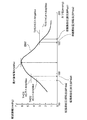
- the CPU 110 calculates the blood pressure value as follows. That is, with respect to the sequence of pulse wave amplitudes (peak to peak) formed by the pulse wave signal SM shown in FIG. 7 (B) obtained from the cuff pressure PC when the cuff 20 is in the pressurizing process, FIG. 7
- the envelope ENV as shown in (C) is set. Along with this, it sets the maximum value AmpMax envelope ENV, predetermined ratio alpha dia for loci, two threshold level THD1, Ths1 of alpha sys.
- THS1 ⁇ sys ⁇ AmpMax.
- the cuff pressure PCs at the time when the envelope ENV crossed those threshold levels THD1 and THS1 are the diastolic blood pressure (diastolic blood pressure) BPdia1 and the systolic blood pressure (systolic blood pressure), respectively. Calculated as BPsys1.
- step S6 the CPU 110 turns off the pump 32 (step S7), opens the valve 33 (step S8), and enters the cuff 20 (fluid bag 22). Controls the exhaust of air.
- the CPU 110 counts the pulse waves obtained from the cuff pressure PC while repeating the processes of steps S4 to S6, and calculates the pulse rate (unit: beat / minute).
- the CPU 110 displays the calculated blood pressure value and pulse rate on the display 50 (step S9), and controls to save the data such as the blood pressure value and the pulse rate in the memory 51.
- FIG. 6 shows an operation flow when the user measures blood pressure in the nighttime blood pressure measurement mode with the sphygmomanometer 100.
- the sphygmomanometer 100 is assumed to be in the normal blood pressure measurement mode.
- step S11 of FIG. 6 when the user presses down the nighttime measurement switch 52B provided on the main body 10, the sphygmomanometer 100 shifts from the normal blood pressure measurement mode to the nighttime blood pressure measurement mode.
- a schedule for measuring once every hour for example, from the time when the nighttime measurement switch 52B is pressed until, for example, 7:00 am is set. It should be noted that the schedule is not limited to this, and even if a schedule for measuring on time such as 7:00 am, 1:00 am, 2:00 pm, and 3:00 am is set after the nighttime measurement switch 52B is pressed. Good.
- the CPU 110 determines whether or not the measurement time is determined by the schedule (in the nighttime blood pressure measurement mode). If it is not the measurement time specified in the schedule (No in step S12), wait for the measurement time specified in the schedule to be reached.
- the CPU 110 starts blood pressure measurement in the same manner as in steps S2 to S4 of FIG. 5, as shown in steps S13 to S15 of FIG. That is, the CPU 110 first initializes the pressure sensor 31 (step S13).
- the CPU 110 closes the valve 33 via the valve drive circuit 330 (step S14), and then turns on (starts) the pump 32 via the pump drive circuit 320 to form the cuff 20 (fluid bag 22). Pressurization is started (step S15). At this time, the CPU 110 controls the pressurizing speed of the cuff pressure PC in the same manner as shown in FIG. 7A.
- step S16 of FIG. 6 the CPU 110 acts as a blood pressure measuring unit, and the pulse wave signal SM (variable component due to the pulse wave included in the output of the pressure sensor 31) acquired at this time (FIG. 7 (FIG. 7). Based on (similar to that shown in B)), an attempt is made to calculate blood pressure values (maximum blood pressure (systolic blood pressure) and diastolic blood pressure (diastolic blood pressure)) using an algorithm for the supine position.
- blood pressure values maximum blood pressure (systolic blood pressure) and diastolic blood pressure (diastolic blood pressure)
- step S17 if the blood pressure value cannot be calculated yet due to lack of data (No in step S17), the cuff pressure PC reaches the upper limit pressure (for safety, for example, 300 mmHg is predetermined). Unless otherwise specified, the processes of steps S15 to S17 are repeated.
- the CPU 110 calculates the blood pressure value as follows. That is, the envelope ENV as shown in FIG. 8 with respect to the sequence of pulse wave amplitudes (peak to peak) formed by the pulse wave signal SM obtained from the cuff pressure PC when the cuff 20 is in the pressurizing process. (Similar to that shown in FIG. 7C) is set.
- the user In the nocturnal blood pressure measurement mode, the user is usually expected to be in the supine position. Therefore, by using the algorithm for the supine position, the blood pressure values (maximum blood pressure and diastolic blood pressure) can be calculated stably and accurately.
- step S17 When the blood pressure value (current blood pressure value) can be calculated in this way (Yes in step S17), the CPU 110 turns off the pump 32 (step S18), opens the valve 33 (step S19), and cuffs 20 (step S19). Control is performed to exhaust the air in the fluid bag 22).
- the CPU 110 counts the pulse wave obtained from the cuff pressure PC for the phenomenon determination described later, particularly the sleep state determination and the irregular pulse wave determination, and the pulse wave. Calculate the number (unit: beat / minute) and pulse wave interval (unit: second). At the same time, the CPU 110 acquires the output data of the acceleration sensor 34 for the posture determination and the body movement determination described later.
- the CPU 110 displays the calculated blood pressure value and pulse rate on the display 50 (step S20), and stores the current blood pressure value, pulse rate, pulse wave interval data, and output data of the acceleration sensor 34 in memory. Control to save to 51.
- step S21 the CPU 110 acts as a difference determination unit to determine whether or not the current blood pressure value is different from the past blood pressure value. To judge. Specifically, the determination is made as follows. In this determination, the current blood pressure value and the past blood pressure value are compared with each other for systolic blood pressure (systolic blood pressure).
- step S32 if the current blood pressure value differs from the previous blood pressure value by 20 mmHg or more (Yes in step S32), it is determined that the current blood pressure value is "different” from the past blood pressure value (step). S33). On the other hand, if the difference between the current blood pressure value and the previous blood pressure value is less than 20 mmHg (No in step S32), it is determined that the current blood pressure value is "no difference” with respect to the past blood pressure value (step S34). ..
- the nighttime blood pressure value is measured a plurality of times according to the schedule of the nighttime blood pressure measurement mode on the previous day and stored in the memory 51. It is assumed that the blood pressure value this time was obtained at 3:00 am as in the above example.
- the CPU 110 reads out the entire nighttime blood pressure value of the previous day from the memory 51.
- the CPU 110 calculates the average value of the nighttime blood pressure values on the previous day.
- the CPU 110 has a predetermined allowable range (in this example, 3:00 am) with respect to the nighttime average value (average value of the nighttime blood pressure value) of the previous day. In this example, it is determined whether or not the difference exceeds 20 mmHg). Here, if the current blood pressure value differs from the previous blood pressure value by 20 mmHg or more (Yes in step S43), it is determined that the current blood pressure value is "different" from the past blood pressure value (step). S44).
- a predetermined allowable range in this example, 3:00 am
- Step S45 if the difference between the current blood pressure value and the previous blood pressure value is less than 20 mmHg (No in step S43), it is determined that the current blood pressure value is "no difference" with respect to the past blood pressure value (No). Step S45).
- the CPU 110 determines the blood pressure value in the past by a predetermined determination method of one of the determination method according to FIG. 9 (A) and the determination method according to FIG. 9 (B). It is determined whether or not there is a difference with respect to the blood pressure value of.
- the present invention is not limited to this, and the CPU 110 makes a determination based on both FIGS. 9 (A) and 9 (B) each time the measurement is performed this time, and it is determined that there is a "difference" in either one. In this case, it may be determined that the current blood pressure value is "different" from the past blood pressure value. As a result, when the measured value this time may include a measurement error, it can be widely detected.
- the CPU 110 may determine that the current blood pressure value is "different” from the past blood pressure value only when it is determined that there is a “difference” by both determination methods. As a result, only when there is a high possibility that the measured value this time includes a measurement error, the phenomenon determination and schedule reset processing (steps S22 and S23) described later can be performed, and the power saving can be measured.
- step S21 of FIG. 6 it is determined whether or not the current blood pressure value is different from the past blood pressure value. This determines whether or not the current blood pressure value may include a measurement error.
- step S21 when it is determined that the current blood pressure value is "no difference" with respect to the past blood pressure value (No in step S21), the process proceeds to step S24, and the CPU 110 measures all the blood pressure specified in the above schedule. Determine if is complete.
- step S24 the process returns to step S12. Then, it waits for the next measurement time determined in the above schedule (No in step S12).
- the CPU 110 repeats the processes of steps S13 to S20.
- step S21 of FIG. 6 determines the current blood pressure value.
- the process proceeds to steps S22 and S23, and the CPU 110 determines the phenomenon.
- a phenomenon discriminating unit when the current blood pressure value differs from the past blood pressure value by more than the above allowable range (20 mmHg in the above example), a plurality of types of phenomena predetermined to the subject.
- the schedule resetting unit the remeasurement time with respect to the current blood pressure value measurement time is variably set according to which of the above-mentioned plurality of types of phenomena has occurred (step S23).
- the process B1 includes a phenomenon discrimination process based on the pulse rate and pulse wave interval data calculated from the output of the pressure sensor 31.
- Process B2 is a phenomenon discrimination process based on data representing the direction of the gravitational acceleration vector with respect to the main body 10 (hence, the posture of the subject wearing the main body 10) and data representing the body movement of the subject, which are obtained from the output of the acceleration sensor 34. Includes.
- step S51 the CPU 110 functions as a sleep state determination unit, and determines whether or not the sleep state of the subject has changed based on the pulse rate data stored in the memory 51.
- the CPU 110 uses a known method as disclosed in, for example, Japanese Patent Application Laid-Open No. 2001-061819 and Japanese Patent Application Laid-Open No. 2007-199025 to change the sleep state of the subject from the change in pulse rate to a deep sleep state. It detects whether it is in non-REM sleep) or light sleep state (REM sleep), and whether it has changed from sleep state to wakefulness.
- the CPU 110 changes the sleep state of the subject when the pulse rate changes from the past average value (for example, 70 beats / minute) beyond a predetermined allowable range ⁇ 20%. , It is determined that the original non-REM sleep has changed to REM sleep or awake state (Yes in step S51). At this time, the CPU 110 reads out the time difference of 15 minutes according to the "change in sleep state" as a candidate from the time difference table (see Table 1) of the memory 51 (step S52). On the other hand, in other cases, the CPU 110 determines that there is no change in the sleep state (No in step S51), and proceeds to step S53.
- step S53 the CPU 110 functions as an irregular pulse wave determination unit, and determines whether or not an irregular pulse wave has occurred based on the pulse wave interval data stored in the memory 51.
- the CPU 110 is ⁇ 25% of the past average pulse wave interval by a known method as disclosed in, for example, JP-A-2018-102670 and JP-A-2019-115614.
- the CPU 110 reads out from the time difference table (see Table 1) of the memory 51 as a candidate the time difference of 5 minutes according to the “generation of irregular pulse wave” (step S54).
- the CPU 110 determines that the pulse wave is a regular pulse wave (No in step S53).
- the CPU 110 selects no time difference (zero) as a candidate (step S55).
- step S56 the CPU 110 acts as an attitude determination unit, and is based on the output data of the acceleration sensor 34 stored in the memory 51, particularly the data representing the direction of the gravitational acceleration vector with respect to the main body 10. Judge whether or not the posture of is changed. Specifically, the CPU 110 exceeds a predetermined threshold value in the direction of the gravitational acceleration vector with respect to the main body 10 by a known method such as disclosed in Japanese Patent No. 3297971 and Japanese Patent Application Laid-Open No. 2013-183975. In this case, it is determined that the posture of the subject has changed (Yes in step S56).
- the CPU 110 reads out the time difference of 30 minutes according to the “change in posture” as a candidate from the time difference table (see Table 1) of the memory 51 (step S57). On the other hand, if this is not the case, the CPU 110 determines that there is no change in posture (No in step S56), and proceeds to step S58.
- the CPU 110 functions as a body movement determination unit, and determines whether or not the subject has moved based on the output data of the acceleration sensor 34 stored in the memory 51, particularly the change in the output of the acceleration sensor 34. To do. Specifically, the CPU 110 determines whether or not the subject has moved based on the change in the output of the acceleration sensor 34 by a known method such as that disclosed in Japanese Patent Application Laid-Open No. 2017-118982. .. That is, during blood pressure measurement, the average values ⁇ x>, ⁇ y>, and ⁇ z> of the outputs ⁇ x, ⁇ y, and ⁇ z of the acceleration sensor 34 are obtained for each unit period (for example, 1 second or several seconds), and further, the unit is obtained.
- the CPU 110 reads out the time difference of 5 minutes according to the "body movement" as a candidate from the time difference table (see Table 1) of the memory 51 (step S59). On the other hand, if this is not the case, the CPU 110 determines that there is no body movement (No in step S58). At this time, the CPU 110 selects no time difference (zero) as a candidate (step S60).
- step S61 the CPU 110 functions as a schedule resetting unit, adds the relative time difference read from the time difference table to the current blood pressure value measurement time, and remeasures the time. To set. For example, if the blood pressure value measurement time this time is 3:00 am and the relative time difference read out is only 15 minutes according to the "change in sleep state", the remeasurement time is 3:15 am. Set to. As a result, the time for remeasurement can be set smoothly.
- the above-mentioned relative time differences are two from the above-mentioned time difference table by the processes B1 and B2.
- the above is read.
- the relative time difference of 30 minutes according to the "change in posture” is performed by the processes B1 and B2.
- the relative time difference of 5 minutes according to the "generation of irregular pulse wave” are read out.
- step S61 the CPU 110 selects the longest time difference among the relative time differences read from the time difference table for the two or more phenomena that have occurred in an overlapping manner.
- the longest time difference of 30 minutes is selected from the relative time difference of 30 minutes according to the "change in posture" and the relative time difference of 5 minutes according to the "generation of irregular pulse wave". ..
- the CPU 110 adds the longest selected time difference of 30 minutes to the current measurement time of the blood pressure value (for example, 3:00 am), and sets the remeasurement time to 3:30 am. Set.
- the CPU 110 sets the time for the remeasurement according to the phenomenon that may continue for the longest time among the two or more phenomena that have occurred in an overlapping manner.
- the remeasurement is started while a certain phenomenon (the phenomenon that continues for the longest time. In the above example, the change in posture) of the two or more phenomena that have occurred repeatedly is still continuing. Such a situation can be avoided.
- the CPU 110 does not set the remeasurement time in step S61.
- step S24 in FIG. It is determined whether or not all the blood pressure measurements specified in) have been completed, including the remeasurement set in the process of.
- step S24 the process returns to step S12. Then, it waits for the next measurement time determined in the above schedule (No in step S12).
- step S12 When the next measurement time specified in the above schedule is reached (Yes in step S12), the CPU 110 repeats the processes of steps S13 to S20. In this way, the CPU 110 repeats the measurement as long as the blood pressure measurement is still scheduled according to the above schedule (“incomplete” in step S21), and when all the blood pressure measurements determined in the above schedule are completed (in step S24). "End"), the above-mentioned nocturnal blood pressure measurement mode is terminated.
- the time of remeasurement is set according to the phenomenon that occurred in the subject. It can be set appropriately (steps S22 and S23 in FIG. 6). As a result, it is possible to avoid that the remeasurement time is too late for the phenomenon that has occurred and that the remeasurement time is too early for the phenomenon that has occurred.
- the sphygmomanometer 100 is a type that presses the wrist as the measurement site (the left wrist 90 is used in the above example, but the right wrist may also be used), the blood pressure monitor 100 is compared with the type that presses the upper arm. It is expected that the degree of disturbing the sleep of the user (subject) is small (Imai et al., “Development and evaluation of a home nocturnal blood pressure monitoring system using a wrist-cuff device”, Blood Pressure Monitoring 2018, 23, P318. -326). Therefore, this sphygmomanometer 100 is suitable for nighttime blood pressure measurement.
- this sphygmomanometer 100 is integrally and compactly configured as a wrist-type sphygmomanometer, it is convenient for the user to handle.
- the above-mentioned plurality of types of phenomena include changes in sleep state and generation of irregular pulse waves. It is possible to determine whether or not four types of phenomena, posture change and body movement, have occurred.
- the blood pressure is calculated in the process of pressurizing the cuff 20 (fluid bag 22), but the present invention is not limited to this. Blood pressure may be calculated in the process of depressurizing the cuff 20.
- the blood pressure measurement instruction and the transition instruction to the nighttime blood pressure measurement mode are input by the measurement switch 52A and the nighttime measurement switch 52B as the operation unit provided on the main body 10, but the present invention is limited to this. is not it.
- a communication unit capable of wireless communication is mounted on the main body 10, and a blood pressure measurement instruction and a transition instruction to the nighttime blood pressure measurement mode are input from a smartphone or the like existing outside the sphygmomanometer 100 via this communication unit. You may.
- the main body 10 is provided integrally with the cuff 20, but the present invention is not limited to this.
- the main body 10 may be configured as a separate body from the cuff 20 and may be connected to the cuff 20 (fluid bag 22) so that fluid can flow through a flexible air tube.
- the above-mentioned blood pressure measuring method (particularly, the operation flow of FIGS. 5, 6, 9 and 10) is used as software (computer program) for non-CD (compact disc), DVD (digital universal disc), flash memory and the like. Data may be recorded on a storable recording medium non-transitory.
- a substantial computer device such as a personal computer, a PDA (Personal Digital Assistance), or a smartphone, the above-mentioned blood pressure measurement method can be applied to those computer devices. Can be executed.
- the oscillometric method is adopted as the blood pressure measurement method, but the method is not limited to this.
- a blood pressure measuring method a method of observing Korotkoff sounds by providing a microphone (Korotkoff method) may be adopted.
Landscapes
- Health & Medical Sciences (AREA)
- Life Sciences & Earth Sciences (AREA)
- Engineering & Computer Science (AREA)
- Veterinary Medicine (AREA)
- Pathology (AREA)
- Biophysics (AREA)
- Biomedical Technology (AREA)
- Heart & Thoracic Surgery (AREA)
- Medical Informatics (AREA)
- Molecular Biology (AREA)
- Surgery (AREA)
- Animal Behavior & Ethology (AREA)
- General Health & Medical Sciences (AREA)
- Public Health (AREA)
- Physics & Mathematics (AREA)
- Cardiology (AREA)
- Vascular Medicine (AREA)
- Physiology (AREA)
- Ophthalmology & Optometry (AREA)
- Dentistry (AREA)
- Oral & Maxillofacial Surgery (AREA)
- Educational Technology (AREA)
- Developmental Disabilities (AREA)
- Child & Adolescent Psychology (AREA)
- Hospice & Palliative Care (AREA)
- Psychiatry (AREA)
- Psychology (AREA)
- Social Psychology (AREA)
- Measuring Pulse, Heart Rate, Blood Pressure Or Blood Flow (AREA)
- Measurement Of The Respiration, Hearing Ability, Form, And Blood Characteristics Of Living Organisms (AREA)
Priority Applications (3)
| Application Number | Priority Date | Filing Date | Title |
|---|---|---|---|
| DE112020005219.2T DE112020005219T5 (de) | 2019-10-29 | 2020-10-05 | Blutdruckmessgerät, blutdruckmessverfahren und programm |
| CN202080073515.8A CN114585300B (zh) | 2019-10-29 | 2020-10-05 | 血压计、血压测量方法、以及存储介质 |
| US17/724,217 US20220240795A1 (en) | 2019-10-29 | 2022-04-19 | Sphygmomanometer, blood pressure measurement method, and computer-readable recording medium |
Applications Claiming Priority (2)
| Application Number | Priority Date | Filing Date | Title |
|---|---|---|---|
| JP2019196142A JP7476514B2 (ja) | 2019-10-29 | 2019-10-29 | 血圧計、血圧計の作動方法、およびプログラム |
| JP2019-196142 | 2019-10-29 |
Related Child Applications (1)
| Application Number | Title | Priority Date | Filing Date |
|---|---|---|---|
| US17/724,217 Continuation US20220240795A1 (en) | 2019-10-29 | 2022-04-19 | Sphygmomanometer, blood pressure measurement method, and computer-readable recording medium |
Publications (1)
| Publication Number | Publication Date |
|---|---|
| WO2021085042A1 true WO2021085042A1 (ja) | 2021-05-06 |
Family
ID=75711739
Family Applications (1)
| Application Number | Title | Priority Date | Filing Date |
|---|---|---|---|
| PCT/JP2020/037772 Ceased WO2021085042A1 (ja) | 2019-10-29 | 2020-10-05 | 血圧計、血圧測定方法、およびプログラム |
Country Status (5)
| Country | Link |
|---|---|
| US (1) | US20220240795A1 (https=) |
| JP (1) | JP7476514B2 (https=) |
| CN (1) | CN114585300B (https=) |
| DE (1) | DE112020005219T5 (https=) |
| WO (1) | WO2021085042A1 (https=) |
Families Citing this family (4)
| Publication number | Priority date | Publication date | Assignee | Title |
|---|---|---|---|---|
| JP2024037519A (ja) * | 2022-09-07 | 2024-03-19 | オムロンヘルスケア株式会社 | 血圧計、および血圧測定方法 |
| JP2024043198A (ja) * | 2022-09-16 | 2024-03-29 | オムロンヘルスケア株式会社 | 血圧計、および血圧測定方法 |
| JP2025141308A (ja) * | 2024-03-15 | 2025-09-29 | 株式会社東海理化電機製作所 | 心身状態推定装置 |
| JP7717994B1 (ja) * | 2025-03-11 | 2025-08-04 | 株式会社エー・アンド・デイ | 血圧計および血圧測定方法 |
Citations (6)
| Publication number | Priority date | Publication date | Assignee | Title |
|---|---|---|---|---|
| JP2002149830A (ja) * | 2000-11-13 | 2002-05-24 | Matsushita Electric Ind Co Ltd | 健康管理方法、アドバイス装置および健康管理システム |
| JP2006247175A (ja) * | 2005-03-11 | 2006-09-21 | Denso Corp | 車両用健康アドバイザー装置 |
| JP2011180857A (ja) * | 2010-03-02 | 2011-09-15 | Saxa Inc | 健康管理指示提供システムおよび健康管理指示提供方法 |
| WO2012018029A1 (ja) * | 2010-08-06 | 2012-02-09 | 株式会社オムシー | 血圧測定装置 |
| JP2016538097A (ja) * | 2013-10-23 | 2016-12-08 | クアンタス, インコーポレイテッド | 消費者バイオメトリックデバイス |
| JP2019117612A (ja) * | 2017-12-27 | 2019-07-18 | オムロンヘルスケア株式会社 | 情報処理装置、情報処理方法及びプログラム |
Family Cites Families (17)
| Publication number | Priority date | Publication date | Assignee | Title |
|---|---|---|---|---|
| JP3297971B2 (ja) | 1995-02-16 | 2002-07-02 | オムロン株式会社 | 電子血圧計 |
| JP2001061819A (ja) | 1999-08-26 | 2001-03-13 | Matsushita Electric Works Ltd | 睡眠判定評価装置 |
| DE102005019755A1 (de) * | 2005-04-28 | 2006-11-09 | Braun Gmbh | Blutdruckmessgerät |
| JP5106781B2 (ja) | 2006-01-30 | 2012-12-26 | 学校法人日本大学 | 睡眠センサー付身体装着装置および睡眠報知制御方法 |
| CN101779952B (zh) * | 2009-01-20 | 2013-03-13 | 深圳迈瑞生物医疗电子股份有限公司 | 血压测量间隔控制方法、装置及监护仪 |
| CN102481127B (zh) * | 2009-08-13 | 2015-07-15 | 帝人制药株式会社 | 呼吸波形信息的运算装置和利用呼吸波形信息的医疗设备 |
| JP5536597B2 (ja) * | 2010-09-15 | 2014-07-02 | テルモ株式会社 | 血圧計 |
| JP5857810B2 (ja) | 2012-03-09 | 2016-02-10 | オムロンヘルスケア株式会社 | 血圧測定装置及びその制御方法 |
| US10758189B2 (en) * | 2012-12-13 | 2020-09-01 | Koninklijke Philips N.V. | Method and apparatus for use in monitoring and identifying abnormal values of a physiological characteristic of a subject |
| JP6610251B2 (ja) | 2015-12-28 | 2019-11-27 | オムロンヘルスケア株式会社 | 血圧関連情報表示装置 |
| JP6750367B2 (ja) * | 2016-07-25 | 2020-09-02 | セイコーエプソン株式会社 | 血圧測定装置および血圧測定方法 |
| JP2018102670A (ja) | 2016-12-27 | 2018-07-05 | オムロンヘルスケア株式会社 | 上下肢の脈波波形から腹部大動脈瘤(aaa)を検出する原理 |
| DE112018001373T5 (de) | 2017-03-15 | 2019-11-28 | Omron Corporation | Blutdruckmessgerät und blutdruckmessverfahren |
| WO2018168796A1 (ja) * | 2017-03-15 | 2018-09-20 | オムロン株式会社 | 生体情報測定装置、方法及びプログラム |
| CN107582036A (zh) * | 2017-08-17 | 2018-01-16 | 上海斐讯数据通信技术有限公司 | 一种提高准确度的血压测量方法、系统和装置 |
| JP6881289B2 (ja) | 2017-12-27 | 2021-06-02 | オムロンヘルスケア株式会社 | 疾患発症リスク予測装置、方法およびプログラム |
| CN110115573B (zh) * | 2019-05-27 | 2024-09-17 | 威海威高瑞影医疗科技有限公司 | 一种血压间隔测量充气压力控制方法、装置及监护仪 |
-
2019
- 2019-10-29 JP JP2019196142A patent/JP7476514B2/ja active Active
-
2020
- 2020-10-05 DE DE112020005219.2T patent/DE112020005219T5/de active Pending
- 2020-10-05 WO PCT/JP2020/037772 patent/WO2021085042A1/ja not_active Ceased
- 2020-10-05 CN CN202080073515.8A patent/CN114585300B/zh active Active
-
2022
- 2022-04-19 US US17/724,217 patent/US20220240795A1/en active Pending
Patent Citations (6)
| Publication number | Priority date | Publication date | Assignee | Title |
|---|---|---|---|---|
| JP2002149830A (ja) * | 2000-11-13 | 2002-05-24 | Matsushita Electric Ind Co Ltd | 健康管理方法、アドバイス装置および健康管理システム |
| JP2006247175A (ja) * | 2005-03-11 | 2006-09-21 | Denso Corp | 車両用健康アドバイザー装置 |
| JP2011180857A (ja) * | 2010-03-02 | 2011-09-15 | Saxa Inc | 健康管理指示提供システムおよび健康管理指示提供方法 |
| WO2012018029A1 (ja) * | 2010-08-06 | 2012-02-09 | 株式会社オムシー | 血圧測定装置 |
| JP2016538097A (ja) * | 2013-10-23 | 2016-12-08 | クアンタス, インコーポレイテッド | 消費者バイオメトリックデバイス |
| JP2019117612A (ja) * | 2017-12-27 | 2019-07-18 | オムロンヘルスケア株式会社 | 情報処理装置、情報処理方法及びプログラム |
Also Published As
| Publication number | Publication date |
|---|---|
| CN114585300B (zh) | 2025-09-09 |
| JP7476514B2 (ja) | 2024-05-01 |
| DE112020005219T5 (de) | 2022-08-25 |
| CN114585300A (zh) | 2022-06-03 |
| JP2021069444A (ja) | 2021-05-06 |
| US20220240795A1 (en) | 2022-08-04 |
Similar Documents
| Publication | Publication Date | Title |
|---|---|---|
| JP6786706B2 (ja) | 血圧測定装置、血圧測定方法及びプログラム | |
| US10765366B2 (en) | Appliance | |
| JP5471337B2 (ja) | 血圧測定装置及び血圧測定方法 | |
| WO2021085042A1 (ja) | 血圧計、血圧測定方法、およびプログラム | |
| CN112584758B (zh) | 脉搏波传播时间测定装置以及血压测定装置 | |
| JP7118784B2 (ja) | 脈波伝播時間測定装置及び血圧測定装置 | |
| JP2021090544A (ja) | 血圧計 | |
| CN111818843B (zh) | 脉搏波传播时间测量装置以及血压测量装置 | |
| JP7400342B2 (ja) | 血圧計、血圧測定方法、及びプログラム | |
| JP2017121276A (ja) | 機器 | |
| US12303241B2 (en) | Sphygmomanometer, blood pressure calculation method, and computer-readable recording medium | |
| JP7347132B2 (ja) | 血圧計、血圧算出方法、およびプログラム | |
| JP2021074088A5 (https=) | ||
| JP7775682B2 (ja) | 血圧測定装置及び血圧測定システム | |
| JP7467884B2 (ja) | 血圧計、血圧計の作動方法、およびプログラム | |
| JP7476512B2 (ja) | 血圧計、血圧計の作動方法、およびプログラム | |
| WO2021039301A1 (ja) | 血圧計、血圧算出方法、およびプログラム | |
| JP2021069445A5 (https=) | ||
| EP4029435B1 (en) | Blood pressure monitoring device and method for adaptive blood pressure monitoring | |
| JP2021083576A (ja) | 血圧計、血圧測定方法、及びプログラム |
Legal Events
| Date | Code | Title | Description |
|---|---|---|---|
| 121 | Ep: the epo has been informed by wipo that ep was designated in this application |
Ref document number: 20880356 Country of ref document: EP Kind code of ref document: A1 |
|
| 122 | Ep: pct application non-entry in european phase |
Ref document number: 20880356 Country of ref document: EP Kind code of ref document: A1 |
|
| WWG | Wipo information: grant in national office |
Ref document number: 202080073515.8 Country of ref document: CN |