WO2021066052A1 - 有機微粒子 - Google Patents
有機微粒子 Download PDFInfo
- Publication number
- WO2021066052A1 WO2021066052A1 PCT/JP2020/037266 JP2020037266W WO2021066052A1 WO 2021066052 A1 WO2021066052 A1 WO 2021066052A1 JP 2020037266 W JP2020037266 W JP 2020037266W WO 2021066052 A1 WO2021066052 A1 WO 2021066052A1
- Authority
- WO
- WIPO (PCT)
- Prior art keywords
- monomer
- meth
- acrylate
- group
- fine particles
- Prior art date
- Legal status (The legal status is an assumption and is not a legal conclusion. Google has not performed a legal analysis and makes no representation as to the accuracy of the status listed.)
- Ceased
Links
- 0 *C(c1ccccc1)=C Chemical compound *C(c1ccccc1)=C 0.000 description 2
- DIMBIGNNIRCBTK-UHFFFAOYSA-N CC(C)(C)c(cc1)ccc1OC(C=C)=O Chemical compound CC(C)(C)c(cc1)ccc1OC(C=C)=O DIMBIGNNIRCBTK-UHFFFAOYSA-N 0.000 description 1
Images
Classifications
-
- C—CHEMISTRY; METALLURGY
- C08—ORGANIC MACROMOLECULAR COMPOUNDS; THEIR PREPARATION OR CHEMICAL WORKING-UP; COMPOSITIONS BASED THEREON
- C08F—MACROMOLECULAR COMPOUNDS OBTAINED BY REACTIONS ONLY INVOLVING CARBON-TO-CARBON UNSATURATED BONDS
- C08F212/00—Copolymers of compounds having one or more unsaturated aliphatic radicals, each having only one carbon-to-carbon double bond, and at least one being terminated by an aromatic carbocyclic ring
- C08F212/02—Monomers containing only one unsaturated aliphatic radical
- C08F212/04—Monomers containing only one unsaturated aliphatic radical containing one ring
- C08F212/06—Hydrocarbons
-
- C—CHEMISTRY; METALLURGY
- C09—DYES; PAINTS; POLISHES; NATURAL RESINS; ADHESIVES; COMPOSITIONS NOT OTHERWISE PROVIDED FOR; APPLICATIONS OF MATERIALS NOT OTHERWISE PROVIDED FOR
- C09D—COATING COMPOSITIONS, e.g. PAINTS, VARNISHES OR LACQUERS; FILLING PASTES; CHEMICAL PAINT OR INK REMOVERS; INKS; CORRECTING FLUIDS; WOODSTAINS; PASTES OR SOLIDS FOR COLOURING OR PRINTING; USE OF MATERIALS THEREFOR
- C09D125/00—Coating compositions based on homopolymers or copolymers of compounds having one or more unsaturated aliphatic radicals, each having only one carbon-to-carbon double bond, and at least one being terminated by an aromatic carbocyclic ring; Coating compositions based on derivatives of such polymers
- C09D125/02—Homopolymers or copolymers of hydrocarbons
- C09D125/04—Homopolymers or copolymers of styrene
- C09D125/08—Copolymers of styrene
- C09D125/14—Copolymers of styrene with unsaturated esters
-
- C—CHEMISTRY; METALLURGY
- C08—ORGANIC MACROMOLECULAR COMPOUNDS; THEIR PREPARATION OR CHEMICAL WORKING-UP; COMPOSITIONS BASED THEREON
- C08F—MACROMOLECULAR COMPOUNDS OBTAINED BY REACTIONS ONLY INVOLVING CARBON-TO-CARBON UNSATURATED BONDS
- C08F230/00—Copolymers of compounds having one or more unsaturated aliphatic radicals, each having only one carbon-to-carbon double bond, and containing phosphorus, selenium, tellurium or a metal
- C08F230/04—Copolymers of compounds having one or more unsaturated aliphatic radicals, each having only one carbon-to-carbon double bond, and containing phosphorus, selenium, tellurium or a metal containing a metal
- C08F230/08—Copolymers of compounds having one or more unsaturated aliphatic radicals, each having only one carbon-to-carbon double bond, and containing phosphorus, selenium, tellurium or a metal containing a metal containing silicon
- C08F230/085—Copolymers of compounds having one or more unsaturated aliphatic radicals, each having only one carbon-to-carbon double bond, and containing phosphorus, selenium, tellurium or a metal containing a metal containing silicon the monomer being a polymerisable silane, e.g. (meth)acryloyloxy trialkoxy silanes or vinyl trialkoxysilanes
-
- C—CHEMISTRY; METALLURGY
- C08—ORGANIC MACROMOLECULAR COMPOUNDS; THEIR PREPARATION OR CHEMICAL WORKING-UP; COMPOSITIONS BASED THEREON
- C08F—MACROMOLECULAR COMPOUNDS OBTAINED BY REACTIONS ONLY INVOLVING CARBON-TO-CARBON UNSATURATED BONDS
- C08F12/00—Homopolymers and copolymers of compounds having one or more unsaturated aliphatic radicals, each having only one carbon-to-carbon double bond, and at least one being terminated by an aromatic carbocyclic ring
- C08F12/02—Monomers containing only one unsaturated aliphatic radical
- C08F12/04—Monomers containing only one unsaturated aliphatic radical containing one ring
- C08F12/06—Hydrocarbons
- C08F12/12—Monomers containing a branched unsaturated aliphatic radical or a ring substituted by an alkyl radical
-
- C—CHEMISTRY; METALLURGY
- C08—ORGANIC MACROMOLECULAR COMPOUNDS; THEIR PREPARATION OR CHEMICAL WORKING-UP; COMPOSITIONS BASED THEREON
- C08F—MACROMOLECULAR COMPOUNDS OBTAINED BY REACTIONS ONLY INVOLVING CARBON-TO-CARBON UNSATURATED BONDS
- C08F212/00—Copolymers of compounds having one or more unsaturated aliphatic radicals, each having only one carbon-to-carbon double bond, and at least one being terminated by an aromatic carbocyclic ring
- C08F212/02—Monomers containing only one unsaturated aliphatic radical
- C08F212/04—Monomers containing only one unsaturated aliphatic radical containing one ring
- C08F212/06—Hydrocarbons
- C08F212/12—Monomers containing a branched unsaturated aliphatic radical or a ring substituted by an alkyl radical
-
- C—CHEMISTRY; METALLURGY
- C08—ORGANIC MACROMOLECULAR COMPOUNDS; THEIR PREPARATION OR CHEMICAL WORKING-UP; COMPOSITIONS BASED THEREON
- C08F—MACROMOLECULAR COMPOUNDS OBTAINED BY REACTIONS ONLY INVOLVING CARBON-TO-CARBON UNSATURATED BONDS
- C08F212/00—Copolymers of compounds having one or more unsaturated aliphatic radicals, each having only one carbon-to-carbon double bond, and at least one being terminated by an aromatic carbocyclic ring
- C08F212/34—Monomers containing two or more unsaturated aliphatic radicals
- C08F212/36—Divinylbenzene
-
- C—CHEMISTRY; METALLURGY
- C08—ORGANIC MACROMOLECULAR COMPOUNDS; THEIR PREPARATION OR CHEMICAL WORKING-UP; COMPOSITIONS BASED THEREON
- C08F—MACROMOLECULAR COMPOUNDS OBTAINED BY REACTIONS ONLY INVOLVING CARBON-TO-CARBON UNSATURATED BONDS
- C08F220/00—Copolymers of compounds having one or more unsaturated aliphatic radicals, each having only one carbon-to-carbon double bond, and only one being terminated by only one carboxyl radical or a salt, anhydride ester, amide, imide or nitrile thereof
- C08F220/02—Monocarboxylic acids having less than ten carbon atoms; Derivatives thereof
- C08F220/04—Acids; Metal salts or ammonium salts thereof
-
- C—CHEMISTRY; METALLURGY
- C08—ORGANIC MACROMOLECULAR COMPOUNDS; THEIR PREPARATION OR CHEMICAL WORKING-UP; COMPOSITIONS BASED THEREON
- C08F—MACROMOLECULAR COMPOUNDS OBTAINED BY REACTIONS ONLY INVOLVING CARBON-TO-CARBON UNSATURATED BONDS
- C08F220/00—Copolymers of compounds having one or more unsaturated aliphatic radicals, each having only one carbon-to-carbon double bond, and only one being terminated by only one carboxyl radical or a salt, anhydride ester, amide, imide or nitrile thereof
- C08F220/02—Monocarboxylic acids having less than ten carbon atoms; Derivatives thereof
- C08F220/10—Esters
-
- C—CHEMISTRY; METALLURGY
- C08—ORGANIC MACROMOLECULAR COMPOUNDS; THEIR PREPARATION OR CHEMICAL WORKING-UP; COMPOSITIONS BASED THEREON
- C08F—MACROMOLECULAR COMPOUNDS OBTAINED BY REACTIONS ONLY INVOLVING CARBON-TO-CARBON UNSATURATED BONDS
- C08F220/00—Copolymers of compounds having one or more unsaturated aliphatic radicals, each having only one carbon-to-carbon double bond, and only one being terminated by only one carboxyl radical or a salt, anhydride ester, amide, imide or nitrile thereof
- C08F220/02—Monocarboxylic acids having less than ten carbon atoms; Derivatives thereof
- C08F220/10—Esters
- C08F220/12—Esters of monohydric alcohols or phenols
- C08F220/16—Esters of monohydric alcohols or phenols of phenols or of alcohols containing two or more carbon atoms
- C08F220/18—Esters of monohydric alcohols or phenols of phenols or of alcohols containing two or more carbon atoms with acrylic or methacrylic acids
-
- C—CHEMISTRY; METALLURGY
- C08—ORGANIC MACROMOLECULAR COMPOUNDS; THEIR PREPARATION OR CHEMICAL WORKING-UP; COMPOSITIONS BASED THEREON
- C08F—MACROMOLECULAR COMPOUNDS OBTAINED BY REACTIONS ONLY INVOLVING CARBON-TO-CARBON UNSATURATED BONDS
- C08F220/00—Copolymers of compounds having one or more unsaturated aliphatic radicals, each having only one carbon-to-carbon double bond, and only one being terminated by only one carboxyl radical or a salt, anhydride ester, amide, imide or nitrile thereof
- C08F220/02—Monocarboxylic acids having less than ten carbon atoms; Derivatives thereof
- C08F220/10—Esters
- C08F220/12—Esters of monohydric alcohols or phenols
- C08F220/16—Esters of monohydric alcohols or phenols of phenols or of alcohols containing two or more carbon atoms
- C08F220/18—Esters of monohydric alcohols or phenols of phenols or of alcohols containing two or more carbon atoms with acrylic or methacrylic acids
- C08F220/1804—C4-(meth)acrylate, e.g. butyl (meth)acrylate, isobutyl (meth)acrylate or tert-butyl (meth)acrylate
-
- C—CHEMISTRY; METALLURGY
- C08—ORGANIC MACROMOLECULAR COMPOUNDS; THEIR PREPARATION OR CHEMICAL WORKING-UP; COMPOSITIONS BASED THEREON
- C08F—MACROMOLECULAR COMPOUNDS OBTAINED BY REACTIONS ONLY INVOLVING CARBON-TO-CARBON UNSATURATED BONDS
- C08F220/00—Copolymers of compounds having one or more unsaturated aliphatic radicals, each having only one carbon-to-carbon double bond, and only one being terminated by only one carboxyl radical or a salt, anhydride ester, amide, imide or nitrile thereof
- C08F220/02—Monocarboxylic acids having less than ten carbon atoms; Derivatives thereof
- C08F220/52—Amides or imides
- C08F220/54—Amides, e.g. N,N-dimethylacrylamide or N-isopropylacrylamide
-
- C—CHEMISTRY; METALLURGY
- C09—DYES; PAINTS; POLISHES; NATURAL RESINS; ADHESIVES; COMPOSITIONS NOT OTHERWISE PROVIDED FOR; APPLICATIONS OF MATERIALS NOT OTHERWISE PROVIDED FOR
- C09D—COATING COMPOSITIONS, e.g. PAINTS, VARNISHES OR LACQUERS; FILLING PASTES; CHEMICAL PAINT OR INK REMOVERS; INKS; CORRECTING FLUIDS; WOODSTAINS; PASTES OR SOLIDS FOR COLOURING OR PRINTING; USE OF MATERIALS THEREFOR
- C09D5/00—Coating compositions, e.g. paints, varnishes or lacquers, characterised by their physical nature or the effects produced; Filling pastes
- C09D5/02—Emulsion paints including aerosols
- C09D5/024—Emulsion paints including aerosols characterised by the additives
-
- C—CHEMISTRY; METALLURGY
- C09—DYES; PAINTS; POLISHES; NATURAL RESINS; ADHESIVES; COMPOSITIONS NOT OTHERWISE PROVIDED FOR; APPLICATIONS OF MATERIALS NOT OTHERWISE PROVIDED FOR
- C09D—COATING COMPOSITIONS, e.g. PAINTS, VARNISHES OR LACQUERS; FILLING PASTES; CHEMICAL PAINT OR INK REMOVERS; INKS; CORRECTING FLUIDS; WOODSTAINS; PASTES OR SOLIDS FOR COLOURING OR PRINTING; USE OF MATERIALS THEREFOR
- C09D7/00—Features of coating compositions, not provided for in group C09D5/00; Processes for incorporating ingredients in coating compositions
- C09D7/40—Additives
- C09D7/65—Additives macromolecular
-
- C—CHEMISTRY; METALLURGY
- C09—DYES; PAINTS; POLISHES; NATURAL RESINS; ADHESIVES; COMPOSITIONS NOT OTHERWISE PROVIDED FOR; APPLICATIONS OF MATERIALS NOT OTHERWISE PROVIDED FOR
- C09D—COATING COMPOSITIONS, e.g. PAINTS, VARNISHES OR LACQUERS; FILLING PASTES; CHEMICAL PAINT OR INK REMOVERS; INKS; CORRECTING FLUIDS; WOODSTAINS; PASTES OR SOLIDS FOR COLOURING OR PRINTING; USE OF MATERIALS THEREFOR
- C09D7/00—Features of coating compositions, not provided for in group C09D5/00; Processes for incorporating ingredients in coating compositions
- C09D7/40—Additives
- C09D7/70—Additives characterised by shape, e.g. fibres, flakes or microspheres
-
- C—CHEMISTRY; METALLURGY
- C09—DYES; PAINTS; POLISHES; NATURAL RESINS; ADHESIVES; COMPOSITIONS NOT OTHERWISE PROVIDED FOR; APPLICATIONS OF MATERIALS NOT OTHERWISE PROVIDED FOR
- C09K—MATERIALS FOR MISCELLANEOUS APPLICATIONS, NOT PROVIDED FOR ELSEWHERE
- C09K3/00—Materials not provided for elsewhere
- C09K3/18—Materials not provided for elsewhere for application to surfaces to minimize adherence of ice, mist or water thereto; Thawing or antifreeze materials for application to surfaces
-
- D—TEXTILES; PAPER
- D06—TREATMENT OF TEXTILES OR THE LIKE; LAUNDERING; FLEXIBLE MATERIALS NOT OTHERWISE PROVIDED FOR
- D06M—TREATMENT, NOT PROVIDED FOR ELSEWHERE IN CLASS D06, OF FIBRES, THREADS, YARNS, FABRICS, FEATHERS OR FIBROUS GOODS MADE FROM SUCH MATERIALS
- D06M15/00—Treating fibres, threads, yarns, fabrics, or fibrous goods made from such materials, with macromolecular compounds; Such treatment combined with mechanical treatment
- D06M15/19—Treating fibres, threads, yarns, fabrics, or fibrous goods made from such materials, with macromolecular compounds; Such treatment combined with mechanical treatment with synthetic macromolecular compounds
- D06M15/21—Macromolecular compounds obtained by reactions only involving carbon-to-carbon unsaturated bonds
- D06M15/227—Macromolecular compounds obtained by reactions only involving carbon-to-carbon unsaturated bonds of hydrocarbons, or reaction products thereof, e.g. afterhalogenated or sulfochlorinated
- D06M15/233—Macromolecular compounds obtained by reactions only involving carbon-to-carbon unsaturated bonds of hydrocarbons, or reaction products thereof, e.g. afterhalogenated or sulfochlorinated aromatic, e.g. styrene
-
- D—TEXTILES; PAPER
- D06—TREATMENT OF TEXTILES OR THE LIKE; LAUNDERING; FLEXIBLE MATERIALS NOT OTHERWISE PROVIDED FOR
- D06M—TREATMENT, NOT PROVIDED FOR ELSEWHERE IN CLASS D06, OF FIBRES, THREADS, YARNS, FABRICS, FEATHERS OR FIBROUS GOODS MADE FROM SUCH MATERIALS
- D06M15/00—Treating fibres, threads, yarns, fabrics, or fibrous goods made from such materials, with macromolecular compounds; Such treatment combined with mechanical treatment
- D06M15/19—Treating fibres, threads, yarns, fabrics, or fibrous goods made from such materials, with macromolecular compounds; Such treatment combined with mechanical treatment with synthetic macromolecular compounds
- D06M15/21—Macromolecular compounds obtained by reactions only involving carbon-to-carbon unsaturated bonds
- D06M15/263—Macromolecular compounds obtained by reactions only involving carbon-to-carbon unsaturated bonds of unsaturated carboxylic acids; Salts or esters thereof
-
- D—TEXTILES; PAPER
- D06—TREATMENT OF TEXTILES OR THE LIKE; LAUNDERING; FLEXIBLE MATERIALS NOT OTHERWISE PROVIDED FOR
- D06M—TREATMENT, NOT PROVIDED FOR ELSEWHERE IN CLASS D06, OF FIBRES, THREADS, YARNS, FABRICS, FEATHERS OR FIBROUS GOODS MADE FROM SUCH MATERIALS
- D06M15/00—Treating fibres, threads, yarns, fabrics, or fibrous goods made from such materials, with macromolecular compounds; Such treatment combined with mechanical treatment
- D06M15/19—Treating fibres, threads, yarns, fabrics, or fibrous goods made from such materials, with macromolecular compounds; Such treatment combined with mechanical treatment with synthetic macromolecular compounds
- D06M15/21—Macromolecular compounds obtained by reactions only involving carbon-to-carbon unsaturated bonds
- D06M15/263—Macromolecular compounds obtained by reactions only involving carbon-to-carbon unsaturated bonds of unsaturated carboxylic acids; Salts or esters thereof
- D06M15/267—Macromolecular compounds obtained by reactions only involving carbon-to-carbon unsaturated bonds of unsaturated carboxylic acids; Salts or esters thereof of unsaturated carboxylic esters having amino or quaternary ammonium groups
-
- D—TEXTILES; PAPER
- D06—TREATMENT OF TEXTILES OR THE LIKE; LAUNDERING; FLEXIBLE MATERIALS NOT OTHERWISE PROVIDED FOR
- D06M—TREATMENT, NOT PROVIDED FOR ELSEWHERE IN CLASS D06, OF FIBRES, THREADS, YARNS, FABRICS, FEATHERS OR FIBROUS GOODS MADE FROM SUCH MATERIALS
- D06M15/00—Treating fibres, threads, yarns, fabrics, or fibrous goods made from such materials, with macromolecular compounds; Such treatment combined with mechanical treatment
- D06M15/19—Treating fibres, threads, yarns, fabrics, or fibrous goods made from such materials, with macromolecular compounds; Such treatment combined with mechanical treatment with synthetic macromolecular compounds
- D06M15/21—Macromolecular compounds obtained by reactions only involving carbon-to-carbon unsaturated bonds
- D06M15/263—Macromolecular compounds obtained by reactions only involving carbon-to-carbon unsaturated bonds of unsaturated carboxylic acids; Salts or esters thereof
- D06M15/273—Macromolecular compounds obtained by reactions only involving carbon-to-carbon unsaturated bonds of unsaturated carboxylic acids; Salts or esters thereof of unsaturated carboxylic esters having epoxy groups
-
- D—TEXTILES; PAPER
- D06—TREATMENT OF TEXTILES OR THE LIKE; LAUNDERING; FLEXIBLE MATERIALS NOT OTHERWISE PROVIDED FOR
- D06M—TREATMENT, NOT PROVIDED FOR ELSEWHERE IN CLASS D06, OF FIBRES, THREADS, YARNS, FABRICS, FEATHERS OR FIBROUS GOODS MADE FROM SUCH MATERIALS
- D06M15/00—Treating fibres, threads, yarns, fabrics, or fibrous goods made from such materials, with macromolecular compounds; Such treatment combined with mechanical treatment
- D06M15/19—Treating fibres, threads, yarns, fabrics, or fibrous goods made from such materials, with macromolecular compounds; Such treatment combined with mechanical treatment with synthetic macromolecular compounds
- D06M15/21—Macromolecular compounds obtained by reactions only involving carbon-to-carbon unsaturated bonds
- D06M15/356—Macromolecular compounds obtained by reactions only involving carbon-to-carbon unsaturated bonds of other unsaturated compounds containing nitrogen, sulfur, silicon or phosphorus atoms
- D06M15/3568—Macromolecular compounds obtained by reactions only involving carbon-to-carbon unsaturated bonds of other unsaturated compounds containing nitrogen, sulfur, silicon or phosphorus atoms containing silicon
-
- D—TEXTILES; PAPER
- D06—TREATMENT OF TEXTILES OR THE LIKE; LAUNDERING; FLEXIBLE MATERIALS NOT OTHERWISE PROVIDED FOR
- D06M—TREATMENT, NOT PROVIDED FOR ELSEWHERE IN CLASS D06, OF FIBRES, THREADS, YARNS, FABRICS, FEATHERS OR FIBROUS GOODS MADE FROM SUCH MATERIALS
- D06M15/00—Treating fibres, threads, yarns, fabrics, or fibrous goods made from such materials, with macromolecular compounds; Such treatment combined with mechanical treatment
- D06M15/19—Treating fibres, threads, yarns, fabrics, or fibrous goods made from such materials, with macromolecular compounds; Such treatment combined with mechanical treatment with synthetic macromolecular compounds
- D06M15/37—Macromolecular compounds obtained otherwise than by reactions only involving carbon-to-carbon unsaturated bonds
- D06M15/643—Macromolecular compounds obtained otherwise than by reactions only involving carbon-to-carbon unsaturated bonds containing silicon in the main chain
-
- D—TEXTILES; PAPER
- D06—TREATMENT OF TEXTILES OR THE LIKE; LAUNDERING; FLEXIBLE MATERIALS NOT OTHERWISE PROVIDED FOR
- D06M—TREATMENT, NOT PROVIDED FOR ELSEWHERE IN CLASS D06, OF FIBRES, THREADS, YARNS, FABRICS, FEATHERS OR FIBROUS GOODS MADE FROM SUCH MATERIALS
- D06M23/00—Treatment of fibres, threads, yarns, fabrics or fibrous goods made from such materials, characterised by the process
- D06M23/08—Processes in which the treating agent is applied in powder or granular form
-
- D—TEXTILES; PAPER
- D06—TREATMENT OF TEXTILES OR THE LIKE; LAUNDERING; FLEXIBLE MATERIALS NOT OTHERWISE PROVIDED FOR
- D06N—WALL, FLOOR, OR LIKE COVERING MATERIALS, e.g. LINOLEUM, OILCLOTH, ARTIFICIAL LEATHER, ROOFING FELT, CONSISTING OF A FIBROUS WEB COATED WITH A LAYER OF MACROMOLECULAR MATERIAL; FLEXIBLE SHEET MATERIAL NOT OTHERWISE PROVIDED FOR
- D06N3/00—Artificial leather, oilcloth or other material obtained by covering fibrous webs with macromolecular material, e.g. resins, rubber or derivatives thereof
- D06N3/04—Artificial leather, oilcloth or other material obtained by covering fibrous webs with macromolecular material, e.g. resins, rubber or derivatives thereof with macromolecular compounds obtained by reactions only involving carbon-to-carbon unsaturated bonds
- D06N3/045—Artificial leather, oilcloth or other material obtained by covering fibrous webs with macromolecular material, e.g. resins, rubber or derivatives thereof with macromolecular compounds obtained by reactions only involving carbon-to-carbon unsaturated bonds with polyolefin or polystyrene (co-)polymers
-
- D—TEXTILES; PAPER
- D06—TREATMENT OF TEXTILES OR THE LIKE; LAUNDERING; FLEXIBLE MATERIALS NOT OTHERWISE PROVIDED FOR
- D06M—TREATMENT, NOT PROVIDED FOR ELSEWHERE IN CLASS D06, OF FIBRES, THREADS, YARNS, FABRICS, FEATHERS OR FIBROUS GOODS MADE FROM SUCH MATERIALS
- D06M2101/00—Chemical constitution of the fibres, threads, yarns, fabrics or fibrous goods made from such materials, to be treated
- D06M2101/16—Synthetic fibres, other than mineral fibres
- D06M2101/30—Synthetic polymers consisting of macromolecular compounds obtained otherwise than by reactions only involving carbon-to-carbon unsaturated bonds
- D06M2101/32—Polyesters
-
- D—TEXTILES; PAPER
- D06—TREATMENT OF TEXTILES OR THE LIKE; LAUNDERING; FLEXIBLE MATERIALS NOT OTHERWISE PROVIDED FOR
- D06M—TREATMENT, NOT PROVIDED FOR ELSEWHERE IN CLASS D06, OF FIBRES, THREADS, YARNS, FABRICS, FEATHERS OR FIBROUS GOODS MADE FROM SUCH MATERIALS
- D06M2200/00—Functionality of the treatment composition and/or properties imparted to the textile material
- D06M2200/10—Repellency against liquids
- D06M2200/12—Hydrophobic properties
-
- D—TEXTILES; PAPER
- D06—TREATMENT OF TEXTILES OR THE LIKE; LAUNDERING; FLEXIBLE MATERIALS NOT OTHERWISE PROVIDED FOR
- D06N—WALL, FLOOR, OR LIKE COVERING MATERIALS, e.g. LINOLEUM, OILCLOTH, ARTIFICIAL LEATHER, ROOFING FELT, CONSISTING OF A FIBROUS WEB COATED WITH A LAYER OF MACROMOLECULAR MATERIAL; FLEXIBLE SHEET MATERIAL NOT OTHERWISE PROVIDED FOR
- D06N2209/00—Properties of the materials
- D06N2209/14—Properties of the materials having chemical properties
- D06N2209/142—Hydrophobic
Definitions
- the present disclosure relates to organic fine particles, and more specifically to non-fluorine organic fine particles.
- water repellency is imparted to the surface of a base material such as metal, glass, paper, cloth, or plastic by a chemical treatment in which a coating is performed using a fluororesin or a silicone resin.
- a base material such as metal, glass, paper, cloth, or plastic
- a coating is performed using a fluororesin or a silicone resin.
- a water-repellent substrate surface having a water contact angle of about 120 ° can be obtained by coating with a fluororesin.
- the water contact angle becomes 150 ° or more by a method of forming a fine uneven structure on the surface of the base material or a method of combining the formation of such a fine uneven structure on the surface of the base material and the above coating treatment.
- Such superhydrophobicity is imparted to the surface of the base material.
- the method of using fine particles and the method of patterning such as etching are mainly used for creating the uneven structure.
- the range and substrate of the patterning method such as etching are limited.
- hydrophobic inorganic fine particles When hydrophobic inorganic fine particles are used as the fine particles, a large amount of a dispersant such as an emulsifier is required to obtain an aqueous dispersion of the hydrophobic inorganic fine particles. If the hydrophobicity of the hydrophobic inorganic fine particles is lowered, that is, if the hydrophobic inorganic fine particles having a hydrophilic group left are used, the dispersion in water becomes a little easier, but the hydrophobicity of the fine particles themselves is lowered, so that it is used as a water repellent. Performance is reduced.
- a dispersant such as an emulsifier
- soap-free polymerization and organic fine particle synthesis methods with less emulsifier. Since these are dispersed in water without an emulsifier or with a small amount of emulsifier, hydrophilic monomers are generally used, and most of the fine particles also exhibit hydrophilicity. Since it is difficult to use a monomer having high hydrophobicity, it has been difficult to synthesize organic fine particles exhibiting water repellency by using soap-free polymerization or an organic fine particle synthesis method with a small amount of emulsifier.
- Patent Document 1 describes a first step of forming an abrasion-resistant base film using fine particles (A) having an average particle size of 15 to 500 ⁇ m, a resin composition (B), and a solvent (C), and an average.
- Discloses a method for producing a water-repellent coating film which comprises.
- the fine particles (a) used to form the superhydrophobic finish film in the examples of Patent Document 1 are silica and inorganic fine particles.
- Patent Document 2 discloses a non-fluoropolymer containing a structural unit derived from a (meth) acrylic acid ester monomer and a structural unit derived from a silicone oil having a (meth) acryloyl group.
- Japanese Unexamined Patent Publication No. 2012-20248 Japanese Unexamined Patent Publication No. 2016-199712 Japanese Unexamined Patent Publication No. 9-3774
- the present disclosure provides organic fine particles capable of imparting excellent water repellency to a substrate.
- the present disclosure relates to organic fine particles that develop water repellency on the substrate when attached to the substrate.
- the organic fine particles can adhere to the base material in a state of having a particle shape.
- the expressed water repellency is (i) When attached to a glass substrate, the contact angle of water is 100 degrees or more. (ii) The contact angle of water is 120 degrees or more when attached to cloth, or (iii) It means at least one having a falling speed of 100 mm / s or more when attached to a cloth.
- the polymer that constitutes the organic fine particles is (1) Hydrophobic monomer having one ethylenically unsaturated double bond and at least one hydrocarbon group having 3 to 40 carbon atoms, and / or (2) (meth) acrylic mono having a polydimethylsiloxane group. It is preferable to have a repeating unit formed from a weight.
- This disclosure is The present invention relates to a water repellent composition
- a water repellent composition comprising (A) organic fine particles and (B) an aqueous medium.
- this disclosure (1) Hydrophobic monomer having one ethylenically unsaturated double bond and at least one hydrocarbon group having 3 to 40 carbon atoms, and / or (2) (meth) acrylic mono having a polydimethylsiloxane group. It relates to organic fine particles comprising a polymer having a repeating unit formed from a metric.
- this disclosure (1) A hydrophobic monomer having one ethylenically unsaturated double bond and at least one hydrocarbon group having 3 to 40 carbon atoms.
- the present invention relates to organic fine particles containing a polymer having a repeating unit formed from.
- Aspect 1 Organic fine particles that can adhere to a base material in a state of having a particle shape and exhibit water repellency on the base material when attached to the base material.
- Aspect 2 (i) The static contact angle of water on the glass substrate is 100 degrees or more when attached to the glass substrate, and (ii) the static contact angle of water on the cloth when attached to the cloth.
- the organic fine particles according to the first aspect wherein the organic fine particles satisfy at least one of 120 degrees or more, or (iii) a falling rate of water on the cloth of 100 mm / s or more when attached to the cloth.
- Aspect 3 When heat-treated at 170 ° C.
- the average diameter of the organic fine particles after the heat treatment is 50% or more of the average diameter of the organic fine particles before the heat treatment, or it can be observed on the cloth.
- Aspect 4 (1) Hydrophobic monomer having one ethylenically unsaturated double bond and at least one hydrocarbon group having 3 to 40 carbon atoms, or (2) (meth) acrylic monomer having a polydimethylsiloxane group.
- Organic fine particles comprising a polymer having a repeating unit formed from.
- Aspect 5 The polymer is (4) A crosslinkable monomer having at least two ethylenically unsaturated double bonds, The organic fine particles according to embodiment 4, which also have a repeating unit formed from.
- Aspect 6 The polymer is further (3) A reactive / hydrophilic monomer having one ethylenically unsaturated double bond and at least one reactive group and / or hydrophilic group, and (5) a homopolymer having a glass transition point of 100 ° C. High glass transition point monomer, The organic fine particles according to embodiment 4 or 5, which have a repeating unit formed from at least one monomer selected from the group consisting of.
- Aspect 7 The combination of the (meth) acrylic monomer and the (meth) acrylic monomer (2) having a hydrocarbon group having 12 to 24 carbon atoms in the side chain of the hydrophobic monomer (1) is a single amount of both.
- Aspect 8 One of aspects 4 to 7 in which a part of the particles can be melted, which is obtained by polymerizing a monomer containing the monomer (4) and then polymerizing a monomer not containing the monomer (4). The organic fine particles described.
- Aspect 9 The organic fine particles according to any one of aspects 4 to 8, wherein the static contact angle of water on the silicon substrate treated with the homopolymer of the hydrophobic monomer (1) is 70 to 120 degrees.
- Y 21 is a benzene ring and H is a hydrogen atom H and R 21 are directly bonded to Y 21, respectively.
- k and l are 1 to 3.
- R 33 is a hydrocarbon group having 2 to 4 valences and 1 to 10 carbon atoms.
- Y 41 is a benzene ring and H is a hydrogen atom H and R 41 are directly bonded to Y 41, respectively.
- m and n are 1 to 3 o is 0 or 1.
- It is a monomer indicated by The crosslinkable monomer (4) has the formula: Or [In the formula, R 51 and R 61 are independently directly bonded, hydrocarbon groups having 1 to 20 carbon atoms,-(CH 2 CH 2 O) r- (r is an integer of 1 to 10), -C.
- R 6 H 4 -, - O-, or -NR '- is at least one 2 consists of more to tetravalent group selected from , R 52 and R 62 are independently hydrogen atoms, monovalent organic groups, or halogen atoms, respectively.
- Y 51 is -O- or -NR'-(R'is H or a hydrocarbon group having 1 to 4 carbon atoms).
- p is 2-4, q is 1 to 5.
- R 71 and R 81 is a hydrocarbon group of 1 to 30 carbon atoms, -C 6 H 4 -, - O-, or -NR '- (R' is H or C 1 -C 4 carbon atoms A group composed of at least one selected from (hydrocarbon groups).
- R 72 and R 82 are hydrogen atoms, monovalent organic groups, or halogen atoms.
- Y 71 is -O- or -NR'-(R'is H or a hydrocarbon group having 1 to 4 carbon atoms).
- the organic fine particles according to any one of aspects 4 to 9, which are monomers represented by.
- the reactive group is an epoxy group, a chloromethyl group, a bromomethyl group, an iodomethyl group or a blocked isocyanate group
- the hydrophilic group is a hydroxyl group, an amino group, a carboxylic acid group or a sulfone.
- the organic fine particles according to any one of aspects 4 to 10.
- the (meth) acrylic monomer (2) has the formula: Or [In the formula, n is a number from 1 to 500. ] At least one monomer selected from the group consisting of Reactive / hydrophilic monomer (3) is glycidyl (meth) acrylate, glycerol (meth) acrylate, hydroxymethyl (meth) acrylate, hydroxyethyl (meth) acrylate, 3-hydroxypropyl (meth) acrylate, 2- Hydroxypropyl (meth) acrylate, 2,3-dihydroxypropyl (meth) acrylate, 3-chloro-2-hydroxypropyl (meth) acrylate, 3-hydroxybutyl (meth) acrylate, 4-hydroxybutyl (meth) acrylate, 2 -Hydroxybutyl (meth) acrylate, 2-acetoacetoxyethyl (meth) acrylate, 4-hydroxybutyl acrylate glycidyl ether, acrylic acid, meth
- the crosslinkable monomer (4) is divinylbenzene, 1,4-butanediol di (meth) acrylate, 1,6-hexanediol di (meth) acrylate, 1,9-nonanediol di (meth) acrylate, neo.
- the high glass transition point monomer (5) is isoboronyl (meth) acrylate, Bornyl (meth) acrylate, adamantyl (meth) acrylate, dicyclopentanyl (meth) acrylate, dicyclopentenyl (meth) acrylate, phenyl (meth).
- the organic fine particles according to any one of aspects 4 to 11, which are at least one monomer selected from the group consisting of acrylate, naphthyl acrylate, and benzyl acrylate.
- Aspect 13 The molar ratio of hydrophobic monomer (1) or (meth) acrylic monomer (2) / reactive / hydrophilic monomer (3) / high glass transition point monomer (5) is 20 to 100.
- the ratio is / 0 to 50/0 to 70, and the crosslinkable monomer (4) is based on 100 mol parts of the hydrophobic monomer (1) and the reactive / hydrophilic monomer (3) in total. It is 0.1 to 30 mol parts, and the (meth) acrylic monomer (2) is a hydrophobic monomer (1), a (meth) acrylic monomer (2) and a reactive / hydrophilic monomer.
- Aspect 14 The organic fine particles according to any one of aspects 1 to 13, which have a falling speed of 150 mm / sec or more when treated on a cloth.
- Aspect 15 The organic fine particles according to any one of aspects 1 to 14, which have an average particle size of 30 nm to 1000 nm.
- Aspect 16 The organic fine particles according to any one of aspects 3 to 14, wherein organic fine particles are obtained by polymerizing a monomer containing the monomer (4) and then polymerizing a monomer not containing the monomer (4). Manufacturing method.
- Aspect 17 A water repellent composition which is an aqueous dispersion of the organic fine particles according to any one of (A) Aspects 1 to 15 and (B) an aqueous medium.
- Aspect 18 The water repellent composition according to aspect 17, further comprising any one or more of (C) a binder resin, (D) a surfactant, and (E) a cross-linking agent.
- the binder resin (C) is selected from at least a non-fluoropolymer having a hydrocarbon group having 3 to 40 carbon atoms in the side chain and a fluoroalkyl polymer having a fluoroalkyl group having 1 to 20 carbon atoms in the side chain.
- Aspect 20 The water repellent composition according to aspect 18 or 19, wherein the amount of the surfactant (D) is 15 parts by weight or less with respect to 100 parts by weight of the organic fine particles (A).
- Aspect 21 The water repellent according to any one of aspects 18 to 20, wherein the binder resin (C) is an acrylic polymer, a urethane polymer, a polyolefin, a polyester, a polyether, a polyamide, a polyimide, a polystyrene, a silicone polymer, or a combination thereof. Composition.
- Aspect 22 The water repellent composition according to any one of aspects 17 to 21, which can prevent frost formation.
- the method for producing a water repellent composition according to any one of aspects 17 to 22.
- Aspect 24 further, Binder resin by adding the aqueous dispersion of the binder resin (C) to the aqueous dispersion of the organic fine particles (A) or by polymerizing the monomer for the binder resin in the aqueous dispersion of the organic fine particles (A).
- Aspect 26 A textile product to which organic fine particles and / or a binder resin in the water repellent composition according to any one of aspects 17 to 22 are attached to the surface.
- Aspect 27 The organic fine particles and / or the binder resin in the water repellent composition according to any one of aspects 17 to 22 are attached to the surface.
- a textile product that satisfies at least one of a static contact angle of water on a cloth of 120 degrees or more, or a falling speed of water on a cloth of 200 mm / sec or more.
- the organic fine particles and the water repellent composition of the present disclosure can impart excellent water repellency (particularly high strong water repellency) to a base material such as a textile product.
- the textile product treated with the water repellent composition of the present disclosure has excellent water droplet fallability. Further, since the falling speed is particularly high, it is suitable for applications requiring high water repellency.
- organic fine particles by making the main chain more flexible than that of inorganic fine particles, it is possible to give the particles themselves motility by heating. Therefore, in water, the hydrophilic groups are stably dispersed by being localized on the outermost surface, and after being applied to the substrate and dried, the hydrophobic portion having a small surface free energy can be localized on the outermost surface.
- the hydrophobic portion is surface segregated after application to become fine particles showing high water repellency.
- the dark colorant tends to reduce the water repellency
- the organic fine particles of the present disclosure can exhibit the dark color effect without impairing the water repellency.
- the water repellent composition is It contains (A) organic fine particles and (B) an aqueous medium.
- the water repellent composition further It may contain (C) a binder resin and / or (D) a surfactant. Higher water repellency can be obtained by containing the binder resin (C).
- the water repellent composition contains the following components.
- Organic fine particles act as an active ingredient that exhibits water repellency.
- the organic fine particles are preferably formed of a non-fluorine polymer.
- the average particle size of the organic fine particles may be 30 to 1000 nm, preferably 50 to 700 nm or 200 to 600 nm, from the viewpoint of water repellency and stability of the aqueous dispersion.
- the average particle size means the average particle size of particles measured by a dynamic light scattering method (DLS).
- the organic fine particles retain their particle shape on the substrate and develop water repellency.
- the water repellency that develops (i) When attached to a glass substrate, the contact angle of water is 100 degrees or more. (ii) The contact angle of water is 120 degrees or more when attached to cloth, or (iii) It means that the falling speed when attached to the cloth is 100 mm / s or more.
- the contact angle of water on the glass substrate may be 100 degrees or more, for example, 110 degrees or more, particularly 118 degrees or more and 180 degrees or less.
- the contact angle of water on the glass substrate to which the composition containing the organic fine particles is attached is 150 by drop-casting the composition containing the organic fine particles onto the glass substrate (slide glass, made of soda-lime glass). Heat at ° C.
- Water contact angle on cloth with composition containing organic particles (water contact angle on cloth with organic particles or water on cloth with organic particles and binder (and other ingredients)
- the contact angle) is preferably 120 degrees or more, more preferably 130 degrees or more, still more preferably 140 degrees or more.
- the contact angle of water on the cloth is such that a PET cloth (grain: 88 g / m 2 , 70 denier, gray) is dipped in a composition containing organic fine particles, passed through a mangle, and passed at 170 ° C. for 1 minute.
- a PET cloth to which organic fine particles are attached is prepared by passing it through a pin tenter, 2 ⁇ L of water is dropped on the PET cloth, and the static contact angle 1 second after the drip is measured by a fully automatic contact angle meter (DropMaster701 manufactured by Kyowa Interface Science). ) Is used for measurement.
- the falling speed of water is preferably 100 mm / s or more, for example, 130 mm / sec or more, and more preferably 150 mm / sec or more or 200 mm / sec or more.
- the falling speed is the average falling speed at a distance of about 40 mm in which 20 ⁇ L of water is dropped from a microsyringe onto a base material inclined at 30 degrees.
- a PET cloth grain: 88 g / m 2 , 70 denier, gray
- it is passed through a mangle and passed through a pin tenter at 170 ° C. for 1 minute to allow the organic fine particles to adhere.
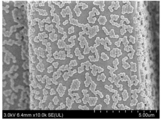
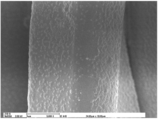
- the unevenness of the fine particles on the substrate can be observed with a laser microscope or a scanning electron microscope.
- the average diameter (average particle size) of the particles after heating is preferably 50% or more, more preferably 60% or more before heating. preferable.
- the average particle size of the fine particles observable on the cloth is preferably 30 to 1000 nm, more preferably 50 to 700 nm or 40 to 500 nm.
- the average particle size is preferably the average particle size after the particles are coated on the substrate and then heated at 170 ° C. for 1 minute.
- the organic microparticles are (1) Hydrophobic monomer having one ethylenically unsaturated double bond and at least one hydrocarbon group having 3 to 40 carbon atoms, and / or (2) (meth) acrylic mono having a polydimethylsiloxane group. It comprises a polymer having repeating units formed from a metric.
- the organic microparticles are (1) A hydrophobic monomer having one ethylenically unsaturated double bond and at least one hydrocarbon group having 3 to 40 carbon atoms. (3) a reactive / hydrophilic monomer having one ethylenically unsaturated double bond and at least one reactive and / or hydrophilic group, and (4) at least two ethylenically unsaturated double bonds.
- Crosslinkable monomer with bonds Contains a polymer having repeating units formed from.
- the polymer constituting the organic fine particles is preferably a non-fluorine polymer.
- the hydrophobic monomer (1) has at least one ethylenically unsaturated double bond and at least one hydrocarbon group having 3 to 40 carbon atoms.
- the static contact angle of water for the homopolymer of the hydrophobic monomer (1) is preferably 70 to 120 degrees, for example 75 to 115 degrees.
- the static contact angle of water of the homopolymer is preferably 90 ° C. or higher, more preferably 97 ° C. or higher.
- the hydrophobic monomer (1) has a branched hydrocarbon group (for example, a branched alkyl group), particularly a t-butyl group or an isopropyl group, and a group having a multi-branched structure as shown in the following formula.
- the static contact angle of the homopolymer water with water is preferably 75 to 115 degrees.
- the static contact angle of the homopolymer is the value of the static contact angle measured with 2 ⁇ l of water droplets after applying a solution of the homopolymer in a good solvent (particularly chloroform) to a silicon substrate and heating at 80 ° C. is there.
- a homopolymer chloroform solution solid content concentration 1.0%) is spin-coated on a silicon wafer substrate (high-purity silicon wafer for research, AS ONE 2-960-55), and heated at 80 ° C. for 15 minutes.
- To prepare a coating film 2 ⁇ L of water is dropped onto the coating film, and the static contact angle 1 second after the droplet is applied is measured using a fully automatic contact angle meter (DropMaster701 manufactured by Kyowa Interface Science Co., Ltd.).
- the hydrophobic monomer (1) is preferably an acrylate compound, an acrylamide compound or a styrene compound containing a hydrocarbon group having 3 to 40 carbon atoms. That is, the hydrophobic monomer (1) is an acrylate compound containing a hydrocarbon group having 3 to 40 carbon atoms, an acrylamide compound containing a hydrocarbon group having 3 to 40 carbon atoms, and a hydrocarbon having 3 to 40 carbon atoms. It is preferably a styrene compound containing a group (excluding the benzene ring).
- the hydrophobic monomer (1) is preferably a non-fluorine monomer.
- a di to tetravalent group composed of at least one selected from (R). However, this is not the case with only divalent hydrocarbon groups).
- Y 21 is a benzene ring and H is a hydrogen atom H and R 21 are directly bonded to Y 21, respectively.
- k and l are 1 to 3. ] It is preferably a monomer represented by.
- R 11 and R 21 are preferably branched or long-chain (or long-chain linear) hydrocarbon groups.
- the hydrocarbon group is preferably an aliphatic hydrocarbon group, particularly a saturated aliphatic hydrocarbon group, particularly an alkyl group.
- -CH 3 groups have lower surface free energy and are more likely to exhibit water repellency than -CH 2-. Therefore, a structure having many branches and many -CH 3 groups is preferable.
- the number of -CH 3 groups is preferably 2 to 15, for example, 3 to 10 or 4 to 9.
- a long-chain alkyl group having a certain length (preferably 16 to 40 carbon atoms) exhibits high water repellency derived from its crystallinity.
- a branched hydrocarbon group for example, a branched alkyl group
- a branched alkyl group particularly a t-butyl group or an isopropyl group
- a hydrocarbon group having a multi-branched structure having 5 to 30 carbon atoms for example, as shown in the following formula.
- a group having a multi-branched structure or a long-chain hydrocarbon group (or a long-chain linear hydrocarbon group) for example, an alkyl group having 16 to 40 or 16 to 26 carbon atoms, particularly 18 to 22 is preferable.
- the long-chain hydrocarbon group is preferably a stearyl group, an icosyl group or a behenyl group.
- R 12 and R 22 may be a hydrogen atom, a methyl group, a halogen atom, a substituted or unsubstituted benzyl group, a substituted or unsubstituted phenyl group. Alternatively, there may be three -CFs. Examples of R 12 and R 22 are hydrogen atom, methyl group, chlorine atom, bromine atom, iodine atom, fluorine atom, -CF 3 group and cyano group. R 12 and R 22 are preferably hydrogen atoms, methyl groups or chlorine atoms. R 12 is more preferably a methyl group. Since R 12 is a methyl group, higher water repellency can be obtained. R 22 is preferably a hydrogen atom, particularly from the viewpoint of reactivity.
- Y 11 is preferably a divalent group or a trivalent group, particularly a divalent group.
- Y 11 is a divalent group, it may or may not have -CH 2-.
- -CH 2 -(-H (C-)-)-CH 2- That is, Is particularly preferable.
- X' is-(CH 2 ) m- (m is an integer of 1 to 5), a linear hydrocarbon group having an unsaturated bond with 1 to 5 carbon atoms, 1 to 5 carbon atoms or 3 to 5 carbon atoms.
- the hydrocarbon group having a branched structure having 3 to 5 carbon atoms may be divalent, trivalent or tetravalent.
- hydrocarbon groups having a branched structure having 3 to 5 carbon atoms include -CH (CH 3 ) -CH 2- (divalent), (Divalent), -CH 2- (-H (C-)-)-CH 2- (trivalent), That is, Is.
- Y 11 which is a divalent group
- Y 11 which is a divalent group
- m is an integer from 1 to 5, especially 2 or 4. ] Is more preferable.
- Y 11 is a trivalent group, Is preferable.
- Y 21 is a benzene ring.
- the monomer having Y 21 has a styryl group.
- 1 to 3 R 21 groups and 2 to 4 hydrogen atoms are bonded to the benzene ring.
- hydrophobic monomer examples include as follows.
- the compound having the following chemical formula is an acrylic compound in which the ⁇ -position is a hydrogen atom, and specific examples may be a methacrylic compound in which the ⁇ -position is a methyl group and an ⁇ -chloroacrylic compound in which the ⁇ -position is a chlorine atom.
- a methacrylic compound having a methyl group at the ⁇ -position is preferable.
- the compound having the following chemical formula is an acrylic compound in which the ⁇ -position is a hydrogen atom, but specific examples are an ⁇ -methylstyrene compound in which the ⁇ -position is a methyl group and ⁇ -chloro in which the ⁇ -position is a chlorine atom. It may be a styrene compound, and a styrene compound in which the ⁇ -position is a hydrogen atom is preferable.
- n is a number of 3 to 40 and m is a number of 1 to 5.
- the (meth) acrylic monomer (2) has a polydimethylsiloxane group in the side chain.
- R91 is a group having a polydimethylsiloxane group, and has an average formula: -(SiR 2 O) a SiR 3 [In the formula, a is 2 to 4000, for example 3 to 400, Each R is independently a monovalent alkyl group having 1 to 12 carbon atoms, and at least two Rs are methyl groups. ] It is preferably a group represented by.
- R 92 is preferably a hydrogen atom, a methyl group or a chlorine atom.
- (meth) acrylic monomer (2) examples include [In the formula, n is a number from 1 to 500. ] Is.
- the (meth) acrylic monomer (2) is a (meth) acrylic monomer having a hydrocarbon group having 3 to 40 carbon atoms or 3 to 30 carbon atoms (particularly 12 to 24) among the hydrophobic monomer (1).
- the total weight of the (meth) acrylic monomer (2) and the hydrophobic monomer (1) is 80 of the total amount of the monomer components. It is preferably used in an amount of less than% by weight, particularly less than 50% by weight or less than 40% by weight. That is, the repeating unit and the (meth) acrylic monomer (2) formed from the (meth) acrylic monomer having a hydrocarbon group having 3 to 40 carbon atoms or 12 to 24 carbon atoms among the hydrophobic monomer (1).
- the constituent monomer is a hydrophobic monomer (1) that is a (meth) acrylic monomer having a hydrocarbon group of 3-40 or 3-30 (particularly 12-24) carbon atoms.
- (meth) acrylic monomer (2) do not consist only of a combination.
- the hydrophobic monomers (1) and the (meth) acrylic monomer which are (meth) acrylic monomers having a hydrocarbon group of 3-40 or 3-30 (particularly 12-24) carbon atoms. It is not necessary to use the combination with the dimer (2).
- the reactive / hydrophilic monomer (3) has one ethylenically unsaturated double bond and at least one reactive group and / or hydrophilic group.
- reactive groups are epoxy groups (eg, glycidyl groups), chloromethyl groups, bromomethyl groups, iodomethyl groups, blocked isocyanate groups.
- hydrophilic groups include hydroxyl groups, amino groups, carboxylic acid groups, sulfonic acid groups, phosphoric acid groups, carboxylic acids, sulfonic acids, alkali metal or alkaline earth metal bases of phosphoric acid, chlorine or bromine, and iodine ions. It is an ammonium base that is a counter anion.
- the reactive / hydrophilic monomer (3) is preferably a non-fluorine monomer.
- R 33 is a group having a direct bond or a hydrocarbon group having 2 to 4 valences of 1 to 10 carbon atoms.
- Y 41 is a benzene ring and H is a hydrogen atom H and R 41 are directly bonded to Y 41, respectively.
- m and n are 1 to 3 o is 0 or 1. ] It is preferably a monomer represented by.
- R 31 and R 41 are monovalent groups. Examples of reactive or hydrophilic groups in R 31 and R 41 are as described above.
- R 32 and R 42 may be a hydrogen atom, a methyl group, a halogen atom, a substituted or unsubstituted benzyl group, a substituted or unsubstituted phenyl group. Alternatively, there may be three -CFs. Examples of R 32 and R 42 are hydrogen atom, methyl group, chlorine atom, bromine atom, iodine atom, fluorine atom, -CF 3 group and cyano group. R 32 and R 42 are preferably hydrogen atoms, methyl groups, and chlorine atoms. More preferably, R 32 is a methyl group. Since R 32 is a methyl group, higher water repellency can be obtained. R 42 is preferably a hydrogen atom, particularly from the viewpoint of reactivity. Y 31 is preferably —O— or —NH—.
- R 33 is preferably a hydrocarbon group having 2 to 4 valences and 1 to 10 carbon atoms.
- R 33 is a divalent alkylene group, such as-(CH 2 ) r- (r is a number from 1 to 5), or a divalent, trivalent or tetravalent alkyl group, such as-(CH). 2 ) r- (CH-) s- H (r is a number from 1 to 5, s is 1, 2 or 3.
- the positions of two CH groups and CH-groups do not have to be in the order described. .) Is preferable.
- Y 41 is a benzene ring.
- the monomer having Y 41 has a styryl group.
- 1 to 3 R 41 groups and 2 to 4 hydrogen atoms are bonded to the benzene ring.
- reactive / hydrophilic monomer (3) examples include glycidyl (meth) acrylate, glycerol (meth) acrylate, hydroxymethyl (meth) acrylate, hydroxyethyl (meth) acrylate, and 3-hydroxypropyl (meth) acrylate.
- the crosslinkable monomer (4) is a compound having at least two (particularly two, three or four) ethylenically unsaturated double bonds.
- the crosslinkable monomer (4) is preferably a non-fluorine monomer.
- the crosslinkable monomer (4) has the formula: Or [In the formula, R 51 and R 61 are independently directly bonded, or a hydrocarbon group having 1 to 20 carbon atoms,-(CH 2 CH 2 O) r- (r is an integer of 1 to 10),-. C 6 H 4 -, - O- , or -NR '- (R' is, H or a hydrocarbon group having 1 to 4 carbon atoms) at least one 2 consists of more to tetravalent group selected from Yes, R 52 and R 62 are hydrogen atoms, monovalent organic groups, or halogen atoms. Y 51 is -O- or -NR'-(R'is H or a hydrocarbon group having 1 to 4 carbon atoms). p is 2-4, q is 1 to 5. ] It is preferably a monomer represented by.
- R 51 and R 61 are directly bonded, may be interrupted with an oxygen atom and / or have a hydrogen atom substituted with an OH group and have a divalent to tetravalent (eg, 2-3 valent) carbon number. 1 to 20 (or 2 to 10) hydrocarbon groups, ethylene glycol groups, propylene glycol groups, glycerol groups, cyclohexyl groups, dicyclopentanyl groups, adamantyl groups, isobolonyl groups, naphthalene groups, bornyl groups, tricyclodecanyl A group and a phenyl group, or a group containing any of these groups.
- R 51 and R 61 may be polymer groups, and the structural unit constituting the polymer group may be the above-exemplified group (for example, ethylene glycol group).
- R 52 and R 62 may independently be a hydrogen atom, a methyl group, a halogen atom, a substituted or unsubstituted benzyl group, or a substituted or unsubstituted phenyl group. Alternatively, there may be three -CFs. Examples of R 52 and R 62 are hydrogen atom, methyl group, chlorine atom, bromine atom, iodine atom, fluorine atom, -CF 3 group and cyano group. R 52 and R 62 are preferably hydrogen atoms, methyl groups, or chlorine atoms. R 52 is more preferably a methyl group. Since R 52 is a methyl group, higher water repellency can be obtained.
- R 62 is preferably a hydrogen atom from the viewpoint of reactivity, but a methyl group is preferable from the viewpoint of water repellency, and R 62 is preferably selected so as to have both reactivity and water repellency.
- the crosslinkable monomer (4) is preferably di (meth) acrylate or divinylbenzene.
- crosslinkable monomer (4) examples include divinylbenzene, 1,4-butanediol di (meth) acrylate, 1,6-hexanediol di (meth) acrylate, and 1,9-nonanediol di (meth).
- neopentyl glycol di (meth) acrylate polyethylene glucoldi (meth) acrylate, trimethylolpropane di (meth) acrylate, ethylene glucoldi (meth) acrylate, methylene glucoldi (meth) acrylate, poly Tetramethylene glucoldi (meth) acrylate, dimethyloltricyclodecanedi (meth) acrylate, trimethylolpropane tri (meth) acrylate, adamantyldi (meth) acrylate, glycerindi (meth) acrylate, tricyclodecanedimethano- Ludi (meth) acrylicate, dicyclopentanyldi (meth) acrylate, 5-hydroxy-1,3-adamantandi (meth) acrylate.
- the polymer may have a repeating unit formed from the high glass transition point monomer.
- the glass transition point of the homopolymer of the high glass transition point monomer (5) is 50 ° C. or higher, preferably 100 ° C. or higher.
- the glass transition point of the homopolymer may be, for example, 120 ° C. or higher, particularly 150 ° C. or higher, and 250 ° C. or lower.
- the glass transition point (glass transition temperature) of the homopolymer was calculated by differential scanning calorimetry (DSC).
- a DSC curve is obtained by raising the temperature of 10 mg of the sample at 10 ° C./min, and the midpoint between the extension of each baseline before and after the secondary transition of the DSC curve and the intersection with the tangent at the inflection point of the DSC curve. Can be obtained as the temperature indicated by.
- the high glass transition point monomer (5) is preferably a non-fluorine monomer.
- the high glass transition point monomer (5) has the formula: Or Wherein, R 71 and R 81 is a hydrocarbon group of 1 to 30 carbon atoms, -C 6 H 4 -, - O-, or -NR '- (R' is H or C 1 -C 4 carbon atoms A group composed of at least one selected from (hydrocarbon groups). R 72 and R 82 are hydrogen atoms, monovalent organic groups, or halogen atoms. Y 71 is -O- or -NR'-(R'is H or a hydrocarbon group having 1 to 4 carbon atoms). ] Is a monomer indicated by
- R 71 and R 81 are cyclohexyl group, dicyclopentanyl group, dicyclopentenyl group, adamantyl group, isobolonyl group, naphthalene group, bornyl group, tricyclodecanyl group, phenyl group.
- R 72 and R 82 may be a halogen atom excluding a hydrogen atom, a methyl group and a fluorine atom, a substituted or unsubstituted benzyl group, and a substituted or unsubstituted phenyl group. Alternatively, there may be three -CFs. Examples of R 72 and R 82 are hydrogen atom, methyl group, chlorine atom, bromine atom, iodine atom, fluorine atom, -CF 3 group and cyano group. R 72 and R 82 are preferably hydrogen atoms, methyl groups, and chlorine atoms. More preferably, R 72 is a methyl group. Since R 72 is a methyl group, higher water repellency can be obtained.
- R 82 is preferably a hydrogen atom from the viewpoint of reactivity, but a methyl group is preferable from the viewpoint of water repellency, and R 82 may be selected so as to have both reactivity and water repellency.
- Y 71 is preferably —O— or —NH—.
- the high glass transition point monomer (5) include Cyclohexyl acrylate, isobornyl acrylate, bornyl acrylate, adamantyl acrylate, dicyclopentanyl acrylate, dicyclopentenyl acrylate, tricyclodecanyl acrylate, phenyl acrylate, naphthyl acrylate, benzyl acrylate, 2-t-butylphenyl acrylate, naphthyl Acrylate esters such as acrylate; Methyl methacrylate, ethyl methacrylate, isopropyl methacrylate, t-butyl methacrylate, cyclohexyl methacrylate, isobornyl methacrylate, bornyl methacrylate, adamantyl methacrylate, dicyclopentanyl methacrylate, dicyclopentenyl methacrylate, tricyclodecanyl methacrylate, phenyl meththacryl
- the high glass transition point monomer (5) is isoboronyl (meth) acrylate, Bornyl (meth) acrylate, adamantyl (meth) acrylate, dicyclopentanyl (meth) acrylate, dicyclopentenyl (meth) acrylate, phenyl (meth). Acrylate, naphthyl acrylate, and benzyl acrylate are preferable, and isobolonyl (meth) acrylate is particularly preferable.
- a monomer (6) other than the monomer (1) to (2) may be used.
- examples of other monomer (6) include, for example, ethylene, vinyl acetate, acrylonitrile, vinyl chloride, styrene, polyethylene glycol (meth) acrylate, polypropylene glycol (meth) acrylate, methoxypolyethylene glycol (meth) acrylate, methoxy. Includes polypropylene glycol (meth) acrylate, and vinyl alkyl ether.
- the other monomer (6) is preferably a non-fluorine monomer. Other monomers are not limited to these examples.
- (meth) acrylate means acrylate or methacrylate
- (meth) acrylamide means acrylamide or methacrylamide
- Each of the monomers (1) to (6) may be a single type or a mixture of two or more types.
- the molar ratio of hydrophobic monomer (1) or (meth) acrylic monomer (2) / reactive / hydrophilic monomer (3) / high glass transition point monomer (5) is , 20-100 / 0-50 / 0-70.
- the molar ratio of hydrophobic monomer (1) or (meth) acrylic monomer (2) / reactive / hydrophilic monomer (3) / high glass transition point monomer (5) is 20. It may be from 99.9 / 0.1 to 50/0 to 70, preferably 20 to 99.5 / 0.5 to 50/0 to 68.
- the molar ratio of the hydrophobic monomer (1) or (meth) acrylic monomer (2) / reactive / hydrophilic monomer (3) is 50 to 99/1 to 50, preferably 55 to 98 /. It may be 2 to 45.
- the molar ratio of the hydrophobic monomer (1) or (meth) acrylic monomer (2) / high glass transition point monomer (5) is 50 to 99/1 to 50, preferably 55 to 98/2. It may be ⁇ 45.
- the crosslinkable monomer (4) includes a hydrophobic monomer (1), a (meth) acrylic monomer (2), a high glass transition point monomer (5), and a reactive / hydrophilic monomer ( For a total of 100 mol parts of 3), it may be 0.1 to 30 mol parts, for example, 0.1 to 25 mol parts.
- a molar of one or both of the hydrophobic monomer (1) or the (meth) acrylic monomer (2) / the reactive / hydrophilic monomer (3) / the high glass transition point monomer (5) is 50 to 95/0 to 30/0 to 30, 60 to 95/0 to 30 or 1 to 20/0 to 30 or 1 to 20, 80 to 95/0 to 15 or 1 to 10/0 to 15. Alternatively, it may be 1 to 10, 85 to 95/0 to 15, or 1 to 10/0 to 15 or 1 to 10.
- the amount of the crosslinkable monomer (4) may be 0 to 20 parts by weight, 1 to 15 parts by weight, or 2 to 10 parts by weight with respect to 100 parts by weight of the polymer.
- the amount of the other monomer (6) may be 0 to 10% by weight, for example 0.1 to 5% by weight, based on the polymer.
- the water-repellent polymer may be a random polymer or a block copolymer, but is preferably a random polymer.
- the water repellent composition contains an aqueous medium.
- the aqueous medium is water, or a mixture of water and an organic solvent.
- the water repellent composition is generally an aqueous dispersion in which the polymer is dispersed in an aqueous medium (water or a mixture of water and an organic solvent).
- the aqueous medium may be water alone or a mixture of water and a (miscible) organic solvent.
- the amount of the organic solvent may be 30% by weight or less, for example, 10% by weight or less, based on the liquid medium.
- the aqueous medium is preferably water alone.
- the amount of the aqueous medium may be 50 to 99.5 parts by weight, particularly 70 to 99.5 parts by weight, when the water-repellent polymer and the aqueous medium are 100 parts by weight in total.
- binder resin acts as a binder for binding organic fine particles to a base material.
- a water-repellent resin is preferable as the binder resin.
- the water-repellent resin also acts as an active ingredient that exhibits water repellency.
- binder resins are acrylic polymers, urethane polymers, polyolefins, polyesters, polyethers, polyamides, polyimides, polystyrenes and silicone polymers.
- the water-repellent resin is a non-fluorine polymer having a hydrocarbon group having 3 to 40 carbon atoms in the side chain, or a fluorine-containing polymer having a fluoroalkyl group having 1 to 20 carbon atoms in the side chain.
- the water-repellent resin is preferably a non-fluorine polymer.
- the hydrocarbon group is preferably a branched hydrocarbon group or a long-chain (or long-chain linear) hydrocarbon group.
- -CH 3 groups have lower surface free energy than -CH 2- and show water repellency.
- branched hydrocarbon group structure having a large (e.g., branched alkyl group), particularly many branches -CH 3 group, for example t- butyl group, an isopropyl group, 2,6,8-trimethyl nonane -4 -A structure such as an yl group is preferable.
- the number of -CH 3 groups is preferably 2 to 15, for example, 3 to 10 or 4 to 8.
- the long-chain hydrocarbon group (or long-chain linear hydrocarbon group) may have 7-40 or 12-30 carbon atoms, such as 16-26, particularly 18-22.
- water-repellent resins are urethane polymers, silicone polymers, acrylic polymers, and polystyrene.
- An example of a non-fluorinated polymer is an amidoamine dendrimer having a long chain hydrocarbon group, which is described in US Pat. No. 8,703,894. The disclosure of this document is incorporated herein by reference.
- Urethane polymers having a hydrocarbon group having 3 to 40 carbon atoms in the side chain include, for example, an isocyanate group-containing compound (for example, monoisocyanate or polyisocyanate, specifically diisocyanate or triisocyanate) and 3 to 40 carbon atoms. It can be produced by reacting a hydroxyl group-containing compound having a hydrocarbon group of.
- Polyurethanes having a branched structure such as a t-butyl group, an isopropyl group, and a 2,6,8-trimethylnonan-4-yl group in the side chain include, for example, an isocyanate group-containing compound (for example, monoisocyanate or polyisocyanate, specifically.
- urethane polymers include sorbitan tristearate, sorbitan monostearate and urethane compounds having long-chain hydrocarbon groups comprising polyfunctional isocyanurates, which are described in US Patent Publication 2014/0295724. The disclosure of this document is incorporated herein by reference.
- An example of a urethane polymer is polyurethane having a long-chain hydrocarbon group, which is described in Japan Special Table 2019-519653 (International Publication 2018/007549). The disclosure of this document is incorporated herein by reference.
- a silicone polymer having a hydrocarbon group having 3 to 40 carbon atoms in a side chain can be produced, for example, by reacting a dichlorosilane compound containing dichlorosilane having a hydrocarbon group having 3 to 40 carbon atoms.
- Polysilicone having a branched structure such as t-butyl group, isopropyl group, 2,6,8-trimethylnonan-4-yl group in the side chain is, for example, t-butyl group, isopropyl group, 2,6,8-.
- It can be produced by reacting a dichlorosilane compound containing dichlorosilane having a branched structure such as a trimethylnonan-4-yl group.
- silicone polymers include long-chain alkyl-modified polydimethylsiloxane.
- An acrylic polymer having a hydrocarbon group having 3 to 40 carbon atoms in the side chain can be produced by polymerizing a monomer containing an acrylic monomer having a hydrocarbon group having 3 to 40 carbon atoms in the side chain.
- the acrylic monomer are the same as those described in the above-mentioned hydrophobic monomer (1).
- Specific examples of the acrylic monomer include, for example, Stearyl (meth) acrylate, behenyl (meth) acrylate, (In particular, amide ethyl stearate (meth) acrylate) [In the above formula, n is a number of 7 to 40 and m is a number of 1 to 5. ] Is.
- Acrylic polymers having a branched structure such as t-butyl group, isopropyl group, 2,6,8-trimethylnonan-4-yl group in the side chain have t-butyl group, isopropyl group, 2,6 in the side chain. It can be produced by polymerizing a monomer containing an acrylic monomer having a branched structure such as 8-trimethylnonan-4-yl group. Examples of the acrylic monomer are the same as those described in the above-mentioned hydrophobic monomer (1). Specific examples of the acrylic monomer are, for example, t-butyl (meth) acrylate, isopropyl (meth) acrylate, and 2,6,8-trimethylnonane-4-yl-acrylate.
- acrylic polymers include repeating units derived from acrylic monomers having long-chain hydrocarbon groups such as behenyl (meth) acrylate and stearyl (meth) acrylate, and vinylidene chloride and / or vinyl chloride. There are polymers containing repeating units. Examples of acrylic polymers include repeating units derived from acrylic monomers having long-chain hydrocarbon groups such as behenyl (meth) acrylate and stearyl (meth) acrylate, and vinylidene chloride and / or vinyl chloride. There is a polymer containing a repeating unit and a repeating unit derived from styrene or ⁇ -methylstyrene, and this acrylic polymer may be mixed with paraffin wax and used.
- acrylic polymers include repeating units derived from acrylic monomers having long-chain hydrocarbon groups such as stearyl (meth) acrylate, repeating units derived from vinylidene chloride and / or vinyl chloride, and poly.
- polymers containing repeating units derived from reactive emulsifiers such as oxyalkylene alkenyl ethers, which are described in Japanese Patent Application Laid-Open No. 2017-25440 (International Publication 2017/014131). The disclosure of this document is incorporated herein by reference.
- the fluoroalkyl group is preferably a perfluoroalkyl group.
- fluorine-containing water-repellent resins include (meth) acrylates having a perfluoroalkyl group having 4 to 8 carbon atoms in the side chain and long-chain alkyl (meth) acrylates such as behenyl (meth) acrylate and stearyl (meth) acrylate.
- Other monomers may be used for the urethane polymer, the silicone polymer, the acrylic polymer, and the polystyrene of the non-fluorine polymer and the fluorine-containing polymer.
- examples of other monomers include, for example, ethylene, vinyl acetate, acrylonitrile, vinyl chloride, polyethylene glycol (meth) acrylate, polypropylene glycol (meth) acrylate, methoxypolyethylene glycol (meth) acrylate, methoxypolypropylene glycol (meth).
- Other monomers are not limited to these examples.
- the water repellent composition may or may not contain a surfactant (emulsifier).
- a surfactant emulsifier
- a small amount of surfactant is added during polymerization (for example, 0.01 to 15 parts by weight with respect to 100 parts by weight of the monomer).
- a surfactant may be added after the polymerization.
- the surfactant preferably contains a nonionic surfactant.
- the surfactant preferably contains one or more surfactants selected from a cationic surfactant, an anionic surfactant, and an amphoteric surfactant. It is preferable to use a combination of a nonionic surfactant and a cationic surfactant.
- Each of the nonionic surfactant, the cationic surfactant, and the amphoteric surfactant may be one kind or a combination of two or more.
- the amount of the surfactant may be 15 parts by weight or less (for example, 0 to 15 parts by weight or 0.01 to 15 parts by weight), preferably 8 parts by weight or less, based on 100 parts by weight of the organic fine particles (A). ..
- a surfactant when a surfactant is added, the stability of the aqueous dispersion and the permeability to the cloth are improved, but the water repellency is lowered. It is preferable to select the type and amount of the surfactant so as to achieve both of these effects.
- cross-linking agent (E) is preferably a cross-linking agent (E) that is cross-linked when an aqueous dispersion of organic fine particles is treated on a cloth and then heated. Further, it is preferable that the cross-linking agent itself is dispersed in water.
- a preferred example of the cross-linking agent (E) is a blocked isocyanate compound.
- Blocked isocyanate compounds [A (NCO) m (in the formula, A is a group remaining after the isocyanate group is removed from the polyisocyanate, and m is an integer of 2 to 8)]
- Isocyanate is [RH (formula).
- R may be a hydrocarbon group which may be substituted with a heteroatom such as a nitrogen atom or an oxygen atom, and H may be a hydrogen atom)] produced by reacting with a blocking agent. can do.
- a (NCO) m is, for example, tolylene diisocyanate (TDI), diphenylmethane diisocyanate (MDI), hexamethylene diisocyanate (HDI), or the like.
- blocking agents that form R groups are oximes, phenols, alcohols, mercaptans, amides, imides, imidazoles, ureas, amines, imines, pyrazoles and active methylene compounds.
- blocked isocyanates such as oxime blocked toluene diisocyanate, blocked hexamethylene diisocyanate, and blocked diphenylmethane diisocyanate are preferable.
- the amount of the cross-linking agent (E) is 0 to 30 parts by weight or 0.01 to 20 parts by weight, for example 0.1 to 15 parts by weight, based on 100 parts by weight of the total of the organic fine particles (A) and the binder resin (C). It may be a department.
- additive water repellent composition is added to the organic fine particles (A) and the aqueous medium (B), and optionally the binder resin (C), the surfactant (D) and / or the cross-linking agent (E).
- Additive (F) may be contained.
- additives are other water repellents, oil repellents, drying rate regulators, film forming aids, compatibilizers, antifreeze agents, viscosity regulators, UV absorbers, antioxidants, pH regulators, defoamers.
- the amount of the additive is 0 to 20 parts by weight or 0.05 to 20 parts by weight, for example 0.1 to 10 parts by weight, based on 100 parts by weight of the total of the organic fine particles (A) and the binder resin (C). You can.
- the polymer (polymer constituting organic fine particles and polymer constituting binder resin) can be produced by any of ordinary polymerization methods, and the conditions of the polymerization reaction can be arbitrarily selected. Examples of such a polymerization method include solution polymerization, suspension polymerization, and emulsion polymerization. Emulsion polymerization is preferred.
- a water repellent composition in the form of an aqueous dispersion is obtained, the method for producing the polymer is not limited.
- a polymer organic fine particles
- a polymer may be produced by polymerizing a monomer for organic fine particles in an aqueous medium in the presence or absence of a surfactant.
- an aqueous dispersion can be obtained by adding a surfactant and water and removing the solvent.
- the production of the aqueous dispersion of the organic fine particles and the production of the aqueous dispersion of the binder resin are performed separately, and the aqueous dispersion of the organic fine particles and the binder resin are produced separately.
- a water repellent composition containing organic fine particles and a binder resin can be produced by mixing with an aqueous dispersion.
- a water repellent composition containing the organic fine particles and the binder resin can be produced by polymerizing the monomer for the binder resin in the aqueous dispersion of the organic fine particles.
- a water repellent composition containing the organic fine particles and the binder resin can be produced by polymerizing the monomer for organic fine particles in the aqueous dispersion of the binder resin.
- emulsion polymerization without a surfactant, it is preferable to polymerize the monomer at a low concentration (for example, monomer concentration 1 to 30% by weight, particularly 1 to 15% by weight) in an aqueous medium.
- a low concentration for example, monomer concentration 1 to 30% by weight, particularly 1 to 15% by weight
- a small amount (single) of the monomer (1) having a water static contact angle of 95 degrees or more for homopolymer or the monomer (2) is used. It is preferable to add 30 mol parts or less, for example 0.1 to 20 mol parts) to 100 mol parts of the entire polymer. As a result, polymerization can be carried out at a high concentration, and the water repellency of the polymer becomes high.
- Examples of monomers to be added are t-butylstyrene, stearyl (meth) acrylate, behenyl (meth) acrylate, 2,6,8-trimethylnonane-4-yl-acrylate, 2,4-dit-butyl.
- the homopolymer water of the monomer (1) is preferably 1 to 70 mol parts, for example 1 to 60 mol parts.
- a method is adopted in which a monomer is dissolved in an organic solvent in the presence of a polymerization initiator, and after nitrogen substitution, the mixture is heated and stirred in the range of 30 to 120 ° C. for 1 to 10 hours.
- the polymerization initiator include azobisisobutyronitrile, benzoyl peroxide, di-t-butyl peroxide, lauryl peroxide, cumene hydroperoxide, t-butyl peroxypivalate, diisopropyl peroxy dicarbonate and the like. Can be mentioned.
- the polymerization initiator is used in the range of 0.01 to 20 mol parts, for example 0.01 to 10 mol parts, with respect to 100 mol parts of the monomer.
- the organic solvent is inert to the monomer and dissolves or uniformly disperses them.
- an ester for example, an ester having 2 to 30 carbon atoms, specifically, ethyl acetate or butyl acetate
- a ketone having 2 to 30 carbon atoms, specifically, methyl ethyl ketone or diisobutyl ketone
- an alcohol for example, an alcohol having 1 to 30 carbon atoms, specifically, isopropyl alcohol, ethanol, methanol
- ethanol ethanol
- the organic solvent examples include acetone, chloroform, HCHC225, isopropyl alcohol, pentane, hexane, heptane, octane, cyclohexane, benzene, toluene, xylene, petroleum ether, tetrahydrofuran, 1,4-dioxane, methyl ethyl ketone, methyl isobutyl ketone, Examples thereof include diisobutyl ketone, ethyl acetate, butyl acetate, 1,1,2,2-tetrachloroethane, 1,1,1-trichloroethane, trichlorethylene, perchloroethylene, tetrachlorodifluoroethane, and trichlorotrifluoroethane. Assuming that the total of the monomer and the organic solvent is 100 parts by weight, the organic solvent is used in the range of 50 to 99.5 parts by weight, for
- emulsion polymerization a method is adopted in which a monomer is emulsified in water in the presence of a polymerization initiator and an emulsifier, substituted with nitrogen, and then stirred and polymerized in the range of 30 to 80 ° C. for 1 to 10 hours.
- the polymerization initiators are benzoyl peroxide, lauroyl peroxide, t-butyl perbenzoate, 1-hydroxycyclohexylhydro peroxide, 3-carboxypropionyl peroxide, acetyl peroxide, azobisisobuty amidine-dihydrochloride, 2 , 2'-azobis (2-methylpropion amidine) dihydrochloride, 4,4'-azobis (4-cyanovaleric acid), 2,2'-azobis [2-methyl-N- (2-hydroxyethyl) propion Amid], 2,2'-azobis [2- (2-imidazolin-2-yl) propane] dihydrochloride, 2,2'-azobis [2- (2-imidazolin-2-yl) propane], peroxide Water-soluble substances such as sodium, potassium persulfate, ammonium persulfate, azobisisobutyronitrile, benzoyl peroxide, di-t-butyl peroxide,
- Diisopropyl peroxydicarbonate and other oil-soluble substances are used.
- the polymerization initiator is used in the range of 0.01 to 10 mol parts with respect to 100 mol parts of the monomer.
- a reducing agent such as longalite, ascorbic acid, tartaric acid, sodium metabisulfite, isoascorbic acid, ferrous sulfate may be used in combination.
- emulsifier various anionic, cationic or nonionic emulsifiers can be used, and they are used in the range of 0.5 to 20 parts by weight with respect to 100 parts by weight of the monomer. It is preferred to use anionic and / or nonionic and / or cationic emulsifiers.
- a compatibilizer that is sufficiently compatible with these monomers, for example, a water-soluble organic solvent. It is possible to improve emulsifying property and copolymerizability by adding a compatibilizer.
- water-soluble organic solvent examples include acetone, methyl ethyl ketone, ethyl acetate, propylene glycol, dipropylene glycol monomethyl ether, dipropylene glycol, tripropylene glycol, ethanol, methanol and the like, and 0.1 based on 100 parts by weight of water. It may be used in the range of to 50 parts by weight, for example, 1 to 40 parts by weight.
- a chain transfer agent may be used in the polymerization.
- the molecular weight of the polymer can be changed according to the amount of the chain transfer agent used.
- chain transfer agents are mercaptan group-containing compounds such as lauryl mercaptan, thioglycol, thioglycerol (particularly alkyl mercaptans (eg, 1-30 carbon atoms)), inorganic salts such as sodium hypophosphite, sodium bisulfite. And so on.
- the amount of the chain transfer agent used may be in the range of 0.01 to 10 parts by weight, for example, 0.1 to 5 parts by weight, based on 100 parts by weight of the total amount of the monomer.
- the water repellent composition is generally preferably an aqueous dispersion.
- the water repellent composition comprises a polymer (the active ingredient of the water repellent composition) and an aqueous medium.
- the amount of the aqueous medium may be, for example, 50-99.9% by weight, particularly 70-99.5% by weight, based on the water repellent composition.
- the concentration of the polymer may be 0.1 to 50% by weight, for example 0.5 to 40% by weight.
- the water repellent composition (and the aqueous dispersion of organic fine particles) can be used as an external treatment agent (surface treatment agent) or an internal treatment agent.
- the water repellent composition (and the aqueous dispersion of organic fine particles) can be used as an oil repellent, an antifouling agent, a stain remover, a release agent or a mold release agent.
- the water repellent composition When the water repellent composition is an external treatment agent, it can be applied to the object to be treated by a conventionally known method. Usually, a method in which the water repellent composition is dispersed in an organic solvent or water, diluted, adhered to the surface of an object to be treated by a known method such as immersion coating, spray coating, foam coating, etc., and dried. Is taken. If necessary, it may be applied together with a suitable cross-linking agent (for example, blocked isocyanate) for curing. Further, it is also possible to add an insect repellent, a softener, an antibacterial agent, a flame retardant, an antistatic agent, a paint fixing agent, an anti-wrinkle agent and the like to the water repellent composition and use them in combination.
- the concentration of the polymer in the treatment liquid to be brought into contact with the base material may be 0.01 to 10% by weight (particularly in the case of dip coating), for example, 0.05 to 10% by weight.
- the objects to be treated with the water repellent composition (and the aqueous dispersion of organic fine particles) include textile products, asbestos, filters (eg, electrostatic filters), dust masks, fuel cell parts (eg, gas diffusion). Electrodes and gas diffusion supports), glass, paper, wood, leather, fur, asbestos, bricks, cement, metals and oxides, ceramic products, plastics, coated surfaces, and plasters.
- textile products For example, animal and vegetable natural fibers such as cotton, hemp, wool and silk, synthetic fibers such as polyamide, polyester, polyvinyl alcohol, polyacrylonitrile, polyvinyl chloride and polypropylene, semi-synthetic fibers such as rayon and acetate, glass fibers and carbon fibers. , Inorganic fibers such as asbestos fibers, or mixed fibers thereof.
- the textile product may be in any form such as fiber or cloth.
- the water repellent composition can also be used as an antifouling agent, a release agent, and a mold release agent (for example, an internal mold release agent or an external mold release agent).
- a mold release agent for example, an internal mold release agent or an external mold release agent.
- the surface of the base material can be easily peeled off from another surface (another surface on the base material or a surface on another base material).
- Organic microparticles can be applied to fibrous substrates (eg, textiles) by any of the methods known for treating textiles with liquids.
- the textile is a cloth
- the cloth may be dipped in the solution, or the solution may be attached or sprayed onto the cloth.
- the treated textile product is dried and preferably heated at, for example, 100 ° C. to 200 ° C. in order to develop water repellency.
- the organic fine particles may be applied to textile products by a cleaning method, and may be applied to textile products by, for example, a washing application or a dry cleaning method.
- the average diameter of the organic fine particles after the heat treatment is preferably 50% or more of the average diameter of the organic fine particles before the heat treatment.
- the average diameter (average particle size) of the organic fine particles after the heat treatment is preferably 60% or more, for example, 70% or more of the average diameter (average particle size) of the organic fine particles before the heat treatment.
- it is preferable that the average particle size of the fine particles observable on the base material after coating the particles on the base material (including cloth) is 50 to 700 nm.
- the average diameter of the organic fine particles before heat treatment is the particle size of the fine particles measured by dynamic light scattering (DLS) from the aqueous dispersion of the organic fine particles (if two or more peaks are observed in the DLS measurement, all). Use the average particle size calculated only from the peak with the smaller particle size, not the average particle size of the peaks), or use the average diameter of the organic fine particles before heat treatment attached to the substrate. If both values are different, use the smaller one.
- DLS dynamic light scattering
- the average diameter of the organic particles on the substrate is the average of the particle diameters of 10 independent smallest units randomly sampled after the organic particles are attached to the substrate and observed with a scanning electron microscope (SEM). Means.
- the average diameter of organic fine particles after heat treatment is determined by applying a dispersion of organic fine particles to a base material (for example, cloth), performing heat treatment at 170 ° C. for 1 minute, and then using a scanning electron microscope (SEM) on the base material. Means the average of 10 independent smallest unit particle diameters observed in.
- the base material is cloth
- it is possible to prepare a cloth to which organic fine particles are attached by immersing the cloth in an aqueous dispersion containing organic fine particles, passing it through a mangle, and passing it through a pin tenter at 170 ° C. for 1 minute.
- the average diameter of the organic particles before heat treatment is random observed on the substrate with a scanning electron microscope (SEM) after applying a dispersion of organic particles to the substrate (eg, cloth) and air-drying for at least 1 hour.
- SEM scanning electron microscope
- the textile products to be processed are typically fabrics, which include textiles, knitted and non-woven fabrics, fabrics and carpets in the form of clothing, but textiles or yarns or intermediate textile products (eg, sliver or It may be blister yarn, etc.).
- the textile material may be a natural fiber (eg, cotton or wool), a synthetic fiber (eg, biscorayon or leocell), or a synthetic fiber (eg, polyester, polyamide or acrylic fiber), or , A mixture of fibers (eg, a mixture of natural and synthetic fibers).
- the fibrous substrate may be leather.
- Aqueous or aqueous emulsions of organic microparticles to make the leather hydrophobic and oleophobic at various stages of leather processing, for example during the moistening of the leather or during the finishing of the leather. May be applied to leather.
- the fibrous substrate may be paper.
- the organic microparticles may be applied to preformed paper or at various stages of papermaking, for example during the drying period of the paper.
- Treatment means applying the treatment agent to the object to be treated by dipping, spraying, coating, or the like.
- the organic fine particles which are the active ingredients of the treatment agent permeate into the inside of the object to be treated and / or adhere to the surface of the object to be treated.
- the falling rate of water is preferably 100 mm / s or more, for example, 130 mm / sec or more, and more preferably 150 mm / sec or more or 200 mm / sec or more.
- the treated substrate exhibits the effect of preventing frost formation.
- the number average molecular weight (Mn), weight average molecular weight (Mw), and molecular weight distribution (Mw / Mn) were determined by gel permeation chromatography (GPC).
- GPC gel permeation chromatography
- tetrahydrofuran was used as a developing solution
- KF-606M, KF-601, and KF-800D manufactured by Shodex Co., Ltd. were used as columns, and the molecular weight and the like were calculated in terms of polystyrene.
- the melting point of the polymer was calculated by differential scanning calorimetry (DSC). DSC measurement is performed in a nitrogen atmosphere, cooled to -20 ° C, heated to 200 ° C at 10 ° C / min, cooled to -20 ° C again, and then observed in the process of heating to 200 ° C at 10 ° C / min. The melting point to be measured was measured. In the polymer in which multiple melting peaks appear, the peak with the largest amount of heat of melting derived from the melting of the long-chain alkyl was defined as the melting point. The glass transition point (glass transition temperature) was determined as the temperature indicated by the midpoint of the intersection of the extension of each baseline before and after the secondary transition of the DSC curve and the tangent at the inflection point of the DSC curve.
- Organic fine particles For the contact angle of the organic fine particles, an aqueous dispersion of the organic fine particles was drop cast onto a glass base material (made of slide glass soda-lime glass) and heated at 150 ° C. for 3 minutes to prepare a base material to which the organic fine particles were attached. 2 ⁇ L of water was dropped onto the glass substrate to which the organic fine particles were attached, and the static contact angle 1 second after the drip was measured using a fully automatic contact angle meter (DropMaster701 manufactured by Kyowa Interface Science Co., Ltd.).
- the contact angle of the organic fine particles on the glass substrate is preferably 100 ° or more, more preferably 110 ° or more, still more preferably 118 ° or more.
- the static contact angle of water of a cloth (PET cloth) treated with an aqueous dispersion of organic fine particles or a composition containing organic fine particles and a binder resin is PET cloth (grain: 88 g / m 2 , 70 denier, gray). Is immersed in an aqueous dispersion of organic fine particles or a composition containing organic fine particles and a binder resin, passed through a mangle, and passed through a pin tenter at 170 ° C. for 1 minute to prepare a PET cloth to which the organic fine particles are attached.
- the contact angle of the organic fine particles on the cloth is preferably 120 ° or more, more preferably 130 ° or more, still more preferably 140 ° or more.
- the aqueous dispersion of the binder resin is drop-cast onto a glass substrate (made of slide glass soda-lime glass) and heated at 150 ° C. for 3 minutes to prepare a coating film. 2 ⁇ L of water was dropped onto the coating film, and the static contact angle 1 second after the drip was measured using a fully automatic contact angle meter (DropMaster701 manufactured by Kyowa Interface Science Co., Ltd.).
- Water repellency and strong water repellency washing durability (water repellency (after washing) and strong water repellency (after washing))] Washing according to the JIS L-0217-103 method is repeated 20 times, and the subsequent water repellency and strong water repellency are evaluated. After washing, it is preferable that the water repellency is 80 points or more and the strong water repellency is 2 points or more.
- the average of the particle diameters of the 10 independent smallest units observed at random was calculated.
- the retention rate (%) of the particle diameter before and after heating is the average particle size of the organic fine particles on the substrate after heating (the average diameter of the particles on the cloth heated at 170 ° C. for 1 minute) and before heating, as determined by SEM observation.
- Emulsifier 1 Polyethylene glycol monooleyl ether (liquid) Emulsifier 2: Polyethylene glycol monooleyl ether (solid) Emulsifier 3: Glyceryl stearate emulsifier 4: Lauryltrimonium chloride emulsifier 5: Cetrimonium chloride emulsifier 6: Stearyltrimonium chloride emulsifier 7: Polyoxyalkylene alkenyl ether (HLB16) Emulsifier 8: Polyoxyalkylene alkenyl ether (HLB14) Emulsifier 9: Pooxyalkylene alkenyl ether (HLB13) Emulsifier 10: Tetraglyceryl monostearate Emulsifier 11: Diethanolamide laurate emulsifier 12: Sorbitane tristearate cross-linking agent 1: Oxym-blocked toluene diisocyanate cross-linking agent 2: Oxym-blocked hexamethylene diisocyanate PDMS-A:
- ⁇ Synthesis example 1> In a nitrogen-substituted reaction vessel, 0.66 g of t-butylstyrene (tBuSty), 0.39 g of glycidyl methacrylate (GMA), 0.018 g of divinylbenzene (DVB), and 33 ml of pure water were added and dispersed. After nitrogen substitution, 18.6 mg of 2,2'-azobis (2-methylpropionamidine) dihydrochloride was added, and the mixture was heated and stirred at 65 ° C. for 8 hours to obtain an aqueous dispersion of organic fine particles. The solid content was 2.85%. The particle size (average particle size) of the aqueous dispersion was 250 nm.
- the contact angle of water on the glass substrate of the organic fine particles was 120 °.
- the static contact angle of water of PET (cloth) (weight: 88 g / m 2 , 70 denier, gray) treated with an aqueous dispersion of organic fine particles was 143.1 °, and the falling speed was 265 mm / s.
- an aqueous dispersion of organic fine particles was cast on a glass substrate, air-dried, and then left in an environment of ⁇ 30 ° C. for 2 days. After that, when the base material was taken out in an environment of 25 ° C., frost was attached to the glass, but no frost was confirmed on the organic fine particles.
- the retention rate of the particle diameter before and after heating at 170 ° C. for 1 minute was 80%.
- Synthesis Examples 2-44> The same procedure as in Synthesis Example 1 was repeated except that the monomers shown in Table 1 were used. The results are shown in Table 1.
- Synthesis Examples 25 to 28 in addition to the monomers shown in the table, a cationic emulsifier (lauryltrimonium chloride) was added to the total amount of the monomers in a predetermined amount shown in the table for polymerization.
- Synthesis Example 29 in addition to the monomers shown in the table, a cationic emulsifier (lauryltrimonium chloride) and polyethylene glycol monooleyl ether were added in an amount of 0.5% based on the total amount of the monomers for polymerization.
- the aqueous dispersion of the organic fine particles synthesized in Synthesis Example 13 was cast on a glass substrate, air-dried, and then left in an environment of ⁇ 30 ° C. for 2 days. After that, when the base material was taken out in an environment of 25 ° C., frost was attached to the glass, but no frost was confirmed on the coating film of the organic fine particles.
- the retention rate of the particle diameter before and after heating at 170 ° C. for 1 minute was 80%.
- the water contact angle of the obtained polymer was 95 °.
- PSty was obtained by adding 1.00 g of Sty, 0.015 g of azobisisobutyronitrile, and 3.4 ml of toluene in a reaction vessel substituted with nitrogen, heating and stirring at 65 ° C. for 8 hours, and then reprecipitating in methanol.
- the molecular weight (Mw) was 15,000 and the molecular weight distribution (Mw / Mn) was 2.1.
- the water contact angle of the obtained polymer was 89 °.
- the glass transition temperature (Tg) was 100 ° C.
- PStMA was obtained by adding 2.00 g of StMA, 0.0097 g of azobisisobutyronitrile, and 20 ml of toluene into a nitrogen-substituted reaction vessel, heating and stirring at 65 ° C. for 8 hours, and then reprecipitating in methanol.
- the molecular weight (Mw) was 35,000 and the molecular weight distribution (Mw / Mn) was 2.1.
- the water contact angle of the obtained polymer was 109 °.
- the melting point (Tm) was 50 ° C.
- ⁇ Synthesis example B1> In a nitrogen-substituted reaction vessel, 3.00 g of StA, 0.149 g of polyethylene glycol monooleyl ether, 0.020 g of sorbitan tristearate, and 60 ml of pure water were added and emulsified. 25 mg of 2,2'-azobis (2-methylpropionamidine) dihydrochloride was added, and the mixture was heated and stirred at 65 ° C. for 8 hours to obtain an aqueous dispersion of PStA. The solid content was 4.6%. The contact angle of water in the film obtained by applying the emulsified dispersion to the glass substrate was 110 °.
- ⁇ Synthesis example B2> In a nitrogen-substituted reaction vessel, 3.00 g of StA, 0.262 g of polyethylene glycol monooleyl ether, 0.037 g of sorbitan tristearate, and 60 ml of pure water were added and emulsified. 25 mg of 2,2'-azobis (2-methylpropionamidine) dihydrochloride was added, and the mixture was heated and stirred at 65 ° C. for 8 hours to obtain an aqueous dispersion of PStA. The solid content was 4.7%. The contact angle of water in the film obtained by applying the emulsified dispersion to the glass substrate was 110 °.
- 3 mg of 2,2'-azobis (2-methylpropionamidine) dihydrochloride was added, and the mixture was heated and stirred at 65 ° C. for 8 hours to obtain an aqueous dispersion of a random polymer of StA / HBA.
- the contact angle of water in the film obtained by applying the emulsified dispersion to the glass substrate was 107 °.
- ⁇ Synthesis example B7> Put 10 g of tripropylene glycol, 20 g of StA, 0.05 g of trialkylammonium chloride, 2.0 g of sorbitan monoalchelate, 1.0 g of polyoxyethylene alkyl ether, and 60 g of pure water in a 200 ml plastic container, and use a homomixer at 2000 rpm for 1 minute. The mixture was stirred and dispersed by ultrasonic waves for 15 minutes.
- the emulsion dispersion is transferred to an autoclave, and after nitrogen substitution, 0.05 g of alkyl mercaptan and 8.6 g of vinyl chloride are added, 0.5 g of an azo initiator is added, and the polymer is water-dispersed by heating and stirring at 60 ° C. for 20 hours. I got a body.
- the contact angle of water in the film obtained by applying the emulsified dispersion to the glass substrate was 108 °.
- ⁇ Synthesis example B8> 3 In a 500 ml plastic container, 30 g of tripropylene glycol, 45 g of C17AEA, 34 g of StA, 1 g of N-alkyrole acrylamide, 2 g of trialkylammonium chloride, 2 g of sorbitan monoalkryl, 2.5 g of polyoxyethylene trialkyl ether, and polyoxyethylene alkyl ether. 5 g and 180 g of pure water were added, and the mixture was stirred at 80 ° C. with a homomixer at 2000 rpm for 1 minute and dispersed by ultrasonic waves for 15 minutes.
- the emulsion dispersion was transferred to an autoclave, and after nitrogen substitution, 0.2 g of alkyl mercaptan and 20 g of vinyl chloride were added.
- An aqueous dispersion of a polymer was obtained by adding 1 g of an azo-based initiator and heating and stirring at 60 ° C. for 20 hours.
- the contact angle of water in the film obtained by applying the emulsified dispersion to the glass substrate was 109 °.
- Methyl isobutyl ketone was removed by an evaporator to obtain an aqueous dispersion of a reaction product of sorbitan stearate and isocyanate.
- the contact angle of water in the film in which the dispersion was applied to the glass substrate was 105 °.
- Examples 1 to 117> The aqueous dispersion of the organic fine particles synthesized in Synthesis Examples 1-44 and the binder resin and emulsifier synthesized in Synthesis Examples B1 to B9 were mixed at the ratios shown in Table 2 to prepare a treatment solution.
- the treatment solution was applied to a PET cloth (weight: 88 g / m 2 , 70 denier, gray) and various measurements (falling speed test, contact angle measurement, water repellency test, strong water repellency test, washing durability) were performed.
- the results are shown in Table 2. However, among the ratios (g) shown in Table 2, except for Synthesis Examples 1 to 44, only the weight of the solid content is shown, not the weight of the entire emulsion dispersion.
- the obtained aqueous dispersion was applied to a glass substrate and heated at 150 ° C. for 1 minute, and then the contact angle of water was 105 degrees.
- the retention rate of the particle diameter before and after heating at 170 ° C. for 1 minute was 90%.
- ⁇ Synthesis Example 84 Synthesis Example 83, except that the amount of StA added was 100 wt% with respect to the solid content of PMMA, and 16 mg of 2,2'-azobis (2-methylpropionamidine) dihydrochloride was added 25 hours later. Polymerization was carried out in the same manner as in the above to obtain an aqueous dispersion of PMMA / StA fine particles. The obtained aqueous dispersion was applied to a glass substrate and heated at 150 ° C. for 1 minute, and then the contact angle of water was 111 degrees. The retention rate of the particle diameter before and after heating at 170 ° C. for 1 minute was 90%.
- Synthesis Example 85 Synthesis Example 83, except that the amount of StA added was 30 wt% with respect to the solid content of PMMA, and 16 mg of 2,2'-azobis (2-methylpropionamidine) dihydrochloride was added 25 hours later. The same polymerization was carried out to obtain an aqueous dispersion of PMMA / StA fine particles. The obtained aqueous dispersion was applied to a glass substrate and heated at 150 ° C. for 1 minute, and then the contact angle of water was 111 degrees. The retention rate of the particle diameter before and after heating at 170 ° C. for 1 minute was 90%.
- Synthesis Example 87 Polymerization was carried out in the same manner as in Synthesis Example 86 except that an aqueous dispersion of PMMA crosslinked fine particles having a diameter of 70 nm was used to obtain an aqueous dispersion of PMMA / StA fine particles. The obtained aqueous dispersion was applied to a glass substrate and heated at 150 ° C. for 1 minute, and then the contact angle of water was 142 degrees. The retention rate of the particle diameter before and after heating at 170 ° C. for 1 minute was 90%.
- an emulsion obtained by emulsifying 0.2 g of StA with 28 mg of glyceryl stearate, 95 mg of polyethylene glycol monooleyl ether, and 1 g of pure water was added, and the mixture was further heated and stirred for 8 hours to obtain an aqueous dispersion of PSty / StA crosslinked fine particles.
- Got The obtained aqueous dispersion was applied to a glass substrate and heated at 150 ° C. for 1 minute, and then the contact angle of water was 115 degrees. The retention rate of the particle diameter before and after heating at 170 ° C. for 1 minute was 85%.
- Synthesis Example 89 Polymerization was carried out in the same manner as in Synthesis Example 88 except that the emulsifier used first was glyceryl stearate (56 mg) and polyethylene glycol monooleyl ether (144 mg) to obtain an aqueous dispersion of PSty / StA crosslinked fine particles. The obtained aqueous dispersion was applied to a glass substrate and heated at 150 ° C. for 1 minute, and then the contact angle of water was 118 degrees. The retention rate of the particle diameter before and after heating at 170 ° C. for 1 minute was 90%.
- Synthesis Example 90 Polymerization was carried out in the same manner as in Synthesis Example 88 except that the emulsifier used first was glyceryl stearate (56 mg) and polyethylene glycol monooleyl ether (144 mg) to obtain an aqueous dispersion of PSty / StA crosslinked fine particles. The obtained aqueous dispersion was applied to a glass substrate and heated at 150 ° C. for 1 minute, and then the contact angle of water was 118 degrees. The retention rate of the particle diameter before and after heating at 170 ° C. for 1 minute was 90%.
- Synthesis Examples 92-110> The same procedure as in Synthesis Example 91 was repeated except that the monomers and amounts used as the initial monomer and additional monomer, and the emulsifiers and amounts used were those shown in Table 4.
- Synthesis Example 109 an additional monomer was added by emulsifying the monomer with a 1.5% emulsifier.
- Synthesis Example 110 instead of 2,2'-azobis (2-methylpropionamidine) dihydrochloride, tBu-hydroperoxide and L-ascorbic acid were added in an amount of 1 mol% each for the synthesis of the monomer, and the temperature was adjusted. Synthesis was carried out at 75 ° C.
- Table 4 shows the contact angles of water measured after applying the aqueous dispersion of the obtained particles to the glass substrate and heating at 150 ° C. for 1 minute with respect to Synthesis Examples 92 to 110.
- Synthesis Examples 92 to 96 a 25 wt% solid binder B8 was mixed with the obtained particles, and the treatment liquid was adjusted so that the concentration of the particles was 2.25%.
- Synthesis Examples 97 to 110 25 wt% of the solid binder B3 was mixed with the obtained particles, and the treatment liquid was adjusted so that the concentration of the particles was 2.25%.
- Table 4 shows the results of measuring the falling speed, water repellency, and strong water repellency test by applying the treatment liquid to the PET cloth as the falling speed, water repellency, and strong water repellency of each synthetic example.
- 1.1 g of an aqueous solution of the cross-linking agent 1 was added to 1 g of the binder resin.
- the retention rate of the particle diameter before and after heating at 170 ° C. for 1 minute was 85% or more.
- FIG. 2 shows a scanning electron microscope (SEM) photograph of a PET cloth (Example 157) to which the organic fine particles of Synthesis Example 93, the binder B8, and the cross-linking agent 1 are attached.
- the organic fine particles and the aqueous dispersion of Synthesis Example B8 were diluted with pure water so that their solid contents were 0.6% and 0.4%, for a total of 1 wt%, to obtain a treatment liquid.
- the PET cloth was dipped in this treatment liquid, passed through a mangle, and the water repellency was evaluated with a heat-treated test cloth, the falling speed was 209 mm / s, the water repellency was 100 points, and the strong water repellency was 3 ++ points. ..
- the retention rate of the particle diameter before and after heating at 170 ° C. for 1 minute was 80%.
- the organic fine particles and the aqueous dispersion of Synthesis Example B8 were diluted with pure water so that their solid contents were 0.8% and 0.2%, for a total of 1 wt%, to obtain a treatment liquid.
- the PET cloth was dipped in this treatment liquid, passed through a mangle, and the water repellency was evaluated with a heat-treated test cloth, the falling speed was 179 mm / s, the water repellency was 100 points, and the strong water repellency was 3 points. ..
- the retention rate of the particle diameter before and after heating at 170 ° C. for 1 minute was 85%.
- the organic fine particles and the aqueous dispersion of Synthesis Example B8 were diluted with pure water so that their solid contents were 0.8% and 0.2%, for a total of 1 wt%, to obtain a treatment liquid.
- the PET cloth was dipped in this treatment liquid, passed through a mangle, and the water repellency was evaluated with a heat-treated test cloth, the falling speed was 183 mm / s, the water repellency was 95 points, and the strong water repellency was 3 points. ..
- the retention rate of the particle diameter before and after heating at 170 ° C. for 1 minute was 85%.
- the organic fine particles of the present disclosure can be used as an oil repellent, an antifouling agent, a stain remover, a release agent or a mold release agent.
- a reactive / hydrophilic monomer having one ethylenically unsaturated double bond and at least one reactive and / or hydrophilic group and (4) at least two ethylenically unsaturated double bonds.
- the polymer is further (5) The organic fine particles according to [1], which have a repeating unit formed from a high glass transition point monomer having a glass transition point of a homopolymer having a glass transition point of 100 ° C. or higher.
- Y 21 is a benzene ring and H is a hydrogen atom H and R 21 are directly bonded to Y 21, respectively.
- k and l are 1 to 3.
- R 33 is a hydrocarbon group having 2 to 4 valences and 1 to 10 carbon atoms.
- Y 41 is a benzene ring and H is a hydrogen atom H and R 41 are directly bonded to Y 41, respectively.
- m and n are 1 to 3 o is 0 or 1.
- It is a monomer indicated by The crosslinkable monomer (4) has the formula: Or [In the formula, R 51 and R 61 are independently directly bonded, hydrocarbon groups having 1 to 20 carbon atoms,-(CH 2 CH 2 O) r- (r is an integer of 1 to 10), -C.
- R 6 H 4 -, - O-, or -NR '- is at least one 2 consists of more to tetravalent group selected from , R 52 and R 62 are independently hydrogen atoms, monovalent organic groups, or halogen atoms, respectively.
- Y 51 is -O- or -NR'-(R'is H or a hydrocarbon group having 1 to 4 carbon atoms).
- p is 2-4, q is 1 to 5.
- R 71 and R 81 is a hydrocarbon group of 1 to 30 carbon atoms, -C 6 H 4 -, - O-, or -NR '- (R' is H or C 1 -C 4 carbon atoms A group composed of at least one selected from (hydrocarbon groups).
- R 72 and R 82 are hydrogen atoms, monovalent organic groups, or halogen atoms.
- Y 71 is -O- or -NR'-(R'is H or a hydrocarbon group having 1 to 4 carbon atoms).
- the reactive group is an epoxy group, a chloromethyl group, a bromomethyl group, an iodomethyl group or a blocked isocyanate group
- the hydrophilic group is a hydroxyl group, an amino group, a carboxylic acid group or a sulfone.
- the organic fine particles according to any one of [1] to [4].
- Reactive / hydrophilic monomer (3) is glycidyl (meth) acrylate, glycerol (meth) acrylate, hydroxymethyl (meth) acrylate, hydroxyethyl (meth) acrylate, 3-hydroxypropyl (meth) acrylate, 2- Hydroxypropyl (meth) acrylate, 2,3-dihydroxypropyl (meth) acrylate, 3-chloro-2-hydroxypropyl (meth) acrylate, 3-hydroxybutyl (meth) acrylate, 4-hydroxybutyl (meth) acrylate, 2 -Hydroxybutyl (meth) acrylate, 2-acetoacetoxyethyl (meth) acrylate, 4-hydroxybutyl acrylate glycidyl ether, acrylic acid, methacrylate, trimethylsilyl (meth) acrylate, 2- (trimethylsilyloxy) ethyl (meth) acrylate, At least one selected from the
- the crosslinkable monomer (4) is divinylbenzene, 1,4-butanediol di (meth) acrylate, 1,6-hexanediol di (meth) acrylate, 1,9-nonanediol di (meth) acrylate, neo.
- the high glass transition point monomer (5) is isoboronyl (meth) acrylate, Bornyl (meth) acrylate, adamantyl (meth) acrylate, dicyclopentanyl (meth) acrylate, dicyclopentenyl (meth) acrylate, phenyl (meth).
- the organic fine particles according to any one of [1] to [5], which is at least one monomer selected from the group consisting of acrylate, naphthyl acrylate, and benzyl acrylate.
- the molar ratio of hydrophobic monomer (1) / reactive / hydrophilic monomer (3) / high glass transition point monomer (5) is 20-99.9 / 0.1-50 / 0- 70, and the crosslinkable monomer (4) is 0.1 to 30 mol parts with respect to 100 mol parts in total of the hydrophobic monomer (1) and the reactive / hydrophilic monomer (3).
- the organic fine particles according to any one of [1] to [7] which have a falling speed of 150 mm / sec or more when treated on a cloth.
- the organic fine particles according to any one of [1] to [8] which have an average particle size of 30 nm to 1000 nm.
- a water-repellent composition which is an aqueous dispersion of organic fine particles according to any one of [1] to [9] and (B) an aqueous medium.
- the water repellent composition according to [11] further comprising one or both of (C) a binder resin and (D) a surfactant.
- the binder resin (C) is selected from at least a non-fluoropolymer having a hydrocarbon group having 3 to 40 carbon atoms in the side chain and a fluoroalkyl polymer having a fluoroalkyl group having 1 to 20 carbon atoms in the side chain.
- the binder resin (C) is described in any one of [11] to [13], wherein the binder resin (C) is an acrylic polymer, a urethane polymer, a polyolefin, a polyester, a polyether, a polyamide, a polyimide, a polystyrene, a silicone polymer, or a combination thereof.
- Water repellent composition [15] The water repellent composition according to any one of [10] to [14], which can prevent frost formation. [16] Polymerize the monomers (1) to (4) and, if necessary, the monomer (5) in the presence of a surfactant that is 15 parts by weight or less with respect to 100 parts by weight of the monomer in an aqueous medium. To obtain an aqueous dispersion of organic fine particles (A), The method for producing a water repellent composition according to any one of [10] to [15].
- Binder resin by adding the aqueous dispersion of the binder resin (C) to the aqueous dispersion of the organic fine particles (A) or by polymerizing the monomer for the binder resin in the aqueous dispersion of the organic fine particles (A).
- the production method according to [16] which comprises a step of obtaining.
- a method for treating a textile product which applies a treatment liquid containing the water repellent composition according to any one of [10] to [15] to the textile product.
Landscapes
- Chemical & Material Sciences (AREA)
- Chemical Kinetics & Catalysis (AREA)
- Organic Chemistry (AREA)
- Engineering & Computer Science (AREA)
- Medicinal Chemistry (AREA)
- Polymers & Plastics (AREA)
- Health & Medical Sciences (AREA)
- Textile Engineering (AREA)
- Materials Engineering (AREA)
- Wood Science & Technology (AREA)
- Life Sciences & Earth Sciences (AREA)
- Combustion & Propulsion (AREA)
- Dispersion Chemistry (AREA)
- Treatments For Attaching Organic Compounds To Fibrous Goods (AREA)
- Addition Polymer Or Copolymer, Post-Treatments, Or Chemical Modifications (AREA)
- Materials Applied To Surfaces To Minimize Adherence Of Mist Or Water (AREA)
- Chemical Or Physical Treatment Of Fibers (AREA)
Priority Applications (6)
| Application Number | Priority Date | Filing Date | Title |
|---|---|---|---|
| EP20872335.3A EP4039714A4 (en) | 2019-09-30 | 2020-09-30 | Organic fine particle |
| CN202080068256.XA CN114502605B (zh) | 2019-09-30 | 2020-09-30 | 有机微粒 |
| JP2021551406A JP7759808B2 (ja) | 2019-09-30 | 2020-09-30 | 有機微粒子 |
| KR1020227010027A KR102809469B1 (ko) | 2019-09-30 | 2020-09-30 | 유기 미립자 |
| US17/707,001 US12617884B2 (en) | 2019-09-30 | 2022-03-29 | Organic fine particle |
| JP2025062614A JP2025111494A (ja) | 2019-09-30 | 2025-04-04 | 有機微粒子 |
Applications Claiming Priority (4)
| Application Number | Priority Date | Filing Date | Title |
|---|---|---|---|
| JP2019-180579 | 2019-09-30 | ||
| JP2019180579 | 2019-09-30 | ||
| JP2020-118767 | 2020-07-09 | ||
| JP2020118767 | 2020-07-09 |
Related Child Applications (1)
| Application Number | Title | Priority Date | Filing Date |
|---|---|---|---|
| US17/707,001 Continuation US12617884B2 (en) | 2019-09-30 | 2022-03-29 | Organic fine particle |
Publications (1)
| Publication Number | Publication Date |
|---|---|
| WO2021066052A1 true WO2021066052A1 (ja) | 2021-04-08 |
Family
ID=75338101
Family Applications (1)
| Application Number | Title | Priority Date | Filing Date |
|---|---|---|---|
| PCT/JP2020/037266 Ceased WO2021066052A1 (ja) | 2019-09-30 | 2020-09-30 | 有機微粒子 |
Country Status (6)
| Country | Link |
|---|---|
| EP (1) | EP4039714A4 (https=) |
| JP (2) | JP7759808B2 (https=) |
| KR (1) | KR102809469B1 (https=) |
| CN (1) | CN114502605B (https=) |
| TW (1) | TWI839577B (https=) |
| WO (1) | WO2021066052A1 (https=) |
Cited By (3)
| Publication number | Priority date | Publication date | Assignee | Title |
|---|---|---|---|---|
| WO2022138851A1 (ja) * | 2020-12-25 | 2022-06-30 | ダイキン工業株式会社 | 耐水圧向上効果のある撥水性有機微粒子 |
| WO2023058532A1 (ja) * | 2021-10-06 | 2023-04-13 | ダイキン工業株式会社 | 球状架橋粒子 |
| JPWO2023119695A1 (https=) * | 2020-12-25 | 2023-06-29 |
Families Citing this family (2)
| Publication number | Priority date | Publication date | Assignee | Title |
|---|---|---|---|---|
| CN117468268B (zh) * | 2023-12-27 | 2024-03-22 | 湖南大道新材料有限公司 | 一种阻水纸袋及其制备方法与应用 |
| EP4609933A1 (en) * | 2024-02-29 | 2025-09-03 | Ahlstrom Oyj | Non-fluorinated nonwoven and paper media having high hydrophobicity and processes for making the sames for making the same |
Citations (13)
| Publication number | Priority date | Publication date | Assignee | Title |
|---|---|---|---|---|
| JPH093774A (ja) | 1995-06-19 | 1997-01-07 | Dainippon Ink & Chem Inc | 濃色化剤および濃色化方法 |
| JP2003268675A (ja) * | 2002-03-08 | 2003-09-25 | Japan Vilene Co Ltd | 撥水性粒子担持繊維、撥水性粒子担持繊維シート、およびその製造方法、並びにそれを用いた衣服 |
| JP2009084468A (ja) | 2007-10-01 | 2009-04-23 | Gantsu Kasei Kk | 光拡散剤及びそれを用いた光拡散フィルム、シート又は成型物 |
| WO2010115496A1 (en) | 2009-03-28 | 2010-10-14 | Huntsman Textile Effects (Germany) Gmbh | Fluorine-free aqueous dispersion for treating textile fabrics |
| JP2012020248A (ja) | 2010-07-15 | 2012-02-02 | Nicca Chemical Co Ltd | 撥水性コーティング膜、その製造方法及びそれを備えた機能性材料 |
| US8703894B2 (en) | 2007-05-03 | 2014-04-22 | Rudolf Gmbh & Co. Kg Chemische Fabrik | Fluorocarbon polymer-free preparations based on water and/or organic solvents and the use thereof as a finish on flat materials |
| US20140295724A1 (en) | 2013-03-29 | 2014-10-02 | E I Du Pont De Nemours And Company | Non-fluorinated urethane based coatings |
| JP2014193972A (ja) * | 2013-03-29 | 2014-10-09 | Tokyo Institute Of Technology | ポリマー微粒子の製造方法 |
| JP2016199712A (ja) | 2015-04-13 | 2016-12-01 | 日華化学株式会社 | 非フッ素系ポリマー、撥水剤組成物、撥水性繊維製品及び撥水性繊維製品の製造方法 |
| JP2016222910A (ja) | 2015-05-29 | 2016-12-28 | 三洋化成工業株式会社 | 樹脂粒子及び樹脂粒子分散液の製造方法 |
| WO2017014131A1 (ja) | 2015-07-23 | 2017-01-26 | 日華化学株式会社 | 非フッ素系ポリマー、撥水剤組成物、撥水性繊維製品及び撥水性繊維製品の製造方法 |
| WO2018007549A1 (de) | 2016-07-07 | 2018-01-11 | Rudolf Gmbh | Zubereitungen als hydrophobierungsmittel |
| WO2019078115A1 (ja) * | 2017-10-18 | 2019-04-25 | ダイキン工業株式会社 | 被膜 |
Family Cites Families (6)
| Publication number | Priority date | Publication date | Assignee | Title |
|---|---|---|---|---|
| JP5463005B2 (ja) * | 2008-02-18 | 2014-04-09 | 積水化成品工業株式会社 | 架橋樹脂粒子及びそれを用いた光学シート |
| JP6741442B2 (ja) * | 2016-02-29 | 2020-08-19 | 日華化学株式会社 | 撥水助剤、非フッ素系撥水剤組成物、及び撥水性繊維製品の製造方法 |
| JP6727865B2 (ja) * | 2016-03-16 | 2020-07-22 | ダイキン工業株式会社 | 共重合体および表面処理剤 |
| JP6829553B2 (ja) * | 2016-05-27 | 2021-02-10 | 日華化学株式会社 | 撥水性繊維製品の製造方法 |
| JP6319419B1 (ja) * | 2016-12-28 | 2018-05-09 | ダイキン工業株式会社 | 表面処理剤 |
| JP2019147870A (ja) * | 2018-02-26 | 2019-09-05 | 積水化学工業株式会社 | アクリル樹脂微粒子 |
-
2020
- 2020-09-30 EP EP20872335.3A patent/EP4039714A4/en active Pending
- 2020-09-30 CN CN202080068256.XA patent/CN114502605B/zh active Active
- 2020-09-30 JP JP2021551406A patent/JP7759808B2/ja active Active
- 2020-09-30 WO PCT/JP2020/037266 patent/WO2021066052A1/ja not_active Ceased
- 2020-09-30 KR KR1020227010027A patent/KR102809469B1/ko active Active
- 2020-09-30 TW TW109134166A patent/TWI839577B/zh active
-
2025
- 2025-04-04 JP JP2025062614A patent/JP2025111494A/ja not_active Withdrawn
Patent Citations (16)
| Publication number | Priority date | Publication date | Assignee | Title |
|---|---|---|---|---|
| JPH093774A (ja) | 1995-06-19 | 1997-01-07 | Dainippon Ink & Chem Inc | 濃色化剤および濃色化方法 |
| JP2003268675A (ja) * | 2002-03-08 | 2003-09-25 | Japan Vilene Co Ltd | 撥水性粒子担持繊維、撥水性粒子担持繊維シート、およびその製造方法、並びにそれを用いた衣服 |
| US8703894B2 (en) | 2007-05-03 | 2014-04-22 | Rudolf Gmbh & Co. Kg Chemische Fabrik | Fluorocarbon polymer-free preparations based on water and/or organic solvents and the use thereof as a finish on flat materials |
| JP2009084468A (ja) | 2007-10-01 | 2009-04-23 | Gantsu Kasei Kk | 光拡散剤及びそれを用いた光拡散フィルム、シート又は成型物 |
| WO2010115496A1 (en) | 2009-03-28 | 2010-10-14 | Huntsman Textile Effects (Germany) Gmbh | Fluorine-free aqueous dispersion for treating textile fabrics |
| JP2012522062A (ja) | 2009-03-28 | 2012-09-20 | ハンツマン・テキスタイル・エフェクツ(ジャーマニー)・ゲーエムベーハー | 織物布を処理するためのフッ素フリー水性分散体 |
| JP2012020248A (ja) | 2010-07-15 | 2012-02-02 | Nicca Chemical Co Ltd | 撥水性コーティング膜、その製造方法及びそれを備えた機能性材料 |
| JP2014193972A (ja) * | 2013-03-29 | 2014-10-09 | Tokyo Institute Of Technology | ポリマー微粒子の製造方法 |
| US20140295724A1 (en) | 2013-03-29 | 2014-10-02 | E I Du Pont De Nemours And Company | Non-fluorinated urethane based coatings |
| JP2016199712A (ja) | 2015-04-13 | 2016-12-01 | 日華化学株式会社 | 非フッ素系ポリマー、撥水剤組成物、撥水性繊維製品及び撥水性繊維製品の製造方法 |
| JP2016222910A (ja) | 2015-05-29 | 2016-12-28 | 三洋化成工業株式会社 | 樹脂粒子及び樹脂粒子分散液の製造方法 |
| WO2017014131A1 (ja) | 2015-07-23 | 2017-01-26 | 日華化学株式会社 | 非フッ素系ポリマー、撥水剤組成物、撥水性繊維製品及び撥水性繊維製品の製造方法 |
| JP2017025440A (ja) | 2015-07-23 | 2017-02-02 | 日華化学株式会社 | 非フッ素系ポリマー、撥水剤組成物、撥水性繊維製品及び撥水性繊維製品の製造方法 |
| WO2018007549A1 (de) | 2016-07-07 | 2018-01-11 | Rudolf Gmbh | Zubereitungen als hydrophobierungsmittel |
| JP2019519653A (ja) | 2016-07-07 | 2019-07-11 | ルドルフ ゲーエムベーハー | 疎水化剤としての製剤 |
| WO2019078115A1 (ja) * | 2017-10-18 | 2019-04-25 | ダイキン工業株式会社 | 被膜 |
Non-Patent Citations (1)
| Title |
|---|
| See also references of EP4039714A4 |
Cited By (7)
| Publication number | Priority date | Publication date | Assignee | Title |
|---|---|---|---|---|
| WO2022138851A1 (ja) * | 2020-12-25 | 2022-06-30 | ダイキン工業株式会社 | 耐水圧向上効果のある撥水性有機微粒子 |
| JPWO2023119695A1 (https=) * | 2020-12-25 | 2023-06-29 | ||
| WO2023119695A1 (ja) * | 2020-12-25 | 2023-06-29 | ダイキン工業株式会社 | スリップ防止効果のある撥水性有機微粒子 |
| CN116547352A (zh) * | 2020-12-25 | 2023-08-04 | 大金工业株式会社 | 具有防滑效果的拨水性有机微粒 |
| WO2023058532A1 (ja) * | 2021-10-06 | 2023-04-13 | ダイキン工業株式会社 | 球状架橋粒子 |
| JP2023055533A (ja) * | 2021-10-06 | 2023-04-18 | ダイキン工業株式会社 | 球状架橋粒子 |
| JP7309156B2 (ja) | 2021-10-06 | 2023-07-18 | ダイキン工業株式会社 | 球状架橋粒子 |
Also Published As
| Publication number | Publication date |
|---|---|
| JP2025111494A (ja) | 2025-07-30 |
| KR20220054829A (ko) | 2022-05-03 |
| EP4039714A1 (en) | 2022-08-10 |
| JPWO2021066052A1 (https=) | 2021-04-08 |
| CN114502605A (zh) | 2022-05-13 |
| JP7759808B2 (ja) | 2025-10-24 |
| CN114502605B (zh) | 2025-05-30 |
| US20220227907A1 (en) | 2022-07-21 |
| EP4039714A4 (en) | 2023-10-18 |
| KR102809469B1 (ko) | 2025-05-19 |
| TW202118850A (zh) | 2021-05-16 |
| TWI839577B (zh) | 2024-04-21 |
Similar Documents
| Publication | Publication Date | Title |
|---|---|---|
| WO2021066052A1 (ja) | 有機微粒子 | |
| JP5670453B2 (ja) | 含フッ素重合体および処理剤 | |
| CN102666970B (zh) | 含氟聚合物和表面处理剂 | |
| JP2009542844A (ja) | 反撥性を付与する方法 | |
| WO1997047667A1 (fr) | Nouveau copolymere, son procede de preparation et son utilisation | |
| JP7307365B2 (ja) | 耐水圧向上効果のある撥水性有機微粒子 | |
| US20240327611A1 (en) | Water-repellent organic fine particles having slip prevention effect | |
| JP7765741B2 (ja) | 撥水撥油剤用重合体、撥水撥油剤組成物および撥水撥油剤処理物 | |
| US12617884B2 (en) | Organic fine particle | |
| WO2023054428A1 (ja) | 撥水剤用重合体、撥水剤組成物および撥水剤処理物 | |
| JP7309156B2 (ja) | 球状架橋粒子 | |
| WO2022009689A1 (ja) | 有機微粒子 |
Legal Events
| Date | Code | Title | Description |
|---|---|---|---|
| 121 | Ep: the epo has been informed by wipo that ep was designated in this application |
Ref document number: 20872335 Country of ref document: EP Kind code of ref document: A1 |
|
| ENP | Entry into the national phase |
Ref document number: 20227010027 Country of ref document: KR Kind code of ref document: A |
|
| ENP | Entry into the national phase |
Ref document number: 2021551406 Country of ref document: JP Kind code of ref document: A |
|
| NENP | Non-entry into the national phase |
Ref country code: DE |
|
| ENP | Entry into the national phase |
Ref document number: 2020872335 Country of ref document: EP Effective date: 20220502 |
|
| WWG | Wipo information: grant in national office |
Ref document number: 202080068256.X Country of ref document: CN |