WO2021039274A1 - 組成物、及び接着性ポリマーの洗浄方法 - Google Patents
組成物、及び接着性ポリマーの洗浄方法 Download PDFInfo
- Publication number
- WO2021039274A1 WO2021039274A1 PCT/JP2020/029340 JP2020029340W WO2021039274A1 WO 2021039274 A1 WO2021039274 A1 WO 2021039274A1 JP 2020029340 W JP2020029340 W JP 2020029340W WO 2021039274 A1 WO2021039274 A1 WO 2021039274A1
- Authority
- WO
- WIPO (PCT)
- Prior art keywords
- mass
- composition
- dimethyl ether
- glycol dimethyl
- cleaning
- Prior art date
- Legal status (The legal status is an assumption and is not a legal conclusion. Google has not performed a legal analysis and makes no representation as to the accuracy of the status listed.)
- Ceased
Links
Images



Classifications
-
- C—CHEMISTRY; METALLURGY
- C11—ANIMAL OR VEGETABLE OILS, FATS, FATTY SUBSTANCES OR WAXES; FATTY ACIDS THEREFROM; DETERGENTS; CANDLES
- C11D—DETERGENT COMPOSITIONS; USE OF SINGLE SUBSTANCES AS DETERGENTS; SOAP OR SOAP-MAKING; RESIN SOAPS; RECOVERY OF GLYCEROL
- C11D7/00—Compositions of detergents based essentially on non-surface-active compounds
- C11D7/50—Solvents
-
- B—PERFORMING OPERATIONS; TRANSPORTING
- B08—CLEANING
- B08B—CLEANING IN GENERAL; PREVENTION OF FOULING IN GENERAL
- B08B3/00—Cleaning by methods involving the use or presence of liquid or steam
- B08B3/04—Cleaning involving contact with liquid
- B08B3/08—Cleaning involving contact with liquid the liquid having chemical or dissolving effect
-
- C—CHEMISTRY; METALLURGY
- C09—DYES; PAINTS; POLISHES; NATURAL RESINS; ADHESIVES; COMPOSITIONS NOT OTHERWISE PROVIDED FOR; APPLICATIONS OF MATERIALS NOT OTHERWISE PROVIDED FOR
- C09D—COATING COMPOSITIONS, e.g. PAINTS, VARNISHES OR LACQUERS; FILLING PASTES; CHEMICAL PAINT OR INK REMOVERS; INKS; CORRECTING FLUIDS; WOODSTAINS; PASTES OR SOLIDS FOR COLOURING OR PRINTING; USE OF MATERIALS THEREFOR
- C09D9/00—Chemical paint or ink removers
-
- C—CHEMISTRY; METALLURGY
- C11—ANIMAL OR VEGETABLE OILS, FATS, FATTY SUBSTANCES OR WAXES; FATTY ACIDS THEREFROM; DETERGENTS; CANDLES
- C11D—DETERGENT COMPOSITIONS; USE OF SINGLE SUBSTANCES AS DETERGENTS; SOAP OR SOAP-MAKING; RESIN SOAPS; RECOVERY OF GLYCEROL
- C11D3/00—Other compounding ingredients of detergent compositions covered in group C11D1/00
- C11D3/16—Organic compounds
- C11D3/20—Organic compounds containing oxygen
- C11D3/2068—Ethers
-
- C—CHEMISTRY; METALLURGY
- C11—ANIMAL OR VEGETABLE OILS, FATS, FATTY SUBSTANCES OR WAXES; FATTY ACIDS THEREFROM; DETERGENTS; CANDLES
- C11D—DETERGENT COMPOSITIONS; USE OF SINGLE SUBSTANCES AS DETERGENTS; SOAP OR SOAP-MAKING; RESIN SOAPS; RECOVERY OF GLYCEROL
- C11D3/00—Other compounding ingredients of detergent compositions covered in group C11D1/00
- C11D3/16—Organic compounds
- C11D3/26—Organic compounds containing nitrogen
- C11D3/28—Heterocyclic compounds containing nitrogen in the ring
-
- C—CHEMISTRY; METALLURGY
- C11—ANIMAL OR VEGETABLE OILS, FATS, FATTY SUBSTANCES OR WAXES; FATTY ACIDS THEREFROM; DETERGENTS; CANDLES
- C11D—DETERGENT COMPOSITIONS; USE OF SINGLE SUBSTANCES AS DETERGENTS; SOAP OR SOAP-MAKING; RESIN SOAPS; RECOVERY OF GLYCEROL
- C11D3/00—Other compounding ingredients of detergent compositions covered in group C11D1/00
- C11D3/43—Solvents
-
- C—CHEMISTRY; METALLURGY
- C11—ANIMAL OR VEGETABLE OILS, FATS, FATTY SUBSTANCES OR WAXES; FATTY ACIDS THEREFROM; DETERGENTS; CANDLES
- C11D—DETERGENT COMPOSITIONS; USE OF SINGLE SUBSTANCES AS DETERGENTS; SOAP OR SOAP-MAKING; RESIN SOAPS; RECOVERY OF GLYCEROL
- C11D7/00—Compositions of detergents based essentially on non-surface-active compounds
- C11D7/22—Organic compounds
- C11D7/26—Organic compounds containing oxygen
-
- C—CHEMISTRY; METALLURGY
- C11—ANIMAL OR VEGETABLE OILS, FATS, FATTY SUBSTANCES OR WAXES; FATTY ACIDS THEREFROM; DETERGENTS; CANDLES
- C11D—DETERGENT COMPOSITIONS; USE OF SINGLE SUBSTANCES AS DETERGENTS; SOAP OR SOAP-MAKING; RESIN SOAPS; RECOVERY OF GLYCEROL
- C11D7/00—Compositions of detergents based essentially on non-surface-active compounds
- C11D7/22—Organic compounds
- C11D7/26—Organic compounds containing oxygen
- C11D7/263—Ethers
-
- C—CHEMISTRY; METALLURGY
- C11—ANIMAL OR VEGETABLE OILS, FATS, FATTY SUBSTANCES OR WAXES; FATTY ACIDS THEREFROM; DETERGENTS; CANDLES
- C11D—DETERGENT COMPOSITIONS; USE OF SINGLE SUBSTANCES AS DETERGENTS; SOAP OR SOAP-MAKING; RESIN SOAPS; RECOVERY OF GLYCEROL
- C11D7/00—Compositions of detergents based essentially on non-surface-active compounds
- C11D7/22—Organic compounds
- C11D7/28—Organic compounds containing halogen
-
- C—CHEMISTRY; METALLURGY
- C11—ANIMAL OR VEGETABLE OILS, FATS, FATTY SUBSTANCES OR WAXES; FATTY ACIDS THEREFROM; DETERGENTS; CANDLES
- C11D—DETERGENT COMPOSITIONS; USE OF SINGLE SUBSTANCES AS DETERGENTS; SOAP OR SOAP-MAKING; RESIN SOAPS; RECOVERY OF GLYCEROL
- C11D7/00—Compositions of detergents based essentially on non-surface-active compounds
- C11D7/22—Organic compounds
- C11D7/32—Organic compounds containing nitrogen
-
- C—CHEMISTRY; METALLURGY
- C11—ANIMAL OR VEGETABLE OILS, FATS, FATTY SUBSTANCES OR WAXES; FATTY ACIDS THEREFROM; DETERGENTS; CANDLES
- C11D—DETERGENT COMPOSITIONS; USE OF SINGLE SUBSTANCES AS DETERGENTS; SOAP OR SOAP-MAKING; RESIN SOAPS; RECOVERY OF GLYCEROL
- C11D7/00—Compositions of detergents based essentially on non-surface-active compounds
- C11D7/22—Organic compounds
- C11D7/32—Organic compounds containing nitrogen
- C11D7/3209—Amines or imines with one to four nitrogen atoms; Quaternized amines
-
- C—CHEMISTRY; METALLURGY
- C11—ANIMAL OR VEGETABLE OILS, FATS, FATTY SUBSTANCES OR WAXES; FATTY ACIDS THEREFROM; DETERGENTS; CANDLES
- C11D—DETERGENT COMPOSITIONS; USE OF SINGLE SUBSTANCES AS DETERGENTS; SOAP OR SOAP-MAKING; RESIN SOAPS; RECOVERY OF GLYCEROL
- C11D7/00—Compositions of detergents based essentially on non-surface-active compounds
- C11D7/22—Organic compounds
- C11D7/32—Organic compounds containing nitrogen
- C11D7/3281—Heterocyclic compounds
-
- C—CHEMISTRY; METALLURGY
- C11—ANIMAL OR VEGETABLE OILS, FATS, FATTY SUBSTANCES OR WAXES; FATTY ACIDS THEREFROM; DETERGENTS; CANDLES
- C11D—DETERGENT COMPOSITIONS; USE OF SINGLE SUBSTANCES AS DETERGENTS; SOAP OR SOAP-MAKING; RESIN SOAPS; RECOVERY OF GLYCEROL
- C11D7/00—Compositions of detergents based essentially on non-surface-active compounds
- C11D7/50—Solvents
- C11D7/5004—Organic solvents
- C11D7/5013—Organic solvents containing nitrogen
-
- C—CHEMISTRY; METALLURGY
- C11—ANIMAL OR VEGETABLE OILS, FATS, FATTY SUBSTANCES OR WAXES; FATTY ACIDS THEREFROM; DETERGENTS; CANDLES
- C11D—DETERGENT COMPOSITIONS; USE OF SINGLE SUBSTANCES AS DETERGENTS; SOAP OR SOAP-MAKING; RESIN SOAPS; RECOVERY OF GLYCEROL
- C11D7/00—Compositions of detergents based essentially on non-surface-active compounds
- C11D7/50—Solvents
- C11D7/5004—Organic solvents
- C11D7/5022—Organic solvents containing oxygen
-
- H—ELECTRICITY
- H10—SEMICONDUCTOR DEVICES; ELECTRIC SOLID-STATE DEVICES NOT OTHERWISE PROVIDED FOR
- H10P—GENERIC PROCESSES OR APPARATUS FOR THE MANUFACTURE OR TREATMENT OF DEVICES COVERED BY CLASS H10
- H10P52/00—Grinding, lapping or polishing of wafers, substrates or parts of devices
-
- H—ELECTRICITY
- H10—SEMICONDUCTOR DEVICES; ELECTRIC SOLID-STATE DEVICES NOT OTHERWISE PROVIDED FOR
- H10P—GENERIC PROCESSES OR APPARATUS FOR THE MANUFACTURE OR TREATMENT OF DEVICES COVERED BY CLASS H10
- H10P70/00—Cleaning of wafers, substrates or parts of devices
- H10P70/20—Cleaning during device manufacture
-
- C—CHEMISTRY; METALLURGY
- C11—ANIMAL OR VEGETABLE OILS, FATS, FATTY SUBSTANCES OR WAXES; FATTY ACIDS THEREFROM; DETERGENTS; CANDLES
- C11D—DETERGENT COMPOSITIONS; USE OF SINGLE SUBSTANCES AS DETERGENTS; SOAP OR SOAP-MAKING; RESIN SOAPS; RECOVERY OF GLYCEROL
- C11D2111/00—Cleaning compositions characterised by the objects to be cleaned; Cleaning compositions characterised by non-standard cleaning or washing processes
- C11D2111/10—Objects to be cleaned
- C11D2111/14—Hard surfaces
- C11D2111/22—Electronic devices, e.g. PCBs or semiconductors
-
- Y—GENERAL TAGGING OF NEW TECHNOLOGICAL DEVELOPMENTS; GENERAL TAGGING OF CROSS-SECTIONAL TECHNOLOGIES SPANNING OVER SEVERAL SECTIONS OF THE IPC; TECHNICAL SUBJECTS COVERED BY FORMER USPC CROSS-REFERENCE ART COLLECTIONS [XRACs] AND DIGESTS
- Y02—TECHNOLOGIES OR APPLICATIONS FOR MITIGATION OR ADAPTATION AGAINST CLIMATE CHANGE
- Y02W—CLIMATE CHANGE MITIGATION TECHNOLOGIES RELATED TO WASTEWATER TREATMENT OR WASTE MANAGEMENT
- Y02W30/00—Technologies for solid waste management
- Y02W30/50—Reuse, recycling or recovery technologies
- Y02W30/62—Plastics recycling; Rubber recycling
Definitions
- the present disclosure relates to a method for cleaning a composition and an adhesive polymer.
- the present disclosure is for decomposing and cleaning an adhesive containing an adhesive polymer used for temporary bonding between a device wafer and a support wafer (carrier wafer) remaining on the device wafer in the process of thinning the semiconductor wafer.
- the present invention relates to a composition that can be used in the above, and a method for cleaning an adhesive polymer using the composition.
- the thickness of each semiconductor wafer is reduced, and a plurality of semiconductor wafers connected by through silicon vias (TSVs) are laminated.
- TSVs through silicon vias
- the surface (back surface) of the device wafer on which the semiconductor device is formed is thinned by polishing, and then an electrode including TSV is formed on the back surface.
- a support wafer which is also called a carrier wafer, is temporarily bonded to the semiconductor device forming surface of the device wafer by using an adhesive in order to impart mechanical strength to the device wafer.
- a glass wafer or a silicon wafer is used as the support wafer.
- a metal wiring or electrode pad containing Al, Cu, Ni, Au, etc., an inorganic film such as an oxide film or a nitride film, or a resin containing polyimide or the like. Layers are formed.
- the back surface of the device wafer is attached to a tape having an acrylic adhesive layer fixed by a ring frame, so that the device wafer is fixed to the tape.
- the device wafer is then separated from the support wafer (debonding), the adhesive on the device wafer is stripped, and the adhesive residue on the device wafer is cleaned and removed with a cleaning agent.
- an adhesive containing a polyorganosiloxane compound with good heat resistance as an adhesive polymer is used.
- the cleaning agent is required to have two actions of breaking the Si—O bond and dissolving the decomposition product with a solvent.
- a cleaning agent include those obtained by dissolving a fluorine-based compound such as tetrabutylammonium fluoride (TBAF) in a polar aprotic solvent. Since the fluoride ion of TBAF is involved in the cleavage of the Si—O bond via the formation of the Si—F bond, it is possible to impart etching performance to the cleaning agent.
- the polar aprotic solvent can dissolve TBAF and does not form solvation with fluoride ions via hydrogen bonds, so that the reactivity of fluoride ions can be enhanced.
- Patent Document 1 Japanese Unexamined Patent Publication No. 2014-133855 describes a cleaning solution of a siloxane resin in which tetraalkylammonium hydroxide is dissolved in a polar aprotic solvent.
- Patent Document 2 Japanese Patent Laid-Open No. 2015-505886 describes a cleaning solution of polysiloxane in which TBAF is dissolved in an ester or a ketone.
- Patent Document 3 Japanese Unexamined Patent Publication No. 2004-000969 describes a cleaning solution in which TBAF is dissolved in propylene glycol alkyl ether alcohol.
- the role of the solvent in cleaning agents containing fluorine compounds such as TBAF and solvents is to sufficiently dissolve highly polar fluorine compounds, which are reactive substances, and to ensure sufficient affinity with the surface of low-polarity adhesives. It is considered that the purpose is to dissolve the decomposition products of the adhesive while ensuring the reactivity of the fluoride ions contained in the fluorine compound.
- the adhesive polymer contained in the adhesive may have a substituent introduced for the purpose of improving heat resistance, peelability, etc., so that the surface of the adhesive may exhibit various polarities. It is hoped that the cleaning agent will exhibit excellent affinity for the surface of such various polar adhesives, thereby achieving high etching rates.
- the present disclosure provides a composition that has an excellent affinity with the surface of the adhesive and can achieve a high etching rate.
- the present inventor in a composition comprising quaternary alkylammonium fluoride or a hydrate thereof, an N-substituted amide compound having no active hydrogen on the nitrogen atom, and dipropylene glycol dimethyl ether, in dipropylene glycol dimethyl ether. It has been found that a high etching rate can be achieved by adjusting the proportion of a specific isomer.
- the present invention includes the following [1] to [10].
- the (A) N-substituted amide compound has the formula (2): (In the formula (2), R 1 represents an alkyl group having 1 to 4 carbon atoms.)
- (A) N-substituted amide compound is 2-pyrrolidone derivative compound R 1 is a methyl group or an ethyl group in the formula (2)
- It said quaternary alkylammonium fluoride is, R 2 R 3 R 4 R 5 N + F - a tetraalkylammonium fluoride represented by, R 2 ⁇ R 5 are each independently a methyl group, an ethyl group,
- the content of the (A) N-substituted amide compound is 50 to 95% by mass, and the content of the (B) dipropylene glycol dimethyl ether is 5 to 50% by mass with respect to 100% by mass of the aprotic solvent.
- the composition according to [8], wherein the adhesive polymer is a polyorganosiloxane compound.
- composition of the present disclosure has a high affinity with the surface of the adhesive, and therefore, a high etching rate can be obtained even when a relatively low concentration of a fluorine compound is used in the composition. This is advantageous for both high performance and low cost of the cleaning agent.
- composition comprises a hydrate of quaternary alkylammonium fluoride or quaternary alkylammonium fluoride and, as an aprotic solvent, (A) N- having no active hydrogen on the nitrogen atom. It contains a substituted amide compound and (B) dipropylene glycol dimethyl ether (DPGDME).
- Quaternary alkylammonium fluoride or its hydrate releases fluoride ions involved in the cleavage of Si—O bonds.
- the quaternary alkylammonium moiety can dissolve the salt quaternary alkylammonium fluoride in an aprotic solvent.
- As the quaternary alkylammonium fluoride various compounds can be used without particular limitation. Hydrate of quaternary alkylammonium fluoride includes, for example, trihydrate, tetrahydrate and pentahydrate.
- the quaternary alkylammonium fluoride may be one kind or a combination of two or more kinds.
- the quaternary alkylammonium fluoride is tetraalkylammonium fluoride represented by R 2 R 3 R 4 R 5 N + F ⁇ , and R 2 to R 5 are independent methyl groups.
- An alkyl group selected from the group consisting of an ethyl group, an n-propyl group, an isopropyl group, and an n-butyl group.
- Examples of such quaternary alkylammonium fluoride include tetramethylammonium fluoride, tetraethylammonium fluoride, tetrapropylammonium fluoride, tetrabutylammonium fluoride and the like.
- the quaternary alkylammonium fluoride is preferably tetrabutylammonium fluoride (TBAF).
- the content of quaternary alkylammonium fluoride in the composition is preferably 0.01 to 10% by mass.
- the "content of quaternary alkylammonium fluoride" is quaternary, excluding the mass of the hydrate when the composition contains a hydrate of quaternary alkylammonium fluoride. It is a value converted as the mass of only alkylammonium fluoride.
- the content of the quaternary alkylammonium fluoride in the composition is more preferably 1 to 10% by mass, further preferably 3 to 7% by mass, and particularly preferably 4 to 6% by mass. preferable.
- the adhesive polymer By setting the content of quaternary alkylammonium fluoride to 0.01% by mass or more, the adhesive polymer can be effectively decomposed and washed, and by setting it to 10% by mass or less, the device of the device wafer It is possible to prevent or suppress corrosion of the metal portion contained in the formed surface.
- composition contains (A) an N-substituted amide compound having no active hydrogen on the nitrogen atom and (B) dipropylene glycol dimethyl ether as an aprotic solvent.
- the content of the aprotic solvent in the composition is preferably 80 to 99.99% by mass, more preferably 85 to 99.95% by mass, and 90 to 99.9% by mass. Is even more preferable.
- the N-substituted amide compound (A) having no active hydrogen on the nitrogen atom is a relatively highly polar aprotonic solvent.
- the quaternary alkylammonium fluoride and its hydrate can be uniformly dissolved or dispersed in the composition.
- the "(A) N-substituted amide compound” also includes a urea compound (carbamide compound) having no active hydrogen on the nitrogen atom.
- N-substituted amide compound (A) various compounds can be used without particular limitation, for example, N, N-dimethylformamide (DMF), N, N-diethylformamide, N, N-dimethylacetamide, N.
- DMF N, N-dimethylformamide
- N-diethylformamide N, N-dimethylacetamide
- N-diethylacetamide N, N-dimethylpropionamide, N, N-diethylpropionamide, tetramethylurea and other acyclic N-substituted amides
- 2-pyrrolidone derivatives 2-piperidone derivatives, ⁇ -caprolactam derivatives, 1,3-Dimethyl-2-imidazolidinone (DMI), 1-methyl-3-ethyl-2-imidazolidinone, 1,3-diethyl-2-imidazolidinone, 1,3-dimethyl-3,4 , 5,6-Tetrahydro-2 (1H) -pyrimidinone (N, N'-dimethylpropyleneurea) and other cyclic N-substituted amides.
- the (A) N-substituted amide compound may be one kind or a combination of two or more kinds.
- the (A) N-substituted amide compound is of formula (2):
- R 1 represents an alkyl group having 1 to 4 carbon atoms.
- It is a 2-pyrrolidone derivative compound represented by.
- the alkyl group having 1 to 4 carbon atoms include a methyl group, an ethyl group, an n-propyl group, an isopropyl group, an n-butyl group, an isobutyl group, a sec-butyl group and a t-butyl group.
- Examples of the 2-pyrrolidone derivative compound represented by the formula (2) include N-methylpyrrolidone (NMP), N-ethylpyrrolidone (NEP), N-propylpyrrolidone, N-butylpyrrolidone and the like.
- N-substituted amide compounds, R 1 in formula (2) or methyl is preferably is ethyl 2-pyrrolidone derivative compound, 2-pyrrolidone derivative compound R 1 is a methyl group in the formula (2), i.e., more preferably N- methylpyrrolidone.
- the content of the N-substituted amide compound in the aprotic solvent is preferably 50 to 95% by mass, more preferably 60 to 95% by mass, when the aprotic solvent is 100% by mass. It is preferably 70 to 90% by mass, and more preferably 70 to 90% by mass.
- Dipropylene glycol dimethyl ether has the following three types of structural isomers.
- the proportion of the structural isomer represented by the formula (1) of dipropylene glycol dimethyl ether is 50% by mass or more, preferably 60% by mass or more, based on the total amount of dipropylene glycol dimethyl ether. ..
- the ratio of the structural isomer represented by the formula (1) of dipropylene glycol dimethyl ether is preferably 50 to 99% by mass, more preferably 60 to 95% by mass, based on the total amount of dipropylene glycol dimethyl ether. , 70 to 95% by mass is more preferable, and 80 to 90% by mass is particularly preferable.
- Dipropylene glycol dimethyl ether containing the structural isomer represented by the formula (1) includes, for example, Nippon Embroidery Co., Ltd. (the structural isomer represented by the formula (1) is 80% by mass or more) and Dow Chemical Japan Co., Ltd. It can be obtained from a company (the structural isomer represented by the formula (1) is 45% by mass or more).
- the content of dipropylene glycol dimethyl ether in the aprotic solvent is preferably 5 to 50% by mass, more preferably 5 to 40% by mass, when the aprotic solvent is 100% by mass. It is more preferably 10 to 30% by mass.
- the composition may contain an additional aprotic solvent other than (A) N-substituted amide compound and (B) dipropylene glycol dimethyl ether.
- additional aprotic solvents include, for example, ethylene glycol dimethyl ether, propylene glycol dimethyl ether, diethylene glycol dimethyl ether, tripropylene glycol dimethyl ether, tripropylene glycol diethyl ether, tripropylene glycol din-butyl ether, tetraethylene glycol dimethyl ether, tetrapropylene.
- Glycol dialkyl ethers such as glycol dimethyl ether; dialkyl ethers such as dibutyl ether, dipentyl ether, dihexyl ether, diheptyl ether, dioctyl ether, butylhexyl ether and butyl octyl ether can be mentioned.
- the flash point of the additional aprotic solvent is preferably 21 ° C. or higher.
- an additional aprotic solvent with a flash point of 21 ° C or higher that is, an additional aprotic solvent that is not applicable to Dangerous Goods Class 4 Class 1 Petroleum, the requirements for equipment, working environment, etc. in the manufacture and use of the composition are reduced. be able to.
- the flash points of diethylene glycol dimethyl ether and dibutyl ether are 51 ° C and 25 ° C, respectively.
- the flash point of dipropylene glycol dimethyl ether is 60 ° C.
- the flash point is measured by the tag sealing method (JIS K 2265-1: 2007).
- the content of the additional aprotic solvent in the aprotic solvent is preferably 10% by mass or less, more preferably 5% by mass or less, when the aprotic solvent is 100% by mass. It is more preferably 1% by mass or less.
- the aprotic solvent does not contain an additional aprotic solvent, i.e. consists of (A) N-substituted amide compound and (B) dipropylene glycol dimethyl ether.
- composition may contain additives such as antioxidants, surfactants, preservatives, and foaming inhibitors as optional components as long as the effects of the present invention are not significantly impaired.
- the composition is substantially free or free of protonic solvents.
- the content of the protonic solvent in the composition can be 5% by mass or less, 3% by mass or less, or 1% by mass or less.
- the protic solvent that can be contained in the composition may be water derived from a hydrate of quaternary alkylammonium fluoride.
- the composition is substantially free or free of an aprotic solvent selected from ketones and esters.
- the content of the aprotic solvent selected from the ketone and the ester in the composition can be 1% by mass or less, 0.5% by mass or less, or 0.1% by mass or less.
- a reaction product aldol self-condensate
- a decomposition product alcohol and carboxylic acid
- the composition of the present disclosure can be used as a decomposition cleaning composition of an adhesive polymer contained in various adhesives.
- the adhesive polymer is not particularly limited as long as it can be washed using the compositions of the present disclosure.
- the adhesive may contain, as an optional component, a curing agent, a curing accelerator, a cross-linking agent, a surfactant, a leveling agent, a filler and the like.
- the adhesive polymer comprises a Si—O bond.
- Adhesive polymers are reduced in molecular weight or lose their crosslinked structure by cleavage of Si—O bonds by fluoride ions of quaternary alkylammonium fluoride, and become soluble in aprotic solvents, resulting in surfaces such as device wafers. Adhesive polymers can be removed from.
- the adhesive polymer containing the Si—O bond is preferably a polyorganosiloxane compound. Since the polyorganosiloxane compound contains a large number of siloxane bonds (Si—O—Si), it can be effectively decomposed and washed using the composition.
- the polyorganosiloxane compound include silicone resins such as silicone elastomers, silicone gels, and MQ resins, and modified products such as epoxy-modified products, acrylic-modified products, methacrylic-modified products, amino-modified products, and mercapto-modified products. ..
- the polyorganosiloxane compound may be a silicone-modified polymer such as a silicone-modified polyurethane or a silicone-modified acrylic resin.
- the adhesive polymer is an addition-curable silicone elastomer, silicone gel, or silicone resin.
- These addition-curable silicones contain ethylenically unsaturated group-containing polyorganosiloxane, such as vinyl-terminated polydimethylsiloxane or vinyl-terminated MQ resin, and polyorganohydrogensiloxane as a cross-linking agent, such as polymethylhydrogensiloxane. It is cured using a hydrosilylation catalyst such as a platinum catalyst.
- the adhesive polymer comprises an aralkyl group, epoxy group, or phenyl group containing polydiorganosiloxane, in particular an aralkyl group, epoxy group, or phenyl group containing polydimethylsiloxane.
- An adhesive containing such an adhesive polymer may be used for temporary bonding in combination with the adhesive containing the above-mentioned addition-curable silicone.
- Cleaning of the adhesive polymer on a substrate such as a silicon wafer can be performed by various conventionally known methods using the composition.
- the composition is discharged onto the base material so as to come into contact with the adhesive polymer (spin etch) while rotating the base material at a predetermined speed using a spin coater or the like. Examples include spraying the composition onto the above adhesive polymer (spraying), immersing a substrate having the adhesive polymer in a tank containing the composition (dipping), and the like.
- the temperature of the decomposition cleaning may vary depending on the type and amount of the adhesive polymer adhered to the substrate, and is generally 20 ° C. to 90 ° C., preferably 40 ° C.
- the time for decomposition and cleaning may vary depending on the type and amount of the adhesive polymer adhered to the substrate, and is generally 5 seconds to 10 hours, preferably 10 seconds to 2 hours. Ultrasound may be applied to the bath or substrate of the composition during disassembly and cleaning.
- the base material may be rinsed with alcohol such as isopropyl alcohol (IPA), ion-exchanged water (DIW), etc., and the base material may be sprayed with nitrogen gas, air, etc., under normal pressure or reduced pressure. It may be dried by heating or the like.
- alcohol such as isopropyl alcohol (IPA), ion-exchanged water (DIW), etc.
- DIW ion-exchanged water
- the base material may be sprayed with nitrogen gas, air, etc., under normal pressure or reduced pressure. It may be dried by heating or the like.
- the method of making a device wafer comprises cleaning the adhesive polymer on the device wafer with the composition. After cleaning, the device wafer may be rinsed or dried as needed.
- the method for manufacturing a device wafer is as follows: Further, a semiconductor device is formed on a base material such as a silicon wafer to obtain a device wafer, and a semiconductor device forming surface of the device wafer and a support wafer are opposed to each other to obtain a device wafer. And the support wafer are temporarily bonded to each other via an adhesive containing an adhesive polymer, the device wafer is thinned by polishing the opposite surface (back surface) of the device forming surface of the device wafer, and the device wafer is supported. It may include separating the wafers.
- the formation of the semiconductor device, the temporary adhesion between the device wafer and the support wafer, the polishing of the back surface of the device wafer, and the separation of the device wafer from the support wafer can be performed by conventionally known methods, and are not particularly limited.
- the composition can be used to regenerate the support wafer used in the manufacture of the device wafer.
- the method of regenerating the support wafer comprises cleaning the adhesive polymer on the support wafer with the composition. After cleaning, the support wafer may be rinsed or dried as needed.
- Dipropylene glycol dimethyl ether which is a mixture of structural isomers, having a different proportion of structural isomers represented by the formula (1) was prepared by the following procedure. 1.
- Percentage of structural isomers represented by formula (1) 86.41% by mass DPGDME obtained from Nippon Embroidery Co., Ltd. was used.
- 2. Percentage of structural isomers represented by formula (1) 73.71% by mass DPGDME obtained from Nippon Emulsifier Co., Ltd. and DPGDME obtained from Dow Chemical Japan Co., Ltd. were mixed at a ratio of 2: 1.
- 3. 3 Percentage of structural isomers represented by formula (1) 61.41% by mass DPGDME obtained from Nippon Emulsifier Co., Ltd. and DPGDME obtained from Dow Chemical Japan Co., Ltd. were mixed at a ratio of 1: 2.
- 4. Percentage of structural isomers represented by formula (1) 49.12% by mass DPGDME obtained from Dow Chemical Japan Co., Ltd. was used.
- the ratio of the structural isomer represented by the formula (1) in DPGDME is 86.41% by mass, and the mass ratio of NMP: DPGDME is 0.764: 0.236, which is 5% by mass TBAF.
- a mixed solvent composition was prepared.
- Examples 2 to 3 and Comparative Example 1 In the same procedure as in Example 1, a DPGDDME having a structural isomer ratio of 73.71% by mass, 61.41% by mass, or 49.12% by mass represented by the formula (1) was used in the DPGDME.
- the ratio of the structural isomer represented by the formula (1) is 73.71% by mass (Example 2), 61.41% by mass (Example 3), 49.12% by mass (Comparative Example 1).
- a composition of a 5 mass% TBAF mixed solvent having a mass ratio of NMP: DPGDME of 0.764: 0.236 was prepared.
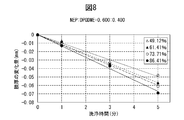
- Examples 4-9 and Comparative Examples 2-3 In the same procedure as in Examples 1 to 3 and Comparative Example 1, the mass ratio of NMP: DPGDME is 0.600: 0.400 (Examples 4 to 6 and Comparative Example 2), or 0.900: 0.100 (.
- the compositions of 5% by mass TBAF mixed solvent according to Examples 7 to 9 and Comparative Example 3) were prepared.
- Examples 10-18 and Comparative Examples 4-6 The mass ratio of NEP: DPGDME was 0. in the same procedure as in Examples 1 to 3 and Comparative Example 1 except that N-ethyl-pyrrolidone (NEP) was used instead of N-methyl-pyrrolidone (NMP). 764: 0.236 (Examples 10 to 12 and Comparative Example 4), 0.600: 0.400 (Examples 13 to 15 and Comparative Example 5), or 0.900: 0.100 (Examples 16 to 18). And Comparative Example 6), a composition of a 5 mass% TBAF mixed solvent was prepared.
- NEP N-ethyl-pyrrolidone
- NMP N-methyl-pyrrolidone
- a silicone resin was applied onto a 12-inch (300 mm) silicon wafer (thickness 770 ⁇ m) so that the dry film thickness was 110 ⁇ m. Then, it was heated at 140 ° C. for 15 minutes and 190 ° C. for 10 minutes on a hot plate to form an adhesive layer on a silicon wafer.
- a silicon wafer having an adhesive layer was divided into 1 cm ⁇ 1 cm sizes to form test pieces, and the thickness of the central portion of the test pieces was measured using a micrometer.
- a screw tube bottle with a volume of 50 cc was placed on the magnetic stirrer. Immediately after preparation (within 30 minutes after preparation) of 15.0 mL of the composition and the stirrer were put into a screw tube bottle. One test piece was immersed in the composition, and the stirrer was rotated at a rotation speed of 900 rpm for 1 minute at room temperature (25 ° C.). After immersion, the test piece was taken out with tweezers and thoroughly rinsed using a isopropyl alcohol (IPA) wash bottle. Then, in the same manner, the test piece was thoroughly rinsed using a washing bottle of ion-exchanged water (DIW).
- DIW ion-exchanged water
- the thickness of the central part of the test piece was measured using a micrometer.
- the same test was performed with the washing time being 2 minutes, 3 minutes, and 5 minutes.
- the difference in the thickness of the test piece before and after immersion for each stirring time that is, the amount of change in the film thickness of the silicone resin was calculated, and the slope of the approximate straight line (intercept is 0) was taken as the etching rate (ER) of the composition. did.
- a screw tube bottle with a volume of 50 cc was placed on the magnetic stirrer. Immediately after preparation (within 30 minutes after preparation) of 15.0 mL of the composition and the stirrer were put into a screw tube bottle. One test piece was immersed in the composition, and the stirrer was rotated at a rotation speed of 900 rpm for 1 minute at room temperature (25 ° C.). After immersion, the test piece was taken out with tweezers and thoroughly rinsed with a isopropyl alcohol (IPA) wash bottle. Then, in the same manner, the test piece was thoroughly rinsed using a washing bottle of ion-exchanged water (DIW).
- DIW ion-exchanged water
- the thickness of the central part of the test piece was measured using a micrometer.
- a similar test was performed with a washing time of 3 minutes and 5 minutes. The difference in the thickness of the test piece before and after immersion for each stirring time, that is, the amount of change in the film thickness of the silicone resin was calculated, and the slope of the approximate straight line (intercept is 0) was taken as the etching rate (ER) of the composition. did.
- the numerical values in the legends of FIGS. 1 to 9 are the proportions of structural isomers represented by the formula (1) (%, notation of "mass" is omitted).
- compositions of the present disclosure are suitably used for decomposing and cleaning adhesive residues used in the process of thinning semiconductor wafers, particularly adhesive residues containing a polyorganosiloxane compound as an adhesive polymer, from the device wafer. be able to.
Landscapes
- Chemical & Material Sciences (AREA)
- Chemical Kinetics & Catalysis (AREA)
- Organic Chemistry (AREA)
- Engineering & Computer Science (AREA)
- Wood Science & Technology (AREA)
- Life Sciences & Earth Sciences (AREA)
- Oil, Petroleum & Natural Gas (AREA)
- Health & Medical Sciences (AREA)
- Emergency Medicine (AREA)
- General Chemical & Material Sciences (AREA)
- Materials Engineering (AREA)
- Detergent Compositions (AREA)
- Cleaning Or Drying Semiconductors (AREA)
- Cleaning By Liquid Or Steam (AREA)
Priority Applications (4)
| Application Number | Priority Date | Filing Date | Title |
|---|---|---|---|
| KR1020227002686A KR102669766B1 (ko) | 2019-08-27 | 2020-07-30 | 조성물, 및 접착성 폴리머의 세정 방법 |
| JP2021542667A JP7574798B2 (ja) | 2019-08-27 | 2020-07-30 | 組成物、及び接着性ポリマーの洗浄方法 |
| CN202080058952.2A CN114269892B (zh) | 2019-08-27 | 2020-07-30 | 组合物、及粘接性聚合物的清洗方法 |
| US17/634,625 US11781092B2 (en) | 2019-08-27 | 2020-07-30 | Composition, and method for cleaning adhesive polymer |
Applications Claiming Priority (2)
| Application Number | Priority Date | Filing Date | Title |
|---|---|---|---|
| JP2019154914 | 2019-08-27 | ||
| JP2019-154914 | 2019-08-27 |
Publications (1)
| Publication Number | Publication Date |
|---|---|
| WO2021039274A1 true WO2021039274A1 (ja) | 2021-03-04 |
Family
ID=74685865
Family Applications (1)
| Application Number | Title | Priority Date | Filing Date |
|---|---|---|---|
| PCT/JP2020/029340 Ceased WO2021039274A1 (ja) | 2019-08-27 | 2020-07-30 | 組成物、及び接着性ポリマーの洗浄方法 |
Country Status (6)
| Country | Link |
|---|---|
| US (1) | US11781092B2 (https=) |
| JP (1) | JP7574798B2 (https=) |
| KR (1) | KR102669766B1 (https=) |
| CN (1) | CN114269892B (https=) |
| TW (1) | TWI758813B (https=) |
| WO (1) | WO2021039274A1 (https=) |
Cited By (2)
| Publication number | Priority date | Publication date | Assignee | Title |
|---|---|---|---|---|
| JPWO2022244593A1 (https=) * | 2021-05-21 | 2022-11-24 | ||
| EP4404244A4 (en) * | 2021-09-16 | 2025-03-12 | Nissan Chemical Corporation | Method for cleaning a semiconductor substrate, method for producing a processed semiconductor substrate, and peeling and dissolving composition |
Families Citing this family (5)
| Publication number | Priority date | Publication date | Assignee | Title |
|---|---|---|---|---|
| CN115315788B (zh) * | 2020-03-23 | 2026-03-20 | 日产化学株式会社 | 半导体基板的清洗方法、经加工的半导体基板的制造方法以及剥离用组合物 |
| CN115427547A (zh) * | 2020-04-09 | 2022-12-02 | 昭和电工株式会社 | 组合物、及粘接性聚合物的洗涤方法 |
| CN116218611B (zh) * | 2021-12-06 | 2024-06-21 | 上海新阳半导体材料股份有限公司 | 一种聚酰亚胺清洗液 |
| CN116218610B (zh) * | 2021-12-06 | 2024-07-09 | 上海新阳半导体材料股份有限公司 | 一种聚酰亚胺清洗液的制备方法 |
| CN116218612B (zh) * | 2021-12-06 | 2024-07-09 | 上海新阳半导体材料股份有限公司 | 一种聚酰亚胺清洗液在清洗半导体器件中的应用 |
Citations (4)
| Publication number | Priority date | Publication date | Assignee | Title |
|---|---|---|---|---|
| JP2004000969A (ja) * | 2002-05-31 | 2004-01-08 | Internatl Business Mach Corp <Ibm> | 電子コンポーネントからシリコーンポリマ付着物を除去する方法 |
| JP2008252100A (ja) * | 2007-03-21 | 2008-10-16 | General Chemical Performance Products Llc | 半導体エッチング残渣の除去剤及び洗浄剤 |
| WO2014092022A1 (ja) * | 2012-12-11 | 2014-06-19 | 富士フイルム株式会社 | シロキサン樹脂の除去剤、それを用いたシロキサン樹脂の除去方法並びに半導体基板製品及び半導体素子の製造方法 |
| JP2017199754A (ja) * | 2016-04-26 | 2017-11-02 | 信越化学工業株式会社 | 洗浄剤組成物及び薄型基板の製造方法 |
Family Cites Families (12)
| Publication number | Priority date | Publication date | Assignee | Title |
|---|---|---|---|---|
| JP2006176700A (ja) * | 2004-12-24 | 2006-07-06 | Tokuyama Corp | 洗浄剤組成物 |
| TWI339780B (en) * | 2005-07-28 | 2011-04-01 | Rohm & Haas Elect Mat | Stripper |
| CN101201556A (zh) * | 2006-12-15 | 2008-06-18 | 安集微电子(上海)有限公司 | 低蚀刻性光刻胶清洗剂 |
| DE102011088885A1 (de) | 2011-12-16 | 2013-06-20 | Wacker Chemie Ag | Siliconlöser |
| BE1020269A5 (nl) * | 2012-01-17 | 2013-07-02 | Taminco | Gebruik van vervangende oplosmiddelen voor n-methylpyrrolidon (nmp). |
| KR102405063B1 (ko) * | 2014-06-30 | 2022-06-07 | 엔테그리스, 아이엔씨. | 텅스텐 및 코발트 상용성을 갖는 에치후 잔류물을 제거하기 위한 수성 및 반-수성 세정제 |
| KR20160070386A (ko) * | 2014-12-10 | 2016-06-20 | 동우 화인켐 주식회사 | 실리콘계 수지 제거용 조성물 |
| KR102347599B1 (ko) * | 2014-12-16 | 2022-01-10 | 동우 화인켐 주식회사 | 실리콘계 수지 제거용 조성물 |
| US10593538B2 (en) * | 2017-03-24 | 2020-03-17 | Fujifilm Electronic Materials U.S.A., Inc. | Surface treatment methods and compositions therefor |
| JP6822440B2 (ja) * | 2017-05-26 | 2021-01-27 | 荒川化学工業株式会社 | 鉛フリーはんだフラックス用洗浄剤組成物、鉛フリーはんだフラックスの洗浄方法 |
| WO2020046515A1 (en) * | 2018-08-30 | 2020-03-05 | Huntsman Petrochemical Llc | Quaternary ammonium hydroxides of polyamines |
| KR102181219B1 (ko) * | 2019-04-19 | 2020-11-20 | 동우 화인켐 주식회사 | 접착 폴리머 제거용 조성물 |
-
2020
- 2020-07-30 US US17/634,625 patent/US11781092B2/en active Active
- 2020-07-30 KR KR1020227002686A patent/KR102669766B1/ko active Active
- 2020-07-30 JP JP2021542667A patent/JP7574798B2/ja active Active
- 2020-07-30 WO PCT/JP2020/029340 patent/WO2021039274A1/ja not_active Ceased
- 2020-07-30 CN CN202080058952.2A patent/CN114269892B/zh active Active
- 2020-08-07 TW TW109126780A patent/TWI758813B/zh active
Patent Citations (4)
| Publication number | Priority date | Publication date | Assignee | Title |
|---|---|---|---|---|
| JP2004000969A (ja) * | 2002-05-31 | 2004-01-08 | Internatl Business Mach Corp <Ibm> | 電子コンポーネントからシリコーンポリマ付着物を除去する方法 |
| JP2008252100A (ja) * | 2007-03-21 | 2008-10-16 | General Chemical Performance Products Llc | 半導体エッチング残渣の除去剤及び洗浄剤 |
| WO2014092022A1 (ja) * | 2012-12-11 | 2014-06-19 | 富士フイルム株式会社 | シロキサン樹脂の除去剤、それを用いたシロキサン樹脂の除去方法並びに半導体基板製品及び半導体素子の製造方法 |
| JP2017199754A (ja) * | 2016-04-26 | 2017-11-02 | 信越化学工業株式会社 | 洗浄剤組成物及び薄型基板の製造方法 |
Cited By (4)
| Publication number | Priority date | Publication date | Assignee | Title |
|---|---|---|---|---|
| JPWO2022244593A1 (https=) * | 2021-05-21 | 2022-11-24 | ||
| WO2022244593A1 (ja) * | 2021-05-21 | 2022-11-24 | 昭和電工株式会社 | 分解洗浄組成物及びその製造方法、並びに接着性ポリマーの洗浄方法 |
| JP7852632B2 (ja) | 2021-05-21 | 2026-04-28 | 株式会社レゾナック | 分解洗浄組成物及びその製造方法、並びに接着性ポリマーの洗浄方法 |
| EP4404244A4 (en) * | 2021-09-16 | 2025-03-12 | Nissan Chemical Corporation | Method for cleaning a semiconductor substrate, method for producing a processed semiconductor substrate, and peeling and dissolving composition |
Also Published As
| Publication number | Publication date |
|---|---|
| TW202113059A (zh) | 2021-04-01 |
| CN114269892B (zh) | 2024-02-23 |
| KR102669766B1 (ko) | 2024-05-28 |
| JPWO2021039274A1 (https=) | 2021-03-04 |
| US11781092B2 (en) | 2023-10-10 |
| US20220290078A1 (en) | 2022-09-15 |
| JP7574798B2 (ja) | 2024-10-29 |
| CN114269892A (zh) | 2022-04-01 |
| KR20220025847A (ko) | 2022-03-03 |
| TWI758813B (zh) | 2022-03-21 |
Similar Documents
| Publication | Publication Date | Title |
|---|---|---|
| KR102669766B1 (ko) | 조성물, 및 접착성 폴리머의 세정 방법 | |
| KR102467591B1 (ko) | 조성물, 접착성 폴리머의 세정 방법, 디바이스 웨이퍼의 제조 방법, 및 지지 웨이퍼의 재생 방법 | |
| KR102772597B1 (ko) | 분해 세정 조성물의 제조 방법 | |
| KR102544429B1 (ko) | 분해세정 조성물, 접착성 폴리머의 세정 방법, 및 디바이스 웨이퍼의 제조 방법 | |
| TWI769770B (zh) | 接著性聚合物之分解洗淨組成物,及接著性聚合物之洗淨方法 | |
| JP7852632B2 (ja) | 分解洗浄組成物及びその製造方法、並びに接着性ポリマーの洗浄方法 | |
| JP2024173330A (ja) | 接着性ポリマーの洗浄方法 | |
| JP2025140006A (ja) | 洗浄組成物及び洗浄組成物の製造方法 | |
| JP2025073670A (ja) | 接着性ポリマーの洗浄方法 |
Legal Events
| Date | Code | Title | Description |
|---|---|---|---|
| 121 | Ep: the epo has been informed by wipo that ep was designated in this application |
Ref document number: 20858292 Country of ref document: EP Kind code of ref document: A1 |
|
| ENP | Entry into the national phase |
Ref document number: 2021542667 Country of ref document: JP Kind code of ref document: A |
|
| ENP | Entry into the national phase |
Ref document number: 20227002686 Country of ref document: KR Kind code of ref document: A |
|
| NENP | Non-entry into the national phase |
Ref country code: DE |
|
| 122 | Ep: pct application non-entry in european phase |
Ref document number: 20858292 Country of ref document: EP Kind code of ref document: A1 |