WO2020261682A1 - 封止用樹脂組成物、封止シートおよび有機el素子封止構造体 - Google Patents
封止用樹脂組成物、封止シートおよび有機el素子封止構造体 Download PDFInfo
- Publication number
- WO2020261682A1 WO2020261682A1 PCT/JP2020/013302 JP2020013302W WO2020261682A1 WO 2020261682 A1 WO2020261682 A1 WO 2020261682A1 JP 2020013302 W JP2020013302 W JP 2020013302W WO 2020261682 A1 WO2020261682 A1 WO 2020261682A1
- Authority
- WO
- WIPO (PCT)
- Prior art keywords
- sealing
- resin composition
- layer
- organic
- modified polyolefin
- Prior art date
- Legal status (The legal status is an assumption and is not a legal conclusion. Google has not performed a legal analysis and makes no representation as to the accuracy of the status listed.)
- Ceased
Links
Images
Classifications
-
- H—ELECTRICITY
- H10—SEMICONDUCTOR DEVICES; ELECTRIC SOLID-STATE DEVICES NOT OTHERWISE PROVIDED FOR
- H10K—ORGANIC ELECTRIC SOLID-STATE DEVICES
- H10K59/00—Integrated devices, or assemblies of multiple devices, comprising at least one organic light-emitting element covered by group H10K50/00
- H10K59/80—Constructional details
- H10K59/87—Passivation; Containers; Encapsulations
- H10K59/873—Encapsulations
-
- C—CHEMISTRY; METALLURGY
- C08—ORGANIC MACROMOLECULAR COMPOUNDS; THEIR PREPARATION OR CHEMICAL WORKING-UP; COMPOSITIONS BASED THEREON
- C08K—Use of inorganic or non-macromolecular organic substances as compounding ingredients
- C08K3/00—Use of inorganic substances as compounding ingredients
- C08K3/02—Elements
- C08K3/08—Metals
-
- C—CHEMISTRY; METALLURGY
- C08—ORGANIC MACROMOLECULAR COMPOUNDS; THEIR PREPARATION OR CHEMICAL WORKING-UP; COMPOSITIONS BASED THEREON
- C08K—Use of inorganic or non-macromolecular organic substances as compounding ingredients
- C08K5/00—Use of organic ingredients
- C08K5/04—Oxygen-containing compounds
- C08K5/07—Aldehydes; Ketones
-
- C—CHEMISTRY; METALLURGY
- C08—ORGANIC MACROMOLECULAR COMPOUNDS; THEIR PREPARATION OR CHEMICAL WORKING-UP; COMPOSITIONS BASED THEREON
- C08L—COMPOSITIONS OF MACROMOLECULAR COMPOUNDS
- C08L23/00—Compositions of homopolymers or copolymers of unsaturated aliphatic hydrocarbons having only one carbon-to-carbon double bond; Compositions of derivatives of such polymers
- C08L23/26—Compositions of homopolymers or copolymers of unsaturated aliphatic hydrocarbons having only one carbon-to-carbon double bond; Compositions of derivatives of such polymers modified by chemical after-treatment
-
- C—CHEMISTRY; METALLURGY
- C08—ORGANIC MACROMOLECULAR COMPOUNDS; THEIR PREPARATION OR CHEMICAL WORKING-UP; COMPOSITIONS BASED THEREON
- C08L—COMPOSITIONS OF MACROMOLECULAR COMPOUNDS
- C08L57/00—Compositions of unspecified polymers obtained by reactions only involving carbon-to-carbon unsaturated bonds
-
- C—CHEMISTRY; METALLURGY
- C09—DYES; PAINTS; POLISHES; NATURAL RESINS; ADHESIVES; COMPOSITIONS NOT OTHERWISE PROVIDED FOR; APPLICATIONS OF MATERIALS NOT OTHERWISE PROVIDED FOR
- C09K—MATERIALS FOR MISCELLANEOUS APPLICATIONS, NOT PROVIDED FOR ELSEWHERE
- C09K3/00—Materials not provided for elsewhere
- C09K3/10—Materials in mouldable or extrudable form for sealing or packing joints or covers
-
- G—PHYSICS
- G09—EDUCATION; CRYPTOGRAPHY; DISPLAY; ADVERTISING; SEALS
- G09F—DISPLAYING; ADVERTISING; SIGNS; LABELS OR NAME-PLATES; SEALS
- G09F9/00—Indicating arrangements for variable information in which the information is built-up on a support by selection or combination of individual elements
- G09F9/30—Indicating arrangements for variable information in which the information is built-up on a support by selection or combination of individual elements in which the desired character or characters are formed by combining individual elements
-
- H—ELECTRICITY
- H05—ELECTRIC TECHNIQUES NOT OTHERWISE PROVIDED FOR
- H05B—ELECTRIC HEATING; ELECTRIC LIGHT SOURCES NOT OTHERWISE PROVIDED FOR; CIRCUIT ARRANGEMENTS FOR ELECTRIC LIGHT SOURCES, IN GENERAL
- H05B33/00—Electroluminescent light sources
- H05B33/02—Details
- H05B33/04—Sealing arrangements, e.g. against humidity
-
- Y—GENERAL TAGGING OF NEW TECHNOLOGICAL DEVELOPMENTS; GENERAL TAGGING OF CROSS-SECTIONAL TECHNOLOGIES SPANNING OVER SEVERAL SECTIONS OF THE IPC; TECHNICAL SUBJECTS COVERED BY FORMER USPC CROSS-REFERENCE ART COLLECTIONS [XRACs] AND DIGESTS
- Y02—TECHNOLOGIES OR APPLICATIONS FOR MITIGATION OR ADAPTATION AGAINST CLIMATE CHANGE
- Y02E—REDUCTION OF GREENHOUSE GAS [GHG] EMISSIONS, RELATED TO ENERGY GENERATION, TRANSMISSION OR DISTRIBUTION
- Y02E10/00—Energy generation through renewable energy sources
- Y02E10/50—Photovoltaic [PV] energy
Definitions
- the present invention relates to a sealing resin composition, a sealing sheet, and an organic EL element sealing structure.
- an organic EL display has been attracting attention as a display alternative to a liquid crystal display (LCD).
- LCD liquid crystal display
- an organic EL element used in an organic EL display deteriorates due to moisture, and there is a problem that the emission characteristics such as emission brightness, luminous efficiency, and emission uniformity deteriorate as the organic EL element deteriorates. Occurs. Therefore, it is known that the organic EL element is sealed with a sealing material having low moisture permeation in order to prevent external moisture and the like from entering (Patent Document 1).
- the present invention has been made in view of the above circumstances, and is a sealing sheet that stably exhibits adhesive reliability under high temperature and high humidity for a long period of time in addition to low moisture permeability and adhesion to an adherend. It is an object of the present invention to provide a sealing resin composition capable of obtaining (sealing material).
- the sealing resin composition contains a modified polyolefin resin and an organometallic compound, and the blending amount of the organometallic compound with respect to 100 parts by mass of the modified polyolefin resin is 0.1 to 10 parts by mass.
- Another aspect of the present invention is a sealing sheet. At least a part of the sealing sheet is formed of a cured product of the sealing resin composition of the above-described embodiment.
- the organic EL element sealing structure includes an organic EL layer and a sealing layer for sealing the organic EL layer, and the sealing layer is formed of the sealing sheet of the above-described embodiment.
- sealing sheet (sealing material) that stably exhibits adhesion reliability under high temperature and high humidity for a long period of time in addition to low moisture permeability and adhesion to an adherend.
- a resin composition for sealing that can be provided can be provided.
- the sealing resin composition according to the embodiment contains a modified polyolefin resin and an organometallic compound.
- the modified polyolefin resin can be obtained by using an unmodified polyolefin resin as a precursor and modifying it with a compound having an acidic functional group. In the present embodiment, by using the modified polyolefin resin, low moisture permeability and adhesion to the adherend can be realized at a higher level.
- the unmodified polyolefin resin includes ethylene, propylene, 1-butene, 1-hexene, 1-heptene, 1-octene, 1-decene, isopylene, 3-methyl-1-butene, 4-methyl-1-pentene and the like.
- ⁇ -olefin 1,3-butadiene, isoprene, 2,3-dimethyl-1,3-butadiene, 1,3-pentadiene, 2-methyl-1,3-pentadiene, 1,3-hexadiene, 4,5- Monopolymers of conjugated diene such as diethyl-1,3-octadiene and chloroprene, copolymers such as random, block and graft of these two or more monomers, mixtures thereof, ⁇ -olefin and / or major of conjugated diene. It refers to a copolymer such as a random, block, or graft of a portion and another unsaturated monomer.
- the unmodified polyolefin resin as the precursor is preferably a polyisobutylene polymer or an isobutylene / isoprene copolymer from the viewpoint of achieving a higher level of low moisture permeability.
- polyisobutylene polymers include OPPANOL N50, OPPANOL N80, OPPANOL N100, OPPANOL B50, OPPANOL B80, and OPPANOL B100 (manufactured by BASF Japan).
- examples of commercially available isobutylene / isoprene copolymers include JSR BUTYL 065, JSR BUTYL 268, and JSR BUTYL 365 (manufactured by JSR).
- the compound having an acidic functional group include maleic acid, fumaric acid, itaconic acid, citraconic acid, crotonic acid, phthalic anhydride, maleic anhydride, acrylic acid, methacrylic acid and the like.
- the modified polyolefin resin can be obtained by reacting the above-mentioned unmodified polyolefin resin with a compound having an acidic functional group.
- the amount of the compound having an acidic functional group to react with the unmodified polyolefin resin is preferably 0.05 to 8 parts by mass, more preferably 0.1 to 5 parts by mass with respect to 100 parts by mass of the unmodified polyolefin resin. It is preferably 0.5 to 3 parts by mass, and more preferably 0.5 to 3 parts by mass.
- the sealing resin composition of the present embodiment may contain an unreacted unmodified polyolefin resin remaining in the process of modifying the unmodified polyolefin resin.
- the unmodified polyolefin resin relative to the total amount of the unmodified polyolefin resin and the modified polyolefin resin
- the content is preferably 90% by mass or more, more preferably 95% by mass or more.
- the lower limit of the weight average molecular weight of the modified polyolefin resin is preferably 50,000 or more, more preferably 80,000 or more.
- the upper limit of the weight average molecular weight of the modified polyolefin resin is preferably 800,000 or less, more preferably 600,000 or less, still more preferably 450,000 or less.
- the weight average molecular weight of the modified polyolefin resin is a value obtained by polystyrene conversion using gel permeation chromatography (GPC).
- the modified polyolefin resin can be produced by a known method, but is preferably produced by solution polymerization. Specifically, an unmodified polyolefin resin, a compound having an acidic functional group, and a polymerization solvent are charged in the reaction vessel, a polymerization initiator is added in an atmosphere of an inert gas such as nitrogen gas, and the reaction temperature is about 50 to 90 ° C. And react for 2 to 20 hours. Further, a polymerization initiator, a chain transfer agent, a compound having an acidic functional group, and a polymerization solvent may be additionally added during the polymerization reaction as appropriate.
- polymerization initiator examples include ordinary organic polymerization initiators such as peroxides and azo compounds, and among these, peroxides are preferable.
- peroxide examples include 1,1,3,3-tetramethylbutylperoxy-2-ethylhexanoate, t-hexylperoxy-2-ethylhexanoate, and t-amylperoxy-2-ethylhexanoate.
- t-butylperoxy-2-ethylhexanoate cumylperoxyneodecanoate, 1,1,3,3-tetramethylbutylperoxyneodecanoate, t-hexylperoxyneodecanoate, t-butylperoxy Neodecanoate, t-butylperoxyneoheptanoate, t-hexylperoxypivalate, t-butylperoxypivalate, 2,5-dimethyl-2,5-di (2-ethylhexanoylperoxy) hexane, 2 , 5-Dimethyl-2,5-di (2-benzoylperoxy) hexane, t-butylperoxy-3,5,5-trimethylhexanoate, t-butylperoxylaurate, t-hexylperoxybenzoate, benzoyl peroxide Can be mentioned.
- the polymerization initiator may be used alone or in combination of two or more.
- the amount of the polymerization initiator used is usually 0.01 to 5 parts by mass with respect to 100 parts by mass of the unmodified polyolefin resin.
- the weight average molecular weight of the modified polyolefin resin can be adjusted within an appropriate range.
- examples of the polymerization solvent include aromatic hydrocarbons such as benzene, toluene and xylene; aliphatic hydrocarbons such as n-pentane, n-hexane, n-heptane and n-octane; cyclopentane and cyclohexane.
- the above-mentioned modified polyolefin resin forms a crosslinked structure, and the cohesive force can be further improved.
- the organometallic compound include an organoaluminum compound, an organoziryl compound, and an organotitanium compound, and the organometallic compound may be used alone or in combination of two or more.
- an organoaluminum compound can be preferably used from the viewpoint of improving compatibility with the modified polyolefin resin.
- the organoaluminum compound preferably has one or more substituents selected from an alkoxy group and an alkylacetate acetate group.
- organoaluminum compound When the organoaluminum compound has one or more substituents selected from an alkoxy group and an alkylacetate acetate group, it is applied to an adherend of a sealing layer (adhesive layer) obtained from a sealing resin composition. Adhesive strength is improved. More specifically, as organoaluminum compounds, aluminum tris (acetylacetonate), aluminumtris (ethylacetacetate), aluminum monoacetylacetonatobis (ethylacetate acetate), aluminum ethylacetacetate diisopropyrate, aluminum isopropyrate. One or more selected from.
- the sealing layer (adhesive layer) obtained from the sealing resin composition
- the above-mentioned organoaluminum compounds aluminum ethylacetate acetate diisopropylate and aluminum isopropylate It is preferable to use.
- the lower limit of the blending amount of the organometallic compound with respect to 100 parts by mass of the modified polyolefin resin is preferably 0.1 part by mass or more, more preferably 0.2 parts by mass or more, and 0. More than 3 parts by mass is more preferable.
- the adhesive strength of the sealing layer (adhesive layer) obtained from the sealing resin composition can be made practically sufficient.
- the upper limit of the blending amount of the organometallic compound with respect to 100 parts by mass of the modified polyolefin resin is preferably 10 parts by mass or less, more preferably 9 parts by mass or less, still more preferably 7 parts by mass or less.
- the compatibility with the modified polyolefin resin is improved, and when the sealing resin composition is used as the sealing layer (adhesive layer), the coating film is coated. Smoothness can be maintained.
- a tackifier resin may be added to the sealing resin composition of the present embodiment.
- the tackifier resin include one or more selected from terpene-based resins and petroleum-based resins.
- the terpene resin include terpene resins and modified terpene resins such as hydrogenated terpene resins, terpene phenol copolymer resins, and aromatic-modified terpene resins.
- Petroleum-based resins include alicyclic petroleum resins such as aliphatic petroleum resins (C5 petroleum resins), aromatic petroleum resins (C9 petroleum resins), and dicyclopentadiene petroleum resins (DCPD petroleum resins). , Alicyclic / aromatic copolymerized petroleum resin, alicyclic / aromatic copolymerized petroleum resin, aliphatic / alicyclic copolymerized petroleum resin, hydrogenated petroleum obtained by hydrogenating the above-exemplified petroleum resin. Petroleum resins such as resins can be mentioned.
- the softening point of the tackifier resin in the sealing resin composition of the present embodiment is preferably 80 to 180 ° C., preferably 90 to 150 ° C., from the viewpoint of durability and adhesive physical properties of the obtained sealing layer (adhesive layer). Is more preferable, and 95 to 140 ° C. is even more preferable.
- the blending amount of the tackifier resin in the sealing resin composition of the present embodiment is from the viewpoint of increasing the adhesive strength without impairing the low moisture permeability of the sealing layer (adhesive layer) obtained from the sealing resin composition. Therefore, it is preferably 5 to 50 parts by mass, more preferably 10 to 35 parts by mass, and even more preferably 15 to 30 parts by mass with respect to 100 parts by mass of the modified polyolefin resin.
- the sealing resin composition of the present embodiment is, if necessary, a curing agent, an antioxidant, a wettability improving agent, a surfactant, a silane coupling agent, and an ultraviolet absorbing agent, as long as the object of the present invention is not impaired. It may contain agents, antistatic agents, light stabilizers, fillers, pigments and the like.
- the sealing resin composition of the present embodiment preferably contains an organic solvent in order to adjust its coatability. Examples of the organic solvent include the polymerization solvent described in the description of the method for producing a modified polyolefin resin, and one type may be used alone or two or more types may be used.
- the content of the organic solvent is usually 20 to 90% by mass, preferably 30 to 90% by mass.
- the sealing resin composition of the present embodiment is obtained by mixing each of the above-mentioned components, stirring at a temperature of 20 to 80 ° C. using a stirrer or the like, and sufficiently dispersing each component.
- the sealing resin composition described above exhibits a good balance of low moisture permeability, adhesion to an adherend, and adhesion reliability under high temperature and high humidity. Therefore, the sealing resin composition of the present embodiment can be suitably used as a sealing material for an organic EL element.
- the sealing sheet according to the embodiment is formed of at least a part of the cured product of the sealing resin composition of the above-described embodiment.
- the sealing sheet of the present embodiment may be a single-layer pressure-sensitive adhesive layer made of a sealing layer obtained from a sealing resin composition, or may be a pressure-sensitive adhesive layer made of a sealing layer obtained from a sealing resin composition. It may have a multi-layer structure composed of other layers laminated on the pressure-sensitive adhesive layer. Examples of the other layer laminated with the pressure-sensitive adhesive layer include a release sheet such as a PET film that has been peeled off, a base material, and a barrier film.
- the sealing sheet may have a sealing layer formed on one side or both sides of the base material.
- the release sheet When the sealing layer is formed on one surface of the base material, the release sheet may be attached to the surface of the sealing layer opposite to the base material. Further, the sealing sheet may have a sealing layer formed on one side or both sides of the barrier film. When the sealing layer is formed on one surface of the barrier film, the release sheet may be attached to the surface of the sealing layer opposite to the barrier film.
- the sealing layer of the present embodiment is formed, for example, as follows.
- the sealing resin composition of the present invention is applied on the peeling surface of the release sheet, on the base material, or on the gas barrier film, and varies depending on the type of solvent, but is usually 50 to 150 ° C, preferably 60 to 130.
- the solvent is removed by drying at ° C. for usually 1 to 10 minutes, preferably 2 to 7 minutes to form a coating film.
- the film thickness of the dry coating film is not particularly limited and is adjusted depending on the object to be sealed, but is usually 0.5 to 200 ⁇ m.
- the sealing sheet is usually 3 days or more, preferably 7 to 10 days, usually 5 to 60 ° C., preferably 15 to 40 ° C., usually 30 to 30 to 3 days or more after the release sheet is attached on the coating film formed under the above conditions. It is aged (cured) in an environment of 70% RH, preferably 40 to 70% RH.
- a coating method of the sealing resin composition a known coating method such as a spin coating method, a knife coating method, a roll coating method, a bar coating method, a blade coating method, a die coating method, or a gravure coating method is used. , A method of applying and drying to a predetermined thickness can be used.
- the base material and the release sheet include polycarbonate (PC), polymethylmethacrylate (PMMA), polyethylene terephthalate (PET), polybutylene terephthalate (PBT), polyethylene naphthalate (PEN), polyethylene (PE), and polypropylene (PP). ), Polyethylene-propylene copolymer, ethylene-vinyl acetate copolymer, acrylonitrile-butadiene-styrene copolymer (ABS), polyamide (nylon), polyimide, polyvinyl chloride (PVC) and other plastic films.
- the gas barrier film is a laminate in which a gas barrier layer is provided on one or both sides of the base material.
- the material of the gas barrier layer is not particularly limited, but for example, a silicon compound such as a polysilazane compound, a polycarbosilane compound, a polysilane compound, a polyorganosiloxane compound, a tetraorganosilane compound, silicon oxide, and silicon nitride.
- a silicon compound such as a polysilazane compound, a polycarbosilane compound, a polysilane compound, a polyorganosiloxane compound, a tetraorganosilane compound, silicon oxide, and silicon nitride.
- Metals such as zinc and tin. These may be used alone or in combination
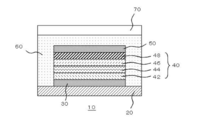
- FIG. 1 is a schematic cross-sectional view of the organic EL element sealing structure 10 according to the embodiment.
- the organic EL element sealing structure 10 shown in FIG. 1 is a top emission type organic EL element sealing structure, and a substrate 20, a reflective electrode 30, an organic EL layer 40, and a transparent electrode 50 are laminated in this order. It has a laminated body. The side surface and the upper surface of the laminate are sealed by the sealing layer 60, and the transparent substrate 70 is installed on the upper surface of the sealing layer 60.
- the substrate 20 may be transparent or opaque.
- the material used for the substrate 20 include semiconductors such as metal, ceramics, glass, and silicon, and resins.
- the resin include polyethylene terephthalate, polymethylmethacrylate, polyolefin, acrylic resin, polyester resin, polyimide resin and the like. Of these, by using polyolefin, acrylic resin, polyester resin, polyimide resin, or the like, the substrate can be made flexible. Further, by using a semiconductor such as silicon for the substrate 20 and forming a plurality of switching elements such as TFTs on the surface thereof, an active matrix drive type organic EL element sealing structure can be obtained.
- the reflective electrode 30 is made of a material having light reflectivity and functions as an anode.
- the material used for the reflective electrode 30 include metals, amorphous alloys, and microcrystalline alloys.
- the metal include Al, Ag, Mo, W, Ni, Cr and the like.
- the amorphous alloy include NiP, NiB, CrP and CrB.
- the microcrystalline alloy include NiAl and the like.
- the organic EL layer 40 has a hole transport layer 42, a light emitting layer 44, an electron transport layer 46, and an electron injection layer 48 in this order from the substrate 20 side.
- the hole transport layer 42 is a layer that has a function of transporting holes, and examples of the material thereof include a triazole derivative, an oxadiazole derivative, and an imidazole derivative.
- a hole injection layer having a hole injection property may be provided between the reflection electrode 30 and the hole transport layer 42.
- the light emitting layer 44 is a layer in which excitons are generated and emit light by recombination of injected holes and electrons, and as the material thereof, fluorescent whitening agents such as benzothiazole type, benzimidazole type, and benzoxazole type are used. And metal chelated oxynoid compounds.
- the electron transport layer 46 is a layer that has a function of transporting electrons, and its material is a heterocyclic tetra such as a nitro-substituted fluorenone derivative, an anthracinodimethane derivative, a diphenylquinone derivative, a thiopyrandioxide derivative, and naphthalene perylene. Examples thereof include carboxylic acid anhydride.
- the electron injecting layer 48 is a layer having an electron injecting property, and examples of the material thereof include an alkali metal, an alkaline earth metal or an alloy containing them, and an electron injecting material such as alkali metal fluoride.
- the transparent electrode 50 is formed by using a conductive metal oxide such as SnO 2 , In 2 O 3 , ITO, IZO, and ZnO: Al.
- a conductive metal oxide such as SnO 2 , In 2 O 3 , ITO, IZO, and ZnO: Al.
- the transparent electrode 50 is used as a cathode, it is preferable to use the uppermost layer of the organic EL layer 40 as the above-mentioned electron injection layer 48 to improve the electron injection efficiency.
- the sealing layer 60 is formed by the sealing sheet of the above-described embodiment.
- the sealing layer 60 is formed by using the sealing sheet described above, the protective layer and the like are peeled off, and then the laminated body including the organic EL layer 40 is covered with the adhesive layer.
- crimping is performed using a press machine or the like to bring the sealing layer 60 into close contact with the substrate 20, the organic EL layer 40, and the transparent substrate 70.
- the pressure during the crimping process may be appropriately adjusted within a range in which the substrate 20, the organic EL layer 40, and the transparent substrate 70 are not damaged. As a result, a sealing layer 60 for sealing the organic EL layer 40 and the like can be obtained.
- the transparent substrate 70 is made of a material that is transparent to the light emitted from the organic EL layer 40.
- the material of the transparent substrate 70 include glass such as borosilicate glass or blue plate glass, and resins such as polyethylene terephthalate, polymethylmethacrylate, polyolefin, acrylic resin, polyester resin and polyimide resin.
- the transparent substrate 70 can be made flexible by forming the transparent substrate 70 using polyolefin, acrylic resin, polyester resin, or polyimide resin.
- the organic EL element sealing structure 10 of the present embodiment seals the organic EL layer 40 with a sealing layer 60 formed by using the sealing sheet of the above-described embodiment, thereby sealing the organic EL layer 40 with moisture. It is possible to improve the reliability for a long period of time by surely protecting from the above and ensuring the adhesion under high temperature and high humidity more surely.
- the organic EL element sealing structure of the present embodiment can be used for various light emitting devices such as an organic EL display and an organic EL lighting.
- the organic EL element sealing structure is a top emission type, but the substrate 20 is made transparent to the light emitted from the organic EL layer 40, and the reflective electrode 30 and the transparent electrode 50 are provided. It is also possible to make it a bottom emission type by exchanging the arrangement of.
- Mw Weight average molecular weight
- GPC method a gel permeation chromatography method
- the weight average molecular weight of the obtained acid-modified polyolefin resin 1 was 250,000.
- An acid-modified polyolefin resin solution 2 was obtained in the same manner as in Production Example 1 except that the amount of t-butylperoxy-2-ethylhexanoate used was 1.5 parts by mass.
- the weight average molecular weight of the obtained acid-modified polyolefin resin 2 was 130,000.
- Example 1 The acid-modified polyolefin resin obtained in Production Example 1 was placed in a container so that the solid content was 100 parts by mass, and then an organometallic compound (ALCH: aluminum ethylacetate diisopropirate; manufactured by Kawaken Fine Chemicals) 0.5.
- a solution containing a sealing resin composition was obtained by blending parts by mass and toluene. The amount of toluene blended was adjusted so that the solid content concentration of the solution was 30%.
- the solution containing the obtained sealing resin composition is applied to a PET film (thickness 38 ⁇ m) that has been peeled so as to have a thickness of 50 ⁇ m after drying, and dried at 90 ° C. for 3 minutes to form an adhesive layer.
- a PET film thickness 38 ⁇ m
- a 25 ⁇ m-thick PET film is further bonded to the surface of the pressure-sensitive adhesive layer on the side where the peeled PET film is not bonded, and is aged for 7 days in an environment of 23 ° C. and 50% RH, and sealed.
- a stop sheet adheresive sheet
- Examples 2 to 10, Comparative Examples 1 to 3 A sealing resin composition and a sealing sheet were produced in the same manner as in Example 1 except that the compositions of the components used were changed as shown in Table 1.
- ⁇ Adhesive strength> The sealing sheets obtained in Examples and Comparative Examples were cut into 25 mm width ⁇ 80 mm length to prepare test pieces.
- the peeled PET film was peeled off from the obtained test piece, and the exposed pressure-sensitive adhesive layer was wiped with cotton moistened with ethyl acetate, and then left at 23 ° C. for 1 hour in a 50% RH environment. It was affixed to (float plate glass: manufactured by Nippon Tact), and a 2 kg roller was reciprocated three times and crimped.
- ⁇ Holding power> The sealing sheets obtained in Examples and Comparative Examples were cut to a width of 20 mm to prepare test pieces.
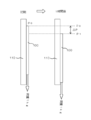
- the peeled PET film was peeled off from the obtained test piece, an exposed adhesive layer having a sticking area of 20 mm ⁇ 20 mm was stuck on the SUS, and a 2 kg roller was pressure-bonded three times. After crimping, it is left for 20 minutes in an environment of 80 ° C./dry, and then, as shown in FIG. 2, a load of 1 kg is applied in the shearing direction of the adhesive layer 100 attached to the glass plate 110 under the same environment, and the load application is started.
- the amount of displacement of the pressure-sensitive adhesive layer 100 1 hour after the start (the amount of displacement ⁇ P of the position P1 of the end portion of the pressure-sensitive adhesive layer 100 1 hour after the start of applying the load to the initial position P0 of the end portion of the pressure-sensitive adhesive layer 100). It was measured.
- ⁇ Adhesion to base material> The sealing sheets obtained in Examples and Comparative Examples were cut into 25 mm width ⁇ 80 mm length to prepare test pieces.
- the peeled PET film was peeled off from the obtained test piece, and the exposed pressure-sensitive adhesive layer was wiped with cotton moistened with ethyl acetate, and then left at 23 ° C. for 1 hour in a 50% RH environment. It was affixed to (float plate glass: manufactured by Nippon Tact), and a 2 kg roller was reciprocated three times and crimped. After crimping, the mixture was left at 60 ° C. and 90% RH for 24 hours, and then left at 23 ° C. and 50% RH for 1 hour. Then, in an environment of 23 ° C.
- the end of the sealing sheet (test piece) is pulled at an angle of 180 ° with respect to the glass plate at a speed of 300 mm / min, and the adhesion to the base material is based on the following criteria. Evaluated in. ⁇ : The sealing sheet was peeled off at the interface between the glass and the adhesive layer. ⁇ : A part of the adhesive layer was transferred to the glass. X: The sealing sheet was peeled off at the interface between the base material (PET film) and the pressure-sensitive adhesive layer.
- ⁇ Durability test> The sealing sheets obtained in Examples and Comparative Examples were cut into a size of 50 mm ⁇ 50 mm to obtain test pieces. From the obtained test piece, the peeled PET film was peeled off, the surface was wiped with cotton moistened with ethyl acetate, and then the glass plate was left at 23 ° C. in a 50% RH environment for 1 hour (float plate glass: Nippon Tact). A 2 kg roller was reciprocated three times and crimped. After crimping, the product was left to stand in an environment of 85 ° C. and 85% RH for 500 hours, and then the durability was evaluated according to the following criteria. ⁇ : No abnormality was observed in the appearance. ⁇ : Slight appearance defects such as foaming, fishing float, and peeling were confirmed, but there is no problem in actual use. X: Poor appearance such as foaming, fishing float, and peeling was observed over a wide area.
- the sealing sheets of Examples 1 to 10 are excellent in moisture permeability because they contain a modified polyolefin resin. As shown in Table 1, the sealing sheets of Examples 1 to 10 showed a value having a very high adhesive strength as compared with Comparative Example 2. Further, it was confirmed that the sealing sheets of Examples 1 to 10 have good holding power after passing through a high temperature and high humidity environment, substrate adhesion, and constant load test results, and also have excellent durability. It was. Further, in Examples 1 to 5 and 7 to 10, it was confirmed that the durability was good and the permeability was good.
- Organic EL element encapsulation structure 20 substrate, 30 reflective electrode, 40 organic EL layer, 42 hole transport layer, 44 light emitting layer, 46 electron transport layer, 48 electron injection layer, 50 transparent electrode, 60 encapsulation layer, 70 transparent substrate, 100 test piece, 110 glass plate, 200 test piece, 210 glass plate, 220 weight
Landscapes
- Chemical & Material Sciences (AREA)
- Organic Chemistry (AREA)
- Health & Medical Sciences (AREA)
- Chemical Kinetics & Catalysis (AREA)
- Medicinal Chemistry (AREA)
- Polymers & Plastics (AREA)
- Engineering & Computer Science (AREA)
- Materials Engineering (AREA)
- General Chemical & Material Sciences (AREA)
- Physics & Mathematics (AREA)
- General Physics & Mathematics (AREA)
- Theoretical Computer Science (AREA)
- Electroluminescent Light Sources (AREA)
- Sealing Material Composition (AREA)
Abstract
低透湿性、被着体への密着性および高温高湿下での接着信頼性をバランスよく発揮する封止シート(封止材)を得ることができる封止用樹脂組成物を提供する。本発明のある態様は、封止用樹脂組成物である。当該封止用樹脂組成物は、変性ポリオレフィン樹脂と、有機金属化合物と、を含有する。当該封止用樹脂組成物において、上記変性ポリオレフィン樹脂100質量部に対する上記有機金属化合物の配合量が0.1~10質量部である。
Description
本発明は、封止用樹脂組成物、封止シートおよび有機EL素子封止構造体に関する。
近年、液晶ディスプレイ(LCD)に代わるディスプレイとして、有機ELディスプレイが注目されている。
一般に、有機ELディスプレイに用いられる有機EL素子は水分により劣化することが知られており、有機EL素子の劣化に伴い、発光輝度、発光効率、発光均一性等の発光特性が低下するという問題が生じる。
このため、外部の水分等が侵入することを防ぐために、水分透過が低い封止材により有機EL素子を封止することが知られている(特許文献1)。
一般に、有機ELディスプレイに用いられる有機EL素子は水分により劣化することが知られており、有機EL素子の劣化に伴い、発光輝度、発光効率、発光均一性等の発光特性が低下するという問題が生じる。
このため、外部の水分等が侵入することを防ぐために、水分透過が低い封止材により有機EL素子を封止することが知られている(特許文献1)。
近年、有機ELディスプレイは狭額縁化・フレキシブル化の検討も進められており、有機EL素子を封止する封止材には低透湿性であることに加え、積層基板を折り曲げた際に剥がれ等の欠陥が発生しないよう、被着体(ガラス)への密着性が高いことも求められる。さらに、高温高湿等の過酷な環境下においても、高い接着信頼性を長期に渡り安定的に発揮することも求められる。
本発明は、上記事情に鑑みてされたものであり、低透湿性、被着体への密着性に加え、高温高湿下での接着信頼性を長期に渡り安定的に発揮する封止シート(封止材)を得ることができる封止用樹脂組成物を提供することを目的とする。
本発明のある態様は、封止用樹脂組成物である。当該封止用樹脂組成物は、変性ポリオレフィン樹脂と、有機金属化合物と、を含み、前記変性ポリオレフィン樹脂100質量部に対する前記有機金属化合物の配合量が0.1~10質量部である。
本発明の他の態様は、封止シートである。当該封止シートは、少なくとも一部が上述した態様の封止用樹脂組成物の硬化物により形成されている。
本発明のさらに他の態様は、有機EL素子封止構造体である。当該有機EL素子封止構造体は、有機EL層と、前記有機EL層を封止する封止層と、を備え、前記封止層が上述した態様の封止シートにより形成されている。
本発明によれば、低透湿性、被着体への密着性に加え、高温高湿下での接着信頼性を長期に渡り安定的に発揮する封止シート(封止材)を得ることができる封止用樹脂組成物を提供することができる。
以下、本発明の実施形態について、詳細に説明する。なお、本明細書中、数値範囲の説明における「a~b」との表記は、特に断らない限り、a以上b以下であることを表す。
実施形態に係る封止用樹脂組成物は、変性ポリオレフィン樹脂と有機金属化合物とを含有する。以下、本実施形態の封止用樹脂組成物の各成分について詳細に説明する。
(変性ポリオレフィン樹脂)
変性ポリオレフィン樹脂は、未変性ポリオレフィン樹脂を前駆体とし、酸性官能基を有する化合物により変性処理することで得られる。本実施形態では、変性ポリオレフィン樹脂を用いることにより、低透湿性と被着体への密着性をより高いレベルで実現することができる。
前記未変性ポリオレフィン樹脂は、エチレン、プロピレン、1-ブテン、1-ヘキセン、1-ヘプテン、1-オクテン、1-デセン、イソブチレン、3-メチル-1-ブテン、4-メチル-1-ペンテン等のα-オレフィン;1,3-ブタジエン、イソプレン、2,3-ジメチル-1,3-ブタジエン、1,3-ペンタジエン、2-メチル-1,3-ペンタジエン、1,3-ヘキサジエン、4,5-ジエチル-1,3-オクタジエン、クロロプレン等の共役ジエンの単独重合体、これら2種以上のモノマーのランダム、ブロック、グラフト等の共重合体、これらの混合物、α-オレフィンおよび/または共役ジエンの主要部と他の不飽和モノマーとのランダム、ブロック、グラフト等の共重合体をいう。
これらのうち、低透湿性をより高いレベルとする観点から、前駆体としての未変性ポリオレフィン樹脂は、ポリイソブチレン重合体、イソブチレン・イソプレン共重合体が好ましい。
ポリイソブチレン重合体の市販品としては、OPPANOL N50、OPPANOL N80、OPPANOL N100、OPPANOL B50、OPPANOL B80、OPPANOL B100(BASFジャパン製)等が挙げられる。また、イソブチレン・イソプレン共重合体の市販品としては、JSR BUTYL 065、JSR BUTYL 268、JSR BUTYL 365(JSR製)等が挙げられる。
前記酸性官能基を有する化合物としては、マレイン酸、フマル酸、イタコン酸、シトラコン酸、クロトン酸、無水フタル酸、無水マレイン酸、アクリル酸、メタクリル酸等が挙げられる。
変性ポリオレフィン樹脂は、未変性ポリオレフィン樹脂を前駆体とし、酸性官能基を有する化合物により変性処理することで得られる。本実施形態では、変性ポリオレフィン樹脂を用いることにより、低透湿性と被着体への密着性をより高いレベルで実現することができる。
前記未変性ポリオレフィン樹脂は、エチレン、プロピレン、1-ブテン、1-ヘキセン、1-ヘプテン、1-オクテン、1-デセン、イソブチレン、3-メチル-1-ブテン、4-メチル-1-ペンテン等のα-オレフィン;1,3-ブタジエン、イソプレン、2,3-ジメチル-1,3-ブタジエン、1,3-ペンタジエン、2-メチル-1,3-ペンタジエン、1,3-ヘキサジエン、4,5-ジエチル-1,3-オクタジエン、クロロプレン等の共役ジエンの単独重合体、これら2種以上のモノマーのランダム、ブロック、グラフト等の共重合体、これらの混合物、α-オレフィンおよび/または共役ジエンの主要部と他の不飽和モノマーとのランダム、ブロック、グラフト等の共重合体をいう。
これらのうち、低透湿性をより高いレベルとする観点から、前駆体としての未変性ポリオレフィン樹脂は、ポリイソブチレン重合体、イソブチレン・イソプレン共重合体が好ましい。
ポリイソブチレン重合体の市販品としては、OPPANOL N50、OPPANOL N80、OPPANOL N100、OPPANOL B50、OPPANOL B80、OPPANOL B100(BASFジャパン製)等が挙げられる。また、イソブチレン・イソプレン共重合体の市販品としては、JSR BUTYL 065、JSR BUTYL 268、JSR BUTYL 365(JSR製)等が挙げられる。
前記酸性官能基を有する化合物としては、マレイン酸、フマル酸、イタコン酸、シトラコン酸、クロトン酸、無水フタル酸、無水マレイン酸、アクリル酸、メタクリル酸等が挙げられる。
変性ポリオレフィン樹脂は、上述した未変性ポリオレフィン樹脂と酸性官能基を有する化合物とを反応させることにより得られる。未変性ポリオレフィン樹脂に反応させる酸性官能基を有する化合物の量は、未変性ポリオレフィン樹脂100質量部に対して、0.05~8質量部が好ましく、0.1~5質量部であることがより好ましく、0.5~3質量部であることがさらに好ましい。
本実施形態の封止用樹脂組成物は、未変性ポリオレフィン樹脂を変性する過程で残存した、未反応の未変性ポリオレフィン樹脂を含みうる。本実施形態の封止用樹脂組成物において、高温高湿下での接着信頼性を長期に渡り安定的に発揮させる観点から、未変性ポリオレフィン樹脂と変性ポリオレフィン樹脂の合計量に対する未変性ポリオレフィン樹脂の含有量は90質量%以上が好ましく、95質量%以上がより好ましい。
本実施形態の封止用樹脂組成物は、未変性ポリオレフィン樹脂を変性する過程で残存した、未反応の未変性ポリオレフィン樹脂を含みうる。本実施形態の封止用樹脂組成物において、高温高湿下での接着信頼性を長期に渡り安定的に発揮させる観点から、未変性ポリオレフィン樹脂と変性ポリオレフィン樹脂の合計量に対する未変性ポリオレフィン樹脂の含有量は90質量%以上が好ましく、95質量%以上がより好ましい。
変性ポリオレフィン樹脂の重量平均分子量の下限は5万以上が好ましく、8万以上がより好ましい。変性ポリオレフィン樹脂の重量平均分子量の下限を上記値とすることにより、封止用樹脂組成物より得られる封止シートを被着体に貼付した際、発泡や浮き上がりが生じることをより長期に渡り抑制し、耐久性を向上させることができる。
変性ポリオレフィン樹脂の重量平均分子量の上限は80万以下が好ましく、60万以下がより好ましく、45万以下がさらに好ましい。変性ポリオレフィン樹脂の重量平均分子量の上限を上記値とすることにより、封止用樹脂組成物の粘度が高くなりすぎることを抑制し、封止用樹脂組成物の加工性を良好に保つことができる。
ここで、重量平均分子量は、ゲル浸透クロマトグラフィー(GPC)を用いて、ポリスチレン換算により求められる値である。
変性ポリオレフィン樹脂の重量平均分子量の上限は80万以下が好ましく、60万以下がより好ましく、45万以下がさらに好ましい。変性ポリオレフィン樹脂の重量平均分子量の上限を上記値とすることにより、封止用樹脂組成物の粘度が高くなりすぎることを抑制し、封止用樹脂組成物の加工性を良好に保つことができる。
ここで、重量平均分子量は、ゲル浸透クロマトグラフィー(GPC)を用いて、ポリスチレン換算により求められる値である。
(変性ポリオレフィン樹脂の製造方法)
変性ポリオレフィン樹脂は、公知の方法により製造することができるが、溶液重合により製造することが好ましい。具体的には反応容器内に未変性ポリオレフィン樹脂、酸性官能基を有する化合物および重合溶媒を仕込み、窒素ガス等の不活性ガス雰囲気下で、重合開始剤を添加し、反応温度50~90℃程度に加熱し、2~20時間反応させる。また、重合反応中に、重合開始剤、連鎖移動剤、酸性官能基を有する化合物、重合溶媒を適宜追加添加してもよい。
重合開始剤としては、例えば、過酸化物、アゾ化合物などの通常の有機系重合開始剤が挙げられ、これらの中でも、過酸化物が好ましい。
過酸化物としては、1,1,3,3-テトラメチルブチルペルオキシ-2-エチルヘキサノエート、t-ヘキシルペルオキシ-2-エチルヘキサノエート、t-アミルペルオキシ-2-エチルヘキサノエート、t-ブチルペルオキシ-2-エチルヘキサノエート、クミルペルオキシネオデカノエート、1,1,3,3-テトラメチルブチルペルオキシネオデカノエート、t-ヘキシルペルオキシネオデカノエート、t-ブチルペルオキシネオデカノエート、t-ブチルペルオキシネオヘプタノエート、t-ヘキシルペルオキシピバレート、t-ブチルペルオキシピバレート、2,5-ジメチル-2,5-ジ(2-エチルヘキサノイルペルオキシ)ヘキサン、2,5-ジメチル-2,5-ジ(2-ベンゾイルペルオキシ)ヘキサン、t-ブチルペルオキシ-3,5,5-トリメチルヘキサノエート、t-ブチルペルオキシラウレート、t-ヘキシルペルオキシベンゾアート、ベンゾイルペルオキシドが挙げられる。
重合開始剤は1種単独で用いてもよく、2種以上を用いてもよい。
重合開始剤の使用量は、未変性ポリオレフィン樹脂100質量部に対して、通常は0.01~5質量部である。このような態様であると、変性ポリオレフィン樹脂の重量平均分子量を適切な範囲内に調整することができる。
溶液重合においては、重合溶媒としては、例えば、ベンゼン、トルエン、キシレン等の芳香族炭化水素;n-ペンタン、n-ヘキサン、n-ヘプタン、n-オクタン等の脂肪族炭化水素;シクロペンタン、シクロヘキサン、シクロヘプタン、シクロオクタン等の脂環式炭化水素;ジエチルエーテル、ジイソプロピルエーテル、1,2-ジメトキシエタン、ジブチルエーテル、テトラヒドロフラン、ジオキサン、アニソール、フェニルエチルエーテル、ジフェニルエーテル等のエーテル;クロロホルム、四塩化炭素、1,2-ジクロロエタン、クロロベンゼン等のハロゲン化炭化水素;酢酸エチル、酢酸プロピル、酢酸ブチル、プロピオン酸メチル等のエステル;アセトン、メチルエチルケトン、ジエチルケトン、メチルイソブチルケトン、シクロヘキサノン等のケトン;N,N-ジメチルホルムアミド、N,N-ジメチルアセトアミド、N-メチルピロリドン等のアミド;アセトニトリル、ベンゾニトリル等のニトリル;ジメチルスルホキシド、スルホラン等のスルホキシドが挙げられる。重合溶媒は1種単独で用いてもよく、2種以上を用いてもよい。
変性ポリオレフィン樹脂は、公知の方法により製造することができるが、溶液重合により製造することが好ましい。具体的には反応容器内に未変性ポリオレフィン樹脂、酸性官能基を有する化合物および重合溶媒を仕込み、窒素ガス等の不活性ガス雰囲気下で、重合開始剤を添加し、反応温度50~90℃程度に加熱し、2~20時間反応させる。また、重合反応中に、重合開始剤、連鎖移動剤、酸性官能基を有する化合物、重合溶媒を適宜追加添加してもよい。
重合開始剤としては、例えば、過酸化物、アゾ化合物などの通常の有機系重合開始剤が挙げられ、これらの中でも、過酸化物が好ましい。
過酸化物としては、1,1,3,3-テトラメチルブチルペルオキシ-2-エチルヘキサノエート、t-ヘキシルペルオキシ-2-エチルヘキサノエート、t-アミルペルオキシ-2-エチルヘキサノエート、t-ブチルペルオキシ-2-エチルヘキサノエート、クミルペルオキシネオデカノエート、1,1,3,3-テトラメチルブチルペルオキシネオデカノエート、t-ヘキシルペルオキシネオデカノエート、t-ブチルペルオキシネオデカノエート、t-ブチルペルオキシネオヘプタノエート、t-ヘキシルペルオキシピバレート、t-ブチルペルオキシピバレート、2,5-ジメチル-2,5-ジ(2-エチルヘキサノイルペルオキシ)ヘキサン、2,5-ジメチル-2,5-ジ(2-ベンゾイルペルオキシ)ヘキサン、t-ブチルペルオキシ-3,5,5-トリメチルヘキサノエート、t-ブチルペルオキシラウレート、t-ヘキシルペルオキシベンゾアート、ベンゾイルペルオキシドが挙げられる。
重合開始剤は1種単独で用いてもよく、2種以上を用いてもよい。
重合開始剤の使用量は、未変性ポリオレフィン樹脂100質量部に対して、通常は0.01~5質量部である。このような態様であると、変性ポリオレフィン樹脂の重量平均分子量を適切な範囲内に調整することができる。
溶液重合においては、重合溶媒としては、例えば、ベンゼン、トルエン、キシレン等の芳香族炭化水素;n-ペンタン、n-ヘキサン、n-ヘプタン、n-オクタン等の脂肪族炭化水素;シクロペンタン、シクロヘキサン、シクロヘプタン、シクロオクタン等の脂環式炭化水素;ジエチルエーテル、ジイソプロピルエーテル、1,2-ジメトキシエタン、ジブチルエーテル、テトラヒドロフラン、ジオキサン、アニソール、フェニルエチルエーテル、ジフェニルエーテル等のエーテル;クロロホルム、四塩化炭素、1,2-ジクロロエタン、クロロベンゼン等のハロゲン化炭化水素;酢酸エチル、酢酸プロピル、酢酸ブチル、プロピオン酸メチル等のエステル;アセトン、メチルエチルケトン、ジエチルケトン、メチルイソブチルケトン、シクロヘキサノン等のケトン;N,N-ジメチルホルムアミド、N,N-ジメチルアセトアミド、N-メチルピロリドン等のアミド;アセトニトリル、ベンゾニトリル等のニトリル;ジメチルスルホキシド、スルホラン等のスルホキシドが挙げられる。重合溶媒は1種単独で用いてもよく、2種以上を用いてもよい。
(有機金属化合物)
実施形態に係る封止用樹脂組成物は、有機金属化合物を含むことにより、上述の変性ポリオレフィン樹脂が架橋構造を形成し、凝集力のより一層の向上が図られる。
有機金属化合物としては、有機アルミニウム化合物、有機ジルコニウム化合物、有機チタン化合物が挙げられ、前記有機金属化合物は1種単独で用いても、2種以上を用いてもよい。
前記有機金属化合物の中でも、変性ポリオレフィン樹脂との相溶性を良好とする観点から有機アルミニウム化合物を好ましく用いることができる。
前記有機アルミニウム化合物は、アルコキシ基、アルキルアセトアセテート基から選択される1種以上の置換基を有することが好ましい。前記有機アルミニウム化合物が、アルコキシ基、アルキルアセトアセテート基から選択される1種以上の置換基を有することで、封止用樹脂組成物より得られる封止層(粘着剤層)の被着体に対する粘着力が向上する。
より具体的には、有機アルミニウム化合物として、アルミニウムトリス(アセチルアセトナート)、アルミニウムトリス(エチルアセトアセテート)、アルミニウムモノアセチルアセトナートビス(エチルアセトアセテート)、アルミニウムエチルアセトアセテートジイソプロピレート、アルミニウムイソプロピレートから選択される1種以上が挙げられる。
なお、封止用樹脂組成物より得られる封止層(粘着剤層)の透過性を良好なものとする観点から、上述の有機アルミニウム化合物のうち、アルミニウムエチルアセトアセテートジイソプロピレート、アルミニウムイソプロピレートを使用することが好ましい。
実施形態に係る封止用樹脂組成物は、有機金属化合物を含むことにより、上述の変性ポリオレフィン樹脂が架橋構造を形成し、凝集力のより一層の向上が図られる。
有機金属化合物としては、有機アルミニウム化合物、有機ジルコニウム化合物、有機チタン化合物が挙げられ、前記有機金属化合物は1種単独で用いても、2種以上を用いてもよい。
前記有機金属化合物の中でも、変性ポリオレフィン樹脂との相溶性を良好とする観点から有機アルミニウム化合物を好ましく用いることができる。
前記有機アルミニウム化合物は、アルコキシ基、アルキルアセトアセテート基から選択される1種以上の置換基を有することが好ましい。前記有機アルミニウム化合物が、アルコキシ基、アルキルアセトアセテート基から選択される1種以上の置換基を有することで、封止用樹脂組成物より得られる封止層(粘着剤層)の被着体に対する粘着力が向上する。
より具体的には、有機アルミニウム化合物として、アルミニウムトリス(アセチルアセトナート)、アルミニウムトリス(エチルアセトアセテート)、アルミニウムモノアセチルアセトナートビス(エチルアセトアセテート)、アルミニウムエチルアセトアセテートジイソプロピレート、アルミニウムイソプロピレートから選択される1種以上が挙げられる。
なお、封止用樹脂組成物より得られる封止層(粘着剤層)の透過性を良好なものとする観点から、上述の有機アルミニウム化合物のうち、アルミニウムエチルアセトアセテートジイソプロピレート、アルミニウムイソプロピレートを使用することが好ましい。
本実施形態の封止用樹脂組成物において、変性ポリオレフィン樹脂100質量部に対する有機金属化合物の配合量の下限は、0.1質量部以上が好ましく、0.2質量部以上がより好ましく、0.3質量部以上がさらに好ましい。有機金属化合物の配合量の下限を上記値とすることにより、封止用樹脂組成物より得られる封止層(粘着剤層)の粘着力を実用上十分なものとすることができる。
一方、変性ポリオレフィン樹脂100質量部に対する有機金属化合物の配合量の上限は、10質量部以下が好ましく、9質量部以下がより好ましく、7質量部以下がさらに好ましい。有機金属化合物の配合量の上限を上記値とすることにより、変性ポリオレフィン樹脂との相溶性をよくし、封止用樹脂組成物を封止層(粘着剤層)とした際に、塗膜の平滑性を保つことができる。
一方、変性ポリオレフィン樹脂100質量部に対する有機金属化合物の配合量の上限は、10質量部以下が好ましく、9質量部以下がより好ましく、7質量部以下がさらに好ましい。有機金属化合物の配合量の上限を上記値とすることにより、変性ポリオレフィン樹脂との相溶性をよくし、封止用樹脂組成物を封止層(粘着剤層)とした際に、塗膜の平滑性を保つことができる。
(粘着付与樹脂)
本実施形態の封止用樹脂組成物には、粘着付与樹脂が添加されてもよい。本実施形態の封止用樹脂組成物に粘着付与樹脂を添加することにより、得られる封止層(粘着剤層)の粘着力をより高めることができる。
粘着付与樹脂としは、テルペン系樹脂、石油系樹脂から選択される1種以上が挙げられる。
テルペン系樹脂としては、テルペン樹脂および、水素添加テルペン樹脂、テルペンフェノール共重合樹脂、芳香族変性テルペン樹脂などの変性テルペン樹脂が挙げられる。
石油系樹脂としては、脂肪族系石油樹脂(C5系石油樹脂)、芳香族系石油樹脂(C9系石油樹脂)、ジシクロペンタジエン系石油樹脂(DCPD系石油樹脂)等の脂環族系石油樹脂、脂肪族/芳香族共重合系石油樹脂、脂環族/芳香族共重合系石油樹脂、脂肪族/脂環族共重合系石油樹脂、前記例示の石油樹脂を水添してなる水添石油樹脂等の石油樹脂が挙げられる。
本実施形態の封止用樹脂組成物における粘着付与樹脂の軟化点は、得られる封止層(粘着剤層)の耐久性と粘着物性の観点から、80~180℃が好ましく、90~150℃がより好ましく、95~140℃がさらに好ましい。
本実施形態の封止用樹脂組成物における粘着付与樹脂の配合量は、封止用樹脂組成物から得られる封止層(粘着剤層)の低透湿性を損なうことなく、粘着力を高める観点から、変性ポリオレフィン樹脂100質量部に対して5~50質量部が好ましく、10~35質量部がより好ましく、15~30質量部がさらに好ましい。
本実施形態の封止用樹脂組成物には、粘着付与樹脂が添加されてもよい。本実施形態の封止用樹脂組成物に粘着付与樹脂を添加することにより、得られる封止層(粘着剤層)の粘着力をより高めることができる。
粘着付与樹脂としは、テルペン系樹脂、石油系樹脂から選択される1種以上が挙げられる。
テルペン系樹脂としては、テルペン樹脂および、水素添加テルペン樹脂、テルペンフェノール共重合樹脂、芳香族変性テルペン樹脂などの変性テルペン樹脂が挙げられる。
石油系樹脂としては、脂肪族系石油樹脂(C5系石油樹脂)、芳香族系石油樹脂(C9系石油樹脂)、ジシクロペンタジエン系石油樹脂(DCPD系石油樹脂)等の脂環族系石油樹脂、脂肪族/芳香族共重合系石油樹脂、脂環族/芳香族共重合系石油樹脂、脂肪族/脂環族共重合系石油樹脂、前記例示の石油樹脂を水添してなる水添石油樹脂等の石油樹脂が挙げられる。
本実施形態の封止用樹脂組成物における粘着付与樹脂の軟化点は、得られる封止層(粘着剤層)の耐久性と粘着物性の観点から、80~180℃が好ましく、90~150℃がより好ましく、95~140℃がさらに好ましい。
本実施形態の封止用樹脂組成物における粘着付与樹脂の配合量は、封止用樹脂組成物から得られる封止層(粘着剤層)の低透湿性を損なうことなく、粘着力を高める観点から、変性ポリオレフィン樹脂100質量部に対して5~50質量部が好ましく、10~35質量部がより好ましく、15~30質量部がさらに好ましい。
(その他の成分)
本実施形態の封止用樹脂組成物は、本発明の目的を損なわない範囲で、必要に応じて、硬化剤、酸化防止剤、濡れ性改良剤、界面活性剤、シランカップリング剤、紫外線吸収剤、帯電防止剤、光安定剤、充填剤、顔料などを含んでもよい。
本実施形態の封止用樹脂組成物は、その塗布性を調整するため、有機溶媒を含有することが好ましい。有機溶媒としては、変性ポリオレフィン樹脂の製造方法の説明で記載した重合溶媒が挙げられ、1種単独で用いてもよく、2種以上を用いてもよい。
本実施形態の封止用樹樹脂組成物において、有機溶媒の含有量は、通常20~90質量%、好ましくは30~90質量%である。
本実施形態の封止用樹脂組成物は、本発明の目的を損なわない範囲で、必要に応じて、硬化剤、酸化防止剤、濡れ性改良剤、界面活性剤、シランカップリング剤、紫外線吸収剤、帯電防止剤、光安定剤、充填剤、顔料などを含んでもよい。
本実施形態の封止用樹脂組成物は、その塗布性を調整するため、有機溶媒を含有することが好ましい。有機溶媒としては、変性ポリオレフィン樹脂の製造方法の説明で記載した重合溶媒が挙げられ、1種単独で用いてもよく、2種以上を用いてもよい。
本実施形態の封止用樹樹脂組成物において、有機溶媒の含有量は、通常20~90質量%、好ましくは30~90質量%である。
本実施形態の封止用樹脂組成物は、上述した各成分を混合し、撹拌機などを用いて20~80℃の温度で撹拌し、各成分を十分に分散させることにより得られる。
以上説明した封止用樹脂組成物は、低透湿性、被着体への密着性および高温高湿下での接着信頼性をバランス良く発揮する。このため、本実施形態の封止用樹脂組成物は、有機EL素子の封止材料として好適に使用されうる。
(封止シート)
実施形態に係る封止シートは、少なくとも一部が上述した実施形態の封止用樹脂組成物の硬化物により形成される。
本実施形態の封止シートは、封止用樹脂組成物から得られる封止層からなる単層の粘着剤層でもよく、封止用樹脂組成物から得られる封止層からなる粘着剤層と当該粘着剤層に積層される他の層からなる複層構造を有していてもよい。当該粘着剤層と積層される他の層としては、剥離処理されたPETフィルムなどの剥離シート、基材、バリアフィルムなどが挙げられる。
封止シートは、基材の一方の面または両面に封止層が形成されていてもよい。基材の一方の面に封止層が形成される場合、基材と反対側の封止層の面に剥離シートが貼付されてもよい。
また、封止シートは、バリアフィルムの一方の面または両面に封止層が形成されていてもよい。バリアフィルムの一方の面に封止層が形成される場合、バリアフィルムと反対側の封止層の面に剥離シートが貼付されてもよい。
実施形態に係る封止シートは、少なくとも一部が上述した実施形態の封止用樹脂組成物の硬化物により形成される。
本実施形態の封止シートは、封止用樹脂組成物から得られる封止層からなる単層の粘着剤層でもよく、封止用樹脂組成物から得られる封止層からなる粘着剤層と当該粘着剤層に積層される他の層からなる複層構造を有していてもよい。当該粘着剤層と積層される他の層としては、剥離処理されたPETフィルムなどの剥離シート、基材、バリアフィルムなどが挙げられる。
封止シートは、基材の一方の面または両面に封止層が形成されていてもよい。基材の一方の面に封止層が形成される場合、基材と反対側の封止層の面に剥離シートが貼付されてもよい。
また、封止シートは、バリアフィルムの一方の面または両面に封止層が形成されていてもよい。バリアフィルムの一方の面に封止層が形成される場合、バリアフィルムと反対側の封止層の面に剥離シートが貼付されてもよい。
本実施形態の封止層は、例えば以下のとおりにして形成される。本発明の封止用樹脂組成物を剥離シートの剥離処理面上、もしくは基材上、もしくはガスバリアフィルム上に塗布し、溶媒の種類によっても異なるが、通常50~150℃、好ましくは60~130℃で、通常1~10分間、好ましくは2~7分間乾燥して溶媒を除去し、塗膜を形成する。乾燥塗膜の膜厚は、特に制限されず、封止対象物によって調節されるが、通常0.5~200μmである。
封止シートは、上記条件で形成された塗膜上に剥離シートを貼付した後、通常3日以上、好ましくは7~10日間、通常5~60℃、好ましくは15~40℃、通常30~70%RH、好ましくは40~70%RHの環境下で熟成(養生)する。
封止用樹脂組成物の塗布方法としては、公知の方法、例えばスピンコート法、ナイフコート法、ロールコート法、バーコート法、ブレードコート法、ダイコート法、グラビアコート法などの周知の塗布方法により、所定の厚さになるように塗布・乾燥する方法を用いることができる。
基材および剥離シートとしては、例えば、ポリカーボネート(PC)、ポリメチルメタクリレート(PMMA)、ポリエチレンテレフタレート(PET)、ポリブチレンテレフタレート(PBT)、ポリエチレンナフタレート(PEN)、ポリエチレン(PE)、ポリプロピレン(PP)、エチレン-プロピレン共重合体、エチレン-酢酸ビニル共重合体、アクリロニトリル-ブタジエン-スチレン共重合体(ABS)、ポリアミド(ナイロン)、ポリイミド、ポリ塩化ビニル(PVC)などのプラスチックフィルムが挙げられる。
ガスバリアフィルムは前記基材の一方もしくは両面に、ガスバリア層が設けられた積層体である。
前記ガスバリア層の材料としては、特に限定されるものではないが、例えば、ポリシラザン化合物、ポリカルボシラン化合物、ポリシラン化合物、ポリオルガノシロキサン化合物、テトラオルガノシラン化合物等のケイ素化合物、酸化ケイ素、酸窒化ケイ素、酸化アルミニウム、酸窒化アルミニウム、酸化マグネシウム、酸化亜鉛、酸化インジウム、酸化スズ等の無機酸化物、窒化ケイ素、窒化アルミニウム等の無機窒化物、酸化窒化ケイ素等の無機酸化窒化物等、アルミニウム、マグネシウム、亜鉛、スズ等の金属などが挙げられる。これらは、1種単独で用いても、2種以上を用いてもよい。
封止シートは、上記条件で形成された塗膜上に剥離シートを貼付した後、通常3日以上、好ましくは7~10日間、通常5~60℃、好ましくは15~40℃、通常30~70%RH、好ましくは40~70%RHの環境下で熟成(養生)する。
封止用樹脂組成物の塗布方法としては、公知の方法、例えばスピンコート法、ナイフコート法、ロールコート法、バーコート法、ブレードコート法、ダイコート法、グラビアコート法などの周知の塗布方法により、所定の厚さになるように塗布・乾燥する方法を用いることができる。
基材および剥離シートとしては、例えば、ポリカーボネート(PC)、ポリメチルメタクリレート(PMMA)、ポリエチレンテレフタレート(PET)、ポリブチレンテレフタレート(PBT)、ポリエチレンナフタレート(PEN)、ポリエチレン(PE)、ポリプロピレン(PP)、エチレン-プロピレン共重合体、エチレン-酢酸ビニル共重合体、アクリロニトリル-ブタジエン-スチレン共重合体(ABS)、ポリアミド(ナイロン)、ポリイミド、ポリ塩化ビニル(PVC)などのプラスチックフィルムが挙げられる。
ガスバリアフィルムは前記基材の一方もしくは両面に、ガスバリア層が設けられた積層体である。
前記ガスバリア層の材料としては、特に限定されるものではないが、例えば、ポリシラザン化合物、ポリカルボシラン化合物、ポリシラン化合物、ポリオルガノシロキサン化合物、テトラオルガノシラン化合物等のケイ素化合物、酸化ケイ素、酸窒化ケイ素、酸化アルミニウム、酸窒化アルミニウム、酸化マグネシウム、酸化亜鉛、酸化インジウム、酸化スズ等の無機酸化物、窒化ケイ素、窒化アルミニウム等の無機窒化物、酸化窒化ケイ素等の無機酸化窒化物等、アルミニウム、マグネシウム、亜鉛、スズ等の金属などが挙げられる。これらは、1種単独で用いても、2種以上を用いてもよい。
(有機EL素子封止構造体)
実施形態に係る有機EL素子封止構造体は、上述した封止シートにより有機EL層が封止された構造を有する。
図1は、実施形態に係る有機EL素子封止構造体10の概略断面図である。図1に示した有機EL素子封止構造体10は、トップエミッション型の有機EL素子封止構造体であり、基板20、反射電極30、有機EL層40および透明電極50がこの順で積層された積層体を有する。当該積層体の側面および上面は、封止層60により封止されており、封止層60の上面に透明基板70が設置されている。
実施形態に係る有機EL素子封止構造体は、上述した封止シートにより有機EL層が封止された構造を有する。
図1は、実施形態に係る有機EL素子封止構造体10の概略断面図である。図1に示した有機EL素子封止構造体10は、トップエミッション型の有機EL素子封止構造体であり、基板20、反射電極30、有機EL層40および透明電極50がこの順で積層された積層体を有する。当該積層体の側面および上面は、封止層60により封止されており、封止層60の上面に透明基板70が設置されている。
基板20は、透明であっても不透明であってもよい。基板20に用いられる材料としては、金属、セラミック、ガラス、シリコンなどの半導体、ならびに樹脂が挙げられる。樹脂としては、ポリエチレンテレフタレート、ポリメチルメタクリレート、ポリオレフィン、アクリル樹脂、ポリエステル樹脂またはポリイミド樹脂などが挙げられる。このうち、ポリオレフィン、アクリル樹脂、ポリエステル樹脂またはポリイミド樹脂などを用いることで、基板に可撓性をもたせることができる。また、基板20にシリコンなどの半導体を用い、その表面に複数のTFTなどのスイッチング素子を形成することにより、アクティブマトリクス駆動型の有機EL素子封止構造体とすることができる。
反射電極30は、光反射性を有する材料で形成され、陽極として機能する。反射電極30に使用される材料としては、金属、アモルファス合金、微結晶性合金が挙げられる。金属としては、Al、Ag、Mo、W、Ni、Crなどが挙げられる。アモルファス合金としては、NiP、NiB、CrPおよびCrBなどが挙げられる。微結晶性合金としては、NiAlなどが挙げられる。
有機EL層40は、基板20側から順に、正孔輸送層42、発光層44、電子輸送層46および電子注入層48を有する。
正孔輸送層42は、正孔を輸送する機能を担う層であり、その材料として、トリアゾール誘導体、オキサジアゾール誘導体、イミダゾール誘導体などが挙げられる。なお、反射電極30と正孔輸送層42との間に正孔注入性を有する正孔注入層を設けてもよい。
発光層44は、注入された正孔と電子が再結合することで励起子が生成・発光する層であり、その材料として、ベンゾチアゾール系、ベンゾイミダゾール系、ベンゾオキサゾール系などの蛍光増白剤や、金属キレート化オキシノイド化合物などが挙げられる。
電子輸送層46は、電子を輸送する機能を担う層であり、その材料としては、ニトロ置換フルオレノン誘導体、アントラキノジメタン誘導体、ジフェニルキノン誘導体、チオピランジオキシド誘導体、ナフタレンペリレン等の複素環テトラカルボン酸無水物等が挙げられる。
電子注入層48は、電子注入性を有する層であり、その材料としては、アルカリ金属、アルカリ土類金属またはそれらを含む合金、アルカリ金属フッ化物などの電子注入性材料が挙げられる。
透明電極50は、SnO2、In2O3、ITO、IZO、ZnO:Alなどの導電性金属酸化物を用いて形成される。透明電極50を陰極として用いる場合には、有機EL層40の最上層を上述した電子注入層48として電子注入効率を高めることが好ましい。
封止層60は、上述した実施形態の封止シートにより形成される。上述した封止シートを用いて封止層60を形成する場合には、保護層等を剥がした後、粘着剤層により有機EL層40を含む積層体を覆う。後述する透明基板70を積層したあと、プレス機等を用いて圧着加工を行い、封止層60と、基板20、有機EL層40および透明基板70とを密着させる。なお、圧着加工時の圧力は、基板20、有機EL層40および透明基板70にダメージが生じない範囲で適宜調節すればよい。これにより、有機EL層40等を封止する封止層60が得られる。
透明基板70は、有機EL層40から発せられる光に対して透明な材料で形成される。透明基板70の材料として、ホウケイ酸ガラスまたは青板ガラスなどのガラス、ポリエチレンテレフタレート、ポリメチルメタクリレート、ポリオレフィン、アクリル樹脂、ポリエステル樹脂またはポリイミド樹脂などの樹脂が挙げられる。このうち、ポリオレフィン、アクリル樹脂、ポリエステル樹脂またはポリイミド樹脂を用いて透明基板70を形成することにより、透明基板70に可撓性を持たせることができる。
本実施形態の有機EL素子封止構造体10は、有機EL層40を上述した実施形態の封止シートを用いて形成された封止層60により封止することにより、有機EL層40を水分から確実に保護するとともに、高温高湿下での密着性をより確実に確保することにより、長期に渡り信頼性の向上を図ることができる。
本実施形態の有機EL素子封止構造体は、有機ELディスプレイや有機EL照明等の様々な発光装置に用いることができる。
以上、本発明の実施形態について述べたが、これらは本発明の例示であり、上記以外の様々な構成を採用することもできる。
たとえば、上述の実施形態では、有機EL素子封止構造体がトップエミッション型であるが、基板20に有機EL層40から発せられる光に対して透明性を持たせ、反射電極30と透明電極50の配置を入れ替えたボトムエミッション型とすることもできる。
たとえば、上述の実施形態では、有機EL素子封止構造体がトップエミッション型であるが、基板20に有機EL層40から発せられる光に対して透明性を持たせ、反射電極30と透明電極50の配置を入れ替えたボトムエミッション型とすることもできる。
以下、本発明を実施例および比較例により説明するが、本発明はこれらに限定されるものではない。
<重量平均分子量(Mw)>
変性ポリオレフィン樹脂について、ゲルパーミエーションクロマトグラフィー法(GPC法)により、下記条件で標準ポリスチレン換算によるMwを求めた。
・測定装置:HLC-8320GPC(東ソー製)
・GPCカラム構成:以下の4連カラム(すべて東ソー製)
(1)TSKgel HxL-H(ガードカラム)
(2)TSKgel GMHxL
(3)TSKgel GMHxL
(4)TSKgel G2500HxL
・流速:1.0mL/min
・カラム温度:40℃
・サンプル濃度:1.5%(w/v)(テトラヒドロフランで希釈)
・移動相溶媒:テトラヒドロフラン
・標準ポリスチレン換算
変性ポリオレフィン樹脂について、ゲルパーミエーションクロマトグラフィー法(GPC法)により、下記条件で標準ポリスチレン換算によるMwを求めた。
・測定装置:HLC-8320GPC(東ソー製)
・GPCカラム構成:以下の4連カラム(すべて東ソー製)
(1)TSKgel HxL-H(ガードカラム)
(2)TSKgel GMHxL
(3)TSKgel GMHxL
(4)TSKgel G2500HxL
・流速:1.0mL/min
・カラム温度:40℃
・サンプル濃度:1.5%(w/v)(テトラヒドロフランで希釈)
・移動相溶媒:テトラヒドロフラン
・標準ポリスチレン換算
(製造例1)
撹拌機、還流冷却器、温度計および窒素道入管を備えた反応装置に、ポリオレフィン樹脂(IIR:JSR BUTYL268;JSR製)100質量部、無水マレイン酸1.1質量部、トルエン200質量部を仕込み、溶液を攪拌しながら窒素ガスを導入し85℃に昇温した。次いで、t-ブチルペルオキシ-2-エチルヘキサノエート0.5質量部を加えた後、85℃で2時間攪拌し、さらに90℃に昇温し2時間攪拌を行った。その後、冷却を行い、酸変性ポリオレフィン樹脂溶液1を得た。得られた酸変性ポリオレフィン樹脂1の重量平均分子量は25万であった。
(製造例2)
t-ブチルペルオキシ-2-エチルヘキサノエートの使用量を1.5質量部とした以外は製造例1と同様にして、酸変性ポリオレフィン樹脂溶液2を得た。得られた酸変性ポリオレフィン樹脂2の重量平均分子量は13万であった。
(製造例3)
t-ブチルペルオキシ-2-エチルヘキサノエートの使用量を0.3質量部とした以外は製造例1と同様にして、酸変性ポリオレフィン樹脂溶液3を得た。得られた酸変性ポリオレフィン樹脂3の重量平均分子量は32万であった。
撹拌機、還流冷却器、温度計および窒素道入管を備えた反応装置に、ポリオレフィン樹脂(IIR:JSR BUTYL268;JSR製)100質量部、無水マレイン酸1.1質量部、トルエン200質量部を仕込み、溶液を攪拌しながら窒素ガスを導入し85℃に昇温した。次いで、t-ブチルペルオキシ-2-エチルヘキサノエート0.5質量部を加えた後、85℃で2時間攪拌し、さらに90℃に昇温し2時間攪拌を行った。その後、冷却を行い、酸変性ポリオレフィン樹脂溶液1を得た。得られた酸変性ポリオレフィン樹脂1の重量平均分子量は25万であった。
(製造例2)
t-ブチルペルオキシ-2-エチルヘキサノエートの使用量を1.5質量部とした以外は製造例1と同様にして、酸変性ポリオレフィン樹脂溶液2を得た。得られた酸変性ポリオレフィン樹脂2の重量平均分子量は13万であった。
(製造例3)
t-ブチルペルオキシ-2-エチルヘキサノエートの使用量を0.3質量部とした以外は製造例1と同様にして、酸変性ポリオレフィン樹脂溶液3を得た。得られた酸変性ポリオレフィン樹脂3の重量平均分子量は32万であった。
(実施例1)
製造例1で得られた酸変性ポリオレフィン樹脂の固形分が100質量部となるように容器に入れ、その後、有機金属化合物(ALCH:アルミニウムエチルアセトアセテートジイソプロピレート;川研ファインケミカル製)0.5質量部およびトルエンを配合し、封止用樹脂組成物を含む溶液を得た。トルエンの配合量は、溶液の固形分濃度が30%となるよう調整した。
得られた封止用樹脂組成物を含む溶液を、乾燥後の厚みが50μmとなるように剥離処理されたPETフィルム(厚さ38μm)に塗工し、90℃で3分乾燥し粘着剤層を形成した。剥離処理されたPETフィルムが貼り合わされていない側の当該粘着剤層の表面に、厚さ25μmのPETフィルムをさらに貼り合せて、23℃、50%RHの環境下で7日間エージングを行い、封止シート(粘着シート)を製造した。
製造例1で得られた酸変性ポリオレフィン樹脂の固形分が100質量部となるように容器に入れ、その後、有機金属化合物(ALCH:アルミニウムエチルアセトアセテートジイソプロピレート;川研ファインケミカル製)0.5質量部およびトルエンを配合し、封止用樹脂組成物を含む溶液を得た。トルエンの配合量は、溶液の固形分濃度が30%となるよう調整した。
得られた封止用樹脂組成物を含む溶液を、乾燥後の厚みが50μmとなるように剥離処理されたPETフィルム(厚さ38μm)に塗工し、90℃で3分乾燥し粘着剤層を形成した。剥離処理されたPETフィルムが貼り合わされていない側の当該粘着剤層の表面に、厚さ25μmのPETフィルムをさらに貼り合せて、23℃、50%RHの環境下で7日間エージングを行い、封止シート(粘着シート)を製造した。
(実施例2~10、比較例1~3)
使用した成分の組成を表1に記載したとおりに変更したこと以外は実施例1と同様に、封止用樹脂組成物および封止シートを製造した。
使用した成分の組成を表1に記載したとおりに変更したこと以外は実施例1と同様に、封止用樹脂組成物および封止シートを製造した。
<粘着力>
実施例および比較例で得られた封止シートを25mm幅×80mm長に裁断し、試験片を作製した。得られた試験片から剥離処理されたPETフィルムを剥がし、露出した粘着剤層を、酢酸エチルを湿らせたコットンで表面を拭いた後23℃、50%RH環境下で1時間放置したガラス板(フロート板ガラス:日本タクト製)に貼付して2kgのローラーを3往復して圧着した。圧着後、23℃、50%RH環境下で24時間放置後、引張試験機(AG-X:島津製作所製)にて300mm/minの速度で封止シート(試験片)の端部をガラス板に対して180°の角度で引っ張り、23℃、50%RH環境下で粘着力を測定した。
実施例および比較例で得られた封止シートを25mm幅×80mm長に裁断し、試験片を作製した。得られた試験片から剥離処理されたPETフィルムを剥がし、露出した粘着剤層を、酢酸エチルを湿らせたコットンで表面を拭いた後23℃、50%RH環境下で1時間放置したガラス板(フロート板ガラス:日本タクト製)に貼付して2kgのローラーを3往復して圧着した。圧着後、23℃、50%RH環境下で24時間放置後、引張試験機(AG-X:島津製作所製)にて300mm/minの速度で封止シート(試験片)の端部をガラス板に対して180°の角度で引っ張り、23℃、50%RH環境下で粘着力を測定した。
<保持力>
実施例および比較例で得られた封止シートを20mm幅に裁断し、試験片を作製した。得られた試験片から剥離処理されたPETフィルムを剥がし、貼付け面積が20mm×20mmとなるように露出した粘着剤層をSUSに貼付し、2kgのローラーを3往復して圧着した。圧着後、80℃/dry環境下で20分放置後、図2に示すように、同環境下でガラス板110に貼付された粘着剤層100のせん断方向に1kgの荷重をかけ、荷重付加開始から1時間後の粘着剤層100のずれ量(粘着剤層100の端部の初期の位置P0に対する荷重付加開始から1時間後の粘着剤層100の端部の位置P1のずれ量ΔP)を測定した。
実施例および比較例で得られた封止シートを20mm幅に裁断し、試験片を作製した。得られた試験片から剥離処理されたPETフィルムを剥がし、貼付け面積が20mm×20mmとなるように露出した粘着剤層をSUSに貼付し、2kgのローラーを3往復して圧着した。圧着後、80℃/dry環境下で20分放置後、図2に示すように、同環境下でガラス板110に貼付された粘着剤層100のせん断方向に1kgの荷重をかけ、荷重付加開始から1時間後の粘着剤層100のずれ量(粘着剤層100の端部の初期の位置P0に対する荷重付加開始から1時間後の粘着剤層100の端部の位置P1のずれ量ΔP)を測定した。
<基材密着性>
実施例および比較例で得られた封止シートを25mm幅×80mm長に裁断し、試験片を作製した。得られた試験片から剥離処理されたPETフィルムを剥がし、露出した粘着剤層を、酢酸エチルを湿らせたコットンで表面を拭いた後23℃、50%RH環境下で1時間放置したガラス板(フロート板ガラス:日本タクト製)に貼付して2kgのローラーを3往復して圧着した。圧着後、60℃、90%RH環境下で24時間放置後、さらに23℃、50%RH環境下で1時間放置した。その後、23℃、50%RH環境下で、ガラス板に対して180°の角度で、300mm/minの速度で封止シート(試験片)の端部を引っ張り、基材密着性を以下の基準で評価した。
〇:ガラスと粘着剤層の界面で封止シートが剥離した。
△:ガラスに粘着剤層の一部が転着した。
×:基材(PETフィルム)と粘着剤層の界面で封止シートが剥離した。
実施例および比較例で得られた封止シートを25mm幅×80mm長に裁断し、試験片を作製した。得られた試験片から剥離処理されたPETフィルムを剥がし、露出した粘着剤層を、酢酸エチルを湿らせたコットンで表面を拭いた後23℃、50%RH環境下で1時間放置したガラス板(フロート板ガラス:日本タクト製)に貼付して2kgのローラーを3往復して圧着した。圧着後、60℃、90%RH環境下で24時間放置後、さらに23℃、50%RH環境下で1時間放置した。その後、23℃、50%RH環境下で、ガラス板に対して180°の角度で、300mm/minの速度で封止シート(試験片)の端部を引っ張り、基材密着性を以下の基準で評価した。
〇:ガラスと粘着剤層の界面で封止シートが剥離した。
△:ガラスに粘着剤層の一部が転着した。
×:基材(PETフィルム)と粘着剤層の界面で封止シートが剥離した。
<定荷重試験>
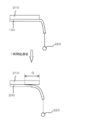
実施例および比較例で得られた封止シートを80mm×20mmの大きさに裁断し、試験片を得た。得られた試験片から、剥離処理されたPETフィルムを剥がし、貼付け面積が50mm×20mmとなるように、酢酸エチルを湿らせたコットンで表面を拭いた後23℃、50%RH環境下で1時間放置したガラス板(フロート板ガラス:日本タクト製)に貼付して2kgのローラーを3往復して圧着した。圧着後、60℃、90%RH環境下で24時間放置後、図3に示すように、ガラス板210に貼付された試験片200の長手方向の一端側の端部(ガラス板110からはみ出る部分の端部)に50gの重り220をつるし、1時間放置した後のガラス板210の一端側の端部からの剥がれ量Qを測定した。
実施例および比較例で得られた封止シートを80mm×20mmの大きさに裁断し、試験片を得た。得られた試験片から、剥離処理されたPETフィルムを剥がし、貼付け面積が50mm×20mmとなるように、酢酸エチルを湿らせたコットンで表面を拭いた後23℃、50%RH環境下で1時間放置したガラス板(フロート板ガラス:日本タクト製)に貼付して2kgのローラーを3往復して圧着した。圧着後、60℃、90%RH環境下で24時間放置後、図3に示すように、ガラス板210に貼付された試験片200の長手方向の一端側の端部(ガラス板110からはみ出る部分の端部)に50gの重り220をつるし、1時間放置した後のガラス板210の一端側の端部からの剥がれ量Qを測定した。
<耐久試験>
実施例および比較例で得られた封止シートを50mm×50mmの大きさに裁断し、試験片を得た。得られた試験片から、剥離処理されたPETフィルムを剥がし、酢酸エチルを湿らせたコットンで表面を拭いた後23℃、50%RH環境下で1時間放置したガラス板(フロート板ガラス:日本タクト製)に貼付して2kgのローラーを3往復して圧着した。圧着後、85℃、85%RH環境下で500時間放置した後、以下の基準で耐久性を評価した。
〇:外観に異常が観察されなかった。
△:発泡・ウキ・剥がれ等の外観不良が僅かに確認されたが、実使用上問題ない。
×:発泡・ウキ・剥がれ等の外観不良が広範囲に渡って観察された。
実施例および比較例で得られた封止シートを50mm×50mmの大きさに裁断し、試験片を得た。得られた試験片から、剥離処理されたPETフィルムを剥がし、酢酸エチルを湿らせたコットンで表面を拭いた後23℃、50%RH環境下で1時間放置したガラス板(フロート板ガラス:日本タクト製)に貼付して2kgのローラーを3往復して圧着した。圧着後、85℃、85%RH環境下で500時間放置した後、以下の基準で耐久性を評価した。
〇:外観に異常が観察されなかった。
△:発泡・ウキ・剥がれ等の外観不良が僅かに確認されたが、実使用上問題ない。
×:発泡・ウキ・剥がれ等の外観不良が広範囲に渡って観察された。
<ヘイズ>
実施例および比較例で得られた封止シートを50mm×50mmのサイズに裁断し、剥離処理されたPETフィルムを剥がした。その後、ヘイズを測定した。ヘイズの測定には、MH-150(村上色彩技術研究所製)を用いた。
実施例および比較例で得られた封止シートを50mm×50mmのサイズに裁断し、剥離処理されたPETフィルムを剥がした。その後、ヘイズを測定した。ヘイズの測定には、MH-150(村上色彩技術研究所製)を用いた。

ALCH:アルミニウムエチルアセトアセテートジイソプロピレート;川研ファインケミカル製
AIPD:アルミニウムイソプロピレート;川研ファインケミカル製
アルミキレートA:アルミニウムトリス(アセチルアセトネート);川研ファインケミカル製
TH-130:テルペンフェノール系粘着付与樹脂 YSポリスターTH-130;ヤスハラケミカル製
R100:脂肪族系炭化水素粘着付与樹脂 Quintone R100;日本ゼオン製
実施例1~10の封止シートは、変性ポリオレフィン樹脂を含むことにより透湿性に優れる。
表1に示すように、実施例1~10の封止シートは、比較例2に比べて粘着力が非常に高い値を示した。さらに、実施例1~10の封止シートは、高温高湿環境を経たあとの保持力、基材密着性、定荷重試験の結果が良好であることに加え、耐久性が優れることが確認された。また、実施例1~5、7~10については、耐久性が良好であることに加え、透過性が良好であることが確認された。
表1に示すように、実施例1~10の封止シートは、比較例2に比べて粘着力が非常に高い値を示した。さらに、実施例1~10の封止シートは、高温高湿環境を経たあとの保持力、基材密着性、定荷重試験の結果が良好であることに加え、耐久性が優れることが確認された。また、実施例1~5、7~10については、耐久性が良好であることに加え、透過性が良好であることが確認された。
10 有機EL素子封止構造体、20 基板、30 反射電極、40 有機EL層、42 正孔輸送層、44 発光層、46 電子輸送層、48 電子注入層、50 透明電極、60 封止層、70 透明基板、100 試験片、110 ガラス板、200 試験片、210 ガラス板、220 重り
Claims (9)
- 変性ポリオレフィン樹脂と、
有機金属化合物と、
を含み、
前記変性ポリオレフィン樹脂100質量部に対する前記有機金属化合物の配合量が0.1~10質量部である封止用樹脂組成物。 - 前記変性ポリオレフィン樹脂の重量平均分子量が5万~80万である請求項1に記載の封止用樹脂組成物。
- 前記変性ポリオレフィン樹脂が酸性官能基を有する請求項1または2に記載の封止用樹脂組成物。
- 前記有機金属化合物が、アルコキシ基、アルキルアセトアセテート基から選択される1種以上の置換基を有する請求項3に記載の封止用樹脂組成物。
- 前記有機金属化合物が、有機アルミニウム化合物である請求項1乃至4のいずれか1項に記載の封止用樹脂組成物。
- 前記有機アルミニウム化合物が、アルミニウムトリス(アセチルアセトナート)、アルミニウムトリス(エチルアセトアセテート)、アルミニウムモノアセチルアセトナートビス(エチルアセトアセテート)、アルミニウムエチルアセトアセテートジイソプロピレート、アルミニウムイソプロピレートから選択される1種以上である請求項5に記載の封止用樹脂組成物。
- テルペン系樹脂、石油系樹脂から選択される1種以上の粘着付与樹脂をさらに含有する請求項1乃至6のいずれか1項に記載の封止用樹脂組成物。
- 少なくとも一部が請求項1乃至7のいずれか1項に記載の封止用樹脂組成物より作製された封止層を有する封止シート。
- 有機EL層と、
前記有機EL層を封止する封止層と、
を備え、
前記封止層が請求項8に記載の封止シートにより形成されている有機EL素子封止構造体。
Priority Applications (2)
| Application Number | Priority Date | Filing Date | Title |
|---|---|---|---|
| CN202080035135.5A CN113811567B (zh) | 2019-06-28 | 2020-03-25 | 密封用树脂组合物、密封片和有机el元件密封结构体 |
| JP2021527379A JPWO2020261682A1 (ja) | 2019-06-28 | 2020-03-25 |
Applications Claiming Priority (2)
| Application Number | Priority Date | Filing Date | Title |
|---|---|---|---|
| JP2019-121856 | 2019-06-28 | ||
| JP2019121856 | 2019-06-28 |
Publications (1)
| Publication Number | Publication Date |
|---|---|
| WO2020261682A1 true WO2020261682A1 (ja) | 2020-12-30 |
Family
ID=74061589
Family Applications (1)
| Application Number | Title | Priority Date | Filing Date |
|---|---|---|---|
| PCT/JP2020/013302 Ceased WO2020261682A1 (ja) | 2019-06-28 | 2020-03-25 | 封止用樹脂組成物、封止シートおよび有機el素子封止構造体 |
Country Status (3)
| Country | Link |
|---|---|
| JP (1) | JPWO2020261682A1 (ja) |
| CN (1) | CN113811567B (ja) |
| WO (1) | WO2020261682A1 (ja) |
Citations (2)
| Publication number | Priority date | Publication date | Assignee | Title |
|---|---|---|---|---|
| JP2017101145A (ja) * | 2015-12-01 | 2017-06-08 | リンテック株式会社 | 接着剤組成物、封止シート、及び封止体 |
| WO2018092800A1 (ja) * | 2016-11-18 | 2018-05-24 | リンテック株式会社 | 接着剤組成物、封止シート、及び封止体 |
Family Cites Families (4)
| Publication number | Priority date | Publication date | Assignee | Title |
|---|---|---|---|---|
| JP2652297B2 (ja) * | 1992-02-26 | 1997-09-10 | 三洋化成工業株式会社 | 樹脂組成物、コーティング剤および接着剤 |
| JP4269773B2 (ja) * | 2003-05-15 | 2009-05-27 | 凸版印刷株式会社 | 無機el素子封止フィルム |
| JP6148870B2 (ja) * | 2013-01-31 | 2017-06-14 | 株式会社日本触媒 | 硬化性樹脂組成物、及び、硬化物 |
| JPWO2019012904A1 (ja) * | 2017-07-10 | 2020-05-07 | 綜研化学株式会社 | 組成物、粘着剤および粘着シート |
-
2020
- 2020-03-25 CN CN202080035135.5A patent/CN113811567B/zh active Active
- 2020-03-25 WO PCT/JP2020/013302 patent/WO2020261682A1/ja not_active Ceased
- 2020-03-25 JP JP2021527379A patent/JPWO2020261682A1/ja active Pending
Patent Citations (2)
| Publication number | Priority date | Publication date | Assignee | Title |
|---|---|---|---|---|
| JP2017101145A (ja) * | 2015-12-01 | 2017-06-08 | リンテック株式会社 | 接着剤組成物、封止シート、及び封止体 |
| WO2018092800A1 (ja) * | 2016-11-18 | 2018-05-24 | リンテック株式会社 | 接着剤組成物、封止シート、及び封止体 |
Also Published As
| Publication number | Publication date |
|---|---|
| CN113811567A (zh) | 2021-12-17 |
| CN113811567B (zh) | 2023-06-27 |
| JPWO2020261682A1 (ja) | 2020-12-30 |
Similar Documents
| Publication | Publication Date | Title |
|---|---|---|
| CN101752276B (zh) | 封装电子装置的方法 | |
| TWI639667B (zh) | Substrate composition, subsequent sheet, electronic device and method of manufacturing same | |
| TWI482831B (zh) | 封裝電子零件之方法 | |
| CN105849220B (zh) | 片状密封材料、密封片材、电子器件密封体和有机el元件 | |
| JP6487098B2 (ja) | 接着シートおよび電子デバイス | |
| CN103347970B (zh) | 用于封装电子装置的粘合剂和方法 | |
| KR101886455B1 (ko) | 점착 시트 및 전자 디바이스 | |
| JP5634518B2 (ja) | 電子的装置のカプセル化方法 | |
| US11139449B2 (en) | Resin composition for sealing organic electronic device element, resin sheet for sealing organic electronic device element, organic electroluminescent element, and image display apparatus | |
| JP2007197517A (ja) | 接着性封止組成物、封止フィルム及び有機el素子 | |
| TWI599630B (zh) | Adhesive composition, followed by sheet and electronic device | |
| TWI547550B (zh) | A resin composition for sealing an element for an organic electronic device, a resin sheet for sealing an element for an organic electronic device, an organic electroluminescent element, and a screen display device | |
| TW201708486A (zh) | 密封用樹脂組成物 | |
| TW201538587A (zh) | 電子裝置密封用樹脂組成物及電子裝置 | |
| TW201241125A (en) | Adhesive and method of encapsulation for electronic arrangement | |
| WO2020261682A1 (ja) | 封止用樹脂組成物、封止シートおよび有機el素子封止構造体 | |
| WO2020261681A1 (ja) | 封止用樹脂組成物、封止シートおよび有機el素子封止構造体 | |
| KR102487141B1 (ko) | 접착제 조성물, 접착 시트, 및 봉지체 | |
| TW201903100A (zh) | 黏著劑組合物、黏著薄片及密封體 |
Legal Events
| Date | Code | Title | Description |
|---|---|---|---|
| 121 | Ep: the epo has been informed by wipo that ep was designated in this application |
Ref document number: 20831356 Country of ref document: EP Kind code of ref document: A1 |
|
| ENP | Entry into the national phase |
Ref document number: 2021527379 Country of ref document: JP Kind code of ref document: A |
|
| NENP | Non-entry into the national phase |
Ref country code: DE |
|
| 122 | Ep: pct application non-entry in european phase |
Ref document number: 20831356 Country of ref document: EP Kind code of ref document: A1 |