WO2020240993A1 - 樹脂組成物および樹脂膜 - Google Patents
樹脂組成物および樹脂膜 Download PDFInfo
- Publication number
- WO2020240993A1 WO2020240993A1 PCT/JP2020/011356 JP2020011356W WO2020240993A1 WO 2020240993 A1 WO2020240993 A1 WO 2020240993A1 JP 2020011356 W JP2020011356 W JP 2020011356W WO 2020240993 A1 WO2020240993 A1 WO 2020240993A1
- Authority
- WO
- WIPO (PCT)
- Prior art keywords
- polymer
- meth
- resin composition
- acrylate
- mass
- Prior art date
- Legal status (The legal status is an assumption and is not a legal conclusion. Google has not performed a legal analysis and makes no representation as to the accuracy of the status listed.)
- Ceased
Links
Classifications
-
- C—CHEMISTRY; METALLURGY
- C08—ORGANIC MACROMOLECULAR COMPOUNDS; THEIR PREPARATION OR CHEMICAL WORKING-UP; COMPOSITIONS BASED THEREON
- C08F—MACROMOLECULAR COMPOUNDS OBTAINED BY REACTIONS ONLY INVOLVING CARBON-TO-CARBON UNSATURATED BONDS
- C08F220/00—Copolymers of compounds having one or more unsaturated aliphatic radicals, each having only one carbon-to-carbon double bond, and only one being terminated by only one carboxyl radical or a salt, anhydride ester, amide, imide or nitrile thereof
- C08F220/02—Monocarboxylic acids having less than ten carbon atoms; Derivatives thereof
- C08F220/10—Esters
- C08F220/26—Esters containing oxygen in addition to the carboxy oxygen
- C08F220/30—Esters containing oxygen in addition to the carboxy oxygen containing aromatic rings in the alcohol moiety
- C08F220/302—Esters containing oxygen in addition to the carboxy oxygen containing aromatic rings in the alcohol moiety and two or more oxygen atoms in the alcohol moiety
-
- C—CHEMISTRY; METALLURGY
- C08—ORGANIC MACROMOLECULAR COMPOUNDS; THEIR PREPARATION OR CHEMICAL WORKING-UP; COMPOSITIONS BASED THEREON
- C08L—COMPOSITIONS OF MACROMOLECULAR COMPOUNDS
- C08L33/00—Compositions of homopolymers or copolymers of compounds having one or more unsaturated aliphatic radicals, each having only one carbon-to-carbon double bond, and only one being terminated by only one carboxyl radical, or of salts, anhydrides, esters, amides, imides or nitriles thereof; Compositions of derivatives of such polymers
- C08L33/04—Homopolymers or copolymers of esters
- C08L33/14—Homopolymers or copolymers of esters of esters containing halogen, nitrogen, sulfur, or oxygen atoms in addition to the carboxy oxygen
-
- C—CHEMISTRY; METALLURGY
- C08—ORGANIC MACROMOLECULAR COMPOUNDS; THEIR PREPARATION OR CHEMICAL WORKING-UP; COMPOSITIONS BASED THEREON
- C08F—MACROMOLECULAR COMPOUNDS OBTAINED BY REACTIONS ONLY INVOLVING CARBON-TO-CARBON UNSATURATED BONDS
- C08F220/00—Copolymers of compounds having one or more unsaturated aliphatic radicals, each having only one carbon-to-carbon double bond, and only one being terminated by only one carboxyl radical or a salt, anhydride ester, amide, imide or nitrile thereof
- C08F220/02—Monocarboxylic acids having less than ten carbon atoms; Derivatives thereof
- C08F220/10—Esters
- C08F220/26—Esters containing oxygen in addition to the carboxy oxygen
- C08F220/30—Esters containing oxygen in addition to the carboxy oxygen containing aromatic rings in the alcohol moiety
-
- C—CHEMISTRY; METALLURGY
- C08—ORGANIC MACROMOLECULAR COMPOUNDS; THEIR PREPARATION OR CHEMICAL WORKING-UP; COMPOSITIONS BASED THEREON
- C08F—MACROMOLECULAR COMPOUNDS OBTAINED BY REACTIONS ONLY INVOLVING CARBON-TO-CARBON UNSATURATED BONDS
- C08F220/00—Copolymers of compounds having one or more unsaturated aliphatic radicals, each having only one carbon-to-carbon double bond, and only one being terminated by only one carboxyl radical or a salt, anhydride ester, amide, imide or nitrile thereof
- C08F220/02—Monocarboxylic acids having less than ten carbon atoms; Derivatives thereof
- C08F220/10—Esters
- C08F220/26—Esters containing oxygen in addition to the carboxy oxygen
- C08F220/30—Esters containing oxygen in addition to the carboxy oxygen containing aromatic rings in the alcohol moiety
- C08F220/301—Esters containing oxygen in addition to the carboxy oxygen containing aromatic rings in the alcohol moiety and one oxygen in the alcohol moiety
-
- C—CHEMISTRY; METALLURGY
- C08—ORGANIC MACROMOLECULAR COMPOUNDS; THEIR PREPARATION OR CHEMICAL WORKING-UP; COMPOSITIONS BASED THEREON
- C08L—COMPOSITIONS OF MACROMOLECULAR COMPOUNDS
- C08L33/00—Compositions of homopolymers or copolymers of compounds having one or more unsaturated aliphatic radicals, each having only one carbon-to-carbon double bond, and only one being terminated by only one carboxyl radical, or of salts, anhydrides, esters, amides, imides or nitriles thereof; Compositions of derivatives of such polymers
- C08L33/04—Homopolymers or copolymers of esters
-
- G—PHYSICS
- G03—PHOTOGRAPHY; CINEMATOGRAPHY; ANALOGOUS TECHNIQUES USING WAVES OTHER THAN OPTICAL WAVES; ELECTROGRAPHY; HOLOGRAPHY
- G03F—PHOTOMECHANICAL PRODUCTION OF TEXTURED OR PATTERNED SURFACES, e.g. FOR PRINTING, FOR PROCESSING OF SEMICONDUCTOR DEVICES; MATERIALS THEREFOR; ORIGINALS THEREFOR; APPARATUS SPECIALLY ADAPTED THEREFOR
- G03F7/00—Photomechanical, e.g. photolithographic, production of textured or patterned surfaces, e.g. printing surfaces; Materials therefor, e.g. comprising photoresists; Apparatus specially adapted therefor
- G03F7/004—Photosensitive materials
-
- G—PHYSICS
- G03—PHOTOGRAPHY; CINEMATOGRAPHY; ANALOGOUS TECHNIQUES USING WAVES OTHER THAN OPTICAL WAVES; ELECTROGRAPHY; HOLOGRAPHY
- G03F—PHOTOMECHANICAL PRODUCTION OF TEXTURED OR PATTERNED SURFACES, e.g. FOR PRINTING, FOR PROCESSING OF SEMICONDUCTOR DEVICES; MATERIALS THEREFOR; ORIGINALS THEREFOR; APPARATUS SPECIALLY ADAPTED THEREFOR
- G03F7/00—Photomechanical, e.g. photolithographic, production of textured or patterned surfaces, e.g. printing surfaces; Materials therefor, e.g. comprising photoresists; Apparatus specially adapted therefor
- G03F7/004—Photosensitive materials
- G03F7/022—Quinonediazides
- G03F7/023—Macromolecular quinonediazides; Macromolecular additives, e.g. binders
-
- G—PHYSICS
- G03—PHOTOGRAPHY; CINEMATOGRAPHY; ANALOGOUS TECHNIQUES USING WAVES OTHER THAN OPTICAL WAVES; ELECTROGRAPHY; HOLOGRAPHY
- G03F—PHOTOMECHANICAL PRODUCTION OF TEXTURED OR PATTERNED SURFACES, e.g. FOR PRINTING, FOR PROCESSING OF SEMICONDUCTOR DEVICES; MATERIALS THEREFOR; ORIGINALS THEREFOR; APPARATUS SPECIALLY ADAPTED THEREFOR
- G03F7/00—Photomechanical, e.g. photolithographic, production of textured or patterned surfaces, e.g. printing surfaces; Materials therefor, e.g. comprising photoresists; Apparatus specially adapted therefor
- G03F7/004—Photosensitive materials
- G03F7/022—Quinonediazides
- G03F7/023—Macromolecular quinonediazides; Macromolecular additives, e.g. binders
- G03F7/0233—Macromolecular quinonediazides; Macromolecular additives, e.g. binders characterised by the polymeric binders or the macromolecular additives other than the macromolecular quinonediazides
Definitions
- the present invention relates to resin compositions and resin films.
- the present application claims priority based on Japanese Patent Application No. 2019-101097 filed in Japan on May 30, 2019, the contents of which are incorporated herein by reference.
- a resin film has been used for the protective film, interlayer insulating film, and flattening film of electronic components such as TFT (thin-film-transistor) type liquid crystal display elements, magnetic head elements, integrated circuit elements, and solid-state image sensors.
- TFT thin-film-transistor
- a transparent conductive film such as indium tin oxide (ITO) is usually formed on an interlayer insulating film formed by using a photosensitive resin composition, and a liquid crystal alignment film is formed on the transparent conductive film. ing. Therefore, the interlayer insulating film of the liquid crystal display element is exposed to high temperature conditions in the step of forming the transparent electrode film on the interlayer insulating film. Therefore, as the material of the resin film used as the interlayer insulating film of the liquid crystal display element, a photosensitive resin composition capable of forming a resin film having good transparency and developability and excellent heat resistance is used.
- Patent Document 1 describes a photosensitive resin composition containing a copolymer containing a repeating unit derived from a hydroxyphenyl (meth) acrylate and a repeating unit derived from a blocked isocyanate group-containing unsaturated compound.
- a resin film obtained by coating on top and drying is disclosed.
- the present invention has been made in view of the above circumstances, and an object of the present invention is to provide a resin composition capable of forming a resin film having excellent transparency, developability, and heat resistance. Another object of the present invention is to provide a resin film having excellent transparency, developability and heat resistance, which is made of a cured product of the resin composition of the present invention.
- the present inventor has diligently studied to solve the above problems. As a result, by curing the resin composition containing the polymer (A) having at least a structural unit derived from hydroxyphenyl (meth) acrylate and a structural unit derived from phenylenedi (meth) acrylate, transparency, developability, We have found that a resin film having excellent heat resistance can be obtained, and have conceived the present invention. That is, the present invention relates to the following matters.
- a resin composition comprising a polymer (A) having at least a structural unit derived from hydroxyphenyl (meth) acrylate and a structural unit derived from phenylenedi (meth) acrylate.
- the total content of the structural unit derived from the hydroxyphenyl (meth) acrylate and the structural unit derived from the phenylenedi (meth) acrylate in the polymer (A) is 40 to 100 mol%.
- the total content of the structural unit derived from the hydroxyphenyl (meth) acrylate and the structural unit derived from the phenylenedi (meth) acrylate in the polymer (A) is 50 to 90 mol%.
- the resin composition according to [3], wherein the content of the structural unit derived from the monomer having a hydroxyalkyl group and an ethylenically unsaturated group is 1 to 20 mol%.
- the resin composition of the present embodiment contains the polymer (A).
- the resin composition of the present embodiment may contain a photosensitive component (B) and / or a thermosetting resin (C) together with the polymer (A).
- the polymer (A) contained in the resin composition of the present embodiment has at least a structural unit derived from hydroxyphenyl (meth) acrylate and a structural unit derived from phenylenedi (meth) acrylate. If necessary, the polymer (A) may contain a monomer unit having a hydroxyalkyl group and an ethylenically unsaturated group, or a structural unit derived from other monomers.
- "(meth) acrylate” means at least one selected from methacrylate and acrylate.
- alkali solubility is imparted by the polymer (A) having a structural unit derived from hydroxyphenyl (meth) acrylate.
- the structural unit derived from hydroxyphenyl (meth) acrylate include a structural unit derived from o-hydroxyphenyl (meth) acrylate, a structural unit derived from m-hydroxyphenyl (meth) acrylate, and p-hydroxyphenyl ( Examples thereof include structural units derived from meta) acrylate.
- the polymer (A) may have only one type of structural units derived from these hydroxyphenyl (meth) acrylates having different bonding positions of substituents, or may have two or more types.
- a structural unit derived from hydroxyphenyl (meth) acrylate from the viewpoint of developability when the resin composition of the present embodiment is used as the photosensitive resin composition and reactivity when synthesizing the polymer (A).
- a structural unit derived from p-hydroxyphenyl (meth) acrylate is preferable.
- the content of the structural unit derived from hydroxyphenyl (meth) acrylate in the polymer (A) is preferably 39.5 to 99.95 mol%, and preferably 44.5 to 94.9 mol%. More preferably, it is 49.6 to 89.8 mol%.
- the content of the structural unit is 39.5 mol% or more, the resin composition has even more excellent alkali solubility and can form a resin film having a good pattern shape.
- the content of the structural unit is 99.95 mol% or less, the content of the structural unit derived from phenylenedi (meth) acrylate can be sufficiently secured, so that even more excellent heat resistance can be obtained.
- the polymer (A) since the polymer (A) has a structural unit derived from phenylenedi (meth) acrylate, the degree of polymerization of the polymer (A) is high, and the polymer has a high purity. It becomes a coalescence (A). Therefore, the resin film obtained by curing the resin composition of the present embodiment has good heat resistance.
- the structural unit derived from phenylenedi (meth) acrylate include a structural unit derived from 1,2-phenylenedi (meth) acrylate, a structural unit derived from 1,3-phenylenedi (meth) acrylate, and 1 , 4-Constituent units derived from phenylenedi (meth) acrylate.
- the polymer (A) may have only one type of structural unit derived from these phenylenedi (meth) acrylates having different bonding positions of substituents, or may have two or more types.
- 1,4-phenylenedi (meth) acrylate is particularly preferable from the viewpoint of reactivity when synthesizing the polymer (A).
- the content of the constituent unit derived from phenylenedi (meth) acrylate in the polymer (A) is preferably 0.05 to 0.5 mol%, and preferably 0.1 to 0.45 mol%. More preferably, it is 0.15 to 0.4 mol%. If necessary, it may be 0.15 to 0.25 mol%, 0.25 to 0.4 mol%, or the like.
- the content of the structural unit is 0.05 mol% or more, the resin composition has even better heat resistance in the resin film obtained by curing the resin composition.
- the content of the structural unit is 0.5 mol% or less, the content of the structural unit derived from hydroxyphenyl (meth) acrylate can be sufficiently secured, so that a resin composition capable of forming a resin film having a good pattern shape can be formed. It becomes a thing.
- the structural unit derived from acrylate) is preferably 99.99: 0.01 to 99.00: 1.00, and more preferably 99.95: 0.05 to 99.50: 0.50. preferable.
- the resin composition has even more excellent alkali solubility and can form a resin film having a good pattern shape. Become.
- the molar ratio of the constituent unit derived from the phenylenedi (meth) acrylate is 0.01 or more, the effect of improving the heat resistance of the resin film made of the cured product of the resin composition becomes remarkable.
- the total content of the structural unit derived from the hydroxyphenyl (meth) acrylate and the structural unit derived from the phenylenedi (meth) acrylate in the polymer (A) is preferably 40 to 100 mol%, preferably 50 to 50 to 100 mol%. It is more preferably 90 mol%, further preferably 60 to 85 mol%. If necessary, it may be 60 to 70 mol% or 70 to 85 mol%. When the total content of the constituent units is 40 mol% or more, the resin composition has even more excellent alkali solubility and can form a resin film having a good pattern shape.
- a hydroxyalkyl group and an ethylenically unsaturated group can be obtained because a polymer having particularly high polymer purity can be obtained and a resin film having good properties such as transparency, heat resistance, and developability can be obtained. It is preferable to include a structural unit derived from a monomer having.
- hydroxyalkyl group in the structural unit derived from the monomer having the hydroxyalkyl group and the ethylenically unsaturated group a hydroxyalkyl group having 1 to 8 carbon atoms is preferable, and a hydroxyalkyl group having 2 to 6 carbon atoms is more preferable. Specific examples thereof include a hydroxyethyl group, a hydroxypropyl group and a hydroxybutyl group.
- Specific examples of the structural unit derived from the monomer having a hydroxyalkyl group and an ethylenically unsaturated group include hydroxymethyl (meth) acrylate, 2-hydroxyethyl (meth) acrylate, and 3-hydroxypropyl (meth) acrylate.
- the polymer (A) may have only one type of structural unit derived from these monomers having a hydroxyalkyl group and an ethylenically unsaturated group, or may have two or more types.
- 2-hydroxyethyl (meth) is particularly good in availability of the monomer and polymerizability when synthesizing the polymer (A).
- Constituent units derived from acrylates and / or constituent units derived from 2,3-dihydroxypropyl (meth) acrylates are preferred.
- the polymer (A) has a structural unit derived from a monomer having a hydroxyalkyl group and an ethylenically unsaturated group, the structural unit derived from the hydroxyphenyl (meth) acrylate and the pheni in the polymer (A).
- the total content of the constituent units derived from the range (meth) acrylate is preferably 50 to 90 mol%, more preferably 60 to 85 mol%. If necessary, it may be 60 to 70 mol% or 70 to 85 mol%.
- the resin composition has even more excellent alkali solubility and can form a resin film having a good pattern shape.
- the content of the structural unit derived from the monomer having a hydroxyalkyl group and an ethylenically unsaturated group in the polymer (A) is preferably 1 to 20 mol%, more preferably 5 to 15 mol%. .. If necessary, it may be 5 to 10 mol% or 10 to 15 mol%.
- the total content of the structural units is 1 mol% or more, the polymer purity is high and the resin composition has good developability, which is preferable.
- the total content of the structural units is 20 mol% or less, the contents of the structural unit derived from the hydroxyphenyl (meth) acrylate and the structural unit derived from the phenylenedi (meth) acrylate are relatively increased. It is preferable because good heat resistance can be ensured.
- the polymer (A) is other than the above three types in order to adjust transparency, heat resistance, adhesion, chemical resistance, electrical properties, refractive index, coatability, developability, storage stability, mechanical strength, etc. It may contain a structural unit derived from another ethylenically unsaturated group-containing monomer.
- Examples of the constituent units derived from other ethylenically unsaturated group-containing monomers include styrene compounds such as styrene, methylstyrene, and methoxystyrene; methyl (meth) acrylate, ethyl (meth) acrylate, butyl (meth) acrylate, and 2-.
- Alkyl (meth) acrylates such as ethylhexyl (meth) acrylate and n-stearyl (meth) acrylate; glycidyl (meth) acrylate, glycidyl ⁇ -ethylacrylate, (meth) acrylic acid-3,4-epoxybutyl, vinyl glycidyl ether.
- the polymer (A) may contain only one type of structural unit derived from other ethylenically unsaturated group-containing monomers, or may contain two or more types.
- a configuration derived from one or more selected from styrene compounds, alkyl (meth) acrylates, and glycidyl (meth) acrylates from the viewpoint of adjusting alkali developability, a configuration derived from one or more selected from styrene compounds, alkyl (meth) acrylates, and glycidyl (meth) acrylates. It preferably contains a unit, particularly preferably a structural unit derived from one or more selected from styrene, methyl (meth) acrylate, and glycidyl (meth) acrylate.
- the content of the structural unit derived from the other ethylenically unsaturated group-containing monomer in the polymer (A) is preferably 5 to 45 mol%, more preferably 10 to 30 mol%.
- the mass average molecular weight Mw of the polymer (A) is preferably 1500 to 20000, more preferably 3000 to 10000, and even more preferably 5000 to 8000. If necessary, it may be 5000 to 6500, 6500 to 8000, or the like.
- a flat coating film can be obtained by applying the resin composition containing the polymer (A).
- the resin composition has excellent developability and a good pattern shape can be obtained.
- it is a resin composition that can obtain a resin film having good heat resistance. Further, when the mass average molecular weight is 20000 or less, the resin composition has good sensitivity and the pattern shape after development becomes good.
- the molecular weight distribution (Mw / Mn) of the polymer (A) is preferably 1.1 to 5.0, more preferably 1.1 to 4.0, and 1.1 to 2.5. It is more preferable to have. If necessary, it may be 1.1 to 1.8, 1.8 to 2.5, or the like. When the molecular weight distribution is within the above range, a good pattern can be formed by exposing and developing the resin composition.
- the method for producing the polymer (A) is not particularly limited, but for example, a monomer which is a raw material of the polymer (A) is used by a polymerization method such as radical polymerization, cationic polymerization, anionic polymerization, or coordination anionic polymerization.
- a polymerization method such as radical polymerization, cationic polymerization, anionic polymerization, or coordination anionic polymerization.
- a polymerization initiator is added to a solution obtained by mixing a monomer as a raw material of the polymer (A) with a solvent inert to the polymerization reaction at a concentration of 10 to 50% by mass, and the temperature is 70 to 120 ° C. It is preferable to use a method of radical polymerization by reacting at temperature for 5 to 10 hours.
- the content (molar ratio) of the constituent units derived from each monomer of the polymer (A) corresponds to the molar ratio of the monomer as the raw material of the polymer (A). Therefore, by adjusting the type and molar ratio of the monomer as the raw material of the polymer (A), the polymer (A) containing a predetermined structural unit in a predetermined content (molar ratio) can be obtained.
- Examples of the polymerization initiator used in producing the polymer (A) include 2,2'-azobis (2,4-dimethylvaleronitrile), 2,2'-azobis (2-butyronitrile), and 2,2.
- Azo-based initiators such as'-azobisisobutyronitrile, dimethyl-2,2'-azobisisobutyrate, and 1,1'-azobis (cyclohexane-1-carbonitrile); benzoyl peroxide, laurylper Organic peroxides such as oxides, octanoyl peroxides, acetyl peroxides, di-t-butyl peroxides, t-butyl cumyl peroxides, dicumyl peroxides, t-butyl peroxyacetates, and t-butyl peroxybenzoates. Things can be mentioned.
- the amount of the polymerization initiator used in producing the polymer (A) is preferably 1 to 15 parts by mass, preferably 1 to 13 parts by mass, based on 100 parts by mass of the total amount of the monomers which are the raw materials of the polymer (A). Is more preferable, and 2 to 10 parts by mass is further preferable. If necessary, it may be 1 to 5 parts by mass, 5 to 8 parts by mass, 8 to 12 parts by mass, or the like.
- Solvents used in producing the polymer (A) include methanol, ethanol, 1-propanol, isopropyl alcohol, butanol, ethylene glycol, acetone, methyl ethyl ketone, methyl isobutyl ketone, tetrahydrofuran, dioxane, toluene, xylene, ethyl acetate, and the like.
- a chain transfer agent may be used for the purpose of adjusting the molecular weight.
- the chain transfer agent include alkyl mercaptans such as octyl mercaptan, nonyl mercaptan, decyl mercaptan, and dodecyl mercaptan.
- the resin composition of the present embodiment may contain a photosensitive component (B), if necessary.
- the resin composition of the present embodiment can be used as a photosensitive resin composition by containing the photosensitive component (B).
- the photosensitive component (B) may be a component having photosensitivity and is not particularly limited, but it is preferable to use a quinonediazide group-containing compound.
- the quinonediazide group-containing compound suppresses alkali solubility in the unexposed portion of the coating film formed by applying the resin composition. Further, the quinonediazide group-containing compound generates a carboxylic acid in the exposed portion of the coating film formed by applying the resin composition to improve the alkali solubility of the coating film and enable the formation of a positive pattern.
- quinonediazide group-containing compound for example, a condensate of a hydroxy group-containing compound having a phenolic hydroxyl group or an alcoholic hydroxyl group and 1,2-naphthoquinonediazide sulfonic acid halide is a preferable example.
- 1,2-naphthoquinone diazide sulfonic acid ester of 2,3,4-trihydroxybenzophenone 1,2-naphthoquinone diazido sulfonic acid ester of 2,2', 4,4'-tetrahydroxybenzophenone, 2 , 3,4,4'-Tetrahydroxy-3'-methoxybenzophenone 1,2-naphthoquinone diazidosulfonic acid ester, 2,4,6,3', 4', 5'-hexahydroxybenzophenone 1,2- Naftquinone diazide sulfonic acid ester, 1,2-naphthoquinone diazido sulfonic acid ester of 2-methyl-2- (2,4-dihydroxyphenyl) -4- (4-hydroxyphenyl) -7-hydroxychroman, 2- [bis ⁇ (5-Isopropyl-4-hydroxy-2-methyl) phenyl ⁇ methyl] 1,2-nap
- quinonediazide group-containing compound 1- [1- (4-hydroxyphenyl) isopropyl] -4- [1,1-bis (4-hydroxyphenyl) ethyl] benzene-1,2 because of its high photosensitivity. It is preferable to use -naphthoquinone diazide-5-sulfonic acid ester.
- the content of the photosensitive component (B) is preferably 5 to 60 parts by mass and more preferably 10 to 50 parts by mass with respect to 100 parts by mass of the polymer (A). If necessary, it may be 10 to 15 parts by mass, 15 to 25 parts by mass, 25 to 35 parts by mass, 35 to 50 parts by mass, or the like. When the content of the photosensitive component (B) is 5 parts by mass or more, better developability can be obtained. Further, when the content of the photosensitive component (B) is 60 parts by mass or less, the transparency, insulating property, flatness and the like of the coating film made of the resin composition become better.
- thermosetting resin (C) The resin composition of the present embodiment may contain a thermosetting resin (C), if necessary.
- the thermosetting resin (C) is used as a cross-linking component for cross-linking the resin composition.
- thermosetting resin (C) examples include methylated melamine resin, methylolated melamine resin, methylolated urea resin, methylolated benzoguanamine resin, alkoxyalkylated melamine resin, alkoxyalkylated urea resin, and alkoxyalkylated benzoguanamine resin.
- examples thereof include methylolated phenol resins, alkoxyalkylated phenol resins, epoxy compounds, aziridine compounds, cyanate compounds, isocyanate compounds, oxazoline compounds, acid anhydride group-containing compounds, and formyl group-containing compounds.
- thermosetting resins (C) nitrogen-containing compounds such as alkoxyalkylated urea resin and alkoxyalkylated melamine resin, and / or epoxy compounds are preferable in that they provide a resin composition having excellent stability.
- These thermosetting resins (C) may be used alone or in combination of two or more.
- the content of the thermosetting resin (C) is preferably 1 to 20 parts by mass, more preferably 5 to 15 parts by mass with respect to 100 parts by mass of the polymer (A). If necessary, it may be 5 to 10 parts by mass, 10 to 15 parts by mass, or the like.
- the content of the thermosetting resin (C) is 1 part by mass or more, the heat resistance, chemical resistance, insulating property, etc. of the resin film formed by applying the resin composition are further improved. Further, when the content of the thermosetting resin (C) is 20 parts by mass or less, the developability of the resin composition becomes even better.
- the resin composition of the present invention contains, if necessary, a solvent and an ultraviolet absorber.
- Sensitives, sensitizers, plasticizers, thickeners, dispersants, defoamers, surfactants, adhesion aids, thermosetting acid-producing compounds, colorants and other other ingredients Good.
- the solvent a solvent that dissolves each component uniformly and does not react with each component contained in the resin composition.
- the solvent the same solvent as those exemplified as the solvent used in producing the polymer (A) described above can be mentioned.
- diethylene glycol ethyl methyl ether, diethylene glycol dimethyl ether, propylene glycol monomethyl ether, purpyrene glycol monomethyl ether acetate, methyl-3-methoxypropionate, methyl methoxypropionate, and ethyl ethoxypropionate are contained in the resin composition.
- a high boiling point solvent such as N-methylpyrrolidone, ⁇ -butyrolactone, N, N-dimethylacetamide is used. It may be used together.
- the solvent is preferably used in the range of 100 to 4000 parts by mass and 200 to 1000 parts by mass with respect to a total of 100 parts by mass of the components other than the solvent in the resin composition. Is more preferable.
- the resin film of the present embodiment is made of a cured product of the resin composition of the present embodiment.
- the resin film of the present embodiment is formed by applying at least one of light and heat to the resin composition of the present embodiment to cure the resin composition.
- a resin film containing a polymer (A), a photosensitive component (B), and a thermosetting resin (C) is used, and a resin film having a predetermined pattern shape such as an interlayer insulating film is used.
- a resin film having a predetermined pattern shape such as an interlayer insulating film is used.
- the following steps (1) to (7) can be formed in this order.
- the steps (4) and (6) are arbitrary steps and may be performed as needed.
- Step (1) A resin composition is applied onto the substrate so that the thickness after curing (thickness of the resin film) becomes a desired thickness.
- Step (2) A coating film is formed by baking (pre-baking) a substrate coated with the resin composition.
- Step (3) A part of the coating film made of the resin composition is exposed by irradiating it with active light rays or radiation.
- Step (4) The substrate having the coating film after exposure is post-heated.
- Step (5) The coating film after exposure is developed with a developing solution.
- Step (6) The entire surface of the developed coating film is exposed.
- Step (7) The substrate having the developed coating film is heated to thermoset (post-bake) the coating film.
- the substrate used in the step (1) can be selected according to the application of the resin film.
- a semiconductor substrate such as a silicon wafer, a ceramic substrate, a glass substrate, a metal substrate, a resin substrate, or the like is used.
- a method for applying the resin composition a known method can be used.
- examples of the method for applying the resin composition include a spray method, a roll coating method, a rotary coating method, and a bar coating method.
- the thickness of the resin composition applied can be, for example, such that the thickness after curing (thickness of the resin film) is 0.1 to 30 ⁇ m.
- Step (2) is performed to evaporate the solvent in the resin composition applied on the substrate.
- the temperature and time of the prebake can be appropriately determined according to the type and content ratio of each component in the resin composition, the thickness of the applied resin composition, and the like. It is appropriate to heat the prebake at a temperature of 60 to 130 ° C. for 30 seconds to 15 minutes, for example.
- the film thickness at the time of completion of prebaking is preferably in the range of, for example, 1 to 6 ⁇ m.
- the coating film made of the resin composition formed through the steps (1) and (2) is exposed to active light or radiation through a mask having a predetermined pattern.
- active light beam or radiation include g-ray (wavelength 436 nm), i-ray (wavelength 365 nm), KrF excimer laser, ArF excimer laser, X-ray, electron beam and the like.
- the light source of active light or radiation include a low-pressure mercury lamp, a high-pressure mercury lamp, an ultra-high-pressure mercury lamp, a chemical lamp, an excimer laser generator, and the like.
- the exposure energy is generally 10 mJ / cm 2 to 1000 mJ / cm 2 , and preferably 20 mJ / cm 2 to 500 mJ / cm 2 energy.
- a region developed by the developing solution and a region not developed by the developing solution are formed on the coating film on the substrate.
- the exposed portion becomes a region developed by an aqueous developer.
- step (4) for example, heating is performed at a temperature of 70 to 130 ° C. for several seconds to several minutes, and then heating is performed as necessary.
- step (5) the exposed coating film is developed with a developing solution.
- the region of the coating film that is developed by the developer is dissolved, and the region that is not developed by the developer remains on the substrate.
- a coating film having a desired pattern shape is formed.
- Examples of the developing solution used in the step (5) include sodium hydroxide, potassium hydroxide, sodium silicate, sodium metasilicate, ammonia, ethylamine, n-propylamine, diethylamine, diethylaminoethanol, di-n-propylamine, and the like.
- An aqueous developer such as an aqueous solution of an alkali (basic compound) such as -diazabicyclo [4,3,0] -none-5-ene can be used.
- an aqueous solution obtained by adding an appropriate amount of a water-soluble organic solvent such as methanol or ethanol and / or a surfactant to the above alkaline aqueous solution may be used.
- step (5) as a developing method, a liquid filling method, a dipping method, a rocking dipping method, a shower method, or the like can be appropriately used.
- the developing time can be appropriately determined depending on the composition of the resin composition, the type of developing solution, and the like.
- the developing time can be, for example, 30 to 120 seconds.
- it is preferable to perform a rinsing treatment by, for example, running water washing on the coating film patterned in a desired pattern shape.
- Step (6) is performed as needed.
- the photosensitive component (B) remaining in the patterned coating film can be decomposed.
- the light transmittance of the coating film is improved.
- the exposure energy in the case of full-scale exposure is preferably 100 to 1000 mJ / cm 2 .
- the developed coating film is heated by a hot plate, an oven, or the like to thermoset (post-bake) the developed coating film.
- the temperature of the post-bake is preferably 120 to 250 ° C. in order to thermoset the developed coating film.
- the post-baking time is appropriately determined according to the type of heating equipment and the like. For example, when the treatment of heating the substrate having the developed coating film on the hot plate is performed, it is appropriate to carry out the treatment for 5 to 30 minutes. For example, when heat-treating a substrate having a developed coating film in an oven, it is appropriate to carry out the heat treatment for 30 to 90 minutes.
- the resin film formed on the substrate in this way is made of a cured product of the resin composition of the present embodiment, it is excellent in insulating properties, transparency, and heat resistance. Therefore, the resin film of the present embodiment is a flattening film, an interlayer insulating film, a protective film in electronic components such as an organic electroluminescence (EL) display device, a liquid crystal display device, a magnetic head element, an integrated circuit element, and a solid-state imaging device. It can be used for various purposes such as microlenses. In particular, the resin film of the present embodiment is suitable for the flattening film and the interlayer insulating film of the organic EL display device and the liquid crystal display device.
- EL organic electroluminescence
- the resin film of the present embodiment when the resin composition of the present embodiment contains a colorant, the resin film of the present embodiment composed of the cured product has excellent insulating properties and heat resistance, and also has good color reproducibility. Therefore, the resin film of the present embodiment is a black PDL (Pixel Defining Layer), a black matrix, in electronic components such as an organic electroluminescence (EL) display device, a liquid crystal display device, a magnetic head element, an integrated circuit element, and a solid-state imaging device. It can be used as a material for color filters, black column spacers, and the like.
- EL organic electroluminescence
- the mass average molecular weight (Mw) and molecular weight distribution (Mw / Mn) of the obtained polymer [A-1] were measured by the methods shown below.
- the polystyrene-equivalent mass average molecular weight (Mw) of the polymer [A-1] was 7,100, and the molecular weight distribution (Mw / Mn) was 1.9.
- the polymer purity of the polymer [A-1] was calculated from the area percentage of the polymer component excluding the residual monomer by gel permission chromatography (GPC). As a result, the polymer purity was 90%.
- the mass average molecular weight (Mw) and the molecular weight distribution (Mw / Mn) of the obtained polymer [A-2] were measured by the same method as that of the polymer [A-1].
- the polystyrene-equivalent mass average molecular weight (Mw) of the polymer [A-2] was 6,800, and the molecular weight distribution (Mw / Mn) was 1.9.
- the polymer purity of the polymer [A-2] was calculated by the same method as that of the polymer [A-1]. As a result, the polymer purity was 91%.
- the mass average molecular weight (Mw) and the molecular weight distribution (Mw / Mn) of the obtained polymer [A-3] were measured by the same method as that of the polymer [A-1].
- the polystyrene-equivalent mass average molecular weight (Mw) of the polymer [A-3] was 6,900, and the molecular weight distribution (Mw / Mn) was 2.0.
- the polymer purity of the polymer [A-3] was calculated by the same method as that of the polymer [A-1]. As a result, the polymer purity was 90%.
- the mass average molecular weight (Mw) and molecular weight distribution (Mw / Mn) of the obtained polymer [A-4] were measured by the same method as that of the polymer [A-1].
- the polystyrene-equivalent mass average molecular weight (Mw) of the polymer [A-4] was 6,700, and the molecular weight distribution (Mw / Mn) was 1.9.
- the polymer purity of the polymer [A-4] was calculated by the same method as that of the polymer [A-1]. As a result, the polymer purity was 92%.
- the mass average molecular weight (Mw) and molecular weight distribution (Mw / Mn) of the obtained polymer [A-5] were measured by the same method as that of the polymer [A-1].
- the polystyrene-equivalent mass average molecular weight (Mw) of the polymer [A-5] was 7,100, and the molecular weight distribution (Mw / Mn) was 2.0.
- the polymer purity of the polymer [A-5] was calculated by the same method as that of the polymer [A-1]. As a result, the polymer purity was 95%.
- the mass average molecular weight (Mw) and molecular weight distribution (Mw / Mn) of the obtained polymer [A-6] were measured by the same method as that of the polymer [A-1].
- Mw polystyrene-equivalent mass average molecular weight
- Mw / Mn molecular weight distribution
- the polymer purity of the polymer [A-6] was calculated by the same method as that of the polymer [A-1]. As a result, the polymer purity was 91%.
- the mass average molecular weight (Mw) and the molecular weight distribution (Mw / Mn) of the obtained polymer [A-7] were measured by the same method as that of the polymer [A-1].
- the polystyrene-equivalent mass average molecular weight (Mw) of the polymer [A-7] was 6,900, and the molecular weight distribution (Mw / Mn) was 1.9.
- the polymer purity of the polymer [A-7] was calculated by the same method as that of the polymer [A-1]. As a result, the polymer purity was 92%.
- the mass average molecular weight (Mw) and molecular weight distribution (Mw / Mn) of the obtained polymer [A-8] were measured by the same method as that of the polymer [A-1].
- the polystyrene-equivalent mass average molecular weight (Mw) of the polymer [A-8] was 6,900, and the molecular weight distribution (Mw / Mn) was 1.8.
- the polymer purity of the polymer [A-8] was calculated by the same method as that of the polymer [A-1]. As a result, the polymer purity was 92%.
- the mass average molecular weight (Mw) and molecular weight distribution (Mw / Mn) of the obtained polymer [A-10] were measured by the same method as that of the polymer [A-1].
- Mw polystyrene-equivalent mass average molecular weight
- Mw / Mn molecular weight distribution
- the polymer purity of the polymer [A-10] was calculated by the same method as that of the polymer [A-1]. As a result, the polymer purity was 88%.
- the mass average molecular weight (Mw) and molecular weight distribution (Mw / Mn) of the obtained polymer [A-11] were measured by the same method as that of the polymer [A-1].
- the polystyrene-equivalent mass average molecular weight (Mw) of the polymer [A-11] was 7,100, and the molecular weight distribution (Mw / Mn) was 2.0.
- the polymer purity of the polymer [A-11] was calculated by the same method as that of the polymer [A-1]. As a result, the polymer purity was 89%.
- Polymer [A-12] As the polymer [A-12], a hydroxystyrene polymer (trade name: Marukalinker MS-2 (manufactured by Maruzen Petrochemical Co., Ltd.)) was used. The mass average molecular weight (Mw) and molecular weight distribution (Mw / Mn) of the polymer [A-12] were measured by the same method as that of the polymer [A-1]. As a result, the polystyrene-equivalent mass average molecular weight (Mw) of the polymer [A-12] was 6,700, and the molecular weight distribution (Mw / Mn) was 2.0. Moreover, the polymer purity of the polymer [A-12] was calculated by the same method as that of the polymer [A-1]. As a result, the polymer purity was 90%.
- Marukalinker MS-2 manufactured by Maruzen Petrochemical Co., Ltd.
- Polymer [A-13] A polymer [A-13] was obtained in the same manner as in Example 1 except that 1,4-phenylenedi methacrylate was not used.
- the mass average molecular weight (Mw) and molecular weight distribution (Mw / Mn) of the obtained polymer [A-13] were measured by the same method as that of the polymer [A-1].
- Mw mass average molecular weight
- Mw / Mn molecular weight distribution
- the polymer purity of the polymer [A-13] was calculated by the same method as that of the polymer [A-1]. As a result, the polymer purity was 87%.
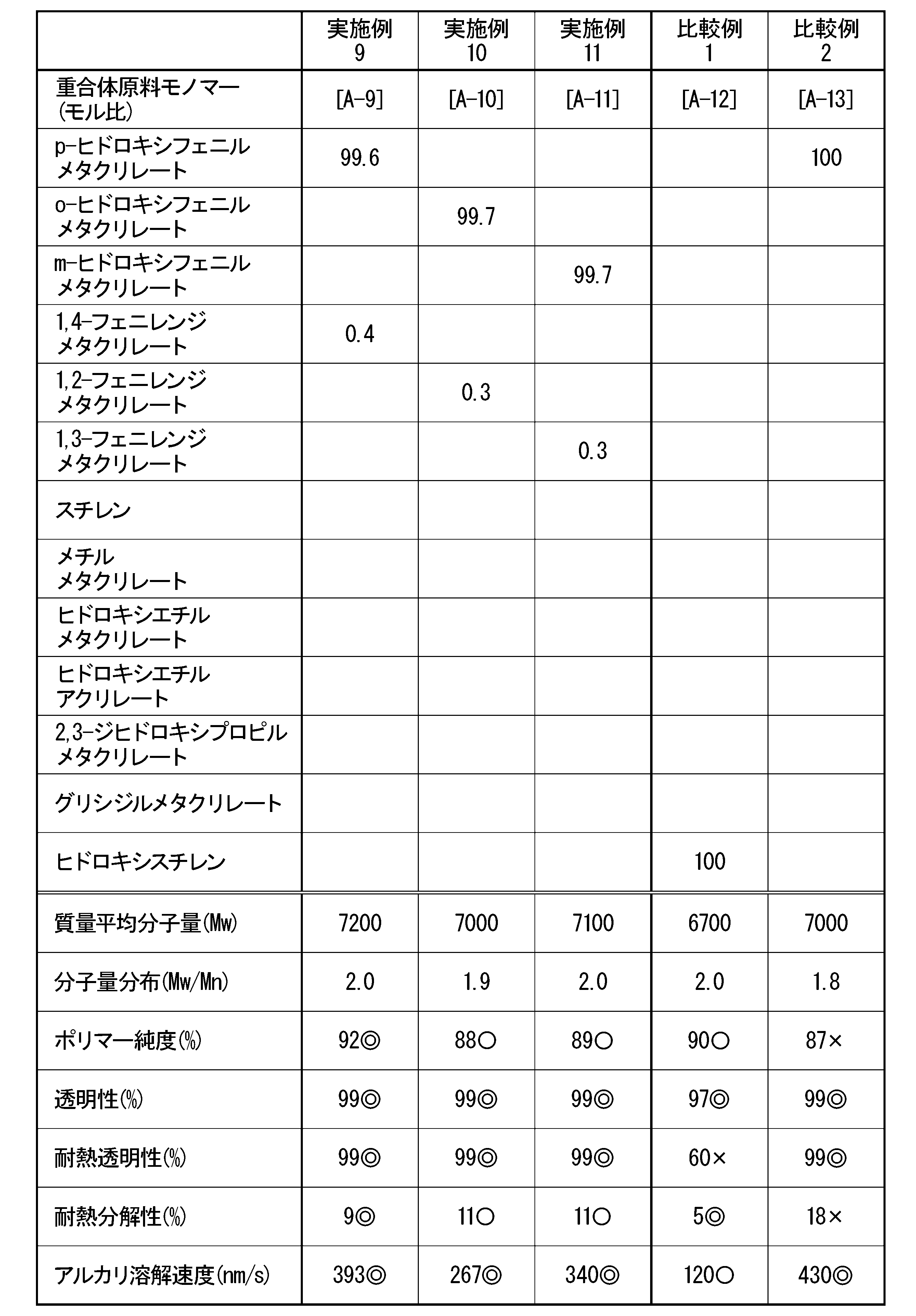
- Tables 1 and 2 show the molar ratio, mass average molecular weight (Mw), molecular weight distribution (Mw / Mn), and polymer purity of the monomers used as raw materials for the polymers [A-1] to [A-13].
- the polymer purity of the polymers [A-1] to [A-13] was evaluated based on the criteria shown below. ⁇ : 92% or more ⁇ : 88-91% ⁇ : 87% or less
- Example 1 100 parts by mass of a polymer solution (35% by mass concentration) containing the polymer [A-1] obtained by the above synthesis method and 1- [1- (4-hydroxyphenyl) isopropyl]-which is a photosensitive component.
- a mixture of 2.10 parts by mass of Nicarac MW-30) manufactured by Waka Chemical Co., Ltd. was mixed with 80 parts by mass of methyl-3-methoxypropionate as a solvent and dissolved.
- the obtained solution was filtered using a 0.2 ⁇ m membrane filter to prepare the photosensitive resin composition of Example 1.
- Example 2 to 11 A polymer containing the polymers [A-2] to [A-11] obtained by the above synthesis method instead of 100 parts by mass of a polymer solution (35% by mass concentration) containing the polymer [A-1].
- the photosensitive resin compositions of Examples 2 to 11 were prepared in the same manner as in Example 1 except that the solution (35% by mass concentration) was used.
- Comparative Example 1 Instead of 100 parts by mass of the polymer solution (35% by mass) containing the polymer [A-1], 35% by mass of the polymer [A-12] using methyl-3-methoxypropionate as a solvent is contained.
- the photosensitive resin composition of Comparative Example 1 was prepared in the same manner as in Example 1 except that the polymer solution was used.
- Comparative Example 2 instead of 100 parts by mass of the polymer solution (35% by mass) containing the polymer [A-1], the polymer solution (35% by mass) containing the polymer [A-13] obtained by the above synthesis method ) was used, and the photosensitive resin composition of Comparative Example 2 was prepared in the same manner as in Example 1.
- the photosensitive resin composition was applied onto a glass substrate so that the thickness after curing was 2.6 ⁇ m.
- the glass substrate coated with the photosensitive resin composition was dried (prebaked) on a hot plate at a temperature of 110 ° C. for 90 seconds to form a coating film.
- the dried coating film was irradiated with g-rays (436 nm) as active rays or radiation with an exposure energy of 200 mJ / cm 2 using an ultra-high pressure mercury lamp as a light source, and the entire surface was exposed.
- the glass substrate having the coating film after exposure was placed in an oven, heated at 200 ° C. for 30 minutes, and heat-cured (post-baked) to obtain a resin film.
- a spectrophotometer (UV-1650PC (manufactured by Shimadzu Corporation) was used to obtain a minimum transmittance of a wavelength of 400 to 800 nm, and the glass substrate was used as a blank. It was measured and evaluated according to the criteria shown below. ⁇ (Good): 95% or more ⁇ (Yes): 90-94% ⁇ (impossible): 89% or less
- ⁇ Heat-resistant transparency> The glass substrate having the resin film used for the above evaluation of ⁇ transparency> was heat-treated again in air at 230 ° C. for 2 hours and further at 250 ° C. for 1 hour. Then, using a spectrophotometer (UV-1650PC (manufactured by Shimadzu Corporation)), the minimum transmittance at a wavelength of 400 to 800 nm was measured using a glass substrate as a blank, and evaluated according to the following criteria. ⁇ (Good): 93% or more ⁇ (Yes): 90-92% ⁇ (impossible): 89% or less
- ⁇ Heat decomposition property> The film thickness of the glass substrate having the resin film used for the evaluation of the above ⁇ heat-resistant transparency> was measured. Then, the glass substrate having the resin film used for the evaluation of the above ⁇ heat-resistant transparency> was reheated by heating at 200 ° C. for 30 minutes. Then, the film thickness of the glass substrate having the resin film after reheating was measured, and the film thickness reduction rate of the resin film due to reheating was calculated using this, and evaluated according to the following criteria. ⁇ (Good): 10% or less ⁇ (Yes): 11 to 15% ⁇ (impossible): 16% or more
- the photosensitive resin composition was applied onto the silicon wafer substrate so that the thickness after curing was 2.6 ⁇ m.
- the silicon wafer substrate coated with the photosensitive resin composition was dried (prebaked) on a hot plate at a temperature of 110 ° C. for 90 seconds to form a coating film.
- the dried coating film was irradiated with active light rays or g-rays (435 nm) as a light source with an exposure energy of 200 mJ / cm 2 using an ultra-high pressure mercury lamp as a light source, and the entire surface was exposed through a positive pattern mask.
- the substrate having the coating film after exposure is immersed in a 2.38% tetramethylammonium hydroxide aqueous solution which is a developing solution to develop the coating film, and the coating film per unit time is developed from the development time of the 2.6 ⁇ m coating film.
- the dissolution rate (nm / s) of the above was calculated and evaluated according to the criteria shown below. ⁇ (Good): 151-500 nm / s ⁇ (possible): 101-150 nm / s ⁇ (impossible): 100 nm / s or less
- the photosensitive resin compositions of Examples 1 to 11 are all evaluated as ⁇ (good) or ⁇ (possible) in terms of transparency, heat-resistant transparency, heat-resistant decomposition, and alkali dissolution rate. )Met.
- 7, 8, and Example 9 containing [A-9] which has a large number of constituent units derived from phenylenedi (meth) acrylate, was evaluated for transparency, heat-resistant transparency, heat-resistant decomposition, and alkali dissolution rate. It was good).
- the photosensitive resin composition of Comparative Example 1 containing the polymer [A-12] containing no structural unit derived from hydroxyphenyl (meth) acrylate and a structural unit derived from phenylenedi (meth) acrylate is heat-resistant and transparent.
- the evaluation of sex was ⁇ (impossible), and the heat resistance was insufficient.
- the photosensitive resin composition of Comparative Example 2 containing the polymer [A-13] containing no structural unit derived from phenylenedi (meth) acrylate had a heat resistance evaluation of ⁇ (impossible), and was heat resistant. Was inadequate.
- a resin composition capable of forming a resin film having excellent developability, transparency and heat resistance.
- the resin film obtained by the present invention can be used for various purposes such as a flattening film, an interlayer insulating film, a protective film, and a microlens used in an organic EL display device and a liquid crystal display device.
Landscapes
- Chemical & Material Sciences (AREA)
- Physics & Mathematics (AREA)
- Health & Medical Sciences (AREA)
- Chemical Kinetics & Catalysis (AREA)
- Medicinal Chemistry (AREA)
- Polymers & Plastics (AREA)
- Organic Chemistry (AREA)
- Spectroscopy & Molecular Physics (AREA)
- General Physics & Mathematics (AREA)
- Materials For Photolithography (AREA)
- Compositions Of Macromolecular Compounds (AREA)
- Addition Polymer Or Copolymer, Post-Treatments, Or Chemical Modifications (AREA)
Abstract
Description
本願は、2019年5月30日に、日本に出願された特願2019-101097号に基づき優先権を主張し、その内容をここに援用する。
例えば、液晶表示素子では、通常、感光性樹脂組成物を用いて形成した層間絶縁膜の上に、酸化インジウムスズ(ITO)などの透明導電膜が形成され、その上に液晶配向膜が形成されている。したがって、液晶表示素子の有する層間絶縁膜は、その上に透明電極膜を形成する工程において、高温条件に曝される。よって、液晶表示素子の層間絶縁膜として用いられる樹脂膜の材料には、透明性および現像性が良好で、しかも耐熱性に優れる樹脂膜を形成できる感光性樹脂組成物が用いられている。
本発明は、上記事情を鑑みてなされたものであり、透明性、現像性、耐熱性の優れた樹脂膜を形成できる樹脂組成物を提供することを目的とする。
また、本発明は、本発明の樹脂組成物の硬化物からなる、透明性、現像性、耐熱性の優れた樹脂膜を提供することを目的とする。
その結果、ヒドロキシフェニル(メタ)アクリレート由来の構成単位およびフェニレンジ(メタ)アクリレート由来の構成単位を少なくとも有する重合体(A)を含有する樹脂組成物を硬化させることにより、透明性、現像性、耐熱性の優れた樹脂膜が得られることを見出し、本発明を想到した。
すなわち、本発明は以下の事項に関する。
[3]前記重合体(A)が、ヒドロキシアルキル基およびエチレン性不飽和基を有するモノマー由来の構成単位をさらに有する、[1]または[2]に記載の樹脂組成物。
[5]前記重合体(A)における、前記ヒドロキシフェニル(メタ)アクリレート由来の構成単位および前記フェニレンジ(メタ)アクリレート由来の構成単位の合計の含有量が、50~90モル%であり、
前記ヒドロキシアルキル基およびエチレン性不飽和基を有するモノマー由来の構成単位の含有量が1~20モル%である、[3]に記載の樹脂組成物。
[7]前記感光性成分(B)が、キノンジアジド基含有化合物である、[6]に記載の樹脂組成物。
[9]熱硬化性樹脂(C)を含有する[1]~[8]のいずれに記載の樹脂組成物。
[樹脂組成物]
本実施形態の樹脂組成物は、重合体(A)を含有する。本実施形態の樹脂組成物は、重合体(A)とともに、感光性成分(B)および/または熱硬化性樹脂(C)を含有していてもよい。
本実施形態の樹脂組成物の含有する重合体(A)は、ヒドロキシフェニル(メタ)アクリレート由来の構成単位およびフェニレンジ(メタ)アクリレート由来の構成単位を、少なくとも有する。重合体(A)は、必要に応じて、ヒドロキシアルキル基およびエチレン性不飽和基を有するモノマー単位やその他のモノマー由来の構成単位を含んでいてもよい。
本発明において、「(メタ)アクリレート」とは、メタクリレートおよびアクリレートから選択される少なくとも1種を意味する。
ヒドロキシフェニル(メタ)アクリレート由来の構成単位としては、具体的には、o-ヒドロキシフェニル(メタ)アクリレート由来の構成単位、m-ヒドロキシフェニル(メタ)アクリレート由来の構成単位、およびp-ヒドロキシフェニル(メタ)アクリレート由来の構成単位が挙げられる。重合体(A)は、置換基の結合位置が異なるこれらのヒドロキシフェニル(メタ)アクリレート由来の構成単位を、1種のみ有していてもよいし、2種以上有していてもよい。ヒドロキシフェニル(メタ)アクリレート由来の構成単位の中でも特に、本実施形態の樹脂組成物を感光性樹脂組成物として用いる場合の現像性と、重合体(A)を合成する際の反応性の観点からp-ヒドロキシフェニル(メタ)アクリレート由来の構成単位が好ましい。
本実施形態の樹脂組成物は、必要に応じて感光性成分(B)を含有していてもよい。本実施形態の樹脂組成物は、感光性成分(B)を含有することにより、感光性樹脂組成物として用いることができる。
具体的には、2,3,4-トリヒドロキシベンゾフェノンの1,2-ナフトキノンジアジドスルホン酸エステル、2,2',4,4'-テトラヒドロキシベンゾフェノンの1,2-ナフトキノンジアジドスルホン酸エステル、2,3,4,4'-テトラヒドロキシ-3'-メトキシベンゾフェノンの1,2-ナフトキノンジアジドスルホン酸エステル、2,4,6,3',4',5'-ヘキサヒドロキシベンゾフェノンの1,2-ナフトキノンジアジドスルホン酸エステル、2-メチル-2-(2,4-ジヒドロキシフェニル)-4-(4-ヒドロキシフェニル)-7-ヒドロキシクロマンの1,2-ナフトキノンジアジドスルホン酸エステル、2-[ビス{(5-イソプロピル-4-ヒドロキシ-2-メチル)フェニル}メチル]フェノールの1,2-ナフトキノンジアジドスルホン酸エステル、1-[1-(3-{1-(4-ヒドロキシフェニル)-1-メチルエチル}-4,6-ジヒドロキシフェニル)-1-メチルエチル]-3-(1-(3-{1-(4-ヒドロキシフェニル)-1-メチルエチル}-4,6-ジヒドロキシフェニル)-1-メチルエチル)ベンゼンの1,2-ナフトキノンジアジドスルホン酸エステル、4,6-ビス{1-(4-ヒドロキシフェニル)-1-メチルエチル}-1,3-ジヒドロキシベンゼンビス(2,4-ジヒドロキシフェニル)メタンの1,2-ナフトキノンジアジドスルホン酸エステル、ビス(p-ヒドロキシフェニル)メタンの1,2-ナフトキノンジアジドスルホン酸エステル、1,1,1-トリ(p-ヒドロキシフェニル)エタンの1,2-ナフトキノンジアジドスルホン酸エステル、1,1,3-トリス(2,5-ジメチル-4-ヒドロキシフェニル)-3-フェニルプロパンの1,2-ナフトキノンジアジドスルホン酸エステル、4,4'-〔1-〔4-〔1-〔4-ヒドロキシフェニル〕-1-メチルエチル〕フェニル〕エチリデン〕ビスフェノールの1,2-ナフトキノンジアジドスルホン酸エステル、3,3,3',3'-テトラメチル-1,1'-スピロビインデン-5,6,7,5',6',7'-ヘキサノールの1,2-ナフトキノンジアジドスルホン酸エステル、2,2,4-トリメチル-7,2',4'-トリヒドロキシフラバンの1,2-ナフトキノンジアジドスルホン酸エステル等が挙げられ、これらを単独でまたは2種以上を組み合わせて用いることができる。
本実施形態の樹脂組成物は、必要に応じて熱硬化性樹脂(C)を含有していてもよい。熱硬化性樹脂(C)は、樹脂組成物を架橋させる架橋成分として用いる。
本発明の樹脂組成物は、重合体(A)、任意成分である感光性成分(B)、任意成分である熱硬化性樹脂(C)の他に、必要に応じて、溶媒、紫外線吸収剤、増感剤、増感助剤、可塑剤、増粘剤、分散剤、消泡剤、界面活性剤、密着助材、感熱性酸生成化合物、着色剤などのその他の成分を含有してもよい。
上記の溶媒の中でも、ジエチレングリコールエチルメチルエーテル、ジエチレングリコールジメチルエーテル、プロピレングリコールモノメチルエーテル、プルピレングリコールモノメチルエーテルアセテート、メチル-3-メトキシプロピオネート、メトキシプロピオン酸メチル、エトキシプロピオン酸エチルは、樹脂組成物中に含まれる各成分の溶解性、各成分との非反応性、樹脂組成物からなる塗膜の形成しやすさ等の点で好ましく使用できる。さらにこれらの溶媒とともに、樹脂組成物を塗布して形成した塗膜における膜厚の面内均一性を高めるため、N-メチルピロリドン、γ-ブチロラクトン、N,N-ジメチルアセトアミドなどの高沸点溶媒を併用してもよい。
本実施形態の樹脂膜は、本実施形態の樹脂組成物の硬化物からなる。
本実施形態の樹脂膜は、本実施形態の樹脂組成物に対し、光および熱の少なくとも一方を付与して、樹脂組成物を硬化させることにより形成される。
工程(2)樹脂組成物を塗布した基板をベーキングする(プリベーク)ことにより塗膜を形成する。
工程(3)樹脂組成物からなる塗膜の一部に、活性光線または放射線を照射して露光する。
工程(4)露光後の塗膜を有する基板を後加熱する。
工程(5)露光後の塗膜を、現像液を用いて現像する。
工程(6)現像後の塗膜を全面露光する。
工程(7)現像後の塗膜を有する基板を加熱して、塗膜を熱硬化(ポストベーク)させる。
樹脂組成物の塗布方法としては、公知の方法を用いることができる。例えば、樹脂組成物の塗布方法として、スプレー法、ロールコート法、回転塗布法、バー塗布法等が挙げられる。
樹脂組成物を塗布する厚みは、例えば、硬化後の厚み(樹脂膜の厚み)が0.1~30μmとなるようにすることができる。
活性光線または放射線としては、例えば、g線(波長436nm)、i線(波長365nm)、KrFエキシマレーザー、ArFエキシマレーザー、X線、電子線等が挙げられる。
活性光線または放射線の光源としては、低圧水銀灯、高圧水銀灯、超高圧水銀灯、ケミカルランプ、エキシマレーザー発生装置等が挙げられる。
露光エネルギーは、一般的には10mJ/cm2~1000mJ/cm2であり、20mJ/cm2~500mJ/cm2エネルギーであることが好ましい。
全面露光を行う場合における露光エネルギーは、100~1000mJ/cm2であることが好ましい。
したがって、本実施形態の樹脂膜は、有機エレクトロルミネッセンス(EL)表示装置、液晶表示装置、磁気ヘッド素子、集積回路素子、固体撮像素子などの電子部品における平坦化膜、層間絶縁膜、保護膜、マイクロレンズ等の様々な用途に用いることができる。特に、本実施形態の樹脂膜は、有機EL表示装置および液晶表示装置の有する平坦化膜および層間絶縁膜に好適である。
また、本実施形態の樹脂組成物が着色剤を含有する場合、その硬化物からなる本実施形態の樹脂膜は、絶縁性、耐熱性に優れるとともに、色再現性が良好である。したがって、本実施形態の樹脂膜は、有機エレクトロルミネッセンス(EL)表示装置、液晶表示装置、磁気ヘッド素子、集積回路素子、固体撮像素子などの電子部品におけるブラックPDL(Pixel Defining Layer)、ブラックマトリックス、カラーフィルター、ブラックカラムスペーサ等の材料に用いることができる。
還流冷却器および攪拌機を備えたフラスコに、p-ヒドロキシフェニルメタクリレートを177質量部、1,4-フェニレンジメタクリレートを1質量部、溶媒であるメチル-3-メトキシプロピオネートを366質量部、重合開始剤である2,2'-アゾビスイソブチロニトリルを19質量部仕込んだ。その後、フラスコ内を窒素置換し、攪拌しながら液温を85℃まで上昇させて7時間反応させ、重合体[A-1]を含む重合体溶液を得た。
また、ゲル・パーミッション・クロマトグラフィー(GPC)で、残存モノマーを除くポリマー成分の面積百分率から、重合体[A-1]のポリマー純度を算出した。その結果、ポリマー純度は90%であった。
ゲル・パーミッション・クロマトグラフィー(GPC)を用いて、下記の条件にて測定し、ポリスチレン換算で算出した。
カラム:東ソー株式会社製 TSK gel Super HM-N 3本
カラム温度:40℃
試料:重合体(A)の0.2%テトラヒドロフラン溶液
展開溶媒:テトラヒドロフラン
検出器:紫外検出器(東ソー株式会社製UV-8320)
流速:0.6mL/min
還流冷却器および攪拌機を備えたフラスコに、p-ヒドロキシフェニルメタクリレートを124質量部、1,4-フェニレンジメタクリレートを1質量部、スチレンを31質量部、溶媒であるメチル-3-メトキシプロピオネートを313質量部、重合開始剤である2,2'-アゾビスイソブチロニトリルを13質量部仕込んだ。その後、重合体[A-1]と同様にして反応させて重合体[A-2]を含む重合体溶液を得た。
また、重合体[A-2]のポリマー純度を、重合体[A-1]と同様の方法により算出した。その結果、ポリマー純度は91%であった。
還流冷却器および攪拌機を備えたフラスコに、p-ヒドロキシフェニルメタクリレートを124質量部、1,4-フェニレンジメタクリレートを1質量部、メチルメタクリレートを30質量部、溶媒であるメチル-3-メトキシプロピオネートを313質量部、重合開始剤である2,2'-アゾビスイソブチロニトリルを14質量部仕込んだ。その後、重合体[A-1]と同様にして反応させて重合体[A-3]を含む重合体溶液を得た。
また、重合体[A-3]のポリマー純度を、重合体[A-1]と同様の方法により算出した。その結果、ポリマー純度は90%であった。
還流冷却器および攪拌機を備えたフラスコに、p-ヒドロキシフェニルメタクリレートを142質量部、1,4-フェニレンジメタクリレートを1質量部、スチレンを10質量部、2-ヒドロキシエチルメタクリレートを13質量部、溶媒であるメチル-3-メトキシプロピオネートを332質量部、重合開始剤である2,2'-アゾビスイソブチロニトリルを13質量部仕込んだ。その後、重合体[A-1]と同様にして反応させて重合体[A-4]を含む重合体溶液を得た。
また、重合体[A-4]のポリマー純度を、重合体[A-1]と同様の方法により算出した。その結果、ポリマー純度は92%であった。
還流冷却器および攪拌機を備えたフラスコに、p-ヒドロキシフェニルメタクリレートを142質量部、1,4-フェニレンジメタクリレートを1質量部、スチレンを10質量部、2-ヒドロキシエチルアクリレートを12質量部、溶媒であるメチル-3-メトキシプロピオネートを332質量部、重合開始剤である2,2'-アゾビスイソブチロニトリルを13質量部仕込んだ。その後、重合体[A-1]と同様にして反応させて重合体[A-5]を含む重合体溶液を得た。
また、重合体[A-5]のポリマー純度を、重合体[A-1]と同様の方法により算出した。その結果、ポリマー純度は95%であった。
還流冷却器および攪拌機を備えたフラスコに、p-ヒドロキシフェニルメタクリレートを142質量部、1,4-フェニレンジメタクリレートを1質量部、グリシジルメタクリレートを28質量部、溶媒であるメチル-3-メトキシプロピオネートを341質量部、重合開始剤である2,2'-アゾビスイソブチロニトリルを13質量部仕込んだ。その後、重合体[A-1]と同様にして反応させて重合体[A-6]を含む重合体溶液を得た。
また、重合体[A-6]のポリマー純度を、重合体[A-1]と同様の方法により算出した。その結果、ポリマー純度は91%であった。
還流冷却器および攪拌機を備えたフラスコに、p-ヒドロキシフェニルメタクリレートを142質量部、1,4-フェニレンジメタクリレートを1質量部、2-ヒドロキシエチルアクリレートを7質量部、グリシジルメタクリレートを34質量部、溶媒であるメチル-3-メトキシプロピオネートを331質量部、重合開始剤である2,2'-アゾビスイソブチロニトリルを12質量部仕込んだ。その後、重合体[A-1]と同様にして反応させて重合体[A-7]を含む重合体溶液を得た。
また、重合体[A-7]のポリマー純度を、重合体[A-1]と同様の方法により算出した。その結果、ポリマー純度は92%であった。
還流冷却器および攪拌機を備えたフラスコに、p-ヒドロキシフェニルメタクリレートを142質量部、1,4-フェニレンジメタクリレートを1質量部、スチレンを6質量部、2,3-ジヒドロキシプロピルメタクリレートを16質量部、溶媒であるメチル-3-メトキシプロピオネートを329質量部、重合開始剤である2,2'-アゾビスイソブチロニトリルを12質量部仕込んだ。その後、重合体[A-1]と同様にして反応させて重合体[A-8]を含む重合体溶液を得た。
また、重合体[A-8]のポリマー純度を、重合体[A-1]と同様の方法により算出した。その結果、ポリマー純度は92%であった。
1,4-フェニレンジメタクリレートの使用量を変更したこと以外は、実施例1と同様にして重合体[A-9]を得た。
得られた重合体[A-9]の質量平均分子量(Mw)および分子量分布(Mw/Mn)を、重合体[A-1]と同様の方法により測定した。その結果、重合体[A-9]のポリスチレン換算質量平均分子量(Mw)は7,200、分子量分布(Mw/Mn)は2.0であった。
また、重合体[A-9]のポリマー純度を、重合体[A-1]と同様の方法により算出した。その結果、ポリマー純度は92%であった。
p-ヒドロキシフェニルメタクリレートの代わりにo-ヒドロキシフェニルメタクリレートを使用し、1,4-フェニレンジメタクリレートの代わりに1,2-フェニレンジメタクリレートを使用したこと以外は、実施例1と同様にして重合体[A-10]を得た。
また、重合体[A-10]のポリマー純度を、重合体[A-1]と同様の方法により算出した。その結果、ポリマー純度は88%であった。
p-ヒドロキシフェニルメタクリレートの代わりにm-ヒドロキシフェニルメタクリレートを使用し、1,4-フェニレンジメタクリレートの代わりに1,3-フェニレンジメタクリレートを使用したこと以外は、実施例1と同様にして重合体[A-11]を得た。
また、重合体[A-11]のポリマー純度を、重合体[A-1]と同様の方法により算出した。その結果、ポリマー純度は89%であった。
重合体[A-12]として、ヒドロキシスチレン重合体(商品名:マルカリンカーM S-2(丸善石油化学株式会社製))を用いた。
重合体[A-12]の質量平均分子量(Mw)および分子量分布(Mw/Mn)を、重合体[A-1]と同様の方法により測定した。その結果、重合体[A-12]のポリスチレン換算質量平均分子量(Mw)は6,700、分子量分布(Mw/Mn)は2.0であった。
また、重合体[A-12]のポリマー純度を、重合体[A-1]と同様の方法により算出した。その結果、ポリマー純度は90%であった。
1,4-フェニレンジメタクリレートを使用しなかったこと以外は、実施例1と同様にして重合体[A-13]を得た。
得られた重合体[A-13]の質量平均分子量(Mw)および分子量分布(Mw/Mn)を、重合体[A-1]と同様の方法により測定した。その結果、重合体[A-13]のポリスチレン換算質量平均分子量(Mw)は7,000、分子量分布(Mw/Mn)は1.8であった。
また、重合体[A-13]のポリマー純度を、重合体[A-1]と同様の方法により算出した。その結果、ポリマー純度は87%であった。
なお、重合体[A-1]~[A-13]のポリマー純度は、以下に示す基準に基づいて評価した。
◎:92%以上
○:88~91%
×:87%以下

(実施例1)
上記の合成方法で得られた重合体[A-1]を含む重合体溶液(35質量%濃度)100質量部と、感光性成分である1-[1-(4-ヒドロキシフェニル)イソプロピル]-4-[1,1-ビス(4-ヒドロキシフェニル)エチル]ベンゼン-1,2-ナフトキノンジアジド-5-スルホン酸エステル6.25質量部と、熱硬化性樹脂であるアルコキシメチル化メラミン樹脂(三和ケミカル社製、商品名:ニカラックMW-30)2.10質量部とを、溶媒であるメチル-3-メトキシプロピオネート80質量部に混合して溶解した。得られた溶液を0.2μmのメンブランフィルターを用いて濾過し、実施例1の感光性樹脂組成物を調製した。
重合体[A-1]を含む重合体溶液(35質量%濃度)100質量部に代えて、上記の合成方法で得られた重合体[A-2]~[A-11]を含む重合体溶液(35質量%濃度)を用いたこと以外は、実施例1と同様にして、実施例2~11の感光性樹脂組成物を調製した。
重合体[A-1]を含む重合体溶液(35質量%濃度)100質量部に代えて、溶媒としてメチル-3-メトキシプロピオネートを使用した重合体[A-12]を35質量%含む重合体溶液を用いたこと以外は、実施例1と同様にして、比較例1の感光性樹脂組成物を調製した。
重合体[A-1]を含む重合体溶液(35質量%濃度)100質量部に代えて、上記の合成方法で得られた重合体[A-13]を含む重合体溶液(35質量%濃度)を用いたこと以外は、実施例1と同様にして、比較例2の感光性樹脂組成物を調製した。
実施例1~11および比較例1、2の感光性樹脂組成物について、以下に示す方法により、透明性、耐熱透明性、耐熱分解性、アルカリ溶解速度を評価した。その結果を表1および表2に示す。
ガラス基板上に感光性樹脂組成物を、硬化後の厚みが2.6μmとなるように塗布した。次いで、感光性樹脂組成物が塗布されたガラス基板をホットプレート上で、温度110℃で90秒間乾燥(プリベーク)させ、塗膜を形成した。その後、乾燥させた塗膜に、光源として超高圧水銀灯を用い、活性光線または放射線としてg線(436nm)を露光エネルギー200mJ/cm2で照射し、全面露光した。続いて、露光後の塗膜を有するガラス基板をオーブン中に入れ、200℃で30分間加熱して、熱硬化(ポストベーク)させて樹脂膜を得た。
◎(良):95%以上
○(可):90~94%
×(不可):89%以下
上記〈透明性〉の評価に用いた樹脂膜を有するガラス基板を、再び空気中で、230℃で2時間、更に250℃で1時間の熱処理を行った。その後、分光光度計(UV-1650PC(株式会社島津製作所製))を使用して、波長400~800nmの最低透過率を、ガラス基板をブランクとして測定し、以下に示す基準により評価した。
◎(良):93%以上
○(可):90~92%
×(不可):89%以下
上記〈耐熱透明性〉の評価に用いた樹脂膜を有するガラス基板の膜厚を測定した。その後、上記〈耐熱透明性〉の評価に用いた樹脂膜を有するガラス基板を、200℃で30分間加熱する再加熱を行った。そして、再加熱後の樹脂膜を有するガラス基板の膜厚を測定し、これを用いて再加熱による樹脂膜の膜厚減少率を算出し、以下に示す基準により評価した。
◎(良):10%以下
○(可):11~15%
×(不可):16%以上
シリコンウエハ基板上に感光性樹脂組成物を、硬化後の厚みが2.6μmとなるように塗布した。次いで、感光性樹脂組成物が塗布されたシリコンウエハ基板を、ホットプレート上で、温度110℃で90秒間乾燥(プリベーク)させ、塗膜を形成した。その後、乾燥させた塗膜に、光源として超高圧水銀灯を用いて活性光線または放射線であるg線(435nm)を露光エネルギー200mJ/cm2で照射し、ポジパターンマスクを介して全面露光した。
◎(良):151~500nm/s
○(可):101~150nm/s
×(不可):100nm/s以下
特に、ヒドロキシアルキル基およびエチレン性不飽和基を有するモノマー由来の構成単位をさらに有する重合体[A-4][A-5][A-7][A-8]を含む実施例4,5、7,8、フェニレンジ(メタ)アクリレート由来の構成単位の多い[A-9]を含む実施例9は、透明性、耐熱透明性、耐熱分解性、アルカリ溶解速度の評価が、全て◎(良)であった。
また、フェニレンジ(メタ)アクリレート由来の構成単位を含まない重合体[A-13]を含む比較例2の感光性樹脂組成物は、耐熱分解性の評価が×(不可)であり、耐熱性が不十分であった。
Claims (10)
- ヒドロキシフェニル(メタ)アクリレート由来の構成単位、およびフェニレンジ(メタ)アクリレート由来の構成単位を、少なくとも有する重合体(A)を含有することを特徴とする樹脂組成物。
- 前記ヒドロキシフェニル(メタ)アクリレート由来の構成単位と、前記フェニレンジ(メタ)アクリレート由来の構成単位とのモル比が、99.99:0.01~99.00:1.00である、請求項1に記載の樹脂組成物。
- 前記重合体(A)が、ヒドロキシアルキル基およびエチレン性不飽和基を有するモノマー由来の構成単位をさらに有する、請求項1または請求項2に記載の樹脂組成物。
- 前記重合体(A)における、前記ヒドロキシフェニル(メタ)アクリレート由来の構成単位および前記フェニレンジ(メタ)アクリレート由来の構成単位の合計の含有量が、40~100モル%である、請求項1または請求項2に記載の樹脂組成物。
- 前記重合体(A)における、前記ヒドロキシフェニル(メタ)アクリレート由来の構成単位および前記フェニレンジ(メタ)アクリレート由来の構成単位の合計の含有量が、50~90モル%であり、
前記ヒドロキシアルキル基およびエチレン性不飽和基を有するモノマー由来の構成単位の含有量が1~20モル%である、請求項3に記載の樹脂組成物。 - 感光性成分(B)を含有する請求項1~請求項5のいずれか一項に記載の樹脂組成物。
- 前記感光性成分(B)が、キノンジアジド基含有化合物である、請求項6に記載の樹脂組成物。
- 前記重合体(A)100質量部に対して、前記感光性成分(B)を5~60質量部含有する、請求項6または請求項7に記載の樹脂組成物。
- 熱硬化性樹脂(C)を含有する請求項1~請求項8のいずれか一項に記載の樹脂組成物。
- 請求項1~請求項9のいずれか一項に記載の樹脂組成物の硬化物からなる樹脂膜。
Priority Applications (4)
| Application Number | Priority Date | Filing Date | Title |
|---|---|---|---|
| CN202311653995.7A CN117467065A (zh) | 2019-05-30 | 2020-03-16 | 树脂组合物及树脂膜 |
| CN202080037012.5A CN113853394A (zh) | 2019-05-30 | 2020-03-16 | 树脂组合物及树脂膜 |
| KR1020217036896A KR102645527B1 (ko) | 2019-05-30 | 2020-03-16 | 수지 조성물 및 수지막 |
| JP2021522649A JP7367761B2 (ja) | 2019-05-30 | 2020-03-16 | 樹脂組成物および樹脂膜 |
Applications Claiming Priority (2)
| Application Number | Priority Date | Filing Date | Title |
|---|---|---|---|
| JP2019101097 | 2019-05-30 | ||
| JP2019-101097 | 2019-05-30 |
Publications (1)
| Publication Number | Publication Date |
|---|---|
| WO2020240993A1 true WO2020240993A1 (ja) | 2020-12-03 |
Family
ID=73551997
Family Applications (1)
| Application Number | Title | Priority Date | Filing Date |
|---|---|---|---|
| PCT/JP2020/011356 Ceased WO2020240993A1 (ja) | 2019-05-30 | 2020-03-16 | 樹脂組成物および樹脂膜 |
Country Status (5)
| Country | Link |
|---|---|
| JP (1) | JP7367761B2 (ja) |
| KR (1) | KR102645527B1 (ja) |
| CN (2) | CN117467065A (ja) |
| TW (1) | TWI844646B (ja) |
| WO (1) | WO2020240993A1 (ja) |
Cited By (1)
| Publication number | Priority date | Publication date | Assignee | Title |
|---|---|---|---|---|
| WO2023013128A1 (ja) * | 2021-08-04 | 2023-02-09 | 日本化薬株式会社 | 硬化性高分子化合物を含む樹脂組成物 |
Citations (5)
| Publication number | Priority date | Publication date | Assignee | Title |
|---|---|---|---|---|
| JP2007033517A (ja) * | 2005-07-22 | 2007-02-08 | Showa Highpolymer Co Ltd | 感光性の樹脂組成物 |
| JP2007204448A (ja) * | 2006-02-03 | 2007-08-16 | Showa Highpolymer Co Ltd | ヒドロキシフェニル(メタ)アクリレート組成物及びその製造方法 |
| JP2012067059A (ja) * | 2010-09-27 | 2012-04-05 | Showa Denko Kk | 二価フェノール類モノ(メタ)アクリレートを製造する方法 |
| WO2013015055A1 (ja) * | 2011-07-25 | 2013-01-31 | 昭和電工株式会社 | 芳香族ジオールモノ(メタ)アクリレートの製造方法 |
| JP2015215453A (ja) * | 2014-05-09 | 2015-12-03 | 日立化成株式会社 | ネガ型感光性樹脂組成物、接着シート、接着剤パターン、接着剤層付半導体ウェハ及び半導体装置 |
Family Cites Families (3)
| Publication number | Priority date | Publication date | Assignee | Title |
|---|---|---|---|---|
| JP4204106B2 (ja) * | 1998-08-12 | 2009-01-07 | 三菱レイヨン株式会社 | 被覆材組成物 |
| JP6258866B2 (ja) * | 2012-12-14 | 2018-01-10 | 昭和電工株式会社 | 感光性樹脂組成物及び樹脂膜 |
| MX2016011732A (es) * | 2014-03-11 | 2017-02-13 | Mitsubishi Rayon Co | Composicion de resina curable por rayos de energia activa y lente de faro de automovil. |
-
2020
- 2020-03-16 WO PCT/JP2020/011356 patent/WO2020240993A1/ja not_active Ceased
- 2020-03-16 CN CN202311653995.7A patent/CN117467065A/zh active Pending
- 2020-03-16 KR KR1020217036896A patent/KR102645527B1/ko active Active
- 2020-03-16 JP JP2021522649A patent/JP7367761B2/ja active Active
- 2020-03-16 CN CN202080037012.5A patent/CN113853394A/zh active Pending
- 2020-03-24 TW TW109109758A patent/TWI844646B/zh active
Patent Citations (5)
| Publication number | Priority date | Publication date | Assignee | Title |
|---|---|---|---|---|
| JP2007033517A (ja) * | 2005-07-22 | 2007-02-08 | Showa Highpolymer Co Ltd | 感光性の樹脂組成物 |
| JP2007204448A (ja) * | 2006-02-03 | 2007-08-16 | Showa Highpolymer Co Ltd | ヒドロキシフェニル(メタ)アクリレート組成物及びその製造方法 |
| JP2012067059A (ja) * | 2010-09-27 | 2012-04-05 | Showa Denko Kk | 二価フェノール類モノ(メタ)アクリレートを製造する方法 |
| WO2013015055A1 (ja) * | 2011-07-25 | 2013-01-31 | 昭和電工株式会社 | 芳香族ジオールモノ(メタ)アクリレートの製造方法 |
| JP2015215453A (ja) * | 2014-05-09 | 2015-12-03 | 日立化成株式会社 | ネガ型感光性樹脂組成物、接着シート、接着剤パターン、接着剤層付半導体ウェハ及び半導体装置 |
Cited By (1)
| Publication number | Priority date | Publication date | Assignee | Title |
|---|---|---|---|---|
| WO2023013128A1 (ja) * | 2021-08-04 | 2023-02-09 | 日本化薬株式会社 | 硬化性高分子化合物を含む樹脂組成物 |
Also Published As
| Publication number | Publication date |
|---|---|
| TWI844646B (zh) | 2024-06-11 |
| CN113853394A (zh) | 2021-12-28 |
| CN117467065A (zh) | 2024-01-30 |
| KR20210154984A (ko) | 2021-12-21 |
| KR102645527B1 (ko) | 2024-03-11 |
| TW202104281A (zh) | 2021-02-01 |
| JPWO2020240993A1 (ja) | 2020-12-03 |
| JP7367761B2 (ja) | 2023-10-24 |
Similar Documents
| Publication | Publication Date | Title |
|---|---|---|
| JP4644857B2 (ja) | 感光性樹脂組成物 | |
| JP2001330953A (ja) | 感放射線性樹脂組成物 | |
| TWI470346B (zh) | Photosensitive resin composition | |
| TWI803587B (zh) | 感放射線性組合物、硬化膜及顯示元件 | |
| TW200907569A (en) | Radiation-sensed resin composition, layer insulation film, microlens and forming method thereof | |
| JP2002287351A (ja) | 感放射線性樹脂組成物、その層間絶縁膜およびマイクロレンズの形成への使用、ならびに層間絶縁膜およびマイクロレンズ | |
| TW201027252A (en) | Radiosensitive resin composition, interlayer insulation film, microlens and methods for manufacturing them | |
| JP2009053667A (ja) | 感放射線性樹脂組成物、ならびに層間絶縁膜およびマイクロレンズとそれらの製造方法 | |
| JP6258866B2 (ja) | 感光性樹脂組成物及び樹脂膜 | |
| CN101256360A (zh) | 放射线敏感性树脂组合物、层间绝缘膜和微透镜、以及它们的制备方法 | |
| JP7367761B2 (ja) | 樹脂組成物および樹脂膜 | |
| JP2000327877A (ja) | 感放射線性樹脂組成物、その層間絶縁膜およびマイクロレンズへの使用、並びに層間絶縁膜およびマイクロレンズ | |
| JP4713262B2 (ja) | 感光性の樹脂組成物 | |
| CN101154041B (zh) | 放射线敏感性树脂组合物、层间绝缘膜和微透镜的形成 | |
| TWI387850B (zh) | 感放射線性樹脂組合物、突起、間隔物、垂直配向型液晶顯示元件、以及突起及/或間隔物之形成方法 | |
| CN1760757B (zh) | 感放射线性树脂组合物 | |
| JP4885742B2 (ja) | 感光性樹脂組成物 | |
| JP3842750B2 (ja) | 感光性樹脂組成物 | |
| KR20060105631A (ko) | 감방사선성 수지 조성물, 이것으로부터 형성된 돌기 및스페이서, 및 이들을 구비하는 액정 표시 소자 | |
| TWI285791B (en) | Radiation-sensitive resin composition, interlayer insulating film and microlens | |
| CN110361932A (zh) | 感放射线性组合物和1,2-萘醌-2-二叠氮磺酸衍生物 |
Legal Events
| Date | Code | Title | Description |
|---|---|---|---|
| 121 | Ep: the epo has been informed by wipo that ep was designated in this application |
Ref document number: 20814074 Country of ref document: EP Kind code of ref document: A1 |
|
| ENP | Entry into the national phase |
Ref document number: 2021522649 Country of ref document: JP Kind code of ref document: A |
|
| ENP | Entry into the national phase |
Ref document number: 20217036896 Country of ref document: KR Kind code of ref document: A |
|
| NENP | Non-entry into the national phase |
Ref country code: DE |
|
| 122 | Ep: pct application non-entry in european phase |
Ref document number: 20814074 Country of ref document: EP Kind code of ref document: A1 |