WO2020235558A1 - 有機エレクトロルミネッセンス素子、化合物及び電子機器 - Google Patents
有機エレクトロルミネッセンス素子、化合物及び電子機器 Download PDFInfo
- Publication number
- WO2020235558A1 WO2020235558A1 PCT/JP2020/019779 JP2020019779W WO2020235558A1 WO 2020235558 A1 WO2020235558 A1 WO 2020235558A1 JP 2020019779 W JP2020019779 W JP 2020019779W WO 2020235558 A1 WO2020235558 A1 WO 2020235558A1
- Authority
- WO
- WIPO (PCT)
- Prior art keywords
- group
- carbon atoms
- unsubstituted
- substituent
- ring
- Prior art date
- Legal status (The legal status is an assumption and is not a legal conclusion. Google has not performed a legal analysis and makes no representation as to the accuracy of the status listed.)
- Ceased
Links
- LHYLPQUDDHSLAX-UHFFFAOYSA-N c(cc1)cc(c2ccccc22)c1[n]2-c(cc1)cc(cc2)c1cc2-[n]1c2c3[o]c4ccccc4c3ccc2c2ccccc12 Chemical compound c(cc1)cc(c2ccccc22)c1[n]2-c(cc1)cc(cc2)c1cc2-[n]1c2c3[o]c4ccccc4c3ccc2c2ccccc12 LHYLPQUDDHSLAX-UHFFFAOYSA-N 0.000 description 2
- OGENPBMBOLTWLZ-UHFFFAOYSA-N Brc(cc1)ccc1-c(cc1)ccc1-[n]1c(cccc2)c2c2ccccc12 Chemical compound Brc(cc1)ccc1-c(cc1)ccc1-[n]1c(cccc2)c2c2ccccc12 OGENPBMBOLTWLZ-UHFFFAOYSA-N 0.000 description 1
- LHRJXUFBLORUQX-UHFFFAOYSA-N C(C(C=C1)c(cc2)ccc2N2c(c3c(cc4)[s]c5c3cccc5)c4-c3cc(-c4ccccc4)ccc3C2)C=C1[n]1c2ccccc2c2c1cccc2 Chemical compound C(C(C=C1)c(cc2)ccc2N2c(c3c(cc4)[s]c5c3cccc5)c4-c3cc(-c4ccccc4)ccc3C2)C=C1[n]1c2ccccc2c2c1cccc2 LHRJXUFBLORUQX-UHFFFAOYSA-N 0.000 description 1
- AGCIQWRXIBTZHL-UHFFFAOYSA-N C(C(C=C1)c2ccccc2)c(c(c2c3)cc4c3c(cccc3)c3[s]4)c1[n]2-c(cc1)ccc1-c(cc1)ccc1-[n]1c2ccccc2c2c1cccc2 Chemical compound C(C(C=C1)c2ccccc2)c(c(c2c3)cc4c3c(cccc3)c3[s]4)c1[n]2-c(cc1)ccc1-c(cc1)ccc1-[n]1c2ccccc2c2c1cccc2 AGCIQWRXIBTZHL-UHFFFAOYSA-N 0.000 description 1
- FEFZOJWSEXFSCZ-UHFFFAOYSA-N C(C1(C2C11)Sc3c1ccc(-c1ccccc1)c3)=Cc1c2c2ccccc2[n]1-c(cc1)ccc1-c(cc1)ccc1-[n]1c(cccc2)c2c2c1cccc2 Chemical compound C(C1(C2C11)Sc3c1ccc(-c1ccccc1)c3)=Cc1c2c2ccccc2[n]1-c(cc1)ccc1-c(cc1)ccc1-[n]1c(cccc2)c2c2c1cccc2 FEFZOJWSEXFSCZ-UHFFFAOYSA-N 0.000 description 1
- UFPNSIWAOIORDC-UHFFFAOYSA-N C(C1)C=Cc2c1c(ccc1c3c4cc(-c5ccccc5)ccc4[n]1-c(cc1)ccc1-c(cc1)ccc1-[n]1c4ccccc4c4c1cccc4)c3[s]2 Chemical compound C(C1)C=Cc2c1c(ccc1c3c4cc(-c5ccccc5)ccc4[n]1-c(cc1)ccc1-c(cc1)ccc1-[n]1c4ccccc4c4c1cccc4)c3[s]2 UFPNSIWAOIORDC-UHFFFAOYSA-N 0.000 description 1
- TVRQGYYGKFKRFK-UHFFFAOYSA-N C(Cc1ccc(C2C=CC([n](c(cccc3)c3c3c4)c3ccc4-c3cccc4c3cccc4)=CC2)cc1)C1c(cccc2)c2-c2ccc(c3ccccc3[o]3)c3c2C1 Chemical compound C(Cc1ccc(C2C=CC([n](c(cccc3)c3c3c4)c3ccc4-c3cccc4c3cccc4)=CC2)cc1)C1c(cccc2)c2-c2ccc(c3ccccc3[o]3)c3c2C1 TVRQGYYGKFKRFK-UHFFFAOYSA-N 0.000 description 1
- MLSCATDGDIQBRD-AQIBEOMPSA-N C/C=C(\C=C/C#C)/c1ccc(c(ccc2c3[s]c4c2cccc4)c3[n]2-c(cc3)ccc3-c(cc3)ccc3-[n]3c4ccccc4c4c3cccc4)c2c1 Chemical compound C/C=C(\C=C/C#C)/c1ccc(c(ccc2c3[s]c4c2cccc4)c3[n]2-c(cc3)ccc3-c(cc3)ccc3-[n]3c4ccccc4c4c3cccc4)c2c1 MLSCATDGDIQBRD-AQIBEOMPSA-N 0.000 description 1
- RYDFEEWJQIWWLA-UHFFFAOYSA-N CC(C(C=C1)[n]2c3c4[s]c(cccc5)c5c4ccc3c3c2cccc3)C=C1c(cc1)ccc1-[n](c(cccc1)c1c1c2)c1ccc2-c1c2[s]c(cccc3)c3c2ccc1 Chemical compound CC(C(C=C1)[n]2c3c4[s]c(cccc5)c5c4ccc3c3c2cccc3)C=C1c(cc1)ccc1-[n](c(cccc1)c1c1c2)c1ccc2-c1c2[s]c(cccc3)c3c2ccc1 RYDFEEWJQIWWLA-UHFFFAOYSA-N 0.000 description 1
- QADXAHVMCZQQAR-UHFFFAOYSA-N CC(C)(C)C(CC1)=Cc(c2c3cccc2)c1[n]3-c(cc1)ccc1-c(cc1)ccc1N(C1C=C2)c3ccccc3C1c1c2c(cccc2)c2[o]1 Chemical compound CC(C)(C)C(CC1)=Cc(c2c3cccc2)c1[n]3-c(cc1)ccc1-c(cc1)ccc1N(C1C=C2)c3ccccc3C1c1c2c(cccc2)c2[o]1 QADXAHVMCZQQAR-UHFFFAOYSA-N 0.000 description 1
- RCBQOZKJDNVRAS-UHFFFAOYSA-N CC(C)(C)c(cc1)cc(c2cc(C(C)(C)C)ccc22)c1[n]2-c(cc1)ccc1-c(cc1)ccc1-[n](c1ccccc1c1c2)c1cc1c2[o]c2ccccc12 Chemical compound CC(C)(C)c(cc1)cc(c2cc(C(C)(C)C)ccc22)c1[n]2-c(cc1)ccc1-c(cc1)ccc1-[n](c1ccccc1c1c2)c1cc1c2[o]c2ccccc12 RCBQOZKJDNVRAS-UHFFFAOYSA-N 0.000 description 1
- ZPCUZLQLHWQZGX-UHFFFAOYSA-N CC(C)(C)c(cc1)cc(c2cc(C(C)(C)C)ccc22)c1[n]2-c(cc1)ccc1-c(cc1)ccc1-[n]1c2c3[o]c(cccc4)c4c3ccc2c2ccccc12 Chemical compound CC(C)(C)c(cc1)cc(c2cc(C(C)(C)C)ccc22)c1[n]2-c(cc1)ccc1-c(cc1)ccc1-[n]1c2c3[o]c(cccc4)c4c3ccc2c2ccccc12 ZPCUZLQLHWQZGX-UHFFFAOYSA-N 0.000 description 1
- KHLHZEUOQXUATO-XSXNXNMISA-N CC(C)(C)c(cc1)cc(c2cc(C(C)(C)C)ccc22)c1[n]2-c(cc1)ccc1-c(cc1)ccc1-[n]1c2ccccc2c2c1C13C(C=CC4C5C4)=C5OC1[C@H]3C=C2 Chemical compound CC(C)(C)c(cc1)cc(c2cc(C(C)(C)C)ccc22)c1[n]2-c(cc1)ccc1-c(cc1)ccc1-[n]1c2ccccc2c2c1C13C(C=CC4C5C4)=C5OC1[C@H]3C=C2 KHLHZEUOQXUATO-XSXNXNMISA-N 0.000 description 1
- KDNCVFWLBYAKBQ-UHFFFAOYSA-N CC(C)(C)c(cc1C23C=C(C(C)(C)C)C=CC2C32)ccc1N2c(cc1)ccc1C(CC1)=CC=C1N(C12C=CC=CC1C21)c2c1cc(c(cccc1)c1[o]1)c1c2 Chemical compound CC(C)(C)c(cc1C23C=C(C(C)(C)C)C=CC2C32)ccc1N2c(cc1)ccc1C(CC1)=CC=C1N(C12C=CC=CC1C21)c2c1cc(c(cccc1)c1[o]1)c1c2 KDNCVFWLBYAKBQ-UHFFFAOYSA-N 0.000 description 1
- IQTCZOUJABCBSH-UHFFFAOYSA-N CC(C)(C)c(cc1c2c3ccc(C(C)(C)C)c2)ccc1[n]3-c(cc1)ccc1-c(cc1)ccc1-[n](c1ccccc11)c(cc2)c1c1c2c(cccc2)c2[o]1 Chemical compound CC(C)(C)c(cc1c2c3ccc(C(C)(C)C)c2)ccc1[n]3-c(cc1)ccc1-c(cc1)ccc1-[n](c1ccccc11)c(cc2)c1c1c2c(cccc2)c2[o]1 IQTCZOUJABCBSH-UHFFFAOYSA-N 0.000 description 1
- 0 CC(C)(C)c(cc1c2c3cccc2)ccc1[n]3-c(cc1)ccc1-c(cc1)ccc1-[n]1c2c(*c3ccccc3-3)c-3ccc2c2ccccc12 Chemical compound CC(C)(C)c(cc1c2c3cccc2)ccc1[n]3-c(cc1)ccc1-c(cc1)ccc1-[n]1c2c(*c3ccccc3-3)c-3ccc2c2ccccc12 0.000 description 1
- LJYMLOBLXGBLDK-UHFFFAOYSA-N CC(C)(C)c(cc1c2c3cccc2)ccc1[n]3-c(cc1)ccc1-c(cc1)ccc1-[n]1c2c3[o]c(cccc4)c4c3ccc2c2ccccc12 Chemical compound CC(C)(C)c(cc1c2c3cccc2)ccc1[n]3-c(cc1)ccc1-c(cc1)ccc1-[n]1c2c3[o]c(cccc4)c4c3ccc2c2ccccc12 LJYMLOBLXGBLDK-UHFFFAOYSA-N 0.000 description 1
- JTRJCAMJVPTBOY-UHFFFAOYSA-N CC(C)(C)c(cc1c2c3cccc2)ccc1[n]3-c(cc1)ccc1-c(cc1)ccc1-[n]1c2ccccc2c2c1CC(c1ccccc1O1)C1=C2 Chemical compound CC(C)(C)c(cc1c2c3cccc2)ccc1[n]3-c(cc1)ccc1-c(cc1)ccc1-[n]1c2ccccc2c2c1CC(c1ccccc1O1)C1=C2 JTRJCAMJVPTBOY-UHFFFAOYSA-N 0.000 description 1
- UUQFTLOJPDJIRK-UHFFFAOYSA-N CC(C)(C)c(cc1c2cc(C(C)(C)C)ccc22)ccc1[n]2-c(cc1)ccc1-c(cc1)ccc1-[n]1c(cccc2)c2c-2c1CCc1c-2c2ccccc2[o]1 Chemical compound CC(C)(C)c(cc1c2cc(C(C)(C)C)ccc22)ccc1[n]2-c(cc1)ccc1-c(cc1)ccc1-[n]1c(cccc2)c2c-2c1CCc1c-2c2ccccc2[o]1 UUQFTLOJPDJIRK-UHFFFAOYSA-N 0.000 description 1
- ONRPDZTYCHPEPU-UHFFFAOYSA-N CC(C1)C(c(cc2)ccc2-[n](c(cccc2)c2c2c3)c2ccc3-c2cccc3c2[o]c2c3cccc2)=CC=C1[n]1c2c3[s]c4ccccc4c3ccc2c2c1cccc2 Chemical compound CC(C1)C(c(cc2)ccc2-[n](c(cccc2)c2c2c3)c2ccc3-c2cccc3c2[o]c2c3cccc2)=CC=C1[n]1c2c3[s]c4ccccc4c3ccc2c2c1cccc2 ONRPDZTYCHPEPU-UHFFFAOYSA-N 0.000 description 1
- KXIVSYRCMCKQTJ-UHFFFAOYSA-N CC(C1C=C2)(c3c2c2ccccc2[n]3-c(cc2)cc(cc3)c2cc3-c(cc2)ccc2-[n]2c(cccc3)c3c3c2cccc3)Oc2c1cccc2 Chemical compound CC(C1C=C2)(c3c2c2ccccc2[n]3-c(cc2)cc(cc3)c2cc3-c(cc2)ccc2-[n]2c(cccc3)c3c3c2cccc3)Oc2c1cccc2 KXIVSYRCMCKQTJ-UHFFFAOYSA-N 0.000 description 1
- AMCIXCXMFFEAKE-UHFFFAOYSA-N CC(CC=C1)c2c1c1cc(-c3cc(cccc4)c4cc3)ccc1[n]2-c(cc1)ccc1-c(cc1)ccc1-[n]1c(c2c(cc3)c4ccccc4[o]2)c3c2ccccc12 Chemical compound CC(CC=C1)c2c1c1cc(-c3cc(cccc4)c4cc3)ccc1[n]2-c(cc1)ccc1-c(cc1)ccc1-[n]1c(c2c(cc3)c4ccccc4[o]2)c3c2ccccc12 AMCIXCXMFFEAKE-UHFFFAOYSA-N 0.000 description 1
- DMAUWZZTGVBZER-UHFFFAOYSA-N CC1(C)c(cc(cc2)-[n]3c(cc4[o]c(cccc5)c5c4c4)c4c4ccccc34)c2-c(cc2)c1cc2-[n]1c(C(C2)C2C=C2)c2c2c1C(C1)C1C=C2 Chemical compound CC1(C)c(cc(cc2)-[n]3c(cc4[o]c(cccc5)c5c4c4)c4c4ccccc34)c2-c(cc2)c1cc2-[n]1c(C(C2)C2C=C2)c2c2c1C(C1)C1C=C2 DMAUWZZTGVBZER-UHFFFAOYSA-N 0.000 description 1
- ZYOQVQSOPGFWEF-UHFFFAOYSA-N c(cc1)cc(c2c3cccc2)c1[n]3-c(cc1)ccc1-c(cc1)cc(cc2)c1cc2-[n]1c2c3[o]c4ccccc4c3ccc2c2ccccc12 Chemical compound c(cc1)cc(c2c3cccc2)c1[n]3-c(cc1)ccc1-c(cc1)cc(cc2)c1cc2-[n]1c2c3[o]c4ccccc4c3ccc2c2ccccc12 ZYOQVQSOPGFWEF-UHFFFAOYSA-N 0.000 description 1
- CZPZRUWDWHRDKM-UHFFFAOYSA-N c(cc1)cc(c2ccc(c3ccccc3[o]3)c3c22)c1[n]2-c(cc1)ccc1-c(cc1)ccc1-[n](c(cccc1)c1c1c2)c1ccc2-c1cccc2c1cccc2 Chemical compound c(cc1)cc(c2ccc(c3ccccc3[o]3)c3c22)c1[n]2-c(cc1)ccc1-c(cc1)ccc1-[n](c(cccc1)c1c1c2)c1ccc2-c1cccc2c1cccc2 CZPZRUWDWHRDKM-UHFFFAOYSA-N 0.000 description 1
- YDSOEDLSAPNWAK-UHFFFAOYSA-N c(cc1)cc(c2ccccc22)c1[n]2-c(cc1)ccc1-c(cc1)ccc1-[n]1c(c2c(cc3)c4ccccc4[s]2)c3c2ccccc12 Chemical compound c(cc1)cc(c2ccccc22)c1[n]2-c(cc1)ccc1-c(cc1)ccc1-[n]1c(c2c(cc3)c4ccccc4[s]2)c3c2ccccc12 YDSOEDLSAPNWAK-UHFFFAOYSA-N 0.000 description 1
- PXVAKEAOASRIJN-UHFFFAOYSA-N c(cc1)cc(c2ccccc22)c1[n]2-c(cc1cc2)ccc1c(cc1)c2cc1-[n]1c(c2c(cc3)c4ccccc4[o]2)c3c2ccccc12 Chemical compound c(cc1)cc(c2ccccc22)c1[n]2-c(cc1cc2)ccc1c(cc1)c2cc1-[n]1c(c2c(cc3)c4ccccc4[o]2)c3c2ccccc12 PXVAKEAOASRIJN-UHFFFAOYSA-N 0.000 description 1
- MEVLRMHKOTVGFK-UHFFFAOYSA-N c(cc1)ccc1-c(cc1c2c3)ccc1[s]c2cc(c1ccccc11)c3[n]1-c(cc1)ccc1-c(cc1)ccc1-[n]1c(cccc2)c2c2c1cccc2 Chemical compound c(cc1)ccc1-c(cc1c2c3)ccc1[s]c2cc(c1ccccc11)c3[n]1-c(cc1)ccc1-c(cc1)ccc1-[n]1c(cccc2)c2c2c1cccc2 MEVLRMHKOTVGFK-UHFFFAOYSA-N 0.000 description 1
- YJQCQVHIHUTODS-UHFFFAOYSA-N c(cc1)ccc1-c1cc(-c(cc2c3c4cccc3)ccc2[n]4-c(cc2)ccc2-c(cc2)ccc2-[n]2c(c3c(cc4)c5ccccc5[o]3)c4c3c2cccc3)ccc1 Chemical compound c(cc1)ccc1-c1cc(-c(cc2c3c4cccc3)ccc2[n]4-c(cc2)ccc2-c(cc2)ccc2-[n]2c(c3c(cc4)c5ccccc5[o]3)c4c3c2cccc3)ccc1 YJQCQVHIHUTODS-UHFFFAOYSA-N 0.000 description 1
- IMQRNJNAHPLPGU-UHFFFAOYSA-N c(cc1)ccc1-c1ccc(c2ccc(c3ccccc3[n]3-c(cc4)ccc4-c(cc4)ccc4-[n]4c5ccccc5c5c4cccc5)c3c2[s]2)c2c1 Chemical compound c(cc1)ccc1-c1ccc(c2ccc(c3ccccc3[n]3-c(cc4)ccc4-c(cc4)ccc4-[n]4c5ccccc5c5c4cccc5)c3c2[s]2)c2c1 IMQRNJNAHPLPGU-UHFFFAOYSA-N 0.000 description 1
- WHCGARKDQIBXPI-UHFFFAOYSA-N c(cc1c2ccc(c(cccc3)c3[o]3)c3c22)ccc1[n]2-c(cc1)ccc1-c(cc1)ccc1-[n](c(cccc1)c1c1c2)c1ccc2-c1cc(cccc2)c2cc1 Chemical compound c(cc1c2ccc(c(cccc3)c3[o]3)c3c22)ccc1[n]2-c(cc1)ccc1-c(cc1)ccc1-[n](c(cccc1)c1c1c2)c1ccc2-c1cc(cccc2)c2cc1 WHCGARKDQIBXPI-UHFFFAOYSA-N 0.000 description 1
- CILATXQQOGDBRQ-UHFFFAOYSA-N c1ccc2[nH]c3c4[s]c(cccc5)c5c4ccc3c2c1 Chemical compound c1ccc2[nH]c3c4[s]c(cccc5)c5c4ccc3c2c1 CILATXQQOGDBRQ-UHFFFAOYSA-N 0.000 description 1
Images



Classifications
-
- H—ELECTRICITY
- H10—SEMICONDUCTOR DEVICES; ELECTRIC SOLID-STATE DEVICES NOT OTHERWISE PROVIDED FOR
- H10K—ORGANIC ELECTRIC SOLID-STATE DEVICES
- H10K85/00—Organic materials used in the body or electrodes of devices covered by this subclass
- H10K85/60—Organic compounds having low molecular weight
- H10K85/649—Aromatic compounds comprising a hetero atom
- H10K85/657—Polycyclic condensed heteroaromatic hydrocarbons
-
- C—CHEMISTRY; METALLURGY
- C09—DYES; PAINTS; POLISHES; NATURAL RESINS; ADHESIVES; COMPOSITIONS NOT OTHERWISE PROVIDED FOR; APPLICATIONS OF MATERIALS NOT OTHERWISE PROVIDED FOR
- C09K—MATERIALS FOR MISCELLANEOUS APPLICATIONS, NOT PROVIDED FOR ELSEWHERE
- C09K11/00—Luminescent materials, e.g. electroluminescent or chemiluminescent
- C09K11/06—Luminescent materials, e.g. electroluminescent or chemiluminescent containing organic luminescent materials
-
- C—CHEMISTRY; METALLURGY
- C07—ORGANIC CHEMISTRY
- C07D—HETEROCYCLIC COMPOUNDS
- C07D491/00—Heterocyclic compounds containing in the condensed ring system both one or more rings having oxygen atoms as the only ring hetero atoms and one or more rings having nitrogen atoms as the only ring hetero atoms, not provided for by groups C07D451/00 - C07D459/00, C07D463/00, C07D477/00 or C07D489/00
- C07D491/02—Heterocyclic compounds containing in the condensed ring system both one or more rings having oxygen atoms as the only ring hetero atoms and one or more rings having nitrogen atoms as the only ring hetero atoms, not provided for by groups C07D451/00 - C07D459/00, C07D463/00, C07D477/00 or C07D489/00 in which the condensed system contains two hetero rings
- C07D491/04—Ortho-condensed systems
- C07D491/044—Ortho-condensed systems with only one oxygen atom as ring hetero atom in the oxygen-containing ring
- C07D491/048—Ortho-condensed systems with only one oxygen atom as ring hetero atom in the oxygen-containing ring the oxygen-containing ring being five-membered
-
- C—CHEMISTRY; METALLURGY
- C07—ORGANIC CHEMISTRY
- C07D—HETEROCYCLIC COMPOUNDS
- C07D495/00—Heterocyclic compounds containing in the condensed system at least one hetero ring having sulfur atoms as the only ring hetero atoms
- C07D495/02—Heterocyclic compounds containing in the condensed system at least one hetero ring having sulfur atoms as the only ring hetero atoms in which the condensed system contains two hetero rings
- C07D495/04—Ortho-condensed systems
-
- C—CHEMISTRY; METALLURGY
- C07—ORGANIC CHEMISTRY
- C07D—HETEROCYCLIC COMPOUNDS
- C07D519/00—Heterocyclic compounds containing more than one system of two or more relevant hetero rings condensed among themselves or condensed with a common carbocyclic ring system not provided for in groups C07D453/00 or C07D455/00
-
- C—CHEMISTRY; METALLURGY
- C07—ORGANIC CHEMISTRY
- C07F—ACYCLIC, CARBOCYCLIC OR HETEROCYCLIC COMPOUNDS CONTAINING ELEMENTS OTHER THAN CARBON, HYDROGEN, HALOGEN, OXYGEN, NITROGEN, SULFUR, SELENIUM OR TELLURIUM
- C07F7/00—Compounds containing elements of Groups 4 or 14 of the Periodic Table
- C07F7/02—Silicon compounds
- C07F7/08—Compounds having one or more C—Si linkages
- C07F7/0803—Compounds with Si-C or Si-Si linkages
- C07F7/081—Compounds with Si-C or Si-Si linkages comprising at least one atom selected from the elements N, O, halogen, S, Se or Te
- C07F7/0812—Compounds with Si-C or Si-Si linkages comprising at least one atom selected from the elements N, O, halogen, S, Se or Te comprising a heterocyclic ring
-
- H—ELECTRICITY
- H10—SEMICONDUCTOR DEVICES; ELECTRIC SOLID-STATE DEVICES NOT OTHERWISE PROVIDED FOR
- H10K—ORGANIC ELECTRIC SOLID-STATE DEVICES
- H10K50/00—Organic light-emitting devices
- H10K50/10—OLEDs or polymer light-emitting diodes [PLED]
- H10K50/11—OLEDs or polymer light-emitting diodes [PLED] characterised by the electroluminescent [EL] layers
-
- H—ELECTRICITY
- H10—SEMICONDUCTOR DEVICES; ELECTRIC SOLID-STATE DEVICES NOT OTHERWISE PROVIDED FOR
- H10K—ORGANIC ELECTRIC SOLID-STATE DEVICES
- H10K85/00—Organic materials used in the body or electrodes of devices covered by this subclass
- H10K85/40—Organosilicon compounds, e.g. TIPS pentacene
-
- H—ELECTRICITY
- H10—SEMICONDUCTOR DEVICES; ELECTRIC SOLID-STATE DEVICES NOT OTHERWISE PROVIDED FOR
- H10K—ORGANIC ELECTRIC SOLID-STATE DEVICES
- H10K85/00—Organic materials used in the body or electrodes of devices covered by this subclass
- H10K85/60—Organic compounds having low molecular weight
- H10K85/615—Polycyclic condensed aromatic hydrocarbons, e.g. anthracene
-
- H—ELECTRICITY
- H10—SEMICONDUCTOR DEVICES; ELECTRIC SOLID-STATE DEVICES NOT OTHERWISE PROVIDED FOR
- H10K—ORGANIC ELECTRIC SOLID-STATE DEVICES
- H10K85/00—Organic materials used in the body or electrodes of devices covered by this subclass
- H10K85/60—Organic compounds having low molecular weight
- H10K85/615—Polycyclic condensed aromatic hydrocarbons, e.g. anthracene
- H10K85/624—Polycyclic condensed aromatic hydrocarbons, e.g. anthracene containing six or more rings
-
- H—ELECTRICITY
- H10—SEMICONDUCTOR DEVICES; ELECTRIC SOLID-STATE DEVICES NOT OTHERWISE PROVIDED FOR
- H10K—ORGANIC ELECTRIC SOLID-STATE DEVICES
- H10K85/00—Organic materials used in the body or electrodes of devices covered by this subclass
- H10K85/60—Organic compounds having low molecular weight
- H10K85/649—Aromatic compounds comprising a hetero atom
- H10K85/654—Aromatic compounds comprising a hetero atom comprising only nitrogen as heteroatom
-
- H—ELECTRICITY
- H10—SEMICONDUCTOR DEVICES; ELECTRIC SOLID-STATE DEVICES NOT OTHERWISE PROVIDED FOR
- H10K—ORGANIC ELECTRIC SOLID-STATE DEVICES
- H10K85/00—Organic materials used in the body or electrodes of devices covered by this subclass
- H10K85/60—Organic compounds having low molecular weight
- H10K85/649—Aromatic compounds comprising a hetero atom
- H10K85/657—Polycyclic condensed heteroaromatic hydrocarbons
- H10K85/6572—Polycyclic condensed heteroaromatic hydrocarbons comprising only nitrogen in the heteroaromatic polycondensed ring system, e.g. phenanthroline or carbazole
-
- H—ELECTRICITY
- H10—SEMICONDUCTOR DEVICES; ELECTRIC SOLID-STATE DEVICES NOT OTHERWISE PROVIDED FOR
- H10K—ORGANIC ELECTRIC SOLID-STATE DEVICES
- H10K85/00—Organic materials used in the body or electrodes of devices covered by this subclass
- H10K85/60—Organic compounds having low molecular weight
- H10K85/649—Aromatic compounds comprising a hetero atom
- H10K85/657—Polycyclic condensed heteroaromatic hydrocarbons
- H10K85/6574—Polycyclic condensed heteroaromatic hydrocarbons comprising only oxygen in the heteroaromatic polycondensed ring system, e.g. cumarine dyes
-
- H—ELECTRICITY
- H10—SEMICONDUCTOR DEVICES; ELECTRIC SOLID-STATE DEVICES NOT OTHERWISE PROVIDED FOR
- H10K—ORGANIC ELECTRIC SOLID-STATE DEVICES
- H10K85/00—Organic materials used in the body or electrodes of devices covered by this subclass
- H10K85/60—Organic compounds having low molecular weight
- H10K85/649—Aromatic compounds comprising a hetero atom
- H10K85/657—Polycyclic condensed heteroaromatic hydrocarbons
- H10K85/6576—Polycyclic condensed heteroaromatic hydrocarbons comprising only sulfur in the heteroaromatic polycondensed ring system, e.g. benzothiophene
-
- C—CHEMISTRY; METALLURGY
- C09—DYES; PAINTS; POLISHES; NATURAL RESINS; ADHESIVES; COMPOSITIONS NOT OTHERWISE PROVIDED FOR; APPLICATIONS OF MATERIALS NOT OTHERWISE PROVIDED FOR
- C09K—MATERIALS FOR MISCELLANEOUS APPLICATIONS, NOT PROVIDED FOR ELSEWHERE
- C09K2211/00—Chemical nature of organic luminescent or tenebrescent compounds
- C09K2211/10—Non-macromolecular compounds
- C09K2211/1003—Carbocyclic compounds
- C09K2211/1007—Non-condensed systems
-
- C—CHEMISTRY; METALLURGY
- C09—DYES; PAINTS; POLISHES; NATURAL RESINS; ADHESIVES; COMPOSITIONS NOT OTHERWISE PROVIDED FOR; APPLICATIONS OF MATERIALS NOT OTHERWISE PROVIDED FOR
- C09K—MATERIALS FOR MISCELLANEOUS APPLICATIONS, NOT PROVIDED FOR ELSEWHERE
- C09K2211/00—Chemical nature of organic luminescent or tenebrescent compounds
- C09K2211/10—Non-macromolecular compounds
- C09K2211/1003—Carbocyclic compounds
- C09K2211/1011—Condensed systems
-
- C—CHEMISTRY; METALLURGY
- C09—DYES; PAINTS; POLISHES; NATURAL RESINS; ADHESIVES; COMPOSITIONS NOT OTHERWISE PROVIDED FOR; APPLICATIONS OF MATERIALS NOT OTHERWISE PROVIDED FOR
- C09K—MATERIALS FOR MISCELLANEOUS APPLICATIONS, NOT PROVIDED FOR ELSEWHERE
- C09K2211/00—Chemical nature of organic luminescent or tenebrescent compounds
- C09K2211/10—Non-macromolecular compounds
- C09K2211/1018—Heterocyclic compounds
- C09K2211/1025—Heterocyclic compounds characterised by ligands
- C09K2211/1029—Heterocyclic compounds characterised by ligands containing one nitrogen atom as the heteroatom
-
- C—CHEMISTRY; METALLURGY
- C09—DYES; PAINTS; POLISHES; NATURAL RESINS; ADHESIVES; COMPOSITIONS NOT OTHERWISE PROVIDED FOR; APPLICATIONS OF MATERIALS NOT OTHERWISE PROVIDED FOR
- C09K—MATERIALS FOR MISCELLANEOUS APPLICATIONS, NOT PROVIDED FOR ELSEWHERE
- C09K2211/00—Chemical nature of organic luminescent or tenebrescent compounds
- C09K2211/10—Non-macromolecular compounds
- C09K2211/1018—Heterocyclic compounds
- C09K2211/1025—Heterocyclic compounds characterised by ligands
- C09K2211/1029—Heterocyclic compounds characterised by ligands containing one nitrogen atom as the heteroatom
- C09K2211/1033—Heterocyclic compounds characterised by ligands containing one nitrogen atom as the heteroatom with oxygen
-
- C—CHEMISTRY; METALLURGY
- C09—DYES; PAINTS; POLISHES; NATURAL RESINS; ADHESIVES; COMPOSITIONS NOT OTHERWISE PROVIDED FOR; APPLICATIONS OF MATERIALS NOT OTHERWISE PROVIDED FOR
- C09K—MATERIALS FOR MISCELLANEOUS APPLICATIONS, NOT PROVIDED FOR ELSEWHERE
- C09K2211/00—Chemical nature of organic luminescent or tenebrescent compounds
- C09K2211/10—Non-macromolecular compounds
- C09K2211/1018—Heterocyclic compounds
- C09K2211/1025—Heterocyclic compounds characterised by ligands
- C09K2211/1029—Heterocyclic compounds characterised by ligands containing one nitrogen atom as the heteroatom
- C09K2211/1037—Heterocyclic compounds characterised by ligands containing one nitrogen atom as the heteroatom with sulfur
-
- C—CHEMISTRY; METALLURGY
- C09—DYES; PAINTS; POLISHES; NATURAL RESINS; ADHESIVES; COMPOSITIONS NOT OTHERWISE PROVIDED FOR; APPLICATIONS OF MATERIALS NOT OTHERWISE PROVIDED FOR
- C09K—MATERIALS FOR MISCELLANEOUS APPLICATIONS, NOT PROVIDED FOR ELSEWHERE
- C09K2211/00—Chemical nature of organic luminescent or tenebrescent compounds
- C09K2211/10—Non-macromolecular compounds
- C09K2211/1018—Heterocyclic compounds
- C09K2211/1025—Heterocyclic compounds characterised by ligands
- C09K2211/1044—Heterocyclic compounds characterised by ligands containing two nitrogen atoms as heteroatoms
-
- C—CHEMISTRY; METALLURGY
- C09—DYES; PAINTS; POLISHES; NATURAL RESINS; ADHESIVES; COMPOSITIONS NOT OTHERWISE PROVIDED FOR; APPLICATIONS OF MATERIALS NOT OTHERWISE PROVIDED FOR
- C09K—MATERIALS FOR MISCELLANEOUS APPLICATIONS, NOT PROVIDED FOR ELSEWHERE
- C09K2211/00—Chemical nature of organic luminescent or tenebrescent compounds
- C09K2211/10—Non-macromolecular compounds
- C09K2211/1018—Heterocyclic compounds
- C09K2211/1025—Heterocyclic compounds characterised by ligands
- C09K2211/1044—Heterocyclic compounds characterised by ligands containing two nitrogen atoms as heteroatoms
- C09K2211/1048—Heterocyclic compounds characterised by ligands containing two nitrogen atoms as heteroatoms with oxygen
-
- C—CHEMISTRY; METALLURGY
- C09—DYES; PAINTS; POLISHES; NATURAL RESINS; ADHESIVES; COMPOSITIONS NOT OTHERWISE PROVIDED FOR; APPLICATIONS OF MATERIALS NOT OTHERWISE PROVIDED FOR
- C09K—MATERIALS FOR MISCELLANEOUS APPLICATIONS, NOT PROVIDED FOR ELSEWHERE
- C09K2211/00—Chemical nature of organic luminescent or tenebrescent compounds
- C09K2211/10—Non-macromolecular compounds
- C09K2211/1018—Heterocyclic compounds
- C09K2211/1025—Heterocyclic compounds characterised by ligands
- C09K2211/1044—Heterocyclic compounds characterised by ligands containing two nitrogen atoms as heteroatoms
- C09K2211/1051—Heterocyclic compounds characterised by ligands containing two nitrogen atoms as heteroatoms with sulfur
-
- C—CHEMISTRY; METALLURGY
- C09—DYES; PAINTS; POLISHES; NATURAL RESINS; ADHESIVES; COMPOSITIONS NOT OTHERWISE PROVIDED FOR; APPLICATIONS OF MATERIALS NOT OTHERWISE PROVIDED FOR
- C09K—MATERIALS FOR MISCELLANEOUS APPLICATIONS, NOT PROVIDED FOR ELSEWHERE
- C09K2211/00—Chemical nature of organic luminescent or tenebrescent compounds
- C09K2211/10—Non-macromolecular compounds
- C09K2211/1018—Heterocyclic compounds
- C09K2211/1025—Heterocyclic compounds characterised by ligands
- C09K2211/1059—Heterocyclic compounds characterised by ligands containing three nitrogen atoms as heteroatoms
-
- C—CHEMISTRY; METALLURGY
- C09—DYES; PAINTS; POLISHES; NATURAL RESINS; ADHESIVES; COMPOSITIONS NOT OTHERWISE PROVIDED FOR; APPLICATIONS OF MATERIALS NOT OTHERWISE PROVIDED FOR
- C09K—MATERIALS FOR MISCELLANEOUS APPLICATIONS, NOT PROVIDED FOR ELSEWHERE
- C09K2211/00—Chemical nature of organic luminescent or tenebrescent compounds
- C09K2211/10—Non-macromolecular compounds
- C09K2211/1018—Heterocyclic compounds
- C09K2211/1025—Heterocyclic compounds characterised by ligands
- C09K2211/1088—Heterocyclic compounds characterised by ligands containing oxygen as the only heteroatom
-
- C—CHEMISTRY; METALLURGY
- C09—DYES; PAINTS; POLISHES; NATURAL RESINS; ADHESIVES; COMPOSITIONS NOT OTHERWISE PROVIDED FOR; APPLICATIONS OF MATERIALS NOT OTHERWISE PROVIDED FOR
- C09K—MATERIALS FOR MISCELLANEOUS APPLICATIONS, NOT PROVIDED FOR ELSEWHERE
- C09K2211/00—Chemical nature of organic luminescent or tenebrescent compounds
- C09K2211/10—Non-macromolecular compounds
- C09K2211/1018—Heterocyclic compounds
- C09K2211/1025—Heterocyclic compounds characterised by ligands
- C09K2211/1092—Heterocyclic compounds characterised by ligands containing sulfur as the only heteroatom
-
- H—ELECTRICITY
- H10—SEMICONDUCTOR DEVICES; ELECTRIC SOLID-STATE DEVICES NOT OTHERWISE PROVIDED FOR
- H10K—ORGANIC ELECTRIC SOLID-STATE DEVICES
- H10K2101/00—Properties of the organic materials covered by group H10K85/00
- H10K2101/10—Triplet emission
-
- H—ELECTRICITY
- H10—SEMICONDUCTOR DEVICES; ELECTRIC SOLID-STATE DEVICES NOT OTHERWISE PROVIDED FOR
- H10K—ORGANIC ELECTRIC SOLID-STATE DEVICES
- H10K2101/00—Properties of the organic materials covered by group H10K85/00
- H10K2101/20—Delayed fluorescence emission
-
- H—ELECTRICITY
- H10—SEMICONDUCTOR DEVICES; ELECTRIC SOLID-STATE DEVICES NOT OTHERWISE PROVIDED FOR
- H10K—ORGANIC ELECTRIC SOLID-STATE DEVICES
- H10K2101/00—Properties of the organic materials covered by group H10K85/00
- H10K2101/40—Interrelation of parameters between multiple constituent active layers or sublayers, e.g. HOMO values in adjacent layers
-
- H—ELECTRICITY
- H10—SEMICONDUCTOR DEVICES; ELECTRIC SOLID-STATE DEVICES NOT OTHERWISE PROVIDED FOR
- H10K—ORGANIC ELECTRIC SOLID-STATE DEVICES
- H10K2101/00—Properties of the organic materials covered by group H10K85/00
- H10K2101/90—Multiple hosts in the emissive layer
-
- H—ELECTRICITY
- H10—SEMICONDUCTOR DEVICES; ELECTRIC SOLID-STATE DEVICES NOT OTHERWISE PROVIDED FOR
- H10K—ORGANIC ELECTRIC SOLID-STATE DEVICES
- H10K50/00—Organic light-emitting devices
- H10K50/10—OLEDs or polymer light-emitting diodes [PLED]
- H10K50/17—Carrier injection layers
-
- H—ELECTRICITY
- H10—SEMICONDUCTOR DEVICES; ELECTRIC SOLID-STATE DEVICES NOT OTHERWISE PROVIDED FOR
- H10K—ORGANIC ELECTRIC SOLID-STATE DEVICES
- H10K50/00—Organic light-emitting devices
- H10K50/10—OLEDs or polymer light-emitting diodes [PLED]
- H10K50/17—Carrier injection layers
- H10K50/171—Electron injection layers
Definitions
- the present invention relates to organic electroluminescence devices, compounds and electronic devices.
- organic electroluminescence device When a voltage is applied to an organic electroluminescence device (hereinafter, may be referred to as an “organic EL device”), holes are injected into the light emitting layer from the anode, and electrons are injected into the light emitting layer from the cathode. Then, in the light emitting layer, the injected holes and electrons are recombined to form excitons. At this time, according to the statistical law of electron spin, singlet excitons are generated at a rate of 25%, and triplet excitons are generated at a rate of 75%. Fluorescent organic EL devices that use light emitted from singlet excitons are being applied to full-color displays such as mobile phones and televisions, but are said to have an internal quantum efficiency of 25% as a limit. Therefore, studies are being conducted to improve the performance of the organic EL element.
- an organic EL device can emit light more efficiently by using triplet excitons in addition to singlet excitons.
- high-efficiency fluorescent organic EL devices using thermally activated delayed fluorescence hereinafter, may be simply referred to as “delayed fluorescence”.
- the TADF (Thermally Activated Fluorescence, Thermally Activated Delayed Fluorescence) mechanism is from triplet excitons to singlet when using a material with a small energy difference ( ⁇ ST) between the singlet and triplet levels. It is a mechanism that utilizes the phenomenon that inverse intersystem crossing to term excitors occurs thermally.
- Thermal activation delayed fluorescence is described in, for example, “Chihaya Adachi,” Device Properties of Organic Semiconductors, “Kodansha, published on April 1, 2012, pp. 261-268".
- TADF property compound a compound exhibiting thermal activated delayed fluorescence (hereinafter, also referred to as TADF property compound)
- TADF property compound a compound in which a donor site and an acceptor site are bonded in a molecule is known.
- Patent Documents 1, 2 and 3 Examples of documents relating to organic EL devices include Patent Documents 1, 2 and 3, and Non-Patent Document 1.
- An object of the present invention is to provide a compound and an organic electroluminescence device capable of improving high performance, particularly luminous efficiency, and to provide an electronic device provided with the organic electroluminescence device.
- the light emitting layer comprises an anode, a cathode, and a light emitting layer contained between the anode and the cathode, and the light emitting layer contains the delayed fluorescent compound M2 and the following general formula.
- the singlet energy S 1 (M2) of the compound M2 and the singlet energy S 1 (M3) of the compound M3, which include the compound M3 represented by (3), are calculated by the following formula (Equation 1).
- An organic electroluminescence element that satisfies the relationship is provided.
- a 30 is the following general formula (3a), general formula (3b), general formula (3c), general formula (3d), general formula (3e) or general formula (3f). It is the group represented.
- X 31 , X 32 , X 33 , X 34 , X 35 and X 36 are independently oxygen atoms, sulfur atoms, NR 371 or SiR 372 R 373 , respectively.
- R 371 , R 372 and R 373 are independent hydrogen atoms or substituents, respectively.
- R 310 to R 319 are independently hydrogen atoms or substituents, or R 310 and R 311 pairs, R 311 and R 312 pairs, R 312 and R 313 pairs, R 314 and R 315.
- R 320 to R 329 are independently hydrogen atoms or substituents, or R 320 and R 321 pairs, R 321 and R 322 pairs, R 322 and R 323 pairs, R 324 and R 325. , R 326 and R 327 , R 327 and R 328 , and any one or more of R 328 and R 329 combined together to form a ring.
- R 330 to R 339 are independently hydrogen atoms or substituents, or a set of R 330 and R 331, a set of R 331 and R 332, a set of R 332 and R 333 , R 335 and R 336, respectively. , R 336 and R 337 , and any one or more of R 337 and R 338 are joined together to form a ring.
- R 340 to R 349 are independently hydrogen atoms or substituents, or a set of R 340 and R 341, a set of R 341 and R 342, a set of R 342 and R 343 , R 345 and R 346, respectively.
- R 350 to R 359 are independently hydrogen atoms or substituents, or R 350 and R 351 pairs, R 351 and R 352 pairs, R 352 and R 353 pairs, R 354 and R 355. , R 355 and R 356 , R 356 and R 357 , and any one or more of R 358 and R 359 joined together to form a ring.
- R 360 to R 369 are independently hydrogen atoms or substituents, or R 360 and R 361 pairs, R 361 and R 362 pairs, R 362 and R 363 pairs, R 364 and R 365.
- R 365 and R 366 , R 366 and R 367 , and any one or more of R 368 and R 369 join together to form a ring.
- R 371 , R 372 and R 373 as substituents
- R 310 -R 319 , R 320 -R 329 , R 330 -R 339 , R 340 -R 349 , R 350 -R 359 and R 360 as substituents.
- ⁇ R 369 are independent of each other Halogen atom, Cyano group, Substituent or unsubstituted ring-forming aryl groups having 6 to 30 carbon atoms, Substituted or unsubstituted ring-forming heterocyclic groups having 5 to 30 atoms, Substituent or unsubstituted alkyl groups having 1 to 30 carbon atoms, Substituent or unsubstituted alkyl halide groups having 1 to 30 carbon atoms, Substituent or unsubstituted alkenyl groups having 2 to 30 carbon atoms, Substituent or unsubstituted alkynyl groups having 2 to 30 carbon atoms, Substituent or unsubstituted alkylsilyl group having 3 to 30 carbon atoms, Substituent or unsubstituted ring-forming arylsilyl group having 6 to 60 carbon atoms, Substituent or unsubstitute
- L 30 is Substituent or unsubstituted ring-forming arylene group having 6 to 22 carbon atoms, Two substituted or unsubstituted ring-forming groups having 6 to 22 carbon atoms bonded to each other, or three substituted or unsubstituted ring-forming groups having 6 to 22 carbon atoms bonded to each other.
- R 31 to R 38 are independently hydrogen atoms or substituents, or a set of R 31 and R 32, a set of R 32 and R 33, a set of R 33 and R 34 , R 35 and R 36.
- R 30 has a substituent
- the substituent and R 31 to R 38 as the substituent are independent of each other.
- a 31 is the following general formula (31a), general formula (31b), general formula (31c), general formula (31d), general formula (31e) or general formula (31f). It is the group represented.)
- R 310 to R 319 are independent hydrogen atoms or substituents, respectively.
- R 320 to R 329 are independently hydrogen atoms or substituents, respectively.
- R 330 to R 339 are independent hydrogen atoms or substituents, respectively.
- R 340 to R 349 are independently hydrogen atoms or substituents, respectively.
- R 350 to R 359 are independently hydrogen atoms or substituents, respectively.
- R 360 to R 369 are independently hydrogen atoms or substituents, respectively.
- R 310 to R 319 , R 320 to R 329 , R 330 to R 339 , R 340 to R 349 , R 350 to R 359 and R 360 to R 369 as substituents are independent of each other.
- R 31 to R 38 are independent hydrogen atoms or substituents, respectively.
- R 401 to R 412 are independent hydrogen atoms or substituents, respectively.
- R 31 to R 38 as substituents and R 401 to R 412 as substituents are independent of each other.
- Halogen atom Substituent or unsubstituted ring-forming aryl groups having 6 to 30 carbon atoms, Substituted or unsubstituted ring-forming heterocyclic groups having 5 to 30 atoms, Substituent or unsubstituted alkyl groups having 1 to 30 carbon atoms, Substituent or unsubstituted alkyl halide groups having 1 to 30 carbon atoms, Substituent or unsubstituted alkenyl groups having 2 to 30 carbon atoms, Substituent or unsubstituted alkynyl groups having 2 to 30 carbon atoms, Substituent or unsubstituted alkylsilyl group having 3 to 30 carbon atoms, Substituent or unsubstituted ring-forming arylsilyl group having 6 to 60 carbon atoms, Substituent or unsubstituted ring-forming aryl phosphoryl group having 6 to 60
- n 0, 1, 2 or 3 If R 405 there are a plurality, a plurality of R 405 may be identical to each other or different, If there are multiple R 406s , the multiple R 406s are the same as or different from each other. If R 407 there are a plurality, a plurality of R 407 is hydrogen, or the same as each other or different, If R 408 there are a plurality, a plurality of R 408 may be identical to one another or different. )
- R 310 to R 319 are independent hydrogen atoms or substituents, respectively.
- R 31 to R 38 are independent hydrogen atoms or substituents, respectively.
- R 401 to R 412 are independent hydrogen atoms or substituents, respectively.
- R 310 to R 319 as substituents, R 31 to R 38 as substituents, and R 401 to R 412 as substituents are independent of each other.
- Halogen atom Substituent or unsubstituted ring-forming aryl groups having 6 to 30 carbon atoms, Substituted or unsubstituted ring-forming heterocyclic groups having 5 to 30 atoms, Substituent or unsubstituted alkyl groups having 1 to 30 carbon atoms, Substituent or unsubstituted alkyl halide groups having 1 to 30 carbon atoms, Substituent or unsubstituted alkenyl groups having 2 to 30 carbon atoms, Substituent or unsubstituted alkynyl groups having 2 to 30 carbon atoms, Substituent or unsubstituted alkylsilyl group having 3 to 30 carbon atoms, Substituent or unsubstituted ring-forming arylsilyl group having 6 to 60 carbon atoms, Substituent or unsubstituted ring-forming aryl phosphoryl group having 6 to 60
- n 0, 1, 2 or 3 If R 405 there are a plurality, a plurality of R 405 may be identical to each other or different, If there are multiple R 406s , the multiple R 406s are the same as or different from each other. If R 407 there are a plurality, a plurality of R 407 is hydrogen, or the same as each other or different, If R 408 there are a plurality, a plurality of R 408 may be identical to one another or different. )
- the light emitting layer includes an anode, a cathode, and a light emitting layer contained between the anode and the cathode, and the light emitting layer is composed of the delayed fluorescent compound M2 and the above-mentioned book.
- an organic electroluminescence device comprising a compound according to any aspect of the invention.
- an electronic device equipped with an organic electroluminescence device according to any one aspect of the present invention is provided.
- the present invention it is possible to provide a compound and an organic electroluminescence device capable of improving high performance, particularly luminous efficiency, and to provide an electronic device provided with the organic electroluminescence device.
- the organic EL element includes an organic layer between both electrodes of the anode and the cathode.
- This organic layer contains at least one layer composed of an organic compound.
- this organic layer is formed by laminating a plurality of layers composed of organic compounds.
- the organic layer may further contain an inorganic compound.
- at least one of the organic layers is a light emitting layer. Therefore, the organic layer may be composed of, for example, one light emitting layer, or may include a layer that can be adopted in the organic EL element.
- the layer that can be adopted for the organic EL device is not particularly limited, but is at least one selected from the group consisting of, for example, a hole injection layer, a hole transport layer, an electron injection layer, an electron transport layer, and a barrier layer. Layers are mentioned.
- the organic EL device of the present embodiment has a light emitting layer included between the anode and the cathode.
- FIG. 1 shows a schematic configuration of an example of an organic EL device in this embodiment.
- the organic EL element 1 includes a translucent substrate 2, an anode 3, a cathode 4, and an organic layer 10 arranged between the anode 3 and the cathode 4.
- the organic layer 10 is composed of a hole injection layer 6, a hole transport layer 7, a light emitting layer 5, an electron transport layer 8, and an electron injection layer 9 laminated in this order from the anode 3 side.
- the light emitting layer may contain a metal complex.
- the light emitting layer does not contain a phosphorescent material (dopant material). Moreover, in one aspect of this embodiment, it is preferable that the light emitting layer does not contain a heavy metal complex and a phosphorescent rare earth metal complex.
- the heavy metal complex include an iridium complex, an osmium complex, a platinum complex, and the like. Moreover, in one aspect of this embodiment, it is also preferable that the light emitting layer does not contain a metal complex.
- the light emitting layer contains a delayed fluorescent compound M2 and a compound M3 represented by the following general formula (3).
- compound M2 is preferably a dopant material (sometimes referred to as guest material, emitter, luminescent material) and compound M3 is a host material (sometimes referred to as matrix material). Is preferable.
- the light emitting layer of this embodiment contains the compound M3 represented by the following general formula (3).
- the compound M3 of the present embodiment may be a compound having thermally activated delayed fluorescence or a compound which does not exhibit thermally activated delayed fluorescence, but is preferably a compound which does not exhibit thermally activated delayed fluorescence.
- a 30 is the following general formula (3a), general formula (3b), general formula (3c), general formula (3d), general formula (3e) or general formula (3f). It is the group represented.
- X 31 , X 32 , X 33 , X 34 , X 35 and X 36 are independently oxygen atoms, sulfur atoms, NR 371 or SiR 372 R 373 , respectively.
- R 371 , R 372 and R 373 are independent hydrogen atoms or substituents, respectively.
- R 310 to R 319 are independently hydrogen atoms or substituents, or R 310 and R 311 pairs, R 311 and R 312 pairs, R 312 and R 313 pairs, R 314 and R 315.
- R 320 to R 329 are independently hydrogen atoms or substituents, or R 320 and R 321 pairs, R 321 and R 322 pairs, R 322 and R 323 pairs, R 324 and R 325. , R 326 and R 327 , R 327 and R 328 , and any one or more of R 328 and R 329 combined together to form a ring.
- R 330 to R 339 are independently hydrogen atoms or substituents, or a set of R 330 and R 331, a set of R 331 and R 332, a set of R 332 and R 333 , R 335 and R 336, respectively. , R 336 and R 337 , and any one or more of R 337 and R 338 are joined together to form a ring.
- R 340 to R 349 are independently hydrogen atoms or substituents, or a set of R 340 and R 341, a set of R 341 and R 342, a set of R 342 and R 343 , R 345 and R 346, respectively.
- R 350 to R 359 are independently hydrogen atoms or substituents, or a set of R 350 and R 351 and a set of R 351 and R 352, a set of R 352 and R 353 , R 354 and R 355, respectively. , R 355 and R 356 , R 356 and R 357 , and any one or more of R 358 and R 359 joined together to form a ring.
- R 360 to R 369 are independently hydrogen atoms or substituents, or R 360 and R 361 pairs, R 361 and R 362 pairs, R 362 and R 363 pairs, R 364 and R 365.
- R 365 and R 366 , R 366 and R 367 , and any one or more of R 368 and R 369 join together to form a ring.
- R 371 , R 372 and R 373 as substituents
- R 310 -R 319 , R 320 -R 329 , R 330 -R 339 , R 340 -R 349 , R 350 -R 359 and R 360 as substituents.
- ⁇ R 369 are independent of each other Halogen atom, Cyano group, Substituent or unsubstituted ring-forming aryl groups having 6 to 30 carbon atoms, Substituted or unsubstituted ring-forming heterocyclic groups having 5 to 30 atoms, Substituent or unsubstituted alkyl groups having 1 to 30 carbon atoms, Substituent or unsubstituted alkyl halide groups having 1 to 30 carbon atoms, Substituent or unsubstituted alkenyl groups having 2 to 30 carbon atoms, Substituent or unsubstituted alkynyl groups having 2 to 30 carbon atoms, Substituent or unsubstituted alkylsilyl group having 3 to 30 carbon atoms, Substituent or unsubstituted ring-forming arylsilyl group having 6 to 60 carbon atoms, Substituent or unsubstitute
- L 30 is Substituent or unsubstituted ring-forming arylene group having 6 to 22 carbon atoms, Two substituted or unsubstituted ring-forming groups having 6 to 22 carbon atoms bonded to each other, or three substituted or unsubstituted ring-forming groups having 6 to 22 carbon atoms bonded to each other.
- R 31 to R 38 are independently hydrogen atoms or substituents, or a set of R 31 and R 32, a set of R 32 and R 33, a set of R 33 and R 34 , R 35 and R 36.
- R 30 has a substituent
- the substituent and R 31 to R 38 as the substituent are independent of each other.
- a 30 is preferably a group represented by the general formula (3a) or formula (3d).
- a 30 is a group represented by the general formula (3a).
- the compound M3 is represented by the following general formula (3A).
- the compound M3 is represented by the following general formula (31), general formula (32), general formula (33), general formula (34), general formula (35) or general formula (36).
- Y 31 , Y 32 , Y 33 , Y 34 , Y 35 and Y 36 are independently oxygen atoms, sulfur atoms, NR 374 or SiR 375 R 376 , respectively.
- R 374 , R 375 and R 376 are independently hydrogen atoms or substituents, respectively.
- a 30 , L 30 , and R 31 to R 38 are synonymous with A 30 , L 30 , and R 31 to R 38 in the general formula (3), respectively.
- R 301 to R 304 are each independently a hydrogen atom or a substituent, or one of a set of R 301 and R 302, a set of R 302 and R 303, and a set of R 303 and R 304.
- R 301 to R 304 are independently hydrogen atoms, substituted or unsubstituted aryl groups having 6 to 30 ring-forming atoms, and substituted or unsubstituted heterocyclic groups having 5 to 30 ring-forming atoms. , Or a substituted or unsubstituted alkyl group having 1 to 30 carbon atoms is preferable.
- R 301 to R 304 are independently hydrogen atoms, substituted or unsubstituted aryl groups having 6 to 30 ring-forming atoms, or substituted or unsubstituted heterocycles having 5 to 30 ring-forming atoms. More preferably it is a group.
- R 301 to R 304 are each independently a hydrogen atom or an aryl group having 6 to 30 substituted or unsubstituted ring-forming carbon atoms.
- R 301 to R 304 are hydrogen atoms.
- Y 31 , Y 32 , Y 33 , Y 34 , Y 35 and Y 36 are preferably oxygen atoms or sulfur atoms, respectively.
- R 31 to R 38 are independently hydrogen atoms, substituted or unsubstituted aryl groups having 6 to 30 ring-forming atoms, and substituted or unsubstituted heterocyclic groups having 5 to 30 ring-forming atoms. , Or a substituted or unsubstituted alkyl group having 1 to 30 carbon atoms is preferable.
- R 31 to R 38 are independently hydrogen atoms, substituted or unsubstituted aryl groups having 6 to 30 ring-forming atoms, or substituted or unsubstituted heterocycles having 5 to 30 ring-forming atoms. More preferably it is a group.
- R 31 to R 38 are independently hydrogen atoms or substituted or unsubstituted aryl groups having 6 to 30 carbon atoms.
- R 31 to R 38 are more preferably hydrogen atoms.
- R 31 to R 38 and R 301 to R 304 are independently hydrogen atoms, substituted or unsubstituted aryl groups having 6 to 30 ring-forming carbon atoms, and substituted or unsubstituted ring-forming atoms. It is preferably a heterocyclic group having 5 to 30 or an alkyl group having 1 to 30 carbon atoms substituted or unsubstituted.
- R 31 to R 38 and R 301 to R 304 are independently hydrogen atoms, substituted or unsubstituted aryl groups having 6 to 30 carbon atoms, or substituted or unsubstituted ring-forming atoms. More preferably, it is a heterocyclic group of the number 5 to 30.
- R 31 to R 38 and R 301 to R 304 are each independently a hydrogen atom or an aryl group having 6 to 30 substituted or unsubstituted ring-forming carbon atoms.
- R 31 to R 38 and R 301 to R 304 are more preferably hydrogen atoms.
- L 30 is preferably a substituted or unsubstituted phenylene group, a substituted or unsubstituted biphenylene group, or a substituted or unsubstituted terphenylene group.
- L 30 is more preferably a substituted or unsubstituted biphenylene group.
- L 30 is (sometimes referred to as the substituent a substituent F L.)
- L 30 is a group consisting of groups represented by the following general formulas (L30-1) to (L30-4), (L30-4-2), (L30-5) to (L30-11). It is also preferable that it is at least one group selected from.
- Q 1 ⁇ Q 14 are each independently, hydrogen atom or a substituent, Q 1 ⁇ Q 14 as a substituent, each independently, Halogen atom, Cyano group, Substituent or unsubstituted ring-forming aryl groups having 6 to 30 carbon atoms, Substituted or unsubstituted ring-forming heterocyclic groups having 5 to 30 atoms, Substituent or unsubstituted alkyl groups having 1 to 30 carbon atoms, Substituent or unsubstituted alkyl halide groups having 1 to 30 carbon atoms, Substituent or unsubstituted alkenyl groups having 2 to 30 carbon atoms, Substituent or unsubstituted alkynyl groups having 2 to 30 carbon atoms, Substituent or unsubstituted alkyl
- Q 1 ⁇ Q 14 as a substituent, each independently, a hydrogen atom, a substituted or unsubstituted ring aryl group having 6 to 30, or a substituted or unsubstituted alkyl group having 1 to 30 carbon atoms Is preferable.
- X 31 , X 32 , X 33 , X 34 , X 35 and X 36 are also preferably oxygen atoms, NR 301 or SiR 302 R 303 , respectively.
- X 31 , X 32 , X 33 , X 34 , X 35 and X 36 are independently oxygen atoms or sulfur atoms, respectively.
- X 31 , X 32 , X 33 , X 34 , X 35 and X 36 are also preferably oxygen atoms.
- the pairs of 328 and R 329 do not combine with each other
- the R 330 and R 331 pairs, the R 331 and R 332 pairs, the R 332 and R 333 pairs, the R 335 and R 336 pairs, the R 336 and R 337 pairs, and the R 337 and R 338 pairs are Do not combine with each other
- the R 340 and R 341 sets, the R 341 and R 342 sets, the R 342 and R 343 sets, the R 345 and R 346 sets, the R 346 and R 347 sets, and the R 347 and R 348 sets are Do not combine with each other R 350 and R 351 pairs, R 351 and R 352 pairs, R 352 and R 353 pairs, R 354 and R 355 pairs, R 355 and R 356 pairs,
- R 310 to R 319 , R 320 to R 329 , R 330 to R 339 , R 340 to R 349 , R 350 to R 359 and R 360 to R 369 are independently hydrogen atoms, substitutions or An unsubstituted ring-forming aryl group having 6 to 30 carbon atoms, a substituted or unsubstituted ring-forming atomic number 5 to 30 heterocyclic group, or a substituted or unsubstituted alkyl group having 1 to 30 carbon atoms is preferable. ..
- R 310 to R 319 , R 320 to R 329 , R 330 to R 339 , R 340 to R 349 , R 350 to R 359 and R 360 to R 369 are independently hydrogen atoms, substitutions or It is more preferable that the aryl group has an unsubstituted ring-forming carbon number of 6 to 30, or a heterocyclic group having a substituted or unsubstituted ring-forming atom number of 5 to 30.
- R 310 to R 319 , R 320 to R 329 , R 330 to R 339 , R 340 to R 349 , R 350 to R 359 and R 360 to R 369 are independently hydrogen atoms or substitutions, respectively. Alternatively, it is more preferably an unsubstituted aryl group having 6 to 30 carbon atoms.
- R 310 to R 319 , R 320 to R 329 , R 330 to R 339 , R 340 to R 349 , R 350 to R 359 and R 360 to R 369 are hydrogen atoms. ..
- the compound M3 of this embodiment can be produced, for example, by the method described in Examples described later.
- the compound M3 of the present embodiment can be produced by following the reaction described in Examples described later and using a known alternative reaction or raw material suitable for the desired product.
- the light emitting layer of this embodiment contains a delayed fluorescent compound M2.
- the emission of delayed fluorescence can be confirmed by transient PL (Photoluminescence) measurement.
- Transient PL measurement is a method of irradiating a sample with a pulsed laser to excite it and measuring the attenuation behavior (transient characteristics) of PL light emission after the irradiation is stopped.
- PL light emission in TADF materials is classified into a light emitting component from a singlet exciton generated by the first PL excitation and a light emitting component from a singlet exciton generated via a triplet exciton.
- the lifetime of singlet excitons generated by the first PL excitation is on the nanosecond order and is very short.
- the light emission from the singlet exciton is rapidly attenuated after irradiation with the pulse laser.
- delayed fluorescence is slowly attenuated due to light emission from singlet excitons generated via triplet excitons having a long lifetime.
- the emission intensity derived from delayed fluorescence can be obtained.
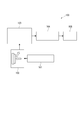
- FIG. 2 shows a schematic diagram of an exemplary device for measuring transient PL.
- a method of measuring transient PL using FIG. 2 and an example of behavior analysis of delayed fluorescence will be described.
- the transient PL measuring device 100 of FIG. 2 includes a pulse laser unit 101 capable of irradiating light having a predetermined wavelength, a sample chamber 102 accommodating a measurement sample, a spectroscope 103 that disperses light emitted from the measurement sample, and 2 A streak camera 104 for forming a dimensional image and a personal computer 105 for capturing and analyzing a two-dimensional image are provided.
- the measurement of transient PL is not limited to the device shown in FIG.
- the sample accommodated in the sample chamber 102 is obtained by forming a thin film on a quartz substrate in which a doping material is doped at a concentration of 12% by mass with respect to the matrix material.
- the thin film sample housed in the sample chamber 102 is irradiated with a pulse laser from the pulse laser unit 101 to excite the doping material.
- Light emission is extracted in a direction of 90 degrees with respect to the irradiation direction of the excitation light, the extracted light is separated by a spectroscope 103, and a two-dimensional image is formed in the streak camera 104.
- a two-dimensional image in which the vertical axis corresponds to time, the horizontal axis corresponds to wavelength, and the bright spot corresponds to emission intensity.
- this two-dimensional image is cut out on a predetermined time axis, it is possible to obtain an emission spectrum in which the vertical axis is the emission intensity and the horizontal axis is the wavelength.
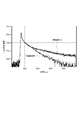
- an attenuation curve (transient PL) in which the vertical axis is the logarithm of the emission intensity and the horizontal axis is the time can be obtained.
- the following reference compound H1 was used as the matrix material, and the following reference compound D1 was used as the doping material to prepare a thin film sample A as described above, and transient PL measurement was performed.
- the attenuation curve was analyzed using the above-mentioned thin film sample A and thin film sample B.
- the following reference compound H2 was used as the matrix material
- the reference compound D1 was used as the doping material to prepare a thin film sample as described above.
- FIG. 3 shows the attenuation curves obtained from the transient PL measured for the thin film sample A and the thin film sample B.
- the ratio of the intensity of the slowly decaying fluorescence to the intensity of the rapidly decaying fluorescence is large to some extent.
- Prompt emission is emission that is immediately observed from the excited state after being excited by pulsed light (light emitted from a pulse laser) having a wavelength absorbed by the delayed fluorescence material.
- Delay light emission is light emission that is not immediately observed after being excited by the pulsed light but is observed thereafter.
- the amount of Prompt emission and Delay emission and their ratio can be obtained by the same method as described in "Nature 492, 234-238, 2012" (Reference 1).
- the device used to calculate the amount of Prompt emission and Delay emission is not limited to the device described in Reference 1 or the device shown in FIG.
- a sample prepared by the following method is used for measuring the delayed fluorescence of compound M2.
- compound M2 is dissolved in toluene to prepare a dilute solution having an absorbance of 0.05 or less at the excitation wavelength in order to remove the contribution of self-absorption.
- the sample solution is frozen and degassed and then sealed in a cell with a lid under an argon atmosphere to obtain an oxygen-free sample solution saturated with argon.
- the fluorescence spectrum of the sample solution is measured with a spectrofluorometer FP-8600 (manufactured by Nippon Kogaku Co., Ltd.), and the fluorescence spectrum of an ethanol solution of 9,10-diphenylanthracene is measured under the same conditions.
- a spectrofluorometer FP-8600 manufactured by Nippon Kogaku Co., Ltd.
- the fluorescence spectrum of an ethanol solution of 9,10-diphenylanthracene is measured under the same conditions.
- the total fluorescence quantum yield is calculated by the equation (1) in 80 (1976) 969.
- the amounts of Prompt emission and Delay emission and their ratios can be determined by the same method as described in "Nature 492, 234-238, 2012" (Reference 1).
- the apparatus used to calculate the amounts of Prompt emission and Delay emission is not limited to the apparatus described in Reference 1 or the apparatus shown in FIG.
- the amount of Prompt luminescence measurement target compound (Compound M2) (Immediate emission) and X P, the amount of Delay emission (delayed luminescence) is taken as X D, the value of X D / X P Is preferably 0.05 or more.
- the measurement of the amount and ratio of Prompt emission and Delay emission of a compound other than compound M2 in the present specification is the same as the measurement of the amount and ratio of Prompt emission and Delay emission of compound M2.
- Examples of the compound M2 include compounds represented by the following general formula (2).
- CN is a cyano group
- D 1 is represented by the following general formula (2a), a group represented by the following general formula (2b) or the following general formula (2c), if D 1 there are a plurality or multiple of D 1 are identical to each other
- Rx is a hydrogen atom or a substituent, or pairs of adjacent Rx are bonded to each other to form a ring, and when there are a plurality of Rx, the plurality of Rx are the same or different from each other.
- Rx as a substituent is independently Halogen atom, Substituent or unsubstituted ring-forming aryl groups having 6 to 30 carbon atoms, Substituted or unsubstituted ring-forming heterocyclic groups having 5 to 30 atoms, Substituted or unsubstituted amino groups, Substituted or unsubstituted carbonyl group, Substituent or unsubstituted alkyl groups having 1 to 30 carbon atoms, Substituent or unsubstituted alkyl halide groups having 1 to 30 carbon atoms, A substituted or unsubstituted alkylsilyl group having 3 to 30 carbon atoms, or a substituted or unsubstituted ring-forming arylsilyl group having 6 to 60 carbon atoms.
- CN, D 1 and Rx are each bonded to a 6-membered ring carbon atom.
- R 1 to R 8 are independently hydrogen atoms or substituents, or a set of R 1 and R 2, a set of R 2 and R 3 , R 3 and R 4 set, a set of R 5 and R 6, a set of R 6 and R 7, and any one or more sets of pairs of R 7 and R 8 are bonded to each other to form a ring, R 1 to R 8 as substituents are independent of each other.
- Halogen atom Substituent or unsubstituted ring-forming aryl groups having 6 to 30 carbon atoms, Substituted or unsubstituted ring-forming heterocyclic groups having 5 to 30 atoms, Substituent or unsubstituted alkyl groups having 1 to 30 carbon atoms, Substituent or unsubstituted alkyl halide groups having 1 to 30 carbon atoms, Substituent or unsubstituted alkylsilyl group having 3 to 30 carbon atoms, Substituent or unsubstituted ring-forming arylsilyl group having 6 to 60 carbon atoms, Hydroxy group, Substituent or unsubstituted alkoxy group having 1 to 30 carbon atoms, Substituent or unsubstituted alkoxy group having 1 to 30 carbon atoms, Substituent or unsubstituted ring-forming aryloxy groups having 6 to 30 carbon
- R 21 to R 28 are independently hydrogen atoms or substituents, or R 21 and R 22 pairs, R 22 and R 23 pairs, R 23 and R 24 pairs, R 25 and R 26. , R 26 and R 27 , and any one or more of the R 27 and R 28 pairs join together to form a ring.
- R 21 to R 28 as substituents are independently synonymous with R 1 to R 8 in the general formula (2a).
- A represents a ring structure represented by the following general formula (211) or the following general formula (212), and this ring structure A is fused with an adjacent ring structure at an arbitrary position.
- p is 1, 2, 3 or 4 When p is 2, 3 or 4, the plurality of ring structures A are the same as or different from each other. * Represents the binding site of the benzene ring with the carbon atom in the general formula (2).
- R 2001 -R 2008 are independently hydrogen atoms or substituents, or R 2001 and R 2002 pairs, R 2002 and R 2003 pairs, R 2003 and R 2004 pairs, R 2005 and R 2006. , R 2006 and R 2007 , and any one or more of R 2007 and R 2008 are combined with each other to form a ring.
- R 2001 to R 2008 as the substituents are independently synonymous with R 1 to R 8 as the substituents in the general formula (2a).
- B represents a ring structure represented by the following general formula (211) or the following general formula (212), and this ring structure B is condensed with an adjacent ring structure at an arbitrary position.
- px is 1, 2, 3 or 4 When px is 2, 3 or 4, the plurality of ring structures B are the same as or different from each other.
- C represents a ring structure represented by the following general formula (211) or the following general formula (212), and this ring structure C is fused with an adjacent ring structure at an arbitrary position.
- py is 1, 2, 3 or 4 When py is 2, 3 or 4, the plurality of ring structures C are the same as or different from each other.
- * Represents the binding site of the benzene ring with the carbon atom in the general formula (2).
- R 2009 and R 2010 are each independently a hydrogen atom or a substituent, or are bonded to each other with a part of an adjacent ring structure to form a ring, or R 2009 and R 2010 and Pairs of R 2010 combine with each other to form a ring
- X 201 is CR 2011 R 2012 , NR 2013 , a sulfur atom or an oxygen atom
- R 2011 , R 2012 and R 2013 are independently hydrogen atoms or substituents, respectively.
- R 2011 and R 2012 are bonded to each other to form a ring
- R 2009 , R 2010 , R 2011 , R 2012 and R 2013 as substituents are independently synonymous with R 1 to R 8 as substituents in the general formula (2a).
- R 2009 and R 2010 independently combine with a part of adjacent ring structures to form a ring. Specifically, the following (I) to (IV) Say one of. Further, in the general formula (211), the fact that the pair of R 2009 and R 2010 are combined with each other to form a ring specifically means the following (V).
- (V) A pair of R 2009 and R 2010 having a ring structure represented by the general formula (211) is bonded to each other to form a ring. That is, (V) means that the pair of R 2009 and R 2010 bonded to the same ring are bonded to each other to form a ring.
- Rx is independently Hydrogen atom, Unsubstituted aryl groups with 6 to 30 carbon atoms, An unsubstituted heterocyclic group having 5 to 30 atoms or an unsubstituted alkyl group having 1 to 30 carbon atoms.
- Rx is an unsubstituted heterocyclic group having 5 to 30 ring-forming atoms
- Rx as a heterocyclic group having 5 to 30 unsubstituted ring-forming atoms is a pyridyl group, a pyrimidinyl group, a triazinyl group, or a dibenzofla. It is preferably an nyl group or a dibenzothienyl group.
- the triazineyl group refers to a group obtained by removing one hydrogen atom from 1,3,5-triazine, 1,2,4-triazine, or 1,2,3-triazine.
- the triazineyl group is preferably a group obtained by removing one hydrogen atom from 1,3,5-triazine.
- Rx is independently Hydrogen atom, Unsubstituted aryl groups with 6 to 30 carbon atoms, More preferably, it is an unsubstituted dibenzofuranyl group or an unsubstituted dibenzothienyl group. In the compound M2 of the present embodiment, Rx is more preferably a hydrogen atom.
- R 1 to R 8 , R 21 to R 28 , R 2001 to R 2008 , R 2009 to R 2010 , and R 2011 to R 2013 as substituents are independently used.
- Unsubstituted aryl groups with 6 to 30 carbon atoms It is preferably an unsubstituted heterocyclic group having 5 to 30 atoms or an unsubstituted alkyl group having 1 to 30 carbon atoms.
- the D 1 is a group represented by the following general formulas (D-21), (D-22), (D-23) or (D-24).
- R 171 to R 200 and R 71 to R 82 are independently hydrogen atoms or substituents, or a set of R 171 and R 172 . , R 172 and R 173 pairs, R 173 and R 174 pairs, R 174 and R 175 pairs, R 175 and R 176 pairs, R 177 and R 178 pairs, R 178 and R 179 pairs, R A set of 179 and R 180, a set of R 181 and R 182, a set of R 182 and R 183, a set of R 183 and R 184, a set of R 185 and R 186, a set of R 186 and R 187 , R 187 and R 188 pairs, R 188 and R 189 pairs, R 189 and R 190 pairs, R 191 and R 192 pairs, R 192 and R 193 pairs, R 193 and R 194 pairs, R 194 and R 195.
- R 171 to R 200 and R 71 to R 82 as substituents are independent of each other.
- Halogen atom Substituent or unsubstituted ring-forming aryl groups having 6 to 14 carbon atoms, Substituted or unsubstituted ring-forming heterocyclic groups having 5 to 14 atoms, Substituent or unsubstituted alkyl groups having 1 to 6 carbon atoms, Substituent or unsubstituted alkyl halide groups having 1 to 30 carbon atoms, Substituent or unsubstituted alkylsilyl group having 3 to 6 carbon atoms, Hydroxy group, Substituent or unsubstituted alkoxy group having 1 to 6 carbon atoms, Substituent or unsubstituted alkoxy group having 1 to 6 carbon atoms, Substituent or unsubstituted ring-forming aryloxy groups having 6 to 14 carbon atoms, Substituent or unsubstituted alkylamino groups having 2 to 12 carbon atoms, Thi
- the D 1 is a group represented by the general formula (D-21), (D-23), or (D-24). In the compound M2 of the present embodiment, it is further preferable that the D 1 is a group represented by the general formula (D-21) or (D-23).
- R 171 to R 200 and R 71 to R 82 as substituents are independently, respectively.
- Unsubstituted aryl groups with 6 to 14 carbon atoms It is preferably an unsubstituted heterocyclic group having 5 to 14 atoms or an unsubstituted alkyl group having 1 to 6 carbon atoms.
- R 171 to R 200 and R 71 to R 82 are hydrogen atoms.
- Examples of the compound M2 include a compound represented by the following general formula (22).
- Ar 1 is an aryl group having a substituted or unsubstituted ring-forming carbon number of 6 to 30, a substituted or unsubstituted heteroaryl group having a ring-forming atom number of 5 to 30, a substituted or unsubstituted ring-forming atom.
- Ar EWG is substituted with a substituted or unsubstituted heteroaryl group having 5 to 30 ring-forming atoms containing one or more nitrogen atoms in the ring, or one or more cyano groups. It is an aryl group having 6 to 30 ring-forming carbon atoms.
- Ar X is independently a hydrogen atom or a substituent, and Ar X as a substituent is a substituted or unsubstituted aryl group having 6 to 30 carbon atoms.
- Ar X as a substituent is a substituted or unsubstituted aryl group having 6 to 30 carbon atoms.
- an unsubstituted heteroaryl group having 5 to 30 atoms a substituted or unsubstituted alkyl group having 1 to 30 carbon atoms, a substituted or unsubstituted fluoroalkyl group having 1 to 30 carbon atoms, a substituted or unsubstituted alkyl group.
- the ring (A) is a 5-membered ring, a 6-membered ring, or a 7-membered ring.
- the ring (A) may be an aromatic hydrocarbon ring or a heterocycle.
- Ar 1 and Ar X are each bonded to the elements constituting the ring (A).
- At least one of Ar 1 and Ar X is any group selected from the group consisting of the groups represented by the following general formulas (1a) to (1j).
- X 1 ⁇ X 20 are each independently a nitrogen atom (N) or carbon atom to which R A1 is attached (C-R A1).
- formula (1b) is either X 5 ⁇ X 8, a carbon atom bonded with any of X 9 ⁇ X 12, any of X 9 ⁇ X 12, either X 5 ⁇ X 8 It is a carbon atom that binds to the heel.
- any of X 5 ⁇ X 8 is a carbon atom bonded to the nitrogen atom in the ring containing A 2.
- the one of X 5 ⁇ X 8 and X 18, a carbon atom bonded with any of X 9 ⁇ X 12 and X 19, one of X 9 ⁇ X 12 and X 19 is a carbon atom bonded with any of X 5 ⁇ X 8 and X 18.
- any of X 5 ⁇ X 8, a carbon atom bonded with any of X 9 ⁇ X 12 and X 19, is one of X 9 ⁇ X 12 and X 19, X 5 is a carbon atom bonded with any of the ⁇ X 8.
- any of X 5 ⁇ X 8 binds to the nitrogen atom which connects the ring containing ring and X 13 ⁇ X 16 and X 20 containing X 9 ⁇ X 12 and X 19 It is a carbon atom.
- Each RA1 is independently a hydrogen atom or a substituent, or any one or more pairs of a plurality of RA1s are directly bonded to each other to form a ring, or a heteroatom is formed.
- R A1 Form a ring through R A1 as a substituent, a substituted or unsubstituted ring aryl group having 6 to 30, a substituted or unsubstituted ring atoms 5-30 heteroaryl group, a substituted or unsubstituted C 1 ⁇ 30 alkyl groups, substituted or unsubstituted fluoroalkyl groups having 1 to 30 carbon atoms, substituted or unsubstituted ring-forming cycloalkyl groups having 3 to 30 carbon atoms, substituted or unsubstituted aralkyl groups having 7 to 30 carbon atoms.
- a plurality of R A1 as a substituent may be identical to one another or different.
- X 1 ⁇ X 8 are, when R A1 is a carbon atom bonded (C-R A1), the plurality of R A1, who do not form a ring.
- * represents a binding site with the ring (A).
- R 2021 to R 2025 are independently hydrogen atoms or substituents, and R 2021 to R 2025 as substituents are independently substituents or unsubstituted aryls having 6 to 30 ring-forming carbon atoms.
- Group substituted or unsubstituted ring-forming heteroaryl group with 5 to 30 atoms, substituted or unsubstituted alkyl group with 1 to 30 carbon atoms, substituted or unsubstituted fluoroalkyl group with 1 to 30 carbon atoms, substituted or substituted From the group consisting of an unsubstituted ring-forming cycloalkyl group having 3 to 30 carbon atoms, a substituted or unsubstituted aralkyl group having 7 to 30 carbon atoms, a substituted phosphoryl group, a substituted silyl group, a cyano group, a nitro group, and a carboxy group. It is one of the groups selected.
- Ara is a substituted or unsubstituted aryl group having 6 to 30 ring-forming carbon atoms, a substituted or unsubstituted heteroaryl group having 5 to 30 ring-forming atoms, substituted or substituted.
- Unsubstituted alkyl groups with 1 to 30 carbon atoms substituted or unsubstituted fluoroalkyl groups with 1 to 30 carbon atoms, substituted or unsubstituted ring-forming cycloalkyl groups with 3 to 30 carbon atoms, substituted or unsubstituted carbons.
- Ara is preferably a substituted or unsubstituted aryl group having 6 to 30 ring-forming carbon atoms, or a substituted or unsubstituted heteroaryl group having 5 to 30 ring-forming atoms.
- Compound M2 is preferably represented by the following general formula (221).
- Compound M2 is also preferably represented by the following general formula (222).
- Y 1 to Y 5 are independently represented by a nitrogen atom (N), a carbon atom to which a cyano group is bonded (C-CN), or a carbon atom to which RA 2 is bonded ( CR A2). ), And at least one of Y 1 to Y 5 is N or C-CN. Multiple RA2s are the same as or different from each other.
- R A2 are each independently a hydrogen atom or a substituent, R A2 as a substituent, a substituted or unsubstituted ring aryl group having 6 to 30, a substituted or unsubstituted ring atoms 5 ⁇ 30 heteroaryl groups, substituted or unsubstituted alkyl groups having 1 to 30 carbon atoms, substituted or unsubstituted fluoroalkyl groups having 1 to 30 carbon atoms, substituted or unsubstituted ring-forming cyclos having 3 to 30 carbon atoms.
- Multiple RA2s are the same as or different from each other.
- Ar 1 is synonymous with Ar 1 in the general formula (22).
- Ar 2 to Ar 5 are independently hydrogen atoms or substituents, and Ar 2 to Ar 5 as substituents are independently substituted or unsubstituted ring-forming carbons.
- Fluoroalkyl group substituted or unsubstituted ring-forming cycloalkyl group having 3 to 30 carbon atoms, substituted or unsubstituted aralkyl group having 7 to 30 carbon atoms, substituted phosphoryl group, substituted silyl group, cyano group, nitro group, carboxy It is any group selected from the group consisting of a group and a group represented by the general formulas (1a) to (1c).
- At least one of Ar 1 to Ar 5 is any group selected from the group consisting of the groups represented by the general formulas (1a) to (1c).
- the compound M2 is also preferably a compound represented by the following general formula (11aa), the following general formula (11bb), or the following general formula (11cc).
- Formula (11aa), (11bb) and (11 cc) in, Y 1 ⁇ Y 5, R A2, Ar 2 ⁇ Ar 5, X 1 ⁇ X 16, R A1, and Ara is, Y 1 ⁇ which are described above It has the same meaning as Y 5 , R A2 , Ar 2 to Ar 5 , X 1 to X 16 , R A 1 , and Ara.
- Examples of the compound M2 include a compound represented by the following general formula (23).
- Az is Substituted or unsubstituted pyridine ring, Substituted or unsubstituted pyrimidine rings, A ring structure selected from the group consisting of a substituted or unsubstituted triazine ring and a substituted or unsubstituted pyrazine ring.
- L 23 is A linking group selected from the group consisting of an arylene group having 6 to 30 substituted or unsubstituted ring-forming carbon atoms and a heteroarylene group having 5 to 30 substituted or unsubstituted ring-forming atoms.
- the plurality of L 23s are the same as or different from each other.
- a plurality of L 23 are bonded to each other without forming a or ring form a ring, Cz is represented by the following general formula (23a).
- Y 21 to Y 28 are independently nitrogen atoms or CR A3 , or Each RA3 is independently a hydrogen atom or a substituent, or any one or more pairs of a plurality of RA3s are bonded to each other to form a ring.
- R A3 as a substituent, each independently, Substituent or unsubstituted ring-forming aryl groups having 6 to 30 carbon atoms, A heteroaryl group having 5 to 30 substituted or unsubstituted ring-forming atoms, Substituent or unsubstituted alkyl groups having 1 to 30 carbon atoms, Substituted or unsubstituted fluoroalkyl groups having 1 to 30 carbon atoms, Substitutable or unsubstituted ring-forming cycloalkyl groups having 3 to 30 carbon atoms, Substituent or unsubstituted aralkyl groups having 7 to 30 carbon atoms, Substituted phosphoryl group, Substituted silyl group, Cyano group, A group selected from the group consisting of a nitro group and a carboxy group. Multiple RA3s are the same as or different from each other * 1 represents a binding site with a carbon atom in the
- Y 21 to Y 28 are CR A3 .
- C in the general formula (23) is preferably 0 or 1.
- Cz is represented by the following general formula (23b), general formula (23c) or general formula (23d).
- Y 21 to Y 28 and Y 51 to Y 58 are independently nitrogen atoms or CR A4 , respectively.
- the general formula (23b), out of Y 25 to Y 28, at least one is a carbon atom bonded with any of Y 51 to Y 54, of Y 51 to Y 54, at least one , A carbon atom bonded to any of Y 25 to Y 28 .
- at least one of Y 25 to Y 28 is a carbon atom bonded to a nitrogen atom in a 5-membered ring of a nitrogen-containing condensed ring containing Y 51 to Y 58 .
- * a and * b represent binding sites with any of Y 21 to Y 28 , respectively, and at least one of Y 25 to Y 28 is represented by * a. At least one of Y 25 to Y 28 is a binding site represented by * b.
- n is 1, 2, 3 or 4
- Each RA4 is independently a hydrogen atom or a substituent, or any one or more pairs of a plurality of RA4s are bonded to each other to form a ring.
- R A4 as a substituent, each independently, Substituent or unsubstituted ring-forming aryl groups having 6 to 30 carbon atoms, A heteroaryl group having 5 to 30 substituted or unsubstituted ring-forming atoms, Substituent or unsubstituted alkyl groups having 1 to 30 carbon atoms, Substituted or unsubstituted fluoroalkyl groups having 1 to 30 carbon atoms, Substitutable or unsubstituted ring-forming cycloalkyl groups having 3 to 30 carbon atoms, Substituent or unsubstituted aralkyl groups having 7 to 30 carbon atoms, Substituted phosphoryl group, Substituted silyl group, Cyano group, Any substituent selected from the group consisting of a nitro group and a carboxy group.
- RA4s are the same or different from each other Z 21 and Z 21 are any one independently selected from the group consisting of an oxygen atom, a sulfur atom, an NR 45 , and a CR 46 R 47 .
- R 45 is a hydrogen atom or a substituent and is R 46 and R 47 are independently hydrogen atoms or substituents, or pairs of R 46 and R 47 combine with each other to form a ring.
- R 45 , R 46 and R 47 as substituents are independent of each other.
- Z 21 is preferably NR 45 .
- R 45 is preferably an aryl group having 6 to 30 substituted or unsubstituted ring-forming carbon atoms.
- Z 22 is preferably NR 45 .
- R 45 is preferably an aryl group having 6 to 30 substituted or unsubstituted ring-forming carbon atoms.
- Y 51 to Y 58 are preferably CR A4 , but in this case, at least one of Y 51 to Y 58 is a carbon atom bonded to the ring structure represented by the general formula (23a). Is.
- Cz is represented by the general formula (23d), and n is preferably 1.
- Az is preferably a ring structure selected from the group consisting of a substituted or unsubstituted pyrimidine ring and a substituted or unsubstituted triazine ring.
- Az is a ring structure selected from the group consisting of a pyrimidine ring having a substituent and a triazine ring having a substituent, and these pyrimidine rings and the substituents of the triazine ring are substituted or unsubstituted ring-forming carbons.
- it is a group selected from the group consisting of an aryl group of number 6 to 30 and a substituted or unsubstituted heteroaryl group having 5 to 30 ring-forming atoms, and the substituted or unsubstituted ring-forming carbon number 6 More preferably, it is from to 30 aryl groups.
- the ring-forming carbon number of the aryl group is preferably 6 to 20, preferably 6 to 14. More preferably, it is more preferably 6 to 12.
- the substituent is a substituted or unsubstituted phenyl group, a substituted or unsubstituted biphenyl group, a substituted or unsubstituted naphthyl group, a substituted or unsubstituted group. It is preferably any substituent selected from the group consisting of a phenanthryl group, a substituted or unsubstituted phenyl group, and a substituted or unsubstituted fluorenyl group, and is preferably a substituted or unsubstituted phenyl group, a substituted or unsubstituted group.
- AZ has a substituted or unsubstituted heteroaryl group as a substituent
- the substituents are a substituted or unsubstituted carbazolyl group, a substituted or unsubstituted dibenzofuranyl group, and a substituted or unsubstituted dibenzothiophenyl. It is preferably any substituent selected from the group consisting of groups.
- RA4 is independently a hydrogen atom or a substituent, and RA4 as a substituent is an aryl group having 6 to 30 substituted or unsubstituted ring-forming carbon atoms and a substituted or unsubstituted ring-forming atomic number. It is preferably any substituent selected from the group consisting of 5 to 30 heteroaryl groups.
- R A4 as the substituent is a substituted or unsubstituted ring aryl group having 6 ⁇ 30, R A4 as a substituent, a substituted or unsubstituted phenyl group, a substituted or unsubstituted biphenyl group, It is preferably any substituent selected from the group consisting of a substituted or unsubstituted naphthyl group, a substituted or unsubstituted phenanthryl group, a substituted or unsubstituted terphenyl group, and a substituted or unsubstituted fluorenyl group.
- Substituent or unsubstituted phenyl group, substituted or unsubstituted biphenyl group, and any substituent selected from the group consisting of substituted or unsubstituted naphthyl group is more preferable.
- R A4 as a substituent is a heteroaryl group or a substituted or unsubstituted ring atoms 5 ⁇ 30, R A4 as a substituent, a substituted or unsubstituted carbazolyl group, Jibenzofura substituted or unsubstituted It is preferably any substituent selected from the group consisting of an Nyl group and a substituted or unsubstituted dibenzothiophenyl group.
- R 45 , R 46 and R 47 as substituents are independently substituted or unsubstituted aryl groups having 6 to 30 ring-forming carbon atoms and substituted or unsubstituted heteroaryl groups having 5 to 30 ring-forming atoms.
- the compound M2 of this embodiment can be produced by a known method.
- the energy gap T 77K (M3) at 77 [K] of compound M3 is preferably larger than the energy gap T 77K (M2) at 77 [K] of compound M2. That is, it is preferable to satisfy the relationship of the following mathematical formula (Equation 11). T 77K (M3)> T 77K (M2) ... (Number 11)
- the compound M3 does not mainly emit light in the light emitting layer when the organic EL element of the present embodiment emits light.
- the energy gap at 77 [K] differs from the normally defined triplet energy.
- the triplet energy measurement is performed as follows. First, a sample in which a solution in which a compound to be measured is dissolved in an appropriate solvent is sealed in a quartz glass tube is prepared. For this sample, the phosphorescence spectrum (vertical axis: phosphorescence emission intensity, horizontal axis: wavelength) was measured at a low temperature (77 [K]), and a tangent line was drawn with respect to the rising edge of the phosphorescence spectrum on the short wavelength side.
- the triple term energy is calculated from a predetermined conversion formula based on the wavelength value at the intersection of the tangent line and the horizontal axis.
- the thermally active delayed fluorescence compound is preferably a compound having a small ⁇ ST.
- ⁇ ST is small, intersystem crossing and inverse intersystem crossing are likely to occur even in a low temperature (77 [K]) state, and an excited singlet state and an excited triplet state coexist.
- the spectrum measured in the same manner as described above contains light emission from both the excited singlet state and the excited triplet state, and it is difficult to distinguish from which state the light is emitted.
- the triplet energy value is considered to be dominant.
- the measurement method is the same as that of the normal triplet energy T, but in order to distinguish the difference in the strict sense, the value measured as follows is referred to as the energy gap T 77K. ..
- the phosphorescence spectrum (vertical axis: phosphorescence emission intensity, horizontal axis: wavelength) is measured at a low temperature (77 [K]), and a tangent line is drawn with respect to the rising edge of the phosphorescence spectrum on the short wavelength side.
- the amount of energy calculated from the following conversion formula (F1) is defined as the energy gap T 77K at 77 [K].
- Conversion formula (F1): T 77K [eV] 1239.85 / ⁇ edge
- the tangent to the rising edge of the phosphorescence spectrum on the short wavelength side is drawn as follows.
- the tangent lines at each point on the curve toward the long wavelength side This tangent increases in slope as the curve rises (ie, as the vertical axis increases).
- the tangent line drawn at the point where the value of the slope reaches the maximum value is the tangent line to the rising edge of the phosphorescence spectrum on the short wavelength side.
- the maximum point having a peak intensity of 15% or less of the maximum peak intensity of the spectrum is not included in the maximum value on the shortest wavelength side described above, and the slope value closest to the maximum value on the shortest wavelength side is the maximum.
- the tangent line drawn at the point where the value is taken is taken as the tangent line to the rising edge of the phosphorescent spectrum on the short wavelength side.
- the F-4500 type spectrofluorometer main body manufactured by Hitachi High-Technology Co., Ltd. can be used for the measurement of phosphorescence.
- the measuring device is not limited to this, and may be measured by combining a cooling device, a low temperature container, an excitation light source, and a light receiving device.
- the tangent to the fall on the long wavelength side of the absorption spectrum is drawn as follows. When moving on the spectrum curve from the maximum value on the longest wavelength side to the long wavelength direction among the maximum values of the absorption spectrum, consider the tangents at each point on the curve. This tangent repeats that the slope decreases and then increases as the curve descends (ie, as the value on the vertical axis decreases).
- the tangent line drawn at the point where the slope value takes the minimum value on the longest wavelength side (except when the absorbance is 0.1 or less) is defined as the tangent line to the fall of the long wavelength side of the absorption spectrum.
- the maximum point having an absorbance value of 0.2 or less is not included in the maximum value on the longest wavelength side.
- the film thickness of the light emitting layer in the organic EL device according to the present embodiment is preferably 5 nm or more and 50 nm or less, more preferably 7 nm or more and 50 nm or less, and most preferably 10 nm or more and 50 nm or less.
- it is 5 nm or more, it is easy to form a light emitting layer and adjust the chromaticity, and when it is 50 nm or less, an increase in the driving voltage is likely to be suppressed.
- the content of the compound M2 and the compound M3 contained in the light emitting layer is preferably in the following range, for example.
- the content of the compound M2 is preferably 10% by mass or more and 80% by mass or less, more preferably 10% by mass or more and 60% by mass or less, and further preferably 20% by mass or more and 60% by mass or less. ..
- the content of the compound M3 is preferably 20% by mass or more and 90% by mass or less, more preferably 40% by mass or more and 90% by mass or less, and further preferably 40% by mass or more and 80% by mass or less. ..
- this embodiment does not exclude that the light emitting layer contains a material other than compound M2 and compound M3.
- the light emitting layer may contain only one type of compound M2, or may contain two or more types of compound M2.
- the light emitting layer may contain only one type of compound M3, or may contain two or more types of compound M3.
- FIG. 4 is a diagram showing the relationship between the energy levels of compound M3 and compound M2 and the energy transfer in the light emitting layer.
- S0 represents the ground state.
- S1 (M2) represents the lowest excited singlet state of compound M2
- T1 (M2) represents the lowest excited triplet state of compound M2.
- S1 (M3) represents the lowest excited singlet state of compound M3, and T1 (M3) represents the lowest excited triplet state of compound M3.
- the dashed arrow in FIG. 4 represents the energy transfer between each excited state. Felster transfer from the lowest excited singlet state S1 of compound M3 or Dexter transfer from the lowest excited triplet state T1 causes energy transfer to the lowest excited singlet state S1 or the lowest excited triplet state T1 of compound M2, respectively. ..
- the lowest excited triplet state T1 of the compound M2 can be intersystem crossed with the lowest excited singlet state S1 by thermal energy.
- fluorescence emission from the lowest excited singlet state S1 of compound M2 can be observed. It is believed that the internal efficiency can theoretically be increased to 100% by using delayed fluorescence by this TADF mechanism.
- the organic EL device of the present embodiment includes a delayed fluorescent compound M2 and a compound M3 having a singlet energy larger than that of the compound M2 in the light emitting layer. According to this embodiment, a high-performance organic EL element, for example, an organic EL element that emits light with high efficiency is realized.
- the organic EL element of this embodiment can be used for electronic devices such as display devices and light emitting devices.
- the substrate is used as a support for an organic EL element.
- the substrate for example, glass, quartz, plastic, or the like can be used.
- a flexible substrate is a foldable (flexible) substrate, and examples thereof include a plastic substrate.
- the material for forming the plastic substrate include polycarbonate, polyarylate, polyether sulfone, polypropylene, polyester, polyvinyl fluoride, polyvinyl chloride, polyimide, polyethylene naphthalate and the like.
- Inorganic vapor deposition film can also be used.
- anode For the anode formed on the substrate, it is preferable to use a metal having a large work function (specifically, 4.0 eV or more), an alloy, an electrically conductive compound, a mixture thereof, or the like.
- a metal having a large work function specifically, 4.0 eV or more
- an alloy an electrically conductive compound, a mixture thereof, or the like.
- ITO Indium Tin Oxide
- indium tin oxide containing silicon or silicon oxide indium oxide-zinc oxide, tungsten oxide, and indium oxide containing zinc oxide.
- Graphene Graphene and the like.
- gold Au
- platinum Pt
- nickel Ni
- tungsten W
- Cr chromium
- Mo molybdenum
- iron Fe
- Co cobalt
- Cu copper
- palladium Pd
- titanium Ti
- nitrides of metallic materials for example, titanium nitride
- indium oxide-zinc oxide can be formed by a sputtering method by using a target in which 1% by mass or more and 10% by mass or less of zinc oxide is added to indium oxide.
- indium oxide containing tungsten oxide and zinc oxide contained 0.5% by mass or more and 5% by mass or less of tungsten oxide and 0.1% by mass or more and 1% by mass or less of zinc oxide with respect to indium oxide.
- a target it can be formed by a sputtering method.
- it may be produced by a vacuum vapor deposition method, a coating method, an inkjet method, a spin coating method or the like.
- the hole injection layer formed in contact with the anode is formed by using a composite material that facilitates hole injection regardless of the work function of the electrode.
- Possible electrode materials eg, metals, alloys, electrically conductive compounds, and mixtures thereof, and other elements belonging to Group 1 or Group 2 of the Periodic Table of the Elements.
- Elements belonging to Group 1 or Group 2 of the Periodic Table of the Elements which are materials with a small work function, that is, alkali metals such as lithium (Li) and cesium (Cs), and magnesium (Mg), calcium (Ca), and strontium.
- Alkaline earth metals such as (Sr), rare earth metals such as alloys containing them (for example, MgAg, AlLi), europium (Eu), ytterbium (Yb), and alloys containing these can also be used.
- a vacuum vapor deposition method or a sputtering method can be used.
- a coating method, an inkjet method or the like can be used.
- cathode As the cathode, it is preferable to use a metal having a small work function (specifically, 3.8 eV or less), an alloy, an electrically conductive compound, a mixture thereof, or the like.
- a cathode material include elements belonging to Group 1 or Group 2 of the Periodic Table of the Elements, that is, alkali metals such as lithium (Li) and cesium (Cs), magnesium (Mg), and calcium (Ca). ), Alkaline earth metals such as strontium (Sr), and rare earth metals such as alloys containing them (for example, MgAg, AlLi), europium (Eu), ytterbium (Yb), and alloys containing them.
- a vacuum vapor deposition method or a sputtering method can be used.
- a silver paste or the like is used, a coating method, an inkjet method, or the like can be used.
- a cathode is formed by using various conductive materials such as indium tin oxide containing Al, Ag, ITO, graphene, silicon or silicon oxide, regardless of the size of the work function. can do.
- These conductive materials can be formed into a film by using a sputtering method, an inkjet method, a spin coating method, or the like.
- the hole injection layer is a layer containing a substance having a high hole injection property.
- Substances with high hole injection properties include molybdenum oxide, titanium oxide, vanadium oxide, renium oxide, ruthenium oxide, chromium oxide, zirconium oxide, hafnium oxide, tantalum oxide, silver oxide, etc. Tungsten oxide, manganese oxide and the like can be used.
- a low molecular weight organic compound 4,4', 4''-tris (N, N-diphenylamino) triphenylamine (abbreviation: TDATA)
- 4,4' , 4''-Tris [N- (3-methylphenyl) -N-phenylamino] triphenylamine (abbreviation: MTDATA)
- 4,4'-bis [N- (4-diphenylaminophenyl) -N-phenyl Amino] biphenyl abbreviation: DPAB
- 4,4'-bis (N- ⁇ 4- [N'-(3-methylphenyl) -N'-phenylamino] phenyl ⁇ -N-phenylamino) biphenyl (abbreviation: abbreviation: DNTPD), 1,3,5-tris [N- (4-diphenylaminophenyl) -N-phenylamino] benzene (abbreviation: TDATA)
- a polymer compound (oligomer, dendrimer, polymer, etc.) can also be used.
- a polymer compound oligomer, dendrimer, polymer, etc.
- PVK poly (N-vinylcarbazole)
- PVTPA poly (4-vinyltriphenylamine)
- PVTPA poly [N- (4- ⁇ N'- [4- (4-diphenylamino)
- PEDOT / PSS polyaniline / poly (styrene sulfonic acid)
- the hole transport layer is a layer containing a substance having a high hole transport property.
- An aromatic amine compound, a carbazole derivative, an anthracene derivative, or the like can be used for the hole transport layer.
- NPB 4,4'-bis [N- (1-naphthyl) -N-phenylamino] biphenyl
- TPD 1,1'-biphenyl] -4,4'-diamine
- BAFLP 4-phenyl-4'-(9-phenylfluoren-9-yl) triphenylamine
- CBP 9- [4- (N-carbazolyl)] phenyl-10-phenylanthracene (CzPA), 9-phenyl-3- [4- (10-phenyl-9-anthril) phenyl]
- Carbazole derivatives such as -9H-carbazole (PCzPA) and anthracene derivatives such as t-BuDNA, DNA and DPAnth may be used.
- Polymer compounds such as poly (N-vinylcarbazole) (abbreviation: PVK) and poly (4-vinyltriphenylamine) (abbreviation: PVTPA) can also be used.
- any substance other than these may be used as long as it is a substance having a higher hole transport property than electrons.
- the layer containing the substance having a high hole transport property is not limited to a single layer, but may be a layer in which two or more layers made of the above substances are laminated.
- a material having a larger energy gap closer to the light emitting layer examples include compound EBL and compound EBL-2 used in the examples described later.
- the electron transport layer is a layer containing a substance having a high electron transport property.
- the electron transport layer includes 1) metal complexes such as aluminum complexes, beryllium complexes and zinc complexes, 2) complex aromatic compounds such as imidazole derivatives, benzimidazole derivatives, azine derivatives, carbazole derivatives and phenanthroline derivatives, and 3) polymer compounds. Can be used.
- Alq tris (4-methyl-8-quinolinolato) aluminum (abbreviation: Almq 3 ), bis (10-hydroxybenzo [h] quinolinato) beryllium (abbreviation: BeBq 2 ), Metal complexes such as BAlq, Znq, ZnPBO, and ZnBTZ can be used.
- a benzimidazole compound can be preferably used.
- the substances described here are mainly substances having electron mobility of 10-6 cm 2 / (V ⁇ s) or more.
- a substance other than the above may be used as the electron transport layer as long as it is a substance having higher electron transport property than hole transport property.
- the electron transport layer may be composed of a single layer, or may be composed of two or more layers made of the above substances.
- a polymer compound can be used for the electron transport layer.
- PF-Py poly [(9,9-dihexylfluorene-2,7-diyl) -co- (pyridine-3,5-diyl)]
- PF-BPy poly [(9,9-dioctylfluorene-2) , 7-diyl) -co- (2,2'-bipyridine-6,6'-diyl)]
- PF-BPy poly [(9,9-dioctylfluorene-2) , 7-diyl) -co- (2,2'-bipyridine-6,6'-diyl)]
- the electron injection layer is a layer containing a substance having a high electron injection property.
- the electron injection layer includes lithium (Li), cesium (Cs), calcium (Ca), lithium fluoride (LiF), cesium fluoride (CsF), calcium fluoride (CaF 2 ), lithium oxide (LiOx), etc.
- Alkaline metals such as, alkaline earth metals, or compounds thereof can be used.
- a substance having an electron transporting property containing an alkali metal, an alkaline earth metal, or a compound thereof, specifically, a substance containing magnesium (Mg) in Alq or the like may be used. In this case, electron injection from the cathode can be performed more efficiently.
- a composite material obtained by mixing an organic compound and an electron donor (donor) may be used for the electron injection layer.
- a composite material is excellent in electron injection property and electron transport property because electrons are generated in the organic compound by the electron donor.
- the organic compound is preferably a material excellent in transporting generated electrons, and specifically, for example, a substance (metal complex, complex aromatic compound, etc.) constituting the above-mentioned electron transport layer is used. be able to.
- the electron donor may be any substance that exhibits electron donating property to the organic compound. Specifically, alkali metals, alkaline earth metals and rare earth metals are preferable, and lithium, cesium, magnesium, calcium, erbium, ytterbium and the like can be mentioned.
- alkali metal oxides and alkaline earth metal oxides are preferable, and lithium oxides, calcium oxides, barium oxides and the like can be mentioned.
- a Lewis base such as magnesium oxide can also be used.
- an organic compound such as tetrathiafulvalene (abbreviation: TTF) can also be used.
- the method for forming each layer of the organic EL device of the present embodiment is not limited except as specifically mentioned above, but is limited to dry film deposition methods such as vacuum deposition method, sputtering method, plasma method, ion plating method, and spin coating.
- dry film deposition methods such as vacuum deposition method, sputtering method, plasma method, ion plating method, and spin coating.
- Known methods such as a coating method, a dipping method, a flow coating method, and a wet film forming method such as an inkjet method can be adopted.
- each organic layer of the organic EL element of the present embodiment is not limited except as specifically mentioned above, but in general, if the film thickness is too thin, defects such as pinholes are likely to occur, and conversely, if it is too thick, it is high. Since an applied voltage is required and efficiency is deteriorated, a range of several nm to 1 ⁇ m is usually preferable.
- Compound M3 contains carbazole, which can be said to be at least one of a hole injecting site and a hole transporting site, and A 30 (preferably) having at least one of higher hole injecting property and hole transporting property than carbazole. since having both a benzo flow carbazole), a compound having only carbazole without a a 30 (e.g., CBP) at least one moderately hole injecting property and hole transporting property than increases.
- the compound M3 which appropriately enhances at least one of the hole injecting property and the hole transporting property, into the light emitting layer, an appropriate amount of holes can be supplied to the light emitting layer. It is thought that the amount of holes and electrons can be matched. As a result, it is considered that the efficiency of the element can be improved.
- delayed fluorescent compounds often have a large absolute value of LUMO (lowest empty molecular orbital) energy level introduced into the molecule in order to reduce ⁇ ST, and the molecule is linked. The absolute value of the energy level of the entire HOMO (highest occupied orbital) is often large.
- the absolute value of the energy level of HOMO is large, the injection of holes into the light emitting layer is hindered, and an appropriate amount of holes may not be supplied to the light emitting layer.
- the light emitting layer contains the compound M3 having at least one of the hole injecting property and the hole transporting property appropriately enhanced together with the delayed fluorescent compound M2, the hole injection into the light emitting layer is inhibited. It is considered that the holes are suppressed and an appropriate amount of holes can be supplied to the light emitting layer, and as a result, high efficiency of the device is realized. Therefore, according to this embodiment, a high-performance organic EL element can be realized.
- "High performance" in the present embodiment means at least one of light emission with a long life, improvement in luminous efficiency, and decrease in drive voltage.
- the organic EL device of the second embodiment is different from the organic EL device of the first embodiment in that the light emitting layer further contains the fluorescent compound M1.
- the light emitting layer contains the compound M3 represented by the general formula (3), the delayed fluorescent compound M2, and the fluorescent compound M1.
- compound M1 is preferably a dopant material
- compound M2 is preferably a host material
- compound M3 is preferably not a dopant material.
- the light emitting layer of this embodiment contains a fluorescent compound M1.
- the compound M1 of the present embodiment is not a phosphorescent metal complex.
- the compound M1 of the present embodiment is preferably not a heavy metal complex. Further, the compound M1 of the present embodiment is preferably not a metal complex.
- a fluorescent material can be used as the compound M1 of the present embodiment.
- the fluorescent material include bisarylaminonaphthalene derivatives, aryl-substituted naphthalene derivatives, bisarylaminoanthracene derivatives, aryl-substituted anthracene derivatives, bisarylaminopyrene derivatives, aryl-substituted pyrene derivatives, and bisarylamino.
- the compound M1 of the present embodiment is preferably a compound represented by the following general formula (10).
- X is a nitrogen atom or a carbon atom bonded to Y
- Y is a hydrogen atom or a substituent and is R 10 to R 15 are independently hydrogen atoms or substituents, or R 10 and R 11 pairs, R 11 and R 12 pairs, R 13 and R 14 pairs, and R 14 and R. Any one or more of the 15 pairs join together to form a ring.
- Y and R 10 to R 15 as substituents are independent of each other.
- Substituent or unsubstituted alkyl groups having 1 to 30 carbon atoms Substituent or unsubstituted alkyl halide groups having 1 to 30 carbon atoms, Substituent or unsubstituted ring-forming cycloalkyl group having 3 to 30 carbon atoms, Substituent or unsubstituted ring-forming aryl groups having 6 to 30 carbon atoms, Substituent or unsubstituted alkoxy group having 1 to 30 carbon atoms, Substituent or unsubstituted alkoxy group having 1 to 30 carbon atoms, Substituent or unsubstituted alkoxy group having 1 to 30 carbon atoms, Substituent or unsubstituted alkylthio groups having 1 to 30 carbon atoms, Substituent or unsubstituted ring-forming aryloxy groups having 6 to 30 carbon atoms, Substituted or unsubsti
- Z 11 and Z 12 are independent substituents, or Z 11 and Z 12 are bonded to each other to form a ring.
- Z 11 and Z 12 as substituents are independent of each other.
- Halogen atom Substituent or unsubstituted alkyl groups having 1 to 30 carbon atoms, Substituent or unsubstituted alkyl halide groups having 1 to 30 carbon atoms, Substituent or unsubstituted ring-forming aryl groups having 6 to 30 carbon atoms, Substituent or unsubstituted alkoxy group having 1 to 30 carbon atoms, It is selected from the group consisting of substituted or unsubstituted 1 to 30 carbon halide alkoxy groups and substituted or unsubstituted ring-forming aryloxy groups having 6 to 30 carbon atoms.
- the compound M1 when Z 11 and Z 12 are bonded to each other to form a ring, the compound M1 is represented by, for example, the following general formula (10A) or the following general formula (10B). ..
- compound M1 is not limited to the following structure.
- X, Y, and R 10 to R 15 are synonymous with X, Y, and R 10 to R 15 in the general formula (10), respectively, and R 1A is independent of each other.
- R 1A as a substituent is synonymous with R 10 to R 15 as a substituent
- n3 is 4.
- X, Y, and R 10 to R 15 are synonymous with X, Y, and R 10 to R 15 in the general formula (10), respectively, and R 1B are independent of each other.
- it is a hydrogen atom or a substituent, and R 1B as a substituent is synonymous with R 10 to R 15 as a substituent, and n4 is 4.
- Z at least one (both preferably Z 11 and Z 12) of the 11 and Z 12 represents a substituted or unsubstituted alkyl group having 1 to 30 carbon atoms, a substituted or unsubstituted C 1-30 halogenated carbons Alkyl groups, substituted or unsubstituted ring-forming aryl groups having 6 to 30 carbon atoms, substituted or unsubstituted alkoxy groups having 1 to 30 carbon atoms, substituted or unsubstituted alkoxy groups having 1 to 30 carbon atoms, and It is preferably a group selected from the group consisting of substituted or unsubstituted ring-forming aryloxy groups having 6 to 30 carbon atoms.
- At least one of Z 11 and Z 12 has an alkoxy group having 1 to 30 carbon atoms substituted with a fluorine atom, an aryloxy group having 6 to 30 carbon atoms substituted with a fluorine atom, and 1 to 1 carbon atom. More preferably, it is a group selected from the group consisting of an aryloxy group having 6 to 30 ring-forming carbon atoms substituted with 30 fluoroalkyl groups. It is more preferable that at least one of Z 11 and Z 12 is an alkoxy group having 1 to 30 carbon atoms substituted with a fluorine atom, and Z 11 and Z 12 have 1 to 30 carbon atoms substituted with a fluorine atom. It is even more preferable that it is an alkoxy group of.
- Z 11 and Z 12 are the same.
- the Z 11 and the Z 12 is a fluorine atom.
- At least one of the Z 11 and the Z 12 is a group represented by the following general formula (10a).
- A is a substituted or unsubstituted alkyl group having 1 to 6 carbon atoms, a substituted or unsubstituted alkyl halide group having 1 to 6 carbon atoms, or a substituted or unsubstituted ring-forming carbon. It is an aryl group of number 6 to 12, L 1 is a substituted or unsubstituted alkylene group having 1 to 6 carbon atoms, or a substituted or unsubstituted ring-forming aryl group having 6 to 12 carbon atoms, and m is a substituted or unsubstituted arylene group. 0,1,2,3,4,5,6, or 7, when m is 3, 4, 5, 6, or 7, a plurality of L 1 may be the same or different from each other. m is preferably 0, 1, or 2. When m is 0, A directly bonds to O (oxygen atom).
- the compound M1 is a compound represented by the following general formula (12).
- the compound M1 is also preferably a compound represented by the following general formula (12).
- X, Y when X is a carbon atom bonded with Y, R 10 ⁇ R 15 are each the X in the general formula (10), Y, and R 10 ⁇ R 15 It is synonymous.
- a 11 and A 12 have the same meaning as A in the general formula (10a), and may be the same as or different from each other.
- L 11 and L 12 have the same meaning as L 1 in the general formula (10a), and may be the same as or different from each other.
- m1 and m2 are 0, 1, 2, 3, 4, 5, 6 or 7, respectively, and are preferably 0, 1, or 2.
- m1 is 3, 4, 5, 6, or 7, a plurality of L 11, equal to or different from each other
- m2 is 3, 4, 5, 6, or 7, a plurality of L 12 are the same or different from each other.
- a 11 is directly bonded to O (oxygen atom)
- a 12 is directly bonded to O (oxygen atom).
- At least one of A and L1 in the general formula (10a) is preferably substituted with a halogen atom, and more preferably substituted with a fluorine atom.
- a in the general formula (10a) is more preferably a perfluoroalkyl group having 1 to 6 carbon atoms or a perfluoroaryl group having 6 to 12 ring-forming carbon atoms, and more preferably a perfluoroalkyl group having 1 to 6 carbon atoms. It is more preferably a group.
- L 1 in the general formula (10a) is more preferably a perfluoroalkylene group having 1 to 6 carbon atoms or a perfluoroarylene group having 6 to 12 ring-forming carbon atoms, and more preferably a perfluoroarylene group having 1 to 6 carbon atoms. It is more preferably an alkylene group.
- the compound M1 is a compound represented by the following general formula (12a).
- X is synonymous with X in the general formula (10)
- Y when X is a carbon atom bonded to Y is synonymous with Y in the general formula (10).
- R 10 to R 15 are independently synonymous with R 10 to R 15 in the general formula (10).
- m3 is 0, 1, 2, 3 or 4 m4 is 0, 1, 2, 3 or 4 m3 and m4 are the same as or different from each other.
- X is a carbon atom that bonds with Y
- Y is a hydrogen atom or a substituent and is Y as a substituent is an alkyl group having 1 to 30 carbon atoms substituted or unsubstituted, an alkyl halide group having 1 to 30 carbon atoms substituted or unsubstituted, and a ring-forming alkyl group having 6 to 30 substituted or unsubstituted carbon atoms. It is preferably a substituent selected from the group consisting of aryl groups, and more preferably a substituted or unsubstituted aryl group having 6 to 30 ring-forming carbon atoms.
- X is a carbon atom that bonds with Y
- Y is a hydrogen atom or a substituent and is Y as a substituent is a substituted or unsubstituted aryl group having 6 to 30 carbon atoms.
- the substituent is Substituent or unsubstituted alkyl groups having 1 to 30 carbon atoms, Substituent or unsubstituted alkyl halide groups having 1 to 30 carbon atoms, Substituent or unsubstituted alkoxy group having 1 to 30 carbon atoms, Examples thereof include a substituted or unsubstituted alkoxy group having 1 to 30 carbon atoms or an aryl group having 6 to 30 carbon atoms substituted with an alkyl group having 1 to 30 carbon atoms.
- the Z 11 and the Z 12 may be bonded to each other to form a ring, but it is preferable that the Z 11 and the Z 12 are not bonded to each other to form a ring.
- R 10 , R 12 , R 13 , and R 15 is a substituted or unsubstituted alkyl group having 1 to 30 carbon atoms, or It is preferably a substituted or unsubstituted alkyl halide group having 1 to 30 carbon atoms.
- R 10 , R 12 , R 13 , and R 15 are substituted or unsubstituted alkyl groups having 1 to 30 carbon atoms, or substituted or unsubstituted. It is more preferably an alkyl halide group having 1 to 30 carbon atoms. In this case, it is preferable that R 11 and R 14 are hydrogen atoms.
- R 10 , R 12 , R 13 , and R 15 are a substituted or unsubstituted aryl group having 6 to 30 carbon atoms. Is preferable.
- R 10 , R 12 , R 13 , and R 15 are substituted or unsubstituted aryl groups having 6 to 30 carbon atoms. preferable. In this case, it is preferable that R 11 and R 14 are hydrogen atoms.
- R 10 , R 12 , R 13 and R 15 are independent of each other.
- Substituent or unsubstituted alkyl groups having 1 to 30 carbon atoms (preferably 1 to 6 carbon atoms) Ring-forming alkyl groups substituted with substituted or unsubstituted alkyl groups having 1 to 30 carbon atoms (preferably 1 to 6 carbon atoms) or alkyl groups having 1 to 30 carbon atoms (preferably ring forming) It is an aryl group having 6 to 12 carbon atoms).
- R 11 and R 14 are hydrogen atoms can be mentioned.
- R 10 , R 12 , and R 13 is a substituted or unsubstituted alkyl group having 1 to 30 carbon atoms, or a substituted or unsubstituted halogen having 1 to 30 carbon atoms. It is preferably an alkylated group.
- R 10 , R 12 , and R 13 are substituted or unsubstituted alkyl groups having 1 to 30 carbon atoms, or substituted or unsubstituted alkyl halide groups having 1 to 30 carbon atoms. Is more preferable.
- R 11 is preferably a hydrogen atom.
- R 10 , R 12 , and R 13 is a substituted or unsubstituted aryl group having 6 to 30 carbon atoms.
- R 10 , R 12 , and R 13 are substituted or unsubstituted aryl groups having 6 to 30 carbon atoms.
- R 11 is preferably a hydrogen atom.
- R 10 , R 12 , and R 13 are independent of each other.
- Substituent or unsubstituted alkyl groups having 1 to 30 carbon atoms (preferably 1 to 6 carbon atoms) Ring-forming alkyl groups substituted with substituted or unsubstituted alkyl groups having 1 to 30 carbon atoms (preferably 1 to 6 carbon atoms) or alkyl groups having 1 to 30 carbon atoms (preferably ring forming) It is an aryl group having 6 to 12 carbon atoms).
- R 11 is a hydrogen atom can be mentioned.
- alkoxy group substituted with the fluorine atom in the compound M1 examples include 2,2,2-trifluoroethoxy group, 2,2-difluorooloethoxy group, 2,2,3,3,3-penta. Fluoro-1-propoxy group, 2,2,3,3-tetrafluoro-1-propoxy group, 1,1,1,3,3,3-hexafluoro-2-propoxy group, 2,2,3,3 , 4,4,4-Heptafluoro-1-butyloxy group, 2,2,3,3,4,4-hexafluoro-1-butyloxy group, nonafluorotertiary butyloxy group, 2,2,3,3 , 4,4,5,5,5-nonafluoropentanoxy group, 2,2,3,3,4,5,5,6,6,6-undecafluorohexanoxy group, 2, 3-Bis (trifluoromethyl) -2,3-butandioxy group, 1,1,2,2-tetra (trifluoromethyl) ethyleneglycoxy group, 4,
- examples of the aryloxy group substituted with a fluorine atom or the aryloxy group substituted with a fluoroalkyl group include a pentafluorophenoxy group, a 3,4,5-trifluorophenoxy group and a 4-trifluoro group.
- Methylphenoxy group, 3,5-bistrifluoromethylphenoxy group, 3-fluoro-4-trifluoromethylphenoxy group, 2,3,5,6-tetrafluoro-4-trifluoromethylphenoxy group, 4-fluorocatecholate Groups include 4-trifluoromethylcatecholate groups, 3,5-bistrifluoromethylcatecholate groups and the like.
- the compound M1 When the compound M1 is a fluorescent compound, it is preferable that the compound M1 exhibits light emission having a main peak wavelength of 400 nm or more and 700 nm or less.
- the main peak wavelength means the maximum emission intensity in the measured fluorescence spectrum of a toluene solution in which the compound to be measured is dissolved at a concentration of 10-6 mol / liter or more and 10-5 mol / liter or less. Refers to the peak wavelength of the fluorescence spectrum.
- a spectrofluorometer F-7000 manufactured by Hitachi High-Tech Science Corporation is used as the measuring device.
- Compound M1 preferably emits red or green light.
- the red emission means the emission in which the main peak wavelength of the fluorescence spectrum is in the range of 600 nm or more and 660 nm or less.
- the main peak wavelength of the compound M1 is preferably 600 nm or more and 660 nm or less, more preferably 600 nm or more and 640 nm or less, and further preferably 610 nm or more and 630 nm or less.
- the green emission means the emission in which the main peak wavelength of the fluorescence spectrum is in the range of 500 nm or more and 560 nm or less.
- the main peak wavelength of the compound M1 is preferably 500 nm or more and 560 nm or less, more preferably 500 nm or more and 540 nm or less, and further preferably 510 nm or more and 540 nm or less.
- the blue emission means the emission in which the main peak wavelength of the fluorescence spectrum is in the range of 430 nm or more and 480 nm or less.
- the main peak wavelength of the compound M1 is preferably 430 nm or more and 480 nm or less, more preferably 440 nm or more and 480 nm or less.
- the main peak wavelength of the light emitted from the organic EL element is measured as follows.
- the spectral radiance spectrum when a voltage is applied to the organic EL element so that the current density is 10 mA / cm 2 is measured with a spectral radiance meter CS-2000 (manufactured by Konica Minolta).
- the peak wavelength of the emission spectrum having the maximum emission intensity is measured, and this is defined as the main peak wavelength (unit: nm).
- Compound M1 can be produced by a known method.
- compound M1 of the present embodiment Specific examples of compound M1 of the present embodiment are shown below. However, the present invention is not limited to specific examples of these compounds. There are various notation methods for the coordination bond between the boron atom and the nitrogen atom in the pyrromethene skeleton, such as a solid line, a broken line, an arrow, or omission. In the present specification, it is represented by a solid line, a broken line, or the description thereof is omitted.
- the singlet energy S 1 (M2) of the compound M2 and the singlet energy S 1 (M1) of the compound M1 preferably satisfy the relationship of the following mathematical formula (Equation 2).
- the singlet energy S 1 (M3) of the compound M3 is preferably larger than the singlet energy S 1 (M1) of the compound M1.
- the singlet energy S 1 (M3) of compound M3, the singlet energy S 1 (M2) of compound M2, and the singlet energy S 1 (M1) of compound M1 satisfy the relationship of the following mathematical formula (Equation 2B). Is preferable. S 1 (M3)> S 1 (M2)> S 1 (M1) ... (Equation 2B)
- the fluorescent compound M1 mainly emits light in the light emitting layer.
- the organic EL element of the present embodiment preferably emits red light or green light.
- the content of the compound M3, the compound M2, and the compound M1 contained in the light emitting layer is preferably in the following range, for example.
- the content of compound M3 is preferably 10% by mass or more and 80% by mass or less.
- the content of the compound M2 is preferably 10% by mass or more and 80% by mass or less, more preferably 10% by mass or more and 60% by mass or less, and further preferably 20% by mass or more and 60% by mass or less.
- the content of compound M1 is preferably 0.01% by mass or more and 10% by mass or less, more preferably 0.01% by mass or more and 5% by mass or less, and 0.01% by mass or more and 1% by mass or less. Is more preferable.
- the upper limit of the total content of compound M3, compound M2, and compound M1 in the light emitting layer is 100% by mass.
- this embodiment does not exclude that the light emitting layer contains a material other than compound M3, compound M2, and compound M1.
- the light emitting layer may contain only one type of compound M3, or may contain two or more types of compound M3.
- the light emitting layer may contain only one type of compound M2, or may contain two or more types of compound M2.
- the light emitting layer may contain only one type of compound M1 or may contain two or more types of compound M1.
- FIG. 5 is a diagram showing an example of the relationship between the energy levels of compound M3, compound M2, and compound M1 in the light emitting layer.
- S0 represents the ground state.
- S1 (M1) represents the lowest excited singlet state of compound M1 and T1 (M1) represents the lowest excited triplet state of compound M1.
- S1 (M2) represents the lowest excited singlet state of compound M2, and T1 (M2) represents the lowest excited triplet state of compound M1.
- S1 (M3) represents the lowest excited singlet state of compound M3, and T1 (M3) represents the lowest excited triplet state of compound M3.
- the lowest excited singlet state of compound M2 crosses the lowest excited singlet state S1 (M2) by thermal energy. Is possible. Then, Felster-type energy transfer from the lowest excited singlet state S1 (M2) of the compound M2 to the compound M1 occurs, and the lowest excited singlet state S1 (M1) is generated. As a result, fluorescence emission from the lowest excited singlet state S1 (M1) of compound M1 can be observed. It is believed that the internal quantum efficiency can theoretically be increased to 100% by using delayed fluorescence by this TADF mechanism.
- the organic EL element of the second embodiment has a delayed fluorescent compound M2, a compound M3 having a singlet energy larger than that of the compound M2, and a singlet energy smaller than that of the delayed fluorescent compound M2 in the light emitting layer. Contains the compound M1 that has.
- a high-performance organic EL element for example, an organic EL element that emits light with high efficiency is realized.
- the organic EL element of the second embodiment can be used for electronic devices such as display devices and light emitting devices.
- the compound of the third embodiment is a compound represented by the following general formula (301).
- the compound corresponding to the following general formula (301) is incorporated.
- a 31 is the following general formula (31a), general formula (31b), general formula (31c), general formula (31d), general formula (31e) or general formula (31f). It is the group represented.)
- R 310 to R 319 are independent hydrogen atoms or substituents, respectively.
- R 320 to R 329 are independently hydrogen atoms or substituents, respectively.
- R 330 to R 339 are independent hydrogen atoms or substituents, respectively.
- R 340 to R 349 are independently hydrogen atoms or substituents, respectively.
- R 350 to R 359 are independently hydrogen atoms or substituents, respectively.
- R 360 to R 369 are independently hydrogen atoms or substituents, respectively.
- R 310 to R 319 , R 320 to R 329 , R 330 to R 339 , R 340 to R 349 , R 350 to R 359 and R 360 to R 369 as substituents are independent of each other.
- R 31 to R 38 are independent hydrogen atoms or substituents, respectively.
- R 401 to R 412 are independent hydrogen atoms or substituents, respectively.
- R 31 to R 38 as substituents and R 401 to R 412 as substituents are independent of each other.
- Halogen atom Substituent or unsubstituted ring-forming aryl groups having 6 to 30 carbon atoms, Substituted or unsubstituted ring-forming heterocyclic groups having 5 to 30 atoms, Substituent or unsubstituted alkyl groups having 1 to 30 carbon atoms, Substituent or unsubstituted alkyl halide groups having 1 to 30 carbon atoms, Substituent or unsubstituted alkenyl groups having 2 to 30 carbon atoms, Substituent or unsubstituted alkynyl groups having 2 to 30 carbon atoms, Substituent or unsubstituted alkylsilyl group having 3 to 30 carbon atoms, Substituent or unsubstituted ring-forming arylsilyl group having 6 to 60 carbon atoms, Substituent or unsubstituted ring-forming aryl phosphoryl group having 6 to 60
- n 0, 1, 2 or 3 If R 405 there are a plurality, a plurality of R 405 may be identical to each other or different, If there are multiple R 406s , the multiple R 406s are the same as or different from each other. If R 407 there are a plurality, a plurality of R 407 is hydrogen, or the same as each other or different, If R 408 there are a plurality, a plurality of R 408 may be identical to one another or different. )
- the set of R 310 and R 311 , the set of R 311 and R 312 , the set of R 312 and R 313 , the set of R 314 and R 315 , the set of R 316 and R 317 , and R 317. and a set of R 318, and a set of R 318 and R 319 are not bonded to each other.
- a set of R 320 and R 321 a set, a set of R 321 and R 322, a set of R 322 and R 323, a set of R 324 and R 325, a set of R 326 and R 327, and a set of R 327. and a set of R 328, and a set of R 328 and R 329 are not bonded to each other.
- the set of R 330 and R 331 , the set of R 331 and R 332 , the set of R 332 and R 333 , the set of R 335 and R 336 , the set of R 336 and R 337 , and R do not combine with each other.
- the pairs of 347 and R 348 do not combine with each other.
- n is preferably 0 or 1.
- the compound of the third embodiment is preferably represented by the following general formula (302).
- R 401 ⁇ R 404, R 409 ⁇ R 412, R 31 ⁇ R 38 are each, A 31 in the general formula (301), R 401 ⁇ R 404, R 409 ⁇ R 412 , R 31 ⁇ R 38 are synonymous with.
- a 30 is preferably a group represented by the general formula (31a) or the general formula (31d).
- the compound of the third embodiment is preferably represented by the following general formula (303).
- R 31 to R 38 are each independently a hydrogen atom, an aryl group having 6 to 30 substituted or unsubstituted ring-forming carbon atoms, and 5 to 30 substituted or unsubstituted ring-forming atoms. It is preferably a heterocyclic group or an substituted or unsubstituted alkyl group having 1 to 30 carbon atoms.
- R 31 to R 38 are each independently a hydrogen atom, an aryl group having 6 to 30 substituted or unsubstituted ring-forming carbon atoms, or 5 to 5 substituted or unsubstituted ring-forming atoms. More preferably, it is a heterocyclic group of 30.
- R 31 to R 38 are each independently a hydrogen atom or an aryl group having 6 to 30 substituted or unsubstituted ring-forming carbon atoms.
- R 31 to R 38 are hydrogen atoms.
- R 401 to R 412 independently have a hydrogen atom, an aryl group having 6 to 30 substituted or unsubstituted ring-forming carbon atoms, and 5 to 30 substituted or unsubstituted ring-forming atoms. It is preferably a heterocyclic group or an substituted or unsubstituted alkyl group having 1 to 30 carbon atoms.
- R 401 to R 412 independently form a hydrogen atom, an aryl group having 6 to 30 substituted or unsubstituted ring-forming carbon atoms, or 5 to 5 substituted or unsubstituted ring-forming atoms. More preferably, it is a heterocyclic group of 30.
- R 401 to R 412 are each independently a hydrogen atom or an aryl group having 6 to 30 substituted or unsubstituted ring-forming carbon atoms.
- R 401 to R 412 are hydrogen atoms.
- R 310 to R 319 , R 320 to R 329 , R 330 to R 339 , R 340 to R 349 , R 350 to R 359 and R 360 to R 369 are independently hydrogen.
- R 401 to R 412 and R 31 to R 38 are each independently a hydrogen atom, a substituted or unsubstituted ring-forming aryl group having 6 to 30 carbon atoms, and a substituted or unsubstituted ring. It is preferably a heterocyclic group having 5 to 30 atoms or an alkyl group having 1 to 30 carbon atoms substituted or unsubstituted.
- R 401 to R 412 and R 31 to R 38 are independently hydrogen atoms, substituted or unsubstituted aryl groups having 6 to 30 ring-forming carbon atoms, or substituted or unsubstituted. More preferably, it is a heterocyclic group having 5 to 30 ring-forming atoms.
- R 401 to R 412 and R 31 to R 38 are each independently a hydrogen atom or an aryl group having 6 to 30 substituted or unsubstituted ring-forming carbon atoms. ..
- R 401 to R 412 and R 31 to R 38 are hydrogen atoms.
- R 310 to R 319 , R 320 to R 329 , R 330 to R 339 , R 340 to R 349 , R 350 to R 359 and R 360 to R 369 are independently hydrogen. More preferably, it is an atomic, substituted or unsubstituted aryl group having 6 to 30 carbon atoms, or a substituted or unsubstituted heterocyclic group having 5 to 30 ring-forming atoms.
- R 310 to R 319 , R 320 to R 329 , R 330 to R 339 , R 340 to R 349 , R 350 to R 359 and R 360 to R 369 are independently hydrogen. It is more preferably an atomic or a substituted or unsubstituted aryl group having 6 to 30 carbon atoms.
- R 310 to R 319 , R 320 to R 329 , R 330 to R 339 , R 340 to R 349 , R 350 to R 359 and R 360 to R 369 are hydrogen atoms. Is even more preferable.
- the compound of the third embodiment also corresponds to the compound according to one aspect of the compound M3 described in the first embodiment. Therefore, specific examples of the compound of the third embodiment are also shown in the specific examples of the compound M3 described in the first embodiment.
- the organic EL device according to one embodiment of the third embodiment is an organic EL device in which the compound M3 in the organic EL device of the first embodiment is replaced with the compound of the third embodiment.
- the compound of the third embodiment can improve the performance of the organic EL element, for example, can improve the luminous efficiency of the organic EL element. Therefore, the organic EL device according to the third embodiment also has high performance, for example, high luminous efficiency.
- the compound of the fourth embodiment is a compound represented by the following general formula (310).
- the compound corresponding to the following general formula (310) is incorporated.
- R 310 to R 319 are independent hydrogen atoms or substituents, respectively.
- R 31 to R 38 are independent hydrogen atoms or substituents, respectively.
- R 401 to R 412 are independent hydrogen atoms or substituents, respectively.
- R 310 to R 319 as substituents, R 31 to R 38 as substituents, and R 401 to R 412 as substituents are independent of each other.
- Halogen atom Substituent or unsubstituted ring-forming aryl groups having 6 to 30 carbon atoms, Substituted or unsubstituted ring-forming heterocyclic groups having 5 to 30 atoms, Substituent or unsubstituted alkyl groups having 1 to 30 carbon atoms, Substituent or unsubstituted alkyl halide groups having 1 to 30 carbon atoms, Substituent or unsubstituted alkenyl groups having 2 to 30 carbon atoms, Substituent or unsubstituted alkynyl groups having 2 to 30 carbon atoms, Substituent or unsubstituted alkylsilyl group having 3 to 30 carbon atoms, Substituent or unsubstituted ring-forming arylsilyl group having 6 to 60 carbon atoms, Substituent or unsubstituted ring-forming aryl phosphoryl group having 6 to 60
- n 0, 1, 2 or 3 If R 405 there are a plurality, a plurality of R 405 may be identical to each other or different, If there are multiple R 406s , the multiple R 406s are the same as or different from each other. If R 407 there are a plurality, a plurality of R 407 is hydrogen, or the same as each other or different, If R 408 there are a plurality, a plurality of R 408 may be identical to one another or different. )
- R 316 pairs, R 316 and R 317 pairs, R 317 and R 318 pairs, and R 318 and R 319 pairs do not combine with each other.
- n is preferably 0 or 1.
- the compound of the fourth embodiment is preferably represented by the following general formula (311).
- R 310 to R 319 , R 401 to R 404 , R 409 to R 412 , and R 31 to R 38 in the general formula (311) are R 310 to R 319 and R 401 in the general formula (310), respectively.
- R 31 to R 38 are each independently a hydrogen atom, an aryl group having 6 to 30 substituted or unsubstituted ring-forming carbon atoms, and 5 to 30 substituted or unsubstituted ring-forming atoms. It is preferably a heterocyclic group or an substituted or unsubstituted alkyl group having 1 to 30 carbon atoms.
- R 31 to R 38 are each independently a hydrogen atom, an aryl group having 6 to 30 substituted or unsubstituted ring-forming carbon atoms, or 5 to 5 substituted or unsubstituted ring-forming atoms. More preferably, it is a heterocyclic group of 30.
- R 31 to R 38 are each independently a hydrogen atom or an aryl group having 6 to 30 substituted or unsubstituted ring-forming carbon atoms.
- R 31 to R 38 are hydrogen atoms.
- R 401 to R 412 independently have a hydrogen atom, an aryl group having 6 to 30 substituted or unsubstituted ring-forming atoms, and 5 to 30 substituted or unsubstituted ring-forming atoms. It is preferably a heterocyclic group or an substituted or unsubstituted alkyl group having 1 to 30 carbon atoms.
- R 401 to R 412 independently form a hydrogen atom, an aryl group having 6 to 30 substituted or unsubstituted ring-forming carbon atoms, or 5 to 5 substituted or unsubstituted ring-forming atoms. More preferably, it is a heterocyclic group of 30.
- R 401 to R 412 are each independently a hydrogen atom or an aryl group having 6 to 30 substituted or unsubstituted ring-forming carbon atoms.
- R 401 to R 412 are hydrogen atoms.
- R 401 to R 412 and R 31 to R 38 are each independently a hydrogen atom, a substituted or unsubstituted ring-forming aryl group having 6 to 30 carbon atoms, and a substituted or unsubstituted ring. It is preferably a heterocyclic group having 5 to 30 atoms or an alkyl group having 1 to 30 carbon atoms substituted or unsubstituted.
- R 401 to R 412 and R 31 to R 38 are independently hydrogen atoms, substituted or unsubstituted aryl groups having 6 to 30 ring-forming carbon atoms, or substituted or unsubstituted. More preferably, it is a heterocyclic group having 5 to 30 ring-forming atoms.
- R 401 to R 412 and R 31 to R 38 are each independently a hydrogen atom or an aryl group having 6 to 30 substituted or unsubstituted ring-forming carbon atoms. ..
- R 401 to R 412 and R 31 to R 38 are hydrogen atoms.
- R 310 to R 319 are each independently a hydrogen atom, an aryl group having 6 to 30 substituted or unsubstituted ring-forming carbon atoms, and 5 to 30 substituted or unsubstituted ring-forming atoms.
- the heterocyclic group of the above, or an alkyl group having 1 to 30 carbon atoms substituted or unsubstituted is more preferable.
- R 310 to R 319 are each independently a hydrogen atom, an aryl group having 6 to 30 substituted or unsubstituted ring-forming carbon atoms, or 5 to 5 substituted or unsubstituted ring-forming atoms. More preferably, it is a heterocyclic group of 30.
- R 310 to R 319 are each independently a hydrogen atom or an aryl group having 6 to 30 substituted or unsubstituted ring-forming carbon atoms.
- R 310 to R 319 are hydrogen atoms.
- the compound of the fourth embodiment also corresponds to the compound according to one aspect of the compound M3 described in the first embodiment. Therefore, specific examples of the compound of the fourth embodiment are also shown in the specific examples of the compound M3 described in the first embodiment.
- the organic EL device according to one embodiment of the fourth embodiment is an organic EL device in which the compound M3 in the organic EL device of the first embodiment is replaced with the compound of the fourth embodiment.
- the compound of the fourth embodiment can improve the performance of the organic EL element, for example, can improve the luminous efficiency of the organic EL element. Therefore, the organic EL device according to the fourth embodiment also has high performance, for example, high luminous efficiency.
- the electronic device is equipped with an organic EL element according to any one of the above-described embodiments.
- the electronic device include a display device and a light emitting device.
- the display device include display parts (for example, an organic EL panel module, etc.), a television, a mobile phone, a tablet, a personal computer, and the like.
- the light emitting device include lighting and vehicle lamps.
- the material for an organic EL device of the sixth embodiment includes at least one of the compound of the third embodiment and the compound of the fourth embodiment. According to the material for the organic EL element of the sixth embodiment, the performance of the organic EL element can be improved, and for example, the luminous efficiency of the organic EL element can be improved.
- the material for the organic EL device of the sixth embodiment may further contain other compounds. When the material for an organic EL device of the sixth embodiment further contains other compounds, the other compounds may be solid or liquid.
- the light emitting layer is not limited to one layer, and a plurality of light emitting layers may be laminated.
- the organic EL element has a plurality of light emitting layers, it is sufficient that at least one light emitting layer satisfies the conditions described in the above embodiment.
- the other light emitting layer may be a fluorescence light emitting layer or a phosphorescent light emitting layer utilizing light emission by electron transition from the triplet excited state to the direct ground state.
- these light emitting layers may be provided adjacent to each other, or a so-called tandem type organic in which a plurality of light emitting units are laminated via an intermediate layer. It may be an EL element.
- a barrier layer may be provided adjacent to at least one of the anode side and the cathode side of the light emitting layer.
- the barrier layer is preferably located in contact with the light emitting layer to block at least one of holes, electrons, and excitons.
- the barrier layer transports electrons and holes reach a layer on the cathode side of the barrier layer (for example, an electron transport layer). Stop doing.
- the organic EL element includes an electron transport layer, it is preferable to include the barrier layer between the light emitting layer and the electron transport layer.
- the barrier layer When the barrier layer is arranged in contact with the anode side of the light emitting layer, the barrier layer transports holes and electrons are transferred to the layer on the anode side of the barrier layer (for example, the hole transport layer). Prevent it from reaching.
- the organic EL element includes a hole transport layer, it is preferable to include the barrier layer between the light emitting layer and the hole transport layer.
- a barrier layer may be provided adjacent to the light emitting layer so that the excitation energy does not leak from the light emitting layer to the peripheral layer thereof. It prevents excitons generated in the light emitting layer from moving to a layer on the electrode side of the barrier layer (for example, an electron transport layer and a hole transport layer). It is preferable that the light emitting layer and the barrier layer are joined.
- the numerical range represented by using “-” means a range including a numerical value before “-” as a lower limit value and a numerical value after "-" as an upper limit value. To do.
- Rx and Ry when Rx and Ry are bonded to each other to form a ring, for example, Rx and Ry include a carbon atom, a nitrogen atom, an oxygen atom, a sulfur atom or a silicon atom, and an atom contained in Rx (carbon atom).
- Rx carbon atom
- the atom contained in Ry are single-bonded, double-bonded, triple-bonded, or It means that they are bonded via a divalent linking group to form a ring having 5 or more ring-forming atoms (specifically, a heterocycle or an aromatic hydrocarbon ring).
- x is a number, a letter, or a combination of a number and a letter.
- y is a number, a letter, or a combination of a number and a letter.
- the divalent linking group e.g., -O -, - CO -, - CO 2 -, - S -, - SO -, - SO 2 -, - NH -, - NRa-, and their Examples thereof include a group in which two or more linking groups of the above are combined.
- heterocycle examples include a ring structure (heterocycle) obtained by removing the bond from the "heteroaryl group Sub 2 " exemplified in "Explanation of each substituent in the general formula” described later. These heterocycles may have substituents.
- aromatic hydrocarbon ring a ring structure (aromatic hydrocarbon ring) obtained by removing the bond from the "aryl group Sub 1 " exemplified in "Explanation of each substituent in the general formula” described later is used. Can be mentioned.
- aromatic hydrocarbon rings may have a substituent.
- Ra examples include the substituted or unsubstituted alkyl group Sub 3 having 1 to 30 carbon atoms, which is exemplified in "Explanation of each substituent in the general formula" described later, and the substituted or unsubstituted ring-forming carbon number 6 to 3.
- Examples thereof include an aryl group Sub 1 of 30 and a heteroaryl group Sub 2 having 5 to 30 substituted or unsubstituted ring-forming atoms.
- Rx and Ry are bonded to each other to form a ring, in the molecular structure represented by the following general formula (E1), the atom contained in Rx 1 and the atom contained in Ry 1 are represented by the general formula (E1).
- the atom contained in Rx 1 and the atom contained in Ry 1 form a ring I represented by the general formula (I2).
- * independently represents the bonding position with another atom in one molecule.
- the two * in the general formula (E1) correspond to the two * in the general formula (E2), respectively, and the two * in the general formula (F1) correspond to the two * in the general formula (F2), respectively.
- the two * in the general formula (G1) correspond to the two * in the general formula (G2), respectively
- the two * in the general formula (H1) correspond to the two * in the general formula (H2).
- the two * in the general formula (I1) correspond to the two * in the general formula (I2), respectively.
- E to I each represent a ring structure (the ring having 5 or more ring-forming atoms).
- * independently represents the bonding position with another atom in one molecule.
- the two * in the general formula (E2) correspond to the two * in the general formula (E1), respectively.
- the two * in the general formulas (F2) to (I2) correspond to the two * in the general formulas (F1) to (I1), respectively.
- the general formula (E1) when Rx 1 and Ry 1 are bonded to each other to form the ring E in the general formula (E2) and the ring E is an unsubstituted benzene ring, the general formula (E1) is used.
- the molecular structure represented is the molecular structure represented by the following general formula (E3).
- the two * in the general formula (E3) correspond independently to the two * in the general formula (E2) and the general formula (E1), respectively.
- the general formula (E1) when Rx 1 and Ry 1 are combined with each other to form the ring E in the general formula (E2), and the ring E is an unsubstituted pyrrole ring, the general formula (E1) is used.
- the molecular structure represented is the molecular structure represented by the following general formula (E4).
- the two * in the general formula (E4) correspond independently to the two * in the general formula (E2) and the general formula (E1), respectively.
- * independently represents the bonding position with another atom in one molecule.
- the ring-forming carbon number constitutes the ring itself of a compound having a structure in which atoms are cyclically bonded (for example, a monocyclic compound, a fused ring compound, a crosslinked compound, a carbocyclic compound, or a heterocyclic compound). Represents the number of carbon atoms in an atom. When the ring is substituted with a substituent, the carbon contained in the substituent is not included in the ring-forming carbon number.
- the "ring-forming carbon number" described below shall be the same unless otherwise specified.
- a benzene ring has a ring-forming carbon number of 6
- a naphthalene ring has a ring-forming carbon number of 10
- a pyridinyl group has a ring-forming carbon number of 5
- a furanyl group has a ring-forming carbon number of 4.
- an alkyl group is substituted as a substituent on the benzene ring or naphthalene ring, the number of carbon atoms of the alkyl group is not included in the number of ring-forming carbon atoms.
- the number of carbon atoms of the fluorene ring as a substituent is not included in the number of ring-forming carbon atoms.
- the number of ring-forming atoms is a compound having a structure in which atoms are cyclically bonded (for example, a monocycle, a fused ring, or a ring assembly) (for example, a monocyclic compound, a fused ring compound, a crosslinked compound, a carbocyclic compound, or a complex). It represents the number of atoms constituting the ring itself of the ring compound). Atoms that do not form a ring and atoms included in the substituent when the ring is substituted by a substituent are not included in the number of ring-forming atoms.
- the "number of ring-forming atoms" described below shall be the same unless otherwise specified.
- the pyridine ring has 6 ring-forming atoms
- the quinazoline ring has 10 ring-forming atoms
- the furan ring has 5 ring-forming atoms.
- Hydrogen atoms bonded to carbon atoms of the pyridine ring and quinazoline ring and atoms constituting substituents are not included in the number of ring-forming atoms.
- a fluorene ring is bonded to the fluorene ring as a substituent (including a spirofluorene ring)
- the number of atoms of the fluorene ring as a substituent is not included in the number of ring-forming atoms.
- the aryl group (sometimes referred to as an aromatic hydrocarbon group) in the present specification is, for example, an aryl group Sub 1 , and the aryl group Sub 1 is a phenyl group, a biphenyl group, a terphenyl group, a naphthyl group, or anthryl.
- chrysenyl It is at least one group selected from the group consisting of a group, a benzo [b] triphenylenyl group, a pisenyl group, and a perylenyl group.
- the ring-forming carbon number is preferably 6 to 30, more preferably 6 to 22, further preferably 6 to 20, and 6 to 14. It is even more preferable to have, and even more preferably 6 to 12.
- aryl groups Sub 1 phenyl group, biphenyl group, naphthyl group, phenanthryl group, terphenyl group, and fluorenyl group are preferable.
- the carbon atom at the 9-position is substituted with the substituted or unsubstituted alkyl group Sub 3 described later, or substituted or unsubstituted. It is preferable that the aryl group Sub 1 of the above is substituted.
- the heteroaryl group (sometimes referred to as a heterocyclic group, a heteroaromatic ring group, or an aromatic heterocyclic group) in the present specification is, for example, the heterocyclic group Sub 2 .
- the heterocyclic group Sub 2 is a group containing at least one atom selected from the group consisting of nitrogen, sulfur, oxygen, silicon, selenium atom, and germanium atom as a heteroatom.
- the heterocyclic group Sub 2 is preferably a group containing at least one atom selected from the group consisting of nitrogen, sulfur, and oxygen as a heteroatom.
- the heterocyclic group Sub 2 in the present specification is, for example, pyridyl group, pyrimidinyl group, pyrazinyl group, pyridadinyl group, triazinyl group, quinolyl group, isoquinolinyl group, naphthyldinyl group, phthalazinyl group, quinoxalinyl group, quinazolinyl group, phenanthridinyl.
- the number of ring-forming atoms is preferably 5 to 30, more preferably 5 to 20, and even more preferably 5 to 14.
- the above heterocyclic groups Sub 2 1-dibenzofuranyl group, 2-dibenzofuranyl group, 3-dibenzofuranyl group, 4-dibenzofuranyl group, 1-dibenzothienyl group, 2-dibenzothienyl group, 3- Even more preferred are the dibenzothienyl group, 4-dibenzothienyl group, 1-carbazolyl group, 2-carbazolyl group, 3-carbazolyl group, 4-carbazolyl group, and 9-carbazolyl group.
- the nitrogen atom at the 9-position is substituted or unsubstituted aryl group Sub 1 in the present specification, or a substituted or unsubstituted heterocycle. It is preferable that the ring group Sub 2 is substituted.
- heterocyclic group Sub 2 may be, for example, a group derived from a partial structure represented by the following general formulas (XY-1) to (XY-18).
- heterocyclic group Sub 2 may be, for example, a group represented by the following general formulas (XY-19) to (XY-22).
- the position of the joint can be changed as appropriate.
- the alkyl group in the present specification may be either a straight chain alkyl group, a branched chain alkyl group or a cyclic alkyl group.
- the alkyl group in the present specification is, for example, the alkyl group Sub 3 .
- the linear alkyl group in the present specification is, for example, the linear alkyl group Sub 31 .
- the alkyl group of the branched chain in the present specification is, for example, the alkyl group Sub 32 of the branched chain.
- the cyclic alkyl group in the present specification is, for example, the cyclic alkyl group Sub 33 .
- the alkyl group Sub 3 is, for example, at least one group selected from the group consisting of a linear alkyl group Sub 31 , a branched chain alkyl group Sub 32 , and a cyclic alkyl group Sub 33 .
- the linear alkyl group Sub 31 or the branched alkyl group Sub 32 is, for example, a methyl group, an ethyl group, an n-propyl group, an isopropyl group, an n-butyl group, an s-butyl group, an isobutyl group, a t-butyl group.
- N-Pentyl group N-Pentyl group, n-Hexyl group, n-Heptyl group, n-octyl group, n-nonyl group, n-decyl group, n-undecyl group, n-dodecyl group, n-tridecyl group, n-tetradecyl group , N-pentadecyl group, n-hexadecyl group, n-heptadecyl group, n-octadecyl group, neopentyl group, amyl group, isoamyl group, 1-methylpentyl group, 2-methylpentyl group, 1-pentylhexyl group, 1- At least one group selected from the group consisting of a butylpentyl group, a 1-heptyloctyl group, and a 3-methylpentyl group.
- the linear alkyl group Sub 31 or the branched chain alkyl group Sub 32 in the present specification preferably has 1 to 30 carbon atoms, more preferably 1 to 20 carbon atoms, and preferably 1 to 10 carbon atoms. More preferably, it is even more preferably 1 to 6.
- the linear alkyl group Sub 31 or the branched alkyl group Sub 32 includes a methyl group, an ethyl group, a propyl group, an isopropyl group, an n-butyl group, an s-butyl group, an isobutyl group, a t-butyl group, and n.
- -Pentyl groups, n-hexyl groups, amyl groups, isoamyl groups, and neopentyl groups are even more preferred.
- the cyclic alkyl group Sub 33 in the present specification is, for example, a cycloalkyl group Sub 331 .
- the cycloalkyl group Sub 331 in the present specification is, for example, at least one group selected from the group consisting of a cyclopropyl group, a cyclobutyl group, a cyclopentyl group, a cyclohexyl group, a 4-methylcyclohexyl group, an adamantyl group, and a norbornyl group.
- the ring-forming carbon number of the cycloalkyl group Sub 331 is preferably 3 to 30, more preferably 3 to 20, further preferably 3 to 10, and even more preferably 5 to 8. preferable.
- cycloalkyl groups Sub 331 cyclopentyl groups and cyclohexyl groups are even more preferable.
- the alkyl halide group in the present specification is, for example, the alkyl halide group Sub 4
- the alkyl halide group Sub 4 is, for example, the alkyl group Sub 3 substituted with one or more halogen atoms, preferably a fluorine atom. It is an alkyl group.
- the alkyl halide group Sub 4 in the present specification is, for example, a group consisting of a fluoromethyl group, a difluoromethyl group, a trifluoromethyl group, a fluoroethyl group, a trifluoromethylmethyl group, a trifluoroethyl group, and a pentafluoroethyl group. At least one of the groups selected from.
- the substituted silyl group in the present specification is, for example, the substituted silyl group Sub 5
- the substituted silyl group Sub 5 is at least one selected from the group consisting of, for example, the alkylsilyl group Sub 51 and the arylsilyl group Sub 52 . Is the basis.
- the alkylsilyl group Sub 51 in the present specification is, for example, the trialkylsilyl group Sub 511 having the above-mentioned alkyl group Sub 3 .
- the trialkylsilyl group Sub 511 is, for example, a trimethylsilyl group, a triethylsilyl group, a tri-n-butylsilyl group, a tri-n-octylsilyl group, a triisobutylsilyl group, a dimethylethylsilyl group, a dimethylisopropylsilyl group, a dimethyl-n.
- the three alkyl groups Sub 3 in the trialkylsilyl group Sub 511 may be the same or different from each other.
- the arylsilyl group Sub 52 in the present specification is, for example, at least one group selected from the group consisting of the dialkylarylsilyl group Sub 521 , the alkyldiarylsilyl group Sub 522 , and the triarylsilyl group Sub 523 .
- the dialkylarylsilyl group Sub 521 is, for example, a dialkylarylsilyl group having two alkyl groups Sub 3 and one aryl group Sub 1 .
- the dialkylarylsilyl group Sub 521 preferably has 8 to 30 carbon atoms.
- the alkyldiarylsilyl group Sub 522 is, for example, an alkyldiarylsilyl group having one of the above alkyl groups Sub 3 and two of the above aryl groups Sub 1 .
- the alkyldiarylsilyl group Sub 522 preferably has 13 to 30 carbon atoms.
- the triarylsilyl group Sub 523 is, for example, a triarylsilyl group having three of the above aryl groups Sub 1 .
- the number of carbon atoms of the triarylsilyl group Sub 523 is preferably 18 to 30.
- R w in -SO 2 R w represents the alkyl group Sub 3 substituted or unsubstituted.
- the aralkyl group (sometimes referred to as an arylalkyl group) in the present specification is, for example, the aralkyl group Sub 7 .
- the aryl group in the aralkyl group Sub 7 includes, for example, at least one of the aryl group Sub 1 and the heteroaryl group Sub 2 .
- Aralkyl group Sub 7 herein is preferably a group having an aryl group Sub 1, it is expressed as -Z 3 -Z 4.
- the Z 3 is, for example, an alkylene group corresponding to the above alkyl group Sub 3 .
- the Z 4 is, for example, the above aryl group Sub 1 .
- the aryl moiety of the aralkyl group Sub 7 has 6 to 30 carbon atoms (preferably 6 to 20, more preferably 6 to 12) in the aryl moiety and 1 to 30 carbon atoms (preferably 1 to 20, more preferably 1 to 12) in the alkyl moiety. 10, more preferably 1 to 6).
- the aralkyl group Sub 7 includes, for example, a benzyl group, a 2-phenylpropane-2-yl group, a 1-phenylethyl group, a 2-phenylethyl group, a 1-phenylisopropyl group, a 2-phenylisopropyl group, and a phenyl-t-.
- the alkoxy group in the present specification is, for example, the alkoxy group Sub 8 , and the alkoxy group Sub 8 is represented as ⁇ OZ 1 .
- This Z 1 is, for example, the above-mentioned alkyl group Sub 3 .
- the alkoxy group Sub 8 is, for example, at least one group selected from the group consisting of a methoxy group, an ethoxy group, a propoxy group, a butoxy group, a pentyloxy group, and a hexyloxy group.
- the alkoxy group Sub 8 preferably has 1 to 30 carbon atoms, and more preferably 1 to 20 carbon atoms.
- the halogenated alkoxy group in the present specification is, for example, a halogenated alkoxy group Sub 9 , and in the halogenated alkoxy group Sub 9 , for example, the above-mentioned alkoxy group Sub 8 is replaced with one or more halogen atoms, preferably a fluorine atom. It is an alkoxy group.
- the aryloxy group (sometimes referred to as an arylalkoxy group) in the present specification is, for example, the arylalkoxy group Sub 10 .
- the aryl group in the arylalkoxy group Sub 10 includes at least one of the aryl group Sub 1 and the heteroaryl group Sub 2 .
- the arylalkoxy group Sub 10 in the present specification is represented by -OZ 2 .
- the Z 2 is, for example, an aryl group Sub 1 or a heteroaryl group Sub 2 .
- the ring-forming carbon number of the arylalkoxy group Sub 10 is preferably 6 to 30, and more preferably 6 to 20. Examples of the arylalkoxy group Sub 10 include a phenoxy group.
- the substituted amino group in the present specification is, for example, the substituted amino group Sub 11
- the substituted amino group Sub 11 is at least one selected from the group consisting of, for example, the arylamino group Sub 111 and the alkylamino group Sub 112 .
- It is a group.
- the arylamino group Sub 111 is represented as -NHR V1 or -N (R V1 ) 2 .
- This R V1 is, for example, the aryl group Sub 1 . -N (R V1) 2 two R V1 in 2, the same or different.
- the alkylamino group Sub 112 is represented as -NHR V2 , or -N (R V2 ) 2 .
- This R V2 is, for example, an alkyl group Sub 3 . -N (R V2) of two of the 2 R V2 are the same or different.
- the alkenyl group herein is, for example, the alkenyl group Sub 12
- the alkenyl group Sub 12 is either a linear or branched chain, eg, a vinyl group, a propenyl group, a butenyl group, an oleyl group, an eikosa.
- the alkynyl group in the present specification is, for example, the alkynyl group Sub 13
- the alkynyl group Sub 13 may be either a straight chain or a branched chain, for example, a group consisting of ethynyl, propynyl, and 2-phenylethynyl. At least one of the groups selected from.
- the alkylthio group in the present specification is, for example, the alkylthio group Sub 14 .
- the alkylthio group Sub 14 is represented as -SR V3 .
- This R V3 is, for example, an alkyl group Sub 3 .
- the number of carbon atoms of the alkylthio group Sub 14 is preferably 1 to 30, and more preferably 1 to 20.
- the arylthio group in the present specification is, for example, the arylthio group Sub 15 .
- the arylthio group Sub 15 is represented as -SR V4 .
- This R V4 is, for example, the aryl group Sub 1 .
- the ring-forming carbon number of the arylthio group Sub 15 is preferably 6 to 30, and more preferably 6 to 20.
- halogen atom examples include a fluorine atom, a chlorine atom, a bromine atom, an iodine atom and the like, and a fluorine atom is preferable.
- the substituted phosphino group in the present specification is, for example, the substituted phosphino group Sub 16
- the substituted phosphino group Sub 16 is, for example, a phenylphosphanyl group.
- the arylcarbonyl group in the present specification is, for example, the arylcarbonyl group Sub 17 , and the arylcarbonyl group Sub 17 is represented as -COY'. This Y'is, for example, the aryl group Sub 1 .
- the arylcarbonyl group Sub 17 in the present specification is, for example, at least one group selected from the group consisting of a phenylcarbonyl group, a diphenylcarbonyl group, a naphthylcarbonyl group, and a triphenylcarbonyl group.
- the acyl group in the present specification is, for example, the acyl group Sub 18 , and the acyl group Sub 18 is represented as -COR'. This R'is, for example, the alkyl group Sub 3 .
- the acyl group Sub 18 in the present specification is, for example, at least one group selected from the group consisting of an acetyl group and a propionyl group.
- the substituted phosphoryl group in the present specification is, for example, the substituted phosphoryl group Sub 19 , and the substituted phosphoryl group Sub 19 is represented by the following general formula (P).
- Ar P1 and Ar P2 are any of the substituents selected from the group consisting of the alkyl group Sub 3 and the aryl group Sub 1 .
- the ester group in the present specification is, for example, the ester group Sub 20
- the ester group Sub 20 is, for example, at least one group selected from the group consisting of an alkyl ester group and an aryl ester group.
- Alkyl ester groups herein, for example, an alkyl ester group Sub 201, an alkyl ester group Sub 201 is represented by -C ( O) OR E.
- RE is, for example, the above-mentioned alkyl group Sub 3 (preferably having 1 to 10 carbon atoms) substituted or unsubstituted.
- R Ar is, for example, the above-mentioned aryl group Sub 1 substituted or unsubstituted.
- the siroxanyl group in the present specification is, for example, the siroxanyl group Sub 21 and the siroxanyl group Sub 21 is a silicon compound group via an ether bond.
- the siroxanyl group Sub 21 is, for example, a trimethylsyloxanyl group.
- the carbamoyl group herein is represented by -CONH 2 .
- the substituted carbamoyl group herein is, for example, the carbamoyl group Sub 22 and the carbamoyl group Sub 22 is represented by -CONH-Ar C or -CONH- RC .
- Ar C is selected from the group consisting of, for example, the substituted or unsubstituted aryl group Sub 1 (preferably having 6 to 10 ring-forming carbon atoms) and the heteroaryl group Sub 2 (preferably having 5 to 14 ring-forming atoms). Is at least one of the groups to be.
- Ar C may be a group in which an aryl group Sub 1 and a heteroaryl group Sub 2 are bonded.
- the RC is, for example, the substituted or unsubstituted alkyl group Sub 3 (preferably having 1 to 6 carbon atoms).
- ring-forming carbon means a carbon atom constituting a saturated ring, an unsaturated ring, or an aromatic ring.
- Ring-forming atom means a carbon atom and a hetero atom constituting a hetero ring (including a saturated ring, an unsaturated ring, and an aromatic ring).
- the hydrogen atom includes isotopes having different numbers of neutrons, that is, hydrogen (Protium), deuterium (Deuterium), and tritium (Tritium).
- the alkyl group Sub 3 refers to any one or more of the linear alkyl group Sub 31 , the branched alkyl group Sub 32 , and the cyclic alkyl group Sub 33 described in "Explanation of each substituent".
- the substituted silyl group Sub 5 means any one or more of the alkylsilyl group Sub 51 and the arylsilyl group Sub 52 .
- the substituted amino group Sub 11 means any one or more of the arylamino group Sub 111 and the alkylamino group Sub 112 .
- the substituent in the case of "substituted or unsubstituted” is, for example, the substituent R F1 , and the substituent R F1 is an aryl group Sub 1 , a heteroaryl group Sub 2 , an alkyl group Sub 3 , and the like.
- Alkyl halide Sub 4 substituted silyl group Sub 5 , alkylsulfonyl group Sub 6 , aralkyl group Sub 7 , alkoxy group Sub 8 , halogenated alkoxy group Sub 9 , arylalkoxy group Sub 10 , substituted amino group Sub 11 , alkenyl group.
- substituents R F1 when the "substituted or unsubstituted” may be Jiariruhou containing group (Ar B1 Ar B2 B-).
- Ar B1 and Ar B2 include the above-mentioned aryl group Sub 1 .
- Ar B1 Ar B2 B- Ar B1 and Ar B2 in the same or different.
- substituents R F1 substituent in "Description of the substituent” (e.g., aryl group Sub 1, heteroaryl Sub 2, alkyl group Sub 3, a halogenated alkyl group Sub 4, Substituted silyl group Sub 5 , alkylsulfonyl group Sub 6 , aralkyl group Sub 7 , alkoxy group Sub 8 , halogenated alkoxy group Sub 9 , arylalkoxy group Sub 10 , substituted amino group Sub 11 , alkenyl group Sub 12 , alkynyl group Sub 13 , Alkylthio group Sub 14 , arylthio group Sub 15 , substituted phosphino group Sub 16 , arylcarbonyl group Sub 17 , acyl group Sub 18 , substituted phosphoryl group Sub 19 , ester group Sub 20 , and siloxanyl group Sub 21 and carbamoyl group Sub 22 ). Specific examples of the above and groups similar to the preferred groups are mentioned.
- Substituents R F1 in the case of "substituted or unsubstituted” are aryl group Sub 1 , heteroaryl group Sub 2 , alkyl group Sub 3 , halogenated alkyl group Sub 4 , substituted silyl group Sub 5 , alkylsulfonyl group Sub 6 , Aralkyl group Sub 7 , alkoxy group Sub 8 , halogenated alkoxy group Sub 9 , arylalkoxy group Sub 10 , substituted amino group Sub 11 , alkenyl group Sub 12 , alkynyl group Sub 13 , alkylthio group Sub 14 , arylthio group Sub 15 , Substituted phosphino group Sub 16 , arylcarbonyl group Sub 17 , acyl group Sub 18 , substituted phosphoryl group Sub 19 , ester group Sub 20 , siloxanyl group Sub 21 , carbamoyl group Sub 22 , unsubstituted amino group,
- R F1 is a "unsubstituted" in the case of "substituted or unsubstituted” means that a hydrogen atom is bonded.
- carbon number XX to YY in the expression "ZZ group having substituted or unsubstituted carbon number XX to YY” represents the number of carbon atoms when the ZZ group is unsubstituted and is substituted. and carbon number of the substituent R F1 where are is not included.
- the "atomic number XX to YY” in the expression "ZZ group of atomic number XX to YY substituted or unsubstituted” represents the number of atoms when the ZZ group is unsubstituted and is substituted. atoms of the substituents R F1 in this case is not included.
- the structure of the ring is a saturated ring, an unsaturated ring, an aromatic hydrocarbon ring, or a heterocycle.
- examples of the aromatic hydrocarbon group in the linking group include a divalent or higher valent group obtained by removing one or more atoms from the monovalent aryl group Sub 1 described above.
- examples of the heterocyclic group in the linking group include a divalent or higher valent group obtained by removing one or more atoms from the monovalent heteroaryl group Sub 2 described above.
- Example 1 A glass substrate (manufactured by Geomatec Co., Ltd.) with an ITO transparent electrode (anode) having a thickness of 25 mm ⁇ 75 mm ⁇ 1.1 mm was ultrasonically cleaned in isopropyl alcohol for 5 minutes, and then UV ozone cleaning was performed for 1 minute. The film thickness of ITO was 130 nm. With the transparent electrode line after cleaning The glass substrate is mounted on the substrate holder of the vacuum vapor deposition apparatus, and first, the compound HT and the compound HA are combined so as to cover the transparent electrode on the surface on the side where the transparent electrode line is formed. By vapor deposition, a hole injection layer having a film thickness of 10 nm was formed.
- the concentration of compound HT in the hole injection layer was 97% by mass, and the concentration of compound HA was 3% by mass.
- the compound HT was deposited on the hole injection layer to form a hole transport layer having a film thickness of 200 nm.
- the compound EBL was deposited on the hole transport layer to form an electron barrier layer having a film thickness of 10 nm.
- the compound M3a as the compound M3, the compound TADF as the compound M2, and the compound RD as the compound M1 were co-deposited on the electron barrier layer to form a light emitting layer having a film thickness of 25 nm.
- the concentration of compound M3a in the light emitting layer was 74% by mass, the concentration of compound TADF was 25% by mass, and the concentration of compound RD was 1% by mass.
- the compound HBL was deposited on the light emitting layer to form a hole barrier layer having a film thickness of 10 nm.
- the compound ET was vapor-deposited on the hole barrier layer to form an electron transport layer having a film thickness of 30 nm.
- lithium fluoride (LiF) was vapor-deposited on the electron transport layer to form an electron-injectable electrode (cathode) having a film thickness of 1 nm.
- metallic aluminum (Al) was vapor-deposited on the electron-injectable electrode to form a metallic Al cathode having a film thickness of 80 nm.
- the element configuration of the organic EL element according to the first embodiment is shown as follows. ITO (130) / HT: HA (10,97%: 3%) / HT (200) / EBL (10) / M3a: TADF: RD (25,74%: 25%: 1%) / HBL (10) / ET (30) / LiF (1) / Al (80)
- the numbers in parentheses indicate the film thickness (unit: nm).
- the percentage-displayed number (97%: 3%) indicates the ratio (mass%) of compound HT and compound HA in the hole injection layer, and the percentage-displayed number (74%: 25%:). 1%) indicates the ratio (mass%) of compound M3a, compound TADF and compound RD in the light emitting layer.
- the same notation will be used.
- Comparative Example 1 The organic EL device according to Comparative Example 1 was produced in the same manner as in Example 1 except that the compound M3a in the light emitting layer of the organic EL device according to Example 1 was changed to the compound shown in Table 1.
- ⁇ Main peak wavelength ( ⁇ p) The spectral radiance spectrum when a voltage was applied to the element so that the current density of the organic EL element was 10 mA / cm 2 was measured with a spectral radiance meter CS-2000 (manufactured by Konica Minolta Co., Ltd.). From the obtained spectral radiance spectrum, the main peak wavelength ⁇ p (unit: nm) was determined.
- S 1 [eV] represents the physical property value of the compound used in the light emitting layer of each Example and Comparative Example.
- S 1 of the compound M3a shows that 3.42 eV
- S 1 compound TADF is 2.38EV.
- Ref-1 of Comparative Example 1 does not correspond to the general formula of compound M3, it is shown in the table in the same column as M3a of Example 1 for convenience.
- the organic EL element according to Example 1 emitted light with higher efficiency than the organic EL element according to Comparative Example 1.
- Example 2 A glass substrate (manufactured by Geomatec Co., Ltd.) with an ITO transparent electrode (anode) having a thickness of 25 mm ⁇ 75 mm ⁇ 1.1 mm was ultrasonically cleaned in isopropyl alcohol for 5 minutes, and then UV ozone cleaning was performed for 1 minute. The film thickness of ITO was 130 nm. With the transparent electrode line after cleaning The glass substrate is mounted on the substrate holder of the vacuum vapor deposition apparatus, and first, the compound HT and the compound HA are combined so as to cover the transparent electrode on the surface on the side where the transparent electrode line is formed.
- the concentration of compound HT in the hole injection layer was 97% by mass, and the concentration of compound HA was 3% by mass.
- the compound HT was deposited on the hole injection layer to form a hole transport layer having a film thickness of 200 nm.
- the compound EBL-2 was vapor-deposited on the hole transport layer to form an electron barrier layer having a film thickness of 10 nm.
- the compound M3a as the compound M3, the compound TADF-2 as the compound M2, and the compound RD as the compound M1 were co-deposited on the electron barrier layer to form a light emitting layer having a thickness of 25 nm. ..
- the concentration of compound M3a in the light emitting layer was 74% by mass, the concentration of compound TADF-2 was 25% by mass, and the concentration of compound RD was 1% by mass.
- the compound HBL was deposited on the light emitting layer to form a hole barrier layer having a film thickness of 10 nm.
- the compound ET was vapor-deposited on the hole barrier layer to form an electron transport layer having a film thickness of 30 nm.
- lithium fluoride (LiF) was vapor-deposited on the electron transport layer to form an electron-injectable electrode (cathode) having a film thickness of 1 nm.
- metallic aluminum (Al) was vapor-deposited on the electron-injectable electrode to form a metallic Al cathode having a film thickness of 80 nm.
- the element configuration of the organic EL element according to the first embodiment is shown as follows. ITO (130) / HT: HA (10,97%: 3%) / HT (200) / EBL-2 (10) / M3a: TADF-2: RD (25,74%: 25%: 1%) / HBL (10) / ET (30) / LiF (1) / Al (80)
- the numbers in parentheses indicate the film thickness (unit: nm).
- the percentage-displayed number (97%: 3%) indicates the ratio (mass%) of compound HT and compound HA in the hole injection layer, and the percentage-displayed number (74%: 25%:). 1%) indicates the ratio (mass%) of compound M3a, compound TADF-2 and compound RD in the light emitting layer.
- the same notation will be used.
- Example 3 and Example 4 The organic EL devices according to the third and fourth embodiments are the same as those in the second embodiment, except that the compound M3a in the light emitting layer of the organic EL device according to the second embodiment is changed to the compound shown in Table 2. Made.
- Comparative Example 2 and Comparative Example 3 The organic EL elements according to Comparative Example 2 and Comparative Example 3 were the same as those in Example 2, except that the compound M3a in the light emitting layer of the organic EL element according to Example 2 was changed to the compound shown in Table 2. Made.
- Ref-1 of Comparative Example 2 and Ref-2 of Comparative Example 2 do not correspond to the general formula of Compound M3, but for convenience, they are shown in the same column as Compound M3 of Examples 2 to 4 in the table. write.
- the organic EL elements according to Examples 2 to 4 emitted light with higher efficiency than the organic EL elements according to Comparative Examples 2 to 3.
- Delayed fluorescence of compound TADF was confirmed by measuring transient PL using the apparatus shown in FIG.
- the compound TADF was dissolved in toluene to prepare a dilute solution having an absorbance of 0.05 or less at the excitation wavelength in order to remove the contribution of self-absorption. Further, in order to prevent quenching by oxygen, the sample solution was frozen and degassed and then sealed in a cell with a lid under an argon atmosphere to obtain an oxygen-free sample solution saturated with argon.
- the fluorescence spectrum of the sample solution was measured with a spectrofluorometer FP-8600 (manufactured by Nippon Kogaku Co., Ltd.), and the fluorescence spectrum of an ethanol solution of 9,10-diphenylanthracene was measured under the same conditions. Using the fluorescence area intensities of both spectra, Morris et al. J. Phys. Chem. The total fluorescence quantum yield was calculated by the equation (1) in 80 (1976) 969. Prompt emission (immediate emission) that is immediately observed from the excited state after being excited by pulsed light (light emitted from a pulse laser) having a wavelength absorbed by the compound TADF, and observation immediately after the excitation.
- pulsed light light emitted from a pulse laser
- the delayed fluorescence emission in this embodiment means that the amount of Delay emission (delayed emission) is 5% or more with respect to the amount of Prompt emission (immediate emission). Specifically, the amount of Prompt luminescence (immediate emission) and X P, the amount of Delay emission (delayed luminescence) is taken as X D, that the value of X D / X P is 0.05 or more means.
- the amounts of Prompt emission and Delay emission and their ratios can be determined by the same method as described in "Nature 492, 234-238, 2012" (Reference 1).
- the apparatus used to calculate the amounts of Prompt emission and Delay emission is not limited to the apparatus described in Reference 1 or the apparatus shown in FIG. Regarding compound TADF, it was confirmed that the amount of Delay emission (delayed emission) was 5% or more of the amount of Prompt emission (immediate emission). As a result of measuring the compound TADF-2 in the same manner as the compound TADF, it was confirmed that the amount of Delay emission (delayed emission) of the compound TADF-2 was 5% or more of the amount of Prompt emission (immediate emission). Was done. Specifically, for compounds TADF and TADF-2, both the values of X D / X P was 0.05 or more.
- organic EL element 1 ... organic EL element, 2 ... substrate, 3 ... anode, 4 ... cathode, 5 ... light emitting layer, 6 ... hole injection layer, 7 ... hole transport layer, 8 ... electron transport layer, 9 ... electron injection layer.
Landscapes
- Chemical & Material Sciences (AREA)
- Organic Chemistry (AREA)
- Engineering & Computer Science (AREA)
- Materials Engineering (AREA)
- Physics & Mathematics (AREA)
- Spectroscopy & Molecular Physics (AREA)
- Optics & Photonics (AREA)
- Electroluminescent Light Sources (AREA)
Priority Applications (5)
| Application Number | Priority Date | Filing Date | Title |
|---|---|---|---|
| JP2021520795A JP7374187B2 (ja) | 2019-05-20 | 2020-05-19 | 有機エレクトロルミネッセンス素子、化合物及び電子機器 |
| CN202080035939.5A CN113826234B (zh) | 2019-05-20 | 2020-05-19 | 有机电致发光元件、化合物以及电子设备 |
| US17/612,293 US20220238815A1 (en) | 2019-05-20 | 2020-05-19 | Organic electroluminescent element, compound, and electronic appliance |
| KR1020217040857A KR102843483B1 (ko) | 2019-05-20 | 2020-05-19 | 유기 일렉트로루미네센스 소자, 화합물 및 전자 기기 |
| EP20809291.6A EP3974433B1 (en) | 2019-05-20 | 2020-05-19 | Organic electroluminescent element, compound, and electronic appliance |
Applications Claiming Priority (2)
| Application Number | Priority Date | Filing Date | Title |
|---|---|---|---|
| JP2019-094653 | 2019-05-20 | ||
| JP2019094653 | 2019-05-20 |
Publications (1)
| Publication Number | Publication Date |
|---|---|
| WO2020235558A1 true WO2020235558A1 (ja) | 2020-11-26 |
Family
ID=73459106
Family Applications (1)
| Application Number | Title | Priority Date | Filing Date |
|---|---|---|---|
| PCT/JP2020/019779 Ceased WO2020235558A1 (ja) | 2019-05-20 | 2020-05-19 | 有機エレクトロルミネッセンス素子、化合物及び電子機器 |
Country Status (6)
| Country | Link |
|---|---|
| US (1) | US20220238815A1 (https=) |
| EP (1) | EP3974433B1 (https=) |
| JP (1) | JP7374187B2 (https=) |
| KR (1) | KR102843483B1 (https=) |
| CN (1) | CN113826234B (https=) |
| WO (1) | WO2020235558A1 (https=) |
Cited By (2)
| Publication number | Priority date | Publication date | Assignee | Title |
|---|---|---|---|---|
| WO2023238769A1 (ja) * | 2022-06-09 | 2023-12-14 | 出光興産株式会社 | 有機エレクトロルミネッセンス素子、化合物、及び電子機器 |
| US12435073B2 (en) | 2019-08-19 | 2025-10-07 | Idemitsu Kosan Co., Ltd. | Compound, material for organic electroluminescent element, organic electroluminescent element, and electronic device |
Families Citing this family (2)
| Publication number | Priority date | Publication date | Assignee | Title |
|---|---|---|---|---|
| WO2023206274A1 (zh) * | 2022-04-28 | 2023-11-02 | 京东方科技集团股份有限公司 | 有机电致发光二极管和显示面板 |
| CN115623845B (zh) * | 2022-10-21 | 2026-03-24 | 浙江虹舞科技有限公司 | 一种有机电致发光器件 |
Citations (8)
| Publication number | Priority date | Publication date | Assignee | Title |
|---|---|---|---|---|
| WO2011049063A1 (ja) * | 2009-10-23 | 2011-04-28 | 新日鐵化学株式会社 | 有機電界発光素子 |
| WO2014166585A1 (de) | 2013-04-08 | 2014-10-16 | Merck Patent Gmbh | Organische elektrolumineszenzvorrichtung |
| KR20140143618A (ko) | 2013-06-07 | 2014-12-17 | 덕산하이메탈(주) | 광효율 개선층을 포함하는 유기전기소자 및 이를 포함하는 전자 장치 |
| WO2015022987A1 (ja) * | 2013-08-16 | 2015-02-19 | コニカミノルタ株式会社 | 有機エレクトロルミネッセンス素子、電子デバイス、発光装置及び発光材料 |
| CN107793398A (zh) | 2017-11-09 | 2018-03-13 | 石家庄诚志永华显示材料有限公司 | 一种热致延迟荧光材料 |
| US20180083201A1 (en) * | 2015-03-30 | 2018-03-22 | Nippon Steel & Sumikin Chemical Co., Ltd. | Organic electroluminescent element |
| US20180130955A1 (en) * | 2014-12-11 | 2018-05-10 | Guangzhou Chinaray Optoelectronic Materials Ltd. | Organic compound, mixture comprising same, composite, and organic electronic component |
| JP2019096876A (ja) * | 2017-11-22 | 2019-06-20 | 三星電子株式会社Samsung Electronics Co.,Ltd. | 組成物、組成物を含む薄膜、及び薄膜を含む有機発光素子 |
Family Cites Families (14)
| Publication number | Priority date | Publication date | Assignee | Title |
|---|---|---|---|---|
| TW565604B (en) * | 2001-04-25 | 2003-12-11 | Toray Industries | Pyrromethene metal complex, material of luminescent element using it and luminescent element |
| WO2010131855A2 (ko) * | 2009-05-13 | 2010-11-18 | 덕산하이메탈(주) | 오원자 헤테로고리를 포함하는 화합물 및 이를 이용한 유기전기소자, 그 단말 |
| WO2011080972A1 (ja) * | 2009-12-28 | 2011-07-07 | 新日鐵化学株式会社 | 有機電界発光素子 |
| EP2564438B1 (en) * | 2010-04-28 | 2016-10-19 | Universal Display Corporation | Depositing premixed materials |
| KR20110132721A (ko) * | 2010-06-03 | 2011-12-09 | 다우어드밴스드디스플레이머티리얼 유한회사 | 신규한 유기 발광 화합물 및 이를 채용하고 있는 유기 전계 발광 소자 |
| JP6148731B2 (ja) * | 2013-06-26 | 2017-06-14 | 出光興産株式会社 | 化合物、有機エレクトロルミネッセンス素子用材料、有機エレクトロルミネッセンス素子、および電子機器 |
| JP6482782B2 (ja) * | 2014-07-18 | 2019-03-13 | 国立大学法人九州大学 | 有機発光素子 |
| EP3141550B1 (en) * | 2015-09-09 | 2020-03-18 | Samsung Electronics Co., Ltd. | Condensed cyclic compound and organic light-emitting device including the same |
| KR102601600B1 (ko) * | 2015-12-24 | 2023-11-14 | 삼성전자주식회사 | 축합환 화합물 및 이를 포함한 유기 발광 소자 |
| CN108137610B (zh) * | 2016-01-07 | 2020-10-16 | 广州华睿光电材料有限公司 | 一种有机光电材料及其用途 |
| DE102017109593B4 (de) * | 2017-05-04 | 2018-12-13 | Cynora Gmbh | Organische Moleküle, insbesondere zur Verwendung in optoelektronischen Vorrichtungen |
| CN107325035A (zh) * | 2017-07-12 | 2017-11-07 | 赵东敏 | 一种联苯类化合物、有机电致发光器件及显示装置 |
| CN108586453A (zh) * | 2018-01-17 | 2018-09-28 | 长春海谱润斯科技有限公司 | 一种苯并咔唑类衍生物及其有机电致发光器件 |
| CN108484576B (zh) * | 2018-04-18 | 2020-07-07 | 上海天马有机发光显示技术有限公司 | 一种化合物及制备方法、一种有机发光显示装置 |
-
2020
- 2020-05-19 KR KR1020217040857A patent/KR102843483B1/ko active Active
- 2020-05-19 CN CN202080035939.5A patent/CN113826234B/zh active Active
- 2020-05-19 EP EP20809291.6A patent/EP3974433B1/en active Active
- 2020-05-19 US US17/612,293 patent/US20220238815A1/en active Pending
- 2020-05-19 WO PCT/JP2020/019779 patent/WO2020235558A1/ja not_active Ceased
- 2020-05-19 JP JP2021520795A patent/JP7374187B2/ja active Active
Patent Citations (8)
| Publication number | Priority date | Publication date | Assignee | Title |
|---|---|---|---|---|
| WO2011049063A1 (ja) * | 2009-10-23 | 2011-04-28 | 新日鐵化学株式会社 | 有機電界発光素子 |
| WO2014166585A1 (de) | 2013-04-08 | 2014-10-16 | Merck Patent Gmbh | Organische elektrolumineszenzvorrichtung |
| KR20140143618A (ko) | 2013-06-07 | 2014-12-17 | 덕산하이메탈(주) | 광효율 개선층을 포함하는 유기전기소자 및 이를 포함하는 전자 장치 |
| WO2015022987A1 (ja) * | 2013-08-16 | 2015-02-19 | コニカミノルタ株式会社 | 有機エレクトロルミネッセンス素子、電子デバイス、発光装置及び発光材料 |
| US20180130955A1 (en) * | 2014-12-11 | 2018-05-10 | Guangzhou Chinaray Optoelectronic Materials Ltd. | Organic compound, mixture comprising same, composite, and organic electronic component |
| US20180083201A1 (en) * | 2015-03-30 | 2018-03-22 | Nippon Steel & Sumikin Chemical Co., Ltd. | Organic electroluminescent element |
| CN107793398A (zh) | 2017-11-09 | 2018-03-13 | 石家庄诚志永华显示材料有限公司 | 一种热致延迟荧光材料 |
| JP2019096876A (ja) * | 2017-11-22 | 2019-06-20 | 三星電子株式会社Samsung Electronics Co.,Ltd. | 組成物、組成物を含む薄膜、及び薄膜を含む有機発光素子 |
Non-Patent Citations (3)
| Title |
|---|
| NATURE COMMUNICATIONS, vol. 5, 2014, pages 4016 |
| NATURE, vol. 492, 2012, pages 234 - 238 |
| YUKI HANDO-TAI: "Debaisu Bussei (Device Physics of Organic Semiconductors", 1 April 2012, KODANSHA, pages: 261 - 268 |
Cited By (2)
| Publication number | Priority date | Publication date | Assignee | Title |
|---|---|---|---|---|
| US12435073B2 (en) | 2019-08-19 | 2025-10-07 | Idemitsu Kosan Co., Ltd. | Compound, material for organic electroluminescent element, organic electroluminescent element, and electronic device |
| WO2023238769A1 (ja) * | 2022-06-09 | 2023-12-14 | 出光興産株式会社 | 有機エレクトロルミネッセンス素子、化合物、及び電子機器 |
Also Published As
| Publication number | Publication date |
|---|---|
| KR102843483B1 (ko) | 2025-08-06 |
| EP3974433A4 (en) | 2022-10-12 |
| EP3974433A1 (en) | 2022-03-30 |
| CN113826234A (zh) | 2021-12-21 |
| CN113826234B (zh) | 2025-07-25 |
| KR20220010514A (ko) | 2022-01-25 |
| EP3974433B1 (en) | 2024-02-21 |
| US20220238815A1 (en) | 2022-07-28 |
| JPWO2020235558A1 (https=) | 2020-11-26 |
| JP7374187B2 (ja) | 2023-11-06 |
Similar Documents
| Publication | Publication Date | Title |
|---|---|---|
| JP6761796B2 (ja) | 有機エレクトロルミネッセンス素子、電子機器、および化合物 | |
| JP7393345B2 (ja) | 有機エレクトロルミネッセンス素子、化合物、有機エレクトロルミネッセンス素子用材料、及び電子機器 | |
| JP2025061694A (ja) | 化合物、有機エレクトロルミネッセンス素子用材料、有機エレクトロルミネッセンス素子及び電子機器 | |
| WO2020241580A1 (ja) | 有機エレクトロルミネッセンス素子及び電子機器 | |
| WO2021166553A1 (ja) | 有機エレクトロルミネッセンス素子及び電子機器 | |
| JP7374187B2 (ja) | 有機エレクトロルミネッセンス素子、化合物及び電子機器 | |
| JP2021119583A (ja) | 有機エレクトロルミネッセンス素子、及び電子機器 | |
| JP6829583B2 (ja) | 化合物、組成物、有機エレクトロルミネッセンス素子、及び電子機器 | |
| WO2021015177A1 (ja) | 有機エレクトロルミネッセンス素子及び電子機器 | |
| US20240306499A1 (en) | Organic electroluminescence element and electronic device | |
| JP2020050650A (ja) | 化合物、有機エレクトロルミネッセンス素子用材料、有機エレクトロルミネッセンス素子、および電子機器 | |
| JP2021197439A (ja) | 有機エレクトロルミネッセンス素子及び電子機器 | |
| US12575319B2 (en) | Organic electroluminescence device and electronic device | |
| JP2020158425A (ja) | 化合物、有機エレクトロルミネッセンス素子用材料、有機エレクトロルミネッセンス素子及び電子機器 | |
| WO2020059862A1 (ja) | 化合物、有機エレクトロルミネッセンス素子用材料、有機エレクトロルミネッセンス素子、および電子機器 | |
| JP2020174072A (ja) | 有機エレクトロルミネッセンス素子及び電子機器 | |
| WO2022025021A1 (ja) | 有機エレクトロルミネッセンス素子、有機エレクトロルミネッセンス発光装置、及び電子機器 | |
| JP2021020857A (ja) | 化合物、有機エレクトロルミネッセンス素子及び電子機器 | |
| WO2022075270A1 (ja) | 有機エレクトロルミネッセンス素子、化合物、有機エレクトロルミネッセンス素子用材料、及び電子機器 | |
| JP2019137617A (ja) | 化合物、有機エレクトロルミネッセンス素子、及び電子機器 | |
| JP7634537B2 (ja) | 化合物、有機エレクトロルミネッセンス素子用材料、有機エレクトロルミネッセンス素子、および電子機器 | |
| US20230050369A1 (en) | Organic electroluminescent element, compound and electronic device | |
| JP2018076260A (ja) | 化合物、組成物、有機エレクトロルミネッセンス素子、及び電子機器 | |
| JP2024075797A (ja) | 有機エレクトロルミネッセンス素子及び電子機器 | |
| JP2020158436A (ja) | 化合物、有機エレクトロルミネッセンス素子用材料、有機エレクトロルミネッセンス素子、および電子機器 |
Legal Events
| Date | Code | Title | Description |
|---|---|---|---|
| 121 | Ep: the epo has been informed by wipo that ep was designated in this application |
Ref document number: 20809291 Country of ref document: EP Kind code of ref document: A1 |
|
| ENP | Entry into the national phase |
Ref document number: 2021520795 Country of ref document: JP Kind code of ref document: A |
|
| NENP | Non-entry into the national phase |
Ref country code: DE |
|
| ENP | Entry into the national phase |
Ref document number: 20217040857 Country of ref document: KR Kind code of ref document: A |
|
| ENP | Entry into the national phase |
Ref document number: 2020809291 Country of ref document: EP Effective date: 20211220 |
|
| WWG | Wipo information: grant in national office |
Ref document number: 202080035939.5 Country of ref document: CN |