WO2020217618A1 - 粉末冶金用混合粉 - Google Patents
粉末冶金用混合粉 Download PDFInfo
- Publication number
- WO2020217618A1 WO2020217618A1 PCT/JP2020/003003 JP2020003003W WO2020217618A1 WO 2020217618 A1 WO2020217618 A1 WO 2020217618A1 JP 2020003003 W JP2020003003 W JP 2020003003W WO 2020217618 A1 WO2020217618 A1 WO 2020217618A1
- Authority
- WO
- WIPO (PCT)
- Prior art keywords
- lubricant
- powder
- melting point
- mass
- iron
- Prior art date
- Legal status (The legal status is an assumption and is not a legal conclusion. Google has not performed a legal analysis and makes no representation as to the accuracy of the status listed.)
- Ceased
Links
Classifications
-
- C—CHEMISTRY; METALLURGY
- C10—PETROLEUM, GAS OR COKE INDUSTRIES; TECHNICAL GASES CONTAINING CARBON MONOXIDE; FUELS; LUBRICANTS; PEAT
- C10M—LUBRICATING COMPOSITIONS; USE OF CHEMICAL SUBSTANCES EITHER ALONE OR AS LUBRICATING INGREDIENTS IN A LUBRICATING COMPOSITION
- C10M169/00—Lubricating compositions characterised by containing as components a mixture of at least two types of ingredient selected from base-materials, thickeners or additives, covered by the preceding groups, each of these compounds being essential
- C10M169/04—Mixtures of base-materials and additives
-
- B—PERFORMING OPERATIONS; TRANSPORTING
- B22—CASTING; POWDER METALLURGY
- B22F—WORKING METALLIC POWDER; MANUFACTURE OF ARTICLES FROM METALLIC POWDER; MAKING METALLIC POWDER; APPARATUS OR DEVICES SPECIALLY ADAPTED FOR METALLIC POWDER
- B22F1/00—Metallic powder; Treatment of metallic powder, e.g. to facilitate working or to improve properties
-
- B—PERFORMING OPERATIONS; TRANSPORTING
- B22—CASTING; POWDER METALLURGY
- B22F—WORKING METALLIC POWDER; MANUFACTURE OF ARTICLES FROM METALLIC POWDER; MAKING METALLIC POWDER; APPARATUS OR DEVICES SPECIALLY ADAPTED FOR METALLIC POWDER
- B22F1/00—Metallic powder; Treatment of metallic powder, e.g. to facilitate working or to improve properties
- B22F1/08—Metallic powder characterised by particles having an amorphous microstructure
-
- B—PERFORMING OPERATIONS; TRANSPORTING
- B22—CASTING; POWDER METALLURGY
- B22F—WORKING METALLIC POWDER; MANUFACTURE OF ARTICLES FROM METALLIC POWDER; MAKING METALLIC POWDER; APPARATUS OR DEVICES SPECIALLY ADAPTED FOR METALLIC POWDER
- B22F1/00—Metallic powder; Treatment of metallic powder, e.g. to facilitate working or to improve properties
- B22F1/09—Mixtures of metallic powders
-
- B—PERFORMING OPERATIONS; TRANSPORTING
- B22—CASTING; POWDER METALLURGY
- B22F—WORKING METALLIC POWDER; MANUFACTURE OF ARTICLES FROM METALLIC POWDER; MAKING METALLIC POWDER; APPARATUS OR DEVICES SPECIALLY ADAPTED FOR METALLIC POWDER
- B22F1/00—Metallic powder; Treatment of metallic powder, e.g. to facilitate working or to improve properties
- B22F1/10—Metallic powder containing lubricating or binding agents; Metallic powder containing organic material
-
- B—PERFORMING OPERATIONS; TRANSPORTING
- B22—CASTING; POWDER METALLURGY
- B22F—WORKING METALLIC POWDER; MANUFACTURE OF ARTICLES FROM METALLIC POWDER; MAKING METALLIC POWDER; APPARATUS OR DEVICES SPECIALLY ADAPTED FOR METALLIC POWDER
- B22F1/00—Metallic powder; Treatment of metallic powder, e.g. to facilitate working or to improve properties
- B22F1/10—Metallic powder containing lubricating or binding agents; Metallic powder containing organic material
- B22F1/102—Metallic powder coated with organic material
-
- B—PERFORMING OPERATIONS; TRANSPORTING
- B22—CASTING; POWDER METALLURGY
- B22F—WORKING METALLIC POWDER; MANUFACTURE OF ARTICLES FROM METALLIC POWDER; MAKING METALLIC POWDER; APPARATUS OR DEVICES SPECIALLY ADAPTED FOR METALLIC POWDER
- B22F1/00—Metallic powder; Treatment of metallic powder, e.g. to facilitate working or to improve properties
- B22F1/10—Metallic powder containing lubricating or binding agents; Metallic powder containing organic material
- B22F1/105—Metallic powder containing lubricating or binding agents; Metallic powder containing organic material containing inorganic lubricating or binding agents, e.g. metal salts
-
- B—PERFORMING OPERATIONS; TRANSPORTING
- B22—CASTING; POWDER METALLURGY
- B22F—WORKING METALLIC POWDER; MANUFACTURE OF ARTICLES FROM METALLIC POWDER; MAKING METALLIC POWDER; APPARATUS OR DEVICES SPECIALLY ADAPTED FOR METALLIC POWDER
- B22F1/00—Metallic powder; Treatment of metallic powder, e.g. to facilitate working or to improve properties
- B22F1/16—Metallic particles coated with a non-metal
-
- B—PERFORMING OPERATIONS; TRANSPORTING
- B22—CASTING; POWDER METALLURGY
- B22F—WORKING METALLIC POWDER; MANUFACTURE OF ARTICLES FROM METALLIC POWDER; MAKING METALLIC POWDER; APPARATUS OR DEVICES SPECIALLY ADAPTED FOR METALLIC POWDER
- B22F1/00—Metallic powder; Treatment of metallic powder, e.g. to facilitate working or to improve properties
- B22F1/17—Metallic particles coated with metal
-
- B—PERFORMING OPERATIONS; TRANSPORTING
- B22—CASTING; POWDER METALLURGY
- B22F—WORKING METALLIC POWDER; MANUFACTURE OF ARTICLES FROM METALLIC POWDER; MAKING METALLIC POWDER; APPARATUS OR DEVICES SPECIALLY ADAPTED FOR METALLIC POWDER
- B22F3/00—Manufacture of workpieces or articles from metallic powder characterised by the manner of compacting or sintering; Apparatus specially adapted therefor ; Presses and furnaces
- B22F3/02—Compacting only
-
- C—CHEMISTRY; METALLURGY
- C10—PETROLEUM, GAS OR COKE INDUSTRIES; TECHNICAL GASES CONTAINING CARBON MONOXIDE; FUELS; LUBRICANTS; PEAT
- C10M—LUBRICATING COMPOSITIONS; USE OF CHEMICAL SUBSTANCES EITHER ALONE OR AS LUBRICATING INGREDIENTS IN A LUBRICATING COMPOSITION
- C10M105/00—Lubricating compositions characterised by the base-material being a non-macromolecular organic compound
- C10M105/08—Lubricating compositions characterised by the base-material being a non-macromolecular organic compound containing oxygen
- C10M105/22—Carboxylic acids or their salts
-
- C—CHEMISTRY; METALLURGY
- C10—PETROLEUM, GAS OR COKE INDUSTRIES; TECHNICAL GASES CONTAINING CARBON MONOXIDE; FUELS; LUBRICANTS; PEAT
- C10M—LUBRICATING COMPOSITIONS; USE OF CHEMICAL SUBSTANCES EITHER ALONE OR AS LUBRICATING INGREDIENTS IN A LUBRICATING COMPOSITION
- C10M105/00—Lubricating compositions characterised by the base-material being a non-macromolecular organic compound
- C10M105/08—Lubricating compositions characterised by the base-material being a non-macromolecular organic compound containing oxygen
- C10M105/32—Esters
-
- C—CHEMISTRY; METALLURGY
- C10—PETROLEUM, GAS OR COKE INDUSTRIES; TECHNICAL GASES CONTAINING CARBON MONOXIDE; FUELS; LUBRICANTS; PEAT
- C10M—LUBRICATING COMPOSITIONS; USE OF CHEMICAL SUBSTANCES EITHER ALONE OR AS LUBRICATING INGREDIENTS IN A LUBRICATING COMPOSITION
- C10M105/00—Lubricating compositions characterised by the base-material being a non-macromolecular organic compound
- C10M105/56—Lubricating compositions characterised by the base-material being a non-macromolecular organic compound containing nitrogen
- C10M105/58—Amines, e.g. polyalkylene polyamines, quaternary amines
-
- C—CHEMISTRY; METALLURGY
- C10—PETROLEUM, GAS OR COKE INDUSTRIES; TECHNICAL GASES CONTAINING CARBON MONOXIDE; FUELS; LUBRICANTS; PEAT
- C10M—LUBRICATING COMPOSITIONS; USE OF CHEMICAL SUBSTANCES EITHER ALONE OR AS LUBRICATING INGREDIENTS IN A LUBRICATING COMPOSITION
- C10M115/00—Lubricating compositions characterised by the thickener being a non-macromolecular organic compound other than a carboxylic acid or salt thereof
- C10M115/04—Lubricating compositions characterised by the thickener being a non-macromolecular organic compound other than a carboxylic acid or salt thereof containing oxygen
-
- C—CHEMISTRY; METALLURGY
- C10—PETROLEUM, GAS OR COKE INDUSTRIES; TECHNICAL GASES CONTAINING CARBON MONOXIDE; FUELS; LUBRICANTS; PEAT
- C10M—LUBRICATING COMPOSITIONS; USE OF CHEMICAL SUBSTANCES EITHER ALONE OR AS LUBRICATING INGREDIENTS IN A LUBRICATING COMPOSITION
- C10M115/00—Lubricating compositions characterised by the thickener being a non-macromolecular organic compound other than a carboxylic acid or salt thereof
- C10M115/08—Lubricating compositions characterised by the thickener being a non-macromolecular organic compound other than a carboxylic acid or salt thereof containing nitrogen
-
- C—CHEMISTRY; METALLURGY
- C22—METALLURGY; FERROUS OR NON-FERROUS ALLOYS; TREATMENT OF ALLOYS OR NON-FERROUS METALS
- C22C—ALLOYS
- C22C33/00—Making ferrous alloys
- C22C33/02—Making ferrous alloys by powder metallurgy
-
- B—PERFORMING OPERATIONS; TRANSPORTING
- B22—CASTING; POWDER METALLURGY
- B22F—WORKING METALLIC POWDER; MANUFACTURE OF ARTICLES FROM METALLIC POWDER; MAKING METALLIC POWDER; APPARATUS OR DEVICES SPECIALLY ADAPTED FOR METALLIC POWDER
- B22F3/00—Manufacture of workpieces or articles from metallic powder characterised by the manner of compacting or sintering; Apparatus specially adapted therefor ; Presses and furnaces
- B22F3/02—Compacting only
- B22F2003/023—Lubricant mixed with the metal powder
-
- B—PERFORMING OPERATIONS; TRANSPORTING
- B22—CASTING; POWDER METALLURGY
- B22F—WORKING METALLIC POWDER; MANUFACTURE OF ARTICLES FROM METALLIC POWDER; MAKING METALLIC POWDER; APPARATUS OR DEVICES SPECIALLY ADAPTED FOR METALLIC POWDER
- B22F2301/00—Metallic composition of the powder or its coating
- B22F2301/10—Copper
-
- B—PERFORMING OPERATIONS; TRANSPORTING
- B22—CASTING; POWDER METALLURGY
- B22F—WORKING METALLIC POWDER; MANUFACTURE OF ARTICLES FROM METALLIC POWDER; MAKING METALLIC POWDER; APPARATUS OR DEVICES SPECIALLY ADAPTED FOR METALLIC POWDER
- B22F2301/00—Metallic composition of the powder or its coating
- B22F2301/35—Iron
-
- B—PERFORMING OPERATIONS; TRANSPORTING
- B22—CASTING; POWDER METALLURGY
- B22F—WORKING METALLIC POWDER; MANUFACTURE OF ARTICLES FROM METALLIC POWDER; MAKING METALLIC POWDER; APPARATUS OR DEVICES SPECIALLY ADAPTED FOR METALLIC POWDER
- B22F2998/00—Supplementary information concerning processes or compositions relating to powder metallurgy
- B22F2998/10—Processes characterised by the sequence of their steps
-
- C—CHEMISTRY; METALLURGY
- C10—PETROLEUM, GAS OR COKE INDUSTRIES; TECHNICAL GASES CONTAINING CARBON MONOXIDE; FUELS; LUBRICANTS; PEAT
- C10M—LUBRICATING COMPOSITIONS; USE OF CHEMICAL SUBSTANCES EITHER ALONE OR AS LUBRICATING INGREDIENTS IN A LUBRICATING COMPOSITION
- C10M2201/00—Inorganic compounds or elements as ingredients in lubricant compositions
- C10M2201/04—Elements
- C10M2201/041—Carbon; Graphite; Carbon black
-
- C—CHEMISTRY; METALLURGY
- C10—PETROLEUM, GAS OR COKE INDUSTRIES; TECHNICAL GASES CONTAINING CARBON MONOXIDE; FUELS; LUBRICANTS; PEAT
- C10M—LUBRICATING COMPOSITIONS; USE OF CHEMICAL SUBSTANCES EITHER ALONE OR AS LUBRICATING INGREDIENTS IN A LUBRICATING COMPOSITION
- C10M2201/00—Inorganic compounds or elements as ingredients in lubricant compositions
- C10M2201/04—Elements
- C10M2201/05—Metals; Alloys
-
- C—CHEMISTRY; METALLURGY
- C10—PETROLEUM, GAS OR COKE INDUSTRIES; TECHNICAL GASES CONTAINING CARBON MONOXIDE; FUELS; LUBRICANTS; PEAT
- C10M—LUBRICATING COMPOSITIONS; USE OF CHEMICAL SUBSTANCES EITHER ALONE OR AS LUBRICATING INGREDIENTS IN A LUBRICATING COMPOSITION
- C10M2201/00—Inorganic compounds or elements as ingredients in lubricant compositions
- C10M2201/04—Elements
- C10M2201/05—Metals; Alloys
- C10M2201/053—Metals; Alloys used as base material
-
- C—CHEMISTRY; METALLURGY
- C10—PETROLEUM, GAS OR COKE INDUSTRIES; TECHNICAL GASES CONTAINING CARBON MONOXIDE; FUELS; LUBRICANTS; PEAT
- C10M—LUBRICATING COMPOSITIONS; USE OF CHEMICAL SUBSTANCES EITHER ALONE OR AS LUBRICATING INGREDIENTS IN A LUBRICATING COMPOSITION
- C10M2201/00—Inorganic compounds or elements as ingredients in lubricant compositions
- C10M2201/06—Metal compounds
- C10M2201/062—Oxides; Hydroxides; Carbonates or bicarbonates
-
- C—CHEMISTRY; METALLURGY
- C10—PETROLEUM, GAS OR COKE INDUSTRIES; TECHNICAL GASES CONTAINING CARBON MONOXIDE; FUELS; LUBRICANTS; PEAT
- C10M—LUBRICATING COMPOSITIONS; USE OF CHEMICAL SUBSTANCES EITHER ALONE OR AS LUBRICATING INGREDIENTS IN A LUBRICATING COMPOSITION
- C10M2207/00—Organic non-macromolecular hydrocarbon compounds containing hydrogen, carbon and oxygen as ingredients in lubricant compositions
- C10M2207/10—Carboxylix acids; Neutral salts thereof
- C10M2207/12—Carboxylix acids; Neutral salts thereof having carboxyl groups bound to acyclic or cycloaliphatic carbon atoms
- C10M2207/125—Carboxylix acids; Neutral salts thereof having carboxyl groups bound to acyclic or cycloaliphatic carbon atoms having hydrocarbon chains of eight up to twenty-nine carbon atoms, i.e. fatty acids
- C10M2207/126—Carboxylix acids; Neutral salts thereof having carboxyl groups bound to acyclic or cycloaliphatic carbon atoms having hydrocarbon chains of eight up to twenty-nine carbon atoms, i.e. fatty acids monocarboxylic
-
- C—CHEMISTRY; METALLURGY
- C10—PETROLEUM, GAS OR COKE INDUSTRIES; TECHNICAL GASES CONTAINING CARBON MONOXIDE; FUELS; LUBRICANTS; PEAT
- C10M—LUBRICATING COMPOSITIONS; USE OF CHEMICAL SUBSTANCES EITHER ALONE OR AS LUBRICATING INGREDIENTS IN A LUBRICATING COMPOSITION
- C10M2207/00—Organic non-macromolecular hydrocarbon compounds containing hydrogen, carbon and oxygen as ingredients in lubricant compositions
- C10M2207/10—Carboxylix acids; Neutral salts thereof
- C10M2207/12—Carboxylix acids; Neutral salts thereof having carboxyl groups bound to acyclic or cycloaliphatic carbon atoms
- C10M2207/125—Carboxylix acids; Neutral salts thereof having carboxyl groups bound to acyclic or cycloaliphatic carbon atoms having hydrocarbon chains of eight up to twenty-nine carbon atoms, i.e. fatty acids
- C10M2207/126—Carboxylix acids; Neutral salts thereof having carboxyl groups bound to acyclic or cycloaliphatic carbon atoms having hydrocarbon chains of eight up to twenty-nine carbon atoms, i.e. fatty acids monocarboxylic
- C10M2207/1265—Carboxylix acids; Neutral salts thereof having carboxyl groups bound to acyclic or cycloaliphatic carbon atoms having hydrocarbon chains of eight up to twenty-nine carbon atoms, i.e. fatty acids monocarboxylic used as thickening agent
-
- C—CHEMISTRY; METALLURGY
- C10—PETROLEUM, GAS OR COKE INDUSTRIES; TECHNICAL GASES CONTAINING CARBON MONOXIDE; FUELS; LUBRICANTS; PEAT
- C10M—LUBRICATING COMPOSITIONS; USE OF CHEMICAL SUBSTANCES EITHER ALONE OR AS LUBRICATING INGREDIENTS IN A LUBRICATING COMPOSITION
- C10M2207/00—Organic non-macromolecular hydrocarbon compounds containing hydrogen, carbon and oxygen as ingredients in lubricant compositions
- C10M2207/28—Esters
- C10M2207/281—Esters of (cyclo)aliphatic monocarboxylic acids
- C10M2207/2815—Esters of (cyclo)aliphatic monocarboxylic acids used as base material
-
- C—CHEMISTRY; METALLURGY
- C10—PETROLEUM, GAS OR COKE INDUSTRIES; TECHNICAL GASES CONTAINING CARBON MONOXIDE; FUELS; LUBRICANTS; PEAT
- C10M—LUBRICATING COMPOSITIONS; USE OF CHEMICAL SUBSTANCES EITHER ALONE OR AS LUBRICATING INGREDIENTS IN A LUBRICATING COMPOSITION
- C10M2207/00—Organic non-macromolecular hydrocarbon compounds containing hydrogen, carbon and oxygen as ingredients in lubricant compositions
- C10M2207/28—Esters
- C10M2207/283—Esters of polyhydroxy compounds
-
- C—CHEMISTRY; METALLURGY
- C10—PETROLEUM, GAS OR COKE INDUSTRIES; TECHNICAL GASES CONTAINING CARBON MONOXIDE; FUELS; LUBRICANTS; PEAT
- C10M—LUBRICATING COMPOSITIONS; USE OF CHEMICAL SUBSTANCES EITHER ALONE OR AS LUBRICATING INGREDIENTS IN A LUBRICATING COMPOSITION
- C10M2207/00—Organic non-macromolecular hydrocarbon compounds containing hydrogen, carbon and oxygen as ingredients in lubricant compositions
- C10M2207/28—Esters
- C10M2207/283—Esters of polyhydroxy compounds
- C10M2207/2835—Esters of polyhydroxy compounds used as base material
-
- C—CHEMISTRY; METALLURGY
- C10—PETROLEUM, GAS OR COKE INDUSTRIES; TECHNICAL GASES CONTAINING CARBON MONOXIDE; FUELS; LUBRICANTS; PEAT
- C10M—LUBRICATING COMPOSITIONS; USE OF CHEMICAL SUBSTANCES EITHER ALONE OR AS LUBRICATING INGREDIENTS IN A LUBRICATING COMPOSITION
- C10M2207/00—Organic non-macromolecular hydrocarbon compounds containing hydrogen, carbon and oxygen as ingredients in lubricant compositions
- C10M2207/28—Esters
- C10M2207/287—Partial esters
- C10M2207/289—Partial esters containing free hydroxy groups
-
- C—CHEMISTRY; METALLURGY
- C10—PETROLEUM, GAS OR COKE INDUSTRIES; TECHNICAL GASES CONTAINING CARBON MONOXIDE; FUELS; LUBRICANTS; PEAT
- C10M—LUBRICATING COMPOSITIONS; USE OF CHEMICAL SUBSTANCES EITHER ALONE OR AS LUBRICATING INGREDIENTS IN A LUBRICATING COMPOSITION
- C10M2207/00—Organic non-macromolecular hydrocarbon compounds containing hydrogen, carbon and oxygen as ingredients in lubricant compositions
- C10M2207/28—Esters
- C10M2207/287—Partial esters
- C10M2207/289—Partial esters containing free hydroxy groups
- C10M2207/2895—Partial esters containing free hydroxy groups used as base material
-
- C—CHEMISTRY; METALLURGY
- C10—PETROLEUM, GAS OR COKE INDUSTRIES; TECHNICAL GASES CONTAINING CARBON MONOXIDE; FUELS; LUBRICANTS; PEAT
- C10M—LUBRICATING COMPOSITIONS; USE OF CHEMICAL SUBSTANCES EITHER ALONE OR AS LUBRICATING INGREDIENTS IN A LUBRICATING COMPOSITION
- C10M2215/00—Organic non-macromolecular compounds containing nitrogen as ingredients in lubricant Compositions
- C10M2215/02—Amines, e.g. polyalkylene polyamines; Quaternary amines
- C10M2215/04—Amines, e.g. polyalkylene polyamines; Quaternary amines having amino groups bound to acyclic or cycloaliphatic carbon atoms
-
- C—CHEMISTRY; METALLURGY
- C10—PETROLEUM, GAS OR COKE INDUSTRIES; TECHNICAL GASES CONTAINING CARBON MONOXIDE; FUELS; LUBRICANTS; PEAT
- C10M—LUBRICATING COMPOSITIONS; USE OF CHEMICAL SUBSTANCES EITHER ALONE OR AS LUBRICATING INGREDIENTS IN A LUBRICATING COMPOSITION
- C10M2215/00—Organic non-macromolecular compounds containing nitrogen as ingredients in lubricant Compositions
- C10M2215/08—Amides [having hydrocarbon substituents containing less than thirty carbon atoms]
-
- C—CHEMISTRY; METALLURGY
- C10—PETROLEUM, GAS OR COKE INDUSTRIES; TECHNICAL GASES CONTAINING CARBON MONOXIDE; FUELS; LUBRICANTS; PEAT
- C10M—LUBRICATING COMPOSITIONS; USE OF CHEMICAL SUBSTANCES EITHER ALONE OR AS LUBRICATING INGREDIENTS IN A LUBRICATING COMPOSITION
- C10M2215/00—Organic non-macromolecular compounds containing nitrogen as ingredients in lubricant Compositions
- C10M2215/24—Organic non-macromolecular compounds containing nitrogen as ingredients in lubricant Compositions having hydrocarbon substituents containing thirty or more carbon atoms, e.g. nitrogen derivatives of substituted succinic acid
- C10M2215/26—Amines
- C10M2215/265—Amines used as base material
-
- C—CHEMISTRY; METALLURGY
- C10—PETROLEUM, GAS OR COKE INDUSTRIES; TECHNICAL GASES CONTAINING CARBON MONOXIDE; FUELS; LUBRICANTS; PEAT
- C10M—LUBRICATING COMPOSITIONS; USE OF CHEMICAL SUBSTANCES EITHER ALONE OR AS LUBRICATING INGREDIENTS IN A LUBRICATING COMPOSITION
- C10M2215/00—Organic non-macromolecular compounds containing nitrogen as ingredients in lubricant Compositions
- C10M2215/24—Organic non-macromolecular compounds containing nitrogen as ingredients in lubricant Compositions having hydrocarbon substituents containing thirty or more carbon atoms, e.g. nitrogen derivatives of substituted succinic acid
- C10M2215/28—Amides; Imides
- C10M2215/285—Amides; Imides used as base material
-
- C—CHEMISTRY; METALLURGY
- C10—PETROLEUM, GAS OR COKE INDUSTRIES; TECHNICAL GASES CONTAINING CARBON MONOXIDE; FUELS; LUBRICANTS; PEAT
- C10N—INDEXING SCHEME ASSOCIATED WITH SUBCLASS C10M RELATING TO LUBRICATING COMPOSITIONS
- C10N2010/00—Metal present as such or in compounds
- C10N2010/02—Groups 1 or 11
-
- C—CHEMISTRY; METALLURGY
- C10—PETROLEUM, GAS OR COKE INDUSTRIES; TECHNICAL GASES CONTAINING CARBON MONOXIDE; FUELS; LUBRICANTS; PEAT
- C10N—INDEXING SCHEME ASSOCIATED WITH SUBCLASS C10M RELATING TO LUBRICATING COMPOSITIONS
- C10N2010/00—Metal present as such or in compounds
- C10N2010/04—Groups 2 or 12
-
- C—CHEMISTRY; METALLURGY
- C10—PETROLEUM, GAS OR COKE INDUSTRIES; TECHNICAL GASES CONTAINING CARBON MONOXIDE; FUELS; LUBRICANTS; PEAT
- C10N—INDEXING SCHEME ASSOCIATED WITH SUBCLASS C10M RELATING TO LUBRICATING COMPOSITIONS
- C10N2010/00—Metal present as such or in compounds
- C10N2010/06—Groups 3 or 13
-
- C—CHEMISTRY; METALLURGY
- C10—PETROLEUM, GAS OR COKE INDUSTRIES; TECHNICAL GASES CONTAINING CARBON MONOXIDE; FUELS; LUBRICANTS; PEAT
- C10N—INDEXING SCHEME ASSOCIATED WITH SUBCLASS C10M RELATING TO LUBRICATING COMPOSITIONS
- C10N2020/00—Specified physical or chemical properties or characteristics, i.e. function, of component of lubricating compositions
- C10N2020/01—Physico-chemical properties
- C10N2020/017—Specific gravity or density
-
- C—CHEMISTRY; METALLURGY
- C10—PETROLEUM, GAS OR COKE INDUSTRIES; TECHNICAL GASES CONTAINING CARBON MONOXIDE; FUELS; LUBRICANTS; PEAT
- C10N—INDEXING SCHEME ASSOCIATED WITH SUBCLASS C10M RELATING TO LUBRICATING COMPOSITIONS
- C10N2040/00—Specified use or application for which the lubricating composition is intended
- C10N2040/20—Metal working
-
- C—CHEMISTRY; METALLURGY
- C10—PETROLEUM, GAS OR COKE INDUSTRIES; TECHNICAL GASES CONTAINING CARBON MONOXIDE; FUELS; LUBRICANTS; PEAT
- C10N—INDEXING SCHEME ASSOCIATED WITH SUBCLASS C10M RELATING TO LUBRICATING COMPOSITIONS
- C10N2040/00—Specified use or application for which the lubricating composition is intended
- C10N2040/20—Metal working
- C10N2040/244—Metal working of specific metals
- C10N2040/246—Iron or steel
-
- C—CHEMISTRY; METALLURGY
- C10—PETROLEUM, GAS OR COKE INDUSTRIES; TECHNICAL GASES CONTAINING CARBON MONOXIDE; FUELS; LUBRICANTS; PEAT
- C10N—INDEXING SCHEME ASSOCIATED WITH SUBCLASS C10M RELATING TO LUBRICATING COMPOSITIONS
- C10N2050/00—Form in which the lubricant is applied to the material being lubricated
- C10N2050/08—Solids
Definitions
- the present invention relates to a mixed powder for powder metallurgy (mixed powder for powder metallurgy), and more particularly to a mixed powder for powder metallurgy having excellent fluidity, extraction property during molding, and compressibility.
- Powder metallurgy technology is a method that can form parts with complicated shapes into a shape that is extremely close to the product shape, and can be manufactured with high dimensional accuracy. According to powder metallurgy technology, cutting costs can be significantly reduced. Therefore, powder metallurgy products are used in various fields as various machines and parts.
- iron-based powder which is the main raw material, is used as an alloy powder such as copper powder, graphite powder, and iron phosphate powder, powder for improving machinability such as MnS, and powder for improving machinability, if necessary.
- a mixed powder mixed with a lubricant hereinafter, referred to as “mixed powder for powder metallurgy” or simply “mixed powder" is used.
- the lubricant contained in the powder metallurgy mixture plays an extremely large role in molding such a powder metallurgy mixture to produce a product.
- the action of the lubricant will be described below.
- the lubricant has a lubricating action when molding the mixed powder with a mold.
- This action is further classified into the following two.
- One is the action of reducing the friction between the particles contained in the mixed powder.
- the lubricant penetrates between the particles to reduce friction, which promotes particle rearrangement.
- the other is the action of reducing the friction between the mold used for molding and the particles.
- the lubricant present on the surface of the mold enters between the mold and the particles, so that the friction between the mold and the particles is reduced.
- the above two actions make it possible to compress the mixed powder to a high density during molding.
- the lubricant also exerts a lubricating action when the mixed powder (molded body) compression molded in the mold is taken out (extracted) from the mold.
- the molded body is extracted from the mold by pushing it out with a punch, but a large frictional resistance is generated due to the friction between the molded body and the surface of the mold. Also at this time, the frictional force is reduced by the lubricant contained in the mixed powder that is present on the surface of the mold.
- the lubricant contained in the mixed powder for powder metallurgy plays a very important role during molding.
- the lubricant is required only until the molding and extraction from the mold are completed, and not only is it unnecessary after that, but it disappears when the molded product is sintered, and the final sintered body is required. Is required not to remain in.
- the lubricant since the lubricant generally has a stronger adhesive force than the iron-based powder, it deteriorates the fluidity of the mixed powder. Further, since the specific gravity of the lubricant is smaller than that of the iron-based powder, there is a problem that the density of the molded product decreases when a large amount is added.
- the lubricant used in the powder metallurgy mixture may be required to function as a binder.
- the binder refers to a component for adhering an alloy powder or the like as an additive component to the surface of the iron-based powder which is the main component.
- a general powder metallurgy mixed powder is simply a mixture of an iron-based powder and an additive component such as an alloy powder, a machinability improving powder, and a lubricant.
- the mixed powder in such a state is mixed.
- Each component may segregate inside the powder.
- graphite powder which is generally used as an alloy powder, has a smaller specific gravity than other components, so that the mixed powder is easily segregated by flowing or vibrating.
- an additive component to the surface of the iron-based powder via a binder.
- a powder is a kind of mixed powder for powder metallurgy, but is also called an segregation prevention treated powder.
- segregation prevention-treated powder since the additive component is attached to the iron-based powder, segregation of the above-mentioned components can be prevented.
- a compound that also functions as a lubricant is often used. This is because the total amount of the binder and the lubricant added to the mixed powder can be reduced by giving the binder a lubricating performance.
- such a mixed powder for powder metallurgy is press-molded at a pressure of 300 to 1000 MPa to form a predetermined part shape, and then sintered at a high temperature of 1000 ° C. or higher to obtain the final part shape.
- the total amount of the lubricant and the binder contained in the mixed powder is generally about 0.1 to 2 parts by mass with respect to 100 parts by mass of the iron-based powder.
- the amount of the lubricant and the binder added should be small. Therefore, the lubricant is required to have excellent lubricity with a small amount of addition.
- the lubrication performance of a lubricant is greatly affected by the melting point of the compound contained in the lubricant.
- the lubricant easily exudes from the inside of the mixed powder to the wall surface of the mold during compression molding as compared with a lubricant composed only of a compound having a high melting point. Is improved.
- Patent Document 1 a lubricant obtained by melt-injecting a mixture of a compound having a relatively low melting point such as oleic acid amide or erucic acid amide and a compound having a high melting point such as ethylene bisstearic acid amide into a spherical shape is released and lubricated. It has been proposed to be used as an agent.
- Patent Document 2 proposes to use as a free lubricant a lubricant containing a semi-stable phase prepared by rapidly cooling a melt mixture of a low melting point oleic acid amide and a high melting point ethylene bisstearic acid amide. ing.
- Patent Document 3 proposes to use a first lubricant having a melting point of 50 to 120 ° C. and a second lubricant having a melting point of 140 to 250 ° C. as free lubricants.
- the present invention has been made in view of the above circumstances, using an easily available lubricant without restrictions on the manufacturing process of the lubricant, the fluidity of the mixed powder, the extractability at the time of molding, and the molded product. It is an object of the present invention to provide a mixed powder for powder metallurgy having the compressibility of the above.
- the present invention has been made to solve the above problems, and the gist thereof is as follows.
- a mixed powder for powder metallurgy containing (a) iron-based powder and (b) lubricant.
- the lubricant (b) contains fatty acid metal soap and contains
- the lubricant (b) is composed of a low melting point lubricant having a melting point of 86 ° C. or lower and a high melting point lubricant having a melting point of more than 86 ° C.
- the low melting point lubricant has at least one selected from the group consisting of an amide group, an ester group, an amino group, and a carboxyl group.
- R1 defined as the ratio of the low melting point lubricant to the whole of the lubricant is 5% by mass or more and less than 90% by mass.
- the (b) lubricant adhering to the surface of the (a) iron-based powder is (b1) a binding lubricant, and the (b) lubricant not adhering to the surface of the (a) iron-based powder is (b1).
- b2) When defined as a free lubricant R2 defined as the ratio of the mass of the (b2) free lubricant to the mass of the (b1) binding lubricant is 0 or more and 15 or less.
- R2 defined as the ratio of the mass of the (b2) free lubricant to the mass of the (b1) binding lubricant is 0 or more and 15 or less.
- B2 A mixed powder for powder metallurgy, wherein the amount R3 of the low melting point lubricant contained as the free lubricant is less than 0.10 parts by mass with respect to 100 parts by mass of the iron-based powder.
- a powder metallurgy mixed powder containing at least one of (a) iron-based powder, (b) lubricant, and (c) carbon black and (d) carbonate.
- the lubricant (b) does not contain fatty acid metal soap,
- the lubricant (b) is composed of a low melting point lubricant having a melting point of 86 ° C. or lower and a high melting point lubricant having a melting point of more than 86 ° C.
- the low melting point lubricant has at least one selected from the group consisting of an amide group, an ester group, an amino group, and a carboxyl group.
- (B) R1 defined as the ratio of the low melting point lubricant to the whole of the lubricant is 5% by mass or more and less than 90% by mass.
- the (b) lubricant adhering to the surface of the (a) iron-based powder is (b1) a binding lubricant, and the (b) lubricant not adhering to the surface of the (a) iron-based powder is (b1).
- b2) When defined as a free lubricant R2 defined as the ratio of the mass of the (b2) free lubricant to the mass of the (b1) binding lubricant is 0 or more and 15 or less.
- a lubricant having a melting point of 100 ° C. or higher is contained.
- B The powder metallurgy mixture according to any one of 1 to 3 above, wherein R4 defined as the ratio of the lubricant having a melting point of 100 ° C. or higher to the entire lubricant is 10% by mass or more. powder.
- the melting point lubricant is at least one selected from the group consisting of fatty acid amide, fatty acid metal soap, and a mixture thereof.
- the gist of the present invention in other embodiments is as follows.
- a mixed powder for powder metallurgy containing (a) iron-based powder and (b) lubricant. If the lubricant (b) does not contain fatty acid metal soap, further Containing at least one of (c) carbon black and (d) carbonate,
- the lubricant (b) is composed of a low melting point lubricant having a melting point of 86 ° C. or lower and a high melting point lubricant having a melting point of more than 86 ° C.
- the low melting point lubricant has at least one selected from the group consisting of an amide group, an ester group, an amino group, and a carboxyl group.
- (B) R1 defined as the ratio of the low melting point lubricant to the whole of the lubricant is 5% by mass or more and less than 90% by mass.
- the (b) lubricant adhering to the surface of the (a) iron-based powder is (b1) a binding lubricant, and the (b) lubricant not adhering to the surface of the (a) iron-based powder is (b1).
- b2) When defined as a free lubricant R2 defined as the ratio of the mass of the (b2) free lubricant to the mass of the (b1) binding lubricant is 0 or more and 15 or less.
- the gist of the present invention in another embodiment is as follows.
- a mixed powder for powder metallurgy containing (a) iron-based powder and (b) lubricant.
- the lubricant (b) contains fatty acid metal soap and contains
- the lubricant (b) is composed of a low melting point lubricant having a melting point of 86 ° C. or lower and a high melting point lubricant having a melting point of more than 86 ° C.
- the low melting point lubricant has at least one selected from the group consisting of an amide group, an ester group, an amino group, and a carboxyl group.
- R1 defined as the ratio of the low melting point lubricant to the whole of the lubricant is 5% by mass or more and less than 90% by mass.
- the (b) lubricant is a (b1) bonded lubricant attached to the surface of the (a) iron-based powder and a (b2) free lubricant not attached to the surface of the (a) iron-based powder.
- B2 A mixed powder for powder metallurgy, wherein the amount R3 of the low melting point lubricant contained as the free lubricant is less than 0.10 parts by mass with respect to 100 parts by mass of the iron-based powder.
- a powder metallurgy mixed powder containing at least one of (a) iron-based powder, (b) lubricant, and (c) carbon black and (d) carbonate.
- the lubricant (b) does not contain fatty acid metal soap,
- the lubricant (b) is composed of a low melting point lubricant having a melting point of 86 ° C. or lower and a high melting point lubricant having a melting point of more than 86 ° C.
- the low melting point lubricant has at least one selected from the group consisting of an amide group, an ester group, an amino group, and a carboxyl group.
- (B) R1 defined as the ratio of the low melting point lubricant to the whole of the lubricant is 5% by mass or more and less than 90% by mass.
- the (b) lubricant is a (b1) bonded lubricant attached to the surface of the (a) iron-based powder and a (b2) free lubricant not attached to the surface of the (a) iron-based powder.
- (B2) A mixed powder for powder metallurgy, wherein the amount R3 of the low melting point lubricant contained as the free lubricant is less than 0.10 parts by mass with respect to 100 parts by mass of the iron-based powder.
- a lubricant having a melting point of 100 ° C. or higher is contained.
- B The powder metallurgy mixture according to any one of 1 to 3 above, wherein R4 defined as the ratio of the lubricant having a melting point of 100 ° C. or higher to the entire lubricant is 10% by mass or more. powder.
- the melting point lubricant is at least one selected from the group consisting of fatty acid amide, fatty acid metal soap, and a mixture thereof.
- the gist of the present invention in other embodiments is as follows.
- a mixed powder for powder metallurgy containing (a) iron-based powder and (b) lubricant. If the lubricant (b) does not contain fatty acid metal soap, further Containing at least one of (c) carbon black and (d) carbonate,
- the lubricant (b) is composed of a low melting point lubricant having a melting point of 86 ° C. or lower and a high melting point lubricant having a melting point of more than 86 ° C.
- the low melting point lubricant has at least one selected from the group consisting of an amide group, an ester group, an amino group, and a carboxyl group.
- (B) R1 defined as the ratio of the low melting point lubricant to the whole of the lubricant is 5% by mass or more and less than 90% by mass.
- the (b) lubricant is a (b1) bonded lubricant attached to the surface of the (a) iron-based powder and a (b2) free lubricant not attached to the surface of the (a) iron-based powder.
- (B2) A mixed powder for powder metallurgy, wherein the amount R3 of the low melting point lubricant contained as the free lubricant is less than 0.10 parts by mass with respect to 100 parts by mass of the iron-based powder.
- the mixed powder for powder metallurgy of the present invention has excellent fluidity and excellent extractability and compressibility during molding. Further, as the lubricant contained in the mixed powder for powder metallurgy of the present invention, a commercially available lubricant can be used without requiring a special manufacturing process. Furthermore, when at least one of carbon black and carbonate is added, good fluidity, extractability, and compressibility are achieved without adding metal soap that causes stains on the furnace during sintering. can do.
- the mixed powder for powder metallurgy in one embodiment of the present invention contains the following (a) and (b) as essential components.
- the lubricant does not contain metal soap
- at least one of (c) and (d) is contained as an essential component.
- the powder metallurgy mixed powder in one embodiment of the present invention is a powder metallurgy mixed powder containing (a) an iron-based powder and (b) a lubricant, and the (b) lubricant contains a fatty acid metal.
- soap is not included, it further contains at least one of (c) carbon black and (d) carbonate.
- the mixed powder for powder metallurgy according to another embodiment of the present invention may optionally contain at least one of the following (e) and (f) in addition to the above components.
- (e) and (f) Iron-based powder
- Lubricant c) Carbon black
- d) Carbonate e
- Alloy powder f) Machinability improver
- iron-based powder any iron-based powder can be used without particular limitation.
- the iron-based powder include iron powder and alloy steel powder.
- the alloy steel powder is selected from the group consisting of, for example, pre-alloyed steel powder, partially diffusion-alloyed steel powder, and hybrid steel powder. It is preferable to use at least one of the above.
- the pre-alloyed steel powder is an alloy steel powder in which alloying elements are pre-alloyed at the time of melting, and is also called a completely alloyed steel powder.
- the partially diffused alloyed steel powder is a powder composed of iron powder as a core and at least one alloy element particle adhering to the surface of the iron powder, and the iron powder and the alloy element particle are diffusion-bonded.
- the hybrid steel powder refers to a powder in which alloy element particles are further diffused and adhered to the surface of the prealloyed steel powder.
- the alloying element for example, 1 or 2 or more selected from the group consisting of C, Cu, Ni, Mo, Mn, Cr, V, and Si can be used.
- iron-based powder refers to a metal powder containing 50% or more of Fe.
- iron powder refers to a powder composed of Fe and unavoidable impurities, and is generally referred to as “pure iron powder” in the present technical field.
- the iron-based powder can be produced by any method.
- the iron-based powder may be a reduced iron-based powder, an atomized iron-based powder, or a mixture thereof.
- the reduced iron-based powder is an iron-based powder produced by reducing iron oxide.
- the atomized iron-based powder is an iron-based powder produced by the atomizing method.
- a powder in which an alloying element is diffused and adhered to the surface of a reduced iron-based powder or an atomized iron-based powder can also be used as the iron-based powder.
- iron-based powder any size can be used, but it is preferable to use an iron-based powder having a median diameter D50 of 30 to 120 ⁇ m.
- the ratio of the mass of the iron-based powder to the total mass of the mixed powder for powder metallurgy is not particularly limited, but is preferably 86% by mass or more, and more preferably 90% or more.
- the lubricant used in the present invention comprises a low melting point lubricant having a melting point of 86 ° C. or lower and a high melting point lubricant having a melting point of more than 86 ° C.
- a low melting point lubricant having a melting point of 86 ° C. or lower and a high melting point lubricant having a melting point of more than 86 ° C.
- the lubricant used in the present invention contains a lubricant having a melting point of 86 ° C. or lower (hereinafter referred to as "low melting point lubricant") as an essential component.
- low melting point lubricant By adding the low melting point lubricant, it is possible to reduce the extraction output when the molded product is extracted from the mold.
- a lubricant having at least one selected from the group consisting of an amide group, an ester group, an amino group, and a carboxyl group is used.
- the low melting point lubricant is preferably a fatty acid derivative, and more preferably a fatty acid derivative having at least one of an alkyl group having 11 or more carbon atoms and an alkenyl group having 11 or more carbon atoms.
- the upper limit of the number of carbon atoms is not particularly limited, but from the viewpoint of easy availability, it is preferably 30 or less, and more preferably 22 or less.
- the low melting point lubricant is preferably at least one selected from the group consisting of fatty acid monoamides, fatty acid esters, aliphatic amines, and fatty acids.
- Examples of the fatty acid monoamide include oleic acid amide and erucic acid amide.
- Examples of the fatty acid ester include an ester of an aliphatic alcohol and a fatty acid, a sucrose fatty acid ester, and a glycerin fatty acid ester.
- Examples of the aliphatic amine include stearylamine and behenylamine.
- Examples of the fatty acid include stearic acid and behenic acid.
- Examples of the fatty acid include stearic acid, behenic acid, and lauric acid.
- the low melting point lubricant is more preferably a monoamide having a fat chain containing an unsaturated bond.
- the reason is as follows.
- the amide group is a functional group that has a particularly large interaction with the mold. Therefore, fatty acid monoamide is expected to exhibit high lubricity in molding using a mold.
- fatty acid monoamide generally has a high melting point, it has a drawback that it does not easily seep into the gap between the mold and the molded product during compression molding.
- a monoamide having a fat chain containing an unsaturated bond has a low melting point because it contains an unsaturated bond, and therefore can exhibit extremely high lubricity.
- Examples of the monoamide having a fatty acid containing an unsaturated bond include oleic acid amide and erucic acid amide.
- the lower limit of the melting point of the low melting point lubricant is not particularly limited.
- the melting point of the low melting point lubricant is preferably 45 ° C. or higher, preferably 50 ° C. or higher. Is more preferable, and the temperature is further preferably 55 ° C. or higher.
- the mold temperature may reach a high temperature of 75 ° C to 80 ° C. Therefore, from the viewpoint of obtaining excellent extraction property even when the mold temperature becomes high in mass production, it is preferable that the melting point of the low melting point lubricant is 75 ° C. or higher. From the above viewpoint, it is particularly preferable to use at least one of a fatty acid monoamide having a melting point of 80 ° C. or higher and a fatty acid having a melting point of 75 ° C. or higher as the low melting point lubricant.
- R1 5% or more and less than 90%
- the low melting point lubricant has an effect of reducing the extraction output when the molded product is extracted from the mold.
- R1 defined as the ratio of the low melting point lubricant to the whole of the (b) lubricant to 5% or more. Therefore, R1 is set to 5% or more, preferably 10% or more.
- R1 is set to less than 90%, preferably 85% or less, and more preferably 80% or less.
- R1 is 5% or more and less than 90%.
- R1 can be calculated by the following formula.
- R1 (mass%) (mass of low melting point lubricant) / (total mass of lubricant) x 100
- At least a part of the lubricant is attached to the surface of the iron-based powder (a), and the rest is not attached to the surface of the iron-based powder.
- the lubricant adhering to the surface of the iron-based powder is defined as (b1) a binding lubricant
- the lubricant not adhering to the surface of the iron-based powder is defined as (b2) a free lubricant.
- the free lubricant does not necessarily have to be included. In other words, all of the lubricants may be coupled lubricants. When a free lubricant is present, the lubricant is attached to the surface of the iron-based powder (b1) and is not attached to the surface of the iron-based powder (b2).
- Consists of free lubricant It is preferable that at least a part of the low melting point lubricant is directly attached (bonded) to the surface of the iron-based powder. All of the low melting point lubricants may be directly attached (bonded) to the surface of the iron-based powder.
- R2 0 to 15 R2 defined as the ratio of the mass of the (b2) free lubricant to the mass of the (b1) binding lubricant is 0 or more and 15 or less.
- the powder metallurgy mixture of the present invention does not have to contain a free lubricant, and therefore R2 may be zero.
- R2 is set to 15 or less, preferably 10.0 or less.
- R2 can be calculated by the following formula.
- R2 (mass of free lubricant) / (mass of combined lubricant)
- the low melting point lubricant has an effect of reducing the extraction output when the molded product is extracted from the mold.
- the low melting point lubricant when the low melting point lubricant is present as a free lubricant, the low melting point lubricant reduces the fluidity of the mixed powder.
- the amount R3 of the low melting point lubricant contained as the (b2) free lubricant is set to less than 0.10 parts by mass with respect to 100 parts by mass of the iron-based powder.
- the lower the R3, the better, so the lower limit is not particularly limited, and R3 may be 0 parts by mass.
- the mixed powder of the present invention can optionally further contain one or both of (e) alloy powder and (f) machinability improver.
- the above-mentioned (b1) binder lubricant can also be used as a binder for adhering additive components such as alloy powder and machinability improver to the surface of the iron-based powder.
- the binder lubricant serves as both a lubricant and a binder.
- the lubricant used in the present invention contains a lubricant having a melting point of 86 ° C or less (low melting point lubricant), and the rest is a lubricant having a melting point of more than 86 ° C (hereinafter, "high melting point lubricant"). It is called “melting point lubricant”). That is, the lubricant comprises a low melting point lubricant having a melting point of 86 ° C. or lower and a high melting point lubricant having a melting point of more than 86 ° C.
- the fluidity of the mixed powder can be improved.
- the melting point lubricant is preferably a fatty acid derivative, and more preferably a fatty acid derivative having at least one of an alkyl group having 11 or more carbon atoms and an alkenyl group having 11 or more carbon atoms.
- the upper limit of the number of carbon atoms is not particularly limited, but from the viewpoint of easy availability, it is preferably 30 or less, and more preferably 22 or less.
- the refractory lubricant is preferably a fatty acid amide, a fatty acid metal soap, and a mixture thereof.
- a fatty acid amide either a fatty acid monoamide or a fatty acid bisamide can be used.
- Examples of the fatty acid monoamide include stearic acid amide and behenic acid amide.
- Examples of the fatty acid bisamide include N, N'-ethylene bisstearic acid amide and N, N'-ethylene bisoleic acid amide.
- Examples of the fatty acid metal soap include zinc stearate, lithium stearate, calcium stearate, magnesium stearate, barium stearate, and aluminum stearate.
- the high melting point lubricant contains a lubricant having a melting point of 100 ° C. or higher.
- R4 10% or more
- a lubricant having a melting point of 100 ° C. or higher it is defined as the ratio of the lubricant having a melting point of 100 ° C. or higher to the whole of the lubricant in order to further enhance the fluidity improving effect. It is preferable that the R4 to be produced is 10% or more.
- the upper limit of the melting point of the high melting point lubricant is not particularly limited. However, from the viewpoint of easy availability, it is preferable to use a high melting point lubricant having a melting point of 250 ° C. or lower, and more preferably to use a high melting point lubricant having a melting point of 230 ° C. or lower.
- the high melting point lubricant may be only the fatty acid metal soap, but it is preferable that one or more kinds of high melting point lubricants other than the fatty acid metal soap are contained, and other than the fatty acid metal soap. It is more preferable to contain two or more kinds of high melting point lubricants. Among them, the high melting point lubricant has a melting point other than 86 ° C. and 100 ° C. as the first high melting point lubricant, which has a melting point of more than 86 ° C., and the second high melting point lubricant, which has a melting point other than the fatty acid metal soap.
- the following high melting point lubricant and the third high melting point lubricant include a high melting point lubricant having a melting point of more than 100 ° C. This is because the balance between the extractability and the powder fluidity can be further improved by using a plurality of high melting point lubricants having different melting points.
- the refractory lubricant may consist of only one lubricant, but preferably contains two or more lubricants.
- the refractory lubricant has a melting point of more than 86 ° C. and 110 ° C. or lower as the first refractory lubricant and a melting point of more than 110 ° C. as the second melting point lubricant. It contains a lubricant, but is preferable. This is because the balance between the extractability and the powder fluidity can be further improved by using a plurality of high melting point lubricants having different melting points.
- the above-mentioned lubricant can optionally contain fatty acid metal soap as a refractory lubricant. That is, the lubricant may or may not contain fatty acid metal soap. From the viewpoint of achieving both fluidity and extractability of the mixed powder, it is preferable that the lubricant contains fatty acid metal soap. Further, the metal soap is preferably contained as a free lubricant rather than a binding lubricant. However, when the mixed powder contains fatty acid zinc soap, metal oxides are generated when the mixed powder is molded and sintered, which contaminates the surface of the furnace or the molded body. Therefore, from the viewpoint of preventing contamination, it is preferable that the lubricant does not contain fatty acid metal soap.
- the mixed powder in one embodiment of the present invention can optionally contain at least one of carbon black and carbonate.
- Both carbon black and carbonate are components having an action of improving the fluidity of the mixed powder. Therefore, from the viewpoint of improving the fluidity of the mixed powder, it is preferable to add at least one of carbon black and carbonate.
- the fatty acid metal soap also has an effect of improving the fluidity of the mixed powder. Therefore, when the mixed powder contains fatty acid metal soap, it is not always necessary to add carbon black and carbonate. However, when the mixed powder does not contain fatty acid metal soap, at least one of carbon black and carbonate needs to be contained in the mixed powder in order to ensure fluidity. In other words, the mixed powder of the present invention contains at least one of fatty acid metal soap, carbon black, and carbonate.
- the amount of the carbon black added is preferably 0.01 to 3.0 parts by mass with respect to 100 parts by mass of the iron-based powder.
- the amount of carbon black added is 0.01 parts by mass or more, a higher fluidity improving effect can be obtained.
- the amount of carbon black added is 3.0 parts by mass or less, deterioration of compressibility and extractability can be prevented, and higher compressibility and extractability can be ensured.
- any carbonate can be used. From the viewpoint of easy availability, it is preferable to use a metal carbonate as the carbonate, and it is preferable to use at least one selected from the group consisting of an alkali metal carbonate and an alkaline earth metal carbonate. More specifically, it is preferable to use at least one selected from the group consisting of calcium carbonate, lithium carbonate, sodium carbonate, potassium carbonate, and magnesium carbonate.
- the amount of the carbonate added is preferably 0.05 to 1.0 part by mass with respect to 100 parts by mass of the iron-based powder. If the amount of carbonate added is 0.05 parts by mass or more, a higher fluidity improving effect can be obtained. On the other hand, when the amount of carbonate added is 1.0 part by mass or less, deterioration of compressibility and extractability can be prevented, and higher compressibility and extractability can be ensured.
- the specific surface area of the carbonate is 3 m 2 / g or more, the fluidity of the mixed powder can be further improved. Therefore, the specific surface area of the carbonate is preferably 3 m 2 / g or more.
- the mixed powder in one embodiment of the present invention may optionally further contain one or both of (e) alloy powder and (f) machinability improver.
- the alloy powder is not particularly limited, and any powder that can be an alloy component can be used.
- the alloy powder for example, one or more powders selected from the group consisting of C, Cu, Ni, Mo, Mn, Cr, V, and Si can be used.
- C When C is used as an alloy component, it is preferable to use graphite powder as the alloy powder.
- (F) Machinability improver By adding a machinability improver, the machinability (workability) of the finally obtained sintered body can be improved. Therefore, from the viewpoint of improving the machinability of the sintered body, it is preferable to add a machinability improving agent.
- machinability improving agent for example, 1 or 2 or more selected from the group consisting of MnS, CaF 2 , and talc can be used.
- the amount of the above-mentioned (e) alloy powder and (e) machinability improving agent added is not particularly limited and can be any amount.
- the total amount of the (e) alloy powder and the (e) machinability improving agent is preferably 10 parts by mass or less, more preferably 7 parts by mass or less, based on 100 parts by mass of the iron-based powder. It is more preferable that the content is parts by mass or less.
- the lower limit of the total amount with respect to 100 parts by mass of the iron-based powder can be 0 parts by mass.
- the total amount is preferably 0.1 part by mass or more, more preferably 0.5 part by mass or more. It is more preferably 1, 1 part by mass or more.
- the mixed powder of the present invention is not particularly limited and can be produced by any method.
- each of the above components can be mixed using a mixer to obtain a mixed powder for powder metallurgy.
- the addition and mixing of each component can be performed once, or can be performed in two or more times.
- the mixture may be stirred while being heated to a temperature equal to or higher than the melting point of the lubricant, and then gradually cooled while being mixed. ..
- the surface of the iron-based powder is covered with the molten lubricant.
- an alloy powder and a machinability improver it is preferable to add them at the same time as the lubricant used as the bonding lubricant.
- components such as alloy powder and machinability improver are fixed to the surface of the iron-based powder via the bonding lubricant adhering to the surface of the iron-based powder.
- the low-melting-point lubricant After mixing the iron-based powder and the low-melting-point lubricant, by heating to a temperature higher than the melting point of the low-melting-point lubricant, at least a part of the low-melting-point lubricant is applied to the surface of the iron-based powder. It can be attached (bonded).
- the free lubricant may be added and mixed separately after the binding lubricant is fixed to the surface of the iron-based powder as described above.
- the addition and mixing of the free lubricant is carried out at a temperature below the melting point of the binder lubricant so that the already adhered bond lubricant does not melt.
- carbon black and carbonate When carbon black and carbonate are used, they may be added at the same time as the free lubricant, or may be added separately from the free lubricant.
- the mixing means is not particularly limited and any one can be used, but from the viewpoint of easy heating, a high-speed bottom stirring type mixer, a tilting rotary pan type mixer, a rotary mulberry type mixer, and a cone. It is preferable to use 1 or 2 or more selected from the group consisting of planetary screw type mixers.
- Example 1 A mixed powder for powder metallurgy was prepared by the following procedure, and the characteristics of the obtained mixed powder for powder metallurgy and the characteristics of a molded product prepared using the mixed powder for powder metallurgy were evaluated.
- a lubricant used as a bonding lubricant and (e) an alloy powder were added to (a) iron-based powder. Then, after heating and mixing at a temperature higher than the melting points of all the added lubricants, the mixture was cooled to a temperature lower than the melting points of all the lubricants. Then, (b2) free lubricant, (c) carbon black and (d) carbonate were added and mixed at room temperature.
- iron powder (pure iron powder) produced by the atomizing method (JIP301A manufactured by JFE Steel Co., Ltd.) was used.
- the median diameter D50 of the iron powder was 80 ⁇ m.
- Copper powder and graphite powder were used as the alloy powder.
- the median diameter D50 of the copper powder was 25 ⁇ m, and the median diameter of the graphite powder was 4.2 ⁇ m.
- the median diameter D50 was measured by a laser diffraction type particle size distribution measuring device.
- Table 1 shows the types and melting points of the lubricants used.
- PUs are fatty acid metal soaps.
- Tables 2 and 3 show the addition amount of each component contained in the mixed powder.
- Apparent density was evaluated using a funnel with an orifice 2.5 mm in diameter according to the method specified in JIS Z 2504. Specifically, the mixed powder was naturally filled by pouring the mixed powder into a container having a known volume using a funnel having an orifice with a diameter of 2.5 mm, and then the mass was measured. The apparent density of the mixed powder was obtained from the obtained mass and the volume of the container.
- the fluidity of the powder was evaluated according to the method specified in JIS Z 2502. Specifically, a funnel having an orifice with a diameter of 2.5 mm was used, and the time until 50 g of the mixed powder flowed down from the orifice was measured, and the value was used as an index of fluidity. Tables 4 and 5 show that the mixed powder did not flow down as a result of the fluidity being too low.
- the density of the molded product was measured according to the method specified in JIS Z 2508. The density was calculated from the dimensions and weight of the obtained molded product. The higher this value, the better the compressibility.
- the mixed powder of the invention example satisfying the conditions of the present invention had the fluidity of the mixed powder, the extractability at the time of molding, and the compressibility of the molded product.
- the mixed powder of the comparative example which does not satisfy the conditions of the present invention was inferior in the fluidity of the mixed powder, the extractability at the time of molding, and at least one of the molded products.
- Example 2 A mixed powder for powder metallurgy was prepared in the same procedure as in Example 1, and the characteristics of the obtained mixed powder for powder metallurgy and the characteristics of a molded product produced using the mixed powder for powder metallurgy were evaluated. However, copper powder and graphite powder were not used.
- alloy steel powder JIP Sigma Roy 415S manufactured by JFE Steel Co., Ltd.
- the alloy steel powder is a partially diffusion alloyed steel powder in which Cu is diffused and adhered to the surface of the iron powder.
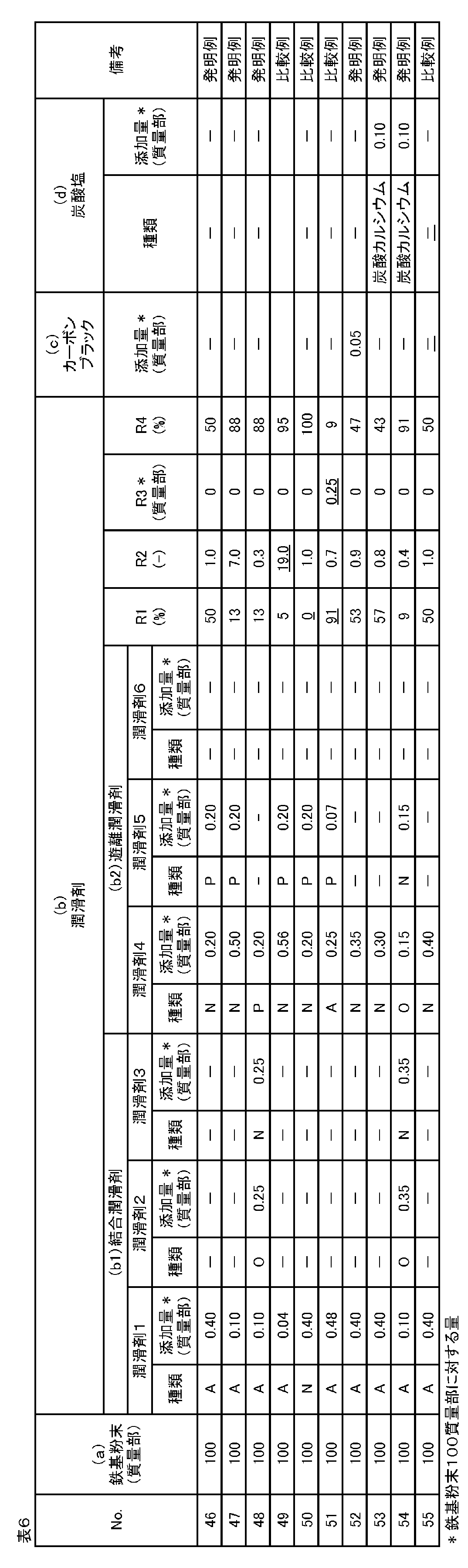
- the median diameter D50 of the alloy steel powder was 80 ⁇ m. Table 6 shows the amount of each component added to the mixed powder.
- the mixed powder of the invention example satisfying the conditions of the present invention had the fluidity of the mixed powder, the extractability at the time of molding, and the compressibility of the molded product.
- the mixed powder of the comparative example which does not satisfy the conditions of the present invention was inferior in the fluidity of the mixed powder, the extractability at the time of molding, and at least one of the molded products. From the results of Examples 1 and 2, it can be seen that the mixed powder satisfying the conditions of the present invention exerts an excellent effect regardless of whether the iron-based powder is iron powder or alloy steel powder. Similarly, it can be seen that the mixed powder satisfying the conditions of the present invention exerts an excellent effect regardless of the presence or absence of the alloy powder.
- Example 3 A mixed powder for powder metallurgy was prepared in the same procedure as in Example 1. Table 8 shows the amount of each component added to the mixed powder.
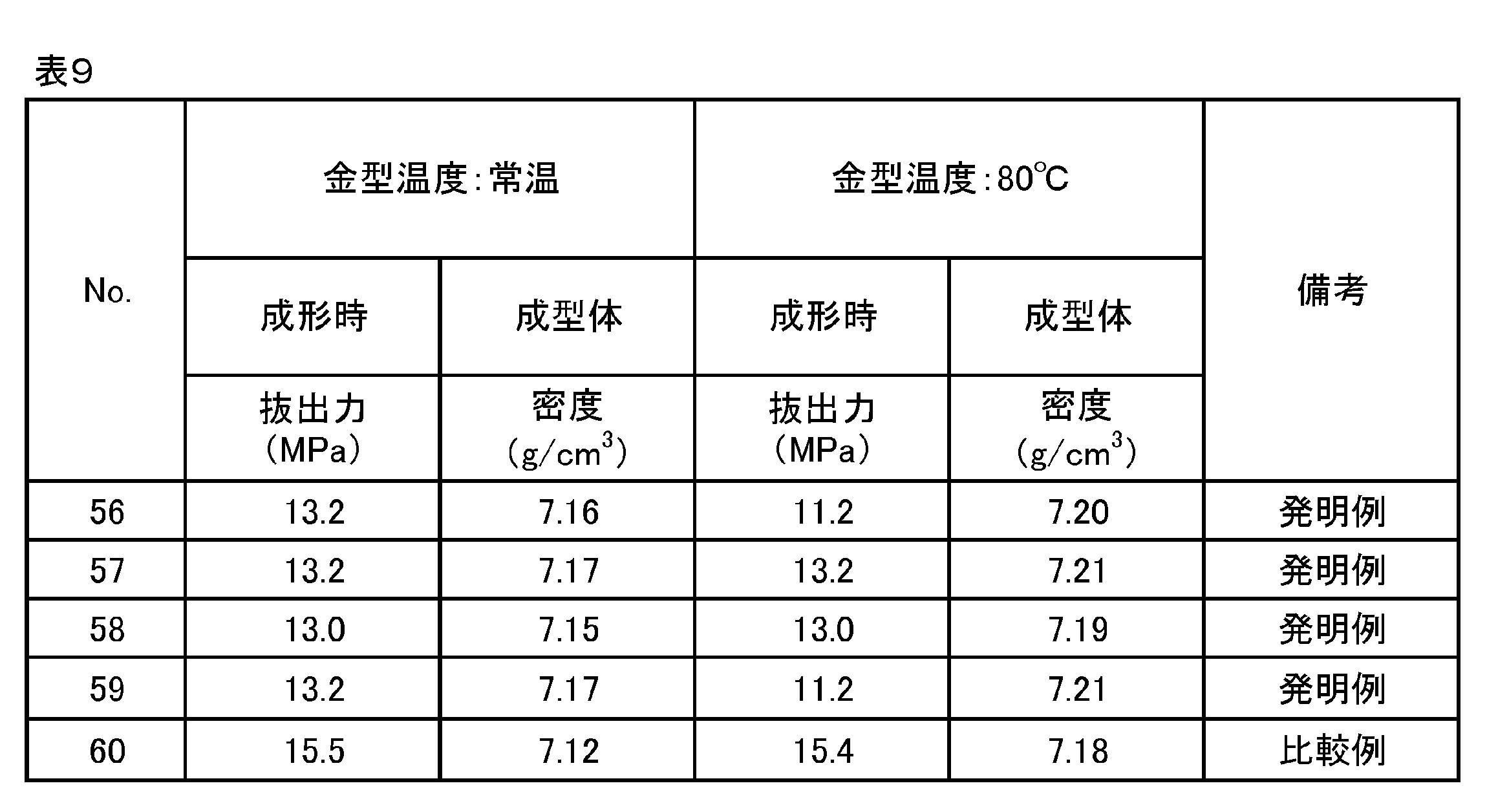
- the mixed powder of the invention example satisfying the conditions of the present invention was superior to the comparative example in both extractability and compressibility when the mold temperature was room temperature.
- N Compute Containing a fatty acid monoamide having a melting point of 80 ° C. or higher.
- N Compute. Contains 56 and fatty acids with a melting point of 75 ° C or higher.
- the mixed powder of 59 showed excellent extractability and compressibility even when the mold temperature was 80 ° C.
Landscapes
- Chemical & Material Sciences (AREA)
- Organic Chemistry (AREA)
- Chemical Kinetics & Catalysis (AREA)
- General Chemical & Material Sciences (AREA)
- Oil, Petroleum & Natural Gas (AREA)
- Health & Medical Sciences (AREA)
- Emergency Medicine (AREA)
- Engineering & Computer Science (AREA)
- Mechanical Engineering (AREA)
- Crystallography & Structural Chemistry (AREA)
- Inorganic Chemistry (AREA)
- Manufacturing & Machinery (AREA)
- Materials Engineering (AREA)
- Metallurgy (AREA)
- Powder Metallurgy (AREA)
- Lubricants (AREA)
Abstract
Description
前記(b)潤滑剤が脂肪酸金属石けんを含み、
前記(b)潤滑剤は、融点が86℃以下である低融点潤滑剤と融点が86℃超である高融点潤滑剤とからなり、
前記低融点潤滑剤は、アミド基、エステル基、アミノ基、およびカルボキシル基からなる群より選択される少なくとも1つを有し、
前記(b)潤滑剤の全体に対する前記低融点潤滑剤の割合として定義されるR1が5質量%以上90質量%未満であり、
前記(a)鉄基粉末の表面に付着している前記(b)潤滑剤を(b1)結合潤滑剤、前記(a)鉄基粉末の表面に付着していない前記(b)潤滑剤を(b2)遊離潤滑剤と定義したとき、
前記(b1)結合潤滑剤の質量に対する前記(b2)遊離潤滑剤の質量の比として定義されるR2が0以上15以下であり、
前記(b2)遊離潤滑剤として含まれる前記低融点潤滑剤の量R3が、鉄基粉末100質量部に対して0.10質量部未満である、粉末冶金用混合粉。
前記(b)潤滑剤が脂肪酸金属石けんを含まず、
前記(b)潤滑剤は、融点が86℃以下である低融点潤滑剤と融点が86℃超である高融点潤滑剤とからなり、
前記低融点潤滑剤は、アミド基、エステル基、アミノ基、およびカルボキシル基からなる群より選択される少なくとも1つを有し、
前記(b)潤滑剤の全体に対する前記低融点潤滑剤の割合として定義されるR1が5質量%以上90質量%未満であり、
前記(a)鉄基粉末の表面に付着している前記(b)潤滑剤を(b1)結合潤滑剤、前記(a)鉄基粉末の表面に付着していない前記(b)潤滑剤を(b2)遊離潤滑剤と定義したとき、
前記(b1)結合潤滑剤の質量に対する前記(b2)遊離潤滑剤の質量の比として定義されるR2が0以上15以下であり、
前記(b2)遊離潤滑剤として含まれる前記低融点潤滑剤の量R3が、鉄基粉末100質量部に対して0.10質量部未満である、粉末冶金用混合粉。
前記(b)潤滑剤の全体に対する前記融点が100℃以上である潤滑剤の割合として定義されるR4が10質量%以上である、上記1~3のいずれか一項に記載の粉末冶金用混合粉。
前記(b)潤滑剤に脂肪酸金属石けんが含まれない場合には、さらに、
(c)カーボンブラックおよび(d)炭酸塩の少なくとも一方を含有し、
前記(b)潤滑剤は、融点が86℃以下である低融点潤滑剤と融点が86℃超である高融点潤滑剤とからなり、
前記低融点潤滑剤は、アミド基、エステル基、アミノ基、およびカルボキシル基からなる群より選択される少なくとも1つを有し、
前記(b)潤滑剤の全体に対する前記低融点潤滑剤の割合として定義されるR1が5質量%以上90質量%未満であり、
前記(a)鉄基粉末の表面に付着している前記(b)潤滑剤を(b1)結合潤滑剤、前記(a)鉄基粉末の表面に付着していない前記(b)潤滑剤を(b2)遊離潤滑剤と定義したとき、
前記(b1)結合潤滑剤の質量に対する前記(b2)遊離潤滑剤の質量の比として定義されるR2が0以上15以下であり、
前記(b2)遊離潤滑剤として含まれる前記低融点潤滑剤の量R3が、鉄基粉末100質量部に対して0.10質量部未満である、粉末冶金用混合粉。
前記(b)潤滑剤が脂肪酸金属石けんを含み、
前記(b)潤滑剤は、融点が86℃以下である低融点潤滑剤と融点が86℃超である高融点潤滑剤とからなり、
前記低融点潤滑剤は、アミド基、エステル基、アミノ基、およびカルボキシル基からなる群より選択される少なくとも1つを有し、
前記(b)潤滑剤の全体に対する前記低融点潤滑剤の割合として定義されるR1が5質量%以上90質量%未満であり、
前記(b)潤滑剤は、前記(a)鉄基粉末の表面に付着している(b1)結合潤滑剤と、前記(a)鉄基粉末の表面に付着していない(b2)遊離潤滑剤とからなり、
前記(b2)遊離潤滑剤の質量に対する前記(b1)結合潤滑剤の質量の比として定義されるR2が0.10~9.0であり、
前記(b2)遊離潤滑剤として含まれる前記低融点潤滑剤の量R3が、鉄基粉末100質量部に対して0.10質量部未満である、粉末冶金用混合粉。
前記(b)潤滑剤が脂肪酸金属石けんを含まず、
前記(b)潤滑剤は、融点が86℃以下である低融点潤滑剤と融点が86℃超である高融点潤滑剤とからなり、
前記低融点潤滑剤は、アミド基、エステル基、アミノ基、およびカルボキシル基からなる群より選択される少なくとも1つを有し、
前記(b)潤滑剤の全体に対する前記低融点潤滑剤の割合として定義されるR1が5質量%以上90質量%未満であり、
前記(b)潤滑剤は、前記(a)鉄基粉末の表面に付着している(b1)結合潤滑剤と、前記(a)鉄基粉末の表面に付着していない(b2)遊離潤滑剤とからなり、
前記(b2)遊離潤滑剤の質量に対する前記(b1)結合潤滑剤の質量の比として定義されるR2が0.10~9.0であり、
前記(b2)遊離潤滑剤として含まれる前記低融点潤滑剤の量R3が、鉄基粉末100質量部に対して0.10質量部未満である、粉末冶金用混合粉。
前記(b)潤滑剤の全体に対する前記融点が100℃以上である潤滑剤の割合として定義されるR4が10質量%以上である、上記1~3のいずれか一項に記載の粉末冶金用混合粉。
(a)鉄基粉末および(b)潤滑剤を含有する粉末冶金用混合粉であって、
前記(b)潤滑剤に脂肪酸金属石けんが含まれない場合には、さらに、
(c)カーボンブラックおよび(d)炭酸塩の少なくとも一方を含有し、
前記(b)潤滑剤は、融点が86℃以下である低融点潤滑剤と融点が86℃超である高融点潤滑剤とからなり、
前記低融点潤滑剤は、アミド基、エステル基、アミノ基、およびカルボキシル基からなる群より選択される少なくとも1つを有し、
前記(b)潤滑剤の全体に対する前記低融点潤滑剤の割合として定義されるR1が5質量%以上90質量%未満であり、
前記(b)潤滑剤は、前記(a)鉄基粉末の表面に付着している(b1)結合潤滑剤と、前記(a)鉄基粉末の表面に付着していない(b2)遊離潤滑剤とからなり、
前記(b2)遊離潤滑剤の質量に対する前記(b1)結合潤滑剤の質量の比として定義されるR2が0.10~9.0であり、
前記(b2)遊離潤滑剤として含まれる前記低融点潤滑剤の量R3が、鉄基粉末100質量部に対して0.10質量部未満である、粉末冶金用混合粉。
(a)鉄基粉末
(b)潤滑剤
(c)カーボンブラック
(d)炭酸塩
(e)合金用粉末
(f)切削性改善剤
上記鉄基粉末としては、特に限定されることなく任意の鉄基粉末を用いることができる。前記鉄基粉末の例としては、鉄粉や合金鋼粉が挙げられる。前記合金鋼粉としては、例えば、予合金鋼粉(pre-alloyed steel powder)、部分拡散合金化鋼粉(partially diffusion-alloyed steel powder)、およびハイブリッド鋼粉(hybrid steel powder)からなる群より選択される少なくとも1つを用いることが好ましい。ここで、予合金鋼粉とは、合金元素を溶製時に予め合金化した合金鋼粉であり、完全合金化鋼粉とも称される。部分拡散合金化鋼粉とは、核としての鉄粉と、前記鉄粉の表面に付着した少なくとも1つの合金元素粒子からなり、前記鉄粉と前記合金元素粒子とが拡散接合している粉末を指す。また、ハイブリッド鋼粉とは、予合金化鋼粉の表面にさらに合金元素粒子を拡散付着させた粉末を指す。前記合金元素としては、例えば、C、Cu、Ni、Mo、Mn、Cr、V、及びSiからなる群より選択される1または2以上を用いることができる。
本発明で使用する潤滑剤は、融点が86℃以下である低融点潤滑剤と融点が86℃超である高融点潤滑剤とからなる。以下、前記低融点潤滑剤と高融点潤滑剤のそれぞれについて説明する。
本発明で使用する潤滑剤は、融点が86℃以下である潤滑剤(以下、「低融点潤滑剤」という)を必須成分として含有する。前記低融点潤滑剤を添加することにより、成形体を金型から抜き出す際の抜出力を低減することができる。
上述したように、前記低融点潤滑剤は、成形体を金型から抜き出す際の抜出力を低減する効果を有している。前記効果を得るためには、前記(b)潤滑剤の全体に対する前記低融点潤滑剤の割合として定義されるR1を5%以上とする必要がある。そのため、R1を5%以上、好ましくは10%以上とする。一方、前記低融点潤滑剤の割合が過剰となると、混合粉の流動性が低下する。そのため、R1を90%未満、好ましくは85%以下、より好ましくは80%以下とする。混合粉の流動性と成形体の抜出し性を両立させるためには、R1を5%以上90%未満とすることが重要である。なお、R1は下記の式で求めることができる。
R1(質量%)=(低融点潤滑剤の質量)/(潤滑剤の全質量)×100
前記(b1)結合潤滑剤の質量に対する前記(b2)遊離潤滑剤の質量の比として定義されるR2は0以上15以下とする。本発明の粉末冶金用混合粉は遊離潤滑剤を含んでいなくてもよく、したがってR2は0であってもよい。一方、R2が15より大きいと、該粉末冶金用混合粉の流動性が悪くなる。そのため、R2は15以下、好ましくは10.0以下とする。なお、R2は下記の式で求めることができる。
R2=(遊離潤滑剤の質量)/(結合潤滑剤の質量)
R5=1/R2=(結合潤滑剤の質量)/(遊離潤滑剤の質量)
上述したように、前記低融点潤滑剤は、成形体を金型から抜き出す際の抜出力を低減する効果を有している。しかし、前記低融点潤滑剤が遊離潤滑剤として存在している場合、該低融点潤滑剤は混合粉の流動性を低下させる。前記低融点潤滑剤の大部分を結合潤滑剤として存在させることにより流動性の低下を防止することができる。そのため、前記(b2)遊離潤滑剤として含まれる前記低融点潤滑剤の量R3を、鉄基粉末100質量部に対して0.10質量部未満とする。一方、R3は低ければ低いほどよいため下限は特に限定されず、R3は0質量部であってよい。
本発明で使用する潤滑剤は、融点が86℃以下である潤滑剤(低融点潤滑剤)を含有し、残部は、融点が86℃超である潤滑剤(以下、「高融点潤滑剤」という)である。すなわち、前記潤滑剤は、融点が86℃以下である低融点潤滑剤と融点が86℃超である高融点潤滑剤からなる。低融点潤滑剤に加えて高融点潤滑剤を用いることにより、混合粉の流動性を向上させることができる。
融点が100℃以上である潤滑剤を使用する場合、流動性向上効果をさらに高めるために、上記潤滑剤の全体に対する、前記融点が100℃以上である潤滑剤の割合として定義されるR4を、10%以上とすることが好ましい。
上述したように、上記潤滑剤は、任意に、高融点潤滑剤として脂肪酸金属石けんを含有することができる。すなわち、前記潤滑剤は、脂肪酸金属石けんを含んでいてもよく、含んでいなくてもよい。混合粉の流動性と抜出性を両立させるという観点からは、前記潤滑剤が脂肪酸金属石けんを含有することが好ましい。また、金属石けんは結合潤滑剤ではなく遊離潤滑剤として含まれることが好ましい。しかし、混合粉が脂肪酸亜鉛石けんを含有する場合、該混合粉を成型し、焼結する際に金属酸化物が生じ、炉や成形体の表面を汚染する。そのため、汚染を防止するという観点からは、前記潤滑剤は、脂肪酸金属石けんを含まないことが好ましい。
本発明の一実施形態における混合粉は、任意に、カーボンブラックおよび炭酸塩の少なくとも一方を含有することができる。カーボンブラックと炭酸塩は、いずれも、混合粉の流動性を向上させる作用を有する成分である。したがって、混合粉の流動性向上の観点からは、カーボンブラックおよび炭酸塩の少なくとも一方を添加することが好ましい。
カーボンブラックを用いる場合、該カーボンブラックの添加量は、鉄基粉末100質量部に対して0.01~3.0質量部とすることが好ましい。カーボンブラックの添加量が0.01質量部以上であれば、さらに高い流動性改善効果を得ることができる。一方、カーボンブラックの添加量が3.0質量部以下であれば、圧縮性および抜出し性の低下を防止し、より高い圧縮性および抜出し性を確保できる。
前記炭酸塩としては、任意の炭酸塩を用いることができる。入手のしやすさなどから、前記炭酸塩としては、金属炭酸塩を用いることが好ましく、アルカリ金属炭酸塩およびアルカリ土類金属炭酸塩からなる群より選択される少なくとも1つを用いることが好ましい。より具体的には、炭酸カルシウム、炭酸リチウム、炭酸ナトリウム、炭酸カリウム、および炭酸マグネシウムからなる群より選択される少なくとも1つを用いることが好ましい。
合金用粉末を含有する混合粉を焼結すると、合金元素が鉄に固溶して合金化する。そのため、合金用粉末を用いることにより、最終的に得られる焼結体の強度を向上させることができる。そのため、焼結体の強度を向上させるという観点からは、合金用粉末を添加することが好ましい。
切削性改善剤を添加することにより、最終的に得られる焼結体の切削性(加工性)を向上させることができる。そのため、焼結体の切削性を向上させるという観点からは、切削性改善剤を添加することが好ましい。
本発明の混合粉は、特に限定されず、任意の方法で製造することができる。本発明の一実施形態においては、上記各成分を、混合機を用いて混合することにより粉末冶金用混合粉末とすることができる。各成分の添加と混合は、1回で行うこともできるが、2回以上に分けて行うこともできる。
以下の手順で粉末冶金用混合粉を調製し、得られた粉末冶金用混合粉の特性と、該粉末冶金用混合粉を用いて作製した成型体の特性を評価した。
見掛密度は、JIS Z 2504に規定された方法に従い、直径2.5mmのオリフィスを有する漏斗を用いて評価した。具体的には、混合粉を直径2.5mmのオリフィスを有する漏斗を用いて容積既知の容器内に流し込むことにより自然充填し、その後、質量を測定した。得られた質量と、前記容器の容積から、前記混合粉の見掛密度を得た。
粉体の流動性は、JIS Z 2502に規定された方法に従って評価した。具体的には、直径2.5mmのオリフィスを有する漏斗を使用し、前記オリフィスから50gの混合粉が流れ落ちるまでの時間を測定し、その値を流動性の指標とした。なお、流動性が低すぎる結果、混合粉が流れ落ちなかったものについては、表4、5に「流れず」と記載した。
前記粉末冶金用混合粉を用いてJPMA P 13に規定された方法に従って、686MPaの成形圧力で直径11.3mm、高さ10mmの円柱状の成型体を作製した。このとき、成形体を金型から抜出す際の最大荷重を抜出力とした。抜出力が低いほど、抜出性が優れている。
前記成形体の密度をJIS Z 2508に規定された方法に従って測定した。前記密度は、得られた成形体の寸法と重量から算出した。この数値が高いほど、圧縮性が優れている。

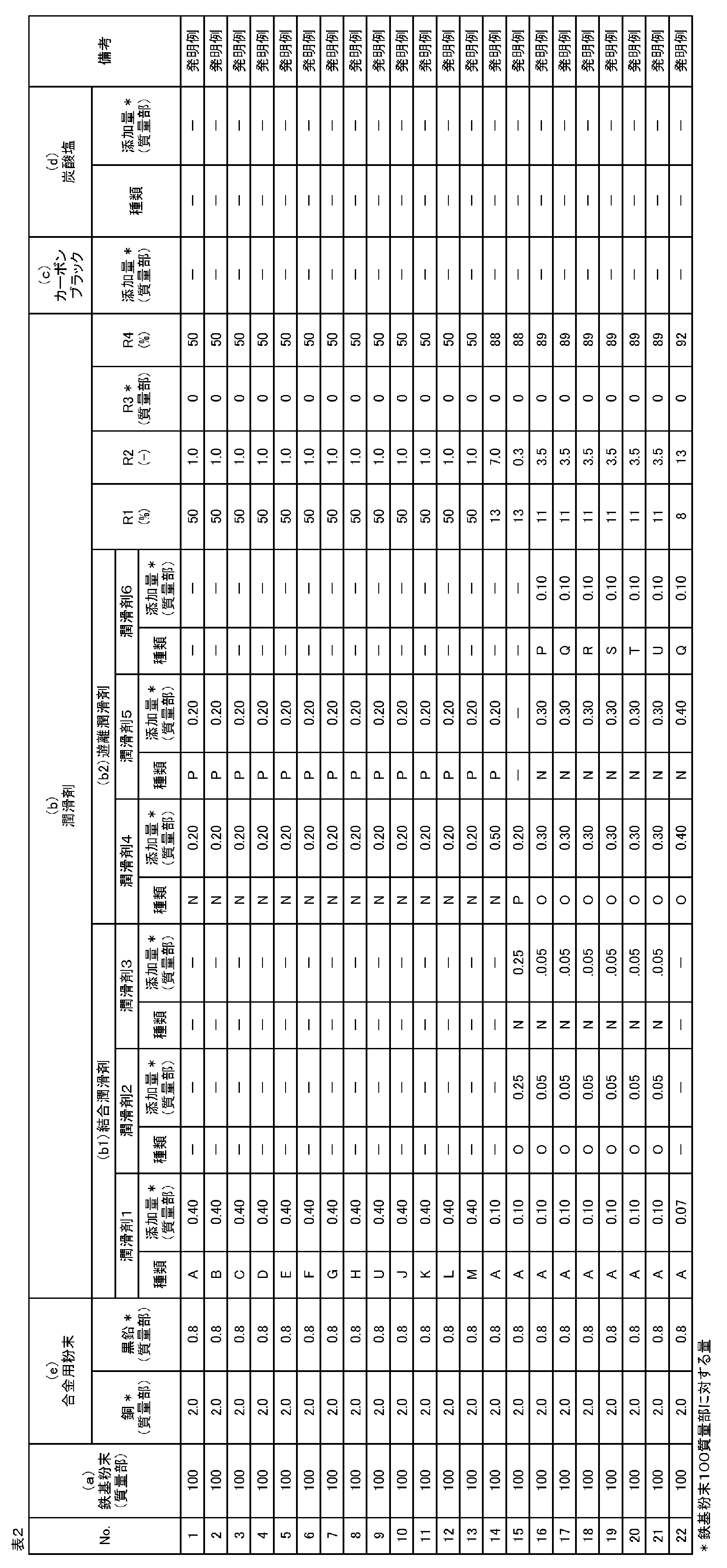
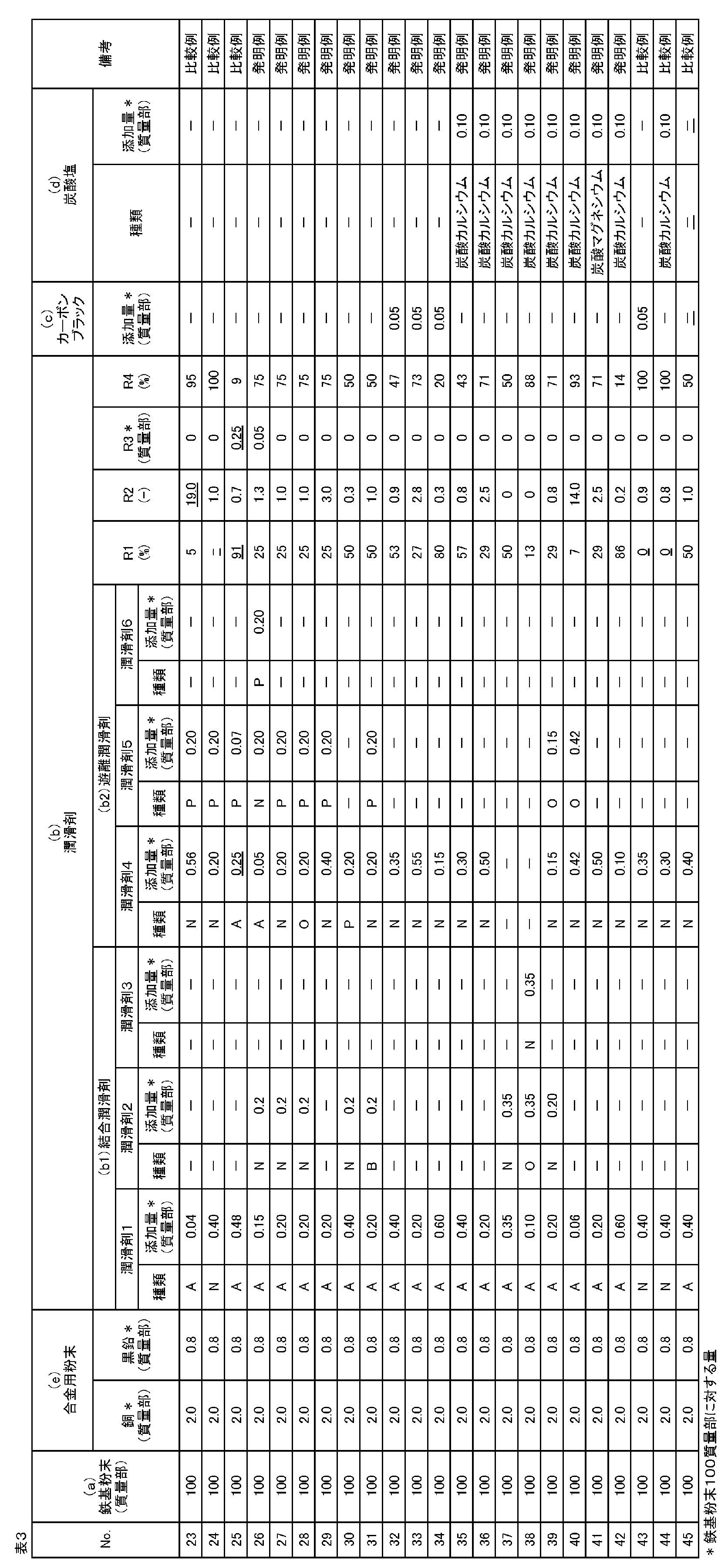
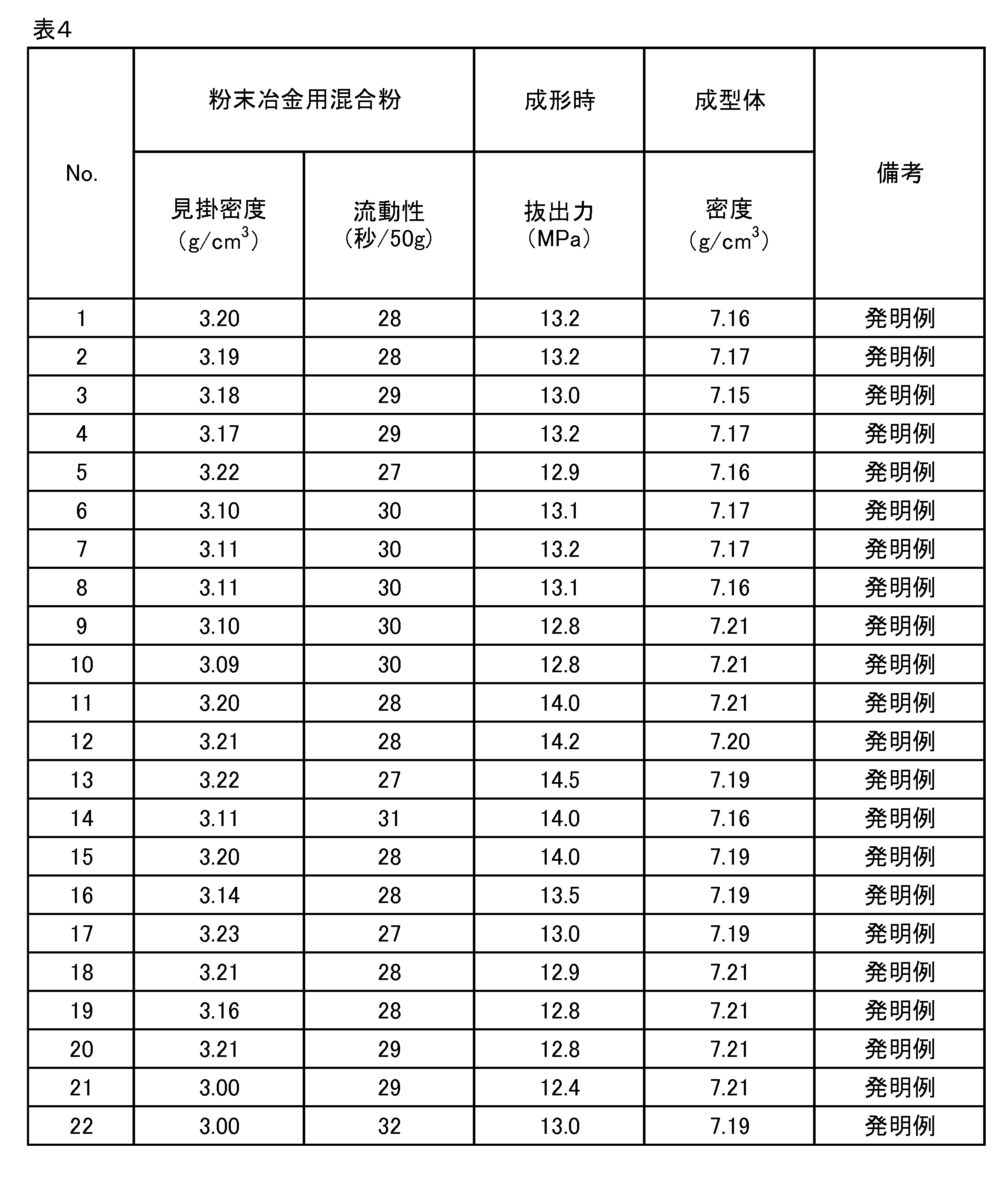

実施例1と同様の手順で粉末冶金用混合粉を調製し、得られた粉末冶金用混合粉の特性と、該粉末冶金用混合粉を用いて作製した成型体の特性を評価した。ただし、銅粉と黒鉛粉は使用しなかった。また、鉄基粉末としては、純鉄粉に代えて、アトマイズ法によって製造された合金鋼粉(JFEスチール株式会社製 JIPシグマロイ415S)を使用した。前記合金鋼粉は、鉄粉の表面にCuを拡散付着させた部分拡散合金化鋼粉である。前記合金鋼粉のメジアン径D50は80μmであった。混合粉に含まれる各成分の添加量を表6に示す。
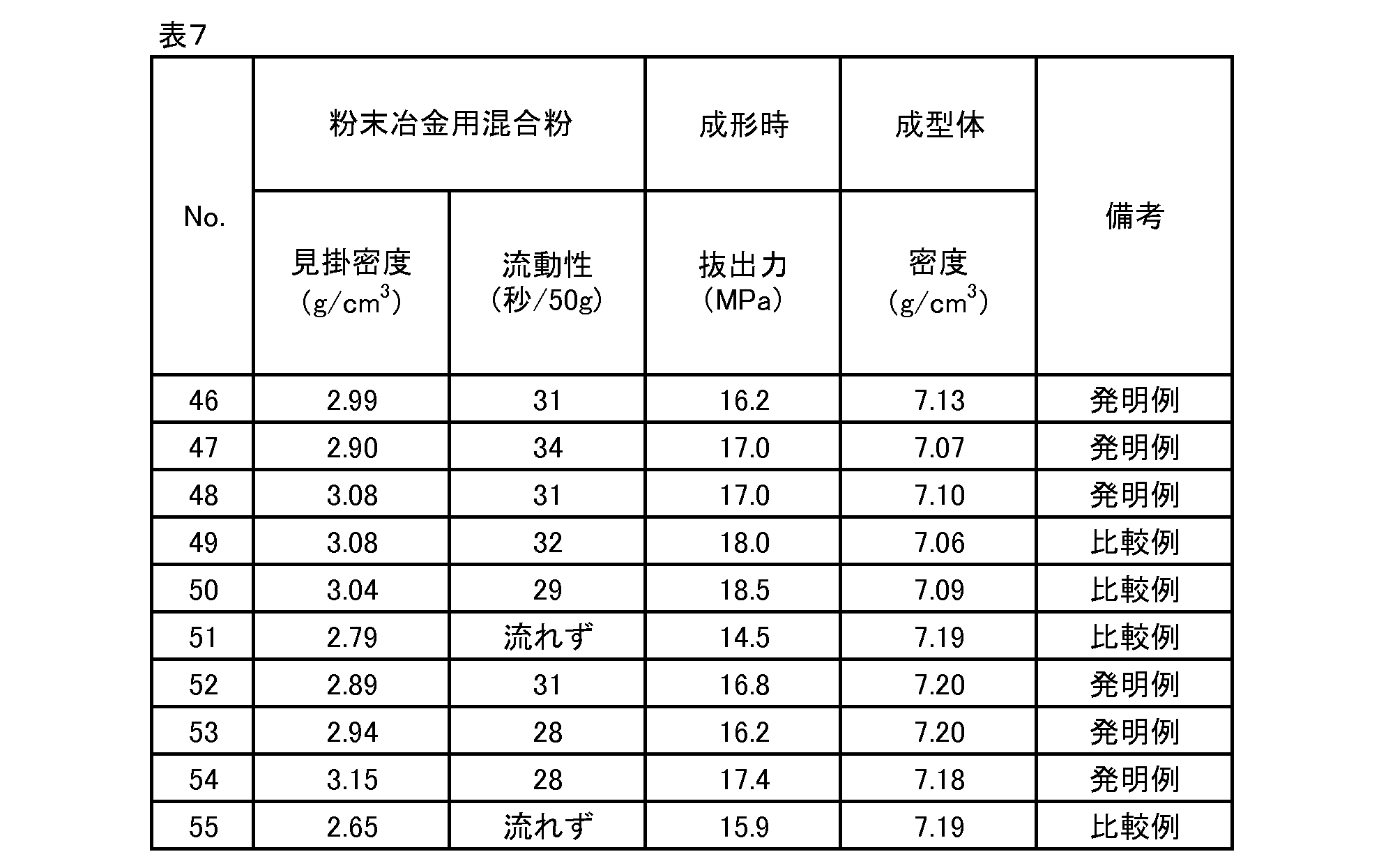
実施例1と同様の手順で粉末冶金用混合粉を調製した。混合粉に含まれる各成分の添加量を表8に示す。

Claims (8)
- (a)鉄基粉末および(b)潤滑剤を含有する粉末冶金用混合粉であって、
前記(b)潤滑剤が脂肪酸金属石けんを含み、
前記(b)潤滑剤は、融点が86℃以下である低融点潤滑剤と融点が86℃超である高融点潤滑剤とからなり、
前記低融点潤滑剤は、アミド基、エステル基、アミノ基、およびカルボキシル基からなる群より選択される少なくとも1つを有し、
前記(b)潤滑剤の全体に対する前記低融点潤滑剤の割合として定義されるR1が5質量%以上90質量%未満であり、
前記(a)鉄基粉末の表面に付着している前記(b)潤滑剤を(b1)結合潤滑剤、前記(a)鉄基粉末の表面に付着していない前記(b)潤滑剤を(b2)遊離潤滑剤と定義したとき、
前記(b1)結合潤滑剤の質量に対する前記(b2)遊離潤滑剤の質量の比として定義されるR2が0以上15以下であり、
前記(b2)遊離潤滑剤として含まれる前記低融点潤滑剤の量R3が、鉄基粉末100質量部に対して0.10質量部未満である、粉末冶金用混合粉。 - (a)鉄基粉末と、(b)潤滑剤と、(c)カーボンブラックおよび(d)炭酸塩の少なくとも一方を含有する粉末冶金用混合粉であって、
前記(b)潤滑剤が脂肪酸金属石けんを含まず、
前記(b)潤滑剤は、融点が86℃以下である低融点潤滑剤と融点が86℃超である高融点潤滑剤とからなり、
前記低融点潤滑剤は、アミド基、エステル基、アミノ基、およびカルボキシル基からなる群より選択される少なくとも1つを有し、
前記(b)潤滑剤の全体に対する前記低融点潤滑剤の割合として定義されるR1が5質量%以上90質量%未満であり、
前記(a)鉄基粉末の表面に付着している前記(b)潤滑剤を(b1)結合潤滑剤、前記(a)鉄基粉末の表面に付着していない前記(b)潤滑剤を(b2)遊離潤滑剤と定義したとき、
前記(b1)結合潤滑剤の質量に対する前記(b2)遊離潤滑剤の質量の比として定義されるR2が0以上15以下であり、
前記(b2)遊離潤滑剤として含まれる前記低融点潤滑剤の量R3が、鉄基粉末100質量部に対して0.10質量部未満である、粉末冶金用混合粉。 - 前記(b1)結合潤滑剤および(b2)遊離潤滑剤が、炭素数11以上のアルキル基および炭素数11以上のアルケニル基の少なくとも一方を有する脂肪酸誘導体を含む、請求項1または2に記載の粉末冶金用混合粉。
- 前記高融点潤滑剤として、融点が100℃以上である潤滑剤を含有し、
前記(b)潤滑剤の全体に対する前記融点が100℃以上である潤滑剤の割合として定義されるR4が10質量%以上である、請求項1~3のいずれか一項に記載の粉末冶金用混合粉。 - 前記高融点潤滑剤が、脂肪酸アミド、脂肪酸金属石けん、およびそれらの混合物からなる群より選択される少なくとも1つである、請求項1~4のいずれか一項に記載の粉末冶金用混合粉。
- 前記低融点潤滑剤が不飽和結合を含む脂肪鎖を有するモノアミドである、請求項1~5のいずれか一項に記載の粉末冶金用混合粉。
- (e)合金用粉末および(f)切削性改善剤の一方または両方をさらに含有する、請求項1~6のいずれか一項に記載の粉末冶金用混合粉。
- 前記(e)合金用粉末および(f)切削性改善剤の一方または両方が、前記(b1)結合潤滑剤によって前記(a)鉄基粉末の表面に付着している、請求項7に記載の粉末冶金用混合粉。
Priority Applications (6)
| Application Number | Priority Date | Filing Date | Title |
|---|---|---|---|
| EP20794985.0A EP3960331A4 (en) | 2019-04-23 | 2020-01-28 | MIXED POWDER FOR POWDER METALLURGY |
| KR1020217034405A KR102533367B1 (ko) | 2019-04-23 | 2020-01-28 | 분말 야금용 혼합분 |
| CN202080030305.0A CN113710392B (zh) | 2019-04-23 | 2020-01-28 | 粉末冶金用混合粉 |
| US17/594,561 US12187976B2 (en) | 2019-04-23 | 2020-01-28 | Mixed powder for powder metallurgy |
| CA3134580A CA3134580C (en) | 2019-04-23 | 2020-01-28 | Mixed powder for powder metallurgy |
| JP2020515265A JP6874905B2 (ja) | 2019-04-23 | 2020-01-28 | 粉末冶金用混合粉 |
Applications Claiming Priority (4)
| Application Number | Priority Date | Filing Date | Title |
|---|---|---|---|
| JP2019082258 | 2019-04-23 | ||
| JP2019-082258 | 2019-04-23 | ||
| JPPCT/JP2019/028551 | 2019-07-19 | ||
| PCT/JP2019/028551 WO2020217551A1 (ja) | 2019-04-23 | 2019-07-19 | 粉末冶金用混合粉 |
Publications (1)
| Publication Number | Publication Date |
|---|---|
| WO2020217618A1 true WO2020217618A1 (ja) | 2020-10-29 |
Family
ID=72942344
Family Applications (2)
| Application Number | Title | Priority Date | Filing Date |
|---|---|---|---|
| PCT/JP2019/028551 Ceased WO2020217551A1 (ja) | 2019-04-23 | 2019-07-19 | 粉末冶金用混合粉 |
| PCT/JP2020/003003 Ceased WO2020217618A1 (ja) | 2019-04-23 | 2020-01-28 | 粉末冶金用混合粉 |
Family Applications Before (1)
| Application Number | Title | Priority Date | Filing Date |
|---|---|---|---|
| PCT/JP2019/028551 Ceased WO2020217551A1 (ja) | 2019-04-23 | 2019-07-19 | 粉末冶金用混合粉 |
Country Status (7)
| Country | Link |
|---|---|
| US (1) | US12187976B2 (ja) |
| EP (1) | EP3960331A4 (ja) |
| JP (2) | JPWO2020217551A1 (ja) |
| KR (1) | KR102533367B1 (ja) |
| CN (1) | CN113710392B (ja) |
| CA (1) | CA3134580C (ja) |
| WO (2) | WO2020217551A1 (ja) |
Cited By (2)
| Publication number | Priority date | Publication date | Assignee | Title |
|---|---|---|---|---|
| WO2025187125A1 (ja) * | 2024-03-07 | 2025-09-12 | Jfeスチール株式会社 | 粉末冶金用混合粉 |
| WO2025216016A1 (ja) * | 2024-04-12 | 2025-10-16 | Jfeスチール株式会社 | 粉末冶金用鉄基混合粉及び鉄基圧粉体 |
Families Citing this family (1)
| Publication number | Priority date | Publication date | Assignee | Title |
|---|---|---|---|---|
| JP7764820B2 (ja) * | 2022-09-05 | 2025-11-06 | Jfeスチール株式会社 | 粉末冶金用混合粉 |
Citations (8)
| Publication number | Priority date | Publication date | Assignee | Title |
|---|---|---|---|---|
| JPH10280005A (ja) * | 1997-04-14 | 1998-10-20 | Kawasaki Steel Corp | 粉末冶金用鉄基粉末混合物及びその製造方法 |
| JPH10317001A (ja) * | 1997-03-19 | 1998-12-02 | Kawasaki Steel Corp | 流動性と成形性に優れた粉末冶金用鉄基粉末混合物、その製造方法および成形体の製造方法 |
| JP2003509581A (ja) | 1999-09-10 | 2003-03-11 | ホガナス アクチボラゲット | 潤滑剤複合材料及びその製造方法 |
| JP2005307348A (ja) | 2004-03-22 | 2005-11-04 | Jfe Steel Kk | 粉末冶金用鉄基粉末混合物 |
| WO2009035119A1 (ja) * | 2007-09-14 | 2009-03-19 | Jfe Steel Corporation | 粉末冶金用鉄基粉末 |
| JP2010059517A (ja) * | 2008-09-05 | 2010-03-18 | Jfe Steel Corp | 粉末冶金用鉄基混合粉末 |
| JP2011184708A (ja) | 2010-03-04 | 2011-09-22 | Kobe Steel Ltd | 粉末冶金用混合粉末 |
| JP2012167302A (ja) * | 2011-02-10 | 2012-09-06 | Hitachi Powdered Metals Co Ltd | 粉末冶金用粉末混合物およびその製造方法 |
Family Cites Families (8)
| Publication number | Priority date | Publication date | Assignee | Title |
|---|---|---|---|---|
| US5279640A (en) * | 1992-09-22 | 1994-01-18 | Kawasaki Steel Corporation | Method of making iron-based powder mixture |
| EP0853994B1 (en) * | 1996-08-05 | 2004-10-06 | JFE Steel Corporation | Iron-base powder mixture for powder metallurgy having excellent fluidity and moldability and process for preparing the same |
| EP0913220B1 (en) | 1997-03-19 | 2008-12-10 | JFE Steel Corporation | Iron base powder mixture for powder metallurgy excellent in fluidity and moldability |
| JP3873547B2 (ja) * | 1999-04-08 | 2007-01-24 | Jfeスチール株式会社 | 粉末冶金用鉄基混合粉 |
| JP2004002964A (ja) * | 2002-04-01 | 2004-01-08 | Jfe Steel Kk | 鉄基粉末混合物 |
| JP4730700B2 (ja) * | 2004-12-21 | 2011-07-20 | 株式会社ダイヤメット | 粉末焼結品の製造方法 |
| JP4967906B2 (ja) | 2007-08-01 | 2012-07-04 | 日産自動車株式会社 | 車室後部の収納構造 |
| KR20160133015A (ko) * | 2008-11-26 | 2016-11-21 | 회가내스 아베 (피유비엘) | 분말 야금학적 조성물용 윤활제 |
-
2019
- 2019-07-19 WO PCT/JP2019/028551 patent/WO2020217551A1/ja not_active Ceased
- 2019-07-19 JP JP2019546424A patent/JPWO2020217551A1/ja not_active Withdrawn
-
2020
- 2020-01-28 CA CA3134580A patent/CA3134580C/en active Active
- 2020-01-28 EP EP20794985.0A patent/EP3960331A4/en active Pending
- 2020-01-28 WO PCT/JP2020/003003 patent/WO2020217618A1/ja not_active Ceased
- 2020-01-28 US US17/594,561 patent/US12187976B2/en active Active
- 2020-01-28 JP JP2020515265A patent/JP6874905B2/ja active Active
- 2020-01-28 CN CN202080030305.0A patent/CN113710392B/zh active Active
- 2020-01-28 KR KR1020217034405A patent/KR102533367B1/ko active Active
Patent Citations (8)
| Publication number | Priority date | Publication date | Assignee | Title |
|---|---|---|---|---|
| JPH10317001A (ja) * | 1997-03-19 | 1998-12-02 | Kawasaki Steel Corp | 流動性と成形性に優れた粉末冶金用鉄基粉末混合物、その製造方法および成形体の製造方法 |
| JPH10280005A (ja) * | 1997-04-14 | 1998-10-20 | Kawasaki Steel Corp | 粉末冶金用鉄基粉末混合物及びその製造方法 |
| JP2003509581A (ja) | 1999-09-10 | 2003-03-11 | ホガナス アクチボラゲット | 潤滑剤複合材料及びその製造方法 |
| JP2005307348A (ja) | 2004-03-22 | 2005-11-04 | Jfe Steel Kk | 粉末冶金用鉄基粉末混合物 |
| WO2009035119A1 (ja) * | 2007-09-14 | 2009-03-19 | Jfe Steel Corporation | 粉末冶金用鉄基粉末 |
| JP2010059517A (ja) * | 2008-09-05 | 2010-03-18 | Jfe Steel Corp | 粉末冶金用鉄基混合粉末 |
| JP2011184708A (ja) | 2010-03-04 | 2011-09-22 | Kobe Steel Ltd | 粉末冶金用混合粉末 |
| JP2012167302A (ja) * | 2011-02-10 | 2012-09-06 | Hitachi Powdered Metals Co Ltd | 粉末冶金用粉末混合物およびその製造方法 |
Cited By (3)
| Publication number | Priority date | Publication date | Assignee | Title |
|---|---|---|---|---|
| WO2025187125A1 (ja) * | 2024-03-07 | 2025-09-12 | Jfeスチール株式会社 | 粉末冶金用混合粉 |
| JPWO2025187125A1 (ja) * | 2024-03-07 | 2025-09-12 | ||
| WO2025216016A1 (ja) * | 2024-04-12 | 2025-10-16 | Jfeスチール株式会社 | 粉末冶金用鉄基混合粉及び鉄基圧粉体 |
Also Published As
| Publication number | Publication date |
|---|---|
| CN113710392B (zh) | 2023-08-08 |
| US20230158565A1 (en) | 2023-05-25 |
| CN113710392A (zh) | 2021-11-26 |
| US12187976B2 (en) | 2025-01-07 |
| CA3134580C (en) | 2023-08-22 |
| JPWO2020217551A1 (ja) | 2021-05-06 |
| EP3960331A1 (en) | 2022-03-02 |
| KR20210140820A (ko) | 2021-11-23 |
| JPWO2020217618A1 (ja) | 2021-05-06 |
| JP6874905B2 (ja) | 2021-05-19 |
| EP3960331A4 (en) | 2022-05-18 |
| KR102533367B1 (ko) | 2023-05-16 |
| WO2020217551A1 (ja) | 2020-10-29 |
| CA3134580A1 (en) | 2020-10-29 |
Similar Documents
| Publication | Publication Date | Title |
|---|---|---|
| JP6874905B2 (ja) | 粉末冶金用混合粉 | |
| JP3004800B2 (ja) | 粉末冶金用鉄基粉末混合物及びその製造方法 | |
| JP7501521B2 (ja) | 潤滑剤、粉末混合物及び焼結体の製造方法 | |
| JP2022090488A (ja) | 粉末冶金用混合粉 | |
| JP6877375B2 (ja) | 粉末冶金用混合粉 | |
| JP6760495B2 (ja) | 粉末冶金用混合粉 | |
| JP6680422B1 (ja) | 粉末冶金用混合粉および粉末冶金用潤滑剤 | |
| JP7764820B2 (ja) | 粉末冶金用混合粉 | |
| JP7673706B2 (ja) | 粉末冶金用鉄基混合粉、鉄基焼結体、および焼結機械部品 | |
| WO2025187125A1 (ja) | 粉末冶金用混合粉 | |
| JP7683689B2 (ja) | 潤滑剤の組み合わせ、粉末混合物、粉末混合物用原料の組み合わせ及び焼結体の製造方法 | |
| JPH09263802A (ja) | 粉末冶金用鉄基粉末混合物及びその製造方法 |
Legal Events
| Date | Code | Title | Description |
|---|---|---|---|
| ENP | Entry into the national phase |
Ref document number: 2020515265 Country of ref document: JP Kind code of ref document: A |
|
| 121 | Ep: the epo has been informed by wipo that ep was designated in this application |
Ref document number: 20794985 Country of ref document: EP Kind code of ref document: A1 |
|
| ENP | Entry into the national phase |
Ref document number: 3134580 Country of ref document: CA |
|
| ENP | Entry into the national phase |
Ref document number: 20217034405 Country of ref document: KR Kind code of ref document: A |
|
| NENP | Non-entry into the national phase |
Ref country code: DE |
|
| ENP | Entry into the national phase |
Ref document number: 2020794985 Country of ref document: EP Effective date: 20211123 |