WO2020209301A1 - ナトリウム含有穀類茶飲料 - Google Patents
ナトリウム含有穀類茶飲料 Download PDFInfo
- Publication number
- WO2020209301A1 WO2020209301A1 PCT/JP2020/015858 JP2020015858W WO2020209301A1 WO 2020209301 A1 WO2020209301 A1 WO 2020209301A1 JP 2020015858 W JP2020015858 W JP 2020015858W WO 2020209301 A1 WO2020209301 A1 WO 2020209301A1
- Authority
- WO
- WIPO (PCT)
- Prior art keywords
- sodium
- beverage
- acid
- taste
- cereal
- Prior art date
- Legal status (The legal status is an assumption and is not a legal conclusion. Google has not performed a legal analysis and makes no representation as to the accuracy of the status listed.)
- Ceased
Links
Classifications
-
- A—HUMAN NECESSITIES
- A23—FOODS OR FOODSTUFFS; TREATMENT THEREOF, NOT COVERED BY OTHER CLASSES
- A23L—FOODS, FOODSTUFFS OR NON-ALCOHOLIC BEVERAGES, NOT OTHERWISE PROVIDED FOR; PREPARATION OR TREATMENT THEREOF
- A23L2/00—Non-alcoholic beverages; Dry compositions or concentrates therefor; Preparation or treatment thereof
- A23L2/38—Other non-alcoholic beverages
-
- A—HUMAN NECESSITIES
- A23—FOODS OR FOODSTUFFS; TREATMENT THEREOF, NOT COVERED BY OTHER CLASSES
- A23L—FOODS, FOODSTUFFS OR NON-ALCOHOLIC BEVERAGES, NOT OTHERWISE PROVIDED FOR; PREPARATION OR TREATMENT THEREOF
- A23L2/00—Non-alcoholic beverages; Dry compositions or concentrates therefor; Preparation or treatment thereof
- A23L2/52—Adding ingredients
- A23L2/68—Acidifying substances
Definitions
- the present invention relates to a beverage containing a cereal extract, an electrolyte and an organic acid. More specifically, the present invention relates to a beverage containing a grain extract and an electrolyte capable of supplying sodium ions, and containing one or more hydroxycarboxylic acids selected from gluconic acid, citric acid, and ascorbic acid as organic acids.
- Heat stroke has traditionally occurred frequently due to exercise and work in a high temperature environment, but recently it has been increasing in daily life due to the effects of the heat island phenomenon and global warming. According to the website of the Ministry of Health, Labor and Welfare of Japan, as a measure against heat stroke, it is desirable to take about 1 to 2 cups of water every 20 to 30 minutes, and to take not only water but also salt. There is.
- a sports drink is usually an acidic drink having a pH of 4.0 or less containing a sweetener, fruit juice, or the like. Beverages containing sweeteners with a pH of 4.0 or less and / or fruit juice have an appropriate sweetness and sourness, thereby masking the taste caused by minerals such as saltiness, and have a good balance between aftertaste, refreshing feeling, and ease of drinking. It has improved and the palatability has been improved (Patent Document 1).
- barley tea beverages have physiological effects such as lowering body temperature and improving blood flow, so demand is increasing as a hydration beverage during the hot summer season and the dry winter season.
- Healthy barley tea (Patent Document 2) in which the concentrations of potassium, sodium, calcium, and magnesium ions are set to a specific ratio, and the sodium ion concentration in beverages is kept low, the pH is adjusted to a specific range, and grains other than wheat are extracted.
- Patent Document 3 There have been reports of barley tea beverages (Patent Document 3) and the like in which horny tastes such as bitterness and astringency derived from roasted barley are alleviated by mixing the substances to give a mellow taste.
- JP-A-2015-211652 Japanese Unexamined Patent Publication No. 62-83847 Japanese Unexamined Patent Publication No. 2015-008704
- Cereal tea beverages such as barley tea beverages are beverages that are popular for their roasted aroma and refreshing taste.
- the horny taste such as bitterness and astringency derived from roasted cereals is enhanced, the drinkability is lowered, and the beverage is used as a hydration beverage. It turned out to be an unsuitable beverage.
- An object of the present invention is to provide a cereal tea beverage having high drinkability, which contains a high concentration of sodium.
- the present inventors have reduced the chloride ion concentration and contained a specific amount of hydroxycarboxylic acid in a cereal tea beverage containing sodium to obtain sodium.
- the present invention is not limited to this, but relates to the following.
- a cereal tea beverage having high drinkability as a beverage for heat stroke countermeasures and a beverage for supplementing water and sodium during exercise (including during light exercise).
- the cereal tea in the present specification refers to a beverage containing an extract of roasted cereals extracted from roasted cereal grains as a raw material by an aqueous solvent.
- the term "cereal” refers to edible seeds mainly composed of starch, and includes not only edible seeds of rice crops but also edible seeds of legume crops, buckwheat, sesame and the like.
- the cereals used as raw materials may be cereals that can be used as beverages.
- rice roasted rice, brown rice, etc.
- wheat barley, hadaka wheat, etc.
- pigeon barley e.g., buckwheat (Japanese buckwheat, buckwheat seeds, etc.) Seeds), sesame, buckwheat / black beans, corn, malt, etc., and one or more of these can be used.
- the preparation and roasting of cereal grains as a raw material for cereal tea may be carried out by a conventional method.
- the beverage is prepared mainly by roasted wheat and / or adlay extract among the above cereals. It can be said that doing so is an example of a preferable embodiment because these roasted extracts have physiological effects such as lowering body temperature and improving blood flow.
- a beverage containing a roasted extract of barley and / or adlay as a main component is "barley" (roasted) in the raw material labeling method specified by the Japanese Food Labeling Law (enforced in April 2015). Beverages in which barley or adlay such as "barley”) and "adlay" are listed at the top.
- wheat or adlay is the first or second beverage listed in the raw material label, and more preferably the beverage is listed first.
- the roasting machine and roasting method are not particularly limited.
- Typical roasting machines include continuous flow roasting machines and rotary drum type roasting machines.
- the roasting method includes methods such as open flame, hot air, far infrared rays, and microwaves, if classified according to the heating method.
- the extraction method of the roasted cereal raw material is not particularly limited, and any method such as a dipping (kneader extraction) method or a watering (column extraction) method may be used.
- the extraction solvent is not particularly limited as long as it is a drinkable solvent suitable for extraction, but is preferably an aqueous solvent, and water can be used most conveniently.
- the water may be of a water quality that can be used for processing foods, for example, distilled water, desalted water, alkaline ionized water, deep ocean water, ion-exchanged water, deoxidized water, or water-soluble organic compounds (eg, alcohol). Class) and / or water containing inorganic salts and the like can be used. Pure water is preferably used.
- the amount of the extraction solvent used varies depending on the type of the cereal raw material, the type of the extraction solvent, the extraction temperature, the desired preference, and the like, but is usually about 5 to 500 parts by weight based on the weight of the cereal raw material.
- the temperature of the extraction solvent at the time of extraction is preferably high in order to bring out the fragrant roasted aroma of cereals, and specifically, it is about 60 to 100 ° C, preferably about 80 to 100 ° C.
- the extraction time is 3 to 60 minutes, preferably 5 to 30 minutes.
- an extract (cereal tea) is obtained by using a known solid-liquid separation means, for example, filtration or centrifugation.
- the extract may be used as a liquid as it is, or may be concentrated or dried in the form of a concentrated solution or a solid (powder or the like).
- the sodium-containing cereal tea beverage of the present invention is a beverage obtained by alleviating horny tastes such as bitterness and astringency derived from roasted cereals enhanced by sodium to give a mellow taste.
- the beverage of the present invention contains pyrazines derived from roasted cereals as one of the components forming a horny taste.
- the "horny taste” in the present invention represents a taste that directly stimulates the oral cavity or tongue, which is tingling or irritating.
- the pyrazines in the present invention refer to pyrazine, methylpyrazine, 2,5-dimethylpyrazine, 2,6-dimethylpyrazine, ethylpyrazine, and 2,3-dimethylpyrazine, and the pyrazine concentration is the sum of these 6 components. It means the content.
- the content of pyrazines in the beverage can be measured by gas chromatography / mass spectrometry (GC / MS method).
- the pyrazine content in the cereal tea beverage of the present invention is 250 ppb or more, preferably 500 ppb or more. Beverages with a pyrazine content of less than 250 ppb do not have a horny taste even when a high concentration of sodium is added, so that the problem of the present invention does not occur.
- the upper limit of pyrazines is 2500 ppb or less, preferably 2000 ppb or less, more preferably 1500 ppb or less, more preferably 1000 ppb or less, and more preferably 940 ppb or less. If the amount of pyrazines is more than 2500 ppb, the effect of the present invention may not be sufficiently obtained.
- the beverage of the present invention is a beverage useful for measures against heat stroke and supplementation of water and sodium during light exercise, and contains a high concentration of sodium.
- Examples of the method of adding sodium to the beverage include a method of adding sodium to the beverage in the form of a sodium salt.
- the sodium salt may be a drinkable sodium salt, for example, sodium chloride, disodium citrate, trisodium citrate, sodium L-ascorbate, sodium gluconate, sodium L-aspartate, sodium benzoate, Sodium hydrogen carbonate, trisodium phosphate and the like can be used, but are not limited thereto.
- disodium citrate, trisodium citrate, sodium L-ascorbate, and / or sodium gluconate is used.
- the concentration of sodium in the beverage of the present invention is 20 to 80 mg / 100 ml. If the sodium concentration is too low, it is insufficient to replenish the water and salt lost by sweating.
- the lower limit of the sodium concentration is preferably 22 mg / 100 ml or more, more preferably 24 mg / 100 ml or more. If the sodium concentration is too high, the effect of the present invention is difficult to be exhibited, so the concentration should be 80 mg / 100 ml or less. It is preferably 70 mg / 100 ml or less, and more preferably 60 mg / 100 ml or less.
- the sodium concentration in the beverage can be analyzed using an atomic absorption spectrophotometer. When blended as a sodium salt, it can be calculated as the content of sodium element.
- chloride ion (Chloride ion) According to the studies by the present inventors, when the chloride ion (Cl ⁇ ) concentration in the beverage is high, the effect of suppressing the bitterness and astringency derived from roasted cereals by the specific hydroxycarboxylic acid described later is inhibited. On the other hand, it has been found that when the chloride ion concentration is suppressed below a specific range, the above-mentioned inhibitory effect is enhanced. Therefore, it is important to control the chloride ion content in the beverage of the present invention to be 30 mg / 100 ml or less.
- the chloride ion content in the beverage of the present invention is more preferably 25 mg / 100 ml or less, further preferably 20 mg / 100 ml or less, further preferably 15 mg / 100 ml or less, still more preferably 10 mg / 100 ml or less.
- a beverage that does not use chloride such as sodium chloride can be mentioned.
- the chloride ion concentration in the beverage can be analyzed by the silver nitrate titration method. Further, when blended as a chloride, it can be calculated as the content of the chlorine element in the chloride.
- the beverage of the present invention contains a specific hydroxycarboxylic acid, a lactone thereof or a salt thereof in order to alleviate the "horny taste" formed by pyrazines and a high concentration of sodium to make the taste soft.
- the specific hydroxycarboxylic acid specifically refers to gluconic acid, citric acid, and ascorbic acid. These can be used alone or in combination of two or more. It is preferable to use two or more kinds in combination because the taste becomes more mellow.
- the salt include alkali metal salts, alkaline earth metal salts, and ammonium salts. Among them, alkali metal salts are preferable, and sodium salts and potassium salts are particularly preferable.
- the cereal tea beverage of the present invention contains one or more hydroxycarboxylic acids selected from gluconic acid, citric acid, and ascorbic acid, and the total concentration thereof is 20 to 800 mg / 100 ml. If the total concentration of the above-mentioned specific hydroxycarboxylic acids is less than the above range, it may not be possible to obtain a sufficient effect for improving the horny taste of cereal tea.
- the lower limit of the total concentration of the hydroxycarboxylic acid is preferably 30 mg / 100 ml or more, and more preferably 40 mg / 100 ml or more.
- the upper limit of hydroxycarboxylic acid is preferably 700 mg / 100 ml or less from the viewpoint of effect and flavor. It is more preferably 600 mg / 100 ml or less, and particularly preferably 500 mg / 100 ml or less.
- Hydroxycarboxylic acid concentrations in beverages can be analyzed using high performance liquid chromatography (HPLC) with ion exclusion chromatography as the separation mode. When hydroxycarboxylic acid is blended as a salt of hydroxycarboxylic acid, it is calculated as a concentration converted to hydroxycarboxylic acid.
- citric acid has a strong acidity and may affect the flavor of beverages. Therefore, when citric acid is used as the hydroxycarboxylic acid, it is preferably blended so that the citric acid concentration in the beverage is 150 mg / 100 ml or less, and more preferably 100 mg / 100 ml or less. When citric acid is used alone, the upper limit is about 200 mg / 100 ml.
- the concentration of gluconic acid may be blended so that the total concentration of the three types of hydroxycarboxylic acids is 20 to 800 mg / 100 ml, and is not particularly limited, but is preferably 20 mg / 100 ml or more. Yes, more preferably 40 mg / 100 ml or more, and the upper limit is preferably 600 mg / 100 ml or less, more preferably 470 mg / 100 ml or less.
- the concentration of ascorbic acid may be blended so that the total concentration of the three types of hydroxycarboxylic acids is 20 to 800 mg / 100 ml, and is not particularly limited, but is preferably 20 mg / 100 ml or more. Yes, more preferably 30 mg / 100 ml or more, and the upper limit value is preferably 270 mg / 100 ml or less, more preferably 200 mg / 100 ml or less.
- the preferable pH (20 ° C.) of the beverage of the present invention is 4.5 to 7.5, and more preferably 5.0 to 7.0.
- the pH of the beverage can be appropriately adjusted by using a pH adjusting agent such as sodium hydrogen carbonate or sodium hydroxide.
- the pH of the beverage can be easily measured using a commercially available pH meter.
- Beverages with low carbohydrate content include beverages with few components that supply sugars (monosaccharides, disaccharides, polysaccharides, sugar alcohols) and dietary fiber.
- sugars monosaccharides, disaccharides, polysaccharides, sugar alcohols
- dietary fiber When sugars are contained, the bitterness and astringency derived from the roasted cereal extract can be effectively masked by a sweetness component or the like. Further, when dietary fiber is contained, the aroma of the roasted cereal extract is suppressed, and the bitterness and astringency tend to be suppressed, so that the problem of the present invention is less likely to occur.
- the preferable carbohydrate content of the beverage of the present invention is 2.0 g / 100 ml or less, more preferably 1.5 g / 100 ml or less, and particularly preferably 1.0 g / 100 ml or less.
- the carbohydrate content as used herein refers to a value quantified using the phenol-sulfuric acid method.
- the cereal tea beverage contains bitterness components such as caffeine, catechin, and naringin
- bitterness components such as caffeine, catechin, and naringin
- the bitterness and astringency derived from roasted cereals are combined to enhance the horny taste. It may be difficult to obtain the effects of the present invention. Therefore, in the beverage of the present invention, it is preferable that the concentration of these bitter components is suppressed to a specific range or less.
- the contents of caffeine, catechin, and naringin can be measured by using high performance liquid chromatography (HPLC).
- the caffeine content in the beverage of the present invention is preferably 0 to 20 mg / 100 ml, more preferably 0 to 15 mg / 100 ml, and even more preferably 0 to 10 mg / 100 ml. , 0-5 mg / 100 ml is particularly preferable, and 0 mg / 100 ml is most preferable.
- the catechin content in the beverage of the present invention is preferably 0 to 30 mg / 100 ml, more preferably 0 to 20 mg / 100 ml, further preferably 0 to 15 mg / 100 ml, and 0 to 10 mg. It is particularly preferably / 100 ml, and most preferably 0 mg / 100 ml.
- the content of catechin refers to the total amount of catechin, epicatechin, gallocatechin, epigallocatechin, catechin gallate, epicatechin gallate, gallocatechin gallate, and epigallocatechin gallate.
- the naringin content in the beverage of the present invention is preferably 0 to 10 mg / 100 ml, more preferably 0 to 5 mg / 100 ml, further preferably 0 to 2 mg / 100 ml, and 0-1 mg. It is particularly preferable that it is / 100 ml.
- various additives and the like may be added to the beverage of the present invention in the same manner as ordinary beverages, as long as the effects of the present invention are not impaired.
- various additives include fragrances, vitamins, pigments, antioxidants, emulsifiers, preservatives, seasonings, extracts, thickeners, quality stabilizers and the like.
- the cereal tea beverage of the present invention is a beverage having high drinkability as a water and sodium supplement beverage, and has the property of being able to be drunk deliciously without getting tired of drinking. Therefore, the beverage of the present invention contained in a container that satisfies the drinking dose per drink, specifically, a container having a capacity of about 350 to 2000 ml (preferably 500 to 1000 ml), has excellent portability and can easily contain water and water. It is preferable because it can replenish sodium.
- the content of pyrazines was analyzed as follows. First, 5 ml of the sample solution is placed in a 20 ml glass bottle with a screw (diameter 18 mm, manufactured by Gestel), sealed with a metal lid with a PTFE septum (manufactured by Gestel), and the aroma component is sealed by the solid phase microextraction method (SPME). Was extracted. The quantification was performed by the standard addition method using the peak area detected in the EIC mode of GC / MS. The retention time of each component can be confirmed by analyzing the standard product. The equipment and conditions used are shown below.
- -SPME fiber SolidFlex / SS, 50/30 ⁇ m DVB / CAR / PDMS (manufactured by Spellco) -Fully automatic volatile component extraction and introduction device: MultiPurposeSampler MPS2XL (manufactured by Gesuteru) ⁇ Preliminary heating: 40 ° C for 5 minutes ⁇ Stirring: None ⁇ Volatile component extraction: 40 ° C for 30 minutes ⁇ Desorption time of volatile components: 3 minutes ⁇ GC oven: GC7890A (manufactured by Agilent Technologies) -Column: VF-WAXms, 60 m x 0.25 mmi. d.
- df 0.50 ⁇ m (manufactured by Agilent Technologies) -GC temperature condition: 40 ° C (5 minutes) ⁇ 5 ° C / min ⁇ 260 ° C (11 minutes) ⁇ Carrier gas: Helium 1.2 ml / min, constant flow rate mode ⁇ Injection: Splitless method ⁇ Inlet temperature: 250 ° C -Mass spectrometer: GC / MS Triple Audio 7000 (manufactured by Agilent Technologies) -Ionization method: EI (70eV) -Measurement method: Scan measurement or simultaneous scan & SIM measurement-Scan parameters: m / z 35-350 Quantitative ion (pyrazine) m / z 80, 53, or 52 (80 in this example) (Methylpyrazine) m / z 94, 67, or 93 (94 in this example) (2.5-Dimethylpyrazine) m / z 108, 42, or 107
- Experiment 1 Manufacture and evaluation of sodium-containing cereal tea beverages
- Commercially available grain tea beverages include company A products (raw material labeling based on the Japanese Food Labeling Law: barley, brown rice, adlay, seaweed extract) (Sample 1-1), and company B products (based on the Japanese Food Labeling Law).
- Example 1-8 Ingredient labeling: Rokujo barley) (Sample 1-8), Company C product (Ingredient labeling based on the Japanese Food Labeling Law: Coix barley, barley, hub tea, sprouted barley, black beans (soybeans), corn, brown rice, biwa leaf, Kawaraketsumei, dandelion root, bubble, barley, barley leaf, mulberry leaf, kelp, nut / vitamin C) (Sample 1-15), Company D product (raw material labeling based on the Japanese Food Labeling Law: Coix seeds, brown rice, Barley, dokudami, adlay, chicory, evening primrose, nanbankibi, young barley leaves, tomorrow's leaves, pearl barley leaves, yomogi) (Sample 1-22) were used.
- Company C product Ingredient labeling based on the Japanese Food Labeling Law: Coix barley, barley, hub tea, sprouted barley, black beans (soybeans), corn
- the pyrazines concentration of each beverage was 913 ppb for A company, 1420 ppb for B company, 360 ppb for C company, and 294 ppb for D company product. 0.03 to 0.15 g / 100 ml of sodium chloride is added to this commercially available beverage to prepare cereal tea beverages having various sodium concentrations (tea beverages containing roasted wheat or adlay extract as the main component). Obtained.
- Experiment 2 Production and evaluation of sodium-containing barley tea beverage (2) After extracting 3 g of barley with 1000 mL of hot water (80 to 90 ° C.) for 5 minutes, the barley was separated and further passed through a 200 mesh to remove solids such as crushed tissue. A barley extract was obtained (Sample 2-1). Sodium chloride was added to this barley extract in the same manner as in Experiment 1 to obtain sodium-containing barley tea beverages having various sodium concentrations (pH 6.5 (20 ° C.), pyrazine content: 910 ppb). These barley tea beverages were evaluated in the same manner as in Experiment 1.
- Experiment 3 Effect of Carbohydrate Content Dextrin (Sanwa Cornstarch Co., Ltd., Sandeck #) was adjusted to the carbohydrate content of Table 3 for the barley tea beverage of Sample 2-6 (sodium content: 39 mg / 100 ml) of Experiment 2. 30) was added. Sodium-containing barley tea beverages having different carbohydrate contents were evaluated in the same manner as in Experiment 1. The results are shown in Table 3. Beverages with a carbohydrate content of more than 2.0 g / 100 ml tended to suppress bitterness and astringency, making it difficult to feel a horny taste.
- Experiment 4 Effect of pH To the wheat tea beverage of Sample 2-6 (sodium content: 39 mg / 100 ml) of Experiment 2, an appropriate amount of phosphoric acid or sodium hydroxide was added so as to have the pH shown in Table 4.
- Sodium-containing barley tea beverages having different pH were evaluated in the same manner as in Experiment 1. The results are shown in Table 4. In beverages having a pH of 4.0 or less, bitterness and astringency tended to be suppressed by sourness, and it was difficult to feel a horny taste. Further, in the beverage having a pH of 8.0 or more, the beverage was slimy and all the flavors were reduced.
- Experiment 5 Effect of chloride ion Select from gluconic acid, citric acid, or ascorbic acid for the barley tea beverage of sample 2-6 (sodium content: 39 mg / 100 ml, carbohydrate content: 0 g / 100 ml) of experiment 2.
- One of the hydroxycarboxylic acids to be added was added in the formulation shown in Table 5 (Sample 5-1 and Sample 5-5, Sample 5-8).
- a sodium chloride source in which a part of sodium chloride was changed to sodium hydrogen carbonate was also prepared (Samples 5-2 to 5-4, Sample 5). -6 to 5-7, samples 5-9 to 5-10).
- the pH of the barley tea beverage was adjusted with phosphoric acid or sodium hydroxide so that the pH (20 ° C.) was 6.5.
- the sodium-containing barley tea beverages containing these hydroxycarboxylic acids were evaluated in the same manner as in Experiment 1.
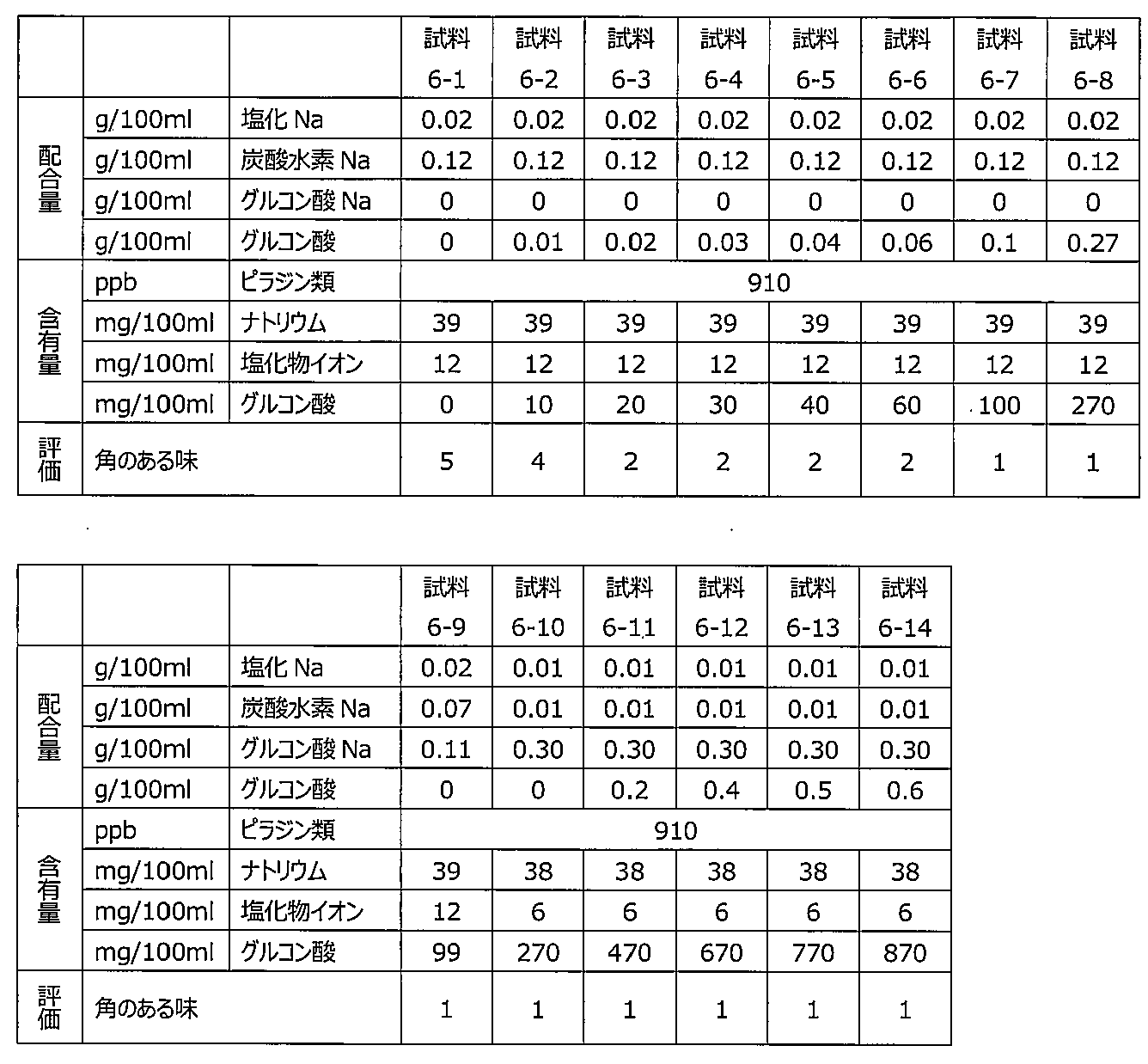
- Experiment 6 Effect of hydroxycarboxylic acid (1) Based on the barley extract of Sample 2-1 of Experiment 2, a barley tea beverage having a sodium content of about 39 mg / 100 ml (carbohydrate content: 0 g / 100 ml) was prepared using sodium chloride and sodium hydrogen carbonate (Sample 6). -1). Gluconic acid was added to this barley tea beverage in the formulation shown in Table 6 (Samples 6-2 to 6-8, Samples 6-11 to 6-14). In addition, those using sodium gluconate as a source of sodium and gluconate were also prepared (Samples 6-9 to 6-14). The pH of these beverages was adjusted to 6.0 using sodium hydroxide and phosphoric acid. The sodium-containing barley tea beverages containing these gluconic acids were evaluated in the same manner as in Experiment 1.
- Experiment 7 Effect of hydroxycarboxylic acid (2)
- a sodium-containing wheat tea beverage was prepared and evaluated in the same manner as in Experiment 6 except that gluconate was changed to citric acid and sodium gluconate was changed to trisodium citrate (sodium content: about 39 mg / 100 ml, carbohydrate content). : 0 g / 100 ml, pH 6.0).
- the results are shown in Table 7.
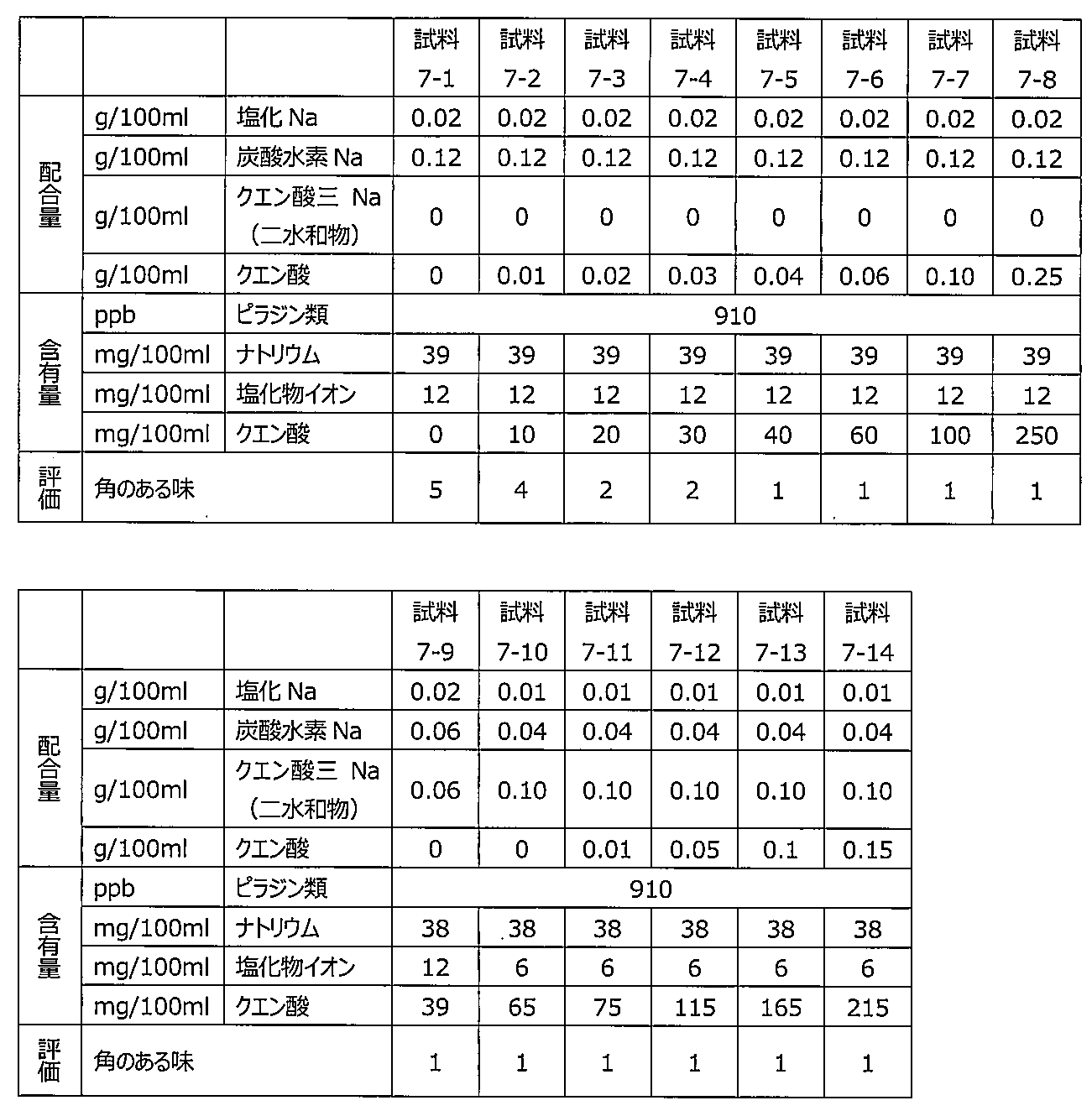
- the beverage containing 20 mg / 100 ml or more of citric acid the bitterness and astringency derived from roasted cereals were suppressed, and the horny taste became a mellow taste.
- Beverages having a citric acid concentration of more than 200 mg / 100 ml in the beverage had no horny taste, but the acidity of citric acid was felt.
- Experiment 8 Effect of hydroxycarboxylic acid (3)
- a sodium-containing wheat tea beverage was prepared and evaluated in the same manner as in Experiment 6 except that gluconic acid was changed to ascorbic acid and sodium gluconate was changed to sodium ascorbate (sodium content: about 39 mg / 100 ml, carbohydrate content: 0 g / 100 ml, pH 6.5).
- the results are shown in Table 8.
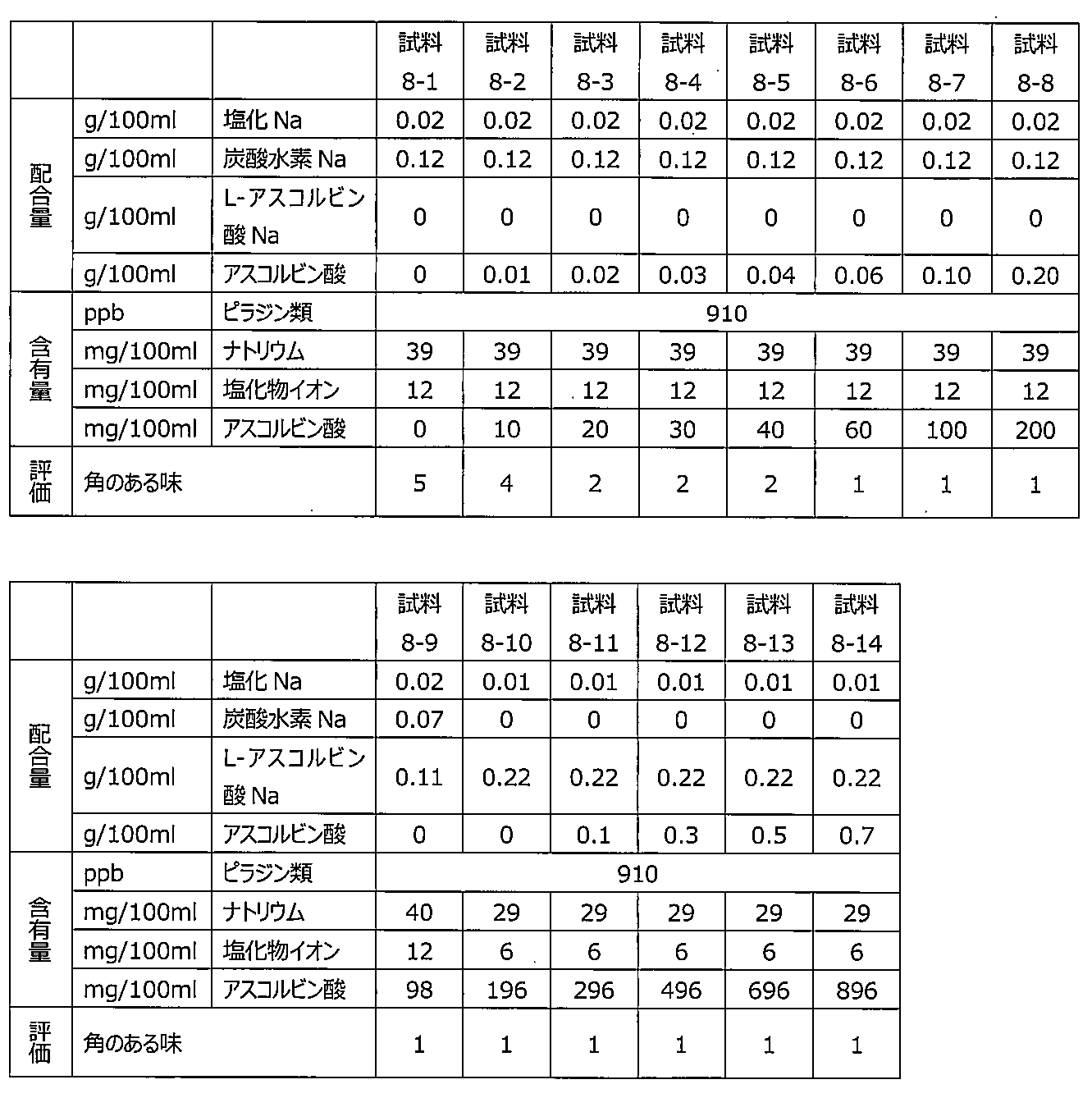
- the beverage containing 20 mg / 100 ml or more of ascorbic acid suppressed the bitterness and astringency derived from roasted cereals, and the horny taste became a mellow taste. A similar effect was confirmed when ascorbate was used.
- Beverages having an ascorbic acid concentration of more than 270 mg / 100 ml in the beverage did not have a horny taste, but a slight acidity of ascorbic acid was felt, and a beverage having an ascorbic acid concentration of more than 800 mg / 100 ml was clearly unpleasant.
- Experiment 9 Effect of hydroxycarboxylic acid (4)
- Sodium-containing wheat tea beverages were prepared in the same manner as in Experiment 6 except that two or more of sodium gluconate, sodium citrate, and sodium ascorbate were used as the hydroxycarboxylic acid (samples 9-1 to 9-4).
- examples 9-1 to 9-4 were used as the hydroxycarboxylic acid (samples 9-1 to 9-4).
- sodium content about 40 mg / 100 ml
- carbohydrate content 0 g / 100 ml, pH 6.5.
- a barley tea beverage prepared by mixing Sample 6-8, Sample 7-5, Sample 8-6, and water prepared in Experiments 6 to 8 at the ratios shown in Table 10 was also prepared (Samples 10-1 to 10-4). ,evaluated.
- Experiment 10 Effect of sodium concentration
- the barley extract (pyrazine content: 910 ppb) obtained in Experiment 2 was mixed with hydroxycarboxylic acids (sodium gluconate, sodium citrate, and sodium ascorbate) according to the formulation shown in Table 11.
- hydroxycarboxylic acids sodium gluconate, sodium citrate, and sodium ascorbate
- Table 11 To prepare a sodium-containing barley tea beverage.
- the pH of the beverage was adjusted with phosphoric acid or sodium hydroxide so that the pH (20 ° C.) of the beverage was 6.0.
- Various barley tea beverages having different sodium contents were evaluated in the same manner as in Experiment 1. The results are shown in Table 11. It was confirmed that when the sodium content was in the range of 20 to 80 mg / 100 ml, the hydroxycarboxylic acid made the horny taste mellow.
- Experiment 11 Effect of pyrazine concentration
- pyrazine standard solution (Fuji Film Wako Pure Chemical Industries, Ltd.) was added according to the formulation shown in Table 12.
- Barley tea beverages with different pyrazine contents were prepared (Samples 12-1 to 12-4).
- a beverage (Sample 12-5) obtained by diluting Sample 11-2 with water twice was prepared, and a pyrazine standard solution was added thereto (Table 13).
- Various barley tea beverages having different amounts of pyrazine were evaluated in the same manner as in Experiment 1. The results are shown in Tables 12 and 13. It was confirmed that in the range of the pyrazine content of 2500 mg / 100 ml or less, the horny taste becomes mellow due to the hydroxycarboxylic acid.
- Experiment 12 Effect of hydroxycarboxylic acid
- a sodium-containing cereal tea beverage was prepared by blending sodium and hydroxycarboxylic acid according to the formulation shown in Table 14 with respect to the commercially available cereal tea beverage used in Experiment 1.
- the pH of each beverage was in the range of 4.5 to 7.5, and the carbohydrate content was 2.0 mg / 100 ml or less. All of the beverages had a mellow taste without the horny taste caused by cereal tea and sodium.
Landscapes
- Health & Medical Sciences (AREA)
- Nutrition Science (AREA)
- Life Sciences & Earth Sciences (AREA)
- Chemical & Material Sciences (AREA)
- Engineering & Computer Science (AREA)
- Food Science & Technology (AREA)
- Polymers & Plastics (AREA)
- Non-Alcoholic Beverages (AREA)
- Tea And Coffee (AREA)
Abstract
250~2500ppbのピラジン類;20~80mg/100mlのナトリウム;30mg/100ml以下の塩化物イオン;グルコン酸、クエン酸、及びアスコルビン酸から選択される1種以上のヒドロキシカルボン酸;及び、焙煎穀類抽出物を含み、前記ヒドロキシカルボン酸の合計濃度が20~800mg/100mlである、穀類茶飲料を提供する。本飲料は、高濃度のナトリウムを含有しながら高いドリンカビリティを有する。
Description
本発明は、穀類抽出物と電解質と有機酸とを含有する飲料に関する。より詳細には、穀類抽出物とナトリウムイオンを供給できる電解質とを含有し、有機酸としてグルコン酸、クエン酸、及びアスコルビン酸から選択される1種以上のヒドロキシカルボン酸を含む飲料に関する。
熱中症は、従来、高温環境下での運動や労働で頻発していたが、ヒートアイランド現象や地球温暖化の影響により、最近では日常生活においても発生が増加している。日本国厚生労働省のホームページによれば、熱中症対策として、20~30分ごとにカップ1~2杯程度の水分を摂取すること、水分だけでなく塩分を合わせて摂取することが望ましいとされている。
塩分を含有する飲料として、スポーツドリンクが多数開発されている。スポーツドリンクは、通常、甘味料や果汁等が配合されたpH4.0以下の酸性飲料である。pH4.0以下の甘味料及び/又は果汁が配合された飲料は、適度な甘みと酸味を有することにより塩味等のミネラルに起因する味がマスキングされ、後味、すっきり感、飲みやすさのバランスがよくなり、嗜好性が向上されている(特許文献1)。
また、麦茶飲料は、体温を下げる、血流を改善する等の生理効果を有するため、夏の暑熱時期や冬の乾燥時期の水分補給飲料としての需要が高まっている。カリウム、ナトリウム、カルシウム、及びマグネシウムイオンの濃度を特定割合にした健康麦茶(特許文献2)や、飲料中のナトリウムイオン濃度を低く抑え、特定範囲のpHに調整し、かつ麦以外の穀類の抽出物を混合することにより焙煎麦由来の苦味及び渋味等の角のある味を緩和して、まろやかな味にした麦茶飲料(特許文献3)等が報告されている。
麦茶飲料等の穀類茶飲料は、焙煎香とすっきりとした味わいが親しまれている飲料である。しかし、ナトリウム量を増大した穀類茶飲料を製造しようとした場合、焙煎穀類由来の苦味・渋味等の角のある味が増強され、ドリンカビリティ(Drinkability)が低下し、水分補給飲料として不適当な飲料となることが判明した。
本発明は、高濃度のナトリウムを含む、高いドリンカビリティを有する穀類茶飲料を提供することを目的とする。
本発明者らは、上記課題を解決するために鋭意検討した結果、ナトリウムを含有する穀類茶飲料に対し、塩化物イオン濃度を低減し、かつ特定量のヒドロキシカルボン酸を含有させることで、ナトリウム含有穀類茶飲料の苦味及び渋味を緩和して、まろやかな味にすることができることを見出し、本発明を完成するに至った。本発明は、これに限定されるものではないが、以下に関する。
[1]以下の(i)~(v):
(i)250~2500ppbのピラジン類;
(ii)20~80mg/100mlのナトリウム;
(iii)30mg/100ml以下の塩化物イオン;
(iv)グルコン酸、クエン酸、及びアスコルビン酸から選択される1種以上のヒドロキシカルボン酸;及び、
(v)焙煎穀類抽出物;
を含み、(iv)ヒドロキシカルボン酸の合計濃度が20~800mg/100mlである、穀類茶飲料。
[2]pHが4.5~7.5である、請求項1に記載の穀類茶飲料。
[3]炭水化物含有量が2.0g/100ml以下である、請求項1又は2に記載の穀類茶飲料。
[1]以下の(i)~(v):
(i)250~2500ppbのピラジン類;
(ii)20~80mg/100mlのナトリウム;
(iii)30mg/100ml以下の塩化物イオン;
(iv)グルコン酸、クエン酸、及びアスコルビン酸から選択される1種以上のヒドロキシカルボン酸;及び、
(v)焙煎穀類抽出物;
を含み、(iv)ヒドロキシカルボン酸の合計濃度が20~800mg/100mlである、穀類茶飲料。
[2]pHが4.5~7.5である、請求項1に記載の穀類茶飲料。
[3]炭水化物含有量が2.0g/100ml以下である、請求項1又は2に記載の穀類茶飲料。
本発明によって、熱中症対策用飲料や運動時(軽運動時を含む)の水分およびナトリウム補給用飲料として、高いドリンカビリティを有する穀類茶飲料の提供が可能となる。
(穀類茶)
本明細書における穀類茶とは、原料となる焙煎穀類粒から水性溶媒により抽出される焙煎穀類の抽出物を含む飲料をいう。本明細書において、「穀類」というときには、澱粉質を主体とする食用の種子を指し、イネ科作物の食用種子だけではなく、マメ科作物の食用種子や、そば、ごま等を含む。原料となる穀類としては、飲料として使用できる穀類であればよく、例えば、米(炒り米、玄米など)、麦(大麦、はだか麦など)、ハト麦、そば(日本ソバ、韃靼種などのそばの種子)、ごま、大豆・黒豆、とうもろこし、麦芽等が挙げられ、これらの1種又は複数種類を用いることができる。穀類茶原料の穀類粒の調製及び焙煎は従来通常に行われている方法で良い。
本明細書における穀類茶とは、原料となる焙煎穀類粒から水性溶媒により抽出される焙煎穀類の抽出物を含む飲料をいう。本明細書において、「穀類」というときには、澱粉質を主体とする食用の種子を指し、イネ科作物の食用種子だけではなく、マメ科作物の食用種子や、そば、ごま等を含む。原料となる穀類としては、飲料として使用できる穀類であればよく、例えば、米(炒り米、玄米など)、麦(大麦、はだか麦など)、ハト麦、そば(日本ソバ、韃靼種などのそばの種子)、ごま、大豆・黒豆、とうもろこし、麦芽等が挙げられ、これらの1種又は複数種類を用いることができる。穀類茶原料の穀類粒の調製及び焙煎は従来通常に行われている方法で良い。
本発明のナトリウム含有飲料を熱中症対策や軽運動時の水分およびナトリウム補給の目的で飲用する場合、上記の穀類のうち、麦及び/又はハト麦の焙煎抽出物を主成分として飲料を調製することは、これらの焙煎抽出物に体温を下げる、血流を改善する等の生理効果があることから、好適な態様の一例であるといえる。ここで、麦及び/又はハト麦の焙煎抽出物を主成分とする飲料とは、日本国食品表示法(2015年4月施行)で規定される原材料表示方法において、「大麦」(焙煎大麦を含む)、「はと麦」などの麦又はハト麦が上位に記載される飲料をいう。好ましくは、原材料表示で麦又はハト麦が1番目又は2番目に記載される飲料であり、より好ましくは1番目に記載される飲料である。
上記穀類の焙煎に関し、焙煎機、焙煎方法は特に限定されない。一般的な焙煎機としては、連続流動式焙煎機や回転ドラム方式の焙煎機等がある。焙煎方法は、加熱方法により分類すれば、直火、熱風、遠赤外線、マイクロウェーブなどの方法がある。
また、上記焙煎穀類原料の抽出方法も特に限定されず、浸漬(ニーダー抽出)法、散水(カラム抽出)法等のいずれの方法を用いてもよい。抽出溶媒は、飲用可能で抽出に適する溶媒であれば特に限定されないが、好ましくは水性溶媒であり、最も簡便には水を用いることができる。水は、食品の処理に使用可能な水質であればよく、例えば、蒸留水、脱塩水、アルカリイオン水、海洋深層水、イオン交換水、脱酸素水、或いは水溶性の有機化合物(例えば、アルコール類)及び/又は無機塩類を含む水などを用いることができる。好ましくは純水を用いる。抽出溶媒の使用量は、穀類原料の種類や抽出溶媒の種類、抽出温度、所望される嗜好性等により異なるが、通常、穀類原料の重量を基準として、5~500重量部程度である。抽出時の抽出溶媒の温度は、穀類の香ばしい焙煎香を引き出すため高温であることが好ましく、具体的には60~100℃、好ましくは80~100℃程度である。抽出時間は、3~60分であり、好ましくは5~30分である。
抽出後は、公知の固液分離手段、例えば濾別や遠心分離を用いて抽出液(穀類茶)を得る。抽出液は、液体のまま用いてもよいし、濃縮や乾燥を行って濃縮液や固体(粉末など)の形態としてもよい。
(ピラジン類)
本発明のナトリウム含有穀類茶飲料は、ナトリウムにより増強される焙煎穀類由来の苦味及び渋味等の角のある味を緩和して、まろやかな味にした飲料である。本発明の飲料は、角のある味わいを形成する成分の一つとして、焙煎穀類由来のピラジン類を含有する。ここで、本発明における「角のある味」とは、ピリッとしたり、イガッとしたりする口腔内や舌を直接刺激するような味を表わす。
本発明のナトリウム含有穀類茶飲料は、ナトリウムにより増強される焙煎穀類由来の苦味及び渋味等の角のある味を緩和して、まろやかな味にした飲料である。本発明の飲料は、角のある味わいを形成する成分の一つとして、焙煎穀類由来のピラジン類を含有する。ここで、本発明における「角のある味」とは、ピリッとしたり、イガッとしたりする口腔内や舌を直接刺激するような味を表わす。
本発明におけるピラジン類とは、ピラジン、メチルピラジン、2,5-ジメチルピラジン、2,6-ジメチルピラジン、エチルピラジン、及び2,3-ジメチルピラジンをいい、ピラジン類濃度とはこれら6成分の合計含有量を意味する。飲料中のピラジン類の含有量は、ガスクロマトグラフィー・質量分析法(GC/MS法)を用いて測定することができる。
本発明の穀類茶飲料におけるピラジン類含量は、250ppb以上であり、好ましくは500ppb以上である。ピラジン類含量が250ppb未満の飲料では、高濃度のナトリウムを配合しても角のある味とはならないので、本発明の課題が発生しない。一方、ピラジン類の上限は2500ppb以下であり、好ましくは2000ppb以下であり、より好ましくは1500ppb以下であり、より好ましくは1000ppb以下であり、より好ましくは940ppb以下である。ピラジン類が2500ppbよりも多いと、本発明の効果が十分に得られないことがある。
(ナトリウム)
本発明の飲料は、熱中症対策や軽運動時の水分およびナトリウム補給に有用な飲料であり、高濃度のナトリウムを含有する。ナトリウムを飲料に含有させる方法としては、例えば、ナトリウム塩の形態で飲料に添加する方法を挙げることができる。ナトリウム塩としては、飲用可能なナトリウム塩であればよく、例えば、塩化ナトリウム、クエン酸二ナトリウム、クエン酸三ナトリウム、L-アスコルビン酸ナトリウム、グルコン酸ナトリウム、L-アスパラギン酸ナトリウム、安息香酸ナトリウム、炭酸水素ナトリウム、リン酸三ナトリウム等を用いることができるが、これらに限定されない。好ましくはクエン酸二ナトリウム、クエン酸三ナトリウム、L-アスコルビン酸ナトリウム、及び/またはグルコン酸ナトリウムが用いられる。
本発明の飲料は、熱中症対策や軽運動時の水分およびナトリウム補給に有用な飲料であり、高濃度のナトリウムを含有する。ナトリウムを飲料に含有させる方法としては、例えば、ナトリウム塩の形態で飲料に添加する方法を挙げることができる。ナトリウム塩としては、飲用可能なナトリウム塩であればよく、例えば、塩化ナトリウム、クエン酸二ナトリウム、クエン酸三ナトリウム、L-アスコルビン酸ナトリウム、グルコン酸ナトリウム、L-アスパラギン酸ナトリウム、安息香酸ナトリウム、炭酸水素ナトリウム、リン酸三ナトリウム等を用いることができるが、これらに限定されない。好ましくはクエン酸二ナトリウム、クエン酸三ナトリウム、L-アスコルビン酸ナトリウム、及び/またはグルコン酸ナトリウムが用いられる。
本発明の飲料におけるナトリウムの濃度は、20~80mg/100mlである。ナトリウム濃度が低すぎる場合、発汗で喪失する水分および塩分の補給には不十分である。ナトリウム濃度の下限値は、22mg/100ml以上が好ましく、24mg/100ml以上がより好ましい。また、ナトリウム濃度が高過ぎる場合、本発明の効果が発揮されにくいことから80mg/100ml以下とする。好ましくは70mg/100ml以下であり、より好ましくは60mg/100ml以下である。なお、飲料中のナトリウム濃度は、原子吸光光度計を用いて分析することができる。また、ナトリウム塩として配合した場合には、ナトリウム元素の含有量として算出することができる。
(塩化物イオン)
本発明者らの検討によると、飲料中の塩化物イオン(Cl-)濃度が高いと、後述する特定のヒドロキシカルボン酸による焙煎穀類由来の苦味及び渋味の抑制作用が阻害される。一方、塩化物イオン濃度が特定範囲以下に抑えられていると、上記の抑制作用が高まることを見出した。したがって、本発明の飲料における塩化物イオンの含有量は、30mg/100ml以下となるよう制御することが重要である。本発明の飲料における塩化物イオンの含有量は、25mg/100ml以下がより好ましく、20mg/100ml以下がさらに好ましく、15mg/100ml以下がさらに好ましく、10mg/100ml以下がさらに好ましい。本発明の好ましい態様の一例として、上述のナトリウムの供給源として、塩化ナトリウムのような塩化物を用いない飲料を挙げることができる。なお、飲料中の塩化物イオン濃度は、硝酸銀滴定法により分析することができる。また、塩化物として配合した場合には、塩化物中の塩素元素の含有量として算出することができる。
本発明者らの検討によると、飲料中の塩化物イオン(Cl-)濃度が高いと、後述する特定のヒドロキシカルボン酸による焙煎穀類由来の苦味及び渋味の抑制作用が阻害される。一方、塩化物イオン濃度が特定範囲以下に抑えられていると、上記の抑制作用が高まることを見出した。したがって、本発明の飲料における塩化物イオンの含有量は、30mg/100ml以下となるよう制御することが重要である。本発明の飲料における塩化物イオンの含有量は、25mg/100ml以下がより好ましく、20mg/100ml以下がさらに好ましく、15mg/100ml以下がさらに好ましく、10mg/100ml以下がさらに好ましい。本発明の好ましい態様の一例として、上述のナトリウムの供給源として、塩化ナトリウムのような塩化物を用いない飲料を挙げることができる。なお、飲料中の塩化物イオン濃度は、硝酸銀滴定法により分析することができる。また、塩化物として配合した場合には、塩化物中の塩素元素の含有量として算出することができる。
(ヒドロキシカルボン酸)
本発明の飲料は、ピラジン類と高濃度のナトリウムにより形成される「角のある味」を緩和して柔らかい味とするために、特定のヒドロキシカルボン酸、そのラクトン又はそれらの塩を配合する。ここで、特定のヒドロキシカルボン酸とは、具体的には、グルコン酸、クエン酸、及びアスコルビン酸をいう。これらは単独で又は2種以上を組み合わせて使用することができる。2種以上を組み合せて使用することは、よりまろやかな味となることから、好ましい。なお、塩としては、アルカリ金属塩、アルカリ土類金属塩、アンモニウム塩が挙げられ、中でもアルカリ金属塩が好ましく、ナトリウム塩、カリウム塩が特に好ましい。
本発明の飲料は、ピラジン類と高濃度のナトリウムにより形成される「角のある味」を緩和して柔らかい味とするために、特定のヒドロキシカルボン酸、そのラクトン又はそれらの塩を配合する。ここで、特定のヒドロキシカルボン酸とは、具体的には、グルコン酸、クエン酸、及びアスコルビン酸をいう。これらは単独で又は2種以上を組み合わせて使用することができる。2種以上を組み合せて使用することは、よりまろやかな味となることから、好ましい。なお、塩としては、アルカリ金属塩、アルカリ土類金属塩、アンモニウム塩が挙げられ、中でもアルカリ金属塩が好ましく、ナトリウム塩、カリウム塩が特に好ましい。
本発明の穀類茶飲料は、グルコン酸、クエン酸、及びアスコルビン酸から選択される1種以上のヒドロキシカルボン酸を含み、その合計濃度が20~800mg/100mlである。上述の特定のヒドロキシカルボン酸の合計濃度が、前記範囲より少ない場合は、穀類茶の角のある味を改善するのに充分な効果を得ることができないことがある。ヒドロキシカルボン酸の合計濃度の下限値は、30mg/100ml以上であることが好ましく、40mg/100ml以上であることがより好ましい。
また、特定のヒドロキシカルボン酸含有量が前記範囲より多い場合は、ヒドロキシカルボン酸特有の酸味が強くなり、飲料の風味に影響を与えることがある。ヒドロキシカルボン酸は、500mg/100ml以上を添加してもその効果は各段に高くなるものではないので、効果と香味の観点から、ヒドロキシカルボン酸の上限は700mg/100ml以下とすることが好ましく、600mg/100ml以下とすることがより好ましく、500mg/100ml以下とすることが特に好ましい。飲料中のヒドロキシカルボン酸濃度は、イオン排除クロマトグラフィーを分離モードとする高速液体クロマトグラフィー(HPLC)を用いて分析することができる。ヒドロキシカルボン酸を、ヒドロキシカルボン酸の塩として配合した場合には、ヒドロキシカルボン酸に換算した濃度として算出する。
上記ヒドロキシカルボン酸の中でも、クエン酸は酸味が強く、飲料の風味に影響を与えることがある。したがって、ヒドロキシカルボン酸として、クエン酸を用いる場合、飲料中のクエン酸濃度は150mg/100ml以下となるように配合することが好ましく、100mg/100ml以下となるように配合することがより好ましい。クエン酸を単独で用いる場合には、その上限は、200mg/100ml程度となる。
ヒドロキシカルボン酸のうち、グルコン酸の濃度は、3種のヒドロキシカルボン酸の合計濃度が20~800mg/100mlとなるように配合されていればよく、特に限定されないが、好ましくは20mg/100ml以上であり、より好ましくは40mg/100ml以上であり、上限値は好ましくは600mg/100ml以下であり、より好ましくは470mg/100ml以下である。
ヒドロキシカルボン酸のうち、アスコルビン酸の濃度は、3種のヒドロキシカルボン酸の合計濃度が20~800mg/100mlとなるように配合されていればよく、特に限定されないが、好ましくは20mg/100ml以上であり、より好ましくは30mg/100ml以上であり、上限値は好ましくは270mg/100ml以下であり、より好ましくは200mg/100ml以下である。
(その他成分)
高濃度のナトリウム添加に伴う焙煎穀類の角のある味は、焙煎穀類抽出物及びナトリウムのような電解質以外の成分が少ない場合に顕著に知覚される。この理由は、角のある味を形成する苦味や渋味をマスキングする成分が少ないためと推測される。効果の顕著さの観点から、焙煎穀類抽出物及び電解質以外の成分が少ない飲料は、本発明の好適な態様の一例である。具体的には、酸味成分が少ない飲料、炭水化物含有量が低い飲料を例示できる。
高濃度のナトリウム添加に伴う焙煎穀類の角のある味は、焙煎穀類抽出物及びナトリウムのような電解質以外の成分が少ない場合に顕著に知覚される。この理由は、角のある味を形成する苦味や渋味をマスキングする成分が少ないためと推測される。効果の顕著さの観点から、焙煎穀類抽出物及び電解質以外の成分が少ない飲料は、本発明の好適な態様の一例である。具体的には、酸味成分が少ない飲料、炭水化物含有量が低い飲料を例示できる。
酸味成分が少ない飲料としては、pHが略中性の飲料を挙げることができる。酸性飲料の場合、酸味成分が焙煎穀類抽出物に由来する苦味や渋味を効果的にマスキングするが、略中性の飲料の場合、そのような酸味成分が存在しないため、焙煎穀類抽出物に由来する苦味や渋味が顕著となり、角のある味が強く知覚される。したがって、効果の顕著さから、本発明の飲料の好ましいpH(20℃)は4.5~7.5であり、より好ましくは5.0~7.0である。飲料のpH調整は、炭酸水素ナトリウム、水酸化ナトリウム等のpH調整剤を用いて適宜行うことができる。飲料のpHは市販のpHメーターを使用して容易に測定することができる。
炭水化物含有量が低い飲料としては、糖類(単糖、二糖、多糖、糖アルコール)や食物繊維を供給する成分が少ない飲料を挙げることができる。糖類が含まれる場合、甘み成分等により焙煎穀類抽出物に由来する苦味や渋味を効果的にマスキングすることができる。また、食物繊維が含まれる場合、焙煎穀類抽出物の香り立ちが抑制され、苦味や渋味も抑制される傾向にあるため、本発明の課題が発生しにくくなる。したがって、効果の顕著さから、本発明の飲料の好ましい炭水化物含有量は2.0g/100ml以下であり、より好ましくは1.5g/100ml以下、特に好ましくは1.0g/100ml以下である。本明細書でいう炭水化物含有量とは、フェノール硫酸法を用いて定量される値をいう。
本発明者らの検討によると、穀類茶飲料にカフェイン、カテキン、ナリンギン等の苦味成分が含まれる場合、焙煎穀類由来の苦味及び渋味と相俟って角のある味わいを増強し、本発明の効果が得られにくくなることがある。したがって、本発明の飲料は、これら苦味成分の濃度が特定範囲以下に抑えられていることが好ましい。なお、カフェイン、カテキン、及びナリンギンの含有量は、高速液体クロマトグラフィー(HPLC)を用いて測定することができる。
具体的には、本発明の飲料におけるカフェイン含有量は、0~20mg/100mlであることが好ましく、0~15mg/100mlであることがより好ましく、0~10mg/100mlであることがさらに好ましく、0~5mg/100mlであることが特に好ましく、0mg/100mlであることが最も好ましい。
また、本発明の飲料におけるカテキン含有量は、0~30mg/100mlであることが好ましく、0~20mg/100mlであることがより好ましく、0~15mg/100mlであることがさらに好ましく、0~10mg/100mlであることが特に好ましく、0mg/100mlであることが最も好ましい。ここで、カテキンの含有量とは、カテキン、エピカテキン、ガロカテキン、エピガロカテキン、カテキンガレート、エピカテキンガレート、ガロカテキンガレート、及びエピガロカテキンガレートの合計量をいう。
さらに、本発明の飲料におけるナリンギン含有量は、0~10mg/100mlであることが好ましく、0~5mg/100mlであることがより好ましく、0~2mg/100mlであることがさらに好ましく、0~1mg/100mlであることが特に好ましい。
その他、本発明の飲料には、本発明の効果を妨げない範囲で、通常の飲料と同様に、各種添加剤などを配合してもよい。各種添加剤としては、例えば、香料、ビタミン類、色素類、酸化防止剤、乳化剤、保存料、調味料、エキス類、増粘剤、品質安定剤などを挙げることができる。
本発明の穀類茶飲料は、水分およびナトリウム補給飲料として、ドリンカビリティが高い飲料であり、飲み飽きずに美味しく飲める性質を有するものである。したがって、1回当たりの飲用量を満たす容器、具体的には容量が350~2000ml(好ましくは500~1000ml)程度の容器に収容された本発明の飲料は、携帯性に優れ、簡便に水分およびナトリウムを補給できる点で好ましい。
以下、実験例を示して本発明の詳細を具体的に説明するが、本発明はこれに限定されるものではない。また、本明細書において、特に記載しない限り、数値範囲はその端点を含むものとして記載される。本実施例中、飲料中の各成分量等は以下の方法により測定した。
[ピラジン類の測定]
ピラジン類の含有量(ピラジン、メチルピラジン、2,5-ジメチルピラジン、2,6-ジメチルピラジン、エチルピラジン、及び2,3-ジメチルピラジンの合計含有量)は下記のように分析した。まず、試料液5mlをネジ付き20ml容ガラス瓶(直径18mm,ゲステル社製)に入れてPTFE製セプタム付き金属蓋(ゲステル社製)にて密栓し、固相マイクロ抽出法(SPME)にて香気成分の抽出を行った。定量は、GC/MSのEICモードにて検出されたピーク面積を用い、標準添加法にて行った。なお、各成分の保持時間は、標準品を分析することで確認できる。使用した機器及び条件を以下に示す。
ピラジン類の含有量(ピラジン、メチルピラジン、2,5-ジメチルピラジン、2,6-ジメチルピラジン、エチルピラジン、及び2,3-ジメチルピラジンの合計含有量)は下記のように分析した。まず、試料液5mlをネジ付き20ml容ガラス瓶(直径18mm,ゲステル社製)に入れてPTFE製セプタム付き金属蓋(ゲステル社製)にて密栓し、固相マイクロ抽出法(SPME)にて香気成分の抽出を行った。定量は、GC/MSのEICモードにて検出されたピーク面積を用い、標準添加法にて行った。なお、各成分の保持時間は、標準品を分析することで確認できる。使用した機器及び条件を以下に示す。
・SPMEファイバー:StableFlex/SS,50/30μm DVB/CAR/PDMS(スペルコ社製)
・全自動揮発性成分抽出導入装置:MultiPurposeSampler MPS2XL(ゲステル社製)
・予備加温:40℃ 5分間
・攪拌:なし
・揮発性成分抽出:40℃ 30分間
・揮発性成分の脱着時間:3分間
・GCオーブン:GC7890A(アジレントテクノロジーズ社製)
・カラム:VF-WAXms,60m×0.25mmi.d. df=0.50μm(アジレントテクノロジーズ社製)
・GC温度条件:40℃(5分間)→5℃/分→260℃(11分間)
・キャリアーガス:ヘリウム 1.2ml/分,流量一定モード
・インジェクション:スプリットレス法
・インレット温度:250℃
・質量分析装置:GC/MS Triple Ouad7000(アジレントテクノロジーズ社製)
・イオン化方式:EI(70eV)
・測定方式:スキャン測定、またはスキャン&SIM同時測定
・スキャンパラメータ:m/z35~350
・定量イオン
(ピラジン) m/z80、53、又は52(本実施例においては80)
(メチルピラジン) m/z94、67、又は93(本実施例においては94)
(2,5-ジメチルピラジン) m/z108、42、又は107(本実施例においては108)
(2,6-ジメチルピラジン) m/z108、42、又は107(本実施例においては108)
(エチルピラジン) m/z107、108、又は80(本実施例においては107)
(2,3-ジメチルピラジン) m/z108、67、又は107(本実施例においては108)
なお、本実施例においては上記の定量イオンを選択したが、ピーク形状、感度、または他の成分との分離が良好でない場合は、試料液の蒸留水による希釈、SIMモードの利用、または標準品分析で得られた他のイオンの選択、の方策のうち1つ以上を用いることができる。
[ナトリウムの測定]
試料2~5gを抽出容器に分取し、1%塩酸溶液200mLを加え、室温下で30分間振とう抽出した。抽出液を遠心管に移して遠心分離し、上澄み液を測定用試験溶液とした。原子吸光光度計の測定波長を589nmに設定して測定用試験溶液の吸光度を検出し、予め作成した標準物質濃度による検量線に基づき、試験溶液の濃度を求めた。
試料2~5gを抽出容器に分取し、1%塩酸溶液200mLを加え、室温下で30分間振とう抽出した。抽出液を遠心管に移して遠心分離し、上澄み液を測定用試験溶液とした。原子吸光光度計の測定波長を589nmに設定して測定用試験溶液の吸光度を検出し、予め作成した標準物質濃度による検量線に基づき、試験溶液の濃度を求めた。
[塩化物イオンの測定]
試料5gに0.01mol/Lの塩酸1gを添加した後、イオン交換水で50gまでメスアップして測定用試験溶液とし、「上水試験方法」(2011年版 日本水道協会)に規定されたモール法による硝酸銀滴定法に準じた方法で分析した。測定用試験溶液中の塩化物イオンの定量は、塩酸のみを添加したブランク測定との差分から算出した。
試料5gに0.01mol/Lの塩酸1gを添加した後、イオン交換水で50gまでメスアップして測定用試験溶液とし、「上水試験方法」(2011年版 日本水道協会)に規定されたモール法による硝酸銀滴定法に準じた方法で分析した。測定用試験溶液中の塩化物イオンの定量は、塩酸のみを添加したブランク測定との差分から算出した。
[ヒドロキシカルボン酸の測定]
試料を純水にて希釈し、メンブレンフィルターにて濾過後、HPLC分析に供した。分析条件は以下のとおり:
・カラム:Shodex RSpak KC-811 (8.0mmI.D.×300mm)
・移動相:10mmol/L リン酸
・流速:0.5mL/min
・検出波長:UV(210nm)
・カラム温度:40℃
・サンプル注入量:40μL
・注入量:20μL
上記の条件で、グルコン酸、クエン酸、及びアスコルビン酸の濃度を各々測定、算出した。また、これらの濃度を合計したものをヒドロキシカルボン酸の合計濃度とした。
試料を純水にて希釈し、メンブレンフィルターにて濾過後、HPLC分析に供した。分析条件は以下のとおり:
・カラム:Shodex RSpak KC-811 (8.0mmI.D.×300mm)
・移動相:10mmol/L リン酸
・流速:0.5mL/min
・検出波長:UV(210nm)
・カラム温度:40℃
・サンプル注入量:40μL
・注入量:20μL
上記の条件で、グルコン酸、クエン酸、及びアスコルビン酸の濃度を各々測定、算出した。また、これらの濃度を合計したものをヒドロキシカルボン酸の合計濃度とした。
[炭水化物の測定]
試験管に飲料1mLと、フェノール試薬(5%(W/V)フェノール水溶液)1mLとを加えてよく撹拌した後、濃硫酸(試薬特級)を5mL加え、すぐに10秒間激しく撹拌した。その後室温に20分以上放置して十分冷却してから、分光光度計で波長490nmの吸収を測定した。D-グルコースを標準物質として同様の操作にて作成した検量線を用いて、飲料中に含まれる炭水化物の濃度を算出した。
試験管に飲料1mLと、フェノール試薬(5%(W/V)フェノール水溶液)1mLとを加えてよく撹拌した後、濃硫酸(試薬特級)を5mL加え、すぐに10秒間激しく撹拌した。その後室温に20分以上放置して十分冷却してから、分光光度計で波長490nmの吸収を測定した。D-グルコースを標準物質として同様の操作にて作成した検量線を用いて、飲料中に含まれる炭水化物の濃度を算出した。
[pHの測定]
pHは、試料の品温を20℃にした後、pHメーター(F21、HORIBA製)を使用して測定した。
pHは、試料の品温を20℃にした後、pHメーター(F21、HORIBA製)を使用して測定した。
実験1:ナトリウム含有穀類茶飲料の製造と評価(1)
市販の穀類茶飲料として、A社製品(日本国食品表示法に基づく原材料表示:大麦、玄米、はと麦、海藻エキス)(試料1-1)、B社製品(日本国食品表示法に基づく原材料表示:六条大麦)(試料1-8)、C社製品(日本国食品表示法に基づく原材料表示:ハトムギ、大麦、ハブ茶、発芽大麦、黒豆(大豆)、とうもろこし、玄米、びわの葉、カワラケツメイ、たんぽぽの根、あわ、きび、エゴマの葉、桑の葉、昆布、ナツメ/ビタミンC)(試料1-15)、D社製品(日本国食品表示法に基づく原材料表示:ハトムギ、玄米、大麦、どくだみ、はぶ茶、チコリー、月見草、ナンバンキビ、オオムギ若葉、明日葉、杜仲葉、ヨモギ)(試料1-22)を用いた。それぞれの飲料のピラジン類濃度は、A社製品:913ppb、B社製品:1420ppb、C社製品:360ppb、D社製品:294ppbであった。この市販飲料に対し、0.03~0.15g/100mlの塩化ナトリウムを配合して、種々のナトリウム濃度の穀類茶飲料(麦又はハト麦の焙煎抽出物を主成分とする茶飲料)を得た。
市販の穀類茶飲料として、A社製品(日本国食品表示法に基づく原材料表示:大麦、玄米、はと麦、海藻エキス)(試料1-1)、B社製品(日本国食品表示法に基づく原材料表示:六条大麦)(試料1-8)、C社製品(日本国食品表示法に基づく原材料表示:ハトムギ、大麦、ハブ茶、発芽大麦、黒豆(大豆)、とうもろこし、玄米、びわの葉、カワラケツメイ、たんぽぽの根、あわ、きび、エゴマの葉、桑の葉、昆布、ナツメ/ビタミンC)(試料1-15)、D社製品(日本国食品表示法に基づく原材料表示:ハトムギ、玄米、大麦、どくだみ、はぶ茶、チコリー、月見草、ナンバンキビ、オオムギ若葉、明日葉、杜仲葉、ヨモギ)(試料1-22)を用いた。それぞれの飲料のピラジン類濃度は、A社製品:913ppb、B社製品:1420ppb、C社製品:360ppb、D社製品:294ppbであった。この市販飲料に対し、0.03~0.15g/100mlの塩化ナトリウムを配合して、種々のナトリウム濃度の穀類茶飲料(麦又はハト麦の焙煎抽出物を主成分とする茶飲料)を得た。
これらのナトリウム含有穀類茶飲料について、熟練した5人のパネルによる官能評価を実施した。官能評価は、「角のある味」を感じられるか否かを評価項目とし、角のある味を感じたパネルの人数を尺度として、5点:角のある味を強く感じる(角のある味を感じたパネル数:5人)、4点:角のある味を感じる(パネル数:4人)、3点:角のある味をやや感じる(パネル数:3人)、2点:角のある味がわずかにある(パネル数:2人)、1点:角のある味がない(パネル数:1人以下)、の5段階を設定した。
結果を表1に示す。ピラジン類を含有する穀類茶飲料において、ナトリウムにより苦味や渋味が増強される傾向にあり、ナトリウム含有量が20mg/100ml以上となると角のある味になることが確認された。

実験2:ナトリウム含有麦茶飲料の製造と評価(2)
3gの大麦に対し熱水(80~90℃)1000mLを用いて5分間抽出処理を行った後、大麦を分離し、さらに200メッシュに通液させ、粉砕組織などの固形分を除去して、大麦抽出液を得た(試料2-1)。この大麦抽出液に、実験1と同様にして塩化ナトリウムを配合して、種々のナトリウム濃度のナトリウム含有麦茶飲料を得た(pH6.5(20℃)、ピラジン類含有量:910ppb)。これら麦茶飲料について、実験1と同様に評価した。
3gの大麦に対し熱水(80~90℃)1000mLを用いて5分間抽出処理を行った後、大麦を分離し、さらに200メッシュに通液させ、粉砕組織などの固形分を除去して、大麦抽出液を得た(試料2-1)。この大麦抽出液に、実験1と同様にして塩化ナトリウムを配合して、種々のナトリウム濃度のナトリウム含有麦茶飲料を得た(pH6.5(20℃)、ピラジン類含有量:910ppb)。これら麦茶飲料について、実験1と同様に評価した。
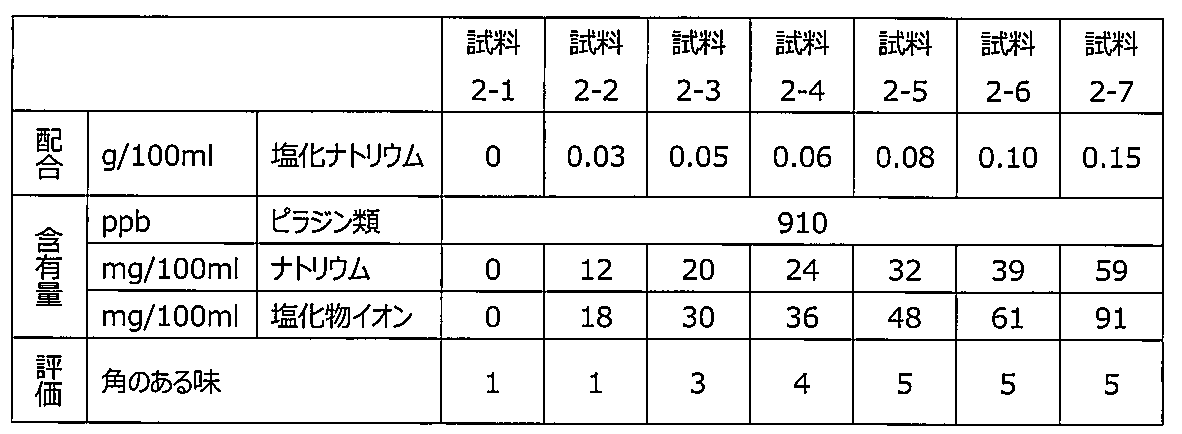
結果を表2に示す。実験1と同じ結果であり、ナトリウム含有量が20mg/100ml以上となると角のある味になることが確認された。
実験3:炭水化物含有量の影響
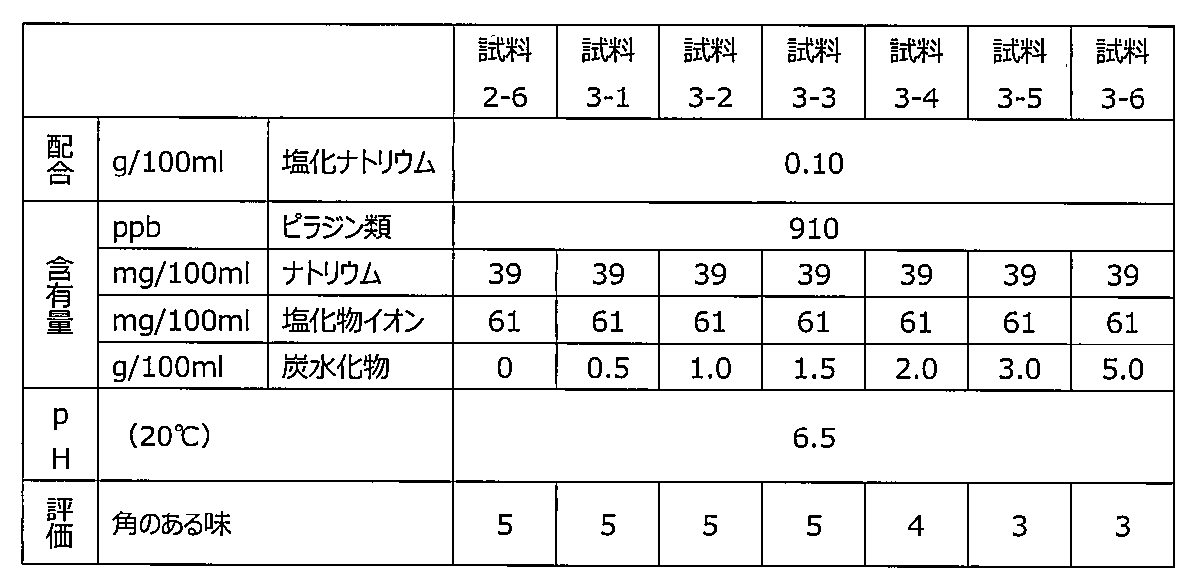
実験2の試料2-6(ナトリウム含有量:39mg/100ml)の麦茶飲料に対して、表3の炭水化物含有量となるようにデキストリン(三和澱粉工業、サンデック#30)を添加した。炭水化物含有量が異なるナトリウム含有麦茶飲料について、実験1と同様に評価した。結果を表3に示す。炭水化物含有量が2.0g/100mlを超える飲料では、苦味や渋味が抑制される傾向にあり、角のある味を感じにくかった。
実験2の試料2-6(ナトリウム含有量:39mg/100ml)の麦茶飲料に対して、表3の炭水化物含有量となるようにデキストリン(三和澱粉工業、サンデック#30)を添加した。炭水化物含有量が異なるナトリウム含有麦茶飲料について、実験1と同様に評価した。結果を表3に示す。炭水化物含有量が2.0g/100mlを超える飲料では、苦味や渋味が抑制される傾向にあり、角のある味を感じにくかった。
実験4:pHの影響
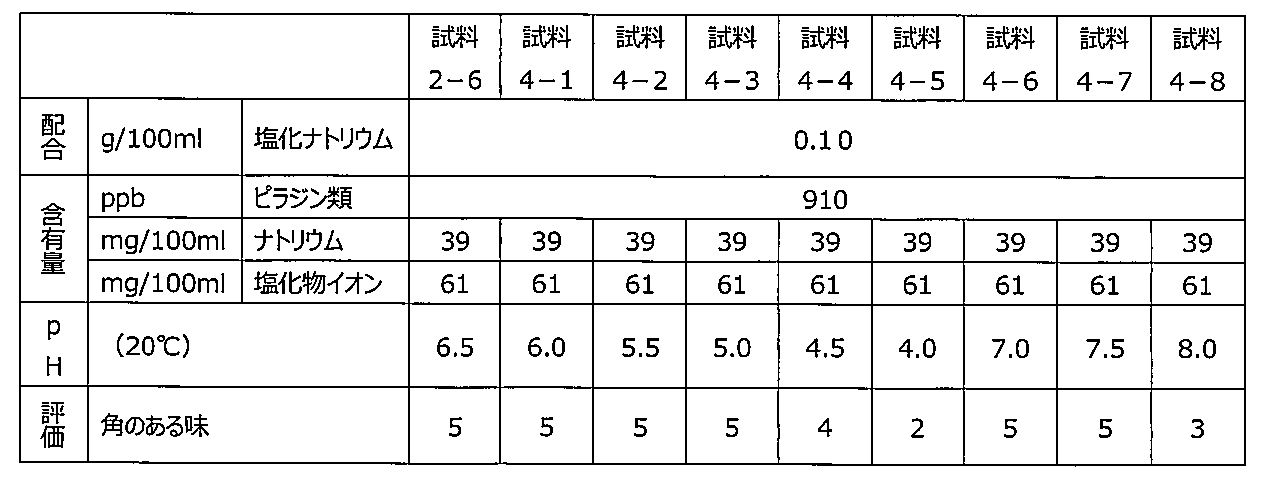
実験2の試料2-6(ナトリウム含有量:39mg/100ml)の麦茶飲料に対して、表4のpHとなるようにリン酸又は水酸化ナトリウムを適量加えた。pHが異なるナトリウム含有麦茶飲料について、実験1と同様に評価した。結果を表4に示す。pHが4.0以下の飲料では、酸味により苦味や渋味が抑制される傾向にあり、角のある味を感じにくかった。また、pHが8.0以上の飲料では、飲料にぬめりが発生し、全ての香味が低減していた。
実験2の試料2-6(ナトリウム含有量:39mg/100ml)の麦茶飲料に対して、表4のpHとなるようにリン酸又は水酸化ナトリウムを適量加えた。pHが異なるナトリウム含有麦茶飲料について、実験1と同様に評価した。結果を表4に示す。pHが4.0以下の飲料では、酸味により苦味や渋味が抑制される傾向にあり、角のある味を感じにくかった。また、pHが8.0以上の飲料では、飲料にぬめりが発生し、全ての香味が低減していた。
実験5:塩化物イオンの影響
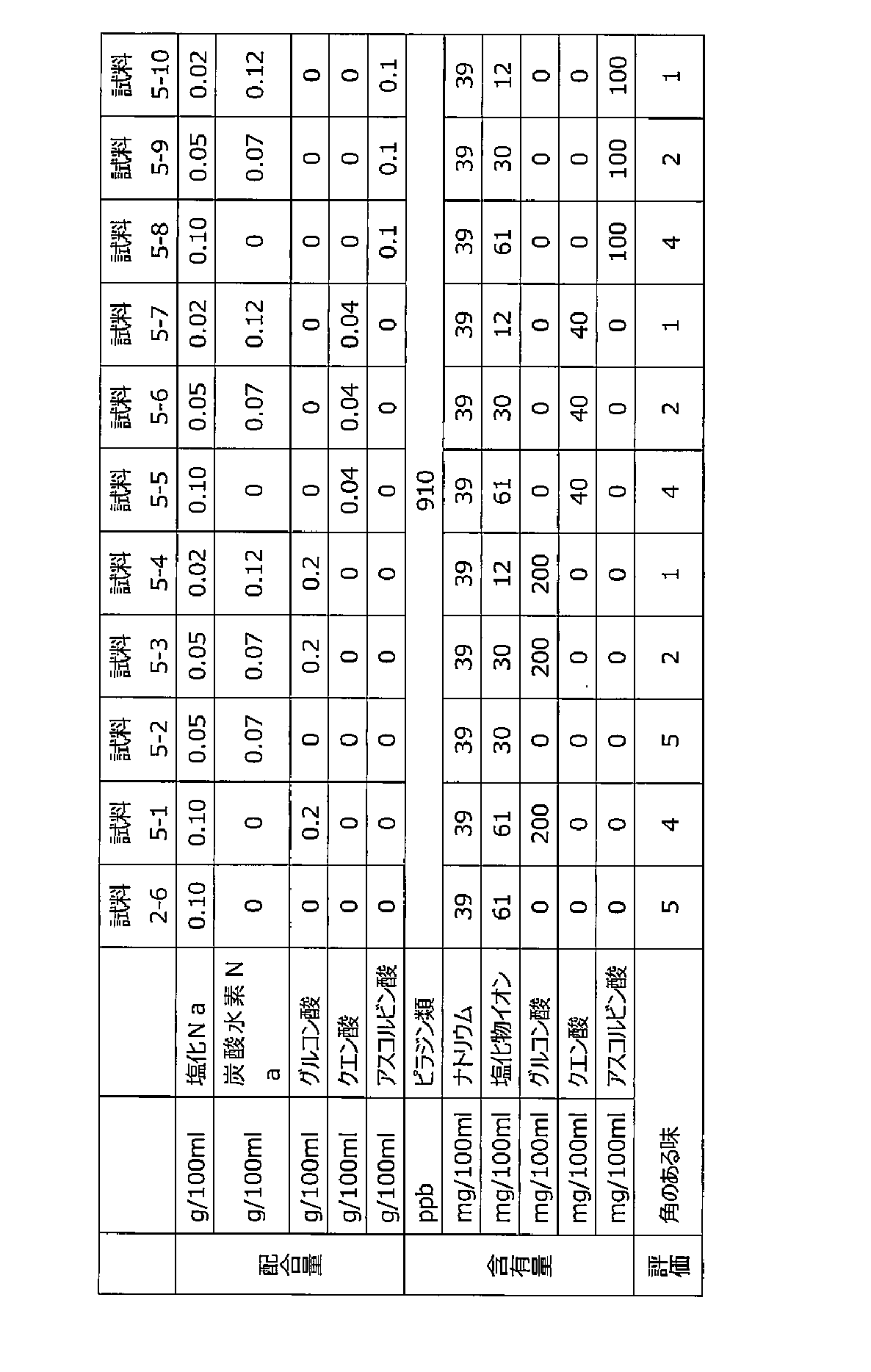
実験2の試料2-6(ナトリウム含有量:39mg/100ml、炭水化物含有量:0g/100ml)の麦茶飲料に対して、グルコン酸、クエン酸、またはアスコルビン酸から選択されるヒドロキシカルボン酸の1種を、表5の配合で添加した(試料5-1、試料5-5、試料5-8)。また、実験2の試料2-1の大麦抽出液をベースとし、ナトリウム供給源として、塩化ナトリウムの一部を炭酸水素ナトリウムに変えたものも調製した(試料5-2~5-4、試料5-6~5-7、試料5-9~5-10)。麦茶飲料のpH(20℃)はいずれも6.5となるように、リン酸又は水酸化ナトリウムを用いてpH調整を行った。これらのヒドロキシカルボン酸を含有するナトリウム含有麦茶飲料について、実験1と同様に評価した。
実験2の試料2-6(ナトリウム含有量:39mg/100ml、炭水化物含有量:0g/100ml)の麦茶飲料に対して、グルコン酸、クエン酸、またはアスコルビン酸から選択されるヒドロキシカルボン酸の1種を、表5の配合で添加した(試料5-1、試料5-5、試料5-8)。また、実験2の試料2-1の大麦抽出液をベースとし、ナトリウム供給源として、塩化ナトリウムの一部を炭酸水素ナトリウムに変えたものも調製した(試料5-2~5-4、試料5-6~5-7、試料5-9~5-10)。麦茶飲料のpH(20℃)はいずれも6.5となるように、リン酸又は水酸化ナトリウムを用いてpH調整を行った。これらのヒドロキシカルボン酸を含有するナトリウム含有麦茶飲料について、実験1と同様に評価した。
結果を表5に示す。ヒドロキシカルボン酸の一つであるグルコン酸を添加すると、ナトリウム含有麦茶飲料の苦味及び渋味が抑制される傾向にあった。このグルコン酸による苦味及び渋味抑制効果は、塩化物イオンの量を低減させるほど効果が高まり、塩化物イオンが30mg/100ml以下となるように低減した飲料では、角のある味がほとんど感じられなかった。グルコン酸を、クエン酸、アスコルビン酸に変えた場合も同様の効果が得られた。ヒドロキシカルボン酸として、リンゴ酸又は乳酸を用いた場合にも若干の効果は感じられたが、上記3種のヒドロキシカルボン酸ほど顕著な効果は得られなかった。
実験6:ヒドロキシカルボン酸の効果(1)
実験2の試料2-1の大麦抽出液をベースとし、塩化ナトリウムと炭酸水素ナトリウムを用いてナトリウム含有量が約39mg/100ml(炭水化物含有量:0g/100ml)の麦茶飲料を調製した(試料6-1)。この麦茶飲料に対して、グルコン酸を表6の配合で添加した(試料6-2~6-8、試料6-11~6-14)。また、ナトリウム及びグルコン酸の供給源としてグルコン酸ナトリウムを用いたものも調製した(試料6-9~6-14)。これら飲料のpHは、水酸化ナトリウムとリン酸を用いてpHを6.0に調整した。これらのグルコン酸を含有するナトリウム含有麦茶飲料について、実験1と同様に評価した。
実験2の試料2-1の大麦抽出液をベースとし、塩化ナトリウムと炭酸水素ナトリウムを用いてナトリウム含有量が約39mg/100ml(炭水化物含有量:0g/100ml)の麦茶飲料を調製した(試料6-1)。この麦茶飲料に対して、グルコン酸を表6の配合で添加した(試料6-2~6-8、試料6-11~6-14)。また、ナトリウム及びグルコン酸の供給源としてグルコン酸ナトリウムを用いたものも調製した(試料6-9~6-14)。これら飲料のpHは、水酸化ナトリウムとリン酸を用いてpHを6.0に調整した。これらのグルコン酸を含有するナトリウム含有麦茶飲料について、実験1と同様に評価した。
結果を表6に示す。グルコン酸を20mg/100ml以上配合した飲料は、焙煎穀類に由来する苦味や渋味が抑制され、角のある味がまろやかな味となった。グルコン酸塩を用いた場合にも同様の効果が確認された。飲料中のグルコン酸濃度が600mg/100mlを超える飲料は角のある味はないものの、グルコン酸による酸味がわずかに感じられた。グルコン酸濃度が800mg/100mlを超える飲料は、穀類茶飲料として後味に異味が感じられドリンカビリティに欠けると評価された。
実験7:ヒドロキシカルボン酸の効果(2)
グルコン酸をクエン酸に、グルコン酸ナトリウムをクエン酸三ナトリウムに変えた以外は、実験6と同様にしてナトリウム含有麦茶飲料を調製し、評価した(ナトリウム含有量:約39mg/100ml、炭水化物含有量:0g/100ml、pH6.0)。結果を表7に示す。クエン酸を20mg/100ml以上配合した飲料は、焙煎穀類に由来する苦味や渋味が抑制され、角のある味がまろやかな味となった。クエン酸塩を用いた場合にも同様の効果が確認された。飲料中のクエン酸濃度が200mg/100mlを超える飲料は角のある味はないものの、クエン酸の酸味が感じられた。
グルコン酸をクエン酸に、グルコン酸ナトリウムをクエン酸三ナトリウムに変えた以外は、実験6と同様にしてナトリウム含有麦茶飲料を調製し、評価した(ナトリウム含有量:約39mg/100ml、炭水化物含有量:0g/100ml、pH6.0)。結果を表7に示す。クエン酸を20mg/100ml以上配合した飲料は、焙煎穀類に由来する苦味や渋味が抑制され、角のある味がまろやかな味となった。クエン酸塩を用いた場合にも同様の効果が確認された。飲料中のクエン酸濃度が200mg/100mlを超える飲料は角のある味はないものの、クエン酸の酸味が感じられた。
実験8:ヒドロキシカルボン酸の効果(3)
グルコン酸をアスコルビン酸に、グルコン酸ナトリウムをアスコルビン酸ナトリウムに変えた以外は、実験6と同様にしてナトリウム含有麦茶飲料を調製し、評価した(ナトリウム含有量:約39mg/100ml、炭水化物含有量:0g/100ml、pH6.5)。結果を表8に示す。アスコルビン酸を20mg/100ml以上配合した飲料は、焙煎穀類に由来する苦味や渋味が抑制され、角のある味がまろやかな味となった。アスコルビン酸塩を用いた場合にも同様の効果が確認された。飲料中のアスコルビン酸濃度が270mg/100mlを超える飲料は角のある味はないものの、アスコルビン酸の酸味が僅かに感じられ、アスコルビン酸濃度が800mg/100mlを超える飲料は明らかに異味を感じた。
グルコン酸をアスコルビン酸に、グルコン酸ナトリウムをアスコルビン酸ナトリウムに変えた以外は、実験6と同様にしてナトリウム含有麦茶飲料を調製し、評価した(ナトリウム含有量:約39mg/100ml、炭水化物含有量:0g/100ml、pH6.5)。結果を表8に示す。アスコルビン酸を20mg/100ml以上配合した飲料は、焙煎穀類に由来する苦味や渋味が抑制され、角のある味がまろやかな味となった。アスコルビン酸塩を用いた場合にも同様の効果が確認された。飲料中のアスコルビン酸濃度が270mg/100mlを超える飲料は角のある味はないものの、アスコルビン酸の酸味が僅かに感じられ、アスコルビン酸濃度が800mg/100mlを超える飲料は明らかに異味を感じた。
実験9:ヒドロキシカルボン酸の効果(4)
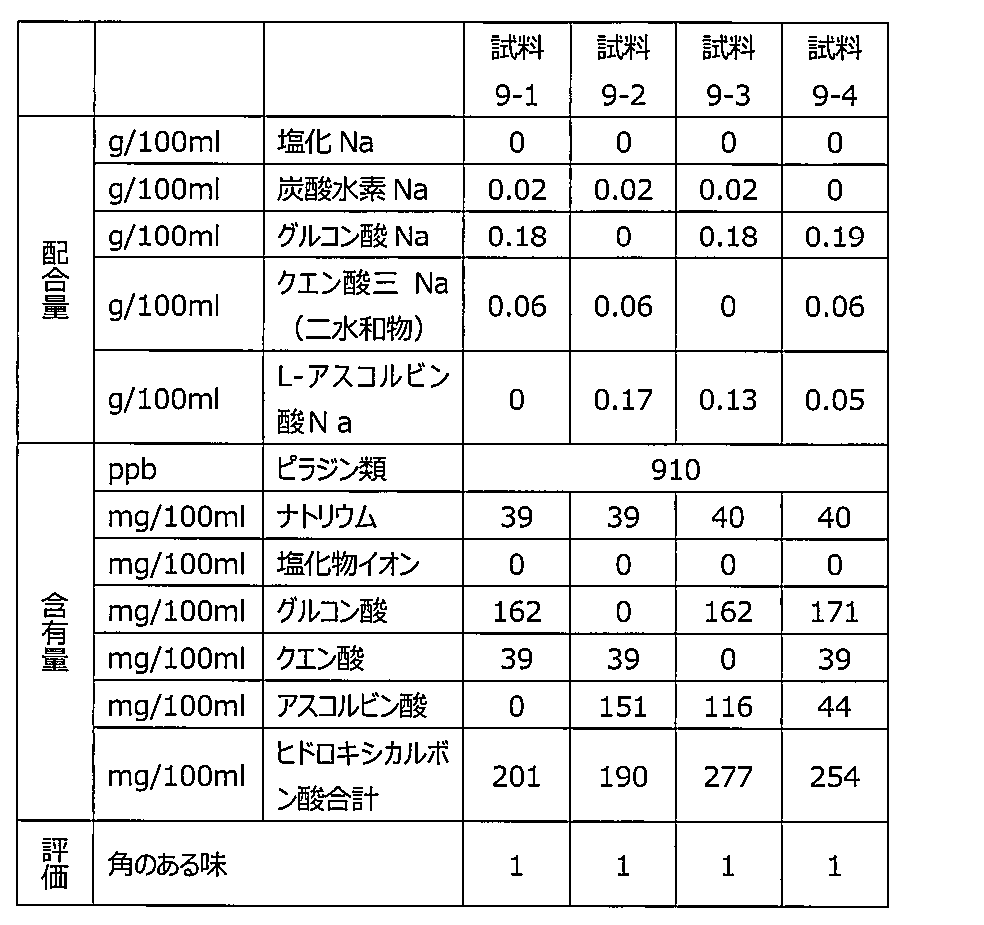
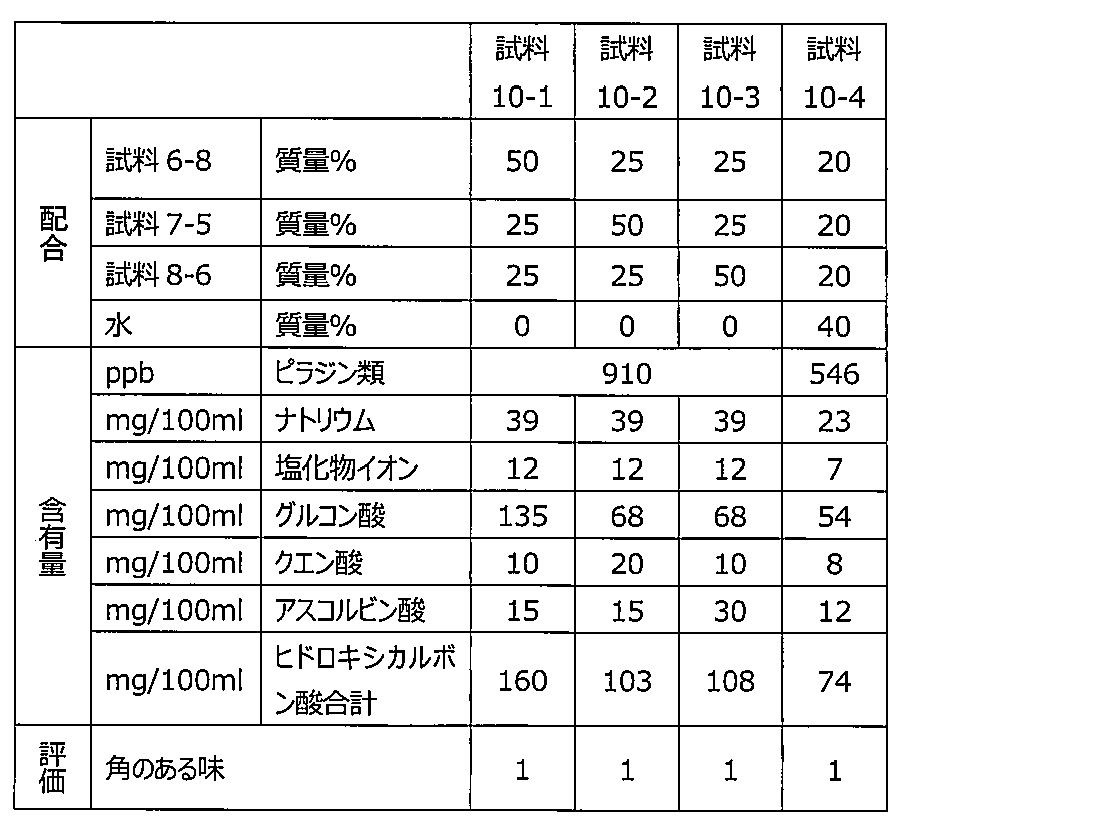
ヒドロキシカルボン酸として、グルコン酸ナトリウム、クエン酸ナトリウム、及びアスコルビン酸ナトリウムのうちの2種以上を用いること以外は、実験6と同様にしてナトリウム含有麦茶飲料を調製(試料9-1~9-4)し、評価した(ナトリウム含有量:約40mg/100ml、炭水化物含有量:0g/100ml、pH6.5)。また、実験6~8で調製した試料6-8、試料7-5、試料8-6、及び水をそれぞれ表10の割合で混合した麦茶飲料も調製(試料10-1~10-4)し、評価した。
ヒドロキシカルボン酸として、グルコン酸ナトリウム、クエン酸ナトリウム、及びアスコルビン酸ナトリウムのうちの2種以上を用いること以外は、実験6と同様にしてナトリウム含有麦茶飲料を調製(試料9-1~9-4)し、評価した(ナトリウム含有量:約40mg/100ml、炭水化物含有量:0g/100ml、pH6.5)。また、実験6~8で調製した試料6-8、試料7-5、試料8-6、及び水をそれぞれ表10の割合で混合した麦茶飲料も調製(試料10-1~10-4)し、評価した。
結果を表9及び表10に示す。グルコン酸、クエン酸、及びアスコルビン酸から選択されるヒドロキシカルボン酸を2種以上用いた場合にも、焙煎穀類に由来する苦味や渋味が抑制され、角のある味がまろやかな味となった。また、5名のパネルのうちの4名以上が、ヒドロキシカルボン酸を1種のみ用いた場合よりも2種以上を用いた方が、よりまろやかな味になると評価した。
実験10:ナトリウム濃度の影響
実験2で得た大麦抽出液(ピラジン類含有量:910ppb)に、表11の処方でヒドロキシカルボン酸(グルコン酸ナトリウム、クエン酸ナトリウム、及びアスコルビン酸ナトリウム)を配合して、ナトリウム含有麦茶飲料を調製した。なお、飲料のpH(20℃)が6.0となるようにリン酸又は水酸化ナトリウムを用いてpH調整を行った。ナトリウム含有量の異なる各種麦茶飲料について、実験1と同様に評価した。結果を表11に示す。ナトリウム含有量が20~80mg/100mlの範囲では、ヒドロキシカルボン酸によって角のある味がまろやかな味になることが確認された。
実験2で得た大麦抽出液(ピラジン類含有量:910ppb)に、表11の処方でヒドロキシカルボン酸(グルコン酸ナトリウム、クエン酸ナトリウム、及びアスコルビン酸ナトリウム)を配合して、ナトリウム含有麦茶飲料を調製した。なお、飲料のpH(20℃)が6.0となるようにリン酸又は水酸化ナトリウムを用いてpH調整を行った。ナトリウム含有量の異なる各種麦茶飲料について、実験1と同様に評価した。結果を表11に示す。ナトリウム含有量が20~80mg/100mlの範囲では、ヒドロキシカルボン酸によって角のある味がまろやかな味になることが確認された。

実験11:ピラジン類濃度の影響
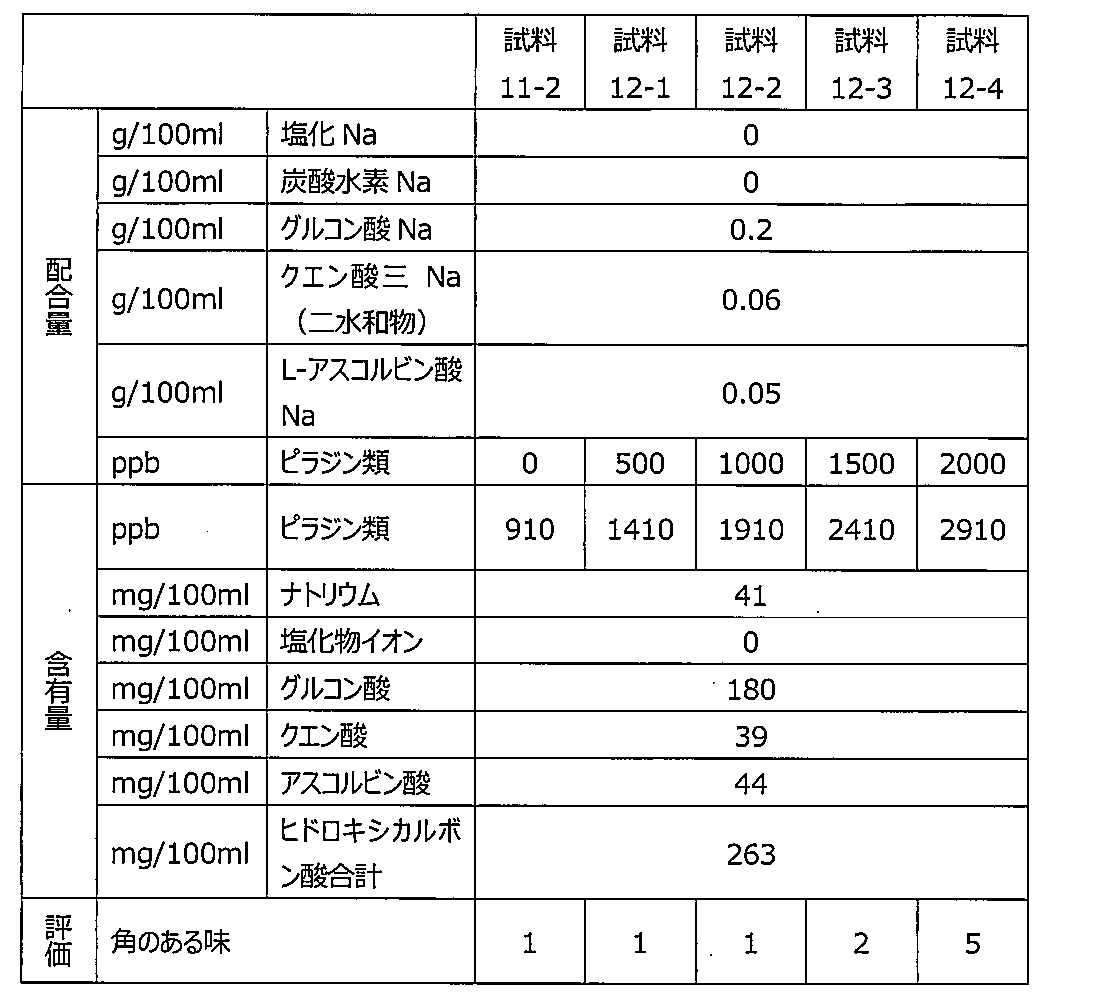
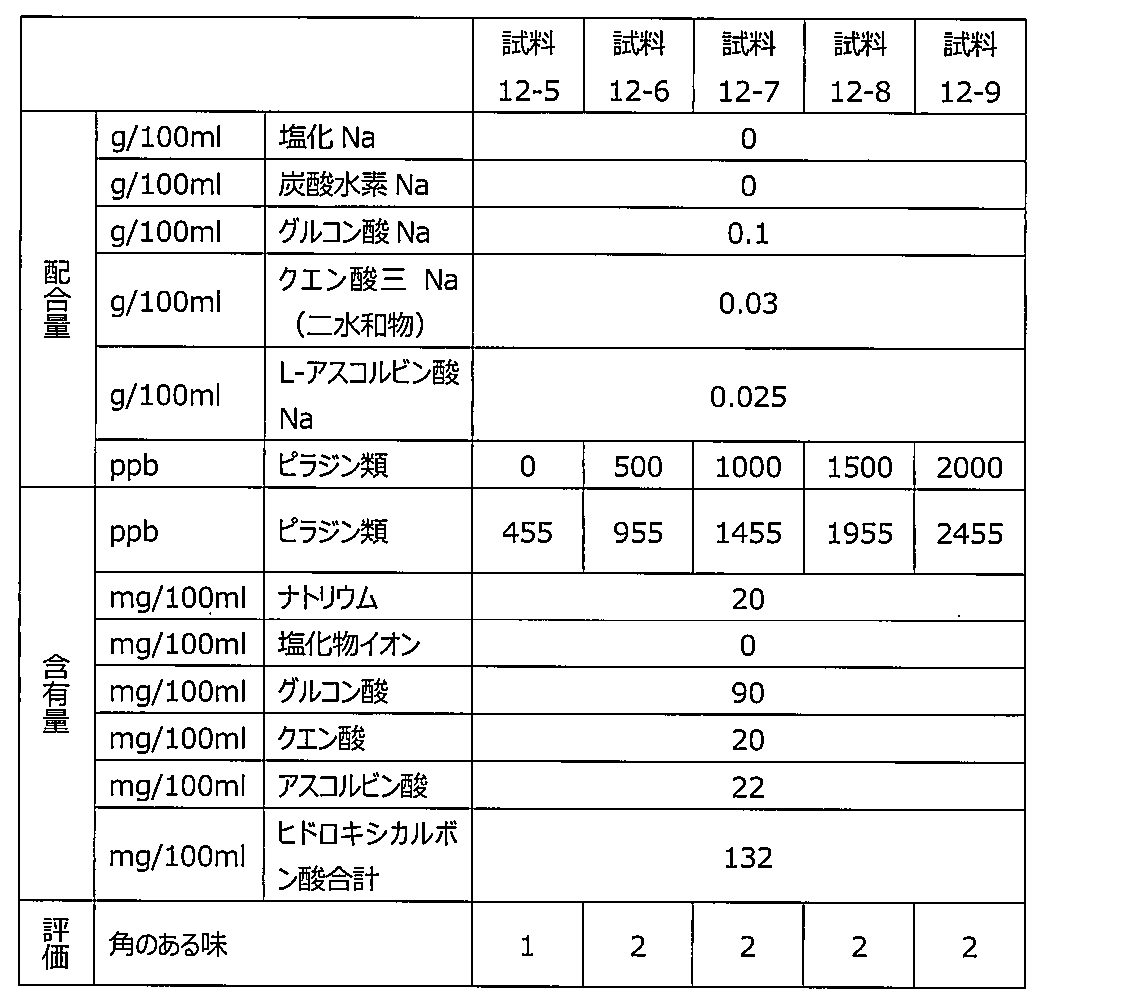
実験10で調製した試料11-2(ピラジン類含有量:910ppb、pH6.0)に、表12の処方でピラジン標準液(富士フィルム和光純薬)を添加してピラジン含有量の異なる麦茶飲料を調製した(試料12-1~12-4)。また、試料11-2を水で2倍に希釈した飲料(試料12-5)を調製し、これにピラジン標準液を添加したものも調製した(表13)。ピラジン量の異なる各種麦茶飲料について、実験1と同様に評価した。結果を表12及び13に示す。ピラジン類含有量が2500mg/100ml以下の範囲では、ヒドロキシカルボン酸によって角のある味がまろやかな味になることが確認された。
実験10で調製した試料11-2(ピラジン類含有量:910ppb、pH6.0)に、表12の処方でピラジン標準液(富士フィルム和光純薬)を添加してピラジン含有量の異なる麦茶飲料を調製した(試料12-1~12-4)。また、試料11-2を水で2倍に希釈した飲料(試料12-5)を調製し、これにピラジン標準液を添加したものも調製した(表13)。ピラジン量の異なる各種麦茶飲料について、実験1と同様に評価した。結果を表12及び13に示す。ピラジン類含有量が2500mg/100ml以下の範囲では、ヒドロキシカルボン酸によって角のある味がまろやかな味になることが確認された。
実験12:ヒドロキシカルボン酸の効果
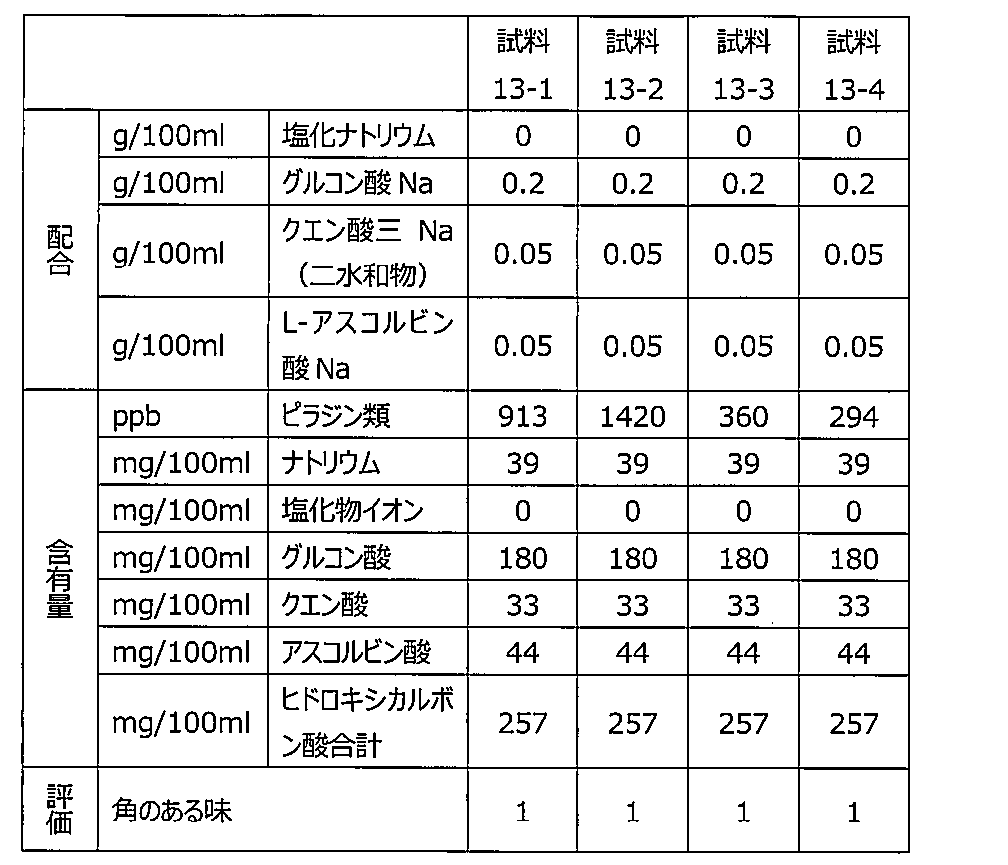
実験1で用いた市販の穀類茶飲料に対して、表14の処方でナトリウム及びヒドロキシカルボン酸を配合して、ナトリウム含有穀類茶飲料を調製した。いずれの飲料もpHは4.5~7.5の範囲内であり、炭水化物含有量は2.0mg/100ml以下であった。いずれの飲料も穀類茶及びナトリウムに起因する角のある味が感じられない、まろやかな味を有する飲料であった。
実験1で用いた市販の穀類茶飲料に対して、表14の処方でナトリウム及びヒドロキシカルボン酸を配合して、ナトリウム含有穀類茶飲料を調製した。いずれの飲料もpHは4.5~7.5の範囲内であり、炭水化物含有量は2.0mg/100ml以下であった。いずれの飲料も穀類茶及びナトリウムに起因する角のある味が感じられない、まろやかな味を有する飲料であった。
Claims (3)
- 以下の(i)~(v):
(i)250~2500ppbのピラジン類;
(ii)20~80mg/100mlのナトリウム;
(iii)30mg/100ml以下の塩化物イオン;
(iv)グルコン酸、クエン酸、及びアスコルビン酸から選択される1種以上のヒドロキシカルボン酸;及び、
(v)焙煎穀類抽出物;
を含み、(iv)ヒドロキシカルボン酸の合計濃度が20~800mg/100mlである、穀類茶飲料。 - pHが4.5~7.5である、請求項1に記載の穀類茶飲料。
- 炭水化物含有量が2.0g/100ml以下である、請求項1又は2に記載の穀類茶飲料。
Applications Claiming Priority (2)
| Application Number | Priority Date | Filing Date | Title |
|---|---|---|---|
| JP2019-076559 | 2019-04-12 | ||
| JP2019076559A JP7213738B2 (ja) | 2019-04-12 | 2019-04-12 | ナトリウム含有穀類茶飲料 |
Publications (1)
| Publication Number | Publication Date |
|---|---|
| WO2020209301A1 true WO2020209301A1 (ja) | 2020-10-15 |
Family
ID=72750683
Family Applications (1)
| Application Number | Title | Priority Date | Filing Date |
|---|---|---|---|
| PCT/JP2020/015858 Ceased WO2020209301A1 (ja) | 2019-04-12 | 2020-04-08 | ナトリウム含有穀類茶飲料 |
Country Status (2)
| Country | Link |
|---|---|
| JP (1) | JP7213738B2 (ja) |
| WO (1) | WO2020209301A1 (ja) |
Citations (5)
| Publication number | Priority date | Publication date | Assignee | Title |
|---|---|---|---|---|
| JPS6283847A (ja) * | 1985-10-07 | 1987-04-17 | Tanpei Seiyaku Kk | 健康茶 |
| JP2003079350A (ja) * | 2001-09-07 | 2003-03-18 | Ito En Ltd | 麦茶飲料の製造方法 |
| JP2012170332A (ja) * | 2011-02-17 | 2012-09-10 | Suntory Holdings Ltd | 麦茶の製造方法 |
| JP2012217348A (ja) * | 2011-04-04 | 2012-11-12 | Ito En Ltd | 容器詰麦茶飲料 |
| JP2015008704A (ja) * | 2013-07-01 | 2015-01-19 | サントリー食品インターナショナル株式会社 | 混合茶飲料 |
Family Cites Families (1)
| Publication number | Priority date | Publication date | Assignee | Title |
|---|---|---|---|---|
| JPH01291774A (ja) * | 1988-05-19 | 1989-11-24 | Kitsukoo Shokuhin Kogyo Kk | 麦茶ドリンクの製造法 |
-
2019
- 2019-04-12 JP JP2019076559A patent/JP7213738B2/ja active Active
-
2020
- 2020-04-08 WO PCT/JP2020/015858 patent/WO2020209301A1/ja not_active Ceased
Patent Citations (5)
| Publication number | Priority date | Publication date | Assignee | Title |
|---|---|---|---|---|
| JPS6283847A (ja) * | 1985-10-07 | 1987-04-17 | Tanpei Seiyaku Kk | 健康茶 |
| JP2003079350A (ja) * | 2001-09-07 | 2003-03-18 | Ito En Ltd | 麦茶飲料の製造方法 |
| JP2012170332A (ja) * | 2011-02-17 | 2012-09-10 | Suntory Holdings Ltd | 麦茶の製造方法 |
| JP2012217348A (ja) * | 2011-04-04 | 2012-11-12 | Ito En Ltd | 容器詰麦茶飲料 |
| JP2015008704A (ja) * | 2013-07-01 | 2015-01-19 | サントリー食品インターナショナル株式会社 | 混合茶飲料 |
Also Published As
| Publication number | Publication date |
|---|---|
| JP2020171261A (ja) | 2020-10-22 |
| JP7213738B2 (ja) | 2023-01-27 |
Similar Documents
| Publication | Publication Date | Title |
|---|---|---|
| TWI580777B (zh) | 非發酵之類啤酒發泡性飲料 | |
| KR101546566B1 (ko) | 용기에 담긴 녹차 음료 | |
| KR101546565B1 (ko) | 용기에 담긴 녹차 음료 | |
| WO2021132439A1 (ja) | 呈味が増強された緑茶飲料 | |
| WO2019059391A1 (ja) | カリウム含有無色透明飲料 | |
| KR101627541B1 (ko) | 용기에 담긴 호지차 음료 | |
| JP6478453B2 (ja) | 麦茶飲料 | |
| JP2021106522A (ja) | 呈味が増強された緑茶飲料 | |
| JP6845742B2 (ja) | 焙煎植物抽出物を含有する飲料 | |
| JP7213738B2 (ja) | ナトリウム含有穀類茶飲料 | |
| JP6836672B1 (ja) | ピラジン類及びナトリウムを含有する飲料 | |
| JP2018191555A (ja) | カフェイン含有飲料 | |
| JP7037248B2 (ja) | 焙煎穀物茶飲料、焙煎穀物茶飲料の製造方法、及び、焙煎穀物茶飲料の風香味向上方法 | |
| JP6657461B1 (ja) | 1−デオキシノジリマイシンを含む容器詰飲料 | |
| JP7211879B2 (ja) | ナトリウム及びグルコン酸を含有する飲料 | |
| TW201919485A (zh) | 含有鈉之無色透明飲料 | |
| CN113573590B (zh) | 容器装茶饮料 | |
| JP2021106569A (ja) | 呈味が増強された緑茶飲料 | |
| JP6895762B2 (ja) | ヘスペリジンと高甘味度甘味料を併用することによって増強されたヘスペリジンの異臭が抑制された容器詰ヘスペリジン含有飲料 | |
| JP7211881B2 (ja) | ナトリウム、カリウム、及びクエン酸を含有する飲料 | |
| KR20210132198A (ko) | 음료 조성물 | |
| JP7211880B2 (ja) | ナトリウム、カリウム、及びアスコルビン酸を含有する飲料 | |
| KR102722863B1 (ko) | 분무건조 콤부차 분말을 이용한 고형차의 제조방법 | |
| JP2021048774A (ja) | ほうじ茶飲料、ほうじ茶飲料の製造方法、並びにほうじ茶飲料の香り立ち、及び味の厚みを向上させる方法 | |
| JP6808082B1 (ja) | 苦味が強化された緑茶飲料 |
Legal Events
| Date | Code | Title | Description |
|---|---|---|---|
| 121 | Ep: the epo has been informed by wipo that ep was designated in this application |
Ref document number: 20787380 Country of ref document: EP Kind code of ref document: A1 |
|
| NENP | Non-entry into the national phase |
Ref country code: DE |
|
| 122 | Ep: pct application non-entry in european phase |
Ref document number: 20787380 Country of ref document: EP Kind code of ref document: A1 |